EP2269817A1 - Hydrophilic member, fin member, aluminum fin member, heat exchanger and air conditioner - Google Patents
Hydrophilic member, fin member, aluminum fin member, heat exchanger and air conditioner Download PDFInfo
- Publication number
- EP2269817A1 EP2269817A1 EP09726264A EP09726264A EP2269817A1 EP 2269817 A1 EP2269817 A1 EP 2269817A1 EP 09726264 A EP09726264 A EP 09726264A EP 09726264 A EP09726264 A EP 09726264A EP 2269817 A1 EP2269817 A1 EP 2269817A1
- Authority
- EP
- European Patent Office
- Prior art keywords
- hydrophilic
- group
- polymer
- film
- water
- Prior art date
- Legal status (The legal status is an assumption and is not a legal conclusion. Google has not performed a legal analysis and makes no representation as to the accuracy of the status listed.)
- Withdrawn
Links
- 229910052782 aluminium Inorganic materials 0.000 title claims description 26
- XAGFODPZIPBFFR-UHFFFAOYSA-N aluminium Chemical compound [Al] XAGFODPZIPBFFR-UHFFFAOYSA-N 0.000 title claims description 18
- 229920001477 hydrophilic polymer Polymers 0.000 claims abstract description 112
- 239000000203 mixture Substances 0.000 claims abstract description 72
- XLYOFNOQVPJJNP-UHFFFAOYSA-N water Substances O XLYOFNOQVPJJNP-UHFFFAOYSA-N 0.000 claims abstract description 68
- 125000005370 alkoxysilyl group Chemical group 0.000 claims abstract description 49
- 229920000642 polymer Polymers 0.000 claims abstract description 46
- 239000003054 catalyst Substances 0.000 claims abstract description 31
- 239000000463 material Substances 0.000 claims abstract description 30
- 150000004696 coordination complex Chemical class 0.000 claims abstract description 24
- 230000008961 swelling Effects 0.000 claims abstract description 14
- 125000000217 alkyl group Chemical group 0.000 claims description 27
- 239000002585 base Substances 0.000 claims description 22
- 125000004435 hydrogen atom Chemical group [H]* 0.000 claims description 22
- 125000003118 aryl group Chemical group 0.000 claims description 18
- 125000005647 linker group Chemical group 0.000 claims description 16
- 238000010438 heat treatment Methods 0.000 claims description 15
- 125000003710 aryl alkyl group Chemical group 0.000 claims description 11
- 229910052783 alkali metal Inorganic materials 0.000 claims description 9
- 229910052736 halogen Inorganic materials 0.000 claims description 9
- 150000001340 alkali metals Chemical class 0.000 claims description 8
- 229910052784 alkaline earth metal Inorganic materials 0.000 claims description 8
- 150000001342 alkaline earth metals Chemical class 0.000 claims description 8
- 125000001183 hydrocarbyl group Chemical group 0.000 claims 2
- 230000003373 anti-fouling effect Effects 0.000 abstract description 17
- -1 halogen ion Chemical class 0.000 description 98
- 239000010410 layer Substances 0.000 description 65
- 238000000576 coating method Methods 0.000 description 50
- 239000000243 solution Substances 0.000 description 47
- 150000001875 compounds Chemical class 0.000 description 44
- 239000011248 coating agent Substances 0.000 description 42
- 229920005989 resin Polymers 0.000 description 38
- 239000011347 resin Substances 0.000 description 38
- 238000000034 method Methods 0.000 description 35
- YRKCREAYFQTBPV-UHFFFAOYSA-N acetylacetone Chemical compound CC(=O)CC(C)=O YRKCREAYFQTBPV-UHFFFAOYSA-N 0.000 description 34
- 239000011521 glass Substances 0.000 description 31
- OKTJSMMVPCPJKN-UHFFFAOYSA-N Carbon Chemical compound [C] OKTJSMMVPCPJKN-UHFFFAOYSA-N 0.000 description 24
- 239000003242 anti bacterial agent Substances 0.000 description 24
- 238000001035 drying Methods 0.000 description 24
- 229910052799 carbon Inorganic materials 0.000 description 22
- 238000006243 chemical reaction Methods 0.000 description 21
- LFQSCWFLJHTTHZ-UHFFFAOYSA-N Ethanol Chemical compound CCO LFQSCWFLJHTTHZ-UHFFFAOYSA-N 0.000 description 20
- 239000000499 gel Substances 0.000 description 20
- 0 CC*(C(C)(C)C)*(C)(C)CCCN Chemical compound CC*(C(C)(C)C)*(C)(C)CCCN 0.000 description 19
- 150000003839 salts Chemical class 0.000 description 18
- 239000007787 solid Substances 0.000 description 18
- 229910052751 metal Inorganic materials 0.000 description 17
- 125000001424 substituent group Chemical group 0.000 description 17
- 239000000758 substrate Substances 0.000 description 17
- 229920003171 Poly (ethylene oxide) Polymers 0.000 description 16
- 150000002148 esters Chemical class 0.000 description 16
- 239000000126 substance Substances 0.000 description 16
- 239000002184 metal Substances 0.000 description 15
- 238000002360 preparation method Methods 0.000 description 15
- 239000010936 titanium Substances 0.000 description 15
- 239000000853 adhesive Substances 0.000 description 14
- 150000004703 alkoxides Chemical class 0.000 description 14
- 230000000845 anti-microbial effect Effects 0.000 description 14
- 235000014113 dietary fatty acids Nutrition 0.000 description 14
- 239000000194 fatty acid Substances 0.000 description 14
- 229930195729 fatty acid Natural products 0.000 description 14
- 239000000178 monomer Substances 0.000 description 14
- 239000004094 surface-active agent Substances 0.000 description 14
- 229910052719 titanium Inorganic materials 0.000 description 14
- 239000002253 acid Substances 0.000 description 13
- 230000001070 adhesive effect Effects 0.000 description 13
- 239000007864 aqueous solution Substances 0.000 description 12
- 239000003431 cross linking reagent Substances 0.000 description 12
- 239000004816 latex Substances 0.000 description 12
- 229920000126 latex Polymers 0.000 description 12
- 229920003023 plastic Polymers 0.000 description 12
- 235000019441 ethanol Nutrition 0.000 description 11
- RTZKZFJDLAIYFH-UHFFFAOYSA-N ether Substances CCOCC RTZKZFJDLAIYFH-UHFFFAOYSA-N 0.000 description 11
- 125000000524 functional group Chemical group 0.000 description 11
- 239000004033 plastic Substances 0.000 description 11
- VYPSYNLAJGMNEJ-UHFFFAOYSA-N Silicium dioxide Chemical compound O=[Si]=O VYPSYNLAJGMNEJ-UHFFFAOYSA-N 0.000 description 10
- 239000003945 anionic surfactant Substances 0.000 description 10
- 230000000052 comparative effect Effects 0.000 description 10
- 239000000356 contaminant Substances 0.000 description 10
- 238000004132 cross linking Methods 0.000 description 10
- JMXKSZRRTHPKDL-UHFFFAOYSA-N titanium ethoxide Chemical compound [Ti+4].CC[O-].CC[O-].CC[O-].CC[O-] JMXKSZRRTHPKDL-UHFFFAOYSA-N 0.000 description 10
- 239000003981 vehicle Substances 0.000 description 10
- 229910052726 zirconium Inorganic materials 0.000 description 10
- CSCPPACGZOOCGX-UHFFFAOYSA-N Acetone Chemical compound CC(C)=O CSCPPACGZOOCGX-UHFFFAOYSA-N 0.000 description 9
- XEKOWRVHYACXOJ-UHFFFAOYSA-N Ethyl acetate Chemical compound CCOC(C)=O XEKOWRVHYACXOJ-UHFFFAOYSA-N 0.000 description 9
- 125000002947 alkylene group Chemical group 0.000 description 9
- 238000001816 cooling Methods 0.000 description 9
- 230000000694 effects Effects 0.000 description 9
- 150000002430 hydrocarbons Chemical group 0.000 description 9
- 125000002496 methyl group Chemical group [H]C([H])([H])* 0.000 description 9
- 239000004372 Polyvinyl alcohol Substances 0.000 description 8
- 239000006087 Silane Coupling Agent Substances 0.000 description 8
- BQCADISMDOOEFD-UHFFFAOYSA-N Silver Chemical compound [Ag] BQCADISMDOOEFD-UHFFFAOYSA-N 0.000 description 8
- 230000015572 biosynthetic process Effects 0.000 description 8
- 239000010419 fine particle Substances 0.000 description 8
- 239000005357 flat glass Substances 0.000 description 8
- 229910052731 fluorine Inorganic materials 0.000 description 8
- 230000036961 partial effect Effects 0.000 description 8
- 229920002451 polyvinyl alcohol Polymers 0.000 description 8
- 229910052710 silicon Inorganic materials 0.000 description 8
- 229910052709 silver Inorganic materials 0.000 description 8
- 239000004332 silver Substances 0.000 description 8
- 239000002904 solvent Substances 0.000 description 8
- 238000002834 transmittance Methods 0.000 description 8
- 239000003795 chemical substances by application Substances 0.000 description 7
- 239000011737 fluorine Substances 0.000 description 7
- 230000003287 optical effect Effects 0.000 description 7
- ZWEHNKRNPOVVGH-UHFFFAOYSA-N 2-Butanone Chemical compound CCC(C)=O ZWEHNKRNPOVVGH-UHFFFAOYSA-N 0.000 description 6
- YCKRFDGAMUMZLT-UHFFFAOYSA-N Fluorine atom Chemical compound [F] YCKRFDGAMUMZLT-UHFFFAOYSA-N 0.000 description 6
- PPBRXRYQALVLMV-UHFFFAOYSA-N Styrene Chemical compound C=CC1=CC=CC=C1 PPBRXRYQALVLMV-UHFFFAOYSA-N 0.000 description 6
- RTAQQCXQSZGOHL-UHFFFAOYSA-N Titanium Chemical compound [Ti] RTAQQCXQSZGOHL-UHFFFAOYSA-N 0.000 description 6
- 230000000844 anti-bacterial effect Effects 0.000 description 6
- 238000009835 boiling Methods 0.000 description 6
- 229920001577 copolymer Polymers 0.000 description 6
- 238000007598 dipping method Methods 0.000 description 6
- 125000005010 perfluoroalkyl group Chemical group 0.000 description 6
- 229920001223 polyethylene glycol Polymers 0.000 description 6
- 239000008213 purified water Substances 0.000 description 6
- 238000010526 radical polymerization reaction Methods 0.000 description 6
- HRPVXLWXLXDGHG-UHFFFAOYSA-N Acrylamide Chemical compound NC(=O)C=C HRPVXLWXLXDGHG-UHFFFAOYSA-N 0.000 description 5
- VEXZGXHMUGYJMC-UHFFFAOYSA-N Hydrochloric acid Chemical compound Cl VEXZGXHMUGYJMC-UHFFFAOYSA-N 0.000 description 5
- XEEYBQQBJWHFJM-UHFFFAOYSA-N Iron Chemical compound [Fe] XEEYBQQBJWHFJM-UHFFFAOYSA-N 0.000 description 5
- 239000002202 Polyethylene glycol Substances 0.000 description 5
- 125000003178 carboxy group Chemical group [H]OC(*)=O 0.000 description 5
- 238000007334 copolymerization reaction Methods 0.000 description 5
- HNPSIPDUKPIQMN-UHFFFAOYSA-N dioxosilane;oxo(oxoalumanyloxy)alumane Chemical compound O=[Si]=O.O=[Al]O[Al]=O HNPSIPDUKPIQMN-UHFFFAOYSA-N 0.000 description 5
- 239000000428 dust Substances 0.000 description 5
- 125000001495 ethyl group Chemical group [H]C([H])([H])C([H])([H])* 0.000 description 5
- 230000007062 hydrolysis Effects 0.000 description 5
- 238000006460 hydrolysis reaction Methods 0.000 description 5
- 238000007788 roughening Methods 0.000 description 5
- 238000003756 stirring Methods 0.000 description 5
- LFQCEHFDDXELDD-UHFFFAOYSA-N tetramethyl orthosilicate Chemical compound CO[Si](OC)(OC)OC LFQCEHFDDXELDD-UHFFFAOYSA-N 0.000 description 5
- ARXJGSRGQADJSQ-UHFFFAOYSA-N 1-methoxypropan-2-ol Chemical compound COCC(C)O ARXJGSRGQADJSQ-UHFFFAOYSA-N 0.000 description 4
- VCRZAKVGPJFABU-UHFFFAOYSA-N 10-phenoxarsinin-10-yloxyphenoxarsinine Chemical compound C12=CC=CC=C2OC2=CC=CC=C2[As]1O[As]1C2=CC=CC=C2OC2=CC=CC=C21 VCRZAKVGPJFABU-UHFFFAOYSA-N 0.000 description 4
- IJGRMHOSHXDMSA-UHFFFAOYSA-N Atomic nitrogen Chemical compound N#N IJGRMHOSHXDMSA-UHFFFAOYSA-N 0.000 description 4
- CERQOIWHTDAKMF-UHFFFAOYSA-N Methacrylic acid Chemical compound CC(=C)C(O)=O CERQOIWHTDAKMF-UHFFFAOYSA-N 0.000 description 4
- JUJWROOIHBZHMG-UHFFFAOYSA-N Pyridine Chemical compound C1=CC=NC=C1 JUJWROOIHBZHMG-UHFFFAOYSA-N 0.000 description 4
- 241001074085 Scophthalmus aquosus Species 0.000 description 4
- GWEVSGVZZGPLCZ-UHFFFAOYSA-N Titan oxide Chemical compound O=[Ti]=O GWEVSGVZZGPLCZ-UHFFFAOYSA-N 0.000 description 4
- 229910021536 Zeolite Inorganic materials 0.000 description 4
- LEQAOMBKQFMDFZ-UHFFFAOYSA-N alpha-ketodiacetal Natural products O=CC=O LEQAOMBKQFMDFZ-UHFFFAOYSA-N 0.000 description 4
- 239000003963 antioxidant agent Substances 0.000 description 4
- 230000003078 antioxidant effect Effects 0.000 description 4
- 150000001732 carboxylic acid derivatives Chemical class 0.000 description 4
- 239000000919 ceramic Substances 0.000 description 4
- 238000009833 condensation Methods 0.000 description 4
- 230000005494 condensation Effects 0.000 description 4
- SWXVUIWOUIDPGS-UHFFFAOYSA-N diacetone alcohol Chemical compound CC(=O)CC(C)(C)O SWXVUIWOUIDPGS-UHFFFAOYSA-N 0.000 description 4
- 238000000572 ellipsometry Methods 0.000 description 4
- 230000002708 enhancing effect Effects 0.000 description 4
- 238000011156 evaluation Methods 0.000 description 4
- 230000001747 exhibiting effect Effects 0.000 description 4
- 150000004665 fatty acids Chemical class 0.000 description 4
- IPCSVZSSVZVIGE-UHFFFAOYSA-N hexadecanoic acid Chemical compound CCCCCCCCCCCCCCCC(O)=O IPCSVZSSVZVIGE-UHFFFAOYSA-N 0.000 description 4
- 230000003301 hydrolyzing effect Effects 0.000 description 4
- 230000001965 increasing effect Effects 0.000 description 4
- 125000001570 methylene group Chemical group [H]C([H])([*:1])[*:2] 0.000 description 4
- 230000003647 oxidation Effects 0.000 description 4
- 238000007254 oxidation reaction Methods 0.000 description 4
- 238000006068 polycondensation reaction Methods 0.000 description 4
- 238000006116 polymerization reaction Methods 0.000 description 4
- 229920001451 polypropylene glycol Polymers 0.000 description 4
- 229920001296 polysiloxane Polymers 0.000 description 4
- 239000000047 product Substances 0.000 description 4
- 239000011241 protective layer Substances 0.000 description 4
- 238000001308 synthesis method Methods 0.000 description 4
- 238000003786 synthesis reaction Methods 0.000 description 4
- WJCNZQLZVWNLKY-UHFFFAOYSA-N thiabendazole Chemical compound S1C=NC(C=2NC3=CC=CC=C3N=2)=C1 WJCNZQLZVWNLKY-UHFFFAOYSA-N 0.000 description 4
- 239000006097 ultraviolet radiation absorber Substances 0.000 description 4
- 125000000391 vinyl group Chemical group [H]C([*])=C([H])[H] 0.000 description 4
- 239000010457 zeolite Substances 0.000 description 4
- JYEUMXHLPRZUAT-UHFFFAOYSA-N 1,2,3-triazine Chemical compound C1=CN=NN=C1 JYEUMXHLPRZUAT-UHFFFAOYSA-N 0.000 description 3
- NIXOWILDQLNWCW-UHFFFAOYSA-N 2-Propenoic acid Natural products OC(=O)C=C NIXOWILDQLNWCW-UHFFFAOYSA-N 0.000 description 3
- UUEWCQRISZBELL-UHFFFAOYSA-N 3-trimethoxysilylpropane-1-thiol Chemical compound CO[Si](OC)(OC)CCCS UUEWCQRISZBELL-UHFFFAOYSA-N 0.000 description 3
- QTBSBXVTEAMEQO-UHFFFAOYSA-N Acetic acid Chemical compound CC(O)=O QTBSBXVTEAMEQO-UHFFFAOYSA-N 0.000 description 3
- UHOVQNZJYSORNB-UHFFFAOYSA-N Benzene Chemical compound C1=CC=CC=C1 UHOVQNZJYSORNB-UHFFFAOYSA-N 0.000 description 3
- LVDKZNITIUWNER-UHFFFAOYSA-N Bronopol Chemical compound OCC(Br)(CO)[N+]([O-])=O LVDKZNITIUWNER-UHFFFAOYSA-N 0.000 description 3
- 101100188540 Candida albicans (strain SC5314 / ATCC MYA-2876) OBPA gene Proteins 0.000 description 3
- RYGMFSIKBFXOCR-UHFFFAOYSA-N Copper Chemical compound [Cu] RYGMFSIKBFXOCR-UHFFFAOYSA-N 0.000 description 3
- YMWUJEATGCHHMB-UHFFFAOYSA-N Dichloromethane Chemical compound ClCCl YMWUJEATGCHHMB-UHFFFAOYSA-N 0.000 description 3
- 108010010803 Gelatin Proteins 0.000 description 3
- KFZMGEQAYNKOFK-UHFFFAOYSA-N Isopropanol Chemical compound CC(C)O KFZMGEQAYNKOFK-UHFFFAOYSA-N 0.000 description 3
- OKKJLVBELUTLKV-UHFFFAOYSA-N Methanol Chemical compound OC OKKJLVBELUTLKV-UHFFFAOYSA-N 0.000 description 3
- LRHPLDYGYMQRHN-UHFFFAOYSA-N N-Butanol Chemical compound CCCCO LRHPLDYGYMQRHN-UHFFFAOYSA-N 0.000 description 3
- 239000004698 Polyethylene Substances 0.000 description 3
- DNIAPMSPPWPWGF-UHFFFAOYSA-N Propylene glycol Chemical compound CC(O)CO DNIAPMSPPWPWGF-UHFFFAOYSA-N 0.000 description 3
- YXFVVABEGXRONW-UHFFFAOYSA-N Toluene Chemical compound CC1=CC=CC=C1 YXFVVABEGXRONW-UHFFFAOYSA-N 0.000 description 3
- 239000007983 Tris buffer Substances 0.000 description 3
- HCHKCACWOHOZIP-UHFFFAOYSA-N Zinc Chemical compound [Zn] HCHKCACWOHOZIP-UHFFFAOYSA-N 0.000 description 3
- 239000012790 adhesive layer Substances 0.000 description 3
- 239000003513 alkali Substances 0.000 description 3
- 229910045601 alloy Inorganic materials 0.000 description 3
- 239000000956 alloy Substances 0.000 description 3
- 239000002280 amphoteric surfactant Substances 0.000 description 3
- 125000004429 atom Chemical group 0.000 description 3
- 229910052788 barium Inorganic materials 0.000 description 3
- 239000004566 building material Substances 0.000 description 3
- 125000003917 carbamoyl group Chemical group [H]N([H])C(*)=O 0.000 description 3
- BVKZGUZCCUSVTD-UHFFFAOYSA-N carbonic acid Chemical compound OC(O)=O BVKZGUZCCUSVTD-UHFFFAOYSA-N 0.000 description 3
- 239000003093 cationic surfactant Substances 0.000 description 3
- 239000012986 chain transfer agent Substances 0.000 description 3
- KRVSOGSZCMJSLX-UHFFFAOYSA-L chromic acid Substances O[Cr](O)(=O)=O KRVSOGSZCMJSLX-UHFFFAOYSA-L 0.000 description 3
- 229920006026 co-polymeric resin Polymers 0.000 description 3
- 239000013065 commercial product Substances 0.000 description 3
- 229910052802 copper Inorganic materials 0.000 description 3
- 239000010949 copper Substances 0.000 description 3
- 125000004122 cyclic group Chemical group 0.000 description 3
- VILAVOFMIJHSJA-UHFFFAOYSA-N dicarbon monoxide Chemical compound [C]=C=O VILAVOFMIJHSJA-UHFFFAOYSA-N 0.000 description 3
- 239000006185 dispersion Substances 0.000 description 3
- AWJWCTOOIBYHON-UHFFFAOYSA-N furo[3,4-b]pyrazine-5,7-dione Chemical compound C1=CN=C2C(=O)OC(=O)C2=N1 AWJWCTOOIBYHON-UHFFFAOYSA-N 0.000 description 3
- 229920000159 gelatin Polymers 0.000 description 3
- 235000019322 gelatine Nutrition 0.000 description 3
- 235000011852 gelatine desserts Nutrition 0.000 description 3
- 125000000623 heterocyclic group Chemical group 0.000 description 3
- 125000004051 hexyl group Chemical group [H]C([H])([H])C([H])([H])C([H])([H])C([H])([H])C([H])([H])C([H])([H])* 0.000 description 3
- 238000010030 laminating Methods 0.000 description 3
- 238000003475 lamination Methods 0.000 description 3
- 239000003446 ligand Substances 0.000 description 3
- MQXVYODZCMMZEM-ZYUZMQFOSA-N mannomustine Chemical compound ClCCNC[C@@H](O)[C@@H](O)[C@H](O)[C@H](O)CNCCCl MQXVYODZCMMZEM-ZYUZMQFOSA-N 0.000 description 3
- FQPSGWSUVKBHSU-UHFFFAOYSA-N methacrylamide Chemical class CC(=C)C(N)=O FQPSGWSUVKBHSU-UHFFFAOYSA-N 0.000 description 3
- BFXIKLCIZHOAAZ-UHFFFAOYSA-N methyltrimethoxysilane Chemical compound CO[Si](C)(OC)OC BFXIKLCIZHOAAZ-UHFFFAOYSA-N 0.000 description 3
- 229910052757 nitrogen Inorganic materials 0.000 description 3
- 239000002736 nonionic surfactant Substances 0.000 description 3
- 125000001436 propyl group Chemical group [H]C([*])([H])C([H])([H])C([H])([H])[H] 0.000 description 3
- 230000001681 protective effect Effects 0.000 description 3
- 230000009467 reduction Effects 0.000 description 3
- 239000000377 silicon dioxide Substances 0.000 description 3
- 239000004575 stone Substances 0.000 description 3
- 125000000547 substituted alkyl group Chemical group 0.000 description 3
- 229910052725 zinc Inorganic materials 0.000 description 3
- 239000011701 zinc Substances 0.000 description 3
- SMZOUWXMTYCWNB-UHFFFAOYSA-N 2-(2-methoxy-5-methylphenyl)ethanamine Chemical compound COC1=CC=C(C)C=C1CCN SMZOUWXMTYCWNB-UHFFFAOYSA-N 0.000 description 2
- 125000003229 2-methylhexyl group Chemical group [H]C([H])([H])C([H])([H])C([H])([H])C([H])([H])C([H])(C([H])([H])[H])C([H])([H])* 0.000 description 2
- PAYRUJLWNCNPSJ-UHFFFAOYSA-N Aniline Chemical compound NC1=CC=CC=C1 PAYRUJLWNCNPSJ-UHFFFAOYSA-N 0.000 description 2
- LSNNMFCWUKXFEE-UHFFFAOYSA-M Bisulfite Chemical compound OS([O-])=O LSNNMFCWUKXFEE-UHFFFAOYSA-M 0.000 description 2
- SOGAXMICEFXMKE-UHFFFAOYSA-N Butylmethacrylate Chemical compound CCCCOC(=O)C(C)=C SOGAXMICEFXMKE-UHFFFAOYSA-N 0.000 description 2
- 229920002101 Chitin Polymers 0.000 description 2
- 229920001661 Chitosan Polymers 0.000 description 2
- HEDRZPFGACZZDS-UHFFFAOYSA-N Chloroform Chemical compound ClC(Cl)Cl HEDRZPFGACZZDS-UHFFFAOYSA-N 0.000 description 2
- FBPFZTCFMRRESA-FSIIMWSLSA-N D-Glucitol Natural products OC[C@H](O)[C@H](O)[C@@H](O)[C@H](O)CO FBPFZTCFMRRESA-FSIIMWSLSA-N 0.000 description 2
- XTHFKEDIFFGKHM-UHFFFAOYSA-N Dimethoxyethane Chemical compound COCCOC XTHFKEDIFFGKHM-UHFFFAOYSA-N 0.000 description 2
- QUSNBJAOOMFDIB-UHFFFAOYSA-N Ethylamine Chemical compound CCN QUSNBJAOOMFDIB-UHFFFAOYSA-N 0.000 description 2
- WSFSSNUMVMOOMR-UHFFFAOYSA-N Formaldehyde Chemical compound O=C WSFSSNUMVMOOMR-UHFFFAOYSA-N 0.000 description 2
- MHAJPDPJQMAIIY-UHFFFAOYSA-N Hydrogen peroxide Chemical compound OO MHAJPDPJQMAIIY-UHFFFAOYSA-N 0.000 description 2
- 229920000663 Hydroxyethyl cellulose Polymers 0.000 description 2
- 239000004354 Hydroxyethyl cellulose Substances 0.000 description 2
- TWRXJAOTZQYOKJ-UHFFFAOYSA-L Magnesium chloride Chemical compound [Mg+2].[Cl-].[Cl-] TWRXJAOTZQYOKJ-UHFFFAOYSA-L 0.000 description 2
- BAPJBEWLBFYGME-UHFFFAOYSA-N Methyl acrylate Chemical compound COC(=O)C=C BAPJBEWLBFYGME-UHFFFAOYSA-N 0.000 description 2
- PXHVJJICTQNCMI-UHFFFAOYSA-N Nickel Chemical compound [Ni] PXHVJJICTQNCMI-UHFFFAOYSA-N 0.000 description 2
- GRYLNZFGIOXLOG-UHFFFAOYSA-N Nitric acid Chemical compound O[N+]([O-])=O GRYLNZFGIOXLOG-UHFFFAOYSA-N 0.000 description 2
- BPQQTUXANYXVAA-UHFFFAOYSA-N Orthosilicate Chemical compound [O-][Si]([O-])([O-])[O-] BPQQTUXANYXVAA-UHFFFAOYSA-N 0.000 description 2
- CBENFWSGALASAD-UHFFFAOYSA-N Ozone Chemical compound [O-][O+]=O CBENFWSGALASAD-UHFFFAOYSA-N 0.000 description 2
- 229910019142 PO4 Inorganic materials 0.000 description 2
- 235000021314 Palmitic acid Nutrition 0.000 description 2
- NBIIXXVUZAFLBC-UHFFFAOYSA-N Phosphoric acid Chemical compound OP(O)(O)=O NBIIXXVUZAFLBC-UHFFFAOYSA-N 0.000 description 2
- 229920002873 Polyethylenimine Polymers 0.000 description 2
- XUIMIQQOPSSXEZ-UHFFFAOYSA-N Silicon Chemical compound [Si] XUIMIQQOPSSXEZ-UHFFFAOYSA-N 0.000 description 2
- CDBYLPFSWZWCQE-UHFFFAOYSA-L Sodium Carbonate Chemical compound [Na+].[Na+].[O-]C([O-])=O CDBYLPFSWZWCQE-UHFFFAOYSA-L 0.000 description 2
- QAOWNCQODCNURD-UHFFFAOYSA-N Sulfuric acid Chemical compound OS(O)(=O)=O QAOWNCQODCNURD-UHFFFAOYSA-N 0.000 description 2
- DKGAVHZHDRPRBM-UHFFFAOYSA-N Tert-Butanol Chemical compound CC(C)(C)O DKGAVHZHDRPRBM-UHFFFAOYSA-N 0.000 description 2
- BOTDANWDWHJENH-UHFFFAOYSA-N Tetraethyl orthosilicate Chemical compound CCO[Si](OCC)(OCC)OCC BOTDANWDWHJENH-UHFFFAOYSA-N 0.000 description 2
- WYURNTSHIVDZCO-UHFFFAOYSA-N Tetrahydrofuran Chemical compound C1CCOC1 WYURNTSHIVDZCO-UHFFFAOYSA-N 0.000 description 2
- 101100020289 Xenopus laevis koza gene Proteins 0.000 description 2
- XLOMVQKBTHCTTD-UHFFFAOYSA-N Zinc monoxide Chemical compound [Zn]=O XLOMVQKBTHCTTD-UHFFFAOYSA-N 0.000 description 2
- IUGGRDVCAVUMLN-UHFFFAOYSA-K [Zr+3].CCCC(=O)CC([O-])=O.CCCC(=O)CC([O-])=O.CCCC(=O)CC([O-])=O Chemical compound [Zr+3].CCCC(=O)CC([O-])=O.CCCC(=O)CC([O-])=O.CCCC(=O)CC([O-])=O IUGGRDVCAVUMLN-UHFFFAOYSA-K 0.000 description 2
- 238000010306 acid treatment Methods 0.000 description 2
- 150000003926 acrylamides Chemical class 0.000 description 2
- 125000005396 acrylic acid ester group Chemical group 0.000 description 2
- 125000002252 acyl group Chemical group 0.000 description 2
- 230000002353 algacidal effect Effects 0.000 description 2
- 125000001931 aliphatic group Chemical group 0.000 description 2
- 125000003545 alkoxy group Chemical group 0.000 description 2
- 150000005215 alkyl ethers Chemical class 0.000 description 2
- MQPPCKJJFDNPHJ-UHFFFAOYSA-K aluminum;3-oxohexanoate Chemical compound [Al+3].CCCC(=O)CC([O-])=O.CCCC(=O)CC([O-])=O.CCCC(=O)CC([O-])=O MQPPCKJJFDNPHJ-UHFFFAOYSA-K 0.000 description 2
- 150000001413 amino acids Chemical class 0.000 description 2
- 125000003277 amino group Chemical group 0.000 description 2
- 230000000843 anti-fungal effect Effects 0.000 description 2
- 230000002421 anti-septic effect Effects 0.000 description 2
- 229940121375 antifungal agent Drugs 0.000 description 2
- DSAJWYNOEDNPEQ-UHFFFAOYSA-N barium atom Chemical compound [Ba] DSAJWYNOEDNPEQ-UHFFFAOYSA-N 0.000 description 2
- 230000004888 barrier function Effects 0.000 description 2
- 230000008901 benefit Effects 0.000 description 2
- DMSMPAJRVJJAGA-UHFFFAOYSA-N benzo[d]isothiazol-3-one Chemical compound C1=CC=C2C(=O)NSC2=C1 DMSMPAJRVJJAGA-UHFFFAOYSA-N 0.000 description 2
- 239000005388 borosilicate glass Substances 0.000 description 2
- 125000000484 butyl group Chemical group [H]C([*])([H])C([H])([H])C([H])([H])C([H])([H])[H] 0.000 description 2
- 229910052791 calcium Inorganic materials 0.000 description 2
- 239000011575 calcium Substances 0.000 description 2
- 125000004181 carboxyalkyl group Chemical group 0.000 description 2
- 239000004568 cement Substances 0.000 description 2
- 230000008859 change Effects 0.000 description 2
- 125000001309 chloro group Chemical group Cl* 0.000 description 2
- ZCDOYSPFYFSLEW-UHFFFAOYSA-N chromate(2-) Chemical compound [O-][Cr]([O-])(=O)=O ZCDOYSPFYFSLEW-UHFFFAOYSA-N 0.000 description 2
- WBYWAXJHAXSJNI-UHFFFAOYSA-N cinnamic acid Chemical compound OC(=O)C=CC1=CC=CC=C1 WBYWAXJHAXSJNI-UHFFFAOYSA-N 0.000 description 2
- 239000008119 colloidal silica Substances 0.000 description 2
- 239000004567 concrete Substances 0.000 description 2
- 238000010411 cooking Methods 0.000 description 2
- 238000003851 corona treatment Methods 0.000 description 2
- 125000006165 cyclic alkyl group Chemical group 0.000 description 2
- 125000001511 cyclopentyl group Chemical group [H]C1([H])C([H])([H])C([H])([H])C([H])(*)C1([H])[H] 0.000 description 2
- AHUXYBVKTIBBJW-UHFFFAOYSA-N dimethoxy(diphenyl)silane Chemical compound C=1C=CC=CC=1[Si](OC)(OC)C1=CC=CC=C1 AHUXYBVKTIBBJW-UHFFFAOYSA-N 0.000 description 2
- 238000003618 dip coating Methods 0.000 description 2
- 208000028659 discharge Diseases 0.000 description 2
- 229920001971 elastomer Polymers 0.000 description 2
- 239000004210 ether based solvent Substances 0.000 description 2
- 150000002170 ethers Chemical class 0.000 description 2
- SBRXLTRZCJVAPH-UHFFFAOYSA-N ethyl(trimethoxy)silane Chemical compound CC[Si](OC)(OC)OC SBRXLTRZCJVAPH-UHFFFAOYSA-N 0.000 description 2
- LYCAIKOWRPUZTN-UHFFFAOYSA-N ethylene glycol Natural products OCCO LYCAIKOWRPUZTN-UHFFFAOYSA-N 0.000 description 2
- 239000004744 fabric Substances 0.000 description 2
- 239000000835 fiber Substances 0.000 description 2
- 238000001914 filtration Methods 0.000 description 2
- 229940015043 glyoxal Drugs 0.000 description 2
- 125000005843 halogen group Chemical group 0.000 description 2
- CTHCTLCNUREAJV-UHFFFAOYSA-N heptane-2,4,6-trione Chemical compound CC(=O)CC(=O)CC(C)=O CTHCTLCNUREAJV-UHFFFAOYSA-N 0.000 description 2
- ILPNRWUGFSPGAA-UHFFFAOYSA-N heptane-2,4-dione Chemical compound CCCC(=O)CC(C)=O ILPNRWUGFSPGAA-UHFFFAOYSA-N 0.000 description 2
- 125000003187 heptyl group Chemical group [H]C([*])([H])C([H])([H])C([H])([H])C([H])([H])C([H])([H])C([H])([H])C([H])([H])[H] 0.000 description 2
- 239000001257 hydrogen Substances 0.000 description 2
- 229910052739 hydrogen Inorganic materials 0.000 description 2
- OUUQCZGPVNCOIJ-UHFFFAOYSA-N hydroperoxyl Chemical compound O[O] OUUQCZGPVNCOIJ-UHFFFAOYSA-N 0.000 description 2
- 230000005660 hydrophilic surface Effects 0.000 description 2
- 125000002768 hydroxyalkyl group Chemical group 0.000 description 2
- 235000019447 hydroxyethyl cellulose Nutrition 0.000 description 2
- 230000001771 impaired effect Effects 0.000 description 2
- 230000002401 inhibitory effect Effects 0.000 description 2
- 239000012212 insulator Substances 0.000 description 2
- 229910052742 iron Inorganic materials 0.000 description 2
- 125000000959 isobutyl group Chemical group [H]C([H])([H])C([H])(C([H])([H])[H])C([H])([H])* 0.000 description 2
- 125000004491 isohexyl group Chemical group C(CCC(C)C)* 0.000 description 2
- 125000001972 isopentyl group Chemical group [H]C([H])([H])C([H])(C([H])([H])[H])C([H])([H])C([H])([H])* 0.000 description 2
- 125000001449 isopropyl group Chemical group [H]C([H])([H])C([H])(*)C([H])([H])[H] 0.000 description 2
- JVTAAEKCZFNVCJ-UHFFFAOYSA-N lactic acid Chemical compound CC(O)C(O)=O JVTAAEKCZFNVCJ-UHFFFAOYSA-N 0.000 description 2
- 239000005340 laminated glass Substances 0.000 description 2
- 239000005355 lead glass Substances 0.000 description 2
- 238000011068 loading method Methods 0.000 description 2
- FPYJFEHAWHCUMM-UHFFFAOYSA-N maleic anhydride Chemical compound O=C1OC(=O)C=C1 FPYJFEHAWHCUMM-UHFFFAOYSA-N 0.000 description 2
- 238000005259 measurement Methods 0.000 description 2
- 230000007246 mechanism Effects 0.000 description 2
- 229910001510 metal chloride Inorganic materials 0.000 description 2
- 125000005397 methacrylic acid ester group Chemical group 0.000 description 2
- BDAGIHXWWSANSR-UHFFFAOYSA-N methanoic acid Natural products OC=O BDAGIHXWWSANSR-UHFFFAOYSA-N 0.000 description 2
- 229920000609 methyl cellulose Polymers 0.000 description 2
- 239000001923 methylcellulose Substances 0.000 description 2
- 235000010981 methylcellulose Nutrition 0.000 description 2
- WQEPLUUGTLDZJY-UHFFFAOYSA-N n-Pentadecanoic acid Natural products CCCCCCCCCCCCCCC(O)=O WQEPLUUGTLDZJY-UHFFFAOYSA-N 0.000 description 2
- 125000001971 neopentyl group Chemical group [H]C([*])([H])C(C([H])([H])[H])(C([H])([H])[H])C([H])([H])[H] 0.000 description 2
- 229910017604 nitric acid Inorganic materials 0.000 description 2
- 125000004433 nitrogen atom Chemical group N* 0.000 description 2
- 125000002347 octyl group Chemical group [H]C([*])([H])C([H])([H])C([H])([H])C([H])([H])C([H])([H])C([H])([H])C([H])([H])C([H])([H])[H] 0.000 description 2
- 125000004430 oxygen atom Chemical group O* 0.000 description 2
- 239000000123 paper Substances 0.000 description 2
- 239000002245 particle Substances 0.000 description 2
- FDPIMTJIUBPUKL-UHFFFAOYSA-N pentan-3-one Chemical compound CCC(=O)CC FDPIMTJIUBPUKL-UHFFFAOYSA-N 0.000 description 2
- 125000001147 pentyl group Chemical group C(CCCC)* 0.000 description 2
- VLTRZXGMWDSKGL-UHFFFAOYSA-N perchloric acid Chemical compound OCl(=O)(=O)=O VLTRZXGMWDSKGL-UHFFFAOYSA-N 0.000 description 2
- 239000003208 petroleum Substances 0.000 description 2
- ZQBAKBUEJOMQEX-UHFFFAOYSA-N phenyl salicylate Chemical compound OC1=CC=CC=C1C(=O)OC1=CC=CC=C1 ZQBAKBUEJOMQEX-UHFFFAOYSA-N 0.000 description 2
- NBIIXXVUZAFLBC-UHFFFAOYSA-K phosphate Chemical compound [O-]P([O-])([O-])=O NBIIXXVUZAFLBC-UHFFFAOYSA-K 0.000 description 2
- 239000010452 phosphate Substances 0.000 description 2
- 238000005498 polishing Methods 0.000 description 2
- 229920002037 poly(vinyl butyral) polymer Polymers 0.000 description 2
- 229920002401 polyacrylamide Polymers 0.000 description 2
- 229920000058 polyacrylate Polymers 0.000 description 2
- 229920000728 polyester Polymers 0.000 description 2
- 229920000573 polyethylene Polymers 0.000 description 2
- 229920001228 polyisocyanate Polymers 0.000 description 2
- 239000005056 polyisocyanate Substances 0.000 description 2
- 229920001289 polyvinyl ether Polymers 0.000 description 2
- 229920000036 polyvinylpyrrolidone Polymers 0.000 description 2
- 239000001267 polyvinylpyrrolidone Substances 0.000 description 2
- 235000013855 polyvinylpyrrolidone Nutrition 0.000 description 2
- QTECDUFMBMSHKR-UHFFFAOYSA-N prop-2-enyl prop-2-enoate Chemical compound C=CCOC(=O)C=C QTECDUFMBMSHKR-UHFFFAOYSA-N 0.000 description 2
- UMJSCPRVCHMLSP-UHFFFAOYSA-N pyridine Natural products COC1=CC=CN=C1 UMJSCPRVCHMLSP-UHFFFAOYSA-N 0.000 description 2
- 150000003242 quaternary ammonium salts Chemical class 0.000 description 2
- 150000003254 radicals Chemical class 0.000 description 2
- 230000009257 reactivity Effects 0.000 description 2
- 230000002829 reductive effect Effects 0.000 description 2
- YGSDEFSMJLZEOE-UHFFFAOYSA-N salicylic acid Chemical compound OC(=O)C1=CC=CC=C1O YGSDEFSMJLZEOE-UHFFFAOYSA-N 0.000 description 2
- 238000005488 sandblasting Methods 0.000 description 2
- 238000006748 scratching Methods 0.000 description 2
- 230000002393 scratching effect Effects 0.000 description 2
- 238000007650 screen-printing Methods 0.000 description 2
- 125000002914 sec-butyl group Chemical group [H]C([H])([H])C([H])([H])C([H])(*)C([H])([H])[H] 0.000 description 2
- 125000003548 sec-pentyl group Chemical group [H]C([H])([H])C([H])([H])C([H])([H])C([H])(*)C([H])([H])[H] 0.000 description 2
- 239000000741 silica gel Substances 0.000 description 2
- 229910002027 silica gel Inorganic materials 0.000 description 2
- 239000000600 sorbitol Substances 0.000 description 2
- 238000004528 spin coating Methods 0.000 description 2
- 238000005507 spraying Methods 0.000 description 2
- 239000010935 stainless steel Substances 0.000 description 2
- 229910001220 stainless steel Inorganic materials 0.000 description 2
- 150000003440 styrenes Chemical class 0.000 description 2
- 125000004434 sulfur atom Chemical group 0.000 description 2
- 125000000999 tert-butyl group Chemical group [H]C([H])([H])C(*)(C([H])([H])[H])C([H])([H])[H] 0.000 description 2
- 238000012360 testing method Methods 0.000 description 2
- OGIDPMRJRNCKJF-UHFFFAOYSA-N titanium oxide Inorganic materials [Ti]=O OGIDPMRJRNCKJF-UHFFFAOYSA-N 0.000 description 2
- DVKJHBMWWAPEIU-UHFFFAOYSA-N toluene 2,4-diisocyanate Chemical compound CC1=CC=C(N=C=O)C=C1N=C=O DVKJHBMWWAPEIU-UHFFFAOYSA-N 0.000 description 2
- 239000005341 toughened glass Substances 0.000 description 2
- 238000012546 transfer Methods 0.000 description 2
- DENFJSAFJTVPJR-UHFFFAOYSA-N triethoxy(ethyl)silane Chemical compound CCO[Si](CC)(OCC)OCC DENFJSAFJTVPJR-UHFFFAOYSA-N 0.000 description 2
- CPUDPFPXCZDNGI-UHFFFAOYSA-N triethoxy(methyl)silane Chemical compound CCO[Si](C)(OCC)OCC CPUDPFPXCZDNGI-UHFFFAOYSA-N 0.000 description 2
- JCVQKRGIASEUKR-UHFFFAOYSA-N triethoxy(phenyl)silane Chemical compound CCO[Si](OCC)(OCC)C1=CC=CC=C1 JCVQKRGIASEUKR-UHFFFAOYSA-N 0.000 description 2
- ZNOCGWVLWPVKAO-UHFFFAOYSA-N trimethoxy(phenyl)silane Chemical compound CO[Si](OC)(OC)C1=CC=CC=C1 ZNOCGWVLWPVKAO-UHFFFAOYSA-N 0.000 description 2
- HQYALQRYBUJWDH-UHFFFAOYSA-N trimethoxy(propyl)silane Chemical compound CCC[Si](OC)(OC)OC HQYALQRYBUJWDH-UHFFFAOYSA-N 0.000 description 2
- 238000009423 ventilation Methods 0.000 description 2
- 229920001567 vinyl ester resin Polymers 0.000 description 2
- 229920002554 vinyl polymer Polymers 0.000 description 2
- 239000012855 volatile organic compound Substances 0.000 description 2
- 239000001993 wax Substances 0.000 description 2
- 239000005322 wire mesh glass Substances 0.000 description 2
- 239000002023 wood Substances 0.000 description 2
- GQYQBIVGRVCCGG-UHFFFAOYSA-N (2,2-dihydroxy-2-phenylethyl) 2-methylprop-2-enoate Chemical compound CC(=C)C(=O)OCC(O)(O)C1=CC=CC=C1 GQYQBIVGRVCCGG-UHFFFAOYSA-N 0.000 description 1
- YCGKGGDGSZYZEV-UHFFFAOYSA-N (2,2-dihydroxy-2-phenylethyl) prop-2-enoate Chemical compound C=CC(=O)OCC(O)(O)C1=CC=CC=C1 YCGKGGDGSZYZEV-UHFFFAOYSA-N 0.000 description 1
- YKZMWXJHPKWFLS-UHFFFAOYSA-N (2-chlorophenyl) 2-methylprop-2-enoate Chemical compound CC(=C)C(=O)OC1=CC=CC=C1Cl YKZMWXJHPKWFLS-UHFFFAOYSA-N 0.000 description 1
- GOUZWCLULXUQSR-UHFFFAOYSA-N (2-chlorophenyl) prop-2-enoate Chemical compound ClC1=CC=CC=C1OC(=O)C=C GOUZWCLULXUQSR-UHFFFAOYSA-N 0.000 description 1
- KVVOEGSKSBXLOB-UHFFFAOYSA-N (2-hydroxy-2-phenylethyl) 2-methylprop-2-enoate Chemical compound CC(=C)C(=O)OCC(O)C1=CC=CC=C1 KVVOEGSKSBXLOB-UHFFFAOYSA-N 0.000 description 1
- NSIHCJDYMGWYKW-UHFFFAOYSA-N (2-hydroxy-2-phenylethyl) prop-2-enoate Chemical compound C=CC(=O)OCC(O)C1=CC=CC=C1 NSIHCJDYMGWYKW-UHFFFAOYSA-N 0.000 description 1
- HZBSQYSUONRRMW-UHFFFAOYSA-N (2-hydroxyphenyl) 2-methylprop-2-enoate Chemical compound CC(=C)C(=O)OC1=CC=CC=C1O HZBSQYSUONRRMW-UHFFFAOYSA-N 0.000 description 1
- IUSXXDHQFMPZQX-UHFFFAOYSA-N (2-hydroxyphenyl) prop-2-enoate Chemical compound OC1=CC=CC=C1OC(=O)C=C IUSXXDHQFMPZQX-UHFFFAOYSA-N 0.000 description 1
- RDJHJYJHQKPTKS-UHFFFAOYSA-N (2-sulfamoylphenyl) 2-methylprop-2-enoate Chemical compound CC(=C)C(=O)OC1=CC=CC=C1S(N)(=O)=O RDJHJYJHQKPTKS-UHFFFAOYSA-N 0.000 description 1
- RPCKQZVEAKXDED-UHFFFAOYSA-N (2-sulfamoylphenyl) prop-2-enoate Chemical compound NS(=O)(=O)C1=CC=CC=C1OC(=O)C=C RPCKQZVEAKXDED-UHFFFAOYSA-N 0.000 description 1
- WYTZZXDRDKSJID-UHFFFAOYSA-N (3-aminopropyl)triethoxysilane Chemical compound CCO[Si](OCC)(OCC)CCCN WYTZZXDRDKSJID-UHFFFAOYSA-N 0.000 description 1
- BJEPYKJPYRNKOW-REOHCLBHSA-N (S)-malic acid Chemical compound OC(=O)[C@@H](O)CC(O)=O BJEPYKJPYRNKOW-REOHCLBHSA-N 0.000 description 1
- POILWHVDKZOXJZ-ARJAWSKDSA-M (z)-4-oxopent-2-en-2-olate Chemical compound C\C([O-])=C\C(C)=O POILWHVDKZOXJZ-ARJAWSKDSA-M 0.000 description 1
- WBYWAXJHAXSJNI-VOTSOKGWSA-M .beta-Phenylacrylic acid Natural products [O-]C(=O)\C=C\C1=CC=CC=C1 WBYWAXJHAXSJNI-VOTSOKGWSA-M 0.000 description 1
- LBQJUQPIJZPQGB-UHFFFAOYSA-N 1,2,4,5-tetrachlorocyclohexa-3,5-diene-1,3-dicarbonitrile Chemical compound ClC1C(C#N)=C(Cl)C(Cl)=CC1(Cl)C#N LBQJUQPIJZPQGB-UHFFFAOYSA-N 0.000 description 1
- CSNIZNHTOVFARY-UHFFFAOYSA-N 1,2-benzothiazole Chemical compound C1=CC=C2C=NSC2=C1 CSNIZNHTOVFARY-UHFFFAOYSA-N 0.000 description 1
- FKTHNVSLHLHISI-UHFFFAOYSA-N 1,2-bis(isocyanatomethyl)benzene Chemical compound O=C=NCC1=CC=CC=C1CN=C=O FKTHNVSLHLHISI-UHFFFAOYSA-N 0.000 description 1
- BCMCBBGGLRIHSE-UHFFFAOYSA-N 1,3-benzoxazole Chemical compound C1=CC=C2OC=NC2=C1 BCMCBBGGLRIHSE-UHFFFAOYSA-N 0.000 description 1
- RTTZISZSHSCFRH-UHFFFAOYSA-N 1,3-bis(isocyanatomethyl)benzene Chemical compound O=C=NCC1=CC=CC(CN=C=O)=C1 RTTZISZSHSCFRH-UHFFFAOYSA-N 0.000 description 1
- RYHBNJHYFVUHQT-UHFFFAOYSA-N 1,4-Dioxane Chemical compound C1COCCO1 RYHBNJHYFVUHQT-UHFFFAOYSA-N 0.000 description 1
- SBJCUZQNHOLYMD-UHFFFAOYSA-N 1,5-Naphthalene diisocyanate Chemical compound C1=CC=C2C(N=C=O)=CC=CC2=C1N=C=O SBJCUZQNHOLYMD-UHFFFAOYSA-N 0.000 description 1
- UWFRVQVNYNPBEF-UHFFFAOYSA-N 1-(2,4-dimethylphenyl)propan-1-one Chemical compound CCC(=O)C1=CC=C(C)C=C1C UWFRVQVNYNPBEF-UHFFFAOYSA-N 0.000 description 1
- VAZJLPXFVQHDFB-UHFFFAOYSA-N 1-(diaminomethylidene)-2-hexylguanidine Polymers CCCCCCN=C(N)N=C(N)N VAZJLPXFVQHDFB-UHFFFAOYSA-N 0.000 description 1
- KYNFOMQIXZUKRK-UHFFFAOYSA-N 2,2'-dithiodiethanol Chemical compound OCCSSCCO KYNFOMQIXZUKRK-UHFFFAOYSA-N 0.000 description 1
- HGOUNPXIJSDIKV-UHFFFAOYSA-N 2,2-bis(hydroxymethyl)butyl 2-methylprop-2-enoate Chemical compound CCC(CO)(CO)COC(=O)C(C)=C HGOUNPXIJSDIKV-UHFFFAOYSA-N 0.000 description 1
- SYENVBKSVVOOPS-UHFFFAOYSA-N 2,2-bis(hydroxymethyl)butyl prop-2-enoate Chemical compound CCC(CO)(CO)COC(=O)C=C SYENVBKSVVOOPS-UHFFFAOYSA-N 0.000 description 1
- CISIJYCKDJSTMX-UHFFFAOYSA-N 2,2-dichloroethenylbenzene Chemical compound ClC(Cl)=CC1=CC=CC=C1 CISIJYCKDJSTMX-UHFFFAOYSA-N 0.000 description 1
- LTMRRSWNXVJMBA-UHFFFAOYSA-L 2,2-diethylpropanedioate Chemical compound CCC(CC)(C([O-])=O)C([O-])=O LTMRRSWNXVJMBA-UHFFFAOYSA-L 0.000 description 1
- PWESSVUYESFKBH-UHFFFAOYSA-N 2,2-dimethoxyethenylbenzene Chemical compound COC(OC)=CC1=CC=CC=C1 PWESSVUYESFKBH-UHFFFAOYSA-N 0.000 description 1
- GBJFSZCDZHSAOP-UHFFFAOYSA-N 2,3-dihydroxy-4-methoxy-4-oxobutanoic acid Chemical compound COC(=O)C(O)C(O)C(O)=O GBJFSZCDZHSAOP-UHFFFAOYSA-N 0.000 description 1
- MHISRJALZKKCNN-UHFFFAOYSA-N 2-(2-methylprop-2-enoyloxy)ethyl 2-hydroxybenzoate Chemical compound CC(=C)C(=O)OCCOC(=O)C1=CC=CC=C1O MHISRJALZKKCNN-UHFFFAOYSA-N 0.000 description 1
- KUBDPQJOLOUJRM-UHFFFAOYSA-N 2-(chloromethyl)oxirane;4-[2-(4-hydroxyphenyl)propan-2-yl]phenol Chemical compound ClCC1CO1.C=1C=C(O)C=CC=1C(C)(C)C1=CC=C(O)C=C1 KUBDPQJOLOUJRM-UHFFFAOYSA-N 0.000 description 1
- HZAXFHJVJLSVMW-UHFFFAOYSA-N 2-Aminoethan-1-ol Chemical compound NCCO HZAXFHJVJLSVMW-UHFFFAOYSA-N 0.000 description 1
- GOXQRTZXKQZDDN-UHFFFAOYSA-N 2-Ethylhexyl acrylate Chemical compound CCCCC(CC)COC(=O)C=C GOXQRTZXKQZDDN-UHFFFAOYSA-N 0.000 description 1
- XNWFRZJHXBZDAG-UHFFFAOYSA-N 2-METHOXYETHANOL Chemical compound COCCO XNWFRZJHXBZDAG-UHFFFAOYSA-N 0.000 description 1
- WYGWHHGCAGTUCH-UHFFFAOYSA-N 2-[(2-cyano-4-methylpentan-2-yl)diazenyl]-2,4-dimethylpentanenitrile Chemical compound CC(C)CC(C)(C#N)N=NC(C)(C#N)CC(C)C WYGWHHGCAGTUCH-UHFFFAOYSA-N 0.000 description 1
- HDPLHDGYGLENEI-UHFFFAOYSA-N 2-[1-(oxiran-2-ylmethoxy)propan-2-yloxymethyl]oxirane Chemical compound C1OC1COC(C)COCC1CO1 HDPLHDGYGLENEI-UHFFFAOYSA-N 0.000 description 1
- VSRMIIBCXRHPCC-UHFFFAOYSA-N 2-[2-[2-[2-[2-(oxiran-2-ylmethoxy)ethoxy]ethoxy]ethoxy]ethoxymethyl]oxirane Chemical compound C1OC1COCCOCCOCCOCCOCC1CO1 VSRMIIBCXRHPCC-UHFFFAOYSA-N 0.000 description 1
- WTYYGFLRBWMFRY-UHFFFAOYSA-N 2-[6-(oxiran-2-ylmethoxy)hexoxymethyl]oxirane Chemical compound C1OC1COCCCCCCOCC1CO1 WTYYGFLRBWMFRY-UHFFFAOYSA-N 0.000 description 1
- KUAUJXBLDYVELT-UHFFFAOYSA-N 2-[[2,2-dimethyl-3-(oxiran-2-ylmethoxy)propoxy]methyl]oxirane Chemical compound C1OC1COCC(C)(C)COCC1CO1 KUAUJXBLDYVELT-UHFFFAOYSA-N 0.000 description 1
- OGMADIBCHLQMIP-UHFFFAOYSA-N 2-aminoethanethiol;hydron;chloride Chemical compound Cl.NCCS OGMADIBCHLQMIP-UHFFFAOYSA-N 0.000 description 1
- 125000004974 2-butenyl group Chemical group C(C=CC)* 0.000 description 1
- 125000000069 2-butynyl group Chemical group [H]C([H])([H])C#CC([H])([H])* 0.000 description 1
- SBYMUDUGTIKLCR-UHFFFAOYSA-N 2-chloroethenylbenzene Chemical compound ClC=CC1=CC=CC=C1 SBYMUDUGTIKLCR-UHFFFAOYSA-N 0.000 description 1
- GPOGMJLHWQHEGF-UHFFFAOYSA-N 2-chloroethyl 2-methylprop-2-enoate Chemical compound CC(=C)C(=O)OCCCl GPOGMJLHWQHEGF-UHFFFAOYSA-N 0.000 description 1
- 125000001340 2-chloroethyl group Chemical group [H]C([H])(Cl)C([H])([H])* 0.000 description 1
- WHBAYNMEIXUTJV-UHFFFAOYSA-N 2-chloroethyl prop-2-enoate Chemical compound ClCCOC(=O)C=C WHBAYNMEIXUTJV-UHFFFAOYSA-N 0.000 description 1
- MENUHMSZHZBYMK-UHFFFAOYSA-N 2-cyclohexylethenylbenzene Chemical compound C1CCCCC1C=CC1=CC=CC=C1 MENUHMSZHZBYMK-UHFFFAOYSA-N 0.000 description 1
- WDQMWEYDKDCEHT-UHFFFAOYSA-N 2-ethylhexyl 2-methylprop-2-enoate Chemical compound CCCCC(CC)COC(=O)C(C)=C WDQMWEYDKDCEHT-UHFFFAOYSA-N 0.000 description 1
- KBKNKFIRGXQLDB-UHFFFAOYSA-N 2-fluoroethenylbenzene Chemical compound FC=CC1=CC=CC=C1 KBKNKFIRGXQLDB-UHFFFAOYSA-N 0.000 description 1
- OMIGHNLMNHATMP-UHFFFAOYSA-N 2-hydroxyethyl prop-2-enoate Chemical compound OCCOC(=O)C=C OMIGHNLMNHATMP-UHFFFAOYSA-N 0.000 description 1
- ZWMJUBVSXUPLKD-UHFFFAOYSA-N 2-hydroxypentyl 2-methylprop-2-enoate Chemical compound CCCC(O)COC(=O)C(C)=C ZWMJUBVSXUPLKD-UHFFFAOYSA-N 0.000 description 1
- FQLZCZIQXBTZGB-UHFFFAOYSA-N 2-hydroxypentyl prop-2-enoate Chemical compound CCCC(O)COC(=O)C=C FQLZCZIQXBTZGB-UHFFFAOYSA-N 0.000 description 1
- VHSHLMUCYSAUQU-UHFFFAOYSA-N 2-hydroxypropyl methacrylate Chemical compound CC(O)COC(=O)C(C)=C VHSHLMUCYSAUQU-UHFFFAOYSA-N 0.000 description 1
- GWZMWHWAWHPNHN-UHFFFAOYSA-N 2-hydroxypropyl prop-2-enoate Chemical compound CC(O)COC(=O)C=C GWZMWHWAWHPNHN-UHFFFAOYSA-N 0.000 description 1
- OZPOYKXYJOHGCW-UHFFFAOYSA-N 2-iodoethenylbenzene Chemical compound IC=CC1=CC=CC=C1 OZPOYKXYJOHGCW-UHFFFAOYSA-N 0.000 description 1
- CTHJQRHPNQEPAB-UHFFFAOYSA-N 2-methoxyethenylbenzene Chemical compound COC=CC1=CC=CC=C1 CTHJQRHPNQEPAB-UHFFFAOYSA-N 0.000 description 1
- PZOGAKOZVSTZSO-UHFFFAOYSA-N 2-methyl-5,6-dihydro-4h-cyclopenta[d][1,2]thiazol-3-one Chemical compound C1CCC2=C1SN(C)C2=O PZOGAKOZVSTZSO-UHFFFAOYSA-N 0.000 description 1
- BGPDQWZQYUDVCY-UHFFFAOYSA-N 2-methyl-n-(2-methylphenyl)prop-2-enamide Chemical compound CC(=C)C(=O)NC1=CC=CC=C1C BGPDQWZQYUDVCY-UHFFFAOYSA-N 0.000 description 1
- VXPNHCXCUJEOKI-UHFFFAOYSA-N 2-methyl-n-(2-methylphenyl)sulfonylprop-2-enamide Chemical compound CC(=C)C(=O)NS(=O)(=O)C1=CC=CC=C1C VXPNHCXCUJEOKI-UHFFFAOYSA-N 0.000 description 1
- NGYXHOXRNFKMRL-UHFFFAOYSA-N 2-methyl-n-(2-sulfamoylphenyl)prop-2-enamide Chemical compound CC(=C)C(=O)NC1=CC=CC=C1S(N)(=O)=O NGYXHOXRNFKMRL-UHFFFAOYSA-N 0.000 description 1
- IJSVVICYGLOZHA-UHFFFAOYSA-N 2-methyl-n-phenylprop-2-enamide Chemical compound CC(=C)C(=O)NC1=CC=CC=C1 IJSVVICYGLOZHA-UHFFFAOYSA-N 0.000 description 1
- CCIDRBFZPRURMU-UHFFFAOYSA-N 2-methyl-n-propylprop-2-enamide Chemical compound CCCNC(=O)C(C)=C CCIDRBFZPRURMU-UHFFFAOYSA-N 0.000 description 1
- BTOVVHWKPVSLBI-UHFFFAOYSA-N 2-methylprop-1-enylbenzene Chemical compound CC(C)=CC1=CC=CC=C1 BTOVVHWKPVSLBI-UHFFFAOYSA-N 0.000 description 1
- 125000000094 2-phenylethyl group Chemical group [H]C1=C([H])C([H])=C(C([H])=C1[H])C([H])([H])C([H])([H])* 0.000 description 1
- PHYRSPFFFIPRNC-UHFFFAOYSA-N 2-prop-2-enoyloxyethyl 2-hydroxybenzoate Chemical compound OC1=CC=CC=C1C(=O)OCCOC(=O)C=C PHYRSPFFFIPRNC-UHFFFAOYSA-N 0.000 description 1
- 125000003903 2-propenyl group Chemical group [H]C([*])([H])C([H])=C([H])[H] 0.000 description 1
- 125000001494 2-propynyl group Chemical group [H]C#CC([H])([H])* 0.000 description 1
- HKADMMFLLPJEAG-UHFFFAOYSA-N 3,3,3-trifluoroprop-1-enylbenzene Chemical compound FC(F)(F)C=CC1=CC=CC=C1 HKADMMFLLPJEAG-UHFFFAOYSA-N 0.000 description 1
- KFNGWPXYNSJXOP-UHFFFAOYSA-N 3-(2-methylprop-2-enoyloxy)propane-1-sulfonic acid Chemical compound CC(=C)C(=O)OCCCS(O)(=O)=O KFNGWPXYNSJXOP-UHFFFAOYSA-N 0.000 description 1
- WGKYSFRFMQHMOF-UHFFFAOYSA-N 3-bromo-5-methylpyridine-2-carbonitrile Chemical compound CC1=CN=C(C#N)C(Br)=C1 WGKYSFRFMQHMOF-UHFFFAOYSA-N 0.000 description 1
- 125000000474 3-butynyl group Chemical group [H]C#CC([H])([H])C([H])([H])* 0.000 description 1
- IWTYTFSSTWXZFU-UHFFFAOYSA-N 3-chloroprop-1-enylbenzene Chemical compound ClCC=CC1=CC=CC=C1 IWTYTFSSTWXZFU-UHFFFAOYSA-N 0.000 description 1
- KSCAZPYHLGGNPZ-UHFFFAOYSA-N 3-chloropropyl(triethoxy)silane Chemical compound CCO[Si](OCC)(OCC)CCCCl KSCAZPYHLGGNPZ-UHFFFAOYSA-N 0.000 description 1
- VCYDIDJFXXIUCY-UHFFFAOYSA-N 3-ethoxyprop-1-enylbenzene Chemical compound CCOCC=CC1=CC=CC=C1 VCYDIDJFXXIUCY-UHFFFAOYSA-N 0.000 description 1
- DKIDEFUBRARXTE-UHFFFAOYSA-N 3-mercaptopropanoic acid Chemical compound OC(=O)CCS DKIDEFUBRARXTE-UHFFFAOYSA-N 0.000 description 1
- ZTHJQCDAHYOPIK-UHFFFAOYSA-N 3-methylbut-2-en-2-ylbenzene Chemical compound CC(C)=C(C)C1=CC=CC=C1 ZTHJQCDAHYOPIK-UHFFFAOYSA-N 0.000 description 1
- MECNWXGGNCJFQJ-UHFFFAOYSA-N 3-piperidin-1-ylpropane-1,2-diol Chemical compound OCC(O)CN1CCCCC1 MECNWXGGNCJFQJ-UHFFFAOYSA-N 0.000 description 1
- SHLSSLVZXJBVHE-UHFFFAOYSA-N 3-sulfanylpropan-1-ol Chemical compound OCCCS SHLSSLVZXJBVHE-UHFFFAOYSA-N 0.000 description 1
- DCQBZYNUSLHVJC-UHFFFAOYSA-N 3-triethoxysilylpropane-1-thiol Chemical compound CCO[Si](OCC)(OCC)CCCS DCQBZYNUSLHVJC-UHFFFAOYSA-N 0.000 description 1
- GUUULVAMQJLDSY-UHFFFAOYSA-N 4,5-dihydro-1,2-thiazole Chemical compound C1CC=NS1 GUUULVAMQJLDSY-UHFFFAOYSA-N 0.000 description 1
- WYEPBHZLDUPIOD-UHFFFAOYSA-N 4,6-dioxoheptanoic acid Chemical compound CC(=O)CC(=O)CCC(O)=O WYEPBHZLDUPIOD-UHFFFAOYSA-N 0.000 description 1
- OSWFIVFLDKOXQC-UHFFFAOYSA-N 4-(3-methoxyphenyl)aniline Chemical compound COC1=CC=CC(C=2C=CC(N)=CC=2)=C1 OSWFIVFLDKOXQC-UHFFFAOYSA-N 0.000 description 1
- JLBJTVDPSNHSKJ-UHFFFAOYSA-N 4-Methylstyrene Chemical compound CC1=CC=C(C=C)C=C1 JLBJTVDPSNHSKJ-UHFFFAOYSA-N 0.000 description 1
- OSDLLIBGSJNGJE-UHFFFAOYSA-N 4-chloro-3,5-dimethylphenol Chemical compound CC1=CC(O)=CC(C)=C1Cl OSDLLIBGSJNGJE-UHFFFAOYSA-N 0.000 description 1
- BMBDLJHNDKMZPG-UHFFFAOYSA-N 4-hydroxy-4-methylheptan-2-one Chemical compound CCCC(C)(O)CC(C)=O BMBDLJHNDKMZPG-UHFFFAOYSA-N 0.000 description 1
- QSJHFVISBQRPRU-UHFFFAOYSA-N 4-hydroxyheptan-2-one Chemical compound CCCC(O)CC(C)=O QSJHFVISBQRPRU-UHFFFAOYSA-N 0.000 description 1
- PCYZZYAEGNVNMH-UHFFFAOYSA-N 4-hydroxypentan-2-one Chemical compound CC(O)CC(C)=O PCYZZYAEGNVNMH-UHFFFAOYSA-N 0.000 description 1
- JOOXCMJARBKPKM-UHFFFAOYSA-N 4-oxopentanoic acid Chemical compound CC(=O)CCC(O)=O JOOXCMJARBKPKM-UHFFFAOYSA-N 0.000 description 1
- JOQHEPMHRUHJFD-UHFFFAOYSA-N 5,7-dioxooctanoic acid Chemical compound CC(=O)CC(=O)CCCC(O)=O JOQHEPMHRUHJFD-UHFFFAOYSA-N 0.000 description 1
- PDGUDBZIXFKFGP-UHFFFAOYSA-N 6-hydroxyhexane-2,4-dione Chemical compound CC(=O)CC(=O)CCO PDGUDBZIXFKFGP-UHFFFAOYSA-N 0.000 description 1
- FHVDTGUDJYJELY-UHFFFAOYSA-N 6-{[2-carboxy-4,5-dihydroxy-6-(phosphanyloxy)oxan-3-yl]oxy}-4,5-dihydroxy-3-phosphanyloxane-2-carboxylic acid Chemical compound O1C(C(O)=O)C(P)C(O)C(O)C1OC1C(C(O)=O)OC(OP)C(O)C1O FHVDTGUDJYJELY-UHFFFAOYSA-N 0.000 description 1
- RQCLKJICDPMGDH-UHFFFAOYSA-N 7-(dichloromethyl)-2-fluoro-3-sulfanylideneisoindol-1-one Chemical compound S=C1N(F)C(=O)C2=C1C=CC=C2C(Cl)Cl RQCLKJICDPMGDH-UHFFFAOYSA-N 0.000 description 1
- PVOGAQUJPPPZRF-UHFFFAOYSA-N 7-hydroxyheptane-2,4-dione Chemical compound CC(=O)CC(=O)CCCO PVOGAQUJPPPZRF-UHFFFAOYSA-N 0.000 description 1
- LPEKGGXMPWTOCB-UHFFFAOYSA-N 8beta-(2,3-epoxy-2-methylbutyryloxy)-14-acetoxytithifolin Natural products COC(=O)C(C)O LPEKGGXMPWTOCB-UHFFFAOYSA-N 0.000 description 1
- RSWGJHLUYNHPMX-UHFFFAOYSA-N Abietic-Saeure Natural products C12CCC(C(C)C)=CC2=CCC2C1(C)CCCC2(C)C(O)=O RSWGJHLUYNHPMX-UHFFFAOYSA-N 0.000 description 1
- WDJHALXBUFZDSR-UHFFFAOYSA-N Acetoacetic acid Natural products CC(=O)CC(O)=O WDJHALXBUFZDSR-UHFFFAOYSA-N 0.000 description 1
- 239000004925 Acrylic resin Substances 0.000 description 1
- 229920000178 Acrylic resin Polymers 0.000 description 1
- NLHHRLWOUZZQLW-UHFFFAOYSA-N Acrylonitrile Chemical compound C=CC#N NLHHRLWOUZZQLW-UHFFFAOYSA-N 0.000 description 1
- 229910018134 Al-Mg Inorganic materials 0.000 description 1
- 229910021365 Al-Mg-Si alloy Inorganic materials 0.000 description 1
- 229910018131 Al-Mn Inorganic materials 0.000 description 1
- 229910018182 Al—Cu Inorganic materials 0.000 description 1
- 229910018467 Al—Mg Inorganic materials 0.000 description 1
- 229910018461 Al—Mn Inorganic materials 0.000 description 1
- QGZKDVFQNNGYKY-UHFFFAOYSA-O Ammonium Chemical compound [NH4+] QGZKDVFQNNGYKY-UHFFFAOYSA-O 0.000 description 1
- VHUUQVKOLVNVRT-UHFFFAOYSA-N Ammonium hydroxide Chemical compound [NH4+].[OH-] VHUUQVKOLVNVRT-UHFFFAOYSA-N 0.000 description 1
- 241000894006 Bacteria Species 0.000 description 1
- WVDDGKGOMKODPV-UHFFFAOYSA-N Benzyl alcohol Chemical compound OCC1=CC=CC=C1 WVDDGKGOMKODPV-UHFFFAOYSA-N 0.000 description 1
- DKPFZGUDAPQIHT-UHFFFAOYSA-N Butyl acetate Natural products CCCCOC(C)=O DKPFZGUDAPQIHT-UHFFFAOYSA-N 0.000 description 1
- REIYHFWZISXFKU-UHFFFAOYSA-N Butyl acetoacetate Chemical compound CCCCOC(=O)CC(C)=O REIYHFWZISXFKU-UHFFFAOYSA-N 0.000 description 1
- FERIUCNNQQJTOY-UHFFFAOYSA-M Butyrate Chemical compound CCCC([O-])=O FERIUCNNQQJTOY-UHFFFAOYSA-M 0.000 description 1
- FERIUCNNQQJTOY-UHFFFAOYSA-N Butyric acid Natural products CCCC(O)=O FERIUCNNQQJTOY-UHFFFAOYSA-N 0.000 description 1
- NSELYKZLLNWRED-UHFFFAOYSA-N C=C1CCOCC1 Chemical compound C=C1CCOCC1 NSELYKZLLNWRED-UHFFFAOYSA-N 0.000 description 1
- OYPRJOBELJOOCE-UHFFFAOYSA-N Calcium Chemical compound [Ca] OYPRJOBELJOOCE-UHFFFAOYSA-N 0.000 description 1
- KXDHJXZQYSOELW-UHFFFAOYSA-N Carbamic acid Chemical class NC(O)=O KXDHJXZQYSOELW-UHFFFAOYSA-N 0.000 description 1
- CURLTUGMZLYLDI-UHFFFAOYSA-N Carbon dioxide Chemical compound O=C=O CURLTUGMZLYLDI-UHFFFAOYSA-N 0.000 description 1
- 229920002134 Carboxymethyl cellulose Polymers 0.000 description 1
- 229920000298 Cellophane Polymers 0.000 description 1
- 229920002284 Cellulose triacetate Polymers 0.000 description 1
- ZAMOUSCENKQFHK-UHFFFAOYSA-N Chlorine atom Chemical compound [Cl] ZAMOUSCENKQFHK-UHFFFAOYSA-N 0.000 description 1
- WBYWAXJHAXSJNI-SREVYHEPSA-N Cinnamic acid Chemical compound OC(=O)\C=C/C1=CC=CC=C1 WBYWAXJHAXSJNI-SREVYHEPSA-N 0.000 description 1
- 241000238424 Crustacea Species 0.000 description 1
- FBPFZTCFMRRESA-JGWLITMVSA-N D-glucitol Chemical compound OC[C@H](O)[C@@H](O)[C@H](O)[C@H](O)CO FBPFZTCFMRRESA-JGWLITMVSA-N 0.000 description 1
- 241000238557 Decapoda Species 0.000 description 1
- FEWJPZIEWOKRBE-JCYAYHJZSA-N Dextrotartaric acid Chemical compound OC(=O)[C@H](O)[C@@H](O)C(O)=O FEWJPZIEWOKRBE-JCYAYHJZSA-N 0.000 description 1
- RWSOTUBLDIXVET-UHFFFAOYSA-N Dihydrogen sulfide Chemical compound S RWSOTUBLDIXVET-UHFFFAOYSA-N 0.000 description 1
- QXNVGIXVLWOKEQ-UHFFFAOYSA-N Disodium Chemical compound [Na][Na] QXNVGIXVLWOKEQ-UHFFFAOYSA-N 0.000 description 1
- 241000588724 Escherichia coli Species 0.000 description 1
- VGGSQFUCUMXWEO-UHFFFAOYSA-N Ethene Chemical compound C=C VGGSQFUCUMXWEO-UHFFFAOYSA-N 0.000 description 1
- JIGUQPWFLRLWPJ-UHFFFAOYSA-N Ethyl acrylate Chemical compound CCOC(=O)C=C JIGUQPWFLRLWPJ-UHFFFAOYSA-N 0.000 description 1
- GYCKQBWUSACYIF-UHFFFAOYSA-N Ethyl salicylate Chemical compound CCOC(=O)C1=CC=CC=C1O GYCKQBWUSACYIF-UHFFFAOYSA-N 0.000 description 1
- JOYRKODLDBILNP-UHFFFAOYSA-N Ethyl urethane Chemical compound CCOC(N)=O JOYRKODLDBILNP-UHFFFAOYSA-N 0.000 description 1
- IAYPIBMASNFSPL-UHFFFAOYSA-N Ethylene oxide Chemical compound C1CO1 IAYPIBMASNFSPL-UHFFFAOYSA-N 0.000 description 1
- 229920000219 Ethylene vinyl alcohol Polymers 0.000 description 1
- 241000233866 Fungi Species 0.000 description 1
- PEDCQBHIVMGVHV-UHFFFAOYSA-N Glycerol Natural products OCC(O)CO PEDCQBHIVMGVHV-UHFFFAOYSA-N 0.000 description 1
- 239000005057 Hexamethylene diisocyanate Substances 0.000 description 1
- UFHFLCQGNIYNRP-UHFFFAOYSA-N Hydrogen Chemical compound [H][H] UFHFLCQGNIYNRP-UHFFFAOYSA-N 0.000 description 1
- WOBHKFSMXKNTIM-UHFFFAOYSA-N Hydroxyethyl methacrylate Chemical compound CC(=C)C(=O)OCCO WOBHKFSMXKNTIM-UHFFFAOYSA-N 0.000 description 1
- AVXURJPOCDRRFD-UHFFFAOYSA-N Hydroxylamine Chemical compound ON AVXURJPOCDRRFD-UHFFFAOYSA-N 0.000 description 1
- DGAQECJNVWCQMB-PUAWFVPOSA-M Ilexoside XXIX Chemical compound C[C@@H]1CC[C@@]2(CC[C@@]3(C(=CC[C@H]4[C@]3(CC[C@@H]5[C@@]4(CC[C@@H](C5(C)C)OS(=O)(=O)[O-])C)C)[C@@H]2[C@]1(C)O)C)C(=O)O[C@H]6[C@@H]([C@H]([C@@H]([C@H](O6)CO)O)O)O.[Na+] DGAQECJNVWCQMB-PUAWFVPOSA-M 0.000 description 1
- WHXSMMKQMYFTQS-UHFFFAOYSA-N Lithium Chemical compound [Li] WHXSMMKQMYFTQS-UHFFFAOYSA-N 0.000 description 1
- PEEHTFAAVSWFBL-UHFFFAOYSA-N Maleimide Chemical compound O=C1NC(=O)C=C1 PEEHTFAAVSWFBL-UHFFFAOYSA-N 0.000 description 1
- VVQNEPGJFQJSBK-UHFFFAOYSA-N Methyl methacrylate Chemical compound COC(=O)C(C)=C VVQNEPGJFQJSBK-UHFFFAOYSA-N 0.000 description 1
- WRQNANDWMGAFTP-UHFFFAOYSA-N Methylacetoacetic acid Chemical compound COC(=O)CC(C)=O WRQNANDWMGAFTP-UHFFFAOYSA-N 0.000 description 1
- VGGLHLAESQEWCR-UHFFFAOYSA-N N-(hydroxymethyl)urea Chemical compound NC(=O)NCO VGGLHLAESQEWCR-UHFFFAOYSA-N 0.000 description 1
- CNCOEDDPFOAUMB-UHFFFAOYSA-N N-Methylolacrylamide Chemical compound OCNC(=O)C=C CNCOEDDPFOAUMB-UHFFFAOYSA-N 0.000 description 1
- UEEJHVSXFDXPFK-UHFFFAOYSA-N N-dimethylaminoethanol Chemical compound CN(C)CCO UEEJHVSXFDXPFK-UHFFFAOYSA-N 0.000 description 1
- OPKOKAMJFNKNAS-UHFFFAOYSA-N N-methylethanolamine Chemical compound CNCCO OPKOKAMJFNKNAS-UHFFFAOYSA-N 0.000 description 1
- XJLXINKUBYWONI-NNYOXOHSSA-N NADP zwitterion Chemical compound NC(=O)C1=CC=C[N+]([C@H]2[C@@H]([C@H](O)[C@@H](COP([O-])(=O)OP(O)(=O)OC[C@@H]3[C@H]([C@@H](OP(O)(O)=O)[C@@H](O3)N3C4=NC=NC(N)=C4N=C3)O)O2)O)=C1 XJLXINKUBYWONI-NNYOXOHSSA-N 0.000 description 1
- 229910002651 NO3 Inorganic materials 0.000 description 1
- NHNBFGGVMKEFGY-UHFFFAOYSA-N Nitrate Chemical compound [O-][N+]([O-])=O NHNBFGGVMKEFGY-UHFFFAOYSA-N 0.000 description 1
- 239000004677 Nylon Substances 0.000 description 1
- 229930040373 Paraformaldehyde Natural products 0.000 description 1
- 229920000538 Poly[(phenyl isocyanate)-co-formaldehyde] Polymers 0.000 description 1
- 229920001744 Polyaldehyde Polymers 0.000 description 1
- 239000004695 Polyether sulfone Substances 0.000 description 1
- 239000004697 Polyetherimide Substances 0.000 description 1
- 239000004642 Polyimide Substances 0.000 description 1
- 239000004743 Polypropylene Substances 0.000 description 1
- 229920001214 Polysorbate 60 Polymers 0.000 description 1
- 239000004793 Polystyrene Substances 0.000 description 1
- 229920001328 Polyvinylidene chloride Polymers 0.000 description 1
- ZLMJMSJWJFRBEC-UHFFFAOYSA-N Potassium Chemical compound [K] ZLMJMSJWJFRBEC-UHFFFAOYSA-N 0.000 description 1
- 239000004820 Pressure-sensitive adhesive Substances 0.000 description 1
- OFOBLEOULBTSOW-UHFFFAOYSA-N Propanedioic acid Natural products OC(=O)CC(O)=O OFOBLEOULBTSOW-UHFFFAOYSA-N 0.000 description 1
- KHPCPRHQVVSZAH-HUOMCSJISA-N Rosin Natural products O(C/C=C/c1ccccc1)[C@H]1[C@H](O)[C@@H](O)[C@@H](O)[C@@H](CO)O1 KHPCPRHQVVSZAH-HUOMCSJISA-N 0.000 description 1
- 240000004808 Saccharomyces cerevisiae Species 0.000 description 1
- 229920001800 Shellac Polymers 0.000 description 1
- BLRPTPMANUNPDV-UHFFFAOYSA-N Silane Chemical compound [SiH4] BLRPTPMANUNPDV-UHFFFAOYSA-N 0.000 description 1
- 229920002125 Sokalan® Polymers 0.000 description 1
- 241000191967 Staphylococcus aureus Species 0.000 description 1
- 229920002472 Starch Polymers 0.000 description 1
- PJANXHGTPQOBST-VAWYXSNFSA-N Stilbene Natural products C=1C=CC=CC=1/C=C/C1=CC=CC=C1 PJANXHGTPQOBST-VAWYXSNFSA-N 0.000 description 1
- 229930006000 Sucrose Natural products 0.000 description 1
- QAOWNCQODCNURD-UHFFFAOYSA-L Sulfate Chemical compound [O-]S([O-])(=O)=O QAOWNCQODCNURD-UHFFFAOYSA-L 0.000 description 1
- LSNNMFCWUKXFEE-UHFFFAOYSA-N Sulfurous acid Chemical compound OS(O)=O LSNNMFCWUKXFEE-UHFFFAOYSA-N 0.000 description 1
- FEWJPZIEWOKRBE-UHFFFAOYSA-N Tartaric acid Natural products [H+].[H+].[O-]C(=O)C(O)C(O)C([O-])=O FEWJPZIEWOKRBE-UHFFFAOYSA-N 0.000 description 1
- LCXXNKZQVOXMEH-UHFFFAOYSA-N Tetrahydrofurfuryl methacrylate Chemical compound CC(=C)C(=O)OCC1CCCO1 LCXXNKZQVOXMEH-UHFFFAOYSA-N 0.000 description 1
- APQHKWPGGHMYKJ-UHFFFAOYSA-N Tributyltin oxide Chemical compound CCCC[Sn](CCCC)(CCCC)O[Sn](CCCC)(CCCC)CCCC APQHKWPGGHMYKJ-UHFFFAOYSA-N 0.000 description 1
- GSEJCLTVZPLZKY-UHFFFAOYSA-N Triethanolamine Chemical compound OCCN(CCO)CCO GSEJCLTVZPLZKY-UHFFFAOYSA-N 0.000 description 1
- XTXRWKRVRITETP-UHFFFAOYSA-N Vinyl acetate Chemical compound CC(=O)OC=C XTXRWKRVRITETP-UHFFFAOYSA-N 0.000 description 1
- QYKIQEUNHZKYBP-UHFFFAOYSA-N Vinyl ether Chemical compound C=COC=C QYKIQEUNHZKYBP-UHFFFAOYSA-N 0.000 description 1
- 235000010724 Wisteria floribunda Nutrition 0.000 description 1
- QCWXUUIWCKQGHC-UHFFFAOYSA-N Zirconium Chemical compound [Zr] QCWXUUIWCKQGHC-UHFFFAOYSA-N 0.000 description 1
- SMEGJBVQLJJKKX-HOTMZDKISA-N [(2R,3S,4S,5R,6R)-5-acetyloxy-3,4,6-trihydroxyoxan-2-yl]methyl acetate Chemical compound CC(=O)OC[C@@H]1[C@H]([C@@H]([C@H]([C@@H](O1)O)OC(=O)C)O)O SMEGJBVQLJJKKX-HOTMZDKISA-N 0.000 description 1
- NNLVGZFZQQXQNW-ADJNRHBOSA-N [(2r,3r,4s,5r,6s)-4,5-diacetyloxy-3-[(2s,3r,4s,5r,6r)-3,4,5-triacetyloxy-6-(acetyloxymethyl)oxan-2-yl]oxy-6-[(2r,3r,4s,5r,6s)-4,5,6-triacetyloxy-2-(acetyloxymethyl)oxan-3-yl]oxyoxan-2-yl]methyl acetate Chemical compound O([C@@H]1O[C@@H]([C@H]([C@H](OC(C)=O)[C@H]1OC(C)=O)O[C@H]1[C@@H]([C@@H](OC(C)=O)[C@H](OC(C)=O)[C@@H](COC(C)=O)O1)OC(C)=O)COC(=O)C)[C@@H]1[C@@H](COC(C)=O)O[C@@H](OC(C)=O)[C@H](OC(C)=O)[C@H]1OC(C)=O NNLVGZFZQQXQNW-ADJNRHBOSA-N 0.000 description 1
- MBHRHUJRKGNOKX-UHFFFAOYSA-N [(4,6-diamino-1,3,5-triazin-2-yl)amino]methanol Chemical compound NC1=NC(N)=NC(NCO)=N1 MBHRHUJRKGNOKX-UHFFFAOYSA-N 0.000 description 1
- YMOONIIMQBGTDU-VOTSOKGWSA-N [(e)-2-bromoethenyl]benzene Chemical compound Br\C=C\C1=CC=CC=C1 YMOONIIMQBGTDU-VOTSOKGWSA-N 0.000 description 1
- APZPSKFMSWZPKL-UHFFFAOYSA-N [3-hydroxy-2,2-bis(hydroxymethyl)propyl] 2-methylprop-2-enoate Chemical compound CC(=C)C(=O)OCC(CO)(CO)CO APZPSKFMSWZPKL-UHFFFAOYSA-N 0.000 description 1
- ZCZFEIZSYJAXKS-UHFFFAOYSA-N [3-hydroxy-2,2-bis(hydroxymethyl)propyl] prop-2-enoate Chemical compound OCC(CO)(CO)COC(=O)C=C ZCZFEIZSYJAXKS-UHFFFAOYSA-N 0.000 description 1
- DLQXPAISVBONQI-UHFFFAOYSA-K [Zr+3].[O-]C(=O)C1=CC=CC=C1.[O-]C(=O)C1=CC=CC=C1.[O-]C(=O)C1=CC=CC=C1 Chemical compound [Zr+3].[O-]C(=O)C1=CC=CC=C1.[O-]C(=O)C1=CC=CC=C1.[O-]C(=O)C1=CC=CC=C1 DLQXPAISVBONQI-UHFFFAOYSA-K 0.000 description 1
- USDJGQLNFPZEON-UHFFFAOYSA-N [[4,6-bis(hydroxymethylamino)-1,3,5-triazin-2-yl]amino]methanol Chemical compound OCNC1=NC(NCO)=NC(NCO)=N1 USDJGQLNFPZEON-UHFFFAOYSA-N 0.000 description 1
- DQVUUGHMHQPVSI-UHFFFAOYSA-N [chloro(phenyl)methyl] 2-methylprop-2-enoate Chemical compound CC(=C)C(=O)OC(Cl)C1=CC=CC=C1 DQVUUGHMHQPVSI-UHFFFAOYSA-N 0.000 description 1
- IXJPGVLRLBAGGW-UHFFFAOYSA-N [chloro(phenyl)methyl] prop-2-enoate Chemical compound C=CC(=O)OC(Cl)C1=CC=CC=C1 IXJPGVLRLBAGGW-UHFFFAOYSA-N 0.000 description 1
- HOZQTWFWBVTMHC-UHFFFAOYSA-N [hydroxy(phenyl)methyl] 2-methylprop-2-enoate Chemical compound CC(=C)C(=O)OC(O)C1=CC=CC=C1 HOZQTWFWBVTMHC-UHFFFAOYSA-N 0.000 description 1
- PGRNFDOACBCSDX-UHFFFAOYSA-N [hydroxy(phenyl)methyl] prop-2-enoate Chemical compound C=CC(=O)OC(O)C1=CC=CC=C1 PGRNFDOACBCSDX-UHFFFAOYSA-N 0.000 description 1
- BWLKKFSDKDJGDZ-UHFFFAOYSA-N [isocyanato(phenyl)methyl]benzene Chemical compound C=1C=CC=CC=1C(N=C=O)C1=CC=CC=C1 BWLKKFSDKDJGDZ-UHFFFAOYSA-N 0.000 description 1
- CQKFNTMINDWGKB-UHFFFAOYSA-N [methoxy(phenyl)methyl] 2-methylprop-2-enoate Chemical compound CC(=C)C(=O)OC(OC)C1=CC=CC=C1 CQKFNTMINDWGKB-UHFFFAOYSA-N 0.000 description 1
- CXSXCWXUCMJUGI-UHFFFAOYSA-N [methoxy(phenyl)methyl] prop-2-enoate Chemical compound C=CC(=O)OC(OC)C1=CC=CC=C1 CXSXCWXUCMJUGI-UHFFFAOYSA-N 0.000 description 1
- 238000005299 abrasion Methods 0.000 description 1
- 125000005595 acetylacetonate group Chemical group 0.000 description 1
- 229940081735 acetylcellulose Drugs 0.000 description 1
- 125000004442 acylamino group Chemical group 0.000 description 1
- 125000004423 acyloxy group Chemical group 0.000 description 1
- 238000007259 addition reaction Methods 0.000 description 1
- 239000000654 additive Substances 0.000 description 1
- 230000000996 additive effect Effects 0.000 description 1
- 239000002998 adhesive polymer Substances 0.000 description 1
- 230000032683 aging Effects 0.000 description 1
- 230000003679 aging effect Effects 0.000 description 1
- 239000005456 alcohol based solvent Substances 0.000 description 1
- 229940072056 alginate Drugs 0.000 description 1
- 235000010443 alginic acid Nutrition 0.000 description 1
- 229920000615 alginic acid Polymers 0.000 description 1
- 125000002723 alicyclic group Chemical group 0.000 description 1
- 150000001336 alkenes Chemical class 0.000 description 1
- 125000003342 alkenyl group Chemical group 0.000 description 1
- 125000004183 alkoxy alkyl group Chemical group 0.000 description 1
- 125000004453 alkoxycarbonyl group Chemical group 0.000 description 1
- 150000003973 alkyl amines Chemical class 0.000 description 1
- 125000004414 alkyl thio group Chemical group 0.000 description 1
- BJEPYKJPYRNKOW-UHFFFAOYSA-N alpha-hydroxysuccinic acid Natural products OC(=O)C(O)CC(O)=O BJEPYKJPYRNKOW-UHFFFAOYSA-N 0.000 description 1
- PNEYBMLMFCGWSK-UHFFFAOYSA-N aluminium oxide Inorganic materials [O-2].[O-2].[O-2].[Al+3].[Al+3] PNEYBMLMFCGWSK-UHFFFAOYSA-N 0.000 description 1
- 229910000147 aluminium phosphate Inorganic materials 0.000 description 1
- 150000001412 amines Chemical class 0.000 description 1
- 150000001414 amino alcohols Chemical class 0.000 description 1
- 125000004397 aminosulfonyl group Chemical group NS(=O)(=O)* 0.000 description 1
- QGZKDVFQNNGYKY-UHFFFAOYSA-N ammonia Natural products N QGZKDVFQNNGYKY-UHFFFAOYSA-N 0.000 description 1
- 150000003931 anilides Chemical class 0.000 description 1
- 125000000129 anionic group Chemical group 0.000 description 1
- 239000003849 aromatic solvent Substances 0.000 description 1
- 125000005161 aryl oxy carbonyl group Chemical group 0.000 description 1
- 125000005110 aryl thio group Chemical group 0.000 description 1
- 125000004104 aryloxy group Chemical group 0.000 description 1
- 125000000656 azaniumyl group Chemical group [H][N+]([H])([H])[*] 0.000 description 1
- 150000007514 bases Chemical class 0.000 description 1
- 239000011324 bead Substances 0.000 description 1
- 235000015278 beef Nutrition 0.000 description 1
- SRSXLGNVWSONIS-UHFFFAOYSA-N benzenesulfonic acid Chemical compound OS(=O)(=O)C1=CC=CC=C1 SRSXLGNVWSONIS-UHFFFAOYSA-N 0.000 description 1
- 229940092714 benzenesulfonic acid Drugs 0.000 description 1
- RWCCWEUUXYIKHB-UHFFFAOYSA-N benzophenone Chemical compound C=1C=CC=CC=1C(=O)C1=CC=CC=C1 RWCCWEUUXYIKHB-UHFFFAOYSA-N 0.000 description 1
- 239000012965 benzophenone Substances 0.000 description 1
- QRUDEWIWKLJBPS-UHFFFAOYSA-N benzotriazole Chemical compound C1=CC=C2N[N][N]C2=C1 QRUDEWIWKLJBPS-UHFFFAOYSA-N 0.000 description 1
- 239000012964 benzotriazole Substances 0.000 description 1
- AOJOEFVRHOZDFN-UHFFFAOYSA-N benzyl 2-methylprop-2-enoate Chemical compound CC(=C)C(=O)OCC1=CC=CC=C1 AOJOEFVRHOZDFN-UHFFFAOYSA-N 0.000 description 1
- 125000001797 benzyl group Chemical group [H]C1=C([H])C([H])=C(C([H])=C1[H])C([H])([H])* 0.000 description 1
- GCTPMLUUWLLESL-UHFFFAOYSA-N benzyl prop-2-enoate Chemical compound C=CC(=O)OCC1=CC=CC=C1 GCTPMLUUWLLESL-UHFFFAOYSA-N 0.000 description 1
- 230000005540 biological transmission Effects 0.000 description 1
- 229910052797 bismuth Inorganic materials 0.000 description 1
- JCXGWMGPZLAOME-UHFFFAOYSA-N bismuth atom Chemical compound [Bi] JCXGWMGPZLAOME-UHFFFAOYSA-N 0.000 description 1
- 238000005282 brightening Methods 0.000 description 1
- 125000005997 bromomethyl group Chemical group 0.000 description 1
- MPMBRWOOISTHJV-UHFFFAOYSA-N but-1-enylbenzene Chemical compound CCC=CC1=CC=CC=C1 MPMBRWOOISTHJV-UHFFFAOYSA-N 0.000 description 1
- CQEYYJKEWSMYFG-UHFFFAOYSA-N butyl acrylate Chemical compound CCCCOC(=O)C=C CQEYYJKEWSMYFG-UHFFFAOYSA-N 0.000 description 1
- 239000000648 calcium alginate Substances 0.000 description 1
- 235000010410 calcium alginate Nutrition 0.000 description 1
- 229960002681 calcium alginate Drugs 0.000 description 1
- 239000001506 calcium phosphate Substances 0.000 description 1
- 229910000389 calcium phosphate Inorganic materials 0.000 description 1
- 235000011010 calcium phosphates Nutrition 0.000 description 1
- 239000000378 calcium silicate Substances 0.000 description 1
- 229910052918 calcium silicate Inorganic materials 0.000 description 1
- OKHHGHGGPDJQHR-YMOPUZKJSA-L calcium;(2s,3s,4s,5s,6r)-6-[(2r,3s,4r,5s,6r)-2-carboxy-6-[(2r,3s,4r,5s,6r)-2-carboxylato-4,5,6-trihydroxyoxan-3-yl]oxy-4,5-dihydroxyoxan-3-yl]oxy-3,4,5-trihydroxyoxane-2-carboxylate Chemical compound [Ca+2].O[C@@H]1[C@H](O)[C@H](O)O[C@@H](C([O-])=O)[C@H]1O[C@H]1[C@@H](O)[C@@H](O)[C@H](O[C@H]2[C@H]([C@@H](O)[C@H](O)[C@H](O2)C([O-])=O)O)[C@H](C(O)=O)O1 OKHHGHGGPDJQHR-YMOPUZKJSA-L 0.000 description 1
- OYACROKNLOSFPA-UHFFFAOYSA-N calcium;dioxido(oxo)silane Chemical compound [Ca+2].[O-][Si]([O-])=O OYACROKNLOSFPA-UHFFFAOYSA-N 0.000 description 1
- 239000003990 capacitor Substances 0.000 description 1
- TWFZGCMQGLPBSX-UHFFFAOYSA-N carbendazim Chemical compound C1=CC=C2NC(NC(=O)OC)=NC2=C1 TWFZGCMQGLPBSX-UHFFFAOYSA-N 0.000 description 1
- 125000004432 carbon atom Chemical group C* 0.000 description 1
- 239000004359 castor oil Substances 0.000 description 1
- 125000002091 cationic group Chemical group 0.000 description 1
- 238000010538 cationic polymerization reaction Methods 0.000 description 1
- 229920002301 cellulose acetate Polymers 0.000 description 1
- 239000013522 chelant Substances 0.000 description 1
- 239000007795 chemical reaction product Substances 0.000 description 1
- 239000000460 chlorine Substances 0.000 description 1
- 229910052801 chlorine Inorganic materials 0.000 description 1
- 125000004218 chloromethyl group Chemical group [H]C([H])(Cl)* 0.000 description 1
- ABXXWVKOBZHNNF-UHFFFAOYSA-N chromium(3+);dioxido(dioxo)chromium Chemical compound [Cr+3].[Cr+3].[O-][Cr]([O-])(=O)=O.[O-][Cr]([O-])(=O)=O.[O-][Cr]([O-])(=O)=O ABXXWVKOBZHNNF-UHFFFAOYSA-N 0.000 description 1
- 229930016911 cinnamic acid Natural products 0.000 description 1
- 235000013985 cinnamic acid Nutrition 0.000 description 1
- WJSDHUCWMSHDCR-UHFFFAOYSA-N cinnamyl acetate Chemical compound CC(=O)OCC=CC1=CC=CC=C1 WJSDHUCWMSHDCR-UHFFFAOYSA-N 0.000 description 1
- 125000000490 cinnamyl group Chemical group C(C=CC1=CC=CC=C1)* 0.000 description 1
- FCSHDIVRCWTZOX-DVTGEIKXSA-N clobetasol Chemical compound C1CC2=CC(=O)C=C[C@]2(C)[C@]2(F)[C@@H]1[C@@H]1C[C@H](C)[C@@](C(=O)CCl)(O)[C@@]1(C)C[C@@H]2O FCSHDIVRCWTZOX-DVTGEIKXSA-N 0.000 description 1
- 238000004040 coloring Methods 0.000 description 1
- 238000006482 condensation reaction Methods 0.000 description 1
- 239000000470 constituent Substances 0.000 description 1
- 238000010276 construction Methods 0.000 description 1
- 238000011109 contamination Methods 0.000 description 1
- JXGWDGNWDNGFJB-UHFFFAOYSA-L copper;quinoline-8-carboxylate Chemical compound [Cu+2].C1=CN=C2C(C(=O)[O-])=CC=CC2=C1.C1=CN=C2C(C(=O)[O-])=CC=CC2=C1 JXGWDGNWDNGFJB-UHFFFAOYSA-L 0.000 description 1
- 238000005260 corrosion Methods 0.000 description 1
- 230000007797 corrosion Effects 0.000 description 1
- 239000002537 cosmetic Substances 0.000 description 1
- 230000008878 coupling Effects 0.000 description 1
- 238000010168 coupling process Methods 0.000 description 1
- 238000005859 coupling reaction Methods 0.000 description 1
- 239000006059 cover glass Substances 0.000 description 1
- 238000005336 cracking Methods 0.000 description 1
- MDRWOAQZCGCEQK-UHFFFAOYSA-N cyclohexane;1,2-diisocyanatobenzene Chemical compound C1CCCCC1.O=C=NC1=CC=CC=C1N=C=O MDRWOAQZCGCEQK-UHFFFAOYSA-N 0.000 description 1
- OIWOHHBRDFKZNC-UHFFFAOYSA-N cyclohexyl 2-methylprop-2-enoate Chemical compound CC(=C)C(=O)OC1CCCCC1 OIWOHHBRDFKZNC-UHFFFAOYSA-N 0.000 description 1
- KBLWLMPSVYBVDK-UHFFFAOYSA-N cyclohexyl prop-2-enoate Chemical compound C=CC(=O)OC1CCCCC1 KBLWLMPSVYBVDK-UHFFFAOYSA-N 0.000 description 1
- 238000000354 decomposition reaction Methods 0.000 description 1
- 230000002939 deleterious effect Effects 0.000 description 1
- 230000006866 deterioration Effects 0.000 description 1
- 229920005994 diacetyl cellulose Polymers 0.000 description 1
- WOWBFOBYOAGEEA-UHFFFAOYSA-N diafenthiuron Chemical compound CC(C)C1=C(NC(=S)NC(C)(C)C)C(C(C)C)=CC(OC=2C=CC=CC=2)=C1 WOWBFOBYOAGEEA-UHFFFAOYSA-N 0.000 description 1
- ZBCBWPMODOFKDW-UHFFFAOYSA-N diethanolamine Chemical compound OCCNCCO ZBCBWPMODOFKDW-UHFFFAOYSA-N 0.000 description 1
- ZMAPKOCENOWQRE-UHFFFAOYSA-N diethoxy(diethyl)silane Chemical compound CCO[Si](CC)(CC)OCC ZMAPKOCENOWQRE-UHFFFAOYSA-N 0.000 description 1
- ZZNQQQWFKKTOSD-UHFFFAOYSA-N diethoxy(diphenyl)silane Chemical compound C=1C=CC=CC=1[Si](OCC)(OCC)C1=CC=CC=C1 ZZNQQQWFKKTOSD-UHFFFAOYSA-N 0.000 description 1
- MTHSVFCYNBDYFN-UHFFFAOYSA-N diethylene glycol Chemical compound OCCOCCO MTHSVFCYNBDYFN-UHFFFAOYSA-N 0.000 description 1
- GYZLOYUZLJXAJU-UHFFFAOYSA-N diglycidyl ether Chemical compound C1OC1COCC1CO1 GYZLOYUZLJXAJU-UHFFFAOYSA-N 0.000 description 1
- WMYWOWFOOVUPFY-UHFFFAOYSA-L dihydroxy(dioxo)chromium;phosphoric acid Chemical compound OP(O)(O)=O.O[Cr](O)(=O)=O WMYWOWFOOVUPFY-UHFFFAOYSA-L 0.000 description 1
- JJQZDUKDJDQPMQ-UHFFFAOYSA-N dimethoxy(dimethyl)silane Chemical compound CO[Si](C)(C)OC JJQZDUKDJDQPMQ-UHFFFAOYSA-N 0.000 description 1
- YYLGKUPAFFKGRQ-UHFFFAOYSA-N dimethyldiethoxysilane Chemical compound CCO[Si](C)(C)OCC YYLGKUPAFFKGRQ-UHFFFAOYSA-N 0.000 description 1
- NJLLQSBAHIKGKF-UHFFFAOYSA-N dipotassium dioxido(oxo)titanium Chemical compound [K+].[K+].[O-][Ti]([O-])=O NJLLQSBAHIKGKF-UHFFFAOYSA-N 0.000 description 1
- UZUODNWWWUQRIR-UHFFFAOYSA-L disodium;3-aminonaphthalene-1,5-disulfonate Chemical compound [Na+].[Na+].C1=CC=C(S([O-])(=O)=O)C2=CC(N)=CC(S([O-])(=O)=O)=C21 UZUODNWWWUQRIR-UHFFFAOYSA-L 0.000 description 1
- 239000012153 distilled water Substances 0.000 description 1
- GMSCBRSQMRDRCD-UHFFFAOYSA-N dodecyl 2-methylprop-2-enoate Chemical compound CCCCCCCCCCCCOC(=O)C(C)=C GMSCBRSQMRDRCD-UHFFFAOYSA-N 0.000 description 1
- ODQWQRRAPPTVAG-GZTJUZNOSA-N doxepin Chemical compound C1OC2=CC=CC=C2C(=C/CCN(C)C)/C2=CC=CC=C21 ODQWQRRAPPTVAG-GZTJUZNOSA-N 0.000 description 1
- 239000003792 electrolyte Substances 0.000 description 1
- 239000012776 electronic material Substances 0.000 description 1
- 239000003822 epoxy resin Substances 0.000 description 1
- 239000003759 ester based solvent Substances 0.000 description 1
- MEGHWIAOTJPCHQ-UHFFFAOYSA-N ethenyl butanoate Chemical compound CCCC(=O)OC=C MEGHWIAOTJPCHQ-UHFFFAOYSA-N 0.000 description 1
- 125000001301 ethoxy group Chemical group [H]C([H])([H])C([H])([H])O* 0.000 description 1
- SUPCQIBBMFXVTL-UHFFFAOYSA-N ethyl 2-methylprop-2-enoate Chemical compound CCOC(=O)C(C)=C SUPCQIBBMFXVTL-UHFFFAOYSA-N 0.000 description 1
- XYIBRDXRRQCHLP-UHFFFAOYSA-N ethyl acetoacetate Chemical compound CCOC(=O)CC(C)=O XYIBRDXRRQCHLP-UHFFFAOYSA-N 0.000 description 1
- 229940093858 ethyl acetoacetate Drugs 0.000 description 1
- 229940005667 ethyl salicylate Drugs 0.000 description 1
- 239000004715 ethylene vinyl alcohol Substances 0.000 description 1
- 125000001153 fluoro group Chemical group F* 0.000 description 1
- 235000019253 formic acid Nutrition 0.000 description 1
- 125000002485 formyl group Chemical group [H]C(*)=O 0.000 description 1
- 235000013611 frozen food Nutrition 0.000 description 1
- WOLATMHLPFJRGC-UHFFFAOYSA-N furan-2,5-dione;styrene Chemical compound O=C1OC(=O)C=C1.C=CC1=CC=CC=C1 WOLATMHLPFJRGC-UHFFFAOYSA-N 0.000 description 1
- DWXAVNJYFLGAEF-UHFFFAOYSA-N furan-2-ylmethyl 2-methylprop-2-enoate Chemical compound CC(=C)C(=O)OCC1=CC=CO1 DWXAVNJYFLGAEF-UHFFFAOYSA-N 0.000 description 1
- 229910052733 gallium Inorganic materials 0.000 description 1
- 150000004676 glycans Chemical class 0.000 description 1
- 235000011187 glycerol Nutrition 0.000 description 1
- 150000002367 halogens Chemical class 0.000 description 1
- 230000020169 heat generation Effects 0.000 description 1
- 125000005842 heteroatom Chemical group 0.000 description 1
- RZXDTJIXPSCHCI-UHFFFAOYSA-N hexa-1,5-diene-2,5-diol Chemical compound OC(=C)CCC(O)=C RZXDTJIXPSCHCI-UHFFFAOYSA-N 0.000 description 1
- RRAMGCGOFNQTLD-UHFFFAOYSA-N hexamethylene diisocyanate Chemical compound O=C=NCCCCCCN=C=O RRAMGCGOFNQTLD-UHFFFAOYSA-N 0.000 description 1
- NDOGLIPWGGRQCO-UHFFFAOYSA-N hexane-2,4-dione Chemical compound CCC(=O)CC(C)=O NDOGLIPWGGRQCO-UHFFFAOYSA-N 0.000 description 1
- FUZZWVXGSFPDMH-UHFFFAOYSA-N hexanoic acid Chemical compound CCCCCC(O)=O FUZZWVXGSFPDMH-UHFFFAOYSA-N 0.000 description 1
- 239000012943 hotmelt Substances 0.000 description 1
- 239000012433 hydrogen halide Substances 0.000 description 1
- 229910000039 hydrogen halide Inorganic materials 0.000 description 1
- 229910000037 hydrogen sulfide Inorganic materials 0.000 description 1
- 238000005984 hydrogenation reaction Methods 0.000 description 1
- 125000002887 hydroxy group Chemical group [H]O* 0.000 description 1
- 238000005286 illumination Methods 0.000 description 1
- 150000002460 imidazoles Chemical class 0.000 description 1
- 150000002462 imidazolines Chemical class 0.000 description 1
- 239000013033 iniferter Substances 0.000 description 1
- 229910001410 inorganic ion Inorganic materials 0.000 description 1
- MGFYSGNNHQQTJW-UHFFFAOYSA-N iodonium Chemical compound [IH2+] MGFYSGNNHQQTJW-UHFFFAOYSA-N 0.000 description 1
- 150000002500 ions Chemical class 0.000 description 1
- JMMWKPVZQRWMSS-UHFFFAOYSA-N isopropanol acetate Natural products CC(C)OC(C)=O JMMWKPVZQRWMSS-UHFFFAOYSA-N 0.000 description 1
- 229940011051 isopropyl acetate Drugs 0.000 description 1
- GWYFCOCPABKNJV-UHFFFAOYSA-N isovaleric acid Chemical compound CC(C)CC(O)=O GWYFCOCPABKNJV-UHFFFAOYSA-N 0.000 description 1
- NLYAJNPCOHFWQQ-UHFFFAOYSA-N kaolin Chemical compound O.O.O=[Al]O[Si](=O)O[Si](=O)O[Al]=O NLYAJNPCOHFWQQ-UHFFFAOYSA-N 0.000 description 1
- 239000005453 ketone based solvent Substances 0.000 description 1
- 239000004310 lactic acid Substances 0.000 description 1
- 235000014655 lactic acid Nutrition 0.000 description 1
- 229960000448 lactic acid Drugs 0.000 description 1
- PBOSTUDLECTMNL-UHFFFAOYSA-N lauryl acrylate Chemical compound CCCCCCCCCCCCOC(=O)C=C PBOSTUDLECTMNL-UHFFFAOYSA-N 0.000 description 1
- 239000011133 lead Substances 0.000 description 1
- 239000010985 leather Substances 0.000 description 1
- 229910052744 lithium Inorganic materials 0.000 description 1
- 229920002521 macromolecule Polymers 0.000 description 1
- 229910052749 magnesium Inorganic materials 0.000 description 1
- 239000011777 magnesium Substances 0.000 description 1
- ZLNQQNXFFQJAID-UHFFFAOYSA-L magnesium carbonate Chemical compound [Mg+2].[O-]C([O-])=O ZLNQQNXFFQJAID-UHFFFAOYSA-L 0.000 description 1
- 239000001095 magnesium carbonate Substances 0.000 description 1
- 229910000021 magnesium carbonate Inorganic materials 0.000 description 1
- 229910001629 magnesium chloride Inorganic materials 0.000 description 1
- 239000000395 magnesium oxide Substances 0.000 description 1
- CPLXHLVBOLITMK-UHFFFAOYSA-N magnesium oxide Inorganic materials [Mg]=O CPLXHLVBOLITMK-UHFFFAOYSA-N 0.000 description 1
- AXZKOIWUVFPNLO-UHFFFAOYSA-N magnesium;oxygen(2-) Chemical compound [O-2].[Mg+2] AXZKOIWUVFPNLO-UHFFFAOYSA-N 0.000 description 1
- VZCYOOQTPOCHFL-UPHRSURJSA-N maleic acid Chemical compound OC(=O)\C=C/C(O)=O VZCYOOQTPOCHFL-UPHRSURJSA-N 0.000 description 1
- 239000011976 maleic acid Substances 0.000 description 1
- 239000001630 malic acid Substances 0.000 description 1
- 235000011090 malic acid Nutrition 0.000 description 1
- 229940099690 malic acid Drugs 0.000 description 1
- 238000004519 manufacturing process Methods 0.000 description 1
- 239000006224 matting agent Substances 0.000 description 1
- QSHDDOUJBYECFT-UHFFFAOYSA-N mercury Chemical compound [Hg] QSHDDOUJBYECFT-UHFFFAOYSA-N 0.000 description 1
- 229910052753 mercury Inorganic materials 0.000 description 1
- 229910021645 metal ion Inorganic materials 0.000 description 1
- 239000002923 metal particle Substances 0.000 description 1
- 125000005394 methallyl group Chemical group 0.000 description 1
- 125000000956 methoxy group Chemical group [H]C([H])([H])O* 0.000 description 1
- 125000004184 methoxymethyl group Chemical group [H]C([H])([H])OC([H])([H])* 0.000 description 1
- ZQMHJBXHRFJKOT-UHFFFAOYSA-N methyl 2-[(1-methoxy-2-methyl-1-oxopropan-2-yl)diazenyl]-2-methylpropanoate Chemical compound COC(=O)C(C)(C)N=NC(C)(C)C(=O)OC ZQMHJBXHRFJKOT-UHFFFAOYSA-N 0.000 description 1
- 229940057867 methyl lactate Drugs 0.000 description 1
- 125000004092 methylthiomethyl group Chemical group [H]C([H])([H])SC([H])([H])* 0.000 description 1
- 244000005700 microbiome Species 0.000 description 1
- 238000002156 mixing Methods 0.000 description 1
- LGCYBCHJTSUDRE-UHFFFAOYSA-N n,2-dimethyl-n-phenylprop-2-enamide Chemical compound CC(=C)C(=O)N(C)C1=CC=CC=C1 LGCYBCHJTSUDRE-UHFFFAOYSA-N 0.000 description 1
- WFKDPJRCBCBQNT-UHFFFAOYSA-N n,2-dimethylprop-2-enamide Chemical compound CNC(=O)C(C)=C WFKDPJRCBCBQNT-UHFFFAOYSA-N 0.000 description 1
- QRWZCJXEAOZAAW-UHFFFAOYSA-N n,n,2-trimethylprop-2-enamide Chemical compound CN(C)C(=O)C(C)=C QRWZCJXEAOZAAW-UHFFFAOYSA-N 0.000 description 1
- 229940088644 n,n-dimethylacrylamide Drugs 0.000 description 1
- YLGYACDQVQQZSW-UHFFFAOYSA-N n,n-dimethylprop-2-enamide Chemical compound CN(C)C(=O)C=C YLGYACDQVQQZSW-UHFFFAOYSA-N 0.000 description 1
- BSCJIBOZTKGXQP-UHFFFAOYSA-N n-(2-hydroxyethyl)-2-methylprop-2-enamide Chemical compound CC(=C)C(=O)NCCO BSCJIBOZTKGXQP-UHFFFAOYSA-N 0.000 description 1
- KJWDFJXMZXZWTC-UHFFFAOYSA-N n-(2-hydroxyethyl)-n,2-dimethylprop-2-enamide Chemical compound OCCN(C)C(=O)C(C)=C KJWDFJXMZXZWTC-UHFFFAOYSA-N 0.000 description 1
- VYHUMZYFJVMWRC-UHFFFAOYSA-N n-(2-hydroxyethyl)-n-methylprop-2-enamide Chemical compound OCCN(C)C(=O)C=C VYHUMZYFJVMWRC-UHFFFAOYSA-N 0.000 description 1
- UUORTJUPDJJXST-UHFFFAOYSA-N n-(2-hydroxyethyl)prop-2-enamide Chemical compound OCCNC(=O)C=C UUORTJUPDJJXST-UHFFFAOYSA-N 0.000 description 1
- ICWPRFNZEBFLPT-UHFFFAOYSA-N n-(2-hydroxyphenyl)-2-methylprop-2-enamide Chemical compound CC(=C)C(=O)NC1=CC=CC=C1O ICWPRFNZEBFLPT-UHFFFAOYSA-N 0.000 description 1
- KIQBVKPQYARZTK-UHFFFAOYSA-N n-(2-hydroxyphenyl)prop-2-enamide Chemical compound OC1=CC=CC=C1NC(=O)C=C KIQBVKPQYARZTK-UHFFFAOYSA-N 0.000 description 1
- RULNGIPWAOXQFQ-UHFFFAOYSA-N n-(2-methylphenyl)prop-2-enamide Chemical compound CC1=CC=CC=C1NC(=O)C=C RULNGIPWAOXQFQ-UHFFFAOYSA-N 0.000 description 1
- HRYBIIIEFYMJOM-UHFFFAOYSA-N n-(2-methylphenyl)sulfonylprop-2-enamide Chemical compound CC1=CC=CC=C1S(=O)(=O)NC(=O)C=C HRYBIIIEFYMJOM-UHFFFAOYSA-N 0.000 description 1
- KFAUOAKHHDYZPL-UHFFFAOYSA-N n-(2-sulfamoylphenyl)prop-2-enamide Chemical compound NS(=O)(=O)C1=CC=CC=C1NC(=O)C=C KFAUOAKHHDYZPL-UHFFFAOYSA-N 0.000 description 1
- NQAWGTOHYUGFGZ-UHFFFAOYSA-N n-(benzenesulfonyl)-2-methylprop-2-enamide Chemical compound CC(=C)C(=O)NS(=O)(=O)C1=CC=CC=C1 NQAWGTOHYUGFGZ-UHFFFAOYSA-N 0.000 description 1
- RFXLKFXZQNHLFW-UHFFFAOYSA-N n-(benzenesulfonyl)prop-2-enamide Chemical compound C=CC(=O)NS(=O)(=O)C1=CC=CC=C1 RFXLKFXZQNHLFW-UHFFFAOYSA-N 0.000 description 1
- CEBFLGHPYLIZSC-UHFFFAOYSA-N n-benzyl-2-methylprop-2-enamide Chemical compound CC(=C)C(=O)NCC1=CC=CC=C1 CEBFLGHPYLIZSC-UHFFFAOYSA-N 0.000 description 1
- OHLHOLGYGRKZMU-UHFFFAOYSA-N n-benzylprop-2-enamide Chemical compound C=CC(=O)NCC1=CC=CC=C1 OHLHOLGYGRKZMU-UHFFFAOYSA-N 0.000 description 1
- VQGWOOIHSXNRPW-UHFFFAOYSA-N n-butyl-2-methylprop-2-enamide Chemical compound CCCCNC(=O)C(C)=C VQGWOOIHSXNRPW-UHFFFAOYSA-N 0.000 description 1
- YRVUCYWJQFRCOB-UHFFFAOYSA-N n-butylprop-2-enamide Chemical compound CCCCNC(=O)C=C YRVUCYWJQFRCOB-UHFFFAOYSA-N 0.000 description 1
- ZIWDVJPPVMGJGR-UHFFFAOYSA-N n-ethyl-2-methylprop-2-enamide Chemical compound CCNC(=O)C(C)=C ZIWDVJPPVMGJGR-UHFFFAOYSA-N 0.000 description 1
- SWPMNMYLORDLJE-UHFFFAOYSA-N n-ethylprop-2-enamide Chemical compound CCNC(=O)C=C SWPMNMYLORDLJE-UHFFFAOYSA-N 0.000 description 1
- IZXGMKHVTNJFAA-UHFFFAOYSA-N n-methyl-n-phenylprop-2-enamide Chemical compound C=CC(=O)N(C)C1=CC=CC=C1 IZXGMKHVTNJFAA-UHFFFAOYSA-N 0.000 description 1
- YPHQUSNPXDGUHL-UHFFFAOYSA-N n-methylprop-2-enamide Chemical compound CNC(=O)C=C YPHQUSNPXDGUHL-UHFFFAOYSA-N 0.000 description 1
- BPCNEKWROYSOLT-UHFFFAOYSA-N n-phenylprop-2-enamide Chemical compound C=CC(=O)NC1=CC=CC=C1 BPCNEKWROYSOLT-UHFFFAOYSA-N 0.000 description 1
- WDFKEEALECCKTJ-UHFFFAOYSA-N n-propylprop-2-enamide Chemical compound CCCNC(=O)C=C WDFKEEALECCKTJ-UHFFFAOYSA-N 0.000 description 1
- PSZYNBSKGUBXEH-UHFFFAOYSA-M naphthalene-1-sulfonate Chemical compound C1=CC=C2C(S(=O)(=O)[O-])=CC=CC2=C1 PSZYNBSKGUBXEH-UHFFFAOYSA-M 0.000 description 1
- 239000000025 natural resin Substances 0.000 description 1
- 229910052759 nickel Inorganic materials 0.000 description 1
- 229910052758 niobium Inorganic materials 0.000 description 1
- 125000000449 nitro group Chemical group [O-][N+](*)=O 0.000 description 1
- 231100000989 no adverse effect Toxicity 0.000 description 1
- 229920000847 nonoxynol Polymers 0.000 description 1
- 229920001778 nylon Polymers 0.000 description 1
- 239000003921 oil Substances 0.000 description 1
- JRZJOMJEPLMPRA-UHFFFAOYSA-N olefin Natural products CCCCCCCC=C JRZJOMJEPLMPRA-UHFFFAOYSA-N 0.000 description 1
- 239000003960 organic solvent Substances 0.000 description 1
- 125000002524 organometallic group Chemical group 0.000 description 1
- FJKROLUGYXJWQN-UHFFFAOYSA-N papa-hydroxy-benzoic acid Natural products OC(=O)C1=CC=C(O)C=C1 FJKROLUGYXJWQN-UHFFFAOYSA-N 0.000 description 1
- KHMYONNPZWOTKW-UHFFFAOYSA-N pent-1-enylbenzene Chemical compound CCCC=CC1=CC=CC=C1 KHMYONNPZWOTKW-UHFFFAOYSA-N 0.000 description 1
- WXZMFSXDPGVJKK-UHFFFAOYSA-N pentaerythritol Chemical compound OCC(CO)(CO)CO WXZMFSXDPGVJKK-UHFFFAOYSA-N 0.000 description 1
- GTCCGKPBSJZVRZ-UHFFFAOYSA-N pentane-2,4-diol Chemical compound CC(O)CC(C)O GTCCGKPBSJZVRZ-UHFFFAOYSA-N 0.000 description 1
- GYDSPAVLTMAXHT-UHFFFAOYSA-N pentyl 2-methylprop-2-enoate Chemical compound CCCCCOC(=O)C(C)=C GYDSPAVLTMAXHT-UHFFFAOYSA-N 0.000 description 1
- ULDDEWDFUNBUCM-UHFFFAOYSA-N pentyl prop-2-enoate Chemical compound CCCCCOC(=O)C=C ULDDEWDFUNBUCM-UHFFFAOYSA-N 0.000 description 1
- PNJWIWWMYCMZRO-UHFFFAOYSA-N pent‐4‐en‐2‐one Natural products CC(=O)CC=C PNJWIWWMYCMZRO-UHFFFAOYSA-N 0.000 description 1
- 230000000737 periodic effect Effects 0.000 description 1
- 150000008379 phenol ethers Chemical class 0.000 description 1
- 239000005011 phenolic resin Substances 0.000 description 1
- QIWKUEJZZCOPFV-UHFFFAOYSA-N phenyl 2-methylprop-2-enoate Chemical compound CC(=C)C(=O)OC1=CC=CC=C1 QIWKUEJZZCOPFV-UHFFFAOYSA-N 0.000 description 1
- 125000001997 phenyl group Chemical group [H]C1=C([H])C([H])=C(*)C([H])=C1[H] 0.000 description 1
- WRAQQYDMVSCOTE-UHFFFAOYSA-N phenyl prop-2-enoate Chemical compound C=CC(=O)OC1=CC=CC=C1 WRAQQYDMVSCOTE-UHFFFAOYSA-N 0.000 description 1
- 229960000969 phenyl salicylate Drugs 0.000 description 1
- FABOKLHQXVRECE-UHFFFAOYSA-N phenyl(tripropoxy)silane Chemical compound CCCO[Si](OCCC)(OCCC)C1=CC=CC=C1 FABOKLHQXVRECE-UHFFFAOYSA-N 0.000 description 1
- 125000000394 phosphonato group Chemical group [O-]P([O-])(*)=O 0.000 description 1
- 125000001476 phosphono group Chemical group [H]OP(*)(=O)O[H] 0.000 description 1
- 230000000704 physical effect Effects 0.000 description 1
- 238000001020 plasma etching Methods 0.000 description 1
- 229920001643 poly(ether ketone) Polymers 0.000 description 1
- 229920006162 poly(etherimide sulfone) Polymers 0.000 description 1
- 229920003207 poly(ethylene-2,6-naphthalate) Polymers 0.000 description 1
- 229920002492 poly(sulfone) Polymers 0.000 description 1
- 239000004584 polyacrylic acid Substances 0.000 description 1
- 229920002647 polyamide Polymers 0.000 description 1
- 229920006122 polyamide resin Polymers 0.000 description 1
- 229920000768 polyamine Polymers 0.000 description 1
- 239000004417 polycarbonate Substances 0.000 description 1
- 229920000515 polycarbonate Polymers 0.000 description 1
- 229920005668 polycarbonate resin Polymers 0.000 description 1
- 239000004431 polycarbonate resin Substances 0.000 description 1
- 229920000647 polyepoxide Polymers 0.000 description 1
- 229920006267 polyester film Polymers 0.000 description 1
- 229920001225 polyester resin Polymers 0.000 description 1
- 239000004645 polyester resin Substances 0.000 description 1
- 229920006393 polyether sulfone Polymers 0.000 description 1
- 239000011112 polyethylene naphthalate Substances 0.000 description 1
- 229920000139 polyethylene terephthalate Polymers 0.000 description 1
- 239000005020 polyethylene terephthalate Substances 0.000 description 1
- 229920001721 polyimide Polymers 0.000 description 1
- 239000003505 polymerization initiator Substances 0.000 description 1
- 229920000306 polymethylpentene Polymers 0.000 description 1
- 239000011116 polymethylpentene Substances 0.000 description 1
- 229920002503 polyoxyethylene-polyoxypropylene Polymers 0.000 description 1
- 229920006324 polyoxymethylene Polymers 0.000 description 1
- 229920001155 polypropylene Polymers 0.000 description 1
- 229920001282 polysaccharide Polymers 0.000 description 1
- 239000005017 polysaccharide Substances 0.000 description 1
- 229920002223 polystyrene Polymers 0.000 description 1
- 229920002635 polyurethane Polymers 0.000 description 1
- 239000004814 polyurethane Substances 0.000 description 1
- 229920005749 polyurethane resin Polymers 0.000 description 1
- 239000011118 polyvinyl acetate Substances 0.000 description 1
- 229920002689 polyvinyl acetate Polymers 0.000 description 1
- 239000004800 polyvinyl chloride Substances 0.000 description 1
- 229920000915 polyvinyl chloride Polymers 0.000 description 1
- 239000005033 polyvinylidene chloride Substances 0.000 description 1
- 229910052700 potassium Inorganic materials 0.000 description 1
- 239000011591 potassium Substances 0.000 description 1
- XAEFZNCEHLXOMS-UHFFFAOYSA-M potassium benzoate Chemical compound [K+].[O-]C(=O)C1=CC=CC=C1 XAEFZNCEHLXOMS-UHFFFAOYSA-M 0.000 description 1
- 125000002924 primary amino group Chemical group [H]N([H])* 0.000 description 1
- 230000008569 process Effects 0.000 description 1
- HJBYJZCUFFYSGA-UHFFFAOYSA-N prop-2-enoyl fluoride Chemical compound FC(=O)C=C HJBYJZCUFFYSGA-UHFFFAOYSA-N 0.000 description 1
- FBCQUCJYYPMKRO-UHFFFAOYSA-N prop-2-enyl 2-methylprop-2-enoate Chemical compound CC(=C)C(=O)OCC=C FBCQUCJYYPMKRO-UHFFFAOYSA-N 0.000 description 1
- HKJYVRJHDIPMQB-UHFFFAOYSA-N propan-1-olate;titanium(4+) Chemical compound CCCO[Ti](OCCC)(OCCC)OCCC HKJYVRJHDIPMQB-UHFFFAOYSA-N 0.000 description 1
- NHARPDSAXCBDDR-UHFFFAOYSA-N propyl 2-methylprop-2-enoate Chemical compound CCCOC(=O)C(C)=C NHARPDSAXCBDDR-UHFFFAOYSA-N 0.000 description 1
- PNXMTCDJUBJHQJ-UHFFFAOYSA-N propyl prop-2-enoate Chemical compound CCCOC(=O)C=C PNXMTCDJUBJHQJ-UHFFFAOYSA-N 0.000 description 1
- 150000003233 pyrroles Chemical class 0.000 description 1
- 229920005604 random copolymer Polymers 0.000 description 1
- 230000035484 reaction time Effects 0.000 description 1
- 238000011160 research Methods 0.000 description 1
- 229960004889 salicylic acid Drugs 0.000 description 1
- 229910052594 sapphire Inorganic materials 0.000 description 1
- 239000010980 sapphire Substances 0.000 description 1
- 210000002374 sebum Anatomy 0.000 description 1
- FLKWPETUFDRUCE-UHFFFAOYSA-N seleninic acid Chemical compound O[SeH]=O FLKWPETUFDRUCE-UHFFFAOYSA-N 0.000 description 1
- WBRSXICUEVGXAB-UHFFFAOYSA-N selenonic acid Chemical compound O[SeH](=O)=O WBRSXICUEVGXAB-UHFFFAOYSA-N 0.000 description 1
- 239000004065 semiconductor Substances 0.000 description 1
- 239000004208 shellac Substances 0.000 description 1
- 229940113147 shellac Drugs 0.000 description 1
- ZLGIYFNHBLSMPS-ATJNOEHPSA-N shellac Chemical compound OCCCCCC(O)C(O)CCCCCCCC(O)=O.C1C23[C@H](C(O)=O)CCC2[C@](C)(CO)[C@@H]1C(C(O)=O)=C[C@@H]3O ZLGIYFNHBLSMPS-ATJNOEHPSA-N 0.000 description 1
- 235000013874 shellac Nutrition 0.000 description 1
- 229910000077 silane Inorganic materials 0.000 description 1
- 239000010703 silicon Substances 0.000 description 1
- 229910052708 sodium Inorganic materials 0.000 description 1
- 239000011734 sodium Substances 0.000 description 1
- NTHWMYGWWRZVTN-UHFFFAOYSA-N sodium silicate Chemical compound [Na+].[Na+].[O-][Si]([O-])=O NTHWMYGWWRZVTN-UHFFFAOYSA-N 0.000 description 1
- AUPJTDWZPFFCCP-GMFCBQQYSA-M sodium;2-[methyl-[(z)-octadec-9-enyl]amino]ethanesulfonate Chemical compound [Na+].CCCCCCCC\C=C/CCCCCCCCN(C)CCS([O-])(=O)=O AUPJTDWZPFFCCP-GMFCBQQYSA-M 0.000 description 1
- 239000007962 solid dispersion Substances 0.000 description 1
- 239000008107 starch Substances 0.000 description 1
- 235000019698 starch Nutrition 0.000 description 1
- PJANXHGTPQOBST-UHFFFAOYSA-N stilbene Chemical compound C=1C=CC=CC=1C=CC1=CC=CC=C1 PJANXHGTPQOBST-UHFFFAOYSA-N 0.000 description 1
- 235000021286 stilbenes Nutrition 0.000 description 1
- 238000003860 storage Methods 0.000 description 1
- 229910052712 strontium Inorganic materials 0.000 description 1
- 125000005504 styryl group Chemical group 0.000 description 1
- 239000005720 sucrose Substances 0.000 description 1
- RVEZZJVBDQCTEF-UHFFFAOYSA-N sulfenic acid Chemical compound SO RVEZZJVBDQCTEF-UHFFFAOYSA-N 0.000 description 1
- BUUPQKDIAURBJP-UHFFFAOYSA-N sulfinic acid Chemical compound OS=O BUUPQKDIAURBJP-UHFFFAOYSA-N 0.000 description 1
- 125000000020 sulfo group Chemical group O=S(=O)([*])O[H] 0.000 description 1
- 150000003871 sulfonates Chemical class 0.000 description 1
- 125000001273 sulfonato group Chemical group [O-]S(*)(=O)=O 0.000 description 1
- 150000003457 sulfones Chemical class 0.000 description 1
- RWSOTUBLDIXVET-UHFFFAOYSA-O sulfonium Chemical compound [SH3+] RWSOTUBLDIXVET-UHFFFAOYSA-O 0.000 description 1
- 229910052717 sulfur Inorganic materials 0.000 description 1
- 150000003467 sulfuric acid derivatives Chemical class 0.000 description 1
- 210000004243 sweat Anatomy 0.000 description 1
- 230000002194 synthesizing effect Effects 0.000 description 1
- 239000003760 tallow Substances 0.000 description 1
- MUTNCGKQJGXKEM-UHFFFAOYSA-N tamibarotene Chemical compound C=1C=C2C(C)(C)CCC(C)(C)C2=CC=1NC(=O)C1=CC=C(C(O)=O)C=C1 MUTNCGKQJGXKEM-UHFFFAOYSA-N 0.000 description 1
- 229910052715 tantalum Inorganic materials 0.000 description 1
- 239000011975 tartaric acid Substances 0.000 description 1
- 235000002906 tartaric acid Nutrition 0.000 description 1
- 229960001367 tartaric acid Drugs 0.000 description 1
- NPTIASHZBHWDSH-UHFFFAOYSA-N telluronic acid Chemical compound O[TeH](=O)=O NPTIASHZBHWDSH-UHFFFAOYSA-N 0.000 description 1
- KUCOHFSKRZZVRO-UHFFFAOYSA-N terephthalaldehyde Chemical compound O=CC1=CC=C(C=O)C=C1 KUCOHFSKRZZVRO-UHFFFAOYSA-N 0.000 description 1
- 150000003505 terpenes Chemical class 0.000 description 1
- 235000007586 terpenes Nutrition 0.000 description 1
- YLQBMQCUIZJEEH-UHFFFAOYSA-N tetrahydrofuran Natural products C=1C=COC=1 YLQBMQCUIZJEEH-UHFFFAOYSA-N 0.000 description 1
- ZQZCOBSUOFHDEE-UHFFFAOYSA-N tetrapropyl silicate Chemical compound CCCO[Si](OCCC)(OCCC)OCCC ZQZCOBSUOFHDEE-UHFFFAOYSA-N 0.000 description 1
- 238000005979 thermal decomposition reaction Methods 0.000 description 1
- 125000003396 thiol group Chemical group [H]S* 0.000 description 1
- VZCYOOQTPOCHFL-UHFFFAOYSA-N trans-butenedioic acid Natural products OC(=O)C=CC(O)=O VZCYOOQTPOCHFL-UHFFFAOYSA-N 0.000 description 1
- KHPCPRHQVVSZAH-UHFFFAOYSA-N trans-cinnamyl beta-D-glucopyranoside Natural products OC1C(O)C(O)C(CO)OC1OCC=CC1=CC=CC=C1 KHPCPRHQVVSZAH-UHFFFAOYSA-N 0.000 description 1
- 238000013519 translation Methods 0.000 description 1
- 239000012780 transparent material Substances 0.000 description 1
- 125000005270 trialkylamine group Chemical group 0.000 description 1
- QORWJWZARLRLPR-UHFFFAOYSA-H tricalcium bis(phosphate) Chemical compound [Ca+2].[Ca+2].[Ca+2].[O-]P([O-])([O-])=O.[O-]P([O-])([O-])=O QORWJWZARLRLPR-UHFFFAOYSA-H 0.000 description 1
- QQQSFSZALRVCSZ-UHFFFAOYSA-N triethoxysilane Chemical compound CCO[SiH](OCC)OCC QQQSFSZALRVCSZ-UHFFFAOYSA-N 0.000 description 1
- 125000002023 trifluoromethyl group Chemical group FC(F)(F)* 0.000 description 1
- YUYCVXFAYWRXLS-UHFFFAOYSA-N trimethoxysilane Chemical compound CO[SiH](OC)OC YUYCVXFAYWRXLS-UHFFFAOYSA-N 0.000 description 1
- JSPLKZUTYZBBKA-UHFFFAOYSA-N trioxidane Chemical class OOO JSPLKZUTYZBBKA-UHFFFAOYSA-N 0.000 description 1
- OZWKZRFXJPGDFM-UHFFFAOYSA-N tripropoxysilane Chemical compound CCCO[SiH](OCCC)OCCC OZWKZRFXJPGDFM-UHFFFAOYSA-N 0.000 description 1
- 229910052720 vanadium Inorganic materials 0.000 description 1
- KOZCZZVUFDCZGG-UHFFFAOYSA-N vinyl benzoate Chemical compound C=COC(=O)C1=CC=CC=C1 KOZCZZVUFDCZGG-UHFFFAOYSA-N 0.000 description 1
- 238000005406 washing Methods 0.000 description 1
- 239000011787 zinc oxide Substances 0.000 description 1
- 229910000166 zirconium phosphate Inorganic materials 0.000 description 1
- LEHFSLREWWMLPU-UHFFFAOYSA-B zirconium(4+);tetraphosphate Chemical compound [Zr+4].[Zr+4].[Zr+4].[O-]P([O-])([O-])=O.[O-]P([O-])([O-])=O.[O-]P([O-])([O-])=O.[O-]P([O-])([O-])=O LEHFSLREWWMLPU-UHFFFAOYSA-B 0.000 description 1
Classifications
-
- C—CHEMISTRY; METALLURGY
- C09—DYES; PAINTS; POLISHES; NATURAL RESINS; ADHESIVES; COMPOSITIONS NOT OTHERWISE PROVIDED FOR; APPLICATIONS OF MATERIALS NOT OTHERWISE PROVIDED FOR
- C09D—COATING COMPOSITIONS, e.g. PAINTS, VARNISHES OR LACQUERS; FILLING PASTES; CHEMICAL PAINT OR INK REMOVERS; INKS; CORRECTING FLUIDS; WOODSTAINS; PASTES OR SOLIDS FOR COLOURING OR PRINTING; USE OF MATERIALS THEREFOR
- C09D201/00—Coating compositions based on unspecified macromolecular compounds
- C09D201/02—Coating compositions based on unspecified macromolecular compounds characterised by the presence of specified groups, e.g. terminal or pendant functional groups
- C09D201/10—Coating compositions based on unspecified macromolecular compounds characterised by the presence of specified groups, e.g. terminal or pendant functional groups containing hydrolysable silane groups
-
- C—CHEMISTRY; METALLURGY
- C08—ORGANIC MACROMOLECULAR COMPOUNDS; THEIR PREPARATION OR CHEMICAL WORKING-UP; COMPOSITIONS BASED THEREON
- C08F—MACROMOLECULAR COMPOUNDS OBTAINED BY REACTIONS ONLY INVOLVING CARBON-TO-CARBON UNSATURATED BONDS
- C08F220/00—Copolymers of compounds having one or more unsaturated aliphatic radicals, each having only one carbon-to-carbon double bond, and only one being terminated by only one carboxyl radical or a salt, anhydride ester, amide, imide or nitrile thereof
- C08F220/02—Monocarboxylic acids having less than ten carbon atoms; Derivatives thereof
- C08F220/52—Amides or imides
- C08F220/54—Amides, e.g. N,N-dimethylacrylamide or N-isopropylacrylamide
- C08F220/56—Acrylamide; Methacrylamide
-
- F—MECHANICAL ENGINEERING; LIGHTING; HEATING; WEAPONS; BLASTING
- F28—HEAT EXCHANGE IN GENERAL
- F28F—DETAILS OF HEAT-EXCHANGE AND HEAT-TRANSFER APPARATUS, OF GENERAL APPLICATION
- F28F2245/00—Coatings; Surface treatments
- F28F2245/02—Coatings; Surface treatments hydrophilic
Definitions
- the present invention relates to a hydrophilic member comprising a base material having coated thereon a hydrophilic film, a fin stock, an aluminum-made fin stock, a heat exchanger using the aluminum-made fin stock, and an air conditioner.
- an optical member such as antireflection film, optical filter, optical lens, spectacle lens and mirror is preferably subjected to an effective antifouling treatment, because use by a human causes attachment of a stain such as fingerprint, sebum, sweat and cosmetic to impair the function and at the same time, removal of the stain is cumbersome.
- Patent Documents 2 to 4 it is known to treat the fin stock surface of a heat exchanger with a hydrophilic composition.
- Patent Document 5 is known as a heat exchanger treated with a hydrophilic composition.
- Patent Document 1 JP-A-2002-361800 (the term "JP-A" as used herein means an "unexamined published Japanese patent application")
- An object of the present invention is to solve these conventional problems and provide a hydrophilic member and a fin stock, particularly an aluminum-made fin stock for heat exchangers, each having a hydrophilic film endowed with sufficient hydrophilicity and excellent in the water resistance, antifouling property and scratch resistance.
- each of R 3 , R 4 , R 5 and R 6 independently represents a hydrogen atom or a hydrocarbon group
- X represents a hydrolyzable alkoxysilyl group
- each of L 2 and L 3 independently represents a single bond or a linking group
- Y represents -NHCOR 7 , -CONH 2 , -N(R 7 ) 2 , -CON(R 7 ) 2 , -COR 7 , -OM, - CO 2 M, -SO 3 M, -PO 3 M, -OPO 3 M or -N(R 7 ) 3 Z 1
- R 7 represents an alkyl group, an aryl group or an aralkyl group
- M represents a hydrogen atom, an alkali metal, an alkaline earth metal or an onium
- Z 1 represents a halogen ion.
- each of R 1 and R 2 independently represents a hydrogen atom or a hydrocarbon group
- X represents a hydrolyzable alkoxysilyl group
- each of A and T independently represents a single bond or a linking group
- Y represents -NHCOR 7 , - CONH 2 , -N(R 7 ) 2 , -CON (R 7 ) 2 , -COR 7 , -OM, -CO 2 M, -SO 3 M, -PO 3 M, - OPO 3 M or -N(R 7 ) 3 Z 1
- R 7 represents an alkyl group, an aryl group or an aralkyl group
- M represents a hydrogen atom, an alkali metal, an alkaline earth metal or an onium
- Z 1 represents a halogen ion.
- hydrophilic composition of the present invention By using the hydrophilic composition of the present invention, a hydrophilic member endowed with sufficient hydrophilicity and excellent in the water resistance, antifouling property and scratch resistance, particularly an aluminum-made fin stock for a heat exchanger used in an air conditioner, can be provided.
- the hydrophilic member of the present invention is a hydrophilic member comprising a base material having thereon a hydrophilic film formed from a hydrophilic composition containing (A-1) a hydrophilic polymer having at least one hydrolyzable alkoxysilyl group on the polymer side chain and (B) a metal complex catalyst, wherein the water swelling degree of the hydrophilic film is 1.5 times or less.
- A-1 a hydrophilic polymer having at least one hydrolyzable alkoxysilyl group on the polymer side chain
- B a metal complex catalyst
- the hydrophilic polymer for use in the present invention is (A-1) a hydrophilic polymer having at least one hydrolyzable alkoxysilyl group on the polymer side chain (sometimes referred to as (A-1) a specific hydrophilic polymer), preferably a polymer having a structure represented by the following formula (1).
- One kind of the hydrophilic polymer for use in the present invention may be used, or two or more kinds thereof may be used.
- the hydrophilic polymer may contain one kind of the structure represented by the following formula (1) or two or more kinds thereof.
- each of R 3 , R 4 , R 5 and R 6 independently represents a hydrogen atom or a hydrocarbon group
- X represents a hydrolyzable alkoxysilyl group
- each of L 2 and L 3 independently represents a single bond or a linking group
- Y represents -NHCOR 7 , -CONH 2 , -N(R 7 ) 2 , -CON(R 7 ) 2 , -COR 7 , -OM, - CO 2 M, -SO 3 M, -PO 3 M, -OPO 3 M or -N(R 7 ) 3 Z 1
- R 7 represents an alkyl group, an aryl group or an aralkyl group
- M represents a hydrogen atom, an alkali metal, an alkaline earth metal or an onium
- Z 1 represents a halogen ion.
- X represents a hydrolyzable alkoxysilyl group and is preferably a group represented by the following formula (a): Formula (a): -Si(R 102 ) a (OR 101 ) 3-a
- R 101 represents a hydrogen atom or an alkyl group
- R 102 represents a hydrogen atom or a monovalent hydrocarbon group selected from an alkyl group, an aryl group and an aralkyl group
- a represents an integer of 0 to 2, provided that at least one R 101 represents an alkyl group, and when a plurality of R 101 or R 102 are present, each R 101 or R 102 may be the same as or different from every other R 101 or R 102 .
- R 101 represents an alkyl group
- the alkyl group is preferably an alkyl group having a carbon number of 1 to 10, and specific preferred examples thereof include a methyl group (OR 101 is a methoxy group) and an ethyl group (OR 101 is an ethoxy group).
- R 102 represents an alkyl group
- the alkyl group is preferably an alkyl group having a carbon number of 1 to 10, and specific preferred examples thereof include a methyl group, an ethyl group, and a hexyl group
- the aryl group is preferably an aryl group having a carbon number of 6 to 25, and specific preferred examples thereof include a phenyl group
- the aralkyl group is preferably an aralkyl group having a carbon number of 7 to 12, and specific preferred examples thereof include a styryl group.
- a linking group preferably intervenes between the repeating unit and the hydrolyzable alkoxysilyl group of the hydrophilic polymer or between the repeating unit and the main chain of the hydrophilic polymer.
- Each of the linking groups L 2 and L 3 is independently, preferably selected from a single bond, -O-, -S-, -CO-, -NH-, -N ⁇ , an aliphatic group, an aromatic group, a heterocyclic group and a combination thereof.
- the linking group is preferably -O-, -S-, -CO-, -NH-, or a combination containing -O-, -S-, -CO- or -NH-.
- each of R 3 , R 4 , R 5 and R 6 independently represents a hydrogen atom or a hydrocarbon group.
- the hydrocarbon group is preferably a hydrocarbon group having a carbon number of 1 to 8, and examples thereof include an alkyl group having a carbon number of 1 to 8, and an aryl group.
- a linear, branched or cyclic alkyl group is preferred, and specific examples thereof include a methyl group, an ethyl group, a propyl group, a butyl group, a pentyl group, a hexyl group, a heptyl group, an octyl group, an isopropyl group, an isobutyl group, an s-butyl group, a tert-butyl group, an isopentyl group, a neopentyl group, a 1-methylbutyl group, an isohexyl group, a 2-ethylhexyl group, a 2-methylhexyl group and a cyclopentyl group.
- each of R 3 , R 4 , R 5 and R 6 is preferably a hydrogen atom, a methyl group or an ethyl group.
- hydrocarbon groups may further have a substituent.
- the substituted alkyl group is constructed by bonding a substituent to an alkylene group, and the substituent used here is a monovalent nonmetallic atom group excluding hydrogen.
- Preferred examples thereof include a halogen atom (-F, -Br, -Cl, -I), an alkoxy group, an aryloxy group, an alkylthio group, an arylthio group, an N-alkylamino group, an N,N-dialkylamino group, an acyloxy group, an N-alkylcarbamoyloxy group, an N-arylcarbamoyloxy group, an acylamino group, a formyl group, an acyl group, a carboxyl group, an alkoxycarbonyl group, an aryloxycarbonyl group, a carbamoyl group, an N-akylcarbamoyl group, an N,N-dialkylcarbamoyl group, an N-arylcarbamoyl group, an N-alkyl-N-arylcarbamoyl group, a sulfo group, a sulfonato group
- the alkylene group in the substituted alkyl group is preferably a divalent organic residue formed by removing any one hydrogen atom on an alkyl group having a carbon number of 1 to 20, more preferably a linear alkylene group having a carbon number of 1 to 12, a branched alkylene group having a carbon number of 3 to 12, or a cyclic alkylene group having a carbon number of 5 to 10, still more preferably a linear alkylene group having a carbon number of 1 to 8, a branched alkylene group having a carbon number of 3 to 8, or a cyclic alkylene group having a carbon number of 5 to 8.
- substituted alkyl group obtained by combining the substituent with the alkylene group include a chloromethyl group, a bromomethyl group, a 2-chloroethyl group, a trifluoromethyl group, a methoxymethyl group, a methoxyethoxyethyl group, an allyloxymethyl group, a phenoxymethyl group, a methylthiomethyl group, a tolylthiomethyl group, an ethylaminoethyl group, a diethylaminopropyl group, a morpholinopropyl group, an acetyloxymethyl group, a benzoyloxymethyl group, an N-cyclohexylcarbamoyloxyethyl group, an N-phenylcarbamoyloxyethyl group, an acetylaminoethyl group, an N-methylbenzoylaminopropyl group, a 2-oxyethyl group
- a chlorophenoxycarbonylmethyl group a carbamoylmethyl group, an N-methylcarbamoylethyl group, an N,N-dipropylcarbamoylmethyl group, an N-(methoxyphenyl)carbamoylethyl group, an N-methyl-N-(sulfophenyl)carbamoylmethyl group, a sulfobutyl group, a sulfonatobutyl group, a sulfamoylbutyl group, an N-ethylsulfamoylmethyl group, an N,N-dipropylsulfamoylpropyl group, an N-tolylsulfamoylpropyl group, an N-methyl-N-(phosphonophenyl)sulfamoyloctyl group, a phosphonobutyl group, a phosphonatohexyl group, a die
- each of L 2 and L 3 represents a single bond or a linking group.
- each of L 2 and L 3 preferably represents a divalent linking group composed of nonmetallic atoms and is preferably composed of 0 to 60 carbon atoms, from 0 to 10 nitrogen atoms, from 0 to 50 oxygen atoms, from 0 to 100 hydrogen atoms and from 0 to 20 sulfur atoms, and more preferably selected from -O-, -S-, -CO-, -NH-, -N ⁇ , an aliphatic group, an aromatic group, a heterocyclic group, and a combination thereof.
- the linking group is more preferably - O-, -s-, -CO-, -NH-, or a combination containing -O- -S-, - CO-, or -NH-.
- Specific examples of the linking group include linking groups illustrated below and linking groups composed of a combination thereof.
- Each of L 2 and L 3 is more preferably -CH 2 CH 2 CH 2 S-, -CH 2 S-, -CONHCH(CH 3 )CH 2 -, -CONH-, -CO-, -CO 2 -, or -CH 2 -.
- Y represents -NHCOR 7 , -CONH 2 , -N(R 7 ) 2 , -CON(R 7 ) 2 , -COR 7 , -OM, -CO 2 M, -SO 3 M, -PO 3 M, -OPO 3 M or -N(R 7 ) 3 Z 1 , wherein R 7 represents a linear, branched or cyclic alkyl group, an aryl group or an aralkyl group, M represents a hydrogen atom, an alkali metal, an alkaline earth metal or an onium, and Z 1 represents a halogen ion.
- R 7 's may combine with each other to form a ring, and the ring formed may be a heterocyclic ring containing a heteroatom such as oxygen atom, sulfur atom and nitrogen atom.
- R 7 may further have a substituent, and examples of the substituent which can be introduced here are the same as those of the substituent which can be introduced when each of R 3 , R 4 , R 5 and R 6 is an alkyl group.
- R 7 is preferably a group having a carbon number of 1 to 8, and specific preferred examples thereof include a methyl group, an ethyl group, a propyl group, a butyl group, a pentyl group, a hexyl group, a heptyl group, an octyl group, an isopropyl group, an isobutyl group, an s-butyl group, a tert-butyl group, an isopentyl group, a neopentyl group, a 1-methylbutyl group, an isohexyl group, a 2-ethylhexyl group, a 2-methylhexyl group, and a cyclopentyl group.
- M is a hydrogen atom, an alkali metal such as lithium, sodium and potassium, an alkaline earth metal such as calcium and barium, or an onium such as ammonium, iodonium and sulfonium.
- Y include -NHCOCH 3 , -CONH 2 , -CON(CH 3 ) 2 , - COOH, -SO 3 - NMe 4 + , -SO 3 -K + , -(CH 2 CH 2 O) n H, and a morpholyl group.
- n preferably represents an integer of 1 to 100.
- the above-described hydrophilic polymer has a hydrophilic functional group exhibiting hydrophilicity, which is represented by Y in the formula, and the density of this functional group is preferably higher, because higher surface hydrophilicity is obtained.
- the density of the hydrophilic functional group can be expressed by the molar number of functional group per g of the hydrophilic polymer and is preferably from 1 to 30 meq/g, more preferably from 2 to 20 meq/g, and most preferably from 3 to 15 meq/g.
- the copolymerization ratio of the hydrophilic polymer can be arbitrarily set such that the amount of the hydrophilic functional group Y falls in the above-described range.
- Specific examples of the hydrophilic polymer having a structure represented by formula (1) are illustrated below, but the present invention is not limited thereto.
- M.W. indicates a mass average molecular weight.
- the polymers in specific examples below are a random copolymer where respective structural units shown are contained in the indicated molar ratio.
- the mass average molecular weight of the hydrophilic polymer having a structure represented by formula (1) is preferably 1,000,000 or less, more preferably from 1,000 to 1,000,000, and most preferably from 10,000 to 50,000. If the molecular weight is excessively large, the viscosity of the coating solution shows an undue rise, whereas if the molecular weight is too small, the adherence, hydrophilicity and the like may be insufficient.
- the hydrophilic polymer above can form a crosslinked film in the state of being mixed with a hydrolyzed polycondensate of the later-described metal alkoxide.
- the hydrophilic polymer as an organic component participates in the strength or flexibility of the film, and particularly, good film properties are obtained when the viscosity of the hydrophilic polymer is from 0.1 to 100 mPa ⁇ s (measured as an aqueous 5% solution at 25°C), preferably from 0.5 to 70 mPa ⁇ s, more preferably from 1 to 50 mPa ⁇ s.
- the viscosity can be measured by an E-type viscometer (RE80L, trade name, manufactured by Tokyo Keiki Co., Ltd.).
- the hydrophilic polymer above may also be a copolymer with other monomers described below.
- the other monomer used include known monomers such as acrylic acid esters, methacrylic acid esters, acrylamides, methacrylamides, vinyl esters, styrenes, acrylic acid, methacrylic acid, acrylonitrile, maleic anhydride and maleic acid imide.
- acrylic acid esters include methyl acrylate, ethyl acrylate, (n- or i-)propyl acrylate, (n-, i-, sec- or tert-)butyl acrylate, amyl acrylate, 2-ethylhexyl acrylate, dodecyl acrylate, chloroethyl acrylate, 2-hydroxyethyl acrylate, 2-hydroxypropyl acrylate, 2-hydroxypentyl acrylate, cyclohexyl acrylate, allyl acrylate, trimethylolpropane monoacrylate, pentaerythritol monoacrylate, benzyl acrylate, methoxybenzyl acrylate, chlorobenzyl acrylate, hydroxybenzyl acrylate, hydroxyphenethyl acrylate, dihydroxyphenethyl acrylate, furfuryl acrylate, tetrahydrofurfuryl acrylate, pheny
- methacrylic acid esters include methyl methacrylate, ethyl methacrylate, (n- or i-)propyl methacrylate, (n-, i-, sec- or tert-)butyl methacrylate, amyl methacrylate, 2-ethylhexyl methacrylate, dodecyl methacrylate, chloroethyl methacrylate, 2-hydroxyethyl methacrylate, 2-hydroxypropyl methacrylate, 2-hydroxypentyl methacrylate, cyclohexyl methacrylate, allyl methacrylate, trimethylolpropane monomethacrylate, pentaerythritol monomethacrylate, benzyl methacrylate, methoxybenzyl methacrylate, chlorobenzyl methacrylate, hydroxybenzyl methacrylate, hydroxyphenethyl methacrylate, dihydroxyphenethyl methacrylate
- acrylamides include acrylamide, N-methylacrylamide, N-ethylacrylamide, N-propylacrylamide, N-butylacrylamide, N-benzylacrylamide, N-hydroxyethylacrylamide, N-phenylacrylamide, N-tolylacrylamide, N-(hydroxyphenyl)acrylamide, N-(sulfamoylphenyl)acrylamide, N-(phenylsulfonyl)acrylamide, N-(tolylsulfonyl)acrylamide, N,N-dimethylacrylamide, N-methyl-N-phenylacrylamide and N-hydroxyethyl-N-methylacrylamide.
- methacrylamides include methacrylamide, N-methylmethacrylamide, N-ethylmethacrylamide, N-propylmethacrylamide, N-butylmethacrylamide, N-benzylmethacrylamide, N-hydroxyethylmethacrylamide, N-phenylmethacrylamide, N-tolylmethacrylamide, N-(hydroxyphenyl)methacrylamide, N-(sulfamoylphenyl)methacrylamide, N-(phenylsulfonyl)methacrylamide, N-(tolylsulfonyl)methacrylamide, N,N-dimethylmethacrylamide, N-methyl-N-phenylmethacrylamide and N-hydroxyethyl-N-methylmethacrylamide.
- vinyl esters include vinyl acetate, vinyl butyrate and vinyl benzoate.
- styrenes include styrene, methylstyrene, dimethylstyrene, trimethylstyrene, ethylstyrene, propylstyrene, cyclohexylstyrene, chloromethylstyrene, trifluoromethylstyrene, ethoxymethylstyrene, acetoxymethylstyrene, methoxystyrene, dimethoxystyrene, chlorostyrene, dichlorostyrene, bromostyrene, iodostyrene, fluorostyrene and carboxystyrene.
- the proportion of the other monomer used to synthesize the copolymer the amount used needs to be large enough to improve various properties but in order to ensure adequate function as a hydrophilic film and sufficiently obtain the advantage by the addition of the hydrophilic polymer, the proportion is preferably not too much large. Accordingly, the total proportion of other monomers in the hydrophilic polymer is preferably 50 mass% or less.
- the (A-1) hydrophilic polymer having at least one hydrolyzable alkoxysilyl group on the polymer side chain is preferably contained in an amount of 5 to 99.5 mass%, more preferably from 15 to 99.5%, based on the solid content.
- the solid content as used herein indicates a solid content excluding the solvent that volatilizes.
- the metal complex catalyst used in the formation of the hydrophilic film of the present invention plays a role of accelerating the hydrolysis and polycondensation of the hydrolyzable alkoxysilyl group in the hydrophilic polymer and causing the hydrophilic polymers to bind with each other.
- the metal complex catalyst is preferably a metal complex composed of a metal element selected from Groups 2A, 3B, 4A and 5A of the periodic table and an oxo- or hydroxy oxygen-containing compound selected from a ⁇ -diketone, a ketoester, a hydroxycarboxylic acid, an ester thereof, an aminoalcohol and an enolic active hydrogen compound.
- a Group 2A element such as Mg, Ca, Sr and Ba
- a Group 3B element such as Al and Ga
- a Group 4A element such as Ti and Zr
- a Group 5A element such as V, Nb and Ta
- examples of the oxo- or hydroxy oxygen-containing compound constituting the ligand of the metal complex include ⁇ -diketones such as acetylacetone(2,4-pentanedione) and 2,4-heptanedione; ketoesters such as methyl acetoacetate, ethyl acetoacetate and butyl acetoacetate; hydroxycarboxylic acids and esters thereof, such as lactic acid, methyl lactate, salicylic acid, ethyl salicylate, phenyl salicylate, malic acid, tartaric acid and methyl tartrate; ketoalcohols such as 4-hydroxy-4-methyl-2-pentanone, 4-hydroxy-2-pentanone, 4-hydroxy-4-methyl-2-heptanone and 4-hydroxy-2-heptanone; aminoalcohols such as monoethanolamine, N,N-dimethylethanolamine, N-methyl-monoethanolamine, diethanolamine and triethanolamine; enolic active compounds
- the ligand is preferably acetylacetone or an acetylacetone derivative.
- the acetylacetone derivative as used in the present invention indicates a compound having a substituent on the methyl group, methylene group or carbonyl carbon of acetylacetone.
- Examples of the substituent substituted on the methyl group of acetylacetone include a linear or branched alkyl group, an acyl group, a hydroxyalkyl group, a carboxyalkyl group, an alkoxy group and an alkoxyalkyl group, each having a carbon number of 1 to 3.
- Examples of the substituent substituted on the methylene group of acetylacetone include a carboxyl group, a linear or branched carboxyalkyl group having a carbon number of 1 to 3, and a hydroxyalkyl group having a carbon number of 1 to 3.
- Examples of the substituent substituted on the carbonyl carbon of acetylacetone include an alkyl group having a carbon number of 1 to 3, and in this case, a hydrogen atom is added to the carbonyl oxygen to form a hydroxyl group.
- acetylacetone derivative examples include ethylcarbonylacetone, n-propylcarbonylacetone, i-propylcarbonylacetone, diacetylacetone, 1-acetyl-1-propionyl-acetylacetone, hydroxyethylcarbonylacetone, hydroxypropylcarbonylacetone, acetoacetic acid, acetopropionic acid, diacetoacetic acid, 3,3-diacetopropionic acid, 4,4-diacetobutyric acid, carboxyethylcarbonylacetone, carboxypropylcarbonylacetone, and diacetone alcohol.
- acetylacetone and diacetylacetone are more preferred.
- the complex of this acetylacetone derivative with the metal element above is a mononuclear complex in which from 1 to 4 acetylacetone derivative molecules are coordinated per one metal element, and in the case where the number of coordination bonds of the metal element is larger than the total number of coordination bonds of acetylacetone derivatives, the metal element may be coordinated with a ligand commonly used in a normal complex, such as water molecule, halogen ion, nitro group and ammonio group.
- Preferred examples of the metal complex include tris(acetylacetonato)aluminum complex salt, di(acetylacetonato)aluminum ⁇ aquo complex salt, mono (acetylacetonato) aluminum ⁇ chloro complex salt, di(diacetylacetonato)aluminum complex salt, aluminum ethylacetoacetate-diisopropylate, aluminum tris(ethylacetoacetate), cyclic aluminum oxide-isopropylate, tris(acetylacetonato)barium complex salt, di(acetylacetonato)titanium complex salt, tris(acetylacetonato)titanium complex salt, di-i-propoxy ⁇ bis(acetylacetonato)titanium complex salt, zirconium tris(ethylacetoacetate), and zirconium tris(benzoate) complex salt.
- metal complexes have high stability in an aqueous coating solution and are excellent in the effect of accelerating the gelling in a sol-gel reaction at the drying under heating.
- aluminum ethylacetoacetate-diisopropylate, aluminum tris(ethylacetoacetate), di(acetylacetonato)titanium complex salt and zirconium tris(ethylacetoacetate) are more preferred.
- counter salt for the metal complex any kind of counter salt may be used as long as it is a water-soluble salt capable of keeping the neutrality of the electric charge as a complex compound.
- a salt form ensuring the stoichiometric neutrality such as nitrate, halogen acid salt, sulfate and phosphate, is used.
- the behavior of the metal complex in the silica sol-gel reaction is described in detail in J. Sol-Gel, Sci. and Tec., 16, 209 (1999 ). As for the reaction mechanism, the following scheme is presumed.
- the metal complex is considered to be stable by taking a coordination structure in a coating solution but at a dehydrating condensation reaction starting in the heating/drying process after coating, accelerates the crosslinking by an acid catalyst-like mechanism. Anyhow, use of this metal complex leads to improving the aging stability of coating solution and the surface quality of film and satisfying both high hydrophilicity and high durability.
- a catalyst capable of accelerating the hydrolysis and polycondensation of the metal alkoxide compound selected from Si, Ti, Zr and Al and bringing about binding to the hydrophilic polymer may be used in combination.
- a catalyst include a compound having acidity, such as hydrogen halide (e.g., hydrochloric acid), carboxylic acid (e.g., nitric acid, sulfuric acid, sulfurous acid, hydrogen sulfide, perchloric acid, hydrogen peroxide, carbonic acid, formic acid, acetic acid), substituted carboxylic acid where R in the structural formula RCOOH of the carboxylic acid is substituted with another element or a substituent, and sulfonic acid (e.g., benzenesulfonic acid); and a basic compound such as ammoniacal base (e.g., aqueous ammonia) and amines (e.g., ethylamine, aniline).
- hydrogen halide e.g., hydroch
- the above-described metal complex catalyst is easily available as a commercial product or may also be obtained by a known synthesis method, for example, by a reaction of each metal chloride with an alcohol.
- the metal complex catalyst is used in an amount of preferably from 0.1 to 50 mass%, more preferably from 0.5 to 20 mass%, based on the solid content.
- one kind of metal complex catalyst may be used alone, or two or more kinds thereof may be used in combination.
- the hydrophilic composition for use in the present invention preferably contains (A-2) a hydrophilic polymer having at least one hydrolyzable alkoxysilyl group at the polymer terminal, in addition to the (A-1) hydrophilic polymer having at least one hydrolyzable alkoxysilyl group on the polymer side chain.
- the (A-2) hydrophilic polymer having at least one hydrolyzable alkoxysilyl group at the polymer terminal is preferably a hydrophilic polymer containing a structure represented by the following formula (2).
- each of R 1 and R 2 independently represents a hydrogen atom or a hydrocarbon group
- X represents a hydrolyzable alkoxysilyl group
- each of A and L 1 independently represents a single bond or a linking group
- Y represents -NHCOR 7 , -CONH 2 , -N(R 7 ) 2 , -CON(R 7 ) 2 , -COR 7 , -OM, - CO 2 M, -SO 3 M, -PO 3 M, -OPO 3 M or -N(R 7 ) 3 Z 1
- R 7 represents an alkyl group, an aryl group or an aralkyl group
- M represents a hydrogen atom, an alkali metal, an alkaline earth metal or an onium
- Z 1 represents a halogen ion.
- the hydrophilic polymer having a structure represented by formula (2) is a hydrophilic polymer having a hydrolyzable alkoxysilyl group at one terminal and can be synthesized, for example, by radical-polymerizing a hydrophilic monomer (for example, an acrylamide, an acrylic acid or a potassium salt of 3-sulfopropyl methacrylate) in the presence of a chain transfer agent (described in Kanji Kamachi and Tsuyoshi Endo, Radical Jugo Handbook (Radical Polymerisation Handbook), NTS) or an Iniferter (described in Otsu, Macromolecules, 19, page 287 et seq. (1986 )).
- a chain transfer agent described in Kanji Kamachi and Tsuyoshi Endo, Radical Jugo Handbook (Radical Polymerisation Handbook), NTS
- an Iniferter described in Otsu, Macromolecules, 19, page 287 et seq. (1986 )
- chain transfer agent examples include 3-mercaptopropionic acid, 2-aminoethanethiol hydrochloride, 3-mercaptopropanol, 2-hydroxyethyldisulfide and 3-mercaptopropyltrimethoxysilane.
- a hydrophilic monomer e.g., acrylamide
- the mass average molecular weight of the hydrophilic polymer having a structure represented by formula (2) is preferably 1,000,000 or less, more preferably from 1,000 to 1,000,000, and most preferably from 2,000 to 50,000.
- each of R 1 and R 2 independently represents the same substituent as R 3 , R 4 , R 5 and R 6 in formula (1), L 1 has the same meaning as L 2 and L 3 in formula (1), and X has the same meaning as X in formula (1).
- hydrophilic polymer having a structure represented by formula (2) are illustrated blow, but the present invention is not limited thereto.
- * indicates the bonding position to the polymer.
- the hydrophilic polymers exemplified above can be synthesized by the radical polymerization of a radical-polymerizable monomer represented by the following formula (i) by using a silane coupling agent represented by the following formula (ii) having a chain transfer function in the radical polymerization.
- the silane coupling agent (ii) has a chain transfer function and therefore, a polymer where a silane coupling group is introduced into the terminal of the polymer main chain can be synthesized in the radical polymerization.
- the (A-2) hydrophilic polymer having at least one hydrolyzable alkoxysilyl group at the polymer terminal is preferably contained in an amount of 0 to 50 mass%, more preferably from 5 to 50 mass%, based on the solid content.
- the mass ratio of ⁇ (A-2) hydrophilic polymer having a hydrolyzable alkoxysilyl group at the polymer terminal/(A-1) hydrophilic polymer having a hydrolyzable alkoxysilyl group on the polymer side chain) is preferably from 50/50 to 5/95.
- an alkoxide compound of an element selected from Si, Ti, Zr and Al (sometimes referred to as a specific alkoxide) may be added to the hydrophilic film-forming composition.
- the specific alkoxide has a hydrolyzable and condensable functional group in its structure, and this is a hydrolyzable and polymerizable compound fulfilling the function as a crosslinking agent and forms a firm film having a crosslinked structure by the condensation and polymerization with the (A-1) hydrophilic polymer.
- the specific alkoxide is preferably a compound represented by the following formula (3) or (4).
- the (A-1) hydrophilic polymer, the (B) metal complex catalyst and the specific alkoxide represented by formula (3) or(4) are mixed, and the mixture is coated on a support surface, heated and dried.
- R 20 represents a hydrogen atom, an alkyl group or an aryl group
- R 21 represents an alkyl group or an aryl group
- Z represents Si, Ti or Zr
- k represents an integer of 0 to 2.
- the carbon number of the alkyl group is preferably from 1 to 4.
- the alkyl group and aryl group each may have a substituent, and examples of the substituent which can be introduced include a halogen atom, an amino group and a mercapto group.
- these compounds are a low molecular compound and preferably have a molecular weight of 1,000 or less.
- Examples of the specific alkoxide represented by formula (3) or (4) are set forth below, but the present invention is not limited thereto.
- Examples of the compound where Z is Si, that is, the silicon-containing specific alkoxide include trimethoxysilane, triethoxysilane, tripropoxysilane, tetramethoxysilane, tetraethoxysilane, tetrapropoxysilane, methyltrimethoxysilane, ethyltrimethoxysilane, propyltrimethoxysilane, methyltriethoxysilane, ethyltriethoxysilane, propyltrimethoxysilane, dimethyldimethoxysilane, diethyldiethoxysilane, ⁇ -chloropropyltriethoxysilane, ⁇ -mercaptopropyltrimethoxysilane, ⁇ -mercaptopropyltriethoxysilane, ⁇ -amin
- tetramethoxysilane tetraethoxysilane
- methyltrimethoxysilane ethyltrimethoxysilane
- methyltriethoxysilane methyltriethoxysilane
- ethyltriethoxysilane dimethyldiethoxysilane
- phenyltrimethoxysilane phenyltriethoxysilane
- diphenyldimethoxysilane and diphenyldiethoxysilane preferred are tetramethoxysilane, tetraethoxysilane, methyltrimethoxysilane, ethyltrimethoxysilane, methyltriethoxysilane, ethyltriethoxysilane, dimethyldiethoxysilane.
- Examples of the compound where Z is Ti, that is, the titanium-containing compound include trimethoxytitanate, tetramethoxytitanate, triethoxytitanate, tetraethoxytitanate, tetrapropoxytitanate, chlorotrimethoxytitanate, chlorotriethoxytitanate, ethyltrimethoxytitanate, methyltriethoxytitanate, ethyltriethoxytitanate, diethyldiethoxytitanate, phenyltrimethoxytitanate and phenyltriethoxytitanate.
- Examples of the compound where Z is Zr that is, the zirconium-containing compound, include zirconates corresponding to the above-described compounds exemplified as the titanium-containing compound.
- Examples of the compound represented by formula (4), that is, the aluminum-containing specific alkoxide include trimethoxyaluminate, triethoxyaluminate, tripropoxyaluminate and tetraethoxyaluminate. Among these alkoxide compounds, an alkoxide where Z is Si is preferred in view of coatability.
- the specific alkoxide one compound may be used alone, or two or more compounds may be used in combination.
- the specific alkoxide is used in an amount of preferably from 0 to 80 mass%, more preferably from 2 to 70 mass%, based on the nonvolatile components.
- the specific alkoxide is easily available as a commercial product or may also be obtained by a known synthesis method, for example, by a reaction of each metal chloride with an alcohol.
- a surfactant is preferably used so as to enhance the surface state of the film formed from the hydrophilic film-forming composition.
- the surfactant include a nonionic surfactant, an anionic surfactant, a cationic surfactant, an amphoteric surfactant and a fluorine-containing surfactant.
- the nonionic surfactant for use in the present invention is not particularly limited and a conventionally known nonionic surfactant can be used.
- examples thereof include polyoxyethylene alkyl ethers, polyoxyethylene alkylphenyl ethers, polyoxyethylene polystyrylphenyl ethers, polyoxyethylene polyoxypropylene alkyl ethers, glycerin fatty acid partial esters, sorbitan fatty acid partial esters, pentaerythritol fatty acid partial esters, propylene glycol monofatty acid esters, sucrose fatty acid partial esters, polyoxyethylene sorbitan fatty acid partial esters, polyoxyethylene sorbitol fatty acid partial esters, polyethylene glycol fatty acid esters, polyglycerin fatty acid partial esters, polyoxyethylenated castor oils, polyoxyethylene glycerin fatty acid partial esters, fatty acid diethanolamides, N,N-bis-2-hydroxyalkylamines, a polyoxy
- the anionic surfactant for use in the present invention is not particularly limited and a conventionally known anionic surfactant can be used.
- examples thereof include fatty acid salts, abietates, hydroxyalkanesulfonates, alkanesulfonates, dialkylsulfosuccinate salts, linear alkylbenzenesulfonates, branched alkylbenzenesulfonates, alkylnaphthalenesulfonates, alkylphenoxypolyoxyethylenepropylsulfonates, polyoxyethylenealkylsulfophenyl ether salts, an N-methyl-N-oleyltaurine sodium salt, a monoamide disodium N-alkylsulfosuccinate, petroleum sulfonates, sulfated beef tallow oil, sulfate salts of fatty acid alkyl ester, alkylsulfate salts, polyoxyethylene alkyl ether sulfate
- the cationic surfactant for use in the present invention is not particularly limited and a conventionally known cationic surfactant can be used. Examples thereof include alkylamine salts, quaternary ammonium salts, polyoxyethylene alkylamine salts and polyethylene polyamine derivatives.
- the amphoteric surfactant for use in the present invention is not particularly limited and a conventionally known amphoteric surfactant can be used. Examples thereof include carboxybetaines, aminocarboxylic acids, sulfobetaines, aminosulfuric esters and imidazolines.
- polyoxyethylene in the above-described surfactants can be instead read as "polyoxyalkylene” such as polyoxymethylene, polyoxypropylene and polyoxybutylene, and these surfactants can also be used in the present invention.
- the surfactant is more preferably a fluorine-containing surfactant containing a perfluoroalkyl group within the molecule.
- the fluorine-containing surfactant includes an anionic type such as perfluoroalkylcarboxylate, perfluoroalkylsulfonate and perfluoroalkylphosphoric ester; an amphoteric type such as perfluoroalkylbetaine; a cationic type such as perfluoroalkyltrimethylammonium salt; and a nonionic type such as perfluoroalkylamine oxide, perfluoroalkyl.
- ethylene oxide adduct oligomer containing a perfluoroalkyl group and a hydrophilic group, oligomer containing a perfluoroalkyl group and a lipophilic group, oligomer containing a perfluoroalkyl group, a hydrophilic group and a lipophilic group, and urethane containing a perfluoroalkyl group and a lipophilic group.
- fluorine-containing surfactants described in JP-A-62-170950 , JP-A-62-226143 and JP-A-60-168144 may also be suitably used.
- the surfactant is preferably used in an amount of preferably from 0.001 to 10 mass%, more preferably from 0.01 to 5 mass%, based on the nonvolatile components.
- One kind of surfactant may be used alone, or two or more kinds of surfactants may be used in combination.
- the hydrophilic composition of the present invention is coated on a desired support to form a hydrophilic film, whereby a hydrophilic member can be obtained.
- An antibacterial agent may be incorporated into the hydrophilic composition so as to impart antibacterial, antifungal and algicidal properties to the hydrophilic member of the present invention.
- a hydrophilic and water-soluble antibacterial agent is preferably incorporated.
- a compound incapable of reducing the hydrophilicity of the hydrophilic member is preferably added, and examples of such an antibacterial agent include an inorganic antibacterial agent and a water-soluble organic antibacterial agent.
- An antibacterial agent having an antiseptic effect on microorganisms in the environment such as bacteria typified by Staphylococcus aureus and Bacillus coli and fungi typified by mold and yeast, is used.
- the organic antibacterial agent includes, for example, a phenol ether derivative, an imidazole derivative, a sulfone derivative, an N ⁇ haloalkylthio compound, an anilide derivative, a pyrrole derivative, a quaternary ammonium salt, and pyridine-based, triazine-based, benzisothiazoline-based and isothiazoline-based antibacterial agents.
- Examples thereof include, but are not limited to, 1,2-benzisothiazolin-3-one, N-fluorodichloromethylthiophthalimide, 2,3,5,6-tetrachloroisophthalonitrile, N-trichloromethylthio-4-cyclohexene-1,2-dicarboxyimide, copper 8-quinolinate, bis(tributyltin)oxide, 2-(4-thiazolyl)benzimidazole (hereinafter, referred to as "TBZ”), methyl 2-benzimidazolecarbamate (hereinafter, referred to as "BCM,”), 10,10'-oxybisphenoxyarsine (hereinafter, referred to as "OBPA”), 2,3,5,6-tetrachloro-4-(methyl-sulfone)pyridine, bis(2-pyridylthio-1-oxide) zinc (hereinafter, referred to as "ZPT”), N,N-dimethyl-N'-(fluorodichloromethylthi
- Such an organic antibacterial agent can be appropriately selected and used by taking into consideration the hydrophilicity, water resistance, sublimability, stability and the like.
- organic antibacterial agents 2-bromo-2-nitro-1,3-propanediol, TBZ, BCM, OBPA and ZPT are preferred in view of hydrophilicity, antibacterial effect and cost.
- the inorganic antibacterial agent includes, for example, mercury, silver, copper, zinc, iron, lead and bismuth in descending order of antiseptic activity.
- a metal or metal ion such as silver, copper, zinc or nickel is loaded on a support such as silicate-based support, phosphate-based support, oxide, glass, potassium titanate and amino acid.
- the inorganic antibacterial agent examples include, but are not limited to, a zeolite-based antimicrobial, a calcium silicate-based antimicrobial, a zirconium phosphate-based antimicrobial, a calcium phosphate-based antimicrobial, a zinc oxide-based antimicrobial, a soluble glass-containing antimicrobial, a silica gel-based antimicrobial, an activated carbon-based antimicrobial, a titanium oxide-based antimicrobial, a titania-based antimicrobial, an organometallic antimicrobial, an ion exchanger ceramic antimicrobial, a layered phosphate-quaternary ammonium salt-based antimicrobial, and an antibacterial stainless steel.
- a zeolite-based antimicrobial examples include, but are not limited to, a zeolite-based antimicrobial, a calcium silicate-based antimicrobial, a zirconium phosphate-based antimicrobial, a calcium phosphate-based antimicrobial, a zinc oxide
- the naturally occurring antibacterial agent includes chitosan that is a basic polysaccharide obtained by hydrolyzing chitin contained in crustaceans such as crab and shrimp.
- chitosan that is a basic polysaccharide obtained by hydrolyzing chitin contained in crustaceans such as crab and shrimp.
- "HOLON KILLER BEADS CELLER (trade name)" of Nikko Co. which is composed of an amino metal having a metal compounded on both sides of an amino acid, is preferred.
- This antibacterial agent is nonvolatile, readily interacts with the polymer or crosslinking agent component of the hydrophilic film, is capable of stable molecular dispersion or solid dispersion, allows effective exposure of the antibacterial agent to the hydrophilic film surface, does not dissolve out even when wetted with water, can sustain its effect over a long period of time, does not affect the human body, can be stably dispersed in the hydrophilic film or coating solution, and causes no deterioration of the hydrophilic film or coating solution.
- a silver-based inorganic antibacterial agent and a water-soluble organic antibacterial agent are most preferred because of their high antibacterial effect.
- a silver zeolite obtained by loading silver on zeolite that is a silicate-based support an antibacterial agent obtained by loading silver on silica gel, 2-bromo-2-nitro-1,3-propanediol, TPN, TBZ, BCM, OBPA, and ZPT are preferred.
- Particularly preferred examples of the commercially available silver zeolite-based antibacterial agent include "Zeomic” of Shinagawa Fuel Co., Ltd., "Silwell” of Fuji Silysia Chemical Ltd., and "Bactenon” of Japan Electronic Materials Corp.
- the content of the antibacterial agent is usually from 0.001 to 10 mass%, preferably from 0.005 to 5 mass%, more preferably from 0.01 to 3 mass%, still more preferably 0.02 to 1.5 mass%, and most preferably 0.05 to 1 mass%.
- the content is 0.001 mass% or more, an effective antibacterial action can be obtained, and when the content is 10 mass% or less, the hydrophilicity as well as the aging property are not impaired and there is caused no adverse effect on the antifouling and antifogging properties.
- the hydrophilic film-forming composition of the present invention may contain an inorganic fine particle for the purpose of increasing the cured film strength of the hydrophilic film and enhancing the hydrophilicity and water retentivity.
- suitable examples of the inorganic fine particle include silica, alumina, magnesium oxide, titanium oxide, magnesium carbonate, calcium alginate, and a mixture thereof. Even when these inorganic fine particles have no photothermal conversion property, they can be used, for example, to strengthen the film or increase the interface adhesion thanks to surface roughening.
- the average particle diameter of the inorganic fine particle is preferably from 5 nm to 10 ⁇ m, more preferably from 0.5 to 3 ⁇ m.
- the particle is stably dispersed in the hydrophilic film and in turn, the film can advantageously maintain sufficiently high strength and hydrophilicity.
- the above-described inorganic fine particle can be easily available as a commercial product, for example, as a colloidal silica dispersion.
- the content of the inorganic fine particle is preferably 20 mass% or less, more preferably 10 mass% or less, based on the entire solid content of the hydrophilic film-forming composition.
- an ultraviolet absorber can be used from the standpoint of enhancing the weather resistance and durability of the hydrophilic film.
- the ultraviolet absorber include benzotriazole-based compounds described in JP-A-58-185677 , JP-A-61-190537 , JP-A-2-782 , JP-A-5-197075 and JP-A-9-34057 , benzophenone-based compounds described in JP-A-46-2784 , JP-A-5-194483 and U.S.
- Patent 3,214,463 cinnamic acid-based compounds described in JP-B-48-30492 (the term "JP-B” as used herein means an "examined Japanese patent publication"), JP-B-56-21141 and JP-A-10-88106 , triazine-based compounds described in JP-A-4-298503 , JP-A-8-53427 , JP-A-8-239368 , JP-A-10-182621 and JP-T-8-501291 (the term “JP-T” as used herein means a "published Japanese translation of a PCT patent application”), compounds described in Research Disclosure, No.
- the amount of the ultraviolet absorber added is appropriately selected according to the purpose but in general, the amount added is preferably from 0.5 to 15 mass% in terms of the solid content.
- an antioxidant may be added so as to enhance the stability of the composition and hydrophilic film of the present invention.
- the antioxidant include those described in European Patent Publication Nos. 223739 , 309401 , 309402 , 310551 , 310552 and 459416 , German Patent Publication No. 3435443 , JP-A-54-48535 , JP-A-62-262047 , JP-A-63-113536 , JP-A-63-163351 , JP-A-2-262654 , JP-A-2-71262 , JP-A-3-121449 , JP-A-5-61166 , JP-A-5-119449 , and U.S. Patents 4,814,262 and 4,980,275 .
- the amount of the antioxidant added is appropriately selected according to the purpose but is preferably from 0.1 to 8 mass% in terms of the solid content.
- the solvent include a ketone-based solvent such as acetone, methyl ethyl ketone and diethyl ketone, an alcohol-based solvent such as methanol, ethanol, 2-propanol, 1--prapanol, 1-butanol and tert-butanol, a chlorine-based solvent such as chloroform and methylene chloride, an aromatic solvent such as benzene and toluene, an ester-based solvent such as ethyl acetate, butyl acetate and isopropyl acetate, an ether-based solvent such as diethyl ether, tetrahydrofuran and dioxane, and a glycol ether-based solvent such as
- the solvent in a range not causing a problem in relation to VOC (volatile organic compounds), and the amount in the range is preferably from 0 to 50 mass%, more preferably from 0 to 30 mass%, based on the entire coating solution at the formation of the water-absorbing film.
- various polymer compounds can be added for adjusting the physical properties of the hydrophilic film, within the range not inhibiting the hydrophilicity.
- the polymer compound which can be used include an acrylic polymer, a polyvinylbutyral resin, a polyurethane resin, a polyamide resin, a polyester resin, an epoxy resin, a phenol resin, a polycarbonate resin, a polyvinylbutyral resin, a polyvinylformal resin, shellac, a vinyl-based resin, an acrylic resin, a rubber-based resin, waxes, and other natural resins. Two or more of these may be used in combination.
- a vinyl-based copolymer obtained by the copolymerization of acrylic monomers is preferred.
- a copolymer containing, as a structural unit, a "carboxyl group-containing monomer", an “alkyl methacrylate” or an “allyl acrylate” is also preferably used.
- a leveling additive for example, a leveling additive, a matting agent, waxes for adjusting the film properties, and a tackifier for improving the adherence to a substrate may be incorporated, if desired, in the range not inhibiting the hydrophilicity.
- the tackifier include adhesive polymers having a high molecular weight described in JP-A-2001-49200 , pages 5 and 6 (for example, a copolymerization product comprising an ester of (meth)acrylic acid and an alcohol containing an alkyl group having a carbon number of 1 to 20, an ester of (meth)acrylic acid and an alicyclic alcohol having a carbon number of 3 to 14, and an ester of (meth) acrylic acid and an aromatic alcohol having a carbon number of 6 to 14), and a low molecular weight tackifying resin having a polymerizable unsaturated bond.
- adhesive polymers having a high molecular weight described in JP-A-2001-49200 , pages 5 and 6 for example, a copolymerization product comprising an ester of (meth)acrylic acid and an alcohol containing an alkyl group having a carbon number of 1 to 20, an ester of (meth)acrylic acid and an alicyclic alcohol having a carbon number of 3 to
- the base material (support) for use in the present invention is not particularly limited, but glass, plastic, metal, ceramic, wood, stone, cement, concrete, fiber, cloth, paper, leather, and a combination or laminate thereof all may be suitably utilized.
- the base material is preferably a glass, plastic, stainless steel or aluminum substrate.
- any glass such as soda glass, lead glass and borosilicate glass may be used.
- float sheet glass, figured glass, frosted sheet glass, mesh glass, wired glass, tempered glass, laminated glass, double glass, vacuum glass, security glass, or highly insulating Low-E double glass may be used.
- the hydrophilic film may be coated directly on the green sheet glass, but one surface or both surfaces of the glass substrate may be subjected to a surface hydrophilizing treatment by oxidation, surface roughening or the like, for the purpose of enhancing the adherence of the hydrophilic film.
- oxidation method include a corona discharge treatment, a glow discharge treatment, a chromic acid treatment (wet), a flame treatment, a hot air treatment, and an ozone/ultraviolet irradiation treatment.
- the surface may also be mechanically roughened by sandblasting, brush polishing or the like.
- the plastic substrate for use in the present invention is not particularly limited, but examples thereof include polyester, polyethylene, polypropylene, cellophane, triacetyl cellulose, diacetyl cellulose, acetyl cellulose butyrate, polyvinyl chloride, polyvinylidene chloride, polyvinyl alcohol, ethylene vinyl alcohol, polystyrene, polycarbonate, polymethylpentene, polysulfone, polyether ketone, acryl, nylon, fluororesin, polyimide, polyetherimide and polyethersulfone films or sheets.
- a polyester film such as polyethylene terephthalate and polyethylene naphthalate is preferred.
- a plastic substrate with excellent transparency is preferred from an optical viewpoint, but a translucent or printed substrate is used depending on the usage.
- the thickness of the plastic substrate varies according to the other party stacked thereon. For example, in use for a portion having many curves, a thin substrate is preferred and a plastic substrate having a thickness of approximately from 6 to 50 ⁇ m is used. Also, in use for a flat plane or a portion requiring strength, a plastic substrate of 50 to 400 ⁇ m is used.
- the base material in use as a fin stock an aluminum-made substrate is preferred.
- one surface or both surfaces of the base material may be subjected to a surface hydrophilizing treatment by oxidation, surface roughening or the like.
- oxidation method include a corona discharge treatment, a glow discharge treatment, a chromic acid treatment (wet), a flame treatment, a hot air treatment, and an ozone/ultraviolet irradiation treatment.
- surface roughening method the surface may also be mechanically roughened by sandblasting, brush polishing or the like.
- one undercoat layer or two or more undercoat layers can be provided between the base material and the hydrophilic film.
- the undercoat layer is preferably a layer formed by hydrolyzing and polycondensing a composition composed of at least an alkoxide compound containing an element selected from Si, Ti, Zr and Al and a nonvolatile catalyst.
- the undercoat layer formed by hydrolyzing and polycondensing a composition composed of at least an alkoxide compound containing an element selected from Si , Tri, Zr and Al and a nonvolatile catalyst has a crosslinked structure and in the present invention, such a crosslinked structure formed by hydrolysis and condensation/polymerization of an alkoxide compound is conveniently referred to as a sol-gel crosslinked structure.
- alkoxide compound containing an element selected from Si, Ti, Zr and Al examples include those described above, and among these, an alkoxide containing Si is preferred in view of reactivity and easy availability.
- a compound used for a silane coupling agent may be suitably used.
- the nonvolatile catalyst for use in the undercoat layer is a catalyst except for those having a boiling point of less than 20°C.
- the nonvolatile catalyst includes, for example, those having a boiling point of 20°C or more and those originally having no boiling point (including those incapable of undergoing a phase change such as thermal decomposition) .
- the nonvolatile catalyst for use in the present invention is not particularly limited, but examples thereof include a metal complex (sometimes referred to as a metal chelate compound) and a silane coupling agent.
- an acid or an alkali is suitably used as the catalyst, and such an acid or alkali may be applied without any particular limitation as long as it has a boiling point of 20°C or more.
- hydrochloric acid having a boiling point of -83°C is excluded, but nitric acid having a boiling point of 121°C and phosphoric acid having a decomposition temperature of 213°C are applicable as the nonvolatile catalyst in the present invention.
- the metal complex include those described above.
- the silane coupling agent used as the nonvolatile catalyst is not particularly limited, but examples thereof include those having a functional group exhibiting acidity or alkalinity, more specifically, include a silane coupling agent having a functional group exhibiting acidity, such as peroxo acid, carboxylic acid, carbohydrazonic acid, carboximidic acid, sulfonic acid, sulfinic acid, sulfenic acid, selenonic acid, seleninic acid, selenenic acid, telluronic acid and the above-described alkali metal salts, and a silane coupling agent having a functional group exhibiting basicity, such as amino group.
- a silane coupling agent having a functional group exhibiting acidity such as peroxo acid, carboxylic acid, carbohydrazonic acid, carboximidic acid, sulfonic acid, sulfinic acid, sulfenic acid, selenonic acid, seleninic acid, selenenic acid, telluronic acid and the above-described
- the undercoat layer can be formed by coating a composition containing at least the above-described alkoxide compound and nonvolatile catalyst on a base material, and heating and drying the coating to effect hydrolysis and polycondensation of the composition.
- the heating temperature and heating time for the formation of the undercoat layer are not particularly limited as long as they are the temperature high enough and the time long enough to allow removal of the solvent in the sol solution and enable formation of a firm film, but in view of production suitability and the like, the heating temperature is preferably 150°C or less and the heating time is preferably within 1 hour.
- the undercoat layer can be produced by a known coating method, and the coating method is not particularly limited but, for example, a spray coating method, a dip coating method, a flow coating method, a spin coating method, a roll coating method, a film applicator method, a screen printing method, a bar coater method, brush coating and sponge coating are applicable.
- the thus-obtained undercoat layer contains the nonvolatile catalyst that is present without losing its activity, and in particular, thanks to the presence of the nonvolatile catalyst also on the surface, very high adherence is obtained at the interface between the undercoat layer and the hydrophilic film.
- the undercoat layer can be provided with fine unevenness by applying plasma etching or mixing a metal particle so as to yield higher adherence at the interface between the undercoat layer and the hydrophilic film.
- the material used for the undercoat layer may be a hydrophilic resin or a water-dispersible latex.
- the hydrophilic resin include polyvinyl alcohol (PVA), a cellulosic resin [e.g., methyl cellulose (MC), hydroxyethyl cellulose (HEC), carboxymethyl cellulose (CMC)], chitins, chitosans, starch, an ether bond-containing resin [e.g., polyethylene oxide (PEO), polyethylene glycol (PEG), polyvinyl ether (PVE)], and a carbamoyl group-containing resin [e.g., polyacrylamide (PAAM), polyvinylpyrrolidone (PVP)].
- PVA polyvinyl alcohol
- MC methyl cellulose
- HEC hydroxyethyl cellulose
- CMC carboxymethyl cellulose
- PEO polyethylene oxide
- PEG polyethylene glycol
- PVE polyvinyl ether
- PVP polyacrylamide
- PAAM
- a carboxyl group-containing polyacrylate examples include a maleic acid resin, an alginate and gelatins.
- at least one member selected from a polyvinyl alcohol-based resin, a cellulosic resin, an ether bond-containing resin, a carbamoyl group-containing resin, a carboxyl group-containing resin and gelatins is preferred, and a polyvinyl alcohol (PVA)-based resin and gelatins are more preferred.
- water-dispersible latex examples include an acryl-based latex, a polyester-based latex, an NBR resin, a polyurethane-based latex, a polyvinyl acetate-based latex, an SBR resin, and a polyamide-based latex.
- an acryl-based latex is preferred.
- One of these hydrophilic resins or water-dispersible latexes may be used alone or two or more thereof may be used in combination, and a hydrophilic resin and a water-dispersible latex may also be used in combination.
- a crosslinking agent capable of crosslinking the hydrophilic resin or water-dispersible latex may also be used.
- crosslinking agent As for the crosslinking agent applicable to the present invention, known crosslinking agents which form the crosslinking by heat may be used. Thermal crosslinking agents in general are described in Shinzo Yamashita and Tosuke Kaneko, Kakyozai Handbook (crosslinking Agent Handbook), Taiseisha (1981 ).
- the crosslinking agent for use in the present invention is not particularly limited as long as the number of functional groups contained is 2 or more and the hydrophilic resin or water-dispersible latex can be effectively crosslinked.
- the thermal crosslinking agent include a polycarboxylic acid such as polyacrylic acid; an amine compound such as polyethyleneimine; a polyepoxy compound such as ethylene or propylene glycol diglycidyl ether, tetraethylene glycol diglycidyl ether, nonaethylene glycol diglycidyl ether, polyethylene or polypropylene glycol glycidyl ether, neopentyl glycol diglycidyl ether, 1,6-hexanediol diglycidyl ether, trimethylolpropane triglycidyl ether, and sorbitol polyglycidyl ether; a polyaldehyde compound such as glyoxal and terephthalaldehyde; a polyisocyanate compound such as tolylene diisocyanate, hexamethylene diisocyanate, diphenylmethane isocyanate, xylylene diisocyanate,
- a water-soluble crosslinking agent is preferred because a coating solution can be easily prepared and the reduction in the hydrophilicity of the produced hydrophilic film can be prevented.
- the total amount of the hydrophilic resin and/or water-dispersible latex in the undercoat layer is preferably from 0.01 to 20 g/m 2 , more preferably from 0.1 to 10 g/m 2 .
- the hydrophilic member of the present invention can be used by appropriately adding separate layers according to the purpose, mode and place in use.
- the configuration of layers added, if desired, is described below.
- an adhesive which is a pressure-sensitive adhesive is preferably used as an adhesive layer on the back surface of the base material.
- the adhesive those generally used for a self-adhesive sheet, such as rubber-based adhesive, acryl-based adhesive, silicone-based adhesive, vinyl ether-based adhesive and styrene-based adhesive, may be used.
- an adhesive for optical usage is selected.
- a pattern such as coloring, translucence or matte texture is required, in addition to the texturing of the base material, a dye or an organic or inorganic fine particle may be added to the adhesive to bring out the effect.
- a tackifier In the case where a tackifier is required, one kind of resin, for example, a tackifying resin such as rosin-based resin, terpene-based resin, petroleum-based resin, styrene-based resin, and hydrogenation product thereof, may be used, or some of them may be used as a mixture.
- the adhesive force of the adhesive for use in the present invention is an adhesive force generally called strong adhesion and is 200 g/25 mm or more, preferably 300 g/25 mm or more, more preferably 400 g/25 mm or more.
- the adhesive force as used herein is a value measured by a 180° peeling test according to JIS Z 0237.
- a release layer may be further added.
- a release agent is preferably incorporated so as to impart releasability.
- the release agent which can be generally used include a silicone-based release agent composed of polyorganosiloxane, a fluorine-based compound, a long chain alkyl-modified polyvinyl alcohol, and a long chain alkyl-modified polyethylene imine.
- various release agents such as hot-melt release agent and monomer-type release agent capable of curing a releasing monomer by radical polymerization, cationic polymerization, polycondensation reaction or the like; a copolymer-based resin such as acryl-silicone-based copolymer resin, acryl-fluorine-based copolymer resin and urethane-silicone-fluorine-based copolymer resin; a resin blend of silicone-based resin and acryl-based resin; and a resin blend of fluorine-based resin and acryl-based resin.
- a hardcoat release layer may be formed by curing a curable composition containing either one atom of fluorine atom and/or silicon atom and an active energy ray-polymerizable group-containing compound.
- a protective layer may be provided on the hydrophilic film.
- the protective layer has a function of preventing scratching on the hydrophilic surface during handling, transportation, storage or the like or preventing reduction in the hydrophilicity due to adhesion of a contaminant.
- a hydrophilic polymer layer used for the release layer or undercoat layer above can be used as for the protective layer. The protective layer is stripped off after laminating the hydrophilic member to an appropriate base material.
- the hydrophilic member having a hydrophilic film may be supplied in the form of a sheet, a roll or a ribbon or may be cut for the lamination to an appropriate base material and then supplied.
- the hydrophilicity on the hydrophilic film surface is generally determined by measuring the contact angle for a waterdrop.
- the waterdrop contact angle on the surface having extremely high hydrophilicity as in the present invention sometimes becomes 10° or less, even 5° or less, and this imposes a limitation on the cross comparison of the hydrophilicity degree.
- measurement of surface free energy is known as a method for more particularly evaluating the hydrophilicity degree of a solid surface.
- the surface free energy is measured, for example, by a Zisman plotting method.
- the surface tension of water is 72 mN/m, and a larger surface free energy value indicates higher hydrophilicity.
- a hydrophilic layer where the surface free energy as measured by the above-described method is from 70 to 95 mN/m, preferably from 72 to 93 mN/m, more preferably from 75 to 90 mN/m, is excellent in the hydrophilicity and exhibits good performance.
- a general hydrophilic film absorbs water and swells. Such a film readily allows intrusion of a contaminant into the inside of the film and is liable to be contaminated (the hydrophilicity deteriorates). When the film is conversely made to hardly swell in water, a contaminant scarcely enters the inside of the film, and the film is not easily contaminated, but the formed hydrophilic film becomes a film with low hydrophilicity.
- the (A-1) hydrophilic polymer for use in the present invention has at least one hydrolyzable alkoxysilyl group on the polymer side chain and therefore, by controlling a crosslinking reaction of hydrolyzable alkoxysilyl groups with each other to allow more progress of the crosslinking reaction, a film (dense film) having high strength and being resistant to swelling in water and in turn, unlikely to be contaminated with a contaminant can be formed. Furthermore, the specific hydrophilic polymer itself has high hydrophilicity and therefore, can form a film with excellent hydrophilicity.
- the water swelling degree of the hydrophilic film according to the present invention is 1.5 times or less, preferably 1.4 times or less.
- the water swelling degree is determined by dipping the hydrophilic member in pure water for 10 minutes and measuring the film thickness after dipping in water by ellipsometry (VASE, manufactured by J. A. Woollam) and is expressed by the ratio to the thickness before dipping in water.
- a general hydrophilic film absorbs water and reserves the water inside of the film and therefore, the refractive index difference between the hydrophilic film and water is small.
- Such a hydrophilic film film with low denseness
- the denseness is conversely increased, a contaminant scarcely enters the inside of the film, and the film is not easily contaminated, but the formed hydrophilic film becomes a film with low hydrophilicity.
- the (A-1) specific hydrophilic polymer for use in the present invention has at least one hydrolyzable alkoxysilyl group on the polymer side chain and therefore, by controlling a crosslinking reaction of hydrolyzable alkoxysilyl groups with each other to form a dense film, the film can be made resistant to contamination with a contaminant. Furthermore, the specific hydrophilic polymer has high hydrophilicity and therefore, can form a film with excellent hydrophilicity.
- the refractive index difference between the hydrophilic film of the present invention and water is preferably 0.14 or more, more preferably 0.15 or more, still more preferably from 0.17 to 0.20.
- the refractive index difference between the hydrophilic film and water is determined as a difference from the refractive index 1.33 of water after dipping the hydrophilic member in pure water for 10 minutes and directly measuring the refractive index of the hydrophilic film by ellipsometry (VASE, manufactured by J. A. Woollam).
- Tg of the hydrophilic film is preferably from 40 to 150°C.
- modulus of the hydrophilic film is preferably from 1 to 7 GPa.
- the hydrophilic member of the present invention In the case of applying (using or laminating) the hydrophilic member of the present invention to windowpane or the like, transparency is important from the standpoint of securing visibility.
- the hydrophilic member of the present invention has excellent transparency, and the transparency is not impaired even when the thickness is large, so that both transparency and durability can be satisfied.
- the thickness of the hydrophilic film of the present invention is preferably from 0.01 to 100 ⁇ m, more preferably from 0 . 05 to 50 ⁇ m, and most preferably from 0.1 to 20 ⁇ m.
- the film thickness is 0.01 ⁇ m or more, sufficiently high hydrophilicity and durability are advantageously obtained, and when the film thickness is 100 ⁇ m or less, a problem in terms of film-forming property, such as cracking, does not arise and this is preferred.
- the transparency is evaluated by measuring the light transmittance in the visible light region (400 to 800 nm) by a spectrophotometer.
- the light transmittance is preferably from 100 to 70%, more preferably from 95 to 75%, and most preferably from 95 to 80%.
- the hydrophilic member provided with the hydrophilic film can be applied to various uses without hindering the visibility.
- the hydrophilic member of the present invention can be formed by dispersing or dissolving requisite components described above in a solvent to prepare a coating solution, coating it on an appropriate backing material, and curing the coating by heat.
- the (A-1) specific hydrophilic polymer and the (B) metal complex catalyst are dissolved in a solvent, and the solution is thoroughly stirred, as a result, the hydrolyzable alkoxysilyl group moiety of the hydrophilic polymer component is hydrolyzed and furthermore, condensation/polymerization partially proceeds to produce a coating solution for forming a hydrophilic film. From this coating solution, a hydrophilic film having high hydrophilicity and high film strength is formed.
- the coating solution for forming a hydrophilic film can be prepared by dissolving the (A-1) specific hydrophilic polymer and the (B) metal complex catalyst and stirring the solution.
- the reaction temperature is from room temperature to 80°C, and the reaction time, that is, the time for which stirring is continued, is preferably from 1 to 72 hours. This stirring allows the hydrolysis and condensation/polymerization to proceed, whereby a coating solution for forming a hydrophilic film can be obtained.
- the hydrophilic member of the present invention can be obtained by coating the hydrophilic composition on an appropriate base material, and heating/drying the coating to form a surface hydrophilic film.
- heating/drying conditions to form a hydrophilic film high-temperature heating is usually applied so as to more proceed the crosslinking reaction of the hydrolyzable alkoxysilyl group and in this case, the crosslinking reaction rapidly proceeds but at a certain point, the molecular motion of the hydrolyzable alkoxysilyl group is suppressed and the crosslinking reaction stops.
- the heating treatment is applied at a low temperature for a long time, whereby the crosslinking reaction effectively proceeds without suppressing the molecular motion of the hydrolyzable alkoxysilyl group and a firm and dense film is advantageously obtained.
- the heating temperature and the heating time are preferably from 50 to 180°C and from 2 minutes to 2 hours, more preferably from 80 to 160°C and from 5 minutes to 1.5 hours, still more preferably from 80 to 160°C and from 1 to 1.5 hours.
- the hydrophilic member of the present invention can be produced by a known coating method, and the coating method is not particularly limited, but examples of the method which can be applied include a spray coating method, a dip coating method, a flow coating method, a spin coating method, a roll coating method, a film applicator method, a screen printing method, a bar coaster method, brush coating, and sponge coating.
- the material to which the hydrophilic member of the present invention can be applied is, for example, in the case of expecting an antifogging effect, a transparent material such as transparent glass substrate, transparent plastic substrate, lens, prism and mirror.
- a transparent material such as transparent glass substrate, transparent plastic substrate, lens, prism and mirror.
- any glass such as soda glass, lead glass and borosilicate glass may be used.
- float sheet glass, figured glass, frosted sheet glass, mesh glass, wired glass, tempered glass, laminated glass, double glass, vacuum glass, security glass, or highly insulating Low-E double glass can be used.
- the usage to which the member having an antifogging effect can be applied includes a mirror such as vehicle rearview mirror, bathroom mirror, lavatory mirror, dental mirror and road mirror; a lens such as eyeglass lens, optical lens, photographic lens, endoscopic lens, illumination lens, semiconductor lens and copier lens; a prism; a windowpane for buildings or lookout towers; a glass for other building material; a windowpane for various vehicles such as automobile, railway vehicle, airplane, marine vessel, submarine, snow wagon, ropeway gondola and amusement park gondola; a windshield glass for various vehicles such as automobile, railway vehicle, airplane, marine vessel, submarine, snow wagon, snowmobile, motorcycle, ropeway gondola and amusement park gondola; a glass for protective goggles, sporting goggles, protective mask shields, sporting mask shields, helmet shields or frozen food display cases; a cover glass for measurement hardware; and a film for the lamination to the surface of these articles.
- a most preferred usage is a glass for automobiles or building materials.
- hydrophilic member of the present invention In the case of expecting the hydrophilic member of the present invention to exert an antifouling effect, for example, metal, ceramic, wood, stone, cement, concrete, fiber, cloth, paper, and a combination or laminate thereof all may be suitably used as the base material therefor, other than glass and plastic.
- the usage to which the member having an antifouling effect can be applied includes a building material, a building exterior material such as outer wall and roof, a building interior material, a window frame, a windowpane, a structural member, an exterior or coat for vehicles such as automobile, railway vehicle, airplane, marine vessel, bicycle and motorcycle, an exterior, dust cover or coat for machinery and articles, an exterior or coat for traffic signs, various display devices, advertising towers, road noise barriers, railroad noise barriers, bridges and guardrails, an interior or coat for tunnels, an insulator, a solar cell cover, a heat collector cover for solar water heaters, a plastic greenhouse, a cover for vehicle lights, housing equipment, a toilet, a bathtub, a washstand, a lighting instrument, a lighting instrument cover, a kitchen utensil, a dish, a dish washer, a dish drier, a sink, a cooking oven, a kitchen hood, a ventilation fan, and a film for the lamination to the surface of these articles.
- a signboard a traffic sign, a sound insulating wall, a plastic greenhouse, an insulator, a vehicle cover, a tent material, a reflector plate, a rain shutter door, a screen door, a solar cell cover, a heat collector cover of solar water heaters and the like, a road lamp, a pavement, outdoor lighting, a stone/tile for artificial waterfalls/artificial fountains, a bridge, a glass house, an outer wall material, a sealer between walls or glasses, a guardrail, a veranda, a vending machine, an outdoor unit of air conditioners, an outdoor bench, various display devices, a shutter, a tollgate, a fare box, a gutter, a protective cover, dust cover or coat for vehicle lamps, a coat for machinery and articles, an exterior or coat for advertising towers, a structural member, housing equipment, a toilet, a bathtub, a washstand, a lighting instrument, a kitchen utensil, a dish, a dish, a dish
- the hydrophilic member of the present invention is preferably a fin stock, particularly a fin stock having an aluminum-made fin body. That is, the fin stock of the present invention is preferably a fin stock comprising a fin body (preferably an aluminum-made fin body) and a hydrophilic film provided on at least a part of the surface of the fin body, wherein the hydrophilic film is provided by coating the hydrophilic film-forming composition of the present invention.
- a heat exchanger or the like of, for example, a room air conditioner or a car air conditioner cohesive water produced during cooling grows into a waterdrop and stays between fins to form a water bridge, as a result, the cooling capacity is reduced.
- a fin stock is obtained by coating the hydrophilic film-forming composition of the present invention on a fin body, whereby a fin stock excellent in the hydrophilicity, antifouling property and their sustainability can be obtained.
- the aluminum used for a fin body of the fin stock includes an aluminum plate whose surface is degreased and, if desired, subjected to a chemical conversion treatment.
- the surface of the aluminum-made fin body is preferably subjected to a chemical conversion treatment.
- the chemical conversion treatment includes, for example, a chromate treatment, and typical examples thereof include a treatment such as alkali salt-chromate method (B.V. method, M.B.V.
- the thin plate of aluminum or the like used for the fin body of a fin stock for heat exchangers may be any of a pure aluminum plate such as, in terms of JIS, 1100, 1050, 1200 and 1N30, an Al-Cu alloy plate such as 2017 and 2014, an Al-Mn alloy plate such as 3003 and 3004, an Al-Mg alloy plate such as 5052 and 5083, an Al-Mg-Si alloy plate such as 6061, and the like.
- the shape thereof may be either a sheet or a coil.
- the fin stock according to the present invention is preferably used for a heat exchanger.
- the heat exchanger having the fin stock according to the present invention is excellent in the hydrophilicity, antifouling property and their sustainability and therefore, can prevent a waterdrop or dust from attaching between fins.
- Examples of the heat exchanger include a heat exchanger used in room coolers, indoor air conditioners, oil coolers for construction machinery, car radiators and capacitors.
- the heat exchanger using the fin stock according to the present invention is preferably used in an air conditioner.
- the fin stock according to the present invention is excellent in the hydrophilicity, antifouling properties and their sustainability, so that an air conditioner improved in the above-described problems such as reduction of cooling capacity can be provided.
- the air conditioner may be any of a room air conditioner, a package air conditioner, a car air conditioner and the like.
- the heat exchanger and air conditioner of the present invention are not particularly limited, and known techniques (for example, JP-A-2002-106882 and JP-A-2002-156135 ) can be applied thereto.
- a float sheet glass (thickness: 2 mm) that is a most common transparent sheet glass was prepared, and the surface of the sheet glass was hydrophilized by a UV/O 3 treatment for 10 minutes.
- First Layer Coating Solution (1) having the composition shown below was spin-coated thereon and dried in an oven at 100°C for 10 minutes to form a first layer having a dry coverage oaf 1.0 g/m 2 .
- Hydrophilic Composition (1) was bar-coated as a second layer on the first layer coated surface and dried in an oven at 150°C for 30 minutes to form a second layer having a dry coverage of 3.0 g/m 2 (film thickness: 3 ⁇ m). In this way, a hydrophilic member was obtained.
- a 20 mass% aqueous solution of colloidal silica dispersion (Snowtex C, produced by Nissan Chemicals Industries, Ltd.) 100 g Sol-Gel Preparation Solution (1) shown below 500 g
- Purified water 450 g
- Sol-Gel Preparation Solution (2) shown below 500 g A 5 mass% aqueous solution of Anionic Surfactant 1 5.0 g
- Hydrophilic Polymer ⁇ 1> The synthesis method of Hydrophilic Polymer ⁇ 1> used is described below. Other hydrophilic polymers containing a hydrolyzable alkoxysilyl group on the side chain can be synthesized in the same manner. Synthesis of Hydrophilic Polymer ⁇ 1>:
- the hydrophilic member obtained was evaluated as follows. The evaluation results are shown in Table 6. Visible Light Transmittance:
- Hydrophilic members were produced and evaluated in the same manner as in Example 1 except that the drying after bar-coating Hydrophilic Composition (1) as a second layer was changed to the drying conditions shown in Table 1.
- Hydrophilic members were produced and evaluated in the same manner as in Example 1 except that the drying after bar-coating Hydrophilic Composition (1) as a second layer was changed to the drying conditions shown in Table 2.
- a hydrophilic member was produced and evaluated in the same manner as in Example 1 except that Hydrophilic Composition (1) was changed to Hydrophilic Composition (2).
- Sol-Gel Preparation Solution (3) shown below 500 g A 5 mass% aqueous solution of Anionic Surfactant 1 5.0 g
- Hydrophilic members were produced and evaluated in the same manner as in Example 6 except that the drying after bar-coating Hydrophilic Composition (2) as a second layer was changed to the drying conditions shown in Table 3.
- An alkali-degreased aluminum substrate (thickness: 0.15 mm) was prepared, and First Layer Coating Solution (2) having the composition shown below was bar-coated thereon and dried in an oven at 100°C for 10 minutes to form a first layer having a dry coverage of 0.1 g/m 2 .
- Hydrophilic Composition (1) used in Example 1 was bar-coated as a second layer on the first layer coated surface and dried in an oven at 150°C for 30 minutes to form a second layer having a dry coverage of 0.5 g/m 2 .
- a hydrophilic member was obtained in this way and evaluated.
- a hydrophilic member was produced and evaluated in the same manner as in Example 11 except that Hydrophilic Composition (1) was changed to Hydrophilic Composition (3).
- Sol-Gel Preparation Solution (5) shown below 500 g A 5 mass% aqueous solution of Anionic Surfactant 1 5.0 g
- Hydrophilic Polymer ⁇ 3> The synthesis method of Hydrophilic Polymer ⁇ 3> used is described below. Other hydrophilic polymers containing a hydrolyzable alkoxysilyl group at the terminal can be synthesized in the same manner. Synthesis of Hydrophilic Polymer ⁇ 3>:
- Hydrophilic members were produced and evaluated in the same manner as in Example 12 except that the drying after bar-coating Hydrophilic Composition (3) as a second layer was changed to the drying conditions shown in Table 4.
- First Layer Coating Solution (3) having the composition shown below was spin-coated (1,000 rpm, 30 seconds) on an SUS substrate (thickness: 1.1 mm) whose surface was hydrophilized by a UV/O 3 treatment for 10 minutes, and dried in an oven at 100°C for 2 minutes to form a layer having a dry coverage of 0.5 g/m 2 .
- the waterdrop contact angle of the first layer was 80°.
- First Layer Coating Solution (4) having the composition shown below was spin-coated (1,000 rpm, 30 seconds) on the first layer and dried in an oven at 100°C for 10 minutes to form a layer having a dry coverage of 0.5 g/m 2 , whereby a first layer having a two-layer structure was formed.
- the waterdrop contact angle of the layer formed from First Layer Coating Solution (4) was 10°.
- Hydrophilic Composition (3) was coated in the same manner as in Example 12 except for changing the hydrophilic polymer in the composition and the drying conditions as shown in Table 5. Hydrophilic members were obtained in this way and evaluated.
- Epikote 1009 (produced by Shell Chemicals Japan Ltd.) 100 g Takenate D110N (produced by Takeda Chemical Industries, Ltd., solid content: 10%) 100 g Methyl ethyl ketone 1,200 g
- An aqueous PVA 105 solution (produced by Kuraray Co., Ltd., solid content: 6%) 130 g
- An aqueous glyoxal solution (produced by Tokyo Chemical Industry Co., Ltd., solid content: 40%) 50 g Ethylene glycol diglycidyl ether (produced by Tokyo Chemical Industry Co., Ltd.) 10 g Ethanol silica (produced by Nissan Chemicals Industries, Ltd., solid content: 30%) 30 g
- a 5 mass% aqueous solution of Anionic Surfactant 1 20 g Water 7,600 g
- Hydrophilic members were produced and evaluated in the same manner as in Example 12 except that the hydrophilic polymer in Hydrophilic Composition (3) and the drying conditions as shown in Table 7. The evaluation results are shown in Table 8.
- Hydrophilic members were produced and evaluated in the same manner as in Example 12 except that (A-1) Hydrophilic Polymer ⁇ 1> and (A-2) Hydrophilic Polymer ⁇ 3> in Hydrophilic Composition (3) were changed to the mass ratio shown in Table 9. The results are shown in Table 10.
- Hydrophilic members were produced and evaluated in the same manner as in Example 12 except for changing the drying conditions of the second layer as shown in Table 11. The evaluation results are shown in Table 12.
- Table 12 Example Visible Light Transmittance Surface Free Energy Swelling Degree Refractive Index Difference Between Hydrophilic Film and Water Anti-fouling Property (contact angle) Water Resistance, Residual Film Ratio Scratch Resistance
- the hydrophilic member of the present invention can be used for various applications requiring hydrophilicity, water resistance, antifouling property and scratch resistance, such as fin stock for heat exchangers contained in air conditioners.
- This application is based on Japanese Patent Application (Patent Application No. 2008-79318) filed on March 25, 2008 and Japanese Patent Application (Patent Application No. 2008-235452) filed on September 12, 2008 , the contents of which are incorporated herein by way of reference.
Landscapes
- Chemical & Material Sciences (AREA)
- Organic Chemistry (AREA)
- Life Sciences & Earth Sciences (AREA)
- Medicinal Chemistry (AREA)
- Polymers & Plastics (AREA)
- Chemical Kinetics & Catalysis (AREA)
- Health & Medical Sciences (AREA)
- Engineering & Computer Science (AREA)
- Materials Engineering (AREA)
- Wood Science & Technology (AREA)
- Paints Or Removers (AREA)
- Laminated Bodies (AREA)
- Application Of Or Painting With Fluid Materials (AREA)
Abstract
A hydrophilic member endowed with sufficient hydrophilicity and excellent in the water resistance, antifouling property and scratch resistance can be provided, which is a hydrophilic member comprising a base material having provided thereon a hydrophilic film formed from a hydrophilic composition containing (A-1) a hydrophilic polymer having at least one hydrolyzable alkoxysilyl group on the polymer side chain and (B) a metal complex catalyst, wherein the water swelling degree of the hydrophilic film is 1.5 times or less.
Description
- The present invention relates to a hydrophilic member comprising a base material having coated thereon a hydrophilic film, a fin stock, an aluminum-made fin stock, a heat exchanger using the aluminum-made fin stock, and an air conditioner.
- Various techniques for preventing adhesion of an oily stain to a member surface have been proposed. In particular, an optical member such as antireflection film, optical filter, optical lens, spectacle lens and mirror is preferably subjected to an effective antifouling treatment, because use by a human causes attachment of a stain such as fingerprint, sebum, sweat and cosmetic to impair the function and at the same time, removal of the stain is cumbersome. For example, taking note of the properties of a sol-gel organic-inorganic hybrid film, it has been found that a hydrophilic surface having a crosslinked structure obtained by hydrolyzing and condensation-polymerizing a hydrophilic polymer and an alkoxide exhibits excellent antifogging and antifouling performances and has excellent abrasion resistance (Patent Document 1).
- In a heat exchanger used for air conditioners and the like, cohesive water produced during cooling grows into a waterdrop and stays between fins to form a water bridge, as a result, the cooling capacity is reduced. Similarly, attachment of a dust or the like between fins also impairs the cooling capacity.
In order to solve these problems, it is known to treat the fin stock surface of a heat exchanger with a hydrophilic composition (Patent Documents 2 to 4).
Also, for example, Patent Document 5 is known as a heat exchanger treated with a hydrophilic composition. - Patent Document 1:
JP-A-2002-361800 - Patent Document 2:
JP-A-2003-201577 - Patent Document 3:
JP-A-2005-232269 - Patent Document 4:
JP-A-2005-75841 - Patent Document 5:
JP-A-2007-225174 - However, there is a problem that a hydrophilic film having a crosslinked structure (particularly, an organic crosslinked hydrophilic film) readily swells and because of low denseness of the film, a contaminant deleterious to the hydrophilic film is liable to intrude into the film, as a result, hydrophilicity is deteriorated. An object of the present invention is to solve these conventional problems and provide a hydrophilic member and a fin stock, particularly an aluminum-made fin stock for heat exchangers, each having a hydrophilic film endowed with sufficient hydrophilicity and excellent in the water resistance, antifouling property and scratch resistance.
- The above-described object can be attained by the invention having the following configurations.
- 1. A hydrophilic member comprising a base material having thereon a hydrophilic film formed from a hydrophilic composition containing (A-1) a hydrophilic polymer having at least one hydrolyzable alkoxysilyl group on the polymer side chain and (B) a metal complex catalyst, wherein the water swelling degree of the hydrophilic film is 1.5 times or less.
- 2. The hydrophilic member as described in 1 above, wherein the difference between the refractive index of the hydrophilic film in water and the refractive index of water is 0.14 or more.
- 3. The hydrophilic member as described in 1 or 2 above, wherein the difference between the refractive index of the hydrophilic film in water and the refractive index of water is from 0.17 to 0.20.
- 4. The hydrophilic member as described in any one of 1 to 3 above, wherein the hydrophilic composition further contains (A-2) a hydrophilic polymer having at least one hydrolyzable alkoxysilyl group at the polymer terminal.
- 5. The hydrophilic member as described in 4 above, wherein the mass ratio between the (A-2) hydrophilic polymer containing a hydrolyzable alkoxysilyl group at the polymer terminal and the (A-1) hydrophilic polymer containing a hydrolyzable alkoxysilyl group on the polymer side chain in the hydrophilic composition {(A-2) hydrophilic polymer containing a hydrolyzable alkoxysilyl group at the polymer terminal/(A-1) hydrophilic polymer containing a hydrolyzable alkoxysilyl group on the polymer side chain} is from 50/50 to 5/95.
- 6. The hydrophilic member as described in any one of 1 to 5 above, wherein the (A-1) hydrophilic polymer having at least one hydrolyzable alkoxysilyl group on the polymer side chain contains a structure represented by the following formula (1) :
-

- wherein each of R3, R4, R5 and R6 independently represents a hydrogen atom or a hydrocarbon group, X represents a hydrolyzable alkoxysilyl group, each of L2 and L3 independently represents a single bond or a linking group, and Y represents -NHCOR7, -CONH2, -N(R7)2, -CON(R7)2, -COR7, -OM, - CO2M, -SO3M, -PO3M, -OPO3M or -N(R7)3Z1, wherein R7 represents an alkyl group, an aryl group or an aralkyl group, M represents a hydrogen atom, an alkali metal, an alkaline earth metal or an onium, and Z1 represents a halogen ion.
- 7. The hydrophilic member as described in any one of 4 to 6 above, wherein the (A-2) hydrophilic polymer having at least one hydrolyzable alkoxysilyl group at the polymer terminal contains a structure represented by the following formula (2):
-

- wherein each of R1 and R2 independently represents a hydrogen atom or a hydrocarbon group, X represents a hydrolyzable alkoxysilyl group, each of A and T independently represents a single bond or a linking group, and Y represents -NHCOR7, - CONH2, -N(R7)2, -CON (R7)2, -COR7, -OM, -CO2M, -SO3M, -PO3M, - OPO3M or -N(R7)3Z1, wherein R7 represents an alkyl group, an aryl group or an aralkyl group, M represents a hydrogen atom, an alkali metal, an alkaline earth metal or an onium, and Z1 represents a halogen ion.
- 8. The hydrophilic member as described in any one of 1 to 7 above, wherein the hydrophilic film is formed by applying the hydrophilic composition onto a base material and subjecting the applied hydrophilic composition to a heat treatment at a temperature of 50 to 180°C for 1 hour or more.
- 9. A fin stock having the hydrophilic member described in any one of 1 to 8 above.
- 10. An aluminum-made fin stock, wherein the fin stock described in 9 above is made of aluminum.
- 11. A heat exchanger having the aluminum-made fin stock described in 10 above.
- 12. An air conditioner having the heat exchanger described in 11 above.
- By using the hydrophilic composition of the present invention, a hydrophilic member endowed with sufficient hydrophilicity and excellent in the water resistance, antifouling property and scratch resistance, particularly an aluminum-made fin stock for a heat exchanger used in an air conditioner, can be provided.
- The hydrophilic member of the present invention is a hydrophilic member comprising a base material having thereon a hydrophilic film formed from a hydrophilic composition containing (A-1) a hydrophilic polymer having at least one hydrolyzable alkoxysilyl group on the polymer side chain and (B) a metal complex catalyst, wherein the water swelling degree of the hydrophilic film is 1.5 times or less.
The present invention is described in detail below. - The hydrophilic polymer for use in the present invention is (A-1) a hydrophilic polymer having at least one hydrolyzable alkoxysilyl group on the polymer side chain (sometimes referred to as (A-1) a specific hydrophilic polymer), preferably a polymer having a structure represented by the following formula (1). One kind of the hydrophilic polymer for use in the present invention may be used, or two or more kinds thereof may be used. Also, the hydrophilic polymer may contain one kind of the structure represented by the following formula (1) or two or more kinds thereof.
-

- In formula (1), each of R3, R4, R5 and R6 independently represents a hydrogen atom or a hydrocarbon group, X represents a hydrolyzable alkoxysilyl group, each of L2 and L3 independently represents a single bond or a linking group, and Y represents -NHCOR7, -CONH2, -N(R7)2, -CON(R7)2, -COR7, -OM, - CO2M, -SO3M, -PO3M, -OPO3M or -N(R7)3Z1, wherein R7 represents an alkyl group, an aryl group or an aralkyl group, M represents a hydrogen atom, an alkali metal, an alkaline earth metal or an onium, and Z1 represents a halogen ion.
- X represents a hydrolyzable alkoxysilyl group and is preferably a group represented by the following formula (a): Formula (a):
-Si(R102)a(OR101)3-a
In formula (a), R101 represents a hydrogen atom or an alkyl group, R102 represents a hydrogen atom or a monovalent hydrocarbon group selected from an alkyl group, an aryl group and an aralkyl group, a represents an integer of 0 to 2, provided that at least one R101 represents an alkyl group, and when a plurality of R101 or R102 are present, each R101 or R102 may be the same as or different from every other R101 or R102. - In the case where R101 represents an alkyl group, the alkyl group is preferably an alkyl group having a carbon number of 1 to 10, and specific preferred examples thereof include a methyl group (OR101 is a methoxy group) and an ethyl group (OR101 is an ethoxy group).
In the case where R102 represents an alkyl group, the alkyl group is preferably an alkyl group having a carbon number of 1 to 10, and specific preferred examples thereof include a methyl group, an ethyl group, and a hexyl group; in the case of representing an aryl group, the aryl group is preferably an aryl group having a carbon number of 6 to 25, and specific preferred examples thereof include a phenyl group; and in the case of representing an aralkyl group, the aralkyl group is preferably an aralkyl group having a carbon number of 7 to 12, and specific preferred examples thereof include a styryl group. - A linking group preferably intervenes between the repeating unit and the hydrolyzable alkoxysilyl group of the hydrophilic polymer or between the repeating unit and the main chain of the hydrophilic polymer. Each of the linking groups L2 and L3 is independently, preferably selected from a single bond, -O-, -S-, -CO-, -NH-, -N<, an aliphatic group, an aromatic group, a heterocyclic group and a combination thereof. The linking group is preferably -O-, -S-, -CO-, -NH-, or a combination containing -O-, -S-, -CO- or -NH-.
- In formula (1), each of R3, R4, R5 and R6 independently represents a hydrogen atom or a hydrocarbon group. The hydrocarbon group is preferably a hydrocarbon group having a carbon number of 1 to 8, and examples thereof include an alkyl group having a carbon number of 1 to 8, and an aryl group. A linear, branched or cyclic alkyl group is preferred, and specific examples thereof include a methyl group, an ethyl group, a propyl group, a butyl group, a pentyl group, a hexyl group, a heptyl group, an octyl group, an isopropyl group, an isobutyl group, an s-butyl group, a tert-butyl group, an isopentyl group, a neopentyl group, a 1-methylbutyl group, an isohexyl group, a 2-ethylhexyl group, a 2-methylhexyl group and a cyclopentyl group. In view of the effect and easy availability, each of R3, R4, R5 and R6 is preferably a hydrogen atom, a methyl group or an ethyl group.
- These hydrocarbon groups may further have a substituent. When the alkyl group has a substituent, the substituted alkyl group is constructed by bonding a substituent to an alkylene group, and the substituent used here is a monovalent nonmetallic atom group excluding hydrogen. Preferred examples thereof include a halogen atom (-F, -Br, -Cl, -I), an alkoxy group, an aryloxy group, an alkylthio group, an arylthio group, an N-alkylamino group, an N,N-dialkylamino group, an acyloxy group, an N-alkylcarbamoyloxy group, an N-arylcarbamoyloxy group, an acylamino group, a formyl group, an acyl group, a carboxyl group, an alkoxycarbonyl group, an aryloxycarbonyl group, a carbamoyl group, an N-akylcarbamoyl group, an N,N-dialkylcarbamoyl group, an N-arylcarbamoyl group, an N-alkyl-N-arylcarbamoyl group, a sulfo group, a sulfonato group, a sulfamoyl group, an N-alkylsulfamoyl group, an N,N-dialkylsulfamoyl group, an N-arylsulfamoyl group, an N-alkyl-N-arylsulfamoyl group, a phosphono group, a phosphonato group, a dialkylphosphono group, a diarylphosphono group, a monoalkylphosphono group, an alkylphosphonato group, a monoarylphosphono group, an arylphosphonato group, a phosphonoxy group, a phosphonatoxy group, an aryl group, and an alkenyl group.
- The alkylene group in the substituted alkyl group is preferably a divalent organic residue formed by removing any one hydrogen atom on an alkyl group having a carbon number of 1 to 20, more preferably a linear alkylene group having a carbon number of 1 to 12, a branched alkylene group having a carbon number of 3 to 12, or a cyclic alkylene group having a carbon number of 5 to 10, still more preferably a linear alkylene group having a carbon number of 1 to 8, a branched alkylene group having a carbon number of 3 to 8, or a cyclic alkylene group having a carbon number of 5 to 8. Specific preferred examples of the substituted alkyl group obtained by combining the substituent with the alkylene group include a chloromethyl group, a bromomethyl group, a 2-chloroethyl group, a trifluoromethyl group, a methoxymethyl group, a methoxyethoxyethyl group, an allyloxymethyl group, a phenoxymethyl group, a methylthiomethyl group, a tolylthiomethyl group, an ethylaminoethyl group, a diethylaminopropyl group, a morpholinopropyl group, an acetyloxymethyl group, a benzoyloxymethyl group, an N-cyclohexylcarbamoyloxyethyl group, an N-phenylcarbamoyloxyethyl group, an acetylaminoethyl group, an N-methylbenzoylaminopropyl group, a 2-oxyethyl group, a 2-oxypropyl group, a carboxypropyl group, a methoxycarbonylethyl group, an allyloxycarbonylbutyl group,
- a chlorophenoxycarbonylmethyl group, a carbamoylmethyl group, an N-methylcarbamoylethyl group, an N,N-dipropylcarbamoylmethyl group, an N-(methoxyphenyl)carbamoylethyl group, an N-methyl-N-(sulfophenyl)carbamoylmethyl group, a sulfobutyl group, a sulfonatobutyl group, a sulfamoylbutyl group, an N-ethylsulfamoylmethyl group, an N,N-dipropylsulfamoylpropyl group, an N-tolylsulfamoylpropyl group, an N-methyl-N-(phosphonophenyl)sulfamoyloctyl group, a phosphonobutyl group, a phosphonatohexyl group, a diethylphosphonobutyl group a diphenylphosphonopropyl group, a methylphosphonobutyl group, a methylphosphonatobutyl group, a tolylphosphonohexyl group, a tolylphosphonatohexyl group, a phosphonoxypropyl group, a phosphonatoxybutyl group, a benzyl group, a phenethyl group, an α-methylbenzyl group, a 1-methyl-l-phenylethyl group, a p-methylbenzyl group, a cinnamyl group, an allyl group, a 1-propenylmethyl group, a 2-butenyl group, a 2-methylallyl group, a 2-methylpropenylmethyl group, a 2-propynyl group, a 2-butynyl group, and a 3-butynyl group.
- Each of L2 and L3 represents a single bond or a linking group. Here, when each of L2 and L3 represents an organic linking group, each of L2 and L3 preferably represents a divalent linking group composed of nonmetallic atoms and is preferably composed of 0 to 60 carbon atoms, from 0 to 10 nitrogen atoms, from 0 to 50 oxygen atoms, from 0 to 100 hydrogen atoms and from 0 to 20 sulfur atoms, and more preferably selected from -O-, -S-, -CO-, -NH-, -N<, an aliphatic group, an aromatic group, a heterocyclic group, and a combination thereof. The linking group is more preferably - O-, -s-, -CO-, -NH-, or a combination containing -O- -S-, - CO-, or -NH-. Specific examples of the linking group include linking groups illustrated below and linking groups composed of a combination thereof.
-

- Each of L2 and L3 is more preferably -CH2CH2CH2S-, -CH2S-, -CONHCH(CH3)CH2-, -CONH-, -CO-, -CO2-, or -CH2-.
- Y represents -NHCOR7, -CONH2, -N(R7)2, -CON(R7)2, -COR7, -OM, -CO2M, -SO3M, -PO3M, -OPO3M or -N(R7)3Z1, wherein R7 represents a linear, branched or cyclic alkyl group, an aryl group or an aralkyl group, M represents a hydrogen atom, an alkali metal, an alkaline earth metal or an onium, and Z1 represents a halogen ion. In the case of having a plurality of R7's as in -CON(R7)2, R7's may combine with each other to form a ring, and the ring formed may be a heterocyclic ring containing a heteroatom such as oxygen atom, sulfur atom and nitrogen atom. R7 may further have a substituent, and examples of the substituent which can be introduced here are the same as those of the substituent which can be introduced when each of R3, R4, R5 and R6 is an alkyl group.
- R7 is preferably a group having a carbon number of 1 to 8, and specific preferred examples thereof include a methyl group, an ethyl group, a propyl group, a butyl group, a pentyl group, a hexyl group, a heptyl group, an octyl group, an isopropyl group, an isobutyl group, an s-butyl group, a tert-butyl group, an isopentyl group, a neopentyl group, a 1-methylbutyl group, an isohexyl group, a 2-ethylhexyl group, a 2-methylhexyl group, and a cyclopentyl group. M is a hydrogen atom, an alkali metal such as lithium, sodium and potassium, an alkaline earth metal such as calcium and barium, or an onium such as ammonium, iodonium and sulfonium. Specific preferred examples of Y include -NHCOCH3, -CONH2, -CON(CH3)2, - COOH, -SO3 -NMe4 +, -SO3-K+, -(CH2CH2O)nH, and a morpholyl group. Among these, -NHCOCH3, -CONH2, -CON (CH3)2, -SO3 -K+ and - (CH2CH2O)nH are more preferred. In the formula above, n preferably represents an integer of 1 to 100.
- The above-described hydrophilic polymer has a hydrophilic functional group exhibiting hydrophilicity, which is represented by Y in the formula, and the density of this functional group is preferably higher, because higher surface hydrophilicity is obtained. The density of the hydrophilic functional group can be expressed by the molar number of functional group per g of the hydrophilic polymer and is preferably from 1 to 30 meq/g, more preferably from 2 to 20 meq/g, and most preferably from 3 to 15 meq/g.
The copolymerization ratio of the hydrophilic polymer can be arbitrarily set such that the amount of the hydrophilic functional group Y falls in the above-described range. The molar ratio of (m) of the monomer containing Y and the molar ratio (n) of the monomer containing X are preferably in the range of m/n = 30/70 to 99/1, more preferably m/n = 40/60 to 98/2, and most preferably m/n = 50/50 to 97/3. When m is a ratio of m/n=30/70 or more, hydrophilicity is not lacking, whereas when n is a ratio of m/n=99/1 or more, the amount of the reactive group is enough and satisfactory curing as well as sufficiently high film strength are obtained.
Specific examples of the hydrophilic polymer having a structure represented by formula (1) are illustrated below, but the present invention is not limited thereto. M.W. indicates a mass average molecular weight. Incidentally, the polymers in specific examples below are a random copolymer where respective structural units shown are contained in the indicated molar ratio. -
(I-1) 
M.W. 22,000 (I-2) 
M.W. 20,000 (I-3) 
M.W, 15,000 (I-4) 
N.W, 8,000 (I-5) 
M.W. 9,000 (I-6) 
M.W. 12,000 (I-7) 
M.W. 10,000 (I-8) 
M.W. 7,000 (I-9) 
M.W. 9,700 (I-10) 
M.W. 15,000 -
(I-11) 
M.W. 7,600 (I-12) 
M.W. 20,000 (I-13) 
n=9 M.W. 25,000 (I-14) 
n=23 M.W. 40,000 (I-15) 
M.W. 30,000 (I-16) 
M.W. 28,000 (I-17) 
M.W. 40,000 (I-18) 
M.W. 18,000 (I-19) 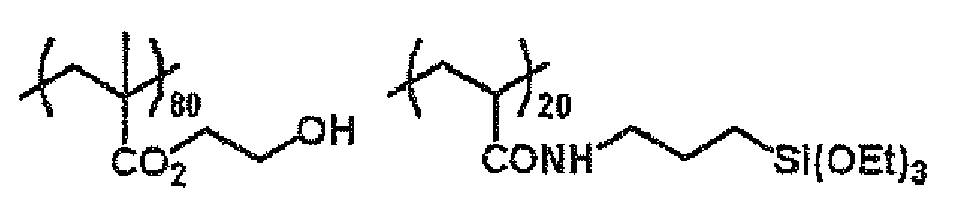
M.W. 54,000 (I-20) 
M.W. 27,000 -
(I-21) 
M.W. 6,000 (I-22) 
M.W, 7,900 (I-23) 
M.W. 9,000 (I-24) 
M.W. 8,600 (I-25) 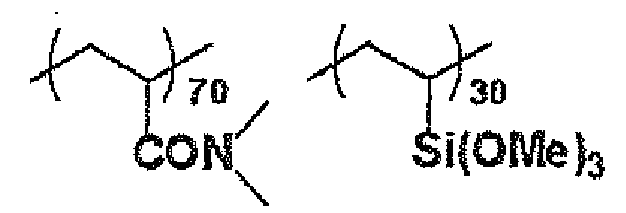
M.W. 10,000 (I-26) 
M.W. 15,000 (I-27) 
M.W. 30,000 (I-28) 
M.W. 50,000 (I-29) 
M.W. 36,000 (I-30) 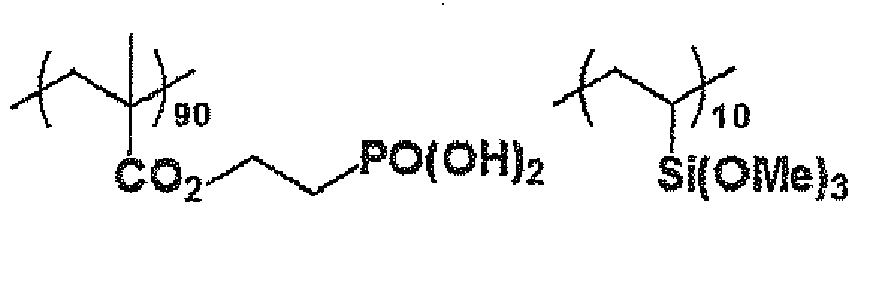
M.W. 28,000 -
(I-31) 
M.W. 15,000 (I-32) 
M.W. 20,000 (I-33) 
M.W.I 3,000 (I-34) 
M.W. 25,005 (I-35) 
M,W, 35,000 (I-36) 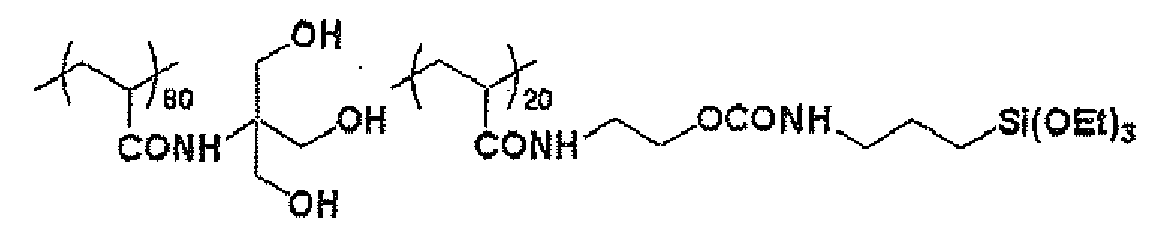
M.W 43,000 (I-37) 
M.W. 23,000 (I-38) 
M.W. 50,000 (I-39) 
M.W. 36,000, (I-40) 
M.W. 40,000 -
(I-41) 
M.W. 20,000 (I-42) 
M.W. 9,000 (I-43) 
M.W. 105,000 (I-44) 
M.W. 80,000 (I-45) 
M.W. 62,000 (I-46) 
M.W. 23,000 (I-47) 
M.W.39,000 (I-48) 
M.W. 20,000 (I-49) 
M.W.11,000 (I-50) 
n=4
M.W. 70,000 -
(I-51) 
M.W. 30,000 (I-52) 
M.W. 15,000 (I-53) 
M.W. 25,000 (I-54) 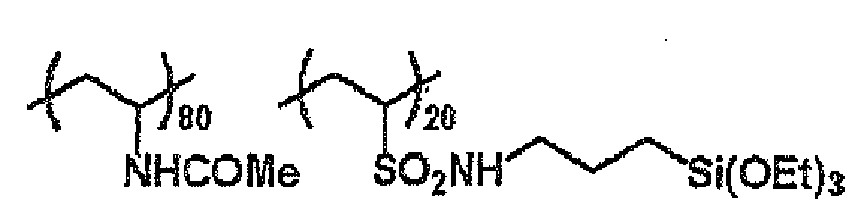
M.W. 180,000 (I-55) 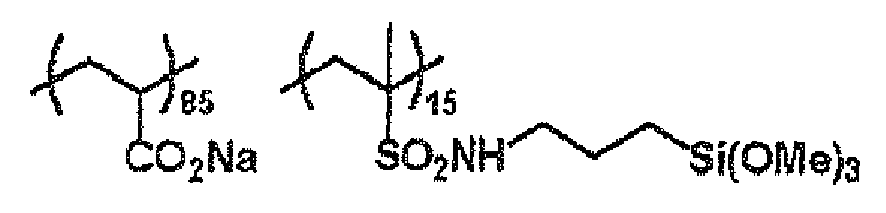
M.W. 52,000 (I-56) 
M.W. 25,000 (I-57) 
M.W. 60,000 (I-58) 
M.W. 8,000 (I-59) 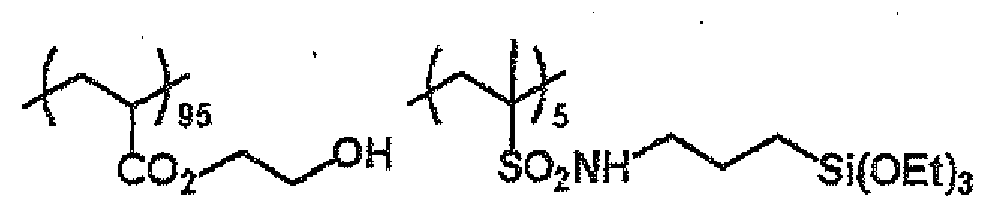
M.W. 200,000 (I-60) 
n=9
M.W. 97,000 -
(I-61) 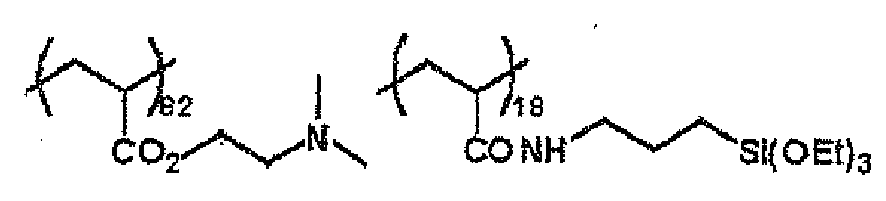
M.W. 25,000 (I-62) 
M.W. 21,000 (I-63) 
M.W. 40,000 (I-64) 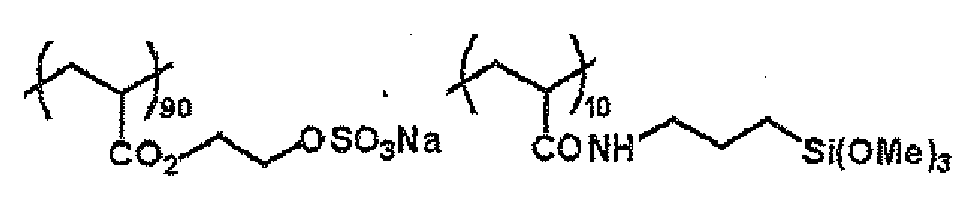
M.W. 15,000 (I-65) 
M.W. 40,000 (I-66) 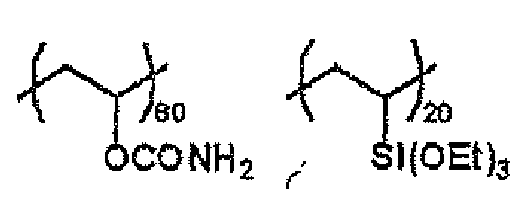
M.W. 32,000 (I-67) 
M.W. 10,000 (I-68) 
M.W. 40,000 (I-69) 
M.W. 28,000 (I-70) 
M.W. 45,000 -
(I-71) 
M.W. 18,000 (I-72) 
M.W. 29,000 (I-73) 
M.W. 30,000 (I-74) 
M.W. 17,000 (I-75) 
M.W. 25,000 (I-76) 
M.W. 18,000 (I-77) 
M.W. 35,000 (I-78) 
M.W.30,000 (I-79) 
M.W. 12,000 (I-80) 
M.W. 55,000 -
(I-81) 
M.W. 23,000 (I-82) 
M.W. 21,000 (I-83) 
M.W. 30,000 (I-84) 
M.W.18,000 (I-85) 
M.W. 25,000 (I-86) 
M.W. 32,000 (I-87) 
M.W. 18,000 (I-88) 
M.W. 40,000 (I-89) 
M.W. 19,000 (I-90) 
M.W. 35,000 - These compounds for synthesizing the above-described hydrophilic polymer are commercially available or can be easily synthesized.
As for the radical polymerization method to synthesize the hydrophilic polymer, any of conventionally known methods may also be used. The general radical polymerization methods are specifically described, for example, in Shin Kobunshi Jikken Gaku 3, Kobunshi no Gousei to Hanno 1 (New Polymer Experimentation 3, Synthesis and Reaction of Polymer 1), compiled by Polymer Society Japan, Kyoritsu Shuppan, Shin Jikken Kagaku Koza 19, Kobunshi Kagaku (I) lecture on New Experimental Chemistry 19, Polymer Chemistry (I)), compiled by The Chemical Society of Japan, Maruzen, and Busshitsu Kogaku Koza, Kobunshi Gousei Kagaku (Lecture on Substance Engineering, Polymer Synthesis Chemistry), Publishing Division of Tokyo Denki University, and these methods can be applied. - The mass average molecular weight of the hydrophilic polymer having a structure represented by formula (1) is preferably 1,000,000 or less, more preferably from 1,000 to 1,000,000, and most preferably from 10,000 to 50,000.
If the molecular weight is excessively large, the viscosity of the coating solution shows an undue rise, whereas if the molecular weight is too small, the adherence, hydrophilicity and the like may be insufficient. - The hydrophilic polymer above can form a crosslinked film in the state of being mixed with a hydrolyzed polycondensate of the later-described metal alkoxide. The hydrophilic polymer as an organic component participates in the strength or flexibility of the film, and particularly, good film properties are obtained when the viscosity of the hydrophilic polymer is from 0.1 to 100 mPa·s (measured as an aqueous 5% solution at 25°C), preferably from 0.5 to 70 mPa·s, more preferably from 1 to 50 mPa·s. The viscosity can be measured by an E-type viscometer (RE80L, trade name, manufactured by Tokyo Keiki Co., Ltd.).
- The hydrophilic polymer above may also be a copolymer with other monomers described below. Examples of the other monomer used include known monomers such as acrylic acid esters, methacrylic acid esters, acrylamides, methacrylamides, vinyl esters, styrenes, acrylic acid, methacrylic acid, acrylonitrile, maleic anhydride and maleic acid imide. By copolymerizing such monomers, various properties such as film-forming property, film strength, hydrophilicity, hydrophobicity, solubility, reactivity and stability, can be improved.
- Specific examples of the acrylic acid esters include methyl acrylate, ethyl acrylate, (n- or i-)propyl acrylate, (n-, i-, sec- or tert-)butyl acrylate, amyl acrylate, 2-ethylhexyl acrylate, dodecyl acrylate, chloroethyl acrylate, 2-hydroxyethyl acrylate, 2-hydroxypropyl acrylate, 2-hydroxypentyl acrylate, cyclohexyl acrylate, allyl acrylate, trimethylolpropane monoacrylate, pentaerythritol monoacrylate, benzyl acrylate, methoxybenzyl acrylate, chlorobenzyl acrylate, hydroxybenzyl acrylate, hydroxyphenethyl acrylate, dihydroxyphenethyl acrylate, furfuryl acrylate, tetrahydrofurfuryl acrylate, phenyl acrylate, hydroxyphenyl acrylate, chlorophenyl acrylate, sulfamoylphenyl acrylate and 2-(hydroxyphenylcarbonyloxy)ethyl acrylate.
- Specific examples of the methacrylic acid esters include methyl methacrylate, ethyl methacrylate, (n- or i-)propyl methacrylate, (n-, i-, sec- or tert-)butyl methacrylate, amyl methacrylate, 2-ethylhexyl methacrylate, dodecyl methacrylate, chloroethyl methacrylate, 2-hydroxyethyl methacrylate, 2-hydroxypropyl methacrylate, 2-hydroxypentyl methacrylate, cyclohexyl methacrylate, allyl methacrylate, trimethylolpropane monomethacrylate, pentaerythritol monomethacrylate, benzyl methacrylate, methoxybenzyl methacrylate, chlorobenzyl methacrylate, hydroxybenzyl methacrylate, hydroxyphenethyl methacrylate, dihydroxyphenethyl methacrylate, furfuryl methacrylate, tetrahydrofurfuryl methacrylate, phenyl methacrylate, hydroxyphenyl methacrylate, chlorophenyl methacrylate, sulfamoylphenyl methacrylate and 2-(hydroxyphenylcarbonyloxy)ethyl methacrylate.
- Specific examples of the acrylamides include acrylamide, N-methylacrylamide, N-ethylacrylamide, N-propylacrylamide, N-butylacrylamide, N-benzylacrylamide, N-hydroxyethylacrylamide, N-phenylacrylamide, N-tolylacrylamide, N-(hydroxyphenyl)acrylamide, N-(sulfamoylphenyl)acrylamide, N-(phenylsulfonyl)acrylamide, N-(tolylsulfonyl)acrylamide, N,N-dimethylacrylamide, N-methyl-N-phenylacrylamide and N-hydroxyethyl-N-methylacrylamide.
- Specific examples of the methacrylamides include methacrylamide, N-methylmethacrylamide, N-ethylmethacrylamide, N-propylmethacrylamide, N-butylmethacrylamide, N-benzylmethacrylamide, N-hydroxyethylmethacrylamide, N-phenylmethacrylamide, N-tolylmethacrylamide, N-(hydroxyphenyl)methacrylamide, N-(sulfamoylphenyl)methacrylamide, N-(phenylsulfonyl)methacrylamide, N-(tolylsulfonyl)methacrylamide, N,N-dimethylmethacrylamide, N-methyl-N-phenylmethacrylamide and N-hydroxyethyl-N-methylmethacrylamide.
- Specific examples of the vinyl esters include vinyl acetate, vinyl butyrate and vinyl benzoate.
Specific examples of the styrenes include styrene, methylstyrene, dimethylstyrene, trimethylstyrene, ethylstyrene, propylstyrene, cyclohexylstyrene, chloromethylstyrene, trifluoromethylstyrene, ethoxymethylstyrene, acetoxymethylstyrene, methoxystyrene, dimethoxystyrene, chlorostyrene, dichlorostyrene, bromostyrene, iodostyrene, fluorostyrene and carboxystyrene. - As for the proportion of the other monomer used to synthesize the copolymer, the amount used needs to be large enough to improve various properties but in order to ensure adequate function as a hydrophilic film and sufficiently obtain the advantage by the addition of the hydrophilic polymer, the proportion is preferably not too much large. Accordingly, the total proportion of other monomers in the hydrophilic polymer is preferably 50 mass% or less.
- In the hydrophilic composition, the (A-1) hydrophilic polymer having at least one hydrolyzable alkoxysilyl group on the polymer side chain is preferably contained in an amount of 5 to 99.5 mass%, more preferably from 15 to 99.5%, based on the solid content. The solid content as used herein indicates a solid content excluding the solvent that volatilizes.
- The metal complex catalyst used in the formation of the hydrophilic film of the present invention plays a role of accelerating the hydrolysis and polycondensation of the hydrolyzable alkoxysilyl group in the hydrophilic polymer and causing the hydrophilic polymers to bind with each other. In particular, the metal complex catalyst is preferably a metal complex composed of a metal element selected from Groups 2A, 3B, 4A and 5A of the periodic table and an oxo- or hydroxy oxygen-containing compound selected from a β-diketone, a ketoester, a hydroxycarboxylic acid, an ester thereof, an aminoalcohol and an enolic active hydrogen compound.
Among the constituent metal elements, a Group 2A element such as Mg, Ca, Sr and Ba, a Group 3B element such as Al and Ga, a Group 4A element such as Ti and Zr, and a Group 5A element such as V, Nb and Ta, are preferred. These metal elements each forms a complex having an excellent catalyst effect. Above all, complexes formed from Zr, Al and Ti are excellent and preferred. - In the present invention, examples of the oxo- or hydroxy oxygen-containing compound constituting the ligand of the metal complex include β-diketones such as acetylacetone(2,4-pentanedione) and 2,4-heptanedione; ketoesters such as methyl acetoacetate, ethyl acetoacetate and butyl acetoacetate; hydroxycarboxylic acids and esters thereof, such as lactic acid, methyl lactate, salicylic acid, ethyl salicylate, phenyl salicylate, malic acid, tartaric acid and methyl tartrate; ketoalcohols such as 4-hydroxy-4-methyl-2-pentanone, 4-hydroxy-2-pentanone, 4-hydroxy-4-methyl-2-heptanone and 4-hydroxy-2-heptanone; aminoalcohols such as monoethanolamine, N,N-dimethylethanolamine, N-methyl-monoethanolamine, diethanolamine and triethanolamine; enolic active compounds such as methylolmelamine, methylolurea, methylolacrylamide and diethyl malonate; and compounds having a substituent on the methyl group, methylene group or carbonyl carbon of acetylacetone(2,4-pentanediol).
- The ligand is preferably acetylacetone or an acetylacetone derivative. The acetylacetone derivative as used in the present invention indicates a compound having a substituent on the methyl group, methylene group or carbonyl carbon of acetylacetone. Examples of the substituent substituted on the methyl group of acetylacetone include a linear or branched alkyl group, an acyl group, a hydroxyalkyl group, a carboxyalkyl group, an alkoxy group and an alkoxyalkyl group, each having a carbon number of 1 to 3. Examples of the substituent substituted on the methylene group of acetylacetone include a carboxyl group, a linear or branched carboxyalkyl group having a carbon number of 1 to 3, and a hydroxyalkyl group having a carbon number of 1 to 3. Examples of the substituent substituted on the carbonyl carbon of acetylacetone include an alkyl group having a carbon number of 1 to 3, and in this case, a hydrogen atom is added to the carbonyl oxygen to form a hydroxyl group.
- Specific preferred examples of the acetylacetone derivative include ethylcarbonylacetone, n-propylcarbonylacetone, i-propylcarbonylacetone, diacetylacetone, 1-acetyl-1-propionyl-acetylacetone, hydroxyethylcarbonylacetone, hydroxypropylcarbonylacetone, acetoacetic acid, acetopropionic acid, diacetoacetic acid, 3,3-diacetopropionic acid, 4,4-diacetobutyric acid, carboxyethylcarbonylacetone, carboxypropylcarbonylacetone, and diacetone alcohol.
- Among these, acetylacetone and diacetylacetone are more preferred. The complex of this acetylacetone derivative with the metal element above is a mononuclear complex in which from 1 to 4 acetylacetone derivative molecules are coordinated per one metal element, and in the case where the number of coordination bonds of the metal element is larger than the total number of coordination bonds of acetylacetone derivatives, the metal element may be coordinated with a ligand commonly used in a normal complex, such as water molecule, halogen ion, nitro group and ammonio group.
- Preferred examples of the metal complex include tris(acetylacetonato)aluminum complex salt, di(acetylacetonato)aluminum·aquo complex salt, mono (acetylacetonato) aluminum·chloro complex salt, di(diacetylacetonato)aluminum complex salt, aluminum ethylacetoacetate-diisopropylate, aluminum tris(ethylacetoacetate), cyclic aluminum oxide-isopropylate, tris(acetylacetonato)barium complex salt, di(acetylacetonato)titanium complex salt, tris(acetylacetonato)titanium complex salt, di-i-propoxy·bis(acetylacetonato)titanium complex salt, zirconium tris(ethylacetoacetate), and zirconium tris(benzoate) complex salt. These metal complexes have high stability in an aqueous coating solution and are excellent in the effect of accelerating the gelling in a sol-gel reaction at the drying under heating. Above all, aluminum ethylacetoacetate-diisopropylate, aluminum tris(ethylacetoacetate), di(acetylacetonato)titanium complex salt and zirconium tris(ethylacetoacetate) are more preferred.
- In the specification of the present invention, description of the counter salt for the metal complex above is omitted, but any kind of counter salt may be used as long as it is a water-soluble salt capable of keeping the neutrality of the electric charge as a complex compound. For example, a salt form ensuring the stoichiometric neutrality, such as nitrate, halogen acid salt, sulfate and phosphate, is used. The behavior of the metal complex in the silica sol-gel reaction is described in detail in J. Sol-Gel, Sci. and Tec., 16, 209 (1999). As for the reaction mechanism, the following scheme is presumed. That is, the metal complex is considered to be stable by taking a coordination structure in a coating solution but at a dehydrating condensation reaction starting in the heating/drying process after coating, accelerates the crosslinking by an acid catalyst-like mechanism. Anyhow, use of this metal complex leads to improving the aging stability of coating solution and the surface quality of film and satisfying both high hydrophilicity and high durability.
- Other than the metal complex catalyst above, a catalyst capable of accelerating the hydrolysis and polycondensation of the metal alkoxide compound selected from Si, Ti, Zr and Al and bringing about binding to the hydrophilic polymer may be used in combination. Examples of such a catalyst include a compound having acidity, such as hydrogen halide (e.g., hydrochloric acid), carboxylic acid (e.g., nitric acid, sulfuric acid, sulfurous acid, hydrogen sulfide, perchloric acid, hydrogen peroxide, carbonic acid, formic acid, acetic acid), substituted carboxylic acid where R in the structural formula RCOOH of the carboxylic acid is substituted with another element or a substituent, and sulfonic acid (e.g., benzenesulfonic acid); and a basic compound such as ammoniacal base (e.g., aqueous ammonia) and amines (e.g., ethylamine, aniline).
The above-described metal complex catalyst is easily available as a commercial product or may also be obtained by a known synthesis method, for example, by a reaction of each metal chloride with an alcohol.
In the hydrophilic film-forming composition of the present invention, the metal complex catalyst is used in an amount of preferably from 0.1 to 50 mass%, more preferably from 0.5 to 20 mass%, based on the solid content. Also, as for the (B) metal complex catalyst, one kind of metal complex catalyst may be used alone, or two or more kinds thereof may be used in combination. - The hydrophilic composition for use in the present invention preferably contains (A-2) a hydrophilic polymer having at least one hydrolyzable alkoxysilyl group at the polymer terminal, in addition to the (A-1) hydrophilic polymer having at least one hydrolyzable alkoxysilyl group on the polymer side chain. The (A-2) hydrophilic polymer having at least one hydrolyzable alkoxysilyl group at the polymer terminal is preferably a hydrophilic polymer containing a structure represented by the following formula (2).
-
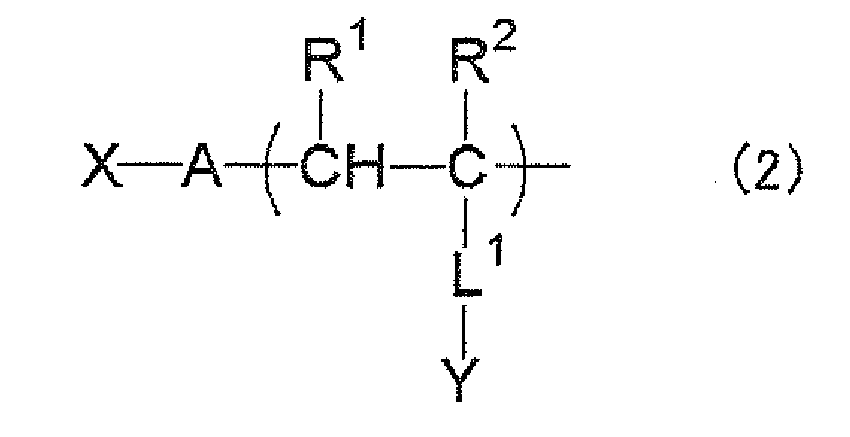
- In formula (2), each of R1 and R2 independently represents a hydrogen atom or a hydrocarbon group, X represents a hydrolyzable alkoxysilyl group, each of A and L1 independently represents a single bond or a linking group, and Y represents -NHCOR7, -CONH2, -N(R7)2, -CON(R7)2, -COR7, -OM, - CO2M, -SO3M, -PO3M, -OPO3M or -N(R7)3Z1, wherein R7 represents an alkyl group, an aryl group or an aralkyl group, M represents a hydrogen atom, an alkali metal, an alkaline earth metal or an onium, and Z1 represents a halogen ion.
- The hydrophilic polymer having a structure represented by formula (2) is a hydrophilic polymer having a hydrolyzable alkoxysilyl group at one terminal and can be synthesized, for example, by radical-polymerizing a hydrophilic monomer (for example, an acrylamide, an acrylic acid or a potassium salt of 3-sulfopropyl methacrylate) in the presence of a chain transfer agent (described in Kanji Kamachi and Tsuyoshi Endo, Radical Jugo Handbook (Radical Polymerisation Handbook), NTS) or an Iniferter (described in Otsu, Macromolecules, 19, page 287 et seq. (1986)). Examples of the chain transfer agent include 3-mercaptopropionic acid, 2-aminoethanethiol hydrochloride, 3-mercaptopropanol, 2-hydroxyethyldisulfide and 3-mercaptopropyltrimethoxysilane. Also, a hydrophilic monomer (e.g., acrylamide) may be radical-polymerized using a radial polymerization initiator having a hydrolyzable alkoxysilyl group without using a chain transfer agent.
The mass average molecular weight of the hydrophilic polymer having a structure represented by formula (2) is preferably 1,000,000 or less, more preferably from 1,000 to 1,000,000, and most preferably from 2,000 to 50,000. - In formula (2), each of R1 and R2 independently represents the same substituent as R3, R4, R5 and R6 in formula (1), L1 has the same meaning as L2 and L3 in formula (1), and X has the same meaning as X in formula (1).
- Specific examples of the hydrophilic polymer having a structure represented by formula (2) are illustrated blow, but the present invention is not limited thereto. In specific examples, * indicates the bonding position to the polymer.
-
(II-1) 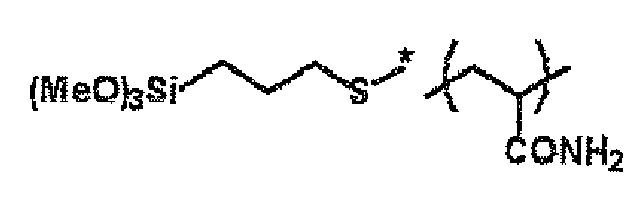
M.W. 9,000 (II-2) 
M.W. 8.500 (II-3) 
M.W. 12,000 (II-4) 
M.W. 28,000 (II-5) 
M.W. 8,800 (II-6) 
M.W. 10,000 (II-7) 
M.W. 18,000 (II-8) 
M.W. 40,000 (II-9) 
M.W. 15,000 (II-10) 
M.W. 26,000 -
(II-11) 
M.W. 8,000 (II-12) 
M.W. 10,000 (II-13) 
M.W. 7,500 (II-14) 
n=23
M.W. 42,000(II-15) 
M.W. 56,000 (II-16) 
M.W. 10,000 (II-17) 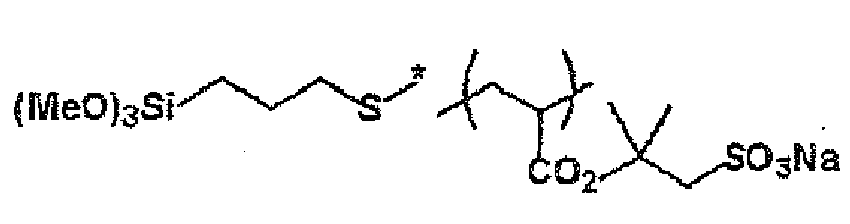
M.W. 32,000 (II-18) 
M.W. 62,000 (II-19) 
M.W. 16,000 (II-20) 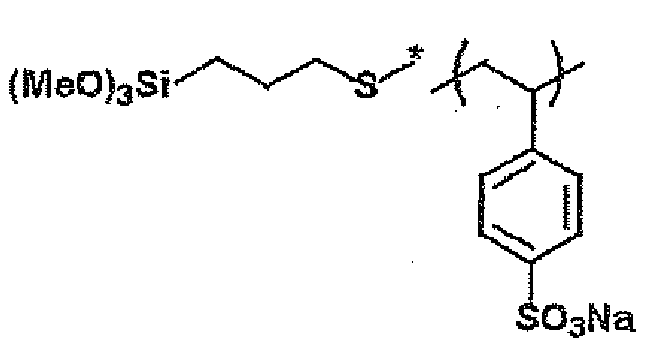
M.W. 28,000 -
(II-21) 
M.W. 10,000 (II-22) 
M.W. 15,000 (II-23) 
M.W. 28,000 (II-24) 
M.W. 48,000 (II-25) 
M.W. 18,000 (II-26) 
M.W 52,000 (II-27) 
M.W. 20,000 (II-28) 
M.W.12,000 (II-29) 
M.W. 39,000 (II-30) 
M.W. 60,000 -
(II-31) 
M.W. 3,600 (II-32) 
M.W. 8,000 (II-34) 
M.W. 10,000 
M.W. 12,000 (II-35) 
M.W. 25,000 (II-36) 
M.W. 9,500 (II-37) 
M.W. 13,500 (II-38) 
M.W. 8,000 (II-39) 
M.W. 9,000 (II-40) 
M.W. 20,000 -
(II-41) 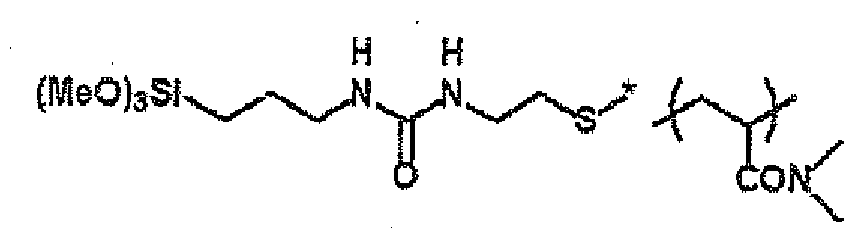
(II-42) 
(II-43) 
(II-44) 
(II-45) 
(II-46) 
(II-47) 
(II-48) 
(II-49) 
(II-50) 
-
(II-51) 
(II-62) 
(II-53) 
(II-54) 
(II-55) 
(II-56) 
(II-57) 
(II-58) 
(II-59) 
(II-60) 
-
(II-61) 
(II-62) 
(II-63) 
(II-64) 
(II-65) 
(II-66) 
(II-67) 
(II-68) 
(II-69) 
(II-70) 
-
(II-71) 
(II-72) 
(II-73) 
(II-74) 
(II-75) 
(II-76) 
(II-77) 
(II-78) 
(II-79) 
(II-80) 
-
(II-81) 
(II-82) 
(II-83) 
(II-84) 
(II-85) 
(II-86) 
(II-87) 
(II-88) 
(II-89) 
(II-90) 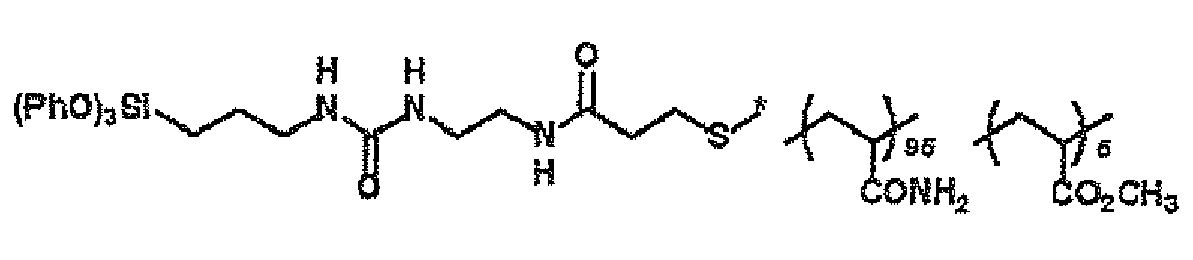
-
(II-91) 
(II-92) 
(II-93) 
(II-94) 
(II-95) 
(II-96) 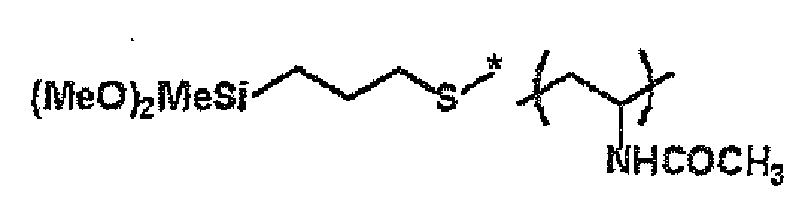
(II-97) 
(II-98) 
(II-99) 
(II-100) 
- The hydrophilic polymers exemplified above can be synthesized by the radical polymerization of a radical-polymerizable monomer represented by the following formula (i) by using a silane coupling agent represented by the following formula (ii) having a chain transfer function in the radical polymerization. The silane coupling agent (ii) has a chain transfer function and therefore, a polymer where a silane coupling group is introduced into the terminal of the polymer main chain can be synthesized in the radical polymerization.
-
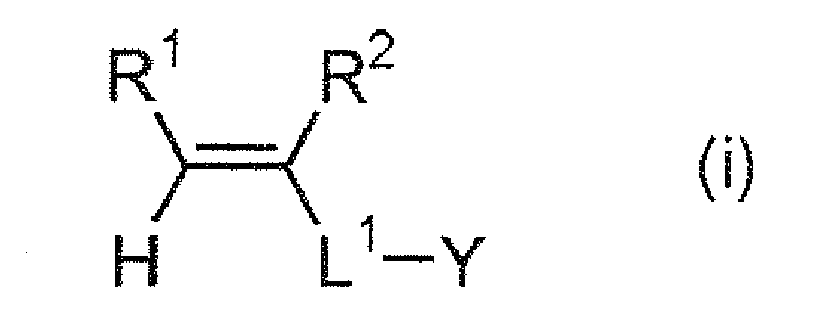
X-A-SH (ii)
- In formulae (i) and (ii), A, R1, R2, L1 and Y have the same meanings as in formula (I). These compounds are commercially available or can be easily synthesized.
- In the hydrophilic composition, the (A-2) hydrophilic polymer having at least one hydrolyzable alkoxysilyl group at the polymer terminal is preferably contained in an amount of 0 to 50 mass%, more preferably from 5 to 50 mass%, based on the solid content.
In the hydrophilic composition, the mass ratio of {(A-2) hydrophilic polymer having a hydrolyzable alkoxysilyl group at the polymer terminal/(A-1) hydrophilic polymer having a hydrolyzable alkoxysilyl group on the polymer side chain) is preferably from 50/50 to 5/95. - In the present invention, for the purpose of increasing the denseness of the hydrophilic film formed, an alkoxide compound of an element selected from Si, Ti, Zr and Al (sometimes referred to as a specific alkoxide) may be added to the hydrophilic film-forming composition. The specific alkoxide has a hydrolyzable and condensable functional group in its structure, and this is a hydrolyzable and polymerizable compound fulfilling the function as a crosslinking agent and forms a firm film having a crosslinked structure by the condensation and polymerization with the (A-1) hydrophilic polymer.
The specific alkoxide is preferably a compound represented by the following formula (3) or (4). In curing the hydrophilic film and forming a crosslinked structure, the (A-1) hydrophilic polymer, the (B) metal complex catalyst and the specific alkoxide represented by formula (3) or(4) are mixed, and the mixture is coated on a support surface, heated and dried. -
(R20)k-Z-(OR21)4-k (3)
Al-(QR21)3 (4)
- In formulae (3) and (4), R20 represents a hydrogen atom, an alkyl group or an aryl group, R21 represents an alkyl group or an aryl group, Z represents Si, Ti or Zr, and k represents an integer of 0 to 2. In the case where each of R20 and R21 represents an alkyl group, the carbon number of the alkyl group is preferably from 1 to 4. The alkyl group and aryl group each may have a substituent, and examples of the substituent which can be introduced include a halogen atom, an amino group and a mercapto group. Incidentally, these compounds are a low molecular compound and preferably have a molecular weight of 1,000 or less.
- Specific examples of the specific alkoxide represented by formula (3) or (4) are set forth below, but the present invention is not limited thereto.
Examples of the compound where Z is Si, that is, the silicon-containing specific alkoxide, include trimethoxysilane, triethoxysilane, tripropoxysilane, tetramethoxysilane, tetraethoxysilane, tetrapropoxysilane, methyltrimethoxysilane, ethyltrimethoxysilane, propyltrimethoxysilane, methyltriethoxysilane, ethyltriethoxysilane, propyltrimethoxysilane, dimethyldimethoxysilane, diethyldiethoxysilane, γ-chloropropyltriethoxysilane, γ-mercaptopropyltrimethoxysilane, γ-mercaptopropyltriethoxysilane, γ-aminopropyltriethoxysilane, phenyltrimethoxysilane, phenyltriethoxysilane, phenyltripropoxysilane, diphenyldimethoxysilane, and diphenyldiethaxysilane. Among these, preferred are tetramethoxysilane, tetraethoxysilane, methyltrimethoxysilane, ethyltrimethoxysilane, methyltriethoxysilane, ethyltriethoxysilane, dimethyldiethoxysilane, phenyltrimethoxysilane, phenyltriethoxysilane, diphenyldimethoxysilane and diphenyldiethoxysilane. - Examples of the compound where Z is Ti, that is, the titanium-containing compound, include trimethoxytitanate, tetramethoxytitanate, triethoxytitanate, tetraethoxytitanate, tetrapropoxytitanate, chlorotrimethoxytitanate, chlorotriethoxytitanate, ethyltrimethoxytitanate, methyltriethoxytitanate, ethyltriethoxytitanate, diethyldiethoxytitanate, phenyltrimethoxytitanate and phenyltriethoxytitanate. "'
Examples of the compound where Z is Zr, that is, the zirconium-containing compound, include zirconates corresponding to the above-described compounds exemplified as the titanium-containing compound.
Examples of the compound represented by formula (4), that is, the aluminum-containing specific alkoxide, include trimethoxyaluminate, triethoxyaluminate, tripropoxyaluminate and tetraethoxyaluminate.
Among these alkoxide compounds, an alkoxide where Z is Si is preferred in view of coatability. - As for the specific alkoxide, one compound may be used alone, or two or more compounds may be used in combination.
In the hydrophilic composition of the present invention, the specific alkoxide is used in an amount of preferably from 0 to 80 mass%, more preferably from 2 to 70 mass%, based on the nonvolatile components.
The specific alkoxide is easily available as a commercial product or may also be obtained by a known synthesis method, for example, by a reaction of each metal chloride with an alcohol. - In the present invention, a surfactant is preferably used so as to enhance the surface state of the film formed from the hydrophilic film-forming composition. Examples of the surfactant include a nonionic surfactant, an anionic surfactant, a cationic surfactant, an amphoteric surfactant and a fluorine-containing surfactant.
- The nonionic surfactant for use in the present invention is not particularly limited and a conventionally known nonionic surfactant can be used. Examples thereof include polyoxyethylene alkyl ethers, polyoxyethylene alkylphenyl ethers, polyoxyethylene polystyrylphenyl ethers, polyoxyethylene polyoxypropylene alkyl ethers, glycerin fatty acid partial esters, sorbitan fatty acid partial esters, pentaerythritol fatty acid partial esters, propylene glycol monofatty acid esters, sucrose fatty acid partial esters, polyoxyethylene sorbitan fatty acid partial esters, polyoxyethylene sorbitol fatty acid partial esters, polyethylene glycol fatty acid esters, polyglycerin fatty acid partial esters, polyoxyethylenated castor oils, polyoxyethylene glycerin fatty acid partial esters, fatty acid diethanolamides, N,N-bis-2-hydroxyalkylamines, a polyoxyethylene alkylamine, a triethanolamine fatty acid ester, a trialkylamine oxide, a polyethylene glycol, and a copolymer of polyethylene glycol and polypropylene glycol.
- The anionic surfactant for use in the present invention is not particularly limited and a conventionally known anionic surfactant can be used. Examples thereof include fatty acid salts, abietates, hydroxyalkanesulfonates, alkanesulfonates, dialkylsulfosuccinate salts, linear alkylbenzenesulfonates, branched alkylbenzenesulfonates, alkylnaphthalenesulfonates, alkylphenoxypolyoxyethylenepropylsulfonates, polyoxyethylenealkylsulfophenyl ether salts, an N-methyl-N-oleyltaurine sodium salt, a monoamide disodium N-alkylsulfosuccinate, petroleum sulfonates, sulfated beef tallow oil, sulfate salts of fatty acid alkyl ester, alkylsulfate salts, polyoxyethylene alkyl ether sulfate salts, fatty acid monoglyceride sulfate salts, polyoxyethylene alkylphenyl ether sulfate salts, polyoxyethylene styrylphenyl ether sulfate salts, alkylphosphate salts, polyoxyethylene alkyl ether phosphate salts, polyoxyethylene alkylphenyl ether phosphate salts, partially saponified styrene/maleic anhydride copolymerization products, partially saponified olefin/maleic anhydride copolymerization products, and naphthalenesulfonate formalin condensates.
- The cationic surfactant for use in the present invention is not particularly limited and a conventionally known cationic surfactant can be used. Examples thereof include alkylamine salts, quaternary ammonium salts, polyoxyethylene alkylamine salts and polyethylene polyamine derivatives.
The amphoteric surfactant for use in the present invention is not particularly limited and a conventionally known amphoteric surfactant can be used. Examples thereof include carboxybetaines, aminocarboxylic acids, sulfobetaines, aminosulfuric esters and imidazolines.
The term "polyoxyethylene" in the above-described surfactants can be instead read as "polyoxyalkylene" such as polyoxymethylene, polyoxypropylene and polyoxybutylene, and these surfactants can also be used in the present invention. - The surfactant is more preferably a fluorine-containing surfactant containing a perfluoroalkyl group within the molecule. The fluorine-containing surfactant includes an anionic type such as perfluoroalkylcarboxylate, perfluoroalkylsulfonate and perfluoroalkylphosphoric ester; an amphoteric type such as perfluoroalkylbetaine; a cationic type such as perfluoroalkyltrimethylammonium salt; and a nonionic type such as perfluoroalkylamine oxide, perfluoroalkyl. ethylene oxide adduct, oligomer containing a perfluoroalkyl group and a hydrophilic group, oligomer containing a perfluoroalkyl group and a lipophilic group, oligomer containing a perfluoroalkyl group, a hydrophilic group and a lipophilic group, and urethane containing a perfluoroalkyl group and a lipophilic group. In addition, fluorine-containing surfactants described in
JP-A-62-170950 JP-A-62-226143 JP-A-60-168144 - In the hydrophilic film-forming composition, the surfactant is preferably used in an amount of preferably from 0.001 to 10 mass%, more preferably from 0.01 to 5 mass%, based on the nonvolatile components. One kind of surfactant may be used alone, or two or more kinds of surfactants may be used in combination.
- Specific preferred examples of the surfactant are illustrated below, but the present invention is not limited thereto.
-

NaO3SO-C12H25
Anionic Surfactant 2

- The hydrophilic composition of the present invention is coated on a desired support to form a hydrophilic film, whereby a hydrophilic member can be obtained.
An antibacterial agent may be incorporated into the hydrophilic composition so as to impart antibacterial, antifungal and algicidal properties to the hydrophilic member of the present invention. In forming a hydrophilic film, a hydrophilic and water-soluble antibacterial agent is preferably incorporated. By virtue of incorporating a hydrophilic and water-soluble antibacterial agent, a surface hydrophilic member excellent in the antibacterial, antifungal and algicidal properties can be obtained without impairing the surface hydrophilicity.
As for the antibacterial agent, a compound incapable of reducing the hydrophilicity of the hydrophilic member is preferably added, and examples of such an antibacterial agent include an inorganic antibacterial agent and a water-soluble organic antibacterial agent. An antibacterial agent having an antiseptic effect on microorganisms in the environment, such as bacteria typified by Staphylococcus aureus and Bacillus coli and fungi typified by mold and yeast, is used. - The organic antibacterial agent includes, for example, a phenol ether derivative, an imidazole derivative, a sulfone derivative, an N·haloalkylthio compound, an anilide derivative, a pyrrole derivative, a quaternary ammonium salt, and pyridine-based, triazine-based, benzisothiazoline-based and isothiazoline-based antibacterial agents.
Examples thereof include, but are not limited to, 1,2-benzisothiazolin-3-one, N-fluorodichloromethylthiophthalimide, 2,3,5,6-tetrachloroisophthalonitrile, N-trichloromethylthio-4-cyclohexene-1,2-dicarboxyimide, copper 8-quinolinate, bis(tributyltin)oxide, 2-(4-thiazolyl)benzimidazole (hereinafter, referred to as "TBZ"), methyl 2-benzimidazolecarbamate (hereinafter, referred to as "BCM,"), 10,10'-oxybisphenoxyarsine (hereinafter, referred to as "OBPA"), 2,3,5,6-tetrachloro-4-(methyl-sulfone)pyridine, bis(2-pyridylthio-1-oxide) zinc (hereinafter, referred to as "ZPT"), N,N-dimethyl-N'-(fluorodichloromethylthio)-N'-phenylsulfamido(dichlorofluanide), poly-(hexamethylenebiguanide) hydrochloride, dithio-2-2'-bis(benzmethylamide), 2-methyl-4,5-trimethylene-4-isothiazolin-3-one, 2-bromo-2-nitro-1,3-propanediol, hexahydro-1,3-tris-(2-hydroxyethyl)-S-triazine, p-chloro-m-xylenol and 1,2-benzisothiazolin-3-one.
Such an organic antibacterial agent can be appropriately selected and used by taking into consideration the hydrophilicity, water resistance, sublimability, stability and the like. Among the organic antibacterial agents, 2-bromo-2-nitro-1,3-propanediol, TBZ, BCM, OBPA and ZPT are preferred in view of hydrophilicity, antibacterial effect and cost. - The inorganic antibacterial agent includes, for example, mercury, silver, copper, zinc, iron, lead and bismuth in descending order of antiseptic activity. For example, a metal or metal ion such as silver, copper, zinc or nickel is loaded on a support such as silicate-based support, phosphate-based support, oxide, glass, potassium titanate and amino acid. Examples of the inorganic antibacterial agent include, but are not limited to, a zeolite-based antimicrobial, a calcium silicate-based antimicrobial, a zirconium phosphate-based antimicrobial, a calcium phosphate-based antimicrobial, a zinc oxide-based antimicrobial, a soluble glass-containing antimicrobial, a silica gel-based antimicrobial, an activated carbon-based antimicrobial, a titanium oxide-based antimicrobial, a titania-based antimicrobial, an organometallic antimicrobial, an ion exchanger ceramic antimicrobial, a layered phosphate-quaternary ammonium salt-based antimicrobial, and an antibacterial stainless steel.
- The naturally occurring antibacterial agent includes chitosan that is a basic polysaccharide obtained by hydrolyzing chitin contained in crustaceans such as crab and shrimp.
In the present invention, "HOLON KILLER BEADS CELLER (trade name)" of Nikko Co., which is composed of an amino metal having a metal compounded on both sides of an amino acid, is preferred.
This antibacterial agent is nonvolatile, readily interacts with the polymer or crosslinking agent component of the hydrophilic film, is capable of stable molecular dispersion or solid dispersion, allows effective exposure of the antibacterial agent to the hydrophilic film surface, does not dissolve out even when wetted with water, can sustain its effect over a long period of time, does not affect the human body, can be stably dispersed in the hydrophilic film or coating solution, and causes no deterioration of the hydrophilic film or coating solution.
Among the antibacterial agents described above, a silver-based inorganic antibacterial agent and a water-soluble organic antibacterial agent are most preferred because of their high antibacterial effect. Above all, a silver zeolite obtained by loading silver on zeolite that is a silicate-based support, an antibacterial agent obtained by loading silver on silica gel, 2-bromo-2-nitro-1,3-propanediol, TPN, TBZ, BCM, OBPA, and ZPT are preferred. Particularly preferred examples of the commercially available silver zeolite-based antibacterial agent include "Zeomic" of Shinagawa Fuel Co., Ltd., "Silwell" of Fuji Silysia Chemical Ltd., and "Bactenon" of Japan Electronic Materials Corp. In addition, "Novaron" of Toa Gosei Co., Ltd., where silver is loaded on an inorganic ion exchanger ceramic; "Atomy Ball" of Catalysts & Chemicals Industries Co., Ltd.; and "SAN-AI BAC P" (produced by San-Ai Oil Co., Ltd.) that is a triazine-based antimicrobial, are also preferred. - The content of the antibacterial agent is usually from 0.001 to 10 mass%, preferably from 0.005 to 5 mass%, more preferably from 0.01 to 3 mass%, still more preferably 0.02 to 1.5 mass%, and most preferably 0.05 to 1 mass%. When the content is 0.001 mass% or more, an effective antibacterial action can be obtained, and when the content is 10 mass% or less, the hydrophilicity as well as the aging property are not impaired and there is caused no adverse effect on the antifouling and antifogging properties.
- The hydrophilic film-forming composition of the present invention may contain an inorganic fine particle for the purpose of increasing the cured film strength of the hydrophilic film and enhancing the hydrophilicity and water retentivity.
Suitable examples of the inorganic fine particle include silica, alumina, magnesium oxide, titanium oxide, magnesium carbonate, calcium alginate, and a mixture thereof. Even when these inorganic fine particles have no photothermal conversion property, they can be used, for example, to strengthen the film or increase the interface adhesion thanks to surface roughening.
The average particle diameter of the inorganic fine particle is preferably from 5 nm to 10 µm, more preferably from 0.5 to 3 µm. Within this range, the particle is stably dispersed in the hydrophilic film and in turn, the film can advantageously maintain sufficiently high strength and hydrophilicity.
The above-described inorganic fine particle can be easily available as a commercial product, for example, as a colloidal silica dispersion.
The content of the inorganic fine particle is preferably 20 mass% or less, more preferably 10 mass% or less, based on the entire solid content of the hydrophilic film-forming composition. - In the present invention, an ultraviolet absorber can be used from the standpoint of enhancing the weather resistance and durability of the hydrophilic film.
Examples of the ultraviolet absorber include benzotriazole-based compounds described inJP-A-58-185677 JP-A-61-190537 JP-A-2-782 JP-A-5-197075 JP-A-9-34057 JP-A-46-2784 JP-A-5-194483 U.S. Patent 3,214,463 , cinnamic acid-based compounds described inJP-B-48-30492 JP-B-56-21141 JP-A-10-88106 JP-A-4-298503 JP-A-8-53427 JP-A-8-239368 JP-A-10-182621 JP-T-8-501291 24239
The amount of the ultraviolet absorber added is appropriately selected according to the purpose but in general, the amount added is preferably from 0.5 to 15 mass% in terms of the solid content. - In the coating solution for forming the hydrophilic film, an antioxidant may be added so as to enhance the stability of the composition and hydrophilic film of the present invention. Examples of the antioxidant include those described in European Patent Publication Nos.
223739 309401 309402 310551 310552 459416 3435443 ,JP-A-54-48535 JP-A-62-262047 JP-A-63-113536 JP-A-63-163351 JP-A-2-262654 JP-A-2-71262 JP-A-3-121449 JP-A-5-61166 JP-A-5-119449 U.S. Patents 4,814,262 and4,980,275 .
The amount of the antioxidant added is appropriately selected according to the purpose but is preferably from 0.1 to 8 mass% in terms of the solid content. - In order to ensure the formability of a uniform coating film on a substrate at the time of forming a hydrophilic film of the hydrophilic member of the present invention, it is also effective to appropriately add an organic solvent to the coating solution for forming the hydrophilic film.
Examples of the solvent include a ketone-based solvent such as acetone, methyl ethyl ketone and diethyl ketone, an alcohol-based solvent such as methanol, ethanol, 2-propanol, 1--prapanol, 1-butanol and tert-butanol, a chlorine-based solvent such as chloroform and methylene chloride, an aromatic solvent such as benzene and toluene, an ester-based solvent such as ethyl acetate, butyl acetate and isopropyl acetate, an ether-based solvent such as diethyl ether, tetrahydrofuran and dioxane, and a glycol ether-based solvent such as ethylene glycol monomethyl ether and ethylene glycol dimethyl ether.
In this case, it is effective to add the solvent in a range not causing a problem in relation to VOC (volatile organic compounds), and the amount in the range is preferably from 0 to 50 mass%, more preferably from 0 to 30 mass%, based on the entire coating solution at the formation of the water-absorbing film. - In the hydrophilic film-forming composition of the present invention, various polymer compounds can be added for adjusting the physical properties of the hydrophilic film, within the range not inhibiting the hydrophilicity. Examples of the polymer compound which can be used include an acrylic polymer, a polyvinylbutyral resin, a polyurethane resin, a polyamide resin, a polyester resin, an epoxy resin, a phenol resin, a polycarbonate resin, a polyvinylbutyral resin, a polyvinylformal resin, shellac, a vinyl-based resin, an acrylic resin, a rubber-based resin, waxes, and other natural resins. Two or more of these may be used in combination. Above all, a vinyl-based copolymer obtained by the copolymerization of acrylic monomers is preferred. Furthermore, a copolymer containing, as a structural unit, a "carboxyl group-containing monomer", an "alkyl methacrylate" or an "allyl acrylate" is also preferably used.
- In addition, for example, a leveling additive, a matting agent, waxes for adjusting the film properties, and a tackifier for improving the adherence to a substrate may be incorporated, if desired, in the range not inhibiting the hydrophilicity.
Specific examples of the tackifier include adhesive polymers having a high molecular weight described inJP-A-2001-49200 - The base material (support) for use in the present invention is not particularly limited, but glass, plastic, metal, ceramic, wood, stone, cement, concrete, fiber, cloth, paper, leather, and a combination or laminate thereof all may be suitably utilized. In particular, the base material is preferably a glass, plastic, stainless steel or aluminum substrate.
As for the glass substrate, any glass such as soda glass, lead glass and borosilicate glass may be used. Also, according to the purpose, float sheet glass, figured glass, frosted sheet glass, mesh glass, wired glass, tempered glass, laminated glass, double glass, vacuum glass, security glass, or highly insulating Low-E double glass may be used. Furthermore, the hydrophilic film may be coated directly on the green sheet glass, but one surface or both surfaces of the glass substrate may be subjected to a surface hydrophilizing treatment by oxidation, surface roughening or the like, for the purpose of enhancing the adherence of the hydrophilic film. Examples of the oxidation method include a corona discharge treatment, a glow discharge treatment, a chromic acid treatment (wet), a flame treatment, a hot air treatment, and an ozone/ultraviolet irradiation treatment. As for the surface roughening method, the surface may also be mechanically roughened by sandblasting, brush polishing or the like. - The plastic substrate for use in the present invention is not particularly limited, but examples thereof include polyester, polyethylene, polypropylene, cellophane, triacetyl cellulose, diacetyl cellulose, acetyl cellulose butyrate, polyvinyl chloride, polyvinylidene chloride, polyvinyl alcohol, ethylene vinyl alcohol, polystyrene, polycarbonate, polymethylpentene, polysulfone, polyether ketone, acryl, nylon, fluororesin, polyimide, polyetherimide and polyethersulfone films or sheets. Among these, a polyester film such as polyethylene terephthalate and polyethylene naphthalate is preferred. Incidentally, a plastic substrate with excellent transparency is preferred from an optical viewpoint, but a translucent or printed substrate is used depending on the usage. The thickness of the plastic substrate varies according to the other party stacked thereon. For example, in use for a portion having many curves, a thin substrate is preferred and a plastic substrate having a thickness of approximately from 6 to 50 µm is used. Also, in use for a flat plane or a portion requiring strength, a plastic substrate of 50 to 400 µm is used.
As for the base material in use as a fin stock, an aluminum-made substrate is preferred. - For the purpose of enhancing the adherence between the base material and the hydrophilic film, one surface or both surfaces of the base material may be subjected to a surface hydrophilizing treatment by oxidation, surface roughening or the like. Examples of the oxidation method include a corona discharge treatment, a glow discharge treatment, a chromic acid treatment (wet), a flame treatment, a hot air treatment, and an ozone/ultraviolet irradiation treatment. As for the surface roughening method, the surface may also be mechanically roughened by sandblasting, brush polishing or the like.
- In the present invention, one undercoat layer or two or more undercoat layers can be provided between the base material and the hydrophilic film.
The undercoat layer is preferably a layer formed by hydrolyzing and polycondensing a composition composed of at least an alkoxide compound containing an element selected from Si, Ti, Zr and Al and a nonvolatile catalyst.
The undercoat layer formed by hydrolyzing and polycondensing a composition composed of at least an alkoxide compound containing an element selected from Si , Tri, Zr and Al and a nonvolatile catalyst has a crosslinked structure and in the present invention, such a crosslinked structure formed by hydrolysis and condensation/polymerization of an alkoxide compound is conveniently referred to as a sol-gel crosslinked structure. - Examples of the alkoxide compound containing an element selected from Si, Ti, Zr and Al include those described above, and among these, an alkoxide containing Si is preferred in view of reactivity and easy availability. Specifically, a compound used for a silane coupling agent may be suitably used.
- The nonvolatile catalyst for use in the undercoat layer is a catalyst except for those having a boiling point of less than 20°C. In other words, the nonvolatile catalyst includes, for example, those having a boiling point of 20°C or more and those originally having no boiling point (including those incapable of undergoing a phase change such as thermal decomposition) .
The nonvolatile catalyst for use in the present invention is not particularly limited, but examples thereof include a metal complex (sometimes referred to as a metal chelate compound) and a silane coupling agent. In this art, an acid or an alkali is suitably used as the catalyst, and such an acid or alkali may be applied without any particular limitation as long as it has a boiling point of 20°C or more. For example, hydrochloric acid having a boiling point of -83°C is excluded, but nitric acid having a boiling point of 121°C and phosphoric acid having a decomposition temperature of 213°C are applicable as the nonvolatile catalyst in the present invention.
Examples of the metal complex include those described above. - The silane coupling agent used as the nonvolatile catalyst is not particularly limited, but examples thereof include those having a functional group exhibiting acidity or alkalinity, more specifically, include a silane coupling agent having a functional group exhibiting acidity, such as peroxo acid, carboxylic acid, carbohydrazonic acid, carboximidic acid, sulfonic acid, sulfinic acid, sulfenic acid, selenonic acid, seleninic acid, selenenic acid, telluronic acid and the above-described alkali metal salts, and a silane coupling agent having a functional group exhibiting basicity, such as amino group.
- The undercoat layer can be formed by coating a composition containing at least the above-described alkoxide compound and nonvolatile catalyst on a base material, and heating and drying the coating to effect hydrolysis and polycondensation of the composition. The heating temperature and heating time for the formation of the undercoat layer are not particularly limited as long as they are the temperature high enough and the time long enough to allow removal of the solvent in the sol solution and enable formation of a firm film, but in view of production suitability and the like, the heating temperature is preferably 150°C or less and the heating time is preferably within 1 hour.
The undercoat layer can be produced by a known coating method, and the coating method is not particularly limited but, for example, a spray coating method, a dip coating method, a flow coating method, a spin coating method, a roll coating method, a film applicator method, a screen printing method, a bar coater method, brush coating and sponge coating are applicable. - The thus-obtained undercoat layer contains the nonvolatile catalyst that is present without losing its activity, and in particular, thanks to the presence of the nonvolatile catalyst also on the surface, very high adherence is obtained at the interface between the undercoat layer and the hydrophilic film.
- Also, the undercoat layer can be provided with fine unevenness by applying plasma etching or mixing a metal particle so as to yield higher adherence at the interface between the undercoat layer and the hydrophilic film.
- The material used for the undercoat layer may be a hydrophilic resin or a water-dispersible latex.
Examples of the hydrophilic resin include polyvinyl alcohol (PVA), a cellulosic resin [e.g., methyl cellulose (MC), hydroxyethyl cellulose (HEC), carboxymethyl cellulose (CMC)], chitins, chitosans, starch, an ether bond-containing resin [e.g., polyethylene oxide (PEO), polyethylene glycol (PEG), polyvinyl ether (PVE)], and a carbamoyl group-containing resin [e.g., polyacrylamide (PAAM), polyvinylpyrrolidone (PVP)]. Other examples include a carboxyl group-containing polyacrylate, a maleic acid resin, an alginate and gelatins.
Among these, at least one member selected from a polyvinyl alcohol-based resin, a cellulosic resin, an ether bond-containing resin, a carbamoyl group-containing resin, a carboxyl group-containing resin and gelatins is preferred, and a polyvinyl alcohol (PVA)-based resin and gelatins are more preferred. - Examples of the water-dispersible latex include an acryl-based latex, a polyester-based latex, an NBR resin, a polyurethane-based latex, a polyvinyl acetate-based latex, an SBR resin, and a polyamide-based latex. Among these, an acryl-based latex is preferred.
One of these hydrophilic resins or water-dispersible latexes may be used alone or two or more thereof may be used in combination, and a hydrophilic resin and a water-dispersible latex may also be used in combination.
Furthermore, a crosslinking agent capable of crosslinking the hydrophilic resin or water-dispersible latex may also be used.
As for the crosslinking agent applicable to the present invention, known crosslinking agents which form the crosslinking by heat may be used. Thermal crosslinking agents in general are described in Shinzo Yamashita and Tosuke Kaneko, Kakyozai Handbook (crosslinking Agent Handbook), Taiseisha (1981). The crosslinking agent for use in the present invention is not particularly limited as long as the number of functional groups contained is 2 or more and the hydrophilic resin or water-dispersible latex can be effectively crosslinked. Specific examples of the thermal crosslinking agent include a polycarboxylic acid such as polyacrylic acid; an amine compound such as polyethyleneimine; a polyepoxy compound such as ethylene or propylene glycol diglycidyl ether, tetraethylene glycol diglycidyl ether, nonaethylene glycol diglycidyl ether, polyethylene or polypropylene glycol glycidyl ether, neopentyl glycol diglycidyl ether, 1,6-hexanediol diglycidyl ether, trimethylolpropane triglycidyl ether, and sorbitol polyglycidyl ether; a polyaldehyde compound such as glyoxal and terephthalaldehyde; a polyisocyanate compound such as tolylene diisocyanate, hexamethylene diisocyanate, diphenylmethane isocyanate, xylylene diisocyanate, polymethylene polyphenyl isocyanate, cyclohexyl diisocyanate, cyclohexane phenylene diisocyanate, naphthalene-1,5-diisocyanate, isopropylbenzene-2,4-diisocyanate, and polypropylene glycol/tolylene diisocyanate addition reaction product; a block polyisocyanate compound; a silane coupling agent such as tetraalkoxysilane; a metal crosslinking agent such as acetylacetonate of aluminum, copper or iron (III); and a polymethylol compound such as trimethylolmelamine and pentaerythritol. Among these thermal crosslinking agents, a water-soluble crosslinking agent is preferred because a coating solution can be easily prepared and the reduction in the hydrophilicity of the produced hydrophilic film can be prevented.
The total amount of the hydrophilic resin and/or water-dispersible latex in the undercoat layer is preferably from 0.01 to 20 g/m2, more preferably from 0.1 to 10 g/m2. - The hydrophilic member of the present invention can be used by appropriately adding separate layers according to the purpose, mode and place in use. The configuration of layers added, if desired, is described below.
- In the case of using the hydrophilic member of the present invention by laminating it to another base material, an adhesive which is a pressure-sensitive adhesive is preferably used as an adhesive layer on the back surface of the base material. As for the adhesive, those generally used for a self-adhesive sheet, such as rubber-based adhesive, acryl-based adhesive, silicone-based adhesive, vinyl ether-based adhesive and styrene-based adhesive, may be used.
In the case where the optical transparency is required, an adhesive for optical usage is selected. In the case where a pattern such as coloring, translucence or matte texture is required, in addition to the texturing of the base material, a dye or an organic or inorganic fine particle may be added to the adhesive to bring out the effect.
In the case where a tackifier is required, one kind of resin, for example, a tackifying resin such as rosin-based resin, terpene-based resin, petroleum-based resin, styrene-based resin, and hydrogenation product thereof, may be used, or some of them may be used as a mixture.
The adhesive force of the adhesive for use in the present invention is an adhesive force generally called strong adhesion and is 200 g/25 mm or more, preferably 300 g/25 mm or more, more preferably 400 g/25 mm or more. The adhesive force as used herein is a value measured by a 180° peeling test according to JIS Z 0237. - In the case where the hydrophilic member of the present invention has the above-described adhesive layer, a release layer may be further added. In the release layer, a release agent is preferably incorporated so as to impart releasability. Examples of the release agent which can be generally used include a silicone-based release agent composed of polyorganosiloxane, a fluorine-based compound, a long chain alkyl-modified polyvinyl alcohol, and a long chain alkyl-modified polyethylene imine. Also, there may be used various release agents such as hot-melt release agent and monomer-type release agent capable of curing a releasing monomer by radical polymerization, cationic polymerization, polycondensation reaction or the like; a copolymer-based resin such as acryl-silicone-based copolymer resin, acryl-fluorine-based copolymer resin and urethane-silicone-fluorine-based copolymer resin; a resin blend of silicone-based resin and acryl-based resin; and a resin blend of fluorine-based resin and acryl-based resin. Furthermore, a hardcoat release layer may be formed by curing a curable composition containing either one atom of fluorine atom and/or silicon atom and an active energy ray-polymerizable group-containing compound.
- A protective layer may be provided on the hydrophilic film. The protective layer has a function of preventing scratching on the hydrophilic surface during handling, transportation, storage or the like or preventing reduction in the hydrophilicity due to adhesion of a contaminant. As for the protective layer, a hydrophilic polymer layer used for the release layer or undercoat layer above can be used. The protective layer is stripped off after laminating the hydrophilic member to an appropriate base material.
- The hydrophilic member having a hydrophilic film may be supplied in the form of a sheet, a roll or a ribbon or may be cut for the lamination to an appropriate base material and then supplied.
- The hydrophilicity on the hydrophilic film surface is generally determined by measuring the contact angle for a waterdrop. However, the waterdrop contact angle on the surface having extremely high hydrophilicity as in the present invention sometimes becomes 10° or less, even 5° or less, and this imposes a limitation on the cross comparison of the hydrophilicity degree. On the other hand, measurement of surface free energy is known as a method for more particularly evaluating the hydrophilicity degree of a solid surface. Various methods have been proposed, but in the present invention, the surface free energy is measured, for example, by a Zisman plotting method. More specifically, this is a method utilizing a property that the surface tension of an aqueous solution of an inorganic electrolyte such as magnesium chloride becomes larger with an increase in the concentration, where the contact angle is measured in air under the room temperature condition by using the aqueous solution above, points of aqueous solutions in various concentrations are plotted by taking the surface tension of the aqueous solution on the abscissa and the contact angle in terms of cosθ on the ordinate to obtain a linear relationship, and the surface tension giving cosθ=1, that is, contact angle=0°, is defined as the surface free energy of the solid. The surface tension of water is 72 mN/m, and a larger surface free energy value indicates higher hydrophilicity.
A hydrophilic layer where the surface free energy as measured by the above-described method is from 70 to 95 mN/m, preferably from 72 to 93 mN/m, more preferably from 75 to 90 mN/m, is excellent in the hydrophilicity and exhibits good performance. - A general hydrophilic film absorbs water and swells. Such a film readily allows intrusion of a contaminant into the inside of the film and is liable to be contaminated (the hydrophilicity deteriorates). When the film is conversely made to hardly swell in water, a contaminant scarcely enters the inside of the film, and the film is not easily contaminated, but the formed hydrophilic film becomes a film with low hydrophilicity. The (A-1) hydrophilic polymer for use in the present invention has at least one hydrolyzable alkoxysilyl group on the polymer side chain and therefore, by controlling a crosslinking reaction of hydrolyzable alkoxysilyl groups with each other to allow more progress of the crosslinking reaction, a film (dense film) having high strength and being resistant to swelling in water and in turn, unlikely to be contaminated with a contaminant can be formed. Furthermore, the specific hydrophilic polymer itself has high hydrophilicity and therefore, can form a film with excellent hydrophilicity. The water swelling degree of the hydrophilic film according to the present invention is 1.5 times or less, preferably 1.4 times or less. If the water swelling degree exceeds 1.5 times, a contaminant readily enters the inside of the film, and the hydrophilicity deteriorates. The water swelling degree is determined by dipping the hydrophilic member in pure water for 10 minutes and measuring the film thickness after dipping in water by ellipsometry (VASE, manufactured by J. A. Woollam) and is expressed by the ratio to the thickness before dipping in water.
- A general hydrophilic film absorbs water and reserves the water inside of the film and therefore, the refractive index difference between the hydrophilic film and water is small. Such a hydrophilic film (film with low denseness) readily allows intrusion of a contaminant into the inside of the film and is liable to be contaminated (the hydrophilicity deteriorates). When the denseness is conversely increased, a contaminant scarcely enters the inside of the film, and the film is not easily contaminated, but the formed hydrophilic film becomes a film with low hydrophilicity. The (A-1) specific hydrophilic polymer for use in the present invention has at least one hydrolyzable alkoxysilyl group on the polymer side chain and therefore, by controlling a crosslinking reaction of hydrolyzable alkoxysilyl groups with each other to form a dense film, the film can be made resistant to contamination with a contaminant. Furthermore, the specific hydrophilic polymer has high hydrophilicity and therefore, can form a film with excellent hydrophilicity. The refractive index difference between the hydrophilic film of the present invention and water is preferably 0.14 or more, more preferably 0.15 or more, still more preferably from 0.17 to 0.20.
The refractive index difference between the hydrophilic film and water is determined as a difference from the refractive index 1.33 of water after dipping the hydrophilic member in pure water for 10 minutes and directly measuring the refractive index of the hydrophilic film by ellipsometry (VASE, manufactured by J. A. Woollam). - Also, for the purpose of imparting heat resistance against heat generation in the heat exchanger, Tg of the hydrophilic film is preferably from 40 to 150°C. Also, the modulus of the hydrophilic film is preferably from 1 to 7 GPa.
- In the case of applying (using or laminating) the hydrophilic member of the present invention to windowpane or the like, transparency is important from the standpoint of securing visibility. The hydrophilic member of the present invention has excellent transparency, and the transparency is not impaired even when the thickness is large, so that both transparency and durability can be satisfied. The thickness of the hydrophilic film of the present invention is preferably from 0.01 to 100 µm, more preferably from 0 . 05 to 50 µm, and most preferably from 0.1 to 20 µm. When the film thickness is 0.01 µm or more, sufficiently high hydrophilicity and durability are advantageously obtained, and when the film thickness is 100 µm or less, a problem in terms of film-forming property, such as cracking, does not arise and this is preferred.
The transparency is evaluated by measuring the light transmittance in the visible light region (400 to 800 nm) by a spectrophotometer. The light transmittance is preferably from 100 to 70%, more preferably from 95 to 75%, and most preferably from 95 to 80%. Within this range, the hydrophilic member provided with the hydrophilic film can be applied to various uses without hindering the visibility. - The hydrophilic member of the present invention can be formed by dispersing or dissolving requisite components described above in a solvent to prepare a coating solution, coating it on an appropriate backing material, and curing the coating by heat.
- For example, the (A-1) specific hydrophilic polymer and the (B) metal complex catalyst are dissolved in a solvent, and the solution is thoroughly stirred, as a result, the hydrolyzable alkoxysilyl group moiety of the hydrophilic polymer component is hydrolyzed and furthermore, condensation/polymerization partially proceeds to produce a coating solution for forming a hydrophilic film. From this coating solution, a hydrophilic film having high hydrophilicity and high film strength is formed.
- The coating solution for forming a hydrophilic film can be prepared by dissolving the (A-1) specific hydrophilic polymer and the (B) metal complex catalyst and stirring the solution. The reaction temperature is from room temperature to 80°C, and the reaction time, that is, the time for which stirring is continued, is preferably from 1 to 72 hours. This stirring allows the hydrolysis and condensation/polymerization to proceed, whereby a coating solution for forming a hydrophilic film can be obtained.
- The hydrophilic member of the present invention can be obtained by coating the hydrophilic composition on an appropriate base material, and heating/drying the coating to form a surface hydrophilic film. As for the heating/drying conditions to form a hydrophilic film, high-temperature heating is usually applied so as to more proceed the crosslinking reaction of the hydrolyzable alkoxysilyl group and in this case, the crosslinking reaction rapidly proceeds but at a certain point, the molecular motion of the hydrolyzable alkoxysilyl group is suppressed and the crosslinking reaction stops. In the present invention, the heating treatment is applied at a low temperature for a long time, whereby the crosslinking reaction effectively proceeds without suppressing the molecular motion of the hydrolyzable alkoxysilyl group and a firm and dense film is advantageously obtained.
The heating temperature and the heating time are preferably from 50 to 180°C and from 2 minutes to 2 hours, more preferably from 80 to 160°C and from 5 minutes to 1.5 hours, still more preferably from 80 to 160°C and from 1 to 1.5 hours. - The hydrophilic member of the present invention can be produced by a known coating method, and the coating method is not particularly limited, but examples of the method which can be applied include a spray coating method, a dip coating method, a flow coating method, a spin coating method, a roll coating method, a film applicator method, a screen printing method, a bar coaster method, brush coating, and sponge coating.
- The material to which the hydrophilic member of the present invention can be applied is, for example, in the case of expecting an antifogging effect, a transparent material such as transparent glass substrate, transparent plastic substrate, lens, prism and mirror.
As for the glass, any glass such as soda glass, lead glass and borosilicate glass may be used. Also, according to the purpose, float sheet glass, figured glass, frosted sheet glass, mesh glass, wired glass, tempered glass, laminated glass, double glass, vacuum glass, security glass, or highly insulating Low-E double glass can be used.
The usage to which the member having an antifogging effect can be applied includes a mirror such as vehicle rearview mirror, bathroom mirror, lavatory mirror, dental mirror and road mirror; a lens such as eyeglass lens, optical lens, photographic lens, endoscopic lens, illumination lens, semiconductor lens and copier lens; a prism; a windowpane for buildings or lookout towers; a glass for other building material; a windowpane for various vehicles such as automobile, railway vehicle, airplane, marine vessel, submarine, snow wagon, ropeway gondola and amusement park gondola; a windshield glass for various vehicles such as automobile, railway vehicle, airplane, marine vessel, submarine, snow wagon, snowmobile, motorcycle, ropeway gondola and amusement park gondola; a glass for protective goggles, sporting goggles, protective mask shields, sporting mask shields, helmet shields or frozen food display cases; a cover glass for measurement hardware; and a film for the lamination to the surface of these articles. A most preferred usage is a glass for automobiles or building materials. - In the case of expecting the hydrophilic member of the present invention to exert an antifouling effect, for example, metal, ceramic, wood, stone, cement, concrete, fiber, cloth, paper, and a combination or laminate thereof all may be suitably used as the base material therefor, other than glass and plastic.
The usage to which the member having an antifouling effect can be applied includes a building material, a building exterior material such as outer wall and roof, a building interior material, a window frame, a windowpane, a structural member, an exterior or coat for vehicles such as automobile, railway vehicle, airplane, marine vessel, bicycle and motorcycle, an exterior, dust cover or coat for machinery and articles, an exterior or coat for traffic signs, various display devices, advertising towers, road noise barriers, railroad noise barriers, bridges and guardrails, an interior or coat for tunnels, an insulator, a solar cell cover, a heat collector cover for solar water heaters, a plastic greenhouse, a cover for vehicle lights, housing equipment, a toilet, a bathtub, a washstand, a lighting instrument, a lighting instrument cover, a kitchen utensil, a dish, a dish washer, a dish drier, a sink, a cooking oven, a kitchen hood, a ventilation fan, and a film for the lamination to the surface of these articles.
Other examples include a signboard, a traffic sign, a sound insulating wall, a plastic greenhouse, an insulator, a vehicle cover, a tent material, a reflector plate, a rain shutter door, a screen door, a solar cell cover, a heat collector cover of solar water heaters and the like, a road lamp, a pavement, outdoor lighting, a stone/tile for artificial waterfalls/artificial fountains, a bridge, a glass house, an outer wall material, a sealer between walls or glasses, a guardrail, a veranda, a vending machine, an outdoor unit of air conditioners, an outdoor bench, various display devices, a shutter, a tollgate, a fare box, a gutter, a protective cover, dust cover or coat for vehicle lamps, a coat for machinery and articles, an exterior or coat for advertising towers, a structural member, housing equipment, a toilet, a bathtub, a washstand, a lighting instrument, a kitchen utensil, a dish, a dish drier, a sink, a cooking oven, a kitchen hood, a ventilation fan, a window rail, a window flame, a tunnel inner wall, lighting in tunnels, a window sash, a fin stock for heat exchangers, an indoor unit of air conditioners, a car air-conditioner, a package air conditioner, a pavement, a bathroom or lavatory mirror, a plastic greenhouse ceiling, a bathroom vanity, an automobile body, and a film or emblem capable of being laminated to these articles.
This member is also applicable to a roofing material, antenna, transmission line or the like in snow countries, and in this case, an excellent property in terms of preventing snow accretion is obtained. - Among these uses, the hydrophilic member of the present invention is preferably a fin stock, particularly a fin stock having an aluminum-made fin body. That is, the fin stock of the present invention is preferably a fin stock comprising a fin body (preferably an aluminum-made fin body) and a hydrophilic film provided on at least a part of the surface of the fin body, wherein the hydrophilic film is provided by coating the hydrophilic film-forming composition of the present invention.
In an aluminum-made fin stock (an aluminum-made fin body itself) used for a heat exchanger or the like of, for example, a room air conditioner or a car air conditioner, cohesive water produced during cooling grows into a waterdrop and stays between fins to form a water bridge, as a result, the cooling capacity is reduced. Similarly, attachment of a dust or the like between fins also impairs the cooling capacity. In order to solve these problems, a fin stock is obtained by coating the hydrophilic film-forming composition of the present invention on a fin body, whereby a fin stock excellent in the hydrophilicity, antifouling property and their sustainability can be obtained. - The aluminum used for a fin body of the fin stock includes an aluminum plate whose surface is degreased and, if desired, subjected to a chemical conversion treatment. In view of adhesion, corrosion resistance and the like of the hydrophilized coat, the surface of the aluminum-made fin body is preferably subjected to a chemical conversion treatment. The chemical conversion treatment includes, for example, a chromate treatment, and typical examples thereof include a treatment such as alkali salt-chromate method (B.V. method, M.B.V. method, E.W, method, Alrock method, Pylumin method), chromic acid method, chromate method and phosphoric acid-chromic acid method, and a non-water washing and coating-type treatment with a composition mainly composed of chromium chromate.
- The thin plate of aluminum or the like used for the fin body of a fin stock for heat exchangers may be any of a pure aluminum plate such as, in terms of JIS, 1100, 1050, 1200 and 1N30, an Al-Cu alloy plate such as 2017 and 2014, an Al-Mn alloy plate such as 3003 and 3004, an Al-Mg alloy plate such as 5052 and 5083, an Al-Mg-Si alloy plate such as 6061, and the like. Also, the shape thereof may be either a sheet or a coil.
- The fin stock according to the present invention is preferably used for a heat exchanger. The heat exchanger having the fin stock according to the present invention is excellent in the hydrophilicity, antifouling property and their sustainability and therefore, can prevent a waterdrop or dust from attaching between fins. Examples of the heat exchanger include a heat exchanger used in room coolers, indoor air conditioners, oil coolers for construction machinery, car radiators and capacitors.
Also, the heat exchanger using the fin stock according to the present invention is preferably used in an air conditioner. The fin stock according to the present invention is excellent in the hydrophilicity, antifouling properties and their sustainability, so that an air conditioner improved in the above-described problems such as reduction of cooling capacity can be provided. The air conditioner may be any of a room air conditioner, a package air conditioner, a car air conditioner and the like.
In addition, the heat exchanger and air conditioner of the present invention are not particularly limited, and known techniques (for example,JP-A-2002-106882 JP-A-2002-156135 - The present invention is described in detail below by referring to Examples, but the present invention is not limited thereto.
- A float sheet glass (thickness: 2 mm) that is a most common transparent sheet glass was prepared, and the surface of the sheet glass was hydrophilized by a UV/O3 treatment for 10 minutes. Thereafter, First Layer Coating Solution (1) having the composition shown below was spin-coated thereon and dried in an oven at 100°C for 10 minutes to form a first layer having a dry coverage oaf 1.0 g/m2. After fully cooling at room temperature, Hydrophilic Composition (1) was bar-coated as a second layer on the first layer coated surface and dried in an oven at 150°C for 30 minutes to form a second layer having a dry coverage of 3.0 g/m2 (film thickness: 3 µm). In this way, a hydrophilic member was obtained.
-
A 20 mass% aqueous solution of colloidal silica dispersion (Snowtex C, produced by Nissan Chemicals Industries, Ltd.) 100 g Sol-Gel Preparation Solution (1) shown below 500 g A 5 mass% aqueous solution of Anionic Surfactant 1 shown below 30 g Purified water 450 g - 8 Gram of tetramethoxysilane (produced by Tokyo Chemical Industry Co., Ltd.) was mixed in 200 g of ethyl alcohol, 10 g of acetylacetone, 10 g of tetraethyl orthotitanate and 100 g of purified water, and the mixture was stirred at room temperature for 2 hours to prepare a sol-gel preparation solution.
-
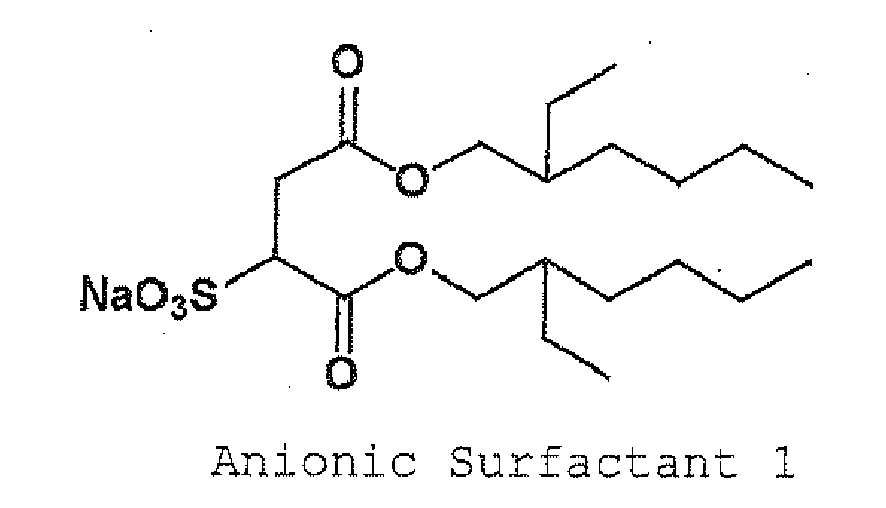
-
Sol-Gel Preparation Solution (2) shown below 500 g A 5 mass% aqueous solution of Anionic Surfactant 1 5.0 g - 30 Gram of Hydrophilic Polymer <1> shown below was mixed in 200 g of ethyl alcohol, 0.25 g of acetylacetone, 0.3 g of tetraethyl orthotitanate and 300 g of purified water, and the mixture was stirred at room temperature for 2 hours to prepare a sol-gel preparation solution.
-

- The synthesis method of Hydrophilic Polymer <1> used is described below. Other hydrophilic polymers containing a hydrolyzable alkoxysilyl group on the side chain can be synthesized in the same manner. Synthesis of Hydrophilic Polymer <1>:
- Into a 500 ml-volume three-neck flask, 56.9 g of acrylamide, 55 g of acrylamide-3-(ethoxysilyl)propyl and 450 g of 1-methoxy-2-propanol were charged, and 2.3 g of dimethyl 2,2'-azobis(2-methylpropionate) was added thereto at 80°C in a nitrogen stream. The mixture was kept at the same temperature with stirring for 6 hours and then cooled to room temperature. The resulting reaction solution was poured in 2 liter of acetone, and the precipitated solid was collected by filtration. The obtained solid was washed with acetone to obtain Hydrophilic Polymer <1>. The mass after drying was 110 g. This polymer was a polymer having a mass average molecular weight of 22,000 as determined by GPC (polyethylene oxide standard).
- The hydrophilic member obtained was evaluated as follows. The evaluation results are shown in Table 6.
Visible Light Transmittance: - The light transmittance in the visible light region (from 400 to 800 nm) was measured by a spectrophotometer and evaluated.
- The surface free energy was measured by the method described above.
- The hydrophilic member was dipped in pure water for 10 minutes, the film thickness before and after dipping was directly measured by ellipsometry (VASE, manufactured by J. A. Woollam), and the swelling degree due to dipping in water was calculated.
- A 50 ml-volume glass vessel was charged with 0.2 g of palmitic acid as a pseudo contaminant and covered with the hydrophilic member such that the hydrophilic film side was exposed to the palmitic acid, and after exposure at 105°C for 1 hour, the hydrophilic member was washed with running after for 30 minutes and then dried at 80°C for 30 minutes. This process was taken as 1 cycle, and the contact angle after 5 cycles was measured. As for the contact angle, the waterdrop contact angle of distilled water was measured by DROP MASTER 500 manufactured by Kyowa Interface Science Co., Ltd.
- A sapphire needle of 0.1 mm in diameter was scanned on the hydrophilic member surface under a load increased from 5 g in steps of 5 g, and the load under which the surface was scratched (measured by a scratch strength tester, Type 18S, manufactured by Shinto Scientific Co., Ltd.) was evaluated. No scratching with a large load indicates good durability.
- The hydrophilic member in a size of 120 cm2 was rubbed by moving a sponge back and force 10 times in water while applying a load of 1 kg, and the residual film ratio was determined from the change in the weight between before and after the treatment.
- The hydrophilic member was dipped in pure water for 10 minutes, the refractive index of the hydrophilic film was directly measured by ellipsometry (VASE, manufactured by J. A. Woollam), and the difference form the refractive index 1.33 of water was determined.
- Hydrophilic members were produced and evaluated in the same manner as in Example 1 except that the drying after bar-coating Hydrophilic Composition (1) as a second layer was changed to the drying conditions shown in Table 1.
- [Table 1]
Table 1 Drying Conditions of Second Layer Example 2 150°C-15 minutes Example 3 150°C-60 minutes Example 4 100°C-30 minutes Example 5 100°C-90 minutes - Hydrophilic members were produced and evaluated in the same manner as in Example 1 except that the drying after bar-coating Hydrophilic Composition (1) as a second layer was changed to the drying conditions shown in Table 2.
- [Table 2]
Table 2 Drying Conditions of Second Layer Comparative Example 1 150°C-1 minute Comparative Example 2 220°C-30 minutes - A hydrophilic member was produced and evaluated in the same manner as in Example 1 except that Hydrophilic Composition (1) was changed to Hydrophilic Composition (2).
-
Sol-Gel Preparation Solution (3) shown below 500 g A 5 mass% aqueous solution of Anionic Surfactant 1 5.0 g - 27 Gram of Hydrophilic Polymer <2> shown below and 3 g of tetramethoxysilane were mixed in 200 g of ethyl alcohol, 0.25 g of acetylacetone, 0.3 g of tetraethyl orthotitanate and 300 g of purified water, and the mixture was stirred at room temperature for 2 hours to prepare a sol-gel preparation solution.
-

- Hydrophilic members were produced and evaluated in the same manner as in Example 6 except that the drying after bar-coating Hydrophilic Composition (2) as a second layer was changed to the drying conditions shown in Table 3.
-
Table 3 Drying Conditions of Second Layer Example 7 150°C-15 minutes Example 8 150°C-60 minutes Example 9 100°C-30 minutes Example 10 100°C-90 minutes - An alkali-degreased aluminum substrate (thickness: 0.15 mm) was prepared, and First Layer Coating Solution (2) having the composition shown below was bar-coated thereon and dried in an oven at 100°C for 10 minutes to form a first layer having a dry coverage of 0.1 g/m2. After fully cooling at room temperature, Hydrophilic Composition (1) used in Example 1 was bar-coated as a second layer on the first layer coated surface and dried in an oven at 150°C for 30 minutes to form a second layer having a dry coverage of 0.5 g/m2. A hydrophilic member was obtained in this way and evaluated.
-
Sol-Gel Preparation Solution (4) shown below 500 g A 5 mass% aqueous solution of Anionic Surfactant 1 30 g Purified water 450 g - 4 Gram of tetramethoxysilane (produced by Tokyo Chemical Industry Co., Ltd.) and 4 g of methyltrimethoxysilane (produced by Tokyo Chemical Industry Co., Ltd.) were mixed in 200 g of ethyl alcohol, 10 g of acetylacetone, 10 g of tetraethyl orthotitanate and 100 g of purified water, and the mixture was stirred at room temperature for 2 hours to prepare a sol-gel preparation solution.
- A hydrophilic member was produced and evaluated in the same manner as in Example 11 except that Hydrophilic Composition (1) was changed to Hydrophilic Composition (3).
-
Sol-Gel Preparation Solution (5) shown below 500 g A 5 mass% aqueous solution of Anionic Surfactant 1 5.0 g - 15 Gram of Hydrophilic Polymer <1> shown below as the (A-1) hydrophilic polymer having a hydrolyzable alkoxysilyl group on the polymer side chain (hydrophilic polymer side chain Si type) and 15 g of Hydrophilic Polymer <3> shown below as the (A-2) hydrophilic polymer having a hydrolyzable alkoxysilyl group at the polymer terminal (hydrophilic polymer terminal Si type) were mixed in 200 g of ethyl alcohol, 0.25 g of acetylacetone, 0.3 g of tetraethyl orthotitanate and 300 g of purified, water, and the mixture was stirred at room temperature for 2 hours to prepare a sol-gel preparation solution.
-


- The synthesis method of Hydrophilic Polymer <3> used is described below. Other hydrophilic polymers containing a hydrolyzable alkoxysilyl group at the terminal can be synthesized in the same manner. Synthesis of Hydrophilic Polymer <3>:
- Into a three-neck flask, 25 g of acrylamide, 3.5 g of 3-mercaptopropyltrimethoxysilane and 51.3 g of 1-methoxy-2-propanol were charged, and the mixture was heated to 65°C under nitrogen flow. Thereto, 0.25 g of 2,2'-azobis(2,4-dimethylvaleronitrile) was added, and the reaction was started. After stirring for 6 hours, the temperature was returned to room temperature, and the reaction solution was poured in 1.5 L of ethyl acetate, as a result, a solid was precipitated. The solid was collected by filtration, thoroughly washed with ethyl acetate, then dried (yield: 21 g) and further confirmed by GPC (polyethylene oxide standard) to be Hydrophilic Polymer <3> having a mass average molecular weight of 3,000. The viscosity of a 5% aqueous solution was 2.5 mPa·s, and the functional group density of the hydrophilic group was 13.4 meq/g.
- Hydrophilic members were produced and evaluated in the same manner as in Example 12 except that the drying after bar-coating Hydrophilic Composition (3) as a second layer was changed to the drying conditions shown in Table 4.
- [Table 4]
Table 4 Drying Conditions of Second Layer Example 13 150°C-15 minutes Example 14 150°C-60 minutes Example 15 150°C-90 minutes - First Layer Coating Solution (3) having the composition shown below was spin-coated (1,000 rpm, 30 seconds) on an SUS substrate (thickness: 1.1 mm) whose surface was hydrophilized by a UV/O3 treatment for 10 minutes, and dried in an oven at 100°C for 2 minutes to form a layer having a dry coverage of 0.5 g/m2. The waterdrop contact angle of the first layer was 80°. Furthermore, First Layer Coating Solution (4) having the composition shown below was spin-coated (1,000 rpm, 30 seconds) on the first layer and dried in an oven at 100°C for 10 minutes to form a layer having a dry coverage of 0.5 g/m2, whereby a first layer having a two-layer structure was formed. The waterdrop contact angle of the layer formed from First Layer Coating Solution (4) was 10°. On the first layer having a two-layer structure, Hydrophilic Composition (3) was coated in the same manner as in Example 12 except for changing the hydrophilic polymer in the composition and the drying conditions as shown in Table 5. Hydrophilic members were obtained in this way and evaluated.
-
Epikote 1009 (produced by Shell Chemicals Japan Ltd.) 100 g Takenate D110N (produced by Takeda Chemical Industries, Ltd., solid content: 10%) 100 g Methyl ethyl ketone 1,200 g -
An aqueous PVA 105 solution (produced by Kuraray Co., Ltd., solid content: 6%) 130 g An aqueous glyoxal solution (produced by Tokyo Chemical Industry Co., Ltd., solid content: 40%) 50 g Ethylene glycol diglycidyl ether (produced by Tokyo Chemical Industry Co., Ltd.) 10 g Ethanol silica (produced by Nissan Chemicals Industries, Ltd., solid content: 30%) 30 g A 5 mass% aqueous solution of Anionic Surfactant 1 20 g Water 7,600 g -
Table 5 Hydrophilic Polymer Side Chain Si Type Hydrophilic polymer Terminal Si Type Drying Conditions of Second Layer Example 16 Hydrophilic Polymer <4> Hydrophilic Polymer <5> 150°C-10 minutes Example 17 Hydrophilic Polymer <4> Hydrophilic Polymer <5> 150°C-20 minutes Example 18 Hydrophilic Polymer <4> Hydrophilic Polymer <5> 150°C-60 minutes Example 19 Hydrophilic Polymer <6> Hydrophilic Polymer <7> 100°C-30 minutes Example 20 Hydrophilic Polymer <6> Hydrophilic Polymer <7> 100°C-90 minutes -
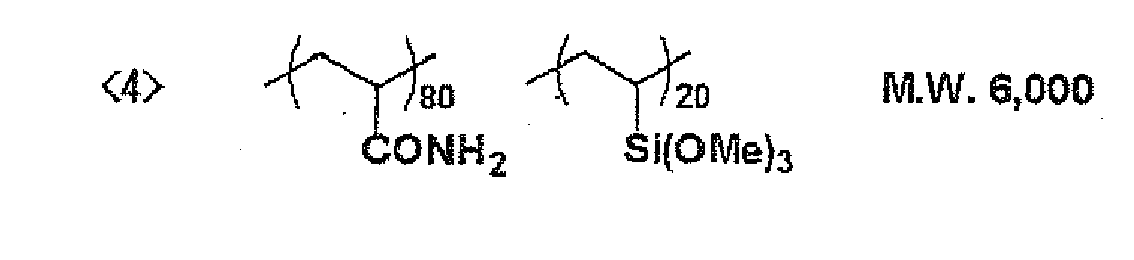


-
Table 6 Visible Light Transmittance Surface Free Energy Swelling Degree Refractive Index Difference Between Hydrophilic Film and Water Anti-fouling Property (contact angle) Water Resistance Residual Film Ratio Scratch Resitance Example 1 87% 82 mN/m 1.2 times 0.17 30° 97% 60 g Example 2 87% % 81 mN/m 1.3 times 0.16 32° 95% 55 g Example 3 88% 82 mN/m 1.1 times 0.18 28° 98% 65 g Example 4 88% 81 mN/m 1.2 times 0.17 30° 97% 60 g Example 5 87% 82 mN/m 1.1 times 0.18 27° 98% 65 g Example 6 88% 82 mN/m 1.1 times 0.18 28° 98% 70 g Example 7 88% 81 mN/m 1.2 times 0.17 30° 97% 70 g Example 8 87% 83 mN/m 1.0 times 0.20 26° 99% 75 g Example 9 86% 82 mN/m 1.1 times 0.18 27° 97% 70 g Example 10 88 % 83 mN/m 1.0 times 0.20 26° 99% 75 g Example 11 - 80 mN/m 1.2 times 0.17 30° 97% 60 g Example 12 - 83 mN/m 1.2 times 0.17 25° 97% 60 g Example 13 - 82 mN/m 1.3 times 0.16 28° 96% 60 g Example 14 - 84 mN/m 1.1 times 0.18 22° 96% 65 g Example 15 - 84 mN/m 1.0 times 0.20 20° 97% 65 g Example 16 - 83 mN/m 1.2 times 0.17 24° 97% 65 g Example 17 - 82 mN/m 1.1 times 0.18 22° 96% 70 Example 18 - 83 mN/m 1.0 times 0.20 18° 98% 70 g Example 19 - 83 mN/m 1.1 times 0. 18 22° 97% 65 g Example 20 - 84 mN/m 1.0 times 0.20 19° 98% 70 g Comparative Example 1 87% 80 mN/m 2.0 times 0.09 75° 90% 40 g Comparative Example 2 86% 80mN/m 1.9 times 0.10 70° 91% 45 g - Hydrophilic members were produced and evaluated in the same manner as in Example 12 except that the hydrophilic polymer in Hydrophilic Composition (3) and the drying conditions as shown in Table 7. The evaluation results are shown in Table 8.
- [Table 7]
Table 7 Hydrophilic Polymer Side Chain Si Type Hydrophilic polymer Terminal Si Type Drying Conditions of Second Layer Example 21 Hydrophilic
Polymer <9>Hydrophilic
Polymer <10>150°C-90 minutes Example 22 Hydrophilic
Polymer <9>Hydrophilic
Polymer <10>150°C-15 minutes Example 23 Hydrophilic
Polymer <9>Hydrophilic
Polymer <10>150°C-10 minutes Comparative Example 3 Hydrophilic
Polymer <9>Hydrophilic
Polymer <10>100°C-5 minutes Comparative Example 4 Hydrophilic
Polymer <9>Hydrophilic
Polymer <10>220°C-15 minutes -


-
Table 8 Visible Light Transmittance Surface Free Energy Swelling Degree Refractive Index Difference Between Hydrophilic Film and Water Anti-fouling Property (contact angle) Water Resistance, ResidualFilm Ratio Scratch Resistance Example 21 - 82 mN/m 1.0 times 0.20 18° 98% 70 g Example 22 - 81 mN/m 1.3 times 0.16 28° 97% 65 g Example 23 - 82 mN/m 1.5 times 0.14 35° 96% 65 g Comparative Example 3 - 81 mN/m 1.6 times 0.12 55° 93% 55 g Comparative Example 4 - 82 minim 1.8 times 0.10 65° 92% 50 g - Hydrophilic members were produced and evaluated in the same manner as in Example 12 except that (A-1) Hydrophilic Polymer <1> and (A-2) Hydrophilic Polymer <3> in Hydrophilic Composition (3) were changed to the mass ratio shown in Table 9. The results are shown in Table 10.
-
Table 9 Hydrophilic Polymer <1>/Hydrophilic Polymer <3> (mass ratio) Example 24 60/40 Example 25 70/30 Example 26 80/20 Example 27 95/5 -
Table 10 Visible Light Transmittance Surface Free Energy Swelling Degree Refractive Index Difference Between Hydrophilic Film and Water Anti-fouling Property (contact angle) Water Resistance, Residual Film Ratio Scratch Resistance Example 24 - 83 mN/m 1.2 times 0.17 26° 97% 60 g Example 25 - 83 mN/m 1.1 times 0.18 27° 97% 60 g Example 26 - 82mN/m 1.1 times 0.18 28° 98% 65 g Example 27 - 82 mN/m 1.1 times 0.18 29° 98% 65 g - Hydrophilic members were produced and evaluated in the same manner as in Example 12 except for changing the drying conditions of the second layer as shown in Table 11. The evaluation results are shown in Table 12.
-
Table 11 Drying Conditions of Second Layer Example 28 50°C-90 minutes Example 29 70°C-90 minutes Example 30 100°C-90 minutes Example 31 140°C-90 minutes Example 32 180°C-90 minutes -
Table 12 Example Visible Light Transmittance Surface Free Energy Swelling Degree Refractive Index Difference Between Hydrophilic Film and Water Anti-fouling Property (contact angle) Water Resistance, Residual Film Ratio Scratch Resistance Example 28 - 83 mN/m 1.4 times 0.15 34° 970 % 60 g Example 29 - 83 mN/m 1.3 times 0.16 30° 97% 60 g Example 30 - 83 mN/m 1.2 times 0.17 25° 97% 60 g Example 31 - 83 mN/m 1.2 times 0.17 25° 97% 60 g Example 32 - 82 mN/m 1.4 times 0.15 34° 98% 60 g - The hydrophilic member of the present invention can be used for various applications requiring hydrophilicity, water resistance, antifouling property and scratch resistance, such as fin stock for heat exchangers contained in air conditioners.
This application is based on Japanese Patent Application (Patent Application No.2008-79318) filed on March 25, 2008 2008-235452) filed on September 12, 2008
Claims (12)
- A hydrophilic member comprising a base material having thereon a hydrophilic film formed from a hydrophilic composition containing (A-1) a hydrophilic polymer having at least one hydrolyzable alkoxysilyl group on a polymer side chain and (B) a metal complex catalyst, wherein a water swelling degree of said hydrophilic film is 1.5 times or less.
- The hydrophilic member as claimed in claim 1, wherein a difference between a refractive index of said hydrophilic film in water and a refractive index of water is 0.14 or more.
- The hydrophilic member as claimed in claim 1 or 2, wherein a difference between a refractive index of said hydrophilic film in water and a refractive index of water is from 0.17 to 0.20.
- The hydrophilic member as claimed in any one of claims 1 to 3, wherein said Hydrophilic composition further contains (A-2) a hydrophilic polymer having at least one hydrolyzable alkoxysilyl group at a polymer terminal.
- The hydrophilic member as claimed in claim 4, wherein a mass ratio between said (A-2) hydrophilic polymer containing a hydrolyzable alkoxysilyl group at a polymer terminal and said (A-1) hydrophilic polymer containing a hydrolyzable alkoxysilyl group on a polymer side chain in said hydrophilic composition, {(A-2) hydrophilic polymer containing a hydrolyzable alkoxysilyl group at a polymer terminal/(A-1) hydrophilic polymer containing a hydrolyzable alkoxysilyl group on a polymer side chain}, is from 50/50 to 5/95.
- The hydrophilic member as claimed in any one of claims 1 to 5, wherein said (A-1) hydrophilic polymer having at least one hydrolyzable alkoxysilyl group on a polymer side chain comprises a structure represented by the following formula (1):

- The hydrophilic member as claimed in any one of claims 4 to 6, wherein said (A-2) hydrophilic polymer having at least one hydrolyzable alkoxysilyl group at a polymer terminal comprises a structure represented by the following formula (2):

- The hydrophilic member as claimed in any one of claims 1 to 7, wherein said hydrophilic film is formed by applying the hydrophilic composition onto a base material and subjecting the applied hydrophilic composition to a heat treatment at a temperature of 50 to 180°C for 1 hour or more.
- A fin stock having the hydrophilic member claimed in any one of claims 1 to 8.
- An aluminum-made fin stock, wherein the fin stock claimed in claim 9 is made of aluminum.
- A heat exchanger having the aluminum-made fin stock claimed in claim 10.
- An air conditioner having the heat exchanger claimed in claim 11.
Applications Claiming Priority (3)
| Application Number | Priority Date | Filing Date | Title |
|---|---|---|---|
| JP2008079318 | 2008-03-25 | ||
| JP2008235452A JP5427382B2 (en) | 2008-03-25 | 2008-09-12 | Hydrophilic member, fin material, aluminum fin material, heat exchanger and air conditioner |
| PCT/JP2009/056005 WO2009119689A1 (en) | 2008-03-25 | 2009-03-25 | Hydrophilic member, fin member, aluminum fin member, heat exchanger and air conditioner |
Publications (1)
| Publication Number | Publication Date |
|---|---|
| EP2269817A1 true EP2269817A1 (en) | 2011-01-05 |
Family
ID=41113879
Family Applications (1)
| Application Number | Title | Priority Date | Filing Date |
|---|---|---|---|
| EP09726264A Withdrawn EP2269817A1 (en) | 2008-03-25 | 2009-03-25 | Hydrophilic member, fin member, aluminum fin member, heat exchanger and air conditioner |
Country Status (6)
| Country | Link |
|---|---|
| US (1) | US20110108262A1 (en) |
| EP (1) | EP2269817A1 (en) |
| JP (1) | JP5427382B2 (en) |
| KR (1) | KR20100127791A (en) |
| CN (1) | CN101980865A (en) |
| WO (1) | WO2009119689A1 (en) |
Cited By (3)
| Publication number | Priority date | Publication date | Assignee | Title |
|---|---|---|---|---|
| CN102367011A (en) * | 2011-06-28 | 2012-03-07 | 苏州方暨圆节能科技有限公司 | Copper radiator heat pipe with film |
| CN102367012A (en) * | 2011-06-28 | 2012-03-07 | 苏州方暨圆节能科技有限公司 | Copper radiator heat pipe with film |
| CN107428881A (en) * | 2015-03-27 | 2017-12-01 | Ppg工业俄亥俄公司 | Durability anti-fingerprint polymer and coating composition |
Families Citing this family (12)
| Publication number | Priority date | Publication date | Assignee | Title |
|---|---|---|---|---|
| JP5561200B2 (en) * | 2010-03-31 | 2014-07-30 | 株式会社エクォス・リサーチ | Method for producing catalyst and method for controlling characteristics of reaction layer for fuel cell using catalyst |
| SA111320468B1 (en) * | 2010-05-26 | 2015-04-01 | الفا لافال كوربوريت ايه بي | Heat exchanger plates with anti-fouling properties |
| JPWO2012014934A1 (en) * | 2010-07-27 | 2013-09-12 | 住友軽金属工業株式会社 | Serpentine heat exchanger for air conditioner |
| KR101103569B1 (en) * | 2011-05-19 | 2012-01-09 | 주식회사 엠아이텍 | Air conditioner and heat radiating fin manufacturing method which increase heat exchange and antibacterial property |
| CN102368027A (en) * | 2011-06-28 | 2012-03-07 | 苏州方暨圆节能科技有限公司 | Flat aluminium cooling tube with film |
| CN102368030A (en) * | 2011-06-28 | 2012-03-07 | 苏州方暨圆节能科技有限公司 | Flat copper cooling tube with film |
| HUE035627T2 (en) | 2013-03-21 | 2018-05-28 | Nihon Parkerizing | Hydrophilic surface treatment agent for aluminum-containing metal heat exchangers having excellent drainage |
| CN105001763A (en) * | 2015-08-13 | 2015-10-28 | 重庆硕优铝材有限公司 | Antibacterial and antioxidant coated aluminium foil and preparation method thereof |
| JP2021137964A (en) * | 2018-05-23 | 2021-09-16 | 富士フイルム株式会社 | Anti-fog laminate and composition for forming anti-fog laminate |
| CN111253839B (en) * | 2020-03-05 | 2021-10-08 | 四川智溢实业有限公司 | Snowfield camouflage net white coating and preparation method thereof |
| CN115315494A (en) * | 2020-03-24 | 2022-11-08 | 日东电工株式会社 | Composition for forming coating film and coating film |
| KR102500600B1 (en) * | 2022-11-01 | 2023-02-20 | 주식회사 유비라이트 | Method for manufacturing water-cooling plate used in battery for electric vehicle and cooling plate manufactured thereby |
Family Cites Families (57)
| Publication number | Priority date | Publication date | Assignee | Title |
|---|---|---|---|---|
| US3214463A (en) | 1960-05-12 | 1965-10-26 | Du Pont | Uv-absorbing sulfonated benzophenone derivatives |
| BE757036A (en) | 1969-10-07 | 1971-03-16 | Fuji Photo Film Co Ltd | PHOTOSENSITIVE COLOR PHOTOGRAPHY MATERIALS WITH BETTER SOLIDITY TO LIGHT |
| JPS5512586B1 (en) | 1971-03-11 | 1980-04-02 | ||
| US4062627A (en) * | 1973-08-06 | 1977-12-13 | Essilor International (Compagnie Generale D'optique S.A.) | Flexible contact lens |
| JPS5249029A (en) | 1975-10-16 | 1977-04-19 | Fuji Photo Film Co Ltd | Silver halide color photographic light sensitive material |
| JPS5448535A (en) | 1977-08-31 | 1979-04-17 | Konishiroku Photo Ind Co Ltd | Color photographic material |
| JPS58185677A (en) | 1982-04-22 | 1983-10-29 | Konishiroku Photo Ind Co Ltd | Uv light absorber |
| JPS60168144A (en) | 1984-02-13 | 1985-08-31 | Japan Synthetic Rubber Co Ltd | Peeling soluting composition |
| JPS6153311A (en) * | 1984-08-22 | 1986-03-17 | Kyowa Gas Chem Ind Co Ltd | Hydrophilic copolymer and its preparation |
| DE3435443A1 (en) | 1984-09-27 | 1986-04-03 | Agfa-Gevaert Ag, 5090 Leverkusen | PHOTOGRAPHIC RECORDING MATERIAL |
| US4587346A (en) | 1985-01-22 | 1986-05-06 | Ciba-Geigy Corporation | Liquid 2-(2-hydroxy-3-higher branched alkyl-5-methyl-phenyl)-2H-benzotriazole mixtures, stabilized compositions and processes for preparing liquid mixtures |
| EP0223739A1 (en) | 1985-11-06 | 1987-05-27 | Ciba-Geigy Ag | Dibenzoxaphosphorine |
| JPH083630B2 (en) | 1986-01-23 | 1996-01-17 | 富士写真フイルム株式会社 | Photosensitive composition |
| JPH06105351B2 (en) | 1986-03-27 | 1994-12-21 | 富士写真フイルム株式会社 | Photosensitive composition |
| GB8610610D0 (en) | 1986-04-30 | 1986-06-04 | Kodak Ltd | Stabilization of dye images |
| EP0264730B1 (en) | 1986-10-10 | 1993-07-14 | Konica Corporation | Silver halide photographic light-sensitive material to provide dye-image with improved color-fastness to light |
| GB8625149D0 (en) | 1986-10-21 | 1986-11-26 | Kodak Ltd | Stabilisation of dye images |
| JPH0830876B2 (en) | 1986-12-25 | 1996-03-27 | コニカ株式会社 | Silver halide photographic light-sensitive material with improved fastness of dye image |
| EP0309401B2 (en) | 1987-09-21 | 2002-06-05 | Ciba Specialty Chemicals Holding Inc. | Stabilization of coatings with N-hydroxy hindered amines |
| ES2065924T5 (en) | 1987-09-21 | 2002-12-16 | Ciba Sc Holding Ag | STABILIZERS BASED ON N-SUBSTITUTED BLOCKED AMIDAS. |
| DE3887428D1 (en) | 1987-09-30 | 1994-03-10 | Ciba Geigy | Phenolic thiane derivatives. |
| EP0310552B1 (en) | 1987-09-30 | 1992-05-13 | Ciba-Geigy Ag | Stabilizers for colour photographic recording materials |
| JP2528334B2 (en) | 1987-10-09 | 1996-08-28 | 富士写真フイルム株式会社 | Silver halide color photographic light-sensitive material |
| EP0323408B1 (en) | 1987-12-28 | 1994-04-06 | Ciba-Geigy Ag | 2-(2-Hydroxyphenyl)-benztriazole derivatives |
| GB8808694D0 (en) | 1988-04-13 | 1988-05-18 | Kodak Ltd | Stabilization of dye images produced in photographic materials |
| US5028519A (en) | 1988-12-06 | 1991-07-02 | Fuji Photo Film Co., Ltd. | Silver halide color photosensitive material |
| JPH03121449A (en) | 1989-07-25 | 1991-05-23 | Fuji Photo Film Co Ltd | Silver halide color photographic sensitive material |
| DE59107294D1 (en) | 1990-05-10 | 1996-03-07 | Ciba Geigy Ag | Radiation curable light stabilized compositions |
| US5254433A (en) | 1990-05-28 | 1993-10-19 | Fuji Photo Film Co., Ltd. | Dye fixing element |
| JPH0561166A (en) | 1991-05-28 | 1993-03-12 | Fuji Photo Film Co Ltd | Silver halide color photographic sensitive material |
| DE59205075D1 (en) | 1991-07-03 | 1996-02-29 | Ciba Geigy Ag | Phenylthiophenyl ketones |
| US5298380A (en) | 1991-09-05 | 1994-03-29 | Ciba-Geigy Corporation | Photographic material which contains a UV absober |
| JP2687264B2 (en) | 1991-10-25 | 1997-12-08 | 富士写真フイルム株式会社 | Silver halide color photographic materials |
| WO1994005645A1 (en) | 1992-09-07 | 1994-03-17 | Ciba-Geigy Ag | Hydroxyphenyl-s-triazines |
| KR100214288B1 (en) * | 1993-04-16 | 1999-08-02 | 성재갑 | Wear-resistant coating composition for preventing fog and synthetic resin molded article coated with the same |
| JPH0718206A (en) * | 1993-07-02 | 1995-01-20 | Toyo Ink Mfg Co Ltd | Highly hydrophilic paint |
| US5556973A (en) | 1994-07-27 | 1996-09-17 | Ciba-Geigy Corporation | Red-shifted tris-aryl-s-triazines and compositions stabilized therewith |
| AU703967B2 (en) | 1994-10-10 | 1999-04-01 | Ciba Specialty Chemicals Holding Inc. | Bisresorcinyltriazines |
| EP0750224A3 (en) | 1995-06-19 | 1997-01-08 | Eastman Kodak Company | 2'-Hydroxyphenyl benzotriazole based UV absorbing polymers with particular substituents and photographic elements containing them |
| US5948605A (en) | 1996-08-16 | 1999-09-07 | Eastman Kodak Company | Ultraviolet ray absorbing polymer latex compositions, method of making same, and imaging elements employing such particles |
| GB2319523B (en) | 1996-11-20 | 2000-11-08 | Ciba Sc Holding Ag | Hydroxyphenyltriazines |
| JP4825992B2 (en) | 1999-08-11 | 2011-11-30 | 綜研化学株式会社 | Acrylic pressure-sensitive adhesive composition, method for producing pressure-sensitive adhesive tape using the composition, and pressure-sensitive adhesive tape |
| JP4554763B2 (en) * | 2000-05-19 | 2010-09-29 | 株式会社カネカ | Resin composition for paint excellent in appearance and stain resistance, and method for extending stain resistance performance of resin composition for paint |
| JP2002012729A (en) * | 2000-06-28 | 2002-01-15 | Hitachi Chem Co Ltd | Water soluble resin composition |
| JP2002106882A (en) | 2000-09-29 | 2002-04-10 | Daikin Ind Ltd | Air conditioner |
| JP2002143765A (en) * | 2000-11-14 | 2002-05-21 | Toray Ind Inc | Method for coating metal substrate and coated article |
| JP2002309159A (en) * | 2001-04-09 | 2002-10-23 | Fuji Photo Film Co Ltd | Hydrophilic coating liquid composition and surface- hydrophilic member |
| JP2002361800A (en) | 2001-06-11 | 2002-12-18 | Fuji Photo Film Co Ltd | Surface hydrophilic member |
| EP1625945B1 (en) * | 2001-06-11 | 2009-12-23 | FUJIFILM Corporation | Surface hydrophilic material |
| JP3536834B2 (en) | 2001-10-15 | 2004-06-14 | 株式会社日立製作所 | Room air conditioner |
| JP2003201577A (en) | 2002-01-09 | 2003-07-18 | Kobe Steel Ltd | Aluminum or aluminum alloy material for heat exchanger fin, and fin for heat exchanger |
| JP4467264B2 (en) | 2003-08-29 | 2010-05-26 | 三菱アルミニウム株式会社 | Fin coating composition and fin material |
| JP2005232269A (en) | 2004-02-18 | 2005-09-02 | Mitsubishi Alum Co Ltd | Hydrophilic coating material excellent in fouling resistance, aluminum material and heat exchanger |
| JP5094081B2 (en) * | 2005-11-17 | 2012-12-12 | 富士フイルム株式会社 | Hydrophilic member and method for producing the same |
| JP2007225174A (en) * | 2006-02-22 | 2007-09-06 | Fujifilm Corp | Heat exchanger |
| JP5337394B2 (en) * | 2007-05-15 | 2013-11-06 | 富士フイルム株式会社 | Hydrophilic coating composition and hydrophilic member using the same |
| JP2009256564A (en) * | 2007-09-26 | 2009-11-05 | Fujifilm Corp | Composition for formation of hydrophilic film, and hydrophilic member |
-
2008
- 2008-09-12 JP JP2008235452A patent/JP5427382B2/en not_active Expired - Fee Related
-
2009
- 2009-03-25 US US12/934,949 patent/US20110108262A1/en not_active Abandoned
- 2009-03-25 CN CN2009801105173A patent/CN101980865A/en active Pending
- 2009-03-25 WO PCT/JP2009/056005 patent/WO2009119689A1/en not_active Ceased
- 2009-03-25 EP EP09726264A patent/EP2269817A1/en not_active Withdrawn
- 2009-03-25 KR KR1020107021237A patent/KR20100127791A/en not_active Withdrawn
Non-Patent Citations (1)
| Title |
|---|
| See references of WO2009119689A1 * |
Cited By (4)
| Publication number | Priority date | Publication date | Assignee | Title |
|---|---|---|---|---|
| CN102367011A (en) * | 2011-06-28 | 2012-03-07 | 苏州方暨圆节能科技有限公司 | Copper radiator heat pipe with film |
| CN102367012A (en) * | 2011-06-28 | 2012-03-07 | 苏州方暨圆节能科技有限公司 | Copper radiator heat pipe with film |
| CN107428881A (en) * | 2015-03-27 | 2017-12-01 | Ppg工业俄亥俄公司 | Durability anti-fingerprint polymer and coating composition |
| EP3274411B1 (en) * | 2015-03-27 | 2023-06-07 | PPG Industries Ohio, Inc. | Durable anti-fingerprint polymers and coating compositions |
Also Published As
| Publication number | Publication date |
|---|---|
| KR20100127791A (en) | 2010-12-06 |
| US20110108262A1 (en) | 2011-05-12 |
| JP2009255500A (en) | 2009-11-05 |
| CN101980865A (en) | 2011-02-23 |
| JP5427382B2 (en) | 2014-02-26 |
| WO2009119689A1 (en) | 2009-10-01 |
Similar Documents
| Publication | Publication Date | Title |
|---|---|---|
| EP2269817A1 (en) | Hydrophilic member, fin member, aluminum fin member, heat exchanger and air conditioner | |
| EP2236557A1 (en) | Hydrophilic composition having mildewproofing effect and hydrophilic member | |
| US20110000658A1 (en) | Hydrophilic member | |
| US20080300359A1 (en) | Aqueous coating material composition | |
| US20100196724A1 (en) | Hydrophilic film forming composition and hydrophilic member | |
| US20110259571A1 (en) | Hydrophilic composition and hydrophilic member having antifungal property | |
| US20100159256A1 (en) | Composition for forming hydrophic firm, spray composition and hydrophilic member using the same | |
| US20090239051A1 (en) | Hydrophilic composition and hydrophilic treated member | |
| US20080226928A1 (en) | Hydrophilic member and process for producing the same | |
| EP1975194A2 (en) | Hydrophilic member and undercoating composition | |
| JP2008279736A (en) | Hydrophilic member and method for producing the same | |
| JP2010083141A (en) | Method for producing hydrophilic member, and hydrophilic member | |
| JP2009235128A (en) | Composition for forming hydrophilic film, and hydrophilic member | |
| JP2010070735A (en) | Hydrophilic composition, hydrophilic member, fin material, heat exchanger, and air conditioner | |
| JP2010047739A (en) | Hydrophilic composition, and hydrophilic member using the same, heat exchanger, air conditioner | |
| WO2009116598A1 (en) | Hydrophilic composition | |
| JP2011073359A (en) | Hydrophilic member | |
| JP2008308658A (en) | Hydrophilic film forming composition, hydrophilic member and method for producing hydrophilic member | |
| WO2009119605A1 (en) | Hydrophilic member | |
| US20090263605A1 (en) | Surface-hydrophilic structure | |
| JP2008088260A (en) | Hydrophilic film forming composition and hydrophilic member | |
| JP2008214507A (en) | Hydrophilic film forming composition and hydrophilic member | |
| JP2009227869A (en) | Composition for forming hydrophilic film, and hydrophilic member | |
| JP2008088258A (en) | Hydrophilic film forming composition and hydrophilic member | |
| JP2009227808A (en) | Hydrophilic composition and hydrophilic member |
Legal Events
| Date | Code | Title | Description |
|---|---|---|---|
| PUAI | Public reference made under article 153(3) epc to a published international application that has entered the european phase |
Free format text: ORIGINAL CODE: 0009012 |
|
| 17P | Request for examination filed |
Effective date: 20100927 |
|
| AK | Designated contracting states |
Kind code of ref document: A1 Designated state(s): AT BE BG CH CY CZ DE DK EE ES FI FR GB GR HR HU IE IS IT LI LT LU LV MC MK MT NL NO PL PT RO SE SI SK TR |
|
| AX | Request for extension of the european patent |
Extension state: AL BA RS |
|
| DAX | Request for extension of the european patent (deleted) | ||
| STAA | Information on the status of an ep patent application or granted ep patent |
Free format text: STATUS: THE APPLICATION HAS BEEN WITHDRAWN |
|
| 18W | Application withdrawn |
Effective date: 20111026 |