EP2265656B1 - Polyisocyanurate - Google Patents
Polyisocyanurate Download PDFInfo
- Publication number
- EP2265656B1 EP2265656B1 EP09735777.6A EP09735777A EP2265656B1 EP 2265656 B1 EP2265656 B1 EP 2265656B1 EP 09735777 A EP09735777 A EP 09735777A EP 2265656 B1 EP2265656 B1 EP 2265656B1
- Authority
- EP
- European Patent Office
- Prior art keywords
- polyisocyanurate
- nhc
- pores
- reaction
- microporous
- Prior art date
- Legal status (The legal status is an assumption and is not a legal conclusion. Google has not performed a legal analysis and makes no representation as to the accuracy of the status listed.)
- Not-in-force
Links
- 229920000582 polyisocyanurate Polymers 0.000 title claims description 121
- 239000011495 polyisocyanurate Substances 0.000 claims description 110
- 239000011148 porous material Substances 0.000 claims description 67
- 238000006243 chemical reaction Methods 0.000 claims description 51
- ADLVDYMTBOSDFE-UHFFFAOYSA-N 5-chloro-6-nitroisoindole-1,3-dione Chemical compound C1=C(Cl)C([N+](=O)[O-])=CC2=C1C(=O)NC2=O ADLVDYMTBOSDFE-UHFFFAOYSA-N 0.000 claims description 50
- 239000007789 gas Substances 0.000 claims description 40
- KDLHZDBZIXYQEI-UHFFFAOYSA-N Palladium Chemical compound [Pd] KDLHZDBZIXYQEI-UHFFFAOYSA-N 0.000 claims description 36
- -1 1,3-bis-(2,6-di-i-propylphenyl)-4,5-dihydroimidazol-2-ylidene Chemical group 0.000 claims description 32
- 229910052751 metal Inorganic materials 0.000 claims description 30
- 239000002184 metal Substances 0.000 claims description 30
- 238000000034 method Methods 0.000 claims description 26
- 125000005647 linker group Chemical group 0.000 claims description 24
- 230000003197 catalytic effect Effects 0.000 claims description 18
- 125000003118 aryl group Chemical group 0.000 claims description 16
- ZFSLODLOARCGLH-UHFFFAOYSA-N isocyanuric acid Chemical group OC1=NC(O)=NC(O)=N1 ZFSLODLOARCGLH-UHFFFAOYSA-N 0.000 claims description 16
- 230000008569 process Effects 0.000 claims description 15
- IQPQWNKOIGAROB-UHFFFAOYSA-N isocyanate group Chemical group [N-]=C=O IQPQWNKOIGAROB-UHFFFAOYSA-N 0.000 claims description 14
- 239000007858 starting material Substances 0.000 claims description 14
- BASFCYQUMIYNBI-UHFFFAOYSA-N platinum Chemical compound [Pt] BASFCYQUMIYNBI-UHFFFAOYSA-N 0.000 claims description 13
- 238000003860 storage Methods 0.000 claims description 12
- 239000002105 nanoparticle Substances 0.000 claims description 11
- 239000001257 hydrogen Substances 0.000 claims description 10
- 229910052739 hydrogen Inorganic materials 0.000 claims description 10
- 229910052763 palladium Inorganic materials 0.000 claims description 10
- UFHFLCQGNIYNRP-UHFFFAOYSA-N Hydrogen Chemical compound [H][H] UFHFLCQGNIYNRP-UHFFFAOYSA-N 0.000 claims description 9
- 229910044991 metal oxide Inorganic materials 0.000 claims description 8
- 150000004706 metal oxides Chemical class 0.000 claims description 8
- 125000004433 nitrogen atom Chemical group N* 0.000 claims description 8
- UQSXHKLRYXJYBZ-UHFFFAOYSA-N Iron oxide Chemical group [Fe]=O UQSXHKLRYXJYBZ-UHFFFAOYSA-N 0.000 claims description 6
- 125000001072 heteroaryl group Chemical group 0.000 claims description 6
- 150000004693 imidazolium salts Chemical class 0.000 claims description 6
- 229910052697 platinum Inorganic materials 0.000 claims description 6
- ALQLPWJFHRMHIU-UHFFFAOYSA-N 1,4-diisocyanatobenzene Chemical compound O=C=NC1=CC=C(N=C=O)C=C1 ALQLPWJFHRMHIU-UHFFFAOYSA-N 0.000 claims description 5
- RQBUVIFBALZGPC-UHFFFAOYSA-N 1-isocyanato-4-(4-isocyanatophenyl)benzene Chemical compound C1=CC(N=C=O)=CC=C1C1=CC=C(N=C=O)C=C1 RQBUVIFBALZGPC-UHFFFAOYSA-N 0.000 claims description 5
- ZUOUZKKEUPVFJK-UHFFFAOYSA-N diphenyl Chemical group C1=CC=CC=C1C1=CC=CC=C1 ZUOUZKKEUPVFJK-UHFFFAOYSA-N 0.000 claims description 5
- 125000005651 substituted 1,4-phenylene group Chemical group 0.000 claims description 5
- 238000006069 Suzuki reaction reaction Methods 0.000 claims description 4
- 150000001543 aryl boronic acids Chemical class 0.000 claims description 3
- 150000001502 aryl halides Chemical class 0.000 claims description 3
- YFXCNIVBAVFOBX-UHFFFAOYSA-N ethenylboronic acid Chemical compound OB(O)C=C YFXCNIVBAVFOBX-UHFFFAOYSA-N 0.000 claims description 2
- 229920002554 vinyl polymer Polymers 0.000 claims description 2
- ZMXDDKWLCZADIW-UHFFFAOYSA-N N,N-Dimethylformamide Chemical compound CN(C)C=O ZMXDDKWLCZADIW-UHFFFAOYSA-N 0.000 description 37
- 229920000642 polymer Polymers 0.000 description 22
- 239000000047 product Substances 0.000 description 21
- 239000002904 solvent Substances 0.000 description 20
- IAZDPXIOMUYVGZ-UHFFFAOYSA-N Dimethylsulphoxide Chemical compound CS(C)=O IAZDPXIOMUYVGZ-UHFFFAOYSA-N 0.000 description 14
- 239000000463 material Substances 0.000 description 13
- 125000001424 substituent group Chemical group 0.000 description 12
- 230000015572 biosynthetic process Effects 0.000 description 11
- 239000003054 catalyst Substances 0.000 description 11
- 238000003786 synthesis reaction Methods 0.000 description 11
- YMWUJEATGCHHMB-UHFFFAOYSA-N Dichloromethane Chemical compound ClCCl YMWUJEATGCHHMB-UHFFFAOYSA-N 0.000 description 10
- IJGRMHOSHXDMSA-UHFFFAOYSA-N Atomic nitrogen Chemical compound N#N IJGRMHOSHXDMSA-UHFFFAOYSA-N 0.000 description 9
- RTZKZFJDLAIYFH-UHFFFAOYSA-N Diethyl ether Chemical compound CCOCC RTZKZFJDLAIYFH-UHFFFAOYSA-N 0.000 description 9
- 238000009826 distribution Methods 0.000 description 8
- 239000000203 mixture Substances 0.000 description 8
- 239000012948 isocyanate Substances 0.000 description 7
- YXFVVABEGXRONW-UHFFFAOYSA-N Toluene Chemical compound CC1=CC=CC=C1 YXFVVABEGXRONW-UHFFFAOYSA-N 0.000 description 6
- 238000002441 X-ray diffraction Methods 0.000 description 6
- 238000001914 filtration Methods 0.000 description 6
- 150000002513 isocyanates Chemical class 0.000 description 6
- 239000011541 reaction mixture Substances 0.000 description 6
- 239000000126 substance Substances 0.000 description 6
- OKTJSMMVPCPJKN-UHFFFAOYSA-N Carbon Chemical compound [C] OKTJSMMVPCPJKN-UHFFFAOYSA-N 0.000 description 5
- 238000001228 spectrum Methods 0.000 description 5
- 238000005406 washing Methods 0.000 description 5
- 238000003917 TEM image Methods 0.000 description 4
- WYURNTSHIVDZCO-UHFFFAOYSA-N Tetrahydrofuran Chemical compound C1CCOC1 WYURNTSHIVDZCO-UHFFFAOYSA-N 0.000 description 4
- 239000003153 chemical reaction reagent Substances 0.000 description 4
- 238000007210 heterogeneous catalysis Methods 0.000 description 4
- 238000011065 in-situ storage Methods 0.000 description 4
- 238000011068 loading method Methods 0.000 description 4
- 239000000178 monomer Substances 0.000 description 4
- 229910052757 nitrogen Inorganic materials 0.000 description 4
- LFQSCWFLJHTTHZ-UHFFFAOYSA-N Ethanol Chemical compound CCO LFQSCWFLJHTTHZ-UHFFFAOYSA-N 0.000 description 3
- XEKOWRVHYACXOJ-UHFFFAOYSA-N Ethyl acetate Chemical compound CCOC(C)=O XEKOWRVHYACXOJ-UHFFFAOYSA-N 0.000 description 3
- OKKJLVBELUTLKV-UHFFFAOYSA-N Methanol Chemical compound OC OKKJLVBELUTLKV-UHFFFAOYSA-N 0.000 description 3
- 229910052799 carbon Inorganic materials 0.000 description 3
- 239000013310 covalent-organic framework Substances 0.000 description 3
- 230000000694 effects Effects 0.000 description 3
- 150000002678 macrocyclic compounds Chemical class 0.000 description 3
- 239000012229 microporous material Substances 0.000 description 3
- 238000002156 mixing Methods 0.000 description 3
- 229920001228 polyisocyanate Polymers 0.000 description 3
- 239000005056 polyisocyanate Substances 0.000 description 3
- 230000009467 reduction Effects 0.000 description 3
- 238000001878 scanning electron micrograph Methods 0.000 description 3
- 238000005201 scrubbing Methods 0.000 description 3
- 238000001179 sorption measurement Methods 0.000 description 3
- 238000003756 stirring Methods 0.000 description 3
- 238000002411 thermogravimetry Methods 0.000 description 3
- 238000001757 thermogravimetry curve Methods 0.000 description 3
- 238000004627 transmission electron microscopy Methods 0.000 description 3
- XKRFYHLGVUSROY-UHFFFAOYSA-N Argon Chemical compound [Ar] XKRFYHLGVUSROY-UHFFFAOYSA-N 0.000 description 2
- 239000013475 COF-5 Substances 0.000 description 2
- CURLTUGMZLYLDI-UHFFFAOYSA-N Carbon dioxide Chemical compound O=C=O CURLTUGMZLYLDI-UHFFFAOYSA-N 0.000 description 2
- HEDRZPFGACZZDS-UHFFFAOYSA-N Chloroform Chemical compound ClC(Cl)Cl HEDRZPFGACZZDS-UHFFFAOYSA-N 0.000 description 2
- 238000005033 Fourier transform infrared spectroscopy Methods 0.000 description 2
- XEEYBQQBJWHFJM-UHFFFAOYSA-N Iron Chemical compound [Fe] XEEYBQQBJWHFJM-UHFFFAOYSA-N 0.000 description 2
- VYPSYNLAJGMNEJ-UHFFFAOYSA-N Silicium dioxide Chemical compound O=[Si]=O VYPSYNLAJGMNEJ-UHFFFAOYSA-N 0.000 description 2
- 238000004458 analytical method Methods 0.000 description 2
- 239000000010 aprotic solvent Substances 0.000 description 2
- 230000002902 bimodal effect Effects 0.000 description 2
- FJDQFPXHSGXQBY-UHFFFAOYSA-L caesium carbonate Chemical compound [Cs+].[Cs+].[O-]C([O-])=O FJDQFPXHSGXQBY-UHFFFAOYSA-L 0.000 description 2
- 125000004432 carbon atom Chemical group C* 0.000 description 2
- 238000005119 centrifugation Methods 0.000 description 2
- 238000005859 coupling reaction Methods 0.000 description 2
- 238000006006 cyclotrimerization reaction Methods 0.000 description 2
- 125000005442 diisocyanate group Chemical group 0.000 description 2
- 238000001035 drying Methods 0.000 description 2
- SZVJSHCCFOBDDC-UHFFFAOYSA-N ferrosoferric oxide Chemical compound O=[Fe]O[Fe]O[Fe]=O SZVJSHCCFOBDDC-UHFFFAOYSA-N 0.000 description 2
- PCHJSUWPFVWCPO-UHFFFAOYSA-N gold Chemical compound [Au] PCHJSUWPFVWCPO-UHFFFAOYSA-N 0.000 description 2
- 239000010931 gold Substances 0.000 description 2
- 229910052737 gold Inorganic materials 0.000 description 2
- 239000010439 graphite Substances 0.000 description 2
- 229910002804 graphite Inorganic materials 0.000 description 2
- 238000010438 heat treatment Methods 0.000 description 2
- 125000001449 isopropyl group Chemical group [H]C([H])([H])C([H])(*)C([H])([H])[H] 0.000 description 2
- 238000005304 joining Methods 0.000 description 2
- ZCSHNCUQKCANBX-UHFFFAOYSA-N lithium diisopropylamide Chemical compound [Li+].CC(C)[N-]C(C)C ZCSHNCUQKCANBX-UHFFFAOYSA-N 0.000 description 2
- 239000002082 metal nanoparticle Substances 0.000 description 2
- 239000012621 metal-organic framework Substances 0.000 description 2
- 238000000696 nitrogen adsorption--desorption isotherm Methods 0.000 description 2
- 238000012856 packing Methods 0.000 description 2
- WXHIJDCHNDBCNY-UHFFFAOYSA-N palladium dihydride Chemical class [PdH2] WXHIJDCHNDBCNY-UHFFFAOYSA-N 0.000 description 2
- YJVFFLUZDVXJQI-UHFFFAOYSA-L palladium(ii) acetate Chemical compound [Pd+2].CC([O-])=O.CC([O-])=O YJVFFLUZDVXJQI-UHFFFAOYSA-L 0.000 description 2
- 239000002245 particle Substances 0.000 description 2
- 239000000843 powder Substances 0.000 description 2
- 239000002244 precipitate Substances 0.000 description 2
- 238000001556 precipitation Methods 0.000 description 2
- 238000002360 preparation method Methods 0.000 description 2
- 150000003839 salts Chemical class 0.000 description 2
- 238000000926 separation method Methods 0.000 description 2
- 239000012279 sodium borohydride Substances 0.000 description 2
- 229910000033 sodium borohydride Inorganic materials 0.000 description 2
- 229910000104 sodium hydride Inorganic materials 0.000 description 2
- 230000003068 static effect Effects 0.000 description 2
- 125000000999 tert-butyl group Chemical group [H]C([H])([H])C(*)(C([H])([H])[H])C([H])([H])[H] 0.000 description 2
- 125000001973 tert-pentyl group Chemical group [H]C([H])([H])C([H])([H])C(*)(C([H])([H])[H])C([H])([H])[H] 0.000 description 2
- YLQBMQCUIZJEEH-UHFFFAOYSA-N tetrahydrofuran Natural products C=1C=COC=1 YLQBMQCUIZJEEH-UHFFFAOYSA-N 0.000 description 2
- 239000010457 zeolite Substances 0.000 description 2
- LUYHWJKHJNFYGV-UHFFFAOYSA-N 1,2-diisocyanato-3-phenylbenzene Chemical compound O=C=NC1=CC=CC(C=2C=CC=CC=2)=C1N=C=O LUYHWJKHJNFYGV-UHFFFAOYSA-N 0.000 description 1
- MTZUIIAIAKMWLI-UHFFFAOYSA-N 1,2-diisocyanatobenzene Chemical compound O=C=NC1=CC=CC=C1N=C=O MTZUIIAIAKMWLI-UHFFFAOYSA-N 0.000 description 1
- ZXHZWRZAWJVPIC-UHFFFAOYSA-N 1,2-diisocyanatonaphthalene Chemical compound C1=CC=CC2=C(N=C=O)C(N=C=O)=CC=C21 ZXHZWRZAWJVPIC-UHFFFAOYSA-N 0.000 description 1
- LSMWOQFDLBIYPM-UHFFFAOYSA-N 1,3-bis(2,4,6-trimethylphenyl)-4,5-dihydro-2h-imidazol-1-ium-2-ide Chemical compound CC1=CC(C)=CC(C)=C1N1[C-]=[N+](C=2C(=CC(C)=CC=2C)C)CC1 LSMWOQFDLBIYPM-UHFFFAOYSA-N 0.000 description 1
- XZDYFCGKKKSOEY-UHFFFAOYSA-N 1,3-bis[2,6-di(propan-2-yl)phenyl]-4,5-dihydro-2h-imidazol-1-ium-2-ide Chemical compound CC(C)C1=CC=CC(C(C)C)=C1N1CCN(C=2C(=CC=CC=2C(C)C)C(C)C)[C]1 XZDYFCGKKKSOEY-UHFFFAOYSA-N 0.000 description 1
- ZUFPKSNVTHKZGZ-UHFFFAOYSA-N 1,3-ditert-butylimidazolidin-1-ium;chloride Chemical compound [Cl-].CC(C)(C)N1CC[NH+](C(C)(C)C)C1 ZUFPKSNVTHKZGZ-UHFFFAOYSA-N 0.000 description 1
- DKBHJZFJCDOGOY-UHFFFAOYSA-N 1,4-diisocyanato-2-methylbenzene Chemical compound CC1=CC(N=C=O)=CC=C1N=C=O DKBHJZFJCDOGOY-UHFFFAOYSA-N 0.000 description 1
- XJKSTNDFUHDPQJ-UHFFFAOYSA-N 1,4-diphenylbenzene Chemical group C1=CC=CC=C1C1=CC=C(C=2C=CC=CC=2)C=C1 XJKSTNDFUHDPQJ-UHFFFAOYSA-N 0.000 description 1
- SDTMFDGELKWGFT-UHFFFAOYSA-N 2-methylpropan-2-olate Chemical compound CC(C)(C)[O-] SDTMFDGELKWGFT-UHFFFAOYSA-N 0.000 description 1
- UPMLOUAZCHDJJD-UHFFFAOYSA-N 4,4'-Diphenylmethane Diisocyanate Chemical compound C1=CC(N=C=O)=CC=C1CC1=CC=C(N=C=O)C=C1 UPMLOUAZCHDJJD-UHFFFAOYSA-N 0.000 description 1
- 125000004580 4,5-dihydroimidazol-2-yl group Chemical group N1C(=NCC1)* 0.000 description 1
- 239000013474 COF-1 Substances 0.000 description 1
- VEXZGXHMUGYJMC-UHFFFAOYSA-M Chloride anion Chemical compound [Cl-] VEXZGXHMUGYJMC-UHFFFAOYSA-M 0.000 description 1
- 238000003775 Density Functional Theory Methods 0.000 description 1
- KMTRUDSVKNLOMY-UHFFFAOYSA-N Ethylene carbonate Chemical compound O=C1OCCO1 KMTRUDSVKNLOMY-UHFFFAOYSA-N 0.000 description 1
- PMQTYWIGJIUFNJ-UHFFFAOYSA-N N=C=O.N=C=O.C1=CC=NC=C1 Chemical compound N=C=O.N=C=O.C1=CC=NC=C1 PMQTYWIGJIUFNJ-UHFFFAOYSA-N 0.000 description 1
- QNBZOZUXXFSIAJ-UHFFFAOYSA-N N=C=O.N=C=O.C=1C=COC=1 Chemical compound N=C=O.N=C=O.C=1C=COC=1 QNBZOZUXXFSIAJ-UHFFFAOYSA-N 0.000 description 1
- KEAYESYHFKHZAL-UHFFFAOYSA-N Sodium Chemical compound [Na] KEAYESYHFKHZAL-UHFFFAOYSA-N 0.000 description 1
- 239000002250 absorbent Substances 0.000 description 1
- 230000002745 absorbent Effects 0.000 description 1
- 238000010521 absorption reaction Methods 0.000 description 1
- 239000013543 active substance Substances 0.000 description 1
- 239000003463 adsorbent Substances 0.000 description 1
- 239000003570 air Substances 0.000 description 1
- 125000003545 alkoxy group Chemical group 0.000 description 1
- 238000013459 approach Methods 0.000 description 1
- 229910052786 argon Inorganic materials 0.000 description 1
- 239000012298 atmosphere Substances 0.000 description 1
- 125000005620 boronic acid group Chemical class 0.000 description 1
- 229910000024 caesium carbonate Inorganic materials 0.000 description 1
- 150000001721 carbon Chemical group 0.000 description 1
- 239000001569 carbon dioxide Substances 0.000 description 1
- 229910002092 carbon dioxide Inorganic materials 0.000 description 1
- 125000002915 carbonyl group Chemical group [*:2]C([*:1])=O 0.000 description 1
- 238000006555 catalytic reaction Methods 0.000 description 1
- 238000007036 catalytic synthesis reaction Methods 0.000 description 1
- 239000003638 chemical reducing agent Substances 0.000 description 1
- 239000004927 clay Substances 0.000 description 1
- 238000006482 condensation reaction Methods 0.000 description 1
- 230000008878 coupling Effects 0.000 description 1
- 238000010168 coupling process Methods 0.000 description 1
- 238000004132 cross linking Methods 0.000 description 1
- 238000002425 crystallisation Methods 0.000 description 1
- 230000008025 crystallization Effects 0.000 description 1
- 125000004122 cyclic group Chemical group 0.000 description 1
- 230000018044 dehydration Effects 0.000 description 1
- 238000006297 dehydration reaction Methods 0.000 description 1
- 238000013461 design Methods 0.000 description 1
- 238000011161 development Methods 0.000 description 1
- 125000005047 dihydroimidazolyl group Chemical group N1(CNC=C1)* 0.000 description 1
- 230000002708 enhancing effect Effects 0.000 description 1
- 238000002474 experimental method Methods 0.000 description 1
- 239000006260 foam Substances 0.000 description 1
- 125000000524 functional group Chemical group 0.000 description 1
- 150000004820 halides Chemical class 0.000 description 1
- 229910052734 helium Inorganic materials 0.000 description 1
- 239000001307 helium Substances 0.000 description 1
- SWQJXJOGLNCZEY-UHFFFAOYSA-N helium atom Chemical compound [He] SWQJXJOGLNCZEY-UHFFFAOYSA-N 0.000 description 1
- 125000000623 heterocyclic group Chemical group 0.000 description 1
- GNOIPBMMFNIUFM-UHFFFAOYSA-N hexamethylphosphoric triamide Chemical compound CN(C)P(=O)(N(C)C)N(C)C GNOIPBMMFNIUFM-UHFFFAOYSA-N 0.000 description 1
- 150000004678 hydrides Chemical class 0.000 description 1
- 150000002431 hydrogen Chemical class 0.000 description 1
- 239000013315 hypercross-linked polymer Substances 0.000 description 1
- 125000002883 imidazolyl group Chemical group 0.000 description 1
- 239000011229 interlayer Substances 0.000 description 1
- 229910052742 iron Inorganic materials 0.000 description 1
- 230000001788 irregular Effects 0.000 description 1
- 238000002955 isolation Methods 0.000 description 1
- 239000010410 layer Substances 0.000 description 1
- 238000004519 manufacturing process Methods 0.000 description 1
- 239000013335 mesoporous material Substances 0.000 description 1
- 238000012544 monitoring process Methods 0.000 description 1
- XVDBWWRIXBMVJV-UHFFFAOYSA-N n-[bis(dimethylamino)phosphanyl]-n-methylmethanamine Chemical compound CN(C)P(N(C)C)N(C)C XVDBWWRIXBMVJV-UHFFFAOYSA-N 0.000 description 1
- 229910052754 neon Inorganic materials 0.000 description 1
- GKAOGPIIYCISHV-UHFFFAOYSA-N neon atom Chemical compound [Ne] GKAOGPIIYCISHV-UHFFFAOYSA-N 0.000 description 1
- JCXJVPUVTGWSNB-UHFFFAOYSA-N nitrogen dioxide Inorganic materials O=[N]=O JCXJVPUVTGWSNB-UHFFFAOYSA-N 0.000 description 1
- 230000000269 nucleophilic effect Effects 0.000 description 1
- 239000013384 organic framework Substances 0.000 description 1
- 239000011368 organic material Substances 0.000 description 1
- 229920000620 organic polymer Polymers 0.000 description 1
- 239000003960 organic solvent Substances 0.000 description 1
- 125000002524 organometallic group Chemical group 0.000 description 1
- 229930184652 p-Terphenyl Natural products 0.000 description 1
- 150000002940 palladium Chemical class 0.000 description 1
- 125000001997 phenyl group Chemical group [H]C1=C([H])C([H])=C(*)C([H])=C1[H] 0.000 description 1
- HXITXNWTGFUOAU-UHFFFAOYSA-N phenylboronic acid Chemical compound OB(O)C1=CC=CC=C1 HXITXNWTGFUOAU-UHFFFAOYSA-N 0.000 description 1
- 230000000704 physical effect Effects 0.000 description 1
- 150000003057 platinum Chemical class 0.000 description 1
- CLSUSRZJUQMOHH-UHFFFAOYSA-L platinum dichloride Chemical compound Cl[Pt]Cl CLSUSRZJUQMOHH-UHFFFAOYSA-L 0.000 description 1
- 239000002798 polar solvent Substances 0.000 description 1
- LPNYRYFBWFDTMA-UHFFFAOYSA-N potassium tert-butoxide Chemical compound [K+].CC(C)(C)[O-] LPNYRYFBWFDTMA-UHFFFAOYSA-N 0.000 description 1
- 238000000634 powder X-ray diffraction Methods 0.000 description 1
- RUOJZAUFBMNUDX-UHFFFAOYSA-N propylene carbonate Chemical compound CC1COC(=O)O1 RUOJZAUFBMNUDX-UHFFFAOYSA-N 0.000 description 1
- 238000000746 purification Methods 0.000 description 1
- 230000005855 radiation Effects 0.000 description 1
- 239000000376 reactant Substances 0.000 description 1
- 230000002441 reversible effect Effects 0.000 description 1
- 238000004626 scanning electron microscopy Methods 0.000 description 1
- 239000000377 silicon dioxide Substances 0.000 description 1
- 239000012312 sodium hydride Substances 0.000 description 1
- 241000894007 species Species 0.000 description 1
- 238000004611 spectroscopical analysis Methods 0.000 description 1
- 239000000758 substrate Substances 0.000 description 1
- 239000000725 suspension Substances 0.000 description 1
- 230000009466 transformation Effects 0.000 description 1
- 238000000844 transformation Methods 0.000 description 1
- 239000013638 trimer Substances 0.000 description 1
Images




Classifications
-
- C—CHEMISTRY; METALLURGY
- C08—ORGANIC MACROMOLECULAR COMPOUNDS; THEIR PREPARATION OR CHEMICAL WORKING-UP; COMPOSITIONS BASED THEREON
- C08G—MACROMOLECULAR COMPOUNDS OBTAINED OTHERWISE THAN BY REACTIONS ONLY INVOLVING UNSATURATED CARBON-TO-CARBON BONDS
- C08G18/00—Polymeric products of isocyanates or isothiocyanates
- C08G18/02—Polymeric products of isocyanates or isothiocyanates of isocyanates or isothiocyanates only
- C08G18/022—Polymeric products of isocyanates or isothiocyanates of isocyanates or isothiocyanates only the polymeric products containing isocyanurate groups
-
- B—PERFORMING OPERATIONS; TRANSPORTING
- B01—PHYSICAL OR CHEMICAL PROCESSES OR APPARATUS IN GENERAL
- B01J—CHEMICAL OR PHYSICAL PROCESSES, e.g. CATALYSIS OR COLLOID CHEMISTRY; THEIR RELEVANT APPARATUS
- B01J23/00—Catalysts comprising metals or metal oxides or hydroxides, not provided for in group B01J21/00
- B01J23/38—Catalysts comprising metals or metal oxides or hydroxides, not provided for in group B01J21/00 of noble metals
- B01J23/40—Catalysts comprising metals or metal oxides or hydroxides, not provided for in group B01J21/00 of noble metals of the platinum group metals
- B01J23/42—Platinum
-
- B—PERFORMING OPERATIONS; TRANSPORTING
- B01—PHYSICAL OR CHEMICAL PROCESSES OR APPARATUS IN GENERAL
- B01J—CHEMICAL OR PHYSICAL PROCESSES, e.g. CATALYSIS OR COLLOID CHEMISTRY; THEIR RELEVANT APPARATUS
- B01J23/00—Catalysts comprising metals or metal oxides or hydroxides, not provided for in group B01J21/00
- B01J23/38—Catalysts comprising metals or metal oxides or hydroxides, not provided for in group B01J21/00 of noble metals
- B01J23/40—Catalysts comprising metals or metal oxides or hydroxides, not provided for in group B01J21/00 of noble metals of the platinum group metals
- B01J23/44—Palladium
-
- B—PERFORMING OPERATIONS; TRANSPORTING
- B01—PHYSICAL OR CHEMICAL PROCESSES OR APPARATUS IN GENERAL
- B01J—CHEMICAL OR PHYSICAL PROCESSES, e.g. CATALYSIS OR COLLOID CHEMISTRY; THEIR RELEVANT APPARATUS
- B01J31/00—Catalysts comprising hydrides, coordination complexes or organic compounds
- B01J31/02—Catalysts comprising hydrides, coordination complexes or organic compounds containing organic compounds or metal hydrides
- B01J31/06—Catalysts comprising hydrides, coordination complexes or organic compounds containing organic compounds or metal hydrides containing polymers
- B01J31/063—Polymers comprising a characteristic microstructure
-
- B—PERFORMING OPERATIONS; TRANSPORTING
- B01—PHYSICAL OR CHEMICAL PROCESSES OR APPARATUS IN GENERAL
- B01J—CHEMICAL OR PHYSICAL PROCESSES, e.g. CATALYSIS OR COLLOID CHEMISTRY; THEIR RELEVANT APPARATUS
- B01J35/00—Catalysts, in general, characterised by their form or physical properties
- B01J35/60—Catalysts, in general, characterised by their form or physical properties characterised by their surface properties or porosity
-
- C—CHEMISTRY; METALLURGY
- C08—ORGANIC MACROMOLECULAR COMPOUNDS; THEIR PREPARATION OR CHEMICAL WORKING-UP; COMPOSITIONS BASED THEREON
- C08G—MACROMOLECULAR COMPOUNDS OBTAINED OTHERWISE THAN BY REACTIONS ONLY INVOLVING UNSATURATED CARBON-TO-CARBON BONDS
- C08G18/00—Polymeric products of isocyanates or isothiocyanates
- C08G18/06—Polymeric products of isocyanates or isothiocyanates with compounds having active hydrogen
- C08G18/70—Polymeric products of isocyanates or isothiocyanates with compounds having active hydrogen characterised by the isocyanates or isothiocyanates used
- C08G18/71—Monoisocyanates or monoisothiocyanates
-
- C—CHEMISTRY; METALLURGY
- C08—ORGANIC MACROMOLECULAR COMPOUNDS; THEIR PREPARATION OR CHEMICAL WORKING-UP; COMPOSITIONS BASED THEREON
- C08G—MACROMOLECULAR COMPOUNDS OBTAINED OTHERWISE THAN BY REACTIONS ONLY INVOLVING UNSATURATED CARBON-TO-CARBON BONDS
- C08G18/00—Polymeric products of isocyanates or isothiocyanates
- C08G18/06—Polymeric products of isocyanates or isothiocyanates with compounds having active hydrogen
- C08G18/70—Polymeric products of isocyanates or isothiocyanates with compounds having active hydrogen characterised by the isocyanates or isothiocyanates used
- C08G18/72—Polyisocyanates or polyisothiocyanates
- C08G18/74—Polyisocyanates or polyisothiocyanates cyclic
- C08G18/76—Polyisocyanates or polyisothiocyanates cyclic aromatic
-
- C—CHEMISTRY; METALLURGY
- C08—ORGANIC MACROMOLECULAR COMPOUNDS; THEIR PREPARATION OR CHEMICAL WORKING-UP; COMPOSITIONS BASED THEREON
- C08G—MACROMOLECULAR COMPOUNDS OBTAINED OTHERWISE THAN BY REACTIONS ONLY INVOLVING UNSATURATED CARBON-TO-CARBON BONDS
- C08G18/00—Polymeric products of isocyanates or isothiocyanates
- C08G18/06—Polymeric products of isocyanates or isothiocyanates with compounds having active hydrogen
- C08G18/70—Polymeric products of isocyanates or isothiocyanates with compounds having active hydrogen characterised by the isocyanates or isothiocyanates used
- C08G18/72—Polyisocyanates or polyisothiocyanates
- C08G18/74—Polyisocyanates or polyisothiocyanates cyclic
- C08G18/76—Polyisocyanates or polyisothiocyanates cyclic aromatic
- C08G18/7614—Polyisocyanates or polyisothiocyanates cyclic aromatic containing only one aromatic ring
-
- C—CHEMISTRY; METALLURGY
- C08—ORGANIC MACROMOLECULAR COMPOUNDS; THEIR PREPARATION OR CHEMICAL WORKING-UP; COMPOSITIONS BASED THEREON
- C08G—MACROMOLECULAR COMPOUNDS OBTAINED OTHERWISE THAN BY REACTIONS ONLY INVOLVING UNSATURATED CARBON-TO-CARBON BONDS
- C08G18/00—Polymeric products of isocyanates or isothiocyanates
- C08G18/06—Polymeric products of isocyanates or isothiocyanates with compounds having active hydrogen
- C08G18/70—Polymeric products of isocyanates or isothiocyanates with compounds having active hydrogen characterised by the isocyanates or isothiocyanates used
- C08G18/72—Polyisocyanates or polyisothiocyanates
- C08G18/74—Polyisocyanates or polyisothiocyanates cyclic
- C08G18/76—Polyisocyanates or polyisothiocyanates cyclic aromatic
- C08G18/7657—Polyisocyanates or polyisothiocyanates cyclic aromatic containing two or more aromatic rings
- C08G18/7664—Polyisocyanates or polyisothiocyanates cyclic aromatic containing two or more aromatic rings containing alkylene polyphenyl groups
- C08G18/7671—Polyisocyanates or polyisothiocyanates cyclic aromatic containing two or more aromatic rings containing alkylene polyphenyl groups containing only one alkylene bisphenyl group
-
- C—CHEMISTRY; METALLURGY
- C08—ORGANIC MACROMOLECULAR COMPOUNDS; THEIR PREPARATION OR CHEMICAL WORKING-UP; COMPOSITIONS BASED THEREON
- C08G—MACROMOLECULAR COMPOUNDS OBTAINED OTHERWISE THAN BY REACTIONS ONLY INVOLVING UNSATURATED CARBON-TO-CARBON BONDS
- C08G18/00—Polymeric products of isocyanates or isothiocyanates
- C08G18/06—Polymeric products of isocyanates or isothiocyanates with compounds having active hydrogen
- C08G18/70—Polymeric products of isocyanates or isothiocyanates with compounds having active hydrogen characterised by the isocyanates or isothiocyanates used
- C08G18/72—Polyisocyanates or polyisothiocyanates
- C08G18/77—Polyisocyanates or polyisothiocyanates having heteroatoms in addition to the isocyanate or isothiocyanate nitrogen and oxygen or sulfur
Definitions
- the present invention relates to polyisocyanurates and to methods for making them.
- Microporous and mesoporous materials such as zeolites, activated carbon, silica and metal organic frameworks (MOFs) are widely used in heterogeneous catalysis, gas storage, adsorption and separations. It is hoped that recent development of polymer-based microporous materials may provide new opportunities in hydrogen storage and heterogeneous catalysis, since organic materials have certain advantages over other materials.
- Microporous polymeric materials may have unique surface properties that can be tailored to facilitate chemoselective adsorption, separation and catalysis. Although hard and soft templates have been widely used in the preparation of porous materials, a bottom-up approach allows for the synthesis of porous materials with tailored porous structure and surface chemistry.
- microporous and mesoporous polymers synthesized from molecular building blocks are still rather limited.
- polymers with intrinsic microporosity have been prepared entirely of fused-ring subunits to provide a rigid nonplanar block or a spiro-center for the contortion of macromolecular structure with the inefficient space packing model.
- Hypercrosslinked polymers represent another class of predominantly microporous polymers. Similar to PIMs. the porosity of hypercrosslinked material is a result of extensive crosslinking that make polymer chains pack inefficiently and prevent the formation of dense and non-porous systems. Generally, the porosity of these two types of materials is created by incorporating rigid units in the polymer network.
- Yaghi's group developed covalent organic frameworks (COFs) that are composed fully of rigid network without any "soft" knots ( A. P. Cote, A. I. Benin, N. W. Ockwig, M. O'Keefe, A. J. Matzger, O. M. Yaghi, Science 2005, 310, 1166 ; H. M. El-Kaderi, J. R. Hunt, J. L. Mendoza-Cortes, A. P. Cote, R. E. Taylor, M. O'Keefe, O. M. Yaghi, Science 2007, 316, 268 ).
- These novel materials are constructed by dehydration condensation reaction of boronic acids. Due to the kinetic reversibility and quasi-inorganic nature of the reaction, highly crystalline products are attained.
- a polyisocyanurate comprising isocyanurate rings linked by linker groups coupled to the nitrogen atoms of said rings.
- the linker groups may be rigid. They are aromatic or heteroaromatic or both. They may for example be either optionally substituted 1,4-phenylene groups or optionally substituted 4,4'-biphenyl groups.
- the polyisocyanurate is microporous or mesoporous or both microporous and mesoporous. It may have pores of about 1 to about 5 nm in diameter. These may be defined by the isocyanurate rings and the linker groups. The polyisocyanurate may have pores of about 20 to about 200 nm in mean diameter.
- the polyisocyanurate may comprise a metal species on the walls of the pores and/ or as nanoparticles located in the pores.
- the metal species may be catalytic. It may be a metal or a metal oxide.
- the metal may for example be platinum or palladium.
- the metal oxide may be iron oxide.
- a polyisocyanurate having pores of about 1 to about 5 nm in diameter, said polyisocyanurate comprising isocyanurate rings linked by rigid linker groups coupled to the nitrogen atoms of said rings.
- a polyisocyanurate having pores of about 1 to about 5 nm in diameter, said polyisocyanurate comprising isocyanurate rings linked by optionally substituted 1,4-phenylene groups or optionally substituted 4,4'-biphenyl groups coupled to the nitrogen atoms of said rings.
- a polyisocyanurate having pores of about 1 to about 5 nm in diameter, said polyisocyanurate comprising isocyanurate rings linked by optionally substituted 1,4-phenylene groups or optionally substituted 4,4'-biphenyl groups coupled to the nitrogen atoms of said rings, said polyisocyanurate comprising a catalytic metal or metal oxide on the walls of the pores and/or as nanoparticles located in the pores.
- a process for making a polyisocyanurate comprising exposing a bisisocyanate to an N-heterocyclic carbene (NHC) for sufficient time and at sufficient temperature for conversion of the bisisocyanate to the polyisocyanurate.
- N-heterocyclic carbene N-heterocyclic carbene
- the polyisocyanurate is microporous or mesoporous or both microporous and mesoporous
- the sufficient temperature may be from about 25 to about 150°C.
- the sufficient time may be from about 1 hour to about 5 days.
- the NHC may be used in a catalytic amount.
- the process may comprise the step of generating the NHC. It may comprise generating the NHC in situ.
- the step of generating the NHC may comprise treating an imidazolium salt with a base.
- the bisisocyanate may be a rigid bisisocyanate. It is an aromatic or heteroaromatic bisisocyanate. It may be for example a 1,4-phenylene diisocyanate or a 4,4'-biphenyldiisocyanate, each being optionally substituted in addition to the isocyanate groups.
- the NHC may be selected from the group consisting of 1,3-bis-mestyl-4,5-dihydroimidazol-2-ylidene, 1,3-bis-(2,6-di- i -propylphenyl)-4,5-dihydroimidazol-2-ylidene and 1,3-bis- t -butyl-4,5-dihydroimidazol-2-ylidene.
- the NHC may be a stable NHC. It may be a polymeric NHC. It may be a non-polymeric (e.g. monomeric or dimeric) NHC.
- a process for making a polyisocyanurate comprising exposing a 1,4-phenylene diisocyanate or a 4,4'-biphenyldiisocyanate, each being optionally substituted in addition to the isocyanate groups, to an N-heterocyclic carbene (NHC) at about 25 to about 150°C for sufficient time for conversion of the bisisocyanate to the polyisocyanurate.
- N-heterocyclic carbene N-heterocyclic carbene
- a third aspect of the invention there is provided use of the polyisocyanurate of the first aspect for storage of a gas.
- the gas may be hydrogen.
- a method of storing a gas comprising exposing a polyisocyanurate according to the invention to the gas, wherein the polyisocyanurate has a pore size such that it can store said gas.
- a method for scrubbing a gaseous substance from a gas comprising said gaseous substance said process comprising exposing a polyisocyanurate according to the invention to said gas, wherein the polyisocyanurate has a pore size such that it can store said gaseous substance.
- the polyisocyanurate may have a pore size such that it can not store other components of the gas.
- a gas storage device comprising the isocyanurate of the first aspect.
- polyisocyanurate of the first aspect as a catalyst wherein the polyisocyanurate comprises a catalytic metal species on the walls of the pores and/or as nanoparticles located in the pores.
- a method for conducting a reaction of a starting material to a product comprising exposing said starting material to a polyisocyanurate according to the first aspect, wherein the polyisocyanurate comprises a catalytic metal species on the walls of the pores and/or as nanoparticles located in the pores and wherein said catalytic metal species is capable of catalysing said reaction.
- the starting material is an aryl halide or a vinyl halide and the reaction is a Suzuki coupling reaction.
- the step of exposing the starting material to the polyisocyanurate comprises exposing the starting material to the polyisocyanurate in the presence of an arylboronic acid or a vinylboronic acid.
- the present invention provides a polyisocyanurate.
- the polyisocyanurate is microporous or mesoporous or both microporous and mesoporous. It may be macroporous. It may be nanoporous. It may have pores of about 1 to about 5 nm in diameter or about 1 to 3, 2 to 5 or 2 to 4nm in diameter, e.g. about 1, 1.5, 2, 2.5, 3, 3.5, 4, 4.5 or 5nm in diameter.
- the polyisocyanurate may have a narrow pore size distribution.
- the pores of the polyisocyanurate may be substantially monodispersed (i.e. all of the pores may be the same diameter). It may have a bimodal pore size distribution or a polymodal pore size distribution.
- the pores of about 1 to about 5nm in diameter may be the smaller (or smallest) of the two modes.
- the smaller (smallest) mode may be substantially monadispersed.
- the polyisocyanate may additionally or alternatively comprise pores having a mean diameter between about 20 and about 200nm. These pores may represent the larger of the two modes of a bimodal distribution. These pores may be about 20 to 150nm, or about 20 to 100, 20 to 50, 50 to 200, 100 to 200, 50 to 100 or 100 to 150nm in mean diameter, e.g. about 20, 30, 40, 50, 60, 70, 80, 90, 100, 110, 120, 130, 140, 150, 160,170, 180, 190 or 200nm. They may have a broad pore size distribution.
- the pores in the range of about 1 to about 5nm may be a direct consequence of the chemistry of the polyisocyanate, in particular the size (length, diameter) of linker groups between the isocyanurate groups.
- the larger pores may be a consequence of the process used for making the polyisocyanurate.
- the polyisocyanurate may be particulate.
- the particles of the polyisocyanurate may be approximately spherical, or they may be irregular, polyhedral or some other shape. They may have a diameter (or mean diameter) of about 0-2 to about 2 micron, or about 0.2 to 1, 0.2 to 0.5, 0.5 to 2, 1 to 2 or 0.5 to 1 micron, e.g. about 0.2. 0.3, 0.4, 0.5, 0.6, 0.7, 0.8, 0.9, 1, 1.1, 1.2, 1.3, 1.4, 1.5, 1.6, 1.7, 1.8, 1.9 or 2 microns. They may be substantially monodispersed. They may be polydispersed.
- the polyisocyanurate may be a condensed mass.
- the porous mass may have pores of about 20 to about 200 nm in diameter, or about 20 to 100, 20 to 50, 50 to 200, 100 to 200 or 50 to 100nm, e.g. about 20, 30, 40, 50, 60, 708, 90, 100, 110, 120, 130, 140, 150, 160, 170, 180, 190 or 200nm. They may have a broad size distribution.
- the polyisocyanurate may comprise isocyanurate rings linked by linker groups.
- An isocyanurate ring is a 6-membered ring in which nitrogen atoms alternate with carbon atoms of carbonyl groups. The nitrogen atoms may be coupled to various species, in the present instance the linker groups. Isocyanurates may be viewed as cyclic trimers of isocyanates.
- the polyisocyanurate of the present invention may comprise a network of fused macrocycles, each of said macrocycles comprising three isocyanurate rings, each pair of isocyanurate rings being joined by a linker group. In this structure, the macrocycles may define pores in said polyisocyanurate.
- the linker groups are coupled to the nitrogen atoms of said rings.
- the linker groups may be rigid.
- the linker groups are aromatic or heteroaromatic or both.
- Suitable linker groups include linear fused aromatic rings (optionally substituted in addition to the isocyanurate rings), commonly having the two linkages to the isocyanurate rings diagonally opposite one another (e.g. naphthalene-2,6-diyl, antraracene-2,6-diyl etc.).
- Other suitable linker groups include 1,4-linked chains of aromatic rings (e.g. 1, 2, 3, 4 or 5 aromatic rings) in which each non-terminal aromatic ring is linked to adjacent rings by the carbon atoms in the 1 and 4 positions, and each terminal aromatic ring is linked to an isocyanurate ring by the carbon atom in the 4 position.
- linker examples include a biphenyl-4,4'-yl group and a 1,4-diphenylbenzene-4',4"-yl group (i.e. a p-terphenyl with bonds in the 4 positions of both terminal rings).
- the linker groups may be either optionally substituted 1,4-phenylene groups or optionally substituted 4,4'-biphenyl groups.
- the linker groups of the polyisocyanurate may be the same as the group joining the two isocyanate groups in the bisisocyanate used to make the polyisocyanurate, or may be derived wherefrom.
- the size of the pores in the polyisocyanurate may be controllable. It may be controllable by means of the linker group.
- a longer linker group i.e. a larger distance between the two isocyanate groups of the bisisocyanate
- This may be modulated by side groups on the linker group, which may protrude into the pores, thereby either reducing their size or modifying their surface chemistry or both.
- the polyisocyanurate may comprise a metal species, e.g. a metal or a metal oxide or some other metal salt on the walls of the pores. It may comprise nanoparticles of the metal species located in the pores. It may comprise the metal species both on the walls of the pores and as nanoparticles located in the pores.
- the metal species may be catalytic.
- the metal may for example be platinum or palladium or gold or iron.
- the metal oxide may be an oxide of any one of these, e.g. Fe 3 O 4 .
- the polyisocyanurates of the present invention may be made by exposing a bisisocyanate to a N-heterocyclic carbene (NHC) for sufficient time and at sufficient temperature for conversion of the bisisocyanate to the polyisocyanurate.
- N-heterocyclic carbene N-heterocyclic carbene
- the reaction may be conducted at about 25 to about 150°C, or about 25 to 100, 25 to 50, 50 to 150. 100 to 150 or 50 to 100°C, or about 25, 30, 35, 40, 45, 50, 60, 70, 80, 90, 100, 110, 120, 130, 140 or 150°C. It may take from about 1 hour to about 5 days, depending on the temperature and the nature of the bisisocyanate and NHC, or about 1 hour to about 1 day, 1 to 12 hours, 1 to 3 hours, 6 hours to 5 days, 1 to 5 days, 3 to 5 days, 12 hours to 2 days or 12 to 24 hours, e.g. about 1, 2, 3, 4, 5, 6, 12 or 18 hours, or about 1, 2, 3, 4 or 5 days. It may be conducted under an inert atmosphere, e.g.
- reaction may be conducted under anhydrous conditions.
- the reaction may be conducted in a sealed vessel.
- the vessel in which they are combined may be sealed (or they may be transferred to a separate vessel which is subsequently sealed).
- the solvent may be substantially anhydrous. It may be dried prior to use in the reaction. It may be a solvent capable of dissolving one or more, optionally all, of the reagents used. It may be a solvent in which the polyisocyanurate is substantially insoluble, or from which the polyisocyanurate can precipitate. It may be an aprotic solvent. It may be a polar solvent. It may be a dipolar aprotic solvent. It may for example be dimethylsulfoxide, dimethylformamide, hexamethylphosphoric triamide, hexamethylphosphorus triamide, propylene carbonate, ethylene carbonate or a mixture of any two or more of these. The reaction may be conducted under substantially anhydrous conditions.
- the bisisocyanate may be a rigid isocyanate. It may have a rigid molecular framework joining the two isocyanate groups. It may have no flexible moieties between the isocyanate groups. It may have a structure such that the two isocyanate groups of the bisisocyanate have a fixed orientation relative to each other. It may be an aromatic, fused aromatic or heteroaromatic bisisocyanate, e.g. a pyridine diisocyanate, a furan diisocyanate, a phenylene diisocyanate, a naphthalene diisocyanate or a biphenyldiisocyanate, each being optionally substituted in addition to the isocyanate groups.
- aromatic, fused aromatic or heteroaromatic bisisocyanate e.g. a pyridine diisocyanate, a furan diisocyanate, a phenylene diisocyanate, a naphthalene diisocyanate or
- It may be a bisisocyanate in which the two isocyanate groups are disposed along a common axis.
- it may be a 1,4-phenylene diisocyanate, a 4,4'-biphenyldiisocyanate, a 2,6-naphthalene diisocyanate or a 2,5-pyridinediisocyanate.
- the pore size of the polyisocyanate may be at least in part controlled by the nature of the bisisocyanate, for example by the distance between the two isocyanate groups thereof.
- the bisisocyanate may optionally be substituted additionally to the isocyanate groups.
- the substituent(s) may for example be halides (e.g.
- the bisisocyanate may have more than one of these as substituents.
- Other monomers, such as 4,4'-methylenebis(phenyl isocyanate) and tolylene-2,5-diisocyanate were found to produce non-porous polymer products.
- the bisisocyanate may comprise two isocyanate groups joined to a linker group.
- the linker group may be as described earlier for the polyisocyanurate, or may be derived therefrom.
- the NHC may be an imidazolylidene. It may be a 2-imidazolylidene. It may be a 1,3-disubstituted 2-imidazolylidene. It may be a dihydroiniidazolylidene. It may be a 4,5-dihydroimidazolylidene. It may be a 4,5-dihydroimidazol-2-ylidene. It may be a 1,3-disubstituted 4,5-dihydroimidazol-2-ylidene.
- the 1 and 3 substituents (of either the 2-imidazolylidene or the 4,5-dihydroimidazol-2-ylidene) may be the same.
- the substituents may be different. They may be bulky substituents.
- the NHC may be sterically stabilised.
- the substituents may be branched chain alkyl substituents. They may be C3 to C12 branched chain alkyl substituents, e.g. C3 to C6, C6 to C12 or C4 to C8. Suitable substituents include isopropyl, tert-butyl, 1,1-dimethylpropyl and 1,1,2,2-tetramethylpropyl.
- They substituents may be aromatic. They may be 2,6-disubstituted aromatic. They may be for example 2,6-dimethylphenyl or 2,4,6-trimethylphenyl.
- the NHC may be a stable NHC. It may be a polymeric NHC. In this case the NHC may be recycled for subsequent reactions. It may be a soluble NHC. It may be an NHC that is separable from the polyisocyanurate. It may be a monomeric NHC. It may be a dimeric NHC.
- the NHC may be used in a catalytic amount. It may be used in a molar amount relative to the bisisocyanate of about 1 to about 10%, or about 1 to 5, 1 to 2, 2 to 10, 5 to 10 or 2 to 5%, e.g. about 1, 2, 3, 4, 5, 6, 7, 8, 9 or 10%.
- the reaction may comprise the step of generating the NHC.
- the NHC may be generated in situ. This may be useful in cases where the NHC has limited stability, or is unstable. It may be useful in cases where the NHC has limited stability, or is unstable, under the reaction conditions used for making the polyisocyanurate.
- the NHC may be made immediately, or a short time, prior to combining it with the bisisocyanate.
- the reaction may be conducted without isolation, or without purification, of the NHC. Thus the NHC may be generated and the bisisocyanate added directly to the reaction mixture in order to convert the bisisocyanate to the polyisocyanurate.
- the NHC may be generated by exposure of an imidazolium salt to a base.
- the base may be a strong base. It may be a non-nucleophilic base. It may for example be hydride (e.g. sodium hydride), lithium diisopropylamide, tert-butoxide (e.g. potassium tert-butoxide) or some other suitable base.
- the base may be used in about equimolar amount relative to the NHC, or may be used in a slight molar excess, e.g. less than or about 1, 5, 10, 15 or 20% molar excess.
- the reaction may be conducted in a solvent. The same range of solvents may be used as described above for the conversion of the bisisocyanate to the polyisocyanurate.
- the reaction may be conducted at about 0 to about 30°C, or about 0 to 25, 0 to 20, 0 to 15, 0 to 10, 10 to 30, 20 to 30, 10 to 20 or 15 to 25°C, e.g. about 0, 5, 10, 15, 20, 25 or 30°C. It may be conducted for at least about 30 minutes, or at least about 1, 1.5 or 2 hours, or for about 0.5 to about 5 hours, or about 0.5 to 2, 0.5 to 1, 1 to 5, 2 to 5 or 1 to 3 hours, e.g. about 0.5, 1, 1.5. 2, 2.5, 3, 3.5, 4, 4.5 or 5 hours. It may be conducted under the same range of atmospheres as described above for the conversion of the bisisocyanate to the polyisocyanurate. It may be conducted under anhydrous conditions.
- the solvent may be dried before use in the preparation of the NHC.
- the imidazolium salt may correspond to the NHC. It may be an imidazolyl salt. It may be a 2-imidazolyl salt. It may be a 1,3-disubstituted 2-imidazolyl salt. It may be a dihydroimidazolyl salt. It may be a 4,5-dihydroimidazolyl salt. It may be a 4,5-dihydroimidazol-2-yl salt. It may be a 1,3-disubstituted 4,5-dihydroimidazol-2-yl salt.
- the 1 and 3 substituents may be the same. They may be different. They may be bulky substituents.
- the imidazolium salt may be sterically stabilised.
- the substituents may be branched chain alkyl substituents. They may be C3 to C12 branched chain alkyl substituents, e.g. C3 to C6, C6 to C12 or C4 to C8. Suitable substituents include isopropyl, tert-butyl, 1,1-dimethylpropyl and 1,1,2,2-tetramethylpropyl.
- They substituents may be aromatic. They may be 2,6-disubstituted aromatic. They may be for example 2,6-dimethylphenyl or 2,4,6-trimethylphenyl.
- the reaction mixture may be agitated or it may be unagitated. It may be vigorously agitated or it may be gently agitated.
- the a gitation if used, may comprise stirring, shaking, sonicating, mixing or some other form of agitating.
- the polyisocyanurate As the polyisocyanurate is commonly insoluble in the solvent used in its production, it may precipitate from the reaction mixture. It may be advantageous to cool the reaction mixture following completion of the reaction. This may facilitate subsequent manipulation of the reaction mixture and may facilitate precipitation of the product polyisocyanurate.
- the precipitated product may be separated from the reaction mixture, e.g. by settling and decanting, by filtration, by centrifugation or by some other suitable method. It may then be washed with a wash solvent. Suitable wash solvents are nonsolvents or poor solvents for the product.
- the product may be washed more than once, e.g. 2, 3, 4 or 5 times, and each washing may, independently, use a washing solvent as described above.
- the product may be washed successively with dimethyl formamide, dichloromethane and ether. Following the washing the product may be dried. This may be at elevated temperature (e.g.
- gas e.g. air or nitrogen or carbon dioxide or a mixture of any two or more suitable gases.
- the procedure described above may provide a quantitative or near quantitative yield of the polyisocyanurate based on bisisocyanate.
- the yield may be at least about 80%, or at least about 85, 90, 95 or 99%.
- the polyisocyanurate of the present invention may be used for storage of a gas, for example hydrogen.
- a gas for example hydrogen.
- specific products may be designed for storage of specific gases by adjusting the nature of the bisisocyanate used to make the polyisocyanurate.
- the polyisocyanurate may be used for absorbing or scrubbing one or more gases from a gas mixture.
- the pores of the polyisocyanurate should be suitable size to fit the gas(es) to be scrubbed but not other gases in the gas mixture.
- a mixture of polyiscyanurates may be used to absorb more than one gas from a gas mixture.
- two or more different polyisocyanurates having different pore sizes may be used in conjunction (e.g. mixed) in order to separate more than one different gas from a mixture.
- the polyisocyanurate described herein is inherently porous at a molecular level, the volume of a gas that may be absorbed and/or stored by it is correspondingly relatively high.
- the polyisocyanurate may be capable of storing up to about 5% by weight of hydrogen, or up to about 4 or 3%, or about 1 to about 5%, or about 1 to 3, 3 to 5, 3 to 4 or 4 to 5% by weight, e.g. about 1, 2, 3, 3.5, 4, 4.5 or 5% by weight.
- the hydrogen may be stored at elevated pressure and reduced temperature. It may for example be stored at about 20 to about 100bar, or about 50 to 100, 20 to 50 or 4-0 to 70bar, e.g.
- about 20, 30, 40, 50, 60, 70, 80, 90 or 100bar It may be stored at below about 0°C, or below about 10, 20, 30, 40, 50, 60, 70, 80, 90 or 100°C, or about 0 to -100°C, or about 0 to -50, -50 to - 100, -50 to -80, -80 to -100 or -70 to -80°C, e.g. about 0, -10, -20, -30, -40, -50, -60, -70, - 80, -90 or -100°C.
- Suitable conditions may be for example 50 bar at -78°C.
- the gas stored in the polyisocyanurate may be released at will.
- This may be achieved by heating the polyisocyanurate having the gas in the pores thereof to a suitable temperature.
- the rate of release of the gas may be adjusted by adjusting the temperature to which the polyisocyanurate having the gas in the pores thereof is heated.
- Release of the gas may be achieved by replacing the gas by a second gas which has greater affinity for the polyisocyanurate to be released. It may be achieved by applying a vacuum or reduced (relative to the storage pressure) pressure to the polyisocyanurate having the gas in the pores thereof.
- the rate of release of the gas may be adjusted by adjusting the reduced pressure to which the polyisocyanurate having the gas in the pores thereof is exposed.
- the gas may be released by both raising the temperature and reducing the pressure under which the gas is stored in the polyisocyanurate.
- a polyisocyanurate having hydrogen stored in the pores thereof at 50 bar at -78°C may release substantially all of the hydrogen by increasing the temperature to about room temperature and/or reducing the pressure to about 1 Bar.
- the polyisocyanurate may therefore be used in a gas storage device or a gas scrubbing device.
- the polyisocyanurate may also be used as a catalyst. It may therefore be a catalytic polyisocyanurate.
- the polyisocyanurate should have catalytic groups in the pores thereof. They may be attached or immobilised to the walls of the pores. They may be in the form of a catalytically active substance such as a metal species, e.g. metal, metal oxide or other metal salt, disposed in the pores. In this event the metal species may be in the form of nanoparticles.
- the substance may be restricted to the pores by the shape of the pores.
- the metal may be for example palladium or platinum or gold.
- the oxide may be iron oxide.
- a catalytic polyisocyanurate may be made by making a polyisocyanurate, as described above, and introducing the catalytic metal species thereto.
- a metal species may be formed in the pores of the polyisocyanurate by precipitation or reaction.
- a palladium-loaded polyisocyanurate may be prepared by loading a soluble palladium salt (e.g. palladium acetate) into the pores of the polyisocyanurate and heating to a suitable temperature for a suitable time.
- a polyisocyanurate loaded with a soluble platinum salt e.g. platinum chloride
- Such a catalytic polyisocyanurate may be used for catalysing a reaction of a starting material to a product.
- the conditions of such a reaction will of course depend on the nature of the reaction.
- a suitable reaction which may be catalysed by a polyisocyanurate having palladium in the pores thereof is a Suzuki coupling reaction between an aryl halide and an aryl boronic acid.
- sufficient polyisocyanurate will be used to have palladium present at about 1% of the reagent present, or about 0.5 to 2% or 1 to 2% or 0.5 to 1%.
- the actual amount of polyisocyanurate will depend on the loading of palladium on the polyisocyanurate.
- the reaction may achieve high yields of coupling product, e.g. greater than about 80%, or greater than 85, 80, 95 or 98%.
- the time taken to achieve this may be less than about 2 days, or less than 1 or 0.5 days, e.g. about 0.5, 1, 1.5 or 2 days.
- Other reactions, e.g. other coupling reactions, which utilise catalysts that may be immobilised in and/or on the pores of the polyisocyanurate may also be conducted in similar fashion.
- the catalyst may be separated, e.g. by filtration, settling/decanting, centrifugation etc. It may be washed in order to remove residual materials such as solvent, product, unreacted starting material or reagent etc. It may then be reused in a subsequent reaction. Commonly there will not be a significant loss of catalytic activity on a subsequent reuse of the catalyst (e.g. less than about 10% loss, or less than about 5, 2 or 1% loss).
- the present invention presents a simple protocol for the catalytic synthesis of microporous and mesoporous polyisocyanurates. These polymers possess robust microporosity and mesoporosity constructed from porous organic sheets. They have been demonstrated as catalyst supports for Pd(II) complexes, as well as for Pd or Pt metal nanoparticles.
- novel polymeric materials are of interest for absorbent, gas storage, heterogeneous catalysis and energy applications.
- they may be of interest for hydrogen storage, and as catalyst supports for organometallic complexes, and metal or oxide nanoparticles.
- the present invention was developed in the context of work aimed at design and synthesis of novel covalent organic frameworks with functional groups so that the porous polymer product can be designed for the desired applications.
- the present specification therefore describes the synthesis and application of microporous and mesoporous polyisocyanurates composed with rigid carbon and nitrogen networks. These new materials are derived by cyclotrimerization of di-isocyanates (bisisocyanates) using N-heterocyclic carbene (NHC) as catalyst.
- N-heterocyclic carbene (NHC) N-heterocyclic carbene
- Polyisocyanurates have been widely used in enhancing the physical properties of different materials, increasing the thermal resistance, flame retardation and chemical resistance characteristics.
- macroporous polyisocyanurates with foam structure has been studied ( N. Masakazu, S. Kapri, S.
- NHCs have been widely used as organocatalysts in many important transformations. Recently, it was found that NHCs can efficiently catalyze cyclotrimerization of isocyanates to form a planar six-membered heterocyclic ring structure ( H. A. Duong, M. J. Cross, J. Louie, Org. Lett. 2004, 6,4679 ). This reaction was adapted by the present inventors to synthesize porous polymer networks by replacing simple isocyanates with diisocyanates.
- Scheme 1 illustrates that a porous C/N organic framework could be generated using NHC organocatalysts. When rigid aryl diisocyanates were used, rigid polymer frameworks were achieved.
- NHCs of 1,3-bis-mestyl-4,5-dihydroimidazol-2-ylidene (SIMes) and 1,3-bis-(2.6-di- i -propylphenyl)-4,5-dihydroimidazol-2-ylidene (SIPr) showed low activities in this reaction especially for monomers with ortho-substituents, such as B.
- 1,3-Bis- t -butyl-4,5-dihydroimidazol-2-ylidene (SI t Bu) showed very high activities for a variety of monomers.
- porous polyisocyanurate (PICU) was synthesized by dissolving 1 mmol of monomer (B) in 5 ml of N,N'-dimethylformamide (DMF) in a pressure flask, and 0.02 mmol of SI t Bu NHC was added. The reaction flask was closed and heated to 80°C for 24 h. The reaction could be conducted at 25°C to 150°C; a longer period of time would be needed for the completion of the reaction at lower temperatures. Due to the low solubility of A in common solvents, the reaction was performed with a suspension of A in hot dimethylsulfoxide (DMSO). The polymer product was collected by filtration and washing, and subsequently dried in a vacuum oven.
- DMSO dimethylsulfoxide
- FIG. 2 illustrates the PA-FTIR spectrum of PICU-B synthesized under different conditions.
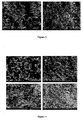
- the microstructure and morphology of PICU-A materials are elucidated by scanning electron microscopy (SEM) ( Figure 3 ).
- SEM scanning electron microscopy
- PICU-B The morphology of PICU-B could vary from a particulate-based structure ( Figure 4(a) ) to a porous network ( Figure 4(c) ) or more condensed structure ( Figure 4(d) ) using different reaction conditions.
- Thermal gravimetric analysis (TGA) indicated that the network structure of the polymers derived remained stable up to 300°C ( Figure 5 ).
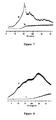
- the powder X-ray diffraction (XRD) peaks of PICU samples were rather weak and broad, and difficult to index ( Figures 7 and 8 ). It was interesting to note that the partially ordered nature of PICU-A and PICU-B was fully reversible. When the polymers were immersed in solvents (e.g. DMSO and DMF), the XRD peaks disappeared. Upon drying, the XRD peaks re-emerged. It is thought that polymers might have became swollen by absorbing the solvent molecules, and may thereby have lost structural order. As the solvent was removed, the packing of the two-dimensional network layer may therefore have been regained, reconstituting the original short-range order of PICU.
- solvents e.g. DMSO and DMF
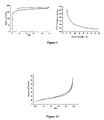
- PICU-A and PICU-B were confirmed by N 2 adsorption analysis.
- the as-synthesized polymers were degassed at 120°C for 16 h, and their nitrogen absorption isotherms were collected at 77 K.
- PICU-B showed an isotherm typical of a microporous material ( Figure 9 ). It has a Brunauer-Emmett-Teller (BET) surface area of 5 69 m 2 /g and a pore volume of 0.355 cm 3 /g, which were much higher than many layered materials (e.g. graphite and clay), and were in the range of many microporous zeolites and carbons.
- BET Brunauer-Emmett-Teller
- PICU-B was less porous as compared to Yaghi's COF-5 (1590 m 2 /g and 0.998 cm 3 /g) ( A. P. Cote, A. I. Benin, N. W. Ockwig, M. O'Keefe, A. J. Matzger, O. M. Yaghi. Science 2005, 310, 1166 ); this could be due to its short-range order and slipped organic sheets that resulted in some inaccessible pores.
- PICU-A showed an even lower surface area (45 m 2 /g) and pore volume (0.07 cm 3 /g) (see Figure 10 for isotherm). It was dominated by mesopores of 20-40 ⁇ (from t -plot analysis), with an average pore diameter of 22 ⁇ (from DFT calculations).
- PICU-B was developed as a porous support for metal complexes or metal nanoparticles. Palladium acetate and PICU-B were mixed in DMF and stirred at 80°C overnight. A yellow powder, Pd/PICU-B-1. was obtained after filtration, washing and drying. The TGA curve of Pd/PICU-B-1 with a Pd loading of about 1 mmol/g is shown in Figure 11 .
- Pd/PICU-B-2 When the synthesis was performed in DMSO, a black powder, Pd/PICU-B-2 was obtained, resulting from the reduction of Pd(II) to Pd(0) nanoparticles.
- TEM images showed that there were no palladium particles in Pd/PICU-B-1, whereas many Pd nanoparticles of 2-3 nm were observed in Pd / PICU - B - 2 ( Figure 12 ). Both Pd / PICU - B - 1 and Pd/PICU-B-2 demonstrated good activity and reusability (see Table 1).
- Pt/PICU-B was also synthesized by mixing PICU-B and Pt(II) chloride in DMF at 80°C, followed by reduction with sodium borohydride ( Figure 13 ).
- PICU-A Synthesis of PICU-A.
- A 160 mg, 1 mmol was suspended in DMSO (20 ml) in a pressure flask, and SI t Bu (0.05 mmol) was added.
- SI t Bu was generated in situ by mixing 1,3-bis-t-butylimidazolinium chloride (0.05 mmol) with NaH (0.05 mmol) in DMF (0-5 ml) for 2 h, before transferring to the reaction flask. The reaction flask was sealed, and placed in the oven at 120°C for 3 days.
- PICU-A was collected by filtration, washed with DMF, CH 2 Cl 2 and ether, and dried in a vacuum oven. Quantitative yield of PICU-A was obtained.
- PICU-B Synthesis of PICU-B.
- B (980 mg, 5 mmol) was dissolved in DMF (50 ml) in a pressure flask, and SI t Bu (0.1 mmol, generated in situ ) was added.
- the reaction flask was sealed, and placed in the oven at 80°C for 3 days.
- PICU-B was collected by filtration, washed with DMF, CH 2 Cl 2 and ether, and dried in a vacuum oven. Quantitative yield of PICU-B was obtained.
Landscapes
- Chemical & Material Sciences (AREA)
- Organic Chemistry (AREA)
- Chemical Kinetics & Catalysis (AREA)
- Health & Medical Sciences (AREA)
- Medicinal Chemistry (AREA)
- Polymers & Plastics (AREA)
- Engineering & Computer Science (AREA)
- Materials Engineering (AREA)
- Crystallography & Structural Chemistry (AREA)
- Polyurethanes Or Polyureas (AREA)
Claims (15)
- Polyisocyanurat, umfassend Isocyanuratringe, verbunden mit Bindungsgruppen, die aromatisch oder heteroaromatisch oder beides sind, wobei die Bindungsgruppen mit den Stickstoffatomen der Ringe gekoppelt sind, wobei das Polyisocyanurat mikroporös oder mesoporös oder sowohl mikroporös als auch mesoporös ist.
- Polyisocyanurat nach Anspruch 1, wobei die Bindungsgruppen entweder optional substituierte 1,4-Phenylengruppen oder optional substituierte 4,4'-Biphenylgruppen sind.
- Polyisocyanurat nach Anspruch 1 oder 2 mit Poren mit 1 bis 5 nm Durchmesser.
- Polyisocyanurat nach einem der Ansprüche 1 bis 3 mit Poren mit mittlerem Durchmesser von 20 bis 200 nm.
- Polyisocyanurat nach einem der Ansprüche 1 bis 4, ferner umfassend eine Metallspezies an den Wänden der Poren und/oder als in den Poren angeordnete Nanopartikel.
- Polyisocyanurat nach Anspruch 5, wobei die Metallspezies katalytisch ist, vorzugsweise wobei die Metallspezies ein Metall oder ein Metalloxid ist, stärker bevorzugt wobei das Metall Platin oder Palladium ist oder wobei das Metalloxid Eisenoxid ist.
- Vorgang zum Erzeugen eines Polyisocyanurats, wobei das Polyisocyanurat mikroporös oder mesoporös oder sowohl mikroporös als auch mesoporös ist und der Vorgang das Aussetzen eines aromatischen oder heteroaromatischen Bisisocyanats einem N-heterocyclischen Carben (NHC) über einen ausreichenden Zeitraum und bei einer ausreichenden Temperatur umfasst, um das Bisisocyanat in das Polyisocyanurat umzuwandeln, welches mikroporös oder mesoporös oder sowohl mikroporös als auch mesoporös ist.
- Vorgang nach Anspruch 7, wobei die ausreichende Temperatur von 25 bis 150 °C beträgt und der ausreichende Zeitraum von 1 Stunde bis 5 Tage beträgt.
- Vorgang nach Anspruch 7 oder 8, wobei das NHC in einer katalytischen Menge eingesetzt wird.
- Vorgang nach einem der Ansprüche 7 bis 9, wobei das Bisisocyanat ein 1,4-Phenylendiisocyanat oder ein 4,4'-Biphenyldiisocyanat ist, jeweils optional zusätzlich zu den Isocyanatgruppen substituiert.
- Vorgang nach einem der Ansprüche 7 bis 10, umfassend den Schritt des Erzeugens des NHC, vorzugsweise wobei der Schritt des Erzeugens des NHC das Behandeln eines Imidazoliumsalzes mit einer Base umfasst.
- Vorgang nach einem der Ansprüche 7 bis 11, wobei das NHC ausgewählt ist aus der Gruppe bestehend aus 1,3-Bis-mestyl-4,5-dihydroimidazol-2-yliden, 1,3-Bis-(2,6-di-i-propylphenyl)-4,5-dihydroimidazol-2-yliden und 1,3-Bis-t-butyl-4,5-dihydroimidazol-2-yliden.
- Gebrauch des Polyisocyanurats nach einem der Ansprüche 1 bis 6 zum Lagern eines Gases, vorzugsweise wobei das Gas Wasserstoff ist.
- Verfahren zum Ausführen einer Reaktion eines Ausgangsmaterials in ein Produkt, wobei das Verfahren das Aussetzen des Ausgangsmaterials einem Polyisocyanurat nach Anspruch 6 umfasst, wobei die Metallspezies die Reaktion katalysieren kann.
- Verfahren nach Anspruch 14, wobei das Ausgangsmaterial ein Arylhalid oder ein Vinylhalid ist und die Reaktion eine Suzuki-Kupplungsreaktion ist, wobei der Schritt des Aussetzens des Ausgangsmaterials dem Polyisocyanurat das Aussetzen des Ausgangsmaterials dem Polyisocyanurat in Gegenwart einer Arylboronsäure oder einer Vinylboronsäure umfasst.
Applications Claiming Priority (2)
| Application Number | Priority Date | Filing Date | Title |
|---|---|---|---|
| US7120608P | 2008-04-17 | 2008-04-17 | |
| PCT/SG2009/000134 WO2009131546A1 (en) | 2008-04-17 | 2009-04-09 | Polyisocyanurates |
Publications (3)
| Publication Number | Publication Date |
|---|---|
| EP2265656A1 EP2265656A1 (de) | 2010-12-29 |
| EP2265656A4 EP2265656A4 (de) | 2014-07-16 |
| EP2265656B1 true EP2265656B1 (de) | 2016-10-26 |
Family
ID=41217074
Family Applications (1)
| Application Number | Title | Priority Date | Filing Date |
|---|---|---|---|
| EP09735777.6A Not-in-force EP2265656B1 (de) | 2008-04-17 | 2009-04-09 | Polyisocyanurate |
Country Status (3)
| Country | Link |
|---|---|
| US (1) | US9481758B2 (de) |
| EP (1) | EP2265656B1 (de) |
| WO (1) | WO2009131546A1 (de) |
Families Citing this family (1)
| Publication number | Priority date | Publication date | Assignee | Title |
|---|---|---|---|---|
| BR112017007881A2 (pt) * | 2014-10-31 | 2018-01-23 | Kimberly Clark Co | artigo de controle de odor |
Family Cites Families (13)
| Publication number | Priority date | Publication date | Assignee | Title |
|---|---|---|---|---|
| US3144452A (en) * | 1962-01-19 | 1964-08-11 | Ici Ltd | Polymerisation of organic isocyanates |
| US3211704A (en) * | 1962-10-31 | 1965-10-12 | Monsanto Res Corp | Ether linked polyisocyanurate prepared from an organic diisocyanate and an organic monoisocyanate in presence of a cocatalyst system |
| SU787422A1 (ru) * | 1978-10-18 | 1980-12-15 | Ордена Ленина Институт Элементоорганических Соединений Ан Ссср | Карборансодержащий полиизоцианурат, обладающий повышенной термической и термоокислительной устойчивостью |
| US4359550A (en) | 1981-01-19 | 1982-11-16 | Basf Wyandotte Corporation | Polyisocyanurate polymers, dispersions, and cellular and non-cellular polyurethane products prepared therefrom |
| AT375652B (de) * | 1982-10-29 | 1984-08-27 | Valentina Alexandro Postnikova | Verfahren zur herstellung von arylaliphatischen polyisozyanuraten |
| FR2536403A1 (fr) * | 1982-11-22 | 1984-05-25 | Postnikova Valentina | Polyisocyanurates arylaliphatiques et leur procede de preparation |
| JPH0651687B2 (ja) | 1985-09-03 | 1994-07-06 | 三菱化成株式会社 | ブロツク化ポリイソシアヌレ−ト |
| DE3920325C2 (de) * | 1988-06-24 | 2001-04-12 | Sunstar Engineering Inc | Maskierte Polyisocyanuratverbindung und sie enthaltende Plastisolzusammensetzung |
| US5204391A (en) * | 1989-10-26 | 1993-04-20 | Sunstar Engineering, Inc. | Blocked polyisocyanurate and polyvinyl chloride plastisol composition containing the same |
| US5221743A (en) * | 1992-03-02 | 1993-06-22 | Olin Corporation | Process for producing isocyanurates by cyclotrimerizing isocyanates using polymer-bound catalysts |
| JP2001098042A (ja) | 1999-09-29 | 2001-04-10 | Mitsui Chemicals Inc | 高分子量ポリイソシアヌレートおよびその製造方法 |
| DE10048844A1 (de) * | 2000-10-02 | 2002-04-11 | Basf Ag | Verfahren zur Herstellung von Platinmetall-Katalysatoren |
| US20080262186A1 (en) | 2004-05-19 | 2008-10-23 | University Of Utah Research Foundation | Catalysts for the Production of Polyisocyanates |
-
2009
- 2009-04-09 EP EP09735777.6A patent/EP2265656B1/de not_active Not-in-force
- 2009-04-09 WO PCT/SG2009/000134 patent/WO2009131546A1/en not_active Ceased
- 2009-04-09 US US12/988,246 patent/US9481758B2/en not_active Expired - Fee Related
Non-Patent Citations (1)
| Title |
|---|
| None * |
Also Published As
| Publication number | Publication date |
|---|---|
| WO2009131546A1 (en) | 2009-10-29 |
| EP2265656A1 (de) | 2010-12-29 |
| US9481758B2 (en) | 2016-11-01 |
| US20110124755A1 (en) | 2011-05-26 |
| EP2265656A4 (de) | 2014-07-16 |
Similar Documents
| Publication | Publication Date | Title |
|---|---|---|
| Modak et al. | A triazine functionalized porous organic polymer: excellent CO 2 storage material and support for designing Pd nanocatalyst for C–C cross-coupling reactions | |
| Ding et al. | Ionic liquid-decorated COF and its covalent composite aerogel for selective CO 2 adsorption and catalytic conversion | |
| Dong et al. | Immobilization of ionic liquids to covalent organic frameworks for catalyzing the formylation of amines with CO 2 and phenylsilane | |
| KR101273877B1 (ko) | 결정성 하이브리드 나노세공체 분말을 포함하는 복합체 및 그 제조방법 | |
| Mahmoudi et al. | Fabrication of UiO-66 nanocages confined brønsted ionic liquids as an efficient catalyst for the synthesis of dihydropyrazolo [4′, 3’: 5, 6] pyrano [2, 3-d] pyrimidines | |
| EP1802732B1 (de) | Kovalent gebundene organische rahmen und polyeder | |
| Veisi et al. | Palladium nanoparticles supported on 1, 3-dicyclohexylguanidine functionalized mesoporous silica SBA-15 as highly active and reusable catalyst for the Suzuki–Miyaura cross-coupling reaction | |
| Ma et al. | Photothermal Catalytic Synthesis of Sulfonic Acid Functionalized Covalent Organic Framework Achieved by COF‐to‐COF Transformation for Photocatalysis | |
| Hu et al. | Ionic covalent organic frameworks for highly effective catalysis | |
| Li et al. | Squaramide-decorated covalent organic framework as a new platform for biomimetic hydrogen-bonding organocatalysis | |
| CN110684203B (zh) | 一种二维含溴共价有机框架化合物及其制备方法 | |
| CN110016126A (zh) | 一种共轭微孔聚合物及其制备方法与应用 | |
| ZA200605687B (en) | Organometallic framework material, preparation and use | |
| Li et al. | Post-synthesis modification of porous organic polymers with amine: a task-specific microenvironment for CO2 capture | |
| EP2014699B1 (de) | Verfahren zur Herstellung organischer poröser Festkörper und mit diesem Verfahren herstellbare Festkörper | |
| Koosha et al. | CuI nanoparticle-immobilized on a hybrid material composed of IRMOF-3 and a sulfonamide-based porous organic polymer as an efficient nanocatalyst for one-pot synthesis of 2, 4-diaryl-quinolines | |
| Wu et al. | Gelation of metalloporphyrin-based conjugated microporous polymers by oxidative homocoupling of terminal alkynes | |
| Azad et al. | Ultra‐small and highly dispersed Pd nanoparticles inside the pores of ZIF‐8: Sustainable approach to waste‐minimized Mizoroki–Heck cross‐coupling reaction based on reusable heterogeneous catalyst | |
| KR20110019804A (ko) | 유무기혼성 나노세공체의 제조방법, 상기 방법에 의하여 수득되는 유무기혼성 나노세공체 및 이의 용도 | |
| Huang et al. | Synthesis, characterization and heterogeneous base catalysis of amino functionalized lanthanide metal-organic frameworks | |
| Gorginpour et al. | A quinoxaline-based porous organic polymer containing copper nanoparticles CuNPs@ Q-POP as a robust nanocatalyst toward C–N coupling reaction | |
| Zang et al. | Synthesis of Pd/conjugated microporous polymer heterogeneous catalysts via imine groups and high catalytic efficiency on Suzuki–Miyaura coupling reaction | |
| Wang et al. | The bulky Pd-PEPPSI-embedded conjugated microporous polymer-catalyzed Suzuki–Miyaura cross-coupling of aryl chlorides and arylboronic acids | |
| WO2022099173A1 (en) | Ion-based methods for stabilizing and improving porous metal-organic framework (mof) materials for water harvesting from air and related applications | |
| Zhang et al. | Melem based mesoporous metal-free catalyst for cycloaddition of CO2 to cyclic carbonate |
Legal Events
| Date | Code | Title | Description |
|---|---|---|---|
| PUAI | Public reference made under article 153(3) epc to a published international application that has entered the european phase |
Free format text: ORIGINAL CODE: 0009012 |
|
| 17P | Request for examination filed |
Effective date: 20101021 |
|
| AK | Designated contracting states |
Kind code of ref document: A1 Designated state(s): AT BE BG CH CY CZ DE DK EE ES FI FR GB GR HR HU IE IS IT LI LT LU LV MC MK MT NL NO PL PT RO SE SI SK TR |
|
| AX | Request for extension of the european patent |
Extension state: AL BA RS |
|
| DAX | Request for extension of the european patent (deleted) | ||
| A4 | Supplementary search report drawn up and despatched |
Effective date: 20140616 |
|
| RIC1 | Information provided on ipc code assigned before grant |
Ipc: C07C 263/00 20060101ALI20140610BHEP Ipc: C07C 265/00 20060101ALI20140610BHEP Ipc: C08G 18/02 20060101ALI20140610BHEP Ipc: C08G 18/71 20060101AFI20140610BHEP |
|
| 17Q | First examination report despatched |
Effective date: 20151020 |
|
| GRAP | Despatch of communication of intention to grant a patent |
Free format text: ORIGINAL CODE: EPIDOSNIGR1 |
|
| INTG | Intention to grant announced |
Effective date: 20160610 |
|
| GRAJ | Information related to disapproval of communication of intention to grant by the applicant or resumption of examination proceedings by the epo deleted |
Free format text: ORIGINAL CODE: EPIDOSDIGR1 |
|
| GRAJ | Information related to disapproval of communication of intention to grant by the applicant or resumption of examination proceedings by the epo deleted |
Free format text: ORIGINAL CODE: EPIDOSDIGR1 |
|
| GRAP | Despatch of communication of intention to grant a patent |
Free format text: ORIGINAL CODE: EPIDOSNIGR1 |
|
| GRAS | Grant fee paid |
Free format text: ORIGINAL CODE: EPIDOSNIGR3 |
|
| GRAR | Information related to intention to grant a patent recorded |
Free format text: ORIGINAL CODE: EPIDOSNIGR71 |
|
| GRAS | Grant fee paid |
Free format text: ORIGINAL CODE: EPIDOSNIGR3 |
|
| GRAA | (expected) grant |
Free format text: ORIGINAL CODE: 0009210 |
|
| INTC | Intention to grant announced (deleted) | ||
| AK | Designated contracting states |
Kind code of ref document: B1 Designated state(s): AT BE BG CH CY CZ DE DK EE ES FI FR GB GR HR HU IE IS IT LI LT LU LV MC MK MT NL NO PL PT RO SE SI SK TR |
|
| INTG | Intention to grant announced |
Effective date: 20160921 |
|
| REG | Reference to a national code |
Ref country code: GB Ref legal event code: FG4D |
|
| REG | Reference to a national code |
Ref country code: CH Ref legal event code: EP |
|
| REG | Reference to a national code |
Ref country code: AT Ref legal event code: REF Ref document number: 839980 Country of ref document: AT Kind code of ref document: T Effective date: 20161115 |
|
| REG | Reference to a national code |
Ref country code: IE Ref legal event code: FG4D |
|
| REG | Reference to a national code |
Ref country code: DE Ref legal event code: R096 Ref document number: 602009041941 Country of ref document: DE |
|
| REG | Reference to a national code |
Ref country code: CH Ref legal event code: NV Representative=s name: ISLER AND PEDRAZZINI AG, CH |
|
| REG | Reference to a national code |
Ref country code: LT Ref legal event code: MG4D |
|
| PG25 | Lapsed in a contracting state [announced via postgrant information from national office to epo] |
Ref country code: LV Free format text: LAPSE BECAUSE OF FAILURE TO SUBMIT A TRANSLATION OF THE DESCRIPTION OR TO PAY THE FEE WITHIN THE PRESCRIBED TIME-LIMIT Effective date: 20161026 |
|
| REG | Reference to a national code |
Ref country code: NL Ref legal event code: MP Effective date: 20161026 |
|
| REG | Reference to a national code |
Ref country code: AT Ref legal event code: MK05 Ref document number: 839980 Country of ref document: AT Kind code of ref document: T Effective date: 20161026 |
|
| PG25 | Lapsed in a contracting state [announced via postgrant information from national office to epo] |
Ref country code: LT Free format text: LAPSE BECAUSE OF FAILURE TO SUBMIT A TRANSLATION OF THE DESCRIPTION OR TO PAY THE FEE WITHIN THE PRESCRIBED TIME-LIMIT Effective date: 20161026 Ref country code: GR Free format text: LAPSE BECAUSE OF FAILURE TO SUBMIT A TRANSLATION OF THE DESCRIPTION OR TO PAY THE FEE WITHIN THE PRESCRIBED TIME-LIMIT Effective date: 20170127 Ref country code: NO Free format text: LAPSE BECAUSE OF FAILURE TO SUBMIT A TRANSLATION OF THE DESCRIPTION OR TO PAY THE FEE WITHIN THE PRESCRIBED TIME-LIMIT Effective date: 20170126 Ref country code: SE Free format text: LAPSE BECAUSE OF FAILURE TO SUBMIT A TRANSLATION OF THE DESCRIPTION OR TO PAY THE FEE WITHIN THE PRESCRIBED TIME-LIMIT Effective date: 20161026 |
|
| PG25 | Lapsed in a contracting state [announced via postgrant information from national office to epo] |
Ref country code: BE Free format text: LAPSE BECAUSE OF FAILURE TO SUBMIT A TRANSLATION OF THE DESCRIPTION OR TO PAY THE FEE WITHIN THE PRESCRIBED TIME-LIMIT Effective date: 20161026 Ref country code: AT Free format text: LAPSE BECAUSE OF FAILURE TO SUBMIT A TRANSLATION OF THE DESCRIPTION OR TO PAY THE FEE WITHIN THE PRESCRIBED TIME-LIMIT Effective date: 20161026 Ref country code: PT Free format text: LAPSE BECAUSE OF FAILURE TO SUBMIT A TRANSLATION OF THE DESCRIPTION OR TO PAY THE FEE WITHIN THE PRESCRIBED TIME-LIMIT Effective date: 20170227 Ref country code: ES Free format text: LAPSE BECAUSE OF FAILURE TO SUBMIT A TRANSLATION OF THE DESCRIPTION OR TO PAY THE FEE WITHIN THE PRESCRIBED TIME-LIMIT Effective date: 20161026 Ref country code: HR Free format text: LAPSE BECAUSE OF FAILURE TO SUBMIT A TRANSLATION OF THE DESCRIPTION OR TO PAY THE FEE WITHIN THE PRESCRIBED TIME-LIMIT Effective date: 20161026 Ref country code: PL Free format text: LAPSE BECAUSE OF FAILURE TO SUBMIT A TRANSLATION OF THE DESCRIPTION OR TO PAY THE FEE WITHIN THE PRESCRIBED TIME-LIMIT Effective date: 20161026 Ref country code: IS Free format text: LAPSE BECAUSE OF FAILURE TO SUBMIT A TRANSLATION OF THE DESCRIPTION OR TO PAY THE FEE WITHIN THE PRESCRIBED TIME-LIMIT Effective date: 20170226 Ref country code: NL Free format text: LAPSE BECAUSE OF FAILURE TO SUBMIT A TRANSLATION OF THE DESCRIPTION OR TO PAY THE FEE WITHIN THE PRESCRIBED TIME-LIMIT Effective date: 20161026 Ref country code: FI Free format text: LAPSE BECAUSE OF FAILURE TO SUBMIT A TRANSLATION OF THE DESCRIPTION OR TO PAY THE FEE WITHIN THE PRESCRIBED TIME-LIMIT Effective date: 20161026 |
|
| REG | Reference to a national code |
Ref country code: DE Ref legal event code: R097 Ref document number: 602009041941 Country of ref document: DE |
|
| PG25 | Lapsed in a contracting state [announced via postgrant information from national office to epo] |
Ref country code: EE Free format text: LAPSE BECAUSE OF FAILURE TO SUBMIT A TRANSLATION OF THE DESCRIPTION OR TO PAY THE FEE WITHIN THE PRESCRIBED TIME-LIMIT Effective date: 20161026 Ref country code: CZ Free format text: LAPSE BECAUSE OF FAILURE TO SUBMIT A TRANSLATION OF THE DESCRIPTION OR TO PAY THE FEE WITHIN THE PRESCRIBED TIME-LIMIT Effective date: 20161026 Ref country code: DK Free format text: LAPSE BECAUSE OF FAILURE TO SUBMIT A TRANSLATION OF THE DESCRIPTION OR TO PAY THE FEE WITHIN THE PRESCRIBED TIME-LIMIT Effective date: 20161026 Ref country code: SK Free format text: LAPSE BECAUSE OF FAILURE TO SUBMIT A TRANSLATION OF THE DESCRIPTION OR TO PAY THE FEE WITHIN THE PRESCRIBED TIME-LIMIT Effective date: 20161026 Ref country code: RO Free format text: LAPSE BECAUSE OF FAILURE TO SUBMIT A TRANSLATION OF THE DESCRIPTION OR TO PAY THE FEE WITHIN THE PRESCRIBED TIME-LIMIT Effective date: 20161026 |
|
| PG25 | Lapsed in a contracting state [announced via postgrant information from national office to epo] |
Ref country code: IT Free format text: LAPSE BECAUSE OF FAILURE TO SUBMIT A TRANSLATION OF THE DESCRIPTION OR TO PAY THE FEE WITHIN THE PRESCRIBED TIME-LIMIT Effective date: 20161026 Ref country code: BG Free format text: LAPSE BECAUSE OF FAILURE TO SUBMIT A TRANSLATION OF THE DESCRIPTION OR TO PAY THE FEE WITHIN THE PRESCRIBED TIME-LIMIT Effective date: 20170126 |
|
| PLBE | No opposition filed within time limit |
Free format text: ORIGINAL CODE: 0009261 |
|
| STAA | Information on the status of an ep patent application or granted ep patent |
Free format text: STATUS: NO OPPOSITION FILED WITHIN TIME LIMIT |
|
| 26N | No opposition filed |
Effective date: 20170727 |
|
| REG | Reference to a national code |
Ref country code: DE Ref legal event code: R119 Ref document number: 602009041941 Country of ref document: DE |
|
| PG25 | Lapsed in a contracting state [announced via postgrant information from national office to epo] |
Ref country code: SI Free format text: LAPSE BECAUSE OF FAILURE TO SUBMIT A TRANSLATION OF THE DESCRIPTION OR TO PAY THE FEE WITHIN THE PRESCRIBED TIME-LIMIT Effective date: 20161026 |
|
| REG | Reference to a national code |
Ref country code: CH Ref legal event code: PL |
|
| GBPC | Gb: european patent ceased through non-payment of renewal fee |
Effective date: 20170409 |
|
| REG | Reference to a national code |
Ref country code: IE Ref legal event code: MM4A |
|
| REG | Reference to a national code |
Ref country code: FR Ref legal event code: ST Effective date: 20171229 |
|
| PG25 | Lapsed in a contracting state [announced via postgrant information from national office to epo] |
Ref country code: FR Free format text: LAPSE BECAUSE OF NON-PAYMENT OF DUE FEES Effective date: 20170502 Ref country code: DE Free format text: LAPSE BECAUSE OF NON-PAYMENT OF DUE FEES Effective date: 20171103 Ref country code: MC Free format text: LAPSE BECAUSE OF FAILURE TO SUBMIT A TRANSLATION OF THE DESCRIPTION OR TO PAY THE FEE WITHIN THE PRESCRIBED TIME-LIMIT Effective date: 20161026 |
|
| PG25 | Lapsed in a contracting state [announced via postgrant information from national office to epo] |
Ref country code: LU Free format text: LAPSE BECAUSE OF NON-PAYMENT OF DUE FEES Effective date: 20170409 Ref country code: GB Free format text: LAPSE BECAUSE OF NON-PAYMENT OF DUE FEES Effective date: 20170409 Ref country code: LI Free format text: LAPSE BECAUSE OF NON-PAYMENT OF DUE FEES Effective date: 20170430 Ref country code: CH Free format text: LAPSE BECAUSE OF NON-PAYMENT OF DUE FEES Effective date: 20170430 |
|
| PG25 | Lapsed in a contracting state [announced via postgrant information from national office to epo] |
Ref country code: IE Free format text: LAPSE BECAUSE OF NON-PAYMENT OF DUE FEES Effective date: 20170409 |
|
| PG25 | Lapsed in a contracting state [announced via postgrant information from national office to epo] |
Ref country code: MT Free format text: LAPSE BECAUSE OF NON-PAYMENT OF DUE FEES Effective date: 20170409 |
|
| PG25 | Lapsed in a contracting state [announced via postgrant information from national office to epo] |
Ref country code: HU Free format text: LAPSE BECAUSE OF FAILURE TO SUBMIT A TRANSLATION OF THE DESCRIPTION OR TO PAY THE FEE WITHIN THE PRESCRIBED TIME-LIMIT; INVALID AB INITIO Effective date: 20090409 |
|
| PG25 | Lapsed in a contracting state [announced via postgrant information from national office to epo] |
Ref country code: CY Free format text: LAPSE BECAUSE OF NON-PAYMENT OF DUE FEES Effective date: 20161026 |
|
| PG25 | Lapsed in a contracting state [announced via postgrant information from national office to epo] |
Ref country code: MK Free format text: LAPSE BECAUSE OF FAILURE TO SUBMIT A TRANSLATION OF THE DESCRIPTION OR TO PAY THE FEE WITHIN THE PRESCRIBED TIME-LIMIT Effective date: 20161026 |
|
| PG25 | Lapsed in a contracting state [announced via postgrant information from national office to epo] |
Ref country code: TR Free format text: LAPSE BECAUSE OF FAILURE TO SUBMIT A TRANSLATION OF THE DESCRIPTION OR TO PAY THE FEE WITHIN THE PRESCRIBED TIME-LIMIT Effective date: 20161026 |