EP2250753B1 - Alleviating mobile device overload conditions in a mobile communication system - Google Patents
Alleviating mobile device overload conditions in a mobile communication system Download PDFInfo
- Publication number
- EP2250753B1 EP2250753B1 EP09713919.0A EP09713919A EP2250753B1 EP 2250753 B1 EP2250753 B1 EP 2250753B1 EP 09713919 A EP09713919 A EP 09713919A EP 2250753 B1 EP2250753 B1 EP 2250753B1
- Authority
- EP
- European Patent Office
- Prior art keywords
- user equipment
- naks
- channel
- overload condition
- cqi value
- Prior art date
- Legal status (The legal status is an assumption and is not a legal conclusion. Google has not performed a legal analysis and makes no representation as to the accuracy of the status listed.)
- Active
Links
Images

Classifications
-
- H—ELECTRICITY
- H04—ELECTRIC COMMUNICATION TECHNIQUE
- H04L—TRANSMISSION OF DIGITAL INFORMATION, e.g. TELEGRAPHIC COMMUNICATION
- H04L1/00—Arrangements for detecting or preventing errors in the information received
- H04L1/0001—Systems modifying transmission characteristics according to link quality, e.g. power backoff
- H04L1/0023—Systems modifying transmission characteristics according to link quality, e.g. power backoff characterised by the signalling
- H04L1/0026—Transmission of channel quality indication
-
- H—ELECTRICITY
- H04—ELECTRIC COMMUNICATION TECHNIQUE
- H04B—TRANSMISSION
- H04B1/00—Details of transmission systems, not covered by a single one of groups H04B3/00 - H04B13/00; Details of transmission systems not characterised by the medium used for transmission
- H04B1/02—Transmitters
- H04B1/03—Constructional details, e.g. casings, housings
- H04B1/036—Cooling arrangements
-
- H—ELECTRICITY
- H04—ELECTRIC COMMUNICATION TECHNIQUE
- H04B—TRANSMISSION
- H04B1/00—Details of transmission systems, not covered by a single one of groups H04B3/00 - H04B13/00; Details of transmission systems not characterised by the medium used for transmission
- H04B1/38—Transceivers, i.e. devices in which transmitter and receiver form a structural unit and in which at least one part is used for functions of transmitting and receiving
- H04B1/40—Circuits
-
- H—ELECTRICITY
- H04—ELECTRIC COMMUNICATION TECHNIQUE
- H04L—TRANSMISSION OF DIGITAL INFORMATION, e.g. TELEGRAPHIC COMMUNICATION
- H04L1/00—Arrangements for detecting or preventing errors in the information received
- H04L1/0001—Systems modifying transmission characteristics according to link quality, e.g. power backoff
- H04L1/0023—Systems modifying transmission characteristics according to link quality, e.g. power backoff characterised by the signalling
- H04L1/0028—Formatting
- H04L1/0031—Multiple signaling transmission
-
- H—ELECTRICITY
- H04—ELECTRIC COMMUNICATION TECHNIQUE
- H04L—TRANSMISSION OF DIGITAL INFORMATION, e.g. TELEGRAPHIC COMMUNICATION
- H04L1/00—Arrangements for detecting or preventing errors in the information received
- H04L1/0001—Systems modifying transmission characteristics according to link quality, e.g. power backoff
- H04L1/0036—Systems modifying transmission characteristics according to link quality, e.g. power backoff arrangements specific to the receiver
-
- H—ELECTRICITY
- H04—ELECTRIC COMMUNICATION TECHNIQUE
- H04W—WIRELESS COMMUNICATION NETWORKS
- H04W72/00—Local resource management
- H04W72/50—Allocation or scheduling criteria for wireless resources
- H04W72/52—Allocation or scheduling criteria for wireless resources based on load
-
- H—ELECTRICITY
- H04—ELECTRIC COMMUNICATION TECHNIQUE
- H04L—TRANSMISSION OF DIGITAL INFORMATION, e.g. TELEGRAPHIC COMMUNICATION
- H04L1/00—Arrangements for detecting or preventing errors in the information received
- H04L1/0001—Systems modifying transmission characteristics according to link quality, e.g. power backoff
- H04L1/0023—Systems modifying transmission characteristics according to link quality, e.g. power backoff characterised by the signalling
- H04L1/0028—Formatting
-
- H—ELECTRICITY
- H04—ELECTRIC COMMUNICATION TECHNIQUE
- H04L—TRANSMISSION OF DIGITAL INFORMATION, e.g. TELEGRAPHIC COMMUNICATION
- H04L1/00—Arrangements for detecting or preventing errors in the information received
- H04L1/12—Arrangements for detecting or preventing errors in the information received by using return channel
- H04L1/16—Arrangements for detecting or preventing errors in the information received by using return channel in which the return channel carries supervisory signals, e.g. repetition request signals
- H04L1/1607—Details of the supervisory signal
-
- H—ELECTRICITY
- H04—ELECTRIC COMMUNICATION TECHNIQUE
- H04W—WIRELESS COMMUNICATION NETWORKS
- H04W72/00—Local resource management
- H04W72/20—Control channels or signalling for resource management
- H04W72/21—Control channels or signalling for resource management in the uplink direction of a wireless link, i.e. towards the network
Definitions
- the present invention relates to mobile communications, and more particularly to methods and apparatuses for operating a mobile device to avoid or alleviate overload conditions in a mobile communication system.
- E-UTRAN Long Term Evolution
- E-UTRA Evolved Universal Terrestrial Radio Access
- LTE Long Term Evolution
- General description will be able to operate over a very wide span of operating bandwidths (e.g., 1.4 MHz to 20 MHz) and also carrier frequencies.
- E-UTRAN systems will be capable of operating within a large range of distances, from microcells (i.e., cells served by low power base stations that cover a limited area, such as a shopping center or other building accessible to the public) up to macrocells having a range that extends up to 100 km.
- OFDMA Orthogonal Frequency Division Multiple Access
- MIMO Multiple-Input-Multiple Output
- the document EP 1 513 356 A2 is considered the closest prior art and upon which the preambles of the independent claims are based.
- the document discloses a radio communication system and radio communication device.
- the reception quality estimating unit measures a reception quality
- at least one of the data buffer monitoring unit and the transmission power monitoring unit measures a data transmission capability. Based on the measured reception quality and data transmission capability, the terminal determines a transmission mode to be used, and reports it to the base station.
- the base station determines the transmission mode to be practically used in accordance with the reported transmission mode, and notifies it to the mobile terminal.
- the base station transmits data according to the determined transmission mode, and the mobile terminal receives data according to the notified transmission mode.
- the radio communication system determines the transmission mode in consideration for not only the reception quality, but also the deficiency in the data transmission capability of the terminal.
- the foregoing and other objects are achieved in methods and apparatuses that control operation of a user equipment in a mobile communications system.
- This operation includes operating a receiver of the user equipment to receive one or more data blocks via a channel.
- a channel quality indicator (CQI) value is reported to a serving base station, wherein the reported CQI value represents a channel quality that is lower than an actual quality of the channel.
- the user equipment is then operated in a manner that is consistent with the reported CQI value.
- Operation of the user equipment involves sending negative acknowledgements (NAKs) to the serving base station at a rate that is consistent with operation by means of a channel having a quality that corresponds to the reported CQI value, including sending one or more NAKs in response to acceptable reception of one or more data blocks.
- NAKs negative acknowledgements
- Sending NAKs to the serving base station at the rate that is consistent with operation by means of the channel having the quality that corresponds to the reported CQI value is further performed in a manner such that the NAKs are distributed over time in a way that emulates a distribution of NAKs that corresponds to the channel having the quality that corresponds to the reported CQI value.
- the distribution of sent NAKs over time can be a random or pseudorandom distribution.
- the reported CQI value is selected by determining which of a plurality of candidate CQI values will cause the user equipment to maintain as much functionality as possible while at the same time alleviating or avoiding the user equipment overload condition.
- the user equipment overload condition is an overheating condition.
- the overload condition can be a limitation in user equipment processing capability.
- This limitation can be, for example, a receiving buffer bottleneck; a transmitting buffer bottleneck; a signal processing bottleneck; or an inability to process received data blocks at an instantaneous downlink throughput rate.
- the term "bottleneck” denotes a part of a path having a lower throughput rate than other parts that make up the path.
- the overload condition can be an alert that an actual overload condition will exist if the user equipment continues operating in a present manner of operation.
- the user equipment is able to take actions to avoid the actual occurrence of the overload condition.
- any such form of embodiments may be referred to herein as "logic configured to” perform a described action, “logic adapted to” perform a described action, or alternatively as “logic that” performs a described action.
- eNode-B the network access point from which a user equipment obtains service
- LTE terminology is not intended to limit the scope of the invention.
- references to "eNode-B" made in the description as well as in the claims should be construed to include not only eNode-B's found in LTE systems, but also to their equivalents in other systems (e.g., a node B or other base station).
- a user equipment overload condition is detected and, in response thereto, one or more actions are taken within the user equipment to either directly or indirectly eliminate the cause of the user equipment overload condition.
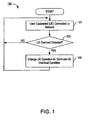
- FIG. 1 is a flowchart of exemplary steps/processes carried out by suitably adapted logic 100 in a user equipment in accordance with exemplary embodiments of the invention.
- the user equipment operates in a connected mode with a serving network (step 101).
- a serving network step 101.
- uplink and downlink data and control information are exchanged between the user equipment and an eNode-B of the network.
- This exchange takes place in accordance with a cellular system protocol such as, without limitation, LTE, e-HSPA, and WiMax.
- an overload condition is detected in the user equipment ("YES" path out of decision block 103).
- the overload condition can be, for example, and overheating condition.
- the overload condition can be an inability of the user equipment to process data at the rate at which it is being received.
- the overload condition can represent an existing condition within the user equipment, or alternatively it can be an alert that an actual overload condition will exist if the user equipment continues operating in a present manner of operation.
- the user equipment changes its operation in a manner that results in alleviation or aversion of the overload condition.
- the user equipment can respond to an overheating condition by taking one or more steps that, either directly or indirectly, result in the user equipment reducing its level of power consumption.
- the user equipment can respond to an incoming data rate that is too high by taking one or more steps that cause the serving node to reduce the rate of data transmission in the downlink direction.
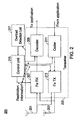
- FIG. 2 is a high level block diagram of an exemplary user equipment 200 adapted to carry out the above-described functions.
- the user equipment 200 includes first and second antennas 201, 203 each of which is used for both transmission and reception of radio signals. Having more than one antenna allows the user equipment 200 to operate in a multiple input multiple output (MIMO) mode of operation, as is known in the art.
- MIMO multiple input multiple output
- this is not essential to the invention and other embodiments could involve only a single antenna or more than two antennas.
- the number of antennas is not a determining factor of the user equipment functionality, nor does it restrict the scope of the invention. For example, due to cost limitations (e.g., the need for extra power amplifiers), it is often the case that a user equipment will be designed to operate with asymmetric receiver/transmit paths (e.g., two receive paths and only one transmit path).
- Transceiver circuitry 205 in the user equipment 200 includes a receiver chain and a transmitter chain.
- the receiver chain comprises a front-end receiver 207 that receives radio signals from the first and second antennas 201, 203 and generates a baseband signal that is supplied to the decoder 209.
- the decoder 209 processes the received baseband signal and generates therefrom the data conveyed by the radio signal. This data is supplied to an application within the user equipment 200 for further processing. The nature of that further processing is beyond the scope of the invention.
- the transmitter chain comprises a coder 211 and a front-end transmitter 213. Operation of the transmitter chain is essentially the reverse of that of the receiver chain.
- the coder 211 receives data from an application running within the user equipment 200 and formats the data in a manner that makes it suitable for transmission (e.g., by applying forward error correction coding and interleaving).
- the coded data residing on a baseband signal, is supplied to the front-end transmitter 213 which converts the baseband signal into a modulated radiofrequency signal.
- the power of the modulated radiofrequency is set to a desired level and supplied to the first and second antennas 201, 203 for transmission.
- the output signal is supplied to only a single one of the first and second antennas 201, 203.
- the user equipment 200 includes circuitry to ensure that signals to be transmitted do not appear on the input terminals of the front-end receiver 207.
- the various blocks within the transceiver 205 operate in accordance with control signals that are generated by a control unit 215.
- the user equipment 200 also includes an overload detection unit 217 that monitors one or more conditions within the transceiver 205 and determines whether these conditions constitute an overload condition. The results of this determination are supplied to the control unit 215 which can then take appropriate actions. For example, as described above, if an overheating condition has been detected the control unit 215 can take one or more steps to alleviate this condition, such as by limiting the maximum transmit power or reducing the speed at which received data is processed or reducing the data rate of data to be transmitted. These actions are described in greater detail in the following discussion.
- Overheating can be addressed by lowering the level of power consumption within the user equipment and this can be accomplished in a variety of ways.
- One technique involves reducing the amount of power consumed by a transmitter part of the user equipment circuitry.
- the maximum allowed transmitter power typically 24 dBm maximum transmitter power in an LTE or e-HSPA system
- Reduction of the maximum allowed transmitter power results in a typically significant lower power consumption in the transmitter part but this in turn reduces the maximum possible uplink data throughput rate.
- Another way to reduce the power consumption, and thereby reduce the temperature in the user equipment is to disable one or more transmitters when the user equipment includes more than one. This leaves only a subset of the user equipment's transmitters enabled, and these are used to maintain a connection with the network.
- the temperature within the user equipment can also be reduced by decreasing the power consumed by the receiver circuitry of the user equipment.
- a direct way of doing this is to disable one or more receiver chains, leaving only a subset of the receivers powered on in order to maintain a connection with the network.
- Yet another technique for restricting the power consumed by the user equipment, and thereby reduce the temperature within the user equipment, is to restrict the downlink data rate. Because a significant part of the baseband power consumption is proportional to the data rate, a reduced data rate results in lower power consumption. Since the serving node is responsible for setting the downlink data throughput rate, it is necessary for the user equipment take some action that will cause the serving node to make the desired data rate adjustments.
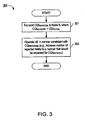
- FIG. 3 is a flowchart of exemplary steps/processes carried out by suitably adapted logic 300 in a user equipment in accordance with exemplary embodiments of the invention that indirectly bring about the serving node reducing a downlink data throughput rate.
- the user equipment sends a channel quality indicator (CQI) report to the eNode-B (or equivalent), wherein the reported value (CQI REPORTED ) is intentionally set to a value that indicates a lower quality channel then actually exists (i.e., the true channel quality value should be set to CQI ACTUAL ) (step 301).
- CQI channel quality indicator
- the theory on which this action is based is as follows:
- the CQI value is typically derived from the instantaneous signal-to-interference ratio (SIR) of the received signal.
- the value CQI ACTUAL is associated with the highest possible throughput rate for the SIR of the received signal.
- a lower CQI value indicates to the eNode-B that the SIR is lower.
- the eNode-B will respond by increasing the level of coding that is applied to the transmitted information. The more coding is applied, the lower the downlink throughput rate.
- the network will typically respond by introducing more coding into the transmitted bits, thereby reducing the downlink throughput.
- the network tests the validity of the reported CQI value. For example, the worse the channel is, the more errors one would expect to occur as blocks of data are transmitted from the serving node to the user equipment at a given code rate. At the serving node, this can be measured by, for example, measuring the number of negative acknowledgments (NAKs) that are received during a given period of time. As is well-known, a NAK is sent by a receiver of a data block back to the sender to indicate that the block was received with errors and should be re-sent. Accordingly, a serving node can measure the rate at which NAKs are received from the user equipment and can compare this with what would be expected when the CQI is as reported by the user equipment.
- NAKs negative acknowledgments
- a typical block error rate that a system would expect to achieve is 10%. But if the network reduces the downlink throughput data rate in response to its "belief" that the CQI REPORTED value accurately represents the channel quality, which is actually better than reported, the actual NAK rate will likely be lower than expected. If the NAK rate is less then what would be expected for CQI REPORTED , then the network could assume that CQI REPORTED is inaccurate and maintain (or return to) the (pre-)existing downlink throughput rate.
- the user equipment should be operated in a manner that is consistent with the reported CQI value (step 303). For example, the user equipment should send NAKs to the serving node at a rate that is consistent with a channel whose quality corresponds to the reported CQI value. This will likely mean sending one or more NAKs for blocks of data whose reception was acceptable (i.e., received without errors or received with correctable errors).
- the user equipment in such embodiments should not only send NAKs at a rate that corresponds to the reported CQI value, but should also ensure that the distribution of these NAKs over time matches an expected distribution for the reported CQI value.
- the distribution of NAKs can be made to be random or pseudorandom.
- each CQI incremental step represents an increment of 1 dB.
- a report of CQI 0 typically represents the worst channel quality, so the eNode-B may respond to such a report by eliminating normal data traffic to the user equipment.
- Control signaling should still be sent, however, to permit improvements to be made by, for example, handing over the connection to another eNode-B.
- CQI CQI ACTUAL
- the downlink throughput will be reduced by 6-12 dB (a factor of 4-16), significantly reducing the risk of the user equipment experiencing the overload condition.
- RRC Radio Resource Control
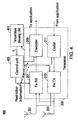
- FIG. 4 is a block diagram of an exemplary user equipment 400 that includes elements that are particularly adapted to alleviate or avoid an overheating condition within the user equipment 400.
- the user equipment 400 includes many of the same elements as those described earlier with respect to FIG. 2 . Accordingly, those elements that are common to both figures need not be described again.
- the user equipment 400 includes a temperature sensing unit 401 that generates a signal, T ⁇ i , that represents an i :th estimate (wherein i is an integer) of the temperature within the user equipment 400. This temperature signal is supplied to a control unit 403.
- the control unit 403 compares the temperature estimate with a threshold value. The comparison indicates whether the user equipment 400 is in or (in some embodiments) approaching an overheating condition. In response to the detected overheating condition, the control unit 403 generates control signals to cause any one or more of the above-described overheating alleviating actions to be taken (e.g., limiting transmitter power, reducing the rate of decoding, etc.).
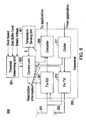
- FIG. 5 is a block diagram of an alternative embodiment of an exemplary user equipment 500 that includes elements that are particularly adapted to alleviate or avoid an overheating condition within the user equipment 500.
- the user equipment 500 includes many of the same elements as those described above with respect to FIG. 4 . Accordingly, those elements that are common to both figures need not be described again.
- the user equipment 500 differs from the user equipment 400 in that the threshold level against which the temperature estimate is compared is not a fixed value, but is instead determined dynamically. To perform this function, the user equipment 500 includes a threshold determining unit 501.
- the threshold determining unit 501 determines what temperature level would constitute an overheating condition (or would indicate that the user equipment 500 is about to overheat) based upon the present battery voltage, data buffer level, and clock speed of processing units and/or buses within the user equipment 500.
- a strategy is adopted wherein, in order to avoid taking unnecessary actions, a higher threshold value is used for transient effects (e.g., transmission bursts) and/or when a temperature rise is predictable and slow (e.g., ongoing battery use).
- a lower threshold value is used when the heating activity is less transient (e.g., predictable moderate to quick heating resulting from a long term process) and/or when a temperature rise is relatively unpredictable (e.g., as with high data rates and/or clock speeds).
- temperature problems can originate from different sources, each associated with its own level of predictability and rate of temperature rise. These characteristics can offer guidance about what would constitute a suitable threshold value. It is desirable to be able to take action before a temperature becomes high enough to cause damage or otherwise detrimentally impact performance. Thus, situations associated with very fast heating call for a low threshold, so that ameliorative action can be taken as soon as possible. By contrast, situations that cause slow heating can be associated with a high threshold level because quick action is not required -- in these circumstances, the user equipment can be permitted to continue its higher level of performance for some time before being degraded in some manner to reduce power (and thereby reduce temperature). When the nature of the heating is unpredictable, prudence calls for a lower threshold level so that ameliorative action can be taken sooner rather than later to avoid any possible damage.
- Whether a heat producing set of circumstances is long lasting or transient can also be a factor when determining a suitable threshold level. For example, if circumstances are known to be transient, a high threshold level may be acceptable even if fast heating is expected because that heating may not last long enough to do any harm.
- Monitoring the data buffer level is useful because information indicating that the data buffer is full implies that there is a high risk that the situation for overheating (due to high processing load) will continue for some time, whereas an indication of low data buffer utilization implies that the processing load (and hence temperature) will likely go down soon (i.e., when the buffer is empty).
- the former situation calls for a lower threshold value if heating occurs quickly, whereas the latter calls for a higher threshold value in order to avoid taking unnecessary action to address a situation that will soon fix itself.
- the threshold value generated by the threshold determining unit 501 is then supplied to a control unit 503.
- the control unit 503 compares the temperature estimate with the dynamically determined threshold value. As in the earlier-described embodiment, the comparison indicates whether the user equipment 500 is in or (in some embodiments) approaching an overheating condition. In response to the detected overheating condition, the control unit 503 generates control signals to cause any one or more of the above-described overheating alleviating actions to be taken (e.g., limiting transmitter power, reducing the rate of decoding, etc.).
- the overload condition is an inability of the user equipment to handle data at the rate at which it is being provided in the downlink direction.
- this can be attributable to a number of different causes, including but not limited to a receiver buffer overflow or a downlink data rate that exceeds the user equipment's signal processing power.
- FIG. 6 is a flowchart of exemplary steps/processes carried out by suitably adapted logic 600 in a user equipment in accordance with exemplary embodiments of the invention.
- the user equipment operates in a connected mode with a serving network (step 601).
- a serving network step 601
- uplink and downlink data and control information are exchanged between the user equipment and an eNode-B (or equivalent).
- This exchange takes place in accordance with a cellular system protocol such as, without limitation, LTE, e-HSPA, and WiMax.
- the user equipment monitors the utilization of one or more (depending on the particular embodiment) user equipment resources (step 603).
- These resources include, but are not limited to, receive buffer utilization, and signal processing utilization.
- the user equipment invokes logic configured to restrict the data rate in the user equipment and network infrastructure (step 607). This involves notifying the network that it should reduce its peak data rates, either for a limited period of time or indefinitely until otherwise notified, depending on embodiment.
- the user equipment signals the network to inform of the user equipment's limited processing capability.
- the signaling can take the form of a short message that indicates, for example, the limitation cause, the receive buffer status, the current maximum possible data rate, the duration of the limitation and other supporting information.
- a preconfigured set of messages either per user equipment or per system that allows the user equipment to signal by means of only a message identifier.
- the preconfigured set of messages is known to both the network and the user equipment.
- the message identifier is associated with the intended one of the preconfigured set of messages, so that merely communicating the message identifier is sufficient to inform the network of the content of the intended message.
- the simplest predefined message can be one that requests an immediate halt of downlink transmission for a specific time.
- a 1-bit indicator can be defined for signaling to the network that the user equipment would like the downlink data throughput rate to be reduced.
- other fields can be used in conjunction with the 1-bit indicator to provide additional information. For example, when the 1-bit indicator is asserted, an existing field such as the CQI indicator can be used to indicate by how much the downlink data throughput rate should be reduced (i.e., the CQI indicator field indicates how the serving eNode-B should respond when the downlink data throughput rate reduction is being requested, and otherwise continues to represent the CQI).
- this second field (e.g., the CQI field) can, when the 1-bit indicator is asserted, represent the maximum value of the data rate that the user equipment is still able to handle.
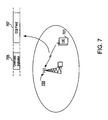
- FIG. 7 is a block diagram of an exemplary user equipment 701 being served by an eNode-B 703.
- the user equipment 701 is in the process of signaling to the eNode-B 703 that it would like the downlink data throughput rate to be reduced.
- the exemplary signaling takes the form of a field 705 (e.g., a 1-bit field) that, when asserted, indicates the need for a data throughput rate reduction.
- another transmitted field (e.g., the CQI field 707) is interpreted by the eNode-B 703 as an indication of by how much the downlink data throughput rate should be reduced, or alternatively the maximum value of the data rate that the user equipment is still able to handle.
- the network responds by adjusting the downlink throughput rate in a manner consistent with the particular message received.
- permissible signaling within a mobile communications network is typically governed by the published standard for the given system type.
- the standards do not provide a mechanism whereby the user equipment can directly request a lower downlink data throughput rate, it is still possible for the user equipment to bring about this result.
- the logic 300 and steps/processes described earlier with reference to FIG. 3 are suitable for indirectly bringing about the result that the network will reduce its downlink throughput rate.
- the term "indirect” means that the user equipment takes one or more actions that, within the communications standard under which the user equipment is operating, do not directly indicate to the network that the user equipment is experiencing some sort of overload condition; nonetheless, the action(s) taken by the user equipment result(s) in the network reducing the downlink throughput rate.
- the technique described with reference to FIG. 3 involves the user equipment sending a CQI report to the eNode-B (or equivalent), wherein the reported value (CQI REPORTED ) is intentionally set to a value that indicates a lower quality channel then actually exists (i.e., the true channel quality value should be set to CQI ACTUAL ) (step 301).
- the user equipment should be operated in a manner that is consistent with the reported CQI value (step 303). For example, the user equipment should send NAKs to the serving node at a rate (and possibly also a distribution over time) that is consistent with a channel whose quality corresponds to the reported CQI value. This will likely mean sending one or more NAKs for blocks of data whose reception was acceptable (i.e., received without errors or received with correctable errors).
- the user equipment indirectly brings about the network reducing the downlink throughput data rate by reporting NAKs instead of positive acknowledgements (ACKs) for some data blocks whose reception was acceptable. For those data blocks that are misleadingly reported as "not received", the user equipment can either discard the originally received data block and rely on the retransmitted version, or keep the originally transmitted version and discard the retransmitted version.
- This technique allows the user equipment to regulate the received data rate.
- this technique has a disadvantage in that the network continues to send data at the high data rate, thereby needlessly occupying the air interface.
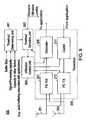
- FIG. 8 is a block diagram of an exemplary user equipment 800 that includes elements that are particularly adapted to alleviate or avoid a resource utilization overload condition within the user equipment 800.
- the user equipment 800 includes many of the same elements as those described earlier with respect to FIG. 2 . Accordingly, those elements that are common to both figures need not be described again.
- the user equipment 800 includes additional elements that are adapted to carry out the steps/processes illustrated in FIG. 6 . These include a threshold determining unit 801 that receives one or more configuration signals that indicate what resources are available within the user equipment. This information can indicate such things as buffer size, signal processing capacity, or any other resource within the user equipment that has the potential to be overloaded by an excessive downlink throughput rate.
- the threshold determining unit 801 generates from this information one or more threshold values that represent a level of resource utilization that corresponds to the user equipment 800 being in (or alternatively about to enter) a resource utilization overload.
- the one or more threshold levels are supplied to an overload detection unit 803 that monitors one or more conditions within the transceiver 205 and also from one or more signals that indicate present utilization levels of one or more resources associated with one or more applications, and determines from these (by means of comparison with corresponding ones of the one or more threshold levels) whether existing conditions constitute (or will constitute) an overload condition.
- the overload detection unit 803 generates an overload status signal that is supplied to a utilization control unit 805. If the overload status signal is asserted (meaning that an overload condition has or will occur), the utilization control unit 805 generates control signals that cause the user equipment to take steps to alleviate (or prevent) the overload condition, such as those described above with reference to FIG. 6 .
- Control lines to the decoder 209 and 211 enable the utilization control unit 805 to control the respective decoding and coding rates, as appropriate. For example, some user equipment resources that are used by both uplink and downlink processing (e.g., buffer and processing unit) can benefit from considering the operation of both reception and transmission paths together.
- a control line to the front-end transmitter 213 enables the output transmitter power to be adjusted, as needed.
- the invention provides a number of ways that enable a user equipment to alleviate or avoid a number of different types of overload conditions. Where that overload can be alleviated by reducing the downlink data throughput rate, a number of embodiments enable this to be achieved even when a system does not provide a direct mechanism for the user equipment to request the desired data rate reduction.
- a user equipment comprises elements that enable both issues to be dealt with.
- some embodiments would include the equivalent of the temperature sensing unit 401 and the threshold determining unit (both depicted in FIG. 5 ) as well as the equivalent of the threshold determining unit (depicted in FIG. 8 ).
- control logic can perform all of the functions attributed to the control unit 503 and the utilization control unit 805 described above.
Landscapes
- Engineering & Computer Science (AREA)
- Computer Networks & Wireless Communication (AREA)
- Signal Processing (AREA)
- Quality & Reliability (AREA)
- Mobile Radio Communication Systems (AREA)
- Telephone Function (AREA)
Priority Applications (1)
| Application Number | Priority Date | Filing Date | Title |
|---|---|---|---|
| PL09713919T PL2250753T3 (pl) | 2008-02-25 | 2009-02-20 | Zmniejszanie stanu przeciążenia urządzenia mobilnego w systemie komunikacji mobilnej |
Applications Claiming Priority (4)
| Application Number | Priority Date | Filing Date | Title |
|---|---|---|---|
| US3116208P | 2008-02-25 | 2008-02-25 | |
| US3116608P | 2008-02-25 | 2008-02-25 | |
| US12/239,346 US8086229B2 (en) | 2008-02-25 | 2008-09-26 | Alleviating mobile device overload conditions in a mobile communication system |
| PCT/EP2009/052074 WO2009106490A1 (en) | 2008-02-25 | 2009-02-20 | Alleviating mobile device overload conditions in a mobile communication system |
Publications (2)
| Publication Number | Publication Date |
|---|---|
| EP2250753A1 EP2250753A1 (en) | 2010-11-17 |
| EP2250753B1 true EP2250753B1 (en) | 2014-11-19 |
Family
ID=40998831
Family Applications (1)
| Application Number | Title | Priority Date | Filing Date |
|---|---|---|---|
| EP09713919.0A Active EP2250753B1 (en) | 2008-02-25 | 2009-02-20 | Alleviating mobile device overload conditions in a mobile communication system |
Country Status (10)
| Country | Link |
|---|---|
| US (2) | US8086229B2 (enExample) |
| EP (1) | EP2250753B1 (enExample) |
| JP (2) | JP5356417B2 (enExample) |
| CN (1) | CN102017493B (enExample) |
| AR (1) | AR070480A1 (enExample) |
| BR (1) | BRPI0908125B1 (enExample) |
| ES (1) | ES2528207T3 (enExample) |
| PL (1) | PL2250753T3 (enExample) |
| WO (1) | WO2009106490A1 (enExample) |
| ZA (1) | ZA201005878B (enExample) |
Families Citing this family (50)
| Publication number | Priority date | Publication date | Assignee | Title |
|---|---|---|---|---|
| US20080178225A1 (en) * | 2007-01-23 | 2008-07-24 | At&T Knowledge Ventures, Lp | Method and system for storing and accessing video data |
| US8620235B2 (en) * | 2008-05-23 | 2013-12-31 | Qualcomm Incorporated | Thermal management for data modules |
| US8880111B2 (en) | 2008-07-25 | 2014-11-04 | Qualcomm Incorporated | System and method for network management |
| FR2942932B1 (fr) * | 2009-03-05 | 2011-04-08 | St Wireless Sa | Procede de controle du fonctionnement d'une unite de traitement d'un appareil de communication sans fil, et appareil de communication correspondant |
| US9407407B2 (en) * | 2009-05-08 | 2016-08-02 | Qualcomm Incorporated | Method and apparatus for controlling carriers used at an access terminal |
| BRPI1016091A2 (pt) | 2009-06-17 | 2017-07-18 | Ericsson Telefon Ab L M | "método para programar transmissões de dados entre um terminal móvel e uma estação base em uma rede de comunicação sem fio, terminal móvel, programa de computador, e, meio legível por computador." |
| US8498328B2 (en) * | 2009-10-13 | 2013-07-30 | Qualcomm Incorporated | Energy management for wireless devices |
| CN101834644A (zh) * | 2010-02-04 | 2010-09-15 | 华为终端有限公司 | 一种无线终端的辅天线状态控制方法及无线终端 |
| JP5387483B2 (ja) * | 2010-03-31 | 2014-01-15 | 富士通株式会社 | 無線通信に用いられる装置、プログラム及び方法 |
| US8937863B2 (en) * | 2010-04-12 | 2015-01-20 | Qualcomm Incorporated | Scheme and apparatus for multi-resource flow control |
| US8918563B2 (en) | 2010-06-01 | 2014-12-23 | Qualcomm Incorporated | Uplink data throttling by buffer status report (BSR) scaling |
| US9112691B2 (en) | 2010-08-13 | 2015-08-18 | Qualcomm Incorporated | Methods and systems for downlink flow control in a wireless communication system |
| US20120176922A1 (en) * | 2011-01-07 | 2012-07-12 | Qualcomm Incorporated | Downlink flow control by adding noise to a receiver to reduce physical layer throughput |
| WO2012153859A1 (ja) * | 2011-05-12 | 2012-11-15 | 日本電気株式会社 | 中継装置 |
| CN103718588B (zh) * | 2011-06-07 | 2017-11-28 | 意大利电信股份公司 | 无线接入网络中的功耗管理 |
| GB2493504B (en) * | 2011-07-25 | 2017-11-29 | Qualcomm Technologies Int Ltd | Data flow control |
| US9019880B2 (en) | 2011-08-11 | 2015-04-28 | Qualcomm Incorporated | Methods and apparatus for overload mitigation using uplink transmit power backoff |
| EP2818017B1 (en) * | 2012-02-21 | 2018-04-11 | Telefonaktiebolaget LM Ericsson (publ) | Processing-time dependent control of data block transmission |
| US9392598B2 (en) * | 2012-03-09 | 2016-07-12 | Qualcomm Incorporated | Method and system for communicating between small cells using over-the-air transmissions |
| US9929788B2 (en) * | 2012-05-29 | 2018-03-27 | Amazon Technologies, Inc. | Reconfiguring MIMO communication links |
| GB2508851B (en) * | 2012-12-12 | 2015-02-18 | Broadcom Corp | Apparatus, methods and computer programs for thermal management of user equipment coupled to a vehicle |
| US9323296B2 (en) * | 2013-01-16 | 2016-04-26 | Qualcomm Incorporated | Thermal mitigation in dual SIM dual active devices |
| US9204396B2 (en) * | 2013-02-08 | 2015-12-01 | Qualcomm Incorporated | Systems and methods for adapting a network search algorithm |
| US20140274011A1 (en) * | 2013-03-14 | 2014-09-18 | Qualcomm Incorporated | Method and apparatus for controlling operation of a user equipment based on physical layer parameters |
| WO2016008140A1 (zh) * | 2014-07-17 | 2016-01-21 | 华为技术有限公司 | 一种终端的传输通道自适应控制的方法、终端及基站设备 |
| US9538489B1 (en) * | 2014-08-27 | 2017-01-03 | Sprint Communications Company L.P. | Wireless communication device to synchronize data transfer rates |
| US9521562B2 (en) * | 2014-10-16 | 2016-12-13 | Qualcomm Incorporated | Decoupling radio frequency (RF) and baseband processing |
| WO2016107648A1 (en) * | 2014-12-30 | 2016-07-07 | Telefonaktiebolaget Lm Ericsson (Publ) | Channel quality perorting in dependecy of communication conditions |
| US10314096B2 (en) | 2015-03-12 | 2019-06-04 | Huawei Technologies Co., Ltd. | Data transmission method, data transmission apparatus, processor, and mobile terminal |
| US9999037B2 (en) | 2015-05-15 | 2018-06-12 | Qualcomm Incorporated | Methods and apparatus for adjusting flow rate of transmissions received by a device |
| US10678637B2 (en) * | 2017-01-10 | 2020-06-09 | Qualcomm Incorporated | Techniques to improve data transfer reliability |
| ES2926709T3 (es) * | 2017-01-13 | 2022-10-27 | Huawei Tech Co Ltd | Método y aparato para ajustar la configuración de recursos de radio |
| CN110169108B (zh) * | 2017-01-13 | 2022-04-22 | 华为技术有限公司 | 一种高速数据传输降级方法、设备及系统 |
| US9936456B1 (en) * | 2017-03-28 | 2018-04-03 | Arris Enterprises Llc | Power consumption management based on enabling and disabling wireless chains |
| WO2018193131A1 (en) * | 2017-04-21 | 2018-10-25 | Sony Mobile Communications Inc. | Mitigation of overheating events at communication devices |
| WO2018209656A1 (zh) * | 2017-05-18 | 2018-11-22 | 北京小米移动软件有限公司 | 保护用户设备的方法、装置、用户设备及基站 |
| US10873887B2 (en) * | 2017-06-30 | 2020-12-22 | Qualcomm Incorporated | Seamless handover with dual connectivity |
| JP6956255B2 (ja) * | 2017-08-09 | 2021-11-02 | 北京小米移動軟件有限公司Beijing Xiaomi Mobile Software Co.,Ltd. | ユーザ機器の過熱保護方法、装置、ユーザ機器及び基地局 |
| WO2019041098A1 (zh) | 2017-08-28 | 2019-03-07 | 北京小米移动软件有限公司 | 切换基站的方法、装置及系统 |
| KR102561517B1 (ko) * | 2017-10-05 | 2023-08-01 | 소니그룹주식회사 | Lte-뉴 라디오 동시 ul 송신 동안 사용자 장비 과열 처리 |
| US11838870B2 (en) | 2018-08-30 | 2023-12-05 | Mediatek Singapore Pte. Ltd. | Methods for reducing power consumption of a communication apparatus and a communication apparatus utilizing the same |
| US11528597B2 (en) * | 2018-09-25 | 2022-12-13 | Mediatek Singapore Pte Ltd. | Carrier and frequency specific capability restrictions |
| WO2020091489A1 (ko) * | 2018-11-02 | 2020-05-07 | 삼성전자 주식회사 | 무선 자원을 제어하기 위한 방법 및 전자 장치 |
| US11405900B2 (en) * | 2018-11-02 | 2022-08-02 | Samsung Electronics Co., Ltd. | Method and apparatus for handling overheat of electronic device |
| KR102954823B1 (ko) * | 2018-11-02 | 2026-04-21 | 삼성전자주식회사 | 전자 장치의 과열을 처리하기 위한 방법 및 장치 |
| KR102653811B1 (ko) | 2019-01-15 | 2024-04-03 | 삼성전자 주식회사 | 차세대 이동통신 시스템에서 단말의 단말 능력 보고 방법 및 장치 |
| KR20200099001A (ko) | 2019-02-13 | 2020-08-21 | 삼성전자주식회사 | 무선 통신 시스템에서 단말 능력을 보고하기 위한 방법 및 장치 |
| CN112806047B (zh) * | 2020-06-19 | 2023-06-06 | 北京小米移动软件有限公司 | 信息处理方法及装置、通信设备及存储介质 |
| WO2023099930A1 (en) * | 2021-12-03 | 2023-06-08 | Telefonaktiebolaget Lm Ericsson (Publ) | Reduction of interference caused by downlink aggressors |
| US12598484B2 (en) * | 2022-12-02 | 2026-04-07 | Samsung Electronics Co., Ltd. | Traffic aware UE temperature management |
Family Cites Families (30)
| Publication number | Priority date | Publication date | Assignee | Title |
|---|---|---|---|---|
| JPS63226124A (ja) * | 1986-10-29 | 1988-09-20 | Oki Electric Ind Co Ltd | 無線装置用レベル制御回路 |
| JP2872156B2 (ja) * | 1996-11-13 | 1999-03-17 | 日本電気テレコムシステム株式会社 | 通信携帯端末 |
| US6169884B1 (en) * | 1998-04-06 | 2001-01-02 | Sierra Wireless, Inc. | Method and apparatus for reducing power in radio transmitters |
| JP3223887B2 (ja) * | 1998-09-07 | 2001-10-29 | 株式会社デンソー | 無線通信装置 |
| US6760311B1 (en) * | 1998-11-20 | 2004-07-06 | Ericsson Inc. | Thermal transmission control of wireless data modem |
| US6865233B1 (en) | 1999-02-19 | 2005-03-08 | Telefonaktiebolaget Lm Ericsson (Publ) | Method and system for control signalling enabling flexible link adaptation in a radiocommunication system |
| GB2355367A (en) * | 1999-10-13 | 2001-04-18 | Ericsson Telefon Ab L M | Adjusting allocation of transmission slots according operating conditions in a mobile telephone |
| EP1143627A4 (en) | 1999-11-05 | 2003-08-06 | Sony Corp | METHOD AND DEVICE FOR TRANSMITTING DATA |
| KR20020025476A (ko) * | 2000-09-29 | 2002-04-04 | 윤종용 | 지.피.알.에스 단말기에서 발열현상에 따른 서비스 클래스변경장치 및 방법 |
| US7023824B2 (en) | 2001-02-27 | 2006-04-04 | Telefonaktiebolaget L M Ericsson (Publ) | Method, apparatus, and system for optimizing transmission power and bit rate in multi-transmission scheme communication systems |
| KR100420601B1 (ko) * | 2001-11-22 | 2004-03-02 | 에스케이 텔레콤주식회사 | 비디오 데이터 스트리밍 서비스 방법 |
| ATE299630T1 (de) * | 2002-02-14 | 2005-07-15 | Matsushita Electric Industrial Co Ltd | Verfahren zum steuern der datenrate in einem drahtlosen paketdatenkommunikationssystem, sender und empfänger zu seiner verwendung |
| GB2386507A (en) | 2002-03-15 | 2003-09-17 | Ubinetics Ltd | Controlling transmission rate |
| US7079856B2 (en) * | 2002-04-05 | 2006-07-18 | Lucent Technologies Inc. | Data flow control between a base station and a mobile station |
| DE10244696A1 (de) * | 2002-09-24 | 2004-04-01 | Philips Intellectual Property & Standards Gmbh | Verfahren und Datenübertragungssystem zur Übertragung von Datenpaketen zwischen einem Sender und einem Empfänger |
| US7342955B2 (en) * | 2003-04-23 | 2008-03-11 | Motorola Inc | Apparatus and method for mobile communication device transmission |
| JP4194091B2 (ja) * | 2003-09-02 | 2008-12-10 | ソニー・エリクソン・モバイルコミュニケーションズ株式会社 | 無線通信システムおよび無線通信装置 |
| JP4350487B2 (ja) * | 2003-11-06 | 2009-10-21 | Kddi株式会社 | 無線通信システム、基地局および無線通信端末 |
| US7206567B2 (en) * | 2003-11-10 | 2007-04-17 | Research In Motion Limited | Methods and apparatus for limiting communication capabilities in mobile communication devices |
| US7599698B2 (en) * | 2003-12-29 | 2009-10-06 | Telefonaktiebolaget Lm Ericsson (Publ) | Network controlled channel information reporting |
| JP4415317B2 (ja) * | 2004-02-23 | 2010-02-17 | セイコーエプソン株式会社 | 情報機器及びその制御方法 |
| US7583630B2 (en) * | 2004-06-28 | 2009-09-01 | Samsung Electronics Co., Ltd. | Method and system for providing mobile station control of data transmission rates in a wireless network |
| JP4457868B2 (ja) * | 2004-11-25 | 2010-04-28 | 富士通株式会社 | 無線通信装置、移動局 |
| EP1825628B1 (en) | 2004-12-17 | 2011-02-09 | Telefonaktiebolaget LM Ericsson (publ) | Apparatus and method in a cellular network |
| EP1954085B1 (en) * | 2005-11-21 | 2016-01-27 | NEC Corporation | Mobile station, downstream transmission rate control method, and downstream transmission rate control program |
| JP4778318B2 (ja) * | 2006-01-20 | 2011-09-21 | 富士通東芝モバイルコミュニケーションズ株式会社 | 携帯端末 |
| JP4472713B2 (ja) * | 2006-06-19 | 2010-06-02 | 株式会社エヌ・ティ・ティ・ドコモ | 移動局装置、送信方法及び移動通信システム |
| US20080046132A1 (en) * | 2006-08-18 | 2008-02-21 | Nokia Corporation | Control of heat dissipation |
| US8917598B2 (en) * | 2007-12-21 | 2014-12-23 | Qualcomm Incorporated | Downlink flow control |
| US8656239B2 (en) * | 2008-02-12 | 2014-02-18 | Qualcomm Incorporated | Control of data transmission based on HARQ in a wireless communication system |
-
2008
- 2008-09-26 US US12/239,346 patent/US8086229B2/en active Active
-
2009
- 2009-02-20 EP EP09713919.0A patent/EP2250753B1/en active Active
- 2009-02-20 JP JP2010547191A patent/JP5356417B2/ja not_active Expired - Fee Related
- 2009-02-20 ES ES09713919.0T patent/ES2528207T3/es active Active
- 2009-02-20 WO PCT/EP2009/052074 patent/WO2009106490A1/en not_active Ceased
- 2009-02-20 PL PL09713919T patent/PL2250753T3/pl unknown
- 2009-02-20 BR BRPI0908125-9A patent/BRPI0908125B1/pt active IP Right Grant
- 2009-02-20 CN CN200980114866.2A patent/CN102017493B/zh active Active
- 2009-02-25 AR ARP090100650A patent/AR070480A1/es not_active Application Discontinuation
-
2010
- 2010-08-17 ZA ZA2010/05878A patent/ZA201005878B/en unknown
-
2011
- 2011-11-21 US US13/301,329 patent/US8594694B2/en active Active
-
2013
- 2013-08-27 JP JP2013176055A patent/JP5602920B2/ja not_active Expired - Fee Related
Also Published As
| Publication number | Publication date |
|---|---|
| AR070480A1 (es) | 2010-04-07 |
| US8594694B2 (en) | 2013-11-26 |
| BRPI0908125B1 (pt) | 2020-10-13 |
| ZA201005878B (en) | 2011-10-26 |
| JP5602920B2 (ja) | 2014-10-08 |
| JP2011514047A (ja) | 2011-04-28 |
| JP5356417B2 (ja) | 2013-12-04 |
| US20090215442A1 (en) | 2009-08-27 |
| WO2009106490A1 (en) | 2009-09-03 |
| US8086229B2 (en) | 2011-12-27 |
| EP2250753A1 (en) | 2010-11-17 |
| JP2014003688A (ja) | 2014-01-09 |
| BRPI0908125A2 (pt) | 2015-08-04 |
| ES2528207T3 (es) | 2015-02-05 |
| PL2250753T3 (pl) | 2015-05-29 |
| CN102017493A (zh) | 2011-04-13 |
| US20120064909A1 (en) | 2012-03-15 |
| CN102017493B (zh) | 2014-06-04 |
Similar Documents
| Publication | Publication Date | Title |
|---|---|---|
| US8086229B2 (en) | Alleviating mobile device overload conditions in a mobile communication system | |
| JP5848279B2 (ja) | 上り回線容量を増加させるためにチャネル品質インジケータフィードバック期間を調整する方法および装置 | |
| JP5295185B2 (ja) | 基地局装置及び通信方法 | |
| EP2374318B1 (en) | Method and apparatus in a telecommunications network for controlling uplink control channel resources | |
| CN107615693B (zh) | 用于上行链路无授权随机接入中的链路自适应的装置和方法 | |
| CN101573898B (zh) | 在移动通信系统中使用的基站装置、用户装置和方法 | |
| US10958372B2 (en) | Radio link adaptation in communication systems | |
| EP1956728B1 (en) | Method for controlling communication of radio terminal, and radio terminal | |
| US9572170B2 (en) | Method and device for applying adaptive link in communication system | |
| JP2010093843A (ja) | データ伝送方法 | |
| CN101207465A (zh) | 一种调整信道质量指示的方法、装置和系统 | |
| EP4496244A1 (en) | Reporting assistance | |
| WO2025067680A1 (en) | Control channel quality reporting and link adaptation | |
| CN115242348A (zh) | 自适应链路调制编码方法、系统及基站 |
Legal Events
| Date | Code | Title | Description |
|---|---|---|---|
| PUAI | Public reference made under article 153(3) epc to a published international application that has entered the european phase |
Free format text: ORIGINAL CODE: 0009012 |
|
| 17P | Request for examination filed |
Effective date: 20100923 |
|
| AK | Designated contracting states |
Kind code of ref document: A1 Designated state(s): AT BE BG CH CY CZ DE DK EE ES FI FR GB GR HR HU IE IS IT LI LT LU LV MC MK MT NL NO PL PT RO SE SI SK TR |
|
| AX | Request for extension of the european patent |
Extension state: AL BA RS |
|
| DAX | Request for extension of the european patent (deleted) | ||
| 17Q | First examination report despatched |
Effective date: 20120820 |
|
| GRAP | Despatch of communication of intention to grant a patent |
Free format text: ORIGINAL CODE: EPIDOSNIGR1 |
|
| RIC1 | Information provided on ipc code assigned before grant |
Ipc: H04L 1/00 20060101AFI20140603BHEP Ipc: H04B 1/40 20060101ALI20140603BHEP Ipc: H04W 72/12 20090101ALI20140603BHEP |
|
| INTG | Intention to grant announced |
Effective date: 20140701 |
|
| GRAS | Grant fee paid |
Free format text: ORIGINAL CODE: EPIDOSNIGR3 |
|
| GRAA | (expected) grant |
Free format text: ORIGINAL CODE: 0009210 |
|
| AK | Designated contracting states |
Kind code of ref document: B1 Designated state(s): AT BE BG CH CY CZ DE DK EE ES FI FR GB GR HR HU IE IS IT LI LT LU LV MC MK MT NL NO PL PT RO SE SI SK TR |
|
| REG | Reference to a national code |
Ref country code: GB Ref legal event code: FG4D |
|
| REG | Reference to a national code |
Ref country code: CH Ref legal event code: EP |
|
| REG | Reference to a national code |
Ref country code: AT Ref legal event code: REF Ref document number: 697550 Country of ref document: AT Kind code of ref document: T Effective date: 20141215 |
|
| REG | Reference to a national code |
Ref country code: IE Ref legal event code: FG4D |
|
| REG | Reference to a national code |
Ref country code: DE Ref legal event code: R096 Ref document number: 602009027840 Country of ref document: DE Effective date: 20141224 |
|
| REG | Reference to a national code |
Ref country code: ES Ref legal event code: FG2A Ref document number: 2528207 Country of ref document: ES Kind code of ref document: T3 Effective date: 20150205 |
|
| REG | Reference to a national code |
Ref country code: SE Ref legal event code: TRGR |
|
| REG | Reference to a national code |
Ref country code: NL Ref legal event code: VDEP Effective date: 20141119 |
|
| REG | Reference to a national code |
Ref country code: AT Ref legal event code: MK05 Ref document number: 697550 Country of ref document: AT Kind code of ref document: T Effective date: 20141119 |
|
| REG | Reference to a national code |
Ref country code: LT Ref legal event code: MG4D |
|
| PG25 | Lapsed in a contracting state [announced via postgrant information from national office to epo] |
Ref country code: NO Free format text: LAPSE BECAUSE OF FAILURE TO SUBMIT A TRANSLATION OF THE DESCRIPTION OR TO PAY THE FEE WITHIN THE PRESCRIBED TIME-LIMIT Effective date: 20150219 Ref country code: FI Free format text: LAPSE BECAUSE OF FAILURE TO SUBMIT A TRANSLATION OF THE DESCRIPTION OR TO PAY THE FEE WITHIN THE PRESCRIBED TIME-LIMIT Effective date: 20141119 Ref country code: IS Free format text: LAPSE BECAUSE OF FAILURE TO SUBMIT A TRANSLATION OF THE DESCRIPTION OR TO PAY THE FEE WITHIN THE PRESCRIBED TIME-LIMIT Effective date: 20150319 Ref country code: NL Free format text: LAPSE BECAUSE OF FAILURE TO SUBMIT A TRANSLATION OF THE DESCRIPTION OR TO PAY THE FEE WITHIN THE PRESCRIBED TIME-LIMIT Effective date: 20141119 Ref country code: LT Free format text: LAPSE BECAUSE OF FAILURE TO SUBMIT A TRANSLATION OF THE DESCRIPTION OR TO PAY THE FEE WITHIN THE PRESCRIBED TIME-LIMIT Effective date: 20141119 Ref country code: PT Free format text: LAPSE BECAUSE OF FAILURE TO SUBMIT A TRANSLATION OF THE DESCRIPTION OR TO PAY THE FEE WITHIN THE PRESCRIBED TIME-LIMIT Effective date: 20150319 |
|
| PG25 | Lapsed in a contracting state [announced via postgrant information from national office to epo] |
Ref country code: AT Free format text: LAPSE BECAUSE OF FAILURE TO SUBMIT A TRANSLATION OF THE DESCRIPTION OR TO PAY THE FEE WITHIN THE PRESCRIBED TIME-LIMIT Effective date: 20141119 Ref country code: LV Free format text: LAPSE BECAUSE OF FAILURE TO SUBMIT A TRANSLATION OF THE DESCRIPTION OR TO PAY THE FEE WITHIN THE PRESCRIBED TIME-LIMIT Effective date: 20141119 Ref country code: HR Free format text: LAPSE BECAUSE OF FAILURE TO SUBMIT A TRANSLATION OF THE DESCRIPTION OR TO PAY THE FEE WITHIN THE PRESCRIBED TIME-LIMIT Effective date: 20141119 Ref country code: GR Free format text: LAPSE BECAUSE OF FAILURE TO SUBMIT A TRANSLATION OF THE DESCRIPTION OR TO PAY THE FEE WITHIN THE PRESCRIBED TIME-LIMIT Effective date: 20150220 Ref country code: CY Free format text: LAPSE BECAUSE OF FAILURE TO SUBMIT A TRANSLATION OF THE DESCRIPTION OR TO PAY THE FEE WITHIN THE PRESCRIBED TIME-LIMIT Effective date: 20141119 |
|
| REG | Reference to a national code |
Ref country code: PL Ref legal event code: T3 |
|
| PG25 | Lapsed in a contracting state [announced via postgrant information from national office to epo] |
Ref country code: DK Free format text: LAPSE BECAUSE OF FAILURE TO SUBMIT A TRANSLATION OF THE DESCRIPTION OR TO PAY THE FEE WITHIN THE PRESCRIBED TIME-LIMIT Effective date: 20141119 Ref country code: RO Free format text: LAPSE BECAUSE OF FAILURE TO SUBMIT A TRANSLATION OF THE DESCRIPTION OR TO PAY THE FEE WITHIN THE PRESCRIBED TIME-LIMIT Effective date: 20141119 Ref country code: CZ Free format text: LAPSE BECAUSE OF FAILURE TO SUBMIT A TRANSLATION OF THE DESCRIPTION OR TO PAY THE FEE WITHIN THE PRESCRIBED TIME-LIMIT Effective date: 20141119 Ref country code: SK Free format text: LAPSE BECAUSE OF FAILURE TO SUBMIT A TRANSLATION OF THE DESCRIPTION OR TO PAY THE FEE WITHIN THE PRESCRIBED TIME-LIMIT Effective date: 20141119 Ref country code: EE Free format text: LAPSE BECAUSE OF FAILURE TO SUBMIT A TRANSLATION OF THE DESCRIPTION OR TO PAY THE FEE WITHIN THE PRESCRIBED TIME-LIMIT Effective date: 20141119 |
|
| REG | Reference to a national code |
Ref country code: DE Ref legal event code: R097 Ref document number: 602009027840 Country of ref document: DE |
|
| PLBE | No opposition filed within time limit |
Free format text: ORIGINAL CODE: 0009261 |
|
| STAA | Information on the status of an ep patent application or granted ep patent |
Free format text: STATUS: NO OPPOSITION FILED WITHIN TIME LIMIT |
|
| PG25 | Lapsed in a contracting state [announced via postgrant information from national office to epo] |
Ref country code: LU Free format text: LAPSE BECAUSE OF FAILURE TO SUBMIT A TRANSLATION OF THE DESCRIPTION OR TO PAY THE FEE WITHIN THE PRESCRIBED TIME-LIMIT Effective date: 20150220 |
|
| REG | Reference to a national code |
Ref country code: CH Ref legal event code: PL |
|
| 26N | No opposition filed |
Effective date: 20150820 |
|
| PG25 | Lapsed in a contracting state [announced via postgrant information from national office to epo] |
Ref country code: MC Free format text: LAPSE BECAUSE OF FAILURE TO SUBMIT A TRANSLATION OF THE DESCRIPTION OR TO PAY THE FEE WITHIN THE PRESCRIBED TIME-LIMIT Effective date: 20141119 Ref country code: CH Free format text: LAPSE BECAUSE OF NON-PAYMENT OF DUE FEES Effective date: 20150228 Ref country code: LI Free format text: LAPSE BECAUSE OF NON-PAYMENT OF DUE FEES Effective date: 20150228 |
|
| REG | Reference to a national code |
Ref country code: IE Ref legal event code: MM4A |
|
| REG | Reference to a national code |
Ref country code: FR Ref legal event code: ST Effective date: 20151030 |
|
| PG25 | Lapsed in a contracting state [announced via postgrant information from national office to epo] |
Ref country code: IE Free format text: LAPSE BECAUSE OF NON-PAYMENT OF DUE FEES Effective date: 20150220 |
|
| PG25 | Lapsed in a contracting state [announced via postgrant information from national office to epo] |
Ref country code: SI Free format text: LAPSE BECAUSE OF FAILURE TO SUBMIT A TRANSLATION OF THE DESCRIPTION OR TO PAY THE FEE WITHIN THE PRESCRIBED TIME-LIMIT Effective date: 20141119 Ref country code: FR Free format text: LAPSE BECAUSE OF NON-PAYMENT OF DUE FEES Effective date: 20150302 |
|
| PG25 | Lapsed in a contracting state [announced via postgrant information from national office to epo] |
Ref country code: MT Free format text: LAPSE BECAUSE OF FAILURE TO SUBMIT A TRANSLATION OF THE DESCRIPTION OR TO PAY THE FEE WITHIN THE PRESCRIBED TIME-LIMIT Effective date: 20141119 |
|
| PG25 | Lapsed in a contracting state [announced via postgrant information from national office to epo] |
Ref country code: HU Free format text: LAPSE BECAUSE OF FAILURE TO SUBMIT A TRANSLATION OF THE DESCRIPTION OR TO PAY THE FEE WITHIN THE PRESCRIBED TIME-LIMIT; INVALID AB INITIO Effective date: 20090220 Ref country code: BG Free format text: LAPSE BECAUSE OF FAILURE TO SUBMIT A TRANSLATION OF THE DESCRIPTION OR TO PAY THE FEE WITHIN THE PRESCRIBED TIME-LIMIT Effective date: 20141119 |
|
| PG25 | Lapsed in a contracting state [announced via postgrant information from national office to epo] |
Ref country code: TR Free format text: LAPSE BECAUSE OF FAILURE TO SUBMIT A TRANSLATION OF THE DESCRIPTION OR TO PAY THE FEE WITHIN THE PRESCRIBED TIME-LIMIT Effective date: 20141119 |
|
| PG25 | Lapsed in a contracting state [announced via postgrant information from national office to epo] |
Ref country code: BE Free format text: LAPSE BECAUSE OF FAILURE TO SUBMIT A TRANSLATION OF THE DESCRIPTION OR TO PAY THE FEE WITHIN THE PRESCRIBED TIME-LIMIT Effective date: 20141119 |
|
| PG25 | Lapsed in a contracting state [announced via postgrant information from national office to epo] |
Ref country code: MK Free format text: LAPSE BECAUSE OF FAILURE TO SUBMIT A TRANSLATION OF THE DESCRIPTION OR TO PAY THE FEE WITHIN THE PRESCRIBED TIME-LIMIT Effective date: 20141119 |
|
| PGFP | Annual fee paid to national office [announced via postgrant information from national office to epo] |
Ref country code: FR Payment date: 20190221 Year of fee payment: 7 Ref country code: IT Payment date: 20190222 Year of fee payment: 11 Ref country code: PL Payment date: 20190131 Year of fee payment: 11 |
|
| PGFP | Annual fee paid to national office [announced via postgrant information from national office to epo] |
Ref country code: SE Payment date: 20190227 Year of fee payment: 11 |
|
| REG | Reference to a national code |
Ref country code: SE Ref legal event code: EUG |
|
| PG25 | Lapsed in a contracting state [announced via postgrant information from national office to epo] |
Ref country code: SE Free format text: LAPSE BECAUSE OF NON-PAYMENT OF DUE FEES Effective date: 20200221 |
|
| REG | Reference to a national code |
Ref country code: ES Ref legal event code: FD2A Effective date: 20210707 |
|
| PG25 | Lapsed in a contracting state [announced via postgrant information from national office to epo] |
Ref country code: IT Free format text: LAPSE BECAUSE OF NON-PAYMENT OF DUE FEES Effective date: 20200220 |
|
| PG25 | Lapsed in a contracting state [announced via postgrant information from national office to epo] |
Ref country code: ES Free format text: LAPSE BECAUSE OF NON-PAYMENT OF DUE FEES Effective date: 20200221 |
|
| PG25 | Lapsed in a contracting state [announced via postgrant information from national office to epo] |
Ref country code: PL Free format text: LAPSE BECAUSE OF NON-PAYMENT OF DUE FEES Effective date: 20200220 |
|
| PGFP | Annual fee paid to national office [announced via postgrant information from national office to epo] |
Ref country code: GB Payment date: 20260227 Year of fee payment: 18 |
|
| PGFP | Annual fee paid to national office [announced via postgrant information from national office to epo] |
Ref country code: DE Payment date: 20260227 Year of fee payment: 18 |