EP2248562A1 - Game device, method of controlling game device, program, and information storage medium - Google Patents
Game device, method of controlling game device, program, and information storage medium Download PDFInfo
- Publication number
- EP2248562A1 EP2248562A1 EP08872696A EP08872696A EP2248562A1 EP 2248562 A1 EP2248562 A1 EP 2248562A1 EP 08872696 A EP08872696 A EP 08872696A EP 08872696 A EP08872696 A EP 08872696A EP 2248562 A1 EP2248562 A1 EP 2248562A1
- Authority
- EP
- European Patent Office
- Prior art keywords
- moving object
- team
- player character
- possession
- restriction region
- Prior art date
- Legal status (The legal status is an assumption and is not a legal conclusion. Google has not performed a legal analysis and makes no representation as to the accuracy of the status listed.)
- Withdrawn
Links
- 238000000034 method Methods 0.000 title claims description 12
- 238000013459 approach Methods 0.000 claims abstract description 13
- 230000009467 reduction Effects 0.000 abstract description 9
- 230000007123 defense Effects 0.000 description 61
- 230000003287 optical effect Effects 0.000 description 14
- 238000004891 communication Methods 0.000 description 11
- 238000010586 diagram Methods 0.000 description 10
- 230000015654 memory Effects 0.000 description 7
- 230000006870 function Effects 0.000 description 4
- 230000009471 action Effects 0.000 description 1
- 239000000470 constituent Substances 0.000 description 1
- 230000000694 effects Effects 0.000 description 1
- 238000005516 engineering process Methods 0.000 description 1
- 230000004044 response Effects 0.000 description 1
- 230000000007 visual effect Effects 0.000 description 1
- 230000003936 working memory Effects 0.000 description 1
Images




Classifications
-
- A63F13/10—
-
- A—HUMAN NECESSITIES
- A63—SPORTS; GAMES; AMUSEMENTS
- A63F—CARD, BOARD, OR ROULETTE GAMES; INDOOR GAMES USING SMALL MOVING PLAYING BODIES; VIDEO GAMES; GAMES NOT OTHERWISE PROVIDED FOR
- A63F13/00—Video games, i.e. games using an electronically generated display having two or more dimensions
- A63F13/55—Controlling game characters or game objects based on the game progress
- A63F13/56—Computing the motion of game characters with respect to other game characters, game objects or elements of the game scene, e.g. for simulating the behaviour of a group of virtual soldiers or for path finding
-
- A—HUMAN NECESSITIES
- A63—SPORTS; GAMES; AMUSEMENTS
- A63F—CARD, BOARD, OR ROULETTE GAMES; INDOOR GAMES USING SMALL MOVING PLAYING BODIES; VIDEO GAMES; GAMES NOT OTHERWISE PROVIDED FOR
- A63F13/00—Video games, i.e. games using an electronically generated display having two or more dimensions
- A63F13/40—Processing input control signals of video game devices, e.g. signals generated by the player or derived from the environment
- A63F13/42—Processing input control signals of video game devices, e.g. signals generated by the player or derived from the environment by mapping the input signals into game commands, e.g. mapping the displacement of a stylus on a touch screen to the steering angle of a virtual vehicle
-
- A—HUMAN NECESSITIES
- A63—SPORTS; GAMES; AMUSEMENTS
- A63F—CARD, BOARD, OR ROULETTE GAMES; INDOOR GAMES USING SMALL MOVING PLAYING BODIES; VIDEO GAMES; GAMES NOT OTHERWISE PROVIDED FOR
- A63F13/00—Video games, i.e. games using an electronically generated display having two or more dimensions
- A63F13/45—Controlling the progress of the video game
-
- A—HUMAN NECESSITIES
- A63—SPORTS; GAMES; AMUSEMENTS
- A63F—CARD, BOARD, OR ROULETTE GAMES; INDOOR GAMES USING SMALL MOVING PLAYING BODIES; VIDEO GAMES; GAMES NOT OTHERWISE PROVIDED FOR
- A63F13/00—Video games, i.e. games using an electronically generated display having two or more dimensions
- A63F13/80—Special adaptations for executing a specific game genre or game mode
- A63F13/812—Ball games, e.g. soccer or baseball
-
- A—HUMAN NECESSITIES
- A63—SPORTS; GAMES; AMUSEMENTS
- A63F—CARD, BOARD, OR ROULETTE GAMES; INDOOR GAMES USING SMALL MOVING PLAYING BODIES; VIDEO GAMES; GAMES NOT OTHERWISE PROVIDED FOR
- A63F13/00—Video games, i.e. games using an electronically generated display having two or more dimensions
- A63F13/80—Special adaptations for executing a specific game genre or game mode
- A63F13/828—Managing virtual sport teams
-
- A—HUMAN NECESSITIES
- A63—SPORTS; GAMES; AMUSEMENTS
- A63F—CARD, BOARD, OR ROULETTE GAMES; INDOOR GAMES USING SMALL MOVING PLAYING BODIES; VIDEO GAMES; GAMES NOT OTHERWISE PROVIDED FOR
- A63F2300/00—Features of games using an electronically generated display having two or more dimensions, e.g. on a television screen, showing representations related to the game
- A63F2300/60—Methods for processing data by generating or executing the game program
- A63F2300/6045—Methods for processing data by generating or executing the game program for mapping control signals received from the input arrangement into game commands
-
- A—HUMAN NECESSITIES
- A63—SPORTS; GAMES; AMUSEMENTS
- A63F—CARD, BOARD, OR ROULETTE GAMES; INDOOR GAMES USING SMALL MOVING PLAYING BODIES; VIDEO GAMES; GAMES NOT OTHERWISE PROVIDED FOR
- A63F2300/00—Features of games using an electronically generated display having two or more dimensions, e.g. on a television screen, showing representations related to the game
- A63F2300/60—Methods for processing data by generating or executing the game program
- A63F2300/64—Methods for processing data by generating or executing the game program for computing dynamical parameters of game objects, e.g. motion determination or computation of frictional forces for a virtual car
-
- A—HUMAN NECESSITIES
- A63—SPORTS; GAMES; AMUSEMENTS
- A63F—CARD, BOARD, OR ROULETTE GAMES; INDOOR GAMES USING SMALL MOVING PLAYING BODIES; VIDEO GAMES; GAMES NOT OTHERWISE PROVIDED FOR
- A63F2300/00—Features of games using an electronically generated display having two or more dimensions, e.g. on a television screen, showing representations related to the game
- A63F2300/80—Features of games using an electronically generated display having two or more dimensions, e.g. on a television screen, showing representations related to the game specially adapted for executing a specific type of game
- A63F2300/8011—Ball
Definitions
- the present invention relates to a game device, a method of controlling a game device, a program, and an information storage medium.
- a game device which executes a game (sport game) of a sport to be performed between a first team and a second team using a moving object such as a ball.
- a game device which executes a soccer game, a basketball game, or an ice hockey game is known.
- a player character belonging to one team is in possession of the moving object, a player character belonging to the other team is controlled to defend against the player character in possession of the moving object.
- Patent Document 1 JP 2005-000248 A
- the present invention has been achieved in view of the problem described above, and an object thereof is to provide a game device, a method of controlling a game device, a program, and an information storage medium which, in a case where a player character belonging to one team is in possession of a moving object, allow a reduction in processing load relating to the control of a player character belonging to the other team.
- a game device for executing a game of a sport to be performed between a first team and a second team using a moving object.
- the game device includes: game situation information storing means for storing game situation information indicating a game situation; selecting means for selecting one or more player characters from among player characters belonging to one team, in a case where any one of player characters belonging to another team is in possession of the moving object; player character control means for controlling a position of the player character selected by the selecting means, based on a position of the moving object or of the player character in possession of the moving object so that the player character selected by the selecting means approaches the moving object or the player character in possession of the moving object; determining means for determining whether or not the moving object or the player character in possession of the moving object is located within a restriction region; and restricting means for imposing a restriction on the control to be executed by the player character control means, in a case where the moving object or the player character in possession of the moving object is
- a game device control method is a control method of controlling a game device for executing a game of a sport to be performed between a first team and a second team using a moving object.
- the control method includes: a step of reading out stored content stored in game situation information storing means storing game situation information indicating a game situation; a step of selecting one or more player characters from among player characters belonging to one team, in a case where any one of player characters belonging to another team is in possession of the moving object; a player character control step of controlling a position of the player character selected at the selecting step based on a position of the moving object or of the player character in possession of the moving object so that the player character selected at the selecting step approaches the moving object or the player character in possession of the moving object; a determining step of determining whether or not the moving object or the player character in possession of the moving object is located within a restriction region; and a restricting step of imposing a restriction on the control to be executed at the player character control step, in a case where
- the program according to the present invention is a program for causing a computer, such as a consumer game machine (stationary type game machine), a portable game machine, a commercial game machine, a mobile phone, a personal digital assistant (PDA), or a personal computer, to function as a game device for executing a game of a sport to be performed between a first team and a second team using a moving object.
- a computer such as a consumer game machine (stationary type game machine), a portable game machine, a commercial game machine, a mobile phone, a personal digital assistant (PDA), or a personal computer, to function as a game device for executing a game of a sport to be performed between a first team and a second team using a moving object.
- the program causes the computer to function as: game situation information storing means for storing game situation information indicating a game situation; selecting means for selecting one or more player characters from among player characters belonging to one team, in a case where any one of player characters belonging to another team is in possession of the moving object; player character control means for controlling a position of the player character selected by the selecting means based on a position of the moving object or of the player character in possession of the moving object so that the player character selected by the selecting means approaches the moving object or the player character in possession of the moving object; determining means for determining whether or not the moving object or the player character in possession of the moving object is located within a restriction region; and restricting means for imposing a restriction on the control to be executed by the player character control means, in a case where the moving object or the player character in possession of the moving obj ect is located within the restriction region, wherein the determining means includes restriction region control means for changing a size of the restriction region based on the game situation information.
- An information storage medium is a computer readable information storage medium storing the above-mentioned program.
- a program distribution device is a program distribution device which includes the information storage medium storing the above-mentioned program, reads out the above-mentioned program from the information storage medium, and distributes the program.
- a program distribution method is a program distribution method which reads out the above-mentioned program from the information recording medium storing the above-mentioned program, and distributes the program.
- the present invention relates to a game device which executes a game (sport game) of a sport to be performed between the first team and the second team using the moving object.
- the game situation information indicating the game situation is stored.
- any one of the player characters belonging to one team is in possession of the moving object
- one or more player characters are selected from among the player characters belonging to the other team.
- the position of the selected character is controlled based on the position of the moving object or of the player character in possession of the moving object such that the selected player character approaches the moving object or the player character in possession of the moving object. It is determined whether or not the moving object or the player character in possession of the moving object is located within the restriction region.
- the moving object or the player character in possession of the moving object is located within the restriction region, execution of the above-mentioned positional control over the selected player characters is restricted. Further, according to the present invention, the size of the restriction region changes based on the game situation information. According to the present invention, in a case where any one of the player characters belonging to one team is in possession of the moving object, it is possible to achieve a reduction in processing load relating to the control of the player characters belonging to the other team.
- the restriction region control means may include: means for storing data obtained by associating the game situation information with restriction region information related to the size of the restriction region; and means for controlling the size of the restriction region based on the restriction region information associated with the game situation information.
- the game device may further include: elapsed time determining means for determining whether or not a time elapsed since the moving object or the player character in possession of the moving object became located within the restriction region has become a predetermined time or longer; and restriction removing means for removing the restriction imposed by the restricting means in a case where the time elapsed since the moving object or the player character in possession of the moving obj ect became located within the restriction region has become the predetermined time or longer.
- the restriction region control means may include: means for controlling the size of the restriction region based on a time elapsed since the moving obj ect or the player character in possession of the moving object became located within the restriction region.
- a game device is implemented by, for example, a consumer game machine (stationary type game machine), a portable game machine, a mobile phone, a personal digital assistant (PDA), or a personal computer.
- a description is given of a case where the game device according to the embodiment of the present invention is implemented by a consumer game machine.
- FIG. 1 is a diagram illustrating an overall configuration of the game device according to the embodiment of the present invention.
- a game device 10 illustrated in FIG. 1 includes a consumer game machine 11, a monitor 32, a speaker 34, and an optical disk 36 (information storage medium).
- the monitor 32 and the speaker 34 are connected to the consumer game machine 11.
- a household television set is used as the monitor 32
- a speaker built into the household television set is used as the speaker 34.
- the consumer game machine 11 is a well-known computer game system.
- the consumer game machine 11 includes a bus 12, a microprocessor 14, a main memory 16, an image processing unit 18, an input/output processing unit 20, an audio processing unit 22, an optical disk reading unit 24, a hard disk 26, a communication interface 28, and controllers 30.
- the constituent components other than the controllers 30 are accommodated in a casing of the consumer game machine 11.
- the microprocessor 14 controls each of the sections of the consumer game machine 11 based on an operating system stored in a ROM (not shown) and on a program read out from the optical disk 36 or the hard disk 26.
- the main memory 16 includes, e.g., a RAM. The program and data each read out from the optical disk 36 or the hard disk 26 are written into the main memory 16 as necessary.
- the main memory 16 is also used as a working memory of the microprocessor 14.
- the bus 12 is for exchanging addresses and data among the sections of the consumer game machine 11.
- the microprocessor 14, the main memory 16, the image processing unit 18, and the input/output processing unit 20 are connected via the bus 12 so as to communicate data with one another.
- the image processing unit 18 includes a VRAM, and renders a game screen in the VRAM based on image data sent from the microprocessor 14. Then, the image processing unit 18 converts the game screen rendered in the VRAM into video signals and outputs the video signals to the monitor 32 at a predetermined timing.
- the input/output processing unit 20 is an interface for the microprocessor 14 to access the audio processing unit 22, the optical disk reading unit 24, the hard disk 26, the communication interface 28, and the controllers 30.
- the audio processing unit 22 includes a sound buffer, reproduces various audio data such as game music, a game sound effect, or a message read out from the optical disk 36 or the hard disk 26 to the sound buffer, and outputs the audio data from the speaker 34.
- the communication interface 28 is an interface for connecting the consumer game machine 11 to a communication network such as the Internet in a wired or wireless manner.
- the optical disk reading unit 24 reads the program or data recorded on the optical disk 36.
- the optical disk 36 is employed for providing the program or data to the consumer game machine 11, but any other information storage media such as a memory card may also be used. Further, the program or data may also be provided to the consumer game machine 11 from a remote location via a data communication network such as the Internet.
- the hard disk 26 is a general hard disk device (auxiliary storage device).
- the controllers 30 are versatile operation input units for a user to input various game operations.
- a plurality of the controllers 30 can be connected to the consumer game machine 11.
- the input/output processing unit 20 scans a state of each of the controllers 30 at predetermined intervals (e.g., every 1/60 th of a second), and passes an operation signal indicative of the result of scanning to the microprocessor 14 via the bus 12.
- the microprocessor 14 determines a game operation made by a user based on the operation signal.
- the controllers 30 may be wire connected or wirelessly connected to the consumer game machine 11.
- a soccer game which simulates a soccer match between a first team and a second team, e.g., is executed.
- a description is given on the assumption that the first team is operated by the user, and the second team is operated by the computer. Note that the first teammay be operated by the computer. Alternatively, the second team may be operated by another user.
- the soccer game is implemented by executing the program read out from the optical disk 36 or the hard disk 26.
- FIG. 2 illustrates an example of the virtual three-dimensional space.
- a field object 42 representing a soccer field is located in a virtual three-dimensional space 40.
- goal lines 43 end lines
- touch lines 45 side lines
- a half-way line 47 are defined on the field object 42.
- a soccer match is played within a pitch 41 which is an area surrounded by the goal lines 43 and the touch lines 45.
- Goal objects 44 each representing a goal
- player objects 46 player characters
- a ball obj ect 48 representing a soccer ball (moving object) are located on the field object 42.
- eleven player objects 46 which belong to the first team and eleven player objects 46 which belong to the second team are located on the field object 42.
- One of the goal objects 44 is associated with the first team while the other goal object 44 is associated with the second team. If the ball object 48 moves in the goal object 44 associated with one team, a scoring event for the other team occurs.
- a region between the goal line 43 corresponding to the goal object 44 of the first team and the halfway line 47 is referred to as the first team's "own half".
- a region between the goal line 43 corresponding to the goal object 44 of the second team and the halfway line 47 referred to as the second team's "own half".
- a virtual camera 49 (viewpoint) is set in the virtual three-dimensional space 40.
- the virtual camera 49 moves in the virtual three-dimensional space 40 according to the movement of the ball object 48.
- a game screen representing the virtual three-dimensional space 40 viewed from the virtual camera 49 is displayed on the monitor 32.
- the player obj ect 46 and the ball obj ect 48 are associated with each other under a predetermined condition.
- the ball object 48 moves according to the movement of the player object 46.
- This state is represented by a dribbling action of the player object 46.
- the state where the ball object 48 is associated with the player object 46 is hereinafter referred to as "state where the player object 46 is in possession of the ball object 48".
- the player object 46 snatches the ball object 48 possessed by another player object 46.
- press defense is a defensive operation, such as getting closer to the player object 46 in possession of the ball object 48 (or to the ball object 48), marking the player object 46 in possession of the ball object 48, and putting pressure on the player object 46 in possession of the ball object 48.
- press defense is a defensive operation, such as getting closer to the player object 46 in possession of the ball object 48 (or to the ball object 48), marking the player object 46 in possession of the ball object 48, and putting pressure on the player object 46 in possession of the ball object 48.
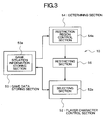
- FIG. 3 is a functional block diagram primarily illustrating, of functions implemented by the game device 10, functions relating to the execution of "press defense". As illustrated in FIG. 3 , the game device 10 includes a game data storing section 50, a player character control section 52, a determining section 54, and a restricting section 56. Those functional blocks are implemented through execution of the program by the microprocessor 14.
- the game data storing section 50 is implemented by, e.g., the main memory 16, the hard disk 26, or the optical disk 36.
- the game data storing section 50 stores game data for executing a soccer game.
- the game data storing section 50 stores data indicating a state (such as position, posture, or moving direction) of the player object 46, data indicating a state (such as position or moving direction) of the ball object 48, and data indicating a state (position or visual line direction) of the virtual camera 49.
- the game data storing section 50 also stores data indicating, e.g., the player object 46 in possession of the ball object 48.
- the game data storing section 50 includes a game situation information storing section 50a.
- the game situation information storing section 50a stores game situation information indicating a game situation.
- the game situation information contains score information indicating respective scores of the first team and the secondteam.
- the game situation information also contains information indicating respective ball possession rates of the first team and the second team, information indicating the respective numbers of free kicks, corner kicks, and shots made by the first team and the second team, and information indicating the respective numbers of yellow cards and red cards given against the first team and the second team.
- the game situation information may also be referred to as information indicating which one of the first team and the second team is winning.
- the player character control section 52 is implemented mainly by the microprocessor 14.
- the player character control section 52 includes a selecting section 52a.
- the selecting section 52a selects one or more player objects 46 from among the player obj ects 4 6 which belong to the other team. For example, the selection of one or more the player objects 46 is automatically executed based on the position of each of the player objects 46 which belong to the team operated by the user or the computer that has given the "press defense" instruction and on the position of the ball object 48 (or of the player object 46 in possession of the ball object 48).
- the player object 46 closest to the position of the ball object 48 (or of the player object 46 in possession of the ball object 48) is selected.
- the selection of one or more the player objects 46 may also be executed in accordance with a selective operation made by the user.
- the one or more player objects 4 6 selected by the user perform "press def ense" .
- the player character control section 52 causes the player object 46 selected by the selecting section 52a to perform "press defense". That is, the player character control section 52 controls the position of the player object 46 selected by the selecting section 52a based on the position of the ball object 48 (or of the player object 46 in possession of the ball object 48) such that the player object 46 selected by the selecting section 52a approaches the ball object 48 (or the player object 46 in possession of the ball object 48).
- the determining section 54 is implemented mainly by the microprocessor 14. The determining section 54 determines whether or not the player object 46 in possession of the ball object 48 (or the ball object 48) is located within the restriction region.
- the restriction region is a region where the execution of "press defense” is restricted.
- the first restriction region is a region where the execution of "press defense” against the second team is restricted
- the second restriction region is a region where the execution of "press defense” against the first team is restricted.
- FIG. 4 is a diagram illustrating an example of the first restriction region and the second restriction region.
- reference numeral 41a denotes the first team's "own half
- reference numeral 43a denotes a goal line located within the first team's own half 41a.
- reference numeral 41b denotes the second team's "own half”
- reference numeral 43b denotes a goal line located within the second team' s own half 41b.
- a first restriction region 60a is set within the second team's own half 41b.
- the first restriction region 60a is a region within the pitch 41 in which the length of a perpendicular 62 to the goal line 43b is equal to or smaller than a first reference distance Da.
- a second restriction region 60b is set within the first team's own half 41a.
- the second restriction region 60b is a region within the pitch 41 in which the length of a perpendicular 64 to the goal line 43a is equal to or smaller than a second reference distance Db.
- the determining section 54 determines whether or not the player object 46 in possession of the ball object 48 (or the ball object 48) is located within the second restriction region 60b. Further, for example, in a state where any one of the player objects 46 which belong to the second team is in possession of the ball object 48, if the user operating the first team has given a "press defense" instruction, the determining section 54 determines whether or not the player object 46 in possession of the ball object 48 (or the ball object 48) is located within the first restriction region 60a.
- the determining section 54 includes a restriction region control section 54a.
- the restriction region control section 54a changes the size of the restriction region based on the game situation information.
- the restriction region control section 54a stores data obtained by associating the game situation information with the restriction region information related to the size of the restriction region.
- the restriction region control section 54a acquires the restriction region information associated with the current game situation information, based on the data, and controls the size of the restriction region based on the restriction region information.
- the data described above may be data in the form of a table, or data in the form of a numerical expression. Alternatively, the data described above may also be stored as a part of the program.
- the data described above is a table obtained by associating a game situation condition related to the game situation information with the restriction region information.
- the restriction region control section 54a controls the size of the restriction region based on the restriction region information associated with the game situation condition satisfied by the current game situation information.
- the restriction region control section 54a controls the respective sizes of the first restriction region 60a and the second restriction region 60b by changing the first reference distance Da and the second reference distance Db based on the game situation information.
- FIG. 5 illustrates an example of reference distance data stored in the restriction region control section 54a.
- the reference distance data illustrated in FIG. 5 is data obtained by associating a "score difference" with the "reference distance".
- the "score difference” is the difference between the score of the team operated by the user or the computer that has given a "press defense" instruction and the score of the opponent team (i.e., the team in possession of the ball object 48).
- the restriction region control section 54a controls the first reference data Da and the second reference distance Db based on the reference distance data. Note that, in FIG. 5 , D1 to D5 have relationship given by D1 ⁇ D2 ⁇ D3 ⁇ D4 ⁇ D5.
- the computer operating the second team has given a "press defense" instruction.
- the second reference distance Db is set to D4
- the second restriction region 60b is set relatively large in size.
- the second restriction region 60b is set relatively small in size.
- the second reference distance Db is set to the distance (D5) longer than the distance (D4) which is set when the score of the second team is higher than the score of the first team by one point. In this manner, when the second team is winning, the second reference distance Db is set longer in accordance with the degree of winning, and consequently, the second restriction region 60b is set larger. Further, for example, when the score of the second team is lower than the score of the first team by two points or more, the second reference distance Db is set to the distance (D1) shorter than the distance (D2) which is set when the score of the second team is lower than the score of the first team by one point. In this manner, when the second team is losing, the second reference distance Db is set shorter in accordance with the degree of losing, and consequently, the second restriction region 60b is set smaller.
- restriction region control section 54a may also store respective reference distances for three cases which are (1) the case where the team operated by the user or the computer that has given a "press defense" instruction is leading the opponent team, (2) the case where the team operated by the user or the computer that has given a "press defense” instruction is being led by the opponent team, and (3) the case where the team operated by the user or the computer that has given a "press defense” instruction has the same score as that of the opponent team. Further, the restriction region control section 54a may also store the coordinates of the vertices of the restriction region, instead of the reference distance, as the restriction region information.
- each of the first restriction region 60a and the second restriction region 60b may be controlled based only on the score of one of the teams.
- the second restriction region 60b may be controlled based only on the score of the second team.
- the second restriction region 60b may be increased in size as the score of the second team increases.
- the second restriction region 60b may be controlled based only on the score of the first team. In this case, the second restriction region 60b may be reduced in size as the score of the first team increases.
- restriction region control section 54a may use another game situation information instead of the score information.
- the second restriction region 60b may be set relatively large in size when the second team is assumed to be winning, and the second restriction region 60b may be set relatively small in size when the second team is assumed to be losing.
- the restricting section 56 is implemented mainly by the microprocessor 14.
- the restricting section 56 restricts execution of the control by the player character control section 52 based on the result of determination by the determining section 54.
- the second reference distance Db is set relatively long, and the second restriction region 60b is set relatively large in size.
- the second reference distance Db is set relatively short, and the second restriction region 60b is set relatively small in size.
- FIG. 6 is a flow chart illustrating processing executed in a case where, in a state where any one of the player objects 46 belonging to one team is in possession of the ball object 48, the user or the computer operating the other team has given a "press defense" instruction.
- the microprocessor 14 executes the processing illustrated in FIG. 6 in accordance with the program stored in the optical disk 36 or the hard disk 26.
- the microprocessor 14 selects one or more player objects 46 which are caused to perform "press defense” from among the player objects 46 which belong to the second team (S101). For example, the player object 46 closest to the ball object 48 (or the player object 46 in possession of the ball object 48) is selected. Note that, in the case where the user operating the first team has given the "press defense" instruction, the player object 46 may be selected from among the player objects 46 which belong to the first team in accordance with a selecting operation by the user.
- the microprocessor 14 acquires the score difference between the first team and the second team (S102).
- processing (S104 to S109) described below is repeatedly executed at each predetermined time interval (which is 1/60 th of a second in this embodiment).
- processing for controlling the player objects 46 other than the one or more player objects 46 selected in S101 and the ball object 48 is executed, though omitted in FIG. 6 .
- the microprocessor 14 (determining section 54) identifies the second restriction region 60b based on the reference distance read out in S103, and determines whether or not the player object 46 in possession of the ball object 48 (or the ball object 48) is located within the second restriction region 60b (S104). Note that the description is given herein using, as an example, the case where the computer operating the second team has given the "press defense" instruction, and hence it is determined whether or not the player object 46 in possession of the ball object 48 is located within the second restriction region 60b. In the case where the user operating the first team has given the "press defense" instruction, it is determined whether or not the player object 46 in possession of the ball object 48 is located within the first restriction region 60a.
- the microprocessor 14 initializes the value of a variable t to a predetermined initial value (0) (S105).
- the variable t is used to measure a time elapsed since the player object 46 in possession of the ball object 48 (or the ball object 48) became located within the second restriction region 60b.
- the variable t is also initialized to the initial value (0) when the player object 46 in possession of the ball object 48 has changed to another of the player objects 46.
- the microprocessor 14 moves the player object 46 selected in S101 toward the ball object 48 (or the player object 46 in possession of the ball object 48) (S106).
- the position of the player object 46 selected in S101 is updated to a position displaced from the current position toward the position of the ball object 48 by a movement distance corresponding to predetermined time (1/60 th of a second). That is, the microprocessor 14 causes the player object 46 selected in S101 to perform "press defense".
- the microprocessor 14 adds 1 to the value of the variable t (S107), and determines whether or not the value of the variable t is equal to or larger than the constant T (S108).
- the constant T is a numerical value representing a predetermined time (e.g., 10 seconds) in units of 1/60 th of a second.
- a case where the value of the variable t is less than T is a case where the time elapsed since the player object 46 in possession of the ball object 48 (or the ball object 48) became located within the second restriction region 60b is less than a predetermined time (e.g., 10 seconds).
- the microprocessor 14 does not execute the processing in S106. That is, the microprocessor 14 does not cause the player object 46 selected in S101 to perform "press defense".
- a case where the value of the variable t is equal to or larger than T is a case where the time elapsed since the player object 46 in possession of the ball object 48 (or the ball object 48) became located within the second restriction region 60b is equal to or larger than a predetermined time (e.g., 10 seconds).
- a predetermined time e.g. 10 seconds.
- the microprocessor 14 moves the player object 46 selected in S101 toward the ball object 48 (S106). That is, the microprocessor 14 causes the player object 46 selected in S101 to perform "press defense".
- the microprocessor 14 determines whether or not a condition for ending "press defense" has been satisfied (S109). Note that the processing in this step is also executed in a case where it is determined that the value of the variable t is less than T (S108: N).
- a case where the condition for ending "press defense” is satisfied is, e.g., a case where an instruction to stop "press defense” has been given, or a case where the player object 46 in possession of the ball object 48 has changed to another of the player objects 46. If the condition for ending "press defense" is not satisfied, the microprocessor 14 executes the processing in S104 to S109 again.
- the game device 10 described above allows a reduction in processing load relating to execution of "press defense". That is, the game device 10 allows a reduction in processing load relating to the control of the player objects 46 belonging to one team, in a case where any one of the player objects 46 belonging to another team is in possession of the ball object 48.
- the game device 10 also allows a reduction in processing load as described above to be effected in accordance with the game situation.
- the restriction region control section 54a may also control the size of the restriction region based on the time elapsed since the player object in possession of the ball object 48 (or the ball object 48) became located within the restriction region.
- a description is given by assuming a case where, in a state where any one of the player objects 46 belonging to the first team is in possession of the ball object 48, the computer operating the second team has given a "press defense" instruction.
- the microprocessor 14 may also set the second reference distance Db to 0. That is, if the time elapsed since the player object 46 in possession of the ball project 48 became located within the second restriction region 60b is equal to or larger than a predetermined time (e.g., 10 seconds), the restriction on execution of "press defense" may also be cancelled by eliminating the second restriction region 60b.
- a predetermined time e.g. 10 seconds
- the restriction region control section 54a may also reduce the size of the second restriction region 60b in stages based on the time elapsed since the player object 46 in possession of the ball object 48 (or the ball object 48) became located within the second restriction region 60b.
- the restriction region control section 54a stores data obtained by associating a combination of the game situation information and the above-mentioned elapsed time with the restriction region information (e.g., the second reference distance Db) related to the size of the second restriction region 60b. Then, the restriction region control section 54a acquires the restriction region information corresponding to the combination of the current game situation information and the elapsed time, and controls the size of the second restriction region 60b based on the restriction region information.
- the size of the restriction region may also be changed based on the strength or strategy of at least one of the teams.
- the size of the second restriction region 60b may also be changed based on the strength of the second team.
- the size of the second restriction region 60b may also be changed based on the level of the computer operating the second team.
- the size of the second restriction region 60b may also be changed based on the ability parameter set to the second team. Note that in a case where the ability parameter showing the level of ability is set to each of the player objects 46 belonging to the second team, the statistic value of the ability parameters of the player objects 46 belonging to the second team may also be used as the ability parameter of the second team.
- the game executed on the game device 10 is not limited to the game in which a three-dimensional game space constituted of three coordinate elements is displayed on the game screen.
- the game executed on the game device 10 may be a game in which a two-dimensional game space constituted of two coordinate elements is displayed on the game screen. That is, the game executed on the game device 10 may be a game in which the positions and the like of a ball and a player character are managed by the two coordinate elements.
- the game executed on the game device 10 may be a game played by two or more users. Further, for example, the game executed on the game device 10 is not limited to a soccer game. The game executed on the game device 10 may be a sports game other than a soccer game. The present invention is also applicable to, e.g., a game of basketball performed using a ball (moving object) and to a game of ice hockey performed using a puck (moving object).
- FIG. 7 is a diagram illustrating an overall configuration of a program distribution system using the communication network.
- the program distribution system 100 includes the game device 10, a communication network 106, and a program distribution device 108.
- the communication network 106 includes, for example, the Internet and a cable television network.
- the program distribution device 108 includes a game database 102 and a server 104.
- the same program as the program stored on the optical disk 36 is stored in the database (information storage medium) 102.
- a demander uses the game device 10 to make a game delivery request, whereby the game delivery request is transferred to the server 104 via the communication network 106.
- the server 104 reads out the program from the database 102 according to the game delivery request, and transmits the program to the game device 10.
- the game delivery is performed in response to the game delivery request, but the server 104 may transmit the program one-sidedly.
- all of programs necessary to implement the game are not necessarily delivered at one time (delivered collectively), and necessary parts may be delivered (split and delivered) depending on which phase the game is in. By thus performing the game delivery via the communication network 106, the demander can obtain the program with ease.
Landscapes
- Engineering & Computer Science (AREA)
- Multimedia (AREA)
- Human Computer Interaction (AREA)
- Theoretical Computer Science (AREA)
- Management, Administration, Business Operations System, And Electronic Commerce (AREA)
- User Interface Of Digital Computer (AREA)
- Processing Or Creating Images (AREA)
Abstract
Description
- The present invention relates to a game device, a method of controlling a game device, a program, and an information storage medium.
- There is known a game device which executes a game (sport game) of a sport to be performed between a first team and a second team using a moving object such as a ball. For example, a game device which executes a soccer game, a basketball game, or an ice hockey game is known. In such a game device, when a player character belonging to one team is in possession of the moving object, a player character belonging to the other team is controlled to defend against the player character in possession of the moving object.
Patent Document 1:JP 2005-000248 A - In a game device as described above, it is necessary, in a case where a player character belonging to one team is in possession of a moving obj ect, to achieve a reduction in processing load relating to the control of a player character belonging to the other team.
- The present invention has been achieved in view of the problem described above, and an object thereof is to provide a game device, a method of controlling a game device, a program, and an information storage medium which, in a case where a player character belonging to one team is in possession of a moving object, allow a reduction in processing load relating to the control of a player character belonging to the other team.
- To solve the above-mentioned problem, a game device according to the present invention is a game device for executing a game of a sport to be performed between a first team and a second team using a moving object. The game device includes: game situation information storing means for storing game situation information indicating a game situation; selecting means for selecting one or more player characters from among player characters belonging to one team, in a case where any one of player characters belonging to another team is in possession of the moving object; player character control means for controlling a position of the player character selected by the selecting means, based on a position of the moving object or of the player character in possession of the moving object so that the player character selected by the selecting means approaches the moving object or the player character in possession of the moving object; determining means for determining whether or not the moving object or the player character in possession of the moving object is located within a restriction region; and restricting means for imposing a restriction on the control to be executed by the player character control means, in a case where the moving object or the player character in possession of the moving object is located within the restriction region, wherein the determining means includes restriction region control means for changing a size of the restriction region based on the game situation information.
- Also, a game device control method according to the present invention is a control method of controlling a game device for executing a game of a sport to be performed between a first team and a second team using a moving object. The control method includes: a step of reading out stored content stored in game situation information storing means storing game situation information indicating a game situation; a step of selecting one or more player characters from among player characters belonging to one team, in a case where any one of player characters belonging to another team is in possession of the moving object; a player character control step of controlling a position of the player character selected at the selecting step based on a position of the moving object or of the player character in possession of the moving object so that the player character selected at the selecting step approaches the moving object or the player character in possession of the moving object; a determining step of determining whether or not the moving object or the player character in possession of the moving object is located within a restriction region; and a restricting step of imposing a restriction on the control to be executed at the player character control step, in a case where the moving object or the player character in possession of the moving object is located within the restriction region, wherein the determining step includes a restriction region control step of changing a size of the restriction region based on the game situation information.
- Also, the program according to the present invention is a program for causing a computer, such as a consumer game machine (stationary type game machine), a portable game machine, a commercial game machine, a mobile phone, a personal digital assistant (PDA), or a personal computer, to function as a game device for executing a game of a sport to be performed between a first team and a second team using a moving object. The program causes the computer to function as: game situation information storing means for storing game situation information indicating a game situation; selecting means for selecting one or more player characters from among player characters belonging to one team, in a case where any one of player characters belonging to another team is in possession of the moving object; player character control means for controlling a position of the player character selected by the selecting means based on a position of the moving object or of the player character in possession of the moving object so that the player character selected by the selecting means approaches the moving object or the player character in possession of the moving object; determining means for determining whether or not the moving object or the player character in possession of the moving object is located within a restriction region; and restricting means for imposing a restriction on the control to be executed by the player character control means, in a case where the moving object or the player character in possession of the moving obj ect is located within the restriction region, wherein the determining means includes restriction region control means for changing a size of the restriction region based on the game situation information.
- An information storage medium according to the present invention is a computer readable information storage medium storing the above-mentioned program. A program distribution device according to the present invention is a program distribution device which includes the information storage medium storing the above-mentioned program, reads out the above-mentioned program from the information storage medium, and distributes the program. A program distribution method according to the present invention is a program distribution method which reads out the above-mentioned program from the information recording medium storing the above-mentioned program, and distributes the program.
- The present invention relates to a game device which executes a game (sport game) of a sport to be performed between the first team and the second team using the moving object. According to the present invention, the game situation information indicating the game situation is stored. In a case where any one of the player characters belonging to one team is in possession of the moving object, one or more player characters are selected from among the player characters belonging to the other team. The position of the selected character is controlled based on the position of the moving object or of the player character in possession of the moving object such that the selected player character approaches the moving object or the player character in possession of the moving object. It is determined whether or not the moving object or the player character in possession of the moving object is located within the restriction region. In a case where the moving object or the player character in possession of the moving object is located within the restriction region, execution of the above-mentioned positional control over the selected player characters is restricted. Further, according to the present invention, the size of the restriction region changes based on the game situation information. According to the present invention, in a case where any one of the player characters belonging to one team is in possession of the moving object, it is possible to achieve a reduction in processing load relating to the control of the player characters belonging to the other team.
- Further, according to an aspect of the present invention, the restriction region control means may include: means for storing data obtained by associating the game situation information with restriction region information related to the size of the restriction region; and means for controlling the size of the restriction region based on the restriction region information associated with the game situation information.
- Further, according to another aspect of the present invention, the game device may further include: elapsed time determining means for determining whether or not a time elapsed since the moving object or the player character in possession of the moving object became located within the restriction region has become a predetermined time or longer; and restriction removing means for removing the restriction imposed by the restricting means in a case where the time elapsed since the moving object or the player character in possession of the moving obj ect became located within the restriction region has become the predetermined time or longer.
- Further, according further another aspect of the present invention, the restriction region control means may include: means for controlling the size of the restriction region based on a time elapsed since the moving obj ect or the player character in possession of the moving object became located within the restriction region.
-
-
FIG. 1 is a diagram illustrating a hardware configuration of a game device according to an embodiment of the present invention. -
FIG. 2 is a diagram illustrating an example of a virtual three-dimensional space. -
FIG. 3 is a functional block diagram of a game device according to the embodiment. -
FIG. 4 is a diagram illustrating an example of a restriction region. -
FIG. 5 is a diagram illustrating an example of reference distance data. -
FIG. 6 is a flow chart illustrating processing executed by the game device. -
FIG. 7 is a diagram illustrating an overall configuration of a program distribution system according to another embodiment of the present invention. - Hereinafter, a detailed description is given of an example of an embodiment of the present invention with reference to the accompanying drawings. A game device according to the embodiment of the present invention is implemented by, for example, a consumer game machine (stationary type game machine), a portable game machine, a mobile phone, a personal digital assistant (PDA), or a personal computer. Herein, a description is given of a case where the game device according to the embodiment of the present invention is implemented by a consumer game machine.
-
FIG. 1 is a diagram illustrating an overall configuration of the game device according to the embodiment of the present invention. Agame device 10 illustrated inFIG. 1 includes aconsumer game machine 11, amonitor 32, aspeaker 34, and an optical disk 36 (information storage medium). Themonitor 32 and thespeaker 34 are connected to theconsumer game machine 11. For example, a household television set is used as themonitor 32, a speaker built into the household television set is used as thespeaker 34. - The
consumer game machine 11 is a well-known computer game system. Theconsumer game machine 11 includes abus 12, amicroprocessor 14, amain memory 16, animage processing unit 18, an input/output processing unit 20, anaudio processing unit 22, an opticaldisk reading unit 24, ahard disk 26, acommunication interface 28, andcontrollers 30. The constituent components other than thecontrollers 30 are accommodated in a casing of theconsumer game machine 11. - The
microprocessor 14 controls each of the sections of theconsumer game machine 11 based on an operating system stored in a ROM (not shown) and on a program read out from theoptical disk 36 or thehard disk 26. Themain memory 16 includes, e.g., a RAM. The program and data each read out from theoptical disk 36 or thehard disk 26 are written into themain memory 16 as necessary. Themain memory 16 is also used as a working memory of themicroprocessor 14. Thebus 12 is for exchanging addresses and data among the sections of theconsumer game machine 11. Themicroprocessor 14, themain memory 16, theimage processing unit 18, and the input/output processing unit 20 are connected via thebus 12 so as to communicate data with one another. - The
image processing unit 18 includes a VRAM, and renders a game screen in the VRAM based on image data sent from themicroprocessor 14. Then, theimage processing unit 18 converts the game screen rendered in the VRAM into video signals and outputs the video signals to themonitor 32 at a predetermined timing. - The input/
output processing unit 20 is an interface for themicroprocessor 14 to access theaudio processing unit 22, the opticaldisk reading unit 24, thehard disk 26, thecommunication interface 28, and thecontrollers 30. Theaudio processing unit 22 includes a sound buffer, reproduces various audio data such as game music, a game sound effect, or a message read out from theoptical disk 36 or thehard disk 26 to the sound buffer, and outputs the audio data from thespeaker 34. Thecommunication interface 28 is an interface for connecting theconsumer game machine 11 to a communication network such as the Internet in a wired or wireless manner. - The optical
disk reading unit 24 reads the program or data recorded on theoptical disk 36. In this case, theoptical disk 36 is employed for providing the program or data to theconsumer game machine 11, but any other information storage media such as a memory card may also be used. Further, the program or data may also be provided to theconsumer game machine 11 from a remote location via a data communication network such as the Internet. Thehard disk 26 is a general hard disk device (auxiliary storage device). - The
controllers 30 are versatile operation input units for a user to input various game operations. A plurality of thecontrollers 30 can be connected to theconsumer game machine 11. The input/output processing unit 20 scans a state of each of thecontrollers 30 at predetermined intervals (e.g., every 1/60th of a second), and passes an operation signal indicative of the result of scanning to themicroprocessor 14 via thebus 12. Themicroprocessor 14 determines a game operation made by a user based on the operation signal. Note that thecontrollers 30 may be wire connected or wirelessly connected to theconsumer game machine 11. - In the
game device 10, a soccer game which simulates a soccer match between a first team and a second team, e.g., is executed. Hereinbelow, a description is given on the assumption that the first team is operated by the user, and the second team is operated by the computer. Note that the first teammay be operated by the computer. Alternatively, the second team may be operated by another user. The soccer game is implemented by executing the program read out from theoptical disk 36 or thehard disk 26. - In order to implement the above-mentioned soccer game, a virtual three-dimensional space (game space) is built in the
main memory 16.FIG. 2 illustrates an example of the virtual three-dimensional space. As illustrated inFIG. 2 , afield object 42 representing a soccer field is located in a virtual three-dimensional space 40. For example, goal lines 43 (end lines), touch lines 45 (side lines), and a half-way line 47 are defined on thefield object 42. A soccer match is played within apitch 41 which is an area surrounded by thegoal lines 43 and the touch lines 45. Goal objects 44 each representing a goal, player objects 46 (player characters) representing soccer players, and a ball obj ect 48 representing a soccer ball (moving object) are located on thefield object 42. Although not shown inFIG. 2 , eleven player objects 46 which belong to the first team and eleven player objects 46 which belong to the second team are located on thefield object 42. - One of the goal objects 44 is associated with the first team while the
other goal object 44 is associated with the second team. If the ball object 48 moves in thegoal object 44 associated with one team, a scoring event for the other team occurs. Hereinbelow, a region between thegoal line 43 corresponding to thegoal object 44 of the first team and thehalfway line 47 is referred to as the first team's "own half". Likewise, a region between thegoal line 43 corresponding to thegoal object 44 of the second team and thehalfway line 47 referred to as the second team's "own half". - Further, a virtual camera 49 (viewpoint) is set in the virtual three-
dimensional space 40. For example, thevirtual camera 49 moves in the virtual three-dimensional space 40 according to the movement of the ball object 48. A game screen representing the virtual three-dimensional space 40 viewed from thevirtual camera 49 is displayed on themonitor 32. - If a
player object 46 and the ball object 48 come close to each other, theplayer obj ect 46 and the ball obj ect 48 are associated with each other under a predetermined condition. In this case, the ball object 48 moves according to the movement of theplayer object 46. This state is represented by a dribbling action of theplayer object 46. The state where the ball object 48 is associated with theplayer object 46 is hereinafter referred to as "state where theplayer object 46 is in possession of the ball object 48". - Further, in a state where one of the player objects 46 is in possession of the ball object 48, if another player object 46 approaches the ball object 48, the
other player object 46 and the ball object 48 are associated with each other under a predetermined condition. In this manner, theplayer object 46 snatches the ball object 48 possessed by anotherplayer object 46. - In the soccer game described above, when any one of the player objects 46 belonging to one team is in possession of the ball object 48, the user or the computer operating the other team is allowed to give a "press defense" instruction. If the user or the computer has given the "press defense" instruction, one or more player objects 46 selected from among the player objects 46 belonging to the team operated by the user or the computer perform "press defense". Here, "press defense" is a defensive operation, such as getting closer to the
player object 46 in possession of the ball object 48 (or to the ball object 48), marking theplayer object 46 in possession of the ball object 48, and putting pressure on theplayer object 46 in possession of the ball object 48. Hereinbelow, a description is given of technology for achieving a reduction in processing load relating to the execution of such "press defense". -
FIG. 3 is a functional block diagram primarily illustrating, of functions implemented by thegame device 10, functions relating to the execution of "press defense". As illustrated inFIG. 3 , thegame device 10 includes a gamedata storing section 50, a playercharacter control section 52, a determiningsection 54, and a restrictingsection 56. Those functional blocks are implemented through execution of the program by themicroprocessor 14. - The game
data storing section 50 is implemented by, e.g., themain memory 16, thehard disk 26, or theoptical disk 36. The gamedata storing section 50 stores game data for executing a soccer game. For example, the gamedata storing section 50 stores data indicating a state (such as position, posture, or moving direction) of theplayer object 46, data indicating a state (such as position or moving direction) of the ball object 48, and data indicating a state (position or visual line direction) of thevirtual camera 49. In addition, the gamedata storing section 50 also stores data indicating, e.g., theplayer object 46 in possession of the ball object 48. - The game
data storing section 50 includes a game situationinformation storing section 50a. The game situationinformation storing section 50a stores game situation information indicating a game situation. For example, the game situation information contains score information indicating respective scores of the first team and the secondteam. For example, the game situation information also contains information indicating respective ball possession rates of the first team and the second team, information indicating the respective numbers of free kicks, corner kicks, and shots made by the first team and the second team, and information indicating the respective numbers of yellow cards and red cards given against the first team and the second team. The game situation information may also be referred to as information indicating which one of the first team and the second team is winning. - The player
character control section 52 is implemented mainly by themicroprocessor 14. The playercharacter control section 52 includes a selectingsection 52a. In a state where any one of the player objects 46 which belong to one team is in possession of the ball object 48, if the user or the computer operating the other team has given a "press defense" instruction, the selectingsection 52a selects one or more player objects 46 from among the player obj ects 4 6 which belong to the other team. For example, the selection of one or more the player objects 46 is automatically executed based on the position of each of the player objects 46 which belong to the team operated by the user or the computer that has given the "press defense" instruction and on the position of the ball object 48 (or of theplayer object 46 in possession of the ball object 48). For example, theplayer object 46 closest to the position of the ball object 48 (or of theplayer object 46 in possession of the ball object 48) is selected. Note that in a case where the user has given the "press defense" instruction, the selection of one or more the player objects 46 may also be executed in accordance with a selective operation made by the user. In this case, the one or more player objects 4 6 selected by the user perform "press def ense" . - The player
character control section 52 causes theplayer object 46 selected by the selectingsection 52a to perform "press defense". That is, the playercharacter control section 52 controls the position of theplayer object 46 selected by the selectingsection 52a based on the position of the ball object 48 (or of theplayer object 46 in possession of the ball object 48) such that theplayer object 46 selected by the selectingsection 52a approaches the ball object 48 (or theplayer object 46 in possession of the ball object 48). - The determining
section 54 is implemented mainly by themicroprocessor 14. The determiningsection 54 determines whether or not theplayer object 46 in possession of the ball object 48 (or the ball object 48) is located within the restriction region. - Here, a description is given of the restriction region. As is described later, the restriction region is a region where the execution of "press defense" is restricted. In the case of this embodiment, there are set a first restriction region where the execution of "press defense" by the first team is restricted, and a second restriction region where the execution of "press defense" by the second team is restricted. In other words, the first restriction region is a region where the execution of "press defense" against the second team is restricted, and the second restriction region is a region where the execution of "press defense" against the first team is restricted.
-
FIG. 4 is a diagram illustrating an example of the first restriction region and the second restriction region. InFIG. 4 ,reference numeral 41a denotes the first team's "own half, and reference numeral 43a denotes a goal line located within the first team'sown half 41a. Likewise,reference numeral 41b denotes the second team's "own half", and reference numeral 43b denotes a goal line located within the second team' sown half 41b. As illustrated inFIG. 4 , afirst restriction region 60a is set within the second team'sown half 41b. Thefirst restriction region 60a is a region within thepitch 41 in which the length of a perpendicular 62 to thegoal line 43b is equal to or smaller than a first reference distance Da. Further, asecond restriction region 60b is set within the first team'sown half 41a. Thesecond restriction region 60b is a region within thepitch 41 in which the length of a perpendicular 64 to thegoal line 43a is equal to or smaller than a second reference distance Db. - For example, in a state where any one of the player objects 46 which belong to the first team is in possession of the ball object 48, if the computer operating the second team has given a "press defense" instruction, the determining
section 54 determines whether or not theplayer object 46 in possession of the ball object 48 (or the ball object 48) is located within thesecond restriction region 60b. Further, for example, in a state where any one of the player objects 46 which belong to the second team is in possession of the ball object 48, if the user operating the first team has given a "press defense" instruction, the determiningsection 54 determines whether or not theplayer object 46 in possession of the ball object 48 (or the ball object 48) is located within thefirst restriction region 60a. - The determining
section 54 includes a restrictionregion control section 54a. The restrictionregion control section 54a changes the size of the restriction region based on the game situation information. For example, the restrictionregion control section 54a stores data obtained by associating the game situation information with the restriction region information related to the size of the restriction region. The restrictionregion control section 54a acquires the restriction region information associated with the current game situation information, based on the data, and controls the size of the restriction region based on the restriction region information. The data described above may be data in the form of a table, or data in the form of a numerical expression. Alternatively, the data described above may also be stored as a part of the program. For example, the data described above is a table obtained by associating a game situation condition related to the game situation information with the restriction region information. In this case, the restrictionregion control section 54a controls the size of the restriction region based on the restriction region information associated with the game situation condition satisfied by the current game situation information. - In the case of this embodiment, the restriction
region control section 54a controls the respective sizes of thefirst restriction region 60a and thesecond restriction region 60b by changing the first reference distance Da and the second reference distance Db based on the game situation information.FIG. 5 illustrates an example of reference distance data stored in the restrictionregion control section 54a. The reference distance data illustrated inFIG. 5 is data obtained by associating a "score difference" with the "reference distance". The "score difference" is the difference between the score of the team operated by the user or the computer that has given a "press defense" instruction and the score of the opponent team (i.e., the team in possession of the ball object 48). Note that a case where the "score difference" has a negative numerical value is a case where the score of the team operated by the user or the computer that has given the "press defense" instruction is lower than the score of the opponent team. A case where the "score difference" has a positive numerical value is a case where the score of the team operated by the user or the computer that has given the "press defense" instruction is higher than the score of the opponent team. The restrictionregion control section 54a controls the first reference data Da and the second reference distance Db based on the reference distance data. Note that, inFIG. 5 , D1 to D5 have relationship given by D1<D2<D3<D4<D5. - Here, a case is assumed where, in a state where any one of the player objects 46 which belong to the first team is in possession of the ball object 48, the computer operating the second team has given a "press defense" instruction. For example, when the score of the second team is higher than the score of the first team by one point, the second reference distance Db is set to D4, and when the score of the second team is lower than the score of the first team by one point, the second reference distance Db is set to D2. Thus, when the second team is winning, the second reference distance Db is set relatively long, and the
second restriction region 60b is set relatively large in size. On the other hand, when the second team is losing, the second reference distance Db is set relatively short, and thesecond restriction region 60b is set relatively small in size. Further, for example, when the score of the second team is higher than the score of the first team by two or more points, the second reference distance Db is set to the distance (D5) longer than the distance (D4) which is set when the score of the second team is higher than the score of the first team by one point. In this manner, when the second team is winning, the second reference distance Db is set longer in accordance with the degree of winning, and consequently, thesecond restriction region 60b is set larger. Further, for example, when the score of the second team is lower than the score of the first team by two points or more, the second reference distance Db is set to the distance (D1) shorter than the distance (D2) which is set when the score of the second team is lower than the score of the first team by one point. In this manner, when the second team is losing, the second reference distance Db is set shorter in accordance with the degree of losing, and consequently, thesecond restriction region 60b is set smaller. - Note that the restriction
region control section 54a may also store respective reference distances for three cases which are (1) the case where the team operated by the user or the computer that has given a "press defense" instruction is leading the opponent team, (2) the case where the team operated by the user or the computer that has given a "press defense" instruction is being led by the opponent team, and (3) the case where the team operated by the user or the computer that has given a "press defense" instruction has the same score as that of the opponent team. Further, the restrictionregion control section 54a may also store the coordinates of the vertices of the restriction region, instead of the reference distance, as the restriction region information. - Here, the description has been given of the example in which the
first restriction region 60a and thesecond restriction region 60b are controlled based on the respective scores of the both teams. However, each of thefirst restriction region 60a and thesecond restriction region 60b may be controlled based only on the score of one of the teams. For example, thesecond restriction region 60b may be controlled based only on the score of the second team. For example, thesecond restriction region 60b may be increased in size as the score of the second team increases. Alternatively, thesecond restriction region 60b may be controlled based only on the score of the first team. In this case, thesecond restriction region 60b may be reduced in size as the score of the first team increases. - Further, the restriction
region control section 54a may use another game situation information instead of the score information. In this case as well, thesecond restriction region 60b may be set relatively large in size when the second team is assumed to be winning, and thesecond restriction region 60b may be set relatively small in size when the second team is assumed to be losing. - The restricting
section 56 is implemented mainly by themicroprocessor 14. The restrictingsection 56 restricts execution of the control by the playercharacter control section 52 based on the result of determination by the determiningsection 54. - There is assumed the case where, in the state where any one of the player obj ects 4 6 which belong to the first team is in possession of the ball object 48, the computer operating the second team has given a "press defense" instruction. In this state, in a case where it is determined by the determining
section 54 that theplayer object 46 in possession of the ball object 48 (or the ball object 48) is located within thesecond restriction region 60b, the restrictingsection 56 imposes a restriction on the control to be executed by the playercharacter control section 52. In this case, the execution of "press defense" by the second team is inhibited. That is, the player objects 46 selected by the selectingsection 52a do not move toward the ball object 48, and do not approach the ball object 48. - There is assumed a case where, in a state where any one of the player objects 46 which belong to the second team is in possession of the ball object 48, the user operating the first team has given a "press defense" instruction. In this state, in a case where it is determined by the determining
section 54 that theplayer object 46 in possession of the ball object 48 (or the ball object 48) is located within thefirst restriction region 60a, the restrictingsection 56 imposes a restriction on the control to be executed by the playercharacter control section 52. In this case, the execution of "press defense" by the first team is inhibited. That is, the player objects 46 selected by the selectingsection 52a do not move toward the ball object 48, and do not approach the ball object 48. - As described above, in the
game device 10, in a case where theplayer object 46 in possession of the ball object 48 is located within the restriction region of the team operated by the user or the computer that has given a "press defense" instruction, the execution of "press defense" is inhibited. As a result, processing load relating to the execution of "press defense" is reduced. - In particular, in the
game device 10, a reduction in processing load relating to execution of "press defense" is effected in accordance with the game situation. - Here, a case is assumed where, in a state where the score of the second team is higher than the score of the first team, the computer operating the second team has given a "press defense" instruction. In this case, the second team is leading the first team (the second team is winning the first team), and hence it can be considered that the second team has a relatively low need to positively snatch the ball object 48 possessed by the first team. Therefore, it can be considered that even when the
player object 46 of the first team in possession of the ball object 48 is positioned relatively far from thegoal line 43a in the first team'sown half 41a, the second team has a relatively low need to perform "press defense". In this regard, in thegame device 10, when the score of the second team is higher than the score of the first team, the second reference distance Db is set relatively long, and thesecond restriction region 60b is set relatively large in size. As a result, even when theplayer object 46 of the first team in possession of the ball object 48 is positioned relatively far from thegoal line 43a of the first team'sown region 41a, the execution of "press defense" is inhibited. - There is also assumed a case where, in a state where the score of the second team is lower than the score of the first team, the computer operating the second team has given a "press defense" instruction. In this case, the second team is being led by the first team (the second team is losing to the first team), and hence it can be considered that the second team has a relatively high need to positively snatch the ball object 48 possessed by the first team. Therefore, it can be considered that even when the
player object 46 of the first team in possession of the ball object 48 is positioned relatively close to thegoal line 43a in the first team'sown half 41a, the second team has a relatively high need to perform "press defense". In this regard, in thegame device 10, when the score of the second team is lower than the score of the first team, the second reference distance Db is set relatively short, and thesecond restriction region 60b is set relatively small in size. As a result, even when theplayer object 46 of the first team in possession of the ball object 48 is positioned relatively close to thegoal line 43a in the first team' sown half 41a, "press defense" is performed. - Next, a description is given of processing executed by the
game device 10 to implement the functional blocks described above. -
FIG. 6 is a flow chart illustrating processing executed in a case where, in a state where any one of the player objects 46 belonging to one team is in possession of the ball object 48, the user or the computer operating the other team has given a "press defense" instruction. Here, the description is given using, as an example, the case where in the state where any one of the player objects 46 which belong to the first team is in possession of the ball object 48, the computer operating the second team has given the "press defense" instruction. Themicroprocessor 14 executes the processing illustrated inFIG. 6 in accordance with the program stored in theoptical disk 36 or thehard disk 26. - As illustrated in
FIG. 6 , the microprocessor 14 (selectingsection 52a) first selects one or more player objects 46 which are caused to perform "press defense" from among the player objects 46 which belong to the second team (S101). For example, theplayer object 46 closest to the ball object 48 (or theplayer object 46 in possession of the ball object 48) is selected. Note that, in the case where the user operating the first team has given the "press defense" instruction, theplayer object 46 may be selected from among the player objects 46 which belong to the first team in accordance with a selecting operation by the user. - After that, the microprocessor 14 (restriction
region control section 54a) acquires the score difference between the first team and the second team (S102). Themicroprocessor 14 reads out the score (P1) of the first team and the score (P2) of the second team, and calculates the score difference ΔP=P2-P1. After that, the microprocessor 14 (restrictionregion control section 54a) reads out the reference distance corresponding to the score difference ΔP acquired in S102, from the reference distance table (S103). Note that the description is given here using, as an example, the case where the computer operating the second team has given a "press defense" instruction, and hence the score difference ΔP=P2-P1 is calculated in the processing in S102. In the case where the user operating the first team has given a "press defense" instruction, the score difference ΔP=P1-P2 is calculated in the processing in S102. - After that, the processing (S104 to S109) described below is repeatedly executed at each predetermined time interval (which is 1/60th of a second in this embodiment). In parallel with the processing in S104 to S109, processing for controlling the player objects 46 other than the one or more player objects 46 selected in S101 and the ball object 48 is executed, though omitted in
FIG. 6 . - First, the microprocessor 14 (determining section 54) identifies the
second restriction region 60b based on the reference distance read out in S103, and determines whether or not theplayer object 46 in possession of the ball object 48 (or the ball object 48) is located within thesecond restriction region 60b (S104). Note that the description is given herein using, as an example, the case where the computer operating the second team has given the "press defense" instruction, and hence it is determined whether or not theplayer object 46 in possession of the ball object 48 is located within thesecond restriction region 60b. In the case where the user operating the first team has given the "press defense" instruction, it is determined whether or not theplayer object 46 in possession of the ball object 48 is located within thefirst restriction region 60a. - If the
player object 46 in possession of the ball object 48 is not located within thesecond restriction region 60b, themicroprocessor 14 initializes the value of a variable t to a predetermined initial value (0) (S105). The variable t is used to measure a time elapsed since theplayer object 46 in possession of the ball object 48 (or the ball object 48) became located within thesecond restriction region 60b. The variable t is also initialized to the initial value (0) when theplayer object 46 in possession of the ball object 48 has changed to another of the player objects 46. - After that, the microprocessor 14 (player character control section 52) moves the
player object 46 selected in S101 toward the ball object 48 (or theplayer object 46 in possession of the ball object 48) (S106). In this case, the position of theplayer object 46 selected in S101 is updated to a position displaced from the current position toward the position of the ball object 48 by a movement distance corresponding to predetermined time (1/60th of a second). That is, themicroprocessor 14 causes theplayer object 46 selected in S101 to perform "press defense". - On the other hand, if the
player object 46 in possession of the ball object 48 is located within thesecond restriction region 60b (S104: Y), the microprocessor 14 (elapsed time determining means) adds 1 to the value of the variable t (S107), and determines whether or not the value of the variable t is equal to or larger than the constant T (S108). The constant T is a numerical value representing a predetermined time (e.g., 10 seconds) in units of 1/60th of a second. - A case where the value of the variable t is less than T is a case where the time elapsed since the
player object 46 in possession of the ball object 48 (or the ball object 48) became located within thesecond restriction region 60b is less than a predetermined time (e.g., 10 seconds). In this case, the microprocessor 14 (restricting section 56) does not execute the processing in S106. That is, themicroprocessor 14 does not cause theplayer object 46 selected in S101 to perform "press defense". - On the other hand, a case where the value of the variable t is equal to or larger than T is a case where the time elapsed since the
player object 46 in possession of the ball object 48 (or the ball object 48) became located within thesecond restriction region 60b is equal to or larger than a predetermined time (e.g., 10 seconds). In this case, the microprocessor 14 (playercharacter control section 52 and a restriction removing means) moves theplayer object 46 selected in S101 toward the ball object 48 (S106). That is, themicroprocessor 14 causes theplayer object 46 selected in S101 to perform "press defense". - As described above, according to the
game device 10, in a case where theplayer object 46 in possession of the ball object 48 has been continuously located within the restriction region for a predetermined time (e.g., 10 seconds) or longer, i.e., in a case where execution of "press defense" has been continuously inhibited for a predetermined time or longer, "press defense" is performed irrespective of whether or not theplayer object 46 in possession of the ball object 48 is located within the restriction region. If a state where "press defense" is not performed has continued over a relatively long period, the user may be given an impression that the movements of the player objects 46 are artificial. In this regard, it is intended that such a problem does not occur according to thegame device 10. - After the processing in S106 is executed, the
microprocessor 14 determines whether or not a condition for ending "press defense" has been satisfied (S109). Note that the processing in this step is also executed in a case where it is determined that the value of the variable t is less than T (S108: N). Here, a case where the condition for ending "press defense" is satisfied is, e.g., a case where an instruction to stop "press defense" has been given, or a case where theplayer object 46 in possession of the ball object 48 has changed to another of the player objects 46. If the condition for ending "press defense" is not satisfied, themicroprocessor 14 executes the processing in S104 to S109 again. - The
game device 10 described above allows a reduction in processing load relating to execution of "press defense". That is, thegame device 10 allows a reduction in processing load relating to the control of the player objects 46 belonging to one team, in a case where any one of the player objects 46 belonging to another team is in possession of the ball object 48. Thegame device 10 also allows a reduction in processing load as described above to be effected in accordance with the game situation. - Note that the present invention is not limited to the embodiment described above.
- For example, the restriction
region control section 54a may also control the size of the restriction region based on the time elapsed since the player object in possession of the ball object 48 (or the ball object 48) became located within the restriction region. Here, a description is given by assuming a case where, in a state where any one of the player objects 46 belonging to the first team is in possession of the ball object 48, the computer operating the second team has given a "press defense" instruction. - For example, if the value of the variable t is determined to be equal to or larger than T in S108 of
FIG. 6 , the microprocessor 14 (restrictionregion control section 54a) may also set the second reference distance Db to 0. That is, if the time elapsed since theplayer object 46 in possession of the ball project 48 became located within thesecond restriction region 60b is equal to or larger than a predetermined time (e.g., 10 seconds), the restriction on execution of "press defense" may also be cancelled by eliminating thesecond restriction region 60b. - Alternatively, the restriction
region control section 54a may also reduce the size of thesecond restriction region 60b in stages based on the time elapsed since theplayer object 46 in possession of the ball object 48 (or the ball object 48) became located within thesecond restriction region 60b. For example, the restrictionregion control section 54a stores data obtained by associating a combination of the game situation information and the above-mentioned elapsed time with the restriction region information (e.g., the second reference distance Db) related to the size of thesecond restriction region 60b. Then, the restrictionregion control section 54a acquires the restriction region information corresponding to the combination of the current game situation information and the elapsed time, and controls the size of thesecond restriction region 60b based on the restriction region information. - As described above, if the state where "press defense" is not executed has continued over a relatively long period, the user may be given an impression that the movements of the player objects 46 are artificial. In this regard, by following a procedure as described above, it is possible to prevent the occurrence of such a problem.
- Otherwise, for example, the size of the restriction region may also be changed based on the strength or strategy of at least one of the teams. For example, the size of the
second restriction region 60b may also be changed based on the strength of the second team. For example, in a case where the level of the computer operating the second team can be selected from among a plurality of levels, the size of thesecond restriction region 60b may also be changed based on the level of the computer operating the second team. Alternatively, for example, in a case where an ability parameter showing the level of ability is set to the second team, the size of thesecond restriction region 60b may also be changed based on the ability parameter set to the second team. Note that in a case where the ability parameter showing the level of ability is set to each of the player objects 46 belonging to the second team, the statistic value of the ability parameters of the player objects 46 belonging to the second team may also be used as the ability parameter of the second team. - Further, for example, the game executed on the
game device 10 is not limited to the game in which a three-dimensional game space constituted of three coordinate elements is displayed on the game screen. The game executed on thegame device 10 may be a game in which a two-dimensional game space constituted of two coordinate elements is displayed on the game screen. That is, the game executed on thegame device 10 may be a game in which the positions and the like of a ball and a player character are managed by the two coordinate elements. - Further, for example, the game executed on the
game device 10 may be a game played by two or more users. Further, for example, the game executed on thegame device 10 is not limited to a soccer game. The game executed on thegame device 10 may be a sports game other than a soccer game. The present invention is also applicable to, e.g., a game of basketball performed using a ball (moving object) and to a game of ice hockey performed using a puck (moving object). - Further, for example, in the above-mentioned description, the program is provided, via the
optical disk 36 serving as an information storage medium, to thegame device 10, but the programmay be delivered to thegame device 10 via a communication network.FIG. 7 is a diagram illustrating an overall configuration of a program distribution system using the communication network. With reference toFIG. 7 , a description is given of a program distribution method according to the present invention. As illustrated inFIG. 7 , theprogram distribution system 100 includes thegame device 10, acommunication network 106, and aprogram distribution device 108. Thecommunication network 106 includes, for example, the Internet and a cable television network. Theprogram distribution device 108 includes agame database 102 and aserver 104. In the system, the same program as the program stored on theoptical disk 36 is stored in the database (information storage medium) 102. Then, a demander uses thegame device 10 to make a game delivery request, whereby the game delivery request is transferred to theserver 104 via thecommunication network 106. Then, theserver 104 reads out the program from thedatabase 102 according to the game delivery request, and transmits the program to thegame device 10. Here, the game delivery is performed in response to the game delivery request, but theserver 104 may transmit the program one-sidedly. In addition, all of programs necessary to implement the game are not necessarily delivered at one time (delivered collectively), and necessary parts may be delivered (split and delivered) depending on which phase the game is in. By thus performing the game delivery via thecommunication network 106, the demander can obtain the program with ease.
Claims (7)
- A game device for executing a game of a sport to be performed between a first team and a second team using a moving object, the game device comprising:game situation information storing means for storing game situation information indicating a game situation;selecting means for selecting one or more player characters from among player characters belonging to one team, in a case where any one of player characters belonging to another team is in possession of the moving object;player character control means for controlling a position of the player character selected by the selecting means, based on a position of the moving object or of the player character in possession of the moving object so that the player character selected by the selecting means approaches the moving object or the player character in possession of the moving object;determining means for determining whether or not the moving object or the player character in possession of the moving object is located within a restriction region; andrestricting means for imposing a restriction on the control to be executed by the player character control means, in a case where the moving object or the player character in possession of the moving object is located within the restriction region, whereinthe determining means includes restriction region control means for changing a size of the restriction region based on the game situation information.
- The game device according to claim 1, wherein
the restriction region control means includes:means for storing data obtained by associating the game situation information with restriction region information related to the size of the restriction region; andmeans for controlling the size of the restriction region based on the restriction region information associated with the game situation information. - The game device according to claim 1, further comprising:elapsed time determining means for determining whether or not a time elapsed since the moving object or the player character in possession of the moving object became located within the restriction region has become a predetermined time or longer; andrestriction removing means for removing the restriction imposed by the restricting means in a case where the time elapsed since the moving object or the player character in possession of the moving object became located within the restriction region has become the predetermined time or longer.
- The game device according to claim 1, wherein
the restriction region control means includes means for controlling the size of the restriction region based on a time elapsed since the moving object or the player character in possession of the moving object became located within the restriction region. - A control method of controlling a game device for executing a game of a sport to be performed between a first team and a second team using a moving object, the control method comprising:a step of reading out stored content stored in a game situation information storing means storing game situation information indicating a game situation;a selecting step of selecting one or more player characters from among player characters belonging to one team, in a case where any one of player characters belonging to another team is in possession of the moving object;a player character control step of controlling a position of the player character selected at the selecting step based on a position of the moving object or of the player character in possession of the moving object so that the player character selected at the selecting step approaches the moving object or the player character in possession of the moving object;a determining step of determining whether or not the moving object or the player character in possession of the moving object is located within a restriction region; anda restricting step of imposing a restriction on the control to be executed at the player character control step, in a case where the moving object or the player character in possession of the moving object is located within the restriction region, whereinthe determining step includes a restriction region control step of changing a size of the restriction region based on the game situation information.
- A program for causing a computer to function as a game device for executing a game of a sport to be performed between a first team and a second team using a moving object, the program causing the computer to function as:game situation information storing means for storing game situation information indicating a game situation;
selecting means for selecting one or more player characters from among player characters belonging to one team, in a case where any one of player characters belonging to another team is in possession of the moving object;
player character control means for controlling a position of the player character selected by the selecting means based on a position of the moving object or of the player character in possession of the moving object so that the player character selected by the selecting means approaches the moving object or the player character in possession of the moving object;
determining means for determining whether or not the moving object or the player character in possession of the moving object is located within a restriction region; and
restricting means for imposing a restriction on the control to be executed by the player character control means, in a case where the moving object or the player character in possession of the moving object is located within the restriction region, wherein
the determining means includes restriction region control means for changing a size of the restriction region based on the game situation information. - A computer readable information storage medium storing a program for causing a computer to function as a game device for executing a game of a sport to be performed between a first team and a second team using a moving object, the program causing the computer to function as:game situation information storing means for storing game situation information indicating a game situation;selecting means for selecting one or more player characters from among player characters belonging to one team, in a case where anyone of player characters belonging to another team is in possession of the moving object;player character control means for controlling a position of the player character selected by the selecting means based on a position of the moving obj ect or of the player character in possession of the moving object so that the player character selected by the selecting means approaches the moving object or the player character in possession of the moving object;determining means for determining whether or not the moving object or the player character in possession of the moving object is located within a restriction region; andrestricting means for imposing a restriction on the control to be executed by the player character control means, in a case where the moving object or the player character in possession of the moving object is located within the restriction region, whereinthe determining means includes restriction region control means for changing a size of the restriction region based on the game situation information.
Applications Claiming Priority (2)
| Application Number | Priority Date | Filing Date | Title |
|---|---|---|---|
| JP2008038222A JP4892503B2 (en) | 2008-02-20 | 2008-02-20 | GAME DEVICE, GAME DEVICE CONTROL METHOD, AND PROGRAM |
| PCT/JP2008/073427 WO2009104341A1 (en) | 2008-02-20 | 2008-12-24 | Game device, method of controlling game device, program, and information storage medium |
Publications (2)
| Publication Number | Publication Date |
|---|---|
| EP2248562A1 true EP2248562A1 (en) | 2010-11-10 |
| EP2248562A4 EP2248562A4 (en) | 2011-06-01 |
Family
ID=40985232
Family Applications (1)
| Application Number | Title | Priority Date | Filing Date |
|---|---|---|---|
| EP08872696A Withdrawn EP2248562A4 (en) | 2008-02-20 | 2008-12-24 | Game device, method of controlling game device, program, and information storage medium |
Country Status (7)
| Country | Link |
|---|---|
| US (1) | US8398487B2 (en) |
| EP (1) | EP2248562A4 (en) |
| JP (1) | JP4892503B2 (en) |
| KR (1) | KR101080668B1 (en) |
| CN (1) | CN101888885B (en) |
| TW (1) | TWI378815B (en) |
| WO (1) | WO2009104341A1 (en) |
Families Citing this family (4)
| Publication number | Priority date | Publication date | Assignee | Title |
|---|---|---|---|---|
| JP5349518B2 (en) * | 2011-03-28 | 2013-11-20 | 株式会社コナミデジタルエンタテインメント | GAME SYSTEM, GAME SYSTEM CONTROL METHOD, AND PROGRAM |
| JP6759267B2 (en) * | 2018-03-30 | 2020-09-23 | 株式会社バンダイナムコエンターテインメント | Game system and programs |
| US11148055B1 (en) * | 2020-09-11 | 2021-10-19 | Riot Games, Inc. | Targeting of an individual object among a plurality of objects in a multi-player online video game |
| CN118022315A (en) * | 2024-02-28 | 2024-05-14 | 网易(杭州)网络有限公司 | Information processing method and device in game, electronic equipment and storage medium |
Family Cites Families (19)
| Publication number | Priority date | Publication date | Assignee | Title |
|---|---|---|---|---|
| JP3736589B2 (en) * | 1997-01-30 | 2006-01-18 | 株式会社セガ | Action determination device, action determination method, battle game machine, and medium in battle game machine |
| JP3126944B2 (en) * | 1997-10-24 | 2001-01-22 | コナミ株式会社 | Video game system and computer-readable recording medium on which program for executing the game is recorded |
| US6902500B2 (en) * | 2002-04-26 | 2005-06-07 | Philip E. Pettey | Sport game |
| US20040018897A1 (en) * | 2002-06-03 | 2004-01-29 | Nelson Jeffrey A. | Soccer (or association football) goalkeeping game |
| JP4093054B2 (en) * | 2002-12-26 | 2008-05-28 | 株式会社セガ | Electronic game machine, its control method, program, and recording medium |
| JP2005000248A (en) | 2003-06-09 | 2005-01-06 | Konami Computer Entertainment Studios Inc | Video game program, video game device and video game method |
| JP3656118B2 (en) * | 2003-09-25 | 2005-06-08 | 株式会社コナミコンピュータエンタテインメント東京 | GAME DEVICE, COMPUTER CONTROL METHOD, AND PROGRAM |
| JP2005160757A (en) | 2003-12-03 | 2005-06-23 | Konami Computer Entertainment Japan Inc | Game software |
| JP4137043B2 (en) * | 2004-10-29 | 2008-08-20 | 株式会社コナミデジタルエンタテインメント | GAME PROGRAM, GAME DEVICE, AND GAME CONTROL METHOD |
| JP3892884B2 (en) * | 2005-08-01 | 2007-03-14 | 株式会社コナミデジタルエンタテインメント | GAME DEVICE, GAME DEVICE CONTROL METHOD, AND PROGRAM |
| JP4291816B2 (en) * | 2005-12-27 | 2009-07-08 | 株式会社コナミデジタルエンタテインメント | GAME DEVICE, GAME DEVICE CONTROL METHOD, AND PROGRAM |
| JP5044129B2 (en) | 2006-03-27 | 2012-10-10 | 株式会社コナミデジタルエンタテインメント | GAME DEVICE, GAME DEVICE CONTROL METHOD, AND PROGRAM |
| JP4921824B2 (en) * | 2006-03-27 | 2012-04-25 | 株式会社コナミデジタルエンタテインメント | GAME DEVICE, GAME DEVICE CONTROL METHOD, AND PROGRAM |
| JP5085059B2 (en) | 2006-06-28 | 2012-11-28 | 株式会社バンダイナムコゲームス | Image generation system, program, and information storage medium |
| TW200817072A (en) * | 2006-08-08 | 2008-04-16 | Sega Corp | Network game system |
| US20080113833A1 (en) * | 2006-11-15 | 2008-05-15 | Francisco Fernandez | Methods of playing soccer games |
| JP4602371B2 (en) * | 2007-03-12 | 2010-12-22 | 株式会社コナミデジタルエンタテインメント | Information processing apparatus, information processing apparatus control method, and program |
| JP4399472B2 (en) * | 2007-03-13 | 2010-01-13 | 株式会社コナミデジタルエンタテインメント | GAME DEVICE, GAME DEVICE CONTROL METHOD, AND PROGRAM |
| JP5017013B2 (en) | 2007-08-08 | 2012-09-05 | 株式会社コナミデジタルエンタテインメント | Network game system, network game system control method and program |
-
2008
- 2008-02-20 JP JP2008038222A patent/JP4892503B2/en active Active
- 2008-12-24 EP EP08872696A patent/EP2248562A4/en not_active Withdrawn
- 2008-12-24 KR KR1020107001768A patent/KR101080668B1/en active Active
- 2008-12-24 CN CN2008801196002A patent/CN101888885B/en active Active
- 2008-12-24 US US12/918,723 patent/US8398487B2/en active Active
- 2008-12-24 WO PCT/JP2008/073427 patent/WO2009104341A1/en not_active Ceased
-
2009
- 2009-02-10 TW TW098104145A patent/TWI378815B/en not_active IP Right Cessation
Also Published As
| Publication number | Publication date |
|---|---|
| TW200944271A (en) | 2009-11-01 |
| JP4892503B2 (en) | 2012-03-07 |
| US8398487B2 (en) | 2013-03-19 |
| TWI378815B (en) | 2012-12-11 |
| KR20100036341A (en) | 2010-04-07 |
| CN101888885B (en) | 2013-11-27 |
| US20100317440A1 (en) | 2010-12-16 |
| KR101080668B1 (en) | 2011-11-08 |
| CN101888885A (en) | 2010-11-17 |
| EP2248562A4 (en) | 2011-06-01 |
| JP2009195355A (en) | 2009-09-03 |
| WO2009104341A1 (en) | 2009-08-27 |
Similar Documents
| Publication | Publication Date | Title |
|---|---|---|
| US9132355B2 (en) | Game device, method for controlling game device, program, and information storage medium | |
| KR101790456B1 (en) | Simulation device, simulation method, and computer readable recording medium | |
| KR101071611B1 (en) | Game device, method of controlling game device, and information storage medium | |
| CN101959566A (en) | Game device, game device control method, program, and information storage medium | |
| US9039505B2 (en) | Game device, method for controlling game device, and information storage medium | |
| WO2007111089A1 (en) | Game system, game machine, game machine control method, and information storage medium | |
| JP5122669B2 (en) | GAME DEVICE, GAME DEVICE CONTROL METHOD, AND PROGRAM | |
| EP2500068A1 (en) | Game device, control method for a game device, program, and information storage medium | |
| US8398487B2 (en) | Game device, method of controlling game device, program, and information storage medium | |
| US20110319159A1 (en) | Game device, method for controlling game device, program and information storing medium | |
| KR100902805B1 (en) | Game device, game device control method, and information storage medium | |
| US8827786B2 (en) | Game device, method of controlling a game device, and information storage medium | |
| JP5419655B2 (en) | GAME DEVICE, GAME DEVICE CONTROL METHOD, AND PROGRAM | |
| US20100203937A1 (en) | Game device, method of controlling a game device, and information storage medium | |
| KR101071608B1 (en) | Game device, game device control method and information storage medium | |
| US8556692B2 (en) | Game device, method for controlling game device, program and information memory medium | |
| JP5325141B2 (en) | GAME DEVICE, GAME DEVICE CONTROL METHOD, AND PROGRAM | |
| JP5492273B2 (en) | GAME DEVICE, GAME DEVICE CONTROL METHOD, AND PROGRAM | |
| JP5350425B2 (en) | GAME SYSTEM, GAME SYSTEM CONTROL METHOD, AND PROGRAM | |
| JP2014195603A (en) | Game device, game control method, and program |
Legal Events
| Date | Code | Title | Description |
|---|---|---|---|
| PUAI | Public reference made under article 153(3) epc to a published international application that has entered the european phase |
Free format text: ORIGINAL CODE: 0009012 |
|
| 17P | Request for examination filed |
Effective date: 20100819 |
|
| AK | Designated contracting states |
Kind code of ref document: A1 Designated state(s): AT BE BG CH CY CZ DE DK EE ES FI FR GB GR HR HU IE IS IT LI LT LU LV MC MT NL NO PL PT RO SE SI SK TR |
|
| AX | Request for extension of the european patent |
Extension state: AL BA MK RS |
|
| DAX | Request for extension of the european patent (deleted) | ||
| A4 | Supplementary search report drawn up and despatched |
Effective date: 20110503 |
|
| 17Q | First examination report despatched |
Effective date: 20120724 |
|
| STAA | Information on the status of an ep patent application or granted ep patent |
Free format text: STATUS: THE APPLICATION IS DEEMED TO BE WITHDRAWN |
|
| 18D | Application deemed to be withdrawn |
Effective date: 20140701 |