EP2246922A1 - Rechargeable Lithium Battery - Google Patents
Rechargeable Lithium Battery Download PDFInfo
- Publication number
- EP2246922A1 EP2246922A1 EP10151646A EP10151646A EP2246922A1 EP 2246922 A1 EP2246922 A1 EP 2246922A1 EP 10151646 A EP10151646 A EP 10151646A EP 10151646 A EP10151646 A EP 10151646A EP 2246922 A1 EP2246922 A1 EP 2246922A1
- Authority
- EP
- European Patent Office
- Prior art keywords
- active material
- lithium battery
- rechargeable lithium
- combinations
- positive active
- Prior art date
- Legal status (The legal status is an assumption and is not a legal conclusion. Google has not performed a legal analysis and makes no representation as to the accuracy of the status listed.)
- Granted
Links
Images

Classifications
-
- H—ELECTRICITY
- H01—ELECTRIC ELEMENTS
- H01M—PROCESSES OR MEANS, e.g. BATTERIES, FOR THE DIRECT CONVERSION OF CHEMICAL ENERGY INTO ELECTRICAL ENERGY
- H01M4/00—Electrodes
- H01M4/02—Electrodes composed of, or comprising, active material
- H01M4/36—Selection of substances as active materials, active masses, active liquids
-
- H—ELECTRICITY
- H01—ELECTRIC ELEMENTS
- H01M—PROCESSES OR MEANS, e.g. BATTERIES, FOR THE DIRECT CONVERSION OF CHEMICAL ENERGY INTO ELECTRICAL ENERGY
- H01M4/00—Electrodes
- H01M4/02—Electrodes composed of, or comprising, active material
- H01M4/13—Electrodes for accumulators with non-aqueous electrolyte, e.g. for lithium-accumulators; Processes of manufacture thereof
- H01M4/131—Electrodes based on mixed oxides or hydroxides, or on mixtures of oxides or hydroxides, e.g. LiCoOx
-
- H—ELECTRICITY
- H01—ELECTRIC ELEMENTS
- H01M—PROCESSES OR MEANS, e.g. BATTERIES, FOR THE DIRECT CONVERSION OF CHEMICAL ENERGY INTO ELECTRICAL ENERGY
- H01M10/00—Secondary cells; Manufacture thereof
- H01M10/05—Accumulators with non-aqueous electrolyte
-
- H—ELECTRICITY
- H01—ELECTRIC ELEMENTS
- H01M—PROCESSES OR MEANS, e.g. BATTERIES, FOR THE DIRECT CONVERSION OF CHEMICAL ENERGY INTO ELECTRICAL ENERGY
- H01M4/00—Electrodes
- H01M4/02—Electrodes composed of, or comprising, active material
- H01M4/13—Electrodes for accumulators with non-aqueous electrolyte, e.g. for lithium-accumulators; Processes of manufacture thereof
- H01M4/133—Electrodes based on carbonaceous material, e.g. graphite-intercalation compounds or CFx
-
- H—ELECTRICITY
- H01—ELECTRIC ELEMENTS
- H01M—PROCESSES OR MEANS, e.g. BATTERIES, FOR THE DIRECT CONVERSION OF CHEMICAL ENERGY INTO ELECTRICAL ENERGY
- H01M4/00—Electrodes
- H01M4/02—Electrodes composed of, or comprising, active material
- H01M4/13—Electrodes for accumulators with non-aqueous electrolyte, e.g. for lithium-accumulators; Processes of manufacture thereof
- H01M4/134—Electrodes based on metals, Si or alloys
-
- H—ELECTRICITY
- H01—ELECTRIC ELEMENTS
- H01M—PROCESSES OR MEANS, e.g. BATTERIES, FOR THE DIRECT CONVERSION OF CHEMICAL ENERGY INTO ELECTRICAL ENERGY
- H01M4/00—Electrodes
- H01M4/02—Electrodes composed of, or comprising, active material
- H01M4/36—Selection of substances as active materials, active masses, active liquids
- H01M4/48—Selection of substances as active materials, active masses, active liquids of inorganic oxides or hydroxides
-
- H—ELECTRICITY
- H01—ELECTRIC ELEMENTS
- H01M—PROCESSES OR MEANS, e.g. BATTERIES, FOR THE DIRECT CONVERSION OF CHEMICAL ENERGY INTO ELECTRICAL ENERGY
- H01M4/00—Electrodes
- H01M4/02—Electrodes composed of, or comprising, active material
- H01M4/36—Selection of substances as active materials, active masses, active liquids
- H01M4/48—Selection of substances as active materials, active masses, active liquids of inorganic oxides or hydroxides
- H01M4/485—Selection of substances as active materials, active masses, active liquids of inorganic oxides or hydroxides of mixed oxides or hydroxides for inserting or intercalating light metals, e.g. LiTi2O4 or LiTi2OxFy
-
- H—ELECTRICITY
- H01—ELECTRIC ELEMENTS
- H01M—PROCESSES OR MEANS, e.g. BATTERIES, FOR THE DIRECT CONVERSION OF CHEMICAL ENERGY INTO ELECTRICAL ENERGY
- H01M4/00—Electrodes
- H01M4/02—Electrodes composed of, or comprising, active material
- H01M4/36—Selection of substances as active materials, active masses, active liquids
- H01M4/48—Selection of substances as active materials, active masses, active liquids of inorganic oxides or hydroxides
- H01M4/52—Selection of substances as active materials, active masses, active liquids of inorganic oxides or hydroxides of nickel, cobalt or iron
- H01M4/525—Selection of substances as active materials, active masses, active liquids of inorganic oxides or hydroxides of nickel, cobalt or iron of mixed oxides or hydroxides containing iron, cobalt or nickel for inserting or intercalating light metals, e.g. LiNiO2, LiCoO2 or LiCoOxFy
-
- H—ELECTRICITY
- H01—ELECTRIC ELEMENTS
- H01M—PROCESSES OR MEANS, e.g. BATTERIES, FOR THE DIRECT CONVERSION OF CHEMICAL ENERGY INTO ELECTRICAL ENERGY
- H01M4/00—Electrodes
- H01M4/02—Electrodes composed of, or comprising, active material
- H01M4/36—Selection of substances as active materials, active masses, active liquids
- H01M4/58—Selection of substances as active materials, active masses, active liquids of inorganic compounds other than oxides or hydroxides, e.g. sulfides, selenides, tellurides, halogenides or LiCoFy; of polyanionic structures, e.g. phosphates, silicates or borates
-
- B—PERFORMING OPERATIONS; TRANSPORTING
- B82—NANOTECHNOLOGY
- B82Y—SPECIFIC USES OR APPLICATIONS OF NANOSTRUCTURES; MEASUREMENT OR ANALYSIS OF NANOSTRUCTURES; MANUFACTURE OR TREATMENT OF NANOSTRUCTURES
- B82Y30/00—Nanotechnology for materials or surface science, e.g. nanocomposites
-
- Y—GENERAL TAGGING OF NEW TECHNOLOGICAL DEVELOPMENTS; GENERAL TAGGING OF CROSS-SECTIONAL TECHNOLOGIES SPANNING OVER SEVERAL SECTIONS OF THE IPC; TECHNICAL SUBJECTS COVERED BY FORMER USPC CROSS-REFERENCE ART COLLECTIONS [XRACs] AND DIGESTS
- Y02—TECHNOLOGIES OR APPLICATIONS FOR MITIGATION OR ADAPTATION AGAINST CLIMATE CHANGE
- Y02E—REDUCTION OF GREENHOUSE GAS [GHG] EMISSIONS, RELATED TO ENERGY GENERATION, TRANSMISSION OR DISTRIBUTION
- Y02E60/00—Enabling technologies; Technologies with a potential or indirect contribution to GHG emissions mitigation
- Y02E60/10—Energy storage using batteries
Definitions
- the invention relates to a rechargeable lithium battery.
- Lithium rechargeable batteries have recently drawn attention as power sources for small portable electronic devices. Such batteries use an organic electrolyte solution, thereby have twice the discharge voltage of a conventional battery using an alkali aqueous solution, and accordingly have high energy density.
- lithium-transition element composite oxides capable of intercalating lithium, such as LiCoO 2 , LiMn 2 O 4 , LiNiO 2 , LiNi 1-x Co x O 2 (0 ⁇ x ⁇ 1), and so on have been investigated.
- various carbon-based materials such as artificial graphite, natural graphite, and hard carbon, which can all intercalate and deintercalate lithium ions, have been used.
- non-carbon-based negative active materials such as Si because of the need for stability and high capacity.
- An embodiment of the present invention provides a rechargeable lithium battery including: a negative electrode having a composite negative active material of metal and a carbonaceous material; a positive electrode having a mixed positive active material of about 90 to about 99 wt% of a first positive active material selected from the group consisting of cobalt, manganese, phosphate-based materials, and combinations thereof, about 1 to about 10 wt% of a nickel-based second positive active material; and a non-aqueous electrolyte.
- the rechargeable lithium battery according to embodiments of the present invention shows excellent cycle-life characteristics.
- An embodiment of the present invention provides a lithium rechargeable battery including a negative electrode having a negative active material, a positive electrode having a positive active material, and a non-aqueous electrolyte.
- the negative active material is a composite of a carbonaceous material and metal.
- Non-limiting examples of the carbonaceous material may include crystalline carbon, amorphous carbon, and combinations thereof.
- the metal refers to a material having excellent thermo- or electrical- conductivity, and non-limiting examples thereof include conductive metals generally such as alkali metals as well as semi-metals having semi-conductivity such as Si.
- the crystalline carbon may include at least one natural graphite or artificial graphite, or a mixture thereof.
- the natural graphite or artificial graphite may have a form of shapeless, sheet, flake, spherical-shaped or fiber-shaped.
- the amorphous carbon may include at least one of soft carbon (low temperature fired carbon) or hard carbon, mesophase pitch carbide, fired coke, or a mixture thereof.
- the metal examples include one selected from Si, an Si-T alloy (where T is an element selected from the group consisting of an alkali metal, an alkaline-earth metal, a group 13 element, a group 14 element, a transition element, a rare earth element, and combinations thereof, and is not Si), Sn, an Sn-Z alloy (where Z is an element selected from the group consisting of an alkali metal, an alkaline-earth metal, a IUPAC group 13 element (old IUPAC IIIB, CAS Group IIIA), a group 14 element (old IUPAC IVB, CAS IVA), a transition element, a rare earth element, and combinations thereof and is not Sn), Pb, In, As, Sb, Ag, or combinations thereof.
- T is an element selected from the group consisting of an alkali metal, an alkaline-earth metal, a group 13 element, a group 14 element, a transition element, a rare earth element, and combinations thereof, and is not Si
- Sn an Sn-
- the elements T and Z may be selected from Mg, Ca, Sr, Ba, Sc, Y, La, Ti, Zr, Hf, V, Nb, Ta, Cr, Mo, W, Re, Fe, Ru, Os, Co, Rh, Ir, Ni, Pd, Pt, Cu, Ag, Au, Zn, Cd, B, Ge, P, As, Sb, Bi, S, Se, Te, and combinations thereof.
- the composite of a carbonaceous material and a metal may include a mixture in which the carbonaceous material is physically mixed with the metal, or a core-shell type including a crystalline carbon core having pores, an amorphous carbon shell formed on the surface of the core, metal nano-particles dispersed in the pores, and amorphous carbon present in the pores.
- the composite of a carbonaceous material and a metal is the core-shell type since the structure suppresses side-reactions and improves the cycle-life characteristics.
- the composite is a mixture, it may be crystalline, amorphous, or a mixture thereof without limiting the crystallinity of the carbonaceous material.
- the mixing ratio can be suitably adjusted, and is not limited.
- the negative active material including the core-shell type composite may have a structure similar to that shown in FIG. 1 .
- the negative active material 221 shown in FIG. 1 includes a crystalline carbon core 223 having pores thereinside, and an amorphous carbon shell 227.
- the pores include closed pores 229a formed inside the core not connected with the shell 227, and open pores 229b formed extending from the inside to connect with the shell 227.
- metal nano-particles 225 may be dispersed in the open pores 229b, and amorphous carbon may be present in both the open pores 229b and the closed pores 229a.
- the pores 229a and 229b may be a sheet or flake-shaped, and a network thereof may be formed inside the core 223.
- the negative active material may have porosity of 30 to 50 volume % based on the entire volume of the negative active material.
- the metal nano-particles have an average particle diameter of about 600 nm or less, and in another embodiment, 100 nm to 500 nm.
- the metal nano-particles may be included at about 5 wt % or more, and in another embodiment, 5 to 30 wt%, based on the total weight of the negative active material.
- the amorphous carbon is included at about 10 to about 15 wt % based on the total weight of the negative active material, while the crystalline carbon is included at about 55 to about 85 wt% based on the total weight of negative active material.
- the amorphous carbon is included within the range, it is possible to provide a composite negative active material including the metal and the carbonaceous material.
- the core-shell type composite negative active material 221 has an average particle diameter of about 5 to about 40 ⁇ m.
- fine crystalline carbon particles are milled to provide a crystalline carbon core 223.
- the fine particles are agglomerated during the milling process to provide closed pores 229a and open pores 229b inside the core 223.
- the carbon core 223 is immersed in a metal nano-particle solution.
- the metal nano-particle solution may be inserted in the open pores 229b of the carbon core 223 as a result of the immersing process.
- the precursor of the amorphous carbon may include coal pitch, mesophase pitch, petroleum pitch, petroleum oil, petroleum heavy oil, or a polymer resin such as phenol resin, furan resin, polyimide resin, and so on.
- the heat treatment is performed at about 800 to about 1200 °C for about 2 to about 10 hours.
- the precursor of the amorphous carbon is carbonized according to the heat treatment, and then transformed into amorphous carbon and inserted into the closed pores 229a and the open pores 229b of the core 223 and provides a shell 227 on the core surface.
- the positive active material may be a mixed positive active material including about 90 to about 99 wt % of a first positive active material selected from cobalt, manganese, a phosphate-based material, or combinations thereof, and about 1 to 10 wt% of a nickel-based second positive active material. According to one embodiment, it includes 95 to 97 wt% of the first positive active material and 3 to 5 wt% of the second positive active material. When the first positive active material and the second positive active material are included within the range, it is possible to improve the cycle-life characteristics without causing deterioration of the discharge capacity or the charge and discharge efficiency.
- the potential of the negative electrode is not increased so as to decrease the utilization of metal among components for the negative active material during the charge and discharge process.
- the utilization of the metal is decreased in such manner, the side-reaction of between the negative active material and the electrolyte solution is decreased, and a Li-source decrease caused during the charge and discharge is compensated for by the nickel-based compound, so as to improve the cycle-life characteristics.
- the first positive active material may be selected from cobalt-based, manganese-based, and phosphate-based materials, or combinations thereof, and may include at least one compound represented by the following Formulae 1 to 9.
- Li a A 1-b X b D 2 (0.90 a ⁇ 1.8, 0 ⁇ b ⁇ 0.5)
- Forma 2 LiE z-b X b O 4-c D c (0 ⁇ b ⁇ 0.5, 0 ⁇ c ⁇ 0.05)
- Forma 3 Li a CoG b O 2 (0.90 ⁇ a ⁇ 1.8, 0.001 ⁇ b ⁇ 0.1)
- A is selected from Co, Mn, or combinations thereof;
- X is selected from Al, Ni, Co, Mn, Cr, Fe, Mg, Sr, V, a rare earth element, or combinations thereof;
- D is selected from O, F, S, P, or combinations thereof;
- E is selected from Co, Mn, or combinations thereof;
- G is selected from Al, Cr, Mn, Fe, Mg, La, Ce, Sr, V, or combinations thereof;
- J is selected from V, Cr, Mn, Co, Ni, Cu, or combinations thereof.
- the second positive active material may include at least one compound represented by the following Formulae 10 or 11.
- Li g Ni h L 1-j O e [Formula 10] wherein, 0.8 ⁇ g ⁇ 2, 0 ⁇ h ⁇ 1, e ranges from about 1 to about 2, 0 ⁇ j ⁇ 1, 0 ⁇ h + j ⁇ 1, and L is selected from A1, Mn, Mg, Zr, La, or combinations thereof.
- Li x Ni y Co z L' 1-y-z O q [Formula 11] wherein, 0.65 ⁇ x ⁇ ,0 ⁇ y ⁇ 1,0 ⁇ z ⁇ 1,0 ⁇ y+z ⁇ 1,q ranges from about 1.8 to about 2, 0 ⁇ y + z ⁇ 1, and L' is selected from Al, Mn, Mg, Zr, La, or combinations thereof.
- the rechargeable lithium battery may have an N/P ratio of about 1.03 to about 1.12, which is the ratio of the negative electrode capacity to the positive electrode capacity.
- the negative electrode may have a potential of about 0.9V or less, and in another embodiment, 0.7 to 0.9V, which are measured using a 3-electrode potential measurement including the positive electrode, the negative electrode, and the lithium metal counter electrode.
- the measuring device for electrode potential in a 3-electrode system is manufactured by close-contacting a lithium metal counter electrode to an electrode element that includes the positive electrode, the negative electrode and a separator interposed between the positive electrode and the negative electrode; attaching a tab to the positive electrode, the negative electrode, and the lithium metal counter electrode; enclosing the product within a battery case; and injecting an electrolyte solution therein.
- the electrode assembly may be a cylindrical jelly-roll-type or a prismatic jelly-roll-type, but it is not limited thereto.
- the lithium metal counter electrode is disposed under the same; on the other hand, when the electrode assembly is a prismatic jelly-roll-type, the electrode assembly may be disposed on the side direction (wide surface direction).
- the lithium metal counter electrode may be circular having a diameter of about 15 mm, a square of about 1 x 1cm, or a rectangular bar, but is not limited thereto.
- the charge and discharge are performed under the discharge condition of about 0.02C to 0.5C, 4.35V cut-off charge, to about 0.02C to 0.5C, 2.5V cut-off discharge.
- the negative electrode includes a binder, and optionally a conductive material.
- the positive electrode includes a binder and a conductive material.
- the binder improves binding properties of active material particles with one another and with a current collector.
- the binder include at least one selected from polyvinyl alcohol, carboxymethyl cellulose, hydroxypropyl cellulose, polyvinyl chloride, carboxylated polyvinylchloride, polyvinylfluoride, an ethylene oxide-containing polymer, polyvinylpyrrolidone, polyurethane, polytetrafluoroethylene, polyvinylidene fluoride, polyethylene, polypropylene, a styrene-butadiene rubber, an acrylated styrene-butadiene rubber, an epoxy resin, nylon, or the like, but are not limited thereto.
- the conductive material is included to improve electrode conductivity. Any electrically conductive material may be used as a conductive material unless it causes a chemical change. Examples of the conductive material include carbon-based materials such as natural graphite, artificial graphite, carbon black, acetylene black, ketjen black, carbon fiber, and the like; metal powder or metal fiber materials such as copper, nickel, aluminum, silver, and the like; or conductive polymers such as polyphenylene derivatives; or mixtures thereof.
- carbon-based materials such as natural graphite, artificial graphite, carbon black, acetylene black, ketjen black, carbon fiber, and the like
- metal powder or metal fiber materials such as copper, nickel, aluminum, silver, and the like
- conductive polymers such as polyphenylene derivatives; or mixtures thereof.
- the negative and positive electrodes may be fabricated by a method including mixing the active material, a conductive material (optionally added in a negative electrode), and a binder into an active material composition and coating the composition on a current collector.
- the electrode manufacturing method is well known, and thus is not described in detail in the present specification.
- the current collector for a negative electrode may be selected from a copper foil, a nickel foil, a stainless steel foil, a titanium foil, a nickel foam, a copper foam, a polymer substrate coated with a conductive metal, or combinations thereof.
- the current collector for a positive electrode may be Al, but is not limited thereto.
- the solvent may include N-methylpyrrolidone, but it is not limited thereto.
- the non-aqueous electrolyte includes a non-aqueous organic solvent and a lithium salt.
- the non-aqueous organic solvent acts as a medium for transmitting ions taking part in the electrochemical reaction of the battery.
- the non-aqueous organic solvent may include a carbonate-based, ester-based, ether-based, ketone-based, alcohol-based, or aprotic solvent.
- Examples of the carbonate-based solvent may include dimethyl carbonate (DMC), diethyl carbonate (DEC), dipropyl carbonate (DPC), methylpropyl carbonate (MPC), ethylpropyl carbonate (EPC), methylethyl carbonate (also known as ethylmethyl carbonate, MEC or EMC), ethylene carbonate (EC), propylene carbonate (PC), butylene carbonate (BC), and the like.
- DMC dimethyl carbonate
- DEC diethyl carbonate
- DPC dipropyl carbonate
- MPC methylpropyl carbonate
- EPC ethylpropyl carbonate
- methylethyl carbonate also known as ethylmethyl carbonate, MEC or EMC
- EC ethylene carbonate
- PC propylene carbonate
- BC butylene carbonate
- ester-based solvent may include methyl acetate, ethyl acetate, n-propyl acetate, dimethyl acetate, methyl propionate, ethyl propionate, ⁇ butyrolactone, 5-decanolide, ⁇ -valerolactone, dl-mevalonolactone, ⁇ -caprolactone, and the like.
- ether-based solvent examples include dibutyl ether, tetraglyme, diglyme, 1,2-dimethoxyethane, 2-methyltetrahydrofuran, tetrahydrofuran, and the like, and examples of the ketone-based solvent include cyclohexanone and the like.
- Examples of the alcohol-based solvent include ethyl alcohol, isopropyl alcohol, and so on, and examples of the aprotic solvent include nitriles such as R-CN (wherein R is a C2 to C20 linear, branched, or cyclic hydrocarbon, a double bond, an aromatic ring, or an ether bond), amides such as dimethylformamide, dioxolanes such as 1,3-dioxolane, sulfolanes, and the like.
- R-CN wherein R is a C2 to C20 linear, branched, or cyclic hydrocarbon, a double bond, an aromatic ring, or an ether bond
- amides such as dimethylformamide
- dioxolanes such as 1,3-dioxolane
- sulfolanes and the like.
- the non-aqueous organic solvent may be used singularly or in a mixture.
- the mixture ratio can be controlled in accordance with desirable battery performance.
- the carbonate-based solvent may include a mixture of a cyclic carbonate and a linear carbonate.
- the cyclic carbonate and the chain carbonate are mixed together in the volume ratio of about 1:1 to about 1:9, and when the mixture is used as an electrolyte, the electrolyte performance may be enhanced.
- the electrolyte of one embodiment of the present invention may further include mixtures of carbonate-based solvents and aromatic hydrocarbon-based solvents.
- the carbonate-based solvents and the aromatic hydrocarbon-based solvents are preferably mixed together in the volume ratio of about 1:1 to about 30:1.
- the aromatic hydrocarbon-based organic solvent may be represented by the following Formula 12.
- R 1 to R 6 are independently hydrogen, a halogen, a C1 to C10 alkyl, a C1 to C10 haloalkyl, or combinations thereof.
- the aromatic hydrocarbon-based organic solvent may include, but is not limited to, at least one selected from benzene, fluorobenzene, 1,2-difluorobenzene, 1,3-difluorobenzene, 1,4-difluorobenzene, 1,2,3-trifluorobenzene, 1,2,4-trifluorobenzene, chlorobenzene, 1,2-dichlorobenzene, 1,3-dichlorobenzene, 1,4-dichlorobenzene, 1,2,3-trichlorobenzene, 1,2,4-trichlorobenzene, iodobenzene, 1,2-diiodobenzene, 1,3-diiodobenzene, 1,4-diiodobenzene, 1,2,3-triiodobenzene, 1,2,4-triiodobenzene, toluene, fluorotoluene, 1,2-difluorotoluen
- the non-aqueous electrolyte may further include vinylene carbonate or an ethylene carbonate-based compound of the following Formula 13.
- R 7 and R 8 are independently hydrogen, a halogen, a cyano (CN), a nitro (NO 2 ), or a C1 to C5 fluoroalkyl, provided that at least one of R 7 and R 8 is a halogen, a nitro (NO 2 ), or a C1 to C5 fluoroalkyl and R 7 and R 8 are not simultaneously hydrogen.
- the ethylene carbonate-based compound includes difluoroethylene carbonate, chloroethylene carbonate, dichloroethylene carbonate, bromoethylene carbonate, dibromoethylene carbonate, nitroethylene carbonate, cyanoethylene carbonate, or fluoroethylene carbonate.
- the use amount of the additive for improving cycle life may be adjusted within an appropriate range.
- the lithium salt supplies lithium ions in the battery, and operates a basic operation of a rechargeable lithium battery and improves lithium ion transport between positive and negative electrodes.
- the lithium salt include at least one supporting salt selected from LiPF 6 , LiBF 4 , LiSbF 6 , LiAsF 6 , LiN(SO 2 C 2 F 5 ) 2 , Li(CF 3 SO 2 ) 2 N, LiN(SO 2 F 2 F 5 ) 2 , LiC 4 F 9 SO 3 , LiClO 4 , LiAlO 2 , LiAlC14, LiN(C x F 2x+1 SO 2 )(C y F 2y+1 SO 2 ), (where x and y are natural numbers), LiCl, LiI, and LiB(C 2 O 4 ) 2 (lithium bisoxalate borate, LiBOB).
- the lithium salt may be used at about a 0.1 to 2.0 M concentration. When the lithium salt is included at the above concentration range, electrolyte performance and lithium i
- the rechargeable lithium battery may further include a separator between the negative electrode and the positive electrode, as needed.
- suitable separator materials include polyethylene, polypropylene, polyvinylidene fluoride, and multi-layers thereof such as a polyethylene/polypropylene double-layered separator, a polyethylene/polypropylene/polyethylene triple-layered separator, and a polypropylene/polyethylene/polypropylene triple-layered separator.
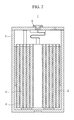
- FIG. 2 is a schematic view of a representative structure of a rechargeable lithium battery.
- FIG. 2 illustrates a cylindrical rechargeable lithium battery 1, which includes a negative electrode 2, a positive electrode 3, a separator 4 interposed between the negative electrode 2 and the positive electrode 3, an electrolyte solution (not shown) impregnating the separator 4, a battery case 5, and a sealing member 6 sealing the battery case 5.
- a mixed positive active material of 97 wt% of LiCoO 2 and 3 wt% of LiNi 0.8 Co 0.15 Al 0.05 O 2 , a polyvinylidene fluoride binder, and a carbon black conductive material were mixed in an N-methylpyrrolidone solvent to provide a positive active material slurry.
- the mixing ratio of the positive active material, the binder, and the conductive material was 94:3:3 wt%.
- the positive active material slurry was coated on an Al-foil current collector to provide a positive electrode in accordance with the general process of manufacturing a positive electrode.
- Flake-shaped artificial graphite micro-particles having an average particle diameter of 3 ⁇ m was milled by a rotary mill to provide an artificial graphite core having an average particle diameter of 20 ⁇ m.
- the micro-particles were agglomerated with each other to provide pores including closed pores and open pores inside the obtained artificial graphite core.
- the porosity of the graphite core formed during the agglomeration was 40 %. Subsequently, silicon was pulverized to an average particle diameter of 250 nm by a bead mill to provide silicon nano-particles.
- the silicon nano-particles were added to alcohol to provide a silicon nano-particle solution, and then the article graphite core was immersed in the silicon nano-particle solution.
- the silicon nano-particle solution was inserted into the open pores inside the artificial graphite core by the capillary phenomenon.
- the obtained product was mixed with petroleum pitch and heated at 900 °C for 3 hours to provide a negative active material.
- the petroleum pitch was carbonized as a result of the heat treatment and was thereby transformed to a hard carbon and inserted in the closed pores and the open pores present in the artificial graphite core so as to provide a shell on the core surface.
- the negative active material, the polyvinylidene fluoride binder, and the carbon black conductive material were mixed in a ratio of 94:3:3 wt% in an N-methylpyrrolidone solvent to provide a negative active material slurry.
- the negative active material slurry was coated on a Cu-foil current collector to provide a negative electrode in accordance with the general process of manufacturing a negative electrode.
- a rechargeable lithium cell was fabricated using the positive electrode, the negative electrode, and the non-aqueous electrolyte in accordance with the general process.
- the non-aqueous electrolyte was a solution in which 1.3 M of LiPF 6 was dissolved in a mixed solvent of ethylene carbonate and diethyl carbonate (3:7 volume ratio).
- the positive active material and the negative active material were adjusted to have an N/P ratio of 1.03, which is a ratio of negative electrode capacity to positive electrode capacity.
- a rechargeable lithium cell was fabricated by the same procedure as in Example 1, except that the positive active material was prepared by mixing 97 wt % of LiCoO 2 and 3 wt % of Li 2 NiO 2 .
- a rechargeable lithium cell was fabricated by the same procedure as in Example 1, except that the positive active material included only LiCoO 2 .
- Each rechargeable lithium cell obtained from Examples 1 and 2 and Comparative Example 1 was measured to determine the cycle-life characteristic, and the results are shown in the following Table 1.
- the cycle-life characteristic was determined by repeating charge and discharge 100 times under the charge condition of 0.5C, 4.35V cut-off voltage, and the discharge condition of 0.2C, 2.5V cut-off voltage at room temperature, and the results are shown as a ratio of discharge capacity at the 100th cycle to that of the first cycle.
- Example 2 91.3 1.03
- Cylinder jelly rolls were fabricated using the positive electrodes and the negative electrodes obtained from each of Examples 1 and 2 and Comparative Example 1, and a lithium metal counter electrode surrounded with a polyethylene separator was disposed under the jelly roll.
- the lithium metal counter electrode was circular having a diameter of 15 mm.
- Each the positive electrode, the negative electrode, and the lithium metal counter electrode was connected with a tab, the outside thereof was covered with a pouch on the three surfaces; an electrolyte solution was injected therein, and the charge and discharge were performed to measure the negative electrode potential in a three electrode method.
- the negative electrode potentials of Examples 1 and 2 were significantly lower than that of Comparative Example 1. Since a lower potential causes a drop in the Si utilization rate of the negative active material, the lower potential can suppress the side reaction between the negative active material and the non-aqueous electrolyte, so it is anticipated that the cycle-life characteristic will be improved as shown in Table 1.
- a rechargeable lithium cell was fabricated by the same procedure as in Example 1, except that the positive active material was prepared by mixing 99 wt % of LiCoO 2 and 1 wt % of Li 2 NiO 2.
- a rechargeable lithium cell was fabricated by the same procedure as in Example 1, except that the positive active material was prepared by mixing 95 wt% of LiCoO2 and 5 wt % of Li 2 NiO 2 .
- a rechargeable lithium cell was fabricated by the same procedure as in Example 1, except that the positive active material was prepared by mixing 90 wt % of LiCoO 2 and 10 wt % of Li 2 NiO 2 .
- Examples 2 to 5 had similar discharge capacity and charge and discharge efficiency to those of Comparative Example 1.
Landscapes
- Chemical & Material Sciences (AREA)
- Chemical Kinetics & Catalysis (AREA)
- Electrochemistry (AREA)
- General Chemical & Material Sciences (AREA)
- Engineering & Computer Science (AREA)
- Inorganic Chemistry (AREA)
- Materials Engineering (AREA)
- Manufacturing & Machinery (AREA)
- Secondary Cells (AREA)
- Battery Electrode And Active Subsutance (AREA)
Abstract
Description
- The invention relates to a rechargeable lithium battery.
- Lithium rechargeable batteries have recently drawn attention as power sources for small portable electronic devices. Such batteries use an organic electrolyte solution, thereby have twice the discharge voltage of a conventional battery using an alkali aqueous solution, and accordingly have high energy density.
- For positive active materials of a rechargeable lithium battery, lithium-transition element composite oxides capable of intercalating lithium, such as LiCoO2, LiMn2O4, LiNiO2, LiNi1-xCox O2 (0<x<1), and so on have been investigated. As for negative active materials of a rechargeable lithium battery, various carbon-based materials such as artificial graphite, natural graphite, and hard carbon, which can all intercalate and deintercalate lithium ions, have been used. However, recently there has been research into non-carbon-based negative active materials such as Si because of the need for stability and high capacity.
- Aspects of the present invention provide a rechargeable lithium battery having improved cycle-life characteristics. Embodiments of the present invention are not limited to the above technical purpose, and a person of ordinary skill in the art can understand other technical purposes.
- An embodiment of the present invention provides a rechargeable lithium battery including: a negative electrode having a composite negative active material of metal and a carbonaceous material; a positive electrode having a mixed positive active material of about 90 to about 99 wt% of a first positive active material selected from the group consisting of cobalt, manganese, phosphate-based materials, and combinations thereof, about 1 to about 10 wt% of a nickel-based second positive active material; and a non-aqueous electrolyte. The rechargeable lithium battery according to embodiments of the present invention shows excellent cycle-life characteristics.
- Additional aspects and/or advantages of the invention will be set forth in part in the description which follows and, in part, will be obvious from the description, or may be learned by practice of the invention.
- These and/or other aspects and advantages of the invention will become apparent and more readily appreciated from the following description of the embodiments, taken in conjunction with the accompanying drawings in which:
-
FIG. 1 is a view of a negative active material according to an embodiment of the present invention; and -
FIG. 2 shows a structure of a rechargeable lithium battery according to anembodiment of the present invention. - Reference will now be made in detail to embodiments of the present invention, examples of which are illustrated in the accompanying drawings, wherein like reference numerals refer to the like elements throughout. The embodiments are described below in order to explain the present invention by referring to the figures.
- An embodiment of the present invention provides a lithium rechargeable battery including a negative electrode having a negative active material, a positive electrode having a positive active material, and a non-aqueous electrolyte. The negative active material is a composite of a carbonaceous material and metal. Non-limiting examples of the carbonaceous material may include crystalline carbon, amorphous carbon, and combinations thereof. The metal refers to a material having excellent thermo- or electrical- conductivity, and non-limiting examples thereof include conductive metals generally such as alkali metals as well as semi-metals having semi-conductivity such as Si.
- The crystalline carbon may include at least one natural graphite or artificial graphite, or a mixture thereof. The natural graphite or artificial graphite may have a form of shapeless, sheet, flake, spherical-shaped or fiber-shaped. The amorphous carbon may include at least one of soft carbon (low temperature fired carbon) or hard carbon, mesophase pitch carbide, fired coke, or a mixture thereof.
- Examples of the metal include one selected from Si, an Si-T alloy (where T is an element selected from the group consisting of an alkali metal, an alkaline-earth metal, a group 13 element, a group 14 element, a transition element, a rare earth element, and combinations thereof, and is not Si), Sn, an Sn-Z alloy (where Z is an element selected from the group consisting of an alkali metal, an alkaline-earth metal, a IUPAC group 13 element (old IUPAC IIIB, CAS Group IIIA), a group 14 element (old IUPAC IVB, CAS IVA), a transition element, a rare earth element, and combinations thereof and is not Sn), Pb, In, As, Sb, Ag, or combinations thereof. The elements T and Z may be selected from Mg, Ca, Sr, Ba, Sc, Y, La, Ti, Zr, Hf, V, Nb, Ta, Cr, Mo, W, Re, Fe, Ru, Os, Co, Rh, Ir, Ni, Pd, Pt, Cu, Ag, Au, Zn, Cd, B, Ge, P, As, Sb, Bi, S, Se, Te, and combinations thereof.
- The composite of a carbonaceous material and a metal may include a mixture in which the carbonaceous material is physically mixed with the metal, or a core-shell type including a crystalline carbon core having pores, an amorphous carbon shell formed on the surface of the core, metal nano-particles dispersed in the pores, and amorphous carbon present in the pores. In one embodiment, the composite of a carbonaceous material and a metal is the core-shell type since the structure suppresses side-reactions and improves the cycle-life characteristics. When the composite is a mixture, it may be crystalline, amorphous, or a mixture thereof without limiting the crystallinity of the carbonaceous material. In addition, the mixing ratio can be suitably adjusted, and is not limited.
- The negative active material including the core-shell type composite may have a structure similar to that shown in
FIG. 1 . The negativeactive material 221 shown inFIG. 1 includes acrystalline carbon core 223 having pores thereinside, and anamorphous carbon shell 227. The pores include closedpores 229a formed inside the core not connected with theshell 227, andopen pores 229b formed extending from the inside to connect with theshell 227. In addition, metal nano-particles 225 may be dispersed in theopen pores 229b, and amorphous carbon may be present in both theopen pores 229b and the closedpores 229a. - The
pores core 223. The negative active material may have porosity of 30 to 50 volume % based on the entire volume of the negative active material. - When the porosity is within that range, it is possible to absorb the expanded volume of the active material during the expansion of the negative active material, and the cycle-life characteristic is improved.
- According to one embodiment, the metal nano-particles have an average particle diameter of about 600 nm or less, and in another embodiment, 100 nm to 500 nm. In addition, the metal nano-particles may be included at about 5 wt % or more, and in another embodiment, 5 to 30 wt%, based on the total weight of the negative active material.
- According to one embodiment, the amorphous carbon is included at about 10 to about 15 wt % based on the total weight of the negative active material, while the crystalline carbon is included at about 55 to about 85 wt% based on the total weight of negative active material. When the amorphous carbon is included within the range, it is possible to provide a composite negative active material including the metal and the carbonaceous material.
- The core-shell type composite negative
active material 221 has an average particle diameter of about 5 to about 40µm. For preparing the core-shell type composite negativeactive material 221, first, fine crystalline carbon particles are milled to provide acrystalline carbon core 223. The fine particles are agglomerated during the milling process to provide closedpores 229a andopen pores 229b inside thecore 223. - The
carbon core 223 is immersed in a metal nano-particle solution. The metal nano-particle solution may be inserted in theopen pores 229b of thecarbon core 223 as a result of the immersing process. - Subsequently, the obtained product is mixed with an amorphous carbon precursor and subjected to heat treatment to provide a core-shell type negative
active material 221. The precursor of the amorphous carbon may include coal pitch, mesophase pitch, petroleum pitch, petroleum oil, petroleum heavy oil, or a polymer resin such as phenol resin, furan resin, polyimide resin, and so on. - The heat treatment is performed at about 800 to about 1200 °C for about 2 to about 10 hours. The precursor of the amorphous carbon is carbonized according to the heat treatment, and then transformed into amorphous carbon and inserted into the closed
pores 229a and theopen pores 229b of thecore 223 and provides ashell 227 on the core surface. - The positive active material may be a mixed positive active material including about 90 to about 99 wt % of a first positive active material selected from cobalt, manganese, a phosphate-based material, or combinations thereof, and about 1 to 10 wt% of a nickel-based second positive active material. According to one embodiment, it includes 95 to 97 wt% of the first positive active material and 3 to 5 wt% of the second positive active material. When the first positive active material and the second positive active material are included within the range, it is possible to improve the cycle-life characteristics without causing deterioration of the discharge capacity or the charge and discharge efficiency.
- When the positive active material is prepared by mixing the first and second positive active materials, the potential of the negative electrode is not increased so as to decrease the utilization of metal among components for the negative active material during the charge and discharge process. In addition, when the utilization of the metal is decreased in such manner, the side-reaction of between the negative active material and the electrolyte solution is decreased, and a Li-source decrease caused during the charge and discharge is compensated for by the nickel-based compound, so as to improve the cycle-life characteristics.
- The first positive active material may be selected from cobalt-based, manganese-based, and phosphate-based materials, or combinations thereof, and may include at least one compound represented by the following
Formulae 1 to 9.
LiaA1-bXbD2 (0.90 a ≤ 1.8, 0 ≤ b < 0.5) [Formula 1]
LiaE1-bXbO2-cDc (0.90 ≤ a ≤ 1.8, 0 ≤ b < 0.5, 0 ≤ c ≤ 0.05) [Formula 2]
LiEz-bXbO4-cDc (0 ≤ b < 0.5, 0 ≤ c ≤ 0.05) [Formula 3]
LiaCoGbO2 (0.90 ≤ a ≤ 1.8, 0.001 ≤ b ≤ 0.1) [Formula 4]
LiaMnGbO2 (0.90 ≤ a ≤ 1.8, 0.001 ≤b ≤ 0.1) [Formula 5]
LiaMn2GbO4 (0.90 ≤ a ≤ 1.8, 0.001 ≤ b ≤ 0.1) [Formula 6]
Li(3-f)J2(PO4)3 (0 ≤ f ≤ 2) [Formula 7]
Li3Fe2(PO4)3 [Formula 8]
LiFePO4 [Formula 9]
- In the
above Formulae 1 to 9, A is selected from Co, Mn, or combinations thereof;
X is selected from Al, Ni, Co, Mn, Cr, Fe, Mg, Sr, V, a rare earth element, or combinations thereof;
D is selected from O, F, S, P, or combinations thereof;
E is selected from Co, Mn, or combinations thereof;
G is selected from Al, Cr, Mn, Fe, Mg, La, Ce, Sr, V, or combinations thereof; and
J is selected from V, Cr, Mn, Co, Ni, Cu, or combinations thereof. - The second positive active material may include at least one compound represented by the following Formulae 10 or 11.
LigNihL1-jOe [Formula 10]
wherein, 0.8 ≤ g ≤ 2, 0 ≤ h ≤ 1, e ranges from about 1 to about 2, 0 ≤ j ≤ 1, 0 ≤ h + j ≤ 1, and
L is selected from A1, Mn, Mg, Zr, La, or combinations thereof.
LixNiyCozL'1-y-zOq [Formula 11]
wherein, 0.65≤x≤,0≤y≤1,0≤z≤1,0≤y+z≤1,q ranges from about 1.8 to about 2, 0 ≤ y + z ≤ 1, and
L' is selected from Al, Mn, Mg, Zr, La, or combinations thereof. - According to one embodiment of the present invention, the rechargeable lithium battery may have an N/P ratio of about 1.03 to about 1.12, which is the ratio of the negative electrode capacity to the positive electrode capacity.
- In addition, according to one embodiment, the negative electrode may have a potential of about 0.9V or less, and in another embodiment, 0.7 to 0.9V, which are measured using a 3-electrode potential measurement including the positive electrode, the negative electrode, and the lithium metal counter electrode. The measuring device for electrode potential in a 3-electrode system is manufactured by close-contacting a lithium metal counter electrode to an electrode element that includes the positive electrode, the negative electrode and a separator interposed between the positive electrode and the negative electrode; attaching a tab to the positive electrode, the negative electrode, and the lithium metal counter electrode; enclosing the product within a battery case; and injecting an electrolyte solution therein. The electrode assembly may be a cylindrical jelly-roll-type or a prismatic jelly-roll-type, but it is not limited thereto. When the electrode assembly is a cylindrical jelly-roll-type, the lithium metal counter electrode is disposed under the same; on the other hand, when the electrode assembly is a prismatic jelly-roll-type, the electrode assembly may be disposed on the side direction (wide surface direction). In addition, the lithium metal counter electrode may be circular having a diameter of about 15 mm, a square of about 1 x 1cm, or a rectangular bar, but is not limited thereto.
- When the potential is measured, the charge and discharge are performed under the discharge condition of about 0.02C to 0.5C, 4.35V cut-off charge, to about 0.02C to 0.5C, 2.5V cut-off discharge.
- The negative electrode includes a binder, and optionally a conductive material. The positive electrode includes a binder and a conductive material. The binder improves binding properties of active material particles with one another and with a current collector. Examples of the binder include at least one selected from polyvinyl alcohol, carboxymethyl cellulose, hydroxypropyl cellulose, polyvinyl chloride, carboxylated polyvinylchloride, polyvinylfluoride, an ethylene oxide-containing polymer, polyvinylpyrrolidone, polyurethane, polytetrafluoroethylene, polyvinylidene fluoride, polyethylene, polypropylene, a styrene-butadiene rubber, an acrylated styrene-butadiene rubber, an epoxy resin, nylon, or the like, but are not limited thereto.
- The conductive material is included to improve electrode conductivity. Any electrically conductive material may be used as a conductive material unless it causes a chemical change. Examples of the conductive material include carbon-based materials such as natural graphite, artificial graphite, carbon black, acetylene black, ketjen black, carbon fiber, and the like; metal powder or metal fiber materials such as copper, nickel, aluminum, silver, and the like; or conductive polymers such as polyphenylene derivatives; or mixtures thereof.
- The negative and positive electrodes may be fabricated by a method including mixing the active material, a conductive material (optionally added in a negative electrode), and a binder into an active material composition and coating the composition on a current collector. The electrode manufacturing method is well known, and thus is not described in detail in the present specification. The current collector for a negative electrode may be selected from a copper foil, a nickel foil, a stainless steel foil, a titanium foil, a nickel foam, a copper foam, a polymer substrate coated with a conductive metal, or combinations thereof. The current collector for a positive electrode may be Al, but is not limited thereto. The solvent may include N-methylpyrrolidone, but it is not limited thereto.
- In a rechargeable lithium battery according to one embodiment of the present invention, the non-aqueous electrolyte includes a non-aqueous organic solvent and a lithium salt. The non-aqueous organic solvent acts as a medium for transmitting ions taking part in the electrochemical reaction of the battery. The non-aqueous organic solvent may include a carbonate-based, ester-based, ether-based, ketone-based, alcohol-based, or aprotic solvent. Examples of the carbonate-based solvent may include dimethyl carbonate (DMC), diethyl carbonate (DEC), dipropyl carbonate (DPC), methylpropyl carbonate (MPC), ethylpropyl carbonate (EPC), methylethyl carbonate (also known as ethylmethyl carbonate, MEC or EMC), ethylene carbonate (EC), propylene carbonate (PC), butylene carbonate (BC), and the like. Examples of the ester-based solvent may include methyl acetate, ethyl acetate, n-propyl acetate, dimethyl acetate, methyl propionate, ethyl propionate, γbutyrolactone, 5-decanolide, γ-valerolactone, dl-mevalonolactone, γ-caprolactone, and the like. Examples of the ether-based solvent include dibutyl ether, tetraglyme, diglyme, 1,2-dimethoxyethane, 2-methyltetrahydrofuran, tetrahydrofuran, and the like, and examples of the ketone-based solvent include cyclohexanone and the like.
- Examples of the alcohol-based solvent include ethyl alcohol, isopropyl alcohol, and so on, and examples of the aprotic solvent include nitriles such as R-CN (wherein R is a C2 to C20 linear, branched, or cyclic hydrocarbon, a double bond, an aromatic ring, or an ether bond), amides such as dimethylformamide, dioxolanes such as 1,3-dioxolane, sulfolanes, and the like.
- The non-aqueous organic solvent may be used singularly or in a mixture. When the organic solvent is used in a mixture, the mixture ratio can be controlled in accordance with desirable battery performance.
- The carbonate-based solvent may include a mixture of a cyclic carbonate and a linear carbonate. The cyclic carbonate and the chain carbonate are mixed together in the volume ratio of about 1:1 to about 1:9, and when the mixture is used as an electrolyte, the electrolyte performance may be enhanced.
- In addition, the electrolyte of one embodiment of the present invention may further include mixtures of carbonate-based solvents and aromatic hydrocarbon-based solvents. The carbonate-based solvents and the aromatic hydrocarbon-based solvents are preferably mixed together in the volume ratio of about 1:1 to about 30:1.
- The aromatic hydrocarbon-based organic solvent may be represented by the following Formula 12.

- In the above Formula 12, R1 to R6 are independently hydrogen, a halogen, a C1 to C10 alkyl, a C1 to C10 haloalkyl, or combinations thereof.
- The aromatic hydrocarbon-based organic solvent may include, but is not limited to, at least one selected from benzene, fluorobenzene, 1,2-difluorobenzene, 1,3-difluorobenzene, 1,4-difluorobenzene, 1,2,3-trifluorobenzene, 1,2,4-trifluorobenzene, chlorobenzene, 1,2-dichlorobenzene, 1,3-dichlorobenzene, 1,4-dichlorobenzene, 1,2,3-trichlorobenzene, 1,2,4-trichlorobenzene, iodobenzene, 1,2-diiodobenzene, 1,3-diiodobenzene, 1,4-diiodobenzene, 1,2,3-triiodobenzene, 1,2,4-triiodobenzene, toluene, fluorotoluene, 1,2-difluorotoluene, 1,3-difluorotoluene, 1,4-difluorotoluene, 1,2,3-trifluorotoluene, 1,2,4-trifluorotoluene, chlorotoluene, 1,2-dichlorotoluene, 1,3-dichlorotoluene, 1,4-dichlorotoluene, 1,2,3-trichlorotoluene, 1,2,4-trichlorotoluene, iodotoluene, 1,2-diiodotoluene, 1,3-diiodotoluene, 1,4-diiodotoluene, 1,2,3-triiodotoluene, 1,2,4-tiiiodotoluene, xylenes, or combinations thereof. The xylenes may includes p-xylene, o-xylene, m-xylene, or combinations thereof.
- The non-aqueous electrolyte may further include vinylene carbonate or an ethylene carbonate-based compound of the following Formula 13.

- In the above Formula 13, R7 and R8 are independently hydrogen, a halogen, a cyano (CN), a nitro (NO2), or a C1 to C5 fluoroalkyl, provided that at least one of R7 and R8 is a halogen, a nitro (NO2), or a C1 to C5 fluoroalkyl and R7 and R8 are not simultaneously hydrogen.
- The ethylene carbonate-based compound includes difluoroethylene carbonate, chloroethylene carbonate, dichloroethylene carbonate, bromoethylene carbonate, dibromoethylene carbonate, nitroethylene carbonate, cyanoethylene carbonate, or fluoroethylene carbonate. The use amount of the additive for improving cycle life may be adjusted within an appropriate range.
- The lithium salt supplies lithium ions in the battery, and operates a basic operation of a rechargeable lithium battery and improves lithium ion transport between positive and negative electrodes. Non-limiting examples of the lithium salt include at least one supporting salt selected from LiPF6, LiBF4, LiSbF6, LiAsF6, LiN(SO2C2F5)2, Li(CF3SO2)2N, LiN(SO2F2F5)2, LiC4F9SO3, LiClO4, LiAlO2, LiAlC14, LiN(CxF2x+1SO2)(CyF2y+1SO2), (where x and y are natural numbers), LiCl, LiI, and LiB(C2O4)2 (lithium bisoxalate borate, LiBOB). The lithium salt may be used at about a 0.1 to 2.0 M concentration. When the lithium salt is included at the above concentration range, electrolyte performance and lithium ion mobility may be enhanced due to optimal electrolyte conductivity and viscosity.
- The rechargeable lithium battery may further include a separator between the negative electrode and the positive electrode, as needed. Non-limiting examples of suitable separator materials include polyethylene, polypropylene, polyvinylidene fluoride, and multi-layers thereof such as a polyethylene/polypropylene double-layered separator, a polyethylene/polypropylene/polyethylene triple-layered separator, and a polypropylene/polyethylene/polypropylene triple-layered separator.
-
FIG. 2 is a schematic view of a representative structure of a rechargeable lithium battery.FIG. 2 illustrates a cylindricalrechargeable lithium battery 1, which includes anegative electrode 2, apositive electrode 3, aseparator 4 interposed between thenegative electrode 2 and thepositive electrode 3, an electrolyte solution (not shown) impregnating theseparator 4, abattery case 5, and a sealingmember 6 sealing thebattery case 5. - The following examples illustrate the present invention in more detail. These examples, however, should not in any sense be interpreted as limiting the scope of the present invention.
- A mixed positive active material of 97 wt% of LiCoO2 and 3 wt% of LiNi0.8Co0.15Al0.05O2, a polyvinylidene fluoride binder, and a carbon black conductive material were mixed in an N-methylpyrrolidone solvent to provide a positive active material slurry. The mixing ratio of the positive active material, the binder, and the conductive material was 94:3:3 wt%. The positive active material slurry was coated on an Al-foil current collector to provide a positive electrode in accordance with the general process of manufacturing a positive electrode.
- Flake-shaped artificial graphite micro-particles having an average particle diameter of 3µm was milled by a rotary mill to provide an artificial graphite core having an average particle diameter of 20µm. During the milling process, the micro-particles were agglomerated with each other to provide pores including closed pores and open pores inside the obtained artificial graphite core.
- The porosity of the graphite core formed during the agglomeration was 40 %. Subsequently, silicon was pulverized to an average particle diameter of 250 nm by a bead mill to provide silicon nano-particles.
- The silicon nano-particles were added to alcohol to provide a silicon nano-particle solution, and then the article graphite core was immersed in the silicon nano-particle solution. The silicon nano-particle solution was inserted into the open pores inside the artificial graphite core by the capillary phenomenon.
- Subsequently, the obtained product was mixed with petroleum pitch and heated at 900 °C for 3 hours to provide a negative active material. The petroleum pitch was carbonized as a result of the heat treatment and was thereby transformed to a hard carbon and inserted in the closed pores and the open pores present in the artificial graphite core so as to provide a shell on the core surface.
- The negative active material, the polyvinylidene fluoride binder, and the carbon black conductive material were mixed in a ratio of 94:3:3 wt% in an N-methylpyrrolidone solvent to provide a negative active material slurry. The negative active material slurry was coated on a Cu-foil current collector to provide a negative electrode in accordance with the general process of manufacturing a negative electrode.
- A rechargeable lithium cell was fabricated using the positive electrode, the negative electrode, and the non-aqueous electrolyte in accordance with the general process. The non-aqueous electrolyte was a solution in which 1.3 M of LiPF6 was dissolved in a mixed solvent of ethylene carbonate and diethyl carbonate (3:7 volume ratio). In addition, the positive active material and the negative active material were adjusted to have an N/P ratio of 1.03, which is a ratio of negative electrode capacity to positive electrode capacity.
- A rechargeable lithium cell was fabricated by the same procedure as in Example 1, except that the positive active material was prepared by mixing 97 wt % of LiCoO2 and 3 wt % of Li2NiO2.
- A rechargeable lithium cell was fabricated by the same procedure as in Example 1, except that the positive active material included only LiCoO2.
- Each rechargeable lithium cell obtained from Examples 1 and 2 and Comparative Example 1 was measured to determine the cycle-life characteristic, and the results are shown in the following Table 1. The cycle-life characteristic was determined by repeating charge and discharge 100 times under the charge condition of 0.5C, 4.35V cut-off voltage, and the discharge condition of 0.2C, 2.5V cut-off voltage at room temperature, and the results are shown as a ratio of discharge capacity at the 100th cycle to that of the first cycle.
Table 1 Cycle-life characteristic (%) N/P ratio Comparative Example 1 57.1 1.03 Example 1 74.2 1.03 Example 2 91.3 1.03 - As shown in Table 1, it is confirmed that the cases of Examples 1 and 2 including the mixed positive active material significantly improved the cycle-life characteristic compared to the case of Comparative Example 1 including only the cobalt-based positive active material.
- Cylinder jelly rolls were fabricated using the positive electrodes and the negative electrodes obtained from each of Examples 1 and 2 and Comparative Example 1, and a lithium metal counter electrode surrounded with a polyethylene separator was disposed under the jelly roll. The lithium metal counter electrode was circular having a diameter of 15 mm. Each the positive electrode, the negative electrode, and the lithium metal counter electrode was connected with a tab, the outside thereof was covered with a pouch on the three surfaces; an electrolyte solution was injected therein, and the charge and discharge were performed to measure the negative electrode potential in a three electrode method.
- The measured negative electrode potentials are shown in the following Table 2.
Table 2 Negative electrode potential (V) N/P ratio Comparative Example 1 0.92 1.03 Example 1 0.78 1.03 Example 2 0.70 1.03 - As shown in Table 2, the negative electrode potentials of Examples 1 and 2 were significantly lower than that of Comparative Example 1. Since a lower potential causes a drop in the Si utilization rate of the negative active material, the lower potential can suppress the side reaction between the negative active material and the non-aqueous electrolyte, so it is anticipated that the cycle-life characteristic will be improved as shown in Table 1.
- A rechargeable lithium cell was fabricated by the same procedure as in Example 1, except that the positive active material was prepared by mixing 99 wt % of LiCoO2 and 1 wt % of Li2NiO2.
- A rechargeable lithium cell was fabricated by the same procedure as in Example 1, except that the positive active material was prepared by mixing 95 wt% of LiCoO2 and 5 wt % of Li2NiO2.
- A rechargeable lithium cell was fabricated by the same procedure as in Example 1, except that the positive active material was prepared by mixing 90 wt % of LiCoO2 and 10 wt % of Li2NiO2.
- Each rechargeable lithium cell obtained from Examples 2 to 5 and Comparative Example 1 was charged and discharged at 0.1C once, and the discharge capacity was measured. The results are shown in the following Table 3. In addition, the charge and discharge efficiency is shown in the following Table 3.
Table 3 Discharge capacity (mAh/g) Charge and discharge efficiency (%) Comparative Example 1 174.8 95 Example 3 174.8 94 Example 2 174.9 92 Example 4 174.0 89 Example 5 174.7 84 - As shown in Table 3, Examples 2 to 5 had similar discharge capacity and charge and discharge efficiency to those of Comparative Example 1.
- From the results shown in Tables 1 to 3, it is understood that the rechargeable lithium cells of Examples 1 to 5 improved the cycle-life characteristics without adversely affecting the discharge capacity and the charge and discharge efficiency.
- Although a few embodiments of the present invention have been shown and described, it would be appreciated by those skilled in the art that changes may be made in these embodiments without departing from the principles of the invention, the scope of which is defined in the claims.
Claims (15)
- A rechargeable lithium battery comprising:a negative electrode comprising a composite negative active material of a metal and a carbonaceous material;a positive electrode comprising a mixed positive active material of about 90 to about 99 wt % of a first positive active material selected from the group consisting of cobalt, manganese, phosphate-based materials, or combinations thereof, and about 1 to 10 wt % of a nickel-based second positive active material; anda non-aqueous electrolyte.
- The rechargeable lithium battery of claim 1, wherein the mixed positive active material comprises 3 to 5 wt % of the second positive active material and 97 to 95 wt % of the first positive active material.
- The rechargeable lithium battery of claim 1 or 2, wherein the first positive active material is at least one compound selected from the group represented by the following Formulae 1 to 9:
LiaA1-bXbD2 (0.90 ≤ a ≤ 1.8, 0 ≤ b < 0.5) [Formula 1]
LiaE1-bXbO2-cDc (0.90 ≤ a ≤ 1.8, 0 ≤ b < 0.5, 0 ≤ c ≤ 0.05) [Formula 2]
LiE2-bXbO4-cDc (0 ≤ b < 0.5, 0 ≤ c ≤ 0.05) [Formula 3]
LiaCoGbO2 (0.90 ≤ a ≤ 1.8, 0.001 ≤ b ≤ 0.1) [Formula 4]
LiaMnGbO2 (0.90 ≤ a ≤ 1.8, 0.001 ≤ b ≤ 0.1) [Formula 5]
LiaMn2GbO4 (0.90 ≤ a ≤ 1.8, 0.001 ≤ b ≤ 0.1) [Formula 6]
Li(3-f)J2(PO4)3 (0 ≤ f ≤ 2) [Formula 7]
Li3FC2(PO4)3 [Formula 8]
LiFePO4 [Formula 9]
wherein A is selected from Co, Mn, or combinations thereof,
X is selected from Al, Ni, Co, Mn, Cr, Fe, Mg, Sr, V, a rare earth element, or combinations thereof,
D is selected from O, F, S, P, or combinations thereof,
E is selected from Co, Mn, or combinations thereof,
G is selected from Al, Cr, Mn, Fe, Mg, La, Ce, Sr, V, or combinations thereof, and
J is selected from V, Cr, Mn, Co, Ni, Cu or combinations thereof. - The rechargeable lithium battery of claim 1, 2 or 3, wherein the second positive active material is a compound represented by the following Formulae 10 or 11:
LigNihL1-jOe [Formula 10]
wherein 0.8 ≤ g ≤ 2, 0 ≤ h ≤ 1, e ranges from 1 to 2, 0 ≤ j ≤ 1, 0 ≤h + j ≤ 1, and L is selected from Al, Mn, Mg, Zr, La, or combinations thereof,
LixNiyCo2L'1-y-zOq [Formula 11]
wherein, 0.65 ≤ x ≤ 1,0 ≤ y ≤ 1,0 ≤ z ≤ 1,0 ≤ y+z≤1,q ranges from 1.8 to 2,0 ≤ y + z ≤ 1, and
L' is selected from Al, Mn, Mg, Zr, La, or combinations thereof. - The rechargeable lithium battery of any one of the preceding claims, wherein the rechargeable lithium battery has an N/P ratio of about 1.03 to about 1.12, which is the ratio of negative electrode capacity to positive electrode capacity.
- The rechargeable lithium battery of any one of the preceding claims, wherein the negative electrode has a potential of 0.9V or less, which is measured by a measuring device of electrode potential in a 3-electrode system.
- The rechargeable lithium battery of any one of the preceding claims, wherein the composite negative active material comprises:a crystalline carbon core formed with pores;an amorphous carbon shell formed on the crystalline carbon core;metal nano-particles dispersed in the pores; andamorphous carbon present in the pores.
- The rechargeable lithium battery of any one of the preceding claims, wherein the metal is one metal or alloy selected from the group consisting of Si, an Si-T alloy (where T is an element selected from an alkali metal, an alkaline-earth metal, a group 13 element, a group 14 element, a transition element, a rare earth element, or combinations thereof, and is not Si), Sn, an Sn-Z alloy (where Z is an element selected from an alkali metal, an alkaline-earth metal, a group 13 element, a group 14 element, a transition element, a rare earth element, or combinations thereof and is not Sn), Pb, In, As, Sb, Ag, or combinations thereof.
- The rechargeable lithium battery of claim 8, wherein the elements T and Z are selected from the group consisting of Mg, Ca, Sr, Ba, Sc, Y, Ti, Zr, Hf, Rf, V, Nb, Ta, Db, Cr, Mo, W, Re, Bh, Fe, Ru, Os, Hs, Rh, Ir, Pd, Pt, Cu, Ag, Au, Zn, Cd, B, Al, Ga, In, Ti, Ge, P, As, Sb, Bi, S, Se, Te, or combinations thereof.
- The rechargeable lithium battery of claim 7, 8 or 9 wherein the composite negative active material has a porosity of 30 to 50 volume %.
- The rechargeable lithium battery of any one of claims 7 to 10, wherein the metal nano-particles have an average particle diameter of 600 nm or less and the concentration of the metal nano-particles is 5 wt% or more.
- The rechargeable lithium battery of any one of claims 7 to 11, wherein average particle size of the metal nano-particles is 100 nm to 500 nm and/or wherein the concentration of the metal nano-particles is 5 to about 30 wt%.
- The rechargeable lithium battery of any one of claims 7 to 12, wherein the composite negative active material has a particle size of about 5 to about 40 µm.
- A positive electrode for a rechargeable lithium battery comprising a current collector and a mixed positive active material disposed on the current collector, wherein the mixed positive active material comprises:a first positive active material selected from the group consisting of cobalt, manganese and phosphate-based materials and combinations thereof, the first positive active material being at a concentration of about 90 to about 99 wt % of the mixed positive active material; anda second positive active material that is nickel-based, the second positive active material being at a concentration of about 1 to about 10 wt % of the mixed positive active material.
- A negative electrode for a rechargeable lithium battery comprising a current collector and a composite negative active material disposed on the current collector, wherein the composite negative active material is a mixture of a metal and a carbonaceous material.
Applications Claiming Priority (1)
| Application Number | Priority Date | Filing Date | Title |
|---|---|---|---|
| KR1020090037725A KR101093705B1 (en) | 2009-04-29 | 2009-04-29 | Lithium secondary battery |
Publications (2)
| Publication Number | Publication Date |
|---|---|
| EP2246922A1 true EP2246922A1 (en) | 2010-11-03 |
| EP2246922B1 EP2246922B1 (en) | 2016-04-20 |
Family
ID=42537737
Family Applications (1)
| Application Number | Title | Priority Date | Filing Date |
|---|---|---|---|
| EP10151646.6A Active EP2246922B1 (en) | 2009-04-29 | 2010-01-26 | Rechargeable Lithium Battery |
Country Status (5)
| Country | Link |
|---|---|
| US (1) | US8597833B2 (en) |
| EP (1) | EP2246922B1 (en) |
| JP (1) | JP5289274B2 (en) |
| KR (1) | KR101093705B1 (en) |
| CN (1) | CN101877417B (en) |
Cited By (6)
| Publication number | Priority date | Publication date | Assignee | Title |
|---|---|---|---|---|
| WO2012106102A1 (en) * | 2011-02-01 | 2012-08-09 | Toyota Motor Engineering & Manufacturing North America, Inc. | Electrode material with core-shell structure |
| AT509807B1 (en) * | 2010-05-11 | 2012-11-15 | Magna E Car Systems Gmbh & Co | MATERIAL FOR NEGATIVE ELECTRODES AND NEGATIVE ELECTRODES AND BATTERIES COMPRISING THIS MATERIAL AND METHOD FOR PRODUCING THE MATERIAL |
| EP2584634A4 (en) * | 2010-06-21 | 2014-08-20 | Nec Energy Devices Ltd | NONAQUEOUS ELECTROLYTE SECONDARY BATTERY |
| CN104396063A (en) * | 2012-11-30 | 2015-03-04 | 株式会社Lg化学 | Negative electrode active material for lithium secondary battery and lithium secondary battery containing same |
| EP2905831A4 (en) * | 2013-09-05 | 2016-07-06 | Lg Chemical Ltd | CATHODE ADDITIVE FOR HIGH CAPACITY LITHIUM SECONDARY BATTERY |
| WO2026027502A1 (en) * | 2024-07-30 | 2026-02-05 | Saft | Lithium-ion electrochemical element with high power and chargeability |
Families Citing this family (60)
| Publication number | Priority date | Publication date | Assignee | Title |
|---|---|---|---|---|
| DK2650955T3 (en) * | 2010-12-08 | 2016-02-15 | Nippon Coke & Engineering Co Ltd | Negative electrode material for lithium-ion secondary batteries and process for making them |
| JP2012142156A (en) * | 2010-12-28 | 2012-07-26 | Sony Corp | Lithium ion secondary battery, positive electrode active material, positive electrode, power tool, electric vehicle, and power storage system |
| WO2012115411A2 (en) * | 2011-02-21 | 2012-08-30 | 주식회사 엘지화학 | Positive electrode active material having improved output characteristics, and lithium secondary battery comprising same |
| JP5742402B2 (en) * | 2011-04-07 | 2015-07-01 | 日本電気株式会社 | Lithium secondary battery and manufacturing method thereof |
| JP2013058452A (en) * | 2011-09-09 | 2013-03-28 | Mitsubishi Chemicals Corp | Composite carbon material for nonaqueous secondary battery and method for manufacturing the same, negative electrode, and nonaqueous secondary battery |
| CN103094576B (en) * | 2011-10-31 | 2015-09-30 | 北京有色金属研究总院 | A kind of nickel-base anode material and preparation method thereof and battery |
| KR101702980B1 (en) * | 2011-11-11 | 2017-02-07 | 삼성에스디아이 주식회사 | Negative active material for rechargeable lithium battery and rechargeable lithium battery including same |
| KR20130056668A (en) * | 2011-11-22 | 2013-05-30 | 삼성전자주식회사 | Composite negative active material, method of preparing the same and lithium secondary battery comprising the same |
| KR20130066326A (en) * | 2011-12-12 | 2013-06-20 | 어플라이드 머티어리얼스, 인코포레이티드 | Positive active material for rechargeable lithium battery, method of preparing the same, and rechargeable lithium battery including the same |
| US10135062B2 (en) * | 2011-12-21 | 2018-11-20 | Nexeon Limited | Fabrication and use of carbon-coated silicon monoxide for lithium-ion batteries |
| WO2013120011A1 (en) | 2012-02-09 | 2013-08-15 | Energ2 Technologies, Inc. | Preparation of polymeric resins and carbon materials |
| US10374221B2 (en) | 2012-08-24 | 2019-08-06 | Sila Nanotechnologies, Inc. | Scaffolding matrix with internal nanoparticles |
| US10263279B2 (en) * | 2012-12-14 | 2019-04-16 | Sila Nanotechnologies Inc. | Electrodes for energy storage devices with solid electrolytes and methods of fabricating the same |
| US10700341B2 (en) * | 2012-12-19 | 2020-06-30 | Samsung Sdi Co., Ltd. | Negative electrode for rechargeable lithium battery, method of preparing the same and rechargeable lithium battery including the same |
| KR101895903B1 (en) | 2012-12-21 | 2018-09-07 | 삼성에스디아이 주식회사 | Positive active material for rechargeable lithium battery and rechargeable lithium battery |
| KR101724004B1 (en) * | 2013-02-06 | 2017-04-06 | 삼성에스디아이 주식회사 | Rechargeable lithium battery |
| CN110112377A (en) | 2013-03-14 | 2019-08-09 | 14族科技公司 | The complex carbon material of electrochemical modification agent comprising lithium alloyage |
| WO2014204278A1 (en) * | 2013-06-20 | 2014-12-24 | 주식회사 엘지화학 | High-capacity electrode active material for lithium secondary battery and lithium secondary battery using same |
| CN103531777B (en) * | 2013-10-23 | 2016-03-30 | 山东大学 | A kind of modified lithium manganate material and preparation method thereof |
| US10195583B2 (en) | 2013-11-05 | 2019-02-05 | Group 14 Technologies, Inc. | Carbon-based compositions with highly efficient volumetric gas sorption |
| KR102663138B1 (en) | 2014-03-14 | 2024-05-03 | 그룹14 테크놀로지스, 인코포레이티드 | Novel methods for sol-gel polymerization in absence of solvent and creation of tunable carbon structure from same |
| KR101567203B1 (en) | 2014-04-09 | 2015-11-09 | (주)오렌지파워 | Negative electrode material for rechargeable battery and method of fabricating the same |
| CN103956480B (en) * | 2014-05-21 | 2016-04-20 | 山东大学 | A kind of WO 3coating LiMn 2 O material and preparation method thereof |
| CN106463765A (en) * | 2014-06-10 | 2017-02-22 | 日立化成株式会社 | Lithium ion cell |
| KR102228749B1 (en) * | 2014-08-11 | 2021-03-16 | 삼성에스디아이 주식회사 | Positive active material for rechargeable lithium battery, method of preparing the same, and rechargeable lithium battery including the same |
| KR102338841B1 (en) * | 2014-08-28 | 2021-12-10 | 삼성에스디아이 주식회사 | Rechargeable lithium battery including the same |
| KR102236913B1 (en) * | 2014-08-28 | 2021-04-05 | 삼성에스디아이 주식회사 | Negative electrode for rechargeable lithium battery and rechargeable lithium battery including the same |
| EP3231024A4 (en) | 2014-12-12 | 2018-08-08 | Pellion Technologies Inc. | Electrochemical cell and method of making the same |
| CN104538620B (en) * | 2014-12-28 | 2017-09-01 | 怀化炯诚新材料科技有限公司 | A kind of fluorinated graphene coats the preparation method of manganese cobalt lithium anode material |
| US20190097222A1 (en) | 2015-08-14 | 2019-03-28 | Energ2 Technologies, Inc. | Composites of porous nano-featured silicon materials and carbon materials |
| CN119419246A (en) * | 2015-08-28 | 2025-02-11 | 14集团技术公司 | New materials with extremely durable lithium intercalation and methods for making them |
| CN106558685B (en) * | 2015-09-30 | 2019-11-22 | 比亚迪股份有限公司 | Porous core-shell structure negative electrode material and its preparation method and battery |
| DE102016202459A1 (en) * | 2016-02-17 | 2017-08-17 | Wacker Chemie Ag | Core-shell composite particles |
| KR102048343B1 (en) | 2016-05-27 | 2019-11-25 | 주식회사 엘지화학 | Negative electrode active material and lithium secondary battery comprising the same |
| EP3469644B1 (en) | 2016-06-14 | 2022-11-09 | Nexeon Limited | Electrodes for metal-ion batteries |
| US20170373305A1 (en) * | 2016-06-22 | 2017-12-28 | Sharp Kabushiki Kaisha | Porous carbon-metal/alloy composite material, synthesis method, and electrode including same |
| WO2018003071A1 (en) * | 2016-06-30 | 2018-01-04 | 富士通株式会社 | Positive electrode material for secondary batteries, method for producing same, and lithium ion secondary battery |
| MX2019001629A (en) | 2016-08-12 | 2019-09-16 | Pellion Tech Inc | Additive containing electrolytes for high energy rechargeable metal anode batteries. |
| PL3516716T3 (en) * | 2016-09-19 | 2021-06-28 | Umicore | Rechargeable electrochemical cell and battery |
| KR20180041314A (en) * | 2016-10-14 | 2018-04-24 | 삼성전자주식회사 | Lithium ion battery and electronic device including the same |
| US10811732B1 (en) | 2016-12-28 | 2020-10-20 | Google Llc | Pre-lithiation for batteries having si-anodes |
| WO2018135253A1 (en) * | 2017-01-20 | 2018-07-26 | Necエナジーデバイス株式会社 | Positive electrode active substance, positive electrode, and lithium ion secondary cell |
| EP3593369A4 (en) | 2017-03-09 | 2021-03-03 | Group14 Technologies, Inc. | DECOMPOSITION OF SILICON-CONTAINING PRECURSORS ON POROUS FRAMEWORK MATERIALS |
| GB2563455B (en) | 2017-06-16 | 2019-06-19 | Nexeon Ltd | Particulate electroactive materials for use in metal-ion batteries |
| KR102346153B1 (en) * | 2017-11-17 | 2022-01-03 | 주식회사 엘지에너지솔루션 | Method for preparing irreversible additive comprised in cathod material for lithium secondary battery, cathode material comprising irreversible additive prepared by the same, and lithium secondary battery comprising cathod active material |
| KR102287331B1 (en) | 2018-08-21 | 2021-08-06 | 삼성에스디아이 주식회사 | Negative active material for rechargeable lithium battery and rechargeable lithium battery including same |
| CN110007245B (en) * | 2019-03-19 | 2021-08-06 | 合肥国轩高科动力能源有限公司 | A three-electrode method for detecting the rationality of the N/P ratio design of lithium-ion batteries |
| KR102425513B1 (en) * | 2019-05-03 | 2022-07-25 | 삼성에스디아이 주식회사 | Lithium secondary battery |
| GB202003864D0 (en) * | 2019-09-10 | 2020-04-29 | Nexeon Ltd | Electroactive materials for use in metal-ion batteries |
| US20220407069A1 (en) * | 2019-11-18 | 2022-12-22 | Gs Yuasa International Ltd. | Energy storage device and method for manufacturing energy storage device |
| JP2023537954A (en) | 2020-08-10 | 2023-09-06 | グループ14・テクノロジーズ・インコーポレイテッド | vibration heat assisted chemical vapor infiltration |
| US11174167B1 (en) | 2020-08-18 | 2021-11-16 | Group14 Technologies, Inc. | Silicon carbon composites comprising ultra low Z |
| EP4146595A1 (en) | 2020-08-18 | 2023-03-15 | Group14 Technologies, Inc. | Manufacturing of silicon-carbon composites materials |
| US11639292B2 (en) | 2020-08-18 | 2023-05-02 | Group14 Technologies, Inc. | Particulate composite materials |
| US11335903B2 (en) | 2020-08-18 | 2022-05-17 | Group14 Technologies, Inc. | Highly efficient manufacturing of silicon-carbon composites materials comprising ultra low z |
| CN116457309B (en) | 2020-09-30 | 2025-02-14 | 14集团技术公司 | Passivation method to control oxygen content and reactivity of silicon-carbon composites |
| GB2616590B (en) * | 2021-10-21 | 2024-05-15 | Nexeon Ltd | Electroactive materials for metal-ion batteries |
| CN115336068A (en) | 2021-10-25 | 2022-11-11 | 宁德新能源科技有限公司 | Electrochemical device and electronic device including the same |
| WO2023070287A1 (en) | 2021-10-25 | 2023-05-04 | 宁德新能源科技有限公司 | Positive electrode plate, electrochemical device, and electronic device |
| EP4425596A4 (en) | 2021-10-25 | 2025-03-05 | Ningde Amperex Technology Limited | POSITIVE PLATE AND LITHIUM-ION SECONDARY BATTERY COMPRISING IT |
Citations (3)
| Publication number | Priority date | Publication date | Assignee | Title |
|---|---|---|---|---|
| WO1997001191A2 (en) * | 1995-06-22 | 1997-01-09 | Polystor Corporation | Nonaqueous battery with cathode active material mixture |
| US20050136330A1 (en) * | 2003-12-19 | 2005-06-23 | Zhenhua Mao | Carbon-coated silicon particle power as the anode material for lithium batteries and the method of making the same |
| US20080008933A1 (en) * | 2005-12-23 | 2008-01-10 | Boston-Power, Inc. | Lithium-ion secondary battery |
Family Cites Families (28)
| Publication number | Priority date | Publication date | Assignee | Title |
|---|---|---|---|---|
| CA2240844A1 (en) * | 1995-12-27 | 1997-07-10 | Motorola, Inc. | Electrode material for lithium intercalation electrochemical cells |
| KR100412188B1 (en) * | 1998-08-27 | 2003-12-24 | 닛본 덴끼 가부시끼가이샤 | Nonaqueous Electrolyte Secondary Cell |
| JP3024636B2 (en) * | 1998-08-27 | 2000-03-21 | 日本電気株式会社 | Non-aqueous electrolyte secondary battery |
| JP2000195517A (en) | 1998-12-28 | 2000-07-14 | Japan Storage Battery Co Ltd | Lithium secondary battery |
| JP4792618B2 (en) * | 2000-05-31 | 2011-10-12 | 日立化成工業株式会社 | Carbonaceous particles for negative electrode of lithium secondary battery, manufacturing method thereof, negative electrode of lithium secondary battery and lithium secondary battery |
| JP2002270247A (en) * | 2001-03-14 | 2002-09-20 | Osaka Gas Co Ltd | Non-aqueous secondary battery |
| JP2003217568A (en) * | 2002-01-17 | 2003-07-31 | Mitsubishi Heavy Ind Ltd | Positive electrode for non-aqueous electrolyte secondary battery and non-aqueous electrolyte secondary battery |
| KR100484713B1 (en) | 2002-03-22 | 2005-04-22 | 주식회사 엘지화학 | Lithium ion secondary battery comprising overdischarge retardant |
| EP1490916B1 (en) * | 2002-03-22 | 2015-04-08 | LG Chem, Ltd. | Lithium secondary battery comprising overdischarge-preventing agent |
| JP2003331922A (en) * | 2002-05-17 | 2003-11-21 | Sony Corp | Battery |
| JP2004014405A (en) | 2002-06-10 | 2004-01-15 | Japan Storage Battery Co Ltd | Non-aqueous electrolyte secondary battery |
| JP2004031165A (en) * | 2002-06-26 | 2004-01-29 | Sony Corp | Non-aqueous electrolyte battery |
| JP2005174847A (en) | 2003-12-15 | 2005-06-30 | Toshiba Corp | Electrode and non-aqueous electrolyte secondary battery |
| US7476467B2 (en) | 2004-03-29 | 2009-01-13 | Lg Chem, Ltd. | Lithium secondary battery with high power |
| JP2008525973A (en) | 2004-12-28 | 2008-07-17 | ボストン−パワー,インコーポレイテッド | Lithium ion secondary battery |
| JP4794172B2 (en) * | 2005-01-18 | 2011-10-19 | 三洋電機株式会社 | Non-aqueous electrolyte secondary battery and charging method thereof |
| KR100624970B1 (en) | 2005-01-28 | 2006-09-19 | 삼성에스디아이 주식회사 | Cathode active material for lithium secondary battery, manufacturing method thereof, and lithium secondary battery |
| KR100646547B1 (en) | 2005-03-25 | 2006-11-23 | 삼성에스디아이 주식회사 | Cathode active material for lithium secondary battery and manufacturing method thereof |
| JP4222519B2 (en) * | 2005-04-13 | 2009-02-12 | 日立マクセル株式会社 | Lithium ion secondary battery and equipment using the same |
| WO2006112674A1 (en) | 2005-04-22 | 2006-10-26 | Lg Chem, Ltd. | New system of lithium ion battery containing material with high irreversible capacity |
| KR100745733B1 (en) * | 2005-09-23 | 2007-08-02 | 삼성에스디아이 주식회사 | Negative electrode active material, manufacturing method thereof and lithium battery employing same |
| JP4785482B2 (en) * | 2005-09-28 | 2011-10-05 | 三洋電機株式会社 | Nonaqueous electrolyte secondary battery |
| JP5036174B2 (en) * | 2005-11-24 | 2012-09-26 | Necエナジーデバイス株式会社 | Non-aqueous electrolyte secondary battery |
| KR100830612B1 (en) * | 2006-05-23 | 2008-05-21 | 강원대학교산학협력단 | Negative active material for lithium secondary battery, method of preparing same, and lithium secondary battery comprising same |
| JP2008027897A (en) * | 2006-06-20 | 2008-02-07 | Osaka Gas Chem Kk | Anode active substance for lithium ion secondary battery |
| JP5143437B2 (en) * | 2007-01-30 | 2013-02-13 | 日本カーボン株式会社 | Method for producing negative electrode active material for lithium ion secondary battery, negative electrode active material, and negative electrode |
| JP2008277232A (en) * | 2007-04-05 | 2008-11-13 | Hitachi Chem Co Ltd | Negative electrode material for lithium secondary battery, its manufacturing method, negative electrode for lithium secondary battery using the negative electrode material, and lithium secondary battery |
| CN101038816B (en) | 2007-04-20 | 2010-06-02 | 哈尔滨工程大学 | A kind of preparation method of porous carbon/nano metal oxide composite material |
-
2009
- 2009-04-29 KR KR1020090037725A patent/KR101093705B1/en active Active
- 2009-10-28 JP JP2009247747A patent/JP5289274B2/en active Active
- 2009-12-30 US US12/649,537 patent/US8597833B2/en active Active
-
2010
- 2010-01-21 CN CN201010003342.0A patent/CN101877417B/en active Active
- 2010-01-26 EP EP10151646.6A patent/EP2246922B1/en active Active
Patent Citations (3)
| Publication number | Priority date | Publication date | Assignee | Title |
|---|---|---|---|---|
| WO1997001191A2 (en) * | 1995-06-22 | 1997-01-09 | Polystor Corporation | Nonaqueous battery with cathode active material mixture |
| US20050136330A1 (en) * | 2003-12-19 | 2005-06-23 | Zhenhua Mao | Carbon-coated silicon particle power as the anode material for lithium batteries and the method of making the same |
| US20080008933A1 (en) * | 2005-12-23 | 2008-01-10 | Boston-Power, Inc. | Lithium-ion secondary battery |
Cited By (11)
| Publication number | Priority date | Publication date | Assignee | Title |
|---|---|---|---|---|
| AT509807B1 (en) * | 2010-05-11 | 2012-11-15 | Magna E Car Systems Gmbh & Co | MATERIAL FOR NEGATIVE ELECTRODES AND NEGATIVE ELECTRODES AND BATTERIES COMPRISING THIS MATERIAL AND METHOD FOR PRODUCING THE MATERIAL |
| EP2584634A4 (en) * | 2010-06-21 | 2014-08-20 | Nec Energy Devices Ltd | NONAQUEOUS ELECTROLYTE SECONDARY BATTERY |
| EP3032622A1 (en) * | 2010-06-21 | 2016-06-15 | NEC Energy Devices, Ltd. | Nonaqueous electrolyte secondary battery |
| WO2012106102A1 (en) * | 2011-02-01 | 2012-08-09 | Toyota Motor Engineering & Manufacturing North America, Inc. | Electrode material with core-shell structure |
| CN104396063A (en) * | 2012-11-30 | 2015-03-04 | 株式会社Lg化学 | Negative electrode active material for lithium secondary battery and lithium secondary battery containing same |
| EP2840630A4 (en) * | 2012-11-30 | 2015-05-27 | Lg Chemical Ltd | Anode active material for lithium secondary battery and lithium secondary battery including same |
| CN104396063B (en) * | 2012-11-30 | 2018-11-09 | 株式会社Lg 化学 | Cathode active material and lithium secondary battery comprising it |
| US10276864B2 (en) | 2012-11-30 | 2019-04-30 | Lg Chem, Ltd. | Anode active material for lithium secondary battery and lithium secondary battery comprising the same |
| EP2905831A4 (en) * | 2013-09-05 | 2016-07-06 | Lg Chemical Ltd | CATHODE ADDITIVE FOR HIGH CAPACITY LITHIUM SECONDARY BATTERY |
| WO2026027502A1 (en) * | 2024-07-30 | 2026-02-05 | Saft | Lithium-ion electrochemical element with high power and chargeability |
| FR3165356A1 (en) * | 2024-07-30 | 2026-02-06 | Saft | High power and chargeability lithium-ion electrochemical element |
Also Published As
| Publication number | Publication date |
|---|---|
| US20100279172A1 (en) | 2010-11-04 |
| CN101877417B (en) | 2016-08-17 |
| JP5289274B2 (en) | 2013-09-11 |
| KR20100118825A (en) | 2010-11-08 |
| US8597833B2 (en) | 2013-12-03 |
| CN101877417A (en) | 2010-11-03 |
| KR101093705B1 (en) | 2011-12-19 |
| EP2246922B1 (en) | 2016-04-20 |
| JP2010262914A (en) | 2010-11-18 |
Similar Documents
| Publication | Publication Date | Title |
|---|---|---|
| EP2246922B1 (en) | Rechargeable Lithium Battery | |
| US12444767B2 (en) | Negative active material for rechargeable lithium battery, method of preparing the same and rechargeable lithium battery including the same | |
| US8906555B2 (en) | Negative active material for rechargeable lithium battery and rechargeable lithium battery comprising same | |
| EP2385574B1 (en) | Positive active material for rechargeable lithium battery and rechargeable lithium battery including same | |
| EP2450986B1 (en) | Negative active material for rechargeable lithium battery and rechargeable lithium battery including same | |
| US9209482B2 (en) | Positive active material for rechargeable lithium battery, method of manufacturing the same and rechargeable lithium battery using the same | |
| KR101342512B1 (en) | Aqueous active material composition, electrode and rechargeable lithium battery using the same | |
| KR101865381B1 (en) | Lithium secondary battery and method for manufacturing the same | |
| KR102439850B1 (en) | Negative electrode active material for rechargeable lithium battery, method for preparing the same, and negative electrode and rechargeable lithium battery including same | |
| EP2306557A1 (en) | Negative active material, method of preparing same, and rechargeable lithium battering including same | |
| US20150155557A1 (en) | Negative electrode active material for rechargeable lithium battery, method for preparing the same and rechargeable lithium battery using the same | |
| EP2221903B1 (en) | Positive electrode for rechargeable lithium battery and rechargeable lithium battery including same | |
| KR102378595B1 (en) | Positive active material for rechargeable lithium battery, method of preparing the same, and rechargeable lithium battery including the same | |
| US9356283B2 (en) | Positive active material for rechargeable lithium battery and rechargeable lithium battery | |
| KR20200072182A (en) | Electrode for rechargeable lithium battery and rechargeable lithium battery including same | |
| KR101780777B1 (en) | Method for charging and discharging lithium secondary battery | |
| EP2458664A2 (en) | Positive active material for rechargeable lithium battery and rechargeable lithium battery comprising same | |
| EP2458663B1 (en) | Positive active material for rechargeable lithium battery, method for manufacturing the same, and rechargeable lithium battery including the same | |
| KR101135491B1 (en) | Positive electrode for rechargeable lithium and rechargeable lithium battery comprising same | |
| US20180026266A1 (en) | Positive Active Material For Lithium Secondary Battery, Method For Producing Same, And Lithium Secondary Battery Comprising Same | |
| EP2395578A1 (en) | Positive active material for rechargeable lithium battery, rechargeable lithium battering using the same and method for manufacturing the same | |
| US20140178739A1 (en) | Positive electrode for rechargeable lithium battery and rechargeable lithium battery including same | |
| KR102600145B1 (en) | Positive active material for rechargeable lithium battery, method of preparing the same, and rechargeable lithium battery including the same |
Legal Events
| Date | Code | Title | Description |
|---|---|---|---|
| PUAI | Public reference made under article 153(3) epc to a published international application that has entered the european phase |
Free format text: ORIGINAL CODE: 0009012 |
|
| 17P | Request for examination filed |
Effective date: 20100126 |
|
| AK | Designated contracting states |
Kind code of ref document: A1 Designated state(s): AT BE BG CH CY CZ DE DK EE ES FI FR GB GR HR HU IE IS IT LI LT LU LV MC MK MT NL NO PL PT RO SE SI SK SM TR |
|
| 17Q | First examination report despatched |
Effective date: 20140224 |
|
| GRAP | Despatch of communication of intention to grant a patent |
Free format text: ORIGINAL CODE: EPIDOSNIGR1 |
|
| INTG | Intention to grant announced |
Effective date: 20160127 |
|
| GRAS | Grant fee paid |
Free format text: ORIGINAL CODE: EPIDOSNIGR3 |
|
| GRAA | (expected) grant |
Free format text: ORIGINAL CODE: 0009210 |
|
| AK | Designated contracting states |
Kind code of ref document: B1 Designated state(s): AT BE BG CH CY CZ DE DK EE ES FI FR GB GR HR HU IE IS IT LI LT LU LV MC MK MT NL NO PL PT RO SE SI SK SM TR |
|
| REG | Reference to a national code |
Ref country code: GB Ref legal event code: FG4D |
|
| REG | Reference to a national code |
Ref country code: CH Ref legal event code: EP |
|
| REG | Reference to a national code |
Ref country code: AT Ref legal event code: REF Ref document number: 793307 Country of ref document: AT Kind code of ref document: T Effective date: 20160515 |
|
| REG | Reference to a national code |
Ref country code: IE Ref legal event code: FG4D |
|
| REG | Reference to a national code |
Ref country code: DE Ref legal event code: R096 Ref document number: 602010032377 Country of ref document: DE |
|
| REG | Reference to a national code |
Ref country code: LT Ref legal event code: MG4D |
|
| REG | Reference to a national code |
Ref country code: AT Ref legal event code: MK05 Ref document number: 793307 Country of ref document: AT Kind code of ref document: T Effective date: 20160420 |
|
| REG | Reference to a national code |
Ref country code: NL Ref legal event code: MP Effective date: 20160420 |
|
| PG25 | Lapsed in a contracting state [announced via postgrant information from national office to epo] |
Ref country code: PL Free format text: LAPSE BECAUSE OF FAILURE TO SUBMIT A TRANSLATION OF THE DESCRIPTION OR TO PAY THE FEE WITHIN THE PRESCRIBED TIME-LIMIT Effective date: 20160420 Ref country code: LT Free format text: LAPSE BECAUSE OF FAILURE TO SUBMIT A TRANSLATION OF THE DESCRIPTION OR TO PAY THE FEE WITHIN THE PRESCRIBED TIME-LIMIT Effective date: 20160420 Ref country code: FI Free format text: LAPSE BECAUSE OF FAILURE TO SUBMIT A TRANSLATION OF THE DESCRIPTION OR TO PAY THE FEE WITHIN THE PRESCRIBED TIME-LIMIT Effective date: 20160420 Ref country code: NL Free format text: LAPSE BECAUSE OF FAILURE TO SUBMIT A TRANSLATION OF THE DESCRIPTION OR TO PAY THE FEE WITHIN THE PRESCRIBED TIME-LIMIT Effective date: 20160420 Ref country code: NO Free format text: LAPSE BECAUSE OF FAILURE TO SUBMIT A TRANSLATION OF THE DESCRIPTION OR TO PAY THE FEE WITHIN THE PRESCRIBED TIME-LIMIT Effective date: 20160720 |
|
| PG25 | Lapsed in a contracting state [announced via postgrant information from national office to epo] |
Ref country code: ES Free format text: LAPSE BECAUSE OF FAILURE TO SUBMIT A TRANSLATION OF THE DESCRIPTION OR TO PAY THE FEE WITHIN THE PRESCRIBED TIME-LIMIT Effective date: 20160420 Ref country code: AT Free format text: LAPSE BECAUSE OF FAILURE TO SUBMIT A TRANSLATION OF THE DESCRIPTION OR TO PAY THE FEE WITHIN THE PRESCRIBED TIME-LIMIT Effective date: 20160420 Ref country code: SE Free format text: LAPSE BECAUSE OF FAILURE TO SUBMIT A TRANSLATION OF THE DESCRIPTION OR TO PAY THE FEE WITHIN THE PRESCRIBED TIME-LIMIT Effective date: 20160420 Ref country code: LV Free format text: LAPSE BECAUSE OF FAILURE TO SUBMIT A TRANSLATION OF THE DESCRIPTION OR TO PAY THE FEE WITHIN THE PRESCRIBED TIME-LIMIT Effective date: 20160420 Ref country code: HR Free format text: LAPSE BECAUSE OF FAILURE TO SUBMIT A TRANSLATION OF THE DESCRIPTION OR TO PAY THE FEE WITHIN THE PRESCRIBED TIME-LIMIT Effective date: 20160420 Ref country code: PT Free format text: LAPSE BECAUSE OF FAILURE TO SUBMIT A TRANSLATION OF THE DESCRIPTION OR TO PAY THE FEE WITHIN THE PRESCRIBED TIME-LIMIT Effective date: 20160822 Ref country code: GR Free format text: LAPSE BECAUSE OF FAILURE TO SUBMIT A TRANSLATION OF THE DESCRIPTION OR TO PAY THE FEE WITHIN THE PRESCRIBED TIME-LIMIT Effective date: 20160721 |
|
| REG | Reference to a national code |
Ref country code: FR Ref legal event code: PLFP Year of fee payment: 8 |
|
| PG25 | Lapsed in a contracting state [announced via postgrant information from national office to epo] |
Ref country code: IT Free format text: LAPSE BECAUSE OF FAILURE TO SUBMIT A TRANSLATION OF THE DESCRIPTION OR TO PAY THE FEE WITHIN THE PRESCRIBED TIME-LIMIT Effective date: 20160420 Ref country code: BE Free format text: LAPSE BECAUSE OF FAILURE TO SUBMIT A TRANSLATION OF THE DESCRIPTION OR TO PAY THE FEE WITHIN THE PRESCRIBED TIME-LIMIT Effective date: 20160420 |
|
| REG | Reference to a national code |
Ref country code: DE Ref legal event code: R097 Ref document number: 602010032377 Country of ref document: DE |
|
| PG25 | Lapsed in a contracting state [announced via postgrant information from national office to epo] |
Ref country code: RO Free format text: LAPSE BECAUSE OF FAILURE TO SUBMIT A TRANSLATION OF THE DESCRIPTION OR TO PAY THE FEE WITHIN THE PRESCRIBED TIME-LIMIT Effective date: 20160420 Ref country code: EE Free format text: LAPSE BECAUSE OF FAILURE TO SUBMIT A TRANSLATION OF THE DESCRIPTION OR TO PAY THE FEE WITHIN THE PRESCRIBED TIME-LIMIT Effective date: 20160420 Ref country code: CZ Free format text: LAPSE BECAUSE OF FAILURE TO SUBMIT A TRANSLATION OF THE DESCRIPTION OR TO PAY THE FEE WITHIN THE PRESCRIBED TIME-LIMIT Effective date: 20160420 Ref country code: DK Free format text: LAPSE BECAUSE OF FAILURE TO SUBMIT A TRANSLATION OF THE DESCRIPTION OR TO PAY THE FEE WITHIN THE PRESCRIBED TIME-LIMIT Effective date: 20160420 Ref country code: SK Free format text: LAPSE BECAUSE OF FAILURE TO SUBMIT A TRANSLATION OF THE DESCRIPTION OR TO PAY THE FEE WITHIN THE PRESCRIBED TIME-LIMIT Effective date: 20160420 |
|
| PLBE | No opposition filed within time limit |
Free format text: ORIGINAL CODE: 0009261 |
|
| STAA | Information on the status of an ep patent application or granted ep patent |
Free format text: STATUS: NO OPPOSITION FILED WITHIN TIME LIMIT |
|
| PG25 | Lapsed in a contracting state [announced via postgrant information from national office to epo] |
Ref country code: SM Free format text: LAPSE BECAUSE OF FAILURE TO SUBMIT A TRANSLATION OF THE DESCRIPTION OR TO PAY THE FEE WITHIN THE PRESCRIBED TIME-LIMIT Effective date: 20160420 |
|
| 26N | No opposition filed |
Effective date: 20170123 |
|
| PG25 | Lapsed in a contracting state [announced via postgrant information from national office to epo] |
Ref country code: SI Free format text: LAPSE BECAUSE OF FAILURE TO SUBMIT A TRANSLATION OF THE DESCRIPTION OR TO PAY THE FEE WITHIN THE PRESCRIBED TIME-LIMIT Effective date: 20160420 |
|
| REG | Reference to a national code |
Ref country code: CH Ref legal event code: PL |
|
| PG25 | Lapsed in a contracting state [announced via postgrant information from national office to epo] |
Ref country code: MC Free format text: LAPSE BECAUSE OF FAILURE TO SUBMIT A TRANSLATION OF THE DESCRIPTION OR TO PAY THE FEE WITHIN THE PRESCRIBED TIME-LIMIT Effective date: 20160420 |
|
| PG25 | Lapsed in a contracting state [announced via postgrant information from national office to epo] |
Ref country code: CH Free format text: LAPSE BECAUSE OF NON-PAYMENT OF DUE FEES Effective date: 20170131 Ref country code: LI Free format text: LAPSE BECAUSE OF NON-PAYMENT OF DUE FEES Effective date: 20170131 |
|
| REG | Reference to a national code |
Ref country code: IE Ref legal event code: MM4A |
|
| PG25 | Lapsed in a contracting state [announced via postgrant information from national office to epo] |
Ref country code: LU Free format text: LAPSE BECAUSE OF NON-PAYMENT OF DUE FEES Effective date: 20170126 |
|
| REG | Reference to a national code |
Ref country code: FR Ref legal event code: PLFP Year of fee payment: 9 |
|
| PG25 | Lapsed in a contracting state [announced via postgrant information from national office to epo] |
Ref country code: IE Free format text: LAPSE BECAUSE OF NON-PAYMENT OF DUE FEES Effective date: 20170126 |
|
| PG25 | Lapsed in a contracting state [announced via postgrant information from national office to epo] |
Ref country code: MT Free format text: LAPSE BECAUSE OF NON-PAYMENT OF DUE FEES Effective date: 20170126 |
|
| PG25 | Lapsed in a contracting state [announced via postgrant information from national office to epo] |
Ref country code: HU Free format text: LAPSE BECAUSE OF FAILURE TO SUBMIT A TRANSLATION OF THE DESCRIPTION OR TO PAY THE FEE WITHIN THE PRESCRIBED TIME-LIMIT; INVALID AB INITIO Effective date: 20100126 |
|
| PG25 | Lapsed in a contracting state [announced via postgrant information from national office to epo] |
Ref country code: BG Free format text: LAPSE BECAUSE OF FAILURE TO SUBMIT A TRANSLATION OF THE DESCRIPTION OR TO PAY THE FEE WITHIN THE PRESCRIBED TIME-LIMIT Effective date: 20160420 |
|
| PG25 | Lapsed in a contracting state [announced via postgrant information from national office to epo] |
Ref country code: CY Free format text: LAPSE BECAUSE OF NON-PAYMENT OF DUE FEES Effective date: 20160420 |
|
| PG25 | Lapsed in a contracting state [announced via postgrant information from national office to epo] |
Ref country code: MK Free format text: LAPSE BECAUSE OF FAILURE TO SUBMIT A TRANSLATION OF THE DESCRIPTION OR TO PAY THE FEE WITHIN THE PRESCRIBED TIME-LIMIT Effective date: 20160420 |
|
| PG25 | Lapsed in a contracting state [announced via postgrant information from national office to epo] |
Ref country code: TR Free format text: LAPSE BECAUSE OF FAILURE TO SUBMIT A TRANSLATION OF THE DESCRIPTION OR TO PAY THE FEE WITHIN THE PRESCRIBED TIME-LIMIT Effective date: 20160420 |
|
| PG25 | Lapsed in a contracting state [announced via postgrant information from national office to epo] |
Ref country code: IS Free format text: LAPSE BECAUSE OF FAILURE TO SUBMIT A TRANSLATION OF THE DESCRIPTION OR TO PAY THE FEE WITHIN THE PRESCRIBED TIME-LIMIT Effective date: 20160820 |
|
| P01 | Opt-out of the competence of the unified patent court (upc) registered |
Effective date: 20230528 |
|
| PGFP | Annual fee paid to national office [announced via postgrant information from national office to epo] |
Ref country code: FR Payment date: 20251231 Year of fee payment: 17 |
|
| PGFP | Annual fee paid to national office [announced via postgrant information from national office to epo] |
Ref country code: GB Payment date: 20260106 Year of fee payment: 17 |
|
| PGFP | Annual fee paid to national office [announced via postgrant information from national office to epo] |
Ref country code: DE Payment date: 20251230 Year of fee payment: 17 |