EP2239060A2 - Method for painting automobile body and system therefor - Google Patents
Method for painting automobile body and system therefor Download PDFInfo
- Publication number
- EP2239060A2 EP2239060A2 EP10154851A EP10154851A EP2239060A2 EP 2239060 A2 EP2239060 A2 EP 2239060A2 EP 10154851 A EP10154851 A EP 10154851A EP 10154851 A EP10154851 A EP 10154851A EP 2239060 A2 EP2239060 A2 EP 2239060A2
- Authority
- EP
- European Patent Office
- Prior art keywords
- paint
- paint film
- film
- forming step
- basecoat
- Prior art date
- Legal status (The legal status is an assumption and is not a legal conclusion. Google has not performed a legal analysis and makes no representation as to the accuracy of the status listed.)
- Withdrawn
Links
- 238000000034 method Methods 0.000 title claims abstract description 59
- 238000010422 painting Methods 0.000 title claims abstract description 41
- 239000003973 paint Substances 0.000 claims abstract description 461
- 230000015572 biosynthetic process Effects 0.000 claims abstract description 18
- 230000001747 exhibiting effect Effects 0.000 claims abstract description 14
- 239000000049 pigment Substances 0.000 claims description 47
- 239000003086 colorant Substances 0.000 claims description 13
- 238000005286 illumination Methods 0.000 claims description 9
- 239000006229 carbon black Substances 0.000 claims description 8
- 238000002834 transmittance Methods 0.000 claims description 6
- 238000010835 comparative analysis Methods 0.000 claims 2
- 239000000428 dust Substances 0.000 description 25
- 230000006866 deterioration Effects 0.000 description 16
- 230000008901 benefit Effects 0.000 description 11
- 229920005989 resin Polymers 0.000 description 11
- 239000011347 resin Substances 0.000 description 11
- 238000010586 diagram Methods 0.000 description 8
- 230000008569 process Effects 0.000 description 8
- 230000001678 irradiating effect Effects 0.000 description 7
- 239000002904 solvent Substances 0.000 description 7
- 238000001035 drying Methods 0.000 description 6
- 239000007921 spray Substances 0.000 description 6
- 238000004070 electrodeposition Methods 0.000 description 5
- 239000007788 liquid Substances 0.000 description 5
- 239000011342 resin composition Substances 0.000 description 5
- XLOMVQKBTHCTTD-UHFFFAOYSA-N Zinc monoxide Chemical compound [Zn]=O XLOMVQKBTHCTTD-UHFFFAOYSA-N 0.000 description 4
- 239000003795 chemical substances by application Substances 0.000 description 4
- 230000002028 premature Effects 0.000 description 4
- 238000005507 spraying Methods 0.000 description 4
- 229920001187 thermosetting polymer Polymers 0.000 description 4
- 239000006097 ultraviolet radiation absorber Substances 0.000 description 4
- 239000000326 ultraviolet stabilizing agent Substances 0.000 description 4
- XLYOFNOQVPJJNP-UHFFFAOYSA-N water Substances O XLYOFNOQVPJJNP-UHFFFAOYSA-N 0.000 description 4
- 239000004606 Fillers/Extenders Substances 0.000 description 3
- GWEVSGVZZGPLCZ-UHFFFAOYSA-N Titan oxide Chemical compound O=[Ti]=O GWEVSGVZZGPLCZ-UHFFFAOYSA-N 0.000 description 3
- JEIPFZHSYJVQDO-UHFFFAOYSA-N iron(III) oxide Inorganic materials O=[Fe]O[Fe]=O JEIPFZHSYJVQDO-UHFFFAOYSA-N 0.000 description 3
- 239000000203 mixture Substances 0.000 description 3
- 239000003960 organic solvent Substances 0.000 description 3
- OGIDPMRJRNCKJF-UHFFFAOYSA-N titanium oxide Inorganic materials [Ti]=O OGIDPMRJRNCKJF-UHFFFAOYSA-N 0.000 description 3
- 239000004925 Acrylic resin Substances 0.000 description 2
- 229920000178 Acrylic resin Polymers 0.000 description 2
- VYZAMTAEIAYCRO-UHFFFAOYSA-N Chromium Chemical compound [Cr] VYZAMTAEIAYCRO-UHFFFAOYSA-N 0.000 description 2
- UQSXHKLRYXJYBZ-UHFFFAOYSA-N Iron oxide Chemical compound [Fe]=O UQSXHKLRYXJYBZ-UHFFFAOYSA-N 0.000 description 2
- 239000004640 Melamine resin Substances 0.000 description 2
- 229920000877 Melamine resin Polymers 0.000 description 2
- WGLPBDUCMAPZCE-UHFFFAOYSA-N Trioxochromium Chemical compound O=[Cr](=O)=O WGLPBDUCMAPZCE-UHFFFAOYSA-N 0.000 description 2
- HCHKCACWOHOZIP-UHFFFAOYSA-N Zinc Chemical compound [Zn] HCHKCACWOHOZIP-UHFFFAOYSA-N 0.000 description 2
- AUNAPVYQLLNFOI-UHFFFAOYSA-L [Pb++].[Pb++].[Pb++].[O-]S([O-])(=O)=O.[O-][Cr]([O-])(=O)=O.[O-][Mo]([O-])(=O)=O Chemical compound [Pb++].[Pb++].[Pb++].[O-]S([O-])(=O)=O.[O-][Cr]([O-])(=O)=O.[O-][Mo]([O-])(=O)=O AUNAPVYQLLNFOI-UHFFFAOYSA-L 0.000 description 2
- 239000002253 acid Substances 0.000 description 2
- 229920000180 alkyd Polymers 0.000 description 2
- 229910052793 cadmium Inorganic materials 0.000 description 2
- BDOSMKKIYDKNTQ-UHFFFAOYSA-N cadmium atom Chemical compound [Cd] BDOSMKKIYDKNTQ-UHFFFAOYSA-N 0.000 description 2
- 230000008859 change Effects 0.000 description 2
- 229910052804 chromium Inorganic materials 0.000 description 2
- 239000011651 chromium Substances 0.000 description 2
- 229910000423 chromium oxide Inorganic materials 0.000 description 2
- 239000010941 cobalt Substances 0.000 description 2
- 229910017052 cobalt Inorganic materials 0.000 description 2
- GUTLYIVDDKVIGB-UHFFFAOYSA-N cobalt atom Chemical compound [Co] GUTLYIVDDKVIGB-UHFFFAOYSA-N 0.000 description 2
- 239000003431 cross linking reagent Substances 0.000 description 2
- 238000007590 electrostatic spraying Methods 0.000 description 2
- 125000003700 epoxy group Chemical group 0.000 description 2
- 125000000524 functional group Chemical group 0.000 description 2
- 238000010438 heat treatment Methods 0.000 description 2
- DCYOBGZUOMKFPA-UHFFFAOYSA-N iron(2+);iron(3+);octadecacyanide Chemical compound [Fe+2].[Fe+2].[Fe+2].[Fe+3].[Fe+3].[Fe+3].[Fe+3].N#[C-].N#[C-].N#[C-].N#[C-].N#[C-].N#[C-].N#[C-].N#[C-].N#[C-].N#[C-].N#[C-].N#[C-].N#[C-].N#[C-].N#[C-].N#[C-].N#[C-].N#[C-] DCYOBGZUOMKFPA-UHFFFAOYSA-N 0.000 description 2
- 239000011159 matrix material Substances 0.000 description 2
- 238000012986 modification Methods 0.000 description 2
- 230000004048 modification Effects 0.000 description 2
- 238000007591 painting process Methods 0.000 description 2
- 239000002245 particle Substances 0.000 description 2
- 229920001225 polyester resin Polymers 0.000 description 2
- 239000004645 polyester resin Substances 0.000 description 2
- 229960003351 prussian blue Drugs 0.000 description 2
- 239000013225 prussian blue Substances 0.000 description 2
- 238000007592 spray painting technique Methods 0.000 description 2
- 239000011701 zinc Substances 0.000 description 2
- 229910052725 zinc Inorganic materials 0.000 description 2
- 239000011787 zinc oxide Substances 0.000 description 2
- 239000004593 Epoxy Substances 0.000 description 1
- 229920001807 Urea-formaldehyde Polymers 0.000 description 1
- 230000002411 adverse Effects 0.000 description 1
- 229910052782 aluminium Inorganic materials 0.000 description 1
- XAGFODPZIPBFFR-UHFFFAOYSA-N aluminium Chemical compound [Al] XAGFODPZIPBFFR-UHFFFAOYSA-N 0.000 description 1
- 150000001412 amines Chemical class 0.000 description 1
- 125000000129 anionic group Chemical group 0.000 description 1
- 229920001400 block copolymer Polymers 0.000 description 1
- 125000003178 carboxy group Chemical group [H]OC(*)=O 0.000 description 1
- ZCDOYSPFYFSLEW-UHFFFAOYSA-N chromate(2-) Chemical compound [O-][Cr]([O-])(=O)=O ZCDOYSPFYFSLEW-UHFFFAOYSA-N 0.000 description 1
- 230000000052 comparative effect Effects 0.000 description 1
- 150000001875 compounds Chemical class 0.000 description 1
- 238000007796 conventional method Methods 0.000 description 1
- 230000007797 corrosion Effects 0.000 description 1
- 238000005260 corrosion Methods 0.000 description 1
- 230000000694 effects Effects 0.000 description 1
- 239000003822 epoxy resin Substances 0.000 description 1
- 125000002887 hydroxy group Chemical group [H]O* 0.000 description 1
- 239000000463 material Substances 0.000 description 1
- 230000002093 peripheral effect Effects 0.000 description 1
- 229920000647 polyepoxide Polymers 0.000 description 1
- 229920001228 polyisocyanate Polymers 0.000 description 1
- 239000005056 polyisocyanate Substances 0.000 description 1
- 230000009467 reduction Effects 0.000 description 1
- 230000008016 vaporization Effects 0.000 description 1
Images


Classifications
-
- B—PERFORMING OPERATIONS; TRANSPORTING
- B05—SPRAYING OR ATOMISING IN GENERAL; APPLYING FLUENT MATERIALS TO SURFACES, IN GENERAL
- B05D—PROCESSES FOR APPLYING FLUENT MATERIALS TO SURFACES, IN GENERAL
- B05D7/00—Processes, other than flocking, specially adapted for applying liquids or other fluent materials to particular surfaces or for applying particular liquids or other fluent materials
- B05D7/14—Processes, other than flocking, specially adapted for applying liquids or other fluent materials to particular surfaces or for applying particular liquids or other fluent materials to metal, e.g. car bodies
-
- B—PERFORMING OPERATIONS; TRANSPORTING
- B05—SPRAYING OR ATOMISING IN GENERAL; APPLYING FLUENT MATERIALS TO SURFACES, IN GENERAL
- B05D—PROCESSES FOR APPLYING FLUENT MATERIALS TO SURFACES, IN GENERAL
- B05D7/00—Processes, other than flocking, specially adapted for applying liquids or other fluent materials to particular surfaces or for applying particular liquids or other fluent materials
- B05D7/22—Processes, other than flocking, specially adapted for applying liquids or other fluent materials to particular surfaces or for applying particular liquids or other fluent materials to internal surfaces, e.g. of tubes
-
- B—PERFORMING OPERATIONS; TRANSPORTING
- B05—SPRAYING OR ATOMISING IN GENERAL; APPLYING FLUENT MATERIALS TO SURFACES, IN GENERAL
- B05D—PROCESSES FOR APPLYING FLUENT MATERIALS TO SURFACES, IN GENERAL
- B05D7/00—Processes, other than flocking, specially adapted for applying liquids or other fluent materials to particular surfaces or for applying particular liquids or other fluent materials
- B05D7/50—Multilayers
- B05D7/56—Three layers or more
- B05D7/57—Three layers or more the last layer being a clear coat
-
- B—PERFORMING OPERATIONS; TRANSPORTING
- B05—SPRAYING OR ATOMISING IN GENERAL; APPLYING FLUENT MATERIALS TO SURFACES, IN GENERAL
- B05D—PROCESSES FOR APPLYING FLUENT MATERIALS TO SURFACES, IN GENERAL
- B05D2252/00—Sheets
- B05D2252/10—Applying the material on both sides
-
- B—PERFORMING OPERATIONS; TRANSPORTING
- B05—SPRAYING OR ATOMISING IN GENERAL; APPLYING FLUENT MATERIALS TO SURFACES, IN GENERAL
- B05D—PROCESSES FOR APPLYING FLUENT MATERIALS TO SURFACES, IN GENERAL
- B05D5/00—Processes for applying liquids or other fluent materials to surfaces to obtain special surface effects, finishes or structures
- B05D5/06—Processes for applying liquids or other fluent materials to surfaces to obtain special surface effects, finishes or structures to obtain multicolour or other optical effects
Definitions
- the present invention relates to a method for painting an automobile body and a system therefor, and, more specifically, to a method for applying paint to an outer panel surface and an inner panel surface of an automobile body each having a basecoat film formed thereon, to perform a painting operation, and a system therefor.
- a basecoat film is formed on an outer panel surface of an automobile, then a first paint is applied onto the basecoat firm, and then a second paint is applied onto the first paint.
- a basecoat film is formed, and then a third paint is applied onto the basecoat firm.
- dusts of the first paint are likely adhered to the third paint film on the inner panel surface, which results in deterioration of aesthetic appearance of the paint film of the inner panel surface.
- an object of the present invention to provide an automobile body painting method capable of effectively preventing deterioration in aesthetic appearance due to a phenomenon that a dust of a first paint applied on an outer panel surface of the automobile body attaches onto a third paint film of an inner panel surface of the automobile body, in a simple operation, and a system therefor.
- a method for painting an automobile body which includes a first paint film-forming step of applying a first paint to an outer plate surface of the automobile body having a basecoat film formed thereon, to form thereon a first paint film having a basecoat hiding ability, and a second paint film-forming step of, after the formation of the first paint film, applying a second paint to the first paint film to form thereon a second paint film which has a basecoat hiding ability lower than that of the first paint film and exhibits an apparent paint-film color only by itself or in cooperation with the first paint film.
- the method is characterized by comprising a third paint film-forming step of, at least after the first paint film-forming step, applying a third paint to an inner panel surface of the automobile body having a basecoat film formed thereon, to form thereon a third paint film exhibiting an apparent paint-film color identical or similar to that of the second paint film of the outer panel surface.
- the third paint to the inner panel surface is applied the inner panel surface to form thereon the third paint film exhibiting an apparent paint-film color identical or similar to that of the second paint film of the outer panel surface, so that the third paint film can hide a dust paint film formed by a dust of the first paint attached on the inner panel surface during the first paint film-forming step. This makes it possible to maintain aesthetic appearance of the inner plate surface in an excellent state.
- FIG. 1 is a process diagram showing an automobile body painting method using an automobile body painting system, according to a first embodiment of the present invention.
- the painting method according to the first embodiment comprises: a basecoat film-forming step K0 of forming a basecoat film 4 on each of an outer panel surface 2 and an inner panel surface 3 of an automobile body 1; a first paint film-forming step K1 of forming a first paint film 5 on the basecoat film 4 of the outer panel surface 2; a second paint film-forming step K2 of forming a second paint film 6 on the first paint film 5 of the outer panel surface 2; a third paint film-forming step K3 of forming a third paint film 7 on the basecoat film 4 of the inner panel surface 3; an inner-panel clear paint film-forming step K4 of forming a clear paint film 8 on the third paint film 7 of the inner panel surface 3; an outer-panel clear paint film-forming step K5 of forming a clear paint film 9 on the second paint film 6 of the outer panel surface 2; and a baking/drying
- a basecoat film 4 having a function of protecting the automobile body 1 from rust (corrosion), etc, is formed on each of the outer and inner panel surfaces 2, 3 of the automobile body 1, for example, by: applying a DC current between the automobile body 1 and an electrodeposition paint contained in a tank, while immersing the automobile body 1 in the tank, to subject the automobile body 1 to an electrodeposition painting process to form an electrodeposition paint film thereon; pulling the automobile body 1 up out of the tank; and transporting the automobile body 1 to a drying furnace to bake and dry the electrodeposition paint film.
- the electrodeposition painting process includes an anionic type using chromate or the like as an anti-rust (anti-corrosive) material, and a cathodic type using an amine-modified resin obtained by modifying a resin excellent in anti-rust (anti-corrosive) ability, such as an epoxy resin, with amine.
- a first paint film 5 having a high basecoat hiding ability is formed on the basecoat film 4 of the outer panel surface 2 of the automobile body 1, in a first paint-film forming station 12 having an electrostatic painting machine 11, such as an air-spray, airless-spray or electrostatic atomization-type painting machine, by spray-applying a first paint to the outer panel surface 2, under a condition that an openable/closable member 13, such as an automobile side door, is approximately closed.
- an electrostatic painting machine 11 such as an air-spray, airless-spray or electrostatic atomization-type painting machine
- the first paint is a liquid paint adapted to form the first paint film 5 having a basecoat hiding ability, wherein the liquid paint is obtained by dissolving or dispersing a pigment for allowing the first paint film 5 to exhibit a given color, a resin component and others, in a solvent consisting of an organic solvent or a water solvent.
- the first paint may further contain an extender pigment, an antisettling agent, a paint surface regulator, an ultraviolet absorber, an ultraviolet stabilizer and a tackifier, in an appropriate manner.
- the pigment to be contained in the first paint may be one selected from the group consisting of carbon black, titanium oxide, iron oxide, aluminum flake, and a combination of two or more thereof.
- the pigment may contain a given color pigment, such as one selected from the group consisting of zinc flower (zinc oxide), cadmium red, molybdenum red, chromium yellow, chromium oxide, Prussian blue, cobalt blue, azo-series pigment, phthalocyanine-series pigment, quinacridone-series pigment, isoindoline-series pigment, threne-series pigment and perylene-series pigment, or a mixture of two or more thereof.
- a given color pigment such as one selected from the group consisting of zinc flower (zinc oxide), cadmium red, molybdenum red, chromium yellow, chromium oxide, Prussian blue, cobalt blue, azo-series pigment, phthalocyanine-series pigment, quinacridone-series pigment
- the resin component to be contained in the first paint is a thermosetting resin composition.
- the thermosetting resin composition may include: a composition comprising a matrix resin, such as an acrylic resin, a polyester resin or an alkyd resin, which has a cross-linkable functional group, and a cross-linking agent, such as a melamine resin, an urea resin or a polyisocyanate compound (including a block copolymer thereof); and an acid/epoxy cross-linked resin composition comprising a primary component of an acid group-containing resin and an epoxy group-containing resin.
- a matrix resin such as an acrylic resin, a polyester resin or an alkyd resin, which has a cross-linkable functional group
- a cross-linking agent such as a melamine resin, an urea resin or a polyisocyanate compound (including a block copolymer thereof)
- an acid/epoxy cross-linked resin composition comprising a primary component of an acid group-containing resin and an epoxy group-containing resin.
- the resin component to be contained in the first paint is a thermosetting resin composition
- a thermosetting resin composition comprising: a matrix resin, such as an acrylic resin, a polyester resin or an alkyd resin, which has a cross-linkable functional group, such as a hydroxyl group, a carboxyl group or an epoxy group; and a cross-linking agent, such as a melamine resin.
- a color of the first paint film 5 is set to an achromatic color having a brightness corresponding to that of the second paint film 6 to be formed on the first paint film 5.
- the color of the first paint film 5 may be set to one selected from five achromatic colors having five levels of brightnesses consisting of dark gray, gray, light gray, super-light gray and white, wherein the selected achromatic color has an excellent basecoat hiding ability.
- an amount of the color pigment to be contained in the first paint is set at a value greater than a normal value, i.e., the amount of the color pigment is set to allow the brightness of the first paint film 5 to become less than a brightness corresponding to that of the second paint film 6, the basecoat hiding ability of the first paint film 5 can be sufficiently ensured.
- a second paint film 6 is formed on the first paint film 5 of the outer panel surface 2, in a second paint film-forming station 15 having an electrostatic painting machine 14, such as an air-spray, airless-spray or electrostatic atomization-type painting machine, by spray-applying a second paint to the first paint film 5 of the outer panel surface 2, while keeping the first paint film 5 from being hardened, i.e., maintaining the first paint film 5 in its unhardened state, under a condition that the openable/closable member 13, such as the an automobile side door, is approximately closed.
- an electrostatic painting machine 14 such as an air-spray, airless-spray or electrostatic atomization-type painting machine
- the second paint is a liquid paint obtained by dissolving or dispersing a color pigment for allowing the second paint film 6 to exhibit a given apparent paint-film color, a resin component and others, in a solvent consisting of an organic solvent or a water solvent.
- the second paint may further contain an extender pigment, an antisettling agent, a paint surface regulator, an ultraviolet absorber, an ultraviolet stabilizer and a tackifier, in an appropriate manner.
- the color pigment to be contained in the second paint is a type which has a basecoat hindering ability lower than that of the first paint film 5, and allows the second paint film 6 to exhibit a specific color selected from a large number of predetermined apparent paint-film colors, only by itself or in cooperation with the first paint film 5.
- the color pigment may be one selected from the group consisting of titanium oxide, zinc flower (zinc oxide), carbon black, cadmium red, molybdenum red, chromium yellow, chromium oxide, Prussian blue, cobalt blue, azo-series pigment, phthalocyanine-series pigment, quinacridone-series pigment, isoindoline-series pigment, threne-series pigment and perylene-series pigment, or a mixture of two or more thereof.
- a third paint film 7 exhibiting an apparent paint-film color of the inner panel surface 3 is formed on the basecoat film 4 of the inner panel surface 3, in a third paint film-forming station 17 having an electrostatic painting machine 16, such as an air-spray, airless-spray or electrostatic atomization-type painting machine, by spray-applying a third paint to the inner panel surface 3, under a condition that the electrostatic painting machine 16 is introduced inside the automobile body 1 while largely opening the openable/closable member 13.
- an electrostatic painting machine 16 such as an air-spray, airless-spray or electrostatic atomization-type painting machine
- the third paint is a liquid paint obtained by dissolving or dispersing a color pigment for allowing the third paint film 7 to exhibit a given apparent paint-film color, a resin component and others, in a solvent consisting of an organic solvent or a water solvent.
- the third paint may further contain an extender pigment, an antisettling agent, a paint surface regulator, an ultraviolet absorber, an ultraviolet stabilizer and a tackifier, in an appropriate manner.
- the same pigment as that contained in the second paint is used as the pigment to be contained in the third paint, so that the third paint film 7 formed of the third paint can exhibit an apparent paint-film color identical or similar to that of the second paint film 6 formed of the second paint.
- a clear paint film 8 is formed on the third paint film 7 of the inner panel surface 3, by applying a clear paint to the third paint film 7 of the inner panel surface 3 using a spray painting technique, such as an air-spraying technique, an airless-spraying technique or an electrostatic spraying technique.
- the clear paint may be a liquid paint containing a thermosetting resin composition and a solvent.
- the clear paint may further contain a photoluminescent pigment, a color pigment, an antisettling agent, a paint surface regulator, an ultraviolet absorber, an ultraviolet stabilizer and a tackifier, in an appropriate manner.
- the photoluminescent pigment and the color pigment are mixed in the clear paint to an extent capable of preserving transparency of the clear paint film 8.
- a clear paint film 9 is formed on the second paint film 6 of the outer panel surface 2, by applying a clear paint to the second paint film 6 of the outer panel surface 2 using a spray painting technique, such as an air-spraying technique, an airless-spraying technique or an electrostatic spraying technique, in the same manner as that in the inner-panel clear paint film-forming step K4.
- a spray painting technique such as an air-spraying technique, an airless-spraying technique or an electrostatic spraying technique
- the automobile body painting method using the automobile body painting system comprises: the first paint film-forming step K1 of applying a first paint to an outer panel surface 2 of an automobile body 1 having a basecoat film 4 formed thereon, to form thereon a first paint film 5 having a basecoat hiding ability; the second paint film-forming step K2 of, after the formation of the first paint film 5, applying a second paint to the first paint film 5 to form thereon a second paint film 6 having a basecoat hiding ability lower than that of the first paint film 5 and exhibiting an apparent paint-film color only by itself or in cooperation with the first paint film 5; and the third paint film-forming step K3 of, at least after the formation of the first paint film 5, applying a third paint to an inner panel surface 3 of the automobile body 1 having a basecoat film 4 formed thereon, to form thereon a third paint film 7 exhibiting an apparent paint-film color identical or similar to that of the second paint film 6 of the outer panel surface 2.
- This provides an advantage of being able to allow the first paint to have versatility to facilitate reduction in facility cost and effectively simplify a painting operation, while preventing deterioration in aesthetic appearance due to a phenomenon that a dust of the first paint applied on the outer panel surface 2 of the automobile body 1 attaches onto the third paint film 7 of the inner panel surface 3.
- the first paint film-forming step of forming the first paint film 5 on the outer panel surface 2 of the automobile body 1 is performed after completion of the third paint film-forming step of forming the third paint film 7 on the inner panel surface 3 of the automobile body 1.
- a dust of the first paint sprayed in the first paint film-forming step to form the first paint film 5 on the basecoat film 4 of the outer panel surface 2 inevitably enters the inside of the automobile body and attaches onto a peripheral edge region of the inner panel surface 3 and others, as shown in FIG. 2 .
- a first pant-based dust paint film 20 attached on the inner panel surface 3 exhibits a color different from that of the third paint film 7 exhibiting an apparent paint-film color of the inner panel surface 3, which inevitably causes deterioration in aesthetic appearance.
- the clear paint film 8 is formed as an upper layer relative to the dust paint film 20 and the third paint film 7, the clear paint layer 8 cannot hide the difference or change in color, because it has no basecoat hiding ability.
- the third paint film-forming step K3 using the third paint film-forming station 17 is performed after the formation of the first paint film 5, in such a manner that the third paint film 7 exhibiting an apparent paint-film color identical or similar to that of the second paint film 6 of the outer panel surface 2 is formed on the inner panel surface 3.
- the third paint film 7 can hide the dust paint film 21 to maintain aesthetic appearance of the inner plate surface 3 in an excellent state.
- the color of the first paint film 5 may be set to one selected from five achromatic colors having five levels of brightnesses consisting of dark gray, gray, light gray, super-light gray and white, in such a manner as to allow the second paint film 6 to exhibit the apparent paint-film color only by itself, or in cooperation with the first paint film 5.
- the first paint for the first paint film can have versatility.
- This provides an advantage of being able to reduce the number of pipes required for the application of the first paint to effectively simplify a structure of the painting system, as compared with cases where the first paint film 5 is set to have the same color as that of the second paint film 6, while effectively preventing deterioration in aesthetic appearance due to the phenomenon that a dust of the first paint applied on the outer panel surface 2 of the automobile body 1 attaches onto the third paint film 7 of the inner panel surface 3.
- the number of operations of changing the pipe during the formation of the first paint film 5 can be significantly reduced, as compared with the number of the pipe changing operations in cases where the operation has to be performed every time a color of each paint for forming the second and third paint films 6, 7 exhibiting an apparent paint-film color is variously changed. This provides an advantage of being able to improve efficiency of a painting operation.
- the first paint for forming the first paint film 5 may incorporate a pigment having a basecoat hiding ability, such as carbon black 18, or may contain a color pigment 19 in an amount greater than a normal amount for providing a brightness corresponding to that of the second paint film. In this case, the basecoat hiding ability of the first paint film 5 can be effectively improved.
- This provides an advantage of being able to effectively prevent premature deterioration of the basecoat film 4 due to ultraviolet light irradiating the basecoat film 4, in a simple manner.
- the amount of the color pigment 19 to be contained in the first paint is set at a value greater than the normal value to allow a brightness of the first paint film 5 formed in the first paint film-forming step K1 to become lower than that of the second paint film 6 formed in the second paint film-forming step K2, the basecoat hiding ability of the first paint film 5 can be ensured while omitting the basecoat-hiding pigment, such as the carbon black 18, or reducing an amount of the basecoat-hiding pigment to be contained in the first paint film 5.
- This provides an advantage of being able to effectively suppress premature deterioration of the basecoat film 4 due to ultraviolet light irradiating the basecoat film 4, in a simpler manner.
- the third paint film-forming step K3 using the third paint film-forming station 17 is performed after completion of both the first paint film-forming step K1 and the second paint film-forming step K2 using the first paint film-forming station 12 and the second paint film-forming station 15 for forming the first paint film 5 and the second film 6 on the outer panel surface 2 of the automobile body 1, as described above.
- the number of operations of opening/closing the openable/closable member 13, such as the an automobile side door, can be reduced, as compared with the cases where the third paint film-forming step K3 is performed between the first paint film-forming step K1 and the second paint film-forming step K2, so that the painting operation can be more simplified, as compared with an after-mentioned second embodiment of the present invention.
- this provides another advantage of being able to suppress the occurrence of an undesirable situation where foreign particles stirred up by an operation of opening/closing the openable/closable member 13 attach on the paint films, to effectively improve paint film quality.
- the method according to the first embodiment comprises the outer-panel clear paint film-forming step K5 of forming a clear paint film 9 on the second paint film 6 formed on the outer panel surface 2 of the automobile body 1.
- the clear paint film 9 formed in the outer-panel clear paint film-forming step K5 can protect the second paint film 6 to effectively maintain weather resistance and smoothness thereof. This makes it possible to sufficiently ensure smoothness of the outer panel surface 2 even if a dust of the third paint sprayed toward the inner panel surface 3 in the third paint film-forming step K3 attaches on the second paint film 6 of the outer panel surface 2.
- FIG. 5 is a process diagram showing an automobile body painting method using an automobile body painting system, according to a second embodiment of the present invention.
- the automobile body painting method according to the second embodiment comprises a first paint film-forming step K1 of forming a first paint film 5 on a basecoat film 4 formed on an outer panel surface 2 of an automobile body 1, as with the first embodiment.
- the first paint film 5 and the second paint film 6 are successively formed on the outer panel surface 2 of the automobile body 1 in the first paint film-forming step K1 and the second paint film-forming step K2.
- the method according to the second embodiment is different from the method according to the first embodiment, in that, after forming the first paint film 5 using a first paint film-forming station 12 in the first paint film-forming step K1, the automobile body 1 is transferred to a third paint film-forming station 17 while opening an openable/closable member 13 in an approximately closed state, to perform a third paint film-forming step K3 of forming a third paint film 7 on a basecoat film 4 formed on an inner panel surface 3 of the automobile body 1, and then, after the formation of the third paint film 7, the automobile body 1 is transported to a second paint film-forming station 15 while approximately closing the openable/closable member 13 in the open state, to perform a second paint film-forming step K2 of forming a second paint film 6 on the first paint film 5 of the outer panel surface 2.
- the third paint film-forming step K3 is performed between the first paint film-forming step K1 and the second paint film-forming step K2, as described above.
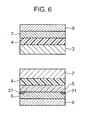
- a dust of a third paint sprayed in the third paint film-forming step K3 attaches on the first paint film 5 of the outer panel surface 2 to form a dust paint film 21 as shown in FIG. 6
- the second paint film 6 is formed thereon to hide the dust paint film 21.
- This provides an advantage of being able to reliably prevent the occurrence of an undesirable situation where the dust of the third paint is exposed on the outer panel surface 2 to cause deterioration in aesthetic appearance in the outer panel surface 2 of the automobile body 1, even if respective colors of the first paint film 6 and the third paint film 7 are slightly different from each other.
- a method for painting an automobile body which comprises: a first paint film-forming step of applying a first paint to an outer plate surface of the automobile body having a basecoat film formed thereon, to form thereon a first paint film having a basecoat hiding ability; a second paint film-forming step of, after the formation of the first paint film, applying a second paint to the first paint film to form thereon a second paint film which has a basecoat hiding ability lower than that of the first paint film and exhibits an apparent paint-film color only by itself or in cooperation with the first paint film; and a third paint film-forming step of, at least after the first paint film-forming step, applying a third paint to an inner panel surface of the automobile body having a basecoat film formed thereon, to form thereon a third paint film exhibiting an apparent paint-film color identical or similar to that of the second paint film of the outer panel surface.
- the basecoat hiding ability means an ability to ensure an ultraviolet (300 to 400 nm) transmittance of 0.05% or less and a black/white hiding ability of 10 ⁇ m or less under a condition that a paint color has a brightness of 60 or less (wherein an illumination angle is - 45 degrees and an acceptance angle is zero degree), and further ensure an ultraviolet (300 to 400 nm) transmittance of 0.05% or less and a black/white hiding ability of 20 ⁇ m or less under a condition that a paint color has a brightness of greater than 60 (wherein an illumination angle is - 45 degrees and an acceptance angle is zero degree) [see JIS K 5400 - 7.2(2) f].
- the similar colors are defined as colors having a relationship where a color difference therebetween is 2 or less (wherein an illumination angle is - 45 degrees and an acceptance angle is zero degree) [see JIS Z 8730].
- the third paint is applied to the inner panel surface to form thereon the third paint film exhibiting an apparent paint-film color identical or similar to that of the second paint film of the outer panel surface.
- the third paint film can hide a dust paint film formed by a dust of the first paint attached on the inner panel surface during the formation of the first paint film. This makes it possible to maintain aesthetic appearance of the inner panel surface in an excellent state.
- the second paint film-forming step is performed between the first paint film-forming step and the third paint film-forming step.
- the number of operations of opening/closing an openable/closable member 13, such as the an automobile side door, can be reduced, as compared with the cases where the third paint film-forming step K3 is performed between the first paint film-forming step K1 and the second paint film-forming step K2, as in a method according to an after-mentioned third aspect (the second embodiment), so that a painting operation can be simplified as compared with the method according to the after-mentioned third aspect.
- this provides another advantage of being able to suppress the occurrence of an undesirable situation where foreign particles stirred up by an operation of opening/closing the
- the third paint film-forming step is performed between the first paint film-forming step and the second paint film-forming step.
- the third paint film is formed after the formation of the first paint film, and then the second paint film is formed.
- the second paint film is formed thereon to allow the dust paint film to be hidden.
- the color of the first paint film is set to one selected from five achromatic colors having five levels of brightnesses consisting of dark gray, gray, light gray, super-light gray and white, in such a manner as to allow the second paint film to exhibit the apparent paint-film color only by itself, or in cooperation with the first paint film.
- the first paint for the first paint film can have versatility, for example, by setting the first paint film to be covered by the second paint film, to have an achromatic color. This makes it possible to reduce the number of pipes required for the application of the first paint, while effectively preventing deterioration in aesthetic appearance due to a phenomenon that a dust of the first paint applied on the outer panel surface of the automobile body attaches onto the third paint film of the inner panel surface.
- the first paint for forming the first paint film 5 incorporates a pigment comprising carbon black 18 and having a basecoat hiding ability, or contains a color pigment 19 in an amount greater than a normal amount for providing a brightness corresponding to that of the second paint film.
- the basecoat-hiding pigment is incorporated in the first paint for forming the first paint film, or an amount of the color pigment to be contained in the first paint is set to a value greater than that the normal value, so that the basecoat hiding ability of the first paint film can be effectively improved.
- This makes it possible to reflect or absorb light, such as visible light or ultraviolet light, irradiating the outer panel surface by the color pigment and others incorporated in the first paint film, so as to restrain the irradiating light, such as ultraviolet light, from reaching the basecoat film, while simplifying the painting operation by omitting an operation of applying a midcoat paint to the basecoat film formed on the outer panel surface and drying the midcoat paint.
- This provides an advantage of being able to effectively prevent premature deterioration of the basecoat film in a simple manner.
- the first paint film to be formed on the outer panel surface in the first paint film-forming step has a brightness less than that of the second paint film.
- the brightness of the first paint film to be formed on the outer panel surface of the automobile body in the first paint film-forming step is set to be less than that of the second paint film to be formed on the outer panel surface of the automobile body in the second paint film-forming step, for example, by setting an amount of a color pigment to be contained in the first paint, at a value greater than the normal value.
- the method according to the first aspect further comprises a clear paint film-forming step of forming a clear paint film at least on the second paint film formed on the outer panel surface.
- a clear paint film is formed on the second paint film formed on the outer panel surface of the automobile body.
- the clear paint film can protect the second paint film to effectively maintain weather resistance and smoothness thereof. This makes it possible to sufficiently ensure smoothness of the outer panel surface even if a dust of the third paint sprayed toward the inner panel surface during the formation of the third paint film attaches on the second paint film of the outer panel surface.
- a system for painting an automobile body which comprises: a first paint film-forming station for applying a first paint to an outer panel surface to an outer plate surface of the automobile body having a basecoat film formed thereon, to form thereon a first paint film having a basecoat hiding ability; a second paint film-forming station for applying a second paint to the first paint film to form thereon a second paint film which has a basecoat hiding ability lower than that of the first paint film and exhibits an apparent paint-film color only by itself or in cooperation with the first paint film; and a third paint film-forming station for, at least after the formation of the first paint film, applying a third paint to an inner panel surface of the automobile body having a basecoat film formed thereon, to form thereon a third paint film exhibiting an apparent paint-film color identical or similar to that of the second paint film of the outer panel surface.
- the system according to the eighth aspect further comprises a clear paint film-forming station for forming a clear paint film at least on the second paint film formed on the outer panel surface.
- a clear paint film is formed on the second paint film formed on the outer panel surface of the automobile body.
- the clear paint film can protect the second paint film to effectively maintain weather resistance and smoothness thereof. This makes it possible to sufficiently ensure smoothness of the outer panel surface even if a dust of the third paint sprayed toward the inner panel surface during the formation of the third paint film attaches on the second paint film of the outer panel surface.
Landscapes
- Life Sciences & Earth Sciences (AREA)
- Engineering & Computer Science (AREA)
- Wood Science & Technology (AREA)
- Application Of Or Painting With Fluid Materials (AREA)
- Coating Apparatus (AREA)
Abstract
Description
- The present invention relates to a method for painting an automobile body and a system therefor, and, more specifically, to a method for applying paint to an outer panel surface and an inner panel surface of an automobile body each having a basecoat film formed thereon, to perform a painting operation, and a system therefor.
- In the conventional method for painting an automobile body, the following steps were commonly followed. First, a basecoat film is formed on an outer panel surface of an automobile, then a first paint is applied onto the basecoat firm, and then a second paint is applied onto the first paint. With respect to an inner panel of the automobile, first of all, a basecoat film is formed, and then a third paint is applied onto the basecoat firm. However, while the first paint is applied to the outer panel surface of the automobile, dusts of the first paint are likely adhered to the third paint film on the inner panel surface, which results in deterioration of aesthetic appearance of the paint film of the inner panel surface.
- Furthermore, when forming an outer surface which exhibits a desired color in combination of the first paint film and the second paint film, it is necessary to prepare a large number of pipes required for application of respective ones of the first paints, and frequently change between the pipes, which inevitably causes deterioration in efficiency of a painting operation.
- In view of the above problems, it is an object of the present invention to provide an automobile body painting method capable of effectively preventing deterioration in aesthetic appearance due to a phenomenon that a dust of a first paint applied on an outer panel surface of the automobile body attaches onto a third paint film of an inner panel surface of the automobile body, in a simple operation, and a system therefor.
- In order to achieve the above object, according to one aspect of the present invention, there is provides a method for painting an automobile body, which includes a first paint film-forming step of applying a first paint to an outer plate surface of the automobile body having a basecoat film formed thereon, to form thereon a first paint film having a basecoat hiding ability, and a second paint film-forming step of, after the formation of the first paint film, applying a second paint to the first paint film to form thereon a second paint film which has a basecoat hiding ability lower than that of the first paint film and exhibits an apparent paint-film color only by itself or in cooperation with the first paint film. The method is characterized by comprising a third paint film-forming step of, at least after the first paint film-forming step, applying a third paint to an inner panel surface of the automobile body having a basecoat film formed thereon, to form thereon a third paint film exhibiting an apparent paint-film color identical or similar to that of the second paint film of the outer panel surface.
- In the present invention, at least after the formation of the first paint film, the third paint to the inner panel surface is applied the inner panel surface to form thereon the third paint film exhibiting an apparent paint-film color identical or similar to that of the second paint film of the outer panel surface, so that the third paint film can hide a dust paint film formed by a dust of the first paint attached on the inner panel surface during the first paint film-forming step. This makes it possible to maintain aesthetic appearance of the inner plate surface in an excellent state.
- These and other objects, features and advantages of the present invention will become apparent upon reading the following detailed description along with the accompanying drawings.
-
-
FIG. 1 is a process diagram showing an automobile body painting method according to a first embodiment of the present invention. -
FIG. 2 is an explanatory diagram showing a paint film configuration formed by a conventional painting method as a comparative example. -
FIG. 3 is an explanatory diagram showing a paint film configuration formed by the painting method according to the first embodiment. -
FIG. 4 is an explanatory diagram showing a light reflection state in a paint film formed by a painting method according to the present invention. -
FIG. 5 is a process diagram showing an automobile body painting method according to a second embodiment of the present invention. -
FIG. 6 is an explanatory diagram showing a paint film configuration formed by the painting method according to the second embodiment. -
FIG. 1 is a process diagram showing an automobile body painting method using an automobile body painting system, according to a first embodiment of the present invention. The painting method according to the first embodiment comprises: a basecoat film-forming step K0 of forming abasecoat film 4 on each of anouter panel surface 2 and aninner panel surface 3 of an automobile body 1; a first paint film-forming step K1 of forming afirst paint film 5 on thebasecoat film 4 of theouter panel surface 2; a second paint film-forming step K2 of forming asecond paint film 6 on thefirst paint film 5 of theouter panel surface 2; a third paint film-forming step K3 of forming athird paint film 7 on thebasecoat film 4 of theinner panel surface 3; an inner-panel clear paint film-forming step K4 of forming aclear paint film 8 on thethird paint film 7 of theinner panel surface 3; an outer-panel clear paint film-forming step K5 of forming aclear paint film 9 on thesecond paint film 6 of theouter panel surface 2; and a baking/drying step (not shown) of baking and drying the first tothird paint films 5 to 7 and theclear paint films - In the basecoat film-forming step K0, a
basecoat film 4 having a function of protecting the automobile body 1 from rust (corrosion), etc, is formed on each of the outer andinner panel surfaces - In the first paint film-forming step K1, a
first paint film 5 having a high basecoat hiding ability is formed on thebasecoat film 4 of theouter panel surface 2 of the automobile body 1, in a first paint-film forming station 12 having anelectrostatic painting machine 11, such as an air-spray, airless-spray or electrostatic atomization-type painting machine, by spray-applying a first paint to theouter panel surface 2, under a condition that an openable/closable member 13, such as an automobile side door, is approximately closed. The first paint is a liquid paint adapted to form thefirst paint film 5 having a basecoat hiding ability, wherein the liquid paint is obtained by dissolving or dispersing a pigment for allowing thefirst paint film 5 to exhibit a given color, a resin component and others, in a solvent consisting of an organic solvent or a water solvent. According to need, the first paint may further contain an extender pigment, an antisettling agent, a paint surface regulator, an ultraviolet absorber, an ultraviolet stabilizer and a tackifier, in an appropriate manner. - For example, the pigment to be contained in the first paint may be one selected from the group consisting of carbon black, titanium oxide, iron oxide, aluminum flake, and a combination of two or more thereof. According to need, the pigment may contain a given color pigment, such as one selected from the group consisting of zinc flower (zinc oxide), cadmium red, molybdenum red, chromium yellow, chromium oxide, Prussian blue, cobalt blue, azo-series pigment, phthalocyanine-series pigment, quinacridone-series pigment, isoindoline-series pigment, threne-series pigment and perylene-series pigment, or a mixture of two or more thereof.
- Preferable, the resin component to be contained in the first paint is a thermosetting resin composition. The thermosetting resin composition may include: a composition comprising a matrix resin, such as an acrylic resin, a polyester resin or an alkyd resin, which has a cross-linkable functional group, and a cross-linking agent, such as a melamine resin, an urea resin or a polyisocyanate compound (including a block copolymer thereof); and an acid/epoxy cross-linked resin composition comprising a primary component of an acid group-containing resin and an epoxy group-containing resin. More preferably, the resin component to be contained in the first paint is a thermosetting resin composition comprising: a matrix resin, such as an acrylic resin, a polyester resin or an alkyd resin, which has a cross-linkable functional group, such as a hydroxyl group, a carboxyl group or an epoxy group; and a cross-linking agent, such as a melamine resin.
- For example, in case where a gray pigment, such as carbon black or titanium oxide, is used as the pigment to be contained in the first paint, a color of the
first paint film 5 is set to an achromatic color having a brightness corresponding to that of thesecond paint film 6 to be formed on thefirst paint film 5. Specifically, the color of thefirst paint film 5 may be set to one selected from five achromatic colors having five levels of brightnesses consisting of dark gray, gray, light gray, super-light gray and white, wherein the selected achromatic color has an excellent basecoat hiding ability. Further, in cases where an amount of the color pigment to be contained in the first paint is set at a value greater than a normal value, i.e., the amount of the color pigment is set to allow the brightness of thefirst paint film 5 to become less than a brightness corresponding to that of thesecond paint film 6, the basecoat hiding ability of thefirst paint film 5 can be sufficiently ensured. - Subsequently, in the second paint film-forming step K2, a
second paint film 6 is formed on thefirst paint film 5 of theouter panel surface 2, in a second paint film-formingstation 15 having anelectrostatic painting machine 14, such as an air-spray, airless-spray or electrostatic atomization-type painting machine, by spray-applying a second paint to thefirst paint film 5 of theouter panel surface 2, while keeping thefirst paint film 5 from being hardened, i.e., maintaining thefirst paint film 5 in its unhardened state, under a condition that the openable/closable member 13, such as the an automobile side door, is approximately closed. The second paint is a liquid paint obtained by dissolving or dispersing a color pigment for allowing thesecond paint film 6 to exhibit a given apparent paint-film color, a resin component and others, in a solvent consisting of an organic solvent or a water solvent. According to need, the second paint may further contain an extender pigment, an antisettling agent, a paint surface regulator, an ultraviolet absorber, an ultraviolet stabilizer and a tackifier, in an appropriate manner. - The color pigment to be contained in the second paint is a type which has a basecoat hindering ability lower than that of the
first paint film 5, and allows thesecond paint film 6 to exhibit a specific color selected from a large number of predetermined apparent paint-film colors, only by itself or in cooperation with thefirst paint film 5. More specifically, the color pigment may be one selected from the group consisting of titanium oxide, zinc flower (zinc oxide), carbon black, cadmium red, molybdenum red, chromium yellow, chromium oxide, Prussian blue, cobalt blue, azo-series pigment, phthalocyanine-series pigment, quinacridone-series pigment, isoindoline-series pigment, threne-series pigment and perylene-series pigment, or a mixture of two or more thereof. - Then, in the third paint film-forming step K3, a
third paint film 7 exhibiting an apparent paint-film color of theinner panel surface 3 is formed on thebasecoat film 4 of theinner panel surface 3, in a third paint film-formingstation 17 having anelectrostatic painting machine 16, such as an air-spray, airless-spray or electrostatic atomization-type painting machine, by spray-applying a third paint to theinner panel surface 3, under a condition that theelectrostatic painting machine 16 is introduced inside the automobile body 1 while largely opening the openable/closable member 13. The third paint is a liquid paint obtained by dissolving or dispersing a color pigment for allowing thethird paint film 7 to exhibit a given apparent paint-film color, a resin component and others, in a solvent consisting of an organic solvent or a water solvent. According to need, the third paint may further contain an extender pigment, an antisettling agent, a paint surface regulator, an ultraviolet absorber, an ultraviolet stabilizer and a tackifier, in an appropriate manner. The same pigment as that contained in the second paint is used as the pigment to be contained in the third paint, so that thethird paint film 7 formed of the third paint can exhibit an apparent paint-film color identical or similar to that of thesecond paint film 6 formed of the second paint. - In cases where a water-soluble paint is used as each of the first to third paints forming the first to
third paint films 5 to 7, after performing a pre-heating operation for vaporizing water therein, the process is shifted to the inner-panel clear paint film-forming step K4. In the inner-panel clear paint film-forming step K4, aclear paint film 8 is formed on thethird paint film 7 of theinner panel surface 3, by applying a clear paint to thethird paint film 7 of theinner panel surface 3 using a spray painting technique, such as an air-spraying technique, an airless-spraying technique or an electrostatic spraying technique. For example, the clear paint may be a liquid paint containing a thermosetting resin composition and a solvent. According to need, the clear paint may further contain a photoluminescent pigment, a color pigment, an antisettling agent, a paint surface regulator, an ultraviolet absorber, an ultraviolet stabilizer and a tackifier, in an appropriate manner. Preferably, the photoluminescent pigment and the color pigment are mixed in the clear paint to an extent capable of preserving transparency of theclear paint film 8. - Then, the process is shifted to the outer-panel clear paint film-forming step K5. In the outer-panel clear paint film-forming step K5, a
clear paint film 9 is formed on thesecond paint film 6 of theouter panel surface 2, by applying a clear paint to thesecond paint film 6 of theouter panel surface 2 using a spray painting technique, such as an air-spraying technique, an airless-spraying technique or an electrostatic spraying technique, in the same manner as that in the inner-panel clear paint film-forming step K4. Then, in the baking/drying step (not shown), the above paint films are simultaneously hardened by heating them at a temperature of about 140°C for about 30 minutes. - As above, in the first embodiment, the automobile body painting method using the automobile body painting system comprises: the first paint film-forming step K1 of applying a first paint to an
outer panel surface 2 of an automobile body 1 having abasecoat film 4 formed thereon, to form thereon afirst paint film 5 having a basecoat hiding ability; the second paint film-forming step K2 of, after the formation of thefirst paint film 5, applying a second paint to thefirst paint film 5 to form thereon asecond paint film 6 having a basecoat hiding ability lower than that of thefirst paint film 5 and exhibiting an apparent paint-film color only by itself or in cooperation with thefirst paint film 5; and the third paint film-forming step K3 of, at least after the formation of thefirst paint film 5, applying a third paint to aninner panel surface 3 of the automobile body 1 having abasecoat film 4 formed thereon, to form thereon athird paint film 7 exhibiting an apparent paint-film color identical or similar to that of thesecond paint film 6 of theouter panel surface 2. This provides an advantage of being able to allow the first paint to have versatility to facilitate reduction in facility cost and effectively simplify a painting operation, while preventing deterioration in aesthetic appearance due to a phenomenon that a dust of the first paint applied on theouter panel surface 2 of the automobile body 1 attaches onto thethird paint film 7 of theinner panel surface 3. - Specifically, in a conventional painting method, the first paint film-forming step of forming the
first paint film 5 on theouter panel surface 2 of the automobile body 1 is performed after completion of the third paint film-forming step of forming thethird paint film 7 on theinner panel surface 3 of the automobile body 1. In this process sequence, a dust of the first paint sprayed in the first paint film-forming step to form thefirst paint film 5 on thebasecoat film 4 of theouter panel surface 2 inevitably enters the inside of the automobile body and attaches onto a peripheral edge region of theinner panel surface 3 and others, as shown inFIG. 2 . - Consequently, in cases where the
first paint film 5 formed of the first paint is set to have a color different from that of thethird paint film 7 formed of the third paint, specifically, in one example where thefirst paint film 5 and thethird paint film 7 are set to have an achromatic color and a chromatic color identical or similar to that of thesecond paint film 6, respectively, a first pant-baseddust paint film 20 attached on theinner panel surface 3 exhibits a color different from that of thethird paint film 7 exhibiting an apparent paint-film color of theinner panel surface 3, which inevitably causes deterioration in aesthetic appearance. Although theclear paint film 8 is formed as an upper layer relative to thedust paint film 20 and thethird paint film 7, theclear paint layer 8 cannot hide the difference or change in color, because it has no basecoat hiding ability. - In contrast, in the first embodiment, the third paint film-forming step K3 using the third paint film-forming
station 17 is performed after the formation of thefirst paint film 5, in such a manner that thethird paint film 7 exhibiting an apparent paint-film color identical or similar to that of thesecond paint film 6 of theouter panel surface 2 is formed on theinner panel surface 3. In this process sequence, even if adust paint film 21 is formed by a dust of the first paint attached on theinner panel surface 3 as shown inFIG. 3 , thethird paint film 7 can hide thedust paint film 21 to maintain aesthetic appearance of theinner plate surface 3 in an excellent state. - Further, the color of the
first paint film 5 may be set to one selected from five achromatic colors having five levels of brightnesses consisting of dark gray, gray, light gray, super-light gray and white, in such a manner as to allow thesecond paint film 6 to exhibit the apparent paint-film color only by itself, or in cooperation with thefirst paint film 5. In this case, the first paint for the first paint film can have versatility. This provides an advantage of being able to reduce the number of pipes required for the application of the first paint to effectively simplify a structure of the painting system, as compared with cases where thefirst paint film 5 is set to have the same color as that of thesecond paint film 6, while effectively preventing deterioration in aesthetic appearance due to the phenomenon that a dust of the first paint applied on theouter panel surface 2 of the automobile body 1 attaches onto thethird paint film 7 of theinner panel surface 3. In addition, the number of operations of changing the pipe during the formation of thefirst paint film 5 can be significantly reduced, as compared with the number of the pipe changing operations in cases where the operation has to be performed every time a color of each paint for forming the second andthird paint films - It is not necessary to allow the
first paint film 5 to exhibit a color identical or similar to the apparent paint-film color. Thus, as shown inFIG. 4 , the first paint for forming thefirst paint film 5 may incorporate a pigment having a basecoat hiding ability, such ascarbon black 18, or may contain acolor pigment 19 in an amount greater than a normal amount for providing a brightness corresponding to that of the second paint film. In this case, the basecoat hiding ability of thefirst paint film 5 can be effectively improved. This makes it possible to reflect or absorb light, such as visible light or ultraviolet light, irradiating theouter panel surface 2 by thecarbon black 18 or thecolor pigment 19 incorporated in thefirst paint film 5, so as to restrain the irradiating light, such as ultraviolet light, from reaching thebasecoat film 4, while simplifying the painting operation by omitting an operation of applying a midcoat paint to thebasecoat film 4 formed on theouter panel surface 2 and drying the midcoat paint. This provides an advantage of being able to effectively prevent premature deterioration of thebasecoat film 4 due to ultraviolet light irradiating thebasecoat film 4, in a simple manner. - Particularly, in cases where the amount of the
color pigment 19 to be contained in the first paint is set at a value greater than the normal value to allow a brightness of thefirst paint film 5 formed in the first paint film-forming step K1 to become lower than that of thesecond paint film 6 formed in the second paint film-forming step K2, the basecoat hiding ability of thefirst paint film 5 can be ensured while omitting the basecoat-hiding pigment, such as thecarbon black 18, or reducing an amount of the basecoat-hiding pigment to be contained in thefirst paint film 5. This provides an advantage of being able to effectively suppress premature deterioration of thebasecoat film 4 due to ultraviolet light irradiating thebasecoat film 4, in a simpler manner. - In the first embodiment, the third paint film-forming step K3 using the third paint film-forming
station 17 is performed after completion of both the first paint film-forming step K1 and the second paint film-forming step K2 using the first paint film-formingstation 12 and the second paint film-formingstation 15 for forming thefirst paint film 5 and thesecond film 6 on theouter panel surface 2 of the automobile body 1, as described above. In this case, the number of operations of opening/closing the openable/closable member 13, such as the an automobile side door, can be reduced, as compared with the cases where the third paint film-forming step K3 is performed between the first paint film-forming step K1 and the second paint film-forming step K2, so that the painting operation can be more simplified, as compared with an after-mentioned second embodiment of the present invention. In addition, this provides another advantage of being able to suppress the occurrence of an undesirable situation where foreign particles stirred up by an operation of opening/closing the openable/closable member 13 attach on the paint films, to effectively improve paint film quality. - Further, the method according to the first embodiment comprises the outer-panel clear paint film-forming step K5 of forming a
clear paint film 9 on thesecond paint film 6 formed on theouter panel surface 2 of the automobile body 1. Thus, theclear paint film 9 formed in the outer-panel clear paint film-forming step K5 can protect thesecond paint film 6 to effectively maintain weather resistance and smoothness thereof. This makes it possible to sufficiently ensure smoothness of theouter panel surface 2 even if a dust of the third paint sprayed toward theinner panel surface 3 in the third paint film-forming step K3 attaches on thesecond paint film 6 of theouter panel surface 2. -
FIG. 5 is a process diagram showing an automobile body painting method using an automobile body painting system, according to a second embodiment of the present invention. - The automobile body painting method according to the second embodiment comprises a first paint film-forming step K1 of forming a
first paint film 5 on abasecoat film 4 formed on anouter panel surface 2 of an automobile body 1, as with the first embodiment. In the method according to the first embodiment, thefirst paint film 5 and thesecond paint film 6 are successively formed on theouter panel surface 2 of the automobile body 1 in the first paint film-forming step K1 and the second paint film-forming step K2. The method according to the second embodiment is different from the method according to the first embodiment, in that, after forming thefirst paint film 5 using a first paint film-formingstation 12 in the first paint film-forming step K1, the automobile body 1 is transferred to a third paint film-formingstation 17 while opening an openable/closable member 13 in an approximately closed state, to perform a third paint film-forming step K3 of forming athird paint film 7 on abasecoat film 4 formed on aninner panel surface 3 of the automobile body 1, and then, after the formation of thethird paint film 7, the automobile body 1 is transported to a second paint film-formingstation 15 while approximately closing the openable/closable member 13 in the open state, to perform a second paint film-forming step K2 of forming asecond paint film 6 on thefirst paint film 5 of theouter panel surface 2. - In the second embodiment, the third paint film-forming step K3 is performed between the first paint film-forming step K1 and the second paint film-forming step K2, as described above. In this case, there is no risk of the occurrence of deterioration in aesthetic appearance due to a phenomenon that a first paint for the
first paint film 6 attaches on thethird paint film 7. Further, even if a dust of a third paint sprayed in the third paint film-forming step K3 attaches on thefirst paint film 5 of theouter panel surface 2 to form adust paint film 21 as shown inFIG. 6 , thesecond paint film 6 is formed thereon to hide thedust paint film 21. This provides an advantage of being able to reliably prevent the occurrence of an undesirable situation where the dust of the third paint is exposed on theouter panel surface 2 to cause deterioration in aesthetic appearance in theouter panel surface 2 of the automobile body 1, even if respective colors of thefirst paint film 6 and thethird paint film 7 are slightly different from each other. - In the second embodiment, there is a possibility that a dust of a second paint sprayed toward the
outer panel surface 2 in the second paint film-forming step K2 attaches on thethird paint film 7 of theinner panel surface 3. However, there is no risk of significant deterioration in aesthetic appearance of theinner panel surface 3, because the second paint is set to have a color identical or similar to that of the third paint for thethird paint film 7. Further, requirements on aesthetic appearance of theinner panel surface 3, such as color uniformity and smoothness, are not so severe as compared with theouter panel surface 2. Thus, there is no risk of the occurrence of adverse effects arising from the phenomenon that the second paint attaches on thethird paint film 6 of theinner panel surface 3. - In summary, according to a first aspect of the present invention, there is provided a method for painting an automobile body, which comprises: a first paint film-forming step of applying a first paint to an outer plate surface of the automobile body having a basecoat film formed thereon, to form thereon a first paint film having a basecoat hiding ability; a second paint film-forming step of, after the formation of the first paint film, applying a second paint to the first paint film to form thereon a second paint film which has a basecoat hiding ability lower than that of the first paint film and exhibits an apparent paint-film color only by itself or in cooperation with the first paint film; and a third paint film-forming step of, at least after the first paint film-forming step, applying a third paint to an inner panel surface of the automobile body having a basecoat film formed thereon, to form thereon a third paint film exhibiting an apparent paint-film color identical or similar to that of the second paint film of the outer panel surface.
- In the present invention, the basecoat hiding ability means an ability to ensure an ultraviolet (300 to 400 nm) transmittance of 0.05% or less and a black/white hiding ability of 10 µm or less under a condition that a paint color has a brightness of 60 or less (wherein an illumination angle is - 45 degrees and an acceptance angle is zero degree), and further ensure an ultraviolet (300 to 400 nm) transmittance of 0.05% or less and a black/white hiding ability of 20 µm or less under a condition that a paint color has a brightness of greater than 60 (wherein an illumination angle is - 45 degrees and an acceptance angle is zero degree) [see JIS K 5400 - 7.2(2) f].
- Further, the similar colors are defined as colors having a relationship where a color difference therebetween is 2 or less (wherein an illumination angle is - 45 degrees and an acceptance angle is zero degree) [see JIS Z 8730].
- In the method according to the first aspect and an after-mentioned system according to an eighth aspect of the present invention, at least after the formation of the first paint film, the third paint is applied to the inner panel surface to form thereon the third paint film exhibiting an apparent paint-film color identical or similar to that of the second paint film of the outer panel surface. Thus, the third paint film can hide a dust paint film formed by a dust of the first paint attached on the inner panel surface during the formation of the first paint film. This makes it possible to maintain aesthetic appearance of the inner panel surface in an excellent state.
- According to a second aspect of the present invention, in the method according to the first aspect, the second paint film-forming step is performed between the first paint film-forming step and the third paint film-forming step.
- In cases where the third paint film-forming step K3 using the third paint film-forming
station 17 is performed after completion of both the first paint film-forming step K1 and the second paint film-forming step K2 using the first paint film-formingstation 12 and the second paint film-formingstation 15 for forming thefirst paint film 5 and thesecond film 6 on theouter panel surface 2 of the automobile body 1, as in the method according to the second aspect (the first embodiment), the number of operations of opening/closing an openable/closable member 13, such as the an automobile side door, can be reduced, as compared with the cases where the third paint film-forming step K3 is performed between the first paint film-forming step K1 and the second paint film-forming step K2, as in a method according to an after-mentioned third aspect (the second embodiment), so that a painting operation can be simplified as compared with the method according to the after-mentioned third aspect. In addition, this provides another advantage of being able to suppress the occurrence of an undesirable situation where foreign particles stirred up by an operation of opening/closing the openable/closable member 13 attach on the paint films, to effectively improve paint film quality. - According to a third aspect of the present invention, in the method according to the first aspect, the third paint film-forming step is performed between the first paint film-forming step and the second paint film-forming step.
- In the method according to the third aspect, the third paint film is formed after the formation of the first paint film, and then the second paint film is formed. In this case, there is no risk of the occurrence of deterioration in aesthetic appearance due to a phenomenon that a first paint for the first paint film attaches on the third paint film. Further, even if a dust of a third paint sprayed to the inner panel surface of the automobile body during the formation of the third paint film attaches on the first paint film of the outer panel surface to form a dust paint film, the second paint film is formed thereon to allow the dust paint film to be hidden. This makes it possible to prevent the occurrence of an undesirable situation where the third paint is exposed on the outer panel surface to cause deterioration in aesthetic appearance in the outer panel surface of the automobile body, even if respective colors of the first paint film and the third paint film are slightly different from each other.
- According to a fourth aspect of the present invention, in the method according to each of the second and third aspects, the color of the first paint film is set to one selected from five achromatic colors having five levels of brightnesses consisting of dark gray, gray, light gray, super-light gray and white, in such a manner as to allow the second paint film to exhibit the apparent paint-film color only by itself, or in cooperation with the first paint film.
- In this case, the first paint for the first paint film can have versatility, for example, by setting the first paint film to be covered by the second paint film, to have an achromatic color. This makes it possible to reduce the number of pipes required for the application of the first paint, while effectively preventing deterioration in aesthetic appearance due to a phenomenon that a dust of the first paint applied on the outer panel surface of the automobile body attaches onto the third paint film of the inner panel surface.
- According to a fifth aspect of the present invention, in the method according to each of the second and third aspects, the first paint for forming the
first paint film 5 incorporates a pigment comprisingcarbon black 18 and having a basecoat hiding ability, or contains acolor pigment 19 in an amount greater than a normal amount for providing a brightness corresponding to that of the second paint film. - In this case, the basecoat-hiding pigment is incorporated in the first paint for forming the first paint film, or an amount of the color pigment to be contained in the first paint is set to a value greater than that the normal value, so that the basecoat hiding ability of the first paint film can be effectively improved. This makes it possible to reflect or absorb light, such as visible light or ultraviolet light, irradiating the outer panel surface by the color pigment and others incorporated in the first paint film, so as to restrain the irradiating light, such as ultraviolet light, from reaching the basecoat film, while simplifying the painting operation by omitting an operation of applying a midcoat paint to the basecoat film formed on the outer panel surface and drying the midcoat paint. This provides an advantage of being able to effectively prevent premature deterioration of the basecoat film in a simple manner.
- According to a sixth aspect of the present invention, in the method according to the first aspect, the first paint film to be formed on the outer panel surface in the first paint film-forming step has a brightness less than that of the second paint film.
- In this case, the brightness of the first paint film to be formed on the outer panel surface of the automobile body in the first paint film-forming step is set to be less than that of the second paint film to be formed on the outer panel surface of the automobile body in the second paint film-forming step, for example, by setting an amount of a color pigment to be contained in the first paint, at a value greater than the normal value. This provides an advantage of being able to effectively suppress premature deterioration of the basecoat film due to ultraviolet light irradiating the basecoat film, in a simpler manner.
- According to a seventh aspect of the present invention, the method according to the first aspect further comprises a clear paint film-forming step of forming a clear paint film at least on the second paint film formed on the outer panel surface.
- In the method according to the seventh aspect, a clear paint film is formed on the second paint film formed on the outer panel surface of the automobile body. Thus, the clear paint film can protect the second paint film to effectively maintain weather resistance and smoothness thereof. This makes it possible to sufficiently ensure smoothness of the outer panel surface even if a dust of the third paint sprayed toward the inner panel surface during the formation of the third paint film attaches on the second paint film of the outer panel surface.
- According to an eighth aspect of the present invention, there is provided a system for painting an automobile body, which comprises: a first paint film-forming station for applying a first paint to an outer panel surface to an outer plate surface of the automobile body having a basecoat film formed thereon, to form thereon a first paint film having a basecoat hiding ability; a second paint film-forming station for applying a second paint to the first paint film to form thereon a second paint film which has a basecoat hiding ability lower than that of the first paint film and exhibits an apparent paint-film color only by itself or in cooperation with the first paint film; and a third paint film-forming station for, at least after the formation of the first paint film, applying a third paint to an inner panel surface of the automobile body having a basecoat film formed thereon, to form thereon a third paint film exhibiting an apparent paint-film color identical or similar to that of the second paint film of the outer panel surface.
- According to a ninth aspect of the present invention, the system according to the eighth aspect further comprises a clear paint film-forming station for forming a clear paint film at least on the second paint film formed on the outer panel surface.
- In the system according to the ninth aspect, a clear paint film is formed on the second paint film formed on the outer panel surface of the automobile body. Thus, the clear paint film can protect the second paint film to effectively maintain weather resistance and smoothness thereof. This makes it possible to sufficiently ensure smoothness of the outer panel surface even if a dust of the third paint sprayed toward the inner panel surface during the formation of the third paint film attaches on the second paint film of the outer panel surface.
- Although the present invention has been fully described by way of example with reference to the accompanying drawings, it is to be understood that various changes and modifications will be apparent to those skilled in the art. Therefore, unless otherwise such changes and modifications depart from the scope of the present invention hereinafter defined, they should be construed as being included therein.
Claims (11)
- A method for painting an automobile body, which comprises:a first paint film-forming step of applying a first paint to an outer plate surface of the automobile body having a basecoat film formed thereon, to form thereon a first paint film having a basecoat hiding ability; anda second paint film-forming step of, after the formation of the first paint film, applying a second paint to the first paint film to form thereon a second paint film which has a basecoat hiding ability lower than that of the first paint film and exhibits an apparent paint-film color only by itself or in cooperation with the first paint film,characterized by a third paint film-forming step of, at least after the first paint film-forming step, applying a third paint to an inner panel surface of the automobile body having a basecoat film formed thereon, to form thereon a third paint film exhibiting an apparent paint-film color identical or similar to that of the second paint film of the outer panel surface.
- The method as defined in claim 1, characterized in that the second paint film-forming step is performed between the first paint film-forming step and the third paint film-forming step.
- The method as defined in claim 1, characterized in that the third paint film-forming step is performed between the first paint film-forming step and the second paint film-forming step.
- The method as defined in claim 2 or 3, characterized in that the color of the first paint film is set to one selected from five achromatic colors having five levels of brightnesses consisting of dark gray, gray, light gray, super-light gray and white, in such a manner as to allow the second paint film to exhibit the apparent paint-film color only by itself, or in cooperation with the first paint film.
- The method as defined in claim 2 or 3, characterized in that the first paint for forming the first paint film incorporates a pigment comprising carbon black and having a basecoat hiding ability, or contains a color pigment in an amount greater than a normal amount for providing a brightness corresponding to that of the second paint film.
- The method as defined in any one of claims 1 to 5, characterized in that the first paint film to be formed on the outer panel surface in the first paint film-forming step has a brightness less than that of the second paint film.
- The method as defined in any one of claims 1 to 6, characterized by further comprising a clear paint film-forming step of forming a clear paint film at least on the second paint film formed on the outer panel surface.
- A system for painting an automobile body, which comprises:a first paint film-forming station for applying a first paint to an outer panel surface to an outer plate surface of the automobile body having a basecoat film formed thereon, to form thereon a first paint film having a basecoat hiding ability; anda second paint film-forming station for applying a second paint to the first paint film to form thereon a second paint film which has a basecoat hiding ability lower than that of the first paint film and exhibits an apparent paint-film color only by itself or in cooperation with the first paint film,characterized by a third paint film-forming station for, at least after the formation of the first paint film, applying a third paint to an inner panel surface of the automobile body having a basecoat film formed thereon, to form thereon a third paint film exhibiting an apparent paint-film color identical or similar to that of the second paint film of the outer panel surface.
- The system as defined in claim 8, characterized by further comprising a clear paint film-forming station for forming a clear paint film at least on the second paint film formed on the outer panel surface.
- The method as defined in claim 1, characterized in that:the basecoat hiding ability is determined by a comparative evaluation, on the basis of transmittance of ultraviolet of 300 to 400 nm and a black/white hiding ability under a condition that a paint color has a brightness of 60 or less, wherein an illumination angle is - 45 degrees and an acceptance angle is zero degree, and transmittance of ultraviolet of 300 to 400 nm and a black/white hiding ability under a condition that a paint color has a brightness of greater than 60, wherein an illumination angle is - 45 degrees and an acceptance angle is zero degree; andsaid similar colors are defined as colors having a relationship where a color difference therebetween is 2 or less, wherein an illumination angle is - 45 degrees and an acceptance angle is zero degree.
- The system as defined in claim 8, characterized in that:the basecoat hiding ability is determined by a comparative evaluation, on the basis of transmittance of ultraviolet of 300 to 400 nm and a black/white hiding ability under a condition that a paint color has a brightness of 60 or less, wherein an illumination angle is - 45 degrees and an acceptance angle is zero degree, and transmittance of ultraviolet of 300 to 400 nm and a black/white hiding ability under a condition that a paint color has a brightness of greater than 60, wherein an illumination angle is - 45 degrees and an acceptance angle is zero degree; andsaid similar colors are defined as colors having a relationship where a color difference therebetween is 2 or less, wherein an illumination angle is - 45 degrees and an acceptance angle is zero degree.
Applications Claiming Priority (1)
| Application Number | Priority Date | Filing Date | Title |
|---|---|---|---|
| JP2009082020A JP4962518B2 (en) | 2009-03-30 | 2009-03-30 | How to paint a car body |
Publications (2)
| Publication Number | Publication Date |
|---|---|
| EP2239060A2 true EP2239060A2 (en) | 2010-10-13 |
| EP2239060A3 EP2239060A3 (en) | 2010-10-20 |
Family
ID=42315623
Family Applications (1)
| Application Number | Title | Priority Date | Filing Date |
|---|---|---|---|
| EP10154851A Withdrawn EP2239060A3 (en) | 2009-03-30 | 2010-02-26 | Method for painting automobile body and system therefor |
Country Status (4)
| Country | Link |
|---|---|
| US (1) | US20100247744A1 (en) |
| EP (1) | EP2239060A3 (en) |
| JP (1) | JP4962518B2 (en) |
| CN (1) | CN101850331B (en) |
Families Citing this family (10)
| Publication number | Priority date | Publication date | Assignee | Title |
|---|---|---|---|---|
| US8927094B2 (en) * | 2011-03-16 | 2015-01-06 | Seiko Epson Corporation | Printed article and method of manufacturing printed article |
| JP5742411B2 (en) * | 2011-04-12 | 2015-07-01 | セイコーエプソン株式会社 | Printed matter and method for producing printed matter |
| US9187034B2 (en) | 2013-03-15 | 2015-11-17 | International Automotive Components Group North America, Inc. | Luminescent, ultraviolet protected automotive interior members |
| JP5805147B2 (en) * | 2013-07-01 | 2015-11-04 | 本田技研工業株式会社 | Painting method |
| CN103789814A (en) * | 2013-11-13 | 2014-05-14 | 浙江吉利控股集团有限公司 | Manufacturing method of standard color plate for automotive coating |
| CA3057968C (en) * | 2017-03-29 | 2022-11-15 | Kansai Paint Co., Ltd. | Method for forming multilayer coating film |
| CN113510109B (en) * | 2021-04-23 | 2022-10-14 | 安徽捷泰智能科技有限公司 | Channel surface repairing device for color sorter |
| JP7771913B2 (en) * | 2022-10-14 | 2025-11-18 | トヨタ自動車株式会社 | How to paint a vehicle body |
| CN118635082A (en) * | 2024-06-12 | 2024-09-13 | 中国第一汽车股份有限公司 | A method for spraying water-based color paint on inner surface of vehicle body |
| CN121164222B (en) * | 2025-10-13 | 2026-07-24 | 立邦涂料(中国)有限公司 | A quantitative method for testing the wet hiding power of paint films |
Family Cites Families (12)
| Publication number | Priority date | Publication date | Assignee | Title |
|---|---|---|---|---|
| JP2611567B2 (en) * | 1991-05-14 | 1997-05-21 | トヨタ車体株式会社 | How to apply mica-based paint |
| JP3755844B2 (en) * | 1996-11-15 | 2006-03-15 | 本田技研工業株式会社 | Multi-layer coating formation method |
| JPH10296169A (en) * | 1997-04-23 | 1998-11-10 | Nippon Paint Co Ltd | 3 coats 1 bake type high chroma solid color coating film forming method |
| JPH11262727A (en) * | 1998-03-17 | 1999-09-28 | Kansai Paint Co Ltd | Method for forming double-layer topcoat film |
| JP2002167696A (en) * | 2000-11-27 | 2002-06-11 | Nippon Paint Co Ltd | Coating film forming method and substrate |
| JP3487301B2 (en) * | 2001-08-06 | 2004-01-19 | マツダ株式会社 | Painting method and painting equipment for automobile body |
| JP2003093966A (en) * | 2001-09-20 | 2003-04-02 | Nippon Paint Co Ltd | Method for forming a coating film on an automobile body and an automobile having a coating film |
| JP3837331B2 (en) * | 2001-12-28 | 2006-10-25 | 本田技研工業株式会社 | Car body coating film forming method and sealant drying apparatus |
| US20060008588A1 (en) * | 2004-07-12 | 2006-01-12 | Marc Chilla | Process for the production of multi-layer coatings |
| JP4647262B2 (en) * | 2004-08-25 | 2011-03-09 | ダイハツ工業株式会社 | Painting method |
| US20060177639A1 (en) * | 2005-02-04 | 2006-08-10 | Elzen Kerstin T | Process for the production of primer surfacer-free multi-layer coatings |
| US7740911B2 (en) * | 2005-10-07 | 2010-06-22 | E. I. Du Pont De Nemours And Company | Method of forming a multi-layer coating on automobile bodies without a primer bake |
-
2009
- 2009-03-30 JP JP2009082020A patent/JP4962518B2/en active Active
-
2010
- 2010-02-26 EP EP10154851A patent/EP2239060A3/en not_active Withdrawn
- 2010-02-26 CN CN201010131718.6A patent/CN101850331B/en not_active Expired - Fee Related
- 2010-03-08 US US12/719,473 patent/US20100247744A1/en not_active Abandoned
Non-Patent Citations (1)
| Title |
|---|
| None |
Also Published As
| Publication number | Publication date |
|---|---|
| EP2239060A3 (en) | 2010-10-20 |
| JP4962518B2 (en) | 2012-06-27 |
| CN101850331A (en) | 2010-10-06 |
| US20100247744A1 (en) | 2010-09-30 |
| CN101850331B (en) | 2015-05-27 |
| JP2010234179A (en) | 2010-10-21 |
Similar Documents
| Publication | Publication Date | Title |
|---|---|---|
| US20100247744A1 (en) | Method for painting automobile body and system therefor | |
| US10239091B2 (en) | Method for forming multilayer coating film | |
| EP1765523B1 (en) | Process for the production of multi-layer coatings | |
| JP2004351389A (en) | Bright coating film forming method and painted object | |
| TWI773559B (en) | Multilayer coating film formation method | |
| EP1843862B1 (en) | Process for the production of primer surfacer-free multi-layer coatings | |
| TWI793326B (en) | Multilayer coating film forming method | |
| JP2021041376A (en) | Coating method for automobile body | |
| JP5580594B2 (en) | Multilayer coating manufacturing method | |
| EP1838459B1 (en) | Process for the production of primer surfacer-free multi-layer coatings | |
| JP2004351390A (en) | Bright coating film forming method and painted object | |
| JP2021006395A (en) | Lacquer-tone coating structure | |
| JP5293341B2 (en) | Method and apparatus for painting automobile body | |
| US7968151B2 (en) | Process for the production of multi-layer coatings | |
| JP5515362B2 (en) | How to paint a car body | |
| JP5179917B2 (en) | Painting method | |
| JP2010234186A (en) | Method and apparatus for painting automobile body | |
| JP2025181166A (en) | Multilayer coating film forming method and multilayer coating film structure | |
| WO2022167173A1 (en) | Method for forming a multilayer coating and object coated with such a multilayer coating | |
| JP2022104361A (en) | Shared paint composition set for forming coating film of outer plate and inner plate of automobile, coating film of outer plate and inner plate of automobile, and method of forming coating film of outer plate and inner plate of automobile | |
| JP2009233522A (en) | Painting method | |
| JPH0975836A (en) | Method for two-tone coating |
Legal Events
| Date | Code | Title | Description |
|---|---|---|---|
| PUAI | Public reference made under article 153(3) epc to a published international application that has entered the european phase |
Free format text: ORIGINAL CODE: 0009012 |
|
| PUAL | Search report despatched |
Free format text: ORIGINAL CODE: 0009013 |
|
| AK | Designated contracting states |
Kind code of ref document: A2 Designated state(s): AT BE BG CH CY CZ DE DK EE ES FI FR GB GR HR HU IE IS IT LI LT LU LV MC MK MT NL NO PL PT RO SE SI SK SM TR |
|
| AX | Request for extension of the european patent |
Extension state: AL BA RS |
|
| AK | Designated contracting states |
Kind code of ref document: A3 Designated state(s): AT BE BG CH CY CZ DE DK EE ES FI FR GB GR HR HU IE IS IT LI LT LU LV MC MK MT NL NO PL PT RO SE SI SK SM TR |
|
| AX | Request for extension of the european patent |
Extension state: AL BA RS |
|
| 17P | Request for examination filed |
Effective date: 20110407 |
|
| 17Q | First examination report despatched |
Effective date: 20120403 |
|
| STAA | Information on the status of an ep patent application or granted ep patent |
Free format text: STATUS: THE APPLICATION IS DEEMED TO BE WITHDRAWN |
|
| 18D | Application deemed to be withdrawn |
Effective date: 20121014 |