EP2233447A1 - Cover glass for portable terminal, method for manufacturing cover glass for portable terminal, and portable terminal apparatus - Google Patents
Cover glass for portable terminal, method for manufacturing cover glass for portable terminal, and portable terminal apparatus Download PDFInfo
- Publication number
- EP2233447A1 EP2233447A1 EP08861136A EP08861136A EP2233447A1 EP 2233447 A1 EP2233447 A1 EP 2233447A1 EP 08861136 A EP08861136 A EP 08861136A EP 08861136 A EP08861136 A EP 08861136A EP 2233447 A1 EP2233447 A1 EP 2233447A1
- Authority
- EP
- European Patent Office
- Prior art keywords
- cover glass
- glass
- mobile terminal
- percent
- terminal according
- Prior art date
- Legal status (The legal status is an assumption and is not a legal conclusion. Google has not performed a legal analysis and makes no representation as to the accuracy of the status listed.)
- Granted
Links
Images


Classifications
-
- H—ELECTRICITY
- H04—ELECTRIC COMMUNICATION TECHNIQUE
- H04B—TRANSMISSION
- H04B1/00—Details of transmission systems, not covered by a single one of groups H04B3/00 - H04B13/00; Details of transmission systems not characterised by the medium used for transmission
- H04B1/38—Transceivers, i.e. devices in which transmitter and receiver form a structural unit and in which at least one part is used for functions of transmitting and receiving
- H04B1/3827—Portable transceivers
- H04B1/3888—Arrangements for carrying or protecting transceivers
-
- C—CHEMISTRY; METALLURGY
- C03—GLASS; MINERAL OR SLAG WOOL
- C03C—CHEMICAL COMPOSITION OF GLASSES, GLAZES OR VITREOUS ENAMELS; SURFACE TREATMENT OF GLASS; SURFACE TREATMENT OF FIBRES OR FILAMENTS MADE FROM GLASS, MINERALS OR SLAGS; JOINING GLASS TO GLASS OR OTHER MATERIALS
- C03C3/00—Glass compositions
- C03C3/04—Glass compositions containing silica
- C03C3/076—Glass compositions containing silica with 40% to 90% silica, by weight
- C03C3/083—Glass compositions containing silica with 40% to 90% silica, by weight containing aluminium oxide or an iron compound
-
- C—CHEMISTRY; METALLURGY
- C03—GLASS; MINERAL OR SLAG WOOL
- C03C—CHEMICAL COMPOSITION OF GLASSES, GLAZES OR VITREOUS ENAMELS; SURFACE TREATMENT OF GLASS; SURFACE TREATMENT OF FIBRES OR FILAMENTS MADE FROM GLASS, MINERALS OR SLAGS; JOINING GLASS TO GLASS OR OTHER MATERIALS
- C03C15/00—Surface treatment of glass, not in the form of fibres or filaments, by etching
-
- C—CHEMISTRY; METALLURGY
- C03—GLASS; MINERAL OR SLAG WOOL
- C03C—CHEMICAL COMPOSITION OF GLASSES, GLAZES OR VITREOUS ENAMELS; SURFACE TREATMENT OF GLASS; SURFACE TREATMENT OF FIBRES OR FILAMENTS MADE FROM GLASS, MINERALS OR SLAGS; JOINING GLASS TO GLASS OR OTHER MATERIALS
- C03C15/00—Surface treatment of glass, not in the form of fibres or filaments, by etching
- C03C15/02—Surface treatment of glass, not in the form of fibres or filaments, by etching for making a smooth surface
-
- C—CHEMISTRY; METALLURGY
- C03—GLASS; MINERAL OR SLAG WOOL
- C03C—CHEMICAL COMPOSITION OF GLASSES, GLAZES OR VITREOUS ENAMELS; SURFACE TREATMENT OF GLASS; SURFACE TREATMENT OF FIBRES OR FILAMENTS MADE FROM GLASS, MINERALS OR SLAGS; JOINING GLASS TO GLASS OR OTHER MATERIALS
- C03C21/00—Treatment of glass, not in the form of fibres or filaments, by diffusing ions or metals in the surface
- C03C21/001—Treatment of glass, not in the form of fibres or filaments, by diffusing ions or metals in the surface in liquid phase, e.g. molten salts, solutions
- C03C21/002—Treatment of glass, not in the form of fibres or filaments, by diffusing ions or metals in the surface in liquid phase, e.g. molten salts, solutions to perform ion-exchange between alkali ions
-
- H—ELECTRICITY
- H04—ELECTRIC COMMUNICATION TECHNIQUE
- H04M—TELEPHONIC COMMUNICATION
- H04M1/00—Substation equipment, e.g. for use by subscribers
- H04M1/02—Constructional features of telephone sets
- H04M1/0202—Portable telephone sets, e.g. cordless phones, mobile phones or bar type handsets
- H04M1/026—Details of the structure or mounting of specific components
- H04M1/0266—Details of the structure or mounting of specific components for a display module assembly
-
- C—CHEMISTRY; METALLURGY
- C03—GLASS; MINERAL OR SLAG WOOL
- C03C—CHEMICAL COMPOSITION OF GLASSES, GLAZES OR VITREOUS ENAMELS; SURFACE TREATMENT OF GLASS; SURFACE TREATMENT OF FIBRES OR FILAMENTS MADE FROM GLASS, MINERALS OR SLAGS; JOINING GLASS TO GLASS OR OTHER MATERIALS
- C03C2204/00—Glasses, glazes or enamels with special properties
- C03C2204/08—Glass having a rough surface
-
- Y—GENERAL TAGGING OF NEW TECHNOLOGICAL DEVELOPMENTS; GENERAL TAGGING OF CROSS-SECTIONAL TECHNOLOGIES SPANNING OVER SEVERAL SECTIONS OF THE IPC; TECHNICAL SUBJECTS COVERED BY FORMER USPC CROSS-REFERENCE ART COLLECTIONS [XRACs] AND DIGESTS
- Y10—TECHNICAL SUBJECTS COVERED BY FORMER USPC
- Y10T—TECHNICAL SUBJECTS COVERED BY FORMER US CLASSIFICATION
- Y10T428/00—Stock material or miscellaneous articles
- Y10T428/24—Structurally defined web or sheet [e.g., overall dimension, etc.]
- Y10T428/24355—Continuous and nonuniform or irregular surface on layer or component [e.g., roofing, etc.]
-
- Y—GENERAL TAGGING OF NEW TECHNOLOGICAL DEVELOPMENTS; GENERAL TAGGING OF CROSS-SECTIONAL TECHNOLOGIES SPANNING OVER SEVERAL SECTIONS OF THE IPC; TECHNICAL SUBJECTS COVERED BY FORMER USPC CROSS-REFERENCE ART COLLECTIONS [XRACs] AND DIGESTS
- Y10—TECHNICAL SUBJECTS COVERED BY FORMER USPC
- Y10T—TECHNICAL SUBJECTS COVERED BY FORMER US CLASSIFICATION
- Y10T428/00—Stock material or miscellaneous articles
- Y10T428/24—Structurally defined web or sheet [e.g., overall dimension, etc.]
- Y10T428/24777—Edge feature
-
- Y—GENERAL TAGGING OF NEW TECHNOLOGICAL DEVELOPMENTS; GENERAL TAGGING OF CROSS-SECTIONAL TECHNOLOGIES SPANNING OVER SEVERAL SECTIONS OF THE IPC; TECHNICAL SUBJECTS COVERED BY FORMER USPC CROSS-REFERENCE ART COLLECTIONS [XRACs] AND DIGESTS
- Y10—TECHNICAL SUBJECTS COVERED BY FORMER USPC
- Y10T—TECHNICAL SUBJECTS COVERED BY FORMER US CLASSIFICATION
- Y10T428/00—Stock material or miscellaneous articles
- Y10T428/31—Surface property or characteristic of web, sheet or block
- Y10T428/315—Surface modified glass [e.g., tempered, strengthened, etc.]
Definitions
- the present invention relates to cover glass used in protecting a display screen of a mobile terminal device such as, for example, a cellular phone and PDA (Personal Digital Assistant), manufacturing method of the cover glass and mobile terminal device.
- a mobile terminal device such as, for example, a cellular phone and PDA (Personal Digital Assistant)
- PDA Personal Digital Assistant
- a protective plate made of plastic for example, protective plate made of acrylic resin with high transparency is disposed at a predetermined distance outside the display (for example, Patent Document 1).
- the protective plate made of acrylic resin tends to bend by external force, it is necessary to set the distance between the protective plate and display at a large extent to which the bending can be absorbed. Further, it is required to increase the thickness to provide the protective plate made of acrylic resin with strength to some extent. Therefore, it has become difficult to actualize thinner mobile terminal devices.
- Patent Document 2 describes cover glass for mobile terminals obtained by cutting plate glass of a specific glass composition into a predetermined shape, chamfering the edge face, performing mirror polishing processing on both surfaces, and then forming a compressive stress layer in the surface by chemical strengthening, thereby suppressing its bending and reducing its tendency to break, and a manufacturing method of the cover glass.
- Patent Document 1 Japanese Unexamined Patent Publication No. 2004-299199
- Patent Document 1 Japanese Unexamined Patent Publication No. 2007-99557
- cover glass is requested in complicated shapes as a shape of the external form of the cover glass, starting conventional simple rectangle shapes, such as shapes (for example, shapes with the negative curvature such that some side constituting the cover glass is largely dented inward) in accordance with the shape of a display screen of the apparatus, and other shapes such that a hole is formed on the main surface of the cover glass.
- the present invention was made in view of the problems, and it is an object of the invention to provide cover glass satisfying high mechanical strength required for cover glass for a mobile terminal even in a complicated shape, manufacturing method of the cover glass and a mobile terminal device with a display screen having high mechanical strength.
- Cover glass for a mobile terminal of the invention is cover glass that is obtained by cutting a plate-shaped glass substrate into a desired shape by etching and that protects a display screen of the mobile terminal, and is characterized in that an edge face of the cover glass is formed of a molten glass surface, and that as surface roughness of the edge face, arithmetic mean roughness Ra is 10 nm or less.
- the cover glass for a mobile terminal according to this configuration is obtained by cutting a plate-shaped glass substrate into a desired shape by etching without undergoing mechanical processing, thereby has high smoothness of the order of nanometers such that surface roughness of the edge face of the cover glass is 10 nm or less, as compared with cover glass undergoing external form formation by mechanical processing, and thus has a surface state with extremely high smoothness further without micro-cracks that are certainly formed in performing external form formation by mechanical processing. Therefore, even when the shape of the external form of the cover glass for a mobile terminal is a complicated shape, it is possible to satisfy high mechanical strength required for the cover glass for a mobile terminal.
- the main surface of the cover glass is formed of a molten glass surface formed by a down-draw method, and as surface roughness of the main surface, arithmetic mean roughness Ra is preferably 0.5 nm or less. According to this configuration, the cover glass becomes further excellent in mechanical strength.
- the desired shape is preferably a shape including a portion having the negative curvature in part of a contour constituting the cover glass.
- a plate thickness of the cover glass is preferably 0.5 mm or less.
- the cover glass is preferably aluminosilicate glass containing at least one selected from the group consisting of SiO 2 Al 2 O 3 , Li 2 O and Na 2 O.
- the main surface of the glass substrate can be a molten glass surface having extremely high smoothness of the order of nanometers without flaws. Accordingly, the need for performing mirror polishing processing on the main surface is eliminated in fabricating the cover glass, and the cover glass without micro-cracks even in the main surface is obtained and becomes the cover glass excellent in mechanical strength. Further, since chemically strengthening by ion exchange is made possible, it is possible to further enhance the mechanical strength.
- the aluminosilicate glass preferably contains 62 percent to 75 percent by weight of SiO 2 , 5 percent to 15 percent by weight of Al 2 O 3 , 4 percent to 10 percent by weight of Li 2 O, 4 percent to 12 percent by weight of Na 2 O, and 5.5 percent to 15 percent by weight of ZrO 2 . According to this configuration, stable glass manufacturing is made possible, and obtained is glass excellent in mechanical strength. Further, the cover glass for a mobile terminal is used in significantly severe environments such that the cover glass comes into contact with human skin, water, rain, etc. and even in such environments, is capable of having sufficient chemical durability.
- the cover glass for a mobile terminal of the invention, is preferable glass that is chemically strengthened by ion exchange treatment. Further, the cover glass preferably has compressive stress layers in the main surface and the edge face. According to this configuration, the surfaces of cover glass are chemically strengthened, the compressive stress layers are further formed in the surfaces (main surfaces and the edge face), and it is thereby possible to further increase the mechanical strength.
- the edge face of the cover glass preferably has a protruding center portion, and incline surfaces inclined respectively toward both main surface sides from the center portion. According to this configuration, in inserting the cover glass in a frame or the like of a mobile terminal device, it is possible to insert the glass with ease without galling and/or chipping occurring.
- a method of manufacturing cover glass for a mobile terminal of the invention is a method of manufacturing cover glass for a mobile terminal for protecting a display screen of the mobile terminal, and is characterized by forming a resist pattern on main surfaces of a plate-shaped glass substrate, then etching the glass substrate with an etchant of a mixed acid aqueous solution containing hydrofluoric acid and at least one kind of acid among sulfuric acid, nitric acid, hydrochloric acid, and hydrofluorosilicic acid using the resist pattern as a mask, and thereby cutting the glass substrate into a desired shape.
- the cover glass having an extremely high surface state is obtained such that surface roughness of an edge face of the cover glass cut into the desired shape has high smoothness of the order of nanometers, and that micro-cracks do not exist which are certainly formed in forming the external form by mechanical processing.
- dimensional accuracy of the cut cover glass is also excellent. Accordingly, even when the shape of the external form of the cover glass for a mobile terminal is a complicated shape, the cover glass with good dimensional accuracy is obtained, and it is possible to obtain high mechanical strength required for the cover glass for a mobile terminal.
- the plate-shaped glass substrate is preferably formed by a down-draw method.
- both main surfaces of the plate-Ssaped glass substrate formed by the down-draw method have surfaces formed by hot forming, and thereby have extremely high smoothness of the order of nanometers, and surface states without micro-cracks.
- etching uniformly from the both main surfaces in etching the glass substrate from the both main surfaces using resist patterns formed on the both main surfaces of the glass substrate as a mask since it is possible to perform etching uniformly from the both main surfaces in etching the glass substrate from the both main surfaces using resist patterns formed on the both main surfaces of the glass substrate as a mask, dimensional accuracy is good, and the shape in cross section of the edge face of the cover glass is excellent, thus being preferable.
- the desired shape is preferably a shape including a portion having the negative curvature in part of a contour constituting the cover glass.
- the cover glass is preferably aluminosilicate glass containing at least one selected from the group consisting of SiO 2 , Al 2 O 3 , Li 2 O and Na 2 O.
- the main surface of the glass substrate does not have flaws, and obtains a surface state having extremely high smoothness of the order of nanometers. Accordingly, the need for performing mirror polishing processing on the main surface is eliminated in fabricating the cover glass, and the cover glass without micro-cracks even in the main surface is obtained and becomes the cover glass excellent in mechanical strength. Further, since chemical strengthening by ion exchange is made possible, it is possible to further enhance the mechanical strength.
- the compressive stress layers are formed in the entire surfaces (main surfaces and the edge face) constituting the cover glass, and it is thereby possible to further increase the mechanical strength.
- a mobile terminal device of the invention is characterized by having an apparatus body having a display screen, and the above-mentioned cover glass for a mobile terminal provided above the display screen. According to this configuration, it is possible to provide a mobile terminal device with the screen display having high mechanical strength.
- the cover glass for a mobile terminal of the invention even when the shape is complicated, it is possible to obtain high mechanical strength required for the cover glass for a mobile terminal. Further, in the mobile terminal device of the invention, even when the cover glass protecting the display screen has a complicated shape, it is possible to obtain the mobile terminal device with the display screen having high mechanical strength.
- FIG. 1 is a cross-sectional view showing part of a mobile terminal device equipped with cover glass for mobile terminals according to an Embodiment of the invention.
- cover glass 1 is disposed at a distance D above a liquid crystal display panel 2.
- the liquid crystal display panel 2 is configured such that a pair of glass substrates 21 and 22 sandwich a liquid crystal layer 23.
- the other members are omitted which are generally used in a liquid crystal display panel.
- the cover glass in this Embodiment of the invention is obtained by forming a resist pattern on a main surface of a plate-shaped glass substrate, then etching the glass substrate with an etchant using the resist pattern as a mask, and thereby cutting the glass substrate into a desired shape, while an edge face 14 of the cover glass 1 as shown in FIG. 3 is formed of a molten glass surface, and surface roughness (arithmetic mean roughness Ra) in the edge face 14 is 10 nm or less.
- the edge face 14 formed by etching has extremely high smoothness, is formed of the molten glass surface, and therefore, is in a state without micro-cracks that certainly exist on an edge face formed by mechanical processing.
- the cover glass with such a configuration even when the shape of the external form of the cover glass for mobile terminals is a complicated shape, it is possible to process the external form into a desired shape with ease, and it is possible obtain high mechanical strength required for cover glass for mobile terminals.
- the plate thickness is 0.5 mm or less and thus thin, it is possible to maintain high mechanical strength.
- cover glass with a thin thickness is inserted in an apparatus, since the cover glass is hard to bend by external force due to the high mechanical strength, it is possible to reduce the distance between the cover grass and display. As a result, it is possible to intend to thin the apparatus.
- any etchant capable of etching a glass substrate can be used as an etchant used in wet etching.
- an acidic solution containing hydrofluoric acid as the main ingredient, mixed acid containing hydrofluoric acid and at least one kind of acid among sulfuric acid, nitric acid, hydrochloric acid, and hydrofluorosilicic acid, etc.
- an etchant used in dry etching any etchant capable of etching a glass substrate can be used, and for example, it is possible to use fluorine gas.
- the cover glass 1 of the invention can be formed in a shape including a portion having the negative curvature in part of a contour constituting the cover glass as shown in FIG. 2(a) .
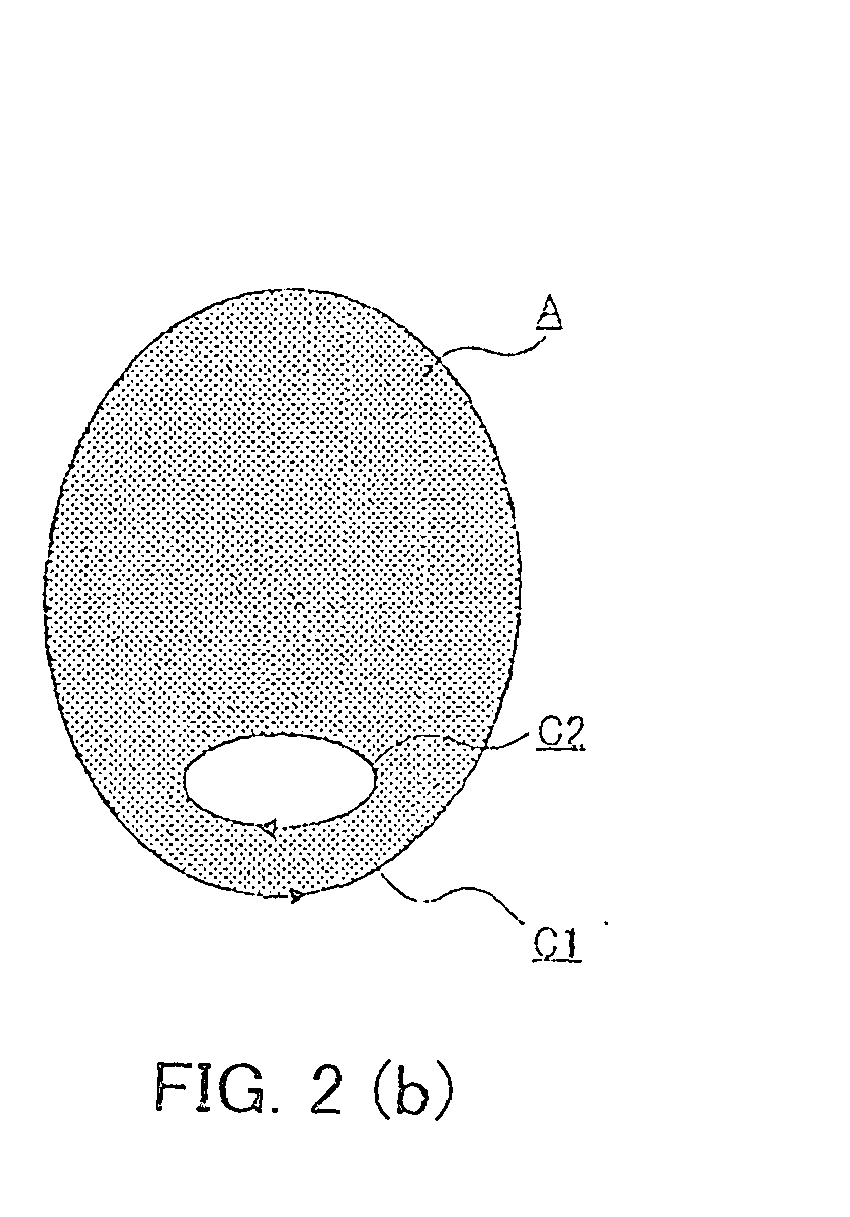
- the positive curvature and negative curvature are defined. It is assumed that the contour constituting the cover glass is represented by curve C1 and curve C2 as shown in FIG. 2(b) , and that the cover glass is represented by area A.
- the contour constituting the cover glass is traced while always seeing the inside of the area A on the left side, a portion of the contour turning to the left as proceeds is defined as the positive curvature, another portion of the contour turning to the right as proceeds is defined as the negative curvature, and the curvature of a straight portion that turns to neither the left nor right is defined as "0".
- the curve C1 as shown in FIG. 2(b) is a curve having the positive curvature
- the curve C2 as shown in FIG. 2(b) is a curve having the negative curvature.
- a segment C+ is the positive curvature
- a segment C- is the negative curvature
- the curvature of a segment C0 is "0".
- the portion having the negative curvature in the cover glass 1 as shown in FIG. 2(a) means corner portions 121 of a hole portion 12, corner portions 111 of a concave portion 11, etc. which are formed within the main surface of the cover glass 1.
- Such a shape including portions having the negative curvature is a shape hard to process by mechanical processing that is the external form processing in the ordinary manufacturing process of the glass substrate. It is possible to actualize such a shape with ease by using photolithography and etching as described later.
- the corner portion 121 of the hole portion 12 and the corner portion 111 of the concave portion 11 described herein do not include portions caused by chipping of the glass or surface roughness and surface swell comprised of minute convex portion and/or concave portion formed on the cover glass surface. In other words, such portions do not include a convex portion caused by chipping of the glass in the portion having the positive curvature, concave portion in surface roughness or surface swell, or the like.
- the cover glass 1 can be fabricated using a plate-shaped glass substrate (sheet glass) formed by a down-draw method.
- glass enabling glass plate formation by a down-draw method is aluminosilicate glass containing SiO 2 , Al 2 O 3 , Li 2 O and/or Na 2 O.
- the aluminosilicate glass preferably contains 62 percent to 75 percent by weight of SiO 2 , 5 percent to 15 percent by weight of Al 2 O 3 , 4 percent to 10 percent by weight of Li 2 O, 4 percent to 12 percent by weight of Na 2 O, and 5.5 percent to 15 percent by weight of ZrO 2 .
- such a composition is preferable that the ratio by weight of Na 2 O/ZrO 2 ranges from 0.5 to 2.0, and that the ratio by weight of Al 2 O 3 /ZrO 2 ranges from 0.4 to 2.5.
- SiO 2 is the prime component forming a glass skeleton.
- the cover glass for mobile terminal devices, particularly, for cellular phones is used in significantly severe environments such that the cover glass comes into contact with human skin, water, rain, etc. and even in such environments, is required to exert sufficient chemical durability.
- the content of SiO 2 preferably ranges from 62 percent by weight to 75 percent by weight.
- Al 2 O 3 is contained to enhance ion exchange performance of the glass surface. Further, the cover glass for mobile terminals needs to have viewability i.e. transparency. With consideration given to chemical durability and transparent durability, the content of Al 2 O 3 preferably ranges from 5 percent by weight to 15 percent by weight.
- Li 2 O is ion-exchanged with Na ion mainly in an ion exchange treatment bath in the glass surface portion, and is thus an essential component in chemically strengthening the glass.
- the content of LiO 2 preferably ranges from 4 percent by weight to 10 percent by weight.
- Na 2 O is ion-exchanged with K ion in the ion exchange treatment bath in the glass surface portion, and is thus an essential component in chemically strengthening the cover glass.
- the mobile terminal device is used under circumstances where shock and/or external force is applied to the display screen by dropping the apparatus, pressing the display screen repeatedly, or by opening and closing in the case of open/close type mobile terminal devices, and even in such use environments, is required to need sufficient mechanical strength.
- the content of Na 2 O preferably ranges from 4 percent by weight to 12 percent by weight.
- ZrO 2 has the effect of increasing the mechanical strength.
- the content of ZrO 2 preferably ranges from 5.5 percent by weight to 15 percent by weight.
- aluminosilicate glass by performing chemical strengthening by ion exchange treatment, and thereby forming a compressive stress layer in the glass surface, it is possible to further increase the mechanical strength.
- other multi-component glass may be used as a substitute for the aluminosilicate glass.
- crystallized glass may be used as the cover glass for mobile terminals.
- the effect is particularly exhibited when the thickness of the cover glass 1 is 0.5 mm or less.
- the glass constituting the cover glass 1 it is preferable to use the glass chemically strengthened by ion exchange treatment as described above.
- the chemically strengthened glass is glass strengthened by replacing alkali metal ions constituting the glass with alkali metal ions larger in size than the alkali metal ions constituting the glass. A compressive stress layer is formed in the surface of thus chemically strengthened glass.
- the external form processing is performed by performing photolithography and etching on a glass substrate.
- an etching step as shown in FIG. 4(a) , both main surfaces of the glass substrate 1 are coated with resist materials 31.
- the resist materials are exposed through a photo mask having a pattern with a desired external form shape (for example, external form including portions having the negative curvature).
- the exposed resist materials are developed, a resist pattern is formed (an opening portion 31a is formed) in an area except areas to be etched of the glass substrate, and the areas to be etched of the glass substrate are etched.
- the edge face 14 becomes the shape as shown in FIG. 4(c) .
- a center portion 14a protrudes outward the most, and inclined surfaces 14b, 14b are formed which are gently curved respectively toward both main surface 13 sides from the center portion 14a.
- the boundary between the inclined surface 14b and the main surface 13 and the boundary (center portion 14a) between the inclined surfaces 14b are in a rounder shape with a radius of several tens of micrometers.
- any material is available which has resistance to the etchant used in etching the glass using a resist pattern as a mask.
- the glass is normally etched by wet etching of an aqueous solution containing hydrofluoric acid, or dry etching of fluorine gas, and therefore, for example, it is possible to use resist materials excellent in resistance to hydrofluoric acid.
- the cover glass having an extremely high surface state is obtained such that the edge face of the cover glass cut into the desired shape has surface roughness of 10 nm or less and thus has high smoothness of the order of nanometers, and that micro-cracks do not exist which are certainly formed in forming the external form by mechanical processing. Further, since photolithography is adopted in forming the external form, dimensional accuracy of the cut cover glass is also good.
- the cover glass for mobile terminals is a complicated shape, the cover glass with good dimensional accuracy is obtained, and it is possible to obtain high mechanical strength required for the cover glass for mobile terminals. Further, by this external form processing by photolithography and etching, it is also possible to enhance productivity and reduce the processing cost. Furthermore, as a remover solution to remove the resist material from the glass substrate, it is preferable to use an alkali solution of KOH, NaOH, etc. In addition, kinds of the resist material, etchant and remover solution are capable of being selected as appropriate corresponding to the material of the glass substrate that is a material to be etched.
- the processing for external form is performed by etching step, it is possible to form the concave portion 11 and hole portion 12 including portions of the negative curvature in the cover glass with ease. Furthermore, similarly, since the etching step is used, by adjusting the mask pattern, it is possible to add a design (various shapes of the external form) such as the logo to the cover glass. By this means, it is possible to easily actualize a complicated design which will be required for the cover glass in the future but cannot be implemented by mechanical processing.
- the plate-shaped glass substrate it is possible to use glass substrates that are directly formed in the shape of a sheet from molten glass, or glass substrates obtained by cutting a glass material formed in some thickness into a predetermined thickness, polishing the main surface, and finishing in a predetermined thickness. It is preferable to use glass substrates that are directly formed in the shape of a sheet from molten glass. This is because the main surface of the glass substrate that is directly formed in the shape of a sheet from molten glass is a surface formed by hot forming has extremely high smoothness, and further has a surface state without micro-cracks.
- Methods for directly forming the molten glass in the shape of a sheet include a down-draw method and float method.
- the down-draw method is preferable among the methods.
- etching step since it is possible to perform etching uniformly from both main surfaces in etching the both main surfaces of the glass substrate using resist patterns formed on the both main surfaces of the glass substrate as a mask, dimensional accuracy is good, and the shape in cross section of the edge face of the cover glass is excellent, thus being preferable.
- the glass in the method of manufacturing cover glass of the invention is preferably aluminosilicate glass containing SiO 2 , Al 2 O 3 , Li 2 O and/or Na 2 O.
- a compressive stress layer is formed in the surface of the cover glass, and it is thereby possible to further enhance mechanical strength of the cover glass.
- the compressive stress layer formed by chemical strengthening is required to be 5 ⁇ m or more.
- the thickness of the compressive stress layer is preferably 50 ⁇ m or more, and more preferably, 100 ⁇ m. Since the cover glass for protecting a display screen of a mobile terminal is provided to cover the display screen, flaws are tend to occur in handling, and further, in consideration of the respect that shock and/or external force is applied by pressing the display screen repeatedly, or by opening and closing in the case of open/close type mobile terminal devices, the compressive stress layer is desired to be formed deeply.
- the cover glass 1 fabricated by the above-mentioned manufacturing method of cover glass has the main surface 13 and the edge face 14 as shown in FIG. 3 , and the cross-sectional shape of the edge face 14 is almost the same in the entire edge face 14 in the external form as shown in FIG. 2 .
- the cover glass according to the invention since the external form is formed by etching as described above, all of the obtained edge face 14 of the external form is formed under the same conditions. Therefore, in the case of forming the external form by wet etching, since the glass is etched isotropically, the edge face 14 is in the shape as shown in FIG. 3 over the whole of the external form.
- aluminosilicate glass containing 63.5 percent by weight of SiO 2, 8.2 percent by weight of Al 2 O 3 , 8.0 percent by weight of Li 2 O, 10.4 percent by weight of Na 2 O and 11.9 percent by weight of ZrO 2 was formed into plate-shaped glass substrates (sheet-shaped glass) with a sheet thickness of 0.5 mm by a down-draw method.
- Surface roughness (arithmetic means roughness Ra) of the main surface of the sheet-shaped glass formed by the down-draw method was measured using an atomic force microscope, and was 0.2 nm.
- both main surfaces of the sheet-shaped glass were coated with negative type hydrofluoric-acid resistant resist in a thickness of 30 ⁇ m, and the hydrofluoric-acid resistant resist underwent baking processing at 150°C for 30 minutes.
- the hydrofluoric-acid resistant resist was exposed from the both surfaces through a photo-mask having a pattern of the external form including portions having the negative curvature as shown in FIG. 2(a)
- the exposed hydrofluoric-acid resistant resist was developed using a developer (Na 2 CO 3 solution), and a resist pattern was formed where the hydrofluoric-acid resistant resist was left in areas except etching-target areas on the sheet-shaped glass.
- the etching-target areas of the sheet-shaped glass were etched from the both main surface sides using the resist pattern as a mask, and the glass was cut into the external form including the portions having the negative curvature as shown in FIG. 2(a) .
- the hydrofluoric-acid resistant resist remaining on the glass was swollen using an NaOH solution, and was removed from the glass, and rinsing treatment was performed. In this way, obtained was cover glass for a cellular phone of the Example having the external form as shown in FIG. 2(a) .
- Example 1 The glass cut by etching from which the resist was removed in aforementioned Example 1 was immersed in a treatment bath of mixed acid of 60 percent of potassium nitrate (KNO 3 ) and 40 percent of sodium nitrate (NaNO 3 ) kept at 385° to 405°C for 4 hours to undergo ion exchange treatment, and chemically strengthened cover glass for a cellular phone was prepared where a compressive stress layer of 150 ⁇ m was formed in the glass surface.
- KNO 3 potassium nitrate
- NaNO 3 sodium nitrate
- Cover glass for a cellular phone was prepared as in above-mentioned Example 1 except that the shape of the external form of the cover glass was a rectangular shape (size: 50 mm x 40 mm, thickness: 0.5 mm) as shown in FIG. 5 .
- Surface roughness of the main surface and edge face of the cover glass and micro-cracks were checked as in Example 1, and it was confirmed that surface roughness was the same as in Example 1, and that any micro-crack did not exist.
- Example 1 As in above-mentioned Example 1 except that a mixed acid aqueous solution of hydrofluoric acid and nitric acid was used as an etchant, the etching-target areas of the sheet-shaped glass were etched from the both main surface sides using the resist pattern as a mask, the glass was cut into the external form including the portions having the negative curvature as shown in FIG. 2(a) , and the cover glass for a mobile terminal was prepared.
- surface roughness of the main surface and edge face of the cover glass and micro-cracks were checked as in Example 1, surface roughness of the main surface was 0.2 nm, surface roughness of the edge face was 10 nm, and it was confirmed that any micro-crack did not exist.
- Example 2 The same aluminosilicate glass as in above-mentioned Example 1 was formed into plate-shaped glass substrates (sheet-shaped glass) by the down-draw method. Next, the formed sheet glass was cut into a rectangle slightly larger than finished measurements using a scriber, processed into a desired shape by grinding the outer edge using a rotary grinder with diamond grain embedded therein, and processed into the shape as shown in FIG. 6(a) .
- the cover glass of aforementioned Comparative Example 1 was subjected to ion exchange treatment under the same conditions as in Example 2, and chemically strengthened cover glass for a mobile terminal was prepared where a compressive stress layer was formed in the glass surface.
- surface roughness of the main surface and edge face of the cover glass and micro-cracks were checked as in Comparative example 1, it was confirmed that surface roughness was the some as in Comparative Example 1, and many micro-cracks existed.
- Cover glass for a cellular phone was prepared as in Comparative Example 2 except that in above-mentioned Comparative Example 1, the shape of the external form of the cover glass was made the same shape as shown in Example 3.
- surface roughness of the main surface and edge face of the cover glass and micro-cracks were checked as in Comparative Example 1, it was confirmed that surface roughness was the same as in Comparative Example 1, and many micro-cracks existed.
- the breaking load when the glass was broken exceeded 50 kgf, and the glass had the extremely high mechanical strength.
- the cover glass of Comparative Examples 1, 2 and 3 was of 5 kgf, 14 kgf, and 17 kgf, and thus had the significantly low strength.
- the cover glass of Comparative Example 1 was extremely weak in mechanical strength.
- the above-mentioned cover glass for mobile terminals of the invention is applicable to mobile terminal devices such as cellular phones by being provided above a display screen of the apparatus body having the display screen.
- Each of the cover glass of Examples 1 to 4 was provided on a display screen of a cellular phone, the cellular phone was subjected to a repetitive drop test, and each cover glass had high mechanical strength without any cracking being found.
- the present invention is not limited to the above-mentioned Embodiment, and is capable of being carried into practice with modifications thereof as appropriate.
- the shape of the external form, the numbers of members, sizes, processing procedures and the like in the above-mentioned Embodiment are examples, and are capable of being carried into practice with various modifications thereof within the scope of exhibiting the effects of the invention.
- the invention is capable of being carried into practice with modifications thereof as appropriate without departing from the scope of the object of the invention.
Landscapes
- Chemical & Material Sciences (AREA)
- Engineering & Computer Science (AREA)
- Life Sciences & Earth Sciences (AREA)
- Chemical Kinetics & Catalysis (AREA)
- General Chemical & Material Sciences (AREA)
- Geochemistry & Mineralogy (AREA)
- Materials Engineering (AREA)
- Organic Chemistry (AREA)
- Signal Processing (AREA)
- Computer Networks & Wireless Communication (AREA)
- Surface Treatment Of Glass (AREA)
- Liquid Crystal (AREA)
- Re-Forming, After-Treatment, Cutting And Transporting Of Glass Products (AREA)
- Glass Compositions (AREA)
- Devices For Indicating Variable Information By Combining Individual Elements (AREA)
- Telephone Set Structure (AREA)
Abstract

Description
- The present invention relates to cover glass used in protecting a display screen of a mobile terminal device such as, for example, a cellular phone and PDA (Personal Digital Assistant), manufacturing method of the cover glass and mobile terminal device.
- In a mobile terminal device such as a cellular phone and PDA, to prevent a shock and external force from being applied to the display, a protective plate made of plastic, for example, protective plate made of acrylic resin with high transparency is disposed at a predetermined distance outside the display (for example, Patent Document 1).
- However, since the protective plate made of acrylic resin tends to bend by external force, it is necessary to set the distance between the protective plate and display at a large extent to which the bending can be absorbed. Further, it is required to increase the thickness to provide the protective plate made of acrylic resin with strength to some extent. Therefore, it has become difficult to actualize thinner mobile terminal devices.
- Then, to actualize thinner mobile terminal devices, proposed is a protective plate using chemically strengthened glass which suppress bending and is a thin plate while having strength (for example, Patent Document 2).
Patent Document 2 describes cover glass for mobile terminals obtained by cutting plate glass of a specific glass composition into a predetermined shape, chamfering the edge face, performing mirror polishing processing on both surfaces, and then forming a compressive stress layer in the surface by chemical strengthening, thereby suppressing its bending and reducing its tendency to break, and a manufacturing method of the cover glass.
Patent Document 1: Japanese Unexamined Patent Publication No.2004-299199
Patent Document 1: Japanese Unexamined Patent Publication No.2007-99557 - Meanwhile, in recent years, in mobile terminal devices such as cellular phones and PDA, competition among apparatus manufacturers has intensified, and required are expensive-looking high-fashion mobile terminal devices, as well as sliming down and high functionality of mobile terminal devices. High-fashion is also required for cover glass, and cover glass is requested in complicated shapes as a shape of the external form of the cover glass, starting conventional simple rectangle shapes, such as shapes (for example, shapes with the negative curvature such that some side constituting the cover glass is largely dented inward) in accordance with the shape of a display screen of the apparatus, and other shapes such that a hole is formed on the main surface of the cover glass.
- However, in the conventional processing method as described in
Patent Document 2, surface roughness is coarse in the cover glass edge face, micro-cracks ranging from about dozens to hundreds of micrometers exist on the chamfering-processed surface of the cover glass edge face, and a problem thereby arises that it is not possible to obtain mechanical strength required for the cover glass for mobile terminals. Further, in the conventional processing method as described inPatent Document 2, cover glass in complicated shapes as described above, is not obtained, or if such cover glass is obtained, the mechanical strength is extremely low, the processing cost is high, and the cover glass is not put to practical use under present circumstances. - The present invention was made in view of the problems, and it is an object of the invention to provide cover glass satisfying high mechanical strength required for cover glass for a mobile terminal even in a complicated shape, manufacturing method of the cover glass and a mobile terminal device with a display screen having high mechanical strength.
- Cover glass for a mobile terminal of the invention is cover glass that is obtained by cutting a plate-shaped glass substrate into a desired shape by etching and that protects a display screen of the mobile terminal, and is characterized in that an edge face of the cover glass is formed of a molten glass surface, and that as surface roughness of the edge face, arithmetic mean roughness Ra is 10 nm or less.
- The cover glass for a mobile terminal according to this configuration is obtained by cutting a plate-shaped glass substrate into a desired shape by etching without undergoing mechanical processing, thereby has high smoothness of the order of nanometers such that surface roughness of the edge face of the cover glass is 10 nm or less, as compared with cover glass undergoing external form formation by mechanical processing, and thus has a surface state with extremely high smoothness further without micro-cracks that are certainly formed in performing external form formation by mechanical processing. Therefore, even when the shape of the external form of the cover glass for a mobile terminal is a complicated shape, it is possible to satisfy high mechanical strength required for the cover glass for a mobile terminal.
- In the cover glass for a mobile terminal of the invention, the main surface of the cover glass is formed of a molten glass surface formed by a down-draw method, and as surface roughness of the main surface, arithmetic mean roughness Ra is preferably 0.5 nm or less. According to this configuration, the cover glass becomes further excellent in mechanical strength.
- In the cover glass for a mobile terminal of the invention, the desired shape is preferably a shape including a portion having the negative curvature in part of a contour constituting the cover glass.
- In the cover glass for a mobile terminal of the invention, a plate thickness of the cover glass is preferably 0.5 mm or less.
- In the cover glass for a mobile terminal of the invention, the cover glass is preferably aluminosilicate glass containing at least one selected from the group consisting of SiO2 Al2O3, Li2O and Na2O. According to this configuration, it is made possible to form the plate-shaped grass substrate by a down-draw method (fusion method), and the main surface of the glass substrate can be a molten glass surface having extremely high smoothness of the order of nanometers without flaws. Accordingly, the need for performing mirror polishing processing on the main surface is eliminated in fabricating the cover glass, and the cover glass without micro-cracks even in the main surface is obtained and becomes the cover glass excellent in mechanical strength. Further, since chemically strengthening by ion exchange is made possible, it is possible to further enhance the mechanical strength.
- In the cover glass for a mobile terminal of the invention, the aluminosilicate glass preferably contains 62 percent to 75 percent by weight of SiO2, 5 percent to 15 percent by weight of Al2O3, 4 percent to 10 percent by weight of Li2O, 4 percent to 12 percent by weight of Na2O, and 5.5 percent to 15 percent by weight of ZrO2. According to this configuration, stable glass manufacturing is made possible, and obtained is glass excellent in mechanical strength. Further, the cover glass for a mobile terminal is used in significantly severe environments such that the cover glass comes into contact with human skin, water, rain, etc. and even in such environments, is capable of having sufficient chemical durability.
- In the cover glass for a mobile terminal of the invention, the cover glass is preferable glass that is chemically strengthened by ion exchange treatment. Further, the cover glass preferably has compressive stress layers in the main surface and the edge face. According to this configuration, the surfaces of cover glass are chemically strengthened, the compressive stress layers are further formed in the surfaces (main surfaces and the edge face), and it is thereby possible to further increase the mechanical strength.
- In the cover glass for a mobile terminal of the invention, the edge face of the cover glass preferably has a protruding center portion, and incline surfaces inclined respectively toward both main surface sides from the center portion. According to this configuration, in inserting the cover glass in a frame or the like of a mobile terminal device, it is possible to insert the glass with ease without galling and/or chipping occurring.
- A method of manufacturing cover glass for a mobile terminal of the invention is a method of manufacturing cover glass for a mobile terminal for protecting a display screen of the mobile terminal, and is characterized by forming a resist pattern on main surfaces of a plate-shaped glass substrate, then etching the glass substrate with an etchant of a mixed acid aqueous solution containing hydrofluoric acid and at least one kind of acid among sulfuric acid, nitric acid, hydrochloric acid, and hydrofluorosilicic acid using the resist pattern as a mask, and thereby cutting the glass substrate into a desired shape.
- According to this method, in cutting the plate-shaped glass substrate into a desired shape by etching without performing mechanical processing, since a mixed acid aqueous solution containing hydrofluoric acid and at least one kind of acid among sulfuric acid, nitric acid, hydrochloric acid, and hydrofluorosilicic acid is used as an etchant, the cover glass having an extremely high surface state is obtained such that surface roughness of an edge face of the cover glass cut into the desired shape has high smoothness of the order of nanometers, and that micro-cracks do not exist which are certainly formed in forming the external form by mechanical processing. Further, since it is possible to adopt photolithography in forming the resist pattern, dimensional accuracy of the cut cover glass is also excellent. Accordingly, even when the shape of the external form of the cover glass for a mobile terminal is a complicated shape, the cover glass with good dimensional accuracy is obtained, and it is possible to obtain high mechanical strength required for the cover glass for a mobile terminal.
- In the method of manufacturing cover glass for a mobile terminal of the invention, the plate-shaped glass substrate is preferably formed by a down-draw method. This is because both main surfaces of the plate-Ssaped glass substrate formed by the down-draw method have surfaces formed by hot forming, and thereby have extremely high smoothness of the order of nanometers, and surface states without micro-cracks. Further, since it is possible to perform etching uniformly from the both main surfaces in etching the glass substrate from the both main surfaces using resist patterns formed on the both main surfaces of the glass substrate as a mask, dimensional accuracy is good, and the shape in cross section of the edge face of the cover glass is excellent, thus being preferable.
- In the method of manufacturing cover glass for a mobile terminal of the invention, the desired shape is preferably a shape including a portion having the negative curvature in part of a contour constituting the cover glass.
- In the method of manufacturing cover glass for a mobile terminal of the invention, the cover glass is preferably aluminosilicate glass containing at least one selected from the group consisting of SiO2, Al2O3, Li2O and Na2O. According to this method, since it is made possible to form the plate-shaped glass substrate by a down-draw method, the main surface of the glass substrate does not have flaws, and obtains a surface state having extremely high smoothness of the order of nanometers. Accordingly, the need for performing mirror polishing processing on the main surface is eliminated in fabricating the cover glass, and the cover glass without micro-cracks even in the main surface is obtained and becomes the cover glass excellent in mechanical strength. Further, since chemical strengthening by ion exchange is made possible, it is possible to further enhance the mechanical strength.
- In the method of manufacturing cover glass for a mobile terminal of the invention, after cutting into the desired shape, it is preferable to perform chemically strengthening on the cut glass substrate by ion exchange treatment. According to this method, the compressive stress layers are formed in the entire surfaces (main surfaces and the edge face) constituting the cover glass, and it is thereby possible to further increase the mechanical strength.
- A mobile terminal device of the invention is characterized by having an apparatus body having a display screen, and the above-mentioned cover glass for a mobile terminal provided above the display screen. According to this configuration, it is possible to provide a mobile terminal device with the screen display having high mechanical strength.
- In the cover glass for a mobile terminal of the invention, even when the shape is complicated, it is possible to obtain high mechanical strength required for the cover glass for a mobile terminal. Further, in the mobile terminal device of the invention, even when the cover glass protecting the display screen has a complicated shape, it is possible to obtain the mobile terminal device with the display screen having high mechanical strength.
-
-
FIG. 1 is a cross-sectional view showing part of a mobile terminal equipped with cover glass for mobile terminals according to an Embodiment of the invention; -
FIG. 2(a) is a diagram to explain the external form of the cover glass as shown inFIG. 1; FIG. 2(b) is a diagram to explain the negative curvature;FIG. 2(c) is a diagram to explain the negative curvature and positive curvature; -
Fig. 3 is a diagram showing a shape of an edge face of the cover glass as shown inFIG. 2 ; -
FiGs. 4(a) to 4(c) are diagrams to explain shape processing by etching of a glass substrate; -
FIG. 5 is a diagram to explain a shape of cover glass of Example 3; and -
FIGs. 6(a) to 6(c) are diagrams to explain a manufacturing process to prepare the cover glass as shown inFIG. 2(a) by a manufacturing method of a Comparative Example. - An Embodiment of the invention will specifically be described below with reference to accompanying drawings.
FIG. 1 is a cross-sectional view showing part of a mobile terminal device equipped with cover glass for mobile terminals according to an Embodiment of the invention. In the mobile terminal device as shown inFIG. 1 ,cover glass 1 is disposed at a distance D above a liquidcrystal display panel 2. The liquidcrystal display panel 2 is configured such that a pair ofglass substrates liquid crystal layer 23. In addition, inFIG. 1 , the other members are omitted which are generally used in a liquid crystal display panel. - The cover glass in this Embodiment of the invention is obtained by forming a resist pattern on a main surface of a plate-shaped glass substrate, then etching the glass substrate with an etchant using the resist pattern as a mask, and thereby cutting the glass substrate into a desired shape, while an
edge face 14 of thecover glass 1 as shown inFIG. 3 is formed of a molten glass surface, and surface roughness (arithmetic mean roughness Ra) in theedge face 14 is 10 nm or less. Thus, in the cover glass according to the invention, since the external form is formed by etching, theedge face 14 formed by etching has extremely high smoothness, is formed of the molten glass surface, and therefore, is in a state without micro-cracks that certainly exist on an edge face formed by mechanical processing. In the cover glass with such a configuration, even when the shape of the external form of the cover glass for mobile terminals is a complicated shape, it is possible to process the external form into a desired shape with ease, and it is possible obtain high mechanical strength required for cover glass for mobile terminals. - Further, for example, even when the plate thickness is 0.5 mm or less and thus thin, it is possible to maintain high mechanical strength. When such cover glass with a thin thickness is inserted in an apparatus, since the cover glass is hard to bend by external force due to the high mechanical strength, it is possible to reduce the distance between the cover grass and display. As a result, it is possible to intend to thin the apparatus.
- in addition, as an etching method to etch the glass substrate, either of wet etching and dry etching is available. From the viewpoint of reducing the processing cost, wet etching is preferable. Any etchant capable of etching a glass substrate can be used as an etchant used in wet etching. For example, it is possible to use an acidic solution containing hydrofluoric acid as the main ingredient, mixed acid containing hydrofluoric acid and at least one kind of acid among sulfuric acid, nitric acid, hydrochloric acid, and hydrofluorosilicic acid, etc. Further, as an etchant used in dry etching, any etchant capable of etching a glass substrate can be used, and for example, it is possible to use fluorine gas.
- Moreover, the
cover glass 1 of the invention can be formed in a shape including a portion having the negative curvature in part of a contour constituting the cover glass as shown inFIG. 2(a) . Herein, the positive curvature and negative curvature are defined. It is assumed that the contour constituting the cover glass is represented by curve C1 and curve C2 as shown inFIG. 2(b) , and that the cover glass is represented by area A. At this point, when the contour constituting the cover glass is traced while always seeing the inside of the area A on the left side, a portion of the contour turning to the left as proceeds is defined as the positive curvature, another portion of the contour turning to the right as proceeds is defined as the negative curvature, and the curvature of a straight portion that turns to neither the left nor right is defined as "0". Accordingly, the curve C1 as shown inFIG. 2(b) is a curve having the positive curvature, and the curve C2 as shown inFIG. 2(b) is a curve having the negative curvature. Further, also when the contour constituting the cover glass is complicated and becomes a shape as shown inFIG. 2(c) , according to the aforementioned definition, a segment C+ is the positive curvature, a segment C- is the negative curvature, and the curvature of a segment C0 is "0". - When the negative curvature is defined as described above, the portion having the negative curvature in the
cover glass 1 as shown inFIG. 2(a) meanscorner portions 121 of ahole portion 12,corner portions 111 of aconcave portion 11, etc. which are formed within the main surface of thecover glass 1. - Such a shape including portions having the negative curvature is a shape hard to process by mechanical processing that is the external form processing in the ordinary manufacturing process of the glass substrate. It is possible to actualize such a shape with ease by using photolithography and etching as described later. In addition, the
corner portion 121 of thehole portion 12 and thecorner portion 111 of theconcave portion 11 described herein do not include portions caused by chipping of the glass or surface roughness and surface swell comprised of minute convex portion and/or concave portion formed on the cover glass surface. In other words, such portions do not include a convex portion caused by chipping of the glass in the portion having the positive curvature, concave portion in surface roughness or surface swell, or the like. - The
cover glass 1 can be fabricated using a plate-shaped glass substrate (sheet glass) formed by a down-draw method. Among glass enabling glass plate formation by a down-draw method is aluminosilicate glass containing SiO2, Al2O3, Li2O and/or Na2O. In particular, the aluminosilicate glass preferably contains 62 percent to 75 percent by weight of SiO2, 5 percent to 15 percent by weight of Al2O3, 4 percent to 10 percent by weight of Li2O, 4 percent to 12 percent by weight of Na2O, and 5.5 percent to 15 percent by weight of ZrO2. Further, such a composition is preferable that the ratio by weight of Na2O/ZrO2 ranges from 0.5 to 2.0, and that the ratio by weight of Al2O3/ZrO2 ranges from 0.4 to 2.5. - SiO2 is the prime component forming a glass skeleton. The cover glass for mobile terminal devices, particularly, for cellular phones is used in significantly severe environments such that the cover glass comes into contact with human skin, water, rain, etc. and even in such environments, is required to exert sufficient chemical durability. With consideration given to the chemical durability and melting temperature, the content of SiO2 preferably ranges from 62 percent by weight to 75 percent by weight.
- Al2O3 is contained to enhance ion exchange performance of the glass surface. Further, the cover glass for mobile terminals needs to have viewability i.e. transparency. With consideration given to chemical durability and transparent durability, the content of Al2O3 preferably ranges from 5 percent by weight to 15 percent by weight.
- Li2O is ion-exchanged with Na ion mainly in an ion exchange treatment bath in the glass surface portion, and is thus an essential component in chemically strengthening the glass. With consideration given to ion exchange performance, transparent resistance and chemical durability, the content of LiO2 preferably ranges from 4 percent by weight to 10 percent by weight.
- Na2O is ion-exchanged with K ion in the ion exchange treatment bath in the glass surface portion, and is thus an essential component in chemically strengthening the cover glass. Further, the mobile terminal device is used under circumstances where shock and/or external force is applied to the display screen by dropping the apparatus, pressing the display screen repeatedly, or by opening and closing in the case of open/close type mobile terminal devices, and even in such use environments, is required to need sufficient mechanical strength. With consideration given to the mechanical strength, transparent resistance and chemical durability, the content of Na2O preferably ranges from 4 percent by weight to 12 percent by weight.
- ZrO2 has the effect of increasing the mechanical strength. With consideration given to chemical durability and stable manufacturing of homogenous glass, the content of ZrO2 preferably ranges from 5.5 percent by weight to 15 percent by weight.
- Further, in the aforementioned aluminosilicate glass, by performing chemical strengthening by ion exchange treatment, and thereby forming a compressive stress layer in the glass surface, it is possible to further increase the mechanical strength. In addition, as a substitute for the aluminosilicate glass, other multi-component glass may be used. Further, when required transparency is guaranteed as the cover glass for mobile terminals, crystallized glass may be used.
- In the invention, the effect is particularly exhibited when the thickness of the
cover glass 1 is 0.5 mm or less. Further, as glass constituting thecover glass 1 , it is preferable to use the glass chemically strengthened by ion exchange treatment as described above. The chemically strengthened glass is glass strengthened by replacing alkali metal ions constituting the glass with alkali metal ions larger in size than the alkali metal ions constituting the glass. A compressive stress layer is formed in the surface of thus chemically strengthened glass. - Described next is a method of manufacturing cover glass for mobile terminals of the invention.
In an external form processing step in manufacturing of the cover glass, the external form processing is performed by performing photolithography and etching on a glass substrate. In an etching step, as shown inFIG. 4(a) , both main surfaces of theglass substrate 1 are coated with resistmaterials 31. Next, the resist materials are exposed through a photo mask having a pattern with a desired external form shape (for example, external form including portions having the negative curvature). Then, as shown inFIG. 4(b) , the exposed resist materials are developed, a resist pattern is formed (anopening portion 31a is formed) in an area except areas to be etched of the glass substrate, and the areas to be etched of the glass substrate are etched. At this point, in the case of using a wet etchant as an etchant, as shown inFIG. 4(b) , the grass is isotropically etched, and by this means, theedge face 14 becomes the shape as shown inFIG. 4(c) . In other words, in theedge face 14, acenter portion 14a protrudes outward the most, and inclinedsurfaces main surface 13 sides from thecenter portion 14a. In addition, it is preferable that the boundary between theinclined surface 14b and themain surface 13 and the boundary (center portion 14a) between theinclined surfaces 14b are in a rounder shape with a radius of several tens of micrometers. By forming such an edge-face shape, in inserting the cove glass in a frame, etc. of a mobile terminal device, it is possible to perform insertion with ease without galling and/or chipping occurring. - As a resist material used in the etching step, any material is available which has resistance to the etchant used in etching the glass using a resist pattern as a mask. The glass is normally etched by wet etching of an aqueous solution containing hydrofluoric acid, or dry etching of fluorine gas, and therefore, for example, it is possible to use resist materials excellent in resistance to hydrofluoric acid.
- As an etchant used in the etching step, it is possible to use a mixed acid containing hydrofluoric acid and at least one kind of acid among sulfuric acid, nitric acid, hydrochloric acid and hydrofluorosilicic acid, etc. By using the aforementioned mixed acid aqueous solution as an etchant, the cover glass having an extremely high surface state is obtained such that the edge face of the cover glass cut into the desired shape has surface roughness of 10 nm or less and thus has high smoothness of the order of nanometers, and that micro-cracks do not exist which are certainly formed in forming the external form by mechanical processing. Further, since photolithography is adopted in forming the external form, dimensional accuracy of the cut cover glass is also good. Accordingly, even when the shape of the external form of the cover glass for mobile terminals is a complicated shape, the cover glass with good dimensional accuracy is obtained, and it is possible to obtain high mechanical strength required for the cover glass for mobile terminals. Further, by this external form processing by photolithography and etching, it is also possible to enhance productivity and reduce the processing cost. Furthermore, as a remover solution to remove the resist material from the glass substrate, it is preferable to use an alkali solution of KOH, NaOH, etc. In addition, kinds of the resist material, etchant and remover solution are capable of being selected as appropriate corresponding to the material of the glass substrate that is a material to be etched.
- Further, since the processing for external form is performed by etching step, it is possible to form the
concave portion 11 andhole portion 12 including portions of the negative curvature in the cover glass with ease. Furthermore, similarly, since the etching step is used, by adjusting the mask pattern, it is possible to add a design (various shapes of the external form) such as the logo to the cover glass. By this means, it is possible to easily actualize a complicated design which will be required for the cover glass in the future but cannot be implemented by mechanical processing. - Furthermore, as the plate-shaped glass substrate, it is possible to use glass substrates that are directly formed in the shape of a sheet from molten glass, or glass substrates obtained by cutting a glass material formed in some thickness into a predetermined thickness, polishing the main surface, and finishing in a predetermined thickness. It is preferable to use glass substrates that are directly formed in the shape of a sheet from molten glass. This is because the main surface of the glass substrate that is directly formed in the shape of a sheet from molten glass is a surface formed by hot forming has extremely high smoothness, and further has a surface state without micro-cracks. Methods for directly forming the molten glass in the shape of a sheet include a down-draw method and float method. The down-draw method is preferable among the methods. In addition to the above-mentioned effects of high smoothness, etc. in the case of performing the external form processing by etching step, since it is possible to perform etching uniformly from both main surfaces in etching the both main surfaces of the glass substrate using resist patterns formed on the both main surfaces of the glass substrate as a mask, dimensional accuracy is good, and the shape in cross section of the edge face of the cover glass is excellent, thus being preferable.
- Moreover, for the same reason as described above, the glass in the method of manufacturing cover glass of the invention is preferably aluminosilicate glass containing SiO2, Al2O3, Li2O and/or Na2O.
- Further, by performing chemical strengthening by ion exchange treatment on the cover glass after the step of the external form processing by etching, a compressive stress layer is formed in the surface of the cover glass, and it is thereby possible to further enhance mechanical strength of the cover glass. In the case of using the above-mentioned plate-shaped glass substrate obtained by the method such as the down-draw method of directly forming molten glass in the shape of a sheet, since both main surfaces of the glass substrate are surfaces formed by hot forming, and thereby have surface states with extremely high smoothness without micro-cracks that are surely formed when the external from is formed by mechanical processing, the compressive stress layer formed by chemical strengthening is required to be 5 µm or more. The thickness of the compressive stress layer is preferably 50 µm or more, and more preferably, 100 µm. Since the cover glass for protecting a display screen of a mobile terminal is provided to cover the display screen, flaws are tend to occur in handling, and further, in consideration of the respect that shock and/or external force is applied by pressing the display screen repeatedly, or by opening and closing in the case of open/close type mobile terminal devices, the compressive stress layer is desired to be formed deeply.
- Furthermore, the
cover glass 1 fabricated by the above-mentioned manufacturing method of cover glass has themain surface 13 and theedge face 14 as shown inFIG. 3 , and the cross-sectional shape of theedge face 14 is almost the same in theentire edge face 14 in the external form as shown inFIG. 2 . In the cover glass according to the invention, since the external form is formed by etching as described above, all of the obtained edge face 14 of the external form is formed under the same conditions. Therefore, in the case of forming the external form by wet etching, since the glass is etched isotropically, theedge face 14 is in the shape as shown inFIG. 3 over the whole of the external form. - Described next are Examples performed to clarify the effects of the invention.
Descriptions are given below using cover glass for a cellular phone to protect a display screen of the cellular phone as an example. - First, aluminosilicate glass containing 63.5 percent by weight of SiO2, 8.2 percent by weight of Al2O3, 8.0 percent by weight of Li2O, 10.4 percent by weight of Na2O and 11.9 percent by weight of ZrO2 was formed into plate-shaped glass substrates (sheet-shaped glass) with a sheet thickness of 0.5 mm by a down-draw method. Surface roughness (arithmetic means roughness Ra) of the main surface of the sheet-shaped glass formed by the down-draw method was measured using an atomic force microscope, and was 0.2 nm.
- Next, both main surfaces of the sheet-shaped glass were coated with negative type hydrofluoric-acid resistant resist in a thickness of 30 µm, and the hydrofluoric-acid resistant resist underwent baking processing at 150°C for 30 minutes. Then, the hydrofluoric-acid resistant resist was exposed from the both surfaces through a photo-mask having a pattern of the external form including portions having the negative curvature as shown in
FIG. 2(a) , the exposed hydrofluoric-acid resistant resist was developed using a developer (Na2CO3 solution), and a resist pattern was formed where the hydrofluoric-acid resistant resist was left in areas except etching-target areas on the sheet-shaped glass. - Next, using a mixed acid aqueous solution of hydrofluoric acid and hydrochloric acid as an etchant, the etching-target areas of the sheet-shaped glass were etched from the both main surface sides using the resist pattern as a mask, and the glass was cut into the external form including the portions having the negative curvature as shown in
FIG. 2(a) . Then, the hydrofluoric-acid resistant resist remaining on the glass was swollen using an NaOH solution, and was removed from the glass, and rinsing treatment was performed. In this way, obtained was cover glass for a cellular phone of the Example having the external form as shown inFIG. 2(a) . - When the cross-sectional shape of the edge face was examined along the external form of thus obtained cover glass (Example) using a light microscope, it was confirmed that the cross-sectional shape was the shape as shown in
FIG. 4(c) and almost the same over the entire external form. Further, surface roughness (arithmetic means roughness Ra) of the main surface of the obtained cover glass was measured using an atomic force microscope, was 0.2 nm, did not change from the surface state immediately after forming by the down-draw method, and had high smoothness. Furthermore, surface roughness (arithmetic means roughness Ra) of the edge face of the cover glass was measured using the atomic force microscope, and was 1.2 to 1.3 nm over the entire external form. As the reason why surface roughness of the edge face was thus low, since the etching step was adopted without performing mechanical processing in processing the external form where the glass substrate was etched with an etchant using a resist pattern formed on the sheet glass as a mask and thereby cut into a desired shape, it is considered that brush marks and/or micro-cracks did not exist that occur in mechanical processing by polishing grain, grinding grain or the like. - Further, when the presence or absence of micro-crack of the edge face of the cover glass was checked using a scanning electron microscope, any micro-crack was not found.
- The glass cut by etching from which the resist was removed in aforementioned Example 1 was immersed in a treatment bath of mixed acid of 60 percent of potassium nitrate (KNO3) and 40 percent of sodium nitrate (NaNO3) kept at 385° to 405°C for 4 hours to undergo ion exchange treatment, and chemically strengthened cover glass for a cellular phone was prepared where a compressive stress layer of 150 µm was formed in the glass surface.
- When surface roughness of the main surface and edge face was measured as in Example 1, surface roughness of the main surface was 0.3 nm and surface roughness of the edge face was 1.4 to 1.5 nm. Further, when checked whether micro-cracks were present in the edge face, it was confirmed that any micro-crack did not exist.
- Cover glass for a cellular phone was prepared as in above-mentioned Example 1 except that the shape of the external form of the cover glass was a rectangular shape (size: 50 mm x 40 mm, thickness: 0.5 mm) as shown in
FIG. 5 . Surface roughness of the main surface and edge face of the cover glass and micro-cracks were checked as in Example 1, and it was confirmed that surface roughness was the same as in Example 1, and that any micro-crack did not exist. - As in above-mentioned Example 1 except that a mixed acid aqueous solution of hydrofluoric acid and nitric acid was used as an etchant, the etching-target areas of the sheet-shaped glass were etched from the both main surface sides using the resist pattern as a mask, the glass was cut into the external form including the portions having the negative curvature as shown in
FIG. 2(a) , and the cover glass for a mobile terminal was prepared. When surface roughness of the main surface and edge face of the cover glass and micro-cracks were checked as in Example 1, surface roughness of the main surface was 0.2 nm, surface roughness of the edge face was 10 nm, and it was confirmed that any micro-crack did not exist. - The same aluminosilicate glass as in above-mentioned Example 1 was formed into plate-shaped glass substrates (sheet-shaped glass) by the down-draw method. Next, the formed sheet glass was cut into a rectangle slightly larger than finished measurements using a scriber, processed into a desired shape by grinding the outer edge using a rotary grinder with diamond grain embedded therein, and processed into the shape as shown in
FIG. 6(a) . - Next, oniy the outer edge portion was ground using a diamond grinder, and underwent predetermined chamfering processing. Then, a hundred sheets of plate-shaped glass in the shape as shown in
FIG. 6(a) were stacked, and the portion (concave portion 11) having the negative curvature was formed using a diamond grinder by mechanical processing (FIG. 6(b) ). - Subsequently, five sheets of plate-shaped glass in the shape as shown in
FIG. 6(b) were stacked, the portion (hole portion 12) having the negative curvature was formed using a diamond grinder by mechanical processing, and the glass was formed into the shape as shown inFIG. 6(c) . Then, finally both main surfaces were polished into mirror surfaces using ceric oxide, and the sheet thickness was adjusted to 0.5 mm. In this way, obtained was cover glass for a cellular phone of Comparative Example 1 having the shape as shown inFIG. 2(a) . - Surface roughness Ra of the main surface and edge face of thus obtained cover glass (Comparative Example 1) was measured as in the Examples. Surface roughness of the main surface was 0.3 nm, and thus was not different from that in Example 1 so much, but surface roughness of the edge face was 0.2 µm and was a significantly large value. Further, when the presence or absence of micro-crack in the edge face of the cover glass was examined, it was confirmed there were many micro-cracks with depths ranging from dozens to hundreds of micrometers. As the reason why surface roughness Ra was thus large or many micro-cracks existed, it is considered that mechanical processing was adopted in shape processing.
- The cover glass of aforementioned Comparative Example 1 was subjected to ion exchange treatment under the same conditions as in Example 2, and chemically strengthened cover glass for a mobile terminal was prepared where a compressive stress layer was formed in the glass surface. When surface roughness of the main surface and edge face of the cover glass and micro-cracks were checked as in Comparative example 1, it was confirmed that surface roughness was the some as in Comparative Example 1, and many micro-cracks existed.
- Cover glass for a cellular phone was prepared as in Comparative Example 2 except that in above-mentioned Comparative Example 1, the shape of the external form of the cover glass was made the same shape as shown in Example 3. When surface roughness of the main surface and edge face of the cover glass and micro-cracks were checked as in Comparative Example 1, it was confirmed that surface roughness was the same as in Comparative Example 1, and many micro-cracks existed.
- (Evaluation test of mechanical strength of the cover glass of Examples 1 to 4 and Comparative Examples 1 to 3)
The cover glass was set on a support mount coming into contact with the outer circumferential edge portion in 3 mm in the main surface of the cover glass, and static pressure strength tests were performed while pressing the center portion of the cover glass from the main surface side opposite to the side in contact with the support mount using a pressurizing member. Used as the pressurizing material was a material made of a stainless alloy having a front end with Φ of 5 mm. - As a result, in the cover glass of Examples 1 to 4, the breaking load when the glass was broken exceeded 50 kgf, and the glass had the extremely high mechanical strength. Meanwhile, the cover glass of Comparative Examples 1, 2 and 3 was of 5 kgf, 14 kgf, and 17 kgf, and thus had the significantly low strength. Particularly, the cover glass of Comparative Example 1 was extremely weak in mechanical strength. When the state of cracking of the cover glass of Comparative Example 1 was checked, it was confirmed that cracking proceeded from micro-cracks existing in areas including the portions having the negative curvature.
- The above-mentioned cover glass for mobile terminals of the invention is applicable to mobile terminal devices such as cellular phones by being provided above a display screen of the apparatus body having the display screen. Each of the cover glass of Examples 1 to 4 was provided on a display screen of a cellular phone, the cellular phone was subjected to a repetitive drop test, and each cover glass had high mechanical strength without any cracking being found.
- The present invention is not limited to the above-mentioned Embodiment, and is capable of being carried into practice with modifications thereof as appropriate. For example, the shape of the external form, the numbers of members, sizes, processing procedures and the like in the above-mentioned Embodiment are examples, and are capable of being carried into practice with various modifications thereof within the scope of exhibiting the effects of the invention. Further, the invention is capable of being carried into practice with modifications thereof as appropriate without departing from the scope of the object of the invention.
Claims (15)
- Cover glass for a mobile terminal that is obtained by cutting a plate-shaped glass substrate into a desired shape by etching and that protects a display screen of the mobile terminal,
wherein an edge face of the cover glass is formed of a molten glass surface, and as surface roughness of the edge face, arithmetic mean roughness Ra is 10 nm or less. - The cover glass for a mobile terminal according to claim 1, wherein a main surface of the cover glass is formed of a molten glass surface formed by a down-draw method, and as surface roughness of the main surface, arithmetic mean roughness Ra is 0.5 nm or less.
- The cover glass for a mobile terminal according to claim 1 or 2, wherein the desired shape is a shape including a portion having the negative curvature in part of a contour constituting the cover glass.
- The cover glass for a mobile terminal according to any one of claims 1 to 3, wherein a plate thickness of the cover glass is 0.5 mm or less.
- The cover glass for a mobile terminal according to any one of claims 1 to 4, wherein the cover glass is aluminosilicate glass containing at least one selected from the group consisting of SiO2, Al2O3, Li2O and Na2O.
- The cover glass for a mobile terminal according to claim 5, wherein the aluminosilicate glass contains 62 percent to 75 percent by weight of SiO2, 5 percent to 15 percent by weight of Al2O3, 4 percent to 10 percent by weight of Li2O, 4 percent to 12 percent by weight of Na2O, and 5.5 percent to 15 percent by weight of ZrO2.
- The cover glass for a mobile terminal according to any one of claims 1 to 6, wherein the cover glass is glass that is chemically strengthened by ion exchange treatment.
- The cover glass for a mobile terminal according to claim 7, wherein the cover glass has compressive stress layers in the main surface and edge face.
- The cover glass for a mobile terminal according to any one of claims 1 to 8, wherein the edge face of the cover glass has a protruding center portion, and inclined surfaces inclined respectively toward both main surface sides from the center portion.
- A method of manufacturing cover glass for a mobile terminal for protecting a display screen of the mobile terminal,
wherein a resist pattern is formed on main surfaces of a plate-shaped glass substrate, and then, using the resist pattern as a mask, the glass substrate is etched with an etchant of a mixed acid aqueous solution containing hydrofluoric acid and at least one kind of acid among sulfuric acid, nitric acid, hydrochloric acid, and hydrofluorosilicic acid, and is thereby cut into a desired shape. - The method of manufacturing cover glass for a mobile terminal according to claim 10, wherein the plate-shaped glass substrate is formed by a down-draw method.
- The method of manufacturing cover glass for a mobile terminal according to claim 11, wherein the desired shape is a shape including a portion having the negative curvature in part of a contour constituting the cover grass.
- The method of manufacturing cover glass for a mobile terminal according to any one of claims 10 to 12, wherein the cover glass is aluminosilicate glass containing at least one selected from the group consisting of SiO2, Al2O3, Li2O and Na2O.
- The method of manufacturing cover glass for a mobile terminal according to claim 13, wherein after cutting into the desired shape, chemical strengthening is performed on the cut glass substrate by ion exchange treatment.
- A mobile terminal device comprising:an apparatus body having a display screen; andthe cover glass for a mobile terminal according to any one of claims 1 to 9 provided above the display screen.
Applications Claiming Priority (2)
| Application Number | Priority Date | Filing Date | Title |
|---|---|---|---|
| JP2007325542 | 2007-12-18 | ||
| PCT/JP2008/072863 WO2009078406A1 (en) | 2007-12-18 | 2008-12-16 | Cover glass for portable terminal, method for manufacturing cover glass for portable terminal, and portable terminal apparatus |
Publications (3)
| Publication Number | Publication Date |
|---|---|
| EP2233447A1 true EP2233447A1 (en) | 2010-09-29 |
| EP2233447A4 EP2233447A4 (en) | 2014-03-26 |
| EP2233447B1 EP2233447B1 (en) | 2020-08-05 |
Family
ID=40795521
Family Applications (1)
| Application Number | Title | Priority Date | Filing Date |
|---|---|---|---|
| EP08861136.3A Active EP2233447B1 (en) | 2007-12-18 | 2008-12-16 | Cover glass for portable terminal, method for manufacturing cover glass for portable terminal, and portable terminal apparatus |
Country Status (6)
| Country | Link |
|---|---|
| US (3) | US8722189B2 (en) |
| EP (1) | EP2233447B1 (en) |
| JP (5) | JP2009167086A (en) |
| KR (1) | KR101512213B1 (en) |
| CN (2) | CN101903301B (en) |
| WO (1) | WO2009078406A1 (en) |
Cited By (17)
| Publication number | Priority date | Publication date | Assignee | Title |
|---|---|---|---|---|
| CN102557464A (en) * | 2010-09-30 | 2012-07-11 | 安瀚视特股份有限公司 | Protective glass and method for producing the protective glass |
| US20120236526A1 (en) * | 2011-03-16 | 2012-09-20 | Weber Douglas J | Strengthening variable thickness glass |
| CN103229130A (en) * | 2010-11-25 | 2013-07-31 | 欧普索尔有限公司 | Tempered glass plate for touch panel and method for manufacturing tempered glass plate for touch panel using the same |
| US9615448B2 (en) | 2008-06-27 | 2017-04-04 | Apple Inc. | Method for fabricating thin sheets of glass |
| US9725359B2 (en) | 2011-03-16 | 2017-08-08 | Apple Inc. | Electronic device having selectively strengthened glass |
| US9756739B2 (en) | 2012-01-25 | 2017-09-05 | Apple Inc. | Glass device housing |
| US9778685B2 (en) | 2011-05-04 | 2017-10-03 | Apple Inc. | Housing for portable electronic device with reduced border region |
| US9886062B2 (en) | 2014-02-28 | 2018-02-06 | Apple Inc. | Exposed glass article with enhanced stiffness for portable electronic device housing |
| US9946302B2 (en) | 2012-09-19 | 2018-04-17 | Apple Inc. | Exposed glass article with inner recessed area for portable electronic device housing |
| US9944554B2 (en) | 2011-09-15 | 2018-04-17 | Apple Inc. | Perforated mother sheet for partial edge chemical strengthening and method therefor |
| US10021798B2 (en) | 2010-09-17 | 2018-07-10 | Apple Inc. | Glass enclosure |
| US10133156B2 (en) | 2012-01-10 | 2018-11-20 | Apple Inc. | Fused opaque and clear glass for camera or display window |
| US10144669B2 (en) | 2011-11-21 | 2018-12-04 | Apple Inc. | Self-optimizing chemical strengthening bath for glass |
| US10185113B2 (en) | 2009-03-02 | 2019-01-22 | Apple Inc. | Techniques for strengthening glass covers for portable electronic devices |
| US10189743B2 (en) | 2010-08-18 | 2019-01-29 | Apple Inc. | Enhanced strengthening of glass |
| US10320959B2 (en) | 2011-09-29 | 2019-06-11 | Apple Inc. | Multi-layer transparent structures for electronic device housings |
| US10401904B2 (en) | 2011-05-04 | 2019-09-03 | Apple Inc. | Housing for portable electronic device with reduced border region |
Families Citing this family (138)
| Publication number | Priority date | Publication date | Assignee | Title |
|---|---|---|---|---|
| TWI577653B (en) * | 2007-03-02 | 2017-04-11 | 日本電氣硝子股份有限公司 | Reinforced plate glass and manufacturing method thereof |
| US8169587B2 (en) | 2007-08-16 | 2012-05-01 | Apple Inc. | Methods and systems for strengthening LCD modules |
| US7810355B2 (en) | 2008-06-30 | 2010-10-12 | Apple Inc. | Full perimeter chemical strengthening of substrates |
| US9346130B2 (en) | 2008-12-17 | 2016-05-24 | Electro Scientific Industries, Inc. | Method for laser processing glass with a chamfered edge |
| JP2010168270A (en) * | 2008-12-26 | 2010-08-05 | Hoya Corp | Glass substrate and method for manufacturing the same |
| US20110019354A1 (en) * | 2009-03-02 | 2011-01-27 | Christopher Prest | Techniques for Strengthening Glass Covers for Portable Electronic Devices |
| JP5070259B2 (en) * | 2009-08-05 | 2012-11-07 | Hoya株式会社 | Ion exchange treated glass production method, chemically strengthened glass production method, and ion exchange treatment apparatus |
| JP5505857B2 (en) * | 2009-08-17 | 2014-05-28 | 日本電気硝子株式会社 | Element sealing body manufacturing method, element sealing method, and element sealing body |
| JP5619392B2 (en) * | 2009-08-20 | 2014-11-05 | 株式会社日本触媒 | Front plate for image display device and manufacturing method thereof |
| US8549882B2 (en) * | 2009-09-30 | 2013-10-08 | Apple Inc. | Pre-processing techniques to produce complex edges using a glass slumping process |
| JP5736379B2 (en) * | 2009-09-30 | 2015-06-17 | アップル インコーポレイテッド | Technology to strengthen the glass cover of portable electronic devices |
| CN102939269B (en) * | 2009-11-25 | 2015-11-25 | 旭硝子株式会社 | Indicating meter protective glass glass substrate and manufacture method thereof |
| JP5589379B2 (en) * | 2009-12-25 | 2014-09-17 | 旭硝子株式会社 | Manufacturing method of glass substrate for display cover glass |
| EP2521699A1 (en) * | 2010-01-07 | 2012-11-14 | Corning Incorporated | Impact-damage-resistant glass sheet |
| KR101143846B1 (en) * | 2010-01-22 | 2012-05-04 | 한국세라믹기술원 | Manufacturing method of chemical reinforced glass |
| JP5451443B2 (en) * | 2010-02-15 | 2014-03-26 | 株式会社ジャパンディスプレイ | Method for manufacturing electrical solid state device |
| US9207528B2 (en) | 2010-06-04 | 2015-12-08 | Apple Inc. | Thin sheet glass processing |
| US9213451B2 (en) | 2010-06-04 | 2015-12-15 | Apple Inc. | Thin glass for touch panel sensors and methods therefor |
| US8923693B2 (en) * | 2010-07-30 | 2014-12-30 | Apple Inc. | Electronic device having selectively strengthened cover glass |
| US8393175B2 (en) * | 2010-08-26 | 2013-03-12 | Corning Incorporated | Methods for extracting strengthened glass substrates from glass sheets |
| US8873028B2 (en) | 2010-08-26 | 2014-10-28 | Apple Inc. | Non-destructive stress profile determination in chemically tempered glass |
| KR101237815B1 (en) * | 2010-09-03 | 2013-03-20 | 아프로시스템 주식회사 | Apparatus and Method for Cutting Glass by Etching |
| US20120085130A1 (en) * | 2010-10-08 | 2012-04-12 | Hill Matthew D | Annealing of glass to alter chemical strengthening behavior |
| US8607590B2 (en) * | 2010-11-30 | 2013-12-17 | Corning Incorporated | Methods for separating glass articles from strengthened glass substrate sheets |
| US8616024B2 (en) * | 2010-11-30 | 2013-12-31 | Corning Incorporated | Methods for forming grooves and separating strengthened glass substrate sheets |
| KR101895591B1 (en) * | 2010-12-27 | 2018-09-05 | 호야 가부시키가이샤 | Glass substrate of cover glass for mobile electronics device, image display apparatus for mobile electronics device, mobile electronics device, manufacturing method of glass substrate of cover glass for mobile electronics device |
| JP5437351B2 (en) | 2010-12-27 | 2014-03-12 | Hoya株式会社 | Glass substrate for cover glass for portable electronic device, image display device for portable electronic device, portable electronic device |
| JP2012148909A (en) * | 2011-01-18 | 2012-08-09 | Nippon Electric Glass Co Ltd | Tempered glass and tempered glass plate |
| US8539794B2 (en) * | 2011-02-01 | 2013-09-24 | Corning Incorporated | Strengthened glass substrate sheets and methods for fabricating glass panels from glass substrate sheets |
| JP5649592B2 (en) * | 2011-02-17 | 2015-01-07 | Hoya株式会社 | Manufacturing method of glass substrate of cover glass for portable electronic device, glass substrate of cover glass for portable electronic device, and portable electronic device |
| US8776547B2 (en) * | 2011-02-28 | 2014-07-15 | Corning Incorporated | Local strengthening of glass by ion exchange |
| JP5926749B2 (en) * | 2011-03-16 | 2016-05-25 | アップル インコーポレイテッド | Controlled chemical strengthening of thin glass |
| JP5881414B2 (en) * | 2011-04-20 | 2016-03-09 | Hoya株式会社 | Cover glass for mobile devices |
| JP5631356B2 (en) * | 2011-05-11 | 2014-11-26 | Hoya株式会社 | Cover glass for portable device and method for manufacturing the same |
| JP6016067B2 (en) * | 2011-05-13 | 2016-10-26 | 日本電気硝子株式会社 | Laminated body |
| EP3006205A1 (en) | 2011-05-13 | 2016-04-13 | Nippon Electric Glass Co., Ltd | Method for cutting laminate, method for processing laminate, and device and method for cutting brittle plate-like object |
| JP5705040B2 (en) * | 2011-06-17 | 2015-04-22 | Hoya株式会社 | Manufacturing method of cover glass for portable device |
| JP5166573B2 (en) * | 2011-06-30 | 2013-03-21 | 株式会社Nsc | Manufacturing method of glass substrate |
| JP5564522B2 (en) * | 2011-06-30 | 2014-07-30 | Hoya株式会社 | Manufacturing method of cover glass for electronic device and manufacturing method of touch sensor module |
| JP5701703B2 (en) * | 2011-07-01 | 2015-04-15 | Hoya株式会社 | Manufacturing method of cover glass for portable device |
| US9315412B2 (en) * | 2011-07-07 | 2016-04-19 | Corning Incorporated | Surface flaw modification for strengthening of glass articles |
| WO2013021854A1 (en) * | 2011-08-05 | 2013-02-14 | Hoya株式会社 | Cover glass for mobile device and production method therefor |
| US8635887B2 (en) * | 2011-08-10 | 2014-01-28 | Corning Incorporated | Methods for separating glass substrate sheets by laser-formed grooves |
| JP2013040086A (en) * | 2011-08-19 | 2013-02-28 | Asahi Glass Co Ltd | Method for manufacturing tempered glass plate and cover glass, and cover glass |
| JP2013043795A (en) * | 2011-08-23 | 2013-03-04 | Nippon Electric Glass Co Ltd | Tempered glass and method of manufacturing the same |
| JPWO2013027651A1 (en) * | 2011-08-23 | 2015-03-19 | Hoya株式会社 | Method for producing tempered glass substrate and tempered glass substrate |
| KR101237631B1 (en) | 2011-09-06 | 2013-02-27 | 임남일 | Reinforced glass for surface protection of display device and its manufacturing method |
| JP2013071854A (en) * | 2011-09-27 | 2013-04-22 | Hoya Corp | Manufacturing method of cover glass for portable terminal |
| JP5926736B2 (en) * | 2011-10-13 | 2016-05-25 | Hoya株式会社 | Manufacturing method of cover glass for portable device |
| CN103889914A (en) * | 2011-10-20 | 2014-06-25 | Hoya株式会社 | Method of producing cover glass for portable equipment |
| KR101914298B1 (en) * | 2011-11-04 | 2018-12-31 | 삼성디스플레이 주식회사 | Apparatus and method for processing glass window of display |
| CN103105961A (en) * | 2011-11-09 | 2013-05-15 | 宸鸿科技(厦门)有限公司 | Manufacture method of touch-control panel |
| KR20130065051A (en) * | 2011-12-09 | 2013-06-19 | 삼성코닝정밀소재 주식회사 | Cutting method of tempered glass and method of manufacturing touch screen panel using the same |
| WO2013088988A1 (en) * | 2011-12-12 | 2013-06-20 | コニカミノルタ株式会社 | Cover glass and method for producing same |
| US8684613B2 (en) | 2012-01-10 | 2014-04-01 | Apple Inc. | Integrated camera window |
| JP5712149B2 (en) * | 2012-01-31 | 2015-05-07 | 株式会社沖データ | Display panel, display panel manufacturing method, and display device |
| JP5345265B1 (en) * | 2012-02-08 | 2013-11-20 | Hoya株式会社 | Manufacturing method and manufacturing apparatus for cover glass for electronic equipment |
| CN104136967B (en) | 2012-02-28 | 2018-02-16 | 伊雷克托科学工业股份有限公司 | Method and device for separating reinforced glass and articles produced from the reinforced glass |
| US10357850B2 (en) | 2012-09-24 | 2019-07-23 | Electro Scientific Industries, Inc. | Method and apparatus for machining a workpiece |
| US9828278B2 (en) | 2012-02-28 | 2017-11-28 | Electro Scientific Industries, Inc. | Method and apparatus for separation of strengthened glass and articles produced thereby |
| WO2013130608A1 (en) * | 2012-02-29 | 2013-09-06 | Electro Scientific Industries, Inc. | Methods and apparatus for machining strengthened glass and articles produced thereby |
| JP6110364B2 (en) * | 2012-03-13 | 2017-04-05 | Hoya株式会社 | GLASS SUBSTRATE FOR ELECTRONIC DEVICE GLASS AND METHOD FOR PRODUCING SAME |
| JP6111240B2 (en) * | 2012-03-13 | 2017-04-05 | Hoya株式会社 | Manufacturing method of glass substrate of cover glass for electronic device |
| US9938186B2 (en) | 2012-04-13 | 2018-04-10 | Corning Incorporated | Strengthened glass articles having etched features and methods of forming the same |
| TWI593644B (en) * | 2012-05-09 | 2017-08-01 | 康寧公司 | Method of manufacturing cover glass |
| TWI592382B (en) * | 2012-05-30 | 2017-07-21 | 宸鴻科技控股有限公司 | Rigid substrate, touch panel, and processing method of rigid substrate |
| US9512029B2 (en) | 2012-05-31 | 2016-12-06 | Corning Incorporated | Cover glass article |
| KR20130139106A (en) * | 2012-06-12 | 2013-12-20 | 삼성디스플레이 주식회사 | Method for processing cover glass |
| JP2014001100A (en) * | 2012-06-18 | 2014-01-09 | Dainippon Printing Co Ltd | Cover glass |
| US10067535B2 (en) * | 2012-09-28 | 2018-09-04 | Apple Inc. | Multiple-element light-bending structures for minimizing display borders |
| JP2015171956A (en) * | 2012-07-17 | 2015-10-01 | 旭硝子株式会社 | Method of manufacturing reinforced cover glass, reinforced cover glass, touch sensor integrated reinforced cover glass, and touch sensor integrated reinforced cover glass |
| JP6025156B2 (en) * | 2012-08-23 | 2016-11-16 | Hoya株式会社 | Glass substrate for cover glass for electronic device, cover glass for electronic device, and method for manufacturing glass substrate for cover glass for electronic device |
| JP5472521B1 (en) | 2012-10-10 | 2014-04-16 | 日本電気硝子株式会社 | Manufacturing method of cover glass for mobile display |
| KR102157750B1 (en) | 2012-11-29 | 2020-09-21 | 코닝 인코포레이티드 | Methods of fabricating glass articles by laser damage and etching |
| CN105228788A (en) | 2012-11-29 | 2016-01-06 | 康宁股份有限公司 | For sacrifice cover layer and the method thereof of laser drill base material |
| US9377912B2 (en) * | 2012-12-11 | 2016-06-28 | Gtat Corporation | Mobile electronic device comprising a modified sapphire |
| TWI484299B (en) * | 2013-02-04 | 2015-05-11 | Everlight Chem Ind Corp | Use of positive-tone photoresist composition |
| KR101336934B1 (en) * | 2013-03-05 | 2013-12-03 | 크루셜텍 (주) | Cover glass and method of manufacturing the same |
| DE112013006831T5 (en) * | 2013-03-15 | 2015-12-10 | Schott Glass Technologies (Suzhou) Co., Ltd. | Chemically toughened flexible ultra-thin glass |
| JP5704767B2 (en) * | 2013-04-26 | 2015-04-22 | 日本電気硝子株式会社 | Tempered glass and manufacturing method thereof |
| US9359261B2 (en) * | 2013-05-07 | 2016-06-07 | Corning Incorporated | Low-color scratch-resistant articles with a multilayer optical film |
| US9110230B2 (en) | 2013-05-07 | 2015-08-18 | Corning Incorporated | Scratch-resistant articles with retained optical properties |
| US9366784B2 (en) | 2013-05-07 | 2016-06-14 | Corning Incorporated | Low-color scratch-resistant articles with a multilayer optical film |
| JP6102500B2 (en) * | 2013-05-17 | 2017-03-29 | 旭硝子株式会社 | Sheet glass and method for cutting sheet glass |
| US9459661B2 (en) | 2013-06-19 | 2016-10-04 | Apple Inc. | Camouflaged openings in electronic device housings |
| JP2016534008A (en) * | 2013-08-07 | 2016-11-04 | トルンプフ レーザー− ウント ジュステームテヒニク ゲゼルシャフト ミット ベシュレンクテル ハフツングTRUMPF Laser− und Systemtechnik GmbH | Method for processing a plate-like workpiece having a transparent, glassy, vitreous, ceramic and / or crystalline layer, as well as a separating device for such a workpiece, and from such a workpiece Product |
| CN103406812B (en) * | 2013-08-28 | 2016-03-09 | 东莞劲胜精密组件股份有限公司 | Glass processing method and mobile equipment glass |
| JP6288499B2 (en) * | 2013-10-03 | 2018-03-07 | 日本電気硝子株式会社 | Tempered glass plate and portable terminal using the same |
| JP5622133B1 (en) * | 2013-10-25 | 2014-11-12 | 大日本印刷株式会社 | Manufacturing method of cover glass |
| JP2015136091A (en) * | 2013-12-21 | 2015-07-27 | 京セラ株式会社 | Electronic apparatus and translucent cover member |
| US9151473B2 (en) * | 2013-12-24 | 2015-10-06 | Kyocera Corporation | Electronic apparatus, light-transmissive cover plate, and portable device |
| WO2015099096A1 (en) * | 2013-12-25 | 2015-07-02 | 京セラ株式会社 | Electronic device |
| US9488857B2 (en) | 2014-01-10 | 2016-11-08 | Corning Incorporated | Method of strengthening an edge of a glass substrate |
| WO2015122454A1 (en) * | 2014-02-12 | 2015-08-20 | 大日本印刷株式会社 | Cover glass, display device having cover glass, and method for producing cover glass |
| JP6260322B2 (en) * | 2014-02-12 | 2018-01-17 | 大日本印刷株式会社 | Cover glass manufacturing method, cover glass, and display device with cover glass |
| JP6331127B2 (en) * | 2014-03-28 | 2018-05-30 | 大日本印刷株式会社 | Cover glass and display device with cover glass |
| KR20150112093A (en) * | 2014-03-26 | 2015-10-07 | 삼성디스플레이 주식회사 | Touch screen panel and method for fabricating the same |
| US9776906B2 (en) | 2014-03-28 | 2017-10-03 | Electro Scientific Industries, Inc. | Laser machining strengthened glass |
| JP6372649B2 (en) * | 2014-04-10 | 2018-08-15 | 日本電気硝子株式会社 | Protective member for display and portable terminal using the same |
| US9335444B2 (en) | 2014-05-12 | 2016-05-10 | Corning Incorporated | Durable and scratch-resistant anti-reflective articles |
| US11267973B2 (en) | 2014-05-12 | 2022-03-08 | Corning Incorporated | Durable anti-reflective articles |
| TW201546005A (en) * | 2014-06-09 | 2015-12-16 | Wintek Corp | Cover plate and method of fabricating the same |
| JP6347160B2 (en) * | 2014-06-17 | 2018-06-27 | 日本電気硝子株式会社 | Glass article and method for producing the same |
| JP6488904B2 (en) * | 2014-06-30 | 2019-03-27 | 大日本印刷株式会社 | Cover glass, display device with cover glass, and method of manufacturing cover glass |
| US9790593B2 (en) | 2014-08-01 | 2017-10-17 | Corning Incorporated | Scratch-resistant materials and articles including the same |
| CN205427872U (en) * | 2015-01-30 | 2016-08-03 | 旭硝子株式会社 | Lid component and key fob who has it |
| CN105931997B (en) * | 2015-02-27 | 2019-02-05 | 胡迪群 | Temporary composite carrier plate |
| CN205384625U (en) | 2015-06-05 | 2016-07-13 | 旭硝子株式会社 | Glass substrate , protection glass and key fob |
| JP2017017151A (en) * | 2015-06-30 | 2017-01-19 | パナソニックIpマネジメント株式会社 | Solar battery module |
| JP2018536177A (en) | 2015-09-14 | 2018-12-06 | コーニング インコーポレイテッド | High light transmittance and scratch resistant anti-reflective article |
| JP6852678B2 (en) * | 2015-11-30 | 2021-03-31 | Agc株式会社 | Glass plate, touchpad, and touch panel |
| EP3408243B1 (en) | 2016-01-26 | 2021-06-23 | Google LLC | Glass enclosures for electronic devices |
| JP6664658B2 (en) * | 2016-03-02 | 2020-03-13 | 日本電気硝子株式会社 | Manufacturing method of sheet glass |
| US10410883B2 (en) | 2016-06-01 | 2019-09-10 | Corning Incorporated | Articles and methods of forming vias in substrates |
| CN106145651A (en) * | 2016-06-24 | 2016-11-23 | 维沃移动通信有限公司 | The manufacture method of a kind of glass cover-plate, glass cover-plate and mobile terminal |
| CN106145633A (en) * | 2016-06-24 | 2016-11-23 | 维沃移动通信有限公司 | The manufacture method of a kind of glass cover-plate, glass cover-plate and mobile terminal |
| US10134657B2 (en) | 2016-06-29 | 2018-11-20 | Corning Incorporated | Inorganic wafer having through-holes attached to semiconductor wafer |
| US10794679B2 (en) | 2016-06-29 | 2020-10-06 | Corning Incorporated | Method and system for measuring geometric parameters of through holes |
| CN206541281U (en) * | 2016-10-12 | 2017-10-03 | 肖特玻璃科技(苏州)有限公司 | A kind of electronic device structure and its ultra-thin glass plate used |
| KR102575017B1 (en) * | 2016-11-17 | 2023-09-05 | 삼성디스플레이 주식회사 | Detecting method for defect of glass substrate |
| KR102739830B1 (en) * | 2016-11-22 | 2024-12-09 | 삼성디스플레이 주식회사 | Display apparatus and manufacturing method of the window member included in display apparatus |
| CN211367401U (en) * | 2017-05-12 | 2020-08-28 | Agc株式会社 | Bending substrates and support members |
| US10580725B2 (en) | 2017-05-25 | 2020-03-03 | Corning Incorporated | Articles having vias with geometry attributes and methods for fabricating the same |
| US11078112B2 (en) | 2017-05-25 | 2021-08-03 | Corning Incorporated | Silica-containing substrates with vias having an axially variable sidewall taper and methods for forming the same |
| JP6907778B2 (en) * | 2017-07-20 | 2021-07-21 | 日本電気硝子株式会社 | Cover members and information equipment |
| US12180108B2 (en) | 2017-12-19 | 2024-12-31 | Corning Incorporated | Methods for etching vias in glass-based articles employing positive charge organic molecules |
| CN108566452B (en) * | 2017-12-29 | 2020-05-12 | Oppo广东移动通信有限公司 | Manufacturing method of cover plate, cover plate, display module and mobile terminal |
| US11554984B2 (en) | 2018-02-22 | 2023-01-17 | Corning Incorporated | Alkali-free borosilicate glasses with low post-HF etch roughness |
| CN108640494B (en) | 2018-04-24 | 2020-02-14 | 昆山国显光电有限公司 | Display screen slotting method and display screen |
| EP4279461A1 (en) | 2018-06-08 | 2023-11-22 | Corning Incorporated | Fracture resistant stress profiles in glasses |
| CN114085038A (en) | 2018-08-17 | 2022-02-25 | 康宁股份有限公司 | Inorganic oxide articles with thin durable antireflective structures |
| US12233627B2 (en) | 2018-11-08 | 2025-02-25 | Nitto Denko Corporation | Thin glass laminated body |
| JP7151551B2 (en) * | 2019-02-28 | 2022-10-12 | Agc株式会社 | Method for manufacturing cover glass, cover glass and display device |
| KR102780490B1 (en) * | 2019-06-20 | 2025-03-14 | 코닝 인코포레이티드 | Method and device for manufacturing glass ribbon |
| KR102823806B1 (en) * | 2019-12-31 | 2025-06-20 | 엘지디스플레이 주식회사 | Display apparatus |
| US12386101B2 (en) | 2020-07-09 | 2025-08-12 | Corning Incorporated | Textured region of a substrate to reduce specular reflectance incorporating surface features with an elliptical perimeter or segments thereof, and method of making the same |
| KR20220072012A (en) * | 2020-11-23 | 2022-06-02 | 삼성디스플레이 주식회사 | Glass and method for manufacturing the same |
| EP4474362A4 (en) | 2022-09-05 | 2025-06-25 | Samsung Electronics Co., Ltd. | SURFACE TREATMENT COMPOSITION AND SURFACE TREATMENT METHOD USING SAME |
Family Cites Families (39)
| Publication number | Priority date | Publication date | Assignee | Title |
|---|---|---|---|---|
| US4053351A (en) * | 1975-11-21 | 1977-10-11 | Rockwell International Corporation | Chemical machining of silica and glass |
| JPS5422A (en) * | 1977-06-03 | 1979-01-05 | Hitachi Ltd | Glass substrate for use as indicator |
| JPS5462846A (en) * | 1977-10-28 | 1979-05-21 | Citizen Watch Co Ltd | Liquid crystal display cell |
| JPS57210238A (en) | 1981-06-18 | 1982-12-23 | Matsushita Electric Ind Co Ltd | Hot air heater |
| JPS6340734A (en) * | 1986-08-01 | 1988-02-22 | Asahi Glass Co Ltd | Formation of through-hole on glass plate |
| JPS6452629A (en) * | 1987-08-25 | 1989-02-28 | Asahi Glass Co Ltd | Production of glass product |
| JPS63248730A (en) * | 1987-08-27 | 1988-10-17 | Asahi Glass Co Ltd | Production of glass product |
| JP2837005B2 (en) | 1991-05-20 | 1998-12-14 | ホーヤ株式会社 | Glass for chemical strengthening |
| JPH05262537A (en) * | 1992-03-19 | 1993-10-12 | Seikosha Co Ltd | Production of perforated member |
| JP3495777B2 (en) * | 1994-03-02 | 2004-02-09 | 株式会社アドバンス | Black film production equipment |
| US6004655A (en) * | 1994-10-26 | 1999-12-21 | Nippon Sheet Glass Co., Ltd. | Method of finishing edge of sheet glass, heat-tempered sheet glass using the method, and fire-resistant construction material using the heat-tempered sheet glass |
| JP3319912B2 (en) * | 1995-06-29 | 2002-09-03 | 株式会社デンソー | Pedestal for semiconductor sensor and processing method thereof |
| WO1998042628A1 (en) * | 1997-03-26 | 1998-10-01 | Siemens Aktiengesellschaft | Method for producing a glass object having at least one recess |
| JP2001105398A (en) | 1999-03-04 | 2001-04-17 | Seiko Epson Corp | Processing method |
| US6595028B1 (en) * | 1999-09-30 | 2003-07-22 | Hoya Corporation | Chemical reinforced glass substrate having desirable edge profile and method of manufacturing the same |
| JP3568888B2 (en) * | 1999-09-30 | 2004-09-22 | Hoya株式会社 | Glass substrate for information recording medium, information recording medium, and method for producing them |
| US20030134734A1 (en) * | 2001-08-08 | 2003-07-17 | Shiro Nishimoto | Press molding method for glass and manufacturing method for glass substrate using this method |
| JP5197902B2 (en) * | 2001-08-31 | 2013-05-15 | ステラケミファ株式会社 | Micro-processed surface treatment liquid for glass substrates with multiple components |
| JP3800125B2 (en) * | 2002-04-18 | 2006-07-26 | セイコーエプソン株式会社 | ELECTRO-OPTICAL PANEL, ELECTRONIC DEVICE, AND METHOD FOR PRODUCING ELECTRO-OPTICAL PANEL |
| US7309671B2 (en) * | 2002-05-24 | 2007-12-18 | Nippon Sheet Glass Co., Ltd. | Glass composition, glass article, glass substrate for magnetic recording media, and method for producing the same |
| US20040137828A1 (en) * | 2002-07-17 | 2004-07-15 | Hoya Corporation | Glass substrate for a mask blank, method of producing a glass substrate for a mask blank, mask blank, method of producing the mask blank, transfer mask, and method of producing a transfer mask |
| US7323276B2 (en) * | 2003-03-26 | 2008-01-29 | Hoya Corporation | Substrate for photomask, photomask blank and photomask |
| JP4239649B2 (en) | 2003-03-31 | 2009-03-18 | 住友化学株式会社 | Scratch-resistant resin plate and display window protection plate of portable information terminal using the same |
| JP4289931B2 (en) | 2003-06-05 | 2009-07-01 | セントラル硝子株式会社 | Method for producing chemically strengthened glass |
| JP4206850B2 (en) * | 2003-07-18 | 2009-01-14 | 信越化学工業株式会社 | Manufacturing method of large synthetic quartz glass substrate for exposure |
| JP2005219960A (en) * | 2004-02-05 | 2005-08-18 | Nishiyama Stainless Chem Kk | Glass cutting and separation method, glass substrate for flat panel display, flat panel display |
| CN100538827C (en) * | 2004-03-25 | 2009-09-09 | Hoya株式会社 | Glass substrate for magnetic disk |
| JP4784969B2 (en) * | 2004-03-30 | 2011-10-05 | Hoya株式会社 | Method for manufacturing glass substrate for mask blank, method for manufacturing mask blank, method for manufacturing reflective mask blank, method for manufacturing exposure mask, and method for manufacturing reflective mask |
| EP1904412A1 (en) * | 2005-02-18 | 2008-04-02 | AGC Flat Glass Europe SA | Process for the selective etching of a glass article surface |
| JP2006294099A (en) * | 2005-04-07 | 2006-10-26 | Asahi Glass Co Ltd | Apparatus for polishing peripheral surface of glass substrate for magnetic recording medium and manufacturing method thereof |
| JP2007099557A (en) | 2005-10-04 | 2007-04-19 | Nippon Electric Glass Co Ltd | Tempered glass article and method for producing the same |
| DE112006003221T5 (en) * | 2005-12-22 | 2008-10-23 | Asahi Glass Co., Ltd. | Glass substrate for a mask preform and polishing process for making the same |
| JP5484649B2 (en) * | 2006-01-27 | 2014-05-07 | 古河電気工業株式会社 | Thin glass manufacturing method |
| JP2007248720A (en) | 2006-03-15 | 2007-09-27 | Seiko Epson Corp | Manufacturing method of substrate for display device |
| CN102086095B (en) * | 2006-03-24 | 2012-11-28 | Hoya株式会社 | Method for producing magnetic disk glass substrate and method for producing magnetic disk |
| CN101454252A (en) | 2006-05-25 | 2009-06-10 | 日本电气硝子株式会社 | Tempered glass and method for producing same |
| US7666511B2 (en) * | 2007-05-18 | 2010-02-23 | Corning Incorporated | Down-drawable, chemically strengthened glass for cover plate |
| US8062732B2 (en) * | 2007-05-22 | 2011-11-22 | Corning Incorporated | Glass article having improved edge |
| US20100279067A1 (en) * | 2009-04-30 | 2010-11-04 | Robert Sabia | Glass sheet having enhanced edge strength |
-
2008
- 2008-12-16 CN CN2008801217102A patent/CN101903301B/en not_active Expired - Fee Related
- 2008-12-16 CN CN201210028869.8A patent/CN102701596B/en not_active Expired - Fee Related
- 2008-12-16 KR KR20107014877A patent/KR101512213B1/en not_active Expired - Fee Related
- 2008-12-16 EP EP08861136.3A patent/EP2233447B1/en active Active
- 2008-12-16 JP JP2008319768A patent/JP2009167086A/en active Pending
- 2008-12-16 WO PCT/JP2008/072863 patent/WO2009078406A1/en not_active Ceased
- 2008-12-16 US US12/808,338 patent/US8722189B2/en active Active
-
2012
- 2012-05-21 JP JP2012115413A patent/JP5356576B2/en active Active
- 2012-11-19 JP JP2012253621A patent/JP5775056B2/en active Active
-
2014
- 2014-03-24 US US14/223,044 patent/US9249049B2/en active Active
- 2014-07-28 JP JP2014153020A patent/JP5952869B2/en active Active
-
2015
- 2015-12-21 US US14/976,533 patent/US10205478B2/en active Active
-
2016
- 2016-06-10 JP JP2016115795A patent/JP6248145B2/en not_active Expired - Fee Related
Cited By (47)
| Publication number | Priority date | Publication date | Assignee | Title |
|---|---|---|---|---|
| US9615448B2 (en) | 2008-06-27 | 2017-04-04 | Apple Inc. | Method for fabricating thin sheets of glass |
| EP2404228B1 (en) * | 2009-03-02 | 2020-01-15 | Apple Inc. | Techniques for strengthening glass covers for portable electronic devices |
| US10185113B2 (en) | 2009-03-02 | 2019-01-22 | Apple Inc. | Techniques for strengthening glass covers for portable electronic devices |
| US10189743B2 (en) | 2010-08-18 | 2019-01-29 | Apple Inc. | Enhanced strengthening of glass |
| US10021798B2 (en) | 2010-09-17 | 2018-07-10 | Apple Inc. | Glass enclosure |
| US12219720B2 (en) | 2010-09-17 | 2025-02-04 | Apple Inc. | Glass enclosure |
| US11785729B2 (en) | 2010-09-17 | 2023-10-10 | Apple Inc. | Glass enclosure |
| US10765020B2 (en) | 2010-09-17 | 2020-09-01 | Apple Inc. | Glass enclosure |
| US10398043B2 (en) | 2010-09-17 | 2019-08-27 | Apple Inc. | Glass enclosure |
| CN107253825A (en) * | 2010-09-30 | 2017-10-17 | 安瀚视特股份有限公司 | The manufacture method of cover plate and cover plate |
| CN102557464A (en) * | 2010-09-30 | 2012-07-11 | 安瀚视特股份有限公司 | Protective glass and method for producing the protective glass |
| US9434644B2 (en) | 2010-09-30 | 2016-09-06 | Avanstrate Inc. | Cover glass and method for producing cover glass |
| CN103229130A (en) * | 2010-11-25 | 2013-07-31 | 欧普索尔有限公司 | Tempered glass plate for touch panel and method for manufacturing tempered glass plate for touch panel using the same |
| US20130295333A1 (en) * | 2010-11-25 | 2013-11-07 | Optsol Co., Ltd | Tempered glass sheet for a touch panel, and method for manufacturing same |
| EP2645208A4 (en) * | 2010-11-25 | 2014-08-20 | Optsol Co Ltd | Tempered glass sheet for a touch panel, and method for manufacturing same |
| CN103229130B (en) * | 2010-11-25 | 2016-03-02 | 欧普索尔有限公司 | Tempered glass plate for touch panel and method for manufacturing tempered glass plate for touch panel using the same |
| US11518708B2 (en) | 2011-03-16 | 2022-12-06 | Apple Inc. | Electronic device having selectively strengthened glass |
| US10781135B2 (en) | 2011-03-16 | 2020-09-22 | Apple Inc. | Strengthening variable thickness glass |
| US9725359B2 (en) | 2011-03-16 | 2017-08-08 | Apple Inc. | Electronic device having selectively strengthened glass |
| US12043571B2 (en) | 2011-03-16 | 2024-07-23 | Apple Inc. | Electronic device having selectively strengthened glass |
| US10676393B2 (en) | 2011-03-16 | 2020-06-09 | Apple Inc. | Electronic device having selectively strengthened glass |
| US20120236526A1 (en) * | 2011-03-16 | 2012-09-20 | Weber Douglas J | Strengthening variable thickness glass |
| US10401904B2 (en) | 2011-05-04 | 2019-09-03 | Apple Inc. | Housing for portable electronic device with reduced border region |
| US11681326B2 (en) | 2011-05-04 | 2023-06-20 | Apple Inc. | Housing for portable electronic device with reduced border region |
| US10761563B2 (en) | 2011-05-04 | 2020-09-01 | Apple Inc. | Housing for portable electronic device with reduced border region |
| US12079032B2 (en) | 2011-05-04 | 2024-09-03 | Apple Inc. | Housing for portable electronic device with reduced border region |
| US10983557B2 (en) | 2011-05-04 | 2021-04-20 | Apple Inc. | Housing for portable electronic device with reduced border region |
| US9778685B2 (en) | 2011-05-04 | 2017-10-03 | Apple Inc. | Housing for portable electronic device with reduced border region |
| US10656674B2 (en) | 2011-05-04 | 2020-05-19 | Apple Inc. | Housing for portable electronic device with reduced border region |
| US9944554B2 (en) | 2011-09-15 | 2018-04-17 | Apple Inc. | Perforated mother sheet for partial edge chemical strengthening and method therefor |
| US10574800B2 (en) | 2011-09-29 | 2020-02-25 | Apple Inc. | Multi-layer transparent structures for electronic device housings |
| US10320959B2 (en) | 2011-09-29 | 2019-06-11 | Apple Inc. | Multi-layer transparent structures for electronic device housings |
| US11368566B2 (en) | 2011-09-29 | 2022-06-21 | Apple Inc. | Multi-layer transparent structures for electronic device housings |
| US10144669B2 (en) | 2011-11-21 | 2018-12-04 | Apple Inc. | Self-optimizing chemical strengthening bath for glass |
| US10551722B2 (en) | 2012-01-10 | 2020-02-04 | Apple Inc. | Fused opaque and clear glass for camera or display window |
| US10133156B2 (en) | 2012-01-10 | 2018-11-20 | Apple Inc. | Fused opaque and clear glass for camera or display window |
| US10278294B2 (en) | 2012-01-25 | 2019-04-30 | Apple Inc. | Glass device housings |
| US11260489B2 (en) | 2012-01-25 | 2022-03-01 | Apple Inc. | Glass device housings |
| US10842031B2 (en) | 2012-01-25 | 2020-11-17 | Apple Inc. | Glass device housings |
| US11612975B2 (en) | 2012-01-25 | 2023-03-28 | Apple Inc. | Glass device housings |
| US10512176B2 (en) | 2012-01-25 | 2019-12-17 | Apple Inc. | Glass device housings |
| US9756739B2 (en) | 2012-01-25 | 2017-09-05 | Apple Inc. | Glass device housing |
| US12083649B2 (en) | 2012-01-25 | 2024-09-10 | Apple Inc. | Glass device housings |
| US9946302B2 (en) | 2012-09-19 | 2018-04-17 | Apple Inc. | Exposed glass article with inner recessed area for portable electronic device housing |
| US10579101B2 (en) | 2014-02-28 | 2020-03-03 | Apple Inc. | Exposed glass article with enhanced stiffness for portable electronic device housing |
| US10496135B2 (en) | 2014-02-28 | 2019-12-03 | Apple Inc. | Exposed glass article with enhanced stiffness for portable electronic device housing |
| US9886062B2 (en) | 2014-02-28 | 2018-02-06 | Apple Inc. | Exposed glass article with enhanced stiffness for portable electronic device housing |
Also Published As
| Publication number | Publication date |
|---|---|
| KR101512213B1 (en) | 2015-04-14 |
| JP5952869B2 (en) | 2016-07-13 |
| CN102701596B (en) | 2015-11-18 |
| JP2016190786A (en) | 2016-11-10 |
| CN101903301B (en) | 2012-12-19 |
| CN101903301A (en) | 2010-12-01 |
| US10205478B2 (en) | 2019-02-12 |
| JP2012197224A (en) | 2012-10-18 |
| US8722189B2 (en) | 2014-05-13 |
| JP5356576B2 (en) | 2013-12-04 |
| US20140202985A1 (en) | 2014-07-24 |
| WO2009078406A1 (en) | 2009-06-25 |
| CN102701596A (en) | 2012-10-03 |
| KR20100097200A (en) | 2010-09-02 |
| JP5775056B2 (en) | 2015-09-09 |
| US20110003619A1 (en) | 2011-01-06 |
| JP2009167086A (en) | 2009-07-30 |
| JP2015038018A (en) | 2015-02-26 |
| JP2013053064A (en) | 2013-03-21 |
| JP6248145B2 (en) | 2017-12-13 |
| US20160127002A1 (en) | 2016-05-05 |
| EP2233447A4 (en) | 2014-03-26 |
| US9249049B2 (en) | 2016-02-02 |
| EP2233447B1 (en) | 2020-08-05 |
Similar Documents
| Publication | Publication Date | Title |
|---|---|---|
| EP2233447B1 (en) | Cover glass for portable terminal, method for manufacturing cover glass for portable terminal, and portable terminal apparatus | |
| JP5066626B2 (en) | Glass substrate for cover glass for portable device and cover glass for portable device | |
| KR101895591B1 (en) | Glass substrate of cover glass for mobile electronics device, image display apparatus for mobile electronics device, mobile electronics device, manufacturing method of glass substrate of cover glass for mobile electronics device | |
| JP5819392B2 (en) | Cover glass manufacturing method and cover glass | |
| TW201231417A (en) | Glass substrate of cover glass for mobile electronic machine, image display device for mobile electronic machine, mobile electronic machine, and method of manufacturing glass substrate of cover glass for mobile electronic machine | |
| KR101236374B1 (en) | Hardened glass substrate and method for manufacturing the same | |
| KR102902309B1 (en) | Method for manufacturing tempered glass and tempered glass | |
| CN102548922B (en) | Anti-glare glass and displays | |
| JP2009208983A (en) | Glass base material and its manufacturing method | |
| EP3524581B1 (en) | Glass article and method for producing the same | |
| WO2013027651A1 (en) | Method for manufacturing reinforced glass substrate and reinforced glass substrate | |
| US20150166406A1 (en) | Chemically strengthened glass plate | |
| JP5066625B2 (en) | Glass substrate for cover glass for portable device and cover glass for portable device | |
| JP2010006644A (en) | Method of manufacturing glass substrate | |
| JP5462224B2 (en) | Manufacturing method of glass substrate of cover glass for portable device | |
| JP2014001100A (en) | Cover glass | |
| JP5462223B2 (en) | Manufacturing method of glass substrate of cover glass for portable device |
Legal Events
| Date | Code | Title | Description |
|---|---|---|---|
| PUAI | Public reference made under article 153(3) epc to a published international application that has entered the european phase |
Free format text: ORIGINAL CODE: 0009012 |
|
| 17P | Request for examination filed |
Effective date: 20100715 |
|
| AK | Designated contracting states |
Kind code of ref document: A1 Designated state(s): AT BE BG CH CY CZ DE DK EE ES FI FR GB GR HR HU IE IS IT LI LT LU LV MC MT NL NO PL PT RO SE SI SK TR |
|
| AX | Request for extension of the european patent |
Extension state: AL BA MK RS |
|
| DAX | Request for extension of the european patent (deleted) | ||
| A4 | Supplementary search report drawn up and despatched |
Effective date: 20140226 |
|
| RIC1 | Information provided on ipc code assigned before grant |
Ipc: H04M 1/02 20060101ALI20140220BHEP Ipc: C03C 15/00 20060101ALI20140220BHEP Ipc: C03C 21/00 20060101ALI20140220BHEP Ipc: C03C 3/083 20060101ALI20140220BHEP Ipc: C03B 33/00 20060101ALI20140220BHEP Ipc: C03C 15/02 20060101AFI20140220BHEP |
|
| STAA | Information on the status of an ep patent application or granted ep patent |
Free format text: STATUS: EXAMINATION IS IN PROGRESS |
|
| 17Q | First examination report despatched |
Effective date: 20170922 |
|
| GRAP | Despatch of communication of intention to grant a patent |
Free format text: ORIGINAL CODE: EPIDOSNIGR1 |
|
| STAA | Information on the status of an ep patent application or granted ep patent |
Free format text: STATUS: GRANT OF PATENT IS INTENDED |
|
| INTG | Intention to grant announced |
Effective date: 20200306 |
|
| GRAS | Grant fee paid |
Free format text: ORIGINAL CODE: EPIDOSNIGR3 |
|
| GRAA | (expected) grant |
Free format text: ORIGINAL CODE: 0009210 |
|
| STAA | Information on the status of an ep patent application or granted ep patent |
Free format text: STATUS: THE PATENT HAS BEEN GRANTED |
|
| AK | Designated contracting states |
Kind code of ref document: B1 Designated state(s): AT BE BG CH CY CZ DE DK EE ES FI FR GB GR HR HU IE IS IT LI LT LU LV MC MT NL NO PL PT RO SE SI SK TR |
|
| REG | Reference to a national code |
Ref country code: GB Ref legal event code: FG4D |
|
| REG | Reference to a national code |
Ref country code: CH Ref legal event code: EP |
|
| REG | Reference to a national code |
Ref country code: AT Ref legal event code: REF Ref document number: 1298496 Country of ref document: AT Kind code of ref document: T Effective date: 20200815 |
|
| REG | Reference to a national code |
Ref country code: DE Ref legal event code: R096 Ref document number: 602008063104 Country of ref document: DE |
|
| REG | Reference to a national code |
Ref country code: IE Ref legal event code: FG4D |
|
| REG | Reference to a national code |
Ref country code: LT Ref legal event code: MG4D |
|
| REG | Reference to a national code |
Ref country code: NL Ref legal event code: MP Effective date: 20200805 |
|
| REG | Reference to a national code |
Ref country code: AT Ref legal event code: MK05 Ref document number: 1298496 Country of ref document: AT Kind code of ref document: T Effective date: 20200805 |
|
| PG25 | Lapsed in a contracting state [announced via postgrant information from national office to epo] |
Ref country code: AT Free format text: LAPSE BECAUSE OF FAILURE TO SUBMIT A TRANSLATION OF THE DESCRIPTION OR TO PAY THE FEE WITHIN THE PRESCRIBED TIME-LIMIT Effective date: 20200805 Ref country code: NO Free format text: LAPSE BECAUSE OF FAILURE TO SUBMIT A TRANSLATION OF THE DESCRIPTION OR TO PAY THE FEE WITHIN THE PRESCRIBED TIME-LIMIT Effective date: 20201105 Ref country code: GR Free format text: LAPSE BECAUSE OF FAILURE TO SUBMIT A TRANSLATION OF THE DESCRIPTION OR TO PAY THE FEE WITHIN THE PRESCRIBED TIME-LIMIT Effective date: 20201106 Ref country code: BG Free format text: LAPSE BECAUSE OF FAILURE TO SUBMIT A TRANSLATION OF THE DESCRIPTION OR TO PAY THE FEE WITHIN THE PRESCRIBED TIME-LIMIT Effective date: 20201105 Ref country code: ES Free format text: LAPSE BECAUSE OF FAILURE TO SUBMIT A TRANSLATION OF THE DESCRIPTION OR TO PAY THE FEE WITHIN THE PRESCRIBED TIME-LIMIT Effective date: 20200805 Ref country code: PT Free format text: LAPSE BECAUSE OF FAILURE TO SUBMIT A TRANSLATION OF THE DESCRIPTION OR TO PAY THE FEE WITHIN THE PRESCRIBED TIME-LIMIT Effective date: 20201207 Ref country code: HR Free format text: LAPSE BECAUSE OF FAILURE TO SUBMIT A TRANSLATION OF THE DESCRIPTION OR TO PAY THE FEE WITHIN THE PRESCRIBED TIME-LIMIT Effective date: 20200805 Ref country code: SE Free format text: LAPSE BECAUSE OF FAILURE TO SUBMIT A TRANSLATION OF THE DESCRIPTION OR TO PAY THE FEE WITHIN THE PRESCRIBED TIME-LIMIT Effective date: 20200805 Ref country code: FI Free format text: LAPSE BECAUSE OF FAILURE TO SUBMIT A TRANSLATION OF THE DESCRIPTION OR TO PAY THE FEE WITHIN THE PRESCRIBED TIME-LIMIT Effective date: 20200805 Ref country code: LT Free format text: LAPSE BECAUSE OF FAILURE TO SUBMIT A TRANSLATION OF THE DESCRIPTION OR TO PAY THE FEE WITHIN THE PRESCRIBED TIME-LIMIT Effective date: 20200805 |
|
| PG25 | Lapsed in a contracting state [announced via postgrant information from national office to epo] |
Ref country code: IS Free format text: LAPSE BECAUSE OF FAILURE TO SUBMIT A TRANSLATION OF THE DESCRIPTION OR TO PAY THE FEE WITHIN THE PRESCRIBED TIME-LIMIT Effective date: 20201205 Ref country code: LV Free format text: LAPSE BECAUSE OF FAILURE TO SUBMIT A TRANSLATION OF THE DESCRIPTION OR TO PAY THE FEE WITHIN THE PRESCRIBED TIME-LIMIT Effective date: 20200805 Ref country code: PL Free format text: LAPSE BECAUSE OF FAILURE TO SUBMIT A TRANSLATION OF THE DESCRIPTION OR TO PAY THE FEE WITHIN THE PRESCRIBED TIME-LIMIT Effective date: 20200805 Ref country code: NL Free format text: LAPSE BECAUSE OF FAILURE TO SUBMIT A TRANSLATION OF THE DESCRIPTION OR TO PAY THE FEE WITHIN THE PRESCRIBED TIME-LIMIT Effective date: 20200805 |
|
| PG25 | Lapsed in a contracting state [announced via postgrant information from national office to epo] |
Ref country code: RO Free format text: LAPSE BECAUSE OF FAILURE TO SUBMIT A TRANSLATION OF THE DESCRIPTION OR TO PAY THE FEE WITHIN THE PRESCRIBED TIME-LIMIT Effective date: 20200805 Ref country code: DK Free format text: LAPSE BECAUSE OF FAILURE TO SUBMIT A TRANSLATION OF THE DESCRIPTION OR TO PAY THE FEE WITHIN THE PRESCRIBED TIME-LIMIT Effective date: 20200805 Ref country code: EE Free format text: LAPSE BECAUSE OF FAILURE TO SUBMIT A TRANSLATION OF THE DESCRIPTION OR TO PAY THE FEE WITHIN THE PRESCRIBED TIME-LIMIT Effective date: 20200805 Ref country code: CZ Free format text: LAPSE BECAUSE OF FAILURE TO SUBMIT A TRANSLATION OF THE DESCRIPTION OR TO PAY THE FEE WITHIN THE PRESCRIBED TIME-LIMIT Effective date: 20200805 |
|
| REG | Reference to a national code |
Ref country code: DE Ref legal event code: R097 Ref document number: 602008063104 Country of ref document: DE |
|
| PLBE | No opposition filed within time limit |
Free format text: ORIGINAL CODE: 0009261 |
|
| STAA | Information on the status of an ep patent application or granted ep patent |
Free format text: STATUS: NO OPPOSITION FILED WITHIN TIME LIMIT |
|
| PG25 | Lapsed in a contracting state [announced via postgrant information from national office to epo] |
Ref country code: SK Free format text: LAPSE BECAUSE OF FAILURE TO SUBMIT A TRANSLATION OF THE DESCRIPTION OR TO PAY THE FEE WITHIN THE PRESCRIBED TIME-LIMIT Effective date: 20200805 |
|
| 26N | No opposition filed |
Effective date: 20210507 |
|
| PG25 | Lapsed in a contracting state [announced via postgrant information from national office to epo] |
Ref country code: IT Free format text: LAPSE BECAUSE OF FAILURE TO SUBMIT A TRANSLATION OF THE DESCRIPTION OR TO PAY THE FEE WITHIN THE PRESCRIBED TIME-LIMIT Effective date: 20200805 |
|
| REG | Reference to a national code |
Ref country code: CH Ref legal event code: PL |
|
| GBPC | Gb: european patent ceased through non-payment of renewal fee |
Effective date: 20201216 |
|
| PG25 | Lapsed in a contracting state [announced via postgrant information from national office to epo] |
Ref country code: SI Free format text: LAPSE BECAUSE OF FAILURE TO SUBMIT A TRANSLATION OF THE DESCRIPTION OR TO PAY THE FEE WITHIN THE PRESCRIBED TIME-LIMIT Effective date: 20200805 Ref country code: MC Free format text: LAPSE BECAUSE OF FAILURE TO SUBMIT A TRANSLATION OF THE DESCRIPTION OR TO PAY THE FEE WITHIN THE PRESCRIBED TIME-LIMIT Effective date: 20200805 |
|
| REG | Reference to a national code |
Ref country code: BE Ref legal event code: MM Effective date: 20201231 |
|
| PG25 | Lapsed in a contracting state [announced via postgrant information from national office to epo] |
Ref country code: IE Free format text: LAPSE BECAUSE OF NON-PAYMENT OF DUE FEES Effective date: 20201216 Ref country code: LU Free format text: LAPSE BECAUSE OF NON-PAYMENT OF DUE FEES Effective date: 20201216 Ref country code: FR Free format text: LAPSE BECAUSE OF NON-PAYMENT OF DUE FEES Effective date: 20201231 |
|
| PG25 | Lapsed in a contracting state [announced via postgrant information from national office to epo] |
Ref country code: LI Free format text: LAPSE BECAUSE OF NON-PAYMENT OF DUE FEES Effective date: 20201231 Ref country code: CH Free format text: LAPSE BECAUSE OF NON-PAYMENT OF DUE FEES Effective date: 20201231 Ref country code: GB Free format text: LAPSE BECAUSE OF NON-PAYMENT OF DUE FEES Effective date: 20201216 |
|
| PG25 | Lapsed in a contracting state [announced via postgrant information from national office to epo] |
Ref country code: IS Free format text: LAPSE BECAUSE OF FAILURE TO SUBMIT A TRANSLATION OF THE DESCRIPTION OR TO PAY THE FEE WITHIN THE PRESCRIBED TIME-LIMIT Effective date: 20201205 Ref country code: TR Free format text: LAPSE BECAUSE OF FAILURE TO SUBMIT A TRANSLATION OF THE DESCRIPTION OR TO PAY THE FEE WITHIN THE PRESCRIBED TIME-LIMIT Effective date: 20200805 Ref country code: MT Free format text: LAPSE BECAUSE OF FAILURE TO SUBMIT A TRANSLATION OF THE DESCRIPTION OR TO PAY THE FEE WITHIN THE PRESCRIBED TIME-LIMIT Effective date: 20200805 Ref country code: CY Free format text: LAPSE BECAUSE OF FAILURE TO SUBMIT A TRANSLATION OF THE DESCRIPTION OR TO PAY THE FEE WITHIN THE PRESCRIBED TIME-LIMIT Effective date: 20200805 |
|
| PG25 | Lapsed in a contracting state [announced via postgrant information from national office to epo] |
Ref country code: BE Free format text: LAPSE BECAUSE OF NON-PAYMENT OF DUE FEES Effective date: 20201231 |
|
| PGFP | Annual fee paid to national office [announced via postgrant information from national office to epo] |
Ref country code: DE Payment date: 20231031 Year of fee payment: 16 |
|
| REG | Reference to a national code |
Ref country code: DE Ref legal event code: R119 Ref document number: 602008063104 Country of ref document: DE |
|
| PG25 | Lapsed in a contracting state [announced via postgrant information from national office to epo] |
Ref country code: DE Free format text: LAPSE BECAUSE OF NON-PAYMENT OF DUE FEES Effective date: 20250701 |