EP2233112B1 - Implant injectable à libération prolongée comprenant un noyau à matrice bioérodable et un revêtement bioérodable - Google Patents
Implant injectable à libération prolongée comprenant un noyau à matrice bioérodable et un revêtement bioérodable Download PDFInfo
- Publication number
- EP2233112B1 EP2233112B1 EP10156691.7A EP10156691A EP2233112B1 EP 2233112 B1 EP2233112 B1 EP 2233112B1 EP 10156691 A EP10156691 A EP 10156691A EP 2233112 B1 EP2233112 B1 EP 2233112B1
- Authority
- EP
- European Patent Office
- Prior art keywords
- drug
- core
- drugs
- skin
- polymeric skin
- Prior art date
- Legal status (The legal status is an assumption and is not a legal conclusion. Google has not performed a legal analysis and makes no representation as to the accuracy of the status listed.)
- Expired - Lifetime
Links
Images





Classifications
-
- A—HUMAN NECESSITIES
- A61—MEDICAL OR VETERINARY SCIENCE; HYGIENE
- A61K—PREPARATIONS FOR MEDICAL, DENTAL OR TOILETRY PURPOSES
- A61K9/00—Medicinal preparations characterised by special physical form
- A61K9/0012—Galenical forms characterised by the site of application
- A61K9/0019—Injectable compositions; Intramuscular, intravenous, arterial, subcutaneous administration; Compositions to be administered through the skin in an invasive manner
- A61K9/0024—Solid, semi-solid or solidifying implants, which are implanted or injected in body tissue
-
- A—HUMAN NECESSITIES
- A61—MEDICAL OR VETERINARY SCIENCE; HYGIENE
- A61K—PREPARATIONS FOR MEDICAL, DENTAL OR TOILETRY PURPOSES
- A61K9/00—Medicinal preparations characterised by special physical form
- A61K9/0012—Galenical forms characterised by the site of application
- A61K9/0048—Eye, e.g. artificial tears
- A61K9/0051—Ocular inserts or implants
-
- A—HUMAN NECESSITIES
- A61—MEDICAL OR VETERINARY SCIENCE; HYGIENE
- A61K—PREPARATIONS FOR MEDICAL, DENTAL OR TOILETRY PURPOSES
- A61K9/00—Medicinal preparations characterised by special physical form
- A61K9/20—Pills, tablets, discs, rods
- A61K9/2095—Tabletting processes
-
- A—HUMAN NECESSITIES
- A61—MEDICAL OR VETERINARY SCIENCE; HYGIENE
- A61P—SPECIFIC THERAPEUTIC ACTIVITY OF CHEMICAL COMPOUNDS OR MEDICINAL PREPARATIONS
- A61P29/00—Non-central analgesic, antipyretic or antiinflammatory agents, e.g. antirheumatic agents; Non-steroidal antiinflammatory drugs [NSAID]
-
- A—HUMAN NECESSITIES
- A61—MEDICAL OR VETERINARY SCIENCE; HYGIENE
- A61P—SPECIFIC THERAPEUTIC ACTIVITY OF CHEMICAL COMPOUNDS OR MEDICINAL PREPARATIONS
- A61P3/00—Drugs for disorders of the metabolism
- A61P3/12—Drugs for disorders of the metabolism for electrolyte homeostasis
-
- A—HUMAN NECESSITIES
- A61—MEDICAL OR VETERINARY SCIENCE; HYGIENE
- A61P—SPECIFIC THERAPEUTIC ACTIVITY OF CHEMICAL COMPOUNDS OR MEDICINAL PREPARATIONS
- A61P31/00—Antiinfectives, i.e. antibiotics, antiseptics, chemotherapeutics
- A61P31/12—Antivirals
-
- A—HUMAN NECESSITIES
- A61—MEDICAL OR VETERINARY SCIENCE; HYGIENE
- A61P—SPECIFIC THERAPEUTIC ACTIVITY OF CHEMICAL COMPOUNDS OR MEDICINAL PREPARATIONS
- A61P31/00—Antiinfectives, i.e. antibiotics, antiseptics, chemotherapeutics
- A61P31/12—Antivirals
- A61P31/14—Antivirals for RNA viruses
-
- A—HUMAN NECESSITIES
- A61—MEDICAL OR VETERINARY SCIENCE; HYGIENE
- A61P—SPECIFIC THERAPEUTIC ACTIVITY OF CHEMICAL COMPOUNDS OR MEDICINAL PREPARATIONS
- A61P35/00—Antineoplastic agents
-
- A—HUMAN NECESSITIES
- A61—MEDICAL OR VETERINARY SCIENCE; HYGIENE
- A61P—SPECIFIC THERAPEUTIC ACTIVITY OF CHEMICAL COMPOUNDS OR MEDICINAL PREPARATIONS
- A61P43/00—Drugs for specific purposes, not provided for in groups A61P1/00-A61P41/00
-
- Y—GENERAL TAGGING OF NEW TECHNOLOGICAL DEVELOPMENTS; GENERAL TAGGING OF CROSS-SECTIONAL TECHNOLOGIES SPANNING OVER SEVERAL SECTIONS OF THE IPC; TECHNICAL SUBJECTS COVERED BY FORMER USPC CROSS-REFERENCE ART COLLECTIONS [XRACs] AND DIGESTS
- Y02—TECHNOLOGIES OR APPLICATIONS FOR MITIGATION OR ADAPTATION AGAINST CLIMATE CHANGE
- Y02A—TECHNOLOGIES FOR ADAPTATION TO CLIMATE CHANGE
- Y02A50/00—TECHNOLOGIES FOR ADAPTATION TO CLIMATE CHANGE in human health protection, e.g. against extreme weather
- Y02A50/30—Against vector-borne diseases, e.g. mosquito-borne, fly-borne, tick-borne or waterborne diseases whose impact is exacerbated by climate change
Definitions
- the present invention relates to injectable sustained release drug delivery devices, and processes useful for making such devices.
- United States Patent No. 6,375,972 by Hong Guo et al. , incorporated by reference herein in its entirety, describes certain drug delivery devices using various combinations of drug cores and polymer coatings to control a delivery rate of drugs implanted into living tissue. While having significant advantages, the reduction in the size of such devices as a part of a normal product development cycle can make manufacture of the devices more difficult. As described in the '972 patent, the drug reservoir can be formed within the tube which supports it by a number of different methods, including injecting the drug matrix into the preformed tube. With smaller tubes and more viscous drug matrix materials, this technique becomes increasingly difficult.
- An injectable drug delivery device includes a core containing one or more drugs and one or more polymers.
- the core may be surrounded by one or more polymer outer layers (referred to herein as "coatings,” “skins,” or “outer layers”).
- the device is formed by extruding or otherwise preforming a polymeric skin for a drug core.
- the drug core may be co-extruded with the skin, or inserted into the skin after the skin has been extruded, and possibly cured.
- the drug core may be coated with one or more polymer coatings.
- the device may be formed by combining at least one polymer, at least one drug, and at least one liquid solvent to form a liquid suspension or solution wherein, upon injection, such suspension or solution under goes a phase change and forms a gel.
- the configuration may provide for controlled release of the drug(s) for an extended period.
- the skin may be permeable, semi-permeable, or impermeable to the drug, or to the fluid environment to which the device may be exposed.
- the drug core may include a polymer matrix which does not significantly affect the release rate of the drug. Alternatively, such a polymer matrix may affect the release rate of the drug.
- the skin, the polymer matrix of the drug core, or both may be bioerodible.
- the device may be fabricated as an extended mass that is segmented into drug delivery devices, which may be left uncoated so that the drug core is exposed on all sides or (where a skin is used) at the ends of each segment, or coated with a layer such as a layer that is permeable to the drug, semi-permeable to the drug, impermeable, or bioerodible.
- Figure 1 shows an apparatus for co-extruding drug delivery devices.
- a system 100 may include a co-extrusion device 102 including at least a first extruder 104 and a second extruder 106, both of which are connected to a die head 108 in a manner well known to those of skill in the extrusion arts.
- the die head 108 has an exit port 110 out of which the co-extruded materials from the extruders 104, 106 are forced.
- the die head 108 and/or exit port 110 may establish a cross-sectional shape of extruded matter.
- Suitable commercially available extruders for use as the extruders 104, 106 include the Randcastle model RCP-0250 Microtruder (Randcastle Extrusion Systems, Cedar Grove, New Jersey), and its associated heaters, controllers, and associated hardware. Exemplary extruders are also disclosed, for example, in U.S. Patent Nos. 5,569,429 , 5,518,672 , and 5,486,328 .
- the extruders 104, 106 may extrude a material through the die head 108 in a known manner, forming a composite co-extruded product 112 which exits the die head 108 at the exit port 110. Each extruder 104, 106 may extrude more than one material through the die head 108 to form a composite co-extruded product 112.
- the system 100 may also have more than two extruders for extruding, e.g., adjacent or concentric drug matrices or additional outer layers.
- the product 112 may include a skin 114 and a core 116.
- the skin 114 may be (or be the precursor to) the drug impermeable tube 112, 212, and/or 312 in the aforementioned '972 patent's devices
- the core 116 may be (or may be the precursor to) the reservoir 114, 214, and/or 314 in the '972 patent's devices.
- the co-extruded product 112 may have an outside diameter suitable for use with a needle ranging in size from about a 30 gauge needle to about a 12 gauge needle, or with a needle ranging in inside diameter from about 0.0055 inches to about 0.0850 inches. It will be appreciated that the co-extruded product 112 may be coated with one or more additional layers, and that the initial size may be such that the coated device has an outside diameter corresponding to a specific needle size. It will also be appreciated that the range of needle sizes is exemplary only, and that the systems described herein may be used to manufacture injectable devices for use with larger or smaller needles than those specifically recited above.
- injectable devices does not refer strictly to devices that are injectable using only hypodermic needle sizes described above. Rather, the term is intended to be construed broadly, and may include devices that are administered through an arthroscope, catheter, or other medical device. Similarly, the terms “inject” and “injected” are meant to include administration by means more broad than via hypodermic needle, such as by arthroscope, catheter, or other medical device. In certain embodiments, the device may be injected in the vicinity of a patient's eye as either an intraocular or periocular injection.
- extrusion parameters may be controlled, such as fluid pressure, flow rate, and temperature of the material being extruded. Suitable extruders may be selected for the ability to deliver the co-extruded materials at pressures and flow rates sufficient to form the product 112 at sizes of the die head 108 and exit port 110 which will produce a product which, when segmented, can be injected into a patient.
- patient refers to either a human or a non-human animal.
- the choice of materials that are to be extruded through the extruders 104, 106 may also affect the extrusion process and implicate additional parameters of the extrusion process, as well as of the overall system 100.
- the system 100 may include additional processing devices that provide further processing of the materials extruded by the extruders 104, 106, and/or the extruded product 112.
- the system 100 may further include a curing station 118 which at least partially cures the product 112 as it passes through the station.
- the curing station 118 may cure either the skin 114, the core 116, or both, and may operate continuously on the extruded product 112 as it passes through the curing station 118, or in intervals coordinated with the passage of extruded material.
- the curing station 118 may apply heat, ultraviolet radiation, or some other energy suitable for curing the polymers in the product 112.
- curable polymers such as heat curable polymers or radiation curable polymers may be employed in the skin 114 and/or the core 116.
- the degree of curing may be controlled by controlling an amount of energy applied by the curing station 118.
- a segmenting station 120 may be provided which segments or otherwise cuts the product 112 into a series of shorter products 112 I .
- the segmenting station 120 may use any suitable technique for cutting the extruded product 112, which may vary according to whether the product 112 is cured, uncured, or partially cured.
- the segmenting station 120 may employ pincers, shears, slicing blades, or any other technique.
- the technique applied by the segmenting station 120 may vary according to a configuration desired for each cut portion of the product 112. For example, where open ends are desired for addition of a diffusion membrane or other functional coating, a shearing action may be appropriate. However, where it is desired to seal each end as the cut is made, a pincer may be used. Multiple cutting instruments may be provided where different cuts are desired for each end, or for different groups of shorter products 112 I .
- Suitable materials 122, 124 for use with the co-extrusion device 102 to form the skin 114 and the core 116, respectively, are numerous.
- the '972 patent describes a number of suitable materials for forming implantable drug delivery devices, which materials may be more specifically used for injectable drug delivery devices.
- the materials used as materials 122, 124 are selected for their ability to be extruded through the system 100 without negatively affecting the properties for which they are specified.
- a material is selected which, upon being processed through an extrusion device, is or remains impermeable.
- biocompatible materials may be selected for the materials which will, when the drug delivery device is fully constructed, come in contact with the patient's biological tissues.
- Suitable polymers for use as materials 122, 124 include, but are not limited to, poly(caprolactone) (PCL), ethylene vinyl acetate polymer (EVA), poly(ethylene glycol) (PEG), poly(vinyl acetate) (PVA), poly(lactic acid) (PLA), poly(glycolic acid) (PGA), poly(lactic-co-glycolic acid) (PLGA), polyalkyl cyanoacralate, polyurethane, nylons, or copolymers thereof.
- the lactic acid may be D-, L-, or any mixture of D- and L-isomers.
- non-aqueous solvents such as PEG may be usefully employed as materials 122, 124 in preparing the core 116.
- non-aqueous solvents that dissolve polymer used in the core 116, that cause a phase change of the core 116, or that ease extrusion (e.g., by providing a greater working temperature range) or other processing of the product 112 may be usefully employed.
- extrusion parameters may be dictated or suggested by a selection of the material(s) 124 which are to be fed into the extruder 104 to form the inner drug core 116.
- extrusion devices typically include one or more heaters and one or more screw drives, plungers, or other pressure-generating devices. It may be a goal of the extruder to raise the temperature, fluid pressure, or both, of the material being extruded. This can present difficulties when a pharmaceutically active drug is included in the materials being processed and extruded by the extruder 104. The active drug may be heated and/or exposed to elevated pressures that negatively affect its efficacy.
- This difficulty can be compounded when the drug itself is to be held in a polymer matrix, and therefore a polymer material is also mixed and heated and/or pressurized with the drug in the extruder 104.
- the materials 124 may be selected so that the activity of the drug in core 116 of the product 112 is sufficient for producing the desired effect when injected.
- the polymer material which forms the matrix may be advantageously selected so that the drug is not destabilized by the matrix.
- the matrix material may be selected so that diffusion through the matrix has little or no effect on the release rate of the drug from the matrix.
- the particle size of the drug(s) used in the matrix may be selected to have a controlling effect on dissolution of the drug(s).
- the materials 122, 124, from which the product 112 is co-extruded may be selected to be stable during the release period for the drug delivery device.
- the materials may optionally be selected so that, after the drug delivery device has released the drug for a predetermined amount of time, the drug delivery device erodes in situ, i.e., is bioerodible.
- the materials may also be selected so that, for the desired life of the delivery device, the materials are stable and do not significantly erode, and the pore size of the materials does not change.
- either or both of the materials 122, 124 may be chosen to be bioerodible at rates that control, or contribute to control of, the release rate of any active agents. It will be appreciated that other materials, such as additional coatings on some or all of the device may be similarly selected for their bioerodible properties.
- the material selection process for materials 122, 124 may proceed as follows: (1) one or more drugs are selected; (2) an extrudable material or class of materials is selected; (3) the material or class of materials is evaluated to ascertain whether and how it affects the release rate of the chosen drug(s) from the material or class of materials; (4) the stability and physico-chemical properties of the material or class of materials are evaluated; (5) the stability of the drug within a matrix of the material or class of materials is evaluated; and (6) the material or class of materials is evaluated to ascertain whether, when formed into a matrix with the chosen drug(s), the material or class of materials prevents biological molecules (e.g., proteinaceous materials) from migrating into the matrix and interacting with the drug(s).
- biological molecules e.g., proteinaceous materials
- the inner material to permit co-extrusion or extrusion of the core; and to inhibit, or prevent, erosion or degradation of the drug in the core.
- An advantage of the system is that the differences between the release rates of drug from delivery devices into different environments, such as different tissue types or different disease conditions, can be controlled.
- the materials 122, 124 may include one or multiple pharmaceutically active drugs, matrix-forming polymers, any biomaterials such as lipids (including long chain fatty acids) and waxes, anti-oxidants, and in some cases, release modifiers (e.g., water or surfactants). These materials may be biocompatible and remain stable during the extrusion processes.
- the blend of active drugs and polymers should be extrudable under the processing conditions.
- the matrix-forming polymers or any biomaterials used may be able to carry a sufficient amount of active drug or drugs to produce therapeutically effective actions over the desired period of time. It is also preferred that the materials used as drug carriers have no deleterious effect, or no significant deleterious effect, on the activity of the pharmaceutical drugs.
- Polymers employed within the skin 114 and the core 116, or coatings added to the skin 114 and/or core 116, may be selected with respect to permeability to one or more drugs within the core 116.
- Permeability is necessarily a relative term.
- the term "permeable” is intended to mean permeable or substantially permeable to a substance, which is typically the drug that the device delivers unless otherwise indicated (for example, where a membrane is permeable to a biological fluid from the environment into which a device is delivered).
- impermeable is intended to mean impermeable or substantially impermeable to substance, which is typically the drug that the device delivers unless otherwise indicated (for example, where a membrane is impermeable to a biological fluid from the environment into which a device is delivered).
- semi-permeable is intended to mean selectively permeable to some substances but not others. It will be appreciated that in certain cases, a membrane may be permeable to a drug, and also substantially control a rate at which the drug diffuses or otherwise passes through the membrane.
- a permeable membrane may also be a release-rate-limiting or release-rate-controlling membrane, and in certain circumstances, permeability of such a membrane may be one of the most significant characteristics controlling release rate for a device.
- permeability of such a membrane may be one of the most significant characteristics controlling release rate for a device.
- the polymers or other biomaterials used as active drug carriers may be selected so that the release rate of drugs from the carriers are determined by the physico-chemical properties of the drugs themselves, but not by the properties of the drug carriers.
- the active drug carrier may also be selected to be a release modifier, or a release modifier may be added to tailor the release rate.
- organic acid such as citric acid and tartaric acid
- amines such as triethanolamine
- Polymers with an acidic or basic pH value may also be used to facilitate or attenuate the release rate of active drugs.
- PLGA may provide an acidic micro-environment in the matrix, since it has an acidic pH value after hydrolysis.
- a hydrophilic agent may be included to increase its release rate.
- Surfactants may also be employed in the material that forms the core 116 in order to alter the properties thereof.
- the charge, lipophilicity or hydrophilicity of any polymeric matrix in the core 116 may be modified by incorporating in some fashion an appropriate compound in the matrix.
- surfactants may be used to enhance wettability of poorly soluble or hydrophobic compositions.
- suitable surfactants include dextran, polysorbates and sodium lauryl sulfate. More generally, the properties and uses of surfactants are well known, and may be advantageously incorporated into the core 116 in certain drug delivery applications of the present invention.
- the processing temperature should be below the decomposition temperatures of active drug, polymers, and release modifiers (if any).
- the temperature may be maintained such that the matrix-forming polymers are capable of accommodating a sufficient amount of active drug to achieve the desired drug loading.
- PLGA can carry up to 55% of fluocinolone acetonide (FA) when the drug-polymer blends are extruded at 100°C, but 65% at 120°C.
- FFA fluocinolone acetonide
- the drug-polymer blends should display good flow properties at the processing temperature to ensure the uniformity of the final products and to achieve the desired draw ratio so the size of the final products can be well controlled.
- the screw speeds for the two extruders in the co-extrusion system may be set at speeds at which a predetermined amount of polymeric skin 114 is co-extruded with the corresponding amount of drug-core 116 materials to achieve the desired thickness of polymeric skin 114.
- 10% weight of PCL skin 114 and 90% weight of FA/PCL drug core 116 can be produced by operating extruder 106 at a speed nine times slower than that of extruder 104 provided that the extruders 104 and 106 have the same screw size.
- Different screw sizes may also be used, with suitable adjustments to speed thereof.
- a drug or other compound can be combined with a polymer by dissolving the polymer in a solvent, combining this solution with the drug or other compound, and processing this combination as necessary to provide an extrudable paste.
- Melt-granulation techniques including solventless melt-granulation, with which those of skill in the art are well acquainted, may also be employed to incorporate drug and polymer into an extrudable paste.
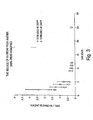
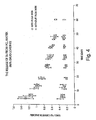
- Figures 2-5 show release rates of various extruded formulations.
- the release rate of FA from a FA/PCL (e.g., 75/25) or FA/PLGA (e.g., 60/40) core matrix with no co-extruded polymeric skin both showed a bi-phase release pattern: a burst release phase, and a slow release phase (see Figures 2 and 3 ).
- the burst release phase was less pronounced when FA levels (loading) in the PCL matrix were reduced from 75% to 60% or 40% (compare Figure 2 with Figures 3-5 ).
- the segmented drug delivery devices may be left open on one end, leaving the drug core exposed.
- the material 124 which is co-extruded to form the drug core 116 of the product 112, as well as the co-extrusion heats and pressures and the curing station 118, may be selected so that the matrix material of the drug core inhibits or prevents the passage of enzymes, proteins, and other materials into the drug core which would lyse the drug before it has an opportunity to be released from the device. As the core empties, the matrix may weaken and break down. Then the skin 114 will be exposed to degradation from both the outside and inside from water and enzymatic action. Drugs having higher solubility may be linked to form low solubility conjugates using the techniques described in U.S. Patent No. 6,051,576 , as further discussed below; alternatively, drugs may be linked together to form molecules large enough to be retained in the matrix.
- the material 122 from which the skin 114 is formed may be selected to be curable by a non-heat source. As described above, some drugs may be negatively affected by high temperatures. Thus, one aspect of the system relates to the selection and extrusion of a material which can be cured by methods other than heating, including, but not limited to, catalyzation, radiation and evaporation.
- materials capable of being cured by electromagnetic (EM) radiation e.g., in the visible or near-visible ranges, e.g., of ultraviolet or blue wavelengths, may be used, or included in, material 122.
- the curing station 118 may include one or more corresponding sources of the EM radiation which cure the material, such as an intense light source, a tuned laser, or the like, as the product 112 advances through the curing station 118.
- curable acrylic based adhesives may be used as material 122.
- the materials 124 of the drug core may include a pH buffer or the like to adjust the pH in the matrix to further tailor the drug release rate in the finished product 112.
- organic acid such as citric, tartaric, and succinic acid may be used to create an acidic micro-environment pH in the matrix.
- the constant low pH value may facilitate the diffusion of weak basic drug through the pores created upon dissolution of the drug.
- an amine such as triethanolamine, may be used to facilitate drug release rates.
- a polymer may also be used as a pH-dependent release modifier.
- PLGA may provide an acidic micro-environment in the matrix as it has an acid pH value after hydrolysis.
- More than one drug may be included in the material 124, and therefore in the core 116 of the product 112.
- the drugs may have the same or different release rates.
- 5-fluorouracil (5-FU) is highly water-soluble and it is difficult to sustain a controlled release of the drug.
- steroids such as triamcinolone acetonide (TA) are much more lipophilic and may provide a slower release profile.
- TA triamcinolone acetonide
- the pellet provides a controlled release of 5-FU over a 5-day period to give an immediate, short-term pharmaceutical effect while simultaneously providing a controlled release of TA over a much longer period.
- a mixture of 5-FU and TA, and/or codrugs or prodrugs thereof, alone or with other drugs and/or polymeric ingredients may be extruded to form the core 116.
- the core may comprise a biocompatible fluid or oil combined with a biocompatible solid (e.g., a bioerodible polymer) and an active agent.
- the inner core may be delivered as a gel while, in certain other embodiments, the inner core may be delivered as a particulate or a liquid that converts to a gel upon contact with water or physiological fluid. Examples of this type of system are described for example, in U.S. Provisional Application No. 60/501,947, filed September 11, 2003 .
- the '947 application also provides for the delivery of injectable liquids that, upon injection, undergo a phase transition and are transformed in situ into gel delivery vehicles. Such liquids may be employed with the injectable devices described herein.
- Injectable in situ gelling compositions may be used with the systems described herein, comprising a drug substance, a biocompatible solvent (e.g., a polyethylene glycol (PEG)), and a biocompatible and bioerodible polymer.
- a biocompatible solvent e.g., a polyethylene glycol (PEG)
- PEG polyethylene glycol
- Certain embodiments of this formulation may be particularly suitable, such as those that provide for the injection of solid drug particles that are dissolved, dispersed, or suspended in the PEG, and embodiments that allow for the injection of a polymeric drug-containing gel into a patient. Examples of injectable in situ gelling compositions may be found in U.S. Prov. App. No. 60/482,677, filed June 26, 2003 .
- drug as it is used herein is intended to encompass all agents which provide a local or systemic physiological or pharmacological effect when administered to mammals, including without limitation any specific drugs noted in the following description and analogs, derivatives, pharmaceutically acceptable salts, esters, prodrugs, codrugs, and protected forms thereof.
- suitable drugs include steroids, alpha receptor agonists, beta receptor antagonists, carbonic anhydrase inhibitors, adrenergic agents,physiologically active peptides and/or proteins, antineoplastic agents, antibiotics, analgesics, anti-inflammatory agents, muscle relaxants, anti-epileptics, anti-ulcerative agents, anti-allergic agents, cardiotonics, anti-arrhythmic agents, vasodilators, antihypertensive agents, anti-diabetic agents, anti-hyperlipidemics, anticoagulants, hemolytic agents, antituberculous agents, hormones, narcotic antagonists, osteoclastic suppressants, osteogenic promoters, angiogenesis suppressors, antibacterials, non-steroidal anti-inflammatory drugs (NSAIDs), glucocorticoids or other anti-inflammatory corticosteroids,s alkaloid analgesics, such as opioid analgesics, antivir
- NSAIDs non-steroidal anti-inflammatory drugs
- Suitable NSAIDs include diclofenac, etoldolac, fenoprofen, floctafenine, flurbiprofen, ibuprofen, indoprofen, ketoprofen, ketorolac, lornoxicam, morazone, naproxen, perisoxal, pirprofen, pranoprofen, suprofen, suxibuzone, tropesin, ximoprofen, zaltoprofen, zileuton, and zomepirac, and analogs, derivatives, pharmaceutically acceptable salts, esters, prodrugs, codrugs, and protected forms thereof.
- Suitable carbonic anhydrase inhibitors include brinzolamide, acetazolamide, methazolamide, dichlorphenamide, ethoxzolamide, and dorzolamide, and analogs, derivatives, pharmaceutically acceptable salts, esters, prodrugs, codrugs, and protected forms thereof.
- Suitable adrenergic agents include brimonidine, apraclonidine, bunazosin, levobetaxolol, levobunalol, carteolol, isoprenaline, fenoterol, metipranolol, and clenbuterol, and analogs, derivatives, pharmaceutically acceptable salts, esters, prodrugs, codrugs, and protected forms thereof.
- Suitable alpha receptor agonists include brimonidine and analogs, derivatives, pharmaceutically acceptable salts, esters, prodrugs, codrugs, and protected forms thereof.
- Suitable beta receptor antagonists include betaxolol and timolol, and analogs, derivatives, pharmaceutically acceptable salts, esters, prodrugs, codrugs, and protected forms thereof.
- Suitable antiviral agents include neviripine and analogs, derivatives, pharmaceutically acceptable salts, esters, prodrugs, codrugs, and protected forms thereof.
- Suitable alkaloid analgesics include desmorphine, dezocine, dihydromorphine, eptazocine, ethylmorphine, glafenine, hydromorphone, isoladol, ketobenidone, p-lactophetide, levorphanol, moptazinol, metazocin, metopon, morphine, nalbuphine, nalmefene, nalorphine, naloxone, norlevorphanol, normorphine, oxmorphone, pentazocine, phenperidine, phenylramidol, tramadol, and viminol, and analogs, derivatives, pharmaceutically acceptable salts, esters, prodrugs, codrugs, and protected forms thereof.
- Suitable glucocorticoids include 21-acetoxypregnenolone, alclometasone, algestone, anacortave acetate, amcinonide, beclomethasone, betamethasone, budesonide, chloroprednisone, clobetasol, clobetasone, clocortolone, cloprednol, corticosterone, cortisone, cortivazol, deflazacort, desonide, desoximetasone, diflorasone, diflucortolone, difuprednate, enoxolone, fluazacort, flucloronide, flumethasone, flunisolide, fluocinolone acetonide, fluocinonide, flucloronide, flumethasone, flunisolide, fluocortin butyl, fluocortolone, fluorometholone, fluperolone acetate, flupred
- steroids include halcinonide, rudetasol propionate, halometasone, halopredone acetate, isoflupredone, loteprednol etabonate, mazipredone, rimexolone, and tixocortol, and analogs, derivatives, pharmaceutically acceptable salts, esters, prodrugs, codrugs, and protected forms thereof.
- Suitable BPH drugs include finasteride and osaterone, and analogs, derivatives, pharmaceutically acceptable salts, esters, prodrugs, codrugs, and protected forms thereof.
- Suitable antineoplastic compounds include alitretinoin (9-cis-retinoic acid); bleomycins, including bleomycin A; capecitabine (5'-deoxy-5-fluoro-cytidine); carubicin; chlorozotocin, chromomycins, including chromomycin A 3 , cladribine; colchicine, cytarabine; daunorubicin; demecolcine, denopterin, docetaxel, doxyifluridine, doxorubicin; dromostanolone, edatrexate, enocitabine, epirubicin, epitiostanol, estramustine; etoposide; floxuridine, fludarabine, 5-fluorouracil, formestane, gemcitabine; irinotecan; lentinan, lonidamine, melengestrol, melphalan; menogaril, methotrexate; mitolac
- Suitable antibacterial compounds include capreomycins, including capreomycin IA, capreomycin IB, capreomycin IIA and capreomycin IIB; carbomycins, including carbomycin A; carumonam; cefaclor, cefadroxil, cefamandole, cefatrizine, cefazedone, cefazolin, cefbuperazone, cefcapene pivoxil, cefclidin, cefdinir, cefditoren, cefime, ceftamet, cefmenoxime, cefmetzole, cefminox, cefodizime, cefonicid, cefoperazone, ceforanide, cefotaxime, cefotetan, cefotiam, cefoxitin, cefpimizole, cefpiramide, cefpirome, cefprozil, cefroxadine, cefsulodin, ceftazidime, cef
- Antiproliferative/antimitotic drugs and prodrugs include natural products such as vinca alkaloids (e.g., vinblastine, vincristine, and vinorelbine), paclitaxel, epidipodophyllotoxins (e.g., etoposide, teniposide), antibiotics (e.g., actinomycins, daunorubicin, doxorubicin and idarubicin), anthracyclines, mitoxantrone, bleomycins, plicamycin (mithramycin) and mitomycin, enzymes (e.g., L-asparaginase); antiplatelet prodrugs; antiproliferative/antimitotic alkylating prodrugs such as nitrogen mustards (mechlorethamine, cyclophosphamide and analogs, melphalan, chlorambucil), ethylenimines and methyhnelamines (hexamethylmelamine and thiote
- a method for treating or reducing the risk of retroviral or lentiviral infection comprising injecting a sustained release drug delivery system including an antiviral agent in a patient in need of treatment wherein a dose of said agent is released for at least 7 days.
- Another aspect of the system provides a method for treating or reducing the risk of retroviral or lentiviral infection comprising injecting a sustained release drug delivery system including an antiviral agent in a patient in need of treatment wherein release of said agent maintains a desired concentration of said agent in blood plasma for at least 7 days.
- the system reduces the risk of mother to child transmission of viral infections.
- viral infections include HIV, Bowenoid Papulosis, Chickenpox, Childhood HIV Disease, Human Cowpox, Hepatitis C, Dengue, Enteroviral, Epidermodysplasia Verruciformis, Erythema Infectiosum (Fifth Disease), Giant Condylomata Acuminata of Buschke and Lowenstein, Hand-Foot-and-Mouth Disease, Herpes Simplex, Herpes Virus 6, Herpes Zoster, Kaposi Varicelliform Eruption, Rubeola Measles, Milker's Nodules, Molluscum Contagiosum, Monkeypox, Orf, Roseola Infantum, Rubella, Smallpox, Viral Hemorrhagic Fevers, Genital Warts, and Nongenital Warts.
- the antiviral agent is selected from azidouridine, anasmycin, amantadine, bromovinyldeoxusidine, chlorovinyldeoxusidine, cytarbine, didanosine, deoxynojirimycin, dideoxycitidine, dideoxyinosine, dideoxynucleoside, desciclovir, deoxyacyclovir, edoxuidine, enviroxime, fiacitabine, foscamet, fialuridine, fluorothymidine, floxuridine, hypericin, interferon, interleukin, isethionate, nevirapine, pentamidine, ribavirin, rimantadine, stavirdine, sargrarnostin, suramin, trichosanthin, tribromothymidine, trichlorothymidine, vidarabine, zidoviridine, zalcitabine and 3-azido-3-de
- the antiviral agent is selected from 2',3'-dideoxyadenosine (ddA), 2',3'-dideoxyguanosine (ddG), 2',3'-dideoxycytidine (ddC), 2',3'-dideoxythymidine (ddT), 2'3'-dideoxy-dideoxythymidine (d4T), 2'-deoxy-3'-thia-cytosine (3TC or lamivudime), 2',3'-dideoxy-2'-fluoroadenosine, 2',3'-dideoxy-2'-fluoroinosine, 2',3'-dideoxy-2'-fluorothymidine, 2',3'-dideoxy-2'-fluorocytosine, 2'3'-dideoxy-2',3'-didehydro-2'-fluorothymidine (Fd4T), 2'3'-dideoxy-2'-bet
- the antiviral agent is selected from trisodium phosphomonoformate, ganciclovir, trifluorothymidine, acyclovir, 3'azido-3'thymidine (AZT), dideoxyinosine (ddI), idoxuridine.
- antiviral drug include selected from the group consisting of acyclovir, azidouridine, anasmycin, amantadine, bromovinyldeoxusidine, chlorovinyldeoxusidine, cytarbine, didanosine, deoxynojirimycin, dideoxycitidine, dideoxyinosine, dideoxynucleoside, desciclovir, deoxyacyclovir, edoxuidine, enviroxime, fiacitabine, foscamet, fialuridine, fluorothymidine, floxuridine, ganciclovir, hypericin, interferon, interleukin, isethionate, idoxuridine, nevirapine, pentamidine, ribavirin, rimantadine, stavirdine, sargramostin, suramin, trichosanthin, trifluorothymidine, tribromothymidine, trichlorothymidine
- the antiviral agent is one which inhibits or reduces HIV infection or susceptibility to HIV infection.
- Non-nucleoside analogs are preferred and include compounds, such as nevirapine, delavirdine and efavirenz, to name a few.
- nucleoside derivatives although less preferable, can also be used, including compounds such as 3'azido-3'thymidine (AZT), dideoxyinosine (ddI), 2',3'-dideoxyadenosine (ddA), 2',3'-dideoxyguanosine (ddG), 2',3'-dideoxycytidine (ddC), 2',3'-dideoxythymidine (ddT), 2'3'-dideoxy-dideoxythymidine (d4T), and 2'-deoxy-3'-thia-cytosine (3TC or lamivudime).
- AZT 3'azido-3'thymidine
- ddI dideoxyinosine
- ddA 2',3'-dideoxyadenosine
- ddG 2',3'-dideoxyguanosine
- ddC 2',3'-dideoxycytidine
- Halogenated nucleoside derivatives may also be used including, for example, 2'3'-dideoxy-2'-fluoronucleosides such as 2',3'-dideoxy-2'-fluoroadenosine, 2',3'-dideoxy-2'-fluoroinosine, 2',3'-dideoxy-2'-fluorothymidine, 2',3'-dideoxy-2'-fluorocytosine, and 2',3'-dideoxy-2',3'-didehydro-2'-fluoronucleosides including, but not limited to2'3'-dideoxy-2',3'-didehydro-2'-fluorothymidine (Fd4T), 2'3'-dideoxy-2'-beta-fluoroadenosine (F-ddA), 2'3'-dideoxy-2'-beta-fluoro- inosine (F-ddI) and 2',3'-dide
- any pharmaceutically acceptable form of such a compound may be employed in the practice of the present invention, i.e., the free base or a pharmaceutically acceptable salt or ester thereof.
- Pharmaceutically acceptable salts for instance, include sulfate, lactate, acetate, stearate, hydrochloride, tartrate, maleate, and the like.
- pharmaceutically acceptable carrier means a pharmaceutically acceptable material, composition or vehicle, such as a liquid or solid filler, diluent, excipient, or encapsulating material, involved in carrying or transporting the subject antagonists from one organ, or portion of the body, to another organ, or portion of the body.
- a pharmaceutically acceptable material, composition or vehicle such as a liquid or solid filler, diluent, excipient, or encapsulating material, involved in carrying or transporting the subject antagonists from one organ, or portion of the body, to another organ, or portion of the body.
- Each carrier must be “acceptable” in the sense of being compatible with the other ingredients of the formulation and not injurious to the patient.
- materials which can serve as pharmaceutically acceptable carriers include: (1) sugars, such as lactose, glucose and sucrose; (2) starches, such as corn starch and potato starch; (3) cellulose, and its derivatives, such as sodium carboxymethyl cellulose, ethyl cellulose and cellulose acetate; (4) powdered tragacanth; (5) malt; (6) gelatin; (7) talc; (8) excipients, such as cocoa butter and suppository waxes; (9) oils, such as peanut oil, cottonseed oil, safflower oil, sesame oil, olive oil, corn oil and soybean oil; (10) glycols, such as propylene glycol; (11) polyols, such as glycerin, sorbitol, mannitol and polyethylene glycol; (12) esters, such as ethyl oleate and ethyl laurate; (13) agar; (14) buffering agents, such as magnesium hydroxide and aluminum hydroxide;
- Codrugs or prodrugs may be used to deliver drugs in a sustained manner.
- codrugs and prodrugs may be adapted to use in the core 116 or skin 114 of the drug delivery devices described above.
- An example of sustained-release systems using codrugs and prodrugs may be found in U.S. Pat. No. 6,051,576 . This reference is incorporated in its entirety herein by reference.
- codrugs and prodrugs may be included with the gelling, suspension, and other embodiments described herein.
- the term "codrug” means a first constituent moiety chemically linked to at least one other constituent moiety that is the same as, or different from, the first constituent moiety.
- the individual constituent moieties are reconstituted as the pharmaceutically active forms of the same moieties, or codrugs thereof, prior to conjugation.
- Constituent moieties may be linked together via reversible covalent bonds such as ester, amide, carbamate, carbonate, cyclic ketal, thioester, thioamide, thiocarbamate, thiocarbonate, xanthate and phosphate ester bonds, so that at the required site in the body they are cleaved to regenerate the active forms of the drug compounds.
- the term "constituent moiety” means one of two or more pharmaceutically active moieties so linked as to form a codrug according to the present invention as described herein. In some embodiments according to the present invention, two molecules of the same constituent moiety are combined to form a dimer (which may or may not have a plane of symmetry). In the context where the free, unconjugated form of the moiety is referred to, the term “constituent moiety” means a pharmaceutically active moiety, either before it is combined with another pharmaceutically active moiety to form a codrug, or after the codrug has been hydrolyzed to remove the linkage between the two or more constituent moieties. In such cases, the constituent moieties are chemically the same as the pharmaceutically active forms of the same moieties, or codrugs thereof, prior to conjugation.
- prodrug is intended to encompass compounds that, under physiological conditions, are converted into the therapeutically active agents of the present invention.
- a common method for making a prodrug is to include selected moieties, such as esters, that are hydrolyzed under physiological conditions to convert the prodrug to an active biological moiety.
- the prodrug is converted by an enzymatic activity of the host animal.
- Prodrugs are typically formed by chemical modification of a biologically active moiety. Conventional procedures for the selection and preparation of suitable prodrug derivatives are described, for example, in Design of Prodrugs, ed. H. Bundgaard, Elsevier, 1985.
- the term "residue of a constituent moiety” means that part of a codrug that is structurally derived from a constituent moiety apart from the functional group through which the moiety is linked to another constituent moiety.
- the residue of the constituent moiety is that part of the constituent moiety that includes the -NH- of the amide, but excluding the hydrogen (H) that is lost when the amide bond is formed.
- the term "residue” as used herein is analogous to the sense of the word “residue” as used in peptide and protein chemistry to refer to a residue of an amino acid in a peptide.
- Codrugs may be formed from two or more constituent moieties covalently linked together either directly or through a linking group.
- the covalent bonds between residues include a bonding structure such as: wherein Z is O, N, -CH 2 -, -CH 2 -O- or -CH 2 -S-, Y is O, or N, and X is O or S.
- the rate of cleavage of the individual constituent moieties can be controlled by the type of bond, the choice of constituent moieties, and/or the physical form of the codrug.
- the lability of the selected bond type may be enzyme-specific. In some embodiments, the bond is selectively labile in the presence of an esterase.
- the bond is chemically labile, e.g., to acid- or base-catalyzed hydrolysis.
- the linking group does not include a sugar, a reduced sugar, a pyrophosphate, or a phosphate group.
- the physiologically labile linkage may be any linkage that is labile under conditions approximating those found in physiologic fluids.
- the linkage may be a direct bond (for instance, ester, amide, carbamate, carbonate, cyclic ketal, thioester, thioamide, thiocarbamate, thiocarbonate, xanthate, phosphate ester, sulfonate, or a sulfamate linkage) or may be a linking group (for instance, a C 1 -C 12 dialcohol, a C 1 -C 12 hydroxyalkanoic acid, a C 1 -C 12 hydroxyalkylamine, a C 1 -C 12 diacid, a C 1 -C 12 aminoacid, or a C 1 -C 12 diamine).
- linkages are direct amide, ester, carbonate, carbamate, and sulfamate linkages, and linkages via succinic acid, salicylic acid, diglycolic acid, oxa acids, oxamethylene, and halides thereof.
- the linkages are labile under physiologic conditions, which generally means pH of about 6 to about 8. The lability of the linkages depends upon the particular type of linkage, the precise pH and ionic strength of the physiologic fluid, and the presence or absence of enzymes that tend to catalyze hydrolysis reactions in vivo. In general, lability of the linkage in vivo is measured relative to the stability of the linkage when the codrug has not been solubilized in a physiologic fluid.
- codrugs may be relatively stable in some physiologic fluids, nonetheless, they are relatively vulnerable to hydrolysis in vivo (or in vitro, when dissolved in physiologic fluids, whether naturally occurring or simulated) as compared to when they are neat or dissolved in non-physiologic fluids (e.g., non-aqueous solvents such as acetone).
- non-physiologic fluids e.g., non-aqueous solvents such as acetone
- Codrugs for preparation of a drug delivery device for use with the systems described herein may be synthesized in the manner illustrated in one of the synthetic schemes below.
- the first and second constituent moieties are to be directly linked, the first moiety is condensed with the second moiety under conditions suitable for forming a linkage that is labile under physiologic conditions. In some cases it is necessary to block some reactive groups on one, the other, or both of the moieties.
- the constituent moieties are to be covalently linked via a linker, such as oxamethylene, succinic acid, or diglycolic acid, it is advantageous to first condense the first constituent moiety with the linker.
- a suitable solvent such as acetonitrile
- suitable catalysts such as carbodiimides including EDCI (1-ethyl-3-(3-dimethylaminopropyl)-carbodiimide) and DCC (DCC: dicyclohexylcarbo-diimide)
- carbodiimides including EDCI (1-ethyl-3-(3-dimethylaminopropyl)-carbodiimide) and DCC (DCC: dicyclohexylcarbo-diimide
- EDCI 1-ethyl-3-(3-dimethylaminopropyl)-carbodiimide
- DCC dicyclohexylcarbo-diimide
- a suitable solvent such as acetonitrile
- suitable catalysts such as carbodiimides including EDCI and DCC
- suitable catalysts such as carbodiimides including EDCI and DCC
- linkers While diacids, dialcohols, amino acids, etc., are described as being suitable linkers, other linkers are contemplated as being within the present invention.
- the hydrolysis product of a codrug described herein may comprise a diacid
- the actual reagent used to make the linkage may be, for example, an acylhalide such as succinyl chloride.
- acylhalide such as succinyl chloride.
- other possible acid, alcohol, amino, sulfato, and sulfamoyl derivatives may be used as reagents to make the corresponding linkage.
- first and second constituent moieties are to be directly linked via a covalent bond
- essentially the same process is conducted, except that in this case there is no need for a step of adding a linker.
- the first and second constituent moieties are merely combined under conditions suitable for forming the covalent bond. In some cases it may be desirable to block certain active groups on one, the other, or both of the constituent moieties. In some cases it may be desirable to use a suitable solvent, such as acetonitrile, a catalyst suitable to form the direct bond, such as carbodiimides including EDCI and DCC, or conditions designed to drive off water of condensation (e.g., reflux) or other reaction by-products.
- first and second moieties may be directly linked in their original form, it is possible for the active groups to be derivatized to increase their reactivity.
- the first moiety is an acid and the second moiety is an alcohol (i.e., has a free hydroxyl group)
- the first moiety may be derivatized to form the corresponding acid halide, such as an acid chloride or an acid bromide.
- acid halide such as an acid chloride or an acid bromide.
- the first and second constituent moieties of the codrug may be any drug, including any of the agents listed above, and analogs, derivatives, pharmaceutically acceptable salts, esters, prodrugs, codrugs, and protected forms thereof.
- the first and second constituent moieties are different drugs; in other embodiments, they are the same.
- the first constituent moiety is an NSAID.
- the second constituent moiety is corticosteroid.
- the first constituent moiety is 5-FU)and the second is TA.
- the first constituent moiety is a beta lactam antibiotic such as amoxicillin and the second is a beta lactamase inhibitor such as clavulanate.
- Step 2 R 1 -COO-L-CO-Prot ⁇ R 1 -COO-L-COOH
- Step 3 R 1 -COO-L-COOH + R 2 -OH ⁇ R 1 -COO-L-COOR 2
- R 1 , L, and R 2 have the meanings set forth above.
- R 1 and R 2 have the meanings set forth above and G is a direct bond, an C 1 -C 4 alkylene, a C 2 -C 4 alkenylene, a C 2 -C 4 alkynylene, or a 1,2-fused ring, and G together with the anhydride group completes a cyclic anhydride.
- Suitable anhydrides include succinic anhydride, glutaric anhydride, maleic anhydride, diglycolic anhydride, and phthalic anhydride.
- drugs may also be included in material 122, and therefore incorporated in the skin 114 of an extruded product segment 112 I . This may provide biphasic release with an initial burst such that when such a system is first placed in the body, a substantial fraction of the total drug released is released from the skin 114. Subsequently, more drug is released from the core 116.
- the drug(s) included in the skin 114 may be the same drug(s) as inside the core 116.
- the drugs included in the skin 114 may be different from the drug(s) included in the core 116.
- the core 116 may include 5-FU while the skin 114 may include TA or loteprednol etabonate.
- an outer layer (such as the skin 114) may be surrounded by an additional layer that is permeable, semi-permeable, or impermeable (element numbers 110, 210, and 310 in the '972 patent), or may itself be formed of a permeable or semi-permeable material.
- co-extruded devices may be provided with one or more layers using techniques and materials fully described in the '972 patent.
- additional layers may be provided, for example with a third, concentric co-extruded material from a co-extrusion device that can co-extrude three materials at one time.
- active agents in the core may be released at various controlled rates.
- materials considered to be impermeable may permit release of drugs or other active agents in the core 116 under certain circumstances.
- permeability of the skin 114 may contribute to the release rate of an active agent over time, and may be used as a parameter to control the release rate over time for a deployed device.
- a continuous mass of co-extruded product 112 may be segmented into devices 112 I having, for example, an impermeable skin 114 surrounding a core 116, with each segment further coated by a semi-permeable or permeable layer to control a release rate through the exposed ends thereof.
- the skin 114, or one or more layers thereof, or a layer surrounding the device may be bioerodible at a known rate, so that core material is exposed after a certain period of time along some or all of the length of the tube, or at one or both ends thereof.
- the delivery rate for the deployed device may be controlled to achieve a variety of release rate profiles.
- Extrusion, and more particularly co-extrusion, of the product 112 permits very close tolerances of the dimensions of the product. It has been found that a significant factor affecting the release rate of drug from a device formed from the product 112 is the internal diameter of the skin 114, which relates to the (at least initial) total surface area available for drug diffusion. Thus, by maintaining close tolerances of the inner diameter of the skin 114, the variation in release rates from the drug cores of batches of devices can be reduced.
- the outside diameter of the delivery device may also be controlled by varying the processing parameters, such as the conveyor speed and the die diameter.
- a co-extrusion line consisting of two Randcastle microtruders, a concentric co-extrusion die, and a conveyer may be used to manufacture an injectable delivery device for FA.
- Micronized powder of FA may be granulated with the following matrix-forming material: PCL or poly(vinyl acetate) (PVAC) at a drug loading level of 40% or 60%.
- the resulting mixture may be co-extruded with or without PLGA or EVA as an outer layer coating to form a composite tube-shaped product
- In-vitro release studies may be carried out using pH 7.4 phosphate buffer to evaluate the release characteristics of FA from different delivery devices.
- FA granules used to form the drug core may be prepared by mixing 100 g of FA powder with 375 g and 167 g of 40% PCL solution to prepare 40% and 60% drug loading formulations, respectively. After oven-drying at 55° C for 2 hours, the granules may be ground to a size 20 mesh manually or using a cryogenic mill. The resulting drug/polymer mixture may be used as material 124 and co-extruded with PLGA as material 122 using two Randcastle Model RCP-0250 microextruders to form a composite co-extruded, tube-shaped product 112.
- the release of drugs can be attenuated by using a different combination of inner matrix-forming materials and outer polymeric materials. This makes these devices suitable for a variety of applications where controlled and sustained release of drugs, including steroids, is desired.
- simple extrusion i.e., extrusion of a single material or mixture, may also be used to extrude a skin which is then cured and filled with a drug core mixture in a non-extrusion process.
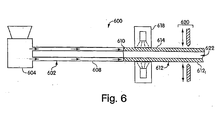
- Figure 6 shows an apparatus for extruding a skin for a drug delivery device.
- a system 600 may include an extrusion device 602 having an extruder 604 connected to a die head 608 in a manner well known to those of skill in the extrusion arts.
- the die head 608 may have an exit port 610 out of which materials from the extruder 604 are forced.
- the die head 608 and/or exit port 610 may establish a cross-sectional shape of extruded matter.
- Commercially available extruders may be used as the extruder 604, including the Randcastle model RCP-0250 Microtruder (Randcastle Extrusion Systems, Cedar Grove, New Jersey), and its associated heaters, controllers, and the like.
- Exemplary extruders are also disclosed, for example, in U.S. Patent Nos. 5,569,429 , 5,518,672 , and 5,486,328 .
- the system 600 may be a system as described above with reference to Fig. 1 , except that no central core is co-extruded with the skin 614, leaving an open center region 622.
- a curing station 618 and a segmenting station 620 may also be provided, and may be as described above with reference to Fig. 1 . It will be appreciated that the center region 622 may have a tendency to collapse under gravity.
- the extruded material 612 may be extruded vertically so that it may be cured and/or segmented without gravity collapsing the walls of the skin 614, resulting in undesired adhesion and closure of the center region 622.
- the extruded material 612 may be segmented at the segmenting station 620 into a plurality of segments 612 I that may form a skin for a sustained release drug delivery device.
- a wire such as Nitinol
- One technique that has been successfully employed is to dip a wire, such as Nitinol, of suitable outside diameter into an uncured polyimide or other suitable polymer.
- the polyimide then may be cured.
- the wire may then be withdrawn from the polyimide to provide a polymer tube into which desired drug formulations may be injected or otherwise inserted.
- This technique has been used, for example, to construct the devices characterized in Fig. 10 below.
- injectable devices may be constructed using preformed cores of drug or drug matrix material.
- the core may be formed by extrusion, compression, or other means and then sprayed or otherwise coated with a film of material having suitable properties.
- the core whether prepared in segments or a continuous length of material that will be cut into segments, may be dip coated in an uncured polymer or other suitable material and, if appropriate, may be cured to form drug delivery devices of suitable dimensions.
- the outer polymer layer may be permeable, non-permeable, or partially permeable according to the type of core and the desired release rate profile for the device.
- the outer layer may also include one or more pores that provide a means for ingress of biological fluids or water and egress of active agents from the core.
- the outer layer may also be bioerodible or non-bioerodible. Bioerodible outer layers may erode at a rate that is faster or slower than (or the same as) an erosion rate of the core, which may itself be bioerodible or non-bioerodible.
- Suitable materials for the outer layer include any biocompatible polymer, including, but not limited to, PCL, EVA, PEG, PVA, PLA, PGA, PLGA, polyimide, polyalkyl cyanoacralate, polyurethane, nylons, or copolymers thereof.
- the lactic acid may be D-, L-, or any mixture of D- and L-isomers. All such outer layers may be suitably employed with any of the injectable devices described herein.
- the core may be fashioned of a drug matrix that independently controls release rate of one or more drugs within the core, using, for example, the extrusion or compression techniques noted above.
- the outer polymer layer may be omitted entirely, or the core may be coated with a layer that affects other properties of the injectable device, including lubricants or adhesives.
- Figure 7 is a flow chart of a process for making an injectable drug delivery device.
- the method 700 may begin by extruding a polymeric skin 704 using an extruder such as the extruder described above with reference to Fig. 6 .
- Any suitable polymer may be used, including a bioerodible polymer or a polymer with a desired permeability, such as impermeability, semi-permeability, or permeability to either a drug to be delivered or a biological fluid in which the device is to be placed. Erodability and permeability may be selected according to a desired drug (and the solubility thereof), a desired release rate, and an expected biological environment, as discussed generally above.
- One suitable polymer for intraocular and periocular applications is polyimide.
- the continuous mass of extruded skin may be segmented, as shown in step 706, into individual segments having an open central region. Segmenting may be performed, for example, using the segmenting station described in reference to Figs. 1 & 6 above.
- drugs may be inserted into a segment cut from the mass of extruded skin.
- the drug may be any of the drugs and drug formulations described above, and may include release-rate controlling formulations such as biocompatible gels, admixtures, polymer/drug matrices, granulated drug compounds, or any other formulations suitable for inserting by injection or other techniques into the segment.
- release-rate controlling formulations such as biocompatible gels, admixtures, polymer/drug matrices, granulated drug compounds, or any other formulations suitable for inserting by injection or other techniques into the segment.
- One suitable formulation is a slurry of PVA and FA that may be forced into the segment and cured.
- a diffusion membrane may be provided to limit the release rate of the drug core.
- the diffusion membrane may operate by, for example, limiting fluid flow into the drug core or limiting the passage of drugs out of the drug core.
- Additional processing steps may be performed.
- the cured and drug-loaded segment in step 708 may be inserted into an additional polymer tube, such as polyimide, of slightly wider and longer dimensions.
- This additional tube may provide a reservoir on one or both ends, which may be filled with, for example, the diffusion membrane on one or both ends of the device.
- an anchor may be attached to the device.
- anchor is intended to refer to anything used to secure the device in a location within a body, such as a small eye for receiving a suture, an expanding wire or flexible material that clasps the puncture hole formed by the needle that injects the device, an adhesive, or the like. Any mechanism suitable for securing the device in its intended location and suitable for use with an injectable drug delivery device may be used as an anchor.
- a reservoir such as the reservoir described above with reference to step 710, may be filled with a curable adhesive, such as an ultraviolet curable adhesive. A portion of an anchor may be inserted into the adhesive, and the adhesive may be cured, such as by applying ultraviolet radiation, so that the anchor is secured to the device.
- the device may be packaged, such as by preloading a needle of appropriate gauge with the device and enclosing the assembly in a suitable package for shipment to an end user.
- the closed package may further be sterilized in any suitable manner.
- steps may be omitted, altered, or rearranged, provided that the steps utilized result in an injectable, sustained release drug delivery device.
- the step of adding a diffusion membrane 710 may be omitted entirely, or may be replaced by a step of coating the entire device with a polymer coating of suitable properties.
- a length of extruded polymeric skin may be filled with a drug core, after which the entire mass may be cured (if appropriate) and cut into a number of segments.
- certain steps, such as curing the extruded skin may be adapted to a particular manufacturing method, such as by partially curing the skin at one step, with additional curing occurring at a subsequent processing step. All such variations are intended to fall within the scope of this description, provided that they result in an injectable, sustained-release drug delivery device as described herein.
- FIG. 8 shows an injectable drug delivery device.
- the device 800 may include a drug core 802, a skin 804 of one or more polymer layers, and an anchor 806 attached to the device 800.
- the drug core 802, the skin 804, and the anchor 806 may be any of the cores, skins, and anchors described herein.
- the release rate may be determined primarily by the surface area of the core 802 at an end of the device 800, and a duration of release may be determined primarily by a length of the device 800.
- an injectable drug delivery device of suitable size and drug release characteristics may be fashioned in other ways.
- a solid, compressed device formed of a drug/polymer matrix may have suitable release properties for use without a skin 804 or other coating that affects release rate.
- the compressed device may be formed, for example, as a cylindrical mass that is extruded using the extruder of Fig. 6 , and then cured into a solid mass (before or after segmenting).
- the compressed device may instead be formed by compressing granules of drug, either alone or in mixture with other substances, into a preformed mold of suitable size.
- a significant advantage of many of the methods of making an injectable device as described above is that stability of the drug itself may be controlled and/or improved.
- the drug when contained in the core, the drug may be protected from forces in the external environment that may degrade or alter its activity, whether in manufacturing, in storage, or in use.
- the matrix in the drug core and/or the skin layer(s) may provide a measure of protection.
- the inner skin may be composed of ultraviolet absorbable material (e.g., polyimide). If the outer layer is cured during fabrication using ultraviolet light, the inner skin may prevent the ultraviolet irradiation from coming into contact with the drug in the core.
- the skin(s) and core matrix may also protect the drug from chemical degradation and metabolism in biological fluids by controlling and limiting the interaction of the drug and fluid. This mechanism may also aid in stabilizing the drug in the device during storage by limiting the interaction of the drug with air or humidity.
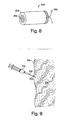
- Figure 9 shows an injectable drug delivery system.
- a needle 902 may puncture a wall of biological material 904.
- the needle 902 may be pre-loaded with an injectable drug delivery device 906, which may be injected into a biological medium 908, such as biological fluid or tissue, on an opposing side of the wall 904, and driven into the biological medium 908 by a fluid 910, such as saline, in a reservoir of the needle.
- a biological medium 908 such as biological fluid or tissue
- a fluid 910 such as saline
- the needle may be variously positioned at different depths within the biological medium 908.
- Figure 10 shows release rates of certain devices.
- preformed tubes of polyimide with an inner diameter of 0.0115 inches and an outer diameter of 0.0125 inches were prepared using the dipped-wire method described above.
- Drug delivery devices were then formed by injecting a paste of FA/PVA (in a ratio of 90:10) into the preformed tube.
- the filled tube was then cut into sections of 3 mm and dried at ambient conditions, after which the sections were cured at 135° C for two hours. This achieved a total drug loading of about 26 ⁇ g/mm in each device.
- Some of the devices were left with two open ends. Other devices were sealed on one end using a silicone adhesive.
- the devices with two open ends released drug at approximately 0.4 ⁇ g/day (after an initial burst of greater release), and the devices with one open end released drug at approximately 0.2 ⁇ g/day (also after an initial burst).
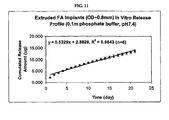
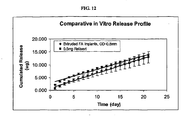
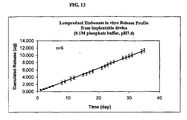
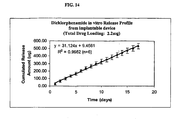
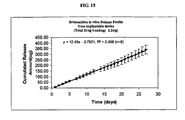
- Figures 11-15 further illustrate experimental release-rate results of injectable devices of the type described herein. The results also illustrate the use of injectible devices of the type described in U.S. application 10/714549 , the disclosure of which is incorporated in its entirety by reference.
- a sample injectable device (outside diameter of approximately about 0.8 mm) was extruded with the drug FA and combined in vitro with O.lm phosphate buffer at pH 7.4. Samples were taken over several days and amounts ( ⁇ g) of FA released were measured.
- a sample implantable device, developed under the trademark Retisert TM was also prepared in vitro with a sample drug, and the amounts ( ⁇ g) of drug released were measured. The results are shown in figures 11 - 15 .
- Figure 11 shows the in-vitro release profile of FA from an injectable device of the type described herein over a period of more than 20 days.
- Figure 12 shows comparative in-vitro profiles of the release of FA from an injectable device of the type described herein and from an implantable device developed under the trademark Retisert TM .
- Figure 13 shows the in-vitro release profile of Loteprednol Etabonate (LE) from an implantable device developed under the trademark Retisert TM .
- Figure 14 shows the in-vitro release profile of Dichlorphenamide (2.2 mg) from an implantable device developed under the trademark Retisert TM .
- Figure 15 shows the in-vitro release profile of Brimonidine (2.2 mg) from an implantable device developed under the trademark Retisert TM .
Landscapes
- Health & Medical Sciences (AREA)
- Life Sciences & Earth Sciences (AREA)
- Pharmacology & Pharmacy (AREA)
- Veterinary Medicine (AREA)
- Chemical & Material Sciences (AREA)
- Public Health (AREA)
- General Health & Medical Sciences (AREA)
- Medicinal Chemistry (AREA)
- Animal Behavior & Ethology (AREA)
- Chemical Kinetics & Catalysis (AREA)
- Organic Chemistry (AREA)
- Nuclear Medicine, Radiotherapy & Molecular Imaging (AREA)
- General Chemical & Material Sciences (AREA)
- Epidemiology (AREA)
- Engineering & Computer Science (AREA)
- Virology (AREA)
- Communicable Diseases (AREA)
- Bioinformatics & Cheminformatics (AREA)
- Oncology (AREA)
- Hematology (AREA)
- Biomedical Technology (AREA)
- Pain & Pain Management (AREA)
- Rheumatology (AREA)
- Molecular Biology (AREA)
- Ophthalmology & Optometry (AREA)
- Diabetes (AREA)
- Obesity (AREA)
- Neurosurgery (AREA)
- Dermatology (AREA)
- Medicinal Preparation (AREA)
- Pharmaceuticals Containing Other Organic And Inorganic Compounds (AREA)
- Medicines That Contain Protein Lipid Enzymes And Other Medicines (AREA)
- Medical Preparation Storing Or Oral Administration Devices (AREA)
- Prostheses (AREA)
Claims (20)
- Dispositif de libération de médicaments formé et dimensionné pour l'injection dans une aiguille d'une taille allant d'une jauge 30 à une jauge 15 ou dans une canule ayant une taille allant d'une jauge 30 à une jauge 15, comportant :un noyau comprenant un ou plusieurs médicaments ; etune pellicule polymère entourant le noyau au moins partiellement, mais pas complètement, cette pellicule comprenant un premier polymère ou plus, imperméable au passage d'au moins un du ou des médicaments,ce dispositif fournissant une libération prolongée du ou des médicaments lorsqu'il est exposé à un milieu biologique.
- Dispositif selon la revendication 1, dans lequel le noyau comporte une matrice du ou des médicaments et un deuxième polymère ou plus.
- Dispositif selon la revendication 2, dans lequel au moins un du deuxième polymère ou plus est bioérodible.
- Dispositif selon la revendication 2, dans lequel au moins un du premier polymère ou plus et du deuxième polymère ou plus est bioérodible, durcissable par rayonnement, thermodurcissable, durcissable par évaporation, ou durcissable par catalyse.
- Dispositif selon la revendication 1, dans lequel la pellicule polymère comprend en outre au moins un médicament.
- Dispositif selon la revendication 1, ce dispositif étant formé et dimensionné pour au moins soit une injection périoculaire, soit une injection intraoculaire.
- Dispositif selon la revendication 2, comportant en outre une deuxième pellicule polymère.
- Dispositif selon la revendication 7, dans lequel la pellicule polymère a une perméabilité au médicament ou aux médicaments différente de celle de la deuxième pellicule polymère, et le noyau est complètement couvert par une combinaison de la pellicule polymère et de la deuxième pellicule polymère.
- Dispositif selon la revendication 7, dans lequel au moins une de la pellicule polymère ou de la deuxième pellicule polymère est bioérodible.
- Dispositif selon la revendication 9, dans lequel une vitesse de libération d'au moins un du ou des médicaments est influencée par une érosion d'au moins une de la pellicule polymère ou de la deuxième pellicule polymère.
- Dispositif selon la revendication 9, dans lequel une vitesse de libération d'au moins un du ou des médicaments est indépendante d'une érosion d'au moins une de la pellicule polymère ou de la deuxième pellicule polymère.
- Dispositif selon la revendication 8, dans lequel chacun du noyau, de la pellicule polymère, et de la deuxième pellicule polymère est bioérodible.
- Dispositif selon la revendication 8, dans lequel une vitesse de libération d'au moins un du ou des médicaments est commandée au moins soit par la perméabilité de la deuxième pellicule polymère à au moins un du ou des médicaments, soit par une surface active du noyau qui n'est pas couverte par la pellicule polymère.
- Dispositif selon la revendication 8, dans lequel au moins soit la pellicule polymère, soit la deuxième pellicule polymère empêche une interaction directe des fluides biologiques avec le noyau
- Dispositif selon la revendication 8, dans lequel une vitesse de libération d'au moins un du ou des médicaments, est (i) commandée par la surface active du noyau ; (ii) pas sensiblement influencée par la diffusion de l'au moins un médicament à travers le noyau ; (iii) sensiblement influencée par la diffusion de l'au moins un médicament à travers le noyau ; ou (iv) sensiblement influencée par une solubilité de l'au moins un médicament à l'intérieur du noyau.
- Dispositif selon la revendication 8, dans lequel au moins un du ou des médicaments est plus stable à l'intérieur du dispositif que dans un milieu biologique.
- Dispositif selon la revendication 8, ce dispositif fournissant une stabilité accrue d'au moins un du ou des médicaments à un processus de durcissement, ou d'au moins un du ou des médicaments au stockage.
- Dispositif selon la revendication 1 ou 8, comportant en outre un ancrage.
- Utilisation d'un premier polymère dans la fabrication d'un dispositif de libération de médicaments pour l'injection dans un procédé de traitement à travers une aiguille d'une taille allant d'une jauge 30 à une jauge 15 ou dans une canule ayant une taille allant d'une jauge 30 à une jauge 15, ce dispositif comportant un noyau comprenant un ou plusieurs médicaments ; et
une pellicule polymère entourant le noyau au moins partiellement, mais pas complètement, cette pellicule comprenant lesdits premiers polymères, caractérisé en ce que le noyau comporte une matrice du ou des médicaments et un deuxième polymère ou plus et dans lequel au moins un du deuxième polymère ou plus est bioérodible. - Utilisation selon la revendication 19, dans laquelle le dispositif est un dispositif selon l'une quelconque des revendications 1 à 18.
Priority Applications (3)
| Application Number | Priority Date | Filing Date | Title |
|---|---|---|---|
| PL10156691T PL2233112T6 (pl) | 2003-11-13 | 2004-10-26 | Wstrzykiwalny implant o przedłużonym uwalnianiu mający biodegradowalną matrycę i biodegradowalną warstewkę |
| SI200432134T SI2233112T1 (sl) | 2003-11-13 | 2004-10-26 | Injekcijski iplantant z zadržanim sproščanjem, ki ima biorazgradljivo jedro matrice in biorazgradljivo lupino |
| CY20141100139T CY1114947T1 (el) | 2003-11-13 | 2014-02-20 | Ενεσιμο εμφυτευμα παρατεταμενης αποδεσμευσης που διαθετει εναν πυρηνα με βιοδιαβρωσιμη μητρα και ενα βιοδιαβρωσιμο δερμα |
Applications Claiming Priority (3)
| Application Number | Priority Date | Filing Date | Title |
|---|---|---|---|
| US10/714,549 US8871241B2 (en) | 2002-05-07 | 2003-11-13 | Injectable sustained release delivery devices |
| US54336804P | 2004-02-09 | 2004-02-09 | |
| EP04796413A EP1696822B1 (fr) | 2003-11-13 | 2004-10-26 | Implant injectable a liberation prolongee comprenant un noyau a matrice bioerodable et un revetement bioerodable |
Related Parent Applications (2)
| Application Number | Title | Priority Date | Filing Date |
|---|---|---|---|
| EP04796413A Division EP1696822B1 (fr) | 2003-11-13 | 2004-10-26 | Implant injectable a liberation prolongee comprenant un noyau a matrice bioerodable et un revetement bioerodable |
| EP04796413.5 Division | 2004-10-26 |
Publications (4)
| Publication Number | Publication Date |
|---|---|
| EP2233112A2 EP2233112A2 (fr) | 2010-09-29 |
| EP2233112A3 EP2233112A3 (fr) | 2011-03-02 |
| EP2233112B1 true EP2233112B1 (fr) | 2013-11-20 |
| EP2233112B3 EP2233112B3 (fr) | 2014-05-14 |
Family
ID=34636703
Family Applications (2)
| Application Number | Title | Priority Date | Filing Date |
|---|---|---|---|
| EP10156691.7A Expired - Lifetime EP2233112B3 (fr) | 2003-11-13 | 2004-10-26 | Implant injectable à libération prolongée comprenant un noyau à matrice bioérodable et un revêtement bioérodable |
| EP04796413A Expired - Lifetime EP1696822B1 (fr) | 2003-11-13 | 2004-10-26 | Implant injectable a liberation prolongee comprenant un noyau a matrice bioerodable et un revetement bioerodable |
Family Applications After (1)
| Application Number | Title | Priority Date | Filing Date |
|---|---|---|---|
| EP04796413A Expired - Lifetime EP1696822B1 (fr) | 2003-11-13 | 2004-10-26 | Implant injectable a liberation prolongee comprenant un noyau a matrice bioerodable et un revetement bioerodable |
Country Status (19)
| Country | Link |
|---|---|
| EP (2) | EP2233112B3 (fr) |
| JP (3) | JP5661226B2 (fr) |
| AT (1) | ATE460901T1 (fr) |
| AU (1) | AU2004292957C1 (fr) |
| CA (1) | CA2545650C (fr) |
| CY (1) | CY1114947T1 (fr) |
| DE (1) | DE602004026106D1 (fr) |
| DK (1) | DK1696822T3 (fr) |
| ES (2) | ES2340389T3 (fr) |
| FR (1) | FR14C0042I1 (fr) |
| IL (1) | IL175584A (fr) |
| MX (1) | MXPA06005431A (fr) |
| NO (1) | NO20062362L (fr) |
| NZ (3) | NZ575950A (fr) |
| PL (2) | PL1696822T3 (fr) |
| PT (2) | PT1696822E (fr) |
| SI (1) | SI1696822T1 (fr) |
| TW (2) | TWI496597B (fr) |
| WO (1) | WO2005051234A2 (fr) |
Families Citing this family (23)
| Publication number | Priority date | Publication date | Assignee | Title |
|---|---|---|---|---|
| US6375972B1 (en) | 2000-04-26 | 2002-04-23 | Control Delivery Systems, Inc. | Sustained release drug delivery devices, methods of use, and methods of manufacturing thereof |
| PL1696822T3 (pl) | 2003-11-13 | 2010-08-31 | Psivida Inc | Wstrzykiwane implanty o opóźnionym wydzielaniu mające matrycę rdzenia i powłokę podatne na erozję biologiczną |
| AU2005269988B2 (en) | 2004-07-02 | 2012-02-02 | Mati Therapeutics Inc. | Treatment medium delivery device and methods for delivery |
| WO2007076358A1 (fr) * | 2005-12-23 | 2007-07-05 | Alcon, Inc. | Preparation pharmaceutique pour l'administration, dans l'oeil, de composes inhibiteurs des récepteurs tyrosine kinases (rtki) |
| KR20090006153A (ko) | 2006-03-31 | 2009-01-14 | 큐엘티 플러그 딜리버리, 인코포레이티드 | 비루관계에 대한 약물 전달 방법, 구조, 및 조성물 |
| AU2008262031B2 (en) | 2007-06-08 | 2011-08-25 | Boehringer Ingelheim International Gmbh | Extended release formulation of nevirapine |
| US9011361B2 (en) | 2007-09-07 | 2015-04-21 | Mati Therapeutics Inc. | Lacrimal implant detection |
| FR2927798B1 (fr) * | 2008-02-25 | 2011-03-04 | C L Investissements | Procede de fabrication d'un dispositif contraceptif intra-uterin et installation pour la mise en oeuvre de ce procede |
| US8858983B2 (en) | 2009-04-30 | 2014-10-14 | Medtronic, Inc. | Antioxidants and antimicrobial accessories including antioxidants |
| US20110238036A1 (en) * | 2009-12-23 | 2011-09-29 | Psivida Us, Inc. | Sustained release delivery devices |
| EP2555749B1 (fr) * | 2010-04-06 | 2016-10-26 | Allergan, Inc. | Implants réservoirs à libération prolongée pour administration de médicament intracamérulaire |
| JP2013526572A (ja) | 2010-05-17 | 2013-06-24 | アエリエ・ファーマシューティカルズ・インコーポレーテッド | 眼治療薬の送達のための薬物送達装置 |
| US8911427B2 (en) | 2010-12-28 | 2014-12-16 | Medtronic, Inc. | Therapeutic agent reservoir delivery system |
| AU2012214146A1 (en) * | 2011-02-11 | 2013-08-29 | Psivida Us, Inc. | Methods of treating macular edema using antiedema therapeutics |
| US20130053794A1 (en) | 2011-08-29 | 2013-02-28 | Suzanne Cadden | Sustained release delivery of active agents to treat glaucoma and ocular hypertension |
| US9974685B2 (en) | 2011-08-29 | 2018-05-22 | Mati Therapeutics | Drug delivery system and methods of treating open angle glaucoma and ocular hypertension |
| BR112014004753A2 (pt) | 2011-08-30 | 2017-03-28 | Univ Gent | formulação de liberação de multicamadas |
| CA2866330A1 (fr) * | 2012-05-30 | 2013-12-05 | Boston Scientific Scimed, Inc. | Particules biodegradables injectables pour liberation controlee d'agent therapeutique |
| CA2969171C (fr) | 2014-12-18 | 2023-12-12 | Dsm Ip Assets B.V. | Systeme d'administration de medicament pour administration de medicaments sensibles aux acides |
| CA3066437A1 (fr) * | 2017-06-13 | 2018-12-20 | EyePoint Pharmaceuticals, Inc. | Dispositifs d'administration de medicaments bioerodable |
| FR3085841B1 (fr) * | 2018-09-14 | 2020-12-04 | Oreal | Procede de preparation de capsules et systeme associe |
| EP3698841A1 (fr) * | 2019-02-19 | 2020-08-26 | L'oreal | Dispositif d'injection |
| EP4121017A4 (fr) * | 2020-03-17 | 2024-07-03 | Blaesi, Aron H. | Forme posologique structurée à multi-excipient expansible pour libération prolongée de médicament |
Family Cites Families (20)
| Publication number | Priority date | Publication date | Assignee | Title |
|---|---|---|---|---|
| US3630200A (en) * | 1969-06-09 | 1971-12-28 | Alza Corp | Ocular insert |
| US4014335A (en) * | 1975-04-21 | 1977-03-29 | Alza Corporation | Ocular drug delivery device |
| US5091185A (en) * | 1990-06-20 | 1992-02-25 | Monsanto Company | Coated veterinary implants |
| US5378475A (en) * | 1991-02-21 | 1995-01-03 | University Of Kentucky Research Foundation | Sustained release drug delivery devices |
| US5443505A (en) * | 1993-11-15 | 1995-08-22 | Oculex Pharmaceuticals, Inc. | Biocompatible ocular implants |
| US6051576A (en) | 1994-01-28 | 2000-04-18 | University Of Kentucky Research Foundation | Means to achieve sustained release of synergistic drugs by conjugation |
| US5550050A (en) * | 1994-04-15 | 1996-08-27 | Cytotherapeutics, Inc. | Method for implanting encapsulated cells in a host |
| US5486328A (en) | 1994-05-31 | 1996-01-23 | Randcastle Extrusion Systems, Inc. | Extrusion surge suppressor and method |
| US5518672A (en) | 1994-05-31 | 1996-05-21 | Randcastle Extrusion Systems, Inc. | Extrusion surge controller and method |
| US5569429A (en) | 1995-05-05 | 1996-10-29 | Randcastle Extrusion Systems, Inc. | Dynamic seal and sealing method |
| US5773019A (en) * | 1995-09-27 | 1998-06-30 | The University Of Kentucky Research Foundation | Implantable controlled release device to deliver drugs directly to an internal portion of the body |
| US5902598A (en) * | 1997-08-28 | 1999-05-11 | Control Delivery Systems, Inc. | Sustained release drug delivery devices |
| US6476079B1 (en) * | 1999-12-23 | 2002-11-05 | Leiras Oy | Devices for the delivery of drugs having antiprogestinic properties |
| US6375972B1 (en) * | 2000-04-26 | 2002-04-23 | Control Delivery Systems, Inc. | Sustained release drug delivery devices, methods of use, and methods of manufacturing thereof |
| SE0001893D0 (sv) * | 2000-05-22 | 2000-05-22 | Pharmacia & Upjohn Ab | Medical arrangement |
| CA2451187C (fr) * | 2001-06-22 | 2012-08-14 | Southern Biosystems, Inc. | Implants coaxiaux a liberation prolongee d'ordre 0 |
| AUPR602401A0 (en) * | 2001-06-29 | 2001-07-26 | Smart Drug Systems Inc | Sustained release delivery system |
| AUPR951501A0 (en) * | 2001-12-14 | 2002-01-24 | Smart Drug Systems Inc | Modified sustained release pharmaceutical system |
| WO2003051328A1 (fr) * | 2001-12-18 | 2003-06-26 | Novo Nordisk A/S | Micro implant a dose solide |
| PL1696822T3 (pl) | 2003-11-13 | 2010-08-31 | Psivida Inc | Wstrzykiwane implanty o opóźnionym wydzielaniu mające matrycę rdzenia i powłokę podatne na erozję biologiczną |
-
2004
- 2004-10-26 PL PL04796413T patent/PL1696822T3/pl unknown
- 2004-10-26 MX MXPA06005431A patent/MXPA06005431A/es active IP Right Grant
- 2004-10-26 JP JP2006539545A patent/JP5661226B2/ja not_active Expired - Lifetime
- 2004-10-26 SI SI200431405T patent/SI1696822T1/sl unknown
- 2004-10-26 DK DK04796413.5T patent/DK1696822T3/da active
- 2004-10-26 EP EP10156691.7A patent/EP2233112B3/fr not_active Expired - Lifetime
- 2004-10-26 EP EP04796413A patent/EP1696822B1/fr not_active Expired - Lifetime
- 2004-10-26 NZ NZ575950A patent/NZ575950A/en not_active IP Right Cessation
- 2004-10-26 NZ NZ547619A patent/NZ547619A/en not_active IP Right Cessation
- 2004-10-26 WO PCT/US2004/035430 patent/WO2005051234A2/fr not_active Ceased
- 2004-10-26 CA CA2545650A patent/CA2545650C/fr not_active Expired - Lifetime
- 2004-10-26 ES ES04796413T patent/ES2340389T3/es not_active Expired - Lifetime
- 2004-10-26 PL PL10156691T patent/PL2233112T6/pl unknown
- 2004-10-26 DE DE602004026106T patent/DE602004026106D1/de not_active Expired - Lifetime
- 2004-10-26 AU AU2004292957A patent/AU2004292957C1/en not_active Expired
- 2004-10-26 PT PT04796413T patent/PT1696822E/pt unknown
- 2004-10-26 AT AT04796413T patent/ATE460901T1/de active
- 2004-10-26 NZ NZ581461A patent/NZ581461A/en not_active IP Right Cessation
- 2004-10-26 PT PT101566917T patent/PT2233112E/pt unknown
- 2004-10-26 ES ES10156691.7T patent/ES2447816T7/es active Active
- 2004-11-05 TW TW103107311A patent/TWI496597B/zh not_active IP Right Cessation
- 2004-11-05 TW TW093133899A patent/TWI445559B/zh not_active IP Right Cessation
-
2006
- 2006-05-11 IL IL175584A patent/IL175584A/en active IP Right Grant
- 2006-05-23 NO NO20062362A patent/NO20062362L/no unknown
-
2011
- 2011-12-16 JP JP2011275895A patent/JP5526114B2/ja not_active Expired - Lifetime
-
2013
- 2013-11-19 JP JP2013239238A patent/JP5918195B2/ja not_active Expired - Lifetime
-
2014
- 2014-02-20 CY CY20141100139T patent/CY1114947T1/el unknown
- 2014-05-20 FR FR14C0042C patent/FR14C0042I1/fr active Active
Also Published As
Similar Documents
| Publication | Publication Date | Title |
|---|---|---|
| US20190201324A1 (en) | Injectable sustained release delivery devices | |
| US8871241B2 (en) | Injectable sustained release delivery devices | |
| EP2233112B3 (fr) | Implant injectable à libération prolongée comprenant un noyau à matrice bioérodable et un revêtement bioérodable | |
| US20110238036A1 (en) | Sustained release delivery devices | |
| US20120238993A1 (en) | Two-piece injectable drug delivery device with heat-cured seal | |
| EP2968882B1 (fr) | Dispositif d'administration de médicament comprenant des particules de transport à base de silicium | |
| US20220296866A1 (en) | Methods, devices and compositions for local delivery | |
| DK2233112T3 (en) | An injectable depot implant having a bioerodible matrix core and an outer membrane bioerodible | |
| PT1765909E (pt) | Polióis de oligocarbonatos que compreendem grupos hidroxilo secundários terminais | |
| HK1148931B (en) | Injectable sustained release implant having a bioerodible matrix core and a bioerodible skin |
Legal Events
| Date | Code | Title | Description |
|---|---|---|---|
| PUAI | Public reference made under article 153(3) epc to a published international application that has entered the european phase |
Free format text: ORIGINAL CODE: 0009012 |
|
| AC | Divisional application: reference to earlier application |
Ref document number: 1696822 Country of ref document: EP Kind code of ref document: P |
|
| AK | Designated contracting states |
Kind code of ref document: A2 Designated state(s): AT BE BG CH CY CZ DE DK EE ES FI FR GB GR HU IE IT LI LU MC NL PL PT RO SE SI SK TR |
|
| PUAL | Search report despatched |
Free format text: ORIGINAL CODE: 0009013 |
|
| AK | Designated contracting states |
Kind code of ref document: A3 Designated state(s): AT BE BG CH CY CZ DE DK EE ES FI FR GB GR HU IE IT LI LU MC NL PL PT RO SE SI SK TR |
|
| REG | Reference to a national code |
Ref country code: HK Ref legal event code: DE Ref document number: 1148931 Country of ref document: HK |
|
| 17P | Request for examination filed |
Effective date: 20110819 |
|
| REG | Reference to a national code |
Ref country code: DE Ref legal event code: R079 Ref document number: 602004043869 Country of ref document: DE Free format text: PREVIOUS MAIN CLASS: A61F0002000000 Ipc: A61K0009200000 |
|
| GRAP | Despatch of communication of intention to grant a patent |
Free format text: ORIGINAL CODE: EPIDOSNIGR1 |
|
| RIC1 | Information provided on ipc code assigned before grant |
Ipc: A61F 2/00 20060101ALI20130425BHEP Ipc: A61K 9/20 20060101AFI20130425BHEP |
|
| INTG | Intention to grant announced |
Effective date: 20130529 |
|
| GRAS | Grant fee paid |
Free format text: ORIGINAL CODE: EPIDOSNIGR3 |
|
| GRAA | (expected) grant |
Free format text: ORIGINAL CODE: 0009210 |
|
| RIN1 | Information on inventor provided before grant (corrected) |
Inventor name: CHOU, KANG-JYE Inventor name: ASHTON, PAUL Inventor name: GUO, HONG Inventor name: WATSON, DAVID A. Inventor name: SHIMIZU, ROBERT W. |
|
| AC | Divisional application: reference to earlier application |
Ref document number: 1696822 Country of ref document: EP Kind code of ref document: P |
|
| AK | Designated contracting states |
Kind code of ref document: B1 Designated state(s): AT BE BG CH CY CZ DE DK EE ES FI FR GB GR HU IE IT LI LU MC NL PL PT RO SE SI SK TR |
|
| REG | Reference to a national code |
Ref country code: GB Ref legal event code: FG4D |
|
| REG | Reference to a national code |
Ref country code: CH Ref legal event code: EP |
|
| REG | Reference to a national code |
Ref country code: AT Ref legal event code: REF Ref document number: 641147 Country of ref document: AT Kind code of ref document: T Effective date: 20131215 |
|
| REG | Reference to a national code |
Ref country code: IE Ref legal event code: FG4D |
|
| REG | Reference to a national code |
Ref country code: DE Ref legal event code: R096 Ref document number: 602004043869 Country of ref document: DE Effective date: 20140116 |
|
| PLCP | Request for limitation filed |
Free format text: ORIGINAL CODE: EPIDOSNLIM1 |
|
| REG | Reference to a national code |
Ref country code: DE Ref legal event code: R055 Ref document number: 602004043869 Country of ref document: DE |
|
| PLCQ | Request for limitation of patent found admissible |
Free format text: ORIGINAL CODE: 0009231 |
|
| REG | Reference to a national code |
Ref country code: RO Ref legal event code: EPE |
|
| PLCR | Communication despatched that request for limitation of patent was allowed |
Free format text: ORIGINAL CODE: 0009245 |
|
| REG | Reference to a national code |
Ref country code: DK Ref legal event code: T3 Effective date: 20140220 |
|
| REG | Reference to a national code |
Ref country code: PT Ref legal event code: SC4A Free format text: AVAILABILITY OF NATIONAL TRANSLATION Effective date: 20140220 |
|
| REG | Reference to a national code |
Ref country code: NL Ref legal event code: T3 |
|
| REG | Reference to a national code |
Ref country code: SE Ref legal event code: TRGR |
|
| LIM1 | Request for limitation found admissible |
Free format text: SEQUENCE NO: 1; FILED DURING OPPOSITION PERIOD Filing date: 20140128 Effective date: 20140128 |
|
| REG | Reference to a national code |
Ref country code: ES Ref legal event code: FG2A Ref document number: 2447816 Country of ref document: ES Kind code of ref document: T3 Effective date: 20140313 |
|
| PLCN | Payment of fee for limitation of patent |
Free format text: ORIGINAL CODE: EPIDOSNRAL3 |
|
| PUAM | (expected) publication of b3 document |
Free format text: ORIGINAL CODE: 0009410 |
|
| STAA | Information on the status of an ep patent application or granted ep patent |
Free format text: STATUS: THE PATENT HAS BEEN LIMITED |
|
| REG | Reference to a national code |
Ref country code: EE Ref legal event code: FG4A Ref document number: E008839 Country of ref document: EE Effective date: 20140210 |
|
| REG | Reference to a national code |
Ref country code: GR Ref legal event code: EP Ref document number: 20140400333 Country of ref document: GR Effective date: 20140317 |
|
| REG | Reference to a national code |
Ref country code: DE Ref legal event code: R056 Ref document number: 602004043869 Country of ref document: DE Effective date: 20140221 |
|
| REG | Reference to a national code |
Ref country code: CH Ref legal event code: AELM |
|
| REG | Reference to a national code |
Ref country code: FR Ref legal event code: CP Free format text: PRODUCT NAME: ACETONIDE DE FLUOCINOLONE; NAT. REGISTRATION NO/DATE: 34 009 222 855 18 20120716; FIRST REGISTRATION: GB - PL 27813/001 20120504 Spc suppl protection certif: 14C0042 Filing date: 20140520 |
|
| REG | Reference to a national code |
Ref country code: PL Ref legal event code: T3 |
|
| REG | Reference to a national code |
Ref country code: DE Ref legal event code: R065 Ref document number: 602004043869 Country of ref document: DE Free format text: PRODUCT NAME: FLUOCINOLONACETONID; AUTHORISATION NO/DATE: 82809.00.00 20120720; PL 27813/0001 20120504 Spc suppl protection certif: 122014000063 |
|
| REG | Reference to a national code |
Ref country code: GB Ref legal event code: CTFF Free format text: PRODUCT NAME: FLUOCINOLOLONE ACETONIDE; REGISTERED: UK PL27813/0001 20120504 Spc suppl protection certif: SPC/GB14/042 Filing date: 20140515 |
|
| REG | Reference to a national code |
Ref country code: FR Ref legal event code: CP Free format text: PRODUCT NAME: ACETONIDE DE FLUOCINOLONE; NAT. REGISTRATION NO/DATE: 34 009 222 855 18 20120716; FIRST REGISTRATION: PL 27813/001 20120504 Spc suppl protection certif: 14C0042 Filing date: 20140520 Ref country code: FR Ref legal event code: AV Effective date: 20140528 |
|
| REG | Reference to a national code |
Ref country code: DE Ref legal event code: R065 Free format text: PRODUCT NAME: FLUOCINOLONACETONID; NAT. REGISTRATION NO/DATE: 82809.00.00 20120720; FIRST REGISTRATION: GB PL 27813/0001 20120504 Spc suppl protection certif: 122014000063 Filing date: 20140520 Expiry date: 20241027 Effective date: 20140611 |
|
| REG | Reference to a national code |
Ref country code: HK Ref legal event code: GR Ref document number: 1148931 Country of ref document: HK |
|
| REG | Reference to a national code |
Ref country code: IT Ref legal event code: SPCF Ref document number: 502014902276921 Country of ref document: IT Free format text: PRODUCT NAME: FLUOCINOLONE ACETONIDE(ILUVIEN); AUTHORISATION NUMBER(S) AND DATE(S): 042616019, 20140530;PL27813/0001, 20120504 Spc suppl protection certif: 132014902285293 |
|
| REG | Reference to a national code |
Ref country code: EE Ref legal event code: LD4A Ref document number: E008839 Country of ref document: EE |
|
| REG | Reference to a national code |
Ref country code: DE Ref legal event code: R097 Ref document number: 602004043869 Country of ref document: DE |
|
| REG | Reference to a national code |
Ref country code: SE Ref legal event code: REB3 Effective date: 20140514 |
|
| REG | Reference to a national code |
Ref country code: NL Ref legal event code: T3 |
|
| PLBE | No opposition filed within time limit |
Free format text: ORIGINAL CODE: 0009261 |
|
| REG | Reference to a national code |
Ref country code: NL Ref legal event code: VDEP Effective date: 20131120 |
|
| REG | Reference to a national code |
Ref country code: GR Ref legal event code: EP Ref document number: 20140401567 Country of ref document: GR Effective date: 20140930 |
|
| 26N | No opposition filed |
Effective date: 20140821 |
|
| REG | Reference to a national code |
Ref country code: SK Ref legal event code: T3 Ref document number: E 16886 Country of ref document: SK |
|
| REG | Reference to a national code |
Ref country code: IT Ref legal event code: SPCG Ref document number: 502014902276921 Country of ref document: IT Free format text: PRODUCT NAME: FLUOCINOLONE ACETONIDE(ILUVIEN); AUTHORISATION NUMBER(S) AND DATE(S): 042616019, 20140530;PL27813/0001, 20120504 Spc suppl protection certif: 132014902285293 Extension date: 20270504 |
|
| REG | Reference to a national code |
Ref country code: PL Ref legal event code: T6 |
|
| REG | Reference to a national code |
Ref country code: SK Ref legal event code: T5 Ref document number: E 16886 Country of ref document: SK Ref country code: DE Ref legal event code: R097 Ref document number: 602004043869 Country of ref document: DE Effective date: 20140821 |
|
| REG | Reference to a national code |
Ref country code: HU Ref legal event code: AG4A Ref document number: E021618 Country of ref document: HU |
|
| PG25 | Lapsed in a contracting state [announced via postgrant information from national office to epo] |
Ref country code: NL Free format text: LAPSE BECAUSE OF FAILURE TO SUBMIT A TRANSLATION OF THE DESCRIPTION OR TO PAY THE FEE WITHIN THE PRESCRIBED TIME-LIMIT Effective date: 20131120 |
|
| REG | Reference to a national code |
Ref country code: FR Ref legal event code: PLFP Year of fee payment: 12 |
|
| REG | Reference to a national code |
Ref country code: DE Ref legal event code: R067 Ref document number: 602004043869 Country of ref document: DE Free format text: PRODUCT NAME: FLUOCINOLONACETONID; NAT. REGISTRATION NO/DATE: 82809.00.00 20120720; FIRST REGISTRATION: GB PL 27813/0001 20120504 Spc suppl protection certif: 122014000063 Filing date: 20140520 Expiry date: 20241027 Extension date: 20270503 Ref country code: DE Ref legal event code: R067 Free format text: PRODUCT NAME: FLUOCINOLONACETONID; NAT. REGISTRATION NO/DATE: 82809.00.00 20120720; FIRST REGISTRATION: GB PL 27813/0001 20120504 Spc suppl protection certif: 122014000063 Filing date: 20140520 Expiry date: 20241027 Extension date: 20270503 Ref country code: DE Ref legal event code: R067 Ref document number: 602004043869 Country of ref document: DE Free format text: PRODUCT NAME: FLUOCINOLONACETONID; AUTHORISATION NO/DATE: 82809.00.00 20120720; PL 27813/0001 20120504 Spc suppl protection certif: 122014000063 |
|
| REG | Reference to a national code |
Ref country code: DE Ref legal event code: R069 Ref document number: 602004043869 Country of ref document: DE Free format text: PRODUCT NAME: FLUOCINOLONACETONID; NAT. REGISTRATION NO/DATE: 82809.00.00 20120720; FIRST REGISTRATION: GB PL 27813/0001 20120504 Spc suppl protection certif: 122014000063 Filing date: 20140520 Expiry date: 20241027 Extension date: 20270503 Ref country code: DE Ref legal event code: R069 Free format text: PRODUCT NAME: FLUOCINOLONACETONID; NAT. REGISTRATION NO/DATE: 82809.00.00 20120720; FIRST REGISTRATION: GB PL 27813/0001 20120504 Spc suppl protection certif: 122014000063 Filing date: 20140520 Expiry date: 20241027 Extension date: 20270503 Ref country code: DE Ref legal event code: R069 Ref document number: 602004043869 Country of ref document: DE Free format text: PRODUCT NAME: FLUOCINOLONACETONID; AUTHORISATION NO/DATE: 82809.00.00 20120720; PL 27813/0001 20120504 Spc suppl protection certif: 122014000063 |
|
| REG | Reference to a national code |
Ref country code: FR Ref legal event code: PLFP Year of fee payment: 13 |
|
| REG | Reference to a national code |
Ref country code: FR Ref legal event code: PLFP Year of fee payment: 14 |
|
| REG | Reference to a national code |
Ref country code: FR Ref legal event code: PLFP Year of fee payment: 15 |
|
| PGFP | Annual fee paid to national office [announced via postgrant information from national office to epo] |
Ref country code: IE Payment date: 20181009 Year of fee payment: 15 |
|
| PG25 | Lapsed in a contracting state [announced via postgrant information from national office to epo] |
Ref country code: NL Free format text: LAPSE BECAUSE OF FAILURE TO SUBMIT A TRANSLATION OF THE DESCRIPTION OR TO PAY THE FEE WITHIN THE PRESCRIBED TIME-LIMIT Effective date: 20131120 |
|
| PGRI | Patent reinstated in contracting state [announced from national office to epo] |
Ref country code: NL Effective date: 20140827 |
|
| PG25 | Lapsed in a contracting state [announced via postgrant information from national office to epo] |
Ref country code: IE Free format text: LAPSE BECAUSE OF NON-PAYMENT OF DUE FEES Effective date: 20191026 |
|
| REG | Reference to a national code |
Ref country code: GB Ref legal event code: CTFW Free format text: PRODUCT NAME: FLUOCINOLOLONE ACETONIDE; REGISTERED: UK PL27813/0001 20120504 Spc suppl protection certif: SPC/GB14/042 Filing date: 20140515 |
|
| P01 | Opt-out of the competence of the unified patent court (upc) registered |
Effective date: 20230522 |
|
| REG | Reference to a national code |
Ref country code: EE Ref legal event code: HC1A Ref document number: E008839 Country of ref document: EE |
|
| PGFP | Annual fee paid to national office [announced via postgrant information from national office to epo] |
Ref country code: RO Payment date: 20230925 Year of fee payment: 20 Ref country code: NL Payment date: 20230915 Year of fee payment: 20 Ref country code: MC Payment date: 20230928 Year of fee payment: 20 Ref country code: IT Payment date: 20230913 Year of fee payment: 20 Ref country code: GB Payment date: 20230907 Year of fee payment: 20 Ref country code: EE Payment date: 20230920 Year of fee payment: 20 Ref country code: BG Payment date: 20230825 Year of fee payment: 20 |
|
| PGFP | Annual fee paid to national office [announced via postgrant information from national office to epo] |
Ref country code: SK Payment date: 20230912 Year of fee payment: 20 Ref country code: SE Payment date: 20230912 Year of fee payment: 20 Ref country code: PL Payment date: 20230830 Year of fee payment: 20 Ref country code: GR Payment date: 20230913 Year of fee payment: 20 Ref country code: FR Payment date: 20230911 Year of fee payment: 20 Ref country code: BE Payment date: 20230918 Year of fee payment: 20 |
|
| PGFP | Annual fee paid to national office [announced via postgrant information from national office to epo] |
Ref country code: LU Payment date: 20231011 Year of fee payment: 20 |
|
| PGFP | Annual fee paid to national office [announced via postgrant information from national office to epo] |
Ref country code: ES Payment date: 20231103 Year of fee payment: 20 |
|
| PGFP | Annual fee paid to national office [announced via postgrant information from national office to epo] |
Ref country code: TR Payment date: 20231020 Year of fee payment: 20 Ref country code: SI Payment date: 20230825 Year of fee payment: 20 Ref country code: PT Payment date: 20231026 Year of fee payment: 20 Ref country code: HU Payment date: 20230926 Year of fee payment: 20 Ref country code: FI Payment date: 20231011 Year of fee payment: 20 Ref country code: DK Payment date: 20231016 Year of fee payment: 20 Ref country code: DE Payment date: 20230830 Year of fee payment: 20 Ref country code: CZ Payment date: 20231017 Year of fee payment: 20 Ref country code: CY Payment date: 20231030 Year of fee payment: 20 Ref country code: CH Payment date: 20231102 Year of fee payment: 20 Ref country code: AT Payment date: 20230925 Year of fee payment: 20 |
|
| REG | Reference to a national code |
Ref country code: FR Ref legal event code: CX Free format text: PRODUCT NAME: ACETONIDE DE FLUOCINOLONE; NAT. REGISTRATION NO/DATE: 34 009 222 855 18 20120716; FIRST REGISTRATION: GB - PL 27813/001 20120504 Spc suppl protection certif: 14C0042 Filing date: 20140520 |
|
| REG | Reference to a national code |
Ref country code: DE Ref legal event code: R071 Ref document number: 602004043869 Country of ref document: DE |
|
| REG | Reference to a national code |
Ref country code: NL Ref legal event code: MK Effective date: 20241025 |
|
| REG | Reference to a national code |
Ref country code: CH Ref legal event code: PL |
|
| REG | Reference to a national code |
Ref country code: ES Ref legal event code: FD2A Effective date: 20241105 |
|
| REG | Reference to a national code |
Ref country code: GB Ref legal event code: PE20 Expiry date: 20241025 Ref country code: SK Ref legal event code: MK4A Ref document number: E 16886 Country of ref document: SK Expiry date: 20241026 |
|
| REG | Reference to a national code |
Ref country code: SE Ref legal event code: EUG |
|
| PG25 | Lapsed in a contracting state [announced via postgrant information from national office to epo] |
Ref country code: PT Free format text: LAPSE BECAUSE OF EXPIRATION OF PROTECTION Effective date: 20241106 |
|
| REG | Reference to a national code |
Ref country code: BE Ref legal event code: MK Effective date: 20241026 |
|
| REG | Reference to a national code |
Ref country code: AT Ref legal event code: MK07 Ref document number: 641147 Country of ref document: AT Kind code of ref document: T Effective date: 20241026 |
|
| PG25 | Lapsed in a contracting state [announced via postgrant information from national office to epo] |
Ref country code: PT Free format text: LAPSE BECAUSE OF EXPIRATION OF PROTECTION Effective date: 20241106 |
|
| PG25 | Lapsed in a contracting state [announced via postgrant information from national office to epo] |
Ref country code: GB Free format text: LAPSE BECAUSE OF EXPIRATION OF PROTECTION Effective date: 20241025 |
|
| PG25 | Lapsed in a contracting state [announced via postgrant information from national office to epo] |
Ref country code: CZ Free format text: LAPSE BECAUSE OF EXPIRATION OF PROTECTION Effective date: 20241026 |
|
| PG25 | Lapsed in a contracting state [announced via postgrant information from national office to epo] |
Ref country code: SK Free format text: LAPSE BECAUSE OF EXPIRATION OF PROTECTION Effective date: 20241026 |
|
| PG25 | Lapsed in a contracting state [announced via postgrant information from national office to epo] |
Ref country code: ES Free format text: LAPSE BECAUSE OF EXPIRATION OF PROTECTION Effective date: 20241027 |
|
| PG25 | Lapsed in a contracting state [announced via postgrant information from national office to epo] |
Ref country code: SK Free format text: LAPSE BECAUSE OF EXPIRATION OF PROTECTION Effective date: 20241026 Ref country code: GB Free format text: LAPSE BECAUSE OF EXPIRATION OF PROTECTION Effective date: 20241025 Ref country code: ES Free format text: LAPSE BECAUSE OF EXPIRATION OF PROTECTION Effective date: 20241027 Ref country code: CZ Free format text: LAPSE BECAUSE OF EXPIRATION OF PROTECTION Effective date: 20241026 |
|
| REG | Reference to a national code |
Ref country code: DK Ref legal event code: EUP Expiry date: 20241026 |