EP2228345B1 - Verfahren zur herstellung von schichtförmigem anionenaustausch-doppelhydroxid - Google Patents
Verfahren zur herstellung von schichtförmigem anionenaustausch-doppelhydroxid Download PDFInfo
- Publication number
- EP2228345B1 EP2228345B1 EP08858187.1A EP08858187A EP2228345B1 EP 2228345 B1 EP2228345 B1 EP 2228345B1 EP 08858187 A EP08858187 A EP 08858187A EP 2228345 B1 EP2228345 B1 EP 2228345B1
- Authority
- EP
- European Patent Office
- Prior art keywords
- acetic acid
- ldh
- carbonate
- ion
- decarbonation
- Prior art date
- Legal status (The legal status is an assumption and is not a legal conclusion. Google has not performed a legal analysis and makes no representation as to the accuracy of the status listed.)
- Not-in-force
Links
- XLYOFNOQVPJJNP-UHFFFAOYSA-M hydroxide Chemical compound [OH-] XLYOFNOQVPJJNP-UHFFFAOYSA-M 0.000 title claims description 8
- 238000000034 method Methods 0.000 title description 27
- 238000005349 anion exchange Methods 0.000 title description 14
- 230000008569 process Effects 0.000 title description 4
- QTBSBXVTEAMEQO-UHFFFAOYSA-N Acetic acid Chemical compound CC(O)=O QTBSBXVTEAMEQO-UHFFFAOYSA-N 0.000 claims description 419
- 239000000872 buffer Substances 0.000 claims description 103
- BVKZGUZCCUSVTD-UHFFFAOYSA-L Carbonate Chemical compound [O-]C([O-])=O BVKZGUZCCUSVTD-UHFFFAOYSA-L 0.000 claims description 94
- 150000001450 anions Chemical class 0.000 claims description 54
- 239000002253 acid Substances 0.000 claims description 23
- 229910021645 metal ion Inorganic materials 0.000 claims description 23
- 239000007864 aqueous solution Substances 0.000 claims description 21
- 239000007858 starting material Substances 0.000 claims description 17
- 238000002360 preparation method Methods 0.000 claims description 16
- 238000006467 substitution reaction Methods 0.000 claims description 10
- 150000003839 salts Chemical class 0.000 claims description 9
- 229910052759 nickel Inorganic materials 0.000 claims description 8
- 229910052782 aluminium Inorganic materials 0.000 claims description 7
- 229910052742 iron Inorganic materials 0.000 claims description 6
- 229910052748 manganese Inorganic materials 0.000 claims description 6
- GPRLSGONYQIRFK-UHFFFAOYSA-N hydron Chemical compound [H+] GPRLSGONYQIRFK-UHFFFAOYSA-N 0.000 claims description 5
- 229910052749 magnesium Inorganic materials 0.000 claims description 5
- 239000000203 mixture Substances 0.000 claims description 5
- 229910052725 zinc Inorganic materials 0.000 claims description 5
- VEXZGXHMUGYJMC-UHFFFAOYSA-M Chloride anion Chemical compound [Cl-] VEXZGXHMUGYJMC-UHFFFAOYSA-M 0.000 claims description 4
- 229910052791 calcium Inorganic materials 0.000 claims description 3
- 229910052804 chromium Inorganic materials 0.000 claims description 3
- 229910052802 copper Inorganic materials 0.000 claims description 3
- 229910052733 gallium Inorganic materials 0.000 claims description 3
- 229910052746 lanthanum Inorganic materials 0.000 claims description 3
- 238000002156 mixing Methods 0.000 claims description 2
- 230000001105 regulatory effect Effects 0.000 claims description 2
- FAPWRFPIFSIZLT-UHFFFAOYSA-M Sodium chloride Chemical compound [Na+].[Cl-] FAPWRFPIFSIZLT-UHFFFAOYSA-M 0.000 description 108
- 239000011780 sodium chloride Substances 0.000 description 54
- 102100031357 L-lactate dehydrogenase C chain Human genes 0.000 description 45
- 101150050566 LDHC gene Proteins 0.000 description 45
- 101150035055 ldh3 gene Proteins 0.000 description 45
- 101150095787 ldh2 gene Proteins 0.000 description 38
- 101150100271 ldhb gene Proteins 0.000 description 38
- 208000016261 weight loss Diseases 0.000 description 38
- CURLTUGMZLYLDI-UHFFFAOYSA-N Carbon dioxide Chemical compound O=C=O CURLTUGMZLYLDI-UHFFFAOYSA-N 0.000 description 36
- 238000006243 chemical reaction Methods 0.000 description 36
- 239000000243 solution Substances 0.000 description 32
- 239000011259 mixed solution Substances 0.000 description 26
- VWDWKYIASSYTQR-UHFFFAOYSA-N sodium nitrate Chemical compound [Na+].[O-][N+]([O-])=O VWDWKYIASSYTQR-UHFFFAOYSA-N 0.000 description 24
- 239000001569 carbon dioxide Substances 0.000 description 23
- 229910002092 carbon dioxide Inorganic materials 0.000 description 23
- -1 chlorine ions Chemical class 0.000 description 21
- 239000013078 crystal Substances 0.000 description 21
- 239000010410 layer Substances 0.000 description 19
- XLYOFNOQVPJJNP-UHFFFAOYSA-N water Chemical compound O XLYOFNOQVPJJNP-UHFFFAOYSA-N 0.000 description 19
- VEXZGXHMUGYJMC-UHFFFAOYSA-N Hydrochloric acid Chemical compound Cl VEXZGXHMUGYJMC-UHFFFAOYSA-N 0.000 description 18
- 238000011084 recovery Methods 0.000 description 18
- 239000013585 weight reducing agent Substances 0.000 description 18
- 239000002585 base Substances 0.000 description 16
- 150000002500 ions Chemical class 0.000 description 15
- 238000001914 filtration Methods 0.000 description 14
- BAZAXWOYCMUHIX-UHFFFAOYSA-M sodium perchlorate Chemical compound [Na+].[O-]Cl(=O)(=O)=O BAZAXWOYCMUHIX-UHFFFAOYSA-M 0.000 description 14
- 229910001488 sodium perchlorate Inorganic materials 0.000 description 14
- 229910002651 NO3 Inorganic materials 0.000 description 13
- 230000008859 change Effects 0.000 description 13
- 238000004090 dissolution Methods 0.000 description 13
- 239000000126 substance Substances 0.000 description 13
- IJGRMHOSHXDMSA-UHFFFAOYSA-N Atomic nitrogen Chemical compound N#N IJGRMHOSHXDMSA-UHFFFAOYSA-N 0.000 description 12
- 239000000047 product Substances 0.000 description 12
- 238000004566 IR spectroscopy Methods 0.000 description 11
- 239000000460 chlorine Substances 0.000 description 11
- 239000011777 magnesium Substances 0.000 description 11
- 239000002244 precipitate Substances 0.000 description 10
- QTBSBXVTEAMEQO-UHFFFAOYSA-M Acetate Chemical compound CC([O-])=O QTBSBXVTEAMEQO-UHFFFAOYSA-M 0.000 description 9
- VMHLLURERBWHNL-UHFFFAOYSA-M Sodium acetate Chemical compound [Na+].CC([O-])=O VMHLLURERBWHNL-UHFFFAOYSA-M 0.000 description 9
- 230000009471 action Effects 0.000 description 9
- 239000007795 chemical reaction product Substances 0.000 description 9
- 238000002474 experimental method Methods 0.000 description 9
- VLTRZXGMWDSKGL-UHFFFAOYSA-N perchloric acid Chemical compound OCl(=O)(=O)=O VLTRZXGMWDSKGL-UHFFFAOYSA-N 0.000 description 9
- 239000000843 powder Substances 0.000 description 9
- 238000000926 separation method Methods 0.000 description 9
- GRYLNZFGIOXLOG-UHFFFAOYSA-N Nitric acid Chemical compound O[N+]([O-])=O GRYLNZFGIOXLOG-UHFFFAOYSA-N 0.000 description 8
- CDBYLPFSWZWCQE-UHFFFAOYSA-L Sodium Carbonate Chemical compound [Na+].[Na+].[O-]C([O-])=O CDBYLPFSWZWCQE-UHFFFAOYSA-L 0.000 description 8
- 229910052801 chlorine Inorganic materials 0.000 description 8
- 150000001875 compounds Chemical class 0.000 description 8
- 238000005342 ion exchange Methods 0.000 description 8
- 229910017604 nitric acid Inorganic materials 0.000 description 8
- 238000000634 powder X-ray diffraction Methods 0.000 description 8
- 239000001632 sodium acetate Substances 0.000 description 8
- 235000017281 sodium acetate Nutrition 0.000 description 8
- 230000009102 absorption Effects 0.000 description 7
- 238000010521 absorption reaction Methods 0.000 description 7
- 230000002378 acidificating effect Effects 0.000 description 7
- PXHVJJICTQNCMI-UHFFFAOYSA-N nickel Substances [Ni] PXHVJJICTQNCMI-UHFFFAOYSA-N 0.000 description 7
- 229910052757 nitrogen Inorganic materials 0.000 description 7
- NHNBFGGVMKEFGY-UHFFFAOYSA-N Nitrate Chemical compound [O-][N+]([O-])=O NHNBFGGVMKEFGY-UHFFFAOYSA-N 0.000 description 6
- 150000007513 acids Chemical class 0.000 description 6
- KRKNYBCHXYNGOX-UHFFFAOYSA-N citric acid Chemical compound OC(=O)CC(O)(C(O)=O)CC(O)=O KRKNYBCHXYNGOX-UHFFFAOYSA-N 0.000 description 6
- 239000002734 clay mineral Substances 0.000 description 6
- GDVKFRBCXAPAQJ-UHFFFAOYSA-A dialuminum;hexamagnesium;carbonate;hexadecahydroxide Chemical compound [OH-].[OH-].[OH-].[OH-].[OH-].[OH-].[OH-].[OH-].[OH-].[OH-].[OH-].[OH-].[OH-].[OH-].[OH-].[OH-].[Mg+2].[Mg+2].[Mg+2].[Mg+2].[Mg+2].[Mg+2].[Al+3].[Al+3].[O-]C([O-])=O GDVKFRBCXAPAQJ-UHFFFAOYSA-A 0.000 description 6
- 238000010438 heat treatment Methods 0.000 description 6
- 229910001701 hydrotalcite Inorganic materials 0.000 description 6
- 229960001545 hydrotalcite Drugs 0.000 description 6
- 239000000463 material Substances 0.000 description 6
- 229910052799 carbon Inorganic materials 0.000 description 5
- 150000001768 cations Chemical class 0.000 description 5
- 230000007423 decrease Effects 0.000 description 5
- 239000012528 membrane Substances 0.000 description 5
- 239000011701 zinc Substances 0.000 description 5
- NBIIXXVUZAFLBC-UHFFFAOYSA-N Phosphoric acid Chemical compound OP(O)(O)=O NBIIXXVUZAFLBC-UHFFFAOYSA-N 0.000 description 4
- 230000008901 benefit Effects 0.000 description 4
- 230000015572 biosynthetic process Effects 0.000 description 4
- 229910001914 chlorine tetroxide Inorganic materials 0.000 description 4
- 238000001035 drying Methods 0.000 description 4
- 230000007613 environmental effect Effects 0.000 description 4
- 238000004442 gravimetric analysis Methods 0.000 description 4
- VKYKSIONXSXAKP-UHFFFAOYSA-N hexamethylenetetramine Chemical compound C1N(C2)CN3CN1CN2C3 VKYKSIONXSXAKP-UHFFFAOYSA-N 0.000 description 4
- VLTRZXGMWDSKGL-UHFFFAOYSA-M perchlorate Chemical compound [O-]Cl(=O)(=O)=O VLTRZXGMWDSKGL-UHFFFAOYSA-M 0.000 description 4
- 230000035484 reaction time Effects 0.000 description 4
- 229910000029 sodium carbonate Inorganic materials 0.000 description 4
- 238000003786 synthesis reaction Methods 0.000 description 4
- OKTJSMMVPCPJKN-UHFFFAOYSA-N Carbon Chemical compound [C] OKTJSMMVPCPJKN-UHFFFAOYSA-N 0.000 description 3
- FEWJPZIEWOKRBE-JCYAYHJZSA-N Dextrotartaric acid Chemical compound OC(=O)[C@H](O)[C@@H](O)C(O)=O FEWJPZIEWOKRBE-JCYAYHJZSA-N 0.000 description 3
- HEMHJVSKTPXQMS-UHFFFAOYSA-M Sodium hydroxide Chemical compound [OH-].[Na+] HEMHJVSKTPXQMS-UHFFFAOYSA-M 0.000 description 3
- XSQUKJJJFZCRTK-UHFFFAOYSA-N Urea Chemical compound NC(N)=O XSQUKJJJFZCRTK-UHFFFAOYSA-N 0.000 description 3
- 238000004458 analytical method Methods 0.000 description 3
- 230000003139 buffering effect Effects 0.000 description 3
- 239000004202 carbamide Substances 0.000 description 3
- 239000003153 chemical reaction reagent Substances 0.000 description 3
- 230000000694 effects Effects 0.000 description 3
- 230000006872 improvement Effects 0.000 description 3
- 238000002955 isolation Methods 0.000 description 3
- 230000007246 mechanism Effects 0.000 description 3
- 230000007935 neutral effect Effects 0.000 description 3
- 238000001228 spectrum Methods 0.000 description 3
- QGZKDVFQNNGYKY-UHFFFAOYSA-N Ammonia Chemical compound N QGZKDVFQNNGYKY-UHFFFAOYSA-N 0.000 description 2
- LFQSCWFLJHTTHZ-UHFFFAOYSA-N Ethanol Chemical compound CCO LFQSCWFLJHTTHZ-UHFFFAOYSA-N 0.000 description 2
- FEWJPZIEWOKRBE-UHFFFAOYSA-N Tartaric acid Natural products [H+].[H+].[O-]C(=O)C(O)C(O)C([O-])=O FEWJPZIEWOKRBE-UHFFFAOYSA-N 0.000 description 2
- 229910000147 aluminium phosphate Inorganic materials 0.000 description 2
- VSCWAEJMTAWNJL-UHFFFAOYSA-K aluminium trichloride Chemical compound Cl[Al](Cl)Cl VSCWAEJMTAWNJL-UHFFFAOYSA-K 0.000 description 2
- 150000001449 anionic compounds Chemical class 0.000 description 2
- 125000000129 anionic group Chemical group 0.000 description 2
- KGBXLFKZBHKPEV-UHFFFAOYSA-N boric acid Chemical compound OB(O)O KGBXLFKZBHKPEV-UHFFFAOYSA-N 0.000 description 2
- 239000004327 boric acid Substances 0.000 description 2
- 239000007853 buffer solution Substances 0.000 description 2
- 239000011575 calcium Substances 0.000 description 2
- 125000002091 cationic group Chemical group 0.000 description 2
- 239000003795 chemical substances by application Substances 0.000 description 2
- 238000000975 co-precipitation Methods 0.000 description 2
- 238000010276 construction Methods 0.000 description 2
- 239000010949 copper Substances 0.000 description 2
- 239000012153 distilled water Substances 0.000 description 2
- 239000000945 filler Substances 0.000 description 2
- 239000007789 gas Substances 0.000 description 2
- XLYOFNOQVPJJNP-ZSJDYOACSA-N heavy water Substances [2H]O[2H] XLYOFNOQVPJJNP-ZSJDYOACSA-N 0.000 description 2
- 150000004687 hexahydrates Chemical class 0.000 description 2
- 239000004312 hexamethylene tetramine Substances 0.000 description 2
- 235000010299 hexamethylene tetramine Nutrition 0.000 description 2
- 238000002329 infrared spectrum Methods 0.000 description 2
- 229910052500 inorganic mineral Inorganic materials 0.000 description 2
- 238000005259 measurement Methods 0.000 description 2
- 235000010755 mineral Nutrition 0.000 description 2
- 239000011707 mineral Substances 0.000 description 2
- 239000000178 monomer Substances 0.000 description 2
- 239000011368 organic material Substances 0.000 description 2
- 229910001415 sodium ion Inorganic materials 0.000 description 2
- 238000001179 sorption measurement Methods 0.000 description 2
- KDYFGRWQOYBRFD-UHFFFAOYSA-N succinic acid Chemical compound OC(=O)CCC(O)=O KDYFGRWQOYBRFD-UHFFFAOYSA-N 0.000 description 2
- 239000011975 tartaric acid Substances 0.000 description 2
- 235000002906 tartaric acid Nutrition 0.000 description 2
- JIAARYAFYJHUJI-UHFFFAOYSA-L zinc dichloride Chemical compound [Cl-].[Cl-].[Zn+2] JIAARYAFYJHUJI-UHFFFAOYSA-L 0.000 description 2
- BNGXYYYYKUGPPF-UHFFFAOYSA-M (3-methylphenyl)methyl-triphenylphosphanium;chloride Chemical compound [Cl-].CC1=CC=CC(C[P+](C=2C=CC=CC=2)(C=2C=CC=CC=2)C=2C=CC=CC=2)=C1 BNGXYYYYKUGPPF-UHFFFAOYSA-M 0.000 description 1
- QGZKDVFQNNGYKY-UHFFFAOYSA-O Ammonium Chemical compound [NH4+] QGZKDVFQNNGYKY-UHFFFAOYSA-O 0.000 description 1
- BTBUEUYNUDRHOZ-UHFFFAOYSA-N Borate Chemical compound [O-]B([O-])[O-] BTBUEUYNUDRHOZ-UHFFFAOYSA-N 0.000 description 1
- KRKNYBCHXYNGOX-UHFFFAOYSA-K Citrate Chemical compound [O-]C(=O)CC(O)(CC([O-])=O)C([O-])=O KRKNYBCHXYNGOX-UHFFFAOYSA-K 0.000 description 1
- DGAQECJNVWCQMB-PUAWFVPOSA-M Ilexoside XXIX Chemical compound C[C@@H]1CC[C@@]2(CC[C@@]3(C(=CC[C@H]4[C@]3(CC[C@@H]5[C@@]4(CC[C@@H](C5(C)C)OS(=O)(=O)[O-])C)C)[C@@H]2[C@]1(C)O)C)C(=O)O[C@H]6[C@@H]([C@H]([C@@H]([C@H](O6)CO)O)O)O.[Na+] DGAQECJNVWCQMB-PUAWFVPOSA-M 0.000 description 1
- WHXSMMKQMYFTQS-UHFFFAOYSA-N Lithium Chemical compound [Li] WHXSMMKQMYFTQS-UHFFFAOYSA-N 0.000 description 1
- 229910020068 MgAl Inorganic materials 0.000 description 1
- 229910019142 PO4 Inorganic materials 0.000 description 1
- OAICVXFJPJFONN-UHFFFAOYSA-N Phosphorus Chemical compound [P] OAICVXFJPJFONN-UHFFFAOYSA-N 0.000 description 1
- NPYPAHLBTDXSSS-UHFFFAOYSA-N Potassium ion Chemical compound [K+] NPYPAHLBTDXSSS-UHFFFAOYSA-N 0.000 description 1
- 238000002441 X-ray diffraction Methods 0.000 description 1
- 238000009825 accumulation Methods 0.000 description 1
- 239000003929 acidic solution Substances 0.000 description 1
- 239000003513 alkali Substances 0.000 description 1
- AZDRQVAHHNSJOQ-UHFFFAOYSA-N alumane Chemical class [AlH3] AZDRQVAHHNSJOQ-UHFFFAOYSA-N 0.000 description 1
- 229910021529 ammonia Inorganic materials 0.000 description 1
- 238000013459 approach Methods 0.000 description 1
- 230000004888 barrier function Effects 0.000 description 1
- 238000010923 batch production Methods 0.000 description 1
- 235000011089 carbon dioxide Nutrition 0.000 description 1
- 238000000160 carbon, hydrogen and nitrogen elemental analysis Methods 0.000 description 1
- 150000003841 chloride salts Chemical class 0.000 description 1
- 239000004927 clay Substances 0.000 description 1
- 230000000052 comparative effect Effects 0.000 description 1
- 239000002131 composite material Substances 0.000 description 1
- 238000001816 cooling Methods 0.000 description 1
- 230000007797 corrosion Effects 0.000 description 1
- 238000005260 corrosion Methods 0.000 description 1
- 230000003247 decreasing effect Effects 0.000 description 1
- 230000007547 defect Effects 0.000 description 1
- 238000011161 development Methods 0.000 description 1
- 230000018109 developmental process Effects 0.000 description 1
- 238000012377 drug delivery Methods 0.000 description 1
- 238000005516 engineering process Methods 0.000 description 1
- 238000004299 exfoliation Methods 0.000 description 1
- 230000006870 function Effects 0.000 description 1
- 238000010348 incorporation Methods 0.000 description 1
- 229910001412 inorganic anion Inorganic materials 0.000 description 1
- 239000011229 interlayer Substances 0.000 description 1
- 229910052744 lithium Inorganic materials 0.000 description 1
- 229910001425 magnesium ion Inorganic materials 0.000 description 1
- 159000000003 magnesium salts Chemical class 0.000 description 1
- 238000004519 manufacturing process Methods 0.000 description 1
- 229910052751 metal Inorganic materials 0.000 description 1
- 239000002184 metal Substances 0.000 description 1
- KBJMLQFLOWQJNF-UHFFFAOYSA-N nickel(ii) nitrate Chemical compound [Ni+2].[O-][N+]([O-])=O.[O-][N+]([O-])=O KBJMLQFLOWQJNF-UHFFFAOYSA-N 0.000 description 1
- 150000004690 nonahydrates Chemical class 0.000 description 1
- 230000006911 nucleation Effects 0.000 description 1
- 238000010899 nucleation Methods 0.000 description 1
- 238000005457 optimization Methods 0.000 description 1
- 150000002891 organic anions Chemical class 0.000 description 1
- NBIIXXVUZAFLBC-UHFFFAOYSA-K phosphate Chemical compound [O-]P([O-])([O-])=O NBIIXXVUZAFLBC-UHFFFAOYSA-K 0.000 description 1
- 239000010452 phosphate Substances 0.000 description 1
- 239000011574 phosphorus Substances 0.000 description 1
- 229910052698 phosphorus Inorganic materials 0.000 description 1
- 229920000642 polymer Polymers 0.000 description 1
- 238000012545 processing Methods 0.000 description 1
- 239000002994 raw material Substances 0.000 description 1
- 238000004064 recycling Methods 0.000 description 1
- 230000009467 reduction Effects 0.000 description 1
- 230000008929 regeneration Effects 0.000 description 1
- 238000011069 regeneration method Methods 0.000 description 1
- 238000011160 research Methods 0.000 description 1
- 239000012266 salt solution Substances 0.000 description 1
- 238000001878 scanning electron micrograph Methods 0.000 description 1
- 239000013535 sea water Substances 0.000 description 1
- 239000011734 sodium Substances 0.000 description 1
- 229910052708 sodium Inorganic materials 0.000 description 1
- BHZOKUMUHVTPBX-UHFFFAOYSA-M sodium acetic acid acetate Chemical class [Na+].CC(O)=O.CC([O-])=O BHZOKUMUHVTPBX-UHFFFAOYSA-M 0.000 description 1
- UKLNMMHNWFDKNT-UHFFFAOYSA-M sodium chlorite Chemical compound [Na+].[O-]Cl=O UKLNMMHNWFDKNT-UHFFFAOYSA-M 0.000 description 1
- 239000007787 solid Substances 0.000 description 1
- 239000000758 substrate Substances 0.000 description 1
- KDYFGRWQOYBRFD-UHFFFAOYSA-L succinate(2-) Chemical compound [O-]C(=O)CCC([O-])=O KDYFGRWQOYBRFD-UHFFFAOYSA-L 0.000 description 1
- 239000001384 succinic acid Substances 0.000 description 1
- 230000002194 synthesizing effect Effects 0.000 description 1
- 229940095064 tartrate Drugs 0.000 description 1
- 238000012360 testing method Methods 0.000 description 1
- 230000001988 toxicity Effects 0.000 description 1
- 231100000419 toxicity Toxicity 0.000 description 1
- GETQZCLCWQTVFV-UHFFFAOYSA-N trimethylamine Chemical compound CN(C)C GETQZCLCWQTVFV-UHFFFAOYSA-N 0.000 description 1
- 238000010792 warming Methods 0.000 description 1
- 238000005406 washing Methods 0.000 description 1
- 230000004580 weight loss Effects 0.000 description 1
- 239000011592 zinc chloride Substances 0.000 description 1
- 235000005074 zinc chloride Nutrition 0.000 description 1
Images




Classifications
-
- B—PERFORMING OPERATIONS; TRANSPORTING
- B01—PHYSICAL OR CHEMICAL PROCESSES OR APPARATUS IN GENERAL
- B01D—SEPARATION
- B01D53/00—Separation of gases or vapours; Recovering vapours of volatile solvents from gases; Chemical or biological purification of waste gases, e.g. engine exhaust gases, smoke, fumes, flue gases, aerosols
- B01D53/34—Chemical or biological purification of waste gases
- B01D53/46—Removing components of defined structure
- B01D53/62—Carbon oxides
-
- B—PERFORMING OPERATIONS; TRANSPORTING
- B01—PHYSICAL OR CHEMICAL PROCESSES OR APPARATUS IN GENERAL
- B01J—CHEMICAL OR PHYSICAL PROCESSES, e.g. CATALYSIS OR COLLOID CHEMISTRY; THEIR RELEVANT APPARATUS
- B01J20/00—Solid sorbent compositions or filter aid compositions; Sorbents for chromatography; Processes for preparing, regenerating or reactivating thereof
- B01J20/02—Solid sorbent compositions or filter aid compositions; Sorbents for chromatography; Processes for preparing, regenerating or reactivating thereof comprising inorganic material
- B01J20/0203—Solid sorbent compositions or filter aid compositions; Sorbents for chromatography; Processes for preparing, regenerating or reactivating thereof comprising inorganic material comprising compounds of metals not provided for in B01J20/04
- B01J20/0274—Solid sorbent compositions or filter aid compositions; Sorbents for chromatography; Processes for preparing, regenerating or reactivating thereof comprising inorganic material comprising compounds of metals not provided for in B01J20/04 characterised by the type of anion
- B01J20/0277—Carbonates of compounds other than those provided for in B01J20/043
-
- B—PERFORMING OPERATIONS; TRANSPORTING
- B01—PHYSICAL OR CHEMICAL PROCESSES OR APPARATUS IN GENERAL
- B01J—CHEMICAL OR PHYSICAL PROCESSES, e.g. CATALYSIS OR COLLOID CHEMISTRY; THEIR RELEVANT APPARATUS
- B01J20/00—Solid sorbent compositions or filter aid compositions; Sorbents for chromatography; Processes for preparing, regenerating or reactivating thereof
- B01J20/02—Solid sorbent compositions or filter aid compositions; Sorbents for chromatography; Processes for preparing, regenerating or reactivating thereof comprising inorganic material
- B01J20/04—Solid sorbent compositions or filter aid compositions; Sorbents for chromatography; Processes for preparing, regenerating or reactivating thereof comprising inorganic material comprising compounds of alkali metals, alkaline earth metals or magnesium
- B01J20/041—Oxides or hydroxides
-
- B—PERFORMING OPERATIONS; TRANSPORTING
- B01—PHYSICAL OR CHEMICAL PROCESSES OR APPARATUS IN GENERAL
- B01J—CHEMICAL OR PHYSICAL PROCESSES, e.g. CATALYSIS OR COLLOID CHEMISTRY; THEIR RELEVANT APPARATUS
- B01J20/00—Solid sorbent compositions or filter aid compositions; Sorbents for chromatography; Processes for preparing, regenerating or reactivating thereof
- B01J20/02—Solid sorbent compositions or filter aid compositions; Sorbents for chromatography; Processes for preparing, regenerating or reactivating thereof comprising inorganic material
- B01J20/04—Solid sorbent compositions or filter aid compositions; Sorbents for chromatography; Processes for preparing, regenerating or reactivating thereof comprising inorganic material comprising compounds of alkali metals, alkaline earth metals or magnesium
- B01J20/043—Carbonates or bicarbonates, e.g. limestone, dolomite, aragonite
-
- B—PERFORMING OPERATIONS; TRANSPORTING
- B01—PHYSICAL OR CHEMICAL PROCESSES OR APPARATUS IN GENERAL
- B01J—CHEMICAL OR PHYSICAL PROCESSES, e.g. CATALYSIS OR COLLOID CHEMISTRY; THEIR RELEVANT APPARATUS
- B01J20/00—Solid sorbent compositions or filter aid compositions; Sorbents for chromatography; Processes for preparing, regenerating or reactivating thereof
- B01J20/02—Solid sorbent compositions or filter aid compositions; Sorbents for chromatography; Processes for preparing, regenerating or reactivating thereof comprising inorganic material
- B01J20/06—Solid sorbent compositions or filter aid compositions; Sorbents for chromatography; Processes for preparing, regenerating or reactivating thereof comprising inorganic material comprising oxides or hydroxides of metals not provided for in group B01J20/04
-
- B—PERFORMING OPERATIONS; TRANSPORTING
- B01—PHYSICAL OR CHEMICAL PROCESSES OR APPARATUS IN GENERAL
- B01J—CHEMICAL OR PHYSICAL PROCESSES, e.g. CATALYSIS OR COLLOID CHEMISTRY; THEIR RELEVANT APPARATUS
- B01J20/00—Solid sorbent compositions or filter aid compositions; Sorbents for chromatography; Processes for preparing, regenerating or reactivating thereof
- B01J20/02—Solid sorbent compositions or filter aid compositions; Sorbents for chromatography; Processes for preparing, regenerating or reactivating thereof comprising inorganic material
- B01J20/06—Solid sorbent compositions or filter aid compositions; Sorbents for chromatography; Processes for preparing, regenerating or reactivating thereof comprising inorganic material comprising oxides or hydroxides of metals not provided for in group B01J20/04
- B01J20/08—Solid sorbent compositions or filter aid compositions; Sorbents for chromatography; Processes for preparing, regenerating or reactivating thereof comprising inorganic material comprising oxides or hydroxides of metals not provided for in group B01J20/04 comprising aluminium oxide or hydroxide; comprising bauxite
-
- B—PERFORMING OPERATIONS; TRANSPORTING
- B01—PHYSICAL OR CHEMICAL PROCESSES OR APPARATUS IN GENERAL
- B01J—CHEMICAL OR PHYSICAL PROCESSES, e.g. CATALYSIS OR COLLOID CHEMISTRY; THEIR RELEVANT APPARATUS
- B01J41/00—Anion exchange; Use of material as anion exchangers; Treatment of material for improving the anion exchange properties
- B01J41/08—Use of material as anion exchangers; Treatment of material for improving the anion exchange properties
- B01J41/10—Inorganic material
-
- C—CHEMISTRY; METALLURGY
- C01—INORGANIC CHEMISTRY
- C01F—COMPOUNDS OF THE METALS BERYLLIUM, MAGNESIUM, ALUMINIUM, CALCIUM, STRONTIUM, BARIUM, RADIUM, THORIUM, OR OF THE RARE-EARTH METALS
- C01F7/00—Compounds of aluminium
- C01F7/78—Compounds containing aluminium, with or without oxygen or hydrogen, and containing two or more other elements
- C01F7/784—Layered double hydroxide, e.g. comprising nitrate, sulfate or carbonate ions as intercalating anions
- C01F7/785—Hydrotalcite
-
- C—CHEMISTRY; METALLURGY
- C01—INORGANIC CHEMISTRY
- C01G—COMPOUNDS CONTAINING METALS NOT COVERED BY SUBCLASSES C01D OR C01F
- C01G53/00—Compounds of nickel
- C01G53/80—Compounds containing nickel, with or without oxygen or hydrogen, and containing one or more other elements
- C01G53/82—Compounds containing nickel, with or without oxygen or hydrogen, and containing two or more other elements
-
- C—CHEMISTRY; METALLURGY
- C01—INORGANIC CHEMISTRY
- C01G—COMPOUNDS CONTAINING METALS NOT COVERED BY SUBCLASSES C01D OR C01F
- C01G9/00—Compounds of zinc
- C01G9/006—Compounds containing zinc, with or without oxygen or hydrogen, and containing two or more other elements
-
- B—PERFORMING OPERATIONS; TRANSPORTING
- B01—PHYSICAL OR CHEMICAL PROCESSES OR APPARATUS IN GENERAL
- B01D—SEPARATION
- B01D2251/00—Reactants
- B01D2251/40—Alkaline earth metal or magnesium compounds
-
- B—PERFORMING OPERATIONS; TRANSPORTING
- B01—PHYSICAL OR CHEMICAL PROCESSES OR APPARATUS IN GENERAL
- B01D—SEPARATION
- B01D2251/00—Reactants
- B01D2251/60—Inorganic bases or salts
- B01D2251/604—Hydroxides
-
- B—PERFORMING OPERATIONS; TRANSPORTING
- B01—PHYSICAL OR CHEMICAL PROCESSES OR APPARATUS IN GENERAL
- B01D—SEPARATION
- B01D2251/00—Reactants
- B01D2251/60—Inorganic bases or salts
- B01D2251/606—Carbonates
-
- B—PERFORMING OPERATIONS; TRANSPORTING
- B01—PHYSICAL OR CHEMICAL PROCESSES OR APPARATUS IN GENERAL
- B01D—SEPARATION
- B01D2253/00—Adsorbents used in seperation treatment of gases and vapours
- B01D2253/10—Inorganic adsorbents
- B01D2253/104—Alumina
-
- B—PERFORMING OPERATIONS; TRANSPORTING
- B01—PHYSICAL OR CHEMICAL PROCESSES OR APPARATUS IN GENERAL
- B01D—SEPARATION
- B01D2253/00—Adsorbents used in seperation treatment of gases and vapours
- B01D2253/10—Inorganic adsorbents
- B01D2253/112—Metals or metal compounds not provided for in B01D2253/104 or B01D2253/106
-
- B—PERFORMING OPERATIONS; TRANSPORTING
- B01—PHYSICAL OR CHEMICAL PROCESSES OR APPARATUS IN GENERAL
- B01D—SEPARATION
- B01D2257/00—Components to be removed
- B01D2257/50—Carbon oxides
- B01D2257/504—Carbon dioxide
-
- C—CHEMISTRY; METALLURGY
- C01—INORGANIC CHEMISTRY
- C01P—INDEXING SCHEME RELATING TO STRUCTURAL AND PHYSICAL ASPECTS OF SOLID INORGANIC COMPOUNDS
- C01P2002/00—Crystal-structural characteristics
- C01P2002/20—Two-dimensional structures
- C01P2002/22—Two-dimensional structures layered hydroxide-type, e.g. of the hydrotalcite-type
-
- C—CHEMISTRY; METALLURGY
- C01—INORGANIC CHEMISTRY
- C01P—INDEXING SCHEME RELATING TO STRUCTURAL AND PHYSICAL ASPECTS OF SOLID INORGANIC COMPOUNDS
- C01P2002/00—Crystal-structural characteristics
- C01P2002/70—Crystal-structural characteristics defined by measured X-ray, neutron or electron diffraction data
- C01P2002/72—Crystal-structural characteristics defined by measured X-ray, neutron or electron diffraction data by d-values or two theta-values, e.g. as X-ray diagram
-
- C—CHEMISTRY; METALLURGY
- C01—INORGANIC CHEMISTRY
- C01P—INDEXING SCHEME RELATING TO STRUCTURAL AND PHYSICAL ASPECTS OF SOLID INORGANIC COMPOUNDS
- C01P2002/00—Crystal-structural characteristics
- C01P2002/80—Crystal-structural characteristics defined by measured data other than those specified in group C01P2002/70
- C01P2002/82—Crystal-structural characteristics defined by measured data other than those specified in group C01P2002/70 by IR- or Raman-data
-
- C—CHEMISTRY; METALLURGY
- C01—INORGANIC CHEMISTRY
- C01P—INDEXING SCHEME RELATING TO STRUCTURAL AND PHYSICAL ASPECTS OF SOLID INORGANIC COMPOUNDS
- C01P2004/00—Particle morphology
- C01P2004/01—Particle morphology depicted by an image
- C01P2004/03—Particle morphology depicted by an image obtained by SEM
-
- C—CHEMISTRY; METALLURGY
- C02—TREATMENT OF WATER, WASTE WATER, SEWAGE, OR SLUDGE
- C02F—TREATMENT OF WATER, WASTE WATER, SEWAGE, OR SLUDGE
- C02F1/00—Treatment of water, waste water, or sewage
- C02F1/42—Treatment of water, waste water, or sewage by ion-exchange
- C02F2001/422—Treatment of water, waste water, or sewage by ion-exchange using anionic exchangers
-
- Y—GENERAL TAGGING OF NEW TECHNOLOGICAL DEVELOPMENTS; GENERAL TAGGING OF CROSS-SECTIONAL TECHNOLOGIES SPANNING OVER SEVERAL SECTIONS OF THE IPC; TECHNICAL SUBJECTS COVERED BY FORMER USPC CROSS-REFERENCE ART COLLECTIONS [XRACs] AND DIGESTS
- Y02—TECHNOLOGIES OR APPLICATIONS FOR MITIGATION OR ADAPTATION AGAINST CLIMATE CHANGE
- Y02C—CAPTURE, STORAGE, SEQUESTRATION OR DISPOSAL OF GREENHOUSE GASES [GHG]
- Y02C20/00—Capture or disposal of greenhouse gases
- Y02C20/40—Capture or disposal of greenhouse gases of CO2
-
- Y—GENERAL TAGGING OF NEW TECHNOLOGICAL DEVELOPMENTS; GENERAL TAGGING OF CROSS-SECTIONAL TECHNOLOGIES SPANNING OVER SEVERAL SECTIONS OF THE IPC; TECHNICAL SUBJECTS COVERED BY FORMER USPC CROSS-REFERENCE ART COLLECTIONS [XRACs] AND DIGESTS
- Y02—TECHNOLOGIES OR APPLICATIONS FOR MITIGATION OR ADAPTATION AGAINST CLIMATE CHANGE
- Y02P—CLIMATE CHANGE MITIGATION TECHNOLOGIES IN THE PRODUCTION OR PROCESSING OF GOODS
- Y02P20/00—Technologies relating to chemical industry
- Y02P20/151—Reduction of greenhouse gas [GHG] emissions, e.g. CO2
Definitions
- the present invention relates to an anion-exchangeable, layered double hydroxide (hereinafter referred simply to as LDH) obtained by decarbonation of the starting material: an LDH having difficult-to-anion exchange carbonate ions (CO 3 2- ) between layers, and a preparation method using the decarbonation.
- LDH anion-exchangeable, layered double hydroxide
- LDHs inclusive of hydrotalcite often contain carbonate ions between layers, primarily because carbonate ions have much stronger affinity for LDHs than other anions (Non-Patent Publication 2). For this reason, an LDH (of the carbonate ion type) containing carbonate ions is very low in ion exchangeability, and anion exchange hardly takes place under ordinary conditions: it has very limited use as an anion exchange agent.
- an LDH is synthesized by coprecipitation reactions wherein aqueous solutions of a magnesium salt and an aluminum salt are mixed together while an aqueous solution of sodium hydroxide is kept at a pH of about 10.
- anions other than carbonate ions for instance, nitrate or chlorine ions
- the reactions involved must be carried out using carbon dioxide-free, degassed distilled water or an alkali reagent in a carbon dioxide-free atmosphere such as a nitrogen stream. Steps of separation by filtration and drying, too, must be all implemented in a carbon dioxide-free atmosphere.
- synthesis conditions vary depending on the type of anions, there is much difficulty in the optimization of synthesis conditions and indeed, LDHs synthesized of any other type are found to be poor in crystallinity (Non-Patent Publication 3).
- LDHs having uniform grain diameter and large yet controlled crystal diameter have been synthesized by carrying out uniform nucleation using a reagent that emits out ammonia in hot water, especially urea, and hexamethylenetetramine.
- the LHDs obtained in this case are only of the carbonate ion type (Non-Patent Publications 4, 5 and 6).
- Non-Patent Publication 8 Due to structural changes caused by heating, however, the reconstructed product is far away from the starting material, leading to problems such as decreased crystallinity after repeated reconstruction (Non-Patent Publication 8), and changes in terms of crystal shape, grain diameter, homogeneity, and composition (Non-Patent Publication 9). Decarbonation requires a several-hour heating at temperatures as high as 500°C, which would be impractical from both energy and time considerations.
- the carbonate ion type is easy to synthesize and indeed, most of the industrially produced LDHs are of this carbonate ion type. If the LDHs of the carbonate ion type can be converted by a simple chemical method into anion exchangeable LDHs that contain easy-to-ion exchange anions (e.g., nitrate ions, and chlorine ions), then they could be extended to a wide of applications industrially as well as at research and testing levels.
- easy-to-ion exchange anions e.g., nitrate ions, and chlorine ions
- LDHs are typical of inorganic CO 2 -fixation materials.
- entrapping of CO 2 there is a product used which is obtained from hydrotalcite structurally changed and decarbonated by heating of the order of 500°C.
- this makes use of the "reconstruction" phenomenon, but does not gain popularity as an effective process for the reason of demerits in consideration of energy and time, because decarbonation requires high temperatures.
- LDHs of the carbonate ion type occurring by reactions with CO 2 cannot be recycled unless again decarbonated by heating of the order of 500°C; they have been considered as only a fixation material chiefly for fixing and throwing away CO 2 .
- LDHs are also possible applications.
- anion exchangeability is used for separation and recovery of harmful or useful anions from in water.
- anion exchangeability has attracted attention and been studied about affinity order (Non-Patent Publication 2).
- this may be used to entrap harmful or useful anions in water and indeed, how to remove phosphorus components from in water using LDHs has been proposed.
- Referring to regeneration of LDHs turning into the carbonate ion type there has been only an inefficient process proposed, in which after "reconstruction” relying upon heating of LDH on the order of 500°C or complete dissolution of LDH, that LHD is again synthesized by "coprecipitation" (Patent Publication 1).
- the LDH can be readily converted into an easy-to-anion exchange LDH, it is then possible to separate off and recover harmful or useful anions from water: these anions trapped in the LDH can be treated with carbonate ions for recovery. And the LDH changed into the carbonate ion type is regenerated by a simple decarbonation operation into an easy-to-anion exchange LDH for repeated use, which would be a very promising candidate for materials capable of separating off and recovering harmful or useful anions.
- LDH Low Density Polyethylene
- Two-dimensional layer-containing compounds such as clay minerals are used for the filler, but there are still problems such as incomplete exfoliation of layers, and an insufficient affinity for matrixes; there is still much left to be desired in terms of dispersibility, etc.
- LDH's layers are so of cationic nature that anionic monomers, for which clay does not work, can be included in them. If the monomers can be included between layers to trigger reactions, it then may be applied to high molecules for which clay minerals cannot be used, and may possibly be extended to even foliation of layers, resulting in some considerable improvements in mechanical strength, gas barrier properties, etc. (Non-Patent Publications 12 and 13).
- the decarbonation method relying on a hydrochloric acid/NaCl mixed solution provides an epoch-making method for synthesizing an LDH containing easy-to-ion exchange anions (e.g., nitrate ions, and chlorine ions) by a simple chemical method yet without affecting grain diameter and homogeneity, but there are still problems stemming from the fact that there is an aqueous solution of strong acidity used, and to allow it to be used in a wider range of industrial applications, much more improvements must be made.
- easy-to-ion exchange anions e.g., nitrate ions, and chlorine ions
- an object of the invention is to provide a preparation method for an anion-exchangeable LDH by decarbonation of a carbonate ion type LDH, which can be implemented with safety and reliability in a continuous manner while keeping crystal shape, crystal structure and crystallinity intact.
- the present invention is embodied as follows.
- Invention 1 provides a preparation method for an anion-exchangeable, layered double hydroxide, wherein a carbonate ion type layered double hydroxide (LDH) having a composition represented by General Formula: Q x R(OH) z (CO 3 2- ) 0.5-y/2 (X - ) y ⁇ nH 2 O where x is indicative of a numeral range of 1.8 ⁇ x ⁇ 4.2; z is indicative of 2 (x-1) ; y is indicative of a minimum value of at least 0 that increases to less than 1 when anions (X - ) remain or a part of anions is introduced; Q is a divalent metal ion; R is a trivalent metal ion; and n is 2 ⁇ 2 is used as a starting material, and y in said general formula increases to a maximum of 1 by substitution of a minus monovalent anion (X -1 ) at a carbonate ion site, characterized in that:
- Invention 2 is characterized in that in the preparation method of Invention 1, said pH is regulated by mixing a buffer comprising an acid and its conjugate base or by supplying an acid.
- Invention 3 is characterized in that in the preparation method of Invention 2, said acid is acetic acid.
- Invention 4 is characterized in that in the preparation method of any one of Inventions 1, 2 and 3, the minus monovalent anion (X - ) is a chlorine ion.
- Invention 5 is characterized in that in the preparation method of any one of Inventions 1 to 4, said aqueous solution is at a temperature from room temperature to a temperature less than 100°C.
- Invention 6 is characterized in that in the preparation method of any one of Inventions 1 to 5, the divalent metal ion Q in said general formula is at least one metal ion selected from the group consisting of Mg, Mn, Fe, Co, Ni, Cu, Zn, and Ca, and the trivalent metal ion R in said general formula is at least one metal ion selected from the group consisting of Al, Ga, Cr, Mn, Fe, Co, Ni, and La.
- LDHs dissolve in the aqueous solution at a pH of not greater than 4.0, but do not at a pH exceeding that. It has also been found that decarbonation occurs even without allowing the aqueous solution to keep strong acidity.
- the aforesaid embodiments are used thereby providing a method that can stand up to industrial mass production.
- Patent Publication 2 a possible reason for the mechanism described in Patent Publication 2 could be that protons in hydrochloric acid react with carbonate ions between layers into hydrogencarbonate ions that bring about a change in ion exchangeability and shift equilibrium in such a direction that chlorine ions enter them, with the result that there are decarbonation reactions occurring, leading to an LDH containing chlorine ions. And why the hydrochloric acid/NaCl mixed solution used for decarbonation is of strong acidity is that all the protons necessary for it are present from the start in the system involved.
- the instant invention overcomes the defects of the already developed decarbonation method relying upon a hydrochloric acid/NaCl mixed solution, successfully providing a simple method for decarbonation of LDHs having carbonate ions between layers.
- the instant invention has thus some considerable advantages inclusive of:
- the carbonate ion (CO 3 2- ) content of the starting material is set at 0.5 at most. This is representative of a composition containing most carbonate ions and so most difficult to achieve decarbonation.
- decarbonation takes place readily via the method of the invention; in other words, there is no particular reason for specifying actual examples containing smaller amounts than that.
- the starting material LDH here has the chemical formula: Q x R(OH) z (CO 3 2- ) 0.5-y/2 (X - ) y ⁇ nH 2 O where x is indicative of a numeral range of 1.8 ⁇ x ⁇ 4.2; z is indicative of 2(x+1); y is indicative of a minimum value of at least 0 that increases to less than 1 when anions (X - ) remain or a part of anions is introduced; Q is a divalent metal ion; R is a trivalent metal ion; and n is substantially 2 although varying depending on an environmental humidity.
- the chemical formula where y takes a maximum of 1, meaning perfect substitution by anions (X - ), is representative of a composition where the most perfect ion exchange takes place.
- the present inventors have figured out the aforesaid means for attaining the object of the invention, thereby successfully converting the starting carbonate type LDH into an LDH containing the added anions through decarbonation that occurs in a very short period of time without giving rise to the dissolution of the starting material.
- an "acetic acid buffer” comprising acetic acid as the acid and sodium acetate as its conjugate base is used.
- a chlorine ion-containing base e.g., NaCl
- a chlorine ion-containing base e.g., NaCl
- the use of the acetic acid buffer/NaCl mixed solution proffers a lot of advantages inclusive of: 1) the solution has a weakly acidic pH of about 5.0 to 5.5, 2) pH changes upon the reaction are reduced down to about 0.5, and 3) the necessary NaCl concentration is sufficiently reduced down to about 1/5 times as much as needed in the hydrochloric acid/NaCl method.
- the present inventors have successfully used a mixed solution comprising an acetic acid buffer and a chlorine ion-containing salt to allow a difficult-to-ion exchange carbonate ion type LHD to be decarbonated at room temperature yet in a short period of time without affecting grain diameter and homogeneity, thereby converting it into an easy-to-anion exchange carbonate ion type LDH.
- the acetic acid buffer is used for the reason that acetate ions (CH 3 COO - ) are hardly entrapped in the LDH, and the requirement for the acetic acid buffer here is that it contain acetate ions.
- an ion pair does not exclude buffers containing analogous acetate ions including cations such as potassium (K + ), lithium (Li + ), ammonium (NF 4 + ) or timethylamine ((CH 3 ) 3 N + ).
- K + potassium
- Li + lithium
- NF 4 + ammonium
- timethylamine ((CH 3 ) 3 N + ).
- sodium ions (Na + ) sodium ions (Na + ) are most often used as the cations, the most general acetic acid buffer is described as a specific example.
- the pH of the aqueous solution is set and kept at greater than 4 but less than 7 so that any pH (hydrogen ion exponent) change with the progress of the decarbonation reaction is held back.
- the buffer that provides an aqueous solution having a pH (hydrogen ion exponent) kept at greater than 4 but less than 7 any desired one may be used unless anions present therein are entrapped in the LDH.
- Such buffers because of comprising a weak acid and its conjugate base, exist in numerous combinations, as described in general handbooks or manuals of chemistry.
- a phosphate base buffer (composed mainly of phosphoric acid and its conjugate base), a citrate base buffer (composed mainly of citric acid and its conjugate base), a borate base buffer (composed mainly of boric acid and its conjugate base), a tartrate base buffer (composed mainly of tartaric acid and its conjugate base), a succinate base buffer (composed mainly of succinic acid and its conjugate base), and buffers composed of other weak acids and their conjugate bases as well as combinations of them.
- Acetic acid turns into sodium acetate through the decarbonation reaction, as will be described later; however, the object of the invention may be attained to some extents even by a method wherein only acetic acid is added dropwise to a NaCl solution containing the carbonate type LDH while the pH of the aqueous solution is kept at greater than 4 but less than 7. And there is buffering action obtained due to the creation of sodium acetate.
- the buffer agent is not used from the start, this method, too, might be stemmed from the concept of using buffers.
- LDH when there is the simple mention of LDH, it stands for MgAl-LDH, but when there are other metal ions contained, the LDH is designated typically as ZnAl-LDH with the metal name attached to it, and that with LDHs composed of Mg and Al, too, they are designated as MgAl-LDH especially when there is the need of referring specifically to the metal ion.
- LDH3 was a commercial hydrotalcite product represented by formula:
- LDH3 was used in 20.0 mg and LDH2 in 16.1 mg. This was to make the quantities of anions in both LHDs equal, 0.066 mmol in term of mole.
- Added under mild shaking to each at 25°C for 1 day was 10 ml of an aqueous solution of a 0.1 mol/L acetic acid buffer at a varied (acetic acid)/(acetic acid + sodium acetate) ratio (hereinafter referred simply to as the acetic acid ratio) for reaction.
- the reaction product was filtered through a 0.2 ⁇ m membrane filter in a nitrogen stream, and the precipitate was fully washed with ion exchanged water that had been boiled for removal of carbon dioxide.
- the filtered-out precipitate was gathered up and recovered, immediately depressurized and dried under a vacuum for 1 hour or longer to obtain white powders.
- Fig. 1 By Fourier transform IR spectrometry and gravimetric analysis, the degree of decarbonation and weight changes (recovery rate) were examined ( Fig. 1 ). The recovery rate was corrected while weight losses due to operations such as filtration were factored out, with a 100% recovery rate meaning that there was neither weight reduction nor LDH dissolution. From Fig. 1 , it has been found that with LDH2, there is no weight reduction in the acetic acid ratio range of 0 to 0.33 (a in Fig. 1 ) and there is a weight reduction at an acetic acid ratio exceeding 0.33, and with LDH3, there is no weight reduction in the acetic acid ratio range of 0 to 0.18 (b in Fig.
- LDH2 does not dissolve in a buffer having a pH value of 4.6 to 4.7 or greater. It has thus been found that no weight reduction (LDH dissolution) occurs under acidic conditions in general, and under weakly acidic conditions at a pH of greater than 4 but less than 7 in particular, so buffers having such a pH range are well suited.
- LDH2 and LDH3 were each analyzed for carbonate ion changes and weight reductions, and determined about the optimum acetic acid ratio in the case where there were varied acetic acid ratios of the acetic acid buffer in the acetic acid buffer/NaCl mixed solution.
- LDH3 was used in 20.0 mg, and LDH2 in 16.1 mg.
- Added to each were 10 mL of an acetic acid buffer/NaCl solution in which while the acetic acid buffer concentration was fixed at 0.1 mol/L and the NaCl concentration at 2.53 mol/L, the acetic acid ratio was varied from 0 up to 0.6 for reaction at 25°C.
- the reaction product was filtered through a 0.2 ⁇ m membrane filter in a nitrogen stream, and the precipitate was fully washed with ion exchanged water that had been boiled for removal of carbon dioxide.
- the filtered-out precipitate was gathered up and collected, and immediately depressurized and dried under a vacuum for 1 hour or longer, thereby obtaining white powders.
- Spectrum a is the profile of the starting carbonate type LDH3, found near 1368 cm -1 derived from carbonate ion C-O stretching vibration (v C-O ). Spectra are lined up such that the acetic acid ratio increases from b to f ; however, with increasing acetic acid ratios, this absorption strength decreases, and there is no absorption at an acetic acid ratio of greater than 0.10 (spectrum e), indicating that carbonate ions have disappeared from between layers.
- LDH2 and LDH3 were each analyzed for carbonate ion changes and weight reductions in an acetic acid buffer/NaCl mixed solution, and determined about the optimum acetic acid buffer concentration in the case where the concentration of the acetic acid buffer was varied.
- LDH3 was used in 20.0 mg, and LDH2 in 16.1 mg.
- Added to each were 10 mL of an acetic acid buffer/NaCl solution in which while the acetic acid ratio was fixed at 0.10 (LDH3) and 0.15 (LDH2) and the NaCl concentration at 2.53 mol/L, the acetic acid buffer concentration was varied from 0 up to 0.25 mol/L for reaction at 25°C.
- the reaction product was filtered through a 0.2 ⁇ m membrane filter in a nitrogen stream, and the precipitate was fully washed with ion exchanged water that had been boiled for removal of carbon dioxide.
- the filtered-out precipitate was gathered up and collected, and immediately depressurized and dried under a vacuum for 1 hour or longer, thereby obtaining white powders.
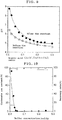
- the quantity and weight of carbonate ions are plotted with respect to the acetic acid buffer concentration in Fig. 10 .
- the quantity of carbonate ions decreases remarkably, and at greater than 0.04 mol/L the quantity of carbonate ions becomes nearly zero.
- the recovery rate there was no weight reduction found even at 0.25 mol/L that was the upper limit to the experimental range.
- LDH3 too, similar results were obtained.
- Another experiment was carried out at 0.5 mol/L; however, there was an about 3% weight reduction observed under this condition. That is, it has been shown that remarkable decarbonation can occur at a buffer concentration of greater than 0.02 mol/L, and there is no weight reduction problem due to dissolution at a buffer concentration of up to 0.25 mol/L.
- a period of time from the addition of a acetic acid buffer/NaCl mixed solution until filtration was varied to look at the degree of progress of decarbonation by IR spectrometry.
- Added to the LDH were 10 mL of a acetic acid buffer/NaCl mixed solution having an acetic acid ratio fixed at 0.1, an acetic acid buffer concentration fixed at 0.1 and an NaCl concentration fixed at 2.53 mol/L for reaction at 25°C.
- LDH3 was used in 20.0 mg, and LDH2 in 16.1 mg.
- the reaction product was filtered through a 0.2 ⁇ m membrane filter in a nitrogen stream, and the precipitate was fully washed with ion exchanged water that had been boiled for removal of carbon dioxide.
- the filtered-out precipitate was gathered up and collected, and immediately depressurized and dried under a vacuum for 1 hour or longer, thereby obtaining white powders.
- the LDH sample used here is in 0.066 mmol.
- Sodium carbonate reacts with acetic acid in the acetic acid buffer, turning into sodium acetate (0.066 mmol). This is the buffering mechanism.
- the lower limit to the acetic acid ratio and concentration of the acetic acid buffer may be determined in such a way that acetic acid is needed in an amount greater than the amount of sodium in the ensuing sodium carbonate.
- the (lower) acetic acid ratio of the acetic acid buffer must be 0.066 or greater because acetic acid must be present in greater than 0.066 mmol, although acetic acid and sodium acetate are each contained in an amount of 1.0 mmol in 10 mL of 0.1 mol/L acetic acid buffer, and (2) the (lower) concentration of the acetic acid buffer must be 0.66 mmol/10 mL, i.e., 0.066 mol/L or greater at an acetic acid ratio of 0.1, and 0.044 mol/L or greater at an acetic acid ratio of 0.15.
- the upper limits to the acetic acid ratio and concentration of the acetic acid buffer are determined from pH values less likely to be affected by weight reductions, because they are limited by the dissolution of LDHs in acids.
- LDH3 is unsusceptible of dissolution at a buffer's pH of 5.2 or greater
- LDH2 is unsusceptible of dissolution at a buffer's pH ranging from 4.6 to 4.7 or greater
- acidic conditions in general and weakly acidic conditions of greater than 4 to less than 7 in particular would be a buffer's pH range with no dissolution of LDHs.
- the acetic acid ratio of the acetic acid buffer is 0.33 or less correspondingly.
- the concentration of NaCl is preferably 1 mol/L or greater, because remarkable decarbonation occurs at 0.2 mol/L or greater ( Fig. 3 ), and the upper limit to it is the saturation concentration of NaCl.
- the saturation concentration of NaCl in water at room temperature is nearly 25% by weight (5.06 mol/L) that roughly defines that upper limit.
- the reaction time is preferably 3 minutes or longer because with LDH2 taking much time for decarbonation, the time needed for completion of decarbonation is 3 minutes.
- ClO 4 - was chosen as the anions (X - ) other than Cl -
- NaClO 2 was used as a salt containing ClO 4 -
- concentration of NaClO 4 in the acetic acid buffer/NaClO 4 mixed solution was varied to look at changes and weight reductions in the quantity of carbonate ions in the MgAl base LDH.
- the degree of decarbonation and weight changes were determined by Fourier transform IR spectroscopy and gravimetric analysis.
- the content of carbonate ions was determined from the results of Fourier transform IR spectroscopy. Changes in the content of carbonate ions due to NaClO 4 concentration changes are shown at c in Fig. 12 . As can be seen from Fig. 12 , residual carbonate ions were very limited down to 5% or less at a NaClO 4 concentration of 7 mol/L or greater.
- weight reductions were corrected in terms of a molecular weight change due to the inclusion of ClO 4 - ions; nearly 100% were recovered with no or little weight reductions (with losses due to filtration and other operations factored in).
- NO 3 - (nitrate ions) was chosen as the anions (X - ) other than Cl - , NaNO 3 was used as a salt containing NO 3 - , and the concentration of NaNO 3 in the acetic acid buffer/NaNO 3 mixed solution was varied to look at changes and weight reductions in the quantity of carbonate ions in the MgAl-LDH.
- Example 8 shows that similar decarbonation takes place even with combinations other than the one in which the metal ions Q and R in the general formula were Mg and Al ions, respectively.
- Example 8 an experiment using an acetic acid buffer was carried out with a combination in which the metal ions Q and R were Ni and Al ions, respectively.
- the starting material was synthesized according to the method described in Non-Patent Publication 6. More specifically, an aqueous solution containing 0.613 g of hexamethylenetetramine was added to an aqueous solution containing 0.727 g of nickel nitrate ⁇ hexahydrate and 0.469 g of aluminum nitrate ⁇ nonahydrate into a total of 25 ml of an aqueous solution, which was in turn heated at 140°C for 1 day in a heat-resistant, pressure-resistant vessel, and then filterated and dried to obtain a light-blue, powdery product Ni 2 Al(OH) 6 (CO 3 2- ) 0.5 ⁇ nH 2 O (hereinafter abbreviated as NiAl-LDH2) in 95% yields.
- NiAl-LDH2 0.5 ⁇ nH 2 O
- the LDH was synthesized by the urea method.
- An aqueous solution (about 90 mL) containing 0.424 g of urea was added to an aqueous solution (about 90 mL) containing 0.273 g of zinc chloride and 0.241 g of aluminum chloride ⁇ hexahydrate, and the total amount of the resulting solution was adjusted to 200 mL, 150 mL of which were placed in a flask having a cooling tube, and heated and refluxed for 20 hours in an open system in an air atmosphere.
- degassed water which has been boiled for removal of carbon dioxide is used, but it is not always necessary to use degassed water for solution preparation, because the decarbonated solution is of weak acidity and at that pH, nearly all of carbonate ions vanish off.
- degassed water is needed for filtration in general and a washing step in particular.
- the present invention is of great significance, as already referred to in the "advantages of the invention". That is, the present invention makes it possible to obtain, in a shorter period of time, more readily and with greater safety, an anion-exchangeable LDH that could not easily be obtained so far in the art. And the obtained easy-to-anion exchange LDH itself could be used industrially: it could be used for separation and recovery of harmful anions from in drainage, separation and recovery of valuable anions from in water, separation and recovery of CO 2 from in exhaust gases, etc. In addition, the product, because of being of anion exchangeability, is expected to have wide applications in a variety of fields from now on.
- the starting LHDs such as hydrotalcite containing anions are precipitated in the form of a flat plate-form crystal having a high aspect ratio, with the c-axis direction of the crystal vertical to the flat plate.
- a carbonate ion-containing LDH that has an easily controllable grain diameter and a high crystal aspect ratio and that is less likely to change in terms of shape and grain diameter by ion exchange can be used as the starting material, it is possible to synthesize an organic-inorganic composite having a controlled grain diameter, opening up a way of forming oriented films lined up in a specific direction. This could be extended to a novel applied field such as the construction of nanodevices by orderly oriented accumulation onto substrates (Non-Patent Publication 17, Patent Publication 3).
Landscapes
- Chemical & Material Sciences (AREA)
- Organic Chemistry (AREA)
- Inorganic Chemistry (AREA)
- Chemical Kinetics & Catalysis (AREA)
- Analytical Chemistry (AREA)
- Engineering & Computer Science (AREA)
- Health & Medical Sciences (AREA)
- Biomedical Technology (AREA)
- Environmental & Geological Engineering (AREA)
- Geology (AREA)
- General Chemical & Material Sciences (AREA)
- Oil, Petroleum & Natural Gas (AREA)
- Life Sciences & Earth Sciences (AREA)
- Compounds Of Alkaline-Earth Elements, Aluminum Or Rare-Earth Metals (AREA)
Claims (6)
- Herstellungsverfahren zur Herstellung eines zum Anionenaustausch fähigen Layered Double Hydroxide, wobei ein Layered Double Hydroxide (LDH) vom Carbonat-Ionen-Typ mit einer Zusammensetzung in der Darstellung durch eine allgemeine Formel QxR(OH)z(CO3 2-)0,5-y/2(X-)y·nH2O, wobei x einen Zahlenbereich von 1,8 ≤ x ≤ 4,2 bezeichnet; z bezeichnet wird durch 2(x + 1); y einen Minimal-wert von mindestens 0 bezeichnet, der auf unter 1 steigt, wenn Anionen (X-) verbleiben oder ein Teil von Anionen eingeführt wird; Q ein zweiwertiges Metall-Ion ist; R ein dreiwertiges Metall-Ion ist; und n = (2 ± 2) ist, als Ausgangsmaterial verwendet wird und y in der allgemeinen Formel auf ein Maximum von 1 durch Substitution eines minus-einwertigen Anions (X-1) an einer Carbonat-Ionen-Stelle steigt, dadurch gekennzeichnet, dass:das Ausgangsmaterial in einer wässrigen Lösung dispergiert wird, die mit einem Salz gemischt ist, das minus-einwertige Anionen (X-) in ausreichender Menge zur Substitution an der Carbonat-Ionen-Stelle enthält, wodurch Substitution realisiert wird, während die wässrige Lösung auf einem pH-Wert (Wasserstoffionenexponent) über 4 bis unter 7 gehalten wird.
- Herstellungsverfahren nach Anspruch 1, dadurch gekennzeichnet, dass der pH-Wert durch Mischen einer Säure und eines Puffers mit ihrer korrespondierenden Base oder einer Zufuhr einer Säure geregelt wird.
- Herstellungsverfahren nach Anspruch 2, dadurch gekennzeichnet, dass die Säure Essigsäure ist.
- Herstellungsverfahren nach Anspruch 1, dadurch gekennzeichnet, dass das minus-einwertige Anion (X-) ein Chlor-Ion ist.
- Herstellungsverfahren nach Anspruch 1, dadurch gekennzeichnet, dass die wässrige Lösung Raumtemperatur bis eine Temperatur unter 100 °C hat.
- Herstellungsverfahren nach Anspruch 1, dadurch gekennzeichnet, dass das zweiwertige Metall-Ion Q in der allgemeinen Formel mindestens ein Metall-Ion ist, das aus der Gruppe ausgewählt ist, die aus Mg, Mn, Fe, Co, Ni, Cu, Zn und Ca besteht, und das dreiwertige Metall-Ion R in der allgemeinen Formel mindestens ein Metall-Ion ist, das aus der Gruppe ausgewählt ist, die aus Al, Ga, Cr, Mn, Fe, Co, Ni und La besteht.
Applications Claiming Priority (3)
| Application Number | Priority Date | Filing Date | Title |
|---|---|---|---|
| JP2007314339 | 2007-12-05 | ||
| JP2008119873 | 2008-05-01 | ||
| PCT/JP2008/071869 WO2009072488A2 (ja) | 2007-12-05 | 2008-12-02 | 陰イオン交換性層状複水酸化物の製造方法 |
Publications (3)
| Publication Number | Publication Date |
|---|---|
| EP2228345A2 EP2228345A2 (de) | 2010-09-15 |
| EP2228345A4 EP2228345A4 (de) | 2016-05-25 |
| EP2228345B1 true EP2228345B1 (de) | 2017-04-12 |
Family
ID=40718308
Family Applications (1)
| Application Number | Title | Priority Date | Filing Date |
|---|---|---|---|
| EP08858187.1A Not-in-force EP2228345B1 (de) | 2007-12-05 | 2008-12-02 | Verfahren zur herstellung von schichtförmigem anionenaustausch-doppelhydroxid |
Country Status (4)
| Country | Link |
|---|---|
| US (1) | US8435910B2 (de) |
| EP (1) | EP2228345B1 (de) |
| JP (1) | JP5317293B2 (de) |
| WO (1) | WO2009072488A2 (de) |
Families Citing this family (38)
| Publication number | Priority date | Publication date | Assignee | Title |
|---|---|---|---|---|
| JP2009173482A (ja) * | 2008-01-23 | 2009-08-06 | National Institute For Materials Science | 膨潤性層状複水酸化物およびその製造方法とそれを用いたゲル状物質、ゾル状物質ならびにナノシート |
| JP5568726B2 (ja) * | 2009-03-09 | 2014-08-13 | 名古屋市 | 酸化チタン/層状複水酸化物複合体及びその製造方法 |
| EP2669251B1 (de) | 2011-01-27 | 2018-01-03 | National Institute for Materials Science | Wasserquellbares geschichtetes doppelhydroxid, herstellungsverfahren dafür, gel- oder solsubstanz, doppelhydroxid-nanofolie und herstellungsverfahren dafür |
| EP2669252A4 (de) | 2011-01-27 | 2016-12-14 | Nat Inst For Materials Science | Verfahren zur herstellung eines geschichteten anionenaustausch-doppelhydroxids und verfahren zum ersetzen von karbonat-ionen eines geschichteten doppelhydroxids mit karbonat-ionen |
| US9248426B2 (en) * | 2012-02-02 | 2016-02-02 | Samsung Electronics Co., Ltd. | Adsorbent for carbon dioxide, method of preparing the same, and capture module for carbon dioxide |
| KR102132779B1 (ko) * | 2012-02-02 | 2020-07-10 | 삼성전자주식회사 | 이산화탄소 흡착제, 그 제조 방법 및 이를 포함하는 이산화탄소 포집 모듈 |
| CN102633285B (zh) * | 2012-04-17 | 2014-04-02 | 北京化工大学 | 一种一维形貌类水滑石材料及其制备方法 |
| KR102093442B1 (ko) * | 2013-03-15 | 2020-03-25 | 삼성전자주식회사 | 이산화탄소 흡착제와 그 제조방법, 이를 포함한 이산화탄소 포집 모듈, 및 이를 이용한 이산화탄소 분리 방법 |
| US20160159659A1 (en) * | 2013-07-25 | 2016-06-09 | Noritake Co., Limited | Anion-conducting material and method for manufacturing same |
| ES2876270T3 (es) * | 2015-04-15 | 2021-11-12 | Commw Scient Ind Res Org | Separación selectiva de elementos o productos de interés en corrientes acuosas |
| US10087355B2 (en) | 2016-03-17 | 2018-10-02 | Saudi Arabian Oil Company | Oil-based drilling fluids containing an alkaline-earth diamondoid compound as rheology modifier |
| US10106482B2 (en) | 2016-03-17 | 2018-10-23 | Saudi Arabian Oil Company | Synthesis of magnesium adamantane salts and magnesium oxide nanocomposites, and systems and methods including the salts or the nanocomposites |
| US10138199B2 (en) | 2016-03-17 | 2018-11-27 | Saudi Arabian Oil Company | High aspect ratio layered double hydroxide materials and methods for preparation thereof |
| US10252245B2 (en) | 2016-03-17 | 2019-04-09 | Saudi Arabian Oil Company | High temperature layered mixed-metal oxide materials with enhanced stability |
| KR102146239B1 (ko) | 2016-03-17 | 2020-08-21 | 사우디 아라비안 오일 컴퍼니 | 전이금속 아다만탄 카복실레이트염 및 산화물 나노복합체의 합성 |
| CN105967323A (zh) * | 2016-05-24 | 2016-09-28 | 武汉理工大学 | 一种提高快速渗滤系统除铬效果的填料及其制备方法 |
| US10875092B2 (en) | 2017-05-19 | 2020-12-29 | Saudi Arabian Oil Company | Methods for preparing mixed-metal oxide diamondoid nanocomposites and catalytic systems including the nanocomposites |
| JP2020520880A (ja) | 2017-05-19 | 2020-07-16 | サウジ アラビアン オイル カンパニーSaudi Arabian Oil Company | 遷移金属アダマンタン塩および酸化物ナノ複合体の合成 |
| US10640696B2 (en) | 2017-08-15 | 2020-05-05 | Saudi Arabian Oil Company | Oil-based drilling fluids for high pressure and high temperature drilling operations |
| US10745606B2 (en) * | 2017-08-15 | 2020-08-18 | Saudi Arabian Oil Company | Oil-based drilling fluid compositions which include layered double hydroxides as rheology modifiers |
| US10988659B2 (en) * | 2017-08-15 | 2021-04-27 | Saudi Arabian Oil Company | Layered double hydroxides for oil-based drilling fluids |
| SG11202001271PA (en) | 2017-08-15 | 2020-03-30 | Saudi Arabian Oil Co | Thermally stable surfactants for oil based drilling fluids |
| US10876039B2 (en) | 2017-08-15 | 2020-12-29 | Saudi Arabian Oil Company | Thermally stable surfactants for oil based drilling fluids |
| US10647903B2 (en) * | 2017-08-15 | 2020-05-12 | Saudi Arabian Oil Company | Oil-based drilling fluid compositions which include layered double hydroxides as rheology modifiers and amino amides as emulsifiers |
| US10793762B2 (en) | 2017-08-15 | 2020-10-06 | Saudi Arabian Oil Company | Layered double hydroxides for oil-based drilling fluids |
| US10676658B2 (en) | 2017-08-15 | 2020-06-09 | Saudi Arabian Oil Company | Oil-based drilling fluids for high pressure and high temperature drilling operations |
| CN107555465A (zh) * | 2017-09-13 | 2018-01-09 | 太原理工大学 | 一种硝酸根插层铜铝类水滑石的快速制备方法 |
| CN107570106B (zh) * | 2017-10-17 | 2020-02-14 | 西南大学 | 一种铁锰类层状双氢氧化物、制备方法及应用 |
| EP3822226B1 (de) * | 2018-07-12 | 2023-10-11 | National Institute for Materials Science | Verpackter körper mit schwefelwasserstoff-retardmittel und verfahren zur herstellung davon und schwefelwasserstoff-retardmittel, schwefelwasserstoff-retardkörper und schwefelwasserstoffherstellungsverfahren mit verwendung davon |
| WO2020053920A1 (ja) * | 2018-09-10 | 2020-03-19 | 共栄社化学株式会社 | イオン伝導性材料、電池用機能層及びその製造方法 |
| CN109718785B (zh) * | 2019-02-13 | 2019-09-17 | 成都理工大学 | 用于乙酸自热重整制氢的水铝钙石衍生钴基催化剂 |
| US12268709B2 (en) * | 2019-04-19 | 2025-04-08 | National Institute For Materials Science | Nitrogenous gas sustained releasing agent and nitrogenous gas sustained releaser composed of the same as well as nitrogenous gas sustained releasing method, respiratory equipment, package, and sustained releasing apparatus using the sustained releaser |
| JP6898627B2 (ja) * | 2019-12-10 | 2021-07-07 | 栗田工業株式会社 | 炭酸型層状複水酸化物の再生方法、及び酸性排ガス処理設備 |
| JP7416441B2 (ja) * | 2021-08-16 | 2024-01-17 | 公立大学法人大阪 | ハイドロタルサイト化合物及び光活性触媒 |
| CN114314686A (zh) * | 2022-01-14 | 2022-04-12 | 青岛理工大学 | 一种ldh微纳米胶体镀层液的一锅式制备方法 |
| CN115999549B (zh) * | 2022-12-30 | 2024-06-28 | 福州大学 | 一种二维/二维硅酸钙/ldh复合材料及其制备方法和应用 |
| WO2025154462A1 (ja) * | 2024-01-18 | 2025-07-24 | パナソニックIpマネジメント株式会社 | 水電解用電極のリサイクル方法及び水電解用電極のリサイクル装置 |
| CN120241787B (zh) * | 2025-04-08 | 2025-11-21 | 四川大学华西医院 | 一种多酶模拟活性NiFeMnCu-LDH的制备方法及其应用 |
Family Cites Families (6)
| Publication number | Priority date | Publication date | Assignee | Title |
|---|---|---|---|---|
| JP3240442B2 (ja) | 1997-06-12 | 2001-12-17 | 富田製薬株式会社 | 脱リン剤造粒物及び排水処理方法 |
| US6333290B1 (en) * | 1998-02-11 | 2001-12-25 | Akzo Nobel Nv | Process for producing anionic clays using magnesium acetate |
| JP2000024658A (ja) * | 1998-07-08 | 2000-01-25 | Kaisui Kagaku Kenkyusho:Kk | 水の脱リン剤およびリンの除去、再生方法 |
| JP2004099391A (ja) * | 2002-09-11 | 2004-04-02 | Mizusawa Ind Chem Ltd | 層状複水酸化物の製造方法 |
| JP4228077B2 (ja) | 2004-03-10 | 2009-02-25 | 独立行政法人物質・材料研究機構 | ハイドロタルサイトの脱炭酸イオンによる、イオン交換性のある陰イオンを有する層状水酸化物の製造方法 |
| JP5187797B2 (ja) | 2005-07-25 | 2013-04-24 | 独立行政法人物質・材料研究機構 | 層状複水酸化物を剥離する方法、複水酸化物ナノシート、該複合薄膜材料、該製造方法、および、層状複水酸化物薄膜材料の製造方法 |
-
2008
- 2008-12-02 WO PCT/JP2008/071869 patent/WO2009072488A2/ja not_active Ceased
- 2008-12-02 EP EP08858187.1A patent/EP2228345B1/de not_active Not-in-force
- 2008-12-02 US US12/734,955 patent/US8435910B2/en not_active Expired - Fee Related
- 2008-12-02 JP JP2009544675A patent/JP5317293B2/ja not_active Expired - Fee Related
Non-Patent Citations (1)
| Title |
|---|
| None * |
Also Published As
| Publication number | Publication date |
|---|---|
| JPWO2009072488A1 (ja) | 2011-04-21 |
| WO2009072488A3 (ja) | 2009-08-06 |
| JP5317293B2 (ja) | 2013-10-16 |
| WO2009072488A2 (ja) | 2009-06-11 |
| US20100279848A1 (en) | 2010-11-04 |
| US8435910B2 (en) | 2013-05-07 |
| EP2228345A2 (de) | 2010-09-15 |
| EP2228345A4 (de) | 2016-05-25 |
Similar Documents
| Publication | Publication Date | Title |
|---|---|---|
| US8435910B2 (en) | Preparation method for anion-exchangeable, layered double hydroxides | |
| Iyi et al. | A novel synthetic route to layered double hydroxides using hexamethylenetetramine | |
| Aisawa et al. | Synthesis and thermal decomposition of Mn–Al layered double hydroxides | |
| Xia et al. | Layered double hydroxides as supports for intercalation and sustained release of antihypertensive drugs | |
| Kooli et al. | Preparation and study of decavanadate-pillared hydrotalcite-like anionic clays containing transition metal cations in the layers. 1. Samples containing nickel-aluminum prepared by anionic exchange and reconstruction | |
| Nuryadin et al. | Phosphate adsorption and desorption on two-stage synthesized amorphous-ZrO2/Mg–Fe layered double hydroxide composite | |
| Guo et al. | Preparation and application of magnesium oxide nanoparticles for superiorly fluoride removal | |
| EP2669251B1 (de) | Wasserquellbares geschichtetes doppelhydroxid, herstellungsverfahren dafür, gel- oder solsubstanz, doppelhydroxid-nanofolie und herstellungsverfahren dafür | |
| Antonyraj et al. | Synthesis of delaminated LDH: A facile two step approach | |
| Bernardo et al. | Physico-chemical assessment of [Mg-Al-PO4]-LDHs obtained by structural reconstruction in high concentration of phosphate | |
| Galindo et al. | Synthesis and characterisation of hydrotalcites produced by an aluminium hazardous waste: A comparison between the use of ammonia and the use of triethanolamine | |
| WO2008129034A1 (en) | Hydrotalcite-like layered double hydroxide (ldh) composition and process of making same | |
| Cheng et al. | Adsorption sites and electron transfer characteristics of methyl orange on three-dimensional hierarchical flower-like nanostructures of Co-Al-layered double hydroxides: Experimental and DFT investigation | |
| Iyi et al. | Deintercalation of carbonate ions and anion exchange of an Al-rich MgAl-LDH (layered double hydroxide) | |
| Sakr et al. | Enhanced CO2 capture from methane-stream using MII-Al LDH prepared by microwave-assisted urea hydrolysis | |
| Tezuka et al. | The synthesis and phosphate adsorptive properties of Mg (II)–Mn (III) layered double hydroxides and their heat-treated materials | |
| WO2014130782A1 (en) | Novel zeolitic materials with heteroatom substitutions on external surface of lattice framework | |
| Chen et al. | Preparation of LiZnPO 4· H 2 O via a novel modified method and its non-isothermal kinetics and thermodynamics of thermal decomposition | |
| JP4228077B2 (ja) | ハイドロタルサイトの脱炭酸イオンによる、イオン交換性のある陰イオンを有する層状水酸化物の製造方法 | |
| Jang et al. | Simplified synthesis of K2CO3-promoted hydrotalcite based on hydroxide-form precursors: Effect of Mg/Al/K2CO3 ratio on high-temperature CO2 sorption capacity | |
| Fu et al. | Chloride intercalated Ni-Al layered double hydroxide for effective adsorption removal of Sb (Ⅴ) | |
| Jobbágy et al. | Homogeneous precipitation of layered Ni (II)–Cr (III) double hydroxides | |
| Bhowmick et al. | Efficient vanadium recovery from highly alkaline solution using Lanthanum doped Mg-Al LDH: A promising approach for sustainable resource extraction | |
| Jaiswal et al. | Layered double hydroxides and the environment: An overview | |
| Gok et al. | Titanium-based lithium-ion sieves granulated with biomaterial for sustainable lithium recovery |
Legal Events
| Date | Code | Title | Description |
|---|---|---|---|
| PUAI | Public reference made under article 153(3) epc to a published international application that has entered the european phase |
Free format text: ORIGINAL CODE: 0009012 |
|
| 17P | Request for examination filed |
Effective date: 20100702 |
|
| AK | Designated contracting states |
Kind code of ref document: A2 Designated state(s): AT BE BG CH CY CZ DE DK EE ES FI FR GB GR HR HU IE IS IT LI LT LU LV MC MT NL NO PL PT RO SE SI SK TR |
|
| AX | Request for extension of the european patent |
Extension state: AL BA MK RS |
|
| DAX | Request for extension of the european patent (deleted) | ||
| A4 | Supplementary search report drawn up and despatched |
Effective date: 20160428 |
|
| RIC1 | Information provided on ipc code assigned before grant |
Ipc: B01D 53/62 20060101ALI20160419BHEP Ipc: C01F 7/00 20060101AFI20160419BHEP Ipc: C02F 1/42 20060101ALI20160419BHEP Ipc: B01J 41/10 20060101ALI20160419BHEP Ipc: C01G 53/00 20060101ALI20160419BHEP Ipc: C01G 9/00 20060101ALI20160419BHEP Ipc: B01J 20/02 20060101ALI20160419BHEP |
|
| GRAJ | Information related to disapproval of communication of intention to grant by the applicant or resumption of examination proceedings by the epo deleted |
Free format text: ORIGINAL CODE: EPIDOSDIGR1 |
|
| GRAP | Despatch of communication of intention to grant a patent |
Free format text: ORIGINAL CODE: EPIDOSNIGR1 |
|
| GRAP | Despatch of communication of intention to grant a patent |
Free format text: ORIGINAL CODE: EPIDOSNIGR1 |
|
| RIC1 | Information provided on ipc code assigned before grant |
Ipc: B01J 41/10 20060101ALI20161024BHEP Ipc: B01J 20/04 20060101ALI20161024BHEP Ipc: C01F 7/00 20060101AFI20161024BHEP Ipc: B01J 20/02 20060101ALI20161024BHEP Ipc: B01D 53/62 20060101ALI20161024BHEP Ipc: C01G 9/00 20060101ALI20161024BHEP Ipc: C02F 1/42 20060101ALI20161024BHEP Ipc: C01G 53/00 20060101ALI20161024BHEP Ipc: B01J 20/08 20060101ALI20161024BHEP Ipc: B01J 20/06 20060101ALI20161024BHEP |
|
| INTG | Intention to grant announced |
Effective date: 20161121 |
|
| GRAS | Grant fee paid |
Free format text: ORIGINAL CODE: EPIDOSNIGR3 |
|
| GRAA | (expected) grant |
Free format text: ORIGINAL CODE: 0009210 |
|
| AK | Designated contracting states |
Kind code of ref document: B1 Designated state(s): AT BE BG CH CY CZ DE DK EE ES FI FR GB GR HR HU IE IS IT LI LT LU LV MC MT NL NO PL PT RO SE SI SK TR |
|
| REG | Reference to a national code |
Ref country code: GB Ref legal event code: FG4D |
|
| REG | Reference to a national code |
Ref country code: CH Ref legal event code: EP |
|
| REG | Reference to a national code |
Ref country code: IE Ref legal event code: FG4D |
|
| REG | Reference to a national code |
Ref country code: AT Ref legal event code: REF Ref document number: 883668 Country of ref document: AT Kind code of ref document: T Effective date: 20170515 |
|
| REG | Reference to a national code |
Ref country code: DE Ref legal event code: R096 Ref document number: 602008049768 Country of ref document: DE |
|
| REG | Reference to a national code |
Ref country code: NL Ref legal event code: MP Effective date: 20170412 |
|
| REG | Reference to a national code |
Ref country code: LT Ref legal event code: MG4D |
|
| REG | Reference to a national code |
Ref country code: AT Ref legal event code: MK05 Ref document number: 883668 Country of ref document: AT Kind code of ref document: T Effective date: 20170412 |
|
| PG25 | Lapsed in a contracting state [announced via postgrant information from national office to epo] |
Ref country code: NL Free format text: LAPSE BECAUSE OF FAILURE TO SUBMIT A TRANSLATION OF THE DESCRIPTION OR TO PAY THE FEE WITHIN THE PRESCRIBED TIME-LIMIT Effective date: 20170412 |
|
| PG25 | Lapsed in a contracting state [announced via postgrant information from national office to epo] |
Ref country code: NO Free format text: LAPSE BECAUSE OF FAILURE TO SUBMIT A TRANSLATION OF THE DESCRIPTION OR TO PAY THE FEE WITHIN THE PRESCRIBED TIME-LIMIT Effective date: 20170712 Ref country code: GR Free format text: LAPSE BECAUSE OF FAILURE TO SUBMIT A TRANSLATION OF THE DESCRIPTION OR TO PAY THE FEE WITHIN THE PRESCRIBED TIME-LIMIT Effective date: 20170713 Ref country code: AT Free format text: LAPSE BECAUSE OF FAILURE TO SUBMIT A TRANSLATION OF THE DESCRIPTION OR TO PAY THE FEE WITHIN THE PRESCRIBED TIME-LIMIT Effective date: 20170412 Ref country code: ES Free format text: LAPSE BECAUSE OF FAILURE TO SUBMIT A TRANSLATION OF THE DESCRIPTION OR TO PAY THE FEE WITHIN THE PRESCRIBED TIME-LIMIT Effective date: 20170412 Ref country code: LT Free format text: LAPSE BECAUSE OF FAILURE TO SUBMIT A TRANSLATION OF THE DESCRIPTION OR TO PAY THE FEE WITHIN THE PRESCRIBED TIME-LIMIT Effective date: 20170412 Ref country code: HR Free format text: LAPSE BECAUSE OF FAILURE TO SUBMIT A TRANSLATION OF THE DESCRIPTION OR TO PAY THE FEE WITHIN THE PRESCRIBED TIME-LIMIT Effective date: 20170412 Ref country code: FI Free format text: LAPSE BECAUSE OF FAILURE TO SUBMIT A TRANSLATION OF THE DESCRIPTION OR TO PAY THE FEE WITHIN THE PRESCRIBED TIME-LIMIT Effective date: 20170412 |
|
| PG25 | Lapsed in a contracting state [announced via postgrant information from national office to epo] |
Ref country code: IS Free format text: LAPSE BECAUSE OF FAILURE TO SUBMIT A TRANSLATION OF THE DESCRIPTION OR TO PAY THE FEE WITHIN THE PRESCRIBED TIME-LIMIT Effective date: 20170812 Ref country code: BG Free format text: LAPSE BECAUSE OF FAILURE TO SUBMIT A TRANSLATION OF THE DESCRIPTION OR TO PAY THE FEE WITHIN THE PRESCRIBED TIME-LIMIT Effective date: 20170712 Ref country code: PL Free format text: LAPSE BECAUSE OF FAILURE TO SUBMIT A TRANSLATION OF THE DESCRIPTION OR TO PAY THE FEE WITHIN THE PRESCRIBED TIME-LIMIT Effective date: 20170412 Ref country code: LV Free format text: LAPSE BECAUSE OF FAILURE TO SUBMIT A TRANSLATION OF THE DESCRIPTION OR TO PAY THE FEE WITHIN THE PRESCRIBED TIME-LIMIT Effective date: 20170412 Ref country code: SE Free format text: LAPSE BECAUSE OF FAILURE TO SUBMIT A TRANSLATION OF THE DESCRIPTION OR TO PAY THE FEE WITHIN THE PRESCRIBED TIME-LIMIT Effective date: 20170412 |
|
| REG | Reference to a national code |
Ref country code: FR Ref legal event code: PLFP Year of fee payment: 10 |
|
| REG | Reference to a national code |
Ref country code: DE Ref legal event code: R097 Ref document number: 602008049768 Country of ref document: DE |
|
| PG25 | Lapsed in a contracting state [announced via postgrant information from national office to epo] |
Ref country code: CZ Free format text: LAPSE BECAUSE OF FAILURE TO SUBMIT A TRANSLATION OF THE DESCRIPTION OR TO PAY THE FEE WITHIN THE PRESCRIBED TIME-LIMIT Effective date: 20170412 Ref country code: SK Free format text: LAPSE BECAUSE OF FAILURE TO SUBMIT A TRANSLATION OF THE DESCRIPTION OR TO PAY THE FEE WITHIN THE PRESCRIBED TIME-LIMIT Effective date: 20170412 Ref country code: EE Free format text: LAPSE BECAUSE OF FAILURE TO SUBMIT A TRANSLATION OF THE DESCRIPTION OR TO PAY THE FEE WITHIN THE PRESCRIBED TIME-LIMIT Effective date: 20170412 Ref country code: RO Free format text: LAPSE BECAUSE OF FAILURE TO SUBMIT A TRANSLATION OF THE DESCRIPTION OR TO PAY THE FEE WITHIN THE PRESCRIBED TIME-LIMIT Effective date: 20170412 Ref country code: DK Free format text: LAPSE BECAUSE OF FAILURE TO SUBMIT A TRANSLATION OF THE DESCRIPTION OR TO PAY THE FEE WITHIN THE PRESCRIBED TIME-LIMIT Effective date: 20170412 |
|
| PLBE | No opposition filed within time limit |
Free format text: ORIGINAL CODE: 0009261 |
|
| STAA | Information on the status of an ep patent application or granted ep patent |
Free format text: STATUS: NO OPPOSITION FILED WITHIN TIME LIMIT |
|
| PG25 | Lapsed in a contracting state [announced via postgrant information from national office to epo] |
Ref country code: IT Free format text: LAPSE BECAUSE OF FAILURE TO SUBMIT A TRANSLATION OF THE DESCRIPTION OR TO PAY THE FEE WITHIN THE PRESCRIBED TIME-LIMIT Effective date: 20170412 |
|
| 26N | No opposition filed |
Effective date: 20180115 |
|
| PG25 | Lapsed in a contracting state [announced via postgrant information from national office to epo] |
Ref country code: SI Free format text: LAPSE BECAUSE OF FAILURE TO SUBMIT A TRANSLATION OF THE DESCRIPTION OR TO PAY THE FEE WITHIN THE PRESCRIBED TIME-LIMIT Effective date: 20170412 |
|
| REG | Reference to a national code |
Ref country code: CH Ref legal event code: PL |
|
| GBPC | Gb: european patent ceased through non-payment of renewal fee |
Effective date: 20171202 |
|
| REG | Reference to a national code |
Ref country code: IE Ref legal event code: MM4A |
|
| PG25 | Lapsed in a contracting state [announced via postgrant information from national office to epo] |
Ref country code: LU Free format text: LAPSE BECAUSE OF NON-PAYMENT OF DUE FEES Effective date: 20171202 Ref country code: MT Free format text: LAPSE BECAUSE OF NON-PAYMENT OF DUE FEES Effective date: 20171202 |
|
| REG | Reference to a national code |
Ref country code: BE Ref legal event code: MM Effective date: 20171231 |
|
| PG25 | Lapsed in a contracting state [announced via postgrant information from national office to epo] |
Ref country code: IE Free format text: LAPSE BECAUSE OF NON-PAYMENT OF DUE FEES Effective date: 20171202 |
|
| PG25 | Lapsed in a contracting state [announced via postgrant information from national office to epo] |
Ref country code: CH Free format text: LAPSE BECAUSE OF NON-PAYMENT OF DUE FEES Effective date: 20171231 Ref country code: GB Free format text: LAPSE BECAUSE OF NON-PAYMENT OF DUE FEES Effective date: 20171202 Ref country code: BE Free format text: LAPSE BECAUSE OF NON-PAYMENT OF DUE FEES Effective date: 20171231 Ref country code: LI Free format text: LAPSE BECAUSE OF NON-PAYMENT OF DUE FEES Effective date: 20171231 |
|
| PG25 | Lapsed in a contracting state [announced via postgrant information from national office to epo] |
Ref country code: MC Free format text: LAPSE BECAUSE OF FAILURE TO SUBMIT A TRANSLATION OF THE DESCRIPTION OR TO PAY THE FEE WITHIN THE PRESCRIBED TIME-LIMIT Effective date: 20170412 Ref country code: HU Free format text: LAPSE BECAUSE OF FAILURE TO SUBMIT A TRANSLATION OF THE DESCRIPTION OR TO PAY THE FEE WITHIN THE PRESCRIBED TIME-LIMIT; INVALID AB INITIO Effective date: 20081202 |
|
| PG25 | Lapsed in a contracting state [announced via postgrant information from national office to epo] |
Ref country code: CY Free format text: LAPSE BECAUSE OF NON-PAYMENT OF DUE FEES Effective date: 20170412 |
|
| PGFP | Annual fee paid to national office [announced via postgrant information from national office to epo] |
Ref country code: FR Payment date: 20191211 Year of fee payment: 12 |
|
| PG25 | Lapsed in a contracting state [announced via postgrant information from national office to epo] |
Ref country code: TR Free format text: LAPSE BECAUSE OF FAILURE TO SUBMIT A TRANSLATION OF THE DESCRIPTION OR TO PAY THE FEE WITHIN THE PRESCRIBED TIME-LIMIT Effective date: 20170412 |
|
| PGFP | Annual fee paid to national office [announced via postgrant information from national office to epo] |
Ref country code: DE Payment date: 20191230 Year of fee payment: 12 |
|
| PG25 | Lapsed in a contracting state [announced via postgrant information from national office to epo] |
Ref country code: PT Free format text: LAPSE BECAUSE OF FAILURE TO SUBMIT A TRANSLATION OF THE DESCRIPTION OR TO PAY THE FEE WITHIN THE PRESCRIBED TIME-LIMIT Effective date: 20170412 |
|
| REG | Reference to a national code |
Ref country code: DE Ref legal event code: R119 Ref document number: 602008049768 Country of ref document: DE |
|
| PG25 | Lapsed in a contracting state [announced via postgrant information from national office to epo] |
Ref country code: FR Free format text: LAPSE BECAUSE OF NON-PAYMENT OF DUE FEES Effective date: 20201231 |
|
| PG25 | Lapsed in a contracting state [announced via postgrant information from national office to epo] |
Ref country code: DE Free format text: LAPSE BECAUSE OF NON-PAYMENT OF DUE FEES Effective date: 20210701 |