EP2223917A1 - Isothiazolyloxyphenylamidine und deren Verwendung als Fungizide - Google Patents
Isothiazolyloxyphenylamidine und deren Verwendung als Fungizide Download PDFInfo
- Publication number
- EP2223917A1 EP2223917A1 EP09151856A EP09151856A EP2223917A1 EP 2223917 A1 EP2223917 A1 EP 2223917A1 EP 09151856 A EP09151856 A EP 09151856A EP 09151856 A EP09151856 A EP 09151856A EP 2223917 A1 EP2223917 A1 EP 2223917A1
- Authority
- EP
- European Patent Office
- Prior art keywords
- groups
- oxy
- formula
- alkyl
- cyano
- Prior art date
- Legal status (The legal status is an assumption and is not a legal conclusion. Google has not performed a legal analysis and makes no representation as to the accuracy of the status listed.)
- Ceased
Links
- 239000000417 fungicide Substances 0.000 title abstract description 9
- -1 isothiazolylaminophenylether compound Chemical class 0.000 claims abstract description 176
- 125000004122 cyclic group Chemical group 0.000 claims abstract description 76
- 229910052760 oxygen Inorganic materials 0.000 claims abstract description 64
- 229910052698 phosphorus Inorganic materials 0.000 claims abstract description 46
- 229910052717 sulfur Inorganic materials 0.000 claims abstract description 45
- 125000005842 heteroatom Chemical group 0.000 claims abstract description 41
- 229910052757 nitrogen Inorganic materials 0.000 claims abstract description 36
- 125000004432 carbon atom Chemical group C* 0.000 claims abstract description 31
- 150000003839 salts Chemical class 0.000 claims abstract description 25
- 229910052799 carbon Inorganic materials 0.000 claims abstract description 23
- 125000005843 halogen group Chemical group 0.000 claims abstract description 17
- 150000001204 N-oxides Chemical class 0.000 claims abstract description 15
- 239000002184 metal Chemical class 0.000 claims abstract description 14
- 229910052751 metal Inorganic materials 0.000 claims abstract description 14
- 125000000449 nitro group Chemical group [O-][N+](*)=O 0.000 claims abstract description 5
- 238000006243 chemical reaction Methods 0.000 claims description 77
- 239000000203 mixture Substances 0.000 claims description 62
- 125000001997 phenyl group Chemical group [H]C1=C([H])C([H])=C(*)C([H])=C1[H] 0.000 claims description 42
- 125000000217 alkyl group Chemical group 0.000 claims description 40
- 125000003342 alkenyl group Chemical group 0.000 claims description 39
- 125000000304 alkynyl group Chemical group 0.000 claims description 38
- 239000001257 hydrogen Substances 0.000 claims description 37
- 229910052739 hydrogen Inorganic materials 0.000 claims description 37
- 125000004400 (C1-C12) alkyl group Chemical group 0.000 claims description 36
- 125000001495 ethyl group Chemical group [H]C([H])([H])C([H])([H])* 0.000 claims description 33
- 238000000034 method Methods 0.000 claims description 32
- UFHFLCQGNIYNRP-UHFFFAOYSA-N Hydrogen Chemical compound [H][H] UFHFLCQGNIYNRP-UHFFFAOYSA-N 0.000 claims description 31
- 125000003396 thiol group Chemical class [H]S* 0.000 claims description 27
- 125000004093 cyano group Chemical group *C#N 0.000 claims description 26
- 244000005700 microbiome Species 0.000 claims description 25
- 125000004429 atom Chemical group 0.000 claims description 23
- 150000001408 amides Chemical class 0.000 claims description 21
- 125000003178 carboxy group Chemical group [H]OC(*)=O 0.000 claims description 21
- 125000001181 organosilyl group Chemical group [SiH3]* 0.000 claims description 21
- 125000002924 primary amino group Chemical group [H]N([H])* 0.000 claims description 21
- 150000001409 amidines Chemical class 0.000 claims description 20
- 229910052736 halogen Inorganic materials 0.000 claims description 20
- 150000002367 halogens Chemical class 0.000 claims description 20
- 125000002496 methyl group Chemical group [H]C([H])([H])* 0.000 claims description 19
- 125000003118 aryl group Chemical group 0.000 claims description 18
- 239000003795 chemical substances by application Substances 0.000 claims description 17
- 150000002431 hydrogen Chemical class 0.000 claims description 17
- 125000003368 amide group Chemical group 0.000 claims description 16
- 125000003545 alkoxy group Chemical group 0.000 claims description 14
- 125000002877 alkyl aryl group Chemical group 0.000 claims description 14
- 150000003568 thioethers Chemical class 0.000 claims description 14
- 125000001255 4-fluorophenyl group Chemical group [H]C1=C([H])C(*)=C([H])C([H])=C1F 0.000 claims description 12
- 125000003710 aryl alkyl group Chemical group 0.000 claims description 12
- 125000000999 tert-butyl group Chemical group [H]C([H])([H])C(*)(C([H])([H])[H])C([H])([H])[H] 0.000 claims description 12
- XEEYBQQBJWHFJM-UHFFFAOYSA-N Iron Chemical compound [Fe] XEEYBQQBJWHFJM-UHFFFAOYSA-N 0.000 claims description 10
- 125000002723 alicyclic group Chemical group 0.000 claims description 9
- 125000004435 hydrogen atom Chemical group [H]* 0.000 claims description 8
- 125000001786 isothiazolyl group Chemical group 0.000 claims description 8
- 125000000040 m-tolyl group Chemical group [H]C1=C([H])C(*)=C([H])C(=C1[H])C([H])([H])[H] 0.000 claims description 8
- 125000004209 (C1-C8) alkyl group Chemical group 0.000 claims description 7
- 150000001412 amines Chemical class 0.000 claims description 7
- 125000001309 chloro group Chemical group Cl* 0.000 claims description 7
- 125000001449 isopropyl group Chemical group [H]C([H])([H])C([H])(*)C([H])([H])[H] 0.000 claims description 7
- 230000009467 reduction Effects 0.000 claims description 7
- JOXIMZWYDAKGHI-UHFFFAOYSA-N toluene-4-sulfonic acid Chemical compound CC1=CC=C(S(O)(=O)=O)C=C1 JOXIMZWYDAKGHI-UHFFFAOYSA-N 0.000 claims description 7
- PAYRUJLWNCNPSJ-UHFFFAOYSA-N N-phenyl amine Natural products NC1=CC=CC=C1 PAYRUJLWNCNPSJ-UHFFFAOYSA-N 0.000 claims description 6
- 150000002905 orthoesters Chemical class 0.000 claims description 6
- 230000008569 process Effects 0.000 claims description 6
- CDAWCLOXVUBKRW-UHFFFAOYSA-N 2-aminophenol Chemical class NC1=CC=CC=C1O CDAWCLOXVUBKRW-UHFFFAOYSA-N 0.000 claims description 5
- AFVFQIVMOAPDHO-UHFFFAOYSA-N Methanesulfonic acid Chemical compound CS(O)(=O)=O AFVFQIVMOAPDHO-UHFFFAOYSA-N 0.000 claims description 5
- 125000004433 nitrogen atom Chemical group N* 0.000 claims description 5
- 125000001797 benzyl group Chemical group [H]C1=C([H])C([H])=C(C([H])=C1[H])C([H])([H])* 0.000 claims description 4
- 125000001188 haloalkyl group Chemical group 0.000 claims description 4
- WAPIJJIOWJVSAU-UHFFFAOYSA-N n'-[4-(2,1-benzothiazol-3-yloxy)-2,5-dimethylphenyl]-n,n-dimethylmethanimidamide Chemical compound C1=C(C)C(N=CN(C)C)=CC(C)=C1OC1=C2C=CC=CC2=NS1 WAPIJJIOWJVSAU-UHFFFAOYSA-N 0.000 claims description 4
- YQAJZCZIIQNSFR-UHFFFAOYSA-N n'-[4-[(4-chloro-3-phenyl-1,2-thiazol-5-yl)oxy]-2,5-dimethylphenyl]-n-ethyl-n-methylmethanimidamide Chemical compound C1=C(C)C(N=CN(C)CC)=CC(C)=C1OC1=C(Cl)C(C=2C=CC=CC=2)=NS1 YQAJZCZIIQNSFR-UHFFFAOYSA-N 0.000 claims description 4
- NTDGMRLRJXICCB-UHFFFAOYSA-N n'-[4-[[3-[(4-chlorophenyl)methyl]-4-cyano-1,2-thiazol-5-yl]oxy]-2,5-dimethylphenyl]-n-ethyl-n-methylmethanimidamide Chemical compound C1=C(C)C(N=CN(C)CC)=CC(C)=C1OC1=C(C#N)C(CC=2C=CC(Cl)=CC=2)=NS1 NTDGMRLRJXICCB-UHFFFAOYSA-N 0.000 claims description 4
- 150000005181 nitrobenzenes Chemical class 0.000 claims description 4
- IQUPABOKLQSFBK-UHFFFAOYSA-N 2-nitrophenol Chemical class OC1=CC=CC=C1[N+]([O-])=O IQUPABOKLQSFBK-UHFFFAOYSA-N 0.000 claims description 3
- VMNDNCCDOVZXAO-UHFFFAOYSA-N n'-[4-[(4-bromo-3-phenyl-1,2-thiazol-5-yl)oxy]-5-chloro-2-methylphenyl]-n-ethyl-n-methylmethanimidamide Chemical compound C1=C(C)C(N=CN(C)CC)=CC(Cl)=C1OC1=C(Br)C(C=2C=CC=CC=2)=NS1 VMNDNCCDOVZXAO-UHFFFAOYSA-N 0.000 claims description 3
- 125000004430 oxygen atom Chemical group O* 0.000 claims description 3
- HOPILAIFYRAYNI-ZVHZXABRSA-N CC=1C=C(OC2=C(C(=NS2)C(C)(C)C)C#N)C(C)=CC=1\N=C\N1CCCCC1 Chemical compound CC=1C=C(OC2=C(C(=NS2)C(C)(C)C)C#N)C(C)=CC=1\N=C\N1CCCCC1 HOPILAIFYRAYNI-ZVHZXABRSA-N 0.000 claims description 2
- IQWUJUDQJAXRJT-JFLMPSFJSA-N CC=1C=C(OC2=C(C(=NS2)C=2C=CC(Cl)=CC=2)C#N)C(C)=CC=1\N=C\N1CCCCC1 Chemical compound CC=1C=C(OC2=C(C(=NS2)C=2C=CC(Cl)=CC=2)C#N)C(C)=CC=1\N=C\N1CCCCC1 IQWUJUDQJAXRJT-JFLMPSFJSA-N 0.000 claims description 2
- QCZGDWPWJIISAY-MFKUBSTISA-N CC=1C=C(OC2=C(C(=NS2)C=2C=CC=CC=2)Cl)C(C)=CC=1\N=C\N1CCCCC1 Chemical compound CC=1C=C(OC2=C(C(=NS2)C=2C=CC=CC=2)Cl)C(C)=CC=1\N=C\N1CCCCC1 QCZGDWPWJIISAY-MFKUBSTISA-N 0.000 claims description 2
- HDPYAWNBZHPWDF-LPYMAVHISA-N CCC1=NSC(OC=2C(=CC(=C(C)C=2)\N=C\N2CCCCC2)C)=C1C#N Chemical compound CCC1=NSC(OC=2C(=CC(=C(C)C=2)\N=C\N2CCCCC2)C)=C1C#N HDPYAWNBZHPWDF-LPYMAVHISA-N 0.000 claims description 2
- CZJBZVDEYSABSU-AFUMVMLFSA-N ClC=1C=C(\N=C\N2CCCCC2)C(C)=CC=1OC(=C1Br)SN=C1C1=CC=CC=C1 Chemical compound ClC=1C=C(\N=C\N2CCCCC2)C(C)=CC=1OC(=C1Br)SN=C1C1=CC=CC=C1 CZJBZVDEYSABSU-AFUMVMLFSA-N 0.000 claims description 2
- GQTSUMYHZJQPQN-AFUMVMLFSA-N ClC=1C=C(\N=C\N2CCCCC2)C(C)=CC=1OC(=C1Cl)SN=C1C1=CC=CC=C1 Chemical compound ClC=1C=C(\N=C\N2CCCCC2)C(C)=CC=1OC(=C1Cl)SN=C1C1=CC=CC=C1 GQTSUMYHZJQPQN-AFUMVMLFSA-N 0.000 claims description 2
- 150000001448 anilines Chemical class 0.000 claims description 2
- 125000004501 isothiazol-5-yl group Chemical group S1N=CC=C1* 0.000 claims description 2
- ZLTPDFXIESTBQG-UHFFFAOYSA-N isothiazole Chemical compound C=1C=NSC=1 ZLTPDFXIESTBQG-UHFFFAOYSA-N 0.000 claims description 2
- NFMQHQXXSBYYBV-UHFFFAOYSA-N n'-[2,5-dimethyl-4-[(3-phenyl-1,2-thiazol-5-yl)oxy]phenyl]-n,n-dimethylmethanimidamide Chemical compound C1=C(C)C(N=CN(C)C)=CC(C)=C1OC1=CC(C=2C=CC=CC=2)=NS1 NFMQHQXXSBYYBV-UHFFFAOYSA-N 0.000 claims description 2
- IXWFSINIKXHYSB-UHFFFAOYSA-N n'-[2-chloro-4-[(4-cyano-3-phenyl-1,2-thiazol-5-yl)oxy]-5-methylphenyl]-n,n-dimethylmethanimidamide Chemical compound C1=C(Cl)C(N=CN(C)C)=CC(C)=C1OC1=C(C#N)C(C=2C=CC=CC=2)=NS1 IXWFSINIKXHYSB-UHFFFAOYSA-N 0.000 claims description 2
- LHUGAAZKXDKBQQ-UHFFFAOYSA-N n'-[2-chloro-4-[(4-cyano-3-phenyl-1,2-thiazol-5-yl)oxy]-5-methylphenyl]-n-ethyl-n-methylmethanimidamide Chemical compound C1=C(Cl)C(N=CN(C)CC)=CC(C)=C1OC1=C(C#N)C(C=2C=CC=CC=2)=NS1 LHUGAAZKXDKBQQ-UHFFFAOYSA-N 0.000 claims description 2
- GAEQZBJQASWMLX-UHFFFAOYSA-N n'-[2-chloro-4-[(4-cyano-3-phenyl-1,2-thiazol-5-yl)oxy]-5-methylphenyl]-n-methyl-n-propylmethanimidamide Chemical compound C1=C(Cl)C(N=CN(C)CCC)=CC(C)=C1OC1=C(C#N)C(C=2C=CC=CC=2)=NS1 GAEQZBJQASWMLX-UHFFFAOYSA-N 0.000 claims description 2
- YPZPLGOTBSHJFC-UHFFFAOYSA-N n'-[2-chloro-4-[[4-cyano-3-(4-fluorophenyl)-1,2-thiazol-5-yl]oxy]-5-methylphenyl]-n-methyl-n-propylmethanimidamide Chemical compound C1=C(Cl)C(N=CN(C)CCC)=CC(C)=C1OC1=C(C#N)C(C=2C=CC(F)=CC=2)=NS1 YPZPLGOTBSHJFC-UHFFFAOYSA-N 0.000 claims description 2
- XUUXCBKYFMTYNY-UHFFFAOYSA-N n'-[2-chloro-5-methyl-4-[(3-phenyl-1,2-thiazol-5-yl)oxy]phenyl]-n,n-dimethylmethanimidamide Chemical compound C1=C(Cl)C(N=CN(C)C)=CC(C)=C1OC1=CC(C=2C=CC=CC=2)=NS1 XUUXCBKYFMTYNY-UHFFFAOYSA-N 0.000 claims description 2
- SXRYUNNDKWQSAS-UHFFFAOYSA-N n'-[2-chloro-5-methyl-4-[(3-phenyl-1,2-thiazol-5-yl)oxy]phenyl]-n-methyl-n-propylmethanimidamide Chemical compound C1=C(Cl)C(N=CN(C)CCC)=CC(C)=C1OC1=CC(C=2C=CC=CC=2)=NS1 SXRYUNNDKWQSAS-UHFFFAOYSA-N 0.000 claims description 2
- PMDHHVQTPDEDFH-UHFFFAOYSA-N n'-[4-[(3-tert-butyl-4-cyano-1,2-thiazol-5-yl)oxy]-2,5-dimethylphenyl]-n-methyl-n-propylmethanimidamide Chemical compound C1=C(C)C(N=CN(C)CCC)=CC(C)=C1OC1=C(C#N)C(C(C)(C)C)=NS1 PMDHHVQTPDEDFH-UHFFFAOYSA-N 0.000 claims description 2
- CDXKAMHMYQAUSW-UHFFFAOYSA-N n'-[4-[(3-tert-butyl-4-cyano-1,2-thiazol-5-yl)oxy]-2-chloro-5-methylphenyl]-n-ethyl-n-methylmethanimidamide Chemical compound C1=C(Cl)C(N=CN(C)CC)=CC(C)=C1OC1=C(C#N)C(C(C)(C)C)=NS1 CDXKAMHMYQAUSW-UHFFFAOYSA-N 0.000 claims description 2
- NEFZISKAKLXMKG-UHFFFAOYSA-N n'-[4-[(4-bromo-3-phenyl-1,2-thiazol-5-yl)oxy]-2,5-dimethylphenyl]-n-ethyl-n-methylmethanimidamide Chemical compound C1=C(C)C(N=CN(C)CC)=CC(C)=C1OC1=C(Br)C(C=2C=CC=CC=2)=NS1 NEFZISKAKLXMKG-UHFFFAOYSA-N 0.000 claims description 2
- CNMFFPKVWOEBEK-UHFFFAOYSA-N n'-[4-[(4-cyano-3-ethyl-1,2-thiazol-5-yl)oxy]-2,5-dimethylphenyl]-n-methyl-n-propylmethanimidamide Chemical compound C1=C(C)C(N=CN(C)CCC)=CC(C)=C1OC1=C(C#N)C(CC)=NS1 CNMFFPKVWOEBEK-UHFFFAOYSA-N 0.000 claims description 2
- HLBRMSBISIQRGB-UHFFFAOYSA-N n'-[4-[(4-cyano-3-phenyl-1,2-thiazol-5-yl)oxy]-2,5-dimethylphenyl]-n-ethyl-n-methylmethanimidamide Chemical compound C1=C(C)C(N=CN(C)CC)=CC(C)=C1OC1=C(C#N)C(C=2C=CC=CC=2)=NS1 HLBRMSBISIQRGB-UHFFFAOYSA-N 0.000 claims description 2
- XRBJEODORWMVLR-UHFFFAOYSA-N n'-[4-[(4-cyano-3-phenyl-1,2-thiazol-5-yl)oxy]-2,5-dimethylphenyl]-n-methyl-n-propylmethanimidamide Chemical compound C1=C(C)C(N=CN(C)CCC)=CC(C)=C1OC1=C(C#N)C(C=2C=CC=CC=2)=NS1 XRBJEODORWMVLR-UHFFFAOYSA-N 0.000 claims description 2
- CEFLJOCJJQQPKO-UHFFFAOYSA-N n'-[4-[[3-(4-chlorophenyl)-4-cyano-1,2-thiazol-5-yl]oxy]-2,5-dimethylphenyl]-n,n-dimethylmethanimidamide Chemical compound C1=C(C)C(N=CN(C)C)=CC(C)=C1OC1=C(C#N)C(C=2C=CC(Cl)=CC=2)=NS1 CEFLJOCJJQQPKO-UHFFFAOYSA-N 0.000 claims description 2
- KMYHQRSMYKVVTP-UHFFFAOYSA-N n'-[4-[[3-(4-chlorophenyl)-4-cyano-1,2-thiazol-5-yl]oxy]-2,5-dimethylphenyl]-n-ethyl-n-methylmethanimidamide Chemical compound C1=C(C)C(N=CN(C)CC)=CC(C)=C1OC1=C(C#N)C(C=2C=CC(Cl)=CC=2)=NS1 KMYHQRSMYKVVTP-UHFFFAOYSA-N 0.000 claims description 2
- SLSGMBUOOQNQLD-UHFFFAOYSA-N n'-[4-[[3-(4-chlorophenyl)-4-cyano-1,2-thiazol-5-yl]oxy]-2,5-dimethylphenyl]-n-methyl-n-propylmethanimidamide Chemical compound C1=C(C)C(N=CN(C)CCC)=CC(C)=C1OC1=C(C#N)C(C=2C=CC(Cl)=CC=2)=NS1 SLSGMBUOOQNQLD-UHFFFAOYSA-N 0.000 claims description 2
- LPIPDAAJBAMKLH-UHFFFAOYSA-N n'-[4-[[4-cyano-3-(3-methylphenyl)-1,2-thiazol-5-yl]oxy]-2,5-dimethylphenyl]-n,n-dimethylmethanimidamide Chemical compound C1=C(C)C(N=CN(C)C)=CC(C)=C1OC1=C(C#N)C(C=2C=C(C)C=CC=2)=NS1 LPIPDAAJBAMKLH-UHFFFAOYSA-N 0.000 claims description 2
- FNHIYWFSFYZDJL-UHFFFAOYSA-N n'-[4-[[4-cyano-3-(3-methylphenyl)-1,2-thiazol-5-yl]oxy]-2,5-dimethylphenyl]-n-methyl-n-propylmethanimidamide Chemical compound C1=C(C)C(N=CN(C)CCC)=CC(C)=C1OC1=C(C#N)C(C=2C=C(C)C=CC=2)=NS1 FNHIYWFSFYZDJL-UHFFFAOYSA-N 0.000 claims description 2
- CPFAEEXQJWPPDC-UHFFFAOYSA-N n'-[4-[[4-cyano-3-(4-fluorophenyl)-1,2-thiazol-5-yl]oxy]-2,5-dimethylphenyl]-n-methyl-n-propylmethanimidamide Chemical compound C1=C(C)C(N=CN(C)CCC)=CC(C)=C1OC1=C(C#N)C(C=2C=CC(F)=CC=2)=NS1 CPFAEEXQJWPPDC-UHFFFAOYSA-N 0.000 claims description 2
- WKFKINCHBULVNT-UHFFFAOYSA-N n'-[5-chloro-4-[(4-chloro-3-phenyl-1,2-thiazol-5-yl)oxy]-2-methylphenyl]-n-ethyl-n-methylmethanimidamide Chemical compound C1=C(C)C(N=CN(C)CC)=CC(Cl)=C1OC1=C(Cl)C(C=2C=CC=CC=2)=NS1 WKFKINCHBULVNT-UHFFFAOYSA-N 0.000 claims description 2
- SUVIYPMLXKLLQM-UHFFFAOYSA-N n'-[5-chloro-4-[(4-cyano-3-phenyl-1,2-thiazol-5-yl)oxy]-2-methylphenyl]-n,n-dimethylmethanimidamide Chemical compound C1=C(C)C(N=CN(C)C)=CC(Cl)=C1OC1=C(C#N)C(C=2C=CC=CC=2)=NS1 SUVIYPMLXKLLQM-UHFFFAOYSA-N 0.000 claims description 2
- SDAXHWABQUMMSN-UHFFFAOYSA-N n'-[5-chloro-4-[(4-cyano-3-phenyl-1,2-thiazol-5-yl)oxy]-2-methylphenyl]-n-ethyl-n-methylmethanimidamide Chemical compound C1=C(C)C(N=CN(C)CC)=CC(Cl)=C1OC1=C(C#N)C(C=2C=CC=CC=2)=NS1 SDAXHWABQUMMSN-UHFFFAOYSA-N 0.000 claims description 2
- DCPRQDZHVNAQLD-UHFFFAOYSA-N n'-[5-chloro-4-[(4-cyano-3-phenyl-1,2-thiazol-5-yl)oxy]-2-methylphenyl]-n-methyl-n-propylmethanimidamide Chemical compound C1=C(C)C(N=CN(C)CCC)=CC(Cl)=C1OC1=C(C#N)C(C=2C=CC=CC=2)=NS1 DCPRQDZHVNAQLD-UHFFFAOYSA-N 0.000 claims description 2
- IKLUORDACQEOTR-UHFFFAOYSA-N n'-[5-chloro-4-[[4-cyano-3-(3-methylphenyl)-1,2-thiazol-5-yl]oxy]-2-methylphenyl]-n,n-dimethylmethanimidamide Chemical compound C1=C(C)C(N=CN(C)C)=CC(Cl)=C1OC1=C(C#N)C(C=2C=C(C)C=CC=2)=NS1 IKLUORDACQEOTR-UHFFFAOYSA-N 0.000 claims description 2
- PUCFIARYXAFDQY-UHFFFAOYSA-N n'-[5-chloro-4-[[4-cyano-3-(3-methylphenyl)-1,2-thiazol-5-yl]oxy]-2-methylphenyl]-n-methyl-n-propylmethanimidamide Chemical compound C1=C(C)C(N=CN(C)CCC)=CC(Cl)=C1OC1=C(C#N)C(C=2C=C(C)C=CC=2)=NS1 PUCFIARYXAFDQY-UHFFFAOYSA-N 0.000 claims description 2
- UUJJRIBPXMBPKP-UHFFFAOYSA-N n'-[5-chloro-4-[[4-cyano-3-(4-fluorophenyl)-1,2-thiazol-5-yl]oxy]-2-methylphenyl]-n,n-dimethylmethanimidamide Chemical compound C1=C(C)C(N=CN(C)C)=CC(Cl)=C1OC1=C(C#N)C(C=2C=CC(F)=CC=2)=NS1 UUJJRIBPXMBPKP-UHFFFAOYSA-N 0.000 claims description 2
- LAOQMZAHXRJXNJ-UHFFFAOYSA-N n'-[5-chloro-4-[[4-cyano-3-(4-fluorophenyl)-1,2-thiazol-5-yl]oxy]-2-methylphenyl]-n-methyl-n-propylmethanimidamide Chemical compound C1=C(C)C(N=CN(C)CCC)=CC(Cl)=C1OC1=C(C#N)C(C=2C=CC(F)=CC=2)=NS1 LAOQMZAHXRJXNJ-UHFFFAOYSA-N 0.000 claims description 2
- 125000003386 piperidinyl group Chemical group 0.000 claims description 2
- 125000005936 piperidyl group Chemical group 0.000 claims description 2
- 125000000719 pyrrolidinyl group Chemical group 0.000 claims description 2
- ITMCEJHCFYSIIV-UHFFFAOYSA-M triflate Chemical compound [O-]S(=O)(=O)C(F)(F)F ITMCEJHCFYSIIV-UHFFFAOYSA-M 0.000 claims description 2
- XFXPMWWXUTWYJX-UHFFFAOYSA-N Cyanide Chemical compound N#[C-] XFXPMWWXUTWYJX-UHFFFAOYSA-N 0.000 claims 13
- LYZBGXAYZLQEOX-UHFFFAOYSA-N n-[2-[2-(1,2-thiazol-3-ylamino)phenoxy]phenyl]-1,2-thiazol-3-amine Chemical class C=1C=CC=C(OC=2C(=CC=CC=2)NC2=NSC=C2)C=1NC=1C=CSN=1 LYZBGXAYZLQEOX-UHFFFAOYSA-N 0.000 claims 2
- HEDRJSWPTSCHKP-UHFFFAOYSA-N 1-nitro-2-(2-nitrophenoxy)peroxybenzene Chemical class [O-][N+](=O)C1=CC=CC=C1OOOC1=CC=CC=C1[N+]([O-])=O HEDRJSWPTSCHKP-UHFFFAOYSA-N 0.000 claims 1
- QTRJTMPLVIRDHO-UHFFFAOYSA-N 3-phenyl-1,2-thiazole Chemical compound S1C=CC(C=2C=CC=CC=2)=N1 QTRJTMPLVIRDHO-UHFFFAOYSA-N 0.000 claims 1
- MCASVLDAAWCTKJ-UHFFFAOYSA-N n'-[2-chloro-4-[[4-cyano-3-(4-fluorophenyl)-1,2-thiazol-5-yl]oxy]-5-methylphenyl]-n,n-dimethylmethanimidamide Chemical compound C1=C(Cl)C(N=CN(C)C)=CC(C)=C1OC1=C(C#N)C(C=2C=CC(F)=CC=2)=NS1 MCASVLDAAWCTKJ-UHFFFAOYSA-N 0.000 claims 1
- UQKHEIIOXOFKJE-UHFFFAOYSA-N n'-[2-chloro-5-methyl-4-[(3-phenyl-1,2-thiazol-5-yl)oxy]phenyl]-n-ethyl-n-methylmethanimidamide Chemical compound C1=C(Cl)C(N=CN(C)CC)=CC(C)=C1OC1=CC(C=2C=CC=CC=2)=NS1 UQKHEIIOXOFKJE-UHFFFAOYSA-N 0.000 claims 1
- ANLRDUIUQLIOAH-UHFFFAOYSA-N n'-[4-[(3-tert-butyl-4-cyano-1,2-thiazol-5-yl)oxy]-2,5-dimethylphenyl]-n,n-dimethylmethanimidamide Chemical compound C1=C(C)C(N=CN(C)C)=CC(C)=C1OC1=C(C#N)C(C(C)(C)C)=NS1 ANLRDUIUQLIOAH-UHFFFAOYSA-N 0.000 claims 1
- HFWKXZCDPIFYDK-UHFFFAOYSA-N n'-[4-[(3-tert-butyl-4-cyano-1,2-thiazol-5-yl)oxy]-2,5-dimethylphenyl]-n-ethyl-n-methylmethanimidamide Chemical compound C1=C(C)C(N=CN(C)CC)=CC(C)=C1OC1=C(C#N)C(C(C)(C)C)=NS1 HFWKXZCDPIFYDK-UHFFFAOYSA-N 0.000 claims 1
- OTILWPNFNKJBDR-UHFFFAOYSA-N n'-[4-[(4-cyano-3-ethyl-1,2-thiazol-5-yl)oxy]-2,5-dimethylphenyl]-n-ethyl-n-methylmethanimidamide Chemical compound C1=C(C)C(N=CN(C)CC)=CC(C)=C1OC1=C(C#N)C(CC)=NS1 OTILWPNFNKJBDR-UHFFFAOYSA-N 0.000 claims 1
- IRJRCNLGNYCNLD-UHFFFAOYSA-N n'-[4-[(4-cyano-3-phenyl-1,2-thiazol-5-yl)oxy]-2,5-dimethylphenyl]-n,n-dimethylmethanimidamide Chemical compound C1=C(C)C(N=CN(C)C)=CC(C)=C1OC1=C(C#N)C(C=2C=CC=CC=2)=NS1 IRJRCNLGNYCNLD-UHFFFAOYSA-N 0.000 claims 1
- XLMICLOQIUVGIW-UHFFFAOYSA-N n'-[4-[[3-(4-tert-butylphenyl)-4-cyano-1,2-thiazol-5-yl]oxy]-2,5-dimethylphenyl]-n-ethyl-n-methylmethanimidamide Chemical compound C1=C(C)C(N=CN(C)CC)=CC(C)=C1OC1=C(C#N)C(C=2C=CC(=CC=2)C(C)(C)C)=NS1 XLMICLOQIUVGIW-UHFFFAOYSA-N 0.000 claims 1
- RZDJUOLCFRFTEV-UHFFFAOYSA-N n'-[4-[[3-(4-tert-butylphenyl)-4-cyano-1,2-thiazol-5-yl]oxy]-2,5-dimethylphenyl]-n-methyl-n-prop-2-enylmethanimidamide Chemical compound C1=C(C)C(N=CN(CC=C)C)=CC(C)=C1OC1=C(C#N)C(C=2C=CC(=CC=2)C(C)(C)C)=NS1 RZDJUOLCFRFTEV-UHFFFAOYSA-N 0.000 claims 1
- YELRXXXFERDXKQ-UHFFFAOYSA-N n'-[4-[[4-cyano-3-(4-fluorophenyl)-1,2-thiazol-5-yl]oxy]-2,5-dimethylphenyl]-n,n-dimethylmethanimidamide Chemical compound C1=C(C)C(N=CN(C)C)=CC(C)=C1OC1=C(C#N)C(C=2C=CC(F)=CC=2)=NS1 YELRXXXFERDXKQ-UHFFFAOYSA-N 0.000 claims 1
- XUOXHYFSEVCJLT-UHFFFAOYSA-N n'-[5-chloro-4-[[4-cyano-3-(3-methylphenyl)-1,2-thiazol-5-yl]oxy]-2-methylphenyl]-n-ethyl-n-methylmethanimidamide Chemical compound C1=C(C)C(N=CN(C)CC)=CC(Cl)=C1OC1=C(C#N)C(C=2C=C(C)C=CC=2)=NS1 XUOXHYFSEVCJLT-UHFFFAOYSA-N 0.000 claims 1
- RKRBGJBWGARRSK-UHFFFAOYSA-N n'-[5-chloro-4-[[4-cyano-3-(4-fluorophenyl)-1,2-thiazol-5-yl]oxy]-2-methylphenyl]-n-ethyl-n-methylmethanimidamide Chemical compound C1=C(C)C(N=CN(C)CC)=CC(Cl)=C1OC1=C(C#N)C(C=2C=CC(F)=CC=2)=NS1 RKRBGJBWGARRSK-UHFFFAOYSA-N 0.000 claims 1
- 125000004434 sulfur atom Chemical group 0.000 claims 1
- 150000001875 compounds Chemical class 0.000 abstract description 58
- 238000002360 preparation method Methods 0.000 abstract description 57
- 239000004009 herbicide Substances 0.000 abstract description 17
- 230000002363 herbicidal effect Effects 0.000 abstract description 9
- 230000000694 effects Effects 0.000 abstract description 8
- 230000000855 fungicidal effect Effects 0.000 abstract description 5
- 230000000844 anti-bacterial effect Effects 0.000 abstract description 4
- 230000008635 plant growth Effects 0.000 abstract description 4
- 239000000575 pesticide Substances 0.000 abstract description 2
- 230000001098 anti-algal effect Effects 0.000 abstract 1
- 230000010534 mechanism of action Effects 0.000 abstract 1
- 239000012873 virucide Substances 0.000 abstract 1
- 241000196324 Embryophyta Species 0.000 description 233
- WEVYAHXRMPXWCK-UHFFFAOYSA-N Acetonitrile Chemical compound CC#N WEVYAHXRMPXWCK-UHFFFAOYSA-N 0.000 description 78
- RTZKZFJDLAIYFH-UHFFFAOYSA-N Diethyl ether Chemical compound CCOCC RTZKZFJDLAIYFH-UHFFFAOYSA-N 0.000 description 69
- 239000002904 solvent Substances 0.000 description 60
- 108090000623 proteins and genes Proteins 0.000 description 58
- YMWUJEATGCHHMB-UHFFFAOYSA-N Dichloromethane Chemical compound ClCCl YMWUJEATGCHHMB-UHFFFAOYSA-N 0.000 description 57
- XEKOWRVHYACXOJ-UHFFFAOYSA-N Ethyl acetate Chemical compound CCOC(C)=O XEKOWRVHYACXOJ-UHFFFAOYSA-N 0.000 description 54
- ZMXDDKWLCZADIW-UHFFFAOYSA-N N,N-Dimethylformamide Chemical compound CN(C)C=O ZMXDDKWLCZADIW-UHFFFAOYSA-N 0.000 description 47
- YXFVVABEGXRONW-UHFFFAOYSA-N Toluene Chemical compound CC1=CC=CC=C1 YXFVVABEGXRONW-UHFFFAOYSA-N 0.000 description 39
- XLYOFNOQVPJJNP-UHFFFAOYSA-N water Substances O XLYOFNOQVPJJNP-UHFFFAOYSA-N 0.000 description 37
- 102000004169 proteins and genes Human genes 0.000 description 36
- BDAGIHXWWSANSR-UHFFFAOYSA-N methanoic acid Natural products OC=O BDAGIHXWWSANSR-UHFFFAOYSA-N 0.000 description 34
- 239000011541 reaction mixture Substances 0.000 description 34
- 238000009472 formulation Methods 0.000 description 33
- VLKZOEOYAKHREP-UHFFFAOYSA-N n-Hexane Chemical compound CCCCCC VLKZOEOYAKHREP-UHFFFAOYSA-N 0.000 description 33
- BZLVMXJERCGZMT-UHFFFAOYSA-N Methyl tert-butyl ether Chemical compound COC(C)(C)C BZLVMXJERCGZMT-UHFFFAOYSA-N 0.000 description 30
- 239000004480 active ingredient Substances 0.000 description 26
- 229910052801 chlorine Inorganic materials 0.000 description 25
- ZAMOUSCENKQFHK-UHFFFAOYSA-N Chlorine atom Chemical compound [Cl] ZAMOUSCENKQFHK-UHFFFAOYSA-N 0.000 description 24
- 239000000460 chlorine Substances 0.000 description 24
- 238000012360 testing method Methods 0.000 description 24
- 241000233866 Fungi Species 0.000 description 23
- 239000000243 solution Substances 0.000 description 22
- UHOVQNZJYSORNB-UHFFFAOYSA-N Benzene Chemical compound C1=CC=CC=C1 UHOVQNZJYSORNB-UHFFFAOYSA-N 0.000 description 21
- JFDZBHWFFUWGJE-UHFFFAOYSA-N benzonitrile Chemical compound N#CC1=CC=CC=C1 JFDZBHWFFUWGJE-UHFFFAOYSA-N 0.000 description 21
- 239000003995 emulsifying agent Substances 0.000 description 21
- 239000000725 suspension Substances 0.000 description 21
- WYURNTSHIVDZCO-UHFFFAOYSA-N Tetrahydrofuran Chemical compound C1CCOC1 WYURNTSHIVDZCO-UHFFFAOYSA-N 0.000 description 20
- 239000000126 substance Substances 0.000 description 20
- LFQSCWFLJHTTHZ-UHFFFAOYSA-N Ethanol Chemical compound CCO LFQSCWFLJHTTHZ-UHFFFAOYSA-N 0.000 description 18
- OKKJLVBELUTLKV-UHFFFAOYSA-N Methanol Chemical compound OC OKKJLVBELUTLKV-UHFFFAOYSA-N 0.000 description 18
- 240000008042 Zea mays Species 0.000 description 18
- 235000002017 Zea mays subsp mays Nutrition 0.000 description 18
- SECXISVLQFMRJM-UHFFFAOYSA-N N-Methylpyrrolidone Chemical compound CN1CCCC1=O SECXISVLQFMRJM-UHFFFAOYSA-N 0.000 description 17
- 201000010099 disease Diseases 0.000 description 17
- 208000037265 diseases, disorders, signs and symptoms Diseases 0.000 description 17
- 230000001681 protective effect Effects 0.000 description 17
- HEDRZPFGACZZDS-UHFFFAOYSA-N Chloroform Chemical compound ClC(Cl)Cl HEDRZPFGACZZDS-UHFFFAOYSA-N 0.000 description 16
- XDTMQSROBMDMFD-UHFFFAOYSA-N Cyclohexane Chemical compound C1CCCCC1 XDTMQSROBMDMFD-UHFFFAOYSA-N 0.000 description 16
- IMNFDUFMRHMDMM-UHFFFAOYSA-N N-Heptane Chemical compound CCCCCCC IMNFDUFMRHMDMM-UHFFFAOYSA-N 0.000 description 16
- 238000001816 cooling Methods 0.000 description 16
- VYPSYNLAJGMNEJ-UHFFFAOYSA-N silicon dioxide Inorganic materials O=[Si]=O VYPSYNLAJGMNEJ-UHFFFAOYSA-N 0.000 description 16
- 241000193388 Bacillus thuringiensis Species 0.000 description 15
- 241000238631 Hexapoda Species 0.000 description 15
- VEXZGXHMUGYJMC-UHFFFAOYSA-N Hydrochloric acid Chemical compound Cl VEXZGXHMUGYJMC-UHFFFAOYSA-N 0.000 description 15
- ZMANZCXQSJIPKH-UHFFFAOYSA-N Triethylamine Chemical compound CCN(CC)CC ZMANZCXQSJIPKH-UHFFFAOYSA-N 0.000 description 15
- 229940097012 bacillus thuringiensis Drugs 0.000 description 15
- 235000019253 formic acid Nutrition 0.000 description 15
- 230000001965 increasing effect Effects 0.000 description 15
- 230000000749 insecticidal effect Effects 0.000 description 15
- 239000012074 organic phase Substances 0.000 description 15
- VZGDMQKNWNREIO-UHFFFAOYSA-N tetrachloromethane Chemical compound ClC(Cl)(Cl)Cl VZGDMQKNWNREIO-UHFFFAOYSA-N 0.000 description 15
- 230000009261 transgenic effect Effects 0.000 description 15
- 241001136792 Alle Species 0.000 description 14
- XTHFKEDIFFGKHM-UHFFFAOYSA-N Dimethoxyethane Chemical compound COCCOC XTHFKEDIFFGKHM-UHFFFAOYSA-N 0.000 description 14
- 239000002253 acid Substances 0.000 description 14
- RDOXTESZEPMUJZ-UHFFFAOYSA-N anisole Chemical compound COC1=CC=CC=C1 RDOXTESZEPMUJZ-UHFFFAOYSA-N 0.000 description 14
- MVPPADPHJFYWMZ-UHFFFAOYSA-N chlorobenzene Chemical compound ClC1=CC=CC=C1 MVPPADPHJFYWMZ-UHFFFAOYSA-N 0.000 description 14
- NNBZCPXTIHJBJL-UHFFFAOYSA-N decalin Chemical compound C1CCCC2CCCCC21 NNBZCPXTIHJBJL-UHFFFAOYSA-N 0.000 description 14
- UAEPNZWRGJTJPN-UHFFFAOYSA-N methylcyclohexane Chemical compound CC1CCCCC1 UAEPNZWRGJTJPN-UHFFFAOYSA-N 0.000 description 14
- 125000001436 propyl group Chemical group [H]C([*])([H])C([H])([H])C([H])([H])[H] 0.000 description 14
- 102000004190 Enzymes Human genes 0.000 description 13
- 108090000790 Enzymes Proteins 0.000 description 13
- 238000004440 column chromatography Methods 0.000 description 13
- 230000003032 phytopathogenic effect Effects 0.000 description 13
- 230000009466 transformation Effects 0.000 description 13
- CSCPPACGZOOCGX-UHFFFAOYSA-N Acetone Chemical compound CC(C)=O CSCPPACGZOOCGX-UHFFFAOYSA-N 0.000 description 12
- IAZDPXIOMUYVGZ-UHFFFAOYSA-N Dimethylsulphoxide Chemical compound CS(C)=O IAZDPXIOMUYVGZ-UHFFFAOYSA-N 0.000 description 12
- 206010061217 Infestation Diseases 0.000 description 12
- FXHOOIRPVKKKFG-UHFFFAOYSA-N N,N-Dimethylacetamide Chemical compound CN(C)C(C)=O FXHOOIRPVKKKFG-UHFFFAOYSA-N 0.000 description 12
- HEMHJVSKTPXQMS-UHFFFAOYSA-M Sodium hydroxide Chemical compound [OH-].[Na+] HEMHJVSKTPXQMS-UHFFFAOYSA-M 0.000 description 12
- 235000005824 Zea mays ssp. parviglumis Nutrition 0.000 description 12
- 239000002585 base Substances 0.000 description 12
- 235000005822 corn Nutrition 0.000 description 12
- 230000001976 improved effect Effects 0.000 description 12
- 239000000463 material Substances 0.000 description 12
- 150000001298 alcohols Chemical class 0.000 description 11
- 150000002170 ethers Chemical class 0.000 description 11
- CUONGYYJJVDODC-UHFFFAOYSA-N malononitrile Chemical compound N#CCC#N CUONGYYJJVDODC-UHFFFAOYSA-N 0.000 description 11
- 229920000151 polyglycol Polymers 0.000 description 11
- 239000010695 polyglycol Substances 0.000 description 11
- 239000011734 sodium Substances 0.000 description 11
- 241000223600 Alternaria Species 0.000 description 10
- QGZKDVFQNNGYKY-UHFFFAOYSA-N Ammonia Chemical compound N QGZKDVFQNNGYKY-UHFFFAOYSA-N 0.000 description 10
- LRHPLDYGYMQRHN-UHFFFAOYSA-N N-Butanol Chemical compound CCCCO LRHPLDYGYMQRHN-UHFFFAOYSA-N 0.000 description 10
- 229920003171 Poly (ethylene oxide) Polymers 0.000 description 10
- 108700019146 Transgenes Proteins 0.000 description 10
- 150000007513 acids Chemical class 0.000 description 10
- 230000002068 genetic effect Effects 0.000 description 10
- 150000002825 nitriles Chemical class 0.000 description 10
- 239000003208 petroleum Substances 0.000 description 10
- 238000000746 purification Methods 0.000 description 10
- 239000000741 silica gel Substances 0.000 description 10
- 229910002027 silica gel Inorganic materials 0.000 description 10
- YLQBMQCUIZJEEH-UHFFFAOYSA-N tetrahydrofuran Natural products C=1C=COC=1 YLQBMQCUIZJEEH-UHFFFAOYSA-N 0.000 description 10
- 229920000742 Cotton Polymers 0.000 description 9
- 241000219146 Gossypium Species 0.000 description 9
- 241000813090 Rhizoctonia solani Species 0.000 description 9
- 239000003054 catalyst Substances 0.000 description 9
- 239000012141 concentrate Substances 0.000 description 9
- 239000002270 dispersing agent Substances 0.000 description 9
- 238000011081 inoculation Methods 0.000 description 9
- 0 *C1NSC(Oc(c(*)c2)cc(*)c2[N+]([O-])=O)=C1* Chemical compound *C1NSC(Oc(c(*)c2)cc(*)c2[N+]([O-])=O)=C1* 0.000 description 8
- RYHBNJHYFVUHQT-UHFFFAOYSA-N 1,4-Dioxane Chemical compound C1COCCO1 RYHBNJHYFVUHQT-UHFFFAOYSA-N 0.000 description 8
- KFZMGEQAYNKOFK-UHFFFAOYSA-N Isopropanol Chemical compound CC(C)O KFZMGEQAYNKOFK-UHFFFAOYSA-N 0.000 description 8
- CTQNGGLPUBDAKN-UHFFFAOYSA-N O-Xylene Chemical compound CC1=CC=CC=C1C CTQNGGLPUBDAKN-UHFFFAOYSA-N 0.000 description 8
- JUJWROOIHBZHMG-UHFFFAOYSA-N Pyridine Chemical compound C1=CC=NC=C1 JUJWROOIHBZHMG-UHFFFAOYSA-N 0.000 description 8
- 230000015572 biosynthetic process Effects 0.000 description 8
- 229950005499 carbon tetrachloride Drugs 0.000 description 8
- 238000010353 genetic engineering Methods 0.000 description 8
- 150000008282 halocarbons Chemical class 0.000 description 8
- 239000000543 intermediate Substances 0.000 description 8
- 230000035772 mutation Effects 0.000 description 8
- BWHMMNNQKKPAPP-UHFFFAOYSA-L potassium carbonate Chemical compound [K+].[K+].[O-]C([O-])=O BWHMMNNQKKPAPP-UHFFFAOYSA-L 0.000 description 8
- 238000005507 spraying Methods 0.000 description 8
- 125000001424 substituent group Chemical group 0.000 description 8
- 239000008096 xylene Substances 0.000 description 8
- UOCLXMDMGBRAIB-UHFFFAOYSA-N 1,1,1-trichloroethane Chemical compound CC(Cl)(Cl)Cl UOCLXMDMGBRAIB-UHFFFAOYSA-N 0.000 description 7
- SCYULBFZEHDVBN-UHFFFAOYSA-N 1,1-Dichloroethane Chemical compound CC(Cl)Cl SCYULBFZEHDVBN-UHFFFAOYSA-N 0.000 description 7
- LZDKZFUFMNSQCJ-UHFFFAOYSA-N 1,2-diethoxyethane Chemical compound CCOCCOCC LZDKZFUFMNSQCJ-UHFFFAOYSA-N 0.000 description 7
- IYCKMNAVTMOAKD-UHFFFAOYSA-N 1,2-thiazol-3-amine Chemical compound NC=1C=CSN=1 IYCKMNAVTMOAKD-UHFFFAOYSA-N 0.000 description 7
- OCJBOOLMMGQPQU-UHFFFAOYSA-N 1,4-dichlorobenzene Chemical compound ClC1=CC=C(Cl)C=C1 OCJBOOLMMGQPQU-UHFFFAOYSA-N 0.000 description 7
- 108010020183 3-phosphoshikimate 1-carboxyvinyltransferase Proteins 0.000 description 7
- 241000228212 Aspergillus Species 0.000 description 7
- ZAFNJMIOTHYJRJ-UHFFFAOYSA-N Diisopropyl ether Chemical compound CC(C)OC(C)C ZAFNJMIOTHYJRJ-UHFFFAOYSA-N 0.000 description 7
- 241000223218 Fusarium Species 0.000 description 7
- 240000002024 Gossypium herbaceum Species 0.000 description 7
- 235000004341 Gossypium herbaceum Nutrition 0.000 description 7
- 241001123663 Penicillium expansum Species 0.000 description 7
- 241000228453 Pyrenophora Species 0.000 description 7
- QAOWNCQODCNURD-UHFFFAOYSA-N Sulfuric acid Chemical compound OS(O)(=O)=O QAOWNCQODCNURD-UHFFFAOYSA-N 0.000 description 7
- 241000209140 Triticum Species 0.000 description 7
- 241000700605 Viruses Species 0.000 description 7
- 125000001931 aliphatic group Chemical group 0.000 description 7
- 150000004945 aromatic hydrocarbons Chemical class 0.000 description 7
- KVNRLNFWIYMESJ-UHFFFAOYSA-N butyronitrile Chemical compound CCCC#N KVNRLNFWIYMESJ-UHFFFAOYSA-N 0.000 description 7
- 229940117389 dichlorobenzene Drugs 0.000 description 7
- 239000000975 dye Substances 0.000 description 7
- 238000011156 evaluation Methods 0.000 description 7
- 239000005457 ice water Substances 0.000 description 7
- LRDFRRGEGBBSRN-UHFFFAOYSA-N isobutyronitrile Chemical compound CC(C)C#N LRDFRRGEGBBSRN-UHFFFAOYSA-N 0.000 description 7
- UZKWTJUDCOPSNM-UHFFFAOYSA-N methoxybenzene Substances CCCCOC=C UZKWTJUDCOPSNM-UHFFFAOYSA-N 0.000 description 7
- GYNNXHKOJHMOHS-UHFFFAOYSA-N methyl-cycloheptane Natural products CC1CCCCCC1 GYNNXHKOJHMOHS-UHFFFAOYSA-N 0.000 description 7
- JIKUXBYRTXDNIY-UHFFFAOYSA-N n-methyl-n-phenylformamide Chemical compound O=CN(C)C1=CC=CC=C1 JIKUXBYRTXDNIY-UHFFFAOYSA-N 0.000 description 7
- FVSKHRXBFJPNKK-UHFFFAOYSA-N propionitrile Chemical compound CCC#N FVSKHRXBFJPNKK-UHFFFAOYSA-N 0.000 description 7
- 238000001228 spectrum Methods 0.000 description 7
- 238000003786 synthesis reaction Methods 0.000 description 7
- HVZJRWJGKQPSFL-UHFFFAOYSA-N tert-Amyl methyl ether Chemical compound CCC(C)(C)OC HVZJRWJGKQPSFL-UHFFFAOYSA-N 0.000 description 7
- PXXNTAGJWPJAGM-UHFFFAOYSA-N vertaline Natural products C1C2C=3C=C(OC)C(OC)=CC=3OC(C=C3)=CC=C3CCC(=O)OC1CC1N2CCCC1 PXXNTAGJWPJAGM-UHFFFAOYSA-N 0.000 description 7
- NFDXQGNDWIPXQL-UHFFFAOYSA-N 1-cyclooctyldiazocane Chemical compound C1CCCCCCC1N1NCCCCCC1 NFDXQGNDWIPXQL-UHFFFAOYSA-N 0.000 description 6
- PAMIQIKDUOTOBW-UHFFFAOYSA-N 1-methylpiperidine Chemical compound CN1CCCCC1 PAMIQIKDUOTOBW-UHFFFAOYSA-N 0.000 description 6
- QDFXRVAOBHEBGJ-UHFFFAOYSA-N 3-(cyclononen-1-yl)-4,5,6,7,8,9-hexahydro-1h-diazonine Chemical compound C1CCCCCCC=C1C1=NNCCCCCC1 QDFXRVAOBHEBGJ-UHFFFAOYSA-N 0.000 description 6
- WADSJYLPJPTMLN-UHFFFAOYSA-N 3-(cycloundecen-1-yl)-1,2-diazacycloundec-2-ene Chemical compound C1CCCCCCCCC=C1C1=NNCCCCCCCC1 WADSJYLPJPTMLN-UHFFFAOYSA-N 0.000 description 6
- BRAZDAQONBLXOH-UHFFFAOYSA-N 5-(4-amino-2,5-dimethylphenoxy)-3-[(4-chlorophenyl)methyl]-1,2-thiazole-4-carbonitrile Chemical compound C1=C(N)C(C)=CC(OC2=C(C(CC=3C=CC(Cl)=CC=3)=NS2)C#N)=C1C BRAZDAQONBLXOH-UHFFFAOYSA-N 0.000 description 6
- 241000228197 Aspergillus flavus Species 0.000 description 6
- 241000193755 Bacillus cereus Species 0.000 description 6
- 241000223195 Fusarium graminearum Species 0.000 description 6
- 235000010469 Glycine max Nutrition 0.000 description 6
- MHAJPDPJQMAIIY-UHFFFAOYSA-N Hydrogen peroxide Chemical compound OO MHAJPDPJQMAIIY-UHFFFAOYSA-N 0.000 description 6
- 241000228457 Leptosphaeria maculans Species 0.000 description 6
- JLTDJTHDQAWBAV-UHFFFAOYSA-N N,N-dimethylaniline Chemical compound CN(C)C1=CC=CC=C1 JLTDJTHDQAWBAV-UHFFFAOYSA-N 0.000 description 6
- 241000736122 Parastagonospora nodorum Species 0.000 description 6
- KWYUFKZDYYNOTN-UHFFFAOYSA-M Potassium hydroxide Chemical compound [OH-].[K+] KWYUFKZDYYNOTN-UHFFFAOYSA-M 0.000 description 6
- UIIMBOGNXHQVGW-UHFFFAOYSA-M Sodium bicarbonate Chemical compound [Na+].OC([O-])=O UIIMBOGNXHQVGW-UHFFFAOYSA-M 0.000 description 6
- 235000021307 Triticum Nutrition 0.000 description 6
- 235000016383 Zea mays subsp huehuetenangensis Nutrition 0.000 description 6
- 125000002947 alkylene group Chemical group 0.000 description 6
- 210000004027 cell Anatomy 0.000 description 6
- 235000013339 cereals Nutrition 0.000 description 6
- 239000012973 diazabicyclooctane Substances 0.000 description 6
- 235000013399 edible fruits Nutrition 0.000 description 6
- IXORZMNAPKEEDV-OBDJNFEBSA-N gibberellin A3 Chemical class C([C@@]1(O)C(=C)C[C@@]2(C1)[C@H]1C(O)=O)C[C@H]2[C@]2(C=C[C@@H]3O)[C@H]1[C@]3(C)C(=O)O2 IXORZMNAPKEEDV-OBDJNFEBSA-N 0.000 description 6
- 239000003112 inhibitor Substances 0.000 description 6
- 239000011777 magnesium Substances 0.000 description 6
- 235000009973 maize Nutrition 0.000 description 6
- XYGTTXYQUMEHDB-UHFFFAOYSA-N n-(dimethoxymethyl)-n-methylethanamine Chemical compound CCN(C)C(OC)OC XYGTTXYQUMEHDB-UHFFFAOYSA-N 0.000 description 6
- 239000003921 oil Substances 0.000 description 6
- 235000019198 oils Nutrition 0.000 description 6
- 239000002689 soil Substances 0.000 description 6
- 239000007787 solid Substances 0.000 description 6
- 230000035882 stress Effects 0.000 description 6
- 239000003053 toxin Substances 0.000 description 6
- 231100000765 toxin Toxicity 0.000 description 6
- 108700012359 toxins Proteins 0.000 description 6
- GETQZCLCWQTVFV-UHFFFAOYSA-N trimethylamine Chemical compound CN(C)C GETQZCLCWQTVFV-UHFFFAOYSA-N 0.000 description 6
- CAAMSDWKXXPUJR-UHFFFAOYSA-N 3,5-dihydro-4H-imidazol-4-one Chemical compound O=C1CNC=N1 CAAMSDWKXXPUJR-UHFFFAOYSA-N 0.000 description 5
- 108010000700 Acetolactate synthase Proteins 0.000 description 5
- IJGRMHOSHXDMSA-UHFFFAOYSA-N Atomic nitrogen Chemical compound N#N IJGRMHOSHXDMSA-UHFFFAOYSA-N 0.000 description 5
- 241000894006 Bacteria Species 0.000 description 5
- 241000123650 Botrytis cinerea Species 0.000 description 5
- 240000002791 Brassica napus Species 0.000 description 5
- 101710151559 Crystal protein Proteins 0.000 description 5
- 241000371644 Curvularia ravenelii Species 0.000 description 5
- 241000223194 Fusarium culmorum Species 0.000 description 5
- 241000223221 Fusarium oxysporum Species 0.000 description 5
- 241001006839 Globisporangium ultimum Species 0.000 description 5
- 244000068988 Glycine max Species 0.000 description 5
- 241000228143 Penicillium Species 0.000 description 5
- 244000046052 Phaseolus vulgaris Species 0.000 description 5
- 235000010627 Phaseolus vulgaris Nutrition 0.000 description 5
- NBIIXXVUZAFLBC-UHFFFAOYSA-N Phosphoric acid Chemical compound OP(O)(O)=O NBIIXXVUZAFLBC-UHFFFAOYSA-N 0.000 description 5
- 241001361634 Rhizoctonia Species 0.000 description 5
- 229920002472 Starch Polymers 0.000 description 5
- 239000000853 adhesive Substances 0.000 description 5
- 230000001070 adhesive effect Effects 0.000 description 5
- 239000003905 agrochemical Substances 0.000 description 5
- 229910052784 alkaline earth metal Inorganic materials 0.000 description 5
- 229910021529 ammonia Inorganic materials 0.000 description 5
- 125000000129 anionic group Chemical group 0.000 description 5
- 244000038559 crop plants Species 0.000 description 5
- 230000007123 defense Effects 0.000 description 5
- 239000000835 fiber Substances 0.000 description 5
- 239000008187 granular material Substances 0.000 description 5
- 244000052769 pathogen Species 0.000 description 5
- 239000008107 starch Substances 0.000 description 5
- 235000019698 starch Nutrition 0.000 description 5
- IFOXQDJNTDMDCH-UHFFFAOYSA-N 1,2,3-trioctadecyl-4-(2,3,4-trioctadecylphenoxy)benzene Chemical compound CCCCCCCCCCCCCCCCCCC1=C(CCCCCCCCCCCCCCCCCC)C(CCCCCCCCCCCCCCCCCC)=CC=C1OC1=CC=C(CCCCCCCCCCCCCCCCCC)C(CCCCCCCCCCCCCCCCCC)=C1CCCCCCCCCCCCCCCCCC IFOXQDJNTDMDCH-UHFFFAOYSA-N 0.000 description 4
- OOANNPDXEPQATR-UHFFFAOYSA-N 2-(1-amino-2,2-dimethylpropylidene)propanedinitrile Chemical compound CC(C)(C)C(N)=C(C#N)C#N OOANNPDXEPQATR-UHFFFAOYSA-N 0.000 description 4
- 125000003903 2-propenyl group Chemical group [H]C([*])([H])C([H])=C([H])[H] 0.000 description 4
- DHGKYVMNSHRALD-UHFFFAOYSA-N 3-phenyl-1,2-thiazol-5-amine Chemical compound S1C(N)=CC(C=2C=CC=CC=2)=N1 DHGKYVMNSHRALD-UHFFFAOYSA-N 0.000 description 4
- 241000190150 Bipolaris sorokiniana Species 0.000 description 4
- 241001465180 Botrytis Species 0.000 description 4
- 241000222199 Colletotrichum Species 0.000 description 4
- 241001600093 Coniophora Species 0.000 description 4
- 108020004414 DNA Proteins 0.000 description 4
- LYCAIKOWRPUZTN-UHFFFAOYSA-N Ethylene glycol Chemical compound OCCO LYCAIKOWRPUZTN-UHFFFAOYSA-N 0.000 description 4
- 229930191978 Gibberellin Natural products 0.000 description 4
- 240000005979 Hordeum vulgare Species 0.000 description 4
- 235000007340 Hordeum vulgare Nutrition 0.000 description 4
- 206010021929 Infertility male Diseases 0.000 description 4
- 208000007466 Male Infertility Diseases 0.000 description 4
- 241001459558 Monographella nivalis Species 0.000 description 4
- 240000007594 Oryza sativa Species 0.000 description 4
- 241000682645 Phakopsora pachyrhizi Species 0.000 description 4
- 241000233614 Phytophthora Species 0.000 description 4
- 102000012338 Poly(ADP-ribose) Polymerases Human genes 0.000 description 4
- 108010061844 Poly(ADP-ribose) Polymerases Proteins 0.000 description 4
- 229920000776 Poly(Adenosine diphosphate-ribose) polymerase Polymers 0.000 description 4
- DNIAPMSPPWPWGF-UHFFFAOYSA-N Propylene glycol Chemical compound CC(O)CO DNIAPMSPPWPWGF-UHFFFAOYSA-N 0.000 description 4
- 241000520648 Pyrenophora teres Species 0.000 description 4
- 241000221662 Sclerotinia Species 0.000 description 4
- KEAYESYHFKHZAL-UHFFFAOYSA-N Sodium Chemical compound [Na] KEAYESYHFKHZAL-UHFFFAOYSA-N 0.000 description 4
- CDBYLPFSWZWCQE-UHFFFAOYSA-L Sodium Carbonate Chemical compound [Na+].[Na+].[O-]C([O-])=O CDBYLPFSWZWCQE-UHFFFAOYSA-L 0.000 description 4
- WQDUMFSSJAZKTM-UHFFFAOYSA-N Sodium methoxide Chemical compound [Na+].[O-]C WQDUMFSSJAZKTM-UHFFFAOYSA-N 0.000 description 4
- 229940100389 Sulfonylurea Drugs 0.000 description 4
- DKGAVHZHDRPRBM-UHFFFAOYSA-N Tert-Butanol Chemical compound CC(C)(C)O DKGAVHZHDRPRBM-UHFFFAOYSA-N 0.000 description 4
- 241000333201 Typhula incarnata Species 0.000 description 4
- 241001360088 Zymoseptoria tritici Species 0.000 description 4
- 230000002378 acidificating effect Effects 0.000 description 4
- 125000002252 acyl group Chemical group 0.000 description 4
- 150000001413 amino acids Chemical class 0.000 description 4
- BTANRVKWQNVYAZ-UHFFFAOYSA-N butan-2-ol Chemical compound CCC(C)O BTANRVKWQNVYAZ-UHFFFAOYSA-N 0.000 description 4
- FJDQFPXHSGXQBY-UHFFFAOYSA-L caesium carbonate Chemical compound [Cs+].[Cs+].[O-]C([O-])=O FJDQFPXHSGXQBY-UHFFFAOYSA-L 0.000 description 4
- 229910000024 caesium carbonate Inorganic materials 0.000 description 4
- XJHCXCQVJFPJIK-UHFFFAOYSA-M caesium fluoride Chemical compound [F-].[Cs+] XJHCXCQVJFPJIK-UHFFFAOYSA-M 0.000 description 4
- 239000000969 carrier Substances 0.000 description 4
- 239000003448 gibberellin Substances 0.000 description 4
- XDDAORKBJWWYJS-UHFFFAOYSA-N glyphosate Chemical compound OC(=O)CNCP(O)(O)=O XDDAORKBJWWYJS-UHFFFAOYSA-N 0.000 description 4
- IGMNYECMUMZDDF-UHFFFAOYSA-N homogentisic acid Chemical compound OC(=O)CC1=CC(O)=CC=C1O IGMNYECMUMZDDF-UHFFFAOYSA-N 0.000 description 4
- 238000011534 incubation Methods 0.000 description 4
- 229910052500 inorganic mineral Inorganic materials 0.000 description 4
- 239000002917 insecticide Substances 0.000 description 4
- ZXEKIIBDNHEJCQ-UHFFFAOYSA-N isobutanol Chemical compound CC(C)CO ZXEKIIBDNHEJCQ-UHFFFAOYSA-N 0.000 description 4
- 229960004592 isopropanol Drugs 0.000 description 4
- 238000004895 liquid chromatography mass spectrometry Methods 0.000 description 4
- ZCSHNCUQKCANBX-UHFFFAOYSA-N lithium diisopropylamide Chemical compound [Li+].CC(C)[N-]C(C)C ZCSHNCUQKCANBX-UHFFFAOYSA-N 0.000 description 4
- 238000004519 manufacturing process Methods 0.000 description 4
- 235000010755 mineral Nutrition 0.000 description 4
- BDERNNFJNOPAEC-UHFFFAOYSA-N n-propyl alcohol Natural products CCCO BDERNNFJNOPAEC-UHFFFAOYSA-N 0.000 description 4
- 125000003854 p-chlorophenyl group Chemical group [H]C1=C([H])C(*)=C([H])C([H])=C1Cl 0.000 description 4
- 229910000027 potassium carbonate Inorganic materials 0.000 description 4
- 235000011181 potassium carbonates Nutrition 0.000 description 4
- NROKBHXJSPEDAR-UHFFFAOYSA-M potassium fluoride Chemical compound [F-].[K+] NROKBHXJSPEDAR-UHFFFAOYSA-M 0.000 description 4
- 239000000843 powder Substances 0.000 description 4
- 239000000047 product Substances 0.000 description 4
- UMJSCPRVCHMLSP-UHFFFAOYSA-N pyridine Natural products COC1=CC=CN=C1 UMJSCPRVCHMLSP-UHFFFAOYSA-N 0.000 description 4
- 238000010992 reflux Methods 0.000 description 4
- 239000012312 sodium hydride Substances 0.000 description 4
- 229910000104 sodium hydride Inorganic materials 0.000 description 4
- 235000011121 sodium hydroxide Nutrition 0.000 description 4
- LPXPTNMVRIOKMN-UHFFFAOYSA-M sodium nitrite Chemical compound [Na+].[O-]N=O LPXPTNMVRIOKMN-UHFFFAOYSA-M 0.000 description 4
- YROXIXLRRCOBKF-UHFFFAOYSA-N sulfonylurea Chemical class OC(=N)N=S(=O)=O YROXIXLRRCOBKF-UHFFFAOYSA-N 0.000 description 4
- LWIHDJKSTIGBAC-UHFFFAOYSA-K tripotassium phosphate Chemical compound [K+].[K+].[K+].[O-]P([O-])([O-])=O LWIHDJKSTIGBAC-UHFFFAOYSA-K 0.000 description 4
- 230000017260 vegetative to reproductive phase transition of meristem Effects 0.000 description 4
- XVIRIXVOLLJIPF-UHFFFAOYSA-N 1-nitro-2-(2-nitrophenoxy)benzene Chemical class [O-][N+](=O)C1=CC=CC=C1OC1=CC=CC=C1[N+]([O-])=O XVIRIXVOLLJIPF-UHFFFAOYSA-N 0.000 description 3
- QEPGMERWUUAHIG-UHFFFAOYSA-N 2,5-dimethyl-4-[(3-phenyl-1,2-thiazol-5-yl)oxy]aniline Chemical compound C1=C(N)C(C)=CC(OC=2SN=C(C=2)C=2C=CC=CC=2)=C1C QEPGMERWUUAHIG-UHFFFAOYSA-N 0.000 description 3
- WGMHAWCJEJRLNF-UHFFFAOYSA-N 2-(1-methoxy-2,2-dimethylpropylidene)propanedinitrile Chemical compound COC(C(C)(C)C)=C(C#N)C#N WGMHAWCJEJRLNF-UHFFFAOYSA-N 0.000 description 3
- ZWEHNKRNPOVVGH-UHFFFAOYSA-N 2-Butanone Chemical compound CCC(C)=O ZWEHNKRNPOVVGH-UHFFFAOYSA-N 0.000 description 3
- VRUXTQRNMUGSLF-UHFFFAOYSA-N 3-amino-4-(4-chlorophenyl)-2-cyanobut-2-enethioamide Chemical compound NC(=S)C(C#N)=C(N)CC1=CC=C(Cl)C=C1 VRUXTQRNMUGSLF-UHFFFAOYSA-N 0.000 description 3
- ZJKHEBUQSRIKHN-UHFFFAOYSA-N 4,5-dichloro-3-phenyl-1,2-thiazole Chemical compound ClC1=C(Cl)SN=C1C1=CC=CC=C1 ZJKHEBUQSRIKHN-UHFFFAOYSA-N 0.000 description 3
- OSWFIVFLDKOXQC-UHFFFAOYSA-N 4-(3-methoxyphenyl)aniline Chemical compound COC1=CC=CC(C=2C=CC(N)=CC=2)=C1 OSWFIVFLDKOXQC-UHFFFAOYSA-N 0.000 description 3
- VJIVQFCAORCZEE-UHFFFAOYSA-N 4-[(4-bromo-3-phenyl-1,2-thiazol-5-yl)oxy]-5-chloro-2-methylaniline Chemical compound C1=C(N)C(C)=CC(OC2=C(C(=NS2)C=2C=CC=CC=2)Br)=C1Cl VJIVQFCAORCZEE-UHFFFAOYSA-N 0.000 description 3
- IXFAQNMKCCNKFV-UHFFFAOYSA-N 4-[(4-chloro-3-phenyl-1,2-thiazol-5-yl)oxy]-2,5-dimethylaniline Chemical compound C1=C(N)C(C)=CC(OC2=C(C(=NS2)C=2C=CC=CC=2)Cl)=C1C IXFAQNMKCCNKFV-UHFFFAOYSA-N 0.000 description 3
- JSWVCUXQICMATE-UHFFFAOYSA-N 4-amino-2,5-dimethylphenol Chemical compound CC1=CC(O)=C(C)C=C1N JSWVCUXQICMATE-UHFFFAOYSA-N 0.000 description 3
- JMOPCENJMJWKPZ-UHFFFAOYSA-N 4-bromo-3-phenyl-1,2-thiazol-5-amine Chemical compound BrC1=C(N)SN=C1C1=CC=CC=C1 JMOPCENJMJWKPZ-UHFFFAOYSA-N 0.000 description 3
- FUIFEKCMKIDYEF-UHFFFAOYSA-N 4-bromo-5-chloro-3-phenyl-1,2-thiazole Chemical compound BrC1=C(Cl)SN=C1C1=CC=CC=C1 FUIFEKCMKIDYEF-UHFFFAOYSA-N 0.000 description 3
- FHILRAVKYKFQEB-UHFFFAOYSA-N 4-chloro-3-phenyl-1,2-thiazol-5-amine Chemical compound ClC1=C(N)SN=C1C1=CC=CC=C1 FHILRAVKYKFQEB-UHFFFAOYSA-N 0.000 description 3
- BGUHYEPNGPRQJL-UHFFFAOYSA-N 5-amino-3-[(4-chlorophenyl)methyl]-1,2-thiazole-4-carbonitrile Chemical compound N#CC1=C(N)SN=C1CC1=CC=C(Cl)C=C1 BGUHYEPNGPRQJL-UHFFFAOYSA-N 0.000 description 3
- VDGIREWSOXFJND-UHFFFAOYSA-N 5-chloro-3-phenyl-1,2-thiazole Chemical compound S1C(Cl)=CC(C=2C=CC=CC=2)=N1 VDGIREWSOXFJND-UHFFFAOYSA-N 0.000 description 3
- QTBSBXVTEAMEQO-UHFFFAOYSA-N Acetic acid Chemical compound CC(O)=O QTBSBXVTEAMEQO-UHFFFAOYSA-N 0.000 description 3
- 229920000856 Amylose Polymers 0.000 description 3
- 241000228245 Aspergillus niger Species 0.000 description 3
- 235000007319 Avena orientalis Nutrition 0.000 description 3
- 244000075850 Avena orientalis Species 0.000 description 3
- BVKZGUZCCUSVTD-UHFFFAOYSA-M Bicarbonate Chemical class OC([O-])=O BVKZGUZCCUSVTD-UHFFFAOYSA-M 0.000 description 3
- WKBOTKDWSSQWDR-UHFFFAOYSA-N Bromine atom Chemical compound [Br] WKBOTKDWSSQWDR-UHFFFAOYSA-N 0.000 description 3
- 241000222290 Cladosporium Species 0.000 description 3
- 241000221751 Claviceps purpurea Species 0.000 description 3
- RYGMFSIKBFXOCR-UHFFFAOYSA-N Copper Chemical compound [Cu] RYGMFSIKBFXOCR-UHFFFAOYSA-N 0.000 description 3
- 241001529717 Corticium <basidiomycota> Species 0.000 description 3
- 240000008067 Cucumis sativus Species 0.000 description 3
- 241000382787 Diaporthe sojae Species 0.000 description 3
- RWSOTUBLDIXVET-UHFFFAOYSA-N Dihydrogen sulfide Chemical compound S RWSOTUBLDIXVET-UHFFFAOYSA-N 0.000 description 3
- 239000004606 Fillers/Extenders Substances 0.000 description 3
- PXGOKWXKJXAPGV-UHFFFAOYSA-N Fluorine Chemical compound FF PXGOKWXKJXAPGV-UHFFFAOYSA-N 0.000 description 3
- 241000879295 Fusarium equiseti Species 0.000 description 3
- 241000461774 Gloeosporium Species 0.000 description 3
- 239000005562 Glyphosate Substances 0.000 description 3
- 241001495426 Macrophomina phaseolina Species 0.000 description 3
- 208000031888 Mycoses Diseases 0.000 description 3
- 231100000678 Mycotoxin Toxicity 0.000 description 3
- PXHVJJICTQNCMI-UHFFFAOYSA-N Nickel Chemical compound [Ni] PXHVJJICTQNCMI-UHFFFAOYSA-N 0.000 description 3
- 235000007164 Oryza sativa Nutrition 0.000 description 3
- MUBZPKHOEPUJKR-UHFFFAOYSA-N Oxalic acid Chemical compound OC(=O)C(O)=O MUBZPKHOEPUJKR-UHFFFAOYSA-N 0.000 description 3
- KDLHZDBZIXYQEI-UHFFFAOYSA-N Palladium Chemical compound [Pd] KDLHZDBZIXYQEI-UHFFFAOYSA-N 0.000 description 3
- 241000317981 Podosphaera fuliginea Species 0.000 description 3
- 241000589516 Pseudomonas Species 0.000 description 3
- 241000221300 Puccinia Species 0.000 description 3
- 241001123569 Puccinia recondita Species 0.000 description 3
- 241000233639 Pythium Species 0.000 description 3
- 241000221696 Sclerotinia sclerotiorum Species 0.000 description 3
- 241000209056 Secale Species 0.000 description 3
- 235000007238 Secale cereale Nutrition 0.000 description 3
- 241000561282 Thielaviopsis basicola Species 0.000 description 3
- 241000221577 Uromyces appendiculatus Species 0.000 description 3
- SYKNUAWMBRIEKB-UHFFFAOYSA-N [Cl].[Br] Chemical compound [Cl].[Br] SYKNUAWMBRIEKB-UHFFFAOYSA-N 0.000 description 3
- WBLXMRIMSGHSAC-UHFFFAOYSA-N [Cl].[Cl] Chemical compound [Cl].[Cl] WBLXMRIMSGHSAC-UHFFFAOYSA-N 0.000 description 3
- 230000036579 abiotic stress Effects 0.000 description 3
- 102000005421 acetyltransferase Human genes 0.000 description 3
- 108020002494 acetyltransferase Proteins 0.000 description 3
- 230000009471 action Effects 0.000 description 3
- 239000013543 active substance Substances 0.000 description 3
- 239000000654 additive Substances 0.000 description 3
- 150000001342 alkaline earth metals Chemical class 0.000 description 3
- 150000004703 alkoxides Chemical class 0.000 description 3
- PNEYBMLMFCGWSK-UHFFFAOYSA-N aluminium oxide Inorganic materials [O-2].[O-2].[O-2].[Al+3].[Al+3] PNEYBMLMFCGWSK-UHFFFAOYSA-N 0.000 description 3
- 239000003899 bactericide agent Substances 0.000 description 3
- 238000009395 breeding Methods 0.000 description 3
- 230000001488 breeding effect Effects 0.000 description 3
- GDTBXPJZTBHREO-UHFFFAOYSA-N bromine Substances BrBr GDTBXPJZTBHREO-UHFFFAOYSA-N 0.000 description 3
- 229910052794 bromium Inorganic materials 0.000 description 3
- 150000004649 carbonic acid derivatives Chemical class 0.000 description 3
- KRKNYBCHXYNGOX-UHFFFAOYSA-N citric acid Chemical compound OC(=O)CC(O)(C(O)=O)CC(O)=O KRKNYBCHXYNGOX-UHFFFAOYSA-N 0.000 description 3
- 229910052802 copper Inorganic materials 0.000 description 3
- 239000010949 copper Substances 0.000 description 3
- ORTQZVOHEJQUHG-UHFFFAOYSA-L copper(II) chloride Chemical compound Cl[Cu]Cl ORTQZVOHEJQUHG-UHFFFAOYSA-L 0.000 description 3
- 229960003280 cupric chloride Drugs 0.000 description 3
- 125000000753 cycloalkyl group Chemical group 0.000 description 3
- 230000006378 damage Effects 0.000 description 3
- 238000010790 dilution Methods 0.000 description 3
- 239000012895 dilution Substances 0.000 description 3
- XXBDWLFCJWSEKW-UHFFFAOYSA-N dimethylbenzylamine Chemical compound CN(C)CC1=CC=CC=C1 XXBDWLFCJWSEKW-UHFFFAOYSA-N 0.000 description 3
- 239000003480 eluent Substances 0.000 description 3
- 238000005516 engineering process Methods 0.000 description 3
- 150000002148 esters Chemical class 0.000 description 3
- 230000035558 fertility Effects 0.000 description 3
- 229910052731 fluorine Inorganic materials 0.000 description 3
- 239000011737 fluorine Substances 0.000 description 3
- 239000006260 foam Substances 0.000 description 3
- 235000003869 genetically modified organism Nutrition 0.000 description 3
- 229940097068 glyphosate Drugs 0.000 description 3
- 238000003306 harvesting Methods 0.000 description 3
- 229910000037 hydrogen sulfide Inorganic materials 0.000 description 3
- 150000004679 hydroxides Chemical class 0.000 description 3
- 230000001939 inductive effect Effects 0.000 description 3
- 239000007788 liquid Substances 0.000 description 3
- 229910021645 metal ion Inorganic materials 0.000 description 3
- 239000011707 mineral Substances 0.000 description 3
- 150000007522 mineralic acids Chemical class 0.000 description 3
- 238000002156 mixing Methods 0.000 description 3
- 239000002636 mycotoxin Substances 0.000 description 3
- MDHXKYRZHJTPIV-UHFFFAOYSA-N n'-[2,5-dimethyl-4-[(3-phenyl-1,2-thiazol-5-yl)oxy]phenyl]-n-ethyl-n-methylmethanimidamide Chemical compound C1=C(C)C(N=CN(C)CC)=CC(C)=C1OC1=CC(C=2C=CC=CC=2)=NS1 MDHXKYRZHJTPIV-UHFFFAOYSA-N 0.000 description 3
- PSHKMPUSSFXUIA-UHFFFAOYSA-N n,n-dimethylpyridin-2-amine Chemical compound CN(C)C1=CC=CC=N1 PSHKMPUSSFXUIA-UHFFFAOYSA-N 0.000 description 3
- 125000001624 naphthyl group Chemical group 0.000 description 3
- 230000007935 neutral effect Effects 0.000 description 3
- 235000015097 nutrients Nutrition 0.000 description 3
- 150000007524 organic acids Chemical class 0.000 description 3
- 150000007530 organic bases Chemical class 0.000 description 3
- 238000007243 oxidative cyclization reaction Methods 0.000 description 3
- TWNQGVIAIRXVLR-UHFFFAOYSA-N oxo(oxoalumanyloxy)alumane Chemical compound O=[Al]O[Al]=O TWNQGVIAIRXVLR-UHFFFAOYSA-N 0.000 description 3
- 235000009566 rice Nutrition 0.000 description 3
- 229910000030 sodium bicarbonate Inorganic materials 0.000 description 3
- 235000017557 sodium bicarbonate Nutrition 0.000 description 3
- 238000009331 sowing Methods 0.000 description 3
- 241000894007 species Species 0.000 description 3
- 238000005728 strengthening Methods 0.000 description 3
- IOGXOCVLYRDXLW-UHFFFAOYSA-N tert-butyl nitrite Chemical compound CC(C)(C)ON=O IOGXOCVLYRDXLW-UHFFFAOYSA-N 0.000 description 3
- 150000003512 tertiary amines Chemical class 0.000 description 3
- 230000001131 transforming effect Effects 0.000 description 3
- IMFACGCPASFAPR-UHFFFAOYSA-N tributylamine Chemical compound CCCCN(CCCC)CCCC IMFACGCPASFAPR-UHFFFAOYSA-N 0.000 description 3
- 239000002023 wood Substances 0.000 description 3
- PLTNFOQBOOFYAR-AATRIKPKSA-N (e)-3-amino-2-cyano-4,4-dimethylpent-2-enethioamide Chemical compound CC(C)(C)C(\N)=C(\C#N)C(N)=S PLTNFOQBOOFYAR-AATRIKPKSA-N 0.000 description 2
- DCTOHCCUXLBQMS-UHFFFAOYSA-N 1-undecene Chemical compound CCCCCCCCCC=C DCTOHCCUXLBQMS-UHFFFAOYSA-N 0.000 description 2
- UBCQVMFLSDHJIG-UHFFFAOYSA-N 2-(1-hydroxy-2,2-dimethylpropylidene)propanedinitrile Chemical compound CC(C)(C)C(O)=C(C#N)C#N UBCQVMFLSDHJIG-UHFFFAOYSA-N 0.000 description 2
- GOJFAKBEASOYNM-UHFFFAOYSA-N 2-(2-aminophenoxy)aniline Chemical class NC1=CC=CC=C1OC1=CC=CC=C1N GOJFAKBEASOYNM-UHFFFAOYSA-N 0.000 description 2
- SBASXUCJHJRPEV-UHFFFAOYSA-N 2-(2-methoxyethoxy)ethanol Chemical compound COCCOCCO SBASXUCJHJRPEV-UHFFFAOYSA-N 0.000 description 2
- XNWFRZJHXBZDAG-UHFFFAOYSA-N 2-METHOXYETHANOL Chemical compound COCCO XNWFRZJHXBZDAG-UHFFFAOYSA-N 0.000 description 2
- NGNBDVOYPDDBFK-UHFFFAOYSA-N 2-[2,4-di(pentan-2-yl)phenoxy]acetyl chloride Chemical compound CCCC(C)C1=CC=C(OCC(Cl)=O)C(C(C)CCC)=C1 NGNBDVOYPDDBFK-UHFFFAOYSA-N 0.000 description 2
- VRKSXTIPNLWEBA-UHFFFAOYSA-N 3-tert-butyl-5-chloro-1,2-thiazole-4-carbonitrile Chemical compound CC(C)(C)C1=NSC(Cl)=C1C#N VRKSXTIPNLWEBA-UHFFFAOYSA-N 0.000 description 2
- 125000006283 4-chlorobenzyl group Chemical group [H]C1=C([H])C(=C([H])C([H])=C1Cl)C([H])([H])* 0.000 description 2
- UHPMCKVQTMMPCG-UHFFFAOYSA-N 5,8-dihydroxy-2-methoxy-6-methyl-7-(2-oxopropyl)naphthalene-1,4-dione Chemical compound CC1=C(CC(C)=O)C(O)=C2C(=O)C(OC)=CC(=O)C2=C1O UHPMCKVQTMMPCG-UHFFFAOYSA-N 0.000 description 2
- MKPBPRHUNFNVPI-UHFFFAOYSA-N 5-(4-amino-2,5-dimethylphenoxy)-3-tert-butyl-1,2-thiazole-4-carbonitrile Chemical compound C1=C(N)C(C)=CC(OC2=C(C(=NS2)C(C)(C)C)C#N)=C1C MKPBPRHUNFNVPI-UHFFFAOYSA-N 0.000 description 2
- JTUSYOFWVIBXIJ-UHFFFAOYSA-N 5-amino-3-tert-butyl-1,2-thiazole-4-carbonitrile Chemical compound CC(C)(C)C1=NSC(N)=C1C#N JTUSYOFWVIBXIJ-UHFFFAOYSA-N 0.000 description 2
- FRPCYJSGOQTOQK-UHFFFAOYSA-N 5-chloro-3-[(4-chlorophenyl)methyl]-1,2-thiazole-4-carbonitrile Chemical compound N#CC1=C(Cl)SN=C1CC1=CC=C(Cl)C=C1 FRPCYJSGOQTOQK-UHFFFAOYSA-N 0.000 description 2
- 241000223602 Alternaria alternata Species 0.000 description 2
- 241001157812 Alternaria brassicicola Species 0.000 description 2
- 241000213004 Alternaria solani Species 0.000 description 2
- 241001444080 Aphanomyces euteiches Species 0.000 description 2
- 241001198951 Ascochyta lentis Species 0.000 description 2
- 241001530056 Athelia rolfsii Species 0.000 description 2
- 241000223651 Aureobasidium Species 0.000 description 2
- 241000223678 Aureobasidium pullulans Species 0.000 description 2
- 241000221198 Basidiomycota Species 0.000 description 2
- 241001465178 Bipolaris Species 0.000 description 2
- 241001480061 Blumeria graminis Species 0.000 description 2
- 241000219198 Brassica Species 0.000 description 2
- 241000233685 Bremia lactucae Species 0.000 description 2
- OYPRJOBELJOOCE-UHFFFAOYSA-N Calcium Chemical compound [Ca] OYPRJOBELJOOCE-UHFFFAOYSA-N 0.000 description 2
- OKTJSMMVPCPJKN-UHFFFAOYSA-N Carbon Chemical group [C] OKTJSMMVPCPJKN-UHFFFAOYSA-N 0.000 description 2
- CURLTUGMZLYLDI-UHFFFAOYSA-N Carbon dioxide Chemical compound O=C=O CURLTUGMZLYLDI-UHFFFAOYSA-N 0.000 description 2
- 241001157813 Cercospora Species 0.000 description 2
- 241000530549 Cercospora beticola Species 0.000 description 2
- 240000001817 Cereus hexagonus Species 0.000 description 2
- 241000221955 Chaetomium Species 0.000 description 2
- 241001515917 Chaetomium globosum Species 0.000 description 2
- 241001149955 Cladosporium cladosporioides Species 0.000 description 2
- 241000395107 Cladosporium cucumerinum Species 0.000 description 2
- 241001149956 Cladosporium herbarum Species 0.000 description 2
- 241000228437 Cochliobolus Species 0.000 description 2
- 241001133184 Colletotrichum agaves Species 0.000 description 2
- 241001123534 Colletotrichum coccodes Species 0.000 description 2
- 241000782774 Coniothyrium glycines Species 0.000 description 2
- 241000195493 Cryptophyta Species 0.000 description 2
- 235000010799 Cucumis sativus var sativus Nutrition 0.000 description 2
- 241001645342 Diaporthe citri Species 0.000 description 2
- 102000016680 Dioxygenases Human genes 0.000 description 2
- 108010028143 Dioxygenases Proteins 0.000 description 2
- GKQLYSROISKDLL-UHFFFAOYSA-N EEDQ Chemical compound C1=CC=C2N(C(=O)OCC)C(OCC)C=CC2=C1 GKQLYSROISKDLL-UHFFFAOYSA-N 0.000 description 2
- 241000125118 Elsinoe fawcettii Species 0.000 description 2
- 241000588694 Erwinia amylovora Species 0.000 description 2
- 241000221785 Erysiphales Species 0.000 description 2
- 241000510928 Erysiphe necator Species 0.000 description 2
- ULGZDMOVFRHVEP-RWJQBGPGSA-N Erythromycin Chemical compound O([C@@H]1[C@@H](C)C(=O)O[C@@H]([C@@]([C@H](O)[C@@H](C)C(=O)[C@H](C)C[C@@](C)(O)[C@H](O[C@H]2[C@@H]([C@H](C[C@@H](C)O2)N(C)C)O)[C@H]1C)(C)O)CC)[C@H]1C[C@@](C)(OC)[C@@H](O)[C@H](C)O1 ULGZDMOVFRHVEP-RWJQBGPGSA-N 0.000 description 2
- 241000588722 Escherichia Species 0.000 description 2
- 241000588724 Escherichia coli Species 0.000 description 2
- 241001240951 Fomitiporia mediterranea Species 0.000 description 2
- 241001208371 Fusarium incarnatum Species 0.000 description 2
- 241001149475 Gaeumannomyces graminis Species 0.000 description 2
- 239000005980 Gibberellic acid Substances 0.000 description 2
- 229920001503 Glucan Polymers 0.000 description 2
- AEMRFAOFKBGASW-UHFFFAOYSA-N Glycolic acid Chemical compound OCC(O)=O AEMRFAOFKBGASW-UHFFFAOYSA-N 0.000 description 2
- 241001409809 Gymnosporangium sabinae Species 0.000 description 2
- 235000003222 Helianthus annuus Nutrition 0.000 description 2
- 241000592938 Helminthosporium solani Species 0.000 description 2
- 241001181532 Hemileia vastatrix Species 0.000 description 2
- CPELXLSAUQHCOX-UHFFFAOYSA-N Hydrogen bromide Chemical compound Br CPELXLSAUQHCOX-UHFFFAOYSA-N 0.000 description 2
- UQSXHKLRYXJYBZ-UHFFFAOYSA-N Iron oxide Chemical compound [Fe]=O UQSXHKLRYXJYBZ-UHFFFAOYSA-N 0.000 description 2
- 241000222418 Lentinus Species 0.000 description 2
- 241000222451 Lentinus tigrinus Species 0.000 description 2
- 235000007688 Lycopersicon esculentum Nutrition 0.000 description 2
- 241001344131 Magnaporthe grisea Species 0.000 description 2
- 241001330975 Magnaporthe oryzae Species 0.000 description 2
- FYYHWMGAXLPEAU-UHFFFAOYSA-N Magnesium Chemical compound [Mg] FYYHWMGAXLPEAU-UHFFFAOYSA-N 0.000 description 2
- 101000763602 Manilkara zapota Thaumatin-like protein 1 Proteins 0.000 description 2
- 101000763586 Manilkara zapota Thaumatin-like protein 1a Proteins 0.000 description 2
- 241001465754 Metazoa Species 0.000 description 2
- 229920000881 Modified starch Polymers 0.000 description 2
- 239000004368 Modified starch Substances 0.000 description 2
- 241000862466 Monilinia laxa Species 0.000 description 2
- 101000966653 Musa acuminata Glucan endo-1,3-beta-glucosidase Proteins 0.000 description 2
- JRNVZBWKYDBUCA-UHFFFAOYSA-N N-chlorosuccinimide Chemical compound ClN1C(=O)CCC1=O JRNVZBWKYDBUCA-UHFFFAOYSA-N 0.000 description 2
- 238000005481 NMR spectroscopy Methods 0.000 description 2
- 239000007832 Na2SO4 Substances 0.000 description 2
- 241000556984 Neonectria galligena Species 0.000 description 2
- 108010019703 Nicotinamidase Proteins 0.000 description 2
- 241000144610 Oculimacula acuformis Species 0.000 description 2
- 241000233654 Oomycetes Species 0.000 description 2
- 229910019142 PO4 Inorganic materials 0.000 description 2
- ZRWPUFFVAOMMNM-UHFFFAOYSA-N Patulin Chemical compound OC1OCC=C2OC(=O)C=C12 ZRWPUFFVAOMMNM-UHFFFAOYSA-N 0.000 description 2
- 241000201565 Peronospora viciae f. sp. pisi Species 0.000 description 2
- 241000263269 Phaeoacremonium minimum Species 0.000 description 2
- 241000047853 Phaeomoniella chlamydospora Species 0.000 description 2
- 241000440444 Phakopsora Species 0.000 description 2
- 241000440445 Phakopsora meibomiae Species 0.000 description 2
- YGYAWVDWMABLBF-UHFFFAOYSA-N Phosgene Chemical compound ClC(Cl)=O YGYAWVDWMABLBF-UHFFFAOYSA-N 0.000 description 2
- 241000210649 Phyllosticta ampelicida Species 0.000 description 2
- 241001149949 Phytophthora cactorum Species 0.000 description 2
- 241000233622 Phytophthora infestans Species 0.000 description 2
- 241001281803 Plasmopara viticola Species 0.000 description 2
- 241001337928 Podosphaera leucotricha Species 0.000 description 2
- 241000222640 Polyporus Species 0.000 description 2
- 239000004372 Polyvinyl alcohol Substances 0.000 description 2
- ATUOYWHBWRKTHZ-UHFFFAOYSA-N Propane Chemical compound CCC ATUOYWHBWRKTHZ-UHFFFAOYSA-N 0.000 description 2
- 239000004146 Propane-1,2-diol Substances 0.000 description 2
- 241000087479 Pseudocercospora fijiensis Species 0.000 description 2
- 241000589517 Pseudomonas aeruginosa Species 0.000 description 2
- 241001281805 Pseudoperonospora cubensis Species 0.000 description 2
- 241000342307 Pseudoperonospora humuli Species 0.000 description 2
- 241000228454 Pyrenophora graminea Species 0.000 description 2
- 241000918585 Pythium aphanidermatum Species 0.000 description 2
- 241000173769 Ramularia collo-cygni Species 0.000 description 2
- 240000005384 Rhizopus oryzae Species 0.000 description 2
- 235000013752 Rhizopus oryzae Nutrition 0.000 description 2
- 241001515790 Rhynchosporium secalis Species 0.000 description 2
- 240000004808 Saccharomyces cerevisiae Species 0.000 description 2
- 241001533598 Septoria Species 0.000 description 2
- 241001597359 Septoria apiicola Species 0.000 description 2
- PMZURENOXWZQFD-UHFFFAOYSA-L Sodium Sulfate Chemical compound [Na+].[Na+].[O-]S([O-])(=O)=O PMZURENOXWZQFD-UHFFFAOYSA-L 0.000 description 2
- VMHLLURERBWHNL-UHFFFAOYSA-M Sodium acetate Chemical compound [Na+].CC([O-])=O VMHLLURERBWHNL-UHFFFAOYSA-M 0.000 description 2
- 240000003768 Solanum lycopersicum Species 0.000 description 2
- 244000061456 Solanum tuberosum Species 0.000 description 2
- 235000002595 Solanum tuberosum Nutrition 0.000 description 2
- 241000579741 Sphaerotheca <fungi> Species 0.000 description 2
- 241001250070 Sporisorium reilianum Species 0.000 description 2
- 241000191940 Staphylococcus Species 0.000 description 2
- 241000191967 Staphylococcus aureus Species 0.000 description 2
- 241000907561 Sydowia polyspora Species 0.000 description 2
- 241001540751 Talaromyces ruber Species 0.000 description 2
- 241000228448 Taphrina deformans Species 0.000 description 2
- 241000865903 Thielaviopsis Species 0.000 description 2
- 241000722093 Tilletia caries Species 0.000 description 2
- 241000222355 Trametes versicolor Species 0.000 description 2
- 241000223259 Trichoderma Species 0.000 description 2
- 241000223261 Trichoderma viride Species 0.000 description 2
- DTQVDTLACAAQTR-UHFFFAOYSA-N Trifluoroacetic acid Chemical compound OC(=O)C(F)(F)F DTQVDTLACAAQTR-UHFFFAOYSA-N 0.000 description 2
- 241000959260 Typhula Species 0.000 description 2
- 241000157667 Urocystis occulta Species 0.000 description 2
- 241000221576 Uromyces Species 0.000 description 2
- 241000007070 Ustilago nuda Species 0.000 description 2
- 241000317942 Venturia <ichneumonid wasp> Species 0.000 description 2
- 241000228452 Venturia inaequalis Species 0.000 description 2
- 241000905623 Venturia oleaginea Species 0.000 description 2
- 241001123668 Verticillium dahliae Species 0.000 description 2
- 241000607479 Yersinia pestis Species 0.000 description 2
- HCHKCACWOHOZIP-UHFFFAOYSA-N Zinc Chemical compound [Zn] HCHKCACWOHOZIP-UHFFFAOYSA-N 0.000 description 2
- 230000000895 acaricidal effect Effects 0.000 description 2
- 239000000642 acaricide Substances 0.000 description 2
- 150000001242 acetic acid derivatives Chemical class 0.000 description 2
- KXKVLQRXCPHEJC-UHFFFAOYSA-N acetic acid trimethyl ester Natural products COC(C)=O KXKVLQRXCPHEJC-UHFFFAOYSA-N 0.000 description 2
- 150000001338 aliphatic hydrocarbons Chemical class 0.000 description 2
- 239000003513 alkali Substances 0.000 description 2
- 230000029936 alkylation Effects 0.000 description 2
- 238000005804 alkylation reaction Methods 0.000 description 2
- 229910000147 aluminium phosphate Inorganic materials 0.000 description 2
- WPYMKLBDIGXBTP-UHFFFAOYSA-N benzoic acid Chemical compound OC(=O)C1=CC=CC=C1 WPYMKLBDIGXBTP-UHFFFAOYSA-N 0.000 description 2
- 239000011575 calcium Substances 0.000 description 2
- 229910052791 calcium Inorganic materials 0.000 description 2
- 230000008859 change Effects 0.000 description 2
- 239000003153 chemical reaction reagent Substances 0.000 description 2
- HRYZWHHZPQKTII-UHFFFAOYSA-N chloroethane Chemical compound CCCl HRYZWHHZPQKTII-UHFFFAOYSA-N 0.000 description 2
- 238000010367 cloning Methods 0.000 description 2
- 239000008199 coating composition Substances 0.000 description 2
- 239000010941 cobalt Substances 0.000 description 2
- 229910017052 cobalt Inorganic materials 0.000 description 2
- GUTLYIVDDKVIGB-UHFFFAOYSA-N cobalt atom Chemical compound [Co] GUTLYIVDDKVIGB-UHFFFAOYSA-N 0.000 description 2
- JHIVVAPYMSGYDF-UHFFFAOYSA-N cyclohexanone Chemical compound O=C1CCCCC1 JHIVVAPYMSGYDF-UHFFFAOYSA-N 0.000 description 2
- LINOMUASTDIRTM-QGRHZQQGSA-N deoxynivalenol Chemical compound C([C@@]12[C@@]3(C[C@@H](O)[C@H]1O[C@@H]1C=C(C([C@@H](O)[C@@]13CO)=O)C)C)O2 LINOMUASTDIRTM-QGRHZQQGSA-N 0.000 description 2
- 229930002954 deoxynivalenol Natural products 0.000 description 2
- 238000011161 development Methods 0.000 description 2
- 230000018109 developmental process Effects 0.000 description 2
- 150000008050 dialkyl sulfates Chemical class 0.000 description 2
- XXJWXESWEXIICW-UHFFFAOYSA-N diethylene glycol monoethyl ether Chemical compound CCOCCOCCO XXJWXESWEXIICW-UHFFFAOYSA-N 0.000 description 2
- 229940075557 diethylene glycol monoethyl ether Drugs 0.000 description 2
- 239000003085 diluting agent Substances 0.000 description 2
- VAYGXNSJCAHWJZ-UHFFFAOYSA-N dimethyl sulfate Chemical compound COS(=O)(=O)OC VAYGXNSJCAHWJZ-UHFFFAOYSA-N 0.000 description 2
- XBDQKXXYIPTUBI-UHFFFAOYSA-N dimethylselenoniopropionate Natural products CCC(O)=O XBDQKXXYIPTUBI-UHFFFAOYSA-N 0.000 description 2
- 230000002222 downregulating effect Effects 0.000 description 2
- 229940079593 drug Drugs 0.000 description 2
- 239000003814 drug Substances 0.000 description 2
- 238000001035 drying Methods 0.000 description 2
- 239000000839 emulsion Substances 0.000 description 2
- 238000000605 extraction Methods 0.000 description 2
- 150000002222 fluorine compounds Chemical class 0.000 description 2
- 239000007789 gas Substances 0.000 description 2
- 230000009368 gene silencing by RNA Effects 0.000 description 2
- 230000035784 germination Effects 0.000 description 2
- IXORZMNAPKEEDV-UHFFFAOYSA-N gibberellic acid GA3 Natural products OC(=O)C1C2(C3)CC(=C)C3(O)CCC2C2(C=CC3O)C1C3(C)C(=O)O2 IXORZMNAPKEEDV-UHFFFAOYSA-N 0.000 description 2
- 239000003292 glue Substances 0.000 description 2
- ZDXPYRJPNDTMRX-UHFFFAOYSA-N glutamine Natural products OC(=O)C(N)CCC(N)=O ZDXPYRJPNDTMRX-UHFFFAOYSA-N 0.000 description 2
- 230000002140 halogenating effect Effects 0.000 description 2
- 125000000623 heterocyclic group Chemical group 0.000 description 2
- 238000004128 high performance liquid chromatography Methods 0.000 description 2
- KIUKXJAPPMFGSW-MNSSHETKSA-N hyaluronan Chemical compound CC(=O)N[C@H]1[C@H](O)O[C@H](CO)[C@@H](O)C1O[C@H]1[C@H](O)[C@@H](O)[C@H](O[C@H]2[C@@H](C(O[C@H]3[C@@H]([C@@H](O)[C@H](O)[C@H](O3)C(O)=O)O)[C@H](O)[C@@H](CO)O2)NC(C)=O)[C@@H](C(O)=O)O1 KIUKXJAPPMFGSW-MNSSHETKSA-N 0.000 description 2
- 229920002674 hyaluronan Polymers 0.000 description 2
- 229940099552 hyaluronan Drugs 0.000 description 2
- 150000004678 hydrides Chemical class 0.000 description 2
- 239000012442 inert solvent Substances 0.000 description 2
- 208000000509 infertility Diseases 0.000 description 2
- 230000036512 infertility Effects 0.000 description 2
- 208000021267 infertility disease Diseases 0.000 description 2
- 230000005764 inhibitory process Effects 0.000 description 2
- 150000007529 inorganic bases Chemical class 0.000 description 2
- 229910052742 iron Inorganic materials 0.000 description 2
- JEIPFZHSYJVQDO-UHFFFAOYSA-N iron(III) oxide Inorganic materials O=[Fe]O[Fe]=O JEIPFZHSYJVQDO-UHFFFAOYSA-N 0.000 description 2
- 238000002955 isolation Methods 0.000 description 2
- JVTAAEKCZFNVCJ-UHFFFAOYSA-N lactic acid Chemical compound CC(O)C(O)=O JVTAAEKCZFNVCJ-UHFFFAOYSA-N 0.000 description 2
- 239000010985 leather Substances 0.000 description 2
- 229910052749 magnesium Inorganic materials 0.000 description 2
- HQKMJHAJHXVSDF-UHFFFAOYSA-L magnesium stearate Chemical compound [Mg+2].CCCCCCCCCCCCCCCCCC([O-])=O.CCCCCCCCCCCCCCCCCC([O-])=O HQKMJHAJHXVSDF-UHFFFAOYSA-L 0.000 description 2
- WPBNNNQJVZRUHP-UHFFFAOYSA-L manganese(2+);methyl n-[[2-(methoxycarbonylcarbamothioylamino)phenyl]carbamothioyl]carbamate;n-[2-(sulfidocarbothioylamino)ethyl]carbamodithioate Chemical compound [Mn+2].[S-]C(=S)NCCNC([S-])=S.COC(=O)NC(=S)NC1=CC=CC=C1NC(=S)NC(=O)OC WPBNNNQJVZRUHP-UHFFFAOYSA-L 0.000 description 2
- 108091040857 miR-604 stem-loop Proteins 0.000 description 2
- 230000000813 microbial effect Effects 0.000 description 2
- 239000002480 mineral oil Substances 0.000 description 2
- 230000001483 mobilizing effect Effects 0.000 description 2
- 235000019426 modified starch Nutrition 0.000 description 2
- 239000005645 nematicide Substances 0.000 description 2
- 101150038594 nodC gene Proteins 0.000 description 2
- 235000016709 nutrition Nutrition 0.000 description 2
- 230000003287 optical effect Effects 0.000 description 2
- 210000000056 organ Anatomy 0.000 description 2
- 235000005985 organic acids Nutrition 0.000 description 2
- 239000003973 paint Substances 0.000 description 2
- 235000021317 phosphate Nutrition 0.000 description 2
- 150000003013 phosphoric acid derivatives Chemical class 0.000 description 2
- 239000000049 pigment Substances 0.000 description 2
- 229920000157 polyfructose Polymers 0.000 description 2
- 229920000642 polymer Polymers 0.000 description 2
- 229920001282 polysaccharide Polymers 0.000 description 2
- 229920002689 polyvinyl acetate Polymers 0.000 description 2
- 239000011118 polyvinyl acetate Substances 0.000 description 2
- 229920002451 polyvinyl alcohol Polymers 0.000 description 2
- 239000011736 potassium bicarbonate Substances 0.000 description 2
- 229910000028 potassium bicarbonate Inorganic materials 0.000 description 2
- 235000015497 potassium bicarbonate Nutrition 0.000 description 2
- 239000011698 potassium fluoride Substances 0.000 description 2
- 235000003270 potassium fluoride Nutrition 0.000 description 2
- TYJJADVDDVDEDZ-UHFFFAOYSA-M potassium hydrogencarbonate Chemical compound [K+].OC([O-])=O TYJJADVDDVDEDZ-UHFFFAOYSA-M 0.000 description 2
- 235000011118 potassium hydroxide Nutrition 0.000 description 2
- 229910000160 potassium phosphate Inorganic materials 0.000 description 2
- 235000011009 potassium phosphates Nutrition 0.000 description 2
- LPNYRYFBWFDTMA-UHFFFAOYSA-N potassium tert-butoxide Chemical compound [K+].CC(C)(C)[O-] LPNYRYFBWFDTMA-UHFFFAOYSA-N 0.000 description 2
- 239000003755 preservative agent Substances 0.000 description 2
- 229960004063 propylene glycol Drugs 0.000 description 2
- 235000013772 propylene glycol Nutrition 0.000 description 2
- 150000003254 radicals Chemical class 0.000 description 2
- YGSDEFSMJLZEOE-UHFFFAOYSA-N salicylic acid Chemical compound OC(=O)C1=CC=CC=C1O YGSDEFSMJLZEOE-UHFFFAOYSA-N 0.000 description 2
- 239000000377 silicon dioxide Substances 0.000 description 2
- 239000001632 sodium acetate Substances 0.000 description 2
- 235000017281 sodium acetate Nutrition 0.000 description 2
- ODZPKZBBUMBTMG-UHFFFAOYSA-N sodium amide Chemical compound [NH2-].[Na+] ODZPKZBBUMBTMG-UHFFFAOYSA-N 0.000 description 2
- 229910000029 sodium carbonate Inorganic materials 0.000 description 2
- 235000017550 sodium carbonate Nutrition 0.000 description 2
- 235000010288 sodium nitrite Nutrition 0.000 description 2
- 239000001488 sodium phosphate Substances 0.000 description 2
- 229910000162 sodium phosphate Inorganic materials 0.000 description 2
- 235000011008 sodium phosphates Nutrition 0.000 description 2
- 229910052938 sodium sulfate Inorganic materials 0.000 description 2
- 235000011152 sodium sulphate Nutrition 0.000 description 2
- 230000007480 spreading Effects 0.000 description 2
- 238000003892 spreading Methods 0.000 description 2
- HXJUTPCZVOIRIF-UHFFFAOYSA-N sulfolane Chemical compound O=S1(=O)CCCC1 HXJUTPCZVOIRIF-UHFFFAOYSA-N 0.000 description 2
- 150000003457 sulfones Chemical class 0.000 description 2
- 150000003462 sulfoxides Chemical class 0.000 description 2
- 230000002195 synergetic effect Effects 0.000 description 2
- 239000012414 tert-butyl nitrite Substances 0.000 description 2
- DLYUQMMRRRQYAE-UHFFFAOYSA-N tetraphosphorus decaoxide Chemical compound O1P(O2)(=O)OP3(=O)OP1(=O)OP2(=O)O3 DLYUQMMRRRQYAE-UHFFFAOYSA-N 0.000 description 2
- 239000002562 thickening agent Substances 0.000 description 2
- 150000003556 thioamides Chemical class 0.000 description 2
- ZMZDMBWJUHKJPS-UHFFFAOYSA-N thiocyanic acid Chemical compound SC#N ZMZDMBWJUHKJPS-UHFFFAOYSA-N 0.000 description 2
- FYSNRJHAOHDILO-UHFFFAOYSA-N thionyl chloride Chemical compound ClS(Cl)=O FYSNRJHAOHDILO-UHFFFAOYSA-N 0.000 description 2
- PYOKUURKVVELLB-UHFFFAOYSA-N trimethyl orthoformate Chemical compound COC(OC)OC PYOKUURKVVELLB-UHFFFAOYSA-N 0.000 description 2
- RIOQSEWOXXDEQQ-UHFFFAOYSA-N triphenylphosphine Chemical compound C1=CC=CC=C1P(C=1C=CC=CC=1)C1=CC=CC=C1 RIOQSEWOXXDEQQ-UHFFFAOYSA-N 0.000 description 2
- RYFMWSXOAZQYPI-UHFFFAOYSA-K trisodium phosphate Chemical compound [Na+].[Na+].[Na+].[O-]P([O-])([O-])=O RYFMWSXOAZQYPI-UHFFFAOYSA-K 0.000 description 2
- 235000013311 vegetables Nutrition 0.000 description 2
- LINOMUASTDIRTM-UHFFFAOYSA-N vomitoxin hydrate Natural products OCC12C(O)C(=O)C(C)=CC1OC1C(O)CC2(C)C11CO1 LINOMUASTDIRTM-UHFFFAOYSA-N 0.000 description 2
- 239000000080 wetting agent Substances 0.000 description 2
- 239000011701 zinc Substances 0.000 description 2
- 229910052725 zinc Inorganic materials 0.000 description 2
- TXUICONDJPYNPY-UHFFFAOYSA-N (1,10,13-trimethyl-3-oxo-4,5,6,7,8,9,11,12,14,15,16,17-dodecahydrocyclopenta[a]phenanthren-17-yl) heptanoate Chemical compound C1CC2CC(=O)C=C(C)C2(C)C2C1C1CCC(OC(=O)CCCCCC)C1(C)CC2 TXUICONDJPYNPY-UHFFFAOYSA-N 0.000 description 1
- 125000004178 (C1-C4) alkyl group Chemical group 0.000 description 1
- 125000006710 (C2-C12) alkenyl group Chemical group 0.000 description 1
- 125000006711 (C2-C12) alkynyl group Chemical group 0.000 description 1
- 125000006552 (C3-C8) cycloalkyl group Chemical group 0.000 description 1
- WRIDQFICGBMAFQ-UHFFFAOYSA-N (E)-8-Octadecenoic acid Natural products CCCCCCCCCC=CCCCCCCC(O)=O WRIDQFICGBMAFQ-UHFFFAOYSA-N 0.000 description 1
- WBYWAXJHAXSJNI-VOTSOKGWSA-M .beta-Phenylacrylic acid Natural products [O-]C(=O)\C=C\C1=CC=CC=C1 WBYWAXJHAXSJNI-VOTSOKGWSA-M 0.000 description 1
- 125000001607 1,2,3-triazol-1-yl group Chemical group [*]N1N=NC([H])=C1[H] 0.000 description 1
- 125000004505 1,2,4-oxadiazol-5-yl group Chemical group O1N=CN=C1* 0.000 description 1
- 125000004515 1,2,4-thiadiazol-3-yl group Chemical group S1N=C(N=C1)* 0.000 description 1
- 125000004516 1,2,4-thiadiazol-5-yl group Chemical group S1N=CN=C1* 0.000 description 1
- 125000003626 1,2,4-triazol-1-yl group Chemical group [*]N1N=C([H])N=C1[H] 0.000 description 1
- 125000004509 1,3,4-oxadiazol-2-yl group Chemical group O1C(=NN=C1)* 0.000 description 1
- 125000004521 1,3,4-thiadiazol-2-yl group Chemical group S1C(=NN=C1)* 0.000 description 1
- 125000004317 1,3,5-triazin-2-yl group Chemical group [H]C1=NC(*)=NC([H])=N1 0.000 description 1
- GJKZJNZHHXWKCH-UHFFFAOYSA-N 1-[4-(4-chlorophenyl)-1-[3-(4-methylpiperazin-1-yl)propyl]piperidin-3-yl]ethanone;trihydrochloride Chemical compound Cl.Cl.Cl.C1CN(C)CCN1CCCN1CC(C(C)=O)C(C=2C=CC(Cl)=CC=2)CC1 GJKZJNZHHXWKCH-UHFFFAOYSA-N 0.000 description 1
- 125000004973 1-butenyl group Chemical group C(=CCC)* 0.000 description 1
- 125000001462 1-pyrrolyl group Chemical group [*]N1C([H])=C([H])C([H])=C1[H] 0.000 description 1
- 238000005160 1H NMR spectroscopy Methods 0.000 description 1
- JVSFQJZRHXAUGT-UHFFFAOYSA-N 2,2-dimethylpropanoyl chloride Chemical compound CC(C)(C)C(Cl)=O JVSFQJZRHXAUGT-UHFFFAOYSA-N 0.000 description 1
- ZFFMLCVRJBZUDZ-UHFFFAOYSA-N 2,3-dimethylbutane Chemical group CC(C)C(C)C ZFFMLCVRJBZUDZ-UHFFFAOYSA-N 0.000 description 1
- VOWZNBNDMFLQGM-UHFFFAOYSA-N 2,5-dimethylaniline Chemical compound CC1=CC=C(C)C(N)=C1 VOWZNBNDMFLQGM-UHFFFAOYSA-N 0.000 description 1
- IAJOBQBIJHVGMQ-UHFFFAOYSA-N 2-amino-4-[hydroxy(methyl)phosphoryl]butanoic acid Chemical compound CP(O)(=O)CCC(N)C(O)=O IAJOBQBIJHVGMQ-UHFFFAOYSA-N 0.000 description 1
- 125000004974 2-butenyl group Chemical group C(C=CC)* 0.000 description 1
- ZNQVEEAIQZEUHB-UHFFFAOYSA-N 2-ethoxyethanol Chemical compound CCOCCO ZNQVEEAIQZEUHB-UHFFFAOYSA-N 0.000 description 1
- 125000002941 2-furyl group Chemical group O1C([*])=C([H])C([H])=C1[H] 0.000 description 1
- YOETUEMZNOLGDB-UHFFFAOYSA-N 2-methylpropyl carbonochloridate Chemical compound CC(C)COC(Cl)=O YOETUEMZNOLGDB-UHFFFAOYSA-N 0.000 description 1
- PKRSYEPBQPFNRB-UHFFFAOYSA-N 2-phenoxybenzoic acid Chemical compound OC(=O)C1=CC=CC=C1OC1=CC=CC=C1 PKRSYEPBQPFNRB-UHFFFAOYSA-N 0.000 description 1
- 125000000389 2-pyrrolyl group Chemical group [H]N1C([*])=C([H])C([H])=C1[H] 0.000 description 1
- 125000000175 2-thienyl group Chemical group S1C([*])=C([H])C([H])=C1[H] 0.000 description 1
- LQJBNNIYVWPHFW-UHFFFAOYSA-N 20:1omega9c fatty acid Natural products CCCCCCCCCCC=CCCCCCCCC(O)=O LQJBNNIYVWPHFW-UHFFFAOYSA-N 0.000 description 1
- KKADPXVIOXHVKN-UHFFFAOYSA-M 3-(4-hydroxyphenyl)pyruvate Chemical compound OC1=CC=C(CC(=O)C([O-])=O)C=C1 KKADPXVIOXHVKN-UHFFFAOYSA-M 0.000 description 1
- 125000004975 3-butenyl group Chemical group C(CC=C)* 0.000 description 1
- 125000003682 3-furyl group Chemical group O1C([H])=C([*])C([H])=C1[H] 0.000 description 1
- 125000001397 3-pyrrolyl group Chemical group [H]N1C([H])=C([*])C([H])=C1[H] 0.000 description 1
- 125000001541 3-thienyl group Chemical group S1C([H])=C([*])C([H])=C1[H] 0.000 description 1
- WUBBRNOQWQTFEX-UHFFFAOYSA-N 4-aminosalicylic acid Chemical compound NC1=CC=C(C(O)=O)C(O)=C1 WUBBRNOQWQTFEX-UHFFFAOYSA-N 0.000 description 1
- KDDQRKBRJSGMQE-UHFFFAOYSA-N 4-thiazolyl Chemical group [C]1=CSC=N1 KDDQRKBRJSGMQE-UHFFFAOYSA-N 0.000 description 1
- WRZOMWDJOLIVQP-UHFFFAOYSA-N 5-Chloro-ortho-toluidine Chemical compound CC1=CC=C(Cl)C=C1N WRZOMWDJOLIVQP-UHFFFAOYSA-N 0.000 description 1
- PRZRAMLXTKZUHF-UHFFFAOYSA-N 5-oxo-n-sulfonyl-4h-triazole-1-carboxamide Chemical compound O=S(=O)=NC(=O)N1N=NCC1=O PRZRAMLXTKZUHF-UHFFFAOYSA-N 0.000 description 1
- CWDWFSXUQODZGW-UHFFFAOYSA-N 5-thiazolyl Chemical group [C]1=CN=CS1 CWDWFSXUQODZGW-UHFFFAOYSA-N 0.000 description 1
- ZCYVEMRRCGMTRW-UHFFFAOYSA-N 7553-56-2 Chemical compound [I] ZCYVEMRRCGMTRW-UHFFFAOYSA-N 0.000 description 1
- QSBYPNXLFMSGKH-UHFFFAOYSA-N 9-Heptadecensaeure Natural products CCCCCCCC=CCCCCCCCC(O)=O QSBYPNXLFMSGKH-UHFFFAOYSA-N 0.000 description 1
- GJCOSYZMQJWQCA-UHFFFAOYSA-N 9H-xanthene Chemical compound C1=CC=C2CC3=CC=CC=C3OC2=C1 GJCOSYZMQJWQCA-UHFFFAOYSA-N 0.000 description 1
- 244000215068 Acacia senegal Species 0.000 description 1
- 241000238876 Acari Species 0.000 description 1
- OQLZINXFSUDMHM-UHFFFAOYSA-N Acetamidine Chemical compound CC(N)=N OQLZINXFSUDMHM-UHFFFAOYSA-N 0.000 description 1
- 229930195730 Aflatoxin Natural products 0.000 description 1
- 229920001817 Agar Polymers 0.000 description 1
- 241000589159 Agrobacterium sp. Species 0.000 description 1
- RGCKGOZRHPZPFP-UHFFFAOYSA-N Alizarin Natural products C1=CC=C2C(=O)C3=C(O)C(O)=CC=C3C(=O)C2=C1 RGCKGOZRHPZPFP-UHFFFAOYSA-N 0.000 description 1
- 244000291564 Allium cepa Species 0.000 description 1
- 235000002732 Allium cepa var. cepa Nutrition 0.000 description 1
- ATRRKUHOCOJYRX-UHFFFAOYSA-N Ammonium bicarbonate Chemical compound [NH4+].OC([O-])=O ATRRKUHOCOJYRX-UHFFFAOYSA-N 0.000 description 1
- 229910000013 Ammonium bicarbonate Inorganic materials 0.000 description 1
- 229920000945 Amylopectin Polymers 0.000 description 1
- 241001444083 Aphanomyces Species 0.000 description 1
- 235000017060 Arachis glabrata Nutrition 0.000 description 1
- 244000105624 Arachis hypogaea Species 0.000 description 1
- 235000010777 Arachis hypogaea Nutrition 0.000 description 1
- 235000018262 Arachis monticola Nutrition 0.000 description 1
- 241001167018 Aroa Species 0.000 description 1
- 241001480043 Arthrodermataceae Species 0.000 description 1
- 241000222195 Ascochyta Species 0.000 description 1
- 241000235349 Ascomycota Species 0.000 description 1
- 241001225321 Aspergillus fumigatus Species 0.000 description 1
- BSYNRYMUTXBXSQ-UHFFFAOYSA-N Aspirin Chemical compound CC(=O)OC1=CC=CC=C1C(O)=O BSYNRYMUTXBXSQ-UHFFFAOYSA-N 0.000 description 1
- 108010016529 Bacillus amyloliquefaciens ribonuclease Proteins 0.000 description 1
- 101000878902 Bacillus thuringiensis Pesticidal crystal protein Cry6Aa Proteins 0.000 description 1
- 101000878906 Bacillus thuringiensis Pesticidal crystal protein Cry6Ba Proteins 0.000 description 1
- 208000035143 Bacterial infection Diseases 0.000 description 1
- 101710183938 Barstar Proteins 0.000 description 1
- 239000005711 Benzoic acid Substances 0.000 description 1
- 235000016068 Berberis vulgaris Nutrition 0.000 description 1
- 241000335053 Beta vulgaris Species 0.000 description 1
- 241000219310 Beta vulgaris subsp. vulgaris Species 0.000 description 1
- 244000309494 Bipolaris glycines Species 0.000 description 1
- 241001480060 Blumeria Species 0.000 description 1
- ZOXJGFHDIHLPTG-UHFFFAOYSA-N Boron Chemical compound [B] ZOXJGFHDIHLPTG-UHFFFAOYSA-N 0.000 description 1
- 235000011293 Brassica napus Nutrition 0.000 description 1
- 235000006008 Brassica napus var napus Nutrition 0.000 description 1
- 235000000540 Brassica rapa subsp rapa Nutrition 0.000 description 1
- 235000004977 Brassica sinapistrum Nutrition 0.000 description 1
- 241000233684 Bremia Species 0.000 description 1
- MOWYEVADLVBUET-UHFFFAOYSA-N CC(C)(C)C(C(C=N)C#N)N Chemical compound CC(C)(C)C(C(C=N)C#N)N MOWYEVADLVBUET-UHFFFAOYSA-N 0.000 description 1
- 241000498608 Cadophora gregata Species 0.000 description 1
- 229910021532 Calcite Inorganic materials 0.000 description 1
- 241001072697 Calonectria ilicicola Species 0.000 description 1
- 241000222120 Candida <Saccharomycetales> Species 0.000 description 1
- 241000222122 Candida albicans Species 0.000 description 1
- 241000282465 Canis Species 0.000 description 1
- 229920002134 Carboxymethyl cellulose Polymers 0.000 description 1
- 241001658057 Cercospora kikuchii Species 0.000 description 1
- 241000113401 Cercospora sojina Species 0.000 description 1
- 241000437818 Cercospora vignicola Species 0.000 description 1
- 108700040089 Chitin synthases Proteins 0.000 description 1
- 241000907567 Choanephora Species 0.000 description 1
- 241000602352 Choanephora infundibulifera Species 0.000 description 1
- VYZAMTAEIAYCRO-UHFFFAOYSA-N Chromium Chemical compound [Cr] VYZAMTAEIAYCRO-UHFFFAOYSA-N 0.000 description 1
- 241000760356 Chytridiomycetes Species 0.000 description 1
- WBYWAXJHAXSJNI-SREVYHEPSA-N Cinnamic acid Chemical compound OC(=O)\C=C/C1=CC=CC=C1 WBYWAXJHAXSJNI-SREVYHEPSA-N 0.000 description 1
- 241000221760 Claviceps Species 0.000 description 1
- 244000060011 Cocos nucifera Species 0.000 description 1
- 235000013162 Cocos nucifera Nutrition 0.000 description 1
- 108091026890 Coding region Proteins 0.000 description 1
- 240000007154 Coffea arabica Species 0.000 description 1
- 241001529387 Colletotrichum gloeosporioides Species 0.000 description 1
- 241000186031 Corynebacteriaceae Species 0.000 description 1
- 241000031930 Dactuliophora Species 0.000 description 1
- 241001508802 Diaporthe Species 0.000 description 1
- 241000866066 Diaporthe caulivora Species 0.000 description 1
- 241001508801 Diaporthe phaseolorum Species 0.000 description 1
- MDNWOSOZYLHTCG-UHFFFAOYSA-N Dichlorophen Chemical compound OC1=CC=C(Cl)C=C1CC1=CC(Cl)=CC=C1O MDNWOSOZYLHTCG-UHFFFAOYSA-N 0.000 description 1
- 235000007351 Eleusine Nutrition 0.000 description 1
- 241000209215 Eleusine Species 0.000 description 1
- 241000125117 Elsinoe Species 0.000 description 1
- 241001568757 Elsinoe glycines Species 0.000 description 1
- 241000588921 Enterobacteriaceae Species 0.000 description 1
- 241001480036 Epidermophyton floccosum Species 0.000 description 1
- 241000588698 Erwinia Species 0.000 description 1
- 241001337814 Erysiphe glycines Species 0.000 description 1
- 101000999829 Escherichia coli (strain K12) NH(3)-dependent NAD(+) synthetase Proteins 0.000 description 1
- KRHYYFGTRYWZRS-UHFFFAOYSA-N Fluorane Chemical compound F KRHYYFGTRYWZRS-UHFFFAOYSA-N 0.000 description 1
- 241000223193 Fusarium acuminatum Species 0.000 description 1
- 241000122692 Fusarium avenaceum Species 0.000 description 1
- 241000567163 Fusarium cerealis Species 0.000 description 1
- 241001302802 Fusarium musarum Species 0.000 description 1
- 241001489200 Fusarium poae Species 0.000 description 1
- 241000690372 Fusarium proliferatum Species 0.000 description 1
- 241001451172 Fusarium pseudograminearum Species 0.000 description 1
- 241000221779 Fusarium sambucinum Species 0.000 description 1
- 241000427940 Fusarium solani Species 0.000 description 1
- 241000145502 Fusarium subglutinans Species 0.000 description 1
- 241000879141 Fusarium tricinctum Species 0.000 description 1
- 241000233732 Fusarium verticillioides Species 0.000 description 1
- 241001149504 Gaeumannomyces Species 0.000 description 1
- 241001620302 Glomerella <beetle> Species 0.000 description 1
- 239000005561 Glufosinate Substances 0.000 description 1
- 108030006517 Glyphosate oxidoreductases Proteins 0.000 description 1
- 241001481828 Glyptocephalus cynoglossus Species 0.000 description 1
- 241000555709 Guignardia Species 0.000 description 1
- 229920000084 Gum arabic Polymers 0.000 description 1
- 241000221557 Gymnosporangium Species 0.000 description 1
- 241000208818 Helianthus Species 0.000 description 1
- 244000020551 Helianthus annuus Species 0.000 description 1
- 241001181537 Hemileia Species 0.000 description 1
- 101000589450 Homo sapiens Poly(ADP-ribose) glycohydrolase Proteins 0.000 description 1
- DGAQECJNVWCQMB-PUAWFVPOSA-M Ilexoside XXIX Chemical compound C[C@@H]1CC[C@@]2(CC[C@@]3(C(=CC[C@H]4[C@]3(CC[C@@H]5[C@@]4(CC[C@@H](C5(C)C)OS(=O)(=O)[O-])C)C)[C@@H]2[C@]1(C)O)C)C(=O)O[C@H]6[C@@H]([C@H]([C@@H]([C@H](O6)CO)O)O)O.[Na+] DGAQECJNVWCQMB-PUAWFVPOSA-M 0.000 description 1
- 229920001202 Inulin Polymers 0.000 description 1
- 239000005909 Kieselgur Substances 0.000 description 1
- 240000008415 Lactuca sativa Species 0.000 description 1
- 235000003228 Lactuca sativa Nutrition 0.000 description 1
- 241000228456 Leptosphaeria Species 0.000 description 1
- 241000555723 Leptosphaerulina Species 0.000 description 1
- 241001198950 Leptosphaerulina trifolii Species 0.000 description 1
- 229920001732 Lignosulfonate Polymers 0.000 description 1
- 241001495424 Macrophomina Species 0.000 description 1
- 241001344133 Magnaporthe Species 0.000 description 1
- 239000012359 Methanesulfonyl chloride Substances 0.000 description 1
- NTIZESTWPVYFNL-UHFFFAOYSA-N Methyl isobutyl ketone Chemical compound CC(C)CC(C)=O NTIZESTWPVYFNL-UHFFFAOYSA-N 0.000 description 1
- UIHCLUNTQKBZGK-UHFFFAOYSA-N Methyl isobutyl ketone Natural products CCC(C)C(C)=O UIHCLUNTQKBZGK-UHFFFAOYSA-N 0.000 description 1
- 241001668538 Mollisia Species 0.000 description 1
- ZOKXTWBITQBERF-UHFFFAOYSA-N Molybdenum Chemical compound [Mo] ZOKXTWBITQBERF-UHFFFAOYSA-N 0.000 description 1
- UVPSSGJTBLNVRE-UHFFFAOYSA-N Moniliformin Natural products O=C1C(OC)=CC(=O)C=2C1=C1C(=O)C(OC)=CC(=O)C1=CC=2 UVPSSGJTBLNVRE-UHFFFAOYSA-N 0.000 description 1
- 241001518729 Monilinia Species 0.000 description 1
- 241000005782 Monographella Species 0.000 description 1
- 241000865901 Mycoleptodiscus Species 0.000 description 1
- 241000865904 Mycoleptodiscus terrestris Species 0.000 description 1
- 241000131448 Mycosphaerella Species 0.000 description 1
- OVRNDRQMDRJTHS-UHFFFAOYSA-N N-acelyl-D-glucosamine Natural products CC(=O)NC1C(O)OC(CO)C(O)C1O OVRNDRQMDRJTHS-UHFFFAOYSA-N 0.000 description 1
- OVRNDRQMDRJTHS-FMDGEEDCSA-N N-acetyl-beta-D-glucosamine Chemical compound CC(=O)N[C@H]1[C@H](O)O[C@H](CO)[C@@H](O)[C@@H]1O OVRNDRQMDRJTHS-FMDGEEDCSA-N 0.000 description 1
- MBLBDJOUHNCFQT-LXGUWJNJSA-N N-acetylglucosamine Natural products CC(=O)N[C@@H](C=O)[C@@H](O)[C@H](O)[C@H](O)CO MBLBDJOUHNCFQT-LXGUWJNJSA-N 0.000 description 1
- PHSPJQZRQAJPPF-UHFFFAOYSA-N N-alpha-Methylhistamine Chemical compound CNCCC1=CN=CN1 PHSPJQZRQAJPPF-UHFFFAOYSA-N 0.000 description 1
- PCLIMKBDDGJMGD-UHFFFAOYSA-N N-bromosuccinimide Chemical compound BrN1C(=O)CCC1=O PCLIMKBDDGJMGD-UHFFFAOYSA-N 0.000 description 1
- BAWFJGJZGIEFAR-NNYOXOHSSA-N NAD zwitterion Chemical compound NC(=O)C1=CC=C[N+]([C@H]2[C@@H]([C@H](O)[C@@H](COP([O-])(=O)OP(O)(=O)OC[C@@H]3[C@H]([C@@H](O)[C@@H](O3)N3C4=NC=NC(N)=C4N=C3)O)O2)O)=C1 BAWFJGJZGIEFAR-NNYOXOHSSA-N 0.000 description 1
- 241001226034 Nectria <echinoderm> Species 0.000 description 1
- 241000244206 Nematoda Species 0.000 description 1
- 241000124176 Neocosmospora Species 0.000 description 1
- 206010028980 Neoplasm Diseases 0.000 description 1
- 244000061176 Nicotiana tabacum Species 0.000 description 1
- 235000002637 Nicotiana tabacum Nutrition 0.000 description 1
- 102000015532 Nicotinamide phosphoribosyltransferase Human genes 0.000 description 1
- 108010064862 Nicotinamide phosphoribosyltransferase Proteins 0.000 description 1
- 102000000780 Nicotinate phosphoribosyltransferase Human genes 0.000 description 1
- 108700040046 Nicotinate phosphoribosyltransferases Proteins 0.000 description 1
- GRYLNZFGIOXLOG-UHFFFAOYSA-N Nitric acid Chemical compound O[N+]([O-])=O GRYLNZFGIOXLOG-UHFFFAOYSA-N 0.000 description 1
- UKOTXHQERFPCBU-YQPARWETSA-N Nivalenol Chemical compound C([C@]12[C@@]3([C@H](O)[C@@H](O)[C@H]1O[C@@H]1C=C(C([C@@H](O)[C@@]13CO)=O)C)C)O2 UKOTXHQERFPCBU-YQPARWETSA-N 0.000 description 1
- ITCSWEBPTQLQKN-UHFFFAOYSA-N Nivalenol Natural products CC1=CC2OC3C(O)C(O)C(C2(CO)CC1=O)C34CO4 ITCSWEBPTQLQKN-UHFFFAOYSA-N 0.000 description 1
- 239000005642 Oleic acid Substances 0.000 description 1
- ZQPPMHVWECSIRJ-UHFFFAOYSA-N Oleic acid Natural products CCCCCCCCC=CCCCCCCCC(O)=O ZQPPMHVWECSIRJ-UHFFFAOYSA-N 0.000 description 1
- 101000708283 Oryza sativa subsp. indica Protein Rf1, mitochondrial Proteins 0.000 description 1
- CBENFWSGALASAD-UHFFFAOYSA-N Ozone Chemical compound [O-][O+]=O CBENFWSGALASAD-UHFFFAOYSA-N 0.000 description 1
- 240000000267 Pandorea jasminoides Species 0.000 description 1
- 241001223281 Peronospora Species 0.000 description 1
- 241001670203 Peronospora manshurica Species 0.000 description 1
- 241000233679 Peronosporaceae Species 0.000 description 1
- 240000007377 Petunia x hybrida Species 0.000 description 1
- 241000555275 Phaeosphaeria Species 0.000 description 1
- 241001503951 Phoma Species 0.000 description 1
- 241001480007 Phomopsis Species 0.000 description 1
- OAICVXFJPJFONN-UHFFFAOYSA-N Phosphorus Chemical compound [P] OAICVXFJPJFONN-UHFFFAOYSA-N 0.000 description 1
- 241001478707 Phyllosticta sojicola Species 0.000 description 1
- 241000233624 Phytophthora megasperma Species 0.000 description 1
- 240000004713 Pisum sativum Species 0.000 description 1
- 235000010582 Pisum sativum Nutrition 0.000 description 1
- 241001503460 Plasmodiophorida Species 0.000 description 1
- 241000233626 Plasmopara Species 0.000 description 1
- 241000896242 Podosphaera Species 0.000 description 1
- RVGRUAULSDPKGF-UHFFFAOYSA-N Poloxamer Chemical compound C1CO1.CC1CO1 RVGRUAULSDPKGF-UHFFFAOYSA-N 0.000 description 1
- 102100032347 Poly(ADP-ribose) glycohydrolase Human genes 0.000 description 1
- ZLMJMSJWJFRBEC-UHFFFAOYSA-N Potassium Chemical compound [K] ZLMJMSJWJFRBEC-UHFFFAOYSA-N 0.000 description 1
- 108010035004 Prephenate Dehydrogenase Proteins 0.000 description 1
- 108010009736 Protein Hydrolysates Proteins 0.000 description 1
- 241000947836 Pseudomonadaceae Species 0.000 description 1
- 241000521936 Pseudomonas amygdali pv. lachrymans Species 0.000 description 1
- 241000589615 Pseudomonas syringae Species 0.000 description 1
- 241001281802 Pseudoperonospora Species 0.000 description 1
- 241000812330 Pyrenochaeta Species 0.000 description 1
- 241000231139 Pyricularia Species 0.000 description 1
- 241000599030 Pythium debaryanum Species 0.000 description 1
- 241001505297 Pythium irregulare Species 0.000 description 1
- 241001622896 Pythium myriotylum Species 0.000 description 1
- 238000012228 RNA interference-mediated gene silencing Methods 0.000 description 1
- 108091030071 RNAI Proteins 0.000 description 1
- 241000173767 Ramularia Species 0.000 description 1
- 239000007868 Raney catalyst Substances 0.000 description 1
- 229910000564 Raney nickel Inorganic materials 0.000 description 1
- 241001633102 Rhizobiaceae Species 0.000 description 1
- 241000235527 Rhizopus Species 0.000 description 1
- 241001515786 Rhynchosporium Species 0.000 description 1
- 101710141795 Ribonuclease inhibitor Proteins 0.000 description 1
- 229940122208 Ribonuclease inhibitor Drugs 0.000 description 1
- 102100037968 Ribonuclease inhibitor Human genes 0.000 description 1
- 108010083644 Ribonucleases Proteins 0.000 description 1
- 102000006382 Ribonucleases Human genes 0.000 description 1
- 241000293869 Salmonella enterica subsp. enterica serovar Typhimurium Species 0.000 description 1
- 244000007853 Sarothamnus scoparius Species 0.000 description 1
- 206010039509 Scab Diseases 0.000 description 1
- 241001558929 Sclerotium <basidiomycota> Species 0.000 description 1
- 239000004113 Sepiolite Substances 0.000 description 1
- 241001597349 Septoria glycines Species 0.000 description 1
- 229920002125 Sokalan® Polymers 0.000 description 1
- 244000062793 Sorghum vulgare Species 0.000 description 1
- 241001250060 Sphacelotheca Species 0.000 description 1
- 241000011575 Spilocaea Species 0.000 description 1
- 241001279361 Stachybotrys Species 0.000 description 1
- 241000371621 Stemphylium Species 0.000 description 1
- 241000514831 Stemphylium botryosum Species 0.000 description 1
- 241000187747 Streptomyces Species 0.000 description 1
- 241000204060 Streptomycetaceae Species 0.000 description 1
- KDYFGRWQOYBRFD-UHFFFAOYSA-N Succinic acid Natural products OC(=O)CCC(O)=O KDYFGRWQOYBRFD-UHFFFAOYSA-N 0.000 description 1
- 108010043934 Sucrose synthase Proteins 0.000 description 1
- 108700006291 Sucrose-phosphate synthases Proteins 0.000 description 1
- 235000021536 Sugar beet Nutrition 0.000 description 1
- 241000228446 Taphrina Species 0.000 description 1
- 241000722133 Tilletia Species 0.000 description 1
- ATJFFYVFTNAWJD-UHFFFAOYSA-N Tin Chemical compound [Sn] ATJFFYVFTNAWJD-UHFFFAOYSA-N 0.000 description 1
- 229910021626 Tin(II) chloride Inorganic materials 0.000 description 1
- GWEVSGVZZGPLCZ-UHFFFAOYSA-N Titan oxide Chemical compound O=[Ti]=O GWEVSGVZZGPLCZ-UHFFFAOYSA-N 0.000 description 1
- 108090000992 Transferases Proteins 0.000 description 1
- 241000223238 Trichophyton Species 0.000 description 1
- 241001045770 Trichophyton mentagrophytes Species 0.000 description 1
- 235000019714 Triticale Nutrition 0.000 description 1
- 241000510929 Uncinula Species 0.000 description 1
- 240000006064 Urena lobata Species 0.000 description 1
- 241001154828 Urocystis <tapeworm> Species 0.000 description 1
- 241000221566 Ustilago Species 0.000 description 1
- 241000082085 Verticillium <Phyllachorales> Species 0.000 description 1
- BZHJMEDXRYGGRV-UHFFFAOYSA-N Vinyl chloride Chemical class ClC=C BZHJMEDXRYGGRV-UHFFFAOYSA-N 0.000 description 1
- 241000726445 Viroids Species 0.000 description 1
- 241000589634 Xanthomonas Species 0.000 description 1
- 241000589636 Xanthomonas campestris Species 0.000 description 1
- 241001272684 Xanthomonas campestris pv. oryzae Species 0.000 description 1
- 241000222126 [Candida] glabrata Species 0.000 description 1
- 239000000205 acacia gum Substances 0.000 description 1
- 235000010489 acacia gum Nutrition 0.000 description 1
- 150000001252 acrylic acid derivatives Chemical class 0.000 description 1
- 239000000443 aerosol Substances 0.000 description 1
- 239000005409 aflatoxin Substances 0.000 description 1
- 239000008272 agar Substances 0.000 description 1
- 230000009418 agronomic effect Effects 0.000 description 1
- HFVAFDPGUJEFBQ-UHFFFAOYSA-M alizarin red S Chemical compound [Na+].O=C1C2=CC=CC=C2C(=O)C2=C1C=C(S([O-])(=O)=O)C(O)=C2O HFVAFDPGUJEFBQ-UHFFFAOYSA-M 0.000 description 1
- 229910052783 alkali metal Inorganic materials 0.000 description 1
- 150000001340 alkali metals Chemical class 0.000 description 1
- 125000003282 alkyl amino group Chemical group 0.000 description 1
- 150000008055 alkyl aryl sulfonates Chemical class 0.000 description 1
- 150000001350 alkyl halides Chemical class 0.000 description 1
- 150000008051 alkyl sulfates Chemical class 0.000 description 1
- 229940045714 alkyl sulfonate alkylating agent Drugs 0.000 description 1
- 150000008052 alkyl sulfonates Chemical class 0.000 description 1
- 230000002152 alkylating effect Effects 0.000 description 1
- HSFWRNGVRCDJHI-UHFFFAOYSA-N alpha-acetylene Natural products C#C HSFWRNGVRCDJHI-UHFFFAOYSA-N 0.000 description 1
- DTOSIQBPPRVQHS-PDBXOOCHSA-N alpha-linolenic acid Chemical compound CC\C=C/C\C=C/C\C=C/CCCCCCCC(O)=O DTOSIQBPPRVQHS-PDBXOOCHSA-N 0.000 description 1
- 235000020661 alpha-linolenic acid Nutrition 0.000 description 1
- 230000004075 alteration Effects 0.000 description 1
- 229910052782 aluminium Inorganic materials 0.000 description 1
- XAGFODPZIPBFFR-UHFFFAOYSA-N aluminium Chemical compound [Al] XAGFODPZIPBFFR-UHFFFAOYSA-N 0.000 description 1
- 235000012211 aluminium silicate Nutrition 0.000 description 1
- 125000005219 aminonitrile group Chemical group 0.000 description 1
- 229960004909 aminosalicylic acid Drugs 0.000 description 1
- 235000012538 ammonium bicarbonate Nutrition 0.000 description 1
- 239000001099 ammonium carbonate Substances 0.000 description 1
- 150000008064 anhydrides Chemical class 0.000 description 1
- 125000002178 anthracenyl group Chemical group C1(=CC=CC2=CC3=CC=CC=C3C=C12)* 0.000 description 1
- 230000000843 anti-fungal effect Effects 0.000 description 1
- 230000001532 anti-fungicidal effect Effects 0.000 description 1
- 230000001857 anti-mycotic effect Effects 0.000 description 1
- 230000000692 anti-sense effect Effects 0.000 description 1
- 239000002543 antimycotic Substances 0.000 description 1
- 125000002029 aromatic hydrocarbon group Chemical group 0.000 description 1
- 229940091771 aspergillus fumigatus Drugs 0.000 description 1
- 229960000892 attapulgite Drugs 0.000 description 1
- 244000052616 bacterial pathogen Species 0.000 description 1
- GYSCAQFHASJXRS-FFCOJMSVSA-N beauvericin Chemical compound C([C@H]1C(=O)O[C@@H](C(N(C)[C@@H](CC=2C=CC=CC=2)C(=O)O[C@@H](C(=O)N(C)[C@@H](CC=2C=CC=CC=2)C(=O)O[C@@H](C(=O)N1C)C(C)C)C(C)C)=O)C(C)C)C1=CC=CC=C1 GYSCAQFHASJXRS-FFCOJMSVSA-N 0.000 description 1
- GYSCAQFHASJXRS-UHFFFAOYSA-N beauvericin Natural products CN1C(=O)C(C(C)C)OC(=O)C(CC=2C=CC=CC=2)N(C)C(=O)C(C(C)C)OC(=O)C(CC=2C=CC=CC=2)N(C)C(=O)C(C(C)C)OC(=O)C1CC1=CC=CC=C1 GYSCAQFHASJXRS-UHFFFAOYSA-N 0.000 description 1
- 108010079684 beauvericin Proteins 0.000 description 1
- 230000009286 beneficial effect Effects 0.000 description 1
- 230000008901 benefit Effects 0.000 description 1
- 235000010233 benzoic acid Nutrition 0.000 description 1
- GINJFDRNADDBIN-FXQIFTODSA-N bilanafos Chemical compound OC(=O)[C@H](C)NC(=O)[C@H](C)NC(=O)[C@@H](N)CCP(C)(O)=O GINJFDRNADDBIN-FXQIFTODSA-N 0.000 description 1
- 239000011230 binding agent Substances 0.000 description 1
- 230000006696 biosynthetic metabolic pathway Effects 0.000 description 1
- 238000010352 biotechnological method Methods 0.000 description 1
- 230000004790 biotic stress Effects 0.000 description 1
- 229910052796 boron Inorganic materials 0.000 description 1
- 230000001680 brushing effect Effects 0.000 description 1
- 239000001273 butane Substances 0.000 description 1
- KDYFGRWQOYBRFD-NUQCWPJISA-N butanedioic acid Chemical compound O[14C](=O)CC[14C](O)=O KDYFGRWQOYBRFD-NUQCWPJISA-N 0.000 description 1
- 229940095731 candida albicans Drugs 0.000 description 1
- 208000032343 candida glabrata infection Diseases 0.000 description 1
- 150000001720 carbohydrates Chemical class 0.000 description 1
- 235000014633 carbohydrates Nutrition 0.000 description 1
- 239000001569 carbon dioxide Substances 0.000 description 1
- 229910002092 carbon dioxide Inorganic materials 0.000 description 1
- BVKZGUZCCUSVTD-UHFFFAOYSA-N carbonic acid Chemical compound OC(O)=O BVKZGUZCCUSVTD-UHFFFAOYSA-N 0.000 description 1
- 239000001768 carboxy methyl cellulose Substances 0.000 description 1
- 235000010948 carboxy methyl cellulose Nutrition 0.000 description 1
- 239000008112 carboxymethyl-cellulose Substances 0.000 description 1
- 239000011111 cardboard Substances 0.000 description 1
- 238000005266 casting Methods 0.000 description 1
- 230000015556 catabolic process Effects 0.000 description 1
- 125000002091 cationic group Chemical group 0.000 description 1
- 238000004113 cell culture Methods 0.000 description 1
- 229920002678 cellulose Polymers 0.000 description 1
- 239000001913 cellulose Substances 0.000 description 1
- 108010040093 cellulose synthase Proteins 0.000 description 1
- 239000003610 charcoal Substances 0.000 description 1
- ALLOLPOYFRLCCX-UHFFFAOYSA-N chembl1986529 Chemical compound COC1=CC=CC=C1N=NC1=C(O)C=CC2=CC=CC=C12 ALLOLPOYFRLCCX-UHFFFAOYSA-N 0.000 description 1
- 239000012320 chlorinating reagent Substances 0.000 description 1
- JUZXDNPBRPUIOR-UHFFFAOYSA-N chlormequat Chemical compound C[N+](C)(C)CCCl JUZXDNPBRPUIOR-UHFFFAOYSA-N 0.000 description 1
- FZFAMSAMCHXGEF-UHFFFAOYSA-N chloro formate Chemical compound ClOC=O FZFAMSAMCHXGEF-UHFFFAOYSA-N 0.000 description 1
- 150000008422 chlorobenzenes Chemical class 0.000 description 1
- 210000003763 chloroplast Anatomy 0.000 description 1
- OEYIOHPDSNJKLS-UHFFFAOYSA-N choline Chemical compound C[N+](C)(C)CCO OEYIOHPDSNJKLS-UHFFFAOYSA-N 0.000 description 1
- 229960001231 choline Drugs 0.000 description 1
- 229910052804 chromium Inorganic materials 0.000 description 1
- 239000011651 chromium Substances 0.000 description 1
- 235000013985 cinnamic acid Nutrition 0.000 description 1
- 229930016911 cinnamic acid Natural products 0.000 description 1
- 235000015165 citric acid Nutrition 0.000 description 1
- 235000016213 coffee Nutrition 0.000 description 1
- 235000013353 coffee beverage Nutrition 0.000 description 1
- 238000009833 condensation Methods 0.000 description 1
- 230000005494 condensation Effects 0.000 description 1
- 239000002826 coolant Substances 0.000 description 1
- 239000005068 cooling lubricant Substances 0.000 description 1
- 239000000498 cooling water Substances 0.000 description 1
- 238000002425 crystallisation Methods 0.000 description 1
- 230000008025 crystallization Effects 0.000 description 1
- 238000005520 cutting process Methods 0.000 description 1
- 125000001995 cyclobutyl group Chemical group [H]C1([H])C([H])([H])C([H])(*)C1([H])[H] 0.000 description 1
- 125000002188 cycloheptatrienyl group Chemical group C1(=CC=CC=CC1)* 0.000 description 1
- 125000000582 cycloheptyl group Chemical group [H]C1([H])C([H])([H])C([H])([H])C([H])([H])C([H])(*)C([H])([H])C1([H])[H] 0.000 description 1
- 125000000113 cyclohexyl group Chemical group [H]C1([H])C([H])([H])C([H])([H])C([H])(*)C([H])([H])C1([H])[H] 0.000 description 1
- 125000000640 cyclooctyl group Chemical group [H]C1([H])C([H])([H])C([H])([H])C([H])([H])C([H])(*)C([H])([H])C([H])([H])C1([H])[H] 0.000 description 1
- 125000000058 cyclopentadienyl group Chemical group C1(=CC=CC1)* 0.000 description 1
- 125000001511 cyclopentyl group Chemical group [H]C1([H])C([H])([H])C([H])([H])C([H])(*)C1([H])[H] 0.000 description 1
- 125000001559 cyclopropyl group Chemical group [H]C1([H])C([H])([H])C1([H])* 0.000 description 1
- 210000000805 cytoplasm Anatomy 0.000 description 1
- 230000001086 cytosolic effect Effects 0.000 description 1
- 238000006731 degradation reaction Methods 0.000 description 1
- 230000037304 dermatophytes Effects 0.000 description 1
- GUJOJGAPFQRJSV-UHFFFAOYSA-N dialuminum;dioxosilane;oxygen(2-);hydrate Chemical compound O.[O-2].[O-2].[O-2].[Al+3].[Al+3].O=[Si]=O.O=[Si]=O.O=[Si]=O.O=[Si]=O GUJOJGAPFQRJSV-UHFFFAOYSA-N 0.000 description 1
- 229960003887 dichlorophen Drugs 0.000 description 1
- QDOXWKRWXJOMAK-UHFFFAOYSA-N dichromium trioxide Chemical compound O=[Cr]O[Cr]=O QDOXWKRWXJOMAK-UHFFFAOYSA-N 0.000 description 1
- 235000005911 diet Nutrition 0.000 description 1
- 230000037213 diet Effects 0.000 description 1
- 235000014113 dietary fatty acids Nutrition 0.000 description 1
- 125000001028 difluoromethyl group Chemical group [H]C(F)(F)* 0.000 description 1
- CLUOCCWZZAGLPM-UHFFFAOYSA-N diphenyl-sulfanyl-sulfanylidene-$l^{5}-phosphane Chemical compound C=1C=CC=CC=1P(=S)(S)C1=CC=CC=C1 CLUOCCWZZAGLPM-UHFFFAOYSA-N 0.000 description 1
- 238000007598 dipping method Methods 0.000 description 1
- 231100000676 disease causative agent Toxicity 0.000 description 1
- 238000009826 distribution Methods 0.000 description 1
- 239000010459 dolomite Substances 0.000 description 1
- 229910000514 dolomite Inorganic materials 0.000 description 1
- 238000010410 dusting Methods 0.000 description 1
- 238000005538 encapsulation Methods 0.000 description 1
- ZSWFCLXCOIISFI-UHFFFAOYSA-N endo-cyclopentadiene Natural products C1C=CC=C1 ZSWFCLXCOIISFI-UHFFFAOYSA-N 0.000 description 1
- 229960003133 ergot alkaloid Drugs 0.000 description 1
- 125000002534 ethynyl group Chemical group [H]C#C* 0.000 description 1
- 230000003631 expected effect Effects 0.000 description 1
- 239000000194 fatty acid Substances 0.000 description 1
- 229930195729 fatty acid Natural products 0.000 description 1
- 230000002349 favourable effect Effects 0.000 description 1
- 239000003337 fertilizer Substances 0.000 description 1
- 238000011049 filling Methods 0.000 description 1
- 239000000706 filtrate Substances 0.000 description 1
- 239000000834 fixative Substances 0.000 description 1
- 235000013312 flour Nutrition 0.000 description 1
- 239000012530 fluid Substances 0.000 description 1
- 238000005187 foaming Methods 0.000 description 1
- 235000013305 food Nutrition 0.000 description 1
- WSFSSNUMVMOOMR-UHFFFAOYSA-N formaldehyde Substances O=C WSFSSNUMVMOOMR-UHFFFAOYSA-N 0.000 description 1
- ZHNUHDYFZUAESO-UHFFFAOYSA-N formamide Substances NC=O ZHNUHDYFZUAESO-UHFFFAOYSA-N 0.000 description 1
- 150000003948 formamides Chemical class 0.000 description 1
- 235000012055 fruits and vegetables Nutrition 0.000 description 1
- 239000003008 fumonisin Substances 0.000 description 1
- 230000002538 fungal effect Effects 0.000 description 1
- 229930183235 fusarin Natural products 0.000 description 1
- 229940083124 ganglion-blocking antiadrenergic secondary and tertiary amines Drugs 0.000 description 1
- 239000000499 gel Substances 0.000 description 1
- 238000012239 gene modification Methods 0.000 description 1
- 230000005017 genetic modification Effects 0.000 description 1
- 235000013617 genetically modified food Nutrition 0.000 description 1
- 230000012010 growth Effects 0.000 description 1
- 239000003630 growth substance Substances 0.000 description 1
- 150000004820 halides Chemical class 0.000 description 1
- 230000026030 halogenation Effects 0.000 description 1
- 238000005658 halogenation reaction Methods 0.000 description 1
- 230000036541 health Effects 0.000 description 1
- 235000010299 hexamethylene tetramine Nutrition 0.000 description 1
- VKYKSIONXSXAKP-UHFFFAOYSA-N hexamethylenetetramine Chemical compound C1N(C2)CN3CN1CN2C3 VKYKSIONXSXAKP-UHFFFAOYSA-N 0.000 description 1
- 238000003898 horticulture Methods 0.000 description 1
- 150000002430 hydrocarbons Chemical group 0.000 description 1
- 229910000042 hydrogen bromide Inorganic materials 0.000 description 1
- IXCSERBJSXMMFS-UHFFFAOYSA-N hydrogen chloride Substances Cl.Cl IXCSERBJSXMMFS-UHFFFAOYSA-N 0.000 description 1
- 229910000041 hydrogen chloride Inorganic materials 0.000 description 1
- 229910000040 hydrogen fluoride Inorganic materials 0.000 description 1
- XMBWDFGMSWQBCA-UHFFFAOYSA-N hydrogen iodide Chemical compound I XMBWDFGMSWQBCA-UHFFFAOYSA-N 0.000 description 1
- 229910000043 hydrogen iodide Inorganic materials 0.000 description 1
- 238000005984 hydrogenation reaction Methods 0.000 description 1
- 150000002440 hydroxy compounds Chemical class 0.000 description 1
- 125000002887 hydroxy group Chemical group [H]O* 0.000 description 1
- WGCNASOHLSPBMP-UHFFFAOYSA-N hydroxyacetaldehyde Natural products OCC=O WGCNASOHLSPBMP-UHFFFAOYSA-N 0.000 description 1
- 230000001771 impaired effect Effects 0.000 description 1
- 230000006872 improvement Effects 0.000 description 1
- 239000012770 industrial material Substances 0.000 description 1
- 239000011261 inert gas Substances 0.000 description 1
- 230000002401 inhibitory effect Effects 0.000 description 1
- 239000001023 inorganic pigment Substances 0.000 description 1
- 230000003993 interaction Effects 0.000 description 1
- JYJIGFIDKWBXDU-MNNPPOADSA-N inulin Chemical compound O[C@H]1[C@H](O)[C@@H](CO)O[C@@]1(CO)OC[C@]1(OC[C@]2(OC[C@]3(OC[C@]4(OC[C@]5(OC[C@]6(OC[C@]7(OC[C@]8(OC[C@]9(OC[C@]%10(OC[C@]%11(OC[C@]%12(OC[C@]%13(OC[C@]%14(OC[C@]%15(OC[C@]%16(OC[C@]%17(OC[C@]%18(OC[C@]%19(OC[C@]%20(OC[C@]%21(OC[C@]%22(OC[C@]%23(OC[C@]%24(OC[C@]%25(OC[C@]%26(OC[C@]%27(OC[C@]%28(OC[C@]%29(OC[C@]%30(OC[C@]%31(OC[C@]%32(OC[C@]%33(OC[C@]%34(OC[C@]%35(OC[C@]%36(O[C@@H]%37[C@@H]([C@@H](O)[C@H](O)[C@@H](CO)O%37)O)[C@H]([C@H](O)[C@@H](CO)O%36)O)[C@H]([C@H](O)[C@@H](CO)O%35)O)[C@H]([C@H](O)[C@@H](CO)O%34)O)[C@H]([C@H](O)[C@@H](CO)O%33)O)[C@H]([C@H](O)[C@@H](CO)O%32)O)[C@H]([C@H](O)[C@@H](CO)O%31)O)[C@H]([C@H](O)[C@@H](CO)O%30)O)[C@H]([C@H](O)[C@@H](CO)O%29)O)[C@H]([C@H](O)[C@@H](CO)O%28)O)[C@H]([C@H](O)[C@@H](CO)O%27)O)[C@H]([C@H](O)[C@@H](CO)O%26)O)[C@H]([C@H](O)[C@@H](CO)O%25)O)[C@H]([C@H](O)[C@@H](CO)O%24)O)[C@H]([C@H](O)[C@@H](CO)O%23)O)[C@H]([C@H](O)[C@@H](CO)O%22)O)[C@H]([C@H](O)[C@@H](CO)O%21)O)[C@H]([C@H](O)[C@@H](CO)O%20)O)[C@H]([C@H](O)[C@@H](CO)O%19)O)[C@H]([C@H](O)[C@@H](CO)O%18)O)[C@H]([C@H](O)[C@@H](CO)O%17)O)[C@H]([C@H](O)[C@@H](CO)O%16)O)[C@H]([C@H](O)[C@@H](CO)O%15)O)[C@H]([C@H](O)[C@@H](CO)O%14)O)[C@H]([C@H](O)[C@@H](CO)O%13)O)[C@H]([C@H](O)[C@@H](CO)O%12)O)[C@H]([C@H](O)[C@@H](CO)O%11)O)[C@H]([C@H](O)[C@@H](CO)O%10)O)[C@H]([C@H](O)[C@@H](CO)O9)O)[C@H]([C@H](O)[C@@H](CO)O8)O)[C@H]([C@H](O)[C@@H](CO)O7)O)[C@H]([C@H](O)[C@@H](CO)O6)O)[C@H]([C@H](O)[C@@H](CO)O5)O)[C@H]([C@H](O)[C@@H](CO)O4)O)[C@H]([C@H](O)[C@@H](CO)O3)O)[C@H]([C@H](O)[C@@H](CO)O2)O)[C@@H](O)[C@H](O)[C@@H](CO)O1 JYJIGFIDKWBXDU-MNNPPOADSA-N 0.000 description 1
- 229940029339 inulin Drugs 0.000 description 1
- PNDPGZBMCMUPRI-UHFFFAOYSA-N iodine Chemical compound II PNDPGZBMCMUPRI-UHFFFAOYSA-N 0.000 description 1
- 229910052740 iodine Inorganic materials 0.000 description 1
- 239000011630 iodine Substances 0.000 description 1
- 150000002500 ions Chemical class 0.000 description 1
- 125000000959 isobutyl group Chemical group [H]C([H])([H])C([H])(C([H])([H])[H])C([H])([H])* 0.000 description 1
- QXJSBBXBKPUZAA-UHFFFAOYSA-N isooleic acid Natural products CCCCCCCC=CCCCCCCCCC(O)=O QXJSBBXBKPUZAA-UHFFFAOYSA-N 0.000 description 1
- MGIYRDNGCNKGJU-UHFFFAOYSA-N isothiazolinone Chemical class O=C1C=CSN1 MGIYRDNGCNKGJU-UHFFFAOYSA-N 0.000 description 1
- 150000002576 ketones Chemical class 0.000 description 1
- 239000004310 lactic acid Substances 0.000 description 1
- 235000014655 lactic acid Nutrition 0.000 description 1
- 239000004816 latex Substances 0.000 description 1
- 229920000126 latex Polymers 0.000 description 1
- CFHGBZLNZZVTAY-UHFFFAOYSA-N lawesson's reagent Chemical compound C1=CC(OC)=CC=C1P1(=S)SP(=S)(C=2C=CC(OC)=CC=2)S1 CFHGBZLNZZVTAY-UHFFFAOYSA-N 0.000 description 1
- 239000000787 lecithin Substances 0.000 description 1
- 235000010445 lecithin Nutrition 0.000 description 1
- AIHDCSAXVMAMJH-GFBKWZILSA-N levan Chemical compound O[C@H]1[C@H](O)[C@@H](CO)O[C@@]1(CO)OC[C@@H]1[C@@H](O)[C@H](O)[C@](CO)(CO[C@@H]2[C@H]([C@H](O)[C@@](O)(CO)O2)O)O1 AIHDCSAXVMAMJH-GFBKWZILSA-N 0.000 description 1
- 229960004488 linolenic acid Drugs 0.000 description 1
- KQQKGWQCNNTQJW-UHFFFAOYSA-N linolenic acid Natural products CC=CCCC=CCC=CCCCCCCCC(O)=O KQQKGWQCNNTQJW-UHFFFAOYSA-N 0.000 description 1
- 239000007791 liquid phase Substances 0.000 description 1
- 231100000053 low toxicity Toxicity 0.000 description 1
- 235000019359 magnesium stearate Nutrition 0.000 description 1
- 230000014759 maintenance of location Effects 0.000 description 1
- 239000004579 marble Substances 0.000 description 1
- 238000005259 measurement Methods 0.000 description 1
- 150000002739 metals Chemical class 0.000 description 1
- VNWKTOKETHGBQD-UHFFFAOYSA-N methane Natural products C VNWKTOKETHGBQD-UHFFFAOYSA-N 0.000 description 1
- 229940098779 methanesulfonic acid Drugs 0.000 description 1
- QARBMVPHQWIHKH-UHFFFAOYSA-N methanesulfonyl chloride Chemical compound CS(Cl)(=O)=O QARBMVPHQWIHKH-UHFFFAOYSA-N 0.000 description 1
- YLGXILFCIXHCMC-JHGZEJCSSA-N methyl cellulose Chemical compound COC1C(OC)C(OC)C(COC)O[C@H]1O[C@H]1C(OC)C(OC)C(OC)OC1COC YLGXILFCIXHCMC-JHGZEJCSSA-N 0.000 description 1
- 229920000609 methyl cellulose Polymers 0.000 description 1
- XMJHPCRAQCTCFT-UHFFFAOYSA-N methyl chloroformate Chemical compound COC(Cl)=O XMJHPCRAQCTCFT-UHFFFAOYSA-N 0.000 description 1
- WBYWAXJHAXSJNI-UHFFFAOYSA-N methyl p-hydroxycinnamate Natural products OC(=O)C=CC1=CC=CC=C1 WBYWAXJHAXSJNI-UHFFFAOYSA-N 0.000 description 1
- 239000001923 methylcellulose Substances 0.000 description 1
- 230000003641 microbiacidal effect Effects 0.000 description 1
- 235000019713 millet Nutrition 0.000 description 1
- 235000010446 mineral oil Nutrition 0.000 description 1
- 239000003595 mist Substances 0.000 description 1
- 229910052750 molybdenum Inorganic materials 0.000 description 1
- 239000011733 molybdenum Substances 0.000 description 1
- KGPQKNJSZNXOPV-UHFFFAOYSA-N moniliformin Chemical compound OC1=CC(=O)C1=O KGPQKNJSZNXOPV-UHFFFAOYSA-N 0.000 description 1
- 125000002950 monocyclic group Chemical group 0.000 description 1
- 229910052901 montmorillonite Inorganic materials 0.000 description 1
- 239000012452 mother liquor Substances 0.000 description 1
- 210000003097 mucus Anatomy 0.000 description 1
- 238000002703 mutagenesis Methods 0.000 description 1
- 231100000350 mutagenesis Toxicity 0.000 description 1
- IHLXAXTZXJRKRI-UHFFFAOYSA-N n'-[2,5-dimethyl-4-[(3-phenyl-1,2-thiazol-5-yl)oxy]phenyl]-n-methyl-n-propylmethanimidamide Chemical compound C1=C(C)C(N=CN(C)CCC)=CC(C)=C1OC1=CC(C=2C=CC=CC=2)=NS1 IHLXAXTZXJRKRI-UHFFFAOYSA-N 0.000 description 1
- NEGDQJJNDMKHLE-UHFFFAOYSA-N n'-[2-chloro-4-[(4-cyano-3-ethyl-1,2-thiazol-5-yl)oxy]-5-methylphenyl]-n-ethyl-n-methylmethanimidamide Chemical compound C1=C(Cl)C(N=CN(C)CC)=CC(C)=C1OC1=C(C#N)C(CC)=NS1 NEGDQJJNDMKHLE-UHFFFAOYSA-N 0.000 description 1
- WYXGTSMHLWIBJD-UHFFFAOYSA-N n'-[2-chloro-4-[[4-cyano-3-(4-fluorophenyl)-1,2-thiazol-5-yl]oxy]-5-methylphenyl]-n-ethyl-n-methylmethanimidamide Chemical compound C1=C(Cl)C(N=CN(C)CC)=CC(C)=C1OC1=C(C#N)C(C=2C=CC(F)=CC=2)=NS1 WYXGTSMHLWIBJD-UHFFFAOYSA-N 0.000 description 1
- GLPNIKJZSBVAOM-UHFFFAOYSA-N n'-[4-[[4-cyano-3-(3-methylphenyl)-1,2-thiazol-5-yl]oxy]-2,5-dimethylphenyl]-n-ethyl-n-methylmethanimidamide Chemical compound C1=C(C)C(N=CN(C)CC)=CC(C)=C1OC1=C(C#N)C(C=2C=C(C)C=CC=2)=NS1 GLPNIKJZSBVAOM-UHFFFAOYSA-N 0.000 description 1
- BDWSWTMROCYUHP-UHFFFAOYSA-N n'-[4-[[4-cyano-3-(4-fluorophenyl)-1,2-thiazol-5-yl]oxy]-2,5-dimethylphenyl]-n-ethyl-n-methylmethanimidamide Chemical compound C1=C(C)C(N=CN(C)CC)=CC(C)=C1OC1=C(C#N)C(C=2C=CC(F)=CC=2)=NS1 BDWSWTMROCYUHP-UHFFFAOYSA-N 0.000 description 1
- 229950006780 n-acetylglucosamine Drugs 0.000 description 1
- IJDNQMDRQITEOD-UHFFFAOYSA-N n-butane Chemical compound CCCC IJDNQMDRQITEOD-UHFFFAOYSA-N 0.000 description 1
- 125000004108 n-butyl group Chemical group [H]C([H])([H])C([H])([H])C([H])([H])C([H])([H])* 0.000 description 1
- 125000003136 n-heptyl group Chemical group [H]C([H])([H])C([H])([H])C([H])([H])C([H])([H])C([H])([H])C([H])([H])C([H])([H])* 0.000 description 1
- 125000001280 n-hexyl group Chemical group C(CCCCC)* 0.000 description 1
- GVWISOJSERXQBM-UHFFFAOYSA-N n-methylpropan-1-amine Chemical compound CCCNC GVWISOJSERXQBM-UHFFFAOYSA-N 0.000 description 1
- OFBQJSOFQDEBGM-UHFFFAOYSA-N n-pentane Natural products CCCCC OFBQJSOFQDEBGM-UHFFFAOYSA-N 0.000 description 1
- 125000000740 n-pentyl group Chemical group [H]C([H])([H])C([H])([H])C([H])([H])C([H])([H])C([H])([H])* 0.000 description 1
- 229950006238 nadide Drugs 0.000 description 1
- 229940042880 natural phospholipid Drugs 0.000 description 1
- 208000015122 neurodegenerative disease Diseases 0.000 description 1
- 229910052759 nickel Inorganic materials 0.000 description 1
- 229930027945 nicotinamide-adenine dinucleotide Natural products 0.000 description 1
- JOUIQRNQJGXQDC-ZYUZMQFOSA-L nicotinate D-ribonucleotide(2-) Chemical compound O1[C@H](COP([O-])([O-])=O)[C@@H](O)[C@@H](O)[C@@H]1[N+]1=CC=CC(C([O-])=O)=C1 JOUIQRNQJGXQDC-ZYUZMQFOSA-L 0.000 description 1
- 229910017604 nitric acid Inorganic materials 0.000 description 1
- JCXJVPUVTGWSNB-UHFFFAOYSA-N nitrogen dioxide Inorganic materials O=[N]=O JCXJVPUVTGWSNB-UHFFFAOYSA-N 0.000 description 1
- 230000014075 nitrogen utilization Effects 0.000 description 1
- 231100000252 nontoxic Toxicity 0.000 description 1
- 230000003000 nontoxic effect Effects 0.000 description 1
- 108020004707 nucleic acids Proteins 0.000 description 1
- 150000007523 nucleic acids Chemical class 0.000 description 1
- 102000039446 nucleic acids Human genes 0.000 description 1
- 229930183344 ochratoxin Natural products 0.000 description 1
- ZQPPMHVWECSIRJ-KTKRTIGZSA-N oleic acid Chemical compound CCCCCCCC\C=C/CCCCCCCC(O)=O ZQPPMHVWECSIRJ-KTKRTIGZSA-N 0.000 description 1
- 238000005457 optimization Methods 0.000 description 1
- 239000011368 organic material Substances 0.000 description 1
- 239000003960 organic solvent Substances 0.000 description 1
- 230000008723 osmotic stress Effects 0.000 description 1
- 235000006408 oxalic acid Nutrition 0.000 description 1
- 239000007800 oxidant agent Substances 0.000 description 1
- 229910052763 palladium Inorganic materials 0.000 description 1
- 229910052625 palygorskite Inorganic materials 0.000 description 1
- FJKROLUGYXJWQN-UHFFFAOYSA-N papa-hydroxy-benzoic acid Natural products OC(=O)C1=CC=C(O)C=C1 FJKROLUGYXJWQN-UHFFFAOYSA-N 0.000 description 1
- 239000000123 paper Substances 0.000 description 1
- 239000011087 paperboard Substances 0.000 description 1
- 239000006072 paste Substances 0.000 description 1
- 235000020232 peanut Nutrition 0.000 description 1
- 239000012071 phase Substances 0.000 description 1
- 150000004707 phenolate Chemical class 0.000 description 1
- 125000000286 phenylethyl group Chemical group [H]C1=C([H])C([H])=C(C([H])=C1[H])C([H])([H])C([H])([H])* 0.000 description 1
- RLOWWWKZYUNIDI-UHFFFAOYSA-N phosphinic chloride Chemical compound ClP=O RLOWWWKZYUNIDI-UHFFFAOYSA-N 0.000 description 1
- 150000003904 phospholipids Chemical class 0.000 description 1
- ABLZXFCXXLZCGV-UHFFFAOYSA-N phosphonic acid group Chemical group P(O)(O)=O ABLZXFCXXLZCGV-UHFFFAOYSA-N 0.000 description 1
- 150000003009 phosphonic acids Chemical class 0.000 description 1
- 239000011574 phosphorus Substances 0.000 description 1
- UHZYTMXLRWXGPK-UHFFFAOYSA-N phosphorus pentachloride Chemical compound ClP(Cl)(Cl)(Cl)Cl UHZYTMXLRWXGPK-UHFFFAOYSA-N 0.000 description 1
- FAIAAWCVCHQXDN-UHFFFAOYSA-N phosphorus trichloride Chemical compound ClP(Cl)Cl FAIAAWCVCHQXDN-UHFFFAOYSA-N 0.000 description 1
- XHXFXVLFKHQFAL-UHFFFAOYSA-N phosphoryl trichloride Chemical compound ClP(Cl)(Cl)=O XHXFXVLFKHQFAL-UHFFFAOYSA-N 0.000 description 1
- 230000029553 photosynthesis Effects 0.000 description 1
- 238000010672 photosynthesis Methods 0.000 description 1
- 239000001007 phthalocyanine dye Substances 0.000 description 1
- 230000000885 phytotoxic effect Effects 0.000 description 1
- 238000005554 pickling Methods 0.000 description 1
- 230000008121 plant development Effects 0.000 description 1
- 230000037039 plant physiology Effects 0.000 description 1
- 229920003023 plastic Polymers 0.000 description 1
- 239000004033 plastic Substances 0.000 description 1
- 239000002798 polar solvent Substances 0.000 description 1
- 239000004584 polyacrylic acid Substances 0.000 description 1
- 229920001184 polypeptide Polymers 0.000 description 1
- 229920000137 polyphosphoric acid Polymers 0.000 description 1
- 229920001296 polysiloxane Polymers 0.000 description 1
- 239000001267 polyvinylpyrrolidone Substances 0.000 description 1
- 229920000036 polyvinylpyrrolidone Polymers 0.000 description 1
- 235000013855 polyvinylpyrrolidone Nutrition 0.000 description 1
- 230000032361 posttranscriptional gene silencing Effects 0.000 description 1
- 229910052700 potassium Inorganic materials 0.000 description 1
- 239000011591 potassium Substances 0.000 description 1
- 235000012015 potatoes Nutrition 0.000 description 1
- 239000002244 precipitate Substances 0.000 description 1
- 239000002243 precursor Substances 0.000 description 1
- 150000003141 primary amines Chemical class 0.000 description 1
- 108090000765 processed proteins & peptides Proteins 0.000 description 1
- 102000004196 processed proteins & peptides Human genes 0.000 description 1
- 230000035755 proliferation Effects 0.000 description 1
- IVRIRQXJSNCSPQ-UHFFFAOYSA-N propan-2-yl carbonochloridate Chemical compound CC(C)OC(Cl)=O IVRIRQXJSNCSPQ-UHFFFAOYSA-N 0.000 description 1
- 239000001294 propane Substances 0.000 description 1
- 239000003380 propellant Substances 0.000 description 1
- 235000019260 propionic acid Nutrition 0.000 description 1
- 239000011814 protection agent Substances 0.000 description 1
- 239000003531 protein hydrolysate Substances 0.000 description 1
- 239000008262 pumice Substances 0.000 description 1
- 125000004307 pyrazin-2-yl group Chemical group [H]C1=C([H])N=C(*)C([H])=N1 0.000 description 1
- KOUKXHPPRFNWPP-UHFFFAOYSA-N pyrazine-2,5-dicarboxylic acid;hydrate Chemical compound O.OC(=O)C1=CN=C(C(O)=O)C=N1 KOUKXHPPRFNWPP-UHFFFAOYSA-N 0.000 description 1
- 125000003226 pyrazolyl group Chemical group 0.000 description 1
- 125000002206 pyridazin-3-yl group Chemical group [H]C1=C([H])C([H])=C(*)N=N1 0.000 description 1
- 125000004940 pyridazin-4-yl group Chemical group N1=NC=C(C=C1)* 0.000 description 1
- 125000000246 pyrimidin-2-yl group Chemical group [H]C1=NC(*)=NC([H])=C1[H] 0.000 description 1
- 125000004527 pyrimidin-4-yl group Chemical group N1=CN=C(C=C1)* 0.000 description 1
- 125000004528 pyrimidin-5-yl group Chemical group N1=CN=CC(=C1)* 0.000 description 1
- 239000010453 quartz Substances 0.000 description 1
- IUVKMZGDUIUOCP-BTNSXGMBSA-N quinbolone Chemical compound O([C@H]1CC[C@H]2[C@H]3[C@@H]([C@]4(C=CC(=O)C=C4CC3)C)CC[C@@]21C)C1=CCCC1 IUVKMZGDUIUOCP-BTNSXGMBSA-N 0.000 description 1
- 230000009257 reactivity Effects 0.000 description 1
- 108020003175 receptors Proteins 0.000 description 1
- 102000005962 receptors Human genes 0.000 description 1
- 230000001850 reproductive effect Effects 0.000 description 1
- 238000011160 research Methods 0.000 description 1
- PYWVYCXTNDRMGF-UHFFFAOYSA-N rhodamine B Chemical compound [Cl-].C=12C=CC(=[N+](CC)CC)C=C2OC2=CC(N(CC)CC)=CC=C2C=1C1=CC=CC=C1C(O)=O PYWVYCXTNDRMGF-UHFFFAOYSA-N 0.000 description 1
- 229940043267 rhodamine b Drugs 0.000 description 1
- 239000003161 ribonuclease inhibitor Substances 0.000 description 1
- 230000005070 ripening Effects 0.000 description 1
- 239000011435 rock Substances 0.000 description 1
- 230000002786 root growth Effects 0.000 description 1
- CVHZOJJKTDOEJC-UHFFFAOYSA-N saccharin Chemical compound C1=CC=C2C(=O)NS(=O)(=O)C2=C1 CVHZOJJKTDOEJC-UHFFFAOYSA-N 0.000 description 1
- 229940081974 saccharin Drugs 0.000 description 1
- 235000019204 saccharin Nutrition 0.000 description 1
- 239000000901 saccharin and its Na,K and Ca salt Substances 0.000 description 1
- 229960004889 salicylic acid Drugs 0.000 description 1
- 150000004671 saturated fatty acids Chemical class 0.000 description 1
- 229930195734 saturated hydrocarbon Natural products 0.000 description 1
- 125000002914 sec-butyl group Chemical group [H]C([H])([H])C([H])([H])C([H])(*)C([H])([H])[H] 0.000 description 1
- 239000003620 semiochemical Substances 0.000 description 1
- 229910052624 sepiolite Inorganic materials 0.000 description 1
- 235000019355 sepiolite Nutrition 0.000 description 1
- 150000004760 silicates Chemical class 0.000 description 1
- 239000002002 slurry Substances 0.000 description 1
- 229910052708 sodium Inorganic materials 0.000 description 1
- 239000001119 stannous chloride Substances 0.000 description 1
- 235000011150 stannous chloride Nutrition 0.000 description 1
- 230000004936 stimulating effect Effects 0.000 description 1
- 238000003860 storage Methods 0.000 description 1
- 150000003871 sulfonates Chemical class 0.000 description 1
- 125000000542 sulfonic acid group Chemical group 0.000 description 1
- 150000003460 sulfonic acids Chemical class 0.000 description 1
- 239000004094 surface-active agent Substances 0.000 description 1
- 230000009885 systemic effect Effects 0.000 description 1
- 239000000454 talc Substances 0.000 description 1
- 229910052623 talc Inorganic materials 0.000 description 1
- CZDYPVPMEAXLPK-UHFFFAOYSA-N tetramethylsilane Chemical compound C[Si](C)(C)C CZDYPVPMEAXLPK-UHFFFAOYSA-N 0.000 description 1
- 239000004753 textile Substances 0.000 description 1
- YUKQRDCYNOVPGJ-UHFFFAOYSA-N thioacetamide Chemical compound CC(N)=S YUKQRDCYNOVPGJ-UHFFFAOYSA-N 0.000 description 1
- DLFVBJFMPXGRIB-UHFFFAOYSA-N thioacetamide Natural products CC(N)=O DLFVBJFMPXGRIB-UHFFFAOYSA-N 0.000 description 1
- OGIDPMRJRNCKJF-UHFFFAOYSA-N titanium oxide Inorganic materials [Ti]=O OGIDPMRJRNCKJF-UHFFFAOYSA-N 0.000 description 1
- 125000003944 tolyl group Chemical group 0.000 description 1
- 230000001256 tonic effect Effects 0.000 description 1
- 125000005490 tosylate group Chemical group 0.000 description 1
- MBMQEIFVQACCCH-UHFFFAOYSA-N trans-Zearalenon Natural products O=C1OC(C)CCCC(=O)CCCC=CC2=CC(O)=CC(O)=C21 MBMQEIFVQACCCH-UHFFFAOYSA-N 0.000 description 1
- 238000012546 transfer Methods 0.000 description 1
- 230000007704 transition Effects 0.000 description 1
- YNJBWRMUSHSURL-UHFFFAOYSA-N trichloroacetic acid Chemical compound OC(=O)C(Cl)(Cl)Cl YNJBWRMUSHSURL-UHFFFAOYSA-N 0.000 description 1
- 150000008648 triflates Chemical class 0.000 description 1
- 125000002023 trifluoromethyl group Chemical group FC(F)(F)* 0.000 description 1
- KHOQXNHADJBILQ-UHFFFAOYSA-N trimethyl(sulfanyl)silane Chemical compound C[Si](C)(C)S KHOQXNHADJBILQ-UHFFFAOYSA-N 0.000 description 1
- 238000009827 uniform distribution Methods 0.000 description 1
- 230000008016 vaporization Effects 0.000 description 1
- 235000015112 vegetable and seed oil Nutrition 0.000 description 1
- 239000008158 vegetable oil Substances 0.000 description 1
- 125000000391 vinyl group Chemical group [H]C([*])=C([H])[H] 0.000 description 1
- 229920002554 vinyl polymer Polymers 0.000 description 1
- 239000003039 volatile agent Substances 0.000 description 1
- 210000002268 wool Anatomy 0.000 description 1
- 241000228158 x Triticosecale Species 0.000 description 1
- 229920001285 xanthan gum Polymers 0.000 description 1
- MBMQEIFVQACCCH-QBODLPLBSA-N zearalenone Chemical compound O=C1O[C@@H](C)CCCC(=O)CCC\C=C\C2=CC(O)=CC(O)=C21 MBMQEIFVQACCCH-QBODLPLBSA-N 0.000 description 1
Classifications
-
- C—CHEMISTRY; METALLURGY
- C07—ORGANIC CHEMISTRY
- C07D—HETEROCYCLIC COMPOUNDS
- C07D275/00—Heterocyclic compounds containing 1,2-thiazole or hydrogenated 1,2-thiazole rings
- C07D275/02—Heterocyclic compounds containing 1,2-thiazole or hydrogenated 1,2-thiazole rings not condensed with other rings
- C07D275/03—Heterocyclic compounds containing 1,2-thiazole or hydrogenated 1,2-thiazole rings not condensed with other rings with hetero atoms or with carbon atoms having three bonds to hetero atoms with at the most one bond to halogen, e.g. ester or nitrile radicals, directly attached to ring carbon atoms
-
- C—CHEMISTRY; METALLURGY
- C07—ORGANIC CHEMISTRY
- C07D—HETEROCYCLIC COMPOUNDS
- C07D275/00—Heterocyclic compounds containing 1,2-thiazole or hydrogenated 1,2-thiazole rings
- C07D275/04—Heterocyclic compounds containing 1,2-thiazole or hydrogenated 1,2-thiazole rings condensed with carbocyclic rings or ring systems
Definitions
- the present invention relates to isothiazolyloxyphenylamidines of the general formula (I), to a process for their preparation, to the use of the amidines according to the invention for controlling unwanted microorganisms, and to an agent for this purpose comprising the isothiazolyloxyphenylamidines according to the invention. Furthermore, the invention relates to a method for controlling unwanted microorganisms by applying the compounds of the invention to the microorganisms and / or in their habitat.
- WO-A-00/046 184 discloses the use of amidines as fungicides.
- WO-A-03/093 224 discloses the use of arylamidine derivatives as fungicides.
- WO-A-03/024 219 discloses fungicidal compositions comprising at least one N2-phenylamidine derivative in combination with another selected known active agent.
- WO-A-04/037 239 discloses antifungicidal drugs based on N2-phenylamidine derivatives.
- WO-A-07/031 513 discloses thiadiazolyl-substituted phenylamidines and their preparation and use as fungicides.
- the object of the present invention is therefore to provide amidines having improved fungicidal activity.
- halogens includes those elements selected from the group consisting of fluorine, chlorine, bromine and iodine, with fluorine, chlorine and bromine being preferred and fluorine and chlorine being particularly preferred preferably used.
- Optionally substituted groups may be monosubstituted or polysubstituted, with multiple substituents the substituents may be the same or different.
- Alkyl groups substituted by one or more halogen atoms are for example selected from trifluoromethyl (CF 3 ), difluoromethyl (CHF 2 ), CF 3 CH 2 , ClCH 2 , CF 3 CCl 2 .
- alkyl groups are, unless otherwise defined, linear, branched or cyclic hydrocarbon groups which optionally have one, two or more single or double unsaturations or one, two or more heteroatoms which are selected from O, N, P and S may have.
- R ' is hydrogen or a C 1 -12- alkyl group, preferably C 2-10 -alkyl group, more preferably C 3-8 -alkyl group which may have one or more heteroatoms selected from N, O, P and S.
- C 1 -C 12 alkyl includes the largest range defined herein for an alkyl group.
- this definition includes, for example, the meanings methyl, ethyl, n-, iso-propyl, n-, iso-, sec- and t-butyl, n-pentyl, n-hexyl, 1,3-dimethylbutyl, 3,3- Dimethylbutyl, n-heptyl, n-nonyl, n-decyl, n-undecyl, n-dodecyl.
- Alkenyl groups are in the context of the present invention, unless otherwise defined, linear, branched or cyclic hydrocarbon groups containing at least one simple unsaturation (double bond) and optionally one, two or more single or double unsaturations or one, two or may have a plurality of heteroatoms selected from O, N, P and S.
- R' is hydrogen or a C 1-12 alkyl group, preferably C 2-10 alkyl group, more preferably C 3-8 alkyl group containing one or more heteroatoms selected from N , O, P and S, may have.
- C 2 -C 12 alkenyl includes the largest range defined herein for an alkenyl group. Specifically, this definition includes, for example, the meanings vinyl; Allyl (2-propenyl), isopropenyl (1-methylethenyl); But-1-enyl (crotyl), but-2-enyl, but-3-enyl; Hex-1-enyl, hex-2-enyl, hex-3-enyl, hex-4-enyl, hex-5-enyl; Hept-1-enyl, hept-2-enyl, hept-3-enyl, hept-4-enyl, hept-5-enyl, hept-6-enyl; Oct-1-enyl, oct-2-enyl, oct-3-enyl, oct-4-enyl, oct-5-enyl, oct-6-enyl, oct-7-eny
- Alkynyl groups are in the context of the present invention, unless otherwise defined, linear, branched or cyclic hydrocarbon groups, the contain at least one double unsaturation (triple bond) and optionally one, two or more single or double unsaturations or one, two or more heteroatoms selected from O, N, P and S.
- R' is hydrogen or a linear, branched or cyclic C 1-12 alkyl group which may have one or more heteroatoms selected from N, O, P and S.
- C 2 -C 12 alkynyl includes the largest range defined herein for an alkynyl group. Specifically, this definition includes, for example, the meanings ethynyl (acetylenyl); Prop-1-ynyl and prop-2-ynyl.
- C 3 -C 8 cycloalkyl includes monocyclic saturated hydrocarbon groups having 3 to 8 carbon ring members such as cyclopropyl, cyclobutyl, cyclopentyl, cyclohexyl, cycloheptyl and cyclooctyl.
- C 5-18 aryl includes the largest range defined herein for an aryl group having 5 to 18 skeleton atoms, where the C atoms may be substituted for heteroatoms.
- this definition includes, for example, the meanings cyclopentadienyl, phenyl, cycloheptatrienyl, cyclooctatetraenyl, naphthyl and anthracenyl; 2-furyl, 3-furyl, 2-thienyl, 3-thienyl, 2-pyrrolyl, 3-pyrrolyl, 3-isoxazolyl, 4-isoxazolyl, 5-isoxazolyl, 3-isothiazolyl, 4-isothiazolyl, 5-isothiazolyl, 3 Pyrazolyl, 4-pyrazolyl, 5-pyrazolyl, 2-oxazolyl, 4-oxazolyl, 5-oxazolyl, 2-thiazolyl, 4-thiazolyl, 5-thiazolyl, 2-imidazolyl
- C 7-19 aralkyl group includes the largest range defined herein for an arylalkyl group having a total of 7 to 19 atoms in the backbone and alkylene chain. Specifically, this definition includes, for example, the meanings benzyl and phenylethyl.
- C 7-19 alkylaryl group includes the largest range defined herein for an alkylaryl group having a total of 7 to 19 atoms in the backbone and alkylene chain. Specifically, this definition includes, for example, the meanings tolyl, 2,3-, 2,4-, 2,5-, 2,6-, 3,4- or 3,5-dimethylphenyl.
- alkyl, alkenyl, alkynyl, aryl, alkaryl and aralkyl groups may have one or more heteroatoms which, unless otherwise defined, are selected from N, O, P and S.
- the heteroatoms replace the numbered carbon atoms ,
- the compounds according to the invention can be present as mixtures of various possible isomeric forms, in particular of stereoisomers, such as, for example, E and Z, threo and erythro, as well as optical isomers, but optionally also of tautomers. It Both the E and the Z isomers, as well as the threo and erythro, and the optical isomers, any mixtures of these isomers, as well as the possible tautomeric forms disclosed and claimed.
- stereoisomers such as, for example, E and Z, threo and erythro
- optical isomers but optionally also of tautomers.
- amidines according to the invention are compounds of the formula (I) or their salts, N-oxides, metal complexes and their stereoisomers.
- the present invention further relates to the salts, N-oxides, metal complexes of the compounds described above and their stereoisomers.
- the compounds of the formula (I) have acidic or basic properties and can form salts with inorganic or organic acids or with bases or with metal ions, optionally also internal salts or adducts.
- the metal ions are, in particular, the ions of the elements of the second main group, in particular calcium and magnesium, the third and fourth main groups, in particular aluminum, tin and lead, and the first to eighth transition groups, in particular chromium, manganese, iron, cobalt, nickel, copper, Zinc and others into consideration. Particularly preferred are the metal ions of the elements of the fourth period.
- the metals can be present in the various valences that belong to them.
- Suitable bases are hydroxides, carbonates, bicarbonates of the alkali metals and alkaline earth metals, in particular those of sodium, potassium, magnesium and calcium, furthermore ammonia, primary, secondary and tertiary amines having (C 1 -C 4 ) -alkyl groups, mono , Di- and trialkanolamines of (C 1 -C 4 ) -alkanols, choline and chlorocholine.
- inorganic acids examples include hydrohalic acids such as hydrogen fluoride, hydrogen chloride, hydrogen bromide and hydrogen iodide, sulfuric acid, phosphoric acid and nitric acid and acid salts such as NaHSO 4 and KHSO 4 .
- Suitable organic acids are, for example, formic acid, carbonic acid and alkanoic acids such as acetic acid, trifluoroacetic acid, trichloroacetic acid and propionic acid and also glycolic acid, thiocyanic acid, lactic acid, succinic acid, citric acid, benzoic acid, cinnamic acid, oxalic acid, alkylsulfonic acids (sulfonic acids having straight-chain or branched alkyl groups having 1 to 20 carbon atoms ), Arylsulfonic acids or -disulfonic acids (aromatic groups such as phenyl and naphthyl which carry one or two sulfonic acid groups), alkylphosphonic acids (phosphonic acids having straight-chain or branched alkyl groups having 1 to 20 carbon atoms), arylphosphonic acids or -diphosphonic acids (aromatic radicals such as phenyl and Naphthyl, which carry one or two phosphonic acid groups),
- the salts thus obtainable also have fungicidal properties.
- amidines in the context of the present invention are selected from the group consisting of: N '- ⁇ 4 - [(4-cyano-3-ethylisothiazol-5-yl) oxy] -2,5-dimethylphenyl ⁇ -N-ethyl N-methylimidoformamide (1), 5- (2,5-dimethyl-4 - ⁇ [(E) -piperidin-1-ylmethylidene] amino ⁇ phenoxy) -3-ethylisothiazole-4-carbonitrile (2), N ' ⁇ 4 - [(4-cyano-3-ethylisothiazol-5-yl) oxy] -2,5-dimethylphenyl ⁇ -N-methyl-N-propylimidoformamide (3), N '- ⁇ 4 - [(3-tert-butyl) Butyl-4-cyanoisothiazol-5-yl) oxy] -2,5-dimethylphenyl
- amidines according to the invention can be obtained by the process illustrated in the following Schemes (Ia) and (Ib):
- nitrobenzene derivatives of the formula (III) are reacted with isothiazolyl alcohols of the formula (II) or the alkoxides formed therefrom according to the reaction scheme below to form nitrophenyl ethers of the formula (VI):
- leaving group Z all substituents are suitable which have sufficient nucleofugicity under the prevailing reaction conditions.
- halogens, triflate, mesylate, tosylate or SO 2 Me may be mentioned as suitable leaving groups.
- the nitrobenzene derivatives of formula (III) are available according to Journal of the Chemical Society 1926, 2036.
- the reaction is preferably carried out in the presence of a base.
- bases are organic and inorganic bases commonly used in such reactions.
- bases are used, which are selected for example from the group consisting of hydrides, hydroxides, amides, alcoholates, acetates, fluorides, phosphates, carbonates and bicarbonates of alkali or alkaline earth metals.
- bases are selected for example from the group consisting of hydrides, hydroxides, amides, alcoholates, acetates, fluorides, phosphates, carbonates and bicarbonates of alkali or alkaline earth metals.
- Particularly preferred are sodium amide, sodium hydride, lithium diisopropylamide, sodium methoxide, potassium tert-butoxide, sodium hydroxide, potassium hydroxide, sodium acetate, sodium phosphate, potassium phosphate, potassium fluoride, cesium fluoride, sodium carbonate, potassium carbonate, potassium bicarbonate, sodium bicarbonate and cesium carbonate.
- tertiary amines such as trimethylamine, triethylamine, tributylamine, N, N-dimethylaniline, N, N-dimethylbenzylamine, pyridine, N-methylpiperidine, N-methylpyrrolidone, N, N-dimethylaminopyridine, diazabicyclooctane (DABCO), diazabicyclononene (DBN) and diazabicycloundecene (DBU) are preferred.
- DABCO diazabicyclooctane
- DBN diazabicyclononene
- DBU diazabicycloundecene
- a catalyst selected from the group consisting of palladium, copper and their salts or complexes can be used.
- the reaction of the nitrobenzene derivative with the hydroxy compound may be carried out in bulk or in a solvent, preferably the reaction is carried out in a solvent selected from conventional solvents which are inert under the prevailing reaction conditions.
- aliphatic, alicyclic or aromatic hydrocarbons such as, for example, petroleum ether, hexane, heptane, cyclohexane, methylcyclohexane, benzene, toluene, xylene or decalin; halogenated hydrocarbons, e.g.
- Chlorobenzene dichlorobenzene, dichloromethane, chloroform, carbon tetrachloride, dichloroethane or trichloroethane
- Ethers such as diethyl ether, diisopropyl ether, methyl tert-butyl ether (MTBE), methyl tert-amyl ether, dioxane, tetrahydrofuran, 1,2-dimethoxyethane, 1,2-diethoxyethane or anisole
- Nitriles such as acetonitrile, propionitrile, n- or iso-butyronitrile or benzonitrile
- Amides such as N, N-dimethylformamide (DMF), N, N-dimethylacetamide, N-methylformanilide, N-methylpyrrolidone (NMP) or hexamethylenephosphoric triamide; or mixtures of these with water and pure water.
- DMF N-dimethylformamide
- the reaction can be carried out in vacuo, at atmospheric pressure or under excess pressure and at temperatures of -20 to 200 ° C, preferably the reaction is carried out at atmospheric pressure and temperatures of 50 to 150 ° C.
- nitrophenol derivatives of the formula (V) or the phenolates formed therefrom are reacted with isothiazolyl derivatives of the formula (IV) in accordance with the following reaction scheme to give nitrophenyl ethers of the formula (VI):
- step (a) With regard to reaction conditions, solvents, catalysts and suitable leaving groups, reference is made to step (a).
- anilines of the formula (VII) are reacted with isothiazolyl alcohols of the formula (II) or the alkoxides formed therefrom according to the following reaction scheme to give aminophenyl ethers of the formula (VIII):
- step (a) With regard to reaction conditions, solvents, catalysts and suitable leaving groups, reference is made to step (a).
- aminophenols of the formula (XII) are reacted with isothiazolyl derivatives of the formula (IV) according to the following reaction scheme to give aminophenyl ethers of the formula (VIII):
- step (e) can be carried out by all methods described in the prior art for the reduction of nitro groups.
- the reduction is carried out with stannous chloride in concentrated hydrochloric acid as in WO-A-0 046 184 described.
- the reduction can also be carried out with hydrogen gas, if appropriate in the presence of suitable hydrogenation catalysts, such as, for example, Raney nickel or Pd / C.
- suitable hydrogenation catalysts such as, for example, Raney nickel or Pd / C.
- the reaction should take place in a solvent which is inert to the prevailing reaction conditions.
- a solvent which is inert to the prevailing reaction conditions.
- Such is, for example, toluene.
- the reaction according to step (ii) is optionally carried out in the presence of a halogenating agent.
- Suitable halogenating agents are, for example, selected from the group consisting of PCl 5 , PCl 3 , POCl 3 or SOCl 2 .
- reaction may alternatively be in the presence of a condensing agent.
- Suitable condensing agents are those commonly used to form amide bonds, by way of example acid halide formers such as e.g. Phosgene, phosphorus tribromide, phosphorus trichloride, phosphorus pentachloride, phosphorus trichloride oxide or thionyl chloride; Anhydride formers such as e.g. Chloroformate, methyl chloroformate, isopropyl chloroformate, isobutyl chloroformate or methanesulfonyl chloride; Carbodiimines such as e.g. N, N'-dicyclohexylcarbodiemin (DCC) or other conventional condensing agents, e.g.
- acid halide formers such as e.g. Phosgene, phosphorus tribromide, phosphorus trichloride, phosphorus pentachloride, phosphorus trichloride oxide or thionyl chloride
- Phosphorus pentoxide polyphosphoric acid, N, N'-carbodiimidazole, 2-ethoxy-N-ethoxycarbonyl-1,2-dihydroquinoline (EEDQ), triphenylphosphine / tetrachloromethane or bromotripyrrolidinophosphonium hexafluorophosphate.
- the reaction according to step (iii) is preferably carried out in a solvent which is selected from the usual, inert in the prevailing reaction conditions solvents.
- a solvent which is selected from the usual, inert in the prevailing reaction conditions solvents.
- Chlorobenzene dichlorobenzene, dichloromethane, chloroform, carbon tetrachloride, dichloroethane or trichloroethane
- Ethers such as diethyl ether, diisopropyl ether, methyl tert-butyl ether (MTBE), methyl tert-amyl ether, dioxane, tetrahydrofuran, 1,2-dimethoxyethane, 1,2-diethoxyethane or anisole
- Nitriles such as acetonitrile, propionitrile, n- or iso-butyronitrile or benzonitrile
- Amides such as N, N-dimethylformamide (DMF), N, N-dimethylacetamide, N-methylformanilide, N-methylpyrrolidone (NMP) or hexamethylenephosphoric triamide
- Esters such as methyl or ethyl acetate
- Sulfoxides such
- reaction according to step (iii) is preferably carried out in the presence of an acid.
- Suitable acids are, for example, selected from the group consisting of organic and inorganic acids, p-toluenesulfonic acid, methanesulfonic acid, hydrochloric acid (gaseous, aqueous or in organic solution) or sulfuric acid.
- step (f) With regard to the reaction conditions, solvents and catalysts, reference is made to step (f).
- step (a) With regard to the reaction conditions, solvents and catalysts, reference is made to step (a).
- the amidines of the formula (XI) obtainable from step (h) can be reacted with isothiazolyl alcohols of the formula (II) or the alkoxides formed therefrom to give the target molecules of the formula (I) according to the invention in accordance with the following reaction scheme:
- step (a) With regard to the reaction conditions, solvents and catalysts, reference is made to step (a).
- the amidines of the formula (X) obtainable from step (g) can be reacted with isothiazolyl derivatives of the formula (IV) to give the target molecules of the formula (I) according to the invention in accordance with the following reaction scheme:
- step (f) With regard to the reaction conditions, solvents and catalysts, reference is made to step (f).
- the preparation of the isothiazolyloxyphenylamidines according to the invention takes place without intermediate isolation of the intermediates.
- the final purification of the Isothiazolyloxyphenylamidine may optionally be carried out by conventional purification methods.
- the purification is carried out by crystallization.
- the isothiazolyl derivatives of the formula IVa in which Z is a chlorine atom used in steps (b), (d) and (j) of the process described above can be prepared, for example, according to the process described in Journal of Chemical Research, Synopses, 1989, 2, 29 and the Japanese patent JP 2002/003410 described and described below, by reacting the Isothiazolylamine of formula (XVII) can be obtained.
- the isothiazolylamines of the formula (XVII) used can be obtained according to the routes described in the following scheme (II).
- the alcohols of the formula (XX) can be prepared, for example, by condensation of malononitrile (XIX) with carbonyl chlorides (XVIII) in the presence of bases, as shown in step (k) and, for example, in US Pat JACS, 2002, 12118-12128 or Bioorg. Med. Chem. Lett., 2006, 4326-4330 described, can be obtained.
- bases are organic and inorganic bases commonly used in such reactions.
- bases are used, which are selected for example from the group consisting of hydrides, hydroxides, amides, alcoholates, acetates, fluorides, phosphates, carbonates and bicarbonates of alkali or alkaline earth metals.
- bases are selected for example from the group consisting of hydrides, hydroxides, amides, alcoholates, acetates, fluorides, phosphates, carbonates and bicarbonates of alkali or alkaline earth metals.
- bases are selected for example from the group consisting of hydrides, hydroxides, amides, alcoholates, acetates, fluorides, phosphates, carbonates and bicarbonates of alkali or alkaline earth metals.
- Preferred are sodium amide, sodium hydride, lithium diisopropylamide, sodium methoxide, potassium tert-butoxide, sodium hydroxide, potassium hydroxide, sodium acetate, sodium phosphat
- tertiary amines such as e.g. Trimethylamine, triethylamine, tributylamine, N, N-dimethylaniline, N, N-dimethylbenzylamine, pyridine, N-methylpiperidine, N-methylpyrolidone, N, N-dimethylaminopyridine, diazabicyclooctane (DABCO), diazabicyclononene (DBN) and diazabicycloundecene (DBU) are particularly preferred ,
- DABCO diazabicyclooctane
- DBN diazabicyclononene
- DBU diazabicycloundecene
- the reaction of the acid chloride (XVIII) with the malononitrile (XIX) is carried out in a solvent selected from conventional solvents which are inert under the prevailing reaction conditions.
- aliphatic, alicyclic or aromatic hydrocarbons such as, for example, petroleum ether, hexane, heptane, cyclohexane, methylcyclohexane, benzene, toluene, xylene or decalin; halogenated hydrocarbons, such as chlorobenzene, dichlorobenzene, dichloromethane, chloroform, carbon tetrachloride, dichloroethane or trichloroethane; Ethers, such as, for example, diethyl ether, diisopropyl ether, methyl tert-butyl ether (MTBE), methyl tert-amyl ether, Dioxane, tetrahydrofuran, 1,2-dimethoxyethane, 1,2-diethoxyethane or anisole; Nitriles, such as acetonitrile, propionitrile, n- or iso-butyroni
- the reaction can be carried out in vacuo, under normal pressure or under excess pressure and at temperatures of -20 to 200 ° C, preferably the reaction is carried out at atmospheric pressure and temperatures of -10 to 20 ° C.
- the alkylation of the hydroxy function of the alcohols of the formula (XX) is carried out in a solvent which is selected from the usual, under the prevailing reaction conditions, inert solvents.
- aliphatic, alicyclic or aromatic hydrocarbons such as, for example, petroleum ether, hexane, heptane, cyclohexane, methylcyclohexane, benzene, toluene, xylene or decalin; halogenated hydrocarbons, e.g.
- Chlorobenzene dichlorobenzene, dichloromethane, chloroform, carbon tetrachloride, dichloroethane or trichloroethane
- Ethers such as diethyl ether, diisopropyl ether, methyl tert-butyl ether (MTBE), methyl tert-amyl ether, dioxane, tetrahydrofuran, 1,2-dimethoxyethane, 1,2-diethoxyethane or anisole
- Nitriles such as acetonitrile, propionitrile, n- or iso-butyronitrile or benzonitrile
- Amides such as N, N-dimethylformamide (DMF), N, N-dimethylacetamide, N-methylformanilide, N-methylpyrrolidone (NMP) or hexamethylenephosphoric triamide; or mixtures of these with water and pure water.
- DMF N-dimethylformamide
- dialkyl sulfates for example, dialkyl sulfates, alkyl halides, mesylates, tosylates or triflates can be used as the alkation reagents. Preference is given to dialkyl sulfates.
- step (k) Particularly preferred are NaHCO 3 or sodium hydride.
- the reaction can be carried out in vacuo, at atmospheric pressure or under excess pressure and at temperatures of -20 to 200 ° C, preferably the reaction is carried out at atmospheric pressure and temperatures of 50 to 150 ° C.
- step (p) the alcohols of formula (XX) may be reacted with suitable chlorinating reagents such as PCl 5 to give the chlorodinitriles of formula (XXVI).
- suitable chlorinating reagents such as PCl 5
- step (m) The subsequent reaction with ammonia according to step (m) can be carried out both from the alkoxydinitrile (XXI) and from the halodinitriles (XXVI), as in Bioorg. Med. Chem. Lett., 2006, 4326-4330 is described.
- the reaction of the alkoxydinitriles (XXI) to the aminodinitriles (XXII) is carried out in a solvent which is selected from conventional solvents which are inert under the prevailing reaction conditions.
- aliphatic, alicyclic or aromatic hydrocarbons such as, for example, petroleum ether, hexane, heptane, cyclohexane, methylcyclohexane, benzene, toluene, xylene or decalin; halogenated hydrocarbons, such as chlorobenzene, dichlorobenzene, dichloromethane, chloroform, carbon tetrachloride, dichloroethane or trichloroethane; Ethers, such as diethyl ether, diisopropyl ether, methyl tert-butyl ether (MTBE), methyl tert-amyl ether, dioxane, tetrahydrofuran, 1,2-dimethoxyethane, 1,2-diethoxyethane or anisole; Nitriles, such as acetonitrile, propionitrile, n- or iso-butyronitrile or
- the reaction can be carried out in vacuo, under normal pressure or under excess pressure and at temperatures of -20 to 200 ° C, preferably the reaction is carried out at atmospheric pressure and temperatures of 0 to 30 ° C.
- EP 1 344 774 A1 teaches a synthesis of the aminonitriles of the formula (XXII) starting from malononitrile (XIX) and carboxylic acid chlorides (XVIII), according to the following reaction scheme:
- EP-A-327 981 describes the synthesis of aminodinitriles of the formula (XXII) likewise starting from nitriles (XXV) by reaction with malononitrile (XIX) with, if appropriate, isolation of the iminoesters (XXIV) as intermediates.
- tertiary amines e.g. Trimethylamine, triethylamine, tributylamine, N, N-dimethylaniline, N, N-dimethylbenzylamine, pyridine, N-methylpiperidine, N-methylpyrrolidone, N, N-dimethylaminopyridine, diazabicyclooctane (DABCO), diazabicyclononene (DBN) and diazabicycloundecene (DBU) in different mixtures.
- DABCO diazabicyclooctane
- DBN diazabicyclononene
- DBU diazabicycloundecene
- gaseous hydrogen sulfide instead of the gaseous hydrogen sulfide preferably used, other sources of hydrogen sulfide, such as. P 2 S 5 , Lawesson's reagent, thioacetamide, thioacetic acid, diphenylphosphinodithioic acid, O, O-dialkyldithiophosphoric acid or trimethylsilanethiolate.
- sources of hydrogen sulfide such as. P 2 S 5 , Lawesson's reagent, thioacetamide, thioacetic acid, diphenylphosphinodithioic acid, O, O-dialkyldithiophosphoric acid or trimethylsilanethiolate.
- the reaction can be carried out in vacuo, under normal pressure or under excess pressure and at temperatures of -20 to 200 ° C, preferably the reaction is carried out at atmospheric pressure and temperatures of 0 to 30 ° C.
- the oxidative cyclization to the aminoisothiazole is carried out in a solvent which is selected from conventional, in the prevailing reaction conditions, inert solvents.
- aliphatic, alicyclic or aromatic hydrocarbons such as, for example, petroleum ether, hexane, heptane, cyclohexane, methylcyclohexane, benzene, toluene, xylene or decalin; halogenated hydrocarbons, e.g.
- Chlorobenzene dichlorobenzene, dichloromethane, chloroform, carbon tetrachloride, dichloroethane or trichloroethane
- Ethers such as diethyl ether, diisopropyl ether, methyl tert-butyl ether (MTBE), methyl tert-amyl ether, dioxane, tetrahydrofuran, 1,2-dimethoxyethane, 1,2-diethoxyethane or anisole
- Nitriles such as acetonitrile, propionitrile, n- or iso-butyronitrile or benzonitrile
- Amides such as N, N-dimethylformamide (DMF), N, N-dimethylacetamide, N-methylformanilide, N-methylpyrrolidone (NMP) or hexamethylenephosphoric triamide; or mixtures of these with water and pure water.
- Particularly preferred are alcohols such as e
- oxidizing agent e.g. Hydrogen peroxide or iodine can be used. Hydrogen peroxide is preferably used.
- the reaction can be carried out in vacuo, under normal pressure or under excess pressure and at temperatures of -20 to 200 ° C, preferably the reaction is carried out at atmospheric pressure and temperatures of -10 to 80 ° C.
- amidines according to the invention have a strong microbicidal action and can be used for controlling unwanted microorganisms, such as fungi (fungi) and bacteria, in crop protection and in the protection of materials.
- Fungicides can be used for the control of Plasmodiophoromycetes, Oomycetes, Chytridiomycetes, Zygomycetes, Ascomycetes, Basidiomycetes and Deuteromycetes.
- Bactericides can be used in crop protection for controlling Pseudomonadaceae, Rhizobiaceae, Enterobacteriaceae, Corynebacteriaceae and Streptomycetaceae.
- Alternaria leaf spot (Alternaria spec. Atrans tenuissima), Anthracnose (Colletotrichum gloeosporoides dematium var. Truncatum), Brown spot (Septoria glycines), Cercospora leaf spot and blight (Cercospora kikuchii), Choanephora leaf blight (Choanephora infundibulifera trispora (Syn.)) , Dactuliophora leaf spot (Dactuliophora glycines), Downy Mildew (Peronospora manshurica), Drechslera blight (Drechslera glycini), Frogeye leaf spot (Cercospora sojina), Leptosphaerulina leaf spot (Leptosphaerulina trifolii), Phyllostica leaf spot (Phyllosticta sojaecola), Pod and Stem Blight (Phomopsis sojae), Powdery Milde
- Black Root Red (Calonectria crotalariae), Charcoal Red (Macrophomina phaseolina), Fusarium Blight or Wilt, Root Red, and Pod and Collar Red (Fusarium oxysporum, Fusarium orthoceras, Fusarium semitectum, Fusarium equiseti), Mycoleptodiscus Root Red (Mycoleptodiscus terrestris), Neocosmospora (Neocosmopspora vasinfecta), Pod and Stem Blight (Diaporthe phaseolorum), Stem Canker (Diaporthe phaseolorum var.
- Phytophthora red (Phytophthora megasperma), Brown Stem Red (Phialophora gregata), Pythium Red (Pythium aphanidermatum, Pythium Irregulare, Pythium debaryanum, Pythium myriotylum, Pythium ultimum), Rhizoctonia Root Red, Stem Decay, and Damping Off (Rhizoctonia solani), Sclerotinia Stem Decay (Sclerotinia sclerotiorum), Sclerotinia Southern Blight (Sclerotinia rolfsii), Thielaviopsis Root Red (Thielaviopsis basicola).
- the active compounds according to the invention also have a strong tonic effect in plants. They are therefore suitable for mobilizing plant-own defenses against attack by unwanted microorganisms.
- plant-strengthening (resistance-inducing) substances are to be understood as meaning those substances which are capable of stimulating the defense system of plants in such a way that the treated plants exhibit extensive resistance to these microorganisms with subsequent inoculation with undesired microorganisms.
- Undesirable microorganisms in the present case are phytopathogenic fungi, bacteria and viruses.
- the substances according to the invention can thus be used to protect plants within a certain period of time after the treatment against the infestation by the said pathogens.
- the period within which protection is provided generally extends from 1 to 10 days, preferably 1 to 7 days after the treatment of the plants with the active ingredients.
- the good plant tolerance of the active ingredients in the necessary concentrations for controlling plant diseases allows treatment of aboveground plant parts, of plant and seed, and the soil.
- the active compounds according to the invention can be used with particularly good success for controlling cereal diseases, such as, for example, against Puccinia species and diseases in the wine, fruit and vegetable growing, such. against Botrytis, Venturia or Alternaria species.
- the active compounds according to the invention are also suitable for increasing crop yield. They are also low toxicity and have good plant tolerance.
- the active compounds according to the invention may optionally also be used in certain concentrations and application rates as herbicides, for influencing plant growth and for controlling animal pests. If appropriate, they can also be used as intermediates and precursors for the synthesis of other active ingredients.
- plants and parts of plants can be treated.
- plants are understood as meaning all plants and plant populations, such as desired and undesired wild plants or crop plants (including naturally occurring crop plants).
- Crop plants can be plants which can be obtained by conventional breeding and optimization methods or by biotechnological and genetic engineering methods or combinations of these methods, including the transgenic plants and including the plant varieties which can or can not be protected by plant breeders' rights.
- Plant parts are to be understood as meaning all aboveground and subterranean parts and organs of the plants, such as shoot, leaf, flower and root, examples of which include leaves, needles, stems, stems, flowers, fruiting bodies, fruits and seeds, and roots, tubers and rhizomes.
- the plant parts also include crops and vegetative and generative propagation material, such as cuttings, tubers, rhizomes, offshoots and seeds.
- the treatment according to the invention of the plants and plant parts with the active ingredients is carried out directly or by acting on their environment, habitat or storage space according to the usual treatment methods, e.g. by dipping, spraying, vaporizing, atomizing, spreading, spreading and in propagation material, in particular in seeds, further by single or multi-layer wrapping.
- mycotoxins include: deoxynivalenol (DON), nivalenol, 15-Ac-DON, 3-Ac-DON, T2 and HT2 toxin, fumonisins, zearalenone, moniliformin, fusarin, diaceotoxyscirpenol (DAS) , Beauvericin, enniatine, fusaroproliferin, fusarenol, ochratoxins, patulin, ergot alkaloids and aflatoxins, which may be caused, for example, by the following fungi: Fusarium spec., Such as Fusarium acuminatum, F.
- the substances according to the invention can be used to protect industrial materials against infestation and destruction by undesired microorganisms.
- Technical materials as used herein mean non-living materials that have been prepared for use in the art.
- technical materials to be protected from microbial change or destruction by the active compounds of the invention may be adhesives, glues, paper and cardboard, textiles, leather, wood, paints and plastics, coolants, and other materials that may be infested or degraded by microorganisms .
- materials to be protected are also parts of production plants, such as cooling water circuits, called, which can be affected by the proliferation of microorganisms.
- technical materials which may be mentioned are preferably adhesives, glues, papers and cartons, leather, wood, paints, cooling lubricants and heat transfer fluids, particularly preferably wood.
- microorganisms that can cause degradation or a change in the technical materials, for example, bacteria, fungi, yeasts, algae and mucus organisms may be mentioned.
- the active compounds according to the invention preferably act against fungi, in particular molds, wood-discolouring and wood-destroying fungi (Basidiomycetes) and against slime organisms and algae.
- the present invention relates to an agent for controlling unwanted microorganisms comprising at least one of the isothiazolyloxyphenylamidines according to the invention.
- the isothiazolyloxyphenylamidines according to the invention can be converted into the customary formulations, such as solutions, emulsions, suspensions, powders, foams, pastes, granules, aerosols, superfine encapsulations in polymeric substances and in seed coating compositions, as well as ULV cold and warm mist formulations.
- formulations are prepared in a known manner, for example by mixing the active compounds with extenders, ie liquid solvents, liquefied gases under pressure and / or solid carriers, optionally with the use of surface-active agents, ie emulsifiers and / or dispersants and / or foam-forming agents.
- extenders ie liquid solvents, liquefied gases under pressure and / or solid carriers
- surface-active agents ie emulsifiers and / or dispersants and / or foam-forming agents.
- organic solvents can also be used as auxiliary solvents.
- Suitable liquid solvents are essentially: aromatics such as xylene, toluene or alkylnaphthalenes, chlorinated aromatics or chlorinated aliphatic hydrocarbons such as chlorobenzenes, chloroethylenes or methylene chloride, aliphatic hydrocarbons such as cyclohexane or paraffins, eg petroleum fractions, alcohols such as butanol or glycol and their Ethers and esters, ketones, such as acetone, methyl ethyl ketone, methyl isobutyl ketone or cyclohexanone, strongly polar solvents, such as dimethylformamide and dimethyl sulfoxide, and water.
- aromatics such as xylene, toluene or alkylnaphthalenes
- chlorinated aromatics or chlorinated aliphatic hydrocarbons such as chlorobenzenes, chloroethylenes or methylene chloride
- aliphatic hydrocarbons such
- liquefied gaseous diluents or carriers are meant those liquids which are gaseous at normal temperature and under normal pressure, for example aerosol propellants, such as halogenated hydrocarbons as well as butane, propane, nitrogen and carbon dioxide.
- Suitable solid carriers are: for example ground natural minerals, such as kaolins, clays, talc, chalk, quartz, attapulgite, montmorillonite or diatomaceous earth, and ground synthetic minerals, such as finely divided silica, alumina and silicates.
- solid carriers for granules are: for example, broken and fractionated natural rocks such as calcite, pumice, marble, sepiolite, dolomite and synthetic granules of inorganic and organic flours and granules of organic material such as sawdust, coconut shells, corn cobs and tobacco stalks.
- Suitable emulsifiers and / or foam-formers are: for example nonionic and anionic emulsifiers, such as polyoxyethylene fatty acid esters, polyoxyethylene fatty alcohol ethers, for example alkylaryl polyglycol ethers, alkylsulfonates, alkyl sulfates, arylsulfonates and protein hydrolysates.
- Suitable dispersants are: for example lignin-sulphite liquors and methylcellulose.
- Adhesives such as carboxymethyl cellulose, natural and synthetic powdery, granular or latex polymers may be used in the formulations, such as gum arabic, polyvinyl alcohol, polyvinyl acetate, as well as natural phospholipids such as cephalins and lecithins, and synthetic phospholipids.
- Other additives may be mineral and vegetable oils.
- Dyes such as inorganic pigments, e.g. Iron oxide, titanium oxide, ferrocyan blue and organic dyes such as alizarin, azo and metal phthalocyanine dyes and trace nutrients such as salts of iron, manganese, boron, copper, cobalt, molybdenum and zinc.
- inorganic pigments e.g. Iron oxide, titanium oxide, ferrocyan blue and organic dyes such as alizarin, azo and metal phthalocyanine dyes and trace nutrients such as salts of iron, manganese, boron, copper, cobalt, molybdenum and zinc.
- the formulations generally contain between 0.1 and 95% by weight of active ingredient, preferably between 0.5 and 90%.
- the formulations described above can be used in a method according to the invention for controlling unwanted microorganisms, in which the isothiazolyloxyphenylamidines according to the invention are applied to the microorganisms and / or their habitat.
- the present invention therefore more particularly relates to a method of protecting seeds and germinating plants from the infestation of phytopathogenic fungi by treating the seed with an agent according to the invention.
- the invention also relates to the use of the seed treatment agents of the invention for protecting the seed and the germinating plant from phytopathogenic fungi.
- the invention relates to seed which has been treated with an agent according to the invention for protection against phytopathogenic fungi.
- One of the advantages of the present invention is that because of the particular systemic properties of the compositions of the invention, treatment of the seed with these agents not only protects the seed itself, but also the resulting plants after emergence from phytopathogenic fungi. In this way, the immediate treatment of the culture at the time of sowing or shortly afterwards can be omitted.
- mixtures according to the invention can also be used in particular in the case of transgenic seed.
- compositions according to the invention are suitable for the protection of seeds of any plant variety used in agriculture, in the greenhouse, in forests or in horticulture.
- these are seeds of cereals (such as wheat, barley, rye, millet and oats), corn, cotton, soy, rice, potatoes, sunflower, bean, coffee, turnip (eg sugarbeet and fodder), peanut, vegetables ( like tomato, cucumber, onions and lettuce), lawn and ornamental plants.
- cereals such as wheat, barley, rye, millet and oats
- corn such as wheat, barley, rye, millet and oats
- peanut like tomato, cucumber, onions and lettuce
- the agent according to the invention is applied to the seed alone or in a suitable formulation.
- the seed is treated in a condition that is so stable that no damage occurs during the treatment.
- the treatment of the seed can be done at any time between harvesting and sowing.
- seed is used which has been separated from the plant and freed from flasks, shells, stems, hull, wool or pulp.
- seed may be used which has been harvested, cleaned and dried to a moisture content below 15% by weight.
- seed may also be used which, after drying, e.g. treated with water and then dried again.
- the agents according to the invention can be applied directly, ie without containing further components and without being diluted.
- suitable formulations and methods for seed treatment are known to the person skilled in the art and are described, for example, in the following documents: US 4,272,417 A . US 4,245,432 A . US 4,808,430 A . US 5,876,739 A . US 2003/0176428 A1 . WO 2002/080675 A1 . WO 2002/028186 A2 ,
- the active compound combinations that can be used according to the invention can be converted into the customary seed dressing formulations, such as solutions, emulsions, suspensions, powders, foams, slurries or other seed coating compositions, as well as ULV formulations.
- formulations are prepared in a known manner by mixing the active ingredients or combinations of active ingredients with conventional additives, such as conventional extenders and solvents or diluents, dyes, wetting agents, dispersants, emulsifiers, defoamers, preservatives, secondary thickeners, adhesives, gibberellins and also Water.
- conventional additives such as conventional extenders and solvents or diluents, dyes, wetting agents, dispersants, emulsifiers, defoamers, preservatives, secondary thickeners, adhesives, gibberellins and also Water.
- Dyes which may be present in the seed dressing formulations which can be used according to the invention are all dyes customary for such purposes. Both water-insoluble pigments and water-soluble dyes are useful in this case. Examples which may be mentioned under the names rhodamine B, C.I. Pigment Red 112 and C.I. Solvent Red 1 known dyes.
- Suitable wetting agents which may be present in the seed dressing formulations which can be used according to the invention are all wetting-promoting substances customary for the formulation of agrochemical active compounds.
- Preferably used are alkylnaphthalene sulfonates, such as diisopropyl or diisobutyl naphthalene sulfonates.
- Suitable dispersants and / or emulsifiers which may be present in the seed dressing formulations which can be used according to the invention are all nonionic, anionic and cationic dispersants customary for the formulation of agrochemical active compounds.
- Preferably usable are nonionic or anionic dispersants or mixtures of nonionic or anionic dispersants.
- Particularly suitable nonionic dispersants are, in particular, ethylene oxide-propylene oxide, block polymers, alkylphenol polyglycol ethers and tristryrylphenol polyglycol ethers and their phosphated or sulfated derivatives.
- Suitable anionic dispersants are in particular lignosulfonates, polyacrylic acid salts and arylsulfonate-formaldehyde condensates.
- Defoamers which may be present in the seed-dressing formulations which can be used according to the invention are all foam-inhibiting substances customary for the formulation of agrochemical active compounds.
- Preferably usable are silicone defoamers and magnesium stearate.
- Preservatives which may be present in the seed dressing formulations which can be used according to the invention are all substances which can be used for such purposes in agrochemical compositions. Examples include dichlorophen and Benzylalkoholhemiformal.
- Suitable secondary thickeners which may be present in the seed dressing formulations which can be used according to the invention are all substances which can be used for such purposes in agrochemical compositions. Preference is given to cellulose derivatives, acrylic acid derivatives, xanthan, modified clays and finely divided silica.
- Suitable adhesives which may be present in the seed dressing formulations which can be used according to the invention are all customary binders which can be used in pickling agents.
- Preferably mentioned are polyvinylpyrrolidone, polyvinyl acetate, polyvinyl alcohol and Tylose.
- the gibberellins are known (cf. R. Wegler "Chemie der convinced für Schweizer- und Swdlingsbekungsstoff", Vol. 2, Springer Verlag, 1970, p. 401-412 ).
- the seed dressing formulations which can be used according to the invention can be used either directly or after prior dilution with water for the treatment of seed of various kinds.
- the concentrates or the preparations obtainable therefrom by dilution with water can be used for dressing the seeds of cereals such as wheat, barley, rye, oats and triticale, as well as the seeds of corn, rice, rape, peas, beans, cotton, sunflowers and beets or even vegetable seeds of various nature.
- the seed dressing formulations which can be used according to the invention or their diluted preparations can also be used for pickling seeds of transgenic plants. In this case, additional synergistic effects may occur in interaction with the substances formed by expression.
- the application rate of the seed dressing formulations which can be used according to the invention can be varied within a relatively wide range. It depends on the respective content of the active ingredients in the formulations and on the seed.
- the application rates of active ingredient combination are generally between 0.001 and 50 g per kilogram of seed, preferably between 0.01 and 15 g per kilogram of seed.
- amidines according to the invention can also be used in admixture with known fungicides, bactericides, acaricides, nematicides or insecticides, so as to obtain e.g. to broaden the spectrum of action or to prevent development of resistance.
- the compounds of the formula (I) according to the invention also have very good antifungal effects. They have a very broad antimycotic spectrum of activity, in particular against dermatophytes and yeasts, mold and diphasic fungi (eg against Candida species such as Candida albicans, Candida glabrata) and Epidermophyton floccosum, Aspergillus species such as Aspergillus niger and Aspergillus fumigatus, Trichophyton species such as Trichophyton mentagrophytes, Microsporon species such as Microsporon canis and audouinii.
- Candida species such as Candida albicans, Candida glabrata
- Epidermophyton floccosum Aspergillus species such as Aspergillus niger and Aspergillus fumigatus
- Trichophyton species such as Trichophyton mentagrophytes
- Microsporon species such as Microsporon canis and audouinii.
- the list of these fungi is by no means
- the isothiazolyloxyphenylamidines according to the invention can therefore be used both in medical and non-medical applications.
- the active compounds can be used as such, in the form of their formulations or in the use forms prepared therefrom, such as ready-to-use solutions, suspensions, wettable powders, pastes, soluble powders, dusts and granules.
- the application is carried out in a conventional manner, for example by casting, spraying, spraying, scattering, dusting, foaming, brushing, etc. It is also possible to apply the active ingredients by the ultra-low-volume method or the active ingredient preparation or the active ingredient itself in to inject the soil.
- the application rates can be varied within a wide range depending on the type of application.
- the application rates of active ingredient are generally between 0.1 and 10,000 g / ha, preferably between 10 and 1,000 g / ha.
- the application rates of active ingredient are generally between 0.001 and 50 g per kilogram of seed, preferably between 0.01 and 10 g per kilogram of seed.
- the application rates of active ingredient are generally between 0.1 and 10,000 g / ha, preferably between 1 and 5,000 g / ha.
- the treatment method of the invention may be used for the treatment of genetically modified organisms (GMOs), e.g. As plants or seeds are used.
- GMOs genetically modified organisms
- Genetically modified plants are plants in which a heterologous gene has been stably integrated into the genome.
- heterologous gene essentially refers to a gene which is provided or assembled outside the plant and which, when introduced into the nuclear genome, chloroplast genome or hypochondriacal genome, imparts new or improved agronomic or other properties to the transformed plant Expressing protein or polypeptide or that it is downregulating or shutting down another gene present in the plant or other genes present in the plant (for example by antisense technology, cosuppression technology or RNAi technology [RNA Interference]).
- a heterologous gene present in the genome is also referred to as a transgene.
- a transgene defined by its specific presence in the plant genome is referred to as a transformation or transgenic event.
- the treatment according to the invention can also lead to superadditive (“synergistic”) effects.
- the following effects are possible, which go beyond the expected effects: reduced application rates and / or extended spectrum of action and / or increased efficacy of the active ingredients and compositions that can be used according to the invention, better plant growth, increased tolerance to high or low Temperatures, increased tolerance to dryness or water or soil salt content, increased flowering efficiency, harvest relief, ripening, higher yields, larger fruits, greater plant height, intense leaf green color, earlier flowering, higher quality and / or higher nutritional value of the produce, higher sugar concentration in the fruits, better shelf life and / or processability of the harvested products.
- the active compound combinations according to the invention can also exert a strengthening effect on plants. They are therefore suitable for mobilizing the plant defense system against attack by undesirable phytopathogenic fungi and / or microorganisms and / or viruses. This may optionally be one of the reasons for the increased effectiveness of the combinations according to the invention, for example against fungi.
- Plant-strengthening (resistance-inducing) substances in the present context should also mean those substances or combinations of substances which are able to stimulate the plant defense system such that the treated plants, when subsequently inoculated with undesirable phytopathogenic fungi and / or microorganisms and / or viruses a considerable degree of resistance to these unwanted phytopathogenic fungi and / or microorganisms and / or viruses.
- phytopathogenic fungi, bacteria and viruses are understood to be undesirable phytopathogenic fungi and / or microorganisms and / or viruses.
- the substances according to the invention can therefore be employed for the protection of plants against attack by the mentioned pathogens within a certain period of time after the treatment.
- the period of time over which a protective effect is achieved generally extends from 1 to 10 days, preferably 1 to 7 days, after the treatment of the plants with the active substances.
- Plants and plant varieties which are preferably treated according to the invention include all plants which have genetic material conferring on these plants particularly advantageous, useful features (whether obtained by breeding and / or biotechnology).
- Plants and plant varieties which are also preferably treated according to the invention are resistant to one or more biotic stressors, i. H. These plants have an improved defense against animal and microbial pests such as nematodes, insects, mites, phytopathogenic fungi, bacteria, viruses and / or viroids.
- Plants and plant varieties which can also be treated according to the invention are those plants which are resistant to one or more abiotic stress factors.
- Abiotic stress conditions may include, for example, drought, cold and heat conditions, osmotic stress, waterlogging, increased soil salt content, increased exposure to minerals, ozone conditions, high light conditions, limited availability of Nitrogen nutrients, limited availability of phosphorus nutrients or avoiding shadows.
- Plants and plant varieties which can also be treated according to the invention are those plants which are characterized by increased yield properties.
- An increased yield can in these plants z. B. based on improved plant physiology, improved plant growth and improved plant development, such as water efficiency, water retention efficiency, improved nitrogen utilization, increased carbon assimilation, improved photosynthesis, increased germination and accelerated Abreife.
- the yield may be further influenced by improved plant architecture (under stress and non-stress conditions), including early flowering, flowering control for hybrid seed production, seedling vigor, plant size, internode count and spacing, root growth, seed size, fruit size, pod size, Pod or ear number, number of seeds per pod or ear, seed mass, increased seed filling, reduced seed drop, reduced pod popping and stability.
- Other yield-related traits include seed composition such as carbohydrate content, protein content, oil content and composition, nutritional value, reduction of nontoxic compounds, improved processability, and improved shelf life.
- Plants which can be treated according to the invention are hybrid plants which already express the properties of heterosis or hybrid effect, which generally leads to higher yield, higher vigor, better health and better resistance to biotic and abiotic stress factors.
- Such plants are typically produced by crossing an inbred male sterile parental line (the female crossover partner) with another inbred male fertile parent line (the male crossbred partner).
- the hybrid seed is typically harvested from the male sterile plants and sold to propagators.
- Pollen sterile plants can sometimes be produced (eg in maize) by delaving (ie mechanical removal of the male reproductive organs or male flowers); however, it is more common for male sterility to be due to genetic determinants in the plant genome.
- a particularly favorable means for the production of male sterile plants is in WO 89/10396
- a ribonuclease such as a barnase is selectively expressed in the tapetum cells in the stamens.
- the fertility can then be restorated by expression of a ribonuclease inhibitor such as barstar in the tapetum cells.
- Plants or plant varieties obtained by methods of plant biotechnology, such as genetic engineering which can be treated according to the invention are herbicide-tolerant plants, i. H. Plants tolerant to one or more given herbicides. Such plants can be obtained either by genetic transformation or by selection of plants containing a mutation conferring such herbicide tolerance.
- Herbicide-tolerant plants are, for example, glyphosate-tolerant plants, ie plants that have been tolerated to the herbicide glyphosate or its salts.
- glyphosate-tolerant plants can be obtained by transforming the plant with a gene encoding the enzyme 5-enolpyruvylshikimate-3-phosphate synthase (EPSPS).
- EPSPS 5-enolpyruvylshikimate-3-phosphate synthase
- EPSPS 5-enolpyruvylshikimate-3-phosphate synthase
- EPSPS genes are the AroA gene (mutant CT7) of the bacterium Salmonella typhimurium, the CP4 gene of the bacterium Agrobacterium sp., The genes for a EPSPS from the petunia, for a EPSPS from the tomato or for a Encoding EPSPS from Eleusine.
- Glyphosate-tolerant plants can also be obtained by expressing a gene encoding a glyphosate oxidoreductase enzyme. Glyphosate-tolerant plants can also be obtained by expressing a gene encoding a glyphosate acetyltransferase enzyme. Glyphosate-tolerant plants can also be obtained by selecting plants which select for naturally occurring mutations of the above mentioned genes.
- herbicide-resistant plants are, for example, plants which have been tolerated to herbicides which inhibit the enzyme glutamine synthase, such as bialaphos, phosphinotricin or glufosinate.
- Such plants can be obtained by expressing an enzyme which detoxifies the herbicide or a mutant of the enzyme glutamine synthase, which is resistant to inhibition.
- an effective detoxifying enzyme is, for example, an enzyme encoding a phosphinotricin acetyltransferase (such as the bar or pat protein from Streptomyces species). Plants expressing an exogenous phosphinotricin acetyltransferase have been described.
- hydroxyphenylpyruvate dioxygenase HPPD
- the hydroxyphenylpyruvate dioxygenases are enzymes that catalyze the reaction in which para-hydroxyphenylpyruvate (HPP) is converted to homogentisate.
- Plants tolerant to HPPD inhibitors can be transformed with a gene encoding a naturally occurring resistant HPPD enzyme or a gene encoding a mutant HPPD enzyme.
- Tolerance to HPPD inhibitors can also be achieved by transforming plants with genes encoding certain enzymes that allow the formation of homogentisate despite inhibition of the native HPPD enzyme by the HPPD inhibitor.
- the tolerance of plants to HPPD inhibitors can also be improved by transforming plants with a gene coding for a prephenate dehydrogenase enzyme in addition to a gene coding for an HPPD-tolerant enzyme.
- ALS inhibitors include sulfonylurea, imidazolinone, triazolopyrimidines, pyrimidinyloxy (thio) benzoates and / or sulfonylaminocarbonyltriazolinone herbicides.
- ALS also known as acetohydroxy acid synthase, AHAS
- AHAS acetohydroxy acid synthase
- plants tolerant to imidazolinone and / or sulfonylurea can be obtained by induced mutagenesis, selection in cell cultures in the presence of the herbicide or by mutation breeding.
- Plants or plant varieties obtained by plant biotechnology methods such as genetic engineering which can also be treated according to the invention are insect-resistant transgenic plants, ie plants which have been made resistant to attack by certain target insects. Such plants can be obtained by genetic transformation or by selection of plants containing a mutation conferring such insect resistance.
- insect-resistant transgenic plants in the present context also include any plant comprising a combination of genes encoding the proteins of any of the above classes 1 to 8.
- an insect-resistant plant contains more than one transgene encoding a protein of any one of the above 1 to 8 in order to extend the spectrum of the corresponding target insect species or to delay the development of resistance of the insects to the plants by use different proteins which are insecticidal for the same target insect species, but have a different mode of action, such as binding to different receptor binding sites in the insect.
- transgenic plants which can be treated according to the invention are plants with one or more genes coding for one or more toxins, the transgenic plants offered under the following commercial names: YIELD GARD® (for example maize, cotton, Soybeans), KnockOut® (for example corn), BiteGard® (for example maize), BT-Xtra® (for example corn), StarLink® (for example maize), Bollgard® (cotton), Nucotn® (cotton), Nucotn 33B® (cotton), NatureGard® (for example corn), Protecta® and NewLeaf® (potato).
- YIELD GARD® for example maize, cotton, Soybeans
- KnockOut® for example corn
- BiteGard® for example maize
- BT-Xtra® for example corn
- StarLink® for example maize
- Bollgard® cotton
- Nucotn® cotton
- Nucotn 33B® cotton
- NatureGard® for example corn
- Protecta® and NewLeaf® pot
- Herbicide-tolerant crops to be mentioned are, for example, corn, cotton and soybean varieties sold under the following tradenames: Roundup Ready® (glyphosate tolerance, for example corn, cotton, soybean), Liberty Link® (phosphinotricin tolerance, for example rapeseed) , IMI® (imidazolinone tolerance) and SCS® (Sylfonylurea tolerance), for example corn.
- Herbicide-resistant plants (plants traditionally grown for herbicide tolerance) to be mentioned include the varieties sold under the name Clearfield® (for example corn).
- transgenic plants that can be treated according to the invention are plants that contain transformation events, or a combination of transformation events, and that are listed, for example, in the files of various national or regional authorities (see, for example, http: // /gmoinfo.jrc.it/gmp_browse.aspx and http://www.agbios.com/dbase.php).
- the calibration is carried out with unbranched alkan-2-ones (with 3 to 16 carbon atoms), whose logP values are known (determination of the logP values by means of the retention times by linear interpolation between two consecutive alkanones).
- the combined organic phases are dried over Mg 2 SO 4 and freed from the solvent under reduced pressure.
- the residue obtained is taken up in diethyl ether, the organic washed with 25% sulfuric acid and water and dried again over Mg 2 SO 4 and freed from the solvent under reduced pressure.
- 3-Amino-4- (4-chlorophenyl) -2-cyano-but-2-enthioamide can be prepared analogously to 3-amino-2-cyano-4- (4-nitrophenyl) but-2-enthioamide (Bioorganic & Medicinal Chemistry Letters , 2006, 4326-4330).
- 3-Phenyfisothiazol-5-amine can be prepared according to JACS, 1994, 2292-2300 getting produced.
- active compound 1 part by weight of active compound is mixed with the indicated amounts of solvent and emulsifier, and the concentrate is diluted with water to the desired concentration.
- active compound 1 part by weight of active compound is mixed with the indicated amounts of solvent and emulsifier, and the concentrate is diluted with water to the desired concentration.
- active compound 1 part by weight of active compound is mixed with the indicated amounts of solvent and emulsifier, and the concentrate is diluted with water to the desired concentration.
- active compound 1 part by weight of active compound is mixed with the indicated amounts of solvent and emulsifier, and the concentrate is diluted with water to the desired concentration.
- the plants are then placed in the greenhouse at about 21 ° C and a relative humidity of about 90%.
- active compound 1 part by weight of active compound is mixed with the indicated amounts of solvent and emulsifier, and the concentrate is diluted with water to the desired concentration.
- the plants are placed in a greenhouse at a temperature of about 22 ° C and a relative humidity of about 80%.
- active compound 1 part by weight of active compound is mixed with the indicated amounts of solvent and emulsifier, and the concentrate is diluted with water to the desired concentration.
- the plants are placed in a greenhouse at a temperature of about 15 ° C and a relative humidity of 80%.
- active compound 1 part by weight of active compound is mixed with the indicated amounts of solvent and emulsifier, and the concentrate is diluted with water to the desired concentration.
- the plants are placed in a greenhouse at a temperature of about 20 ° C and a relative humidity of about 80%.
- Phakopsora test (soybeans) / protective
- Examples Nos. 1 , 3 and 5 of Table 1 showed an efficiency of 80% or more at an active ingredient concentration of 100 ppm.
Landscapes
- Chemical & Material Sciences (AREA)
- Organic Chemistry (AREA)
- Pharmaceuticals Containing Other Organic And Inorganic Compounds (AREA)
- Agricultural Chemicals And Associated Chemicals (AREA)
- Plural Heterocyclic Compounds (AREA)
- Thiazole And Isothizaole Compounds (AREA)
Abstract
Die vorliegende Erfindung betrifft Isothiazolyloxyphenylamidine der allgemeinen Formel (I), ein Verfahren zu deren Herstellung, die Verwendung der erfindungsgemäßen Amidine zum Bekämpfen von unerwünschten Mikroorganismen, sowie ein Mittel zu diesem Zweck, umfassend die erfindungsgemäßen Isothiazolyloxyphenylamidine. Weiterhin betrifft die Erfindung ein Verfahren zum Bekämpfen unerwünschter Mikroorganismen durch Ausbringen der erfindungsgemäßen Verbindungen auf die Mikroorganismen und/oder in deren Lebensraum sowie Saatgut, das diese enthält.
Description
- Die vorliegende Erfindung betrifft Isothiazolyloxyphenylamidine der allgemeinen Formel (I), ein Verfahren zu deren Herstellung, die Verwendung der erfindungsgemäßen Amidine zum Bekämpfen von unerwünschten Mikroorganismen, sowie ein Mittel zu diesem Zweck, umfassend die erfindungsgemäßen Isothiazolyloxyphenylamidine. Weiterhin betrifft die Erfindung ein Verfahren zum Bekämpfen unerwünschter Mikroorganismen durch Ausbringen der erfindungsgemäßen Verbindungen auf die Mikroorganismen und/oder in deren Lebensraum.
-
WO-A-00/046 184 -
WO-A-03/093 224 -
WO-A-03/024 219 -
WO-A-04/037 239 -
WO-A-07/031 513 - Die Wirksamkeit der im Stand der Technik beschriebenen Amidine ist gut, lässt jedoch in manchen Fallen zu wünschen übrig.
- Der vorliegenden Erfindung liegt daher die Aufgabe zugrunde, Amidine mit einer verbesserten fungiziden Wirksamkeit zur Verfügung zu stellen.
- Die Aufgabe wurde überraschenderweise gelöst durch Isothiazolyloxyphenylamidine der Formel (I)

- R1
- ausgewählt ist aus Wasserstoff; linearen, verzweigten C1-12-Alkyl-, C2-12-Alkenyl-, C2-12-Alkinyl- oder cyclischen C3-8-Alkyl-, C4-8-Alkenyl-, C4-8-Alkinyl-Gruppen, wobei im Ringsystem aller zuvor genannten cyclischen Gruppen ein oder mehrere C-Atome durch Heteroatome, ausgewählt aus C, N, O, P und S, ersetzt sein können und alle zuvor genannten Gruppen mit einer oder mehreren Gruppen, die ausgewählt sind aus -R', -X, -OR', -SR', -NR'2, -SiR'3, -COOR', -CN und -CONR2' substituiert sein können, wobei R' Wasserstoff oder eine C1-12-Alkyl-Gruppe ist; -SH; -SR", wobei R" eine C1-12-Alkyl-Gruppe ist, die mit einer oder mehreren Gruppen, die ausgewählt sind aus -R', -X, -OR', -SR', -NR'2, -SiR'3, -COOR', -CN und-CONR2', substituiert sein kann, worin R' die obige Bedeutung hat;
- R2
- ausgewählt ist aus linearen, verzweigten C1-12-Alkyl-, C2-12-Alkenyl-, C2-12-Alkinyl-, cyclischen C3-8-Alkyl-, C4-8-Alkenyl-, C4-8-Alkinyl- oder C5-18-Aryl-, C7-19-Ar-alkyl- oder C7-19-Alkaryl-Gruppen, wobei im Ringsystem aller zuvor genannten cyclischen Gruppen ein oder mehrere C-Atome durch Heteroatome, ausgewählt aus C, N, O, P und S, ersetzt sein können und alle zuvor genannten Gruppen mit einer oder mehreren Gruppen, die ausgewählt sind aus -R', -X, -OR', -SR', -NR'2, -SiR'3, -COOR', -CN und -CONR2', substituiert sein können, wobei R' die obigen Bedeutungen hat;
- R3
- ausgewählt ist aus -CN, -SH, -SR", -OR", -(C=O)-R" , wobei R" die obigen Bedeutungen hat; linearen, verzweigten C1-12-Alkyl-, C2-12-Alkenyl-, C2-12-Alkinyl-, cyclischen C3-8-Alkyl-, C4-8-Alkenyl-, C4-8-Alkinyl- oder C5-18-Aryl-, C7-19-Ar-alkyl- oder C7-19-Alkaryl-Gruppen, wobei im Ringsystem aller zuvor genannten cyclischen Gruppen ein oder mehrere C-Atome durch Heteroatome, ausgewählt aus C, N, O, P und S, ersetzt sein können und alle zuvor genannten Gruppen mit einer oder mehreren Gruppen, die ausgewählt sind aus -R', -X, -OR', -SR', -NR'2, -SiR'3, -COOR', -CN und -CONR2', substituiert sein können, wobei R' die obigen Bedeutungen hat;
oder in der
R2 und R3,
R2 und R1 oder - R1 und R3
- gemeinsam mit den Atomen, an die sie gebunden sind oder mit weiteren Atomen, ausgewählt aus C, N, O, P und S, einen vier- bis siebengliedrigen Ring bilden können, der mit R'-, OR'-, SR'-, NR'2-, SiR'3-Gruppen substituiert sein kann, wobei R' die obigen Bedeutungen hat;
- R4
- ausgewählt ist aus der Gruppe bestehend aus Wasserstoff, -X, -CN, -SH, -SR", -OR", -(C=O)-R", wobei R" die obigen Bedeutungen hat; linearen, verzweigten C1-12-Alkyl-, C2-12-Alkenyl-, C2-12-Alkinyl-, cyclischen C3-8-Alkyl-, C4-8-Alkenyl-, C4-8-Alkinyl- oder C5-18-Aryl-, C7-19-Aralkyl oder C7-19-Alkaryl-Gruppen, wobei im Ringsystem aller zuvor genannten cyclischen Gruppen ein oder mehrere C-Atome durch Heteroatome, ausgewählt aus N, O, P und S, ersetzt sein können und alle zuvor genannten Gruppen mit einer oder mehreren Gruppen, die ausgewählt sind aus -R', Halogen- (-X), Alkoxy- (-OR'), Thioether- oder Mercapto- (-SR'), Amino- (-NR'2), Silyl- (-SiR'3), Carboxyl- (-COOR'), Cyan- (-CN) und Amid-Gruppen (-CONR2'), substituiert sein können, wobei R' die obigen Bedeutungen hat;
- R5
- ausgewählt ist aus der Gruppe bestehend aus Wasserstoff, -X, -CN, -SH, -SR", -OR", -(C=O)-R", wobei R" die obigen Bedeutungen hat; linearen, verzweigten C1-12-Alkyl-, C2-12-Alkenyl-, C2-12-Alkinyl-, cyclischen C3-8-Alkyl-, C4-8-Alkenyl-, C4-8-Alkinyl- oder C5-18-Aryl-, C7-19-Aralkyl oder C7-19-Alkaryl-Gruppen, wobei im Ringsystem aller zuvor genannten cyclischen Gruppen ein oder mehrere C-Atome durch Heteroatome, ausgewählt aus N, O, P und S, ersetzt sein können und alle zuvor genannten Gruppen mit einer oder mehreren Gruppen, die ausgewählt sind aus -R', Halogen- (-X), Alkoxy- (-OR'), Thioether- oder Mercapto- (-SR'), Amino- (-NR'2), Silyl- (-SiR'3), Carboxyl- (-COOR'), Cyan- (-CN) und Amid-Gruppen (-CONR2'), substituiert sein können, wobei R' die obigen Bedeutungen hat;
- R6
- ausgewählt ist aus der Gruppe bestehend aus Wasserstoff, Halogen- (-X), Alkoxy-(-OR'), Thioether- oder Mercapto- (-SR'), Amino- (-NR'2), -Nitro (-NO2), Silyl-(-SiR'3), Carboxyl- (-COOR'), Cyan- (-CN) und Amid-Gruppen (-CONR2'), linearen, verzweigten C1-12-Alkyl-, C2-12-Alkenyl-, C2-12-Alkinyl-, cyclischen C3-12-Alkyl-, C4-12-Alkenyl-, C4-12-Alkinyl- oder C5-18-Aryl-, C7-19-Aralkyl oder C7-19-Alkaryl-Gruppen, wobei im Ringsystem aller zuvor genannten cyclischen Gruppen ein oder mehrere C-Atome durch Heteroatome, ausgewählt aus N, O, P und S, ersetzt sein können und alle zuvor genannten Gruppen mit einer oder mehreren Gruppen, die ausgewählt sind aus -R', Halogen- (-X), Alkoxy- (-OR'), Thioether- oder Mercapto- (-SR'), Amino- (-NR'2), Silyl- (-SiR'3), Carboxyl- (-COOR'), Cyan- (-CN) und Amid-Gruppen (-CONR2'), substituiert sein können, wobei R' die obigen Bedeutungen hat;
- R7
- ausgewählt ist aus Wasserstoff, linearen, verzweigten C1-12-Alkyl-, C2-12-Alkenyl-, C2-12-Alkinyl-, cyclischen C3-12-Alkyl-, C4-12-Alkenyl-, C4-12-Alkinyl- oder C5-18-Aryl-, C7-19-Aralkyl oder C7-19-Alkaryl-Gruppen, wobei im Ringsystem aller zuvor genannten cyclischen Gruppen ein oder mehrere C-Atome durch Heteroatome, ausgewählt aus N, O, P und S, ersetzt sein können und alle zuvor genannten Gruppen mit einer oder mehreren Gruppen, die ausgewählt sind aus -R', Halogen-(-X), Alkoxy- (-OR'), Thioether- oder Mercapto- (-SR'), Amino- (-NR'2), Silyl-(-SiR'3), Carboxyl- (-COOR'), Cyan- (-CN) und Amid-Gruppen (-CONR2'), substituiert sein können, wobei R' die obigen Bedeutungen hat; oder
- R6 und R7
- gemeinsam mit den Atomen, an die sie gebunden sind oder mit weiteren Atomen, ausgewählt aus C, N, O, P und S, einen vier- bis siebengliedrigen Ring bilden können, der mit R'-, X-, -OR', -SR', -NR'2, -SiR'3, -COOR', -CN und NR2'CO-Gruppen substituiert sein kann, wobei R' die obigen Bedeutungen hat und der eine, zwei oder drei Unsättigungen aufweisen kann;
- Im Zusammenhang mit der vorliegenden Erfindung umfasst der Begriff Halogene (X), soweit nicht anders definiert, solche Elemente, die ausgewählt sind aus der Gruppe bestehend aus Fluor, Chlor, Brom und Iod, wobei Fluor, Chlor und Brom bevorzugt und Fluor und Chlor besonders bevorzugt verwendet werden.
- Gegebenenfalls substituierte Gruppen können einfach oder mehrfach substituiert sein, wobei bei Mehrfachsubstitutionen die Substituenten gleich oder verschieden sein können.
- Mit einem oder mehreren Halogenatomen (-X) substituierte Alkyl-Gruppen sind beispielsweise ausgewählt aus Trifluormethyl (CF3), Difluormethyl (CHF2), CF3CH2, ClCH2, CF3CCl2.
- Alkyl-Gruppen sind im Zusammenhang mit der vorliegenden Erfindung, soweit nicht abweichend definiert, lineare, verzweigte oder ringförmige Kohlenwasserstoff-Gruppen, die optional eine, zwei oder mehrere einfache oder zweifache Unsättigungen oder ein, zwei oder mehrere Heteroatome, die ausgewählt sind aus O, N, P und S aufweisen können. Außerdem können die erfindungsgemäßen Alkyl-Gruppen optional durch weitere Gruppen substituiert sein, die ausgewählt sind aus -R', Halogen- (-X), Alkoxy- (-OR'), Thioether- oder Mercapto-(-SR'), Amino- (-NR'2), Silyl- (-SiR'3), Carboxyl- (-COOR'), Cyan- (-CN), Acyl- (-(C=O)R') und Amid-Gruppen (-CONR2'), wobei R' Wasserstoff oder eine C1-12-Alkyl-Gruppe, vorzugsweise C2-10-Alkyl-Gruppe, besonders bevorzugt C3-8-Alkyl-Gruppe ist, die ein oder mehrere Heteroatome, ausgewählt aus N, O, P und S, aufweisen kann.
- Die Definition C1-C12-Alkyl umfasst den größten hierin definierten Bereich für eine AlkylGruppe. Im Einzelnen umfasst diese Definition beispielsweise die Bedeutungen Methyl, Ethyl, n-, iso-Propyl, n-, iso-, sec- und t-Butyl, n-Pentyl, n-Hexyl, 1,3-Dimethylbutyl, 3,3-Dimethylbutyl, n-Heptyl, n-Nonyl, n-Decyl, n-Undecyl, n-Dodecyl.
- Alkenyl-Gruppen sind im Zusammenhang mit der vorliegenden Erfindung, soweit nicht abweichend definiert, lineare, verzweigte oder ringförmige Kohlenwasserstoff-Gruppen, die wenigstens eine einfache Unsättigung (Doppelbindung) enthalten und optional eine, zwei oder mehrere einfache oder zweifache Unsättigungen oder ein, zwei oder mehrere Heteroatome, die ausgewählt sind aus O, N, P und S aufweisen können. Außerdem können die erfindungsgemäßen Alkenyl-Gruppen optional durch weitere Gruppen substituiert sein, die ausgewählt sind aus -R', Halogen- (-X), Alkoxy- (-OR'), Thioether- oder Mercapto- (-SR'), Amino-(-NR'2), Silyl- (-SiR'3), Carboxyl- (-COOR'), Cyan- (-CN), Acyl- (-(C=O)R') und Amid-Gruppen (-CONR2'), wobei R' Wasserstoff oder eine C1-12-Alkyl-Gruppe, vorzugsweise C2-10-Alkyl-Gruppe, besonders bevorzugt C3-8-Alkyl-Gruppe ist, die ein oder mehrere Heteroatome, ausgewählt aus N, O, P und S, aufweisen kann.
- Die Definition C2-C12-Alkenyl umfasst den größten hierin definierten Bereich für eine AlkenylGruppe. Im Einzelnen umfasst diese Definition beispielsweise die Bedeutungen Vinyl; Allyl (2-Propenyl), Isopropenyl (1-Methylethenyl); But-1-enyl (Crotyl), But-2-enyl, But-3-enyl; Hex-1-enyl, Hex-2-enyl, Hex-3-enyl, Hex-4-enyl, Hex-5-enyl; Hept-1-enyl, Hept-2-enyl, Hept-3-enyl, Hept-4-enyl, Hept-5-enyl, Hept-6-enyl; Oct-1-enyl, Oct-2-enyl, Oct-3-enyl, Oct-4-enyl, Oct-5-enyl, Oct-6-enyl, Oct-7-enyl; Non-1-enyl, Non-2-enyl, Non-3-enyl, Non-4-enyl, Non-5-enyl, Non-6-enyl, Non-7-enyl, Non-8-enyl; Dec-1-enyl, Dec-2-enyl, Dec-3-enyl, Dec-4-enyl, Dec-5-enyl, Dec-6-enyl, Dec-7-enyl, Dec-8-enyl, Dec-9-enyl; Undec-1-enyl, Undec-2-enyl, Undec-3-enyl, Undec-4-enyl, Undec-5-enyl, Undec-6-enyl, Undec-7-enyl, Undec-8-enyl, Undec-9-enyl, Undec-10-enyl; Dodec-1-enyl, Dodec-2-enyl, Dodec-3-enyl, Dodec-4-enyl, Dodec-5-enyl, Dodec-6-enyl, Dodec-7-enyl, Dodec-8-enyl, Dodec-9-enyl, Dodec-10-enyl, Dodec-11-enyl; Buta-1,3-dienyl, Penta-1,3-dienyl.
- Alkinyl-Gruppen sind im Zusammenhang mit der vorliegenden Erfindung, soweit nicht abweichend definiert, lineare, verzweigte oder ringförmige Kohlenwasserstoff-Gruppen, die wenigstens eine zweifache Unsättigung (Dreifachbindung) enthalten und optional eine, zwei oder mehrere einfache oder zweifache Unsättigungen oder ein, zwei oder mehrere Heteroatome, die ausgewählt sind aus O, N, P und S, aufweisen können. Außerdem können die erfindungsgemäßen Alkinyl-Gruppen optional durch weitere Gruppen substituiert sein, die ausgewählt sind aus -R', Halogen- (-X), Alkoxy- (-OR'), Thioether- oder Mercapto- (-SR'), Amino-(-NR'2), Silyl- (-SiR'3), Carboxyl- (-COOR'), Cyan- (-CN), Acyl- (-(C=O)R') und Amid-Gruppen (-CONR2'), wobei R' Wasserstoff oder eine lineare, verzweigte oder cyclische C1-12-Alkyl-Gruppe ist, die ein oder mehrere Heteroatome, ausgewählt aus N, O, P und S, aufweisen kann.
- Die Definition C2-C12-Alkinyl umfasst den größten hierin definierten Bereich für eine Alkinyl-Gruppe. Im Einzelnen umfasst diese Definition beispielsweise die Bedeutungen Ethinyl (Acetylenyl); Prop-1-inyl und Prop-2-inyl.
- Die Definition C3-C8-Cycloalkyl umfasst monocyclische, gesättigte Kohlenwasserstoffgruppen mit 3 bis 8 Kohlenstoffringgliedern, wie Cyclopropyl, Cyclobutyl, Cyclopentyl, Cyclohexyl, Cycloheptyl und Cyclooctyl.
- Aryl-Gruppen sind im Zusammenhang mit der vorliegenden Erfindung, soweit nicht abweichend definiert, aromatische Kohlenwasserstoff-Gruppen, die ein, zwei oder mehrere Heteroatome, die ausgewählt sind aus O, N, P und S aufweisen können und optional durch weitere Gruppen substituiert sein können, die ausgewählt sind aus -R', Halogen- (-X), Alkoxy-(-OR'), Thioether- oder Mercapto- (-SR'), Amino- (-NR'2), Silyl- (-SiR'3), Carboxyl-(-COOR'), Cyan- (-CN), Acyl- (-(C=O)R') und Amid-Gruppen (-CONR2'), wobei R' Wasserstoff oder eine C1-12-Alkyl-Gruppe, vorzugsweise C2-10-Alkyl-Gruppe, besonders bevorzugt C3-8-Alkyl-Gruppe ist, die ein oder mehrere Heteroatome, ausgewählt aus N, O, P und S, aufweisen kann.
- Die Definition C5-18-Aryl umfasst den größten hierin definierten Bereich für eine Aryl-Gruppe mit 5 bis 18 Gerüst-Atomen, wobei die C-Atome gegen Heteroatome ausgetauscht sein können. Im Einzelnen umfasst diese Definition beispielsweise die Bedeutungen Cyclopentadienyl, Phenyl, Cycloheptatrienyl, Cyclooctatetraenyl, Naphthyl und Anthracenyl; 2-Furyl, 3-Furyl, 2-Thienyl, 3-Thienyl, 2-Pyrrolyl, 3-Pyrrolyl, 3-Isoxazolyl, 4-Isoxazolyl, 5-Isoxazolyl, 3-Isothiazolyl, 4-Isothiazolyl, 5-Isothiazolyl, 3-Pyrazolyl, 4-Pyrazolyl, 5-Pyrazolyl, 2-Oxazolyl, 4-Oxazolyl, 5-Oxazolyl, 2-Thiazolyl, 4-Thiazolyl, 5-Thiazolyl, 2-Imidazolyl, 4-Imidazolyl, 1,2,4-Oxadiazol-3-yl, 1,2,4-Oxadiazol-5-yl, 1,2,4-Thiadiazol-3-yl, 1,2,4-Thiadiazol-5-yl, 1,2,4-Triazol-3-yl, 1,3,4-Oxadiazol-2-yl, 1,3,4-Thiadiazol-2-yl und 1,3,4-Triazol-2-yl; 1-Pyrrolyl, 1-Pyrazolyl, 1,2,4-Triazol-1-yl, 1-Imidazolyl, 1,2,3-Triazol-1-yl, 1,3,4-Triazol-1-yl; 3-Pyridazinyl, 4-Pyridazinyl, 2-Pyrimidinyl, 4-Pyrimidinyl, 5-Pyrimidinyl, 2-Pyrazinyl, 1,3,5-Triazin-2-yl und 1,2,4-Triazin-3-yl.
- Arylalkyl-Gruppen (Aralkyl-Gruppen) sind im Zusammenhang mit der vorliegenden Erfindung, soweit nicht abweichend definiert, durch Aryl-Gruppen substituierte Alkyl-Gruppen, die eine C1-8-Alkylenkette aufweisen können und im Arylgerüst oder der Alkylenkette durch eines oder mehrere Heteroatome, die ausgewählt sind aus O, N, P und S und optional durch weitere Gruppen substituiert sein können, die ausgewählt sind aus -R', Halogen- (-X), Alkoxy- (-OR'), Thioether- oder Mercapto- (-SR'), Amino- (-NR'2), Silyl- (-SiR'3), Carboxyl- (-COOR'), Cyan-(-CN), Acyl- (-(C=O)R') und Amid-Gruppen (-CONR2'), wobei R' Wasserstoff oder eine C1-12-Alkyl-Gruppe, vorzugsweise C2-10-Alkyl-Gruppe, besonders bevorzugt C3-8-Alkyl-Gruppe ist, die ein oder mehrere Heteroatome, ausgewählt aus N, O, P und S, aufweisen kann.
- Die Definition C7-19-Aralkyl-Gruppe umfasst den größten hierin definierten Bereich für einen Arylalkyl-Gruppe mit insgesamt 7 bis 19 Atomen in Gerüst und Alkylenkette. Im Einzelnen umfasst diese Definition beispielsweise die Bedeutungen Benzyl- und Phenylethyl-.
- Alkylaryl-Gruppen (Alkaryl-Gruppen) sind im Zusammenhang mit der vorliegenden Erfindung, soweit nicht abweichend definiert, durch Alkyl-Gruppen substituierte Aryl-Gruppen, die eine C1-8-Alkylenkette aufweisen können und im Arylgerüst oder der Alkylenkette durch eines oder mehrere Heteroatome, die ausgewählt sind aus O, N, P und S und optional durch weitere Gruppen substituiert sein können, die ausgewählt sind aus -R', Halogen- (-X), Alkoxy- (-OR'), Thioether- oder Mercapto- (-SR'), Amino- (-NR'2), Silyl- (-SiR'3), Carboxyl- (-COOR'), Cyan-(-CN), Acyl- (-(C=O)R') und Amid-Gruppen (-CONR2'), wobei R' Wasserstoff oder eine C1-12-Alkyl-Gruppe, vorzugsweise C2-10-Alkyl-Gruppe, besonders bevorzugt C3-8-Alkyl-Gruppe ist, die ein oder mehrere Heteroatome, ausgewählt aus N, O, P und S, aufweisen kann.
- Die Definition C7-19-Alkylaryl-Gruppe umfasst den größten hierin definierten Bereich für einen Alkylaryl-Gruppe mit insgesamt 7 bis 19 Atomen in Gerüst und Alkylenkette. Im Einzelnen umfasst diese Definition beispielsweise die Bedeutungen Tolyl-, 2,3-, 2,4-, 2,5-, 2,6-, 3,4- oder 3,5-Dimethylphenyl.
- Die Alkyl-, Alkenyl-, Alkinyl-, Aryl,- Alkaryl- und Aralkylgruppen können zudem ein oder mehrere Heteroatome aufweisen, die - soweit nicht abweichend definiert - ausgewählt sind aus N, O, P und S. Die Heteroatome ersetzen dabei die bezifferten Kohlenstoffatome.
- Die erfindungsgemäßen Verbindungen können gegebenenfalls als Mischungen verschiedener möglicher isomerer Formen, insbesondere von Stereoisomeren, wie z.B. E- und Z-, threo- und erythro-, sowie optischen Isomeren, gegebenenfalls aber auch von Tautomeren vorliegen. Es werden sowohl die E- als auch die Z-Isomeren, wie auch die threo- und erythro-, sowie die optischen Isomeren, beliebige Mischungen dieser Isomeren, sowie die möglichen tautomeren Formen offenbart und beansprucht.
- Die erfindungsgemäßen Amidine sind Verbindungen der Formel (I)

- In Formel (I) haben die Gruppen die im Folgenden definierten Bedeutungen. Die getroffenen Definitionen gelten für alle Zwischenprodukte gleichermaßen:
- R1
- ist ausgewählt aus Wasserstoff; linearen, verzweigten C1-12-Alkyl-, C2-12-Alkenyl-, C2-12-Alkinyl- oder cyclischen C3-8-Alkyl-, C4-8-Alkenyl-, C4-8-Alkinyl-Gruppen, wobei im Ringsystem aller zuvor genannten cyclischen Gruppen ein oder mehrere C-Atome durch Heteroatome, ausgewählt aus N, O, P und S, ersetzt sein können und alle zuvor genannten Gruppen mit einer oder mehreren Gruppen, die ausgewählt sind aus -R', -X, -OR', -SR', -NR'2, -SiR'3, -COOR', -CN und -CONR2' substituiert sein können, wobei R' Wasserstoff oder eine C1-12-Alkyl-Gruppe ist; -SH; -SR", wobei R" eine C1-12-Alkyl-Gruppe ist, die mit einer oder mehreren Gruppen, die ausgewählt sind aus -R', -X, -OR', -SR', -NR'2, -SiR'3, -COOR', -CN und-CONR2', substituiert sein kann, worin R' die obige Bedeutung hat;
- R2
- ist ausgewählt aus linearen, verzweigten C1-12-Alkyl-, C2-12-Alkenyl-, C2-12-Alkinyl, cyclischen C3-8-Alkyl-, C4-8-Alkenyl-, C4-8-Alkinyl- oder C5-18-Aryl-, C7-19-Aralkyl- oder C7-19-Alkaryl-Gruppen, wobei im Ringsystem aller zuvor genannten cyclischen Gruppen ein oder mehrere C-Atome durch Heteroatome, ausgewählt aus N, O, P und S, ersetzt sein können und alle zuvor genannten Gruppen mit einer oder mehreren Gruppen, die ausgewählt sind aus -R', -X, -OR', -SR', -NR'2, -SiR'3, -COOR', -CN und -CONR2', substituiert sein können, wobei R' die obigen Bedeutungen hat;
- R3
- ist ausgewählt aus -CN, -SH, -SR", -OR", -(C=O)-R", wobei R" die obigen Bedeutungen hat; linearen, verzweigten C1-12-Alkyl-, C2-12-Alkenyl-, C2-12-Alkinyl-, cyclischen C3-8-Alkyl-, C4-8-Alkenyl-, C4-8-Alkinyl- oder C5-18-Aryl-, C7-19-Ar-alkyl- oder C7-19-Alkaryl-Gruppen, wobei im Ringsystem aller zuvor genannten cyclischen Gruppen ein oder mehrere C-Atome durch Heteroatome, ausgewählt aus N, O, P und S, ersetzt sein können und alle zuvor genannten Gruppen mit einer oder mehreren Gruppen, die ausgewählt sind aus -R', -X, -OR', -SR', -NR'2, -SiR'3, -COOR', -CN und -CONR2', substituiert sein können, wobei R' die obigen Bedeutungen hat;
- In einer alternativen erfindungsgemäßen Ausführungsform können R2 und R3, R2 und R1 oder R1 und R3 gemeinsam mit den Atomen, an die sie gebunden sind oder mit weiteren Atomen, ausgewählt aus N, O, P und S, einen vier- bis siebengliedrigen Ring bilden, der mit R'-, OR'-, SR'-, NR'2-, SiR'3-Gruppen substituiert sein kann, wobei R' die obigen Bedeutungen hat;
- R4
- ist ausgewählt aus der Gruppe bestehend aus Wasserstoff, -X, -CN, -SH, -SR", -OR", -(C=O)-R", wobei R" die obigen Bedeutungen hat; linearen, verzweigten C1-12-Alkyl-, C2-12-Alkenyl-, C2-12-Alkinyl-, cyclischen C3-8-Alkyl-, C4-8-Alkenyl-, C4-8-Alkinyl- oder C5-8-Aryl-, C7-19-Aralkyl oder C7-19-Alkaryl-Gruppen, wobei im Ringsystem aller zuvor genannten cyclischen Gruppen ein oder mehrere C-Atome durch Heteroatome, ausgewählt aus N, O, P und S, ersetzt sein können und alle zuvor genannten Gruppen mit einer oder mehreren Gruppen, die ausgewählt sind aus -R', Halogen- (-X), Alkoxy- (-OR'), Thioether- oder Mercapto- (-SR'), Amino- (-NR'2), Silyl- (-SiR'3), Carboxyl- (-COOR'), Cyan- (-CN) und Amid-Gruppen (-CONR2'), substituiert sein können, wobei R' die obigen Bedeutungen hat;
- R5
- ist ausgewählt aus der Gruppe bestehend aus Wasserstoff, -X, -CN, -SH, -SR", -OR", -(C=O)-R", wobei R" die obigen Bedeutungen hat; linearen, verzweigten C1-12-Alkyl-, C2-12-Alkenyl-, C2-12-Alkinyl-, cyclischen C3-8-Alkyl-, C4-8-Alkenyl-, C4-8-Alkinyl- oder C5-18-Aryl-, C7-19-Aralkyl oder C7-19-Alkaryl-Gruppen, wobei im Ringsystem aller zuvor genannten cyclischen Gruppen ein oder mehrere C-Atome durch Heteroatome, ausgewählt aus N, O, P und S, ersetzt sein können und alle zuvor genannten Gruppen mit einer oder mehreren Gruppen, die ausgewählt sind aus -R', Halogen- (-X), Alkoxy- (-OR'), Thioether- oder Mercapto- (-SR'), Amino- (-NR'2), Silyl- (-SiR'3), Carboxyl- (-COOR'), Cyan- (-CN) und Amid-Gruppen (-CONR2'), substituiert sein können, wobei R' die obigen Bedeutungen hat;
- R6
- ist ausgewählt aus der Gruppe bestehend aus Wasserstoff, Halogen- (-X), Alkoxy-(-OR'), Thioether- oder Mercapto- (-SR'), Amino- (-NR'2), -Nitro (-NO2), Silyl-(-SiR'3), Carboxyl- (-COOR'), Cyan- (-CN) und Amid-Gruppen (-CONR2'), linearen, verzweigten C1-12-Alkyl-, C2-12-Alkenyl-, C2-12-Alkinyl-, cyclischen C3-12-Alkyl-, C4-12-Alkenyl-, C4-12-Alkinyl- oder C5-18-Aryl-, C7-19-Aralkyl oder C7-19-Alkaryl-Gruppen, wobei im Ringsystem aller zuvor genannten cyclischen Gruppen ein oder mehrere C-Atome durch Heteroatome, ausgewählt aus N, O, P und S, ersetzt sein können und alle zuvor genannten Gruppen mit einer oder mehreren Gruppen, die ausgewählt sind aus -R', Halogen- (-X), Alkoxy- (-OR'), Thioether- oder Mercapto- (-SR'), Amino- (-NR'2), Silyl- (-SiR'3), Carboxyl- (-COOR'), Cyan- (-CN) und Amid-Gruppen (-CONR2'), substituiert sein können, wobei R' die obigen Bedeutungen hat;
- R7
- ist ausgewählt aus Wasserstoff, linearen, verzweigten C1-12-Alkyl-, C2-12-Alkenyl-, C2-12-Alkinyl-, cyclischen C3-12-Alkyl-, C4-12-Alkenyl-, C4-12-Alkinyl- oder C5-18-Aryl-, C7-19-Aralkyl oder C7-19-Alkaryl-Gruppen, wobei im Ringsystem aller zuvor genannten cyclischen Gruppen ein oder mehrere C-Atome durch Heteroatome, ausgewählt aus N, O, P und S, ersetzt sein können und alle zuvor genannten Gruppen mit einer oder mehreren Gruppen, die ausgewählt sind aus -R', Halogen-(-X), Alkoxy- (-OR'), Thioether- oder Mercapto- (-SR'), Amino- (-NR'2), Silyl-(-SiR'3), Carboxyl- (-COOR'), Cyan- (-CN) und Amid-Gruppen (-CONR2'), substituiert sein können, wobei R' die obigen Bedeutungen hat; oder
- R6 und R7
- gemeinsam mit den Atomen, an die sie gebunden sind oder mit weiteren Atomen, ausgewählt aus C, N, O, P und S, einen vier- bis siebengliedrigen Ring bilden können, der mit R'-, X-, -OR', -SR', -NR'2, -SiR'3, -COOR', -CN und NR2'CO-Gruppen substituiert sein kann, wobei R' die obigen Bedeutungen hat;
- In Formel (I) haben die Gruppen die im Folgenden definierten bevorzugten Bedeutungen. Die als bevorzugt getroffenen Definitionen gelten für alle Zwischenprodukte gleichermaßen:
- R1
- ist ausgewählt aus der Gruppe bestehend aus Wasserstoff, einer Mercapto-Gruppe (SH) oder C1-8-Alkyl-Gruppen;
- R2
- ist ausgewählt aus linearen oder verzweigten C1-8-Alkyl-Gruppen;
- R3
- ist ausgewählt aus linearen, verzweigten und alicyclischen C1-8-Alkyl-Gruppen;
- In einer alternativen bevorzugten erfindungsgemäßen Ausführungsform können R2 und R3 gemeinsam mit dem N-Atom, an das sie gebunden sind oder mit weiteren Atomen, die ausgewählt sind aus N und O, einen fünf- bis sechsgliedrigen Ring bilden können, der mit einer oder mehreren C1-12-Alkyl-Gruppen substituiert sein kann;
- R4
- ist ausgewählt aus der Gruppe bestehend aus -X (Halogen), linearen oder verzweigten, C1-12-Alkyl-Gruppen und C1-5-Haloalkyl-Gruppen;
- R5
- ist ausgewählt aus der Gruppe bestehend aus -X (Halogen), linearen oder verzweigten, C1-12-Alkyl-Gruppen und C1-5-Haloalkyl-Gruppen;
- R6
- ist ausgewählt aus der Gruppe bestehend aus Wasserstoff, -X (Halogen), Cyano und linearen C1-8-Alkyl-Gruppen;
- R7
- ist ausgewählt Wasserstoff, linearen, verzweigten, C1-12-Alkyl-, Benzyl- und Phenyl-Gruppen, wobei die Phenylgruppen mit Halogenatomen und/oder mit linearen oder verzweigten, C1-12-Alkyl-Gruppen substituiert sein können; oder
- R6 und R7
- gemeinsam mit den Atomen, an die sie gebunden sind, einen annelierten fünf oder sechsgliedrigen Ring bilden, der eine, zwei oder drei Unsättigungen aufweisen kann;
- In Formel (I) haben die Reste die im Folgenden definierten besonders bevorzugten Bedeutungen. Die als besonders bevorzugt getroffenen Definitionen gelten für alle Zwischenprodukte gleichermaßen:
- R1
- ist ausgewählt aus der Gruppe bestehend aus Wasserstoff, Mercapto und Methyl;
- R2
- ist ausgewählt aus der Gruppe bestehend aus Methyl und Ethyl;
- R3
- ist ausgewählt aus der Gruppe bestehend aus Methyl, Ethyl und Isopropyl;
- In einer alternativen besonders bevorzugten erfindungsgemäßen Ausführungsform bilden R2 und R3, gemeinsam mit dem N-Atom, an das sie gebunden sind, einen Piperidinyl-, Piperidyl-, Pyrrolidinyl-, Pyrrolidyl- oder 2,6-Dimethylmorpholinyl-Rest;
- R4
- ausgewählt ist aus einem Cl-Atom und und einer Methyl-Gruppe;
- R5
- ausgewählt ist aus einem Cl-Atom und und einer Methyl-Gruppe;
- R6
- ausgewählt ist aus Wasserstoff, Halogenatomen oder einer Cyano-Gruppe;
- R7
- ausgewählt ist aus der Gruppe bestehend aus tert-Butyl-, Ethyl-, Phenyl- und Benzyl-Gruppen, wobei die Phenyl-Gruppen in 3- oder 4-Position mit Halogenatomen, oder mit einer tert-Butyl- oder Mehyl-Gruppe substituiert sein können; oder
- R6 und R7
- gemeinsam mit den Atomen, an die sie gebunden sind, einen Phenylring bilden können.oder deren Salze, N-Oxide, Metallkomplexe und deren Stereoisomere.
- Die vorliegende Erfindung betrifft darüber hinaus auch die Salze, N-Oxide, Metallkomplexe der zuvor beschriebenen Verbindungen und deren Stereoisomere.
- Je nach Art der oben definierten Substituenten weisen die Verbindungen der Formel (I) saure oder basische Eigenschaften auf und können mit anorganischen oder organischen Säuren oder mit Basen oder mit Metallionen Salze, gegebenenfalls auch innere Salze oder Addukte bilden.
- Als Metallionen kommen insbesondere die Ionen der Elemente der zweiten Hauptgruppe, insbesondere Calzium und Magnesium, der dritten und vierten Hauptgruppe, insbesondere Aluminium, Zinn und Blei, sowie der ersten bis achten Nebengruppe, insbesondere Chrom, Mangan, Eisen, Kobalt, Nickel, Kupfer, Zink und andere in Betracht. Besonders bevorzugt sind die Metallionen der Elemente der vierten Periode. Die Metalle können dabei in den verschiedenen ihnen zukommenden Wertigkeiten vorliegen.
- Tragen die Verbindungen der Formel (I) Hydroxy, Carboxy oder andere, saure Eigenschaften induzierende Gruppen, so können diese Verbindungen mit Basen zu Salzen umgesetzt werden.
- Geeignete Basen sind beispielsweise Hydroxide, Carbonate, Hydrogencarbonate der Alkali- und Erdalkalimetalle, insbesondere die von Natrium, Kalium, Magnesium und Calcium, weiterhin Ammoniak, primäre, sekundäre und teritäre Amine mit (C1-C4-)-Alkyl-Gruppen, Mono-, Di- und Trialkanolamine von (C1-C4)-Alkanolen, Cholin sowie Chlorcholin.
- Tragen die Verbindungen der Formel (I) Amino, Alkylamino oder andere, basische Eigenschaften induzierende Gruppen, so können diese Verbindungen mit Säuren zu Salzen umgesetzt werden.
- Beispiele für anorganische Säuren sind Halogenwasserstoffsäuren wie Fluorwasserstoff, Chlorwasserstoff, Bromwasserstoff und Iodwasserstoff, Schwefelsäure, Phosphorsäure und Salpetersäure und saure Salze wie NaHSO4 und KHSO4.
- Als organische Säuren kommen beispielsweise Ameisensäure, Kohlensäure und Alkansäuren wie Essigsäure, Trifluoressigsäure, Trichloressigsäure und Propionsäure sowie Glycolsäure, Thiocyansäure, Milchsäure, Bernsteinsäure, Zitronensäure, Benzoesäure, Zimtsäure, Oxalsäure, Alkylsulfonsäuren (Sulfonsäuren mit geradkettigen oder verzweigten Alkyl-Gruppen mit 1 bis 20 Kohlenstoffatomen), Arylsulfonsäuren oder -disulfonsäuren (aromatische Gruppen wie Phenyl und Naphthyl welche ein oder zwei Sulfonsäuregruppen tragen), Alkylphosphon-säuren (Phosphonsäuren mit geradkettigen oder verzweigten Alkyl-Gruppen mit 1 bis 20 Kohlenstoffatomen), Arylphosphonsäuren oder - diphosphonsäuren (aromatische Reste wie Phenyl und Naphthyl, welche ein oder zwei Phosphonsäure-Gruppen tragen), wobei die Alkyl- bzw. Aryl-Gruppen weitere Substituenten tragen können, z.B. p-Toluolsulfonsäure, Salicylsäure, p-Aminosalicylsäure, 2-Phenoxybenzoesäure, 2-Acetoxybenzoesäure, Saccharin etc.
- Die so erhältlichen Salze weisen ebenfalls fungizide Eigenschaften auf.
- Im Zusammenhang mit der vorliegenden Erfindung besonders bevorzugte Amidine sind ausgewählt aus der Gruppe bestehend aus: N'-{4-[(4-Cyan-3-ethylisothiazol-5-yl)oxy]-2,5-dimethylphenyl}-N-ethyl-N-methylimidoformamid (1), 5-(2,5-Dimethyl-4-{[(E)-piperidin-1-ylmethyliden]amino}phenoxy)-3-ethylisothiazol-4-carbonitril (2), N'-{4-[(4-Cyan-3-ethylisothiazol-5-yl)oxy]-2,5-dimethylphenyl}-N-methyl-N-propylimidoformamid (3), N'-{4-[(3-tert-Butyl-4-cyanisothiazol-5-yl)oxy]-2,5-dimethylphenyl}-N-methyl-N-propylimidoformamid (4), N'-{4-[(3-tert-Butyl-4-cyanisothiazol-5-yl)oxy]-2,5-dimethylphenyl}-N-methyl-N-prop-2-en-1-ylimidoformamid (5), N'-{4-[(3-tert-Butyl-4-cyanisothiazol-5-yl)oxy]-2,5-dimethylphenyl}-N-ethyl-N-methylimidoformamid (6), 3-tert-Butyl-5-(2,5-dimethyl-4-{[(E)-piperidin-1-yl-methyliden]amino}phenoxy)isothiazol-4-carbonitril (7), N'-{4-[(3-tert-Butyl-4-cyanisothiazol-5-yl)oxy]-2,5-dimethylphenyl}-N,N-dimethylimidoformamid (8), N'-{2-Chlor-4-[(4-cyan-3-ethylisothiazol-5-yl)oxy]-5-methylphenyl}-N-ethyl-N-methylimidoformamid (9), N'-{4-[(3-tert-Butyl-4-cyanisothiazol-5-yl)oxy]-2-chlor-5-methylphenyl}-N-ethyl-N-methylimidoformamid (10), N'-{5-Chlor-4-[(4-cyan-3-phenylisothiazol-5-yl)oxy]-2-methylphenyl}-N,N-dimethylimidoformamid (11), N'-{5-Chlor-4-[(4-cyan-3-phenylisothiazol-5-yl)oxy]-2-methylphenyl}-N-ethyl-N-methylimidoformamid (12), N'-{5-Chlor-4-[(4-cyan-3-phenylisothiazol-5-yl)oxy]-2-methylphenyl}-N-methyl-N-propylimidoformamid (13), N'-{4-[(4-Cyan-3-phenylisothiazol-5-yl)oxy]-2,5-dimethylphenyl}-N,N-dimethylimidoformamid (14), N'-{4-[(4-Cyan-3-phenylisothiazol-5-yl)oxy]-2,5-dimethylphenyl}-N-ethyl-N-methylimidoformamid (15), N'-{4-[(4-Cyan-3-phenylisothiazol-5-yl)oxy]-2,5-dimethylphenyl}-N-methyl-N-propylimidoformamid (16), N'-{2-Chlor-4-[(4-cyan-3-phenylisothiazol-5-yl)oxy]-5-methylphenyl}-N,N-dimethylimidoformamid (17), N'-{2-Chlor-4-[(4-cyan-3-phenylisothiazol-5-yl)oxy]-5-methylphenyl}-N-ethyl-N-methylimidoformamid (18), N'-{2-Chlor-4-[(4-cyan-3-phenylisothiazol-5-yl)oxy]-5-methylphenyl}-N-methyl-N-propylimidoformamid (19), 3-(4-Chlorphenyl)-5-(2,5-dimethyl-4-{[(E)-piperidin-1-ylmethyliden]amino}phenoxy)isothiazol-4-carbonitril (20), N'-(4-{[3-(4-Chlorphenyl)-4-cyanisothiazol-5-yl]oxy}-2,5-dimethylphenyl)-N-methyl-N-propylimidoformamid (21), N'-(4-{[3-(4-Chlorphenyl)-4-cyanisothiazol-5-yl]oxy}-2,5-dimethylphenyl)-N-ethyl-N-methylimidoformamid (22), N'-(4-{[3-(4-Chlorphenyl)-4-cyanisothiazol-5-yl]oxy}-2,5-dimethylphenyl)-N,N-dimethylimidoformamid (23), N'-(4-{[4-Cyan-3-(3-methylphenyl)-isothiazol-5-yl]oxy}-2,5-dimethylphenyl)-N,N- dimethylimidoformamid (24), N'-(4-{[4-Cyan-3-(3-methylphenyl)isothiazol-5-yl]oxy}-2,5-dimethylphenyl)-N-ethyl-N-methyl-imidoformamid (25), N'-(4-{[4-Cyan-3-(3-methylphenyl)isothiazol-5-yl]oxy}-2,5-dimethylphenyl)-N-methyl-N-propylimidoformamid (26), N'-(4-{[3-(4-Chlorbenzyl)-4-cyanisothiazol-5-yl]oxy}-2,5-dimethylphenyl)-N-ethyl-N-methylimidoformamid (27), N'-(4-{[3-(4-tert-Butylphenyl)-4-cyanisothiazol-5-yl]oxy}-2,5-dimethylphenyl)-N-ethyl-N-methylimidoformamid (28), N'-(4-{[3-(4-tert-Butylphenyl)-4-cyanisothiazol-5-yl]oxy}-2,5-dimethylphenyl)-N-methyl-N-propylimidoformamid (29), N'-(4-{[3-(4-tert-Butylphenyl)-4-cyanisothiazol-5-yl]oxy}-2,5-dimethylphenyl)-N-methyl-N-prop-2-en-1-ylimidoformamid (30), N'-(4-{[4-Cyan-3-(4-fluorphenyl)-isothiazol-5-yl]oxy}-2,5-dimethylphenyl)-N,N-dimethylimidoformamid (31), N'-(4-{[4-Cyan-3-(4-fluorphenyl)isothiazol-5-yl]oxy}-2,5-dimethylphenyl)-N-ethyl-N-methylimidoformamid (32), N'-(4-{[4-Cyan-3-(4-fluorphenyl)isothiazol-5-yl]oxy}-2,5-dimethylphenyl)-N-methyl-N-propylimidoformamid (33), N'-{4-[(4-Brom-3-phenylisothiazol-5-yl)oxy]-2,5-dimethylphenyl}-N-ethyl-N-methylimidoformamid (34), N'-(2-Chlor-4-{[4-cyan-3-(4-fluorphenyl)isothiazol-5-yl]oxy}-5-methylphenyl)-N-methyl-N-propylimidoformamid (35), N'-(5-Chlor-4-{[4-cyan-3-(4-fluorphenyl)isothiazol-5-yl]oxy}-2-methylphenyl)-N,N-dimethylimidoformamid (36), N'-(5-Chlor-4-{[4-cyan-3-(4-fluorphenyl)isothiazol-5-yl]oxy}-2-methylphenyl)-N-ethyl-N-methylimidoformamid (37), N'-(5-Chlor-4-{[4-cyan-3-(4-fluorphenyl)isothiazol-5-yl]oxy}-2-methylphenyl)-N-methyl-N-propylimidoformamid (38), N'-(5-Chlor-4-{[4-cyan-3-(3-methylphenyl)isothiazol-5-yl]oxy}-2-methylphenyl)-N,N-dimethylimidoformamid (39), N'-(5-Chlor-4-{[4-cyan-3-(3-methylphenyl)isothiazol-5-yl]oxy}-2-methylphenyl)-N-ethyl-N-methylimidoformamid (40), N'-(5-Chlor-4-{[4-cyan-3-(3-methylphenyl)isothiazol-5-yl]oxy}-2-methylphenyl)-N-methyl-N-propylimidoformamid (41), N'-{2,5-Dimethyl-4-[(3-phenylisothiazol-5-yl)oxy]phenyl}-N,N-dimethylimidoformamid (42), N'-{2,5-Dimethyl-4-[(3-phenylisothiazol-5-yl)oxy]phenyl}-N-ethyl-N-methylimidoformamid (43), N'-{2,5-Dimethyl-4-[(3-phenylisothiazol-5-yl)oxy]phenyl}-N-methyl-N-propylimidoformamid (44), N'-{2-Chlor-5-methyl-4-[(3-phenylisothiazol-5-yl)oxy]phenyl}-N,N-dimethylimidoformamid (45), N'-{2-Chlor-5-methyl-4-[(3-phenylisothiazol-5-yl)oxy]phenyl}-N-ethyl-N-methylimidoformamid (46), N'-{2-Chlor-5-methyl-4-[(3-phenylisothiazol-5-yl)oxy]phenyl}-N-methyl-N-propylimidoformamid (47), N'-{4-[(4-Chlor-3-phenylisothiazol-5-yl)oxy]-2,5-dimethylphenyl}-N-ethyl-N-methylimidoformamid (48), N'-{4-[(4-Chlor-3-phenylisothiazol-5-yl)oxy]-2,5-dimethylphenyl}-N-methyl-N-propan-2-ylimidoformamid (49), 4-[(4-Chlor-3-phenylisothiazol-5-yl)oxy]-2,5-dimethyl-N-[(E)-piperidin-1-ylmethyliden]aniline (50), N'-{5-Chlor-4-[(4-chlor-3-phenylisothiazol-5-yl)oxy]-2-methylphenyl}-N-ethyl-N-methylimidoformamid (51), N'-{5-Chlor-4-[(4-chlor-3-phenylisothiazol-5-yl)oxy]-2-methylphenyl}-N-methyl-N-propan-2-ylimidoformamid (52), 5-Chlor-4-[(4-chlor-3-phenylisothiazol-5-yl)oxy]-2-methyl-N-[(E)-piperidin-1-ylmethyliden]aniline (53), N'-{4-[(4-Brom-3-phenylisothiazol-5-yl)oxy]-5-chlor-2-methylphenyl}-N-ethyl-N-methylimidoformamid (54), N'-{4-[(4-Brom-3-phenylisothiazol-5-yl)oxy]-5-chlor-2-methylphenyl}-N-methyl-N-propan-2-ylimidoformamid (55), 4-[(4-Brom-3-phenylisothiazol-5-yl)oxy]-5-chlor-2-methyl-N-[(E)-piperidin-1-ylmethyliden]aniline (56), N'-(2-Chlor-4-{[4-cyan-3-(4-fluorphenyl)isothiazol-5-yl]oxy}-5-methylphenyl)-N,N-dimethylimidoformamid (57), N'-(2-Chlor-4-{[4-cyan-3-(4-fluorphenyl)isothiazol-5-yl]oxy}-5-methylphenyl)-N-ethyl-N-methylimidoformamid (58), N'-[4-(2,1-Benzisothiazol-3-yloxy)-2,5-dimethylphenyl]-N-ethyl-N-methylimidoformamid (59), N'-[4-(2,1-Benzisothiazol-3-yloxy)-2,5-dimethylphenyl]-N,N-dimethylimidoformamid (60) oder deren Salze, N-Oxide, Metallkomplexe und deren Stereoisomere.
- Die erfindungsgemäßen Amidine können durch das in den folgenden Schemata (Ia) und (Ib) dargestellte Verfahren erhalten werden:


- In einer erfindungsgemäßen Ausführungsform werden Nitrobenzolderivate der Formel (III) mit Isothiazolyl-Alkoholen der Formel (II) oder den daraus gebildeten Alkoholaten gemäß dem nachfolgenden Reaktionsschema zu Nitrophenylethern der Formel (VI) umgesetzt:

- Als Austrittsgruppe Z sind alle Substituenten geeignet, die bei den vorherrschenden Reaktionsbedingungen eine ausreichende Nucleofugizität aufweisen. Beispielhaft seien Halogene, Triflat, Mesylat, Tosylat oder SO2Me als geeignete Austrittsgruppen genannt.
- Die Nitrobenzolderivate der Formel (III) sind gemäß Journal of the Chemical Society 1926, 2036 erhältlich. Die Reaktion erfolgt vorzugsweise in Gegenwart einer Base.
- Geeignete Basen sind organische und anorganische Basen, die üblicherweise in solchen Reaktionen verwendet werden. Vorzugsweise werden Basen verwendet, die beispielhaft ausgewählt sind aus der Gruppe bestehend aus Hydriden, Hydroxiden, Amiden, Alkoholaten, Acetaten, Fluoriden, Phosphaten, Carbonaten und Hydrogencarbonaten von Alkali- oder Erdalkalimetallen. Besonders bevorzugt sind dabei Natriumamid, Natriumhydrid, Lithiumdiisopropylamid, Natriummethanolat, Kalium-tert-butanolat, Natriumhydroxid, Kaliumhydroxid, Natriumacetat, Natriumphosphat, Kaliumphosphat, Kaliumfluorid, Caesiumfluorid, Natriumcarbonat, Kaliumcarbonat, Kaliumhydrogencarbonat, Natriumhydrogencarbonat und Caesiumcarbonat. Außerdem sind tertiäre Amine, wie z.B. Trimethylamin, Triethylamin, Tributylamin, N,N-Dimethylanilin, N,N-Dimethylbenzylamin, Pyridin, N-Methylpiperidin, N-Methylpyrolidon, N,N-Dimethylaminopyridin, Diazabicyclooctan (DABCO), Diazabicyclononen (DBN) und Diazabicycloundecen (DBU) bevorzugt.
- Gegebenenfalls kann ein Katalysator, der ausgewählt ist aus der Gruppe bestehend aus Palladium, Kupfer und deren Salzen oder Komplexen eingesetzt werden.
- Die Reaktion des Nitrobenzolderivats mit der Hydroxyverbindung kann in Substanz oder in einem Lösungsmittel erfolgen, vorzugsweise wird die Reaktion in einem Lösungsmittel durchgeführt, welches ausgewählt ist aus üblichen, bei den vorherrschenden Reaktionsbedingungen inerten Lösungsmitteln.
- Bevorzugt werden aliphatische, alicyclische oder aromatische Kohlenwasserstoffe, wie beispielsweise Petrolether, Hexan, Heptan, Cyclohexan, Methylcyclohexan, Benzol, Toluol, Xylol oder Decalin; halogenierte Kohlenwasserstoffe, wie z.B. Chlorbenzol, Dichlorbenzol, Dichlormethan, Chloroform, Tetrachlorkohlenstoff, Dichlorethan oder Trichlorethan; Ether, wie beispielsweise Diethylether, Diisopropylether, Methyl-tert-butylether (MTBE), Methyl-tert-amylether, Dioxan, Tetrahydrofuran, 1,2-Dimethoxyethan, 1,2-Diethoxyethan oder Anisol; Nitrile, wie beispielsweise Acetonitril, Propionitril, n- oder iso-Butyronitril oder Benzonitril; Amide, wie beispielsweise N,N-Dimethylformamid (DMF), N,N-Dimethylacetamid, N-Methylformanilid, N-Methylpyrrolidon (NMP) oder Hexamethylenphosphorsäuretriamid; oder Mischungen dieser mit Wasser sowie reines Wasser.
- Die Reaktion kann im Vakuum, bei Normaldruck oder unter Überdruck und bei Temperaturen von -20 bis 200 °C durchgeführt werden, vorzugsweise erfolgt die Reaktion bei Normaldruck und Temperaturen von 50 bis 150 °C.
- In einer alternativen erfindungsgemäßen Ausführungsform werden Nitrophenolderivate der Formel (V) oder die daraus gebildeten Phenolate mit Isothiazolyl-Derivaten der Formel (IV) gemäß dem nachfolgenden Reaktionsschema zu Nitrophenylethern der Formel (VI) umgesetzt:

- Die Nitrophenolderivate der Formel (V) sind gemäß Journal of the Chemical Society 1926, 2036 erhältlich.
- Im Hinblick auf Reaktionsbedingungen, Lösungsmittel, Katalysatoren und geeignete Austrittsgruppen, sei auf Schritt (a) verwiesen.
- In einer weiteren alternativen erfindungsgemäßen Ausführungsform werden Aniline der Formel (VII) mit Isothiazolyl-Alkoholen der Formel (II) oder den daraus gebildeten Alkoholaten gemäß dem nachfolgenden Reaktionsschema zu Aminophenylethern der Formel (VIII) umgesetzt:
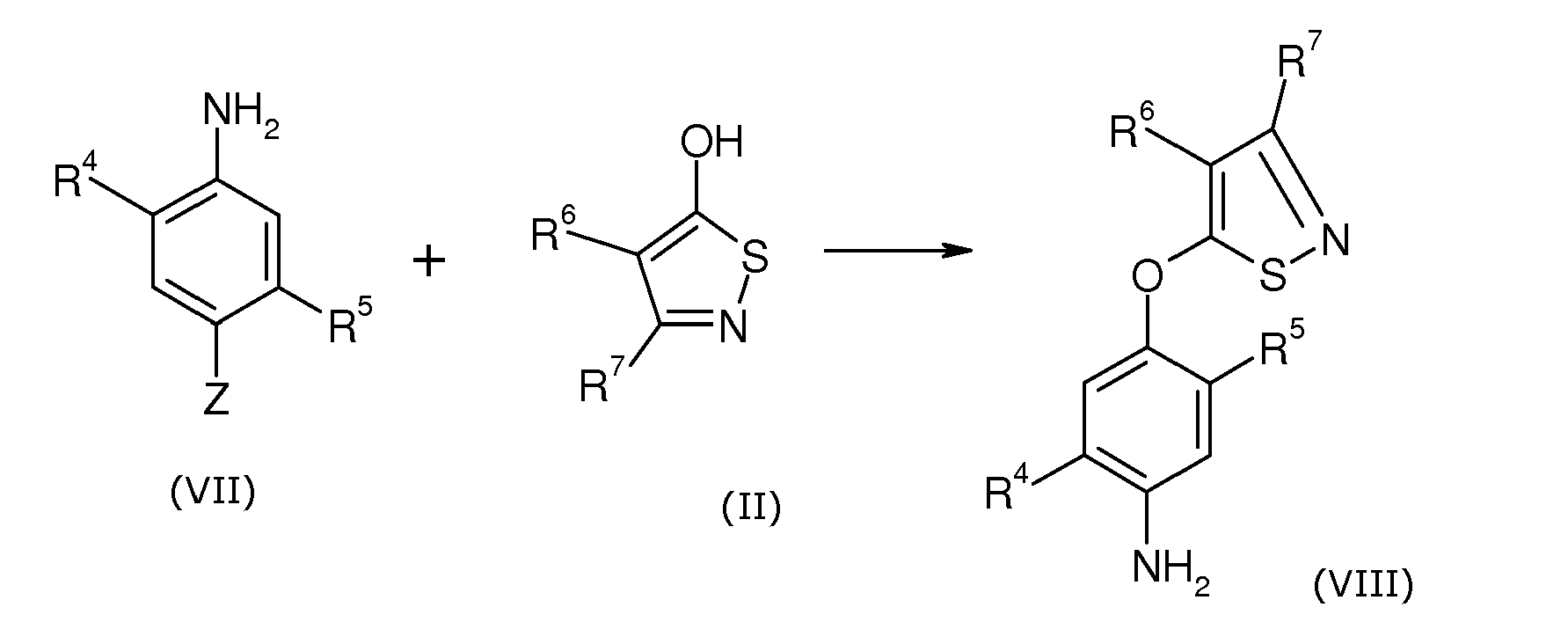
- Im Hinblick auf Reaktionsbedingungen, Lösungsmittel, Katalysatoren und geeignete Austrittsgruppen, sei auf Schritt (a) verwiesen.
- In einer weiteren alternativen erfindungsgemäßen Ausführungsform werden Aminophenole der Formel (XII) mit Isothiazolyl-Derivaten der Formel (IV) gemäß dem nachfolgenden Reaktionsschema zu Aminophenylethern der Formel (VIII) umgesetzt:

- Im Hinblick auf Reaktionsbedingungen, Lösungsmittel, Katalysatoren und geeignete Austrittsgruppen, sei auf Schritte (a) und (c) verwiesen.
- Die in den Schritten (a) und (b) erhaltenen Nitrophenylether der Formel (VI) können gemäß dem nachfolgenden Reaktionsschema zu den Anilinethern der Formel (VIII) reduziert werden:

- Die Reduktion gemäß Schritt (e) kann durch sämtliche im Stand der Technik zur Reduktion von Nitro-Gruppen beschriebenen Methoden erfolgen.
- Vorzugsweise erfolgt die Reduktion mit Zinnchlorid in konzentrierter Salzsäure wie in
WO-A-0 046 184 - Wird die Reduktion in der Flüssigphase durchgeführt, so sollte die Reaktion in einem gegenüber den vorherrschenden Reaktionsbedingungen inerten Lösungsmittel erfolgen. Ein solches ist beispielsweise Toluol.
- Die Umsetzung der Anilinether der Formel (VIII) zu den erfindungsgemäßen Amidinen der Formel (I) gemäß Schritt (f) kann, wie zuvor in Schema (Ib) dargestellt nach unterschiedlichen alternativen Methoden unter Verwendung von
- (i) Aminoacetalen der Formel (XIII) oder
- (ii) Amiden der Formel (XIV) oder
- (iii) Aminen der Formel (XV) in Gegenwart von Orthoestern der Formel (XVI)
- Die einzelnen alternativen Ausführungsformen (i) bis (iii) des erfindungsgemäßen Verfahrens sollen infolge kurz erläutert werden:
- (i) Gemäß einer erfindungsgemäßen Ausführungsform, die im Schema (Ib) als Schritt (i) dargestellt ist, werden die Anilinether der Formel (VIII) mit Aminoacetalen der Formel (XIII), in der R1, R2 und R3 wie zuvor beschrieben definiert sind und R11 und R12 ausgewählt sind aus C1-8-Alkyl-Gruppen, vorzugsweise aus C2-6-Alkyl-Gruppen, besonders bevorzugt aus C3-5-Alkyl-Gruppen und gemeinsam mit den O-Atomen, an die sie gebunden sind, einen fünf- oder sechsgliedrigen Ring bilden können, zu den erfindungsgemäßen Isothiazolyloxyphenylamidinen der Formel (I) umgesetzt.
- Die Aminoacetale der Formel (XIII) sind aus den in JACS, 65, 1566 (1943) beschriebenen Formamiden durch Umsetzung mit Alkylierungsreagenzien, wie z.B. Dimethylsulfat, erhältlich.
- (ii) In einer alternativen erfindungsgemäßen Ausführungsform, die im Schema (Ib) als Schritt (ii) dargestellt ist, werden die Anilinether der Formel (VIII) mit Amiden der Formel (XIV), in der die Gruppen R1, R2 und R3 wie zuvor definiert sind, zu den erfindungsgemäßen Isothiazolyloxyphenylamidinen umgesetzt.
- Die Reaktion gemäß Schritt (ii) erfolgt ggf. in Gegenwart eines Halogenierungsmittels. Geeignete Halogenierungsmittel sind beispielsweise ausgewählt aus der Gruppe bestehend aus PCl5, PCl3, POCl3 oder SOCl2.
- Zudem kann die Reaktion alternativ in Gegenwart eines Kondensationsmittels erfolgen.
- Geeignete Kondensationsmittel sind solche, die üblicherweise zur Knüpfung von Amidbindungen verwendet werden, beispielhaft seien Säurehalogenidbildner wie z.B. Phosgen, Phosphortribromid, Phosphortrichlorid, Phosphorpentachlorid, Phosphortrichloridoxid oder Thionylchlorid; Anhydridbildner wie z.B. Chlorformiat, Methylchlorformiat, Isopropylchlorformiat, Isobutylchlorformiat oder Methansulfonylchlorid; Carbodiimine wie z.B. N,N'-Dicyclohexylcarbodümin (DCC) oder andere übliche Kondensationsmittel wie z.B. Phosphorpentoxid, Polyphosphorsäure, N,N'-Carbodiimidazol, 2-Ethoxy-N-ethoxycarbonyl-1,2-dihydroquinolin (EEDQ), Triphenylphosphin/Tetrachlormethan oder Bromtripyrrolidinophosphoniumhexafluorophosphat genannt.
- Die Reaktion gemäß Schritt (ii) erfolgt vorzugsweise in einem Lösungsmittel, welches ausgewählt ist aus den üblichen, bei den vorherrschenden Reaktionsbedingungen inerten Lösungsmitteln. Bevorzugt werden aliphatische, alicyclische oder aromatische Kohlenwasserstoffe, wie beispielsweise Petrolether, Hexan, Heptan, Cyclohexan, Methylcyclohexan, Benzol, Toluol, Xylol oder Decalin; halogenierte Kohlenwasserstoffe, wie z.B. Chlorbenzol, Dichlorbenzol, Dichlormethan, Chloroform, Tetrachlorkohlenstoff, Dichlorethan oder Trichlorethan; Ether, wie beispielsweise Diethylether, Diisopropylether, Methyl-tert-butylether (MTBE), Methyl-tert-amylether, Dioxan, Tetrahydrofuran, 1,2-Dimethoxyethan, 1,2-Diethoxyethan oder Anisol; Nitrile, wie beispielsweise Acetonitril, Propionitril, n- oder iso-Butyronitril oder Benzonitril; Amide, wie beispielsweise N,N-Dimethylformamid (DMF), N,N-Dimethylacetamid, N-Methylformanilid, N-Methylpyrrolidon (NMP) oder Hexamethylenphosphorsäuretriamid; Ester, wie beispielsweise Methyl- oder Ethylacetat; Sulfoxide, wie beispielsweise Dimethylsulfoxid (DMSO); Sulfone, wie beispielsweise Sulfolan; Alkohole, wie beispielsweise Methanol, Ethanol, n- oder iso-Propanol, n-, iso-, sec- oder tert-Butanol, Ethandiol, Propan-1,2-diol, Ethoxiethanol, Methoxyethanol, Diethylenglycolmonomethylether, Diethylenglycolmonoethylether oder Mischungen dieser verwendet.
- (iii) Gemäß einer weiteren alternativen erfindungsgemäßen Ausführungsform, die in Schema (Ib) als Schritt (iii) dargestellt ist, werden die Anilinether der Formel (VIII) mit Aminen der Formel (XV), in der die Gruppen R2 und R3 wie zuvor definiert sind in Gegenwart von Orthoestern der Formel (XVI), in der R1 Wasserstoff ist und R8 bis R10 unabhängig voneinander ausgewählt sind aus C1-8-Alkyl-Gruppen, vorzugsweise aus C2-6-Alkyl-Gruppen, besonders bevorzugt aus C3-5-Alkyl-Gruppen oder R8 und R10, R9 und R10 oder R8 und R9 gemeinsam mit den O-Atomen, an die sie gebunden sind, einen fünf- oder sechsgliedrigen Ring bilden können, zu den erfindungsgemäßen Isothiazolyloxyphenylamidinen umgesetzt.
- Die Reaktion gemäß Schritt (iii) erfolgt vorzugsweise in einem Lösungsmittel, welches ausgewählt ist aus den üblichen, bei den vorherrschenden Reaktionsbedingungen inerten Lösungsmitteln. Bevorzugt werden aliphatische, alicyclische oder aromatische Kohlenwasserstoffe, wie beispielsweise Petrolether, Hexan, Heptan, Cyclohexan, Methylcyclohexan, Benzol, Toluol, Xylol oder Decalin; halogenierte Kohlenwasserstoffe, wie z.B. Chlorbenzol, Dichlorbenzol, Dichlormethan, Chloroform, Tetrachlorkohlenstoff, Dichlorethan oder Trichlorethan; Ether, wie beispielsweise Diethylether, Diisopropylether, Methyl-tert-butylether (MTBE), Methyl-tert-amylether, Dioxan, Tetrahydrofuran, 1,2-Dimethoxyethan, 1,2-Diethoxyethan oder Anisol; Nitrile, wie beispielsweise Acetonitril, Propionitril, n- oder iso-Butyronitril oder Benzonitril; Amide, wie beispielsweise N,N-Dimethylformamid (DMF), N,N-Dimethylacetamid, N-Methylformanilid, N-Methylpyrrolidon (NMP) oder Hexamethylenphosphorsäuretriamid; Ester, wie beispielsweise Methyl- oder Ethylacetat; Sulfoxide, wie beispielsweise Dimethylsulfoxid (DMSO); Sulfone, wie beispielsweise Sulfolan; Alkohole, wie beispielsweise Methanol, Ethanol, n- oder iso-Propanol, n-, iso-, sec- oder tert-Butanol, Ethandiol, Propan-1,2-diol, Ethoxiethanol, Methoxyethanol, Diethylenglycolmonomethylether, Diethylenglycolmonoethylether; oder Mischungen dieser mit Wasser sowie reines Wasser verwendet.
- Die Reaktion gemäß Schritt (iii) erfolgt vorzugsweise in Gegenwart einer Säure.
- Geeignete Säuren sind beispielsweise ausgewählt aus der Gruppe bestehend aus organischen und anorganischen Säuren, wobei p-Toluolsulfonsäure, Methansulfonsäure, Salzsäure (gasförmig, wässrig oder in organischer Lösung) oder Schwefelsäure.
- In einer alternativen erfindungsgemäßen Ausführungsform können bereits die Aminophenole der Formel (XII)
- (i) mit Aminoacetalen der Formel (XIII) oder
- (ii) mit Amiden der Formel (XIV) oder
- (iii) mit Aminen der Formel (XV) in Gegenwart von Orthoestern der Formel (XVI)
- Hinsichtlich der Reaktionsbedingungen, Lösungsmittel und Katalysatoren, sei auf Schritt (f) verwiesen.
- Die weitere Umsetzung der Amidine der Formel (X) zu den erfindungsgemäßen Zielmolekülen der Formel (I) kann beispielsweise wie in Schritt (j) beschrieben erfolgen.
- In einer alternativen erfindungsgemäßen Ausführungsform können die Aminophenylderivate der Formel (VII)
- (i) mit Aminoacetalen der Formel (XIII) oder
- (ii) mit Amiden der Formel (XIV) oder
- (iii) mit Aminen der Formel (XV) in Gegenwart von Orthoestern der Formel (XVI)
- Hinsichtlich der Reaktionsbedingungen, Lösungsmittel und Katalysatoren, sei auf Schritt (a) verwiesen.
- Die weitere Umsetzung der Amidine der Formel (XI) zu den erfindungsgemäßen Zielmolekülen der Formel (I) kann beispielsweise wie in Schritt (i) beschrieben erfolgen.
- Gemäß einer weiteren erfindungsgemäßen Ausführungsform können die aus Schritt (h) erhältlichen Amidine der Formel (XI) mit Isothiazolyl-Alkoholen der Formel (II) oder den daraus gebildeten Alkoholaten zu den erfindungsgemäßen Zielmolekülen der Formel (I) gemäß dem nachfolgenden Reaktionsschema umgesetzt werden:

- Hinsichtlich der Reaktionsbedingungen, Lösungsmittel und Katalysatoren sei auf Schritt (a) verwiesen.
- Gemäß einer weiteren erfindungsgemäßen Ausführungsform können die aus Schritt (g) erhältlichen Amidine der Formel (X) mit Isothiazolyl-Derivaten der Formel (IV) zu den erfindungsgemäßen Zielmolekülen der Formel (I) gemäß dem nachfolgenden Reaktionsschema umgesetzt werden:

- Hinsichtlich der Reaktionsbedingungen, Lösungsmittel und Katalysatoren, sei auf Schritt (f) verwiesen.
- Im Zusammenhang mit den erfindungsgemäßen Verfahren zur Herstellung der Amidine der Formel (I) sind die folgenden Kombinationen von Reaktionsschritten als vorteilhaft anzusehen: Schritte (a), (e) und (f); Schritte (b), (e) und (f); Schritte (c) und (f); Schritte (d) und (f); Schritte (h) und (i) und/oder Schritte (g) und (j).
- Die Herstellung der erfindungsgemäßen Isothiazolyloxyphenylamidine erfolgt ggf. ohne zwischenzeitliche Isolierung der Zwischenprodukte.
- Die abschließende Reinigung der Isothiazolyloxyphenylamidine kann ggf. durch übliche Reinigungsverfahren erfolgen. Vorzugsweise erfolgt die Reinigung durch Kristallisation.
- Die in Schritten (b), (d) und (j) des zuvor beschriebenen Verfahrens verwendeten Isothiazolyl-Derivate der Formel IVa worin Z ein Chloratom ist, können beispielsweise gemäß dem in Journal of Chemical Research, Synopses, 1989, 2, 29 und dem japanischen Patent
JP 2002/003410 
- Die verwendeten Isothiazolylamine der Formel (XVII) können gemäß den im nachfolgenden Schema (II) beschriebenen Routen erhaten werden.
- Die Alkohole gemäß Formel (XX) können beispielsweise durch Kondensation von Malonsäuredinitril (XIX) mit Carbonsäurechloriden (XVIII) in Gegenwart von Basen, wie in Schritt (k) dargestellt und z.B. in JACS, 2002, 12118-12128 oder Bioorg. Med. Chem. Lett., 2006, 4326-4330 beschrieben, erhalten werden.
- Geeignete Basen sind organische und anorganische Basen, die üblicherweise in solchen Reaktionen verwendet werden. Vorzugsweise werden Basen verwendet, die beispielhaft ausgewählt sind aus der Gruppe bestehend aus Hydriden, Hydroxiden, Amiden, Alkoholaten, Acetaten, Fluoriden, Phosphaten, Carbonaten und Hydrogencarbonaten von Alkali- oder Erdalkalimetallen. Bevorzugt sind dabei Natriumamid, Natriumhydrid, Lithiumdiisopropylamid, Natriummethanolat, Kalium-tert-butanolat, Natriumhydroxid, Kaliumhydroxid, Natriumacetat, Natriumphosphat, Kaliumphosphat, Kaliumfluorid, Caesiumfluorid, Natriumcarbonat, Kaliumcarbonat, Kaliumhydrogencarbonat, Natriumhydrogencarbonat und Caesiumcarbonat. Außerdem sind tertiäre Amine, wie z.B. Trimethylamin, Triethylamin, Tributylamin, N,N-Dimethylanilin, N,N-Dimethylbenzylamin, Pyridin, N-Methylpiperidin, N-Methylpyrolidon, N,N-Dimethylaminopyridin, Diazabicyclooctan (DABCO), Diazabicyclononen (DBN) und Diazabicycloundecen (DBU) besonders bevorzugt.
- Die Reaktion des Säurechlorids (XVIII) mit dem Malonsäuredinitril (XIX) wird in einem Lösungsmittel durchgeführt, welches ausgewählt ist aus üblichen, bei den vorherrschenden Reaktionsbedingungen inerten Lösungsmitteln.
- Bevorzugt werden aliphatische, alicyclische oder aromatische Kohlenwasserstoffe, wie beispielsweise Petrolether, Hexan, Heptan, Cyclohexan, Methylcyclohexan, Benzol, Toluol, Xylol oder Decalin; halogenierte Kohlenwasserstoffe, wie z.B. Chlorbenzol, Dichlorbenzol, Dichlormethan, Chloroform, Tetrachlorkohlenstoff, Dichlorethan oder Trichlorethan; Ether, wie beispielsweise Diethylether, Diisopropylether, Methyl-tert-butylether (MTBE), Methyl-tert-amylether, Dioxan, Tetrahydrofuran, 1,2-Dimethoxyethan, 1,2-Diethoxyethan oder Anisol; Nitrile, wie beispielsweise Acetonitril, Propionitril, n- oder iso-Butyronitril oder Benzonitril; Amide, wie beispielsweise N,N-Dimethylformamid (DMF), N,N-Dimethylacetamid, N-Methylformanilid, N-Methylpyrrolidon (NMP) oder Hexamethylenphosphorsäuretriamid; oder Mischungen dieser mit Wasser sowie reines Wasser.
- Die Reaktion kann im Vakuum, bei Normaldruck oder unter Überdruck und bei Temperaturen von -20 bis 200 °C durchgeführt werden, vorzugsweise erfolgt die Reaktion bei Normaldruck und Temperaturen von -10 bis 20 °C.
-
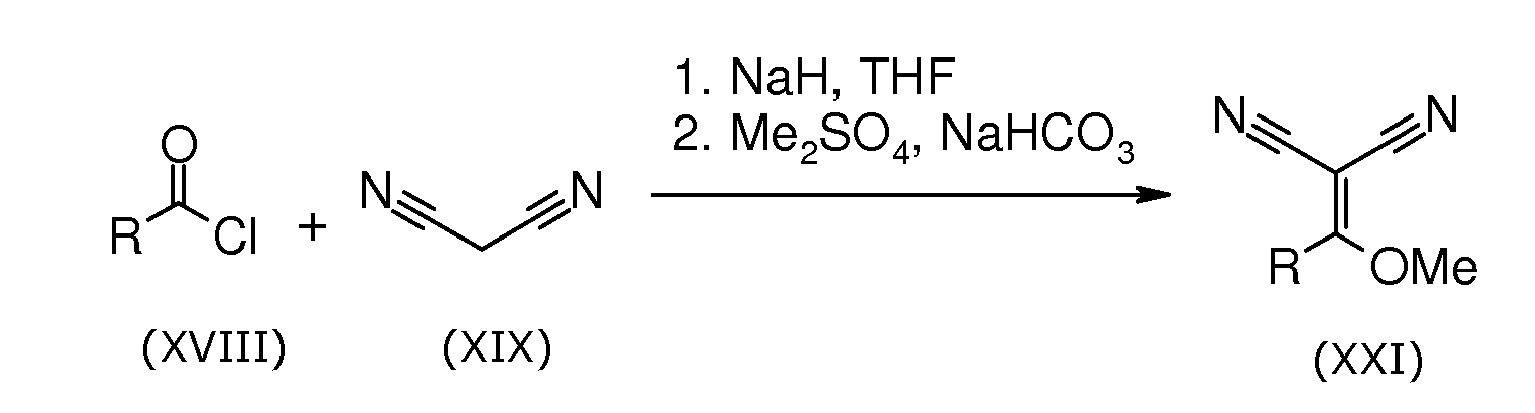
- Die Alkylierung der Hydroxyfunktion der Alkohole der Formel (XX) wird in einem Lösungsmittel durchgeführt, welches ausgewählt ist aus üblichen, bei den vorherrschenden Reaktionsbedingungen, inerten Lösungsmitteln.
- Bevorzugt werden aliphatische, alicyclische oder aromatische Kohlenwasserstoffe, wie beispielsweise Petrolether, Hexan, Heptan, Cyclohexan, Methylcyclohexan, Benzol, Toluol, Xylol oder Decalin; halogenierte Kohlenwasserstoffe, wie z.B. Chlorbenzol, Dichlorbenzol, Dichlormethan, Chloroform, Tetrachlorkohlenstoff, Dichlorethan oder Trichlorethan; Ether, wie beispielsweise Diethylether, Diisopropylether, Methyl-tert-butylether (MTBE), Methyl-tert-amylether, Dioxan, Tetrahydrofuran, 1,2-Dimethoxyethan, 1,2-Diethoxyethan oder Anisol; Nitrile, wie beispielsweise Acetonitril, Propionitril, n- oder iso-Butyronitril oder Benzonitril; Amide, wie beispielsweise N,N-Dimethylformamid (DMF), N,N-Dimethylacetamid, N-Methylformanilid, N-Methylpyrrolidon (NMP) oder Hexamethylenphosphorsäuretriamid; oder Mischungen dieser mit Wasser sowie reines Wasser.
- Als Alkierungsreagenzien lassen sich beispielsweise Dialkylsulfate, Alkylhalogenide, - mesylate, -tosylate oder triflate einsetzen. Bevorzugt werden Dialkylsulfate.
- Hinsichtlich der geeigneten Basen sei auf Schritt (k) verwiesen. Besonders bevorzugt sind NaHCO3 oder Natriumhydrid.
- Die Reaktion kann im Vakuum, bei Normaldruck oder unter Überdruck und bei Temperaturen von -20 bis 200 °C durchgeführt werden, vorzugsweise erfolgt die Reaktion bei Normaldruck und Temperaturen von 50 bis 150 °C.
- In einem anschließenden Schritt (1) werden die Alkohole der Formel (XX) zu Alkoxydinitrilen der Formel (XXI), wie in JACS, 2002, 12118-12128 beschrieben, umgesetzt.
- In einer alternativen Ausführungsform, die in Schritt (p) dargestellt ist, können die Alkohole der Formel (XX) mit geeigneten Chlorierungsreagenzien, wie z.B. PCl5, zu den Chlorodinitrilen der Formel (XXVI) umgesetzt werden. Ein entsprechendes Verfahren beschreibt Bioorg. Med. Chem. Lett., 2006, 4326-4330.
- Die Folgeumsetzung mit Ammoniak gemäß Schritt (m) kann sowohl aus dem Alkoxydinitrilen (XXI) als auch aus den Halodinitrilen (XXVI) erfolgen, wie in Bioorg. Med. Chem. Lett., 2006, 4326-4330 beschrieben ist.

- Die Umsetzung der Alkoxydinitrile (XXI) zu der Aminodinitrilen (XXII) wird in einem Lösungsmittel durchgeführt, welches ausgewählt ist aus üblichen, bei den vorherrschenden Reaktionsbedingungen inerten Lösungsmitteln.
- Bevorzugt werden aliphatische, alicyclische oder aromatische Kohlenwasserstoffe, wie beispielsweise Petrolether, Hexan, Heptan, Cyclohexan, Methylcyclohexan, Benzol, Toluol, Xylol oder Decalin; halogenierte Kohlenwasserstoffe, wie z.B. Chlorbenzol, Dichlorbenzol, Dichlormethan, Chloroform, Tetrachlorkohlenstoff, Dichlorethan oder Trichlorethan; Ether, wie beispielsweise Diethylether, Diisopropylether, Methyl-tert-butylether (MTBE), Methyl-tert-amylether, Dioxan, Tetrahydrofuran, 1,2-Dimethoxyethan, 1,2-Diethoxyethan oder Anisol; Nitrile, wie beispielsweise Acetonitril, Propionitril, n- oder iso-Butyronitril oder Benzonitril; Amide, wie beispielsweise N,N-Dimethylformamid (DMF), N,N-Dimethylacetamid, N-Methylformanilid, N-Methylpyrrolidon (NMP) oder Hexamethylenphosphorsäuretriamid; oder Mischungen dieser mit Wasser sowie reines Wasser. Besonders bevorzugt sind Alkohole wie z.B Methanol, Ethanol, iso-Propanol oder n-Butanol.
- Statt Ammoniak können auch andere Ammoniakquellen wie z.B. Urotropin verwendet werden.
- Die Reaktion kann im Vakuum, bei Normaldruck oder unter Überdruck und bei Temperaturen von -20 bis 200 °C durchgeführt werden, vorzugsweise erfolgt die Reaktion bei Normaldruck und Temperaturen von 0 bis 30 °C.
- Alternativ sind die Aminodinitrile der Formel (XXII), bei denen der Rest R7 der Gruppe


-
EP 1 344 774 A1 lehrt eine Synthese der Aminodinitrile der Formel (XXII) ausgehend von Malonsäuredinitril (XIX) und Carbonsäurechloriden (XVIII), gemäß dem nachfolgenden Reaktionsschema: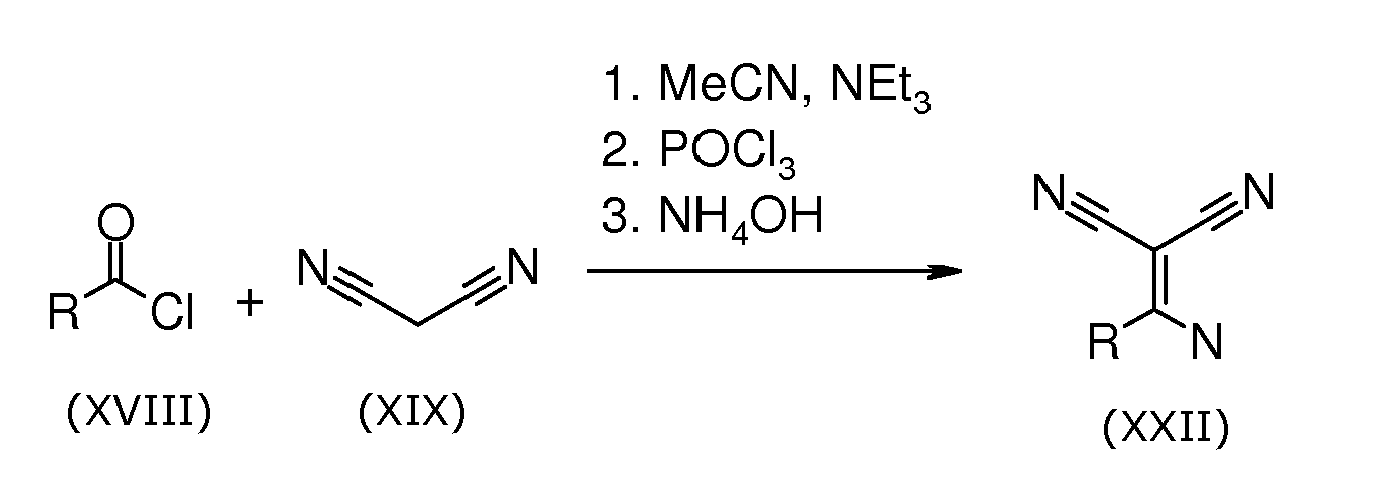
- Desweiteren lassen sich Isothiazolylamine der Formel (XVII), bei denen R7 der Gruppe


-
EP-A-327 981 - Die Transformation der Nitrile der Formel (XXII) zu den die Thioamiden der Formel (XXIII) kann, wie in der
DE-A-2 434 922 beschrieben, in einem Gemisch aus organischen Basen durchgeführt werden. - Bevorzugt sind tertiäre Amine, wie z.B. Trimethylamin, Triethylamin, Tributylamin, N,N-Dimethylanilin, N,N-Dimethylbenzylamin, Pyridin, N-Methylpiperidin, N-Methylpyrolidon, N,N-Dimethylaminopyridin, Diazabicyclooctan (DABCO), Diazabicyclononen (DBN) und Diazabicycloundecen (DBU) in unterschiedlichen Mischungen.
- Statt des bevorzugt verwendeten gasförmigen Schwefelwasserstoffes können auch andere Quellen für Schwefelwasserstoff, wie z..B. P2S5, Lawesson'sches Reagenz, Thioacetamid, Thioessigsäure, Diphenylphosphinodithionsäure, O,O-Dialkyldithiophosphorsäure oder Trimethylsilanthiolat verwendet werden.
- Die Reaktion kann im Vakuum, bei Normaldruck oder unter Überdruck und bei Temperaturen von -20 bis 200 °C durchgeführt werden, vorzugsweise erfolgt die Reaktion bei Normaldruck und Temperaturen von 0 bis 30 °C.
- Die Synthese von Aminoisothiazolen der Formel (XVII) mit R6 = H durch oxidative Cyclisierung von 3-Iminothioacetamiden der Formel (XXIII) gemäß Schritt (o) ist z.B. in Journal of the American Chemical Society, 1994, 116, 2292-300; in
EP-A-129 408 DE-A-2 434 922 für R6 = H beschrieben. Bioorg. Med. Chem. Lett., 2006, 4326-4330 beschreibt die oxidative Cyclisierung für Verbindungen mit R6 ≠ H. - Die oxidative Cyclisierung zum Aminoisothiazol wird in einem Lösungsmittel durchgeführt, welches ausgewählt ist aus üblichen, bei den vorherrschenden Reaktionsbedingungen, inerten Lösungsmitteln.
- Bevorzugt werden aliphatische, alicyclische oder aromatische Kohlenwasserstoffe, wie beispielsweise Petrolether, Hexan, Heptan, Cyclohexan, Methylcyclohexan, Benzol, Toluol, Xylol oder Decalin; halogenierte Kohlenwasserstoffe, wie z.B. Chlorbenzol, Dichlorbenzol, Dichlormethan, Chloroform, Tetrachlorkohlenstoff, Dichlorethan oder Trichlorethan; Ether, wie beispielsweise Diethylether, Diisopropylether, Methyl-tert-butylether (MTBE), Methyl-tert-amylether, Dioxan, Tetrahydrofuran, 1,2-Dimethoxyethan, 1,2-Diethoxyethan oder Anisol; Nitrile, wie beispielsweise Acetonitril, Propionitril, n- oder iso-Butyronitril oder Benzonitril; Amide, wie beispielsweise N,N-Dimethylformamid (DMF), N,N-Dimethylacetamid, N-Methylformanilid, N-Methylpyrrolidon (NMP) oder Hexamethylenphosphorsäuretriamid; oder Mischungen dieser mit Wasser sowie reines Wasser. Besonders bevorzugt sind Alkohole wie z.B. Methanol, Ethanol, iso-Propanol oder n-Butanol.
- Als Oxidationsmittel können z.B. Wasserstoffperoxid oder Iod eingesetzt werden. Bevorzugt wird Wasserstoffperoxid eingesetzt.
- Die Reaktion kann im Vakuum, bei Normaldruck oder unter Überdruck und bei Temperaturen von -20 bis 200 °C durchgeführt werden, vorzugsweise erfolgt die Reaktion bei Normaldruck und Temperaturen von -10 bis 80 °C.
- Die Synthese der 4-Halogen-Aminoisothiazolintermediate der Formel (XVII) mit R6 = Halogen kann durch Halogenierung der noch freien 4-Position aus den entsprechenden Aminoisothiazolen analog zu Heterocycles, 1994, 37, 859-67 erfolgen.
- Die Herstellung von Hydroxyisothiazolen ausgehend von Thioalkylderivaten ist im Australian Journal of Chemistry 1989, 42, 1291-306 beschrieben.
- Ausgehend von Halodinitrilen (XXVI) sind Hydroxyisothiazole gemäß Australian Journal of Chemistry 1975 28, 2051-5 zugänglich.

- Die erfindungsgemäßen Amidine weisen eine starke mikrobizide Wirkung auf und können zur Bekämpfung von unerwünschten Mikroorganismen, wie Fungi (Pilze) und Bakterien, im Pflanzenschutz und im Materialschutz eingesetzt werden.
- Fungizide lassen sich Pflanzenschutz zur Bekämpfung von Plasmodiophoromycetes, Oomycetes, Chytridiomycetes, Zygomycetes, Ascomycetes, Basidiomycetes und Deuteromycetes einsetzen.
- Bakterizide lassen sich im Pflanzenschutz zur Bekämpfung von Pseudomonadaceae, Rhizobiaceae, Enterobacteriaceae, Corynebacteriaceae und Streptomycetaceae einsetzen.
- Beispielhaft aber nicht begrenzend seien einige Erreger von pilzlichen und bakteriellen Erkrankungen, die unter die oben aufgezählten Oberbegriffe fallen, genannt:
- Erkrankungen, hervorgerufen durch Erreger des Echten Mehltaus wie z.B. Blumeria-Arten, wie beispielsweise Blumeria graminis;
- Podosphaera-Arten, wie beispielsweise Podosphaera leucotricha;
- Sphaerotheca-Arten, wie beispielsweise Sphaerotheca fuliginea;
- Uncinula-Arten, wie beispielsweise Uncinula necator;
- Erkrankungen, hervorgerufen durch Erreger von Rostkrankheiten wie z.B.
- Gymnosporangium-Arten, wie beispielsweise Gymnosporangium sabinae
- Hemileia-Arten, wie beispielsweise Hemileia vastatrix;
- Phakopsora-Arten, wie beispielsweise Phakopsora pachyrhizi und Phakopsora meibomiae;
- Puccinia-Arten, wie beispielsweise Puccinia recondita;
- Uromyces-Arten, wie beispielsweise Uromyces appendiculatus;
- Erkrankungen, hervorgerufen durch Erreger der Gruppe der Oomyceten wie z.B.
- Bremia-Arten, wie beispielsweise Bremia lactucae;
- Peronospora-Arten, wie beispielsweise Peronospora pisi oder P. brassicae;
- Phytophthora-Arten, wie beispielsweise Phytophthora infestans;
- Plasmopara-Arten, wie beispielsweise Plasmopara viticola;
- Pseudoperonospora-Arten, wie beispielsweise Pseudoperonospora humuli oder Pseudoperonospora cubensis;
- Pythium-Arten, wie beispielsweise Pythium ultimum;
- Blattfleckenkrankheiten und Blattwelken, hervorgerufen durch z.B. Alternaria-Arten, wie beispielsweise Alternaria solani;
- Cercospora-Arten, wie beispielsweise Cercospora beticola;
- Cladosporium-Arten, wie beispielsweise Cladosporium cucumerinum;
- Cochliobolus-Arten, wie beispielsweise Cochliobolus sativus (Konidienform: Drechslera, Syn: Helminthosporium);
- Colletotrichum-Arten, wie beispielsweise Colletotrichum lindemuthanium;
- Cycloconium-Arten, wie beispielsweise Cycloconium oleaginum;
- Diaporthe-Arten, wie beispielsweise Diaporthe citri;
- Elsinoe-Arten, wie beispielsweise Elsinoe fawcettii;
- Gloeosporium-Arten, wie beispielsweise Gloeosporium laeticolor;
- Glomerella-Arten, wie beispielsweise Glomerella cingulata;
- Guignardia-Arten, wie beispielsweise Guignardia bidwelli;
- Leptosphaeria-Arten, wie beispielsweise Leptosphaeria maculans;
- Magnaporthe-Arten, wie beispielsweise Magnaporthe grisea;
- Mycosphaerella-Arten, wie beispielsweise Mycosphaerella graminicola und Mycosphaerella fijiensis;
- Phaeosphaeria-Arten, wie beispielsweise Phaeosphaeria nodorum;
- Pyrenophora-Arten, wie beispielsweise Pyrenophora teres;
- Ramularia-Arten, wie beispielsweise Ramularia collo-cygni;
- Rhynchosporium-Arten, wie beispielsweise Rhynchosporium secalis;
- Septoria-Arten, wie beispielsweise Septoria apii;
- Typhula-Arten, wie beispielsweise Typhula incarnata;
- Venturia-Arten, wie beispielsweise Venturia inaequalis;
- Wurzel- und Stengelkrankheiten, hervorgerufen durch z.B. Corticium-Arten, wie beispielsweise Corticium graminearum;
- Fusarium-Arten, wie beispielsweise Fusarium oxysporum;
- Gaeumannomyces-Arten, wie beispielsweise Gaeumannomyces graminis;
- Rhizoctonia-Arten, wie beispielsweise Rhizoctonia solani;
- Tapesia-Arten, wie beispielsweise Tapesia acuformis;
- Thielaviopsis-Arten, wie beispielsweise Thielaviopsis basicola;
- Ähren- und Rispenerkrankungen (inklusive Maiskolben), hervorgerufen durch z.B. Alternaria-Arten, wie beispielsweise Alternaria spp.;
- Aspergillus-Arten, wie beispielsweise Aspergillus flavus;
- Cladosporium-Arten, wie beispielsweise Cladosporium cladosporioides;
- Claviceps-Arten, wie beispielsweise Claviceps purpurea;
- Fusarium-Arten, wie beispielsweise Fusarium culmorum;
- Gibberella-Arten, wie beispielsweise Gibberella zeae;
- Monographella-Arten, wie beispielsweise Monographella nivalis;
- Erkrankungen, hervorgerufen durch Brandpilze wie z.B. Sphacelotheca-Arten, wie beispielsweise Sphacelotheca reiliana;
- Tilletia-Arten, wie beispielsweise Tilletia caries;
- Urocystis-Arten, wie beispielsweise Urocystis occulta;
- Ustilago-Arten, wie beispielsweise Ustilago nuda;
- Fruchtfäule hervorgerufen durch z.B. Aspergillus-Arten, wie beispielsweise Aspergillus flavus;
- Botrytis-Arten, wie beispielsweise Botrytis cinerea;
- Penicillium-Arten, wie beispielsweise Penicillium expansum und Penicillium purpurogenum;
- Sclerotinia-Arten, wie beispielsweise Sclerotinia sclerotiorum;
- Verticilium-Arten, wie beispielsweise Verticilium alboatrum;
- Samen- und bodenbürtige Fäulen und Welken, sowie Sämlingserkrankungen, hervorgerufen durch z.B.
- Alternaria-Arten, wie beispielsweise Alternaria brassicicola
- Aphanomyces-Arten, wie beispielsweise Aphanomyces euteiches
- Ascochyta-Arten, wie beispielsweise Ascochyta lentis
- Aspergillus-Arten, wie beispielsweise Aspergillus flavus
- Cladosporium-Arten, wie beispielsweise Cladosporium herbarum
- Cochliobolus-Arten, wie beispielsweise Cochliobolus sativus
- (Konidienform: Drechslera, Bipolaris Syn: Helminthosporium);
- Colletotrichum-Arten, wie beispielsweise Colletotrichum coccodes;
- Fusarium-Arten, wie beispielsweise Fusarium culmorum;
- Gibberella-Arten, wie beispielsweise Gibberella zeae;
- Macrophomina-Arten, wie beispielsweise Macrophomina phaseolina Monographella-Arten, wie beispielsweise Monographella nivalis;
- Penicillium-Arten, wie beispielsweise Penicillium expansum
- Phoma-Arten, wie beispielsweise Phoma lingam
- Phomopsis-Arten, wie beispielsweise Phomopsis sojae;
- Phytophthora Arten, wie beispielsweise Phytophthora cactorum;
- Pyrenophora-Arten, wie beispielsweise Pyrenophora graminea
- Pyricularia-Arten, wie beispielsweise Pyricularia oryzae;
- Pythium-Arten, wie beispielsweise Pythium ultimum;
- Rhizoctonia-Arten, wie beispielsweise Rhizoctonia solani;
- Rhizopus-Arten, wie beispielsweise Rhizopus oryzae
- Sclerotium-Arten, wie beispielsweise Sclerotium rolfsii;
- Septoria-Arten, wie beispielsweise Septoria nodorum;
- Typhula-Arten, wie beispielsweise Typhula incarnata;
- Verticillium-Arten, wie beispielsweise Verticillium dahliae
- Krebserkrankungen, Gallen und Hexenbesen, hervorgerufen durch z.B.
- Nectria-Arten, wie beispielsweise Nectria galligena;
- Welkeerkrankungen hervorgerufen durch z.B. Monilinia-Arten, wie beispielsweise Monilinia laxa;
- Deformationen von Blättern, Blüten und Früchten, hervorgerufen durch z.B. Taphrina-Arten, wie beispielsweise Taphrina deformans;
- Degenerationserkrankungen holziger pflanzen, hervorgerufen durch z.B. Esca-Arten, wie beispielsweise Phaeomoniella chlamydospora und Phaeoacremonium aleophilum und Fomitiporia mediterranea;
- Blüten- und Samenerkrankungen, hervorgerufen durch z.B. Botrytis-Arten, wie beispielsweise Botrytis cinerea;
- Erkrankungen von Pflanzenknollen, hervorgerufen durch z.B. Rhizoctonia-Arten, wie beispielsweise Rhizoctonia solani;
- Helminthosporium-Arten, wie beispielsweise Helminthosporium solani;
- Erkrankungen, hervorgerufen durch bakterielle Erreger wie z.B. Xanthomonas-Arten, wie beispielsweise Xanthomonas campestris pv. oryzae;
- Pseudomonas-Arten, wie beispielsweise Pseudomonas syringae pv. lachrymans;
- Erwinia-Arten, wie beispielsweise Erwinia amylovora;
- Bevorzugt können die folgenden Krankheiten von Soja-Bohnen bekämpft werden:
- Pilzkrankheiten an Blättern, Stängeln, Schoten und Samen verursacht durch z.B.
- Alternaria leaf spot (Alternaria spec. atrans tenuissima), Anthracnose (Colletotrichum gloeosporoides dematium var. truncatum), Brown spot (Septoria glycines), Cercospora leaf spot and blight (Cercospora kikuchii), Choanephora leaf blight (Choanephora infundibulifera trispora (Syn.)), Dactuliophora leaf spot (Dactuliophora glycines), Downy Mildew (Peronospora manshurica), Drechslera blight (Drechslera glycini), Frogeye Leaf spot (Cercospora sojina), Leptosphaerulina Leaf Spot (Leptosphaerulina trifolii), Phyllostica Leaf Spot (Phyllosticta sojaecola), Pod and Stem Blight (Phomopsis sojae), Powdery Mildew (Microsphaera diffusa), Pyrenochaeta Leaf Spot (Pyrenochaeta glycines), Rhizoctonia Aerial, Foliage, and Web Blight (Rhizoctonia solani), Rust (Phakopsora pachyrhizi), Scab (Sphaceloma glycines), Stemphylium Leaf Blight (Stemphylium botryosum), Target Spot (Corynespora cassiicola)
- Black Root Rot (Calonectria crotalariae), Charcoal Rot (Macrophomina phaseolina), Fusarium Blight or Wilt, Root Rot, and Pod and Collar Rot (Fusarium oxysporum, Fusarium orthoceras, Fusarium semitectum, Fusarium equiseti), Mycoleptodiscus Root Rot (Mycoleptodiscus terrestris), Neocosmospora (Neocosmopspora vasinfecta), Pod and Stem Blight (Diaporthe phaseolorum), Stem Canker (Diaporthe phaseolorum var. caulivora), Phytophthora Rot (Phytophthora megasperma), Brown Stem Rot (Phialophora gregata), Pythium Rot (Pythium aphanidermatum, Pythium irregulare, Pythium debaryanum, Pythium myriotylum, Pythium ultimum), Rhizoctonia Root Rot, Stem Decay, and Damping-Off (Rhizoctonia solani), Sclerotinia Stem Decay (Sclerotinia sclerotiorum), Sclerotinia Southern Blight (Sclerotinia rolfsii), Thielaviopsis Root Rot (Thielaviopsis basicola).
- Die erfindungsgemäßen Wirkstoffe weisen auch eine starke stärkende Wirkung in Pflanzen auf. Sie eignen sich daher zur Mobilisierung pflanzeneigener Abwehrkräfte gegen Befall durch unerwünschte Mikroorganismen.
- Unter pflanzenstärkenden (resistenzinduzierenden) Stoffen sind im vorliegenden Zusammenhang solche Substanzen zu verstehen, die in der Lage sind, das Abwehrsystem von Pflanzen so zu stimulieren, dass die behandelten Pflanzen bei nachfolgender Inokulation mit unerwünschten Mikroorganismen weitgehende Resistenz gegen diese Mikroorganismen entfalten.
- Unter unerwünschten Mikroorganismen sind im vorliegenden Fall phytopathogene Pilze, Bakterien und Viren zu verstehen. Die erfindungsgemäßen Stoffe können also eingesetzt werden, um Pflanzen innerhalb eines gewissen Zeitraums nach der Behandlung gegen den Befall durch die genannten Schaderreger zu schützen. Der Zeitraum, innerhalb dessen Schutz herbeigeführt wird, erstreckt sich im Allgemeinen von 1 bis 10 Tage, vorzugsweise 1 bis 7 Tage nach der Behandlung der Pflanzen mit den Wirkstoffen.
- Die gute Pflanzenverträglichkeit der Wirkstoffe in den zur Bekämpfung von Pflanzenkrankheiten notwendigen Konzentrationen erlaubt eine Behandlung von oberirdischen Pflanzenteilen, von Pflanz- und Saatgut, und des Bodens.
- Dabei lassen sich die erfindungsgemäßen Wirkstoffe mit besonders gutem Erfolg zur Bekämpfung von Getreidekrankheiten, wie z.B. gegen Puccinia-Arten und von Krankheiten im Wein-, Obst- und Gemüseanbau, wie z.B. gegen Botrytis-, Venturia- oder Alternaria-Arten, einsetzen.
- Die erfindungsgemäßen Wirkstoffe eignen sich auch zur Steigerung des Ernteertrages. Sie sind außerdem mindertoxisch und weisen eine gute Pflanzenverträglichkeit auf.
- Die erfindungsgemäßen Wirkstoffe können gegebenenfalls in bestimmten Konzentrationen und Aufwandmengen auch als Herbizide, zur Beeinflussung des Pflanzenwachstums, sowie zur Bekämpfung von tierischen Schädlingen verwendet werden. Sie lassen sich gegebenenfalls auch als Zwischen- und Vorprodukte für die Synthese weiterer Wirkstoffe einsetzen.
- Erfindungsgemäß können alle Pflanzen und Pflanzenteile behandelt werden. Unter Pflanzen werden hierbei alle Pflanzen und Pflanzenpopulationen verstanden, wie erwünschte und unerwünschte Wildpflanzen oder Kulturpflanzen (einschließlich natürlich vorkommender Kulturpflanzen). Kulturpflanzen können Pflanzen sein, die durch konventionelle Züchtungs- und Optimierungsmethoden oder durch biotechnologische und gentechnologische Methoden oder Kombinationen dieser Methoden erhalten werden können, einschließlich der transgenen Pflanzen und einschließlich der durch Sortenschutzrechte schützbaren oder nicht schützbaren Pflanzensorten. Unter Pflanzenteilen sollen alle oberirdischen und unterirdischen Teile und Organe der Pflanzen, wie Spross, Blatt, Blüte und Wurzel verstanden werden, wobei beispielhaft Blätter, Nadeln, Stängel, Stämme, Blüten, Fruchtkörper, Früchte und Samen sowie Wurzeln, Knollen und Rhizome aufgeführt werden. Zu den Pflanzenteilen gehört auch Erntegut sowie vegetatives und generatives Vermehrungsmaterial, beispielsweise Stecklinge, Knollen, Rhizome, Ableger und Samen.
- Die erfindungsgemäße Behandlung der Pflanzen und Pflanzenteile mit den Wirkstoffen erfolgt direkt oder durch Einwirkung auf deren Umgebung, Lebensraum oder Lagerraum nach den üblichen Behandlungsmethoden, z.B. durch Tauchen, Sprühen, Verdampfen, Vernebeln, Streuen, Aufstreichen und bei Vermehrungsmaterial, insbesondere bei Samen, weiterhin durch ein- oder mehrschichtiges Umhüllen.
- Darüber hinaus kann durch die erfindungsgemäße Behandlung der Mykotoxingehalt im Erntegut und den daraus hergestellten Nahrungs- und Futtermitteln verringert werden. Besonders, aber nicht ausschließlich sind hierbei folgende Mykotoxine zu nennen: Deoxynivalenol (DON), Nivalenol, 15-Ac-DON, 3-Ac-DON, T2- und HT2- Toxin, Fumonisine, Zearalenon, Moniliformin, Fusarin, Diaceotoxyscirpenol (DAS), Beauvericin, Enniatin, Fusaroproliferin, Fusarenol, Ochratoxine, Patulin, Mutterkornalkaloide und Aflatoxine, die beispielsweise von den folgenden Pilzen verursacht werden können: Fusarium spec., wie Fusarium acuminatum, F. avenaceum, F. crookwellense, F. culmorum, F. graminearum (Gibberella zeae), F. equiseti, F. fujikoroi, F. musarum, F. oxysporum, F. proliferatum, F. poae, F. pseudograminearum, F. sambucinum, F. scirpi, F. semitectum, F. solani, F. sporotrichoides, F. langsethiae, F. subglutinans, F. tricinctum, F. verticillioides u.a. sowie auch von Aspergillus spec., Penicillium spec., Claviceps purpurea, Stachybotrys spec. u.a.
- Im Materialschutz lassen sich die erfindungsgemäßen Stoffe zum Schutz von technischen Materialien gegen Befall und Zerstörung durch unerwünschte Mikroorganismen einsetzen.
- Unter technischen Materialien sind im vorliegenden Zusammenhang nichtlebende Materialien zu verstehen, die für die Verwendung in der Technik zubereitet worden sind. Beispielsweise können technische Materialien, die durch erfindungsgemäße Wirkstoffe vor mikrobieller Veränderung oder Zerstörung geschützt werden sollen, Klebstoffe, Leime, Papier und Karton, Textilien, Leder, Holz, Anstrichmittel und Kunststoffartikel, Kühlschmierstoffe und andere Materialien sein, die von Mikroorganismen befallen oder zersetzt werden können. Im Rahmen der zu schützenden Materialien seien auch Teile von Produktionsanlagen, beispielsweise Kühlwasserkreisläufe, genannt, die durch Vermehrung von Mikroorganismen beeinträchtigt werden können. Im Rahmen der vorliegenden Erfindung seien als technische Materialien vorzugsweise Klebstoffe, Leime, Papiere und Kartone, Leder, Holz, Anstrichmittel, Kühlschmiermittel und Wärmeübertragungsflüssigkeiten genannt, besonders bevorzugt Holz.
- Als Mikroorganismen, die einen Abbau oder eine Veränderung der technischen Materialien bewirken können, seien beispielsweise Bakterien, Pilze, Hefen, Algen und Schleimorganismen genannt. Vorzugsweise wirken die erfindungsgemäßen Wirkstoffe gegen Pilze, insbesondere Schimmelpilze, holzverfärbende und holzzerstörende Pilze (Basidiomyceten) sowie gegen Schleimorganismen und Algen.
- Es seien beispielsweise Mikroorganismen der folgenden Gattungen genannt:
- Alternaria, wie Alternaria tenuis,
- Aspergillus, wie Aspergillus niger,
- Chaetomium, wie Chaetomium globosum,
- Coniophora, wie Coniophora puetana,
- Lentinus, wie Lentinus tigrinus,
- Penicillium, wie Penicillium glaucum,
- Polyporus, wie Polyporus versicolor,
- Aureobasidium, wie Aureobasidium pullulans,
- Sclerophoma, wie Sclerophoma pityophila,
- Trichoderma, wie Trichoderma viride,
- Escherichia, wie Escherichia coli,
- Pseudomonas, wie Pseudomonas aeruginosa,
- Staphylococcus, wie Staphylococcus aureus.
- Die vorliegende Erfindung betrifft ein Mittel zum Bekämpfen unerwünschter Mikroorganismen, umfassend wenigstens eines der erfindungsgemäßen Isothiazolyloxyphenylamidine.
- Die erfindungsgemäßen Isothiazolyloxyphenylamidine können dazu in Abhängigkeit von ihren jeweiligen physikalischen und/ oder chemischen Eigenschaften in die üblichen Formulierungen überführt werden, wie Lösungen, Emulsionen, Suspensionen, Pulver, Schäume, Pasten, Granulate, Aerosole, Feinstverkapselungen in polymeren Stoffen und in Hüllmassen für Saatgut, sowie ULV-Kalt- und Warmnebel-Formulierungen.
- Diese Formulierungen werden in bekannter Weise hergestellt, z.B. durch Vermischen der Wirkstoffe mit Streckmitteln, also flüssigen Lösungsmitteln, unter Druck stehenden verflüssigten Gasen und/ oder festen Trägerstoffen, gegebenenfalls unter Verwendung von oberflächenaktiven Mitteln, also Emulgiermitteln und/oder Dispergiermitteln und/oder schaumerzeugenden Mitteln. Im Falle der Benutzung von Wasser als Streckmittel können z.B. auch organische Lösungsmittel als Hilfslösungsmittel verwendet werden. Als flüssige Lösungsmittel kommen im Wesentlichen infrage: Aromaten, wie Xylol, Toluol oder Alkylnaphthaline, chlorierte Aromaten oder chlorierte aliphatische Kohlenwasserstoffe, wie Chlorbenzole, Chlorethylene oder Methylenchlorid, aliphatische Kohlenwasserstoffe, wie Cyclohexan oder Paraffine, z.B. Erdölfraktionen, Alkohole, wie Butanol oder Glycol sowie deren Ether und Ester, Ketone, wie Aceton, Methylethylketon, Methylisobutylketon oder Cyclohexanon, stark polare Lösungsmittel, wie Dimethylformamid und Dimethylsulfoxid, sowie Wasser. Mit verflüssigten gasförmigen Streckmitteln oder Trägerstoffen sind solche Flüssigkeiten gemeint, welche bei normaler Temperatur und unter Normaldruck gasförmig sind, z.B. Aerosol-Treibgase, wie Halogenkohlenwasserstoffe sowie Butan, Propan, Stickstoff und Kohlendioxid. Als feste Trägerstoffe kommen infrage: z.B. natürliche Gesteinsmehle, wie Kaoline, Tonerden, Talkum, Kreide, Quarz, Attapulgit, Montmorillonit oder Diatomeenerde und synthetische Gesteinsmehle, wie hochdisperse Kieselsäure, Aluminiumoxid und Silikate. Als feste Trägerstoffe für Granulate kommen infrage: z.B. gebrochene und fraktionierte natürliche Gesteine wie Calcit, Bims, Marmor, Sepiolith, Dolomit sowie synthetische Granulate aus anorganischen und organischen Mehlen sowie Granulate aus organischem Material wie Sägemehl, Kokosnussschalen, Maiskolben und Tabakstängel. Als Emulgier und/oder schaumerzeugende Mittel kommen infrage: z.B. nichtionogene und anionische Emulgatoren, wie Polyoxyethylen-Fettsäureester, Polyoxyethylen-Fettalkoholether, z.B. Alkylarylpolyglycolether, Alkylsulfonate, Alkylsulfate, Arylsulfonate sowie Eiweißhydrolysate. Als Dispergiermittel kommen infrage: z.B. Lignin-Sulfitablaugen und Methylcellulose.
- Es können in den Formulierungen Haftmittel wie Carboxymethylcellulose, natürliche und synthetische pulverige, körnige oder latexförmige Polymere verwendet werden, wie Gummiarabicum, Polyvinylalkohol, Polyvinylacetat, sowie natürliche Phospholipide, wie Kephaline und Lecithine, und synthetische Phospholipide. Weitere Additive können mineralische und vegetabile Öle sein.
- Es können Farbstoffe wie anorganische Pigmente, z.B. Eisenoxid, Titanoxid, Ferrocyanblau und organische Farbstoffe, wie Alizarin-, Azo- und Metallphthalocyaninfarbstoffe und Spurennährstoffe, wie Salze von Eisen, Mangan, Bor, Kupfer, Kobalt, Molybdän und Zink verwendet werden.
- Die Formulierungen enthalten im Allgemeinen zwischen 0,1 und 95 Gewichtsprozent Wirkstoff, vorzugsweise zwischen 0,5 und 90 %.
- Die zuvor beschriebenen Formulierungen können in einem erfindungsgemäßen Verfahren zum Bekämpfen unerwünschter Mikroorganismen verwendet werden, bei dem die erfindungsgemäßen Isothiazolyloxyphenylamidine auf die Mikroorganismen und/oder in deren Lebensraum ausgebracht werden.
- Die Bekämpfung von phytopathogenen Pilzen durch die Behandlung des Saatguts von Pflanzen ist seit langem bekannt und ist Gegenstand ständiger Verbesserungen. Dennoch ergeben sich bei der Behandlung von Saatgut eine Reihe von Problemen, die nicht immer zufrieden stellend gelöst werden können. So ist es erstrebenswert, Verfahren zum Schutz des Saatguts und der keimenden Pflanze zu entwickeln, die das zusätzliche Ausbringen von Pflanzenschutzmitteln nach der Saat oder nach dem Auflaufen der Pflanzen überflüssig machen oder zumindest deutlich verringern. Es ist weiterhin erstrebenswert, die Menge des eingesetzten Wirkstoffs dahingehend zu optimieren, dass das Saatgut und die keimende Pflanze vor dem Befall durch phytopathogene Pilze bestmöglich geschützt wird, ohne jedoch die Pflanze selbst durch den eingesetzten Wirkstoff zu schädigen. Insbesondere sollten Verfahren zur Behandlung von Saatgut auch die intrinsischen fungiziden Eigenschaften transgener Pflanzen einbeziehen, um einen optimalen Schutz des Saatguts und der keimenden Pflanze bei einem minimalen Aufwand an Pflanzenschutzmitteln zu erreichen.
- Die vorliegende Erfindung bezieht sich daher insbesondere auch auf ein Verfahren zum Schutz von Saatgut und keimenden Pflanzen vor dem Befall von phytopathogenen Pilzen, indem das Saatgut mit einem erfindungsgemäßen Mittel behandelt wird.
- Die Erfindung bezieht sich ebenfalls auf die Verwendung der erfindungsgemäßen Mittel zur Behandlung von Saatgut zum Schutz des Saatguts und der keimenden Pflanze vor phytopathogenen Pilzen.
- Weiterhin bezieht sich die Erfindung auf Saatgut, welches zum Schutz vor phytopathogenen Pilzen mit einem erfindungsgemäßen Mittel behandelt wurde.
- Einer der Vorteile der vorliegenden Erfindung ist es, dass aufgrund der besonderen systemischen Eigenschaften der erfindungsgemäßen Mittel die Behandlung des Saatguts mit diesen Mitteln nicht nur das Saatgut selbst, sondern auch die daraus hervorgehenden Pflanzen nach dem Auflaufen vor phytopathogenen Pilzen schützt. Auf diese Weise kann die unmittelbare Behandlung der Kultur zum Zeitpunkt der Aussaat oder kurz danach entfallen.
- Ebenso ist es als vorteilhaft anzusehen, dass die erfindungsgemäßen Mischungen insbesondere auch bei transgenem Saatgut eingesetzt werden können.
- Die erfindungsgemäßen Mittel eignen sich zum Schutz von Saatgut jeglicher Pflanzensorte, die in der Landwirtschaft, im Gewächshaus, in Forsten oder im Gartenbau eingesetzt wird. Insbesondere handelt es sich dabei um Saatgut von Getreide (wie Weizen, Gerste, Roggen, Hirse und Hafer), Mais, Baumwolle, Soja, Reis, Kartoffeln, Sonnenblume, Bohne, Kaffee, Rübe (z.B. Zuckerrübe und Futterrübe), Erdnuss, Gemüse (wie Tomate, Gurke, Zwiebeln und Salat), Rasen und Zierpflanzen. Besondere Bedeutung kommt der Behandlung des Saatguts von Getreide (wie Weizen, Gerste, Roggen und Hafer), Mais und Reis zu.
- Im Rahmen der vorliegenden Erfindung wird das erfindungsgemäße Mittel alleine oder in einer geeigneten Formulierung auf das Saatgut aufgebracht. Vorzugsweise wird das Saatgut in einem Zustand behandelt, in dem so stabil ist, dass keine Schäden bei der Behandlung auftreten. Im Allgemeinen kann die Behandlung des Saatguts zu jedem Zeitpunkt zwischen der Ernte und der Aussaat erfolgen. Üblicherweise wird Saatgut verwendet, das von der Pflanze getrennt und von Kolben, Schalen, Stängeln, Hülle, Wolle oder Fruchtfleisch befreit wurde. So kann zum Beispiel Saatgut verwendet werden, das geerntet, gereinigt und bis zu einem Feuchtigkeitsgehalt von unter 15 Gew.-% getrocknet wurde. Alternativ kann auch Saatgut verwendet werden, das nach dem Trocknen z.B. mit Wasser behandelt und dann erneut getrocknet wurde.
- Im Allgemeinen muss bei der Behandlung des Saatguts darauf geachtet werden, dass die Menge des auf das Saatgut aufgebrachten erfindungsgemäßen Mittels und/oder weiterer Zusatzstoffe so gewählt wird, dass die Keimung des Saatguts nicht beeinträchtigt bzw. die daraus hervorgehende Pflanze nicht geschädigt wird. Dies ist vor allem bei Wirkstoffen zu beachten, die in bestimmten Aufwandmengen phytotoxische Effekte zeigen können.
- Die erfindungsgemäßen Mittel können unmittelbar aufgebracht werden, also ohne weitere Komponenten zu enthalten und ohne verdünnt worden zu sein. In der Regel ist es vorzuziehen, die Mittel in Form einer geeigneten Formulierung auf das Saatgut aufzubringen. Geeignete Formulierungen und Verfahren für die Saatgutbehandlung sind dem Fachmann bekannt und werden z.B. in den folgenden Dokumenten beschrieben:
US 4,272,417 A ,US 4,245,432 A ,US 4,808,430 A ,US 5,876,739 A ,US 2003/0176428 A1 ,WO 2002/080675 A1 ,WO 2002/028186 A2 . - Die erfindungsgemäß verwendbaren Wirkstoffkombinationen können in die üblichen Beizmittel-Formulierungen überführt werden, wie Lösungen, Emulsionen, Suspensionen, Pulver, Schäume, Slurries oder andere Hüllmassen für Saatgut, sowie ULV-Formulierungen.
- Diese Formulierungen werden in bekannter Weise hergestellt, indem man die Wirkstoffe oder Wirkstoffkombinationen mit üblichen Zusatzstoffen vermischt, wie zum Beispiel übliche Streckmittel sowie Lösungs- oder Verdünnungsmittel, Farbstoffe, Netzmittel, Dispergiermittel, Emulgatoren, Entschäumer, Konservierungsmittel, sekundäre Verdickungsmittel, Kleber, Gibberelline und auch Wasser.
- Als Farbstoffe, die in den erfindungsgemäß verwendbaren Beizmittel-Formulierungen enthalten sein können, kommen alle für derartige Zwecke üblichen Farbstoffe in Betracht. Dabei sind sowohl in Wasser wenig lösliche Pigmente als auch in Wasser lösliche Farbstoffe verwendbar. Als Beispiele genannt seien die unter den Bezeichnungen Rhodamin B, C.I. Pigment Red 112 und C.I. Solvent Red 1 bekannten Farbstoffe.
- Als Netzmittel, die in den erfindungsgemäß verwendbaren Beizmittel-Formulierungen enthalten sein können, kommen alle zur Formulierung von agrochemischen Wirkstoffen üblichen, die Benetzung fördernden Stoffe in Frage. Vorzugsweise verwendbar sind Alkylnaphthalin-Sulfonate, wie Diisopropyl- oder Diisobutyl-naphthalin-Sulfonate.
- Als Dispergiermittel und/oder Emulgatoren, die in den erfindungsgemäß verwendbaren Beizmittel-Formulierungen enthalten sein können, kommen alle zur Formulierung von agrochemischen Wirkstoffen üblichen nichtionischen, anionischen und kationischen Dispergiermittel in Betracht. Vorzugsweise verwendbar sind nichtionische oder anionische Dispergiermittel oder Gemische von nichtionischen oder anionischen Dispergiermitteln. Als geeignete nichtionische Dispergiermittel sind insbesondere Ethylenoxid-Propylenoxid Blockpolymere, Alkylphenolpolyglykolether sowie Tristryrylphenolpolyglykolether und deren phosphatierte oder sulfatierte Derivate zu nennen. Geeignete anionische Dispergiermittel sind insbesondere Ligninsulfonate, Polyacrylsäuresalze und Arylsulfonat-Formaldehydkondensate.
- Als Entschäumer können in den erfindungsgemäß verwendbaren Beizmittel-Formulierungen alle zur Formulierung von agrochemischen Wirkstoffen üblichen schaumhemmenden Stoffe enthalten sein. Vorzugsweise verwendbar sind Silikonentschäumer und Magnesiumstearat.
- Als Konservierungsmittel können in den erfindungsgemäß verwendbaren Beizmittel-Formulierungen alle für derartige Zwecke in agrochemischen Mitteln einsetzbaren Stoffe vorhanden sein. Beispielhaft genannt seien Dichlorophen und Benzylalkoholhemiformal.
- Als sekundäre Verdickungsmittel, die in den erfindungsgemäß verwendbaren Beizmittel-Formulierungen enthalten sein können, kommen alle für derartige Zwecke in agrochemischen Mitteln einsetzbaren Stoffe in Frage. Vorzugsweise in Betracht kommen Cellulosederivate, Acrylsäurederivate, Xanthan, modifizierte Tone und hochdisperse Kieselsäure.
- Als Kleber, die in den erfindungsgemäß verwendbaren Beizmittel-Formulierungen enthalten sein können, kommen alle üblichen in Beizmitteln einsetzbaren Bindemittel in Frage. Vorzugsweise genannt seien Polyvinylpyrrolidon, Polyvinylacetat, Polyvinylalkohol und Tylose.
- Als Gibberelline, die in den erfindungsgemäß verwendbaren Beizmittel-Formulierungen enthalten sein können, kommen vorzugsweise die Gibberelline A1, A3 (= Gibberellinsäure), A4 und A7 infrage, be-sonders bevorzugt verwendet man die Gibberellinsäure. Die Gibberelline sind bekannt (vgl. R. Wegler "Chemie der Pflanzenschutz- und Schädlingsbekämpfungsmittel", Bd. 2, Springer Verlag, 1970, S. 401-412).
- Die erfindungsgemäß verwendbaren Beizmittel-Formulierungen können entweder direkt oder nach vorherigem Verdünnen mit Wasser zur Behandlung von Saatgut der verschiedensten Art eingesetzt werden. So lassen sich die Konzentrate oder die daraus durch Verdünnen mit Wasser erhältlichen Zubereitungen einsetzen zur Beizung des Saatgutes von Getreide, wie Weizen, Gerste, Roggen, Hafer und Triticale, sowie des Saatgutes von Mais, Reis, Raps, Erbsen, Bohnen, Baumwolle, Sonnenblumen und Rüben oder auch von Gemüsesaatgut der verschiedensten Natur. Die erfindungsgemäß verwendbaren Beizmittel-Formulierungen oder deren verdünnte Zubereitungen können auch zum Beizen von Saatgut transgener Pflanzen eingesetzt werden. Dabei können im Zusammenwirken mit den durch Expression gebildeten Substanzen auch zusätzliche synergistische Effekte auftreten.
- Zur Behandlung von Saatgut mit den erfindungsgemäß verwendbaren Beizmittel-Formulierungen oder den daraus durch Zugabe von Wasser hergestellten Zubereitungen kommen alle üblicherweise für die Beizung einsetzbaren Mischgeräte in Betracht. Im einzelnen geht man bei der Beizung so vor, dass man das Saatgut in einen Mischer gibt, die jeweils gewünschte Menge an Beizmittel-Formulierungen entweder als solche oder nach vorherigem Verdünnen mit Wasser hinzufügt und bis zur gleichmäßigen Verteilung der Formulierung auf dem Saatgut mischt. Gegebenenfalls schließt sich ein Trocknungsvorgang an.
- Die Aufwandmenge an den erfindungsgemäß verwendbaren Beizmittel-Formulierungen kann innerhalb eines größeren Bereiches variiert werden. Sie richtet sich nach dem jeweiligen Gehalt der Wirkstoffe in den Formulierungen und nach dem Saatgut. Die Aufwandmengen an Wirkstoffkombination liegen im Allgemeinen zwischen 0,001 und 50 g pro Kilogramm Saatgut, vorzugsweise zwischen 0,01 und 15 g pro Kilogramm Saatgut.
- Die erfindungsgemäßen Amidine können als solche oder in ihren Formulierungen auch in Mischung mit bekannten Fungiziden, Bakteriziden, Akariziden, Nematiziden oder Insektiziden verwendet werden, um so z.B. das Wirkungsspektrum zu verbreitern oder Resistenzentwicklungen vorzubeugen.
- Auch eine Mischung mit anderen bekannten Wirkstoffen, wie Herbiziden oder mit Düngemitteln und Wachstumsregulatoren, Safener bzw. Semiochemicals ist möglich.
- Darüber hinaus weisen die erfindungsgemäßen Verbindungen der Formel (I) auch sehr gute antimykotische Wirkungen auf. Sie besitzen ein sehr breites antimykotisches Wirkungsspektrum, insbesondere gegen Dermatophyten und Sprosspilze, Schimmel und diphasische Pilze (z.B. gegen Candida-Spezies wie Candida albicans, Candida glabrata) sowie Epidermophyton floccosum, Aspergillus-Spezies wie Aspergillus niger und Aspergillus fumigatus, Trichophyton-Spezies wie Trichophyton mentagrophytes, Microsporon-Spezies wie Microsporon canis und audouinii. Die Aufzählung dieser Pilze stellt keinesfalls eine Beschränkung des erfassbaren mykotischen Spektrums dar, sondern hat nur erläuternden Charakter.
- Die erfindungsgemäßen Isothiazolyloxyphenylamidine können daher sowohl in medizinische als auch in nicht-medizinische Anwendungen eingesetzt werden.
- Die Wirkstoffe können als solche, in Form ihrer Formulierungen oder den daraus bereiteten Anwendungsformen, wie gebrauchsfertige Lösungen, Suspensionen, Spritzpulver, Pasten, lösliche Pulver, Stäubemittel und Granulate angewendet werden. Die Anwendung geschieht in üblicher Weise, z.B. durch Gießen, Verspritzen, Versprühen, Verstreuen, Verstäuben, Verschäumen, Bestreichen usw. Es ist ferner möglich, die Wirkstoffe nach dem Ultra-Low-Volume-Verfahren auszubringen oder die Wirkstoffzubereitung oder den Wirkstoff selbst in den Boden zu injizieren.
- Es kann auch das Saatgut der Pflanzen behandelt werden.
- Beim Einsatz der erfindungsgemäßen Isothiazolyloxyphenylamidine als Fungizide können die Aufwandmengen je nach Applikationsart innerhalb eines größeren Bereiches variiert werden. Bei der Behandlung von Pflanzenteilen liegen die Aufwandmengen an Wirkstoff im allgemeinen zwischen 0,1 und 10.000 g/ha, vorzugsweise zwischen 10 und 1.000 g/ha. Bei der Saatgutbehandlung liegen die Aufwandmengen an Wirkstoff im allgemeinen zwischen 0,001 und 50 g pro Kilogramm Saatgut, vorzugsweise zwischen 0,01 und 10 g pro Kilogramm Saatgut. Bei der Behandlung des Bodens liegen die Aufwandmengen an Wirkstoff im Allgemeinen zwischen 0,1 und 10.000 g/ha, vorzugsweise zwischen 1 und 5.000 g/ha.
- Das erfindungsgemäße Behandlungsverfahren kann für die Behandlung von genetisch modifizierten Organismen (GMOs), z. B. Pflanzen oder Samen, verwendet werden. Genetisch modifizierte Pflanzen (oder transgene Pflanzen) sind Pflanzen, bei denen ein heterologes Gen stabil in das Genom integriert worden ist. Der Begriff "heterologes Gen" bedeutet im wesentlichen ein Gen, das außerhalb der Pflanze bereitgestellt oder assembliert wird und das bei Einführung in das Zellkerngenom, das Chloroplastengenom oder das Hypochondriengenom der transformierten Pflanze dadurch neue oder verbesserte agronomische oder sonstige Eigenschaften verleiht, daß es ein interessierendes Protein oder Polypeptid exprimiert oder daß es ein anderes Gen, das in der Pflanze vorliegt bzw. andere Gene, die in der Pflanze vorliegen, herunterreguliert oder abschaltet (zum Beispiel mittels Antisense-Technologie, Cosuppressionstechnologie oder RNAi-Technologie [RNA Interference]). Ein heterologes Gen, das im Genom vorliegt, wird ebenfalls als Transgen bezeichnet. Ein Transgen, das durch sein spezifisches Vorliegen im Pflanzengenom definiert ist, wird als Transformations- bzw. transgenes Event bezeichnet.
- In Abhängigkeit von den Pflanzenarten oder Pflanzensorten, ihrem Standort und ihren Wachstumsbedingungen (Böden, Klima, Vegetationsperiode, Ernährung) kann die erfindungsgemäße Behandlung auch zu überadditiven ("synergistischen") Effekten führen. So sind zum Beispiel die folgenden Effekte möglich, die über die eigentlich zu erwartenden Effekte hinausgehen: verringerte Aufwandmengen und/oder erweitertes Wirkungsspektrum und/oder erhöhte Wirksamkeit der Wirkstoffe und Zusammensetzungen, die erfindungsgemäß eingesetzt werden können, besseres Pflanzenwachstum, erhöhte Toleranz gegenüber hohen oder niedrigen Temperaturen, erhöhte Toleranz gegenüber Trockenheit oder Wasser- oder Bodensalzgehalt, erhöhte Blühleistung, Ernteerleichterung, Reifebeschleunigung, höhere Erträge, größere Früchte, größere Pflanzenhöhe, intensiver grüne Farbe des Blatts, frühere Blüte, höhere Qualität und/oder höherer Nährwert der Ernteprodukte, höhere Zuckerkonzentration in den Früchten, bessere Lagerfähigkeit und/oder Verarbeitbarkeit der Ernteprodukte.
- In gewissen Aufwandmengen können die erfindungsgemäßen Wirkstoffkombinationen auch eine stärkende Wirkung auf Pflanzen ausüben. Sie eignen sich daher für die Mobilisierung des pflanzlichen Abwehrsystems gegen Angriff durch unerwünschte phytopathogene Pilze und/oder Mikroorganismen und/oder Viren. Dies kann gegebenenfalls einer der Gründe für die erhöhte Wirksamkeit der erfindungsgemäßen Kombinationen sein, zum Beispiel gegen Pilze. Pflanzenstärkende (resistenzinduzierende) Substanzen sollen im vorliegenden Zusammenhang auch solche Substanzen oder Substanzkombinationen bedeuten, die fähig sind, das pflanzliche Abwehrsystem so zu stimulieren, daß die behandelten Pflanzen, wenn sie im Anschluß daran mit unerwünschten phytopathogenen Pilzen und/oder Mikroorganismen und/oder Viren inokkuliert werde, einen beträchtlichen Resistenzgrad gegen diese unerwünschten phytopathogenen Pilze und/oder Mikroorganismen und/oder Viren aufweisen. Im vorliegenden Fall versteht man unter unerwünschten phytopathogenen Pilzen und/oder Mikroorganismen und/oder Viren phytopathogene Pilze, Bakterien und Viren. Die erfindungsgemäßen Substanzen lassen sich daher zum Schutz von Pflanzen gegen Angriff durch die erwähnten Pathogene innerhalb eines gewissen Zeitraums nach der Behandlung einsetzen. Der Zeitraum, über den eine Schutzwirkung erzielt wird, erstreckt sich im allgemeinen von 1 bis 10 Tagen, vorzugsweise 1 bis 7 Tagen, nach der Behandlung der Pflanzen mit den Wirkstoffen.
- Zu Pflanzen und Pflanzensorten, die vorzugsweise erfindungsgemäß behandelt werden, zählen alle Pflanzen, die über Erbgut verfügen, das diesen Pflanzen besonders vorteilhafte, nützliche Merkmale verleiht (egal, ob dies durch Züchtung und/oder Biotechnologie erzielt wurde).
- Pflanzen und Pflanzensorten, die ebenfalls vorzugsweise erfindungsgemäß behandelt werden, sind gegen einen oder mehrere biotische Streßfaktoren resistent, d. h. diese Pflanzen weisen eine verbesserte Abwehr gegen tierische und mikrobielle Schädlinge wie Nematoden, Insekten, Milben, phytopathogene Pilze, Bakterien, Viren und/oder Viroide auf.
- Pflanzen und Pflanzensorten, die ebenfalls erfindungsgemäß behandelt werden können, sind solche Pflanzen, die gegen einen oder mehrere abiotische Streßfaktoren resistent sind. Zu den abiotischen Streßbedingungen können zum Beispiel Dürre, Kälte- und Hitzebedingungen, osmotischer Streß, Staunässe, erhöhter Bodensalzgehalt, erhöhtes Ausgesetztsein an Mineralien, Ozonbedingungen, Starklichtbedingungen, beschränkte Verfügbarkeit von Stickstoffnährstoffen, beschränkte Verfügbarkeit von Phosphornährstoffen oder Vermeidung von Schatten zählen.
- Pflanzen und Pflanzensorten, die ebenfalls erfindungsgemäß behandelt werden können, sind solche Pflanzen, die durch erhöhte Ertragseigenschaften gekennzeichnet sind. Ein erhöhter Ertrag kann bei diesen Pflanzen z. B. auf verbesserter Pflanzenphysiologie, verbessertem Pflanzenwuchs und verbesserter Pflanzenentwicklung, wie Wasserverwertungseffizienz, Wasserhalteeffizienz, verbesserter Stickstoffverwertung, erhöhter Kohlenstoffassimilation, verbesserter Photosynthese, verstärkter Keimkraft und beschleunigter Abreife beruhen. Der Ertrag kann weiterhin durch eine verbesserte Pflanzenarchitektur (unter Streß- und nicht-StreßBedingungen) beeinflußt werden, darunter frühe Blüte, Kontrolle der Blüte für die Produktion von Hybridsaatgut, Keimpflanzenwüchsigkeit, Pflanzengröße, Internodienzahl und -abstand, Wurzelwachstum, Samengröße, Fruchtgröße, Schotengröße, Schoten- oder Ährenzahl, Anzahl der Samen pro Schote oder Ähre, Samenmasse, verstärkte Samenfüllung, verringerter Samenausfall, verringertes Schotenplatzen sowie Standfestigkeit. Zu weiteren Ertragsmerkmalen zählen Samenzusammensetzung wie Kohlenhydratgehalt, Proteingehalt, Ölgehalt und Ölzusammensetzung, Nährwert, Verringerung der nährwidrigen Verbindungen, verbesserte Verarbeitbarkeit und verbesserte Lagerfähigkeit.
- Pflanzen, die erfindungsgemäß behandelt werden können, sind Hybridpflanzen, die bereits die Eigenschaften der Heterosis bzw. des Hybrideffekts exprimieren, was im allgemeinen zu höherem Ertrag, höherer Wüchsigkeit, besserer Gesundheit und besserer Resistenz gegen biotische und abiotische Streßfaktoren führt. Solche Pflanzen werden typischerweise dadurch erzeugt, daß man eine ingezüchtete pollensterile Elternlinie (den weiblichen Kreuzungspartner) mit einer anderen ingezüchteten pollenfertilen Elternlinie (dem männlichen Kreuzungspartner) kreuzt. Das Hybridsaatgut wird typischerweise von den pollensterilen Pflanzen geerntet und an Vermehrer verkauft. Pollensterile Pflanzen können manchmal (z. B. beim Mais) durch Entfahnen (d. h. mechanischem Entfernen der männlichen Geschlechtsorgane bzw. der männlichen Blüten), produziert werden; es ist jedoch üblicher, daß die Pollensterilität auf genetischen Determinanten im Pflanzengenom beruht. In diesem Fall, insbesondere dann, wenn es sich bei dem gewünschten Produkt, da man von den Hybridpflanzen ernten will, um die Samen handelt, ist es üblicherweise günstig, sicherzustellen, daß die Pollenfertilität in Hybridpflanzen, die die für die Pollensterilität verantwortlichen genetischen Determinanten enthalten, völlig restoriert wird. Dies kann erreicht werden, indem sichergestellt wird, daß die männlichen Kreuzungspartner entsprechende Fertilitätsrestorergene besitzen, die in der Lage sind, die Pollenfertilität in Hybridpflanzen, die die genetischen Determinanten, die für die Pollensterilität verantwortlich sind, enthalten, zu restorieren. Genetische Determinanten für Pollensterilität können im Cytoplasma lokalisiert sein. Beispiele für cytoplasmatische Pollensterilität (CMS) wurden zum Beispiel für Brassica-Arten beschrieben. Genetische Determinanten für Pollensterilität können jedoch auch im Zellkerngenom lokalisiert sein. Pollensterile Pflanzen können auch mit Methoden der pflanzlichen Biotechnologie, wie Gentechnik, erhalten werden. Ein besonders günstiges Mittel zur Erzeugung von pollensterilen Pflanzen ist in
WO 89/10396 - Pflanzen oder Pflanzensorten (die mit Methoden der Pflanzenbiotechnologie, wie der Gentechnik, erhalten werden), die erfindungsgemäß behandelt werden können, sind herbizidtolerante Pflanzen, d. h. Pflanzen, die gegenüber einem oder mehreren vorgegebenen Herbiziden tolerant gemacht worden sind. Solche Pflanzen können entweder durch genetische Transformation oder durch Selektion von Pflanzen, die eine Mutation enthalten, die solch eine Herbizidtoleranz verleiht, erhalten werden.
- Herbizidtolerante Pflanzen sind zum Beispiel glyphosatetolerante Pflanzen, d. h. Pflanzen, die gegenüber dem Herbizid Glyphosate oder dessen Salzen tolerant gemacht worden sind. So können zum Beispiel glyphosatetolerante Pflanzen durch Transformation der Pflanze mit einem Gen, das für das Enzym 5-Enolpyruvylshikimat-3-phosphatsynthase (EPSPS) kodiert, erhalten werden. Beispiele für solche EPSPS-Gene sind das AroA-Gen (Mutante CT7) des Bakterium Salmonella typhimurium, das CP4-Gen des Bakteriums Agrobacterium sp., die Gene, die für eine EPSPS aus der Petunie, für eine EPSPS aus der Tomate oder für eine EPSPS aus Eleusine kodieren. Es kann sich auch um eine mutierte EPSPS handeln. Glyphosatetolerante Pflanzen können auch dadurch erhalten werden, daß man ein Gen exprimiert, das für ein Glyphosate-Oxidoreduktase-Enzym kodiert. Glyphosatetolerante Pflanzen können auch dadurch erhalten werden, daß man ein Gen exprimiert, das für ein Glyphosate-acetyltransferase-Enzym kodiert. Glyphosatetolerante Pflanzen können auch dadurch erhalten werden, daß man Pflanzen, die natürlich vorkommende Mutationen der oben erwähnten Gene selektiert.
- Sonstige herbizidresistente Pflanzen sind zum Beispiel Pflanzen, die gegenüber Herbiziden, die das Enzym Glutaminsynthase hemmen, wie Bialaphos, Phosphinotricin oder Glufosinate, tolerant gemacht worden sind. Solche Pflanzen können dadurch erhalten werden, daß man ein Enzym exprimiert, das das Herbizid oder eine Mutante des Enzyms Glutaminsynthase, das gegenüber Hemmung resistent ist, entgiftet. Solch ein wirksames entgiftendes Enzym ist zum Beispiel ein Enzym, das für ein Phosphinotricin-acetyltransferase kodiert (wie zum Beispiel das bar- oder pat-Protein aus Streptomyces-Arten). Pflanzen, die eine exogene Phosphinotricin-acetyltransferase exprimieren, sind beschrieben.
- Weitere herbizidtolerante Pflanzen sind auch Pflanzen, die gegenüber den Herbiziden, die das Enzym Hydroxyphenylpyruvatdioxygenase (HPPD) hemmen, tolerant gemacht worden sind. Bei den Hydroxyphenylpyruvatdioxygenasen handelt es sich um Enzyme, die die Reaktion, in der para-Hydroxyphenylpyruvat (HPP) zu Homogentisat umgesetzt wird, katalysieren. Pflanzen, die gegenüber HPPD-Hemmern tolerant sind, können mit einem Gen, das für ein natürlich vorkommendes resistentes HPPD-Enzym kodiert, oder einem Gen, das für ein mutiertes HPPD-Enzym kodiert, transformiert werden. Eine Toleranz gegenüber HPPD-Hemmern kann auch dadurch erzielt werden, daß man Pflanzen mit Genen transformiert, die für gewisse Enzyme kodieren, die die Bildung von Homogentisat trotz Hemmung des nativen HPPD-Enzyms durch den HPPD-Hemmer ermöglichen. Die Toleranz von Pflanzen gegenüber HPPD-Hemmern kann auch dadurch verbessert werden, daß man Pflanzen zusätzlich zu einem Gen, das für ein HPPD-tolerantes Enzym kodiert, mit einem Gen transformiert, das für ein Prephenatdehydrogenase-Enzym kodiert.
- Weitere herbizidresistente Pflanzen sind Pflanzen, die gegenüber Acetolactatsynthase (ALS)-Hemmern tolerant gemacht worden sind. Zu bekannten ALS-Hemmern zählen zum Beispiel Sulfonylharnstoff, Imidazolinon, Triazolopyrimidine, Pyrimidinyloxy(thio)benzoate und/oder Sulfonylaminocarbonyltriazolinon-Herbizide. Es ist bekannt, daß verschiedene Mutationen im Enzym ALS (auch als Acetohydroxysäure-Synthase, AHAS, bekannt) eine Toleranz gegenüber unterschiedlichen Herbiziden bzw. Gruppen von Herbiziden verleihen. Die Herstellung von sulfonylharnstofftoleranten Pflanzen und imidazolinontoleranten Pflanzen ist in der internationalen Veröffentlichung
WO 1996/033270 beschrieben. Weitere sulfonylharnstoff- und imidazolinontolerante Pflanzen sind auch in z.B.WO 2007/024782 beschrieben. - Weitere Pflanzen, die gegenüber Imidazolinon und/oder Sulfonylharnstoff tolerant sind, können durch induzierte Mutagenese, Selektion in Zellkulturen in Gegenwart des Herbizids oder durch Mutationszüchtung erhalten werden.
- Pflanzen oder Pflanzensorten (die nach Methoden der pflanzlichen Biotechnologie, wie der Gentechnik, erhalten wurden), die ebenfalls erfindungsgemäß behandelt werden können, sind insektenresistente transgene Pflanzen, d.h. Pflanzen, die gegen Befall mit gewissen Zielinsekten resistent gemacht wurden. Solche Pflanzen können durch genetische Transformation oder durch Selektion von Pflanzen, die eine Mutation enthalten, die solch eine Insektenresistenz verleiht, erhalten werden.
- Der Begriff "insektenresistente transgene Pflanze" umfaßt im vorliegenden Zusammenhang jegliche Pflanze, die mindestens ein Transgen enthält, das eine Kodiersequenz umfaßt, die für folgendes kodiert:
- 1) ein insektizides Kristallprotein aus Bacillus thuringiensis oder einen insektiziden Teil davon, wie die insektiziden Kristallproteine, die online bei:
- http://www.lifesci.sussex,ac.uk/Home/Neil Crickmore/Bt/ beschrieben sind, zusammengestellt wurden, oder insektizide Teile davon, z.B. Proteine der Cry-Proteinklassen Cry1Ab, Cry1Ac, Cry1F Cry2Ab, Cry3Ae oder Cry3Bb oder insektizide Teile davon; oder
- 2) ein Kristallprotein aus Bacillus thuringiensis oder einen Teil davon, der in Gegenwart eines zweiten, anderen Kristallproteins als Bacillus thuringiensis oder eines Teils davon insektizid wirkt, wie das binäre Toxin, das aus den Kristallproteinen Cy34 und Cy35 besteht; oder
- 3) ein insektizides Hybridprotein, das Teile von zwei unterschiedlichen insektiziden Kristallproteinen aus Bacillus thuringiensis umfaßt, wie zum Beispiel ein Hybrid aus den Proteinen von 1) oben oder ein Hybrid aus den Proteinen von 2) oben, z. B. das Protein Cry1A.105, das von dem Mais-Event MON98034 produziert wird (
WO 2007/027777 ); oder - 4) ein Protein gemäß einem der Punkte 1) bis 3) oben, in dem einige, insbesondere 1 bis 10, Aminosäuren durch eine andere Aminosäure ersetzt wurden, um eine höhere insektizide Wirksamkeit gegenüber einer Zielinsektenart zu erzielen und/oder um das Spektrum der entsprechenden Zielinsektenarten zu erweitern und/oder wegen Veränderungen, die in die Kodier- DNA während der Klonierung oder Transformation induziert wurden, wie das Protein Cry3Bb1 in Mais-Events MON863 oder MON88017 oder das Protein Cry3A im Mais-Event MIR 604;
- 5) ein insektizides sezerniertes Protein aus Bacillus thuringiensis oder Bacillus cereus oder einen insektiziden Teil davon, wie die vegetativ wirkenden insektentoxischen Proteine (vegetative insekticidal proteins, VIP), die unter http://www.lifesci.sussex.ac.uk/Home/Neil_Crickmore/Bt/vip.html angeführt sind, z. B. Proteine der Proteinklasse VIP3Aa; oder
- 6) ein sezerniertes Protein aus Bacillus thuringiensis oder Bacillus cereus, das in Gegenwart eines zweiten sezernierten Proteins aus Bacillus thuringiensis oder B. cereus insektizid wirkt, wie das binäre Toxin, das aus den Proteinen VIP1A und VIP2A besteht.
- 7) ein insektizides Hybridprotein, das Teile von verschiedenen sezernierten Proteinen von Bacillus thuringiensis oder Bacillus cereus umfaßt, wie ein Hybrid der Proteine von 1) oder ein Hybrid der Proteine von 2) oben; oder
- 8) ein Protein gemäß einem der Punkte 1) bis 3) oben, in dem einige, insbesondere 1 bis 10, Aminosäuren durch eine andere Aminosäure ersetzt wurden, um eine höhere insektizide Wirksamkeit gegenüber einer Zielinsektenart zu erzielen und/oder um das Spektrum der entsprechenden Zielinsektenarten zu erweitern und/oder wegen Veränderungen, die in die Kodier- DNA während der Klonierung oder Transformation induziert wurden (wobei die Kodierung für ein insektizides Protein erhalten bleibt), wie das Protein VIP3Aa im Baumwoll-Event COT 102.
- Natürlich zählt zu den insektenresistenten transgenen Pflanzen im vorliegenden Zusammenhang auch jegliche Pflanze, die eine Kombination von Genen umfaßt, die für die Proteine von einer der oben genannten Klassen 1 bis 8 kodieren. In einer Ausführungsform enthält eine insektenresistente Pflanze mehr als ein Transgen, das für ein Protein nach einer der oben genannten 1 bis 8 kodiert, um das Spektrum der entsprechenden Zielinsektenarten zu erweitern oder um die Entwicklung einer Resistenz der Insekten gegen die Pflanzen dadurch hinauszuzögern, daß man verschiedene Proteine einsetzt, die für dieselbe Zielinsektenart insektizid sind, jedoch eine unterschiedliche Wirkungsweise, wie Bindung an unterschiedliche Rezeptorbindungsstellen im Insekt, aufweisen.
- Pflanzen oder Pflanzensorten (die nach Methoden der pflanzlichen Biotechnologie, wie der Gentechnik, erhalten wurden), die ebenfalls erfindungsgemäß behandelt werden können, sind gegenüber abiotischen Streßfaktoren tolerant. Solche Pflanzen können durch genetische Transformation oder durch Selektion von Pflanzen, die eine Mutation enthalten, die solch eine Streßresistenz verleiht, erhalten werden. Zu besonders nützlichen Pflanzen mit Streßtoleranz zählen folgende:
- a. Pflanzen, die ein Transgen enthalten, das die Expression und/oder Aktivität des Gens für die Poly(ADP-ribose)polymerase (PARP) in den Pflanzenzellen oder Pflanzen zu reduzieren vermag.
- b. Pflanzen, die ein streßtoleranzförderndes Transgen enthalten, das die Expression und/oder Aktivität der für PARG kodierenden Gene der Pflanzen oder Pflanzenzellen zu reduzieren vermag;
- c. Pflanzen, die ein streßtoleranzförderndes Transgen enthalten, das für ein in Pflanzen funktionelles Enzym des Nicotinamidadenindinukleotid-Salvage-Biosynthesewegs kodiert, darunter Nicotinamidase, Nicotinatphosphoribosyltransferase, Nicotinsäuremononukleotidadenyltransferase, Nicotinamidadenindinukleotidsynthetase oder Nicotinamidphosphoribosyltransferase.
- Pflanzen oder Pflanzensorten (die nach Methoden der pflanzlichen Biotechnologie, wie der Gentechnik, erhalten wurden), die ebenfalls erfindungsgemäß behandelt werden können, weisen eine veränderte Menge, Qualität und/oder Lagerfähigkeit des Ernteprodukts und/oder veränderte Eigenschaften von bestimmten Bestandteilen des Ernteprodukts auf, wie zum Beispiel:
- 1) Transgene Pflanzen, die eine modifizierte Stärke synthetisieren, die bezüglich ihrer chemisch-physikalischen Eigenschaften, insbesondere des Amylosegehalts oder des Amylose/Amylopektin-Verhältnisses, des Verzweigungsgrads, der durchschnittlichen Kettenlänge, der Verteilung der Seitenketten, des Viskositätsverhaltens, der Gelfestigkeit, der Stärkekorngröße und/oder Stärkekornmorphologie im Vergleich mit der synthetisierten Stärke in Wildtyppflanzenzellen oder -pflanzen verändert ist, so daß sich diese modifizierte Stärke besser für bestimmte Anwendungen eignet.
- 2) Transgene Pflanzen, die Nichtstärkekohlenhydratpolymere synthetisieren, oder Nichtstärkekohlenhydratpolymere, deren Eigenschaften im Vergleich zu Wildtyppflanzen ohne genetische Modifikation verändert sind. Beispiele sind Pflanzen, die Polyfructose, insbesondere des Inulin- und Levantyps, produzieren, Pflanzen, die alpha-1,4-Glucane produzieren, Pflanzen, die alpha-1,6-verzweigte alpha-1,4-Glucane produzieren und Pflanzen, die Alternan produzieren.
- 3) Transgene Pflanzen, die Hyaluronan produzieren.
- Pflanzen oder Pflanzensorten (die nach Methoden der pflanzlichen Biotechnologie, wie der Gentechnik, erhalten wurden), die ebenfalls erfindungsgemäß behandelt werden können, sind Pflanzen wie Baumwollpflanzen mit veränderten Fasereigenschaften. Solche Pflanzen können durch genetische Transformation oder durch Selektion von Pflanzen, die eine Mutation enthalten, die solche veränderten Fasereigenschaften verleiht, erhalten werden; dazu zählen:
- a) Pflanzen wie Baumwollpflanzen, die eine veränderte Form von Cellulosesynthasegenen enthalten,
- b) Pflanzen wie Baumwollpflanzen, die eine veränderte Form von rsw2- oder rsw3- homologen Nukleinsäuren enthalten;
- c) Pflanzen wie Baumwollpflanzen mit einer erhöhten Expression der Saccharosephosphatsynthase;
- d) Pflanzen wie Baumwollpflanzen mit einer erhöhten Expression der Saccharosesynthase;
- e) Pflanzen wie Baumwollpflanzen bei denen der Zeitpunkt der Durchlaßsteuerung der Plasmodesmen an der Basis der Faserzelle verändert ist, z. B. durch Herunterregulieren der faserselektiven β-1,3-Glucanase;
- f) Pflanzen wie Baumwollpflanzen mit Fasern mit veränderter Reaktivität, z. B. durch Expression des N-Acetylglucosamintransferasegens, darunter auch nodC, und von Chitinsynthasegenen.
- Pflanzen oder Pflanzensorten (die nach Methoden der pflanzlichen Biotechnologie, wie der Gentechnik, erhalten wurden), die ebenfalls erfindungsgemäß behandelt werden können, sind Pflanzen wie Raps oder verwandte Brassica-Pflanzen mit veränderten Eigenschaften der Ölzusammensetzung. Solche Pflanzen können durch genetische Transformation oder durch Selektion von Pflanzen, die eine Mutation enthalten, die solche veränderten Öleigenschaften verleiht, erhalten werden; dazu zählen:
- a) Pflanzen wie Rapspflanzen, die Öl mit einem hohen Ölsäuregehalt produziere;
- b) Pflanzen wie Rapspflanzen, die Öl mit einem niedrigen Linolensäuregehalt produzieren.
- c) Pflanzen wie Rapspflanzen, die Öl mit einem niedrigen gesättigten Fettsäuregehalt produzieren.
- Besonders nützliche transgene Pflanzen, die erfindungsgemäß behandelt werden können, sind Pflanzen mit einem oder mehreren Genen, die für ein oder mehrere Toxine kodieren, sind die transgenen Pflanzen, die unter den folgenden Handelsbezeichnungen angeboten werden: YIELD GARD® (zum Beispiel Mais, Baumwolle, Sojabohnen), KnockOut® (zum Beispiel Mais), BiteGard® (zum Beispiel Mais), BT-Xtra® (zum Beispiel Mais), StarLink® (zum Beispiel Mais), Bollgard® (Baumwolle), Nucotn® (Baumwolle), Nucotn 33B® (Baumwolle), NatureGard® (zum Beispiel Mais), Protecta® und NewLeaf® (Kartoffel). Herbizidtolerante Pflanzen, die zu erwähnen sind, sind zum Beispiel Maissorten, Baumwollsorten und Sojabohnensorten, die unter den folgenden Handelsbezeichnungen angeboten werden: Roundup Ready® (Glyphosatetoleranz, zum Beispiel Mais, Baumwolle, Sojabohne), Liberty Link® (Phosphinotricintoleranz, zum Beispiel Raps), IMI® (Imidazolinontoleranz) und SCS® (Sylfonylharnstofftoleranz), zum Beispiel Mais. Zu den herbizidresistenten Pflanzen (traditionell auf Herbizidtoleranz gezüchtete Pflanzen), die zu erwähnen sind, zählen die unter der Bezeichnung Clearfield® angebotenen Sorten (zum Beispiel Mais).
- Besonders nützliche transgene Pflanzen, die erfindungsgemäß behandelt werden können, sind Pflanzen, die Transformations-Events, oder eine Kombination von Transformations-Events, enthalten und die zum Beispiel in den Dateien von verschiedenen nationalen oder regionalen Behörden angeführt sind (siehe zum Beispiel http://gmoinfo.jrc.it/gmp_browse.aspx und http://www.agbios.com/dbase.php).
-

Bsp R1 R2 R3 R4 R5 R6 R7 NMR R2 + R3 R6 + R7 1 H CH3 Ethyl CH3 CH3 Cyan Ethyl δ = 7.64 (b, 1H), 7.12 (s, 1H), 6.76 (s, 1H), 3.39 (q, 2H), 2.99 (s, 3H), 2.77 (q, 2H), 2.15 (s, 6H), 1.25 (t, 3H), 1.16 (t, 3H) 2 H Pentan-1,5-diyl CH3 CH3 Cyan Ethyl δ = 7.61 (b, 1H), 7.18 (s, 1H), 6.77 (s, 1H), 3.50 (m, 4H), 2.78 (q, 2H), 2.15 (s, 6H), 1.67-1.45 (m, 6H) 3 H CH3 Propyl CH3 CH3 Cyan Ethyl δ = 7.66 (b, 1H), 7.12 (s, 1H), 6.75 (s, 1H), 3.20 (m, 2H), 2.97 (s, 3H), 2.79 (q, 2H), 2.15 (s, 3H), 2.14 (s, 3H), 1.60, (m, 2H), 1.25 (t, 3H), 0.89 (t, 3H) 4 H CH3 Propyl CH3 CH3 Cyan tert-Butyl δ = 7.66 (b, 1H), 7.12 (s, 1H), 6.75 (s, 1H), 3.21 (m, 2H), 2.98 (s, 3H), 2.15 (s, 6H), 1.60, (m, 2H), 1.30 (s, 9H), 0.88 (t, 3H) 5 H CH3 Prop-2-en-1-yl CH3 CH3 Cyan tert-Butyl δ = 7.70 (b, 1H), 7.14 (s, 1H), 6.77 (s, 1H), 5.86 (m, 1H), 5.21 (m, 2H), 2.97 (m, 2H), 2.98 (s, 3H), 2.14 (s, 6H), 1.40 (s, 9H) 6 H CH3 Ethyl CH3 CH3 Cyan tert-Butyl δ = 7.65 (b, 1H), 7.13 (s, 1H), 6.76 (s, 1H), 3.38 (m, 2H), 2.95 (s, 3H), 2.15 (s, 3H), 2.14 (s, 3H), 1.40 (s, 9H), 1.14 (t, 3H) 7 H Pentan-1,5-diyl CH3 CH3 Cyan tert-Butyl δ = 7.62 (b, 1H), 7.12 (s, 1H), 6.77 (s, 1H), 3.45 (m, 4H), 1.14 (s, 6H), 1.40 (s, 9H) 8 H CH3 CH3 CH3 CH3 Cyan tert-Butyl δ = 7.63 (b, 1H), 7.14 (s, 1H), 6.76 (s, 1H), 2.97 (s, 6H), 2.15 (s, 3H), 2.14 (s, 3H), 1.65-1.52 (m, 6H), 1.39 (s, 9H) 9 H CH3 Ethyl Chlor CH3 Cyan Ethyl δ = 7.51 (b, 1H), 6.99 (s, 1H), 3.40 (q, 2H), 2.99 (s, 3H), 2.77 (q, 2H), 2.17 (s, 3H), 1.24 (t, 3H), 1.13 (t, 3H) 10 H CH3 Ethyl Chlor CH3 Cyan tert-Butyl δ = 7.52 (b, 1H), 7.00 (s, 1H), 3.39 (m, 2H), 2.98 (s, 3H), 2.17 (s, 3H), 1.40 (s, 9H), 1.16 (t, 3H) 11 H CH3 CH3 CH3 Chlor Cyan Phenyl δ = 7.90-7.94 (m, 2H), 7.77 (s, 1 H), 7.55-7.59 (m, 3H), 7.47 (s, 1H), 7.10 (s, 1H), 3.00 (s, 6H), 2.21 (s, 3H) 12 H Ethyl CH3 CH3 Chlor Cyan Phenyl δ = 7.90-7.93 (m, 2H), 7.79 (s, 1H), 7.55-7.59 (m, 3H), 7.47 (s, 1H), 7.11 (s, 1H), 3.42 (q, 2H), 2.98 (s, 3H), 2.21 (s, 3H), 1.16 (t, 3H) 13 H Propyl CH3 CH3 Chlor Cyan Phenyl δ = 7.91-7.93 (m, 2H), 7.80 (s, 1 H), 7.56-7.58 (m, 3H), 7.47 (s, 1H), 7.09 (s, 1H), 3.34 (brt, 2H), 2.98 (s, 3H), 2.21 (s, 3H), 1.58-1.64 (m, 2H), 0.88 (t, 3H) 14 H CH3 CH3 CH3 CH3 Cyan Phenyl δ = 7.91-7.93 (m, 2H), 7.66 (s, 1 H), 7.54-7.58 (m, 3H), 7.20 (s, 1H), 6.80 (s, 1H), 2.99 (s, 6H), 2.19 (s, 3H), 2.18 (s, 3H) 15 H Ethyl CH3 CH3 CH3 Cyan Phenyl δ = 7.91-7.94 (m, 2H), 7.67 (s, 1H), 7.54-7.58 (m, 3H), 7.20 (s, 1H), 6.80 (s, 1H), 3.40 (q, 2H), 2.97 (s, 3H), 2.20 (s, 3H), 2.18 (s, 3H), 1.54 (t, 3H) 16 H Propyl CH3 CH3 CH3 Cyan Phenyl δ = 7.90-7.94 (m, 2H), 7.68 (s, 1 H), 7.54-7.58 (m, 3H), 7.20 (s, 1H), 6.78 (s, 1H), 3.32 (brt, 2H), 2.96 (s, 3H), 2.19 (s, 3H), 2.18 (s, 3H), 1.56-1.65 (m, 2H), 0.89 (t, 3H) 17 H CH3 CH3 Chlor CH3 Cyan Phenyl δ = 7.91-7.93 (m, 2H), 7.75 (s, 1H), 7.56-7.59 (m+s, 4H), 7.03 (s, 1H), 3.01 (s, 6H), 2.22 (s, 3H) 18 H Ethyl CH3 Chlor CH3 Cyan Phenyl δ = 7.91-7.93 (m, 2H), 7.76 (s, 1H), 7.56-7.59 (m+s, 4H), 7.03 (s, 1H), 3.42 (q, 2H), 2.99 (s, 3H), 2.21 (s, 3H), 1.17 (t, 3H) 19 H Propyl CH3 Chlor CH3 Cyan Phenyl δ = 7.91-7.93 (m, 2H), 7.77 (s, 1 H), 7.56-7.59 (m+s, 4H), 7.02 (s, 1H), 3.33 (brt, 2H), 2.98 (s, 3H), 2.22 (s, 3H), 1.60-1.65 (m, 2H), 0.88 (t, 3H) 20 H Pentan-1,5-diyl CH3 CH3 Cyan 4-Chlorphe nyl δ = 7.94 (d, 2H), 7.64 (s, 1 H), 7.63 (d, 2H), 7.20 (s, 1H), 6.80 (s, 1H), 3.42-3.50 (m, 4H), 2.19 (s, 3H), 2.17 (s, 3H), 1.52-1,68 (m, 6H) 21 H Propyl CH3 CH3 CH3 Cyan 4-Chlor-phenyl δ = 7.94 (d, 2H), 7.68 (s, 1 H), 7.63 (d, 2H), 7.20 (s, 1H), 6.79 (s, 1H), 3.32 (brt, 2H), 2.96 (s, 3H), 2.19 (s, 3H), 2.17 (s, 3H), 1.60-1.65 (m, 2H), 0.88 (t, 3H) 22 H Ethyl CH3 CH3 CH3 Cyan 4-Chlor-phenyl δ = 7.95 (d, 2H), 7.68 (s, 1H), 7.63 (d, 2H), 7.20 (s, 1H), 6.81 (s, 1H), 3.40 (q, 2H), 2.97 (s, 3H), 2.19 (s, 3H), 2.18 (s, 3H), 1.56 (t, 3H) 23 H CH3 CH3 CH3 CH3 Cyan 4-Chlor-phenyl δ = 7.94 (d, 2H), 7.65 (s, 1H), 7.62 (d, 2H), 7.20 (s, 1H), 6.79 (s, 6H), 2.98 (s, 6H), 2.18 (s, 3H), 2.19 (s, 3H) 24 H CH3 CH3 CH3 CH3 Cyan 3-Methyl- phenyl δ = 7.69-7.74 (m, 2H), 7.65 (s, 1 H), 7.34-7.48 (m, 2H), 7.20 (s, 1H), 6.79 (s, 1H), 2.98 (s, 6H), 2.40 (s, 3H), 2.19 (s, 3H), 2.18 (s, 3H) 25 H Ethyl CH3 CH3 CH3 Cyan 3-Methyl- phenyl δ = 7.69-7.75 (m, 2H), 7.67 (s, 1H), 7.34-7.48 (m, 2H), 7.20 (s, 1H), 6.80 (s, 1H), 3.39 (q, 2H), 2.96 (s, 3H), 2.40 (s, 3H), 2.19 (s, 3H), 2.18 (s, 3H), 1.15 (t, 3H) 26 H Propyl CH3 CH3 CH3 Cyan 3-Methyl- phenyl δ = 7.69-7.75 (m, 2H), 7.68 (s, 1 H), 7.35-7.48 (m, 2H), 7.20 (s, 1H), 6.78 (s, 1H), 3.32 (brt, 2H), 2.96 (s, 3H), 2.40 (s, 3H), 2.19 (s, 3H), 2.18 (s, 3H), 1.55-1.67 (m, 2H), 0.89 (t, 3H) 27 H Ethyl CH3 CH3 CH3 Cyan 4-Chlor- benzyl δ = 7.64 (s, 1H), 7.38 (d, 2H), 7.30 (d, 2H), 7.13 (s, 1H), 6.76 (s, 1H), 4.14 (s, 2H), 3.38 (q, 2H), 2.95 (s, 3H), 2.15 (s, 3H), 2.13 (s, 3H), 1.14 (t, 3H) 28 H Ethyl CH3 CH3 CH3 Cyan 4-tert- Butyl-phenyl δ = 7.86 (d, 2H), 7.67 (s, 1H), 7.58 (d, 2H), 7.20 (s, 1H), 6.80 (s, 1H), 3.38 (q, 2H), 2.96 (s, 3H), 2.19 (s, 3H), 2.17 (s, 3H), 1.34 (s, 9H), 1.15 (t, 3H) 29 H Propyl CH3 CH3 CH3 Cyan 4-tert-Butyl-phenyl δ = 7.86 (d, 2H), 7.68 (s, 1 H), 7.58 (d, 2H), 7.20 (s, 1H), 6.78 (s, 1H), 3.32 (brt, 2H), 2.96 (s, 3H), 2.19 (s, 3H), 2.17 (s, 3H), 1.53-1.64 (m, 2H), 1.33 (s, 9H), 0.88 (t, 3H) 30 H Prop-2-en-1-yl CH3 CH3 CH3 Cyan 4-tert-Butyl-phenyl δ = 7.86 (d, 2H), 7.71 (s, 1 H), 7.58 (d, 2H), 7.21 (s, 1H), 6.80 (s, 1H), 5.81-5.95 (m, 1H), 5.19-5.25 (m, 2H), 3.97 (brd, 2H), 2.95 (s, 3H), 2.19 (s, 3H), 2.18 (s, 3H), 1.33 (s, 9H) 31 H CH3 CH3 CH3 CH3 Cyan 4-Fluor-phenyl δ = 7.80-7.95 (m, 2H), 7.65 (s, 1 H), 7.36-7.41 (m, 2H), 7.20 (s, 1H), 6.79 (s, 1H), 2.98 (s, 6H), 2.19 (s, 3H), 2.18 (s, 3H) 32 H Ethyl CH3 CH3 CH3 Cyan 4-Fluor-phenyl δ = 7.95-8.00 (m, 2H), 7.67 (s, 1H), 7.36-7.42 (m, 2H), 7.19 (s, 1H), 6.80 (s, 1H), 3.39 (q, 2H), 2.97 (s, 3H), 2.19 (s, 3H), 2.17 (s, 3H), 1.15 (t, 3H) 33 H Propyl CH3 CH3 CH3 Cyan 4-Fluor-phenyl δ = 7.93-8.01 (m, 2H), 7.68 (s, 1 H), 7.35-7.43 (m, 2H), 7.20 (s, 1H), 6.78 (s, 1H), 3.13 (brt, 2H), 2.96 (s, 3H), 2.19 (s, 3H), 2.17 (s, 3H), 1.55-1.65 (m, 2H), 0.88 (t, 3H) 34 H CH3 Ethyl CH3 CH3 Brom Phenyl δ = 7.78-7.82 (m, 2H), 7.65 (s, 1 H), 7.49-7.52 (m, 3H), 7.09 (s, 1H), 6.77 (s, 1H), 3.38 (q, 2H), 2.95 (s, 3H), 2.17 (s, 6H), 1.15 (t, 3H) 35 H Propyl CH3 Chlor CH3 Cyan 4-Fluor-phenyl δ = 7.96-8.00 (m, 2H), 7.77 (brs, 1 H), 7.58 (s, 1H), 7.38-7.42 (m, 2H), 7.02 (s, 1H), 3.32 (brt, 2H), 2.98 (s, 3H), 2.21 (s, 3H), 1.55-1.67 (m, 2H), 0.88 (t, 3H) 36 H CH3 CH3 CH3 Chlor Cyan 4-Fluor-phenyl δ = 7.95-8.01 (m, 2H), 7.77 (s, 1H), 7.46 (s, 1H), 7.37-7.43 (m, 2H), 7.10 (s, 1H), 3.01 (s, 6H), 2.21 (s, 3H) 37 H Ethyl CH3 CH3 Chlor Cyan 4-Fluor-phenyl δ = 7.96-8.00 (m, 2H), 7.79 (brs, 1H), 7.46 (s, 1H), 7.33-7.42 (m, 2H), 7.11 (s, 1H), 3.42 (q, 2H), 2.98 (s, 3H), 2.21 (s, 3H), 1.16 (t, 3H) 38 H Propyl CH3 CH3 Chlor Cyan 4-Fluor-phenyl δ = 7.95-8.01 (m, 2H), 7.80 (s, 1 H), 7.47 (s, 1H), 7.37-7.42 (m, 2H), 7.09 (s, 1H), 3.33 (brt, 2H), 2.98 (s, 3H), 2.21 (s, 3H), 1.57-1.68 (m, 2H), 0.88 (t, 3H) 39 H CH3 CH3 CH3 Chlor Cyan 3-Methyl- phenyl δ = 7.77 (s, 1H), 7.69-7.74 (m, 2H), 7.47 (s, 1H), 7.37-7.45 (m, 2H), 7.10 (s, 1H), 3.00 (s, 6H), 2.40 (s, 3H), 2.21 (s, 3H) 40 H Ethyl CH3 CH3 Chlor Cyan 3-Methyl-phenyl δ = 7.79 (s, 1H), 7.69-7.74 (m, 2H), 7.47 (s, 1H), 7.37-7.46 (m, 2H), 7.11 (s, 1H), 3.42 (q, 2H), 2.98 (s, 3H), 2.40 (s, 3H), 2.21 (s, 3H), 1.16 (t, 3H) 41 H Propyl CH3 CH3 Chlor Cyan 3-Methyl-phenyl δ = 7.80 (s, 1H), 7.69-7.74 (m, 2H), 7.47 (s, 1H), 7.37-7.45 (m, 2H), 7.09 (s, 1H), 3.34 (brt, 2H), 2.99 (s, 3H), 2.40 (s, 3H), 2.20 (s, 3H), 1.55-1.65 (m, 2H), 0.88 (t, 3H) 42 H CH3 CH3 CH3 CH3 H Phenyl δ = 7.92 (d, 2H), 7.63 (s, 1H), 7.40-7.48 (m, 3H), 7.29 (s, 1H), 7.04 (s, 1H), 6.74 (s, 1H), 2.98 (s, 6H), 2.17 (s, 6H) 43 H Ethyl CH3 CH3 CH3 H Phenyl δ = 7.91 (d, 2H), 7.64 (s, 1H), 7.40-7.48 (m, 3H), 7.28 (s, 1H), 7.04 (s, 1H), 6.74 (s, 1H), 3.38 (q, 2H), 2.95 (s, 3H), 2.16 (s, 6H), 1.15 (t, 3H) 44 H Propyl CH3 CH3 CH3 H Phenyl δ = 7.91 (d, 2H), 7.65 (s, 1H), 7.39-7.47 (m, 3H), 7.28 (s, 1H), 7.04 (s, 1H), 6.73 (s, 1H), 3.31 (brt, 2H), 2.96 (s, 3H), 2.16 (s, 6H), 1.55-1.64 (m, 2H), 0.88 (t, 3H) 45 H CH3 CH3 Chlor CH3 H Phenyl δ = 7.93 (d, 2H), 7.73 (s, 1H), 7.40-7.47 (m, 3H), 7.35 (s, 1H), 7.33 (s, 1H), 6.98 (s, 1H), 3.01 (s, 6H), 2.19 (s, 3H) 46 H Ethyl CH3 Chlor CH3 H Phenyl δ = 7.93 (d, 2H), 7.73 (s, 1H), 7.40-7.48 (m, 3H), 7.35 (s, 1H), 7.33 (s, 1H), 6.98 (s, 1H), 3.40 (q, 2H), 2.98 (s, 3H), 2.19 (s, 3H), 1.16 (t, 3H) 47 H Propyl CH3 Chlor CH3 H Phenyl δ = 7.93 (d, 2H), 7.74 (s, 1H), 7.40-7.47 (m, 3H), 7.34 (s, 1H), 7.33 (s, 1H), 6.96 (s, 1H), 3.32 (brt, 2H), 2.98 (s, 3H), 2.19 (s, 3H), 1.57-1.66 (m, 2H), 0.89 (t, 3H) 48 H CH3 Ethyl CH3 CH3 Chlor Phenyl δ = 7.80-7.84 (m, 2H), 7.65 (s, 1 H), 7.49-7.54 (m, 3H), 7.10 (s, 1H), 6.76 (s, 1H), 3.38 (q, 2H), 2.95 (s, 3H), 2.17 (s, 6H), 1.15 (t, 3H) 49 H CH3 Propan-2-yl CH3 CH3 Chlor Phenyl δ = 7.81-7.84 (m, 2H), 7.69 (s, 1 H), 7.49-7.53 (m, 3H), 7.10 (s, 1H), 6.76 (s, 1H), 2.86 (s, 3H), 2.17 (s, 6H), 1.20 (d, 6H) 50 H Pentan-1,5-diyl CH3 CH3 Chlor Phenyl δ = 7.80-7.84 (m, 2H), 7.62 (s, 1 H), 7.49-7.54 (m, 3H), 7.10 (s, 1H), 6.77 (s, 1H), 3.45 (m, 4H), 2.17 (s, 3H), 2.16 (s, 3H), 1.51-1,67 (m, 6H) 51 H CH3 Ethyl CH3 Chlor Chlor Phenyl δ = 7.80-7.84 (m, 2H), 7.76 (s, 1 H), 7.50-7.54 (m, 3H), 7.34 (s, 1H), 7.06 (s, 1H), 3.40 (q, 2H), 2.97 (s, 3H), 2.19 (s, 6H), 1.15 (t, 3H) 52 H CH3 Propan-2-yl CH3 Chlor Chlor Phenyl δ = 7.80-7.84 (m, 3H), 7.50-7.54 (m, 3H), 7.34 (s, 1H), 7.07 (s, 1H), 2.88 (s, 3H), 2.19 (s, 3H), 1.20 (d, 6H) 53 H Pentan-1,5-diyl CH3 Chlor Chlor Phenyl δ = 7.80-7.84 (m, 2H), 7.73 (s, 1 H), 7.50-7.54 (m, 3H), 7.34 (s, 1H), 7.07 (s, 1H), 3.48 (m, 4H), 2.18 (s, 3H), 1.52-1,67 (m, 6H) 54 H CH3 Ethyl CH3 Chlor Brom Phenyl δ = 7.76-7.84 (m, 3H), 7.49-7.54 (m, 3H), 7.34 (s, 1H), 7.07 (s, 1H), 3.40 (q, 2H), 2.97 (s, 3H), 2.20 (s, 3H), 1.15 (t, 3H) 55 H CH3 Propan-2-yl CH3 Chlor Brom Phenyl δ = 7.76-7.84 (m, 3H), 7.50-7.53 (m, 3H), 7.34 (s, 1H), 7.07 (s, 1H), 2.88 (s, 3H), 2.19 (s, 3H), 1.20 (d, 6H) 56 H Pentan-1,5-diyl CH3 Chlor Brom Phenyl δ = 7.80-7.84 (m, 2H), 7.73 (s, 1 H), 7.49-7.54 (m, 3H), 7.34 (s, 1H), 7.07 (s, 1H), 3.48 (m, 4H), 2.19 (s, 3H), 1.52-1,67 (m, 6H) 57 H CH3 CH3 Chlor CH3 Cyan 4-Fluor-phenyl δ = 7.95-8.00 (m, 2H), 7.45 (s, 1H), 7.59 (s, 1H), 7.37-7.43 (m, 2H), 7.03 (s, 1H), 3.01 (s, 6H), 2.22 (s, 3H) 58 H Ethyl CH3 Chlor CH3 Cyan 4-Fluor-phenyl δ = 7.96-8.00 (m, 2H), 7.77 (brs, 1H), 7.58 (s, 1H), 7.37-7.42 (m, 2H), 7.04 (s, 1H), 3.41 (q, 2H), 2.99 (s, 3H), 2.22 (s, 3H), 1.17 (t, 3H) 59 Ethyl CH3 CH3 CH3 (IZ,3Z)-buta-1,3-dien-1,4-diyl δ = 7.72 (d, 1H), 7.66 (s, 1H), 7.49 (d, 1H), 7.40-7.44 (m, 1H), 7.10-7.14 (m, 2H), 6.79 (s, 1H), 3.39 (brq, 2H), 2.96 (s, 3H), 2.17 (s, 3H), 2.15 (s, 3H), 1.15 (t, 3H) 60 CH3 CH3 CH3 CH3 (1Z,3Z)-buta-1,3-dien-1,4-diyl δ = 7.72 (d, 1H), 7.65 (s, 1H), 7.50 (d, 1H), 7.39-7.44 (m, 1H), 7.10-7.14 (m, 2H), 6.79 (s, 1H), 2.98 (s, 6H), 2.17 (s, 3H), 2.15 (s, 3H) - Im 1H-NMR (DMSO, 400 MHz) der Beispiele 49, 52 and 56 wurde das Septuplet für CH(Me)2 nicht detektiert.
- Die Messung der logP Werte erfolgte gemäß EEC Directive 79/831 Annex V.A8 durch HPLC (High Performance Liquid Chromatography) an reversed-phase Säulen (C 18), mit der nachfolgenden Methode:
- [a] Die Bestimmung erfolgt im sauren Bereich bei pH 2.3 mit 0,1% wässriger Phosphorsäure und Acetonitril als Eluenten
linearer Gradient von 10% Acetonitril bis 95% Acetonitril. - [b] Die Bestimmung mit der LC-MS im sauren Bereich erfolgt bei pH 2,7 mit 0,1 % wässriger Ameisensäure und Acetonitril (enthält 0, 1 % Ameisensäure) als Eluenten
linearer Gradient von 10% Acetonitril bis 95% Acetonitril - [c] Die Bestimmung mit der LC-MS im neutralen Bereich erfolgt bei pH 7.8 mit 0,001 molarer wässriger Ammoniumhydrogencarbonat-Lösung und Acetonitril als Eluenten
linearer Gradient von 10 % Acetonitril bis 95 % Acetonitril. - Die Eichung erfolgt mit unverzweigten Alkan-2-onen (mit 3 bis 16 Kohlenstoffatomen), deren logP-Werte bekannt sind (Bestimmung der logP-Werte anhand der Retentionszeiten durch lineare Interpolation zwischen zwei aufeinander folgenden Alkanonen).
- Die chemischen NMR-Verschiebungen δ in ppm wurden bei 400 MHZ falls nicht anders angegeben im Lösungsmittel DMSOd6 mit Tetramethylsilan als internem Standard gemessen.
*: das Septuplet für CH(CH3)2 wurde nicht angezeigt.
**: Aufnahme im Lösungsmittel CD3CN
Folgende Abbkürzungen beschreiben die Signalaufspaltung:
s = Singulett; d = Dublett; t = Triplett; q = Quadruplett; m = Multiplett -

- Eine Lösung von 0.40 g (1.32 mmol) 5-(4-Amino-2,5-dimethylphenoxy)-3-tert-butylisothiazol-4-carbonitril in 20 ml Orthoameisensäuremethylester wird mit 10 mg para-Toluolsulfonsäure versetzt und 2 h zum Rückfluß erhitzt. Anschließend werden die flüchtigen Bestandteile im Vakuum entfernt, der Rückstand in 20 ml Dichlormethan gelöst und 194 mg (2.65 mmol) Propylmethylamin versetzt und die Reaktionsmischung 16 h bei Raumtemperatur gerührt. Anschließend wird das Reaktionsgemisch unter vermindertem Druck vom Lösungsmittel befreit.
- Nach säulenchromatographischer Aufreinigung an Aluminiumoxid mit Cyclohexan/Ethylacetat erhält man 0.60 g (1.32 mmol, 99% der Theorie) an N'-{4-[(3-tert-Butyl-4-cyanisothiazol-5-yl)oxy]-2,5-dimethylphenyl}-N-propyl-N-methylimidoformamid mit dem LogP (HCO2H) = 2.19.
-

- Eine Suspension von 5.0 g (24.9 mmol) 3-tert-Butyl-5-chlorisothiazol-4-carbonitril, 3.41 g (24.9 mmol) 2,5-Dimethyl-4-hydroxyanilin und 5.51 g (39.86 mmol) Kaliumcarbonat in 100 ml DMF wird 6 h unter Rückfluss erhitzt. Nach dem Abkühlen wird das Reaktionsgemisch auf Eiswasser gegeben. Nach Extraktion mit Dichlormethan werden die vereinigten organischen Phasen über Na2SO4 getrocknet und unter vermindertem Druck vom Lösungsmittel befreit.
- Nach säulenchromatographischer Aufreinigung an Kieselgel mit Cyclohexan/Ethylacetat erhält man 5.9 g (19.6 mmol, 79% der Theorie) an 5-(4-Amino-2,5-dimethylphenoxy)-3-(4-chlorbenzyl)isothiazol-4-carbonitril.
-

- Zu einer Suspension von 1.30 g (7.0 mmol) 5-Amino-3-tert-butylisothiazol-4-carbonitril in 55 mL konz. Salzsäure werden bei 0 °C 1.48 g (22.0 mmol) Natriumnitrit gegeben. Das Reaktionsgemisch wird 1 h bei 0 °C und 2 h bei Raumtemperatur gerührt. Anschließend wird das Reaktionsgemisch durch Zugabe von Natronlauge neutralisiert. Nach Zugabe von Wasser wird mit Methyl-t-butylether extrahiert, die vereinigten organischen Phasen über Na2SO4 getrocknet und unter vermindertem Druck vom Lösungsmittel befreit.
- Man erhält 0.7 g (3.50 mmol, 47 % der Theorie) 3-tert-Butyl-5-chlorisothiazol-4-carbonitril.
-

- Zu einer Suspension von 1.50 g (8.0 mmol) (2E)-3-Amino-2-cyan-4,4-dimethylpent-2-enthioamid in 15 ml Methanol werden bei 0°C 1.16g (1.1 mmol) einer wässrigen Wasserstoffperoxid Lösung (35%) getropft. Das Reaktionsgemisch wird 2 h unter Rückfluss erhitzt. Nach dem Abkühlen wird das Reaktionsgemisch auf Eiswasser gegeben und mit Dichlormethan extrahiert. Die vereinigten organischen Phasen werden über Na2SO4 getrocknet und unter vermindertem Druck vom Lösungsmittel befreit.
- Man erhält 1.30 g (7.17 mmol, 90% der Theorie) an 5-Amino-3-tert-butyfisothiazol-4-carbonitril mit dem LogP (HCO2H) = 2,40.
-

- Zu einer Mischung aus 1.6 g (1.40 mmol) (1-Amino-2,2-dimethylpropyliden)propandinitril, 1.41 g (1.40 mmol) Triethylamin und 2.21 g (2.80 mmol) Pyridin werden 1.52 g (4.50 mmol) Schwefelwasserstoff unter Kühlung als Gas eingeleitet. Anschließend wird 1 h Stickstoff durch die Reaktionsmischung geleitet, dann die Reaktionsmischung auf Eiswasser gegeben und mit Dichlormethan extrahiert. Die vereinigten organischen Phasen werden über Mg2SO4 getrocknet und unter vermindertem Druck vom Lösungsmittel befreit.
- Nach säulenchromatographischer Aufreinigung an Kieselgel mit Heptan/Ethylacetat erhält man 1.5 g (0.82 mmol, 56% der Theorie) an 5-(4-Amino-2,5-dimethylphenoxy)-3-(4-chlorbenzyl)isothiazol-4-carbonitril.
-

- In eine Lösung von 54 g (33.2 mmol) (1-Methoxy-2,2-dimethylpropyliden)propandinitril in 200 ml Ethanol werden bis zur Komplettierung der Reaktion insgesamt 7.74 g (45.5 mmol) Ammoniak eingeleitet, wobei ein gelber Feststoff ausfällt und die Mischung noch 2 h bei Raumtemperatur nachgerührt. Anschließend wird die Mischung filtriert und der Feststoff mit kaltem Ethanol nachgewaschen und im Vakuum getrocknet.
- Man erhält 24.2 g (16.2 mmol, 49 % der Theorie) an (1-Amino-2,2-dimethylpropyliden)propan-dinitril.
- Aufkonzentrieren der Mutterlauge liefert weitere 9.3 g (6.2 mmol, 19% der Theorie) an (1-Amino-2,2-dimethylpropyliden)propandinitril.
-

- Eine Lösung von 4.0 g (2.70 mmol) (1-Hydroxy-2,2-dimethylpropyliden)propandinitril in 7 ml Wasser wird mit 34 g (26.6 mmol) Dimethylsulfat gelöst in 45 ml Dioxan versetzt. Anschließend werden 24.6 g (29.3 mmol) Natriumhydrogencarbonat zugegeben und die Reaktionsmischung 2 h auf 85 °C erhitzt. Nach Abkühlen auf Raumtemperatur werden 100 ml Wasser zugegeben und mit Diethylether extrahiert. Die vereinigten organischen Phasen werden über Mg2SO4 getrocknet und unter vermindertem Druck vom Lösungsmittel befreit.
- Man erhält 3.2 g (2.0 mmol, 50% Reinheit, 37 % der Theorie) an (1-Methoxy-2,2-dimethylpropyliden)propandinitril.
-

- Zu einer Lösung von 100 g (1.5 mol) Malonsäuredinitril und 306 g (3.0 mol) Triethylamin in 1 l Tetrahydrofuran werden unter Schutzgas bei 0°C 182 g (1.5 mol) Trimethylacetylchlorid gelöst in 100 ml Tetrahydrofuran innerhalb von 2 h zugetropft. Anschließend wird noch 1 h bei 0°C nachgerührt, die Reaktionsmischung filtriert und der abfiltrierte Feststoff mit Tetrahydrofuran nachgewaschen. Die vereinigten Filtrate werden in Eiswasser gegeben und mit halbkonzentrierter Schwefelsäure auf pH = 3 gebracht. Anschließend wird mit Chloroform extrahiert. Die vereinigten organischen Phasen werden über Mg2SO4 getrocknet und unter vermindertem Druck vom Lösungsmittel befreit. Der erhaltene Rückstand wird in Diethylether aufgenommen, die organische mit 25 %iger Schwefelsäure und Wasser gewaschen und erneut über Mg2SO4 getrocknet und unter vermindertem Druck vom Lösungsmittel befreit.
- Man erhält 227 g (1.51 mol, 100 % der Theorie) an (1-Hydroxy-2,2-dimethylpropyliden)propandinitril.
-
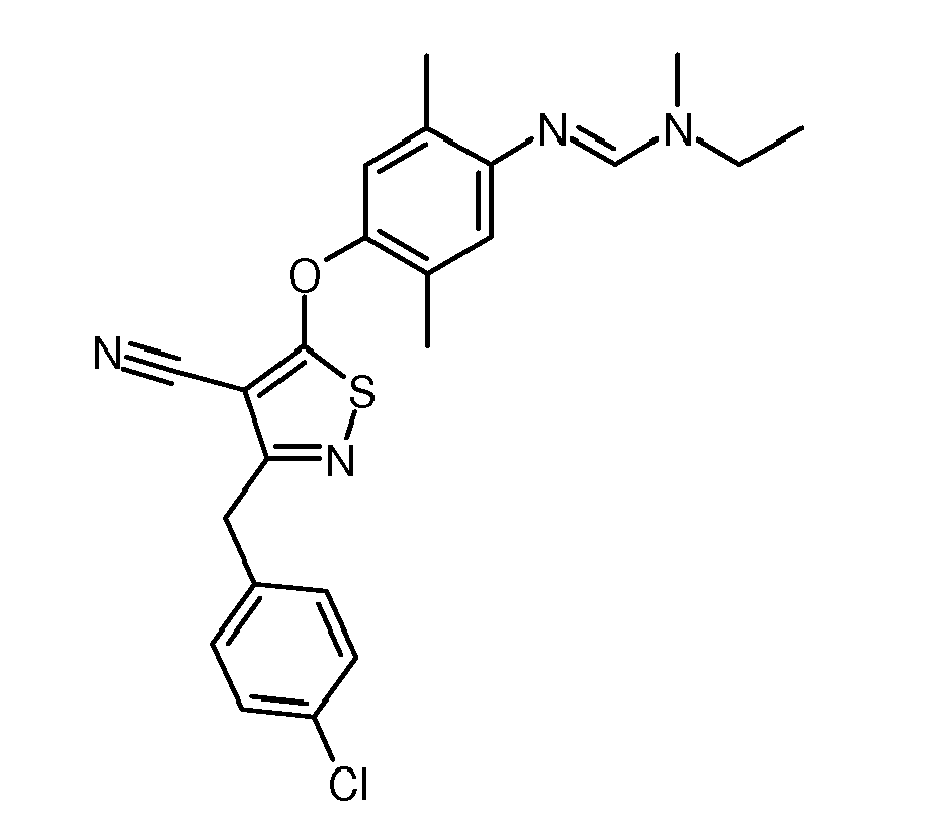
- Eine Lösung von 1.80 g (4.87 mmol) 5-(4-Amino-2,5-dimethylphenoxy)-3-(4-chlorbenzyl)isothiazol-4-carbonitril und 0.91 g (6.8 mmol) N-(Dimethoxymethyl)-N-methylethanamin in 60 ml Toluol wird 22 h bei 80 °C gerührt. Nach erneuter Zugabe von 0.91 g (6.8 mmol) N-(Dimethoxymethyl)-N-methylethanamin wird die Lösung weitere 22 h gerührt. Nach dem Abkühlen wird das Reaktionsgemisch unter vermindertem Druck vom Lösungsmittel befreit.
- Nach säulenchromatographischer Aufreinigung an Aluminiumoxid mit Hexan/Ethylacetat erhält man 0.18 g (0.41 mmol, 8% der Theorie) an N'-(4-{[3-(4-Chlorbenzyl)-4-cyanisothiazol-5-yl]oxy}-2,5-dimethylphenyl)-N-ethyl-N-methylimidoformamid mit dem LogP (HCO2H) = 2.39.
-

- Eine Suspension von 3.90 g (14.49 mmol) 5-Chlor-3-(4-chlorbenzyl)isothiazol-4-carbonitril, 1.99 g (14.49 mmol) 2,5-Dimethyl-4-hydroxyanilin und 3.20 g (23.18 mmol) Kaliumcarbonat in 20 ml DMF wird 6 h unter Rückfluss erhitzt. Nach dem Abkühlen wird das Reaktionsgemisch auf Eiswasser gegeben. Nach Extraktion mit Dichlormethan werden die vereinigten organischen Phasen über Na2SO4 getrocknet und unter vermindertem Druck vom Lösungsmittel befreit.
- Nach säulenchromatographischer Aufreinigung an Kieselgel mit Hexan/Ethylacetat erhält man 1.70 g (4.6 mmol, 29% der Theorie) an 5-(4-Amino-2,5-dimethylphenoxy)-3-(4-chlorbenzyl)isothiazol-4-carbonitril mit dem LogP (HCO2H = 4.03.
-

- Zu einer Suspension von 5.00 g (20.0 mmol) 5-Amino-3-(4-chlorbenzyl)isothiazol-4-carbonitril in 80 mL konz. Salzsäure werden bei 0 °C 4.14 g (60.07 mmol) Natriumnitrit gegeben. Das Reaktionsgemisch wird 1 h bei 0 °C und 2 h bei Raumtemperatur gerührt. Anschließend wird das Reaktionsgemisch durch Zugabe von Natronlauge neutralisiert. Nach Zugabe von Wasser wird mit Methyl-t-butylether extrahiert, die vereinigten organischen Phasen über Na2SO4 getrocknet und unter vermindertem Druck vom Lösungsmittel befreit.
- Man erhält 3.90 g (14.49 mmol, 54% der Theorie) 5-Chlor-3-(4-chlorbenzyl)isothiazol-4-carbonitril LogP (HCO2H = 3,87.
-

- Zu einer Suspension von 7.00 g (20.6 mmol) 3-Amino-4-(4-chlorphenyl)-2-cyanbut-2-enthioamid in 80 ml Methanol werden bei 0 °C 2.70 g (27.8 mmol) einer wässrigen Wasserstoffperoxid Lösung (35%) getropft. Das Reaktionsgemisch wird 2 h unter Rückfluss erhitzt. Nach dem Abkühlen wird das Reaktionsgemisch auf Eiswasser gegeben und mit Dichlormethan extrahiert. Die vereinigten organischen Phasen werden über Na2SO4 getrocknet und unter vermindertem Druck vom Lösungsmittel befreit.
- Man erhält 5.00 g (20.0 mmol, 97% der Theorie) an 5-Amino-3-(4-chlorbenzyl)isothiazol-4-carbonitril mit dem LogP (HCO2H) = 2,40.
-

- 3-Amino-4-(4-chlorphenyl)-2-cyanbut-2-enthioamid kann analog zu 3-Amino-2-cyan-4-(4-nitrophenyl)but-2-enthioamid hergestellt werden (Bioorganic & Medicinal Chemistry Letters, 2006, 4326-4330).
-

- Eine Lösung von 0.40 g (1.35 mmol) 2,5-Dimethyl-4-[(3-phenylisothiazol-5-yl)oxy]anilin und 0.25 g (1.9 mmol) N-(Dimethoxymethyl)-N-methylethanamin in 10 ml Toluol wird 22 h bei 80 °C gerührt. Nach erneuter Zugabe von 0.25 g (1.9 mmol) N-(Dimethoxymethyl)-N-methylethanamin wird die Lösung weitere 22 h gerührt. Nach dem Abkühlen wird das Reaktionsgemisch unter vermindertem Druck vom Lösungsmittel befreit.
- Nach säulenchromatographischer Aufreinigung an Aluminiumoxid mit Hexan/Ethylacetat erhält man 0.23 g (0.63 mmol, 45% der Theorie) an N'-{2,5-Dimethyl-4-[(3-phenylisothiazol-5-yl)oxy]phenyl}-N-ethyl-N-methylimidoformamid mit dem LogP (HCO2H) = 2.11.
-

- Zu einer Lösung von 2,5-Dimethyl-4-hydroxyanilin in 15 mL DMF werden 0.34 g (8.43 mmol) Natriumhydrid (60% in Mineralöl) gegeben und die Reaktionsmischung wird 2 h bei Raumtemperatur gerührt. Eine Lösung von 1.50 g (7.67 mmol) 5-Chlor-3-phenylisothiazol in 5 mL DMF wird zu der Reaktionsmischung getropft. Anschließend wird die Reaktionsmischung 3 h bei 100 °C gerührt. Nach dem Abkühlen wird das Reaktionsgemisch auf Eiswasser gegeben und mit Ethylacetat extrahiert. Die vereinigten organischen Phasen werden über Na2SO4 getrocknet und unter vermindertem Druck vom Lösungsmittel befreit.
- Man erhält 3.00 g (10.1 mmol, 80% der Theorie) an 2,5-Dimethyl-4-[(3-phenylisothiazol-5-yl)oxy]anilin mit dem LogP (HCO2H) = 3,60.
-

- 9.15 g (68.1 mmol) Kupferdichlorid und 7.02 g (68.1 mmol) t-Butylnitrit werden in 140 mL Acetonitril vorgelegt. Zu dieser Suspension werden bei 60 °C portionsweise 8.00 g (45.4 mmol) 3-Phenylisothiazol-5-amin gegeben. Anschließend wird die Reaktionsmischung 1 h bei 80 °C gerührt. Nach dem Abkühlen wird das Reaktionsgemisch mit halbkonzentrierter Salzsäure versetzt und mit Dichlormethan extrahiert. Die vereinigten organischen Phasen werden über Na2SO4 getrocknet und unter vermindertem Druck vom Lösungsmittel befreit.
- Nach säulenchromatographischer Aufreinigung an Kieselgel mit Hexan/Ethylacetat erhält man 5.10 g (26.1 mmol, 55% der Theorie) an 5-Chlor-3-phenylisothiazol mit dem LogP (HCO2H) = 3,82.
-

- 3-Phenyfisothiazol-5-amin kann gemäß JACS, 1994, 2292-2300 hergestellt werden.
-

- Zu einer Lösung von 600 mg (1.81 mmol) 4-[(4-Chlor-3-phenylisothiazol-5-yl)oxy]-2,5-dimethylanilin in 8 ml Toluol werden 483 mg (3.63 mmol) N-(Dimethoxymethyl)-N-methylethanamin bei Raumtemperatur gegeben. Die Reaktionsmischung wird bei 60°C für 24 Stunden gerührt. Nach dem Abkühlen wird das Lösungsmittel unter Druck entfernt. Der Rückstand wird über Aluminiumoxid (neutrales, aktiviert) mit Petrolether/Ethylacetat (9/1) filtriert. Man erhält 607 mg (1.52 mmol, 84% der Theorie) N'-{4-[(4-Chlor-3-phenylisothiazol-5-yl)oxy]-2,5-dimethylphenyl}-N-ethyl-N-methylimidoformamid mit dem LogP (HCO2H)= 2.25.
-

- Eine Suspension von 300 mg (1.30 mmol) 4,5-Dichlor-3-phenylisothiazol, 179 mg (1.30 mmol) 4-Amino-2,5-dimethylbenzol und 680 mg (2.08 mmol) Caesiumcarbonat in 5 ml N,N-Dimethylformamid wird 4 Stunden bei 150°C gerührt. Nach dem Abkühlen wird das Reaktionsgemisch mit Wasser verdünnt und mit Dichloromethan extrahiert. Die gesamten organischen Phasen werden über Na2SO4 getrocknet. Anschließend wird filtriert und unter reduziertem Druck eingeengt. Der Rückstand wird säulenchromatographisch an Kieselgel mit Cyclohexan/Ethylacetat (3/1) gereinigt. Man erhält 310 mg (0.94 mmol, 72% der Theorie) 4-[(4-Chlor-3-phenylisothiazol-5-yl)oxy]-2,5-dimethylanilin mit dem LogP (HCO2H) = 4.22.
-

- Zu einer Suspension von 8.61 g (64.1 mmol) Kupferdichlorid in 150 ml Acetonitril werden 6.60 g (64.1 mmol) tert-Butylnitrit bei Raumtemperatur gegeben. 9.00 g (42.7 mmol) 4-Chlor-3-phenylisothiazol-5-amin werden dann bei 60°C portionsweise zugegeben. Nach beendeter Zugabe wird die Reaktionsmischung auf 80°C erhitzt und noch eine Stunde bei dieser Temperatur gerührt. Nach dem Abkühlen wird das Reaktionsgemisch auf halbkonz. Salzsäure gegeben und mit Dichlormethan extrahiert. Die vereinigten organischen Phasen werden über Na2SO4 getrocknet. Anschließend wird filtriert und unter reduziertem Druck eingeengt. Der Rückstand wird säulenchromatographisch an Kieselgel mit Cyclohexan/Ethylacetat (9/1) gereinigt. Man erhält 3.68 g (16 mmol, 37% der Theorie) 4,5-Dichlor-3-phenylisothiazol mit dem LogP (HCO2H) = 4.44.
-

- Zu einer Lösung von 9.50 g (53.9 mmol) 3-Phenylisothiazol-5-amin (J. Am. Chem. Soc. 1994, 116(6), 2292-2300) in 100 ml Acetonitril werden portionsweise 7.19 g (53.9 mmol) 1-Chlorpyrrolidin-2,5-dion bei Raumtemperatur gegeben. Die Reaktionsmischung wird bei Raumtemperatur für 24 Stunden gerührt. Das Acetonitril wird unter vermindertem Druck entfernt. Der Rückstand wird säulenchromatographisch an Kieselgel mit Cyclohexan/Ethylacetat (3/1) gereinigt. Man erhält 9.10 g (43.1 mmol, 80% der Theorie) 4-Chlor-3-phenylisothiazol-5-amin mit dem LogP (HCO2H) = 2.21.
-

- Zu einer Lösung von 160 mg (0.404 mmol) 4-[(4-Brom-3-phenylisothiazol-5-yl)oxy]-5-chlor-2-methylanilin in 8 ml Toluol werden 108 mg (0.809 mmol) N-(Dimethoxymethyl)-N-methylethanamin bei Raumtemperatur gegeben. Die Reaktionsmischung wird bei 60°C für 24 Stunden gerührt. Nach dem Abkühlen wird das Lösungsmittel unter Druck entfernt. Der Rückstand wird über Aluminiumoxid (neutrales, aktiviert) mit Petrolether/Ethylacetat (9/1) filtriert. Man erhält 171 mg (0.37 mmol, 91% der Theorie) N'-{4-[(4-Brom-3-phenylisothiazol-5-yl)oxy]-5-chlor-2-methylphenyl}-N-ethyl-N-methylimidoformamid mit dem LogP (HCO2H) = 2.26.
-

- Eine Suspension von 580 mg (1.86 mmol) 4-Brom-5-chlor-3-phenylisothiazol, 293 mg (1.86 mmol) 4-Amino-2-chlor-5-methylbenzol und 969 mg (2.97 mmol) Caesiumcarbonat in 5 ml N,N-Dimethylformamid wird 4 Stunden bei 150°C gerührt. Nach dem Abkühlen wird das Reaktionsgemisch mit Wasser verdünnt und mit Dichlormethan extrahiert. Die vereinigten organischen Phasen werden über Na2SO4 getrocknet. Anschließend wird filtriert und unter reduziertem Druck eingeengt. Der Rückstand wird säulenchromatographisch an Kieselgel mit Cyclohexan/Ethylacetat (3/1) gereinigt. Man erhält 517 mg (1.3 mmol, 70% der Theorie) 4-[(4-Brom-3-phenylisothiazol-5-yl)oxy]-5-chlor-2-methylanilin mit dem LogP (HCO2H) = 4.41.
-

- Zu einer Suspension von 3.79 g (28.2 mmol) Kupferdichlorid in 70 ml Acetonitril werden 2.91 g (28.2 mmol) tert-Butylnitrit bei Raumtemperatur gegeben. 4.80 g (18.8 mmol) 4-Brom-3-phenylisothiazol-5-amin werden dann bei 60°C portionsweise zugegeben. Nach beendeter Zugabe wird die Reaktionsmischung auf 80°C erhitzt und noch eine Stunde bei dieser Temperatur gerührt. Nach dem Abkühlen wird das Reaktionsgemisch auf halbkonz. Salzsäure gegeben und mit Dichlormethan extrahiert. Die gesamten organischen Phasen werden über Na2SO4 getrocknet. Anschließend wird filtriert und unter reduziertem Druck eingeengt. Der Rückstand wird nach säulenchromatographisch an Kieselgel mit Cyclohexan/Ethylaceat (9/1) gereinigt. Man erhält 3.05 g (11.1 mmol, 59% der Theorie) 4-Brom-5-chlor-3-phenylisothiazol mit dem LogP (HCO2H) = 4.41.
-

- Zu einer Lösung von 10.00 g (56.7 mmol) 3-Phenylisothiazol-5-amin (J. Am. Chem. Soc. 1994, 116(6), 2292-2300) in 100 ml Acetonitril werden portionsweise 10.09 g (56.7 mmol) 1-Brompyrrolidin-2,5-dion bei Raumtemperatur gegeben. Die Reaktionsmischung wird bei Raumtemperatur für 24 Stunden gerührt. Das Acetonitril wird unter Druck entfernt. Der Rückstand wird säulenchromatographisch an Kieselgel mit
- Cyclohexan/Ethylacetat (3/1) gereinigt. Man erhält 14.10 g (55 mmol, 97% der Theorie) 4-Brom-3-phenylisothiazol-5-amin mit dem LogP (HCO2H) = 2.26.
-
- Lösungsmittel:
- 49 Gewichtsteile N, N - Dimethylformamid
- Emulgator:
- 1 Gewichtsteil Alkyl-Aryl-Polyglykolether (Polyoxyethylen(16)tristearylphenylether)
- Zur Herstellung einer zweckmäßigen Wirkstoffzubereitung vermischt man 1 Gewichtsteil Wirkstoff mit den angegebenen Mengen Lösungsmittel und Emulgator und verdünnt das Konzentrat mit Wasser auf die gewünschte Konzentration.
- Zur Prüfung auf protektive Wirksamkeit bespritzt man junge Gurkenpflanzen mit der Wirkstoffzubereitung in der angegebenen Aufwandmenge. 1 Tag nach der Behandlung werden die Pflanzen mit einer Sporensuspension von Sphaerotheca fuliginea inokuliert. Anschließend werden die Pflanzen in einem Gewächshaus bei 70 % relativer Luftfeuchtigkeit und einer Temperatur von 23°C aufgestellt.
- 7 Tage nach der Inokulation erfolgt die Auswertung. Dabei bedeutet 0 % ein Wirkungsgrad, der demjenigen der Kontrolle entspricht, während ein Wirkungsgrad von 100 % bedeutet, daß kein Befall beobachtet wird.
- In diesem Test zeigen die nachfolgenden erfindungsgemäßen Verbindungen Nr. 1, 3, 4, 5, 7, 8, 9, 10, 14, 15, 16, 11, 12, 13, 17, 18, 19, 23, 22, 21, 20, 25, 26, 24, 27, 30, 28, 29, 31, 32, und 33 aus Tabelle 1 bei einer Konzentration an Wirkstoff von 500ppm einen Wirkungsgrad von 70% oder mehr.
-
- Lösungsmittel:
- 49 Gewichtsteile N, N - Dimethylformamid
- Emulgator:
- 1 Gewichtsteil Alkyl-Aryl-Polyglykolether (Polyoxyethylen(16)tristearylphenylether)
- Zur Herstellung einer zweckmäßigen Wirkstoffzubereitung vermischt man 1 Gewichtsteil Wirkstoff mit den angegebenen Mengen Lösungsmittel und Emulgator und verdünnt das Konzentrat mit Wasser auf die gewünschte Konzentration.
- Zur Prüfung auf protektive Wirksamkeit bespritzt man junge Weizenpflanzen mit der Wirkstoffzubereitung in der angegebenen Aufwandmenge. 1 Tag nach der Behandlung werden die Pflanzen mit einer Sporensuspension von Puccinia recondita inokuliert und stehen dann 48h bei 100% rel. Feuchte und 22°C. Anschließend stehen die Pflanzen bei 80% rel. Luftfeuchtigkeit und einer Temperatur von 20°C.
- 7-9 Tage nach der Inokulation erfolgt die Auswertung. Dabei bedeutet 0 % ein Wirkungsgrad, der demjenigen der Kontrolle entspricht, während ein Wirkungsgrad von 100 % bedeutet, dass kein Befall beobachtet wird.
- In diesem Test zeigen die nachfolgenden erfindungsgemäßen Verbindungen Nr. 1, 2, 3, 4, 5, 6, 7, 8, 9, 10, 14, 15, 16, 11, 12, 13, 17, 18, 19, 23, 22, 21, 20, 25, 26, 24, 27, 30, 28, 29, 31, 32, 33 und 34 aus Tabelle 1 bei einer Konzentration an Wirkstoff von 500ppm einen Wirkungsgrad von 70% oder mehr.
-
- Lösungsmittel:
- 24,5 Gewichtsteile Aceton
24,5 Gewichtsteile Dimethylacetamid - Emulgator:
- 1 Gewichtsteil Alkyl-Aryl-Polyglykolether (Polyoxyethylen(16)tristearylphenylether)
- Zur Herstellung einer zweckmäßigen Wirkstoffzubereitung vermischt man 1 Gewichtsteil Wirkstoff mit den angegebenen Mengen Lösungsmittel und Emulgator und verdünnt das Konzentrat mit Wasser auf die gewünschte Konzentration.
- Zur Prüfung auf protektive Wirksamkeit werden junge Pflanzen mit der Wirkstoffzubereitung in der angegebenen Aufwandmenge besprüht. Nach Antrocknen des Spritzbelages werden auf jedes Blatt 2 kleine mit Botrytis cinerea bewachsene Agarstückchen aufgelegt. Die inokulierten Pflanzen werden in einer abgedunkelten Kammer bei ca. 20°C und 100% relativer Luftfeuchtigkeit aufgestellt.
- 2 Tage nach der Inokulation wird die Größe der Befallsflecken auf den Blättern ausgewertet. Dabei bedeutet 0% ein Wirkungsgrad, der demjenigen der Kontrolle entspricht, während ein Wirkungsgrad von 100% bedeutet, daß kein Befall beobachtet wird.
- In diesem Test zeigen die nachfolgenden erfindungsgemäßen Verbindungen Nr. 5, 6, 7, 8, 10, 14, 15, 16, 11, 12, 13, 17 und 27 bei einer Konzentration an Wirkstoff von 250ppm einen Wirkungsgrad von 70% oder mehr.
-
- Lösungsmittel:
- 24,5 Gewichtsteile Aceton
24,5 Gewichtsteile Dimethylacetamid - Emulgator :
- 1 Gewichtsteil Alkyl-Aryl-Polyglykolether (Polyoxyethylen(16)tri-stearylphenylether)
- Zur Herstellung einer zweckmäßigen Wirkstoffzubereitung vermischt man 1 Gewichtsteil Wirkstoff mit den angegebenen Mengen Lösungsmittel und Emulgator und verdünnt das Konzentrat mit Wasser auf die gewünschte Konzentration.
- Zur Prüfung auf protektive Wirksamkeit werden junge Pflanzen mit der Wirkstoffzubereitung in der angegebenen Aufwandmenge besprüht. Nach Antrocknen des Spritzbelages werden die Pflanzen mit einer wäßrigen Sporensuspension des Bohnenrosterregers Uromyces appendiculatus inokuliert und verbleiben dann 1 Tag bei ca. 20°C und 100% relativer Luftfeuchtigkeit in einer Inkubations-kabine.
- Die Pflanzen werden dann im Gewächshaus bei ca. 21°C und einer relativen Luftfeuchtigkeit von ca. 90% aufgestellt.
- 10 Tage nach der Inokulation erfolgt die Auswertung. Dabei bedeutet 0% ein Wirkungsgrad, der demjenigen der Kontrolle entspricht, während ein Wirkungsgrad von 100% bedeutet, daß kein Befall beobachtet wird.
- In diesem Test zeigen die nachfolgenden erfindungsgemäßen Verbindungen Nr. 1, 3, 4, 5, 6, 7, 8, 10, 14, 15, 16, 12, 13, 17, 18, 19 und 27 bei einer Konzentration an Wirkstoff von 10ppm einen Wirkungsgrad von 70% oder mehr.
-
- Lösungsmittel:
- 49 Gewichtsteile N,N-Dimethylacetamid
- Emulgator:
- 1 Gewichtsteil Alkyl-Aryl-Polyglykolether (Polyoxyethylen(16)tristearylphenylether)
- Zur Herstellung einer zweckmäßigen Wirkstoffzubereitung vermischt man 1 Gewichtsteil Wirkstoff mit den angegebenen Mengen Lösungsmittel und Emulgator und verdünnt das Konzentrat mit Wasser auf die gewünschte Konzentration.
- Zur Prüfung auf protektive Wirksamkeit besprüht man junge Pflanzen mit der Wirkstoffzubereitung in der angegebenen Aufwandmenge. Nach Antrocknen des Spritzbelages werden die Pflanzen mit Sporen mit einer Sporensuspension von Leptosphaeria nodorum besprüht. Die Pflanzen verbleiben 48 Stunden bei 20°C und 100 % relativer Luftfeuchtigkeit in einer Inkubationskabine.
- Die Pflanzen werden in einem Gewächshaus bei einer Temperatur von ca. 22°C und einer relativen Luftfeuchtigkeit von ca. 80 % aufgestellt.
- 8 Tage nach der Inokulation erfolgt die Auswertung. Dabei bedeutet 0 % ein Wirkungsgrad, der demjenigen der Kontrolle entspricht, während ein Wirkungsgrad von 100 % bedeutet, dass kein Befall beobachtet wird.
- In diesem Test zeigen die nachfolgenden erfindungsgemäßen Verbindungen Nr. 1, 4, 5, 6, 8, 10, 27 und 43 bei einer Konzentration an Wirkstoff von 500ppm einen Wirkungsgrad von 70% oder mehr.
-
- Lösungsmittel:
- 49 Gewichtsteile N,N-Dimethylacetamid
- Emulgator:
- 1 Gewichtsteil Alkyl-Aryl-Polyglykolether (Polyoxyethylen(16)tri-stearylphenylether)
- Zur Herstellung einer zweckmäßigen Wirkstoffzubereitung vermischt man 1 Gewichtsteil Wirkstoff mit den angegebenen Mengen Lösungsmittel und Emulgator und verdünnt das Konzentrat mit Wasser auf die gewünschte Konzentration.
- Zur Prüfung auf protektive Wirksamkeit werden junge Pflanzen mit der Wirkstoffzubereitung in der angegebenen Aufwandmenge besprüht. Nach Antrocknen des Spritzbelages werden die Pflanzen mit einer Sporensuspension von Septoria tritici besprüht. Die Pflanzen verbleiben 48 Stunden bei 20°C und 100 % relativer Luftfeuchtigkeit in einer Inkubationskabine. Danach werden die Pflanzen für weitere 60 Stunden unter eine Klarsichthaube bei 15°C und 100% relativer Luftfeuchte gestellt.
- Die Pflanzen werden in einem Gewächshaus bei einer Temperatur von ca. 15°C und einer relativen Luftfeuchtigkeit von 80 % aufgestellt.
- 21 Tage nach der Inokulation erfolgt die Auswertung. Dabei bedeutet 0% ein Wirkungsgrad, der demjenigen der Kontrolle entspricht, während ein Wirkungsgrad von 100% bedeutet, dass kein Befall beobachtet wird.
- In diesem Test zeigen die nachfolgenden erfindungsgemäßen Verbindungen Nr. 1, 4, 5, 6, 8, 10, 15, 12, 18, 27 und 43 bei einer Konzentration an Wirkstoff von 500ppm einen Wirkungsgrad von 70% oder mehr.
-
- Lösungsmittel:
- 49 Gewichtsteile N,N-Dimethylacetamid
- Emulgator:
- 1 Gewichtsteil Alkyl-Aryl-Polyglykolether (Polyoxyethylen(16)tri-stearylphenylether)
- Zur Herstellung einer zweckmäßigen Wirkstoffzubereitung vermischt man 1 Gewichtsteil Wirkstoff mit den angegebenen Mengen Lösungsmittel und Emulgator und verdünnt das Konzentrat mit Wasser auf die gewünschte Konzentration.
- Zur Prüfung auf protektive Wirksamkeit besprüht man junge Pflanzen mit der Wirkstoffzubereitung in der angegebenen Aufwandmenge. Nach Antrocknen des Spritzbelages werden die Pflanzen mit einer Sporensuspension von Pyrenophora teres besprüht. Die Pflanzen verbleiben 48 Stunden bei 20°C und 100 % relativer Luftfeuchtigkeit in einer Inkubationskabine.
- Die Pflanzen werden in einem Gewächshaus bei einer Temperatur von ca. 20°C und einer relativen Luftfeuchtigkeit von ca. 80 % aufgestellt.
- 8 Tage nach der Inokulation erfolgt die Auswertung. Dabei bedeutet 0 % ein Wirkungsgrad, der demjenigen der Kontrolle entspricht, während ein Wirkungsgrad von 100 % bedeutet, dass kein Befall beobachtet wird.
- In diesem Test zeigen die nachfolgenden erfindungsgemäßen Verbindungen Nr. 1, 3, 4, 5, 6, 8, 10, 15, 12, 18, 27, 43 und 46 bei einer Konzentration an Wirkstoff von 500ppm einen Wirkungsgrad von 70% oder mehr.
-
- Lösungsmittel:
- 28,5 Gew.-Teile Aceton
- Emulgator:
- 1,5 Gew.-Teil Alkyl-Aryl-Polyglykolether (Polyoxyethylen(16)tri-stearylphenylether)
- Zur Herstellung einer zweckmäßigen Wirkstoffzubereitung vermischt man 1 Gewichtsteil Wirkstoff mit der angegebenen Menge Lösungsmittel und verdünnt das Konzentrat mit Wasser und der angegebenen Menge Emulgator auf die gewünschte Konzentration.
- Zur Prüfung auf protektive Wirksamkeit bespritzt man junge Reispflanzen mit der Wirkstoffzubereitung in der angegebenen Aufwandmenge. 1 Tag nach der Behandlung werden die Pflanzen mit einer wässrigen Sporensuspension von Phakopsora pachyrhizi inokuliert. Anschließend werden die Pflanzen in einem Gewächshaus bei 80 % relativer Luftfeuchtigkeit und 20°C aufgestellt.
- 11 Tage nach der Inokulation erfolgt die Auswertung. Dabei bedeutet 0 % ein Wirkungsgrad, der demjenigen der Kontrolle entspricht, während ein Wirkungsgrad von 100 % bedeutet, dass kein Befall beobachtet wird.
- In diesem Test zeigten die Beispiele Nr. 1, 3 und 5 aus Tabelle 1 bei einer Konzentration an Wirkstoff von 100 ppm einen Wirkungsgrad von 80% oder mehr.


Claims (13)
- Isothiazolyloxyphenylamidine der Formel (I)
 R1 ausgewählt ist aus Wasserstoff; linearen, verzweigten C1-12-Alkyl-, C2-12-Alkenyl-, C2-12-Alkinyl- oder cyclischen C3-8-Alkyl-, C4-8-Alkenyl-, C4-8-Alkinyl-Gruppen, wobei im Ringsystem aller zuvor genannten cyclischen Gruppen ein oder mehrere C-Atome durch Heteroatome, ausgewählt aus N, O, P und S, ersetzt sein können und alle zuvor genannten Gruppen mit einer oder mehreren Gruppen, die ausgewählt sind aus -R', -X, -OR', -SR', -NR'2, -SiR'3, -COOR', -CN und-CONR2' substituiert sein können, wobei R' Wasserstoff oder eine C1-12-Alkyl-Gruppe ist; -SH; -SR", wobei R" eine C1-12-Alkyl-Gruppe ist, die mit einer oder mehreren Gruppen, die ausgewählt sind aus -R', -X, -OR', -SR', -NR'2, -SiR'3, -COOR', -CN und-CONR2', substituiert sein kann, worin R' die obige Bedeutung hat;R2 ausgewählt ist aus linearen, verzweigten C1-12-Alkyl-, C2-12-Alkenyl-, C2-12-Alkinyl-, cyclischen C3-8-Alkyl-, C4-8-Alkenyl-, C4-8-Alkinyl- oder C5-18-Aryl-, C7-19-Aralkyl- oder C7-19-Alkaryl-Gruppen, wobei im Ringsystem aller zuvor genannten cyclischen Gruppen ein oder mehrere C-Atome durch Heteroatome, ausgewählt aus N, O, P und S, ersetzt sein können und alle zuvor genannten Gruppen mit einer oder mehreren Gruppen, die ausgewählt sind aus -R', -X, -OR', -SR', -NR'2, -SiR'3, -COOR', -CN und -CONR2', substituiert sein können, wobei R' die obigen Bedeutungen hat;R3 ausgewählt ist aus -CN, -SH, -SR", -OR", -(C=O)-R", wobei R" die obigen Bedeutungen hat; linearen, verzweigten C1-12-Alkyl-, C2-12-Alkenyl-, C2-12-Alkinyl-, cyclischen C3-8-Alkyl-, C4-8-Alkenyl-, C4-8-Alkinyl- oder C5-18-Aryl-, C7-19-Aralkyl- oder C7-19-Alkaryl-Gruppen, wobei im Ringsystem aller zuvor genannten cyclischen Gruppen ein oder mehrere C-Atome durch Heteroatome, ausgewählt aus N, O, P und S, ersetzt sein können und alle zuvor genannten Gruppen mit einer oder mehreren Gruppen, die ausgewählt sind aus -R', -X, -OR', -SR', -NR'2, -SiR'3, -COOR', -CN und -CONR2', substituiert sein können, wobei R' die obigen Bedeutungen hat;
oder in der
R2 und R3,
R2 und R1 oderR1 und R3 gemeinsam mit den Atomen, an die sie gebunden sind oder mit weiteren Atomen, ausgewählt aus C, N, O, P und S, einen vier- bis siebengliedrigen Ring bilden können, der mit R'-, OR'-, SR'-, NR'2-, SiR'3-Gruppen substituiert sein kann, wobei R' die obigen Bedeutungen hat;R4 ausgewählt ist aus der Gruppe bestehend aus Wasserstoff, -X, -CN, -SH, -SR", -OR", -(C=O)-R", wobei R" die obigen Bedeutungen hat; linearen, verzweigten C1-12-Alkyl-, C2-12-Alkenyl-, C2-12-Alkinyl-, cyclischen C3-8-Alkyl-, C4-8-Alkenyl-, C4-8-Alkinyl- oder C5-18-Aryl-, C7-19-Aralkyl oder C7-19-Alkaryl-Gruppen, wobei im Ringsystem aller zuvor genannten cyclischen Gruppen ein oder mehrere C-Atome durch Heteroatome, ausgewählt aus C, N, O, P und S, ersetzt sein können und alle zuvor genannten Gruppen mit einer oder mehreren Gruppen, die ausgewählt sind aus -R', Halogen- (-X), Alkoxy- (-OR'), Thioether- oder Mercapto- (-SR'), Amino- (-NR'2), Silyl- (-SiR'3), Carboxyl- (-COOR'), Cyan- (-CN) und Amid-Gruppen (-CONR2'), substituiert sein können, wobei R' die obigen Bedeutungen hat;R5 ausgewählt ist aus der Gruppe bestehend aus Wasserstoff, -X, -CN, -SH, -SR", -OR", -(C=O)-R", wobei R" die obigen Bedeutungen hat; linearen, verzweigten C1-12-Alkyl-, C2-12-Alkenyl-, C2-12-Alkinyl-, cyclischen C3-8-Alkyl-, C4-8-Alkenyl-, C4-8-Alkinyl- oder C5-18-Aryl-, C7-19-Aralkyl oder C7-19-Alkaryl-Gruppen, wobei im Ringsystem aller zuvor genannten cyclischen Gruppen ein oder mehrere C-Atome durch Heteroatome, ausgewählt aus C, N, O, P und S, ersetzt sein können und alle zuvor genannten Gruppen mit einer oder mehreren Gruppen, die ausgewählt sind aus -R', Halogen- (-X), Alkoxy- (-OR'), Thioether- oder Mercapto- (-SR'), Amino- (-NR'2), Silyl- (-SiR'3), Carboxyl- (-COOR'), Cyan- (-CN) und Amid-Gruppen (-CONR2'), substituiert sein können, wobei R' die obigen Bedeutungen hat;R6 ausgewählt ist aus der Gruppe bestehend aus Wasserstoff, Halogen- (-X), Alkoxy- (-OR'), Thioether- oder Mercapto- (-SR'), Amino- (-NR'2), -Nitro (-NO2) Silyl- (-SiR'3), Carboxyl- (-COOR'), Cyan- (-CN) und Amid-Gruppen (-CONR2'), linearen, verzweigten C1-12-Alkyl-, C2-12-Alkenyl-, C2-12-Alkinyl-, cyclischen C3-12-Alkyl-, C4-12-Alkenyl-, C4-12-Alkinyl- oder C5-18-Aryl-, C7-19-Aralkyl oder C7-19-Alkaryl-Gruppen, wobei im Ringsystem aller zuvor genannten cyclischen Gruppen ein oder mehrere C-Atome durch Heteroatome, ausgewählt aus C, N, O, P und S, ersetzt sein können und alle zuvor genannten Gruppen mit einer oder mehreren Gruppen, die ausgewählt sind aus -R', Halogen- (-X), Alkoxy- (-OR'), Thioether- oder Mercapto- (-SR'), Amino- (-NR'2), Silyl- (-SiR'3), Carboxyl- (-COOR'), Cyan- (-CN) und Amid-Gruppen (-CONR2'), substituiert sein können, wobei R' die obigen Bedeutungen hat;R7 ausgewählt ist aus Wasserstoff, linearen, verzweigten C1-12-Alkyl-, C2-12-Alkenyl-, C2-12-Alkinyl-, cyclischen C3-12-Alkyl-, C4-12-Alkenyl-, C4-12-Alkinyl- oder C5-18-Aryl-, C7-19-Aralkyl oder C7-19-Alkaryl-Gruppen, wobei im Ringsystem aller zuvor genannten cyclischen Gruppen ein oder mehrere C-Atome durch Heteroatome, ausgewählt aus C, N, O, P und S, ersetzt sein können und alle zuvor genannten Gruppen mit einer oder mehreren Gruppen, die ausgewählt sind aus -R', Halogen- (-X), Alkoxy- (-OR'), Thioether- oder Mercapto- (-SR'), Amino- (-NR'2), Silyl- (-SiR'3), Carboxyl- (-COOR'), Cyan- (-CN) und Amid-Gruppen (-CONR2'), substituiert sein können, wobei R' die obigen Bedeutungen hat;R6 und R7 gemeinsam mit den Atomen, an die sie gebunden sind oder mit weiteren Atomen, ausgewählt aus C, N, O, P und S, einen vier- bis siebengliedrigen Ring bilden können, der mit R'-, X-, -OR', -SR', -NR'2, -SiR'3, -COOR', -CN und NR2'CO-Gruppen substituiert sein kann, wobei R' die obigen Bedeutungen hat;oder deren Salze, N-Oxide, Metallkomplexe und deren Stereoisomere. - Isothiazolyloxyphenylamidine der Formel (I), gemäß Anspruch 1, wobeiR1 ausgewählt ist aus der Gruppe bestehend aus Wasserstoff, einer Mercapto-Gruppe (-SH) oder C1-8-Alkyl-Gruppen;R2 ausgewählt ist aus linearen oder verzweigten C1-8-Alkyl-Gruppen;R3 ausgewählt ist aus linearen, verzweigten und alicyclischen C1-8-Alkyl-Gruppen;
oder in welcherR2 und R3 gemeinsam mit dem N-Atom, an das sie gebunden sind oder mit weiteren Atomen, die ausgewählt sind aus N und O, einen fünf- bis sechsgliedrigen Ring bilden können, der mit einer oder mehreren C1-12-Alkyl-Gruppen substituiert sein kann;R4 ausgewählt ist aus der Gruppe bestehend aus Halogenatomen, linearen oder verzweigten, C1-12-Alkyl-Gruppen und C1-5-Haloalkyl-Gruppen;R5 ausgewählt ist aus der Gruppe bestehend aus Halogenatomen, linearen oder verzweigten, C1-12-Alkyl-Gruppen und C1-5-Haloalkyl-Gruppen;R6 ausgewählt aus der Gruppe bestehend aus Wasserstoff, Halogenatomen, Cyano und linearen C1-8-Alkyl-Gruppen;R7 ausgewählt Wasserstoff, linearen, verzweigten, C1-12-Alkyl-Gruppen und Phenyl-Gruppen, wobei die Phenylgruppen mit Halogenatomen und/oder mit linearen oder verzweigten, C1-12-Alkyl-Gruppen substituiert sein können;R6 und R7 gemeinsam mit den Atomen, an die sie gebunden sind, einen annelierten fünf oder sechsgliedrigen Ring bilden, der eine, zwei oder drei Unsättigungen aufweisen kann;oder deren Salze, N-Oxide, Metallkomplexe und deren Stereoisomere. - Isothiazolyloxyphenylamidine der Formel (I), gemäß einem der Ansprüche 1 oder 2, in welcherR1 ausgewählt ist aus der Gruppe bestehend aus Wasserstoff, Mercapto und Methyl;R2 ausgewählt ist aus der Gruppe bestehend aus Methyl und Ethyl;R3 ausgewählt ist aus der Gruppe bestehend aus Methyl, Ethyl und Isopropyl;
oder wobeiR2 und R3 gemeinsam mit dem N-Atom, an das sie gebunden sind, einen Piperidyl-, Piperidinyl-, Pyrolidyl-, Pyrrolidinyl- oder 2,6-Dimethylmorpholinyl-Rest bilden;R4 ausgewählt ist aus einem Cl-Atom und einer Methyl-Gruppe;R5 ausgewählt ist aus einem Cl-Atom und einer Methyl-Gruppe;R6 ausgewählt ist aus Wasserstoff, Halogenatomen oder einer Cyano-Gruppe;R7 ausgewählt ist aus der Gruppe bestehend aus tert-Butyl-, Ethyl-, Phenyl- und Benzyl-Gruppen, wobei die Phenyl-Gruppen in 3- oder 4-Position mit Halogenatomen, oder mit einer tert-Butyl- oder Methyl-Gruppe substituiert sein können;R6 und R7 gemeinsam mit den Atomen, an die sie gebunden sind, einen Phenylring bilden können;oder deren Salze, N-Oxide, Metallkomplexe und deren Stereoisomere. - Isothiazolyloxyphenylamidin gemäß einem der Ansprüche 1 bis 3 ausgewählt aus der Gruppe bestehend aus N'-{4-[(4-Cyan-3-ethylisothiazol-5-yl)oxy]-2,5-dimethylphenyl}-N-ethyl-N-methylimidoformamid (1), 5-(2,5-Dimethyl-4-{[(E)-piperidin-1-ylmethyliden]amino}phenoxy)-3-ethylisothiazol-4-carbonitril (2), N'-{4-[(4-Cyan-3-ethylisothiazol-5-yl)oxy]-2,5-dimethylphenyl}-N-methyl-N-propylimidoformamid (3), N'-{4-[(3-tert-Butyl-4-cyanisothiazol-5-yl)oxy]-2,5-dimethylphenyl}-N-methyl-N-propylimidoformamid (4), N'-{4-[(3-tert-Butyl-4-cyanisothiazol-5-yl)oxy]-2,5-dimethylphenyl}-N-methyl-N-prop-2-en-1-ylimidoformamid (5), N'-{4-[(3-tert-Butyl-4-cyanisothiazol-5-yl)oxy]-2,5-dimethylphenyl}-N-ethyl-N-methylimidoformamid (6), 3-tert-Butyl-5-(2,5-dimethyl-4-{[(E)-piperidin-1-ylmethyliden]amino}phenoxy)isothiazol-4-carbonitril (7), N'-{4-[(3-tert-Butyl-4-cyanisothiazol-5-yl)oxy]-2,5-dimethylphenyl}-N,N-dimethylimidoformamid (8), N'-{2-Chlor-4-[(4-cyan-3-ethylisothiazol-5-yl)oxy]-5-methylphenyl}-N-ethyl-N-methylimidoformamid (9), N'-{4-[(3-tert-Butyl-4-cyanisothiazol-5-yl)oxy]-2-chlor-5-methylphenyl}-N-ethyl-N-methylimidoformamid (10), N'-{5-Chlor-4-[(4-cyan-3-phenylisothiazol-5-yl)oxy]-2-methylphenyl}-N,N-dimethylimidoformamid (11), N'-{5-Chlor-4-[(4-cyan-3-phenylisothiazol-5-yl)oxy]-2-methylphenyl}-N-ethyl-N-methylimidoformamid (12), N'-{5-Chlor-4-[(4-cyan-3-phenylisothiazol-5-yl)oxy]-2-methylphenyl}-N-methyl-N-propylimidoformamid (13), N'-{4-[(4-Cyan-3-phenylisothiazol-5-yl)oxy]-2,5-dimethylphenyl}-N,N-dimethylimidoformamid (14), N'-{4-[(4-Cyan-3-phenylisothiazol-5-yl)oxy]-2,5-dimethylphenyl}-N-ethyl-N-methylimidoformamid (15), N'-{4-[(4-Cyan-3-phenylisothiazol-5-yl)oxy]-2,5-dimethylphenyl}-N-methyl-N-propylimidoformamid (16), N'-{2-Chlor-4-[(4-cyan-3-phenylisothiazol-5-yl)oxy]-5-methylphenyl}-N,N-dimethylimidoformamid (17), N'-{2-Chlor-4-[(4-cyan-3-phenylisothiazol-5-yl)oxy]-5-methylphenyl}-N-ethyl-N-methylimidoformamid (18), N'-{2-Chlor-4-[(4-cyan-3-phenylisothiazol-5-yl)oxy]-5-methylphenyl}-N-methyl-N-propylimidoformamid (19), 3-(4-Chlorphenyl)-5-(2,5-dimethyl-4-{[(E)-piperidin-1-ylmethyliden]amino}phenoxy)isothiazol-4-carbonitril (20), N'-(4-{[3-(4-Chlorphenyl)-4-cyanisothiazol-5-yl]oxy}-2,5-dimethylphenyl)-N-methyl-N-propylimidoformamid (21), N'-(4-{[3-(4-Chlorphenyl)-4-cyanisothiazol-5-yl]oxy}-2,5-dimethylphenyl)-N-ethyl-N-methylimidoformamid (22), N'-(4-{[3-(4-Chlorphenyl)-4-cyanisothiazol-5-yl]oxy}-2,5-dimethylphenyl)-N,N-dimethylimidoformamid (23), N'-(4-{[4-Cyan-3-(3-methylphenyl)isothiazol-5-yl]oxy}-2,5-dimethylphenyl)-N,N- dimethylimidoformamid (24), N'-(4-{[4-Cyan-3-(3-methylphenyl)isothiazol-5-yl]oxy}-2,5-dimethylphenyl)-N-ethyl-N-methyl-imido-formamid (25), N'-(4-{[4-Cyan-3-(3-methylphenyl)isothiazol-5-yl]oxy}-2,5-dimethylphenyl)-N-methyl-N-propylimidoformamid (26), N'-(4-{[3-(4-Chlorbenzyl)-4-cyanisothiazol-5-yl]oxy}-2,5-dimethylphenyl)-N-ethyl-N-methylimidoformamid (27), N'-(4-{[3-(4-tert-Butylphenyl)-4-cyanisothiazol-5-yl]oxy}-2,5-dimethylphenyl)-N-ethyl-N-methylimidoformamid (28), N'-(4- { [3-(4-tert-Butylphenyl)-4-cyanisothiazol-5-yl] oxy }-2,5-dimethylphenyl)-N-methyl-N-propylimidoformamid (29), N'-(4-{[3-(4-tert-Butylphenyl)-4-cyanisothiazol-5-yl]oxy}-2,5-dimethylphenyl)-N-methyl-N-prop-2-en-1-ylimidoformamid (30), N'-(4-{[4-Cyan-3-(4-fluorphenyl)isothiazol-5-yl]oxy}-2,5-dimethylphenyl)-N,N-dimethylimidoformamid (31), N'-(4-1[4-Cyan-3-(4-fluorphenyl)isothiazol-5-yl]oxyl-2,5-dimethylphenyl)-N-ethyl-N-methylimidoformamid (32), N'-(4-{[4-Cyan-3-(4-fluorphenyl)isothiazol-5-yl]oxy}-2,5-dimethylphenyl)-N-methyl-N-propylimidoformamid (33), N'-{4-[(4-Brom-3-phenylisothiazol-5-yl)oxy]-2,5-dimethylphenyl}-N-ethyl-N-methylimidoformamid (34), N'-(2-Chlor-4-{[4-cyan-3-(4-fluorphenyl)isothiazol-5-yl]oxy}-5-methylphenyl)-N-methyl-N-propylimidoformamid (35), N'-(5-Chlor-4-{[4-cyan-3-(4-fluorphenyl)isothiazol-5-yl]oxy }-2-methylphenyl)-N,N-dimethylimidoformamid (36), N'-(5-Chlor-4-{[4-cyan-3-(4-fluorphenyl)isothiazol-5-yl]oxy}-2-methylphenyl)-N-ethyl-N-methylimidoformamid (37), N'-(5-Chlor-4-{ [4-cyan-3-(4-fluorphenyl)isothiazol-5-yl]oxy}-2-methylphenyl)-N-methyl-N-propylimidoformamid (38), N'-(5-Chlor-4-{[4-cyan-3-(3-methylphenyl)isothiazol-5-yl]oxy}-2-methylphenyl)-N,N-dimethylimidoformamid (39), N'-(5-Chlor-4-{[4-cyan-3-(3-methylphenyl)-isothiazol-5-yl]oxy}-2-methylphenyl)-N-ethyl-N-methylimidoformamid (40), N'-(5-Chlor-4-{[4-cyan-3-(3-methylphenyl)isothiazol-5-yl]oxy}-2-methylphenyl)-N-methyl-N-propylimidoformamid (41), N'-{2,5-Dimethyl-4-[(3-phenylisothiazol-5-yl)oxy]-phenyl}-N,N-dimethylimidoformamid (42), N'-{2,5-Dimethyl-4-[(3-phenylisothiazol-5-yl)oxy]phenyl}-N-ethyl-N-methylimidoformamid (43), N'-{2,5-Dimethyl-4-[(3-phenylisothiazol-5-yl)oxy]phenyl}-N-methyl-N-propylimidoformamid (44), N'-{2-Chlor-5-methyl-4-[(3-phenylisothiazol-5-yl)oxy]phenyl}-N,N-dimethylimidoformamid (45), N'-{2-Chlor-5-methyl-4-[(3-phenylisothiazol-5-yl)oxy]phenyl}-N-ethyl-N-methylimidoformamid (46), N'-{2-Chlor-5-methyl-4-[(3-phenylisothiazol-5-yl)oxy]phenyl}-N-methyl-N-propylimidoformamid (47), N'-{4-[(4-Chlor-3-phenylisothiazol-5-yl)oxy]-2,5-dimethylphenyl}-N-ethyl-N-methylimidoformamid (48), N'-{4-[(4-Chlor-3-phenylisothiazol-5-yl)oxy]-2,5-dimethylphenyl -N-methyl-N-propan-2-ylimidoformamid (49), 4-[(4-Chlor-3-phenylisothiazol-5-yl)oxy]-2,5-dimethyl-N-[(E)-piperidin-1-ylmethyliden]aniline (50), N'-{5-Chlor-4-[(4-chlor-3-phenylisothiazol-5-yl)oxy]-2-methylphenyl}-N-ethyl-N-methylimidoformamid (51), N'-{5-Chlor-4-[(4-chlor-3-phenylisothiazol-5-yl)oxy]-2-methylphenyl}-N-methyl-N-propan-2-ylimidoformamid (52), 5-Chlor-4-[(4-chlor-3-phenylisothiazol-5-yl)oxy]-2-methyl-N-[(E)-piperidin-1-ylmethyliden]aniline (53), N'-{4-[(4-Brom-3-phenylisothiazol-5-yl)oxy]-5-chlor-2-methylphenyl}-N-ethyl-N-methylimidoformamid (54), N'-{4-[(4-Brom-3-phenylisothiazol-5-yl)oxy]-5-chlor-2-methylphenyl}-N-methyl-N-propan-2-ylimidoformamid (55), 4-[(4-Brom-3-phenylisothiazol-5-yl)oxy]-5-chlor-2-methyl-N-[(E)-piperidin-1-ylmethyliden] aniline (56), N'-(2-Chlor-4-{[4-cyan-3-(4-fluorphenyl)isothiazol-5-yl]oxy}-5-methylphenyl)-N,N-dimethylimidoformamid (57), N'-(2-Chlor-4-{[4-cyan-3-(4-fluorphenyl)isothiazol-5-yl]oxy}-5-methylphenyl)-N-ethyl-N-methylimidoformamid (58), N'-[4-(2,1-Benzisothiazol-3-yloxy)-2,5-dimethylphenyl]-N-ethyl-N-methylimidoformamid (59), N'-[4-(2,1-Benzisothiazol-3-yloxy)-2,5-dimethylphenyl]-N,N-dimethylimidoformamid (60) oder deren Salze, N-Oxide, Metallkomplexe und deren Stereoisomere.
- Verfahren zum Herstellen der Isothiazolyloxyphenylamidine gemäß einem der Ansprüche 1 bis 4 umfassend wenigstens einen der folgenden Schritte (a) bis (j):(a) Umsetzung von Nitrobenzolderivaten der Formel (III) mit einem Isothiazolyl-Alkohol der Formel (II) gemäß dem nachfolgenden Reaktionsschema:
 (b) Umsetzung von Nitrophenolderivaten der Formel (V) mit Isothiazolyl-Derivaten der Formel (IV) gemäß dem nachfolgenden Reaktionsschema:
 (c) Umsetzung von Anilinen der Formel (VII) mit einem Isothiazolyl-Alkohol gemäß Formel (II) gemäß dem nachfolgenden Reaktionsschema:
 (d) Umsetzung von Aminophenolen der Formel (XII) mit Isothiazolyl-Derivaten der Formel (IV) gemäß dem nachfolgenden Reaktionsschema:
 (e) Reduktion der Nitrophenoxyether der Formel (VI) zu Anilinethern der Formel (VIII) gemäß dem nachfolgenden Reaktionsschema:
 (f) Umsetzung der Anilinether der Formel (VIII) mit(i) Aminoacetalen der Formel (XIII) oder(ii) mit Amiden der Formel (XIV) oder(iii) mit Aminen der Formel (XV) in Gegenwart von Orthoestern der Formel (XVI) gemäß dem nachfolgenden Reaktionsschema:
 (g) Umsetzung der Aminophenole der Formel (XII) mit(i) Aminoacetalen der Formel (XIII) oder(ii) mit Amiden der Formel (XIV) oder(iii) mit Aminen der Formel (XV) in Gegenwart von Orthoestern der Formel (XVI) gemäß dem nachfolgenden Reaktionsschema:
 (h) Umsetzung der Aminophenole der Formel (VII) mit(i) Aminoacetalen der Formel (XIII) oder(ii) mit Amiden der Formel (XIV) oder(iii) mit Aminen der Formel (XV) in Gegenwart von Orthoestern der Formel (XVI) gemäß dem nachfolgenden Reaktionsschema:
 (i) Umsetzung von Amidinen der Formel (XI) mit einem Isothiazolylalkohol der Formel (II) gemäß dem nachfolgenden Reaktionsschema:
 (j) Umsetzung von Amidinen der Formel (XI) mit Isothiazolyl-Derivaten der Formel (IV) gemäß dem nachfolgenden Reaktionsschema:wobei in den obigen Schemata
 Z eine Austrittsgruppe ist;R1 bis R7 die obigen Bedeutungen haben;
undR8 bis R10 unabhängig voneinander ausgewählt sind aus der Gruppe bestehend aus Wasserstoff, C1-12-Alkyl-, C2-12-Alkenyl-, C2-12-Alkinyl- oder C5-18-Aryl- oder C7-19-Arylalkyl-, C7-19-Alkylaryl-Gruppen und jeweils R8 mit R9, R8 mit R10 oder R9 mit R10 gemeinsam mit den Atomen, an die sie gebunden sind und gegebenenfalls mit weiteren C-, N-, O- oder S-Atomen einen fünf-, sechs- oder siebengliedrigen Ring bilden können;R11 und R12 unabhängig voneinander ausgewählt sind aus der Gruppe bestehend aus Wasserstoff, C1-12-Alkyl-, C2-12-Alkenyl- C2-12-Alkinyl- oder C5-18-Aryl- oder C7-19-Arylalkyl-Gruppen und gemeinsam mit den Atomen, an die sie gebunden sind, einen fünf-, sechs- oder siebengliedrigen Ring bilden können. - Isothiazolylalkohole der Fomel (II)

- Isothiazolyl-Derivate der Formel (IV)

- Isothiazolylaminophenylether der Formel (VIII)

- Isothiazolylaminophenylether der Formel (VI)

- Mittel zum Bekämpfen unerwünschter Mikroorganismen, umfassend wenigstens ein Isothiazolyloxyphenylamidin gemäß einem der Ansprüche 1 bis 4.
- Verwendung eines Isothiazolyloxyphenylamidins gemäß irgendeinem der Ansprüche 1 bis 4 oder Mischungen dieser zum Bekämpfen unerwünschter Mikroorganismen.
- Verfahren zum Bekämpfen unerwünschter Mikroorganismen, dadurch gekennzeichnet, dass Isothiazolyloxyphenylamidine gemäß einem der Ansprüche 1 bis 4 auf die Mikroorganismen und/oder in deren Lebensraum ausgebracht werden.
- Saatgut, welches mit wenigstens einem Isothiazolyloxyphenylamidin gemäß einem der Ansprüche 1 bis 4 behandelt ist.
Priority Applications (11)
| Application Number | Priority Date | Filing Date | Title |
|---|---|---|---|
| EP09151856A EP2223917A1 (de) | 2009-02-02 | 2009-02-02 | Isothiazolyloxyphenylamidine und deren Verwendung als Fungizide |
| PCT/EP2010/000353 WO2010086118A1 (de) | 2009-02-02 | 2010-01-21 | Isothiazolyloxyphenylamidine und deren verwendung als fungizide |
| UAA201110590A UA104885C2 (uk) | 2009-02-02 | 2010-01-21 | Ізотіазолілоксифеніламідини та їх застосування як фунгіцидів |
| EA201190144A EA019744B9 (ru) | 2009-02-02 | 2010-01-21 | Изотиазолилоксифениламидины и их применение для борьбы с фитопатогенными грибами и семенной материал, обработанный изотиазолилоксифениламидинами |
| BRPI1008082-1A BRPI1008082A2 (pt) | 2009-02-02 | 2010-01-21 | Isotiazoliloxifenilamisinas e seu emprego como fungicidas |
| AU2010209957A AU2010209957A1 (en) | 2009-02-02 | 2010-01-21 | Isothiazolyloxyphenyl amidines and use thereof as fungicides |
| CN201080015929.1A CN102388027B (zh) | 2009-02-02 | 2010-01-21 | 异噻唑基氧苯基脒及其作为杀菌剂的用途 |
| EP10701104A EP2391612A1 (de) | 2009-02-02 | 2010-01-21 | Isothiazolyloxyphenylamidine und deren verwendung als Fungizide |
| ARP100100252A AR075358A1 (es) | 2009-02-02 | 2010-01-29 | Derivados de isotiazoliloxifenilamidinas utiles como fungicidas,procedimiento para su preparacion y procedimiento para combatir microorganismos no deseados |
| US12/697,211 US8138211B2 (en) | 2009-02-02 | 2010-01-30 | Isothiazolyloxyphenylamidines and their use as fungicides |
| US13/301,016 US8470739B2 (en) | 2009-02-02 | 2011-11-21 | Isothiazolyloxyphenylamidines and their use as fungicides |
Applications Claiming Priority (1)
| Application Number | Priority Date | Filing Date | Title |
|---|---|---|---|
| EP09151856A EP2223917A1 (de) | 2009-02-02 | 2009-02-02 | Isothiazolyloxyphenylamidine und deren Verwendung als Fungizide |
Publications (1)
| Publication Number | Publication Date |
|---|---|
| EP2223917A1 true EP2223917A1 (de) | 2010-09-01 |
Family
ID=40717015
Family Applications (2)
| Application Number | Title | Priority Date | Filing Date |
|---|---|---|---|
| EP09151856A Ceased EP2223917A1 (de) | 2009-02-02 | 2009-02-02 | Isothiazolyloxyphenylamidine und deren Verwendung als Fungizide |
| EP10701104A Withdrawn EP2391612A1 (de) | 2009-02-02 | 2010-01-21 | Isothiazolyloxyphenylamidine und deren verwendung als Fungizide |
Family Applications After (1)
| Application Number | Title | Priority Date | Filing Date |
|---|---|---|---|
| EP10701104A Withdrawn EP2391612A1 (de) | 2009-02-02 | 2010-01-21 | Isothiazolyloxyphenylamidine und deren verwendung als Fungizide |
Country Status (9)
| Country | Link |
|---|---|
| US (2) | US8138211B2 (de) |
| EP (2) | EP2223917A1 (de) |
| CN (1) | CN102388027B (de) |
| AR (1) | AR075358A1 (de) |
| AU (1) | AU2010209957A1 (de) |
| BR (1) | BRPI1008082A2 (de) |
| EA (1) | EA019744B9 (de) |
| UA (1) | UA104885C2 (de) |
| WO (1) | WO2010086118A1 (de) |
Cited By (1)
| Publication number | Priority date | Publication date | Assignee | Title |
|---|---|---|---|---|
| WO2018178057A1 (en) * | 2017-03-31 | 2018-10-04 | Syngenta Participations Ag | Microbiocidal phenylamidine derivatives with improved plant safety properties |
Families Citing this family (24)
| Publication number | Priority date | Publication date | Assignee | Title |
|---|---|---|---|---|
| EP2223917A1 (de) * | 2009-02-02 | 2010-09-01 | Bayer CropScience AG | Isothiazolyloxyphenylamidine und deren Verwendung als Fungizide |
| US10252977B2 (en) | 2015-06-15 | 2019-04-09 | Bayer Cropscience Aktiengesellschaft | Halogen-substituted phenoxyphenylamidines and the use thereof as fungicides |
| HRP20202011T1 (hr) | 2015-06-15 | 2021-04-02 | Syngenta Crop Protection Ag | Halogen-supstituirani fenoksifenilamidini i njihova upotreba kao fungicidi |
| RU2735177C2 (ru) | 2015-07-08 | 2020-10-28 | Байер Кропсайенс Акциенгезельшафт | Феноксигалогенфениламидины и их применение в качестве фунгицидов |
| CN107200712A (zh) * | 2016-03-16 | 2017-09-26 | 浙江省化工研究院有限公司 | 一类含取代基嘧啶芳基脒类化合物、其制备方法及应用 |
| EP3525588B1 (de) | 2016-10-14 | 2024-04-24 | PI Industries Ltd | 4-substitutierte phenylamidine und deren anwendung zum schutz von kulturpflanzen durch die bekämfpung unerwünschter phytopathogener mikroorganismen |
| WO2018069842A1 (en) | 2016-10-14 | 2018-04-19 | Pi Industries Ltd | 4-amino substituted phenylamidine derivatives and their use to protect crops by fighting undesired phytopathogenic micoorganisms |
| EP3335559A1 (de) | 2016-12-14 | 2018-06-20 | Bayer CropScience Aktiengesellschaft | Wirkstoffkombinationen |
| AU2017375012A1 (en) | 2016-12-14 | 2019-06-27 | Bayer Aktiengesellschaft | Phenylamidines and the use thereof as fungicides |
| WO2018109002A1 (en) | 2016-12-14 | 2018-06-21 | Bayer Cropscience Aktiengesellschaft | Active compound combinations |
| KR20190097125A (ko) | 2016-12-14 | 2019-08-20 | 바이엘 크롭사이언스 악티엔게젤샤프트 | 페녹시페닐아미딘 및 살균제로서의 이들의 용도 |
| JP2020517608A (ja) | 2017-04-20 | 2020-06-18 | ピーアイ インダストリーズ リミテッドPi Industries Ltd | 新規フェニルアミン化合物 |
| EP3625215B1 (de) | 2017-05-18 | 2023-09-13 | PI Industries Ltd | Formimidamidin-verbindungen verwendbar gegen phytopathogene microorganismen |
| AR115966A1 (es) | 2018-08-17 | 2021-03-17 | Pi Industries Ltd | Compuestos de fenilamidina y sus usos |
| AR117788A1 (es) * | 2019-01-14 | 2021-08-25 | Pi Industries Ltd | Compuestos de fenilamidina 3-sustituida, preparación y uso |
| TW202045008A (zh) | 2019-02-01 | 2020-12-16 | 印度商皮埃企業有限公司 | 4-取代的異噁唑/異噁唑啉(雜)芳基脒化合物、及其製備與用途 |
| AR120427A1 (es) | 2019-11-12 | 2022-02-16 | Pi Industries Ltd | Composición agroquímica que comprende compuestos de fenilamidina 4-sustituidos |
| EP3708565A1 (de) | 2020-03-04 | 2020-09-16 | Bayer AG | Pyrimidinyloxyphenylamidine und ihre verwendung als fungizide |
| UY39543A (es) | 2020-11-30 | 2022-05-31 | Pi Industries Ltd | Una nueva composición agroquímica que comprende compuestos de fenilamidina 3-sustituidos |
| EP3915971A1 (de) | 2020-12-16 | 2021-12-01 | Bayer Aktiengesellschaft | Phenyl-s(o)n-phenylamidine und verwendung davon als fungizide |
| WO2023284761A1 (zh) * | 2021-07-13 | 2023-01-19 | 南通泰禾化工股份有限公司 | 一种吡唑醚类化合物及其制备方法和应用 |
| TW202321209A (zh) | 2021-07-29 | 2023-06-01 | 印度商皮埃企業有限公司 | 4—經取代的芳基脒化合物、其製備及用途 |
| CN115477874A (zh) * | 2022-10-14 | 2022-12-16 | 北京汇聚和新材料有限公司 | 一种水性防锈底漆及其制备方法 |
| CN118702628A (zh) * | 2023-03-27 | 2024-09-27 | 南通泰禾化工股份有限公司 | 一种吡唑-5-醚类化合物及其制备方法和应用 |
Citations (26)
| Publication number | Priority date | Publication date | Assignee | Title |
|---|---|---|---|---|
| US3840665A (en) * | 1971-08-16 | 1974-10-08 | Icn Pharmaceuticals | Topical antifungal 4-nitroisothiazole compositions |
| DE2434922A1 (de) | 1973-07-19 | 1975-01-30 | Fmc Corp | Isothiazolylharnstoffe, verfahren zu ihrer herstellung und ihre verwendung als herbizide |
| US4245432A (en) | 1979-07-25 | 1981-01-20 | Eastman Kodak Company | Seed coatings |
| US4272417A (en) | 1979-05-22 | 1981-06-09 | Cargill, Incorporated | Stable protective seed coating |
| EP0129408A2 (de) | 1983-06-20 | 1984-12-27 | Eli Lilly And Company | (3-Alkyl-5-Isothiazolyl)Harnstoffe |
| US4808430A (en) | 1987-02-27 | 1989-02-28 | Yazaki Corporation | Method of applying gel coating to plant seeds |
| EP0327981A1 (de) | 1988-02-12 | 1989-08-16 | BASF Aktiengesellschaft | Verfahren zur Herstellung von 2-Cyano-3-aminoacrylnitril-Derivaten |
| WO1989010396A1 (en) | 1988-04-28 | 1989-11-02 | Plant Genetic Systems N.V. | Plants with modified stamen cells |
| JPH0256473A (ja) * | 1988-08-22 | 1990-02-26 | Ishihara Sangyo Kaisha Ltd | 3−メチル−4−ニトロイソチアゾール系化合物 |
| US5338856A (en) * | 1992-08-17 | 1994-08-16 | Dowelanco | 3,4-N,trisubstituted-4,5-dihydro-1H-pyrazole-1-carboxamides and their use as insecticides |
| JPH06236057A (ja) * | 1993-02-10 | 1994-08-23 | Fuji Xerox Co Ltd | 電子写真感光体 |
| WO1996033270A1 (en) | 1995-04-20 | 1996-10-24 | American Cyanamid Company | Structure-based designed herbicide resistant products |
| US5876739A (en) | 1996-06-13 | 1999-03-02 | Novartis Ag | Insecticidal seed coating |
| WO2000046184A1 (en) | 1999-02-06 | 2000-08-10 | Aventis Cropscience Gmbh | N2-phenylamidine derivatives |
| JP2002003410A (ja) | 2000-06-27 | 2002-01-09 | Fuji Photo Film Co Ltd | 芳香族ハロゲン化物の製造方法。 |
| WO2002028186A2 (en) | 2000-10-06 | 2002-04-11 | Monsanto Technology, Llc | Seed treatment with combinations of insecticides |
| WO2002080675A1 (en) | 2001-03-21 | 2002-10-17 | Monsanto Technology, Llc | Treated plant seeds with controlled release of active agents |
| WO2003024219A1 (fr) | 2001-09-10 | 2003-03-27 | Bayer Cropscience S.A. | Melange fongicide contenant des derives d'arylamidine |
| EP1344774A1 (de) | 2002-03-15 | 2003-09-17 | Fuji Photo Film Co., Ltd. | Verfahren zur Herstellung von dicyanomethyliden und heterozyklische Verbindungen |
| US20030176428A1 (en) | 1998-11-16 | 2003-09-18 | Schneidersmann Ferdinand Martin | Pesticidal composition for seed treatment |
| WO2003093224A1 (en) | 2002-05-03 | 2003-11-13 | E.I. Du Pont De Nemours And Company | Amidinylphenyl compounds and their use as fungicides |
| WO2004037239A1 (en) | 2002-10-24 | 2004-05-06 | Bayer Cropscience S.A. | Antifungal medicaments based on arylamidine derivatives |
| WO2007024782A2 (en) | 2005-08-24 | 2007-03-01 | Pioneer Hi-Bred International, Inc. | Compositions providing tolerance to multiple herbicides and methods of use thereof |
| WO2007027777A2 (en) | 2005-08-31 | 2007-03-08 | Monsanto Technology Llc | Nucleotide sequences encoding insecticidal proteins |
| WO2007031513A1 (en) | 2005-09-13 | 2007-03-22 | Bayer Cropscience Ag | Pesticide thiazolyloxy substituted phenylamidine derivatives |
| DE102008000872A1 (de) * | 2007-04-11 | 2008-11-13 | Basf Se | Fungizide Pyridazine, Verfahren zu ihrer Herstellung und ihre Verwendung zur Bekämpfung von Schadpilzen sowie sie enthaltende Mittel |
Family Cites Families (2)
| Publication number | Priority date | Publication date | Assignee | Title |
|---|---|---|---|---|
| DE2231098A1 (de) | 1972-06-24 | 1974-01-03 | Bayer Ag | Verfahren zur herstellung von 3,4-dichlorisothiazolen |
| EP2223917A1 (de) * | 2009-02-02 | 2010-09-01 | Bayer CropScience AG | Isothiazolyloxyphenylamidine und deren Verwendung als Fungizide |
-
2009
- 2009-02-02 EP EP09151856A patent/EP2223917A1/de not_active Ceased
-
2010
- 2010-01-21 EP EP10701104A patent/EP2391612A1/de not_active Withdrawn
- 2010-01-21 WO PCT/EP2010/000353 patent/WO2010086118A1/de not_active Ceased
- 2010-01-21 AU AU2010209957A patent/AU2010209957A1/en not_active Abandoned
- 2010-01-21 EA EA201190144A patent/EA019744B9/ru not_active IP Right Cessation
- 2010-01-21 CN CN201080015929.1A patent/CN102388027B/zh not_active Expired - Fee Related
- 2010-01-21 BR BRPI1008082-1A patent/BRPI1008082A2/pt not_active Application Discontinuation
- 2010-01-21 UA UAA201110590A patent/UA104885C2/uk unknown
- 2010-01-29 AR ARP100100252A patent/AR075358A1/es unknown
- 2010-01-30 US US12/697,211 patent/US8138211B2/en not_active Expired - Fee Related
-
2011
- 2011-11-21 US US13/301,016 patent/US8470739B2/en not_active Expired - Fee Related
Patent Citations (26)
| Publication number | Priority date | Publication date | Assignee | Title |
|---|---|---|---|---|
| US3840665A (en) * | 1971-08-16 | 1974-10-08 | Icn Pharmaceuticals | Topical antifungal 4-nitroisothiazole compositions |
| DE2434922A1 (de) | 1973-07-19 | 1975-01-30 | Fmc Corp | Isothiazolylharnstoffe, verfahren zu ihrer herstellung und ihre verwendung als herbizide |
| US4272417A (en) | 1979-05-22 | 1981-06-09 | Cargill, Incorporated | Stable protective seed coating |
| US4245432A (en) | 1979-07-25 | 1981-01-20 | Eastman Kodak Company | Seed coatings |
| EP0129408A2 (de) | 1983-06-20 | 1984-12-27 | Eli Lilly And Company | (3-Alkyl-5-Isothiazolyl)Harnstoffe |
| US4808430A (en) | 1987-02-27 | 1989-02-28 | Yazaki Corporation | Method of applying gel coating to plant seeds |
| EP0327981A1 (de) | 1988-02-12 | 1989-08-16 | BASF Aktiengesellschaft | Verfahren zur Herstellung von 2-Cyano-3-aminoacrylnitril-Derivaten |
| WO1989010396A1 (en) | 1988-04-28 | 1989-11-02 | Plant Genetic Systems N.V. | Plants with modified stamen cells |
| JPH0256473A (ja) * | 1988-08-22 | 1990-02-26 | Ishihara Sangyo Kaisha Ltd | 3−メチル−4−ニトロイソチアゾール系化合物 |
| US5338856A (en) * | 1992-08-17 | 1994-08-16 | Dowelanco | 3,4-N,trisubstituted-4,5-dihydro-1H-pyrazole-1-carboxamides and their use as insecticides |
| JPH06236057A (ja) * | 1993-02-10 | 1994-08-23 | Fuji Xerox Co Ltd | 電子写真感光体 |
| WO1996033270A1 (en) | 1995-04-20 | 1996-10-24 | American Cyanamid Company | Structure-based designed herbicide resistant products |
| US5876739A (en) | 1996-06-13 | 1999-03-02 | Novartis Ag | Insecticidal seed coating |
| US20030176428A1 (en) | 1998-11-16 | 2003-09-18 | Schneidersmann Ferdinand Martin | Pesticidal composition for seed treatment |
| WO2000046184A1 (en) | 1999-02-06 | 2000-08-10 | Aventis Cropscience Gmbh | N2-phenylamidine derivatives |
| JP2002003410A (ja) | 2000-06-27 | 2002-01-09 | Fuji Photo Film Co Ltd | 芳香族ハロゲン化物の製造方法。 |
| WO2002028186A2 (en) | 2000-10-06 | 2002-04-11 | Monsanto Technology, Llc | Seed treatment with combinations of insecticides |
| WO2002080675A1 (en) | 2001-03-21 | 2002-10-17 | Monsanto Technology, Llc | Treated plant seeds with controlled release of active agents |
| WO2003024219A1 (fr) | 2001-09-10 | 2003-03-27 | Bayer Cropscience S.A. | Melange fongicide contenant des derives d'arylamidine |
| EP1344774A1 (de) | 2002-03-15 | 2003-09-17 | Fuji Photo Film Co., Ltd. | Verfahren zur Herstellung von dicyanomethyliden und heterozyklische Verbindungen |
| WO2003093224A1 (en) | 2002-05-03 | 2003-11-13 | E.I. Du Pont De Nemours And Company | Amidinylphenyl compounds and their use as fungicides |
| WO2004037239A1 (en) | 2002-10-24 | 2004-05-06 | Bayer Cropscience S.A. | Antifungal medicaments based on arylamidine derivatives |
| WO2007024782A2 (en) | 2005-08-24 | 2007-03-01 | Pioneer Hi-Bred International, Inc. | Compositions providing tolerance to multiple herbicides and methods of use thereof |
| WO2007027777A2 (en) | 2005-08-31 | 2007-03-08 | Monsanto Technology Llc | Nucleotide sequences encoding insecticidal proteins |
| WO2007031513A1 (en) | 2005-09-13 | 2007-03-22 | Bayer Cropscience Ag | Pesticide thiazolyloxy substituted phenylamidine derivatives |
| DE102008000872A1 (de) * | 2007-04-11 | 2008-11-13 | Basf Se | Fungizide Pyridazine, Verfahren zu ihrer Herstellung und ihre Verwendung zur Bekämpfung von Schadpilzen sowie sie enthaltende Mittel |
Non-Patent Citations (22)
| Title |
|---|
| ALBERT A H, O'BRIEN, D E O, ROBINS, R K: "The Synthesis and Reactions of Certain 3-Substituted-2,1-benzisothiazoles", JOURNAL OF HETEROCYCLIC CHEMISTRY, vol. 15, 1978, pages 529 - 536, XP002535413 * |
| ARCH. PHARM. CHEM. LIFE SCI., 2006, pages 608 - 615 |
| ARRIAU J: "Etude theorique de la tautomerie d'heterocycles a cinq chainons contenants 1 ou 2 heteroatomes dans le cycle", ANALES DE QUIMICA. SERIE C, QUIMICA ORGANICA Y BIOQUIMICA, REAL SOCIEDAD ESPANOLA DE QUIMICA, MADRID, ES, vol. 77, 1 January 1981 (1981-01-01), pages 105 - 111, XP009119469, ISSN: 0211-1357 * |
| AUSTRALIAN JOURNAL OF CHEMISTRY, vol. 28, 1975, pages 2051 - 5 |
| AUSTRALIAN JOURNAL OF CHEMISTRY, vol. 42, 1989, pages 1291 - 306 |
| BIOORG. MED. CHEM. LETT., 2006, pages 4326 - 4330 |
| COGHI ET AL: "Sintesi e attività fitotossica de acidi 2,1-benzisotiazol-3-ilacetici bz-sostituiti e di loro esteri", ACTA NATURALIA DE L'ATENEO PARMENSE, PARMA, IT, vol. 22, 1 January 1986 (1986-01-01), pages 41 - 46, XP009119468, ISSN: 0392-419X * |
| HANS-DIETER KREBS: "Thienoisothiazoles. III. The Synthesis and Reactions of 3-Phenyl-5-alkylthioisothiazole-4-carbonitriles and 3-Phenylthieno(3,2-d)isothiazoles", AUSTRALIAN JOURNAL OF CHEMISTRY, CSIRO, AU, vol. 42, no. 8, 1 January 1989 (1989-01-01), pages 1291 - 1306, XP009118212, ISSN: 0004-9425 * |
| HETEROCYCLES, vol. 37, 1994, pages 859 - 67 |
| J. AM. CHEM. SOC., vol. 116, no. 6, 1994, pages 2292 - 2300 |
| J. HETEROCYCLIC CHEM, 1989, pages 1575 |
| JACS, 2002, pages 12118 - 12128 |
| JOURNAL OF CHEMICAL RESEARCH, SYNOPSES, vol. 2, 1989, pages 29 |
| JOURNAL OF THE AMERICAN CHEMICAL SOCIETY, vol. 116, 1994, pages 2292 - 300 |
| JOURNAL OF THE CHEMICAL SOCIETY, 1926, pages 2036 |
| KUCHEROV F A ET AL: "Unusual oxidative dehydration of vic-[alkyl(aryl)thio]-substituted aromatic (heteroaromatic) carboxamides", RUSSIAN CHEMICAL BULLETIN, INTERNATIONAL EDITION, vol. 53, no. 4, 2004, pages 916 - 924, XP002535416 * |
| MILLE G, POITE J-C, CHOUTEAU J, METZGER J: "Etude des spectres de vibration des dérivés monosubstitués en position 5 de l'isothiazole", CANADIAN JOURNAL OF CHEMISTRY, vol. 53, 1975, pages 1642 - 1646, XP002535415 * |
| NAITO T ET AL: "STUDIES ON ISOTHIAZOLES. I. 3-ARYLISOTHIAZOLE-4-CARBOXYLIC ACIDS", CHEMICAL AND PHARMACEUTICAL BULLETIN, PHARMACEUTICAL SOCIETY OF JAPAN, TOKYO, JP, vol. 16, no. 1, 1 January 1968 (1968-01-01), pages 148 - 164, XP000864790, ISSN: 0009-2363 * |
| ORG. BIOMOL. CHEM., 2004, pages 2340 - 2345 |
| PERRONET J, TALIANI L: "Action des isocyanates sur les benzisothiazol-2,1 ones-3(1H) et sur les thiadiazol-1,2,4 ones-5: un nouveau réarrangement avec extrusion de l'atome de soufre", JOURNAL OF HETEROCYCLIC CHEMISTRY, vol. 17, 1980, pages 673 - 678, XP002535414 * |
| R. WEGLER: "Chemie der Pflanzenschutz- und Schädlingsbekämpfungsmittel", vol. 2, 1970, SPRINGER VERLAG, pages: 401 - 412 |
| STOCKS I ET AL: "Isothiazoles. Part XIV. 5-Alkoxy- and Hydroxyisothiazoles", JOURNAL OF THE CHEMICAL SOCIETY, SECTION C: ORGANIC CHEMISTRY, CHEMICAL SOCIETY. LETCHWORTH, GB, 1 January 1971 (1971-01-01), pages 1314 - 1317, XP009118232, ISSN: 0022-4952 * |
Cited By (1)
| Publication number | Priority date | Publication date | Assignee | Title |
|---|---|---|---|---|
| WO2018178057A1 (en) * | 2017-03-31 | 2018-10-04 | Syngenta Participations Ag | Microbiocidal phenylamidine derivatives with improved plant safety properties |
Also Published As
| Publication number | Publication date |
|---|---|
| AU2010209957A1 (en) | 2011-08-25 |
| WO2010086118A1 (de) | 2010-08-05 |
| EP2391612A1 (de) | 2011-12-07 |
| US20110130282A1 (en) | 2011-06-02 |
| EA019744B9 (ru) | 2015-01-30 |
| US8470739B2 (en) | 2013-06-25 |
| CN102388027A (zh) | 2012-03-21 |
| US8138211B2 (en) | 2012-03-20 |
| AR075358A1 (es) | 2011-03-30 |
| EA019744B1 (ru) | 2014-05-30 |
| UA104885C2 (uk) | 2014-03-25 |
| US20120065061A1 (en) | 2012-03-15 |
| EA201190144A1 (ru) | 2012-02-28 |
| CN102388027B (zh) | 2015-07-01 |
| BRPI1008082A2 (pt) | 2015-08-25 |
Similar Documents
| Publication | Publication Date | Title |
|---|---|---|
| EP2307391B1 (de) | Thiadiazolyloxyphenylamidine und deren verwendung als fungizide | |
| EP2307390B1 (de) | Thiadiazolyloxyphenylamidine und deren verwendung als fungizide | |
| EP2136629B1 (de) | Phenoxyphenylamidine als fungizide | |
| EP2134170B1 (de) | Fluoralkylphenylamidine und deren verwendung als fungizide | |
| EP2146975B1 (de) | Thiadiazolyloxyphenylamidine und deren verwendung als fungizide | |
| EP2120559B1 (de) | Substituierte phenylamidine und deren verwendung als fungizide | |
| US8470739B2 (en) | Isothiazolyloxyphenylamidines and their use as fungicides | |
| EP2136628B1 (de) | Phenoxy-substituierte phenylamidin-derivate und deren verwendung als fungizide | |
| EP2072506A1 (de) | Thiazolyloxyphenylamidine oder Thiadiazolyloxyphenylamidine und deren Verwendung als Fungizide | |
| EP2136627B1 (de) | Dihalogenphenoxyphenylamidine und deren verwendung als fungizide | |
| EP2120558A2 (de) | 3,4-disubstituierte phenoxyphenylamidine und deren verwendung als fungizide | |
| EP2120560A1 (de) | 4-cycloalkyl- oder 4-arylsubstituierte phenoxyphenylamidine und deren verwendung als fungizide | |
| EP2264012A1 (de) | Heteroarylamidine und deren Verwendung als Fungizide | |
| EP1969933A1 (de) | Dihalogenphenoxyphenylamidine und deren Verwendung als Fungizide | |
| EP2264011A1 (de) | Heteroarylamidine und deren Verwendung als Fungizide | |
| WO2011082941A1 (de) | Benzylsubstituierte thiadiazolyloxyphenylamidiniumsalze als fungizide | |
| EP2264010A1 (de) | Hetarylamidine | |
| WO2011006604A1 (de) | Substituierte aminothiazole und deren verwendung als fungizide |
Legal Events
| Date | Code | Title | Description |
|---|---|---|---|
| PUAI | Public reference made under article 153(3) epc to a published international application that has entered the european phase |
Free format text: ORIGINAL CODE: 0009012 |
|
| AK | Designated contracting states |
Kind code of ref document: A1 Designated state(s): AT BE BG CH CY CZ DE DK EE ES FI FR GB GR HR HU IE IS IT LI LT LU LV MC MK MT NL NO PL PT RO SE SI SK TR |
|
| AX | Request for extension of the european patent |
Extension state: AL BA RS |
|
| STAA | Information on the status of an ep patent application or granted ep patent |
Free format text: STATUS: THE APPLICATION HAS BEEN REFUSED |
|
| 18R | Application refused |
Effective date: 20101016 |