EP2223629B1 - Telescopic column - Google Patents
Telescopic column Download PDFInfo
- Publication number
- EP2223629B1 EP2223629B1 EP09153948.6A EP09153948A EP2223629B1 EP 2223629 B1 EP2223629 B1 EP 2223629B1 EP 09153948 A EP09153948 A EP 09153948A EP 2223629 B1 EP2223629 B1 EP 2223629B1
- Authority
- EP
- European Patent Office
- Prior art keywords
- elongated
- elongated section
- section
- telescoping
- guiding
- Prior art date
- Legal status (The legal status is an assumption and is not a legal conclusion. Google has not performed a legal analysis and makes no representation as to the accuracy of the status listed.)
- Not-in-force
Links
- 238000005096 rolling process Methods 0.000 claims description 33
- 238000010276 construction Methods 0.000 description 2
- 238000000034 method Methods 0.000 description 2
- 230000010485 coping Effects 0.000 description 1
- 238000004519 manufacturing process Methods 0.000 description 1
- 238000011089 mechanical engineering Methods 0.000 description 1
Images


Classifications
-
- A—HUMAN NECESSITIES
- A47—FURNITURE; DOMESTIC ARTICLES OR APPLIANCES; COFFEE MILLS; SPICE MILLS; SUCTION CLEANERS IN GENERAL
- A47B—TABLES; DESKS; OFFICE FURNITURE; CABINETS; DRAWERS; GENERAL DETAILS OF FURNITURE
- A47B9/00—Tables with tops of variable height
- A47B9/20—Telescopic guides
-
- F—MECHANICAL ENGINEERING; LIGHTING; HEATING; WEAPONS; BLASTING
- F16—ENGINEERING ELEMENTS AND UNITS; GENERAL MEASURES FOR PRODUCING AND MAINTAINING EFFECTIVE FUNCTIONING OF MACHINES OR INSTALLATIONS; THERMAL INSULATION IN GENERAL
- F16C—SHAFTS; FLEXIBLE SHAFTS; ELEMENTS OR CRANKSHAFT MECHANISMS; ROTARY BODIES OTHER THAN GEARING ELEMENTS; BEARINGS
- F16C29/00—Bearings for parts moving only linearly
- F16C29/008—Systems with a plurality of bearings, e.g. four carriages supporting a slide on two parallel rails
-
- F—MECHANICAL ENGINEERING; LIGHTING; HEATING; WEAPONS; BLASTING
- F16—ENGINEERING ELEMENTS AND UNITS; GENERAL MEASURES FOR PRODUCING AND MAINTAINING EFFECTIVE FUNCTIONING OF MACHINES OR INSTALLATIONS; THERMAL INSULATION IN GENERAL
- F16C—SHAFTS; FLEXIBLE SHAFTS; ELEMENTS OR CRANKSHAFT MECHANISMS; ROTARY BODIES OTHER THAN GEARING ELEMENTS; BEARINGS
- F16C29/00—Bearings for parts moving only linearly
- F16C29/04—Ball or roller bearings
-
- A—HUMAN NECESSITIES
- A47—FURNITURE; DOMESTIC ARTICLES OR APPLIANCES; COFFEE MILLS; SPICE MILLS; SUCTION CLEANERS IN GENERAL
- A47B—TABLES; DESKS; OFFICE FURNITURE; CABINETS; DRAWERS; GENERAL DETAILS OF FURNITURE
- A47B2220/00—General furniture construction, e.g. fittings
- A47B2220/0022—Slides
- A47B2220/0025—Slides having telescoping guides with friction reducing pieces, e.g. balls between inner and outer profiles
Definitions
- the present disclosure relates to a telescopic column with an outer elongated element and an inner elongated element, the elements being capable of telescoping relative to each other.
- the present disclosure relates to a telescopic column with an outer elongated element and an inner elongated element and a telescopic arrangement arranged between the inner elongated element and the outer elongated element for facilitating a telescopic movement between the inner and outer elongated elements.
- Telescopic columns are known for a wide range of applications.
- telescopic columns are used in vertically adjustable furniture, such as tables, for varying the height of the table top.
- telescopic columns are also used in other fields, such as in mechanical engineering.
- a linear actuator is often used to adjust the furniture, such as the height of a table top.
- a linear actuator comprises a motor, a telescopic column and a threaded screw arranged inside the telescopic column.
- the motor is arranged to rotate the threaded screw, and the threaded screw is connected to the telescopic column such that when the screw is rotated, a telescopic movement takes place between two telescopically arranged tubes of the telescopic column.
- Telescopic columns generally comprise an outer tube of rectangular or circular cross-section and an inner tube of the same cross-sectional shape but with a smaller diameter.
- an outer tube of rectangular or circular cross-section and an inner tube of the same cross-sectional shape but with a smaller diameter.
- WO 2007/013827 and WO 8706439 describe a telescopic screw lift having a modular telescopic column.
- the column has module guides made up of linear double-row ball bearings mounted with external raceway and internal raceway to neighbouring wall surfaces.
- US 2002/0050112 shows a telescopic column having three telescopically arranged tubes: an inner tube, an outer tube, and an intermediate tube arranged between the inner and outer tube.
- the tubes all have rectangular cross-section where each corner has a longitudinal groove for receiving at least one ball acting as a ball bearing between the inner tube and the intermediate tube and at least one ball acting as a ball bearing between the intermediate tube and the outer tube.
- the ball bearings facilitate the telescopic movement between the respective tubes.
- the longitudinal grooves each act as a guide for a ball. By such longitudinal grooves a lateral stability is achieved, i.e. the balls will not be easily deformed when the column is exposed to lateral forces.
- such a telescopic column is rather complicated to produce and requires a rather high precision in the grooves.
- a telescopic column comprising an outer elongated element and an inner elongated element, the inner and outer elongated elements being capable of telescoping relative to each other.
- the column further comprises a telescoping arrangement arranged between the inner and outer elongated elements so as to facilitate a telescoping movement between the inner elongated element and the outer elongated element.
- the telescoping arrangement comprises a first elongated section securely arranged to the inner elongated element, and a second elongated section securely arranged to the outer elongated element, and a guiding element for connecting the first elongated section to the second elongated section and for guiding a telescoping movement between the first elongated section and the second elongated section.
- the guiding element could be arranged with one part attached to the first elongated section and with one part attached to the second elongated section, the parts being arranged to co-operate with each other, or to engage each other, e.g. such that at least one of the parts grasps the other part.
- the guiding element is preferably an elongated element, extending at least along the portions of the elongated sections that are in contact when telescoping.
- the guiding element could comprise a bent, e.g. c- or u-shaped profile of the first elongated section and a bent e.g.
- the bent profiles are arranged such that they engage each other.
- the bent profiles have an elongated extension along the longitudinal axis of the telescopic column.
- the guiding element comprises a set of rolling bearings arranged between the profiles.
- a robust column is achieved that has a high lateral stability.
- the inner and outer elements is not a part for achieving the telescoping movement, the inner and outer elongated elements will not be exposed to wear due to the telescoping movement. Consequently, the material for the inner and outer element could be selected with great liberty.
- the telescopic function in a separate telescopic arrangement, the telescopic column will be easy to assemble.
- the telescoping arrangement has two separate telescoping units, each unit having first and second elongated sections securely arranged to the inner and the outer elongated element, respectively, and having a guiding element for connecting and guiding a telescoping movement between the first and second elongated sections.
- the first telescoping unit is securely arranged to a first side of the inner elongated element whereas the second telescoping unit is securely arranged to a second side of the inner elongated element.
- the telescopic column is easy to assemble.
- the first telescoping unit is assembled to the first side of the inner elongated element and the second telescoping unit is assembled to the second side of the inner elongated element.
- lateral forces from different directions are carried well, especially if the telescoping units are perpendicular to each other.
- the telescopic column would function well, and carry loads well with only two separate telescoping units.
- the first side and the second side of the inner elongated element are situated within a cross-sectional area covering 180 degrees of the cross-sectional circumference of the inner elongated element. i.e. there are only telescoping units arranged within this 180 degrees cross-sectional area. There is no telescopic arrangement arranged between the inner elongated element and the outer elongated element outside this cross-sectional area. i.e. there will only be telescoping units arranged between the inner and outer elongated elements around up to half of the inner elongated elements' circumference.
- the first side of the inner elongated element and the second side of the inner elongated element are substantially perpendicular to each other.
- the telescoping units are perpendicularly arranged in relation to each other.
- each of the first telescoping unit and the second telescoping unit is pre-fabricated before the telescopic column is mounted.
- These separately produced telescoping units can thereafter be arranged to each of the inner and outer elongated elements to produce the telescopic column.
- Such telescoping units do not need to be especially adapted to a certain application and/or size of telescopic column. On the contrary they may be used in any kind of application where a telescopic movement is requested. Thereby, the telescoping unit can be mass-produced, which results in a cost-efficient telescopic column
- each of the first and second telescoping units further comprises a third elongated section arranged between the first elongated section and the second elongated section.
- the guiding element comprises a first guiding element for connecting the first elongated section to the third elongated section and for guiding a telescoping movement between the first elongated section and the third elongated section, and a second guiding element for connecting the third elongated section to the second elongated section and for guiding a telescoping movement between the third elongated section and the second elongated section.
- the guiding elements further each comprises a set of bearings, for facilitating the telescopic movement between the sections.
- the bearings in the set of bearings could be rolling bearings.
- rolling bearings By using rolling bearings as bearing elements, a low wear and a low friction could be achieved.
- a rolling bearing is meant a bearing comprising any kind of rolling bodies, such as roller bearings, cylinder bearings, ball bearings etc.
- the sets of rolling bearings each comprises a plurality of rollers, such as balls, arranged along the longitudinal axis of the column.
- rollers such as balls
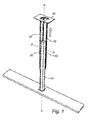
- Figure 1 describes a telescopic column according to the invention having an extension along its longitudinal axis X.
- the longitudinal axis X of the telescopic column is defined as parallel to the telescopic movement direction of the column.
- the telescopic column is elongated in a direction that is parallel to the longitudinal axis. In the document, when a feature is elongated it generally has an extension direction that is parallel to the longitudinal axis.
- the telescopic column is arranged on a base 70.
- the telescopic column comprises an inner elongated tubular element 10 with a square-shaped cross-section, an outer elongated element 30, a first telescoping unit 20 and a second telescoping unit 40.
- the first telescoping unit 20 and the second telescoping unit 40 are arranged between the inner elongated tubular element 10 and the outer elongated element 30.
- the telescopic column of fig 1 further comprises a horizontally arranged top plate 50 arranged to an upper part of the outer elongated element 30.
- the top plate 50 has a general extension substantially perpendicular to the longitudinal axis X.
- the telescopic column could be used in a linear actuator.
- a linear actuator comprises, except for the telescopic column, a motor arranged to the top plate 50 and a threaded screw arranged inside the inner tubular element 10 of the telescopic column. Further, there is a threaded nut securely arranged inside the inner tubular element.
- the motor is arranged to rotate the threaded screw, and the threaded screw is connected to the threaded nut such that when the screw is rotated, a telescopic movement takes place between the inner and outer elongated element.
- the first telescoping unit 20 is arranged between a first side 10a of the inner elongated element and a first side 30a of the outer elongated element 30.
- the second telescoping unit 40 is arranged between a second side 10b of the inner elongated element and a second side 30b of the outer elongated element.
- the first side 10a and the second side 10b of the inner elongated element are substantially perpendicular to each other.
- the outer elongated element 30 has an angled cross-section having three parts, where its first part 30a is substantially parallel to the first side 10a of the inner tubular element and its second part 30b is substantially parallel to the second side 10b of the inner tubular element, and, consequently, its second part is substantially perpendicular to its first part.
- the first and the second parts 30a, 30b are connected by an intermediate part 30c angled about 45 degrees in relation to both the first part and the second part.
- the first telescoping unit 20 comprises a first elongated section 23 securely arranged to the first side 10a of the inner tubular element and a second elongated section 24 securely arranged to the first part 30a of the outer elongated element.
- the first telescoping unit 20 further comprises a set of rolling bearings 21, 22 arranged between the first elongated section 23 and the second elongated section 24.
- the first elongated section 23 and the second elongated section 24 each has a main cross-sectional extension that is parallel to the first side of the inner elongated element 10 and the first part of the outer elongated element 30, respectively.
- first elongated section 23 and the second elongated section 24 are each shaped such that an elongated guide is provided at each end.
- Each of the elongated guides is arranged to receive a subset 21 or 22 of the set of rolling bearings 21, 22.
- the guides and the set of rolling bearings provides a guiding element for connecting the first elongated section 23 to the second elongated section 24 and for guiding a telescoping movement between the first elongated section and the second elongated section.
- the first elongated section 23 has a straight main part 23a, parallel to the first side 10a of the inner tubular element, a first end part 23b and a second end part 23c, the end parts 23b, 23c each extending from a respective end of the main part 23a in a direction away from the first side 10a of the inner tubular element and away from each other.
- the end parts 23b, 23c then each have a further extension where they are bent towards each other.
- the end parts 23b, 23c thereby each provide a c-shaped profile.
- the second elongated section 24 has a straight main part 24a, parallel to the first side 30a of the outer elongated element, a first end part 24b and a second end part 24c, the end parts 24b, 24c each extending from a respective end of the main part 24a in a direction away from the first side 30d of the outer elongated element and towards each other.
- the end parts 24b, 24c then each have a further extension where they are bent away from each other.
- the end parts 24b, 24c thereby each provide a c-shaped profile.
- the c-shaped profile created by the first end part 24b of the second elongated section 24 and the c-shaped profile created by the first end part 23b of the first elongated section 23 are arranged opposite to each other with its open ends directed towards each other to thereby create a guide for receiving and guiding a subset 21 of the set of roller bearings 21, 22.
- the c-shaped profile created by the second end part 24c of the second elongated section 24 and the c-shaped profile created by the second end part 23c of the first elongated section 23 are arranged opposite to each other to thereby create a guide for receiving and guiding the other subset 22 of the set of roller bearings 21, 22.
- the second telescoping unit 40 comprises a first elongated section 43 securely arranged to the second side 10b of the inner tubular element and a second elongated section 44 securely arranged to the second part 30b of the outer elongated element.
- the second telescoping unit 40 further comprises a set of rolling bearings 41, 42 arranged between the first elongated section 43 and the second elongated section 44.
- the first elongated section and the second elongated section each has a main cross-sectional extension that is parallel to the second sides 10b, 30b of the inner elongated element 10 and the outer elongated element 30, respectively.
- first elongated section 43 and the second elongated section 44 are each shaped such that an elongated guide is provided at each end.
- Each of the elongated guides is arranged to receive a subset 41 or 42 of the set of roller bearings 41, 42.
- the guides and the set of rolling bearings provides a guiding element for connecting the first elongated section 43 to the second elongated section 44 and for guiding a telescoping movement between the first elongated section and the second elongated section.
- the second telescoping unit 40 has a similar construction as the first telescoping unit 20. For this reason, for a more detailed description of the first and second elongated section 43, 44 of the second telescoping unit 40, see the description above for the first and second elongated section of the first telescoping unit 20.
- FIG 3 is a perspective view of a telescoping unit 20, 40 of the invention.
- the telescoping unit 20 is in its extended mode, where the first elongated section 23 and the second elongated section 24 have been telescopically moved away from each other.
- each subset of rolling bearings 21, 22 comprises a number of balls 21 a, 21 b, ..., 21 n etc and 22a, 22b, ..., 22n etc arranged in a row.
- the number of connected balls is ten.
- each subset of rolling bearings has an extension that is parallel to the elongated sections and, consequently, parallel to the longitudinal axis of the telescopic column, when the telescoping unit 20 has been arranged to a telescopic column. Further, each of the balls of a subset of rolling bearings is arranged in a ball holder for better controlling the movement of the balls.
- Figures 4-6 show another embodiment of the invention.
- the first and the second telescoping unit 20, 40 each comprises a third elongated section 125, 145 arranged between the first and the second elongated section to achieve a longer telescopic movement. This is achieved by a telescopic movement between three parts, the first elongated section 123, 143, the third elongated section 125, 145 and the second elongated section 124, 144.
- first elongated section 123 of the first telescoping unit 20 is securely arranged to the first side 10a of the inner tubular element and the second elongated section 124 of the first telescoping unit is securely arranged to the first part 30a of the outer elongated element.
- a first set of rolling bearings 121, 122 is arranged between the first elongated section 123 and the third elongated section 125 for facilitating a telescopic movement between the first and the third elongated section.
- a second set of rolling 126, 127 bearings is arranged between the third elongated section 125 and the second elongated section 124 for facilitating a telescopic movement between the third and the second elongated section.
- the third elongated section 125 comprises a first part 125a and a second part 125b.
- the first elongated section 123, the second elongated section 124 and the first and second parts 125a, 125b of the third elongated section each has a main cross-sectional extension that is parallel to the first sides 10a, 30a of the inner elongated element 10 and the outer elongated element 30, respectively.
- the first elongated section 123, and the first part 125a of the third elongated section are each shaped such that an elongated guide is arranged at each end, each of the elongated guides being arranged to receive a subset 121 or 122 of the first set of rolling bearings 121, 122.
- the second elongated section 124, and the second part 125b of the third elongated section are each shaped such that an elongated guide is arranged at each end, each of the elongated guides being arranged to receive a subset 126 or 127 of the second set of rolling bearings 126, 127.
- the guides of the first and third elongated section and the set of rolling bearings arranged in the guides provides a guiding element for connecting the first elongated section 123 to the third elongated section 125 and for guiding a telescoping movement between the first elongated section and the third elongated section.
- the guides of the second and third elongated section and the set of rolling bearings arranged in the guides provides a guiding element for connecting the third elongated section 125 to the second elongated section 124 and for guiding a telescoping movement between the second elongated section and the third elongated section.
- the first elongated section 123 has a straight main part 123a, parallel to the first side 10a of the inner tubular element, a first end part 123b and a second end part 123c.
- the end parts 123b, 123c each extends from a respective end of the main part 123a in a direction away from the first side 10a of the inner tubular element and away from each other, and are then bent towards each other such that they have a further extension in a direction away from the first side and towards each other. Thereby, a c-shaped profile is created.
- the first part of the third elongated section 125a has a straight main part 125aa, parallel to the first side 30a of the outer elongated element, a first end part 125ab and a second end part 125ac, the end parts 125ab, 125ac each extending from a respective end of the main part 125aa in a direction away from the first side 30d of the outer elongated element and towards each other.
- the end parts 125ab, 125ac of the first part of the third elongated section then each has a further extension where they are bent away from each other. Thereby, a c-shaped profile is created.
- the c-shaped profile created by the first end part 125ab of the first part of the third elongated section 125 and the c-shaped profile created by the second end part 123b of the first elongated section 123 are arranged opposite to each other with their open ends towards each other to receive a subset 121 of the first set of roller bearings 121, 122.
- the c-shaped profile created by the second end part 125ac of the first part of the third elongated section 125 and the c-shaped profile created by the third part 123c of the first elongated section 123 are arranged opposite with their open ends towards each other to receive the other subset 122 of the first set of roller bearings 121, 122.
- the second part 125b of the third elongated section 125 has a straight main part 125ba, parallel to the first side 10a of the inner tubular element, a first end part 125bb and a second end part 125bc, the end parts 125bb, 125bc each extending from a respective end of the main part 125ba in a direction away from the first side 10a of the inner tubular element and towards each other.
- the straight main part 125ba of the second part 125b of the third elongated section 125 is arranged to the straight main part 125ab of the first part 125a of the third elongated section 125.
- the ends parts 125bb, 125bc then each has a further extension where they are bent away from each other. Thereby, a c-shaped profile is created for receiving a roller or ball of a rolling bearing.
- the second elongated section 124 has a straight main part 124a, parallel to the first side 30a of the outer elongated element, a first end part 124b and a second end part 124c, the end parts 124b, 124c each extending from a respective end of the main part 124a in a direction away from the first side 30d of the outer elongated element and towards each other.
- the end parts 124b, 124c then each have a further extension where they are bent towards each other.
- a c-shaped profile is created for receiving a roller or ball of a rolling bearing.
- the c-shaped profile created by the first end part 125bb of the second part 125b of the third elongated section 125 and the c-shaped profile created by the second part 124b of the second elongated section 124 are arranged opposite to each other with their open ends towards each other for receiving a subset 126 of the second set of roller bearings 126, 127.
- the c-shaped profile of the second end part 125ac of the first part of the third elongated section 125 and the c-shaped profile of the third part 124c of the second elongated section 124 are arranged opposite with their open ends towards each other for receiving the other subset 127 of the second set of roller bearings 126, 127.
- the second telescoping unit 40 comprises a first elongated section 143 securely arranged to the second side 10b of the inner tubular element and a second elongated section 144 securely arranged to the second part 30b of the outer elongated element.
- the first set of rolling bearings 141, 142 is arranged between the first elongated section 143 and the third elongated section 145 for facilitating a telescopic movement between the first and the third elongated section.
- the second set of rolling bearings 146, 147 is arranged between the third elongated section 145 and the second elongated section 144 for facilitating a telescopic movement between the third and the second elongated section.
- first elongated section 143 of the second telescoping unit 40 is securely arranged to the second side 10b of the inner tubular element and the second elongated section 144 of the second telescoping unit is securely arranged to the second part 30b of the outer elongated element.
- the first set of rolling bearings 141, 142 is arranged between the first elongated section 143 and the third elongated section 145 for facilitating a telescopic movement between the first and the third elongated section.
- the second set of rolling 146, 147 bearings is arranged between the third elongated section 145 and the second elongated section 144 for facilitating a telescopic movement between the third and the second elongated section.
- the third elongated section 145 comprises a first part 145a and a second part 145b.
- the first elongated section 143, the second elongated section 144 and the first and second parts 145a, 145b of the third elongated section each has a main cross-sectional extension that is parallel to the second sides 10b, 30b of the inner elongated element 10 and the outer elongated element 30, respectively.
- the first elongated section 143, and the first part 145a of the third elongated section are each shaped such that an elongated guide is arranged at each end, each of the elongated guides being arranged to receive a subset 141 or 142 of the first set of rolling bearings 141, 142.
- the second elongated section 144, and the second part 145b of the third elongated section are each shaped such that an elongated guide is arranged at each end, each of the elongated guides being arranged to receive a subset 146 or 147 of the second set of rolling bearings 146, 147.
- the guides of the first and third elongated section and the set of rolling bearings arranged in the guides provides a guiding element for connecting the first elongated section 143 to the third elongated section 145 and for guiding a telescoping movement between the first elongated section and the third elongated section.
- the guides of the second and third elongated section and the set of rolling bearings arranged in the guides provides a guiding element for connecting the third elongated section 145 to the second elongated section 144 and for guiding a telescoping movement between the second elongated section and the third elongated section.
- the second telescoping unit 40 has a similar construction as the first telescoping unit 20. For this reason, for a more detailed description of the first, second and third elongated section 143, 144, 145 of the second telescoping unit 40, see the description above for the first, second and third elongated section 123, 124, 125 of the first telescoping unit 20.
- each subset of rolling bearings 121, 122, 126, 127, 141, 142, 146, 147 is arranged in the same way as described for the first embodiment of the invention, in connection with figure 3 .
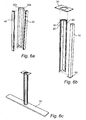
- Figures 6a-6c describes the procedure for mounting a telescopic column according to the invention.
- the first telescoping unit 20 is arranged to the first part 30a of the outer elongated element and the second telescoping unit 40 is arranged to the second part 30b of the outer elongated element.
- the second elongated section 24, 124 of the first telescoping unit 20 is arranged such that it bears against an inner surface of the first part 30a of the outer elongated element 30 and the second elongated section 44, 144 of the second telescoping unit 40 is arranged such that it bears against an inner surface of the second part 30b of the outer elongated element 30.
- the telescoping units may be welded to the respective part.
- the inner tubular element 10 is arranged to the first and second telescoping units such that the first side 10a of the inner tubular element 10 bears against the first elongated section 23, 123 of the first telescoping unit 20 and that the second side 10b of the inner tubular element 10 bears against the first elongated section 43, 143 of the second telescoping unit 40.
- the inner tubular element 10 may have been arranged with a bottom plate 60 to its bottom part, such that the bottom plate has a main extension direction that is perpendicular to the main extension direction of the tubular element.
- the top plate 50 is arranged to the outer elongated element 30. Alternatively, the top plate may have been arranged to the outer elongated element before the first step is accomplished.
- the telescopic column is mounted to a base 70 ( Fig. 6c ) by mounting the bottom plate 60 to the base 70.
- the top plate 50 will follow the movement of the telescopic column away from the base 70, whereas the bottom plate 60 will of course, stand still on the base.
- a housing for a motor can be arranged onto the top plate 50.
- a motor can be arranged to drive a threaded screw arranged inside the inner tubular element for achieving the telescopic movement between the inner and outer elongated element 10, 30.
- a table top may be arranged onto the top plate 50 .
- one or more protecting tubes of e.g. rectangular cross-section is arranged outside the telescopic column, to surround the telescopic column.
- the protecting tube may be of any material.
- the protecting tube does not need to be of a load-carrying material.
- telescopic columns are disclosed having two or three elongated elements capable of telescoping in relation to each other.
- the invention may also be applicable to telescopic columns having more than three elongated elements capable of telescoping in relation to each other.
Landscapes
- Engineering & Computer Science (AREA)
- General Engineering & Computer Science (AREA)
- Mechanical Engineering (AREA)
- Bearings For Parts Moving Linearly (AREA)
Priority Applications (3)
| Application Number | Priority Date | Filing Date | Title |
|---|---|---|---|
| PL09153948T PL2223629T3 (pl) | 2009-02-27 | 2009-02-27 | Kolumna teleskopowa |
| DK09153948.6T DK2223629T3 (da) | 2009-02-27 | 2009-02-27 | Teleskopisk søjle |
| EP09153948.6A EP2223629B1 (en) | 2009-02-27 | 2009-02-27 | Telescopic column |
Applications Claiming Priority (1)
| Application Number | Priority Date | Filing Date | Title |
|---|---|---|---|
| EP09153948.6A EP2223629B1 (en) | 2009-02-27 | 2009-02-27 | Telescopic column |
Publications (2)
| Publication Number | Publication Date |
|---|---|
| EP2223629A1 EP2223629A1 (en) | 2010-09-01 |
| EP2223629B1 true EP2223629B1 (en) | 2015-03-18 |
Family
ID=40897672
Family Applications (1)
| Application Number | Title | Priority Date | Filing Date |
|---|---|---|---|
| EP09153948.6A Not-in-force EP2223629B1 (en) | 2009-02-27 | 2009-02-27 | Telescopic column |
Country Status (3)
| Country | Link |
|---|---|
| EP (1) | EP2223629B1 (pl) |
| DK (1) | DK2223629T3 (pl) |
| PL (1) | PL2223629T3 (pl) |
Families Citing this family (3)
| Publication number | Priority date | Publication date | Assignee | Title |
|---|---|---|---|---|
| WO2014120771A1 (en) * | 2013-01-31 | 2014-08-07 | Suspa Gmbh | Self-aligning axial bearing |
| US9332839B2 (en) * | 2014-09-12 | 2016-05-10 | John Frederick Ringlein | Desk mounted vertically adjustable stand up desk |
| GB2541654A (en) | 2015-08-24 | 2017-03-01 | Heald Tech Ltd | Security barrier apparatus |
Family Cites Families (4)
| Publication number | Priority date | Publication date | Assignee | Title |
|---|---|---|---|---|
| IT7223966U1 (it) * | 1972-12-07 | 1974-06-07 | Philips Spa | Dispositivo di sostegno a telescopio con ripresa automatica dei giochi |
| JPH078911Y2 (ja) * | 1989-12-26 | 1995-03-06 | 日本トムソン株式会社 | 転がり直動案内ユニット |
| DE10054236A1 (de) | 2000-11-02 | 2002-07-25 | Okin Ges Fuer Antriebstechnik | Teleskoparm |
| PL376312A1 (pl) * | 2005-07-26 | 2007-02-05 | Włodzimierz Śmieszek | Teleskopowy podnośnik śrubowy, zwłaszcza do podnoszenia płaskiego ekranu telewizyjnego z wnętrza pojemnika meblowego w położenie ekspozycji |
-
2009
- 2009-02-27 DK DK09153948.6T patent/DK2223629T3/da active
- 2009-02-27 EP EP09153948.6A patent/EP2223629B1/en not_active Not-in-force
- 2009-02-27 PL PL09153948T patent/PL2223629T3/pl unknown
Also Published As
| Publication number | Publication date |
|---|---|
| DK2223629T3 (da) | 2015-06-01 |
| PL2223629T3 (pl) | 2015-08-31 |
| EP2223629A1 (en) | 2010-09-01 |
Similar Documents
| Publication | Publication Date | Title |
|---|---|---|
| EP2342992B1 (en) | Linear actuator for height adjustable columns | |
| JP4890596B2 (ja) | テレスコピックカバー | |
| KR102622752B1 (ko) | 자기부상 중력 보상 장치 | |
| EP2223629B1 (en) | Telescopic column | |
| US20200352320A1 (en) | Telescopable column, in particular for items of furniture, such as desks, and desk having such a column | |
| US20020050112A1 (en) | Telescopic column | |
| JP6604488B2 (ja) | 直動案内装置及び直動案内装置の製造方法 | |
| CN103009337B (zh) | 一种全向微调卫星仪器侧板安装车 | |
| US20140208545A1 (en) | Rail and roller of a window and door system and window operation apparatus for windows and doors using same | |
| JPWO2022045346A5 (pl) | ||
| US5690315A (en) | Compact lifter assembly | |
| US11149826B1 (en) | Planetary rolling micro-jacking device | |
| KR20110047459A (ko) | 센서 지지 브라켓 및 그 조립체 | |
| WO2007013827A1 (en) | Telescopic screw lift, especially for lifting a flat tv screen from the furniture container into a display position | |
| WO2002038473A1 (en) | Linear motion guide | |
| JP2587921B2 (ja) | 手術台 | |
| JP2018200367A (ja) | レンズ装置 | |
| US8166838B2 (en) | Actuator for driving movable object and motion guide apparatus for guiding motion of movable object | |
| KR20220098381A (ko) | 리프팅 기둥부 | |
| JP5757923B2 (ja) | 昇降装置 | |
| JP2005185077A (ja) | アクチュエータ、ステージ装置及び軸受加工装置 | |
| EP4350172B1 (en) | Linear actuator and telescopic column with double threaded spindel | |
| JP5306072B2 (ja) | 伸縮ユニット及びこの伸縮ユニットを用いた建築ユニット | |
| JP6157301B2 (ja) | 昇降装置 | |
| WO2014088420A1 (en) | A guiding assembly for a piping system |
Legal Events
| Date | Code | Title | Description |
|---|---|---|---|
| PUAI | Public reference made under article 153(3) epc to a published international application that has entered the european phase |
Free format text: ORIGINAL CODE: 0009012 |
|
| 17P | Request for examination filed |
Effective date: 20091119 |
|
| AK | Designated contracting states |
Kind code of ref document: A1 Designated state(s): AT BE BG CH CY CZ DE DK EE ES FI FR GB GR HR HU IE IS IT LI LT LU LV MC MK MT NL NO PL PT RO SE SI SK TR |
|
| AX | Request for extension of the european patent |
Extension state: AL BA RS |
|
| AKX | Designation fees paid |
Designated state(s): AT BE BG CH CY CZ DE DK EE ES FI FR GB GR HR HU IE IS IT LI LT LU LV MC MK MT NL NO PL PT RO SE SI SK TR |
|
| RIC1 | Information provided on ipc code assigned before grant |
Ipc: F16C 29/04 20060101AFI20140812BHEP Ipc: A47B 9/20 20060101ALI20140812BHEP |
|
| GRAP | Despatch of communication of intention to grant a patent |
Free format text: ORIGINAL CODE: EPIDOSNIGR1 |
|
| INTG | Intention to grant announced |
Effective date: 20140922 |
|
| GRAS | Grant fee paid |
Free format text: ORIGINAL CODE: EPIDOSNIGR3 |
|
| GRAA | (expected) grant |
Free format text: ORIGINAL CODE: 0009210 |
|
| AK | Designated contracting states |
Kind code of ref document: B1 Designated state(s): AT BE BG CH CY CZ DE DK EE ES FI FR GB GR HR HU IE IS IT LI LT LU LV MC MK MT NL NO PL PT RO SE SI SK TR |
|
| REG | Reference to a national code |
Ref country code: GB Ref legal event code: FG4D |
|
| REG | Reference to a national code |
Ref country code: CH Ref legal event code: EP |
|
| REG | Reference to a national code |
Ref country code: IE Ref legal event code: FG4D |
|
| REG | Reference to a national code |
Ref country code: AT Ref legal event code: REF Ref document number: 716780 Country of ref document: AT Kind code of ref document: T Effective date: 20150415 |
|
| REG | Reference to a national code |
Ref country code: DE Ref legal event code: R096 Ref document number: 602009030002 Country of ref document: DE Effective date: 20150430 |
|
| REG | Reference to a national code |
Ref country code: DK Ref legal event code: T3 Effective date: 20150528 |
|
| REG | Reference to a national code |
Ref country code: NL Ref legal event code: T3 |
|
| REG | Reference to a national code |
Ref country code: SE Ref legal event code: TRGR |
|
| PG25 | Lapsed in a contracting state [announced via postgrant information from national office to epo] |
Ref country code: FI Free format text: LAPSE BECAUSE OF FAILURE TO SUBMIT A TRANSLATION OF THE DESCRIPTION OR TO PAY THE FEE WITHIN THE PRESCRIBED TIME-LIMIT Effective date: 20150318 Ref country code: LT Free format text: LAPSE BECAUSE OF FAILURE TO SUBMIT A TRANSLATION OF THE DESCRIPTION OR TO PAY THE FEE WITHIN THE PRESCRIBED TIME-LIMIT Effective date: 20150318 Ref country code: HR Free format text: LAPSE BECAUSE OF FAILURE TO SUBMIT A TRANSLATION OF THE DESCRIPTION OR TO PAY THE FEE WITHIN THE PRESCRIBED TIME-LIMIT Effective date: 20150318 Ref country code: NO Free format text: LAPSE BECAUSE OF FAILURE TO SUBMIT A TRANSLATION OF THE DESCRIPTION OR TO PAY THE FEE WITHIN THE PRESCRIBED TIME-LIMIT Effective date: 20150618 |
|
| REG | Reference to a national code |
Ref country code: LT Ref legal event code: MG4D |
|
| PG25 | Lapsed in a contracting state [announced via postgrant information from national office to epo] |
Ref country code: LV Free format text: LAPSE BECAUSE OF FAILURE TO SUBMIT A TRANSLATION OF THE DESCRIPTION OR TO PAY THE FEE WITHIN THE PRESCRIBED TIME-LIMIT Effective date: 20150318 Ref country code: GR Free format text: LAPSE BECAUSE OF FAILURE TO SUBMIT A TRANSLATION OF THE DESCRIPTION OR TO PAY THE FEE WITHIN THE PRESCRIBED TIME-LIMIT Effective date: 20150619 |
|
| REG | Reference to a national code |
Ref country code: PL Ref legal event code: T3 |
|
| PG25 | Lapsed in a contracting state [announced via postgrant information from national office to epo] |
Ref country code: RO Free format text: LAPSE BECAUSE OF FAILURE TO SUBMIT A TRANSLATION OF THE DESCRIPTION OR TO PAY THE FEE WITHIN THE PRESCRIBED TIME-LIMIT Effective date: 20150318 Ref country code: ES Free format text: LAPSE BECAUSE OF FAILURE TO SUBMIT A TRANSLATION OF THE DESCRIPTION OR TO PAY THE FEE WITHIN THE PRESCRIBED TIME-LIMIT Effective date: 20150318 Ref country code: SK Free format text: LAPSE BECAUSE OF FAILURE TO SUBMIT A TRANSLATION OF THE DESCRIPTION OR TO PAY THE FEE WITHIN THE PRESCRIBED TIME-LIMIT Effective date: 20150318 Ref country code: CZ Free format text: LAPSE BECAUSE OF FAILURE TO SUBMIT A TRANSLATION OF THE DESCRIPTION OR TO PAY THE FEE WITHIN THE PRESCRIBED TIME-LIMIT Effective date: 20150318 Ref country code: PT Free format text: LAPSE BECAUSE OF FAILURE TO SUBMIT A TRANSLATION OF THE DESCRIPTION OR TO PAY THE FEE WITHIN THE PRESCRIBED TIME-LIMIT Effective date: 20150720 Ref country code: EE Free format text: LAPSE BECAUSE OF FAILURE TO SUBMIT A TRANSLATION OF THE DESCRIPTION OR TO PAY THE FEE WITHIN THE PRESCRIBED TIME-LIMIT Effective date: 20150318 |
|
| PG25 | Lapsed in a contracting state [announced via postgrant information from national office to epo] |
Ref country code: IS Free format text: LAPSE BECAUSE OF FAILURE TO SUBMIT A TRANSLATION OF THE DESCRIPTION OR TO PAY THE FEE WITHIN THE PRESCRIBED TIME-LIMIT Effective date: 20150718 |
|
| REG | Reference to a national code |
Ref country code: DE Ref legal event code: R097 Ref document number: 602009030002 Country of ref document: DE |
|
| PLBE | No opposition filed within time limit |
Free format text: ORIGINAL CODE: 0009261 |
|
| STAA | Information on the status of an ep patent application or granted ep patent |
Free format text: STATUS: NO OPPOSITION FILED WITHIN TIME LIMIT |
|
| REG | Reference to a national code |
Ref country code: FR Ref legal event code: PLFP Year of fee payment: 8 |
|
| REG | Reference to a national code |
Ref country code: AT Ref legal event code: UEP Ref document number: 716780 Country of ref document: AT Kind code of ref document: T Effective date: 20150318 |
|
| 26N | No opposition filed |
Effective date: 20151221 |
|
| PG25 | Lapsed in a contracting state [announced via postgrant information from national office to epo] |
Ref country code: SI Free format text: LAPSE BECAUSE OF FAILURE TO SUBMIT A TRANSLATION OF THE DESCRIPTION OR TO PAY THE FEE WITHIN THE PRESCRIBED TIME-LIMIT Effective date: 20150318 |
|
| PG25 | Lapsed in a contracting state [announced via postgrant information from national office to epo] |
Ref country code: BE Free format text: LAPSE BECAUSE OF NON-PAYMENT OF DUE FEES Effective date: 20160229 |
|
| PG25 | Lapsed in a contracting state [announced via postgrant information from national office to epo] |
Ref country code: BE Free format text: LAPSE BECAUSE OF FAILURE TO SUBMIT A TRANSLATION OF THE DESCRIPTION OR TO PAY THE FEE WITHIN THE PRESCRIBED TIME-LIMIT Effective date: 20150318 |
|
| PG25 | Lapsed in a contracting state [announced via postgrant information from national office to epo] |
Ref country code: LU Free format text: LAPSE BECAUSE OF FAILURE TO SUBMIT A TRANSLATION OF THE DESCRIPTION OR TO PAY THE FEE WITHIN THE PRESCRIBED TIME-LIMIT Effective date: 20160227 Ref country code: MC Free format text: LAPSE BECAUSE OF FAILURE TO SUBMIT A TRANSLATION OF THE DESCRIPTION OR TO PAY THE FEE WITHIN THE PRESCRIBED TIME-LIMIT Effective date: 20150318 |
|
| REG | Reference to a national code |
Ref country code: CH Ref legal event code: PL |
|
| PG25 | Lapsed in a contracting state [announced via postgrant information from national office to epo] |
Ref country code: LI Free format text: LAPSE BECAUSE OF NON-PAYMENT OF DUE FEES Effective date: 20160229 Ref country code: CH Free format text: LAPSE BECAUSE OF NON-PAYMENT OF DUE FEES Effective date: 20160229 |
|
| REG | Reference to a national code |
Ref country code: IE Ref legal event code: MM4A |
|
| REG | Reference to a national code |
Ref country code: FR Ref legal event code: PLFP Year of fee payment: 9 |
|
| PG25 | Lapsed in a contracting state [announced via postgrant information from national office to epo] |
Ref country code: IE Free format text: LAPSE BECAUSE OF NON-PAYMENT OF DUE FEES Effective date: 20160227 |
|
| PG25 | Lapsed in a contracting state [announced via postgrant information from national office to epo] |
Ref country code: MT Free format text: LAPSE BECAUSE OF FAILURE TO SUBMIT A TRANSLATION OF THE DESCRIPTION OR TO PAY THE FEE WITHIN THE PRESCRIBED TIME-LIMIT Effective date: 20150318 |
|
| REG | Reference to a national code |
Ref country code: FR Ref legal event code: PLFP Year of fee payment: 10 |
|
| PG25 | Lapsed in a contracting state [announced via postgrant information from national office to epo] |
Ref country code: HU Free format text: LAPSE BECAUSE OF FAILURE TO SUBMIT A TRANSLATION OF THE DESCRIPTION OR TO PAY THE FEE WITHIN THE PRESCRIBED TIME-LIMIT; INVALID AB INITIO Effective date: 20090227 Ref country code: CY Free format text: LAPSE BECAUSE OF FAILURE TO SUBMIT A TRANSLATION OF THE DESCRIPTION OR TO PAY THE FEE WITHIN THE PRESCRIBED TIME-LIMIT Effective date: 20150318 |
|
| PG25 | Lapsed in a contracting state [announced via postgrant information from national office to epo] |
Ref country code: TR Free format text: LAPSE BECAUSE OF FAILURE TO SUBMIT A TRANSLATION OF THE DESCRIPTION OR TO PAY THE FEE WITHIN THE PRESCRIBED TIME-LIMIT Effective date: 20150318 Ref country code: MK Free format text: LAPSE BECAUSE OF FAILURE TO SUBMIT A TRANSLATION OF THE DESCRIPTION OR TO PAY THE FEE WITHIN THE PRESCRIBED TIME-LIMIT Effective date: 20150318 Ref country code: MT Free format text: LAPSE BECAUSE OF FAILURE TO SUBMIT A TRANSLATION OF THE DESCRIPTION OR TO PAY THE FEE WITHIN THE PRESCRIBED TIME-LIMIT Effective date: 20160229 |
|
| PG25 | Lapsed in a contracting state [announced via postgrant information from national office to epo] |
Ref country code: BG Free format text: LAPSE BECAUSE OF FAILURE TO SUBMIT A TRANSLATION OF THE DESCRIPTION OR TO PAY THE FEE WITHIN THE PRESCRIBED TIME-LIMIT Effective date: 20150318 |
|
| PGFP | Annual fee paid to national office [announced via postgrant information from national office to epo] |
Ref country code: NL Payment date: 20190214 Year of fee payment: 11 |
|
| PGFP | Annual fee paid to national office [announced via postgrant information from national office to epo] |
Ref country code: PL Payment date: 20190115 Year of fee payment: 11 Ref country code: IT Payment date: 20190221 Year of fee payment: 11 Ref country code: GB Payment date: 20190225 Year of fee payment: 11 Ref country code: DE Payment date: 20190116 Year of fee payment: 11 |
|
| PGFP | Annual fee paid to national office [announced via postgrant information from national office to epo] |
Ref country code: FR Payment date: 20190218 Year of fee payment: 11 Ref country code: AT Payment date: 20190116 Year of fee payment: 11 Ref country code: SE Payment date: 20190215 Year of fee payment: 11 Ref country code: DK Payment date: 20190117 Year of fee payment: 11 |
|
| REG | Reference to a national code |
Ref country code: DE Ref legal event code: R119 Ref document number: 602009030002 Country of ref document: DE |
|
| REG | Reference to a national code |
Ref country code: DK Ref legal event code: EBP Effective date: 20200229 |
|
| REG | Reference to a national code |
Ref country code: SE Ref legal event code: EUG |
|
| REG | Reference to a national code |
Ref country code: NL Ref legal event code: MM Effective date: 20200301 |
|
| REG | Reference to a national code |
Ref country code: AT Ref legal event code: MM01 Ref document number: 716780 Country of ref document: AT Kind code of ref document: T Effective date: 20200227 |
|
| GBPC | Gb: european patent ceased through non-payment of renewal fee |
Effective date: 20200227 |
|
| PG25 | Lapsed in a contracting state [announced via postgrant information from national office to epo] |
Ref country code: SE Free format text: LAPSE BECAUSE OF NON-PAYMENT OF DUE FEES Effective date: 20200228 |
|
| PG25 | Lapsed in a contracting state [announced via postgrant information from national office to epo] |
Ref country code: AT Free format text: LAPSE BECAUSE OF NON-PAYMENT OF DUE FEES Effective date: 20200227 |
|
| PG25 | Lapsed in a contracting state [announced via postgrant information from national office to epo] |
Ref country code: NL Free format text: LAPSE BECAUSE OF NON-PAYMENT OF DUE FEES Effective date: 20200301 |
|
| PG25 | Lapsed in a contracting state [announced via postgrant information from national office to epo] |
Ref country code: DK Free format text: LAPSE BECAUSE OF NON-PAYMENT OF DUE FEES Effective date: 20200229 Ref country code: FR Free format text: LAPSE BECAUSE OF NON-PAYMENT OF DUE FEES Effective date: 20200229 Ref country code: GB Free format text: LAPSE BECAUSE OF NON-PAYMENT OF DUE FEES Effective date: 20200227 Ref country code: DE Free format text: LAPSE BECAUSE OF NON-PAYMENT OF DUE FEES Effective date: 20200901 |
|
| PG25 | Lapsed in a contracting state [announced via postgrant information from national office to epo] |
Ref country code: IT Free format text: LAPSE BECAUSE OF NON-PAYMENT OF DUE FEES Effective date: 20200227 |
|
| PG25 | Lapsed in a contracting state [announced via postgrant information from national office to epo] |
Ref country code: PL Free format text: LAPSE BECAUSE OF NON-PAYMENT OF DUE FEES Effective date: 20200227 |