EP2221981A1 - Verfahren zur Trägerfrequenzversatzschätzung in einem Telekommunikationssignalempfänger, insbesondere in einer mobilen Einrichtung - Google Patents
Verfahren zur Trägerfrequenzversatzschätzung in einem Telekommunikationssignalempfänger, insbesondere in einer mobilen Einrichtung Download PDFInfo
- Publication number
- EP2221981A1 EP2221981A1 EP10153921A EP10153921A EP2221981A1 EP 2221981 A1 EP2221981 A1 EP 2221981A1 EP 10153921 A EP10153921 A EP 10153921A EP 10153921 A EP10153921 A EP 10153921A EP 2221981 A1 EP2221981 A1 EP 2221981A1
- Authority
- EP
- European Patent Office
- Prior art keywords
- carrier frequency
- estimating
- frequency slip
- signal
- slip
- Prior art date
- Legal status (The legal status is an assumption and is not a legal conclusion. Google has not performed a legal analysis and makes no representation as to the accuracy of the status listed.)
- Granted
Links
- 238000000034 method Methods 0.000 title claims abstract description 29
- 230000010363 phase shift Effects 0.000 claims abstract description 29
- 238000004590 computer program Methods 0.000 claims abstract description 5
- 238000005070 sampling Methods 0.000 claims description 22
- 238000004891 communication Methods 0.000 claims description 9
- 230000005540 biological transmission Effects 0.000 claims description 8
- 238000001228 spectrum Methods 0.000 claims description 5
- 238000012217 deletion Methods 0.000 claims description 2
- 230000037430 deletion Effects 0.000 claims description 2
- 239000013256 coordination polymer Substances 0.000 description 21
- 238000004364 calculation method Methods 0.000 description 20
- 238000007792 addition Methods 0.000 description 14
- 230000000875 corresponding effect Effects 0.000 description 8
- 238000001514 detection method Methods 0.000 description 5
- 230000002596 correlated effect Effects 0.000 description 4
- 230000004069 differentiation Effects 0.000 description 2
- 230000035945 sensitivity Effects 0.000 description 2
- 238000004088 simulation Methods 0.000 description 2
- 230000001360 synchronised effect Effects 0.000 description 2
- 229920000535 Tan II Polymers 0.000 description 1
- 241000897276 Termes Species 0.000 description 1
- 238000009825 accumulation Methods 0.000 description 1
- 239000000654 additive Substances 0.000 description 1
- 230000000996 additive effect Effects 0.000 description 1
- 230000003111 delayed effect Effects 0.000 description 1
- 230000000694 effects Effects 0.000 description 1
- 238000001914 filtration Methods 0.000 description 1
- 230000008054 signal transmission Effects 0.000 description 1
Images

Classifications
-
- H—ELECTRICITY
- H04—ELECTRIC COMMUNICATION TECHNIQUE
- H04B—TRANSMISSION
- H04B1/00—Details of transmission systems, not covered by a single one of groups H04B3/00 - H04B13/00; Details of transmission systems not characterised by the medium used for transmission
- H04B1/69—Spread spectrum techniques
- H04B1/707—Spread spectrum techniques using direct sequence modulation
- H04B1/7073—Synchronisation aspects
- H04B1/7087—Carrier synchronisation aspects
-
- H—ELECTRICITY
- H04—ELECTRIC COMMUNICATION TECHNIQUE
- H04B—TRANSMISSION
- H04B1/00—Details of transmission systems, not covered by a single one of groups H04B3/00 - H04B13/00; Details of transmission systems not characterised by the medium used for transmission
- H04B1/69—Spread spectrum techniques
- H04B1/707—Spread spectrum techniques using direct sequence modulation
-
- H—ELECTRICITY
- H04—ELECTRIC COMMUNICATION TECHNIQUE
- H04B—TRANSMISSION
- H04B1/00—Details of transmission systems, not covered by a single one of groups H04B3/00 - H04B13/00; Details of transmission systems not characterised by the medium used for transmission
- H04B1/69—Spread spectrum techniques
- H04B1/707—Spread spectrum techniques using direct sequence modulation
- H04B1/7073—Synchronisation aspects
- H04B1/7075—Synchronisation aspects with code phase acquisition
Definitions
- the present invention relates to a method for estimating a carrier frequency slip in a telecommunication signal receiver. It also relates to a mobile telecommunication device and a computer program capable of implementing this method.
- the carrier frequency used at transmission for the modulation of a signal and the frequency used in reception for the demodulation of this signal can never be strictly identical.
- a carrier frequency slip phenomenon generally described as "offset" of carrier frequency, is thus necessarily observed between the transmitter and the receiver.
- this slip can be more or less important and degrades the reception of signals if no correction is made.
- the invention applies in particular to low-power telecommunications in which the receivers are mobile devices whose power consumption must be limited, that is to say in which it is necessary to implement the most advanced digital algorithms. simple possible involving a minimum of operations. Moreover, for these same reasons of consumption, but also for cost issues, the oscillators used in these receivers may have a low accuracy. A good estimate and an effective correction of the carrier frequency slip are then essential.
- the carrier frequency and the sampling frequencies are generated from the same oscillator.
- the relative slip of the carrier frequency and the relative slip of the frequency of the coded symbols are equal. The estimation of only one of these slips, in the first place the slip of the carrier frequency, is therefore sufficient.
- DSSS Direct Sequence Spread Spectrum
- an information symbol is associated with a binary spreading sequence of L bits called "chips". These chips then modulate the carrier phase or frequency of a constant envelope signal.
- the communication is in packet transmission mode and each packet comprises a preamble which is a predetermined sequence of DSSS spread-encoded symbols, which predetermined sequence is known to the receiver. This preamble thus allows the synchronization of the receiver to demodulate a received packet.
- the invention can thus notably be implemented in the particular field of wireless communications between an emitter and a receiver whose physical layer conforms to that described in the IEEE 802.15.4 standard for the ISM band (for "Industrial, Scientific and Medical ”) at 2.4-2.48 GHz, using O-QPSK modulation.
- the estimation of the carrier frequency slip is more precisely carried out during the synchronization step which is performed on the preamble of any packet.
- the received signal is differentiated by calculating the complex product conjugated between one sample and another delayed one chip period (time between the receipt of two chips of the spreading sequence of the symbol # 0), then correlated with a binary sequence of reference stored and / or generated by the receiver and corresponding to the spreading sequence of the symbol # 0.
- This treatment is optionally followed by an accumulation to accumulate the results relating to the eight spreading sequences of the symbol # 0 of the preamble.
- the signal thus obtained serves both synchronization and estimation of the carrier frequency slip.
- the correction of the carrier frequency slip is then done by multiplying the correlation of each differentiated received spreading sequence with all the possible spreading sequences differentiated by the complex number.
- Another solution is to cut the spreading sequences in several successive portions, to perform a partial correlation on each of the portions, and to sum the modules of the calculated partial correlations. This results in better performance by better resistance to slip of the carrier frequency than when calculating complete correlations. From the calculated partial correlations, it is also possible to estimate the carrier frequency slip when it becomes too important to be neglected.
- the carrier frequency slip is estimated from the partial correlations calculated by extracting the argument of each of the complex numbers resulting from the partial correlations, which proves to be too expensive in terms of calculations and therefore disadvantageous in the case an application requiring low power consumption.
- this method is also simple to implement because it bases its estimation of the carrier frequency slip on the estimate of a phase shift between calculated partial correlations.
- the determination step comprises estimating an average phase shift between the successive partial correlations calculated at the selected synchronization position, in particular by estimating the expected product's mathematical expectancy between any two successive partial correlations calculated at the selected synchronization position.
- a method for estimating a carrier frequency slip according to the invention may further comprise a step of correction of the carrier frequency slip by compensation of this slip on the signal received using the value determined from the carrier frequency slip.
- the successive phase shift coefficients are calculated by frames using pre-computed data tables.
- the reference bit sequence is obtained by direct sequence spread spectrum of a reference symbol, in particular in the context of a transmission compliant with the IEEE 802.15.4 standard providing a packet symbol transmission, the reference bit sequence being contained in the preamble of each received packet.
- the carrier frequency slip accompanied by a frequency shift transmitted symbols compensates for the shift generated in the samples taken by the receiver by the addition or the deleting a sample each time this offset becomes greater, in advance or late, at half a sampling step.
- the invention also relates to a computer program downloadable from a communication network and / or recorded on a computer readable medium and / or executable by a processor, comprising program code instructions for executing the steps of FIG. a method for estimating a carrier frequency slip as defined above, when said program is run on a computer.
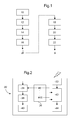
- the method for estimating a carrier frequency slip represented on the figure 1 comprises a first step 10 for calculating N partial correlations performed by a telecommunication signal receiver.
- These N partial correlations relate to N successive portions of a reference bit sequence of L bits. The successive portions being for example all distinct, of the same size and without overlap, each of them comprises ONE bit.
- the invention applies to any type of communication, involving any type of reference binary sequence.
- the reference binary sequence is obtained by DSSS direct sequence spread spectrum of a reference symbol, in particular the symbol # 0 of an O-QPSK modulation repeated eight times in the preamble of each packet of a packet-transmitted signal in accordance with IEEE 802.15.4.
- s or (s n ) where n is a sampling index.
- the sampling step is a fraction of the chip period.
- the index n of the spreading sequence (s n ) varies from 0 to PL-1.
- r or (r n ) a signal received and transposed in baseband, also sampled with P samples per chip and including in particular the reference spreading sequence to allow synchronization of the signals (r n ) and (s n ) .
- Each partial correlation is calculated in step 10 between a portion of the signal r received and a predetermined portion of the reference spreading sequence s, according to several possible relative positions between the received signal and the predetermined portion, in accordance with the following relationship :
- n 0 be the value of n for which the signals r and s are synchronized.
- r not AT ⁇ s not - not 0 ⁇ exp ⁇ 2 ⁇ ⁇ j ⁇ ⁇ ⁇ f not + j ⁇ + b not , where A is the constant amplitude of the received signal, ⁇ f is the normalized carrier frequency offset by the sampling frequency of the receiver, ⁇ is a constant phase shift and b n is a white Gaussian noise sample centered, the received signal is supposed tainted with a Gaussian additive white noise centered.
- steps 14 and 16 for determining the carrier frequency slip from these particular values of the partial correlations are carried out.
- a phase shift between partial correlations calculated at the selected synchronization position n 0 is estimated. More precisely, it is for example a mean phase shift ⁇ between the successive partial correlations calculated at the selected synchronization position n 0 which is estimated.
- This average phase shift can be expressed as an argument of the following mathematical expectation: E ⁇ CP * not 0 k ⁇ CP not 0 k + 1 .
- the carrier frequency drift normalized by the sampling frequency is estimated, it is possible to decode the symbols contained in each received data packet by correlation with a version of the sixteen symbols (in O-QPSK modulation) known to the receiver. .
- a complete correlation or several partial correlations relating to each possible symbol may or may be applied (s).
- a correction must be made to the chips of the spreading sequence received taking into account the estimated carrier frequency slip. This correction also makes it possible to limit the number of partial correlations to be envisaged if this decoding principle is chosen.
- successive phase shift coefficients ⁇ k are calculated as a function of the value ⁇ f estimated at step 16 and intended to be applied (by a complex multiplication) to the successive chips of the sequence d spreading received to correct the carrier frequency slip.
- the successive phase shift coefficients can be obtained by direct calculation, but also using precomputed data tables to avoid complicated trigonometric calculations.
- a first table allows for example to frame the phase of the expected mathematical expectation in step 14 and a second table allows to deduce the successive values of the coefficients ⁇ k .
- step 14 From the value of S is obtained in step 14, we calculate the values of Re ( S is ) and Im ( S is ).
- the index k 0 is determined such that VS k 0 ⁇ im S is Re S is ⁇ VS ⁇ k 0 + 1 , then, using the index k 0 found and the signs of Re ( S is ) and Im ( S is ), we deduce the index n 0 such that Tab [2n 0 ] is an approximation of S is in angular value.
- n 0 is less than or equal to 8
- the current spreading sequence received r is corrected using the coefficients ⁇ k to provide the corrected spreading sequence v and, on the other hand, the corrected spreading sequence v is correlated to each of the possible reference spreading sequences according to the selected decoding method of partial correlations or total correlation.
- the corrected spreading sequence v is correlated to each of the possible reference spreading sequences according to the selected decoding method of partial correlations or total correlation.
- sixteen different correlation values are provided, each corresponding to one of the reference spreading sequences. The absolute value of each of these sixteen correlation values is then calculated.
- the method of estimating a carrier frequency slip described above can for example be executed by a computer program downloadable from a communication network and / or recorded on a computer readable medium and / or executable by a processor.
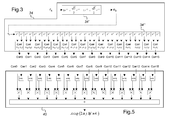
- the figure 2 schematically represents the general functional structure of a telecommunication signal receiver 30 designed for implementing the method for estimating a carrier frequency slip described above, for example a mobile telecommunication device able to communicate according to the IEEE standard 802.15.4.
- the mobile device 30 comprises a signal transmission / reception interface 32 in accordance with the IEEE 802.15.4 standard.
- the signals received in O-QPSK modulation by the mobile device 30 are transposed into baseband by an oscillator (not shown).
- the preamble of a received packet is transmitted to means 34 for calculating partial correlations.
- These partial correlations relate to several successive portions of the reference spreading sequence of the symbol # 0, each partial correlation being calculated between a portion of the baseband preamble, this preamble comprising a succession of eight standard reference spreading sequences.
- the carrier frequency slip must be less than 40 ppm on transmission, which allows a maximum slip of 80 ppm between the transmitter and the receiver.
- the sensitivity must be better than -85 dBm, which is defined as the minimum power required in reception to obtain a packet error rate of less than 1% with packets of 20 bytes.
- a carrier frequency slip at 80 ppm corresponds to 200 kHz.
- N 16 is an advantageous choice in terms of error rate in the presence of a carrier frequency slip.
- the reference spreading sequences are stored and / or generated in storage and / or generation means 36 of the mobile device 30.
- the reference spreading sequence corresponding to the symbol # 0 is therefore in particular provided by these means of storage and / or generation 36 to the calculation means 34.
- the mobile device 30 further comprises means 38 for selecting a synchronization position n 0 from the possible relative positions between the received signal and the reference bit sequence stored and / or generated by the mobile device.
- These selection means 38 are designed to implement the step 12 described above. They are therefore connected to the calculation means 34 to recover the values of the partial correlations at each possible relative position.
- the mobile device 30 also comprises means 40 for determining the carrier frequency slip by estimating a phase shift between partial correlations calculated at the selected synchronization position. They are therefore connected to the selection means 38 which provide them with this synchronization position. They are designed to implement step 14 previously described.
- the mobile device 30 comprises means 44 for selecting, from among the absolute values provided by the decoding and correction means 42, the maximum value and the corresponding symbol S. They are designed to implement step 22 previously described.
- each partial correlation relates to four samples covering two chips.
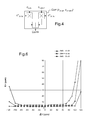
- a first module 34 filters the received signal r over a window of four samples, this filter being adapted to the half-sinusoidal shape of each chip. It supplies a signal e to the second module 34 "of the calculation means 34.
- the second module 34 "has 32 retarders of 2 samples each arranged in series and providing 32 samples with 16 partial correlators Corr (c 31-2k , c 31-2k-1 ), 0 ⁇ k ⁇ 15, each bearing on two successive chips of the reference spreading sequence linked to the symbol # 0.
- This reference spreading sequence is noted (c 31 , ..., c 0 ) on the figure 3 .
- any partial correlator Corr (c 31-2k , c 31-2k-1 ) of the second module 34 is shown in detail on the figure 4 .
- Two samples e n-4k and e n-4k-2 of the signal e, shifted by a chip period, are provided at the input of this partial correlator. They are multiplied respectively by the complex conjugate values c * 31-2k and c * 31-2k-1 of two successive chips forming a portion of the reference spreading sequence. The two values obtained are then added to provide the partial correlation result Corrk at a possible relative position between the received signal and the reference portion under consideration.
- n 0 correspond 16 particular values of the partial correlations Corr0 to Corr15 taken from the figure 5 .
- the determination means 40 comprise 15 multipliers for multiplying each partial correlation Corr0 to Corr14 to the conjugate complex value of the following partial correlation Corr1 to Corr15. The results of these multiplications are summed to output the signal S is defined previously.
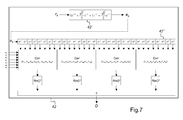
- the precision obtained by taking the argument of the signal S is provided by the determining means 40 as the carrier frequency slip estimator is illustrated on the figure 6 .
- the three curves represented in this figure are obtained from simulations in the presence of Gaussian white noise for different values of signal-to-noise ratio: 12 dB, 15 dB and 20 dB.
- the accuracy of the estimate is better as the signal-to-noise ratio is high.
- the curve which interests us more particularly is that corresponding to a signal-to-noise ratio of 15 dB because it corresponds to the target sensitivity of the receiver.
- the mean squared error on the estimate of the carrier frequency slip is less than 5 ppm over a range of this carrier frequency slip between -80 ppm and +80 ppm.
- each decoding partial correlation covers sixteen samples covering eight chips.
- a first module 42 ' identical to the module 34', performs a filtering of the signal r adapted to the half-sinusoidal shape of each chip. It supplies a signal e to the second module 42 "of the decoding and correction means 42.
- the second module 42 "has 32 retarders of 2 samples each arranged in series and providing 32 samples with 4 partial correlators Corr (c 31-8k , c 31-8k-1 , c 31-8k-2 , c 31-8k-3 , c 31-8k-4 , c 31-8k-5 , c 31-8k-6 , c 31-8k-7 ), 0 ⁇ k ⁇ 4, each bearing on 8 successive chips of one of the 16 sequences of reference spread relative to the symbols # 0 to # 15.
- This random spreading sequence on which the 4 partial correlations are calculated is noted for the sake of simplification (c 31 , ..., c 0 ) in this figure and the following one. .
- the module 42 "then performs the calculation of the absolute value squared of this result for each partial correlator and then adds the four partial absolute values to provide a decision variable D of the considered symbol.
- the relative sliding of the symbol frequency causes a regular shift of symbol synchronization at the receiver. If t 0 is an initial moment when the synchronization at the level of the symbols is supposed perfect, then the shift of the symbols as a function of time t is - (t - t 0 ) ⁇ f ( ⁇ f being assumed to be much less than 1).
- This expression reflects the fact that when ⁇ f is positive, the receiver samples too fast with respect to the transmitter, which generates a delay with respect to the received signal: it is then necessary to remove a sample when this offset is greater than half a step. 'sampling. It is deduced that after 1 / 2 ⁇ f samples, then all 1 / ⁇ f samples, a sample must be removed to compensate for this offset.
- a value given by this table gives the position of the first sample to be added or removed, the following being then spaced twice this value.
Landscapes
- Engineering & Computer Science (AREA)
- Computer Networks & Wireless Communication (AREA)
- Signal Processing (AREA)
- Synchronisation In Digital Transmission Systems (AREA)
- Mobile Radio Communication Systems (AREA)
Applications Claiming Priority (1)
| Application Number | Priority Date | Filing Date | Title |
|---|---|---|---|
| FR0951144A FR2942576B1 (fr) | 2009-02-23 | 2009-02-23 | Procede d'estimation d'un decalage de frequence porteuse dans un recepteur de signaux de telecommunication, notamment un dispositif mobile. |
Publications (2)
| Publication Number | Publication Date |
|---|---|
| EP2221981A1 true EP2221981A1 (de) | 2010-08-25 |
| EP2221981B1 EP2221981B1 (de) | 2012-05-09 |
Family
ID=41137525
Family Applications (1)
| Application Number | Title | Priority Date | Filing Date |
|---|---|---|---|
| EP10153921A Not-in-force EP2221981B1 (de) | 2009-02-23 | 2010-02-18 | Verfahren zur Trägerfrequenzversatzschätzung in einem Telekommunikationssignalempfänger, insbesondere in einer mobilen Einrichtung |
Country Status (6)
| Country | Link |
|---|---|
| US (1) | US8503504B2 (de) |
| EP (1) | EP2221981B1 (de) |
| JP (1) | JP2010200319A (de) |
| AT (1) | ATE557476T1 (de) |
| ES (1) | ES2387640T3 (de) |
| FR (1) | FR2942576B1 (de) |
Cited By (1)
| Publication number | Priority date | Publication date | Assignee | Title |
|---|---|---|---|---|
| CN113949613A (zh) * | 2016-03-31 | 2022-01-18 | 弗劳恩霍夫应用研究促进协会 | 用于接收数据分组的方法、接收机和计算机可读存储介质 |
Families Citing this family (8)
| Publication number | Priority date | Publication date | Assignee | Title |
|---|---|---|---|---|
| CN102223654B (zh) * | 2011-06-21 | 2017-04-26 | 中兴通讯股份有限公司 | 一种前导检测方法及系统 |
| US8867675B1 (en) * | 2011-08-04 | 2014-10-21 | Marvell International Ltd. | Low bandwidth PHY with frequency offset constraints |
| US20150043520A1 (en) * | 2011-11-17 | 2015-02-12 | Broadcom Corporation | Methods and Apparatuses for Provision of Reference Signal Design for Downlink Tracking in Occupied Shared Band |
| GB201410641D0 (en) * | 2014-06-13 | 2014-07-30 | Nordic Semiconductor Asa | Radio communication |
| US9887869B2 (en) | 2016-05-06 | 2018-02-06 | Samsung Electronics Co., Ltd. | Method of compensating carrier frequency offset in receivers |
| CN112887944B (zh) * | 2021-01-07 | 2024-02-23 | 澳门科技大学 | 一种物理层跨技术通信方法和装置 |
| CN119865406A (zh) * | 2022-08-19 | 2025-04-22 | 华为技术有限公司 | 信号处理方法及装置 |
| US12015511B1 (en) | 2022-12-01 | 2024-06-18 | L3Harris Technologies, Inc. | Radio frequency (RF) communications system having RF nodes that determine a despreading sequence and phase and timing offsets for frequency agility |
Citations (4)
| Publication number | Priority date | Publication date | Assignee | Title |
|---|---|---|---|---|
| WO2001061880A1 (en) | 2000-02-19 | 2001-08-23 | Nec Corporation | Method for frequency offset estimation in a direct sequence spread spectrum communications receiver |
| WO2002080404A2 (en) * | 2001-03-29 | 2002-10-10 | Soma Networks, Inc. | Method for radio transmitter acquisition |
| US20070002937A1 (en) | 2005-06-30 | 2007-01-04 | Samsung Electro-Mechanics Co., Ltd. | Symbol detector based on frequency offset compensation in zigbee system and symbol detecting method thereof |
| US20080205492A1 (en) * | 2007-02-23 | 2008-08-28 | Freescale Semiconductor, Inc. | Joint de-spreading and frequency correction using a correlator |
Family Cites Families (10)
| Publication number | Priority date | Publication date | Assignee | Title |
|---|---|---|---|---|
| JP2672769B2 (ja) * | 1992-06-29 | 1997-11-05 | 三菱電機株式会社 | スペクトル拡散受信機 |
| EP1081505A1 (de) * | 1999-09-06 | 2001-03-07 | CSEM Centre Suisse d'Electronique et de Microtechnique S.A. - Recherche et Développement | Digitaler Korrelator und Korrelationsverfahren in einem Telemetriemessungssystem |
| KR100319927B1 (ko) * | 2000-01-11 | 2002-01-09 | 윤종용 | 비동기식 광대역 직접 시퀀스 코드분할다중접속 수신기의셀 탐색 장치 및 각 셀에 고유한 코드 획득 방법 |
| US6850557B1 (en) * | 2000-04-18 | 2005-02-01 | Sirf Technology, Inc. | Signal detector and method employing a coherent accumulation system to correlate non-uniform and disjoint sample segments |
| US6738608B2 (en) * | 2002-02-12 | 2004-05-18 | Qualcomm Incorporated | Frequency-timing control loop for wireless communication systems |
| JP2004241886A (ja) * | 2003-02-04 | 2004-08-26 | Nec Mobiling Ltd | 周波数制御回路、及びそれを用いた無線送受信装置とその周波数制御方法 |
| JP2004304363A (ja) * | 2003-03-28 | 2004-10-28 | Fujitsu Ltd | Ofdm復調回路 |
| DE102004059958B4 (de) * | 2004-12-13 | 2007-10-04 | Fraunhofer-Gesellschaft zur Förderung der angewandten Forschung e.V. | Vorrichtung und Verfahren zum Bestimmen eines Korrelationswertes |
| US8031586B2 (en) * | 2007-08-15 | 2011-10-04 | Nokia Corporation | Method and apparatus for transmitter timing adjustment |
| US7991042B2 (en) * | 2008-02-04 | 2011-08-02 | Mediatek Inc. | GNSS receiver and method for GNSS memory code generation |
-
2009
- 2009-02-23 FR FR0951144A patent/FR2942576B1/fr not_active Expired - Fee Related
-
2010
- 2010-02-18 ES ES10153921T patent/ES2387640T3/es active Active
- 2010-02-18 EP EP10153921A patent/EP2221981B1/de not_active Not-in-force
- 2010-02-18 JP JP2010033467A patent/JP2010200319A/ja active Pending
- 2010-02-18 AT AT10153921T patent/ATE557476T1/de active
- 2010-02-22 US US12/710,005 patent/US8503504B2/en not_active Expired - Fee Related
Patent Citations (4)
| Publication number | Priority date | Publication date | Assignee | Title |
|---|---|---|---|---|
| WO2001061880A1 (en) | 2000-02-19 | 2001-08-23 | Nec Corporation | Method for frequency offset estimation in a direct sequence spread spectrum communications receiver |
| WO2002080404A2 (en) * | 2001-03-29 | 2002-10-10 | Soma Networks, Inc. | Method for radio transmitter acquisition |
| US20070002937A1 (en) | 2005-06-30 | 2007-01-04 | Samsung Electro-Mechanics Co., Ltd. | Symbol detector based on frequency offset compensation in zigbee system and symbol detecting method thereof |
| US20080205492A1 (en) * | 2007-02-23 | 2008-08-28 | Freescale Semiconductor, Inc. | Joint de-spreading and frequency correction using a correlator |
Non-Patent Citations (1)
| Title |
|---|
| BERNIER C ET AL: "An ultra low power SoC for 2.4 GHz IEEE802.15.4 wireless communications", ESSCIRC 2008 - 34TH EUROPEAN SOLID-STATE CIRCUITS CONFERENCE IOP PUBLISHING BRISTOL, UK, 2008, pages 426 - 429, XP002550344, ISBN: 9781424423613 * |
Cited By (1)
| Publication number | Priority date | Publication date | Assignee | Title |
|---|---|---|---|---|
| CN113949613A (zh) * | 2016-03-31 | 2022-01-18 | 弗劳恩霍夫应用研究促进协会 | 用于接收数据分组的方法、接收机和计算机可读存储介质 |
Also Published As
| Publication number | Publication date |
|---|---|
| JP2010200319A (ja) | 2010-09-09 |
| EP2221981B1 (de) | 2012-05-09 |
| FR2942576A1 (fr) | 2010-08-27 |
| US20100215127A1 (en) | 2010-08-26 |
| ES2387640T3 (es) | 2012-09-27 |
| ATE557476T1 (de) | 2012-05-15 |
| US8503504B2 (en) | 2013-08-06 |
| FR2942576B1 (fr) | 2011-02-18 |
Similar Documents
| Publication | Publication Date | Title |
|---|---|---|
| EP2221981B1 (de) | Verfahren zur Trägerfrequenzversatzschätzung in einem Telekommunikationssignalempfänger, insbesondere in einer mobilen Einrichtung | |
| EP3190711B1 (de) | Rf-empfänger mit frequenzverfolgung | |
| EP3931991B1 (de) | Verfahren und vorrichtung zur modulierung mit zadoff-chu-sequenzen | |
| EP2732592A1 (de) | Verfahren und modul zur schätzung der frequenzvorspannung in einem digitalen telekommunikationssystem | |
| EP1041729B1 (de) | Verfahren zur Taktsynchronisierung eines digitalen Signals | |
| EP1260071B1 (de) | Verfahren und vorrichtung für kanalschäztung | |
| WO2021191561A1 (fr) | Procédé d'estimation de symboles véhiculés par un signal comprenant une pluralité de chirps, produit programme d'ordinateur et dispositif correspondants | |
| EP3202077B1 (de) | Verfahren zum senden eines mehrträgersignals, verfahren zum empfang, vorrichtungen und computerprogramme im zusammenhang damit zur implementierung einer modulation vom oqam-typ | |
| EP2909945A1 (de) | Verfahren zur bestimmung der ankunftszeit eines uwb-impulses und entsprechender empfänger | |
| EP2909944B1 (de) | Uwb empfänger mit zeitverschiebungskorrektur | |
| EP3991373A1 (de) | Verfahren zur erzeugung eines signals mit einer linearen frequenzmodulationsabfolge im zeitverlauf, verfahren zum schätzen von fahrzeugsymbolen unter verwendung eines solchen signals, computerprogrammprodukt und entsprechende vorrichtungen | |
| EP0629059B1 (de) | Digitales Spreizspektrumübertragungssystem mit Niederfrequenz-Pseudozufallkodierung von Nutzinformation und Verfahren zur Spektrumsspreizung und Spektrumskomprimierung zur Verwendung in einem solchen System | |
| EP3116182A1 (de) | Quadratur-demodulator für rfid-empfänger mit sehr hohem durchsatz | |
| EP1184996B1 (de) | Ein nichtkoheräntes DP-MOK Empfangsverfahren mit Mehrwegkombination und Empfänger dafür | |
| EP1142147B1 (de) | Verfahren zum empfangen von spreizspektrumsignalen mit korrektur des frequenzversatzes | |
| EP1739825B1 (de) | Demodulator with automatic correction of a detected spectral inversion , and device | |
| WO2021214415A1 (fr) | Procédé de synchronisation d'un signal comprenant une pluralité de chirps, produit programme d'ordinateur et dispositif correspondants | |
| EP2887601B1 (de) | Verfahren zur Erzeugung von Symbolen für die automatische Kontrolle der Verstärkung eines auszusendenden Signals | |
| EP2146457A1 (de) | Zeitliches Synchronisierungsverfahren eines digitalen Signals, sowie entsprechende Vorrichtung und entsprechendes Computerprogrammprodukt. | |
| EP1252722B1 (de) | Cdma-funkübertragungsverfahren mit zugriffskodes und empfänger dafür | |
| WO2010057871A2 (fr) | Procede de modulation multi-etats a phase continue et emetteur mettant en oeuvre le procede | |
| EP1093267B1 (de) | Frequenzkorrektur beim Empfang in einem Paketübertragungssystem | |
| EP1477004A1 (de) | Frequenzmodulator für digitale übertragungen | |
| FR2819126A1 (fr) | Circuit numerique d'emission/reception dans un systeme cdma | |
| FR2822323A1 (fr) | Procede de recuperation de rythme de paquets de signaux numeriques |
Legal Events
| Date | Code | Title | Description |
|---|---|---|---|
| PUAI | Public reference made under article 153(3) epc to a published international application that has entered the european phase |
Free format text: ORIGINAL CODE: 0009012 |
|
| AK | Designated contracting states |
Kind code of ref document: A1 Designated state(s): AT BE BG CH CY CZ DE DK EE ES FI FR GB GR HR HU IE IS IT LI LT LU LV MC MK MT NL NO PL PT RO SE SI SK SM TR |
|
| AX | Request for extension of the european patent |
Extension state: AL BA RS |
|
| 17P | Request for examination filed |
Effective date: 20110218 |
|
| GRAC | Information related to communication of intention to grant a patent modified |
Free format text: ORIGINAL CODE: EPIDOSCIGR1 |
|
| GRAP | Despatch of communication of intention to grant a patent |
Free format text: ORIGINAL CODE: EPIDOSNIGR1 |
|
| RIC1 | Information provided on ipc code assigned before grant |
Ipc: H04B 1/707 20110101AFI20111108BHEP |
|
| GRAS | Grant fee paid |
Free format text: ORIGINAL CODE: EPIDOSNIGR3 |
|
| GRAA | (expected) grant |
Free format text: ORIGINAL CODE: 0009210 |
|
| AK | Designated contracting states |
Kind code of ref document: B1 Designated state(s): AT BE BG CH CY CZ DE DK EE ES FI FR GB GR HR HU IE IS IT LI LT LU LV MC MK MT NL NO PL PT RO SE SI SK SM TR |
|
| REG | Reference to a national code |
Ref country code: GB Ref legal event code: FG4D Free format text: NOT ENGLISH |
|
| REG | Reference to a national code |
Ref country code: AT Ref legal event code: REF Ref document number: 557476 Country of ref document: AT Kind code of ref document: T Effective date: 20120515 Ref country code: CH Ref legal event code: EP |
|
| REG | Reference to a national code |
Ref country code: IE Ref legal event code: FG4D Free format text: LANGUAGE OF EP DOCUMENT: FRENCH |
|
| REG | Reference to a national code |
Ref country code: DE Ref legal event code: R096 Ref document number: 602010001324 Country of ref document: DE Effective date: 20120705 |
|
| REG | Reference to a national code |
Ref country code: SE Ref legal event code: TRGR |
|
| REG | Reference to a national code |
Ref country code: NL Ref legal event code: VDEP Effective date: 20120509 |
|
| REG | Reference to a national code |
Ref country code: ES Ref legal event code: FG2A Ref document number: 2387640 Country of ref document: ES Kind code of ref document: T3 Effective date: 20120927 |
|
| REG | Reference to a national code |
Ref country code: LT Ref legal event code: MG4D Effective date: 20120509 |
|
| PG25 | Lapsed in a contracting state [announced via postgrant information from national office to epo] |
Ref country code: LT Free format text: LAPSE BECAUSE OF FAILURE TO SUBMIT A TRANSLATION OF THE DESCRIPTION OR TO PAY THE FEE WITHIN THE PRESCRIBED TIME-LIMIT Effective date: 20120509 Ref country code: IS Free format text: LAPSE BECAUSE OF FAILURE TO SUBMIT A TRANSLATION OF THE DESCRIPTION OR TO PAY THE FEE WITHIN THE PRESCRIBED TIME-LIMIT Effective date: 20120909 Ref country code: CY Free format text: LAPSE BECAUSE OF FAILURE TO SUBMIT A TRANSLATION OF THE DESCRIPTION OR TO PAY THE FEE WITHIN THE PRESCRIBED TIME-LIMIT Effective date: 20120509 Ref country code: NO Free format text: LAPSE BECAUSE OF FAILURE TO SUBMIT A TRANSLATION OF THE DESCRIPTION OR TO PAY THE FEE WITHIN THE PRESCRIBED TIME-LIMIT Effective date: 20120809 Ref country code: PL Free format text: LAPSE BECAUSE OF FAILURE TO SUBMIT A TRANSLATION OF THE DESCRIPTION OR TO PAY THE FEE WITHIN THE PRESCRIBED TIME-LIMIT Effective date: 20120509 |
|
| REG | Reference to a national code |
Ref country code: AT Ref legal event code: MK05 Ref document number: 557476 Country of ref document: AT Kind code of ref document: T Effective date: 20120509 |
|
| PG25 | Lapsed in a contracting state [announced via postgrant information from national office to epo] |
Ref country code: SI Free format text: LAPSE BECAUSE OF FAILURE TO SUBMIT A TRANSLATION OF THE DESCRIPTION OR TO PAY THE FEE WITHIN THE PRESCRIBED TIME-LIMIT Effective date: 20120509 Ref country code: HR Free format text: LAPSE BECAUSE OF FAILURE TO SUBMIT A TRANSLATION OF THE DESCRIPTION OR TO PAY THE FEE WITHIN THE PRESCRIBED TIME-LIMIT Effective date: 20120509 Ref country code: LV Free format text: LAPSE BECAUSE OF FAILURE TO SUBMIT A TRANSLATION OF THE DESCRIPTION OR TO PAY THE FEE WITHIN THE PRESCRIBED TIME-LIMIT Effective date: 20120509 Ref country code: PT Free format text: LAPSE BECAUSE OF FAILURE TO SUBMIT A TRANSLATION OF THE DESCRIPTION OR TO PAY THE FEE WITHIN THE PRESCRIBED TIME-LIMIT Effective date: 20120910 Ref country code: GR Free format text: LAPSE BECAUSE OF FAILURE TO SUBMIT A TRANSLATION OF THE DESCRIPTION OR TO PAY THE FEE WITHIN THE PRESCRIBED TIME-LIMIT Effective date: 20120810 |
|
| PG25 | Lapsed in a contracting state [announced via postgrant information from national office to epo] |
Ref country code: AT Free format text: LAPSE BECAUSE OF FAILURE TO SUBMIT A TRANSLATION OF THE DESCRIPTION OR TO PAY THE FEE WITHIN THE PRESCRIBED TIME-LIMIT Effective date: 20120509 Ref country code: DK Free format text: LAPSE BECAUSE OF FAILURE TO SUBMIT A TRANSLATION OF THE DESCRIPTION OR TO PAY THE FEE WITHIN THE PRESCRIBED TIME-LIMIT Effective date: 20120509 Ref country code: SK Free format text: LAPSE BECAUSE OF FAILURE TO SUBMIT A TRANSLATION OF THE DESCRIPTION OR TO PAY THE FEE WITHIN THE PRESCRIBED TIME-LIMIT Effective date: 20120509 Ref country code: RO Free format text: LAPSE BECAUSE OF FAILURE TO SUBMIT A TRANSLATION OF THE DESCRIPTION OR TO PAY THE FEE WITHIN THE PRESCRIBED TIME-LIMIT Effective date: 20120509 Ref country code: NL Free format text: LAPSE BECAUSE OF FAILURE TO SUBMIT A TRANSLATION OF THE DESCRIPTION OR TO PAY THE FEE WITHIN THE PRESCRIBED TIME-LIMIT Effective date: 20120509 Ref country code: EE Free format text: LAPSE BECAUSE OF FAILURE TO SUBMIT A TRANSLATION OF THE DESCRIPTION OR TO PAY THE FEE WITHIN THE PRESCRIBED TIME-LIMIT Effective date: 20120509 Ref country code: CZ Free format text: LAPSE BECAUSE OF FAILURE TO SUBMIT A TRANSLATION OF THE DESCRIPTION OR TO PAY THE FEE WITHIN THE PRESCRIBED TIME-LIMIT Effective date: 20120509 |
|
| PLBE | No opposition filed within time limit |
Free format text: ORIGINAL CODE: 0009261 |
|
| STAA | Information on the status of an ep patent application or granted ep patent |
Free format text: STATUS: NO OPPOSITION FILED WITHIN TIME LIMIT |
|
| 26N | No opposition filed |
Effective date: 20130212 |
|
| REG | Reference to a national code |
Ref country code: DE Ref legal event code: R097 Ref document number: 602010001324 Country of ref document: DE Effective date: 20130212 |
|
| PG25 | Lapsed in a contracting state [announced via postgrant information from national office to epo] |
Ref country code: BG Free format text: LAPSE BECAUSE OF FAILURE TO SUBMIT A TRANSLATION OF THE DESCRIPTION OR TO PAY THE FEE WITHIN THE PRESCRIBED TIME-LIMIT Effective date: 20120809 |
|
| BERE | Be: lapsed |
Owner name: COMMISSARIAT A L'ENERGIE ATOMIQUE ET AUX ENERGIES Effective date: 20130228 |
|
| PG25 | Lapsed in a contracting state [announced via postgrant information from national office to epo] |
Ref country code: MC Free format text: LAPSE BECAUSE OF NON-PAYMENT OF DUE FEES Effective date: 20130228 |
|
| REG | Reference to a national code |
Ref country code: IE Ref legal event code: MM4A |
|
| PG25 | Lapsed in a contracting state [announced via postgrant information from national office to epo] |
Ref country code: IE Free format text: LAPSE BECAUSE OF NON-PAYMENT OF DUE FEES Effective date: 20130218 Ref country code: BE Free format text: LAPSE BECAUSE OF NON-PAYMENT OF DUE FEES Effective date: 20130228 |
|
| PG25 | Lapsed in a contracting state [announced via postgrant information from national office to epo] |
Ref country code: MT Free format text: LAPSE BECAUSE OF FAILURE TO SUBMIT A TRANSLATION OF THE DESCRIPTION OR TO PAY THE FEE WITHIN THE PRESCRIBED TIME-LIMIT Effective date: 20120509 |
|
| REG | Reference to a national code |
Ref country code: CH Ref legal event code: PL |
|
| PG25 | Lapsed in a contracting state [announced via postgrant information from national office to epo] |
Ref country code: LI Free format text: LAPSE BECAUSE OF NON-PAYMENT OF DUE FEES Effective date: 20140228 Ref country code: CH Free format text: LAPSE BECAUSE OF NON-PAYMENT OF DUE FEES Effective date: 20140228 |
|
| REG | Reference to a national code |
Ref country code: FR Ref legal event code: PLFP Year of fee payment: 6 |
|
| PG25 | Lapsed in a contracting state [announced via postgrant information from national office to epo] |
Ref country code: SM Free format text: LAPSE BECAUSE OF FAILURE TO SUBMIT A TRANSLATION OF THE DESCRIPTION OR TO PAY THE FEE WITHIN THE PRESCRIBED TIME-LIMIT Effective date: 20120509 |
|
| PG25 | Lapsed in a contracting state [announced via postgrant information from national office to epo] |
Ref country code: TR Free format text: LAPSE BECAUSE OF FAILURE TO SUBMIT A TRANSLATION OF THE DESCRIPTION OR TO PAY THE FEE WITHIN THE PRESCRIBED TIME-LIMIT Effective date: 20120509 |
|
| PG25 | Lapsed in a contracting state [announced via postgrant information from national office to epo] |
Ref country code: LU Free format text: LAPSE BECAUSE OF NON-PAYMENT OF DUE FEES Effective date: 20130218 Ref country code: MK Free format text: LAPSE BECAUSE OF FAILURE TO SUBMIT A TRANSLATION OF THE DESCRIPTION OR TO PAY THE FEE WITHIN THE PRESCRIBED TIME-LIMIT Effective date: 20120509 Ref country code: HU Free format text: LAPSE BECAUSE OF FAILURE TO SUBMIT A TRANSLATION OF THE DESCRIPTION OR TO PAY THE FEE WITHIN THE PRESCRIBED TIME-LIMIT; INVALID AB INITIO Effective date: 20100218 |
|
| REG | Reference to a national code |
Ref country code: FR Ref legal event code: PLFP Year of fee payment: 7 |
|
| REG | Reference to a national code |
Ref country code: FR Ref legal event code: PLFP Year of fee payment: 8 |
|
| REG | Reference to a national code |
Ref country code: FR Ref legal event code: PLFP Year of fee payment: 9 |
|
| PGFP | Annual fee paid to national office [announced via postgrant information from national office to epo] |
Ref country code: FR Payment date: 20210215 Year of fee payment: 12 Ref country code: IT Payment date: 20210226 Year of fee payment: 12 Ref country code: FI Payment date: 20210219 Year of fee payment: 12 |
|
| PGFP | Annual fee paid to national office [announced via postgrant information from national office to epo] |
Ref country code: DE Payment date: 20210223 Year of fee payment: 12 Ref country code: GB Payment date: 20210225 Year of fee payment: 12 Ref country code: ES Payment date: 20210323 Year of fee payment: 12 Ref country code: SE Payment date: 20210225 Year of fee payment: 12 |
|
| REG | Reference to a national code |
Ref country code: DE Ref legal event code: R119 Ref document number: 602010001324 Country of ref document: DE |
|
| REG | Reference to a national code |
Ref country code: FI Ref legal event code: MAE |
|
| REG | Reference to a national code |
Ref country code: SE Ref legal event code: EUG |
|
| GBPC | Gb: european patent ceased through non-payment of renewal fee |
Effective date: 20220218 |
|
| PG25 | Lapsed in a contracting state [announced via postgrant information from national office to epo] |
Ref country code: SE Free format text: LAPSE BECAUSE OF NON-PAYMENT OF DUE FEES Effective date: 20220219 Ref country code: FI Free format text: LAPSE BECAUSE OF NON-PAYMENT OF DUE FEES Effective date: 20220218 |
|
| PG25 | Lapsed in a contracting state [announced via postgrant information from national office to epo] |
Ref country code: FR Free format text: LAPSE BECAUSE OF NON-PAYMENT OF DUE FEES Effective date: 20220228 |
|
| PG25 | Lapsed in a contracting state [announced via postgrant information from national office to epo] |
Ref country code: GB Free format text: LAPSE BECAUSE OF NON-PAYMENT OF DUE FEES Effective date: 20220218 Ref country code: DE Free format text: LAPSE BECAUSE OF NON-PAYMENT OF DUE FEES Effective date: 20220901 |
|
| REG | Reference to a national code |
Ref country code: ES Ref legal event code: FD2A Effective date: 20230503 |
|
| PG25 | Lapsed in a contracting state [announced via postgrant information from national office to epo] |
Ref country code: IT Free format text: LAPSE BECAUSE OF NON-PAYMENT OF DUE FEES Effective date: 20220218 |
|
| PG25 | Lapsed in a contracting state [announced via postgrant information from national office to epo] |
Ref country code: ES Free format text: LAPSE BECAUSE OF NON-PAYMENT OF DUE FEES Effective date: 20220219 |