EP2217587B1 - Verfahren zur herstellung von e-caprolacton - Google Patents
Verfahren zur herstellung von e-caprolacton Download PDFInfo
- Publication number
- EP2217587B1 EP2217587B1 EP08847460.6A EP08847460A EP2217587B1 EP 2217587 B1 EP2217587 B1 EP 2217587B1 EP 08847460 A EP08847460 A EP 08847460A EP 2217587 B1 EP2217587 B1 EP 2217587B1
- Authority
- EP
- European Patent Office
- Prior art keywords
- caprolactone
- cyclization
- acid
- purity
- preparing
- Prior art date
- Legal status (The legal status is an assumption and is not a legal conclusion. Google has not performed a legal analysis and makes no representation as to the accuracy of the status listed.)
- Not-in-force
Links
- PAPBSGBWRJIAAV-UHFFFAOYSA-N ε-Caprolactone Chemical compound O=C1CCCCCO1 PAPBSGBWRJIAAV-UHFFFAOYSA-N 0.000 title claims description 73
- 238000004519 manufacturing process Methods 0.000 title claims description 13
- 238000007363 ring formation reaction Methods 0.000 claims description 49
- 150000002148 esters Chemical class 0.000 claims description 35
- OKKJLVBELUTLKV-UHFFFAOYSA-N Methanol Chemical compound OC OKKJLVBELUTLKV-UHFFFAOYSA-N 0.000 claims description 33
- 238000004821 distillation Methods 0.000 claims description 32
- 239000000047 product Substances 0.000 claims description 31
- 238000007669 thermal treatment Methods 0.000 claims description 29
- LFQSCWFLJHTTHZ-UHFFFAOYSA-N Ethanol Chemical compound CCO LFQSCWFLJHTTHZ-UHFFFAOYSA-N 0.000 claims description 26
- 239000000203 mixture Substances 0.000 claims description 26
- 238000005886 esterification reaction Methods 0.000 claims description 25
- 230000032050 esterification Effects 0.000 claims description 21
- WNLRTRBMVRJNCN-UHFFFAOYSA-N adipic acid Chemical compound OC(=O)CCCCC(O)=O WNLRTRBMVRJNCN-UHFFFAOYSA-N 0.000 claims description 20
- IWHLYPDWHHPVAA-UHFFFAOYSA-N 6-hydroxyhexanoic acid Chemical compound OCCCCCC(O)=O IWHLYPDWHHPVAA-UHFFFAOYSA-N 0.000 claims description 16
- VKONPUDBRVKQLM-UHFFFAOYSA-N cyclohexane-1,4-diol Chemical class OC1CCC(O)CC1 VKONPUDBRVKQLM-UHFFFAOYSA-N 0.000 claims description 14
- 239000001361 adipic acid Substances 0.000 claims description 12
- 235000011037 adipic acid Nutrition 0.000 claims description 12
- 150000001875 compounds Chemical class 0.000 claims description 12
- 229920005862 polyol Polymers 0.000 claims description 12
- 150000003077 polyols Chemical class 0.000 claims description 12
- 239000007791 liquid phase Substances 0.000 claims description 9
- 238000000926 separation method Methods 0.000 claims description 9
- JHIVVAPYMSGYDF-UHFFFAOYSA-N cyclohexanone Chemical compound O=C1CCCCC1 JHIVVAPYMSGYDF-UHFFFAOYSA-N 0.000 claims description 8
- XXMIOPMDWAUFGU-UHFFFAOYSA-N hexane-1,6-diol Chemical compound OCCCCCCO XXMIOPMDWAUFGU-UHFFFAOYSA-N 0.000 claims description 8
- 150000001732 carboxylic acid derivatives Chemical class 0.000 claims description 7
- 239000011541 reaction mixture Substances 0.000 claims description 7
- 239000007789 gas Substances 0.000 claims description 6
- QVGXLLKOCUKJST-UHFFFAOYSA-N atomic oxygen Chemical compound [O] QVGXLLKOCUKJST-UHFFFAOYSA-N 0.000 claims description 5
- YDJZXHZRXDLCEH-UHFFFAOYSA-N methyl 6-hydroxyhexanoate Chemical compound COC(=O)CCCCCO YDJZXHZRXDLCEH-UHFFFAOYSA-N 0.000 claims description 5
- 229910052760 oxygen Inorganic materials 0.000 claims description 5
- 239000001301 oxygen Substances 0.000 claims description 5
- XDTMQSROBMDMFD-UHFFFAOYSA-N Cyclohexane Chemical compound C1CCCCC1 XDTMQSROBMDMFD-UHFFFAOYSA-N 0.000 claims description 4
- 239000006227 byproduct Substances 0.000 claims description 4
- HPXRVTGHNJAIIH-UHFFFAOYSA-N cyclohexanol Chemical compound OC1CCCCC1 HPXRVTGHNJAIIH-UHFFFAOYSA-N 0.000 claims description 4
- 230000003647 oxidation Effects 0.000 claims description 4
- 238000007254 oxidation reaction Methods 0.000 claims description 4
- 150000001733 carboxylic acid esters Chemical class 0.000 claims description 3
- 238000003809 water extraction Methods 0.000 claims description 3
- 239000003054 catalyst Substances 0.000 description 30
- -1 6-hydroxycaproic acid ester Chemical class 0.000 description 25
- 238000006243 chemical reaction Methods 0.000 description 25
- 238000009835 boiling Methods 0.000 description 15
- XLYOFNOQVPJJNP-UHFFFAOYSA-N water Substances O XLYOFNOQVPJJNP-UHFFFAOYSA-N 0.000 description 15
- 238000000034 method Methods 0.000 description 14
- 150000005690 diesters Chemical class 0.000 description 9
- ALQSHHUCVQOPAS-UHFFFAOYSA-N Pentane-1,5-diol Chemical compound OCCCCCO ALQSHHUCVQOPAS-UHFFFAOYSA-N 0.000 description 8
- 239000002253 acid Substances 0.000 description 8
- 150000001298 alcohols Chemical class 0.000 description 8
- 125000004432 carbon atom Chemical group C* 0.000 description 8
- REIUXOLGHVXAEO-UHFFFAOYSA-N pentadecan-1-ol Chemical compound CCCCCCCCCCCCCCCO REIUXOLGHVXAEO-UHFFFAOYSA-N 0.000 description 8
- 238000002360 preparation method Methods 0.000 description 8
- QTBSBXVTEAMEQO-UHFFFAOYSA-N Acetic acid Chemical compound CC(O)=O QTBSBXVTEAMEQO-UHFFFAOYSA-N 0.000 description 6
- AMQJEAYHLZJPGS-UHFFFAOYSA-N N-Pentanol Chemical compound CCCCCO AMQJEAYHLZJPGS-UHFFFAOYSA-N 0.000 description 6
- KWYUFKZDYYNOTN-UHFFFAOYSA-M Potassium hydroxide Chemical compound [OH-].[K+] KWYUFKZDYYNOTN-UHFFFAOYSA-M 0.000 description 6
- QAOWNCQODCNURD-UHFFFAOYSA-N Sulfuric acid Chemical compound OS(O)(=O)=O QAOWNCQODCNURD-UHFFFAOYSA-N 0.000 description 6
- RTAQQCXQSZGOHL-UHFFFAOYSA-N Titanium Chemical compound [Ti] RTAQQCXQSZGOHL-UHFFFAOYSA-N 0.000 description 6
- 239000002815 homogeneous catalyst Substances 0.000 description 6
- BDAGIHXWWSANSR-UHFFFAOYSA-N methanoic acid Natural products OC=O BDAGIHXWWSANSR-UHFFFAOYSA-N 0.000 description 6
- PEDCQBHIVMGVHV-UHFFFAOYSA-N Glycerine Chemical compound OCC(O)CO PEDCQBHIVMGVHV-UHFFFAOYSA-N 0.000 description 5
- 238000009833 condensation Methods 0.000 description 5
- 230000005494 condensation Effects 0.000 description 5
- 150000001991 dicarboxylic acids Chemical class 0.000 description 5
- 238000005984 hydrogenation reaction Methods 0.000 description 5
- 150000002763 monocarboxylic acids Chemical class 0.000 description 5
- XFRVVPUIAFSTFO-UHFFFAOYSA-N 1-Tridecanol Chemical compound CCCCCCCCCCCCCO XFRVVPUIAFSTFO-UHFFFAOYSA-N 0.000 description 4
- 239000002841 Lewis acid Substances 0.000 description 4
- OFOBLEOULBTSOW-UHFFFAOYSA-N Malonic acid Chemical compound OC(=O)CC(O)=O OFOBLEOULBTSOW-UHFFFAOYSA-N 0.000 description 4
- NBIIXXVUZAFLBC-UHFFFAOYSA-N Phosphoric acid Chemical compound OP(O)(O)=O NBIIXXVUZAFLBC-UHFFFAOYSA-N 0.000 description 4
- WERYXYBDKMZEQL-UHFFFAOYSA-N butane-1,4-diol Chemical compound OCCCCO WERYXYBDKMZEQL-UHFFFAOYSA-N 0.000 description 4
- 239000007795 chemical reaction product Substances 0.000 description 4
- MWKFXSUHUHTGQN-UHFFFAOYSA-N decan-1-ol Chemical compound CCCCCCCCCCO MWKFXSUHUHTGQN-UHFFFAOYSA-N 0.000 description 4
- XBDQKXXYIPTUBI-UHFFFAOYSA-N dimethylselenoniopropionate Natural products CCC(O)=O XBDQKXXYIPTUBI-UHFFFAOYSA-N 0.000 description 4
- 150000007517 lewis acids Chemical class 0.000 description 4
- ZWRUINPWMLAQRD-UHFFFAOYSA-N nonan-1-ol Chemical compound CCCCCCCCCO ZWRUINPWMLAQRD-UHFFFAOYSA-N 0.000 description 4
- 239000007858 starting material Substances 0.000 description 4
- RTBFRGCFXZNCOE-UHFFFAOYSA-N 1-methylsulfonylpiperidin-4-one Chemical compound CS(=O)(=O)N1CCC(=O)CC1 RTBFRGCFXZNCOE-UHFFFAOYSA-N 0.000 description 3
- NYHNVHGFPZAZGA-UHFFFAOYSA-N 2-hydroxyhexanoic acid Chemical compound CCCCC(O)C(O)=O NYHNVHGFPZAZGA-UHFFFAOYSA-N 0.000 description 3
- OSWFIVFLDKOXQC-UHFFFAOYSA-N 4-(3-methoxyphenyl)aniline Chemical compound COC1=CC=CC(C=2C=CC(N)=CC=2)=C1 OSWFIVFLDKOXQC-UHFFFAOYSA-N 0.000 description 3
- PHOJOSOUIAQEDH-UHFFFAOYSA-N 5-hydroxypentanoic acid Chemical compound OCCCCC(O)=O PHOJOSOUIAQEDH-UHFFFAOYSA-N 0.000 description 3
- KFZMGEQAYNKOFK-UHFFFAOYSA-N Isopropanol Chemical compound CC(C)O KFZMGEQAYNKOFK-UHFFFAOYSA-N 0.000 description 3
- 239000002879 Lewis base Substances 0.000 description 3
- MUBZPKHOEPUJKR-UHFFFAOYSA-N Oxalic acid Chemical compound OC(=O)C(O)=O MUBZPKHOEPUJKR-UHFFFAOYSA-N 0.000 description 3
- HEMHJVSKTPXQMS-UHFFFAOYSA-M Sodium hydroxide Chemical compound [OH-].[Na+] HEMHJVSKTPXQMS-UHFFFAOYSA-M 0.000 description 3
- 150000007513 acids Chemical class 0.000 description 3
- JFCQEDHGNNZCLN-UHFFFAOYSA-N anhydrous glutaric acid Natural products OC(=O)CCCC(O)=O JFCQEDHGNNZCLN-UHFFFAOYSA-N 0.000 description 3
- 239000007864 aqueous solution Substances 0.000 description 3
- 239000002585 base Substances 0.000 description 3
- 150000004649 carbonic acid derivatives Chemical class 0.000 description 3
- 239000000470 constituent Substances 0.000 description 3
- PDXRQENMIVHKPI-UHFFFAOYSA-N cyclohexane-1,1-diol Chemical class OC1(O)CCCCC1 PDXRQENMIVHKPI-UHFFFAOYSA-N 0.000 description 3
- PFURGBBHAOXLIO-UHFFFAOYSA-N cyclohexane-1,2-diol Chemical class OC1CCCCC1O PFURGBBHAOXLIO-UHFFFAOYSA-N 0.000 description 3
- 235000019253 formic acid Nutrition 0.000 description 3
- 238000004508 fractional distillation Methods 0.000 description 3
- 150000007527 lewis bases Chemical class 0.000 description 3
- 239000007788 liquid Substances 0.000 description 3
- 239000012528 membrane Substances 0.000 description 3
- 230000000737 periodic effect Effects 0.000 description 3
- 229920000642 polymer Polymers 0.000 description 3
- 238000010992 reflux Methods 0.000 description 3
- 239000011949 solid catalyst Substances 0.000 description 3
- 239000000243 solution Substances 0.000 description 3
- 238000010626 work up procedure Methods 0.000 description 3
- DSKYSDCYIODJPC-UHFFFAOYSA-N 2-butyl-2-ethylpropane-1,3-diol Chemical compound CCCCC(CC)(CO)CO DSKYSDCYIODJPC-UHFFFAOYSA-N 0.000 description 2
- YEJRWHAVMIAJKC-UHFFFAOYSA-N 4-Butyrolactone Chemical compound O=C1CCCO1 YEJRWHAVMIAJKC-UHFFFAOYSA-N 0.000 description 2
- OZJPLYNZGCXSJM-UHFFFAOYSA-N 5-valerolactone Chemical compound O=C1CCCCO1 OZJPLYNZGCXSJM-UHFFFAOYSA-N 0.000 description 2
- LSNNMFCWUKXFEE-UHFFFAOYSA-M Bisulfite Chemical compound OS([O-])=O LSNNMFCWUKXFEE-UHFFFAOYSA-M 0.000 description 2
- FERIUCNNQQJTOY-UHFFFAOYSA-N Butyric acid Chemical compound CCCC(O)=O FERIUCNNQQJTOY-UHFFFAOYSA-N 0.000 description 2
- RYGMFSIKBFXOCR-UHFFFAOYSA-N Copper Chemical compound [Cu] RYGMFSIKBFXOCR-UHFFFAOYSA-N 0.000 description 2
- UDSFAEKRVUSQDD-UHFFFAOYSA-N Dimethyl adipate Chemical compound COC(=O)CCCCC(=O)OC UDSFAEKRVUSQDD-UHFFFAOYSA-N 0.000 description 2
- VEXZGXHMUGYJMC-UHFFFAOYSA-N Hydrochloric acid Chemical compound Cl VEXZGXHMUGYJMC-UHFFFAOYSA-N 0.000 description 2
- XEEYBQQBJWHFJM-UHFFFAOYSA-N Iron Chemical compound [Fe] XEEYBQQBJWHFJM-UHFFFAOYSA-N 0.000 description 2
- LRHPLDYGYMQRHN-UHFFFAOYSA-N N-Butanol Chemical compound CCCCO LRHPLDYGYMQRHN-UHFFFAOYSA-N 0.000 description 2
- PXHVJJICTQNCMI-UHFFFAOYSA-N Nickel Chemical compound [Ni] PXHVJJICTQNCMI-UHFFFAOYSA-N 0.000 description 2
- KDLHZDBZIXYQEI-UHFFFAOYSA-N Palladium Chemical compound [Pd] KDLHZDBZIXYQEI-UHFFFAOYSA-N 0.000 description 2
- VYPSYNLAJGMNEJ-UHFFFAOYSA-N Silicium dioxide Chemical compound O=[Si]=O VYPSYNLAJGMNEJ-UHFFFAOYSA-N 0.000 description 2
- KDYFGRWQOYBRFD-UHFFFAOYSA-N Succinic acid Natural products OC(=O)CCC(O)=O KDYFGRWQOYBRFD-UHFFFAOYSA-N 0.000 description 2
- UWHCKJMYHZGTIT-UHFFFAOYSA-N Tetraethylene glycol, Natural products OCCOCCOCCOCCO UWHCKJMYHZGTIT-UHFFFAOYSA-N 0.000 description 2
- GWEVSGVZZGPLCZ-UHFFFAOYSA-N Titan oxide Chemical compound O=[Ti]=O GWEVSGVZZGPLCZ-UHFFFAOYSA-N 0.000 description 2
- ZJCCRDAZUWHFQH-UHFFFAOYSA-N Trimethylolpropane Chemical compound CCC(CO)(CO)CO ZJCCRDAZUWHFQH-UHFFFAOYSA-N 0.000 description 2
- XLOMVQKBTHCTTD-UHFFFAOYSA-N Zinc monoxide Chemical compound [Zn]=O XLOMVQKBTHCTTD-UHFFFAOYSA-N 0.000 description 2
- 235000011054 acetic acid Nutrition 0.000 description 2
- 230000002378 acidificating effect Effects 0.000 description 2
- 229910000272 alkali metal oxide Inorganic materials 0.000 description 2
- 150000001340 alkali metals Chemical class 0.000 description 2
- 229910001860 alkaline earth metal hydroxide Inorganic materials 0.000 description 2
- 229910052782 aluminium Inorganic materials 0.000 description 2
- XAGFODPZIPBFFR-UHFFFAOYSA-N aluminium Chemical compound [Al] XAGFODPZIPBFFR-UHFFFAOYSA-N 0.000 description 2
- 229910000147 aluminium phosphate Inorganic materials 0.000 description 2
- QVQLCTNNEUAWMS-UHFFFAOYSA-N barium oxide Chemical compound [Ba]=O QVQLCTNNEUAWMS-UHFFFAOYSA-N 0.000 description 2
- 230000015572 biosynthetic process Effects 0.000 description 2
- BVKZGUZCCUSVTD-UHFFFAOYSA-N carbonic acid Chemical class OC(O)=O BVKZGUZCCUSVTD-UHFFFAOYSA-N 0.000 description 2
- 125000003178 carboxy group Chemical group [H]OC(*)=O 0.000 description 2
- 150000007942 carboxylates Chemical class 0.000 description 2
- 150000001735 carboxylic acids Chemical class 0.000 description 2
- 229910017052 cobalt Inorganic materials 0.000 description 2
- 239000010941 cobalt Substances 0.000 description 2
- GUTLYIVDDKVIGB-UHFFFAOYSA-N cobalt atom Chemical compound [Co] GUTLYIVDDKVIGB-UHFFFAOYSA-N 0.000 description 2
- 229910052802 copper Inorganic materials 0.000 description 2
- 239000010949 copper Substances 0.000 description 2
- 230000018044 dehydration Effects 0.000 description 2
- 238000006297 dehydration reaction Methods 0.000 description 2
- JKWMSGQKBLHBQQ-UHFFFAOYSA-N diboron trioxide Chemical compound O=BOB=O JKWMSGQKBLHBQQ-UHFFFAOYSA-N 0.000 description 2
- 150000002009 diols Chemical group 0.000 description 2
- 235000011187 glycerol Nutrition 0.000 description 2
- FUZZWVXGSFPDMH-UHFFFAOYSA-N hexanoic acid Chemical compound CCCCCC(O)=O FUZZWVXGSFPDMH-UHFFFAOYSA-N 0.000 description 2
- 229910052500 inorganic mineral Inorganic materials 0.000 description 2
- 150000002500 ions Chemical class 0.000 description 2
- ZXEKIIBDNHEJCQ-UHFFFAOYSA-N isobutanol Chemical compound CC(C)CO ZXEKIIBDNHEJCQ-UHFFFAOYSA-N 0.000 description 2
- 125000001449 isopropyl group Chemical group [H]C([H])([H])C([H])(*)C([H])([H])[H] 0.000 description 2
- MRELNEQAGSRDBK-UHFFFAOYSA-N lanthanum(3+);oxygen(2-) Chemical compound [O-2].[O-2].[O-2].[La+3].[La+3] MRELNEQAGSRDBK-UHFFFAOYSA-N 0.000 description 2
- 238000011068 loading method Methods 0.000 description 2
- 150000004702 methyl esters Chemical class 0.000 description 2
- 239000011707 mineral Substances 0.000 description 2
- 125000004108 n-butyl group Chemical group [H]C([H])([H])C([H])([H])C([H])([H])C([H])([H])* 0.000 description 2
- PLDDOISOJJCEMH-UHFFFAOYSA-N neodymium(3+);oxygen(2-) Chemical compound [O-2].[O-2].[O-2].[Nd+3].[Nd+3] PLDDOISOJJCEMH-UHFFFAOYSA-N 0.000 description 2
- SLCVBVWXLSEKPL-UHFFFAOYSA-N neopentyl glycol Chemical compound OCC(C)(C)CO SLCVBVWXLSEKPL-UHFFFAOYSA-N 0.000 description 2
- GLDOVTGHNKAZLK-UHFFFAOYSA-N octadecan-1-ol Chemical compound CCCCCCCCCCCCCCCCCCO GLDOVTGHNKAZLK-UHFFFAOYSA-N 0.000 description 2
- BASFCYQUMIYNBI-UHFFFAOYSA-N platinum Chemical compound [Pt] BASFCYQUMIYNBI-UHFFFAOYSA-N 0.000 description 2
- BDERNNFJNOPAEC-UHFFFAOYSA-N propan-1-ol Chemical compound CCCO BDERNNFJNOPAEC-UHFFFAOYSA-N 0.000 description 2
- 235000019260 propionic acid Nutrition 0.000 description 2
- IUVKMZGDUIUOCP-BTNSXGMBSA-N quinbolone Chemical compound O([C@H]1CC[C@H]2[C@H]3[C@@H]([C@]4(C=CC(=O)C=C4CC3)C)CC[C@@]21C)C1=CCCC1 IUVKMZGDUIUOCP-BTNSXGMBSA-N 0.000 description 2
- 229910052702 rhenium Inorganic materials 0.000 description 2
- WUAPFZMCVAUBPE-UHFFFAOYSA-N rhenium atom Chemical compound [Re] WUAPFZMCVAUBPE-UHFFFAOYSA-N 0.000 description 2
- 238000003786 synthesis reaction Methods 0.000 description 2
- XOLBLPGZBRYERU-UHFFFAOYSA-N tin dioxide Chemical compound O=[Sn]=O XOLBLPGZBRYERU-UHFFFAOYSA-N 0.000 description 2
- 229910052719 titanium Inorganic materials 0.000 description 2
- 239000010936 titanium Substances 0.000 description 2
- JOXIMZWYDAKGHI-UHFFFAOYSA-N toluene-4-sulfonic acid Chemical compound CC1=CC=C(S(O)(=O)=O)C=C1 JOXIMZWYDAKGHI-UHFFFAOYSA-N 0.000 description 2
- ZIBGPFATKBEMQZ-UHFFFAOYSA-N triethylene glycol Chemical compound OCCOCCOCCO ZIBGPFATKBEMQZ-UHFFFAOYSA-N 0.000 description 2
- KJIOQYGWTQBHNH-UHFFFAOYSA-N undecanol Chemical compound CCCCCCCCCCCO KJIOQYGWTQBHNH-UHFFFAOYSA-N 0.000 description 2
- NQPDZGIKBAWPEJ-UHFFFAOYSA-N valeric acid Chemical compound CCCCC(O)=O NQPDZGIKBAWPEJ-UHFFFAOYSA-N 0.000 description 2
- 239000010457 zeolite Substances 0.000 description 2
- SJZRECIVHVDYJC-UHFFFAOYSA-N 4-hydroxybutyric acid Chemical compound OCCCC(O)=O SJZRECIVHVDYJC-UHFFFAOYSA-N 0.000 description 1
- 229940006015 4-hydroxybutyric acid Drugs 0.000 description 1
- YDCRNMJQROAWFT-UHFFFAOYSA-N 5-hydroxyhexanoic acid Chemical class CC(O)CCCC(O)=O YDCRNMJQROAWFT-UHFFFAOYSA-N 0.000 description 1
- 229910018072 Al 2 O 3 Inorganic materials 0.000 description 1
- VYZAMTAEIAYCRO-UHFFFAOYSA-N Chromium Chemical compound [Cr] VYZAMTAEIAYCRO-UHFFFAOYSA-N 0.000 description 1
- QPLDLSVMHZLSFG-UHFFFAOYSA-N Copper oxide Chemical compound [Cu]=O QPLDLSVMHZLSFG-UHFFFAOYSA-N 0.000 description 1
- 239000005751 Copper oxide Substances 0.000 description 1
- 229910019142 PO4 Inorganic materials 0.000 description 1
- 229910004298 SiO 2 Inorganic materials 0.000 description 1
- 229910006404 SnO 2 Inorganic materials 0.000 description 1
- QAOWNCQODCNURD-UHFFFAOYSA-L Sulfate Chemical compound [O-]S([O-])(=O)=O QAOWNCQODCNURD-UHFFFAOYSA-L 0.000 description 1
- ATJFFYVFTNAWJD-UHFFFAOYSA-N Tin Chemical compound [Sn] ATJFFYVFTNAWJD-UHFFFAOYSA-N 0.000 description 1
- QCWXUUIWCKQGHC-UHFFFAOYSA-N Zirconium Chemical compound [Zr] QCWXUUIWCKQGHC-UHFFFAOYSA-N 0.000 description 1
- GEIAQOFPUVMAGM-UHFFFAOYSA-N ZrO Inorganic materials [Zr]=O GEIAQOFPUVMAGM-UHFFFAOYSA-N 0.000 description 1
- MCMNRKCIXSYSNV-UHFFFAOYSA-N ZrO2 Inorganic materials O=[Zr]=O MCMNRKCIXSYSNV-UHFFFAOYSA-N 0.000 description 1
- YIMQCDZDWXUDCA-UHFFFAOYSA-N [4-(hydroxymethyl)cyclohexyl]methanol Chemical compound OCC1CCC(CO)CC1 YIMQCDZDWXUDCA-UHFFFAOYSA-N 0.000 description 1
- XHCLAFWTIXFWPH-UHFFFAOYSA-N [O-2].[O-2].[O-2].[O-2].[O-2].[V+5].[V+5] Chemical class [O-2].[O-2].[O-2].[O-2].[O-2].[V+5].[V+5] XHCLAFWTIXFWPH-UHFFFAOYSA-N 0.000 description 1
- 150000001278 adipic acid derivatives Chemical class 0.000 description 1
- 239000003513 alkali Substances 0.000 description 1
- 229910001854 alkali hydroxide Inorganic materials 0.000 description 1
- 229910000287 alkaline earth metal oxide Inorganic materials 0.000 description 1
- 150000004703 alkoxides Chemical class 0.000 description 1
- 150000001412 amines Chemical class 0.000 description 1
- 230000003321 amplification Effects 0.000 description 1
- 229910052787 antimony Inorganic materials 0.000 description 1
- WATWJIUSRGPENY-UHFFFAOYSA-N antimony atom Chemical compound [Sb] WATWJIUSRGPENY-UHFFFAOYSA-N 0.000 description 1
- 229910000410 antimony oxide Inorganic materials 0.000 description 1
- 229910000416 bismuth oxide Inorganic materials 0.000 description 1
- 150000001639 boron compounds Chemical class 0.000 description 1
- CDQSJQSWAWPGKG-UHFFFAOYSA-N butane-1,1-diol Chemical compound CCCC(O)O CDQSJQSWAWPGKG-UHFFFAOYSA-N 0.000 description 1
- KDYFGRWQOYBRFD-NUQCWPJISA-N butanedioic acid Chemical compound O[14C](=O)CC[14C](O)=O KDYFGRWQOYBRFD-NUQCWPJISA-N 0.000 description 1
- BRPQOXSCLDDYGP-UHFFFAOYSA-N calcium oxide Chemical compound [O-2].[Ca+2] BRPQOXSCLDDYGP-UHFFFAOYSA-N 0.000 description 1
- 239000000292 calcium oxide Substances 0.000 description 1
- ODINCKMPIJJUCX-UHFFFAOYSA-N calcium oxide Inorganic materials [Ca]=O ODINCKMPIJJUCX-UHFFFAOYSA-N 0.000 description 1
- 125000002915 carbonyl group Chemical group [*:2]C([*:1])=O 0.000 description 1
- 125000002843 carboxylic acid group Chemical group 0.000 description 1
- 239000012159 carrier gas Substances 0.000 description 1
- 238000009903 catalytic hydrogenation reaction Methods 0.000 description 1
- 229910000420 cerium oxide Inorganic materials 0.000 description 1
- 238000004587 chromatography analysis Methods 0.000 description 1
- 229910052804 chromium Inorganic materials 0.000 description 1
- 239000011651 chromium Substances 0.000 description 1
- UOUJSJZBMCDAEU-UHFFFAOYSA-N chromium(3+);oxygen(2-) Chemical class [O-2].[O-2].[O-2].[Cr+3].[Cr+3] UOUJSJZBMCDAEU-UHFFFAOYSA-N 0.000 description 1
- 229910000431 copper oxide Inorganic materials 0.000 description 1
- TYIXMATWDRGMPF-UHFFFAOYSA-N dibismuth;oxygen(2-) Chemical compound [O-2].[O-2].[O-2].[Bi+3].[Bi+3] TYIXMATWDRGMPF-UHFFFAOYSA-N 0.000 description 1
- 239000000539 dimer Substances 0.000 description 1
- 125000000118 dimethyl group Chemical group [H]C([H])([H])* 0.000 description 1
- SHWINQXIGSEZAP-UHFFFAOYSA-N dimethyl heptanedioate Chemical compound COC(=O)CCCCCC(=O)OC SHWINQXIGSEZAP-UHFFFAOYSA-N 0.000 description 1
- 230000000694 effects Effects 0.000 description 1
- 125000004185 ester group Chemical group 0.000 description 1
- 239000011552 falling film Substances 0.000 description 1
- 229910000449 hafnium oxide Inorganic materials 0.000 description 1
- WIHZLLGSGQNAGK-UHFFFAOYSA-N hafnium(4+);oxygen(2-) Chemical compound [O-2].[O-2].[Hf+4] WIHZLLGSGQNAGK-UHFFFAOYSA-N 0.000 description 1
- 238000010438 heat treatment Methods 0.000 description 1
- 239000002638 heterogeneous catalyst Substances 0.000 description 1
- ACCCMOQWYVYDOT-UHFFFAOYSA-N hexane-1,1-diol Chemical compound CCCCCC(O)O ACCCMOQWYVYDOT-UHFFFAOYSA-N 0.000 description 1
- 150000004679 hydroxides Chemical class 0.000 description 1
- 125000004356 hydroxy functional group Chemical group O* 0.000 description 1
- 238000010348 incorporation Methods 0.000 description 1
- 229910052738 indium Inorganic materials 0.000 description 1
- APFVFJFRJDLVQX-UHFFFAOYSA-N indium atom Chemical compound [In] APFVFJFRJDLVQX-UHFFFAOYSA-N 0.000 description 1
- 229910052742 iron Inorganic materials 0.000 description 1
- UQSXHKLRYXJYBZ-UHFFFAOYSA-N iron oxide Inorganic materials [Fe]=O UQSXHKLRYXJYBZ-UHFFFAOYSA-N 0.000 description 1
- 235000013980 iron oxide Nutrition 0.000 description 1
- VBMVTYDPPZVILR-UHFFFAOYSA-N iron(2+);oxygen(2-) Chemical class [O-2].[Fe+2] VBMVTYDPPZVILR-UHFFFAOYSA-N 0.000 description 1
- 229910000464 lead oxide Inorganic materials 0.000 description 1
- 239000012263 liquid product Substances 0.000 description 1
- 239000000395 magnesium oxide Substances 0.000 description 1
- CPLXHLVBOLITMK-UHFFFAOYSA-N magnesium oxide Inorganic materials [Mg]=O CPLXHLVBOLITMK-UHFFFAOYSA-N 0.000 description 1
- AXZKOIWUVFPNLO-UHFFFAOYSA-N magnesium;oxygen(2-) Chemical compound [O-2].[Mg+2] AXZKOIWUVFPNLO-UHFFFAOYSA-N 0.000 description 1
- 239000000155 melt Substances 0.000 description 1
- 229910044991 metal oxide Inorganic materials 0.000 description 1
- 150000004706 metal oxides Chemical class 0.000 description 1
- 238000002156 mixing Methods 0.000 description 1
- 229910052759 nickel Inorganic materials 0.000 description 1
- 238000003199 nucleic acid amplification method Methods 0.000 description 1
- 238000006384 oligomerization reaction Methods 0.000 description 1
- 150000007524 organic acids Chemical class 0.000 description 1
- 235000005985 organic acids Nutrition 0.000 description 1
- 235000006408 oxalic acid Nutrition 0.000 description 1
- 125000004043 oxo group Chemical group O=* 0.000 description 1
- TWNQGVIAIRXVLR-UHFFFAOYSA-N oxo(oxoalumanyloxy)alumane Chemical compound O=[Al]O[Al]=O TWNQGVIAIRXVLR-UHFFFAOYSA-N 0.000 description 1
- BMMGVYCKOGBVEV-UHFFFAOYSA-N oxo(oxoceriooxy)cerium Chemical compound [Ce]=O.O=[Ce]=O BMMGVYCKOGBVEV-UHFFFAOYSA-N 0.000 description 1
- VTRUBDSFZJNXHI-UHFFFAOYSA-N oxoantimony Chemical compound [Sb]=O VTRUBDSFZJNXHI-UHFFFAOYSA-N 0.000 description 1
- YEXPOXQUZXUXJW-UHFFFAOYSA-N oxolead Chemical compound [Pb]=O YEXPOXQUZXUXJW-UHFFFAOYSA-N 0.000 description 1
- VVRQVWSVLMGPRN-UHFFFAOYSA-N oxotungsten Chemical class [W]=O VVRQVWSVLMGPRN-UHFFFAOYSA-N 0.000 description 1
- RVTZCBVAJQQJTK-UHFFFAOYSA-N oxygen(2-);zirconium(4+) Chemical compound [O-2].[O-2].[Zr+4] RVTZCBVAJQQJTK-UHFFFAOYSA-N 0.000 description 1
- 229910052763 palladium Inorganic materials 0.000 description 1
- UWJJYHHHVWZFEP-UHFFFAOYSA-N pentane-1,1-diol Chemical compound CCCCC(O)O UWJJYHHHVWZFEP-UHFFFAOYSA-N 0.000 description 1
- 150000004965 peroxy acids Chemical class 0.000 description 1
- 239000012071 phase Substances 0.000 description 1
- 150000002989 phenols Chemical class 0.000 description 1
- NBIIXXVUZAFLBC-UHFFFAOYSA-K phosphate Chemical compound [O-]P([O-])([O-])=O NBIIXXVUZAFLBC-UHFFFAOYSA-K 0.000 description 1
- 239000010452 phosphate Substances 0.000 description 1
- AVFBYUADVDVJQL-UHFFFAOYSA-N phosphoric acid;trioxotungsten;hydrate Chemical compound O.O=[W](=O)=O.O=[W](=O)=O.O=[W](=O)=O.O=[W](=O)=O.O=[W](=O)=O.O=[W](=O)=O.O=[W](=O)=O.O=[W](=O)=O.O=[W](=O)=O.O=[W](=O)=O.O=[W](=O)=O.O=[W](=O)=O.OP(O)(O)=O AVFBYUADVDVJQL-UHFFFAOYSA-N 0.000 description 1
- 229910052615 phyllosilicate Inorganic materials 0.000 description 1
- 229910052697 platinum Inorganic materials 0.000 description 1
- 229920001610 polycaprolactone Polymers 0.000 description 1
- 238000006116 polymerization reaction Methods 0.000 description 1
- 229920002635 polyurethane Polymers 0.000 description 1
- 239000004814 polyurethane Substances 0.000 description 1
- 238000000746 purification Methods 0.000 description 1
- 229910052761 rare earth metal Inorganic materials 0.000 description 1
- 150000002910 rare earth metals Chemical class 0.000 description 1
- 229910052703 rhodium Inorganic materials 0.000 description 1
- 239000010948 rhodium Substances 0.000 description 1
- MHOVAHRLVXNVSD-UHFFFAOYSA-N rhodium atom Chemical compound [Rh] MHOVAHRLVXNVSD-UHFFFAOYSA-N 0.000 description 1
- 150000003839 salts Chemical class 0.000 description 1
- DCKVNWZUADLDEH-UHFFFAOYSA-N sec-butyl acetate Chemical compound CCC(C)OC(C)=O DCKVNWZUADLDEH-UHFFFAOYSA-N 0.000 description 1
- 238000007086 side reaction Methods 0.000 description 1
- 239000000377 silicon dioxide Substances 0.000 description 1
- 235000012239 silicon dioxide Nutrition 0.000 description 1
- 239000002904 solvent Substances 0.000 description 1
- 239000000126 substance Substances 0.000 description 1
- 150000003460 sulfonic acids Chemical class 0.000 description 1
- 239000003930 superacid Substances 0.000 description 1
- 239000000725 suspension Substances 0.000 description 1
- 229910052718 tin Inorganic materials 0.000 description 1
- 239000004408 titanium dioxide Substances 0.000 description 1
- 238000005809 transesterification reaction Methods 0.000 description 1
- 229910001930 tungsten oxide Inorganic materials 0.000 description 1
- 229940005605 valeric acid Drugs 0.000 description 1
- 229910052720 vanadium Inorganic materials 0.000 description 1
- GPPXJZIENCGNKB-UHFFFAOYSA-N vanadium Chemical compound [V]#[V] GPPXJZIENCGNKB-UHFFFAOYSA-N 0.000 description 1
- 229910001935 vanadium oxide Inorganic materials 0.000 description 1
- 239000011787 zinc oxide Substances 0.000 description 1
- 229910052726 zirconium Inorganic materials 0.000 description 1
Images
Classifications
-
- C—CHEMISTRY; METALLURGY
- C07—ORGANIC CHEMISTRY
- C07D—HETEROCYCLIC COMPOUNDS
- C07D313/00—Heterocyclic compounds containing rings of more than six members having one oxygen atom as the only ring hetero atom
- C07D313/02—Seven-membered rings
- C07D313/04—Seven-membered rings not condensed with other rings
Definitions
- the invention relates to an improved process for the preparation of ⁇ -caprolactone in a purity of more than 99% by cyclization of 6-hydroxycaproic acid ester in the liquid phase at 150 to 400 ° C and 1 to 1020 hPa abs., Separation and condensation of volatile under cyclization conditions compounds, in which the residual bottom product of the cyclization is treated thermally in at least one further reactor in the presence of 0.1 to 90 wt .-% mono-, di- or polyols, volatile compounds are separated and condensed and ⁇ -caprolactone by distillation from the condensates is won.
- ⁇ -caprolactone or the polycaprolactones prepared therefrom by polyaddition serve for the production of polyurethanes.
- DCL dicarboxylic acid solution
- DCL dicarboxylic acid solution
- adipic acid between 10 and 40% 6-hydroxycaproic acid
- glutaric acid between 1 and 10% of 5-hydroxyvaleric acid
- 1,2-cyclohexanediols between 1 and 5% of 1,4-cyclohexanediols
- formic acid between 2 and 10% of formic acid and a large number of other mono- and dicarboxylic acids, esters, oxo and oxa Compounds whose individual content generally does not exceed 5%.
- acetic acid propionic acid, butyric acid, valeric acid, caproic acid, oxalic acid, malonic acid, succinic acid, 4-hydroxybutyric acid and gamma-butyrolactone.
- aqueous solutions are esterified after dehydration with a low molecular weight alcohol to the corresponding carboxylic acid esters, the resulting esterification mixture is in a first distillation stage of excess alcohol and
- the stream containing essentially 6-hydroxycaproic acid ester is heated at reduced pressure to temperatures above 200 ° C., whereby 6-hydroxycaproic acid esters are cyclized to caprolactone and pure caprolactone is recovered from the cyclization product by distillation.
- the liquid-phase cyclization can be carried out without catalyst, but is preferably carried out in the presence of a catalyst. In some cases, it is advantageous to carry out the cyclization reaction in the presence of high-boiling mono-, di- or polyols.
- reaction products mainly caprolactone and esterification alcohol
- caprolactone By fractional distillation caprolactone is recovered from the condensate.
- the 6-hydroxycaproic ester also contains diesters, in particular adipic diesters, which may also be unsaturated, then, for example, in the case of the dimethyl esters, the dimeric ester CH 3 OOC- (CH 2 ) 4 -COO (CH 2 ) 5 -COOCH 3 can form which can also be formed by incorporation of further 6-hydroxy ester molecules oligomers and polymers.
- diesters especially when they exceed levels of 1%, the yield of caprolactone, especially at short residence times, significantly, sometimes less than 70%.
- This object has been achieved by a process for preparing ⁇ -caprolactone in a purity of more than 99% by cyclization of 6-hydroxycaproic acid ester in the liquid phase at 150 to 400 ° C. and 1 to 1020 hPa abs., Separation and condensation under cyclization conditions Volatile compounds, characterized in that the remaining bottom product of the cyclization in at least one further reactor is thermally treated in the presence of 0.1 to 90 wt .-% mono-, di- or polyols, volatile compounds are separated and condensed and ⁇ -caprolactone is obtained by distillation from the condensates.
- the thermal treatment can be carried out under the pressure and temperature conditions of the cyclization, but is preferably at higher temperature, for example at 50 ° C higher temperature, thermally treated. It can also be varied in addition to the pressure, preferably a lower pressure than in the cyclization is set.
- the bottoms of caprolactone production are complex mixtures of oligomeric and polymeric esters generally containing 6-hydroxycaproic acid, adipic acid, unsaturated adipic acid and diol units such as 1,4-cyclohexanediols.
- other alcohol components such as e.g. 1,5-pentanediol, 1,6-hexanediol, 1,4-cyclohexanedimethanol, nonanol, tridecanol or pentadecanol, which have either been added previously and / or may be intrinsic to the system, e.g. 1,5-pentanediol.
- the non-volatile bottoms product of the 6-hydroxycaproic acid ester cyclization under the conditions of the cyclization is converted into at least one further, i. from the cyclization reactor, the reactor is discontinuously or continuously subjected to a thermal treatment.
- the thereby volatile, distilling off compounds are condensed.
- additional caprolactone is recovered by distillation, which increases the total caprolactone yield.
- the thermal treatment is carried out at temperatures of 150 to 400 ° C, preferably 180 to 350 ° C, more preferably 190 to 330 ° C, and pressures of 1 to 1020 hPa abs., Preferably 2 to 500 hPa, particularly preferably 5 to 200 hPa
- the thermal treatment of the bottom product of the cyclization is generally carried out at the same or preferably at a temperature of up to 100 ° C. higher than the cyclization of the 6-hydroxycaproic esters. It is particularly preferred that thermal treatment of the bottom product from the cyclization at up to 50 ° C, and more preferably at temperatures up to 30 ° C higher than in the 6-Hydroxycapronsäureester cyclization perform.
- the thermal treatment can be continuous or discontinuous.
- the residence time is generally from 0.1 to 24 hours, preferably up to 15 hours, more preferably up to 10 hours.
- the reaction pressure may correspond to the pressure of the cyclization, but a lower pressure is preferred. In absolute terms, it is preferably below 50 hPa, more preferably between 1 and 30 hPa.
- Reactors which can be used for the thermal treatment are, for example, mixed containers with attached distillation column, wiper blade evaporator (Sambay evaporator) or falling film evaporator. It is further preferred not to expel the gaseous reaction products of the thermal treatment in one stage, but to use a separator with at least one theoretical bottom and partial liquid product return. This surprisingly increases the yield of caprolactone. It is also possible to carry out the thermal treatment in a reaction column.
- a solvent may be added.
- high-boiling mono-, di- or polyol is added to the bottom product of the cyclization before or during the thermal treatment.
- high-boiling are meant mono-, di- or polyols with boiling points preferably above the boiling point of caprolactone under the given reaction pressures.
- decanol As mono-, di- or polyol, decanol, undecanol, tridecanol, pentadecanol, orcatadecanol, 1,4-butanediol, 1,5-pentanediol, 1,6-hexanediol, 1,4-cyclohexanediols, butylethylpropanediol, neopentyl glycol, triethylene glycol, tetraethylene glycol , Trimethylolpropane or glycerin are used.
- high-boiling mono-, di- or polyol-containing mixtures which are obtained as distillation residues in the synthesis of mono-, di- or polyol, e.g. Distillation residues obtained in the synthesis of nonanol or tridecanol / pentadecanol.
- These high-boiling mono-, di- or polyols are initially charged and / or added to the reaction mixture or added separately, e.g. in each case in concentrations of 0.1 to 90% by weight, preferably 1 to 60% by weight, particularly preferably 5 to 30% by weight.
- the thermal treatment of the bottom product of the cyclization is carried out in the presence of a catalyst.
- a catalyst especially when using a homogeneously dissolved catalyst in the cyclization, this may continue to be present in the thermal treatment, but it can also be added another.
- Suitable catalysts for the thermal treatment are the catalysts known per se for the cyclization of the 6-hydroxycaproic esters. Suitable catalysts are catalysts which may be homogeneously dissolved or heterogeneous. Examples are alkali metal and alkaline earth metal hydroxides, oxides, carbonates, alkoxylates or carboxylates, Lewis acids or Lewis bases, preferably from III. and IV. Main group or the I. to VIII. Subgroup of the Periodic Table of the Elements or oxides of rare earth metals or mixtures thereof.
- Examples are magnesium oxide, zinc oxide, boron trioxide, titanium dioxide, silicon dioxide, tin dioxide, bismuth oxide, copper oxide, lanthanum oxide, zirconium dioxide, vanadium oxides, chromium oxides, tungsten oxides, iron oxides, cerium oxide, aluminum oxide, hafnium oxide, lead oxide, antimony oxide, barium oxide, calcium oxide, sodium hydroxide, potassium hydroxide, neodymium oxide , It is also possible to use mixtures of oxides, which may be mixtures of the individual components or else mixed oxides, as described, for example, in US Pat. in zeolites, clays or heteropolyacids. Preference is given to Lewis acids or bases based on aluminum, zirconium or titanium.
- a catalyst loading of from 0.01 to 40, preferably from 0.05 to 20, in particular from 0.07 to 10 g of starting material (6-hydroxycaproic acid ester) per g of catalyst per hour is maintained.
- Homogeneous catalysts are used in a concentration of usually 10 to 10,000 ppm, preferably 5 to 5000 ppm, particularly preferably 100 to 1000 ppm.
- volatile compounds are obtained as top products in the form of mixtures containing as main product ⁇ -caprolactone in addition to low boilers such as e.g. containing lower alcohols.
- the bottom product of the cyclization of the 6-hydroxycaproic esters to ⁇ -caprolactone is used for the thermal treatment.
- Suitable 6-hydroxycaproic esters are, as a rule, esters of alkanols having 1 to 12 carbon atoms, cycloalkanols having 5 to 7 carbon atoms, aralkanols having 7 to 8 carbon atoms or phenols having 6 to 8 carbon atoms.
- diols such as butanediol or pentanediol come into consideration in principle.
- the ester groups in the 6-hydroxycaproic acid esters may be the same or different.
- the particularly preferred educt is 6-hydroxycaproic acid methyl ester.
- 6-hydroxycaproic can, for example, according to DE-A 197 50 532 , which is hereby incorporated by reference and is to be considered incorporated herein.
- 6-hydroxycaproic acid ester is obtained by catalytic hydrogenation of adipic diesters or feed streams containing these esters as essential constituents, distillation of the hydrogenation effluent and separation of hexanediol and adipic diesters.
- the hydrogenation is preferably carried out in the liquid phase.
- Heterogeneous but also homogeneous catalysts suitable for the hydrogenation of carbonyl groups are generally used as hydrogenation catalysts in this process. They can be both fixed and mobile, for example, in a fluidized bed reactor used. Examples of this are, for example, in Houben-Weyl, "Methods of Organic Chemistry", Volume IV / 1c, pp. 16 to 26 described.
- hydrogenation catalysts preference is given to those which contain one or more elements of group I b, VI b, VII b and VIII b and III a, IV a and V a of the Periodic Table of the Elements, in particular copper, chromium, rhenium, cobalt, Rhodium, nickel, palladium, iron, platinum, indium, tin and / or antimony. Particular preference is given to catalysts which contain copper, cobalt and / or rhenium.
- the preparation of the 6-hydroxycaproic acid ester takes place after WO 97/31883 such that a carboxylic acid mixture containing adipic acid, 6-hydroxycaproic acid and small quantities of 1,4-cyclohexanediols which is obtainable as a by-product of the oxidation of cyclohexane to cyclohexanone / cyclohexanol with oxygen or oxygen-containing gases by water extraction of the reaction mixture with a low molecular weight alcohol to the corresponding carboxylic acid ester is esterified, and the resulting esterification mixture is separated in at least one distillation stage.
- the dicarboxylic acid solution (DCL) is generally an aqueous solution with a water content of 20 to 80%. Since an esterification fraction is an equilibrium reaction in which water is formed, it is useful, especially in esterification with e.g. Methanol to remove existing water before the reaction, especially if during the esterification reaction water, not, for. not azeotropic, can be removed.
- the dehydration in stage 1 may e.g.
- a membrane system or preferably by a distillation apparatus in which at 10 to 250 ° C, preferably 20 to 200 ° C, particularly preferably 30 to 200 ° C and a pressure of 1 to 1500 hPa, preferably 5 to 1100 hPa, especially preferably 20 to 1000 hPa water overhead and higher monocarboxylic acids, dicarboxylic acids and 1,4-cyclohexanediols are separated off via bottom.
- the bottom temperature is preferably chosen so that the bottom product can be removed liquid.
- the water content in the bottom of the column can be from 0.01 to 10% by weight, preferably from 0.01 to 5% by weight, particularly preferably from 0.01 to 1% by weight.
- the separation of the water can be carried out so that the water is obtained predominantly acid-free or you can distill off the lower monocarboxylic acids contained in the DCL - essentially formic acid - for the most part with the water, so that they do not bind any esterification in the esterification.
- the carboxylic acid stream from stage 1 is mixed with alcohol ROH having 1 to 10 carbon atoms.
- alcohol ROH having 1 to 10 carbon atoms.
- methanol, ethanol, propanol or i-propanol or mixtures of the alcohols but preferably methanol on the one hand or C 4 and higher alcohols, in particular having 4 to 8 carbon atoms and preferably n- or i-butanol or n-pentanol or i Pentanol, on the other hand.
- the mixing ratio of alcohol to carboxylic acid stream may be from 0.1 to 30, preferably from 0.2 to 20, particularly preferably from 0.5 to 10.
- the esterification reaction can be carried out at 50 to 400 ° C, preferably 70 to 300 ° C, particularly preferably 90 to 200 ° C. become.
- An external pressure can be applied, but the esterification is preferably carried out under autogenous pressure of the reaction system.
- Verest fürsapparat can be a stirred tank or flow tube or it can be used in each case more.
- the residence time necessary for the esterification is between 0.3 and 10 hours, preferably 0.5 to 5 hours.
- the esterification reaction can proceed without the addition of a catalyst, but a catalyst is preferably added to increase the reaction rate.
- It may be a homogeneous dissolved or a solid catalyst.
- Sulfuric acid, phosphoric acid, hydrochloric acid, sulfonic acid such as p-toluenesulfonic acid, heteropolyacids such as tungstophosphoric acid or Lewis acids such as aluminum, vanadium, titanium, boron compounds may be mentioned by way of example as homogeneous catalysts.
- the weight ratio of homogeneous catalyst to carboxylic acid melt is usually 0.0001 to 0.5, preferably 0.001 to 0.3.
- Acidic or superacid metal oxides such as SiO 2 , Al 2 O 3 , SnO 2 , ZrO 2 , phyllosilicates or zeolites, all of which can be doped with mineral acid esters, such as sulfate or phosphate, for acid amplification, or organic ion exchangers, are solid catalysts suitable with sulfonic acid or carboxylic acid groups.
- the solid catalysts can be arranged as a fixed bed or used as a suspension.
- the water formed in the reaction is conveniently used continuously, e.g. through a membrane or removed by distillation.
- the completeness of the conversion of the free carboxyl groups present in the carboxylic acid melt is determined by the acid number (mg KOH / g) measured after the reaction. It is less the optionally added acid as a catalyst from 0.01 to 50, preferably 0.1 to 10. Not all present in the system carboxyl groups must be present as esters of the alcohol used, but a part may be in the form of dimeric or oligomeric esters with the OH end of hydroxycaproic acid present.
- the esterification mixture is fed in stage 3, a membrane system or preferably a distillation column. If a dissolved acid was used as a catalyst for the esterification reaction, the esterification mixture is expediently neutralized with a base, wherein 1 to 1.5 base equivalents are added per acid equivalent of the catalyst.
- Bases used are generally alkali metal or alkaline earth metal oxides, carbonates, hydroxides or alkoxides, or amines in substance or dissolved in the esterification alcohol. However, it can also be neutralized with basic ion exchangers.
- the column is preferably fed in between the top and bottom streams.
- pressures of 1 to 1500 hPa preferably 20 to 1000 hPa, particularly preferably 40 to 800 hPa and temperatures between 0 and 150 ° C, preferably 15 and 90 ° C and especially 25 and 75 ° C
- the excess esterification alcohol ROH, Water and corresponding esters of formic acid, acetic acid and propionic acid deducted.
- This stream can either be burned or preferably further processed in stage 11.
- the bottom product obtained is an ester mixture which consists predominantly of the esters of the alcohol ROH used with dicarboxylic acids such as adipic acid and glutaric acid, hydroxycarboxylic acids such as 6-hydroxycaproic acid and 5-hydroxyvaleric acid and of oligomers and free or esterified 1,4-cyclohexanediols. It may be useful to allow a residual content of water and / or alcohol ROH up to 4 wt .-% in the ester mixture.
- the bottom temperatures are from 70 to 250.degree. C., preferably from 80 to 220.degree. C., particularly preferably from 100 to 190.degree.
- stage 4 This is a distillation column in which the feed takes place between the low-boiling components and the high-boiling components.
- the column is operated at temperatures of 10 to 300 ° C., preferably 20 to 270 ° C., more preferably 30 to 250 ° C. and pressures of 1 to 1000 hPa abs., Preferably 5 to 500 hPa, particularly preferably 10 to 200 hPa.
- the top fraction consists predominantly of residual water and residual alcohol ROH, esters of the alcohol ROH with monocarboxylic acids, predominantly C 3 - to C 6 monocarboxylic acid esters with hydroxycarboxylic acids, such as 6-hydroxycaproic acid, 5-hydroxyvaleric acid and, above all, the diesters with dicarboxylic acids, such as adipic acid, glutaric acid and succinic acid , Cyclohexanediols, ⁇ -caprolactone and valerolactone.
- esters of the alcohol ROH with monocarboxylic acids predominantly C 3 - to C 6 monocarboxylic acid esters with hydroxycarboxylic acids, such as 6-hydroxycaproic acid, 5-hydroxyvaleric acid and, above all, the diesters with dicarboxylic acids, such as adipic acid, glutaric acid and succinic acid , Cyclohexanediols, ⁇ -caprolactone and valerolactone.
- the said components can be separated together overhead or in a further preferred embodiment in the column of the stage 4 in a top stream containing predominantly residual water and residual alcohol and the above-mentioned components having 3 to 5 carbon atoms and a side stream, which outweigh the above mentioned constituents of the C 6 ester, are separated.
- the current containing the esters of C 6 acids can then be determined according to how much ⁇ -caprolactone is to be prepared WO 97/31883 preferred method only partially or as a total current in the stage 12 are fed.
- Levels 3 and 4 can be combined, especially if only smaller quantities are processed. For this purpose, for example, in a batchwise fractional distillation of the C 6 ester stream can be obtained.
- ⁇ -caprolactone preparation of the predominantly esters of C 6 acids containing stream from the stage 4 is used.
- this stream is separated in stage 12, a distillation column, in a predominantly adipic acid-containing stream overhead and a predominantly 6-hydroxycaproic acid containing stream over the bottom.
- the column is operated at pressures of 1 to 500 hPa abs., Preferably 5 to 350 hPa, particularly preferably 10 to 200 hPa and bottom temperatures of 80 to 250 ° C, preferably 100 to 200 ° C, particularly preferably 110 to 180 ° C operated.
- the head temperatures adjust accordingly.
- adipic acid diester it may be advantageous to separate in step 12 together with the adipic acid diester also some hydroxycaproic acid ester.
- this proportion of hydroxycaproic acid ester is separated together with the adipic acid diester via the top (for example methyl ester) or via bottom (for example butyl ester).
- the 6-hydroxycaproic ester-containing stream is reacted in the liquid phase to alcohol and ⁇ -caprolactone. It may also contain other components which may account for up to 20% by weight, but are preferably below 10%, more preferably below 5%. These components are e.g. from 1,5-pentanediol, cyclohexanediols, unsaturated adipic diesters, pimelic diesters, ⁇ -caprolactone, 5-hydroxycaproic acid esters and diesters based on u. a. of 6-hydroxycaproic acid esters.
- Suitable catalysts are acidic or basic catalysts which may be homogeneously dissolved or heterogeneous. Examples are alkali and alkaline earth metal hydroxides, oxides, carbonates, alkoxylates or carboxylates, acids such as sulfuric or phosphoric acid, organic acids such as sulfonic acids or mono- or dicarboxylic acids, or salts of the abovementioned acids, Lewis acids or Lewis bases, preferably from III. and IV. Main Group or the I. to VIII. Subgroup of the Periodic Table of the Elements.
- the catalyst loading is usually from 0.05 to 5 kg of starting material / liter of catalyst per hour.
- the catalyst is preferably admixed with the educt stream.
- the concentration is usually 10 to 10,000 ppm, preferably 50 to 5000 ppm, particularly preferably 100 to 1000 ppm.
- the reaction is usually carried out at 150 to 400 ° C, preferably 180 to 350 ° C, more preferably 190 to 330 ° C and pressures of 1 to 1020 hPa, preferably 5 to 500 hPa, more preferably 10 to 200 hPa.
- cyclization reaction in the presence of high boiling mono-, di- or polyols, e.g. Decanol, undecanol, tridecanol, pentadecanol, octadecanol, 1,4-butanediol, 1,5-pentanediol, 1,6-hexanediol, 1,4-cyclohexanediols, butylethylpropanediol, neopentyl glycol, triethylene glycol, tetraethylene glycol, trimethylolpropane or glycerol.
- high boiling mono-, di- or polyols e.g. Decanol, undecanol, tridecanol, pentadecanol, octadecanol, 1,4-butanediol, 1,5-pentanediol, 1,6-hexanediol, 1,4-cyclohex
- high-boiling alcohols or polyols are initially charged and / or added to the reaction mixture or added separately, e.g. in each case in concentrations of from 0.1 to 90% by weight, preferably from 1 to 60% by weight, particularly preferably from 5 to 30% by weight.
- the reaction products are removed from the reaction mixture predominantly in gaseous form.
- a column attached to the reaction vessel in which unreacted starting material can be kept in the reaction system and the alcohol and ⁇ -caprolactone are removed overhead.
- the condensation of the product stream can take place in such a way that fractional condensation takes place, ie. H. first predominantly ⁇ -caprolactone, then the esterification alcohol.
- the alcohol stream can advantageously be returned to stage 2, 8 or 11.
- the bottom product of the cyclization consists of a complex mixture of oligomers and polymers.
- the feed to the reaction vessel can take place without preheating. If homogeneous catalysts are used, it is advantageous to feed the educt directly into the cyclization bottom entered. In this case, the catalyst can either be added to the feed before the reaction or be added directly to the reaction vessel.
- the preheating temperature is between 100 and 300 ° C, preferably 130 to 270 ° C, more preferably 150 to 250 ° C.
- the hydroxycaproic ester reacts in part already to alcohol, ⁇ -caprolactone and dimeric or oligomeric Hydroxycapronsäureestern. This has the effect that only a small amount of hydroxycaproic acid ester, when it enters the hot reaction vessel, can immediately distill off from the reaction bottom. In this way, column bottoms are saved.
- a further advantageous possibility is to recover the major part of the esterification alcohol prior to the workup of the ⁇ -caprolactone, especially if this alcohol, such as methanol, boils low and would be difficult to condense as a result.
- the Hydroxycapronsäuremethylester is preheated in the presence of a catalyst as described above, wherein already distilled off the liberated alcohol. This is advantageously done at 100 to 1100 hPa abs., A pressure range at which the ester alcohol is easily condensable. This procedure is preferably possible in the presence of the high-boiling alcohols described above.
- the nonvolatile bottom product of the 6-hydroxycaproic ester cyclization is subjected to a thermal treatment in a reaction vessel at reduced pressure batchwise or continuously.
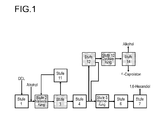
- the top stream of cyclization ( Fig. 1 , Step 13) is worked up after condensation in step 14 on. It can be one or more columns. If a column is used, the optionally still present esterification alcohol and other C 1 to C 6 low boilers are separated off at the top, via side stream pure ⁇ -caprolactone and optionally unconverted hydroxycaproic acid ester which is returned via the bottom.
- ⁇ -caprolactone is obtained when in stage 14 the low boilers mentioned are fed in a first column via the top, ⁇ -caprolactone and other high boilers via the bottom into a second column, where ⁇ -caprolactone is taken off at the top. If the ⁇ -caprolactone stream to be recovered is only smaller amounts, ⁇ -caprolactone can be obtained with one column by batchwise fractional distillation.
- the condensed overheads of thermal treatment which under conditions of thermal treatment volatile compounds, mainly ⁇ -caprolactone may be worked up by distillation in the same way as the condensed overheads of the cyclization, the volatile compounds under cyclization conditions, to highly pure ⁇ -caprolactone.
- the one- or multi-stage distillations for the purification of caprolactone are at bottom temperatures of 70 to 250 ° C, preferably 90 to 230 ° C, particularly preferably 100 to 210 ° C and pressures of 1 to 500 hPa abs., Preferably 5 to 200 hPa, more preferably 10 to 150 hPa performed.
- the level in the reactor was kept at about 40% by means of regulation. Excess reactor contents were discharged. The reactor contents were pumped around, wherein in the Umpumpkeis a heat exchanger supplied energy to the system. At a reactor temperature of about 220 ° C and a pressure of 40 hPa absolute distilled at a reflux ratio of 5: 1 per hour predominantly methanol and ⁇ -caprolactone. The distillate stream was condensed at about 10 ° C. Gas chromatographic analysis showed a yield of ⁇ -caprolactone of 65 mol.%.
- the liquid reaction product from the cyclization reactor (the bottom product of the cyclization) was collected and batchwise with the addition of another 1000 ppm titanate in a distillation flask with 2 liters content and attached column (reflux ratio 1: 1) at 250 ° C and 10 hPa absolute for 3 hours heated.
- the resulting distillation product contained predominantly ⁇ -caprolactone and 1,6-hexanediol.
- the molar ⁇ -caprolactone yield was in this second reaction stage in the individual reactions by 25% ⁇ -caprolactone, so that over the entire process, a yield of 90 mol% was achieved.
- the product obtained in the cyclization and the thermal treatment was distilled batchwise at about 40 mbar. This caprolactone was obtained with a purity of 99.90%.
- Example 1 was repeated, with the difference that 0.2 kg of C 15 -alcohol was added per kg of liquid reaction discharge from the cyclization reactor in the batchwise thermal treatment. As a result, the caprolactone yield in the thermal treatment was increased to about 30%.
- the purifying distillation analogous to Example 1 gave a caprolactone purity of 99.92%
- the remaining bottom product of the cyclization was thermally treated in a 5 liter column-fitted reactor after again adding 1000 ppm of titanate.
- the reactor contents were pumped around, wherein in the Umpumpkeis a heat exchanger supplied energy to the system.
- Umpumpkeis a heat exchanger supplied energy to the system.
- a reactor temperature of about 230 ° C and a pressure of 10 hPa absolute distilled at a reflux ratio of 1: 1 per hour predominantly ⁇ -caprolactone.
- the purifying distillation analogous to Example 1 gave a caprolactone purity of 99.89%.
Landscapes
- Chemical & Material Sciences (AREA)
- Organic Chemistry (AREA)
- Organic Low-Molecular-Weight Compounds And Preparation Thereof (AREA)
- Pyrane Compounds (AREA)
Applications Claiming Priority (2)
| Application Number | Priority Date | Filing Date | Title |
|---|---|---|---|
| US98542407P | 2007-11-05 | 2007-11-05 | |
| PCT/EP2008/064608 WO2009059913A1 (de) | 2007-11-05 | 2008-10-28 | VERFAHREN ZUR HERSTELLUNG ε-CAPROLACTON |
Publications (2)
| Publication Number | Publication Date |
|---|---|
| EP2217587A1 EP2217587A1 (de) | 2010-08-18 |
| EP2217587B1 true EP2217587B1 (de) | 2015-09-23 |
Family
ID=40303445
Family Applications (1)
| Application Number | Title | Priority Date | Filing Date |
|---|---|---|---|
| EP08847460.6A Not-in-force EP2217587B1 (de) | 2007-11-05 | 2008-10-28 | Verfahren zur herstellung von e-caprolacton |
Country Status (7)
| Country | Link |
|---|---|
| US (1) | US8247580B2 (enExample) |
| EP (1) | EP2217587B1 (enExample) |
| JP (1) | JP5453289B2 (enExample) |
| KR (1) | KR20100088691A (enExample) |
| CN (1) | CN101848904B (enExample) |
| CA (1) | CA2703828A1 (enExample) |
| WO (1) | WO2009059913A1 (enExample) |
Families Citing this family (11)
| Publication number | Priority date | Publication date | Assignee | Title |
|---|---|---|---|---|
| US8466299B2 (en) * | 2008-12-05 | 2013-06-18 | Basf Se | Process for preparing delta-valerolactone in the gas phase |
| US8575401B2 (en) | 2008-12-09 | 2013-11-05 | Basf Se | Method for purifying crude polymethylols |
| US8884076B2 (en) | 2008-12-09 | 2014-11-11 | Basf Se | Method for preparing polymethylols |
| CN102256927A (zh) * | 2008-12-18 | 2011-11-23 | 因温斯特技术公司 | 环己烷氧化工艺副产物衍生物及其使用方法 |
| BRPI1006870A2 (pt) | 2009-01-12 | 2016-03-15 | Basf Se | processo para recuperar componentes de uma mistura de baixo ponto de ebulição |
| PL2384344T3 (pl) * | 2009-01-30 | 2020-04-30 | Invista Textiles (U.K.) Limited | Aromatyczne poliestropoliole, pianki poliuretanowe modyfikowane izocyjanuratem i sposoby ich wytwarzania |
| EP2417088B1 (de) | 2009-04-07 | 2013-05-29 | Basf Se | Verfahren zur herstellung von 1,6-hexandiol |
| EP2417089B1 (de) | 2009-04-07 | 2013-06-05 | Basf Se | Verfahren zur herstellung von 1,6-hexandiol und caprolacton |
| CN103080098B (zh) * | 2010-09-08 | 2014-11-05 | 巴斯夫欧洲公司 | 制备ε-己内酯和1,6-己二醇的方法 |
| US11208394B2 (en) | 2018-09-17 | 2021-12-28 | Regents Of The University Of Minnesota | Chemical process to manufacture branched-caprolactone |
| CN111995612A (zh) * | 2020-08-24 | 2020-11-27 | 青岛科技大学 | 一种己内酯的合成方法 |
Family Cites Families (8)
| Publication number | Priority date | Publication date | Assignee | Title |
|---|---|---|---|---|
| GB140184A (en) * | 1919-02-22 | 1920-03-25 | Thomas Stanislaus Fildes | Improvements in or relating to hot water cylinders |
| GB1140184A (en) * | 1967-06-13 | 1969-01-15 | Chisso Corp | Process for manufacturing e-caprolactone |
| DE3823213A1 (de) | 1988-07-08 | 1990-01-11 | Basf Ag | Verfahren zur herstellung von caprolacton |
| MY118128A (en) * | 1996-03-01 | 2004-09-30 | Basf Ag | The preparation of 1, 6-hexanediol and caprolactone |
| DE19744400A1 (de) * | 1997-10-08 | 1999-04-15 | Bayer Ag | Verfahren zur Herstellung von Triazolinthion-Derivaten |
| DE19750532A1 (de) | 1997-11-14 | 1999-05-20 | Basf Ag | Verfahren zur Herstellung von 1,6-Hexandiol und 6-Hydroxycapronsäure bzw. deren Estern |
| DE10100552A1 (de) * | 2001-01-09 | 2002-07-11 | Basf Ag | Verfahren und Vorrichtung zur destillativen Aufarbeitung von 1,6-Hexandiol, 1,5-Pentandiol ung Caprolacton |
| DE10308489A1 (de) * | 2003-02-26 | 2004-09-09 | Basf Ag | Verfahren zur Herstellung von Cyclopentanon und Caprolacton aus Dicarbonsäure-Lösung |
-
2008
- 2008-10-28 CN CN200880114782.4A patent/CN101848904B/zh not_active Expired - Fee Related
- 2008-10-28 EP EP08847460.6A patent/EP2217587B1/de not_active Not-in-force
- 2008-10-28 KR KR1020107012350A patent/KR20100088691A/ko not_active Withdrawn
- 2008-10-28 WO PCT/EP2008/064608 patent/WO2009059913A1/de not_active Ceased
- 2008-10-28 US US12/741,383 patent/US8247580B2/en not_active Expired - Fee Related
- 2008-10-28 JP JP2010532546A patent/JP5453289B2/ja not_active Expired - Fee Related
- 2008-10-28 CA CA2703828A patent/CA2703828A1/en not_active Abandoned
Also Published As
| Publication number | Publication date |
|---|---|
| WO2009059913A1 (de) | 2009-05-14 |
| CN101848904A (zh) | 2010-09-29 |
| US20100240913A1 (en) | 2010-09-23 |
| CA2703828A1 (en) | 2009-05-14 |
| CN101848904B (zh) | 2013-05-01 |
| KR20100088691A (ko) | 2010-08-10 |
| EP2217587A1 (de) | 2010-08-18 |
| US8247580B2 (en) | 2012-08-21 |
| JP2011503021A (ja) | 2011-01-27 |
| JP5453289B2 (ja) | 2014-03-26 |
Similar Documents
| Publication | Publication Date | Title |
|---|---|---|
| EP2225220B1 (de) | Verfahren zur Herstellung von epsilon-Caprolacton | |
| EP0883591B1 (de) | Verfahren zur herstellung von 1,6-hexandiol und caprolacton | |
| EP0883590B1 (de) | Verfahren zur herstellung von 1,6-hexandiol mit einer reinheit über 99 % | |
| EP2417087B1 (de) | Verfahren zur herstellung von 1,6-hexandiol durch hydrierung von oligo- und polyestern | |
| EP2217587A1 (de) | Verfahren zur herstellung e-caprolacton | |
| EP2417089B1 (de) | Verfahren zur herstellung von 1,6-hexandiol und caprolacton | |
| EP2158192A1 (de) | Verfahren zur herstellung -caprolacton | |
| EP2417088B1 (de) | Verfahren zur herstellung von 1,6-hexandiol | |
| EP2244996B1 (de) | Verfahren zur herstellung von 6-hydroxycapronsäureestern | |
| EP1720818B1 (de) | Verfahren zur herstellung von hexandiol - 1,6 | |
| DE19607954A1 (de) | Verfahren zur Herstellung von 1,6-Hexandiol und Caprolacton | |
| EP2373601B1 (de) | Verfahren zur herstellung von 1,6-hexandiol | |
| EP2614056B1 (de) | Verfahren zur herstellung von epsilon-caprolacton und 1,6-hexandiol | |
| EP1189859B1 (de) | Verfahren zur herstellung von hexandiol | |
| DE19607955A1 (de) | Verfahren zur Herstellung von 1,6-Hexandiol mit einer Reinheit über 99 % | |
| WO2004046072A1 (de) | Verfahren zur herstellung von 1,6-hexandiol in einer reinheit von über 99,5% | |
| DE19647349A1 (de) | Verfahren zur Herstellung von 1,6-Hexandiol und Caprolacton | |
| DE19647348A1 (de) | Verfahren zur Herstellung von 1,6-Hexandiol mit einer Reinheit über 99 % | |
| WO2004026798A2 (de) | Verfahren zur herstellung von 1,6-hexandiol | |
| EP1601638B1 (de) | Verfahren zur herstellung und reinigung von cyclopentanon |
Legal Events
| Date | Code | Title | Description |
|---|---|---|---|
| PUAI | Public reference made under article 153(3) epc to a published international application that has entered the european phase |
Free format text: ORIGINAL CODE: 0009012 |
|
| 17P | Request for examination filed |
Effective date: 20100607 |
|
| AK | Designated contracting states |
Kind code of ref document: A1 Designated state(s): AT BE BG CH CY CZ DE DK EE ES FI FR GB GR HR HU IE IS IT LI LT LU LV MC MT NL NO PL PT RO SE SI SK TR |
|
| AX | Request for extension of the european patent |
Extension state: AL BA MK RS |
|
| DAX | Request for extension of the european patent (deleted) | ||
| RIN1 | Information on inventor provided before grant (corrected) |
Inventor name: SIRCH, TILMAN Inventor name: PINKOS, ROLF Inventor name: BEJUNE, STEPHANIE Inventor name: GASIOROWSKI, TODD Inventor name: ANDRESS, JEFFREY T. Inventor name: TEBBEN, GERD-DIETER Inventor name: SPENGEMAN, TODD C Inventor name: KRUG, THOMAS |
|
| GRAP | Despatch of communication of intention to grant a patent |
Free format text: ORIGINAL CODE: EPIDOSNIGR1 |
|
| INTG | Intention to grant announced |
Effective date: 20150625 |
|
| GRAS | Grant fee paid |
Free format text: ORIGINAL CODE: EPIDOSNIGR3 |
|
| GRAA | (expected) grant |
Free format text: ORIGINAL CODE: 0009210 |
|
| AK | Designated contracting states |
Kind code of ref document: B1 Designated state(s): AT BE BG CH CY CZ DE DK EE ES FI FR GB GR HR HU IE IS IT LI LT LU LV MC MT NL NO PL PT RO SE SI SK TR |
|
| REG | Reference to a national code |
Ref country code: GB Ref legal event code: FG4D Free format text: NOT ENGLISH |
|
| REG | Reference to a national code |
Ref country code: CH Ref legal event code: EP |
|
| REG | Reference to a national code |
Ref country code: AT Ref legal event code: REF Ref document number: 751163 Country of ref document: AT Kind code of ref document: T Effective date: 20151015 |
|
| REG | Reference to a national code |
Ref country code: IE Ref legal event code: FG4D Free format text: LANGUAGE OF EP DOCUMENT: GERMAN |
|
| REG | Reference to a national code |
Ref country code: DE Ref legal event code: R096 Ref document number: 502008013411 Country of ref document: DE |
|
| REG | Reference to a national code |
Ref country code: NL Ref legal event code: MP Effective date: 20150923 |
|
| PG25 | Lapsed in a contracting state [announced via postgrant information from national office to epo] |
Ref country code: NO Free format text: LAPSE BECAUSE OF FAILURE TO SUBMIT A TRANSLATION OF THE DESCRIPTION OR TO PAY THE FEE WITHIN THE PRESCRIBED TIME-LIMIT Effective date: 20151223 Ref country code: FI Free format text: LAPSE BECAUSE OF FAILURE TO SUBMIT A TRANSLATION OF THE DESCRIPTION OR TO PAY THE FEE WITHIN THE PRESCRIBED TIME-LIMIT Effective date: 20150923 Ref country code: LT Free format text: LAPSE BECAUSE OF FAILURE TO SUBMIT A TRANSLATION OF THE DESCRIPTION OR TO PAY THE FEE WITHIN THE PRESCRIBED TIME-LIMIT Effective date: 20150923 Ref country code: LV Free format text: LAPSE BECAUSE OF FAILURE TO SUBMIT A TRANSLATION OF THE DESCRIPTION OR TO PAY THE FEE WITHIN THE PRESCRIBED TIME-LIMIT Effective date: 20150923 Ref country code: GR Free format text: LAPSE BECAUSE OF FAILURE TO SUBMIT A TRANSLATION OF THE DESCRIPTION OR TO PAY THE FEE WITHIN THE PRESCRIBED TIME-LIMIT Effective date: 20151224 |
|
| REG | Reference to a national code |
Ref country code: LT Ref legal event code: MG4D |
|
| PG25 | Lapsed in a contracting state [announced via postgrant information from national office to epo] |
Ref country code: SE Free format text: LAPSE BECAUSE OF FAILURE TO SUBMIT A TRANSLATION OF THE DESCRIPTION OR TO PAY THE FEE WITHIN THE PRESCRIBED TIME-LIMIT Effective date: 20150923 Ref country code: HR Free format text: LAPSE BECAUSE OF FAILURE TO SUBMIT A TRANSLATION OF THE DESCRIPTION OR TO PAY THE FEE WITHIN THE PRESCRIBED TIME-LIMIT Effective date: 20150923 |
|
| PG25 | Lapsed in a contracting state [announced via postgrant information from national office to epo] |
Ref country code: NL Free format text: LAPSE BECAUSE OF FAILURE TO SUBMIT A TRANSLATION OF THE DESCRIPTION OR TO PAY THE FEE WITHIN THE PRESCRIBED TIME-LIMIT Effective date: 20150923 |
|
| PG25 | Lapsed in a contracting state [announced via postgrant information from national office to epo] |
Ref country code: CZ Free format text: LAPSE BECAUSE OF FAILURE TO SUBMIT A TRANSLATION OF THE DESCRIPTION OR TO PAY THE FEE WITHIN THE PRESCRIBED TIME-LIMIT Effective date: 20150923 Ref country code: ES Free format text: LAPSE BECAUSE OF FAILURE TO SUBMIT A TRANSLATION OF THE DESCRIPTION OR TO PAY THE FEE WITHIN THE PRESCRIBED TIME-LIMIT Effective date: 20150923 Ref country code: IS Free format text: LAPSE BECAUSE OF FAILURE TO SUBMIT A TRANSLATION OF THE DESCRIPTION OR TO PAY THE FEE WITHIN THE PRESCRIBED TIME-LIMIT Effective date: 20160123 Ref country code: IT Free format text: LAPSE BECAUSE OF FAILURE TO SUBMIT A TRANSLATION OF THE DESCRIPTION OR TO PAY THE FEE WITHIN THE PRESCRIBED TIME-LIMIT Effective date: 20150923 Ref country code: EE Free format text: LAPSE BECAUSE OF FAILURE TO SUBMIT A TRANSLATION OF THE DESCRIPTION OR TO PAY THE FEE WITHIN THE PRESCRIBED TIME-LIMIT Effective date: 20150923 Ref country code: SK Free format text: LAPSE BECAUSE OF FAILURE TO SUBMIT A TRANSLATION OF THE DESCRIPTION OR TO PAY THE FEE WITHIN THE PRESCRIBED TIME-LIMIT Effective date: 20150923 |
|
| PG25 | Lapsed in a contracting state [announced via postgrant information from national office to epo] |
Ref country code: PL Free format text: LAPSE BECAUSE OF FAILURE TO SUBMIT A TRANSLATION OF THE DESCRIPTION OR TO PAY THE FEE WITHIN THE PRESCRIBED TIME-LIMIT Effective date: 20150923 Ref country code: PT Free format text: LAPSE BECAUSE OF FAILURE TO SUBMIT A TRANSLATION OF THE DESCRIPTION OR TO PAY THE FEE WITHIN THE PRESCRIBED TIME-LIMIT Effective date: 20160125 Ref country code: RO Free format text: LAPSE BECAUSE OF FAILURE TO SUBMIT A TRANSLATION OF THE DESCRIPTION OR TO PAY THE FEE WITHIN THE PRESCRIBED TIME-LIMIT Effective date: 20150923 |
|
| REG | Reference to a national code |
Ref country code: CH Ref legal event code: PL |
|
| REG | Reference to a national code |
Ref country code: DE Ref legal event code: R097 Ref document number: 502008013411 Country of ref document: DE |
|
| PG25 | Lapsed in a contracting state [announced via postgrant information from national office to epo] |
Ref country code: MC Free format text: LAPSE BECAUSE OF FAILURE TO SUBMIT A TRANSLATION OF THE DESCRIPTION OR TO PAY THE FEE WITHIN THE PRESCRIBED TIME-LIMIT Effective date: 20150923 |
|
| REG | Reference to a national code |
Ref country code: IE Ref legal event code: MM4A |
|
| PG25 | Lapsed in a contracting state [announced via postgrant information from national office to epo] |
Ref country code: LI Free format text: LAPSE BECAUSE OF NON-PAYMENT OF DUE FEES Effective date: 20151031 Ref country code: CH Free format text: LAPSE BECAUSE OF NON-PAYMENT OF DUE FEES Effective date: 20151031 |
|
| PLBE | No opposition filed within time limit |
Free format text: ORIGINAL CODE: 0009261 |
|
| REG | Reference to a national code |
Ref country code: FR Ref legal event code: ST Effective date: 20160630 |
|
| STAA | Information on the status of an ep patent application or granted ep patent |
Free format text: STATUS: NO OPPOSITION FILED WITHIN TIME LIMIT |
|
| 26N | No opposition filed |
Effective date: 20160624 |
|
| PG25 | Lapsed in a contracting state [announced via postgrant information from national office to epo] |
Ref country code: DK Free format text: LAPSE BECAUSE OF FAILURE TO SUBMIT A TRANSLATION OF THE DESCRIPTION OR TO PAY THE FEE WITHIN THE PRESCRIBED TIME-LIMIT Effective date: 20150923 Ref country code: FR Free format text: LAPSE BECAUSE OF NON-PAYMENT OF DUE FEES Effective date: 20151123 |
|
| PG25 | Lapsed in a contracting state [announced via postgrant information from national office to epo] |
Ref country code: IE Free format text: LAPSE BECAUSE OF NON-PAYMENT OF DUE FEES Effective date: 20151028 |
|
| PG25 | Lapsed in a contracting state [announced via postgrant information from national office to epo] |
Ref country code: SI Free format text: LAPSE BECAUSE OF FAILURE TO SUBMIT A TRANSLATION OF THE DESCRIPTION OR TO PAY THE FEE WITHIN THE PRESCRIBED TIME-LIMIT Effective date: 20150923 |
|
| REG | Reference to a national code |
Ref country code: AT Ref legal event code: MM01 Ref document number: 751163 Country of ref document: AT Kind code of ref document: T Effective date: 20151028 |
|
| PGFP | Annual fee paid to national office [announced via postgrant information from national office to epo] |
Ref country code: GB Payment date: 20161028 Year of fee payment: 9 |
|
| PG25 | Lapsed in a contracting state [announced via postgrant information from national office to epo] |
Ref country code: AT Free format text: LAPSE BECAUSE OF NON-PAYMENT OF DUE FEES Effective date: 20151028 |
|
| PGFP | Annual fee paid to national office [announced via postgrant information from national office to epo] |
Ref country code: DE Payment date: 20170102 Year of fee payment: 9 |
|
| PG25 | Lapsed in a contracting state [announced via postgrant information from national office to epo] |
Ref country code: HU Free format text: LAPSE BECAUSE OF FAILURE TO SUBMIT A TRANSLATION OF THE DESCRIPTION OR TO PAY THE FEE WITHIN THE PRESCRIBED TIME-LIMIT; INVALID AB INITIO Effective date: 20081028 Ref country code: BG Free format text: LAPSE BECAUSE OF FAILURE TO SUBMIT A TRANSLATION OF THE DESCRIPTION OR TO PAY THE FEE WITHIN THE PRESCRIBED TIME-LIMIT Effective date: 20150923 |
|
| PG25 | Lapsed in a contracting state [announced via postgrant information from national office to epo] |
Ref country code: CY Free format text: LAPSE BECAUSE OF FAILURE TO SUBMIT A TRANSLATION OF THE DESCRIPTION OR TO PAY THE FEE WITHIN THE PRESCRIBED TIME-LIMIT Effective date: 20150923 |
|
| PG25 | Lapsed in a contracting state [announced via postgrant information from national office to epo] |
Ref country code: BE Free format text: LAPSE BECAUSE OF NON-PAYMENT OF DUE FEES Effective date: 20151031 |
|
| PG25 | Lapsed in a contracting state [announced via postgrant information from national office to epo] |
Ref country code: MT Free format text: LAPSE BECAUSE OF FAILURE TO SUBMIT A TRANSLATION OF THE DESCRIPTION OR TO PAY THE FEE WITHIN THE PRESCRIBED TIME-LIMIT Effective date: 20150923 Ref country code: TR Free format text: LAPSE BECAUSE OF FAILURE TO SUBMIT A TRANSLATION OF THE DESCRIPTION OR TO PAY THE FEE WITHIN THE PRESCRIBED TIME-LIMIT Effective date: 20150923 |
|
| PG25 | Lapsed in a contracting state [announced via postgrant information from national office to epo] |
Ref country code: LU Free format text: LAPSE BECAUSE OF NON-PAYMENT OF DUE FEES Effective date: 20151028 |
|
| REG | Reference to a national code |
Ref country code: DE Ref legal event code: R119 Ref document number: 502008013411 Country of ref document: DE |
|
| GBPC | Gb: european patent ceased through non-payment of renewal fee |
Effective date: 20171028 |
|
| PG25 | Lapsed in a contracting state [announced via postgrant information from national office to epo] |
Ref country code: GB Free format text: LAPSE BECAUSE OF NON-PAYMENT OF DUE FEES Effective date: 20171028 Ref country code: DE Free format text: LAPSE BECAUSE OF NON-PAYMENT OF DUE FEES Effective date: 20180501 |