EP2213276A1 - Multilayer device for forming adhesive pads for fixing dentures and for forming dermal adhesive bandages - Google Patents
Multilayer device for forming adhesive pads for fixing dentures and for forming dermal adhesive bandages Download PDFInfo
- Publication number
- EP2213276A1 EP2213276A1 EP10151231A EP10151231A EP2213276A1 EP 2213276 A1 EP2213276 A1 EP 2213276A1 EP 10151231 A EP10151231 A EP 10151231A EP 10151231 A EP10151231 A EP 10151231A EP 2213276 A1 EP2213276 A1 EP 2213276A1
- Authority
- EP
- European Patent Office
- Prior art keywords
- forming
- glycerol
- sodium alginate
- adhesive
- content
- Prior art date
- Legal status (The legal status is an assumption and is not a legal conclusion. Google has not performed a legal analysis and makes no representation as to the accuracy of the status listed.)
- Granted
Links
- 239000000853 adhesive Substances 0.000 title claims abstract description 18
- 230000001070 adhesive effect Effects 0.000 title claims abstract description 18
- 230000002500 effect on skin Effects 0.000 title claims abstract description 6
- PEDCQBHIVMGVHV-UHFFFAOYSA-N Glycerine Chemical compound OCC(O)CO PEDCQBHIVMGVHV-UHFFFAOYSA-N 0.000 claims abstract description 39
- 235000010413 sodium alginate Nutrition 0.000 claims abstract description 16
- XLYOFNOQVPJJNP-UHFFFAOYSA-N water Substances O XLYOFNOQVPJJNP-UHFFFAOYSA-N 0.000 claims abstract description 16
- IXPNQXFRVYWDDI-UHFFFAOYSA-N 1-methyl-2,4-dioxo-1,3-diazinane-5-carboximidamide Chemical compound CN1CC(C(N)=N)C(=O)NC1=O IXPNQXFRVYWDDI-UHFFFAOYSA-N 0.000 claims abstract description 15
- 239000000661 sodium alginate Substances 0.000 claims abstract description 15
- 229940005550 sodium alginate Drugs 0.000 claims abstract description 15
- JLVVSXFLKOJNIY-UHFFFAOYSA-N Magnesium ion Chemical compound [Mg+2] JLVVSXFLKOJNIY-UHFFFAOYSA-N 0.000 claims abstract description 6
- 229910001424 calcium ion Inorganic materials 0.000 claims abstract description 6
- 239000000463 material Substances 0.000 claims abstract description 6
- 229910001425 magnesium ion Inorganic materials 0.000 claims abstract description 5
- 239000007788 liquid Substances 0.000 claims description 11
- BHPQYMZQTOCNFJ-UHFFFAOYSA-N Calcium cation Chemical compound [Ca+2] BHPQYMZQTOCNFJ-UHFFFAOYSA-N 0.000 claims description 5
- 239000000203 mixture Substances 0.000 claims description 4
- 230000001225 therapeutic effect Effects 0.000 claims description 4
- 239000000126 substance Substances 0.000 claims description 3
- 229920000858 Cyclodextrin Polymers 0.000 claims description 2
- 239000001116 FEMA 4028 Substances 0.000 claims description 2
- WHGYBXFWUBPSRW-FOUAGVGXSA-N beta-cyclodextrin Chemical group OC[C@H]([C@H]([C@@H]([C@H]1O)O)O[C@H]2O[C@@H]([C@@H](O[C@H]3O[C@H](CO)[C@H]([C@@H]([C@H]3O)O)O[C@H]3O[C@H](CO)[C@H]([C@@H]([C@H]3O)O)O[C@H]3O[C@H](CO)[C@H]([C@@H]([C@H]3O)O)O[C@H]3O[C@H](CO)[C@H]([C@@H]([C@H]3O)O)O3)[C@H](O)[C@H]2O)CO)O[C@@H]1O[C@H]1[C@H](O)[C@@H](O)[C@@H]3O[C@@H]1CO WHGYBXFWUBPSRW-FOUAGVGXSA-N 0.000 claims description 2
- 235000011175 beta-cyclodextrine Nutrition 0.000 claims description 2
- 229960004853 betadex Drugs 0.000 claims description 2
- 239000002537 cosmetic Substances 0.000 claims description 2
- 238000004519 manufacturing process Methods 0.000 claims description 2
- 239000007779 soft material Substances 0.000 claims 1
- OYPRJOBELJOOCE-UHFFFAOYSA-N Calcium Chemical compound [Ca] OYPRJOBELJOOCE-UHFFFAOYSA-N 0.000 abstract description 9
- 239000011575 calcium Substances 0.000 abstract description 9
- 239000004753 textile Substances 0.000 abstract 1
- 239000010410 layer Substances 0.000 description 17
- FAPWRFPIFSIZLT-UHFFFAOYSA-M Sodium chloride Chemical compound [Na+].[Cl-] FAPWRFPIFSIZLT-UHFFFAOYSA-M 0.000 description 12
- 239000006260 foam Substances 0.000 description 11
- 210000000214 mouth Anatomy 0.000 description 9
- TWRXJAOTZQYOKJ-UHFFFAOYSA-L Magnesium chloride Chemical compound [Mg+2].[Cl-].[Cl-] TWRXJAOTZQYOKJ-UHFFFAOYSA-L 0.000 description 8
- UIIMBOGNXHQVGW-UHFFFAOYSA-M Sodium bicarbonate Chemical compound [Na+].OC([O-])=O UIIMBOGNXHQVGW-UHFFFAOYSA-M 0.000 description 8
- 229910052791 calcium Inorganic materials 0.000 description 8
- 239000011777 magnesium Substances 0.000 description 8
- 229910052749 magnesium Inorganic materials 0.000 description 8
- -1 magnesium cations Chemical class 0.000 description 8
- IOLCXVTUBQKXJR-UHFFFAOYSA-M potassium bromide Chemical compound [K+].[Br-] IOLCXVTUBQKXJR-UHFFFAOYSA-M 0.000 description 8
- 239000011780 sodium chloride Substances 0.000 description 6
- 239000000243 solution Substances 0.000 description 5
- 239000007864 aqueous solution Substances 0.000 description 4
- 150000001768 cations Chemical class 0.000 description 4
- 238000001035 drying Methods 0.000 description 4
- 229910001629 magnesium chloride Inorganic materials 0.000 description 4
- 229920000642 polymer Polymers 0.000 description 4
- OTYBMLCTZGSZBG-UHFFFAOYSA-L potassium sulfate Chemical compound [K+].[K+].[O-]S([O-])(=O)=O OTYBMLCTZGSZBG-UHFFFAOYSA-L 0.000 description 4
- 229910052939 potassium sulfate Inorganic materials 0.000 description 4
- 229910000030 sodium bicarbonate Inorganic materials 0.000 description 4
- NWONKYPBYAMBJT-UHFFFAOYSA-L zinc sulfate Chemical compound [Zn+2].[O-]S([O-])(=O)=O NWONKYPBYAMBJT-UHFFFAOYSA-L 0.000 description 4
- 239000011686 zinc sulphate Substances 0.000 description 4
- FHVDTGUDJYJELY-UHFFFAOYSA-N 6-{[2-carboxy-4,5-dihydroxy-6-(phosphanyloxy)oxan-3-yl]oxy}-4,5-dihydroxy-3-phosphanyloxane-2-carboxylic acid Chemical compound O1C(C(O)=O)C(P)C(O)C(O)C1OC1C(C(O)=O)OC(OP)C(O)C1O FHVDTGUDJYJELY-UHFFFAOYSA-N 0.000 description 3
- 238000013019 agitation Methods 0.000 description 3
- 229940072056 alginate Drugs 0.000 description 3
- 235000010443 alginic acid Nutrition 0.000 description 3
- 229920000615 alginic acid Polymers 0.000 description 3
- 235000012206 bottled water Nutrition 0.000 description 3
- 239000003651 drinking water Substances 0.000 description 3
- 210000000416 exudates and transudate Anatomy 0.000 description 3
- 210000003296 saliva Anatomy 0.000 description 3
- 206010052428 Wound Diseases 0.000 description 2
- 208000027418 Wounds and injury Diseases 0.000 description 2
- 230000015572 biosynthetic process Effects 0.000 description 2
- 239000000470 constituent Substances 0.000 description 2
- 239000006185 dispersion Substances 0.000 description 2
- 230000000694 effects Effects 0.000 description 2
- 238000006703 hydration reaction Methods 0.000 description 2
- 238000000034 method Methods 0.000 description 2
- 238000002156 mixing Methods 0.000 description 2
- 238000004806 packaging method and process Methods 0.000 description 2
- 239000002245 particle Substances 0.000 description 2
- 239000001120 potassium sulphate Substances 0.000 description 2
- 235000011151 potassium sulphates Nutrition 0.000 description 2
- 239000000843 powder Substances 0.000 description 2
- 238000002360 preparation method Methods 0.000 description 2
- 238000004080 punching Methods 0.000 description 2
- 150000003839 salts Chemical class 0.000 description 2
- 239000002356 single layer Substances 0.000 description 2
- 235000017557 sodium bicarbonate Nutrition 0.000 description 2
- 229910001220 stainless steel Inorganic materials 0.000 description 2
- 239000010935 stainless steel Substances 0.000 description 2
- 238000003756 stirring Methods 0.000 description 2
- 239000000758 substrate Substances 0.000 description 2
- 229910000368 zinc sulfate Inorganic materials 0.000 description 2
- 235000009529 zinc sulphate Nutrition 0.000 description 2
- 239000004925 Acrylic resin Substances 0.000 description 1
- 229920000178 Acrylic resin Polymers 0.000 description 1
- 229920003171 Poly (ethylene oxide) Polymers 0.000 description 1
- 239000004372 Polyvinyl alcohol Substances 0.000 description 1
- 229910000831 Steel Inorganic materials 0.000 description 1
- 238000010521 absorption reaction Methods 0.000 description 1
- 239000011230 binding agent Substances 0.000 description 1
- 229920001222 biopolymer Polymers 0.000 description 1
- 235000010418 carrageenan Nutrition 0.000 description 1
- 229920001525 carrageenan Polymers 0.000 description 1
- 229920002678 cellulose Polymers 0.000 description 1
- 235000010980 cellulose Nutrition 0.000 description 1
- 230000008878 coupling Effects 0.000 description 1
- 238000010168 coupling process Methods 0.000 description 1
- 238000005859 coupling reaction Methods 0.000 description 1
- 238000013016 damping Methods 0.000 description 1
- 238000006073 displacement reaction Methods 0.000 description 1
- 238000001704 evaporation Methods 0.000 description 1
- 230000008020 evaporation Effects 0.000 description 1
- 239000004744 fabric Substances 0.000 description 1
- 230000037406 food intake Effects 0.000 description 1
- 238000009472 formulation Methods 0.000 description 1
- 239000003349 gelling agent Substances 0.000 description 1
- 150000004676 glycans Polymers 0.000 description 1
- 238000010438 heat treatment Methods 0.000 description 1
- 238000010030 laminating Methods 0.000 description 1
- 238000003475 lamination Methods 0.000 description 1
- 229940096405 magnesium cation Drugs 0.000 description 1
- 230000018984 mastication Effects 0.000 description 1
- 238000010077 mastication Methods 0.000 description 1
- 239000004200 microcrystalline wax Substances 0.000 description 1
- 235000019808 microcrystalline wax Nutrition 0.000 description 1
- 230000000877 morphologic effect Effects 0.000 description 1
- 210000004877 mucosa Anatomy 0.000 description 1
- 239000004745 nonwoven fabric Substances 0.000 description 1
- 239000003002 pH adjusting agent Substances 0.000 description 1
- 210000003254 palate Anatomy 0.000 description 1
- 239000001814 pectin Substances 0.000 description 1
- 229920001277 pectin Polymers 0.000 description 1
- 235000010987 pectin Nutrition 0.000 description 1
- 239000004014 plasticizer Substances 0.000 description 1
- 150000004804 polysaccharides Polymers 0.000 description 1
- 229920002451 polyvinyl alcohol Polymers 0.000 description 1
- 230000000750 progressive effect Effects 0.000 description 1
- 239000011347 resin Substances 0.000 description 1
- 229920005989 resin Polymers 0.000 description 1
- 239000010959 steel Substances 0.000 description 1
- 230000008961 swelling Effects 0.000 description 1
- 239000008399 tap water Substances 0.000 description 1
- 235000020679 tap water Nutrition 0.000 description 1
- 230000009967 tasteless effect Effects 0.000 description 1
- 239000003643 water by type Substances 0.000 description 1
- 238000009736 wetting Methods 0.000 description 1
Images
Classifications
-
- A—HUMAN NECESSITIES
- A61—MEDICAL OR VETERINARY SCIENCE; HYGIENE
- A61L—METHODS OR APPARATUS FOR STERILISING MATERIALS OR OBJECTS IN GENERAL; DISINFECTION, STERILISATION OR DEODORISATION OF AIR; CHEMICAL ASPECTS OF BANDAGES, DRESSINGS, ABSORBENT PADS OR SURGICAL ARTICLES; MATERIALS FOR BANDAGES, DRESSINGS, ABSORBENT PADS OR SURGICAL ARTICLES
- A61L15/00—Chemical aspects of, or use of materials for, bandages, dressings or absorbent pads
- A61L15/16—Bandages, dressings or absorbent pads for physiological fluids such as urine or blood, e.g. sanitary towels, tampons
- A61L15/42—Use of materials characterised by their function or physical properties
- A61L15/44—Medicaments
-
- A—HUMAN NECESSITIES
- A61—MEDICAL OR VETERINARY SCIENCE; HYGIENE
- A61K—PREPARATIONS FOR MEDICAL, DENTAL OR TOILETRY PURPOSES
- A61K6/00—Preparations for dentistry
- A61K6/30—Compositions for temporarily or permanently fixing teeth or palates, e.g. primers for dental adhesives
- A61K6/35—Preparations for stabilising dentures in the mouth
-
- A—HUMAN NECESSITIES
- A61—MEDICAL OR VETERINARY SCIENCE; HYGIENE
- A61L—METHODS OR APPARATUS FOR STERILISING MATERIALS OR OBJECTS IN GENERAL; DISINFECTION, STERILISATION OR DEODORISATION OF AIR; CHEMICAL ASPECTS OF BANDAGES, DRESSINGS, ABSORBENT PADS OR SURGICAL ARTICLES; MATERIALS FOR BANDAGES, DRESSINGS, ABSORBENT PADS OR SURGICAL ARTICLES
- A61L15/00—Chemical aspects of, or use of materials for, bandages, dressings or absorbent pads
- A61L15/16—Bandages, dressings or absorbent pads for physiological fluids such as urine or blood, e.g. sanitary towels, tampons
- A61L15/22—Bandages, dressings or absorbent pads for physiological fluids such as urine or blood, e.g. sanitary towels, tampons containing macromolecular materials
- A61L15/28—Polysaccharides or their derivatives
-
- A—HUMAN NECESSITIES
- A61—MEDICAL OR VETERINARY SCIENCE; HYGIENE
- A61L—METHODS OR APPARATUS FOR STERILISING MATERIALS OR OBJECTS IN GENERAL; DISINFECTION, STERILISATION OR DEODORISATION OF AIR; CHEMICAL ASPECTS OF BANDAGES, DRESSINGS, ABSORBENT PADS OR SURGICAL ARTICLES; MATERIALS FOR BANDAGES, DRESSINGS, ABSORBENT PADS OR SURGICAL ARTICLES
- A61L15/00—Chemical aspects of, or use of materials for, bandages, dressings or absorbent pads
- A61L15/16—Bandages, dressings or absorbent pads for physiological fluids such as urine or blood, e.g. sanitary towels, tampons
- A61L15/42—Use of materials characterised by their function or physical properties
- A61L15/60—Liquid-swellable gel-forming materials, e.g. super-absorbents
-
- A—HUMAN NECESSITIES
- A61—MEDICAL OR VETERINARY SCIENCE; HYGIENE
- A61L—METHODS OR APPARATUS FOR STERILISING MATERIALS OR OBJECTS IN GENERAL; DISINFECTION, STERILISATION OR DEODORISATION OF AIR; CHEMICAL ASPECTS OF BANDAGES, DRESSINGS, ABSORBENT PADS OR SURGICAL ARTICLES; MATERIALS FOR BANDAGES, DRESSINGS, ABSORBENT PADS OR SURGICAL ARTICLES
- A61L2300/00—Biologically active materials used in bandages, wound dressings, absorbent pads or medical devices
- A61L2300/20—Biologically active materials used in bandages, wound dressings, absorbent pads or medical devices containing or releasing organic materials
- A61L2300/23—Carbohydrates
- A61L2300/232—Monosaccharides, disaccharides, polysaccharides, lipopolysaccharides
-
- A—HUMAN NECESSITIES
- A61—MEDICAL OR VETERINARY SCIENCE; HYGIENE
- A61L—METHODS OR APPARATUS FOR STERILISING MATERIALS OR OBJECTS IN GENERAL; DISINFECTION, STERILISATION OR DEODORISATION OF AIR; CHEMICAL ASPECTS OF BANDAGES, DRESSINGS, ABSORBENT PADS OR SURGICAL ARTICLES; MATERIALS FOR BANDAGES, DRESSINGS, ABSORBENT PADS OR SURGICAL ARTICLES
- A61L2300/00—Biologically active materials used in bandages, wound dressings, absorbent pads or medical devices
- A61L2300/60—Biologically active materials used in bandages, wound dressings, absorbent pads or medical devices characterised by a special physical form
- A61L2300/606—Coatings
- A61L2300/608—Coatings having two or more layers
-
- A—HUMAN NECESSITIES
- A61—MEDICAL OR VETERINARY SCIENCE; HYGIENE
- A61L—METHODS OR APPARATUS FOR STERILISING MATERIALS OR OBJECTS IN GENERAL; DISINFECTION, STERILISATION OR DEODORISATION OF AIR; CHEMICAL ASPECTS OF BANDAGES, DRESSINGS, ABSORBENT PADS OR SURGICAL ARTICLES; MATERIALS FOR BANDAGES, DRESSINGS, ABSORBENT PADS OR SURGICAL ARTICLES
- A61L2300/00—Biologically active materials used in bandages, wound dressings, absorbent pads or medical devices
- A61L2300/80—Biologically active materials used in bandages, wound dressings, absorbent pads or medical devices characterised by a special chemical form
- A61L2300/802—Additives, excipients, e.g. cyclodextrins, fatty acids, surfactants
Definitions
- the present invention relates to a multilayer device for forming adhesive pads for fixing dentures and dermal adhesive bandages.
- Two types of formulation are used for fixing dentures into the oral cavity, namely a first type comprising mixtures of micro-crystalline waxes, modified celluloses, pectins, carrageenans and polybutane resins, and a second type comprising alginate threads and alginate particles combined with acrylic resins.
- a first type comprising mixtures of micro-crystalline waxes, modified celluloses, pectins, carrageenans and polybutane resins
- a second type comprising alginate threads and alginate particles combined with acrylic resins.
- the products of the second type require, for developing a sufficient adhesiveness, a contact time with saliva liquids which is considerably longer than 60 seconds; it follows that fixing to the soft parts of the mouth is not adequate, resulting in denture displacement during mastication. This can also cause flaking of both types of product, with consequent release and possible ingestion of material particles.
- US 2005/0137272 A1 describes gelled biopolymer based foam obtained by forming an aqueous dispersion sodium alginates (among other polymers), together with a gelling agent (comprising bivalent cations of alkaline materials, including calcium ions), a plasticizer (including glycerol), pH modifier and water forming a foam from the dispersion and forming a gelled foam, and then drying the gelled foam in a very time consuming manner (such as overnight, see examples 7, 17 and others).
- a gelling agent comprising bivalent cations of alkaline materials, including calcium ions
- a plasticizer including glycerol
- pH modifier including bivalent cations of alkaline materials, including calcium ions
- pH modifier including bivalent cations of alkaline materials, including calcium ions
- pH modifier including bivalent cations of alkaline materials, including calcium ions
- pH modifier including bivalent cations of alkaline materials, including calcium ions
- pH modifier including
- Such foam can be applied onto a surface of a single layer of a substrate (including a woven or non-woven article).
- This gelled form is obtained by heating to temperatures and for times variable between about 1 hour if at 80/100°C and about 8 hours if at ambient temperature. It follows that the residual water content of the dried gelled foam at ambient humidity is about 10% (see examples 19, 20 and elsewhere).
- Such a low residual water content of the dried product has the drawback that the product (foam) is too rigid and poorly manageable for its use for fixing dentures in the oral cavity.
- applying the foam to just a single layer of a substrate easily leads to detachment of this foam from the support.
- the main object of the present invention is to provide a device able to fix dentures into the oral cavity and fix bandages onto the human skin without presenting the aforesaid drawbacks, i.e. a device which is soft, flexible and permeable to aqueous liquids, hence usable both for applying and retaining dentures within the oral cavity and for forming dermal adhesive bandages.
- a device characterised by consisting of two outer layers and an intermediate layer in the form of an aqueous gel having a calcium ion and/or magnesium ion content less than 0.04%, a sodium alginate content between 18.0% and 22.0%, a glycerol content between 30.0% and 42.0%, and a water content between 30.0% and 50.0%, the percentages being by weight on the weight of the intermediate layer.
- the sodium alginate content of the device is 20%
- the glycerol content is 40%
- the constituent material of the outer layers is a web made of hydrophilic fibres, and can comprise a substance of cosmetic or therapeutic action, in particular ⁇ -cyclodextrin.
- the multilayer device of the present invention is prepared by a process characterised in that between 9.0% and 11.0% of sodium alginate and between 15.0% and 21.0% of glycerol are mixed with an aqueous liquid having a calcium ion and/or magnesium ion content less than 0.02%, the percentages indicated being by weight on the total weight of the mixture, which is spread and laminated between two layers of soft, flexible material permeable to aqueous liquids, in a quantity between 400 and 420 g/m 2 such as to form between them said intermediate layer forming part of a multilayer device which is partially dried at a temperature between 100°C and 110°C for a time between 3 and 5 minutes (hence for a very short time compared with that suggested by the aforesaid US patent).
- the two web layers between which the intermediate layer is interposed prevent its flaking, that the thickness of said intermediate layer can be easily obtained and gauged by common laminating machines, that the absorption of water (containing calcium and/or magnesium cations with consequent exhibition of the adhesive power) for gel formation takes place in a very short time, of just a few seconds (generally less than 10 seconds).
- the rate of re-hydration of the previously dried device is high because the thickness which has to be traversed from the outer surfaces of the two web layers to the intermediate layer is small, the residual water content of the dried product developing the property of conferring softness on the multilayer device.
- US 4632880 describes an adhesive device formed from heat-laminated webs having a water activated adhesive uniformly dispersed between these webs, to support a denture within the oral cavity.
- this device comprises - as an essential component bonding the fibres together- a binder based on polyethylene oxide polymer together with sodium alginate as a water-activated adhesive.
- EP1452168 describes a pad comprising a flexible support comprising various components spread over one surface thereof, these components having as is basic constituent a product inherently adhesive towards the skin, in particular polyvinyl alcohol.
- the adhesive power of the device of the present invention is exhibited if, and only if, there is an abundant availability of calcium and/or magnesium cations in the liquid (human saliva, wound exudates, artificial aqueous solutions or common tap water).
- the calcium and/or magnesium cations must however be absent (or present only in the minimum quantities specified in claim 7) during the device coupling/drying stage (production stage) due to the irreversibility of the gel formation process, which would make it difficult to spread the gel over the surfaces of the two webs.
- Sodium alginate is dispersed in water (with the absence of calcium or magnesium cations or containing less than 0.02% of these cations) in a stainless steel vessel. Mixing must continue until the polymer powder is completely dissolved (requiring about 45-50 minutes). On termination of this step, a very viscous transparent liquid mass forms. Glycerol (pharmaceutical grade) is then added into the same vessel, and left under agitation for a further 15 minutes.
- aqueous solution containing 10 wt% of sodium alginate and 20 wt% of glycerol is obtained.
- the solution which is colourless and tasteless, if not used immediately can be stored in a refrigerator cell at +4°C for not more than 48 hours (in closed steel vessels).
- the solution is then applied by lamination between two layers of non-woven hydrophilic web in a quantity of 420 g/m 2 .
- the coupled system formed in this manner is maintained extended and is advanced along a tunnel drying oven of hot air jet type. Its four successive sections must have the following temperatures: a) +100°C, b) +100°C, c) +100°C, and d) +110°C, its advancement rate being 3.5 m/sec.
- the total residence time is 5 min, equally divided between the various sections.
- the product obtained is wound into rolls and then divided into smaller rolls to be fed to subsequent punching to obtain the required shapes.
- the shaped pads obtained are then inserted into individual sachets, which are then inserted into boxes for final packaging.
- the pads are preferably re-hydrated with potable water (containing calcium and/or magnesium cations) to enable rapid commencement of gel swelling by re-hydration followed by easy manipulation in applying the pad to the denture and into the oral cavity, where the presence of the bivalent cations in the water and saliva increases the adhesivity of the device both to the denture and to the oral cavity mucosa.
- Sodium alginate is dispersed in pure water (i.e. without calcium and/or magnesium cations) under slow stirring and at ambient temperature in a stainless steel vessel (easily washable and sanitizable). Mixing must continue until the polymer powder is completely dissolved (requiring about 60 minutes). On termination of this step, a very viscous transparent liquid mass forms. Glycerol (pharmaceutical grade) is then added in the same vessel, and left under agitation for a further 15 minutes.
- an aqueous solution of the following salts is prepared (percentages by weight on the total solution weight):
- the coupled system formed in this manner is maintained extended and is advanced through a tunnel drying oven of hot air jet type. Its four progressive sections must have the following temperatures: a) +100°C, b) +100°C, c) +100°C, and d) +110°C, its advancement rate being 3.5 m/sec, the total residence time in the oven being 4 min, equally divided between the various oven sections.
- the final, i.e. coupled, product is wound into rolls and then divided into smaller rolls to be fed to subsequent punching to obtain the required shapes.
- the shaped sheets obtained are then inserted into sachets, which are then inserted into boxes for final packaging.
- the result obtained is a rectangular sheet which can be further cut to size by the final user to better adapt it to the body part to be treated.
- the bandage obtained in this manner is suitable for application to any part of the body except injured parts.
- the high local concentration of saline solutes remains substantially constant for the entire treatment period, enabling maximum therapeutic effectiveness of the saline complex (there is however some water loss by evaporation due to body heat).
- This device can be produced by preparing the starting gel directly from thermal waters to hence obtain therapeutic bandages with characteristics depending on those of the thermal water used.
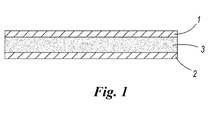
- FIG. 1 A cross-section through a bandage is shown on an enlarged scale in the accompanying Figure 1 in which the reference numerals 1 and 2 indicate respectively two separate layers of hydrophilic porous web fabric between which the intermediate dried gel layer 3 is interposed.
Landscapes
- Health & Medical Sciences (AREA)
- Chemical & Material Sciences (AREA)
- Veterinary Medicine (AREA)
- Life Sciences & Earth Sciences (AREA)
- Animal Behavior & Ethology (AREA)
- General Health & Medical Sciences (AREA)
- Public Health (AREA)
- Epidemiology (AREA)
- Hematology (AREA)
- Engineering & Computer Science (AREA)
- Materials Engineering (AREA)
- Dispersion Chemistry (AREA)
- Oral & Maxillofacial Surgery (AREA)
- Dental Preparations (AREA)
- Materials For Medical Uses (AREA)
- Adhesives Or Adhesive Processes (AREA)
- Cosmetics (AREA)
Abstract
Description
- The present invention relates to a multilayer device for forming adhesive pads for fixing dentures and dermal adhesive bandages.
- Two types of formulation are used for fixing dentures into the oral cavity, namely a first type comprising mixtures of micro-crystalline waxes, modified celluloses, pectins, carrageenans and polybutane resins, and a second type comprising alginate threads and alginate particles combined with acrylic resins. In both cases the application presents a series of problems. With regard to products of the first type, these are difficult to use, as they have to be spread/secured on specific regions of the dental prosthesis, they do not provide a sufficient damping effect (elastic behaviour) to protect the palate or gum, and do not adequately conform to their morphological characteristics.
- The products of the second type require, for developing a sufficient adhesiveness, a contact time with saliva liquids which is considerably longer than 60 seconds; it follows that fixing to the soft parts of the mouth is not adequate, resulting in denture displacement during mastication. This can also cause flaking of both types of product, with consequent release and possible ingestion of material particles.
-
US 2005/0137272 A1 describes gelled biopolymer based foam obtained by forming an aqueous dispersion sodium alginates (among other polymers), together with a gelling agent (comprising bivalent cations of alkaline materials, including calcium ions), a plasticizer (including glycerol), pH modifier and water forming a foam from the dispersion and forming a gelled foam, and then drying the gelled foam in a very time consuming manner (such as overnight, see examples 7, 17 and others). Such dried foam has high absorbency properties and its re-hydrating time is very long (such as 3-5 minutes, see example 13). - Such foam can be applied onto a surface of a single layer of a substrate (including a woven or non-woven article). This gelled form is obtained by heating to temperatures and for times variable between about 1 hour if at 80/100°C and about 8 hours if at ambient temperature. It follows that the residual water content of the dried gelled foam at ambient humidity is about 10% (see examples 19, 20 and elsewhere). Such a low residual water content of the dried product has the drawback that the product (foam) is too rigid and poorly manageable for its use for fixing dentures in the oral cavity. Moreover, applying the foam to just a single layer of a substrate easily leads to detachment of this foam from the support. The aforesaid US patent states that the dried foam is able to absorb large quantities of aqueous liquids, for which reason it illustrates its use for forming bandages which can be applied directly to wounds, to hence absorb the exudates and become adhesive to the skin by the effect of the various bivalent cations present in said exudates.
- The main object of the present invention is to provide a device able to fix dentures into the oral cavity and fix bandages onto the human skin without presenting the aforesaid drawbacks, i.e. a device which is soft, flexible and permeable to aqueous liquids, hence usable both for applying and retaining dentures within the oral cavity and for forming dermal adhesive bandages.
- This object is attained by a device characterised by consisting of two outer layers and an intermediate layer in the form of an aqueous gel having a calcium ion and/or magnesium ion content less than 0.04%, a sodium alginate content between 18.0% and 22.0%, a glycerol content between 30.0% and 42.0%, and a water content between 30.0% and 50.0%, the percentages being by weight on the weight of the intermediate layer.
Preferably the sodium alginate content of the device is 20%, the glycerol content is 40%, and the constituent material of the outer layers is a web made of hydrophilic fibres, and can comprise a substance of cosmetic or therapeutic action, in particular β-cyclodextrin. - The multilayer device of the present invention is prepared by a process characterised in that between 9.0% and 11.0% of sodium alginate and between 15.0% and 21.0% of glycerol are mixed with an aqueous liquid having a calcium ion and/or magnesium ion content less than 0.02%, the percentages indicated being by weight on the total weight of the mixture, which is spread and laminated between two layers of soft, flexible material permeable to aqueous liquids, in a quantity between 400 and 420 g/m2 such as to form between them said intermediate layer forming part of a multilayer device which is partially dried at a temperature between 100°C and 110°C for a time between 3 and 5 minutes (hence for a very short time compared with that suggested by the aforesaid US patent).
- The advantages deriving therefrom are that the two web layers between which the intermediate layer is interposed prevent its flaking, that the thickness of said intermediate layer can be easily obtained and gauged by common laminating machines, that the absorption of water (containing calcium and/or magnesium cations with consequent exhibition of the adhesive power) for gel formation takes place in a very short time, of just a few seconds (generally less than 10 seconds).
- The rate of re-hydration of the previously dried device is high because the thickness which has to be traversed from the outer surfaces of the two web layers to the intermediate layer is small, the residual water content of the dried product developing the property of conferring softness on the multilayer device.
-
US 4632880 describes an adhesive device formed from heat-laminated webs having a water activated adhesive uniformly dispersed between these webs, to support a denture within the oral cavity. However, this device comprises - as an essential component bonding the fibres together- a binder based on polyethylene oxide polymer together with sodium alginate as a water-activated adhesive. -
EP1452168 describes a pad comprising a flexible support comprising various components spread over one surface thereof, these components having as is basic constituent a product inherently adhesive towards the skin, in particular polyvinyl alcohol. - Evidently, the adhesive power of the device of the present invention is exhibited if, and only if, there is an abundant availability of calcium and/or magnesium cations in the liquid (human saliva, wound exudates, artificial aqueous solutions or common tap water). The calcium and/or magnesium cations must however be absent (or present only in the minimum quantities specified in claim 7) during the device coupling/drying stage (production stage) due to the irreversibility of the gel formation process, which would make it difficult to spread the gel over the surfaces of the two webs.
For a better understanding of the characteristics of the device of the present invention, two non-limiting embodiments will now be described. - Sodium alginate is dispersed in water (with the absence of calcium or magnesium cations or containing less than 0.02% of these cations) in a stainless steel vessel. Mixing must continue until the polymer powder is completely dissolved (requiring about 45-50 minutes). On termination of this step, a very viscous transparent liquid mass forms. Glycerol (pharmaceutical grade) is then added into the same vessel, and left under agitation for a further 15 minutes.
- At the end of this step an aqueous solution containing 10 wt% of sodium alginate and 20 wt% of glycerol is obtained. The solution, which is colourless and tasteless, if not used immediately can be stored in a refrigerator cell at +4°C for not more than 48 hours (in closed steel vessels).
- The solution is then applied by lamination between two layers of non-woven hydrophilic web in a quantity of 420 g/m2.
- The coupled system formed in this manner is maintained extended and is advanced along a tunnel drying oven of hot air jet type. Its four successive sections must have the following temperatures: a) +100°C, b) +100°C, c) +100°C, and d) +110°C, its advancement rate being 3.5 m/sec. The total residence time is 5 min, equally divided between the various sections.
- The product obtained is wound into rolls and then divided into smaller rolls to be fed to subsequent punching to obtain the required shapes.
- The shaped pads obtained are then inserted into individual sachets, which are then inserted into boxes for final packaging.
Immediately prior to use the pads are preferably re-hydrated with potable water (containing calcium and/or magnesium cations) to enable rapid commencement of gel swelling by re-hydration followed by easy manipulation in applying the pad to the denture and into the oral cavity, where the presence of the bivalent cations in the water and saliva increases the adhesivity of the device both to the denture and to the oral cavity mucosa. - Sodium alginate is dispersed in pure water (i.e. without calcium and/or magnesium cations) under slow stirring and at ambient temperature in a stainless steel vessel (easily washable and sanitizable). Mixing must continue until the polymer powder is completely dissolved (requiring about 60 minutes). On termination of this step, a very viscous transparent liquid mass forms. Glycerol (pharmaceutical grade) is then added in the same vessel, and left under agitation for a further 15 minutes.
- At the end of this step an aqueous solution containing 11 wt% of sodium alginate and 15 wt% of glycerol is obtained.
- Simultaneously, in another vessel, an aqueous solution of the following salts is prepared (percentages by weight on the total solution weight):
- 1) magnesium chloride MgCl2 0.08%
- 2) potassium sulphate K2SO4 1.4%
- 3) sodium chloride NaCl 10.0%
- 4) zinc sulphate ZnSO4 0.4%
- 5) sodium bicarbonate NaHCO3 0.04%
- 6) potassium bromide KBr 0.02%
- This saline solution is qualitatively similar to that of the Dead Sea.
- At this point 50% w/w of the sodium alginate solution is mixed with 50% w/w of the saline solution in a third mixer under mild stirring.
The mass is kept under agitation until completely homogenized (about 30 minutes). - The weight percentage concentration of the solutes is hence halved compared with that specified in the starting solutions:
- 1) sodium alginate 5.5%
- 2) glycerol 7.5%
- 3) magnesium chloride MgCl2 0.04%
- 4) potassium sulphate K2SO4 0.07%
- 5) sodium chloride NaCl 5.0%
- 6) zinc sulphate ZnSO4 0.2%
- 7) sodium bicarbonate NaHCO3 0.02%
- 8) potassium bromide KBr 0.01 %
- In this manner a gel is obtained (certainly partially crosslinked because of the presence of the magnesium cation), and is laminated by application onto the opposing surfaces of two layers of non-woven web, the gel quantity being 400 g/m2 of web.
- The coupled system formed in this manner is maintained extended and is advanced through a tunnel drying oven of hot air jet type. Its four progressive sections must have the following temperatures: a) +100°C, b) +100°C, c) +100°C, and d) +110°C, its advancement rate being 3.5 m/sec, the total residence time in the oven being 4 min, equally divided between the various oven sections.
- The final, i.e. coupled, product is wound into rolls and then divided into smaller rolls to be fed to subsequent punching to obtain the required shapes.
- The shaped sheets obtained are then inserted into sachets, which are then inserted into boxes for final packaging.
- The result obtained is a rectangular sheet which can be further cut to size by the final user to better adapt it to the body part to be treated.
- Application requires prior wetting of the sheets with warm potable water (containing calcium and magnesium cations) and their application to the skin by handling them as though they were bandages. The water absorbed by capillarity by the two outer non-woven fabric layers comes into contact with the intermediate layer which, as it contains sodium alginate fibres, begins to swell (increasing in volume). The presence of the calcium and/or magnesium cations originating from the hardening salts present in the potable water completes gelling of the active mass by forming ionic cross-linkages between the alginate polysaccharide chains (gel cross-linkage).
- The bandage obtained in this manner is suitable for application to any part of the body except injured parts.
- The high local concentration of saline solutes remains substantially constant for the entire treatment period, enabling maximum therapeutic effectiveness of the saline complex (there is however some water loss by evaporation due to body heat).
- This device can be produced by preparing the starting gel directly from thermal waters to hence obtain therapeutic bandages with characteristics depending on those of the thermal water used.
- A cross-section through a bandage is shown on an enlarged scale in the accompanying
Figure 1 in which thereference numerals 1 and 2 indicate respectively two separate layers of hydrophilic porous web fabric between which the intermediate driedgel layer 3 is interposed.
Claims (7)
- A soft, flexible multilayer device permeable to aqueous liquids for forming adhesive pads for fixing dentures and for forming dermal adhesive bandages, characterised by consisting of two outer layers and an intermediate layer in the form of an aqueous gel having a calcium ion and/or magnesium ion content less than 0.04%, a sodium alginate content between 18.0% and 22.0%, a glycerol content between 30.0% and 42.0%, and a water content between 30.0% and 50.0%, the percentages being by weight on the weight of the intermediate layer.
- A device as claimed in claim 1, characterised in that the sodium alginate content is 20%.
- A device as claimed in claims 1 and 2, characterised in that said glycerol is present in a quantity of 40.0%.
- A device as claimed in claim 1, characterised in that said outer layers of soft material consist of webs formed of hydrophilic fibres.
- A device as claimed in claim 1, characterised by comprising at least one substance of cosmetic or therapeutic action.
- A device as claimed in claim 5, characterised in that said substance is β-cyclodextrin.
- A process for preparing a multilayer device in accordance with claims from 1 to 6, characterised in that between 9.0% and 11.0% of sodium alginate and between 15.0% and 21.0% of glycerol are mixed with an aqueous liquid having a calcium ion and/or magnesium ion content less than 0.02%, the percentages indicated being by weight on the total weight of the mixture, which is spread and laminated between two layers of soft, flexible material permeable to aqueous liquids, in a quantity between 400 and 420 g/m2. such as to form between them said intermediate layer forming part of a multilayer device which is partially dried at a temperature between 100°C and 110°C for a time between 3 and 5 minutes.
Applications Claiming Priority (1)
| Application Number | Priority Date | Filing Date | Title |
|---|---|---|---|
| IT000104A ITMI20090104A1 (en) | 2009-01-29 | 2009-01-29 | ADHESIVE PRODUCT, IN PARTICULAR ADHESIVE BEARING FOR DENTISTRY OR DERMOADESIVE BANDAGE |
Publications (2)
| Publication Number | Publication Date |
|---|---|
| EP2213276A1 true EP2213276A1 (en) | 2010-08-04 |
| EP2213276B1 EP2213276B1 (en) | 2013-04-24 |
Family
ID=41137696
Family Applications (1)
| Application Number | Title | Priority Date | Filing Date |
|---|---|---|---|
| EP10151231.7A Not-in-force EP2213276B1 (en) | 2009-01-29 | 2010-01-20 | Multilayer device for forming adhesive pads for fixing dentures and for forming dermal adhesive bandages |
Country Status (5)
| Country | Link |
|---|---|
| US (1) | US20100190140A1 (en) |
| EP (1) | EP2213276B1 (en) |
| CA (1) | CA2690526A1 (en) |
| IT (1) | ITMI20090104A1 (en) |
| RU (1) | RU2010102890A (en) |
Families Citing this family (3)
| Publication number | Priority date | Publication date | Assignee | Title |
|---|---|---|---|---|
| CN104383590B (en) * | 2014-10-24 | 2016-08-17 | 浙江奥林医疗用品有限公司 | A kind of bamboo protoconch polysaccharide functional dressing and preparation method thereof |
| JP6380898B2 (en) * | 2016-06-25 | 2018-08-29 | 八木 啓介 | Natural denture adsorption sheet |
| CN110368116A (en) * | 2019-08-28 | 2019-10-25 | 广州柏纶义齿科技有限公司 | A kind of artificial tooth bite-block and preparation method thereof |
Citations (4)
| Publication number | Priority date | Publication date | Assignee | Title |
|---|---|---|---|---|
| US4632880A (en) | 1981-02-23 | 1986-12-30 | Combe Incorporated | Dental adhesive device and method of producing same |
| EP1452168A2 (en) | 2003-02-26 | 2004-09-01 | Biofarm S.R.L. | Cosmetic or healing gel for application to the human skin |
| US20050137272A1 (en) | 2003-09-08 | 2005-06-23 | Olav Gaserod | Gelled biopolymer based foam |
| WO2007062346A2 (en) * | 2005-11-22 | 2007-05-31 | Smithkline Beecham Corporation | Adhesive liner |
Family Cites Families (4)
| Publication number | Priority date | Publication date | Assignee | Title |
|---|---|---|---|---|
| US4315779A (en) * | 1979-10-01 | 1982-02-16 | Richardson-Vicks Inc. | Non-adhesive gel compositions for stabilizing dentures |
| WO2001045644A2 (en) * | 1999-12-23 | 2001-06-28 | Combe International Ltd. | Dental adhesive device and method for producing same |
| JP2002000626A (en) * | 2000-06-19 | 2002-01-08 | Health Tech:Kk | Denture stabilizer |
| WO2007062414A1 (en) * | 2005-11-26 | 2007-05-31 | Grinrx | Hydrogel sheets and shapes for oral care |
-
2009
- 2009-01-29 IT IT000104A patent/ITMI20090104A1/en unknown
-
2010
- 2010-01-19 CA CA2690526A patent/CA2690526A1/en not_active Abandoned
- 2010-01-20 EP EP10151231.7A patent/EP2213276B1/en not_active Not-in-force
- 2010-01-27 US US12/694,681 patent/US20100190140A1/en not_active Abandoned
- 2010-01-28 RU RU2010102890/15A patent/RU2010102890A/en not_active Application Discontinuation
Patent Citations (4)
| Publication number | Priority date | Publication date | Assignee | Title |
|---|---|---|---|---|
| US4632880A (en) | 1981-02-23 | 1986-12-30 | Combe Incorporated | Dental adhesive device and method of producing same |
| EP1452168A2 (en) | 2003-02-26 | 2004-09-01 | Biofarm S.R.L. | Cosmetic or healing gel for application to the human skin |
| US20050137272A1 (en) | 2003-09-08 | 2005-06-23 | Olav Gaserod | Gelled biopolymer based foam |
| WO2007062346A2 (en) * | 2005-11-22 | 2007-05-31 | Smithkline Beecham Corporation | Adhesive liner |
Also Published As
| Publication number | Publication date |
|---|---|
| US20100190140A1 (en) | 2010-07-29 |
| ITMI20090104A1 (en) | 2010-07-30 |
| CA2690526A1 (en) | 2010-07-29 |
| EP2213276B1 (en) | 2013-04-24 |
| RU2010102890A (en) | 2011-08-10 |
Similar Documents
| Publication | Publication Date | Title |
|---|---|---|
| CN101959539B (en) | Wound-covering hydrogel material | |
| RU2701257C2 (en) | Skin care composition delivery device | |
| CN108014366B (en) | A kind of marine biological material composite hydrogel dressing and preparation method thereof | |
| TW394689B (en) | Absorbent dressing for absorbing exudate from a wound | |
| CN103800940B (en) | A kind of bleeding-stopping dressing and preparation method | |
| CN102850598B (en) | Alginate-gelatin-carboxymethylcellulose sodium blend membrane, and preparation and application thereof | |
| MX2012005373A (en) | A component for a wound dressing. | |
| WO2002040068A2 (en) | Wound dressing and drug delivery system | |
| CN102137684A (en) | hemostatic material | |
| US20070104769A1 (en) | Bioabsorbable hemostatic gauze | |
| CN103768650A (en) | Wound regenerating and repairing bandage and manufacture method thereof | |
| WO1999053968A1 (en) | Solid borate-diol interaction products for use in wounds | |
| MX2010011297A (en) | Rapidly wetting material containing hydrocolloid, method for the manufacture thereof and use thereof. | |
| RU2249467C2 (en) | Medicinal material and products based upon this material | |
| CN109331215A (en) | A kind of medical antibacterial sponge and preparation method thereof | |
| EP2213276B1 (en) | Multilayer device for forming adhesive pads for fixing dentures and for forming dermal adhesive bandages | |
| US20070020318A1 (en) | Hydrocolloid materials for use in wound healing | |
| CN110403760A (en) | A kind of moisture absorption vapor-permeable type wound dressing patch | |
| JP2003070898A (en) | Plaster and production method thereof | |
| CN107496973B (en) | Chitosan sponge pad band-aid capable of rapidly stopping bleeding and preparation method thereof | |
| CN104069535B (en) | A kind of Preparation method and use of biological activity composite membrane bleeding-stopping dressing | |
| WO2004080500A1 (en) | Hydrocolloid materials for use in wound healing | |
| EP1951326A2 (en) | Bioabsorbable hemostatic gauze | |
| CN112870430B (en) | Composite gel hemostatic powder based on natural polysaccharide, and preparation method and application thereof | |
| JP2003225298A (en) | Adhesive plaster |
Legal Events
| Date | Code | Title | Description |
|---|---|---|---|
| PUAI | Public reference made under article 153(3) epc to a published international application that has entered the european phase |
Free format text: ORIGINAL CODE: 0009012 |
|
| AK | Designated contracting states |
Kind code of ref document: A1 Designated state(s): AT BE BG CH CY CZ DE DK EE ES FI FR GB GR HR HU IE IS IT LI LT LU LV MC MK MT NL NO PL PT RO SE SI SK SM TR |
|
| 17P | Request for examination filed |
Effective date: 20100730 |
|
| GRAP | Despatch of communication of intention to grant a patent |
Free format text: ORIGINAL CODE: EPIDOSNIGR1 |
|
| GRAS | Grant fee paid |
Free format text: ORIGINAL CODE: EPIDOSNIGR3 |
|
| GRAA | (expected) grant |
Free format text: ORIGINAL CODE: 0009210 |
|
| AK | Designated contracting states |
Kind code of ref document: B1 Designated state(s): AT BE BG CH CY CZ DE DK EE ES FI FR GB GR HR HU IE IS IT LI LT LU LV MC MK MT NL NO PL PT RO SE SI SK SM TR |
|
| REG | Reference to a national code |
Ref country code: GB Ref legal event code: FG4D |
|
| REG | Reference to a national code |
Ref country code: CH Ref legal event code: EP |
|
| REG | Reference to a national code |
Ref country code: AT Ref legal event code: REF Ref document number: 608143 Country of ref document: AT Kind code of ref document: T Effective date: 20130515 |
|
| REG | Reference to a national code |
Ref country code: IE Ref legal event code: FG4D |
|
| REG | Reference to a national code |
Ref country code: DE Ref legal event code: R096 Ref document number: 602010006481 Country of ref document: DE Effective date: 20130620 |
|
| REG | Reference to a national code |
Ref country code: AT Ref legal event code: MK05 Ref document number: 608143 Country of ref document: AT Kind code of ref document: T Effective date: 20130424 |
|
| REG | Reference to a national code |
Ref country code: LT Ref legal event code: MG4D |
|
| REG | Reference to a national code |
Ref country code: NL Ref legal event code: VDEP Effective date: 20130424 |
|
| PG25 | Lapsed in a contracting state [announced via postgrant information from national office to epo] |
Ref country code: BE Free format text: LAPSE BECAUSE OF FAILURE TO SUBMIT A TRANSLATION OF THE DESCRIPTION OR TO PAY THE FEE WITHIN THE PRESCRIBED TIME-LIMIT Effective date: 20130424 Ref country code: NO Free format text: LAPSE BECAUSE OF FAILURE TO SUBMIT A TRANSLATION OF THE DESCRIPTION OR TO PAY THE FEE WITHIN THE PRESCRIBED TIME-LIMIT Effective date: 20130724 Ref country code: SE Free format text: LAPSE BECAUSE OF FAILURE TO SUBMIT A TRANSLATION OF THE DESCRIPTION OR TO PAY THE FEE WITHIN THE PRESCRIBED TIME-LIMIT Effective date: 20130424 Ref country code: GR Free format text: LAPSE BECAUSE OF FAILURE TO SUBMIT A TRANSLATION OF THE DESCRIPTION OR TO PAY THE FEE WITHIN THE PRESCRIBED TIME-LIMIT Effective date: 20130725 Ref country code: AT Free format text: LAPSE BECAUSE OF FAILURE TO SUBMIT A TRANSLATION OF THE DESCRIPTION OR TO PAY THE FEE WITHIN THE PRESCRIBED TIME-LIMIT Effective date: 20130424 Ref country code: LT Free format text: LAPSE BECAUSE OF FAILURE TO SUBMIT A TRANSLATION OF THE DESCRIPTION OR TO PAY THE FEE WITHIN THE PRESCRIBED TIME-LIMIT Effective date: 20130424 Ref country code: FI Free format text: LAPSE BECAUSE OF FAILURE TO SUBMIT A TRANSLATION OF THE DESCRIPTION OR TO PAY THE FEE WITHIN THE PRESCRIBED TIME-LIMIT Effective date: 20130424 Ref country code: IS Free format text: LAPSE BECAUSE OF FAILURE TO SUBMIT A TRANSLATION OF THE DESCRIPTION OR TO PAY THE FEE WITHIN THE PRESCRIBED TIME-LIMIT Effective date: 20130824 Ref country code: PT Free format text: LAPSE BECAUSE OF FAILURE TO SUBMIT A TRANSLATION OF THE DESCRIPTION OR TO PAY THE FEE WITHIN THE PRESCRIBED TIME-LIMIT Effective date: 20130826 Ref country code: ES Free format text: LAPSE BECAUSE OF FAILURE TO SUBMIT A TRANSLATION OF THE DESCRIPTION OR TO PAY THE FEE WITHIN THE PRESCRIBED TIME-LIMIT Effective date: 20130804 Ref country code: SI Free format text: LAPSE BECAUSE OF FAILURE TO SUBMIT A TRANSLATION OF THE DESCRIPTION OR TO PAY THE FEE WITHIN THE PRESCRIBED TIME-LIMIT Effective date: 20130424 |
|
| PG25 | Lapsed in a contracting state [announced via postgrant information from national office to epo] |
Ref country code: LV Free format text: LAPSE BECAUSE OF FAILURE TO SUBMIT A TRANSLATION OF THE DESCRIPTION OR TO PAY THE FEE WITHIN THE PRESCRIBED TIME-LIMIT Effective date: 20130424 Ref country code: HR Free format text: LAPSE BECAUSE OF FAILURE TO SUBMIT A TRANSLATION OF THE DESCRIPTION OR TO PAY THE FEE WITHIN THE PRESCRIBED TIME-LIMIT Effective date: 20130424 Ref country code: BG Free format text: LAPSE BECAUSE OF FAILURE TO SUBMIT A TRANSLATION OF THE DESCRIPTION OR TO PAY THE FEE WITHIN THE PRESCRIBED TIME-LIMIT Effective date: 20130724 Ref country code: PL Free format text: LAPSE BECAUSE OF FAILURE TO SUBMIT A TRANSLATION OF THE DESCRIPTION OR TO PAY THE FEE WITHIN THE PRESCRIBED TIME-LIMIT Effective date: 20130424 Ref country code: CY Free format text: LAPSE BECAUSE OF FAILURE TO SUBMIT A TRANSLATION OF THE DESCRIPTION OR TO PAY THE FEE WITHIN THE PRESCRIBED TIME-LIMIT Effective date: 20130424 |
|
| PG25 | Lapsed in a contracting state [announced via postgrant information from national office to epo] |
Ref country code: DK Free format text: LAPSE BECAUSE OF FAILURE TO SUBMIT A TRANSLATION OF THE DESCRIPTION OR TO PAY THE FEE WITHIN THE PRESCRIBED TIME-LIMIT Effective date: 20130424 Ref country code: CZ Free format text: LAPSE BECAUSE OF FAILURE TO SUBMIT A TRANSLATION OF THE DESCRIPTION OR TO PAY THE FEE WITHIN THE PRESCRIBED TIME-LIMIT Effective date: 20130424 Ref country code: SK Free format text: LAPSE BECAUSE OF FAILURE TO SUBMIT A TRANSLATION OF THE DESCRIPTION OR TO PAY THE FEE WITHIN THE PRESCRIBED TIME-LIMIT Effective date: 20130424 Ref country code: EE Free format text: LAPSE BECAUSE OF FAILURE TO SUBMIT A TRANSLATION OF THE DESCRIPTION OR TO PAY THE FEE WITHIN THE PRESCRIBED TIME-LIMIT Effective date: 20130424 |
|
| PG25 | Lapsed in a contracting state [announced via postgrant information from national office to epo] |
Ref country code: NL Free format text: LAPSE BECAUSE OF FAILURE TO SUBMIT A TRANSLATION OF THE DESCRIPTION OR TO PAY THE FEE WITHIN THE PRESCRIBED TIME-LIMIT Effective date: 20130424 Ref country code: IT Free format text: LAPSE BECAUSE OF FAILURE TO SUBMIT A TRANSLATION OF THE DESCRIPTION OR TO PAY THE FEE WITHIN THE PRESCRIBED TIME-LIMIT Effective date: 20130424 Ref country code: RO Free format text: LAPSE BECAUSE OF FAILURE TO SUBMIT A TRANSLATION OF THE DESCRIPTION OR TO PAY THE FEE WITHIN THE PRESCRIBED TIME-LIMIT Effective date: 20130424 |
|
| PLBE | No opposition filed within time limit |
Free format text: ORIGINAL CODE: 0009261 |
|
| STAA | Information on the status of an ep patent application or granted ep patent |
Free format text: STATUS: NO OPPOSITION FILED WITHIN TIME LIMIT |
|
| 26N | No opposition filed |
Effective date: 20140127 |
|
| REG | Reference to a national code |
Ref country code: DE Ref legal event code: R097 Ref document number: 602010006481 Country of ref document: DE Effective date: 20140127 |
|
| REG | Reference to a national code |
Ref country code: DE Ref legal event code: R119 Ref document number: 602010006481 Country of ref document: DE |
|
| PG25 | Lapsed in a contracting state [announced via postgrant information from national office to epo] |
Ref country code: LU Free format text: LAPSE BECAUSE OF FAILURE TO SUBMIT A TRANSLATION OF THE DESCRIPTION OR TO PAY THE FEE WITHIN THE PRESCRIBED TIME-LIMIT Effective date: 20140120 Ref country code: MC Free format text: LAPSE BECAUSE OF FAILURE TO SUBMIT A TRANSLATION OF THE DESCRIPTION OR TO PAY THE FEE WITHIN THE PRESCRIBED TIME-LIMIT Effective date: 20130424 |
|
| REG | Reference to a national code |
Ref country code: CH Ref legal event code: PL |
|
| GBPC | Gb: european patent ceased through non-payment of renewal fee |
Effective date: 20140120 |
|
| REG | Reference to a national code |
Ref country code: DE Ref legal event code: R119 Ref document number: 602010006481 Country of ref document: DE Effective date: 20140801 |
|
| PG25 | Lapsed in a contracting state [announced via postgrant information from national office to epo] |
Ref country code: CH Free format text: LAPSE BECAUSE OF NON-PAYMENT OF DUE FEES Effective date: 20140131 Ref country code: LI Free format text: LAPSE BECAUSE OF NON-PAYMENT OF DUE FEES Effective date: 20140131 Ref country code: DE Free format text: LAPSE BECAUSE OF NON-PAYMENT OF DUE FEES Effective date: 20140801 |
|
| REG | Reference to a national code |
Ref country code: FR Ref legal event code: ST Effective date: 20140930 |
|
| REG | Reference to a national code |
Ref country code: IE Ref legal event code: MM4A |
|
| PG25 | Lapsed in a contracting state [announced via postgrant information from national office to epo] |
Ref country code: GB Free format text: LAPSE BECAUSE OF NON-PAYMENT OF DUE FEES Effective date: 20140120 Ref country code: FR Free format text: LAPSE BECAUSE OF NON-PAYMENT OF DUE FEES Effective date: 20140131 |
|
| PG25 | Lapsed in a contracting state [announced via postgrant information from national office to epo] |
Ref country code: IE Free format text: LAPSE BECAUSE OF NON-PAYMENT OF DUE FEES Effective date: 20140120 |
|
| PG25 | Lapsed in a contracting state [announced via postgrant information from national office to epo] |
Ref country code: MT Free format text: LAPSE BECAUSE OF FAILURE TO SUBMIT A TRANSLATION OF THE DESCRIPTION OR TO PAY THE FEE WITHIN THE PRESCRIBED TIME-LIMIT Effective date: 20130424 |
|
| PG25 | Lapsed in a contracting state [announced via postgrant information from national office to epo] |
Ref country code: SM Free format text: LAPSE BECAUSE OF FAILURE TO SUBMIT A TRANSLATION OF THE DESCRIPTION OR TO PAY THE FEE WITHIN THE PRESCRIBED TIME-LIMIT Effective date: 20130424 |
|
| PG25 | Lapsed in a contracting state [announced via postgrant information from national office to epo] |
Ref country code: HU Free format text: LAPSE BECAUSE OF FAILURE TO SUBMIT A TRANSLATION OF THE DESCRIPTION OR TO PAY THE FEE WITHIN THE PRESCRIBED TIME-LIMIT; INVALID AB INITIO Effective date: 20100120 Ref country code: TR Free format text: LAPSE BECAUSE OF FAILURE TO SUBMIT A TRANSLATION OF THE DESCRIPTION OR TO PAY THE FEE WITHIN THE PRESCRIBED TIME-LIMIT Effective date: 20130424 |
|
| PG25 | Lapsed in a contracting state [announced via postgrant information from national office to epo] |
Ref country code: MK Free format text: LAPSE BECAUSE OF FAILURE TO SUBMIT A TRANSLATION OF THE DESCRIPTION OR TO PAY THE FEE WITHIN THE PRESCRIBED TIME-LIMIT Effective date: 20130424 |