EP2209752B1 - Composition and method for producing an insulating product - Google Patents
Composition and method for producing an insulating product Download PDFInfo
- Publication number
- EP2209752B1 EP2209752B1 EP08838408.6A EP08838408A EP2209752B1 EP 2209752 B1 EP2209752 B1 EP 2209752B1 EP 08838408 A EP08838408 A EP 08838408A EP 2209752 B1 EP2209752 B1 EP 2209752B1
- Authority
- EP
- European Patent Office
- Prior art keywords
- composition
- insulating
- heat
- weight percentage
- hydroxide
- Prior art date
- Legal status (The legal status is an assumption and is not a legal conclusion. Google has not performed a legal analysis and makes no representation as to the accuracy of the status listed.)
- Not-in-force
Links
Images

Classifications
-
- B—PERFORMING OPERATIONS; TRANSPORTING
- B28—WORKING CEMENT, CLAY, OR STONE
- B28B—SHAPING CLAY OR OTHER CERAMIC COMPOSITIONS; SHAPING SLAG; SHAPING MIXTURES CONTAINING CEMENTITIOUS MATERIAL, e.g. PLASTER
- B28B5/00—Producing shaped articles from the material in moulds or on moulding surfaces, carried or formed by, in or on conveyors irrespective of the manner of shaping
- B28B5/02—Producing shaped articles from the material in moulds or on moulding surfaces, carried or formed by, in or on conveyors irrespective of the manner of shaping on conveyors of the endless-belt or chain type
- B28B5/026—Producing shaped articles from the material in moulds or on moulding surfaces, carried or formed by, in or on conveyors irrespective of the manner of shaping on conveyors of the endless-belt or chain type the shaped articles being of indefinite length
- B28B5/027—Producing shaped articles from the material in moulds or on moulding surfaces, carried or formed by, in or on conveyors irrespective of the manner of shaping on conveyors of the endless-belt or chain type the shaped articles being of indefinite length the moulding surfaces being of the indefinite length type, e.g. belts, and being continuously fed
-
- B—PERFORMING OPERATIONS; TRANSPORTING
- B28—WORKING CEMENT, CLAY, OR STONE
- B28B—SHAPING CLAY OR OTHER CERAMIC COMPOSITIONS; SHAPING SLAG; SHAPING MIXTURES CONTAINING CEMENTITIOUS MATERIAL, e.g. PLASTER
- B28B1/00—Producing shaped prefabricated articles from the material
- B28B1/50—Producing shaped prefabricated articles from the material specially adapted for producing articles of expanded material, e.g. cellular concrete
-
- B—PERFORMING OPERATIONS; TRANSPORTING
- B28—WORKING CEMENT, CLAY, OR STONE
- B28B—SHAPING CLAY OR OTHER CERAMIC COMPOSITIONS; SHAPING SLAG; SHAPING MIXTURES CONTAINING CEMENTITIOUS MATERIAL, e.g. PLASTER
- B28B11/00—Apparatus or processes for treating or working the shaped or preshaped articles
- B28B11/04—Apparatus or processes for treating or working the shaped or preshaped articles for coating or applying engobing layers
- B28B11/042—Apparatus or processes for treating or working the shaped or preshaped articles for coating or applying engobing layers with insulating material
-
- B—PERFORMING OPERATIONS; TRANSPORTING
- B28—WORKING CEMENT, CLAY, OR STONE
- B28B—SHAPING CLAY OR OTHER CERAMIC COMPOSITIONS; SHAPING SLAG; SHAPING MIXTURES CONTAINING CEMENTITIOUS MATERIAL, e.g. PLASTER
- B28B11/00—Apparatus or processes for treating or working the shaped or preshaped articles
- B28B11/04—Apparatus or processes for treating or working the shaped or preshaped articles for coating or applying engobing layers
- B28B11/042—Apparatus or processes for treating or working the shaped or preshaped articles for coating or applying engobing layers with insulating material
- B28B11/043—Apparatus or processes for treating or working the shaped or preshaped articles for coating or applying engobing layers with insulating material filling cavities or chambers of hollow blocks
-
- B—PERFORMING OPERATIONS; TRANSPORTING
- B28—WORKING CEMENT, CLAY, OR STONE
- B28B—SHAPING CLAY OR OTHER CERAMIC COMPOSITIONS; SHAPING SLAG; SHAPING MIXTURES CONTAINING CEMENTITIOUS MATERIAL, e.g. PLASTER
- B28B11/00—Apparatus or processes for treating or working the shaped or preshaped articles
- B28B11/24—Apparatus or processes for treating or working the shaped or preshaped articles for curing, setting or hardening
-
- C—CHEMISTRY; METALLURGY
- C04—CEMENTS; CONCRETE; ARTIFICIAL STONE; CERAMICS; REFRACTORIES
- C04B—LIME, MAGNESIA; SLAG; CEMENTS; COMPOSITIONS THEREOF, e.g. MORTARS, CONCRETE OR LIKE BUILDING MATERIALS; ARTIFICIAL STONE; CERAMICS; REFRACTORIES; TREATMENT OF NATURAL STONE
- C04B18/00—Use of agglomerated or waste materials or refuse as fillers for mortars, concrete or artificial stone; Treatment of agglomerated or waste materials or refuse, specially adapted to enhance their filling properties in mortars, concrete or artificial stone
- C04B18/02—Agglomerated materials, e.g. artificial aggregates
- C04B18/027—Lightweight materials
-
- C—CHEMISTRY; METALLURGY
- C04—CEMENTS; CONCRETE; ARTIFICIAL STONE; CERAMICS; REFRACTORIES
- C04B—LIME, MAGNESIA; SLAG; CEMENTS; COMPOSITIONS THEREOF, e.g. MORTARS, CONCRETE OR LIKE BUILDING MATERIALS; ARTIFICIAL STONE; CERAMICS; REFRACTORIES; TREATMENT OF NATURAL STONE
- C04B28/00—Compositions of mortars, concrete or artificial stone, containing inorganic binders or the reaction product of an inorganic and an organic binder, e.g. polycarboxylate cements
- C04B28/24—Compositions of mortars, concrete or artificial stone, containing inorganic binders or the reaction product of an inorganic and an organic binder, e.g. polycarboxylate cements containing alkyl, ammonium or metal silicates; containing silica sols
- C04B28/26—Silicates of the alkali metals
-
- B—PERFORMING OPERATIONS; TRANSPORTING
- B28—WORKING CEMENT, CLAY, OR STONE
- B28B—SHAPING CLAY OR OTHER CERAMIC COMPOSITIONS; SHAPING SLAG; SHAPING MIXTURES CONTAINING CEMENTITIOUS MATERIAL, e.g. PLASTER
- B28B11/00—Apparatus or processes for treating or working the shaped or preshaped articles
- B28B11/14—Apparatus or processes for treating or working the shaped or preshaped articles for dividing shaped articles by cutting
- B28B11/16—Apparatus or processes for treating or working the shaped or preshaped articles for dividing shaped articles by cutting for extrusion or for materials supplied in long webs
-
- Y—GENERAL TAGGING OF NEW TECHNOLOGICAL DEVELOPMENTS; GENERAL TAGGING OF CROSS-SECTIONAL TECHNOLOGIES SPANNING OVER SEVERAL SECTIONS OF THE IPC; TECHNICAL SUBJECTS COVERED BY FORMER USPC CROSS-REFERENCE ART COLLECTIONS [XRACs] AND DIGESTS
- Y02—TECHNOLOGIES OR APPLICATIONS FOR MITIGATION OR ADAPTATION AGAINST CLIMATE CHANGE
- Y02W—CLIMATE CHANGE MITIGATION TECHNOLOGIES RELATED TO WASTEWATER TREATMENT OR WASTE MANAGEMENT
- Y02W30/00—Technologies for solid waste management
- Y02W30/50—Reuse, recycling or recovery technologies
- Y02W30/91—Use of waste materials as fillers for mortars or concrete
Definitions
- the invention relates to a method for producing an insulating product, for example an insulating panel that is usable in the construction of buildings, boats and/or aeroplanes.
- incombustible (or self-extinguishing) materials are widely known and used that are provided with acoustic and heat insulating properties, such as, for example: glass wool, expanded perlite, expanded vermiculite, extruded polystyrene, expanded polyurethane.
- acoustic and heat insulating properties such as, for example: glass wool, expanded perlite, expanded vermiculite, extruded polystyrene, expanded polyurethane.
- the aforesaid materials are usually used to construct insulating products, for example panels for building, that are inserted into the walls and/or the roofs of buildings to reduce the acoustic and heat conductibility thereof.
- a drawback of known insulating materials which is detectable, for example, in vermiculite and in perlite, consists of the fact that the latter require the use of binders if they are used to make panels. This substantially complicates the methods used for making insulating products and makes the latter costly to produce.
- self-extinguishing materials are burnable if attacked by fire (as is detectable experimentally) and are able to stop combustion effectively once they have been moved away from the fire (a situation that is, however, unlikely to occur during a real fire).
- known self-extinguishing materials comprise organic substances and produce, through the effect of the combustion, substantially harmful fumes.
- a further drawback of known insulating materials, that is detectable in particular in glass wool consists of the fact that the products produced using the latter, for example panels for building, tend to release particles (fibres) into the environment of sufficiently small dimensions to be able to be inhaled accidentally. Consequently, the glass wool can cause, or even simply contribute, to the occurrence of serial pathologies of the respiratory tract, thus being substantially harmful both for users of the panels and for the operators assigned to making and/or installing the aforesaid panels.
- RU2087447 discloses a method, in which water glass (67-95%), Ca(OH) 2 as filler (4-25%), crushed sand (0.1-10%) and an organoSilicon fluid (0.01 - 10%), are mixed for 5-60 minutes at 20-60°C. The deriving mixture is then forced through apertures having a diameter between 1-3 mm, so as to form granules. The so formed granules are dried at 60-100°C for 1-15 minutes and the dried granules are finally expanded at 360-800°C for 0.1-15 minutes.
- DE19923493 discloses a lightweight material that is produced from expanded polystyrene granules and an inorganic binder.
- the production of the lightweight material comprises: mixing expanded polystyrene granulate particles with a pre-finished binder consisting of an aqueous colloidal silicic acid dispersion; or mixing polystyrene granulate particles with the aqueous colloidal silicic acid dispersion and/or water glass solution and then mixing with hydrated lime; or mixing polystyrene granulate particles with milk of lime and then mixing with the aqueous colloidal silicic acid dispersion and/or water glass solution.
- the polystyrene granulate particles are completely enclosed by the binder.
- the weight ratio of SiO 2 /CaO is 0.5-1:0.5-1.
- the mixture obtained is hardened.
- An object of the invention is to improve known production methods and the heat and acoustic insulating materials produced therewith
- Another object is to provide a method that enables the manufacture of insulating products, for example panels for building, to be made simpler and less costly.
- a further object is to provide an insulating material provided with heat and acoustic insulating properties that are similar to those of the known insulating materials, and which is usable for producing insulating products, for example panels for building, without requiring the use of binders.
- the method according to the invention enables insulating products to be produced, for example panels for building, that are provided with incombustibility, heat insulating and acoustic insulating properties that are similar to those of the products obtained from known insulating materials.
- the aforesaid heat conductibility value ⁇ is the same as the heat conductibility value ⁇ of a known insulating material, i.e. glass wool.
- the method according to the invention is less polluting, less costly and simpler to apply than known methods inasmuch as binders are not required.
- the composition does not comprise substances that are able to produce harmful fumes during possible combustion, combustion that is moreover prevented by a substantial preponderance (in weight %) of silicate in the composition, as disclosed in detail below.
- an insulating product obtained by the composition is not able to release particles into the environment that are inhalable accidentally, thus being less dangerous for the health of users and/or workers compared with the insulating products obtained with known materials (for example, fibreglass).
- a method is made available for producing an insulating material in powder and/or granules.
- the latter is usable, for example, to fill gaps of building works so as to insulate the latter.
- the method according to the invention enables, without the use of binders, a material and an insulating product to be produced having fireproof, heat insulating and acoustic properties that are similar to those of known materials and insulating products. Consequently, the procedure for manufacturing insulating products, for example bricks and panels for building, is simplified and made less costly.
- a mixture 1 that is usable for producing an insulating product 2, for example a building panel, is obtained from a liquid composition having an average percentage formula expressed in the following Table 1:
- Table 1 Component % range in weight Alkaline silicate (in water solution) 89.9 - 99.7 Metal hydroxide 0.1 - 10 Impermeabilising agent 0.1 - 5
- the alkaline silicate water solution comprises a weight percentage of silicate comprised between 25% and 40%.
- the alkaline silicate comprises: sodium polysilicate (Na 2 O ⁇ nSiO 2 ) and/or potassium polysilicate (K 2 O ⁇ nSiO 2 ).
- the silicate is of alkaline type inasmuch as it has a SiO 2 /Na 2 O (or SiO 2 /K 2 O) ratio comprised between 1.6 and 2.5.
- the alkaline silicate is equal to about 94% of the composition.
- the metal hydroxide is used inasmuch as it is able to bind the ions Na + (or K + ), thus producing insoluble calcium silicates.
- the metal hydroxide may comprise calcium hydroxide (Ca(OH) 2 ), lithium hydroxide (LiOH), magnesium hydroxide (Mg(OH) 2 ), aluminium hydroxide (Al(OH) 3 ), or a mix of these hydroxides.
- the metal hydroxide is equal to about 5% of the composition.
- the impermeabilising agent comprises liquid silicone (for example, a siloxane), that makes a product obtained by the composition in the Table impermeable to water, and thus resistant to humidity.
- liquid silicone for example, a siloxane
- the impermeabilising agent is equal to approximately 1% of the composition.
- Figure 1 shows an apparatus 1 (that does not form part of the invention), by means of which it is possible to make a building product 10, for example an insulating panel.
- a tank 2 provided with a mixing device 3 of known type (shown by a dashed line), is filled with the silicate water solution, the metal hydroxide and the impermeabilising agent, according to the weight percentages disclosed above.
- colouring agents are also fed into the tank 2, for example pigments, in a weight percentage equal to 0.5-1% of the composition.
- fibres are also fed into the tank 2, the fibres can be inorganic (for example, fibreglass) and/or vegetable (for example, jute or cocoa fibre) and are provided in a weight percentage equal to 0.5-1% of the composition.
- the aforesaid fibres act by increasing the mechanical resistance of the product 10.
- calcium stearate [CH 3 (CH 2 ) 16 COOH] 2 Ca
- a weight percentage equal to 0.1-5% of the composition.
- the various components are mixed together so as to produce a liquid mixture C that, via conduit means 4, is transferred to a conveying device 5.
- the conduit means is provided with pumping means that facilitates the transfer of the mixture C.
- the conveying device 5 is partially housed in a tunnel kiln 9 (shown by a dashed line), of known type, that is able to reach temperatures up to 450°C.
- the conveying device 5 comprises a pair of belt conveyors 6, 7 of known type that are horizontally superimposed on one another and are interposed between two side baffles (that are not shown), that are parallel to one another.
- Each side baffle is arranged vertically with respect to an adjacent side of the conveying device 5 and extends along the entire length of the latter.
- Each conveyor belt 6, 7 comprises a corresponding belt 6a, 7a, that is coated with an anti-adhering material, for example polytetrafluorethylene (PTFE), and is driven by a plurality of motorized rollers 8.
- PTFE polytetrafluorethylene
- each belt 6a, 7a slides in contact with a stiff plane (that is not shown), for example made of steel.
- the two belt conveyors 6, 7 are supported by a supporting frame S, maintaining the two mutually overlapping and parallel belt conveyors 6, 7.
- the supporting frame S is provided with a positioning device (that is not shown), comprising a plurality of worm screws interacting with a corresponding plurality of lead screw elements.
- the worm screws (driven by motors) are mounted on side portions of the conveyor belt 6 (or 7), whilst the respective lead screw elements are mounted on corresponding side portions of the other conveyor belt 7 (or 6).
- the conveyor belt 6 and the conveyor belt 7 can be moved away from and/or towards one another, so as to vary (i.e. increase and/or decrease) a distance d comprised between the respective belts 6a, 7a and defining the thickness of the product 10 producible by the apparatus 1.
- the mixture C Once the mixture C has been conveyed by the conduit means 4 to an inlet end 5a of the conveying device 5 it expands on the surface of the belt 7a that, together with the belt 6a above, runs in an advancing direction F1 to an outlet end 5b of the conveying device 5, opposite the inlet end 5a. Proceeding in the advancing direction F1, the mixture C is subjected to the action of a high temperature, comprised between 200°C and 450°C, generated inside the tunnel kiln 9.
- a high temperature comprised between 200°C and 450°C
- the mixture C remains confined in a sort of "mould cavity", that is approximately parallelpipedon-shaped and is defined overall by the belt 6a, by the belt 7a (and by the stiff planes in contact with which the belt 6a and the belt 7a run) and by the side baffles flanking the two belt conveyors 6 and 7.
- This "mould cavity” defines the shape and dimensions of the product 10. Consequently, the product 10, when it exits the conveying device 5 at the outlet end 5b, is also substantially parallelpipedon-shaped, having a width that is the same as the width of each belt 6a, 7a and a thickness that is equal to the distance d comprised between belt 6a and the belt 7a.
- the thickness of the product 10 In order to vary the thickness of the product 10, it is sufficient to vary in an appropriate manner the distance d from the positioning device comprised in the supporting frame S.
- the duration of the heat treatment varies in function of the final thickness of the product 10 to be produced and is anyway comprised between 1 h and 6 h. In order to vary the duration of the heat treatment it is sufficient to vary the advancing speed of the belt conveyors 6 and 7 in the advancing direction F1. Further, by appropriately adjusting the maximum temperature at which heat treatment is conducted, it is possible to vary the properties, and thus the use, of the product 10.
- the maximum temperature applied is approximately 250°C
- the mixture C is not completely dehydrated, inasmuch as the water bound in the components of the mixture does not evaporate and the product 10 thus obtained is provided with optimal fireproof properties.
- the maximum applied temperature is approximately 400-450°C
- the mixture C is completely dehydrated, as also the bound water is removed and the product 10 obtained thereby is particularly effective in ensuring heat insulation.
- a cutting station that is not shown
- the cutting member enables the product 10 exiting the conveying device 5 to be cut at preset intervals so as to produce, for example, a plurality of panels having a rectangular plan shape.
- a coating sheet is positioned that may comprise: paper, aluminium, plastic film, vegetable-fibre film. Consequently, the produced product 10 is enclosed in a protective casing, that increases the mechanical and/or insulating properties thereof.
- the product 10 exiting the conveying device 5 is immersed in an impermeabilising bath, comprising a silicone water solution or a diluted sulphuric acid water solution.
- the conveying device 5 comprises two pairs of horizontally overlapping belt conveyors, conformed and functioning in a similar manner to the belt conveyors 6, 7 disclosed above.
- the two pairs of belt conveyors are mutually aligned along the advancing direction F1, the cutting station is positioned at the adjacent ends of the two pairs and the cutting member works inside the tunnel kiln.
- the belts 6a and 7a By shaping in a suitable manner (according to known procedures) the belts 6a and 7a, it is possible to vary the shape and dimensions of the product 10, so that the latter can be used, not only in building but also for insulating hulls of boats, fuselages of aeroplanes and railway carriages.
- the product 10 Owing to the cellular structure that is generated in the mixture C through the effect of the heat treatment, the product 10 has optimal acoustic and heat insulating properties and a specific weight that is less than that of known insulating products.
- the product 10 does not require the use of binders, it thus being less costly than known insulating products. Owing to the absence of chemical binders in the mixture C, the product 10 can be disposed of as simple solid urban waste rather than as industrial waste and can even be recycled. Owing to the preponderance (in weight %) of the silicate in the mixture C, the product 10 is incombustible.
- the liquid mixture C prepared in the tank 2 is fed into a dryer/centrifugator of known type (for example, the "Turbo Dryer" apparatus produced by VOMM S.p.A.), in which the mixture C is simultaneously heat-treated and finely divided, i.e.
- the insulating material in powder (or granules) according to the invention has the same insulating, acoustic and fireproof properties as the products 10 that are obtainable by the apparatus 1.
- the insulating powder material can be used directly to fill and insulate the gaps of floors and/or walls, or to fill bags made of biodegradable material (of vegetable origin) or of thermoreflective material (aluminium), that are in turn inserted into the aforesaid gaps.
- the insulating material in powder according to the invention having a lesser specific weight than other known insulating materials, can be mixed with clay and used both as a lightening and an insulating material with which to produce building products, for example, bricks.
- the insulating material in powder according to the invention is obtained by milling a product 10.
- the operating parameters of the drying/centrifugator apparatus can be set so as to produce, starting with the liquid mixture C, a material in powder (or granules) that is not completely dehydrated and not completely expanded. This can be obtained, for example, by performing heat treatment at temperatures comprised between 100°C and 250°C.
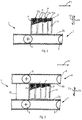
- Figures 2 and 3 illustrate a manner of use (not forming part of the invention) of the apparatus 1 for producing the aforesaid material in powder not completely dehydrated and not completely expanded.
- a building product provided with cavities for example a drilled brick 11, provided with holes 11a and ground, is positioned on the belt 7a of the conveyor belt 7 (i.e. on the conveyor belt positioned below in the conveying device 5).
- a dispensing device of known type that is not shown
- the positioning device is again driven to move the conveyor belt 6 and the conveyor belt 7 closer to make the distance d the same as the height of the drilled brick 11.
- the material in powder P remains confined inside the holes 11a. It is thus possible, by driving the conveying device 5, to move in the advancing direction F1 the drilled brick 11, so as to heat the latter to about 400-450°C and dry completely the material in powder P.
- the latter through the effect of the heat treatment, expands inside the holes 11a, but cannot exit the latter inasmuch as it is immobilised there by the belt 6a and by the belt 7a of the conveying device 5.
- the drilled brick 11 exits the outlet end 5b of the conveying device 5, the material in powder P that fills the holes 11a is completely expanded and dried.
- the drilled brick 11 is inserted into a mould made in a shapingly coupled manner with the drilled brick 11. After filling the holes 11a with the material in powder P the mould is closed and inserted into a kiln of known type, inside which the brick 11 is heat-treated at a temperature of approximately 400-450°C, i.e. in a similar manner to what is disclosed above with reference to Figures 2 and 3 .
Landscapes
- Engineering & Computer Science (AREA)
- Chemical & Material Sciences (AREA)
- Ceramic Engineering (AREA)
- Structural Engineering (AREA)
- Mechanical Engineering (AREA)
- Manufacturing & Machinery (AREA)
- Materials Engineering (AREA)
- Organic Chemistry (AREA)
- Civil Engineering (AREA)
- Inorganic Chemistry (AREA)
- Chemical Kinetics & Catalysis (AREA)
- Building Environments (AREA)
- Processing Of Solid Wastes (AREA)
- Macromonomer-Based Addition Polymer (AREA)
- Solid-Sorbent Or Filter-Aiding Compositions (AREA)
- Pigments, Carbon Blacks, Or Wood Stains (AREA)
- Silicates, Zeolites, And Molecular Sieves (AREA)
- Organic Insulating Materials (AREA)
Priority Applications (2)
| Application Number | Priority Date | Filing Date | Title |
|---|---|---|---|
| SI200831644A SI2209752T1 (sl) | 2007-10-09 | 2008-10-06 | Sestava in postopek za izdelavo izolacijskega proizvoda |
| HRP20160858TT HRP20160858T1 (hr) | 2007-10-09 | 2008-10-06 | Sastav i metoda proizvodnje izolacijskog proizvoda |
Applications Claiming Priority (2)
| Application Number | Priority Date | Filing Date | Title |
|---|---|---|---|
| IT000307A ITMO20070307A1 (it) | 2007-10-09 | 2007-10-09 | Composizione e metodo per produrre un manufatto isolante |
| PCT/IB2008/002641 WO2009047612A2 (en) | 2007-10-09 | 2008-10-06 | Composition and method for producing an insulating product |
Publications (2)
| Publication Number | Publication Date |
|---|---|
| EP2209752A2 EP2209752A2 (en) | 2010-07-28 |
| EP2209752B1 true EP2209752B1 (en) | 2016-04-13 |
Family
ID=40313918
Family Applications (1)
| Application Number | Title | Priority Date | Filing Date |
|---|---|---|---|
| EP08838408.6A Not-in-force EP2209752B1 (en) | 2007-10-09 | 2008-10-06 | Composition and method for producing an insulating product |
Country Status (11)
| Country | Link |
|---|---|
| US (1) | US8425794B2 (pl) |
| EP (1) | EP2209752B1 (pl) |
| CA (1) | CA2702157C (pl) |
| DK (1) | DK2209752T3 (pl) |
| ES (1) | ES2579445T3 (pl) |
| HR (1) | HRP20160858T1 (pl) |
| IT (1) | ITMO20070307A1 (pl) |
| PL (1) | PL2209752T3 (pl) |
| RU (1) | RU2010117204A (pl) |
| SI (1) | SI2209752T1 (pl) |
| WO (1) | WO2009047612A2 (pl) |
Families Citing this family (2)
| Publication number | Priority date | Publication date | Assignee | Title |
|---|---|---|---|---|
| US9336768B2 (en) * | 2010-02-17 | 2016-05-10 | CCD Ventures LLC | Smartphone security masking enclosure |
| EP2420380A1 (en) * | 2010-08-19 | 2012-02-22 | Alcoa Architectural Products SAS | Non-combustible composite panel and manufacturing method |
Family Cites Families (13)
| Publication number | Priority date | Publication date | Assignee | Title |
|---|---|---|---|---|
| GB933410A (en) | 1960-08-27 | 1963-08-08 | Basf Ag | Production of fireproofing sheets |
| DE2207278A1 (de) | 1971-02-18 | 1972-10-05 | Lion Fat & Oil Co, Ltd , Tokio | Schaume und Hohlteilchen, bestehend aus anorganischen Substanzen, und Verfahren zu ihrer Herstellung |
| JPS508807A (pl) | 1973-05-28 | 1975-01-29 | ||
| AU520693B2 (en) | 1979-09-10 | 1982-02-18 | Ppg Industries, Inc. | Curable pigmented silicate coating commpositions |
| US4328034A (en) | 1980-05-27 | 1982-05-04 | Ferguson Charles N | Foam composition and process |
| DE3723186A1 (de) | 1987-07-14 | 1989-01-26 | Steag Entsorgungs Gmbh | Verfahren zur herstellung von granulaten oder formkoerpern aus staubfoermigen mineralischen stoffen |
| US5256222A (en) | 1990-09-10 | 1993-10-26 | Manville Corporation | Lightweight building material board |
| RU2087447C1 (ru) * | 1993-08-12 | 1997-08-20 | Акционерное общество "Интеркварцстрой" | Смесь для получения теплоизоляционного материала и способ его получения |
| DE9418205U1 (de) | 1994-11-12 | 1996-03-14 | Pafamax Brandschutztechnik GmbH, 34123 Kassel | Bauelement aus einem nicht brennbaren Material |
| JPH0910685A (ja) | 1995-06-30 | 1997-01-14 | Kawasaki Steel Corp | 保護膜形成方法 |
| DE19923493C2 (de) | 1998-06-15 | 2003-02-27 | Stefan Wisser | Verfahren zur Herstellung eines Leichtwerkstoffes und seine Verwendung |
| DE19909077A1 (de) * | 1999-03-02 | 2000-09-14 | Peter Niedner | Mineralischer schaumförmiger Bau- und Strukturwerkstoff sowie Verfahren zur Herstellung eines Mineralschaumes und Vorrichtung zur Durchführung des Verfahrens |
| WO2008157714A1 (en) | 2007-06-19 | 2008-12-24 | Georgia Tech Research Corporation | High strength pozzolan foam materials and methods of making the same |
-
2007
- 2007-10-09 IT IT000307A patent/ITMO20070307A1/it unknown
-
2008
- 2008-10-06 WO PCT/IB2008/002641 patent/WO2009047612A2/en not_active Ceased
- 2008-10-06 SI SI200831644A patent/SI2209752T1/sl unknown
- 2008-10-06 CA CA2702157A patent/CA2702157C/en not_active Expired - Fee Related
- 2008-10-06 US US12/682,009 patent/US8425794B2/en not_active Expired - Fee Related
- 2008-10-06 ES ES08838408.6T patent/ES2579445T3/es active Active
- 2008-10-06 HR HRP20160858TT patent/HRP20160858T1/hr unknown
- 2008-10-06 EP EP08838408.6A patent/EP2209752B1/en not_active Not-in-force
- 2008-10-06 RU RU2010117204/03A patent/RU2010117204A/ru not_active Application Discontinuation
- 2008-10-06 DK DK08838408.6T patent/DK2209752T3/en active
- 2008-10-06 PL PL08838408T patent/PL2209752T3/pl unknown
Also Published As
| Publication number | Publication date |
|---|---|
| HRP20160858T1 (hr) | 2016-12-02 |
| US8425794B2 (en) | 2013-04-23 |
| EP2209752A2 (en) | 2010-07-28 |
| DK2209752T3 (en) | 2016-07-25 |
| CA2702157A1 (en) | 2009-04-16 |
| CA2702157C (en) | 2016-07-12 |
| WO2009047612A2 (en) | 2009-04-16 |
| SI2209752T1 (sl) | 2016-08-31 |
| US20100282997A1 (en) | 2010-11-11 |
| PL2209752T3 (pl) | 2017-03-31 |
| WO2009047612A3 (en) | 2010-03-04 |
| ITMO20070307A1 (it) | 2009-04-10 |
| ES2579445T3 (es) | 2016-08-11 |
| RU2010117204A (ru) | 2011-11-20 |
Similar Documents
| Publication | Publication Date | Title |
|---|---|---|
| US5641584A (en) | Highly insulative cementitious matrices and methods for their manufacture | |
| US5631097A (en) | Laminate insulation barriers having a cementitious structural matrix and methods for their manufacture | |
| KR100795991B1 (ko) | 방화문코어를 형성하는 방법 및 시스템 | |
| KR100457426B1 (ko) | 내열성이 우수한 초경량의 난연성 단열재 조성물과 그제조장치 및 그를 이용한 제조방법 | |
| JPH04244840A (ja) | 軽量建築材厚板 | |
| US3957501A (en) | Non-combustible light-weight inorganic shaped articles and process of manufacture | |
| CZ299245B6 (cs) | Lehcený materiál obsahující penový perlit a zpusob jeho výroby | |
| EP2209752B1 (en) | Composition and method for producing an insulating product | |
| JP2022516303A (ja) | 保温プレート原料組成物、保温プレート及びその製造工程 | |
| Bulewicz et al. | Intumescent silicate‐based materials: Mechanism of swelling in contact with fire | |
| CN109912285B (zh) | 一种柔性保温板的制作工艺 | |
| RU2442762C1 (ru) | Способ изготовления легковесного керамического теплоизоляционного и теплоизоляционно-конструкционного материала | |
| KR102543519B1 (ko) | 패각류를 이용한 단열재의 제조 방법 | |
| DE2853333C2 (de) | Verfahren zur Herstellung eines mineralischen Schaumstoffes | |
| JPH09110514A (ja) | 石綿原料焼結体とその製造方法 | |
| JP2019532003A (ja) | 疎水性シリカ成形体の製造方法 | |
| RU2100321C1 (ru) | Способ получения теплоизоляционного конструктивного материала | |
| CN103951337B (zh) | 一种低密度高强度速凝发泡水泥保温板及其制备方法 | |
| RU2473516C1 (ru) | Способ изготовления легковесного керамического теплоизоляционного и теплоизоляционно-конструкционного материала "конпазит" | |
| JPH05500676A (ja) | フェノール樹脂とセメントとを含有する組成物 | |
| CN112174605A (zh) | 一种外墙板用的石墨防火保温芯材及其制备方法 | |
| JP2660378B2 (ja) | 耐火被覆材の製造法 | |
| US11623891B2 (en) | Process for fireproofing materials | |
| JP2652774B2 (ja) | 無機質板の製造方法 | |
| KR20230044066A (ko) | 패각 및 질석을 이용한 친환경 불연 마감재의 제조 방법 |
Legal Events
| Date | Code | Title | Description |
|---|---|---|---|
| PUAI | Public reference made under article 153(3) epc to a published international application that has entered the european phase |
Free format text: ORIGINAL CODE: 0009012 |
|
| 17P | Request for examination filed |
Effective date: 20100504 |
|
| AK | Designated contracting states |
Kind code of ref document: A2 Designated state(s): AT BE BG CH CY CZ DE DK EE ES FI FR GB GR HR HU IE IS IT LI LT LU LV MC MT NL NO PL PT RO SE SI SK TR |
|
| AX | Request for extension of the european patent |
Extension state: AL BA MK RS |
|
| DAX | Request for extension of the european patent (deleted) | ||
| 17Q | First examination report despatched |
Effective date: 20111118 |
|
| GRAP | Despatch of communication of intention to grant a patent |
Free format text: ORIGINAL CODE: EPIDOSNIGR1 |
|
| RIC1 | Information provided on ipc code assigned before grant |
Ipc: C04B 18/02 20060101ALI20151009BHEP Ipc: C04B 103/65 20060101ALI20151009BHEP Ipc: B01J 2/28 20060101ALI20151009BHEP Ipc: F16L 59/00 20060101ALI20151009BHEP Ipc: C04B 28/26 20060101AFI20151009BHEP Ipc: C04B 38/02 20060101ALI20151009BHEP |
|
| INTG | Intention to grant announced |
Effective date: 20151028 |
|
| GRAS | Grant fee paid |
Free format text: ORIGINAL CODE: EPIDOSNIGR3 |
|
| GRAA | (expected) grant |
Free format text: ORIGINAL CODE: 0009210 |
|
| AK | Designated contracting states |
Kind code of ref document: B1 Designated state(s): AT BE BG CH CY CZ DE DK EE ES FI FR GB GR HR HU IE IS IT LI LT LU LV MC MT NL NO PL PT RO SE SI SK TR |
|
| REG | Reference to a national code |
Ref country code: GB Ref legal event code: FG4D |
|
| REG | Reference to a national code |
Ref country code: AT Ref legal event code: REF Ref document number: 789948 Country of ref document: AT Kind code of ref document: T Effective date: 20160415 Ref country code: CH Ref legal event code: EP |
|
| REG | Reference to a national code |
Ref country code: IE Ref legal event code: FG4D |
|
| REG | Reference to a national code |
Ref country code: DE Ref legal event code: R096 Ref document number: 602008043606 Country of ref document: DE |
|
| REG | Reference to a national code |
Ref country code: CH Ref legal event code: NV Representative=s name: FIAMMENGHI-FIAMMENGHI, CH |
|
| REG | Reference to a national code |
Ref country code: HR Ref legal event code: TUEP Ref document number: P20160858 Country of ref document: HR Ref country code: RO Ref legal event code: EPE |
|
| REG | Reference to a national code |
Ref country code: DK Ref legal event code: T3 Effective date: 20160714 |
|
| REG | Reference to a national code |
Ref country code: LT Ref legal event code: MG4D Ref country code: NL Ref legal event code: FP |
|
| REG | Reference to a national code |
Ref country code: ES Ref legal event code: FG2A Ref document number: 2579445 Country of ref document: ES Kind code of ref document: T3 Effective date: 20160811 |
|
| REG | Reference to a national code |
Ref country code: FR Ref legal event code: PLFP Year of fee payment: 9 |
|
| PG25 | Lapsed in a contracting state [announced via postgrant information from national office to epo] |
Ref country code: LT Free format text: LAPSE BECAUSE OF FAILURE TO SUBMIT A TRANSLATION OF THE DESCRIPTION OR TO PAY THE FEE WITHIN THE PRESCRIBED TIME-LIMIT Effective date: 20160413 Ref country code: NO Free format text: LAPSE BECAUSE OF FAILURE TO SUBMIT A TRANSLATION OF THE DESCRIPTION OR TO PAY THE FEE WITHIN THE PRESCRIBED TIME-LIMIT Effective date: 20160713 Ref country code: FI Free format text: LAPSE BECAUSE OF FAILURE TO SUBMIT A TRANSLATION OF THE DESCRIPTION OR TO PAY THE FEE WITHIN THE PRESCRIBED TIME-LIMIT Effective date: 20160413 |
|
| PG25 | Lapsed in a contracting state [announced via postgrant information from national office to epo] |
Ref country code: GR Free format text: LAPSE BECAUSE OF FAILURE TO SUBMIT A TRANSLATION OF THE DESCRIPTION OR TO PAY THE FEE WITHIN THE PRESCRIBED TIME-LIMIT Effective date: 20160714 Ref country code: SE Free format text: LAPSE BECAUSE OF FAILURE TO SUBMIT A TRANSLATION OF THE DESCRIPTION OR TO PAY THE FEE WITHIN THE PRESCRIBED TIME-LIMIT Effective date: 20160413 Ref country code: LV Free format text: LAPSE BECAUSE OF FAILURE TO SUBMIT A TRANSLATION OF THE DESCRIPTION OR TO PAY THE FEE WITHIN THE PRESCRIBED TIME-LIMIT Effective date: 20160413 Ref country code: PT Free format text: LAPSE BECAUSE OF FAILURE TO SUBMIT A TRANSLATION OF THE DESCRIPTION OR TO PAY THE FEE WITHIN THE PRESCRIBED TIME-LIMIT Effective date: 20160816 |
|
| REG | Reference to a national code |
Ref country code: SK Ref legal event code: T3 Ref document number: E 21515 Country of ref document: SK |
|
| REG | Reference to a national code |
Ref country code: HR Ref legal event code: T1PR Ref document number: P20160858 Country of ref document: HR |
|
| REG | Reference to a national code |
Ref country code: DE Ref legal event code: R097 Ref document number: 602008043606 Country of ref document: DE |
|
| PG25 | Lapsed in a contracting state [announced via postgrant information from national office to epo] |
Ref country code: EE Free format text: LAPSE BECAUSE OF FAILURE TO SUBMIT A TRANSLATION OF THE DESCRIPTION OR TO PAY THE FEE WITHIN THE PRESCRIBED TIME-LIMIT Effective date: 20160413 |
|
| PLBE | No opposition filed within time limit |
Free format text: ORIGINAL CODE: 0009261 |
|
| STAA | Information on the status of an ep patent application or granted ep patent |
Free format text: STATUS: NO OPPOSITION FILED WITHIN TIME LIMIT |
|
| 26N | No opposition filed |
Effective date: 20170116 |
|
| REG | Reference to a national code |
Ref country code: IE Ref legal event code: MM4A |
|
| PG25 | Lapsed in a contracting state [announced via postgrant information from national office to epo] |
Ref country code: LU Free format text: LAPSE BECAUSE OF NON-PAYMENT OF DUE FEES Effective date: 20161006 |
|
| REG | Reference to a national code |
Ref country code: FR Ref legal event code: PLFP Year of fee payment: 10 |
|
| PG25 | Lapsed in a contracting state [announced via postgrant information from national office to epo] |
Ref country code: IE Free format text: LAPSE BECAUSE OF NON-PAYMENT OF DUE FEES Effective date: 20161006 |
|
| PG25 | Lapsed in a contracting state [announced via postgrant information from national office to epo] |
Ref country code: HU Free format text: LAPSE BECAUSE OF FAILURE TO SUBMIT A TRANSLATION OF THE DESCRIPTION OR TO PAY THE FEE WITHIN THE PRESCRIBED TIME-LIMIT; INVALID AB INITIO Effective date: 20081006 Ref country code: CY Free format text: LAPSE BECAUSE OF FAILURE TO SUBMIT A TRANSLATION OF THE DESCRIPTION OR TO PAY THE FEE WITHIN THE PRESCRIBED TIME-LIMIT Effective date: 20160413 |
|
| PG25 | Lapsed in a contracting state [announced via postgrant information from national office to epo] |
Ref country code: MT Free format text: LAPSE BECAUSE OF NON-PAYMENT OF DUE FEES Effective date: 20161031 Ref country code: IS Free format text: LAPSE BECAUSE OF FAILURE TO SUBMIT A TRANSLATION OF THE DESCRIPTION OR TO PAY THE FEE WITHIN THE PRESCRIBED TIME-LIMIT Effective date: 20160413 Ref country code: MC Free format text: LAPSE BECAUSE OF FAILURE TO SUBMIT A TRANSLATION OF THE DESCRIPTION OR TO PAY THE FEE WITHIN THE PRESCRIBED TIME-LIMIT Effective date: 20160413 |
|
| PG25 | Lapsed in a contracting state [announced via postgrant information from national office to epo] |
Ref country code: BG Free format text: LAPSE BECAUSE OF FAILURE TO SUBMIT A TRANSLATION OF THE DESCRIPTION OR TO PAY THE FEE WITHIN THE PRESCRIBED TIME-LIMIT Effective date: 20160413 |
|
| REG | Reference to a national code |
Ref country code: AT Ref legal event code: UEP Ref document number: 789948 Country of ref document: AT Kind code of ref document: T Effective date: 20160413 |
|
| REG | Reference to a national code |
Ref country code: FR Ref legal event code: PLFP Year of fee payment: 11 |
|
| REG | Reference to a national code |
Ref country code: HR Ref legal event code: ODRP Ref document number: P20160858 Country of ref document: HR Payment date: 20190920 Year of fee payment: 12 |
|
| PGFP | Annual fee paid to national office [announced via postgrant information from national office to epo] |
Ref country code: RO Payment date: 20190924 Year of fee payment: 12 Ref country code: SK Payment date: 20190919 Year of fee payment: 12 Ref country code: TR Payment date: 20190920 Year of fee payment: 12 |
|
| PGFP | Annual fee paid to national office [announced via postgrant information from national office to epo] |
Ref country code: HR Payment date: 20190920 Year of fee payment: 12 Ref country code: PL Payment date: 20190926 Year of fee payment: 12 |
|
| PGFP | Annual fee paid to national office [announced via postgrant information from national office to epo] |
Ref country code: DE Payment date: 20191029 Year of fee payment: 12 Ref country code: CZ Payment date: 20191002 Year of fee payment: 12 Ref country code: NL Payment date: 20191026 Year of fee payment: 12 |
|
| PGFP | Annual fee paid to national office [announced via postgrant information from national office to epo] |
Ref country code: DK Payment date: 20191029 Year of fee payment: 12 Ref country code: SI Payment date: 20190919 Year of fee payment: 12 Ref country code: BE Payment date: 20191028 Year of fee payment: 12 Ref country code: IT Payment date: 20191023 Year of fee payment: 12 Ref country code: ES Payment date: 20191104 Year of fee payment: 12 Ref country code: FR Payment date: 20191025 Year of fee payment: 12 |
|
| PGFP | Annual fee paid to national office [announced via postgrant information from national office to epo] |
Ref country code: AT Payment date: 20190919 Year of fee payment: 12 Ref country code: CH Payment date: 20191104 Year of fee payment: 12 |
|
| PGFP | Annual fee paid to national office [announced via postgrant information from national office to epo] |
Ref country code: GB Payment date: 20191028 Year of fee payment: 12 |
|
| REG | Reference to a national code |
Ref country code: HR Ref legal event code: PBON Ref document number: P20160858 Country of ref document: HR Effective date: 20201006 |
|
| PG25 | Lapsed in a contracting state [announced via postgrant information from national office to epo] |
Ref country code: CZ Free format text: LAPSE BECAUSE OF NON-PAYMENT OF DUE FEES Effective date: 20201006 |
|
| REG | Reference to a national code |
Ref country code: DE Ref legal event code: R119 Ref document number: 602008043606 Country of ref document: DE |
|
| REG | Reference to a national code |
Ref country code: DK Ref legal event code: EBP Effective date: 20201031 |
|
| REG | Reference to a national code |
Ref country code: CH Ref legal event code: PL |
|
| REG | Reference to a national code |
Ref country code: NL Ref legal event code: MM Effective date: 20201101 |
|
| REG | Reference to a national code |
Ref country code: AT Ref legal event code: MM01 Ref document number: 789948 Country of ref document: AT Kind code of ref document: T Effective date: 20201006 |
|
| GBPC | Gb: european patent ceased through non-payment of renewal fee |
Effective date: 20201006 |
|
| REG | Reference to a national code |
Ref country code: SK Ref legal event code: MM4A Ref document number: E 21515 Country of ref document: SK Effective date: 20201006 |
|
| REG | Reference to a national code |
Ref country code: BE Ref legal event code: MM Effective date: 20201031 |
|
| PG25 | Lapsed in a contracting state [announced via postgrant information from national office to epo] |
Ref country code: FR Free format text: LAPSE BECAUSE OF NON-PAYMENT OF DUE FEES Effective date: 20201031 Ref country code: HR Free format text: LAPSE BECAUSE OF NON-PAYMENT OF DUE FEES Effective date: 20201006 Ref country code: NL Free format text: LAPSE BECAUSE OF NON-PAYMENT OF DUE FEES Effective date: 20201101 Ref country code: DE Free format text: LAPSE BECAUSE OF NON-PAYMENT OF DUE FEES Effective date: 20210501 Ref country code: SK Free format text: LAPSE BECAUSE OF NON-PAYMENT OF DUE FEES Effective date: 20201006 Ref country code: RO Free format text: LAPSE BECAUSE OF NON-PAYMENT OF DUE FEES Effective date: 20201006 |
|
| PG25 | Lapsed in a contracting state [announced via postgrant information from national office to epo] |
Ref country code: SI Free format text: LAPSE BECAUSE OF NON-PAYMENT OF DUE FEES Effective date: 20201007 Ref country code: GB Free format text: LAPSE BECAUSE OF NON-PAYMENT OF DUE FEES Effective date: 20201006 Ref country code: LI Free format text: LAPSE BECAUSE OF NON-PAYMENT OF DUE FEES Effective date: 20201031 Ref country code: BE Free format text: LAPSE BECAUSE OF NON-PAYMENT OF DUE FEES Effective date: 20201031 Ref country code: CH Free format text: LAPSE BECAUSE OF NON-PAYMENT OF DUE FEES Effective date: 20201031 Ref country code: AT Free format text: LAPSE BECAUSE OF NON-PAYMENT OF DUE FEES Effective date: 20201006 |
|
| REG | Reference to a national code |
Ref country code: SI Ref legal event code: KO00 Effective date: 20210810 |
|
| PG25 | Lapsed in a contracting state [announced via postgrant information from national office to epo] |
Ref country code: IT Free format text: LAPSE BECAUSE OF NON-PAYMENT OF DUE FEES Effective date: 20201006 |
|
| PG25 | Lapsed in a contracting state [announced via postgrant information from national office to epo] |
Ref country code: DK Free format text: LAPSE BECAUSE OF NON-PAYMENT OF DUE FEES Effective date: 20201031 |
|
| REG | Reference to a national code |
Ref country code: ES Ref legal event code: FD2A Effective date: 20220121 |
|
| PG25 | Lapsed in a contracting state [announced via postgrant information from national office to epo] |
Ref country code: ES Free format text: LAPSE BECAUSE OF NON-PAYMENT OF DUE FEES Effective date: 20201007 |
|
| PG25 | Lapsed in a contracting state [announced via postgrant information from national office to epo] |
Ref country code: TR Free format text: LAPSE BECAUSE OF NON-PAYMENT OF DUE FEES Effective date: 20201006 |
|
| PG25 | Lapsed in a contracting state [announced via postgrant information from national office to epo] |
Ref country code: PL Free format text: LAPSE BECAUSE OF NON-PAYMENT OF DUE FEES Effective date: 20201006 |