EP2196431A2 - Method for moving and aligning heavy device - Google Patents
Method for moving and aligning heavy device Download PDFInfo
- Publication number
- EP2196431A2 EP2196431A2 EP09177602A EP09177602A EP2196431A2 EP 2196431 A2 EP2196431 A2 EP 2196431A2 EP 09177602 A EP09177602 A EP 09177602A EP 09177602 A EP09177602 A EP 09177602A EP 2196431 A2 EP2196431 A2 EP 2196431A2
- Authority
- EP
- European Patent Office
- Prior art keywords
- base plate
- skid
- heavy component
- turbine
- component
- Prior art date
- Legal status (The legal status is an assumption and is not a legal conclusion. Google has not performed a legal analysis and makes no representation as to the accuracy of the status listed.)
- Granted
Links
Images



Classifications
-
- B—PERFORMING OPERATIONS; TRANSPORTING
- B65—CONVEYING; PACKING; STORING; HANDLING THIN OR FILAMENTARY MATERIAL
- B65G—TRANSPORT OR STORAGE DEVICES, e.g. CONVEYORS FOR LOADING OR TIPPING, SHOP CONVEYOR SYSTEMS OR PNEUMATIC TUBE CONVEYORS
- B65G7/00—Devices for assisting manual moving or tilting heavy loads
- B65G7/02—Devices adapted to be interposed between loads and the ground or floor, e.g. crowbars with means for assisting conveyance of loads
-
- B—PERFORMING OPERATIONS; TRANSPORTING
- B66—HOISTING; LIFTING; HAULING
- B66F—HOISTING, LIFTING, HAULING OR PUSHING, NOT OTHERWISE PROVIDED FOR, e.g. DEVICES WHICH APPLY A LIFTING OR PUSHING FORCE DIRECTLY TO THE SURFACE OF A LOAD
- B66F19/00—Hoisting, lifting, hauling or pushing, not otherwise provided for
-
- B—PERFORMING OPERATIONS; TRANSPORTING
- B66—HOISTING; LIFTING; HAULING
- B66F—HOISTING, LIFTING, HAULING OR PUSHING, NOT OTHERWISE PROVIDED FOR, e.g. DEVICES WHICH APPLY A LIFTING OR PUSHING FORCE DIRECTLY TO THE SURFACE OF A LOAD
- B66F11/00—Lifting devices specially adapted for particular uses not otherwise provided for
-
- F—MECHANICAL ENGINEERING; LIGHTING; HEATING; WEAPONS; BLASTING
- F01—MACHINES OR ENGINES IN GENERAL; ENGINE PLANTS IN GENERAL; STEAM ENGINES
- F01D—NON-POSITIVE DISPLACEMENT MACHINES OR ENGINES, e.g. STEAM TURBINES
- F01D25/00—Component parts, details, or accessories, not provided for in, or of interest apart from, other groups
- F01D25/28—Supporting or mounting arrangements, e.g. for turbine casing
-
- H—ELECTRICITY
- H02—GENERATION; CONVERSION OR DISTRIBUTION OF ELECTRIC POWER
- H02K—DYNAMO-ELECTRIC MACHINES
- H02K15/00—Processes or apparatus specially adapted for manufacturing, assembling, maintaining or repairing of dynamo-electric machines
-
- H—ELECTRICITY
- H02—GENERATION; CONVERSION OR DISTRIBUTION OF ELECTRIC POWER
- H02K—DYNAMO-ELECTRIC MACHINES
- H02K15/00—Processes or apparatus specially adapted for manufacturing, assembling, maintaining or repairing of dynamo-electric machines
- H02K15/50—Disassembling, repairing or modifying dynamo-electric machines
-
- B—PERFORMING OPERATIONS; TRANSPORTING
- B23—MACHINE TOOLS; METAL-WORKING NOT OTHERWISE PROVIDED FOR
- B23P—METAL-WORKING NOT OTHERWISE PROVIDED FOR; COMBINED OPERATIONS; UNIVERSAL MACHINE TOOLS
- B23P21/00—Machines for assembling a multiplicity of different parts to compose units, with or without preceding or subsequent working of such parts, e.g. with program control
-
- B—PERFORMING OPERATIONS; TRANSPORTING
- B62—LAND VEHICLES FOR TRAVELLING OTHERWISE THAN ON RAILS
- B62D—MOTOR VEHICLES; TRAILERS
- B62D65/00—Designing, manufacturing, e.g. assembling, facilitating disassembly, or structurally modifying motor vehicles or trailers, not otherwise provided for
- B62D65/02—Joining sub-units or components to, or positioning sub-units or components with respect to, body shell or other sub-units or components
- B62D65/022—Transferring or handling sub-units or components, e.g. in work stations or between workstations and transportation systems
-
- H—ELECTRICITY
- H02—GENERATION; CONVERSION OR DISTRIBUTION OF ELECTRIC POWER
- H02K—DYNAMO-ELECTRIC MACHINES
- H02K15/00—Processes or apparatus specially adapted for manufacturing, assembling, maintaining or repairing of dynamo-electric machines
- H02K15/02—Processes or apparatus specially adapted for manufacturing, assembling, maintaining or repairing of dynamo-electric machines of stator or rotor bodies
-
- Y—GENERAL TAGGING OF NEW TECHNOLOGICAL DEVELOPMENTS; GENERAL TAGGING OF CROSS-SECTIONAL TECHNOLOGIES SPANNING OVER SEVERAL SECTIONS OF THE IPC; TECHNICAL SUBJECTS COVERED BY FORMER USPC CROSS-REFERENCE ART COLLECTIONS [XRACs] AND DIGESTS
- Y02—TECHNOLOGIES OR APPLICATIONS FOR MITIGATION OR ADAPTATION AGAINST CLIMATE CHANGE
- Y02T—CLIMATE CHANGE MITIGATION TECHNOLOGIES RELATED TO TRANSPORTATION
- Y02T50/00—Aeronautics or air transport
- Y02T50/60—Efficient propulsion technologies, e.g. for aircraft
-
- Y—GENERAL TAGGING OF NEW TECHNOLOGICAL DEVELOPMENTS; GENERAL TAGGING OF CROSS-SECTIONAL TECHNOLOGIES SPANNING OVER SEVERAL SECTIONS OF THE IPC; TECHNICAL SUBJECTS COVERED BY FORMER USPC CROSS-REFERENCE ART COLLECTIONS [XRACs] AND DIGESTS
- Y10—TECHNICAL SUBJECTS COVERED BY FORMER USPC
- Y10T—TECHNICAL SUBJECTS COVERED BY FORMER US CLASSIFICATION
- Y10T29/00—Metal working
- Y10T29/49—Method of mechanical manufacture
- Y10T29/49316—Impeller making
- Y10T29/49318—Repairing or disassembling
-
- Y—GENERAL TAGGING OF NEW TECHNOLOGICAL DEVELOPMENTS; GENERAL TAGGING OF CROSS-SECTIONAL TECHNOLOGIES SPANNING OVER SEVERAL SECTIONS OF THE IPC; TECHNICAL SUBJECTS COVERED BY FORMER USPC CROSS-REFERENCE ART COLLECTIONS [XRACs] AND DIGESTS
- Y10—TECHNICAL SUBJECTS COVERED BY FORMER USPC
- Y10T—TECHNICAL SUBJECTS COVERED BY FORMER US CLASSIFICATION
- Y10T29/00—Metal working
- Y10T29/49—Method of mechanical manufacture
- Y10T29/49815—Disassembling
-
- Y—GENERAL TAGGING OF NEW TECHNOLOGICAL DEVELOPMENTS; GENERAL TAGGING OF CROSS-SECTIONAL TECHNOLOGIES SPANNING OVER SEVERAL SECTIONS OF THE IPC; TECHNICAL SUBJECTS COVERED BY FORMER USPC CROSS-REFERENCE ART COLLECTIONS [XRACs] AND DIGESTS
- Y10—TECHNICAL SUBJECTS COVERED BY FORMER USPC
- Y10T—TECHNICAL SUBJECTS COVERED BY FORMER US CLASSIFICATION
- Y10T29/00—Metal working
- Y10T29/49—Method of mechanical manufacture
- Y10T29/49815—Disassembling
- Y10T29/49819—Disassembling with conveying of work or disassembled work part
-
- Y—GENERAL TAGGING OF NEW TECHNOLOGICAL DEVELOPMENTS; GENERAL TAGGING OF CROSS-SECTIONAL TECHNOLOGIES SPANNING OVER SEVERAL SECTIONS OF THE IPC; TECHNICAL SUBJECTS COVERED BY FORMER USPC CROSS-REFERENCE ART COLLECTIONS [XRACs] AND DIGESTS
- Y10—TECHNICAL SUBJECTS COVERED BY FORMER USPC
- Y10T—TECHNICAL SUBJECTS COVERED BY FORMER US CLASSIFICATION
- Y10T29/00—Metal working
- Y10T29/49—Method of mechanical manufacture
- Y10T29/49826—Assembling or joining
- Y10T29/49828—Progressively advancing of work assembly station or assembled portion of work
- Y10T29/49829—Advancing work to successive stations [i.e., assembly line]
Definitions
- Embodiments of the subject matter disclosed herein generally relate to methods and systems and, more particularly, to mechanisms and techniques for moving a heavy device and aligning it with other devices.
- LNG liquefied natural gas
- LNG is a gas that has been converted to liquid form for ease of storage or transport.
- Liquefied natural gas takes up about 1/600th the volume of natural gas at a stove burner tip.
- the off-shore platform needs a consistent supply of energy.
- One way to achieve this energy is to provide the off-shore platform with a power generation source.
- a power generation source includes a fuel supply source, a turbine, and a generator.
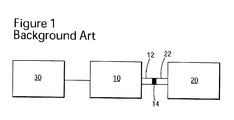
- Figure 1 shows the turbine 10 connected to generator 20 and also to the fuel supply source 30. Burning the fuel from the fuel supply source 30, the turbine 10 generates rotation motion in the axis 12.
- the axis 12 is connected to an axis 22 of the generator 20.
- the two axes 12 and 22 are coupled together via a coupling element 14.
- the two axes 12 and 22 have to be well aligned in order to prevent damage to the coupling or of the axes.
- By rotating the axis 22 of the generator 20, the generator 20 generates the electric energy necessary for the off-shore platform.
- the weights of the turbine 10 and generator 20 are large, in the range of 100 to 250 tons.
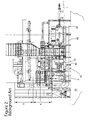
- Figure 2 shows such an example of a gas turbine 10 connected to a generator 20 and disposed on a base plate 40.
- the base plate 40 may have plural gimbals 45 that support the base plate 40.
- the gimbals 45 are supported by the barge 50.
- Figure 2 shows how various equipment is disposed at level A, above the turbine 10 and the generator 20. Furthermore, Figure 2 shows even more equipment disposed at a level B, in top of level A.
- the method includes disconnecting the heavy component from other components of the plant assembly and from a base plate to which the heavy component is fixed; lifting the heavy component above the base plate with a lifting system provided within the base plate; connecting at least a pair of rails to the base plate, under the lifted heavy component, such that the at least a pair of rails extends at substantially a right angle relative to a longitudinal axis of the heavy component; lowering the heavy component on crawling mechanisms disposed on the at least a pair of rails; and laterally replacing the heavy component from the base plate and the other components of the plant assembly by actuating the crawling mechanisms.
- a method for laterally aligning a first heavy component with a second component on a base plate of a plant assembly the first heavy component having a longitudinal axis extending along a longest size of the first heavy component and a lateral axis extending substantially perpendicular to the longitudinal axis such that both the longitudinal axis and the lateral axis are in a plane of the base plate.
- the method includes receiving the first heavy component on a lifting system provided within the base plate; lowering the first heavy component with the lifting system on the base plate such that guiding pins provided on a skid of the first heavy component enter guiding holes provided in the base plate; and pushing the skid of the first heavy component along the lateral axis with a lateral aligning system that includes at least two moving cylinders provided on a first side of the skid and configured to push the skid along the lateral axis, and at least two moving cylinders provided on a second side of the skid, opposite the first side, and configured to push the skid opposite to the at least two moving cylinders on the first side.
- a method for axially aligning a first heavy component with a second component on a base plate of a plant assembly the first heavy component having a longitudinal axis extending along a longest size of the first heavy component and a lateral axis extending substantially perpendicular to the longitudinal axis such that both the longitudinal axis and the lateral axis are in a plane of the base plate.
- the method includes receiving the first heavy component on a lifting system provided within the base plate; lowering the first heavy component with the lifting system on the base plate such that a single guiding pin, connected to a skid of the first heavy component, enters a receiving guiding hole provided in the base plate, wherein the single guiding pin is a reference point of the skid; and applying, with an axial aligning system, a force to the single guiding pin along the longitudinal axis to move the skid along the longitudinal axis towards or away from the second component.
- a turbine package configured to be connected to a heavy device in a plant assembly.
- the turbine package includes a turbine having a weight between 100 to 250 tons; a skid connected to the turbine and configured to support the turbine; at least four guiding pins connected to the skid, on a side of the skid opposite to a side to which the turbine is connected; and a single guiding pin centrally connected to the skid on the same side as the at least four guiding pins.
- the four guiding pins are connected to the skid closer to an external perimeter of the skid than to the single guiding pin.
- Figure 1 is a schematic diagram of a turbine connected to a generator
- Figure 2 is a schematic side view of a power plant disposed on a barge
- Figure 3 is a schematic top view of a plant assembly disposed on a barge
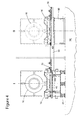
- Figure 4 is a schematic cross sectional view of a turbine on a base plate fixed to a barge according to an exemplary embodiment
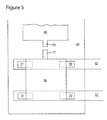
- Figure 5 is a schematic top view of a skid of a heavy device, a rail system and crawling mechanisms according to an exemplary embodiment
- Figure 6 is a schematic overall view of a lifting system according to an exemplary embodiment
- Figure 7 is a schematic side view of the skid lifted from the base plate according to an exemplary embodiment
- Figure 8 is a schematic view of the crawling mechanism inserted under the skid according to an exemplary embodiment
- Figure 9 is a schematic view of a lateral aligning mechanism according to an exemplary embodiment
- Figure 10 is a schematic view of an axial aligning mechanism according to an exemplary embodiment
- Figure 11 is a flow chart illustrating steps for laterally replacing a heavy device from a plant assembly according to an exemplary embodiment
- Figure 12 is a flow chart illustrating steps for laterally aligning the heavy device of Figure 11 according to an exemplary embodiment
- Figure 13 is a flow chart illustrating steps for axially aligning the heavy device of Figure 11 according to an exemplary embodiment
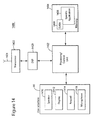
- Figure 14 is a schematic diagram of a computerized system for controlling the replacing and alignment of the heavy device.
- the turbine 10 is laterally removed from its original place, i.e., removed at a side of the plant assembly.
- Figure 3 shows various components of the plant assembly connected to the turbine 10 at points C. When the turbine 10 is taken from position I to position II, all those connections C are disconnected from the turbine 10.
- connection D between the turbine 10 and the generator 20 is directional sensitive in the sense that the axes of the turbine 10 and generator 20 would have to be aligned with a high precision to allow a smooth synchronous rotation of the axes. This aspect will be discussed later.
- the turbine 10 is removed from its original position in the plant assembly by using a rail system 60 and crawling mechanisms 70 as shown in Figure 4 .
- the crawling mechanisms 70 may enter under the turbine skid 16 and the main baseplate 40 and move the turbine 10 together with the skid 16 from position I to position II along the railing system 60.
- the skid 16 may be a heavy metal structure on which the entire turbine 10 is fixed.
- a trolley 90 receives the skid 16 with the turbine 10.
- the rail system 60 may include two rails 62. Each rail may be made of steel and have a height of about 48 cm and a width of about 60 cm. The length of the rail is dictated by the size of the barge, the turbine unit, the space available around the plant assembly, etc.
- the trolley 90 may include a lifting system (not shown) for lifting the skid 16 and turbine 10 such that the two rails 62 may be removed.
- Figure 4 shows only one crawling mechanism 70 that enters under the turbine skid 16 from right to left at position I.
- the same crawling mechanism 70 is shown at the right of position II.
- two active crawling mechanisms 70 together with two passive driven pads (not shown in Figure 4 ) are used to support the turbine skid 16.
- the active crawling mechanisms 70 and the two passive driven pads 71 may be provided as shown in Figure 5 , in which the two rails 62 are shown installed on the base plate 40, under the skid 16.
- the turbine 10 is not shown on skid 16 for simplicity.
- Figure 5 also shows the two crawling mechanisms 70 and the two driven pads 71 and their position relative to the skid 16.
- the rail system 60 may be removed and the skid 16 is attached to the trolley 90.
- the trolley 90 may be then taken either to another location of the barge, for example, a workshop, or to another barge to be taken to a ground location for maintenance.
- the gimbals 45 are connected to the base plate 40 to support the base plate 40.
- the gimbals 45 may be mounted on a deck, which may be a barge, or a solid foundation on the ground. It is noted that for the weight supported by the base plate 40 (100 to 250 tons for the turbine, 100 to 250 tons for the generator and another 100 to 250 tons for the remaining equipment), i.e. 300 to 750 tons, there is no known base plate being supported by only 3 gimbals.
- One advantage for having three and not less or more gimbals for such a system is the fact that each of the three gimbals contacts the deck while for four or more gimbals is not possible to have a complete contact between each gimbals and the supporting deck. Having a stable base plate for such a heavy device is advantageous.
- a lifting system 100 for moving the turbine 10 from position I on the crawling mechanisms 70, a lifting system 100 as shown in Figure 4 is utilized.
- Figure 4 shows only two lifting jacks of the lifting system 100.
- more lifting jacks may be used as shown in Figure 6 .
- the lifting system 100 may include four lifting jacks 102 for lifting the skid 16.
- the lifting jacks 102 may be connected via hydraulic hoses 104 to a hydraulic pump 106.
- a control system 108 which may include a computer with a touch screen, keyboard, mouse, screen, etc. is connected to the hydraulic pump 106 and to stroke sensors 110 via cables 112.
- the control system 108 may be configured to control the lift applied by the lifting jacks 102.
- the control system 108 may be configured to control each lifting jack 102 independently, or some or all of the lifting jacks 102 simultaneously to produce a same or different amount of lift.
- the lifting system 100 may be provided within the base plate 40 as shown in Figure 7.
- Figure 7 shows one cross section of the skid 16 supported by two lifting jacks 102 such that the skid 16 and turbine 10 are raised a distance "d" from the base plate 40.
- the distance "d” may be between 20 and 60 cm.
- the lifting system 100 may be permanently secured within the base plate 40. This is possible as a thickness "t" of the base plate may be between 1 to 2 m.
- the lifting jacks 102 may be replaced after the skid 16 and turbine 10 are laterally removed.
- Figure 7 also shows a guiding mechanism 110 that includes guiding pins 112 and guiding holes 114.
- the guiding pins 112 are steel pins connected to the skid 16 and are configured to enter the guiding holes 114 that are provided in the base plate 40.
- a diameter of the guiding holes 114 is larger than a diameter of the guiding pins 112 such that the guiding pins 112 may easily enter the guiding holes 114.
- the guiding mechanism 110 is used to guide the skid 16 and turbine 10 towards and away from the base plate 40. Also, the guiding mechanism 110 prevents the skid 16 and turbine 10 from falling off the base plate 40 when the barge is experiencing high waves.
- the axis 12 of the turbine 10 needs to be aligned with the axis 22 of the generator 20 and thus, an initial, rough, alignment can be achieved by using the guiding mechanism 110 to have the turbine 10 in a desired position.
- the guiding pins 112 do not fit tightly the guiding holes 114 (it would be very difficult to deliver a heavy turbine with four pins to perfectly enter into four holes), even after the skid 16 and turbine 10 are lowered on the base plate 40 with the guiding pins 112 into the guiding holes 114, it may happen that the turbine 10 is not aligned with the generator 20.
- Various mechanisms that may be used to further align the turbine 10 with the generator 20 are discussed later.
- the rail system 60 is installed as shown in Figure 8 .
- the upper drawing in Figure 8 shows a side view of rail 62, crawling mechanism 70, base plate 40 and skid 16 while the lower drawing in Figure 8 shows a top view of the rail 62 and the crawling mechanism 70.
- the lower drawing in Figure 8 corresponds to the upper drawing of the same figure.
- Each rail 62 has one end fixed in two locations to the base plate 40 and the other end fixed to the trolley 90, for stability.
- the rail 62 is fixed to the base plate 40 at the same locations where the skid 16 is fixed to the base plate 40.
- the rail system 60 does not necessitate extra elements for being attached to the base plate 40.
- the crawling mechanism 70 may include a load bearing pad 72, a no load pad 74, each connected to a corresponding sliding fixture 76.
- One crawling mechanism 70 may include two sliding fixtures 76 connected to each other by moving cylinders 80.
- the two sliding fixtures 76 may include corresponding engagement cylinders 78a and 78b.
- the rails 62 have holes 82 that have a shape and size matching the engagement cylinders 78a and 78b.
- the movement of the crawling mechanism 70 is discussed next still with regard to Figure 8 .
- a similar crawling mechanism is used in the aeronautic industry for moving airplanes' bodies.
- the moving cylinder 80 is actuated (expanded) to move engagement cylinder 78b to be aligned with a slot 82.
- the engagement cylinder 78b is lowered into the slot 82 to fix the engagement cylinder 78b and the corresponding sliding fixture 76.
- the engagement cylinder 78a Assuming that the engagement cylinder 78a was already lowered into another slot 82, the engagement cylinder 78a is now raised to exit from slot 82. Then, the moving cylinder 80 is actuated (contracted) to move the engagement cylinder 78a towards the engagement cylinder 78b. At this stage, the skid 16 moves towards the engagement cylinder 78b, thus exiting the plant assembly.
- the moving cylinder 80 may be one of those produced by Enerpac, Italy.
- the moving cylinder 80 may be RAC-302, produced by Enerpac, which can develop a force of 30 tons at 700 bar.
- the pads 72 and 74 slide on the rail 62 with no wheels.
- the faces of the pads facing the rail 62 are, for example, coated in Teflon or turciteTM to produce a low friction.
- a distance between the two engagement cylinders 78a and 78b may be between 50 and 200 cm.
- a similar mechanism to the lifting system 100 may be used to lift the skid 16 from the rails 62, remove the rail system 60 and lower the skid 16 on the trolley 90.
- a reverse process may be used to install the skid 16 and turbine 10 back into the plant assembly.
- a lateral alignment is achieved as discussed next and illustrated in Figure 7.
- Figure 7 shows a cross section through the skid 16 and the base plate 40. Turbine 10 and skid 16 extend into and out of the page. As discussed earlier, after the guiding pins 112 are lowered into the guiding holes 114 (assuming that the skid 16 has been transferred from the rail system 60 onto the lifting system 100 of the base plate 40), the lifting jacks 102 are completely retracted into the base plate 40 such that the lifting jacks 102 are not in contact with the skid 16. Suppose that skid 16 has to be moved now in a lateral direction, indicated by arrow F in Figure 7 .
- a lateral aligning system 120 may include four displacing cylinders 122, two on each side of the skid 16. By actuating pairs of the displacing cylinders 122, which are controlled by a controlling device 124, the skid 16 may be laterally displaced along direction F.
- An exemplary location of the guiding pins 112 are shown on the skid 16 in reference to the displacing cylinders 122. Other locations of the guiding pins 112 and displacing cylinders 122 are also possible as will be appreciated by those skilled in the art.
- FIG. 7 shows an axial alignment system 130, which is configured to receive a single pin 140 (shown in Figure 10 ) that is part of the skid 16 or attached to the skid 16.
- the single pin 140 is fixedly attached to the skid 16.
- a cross section of the single pin 140 may be, in one application, square or rectangular.
- the axial alignment system 130 includes at least two axial moving cylinders 132, placed in a cavity 134 formed in the base plate 40. A distance between the ends of the axial moving cylinders 132 is larger than a size of the single pin 140 such that the single pin 140 may enter between the two axial moving cylinders 132, as shown in Figure 10 .
- the axial moving cylinders 132 are configured to move along an axial direction E, which is perpendicular to F. Both directions E and F are in the plane of the base plate 40.
- E axial direction
- F axial direction
- the skid 16 and turbine 10 are moved along the E direction
- the other axial moving cylinder 132 the skid 16 and turbine 10 are moving in the opposite direction.
- the axis 12 of the turbine 10 may be moved closer or farther from the axis 22 of the generator 20 and this axial movement of the turbine 10 was designed to be able to achieve the coupling or decoupling of the two axes 12 and 22 via the coupling element 14.
- the lateral alignment and the axial alignment may be performed independently one from the other.
- the moving cylinders of Enerpac may be used in the lifting system 100, the lateral alignment system 120 and the axial alignment system 130.
- the method includes a step 1100 of disconnecting the heavy component from other components of the plant assembly and from a base plate to which the heavy component is fixed, a step 1102 of lifting the heavy component above the base plate with a lifting system provided within the base plate, a step 1104 of connecting at least a pair of rails to the base plate, under the lifted heavy component, such that the at least a pair of rails extends at substantially a right angle relative to a longitudinal axis of the heavy component; a step 1106 of lowering the heavy component on crawling mechanisms disposed on the at least a pair of rails, and a step 1108 of laterally replacing the heavy component from the base plate and the other components of the plant assembly by actuating the crawling mechanisms.
- the steps of a method for laterally aligning a first heavy component with a second component on a base plate of a plant assembly are illustrated in Figure 12 .
- the first heavy component has a longitudinal axis extending along a longest size of the first heavy component and a lateral axis extending substantially perpendicular to the longitudinal axis such that both the longitudinal axis and the lateral axis are in a plane of the base plate.
- the method includes a step 1200 of receiving the first heavy component on a lifting system provided within the base plate, a step 1202 of lowering the first heavy component with the lifting system on the base plate such that guiding pins provided on a skid of the first heavy component enter guiding holes provided in the base plate, and a step 1204 of pushing the skid of the first heavy component along the lateral axis with a lateral aligning system that includes at least two moving cylinders provided on a first side of the skid and configured to push the skid along the lateral axis, and at least two moving cylinders provided on a second side of the skid, opposite the first side, and configured to push the skid opposite to the at least two moving cylinders on the first side.
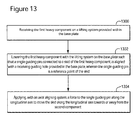
- the steps of a method for axially aligning a first heavy component with a second component on a base plate of a plant assembly are illustrated in Figure 13 .
- the first heavy component has a longitudinal axis extending along a longest size of the first heavy component and a lateral axis extending substantially perpendicular to the longitudinal axis such that both the longitudinal axis and the lateral axis are in a plane of the base plate.
- the method includes a step 1300 of receiving the first heavy component on a lifting system provided within the base plate, a step 1302 of lowering the first heavy component with the lifting system on the base plate such that a single guiding pin, connected to a skid of the first heavy component, enters a receiving guiding hole provided in the base plate, wherein the single guiding pin is a reference point of the skid, and a step 1306 of applying, with an axial aligning system, a force to the single guiding pin along the longitudinal axis to move the skid along the longitudinal axis towards or away from the second component.
- each of the lifting system 100, the lateral alignment system 120 and the axial alignment system 130 may be achieved with a computer system or multiple computer systems configured to run executable instructions, which, when executed, actuate the systems 100, 120 and 130 to lift or move the skid 16.
- a computer system is shown in Figure 14 as system 1400 and may include a processing/control unit 1402, such as a microprocessor, reduced instruction set computer (RISC), or other central processing module.
- the processing unit 1402 need not be a single device, and may include one or more processors.
- the processing unit 1402 may include a master processor and associated slave processors coupled to communicate with the master processor.
- the processing unit 1402 may control the basic functions of the system as dictated by programs available in the storage/memory 1404. Thus, the processing unit 1402 may execute the functions described in Figures 11 and 12 . More particularly, the storage/memory 1404 may include an operating system and program modules for carrying out functions and applications on the computing system.
- the program storage may include one or more of read-only memory (ROM), flash ROM, programmable and/or erasable ROM, random access memory (RAM), subscriber interface module (SIM), wireless interface module (WIM), smart card, or other removable memory device, etc.
- the program modules and associated features may also be transmitted to the parallel computing system 1400 via data signals, such as being downloaded electronically via a network, such as the Internet.
- One of the programs that may be stored in the storage/memory 1404 is a specific program 1406.
- the specific program 1406 may determine a height for raising the skid, a distance for moving the skid from position I to position II in Figure 4 , etc.
- the program 1406 and associated features may be implemented in software and/or firmware operable by way of the processor 1402.
- the program storage/memory 1404 may also be used to store data 1408, such as the tables 28 and 30, or other data associated with the present exemplary embodiments.
- the programs 1406 and data 1408 are stored in non-volatile electrically-erasable, programmable ROM (EEPROM), flash ROM, etc. so that the information is not lost upon power down of the parallel computing system 1400.
- EEPROM electrically-erasable, programmable ROM
- the processor 1402 may also be coupled to user interface 1410 elements associated with a mobile terminal.
- the user interface 1410 of the mobile terminal may include, for example, a display 1412 such as a liquid crystal display, a keypad 1414, speaker 1416, and a microphone 1418. These and other user interface components are coupled to the processor 1402 as is known in the art.
- the keypad 1414 may include alpha-numeric keys for performing a variety of functions, including dialing numbers and executing operations assigned to one or more keys.
- other user interface mechanisms may be employed, such as voice commands, switches, touch pad/screen, graphical user interface using a pointing device, trackball, joystick, or any other user interface mechanism.
- the parallel computing system 1400 may also include a digital signal processor (DSP) 1420.
- the DSP 1420 may perform a variety of functions, including analog-to-digital (A/D) conversion, digital-to-analog (D/A) conversion, speech coding/decoding, encryption/decryption, error detection and correction, bit stream translation, filtering, etc.
- the transceiver 1422 generally coupled to an antenna 1424, may transmit and receive the radio signals associated with a wireless device.
- the computing system 1400 of Figure 14 is provided as a representative example of a computing environment in which the principles of the present exemplary embodiments may be applied. From the description provided herein, those skilled in the art will appreciate that the present invention is equally applicable in a variety of other currently known and future mobile and fixed computing environments.
- the specific application 1406 and associated features, and data 1408, may be stored in a variety of manners, may be operable on a variety of processing devices, and may be operable in mobile devices having additional, fewer, or different supporting circuitry and user interface mechanisms. It is noted that the principles of the present exemplary embodiments are equally applicable to non-mobile terminals, i.e., landline computing systems.
- the disclosed exemplary embodiments provide a system, computer medium and a method for laterally replacing a heavy device and for aligning the heavy device with another heavy device. It should be understood that this description is not intended to limit the invention. On the contrary, the exemplary embodiments are intended to cover alternatives, modifications and equivalents, which are included in the spirit and scope of the invention as defined by the appended claims. Further, in the detailed description of the exemplary embodiments, numerous specific details are set forth in order to provide a comprehensive understanding of the claimed invention. However, one skilled in the art would understand that various embodiments may be practiced without such specific details.
Landscapes
- Engineering & Computer Science (AREA)
- Mechanical Engineering (AREA)
- Life Sciences & Earth Sciences (AREA)
- Geology (AREA)
- Structural Engineering (AREA)
- General Engineering & Computer Science (AREA)
- Manufacturing & Machinery (AREA)
- Power Engineering (AREA)
- Automatic Assembly (AREA)
- Load-Engaging Elements For Cranes (AREA)
- Vehicle Cleaning, Maintenance, Repair, Refitting, And Outriggers (AREA)
Abstract
Description
- Embodiments of the subject matter disclosed herein generally relate to methods and systems and, more particularly, to mechanisms and techniques for moving a heavy device and aligning it with other devices.
- During the past years, an increased interest in alternative sources of energy has driving the oil and gas industry in exploring fossil fuels off-shore, at higher depths. One such fossil source is liquefied natural gas (LNG). LNG is a gas that has been converted to liquid form for ease of storage or transport. Liquefied natural gas takes up about 1/600th the volume of natural gas at a stove burner tip. However, for the extraction and liquefaction process, the off-shore platform needs a consistent supply of energy. One way to achieve this energy is to provide the off-shore platform with a power generation source.
- Conventionally, a power generation source includes a fuel supply source, a turbine, and a generator.
Figure 1 shows theturbine 10 connected togenerator 20 and also to thefuel supply source 30. Burning the fuel from thefuel supply source 30, theturbine 10 generates rotation motion in theaxis 12. Theaxis 12 is connected to anaxis 22 of thegenerator 20. The twoaxes coupling element 14. The twoaxes axis 22 of thegenerator 20, thegenerator 20 generates the electric energy necessary for the off-shore platform. The weights of theturbine 10 andgenerator 20 are large, in the range of 100 to 250 tons. - Thus, when performing maintenance for these heavy devices, large and powerful cranes have to be available in order to remove, for example, the casing of the turbine for various maintenance operations. Such operations are not only dangerous but also time consuming. For example, a conventional maintenance process may take 45 days to be performed. In addition, the process is dangerous because heavy parts are hanging above the turbine and generator, with the potential of falling and destroying the equipment or injuring the persons beneath.
- Further, as the power plant is off-shore, i.e., floating on a barge, the movement of the sea also contributes to the increase danger of having heavy devices hanging overhead. Furthermore, new designs of the turbines and generators require that other equipment associated with the power plant is provided in top of the turbine and generator, as shown for example in
Figure 2 . -
Figure 2 shows such an example of agas turbine 10 connected to agenerator 20 and disposed on abase plate 40. Thebase plate 40 may haveplural gimbals 45 that support thebase plate 40. Thegimbals 45 are supported by thebarge 50.Figure 2 shows how various equipment is disposed at level A, above theturbine 10 and thegenerator 20. Furthermore,Figure 2 shows even more equipment disposed at a level B, in top of level A. - Accordingly, it would be desirable to provide systems and methods that avoid the afore-described problems and drawbacks, i.e., hanging heavy parts, providing powerful cranes, lack of access from above to the heavy devices, etc.
- According to one exemplary embodiment, there is a method for laterally replacing a heavy component of a plant assembly. The method includes disconnecting the heavy component from other components of the plant assembly and from a base plate to which the heavy component is fixed; lifting the heavy component above the base plate with a lifting system provided within the base plate; connecting at least a pair of rails to the base plate, under the lifted heavy component, such that the at least a pair of rails extends at substantially a right angle relative to a longitudinal axis of the heavy component; lowering the heavy component on crawling mechanisms disposed on the at least a pair of rails; and laterally replacing the heavy component from the base plate and the other components of the plant assembly by actuating the crawling mechanisms.
- According to another exemplary embodiment, there is a method for laterally aligning a first heavy component with a second component on a base plate of a plant assembly, the first heavy component having a longitudinal axis extending along a longest size of the first heavy component and a lateral axis extending substantially perpendicular to the longitudinal axis such that both the longitudinal axis and the lateral axis are in a plane of the base plate. The method includes receiving the first heavy component on a lifting system provided within the base plate; lowering the first heavy component with the lifting system on the base plate such that guiding pins provided on a skid of the first heavy component enter guiding holes provided in the base plate; and pushing the skid of the first heavy component along the lateral axis with a lateral aligning system that includes at least two moving cylinders provided on a first side of the skid and configured to push the skid along the lateral axis, and at least two moving cylinders provided on a second side of the skid, opposite the first side, and configured to push the skid opposite to the at least two moving cylinders on the first side.
- According to still another exemplary embodiment, there is a method for axially aligning a first heavy component with a second component on a base plate of a plant assembly, the first heavy component having a longitudinal axis extending along a longest size of the first heavy component and a lateral axis extending substantially perpendicular to the longitudinal axis such that both the longitudinal axis and the lateral axis are in a plane of the base plate. The method includes receiving the first heavy component on a lifting system provided within the base plate; lowering the first heavy component with the lifting system on the base plate such that a single guiding pin, connected to a skid of the first heavy component, enters a receiving guiding hole provided in the base plate, wherein the single guiding pin is a reference point of the skid; and applying, with an axial aligning system, a force to the single guiding pin along the longitudinal axis to move the skid along the longitudinal axis towards or away from the second component.
- According to another exemplary embodiment, there is a turbine package configured to be connected to a heavy device in a plant assembly. The turbine package includes a turbine having a weight between 100 to 250 tons; a skid connected to the turbine and configured to support the turbine; at least four guiding pins connected to the skid, on a side of the skid opposite to a side to which the turbine is connected; and a single guiding pin centrally connected to the skid on the same side as the at least four guiding pins. The four guiding pins are connected to the skid closer to an external perimeter of the skid than to the single guiding pin.
- The accompanying drawings, which are incorporated in and constitute a part of the specification, illustrate one or more embodiments and, together with the description, explain these embodiments. In the drawings:
-
Figure 1 is a schematic diagram of a turbine connected to a generator; -
Figure 2 is a schematic side view of a power plant disposed on a barge; -
Figure 3 is a schematic top view of a plant assembly disposed on a barge; -
Figure 4 is a schematic cross sectional view of a turbine on a base plate fixed to a barge according to an exemplary embodiment; -
Figure 5 is a schematic top view of a skid of a heavy device, a rail system and crawling mechanisms according to an exemplary embodiment; -
Figure 6 is a schematic overall view of a lifting system according to an exemplary embodiment; -
Figure 7 is a schematic side view of the skid lifted from the base plate according to an exemplary embodiment; -
Figure 8 is a schematic view of the crawling mechanism inserted under the skid according to an exemplary embodiment; -
Figure 9 is a schematic view of a lateral aligning mechanism according to an exemplary embodiment; -
Figure 10 is a schematic view of an axial aligning mechanism according to an exemplary embodiment; -
Figure 11 is a flow chart illustrating steps for laterally replacing a heavy device from a plant assembly according to an exemplary embodiment; -
Figure 12 is a flow chart illustrating steps for laterally aligning the heavy device ofFigure 11 according to an exemplary embodiment; -
Figure 13 is a flow chart illustrating steps for axially aligning the heavy device ofFigure 11 according to an exemplary embodiment; and -
Figure 14 is a schematic diagram of a computerized system for controlling the replacing and alignment of the heavy device. - The following description of the exemplary embodiments refers to the accompanying drawings. The same reference numbers in different drawings identify the same or similar elements. The following detailed description does not limit the invention. Instead, the scope of the invention is defined by the appended claims. The following embodiments are discussed, for simplicity, with regard to the terminology and structure of a gas turbine connected to a generator to form a plant assembly on a barge. However, the embodiments to be discussed next are not limited to these systems, but may be applied to other plant assemblies that include heavy devices that require easy and safe access and also a good alignment among the various devices. The exemplary embodiments also apply to devices that are located on the ground.
- Reference throughout the specification to "one embodiment" or "an embodiment" means that a particular feature, structure, or characteristic described in connection with an embodiment is included in at least one embodiment of the subject matter disclosed. Thus, the appearance of the phrases "in one embodiment" or "in an embodiment" in various places throughout the specification is not necessarily referring to the same embodiment. Further, the particular features, structures or characteristics may be combined in any suitable manner in one or more embodiments.
- As discussed above with regard to
Figure 2 , because of the existing equipment provided in top of theturbine 10 andgenerator 20, it is necessary to use a powerful crane to raise askid 16 with all the equipment on it for maintenance. Thus, according to an exemplary embodiment shown inFigure 3 , theturbine 10 is laterally removed from its original place, i.e., removed at a side of the plant assembly.Figure 3 shows various components of the plant assembly connected to theturbine 10 at points C. When theturbine 10 is taken from position I to position II, all those connections C are disconnected from theturbine 10. It is noted that connection D, between theturbine 10 and thegenerator 20 is directional sensitive in the sense that the axes of theturbine 10 andgenerator 20 would have to be aligned with a high precision to allow a smooth synchronous rotation of the axes. This aspect will be discussed later. - By laterally replacing the
turbine 10 from the plant assembly, no heavy cranes are necessary and the danger of having theheavy turbine 10 falling on the equipment below and/or maintenance personnel is removed. However, other challenges have to be addressed when performing the lateral removal of theturbine 10. These aspects are discussed next. - According to an exemplary embodiment, the
turbine 10 is removed from its original position in the plant assembly by using arail system 60 and crawlingmechanisms 70 as shown inFigure 4 . The crawlingmechanisms 70 may enter under theturbine skid 16 and themain baseplate 40 and move theturbine 10 together with theskid 16 from position I to position II along therailing system 60. Theskid 16 may be a heavy metal structure on which theentire turbine 10 is fixed. At position II, atrolley 90 receives theskid 16 with theturbine 10. Therail system 60 may include tworails 62. Each rail may be made of steel and have a height of about 48 cm and a width of about 60 cm. The length of the rail is dictated by the size of the barge, the turbine unit, the space available around the plant assembly, etc. Thetrolley 90 may include a lifting system (not shown) for lifting theskid 16 andturbine 10 such that the tworails 62 may be removed. -
Figure 4 shows only onecrawling mechanism 70 that enters under theturbine skid 16 from right to left at position I. Thesame crawling mechanism 70 is shown at the right of position II. However, according to an exemplary embodiment, twoactive crawling mechanisms 70 together with two passive driven pads (not shown inFigure 4 ) are used to support theturbine skid 16. Theactive crawling mechanisms 70 and the two passive drivenpads 71 may be provided as shown inFigure 5 , in which the tworails 62 are shown installed on thebase plate 40, under theskid 16. Theturbine 10 is not shown onskid 16 for simplicity.Figure 5 also shows the two crawlingmechanisms 70 and the two drivenpads 71 and their position relative to theskid 16. - Still with regard to
Figure 4 , after theturbine 10 andskid 16 are replaced from position I to position II with the crawlingmechanisms 70, therail system 60 may be removed and theskid 16 is attached to thetrolley 90. Thetrolley 90 may be then taken either to another location of the barge, for example, a workshop, or to another barge to be taken to a ground location for maintenance. - Still with regard to
Figure 4 , thegimbals 45 are connected to thebase plate 40 to support thebase plate 40. Thegimbals 45 may be mounted on a deck, which may be a barge, or a solid foundation on the ground. It is noted that for the weight supported by the base plate 40 (100 to 250 tons for the turbine, 100 to 250 tons for the generator and another 100 to 250 tons for the remaining equipment), i.e. 300 to 750 tons, there is no known base plate being supported by only 3 gimbals. One advantage for having three and not less or more gimbals for such a system is the fact that each of the three gimbals contacts the deck while for four or more gimbals is not possible to have a complete contact between each gimbals and the supporting deck. Having a stable base plate for such a heavy device is advantageous. - For moving the
turbine 10 from position I on the crawlingmechanisms 70, alifting system 100 as shown inFigure 4 is utilized.Figure 4 shows only two lifting jacks of thelifting system 100. However, more lifting jacks may be used as shown inFigure 6 . According to an exemplary embodiment, thelifting system 100 may include four liftingjacks 102 for lifting theskid 16. The lifting jacks 102 may be connected viahydraulic hoses 104 to ahydraulic pump 106. Acontrol system 108, which may include a computer with a touch screen, keyboard, mouse, screen, etc. is connected to thehydraulic pump 106 and tostroke sensors 110 viacables 112. Thecontrol system 108 may be configured to control the lift applied by the lifting jacks 102. According to one exemplary embodiment, thecontrol system 108 may be configured to control each liftingjack 102 independently, or some or all of the lifting jacks 102 simultaneously to produce a same or different amount of lift. - The
lifting system 100 may be provided within thebase plate 40 as shown inFigure 7. Figure 7 shows one cross section of theskid 16 supported by two liftingjacks 102 such that theskid 16 andturbine 10 are raised a distance "d" from thebase plate 40. The distance "d" may be between 20 and 60 cm. As shown inFigure 7 , according to an exemplary embodiment, thelifting system 100 may be permanently secured within thebase plate 40. This is possible as a thickness "t" of the base plate may be between 1 to 2 m. However, according to this exemplary embodiment, the lifting jacks 102 may be replaced after theskid 16 andturbine 10 are laterally removed. -
Figure 7 also shows aguiding mechanism 110 that includes guidingpins 112 and guidingholes 114. The guiding pins 112 are steel pins connected to theskid 16 and are configured to enter the guidingholes 114 that are provided in thebase plate 40. A diameter of the guidingholes 114 is larger than a diameter of the guiding pins 112 such that the guiding pins 112 may easily enter the guiding holes 114. Theguiding mechanism 110 is used to guide theskid 16 andturbine 10 towards and away from thebase plate 40. Also, theguiding mechanism 110 prevents theskid 16 andturbine 10 from falling off thebase plate 40 when the barge is experiencing high waves. As previously discussed, theaxis 12 of theturbine 10 needs to be aligned with theaxis 22 of thegenerator 20 and thus, an initial, rough, alignment can be achieved by using theguiding mechanism 110 to have theturbine 10 in a desired position. However, due to the fact that the guiding pins 112 do not fit tightly the guiding holes 114 (it would be very difficult to deliver a heavy turbine with four pins to perfectly enter into four holes), even after theskid 16 andturbine 10 are lowered on thebase plate 40 with the guiding pins 112 into the guidingholes 114, it may happen that theturbine 10 is not aligned with thegenerator 20. Various mechanisms that may be used to further align theturbine 10 with thegenerator 20 are discussed later. - Once the
skid 16 andturbine 10 are lifted from the base plate 40 (assuming that all the connections of the turbine to other devices are disconnected), therail system 60 is installed as shown inFigure 8 . The upper drawing inFigure 8 shows a side view ofrail 62,crawling mechanism 70,base plate 40 andskid 16 while the lower drawing inFigure 8 shows a top view of therail 62 and thecrawling mechanism 70. The lower drawing inFigure 8 corresponds to the upper drawing of the same figure. Eachrail 62 has one end fixed in two locations to thebase plate 40 and the other end fixed to thetrolley 90, for stability. Therail 62 is fixed to thebase plate 40 at the same locations where theskid 16 is fixed to thebase plate 40. Thus, therail system 60 does not necessitate extra elements for being attached to thebase plate 40. - Once the
rail system 60 is fixed in place, the crawling mechanism is brought under theskid 16. Thecrawling mechanism 70 is discussed now in more details with regard toFigure 8 . The crawling mechanism 70 (two crawlingmechanisms 70 are used to move theturbine skid 16 but only one is shown inFigure 8 ) may include aload bearing pad 72, a noload pad 74, each connected to a corresponding slidingfixture 76. Onecrawling mechanism 70 may include two slidingfixtures 76 connected to each other by movingcylinders 80. The two slidingfixtures 76 may include correspondingengagement cylinders rails 62 haveholes 82 that have a shape and size matching theengagement cylinders - The movement of the
crawling mechanism 70 is discussed next still with regard toFigure 8 . A similar crawling mechanism is used in the aeronautic industry for moving airplanes' bodies. Once thecrawling mechanism 70 is in position, i.e., theload bearing pad 72 is under theskid 16 and theskid 16 is lowered on the twoload bearing pads 72 of the twocrawling mechanism 70 and on the drivenpads 71, the movingcylinder 80 is actuated (expanded) to moveengagement cylinder 78b to be aligned with aslot 82. Once the alignment of theengagement cylinder 78b and theslot 82 is achieved, theengagement cylinder 78b is lowered into theslot 82 to fix theengagement cylinder 78b and the corresponding slidingfixture 76. Assuming that theengagement cylinder 78a was already lowered into anotherslot 82, theengagement cylinder 78a is now raised to exit fromslot 82. Then, the movingcylinder 80 is actuated (contracted) to move theengagement cylinder 78a towards theengagement cylinder 78b. At this stage, theskid 16 moves towards theengagement cylinder 78b, thus exiting the plant assembly. - Once the
engagement cylinder 78a is aligned to anotherslot 82, theengagement cylinder 78a is lowered into thisnew slot 82, theengagement cylinder 78b is raised out of itsslot 82, the movingcylinder 80 is again expanded to move theengagement cylinder 78b to another slot, further away from theskid 16. Then the process is repeated until theskid 16 andturbine 10 is completely and laterally removed from the plant assembly and theskid 16 is fully on thetrolley 90. - The moving
cylinder 80 may be one of those produced by Enerpac, Italy. For example, the movingcylinder 80 may be RAC-302, produced by Enerpac, which can develop a force of 30 tons at 700 bar. Thepads rail 62 with no wheels. The faces of the pads facing therail 62 are, for example, coated in Teflon or turcite™ to produce a low friction. A distance between the twoengagement cylinders - Having the
skid 16 and theturbine 10 above thetrolley 90, a similar mechanism to thelifting system 100 may be used to lift theskid 16 from therails 62, remove therail system 60 and lower theskid 16 on thetrolley 90. A reverse process may be used to install theskid 16 andturbine 10 back into the plant assembly. - However, installing the
skid 16 with theturbine 10 back on thebase plate 40 involves, as discussed earlier, aligning theaxis 12 of theturbine 10 with theaxis 22 of thegenerator 20. The alignment mechanism is discussed now with regard to the following exemplary embodiments andFigures 7 and9 . - According to an exemplary embodiment, a lateral alignment is achieved as discussed next and illustrated in
Figure 7. Figure 7 shows a cross section through theskid 16 and thebase plate 40.Turbine 10 andskid 16 extend into and out of the page. As discussed earlier, after the guiding pins 112 are lowered into the guiding holes 114 (assuming that theskid 16 has been transferred from therail system 60 onto thelifting system 100 of the base plate 40), the lifting jacks 102 are completely retracted into thebase plate 40 such that the lifting jacks 102 are not in contact with theskid 16. Suppose thatskid 16 has to be moved now in a lateral direction, indicated by arrow F inFigure 7 . Alateral aligning system 120, which is shown inFigure 9 , may include four displacingcylinders 122, two on each side of theskid 16. By actuating pairs of the displacingcylinders 122, which are controlled by a controllingdevice 124, theskid 16 may be laterally displaced along direction F. An exemplary location of the guiding pins 112 are shown on theskid 16 in reference to the displacingcylinders 122. Other locations of the guiding pins 112 and displacingcylinders 122 are also possible as will be appreciated by those skilled in the art. - According to another exemplary embodiment, an axial alignment of the
turbine 10 and thegenerator 20 is discussed with regard toFigures 7 and10 .Figure 7 shows anaxial alignment system 130, which is configured to receive a single pin 140 (shown inFigure 10 ) that is part of theskid 16 or attached to theskid 16. According to an exemplary embodiment, thesingle pin 140 is fixedly attached to theskid 16. A cross section of thesingle pin 140 may be, in one application, square or rectangular. After thesingle pin 140 is inserted into a guidingsquare plate 142, which is welded to thebase plate 40, and after theturbine 10 has been aligned both axially and laterally, thesingle pin 140 is fixed relative to thebase plate 40 by using shims (not shown). In this way, the turbine is fixedly attached to thebase plate 40. When theskid 16 has to be removed from thebase plate 40, thesingle pin 140 disengages from the guidingsquare plate 142. - The
axial alignment system 130 includes at least two axial movingcylinders 132, placed in acavity 134 formed in thebase plate 40. A distance between the ends of the axial movingcylinders 132 is larger than a size of thesingle pin 140 such that thesingle pin 140 may enter between the two axial movingcylinders 132, as shown inFigure 10 . - The axial moving
cylinders 132 are configured to move along an axial direction E, which is perpendicular to F. Both directions E and F are in the plane of thebase plate 40. By actuating one of the axial movingcylinders 132, theskid 16 andturbine 10 are moved along the E direction and by actuating the other axial movingcylinder 132, theskid 16 andturbine 10 are moving in the opposite direction. With this axial movement, theaxis 12 of theturbine 10 may be moved closer or farther from theaxis 22 of thegenerator 20 and this axial movement of theturbine 10 was designed to be able to achieve the coupling or decoupling of the twoaxes coupling element 14. - According to an exemplary embodiment, the lateral alignment and the axial alignment may be performed independently one from the other. The moving cylinders of Enerpac may be used in the
lifting system 100, thelateral alignment system 120 and theaxial alignment system 130. - Having discussed the arrangement of the plant assembly and various systems related to the turbine and the generator, the steps of various methods for laterally replacing and aligning the turbine with the generator are discussed next with reference to
Figures 11 and12 . According to an exemplary embodiment, the steps of a method of laterally replacing a heavy component of a plant assembly are shown inFigure 11 . The method includes astep 1100 of disconnecting the heavy component from other components of the plant assembly and from a base plate to which the heavy component is fixed, astep 1102 of lifting the heavy component above the base plate with a lifting system provided within the base plate, astep 1104 of connecting at least a pair of rails to the base plate, under the lifted heavy component, such that the at least a pair of rails extends at substantially a right angle relative to a longitudinal axis of the heavy component; astep 1106 of lowering the heavy component on crawling mechanisms disposed on the at least a pair of rails, and astep 1108 of laterally replacing the heavy component from the base plate and the other components of the plant assembly by actuating the crawling mechanisms. - According to another exemplary embodiment, the steps of a method for laterally aligning a first heavy component with a second component on a base plate of a plant assembly are illustrated in
Figure 12 . The first heavy component has a longitudinal axis extending along a longest size of the first heavy component and a lateral axis extending substantially perpendicular to the longitudinal axis such that both the longitudinal axis and the lateral axis are in a plane of the base plate. The method includes astep 1200 of receiving the first heavy component on a lifting system provided within the base plate, astep 1202 of lowering the first heavy component with the lifting system on the base plate such that guiding pins provided on a skid of the first heavy component enter guiding holes provided in the base plate, and astep 1204 of pushing the skid of the first heavy component along the lateral axis with a lateral aligning system that includes at least two moving cylinders provided on a first side of the skid and configured to push the skid along the lateral axis, and at least two moving cylinders provided on a second side of the skid, opposite the first side, and configured to push the skid opposite to the at least two moving cylinders on the first side. - According to an exemplary embodiment, the steps of a method for axially aligning a first heavy component with a second component on a base plate of a plant assembly are illustrated in
Figure 13 . The first heavy component has a longitudinal axis extending along a longest size of the first heavy component and a lateral axis extending substantially perpendicular to the longitudinal axis such that both the longitudinal axis and the lateral axis are in a plane of the base plate. The method includes astep 1300 of receiving the first heavy component on a lifting system provided within the base plate, astep 1302 of lowering the first heavy component with the lifting system on the base plate such that a single guiding pin, connected to a skid of the first heavy component, enters a receiving guiding hole provided in the base plate, wherein the single guiding pin is a reference point of the skid, and a step 1306 of applying, with an axial aligning system, a force to the single guiding pin along the longitudinal axis to move the skid along the longitudinal axis towards or away from the second component. - By using the above described methods, a time for having a fully functional plant assembly is reduced from 45 days to around 22 days.
- The control of each of the
lifting system 100, thelateral alignment system 120 and theaxial alignment system 130 may be achieved with a computer system or multiple computer systems configured to run executable instructions, which, when executed, actuate thesystems skid 16. Such a computer system is shown inFigure 14 assystem 1400 and may include a processing/control unit 1402, such as a microprocessor, reduced instruction set computer (RISC), or other central processing module. Theprocessing unit 1402 need not be a single device, and may include one or more processors. For example, theprocessing unit 1402 may include a master processor and associated slave processors coupled to communicate with the master processor. - The
processing unit 1402 may control the basic functions of the system as dictated by programs available in the storage/memory 1404. Thus, theprocessing unit 1402 may execute the functions described inFigures 11 and12 . More particularly, the storage/memory 1404 may include an operating system and program modules for carrying out functions and applications on the computing system. For example, the program storage may include one or more of read-only memory (ROM), flash ROM, programmable and/or erasable ROM, random access memory (RAM), subscriber interface module (SIM), wireless interface module (WIM), smart card, or other removable memory device, etc. The program modules and associated features may also be transmitted to theparallel computing system 1400 via data signals, such as being downloaded electronically via a network, such as the Internet. - One of the programs that may be stored in the storage/
memory 1404 is aspecific program 1406. As previously described, thespecific program 1406 may determine a height for raising the skid, a distance for moving the skid from position I to position II inFigure 4 , etc. Theprogram 1406 and associated features may be implemented in software and/or firmware operable by way of theprocessor 1402. The program storage/memory 1404 may also be used to storedata 1408, such as the tables 28 and 30, or other data associated with the present exemplary embodiments. In one exemplary embodiment, theprograms 1406 anddata 1408 are stored in non-volatile electrically-erasable, programmable ROM (EEPROM), flash ROM, etc. so that the information is not lost upon power down of theparallel computing system 1400. - The
processor 1402 may also be coupled to user interface 1410 elements associated with a mobile terminal. The user interface 1410 of the mobile terminal may include, for example, adisplay 1412 such as a liquid crystal display, akeypad 1414,speaker 1416, and amicrophone 1418. These and other user interface components are coupled to theprocessor 1402 as is known in the art. Thekeypad 1414 may include alpha-numeric keys for performing a variety of functions, including dialing numbers and executing operations assigned to one or more keys. Alternatively, other user interface mechanisms may be employed, such as voice commands, switches, touch pad/screen, graphical user interface using a pointing device, trackball, joystick, or any other user interface mechanism. - The
parallel computing system 1400 may also include a digital signal processor (DSP) 1420. TheDSP 1420 may perform a variety of functions, including analog-to-digital (A/D) conversion, digital-to-analog (D/A) conversion, speech coding/decoding, encryption/decryption, error detection and correction, bit stream translation, filtering, etc. Thetransceiver 1422, generally coupled to anantenna 1424, may transmit and receive the radio signals associated with a wireless device. - The
computing system 1400 ofFigure 14 is provided as a representative example of a computing environment in which the principles of the present exemplary embodiments may be applied. From the description provided herein, those skilled in the art will appreciate that the present invention is equally applicable in a variety of other currently known and future mobile and fixed computing environments. For example, thespecific application 1406 and associated features, anddata 1408, may be stored in a variety of manners, may be operable on a variety of processing devices, and may be operable in mobile devices having additional, fewer, or different supporting circuitry and user interface mechanisms. It is noted that the principles of the present exemplary embodiments are equally applicable to non-mobile terminals, i.e., landline computing systems. - The disclosed exemplary embodiments provide a system, computer medium and a method for laterally replacing a heavy device and for aligning the heavy device with another heavy device. It should be understood that this description is not intended to limit the invention. On the contrary, the exemplary embodiments are intended to cover alternatives, modifications and equivalents, which are included in the spirit and scope of the invention as defined by the appended claims. Further, in the detailed description of the exemplary embodiments, numerous specific details are set forth in order to provide a comprehensive understanding of the claimed invention. However, one skilled in the art would understand that various embodiments may be practiced without such specific details.
- Although the features and elements of the present exemplary embodiments are described in the embodiments in particular combinations, each feature or element can be used alone without the other features and elements of the embodiments or in various combinations with or without other features and elements disclosed herein.
- This written description uses examples to disclose the invention, including the best mode, and also to enable any person skilled in the art to practice the invention, including making and using any devices or systems and performing any incorporated methods. The patentable scope of the invention is defined by the claims, and may include other examples that occur to those skilled in the art. Such other example are intended to be within the scope of the claims if they have structural elements that do not differ from the literal language of the claims, or if they include equivalent structural elements within the literal languages of the claims.
Aspects of the present invention are defined in the following numbered clauses: - 1. A method for laterally replacing a heavy component of a plant assembly, the method comprising:
- disconnecting the heavy component from other components of the plant assembly and from a base plate to which the heavy component is fixed;
- lifting the heavy component above the base plate with a lifting system provided within the base plate;
- connecting at least a pair of rails to the base plate, under the lifted heavy component, such that the at least a pair of rails extends at substantially a right angle relative to a longitudinal axis of the heavy component;
- lowering the heavy component on crawling mechanisms disposed on the at least a pair of rails; and
- laterally replacing the heavy component from the base plate and the other components of the plant assembly by actuating the crawling mechanisms.
- 2. The method of
Clause 1, further comprising:- connecting the at least a pair of rails to a trolley disposed next to the base plate such that the at least a pair of rails spans between the base plate and the trolley.
- 3. The method of Clause 2, further comprising:
- displacing the heavy component until the heavy component is above the trolley.
- 4. The method of Clause 3, further comprising:
- lifting the heavy component above the rail with another lifting system provided on the trolley;
- removing the at least a pair of rails from the trolley; and
- lowering the heavy component on the trolley.
- 5. The method of
Clause 1, further comprising:- providing two active crawling mechanisms and two passive driven pads to the corners of a skid on which the heavy component is placed.
- 6. The method of
Clause 1, further comprising:- hydraulically lifting and laterally replacing the heavy component.
- 7. The method of
Clause 1, wherein the heavy component is a gas turbine and the base plate is fixed on a barge. - 8. The method of Clause 7, wherein the gas turbine has a weight between 100 to 250 tons.
- 9. A method for laterally aligning a first heavy component with a second component on a base plate of a plant assembly, the first heavy component having a longitudinal axis extending along a longest size of the first heavy component and a lateral axis extending substantially perpendicular to the longitudinal axis such that both the longitudinal axis and the lateral axis are in a plane of the base plate, the method comprising:
- receiving the first heavy component on a lifting system provided within the base plate;
- lowering the first heavy component with the lifting system on the base plate such that guiding pins provided on a skid of the first heavy component enter guiding holes provided in the base plate; and
- pushing the skid of the first heavy component along the lateral axis with a lateral aligning system that includes at least two moving cylinders provided on a first side of the skid and configured to push the skid along the lateral axis, and at least two moving cylinders provided on a second side of the skid, opposite the first side, and configured to push the skid opposite to the at least two moving cylinders on the first side.
- 10. The method of Clause 9, further comprising:
- pushing the skid with the lateral aligning system until a rotor of the first heavy component is aligned with a rotor of the second component along the longitudinal axis.
- 11. The method of Clause 9, further comprising:
- aligning, during the lowering step, a single guiding pin, connected to the skid, with a receiving guiding hole provided in the base plate, wherein the single guiding pin is a reference point of the skid; and
- applying, with an axial aligning system, a force to the single guiding pin along the longitudinal axis to move the skid along the longitudinal axis towards or away from the second component.
- 12. The method of
Clause 11, wherein the axial aligning system includes at least two moving cylinders, a first moving cylinder configured to push the single guiding pin towards the second component such that a rotor of the first heavy component connects to a rotor of the second component and a second moving cylinder configured to push the single guiding pin away from the second component such that the rotor of the first heavy component disconnects from the rotor of the second component. - 13. The method of Clause 9, wherein the first heavy component is a gas turbine, the second component is a generator, and a weight of each of the first and second components is between 100 to 250 tons.
- 14. A method for axially aligning a first heavy component with a second component on a base plate of a plant assembly, the first heavy component having a longitudinal axis extending along a longest size of the first heavy component and a lateral axis extending substantially perpendicular to the longitudinal axis such that both the longitudinal axis and the lateral axis are in a plane of the base plate, the method comprising:
- receiving the first heavy component on a lifting system provided within the base plate;
- lowering the first heavy component with the lifting system on the base plate such that a single guiding pin, connected to a skid of the first heavy component, enters a receiving guiding hole provided in the base plate, wherein the single guiding pin is a reference point of the skid; and
- applying, with an axial aligning system, a force to the single guiding pin along the longitudinal axis to move the skid along the longitudinal axis towards or away from the second component.
- 15. The method of
Clause 14, further comprising:- aligning, during the lowering step, guiding pins provided on the skid with guiding holes provided in the base plate; and
- pushing the skid of the first heavy component along the lateral axis with a lateral aligning system that includes at least two moving cylinders provided on a first side of the skid and configured to push the skid along the lateral axis, and at least two moving cylinders provided on a second side of the skid, opposite the first side, and configured to push the skid opposite to the at least two moving cylinders on the first side.
- 16. The method of Clause 15, further comprising:
- pushing the skid with the lateral aligning system until a rotor of the first heavy component is aligned with a rotor of the second component along the longitudinal axis.
- 17. The method of
Clause 14, wherein the axial aligning system includes at least two moving cylinders, a first moving cylinder configured to push the single guiding pin towards the second component such that a rotor of the first heavy component connects to a rotor of the second component and a second moving cylinder configured to push the single guiding pin away from the second component such that the rotor of the first heavy component disconnects from the rotor of the second component. - 18. The method of
Clause 14, wherein the first heavy component is a gas turbine, the second component is a generator, and a weight of each of the first and second components is between 100 to 250 tons. - 19. A turbine package configured to be connected to a heavy device in a plant assembly, the turbine package comprising:
- a turbine having a weight between 100 to 250 tons;
- a skid connected to the turbine and configured to support the turbine;
- at least four guiding pins connected to the skid, on a side of the skid opposite to a side to which the turbine is connected; and
- a single guiding pin centrally connected to the skid on the same side as the at least four guiding pins, wherein
- the four guiding pins are connected to the skid closer to an external perimeter of the skid than to the single guiding pin.
- 20. The turbine package of Clause 19, further comprising:
- the heavy device aligned with the turbine and provided on a base plate together with the turbine, wherein a weight of the heavy device is between 100 to 250 tons; and
- the base plate.
- 21. The turbine package of
Clause 20, further comprising:- three gimbals connected to the base plate, wherein the three gimbals are configured to ensure a contact between each gimbals and a deck supporting the base plate.
- 22. A computer readable medium including computer executable instructions, wherein the instructions, when executed, implement a method for laterally replacing a heavy component of a plant assembly, the method comprising:
- lifting the heavy component above the base plate with a lifting system provided within the base plate;
- lowering the heavy component on crawling mechanisms disposed on at least a pair of rails installed between the base plate and a trolley; and
- actuating the crawling mechanisms to laterally remove the heavy component from the base plate and the other components of the plant assembly.
- 23. A computer readable medium including computer executable instructions, wherein the instructions, when executed, implement a method for laterally aligning a first heavy component with a second component on a base plate of a plant assembly, the first heavy component having a longitudinal axis extending along a longest size of the first heavy component and a lateral axis extending substantially perpendicular to the longitudinal axis such that both the longitudinal axis and the lateral axis are in a plane of the base plate, the method comprising:
- lowering the first heavy component with a lifting system on the base plate such that guiding pins provided on a skid of the first heavy component enter guiding holes provided in the base plate; and
- pushing the skid of the first heavy component along the lateral axis with a lateral aligning system that includes at least two moving cylinders provided on a first side of the skid and configured to push the skid along the lateral axis, and at least two moving cylinders provided on a second side of the skid, opposite the first side, and configured to push the skid opposite to the at least two moving cylinders on the first side.
- 24. The medium of Clause 23, further comprising:
- aligning, during the lowering step, a single guiding pin, connected to the skid, with a receiving guiding hole provided in the base plate, wherein the single guiding pin is a reference point of the skid; and
- applying, with an axial aligning system, a force to the single guiding pin along the longitudinal axis to move the skid along the longitudinal axis towards or away from the second component.
- 25. A computer readable medium including computer executable instructions, wherein the instructions, when executed, implement a method for laterally aligning a first heavy component with a second component on a base plate of a plant assembly, the first heavy component having a longitudinal axis extending along a longest size of the first heavy component and a lateral axis extending substantially perpendicular to the longitudinal axis such that both the longitudinal axis and the lateral axis are in a plane of the base plate, the method comprising:
- receiving the first heavy component on a lifting system provided within the base plate;
- lowering the first heavy component with the lifting system on the base plate such that a single guiding pin, connected to a skid of the first heavy component, enters a receiving guiding hole provided in the base plate, wherein the single guiding pin is a reference point of the skid; and
Claims (15)
- A method for laterally replacing a heavy component (10) of a plant assembly, the method comprising:disconnecting the heavy component (10) from other components (20) of the plant assembly and from a base plate (40) to which the heavy component is fixed;lifting the heavy component (10) above the base plate (40) with a lifting system (100) provided within the base plate (40);connecting at least a pair of rails (60) to the base plate (40), under the lifted heavy component (10), such that the at least a pair of rails (60) extends at substantially a right angle relative to a longitudinal axis of the heavy component (10);lowering the heavy component (10) on crawling mechanisms (70) disposed on the at least a pair of rails (60); andlaterally replacing the heavy component (10) from the base plate (40) and the other components (20) of the plant assembly by actuating the crawling mechanisms (70).
- The method of Claim 1, further comprising:connecting the at least a pair of rails (60) to a trolley (90) disposed next to the base plate (40) such that the at least a pair of rails (60) spans between the base plate (40) and the trolley (90).
- The method of Claim 2, further comprising:displacing the heavy component (10) until the heavy component (10) is above the trolley (90).
- The method of Claim 2 or Claim 3, further comprising:lifting the heavy component (10) above the rail (60) with another lifting system provided on the trolley (90);removing the at least a pair of rails (60) from the trolley (90); andlowering the heavy component (10) on the trolley (90).
- The method of any one of the preceding Claims, further comprising:providing two active crawling mechanisms (70) and two passive driven pads (71) to the corners of a skid (16) on which the heavy component (10) is placed.
- The method of any one of the preceding Claims, further comprising:hydraulically lifting and laterally replacing the heavy component (10).
- The method of any one of the preceding Claims, wherein the heavy component (10) is a gas turbine and the base plate (40) is fixed on a barge (50).
- The method of Claim 7, wherein the gas turbine has a weight between 100 to 250 tons.
- A method for laterally aligning a first heavy component (10) with a second component (20) on a base plate (40) of a plant assembly, the first heavy component (10) having a longitudinal axis extending along a longest size of the first heavy component (10) and a lateral axis extending substantially perpendicular to the longitudinal axis such that both the longitudinal axis and the lateral axis are in a plane of the base plate (40), the method comprising:receiving the first heavy component (10) on a lifting system (100) provided within the base plate (40);lowering the first heavy component (40) with the lifting system (100) on the base plate (40) such that guiding pins (112) provided on a skid (16) of the first heavy component (10) enter guiding holes (114) provided in the base plate (40); andpushing the skid (16) of the first heavy component (10) along the lateral axis with a lateral aligning system (120) that includes at least two moving cylinders (122) provided on a first side of the skid (16) and configured to push the skid (16) along the lateral axis, and at least two moving cylinders (122) provided on a second side of the skid (16), opposite the first side, and configured to push the skid (16) opposite to the at least two moving cylinders (122) on the first side.
- The method of Claim 9, further comprising:pushing the skid (16) with the lateral aligning system (120) until a rotor of the first heavy component (10) is aligned with a rotor of the second component (20) along the longitudinal axis.
- The method of Claim 9 or Claim 10, further comprising:aligning, during the lowering step, a single guiding pin (140), connected to the skid (16), with a receiving guiding hole (142) provided in the base plate (40), wherein the single guiding pin (140) is a reference point of the skid (16); andapplying, with an axial aligning system (132), a force to the single guiding pin (140) along the longitudinal axis to move the skid (16) along the longitudinal axis towards or away from the second component (20).
- A method for axially aligning a first heavy component with a second component on a base plate of a plant assembly, the first heavy component having a longitudinal axis extending along a longest size of the first heavy component and a lateral axis extending substantially perpendicular to the longitudinal axis such that both the longitudinal axis and the lateral axis are in a plane of the base plate, the method comprising:receiving the first heavy component on a lifting system provided within the base plate;lowering the first heavy component with the lifting system on the base plate such that a single guiding pin, connected to a skid of the first heavy component, enters a receiving guiding hole provided in the base plate, wherein the single guiding pin is a reference point of the skid; andapplying, with an axial aligning system, a force to the single guiding pin along the longitudinal axis to move the skid along the longitudinal axis towards or away from the second component.
- A turbine package configured to be connected to a heavy device (20) in a plant assembly, the turbine package comprising:a turbine (10) having a weight between 100 to 250 tons;a skid (16) connected to the turbine (10) and configured to support the turbine (10);at least four guiding pins (112) connected to the skid (16), on a side of the skid (16) opposite to a side to which the turbine (10) is connected; anda single guiding pin (14) centrally connected to the skid (16) on the same side as the at least four guiding pins (112), whereinthe four guiding pins (112) are connected to the skid (16) closer to an external perimeter of the skid (16) than to the single guiding pin (140).
- The turbine package of Claim 13, further comprising:the heavy device (20) aligned with the turbine (10) and provided on a base plate (40) together with the turbine (10), wherein a weight of the heavy device (20) is between 100 to 250 tons; andthe base plate (40).
- The turbine package of Claim 13 or Claim 14, further comprising:three gimbals (45) connected to the base plate (40), wherein the three gimbals (45) are configured to ensure a contact between each gimbals (45) and a deck (50) supporting the base plate (40).
Applications Claiming Priority (2)
| Application Number | Priority Date | Filing Date | Title |
|---|---|---|---|
| US12210608P | 2008-12-12 | 2008-12-12 | |
| US12/608,663 US9032620B2 (en) | 2008-12-12 | 2009-10-29 | Method for moving and aligning heavy device |
Publications (3)
| Publication Number | Publication Date |
|---|---|
| EP2196431A2 true EP2196431A2 (en) | 2010-06-16 |
| EP2196431A3 EP2196431A3 (en) | 2014-01-22 |
| EP2196431B1 EP2196431B1 (en) | 2017-06-07 |
Family
ID=42077254
Family Applications (1)
| Application Number | Title | Priority Date | Filing Date |
|---|---|---|---|
| EP09177602.1A Active EP2196431B1 (en) | 2008-12-12 | 2009-12-01 | Method for moving and aligning heavy device |
Country Status (8)
| Country | Link |
|---|---|
| US (1) | US9032620B2 (en) |
| EP (1) | EP2196431B1 (en) |
| JP (1) | JP5658453B2 (en) |
| KR (1) | KR101726874B1 (en) |
| CN (1) | CN101746671B (en) |
| CA (1) | CA2686729C (en) |
| ES (1) | ES2637921T3 (en) |
| RU (1) | RU2546363C2 (en) |
Cited By (4)
| Publication number | Priority date | Publication date | Assignee | Title |
|---|---|---|---|---|
| GB2488888A (en) * | 2011-03-10 | 2012-09-12 | Gen Electric | Generator support and method of elevating a generator with a lifting device |
| ITFI20130110A1 (en) * | 2013-05-14 | 2014-11-15 | Nuovo Pignone Srl | BASEPLATE FOR MOUNTING AND SUPPORTING ROTATING MACHINERY AND SYSTEM COMPRISING SAID BASEPLATE |
| ITFI20130297A1 (en) * | 2013-12-09 | 2015-06-10 | Nuovo Pignone Srl | "GAS TURBINE OFFSHORE INSTALLATIONS" |
| EP3832075A1 (en) * | 2019-12-04 | 2021-06-09 | Mitsubishi Power, Ltd. | Gas turbine module, gas turbine plant including the same, method of unloading gas turbine module, and method of exchanging gas turbine module |
Families Citing this family (57)
| Publication number | Priority date | Publication date | Assignee | Title |
|---|---|---|---|---|
| US10854345B2 (en) | 2012-03-02 | 2020-12-01 | Nuscale Power, Llc | Servicing a nuclear reactor module |
| CN103790645B (en) * | 2014-02-14 | 2015-09-16 | 哈尔滨工业大学 | Evaluate and the aeroengine rotor assembly method optimized and device based on concentricity and perpendicularity |
| CN103790648B (en) * | 2014-02-14 | 2015-09-16 | 哈尔滨工业大学 | The aeroengine rotor assembly method optimized based on multi-part concentricity and device |
| BR112017006186B8 (en) | 2014-10-17 | 2023-02-14 | Nuovo Pignone Srl | ASSEMBLY SYSTEM TO SUPPORT ROTATING MACHINERY AND ASSEMBLY METHOD OF A BASE FRAME |
| US9803793B2 (en) * | 2014-12-05 | 2017-10-31 | General Electric Company | Method for laterally moving industrial machine |
| GB2534661B (en) * | 2014-12-05 | 2018-03-07 | Gen Electric | Method for laterally moving industrial machine |
| CN104932504A (en) * | 2015-06-08 | 2015-09-23 | 湖北三江航天万山特种车辆有限公司 | Accurate aligning device of heavy engineering vehicle and control method of aligning device |
| EP3103973B1 (en) * | 2015-06-12 | 2019-03-27 | General Electric Company | System for laterally moving industrial machine |
| CN105109885B (en) * | 2015-08-27 | 2017-05-31 | 中国十九冶集团有限公司 | Generator set moving in-place platform and method |
| AU2017200404A1 (en) * | 2016-01-22 | 2017-08-10 | The Raymond Corporation | Systems and methods for a material handling vehicle network |
| CN106082013B (en) * | 2016-06-22 | 2018-05-01 | 上海交通大学 | A kind of mechanical device for kicker magnet actuation, separation and position adjustment |
| JP7033854B2 (en) * | 2017-03-31 | 2022-03-11 | 三菱重工業株式会社 | Maintenance method for maintenance equipment, power generation equipment, and equipment |
| US11624326B2 (en) | 2017-05-21 | 2023-04-11 | Bj Energy Solutions, Llc | Methods and systems for supplying fuel to gas turbine engines |
| DE102018105410A1 (en) * | 2018-03-08 | 2019-09-12 | Jungheinrich Aktiengesellschaft | Truck with a driver's display |
| CN109861469B (en) * | 2019-03-17 | 2024-07-26 | 湖北缙龙科技有限公司 | Full-automatic assembly machine for miniature disc type motor rotor |
| US11560845B2 (en) | 2019-05-15 | 2023-01-24 | Bj Energy Solutions, Llc | Mobile gas turbine inlet air conditioning system and associated methods |
| US12338772B2 (en) | 2019-09-13 | 2025-06-24 | Bj Energy Solutions, Llc | Systems, assemblies, and methods to enhance intake air flow to a gas turbine engine of a hydraulic fracturing unit |
| US10815764B1 (en) | 2019-09-13 | 2020-10-27 | Bj Energy Solutions, Llc | Methods and systems for operating a fleet of pumps |
| CA3092863C (en) | 2019-09-13 | 2023-07-18 | Bj Energy Solutions, Llc | Fuel, communications, and power connection systems and related methods |
| CA3092859A1 (en) | 2019-09-13 | 2021-03-13 | Bj Energy Solutions, Llc | Fuel, communications, and power connection systems and related methods |
| CA3191280A1 (en) | 2019-09-13 | 2021-03-13 | Bj Energy Solutions, Llc | Methods and systems for supplying fuel to gas turbine engines |
| US10961914B1 (en) | 2019-09-13 | 2021-03-30 | BJ Energy Solutions, LLC Houston | Turbine engine exhaust duct system and methods for noise dampening and attenuation |
| US12065968B2 (en) | 2019-09-13 | 2024-08-20 | BJ Energy Solutions, Inc. | Systems and methods for hydraulic fracturing |
| US11002189B2 (en) | 2019-09-13 | 2021-05-11 | Bj Energy Solutions, Llc | Mobile gas turbine inlet air conditioning system and associated methods |
| US10989180B2 (en) | 2019-09-13 | 2021-04-27 | Bj Energy Solutions, Llc | Power sources and transmission networks for auxiliary equipment onboard hydraulic fracturing units and associated methods |
| US11555756B2 (en) | 2019-09-13 | 2023-01-17 | Bj Energy Solutions, Llc | Fuel, communications, and power connection systems and related methods |
| US10895202B1 (en) | 2019-09-13 | 2021-01-19 | Bj Energy Solutions, Llc | Direct drive unit removal system and associated methods |
| CA3092865C (en) | 2019-09-13 | 2023-07-04 | Bj Energy Solutions, Llc | Power sources and transmission networks for auxiliary equipment onboard hydraulic fracturing units and associated methods |
| US11015594B2 (en) | 2019-09-13 | 2021-05-25 | Bj Energy Solutions, Llc | Systems and method for use of single mass flywheel alongside torsional vibration damper assembly for single acting reciprocating pump |
| US11015536B2 (en) | 2019-09-13 | 2021-05-25 | Bj Energy Solutions, Llc | Methods and systems for supplying fuel to gas turbine engines |
| CN110921200B (en) * | 2019-12-26 | 2021-04-30 | 三一重机有限公司 | Excavator assembly equipment and excavator assembly production line |
| US11708829B2 (en) | 2020-05-12 | 2023-07-25 | Bj Energy Solutions, Llc | Cover for fluid systems and related methods |
| US10968837B1 (en) | 2020-05-14 | 2021-04-06 | Bj Energy Solutions, Llc | Systems and methods utilizing turbine compressor discharge for hydrostatic manifold purge |
| US11428165B2 (en) | 2020-05-15 | 2022-08-30 | Bj Energy Solutions, Llc | Onboard heater of auxiliary systems using exhaust gases and associated methods |
| US11208880B2 (en) | 2020-05-28 | 2021-12-28 | Bj Energy Solutions, Llc | Bi-fuel reciprocating engine to power direct drive turbine fracturing pumps onboard auxiliary systems and related methods |
| US11208953B1 (en) | 2020-06-05 | 2021-12-28 | Bj Energy Solutions, Llc | Systems and methods to enhance intake air flow to a gas turbine engine of a hydraulic fracturing unit |
| US10961908B1 (en) | 2020-06-05 | 2021-03-30 | Bj Energy Solutions, Llc | Systems and methods to enhance intake air flow to a gas turbine engine of a hydraulic fracturing unit |
| US11109508B1 (en) | 2020-06-05 | 2021-08-31 | Bj Energy Solutions, Llc | Enclosure assembly for enhanced cooling of direct drive unit and related methods |
| US11066915B1 (en) | 2020-06-09 | 2021-07-20 | Bj Energy Solutions, Llc | Methods for detection and mitigation of well screen out |
| US11111768B1 (en) * | 2020-06-09 | 2021-09-07 | Bj Energy Solutions, Llc | Drive equipment and methods for mobile fracturing transportation platforms |
| US10954770B1 (en) | 2020-06-09 | 2021-03-23 | Bj Energy Solutions, Llc | Systems and methods for exchanging fracturing components of a hydraulic fracturing unit |
| US11022526B1 (en) | 2020-06-09 | 2021-06-01 | Bj Energy Solutions, Llc | Systems and methods for monitoring a condition of a fracturing component section of a hydraulic fracturing unit |
| US11028677B1 (en) | 2020-06-22 | 2021-06-08 | Bj Energy Solutions, Llc | Stage profiles for operations of hydraulic systems and associated methods |
| US11939853B2 (en) | 2020-06-22 | 2024-03-26 | Bj Energy Solutions, Llc | Systems and methods providing a configurable staged rate increase function to operate hydraulic fracturing units |
| US11125066B1 (en) | 2020-06-22 | 2021-09-21 | Bj Energy Solutions, Llc | Systems and methods to operate a dual-shaft gas turbine engine for hydraulic fracturing |
| US11933153B2 (en) | 2020-06-22 | 2024-03-19 | Bj Energy Solutions, Llc | Systems and methods to operate hydraulic fracturing units using automatic flow rate and/or pressure control |
| US11473413B2 (en) | 2020-06-23 | 2022-10-18 | Bj Energy Solutions, Llc | Systems and methods to autonomously operate hydraulic fracturing units |
| US11466680B2 (en) | 2020-06-23 | 2022-10-11 | Bj Energy Solutions, Llc | Systems and methods of utilization of a hydraulic fracturing unit profile to operate hydraulic fracturing units |
| US11220895B1 (en) | 2020-06-24 | 2022-01-11 | Bj Energy Solutions, Llc | Automated diagnostics of electronic instrumentation in a system for fracturing a well and associated methods |
| US11149533B1 (en) | 2020-06-24 | 2021-10-19 | Bj Energy Solutions, Llc | Systems to monitor, detect, and/or intervene relative to cavitation and pulsation events during a hydraulic fracturing operation |
| US11193361B1 (en) | 2020-07-17 | 2021-12-07 | Bj Energy Solutions, Llc | Methods, systems, and devices to enhance fracturing fluid delivery to subsurface formations during high-pressure fracturing operations |
| EP3961001A1 (en) * | 2020-08-25 | 2022-03-02 | General Electric Company | Gas turbine alignment assembly and method |
| CN112357822B (en) * | 2020-11-20 | 2022-05-17 | 中船华南船舶机械有限公司 | Working method of offshore slipping device |
| CN112811067B (en) * | 2021-01-28 | 2022-12-13 | 山东齐林电力设备股份有限公司 | Oil-immersed power transformer transferring method |
| US11639654B2 (en) | 2021-05-24 | 2023-05-02 | Bj Energy Solutions, Llc | Hydraulic fracturing pumps to enhance flow of fracturing fluid into wellheads and related methods |
| US12378864B2 (en) | 2021-10-25 | 2025-08-05 | Bj Energy Solutions, Llc | Systems and methods to reduce acoustic resonance or disrupt standing wave formation in a fluid manifold of a high-pressure fracturing system |
| CN115258091B (en) * | 2022-07-01 | 2023-06-20 | 江南造船(集团)有限责任公司 | Ship host installation method |
Family Cites Families (32)
| Publication number | Priority date | Publication date | Assignee | Title |
|---|---|---|---|---|
| CH292539A (en) | 1950-03-27 | 1953-08-15 | Power Jets Res & Dev Ltd | Turbine system for elastic working medium. |
| GB1125171A (en) | 1965-04-02 | 1968-08-28 | Ass Elect Ind | Improvements in or relating to steam turbine installations |
| SE387408B (en) | 1974-12-23 | 1976-09-06 | Stal Laval Turbin Ab | PROCEDURE FOR INSTALLATION IN A MACHINE HALL OF A GAS TURBINE UNIT |
| JPS58151196U (en) | 1982-03-31 | 1983-10-11 | 川崎重工業株式会社 | Portable heavy cargo handling jack |
| JPS5957804A (en) | 1982-09-28 | 1984-04-03 | Toshiba Corp | Transferring device for heavy load |
| SU1134286A1 (en) * | 1983-08-12 | 1985-01-15 | Славянский Филиал Всесоюзного Ордена Ленина Научно-Исследовательского И Проектно-Конструкторского Института Металлургического Машиностроения | Roller set for withdrawing ingot from mould |
| CH672540A5 (en) | 1986-05-19 | 1989-11-30 | Bbc Brown Boveri & Cie | |
| SU1423352A1 (en) | 1986-07-27 | 1988-09-15 | Вильнюсский Филиал Экспериментального Научно-Исследовательского Института Металлорежущих Станков | Production module |
| SU1504171A1 (en) | 1987-03-26 | 1989-08-30 | Рязанский Филиал Государственного Проектно-Технологического И Экспериментального Института "Оргстанкинпром" | Vehicle |
| DE3826741C1 (en) | 1987-11-12 | 1990-02-22 | Nixdorf Computer Ag, 4790 Paderborn, De | |
| JPH02182609A (en) | 1988-12-30 | 1990-07-17 | Sumitomo Heavy Ind Ltd | Conveying method for heavy article |
| FR2646470B1 (en) | 1989-04-26 | 1991-07-05 | Alsthom Gec | ROTOR SUPPORT SYSTEM IN AN AXIAL EXHAUST TURBINE WITH THE ISOTROPICALLY STRAIGHT EXHAUST BEARING, DIRECTLY FLANGE ON THE FOUNDATION |
| NZ241415A (en) | 1992-01-27 | 1995-04-27 | Air New Zealand Ltd | Gas turbine engine transporting frames |
| JP3328891B2 (en) | 1993-11-17 | 2002-09-30 | 本田技研工業株式会社 | Method and apparatus for assembling automobile body |
| DE4423324A1 (en) | 1994-07-02 | 1996-01-04 | Abb Management Ag | Process for replacing a machine part |
| RU2141084C1 (en) | 1995-10-05 | 1999-11-10 | Би Эйч Пи Петролеум ПТИ. Лтд. | Liquefaction plant |
| US6109424A (en) | 1997-03-20 | 2000-08-29 | Fori Automation, Inc. | Chassis/body marriage lift machine |
| JPH11193200A (en) | 1998-01-05 | 1999-07-21 | Nissan Motor Co Ltd | Heavy load operation device |
| JP2000053400A (en) | 1998-08-12 | 2000-02-22 | Kawatetsu Kizai Kogyo Kk | Clamp device in large heavy cargo horizontal pulling method |
| JP4101411B2 (en) | 1999-09-09 | 2008-06-18 | 株式会社東芝 | Power plant installation method |
| JP4366034B2 (en) | 2001-10-02 | 2009-11-18 | 株式会社日立製作所 | Turbine power generation equipment |
| DE10319015B4 (en) * | 2003-04-27 | 2006-04-13 | Mtu Aero Engines Gmbh | Process for the maintenance of gas turbines |
| JP4124098B2 (en) | 2003-10-31 | 2008-07-23 | 株式会社ジェイテクト | Machine Tools |
| US7503244B2 (en) | 2003-06-17 | 2009-03-17 | Jtekt Corporation | Machine tool and bed thereof |
| US7530152B2 (en) * | 2004-05-24 | 2009-05-12 | Dcr Ip Company, Llc | Vehicle collision repair process and system |
| DE102004040245A1 (en) | 2004-08-13 | 2006-02-23 | Frenzel-Bau Gmbh & Co. Kg | Cargo handling and transport system |
| JP4092324B2 (en) * | 2004-10-28 | 2008-05-28 | 本田技研工業株式会社 | Car body transfer method and transfer device |
| US7779540B2 (en) | 2005-08-12 | 2010-08-24 | United Technologies Corporation | Apparatus and method for quadrail ergonomic assembly |
| US7552903B2 (en) | 2005-12-13 | 2009-06-30 | Solar Turbines Incorporated | Machine mounting system |
| US20080187431A1 (en) | 2006-06-30 | 2008-08-07 | Ian Trevor Brown | Power system |
| GB0613929D0 (en) | 2006-07-13 | 2006-08-23 | Rolls Royce Plc | An engine core stand arrangement and method of removal and transportation of an engine core |
| CN200961369Y (en) | 2006-10-26 | 2007-10-17 | 李同祥 | Stereo parking frame for vehicle automatically exiting from or entering into parking place |
-
2009
- 2009-10-29 US US12/608,663 patent/US9032620B2/en active Active
- 2009-12-01 ES ES09177602.1T patent/ES2637921T3/en active Active
- 2009-12-01 EP EP09177602.1A patent/EP2196431B1/en active Active
- 2009-12-03 JP JP2009275010A patent/JP5658453B2/en active Active
- 2009-12-03 CA CA2686729A patent/CA2686729C/en active Active
- 2009-12-10 KR KR1020090122293A patent/KR101726874B1/en active Active
- 2009-12-11 CN CN200910262610.8A patent/CN101746671B/en active Active
- 2009-12-11 RU RU2009147215/11A patent/RU2546363C2/en active
Cited By (13)
| Publication number | Priority date | Publication date | Assignee | Title |
|---|---|---|---|---|
| GB2488888A (en) * | 2011-03-10 | 2012-09-12 | Gen Electric | Generator support and method of elevating a generator with a lifting device |
| US8564165B2 (en) | 2011-03-10 | 2013-10-22 | General Electric Company | Centerline generator support system and method of elevating a centerline generator from a support surface |
| GB2488888B (en) * | 2011-03-10 | 2017-12-06 | Gen Electric | Centerline generator support system and method of elevating a centerline generator from a support surface |
| WO2014184141A1 (en) * | 2013-05-14 | 2014-11-20 | Nuovo Pignone Srl | Baseplate for mounting and supporting rotating machinery and system comprising said baseplate |
| ITFI20130110A1 (en) * | 2013-05-14 | 2014-11-15 | Nuovo Pignone Srl | BASEPLATE FOR MOUNTING AND SUPPORTING ROTATING MACHINERY AND SYSTEM COMPRISING SAID BASEPLATE |
| US10060293B2 (en) | 2013-05-14 | 2018-08-28 | Nuovo Pignone Srl | Baseplate for mounting and supporting rotating machinery and system comprising said baseplate |
| ITFI20130297A1 (en) * | 2013-12-09 | 2015-06-10 | Nuovo Pignone Srl | "GAS TURBINE OFFSHORE INSTALLATIONS" |
| WO2015086464A1 (en) * | 2013-12-09 | 2015-06-18 | Nuovo Pignone Srl | Gas turbine offshore installations |
| AU2014363789B2 (en) * | 2013-12-09 | 2018-05-10 | Nuovo Pignone Srl | Gas turbine offshore installations |
| RU2697690C1 (en) * | 2013-12-09 | 2019-08-16 | Нуово Пиньоне СРЛ | Gas-turbine marine installations |
| EP3832075A1 (en) * | 2019-12-04 | 2021-06-09 | Mitsubishi Power, Ltd. | Gas turbine module, gas turbine plant including the same, method of unloading gas turbine module, and method of exchanging gas turbine module |
| US11499449B2 (en) | 2019-12-04 | 2022-11-15 | Mitsubishi Heavy Industries, Ltd. | Gas turbine module, gas turbine plant including the same, method of unloading gas turbine module, and method of exchanging gas turbine module |
| AU2020277137B2 (en) * | 2019-12-04 | 2022-11-17 | Mitsubishi Power, Ltd. | Gas turbine module, gas turbine plant including the same, method of unloading gas turbine module, and method of exchanging gas turbine module |
Also Published As
| Publication number | Publication date |
|---|---|
| CN101746671A (en) | 2010-06-23 |
| US20100150693A1 (en) | 2010-06-17 |
| JP2010168217A (en) | 2010-08-05 |
| JP5658453B2 (en) | 2015-01-28 |
| KR20100068201A (en) | 2010-06-22 |
| EP2196431A3 (en) | 2014-01-22 |
| KR101726874B1 (en) | 2017-04-13 |
| CA2686729C (en) | 2017-03-07 |
| RU2009147215A (en) | 2011-06-20 |
| RU2546363C2 (en) | 2015-04-10 |
| CA2686729A1 (en) | 2010-06-12 |
| US9032620B2 (en) | 2015-05-19 |
| ES2637921T3 (en) | 2017-10-17 |
| CN101746671B (en) | 2015-08-05 |
| EP2196431B1 (en) | 2017-06-07 |
Similar Documents
| Publication | Publication Date | Title |
|---|---|---|
| EP2196431B1 (en) | Method for moving and aligning heavy device | |
| EP2641825B1 (en) | Ship for installing offshore wind turbines, and method for installing offshore wind turbines using same | |
| AU2009244469B2 (en) | Erection method for solar receiver and support tower | |
| US8371074B2 (en) | Mast assembly for wind turbine | |
| US8584429B2 (en) | Tower erection system and method | |
| EP3161219B1 (en) | A structure and a method for erecting tower with hydraulic cylinders | |
| MX2019008415A (en) | Method for onshore or offshore erecting an upstanding construction. | |
| US10550596B2 (en) | Support tower, particularly for a wind turbine | |
| CN102786004B (en) | Integrally moving on-load hydraulic lifting system without mooring rope and lifting method | |
| EP3333321B1 (en) | Method and apparatus for elevating a marine platform | |
| KR101319019B1 (en) | Method of establishing wind power generator and apparatus thereof | |
| CN101858149A (en) | Large-sized steel structure integral translation and hoisting combination construction process | |
| CN120553579A (en) | A method for lifting a bending and twisting segment | |
| US20190264655A1 (en) | Conversion of moveable offshore drilling platforms to a wind turbine installation unit | |
| EP4520958A1 (en) | Alignment and insertion system for lowering blades without using a crane | |
| CN201535082U (en) | Solid-web type vertical guy cable mast | |
| CN203284819U (en) | Righting and deviation rectifying system of pile body | |
| CN105417422A (en) | Movable independent derrick mast hoisting device and hoisting method thereof | |
| CN203113751U (en) | Mobile-type hydraulic climbing construction platform device | |
| MX2024012671A (en) | Wind turbine tower detachable self erecting system for all wind turbine components | |
| WO2016001666A1 (en) | Improved apparatus |
Legal Events
| Date | Code | Title | Description |
|---|---|---|---|
| PUAI | Public reference made under article 153(3) epc to a published international application that has entered the european phase |
Free format text: ORIGINAL CODE: 0009012 |
|
| AK | Designated contracting states |
Kind code of ref document: A2 Designated state(s): AT BE BG CH CY CZ DE DK EE ES FI FR GB GR HR HU IE IS IT LI LT LU LV MC MK MT NL NO PL PT RO SE SI SK SM TR |
|
| RIC1 | Information provided on ipc code assigned before grant |
Ipc: F01D 25/28 20060101ALI20130723BHEP Ipc: E02B 17/00 20060101ALI20130723BHEP Ipc: B66F 19/00 20060101AFI20130723BHEP |
|
| PUAL | Search report despatched |
Free format text: ORIGINAL CODE: 0009013 |
|
| AK | Designated contracting states |
Kind code of ref document: A3 Designated state(s): AT BE BG CH CY CZ DE DK EE ES FI FR GB GR HR HU IE IS IT LI LT LU LV MC MK MT NL NO PL PT RO SE SI SK SM TR |
|
| RIC1 | Information provided on ipc code assigned before grant |
Ipc: E02B 17/00 20060101ALI20131216BHEP Ipc: B66F 19/00 20060101AFI20131216BHEP Ipc: F01D 25/28 20060101ALI20131216BHEP |
|
| 17P | Request for examination filed |
Effective date: 20140722 |
|
| RBV | Designated contracting states (corrected) |
Designated state(s): AT BE BG CH CY CZ DE DK EE ES FI FR GB GR HR HU IE IS IT LI LT LU LV MC MK MT NL NO PL PT RO SE SI SK SM TR |
|
| GRAP | Despatch of communication of intention to grant a patent |
Free format text: ORIGINAL CODE: EPIDOSNIGR1 |
|
| STAA | Information on the status of an ep patent application or granted ep patent |
Free format text: STATUS: GRANT OF PATENT IS INTENDED |
|
| RIC1 | Information provided on ipc code assigned before grant |
Ipc: B62D 65/02 20060101ALN20170124BHEP Ipc: B66F 19/00 20060101AFI20170124BHEP Ipc: B23P 21/00 20060101ALN20170124BHEP Ipc: F01D 25/28 20060101ALI20170124BHEP |
|
| INTG | Intention to grant announced |
Effective date: 20170207 |
|
| GRAS | Grant fee paid |
Free format text: ORIGINAL CODE: EPIDOSNIGR3 |
|
| GRAA | (expected) grant |
Free format text: ORIGINAL CODE: 0009210 |
|
| STAA | Information on the status of an ep patent application or granted ep patent |
Free format text: STATUS: THE PATENT HAS BEEN GRANTED |
|
| AK | Designated contracting states |
Kind code of ref document: B1 Designated state(s): AT BE BG CH CY CZ DE DK EE ES FI FR GB GR HR HU IE IS IT LI LT LU LV MC MK MT NL NO PL PT RO SE SI SK SM TR |
|
| REG | Reference to a national code |
Ref country code: GB Ref legal event code: FG4D |
|
| GRAA | (expected) grant |
Free format text: ORIGINAL CODE: 0009210 |
|
| REG | Reference to a national code |
Ref country code: CH Ref legal event code: EP Ref country code: AT Ref legal event code: REF Ref document number: 899070 Country of ref document: AT Kind code of ref document: T Effective date: 20170615 |
|
| REG | Reference to a national code |
Ref country code: IE Ref legal event code: FG4D |
|
| REG | Reference to a national code |
Ref country code: DE Ref legal event code: R096 Ref document number: 602009046457 Country of ref document: DE |
|
| REG | Reference to a national code |
Ref country code: NL Ref legal event code: FP |
|
| REG | Reference to a national code |
Ref country code: NO Ref legal event code: T2 Effective date: 20170607 |
|
| REG | Reference to a national code |
Ref country code: ES Ref legal event code: FG2A Ref document number: 2637921 Country of ref document: ES Kind code of ref document: T3 Effective date: 20171017 |
|
| REG | Reference to a national code |
Ref country code: LT Ref legal event code: MG4D |
|
| PG25 | Lapsed in a contracting state [announced via postgrant information from national office to epo] |
Ref country code: GR Free format text: LAPSE BECAUSE OF FAILURE TO SUBMIT A TRANSLATION OF THE DESCRIPTION OR TO PAY THE FEE WITHIN THE PRESCRIBED TIME-LIMIT Effective date: 20170908 Ref country code: FI Free format text: LAPSE BECAUSE OF FAILURE TO SUBMIT A TRANSLATION OF THE DESCRIPTION OR TO PAY THE FEE WITHIN THE PRESCRIBED TIME-LIMIT Effective date: 20170607 Ref country code: LT Free format text: LAPSE BECAUSE OF FAILURE TO SUBMIT A TRANSLATION OF THE DESCRIPTION OR TO PAY THE FEE WITHIN THE PRESCRIBED TIME-LIMIT Effective date: 20170607 Ref country code: HR Free format text: LAPSE BECAUSE OF FAILURE TO SUBMIT A TRANSLATION OF THE DESCRIPTION OR TO PAY THE FEE WITHIN THE PRESCRIBED TIME-LIMIT Effective date: 20170607 |
|
| REG | Reference to a national code |
Ref country code: AT Ref legal event code: MK05 Ref document number: 899070 Country of ref document: AT Kind code of ref document: T Effective date: 20170607 |
|
| PG25 | Lapsed in a contracting state [announced via postgrant information from national office to epo] |
Ref country code: LV Free format text: LAPSE BECAUSE OF FAILURE TO SUBMIT A TRANSLATION OF THE DESCRIPTION OR TO PAY THE FEE WITHIN THE PRESCRIBED TIME-LIMIT Effective date: 20170607 Ref country code: SE Free format text: LAPSE BECAUSE OF FAILURE TO SUBMIT A TRANSLATION OF THE DESCRIPTION OR TO PAY THE FEE WITHIN THE PRESCRIBED TIME-LIMIT Effective date: 20170607 Ref country code: BG Free format text: LAPSE BECAUSE OF FAILURE TO SUBMIT A TRANSLATION OF THE DESCRIPTION OR TO PAY THE FEE WITHIN THE PRESCRIBED TIME-LIMIT Effective date: 20170907 |
|
| REG | Reference to a national code |
Ref country code: FR Ref legal event code: PLFP Year of fee payment: 9 |
|
| PG25 | Lapsed in a contracting state [announced via postgrant information from national office to epo] |
Ref country code: EE Free format text: LAPSE BECAUSE OF FAILURE TO SUBMIT A TRANSLATION OF THE DESCRIPTION OR TO PAY THE FEE WITHIN THE PRESCRIBED TIME-LIMIT Effective date: 20170607 Ref country code: RO Free format text: LAPSE BECAUSE OF FAILURE TO SUBMIT A TRANSLATION OF THE DESCRIPTION OR TO PAY THE FEE WITHIN THE PRESCRIBED TIME-LIMIT Effective date: 20170607 Ref country code: SK Free format text: LAPSE BECAUSE OF FAILURE TO SUBMIT A TRANSLATION OF THE DESCRIPTION OR TO PAY THE FEE WITHIN THE PRESCRIBED TIME-LIMIT Effective date: 20170607 Ref country code: CZ Free format text: LAPSE BECAUSE OF FAILURE TO SUBMIT A TRANSLATION OF THE DESCRIPTION OR TO PAY THE FEE WITHIN THE PRESCRIBED TIME-LIMIT Effective date: 20170607 Ref country code: AT Free format text: LAPSE BECAUSE OF FAILURE TO SUBMIT A TRANSLATION OF THE DESCRIPTION OR TO PAY THE FEE WITHIN THE PRESCRIBED TIME-LIMIT Effective date: 20170607 |
|
| PG25 | Lapsed in a contracting state [announced via postgrant information from national office to epo] |
Ref country code: IS Free format text: LAPSE BECAUSE OF FAILURE TO SUBMIT A TRANSLATION OF THE DESCRIPTION OR TO PAY THE FEE WITHIN THE PRESCRIBED TIME-LIMIT Effective date: 20171007 Ref country code: PL Free format text: LAPSE BECAUSE OF FAILURE TO SUBMIT A TRANSLATION OF THE DESCRIPTION OR TO PAY THE FEE WITHIN THE PRESCRIBED TIME-LIMIT Effective date: 20170607 Ref country code: SM Free format text: LAPSE BECAUSE OF FAILURE TO SUBMIT A TRANSLATION OF THE DESCRIPTION OR TO PAY THE FEE WITHIN THE PRESCRIBED TIME-LIMIT Effective date: 20170607 |
|
| REG | Reference to a national code |
Ref country code: DE Ref legal event code: R097 Ref document number: 602009046457 Country of ref document: DE |
|
| PLBE | No opposition filed within time limit |
Free format text: ORIGINAL CODE: 0009261 |
|
| STAA | Information on the status of an ep patent application or granted ep patent |
Free format text: STATUS: NO OPPOSITION FILED WITHIN TIME LIMIT |
|
| PG25 | Lapsed in a contracting state [announced via postgrant information from national office to epo] |
Ref country code: DK Free format text: LAPSE BECAUSE OF FAILURE TO SUBMIT A TRANSLATION OF THE DESCRIPTION OR TO PAY THE FEE WITHIN THE PRESCRIBED TIME-LIMIT Effective date: 20170607 |
|
| 26N | No opposition filed |
Effective date: 20180308 |
|
| PG25 | Lapsed in a contracting state [announced via postgrant information from national office to epo] |
Ref country code: SI Free format text: LAPSE BECAUSE OF FAILURE TO SUBMIT A TRANSLATION OF THE DESCRIPTION OR TO PAY THE FEE WITHIN THE PRESCRIBED TIME-LIMIT Effective date: 20170607 |
|
| REG | Reference to a national code |
Ref country code: IE Ref legal event code: MM4A |
|
| PG25 | Lapsed in a contracting state [announced via postgrant information from national office to epo] |
Ref country code: LU Free format text: LAPSE BECAUSE OF NON-PAYMENT OF DUE FEES Effective date: 20171201 Ref country code: MT Free format text: LAPSE BECAUSE OF NON-PAYMENT OF DUE FEES Effective date: 20171201 |
|
| REG | Reference to a national code |
Ref country code: BE Ref legal event code: MM Effective date: 20171231 |
|
| PG25 | Lapsed in a contracting state [announced via postgrant information from national office to epo] |
Ref country code: IE Free format text: LAPSE BECAUSE OF NON-PAYMENT OF DUE FEES Effective date: 20171201 |
|
| PG25 | Lapsed in a contracting state [announced via postgrant information from national office to epo] |
Ref country code: BE Free format text: LAPSE BECAUSE OF NON-PAYMENT OF DUE FEES Effective date: 20171231 |
|
| PG25 | Lapsed in a contracting state [announced via postgrant information from national office to epo] |
Ref country code: MC Free format text: LAPSE BECAUSE OF FAILURE TO SUBMIT A TRANSLATION OF THE DESCRIPTION OR TO PAY THE FEE WITHIN THE PRESCRIBED TIME-LIMIT Effective date: 20170607 Ref country code: HU Free format text: LAPSE BECAUSE OF FAILURE TO SUBMIT A TRANSLATION OF THE DESCRIPTION OR TO PAY THE FEE WITHIN THE PRESCRIBED TIME-LIMIT; INVALID AB INITIO Effective date: 20091201 |
|
| PG25 | Lapsed in a contracting state [announced via postgrant information from national office to epo] |
Ref country code: CY Free format text: LAPSE BECAUSE OF NON-PAYMENT OF DUE FEES Effective date: 20170607 |
|
| PG25 | Lapsed in a contracting state [announced via postgrant information from national office to epo] |
Ref country code: MK Free format text: LAPSE BECAUSE OF FAILURE TO SUBMIT A TRANSLATION OF THE DESCRIPTION OR TO PAY THE FEE WITHIN THE PRESCRIBED TIME-LIMIT Effective date: 20170607 |
|
| PG25 | Lapsed in a contracting state [announced via postgrant information from national office to epo] |
Ref country code: TR Free format text: LAPSE BECAUSE OF FAILURE TO SUBMIT A TRANSLATION OF THE DESCRIPTION OR TO PAY THE FEE WITHIN THE PRESCRIBED TIME-LIMIT Effective date: 20170607 |
|
| PG25 | Lapsed in a contracting state [announced via postgrant information from national office to epo] |
Ref country code: PT Free format text: LAPSE BECAUSE OF FAILURE TO SUBMIT A TRANSLATION OF THE DESCRIPTION OR TO PAY THE FEE WITHIN THE PRESCRIBED TIME-LIMIT Effective date: 20170607 |
|
| REG | Reference to a national code |
Ref country code: NO Ref legal event code: CHAD Owner name: NUOVO PIGNONE INTERNATIONAL S.R.L., IT |
|
| REG | Reference to a national code |
Ref country code: NO Ref legal event code: CHAD Owner name: NUOVO PIGNONE TECNOLOGIE - S.R.L., IT |
|
| REG | Reference to a national code |
Ref country code: CH Ref legal event code: PK Free format text: BERICHTIGUNGEN |
|
| REG | Reference to a national code |
Ref country code: NL Ref legal event code: PD Owner name: NUOVO PIGNONE TECNOLOGIE - S.R.L.; IT Free format text: DETAILS ASSIGNMENT: CHANGE OF OWNER(S), ASSIGNMENT; FORMER OWNER NAME: NUOVO PIGNONE S.R.L. Effective date: 20220621 |
|
| REG | Reference to a national code |
Ref country code: ES Ref legal event code: PC2A Owner name: NUOVO PIGNONE TECNOLOGIE - S.R.L. Effective date: 20220707 |
|
| REG | Reference to a national code |
Ref country code: GB Ref legal event code: 732E Free format text: REGISTERED BETWEEN 20220728 AND 20220803 |
|
| REG | Reference to a national code |
Ref country code: DE Ref legal event code: R081 Ref document number: 602009046457 Country of ref document: DE Owner name: NUOVO PIGNONE TECNOLOGIE - S.R.L., IT Free format text: FORMER OWNER: NUOVO PIGNONE S.P.A., FIRENZE, IT |
|
| PGFP | Annual fee paid to national office [announced via postgrant information from national office to epo] |
Ref country code: NL Payment date: 20251119 Year of fee payment: 17 |
|
| REG | Reference to a national code |
Ref country code: CH Ref legal event code: U11 Free format text: ST27 STATUS EVENT CODE: U-0-0-U10-U11 (AS PROVIDED BY THE NATIONAL OFFICE) Effective date: 20260101 |
|
| PGFP | Annual fee paid to national office [announced via postgrant information from national office to epo] |
Ref country code: DE Payment date: 20251126 Year of fee payment: 17 |
|
| PGFP | Annual fee paid to national office [announced via postgrant information from national office to epo] |
Ref country code: GB Payment date: 20251120 Year of fee payment: 17 |
|
| PGFP | Annual fee paid to national office [announced via postgrant information from national office to epo] |
Ref country code: NO Payment date: 20251121 Year of fee payment: 17 |
|
| PGFP | Annual fee paid to national office [announced via postgrant information from national office to epo] |
Ref country code: IT Payment date: 20251119 Year of fee payment: 17 |
|
| PGFP | Annual fee paid to national office [announced via postgrant information from national office to epo] |
Ref country code: FR Payment date: 20251120 Year of fee payment: 17 |
|
| PGFP | Annual fee paid to national office [announced via postgrant information from national office to epo] |
Ref country code: ES Payment date: 20260102 Year of fee payment: 17 |
|
| PGFP | Annual fee paid to national office [announced via postgrant information from national office to epo] |
Ref country code: CH Payment date: 20260101 Year of fee payment: 17 |