EP2172479B1 - Glp-1 peptide having sugar chain attached thereto - Google Patents
Glp-1 peptide having sugar chain attached thereto Download PDFInfo
- Publication number
- EP2172479B1 EP2172479B1 EP08764149.4A EP08764149A EP2172479B1 EP 2172479 B1 EP2172479 B1 EP 2172479B1 EP 08764149 A EP08764149 A EP 08764149A EP 2172479 B1 EP2172479 B1 EP 2172479B1
- Authority
- EP
- European Patent Office
- Prior art keywords
- glp
- fmoc
- oligosaccharide chain
- peptide
- misc
- Prior art date
- Legal status (The legal status is an assumption and is not a legal conclusion. Google has not performed a legal analysis and makes no representation as to the accuracy of the status listed.)
- Active
Links
Images





Classifications
-
- C—CHEMISTRY; METALLURGY
- C07—ORGANIC CHEMISTRY
- C07K—PEPTIDES
- C07K14/00—Peptides having more than 20 amino acids; Gastrins; Somatostatins; Melanotropins; Derivatives thereof
- C07K14/435—Peptides having more than 20 amino acids; Gastrins; Somatostatins; Melanotropins; Derivatives thereof from animals; from humans
- C07K14/575—Hormones
- C07K14/605—Glucagons
-
- A—HUMAN NECESSITIES
- A61—MEDICAL OR VETERINARY SCIENCE; HYGIENE
- A61P—SPECIFIC THERAPEUTIC ACTIVITY OF CHEMICAL COMPOUNDS OR MEDICINAL PREPARATIONS
- A61P1/00—Drugs for disorders of the alimentary tract or the digestive system
- A61P1/12—Antidiarrhoeals
-
- A—HUMAN NECESSITIES
- A61—MEDICAL OR VETERINARY SCIENCE; HYGIENE
- A61P—SPECIFIC THERAPEUTIC ACTIVITY OF CHEMICAL COMPOUNDS OR MEDICINAL PREPARATIONS
- A61P1/00—Drugs for disorders of the alimentary tract or the digestive system
- A61P1/14—Prodigestives, e.g. acids, enzymes, appetite stimulants, antidyspeptics, tonics, antiflatulents
-
- A—HUMAN NECESSITIES
- A61—MEDICAL OR VETERINARY SCIENCE; HYGIENE
- A61P—SPECIFIC THERAPEUTIC ACTIVITY OF CHEMICAL COMPOUNDS OR MEDICINAL PREPARATIONS
- A61P3/00—Drugs for disorders of the metabolism
- A61P3/04—Anorexiants; Antiobesity agents
-
- A—HUMAN NECESSITIES
- A61—MEDICAL OR VETERINARY SCIENCE; HYGIENE
- A61P—SPECIFIC THERAPEUTIC ACTIVITY OF CHEMICAL COMPOUNDS OR MEDICINAL PREPARATIONS
- A61P3/00—Drugs for disorders of the metabolism
- A61P3/08—Drugs for disorders of the metabolism for glucose homeostasis
- A61P3/10—Drugs for disorders of the metabolism for glucose homeostasis for hyperglycaemia, e.g. antidiabetics
-
- A—HUMAN NECESSITIES
- A61—MEDICAL OR VETERINARY SCIENCE; HYGIENE
- A61P—SPECIFIC THERAPEUTIC ACTIVITY OF CHEMICAL COMPOUNDS OR MEDICINAL PREPARATIONS
- A61P9/00—Drugs for disorders of the cardiovascular system
- A61P9/10—Drugs for disorders of the cardiovascular system for treating ischaemic or atherosclerotic diseases, e.g. antianginal drugs, coronary vasodilators, drugs for myocardial infarction, retinopathy, cerebrovascula insufficiency, renal arteriosclerosis
-
- A—HUMAN NECESSITIES
- A61—MEDICAL OR VETERINARY SCIENCE; HYGIENE
- A61K—PREPARATIONS FOR MEDICAL, DENTAL OR TOILETRY PURPOSES
- A61K38/00—Medicinal preparations containing peptides
Definitions
- the present invention relates to an oligosaccharide chain added GLP-1 peptide.
- GLP-1 (glucagon-like peptide-1) is a peptide of intestinal origin that is deeply involved in regulation of glucose homeostasis. GLP-1 is synthesized in intestinal L-cells by the tissue-specific post-translational processing of preproglucagon which is a glucagon precursor and released into circulation in response to food intake. These peptides serve as main mediators of the entero-insular axis and act through the binding to particular receptors.
- GLP-1 has been known to act mainly on the pancreas and promote the insulin release of P cells in a glucose concentration-dependent manner. It has also been suggested that GLP-1 is likely to suppress glucagon secretion, delay gastric emptying, and enhance peripheral glucose disposal.
- GLP-1 The administration of GLP-1 to patients with non-insulin-dependent diabetes mellitus can normalize postprandial glucose levels, suggesting that GLP-1 may be used as a therapeutic drug.
- GLP-1 also has the effect of improving glycemic control in patients with insulin-dependent diabetes mellitus. Since the effect of promoting insulin release by GLP-1 depends on plasma glucose concentrations, GLP-1 mediates reduced insulin release at a low plasma glucose concentration and therefore advantageously causes no serious hypoglycemia. Thus, the highly safe treatment of diabetes can be achieved by controlling the amount of GLP-1 in blood as necessary. However, the half-life of GLP-1 in blood is as extremely short as 2 to 6 minutes, presenting the problem of its limited possibility as a therapeutic agent.
- Patent Document 1 discloses a PEGylated GLP-1 compound comprising a GLP-1 compound conjugated to at least 1 polyethylene glycol (PEG) molecule, wherein each PEG is bound with the GLP-1 compound at the Cys or Lys amino acid or at the carboxyl-terminal amino acid, and the PEGylated GLP-1 compound has an elimination half-life of at least 1 hour.
- PEG polyethylene glycol
- the obtained biologically active peptide has a longer half-life and highly delayed clearance compared to those of unPEGylated peptides. It has also been shown that the PEGylated GLP-1 compound and composition are useful in the treatment of the health condition such as diabetes, obesity and irritable bowel syndrome as well as reducing blood sugar level, suppressing gastric and/or intestinal motility, gastric and/or intestinal emptying, and controlling food intake (e.g., Non-patent document 1).
- PEG is a compound that is not metabolized in vivo. Therefore, the continuous administration of the PEGylated GLP-1 compound accumulates PEG in vivo and might cause adverse reaction in the living bodies (Non-patent document 1).
- Exendin-4 found from the saliva of a lizard is a compound that is structurally similar to GLP-1 and has similar activity and high stability in blood (Non-patent Document 2) which has been placed on the market in U.S..
- Non-patent Document 2 which has been placed on the market in U.S..
- exendin-4 has a nonhuman sequence and might induce neutralizing antibodies attributed to long-term administration, leading to attenuated efficacy ((Non-patent Documents 3-5).
- An object of the present invention is to provide an oligosaccharide chain added GLP-1 peptide that has higher stability in blood than that of GLP-1 and, more preferably, exhibits higher activity of controlling blood-sugar levels than that of GLP-1.
- the present invention can have the following characteristics to solve the problem.
- the present invention provides an oligosaccharide chain added GLP-1 (7-37) peptide, wherein the oligosaccharide chain added GLP-1 (7-37) peptide is
- the present invention also provides the oligosaccharide chain added GLP-1 (7-37) peptide as described in the preceding paragraph, wherein the oligosaccharide chain added GLP-1 (7-37) is:
- the oligosaccharide chain added amino acid can be preferably, but not limited to, oligosaccharide chain added Asn or oligosaccharide chain added Cys, depending on embodiments.
- the oligosaccharide chain in the oligosaccharide chain added amino acid, may be linked to the amino acid via a linker or without a linker.
- the oligosaccharide chain is linked to the amino acid without a linker (i.e., directly), depending on embodiments.
- the oligosaccharide chain is generally preferably an oligosaccharide chain consisting of four or more sugars. However, an oligosaccharide chain consisting of five to eleven sugars may be preferable, depending on embodiments.
- the oligosaccharide chain may be preferably, but not limited to, an oligosaccharide chain selected from the group consisting of disialo, monosialo, asialo, diGlcNAc and dimannose oligosaccharide chains, depending on embodiments.
- the oligosaccharide chain is of the following formula: wherein R 1 and R 2 are the same or different and each are of the and Ac is an acetyl group.
- the oligosaccharide chain is, preferably, substantially uniform.
- the oligosaccharide chains can be adjusted to have such a structure. According to the disclosure of the present invention, e.g., at least 90% or at least 99% uniformity can be achieved.
- the oligosaccharide chain added GLP-1 (7-37) peptide of the present invention preferably, has higher stability in blood than that of GLP-1 (7-37).
- the oligosaccharide chain added GLP-1 (7-37) peptide of the present invention can have the activity of controlling blood-sugar levels preferably at least 5 times, more preferably at least 10 times, even more preferably at least 20 times that of GLP-1 in OGTT (Oral Glucose Tolerance Test).
- the oligosaccharide chain added GLP-1 (7-37) peptide of the present invention can have DPP-IV resistance preferably at least 30 times, more preferably at least 50 times that of GLP-1 (7-37).
- the oligosaccharide chain added GLP-1 (7-37) peptide of the present invention can be used as a novel active ingredient in medical application.
- Such medical application encompasses the treatment or prevention of diseases associated with GLP-1 (7-37).
- diseases are typified by, e.g., diabetes.
- the oligosaccharide chain added GLP-1 (7-37) peptide of the present invention has higher stability in blood than that of GLP-1 (7-37).
- the oligosaccharide chain added GLP-1 (7-37) peptide of the present invention has higher activity of controlling blood-sugar levels than that of GLP-1 (7-37). Accordingly, the oligosaccharide chain added GLP-1 (7-37) peptide of the present invention can be administered at a lower dose and a smaller number of doses than those of GLP-1 (7-37).
- the oligosaccharide chain to be added to the oligosaccharide chain added GLP-1 (7-37) peptide of the present invention is easily degraded in vivo and therefore, does not cause adverse reaction attributed to its accumulation in the living bodies.
- oligosaccharide chains to be added to the oligosaccharide chain added GLP-1 (7-37) peptide of the present invention exist in vivo in mammals including humans, birds, etc. They exhibit neither side effects nor antigenicity, when administered to living bodies. Therefore, they do not present the problem of allergic reactions or a loss of efficacy attributed to antibody production.
- the compound of the present invention which is an oligosaccharide chain added peptide, can be supplied stably and conveniently in large amounts and is also very useful from the viewpoint of pharmaceutical production.
- GLP-1 used herein represents glucagon-like peptide-1 and refers to GLP-1 (7-37).
- the GLP-1 (7-37) has the amino acid sequence of His-Ala-Glu-Gly-Thr-Phe-Thr-Ser-Asp-Val-Ser-Ser-Tyr-Leu-Glu-Gly-Gln-Ala-Ala-Lys-Glu-Phe-Ile-Ala-Trp-Leu-Val-Lys-Gly-Arg-Gly (SEQ ID NO: 2).
- a "GLP-1 analog” is a peptide structurally similar to GLP-1 and/or a peptide structurally overlapping with GLP-1.
- Examples of such peptides include: a peptide having the amino acid sequence of GLP-1 with conservative substitution of one or several amino acids; modified GLP-1; a GLP-1 fragment having GLP-1 activity; elongated GLP-1 having GLP-1 activity; and exendin-4 and its analog ( Curr. Opin. Investig. Drugs 8, 842-8 (2007 ), J. Pharmacol. Exp. Ther. 307, 490-496 (2003 ), Diabetes 50, 2530-9 (2001 ), etc.).
- amino acid used herein is used in the broadest sense and encompasses not only natural amino acids but also nonnatural amino acids such as amino acid variants and derivatives. Taking this broad definition into consideration, those skilled in the art can understand that examples of the amino acid used herein include: natural proteogenic L-amino acids; D-amino acids; chemically modified amino acids such as amino acid variants and derivatives; natural nonproteogenic amino acids such as norleucine, ⁇ -alanine and ornithine; and chemically synthesized compounds having properties characteristic of amino acids known in the art.
- nonnatural amino acids examples include ⁇ -methyl amino acids ( ⁇ -methylalanine etc.), D-amino acids, histidine-like amino acids (2-amino-histidine, ⁇ -hydroxy-histidine, homohistidine, ⁇ -fluoromethyl-histidine and ⁇ -methyl-histidine, etc.), amino acids having extra methylene in the side chain (“homo"amino acids) and amino acids having a carboxylic acid functional group in the side chain substituted with a sulfonic acid group (cysteic acid etc.).
- Some GLP-1 analogs having GLP-1 activity have been known to contain nonnatural amino acids.
- the amino acids contained in the compound of the present invention consist only of natural amino acids.
- the "conservative substitution of one or several amino acids” used herein refers to amino acid substitution that substitutes the original amino acid with an amino acid having hydrophilicity and/or hydrophobicity indexes similar thereto and does not produce evident reduction or loss of GLP-1 activity after the substitution.
- modified GLP-1 used herein is a compound wherein GLP-1 is naturally or artificially modified.
- modification include alkylation, acylation (e.g., acetylation), amidation, carboxylation, esterification, disulfide bond formation, glycosylation, lipidation, phosphorylation, hydroxylation and labeling of one or several amino acid residues of GLP-1.
- GLP-1 fragment having GLP-1 activity used herein is a peptide that has deletion of one or more amino acids from the N terminal and/or C terminal of GLP-1 and maintains GLP-1 activity.
- the "elongated GLP-1 having GLP-1 activity” used herein is a peptide that has addition of one or more amino acids to the N terminal and/or C terminal of GLP-1 and maintains GLP-1 activity (see e.g., Endocrinology, 125, 3109-14 (1989 )).
- amino acids added to the C terminal of GLP-1 are sequentially referred to as an amino acid at position 38, an amino acid at position 39, ... etc.
- amino acids added to the N terminal of GLP-1 are sequentially referred to as an amino acid at position 6, an amino acid at position 5, ... etc.
- Examples of the "peptide having one amino acid further added to the C terminal (position 37) of GLP-1” include a peptide having Asn or Cys added to 37Gly of GLP-1.
- oligosaccharide chain added GLP-1 peptide (glycosylated GLP-1 peptide, sugar chain added GLP-1 peptide)" of the present invention is characterized in that at least one amino acid is substituted with an oligosaccharide chain added amino acid.
- oligosaccharide chain added GLP-1 peptide used herein encompasses a peptide wherein at least one amino acid of GLP-1 is substituted with an oligosaccharide chain added amino acid and a peptide wherein at least one amino acid of the GLP-1 analog is substituted with an oligosaccharide chain added amino acid.
- These peptides are incorporated in the oligosaccharide chain added GLP-1 peptide, even when they further have deletion, substitution or addition of one or several amino acids except the oligosaccharide chain added amino acids.
- a peptide wherein the C terminal of any of these peptides is amidated (e.g., GLP-1(7-36)NH 2 having the amino acid sequence of His-Ala-Glu-Gly-Thr-Phe-Thr-Ser-Asp-Val-Ser-Ser-Tyr-Leu-Glu-Gly-Gln-Ala-Ala-Lys-Glu-Phe-Ile-Ala-Trp-Leu-Val-Lys-Gly-Arg-NH 2 (SEQ ID NO: 3), wherein at least one amino acid is substituted with an oligosaccharide chain added amino acid) is also incorporated in the oligosaccharide chain added GLP-1 peptide. Salts of these peptides are also incorporated in the oligosaccharide chain added GLP-1 peptide.
- the salts used herein are salts known by those skilled in the art and may be any of acid addition and base addition salts.
- Acids usually used for forming the acid addition salts are inorganic acids such as hydrochloric acid, hydrobromic acid, hydroiodic acid, sulfuric acid and phosphoric acid and organic acids such as p-toluenesulfonic acid, methanesulfonic acid, oxalic acid, p-bromophenylsulfonic acid, carboxylic acid, succinic acid, citric acid, benzoic acid and acetic acid.
- base addition salts examples include salts derived from ammonium hydroxide or alkali or alkaline-earth metal hydroxides and salts derived from inorganic bases such as carbonate and bicarbonate. Particularly, pharmaceutically acceptable salts are preferable.
- oligosaccharide chain added amino acid used herein is an amino acid linked to an oligosaccharide chain.
- the oligosaccharide chain may be linked to the amino acid via a linker.
- the site of the oligosaccharide chain to which the amino acid is linked is not particularly limited.
- the amino acid is linked to the reducing terminal of the oligosaccharide chain.
- the type of the amino acid linked to the oligosaccharide chain is not particularly limited, and both natural and nonnatural amino acids can be used.
- the oligosaccharide chain added amino acid is structurally the same as or similar to those existing in a form of glycopeptide (glycoprotein) in vivo
- the oligosaccharide chain added amino acid is preferably oligosaccharide chain added Asn such as an N-linked oligosaccharide chain or oligosaccharide chain added Ser and oligosaccharide chain added Thr such as an O-linked oligosaccharide chain, particularly preferably oligosaccharide chain added Asn.
- the amino acid in the oligosaccharide chain added amino acid is preferably: an amino acid having two or more carboxyl groups in the molecule, such as aspartic acid or glutamic acid; an amino acid having two or more amino groups in the molecule, such as lysine, arginine, histidine or tryptophan; an amino acid having a hydroxyl group in the molecule, such as serine, threonine or tyrosine; an amino acid having a thiol group in the molecule, such as cysteine; or an amino acid having an amide group in the molecule, such as asparagine or glutamine, from the viewpoint of easy binding with the linker.
- aspartic acid, glutamic acid, lysine, arginine, serine, threonine, cysteine, asparagine or glutamine is preferable from the viewpoint of reactivity.
- the oligosaccharide chain added GLP-1 peptides of the present invention exhibited no large difference in the activity of suppressing rise in blood-sugar levels between oligosaccharide chain added Asn (without a linker) and oligosaccharide chain added Cys (via a linker) as an oligosaccharide chain added amino acid, when they had the same oligosaccharide chain structures, the same structures except oligosaccharide chain structures, the same oligosaccharide chain added sites and the same numbers of oligosaccharide chains to be added.
- linkers When the oligosaccharide chain is linked to the amino acid via a linker, a wide range of linkers used in the art can be used. Examples thereof may include -NH-(CO)-(CH 2 ) a -CH 2 -, wherein:
- R is a group formed by removing one hydrogen atom from a group selected from the group consisting of alkyl, substituted alkyl, alkenyl, substituted alkenyl, alkynyl, substituted alkynyl, aryl, substituted aryl, a carbocyclic group, a substituted carbocyclic group, a heterocyclic group and a substituted heterocyclic group.
- the oligosaccharide chain added GLP-1 peptide having the oligosaccharide chain added amino acid wherein the oligosaccharide chain is linked to the amino acid without a linker can have lower antigenicity than that of the oligosaccharide chain added GLP-1 peptide wherein the oligosaccharide chain is linked to the amino acid via a linker.
- the oligosaccharide chain added GLP-1 peptide having the oligosaccharide chain added amino acid wherein the oligosaccharide chain is linked to the amino acid via a linker can have higher stability in blood than that of the oligosaccharide chain added GLP-1 peptide wherein the oligosaccharide chain is linked to the amino acid without a linker.
- a process for producing the oligosaccharide chain added GLP-1 peptide of the present invention is not limited by any means by the description (e.g., the description stating "oligosaccharide chain added GLP-1 peptide wherein an amino acid is substituted with an oligosaccharide chain added amino acid).
- An oligosaccharide chain added GLP-1 peptide produced by any of following Processes A and B is incorporated in the "oligosaccharide chain added GLP-1 peptide wherein an amino acid is substituted with a oligosaccharide chain added amino acid".
- an oligosaccharide chain added GLP-1 peptide wherein an amino acid-unlinked oligosaccharide chain is linked directly or via a linker to an amino acid in the peptide
- an oligosaccharide chain added GLP-1 peptide wherein an oligosaccharide chain already added is further elongated by the addition of a sugar or oligosaccharide chain thereto
- an oligosaccharide chain added GLP-1 peptide wherein one or several amino acids bound with amino and/or carboxyl groups of the oligosaccharide chain added amino acid are further linked to one or several GLP-1 fragments are also incorporated in the oligosaccharide chain added GLP-1 peptide of the present invention as long as their final structures are in agreement therewith.
- the number of substitutions that substitute an amino acid of GLP-1 with an oligosaccharide chain added amino acid may be adjusted appropriately according to stability in blood, biological activities (e.g., the activity of controlling blood-sugar levels), the number of amino acids existing in the final oligosaccharide chain added GLP-1 peptide, the molecular weights of the oligosaccharide chain added GLP-1 peptide before and after the addition of oligosaccharide chain, etc.
- 1 to 5 substitutions are preferable, and 1 to 3 substitutions are more preferable.
- one substitution may be selected from the viewpoint of convenience as long as this one substitution produces the desired activity.
- an oligosaccharide chain added GLP-1 peptide wherein one amino acid of GLP-1 is substituted with an oligosaccharide chain added amino acid exhibits enhanced stability in blood and reduced activity of controlling blood-sugar levels, when one or more amino acids except the oligosaccharide chain added amino acids are further substituted with an oligosaccharide chain added amino acid (however, the reduced activity of controlling blood-sugar levels can be compensated by the enhanced stability in blood).
- the substitution site of an amino acid with an oligosaccharide chain added amino acid can be adjusted appropriately according to stability in blood or the activity of controlling blood-sugar levels.
- the substitution site of an amino acid of GLP-1 with an oligosaccharide chain added amino acid can be selected from any sites of GLP-1 according to the desired activity and is preferably at least one site selected from positions 18, 20, 22, 30 and 36, and particularly at least one site selected from positions 30 and 36.
- the substitution sites of two amino acids of GLP-1 with oligosaccharide chain added amino acids may include substitution of positions 18 and 36 from the viewpoint of the effect of controlling blood-sugar levels by the oligosaccharide chain added GLP-1 peptide.
- the substitution sites of the amino acids with oligosaccharide chain added amino acids can be selected from, but not limited to, any of combinations of the sites described above.
- a combination wherein one site is selected from the preferable sites and the other sites are selected from any sites selected from 18, 20, 22, 30 and 36 of GLP-1, and a combination wherein one site is selected from the preferable sites and the other sites are selected from any sites of one or several amino acids further added to the C terminal (position 37) of GLP-1 are also incorporated in a preferable aspect of the present invention.
- preferable examples of the deletion, substitution or addition of one or several amino acids except the oligosaccharide chain added amino acid(s) in GLP-1 may include, but not limited to:
- oligosaccharide chain added GLP-1 peptide of the present invention examples include an oligosaccharide chain added GLP-1 peptide represented by the general formula (1): wherein:
- oligosaccharide chain added GLP-1 peptide of the present invention may include:
- oligosaccharide chain refers to a compound composed of at least one sugar unit (monosaccharide and/or its derivative). When two or more sugar units are linked, these sugar units are bound by dehydrating condensation through a glycosidic linkage between them.
- oligosaccharide chain examples include, but not limited to, monosaccharides and polysaccharides (glucose, galactose, mannose, fucose, xylose, N-acetylglucosamine, N-acetylgalactosamine, sialic acid and their complexes and derivatives) contained in living bodies as well as a wide range of oligosaccharide chains such as degraded polysaccharides and those degraded or derived from complex biological molecules such as glycoproteins, proteoglycans, glycosaminoglycans and glycolipids.
- the oligosaccharide chain may be linear or branched.
- oligosaccharide chain used herein also encompasses oligosaccharide chain derivatives.
- oligosaccharide chain derivatives include, but not limited to, oligosaccharide chains composed of a sugar having a carboxyl group (e.g., aldonic acid which is carboxylic acid formed by oxidation at C-1 position (e.g., D-gluconic acid formed by the oxidation of D-glucose) and uronic acid wherein the terminal carbon atom has been oxidized to a carboxyl group (D-glucuronic acid formed by the oxidation of D-glucose)); a sugar having an amino group or amino group derivative (e.g., acetylated amino group) (e.g., N-acetyl-D-glucosamine and N-acetyl-D-galactosamine); a sugar having both amino and carboxyl groups (e.g., N-acetylneuraminic acid (
- preferable oligosaccharide chains enhance stability in blood and, more preferably, do not delete the activity of controlling blood-sugar levels, when added to GLP-1 (i.e., when an amino acid of GLP-1 is substituted with an oligosaccharide chain added amino acid).
- preferable oligosaccharide chains enhance the activity of controlling blood-sugar levels, when added to GLP-1 (i.e., when an amino acid of GLP-1 is substituted with an oligosaccharide chain added amino acid).
- the oligosaccharide chain in the oligosaccharide chain added GLP-1 peptide of the present invention exists in vivo in a form of complex carbohydrate (glycopeptide (or glycoprotein), proteoglycan, glycolipid, etc.) and is preferably an N-linked oligosaccharide chain, an O-linked oligosaccharide chain, etc., which is bound in vivo to a peptide (or protein) to form a glycopeptide (or glycoprotein).
- the oligosaccharide chain used in the present invention is an N-linked oligosaccharide chain.
- the N-linked oligosaccharide chain may include a high-mannose type, a complex type and a hybrid type.
- the complex type is particularly preferable.
- the oligosaccharide chain in the oligosaccharide chain added GLP-1 peptide of the present invention is preferably an oligosaccharide chain consisting of four or more sugars, e.g., five or more, seven or more, nine or more or eleven or more sugars.
- the oligosaccharide chain in the oligosaccharide chain added GLP-1 peptide of the present invention consists of five to eleven, nine to eleven or eleven sugars.
- the oligosaccharide chain in the oligosaccharide chain added GLP-1 peptide of the present invention is an oligosaccharide chain selected from the group consisting of disialo, monosialo, asialo (digalactose), diGlcNAc (diN-acetylglucosamine) and dimannose oligosaccharide chains and is more preferably a disialo oligosaccharide chain.
- oligosaccharide chains usable in the present invention include an oligosaccharide chain which is of the following general formula: wherein R 1 and R 2 are the same or different and each are of the and Ac is an acetyl group.
- examples of preferable oligosaccharide chain may include oligosaccharide chain structurally the same as (oligosaccharide chains having the same types of constituent sugars and the same patterns of linkages of the sugars) oligosaccharide chain which is bound to a protein to form a glycoprotein in human bodies (e.g., oligosaccharide chains described in "FEBS LETTERS Vol. 50, No. 3, Feb. 1975 "), and oligosaccharide chain lacking one or several sugars from the nonreducing end thereof, which are described in Tables 1 to 4 below.
- the oligosaccharide chain added GLP-1 peptide of the present invention has a uniform oligosaccharide chain structure.
- the uniform oligosaccharide chain structure used herein refers to the same type of each constituent sugar in the oligosaccharide chain, the same order wherein the sugars are linked, and the same pattern of linkages between the sugars and means that at least 90%, preferably at least 95%, more preferably at least 99% of oligosaccharide chain added GLP-1 peptides have a uniform oligosaccharide chain structure.
- the oligosaccharide chain added GLP-1 peptides having a uniform oligosaccharide chain structure have constant quality and are particularly preferable in the field such as pharmaceutical production.
- examples of preferable oligosaccharide chain added GLP-1 peptide may include oligosaccharide chain added GLP-1 peptides (SEQ ID NOs:103 to 151) produced in the following Examples. Namely, oligosaccharide chain added GLP-1 peptides having the sequence of His7-Ala8-Glu9-Gly10-Thr11-Phe12-Thr13-Ser14-Asp15-Val16-Ser17-Ser18-Tyr19-Leu20-Glu21-Gly22-Gln23-Ala24-Ala25-Lys26-Glu27-Phe28-Ile29-Ala30-Trp31-Leu32-Val33-Lys34-Gly35-Arg36-Gly37 (SEQ ID NO:2, GLP-1) wherein:
- the oligosaccharide chain added GLP-1 peptide of the present invention can be produced by incorporating an oligosaccharide chain addition step (glycosylation step) to a peptide synthesis method known by those skilled in the art.
- a method using reverse reaction of an enzyme typified by transglutaminase is also usable.
- this method presents problems such as a large amount of necessary oligosaccharide chains to be added, complicated purification after the final step, limited sites to which oligosaccharide chain is added, and limited types of oligosaccharide chains that can be added. Therefore, the method is not practical for large-scale production such as pharmaceutical production, though it may be used in synthesis in small amounts, e.g., for assay use.
- a process for conveniently producing the oligosaccharide chain added GLP-1 peptide of the present invention and for stably producing oligosaccharide chain added GLP-1 peptides having a uniform oligosaccharide chain structure is specifically exemplified below by a process for producing an oligosaccharide chain added GLP-1 peptide by using oligosaccharide chain added Asn as an oligosaccharide chain added amino acid and utilizing a peptide synthesis method known in the art such as solid-phase synthesis or liquid-phase synthesis (Process A) and a process for producing an oligosaccharide chain added GLP-1 peptide which comprises producing a peptide wherein any amino acid of GLP-1 is substituted with Cys, according to a peptide synthesis method known in the art and then adding oligosaccharide chain to the Cys through chemical synthesis (Process B).
- oligosaccharide chain added GLP-1 peptides with reference to these production processes.
- the oligosaccharide chain added GLP-1 peptides thus obtained and production processes thereof are very useful particularly in the field of pharmaceutical production.
- These Processes A and B may be performed in combination. For synthesis in small amounts, e.g., for assay use, these processes may also be combined with oligosaccharide chain extension reaction catalyzed by transferase.
- the Processes A an B can be referred to the descriptions of WO 2004/005330 and WO 2005/010053 , respectively.
- Oligosaccharide chains used in each process can be referred to WO 03/008431 , WO 2004/058984 , WO 2004/058824 , WO 2004/070046 , WO 2007/011055 , etc. These documents are incorporated herein by reference.
- a glycopeptide having at least two oligosaccharide chain added asparagines at a desired position of the peptide chain thereof can be prepared by suitably adding the step (6) of amidating the free amino group and a carboxyl group of the asparagine portion of an oligosaccharide chain added asparagine having amino group nitrogen protected with a fat-soluble protective group.
- a glycopeptide having at least two kinds of oligosaccharide chain added asparagines at a desired position of the peptide chain thereof can be prepared by using a different oligosaccharide chain added asparagine.
- the oligosaccharide chain added asparagine can be introduced into an end portion of the peptide chain.
- the resin having a hydroxyl group may usually be a resin having hydroxyl useful for solid-phase synthesis.
- resins usable are Amino-PEGA resin (product of Merck), Wang resin (product of Merck), HMPA-PEGA resin (product of Merck), etc.
- amino acids are usable as such.
- amino acids usable are natural amino acids such as serine (Ser), asparagine (Asn), valine (Val), leucine (Leu), isoleucine (Ile), alanine (Ala), tyrosine (Tyr), glycine (Gly), lysine (Lys), arginine (Arg), histidine (His), aspartic acid (Asp), glutamic acid (Glu), glutamine (Gln), threonine (Thr), cysteine (Cys), methionine (Met), phenylalanine (Phe) tryptophan (Trp) and proline (Pro).
- fat-soluble protective groups are 9-fluorenylmethoxycarbonyl (Fmoc) group, tert-butyloxycarbonyl (Boc) group, benzyl group, allyl group, allyloxycarbonyl group, acetyl group and the like, which are carbonate-type or amide-type protective groups.
- the fat-soluble protective group e.g., Fmoc group
- Fmoc group can be introduced by adding 9-fluorenylmethyl-N-succinimidyl carbonate and sodium hydrogencarbonate to the contemplated compound for reaction. It is preferable to conduct the reaction at 0 to 50 DEG C, preferably at room temperature, for about 1 to about 5 hours.
- the above amino acid can be protected with a fat-soluble protective group by the method described above.
- the above protected amino acid can be those available commercially. Examples are Fmoc-Ser, Fmoc-Asn, Fmoc-Val, Fmoc-Leu, Fmoc-Ile, Fmoc-Ala, Fmoc-Tyr, Fmoc-Gly, Fmoc-Lys, Fmoc-Arg, Fmoc-His, Fmoc-Asp, Fmoc-Glu, Fmoc-Gln, Fmoc-Thr, Fmoc-Cys, Fmoc-Met, Fmoc-Phe, Fmoc-Trp and Fmoc-Pro.
- esterifying catalysts Usable as esterifying catalysts are dehydrating condensation agents such as 1-mesitylenesulfonyl-3-nitro-1,2,4-triazole (MSNT), dicyclohexylcarbodiimide (DCC) and diisopropylcarbodiimide (DIPCDI).
- MSNT 1-mesitylenesulfonyl-3-nitro-1,2,4-triazole
- DCC dicyclohexylcarbodiimide
- DIPCDI diisopropylcarbodiimide
- the dehydrating condensation agent is used in an amount of 1 to 10 wt%, preferably 2 to 5 wt%, based on lwt% of an amino acid.
- the esterifying reaction is conducted preferably by placing a resin, for example, into a solid-phase column, washing the resin with a solvent and thereafter adding a solution of amino acid in a solvent to the resin.
- solvents for washing are dimethylformamide (DMF), 2-propanol, methylene chloride, etc.
- solvents for dissolving amino acids are dimethyl sulfoxide (DMSO), DMF, methylene chloride, etc.
- the reaction is conducted at 0 to 50 DEG C, preferably at room temperature, for about 10 to about 30 hours, preferably about 15 minutes to about 24 hours.
- the unreacted hydroxyl group remaining on the solid phase at this time is acetylated, for example, with acetic anhydride for capping.
- the fat-soluble protective group can be removed, for example, by a treatment with a base.
- bases to be used are piperidine, morpholine, etc.
- This treatment is conducted preferably in the presence of a solvent.
- solvents usable are DMSO, DMF, methanol, etc.
- the reaction of amidating the free amino group with a carboxyl group of a desired amino acid having amino group nitrogen protected with the fat-soluble group is conducted, preferably in the presence of an activator and a solvent.
- Examples of useful activators are dicyclohexylcarbodiimide (DCC), 1-ethyl-3-(3-dimethylaminopropyl)carbodiimide / hydrochloride (WSC/HC1), diphenylphosphorylazide (DPPA), carbonyldiimidazole (CDI), diethylcyanophosphonate (DEPC), benzotriazole-1-yloxy-trispyrrolidinophosphonium (DIPCI), benzotriazole-1-yloxy-trispyrrolidinophosphonium hexafluorophosphate (PyBOP), 1-hydroxybenzotriazole (HOBt), hydroxysuccinimide (HOSu), dimethylaminopyridine (DMAP), 1-hydroxy-7-azabenzotriazole (HOAt), hydroxyphthalimide (HOPht), pentafluorophenol (Pfp-OH), 2-(1H-benzotriazole-1-yl)-1,1,
- the activator is used in an amount of 1 to 20 equivalents, preferably 1 to 10 equivalents, more preferably 1 to 5 equivalents, based on an amino acid having amino group nitrogen protected with a fat-soluble protective group.
- the peptide chain is cut off from the resin, preferably by a treatment with an acid.
- acids to be used are trifluoroacetic acid (TFA), hydrogen fluoride (HF), etc.
- the glycopeptide having at least two oligosaccharide chain added asparagines at a desired position of the peptide chain thereof can be prepared by suitably additionally performing the steps (6) of amidating the free amino group and a carboxyl group of the asparagine portion of an oligosaccharide chain added asparagine having amino group nitrogen protected with a fat-soluble protective group, and (7) of removing the fat-soluble protective group to form a free amino group.
- a glycopeptide having at least one oligosaccharide chain added asparagine at a desired position of the peptide chain thereof can be prepared by performing as final steps the steps (6) of amidating the free amino group and the carboxyl group of the asparagine portion of an oligosaccharide chain added asparagine having amino group nitrogen protected with a fat-soluble protective group, and (7) of removing the fat-soluble protective group to form a free amino group.
- a glycopeptide having an oligosaccharide chain added asparagine at an end portion can be prepared by performing the step (1) of esterifying a hydroxyl group of a resin having the hydroxyl group and a carboxyl group of an amino acid having amino group nitrogen protected with a fat-soluble protective group, in place of the step (6) or in addition to the step (6).
- a peptide containing Cys is produced by a method such as solid-phase synthesis, liquid-phase synthesis, cell-based synthesis and separation and extraction of those existing naturally.
- a haloacetamide complex-type oligosaccharide chain derivative is allowed to react with the thus-obtained peptide containing Cys for production.
- the reaction may be conducted usually at 0 to 80°C, preferably 10 to 60°C, more preferably 15 to 35°C.
- the reaction time is usually preferably about 30 minutes to about 5 hours.
- the reaction product may be purified appropriately by a method known in the art [e.g., high-performance liquid column chromatography (HPLC)].
- the haloacetamide complex-type oligosaccharide chain derivative is, e.g., a compound wherein a hydroxyl group bound to carbon at position 1 of a complex-type asparagine-linked oligosaccharide chain is substituted with -NH-(CO)-(CH 2 ) a -CH 2 X, wherein X represents a halogen atom, and a represents an integer, preferably an integer of 0 to 4, but not limited to these numbers unless linker functions of interest are inhibited.
- the haloacetamide complex-type oligosaccharide chain derivative is allowed to react with the peptide containing Cys in a phosphate buffer at room temperature. After the completion of reaction, an oligosaccharide chain added GLP-1 peptide substituted with oligosaccharide chain added Cys can be obtained by HPLC purification.
- the oligosaccharide chain added GLP-1 peptide of the present invention has GLP-1 activity.
- GLP-1 activity refers to some or all of biological activities known in the art as to GLP-1.
- GLP-1 has been known to have, in addition to the effect of controlling blood-sugar levels, e.g., insulin secretion associated with cAMP synthesis induction, pancreatic islet protection (apoptosis suppression) and pancreatic islet growth as effects on a pancreatic islet as well as appetite suppression, gastrointestinal motility suppression, calcitonin secretion promotion and cardioprotective action during ischemia as extra-pancreatic effects.
- the GLP-1 activity refers to all or some of biological activities associated with these effects, and these activities can be measured respectively using an approach known by those skilled in the art.
- the activity of controlling blood-sugar levels can be measured using the measurement of the effect of lowering blood-sugar levels in diabetes mice (db/db mice) or the measurement of the effect of suppressing rise in blood-sugar levels in Oral Glucose Tolerance Test (OGTT).
- OGTT Oral Glucose Tolerance Test
- the effect of controlling blood-sugar levels in db/db mice is also referred to herein as the "effect of lowering blood-sugar levels"
- the effect of controlling blood-sugar levels in OGTT is also referred to herein as the "effect of suppressing rise in blood-sugar levels”.
- the activity of controlling blood-sugar levels in OGTT can be determined by measuring suppression of rise in blood-sugar levels in mice forced to drink sugar.
- a test compound is first administered to mice fasted overnight. 30 minutes after the administration, a glucose solution is orally administered to the mice. Mouse blood-sugar levels increase due to the glucose administration, reach the maximum about 30 minutes after the administration, and gradually decrease.
- the blood-sugar levels can be measured 30 minutes after the glucose administration and compared with those obtained by GLP-1 administration to thereby measure the effect of controlling blood-sugar levels by the oligosaccharide chain added GLP-1 peptide.
- the oligosaccharide chain added GLP-1 peptide of the present invention exhibits preferably 80% or lower, more preferably 60% or lower, even more preferably 40% or lower, particularly preferably 20% or lower of the control blood sugar levels.
- the strength of the activity of controlling blood-sugar levels by the oligosaccharide chain added GLP-1 peptide of the present invention can be determined by comparing doses confirmed in OGTT to bring about equivalent effects of suppressing rise in blood-sugar levels.
- the activity of controlling blood-sugar levels by the oligosaccharide chain added GLP-1 peptide is 10 times that of the GLP-1.
- the oligosaccharide chain added GLP-1 peptide of the present invention has the activity of controlling blood-sugar levels preferably at least 5 times, more preferably at least 10 times, even more preferably at least 20 times, particularly preferably at least 50 times that of GLP-1.
- the activity of controlling blood-sugar levels in db/db mice can be determined by measuring blood-sugar levels in diabetes mice after administration of a test compound.
- blood-sugar levels after test compound administration are measured over time.
- the effect of lowering blood-sugar levels can be confirmed, if blood-sugar levels measured, e.g., 120 minutes after the administration are lower than those measured at the time of administration.
- the durability of the effect of lowering blood-sugar levels can be determined by measuring blood-sugar levels, e.g., 300 minutes after the administration.
- the oligosaccharide chain added GLP-1 peptide of the present invention exhibits preferably 80% or lower, more preferably 70% or lower, particularly preferably 60% or lower of the control blood-sugar levels.
- the oligosaccharide chain added GLP-1 peptide of the present invention exhibits preferably 70% or lower, more preferably 60% or lower, particularly preferably 50% or lower (e.g., 45% or lower) of the control blood-sugar levels.
- the oligosaccharide chain added GLP-1 peptide of the present invention exhibits preferably 70% or lower, more preferably 50% or lower of the control blood-sugar levels.
- the oligosaccharide chain added GLP-1 peptide of the present invention exhibits preferably 70% or lower, more preferably 50% or lower of the control blood-sugar levels.
- GLP-1 activities e.g., insulin secretion activity can be measured using an in-vitro test of the ability to synthesize cAMP.
- GLP-1 increases intracellular cAMP concentrations through the binding to its receptor and promotes insulin secretion.
- mouse GLP-1 receptor-expressing CHO-K1 cells are stimulated with the oligosaccharide chain added GLP-1 peptide and then, the amount of cAMP synthesized in the cells is measured. Its EC50 value can be compared with that obtained by GLP-1 to thereby measure the insulin secretion activity of the oligosaccharide chain added GLP-1 peptide.
- the oligosaccharide chain added GLP-1 peptide of the present invention has higher stability in blood than that of GLP-1.
- the stability in blood can be measured using an approach known by those skilled in the art and can be determined by measuring, e.g., stability in plasma or resistance to DPP-IV (dipeptidyl peptidase IV) and using a half-life, AUC (area under the blood concentration time curve), etc., as an index.
- Increased renal clearance also contributes to enhancement in stability in blood.
- the stability in plasma can be determined using, e.g., an approach described in following Test Example 1.
- the oligosaccharide chain added GLP-1 peptide of the present invention has higher stability in plasma than that of GLP-1.
- the resistance to DPP-IV can be determined by measuring a half-life in a DPP-IV solution, as shown in, e.g., following Test Example 4.
- the oligosaccharide chain added GLP-1 peptide of the present invention has higher resistance to DPP-IV than that of GLP-1 and has a half-life at least 1.2 times (e.g., at least 2 times), preferably at least 5 times, more preferably at least 10 times, particularly preferably at least 20 times higher than that of GLP-1, when resistance to DPP-IV is measured using, e.g., the approach of following Test Example 4.
- the oligosaccharide chain added GLP-1 peptide of the present invention also has a half-life of preferably at least 1 hour, more preferably at least 3, 5, 7, 10, 15 and 20 hours, even more preferably at least 24 hours, in blood.
- the pharmaceutical composition comprising the oligosaccharide chain added GLP-1 peptide of the present invention as an active ingredient is effective for the treatment or prevention of diseases associated with GLP-1.
- GLP-1 has been known to have various effects, as described above, and these effects are associated with various diseases. It has been found that, e.g., GLP-1 stimulates insulin release and thereby causes cellular uptake of glucose and reduction in blood-sugar levels. It has also been found that GLP-1 suppresses gastric and/or intestinal motility, gastric and/or intestinal emptying, and food ingestion.
- the diseases associated with GLP-1 encompass, e.g., non-insulin-dependent diabetes mellitus (NIDDM), insulin-dependent diabetes mellitus, stroke (see WO 00/16797 by Efendic), myocardial infarction (see WO 98/08531 by Efendic), obesity (see WO 98/19698 by Efendic), functional dyspepsia, irritable bowel syndrome (see WO 99/64060 by Efendic) and pancreatic islet transplantation.
- NIDDM non-insulin-dependent diabetes mellitus
- insulin-dependent diabetes mellitus stroke
- myocardial infarction see WO 98/08531 by Efendic
- obesity see WO 98/19698 by Efendic
- functional dyspepsia irritable bowel syndrome
- pancreatic islet transplantation pancreatic islet transplantation.
- the pharmaceutical composition comprising the oligosaccharide chain added GLP-1 peptide of
- the pharmaceutical composition may be formulated in a usual pharmaceutical composition form using diluents or excipients such as fillers, extenders, binders, wetting agents, disintegrants, surfactants and lubricants usually used.
- diluents or excipients such as fillers, extenders, binders, wetting agents, disintegrants, surfactants and lubricants usually used.
- Examples of such a pharmaceutical composition include tablets, pills, powders, liquid formulations, suspensions, emulsions, granules, capsules, suppositories and injections.
- the amount of the oligosaccharide chain added GLP-1 peptide of the present invention contained in the pharmaceutical composition is not particularly limited and can be selected appropriately from within a wide range.
- the oligosaccharide chain added GLP-1 peptide of the present invention is usually contained in an amount of preferably 1 to 70 wt% in the pharmaceutical composition.
- the pharmaceutical composition comprising the oligosaccharide chain added GLP-1 peptide of the present invention as an active ingredient may further contain an additional active ingredient or may also be used in combination with a pharmaceutical composition containing an additional active ingredient.
- the pharmaceutical composition comprising the oligosaccharide chain added GLP-1 peptide of the present invention as an active ingredient may further comprise at least one different oligosaccharide chain added GLP-1 peptide of the present invention as an active ingredient or may also be used in combination with a pharmaceutical composition comprising at least one different oligosaccharide chain added GLP-1 peptide of the present invention as an active ingredient.
- An administration method of the pharmaceutical composition according to the present invention is not particularly limited.
- the pharmaceutical composition according to the present invention is administered by a method suitable for various dosage forms, the age and sex of a patient, the severity of a disease and other conditions.
- Examples of administration methods of tablets, pills, liquid formulations, suspensions, emulsions, granules and capsules include oral administration.
- Injections can be administered intravenously, intramuscularly, intradermally, subcutaneously or intraperitoneally either alone or as a mixture with a usual glucose or amino acid infusion. Suppositories are administered rectally.
- the dose of the pharmaceutical composition may be selected appropriately according to use, the age and sex of a patient, the severity of a disease and other conditions.
- the pharmaceutical composition is usually administered at a dose of 0.1 to 900 nmol, preferably 1 to 90 nmol, in terms of the oligosaccharide chain added GLP-1 peptide of the present invention per kg of body weight.
- the oligosaccharide chain added GLP-1 peptide of the present invention has much higher stability in blood than that of GLP-1.
- the oligosaccharide chain added GLP-1 peptide of the present invention has much higher activity of controlling blood-sugar levels than that of GLP-1. Therefore, its dose can be decreased advantageously.
- the number of doses of the pharmaceutical composition may be selected appropriately according to use, the age and sex of a patient, the severity of a disease and other conditions and is, e.g., 3 doses/day, 2 doses/day or 1 dose/day.
- the pharmaceutical composition may be administered with less frequency (e.g., 1 dose/week, or 1 dose/month) according to its stability in blood.
- the number of doses of the pharmaceutical composition is preferably 1 dose or less/day.
- the oligosaccharide chain added GLP-1 peptide of the present invention has much higher stability in blood than that of GLP-1. Therefore, the number of doses can be decreased advantageously.
- the oligosaccharide chain added to the oligosaccharide chain added GLP-1 peptide of the present invention is easily degraded in a metabolic system in vivo.
- the oligosaccharide chain has a structure that is bound in a form of glycopeptide (or glycoprotein) in vivo.
- the oligosaccharide chain added GLP-1 peptide of the present invention and the pharmaceutical composition comprising this peptide as an active ingredient exhibits neither side effects nor antigenicity, even when administered to living bodies. Therefore, they advantageously produce neither allergic reactions nor a loss of efficacy attributed to antibody production.
- the oligosaccharide chain added GLP-1 peptide of the present invention can be supplied stably and conveniently in large amounts and is also very useful from the viewpoint of providing a high-quality drug having stable quality.
- the present invention also provides a method for treating or preventing a disease associated with GLP-1, comprising administering an effective amount of the oligosaccharide chain added GLP-1 peptide of the present invention.
- Fmoc-Gly (0.50 mmol), MSNT (0.50 mmol) and N-methylimidazole (0.375 mmol) were dissolved in DCM (2 ml), loaded to a solid-phase synthesis column and stirred at 25°C for 3 hours.
- the amino acid having an amino group protected with Fmoc group was dissolved in N-methylpyrrolidone (NMP) (1 ml). After addition of 0.45 M HCTU•HOBT/NMP (0.4 mmol), the resulting mixture was loaded to a solid-phase synthesis column. Subsequently, 0.9 M DIPEA/NMP (0.8 mmol) was added to the solid-phase synthesis column. After stirring at room temperature for 20 minutes, the resin was washed with DCM and DMF, and Fmoc group was removed by using a 20% piperidine/DMF solution (2 ml) for 15 minutes. This operation was repeatedly performed using an amino acid protected with Fmoc group (0.5 mmol) to sequentially condense amino acids.
- NMP N-methylpyrrolidone
- DIPEA/NMP 0.8 mmol
- the resulting residue was purified by HPLC [column: SHISEIDO UG-120 (C18 5 ⁇ m), ⁇ 20 x 250 mm, gradient: A solution: 0.1% TFA water, B solution: 0.09% TFA/10% waster/90% AN 8.0 ml/min; 35 ⁇ 60%B, 20 min linear gradient] to obtain a peptide wherein 18Ser of GLP-1 is substituted by Cys.
- reaction solution was directly subjected to purification by HPLC [column: SHISEIDO UG-120 (C18, 5 ⁇ m), ⁇ 4.6 x 250 mm, gradient: A solution: 0.1% TFA water, B solution: 0.09% TFA/10% water/90% AN 0.7 ml/min; 35 ⁇ 60%B, 20 min linear gradient] to obtain 1 mg of oligosaccharide chain added GLP-1 peptide (1) wherein 18Ser of GLP-1 is substituted by oligosaccharide chain added Cys (18Cys GLP-1-disialo).
- Fmoc-Gly (0.50 mmol), MSNT (0.50 mmol) and N-methylimidazole (0.375 mmol) were dissolved in DCM (2 ml), loaded to a solid-phase synthesis column, and stirred at 25°C for 3 hours.
- the amino acid having an amino group protected with Fmoc group was dissolved in NMP (1 ml). After addition of 0.45 M HCTU.HOBT/NMP (0.4 mmol), the resulting mixture was loaded to a solid-phase synthesis column. Subsequently, 0.9 M DIPEA/NMP (0.8 mmol) was added to the solid-phase synthesis column. After the mixture was stirred at room temperature for 20 minutes, the resin was washed with DCM and DMF, and Fmoc group was removed by using 20% piperidine/DMF solution (2 ml) for 15 minutes. This operation was repeatedly performed using an amino acid protected with Fmoc group (0.5 mmol) to sequentially condense amino acids.
- the obtained resin having a peptide formed thereon was partly taken in a solid-phase synthesis column.
- the resin was removed by filtration, and the reaction solution was concentrated under reduced pressure.
- the results are shown in Table 5.
- Fmoc-Gly (0.50 mmol), MSNT (0.50 mmol) and N-methylimidazole (0.375 mmol) were dissolved in DCM (2 ml), loaded to a solid-phase synthesis column, and stirred at 25°C for 3 hours.
- the amino acid having an amino group protected with Fmoc group was dissolved in NMP (1 ml). After addition of 0.45 M HCTU ⁇ HOBT/NMP (0.4 mmol), the resulting mixture was loaded to a solid-phase synthesis column. Subsequently, 0.9 M DIPEA/NMP (0.8 mmol) was added to the solid-phase synthesis column. After the mixture was stirred at room temperature for 20 minutes, the resin was washed with DCM and DMF, and Fmoc group was removed by using 20% piperidine/DMF solution (2 ml) for 15 minutes. This operation was repeatedly performed using an amino acid protected with Fmoc group (0.5 mmol) to sequentially condense amino acids.
- the 31-residue protected peptide (equivalent to 2 ⁇ mol) was transferred to an eggplant flask and dissolved in DMF (0.03 ml).
- asialo oligosaccharide chain added asparagine (amine-free) (4.9 mg, 1 ⁇ mol)
- PyBOP (1 mg, 1.9 ⁇ mol
- HOBt 0.3 mg, 2 ⁇ mol
- DIPEA 0.00052 ml, 3 ⁇ mol
- the obtained residue was purified by HPLC [column: SHISEIDO UG-120 (C18 5 ⁇ m), ⁇ 20 x 250 mm, gradient: A solution: 0.1% TFA water, B solution: 0.09% TFA/10% water/90% AN 8.0 ml/min; 35 ⁇ 60% B solution, 20 min linear gradient] to obtain a oligosaccharide chain added GLP-1 peptide wherein position 38 of GLP-1 was substituted with oligosaccharide chain added Asn (38Asn-GLP-1-asialo).
- ESI-MS Calcd for C 217 H 336 N 46 O 94 : [M+3H] 3+ 1697.8, found. 1697.9.
- Fmoc-Gly (0.50 mmol), MSNT (0.50 mmol) and N-methylimidazole (0.375 mmol) were dissolved in DCM (2 ml), loaded to a solid-phase synthesis column and stirred at 25°C for 3 hours.
- the amino acid having an amino group protected with Fmoc group was dissolved in NMP (1 ml). After addition of 0.45 M HCTU ⁇ HOBT/NMP (0.4 mmol), the resulting mixture was loaded to a solid-phase synthesis column. Subsequently, 0.9 M DIPEA/NMP (0.8 mmol) was added to the solid-phase synthesis column. After stirring at room temperature for 20 minutes, the resin was washed with DCM and DMF, and Fmoc group was removed by using a 20% piperidine/DMF solution (2 ml) for 15 minutes. This operation was repeatedly performed using an amino acid protected with Fmoc group (0.5 mmol) to sequentially condense amino acids.
- Fmoc-Gly, Fmoc-Arg(Pbf), Fmoc-Gly, Fmoc-Lys(Boc), Fmoc-Val, Fmoc-Leu, Fmoc-Trp(Boc), Fmoc-Ala, Fmoc-Ile, Fmoc-Phe, Fmoc-Glu(OtBu), Fmoc-Lys(Boc), Fmoc-Ala, Fmoc-Ala, Fmoc-Gln(Trt), Fmoc-Gly, Fmoc-Glu(OtBu), and Fmoc-Leu were used as the amino acids protected by Fmoc group to obtain a 18-residue peptide of Gly-Arg(Pbf)-Gly-Lys(Boc)-Val-Leu-Trp(Boc)-Ala-Ile-Phe-Glu(OtBu)-Ly
- Oligosaccharide chain added asparagine (b) (a product of OTSUKA Chemical Co., Ltd.) (18 mg, 10 ⁇ mol) and DEPBT(4.5 mg, 15 ⁇ mol) were dissolved in DMF(0.34 ml), and placed in Eppendorf tube. DIPEA (2.6 ⁇ l, 15 ⁇ mol) was added and the mixture was stirred at room temperature for 24 hours.
- oligosaccharide chain added 19-residue peptide of Gly-Arg(Pbf)-Gly-Lys(Boc)-Val-Leu-Trp(Boc)-Ala-Ile-Phe-Glu(OtBu)-Lys(Boc)-Ala-Ala-Gln(Trt)-Gly-Glu(OtBu)-Leu-Asn(Oligosaccharide chain) (SEQ ID NO:35) was obtained on a solid phase.
- the amino acid having an amino group protected with Fmoc group was then condensed using HOBt (3.4 mg, 0.025 mmol), DIPCI (3.8 ⁇ l, 0.025 mmol) and DMF (0.1 ml) to obtain oligosaccharide chain added 31-residue peptide of Gly-Arg(Pbf)-Gly-Lys(Boc)-Val-Leu-Trp(Boc)-Ala-Ile-Phe-Glu(OtBu)-Lys(Boc)-Ala-Ala-Gln(Trt)-Gly-Glu(OtBu)-Leu-Asn(Oligosaccharide chain)-Ser(tBu)-Ser(tBu)-Val-Asp(OtBu)-Ser(tBu)-Thr(tBu)-Phe-Thr(tBu)-Gly-Glu(OtBu)-Ala-His(Trt) (SEQ
- the obtained resin having anoligosaccharide chain added peptide formed thereon was partly taken in a solid-phase synthesis column.
- Fmoc-Gly (0.50 mmol), MSNT (0.50 mmol) and N-methylimidazole (0.375 mmol) were dissolved in DCM (2 ml), loaded to a solid-phase synthesis column and stirred at 25°C for 3 hours.
- the amino acid having an amino group protected with Fmoc group was dissolved in N-methylpyrrolidone (NMP) (1 ml). After addition of 0.45 M HCTU ⁇ HOBT/NMP (0.4 mmol), the resulting mixture was loaded to a solid-phase synthesis column. Subsequently, 0.9 M DIPEA/NMP (0.8 mmol) was added to the solid-phase synthesis column. After stirring at room temperature for 20 minutes, the resin was washed with DCM and DMF, and Fmoc group was removed by using a 20% piperidine/DMF solution (2 ml) for 15 minutes. This operation was repeatedly performed using an amino acid protected with Fmoc group (0.5 mmol) to sequentially condense amino acids.
- NMP N-methylpyrrolidone
- the obtained resin having a peptide formed thereon was partly taken in a solid-phase synthesis column.
- the resin was removed by filtration and the reaction solution was concentrated under reduced pressure.
- the resulting residue was purified by HPLC [column: SHISEIDO UG-120 (C18 5 ⁇ m), ⁇ 20 x 250 mm, gradient: A solution: 0.1% TFA water, B solution: 0.09% TFA/10% waster/90% AN 8.0 ml/min; 35 ⁇ 60%B, 20 min linear gradient] to obtain peptide wherein 20Leu of GLP-1 is substituted by Cys.
- Bromoacetamidyl disialo oligosaccharide (a) (a product of OTSUKA Chemical Co., Ltd.) (36.9 mg) and the peptide chain synthesized above (12.3 mg) were dissolved in 100 mM phosphate buffer (pH 7.5, 1.5 ml) and allowed to react at 37°C for 4 hours.
- reaction solution was directly subjected to purification by HPLC [column: SHISEIDO UG-120 (C18, 5 ⁇ m), ⁇ 20 x 250 mm, gradient: A solution: 0.1% TFA water, B solution: 0.09% TFA/10% water/90% AN 8.0 ml/min; 35 ⁇ 60%B, 20 min linear gradient] to obtain 13.4 mg of oligosaccharide chain added GLP-1 peptide wherein 20Leu of GLP-1 is substituted by oligosaccharide chain added Cys (20Cys GLP-1-disialo).
- Fmoc-Gly (0.50 mmol), MSNT (0.50 mmol) and N-methylimidazole (0.375 mmol) were dissolved in DCM (2 ml), loaded to a solid-phase synthesis column and stirred at 25°C for 3 hours.
- the amino acid having an amino group protected with Fmoc group was dissolved in N-methylpyrrolidone (NMP) (1 ml). After addition of 0.45 M HCTU ⁇ HOBT/NMP (0.4 mmol), the resulting mixture was loaded to a solid-phase synthesis column. Subsequently, 0.9 M DIPEA/NMP (0.8 mmol) was added to the solid-phase synthesis column. After stirring at room temperature for 20 minutes, the resin was washed with DCM and DMF, and Fmoc group was removed by using a 20% piperidine/DMF solution (2 ml) for 15 minutes. This operation was repeatedly performed using an amino acid protected with Fmoc group (0.5 mmol) to sequentially condense amino acids.
- NMP N-methylpyrrolidone
- the obtained resin having a peptide formed thereon was partly taken in a solid-phase synthesis column.
- the resin was removed by filtration and the reaction solution was concentrated under reduced pressure.
- the resulting residue was purified by HPLC [column: SHISEIDO UG-120 (C18 5 ⁇ m), ⁇ 20 x 250 mm, gradient: A solution: 0.1% TFA water, B solution: 0.09% TFA/10% waster/90% AN 8.0 ml/min; 35 ⁇ 60%B, 20 min linear gradient] to obtain peptide wherein 30Ala of GLP-1 is substituted by Cys.
- Bromoacetamidyl disialo oligosaccharide (a) (a product of OTSUKA Chemical Co., Ltd.) (21.3 mg) and the peptide chain synthesized above (7.1 mg) were dissolved in 100 mM phosphate buffer (pH 7.5, 0.7 ml) and allowed to react at 37°C for 4 hours.
- reaction solution was directly subjected to purification by HPLC [column: SHISEIDO UG-120 (C18, 5 ⁇ m), ⁇ 20 x 250 mm, gradient: A solution: 0.1% TFA water, B solution: 0.09% TFA/10% water/90% AN 8.0 ml/min; 35 ⁇ 60%B, 20 min linear gradient] to obtain 6.6 mg of oligosaccharide chain added GLP-1 peptide wherein 30Ala of GLP-1 is substituted by oligosaccharide chain added Cys (30Cys GLP-1-disialo).
- Fmoc-Gly (0.50 mmol), MSNT (0.50 mmol) and N-methylimidazole (0.375 mmol) were dissolved in DCM (2 ml), loaded to a solid-phase synthesis column and stirred at 25°C for 3 hours.
- the amino acid having an amino group protected with Fmoc group was dissolved in N-methylpyrrolidone (NMP) (1 ml). After addition of 0.45 M HCTU ⁇ HOBT/NMP (0.4 mmol), the resulting mixture was loaded to a solid-phase synthesis column. Subsequently, 0.9 M DIPEA/NMP (0.8 mmol) was added to the solid-phase synthesis column. After stirring at room temperature for 20 minutes, the resin was washed with DCM and DMF, and Fmoc group was removed by using a 20% piperidine/DMF solution (2 ml) for 15 minutes. This operation was repeatedly performed using an amino acid protected with Fmoc group (0.5 mmol) to sequentially condense amino acids.
- NMP N-methylpyrrolidone
- the obtained resin having a peptide formed thereon was partly taken in a solid-phase synthesis column.
- the resin was removed by filtration and the reaction solution was concentrated under reduced pressure.
- the resulting residue was purified by HPLC [column: SHISEIDO UG-120 (C18 5 ⁇ m), ⁇ 20 x 250 mm, gradient: A solution: 0.1% TFA water, B solution: 0.09% Tufa/10% water/90% AN 8.0 ml/min; 35 ⁇ 60%B, 20 min linear gradient] to obtain peptide wherein 22Gly of GLP-1 is substituted by Cys.
- Bromoacetamidyl digalactose oligosaccharide (c) (a product of OTSUKA Chemical Co., Ltd.) (15 mg) and the peptide chain synthesized above (3.4 mg) were dissolved in 100 mM phosphate buffer (pH 7.5, 340 ⁇ l) and allowed to react at 37°C for 4 hours.
- reaction solution was directly subjected to purification by HPLC [column: SHISEIDO UG-120 (C18, 5 ⁇ m), ⁇ 4.6 x 250 mm, gradient: A solution: 0.1% TFA water, B solution: 0.09% TFA/10% water/90% AN 0.7 ml/min; 35 ⁇ 60%B, 20 min linear gradient] to obtain 0.7 mg of oligosaccharide chain added GLP-1 peptide wherein 22Gly of GLP-1 is substituted by oligosaccharide chain added Cys (22Cys GLP-1-asialo).
- Fmoc-Gly (0.50 mmol), MSNT (0.50 mmol) and N-methylimidazole (0.375 mmol) were dissolved in DCM (2 ml), loaded to a solid-phase synthesis column and stirred at 25°C for 3 hours.
- the amino acid having an amino group protected with Fmoc group was dissolved in N-methylpyrrolidone (NMP) (1 ml). After addition of 0.45 M HCTU ⁇ HOBT/NMP (0.4 mmol), the resulting mixture was loaded to a solid-phase synthesis column. Subsequently, 0.9 M DIPEA/NMP (0.8 mmol) was added to the solid-phase synthesis column. After stirring at room temperature for 20 minutes, the resin was washed with DCM and DMF, and Fmoc group was removed by using a 20% piperidine/DMF solution (2 ml) for 15 minutes. This operation was repeatedly performed using an amino acid protected with Fmoc group (0.5 mmol) to sequentially condense amino acids.
- NMP N-methylpyrrolidone
- the obtained resin having a peptide formed thereon was partly taken in a solid-phase synthesis column.
- the resin was removed by filtration and the reaction solution was concentrated under reduced pressure.
- the resulting residue was purified by HPLC [column: SHISEIDO UG-120 (C18 5 ⁇ m), ⁇ 20 x 250 mm, gradient: A solution: 0.1% TFA water, B solution: 0.09% TFA/10% waster/90% AN 8.0 ml/min; 35 ⁇ 60%B, 20 min linear gradient] to obtain peptide wherein 30Ala of GLP-1 is substituted by Cys.
- Bromoacetamidyl digalactose oligosaccharide (c) (a product of OTSUKA Chemical Co., Ltd.) (9.0 mg) and the peptide chain synthesized above (4.1 mg) were dissolved in 100 mM phosphate buffer (pH 7.5, 410 ⁇ l) and allowed to react at 37°C for 4 hours.
- reaction solution was directly subjected to purification by HPLC [column: SHISEIDO UG-120 (C18, 5 ⁇ m), ⁇ 4.6 x 250 mm, gradient: A solution: 0.1% TFA water, B solution: 0.09% TFA/10% water/90% AN 0.7 ml/min; 35 ⁇ 60%B, 20 min linear gradient] to obtain 2.4 mg of oligosaccharide chain added GLP-1 peptide wherein 30Ala of GLP-1 is substituted by oligosaccharide chain added Cys (30Cys GLP-1-asialo).
- Fmoc-Gly (0.50 mmol), MSNT (0.50 mmol) and N-methylimidazole (0.375 mmol) were dissolved in DCM (2 ml), loaded to a solid-phase synthesis column and stirred at 25°C for 3 hours.
- the amino acid having an amino group protected with Fmoc group was dissolved in N-methylpyrrolidone (NMP) (1 ml). After addition of 0.45 M HCTU ⁇ HOBT/NMP (0.4 mmol), the resulting mixture was loaded to a solid-phase synthesis column. Subsequently, 0.9 M DIPEA/NMP (0.8 mmol) was added to the solid-phase synthesis column. After stirring at room temperature for 20 minutes, the resin was washed with DCM and DMF, and Fmoc group was removed by using a 20% piperidine/DMF solution (2 ml) for 15 minutes. This operation was repeatedly performed using an amino acid protected with Fmoc group (0.5 mmol) to sequentially condense amino acids.
- NMP N-methylpyrrolidone
- the obtained resin having a peptide formed thereon was partly taken in a solid-phase synthesis column.
- the resin was removed by filtration and the reaction solution was concentrated under reduced pressure.
- the resulting residue was purified by HPLC [column: SHISEIDO UG-120 (C18 5 ⁇ m), ⁇ 20 x 250 mm, gradient: A solution: 0.1% TFA water, B solution: 0.09% TFA/10% water/90% AN 8.0 ml/min; 35 ⁇ 60%B, 20 min linear gradient] to obtain peptide wherein 36Arg of GLP-1 is substituted by Cys.
- Bromoacetamidyl digalactose oligosaccharide (c) (a product of OTSUKA Chemical Co., Ltd.) (3.0 mg) and the peptide chain synthesized above (0.5 mg) were dissolved in 100 mM phosphate buffer (pH 7.5, 100 ⁇ l) and allowed to react at 37°C for 4 hours. After complete consumption of raw materials were confirmed by HPLC, the reaction solution was directly subjected to purification by HPLC [column: SHISEIDO UG-120 (C18, 5 ⁇ m), ⁇ 4.6 x 250 mm, gradient: A solution: 0 .
- Fmoc-Gly (0.50 mmol), MSNT (0.50 mmol) and N-methylimidazole (0.375 mmol) were dissolved in DCM (2 ml), loaded to a solid-phase synthesis column and stirred at 25°C for 3 hours.
- the amino acid having an amino group protected with Fmoc group was dissolved in N-methylpyrrolidone (NMP) (1 ml). After addition of 0.45 M HCTU ⁇ HOBT/NMP (0.4 mmol), the resulting mixture was loaded to a solid-phase synthesis column. Subsequently, 0.9 M DIPEA/NMP (0.8 mmol) was added to the solid-phase synthesis column. After stirring at room temperature for 20 minutes, the resin was washed with DCM and DMF, and Fmoc group was removed by using a 20% piperidine/DMF solution (2 ml) for 15 minutes. This operation was repeatedly performed using an amino acid protected with Fmoc group (0.5 mmol) to sequentially condense amino acids.
- NMP N-methylpyrrolidone
- the obtained resin having a peptide formed thereon was partly taken in a solid-phase synthesis column.
- the resin was removed by filtration and the reaction solution was concentrated under reduced pressure.
- the resulting residue was purified by HPLC [column: SHISEIDO UG-120 (C18 5 ⁇ m), ⁇ 20 x 250 mm, gradient: A solution: 0.1% TFA water, B solution: 0.09% TFA/10% water/90% AN 8.0 ml/min; 35 ⁇ 60%B, 20 min linear gradient] to obtain peptide wherein 22Gly of GLP-1 is substituted by Cys.
- Bromoacetamidyl diN-acetylglucosamine oligosaccharide (d) (a product of OTSUKA Chemical Co., Ltd.) (8.4 mg) and the peptide chain synthesized above (3.4 mg) were dissolved in 100 mM phosphate buffer (pH 7.5, 340 ⁇ l) and allowed to react at 37°C for 4 hours.
- reaction solution was directly subjected to purification by HPLC [column: SHISEIDO UG-120 (C18, 5 ⁇ m), ⁇ 4.6 x 250 mm, gradient: A solution: 0.1% TFA water, B solution: 0.09% TFA/10% water/90% AN 0.7 ml/min; 35 ⁇ 60%B, 20 min linear gradient] to obtain 2.2 mg of oligosaccharide chain added GLP-1 peptide wherein 22Gly of GLP-1 is substituted by oligosaccharide chain added Cys (22Cys GLP-1-diGlcNAc).
- Fmoc-Gly (0.50 mmol), MSNT (0.50 mmol) and N-methylimidazole (0.375 mmol) were dissolved in DCM (2 ml), loaded to a solid-phase synthesis column and stirred at 25°C for 3 hours.
- the amino acid having an amino group protected with Fmoc group was dissolved in N-methylpyrrolidone (NMP) (1 ml). After addition of 0.45 M HCTU ⁇ HOBT/NMP (0.4 mmol), the resulting mixture was loaded to a solid-phase synthesis column. Subsequently, 0.9 M DIPEA/NMP (0.8 mmol) was added to the solid-phase synthesis column. After stirring at room temperature for 20 minutes, the resin was washed with DCM and DMF, and Fmoc group was removed by using a 20% piperidine/DMF solution (2 ml) for 15 minutes. This operation was repeatedly performed using an amino acid protected with Fmoc group (0.5 mmol) to sequentially condense amino acids.
- NMP N-methylpyrrolidone
- the obtained resin having a peptide formed thereon was partly taken in a solid-phase synthesis column.
- the resin was removed by filtration and the reaction solution was concentrated under reduced pressure.
- the resulting residue was purified by HPLC [column: SHISEIDO UG-120 (C18 5 ⁇ m), ⁇ 20 x 250 mm, gradient: A solution: 0.1% TFA water, B solution: 0.09% TFA/10% water/90% AN 8.0 ml/min; 35 ⁇ 60%B, 20 min linear gradient] to obtain peptide wherein 30Ala of GLP-1 is substituted by Cys.
- Bromoacetamidyl diN-acetylglucosamine oligosaccharide (d) (a product of OTSUKA Chemical Co., Ltd.) (9.3 mg) and the peptide chain synthesized above (4.1 mg) were dissolved in 100 mM phosphate buffer (pH 7.5, 410 ⁇ l) and allowed to react at 37°C for 4 hours.
- reaction solution was directly subjected to purification by HPLC [column: SHISEIDO UG-120 (C18, 5 ⁇ m), ⁇ 4.6 x 250 mm, gradient: A solution: 0.1% TFA water, B solution: 0.09% TFA/10% water/90% AN 0.7 ml/min; 35 ⁇ 60%B, 20 min linear gradient] to obtain 2.2 mg of oligosaccharide chain added GLP-1 peptide wherein 30Ala of GLP-1 is substituted by oligosaccharide chain added Cys (30Cys GLP-1-diGlcNAc).
- Fmoc-Gly (0.50 mmol), MSNT (0.50 mmol) and N-methylimidazole (0.375 mmol) were dissolved in DCM (2 ml), loaded to a solid-phase synthesis column and stirred at 25°C for 3 hours.
- the amino acid having an amino group protected with Fmoc group was dissolved in N-methylpyrrolidone (NMP) (1 ml). After addition of 0.45 M HCTU ⁇ HOBT/NMP (0.4 mmol), the resulting mixture was loaded to a solid-phase synthesis column. Subsequently, 0.9 M DIPEA/NMP (0.8 mmol) was added to the solid-phase synthesis column. After stirring at room temperature for 20 minutes, the resin was washed with DCM and DMF, and Fmoc group was removed by using a 20% piperidine/DMF solution (2 ml) for 15 minutes. This operation was repeatedly performed using an amino acid protected with Fmoc group (0.5 mmol) to sequentially condense amino acids.
- NMP N-methylpyrrolidone
- the obtained resin having a peptide formed thereon was partly taken in a solid-phase synthesis column.
- the resin was removed by filtration and the reaction solution was concentrated under reduced pressure.
- the resulting residue was purified by HPLC [column: SHISEIDO UG-120 (C18 5 ⁇ m), ⁇ 20 x 250 mm, gradient: A solution: 0.1% TFA water, B solution: 0.09% TFA/10% waster/90% AN 8.0 ml/min; 35 ⁇ 60%B, 20 min linear gradient] to obtain peptide wherein 22Gly of GLP-1 is substituted by Cys.
- Bromoacetamidyl dimannose oligosaccharide (e) (a product of OTSUKA Chemical Co., Ltd.) (7.2 mg) and the peptide chain synthesized above (3.4 mg) were dissolved in 100 mM phosphate buffer (pH 7.5, 340 ⁇ l) and allowed to react at 37°C for 4 hours.
- reaction solution was directly subjected to purification by HPLC [column: SHISEIDO UG-120 (C18, 5 ⁇ m), ⁇ 4.6 x 250 mm, gradient: A solution: 0.1% TFA water, B solution: 0.09% TFA/10% water/90% AN 0.7 ml/min; 35 ⁇ 60%B, 20 min linear gradient] to obtain 1.6 mg of oligosaccharide chain added GLP-1 peptide wherein 22Gly of GLP-1 is substituted by oligosaccharide chain added Cys (22Cys GLP-1-dimannose).
- Fmoc-Gly (0.50 mmol), MSNT (0.50 mmol) and N-methylimidazole (0.375 mmol) were dissolved in DCM (2 ml), loaded to a solid-phase synthesis column and stirred at 25°C for 3 hours.
- the amino acid having an amino group protected with Fmoc group was dissolved in N-methylpyrrolidone (NMP) (1 ml). After addition of 0.45 M HCTU ⁇ HOBT/NMP (0.4 mmol), the resulting mixture was loaded to a solid-phase synthesis column. Subsequently, 0.9 M DIPEA/NMP (0.8 mmol) was added to the solid-phase synthesis column. After stirring at room temperature for 20 minutes, the resin was washed with DCM and DMF, and Fmoc group was removed by using a 20% piperidine/DMF solution (2 ml) for 15 minutes. This operation was repeatedly performed using an amino acid protected with Fmoc group (0.5 mmol) to sequentially condense amino acids.
- NMP N-methylpyrrolidone
- the obtained resin having a peptide formed thereon was partly taken in a solid-phase synthesis column.
- the resin was removed by filtration and the reaction solution was concentrated under reduced pressure.
- the resulting residue was purified by HPLC [column: SHISEIDO UG-120 (C18 5 ⁇ m), ⁇ 20 x 250 mm, gradient: A solution: 0.1% TFA water, B solution: 0.09% TFA/10% water/90% AN 8.0 ml/min; 35 ⁇ 60%B, 20 min linear gradient] to obtain peptide wherein 30Ala of GLP-1 is substituted by Cys.
- Bromoacetamidyl dimannose oligosaccharide (e) (a product of OTSUKA Chemical Co., Ltd.) (10.2 mg) and the peptide chain synthesized above (4.1 mg) were dissolved in 100 mM phosphate buffer (pH 7.5, 410 ⁇ l) and allowed to react at 37°C for 4 hours.
- reaction solution was directly subjected to purification by HPLC [column: SHISEIDO UG-120 (C18, 5 ⁇ m), ⁇ 4.6 x 250 mm, gradient: A solution: 0.1% TFA water, B solution: 0.09% TFA/10% water/90% AN 0.7 ml/min; 35 ⁇ 60%B, 20 min linear gradient] to obtain 2.4 mg of oligosaccharide chain added GLP-1 peptide wherein 30Ala of GLP-1 is substituted by oligosaccharide chain added Cys (30Cys GLP-1-dimannose).
- Fmoc-Gly (0.25 mmol), MSNT (0.25 mmol) and N-methylimidazole (0.175 mmol) were dissolved in DCM (2 ml), loaded to a solid-phase synthesis column and stirred at 25°C for 3 hours.
- the amino acid having an amino group protected with Fmoc group was dissolved in N-methylpyrrolidone (NMP) (1 ml). After addition of 0.45 M HCTU ⁇ HOBT/NMP (0.25 mmol), the resulting mixture was loaded to a solid-phase synthesis column. Subsequently, 0.9 M DIPEA/NMP (0.25 mmol) was added to the solid-phase synthesis column. After stirring at room temperature for 20 minutes, the resin was washed with DCM and DMF, and Fmoc group was removed by using a 20% piperidine/DMF solution (2 ml) for 15 minutes. This operation was repeatedly performed using an amino acid protected with Fmoc group (0.25 mmol) to sequentially condense amino acids.
- NMP N-methylpyrrolidone
- Asialo oligosaccharide chain added asparagine (b) (a product of OTSUKA Chemical Co., Ltd.) 198 mg (100 ⁇ mol) and DEPBT 30.0 mg (100 ⁇ mol) were dissolved in NMP/DMSO (2.4/0.6 ml) and loaded to the solid-phase synthesis column. After addition of DIPEA 26 ⁇ l (150 ⁇ mol), the mixture was stirred at room temperature for 24 hours.
- oligosaccharide chain added 20-residue peptide of Gly-Arg(Pbf)-Gly-Lys(Boc)-Val-Leu-Trp(Boc)-Ala-Ile-Phe-Glu(OtBu)-Lys(Boc)-Ala-Ala-Gln(Trt ) -Gly-Glu(OtBu) -Leu-Tyr(tBu) -Asn(oligosaccharide chain) (SEQ ID NO:72) was obtained on a solid phase.
- the resulting residue was purified by HPLC [column: SHISEIDO UG-120 (C18 5 ⁇ m) , ⁇ 20 x 250 mm, gradient: A solution: 0.1% TFA water, B solution: 0.09% TFA/10% water/90% AN 8.0 ml/min; 35 ⁇ 60%B, 20 min linear gradient] to obtain 8.2 mg of oligosaccharide chain added GLP-1 peptide wherein 18Ser of GLP-1 is substituted with asialo oligosaccharide chain added Asn (18Asn GLP-1-asialo).
- Fmoc-Gly (0.25 mmol), MSNT (0.25 mmol) and N-methylimidazole (0.175 mmol) were dissolved in DCM (2 ml), loaded to a solid-phase synthesis column and stirred at 25°C for 3 hours.
- the amino acid having an amino group protected with Fmoc group was dissolved in N-methylpyrrolidone (NMP) (1 ml). After addition of 0.45 M HCTU ⁇ HOBT/NMP (0.25 mmol), the resulting mixture was loaded to a solid-phase synthesis column. Subsequently, 0.9 M DIPEA/NMP (0.25 mmol) was added to the solid-phase synthesis column. After stirring at room temperature for 20 minutes, the resin was washed with DCM and DMF, and Fmoc group was removed by using a 20% piperidine/DMF solution (2 ml) for 15 minutes. This operation was repeatedly performed using an amino acid protected with Fmoc group (0.25 mmol) to sequentially condense amino acids.
- NMP N-methylpyrrolidone
- Asialo oligosaccharide chain added asparagine (b) (a product of OTSUKA Chemical Co., Ltd.) 198 mg (100 ⁇ mol) and DEPBT 30 mg (100 ⁇ mol) were dissolved in NMP/DMSO (2.4/0.6 ml) and loaded to the solid-phase synthesis column. After addition of DIPEA (26 ⁇ l, 150 ⁇ mol), the mixture was stirred at room temperature for 24 hours.
- oligosaccharide chain added 16-residue peptide of Gly-Arg(Pbf)-Gly-Lys(Boc)-Val-Leu-Trp(Boc)-Ala-Ile-Phe-Glu(OtBu)-Lys(Boc)-Ala-Ala-Gln(Trt)-Asn(Oligosaccharide chain) (SEQ ID NO:75) was obtained on a solid phase.
- the resulting residue was purified by HPLC [column: SHISEIDO UG-120 (C18 5 ⁇ m), ⁇ 20 x 250 mm, gradient: A solution: 0.1% TFA water, B solution: 0.09% TFA/10% water/90% AN 7.0 ml/min; 35 ⁇ 60%B, 20 min linear gradient] to obtain 12.2 mg of oligosaccharide chain added GLP-1 peptide wherein 22Gly of GLP-1 is substituted with asialo oligosaccharide chain added Asn (22Asn GLP-1-asialo).
- Fmoc-Gly (0.25 mmol), MSNT (0.25 mmol) and N-methylimidazole (0.175 mmol) were dissolved in DCM (2 ml), loaded to a solid-phase synthesis column and stirred at 25°C for 3 hours.
- the amino acid having an amino group protected with Fmoc group was dissolved in N-methylpyrrolidone (NMP) (1 ml). After addition of 0.45 M HCTU ⁇ HOBT/NMP (0.25 mmol), the resulting mixture was loaded to a solid-phase synthesis column. Subsequently, 0.9 M DIPEA/NMP (0.25 mmol) was added to the solid-phase synthesis column. After stirring at room temperature for 20 minutes, the resin was washed with DCM and DMF, and Fmoc group was removed by using a 20% piperidine/DMF solution (2 ml) for 15 minutes. This operation was repeatedly performed using an amino acid protected with Fmoc group (0.25 mmol) to sequentially condense amino acids.
- NMP N-methylpyrrolidone
- Fmoc-Gly, Fmoc-Arg(Pbf), Fmoc-Gly, Fmoc-Lys(Boc), Fmoc-Val, Fmoc-Leu and Fmoc-Trp(Boc) were used as the amino acids protected by Fmoc group to obtain a 7-residue peptide of Gly-Arg(Pbf)-Gly-Lys(Boc)-Val-Leu-Trp(Boc) (SEQ ID NO:92) on a solid-phase resin.
- Asialo oligosaccharide chain added asparagine (b) (a product of OTSUKA Chemical Co., Ltd.) 198 mg (100 ⁇ mol) and DEPBT 30.0 mg (100 ⁇ mol) were dissolved in NMP/DMSO (2.4/0.6 ml) and loaded to the solid-phase synthesis column. After addition of DIPEA 26 ⁇ l (150 ⁇ mol), the mixture was stirred at room temperature for 24 hours.
- oligosaccharide chain added 8-residue peptide of Gly-Arg(Pbf)-Gly-Lys(Boc)-Val-Leu-Trp(Boc)-Asn(oligosaccharide chain)(SEQ ID NO:93) was obtained on the solid phase.
- the resulting residue was purified by HPLC [column: SHISEIDO UG-120 (C18 5 ⁇ m), 20 x 250 mm, gradient: A solution: 0.1% TFA water, B solution: 0.09% TFA/10% water/90% AN 7.0 ml/min; 35 ⁇ 60%B, 20 min linear gradient] to obtain 6.4 mg of oligosaccharide chain added GLP-1 peptide wherein 30Ala of GLP-1 is substituted with asialo oligosaccharide chain added Asn (30Asn GLP-1-asialo).
- Fmoc-Gly (0.25 mmol), MSNT (0.25 mmol) and N-methylimidazole (0.175 mmol) were dissolved in DCM (2 ml), loaded to a solid-phase synthesis column and stirred at 25°C for 3 hours.
- the amino acid having an amino group protected with Fmoc group was dissolved in N-methylpyrrolidone (NMP) (1 ml). After addition of 0.45 M HCTU ⁇ HOBT/NMP (0.25 mmol), the resulting mixture was loaded to a solid-phase synthesis column. Subsequently, 0.9 M DIPEA/NMP (0.25 mmol) was added to the solid-phase synthesis column. After stirring at room temperature for 20 minutes, the resin was washed with DCM and DMF, and Fmoc group was removed by using a 20% piperidine/DMF solution (2 ml) for 15 minutes.
- NMP N-methylpyrrolidone
- Asialo oligosaccharide chain added asparagine (b) (a product of OTSUKA Chemical Co., Ltd.) 198 mg (100 ⁇ mol) and DEPBT 30.0 mg (100 ⁇ mol) were dissolved in NMP/DMSO (2.4/0.6 ml) and loaded to the solid-phase synthesis column. After addition of DIPEA 26 ⁇ l (150 ⁇ mol), the mixture was stirred at room temperature for 24 hours. After washing with DCM and DMF, oligosaccharide chain added 2-residue peptide of Gly-Asn(o$ligosaccharide chain) was obtained on the solid phase.
- the resulting residue was purified by HPLC [column: SHISEIDO UG-120 (C18 5 ⁇ m) , ⁇ 20 x 250 mm, gradient: A solution: 0.1% TFA water, B solution: 0.09% TFA/10% water/90% AN 7.0 ml/min; 35 ⁇ 60%B, 20 min linear gradient] to obtain 8.0 mg of oligosaccharide chain added GLP-1 peptide wherein 36Aeg of GLP-1 is substituted with asialo oligosaccharide chain added Asn (36Asn GLP-1-asialo).
- BSA bovine serum albumine
- Figure 1 shows an exemplary chart of the HPLC.
- the front peak shows 18 Asn GLP-1-asialo (material)
- the back peak shows 18 Asn GLP-1-disialo.
- BSA bovine serum albumine
- FIG. 2 shows an exemplary chart of the HPLC.
- the front peak shows 22 Asn GLP-1-asialo (material)
- the back peak shows 22 Asn GLP-1-disialo.
- BSA bovine serum albumine
- FIG. 3 shows an exemplary chart of the HPLC.
- the front peak shows 30 Asn GLP-1-asialo (material)
- the back peak shows 30 Asn GLP-1-disialo.
- the amino acid having an amino group protected with Fmoc group was dissolved in N-methylpyrrolidone (NMP) (1 ml). After addition of 0.45 M HCTU ⁇ HOBT/NMP (0.4 mmol), the mixture was loaded to a solid-phase synthesis column. Subsequently, 0.9 M DIPEA/NMP (0.8 mmol) was added to the solid-phase synthesis column. After stirring at room temperature for 20 minutes, the resin was washed with DCM and DMF, and Fmoc group was removed by using 20% piperidine/DMF solution (2 ml) for 15 minutes. This operation was repeatedly performed using an amino acid protected with Fmoc group (0.5 mmol) to sequentially condense amino acids.
- NMP N-methylpyrrolidone
- Fmoc-Ala, Fmoc-Gln(Trt), Fmoc-Gly, Fmoc-Glu(OtBu), Fmoc-Leu, Fmoc-Tyr(tBu), Fmoc-Ser(tBu), Fmoc-Ser(tBu), Fmoc-Val, Fmoc-Asp(OtBu), Fmoc-Ser(tBu), Fmoc-Thr(tBu), Fmoc-Phe, Fmoc-Thr(tBu), Fmoc-Gly, Fmoc-Glu(OtBu) and Fmoc-Ala were used as amino acids protected by Fmoc group, and Boc-His (Trt) was used as the amino acid protected by Boc group, to obtain 18-residue peptide of Ala-Gln(Trt)-Gly-Glu(OtBu)-Leu-Tyr(tBu)-Ser(tBu)
- the 18-residue protected peptide (equivalent to 35 ⁇ mol) was transferred to an eggplant flask, dissolved in DMF (3.7 ml) and cooled to -15 to -20°C under an argon atmosphere. To this, benzylthiol 125 ⁇ l (1.06 mmol) was added and separately prepared DMF solution (1.0 ml) of PyBOP 94.7 mg (182 ⁇ mol) was added, and subsequently, DIPEA 29.8 ⁇ l (175 ⁇ mol) was added. The mixture was stirred at -15 to -20°C for 2 hours and added to cool diethyl ether (150 ml). After precipitation of peptide component, the solution portion was removed by a membrane filter.
- the amino acid having an amino group protected with Fmoc group and HOBt 67.6 mg (0.50 mmol)) and DIPCI 77.0 ⁇ l (63.1 mg, 0.50 mmol) were dissolved in DMF (2 ml). After activation for 15 minutes, the resulting mixture was loaded to a solid-phase synthesis column. After stirring at room temperature for one hour, Fmoc group was removed by using a 20% piperidine/DMF solution (2 ml) for 20 minutes. This operation was repeatedly performed using an amino acid protected with Fmoc group (0.5 mmol) to sequentially condense amino acids.
- Fmoc-Gly, Fmoc-Arg(Pbf), Fmoc-Gly, Fmoc-Lys(Boc), Fmoc-Val, Fmoc-Leu and Fmoc-Trp(Boc) were used as amino acids protected by Fmoc group to obtain 7-residue peptide of Gly-Arg(Pbf)-Gly-Lys(Boc)-Val-Leu-Trp(Boc) (SEQ ID NO:99) on a solid phase resin.
- the 7-residue peptide (34.6 ⁇ mol) was transferred to a separately prepared solid-phase synthesis column to remove Fmoc group by using a 20% piperidine/DMF solution (2 ml) for 15 minutes and washed with DMF.
- oligosaccharide chain added asparagine (f) (a product of OTSUKA Chemical Co., Ltd.) 132.7 mg (48.4 ⁇ mol) and DEPBT 31.2 mg (104.3 ⁇ mol) were dissolved in DMF/DMSO (1: 4 mixture solution, 0.6 ml) and loaded to the solid-phase synthesis column. After addition of DIPEA 18.1 ⁇ l (103.8 ⁇ mol), the mixture was stirred at room temperature for 18 hours.
- the amino acid having an amino group protected with Fmoc group and HOBt 33.8 mg (0.25 mmol), and DIPCI 38.5 ⁇ l (31.5 mg, 0.25 mmol) were dissolved in DMF (1 ml). After activation for 15 minutes, the mixture was loaded to a solid-phase synthesis column. After stirring at room temperature for one hour, Fmoc group was removed by using a 20% piperidine/DMF solution (1 ml) for 20 minutes. This operation was repeatedly performed to sequentially condense amino acids.
- Fmoc-Ile, Fmoc-Phe, Fmoc-Glu(OtBu) and Fmoc-Lys(Boc) were used as amino acids protected by Fmoc group, and Boc-Cys (Trt) was used as amino acids protected by Boc group to obtain oligosaccharide chain added 13-residue peptide of Gly-Arg(Pbf)-Gly-Lys(Boc)-Val-Leu-Trp(Boc)-Asn(oligosaccharide chain)-Ile-Phe-Glu(OtBu)-Lys(Boc)-Cys(trt) (SEQ ID NO:100) on a solid phase resin.
- a 50 mM dithiothreitol solution buffer pH 6.8 prepared from 50mM dithiothreitol solution, 6 M guanidine hydrochloride solution and 0.2 mM phosphoric acid solution
- reaction solution was directly subjected to purification by HPLC [column: SHISEIDO UG-120 (C18 5 ⁇ m), ⁇ 20 x 250 mm, gradient: A solution: 0.1% TFA water, B solution: 0.09% TFA/10% water/90% AN 7.0 ml/min; 25 ⁇ 45%B (15 min) ⁇ 60%B (10 min) ⁇ 95%B (10 min) linear gradient] to obtain an oligosaccharide chain added 13-residue peptide (18.2 mg) .
- the two types of peptides thus prepared the 18-residue peptide having benzylthio ester at C terminal (9.3 mg) and the oligosaccharide chain added 13-residue peptide (18.2 mg) were placed in a same centrifuge tube and dissolved in a buffer solution (pH 6.8, 0.15 ml) (prepared from 6 M guanidine hydrochloride solution and 0.2 mM phosphoric acid solution). Thiophenol (15.4 ( ⁇ 1) was then added at room temperature and a reaction was performed at 37°C.
- a buffer solution pH 6.8, 0.15 ml
- Thiophenol (15.4 ( ⁇ 1) was then added at room temperature and a reaction was performed at 37°C.
- reaction solution was directly subjected to purification by HPLC, [column: SHISEIDO UG-120 (C18 5 ⁇ m), ⁇ 20 x 250 mm, gradient: A solution: 0.1% TFA water, B solution: 0.09% TFA/10% waster/90% AN 7.0 ml/min; 25 ⁇ 45%B (15 min) ⁇ 60%B (10 min) ⁇ 95%B (10 min), linear gradient] to obtain an oligosaccharide chain added 31-residue peptide (9.2 mg).
- ESI-MS Calcd for C 250 H 377 N 47 O 109 S: [M+4H] 4+ 1454.4, found. 1455.0
- the obtained oligosaccharide chain added peptide (9.2 mg) was placed in a centrifuge tube and dissolved in a buffer solution (pH 7.0, prepared from 35 mM TCEP solution, 6 M guanidine hydrochloride solution and 0.2 mM phosphoric acid solution). To the reaction solution, activated Raney Nickel was added at room temperature. After 72 hours, completion of the reaction was confirmed by HPLC.
- a buffer solution pH 7.0, prepared from 35 mM TCEP solution, 6 M guanidine hydrochloride solution and 0.2 mM phosphoric acid solution.
- the oligosaccharide chain added 31-residue peptide (1.3 mg) thus obtained was placed in an Eppendorf tube and dissolved with distilled water (25 ⁇ l). To this solution, a 100 mM aqueous sodium hydroxide solution (25 ⁇ l) was added at room temperature. After 30 minutes, production of desired product was confirmed by HPLC and the solution was cooled to 0°C and neutralized by adding 50 mM aqueous acetic acid solution (50 ⁇ l).
- the solution was purified by HPLC [column: Vydac column (C18 5 ⁇ m), ⁇ 4.6 x 250 mm, gradient: A solution: 0.1% TFA water, B solution: 0.09% TFA/10% waster/90% AN 7.0 ml/min; 25 ⁇ 45%B (15 min) 60%B (10 min) ⁇ 95%B (10 min), linear gradient] to obtain 0.3 mg of desired oligosaccharide chain added GLP-1 peptide wherein 30Ala of GLP-1 is substituted by disialo oligosaccharide chain added Asn (30Asn GLP-1-disialo).
- ESI-MS Calcd for C 236 H 365 N 47 O 109 : [M+4H] 4+ 1401.4, found. 1402.1
- BSA bovine serum albumine
- FIG. 4 shows an exemplary chart of the HPLC.
- the front peak shows 36 Asn GLP-1-asialo (material)
- the back peak shows 36 Asn GLP-1-disialo.
- the amino acid having an amino group protected with Fmoc group was dissolved in N-methylpyrrolidone (NMP) (1 ml). After addition of 0.45 M HCTU ⁇ HOBT/NMP (0.4 mmol), the mixture was loaded to a solid-phase synthesis column. Subsequently, 0.9 M DIPEA/NMP (0.8 mmol) was added to the solid-phase synthesis column. After stirring at room temperature for 20 minutes, the resin was washed with DCM and DMF, and Fmoc group was removed by using 20% piperidine/DMF solution (2 ml) for 15 minutes. This operation was repeatedly performed using an amino acid protected with Fmoc group (0.5 mmol) to sequentially condense amino acids.
- NMP N-methylpyrrolidone
- the resulting residue was purified by HPLC [column: SHISEIDO UG-120 (C18 5 ⁇ m), ⁇ 20 x 250 mm, gradient: A solution: 0.1% TFA water, B solution: 0.09% TFA/10% water/90% AN 8.0 ml/min; 35 ⁇ 60%B, 20 min linear gradient] to obtain a peptide wherein 18Ser and 36Arg of GLP-1 are each substituted with Cys.
- Bromoacetamidyl disialo oligosaccharide (a) (a product of OTSUKA Chemical Co., Ltd.) (10.5 mg) and the peptide chain synthesized above (2.1 mg) were dissolved in 100 mM phosphate buffer (pH 7.5, 210 ⁇ l) and allowed to react at 37°C for 4 hours.
- reaction solution was directly subjected to purification by HPLC [column: SHISEIDO UG-120 (C18, 5 ⁇ m), ⁇ 4.6 x 250 mm, gradient: A solution: 0.1% TFA water, B solution: 0.09% TFA/10% water/90% AN 0.7 ml/min; 35 ⁇ 60%B, 20 min linear gradient] to obtain 0.8 mg of oligosaccharide chain added GLP-1 peptide wherein 18Ser and 36Arg of GLP-1 are each substituted by oligosaccharide chain added Cys (18-36Cys GLP-1-disialo).
- Table 7 shows MS spectrum data of oligosaccharide chain added GLP-1 peptides obtained in Examples 16, 21, 24, 26, 28-30, 32, 33, 36, 37, 41-47 and 49.
- [M+H] + represents measurement results by MALDI-TOF mass
- [M+3H] 3+ and [M+4H] 4+ represent measurement results by EMI-MS.
- Example 16 20Cys GLP-1-disialo Calculated for C 234 H 361 N 47 O 109 S [M+H] + 5606.4 found. 5606.0
- Example 21 30Cys GLP-1-disialo Calculated for C 237 H 367 N 47 O 109 S [M+H] + 5648.4 found.
- Example 24 22Cys GLP-1-asialo Calculated for C 216 H 335 N 45 O 93 S [M+H] + 5080.3 found. 5081.9
- Example 26 30Cys GLP-1-asialo Calculated for C 215 H 333 N 45 O 93 S [M+H] + 5066.3 found. 5068.0
- Example 28 36Cys GLP-1-asialo Calculated for C 212 H 326 N 42 O 93 S [M+H] + 4981.2 found. 4983.1
- Example 29 22Cys GLP-1-diGlcNAc Calculated for C 204 H 315 N 45 O 83 S [M+H] + 4756.2 found.
- Example 30 30Cys GLP-1-diGlcNAc Calculated for C 203 H 313 N 45 O 83 S [M+H] + 4742.1 found. 4742.0
- Example 32 22Cys GLP-1-diminose Calculated for C 188 H 289 N 43 O 73 S [M+H] + 4350.0 found. 4351.0
- Example 33 30Cys GLP-1-dimannose Calculated for C 187 H 287 N 43 O 73 S [M+H] + 9336.0 found. 9338.0
- Example 36 18Asn GLP-1-asialo Calculated for C 214 H 331 N 45 O 92 [M+H] + 5004.3 found.
- Example 37 22Asn GLP-1-asialo Calculated for C 215 H 333 N 45 O 93 [M+H] + 5034.3 found. 5035.9
- Example 41 30Asn GLP-1-asialo Calculated for C 214 H 331 N 45 O 93 [M+H] + 5020.3 found. 5020.8
- Example 42 36Asn GLP-1-asialo Calculated for C 211 H 324 N 42 O 93 [M+H] + 4935.2 found. 4936.7
- Example 43 18Asn GLP-1-disialo Calculated for C 236 H 365 N 47 O 108 [M+H] + 5586.5 found.
- Example 44 22Asn GLP-1-disialo Calculated for C 237 H 367 N 47 O 109 [M+H] + 5616.5 found. 5618.4
- Example 45 30Asn GLP-1-disialo Calculated for C 236 H 365 N 47 O 109 [M+H] + 5602.5 found. 5606.2
- Example 46 30Asn GLP-1-disialo Calculated for C 236 H 365 N 41 O 109 [M+4H] 4+ 1401.7 found. 1402.1
- Example 47 36Asn GLP-1-disialo Calculated for C 233 H 358 N 44 O 109 [M+H] + 5517.4 found. 5521.7
- Example 49 18,36Cys GLP-1-disialo, Calculated for C 320 H 449 N 51 O 170 S 2 [M+H] + 7841.1 found. 7845.3
- Test Example 1 (Stability in plasma) of Example 7 mostly remained even after 24 hours (1440 minutes) after the plasma addition.
- the peptide prepared in each of Examples 1 to 5 (including Reference Example 3) or Comparative Example 1 was intraperitoneally administered as the same sample at a dose of 8 ml in total per kg of body weight (sample concentration: 9 nmol/kg of body weight) to each of three 8-week-old male type-2 diabetes model mice (BKS.Cg-+ Lepr db / Lepr db / Jcl*).
- BKS.Cg-+ Lepr db / Lepr db / Jcl* 8-week-old male type-2 diabetes model mice
- the peptide in a PBS solution (9 nmol/10 ml) was intraperitoneally administered at a dose of 10 ml/kg to the BKS.Cg-+ Lepr db /+ Lepr db /Jcl mice (8 week old, male).
- peripheral blood from the retro-orbital venous plexus was collected.
- the obtained blood was diluted with PBS to 0.3 ml in total, and the solution was centrifuged to separate plasma and hemocyte components. Then, only the plasma component was transferred to an Eppendorf tube separately prepared and refrigerated.
- a glucose concentration in plasma was measured in accordance with Glucose CII-Test Wako using an absorptiometer. The results were obtained by statistical processing. The results are shown in FIG. 7 .
- Example 5 The peptide prepared in Example 5 or Comparative Example 1 was intraperitoneally administered as the same sample at a dose of 8 ml in total per kg of body weight (sample concentration per kg of body weight: 0.9 nmol/kg, 9 nmol/kg, 90 nmol/kg or 900 nmol/kg) to each of three 8-week-old male type-2 diabetes model mice (BKS.Cg-+ Lepr db / Lepr db / Jcl*).
- the peptide in a PBS solution (0.9 nmol/10 ml, 9 nmol/10 ml, 90 nmol/10 ml or 900 nmol/10 ml) was intraperitoneally administered at a dose of 10 ml/kg to the BKS.Cg-+ Lepr db /+ Lepr db /Jcl mice (8 week old, male). 0, 30, 60, 90 and 120 minutes after the sample administration, 0.03 ml of peripheral blood from the retro-orbital venous plexus was collected. The obtained blood was diluted with PBS to 0.3 ml in total, and the solution was centrifuged to separate plasma and hemocyte components.
- FIG. 8 shows that the oligosaccharide chain added GLP-1 peptide exhibits excellent effect of lowering blood-sugar levels even at a dose that is 1/100 of the GLP-1 dose of 900 nmol/kg.
- Test Example 4 (Test of resistance to dipeptidyl peptidase IV (DPP-IV) - 1)
- Example Compound Relative Resistance Example 1 18Cys GLP-1-disialo 1.6 Example 16 20Cys GLP-1-disialo 2.6 Example 2 22Cys GLP-1-disialo 3.1 Example 21 30Cys GLP-1-disialo 2.4 Example 4 36Cys GLP-1-disialo 1.6 Example 5 38Cys GLP-1-disialo 1.7 Example 36 18Asn GLP-1-asialo 1.3 Example 49 18,36Cys GLP-1-disialo 128.6
- the oligosaccharide chain added GLP-1 peptide of each Example exhibited DPP-IV resistance 1.2 to 128 times that of the GLP-1 of Comparative Example 1.
- the maximum resistance was exhibited by the 18,36Cys-disialo oligosaccharide chain added GLP-1 peptide, followed by 22Cys-disialo, 20Cys-disialo, 30Cys-disialo, 38Cys-disialo, 36Cys-disialo, 18Cys-disialo and 18Asn-asialo in this order.
- the oligosaccharide chain added GLP-1 peptides of Reference Example 3 or Examples 1, 4 and 49 were compared in DPP-IV resistance.
- Test Example 6 (Test of ability to synthesize cAMP)
- a mouse GLP1 receptor sense primer (5'-GTTGCTAGCGCCACCATGGCCAGCACCCCAAGCCT-3') (SEQ ID NO: 152) and a mouse GLP-1 receptor antisense primer (5'-CCTGAATTCTCAGCTGTAGGAACTCTGGCAG-3') (SEQ ID NO: 153) capable of binding to the 5' and 3' ends of mouse GLP-1 receptor cDNA were separately synthesized.
- PCR was performed using Ex Taq polymerase (TaKaRa) with cDNA (Clone ID: 40046534, Open Biosystems) as a template.
- reaction solution consisting of 1 ⁇ L of template cDNA (10 ng/ ⁇ L), 4 ⁇ L of 2.5 mM dNTPs, 1 ⁇ L of primer solution mixtures (each 50 ⁇ M), 5 ⁇ L of ⁇ 10 Ex Taq polymerase Buffer, 0.25 ⁇ L of Ex Taq polymerase and 38.75 ⁇ L of sterilized water was used and allowed to react by 94°C for 1 minute; 94°C for 45 seconds, 55°C for 1 minute and 72°C for 2 minutes (35 cycles); and 72°C for 10 minutes.
- the PCR reaction product was electrophoresed on 1% agarose gel, and the cDNA fragment was purified using Wizard SV Gel and PCR Clean-up System (Promega) and treated with restriction enzymes (EcoRI and NheI) to obtain mouse GLP-1 receptor cDNA.
- a pIRES-gfp vector was used as an expression vector.
- This vector was prepared by inserting, to a vector pEGFP-N1 (Clontech), an IRES gene-containing DNA fragment obtained by the restriction enzyme treatment (Sal I and BamHI) of pIRESpuro2 (Clontech).
- mouse GLP-1 receptor cDNA fragment was inserted to pIRES-gfp to thereby obtain a mouse GLP-1 receptor-expressing vector mGLP-1R/pIRES-gfp.
- the DNA sequence of the obtained vector was confirmed using ABI3100-Avant (Applied Biosystems).
- CHO-K1 cells (ATCC catalog No. CCL-61) were transfected with the obtained mGLP-1R/pIRES-gfp using FuGENE (registered trademark) (Roche) according to the instruction manual.
- the transfected CHO-K1 cells were cultured in RPMI1640 medium (Wako Pure Chemical Industries) containing 10% FCS (Hyclone) and penicillin-streptomycin (SIGMA). Drug selection was conducted by the addition of 1.0 mg/ml G418 (Wako Pure Chemical Industries).
- the drug resistance cells were sorted with a cell sorter (EPICS ALTRA, Beckman Coulter) using a GFP expression level as an index.
- the limiting dilution method was conducted to obtain cells highly expressing GFP, namely, cells highly expressing a mouse GLP-1 receptor.
- the obtained cells were used as mouse GLP-1 receptor-expressing CHO-K1 cells in the experiment shown below.
- mice GLP-1 receptor-expressing CHO-K1 cells prepared in the preceding paragraph 2 were used to evaluate the agonist effect of the oligosaccharide chain added GLP-1 peptide using the ability to synthesize cAMP as an index.
- the mouse GLP-1 receptor-expressing CHO-K1 cells were suspended at a concentration of 5 ⁇ 10 5 cells/ml in RPMI1640 medium containing 10% FCS. The cell suspension was seeded at a concentration of 100 ⁇ L per well to a flat-bottomed 96-well plate (Falcon) and cultured at 5% CO 2 at 37°C for 16 hours. The culture supernatant was discarded. The oligosaccharide chain added GLP-1 peptide dissolved in Krebs Ringer bicarbonate Buffer containing 2.5 mM glucose was added at a concentration of 100 ⁇ L/well and cultured at 37°C for 30 minutes. The culture supernatant was immediately discarded.
- the amount of cAMP synthesized in the mouse GLP-1 receptor-expressing CHO-K1 cells was measured using cAMP ELISA Kit (GE Healthcare or Cayman) and used as an index for the agonist effect of the oligosaccharide chain added GLP-1 peptide on mouse GLP-1 receptors.
- GLP-1 increases intracellular cAMP concentrations through the binding to its receptor and promotes insulin secretion.
- the activity of the oligosaccharide chain added GLP-1 peptide was evaluated using the ability to synthesize cAMP as an index.
- the mouse GLP-1 receptor-expressing CHO-K1 cells were stimulated with the oligosaccharide chain added GLP-1 peptide.
- the amount of cAMP synthesized in the cells was measured.
- the EC50 value of the GLP-1 without oligosaccharide chain addition of Comparative Example 1 was defined as 1.
- the relative activities of the oligosaccharide chain added GLP-1 peptides of Examples 1, 2, 4, 5, 16, 21 and Reference Example 3 are shown in Table 10.
- Example Compound Relative Activity Example 1 18Cys GLP-1-disialo ⁇ 0.1 Example 16 20Cys GLP-1-disialo ⁇ 0.1 Example 2 22Cys GLP-1-disialo 1.0 Example 3 26Cys GLP-1-disialo 0.2 Example 21 30Cys GLP-1-disialo 0.6 Example 4 36Cys GLP-1-disialo 1.9 Example 5 38Cys GLP-1-disialo 1.9
- a PBS solution of the oligosaccharide chain added GLP-1 peptide prepared in each of Examples 1, 2, 4, 5, 16, 21, 24, 26, 29, 30, 32, 33, 45 or 49, or Reference Example 3 or the GLP-1 prepared in Comparative Example 1 was intraperitoneally administered at a dose of 10 ml/kg to C57BL/6JJcl mice (10 week old, male) fasted overnight. After 30 minutes, a glucose solution was orally administered at a dose of 1 mg/g. Blood was collected from the orbits before the glucose administration and 30 minutes, 60 minutes and 120 minutes after the glucose administration. Blood-sugar levels were measured using ACCU-CHEK Aviva (Roche Diagnostics).
- Test Example 7-1 (OGTT of various oligosaccharide chain added GLP-1 peptides)
- the GLP-1 without oligosaccharide chain addition of Comparative Example 1 has low stability in blood and has small effect of suppressing rise in blood-sugar levels because it is quickly degraded after administration.
- the oligosaccharide chain added GLP-1 peptides 18Cys GLP-1-disialo, 20Cys GLP-1-disialo, 22Cys GLP-1-disialo, 30Cys GLP-1-disialo, 36Cys GLP-1-disialo and 38Cys GLP-1-disialo exhibited strong effect of suppressing rise in blood-sugar levels.
- Test Example 7-2 Influence of oligosaccharide chain structure in OGTT of oligosaccharide chain added GLP-1 peptide
- Test Example 7-3 Influence of dose in OGTT of oligosaccharide chain added GLP-1 peptide
- the 36Cys GLP-1-disialo at a dose of 0.09 nmol/kg exhibited the activity of suppressing rise in blood-sugar levels equivalent to that of the GLP-1 at a dose of 9 nmol/kg, suggesting that the activity of the 36Cys GLP-1-disialo was about 100 times higher than that of the GLP-1.
- the 30Cys GLP-1-disialo at a dose of 0.09 nmol/kg had weaker activity of suppressing rise in blood-sugar levels than that of the 36Cys GLP-1-disialo at the same dose, suggesting that the activity of the 30Cys GLP-1-disialo is up to 10 to 100 times that of the GLP-1.
- the oligosaccharide chain addition sites that exhibited high activity in the OGTT were positions 30 and 36.
- Test Example 7-4 (OGTT of oligosaccharide chain added GLP-1 peptide having oligosaccharide chain added Asn)
- oligosaccharide chain added GLP-1 peptide wherein an amino acid at position 22 or 30 of GLP-1 was substituted with oligosaccharide chain added Asn (naturally occuring type of linked oligosaccharide chain) or oligosaccharide chain added Cys were compared in activity at a dose of 0.9 nmol/kg in mouse OGTT.
- the results are shown in FIG. 19 .
- the OGTT results of GLP-1 were obtained at a dose of 9 nmol/kg according to Test Example 7-2.
- Test Example 7-5 Influence of the number of oligosaccharide chains to be added in OGTT of oligosaccharide chain added GLP-1 peptide
- the oligosaccharide chain added GLP-1 peptides of Example 49 having 2 oligosaccharide chains were evaluated for their effects of suppressing rise in blood-sugar levels using mouse OGTT.
- the OGTT results of 18,36Cys GLP-1-disialo at a dose of 9 nmol/kg are shown in FIG. 20 .
- the OGTT results of GLP-1 were obtained at a dose of 9 nmol/kg according to Test Example 7-2.
- the oligosaccharide chain added GLP-1 peptide prepared in Example 2, 4, 21 or Reference Example 3 or the GLP-1 prepared in Comparative Example 1 in a PBS solution (9 nmol/10 ml) was intraperitoneally administered at a dose of 10 ml/kg to BKS.Cg-+ Lepr db /+Lepr db /Jcl mice (10 week old, male). Blood was collected from the orbits before the compound administration and 30 minutes, 60 minutes, 120 minutes, 180 minutes and 300 minutes after the compound administration. Blood-sugar levels were measured using ACCU-CHEK Aviva (Roche Diagnostics).
- mice serving as diabetes model mice have a mutation in a receptor of leptin which is anorexigenic/energy metabolism-accelerating hormone and develops conditions such as obesity or hyperglycemia.
- GLP-1 has low stability in blood and has low effect of lowering blood-sugar levels because it is quickly degraded after administration. Therefore, blood-sugar levels in GLP-1-administered mice were almost equal to those in PBS-administered mice.
- the oligosaccharide chain added GLP-1 peptides (30Cys GLP-1-disialo and 36Cys GLP-1-disialo) exhibited strong effect of lowering blood-sugar levels.
- Those exhibiting the activity of suppressing rise in blood-sugar levels in mouse OGTT also exhibited the effect of lowering blood-sugar levels in the db/db mice (effect of lowering blood-sugar levels on 120 minutes: 30Cys GLP-1-disialo and 36Cys GLP-1-disialo ⁇ 22Cys GLP-1-disialo).
- the present invention provides an oligosaccharide chain added GLP-1 peptide that has higher stability in blood than that of GLP-1 and, preferably, exhibits higher activity of controlling blood-sugar levels than that of GLP-1.
- the present invention is useful particularly in pharmaceutical field.
Landscapes
- Health & Medical Sciences (AREA)
- Chemical & Material Sciences (AREA)
- Life Sciences & Earth Sciences (AREA)
- Organic Chemistry (AREA)
- Medicinal Chemistry (AREA)
- General Health & Medical Sciences (AREA)
- Engineering & Computer Science (AREA)
- Bioinformatics & Cheminformatics (AREA)
- Veterinary Medicine (AREA)
- Public Health (AREA)
- Chemical Kinetics & Catalysis (AREA)
- Nuclear Medicine, Radiotherapy & Molecular Imaging (AREA)
- General Chemical & Material Sciences (AREA)
- Pharmacology & Pharmacy (AREA)
- Animal Behavior & Ethology (AREA)
- Diabetes (AREA)
- Endocrinology (AREA)
- Molecular Biology (AREA)
- Genetics & Genomics (AREA)
- Toxicology (AREA)
- Biophysics (AREA)
- Biochemistry (AREA)
- Gastroenterology & Hepatology (AREA)
- Proteomics, Peptides & Aminoacids (AREA)
- Zoology (AREA)
- Obesity (AREA)
- Hematology (AREA)
- Nutrition Science (AREA)
- Child & Adolescent Psychology (AREA)
- Emergency Medicine (AREA)
- Urology & Nephrology (AREA)
- Vascular Medicine (AREA)
- Cardiology (AREA)
- Heart & Thoracic Surgery (AREA)
- Medicines That Contain Protein Lipid Enzymes And Other Medicines (AREA)
- Peptides Or Proteins (AREA)
- Polysaccharides And Polysaccharide Derivatives (AREA)
Description
- The present invention relates to an oligosaccharide chain added GLP-1 peptide.
- GLP-1 (glucagon-like peptide-1) is a peptide of intestinal origin that is deeply involved in regulation of glucose homeostasis. GLP-1 is synthesized in intestinal L-cells by the tissue-specific post-translational processing of preproglucagon which is a glucagon precursor and released into circulation in response to food intake. These peptides serve as main mediators of the entero-insular axis and act through the binding to particular receptors.
- GLP-1 has been known to act mainly on the pancreas and promote the insulin release of P cells in a glucose concentration-dependent manner. It has also been suggested that GLP-1 is likely to suppress glucagon secretion, delay gastric emptying, and enhance peripheral glucose disposal.
- The administration of GLP-1 to patients with non-insulin-dependent diabetes mellitus can normalize postprandial glucose levels, suggesting that GLP-1 may be used as a therapeutic drug. GLP-1 also has the effect of improving glycemic control in patients with insulin-dependent diabetes mellitus. Since the effect of promoting insulin release by GLP-1 depends on plasma glucose concentrations, GLP-1 mediates reduced insulin release at a low plasma glucose concentration and therefore advantageously causes no serious hypoglycemia. Thus, the highly safe treatment of diabetes can be achieved by controlling the amount of GLP-1 in blood as necessary. However, the half-life of GLP-1 in blood is as extremely short as 2 to 6 minutes, presenting the problem of its limited possibility as a therapeutic agent.
- To solve such a problem, an attempt has been made to modify GLP-1. For example,
Patent Document 1 discloses a PEGylated GLP-1 compound comprising a GLP-1 compound conjugated to at least 1 polyethylene glycol (PEG) molecule, wherein each PEG is bound with the GLP-1 compound at the Cys or Lys amino acid or at the carboxyl-terminal amino acid, and the PEGylated GLP-1 compound has an elimination half-life of at least 1 hour. - According to
Patent Document 1, the obtained biologically active peptide has a longer half-life and highly delayed clearance compared to those of unPEGylated peptides. It has also been shown that the PEGylated GLP-1 compound and composition are useful in the treatment of the health condition such as diabetes, obesity and irritable bowel syndrome as well as reducing blood sugar level, suppressing gastric and/or intestinal motility, gastric and/or intestinal emptying, and controlling food intake (e.g., Non-patent document 1). - However, PEG is a compound that is not metabolized in vivo. Therefore, the continuous administration of the PEGylated GLP-1 compound accumulates PEG in vivo and might cause adverse reaction in the living bodies (Non-patent document 1).
- Exendin-4 found from the saliva of a lizard (Heloderma) is a compound that is structurally similar to GLP-1 and has similar activity and high stability in blood (Non-patent Document 2) which has been placed on the market in U.S.. However, exendin-4 has a nonhuman sequence and might induce neutralizing antibodies attributed to long-term administration, leading to attenuated efficacy ((Non-patent Documents 3-5).
- On the other hand, it has become evident that oligosaccharide chains play various roles in vivo. They have been less well studied due to their complicated and diverse structures, though the importance of the studies is recognized. An attempt has been made on a method for obtaining a glycopeptide having constant composition (Patent Document 2). However, this production method is still less than sufficient from the viewpoint of convenience or large-scale production and is not practical method particularly for long oligosaccharide chains existing in vivo.
- [Patent Document 1] National Publication of International Patent Application No.
2006-520818 - [Patent Document 2]
WO 2005-095331 - [Non-patent document 1] Toxicological Science, 42, 152-157 (1998)
- [Non-patent document 2] J Biol Chem. 267, 402-5 (1992)
- [Non-patent Document 3] Vascular Health and )
- [Non-patent Document 4] JAMA. 298, 194-206 (2007)
- [Non-patent Document 5]
Endocrine Reviews 28, 187-218 (2007 - An object of the present invention is to provide an oligosaccharide chain added GLP-1 peptide that has higher stability in blood than that of GLP-1 and, more preferably, exhibits higher activity of controlling blood-sugar levels than that of GLP-1.
- The present invention can have the following characteristics to solve the problem.
- The present invention provides an oligosaccharide chain added GLP-1 (7-37) peptide, wherein the oligosaccharide chain added GLP-1 (7-37) peptide is
- (a1) an oligosaccharide chain added GLP-1 (7-37) peptide having one or several amino acids further added to the C terminal (position 37) of GLP-1 (7-37), wherein at least one of the added amino acids is substituted with an oligosaccharide chain added amino acid;
- (a2) an oligosaccharide chain added GLP-1 (7-37) peptide having one amino acid further added to the C terminal (position 37) of GLP-1 (7-37), wherein said added amino acid is substituted with an oligosaccharide chain added amino acid;
- (a5) an oligosaccharide chain added GLP-1 (7-37) peptide wherein at least one amino acid is substituted with an oligosaccharide chain added amino acid and the substituted site is selected from
positions - The present invention also provides the oligosaccharide chain added GLP-1 (7-37) peptide as described in the preceding paragraph, wherein the oligosaccharide chain added GLP-1 (7-37) is:
- (a) an oligosaccharide chain added GLP-1 (7-37) peptide
- In the present invention, the oligosaccharide chain added amino acid can be preferably, but not limited to, oligosaccharide chain added Asn or oligosaccharide chain added Cys, depending on embodiments.
- In the present invention, in the oligosaccharide chain added amino acid, the oligosaccharide chain may be linked to the amino acid via a linker or without a linker. Preferably, the oligosaccharide chain is linked to the amino acid without a linker (i.e., directly), depending on embodiments.
- In the present invention, the oligosaccharide chain is generally preferably an oligosaccharide chain consisting of four or more sugars. However, an oligosaccharide chain consisting of five to eleven sugars may be preferable, depending on embodiments.
- In the present invention, the oligosaccharide chain may be preferably, but not limited to, an oligosaccharide chain selected from the group consisting of disialo, monosialo, asialo, diGlcNAc and dimannose oligosaccharide chains, depending on embodiments.
- In the present invention, the oligosaccharide chain is of the following formula:

R1 and R2 are the same or different and each are of the

Ac is an acetyl group. - In the present invention, the oligosaccharide chain is, preferably, substantially uniform. In the present invention, the oligosaccharide chains can be adjusted to have such a structure. According to the disclosure of the present invention, e.g., at least 90% or at least 99% uniformity can be achieved.
- The oligosaccharide chain added GLP-1 (7-37) peptide of the present invention, preferably, has higher stability in blood than that of GLP-1 (7-37).
- The oligosaccharide chain added GLP-1 (7-37) peptide of the present invention can have the activity of controlling blood-sugar levels preferably at least 5 times, more preferably at least 10 times, even more preferably at least 20 times that of GLP-1 in OGTT (Oral Glucose Tolerance Test).
- The oligosaccharide chain added GLP-1 (7-37) peptide of the present invention can have DPP-IV resistance preferably at least 30 times, more preferably at least 50 times that of GLP-1 (7-37).
- The oligosaccharide chain added GLP-1 (7-37) peptide of the present invention can be used as a novel active ingredient in medical application. Such medical application encompasses the treatment or prevention of diseases associated with GLP-1 (7-37). Such diseases are typified by, e.g., diabetes.
- Of course, one or any combination of the characteristics of the present invention described above is also incorporated in the oligosaccharide chain added GLP-1 (7-37) peptide of the present invention.
- The oligosaccharide chain added GLP-1 (7-37) peptide of the present invention has higher stability in blood than that of GLP-1 (7-37). In one aspect of the present invention, the oligosaccharide chain added GLP-1 (7-37) peptide of the present invention has higher activity of controlling blood-sugar levels than that of GLP-1 (7-37). Accordingly, the oligosaccharide chain added GLP-1 (7-37) peptide of the present invention can be administered at a lower dose and a smaller number of doses than those of GLP-1 (7-37).
- The oligosaccharide chain to be added to the oligosaccharide chain added GLP-1 (7-37) peptide of the present invention is easily degraded in vivo and therefore, does not cause adverse reaction attributed to its accumulation in the living bodies.
- Some or all of the oligosaccharide chains to be added to the oligosaccharide chain added GLP-1 (7-37) peptide of the present invention exist in vivo in mammals including humans, birds, etc. They exhibit neither side effects nor antigenicity, when administered to living bodies. Therefore, they do not present the problem of allergic reactions or a loss of efficacy attributed to antibody production.
- For previous oligosaccharide chains, particularly, long oligosaccharide chains, oligosaccharide chain added peptides (or proteins) having a uniform oligosaccharide chain structure were difficult to obtain in large amounts with constant quality. However, according to the production process of the present invention, the compound of the present invention, which is an oligosaccharide chain added peptide, can be supplied stably and conveniently in large amounts and is also very useful from the viewpoint of pharmaceutical production.
-
-
FIG. 1 is one example of a HPLC chart in Example 43 and shows peaks of 18Asn GLP-1-asialo and 18Asn GLP-1-disialo; -
FIG. 2 is one example of a HPLC chart in Example 44 and shows peaks of 22Asn GLP-1-asialo and 22Asn GLP-1-disialo; -
FIG. 3 is one example of a HPLC chart in Example 45 and shows peaks of 30Asn GLP-1-asialo and 30Asn GLP-1-disialo; -
FIG. 4 is one example of a HPLC chart in Example 47 and shows peaks of 36Asn GLP-1-asialo and 36Asn GLP-1-disialo; -
FIG. 5 is a graph showing HPLC analysis results of an oligosaccharide chain added GLP-1 peptide of Example 7 in Test Example 1 (Test of stability in plasma); -
FIG. 6 is a graph showing HPLC analysis results of GLP-1 of Comparative Example 1 in Test Example 1 (Test of stability in plasma); -
FIG. 7 is a graph showing changes of blood-sugar levels after administration of oligosaccharide chain added GLP-1 peptides of Examples 1 to 5 (including Reference Example 3) and a GLP-1 compound of Comparative Example 1 in Test Example 2 (Test of effect of lowering blood-sugar levels in db/db mice); -
FIG. 8 is a graph showing changes of blood-sugar levels after administration of oligosaccharide chain added GLP-1 peptides of Example 5 and a GLP-1 of Comparative Example 1 in Test Example 3 (Test of effect of lowering blood-sugar levels in db/db mice); -
FIG. 9 is a graph showing changes of blood-sugar levels after addition of oligosaccharide chain added GLP-1 peptides of Examples and GLP-1 of Comparative Example 1 in Test Example 7-1 which is Oral Glucose Tolerance Test (OGTT) conducted for examining the effect of suppressing rise in blood-sugar levels by the oligosaccharide chain added GLP-1 peptides; -
FIG. 10 is a graph showing changes of blood-sugar levels after addition of oligosaccharide chain added GLP-1 peptides of Examples and GLP-1 of Comparative Example 1 in Test Example 7-1 which is Oral Glucose Tolerance Test (OGTT) conducted for examining the effect of suppressing rise in blood-sugar levels by the oligosaccharide chain added GLP-1 peptides; -
FIG. 11 is a graph showing changes of blood-sugar levels after addition of oligosaccharide chain added GLP-1 peptides of Examples and GLP-1 of Comparative Example 1 in Test Example 7-1 which is Oral Glucose Tolerance Test (OGTT) conducted for examining the effect of suppressing rise in blood-sugar levels by the oligosaccharide chain added GLP-1 peptides; -
FIG. 12 is a graph showing changes of blood-sugar levels after addition of oligosaccharide chain added GLP-1 peptides of Examples and GLP-1 of Comparative Example 1 in Test Example 7-2 which is Oral Glucose Tolerance Test (OGTT) conducted for examining the influence of oligosaccharide chain structures of the peptides on the effect of suppressing rise in blood-sugar levels by the oligosaccharide chain added GLP-1 peptides; -
FIG. 13 is a graph showing changes of blood-sugar levels after addition of oligosaccharide chain added GLP-1 peptides of Examples and GLP-1 of Comparative Example 1 in Test Example 7-2 which is Oral Glucose Tolerance Test (OGTT) conducted for examining the influence of oligosaccharide chain structures of the peptides on the effect of suppressing rise in blood-sugar levels by the oligosaccharide chain added GLP-1 peptides; -
FIG. 14 is a graph showing changes of blood-sugar levels after addition of oligosaccharide chain added GLP-1 peptides of Examples and GLP-1 of Comparative Example 1 in Test Example 7-2 which is Oral Glucose Tolerance Test (OGTT) conducted for examining the influence of oligosaccharide chain structures of the peptides on the effect of suppressing rise in blood-sugar levels by the oligosaccharide chain added GLP-1 peptides; -
FIG. 15 is a graph showing changes of blood-sugar levels after addition of oligosaccharide chain added GLP-1 peptides of Examples and GLP-1 of Comparative Example 1 in Test Example 7-3 which is Oral Glucose Tolerance Test (OGTT) conducted for examining the influence of oligosaccharide chain structures of the peptides on the effect of suppressing rise in blood-sugar levels by the oligosaccharide chain added GLP-1 peptides; -
FIG. 16 is a graph showing changes of blood-sugar levels after addition of oligosaccharide chain added GLP-1 peptides of Examples and GLP-1 of Comparative Example 1 in Test Example 7-3 which is Oral Glucose Tolerance Test (OGTT) conducted for examining the influence of oligosaccharide chain structures of the peptides on the effect of suppressing rise in blood-sugar levels by the oligosaccharide chain added GLP-1 peptides; -
FIG. 17 is a graph showing changes of blood-sugar levels after addition of oligosaccharide chain added GLP-1 peptides of Examples and GLP-1 of Comparative Example 1 in Test Example 7-3 which is Oral Glucose Tolerance Test (OGTT) conducted for examining the influence of doses of the peptides on the effect of suppressing rise in blood-sugar levels by the oligosaccharide chain added GLP-1 peptides; -
FIG. 18 is a graph showing changes of blood-sugar levels after addition of oligosaccharide chain added GLP-1 peptides of Examples and GLP-1 of Comparative Example 1 in Test Example 7-3 which is Oral Glucose Tolerance Test (OGTT) conducted for examining the influence of doses of the peptides on the effect of suppressing rise in blood-sugar levels by the oligosaccharide chain added GLP-1 peptides; -
FIG. 19 is a graph showing changes of blood-sugar levels after addition of oligosaccharide chain added GLP-1 peptides of Examples and GLP-1 of Comparative Example 1 in Test Example 7-4 which is Oral Glucose Tolerance Test (OGTT) conducted for examining the effect of suppressing rise in blood-sugar levels by the Asn oligosaccharide chain added GLP-1 peptides; -
FIG. 20 is a graph showing changes of blood-sugar levels after addition of oligosaccharide chain added GLP-1 peptides of Examples and GLP-1 of Comparative Example 1 in Test Example 7-5 which is Oral Glucose Tolerance Test (OGTT) conducted for examining the influence of the number of oligosaccharide chains to be added of the peptides on the effect of suppressing rise in blood-sugar levels by the oligosaccharide chain added GLP-1 peptides; -
FIG. 21 is a graph showing changes of blood-sugar levels after addition of oligosaccharide chain added GLP-1 peptide of Example and GLP-1 of Comparative Example 1 in Test Example 7-5 which is Oral Glucose Tolerance Test (OGTT) conducted for examining the influence of the number of oligosaccharide chains to be added of the peptides on the effect of suppressing rise in blood-sugar levels by the oligosaccharide chain added GLP-1 peptides; and -
FIG. 22 is a graph showing changes of blood-sugar levels after addition of oligosaccharide chain added GLP-1 peptides of Examples and GLP-1 of Comparative Example 1 in Test Example 8 conducted for examining the effect of suppressing rise in blood-sugar levels in diabetes model mice by the oligosaccharide chain added GLP-1 peptides. - "GLP-1" used herein represents glucagon-like peptide-1 and refers to GLP-1 (7-37).
- The GLP-1 (7-37) has the amino acid sequence of
His-Ala-Glu-Gly-Thr-Phe-Thr-Ser-Asp-Val-Ser-Ser-Tyr-Leu-Glu-Gly-Gln-Ala-Ala-Lys-Glu-Phe-Ile-Ala-Trp-Leu-Val-Lys-Gly-Arg-Gly (SEQ ID NO: 2). - In the present invention, a "GLP-1 analog" is a peptide structurally similar to GLP-1 and/or a peptide structurally overlapping with GLP-1. Examples of such peptides include: a peptide having the amino acid sequence of GLP-1 with conservative substitution of one or several amino acids; modified GLP-1; a GLP-1 fragment having GLP-1 activity; elongated GLP-1 having GLP-1 activity; and exendin-4 and its analog (Curr. Opin. Investig. Drugs 8, 842-8 (2007), J. Pharmacol. Exp. Ther. 307, 490-496 (2003),
Diabetes 50, 2530-9 (2001 - The "amino acid" used herein is used in the broadest sense and encompasses not only natural amino acids but also nonnatural amino acids such as amino acid variants and derivatives. Taking this broad definition into consideration, those skilled in the art can understand that examples of the amino acid used herein include: natural proteogenic L-amino acids; D-amino acids; chemically modified amino acids such as amino acid variants and derivatives; natural nonproteogenic amino acids such as norleucine, β-alanine and ornithine; and chemically synthesized compounds having properties characteristic of amino acids known in the art. Examples of the nonnatural amino acids include α-methyl amino acids (α-methylalanine etc.), D-amino acids, histidine-like amino acids (2-amino-histidine, β-hydroxy-histidine, homohistidine, α-fluoromethyl-histidine and α-methyl-histidine, etc.), amino acids having extra methylene in the side chain ("homo"amino acids) and amino acids having a carboxylic acid functional group in the side chain substituted with a sulfonic acid group (cysteic acid etc.). Some GLP-1 analogs having GLP-1 activity have been known to contain nonnatural amino acids. In a preferable aspect, the amino acids contained in the compound of the present invention consist only of natural amino acids.
- The "conservative substitution of one or several amino acids" used herein refers to amino acid substitution that substitutes the original amino acid with an amino acid having hydrophilicity and/or hydrophobicity indexes similar thereto and does not produce evident reduction or loss of GLP-1 activity after the substitution.
- The "modified GLP-1" used herein is a compound wherein GLP-1 is naturally or artificially modified. Examples of such modification include alkylation, acylation (e.g., acetylation), amidation, carboxylation, esterification, disulfide bond formation, glycosylation, lipidation, phosphorylation, hydroxylation and labeling of one or several amino acid residues of GLP-1.
- The "GLP-1 fragment having GLP-1 activity" used herein is a peptide that has deletion of one or more amino acids from the N terminal and/or C terminal of GLP-1 and maintains GLP-1 activity.
- The "elongated GLP-1 having GLP-1 activity" used herein is a peptide that has addition of one or more amino acids to the N terminal and/or C terminal of GLP-1 and maintains GLP-1 activity (see e.g., Endocrinology, 125, 3109-14 (1989)).
- In the phrase "peptide having one or several amino acids further added to the C terminal (position 37) of GLP-1" used herein, amino acids added to the C terminal of GLP-1 are sequentially referred to as an amino acid at position 38, an amino acid at position 39, ... etc. In the "peptide having one or several amino acids further added to the N terminal (position 7) of GLP-1", amino acids added to the N terminal of GLP-1 are sequentially referred to as an amino acid at position 6, an amino acid at position 5, ... etc. Examples of the "peptide having one amino acid further added to the C terminal (position 37) of GLP-1" include a peptide having Asn or Cys added to 37Gly of GLP-1.
- The "oligosaccharide chain added GLP-1 peptide (glycosylated GLP-1 peptide, sugar chain added GLP-1 peptide)" of the present invention is characterized in that at least one amino acid is substituted with an oligosaccharide chain added amino acid.
- The "oligosaccharide chain added GLP-1 peptide" used herein encompasses a peptide wherein at least one amino acid of GLP-1 is substituted with an oligosaccharide chain added amino acid and a peptide wherein at least one amino acid of the GLP-1 analog is substituted with an oligosaccharide chain added amino acid. These peptides are incorporated in the oligosaccharide chain added GLP-1 peptide, even when they further have deletion, substitution or addition of one or several amino acids except the oligosaccharide chain added amino acids. A peptide wherein the C terminal of any of these peptides is amidated (e.g., GLP-1(7-36)NH2 having the amino acid sequence of His-Ala-Glu-Gly-Thr-Phe-Thr-Ser-Asp-Val-Ser-Ser-Tyr-Leu-Glu-Gly-Gln-Ala-Ala-Lys-Glu-Phe-Ile-Ala-Trp-Leu-Val-Lys-Gly-Arg-NH2 (SEQ ID NO: 3), wherein at least one amino acid is substituted with an oligosaccharide chain added amino acid) is also incorporated in the oligosaccharide chain added GLP-1 peptide. Salts of these peptides are also incorporated in the oligosaccharide chain added GLP-1 peptide.
- The salts used herein are salts known by those skilled in the art and may be any of acid addition and base addition salts. Acids usually used for forming the acid addition salts are inorganic acids such as hydrochloric acid, hydrobromic acid, hydroiodic acid, sulfuric acid and phosphoric acid and organic acids such as p-toluenesulfonic acid, methanesulfonic acid, oxalic acid, p-bromophenylsulfonic acid, carboxylic acid, succinic acid, citric acid, benzoic acid and acetic acid. Examples of the base addition salts include salts derived from ammonium hydroxide or alkali or alkaline-earth metal hydroxides and salts derived from inorganic bases such as carbonate and bicarbonate. Particularly, pharmaceutically acceptable salts are preferable.
- The "oligosaccharide chain added amino acid" used herein is an amino acid linked to an oligosaccharide chain. In this context, the oligosaccharide chain may be linked to the amino acid via a linker. The site of the oligosaccharide chain to which the amino acid is linked is not particularly limited. Preferably, the amino acid is linked to the reducing terminal of the oligosaccharide chain.
- The type of the amino acid linked to the oligosaccharide chain is not particularly limited, and both natural and nonnatural amino acids can be used. From the viewpoint that the oligosaccharide chain added amino acid is structurally the same as or similar to those existing in a form of glycopeptide (glycoprotein) in vivo, the oligosaccharide chain added amino acid is preferably oligosaccharide chain added Asn such as an N-linked oligosaccharide chain or oligosaccharide chain added Ser and oligosaccharide chain added Thr such as an O-linked oligosaccharide chain, particularly preferably oligosaccharide chain added Asn.
- When the oligosaccharide chain is linked to the amino acid via a linker, the amino acid in the oligosaccharide chain added amino acid is preferably: an amino acid having two or more carboxyl groups in the molecule, such as aspartic acid or glutamic acid; an amino acid having two or more amino groups in the molecule, such as lysine, arginine, histidine or tryptophan; an amino acid having a hydroxyl group in the molecule, such as serine, threonine or tyrosine; an amino acid having a thiol group in the molecule, such as cysteine; or an amino acid having an amide group in the molecule, such as asparagine or glutamine, from the viewpoint of easy binding with the linker. Particularly, aspartic acid, glutamic acid, lysine, arginine, serine, threonine, cysteine, asparagine or glutamine is preferable from the viewpoint of reactivity.
- In following Test Example 7-4, the oligosaccharide chain added GLP-1 peptides of the present invention exhibited no large difference in the activity of suppressing rise in blood-sugar levels between oligosaccharide chain added Asn (without a linker) and oligosaccharide chain added Cys (via a linker) as an oligosaccharide chain added amino acid, when they had the same oligosaccharide chain structures, the same structures except oligosaccharide chain structures, the same oligosaccharide chain added sites and the same numbers of oligosaccharide chains to be added.
- When the oligosaccharide chain is linked to the amino acid via a linker, a wide range of linkers used in the art can be used. Examples thereof may include -NH-(CO)-(CH2)a-CH2-, wherein:
- "a" represents an integer, preferably an integer of 0 to 4, but not limited to these numbers unless linker functions of interest are inhibited; and
- C1-10 polymethylene and -CH2-R- wherein R is a group formed by removing one hydrogen atom from a group selected from the group consisting of alkyl, substituted alkyl, alkenyl, substituted alkenyl, alkynyl, substituted alkynyl, aryl, substituted aryl, a carbocyclic group, a substituted carbocyclic group, a heterocyclic group and a substituted heterocyclic group.
- The oligosaccharide chain added GLP-1 peptide having the oligosaccharide chain added amino acid wherein the oligosaccharide chain is linked to the amino acid without a linker can have lower antigenicity than that of the oligosaccharide chain added GLP-1 peptide wherein the oligosaccharide chain is linked to the amino acid via a linker. The oligosaccharide chain added GLP-1 peptide having the oligosaccharide chain added amino acid wherein the oligosaccharide chain is linked to the amino acid via a linker can have higher stability in blood than that of the oligosaccharide chain added GLP-1 peptide wherein the oligosaccharide chain is linked to the amino acid without a linker.
- A process for producing the oligosaccharide chain added GLP-1 peptide of the present invention is not limited by any means by the description (e.g., the description stating "oligosaccharide chain added GLP-1 peptide wherein an amino acid is substituted with an oligosaccharide chain added amino acid). An oligosaccharide chain added GLP-1 peptide produced by any of following Processes A and B is incorporated in the "oligosaccharide chain added GLP-1 peptide wherein an amino acid is substituted with a oligosaccharide chain added amino acid". Moreover, e.g.: an oligosaccharide chain added GLP-1 peptide wherein an amino acid-unlinked oligosaccharide chain is linked directly or via a linker to an amino acid in the peptide; an oligosaccharide chain added GLP-1 peptide wherein an oligosaccharide chain already added is further elongated by the addition of a sugar or oligosaccharide chain thereto; and an oligosaccharide chain added GLP-1 peptide wherein one or several amino acids bound with amino and/or carboxyl groups of the oligosaccharide chain added amino acid are further linked to one or several GLP-1 fragments are also incorporated in the oligosaccharide chain added GLP-1 peptide of the present invention as long as their final structures are in agreement therewith.
- The number of substitutions that substitute an amino acid of GLP-1 with an oligosaccharide chain added amino acid may be adjusted appropriately according to stability in blood, biological activities (e.g., the activity of controlling blood-sugar levels), the number of amino acids existing in the final oligosaccharide chain added GLP-1 peptide, the molecular weights of the oligosaccharide chain added GLP-1 peptide before and after the addition of oligosaccharide chain, etc. For example, 1 to 5 substitutions are preferable, and 1 to 3 substitutions are more preferable. Preferably, one substitution may be selected from the viewpoint of convenience as long as this one substitution produces the desired activity. In general, an oligosaccharide chain added GLP-1 peptide wherein one amino acid of GLP-1 is substituted with an oligosaccharide chain added amino acid exhibits enhanced stability in blood and reduced activity of controlling blood-sugar levels, when one or more amino acids except the oligosaccharide chain added amino acids are further substituted with an oligosaccharide chain added amino acid (however, the reduced activity of controlling blood-sugar levels can be compensated by the enhanced stability in blood).
- In the oligosaccharide chain added GLP-1 peptide of the present invention, the substitution site of an amino acid with an oligosaccharide chain added amino acid can be adjusted appropriately according to stability in blood or the activity of controlling blood-sugar levels.
- In one aspect of the present invention, the substitution site of an amino acid of GLP-1 with an oligosaccharide chain added amino acid can be selected from any sites of GLP-1 according to the desired activity and is preferably at least one site selected from
positions positions 30 and 36. - In one aspect of the present invention, from the viewpoint of the effect of controlling blood-sugar levels by the oligosaccharide chain added GLP-1 peptide, the substitution site of an amino acid with an oligosaccharide chain added amino acid is, e.g., at least one site selected from
positions positions 30 and 36. Particularly, examples of the substitution sites of two amino acids of GLP-1 with oligosaccharide chain added amino acids may include substitution ofpositions 18 and 36 from the viewpoint of the effect of controlling blood-sugar levels by the oligosaccharide chain added GLP-1 peptide. - In one aspect of the present invention, when two or more amino acids are substituted with oligosaccharide chain added amino acids, the substitution sites of the amino acids with oligosaccharide chain added amino acids can be selected from, but not limited to, any of combinations of the sites described above. For example, a combination wherein one site is selected from the preferable sites and the other sites are selected from any sites selected from 18, 20, 22, 30 and 36 of GLP-1, and a combination wherein one site is selected from the preferable sites and the other sites are selected from any sites of one or several amino acids further added to the C terminal (position 37) of GLP-1 are also incorporated in a preferable aspect of the present invention.
- In one aspect of the present invention, preferable examples of the deletion, substitution or addition of one or several amino acids except the oligosaccharide chain added amino acid(s) in GLP-1 may include, but not limited to:
- substitution of 18Ser with an amino acid selected from the group consisting of Ala, Gly, Thr, Leu, Ile, Val, Glu, Asp and Lys;
- substitution of 20Leu with an amino acid selected from the group consisting of Ala, Gly, Ser, Thr, Leu, Ile, Val, Glu, Asp and Lys;
- substitution of 22Gly with an amino acid selected from the group consisting of Ala, Ser, Thr, Leu, Ile, Val, Glu, Asp and Lys;
- substitution of 30Ala with an amino acid selected from the group consisting of Gly, Ser, Thr, Leu, Ile, Val, Glu, Asp and Lys;
- substitution of 36Arg with an amino acid selected from the group consisting of Lys, Glu, Asp and His; and/or
- substitution of 37Gly with an amino acid selected from the group consisting of Ala, Ser, Thr, Leu, Ile, Val, Glu, Asp and Lys.
- Examples of the oligosaccharide chain added GLP-1 peptide of the present invention include an oligosaccharide chain added GLP-1 peptide represented by the general formula (1):wherein:

- Xaa18 represents Ser, oligosaccharide chain added Cys or oligosaccharide chain added Asn;
- Xaa19 represents Tyr;
- Xaa22 represents Gly, oligosaccharide chain added Cys or oligosaccharide chain added Asn;
- Xaa26 represents Lys;
- Xaa36 represents Arg, oligosaccharide chain added Cys or oligosaccharide chain added Asn,
- Xaa37 represents Gly, NH2, Gly-oligosaccharide chain added Cys or Gly-oligosaccharide chain added Asn, and
- when Xaa18 is Ser, Xaa19 is Tyr, Xaa22 is Gly, Xaa26 is Lys, and Xaa36 is Arg, then Xaa37 represents Gly-oligosaccharide chain added Cys or Gly-oligosaccharide chain added Asn. The peptide represented by the general formula (1) is represented by SEQ ID NO: 1 herein.
- Specific examples of the oligosaccharide chain added GLP-1 peptide of the present invention may include:
- (a1) a peptide represented by the general formula (1) wherein Xaa18 represents oligosaccharide chain added Cys, Xaa19 represents Tyr, Xaa22 represents Gly, Xaa26 represents Lys, Xaa36 represents Arg and Xaa37 represents Gly (SEQ ID NO:4);
- (a2) a peptide represented by the general formula (1) wherein Xaa18 represents Ser, Xaa19 represents Tyr, Xaa22 represents oligosaccharide chain added Cys, Xaa26 represents Lys, Xaa36 represents Arg and Xaa37 represents Gly (SEQ ID NO:5);
- (a4) a peptide represented by the general formula (1) wherein Xaa18 represents Ser, Xaa19 represents Tyr, Xaa22 represents Gly, Xaa26 represents Lys, Xaa36 represents oligosaccharide chain added Cys, and Xaa37 represents Gly (SEQ ID NO:7);
- (a5) a peptide represented by the general formula (1) wherein Xaa18 represents Ser, Xaa19 represents Tyr, Xaa22 represents Gly, Xaa26 represents Lys, Xaa36 represents Arg and Xaa37 represents oligosaccharide chain added Cys (SEQ ID NO:8);
- (a7) a peptide represented by the general formula (1) wherein Xaa18 oligosaccharide chain added Asn, Xaa19 represents Tyr, Xaa22 represents Gly, Xaa26 represents Lys, Xaa36 represents Arg and Xaa37 represents Gly (SEQ ID NO:10);
- (a8) a peptide represented by the general formula (1) wherein Xaa18 represents Ser, Xaa19 represents Tyr, Xaa22 represents oligosaccharide chain added Asn, Xaa26 represents Lys, Xaa36 represents Arg and Xaa37 represents Gly (SEQ ID NO:11);
- (a10) a peptide represented by the general formula (1) wherein Xaa18 represents Ser, Xaa19 represents Tyr, Xaa22 represents Gly, Xaa26 represents Lys, Xaa36 represents oligosaccharide chain added Asn and Xaa37 represents Gly (SEQ ID NO:13);
- (a11) a peptide represented by the general formula (1) wherein Xaa18 represents Ser, Xaa19 represents Tyr, Xaa22 represents Gly, Xaa26 represents Lys, Xaa36 represents Arg and Xaa37 represents oligosaccharide chain added Asn (SEQ ID NO:14);
- (a13) a peptide represented by the general formula (1) wherein Xaa18 represents oligosaccharide chain added Cys, Xaa19 represents Tyr, Xaa22 represents Gly, Xaa26 represents Lys, Xaa36 represents Arg and Xaa37 represents NH2 (SEQ ID NO:16);
- (a14) a peptide represented by the general formula (1) wherein Xaa18 represents Ser, Xaa19 represents Tyr, Xaa22 represents oligosaccharide chain added Cys, Xaa26 represents Lys, Xaa36 represents Arg and Xaa37 represents NH2 (SEQ ID NO:17);
- (a16) a peptide represented by the general formula (1) wherein Xaa18 represents Ser, Xaa19 represents Tyr, Xaa22 represents Gly, Xaa26 represents Lys, Xaa36 represents oligosaccharide chain added Cys and Xaa37 represents NH2 (SEQ ID NO:19);
- (a18) a peptide represented by the general formula (1) wherein Xaa18 represents oligosaccharide chain added Asn, Xaa19 represents Tyr, Xaa22 represents Gly, Xaa26 represents Lys, Xaa36 represents Arg and Xaa37 represents NH2 (SEQ ID NO:21);
- (a19) a peptide represented by the general formula (1) wherein Xaa18 represents Ser, Xaa19 represents Tyr, Xaa22 represents oligosaccharide chain added Asn, Xaa26 represents Lys, Xaa36 represents Arg and Xaa37 represents NH2 (SEQ ID NO:22);
- (a21) a peptide represented by the general formula (1) wherein Xaa18 represents Ser, Xaa19 represents Tyr, Xaa22 represents Gly, Xaa26 represents Lys, Xaa36 represents oligosaccharide chain added Asn and Xaa37 represents NH2 (SEQ ID NO:24);
- (a23) a peptide represented by the general formula (1) wherein Xaa18 represents oligosaccharide chain added Cys, Xaa19 represents Tyr, Xaa22 represents oligosaccharide chain added Cys, Xaa26 represents Lys, Xaa36 represents Arg and Xaa37 represents Gly-oligosaccharide chain added Cys (SEQ ID NO:26);
- The "oligosaccharide chain" used herein refers to a compound composed of at least one sugar unit (monosaccharide and/or its derivative). When two or more sugar units are linked, these sugar units are bound by dehydrating condensation through a glycosidic linkage between them. Examples of such a oligosaccharide chain include, but not limited to, monosaccharides and polysaccharides (glucose, galactose, mannose, fucose, xylose, N-acetylglucosamine, N-acetylgalactosamine, sialic acid and their complexes and derivatives) contained in living bodies as well as a wide range of oligosaccharide chains such as degraded polysaccharides and those degraded or derived from complex biological molecules such as glycoproteins, proteoglycans, glycosaminoglycans and glycolipids. The oligosaccharide chain may be linear or branched.
- The "oligosaccharide chain" used herein also encompasses oligosaccharide chain derivatives. Examples of the oligosaccharide chain derivatives include, but not limited to, oligosaccharide chains composed of a sugar having a carboxyl group (e.g., aldonic acid which is carboxylic acid formed by oxidation at C-1 position (e.g., D-gluconic acid formed by the oxidation of D-glucose) and uronic acid wherein the terminal carbon atom has been oxidized to a carboxyl group (D-glucuronic acid formed by the oxidation of D-glucose)); a sugar having an amino group or amino group derivative (e.g., acetylated amino group) (e.g., N-acetyl-D-glucosamine and N-acetyl-D-galactosamine); a sugar having both amino and carboxyl groups (e.g., N-acetylneuraminic acid (sialic acid) and N-acetylmuramic acid); a deoxy sugar (e.g., 2-deoxy-D-ribose); a sulfated sugar containing a sulfuric acid group; and a phosphorylated sugar containing a phosphoric acid group.
- In the present invention, preferable oligosaccharide chains enhance stability in blood and, more preferably, do not delete the activity of controlling blood-sugar levels, when added to GLP-1 (i.e., when an amino acid of GLP-1 is substituted with an oligosaccharide chain added amino acid). In one aspect of the present invention, preferable oligosaccharide chains enhance the activity of controlling blood-sugar levels, when added to GLP-1 (i.e., when an amino acid of GLP-1 is substituted with an oligosaccharide chain added amino acid).
- From the viewpoint that the oligosaccharide chain added GLP-1 peptide of the present invention is administered to living bodies, the oligosaccharide chain in the oligosaccharide chain added GLP-1 peptide of the present invention exists in vivo in a form of complex carbohydrate (glycopeptide (or glycoprotein), proteoglycan, glycolipid, etc.) and is preferably an N-linked oligosaccharide chain, an O-linked oligosaccharide chain, etc., which is bound in vivo to a peptide (or protein) to form a glycopeptide (or glycoprotein).
- Preferably, the oligosaccharide chain used in the present invention is an N-linked oligosaccharide chain. Examples of the N-linked oligosaccharide chain may include a high-mannose type, a complex type and a hybrid type. The complex type is particularly preferable.
- In one aspect of the present invention, the oligosaccharide chain in the oligosaccharide chain added GLP-1 peptide of the present invention is preferably an oligosaccharide chain consisting of four or more sugars, e.g., five or more, seven or more, nine or more or eleven or more sugars.
- In a preferable aspect of the present invention, the oligosaccharide chain in the oligosaccharide chain added GLP-1 peptide of the present invention consists of five to eleven, nine to eleven or eleven sugars.
- In a preferable aspect of the present invention, the oligosaccharide chain in the oligosaccharide chain added GLP-1 peptide of the present invention is an oligosaccharide chain selected from the group consisting of disialo, monosialo, asialo (digalactose), diGlcNAc (diN-acetylglucosamine) and dimannose oligosaccharide chains and is more preferably a disialo oligosaccharide chain.
- Examples of oligosaccharide chains usable in the present invention include an oligosaccharide chain which is of the following general formula:


R1 and R2 are the same or different and each are of the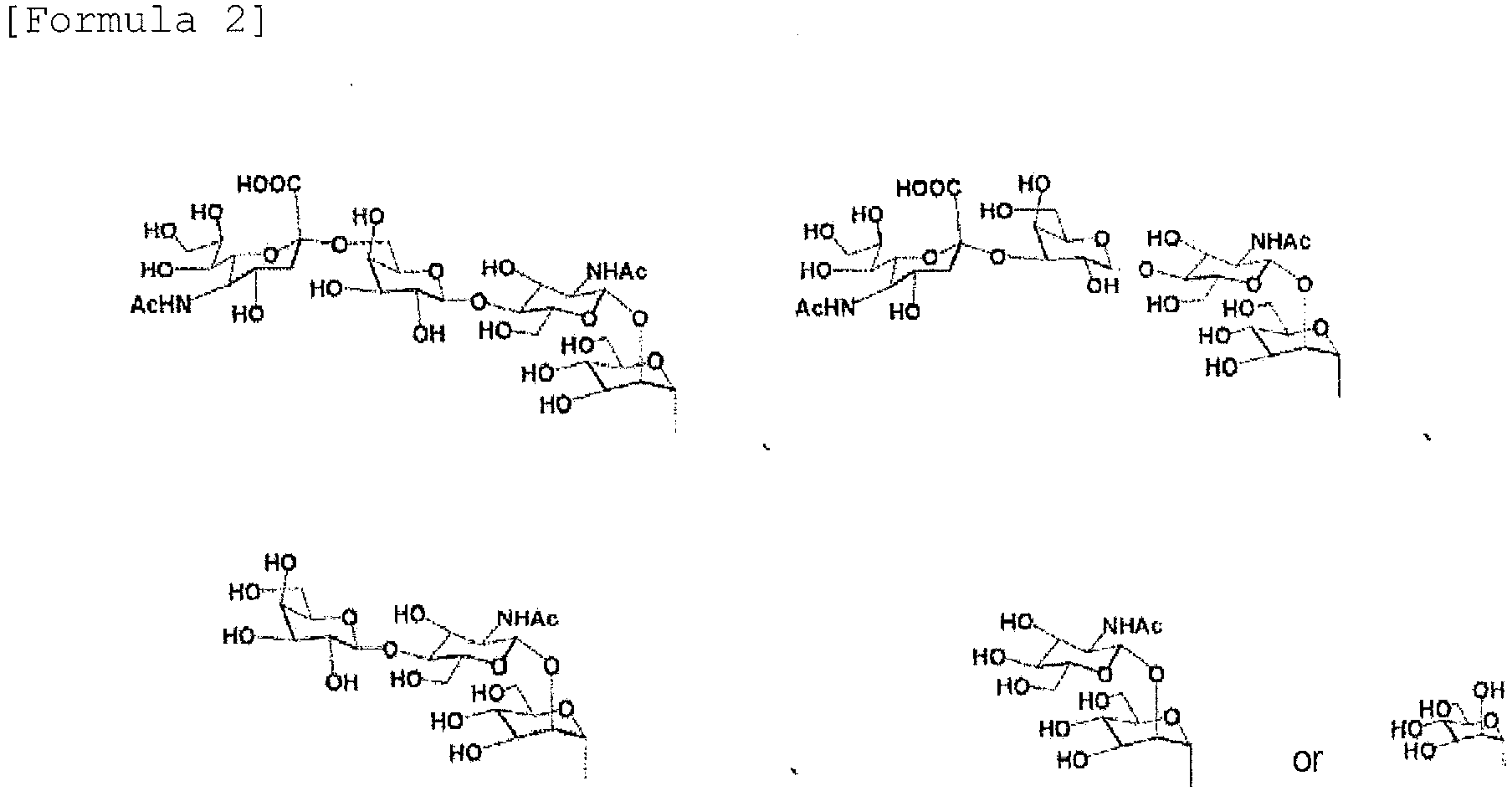
Ac is an acetyl group. - In the present invention, examples of preferable oligosaccharide chain may include oligosaccharide chain structurally the same as (oligosaccharide chains having the same types of constituent sugars and the same patterns of linkages of the sugars) oligosaccharide chain which is bound to a protein to form a glycoprotein in human bodies (e.g., oligosaccharide chains described in "FEBS LETTERS Vol. 50, No. 3, Feb. 1975"), and oligosaccharide chain lacking one or several sugars from the nonreducing end thereof, which are described in Tables 1 to 4 below.


- In a preferable aspect of the present invention, the oligosaccharide chain added GLP-1 peptide of the present invention has a uniform oligosaccharide chain structure. The uniform oligosaccharide chain structure used herein refers to the same type of each constituent sugar in the oligosaccharide chain, the same order wherein the sugars are linked, and the same pattern of linkages between the sugars and means that at least 90%, preferably at least 95%, more preferably at least 99% of oligosaccharide chain added GLP-1 peptides have a uniform oligosaccharide chain structure. The oligosaccharide chain added GLP-1 peptides having a uniform oligosaccharide chain structure have constant quality and are particularly preferable in the field such as pharmaceutical production.
- In the present invention, examples of preferable oligosaccharide chain added GLP-1 peptide may include oligosaccharide chain added GLP-1 peptides (SEQ ID NOs:103 to 151) produced in the following Examples. Namely, oligosaccharide chain added GLP-1 peptides having the sequence of His7-Ala8-Glu9-Gly10-Thr11-Phe12-Thr13-Ser14-Asp15-Val16-Ser17-Ser18-Tyr19-Leu20-Glu21-Gly22-Gln23-Ala24-Ala25-Lys26-Glu27-Phe28-Ile29-Ala30-Trp31-Leu32-Val33-Lys34-Gly35-Arg36-Gly37 (SEQ ID NO:2, GLP-1) wherein:
- (b1) 18Ser is substituted by disialo oligosaccharide chain added Cys (Example 1)(SEQ ID NO:103);
- (b2) 22Gly is substituted by disialo oligosaccharide chain added Cys (Example 2) (SEQ ID NO:104);
- (b3) 26Lys is substituted by disialo oligosaccharide chain added Cys (Reference Example 3) (SEQ ID NO:105);
- (b4) 36Arg is substituted by disialo oligosaccharide chain added Cys (Example 4) (SEQ ID NO:106);
- (b5) 37Gly is substituted by disialo oligosaccharide chain added Cys (Example 5) (SEQ ID NO:107);
- (b6) 37Gly is substituted by asialo oligosaccharide chain added Asn (Example 6) (SEQ ID NO:108);
- (b7) 19Tyr is substituted by asialo oligosaccharide chain added Asn (Reference Example 7) (SEQ ID NO:109);
- (b16) 20Leu is substituted by disialo oligosaccharide chain added Cys (Example 16) (SEQ ID NO:118);
- (b21) 30Ala is substituted by disialo oligosaccharide chain added Cys (Example 21) (SEQ ID NO:123);
- (b24) 22Gly is substituted by asialo oligosaccharide chain added Cys (Example 24) (SEQ ID NO:126);
- (b26) 30Ala is substituted by asialo oligosaccharide chain added Cys (Example 26) (SEQ ID NO:128);
- (b28) 36Arg is substituted by asialo oligosaccharide chain added Cys (Example 28) (SEQ ID NO:130);
- (b29) 22Gly is substituted by diGlucNAc oligosaccharide chain added Cys (Example 29) (SEQ ID NO:131);
- (b30) 30Ala is substituted by diGlucNAc oligosaccharide chain added Cys (Example 30) (SEQ ID NO:132);
- (b32) 22Gly is substituted by dimannose oligosaccharide chain added Cys (Example 32) (SEQ ID NO:134);
- (b33) 30Ala is substituted by dimannose oligosaccharide chain added Cys (Example 33) (SEQ ID NO:135);
- (b36) 18Ser is substituted by asialo oligosaccharide chain added Asn (Example 36) (SEQ ID NO:138);
- (b37) 22Gly is substituted by asialo oligosaccharide chain added Asn (Example 37) (SEQ ID NO:139);
- (b41) 30Ala is substituted by asialo oligosaccharide chain added Asn (Example 41) (SEQ ID NO:143);
- (b42) 36Arg is substituted by asialo oligosaccharide chain added Asn (Example 42) (SEQ ID NO:144);
- (b43) 18Ser is substituted by disialo oligosaccharide chain added Asn (Example 43) (SEQ ID N0:145);
- (b44) 22Gly is substituted by disialo oligosaccharide chain added Asn (Example 44) (SEQ ID NO:146);
- (b45) 30Ala is substituted by disialo oligosaccharide chain added Asn (Example 45) (SEQ ID NO:147);
- (b46) 30Ala is substituted by disialo oligosaccharide chain added Asn (Example 46) (SEQ ID NO:148);
- (b47) 36Arg is substituted by disialo oligosaccharide chain added Asn (Example 47) (SEQ ID NO:149); and
- (b49) 18Ser and 36Arg are each substituted by disialo oligosaccharide chain added Cys (Example 49) (SEQ ID NO:151).
- The oligosaccharide chain added GLP-1 peptide of the present invention can be produced by incorporating an oligosaccharide chain addition step (glycosylation step) to a peptide synthesis method known by those skilled in the art. For oligosaccharide chain addition, a method using reverse reaction of an enzyme typified by transglutaminase is also usable. However, this method presents problems such as a large amount of necessary oligosaccharide chains to be added, complicated purification after the final step, limited sites to which oligosaccharide chain is added, and limited types of oligosaccharide chains that can be added. Therefore, the method is not practical for large-scale production such as pharmaceutical production, though it may be used in synthesis in small amounts, e.g., for assay use.
- A process for conveniently producing the oligosaccharide chain added GLP-1 peptide of the present invention and for stably producing oligosaccharide chain added GLP-1 peptides having a uniform oligosaccharide chain structure is specifically exemplified below by a process for producing an oligosaccharide chain added GLP-1 peptide by using oligosaccharide chain added Asn as an oligosaccharide chain added amino acid and utilizing a peptide synthesis method known in the art such as solid-phase synthesis or liquid-phase synthesis (Process A) and a process for producing an oligosaccharide chain added GLP-1 peptide which comprises producing a peptide wherein any amino acid of GLP-1 is substituted with Cys, according to a peptide synthesis method known in the art and then adding oligosaccharide chain to the Cys through chemical synthesis (Process B). Those skilled in the art can produce various oligosaccharide chain added GLP-1 peptides with reference to these production processes. The oligosaccharide chain added GLP-1 peptides thus obtained and production processes thereof are very useful particularly in the field of pharmaceutical production. These Processes A and B may be performed in combination. For synthesis in small amounts, e.g., for assay use, these processes may also be combined with oligosaccharide chain extension reaction catalyzed by transferase. The Processes A an B can be referred to the descriptions of
WO 2004/005330 andWO 2005/010053 , respectively. Oligosaccharide chains used in each process can be referred toWO 03/008431 WO 2004/058984 ,WO 2004/058824 ,WO 2004/070046 ,WO 2007/011055 , etc. These documents are incorporated herein by reference. -
- First, (1) a hydroxyl group of a resin having the hydroxyl group and a carboxyl group of an amino acid having amino group nitrogen protected with a fat-soluble protective group are subjected to an esterifying reaction. Since the amino group nitrogen of the amino acid is protected with a fat-soluble protective group, the hydroxyl group of the resin is reacted with the carboxyl group of the amino acid, with self-condensation of the amino acid prevented.
- Next, (2) the fat-soluble protective group is removed from the resulting ester to form a free amino group,
- (3) the free amino group is amidated with a carboxyl group of a desired amino acid having amino group nitrogen protected with a fat-soluble protective group,
- (4) the fat-soluble protective group is removed to form a free amino group, and
- (5) the steps (3) and (4) are repeated at least once to thereby obtain a peptide having a desired number of desired amino acids as linked and having the resin attached to one end thereof and a free amino group at the other end thereof.
- (6) Next, the free amino group is amidated with a carboxyl group of the asparagine portion of an asparagine-linked oligosaccharide (oligosaccharide chain added asparagine) having amino group nitrogen protected with a fat-soluble protective group,
- (7) the fat-soluble protective group is removed to form a free amino group,
- (8) the free amino group is amidated with a carboxyl group of a desired amino acid having amino group nitrogen protected with a fat-soluble protective group,
- (9) the steps (7) and (8) are repeated at least once, and
- (10) the fat-soluble protective group is removed to form a free amino group and thereby obtain a glycopeptide having a desired number of desired amino acids as linked and having the resin attached to one end thereof, a free amino group at the other end thereof and an oligosaccharide chain added asparagine at an intermediate position.
- (11) The resin is cut off with an acid, whereby a glycopeptide can be prepared which has an oligosaccharide chain added asparagine at a desired position of the peptide chain thereof.
- Furthermore, a glycopeptide having at least two oligosaccharide chain added asparagines at a desired position of the peptide chain thereof can be prepared by suitably adding the step (6) of amidating the free amino group and a carboxyl group of the asparagine portion of an oligosaccharide chain added asparagine having amino group nitrogen protected with a fat-soluble protective group. At this time, a glycopeptide having at least two kinds of oligosaccharide chain added asparagines at a desired position of the peptide chain thereof can be prepared by using a different oligosaccharide chain added asparagine.
- Alternatively, the oligosaccharide chain added asparagine can be introduced into an end portion of the peptide chain.
- The resin having a hydroxyl group may usually be a resin having hydroxyl useful for solid-phase synthesis. Examples of resins usable are Amino-PEGA resin (product of Merck), Wang resin (product of Merck), HMPA-PEGA resin (product of Merck), etc.
- All amino acids are usable as such. Examples of amino acids usable are natural amino acids such as serine (Ser), asparagine (Asn), valine (Val), leucine (Leu), isoleucine (Ile), alanine (Ala), tyrosine (Tyr), glycine (Gly), lysine (Lys), arginine (Arg), histidine (His), aspartic acid (Asp), glutamic acid (Glu), glutamine (Gln), threonine (Thr), cysteine (Cys), methionine (Met), phenylalanine (Phe) tryptophan (Trp) and proline (Pro).
- Examples of fat-soluble protective groups are 9-fluorenylmethoxycarbonyl (Fmoc) group, tert-butyloxycarbonyl (Boc) group, benzyl group, allyl group, allyloxycarbonyl group, acetyl group and the like, which are carbonate-type or amide-type protective groups. The fat-soluble protective group, e.g., Fmoc group, can be introduced by adding 9-fluorenylmethyl-N-succinimidyl carbonate and sodium hydrogencarbonate to the contemplated compound for reaction. It is preferable to conduct the reaction at 0 to 50 DEG C, preferably at room temperature, for about 1 to about 5 hours.
- The above amino acid can be protected with a fat-soluble protective group by the method described above. The above protected amino acid can be those available commercially. Examples are Fmoc-Ser, Fmoc-Asn, Fmoc-Val, Fmoc-Leu, Fmoc-Ile, Fmoc-Ala, Fmoc-Tyr, Fmoc-Gly, Fmoc-Lys, Fmoc-Arg, Fmoc-His, Fmoc-Asp, Fmoc-Glu, Fmoc-Gln, Fmoc-Thr, Fmoc-Cys, Fmoc-Met, Fmoc-Phe, Fmoc-Trp and Fmoc-Pro.
- Usable as esterifying catalysts are dehydrating condensation agents such as 1-mesitylenesulfonyl-3-nitro-1,2,4-triazole (MSNT), dicyclohexylcarbodiimide (DCC) and diisopropylcarbodiimide (DIPCDI). The dehydrating condensation agent is used in an amount of 1 to 10 wt%, preferably 2 to 5 wt%, based on lwt% of an amino acid.
- The esterifying reaction is conducted preferably by placing a resin, for example, into a solid-phase column, washing the resin with a solvent and thereafter adding a solution of amino acid in a solvent to the resin. Examples of solvents for washing are dimethylformamide (DMF), 2-propanol, methylene chloride, etc. Examples of solvents for dissolving amino acids are dimethyl sulfoxide (DMSO), DMF, methylene chloride, etc. The reaction is conducted at 0 to 50 DEG C, preferably at room temperature, for about 10 to about 30 hours, preferably about 15 minutes to about 24 hours.
- Preferably, the unreacted hydroxyl group remaining on the solid phase at this time is acetylated, for example, with acetic anhydride for capping.
- The fat-soluble protective group can be removed, for example, by a treatment with a base. Examples of bases to be used are piperidine, morpholine, etc. This treatment is conducted preferably in the presence of a solvent. Examples of solvents usable are DMSO, DMF, methanol, etc.
- The reaction of amidating the free amino group with a carboxyl group of a desired amino acid having amino group nitrogen protected with the fat-soluble group is conducted, preferably in the presence of an activator and a solvent.
- Examples of useful activators are dicyclohexylcarbodiimide (DCC), 1-ethyl-3-(3-dimethylaminopropyl)carbodiimide / hydrochloride (WSC/HC1), diphenylphosphorylazide (DPPA), carbonyldiimidazole (CDI), diethylcyanophosphonate (DEPC), benzotriazole-1-yloxy-trispyrrolidinophosphonium (DIPCI), benzotriazole-1-yloxy-trispyrrolidinophosphonium hexafluorophosphate (PyBOP), 1-hydroxybenzotriazole (HOBt), hydroxysuccinimide (HOSu), dimethylaminopyridine (DMAP), 1-hydroxy-7-azabenzotriazole (HOAt), hydroxyphthalimide (HOPht), pentafluorophenol (Pfp-OH), 2-(1H-benzotriazole-1-yl)-1,1,3,3-tetramethyluronium hexafluorophosphate (HBTU), O-(7-azabenzotriazole-1-yl)-1,1,3,3-tetramethyluronium hexafluorophosphonate (HATU), O-benzotriazole-1-yl-1,1,3,3-tetramethyluronium tetrafluoroborate (TBTU), 3,4-dihydro-3-hydrodi-4-oxa-1,2,3-benzotriazine (Dhbt).
- The activator is used in an amount of 1 to 20 equivalents, preferably 1 to 10 equivalents, more preferably 1 to 5 equivalents, based on an amino acid having amino group nitrogen protected with a fat-soluble protective group.
- Examples of useful solvents are DMSO, DMF, methylene chloride, etc. It is desired that the reaction be conducted at 0 to 50 DEG C, preferably at room temperature, for about 10 to about 30 hours, preferably about 15 minutes to about 24 hours. The fat-soluble protective group can be removed in the same manner as described above.
- The peptide chain is cut off from the resin, preferably by a treatment with an acid. Examples of acids to be used are trifluoroacetic acid (TFA), hydrogen fluoride (HF), etc.
- The glycopeptide having at least two oligosaccharide chain added asparagines at a desired position of the peptide chain thereof can be prepared by suitably additionally performing the steps (6) of amidating the free amino group and a carboxyl group of the asparagine portion of an oligosaccharide chain added asparagine having amino group nitrogen protected with a fat-soluble protective group, and (7) of removing the fat-soluble protective group to form a free amino group.
- Further, a glycopeptide having at least one oligosaccharide chain added asparagine at a desired position of the peptide chain thereof can be prepared by performing as final steps the steps (6) of amidating the free amino group and the carboxyl group of the asparagine portion of an oligosaccharide chain added asparagine having amino group nitrogen protected with a fat-soluble protective group, and (7) of removing the fat-soluble protective group to form a free amino group.
- Further, a glycopeptide having an oligosaccharide chain added asparagine at an end portion can be prepared by performing the step (1) of esterifying a hydroxyl group of a resin having the hydroxyl group and a carboxyl group of an amino acid having amino group nitrogen protected with a fat-soluble protective group, in place of the step (6) or in addition to the step (6).
- In this way, an oligosaccharide chain added GLP-1 peptide substituted with oligosaccharide chain added Asn can be obtained.
- First, a peptide containing Cys is produced by a method such as solid-phase synthesis, liquid-phase synthesis, cell-based synthesis and separation and extraction of those existing naturally.
- Next, a haloacetamide complex-type oligosaccharide chain derivative is allowed to react with the thus-obtained peptide containing Cys for production. The reaction may be conducted usually at 0 to 80°C, preferably 10 to 60°C, more preferably 15 to 35°C. The reaction time is usually preferably about 30 minutes to about 5 hours. After the completion of reaction, the reaction product may be purified appropriately by a method known in the art [e.g., high-performance liquid column chromatography (HPLC)].
- The haloacetamide complex-type oligosaccharide chain derivative is, e.g., a compound wherein a hydroxyl group bound to carbon at
position 1 of a complex-type asparagine-linked oligosaccharide chain is substituted with -NH-(CO)-(CH2)a-CH2X, wherein X represents a halogen atom, and a represents an integer, preferably an integer of 0 to 4, but not limited to these numbers unless linker functions of interest are inhibited. - Specifically, the haloacetamide complex-type oligosaccharide chain derivative is allowed to react with the peptide containing Cys in a phosphate buffer at room temperature. After the completion of reaction, an oligosaccharide chain added GLP-1 peptide substituted with oligosaccharide chain added Cys can be obtained by HPLC purification.
- The oligosaccharide chain added GLP-1 peptide of the present invention has GLP-1 activity.
- The "GLP-1 activity" used herein refers to some or all of biological activities known in the art as to GLP-1. GLP-1 has been known to have, in addition to the effect of controlling blood-sugar levels, e.g., insulin secretion associated with cAMP synthesis induction, pancreatic islet protection (apoptosis suppression) and pancreatic islet growth as effects on a pancreatic islet as well as appetite suppression, gastrointestinal motility suppression, calcitonin secretion promotion and cardioprotective action during ischemia as extra-pancreatic effects. Thus, the GLP-1 activity refers to all or some of biological activities associated with these effects, and these activities can be measured respectively using an approach known by those skilled in the art.
- Of the GLP-1 activities, e.g., the activity of controlling blood-sugar levels can be measured using the measurement of the effect of lowering blood-sugar levels in diabetes mice (db/db mice) or the measurement of the effect of suppressing rise in blood-sugar levels in Oral Glucose Tolerance Test (OGTT). The phrase "controlling blood-sugar levels" used herein encompasses both concepts of suppressing rise in blood-sugar levels and lowering blood-sugar levels. Particularly, the effect of controlling blood-sugar levels in db/db mice is also referred to herein as the "effect of lowering blood-sugar levels", and the effect of controlling blood-sugar levels in OGTT is also referred to herein as the "effect of suppressing rise in blood-sugar levels".
- The activity of controlling blood-sugar levels in OGTT can be determined by measuring suppression of rise in blood-sugar levels in mice forced to drink sugar. When, e.g., an approach of following Test Example 7 is used, a test compound is first administered to mice fasted overnight. 30 minutes after the administration, a glucose solution is orally administered to the mice. Mouse blood-sugar levels increase due to the glucose administration, reach the maximum about 30 minutes after the administration, and gradually decrease. The blood-sugar levels can be measured 30 minutes after the glucose administration and compared with those obtained by GLP-1 administration to thereby measure the effect of controlling blood-sugar levels by the oligosaccharide chain added GLP-1 peptide. When the blood-sugar levels measured 30 minutes thereafter are compared with those obtained by GLP-1 administration, the oligosaccharide chain added GLP-1 peptide of the present invention exhibits preferably 80% or lower, more preferably 60% or lower, even more preferably 40% or lower, particularly preferably 20% or lower of the control blood sugar levels. The strength of the activity of controlling blood-sugar levels by the oligosaccharide chain added GLP-1 peptide of the present invention can be determined by comparing doses confirmed in OGTT to bring about equivalent effects of suppressing rise in blood-sugar levels. When, e.g., 10 doses of GLP-1 and 1 dose of the oligosaccharide chain added GLP-1 peptide produce the same effects of controlling blood-sugar levels, the activity of controlling blood-sugar levels by the oligosaccharide chain added GLP-1 peptide is 10 times that of the GLP-1. The oligosaccharide chain added GLP-1 peptide of the present invention has the activity of controlling blood-sugar levels preferably at least 5 times, more preferably at least 10 times, even more preferably at least 20 times, particularly preferably at least 50 times that of GLP-1.
- The activity of controlling blood-sugar levels in db/db mice can be determined by measuring blood-sugar levels in diabetes mice after administration of a test compound. When, e.g., an approach described in following Test Example 8 is used, blood-sugar levels after test compound administration are measured over time. The effect of lowering blood-sugar levels can be confirmed, if blood-sugar levels measured, e.g., 120 minutes after the administration are lower than those measured at the time of administration. Alternatively, the durability of the effect of lowering blood-sugar levels can be determined by measuring blood-sugar levels, e.g., 300 minutes after the administration. When blood-sugar levels measured 120 minutes after the administration are compared with those obtained by GLP-1 administration using the approach of following Test Example 8, the oligosaccharide chain added GLP-1 peptide of the present invention exhibits preferably 80% or lower, more preferably 70% or lower, particularly preferably 60% or lower of the control blood-sugar levels. Alternatively, when blood-sugar levels measured 120 minutes after the administration are compared with those measured at the time of administration, the oligosaccharide chain added GLP-1 peptide of the present invention exhibits preferably 70% or lower, more preferably 60% or lower, particularly preferably 50% or lower (e.g., 45% or lower) of the control blood-sugar levels. When blood-sugar levels measured 300 minutes after the administration are compared with those obtained by GLP-1 administration, the oligosaccharide chain added GLP-1 peptide of the present invention exhibits preferably 70% or lower, more preferably 50% or lower of the control blood-sugar levels. When blood-sugar levels measured 300 minutes after the administration are compared with those measured at the time of administration, the oligosaccharide chain added GLP-1 peptide of the present invention exhibits preferably 70% or lower, more preferably 50% or lower of the control blood-sugar levels.
- Even if the activity of controlling blood-sugar levels by the oligosaccharide chain added GLP-1 peptide of the present invention is lower than that of GLP-1, this low activity can be compensated by enhanced stability in blood.
- Of the GLP-1 activities, e.g., insulin secretion activity can be measured using an in-vitro test of the ability to synthesize cAMP. GLP-1 increases intracellular cAMP concentrations through the binding to its receptor and promotes insulin secretion. Thus, e.g., mouse GLP-1 receptor-expressing CHO-K1 cells are stimulated with the oligosaccharide chain added GLP-1 peptide and then, the amount of cAMP synthesized in the cells is measured. Its EC50 value can be compared with that obtained by GLP-1 to thereby measure the insulin secretion activity of the oligosaccharide chain added GLP-1 peptide.
- The oligosaccharide chain added GLP-1 peptide of the present invention has higher stability in blood than that of GLP-1. The stability in blood can be measured using an approach known by those skilled in the art and can be determined by measuring, e.g., stability in plasma or resistance to DPP-IV (dipeptidyl peptidase IV) and using a half-life, AUC (area under the blood concentration time curve), etc., as an index. Increased renal clearance also contributes to enhancement in stability in blood.
- The stability in plasma can be determined using, e.g., an approach described in following Test Example 1. The oligosaccharide chain added GLP-1 peptide of the present invention has higher stability in plasma than that of GLP-1.
- The resistance to DPP-IV can be determined by measuring a half-life in a DPP-IV solution, as shown in, e.g., following Test Example 4. The oligosaccharide chain added GLP-1 peptide of the present invention has higher resistance to DPP-IV than that of GLP-1 and has a half-life at least 1.2 times (e.g., at least 2 times), preferably at least 5 times, more preferably at least 10 times, particularly preferably at least 20 times higher than that of GLP-1, when resistance to DPP-IV is measured using, e.g., the approach of following Test Example 4.
- The oligosaccharide chain added GLP-1 peptide of the present invention also has a half-life of preferably at least 1 hour, more preferably at least 3, 5, 7, 10, 15 and 20 hours, even more preferably at least 24 hours, in blood.
- Next, a pharmaceutical composition comprising the oligosaccharide chain added GLP-1 peptide of the present invention as an active ingredient will be described.
- The pharmaceutical composition comprising the oligosaccharide chain added GLP-1 peptide of the present invention as an active ingredient is effective for the treatment or prevention of diseases associated with GLP-1. GLP-1 has been known to have various effects, as described above, and these effects are associated with various diseases. It has been found that, e.g., GLP-1 stimulates insulin release and thereby causes cellular uptake of glucose and reduction in blood-sugar levels. It has also been found that GLP-1 suppresses gastric and/or intestinal motility, gastric and/or intestinal emptying, and food ingestion. Thus, the diseases associated with GLP-1 encompass, e.g., non-insulin-dependent diabetes mellitus (NIDDM), insulin-dependent diabetes mellitus, stroke (see
WO 00/16797 WO 98/08531 WO 98/19698 WO 99/64060 type 1 diabetes and the treatment oftype 2 diabetes. - The pharmaceutical composition may be formulated in a usual pharmaceutical composition form using diluents or excipients such as fillers, extenders, binders, wetting agents, disintegrants, surfactants and lubricants usually used.
- Examples of such a pharmaceutical composition include tablets, pills, powders, liquid formulations, suspensions, emulsions, granules, capsules, suppositories and injections.
- The amount of the oligosaccharide chain added GLP-1 peptide of the present invention contained in the pharmaceutical composition is not particularly limited and can be selected appropriately from within a wide range. The oligosaccharide chain added GLP-1 peptide of the present invention is usually contained in an amount of preferably 1 to 70 wt% in the pharmaceutical composition.
- The pharmaceutical composition comprising the oligosaccharide chain added GLP-1 peptide of the present invention as an active ingredient may further contain an additional active ingredient or may also be used in combination with a pharmaceutical composition containing an additional active ingredient. Moreover, the pharmaceutical composition comprising the oligosaccharide chain added GLP-1 peptide of the present invention as an active ingredient may further comprise at least one different oligosaccharide chain added GLP-1 peptide of the present invention as an active ingredient or may also be used in combination with a pharmaceutical composition comprising at least one different oligosaccharide chain added GLP-1 peptide of the present invention as an active ingredient.
- An administration method of the pharmaceutical composition according to the present invention is not particularly limited. The pharmaceutical composition according to the present invention is administered by a method suitable for various dosage forms, the age and sex of a patient, the severity of a disease and other conditions. Examples of administration methods of tablets, pills, liquid formulations, suspensions, emulsions, granules and capsules include oral administration. Injections can be administered intravenously, intramuscularly, intradermally, subcutaneously or intraperitoneally either alone or as a mixture with a usual glucose or amino acid infusion. Suppositories are administered rectally.
- The dose of the pharmaceutical composition may be selected appropriately according to use, the age and sex of a patient, the severity of a disease and other conditions. The pharmaceutical composition is usually administered at a dose of 0.1 to 900 nmol, preferably 1 to 90 nmol, in terms of the oligosaccharide chain added GLP-1 peptide of the present invention per kg of body weight. The oligosaccharide chain added GLP-1 peptide of the present invention has much higher stability in blood than that of GLP-1. In one aspect, the oligosaccharide chain added GLP-1 peptide of the present invention has much higher activity of controlling blood-sugar levels than that of GLP-1. Therefore, its dose can be decreased advantageously.
- The number of doses of the pharmaceutical composition may be selected appropriately according to use, the age and sex of a patient, the severity of a disease and other conditions and is, e.g., 3 doses/day, 2 doses/day or 1 dose/day. Alternatively, the pharmaceutical composition may be administered with less frequency (e.g., 1 dose/week, or 1 dose/month) according to its stability in blood. The number of doses of the pharmaceutical composition is preferably 1 dose or less/day. The oligosaccharide chain added GLP-1 peptide of the present invention has much higher stability in blood than that of GLP-1. Therefore, the number of doses can be decreased advantageously.
- The oligosaccharide chain added to the oligosaccharide chain added GLP-1 peptide of the present invention is easily degraded in a metabolic system in vivo. In one aspect of the present invention, the oligosaccharide chain has a structure that is bound in a form of glycopeptide (or glycoprotein) in vivo. Thus, the oligosaccharide chain added GLP-1 peptide of the present invention and the pharmaceutical composition comprising this peptide as an active ingredient exhibits neither side effects nor antigenicity, even when administered to living bodies. Therefore, they advantageously produce neither allergic reactions nor a loss of efficacy attributed to antibody production.
- Furthermore, the oligosaccharide chain added GLP-1 peptide of the present invention can be supplied stably and conveniently in large amounts and is also very useful from the viewpoint of providing a high-quality drug having stable quality.
- The present invention also provides a method for treating or preventing a disease associated with GLP-1, comprising administering an effective amount of the oligosaccharide chain added GLP-1 peptide of the present invention.
- Hereinafter, the present invention will be described specifically with reference to Examples. However, the present invention is not intended to be limited to them by any means. In
FIGS. 7 to 22 , e.g., "22Cys GLP-1-disialo" which is an oligosaccharide chain added GLP-1 peptide wherein an amino acid at position 22 of GLP-1 is substituted by disialo oligosaccharide chain added Cys is also referred to as "22Cys-disialoGLP-1", "C22" or "C22-disialo". The same applies to other oligosaccharide chains and amino acid sites. - A solid-phase synthesis column was charged with Amino-PEGA resin (100 µmol) (product of Merck), washed thoroughly with dichloromethane (DCM) and DMF and the resin was thoroughly swollen with DMF. 4-hydroxymethyl-3-methoxyphenoxybutyric acid (HMPB) (0.25 mmol), TBTU (0.25 mmol) and N-ethylmorpholine (0.25 mmol) were dissolved in DMF (2 ml), loaded to the column, and stirred at room temperature for 4 hours. The resin was washed thoroughly with DMF and DCM to obtain HMPB-PEGA resin, which was used as a solid phase for solid-phase synthesis.
- Fmoc-Gly (0.50 mmol), MSNT (0.50 mmol) and N-methylimidazole (0.375 mmol) were dissolved in DCM (2 ml), loaded to a solid-phase synthesis column and stirred at 25°C for 3 hours.
- After stirring, the resin was washed with DCM and DMF. Fmoc group was removed by using 20% piperidine/DMF solution (2 ml) for 15 minutes. After washing with DMF, amino acids were sequentially condensed in accordance with the method shown below to extend a peptide chain.
- The amino acid having an amino group protected with Fmoc group was dissolved in N-methylpyrrolidone (NMP) (1 ml). After addition of 0.45 M HCTU•HOBT/NMP (0.4 mmol), the resulting mixture was loaded to a solid-phase synthesis column. Subsequently, 0.9 M DIPEA/NMP (0.8 mmol) was added to the solid-phase synthesis column. After stirring at room temperature for 20 minutes, the resin was washed with DCM and DMF, and Fmoc group was removed by using a 20% piperidine/DMF solution (2 ml) for 15 minutes. This operation was repeatedly performed using an amino acid protected with Fmoc group (0.5 mmol) to sequentially condense amino acids.
- Fmoc-Gly, Fmoc-Arg(Pbf), Fmoc-Gly, Fmoc-Lys(Boc), Fmoc-Val, Fmoc-Leu, Fmoc-Trp(Boc), Fmoc-Ala, Fmoc-Ile, Fmoc-Phe, Fmoc-Glu(OtBu), Fmoc-Lys(Boc), Fmoc-Ala, Fmoc-Ala, Fmoc-Gln(Trt), Fmoc-Gly, Fmoc-Glu(OtBu), Fmoc-Leu, Fmoc-Tyr(tBu), Fmoc-Cys(Trt)-OH, Fmoc-Ser(tBu), Fmoc-Val, Fmoc-Asp(OtBu), Fmoc-Ser(tBu), Fmoc-Thr(tBu), Fmoc-Phe, Fmoc-Thr(tBu), Fmoc-Gly, Fmoc-Glu(OtBu), Fmoc-Ala and Fmoc-His(Trt) were used as the amino acids protected by Fmoc group to obtain a 31-residue peptide of Gly-Arg(Pbf)-Gly-Lys(Boc)-Val-Leu-Trp(Boc)-Ala-Ile-Phe-Glu(OtBu)-Lys(Boc)-Ala-Ala-Gln(Trt)-Gly-Glu(OtBu)-Leu-Tyr(tBu)-Cys(Trt)-Ser(tBu)-Val-Asp(OtBu)-Ser(tBu)-Thr(tBu)-Phe-Thr(tBu)-Gly-Glu(OtBu)-Ala-His(Trt) (SEQ ID NO:30) on a solid-phase resin. According to the principal of the Fmoc method, the sequence is described to start from the C terminal with the direction of 37 → 7.
- After washing with DCM and DMF, the resin equivalent to 5 µmol of the 31 residue peptide was transferred to an Eppendorf tube. The obtained resin having a peptide formed thereon was partly taken in a solid-phase synthesis column. Trifluoroacetic acid: water: TIPS (= 95: 2.5: 2.5) was added such that the resin was thoroughly soaked and stirred at room temperature for 3 hours. The resin was removed by filtration and the reaction solution was concentrated under reduced pressure. The resulting residue was purified by HPLC [column: SHISEIDO UG-120 (C18 5 µm), φ 20 x 250 mm, gradient: A solution: 0.1% TFA water, B solution: 0.09% TFA/10% waster/90% AN 8.0 ml/min; 35 → 60%B, 20 min linear gradient] to obtain a peptide wherein 18Ser of GLP-1 is substituted by Cys.
- Bromoacetamidyl disialo oligosaccharide (a)(a product of OTSUKA Chemical Co., Ltd.) (3 mg)

- An oligosaccharide chain added GLP-1 peptide (2) wherein 22Gly of GLP-1 was substituted with oligosaccharide chain added Cys (22Cys GLP-1-disialo), an oligosaccharide chain added GLP-1 peptide (3) wherein 26Lys of GLP-1 was substituted with oligosaccharide chain added Cys (26Cys GLP-1-disialo) (Reference Example 3), an oligosaccharide chain added GLP-1 peptide (4) wherein 36Arg of GLP-1 was substituted with oligosaccharide chain added Cys (36Cys GLP-1-disialo), and an oligosaccharide chain added GLP-1 peptide (5) wherein oligosaccharide chain added Cys was further added to 37Gly of GLP-1 (38Cys GLP-1-disialo) were obtained in the same way as in Example 1 except that the order wherein amino acids were condensed was changed. The results are shown in Table 5.
- A solid-phase synthesis column was charged with Amino-PEGA resin (100 µmol), washed thoroughly with DCM and DMF, and thoroughly swollen with DMF. 4-hydroxymethyl-3-methoxyphenoxybutyric acid (HMPB) (0.25 mmol), TBTU (0.25 mmol) and N-ethylmorpholine (0.25 mmol) were dissolved in DMF (2 ml), loaded to the column, and stirred at room temperature for 4 hours. The resin was washed thoroughly with DMF and DCM to obtain HMPB-PEGA resin, which was used as a solid phase for solid-phase synthesis.
- Fmoc-Gly (0.50 mmol), MSNT (0.50 mmol) and N-methylimidazole (0.375 mmol) were dissolved in DCM (2 ml), loaded to a solid-phase synthesis column, and stirred at 25°C for 3 hours.
- After stirring, the resin was washed with DCM and DMF. Fmoc group was removed by using 20% piperidine/DMF solution (2 ml) for 15 minutes. After washing with DMF, amino acids were sequentially condensed in accordance with the method shown below to extend a peptide chain.
- The amino acid having an amino group protected with Fmoc group was dissolved in NMP (1 ml). After addition of 0.45 M HCTU.HOBT/NMP (0.4 mmol), the resulting mixture was loaded to a solid-phase synthesis column. Subsequently, 0.9 M DIPEA/NMP (0.8 mmol) was added to the solid-phase synthesis column. After the mixture was stirred at room temperature for 20 minutes, the resin was washed with DCM and DMF, and Fmoc group was removed by using 20% piperidine/DMF solution (2 ml) for 15 minutes. This operation was repeatedly performed using an amino acid protected with Fmoc group (0.5 mmol) to sequentially condense amino acids.
- Fmoc-Gly, Fmoc-Arg (Pbf), Fmoc-Gly, Fmoc-Lys (Boc), Fmoc-Val, Fmoc-Leu, Fmoc-Trp (Boc), Fmoc-Ala, Fmoc-Ile, Fmoc-Phe, Fmoc-Glu (OtBu), Fmoc-Lys (Boc), Fmoc-Ala, Fmoc-Ala, Fmoc-Gln (Trt), Fmoc-Gly, Fmoc-Glu (OtBu), Fmoc-Leu, Fmoc-Tyr (tBu), Fmoc-Ser (tBu), Fmoc-Ser (tBu), Fmoc-Val, Fmoc-Asp (OtBu), Fmoc-Ser (tBu), Fmoc-Thr (tBu), Fmoc-Phe, Fmoc-Thr (tBu), Fmoc-Gly, Fmoc-Glu (OtBu), Fmoc-Ala and Fmoc-His (Trt) were used as the amino acids protected with Fmoc group to obtain a 31-residue peptide of Gly-Arg(Pbf)-Gly-Lys(Boc)-Val-Leu-Trp(Boc)-Ala-Ile-Phe-Glu(OtBu)-Lys(Boc)-Ala-Ala-Gln(Trt)-Gly-Glu(OtBu)-Leu-Tyr(tBu)-Ser(tBu)-Ser(tBu)-Val-Asp(OtBu)-Ser(tBu)-Thr(tBu)-Phe-Thr(tBu)-Gly-Glu(OtBu)-Ala-His(Trt) (SEQ ID NO: 31) on a solid-phase resin.
- After washing with DCM and DMF, the resin equivalent to 5 µmol of the 31-residue peptide was transferred to an Eppendorf tube.
- The obtained resin having a peptide formed thereon was partly taken in a solid-phase synthesis column. Trifluoroacetic acid: water: TIPS (= 95:2.5:2.5) was added such that the resin was thoroughly soaked and stirred at room temperature for 3 hours. The resin was removed by filtration, and the reaction solution was concentrated under reduced pressure. The resulting residue was purified by HPLC (Cadenza column C18 100 x 10 mm, developing solvent A: 0.1% aqueous TFA solution, B: 0.1% TFA acetonitrile: water = 90:10, gradient A:B = 95:5 → 5:95, 15 min, flow rate: 3.0 ml/min) to obtain GLP-1. The results are shown in Table 5.
[Table 5] MALDI-TOF mass (Bluker Daltonics, AutoFLEX) Example 1 18Cys GLP-1-disialo Calculated for C237H367N170108S [M+H]+ 5631.47, found 5632.0 Example 2 22Cys GLP-1-disialo Calculated for C23811369N47O-109S [M+H]+ 5661.44, found 5662.1 Reference Example 3 26Cys GLP-1-disialo Calculated for C234H360N46O109S [M+H]+ 5590.38, found 5591.7 Example 4 36Cys GLP-1-disialo Calculated for C234H360N14O109S LM+H]+ 5562.37, found 5562.9 Example 5 38Cys GLP-1-disialo Calculated for C240H372N48O110S [M+H]+ 5718.47, found 5719.1 Comparative Example 1 GLP-1 - A solid-phase synthesis column was charged with Amino-PEGA resin (100 µmol), washed thoroughly with DCM and DMF, and thoroughly swollen with DMF. 4-hydroxymethyl-3-methoxyphenoxybutyric acid (HMPB) (0.25 mmol), TBTU (0.25 mmol) and N-ethylmorpholine (0.25 mmol) were dissolved in DMF (2 ml), loaded to the column, and stirred at room temperature for 4 hours. The resin was washed thoroughly with DMF and DCM to obtain HMPB-PEGA resin, which was used as a solid phase for solid-phase synthesis.
- Fmoc-Gly (0.50 mmol), MSNT (0.50 mmol) and N-methylimidazole (0.375 mmol) were dissolved in DCM (2 ml), loaded to a solid-phase synthesis column, and stirred at 25°C for 3 hours.
- After stirring, the resin was washed with DCM and DMF. Fmoc group was removed by using 20% piperidine/DMF solution (2 ml) for 15 minutes. After washing with DMF, amino acids were sequentially condensed in accordance with the method shown below to extend a peptide chain.
- The amino acid having an amino group protected with Fmoc group was dissolved in NMP (1 ml). After addition of 0.45 M HCTU·HOBT/NMP (0.4 mmol), the resulting mixture was loaded to a solid-phase synthesis column. Subsequently, 0.9 M DIPEA/NMP (0.8 mmol) was added to the solid-phase synthesis column. After the mixture was stirred at room temperature for 20 minutes, the resin was washed with DCM and DMF, and Fmoc group was removed by using 20% piperidine/DMF solution (2 ml) for 15 minutes. This operation was repeatedly performed using an amino acid protected with Fmoc group (0.5 mmol) to sequentially condense amino acids.
- (Boc-His(Trt)-OH was used for the final amino acid and used for condensation in the same way as in Fmoc-His(Trt)-OH.)
- Fmoc-Gly, Fmoc-Arg (Pbf), Fmoc-Gly, Fmoc-Lys (Boc), Fmoc-Val, Fmoc-Leu, Fmoc-Trp (Boc), Fmoc-Ala, Fmoc-Ile, Fmoc-Phe, Fmoc-Glu (OtBu), Fmoc-Lys (Boc), Fmoc-Ala, Fmoc-Ala, Fmoc-Gln (Trt), Fmoc-Gly, Fmoc-Glu (OtBu), Fmoc-Leu, Fmoc-Tyr (tBu), Fmoc-Ser (tBu), Fmoc-Ser (tBu), Fmoc-Val, Fmoc-Asp (OtBu), Fmoc-Ser (tBu), Fmoc-Thr (tBu), Fmoc-Phe, Fmoc-Thr (tBu), Fmoc-Gly, Fmoc-Glu (OtBu), Fmoc-Ala and Fmoc-His (Trt) were used as the amino acids protected with Fmoc group and Boc-His(Trt)-OH was used as the amino acid protected with Boc group to obtain a 31-residue peptide of Gly-Arg(Pbf)-Gly-Lys(Boc)-Val-Leu-Trp(Boc)-Ala-Ile-Phe-Glu(OtBu)-Lys(Boc)-Ala-Ala-Gln(Trt)-Gly-Glu(OtBu)-Leu-Tyr(tBu)-Ser(tBu)-Ser(tBu)-Val-Asp(OtBu)-Ser(tBu)-Thr(tBu)-Phe-Thr(tBu)-Gly-Glu(OtBu)-Ala-His(Trt) (SEQ ID NO: 32) on a solid-phase resin.
- After washing with DCM and DMF, a solution mixture of trifluoroethanol and acetic acid (1:1) was added such that the resin was thoroughly soaked and stirred at room temperature for 18 hours. The resin was removed by filtration, and the reaction solution was concentrated under reduced pressure. The obtained residue was concentrated to obtain a protected peptide of Gly-Arg(Pbf)-Gly-Lys(Boc)-Val-Leu-Trp(Boc)-Ala-Ile-Phe-Glu(OtBu)-Lys(Boc)-Ala-Ala-Gln(Trt)-Gly-Glu(OtBu)-Leu-Tyr(tBu)-Ser(tBu)-Ser(tBu)-Val-Asp(OtBu)-Ser(tBu)-Thr(tBu)-Phe-Thr(tBu)-Gly-Glu(OtBu)-Ala-His(Trt)-Boc (Sequence No. 33). The 31-residue protected peptide (equivalent to 2 µmol) was transferred to an eggplant flask and dissolved in DMF (0.03 ml). In an Eppendorf tube separately prepared, asialo oligosaccharide chain added asparagine (amine-free) (4.9 mg, 1 µmol), PyBOP (1 mg, 1.9 µmol) and HOBt (0.3 mg, 2 µmol) dissolved in DMF (0.04 ml) were placed, and DIPEA (0.00052 ml, 3 µmol) was finally added thereto. The solution mixture in this Eppendorf tube was placed in the eggplant flask prepared in advance and stirred at room temperature for 2.5 hours. After completion of the reaction, the solution was concentrated. To the residue, trifluoroacetic acid: water: TIPS (= 95:2.5:2.5) was added and stirred at room temperature. After 2 hours, the solution was added to diethyl ether (150 ml) separately prepared to obtain a crystal. The solution portion was removed by a membrane filter to obtain a residue containing the oligosaccharide chain added GLP-1 peptide of interest. The obtained residue was purified by HPLC [column: SHISEIDO UG-120 (C18 5 µm), φ20 x 250 mm, gradient: A solution: 0.1% TFA water, B solution: 0.09% TFA/10% water/90% AN 8.0 ml/min; 35 → 60% B solution, 20 min linear gradient] to obtain a oligosaccharide chain added GLP-1 peptide wherein position 38 of GLP-1 was substituted with oligosaccharide chain added Asn (38Asn-GLP-1-asialo).
ESI-MS: Calcd for C217H336N46O94: [M+3H]3+ 1697.8, found. 1697.9. - A solid-phase synthesis column was charged with Amino-PEGA resin (100 µmol), washed thoroughly with DCM and DMF and the resin was thoroughly swollen with DMF. 4-hydroxymethyl-3-methoxyphenoxybutyric acid (HMPB) (0.25 mmol), TBTU (0.25 mmol) and N-ethylmorpholine (0.25 mmol) were dissolved in DMF (2 ml), loaded to the column, and stirred at room temperature for 4 hours. The resin was washed thoroughly with DMF and DCM to obtain HMPB-PEGA resin, which was used as a solid phase for solid-phase synthesis.
- Fmoc-Gly (0.50 mmol), MSNT (0.50 mmol) and N-methylimidazole (0.375 mmol) were dissolved in DCM (2 ml), loaded to a solid-phase synthesis column and stirred at 25°C for 3 hours.
- After stirring, the resin was washed with DCM and DMF. Fmoc group was removed by using 20% piperidine/DMF solution (2 ml) for 15 minutes. After washing with DMF, amino acids were sequentially condensed in accordance with the method shown below to extend a peptide chain.
- The amino acid having an amino group protected with Fmoc group was dissolved in NMP (1 ml). After addition of 0.45 M HCTU·HOBT/NMP (0.4 mmol), the resulting mixture was loaded to a solid-phase synthesis column. Subsequently, 0.9 M DIPEA/NMP (0.8 mmol) was added to the solid-phase synthesis column. After stirring at room temperature for 20 minutes, the resin was washed with DCM and DMF, and Fmoc group was removed by using a 20% piperidine/DMF solution (2 ml) for 15 minutes. This operation was repeatedly performed using an amino acid protected with Fmoc group (0.5 mmol) to sequentially condense amino acids.
- Fmoc-Gly, Fmoc-Arg(Pbf), Fmoc-Gly, Fmoc-Lys(Boc), Fmoc-Val, Fmoc-Leu, Fmoc-Trp(Boc), Fmoc-Ala, Fmoc-Ile, Fmoc-Phe, Fmoc-Glu(OtBu), Fmoc-Lys(Boc), Fmoc-Ala, Fmoc-Ala, Fmoc-Gln(Trt), Fmoc-Gly, Fmoc-Glu(OtBu), and Fmoc-Leu were used as the amino acids protected by Fmoc group to obtain a 18-residue peptide of Gly-Arg(Pbf)-Gly-Lys(Boc)-Val-Leu-Trp(Boc)-Ala-Ile-Phe-Glu(OtBu)-Lys(Boc)-Ala-Ala-Gln(Trt)-Gly-Glu(OtBu)-Leu (SEQ ID NO:34) on a solid-phase resin.
- After washing with DCM and DMF, the resin equivalent to 5 µmol of the 18 residue peptide was transferred to an Eppendorf tube.
- Oligosaccharide chain added asparagine (b) (a product of OTSUKA Chemical Co., Ltd.) (18 mg, 10µmol)

- The obtained resin having anoligosaccharide chain added peptide formed thereon was partly taken in a solid-phase synthesis column. Trifluoroacetic acid: water: TIPS (= 95: 2.5: 2.5) was added such that the resin was thoroughly soaked and stirred at room temperature for 3 hours. The resin was removed by filtration and the reaction solution was concentrated under reduced pressure. The resulting residue was purified by HPLC [column: SHISEIDO UG-120 (C18 5 µm), φ 20 x 250 mm, gradient: A solution: 0.1% TFA water, B solution: 0.09% TFA/10% water/90% AN 7.0 ml/min; 35 → 60%B, 20 min linear gradient] to obtain oligosaccharide chain added peptide wherein
position 19 of GLP-1 is substituted by oligosaccharide chain added Asn (19Asn GLP-1-asialo). ESI-MS: Calcd for C214H331N45O92: [M+3H]3+ 1668.8, found.1668.1.[Table 6] EMI-MS Example 6 38Asn GLP-1-asialo Calculated for C217H336N46O94 [M+3H]3+ 1697.8, found 1697.9 Reference Example 7 19Asn GLP-1-asialo Calculated for C214H331N45O92 [M+3H]3+ 1668.8, found 1668.1 - A solid-phase synthesis column was charged with Amino-PEGA resin (100 µmol) (product of Merck), washed thoroughly with dichloromethane (DCM) and DMF and the resin was thoroughly swollen with DMF. 4-hydroxymethyl-3-methoxyphenoxybutyric acid (HMPB) (0.25 mmol), TBTU (0.25 mmol) and N-ethylmorpholine (0.25 mmol) were dissolved in DMF (2 ml), loaded to the column, and stirred at room temperature for 4 hours. The resin was washed thoroughly with DMF and DCM to obtain HMPB-PEGA resin, which was used as a solid phase for solid-phase synthesis.
- Fmoc-Gly (0.50 mmol), MSNT (0.50 mmol) and N-methylimidazole (0.375 mmol) were dissolved in DCM (2 ml), loaded to a solid-phase synthesis column and stirred at 25°C for 3 hours.
- After stirring, the resin was washed with DCM and DMF. Fmoc group was removed by using 20% piperidine/DMF solution (2 ml) for 15 minutes. After washing with DMF, amino acids were sequentially condensed in accordance with the method shown below to extend a peptide chain.
- The amino acid having an amino group protected with Fmoc group was dissolved in N-methylpyrrolidone (NMP) (1 ml). After addition of 0.45 M HCTU·HOBT/NMP (0.4 mmol), the resulting mixture was loaded to a solid-phase synthesis column. Subsequently, 0.9 M DIPEA/NMP (0.8 mmol) was added to the solid-phase synthesis column. After stirring at room temperature for 20 minutes, the resin was washed with DCM and DMF, and Fmoc group was removed by using a 20% piperidine/DMF solution (2 ml) for 15 minutes. This operation was repeatedly performed using an amino acid protected with Fmoc group (0.5 mmol) to sequentially condense amino acids.
- Fmoc-Gly, Fmoc-Arg(Pbf), Fmoc-Gly, Fmoc-Lys(Boc), Fmoc-Val, Fmoc-Leu, Fmoc-Trp(Boc), Fmoc-Ala, Fmoc-Ile, Fmoc-Phe, Fmoc-Glu(OtBu), Fmoc-Lys(Boc), Fmoc-Ala, Fmoc-Ala, Fmoc-Gln(Trt), Fmoc-Gly, Fmoc-Glu(OtBu), Fmoc-Cys(Trt), Fmoc-Tyr(tBu), Fmoc-Ser(tBu), Fmoc-Ser(tBu), Fmoc-Val, Fmoc-Asp(OtBu), Fmoc-Ser(tBu), Fmoc-Thr(tBu), Fmoc-Phe, Fmoc-Thr(tBu), Fmoc-Gly, Fmoc-Glu(OtBu), Fmoc-Ala and Fmoc-His(Trt) were used as the amino acids protected by Fmoc group to obtain a 31-residue peptide of Gly-Arg(Pbf)-Gly-Lys(Boc)-Val-Leu-Trp(Boc)-Ala-Ile-Phe-Glu(OtBu)-Lys(Boc)-Ala-Ala-Gln(Trt)-Gly-Glu(OtBu)-Cys(Trt)-Tyr(tBu)-Ser(tBu)-Ser(tBu)-Val-Asp(OtBu)-Ser(tBu)-Thr(tBu)-Phe-Thr(tBu)-Gly-Glu(OtBu)-Ala-His(Trt) (SEQ ID NO:45) on a solid-phase resin.
- The obtained resin having a peptide formed thereon was partly taken in a solid-phase synthesis column. Trifluoroacetic acid: water: TIPS (= 95: 2.5: 2.5) was added such that the resin was thoroughly soaked and stirred at room temperature for 3 hours. The resin was removed by filtration and the reaction solution was concentrated under reduced pressure. The resulting residue was purified by HPLC [column: SHISEIDO UG-120 (C18 5 µm), φ 20 x 250 mm, gradient: A solution: 0.1% TFA water, B solution: 0.09% TFA/10% waster/90% AN 8.0 ml/min; 35 → 60%B, 20 min linear gradient] to obtain peptide wherein 20Leu of GLP-1 is substituted by Cys.
- Bromoacetamidyl disialo oligosaccharide (a) (a product of OTSUKA Chemical Co., Ltd.) (36.9 mg) and the peptide chain synthesized above (12.3 mg) were dissolved in 100 mM phosphate buffer (pH 7.5, 1.5 ml) and allowed to react at 37°C for 4 hours. After complete consumption of raw materials were confirmed by HPLC, the reaction solution was directly subjected to purification by HPLC [column: SHISEIDO UG-120 (C18, 5 µm), φ 20 x 250 mm, gradient: A solution: 0.1% TFA water, B solution: 0.09% TFA/10% water/90% AN 8.0 ml/min; 35 → 60%B, 20 min linear gradient] to obtain 13.4 mg of oligosaccharide chain added GLP-1 peptide wherein 20Leu of GLP-1 is substituted by oligosaccharide chain added Cys (20Cys GLP-1-disialo).
- A solid-phase synthesis column was charged with Amino-PEGA resin (100 µmol) (product of Merck), washed thoroughly with dichloromethane (DCM) and DMF and the resin was thoroughly swollen with DMF. 4-hydroxymethyl-3-methoxyphenoxybutyric acid (HMPB) (0.25 mmol), TBTU (0.25 mmol) and N-ethylmorpholine (0.25 mmol) were dissolved in DMF (2 ml), loaded to the column, and stirred at room temperature for 4 hours. The resin was washed thoroughly with DMF and DCM to obtain HMPB-PEGA resin, which was used as a solid phase for solid-phase synthesis.
- Fmoc-Gly (0.50 mmol), MSNT (0.50 mmol) and N-methylimidazole (0.375 mmol) were dissolved in DCM (2 ml), loaded to a solid-phase synthesis column and stirred at 25°C for 3 hours.
- After stirring, the resin was washed with DCM and DMF. Fmoc group was removed by using 20% piperidine/DMF solution (2 ml) for 15 minutes. After washing with DMF, amino acids were sequentially condensed in accordance with the method shown below to extend a peptide chain.
- The amino acid having an amino group protected with Fmoc group was dissolved in N-methylpyrrolidone (NMP) (1 ml). After addition of 0.45 M HCTU·HOBT/NMP (0.4 mmol), the resulting mixture was loaded to a solid-phase synthesis column. Subsequently, 0.9 M DIPEA/NMP (0.8 mmol) was added to the solid-phase synthesis column. After stirring at room temperature for 20 minutes, the resin was washed with DCM and DMF, and Fmoc group was removed by using a 20% piperidine/DMF solution (2 ml) for 15 minutes. This operation was repeatedly performed using an amino acid protected with Fmoc group (0.5 mmol) to sequentially condense amino acids.
- Fmoc-Gly, Fmoc-Arg(Pbf), Fmoc-Gly, Fmoc-Lys(Boc), Fmoc-Val, Fmoc-Leu, Fmoc-Trp(Boc), Fmoc-Cys(Trt), Fmoc-Ile, Fmoc-Phe, Fmoc-Glu(OtBu), Fmoc-Lys(Boc), Fmoc-Ala, Fmoc-Ala, Fmoc-Gln(Trt), Fmoc-Gly, Fmoc-Glu(OtBu), Fmoc-Leu, Fmoc-Tyr(tBu), Fmoc-Ser(tBu), Fmoc-Ser(tBu), Fmoc-Val, Fmoc-Asp(OtBu), Fmoc-Ser(tBu), Fmoc-Thr(tBu), Fmoc-Phe, Fmoc-Thr(tBu), Fmoc-Gly, Fmoc-Glu(OtBu), Fmoc-Ala and Fmoc-His(Trt) were used as the amino acids protected by Fmoc group to obtain a 31-residue peptide of Gly-Arg(Pbf)-Gly-Lys(Boc)-Val-Leu-Trp(Boc)-Cys(Trt)-Ile-Phe-Glu(OtBu)-Lys(Boc)-Ala-Ala-Gln(Trt)-Gly-Glu(OtBu)-Leu-Tyr(tBu)-Ser(tBu)-Ser(tBu)-Val-Asp(OtBu)-Ser(tBu)-Thr(tBu)-Phe-Thr(tBu)-Gly-Glu(OtBu)-Ala-His(Trt) (SEQ ID NO:50) on a solid-phase resin.
- The obtained resin having a peptide formed thereon was partly taken in a solid-phase synthesis column. Trifluoroacetic acid: water: TIPS (= 95: 2.5: 2.5) was added such that the resin was thoroughly soaked and stirred at room temperature for 3 hours. The resin was removed by filtration and the reaction solution was concentrated under reduced pressure. The resulting residue was purified by HPLC [column: SHISEIDO UG-120 (C18 5 µm), φ 20 x 250 mm, gradient: A solution: 0.1% TFA water, B solution: 0.09% TFA/10% waster/90% AN 8.0 ml/min; 35 → 60%B, 20 min linear gradient] to obtain peptide wherein 30Ala of GLP-1 is substituted by Cys.
- Bromoacetamidyl disialo oligosaccharide (a) (a product of OTSUKA Chemical Co., Ltd.) (21.3 mg) and the peptide chain synthesized above (7.1 mg) were dissolved in 100 mM phosphate buffer (pH 7.5, 0.7 ml) and allowed to react at 37°C for 4 hours. After complete consumption of raw materials were confirmed by HPLC, the reaction solution was directly subjected to purification by HPLC [column: SHISEIDO UG-120 (C18, 5 µm), φ 20 x 250 mm, gradient: A solution: 0.1% TFA water, B solution: 0.09% TFA/10% water/90% AN 8.0 ml/min; 35 → 60%B, 20 min linear gradient] to obtain 6.6 mg of oligosaccharide chain added GLP-1 peptide wherein 30Ala of GLP-1 is substituted by oligosaccharide chain added Cys (30Cys GLP-1-disialo).
- A solid-phase synthesis column was charged with Amino-PEGA resin (100 µmol) (product of Merck), washed thoroughly with dichloromethane (DCM) and DMF and the resin was thoroughly swollen with DMF. 4-hydroxymethyl-3-methoxyphenoxybutyric acid (HMPB) (0.25 mmol), TBTU (0.25 mmol) and N-ethylmorpholine (0.25 mmol) were dissolved in DMF (2 ml), loaded to the column, and stirred at room temperature for 4 hours. The resin was washed thoroughly with DMF and DCM to obtain HMPB-PEGA resin, which was used as a solid phase for solid-phase synthesis.
- Fmoc-Gly (0.50 mmol), MSNT (0.50 mmol) and N-methylimidazole (0.375 mmol) were dissolved in DCM (2 ml), loaded to a solid-phase synthesis column and stirred at 25°C for 3 hours.
- After stirring, the resin was washed with DCM and DMF. Fmoc group was removed by using 20% piperidine/DMF solution (2 ml) for 15 minutes. After washing with DMF, amino acids were sequentially condensed in accordance with the method shown below to extend a peptide chain.
- The amino acid having an amino group protected with Fmoc group was dissolved in N-methylpyrrolidone (NMP) (1 ml). After addition of 0.45 M HCTU·HOBT/NMP (0.4 mmol), the resulting mixture was loaded to a solid-phase synthesis column. Subsequently, 0.9 M DIPEA/NMP (0.8 mmol) was added to the solid-phase synthesis column. After stirring at room temperature for 20 minutes, the resin was washed with DCM and DMF, and Fmoc group was removed by using a 20% piperidine/DMF solution (2 ml) for 15 minutes. This operation was repeatedly performed using an amino acid protected with Fmoc group (0.5 mmol) to sequentially condense amino acids.
- Fmoc-Gly, Fmoc-Arg(Pbf), Fmoc-Gly, Fmoc-Lys(Boc), Fmoc-Val, Fmoc-Leu, Fmoc-Trp(Boc), Fmoc-Ala, Fmoc-Ile, Fmoc-Phe, Fmoc-Glu(OtBu), Fmoc-Lys(Boc), Fmoc-Ala, Fmoc-Ala, Fmoc-Gln(Trt), Fmoc-Cys(Trt), Fmoc-Glu(OtBu), Fmoc-Leu, Fmoc-Tyr(tBu), Fmoc-Ser(tBu), Fmoc-Ser(tBu), Fmoc-Val, Fmoc-Asp(OtBu), Fmoc-Ser(tBu), Fmoc-Thr(tBu), Fmoc-Phe, Fmoc-Thr(tBu), Fmoc-Gly, Fmoc-Glu(OtBu), Fmoc-Ala and Fmoc-His(Trt) were used as the amino acids protected by Fmoc group to obtain a 31-residue peptide of Gly-Arg(Pbf)-Gly-Lys(Boc)-Val-Leu-Trp(Boc)-Ala-Ile-Phe-Glu(OtBu)-Lys(Boc)-Ala-Ala-Gln(Trt)-Cys(Trt)-Glu(OtBu)-Leu-Tyr(tBu)-Ser(tBu)-Ser(tBu)-Val-Asp(OtBu)-Ser(tBu)-Thr(tBu)-Phe-Thr(tBu)-Gly-Glu(OtBu)-Ala-His(Trt) (SEQ ID NO:53) on a solid-phase resin.
- The obtained resin having a peptide formed thereon was partly taken in a solid-phase synthesis column. Trifluoroacetic acid: water: TIPS (= 95: 2.5: 2.5) was added such that the resin was thoroughly soaked and stirred at room temperature for 3 hours. The resin was removed by filtration and the reaction solution was concentrated under reduced pressure. The resulting residue was purified by HPLC [column: SHISEIDO UG-120 (C18 5 µm), φ 20 x 250 mm, gradient: A solution: 0.1% TFA water, B solution: 0.09% Tufa/10% water/90% AN 8.0 ml/min; 35 → 60%B, 20 min linear gradient] to obtain peptide wherein 22Gly of GLP-1 is substituted by Cys.
- Bromoacetamidyl digalactose oligosaccharide (c) (a product of OTSUKA Chemical Co., Ltd.) (15 mg)

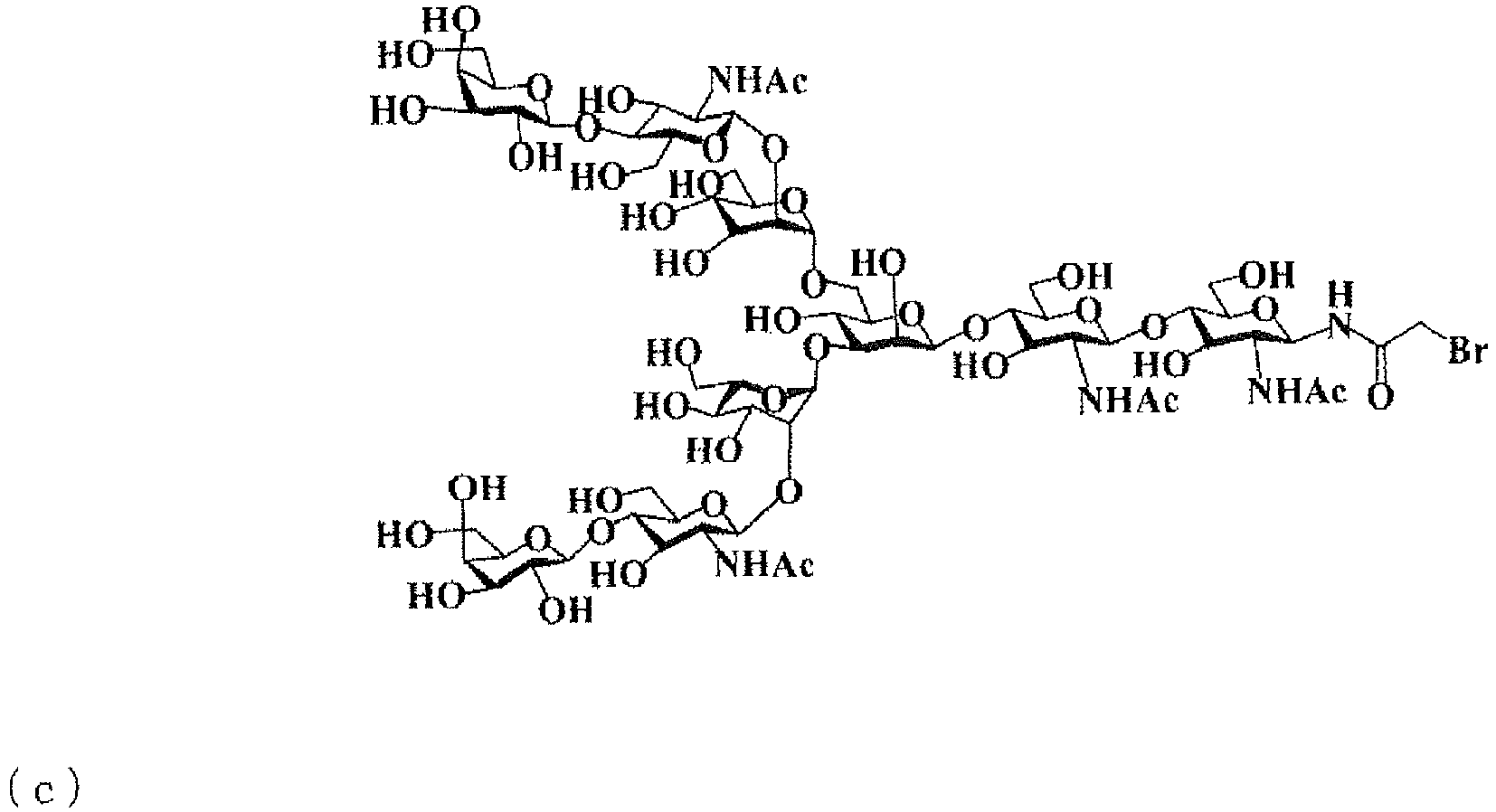
- A solid-phase synthesis column was charged with Amino-PEGA resin (100 µmol) (product of Merck), washed thoroughly with dichloromethane (DCM) and DMF and the resin was thoroughly swollen with DMF. 4-hydroxymethyl-3-methoxyphenoxybutyric acid (HMPB) (0.25 mmol), TBTU (0.25 mmol) and N-ethylmorpholine (0.25 mmol) were dissolved in DMF (2 ml), loaded to the column, and stirred at room temperature for 4 hours. The resin was washed thoroughly with DMF and DCM to obtain HMPB-PEGA resin, which was used as a solid phase for solid-phase synthesis.
- Fmoc-Gly (0.50 mmol), MSNT (0.50 mmol) and N-methylimidazole (0.375 mmol) were dissolved in DCM (2 ml), loaded to a solid-phase synthesis column and stirred at 25°C for 3 hours.
- After stirring, the resin was washed with DCM and DMF. Fmoc group was removed by using 20% piperidine/DMF solution (2 ml) for 15 minutes. After washing with DMF, amino acids were sequentially condensed in accordance with the method shown below to extend a peptide chain.
- The amino acid having an amino group protected with Fmoc group was dissolved in N-methylpyrrolidone (NMP) (1 ml). After addition of 0.45 M HCTU·HOBT/NMP (0.4 mmol), the resulting mixture was loaded to a solid-phase synthesis column. Subsequently, 0.9 M DIPEA/NMP (0.8 mmol) was added to the solid-phase synthesis column. After stirring at room temperature for 20 minutes, the resin was washed with DCM and DMF, and Fmoc group was removed by using a 20% piperidine/DMF solution (2 ml) for 15 minutes. This operation was repeatedly performed using an amino acid protected with Fmoc group (0.5 mmol) to sequentially condense amino acids.
- Fmoc-Gly, Fmoc-Arg(Pbf), Fmoc-Gly, Fmoc-Lys(Boc), Fmoc-Val, Fmoc-Leu, Fmoc-Trp(Boc), Fmoc-Cys(Trt), Fmoc-Ile, Fmoc-Phe, Fmoc-Glu(OtBu), Fmoc-Lys(Boc), Fmoc-Ala, Fmoc-Ala, Fmoc-Gln(Trt), Fmoc-Gly, Fmoc-Glu(OtBu), Fmoc-Leu, Fmoc-Tyr(tBu), Fmoc-Ser(tBu), Fmoc-Ser(tBu), Fmoc-Val, Fmoc-Asp(OtBu), Fmoc-Ser(tBu), Fmoc-Thr(tBu), Fmoc-Phe, Fmoc-Thr(tBu), Fmoc-Gly, Fmoc-Glu(OtBu), Fmoc-Ala and Fmoc-His(Trt) were used as the amino acids protected by Fmoc group to obtain a 31-residue peptide of Gly-Arg(Pbf)-Gly-Lys(Boc)-Val-Leu-Trp(Boc)-Cys(Trt)-Ile-Phe-Glu (OtBu) -Lys (Boc) -Ala-Ala-Gln (Trt) -Gly-Glu (OtBu) -Leu-Tyr(tBu)-Ser(tBu)-Ser(tBu)-Val-Asp(OtBu)-Ser(tBu)-Thr(tBu)-Phe-Thr(tBu)-Gly-Glu(OtBu)-Ala-His(Trt) (SEQ ID NO:55) on a solid-phase resin.
- The obtained resin having a peptide formed thereon was partly taken in a solid-phase synthesis column. Trifluoroacetic acid: water: TIPS (= 95: 2.5: 2.5) was added such that the resin was thoroughly soaked and stirred at room temperature for 3 hours. The resin was removed by filtration and the reaction solution was concentrated under reduced pressure. The resulting residue was purified by HPLC [column: SHISEIDO UG-120 (C18 5 µm), φ 20 x 250 mm, gradient: A solution: 0.1% TFA water, B solution: 0.09% TFA/10% waster/90% AN 8.0 ml/min; 35 → 60%B, 20 min linear gradient] to obtain peptide wherein 30Ala of GLP-1 is substituted by Cys.
- Bromoacetamidyl digalactose oligosaccharide (c) (a product of OTSUKA Chemical Co., Ltd.) (9.0 mg) and the peptide chain synthesized above (4.1 mg) were dissolved in 100 mM phosphate buffer (pH 7.5, 410 µl) and allowed to react at 37°C for 4 hours. After complete consumption of raw materials were confirmed by HPLC, the reaction solution was directly subjected to purification by HPLC [column: SHISEIDO UG-120 (C18, 5 µm), φ 4.6 x 250 mm, gradient: A solution: 0.1% TFA water, B solution: 0.09% TFA/10% water/90% AN 0.7 ml/min; 35 → 60%B, 20 min linear gradient] to obtain 2.4 mg of oligosaccharide chain added GLP-1 peptide wherein 30Ala of GLP-1 is substituted by oligosaccharide chain added Cys (30Cys GLP-1-asialo).
- A solid-phase synthesis column was charged with Amino-PEGA resin (100 µmol) (product of Merck), washed thoroughly with dichloromethane (DCM) and DMF and the resin was thoroughly swollen with DMF. 4-hydroxymethyl-3-methoxyphenoxybutyric acid (HMPB) (0.25 mmol), TBTU (0.25 mmol) and N-ethylmorpholine (0.25 mmol) were dissolved in DMF (2 ml), loaded to the column, and stirred at room temperature for 4 hours. The resin was washed thoroughly with DMF and DCM to obtain HMPB-PEGA resin, which was used as a solid phase for solid-phase synthesis.
- Fmoc-Gly (0.50 mmol), MSNT (0.50 mmol) and N-methylimidazole (0.375 mmol) were dissolved in DCM (2 ml), loaded to a solid-phase synthesis column and stirred at 25°C for 3 hours.
- After stirring, the resin was washed with DCM and DMF. Fmoc group was removed by using 20% piperidine/DMF solution (2 ml) for 15 minutes. After washing with DMF, amino acids were sequentially condensed in accordance with the method shown below to extend a peptide chain.
- The amino acid having an amino group protected with Fmoc group was dissolved in N-methylpyrrolidone (NMP) (1 ml). After addition of 0.45 M HCTU·HOBT/NMP (0.4 mmol), the resulting mixture was loaded to a solid-phase synthesis column. Subsequently, 0.9 M DIPEA/NMP (0.8 mmol) was added to the solid-phase synthesis column. After stirring at room temperature for 20 minutes, the resin was washed with DCM and DMF, and Fmoc group was removed by using a 20% piperidine/DMF solution (2 ml) for 15 minutes. This operation was repeatedly performed using an amino acid protected with Fmoc group (0.5 mmol) to sequentially condense amino acids.
- Fmoc-Gly, Fmoc-Cys(Trt), Fmoc-Gly, Fmoc-Lys(Boc), Fmoc-Val, Fmoc-Leu, Fmoc-Trp(Boc), Fmoc-Ala, Fmoc-Ile, Fmoc-Phe, Fmoc-Glu(OtBu), Fmoc-Lys(Boc), Fmoc-Ala, Fmoc-Ala, Fmoc-Gln(Trt), Fmoc-Gly, Fmoc-Glu(OtBu), Fmoc-Leu, Fmoc-Tyr(tBu), Fmoc-Ser(tBu), Fmoc-Ser(tBu), Fmoc-Val, Fmoc-Asp(OtBu), Fmoc-Ser(tBu), Fmoc-Thr(tBu), Fmoc-Phe, Fmoc-Thr(tBu), Fmoc-Gly, Fmoc-Glu(OtBu), Fmoc-Ala and Fmoc-His(Trt) were used as the amino acids protected by Fmoc group to obtain a 31-residue peptide of Gly-Cys(Trt)-Gly-Lys(Boc)-Val-Leu-Trp(Boc)-Ala-Ile-Phe-Glu (OtBu) -Lys (Boc) -Ala-Ala-Gln (Trt) -Gly-Glu (OtBu) -Leu-Tyr(tBu)-Ser(tBu)-Ser(tBu)-Val-Asp(OtBu)-Ser(tBu)-Thr(tBu)-Phe-Thr(tBu)-Gly-Glu(OtBu)-Ala-His(Trt) (SEQ ID NO:57) on a solid-phase resin.
- The obtained resin having a peptide formed thereon was partly taken in a solid-phase synthesis column. Trifluoroacetic acid: water: TIPS (= 95: 2.5: 2.5) was added such that the resin was thoroughly soaked and stirred at room temperature for 3 hours. The resin was removed by filtration and the reaction solution was concentrated under reduced pressure. The resulting residue was purified by HPLC [column: SHISEIDO UG-120 (C18 5 µm), φ 20 x 250 mm, gradient: A solution: 0.1% TFA water, B solution: 0.09% TFA/10% water/90% AN 8.0 ml/min; 35 → 60%B, 20 min linear gradient] to obtain peptide wherein 36Arg of GLP-1 is substituted by Cys.
- Bromoacetamidyl digalactose oligosaccharide (c) (a product of OTSUKA Chemical Co., Ltd.) (3.0 mg) and the peptide chain synthesized above (0.5 mg) were dissolved in 100 mM phosphate buffer (pH 7.5, 100 µl) and allowed to react at 37°C for 4 hours. After complete consumption of raw materials were confirmed by HPLC, the reaction solution was directly subjected to purification by HPLC [column: SHISEIDO UG-120 (C18, 5 µm), φ 4.6 x 250 mm, gradient: A solution: 0.1% TFA water, B solution: 0.09% TFA/10% water/90% AN 0.7 ml/min; 35 → 60%B, 20 min linear gradient] to obtain 0.2 mg of oligosaccharide chain added GLP-1 peptide wherein 36Arg of GLP-1 is substituted by oligosaccharide chain added Cys (36Cys GLP-1-asialo) .
- A solid-phase synthesis column was charged with Amino-PEGA resin (100 µmol) (product of Merck), washed thoroughly with dichloromethane (DCM) and DMF and the resin was thoroughly swollen with DMF. 4-hydroxymethyl-3-methoxyphenoxybutyric acid (HMPB) (0.25 mmol), TBTU (0.25 mmol) and N-ethylmorpholine (0.25 mmol) were dissolved in DMF (2 ml), loaded to the column, and stirred at room temperature for 4 hours. The resin was washed thoroughly with DMF and DCM to obtain HMPB-PEGA resin, which was used as a solid phase for solid-phase synthesis.
- Fmoc-Gly (0.50 mmol), MSNT (0.50 mmol) and N-methylimidazole (0.375 mmol) were dissolved in DCM (2 ml), loaded to a solid-phase synthesis column and stirred at 25°C for 3 hours.
- After stirring, the resin was washed with DCM and DMF. Fmoc group was removed by using 20% piperidine/DMF solution (2 ml) for 15 minutes. After washing with DMF, amino acids were sequentially condensed in accordance with the method shown below to extend a peptide chain.
- The amino acid having an amino group protected with Fmoc group was dissolved in N-methylpyrrolidone (NMP) (1 ml). After addition of 0.45 M HCTU·HOBT/NMP (0.4 mmol), the resulting mixture was loaded to a solid-phase synthesis column. Subsequently, 0.9 M DIPEA/NMP (0.8 mmol) was added to the solid-phase synthesis column. After stirring at room temperature for 20 minutes, the resin was washed with DCM and DMF, and Fmoc group was removed by using a 20% piperidine/DMF solution (2 ml) for 15 minutes. This operation was repeatedly performed using an amino acid protected with Fmoc group (0.5 mmol) to sequentially condense amino acids.
- Fmoc-Gly, Fmoc-Arg(Pbf), Fmoc-Gly, Fmoc-Lys(Boc), Fmoc-Val, Fmoc-Leu, Fmoc-Trp(Boc), Fmoc-Ala, Fmoc-Ile, Fmoc-Phe, Fmoc-Glu(OtBu), Fmoc-Lys(Boc), Fmoc-Ala, Fmoc-Ala, Fmoc-Gln(Trt), Fmoc-Cys(Trt), Fmoc-Glu(OtBu), Fmoc-Leu, Fmoc-Tyr(tBu), Fmoc-Ser(tBu), Fmoc-Ser(tBu), Fmoc-Val, Fmoc-Asp(OtBu), Fmoc-Ser(tBu), Fmoc-Thr(tBu), Fmoc-Phe, Fmoc-Thr(tBu), Fmoc-Gly, Fmoc-Glu(OtBu), Fmoc-Ala and Fmoc-His(Trt) were used as the amino acids protected by Fmoc group to obtain a 31-residue peptide of Gly-Arg(Pbf)-Gly-Lys(Boc)-Val-Leu-Trp(Boc)-Ala-Ile-Phe-Glu (OtBu) -Lys(Boc) -Ala-Ala-Gln(Trt) -Cys(Trt) -Glu(OtBu)-Leu-Tyr(tBu)-Ser(tBu)-Ser(tBu)-Val-Asp(OtBu)-Ser(tBu)-Thr(tBu)-Phe-Thr(tBu)-Gly-Glu(OtBu)-Ala-His(Trt) (SEQ ID NO:58) on a solid-phase resin.
- The obtained resin having a peptide formed thereon was partly taken in a solid-phase synthesis column. Trifluoroacetic acid: water: TIPS (= 95: 2.5: 2.5) was added such that the resin was thoroughly soaked and stirred at room temperature for 3 hours. The resin was removed by filtration and the reaction solution was concentrated under reduced pressure. The resulting residue was purified by HPLC [column: SHISEIDO UG-120 (C18 5 µm), φ 20 x 250 mm, gradient: A solution: 0.1% TFA water, B solution: 0.09% TFA/10% water/90% AN 8.0 ml/min; 35 →60%B, 20 min linear gradient] to obtain peptide wherein 22Gly of GLP-1 is substituted by Cys.
- Bromoacetamidyl diN-acetylglucosamine oligosaccharide (d) (a product of OTSUKA Chemical Co., Ltd.) (8.4 mg)


- A solid-phase synthesis column was charged with Amino-PEGA resin (100 µmol) (product of Merck), washed thoroughly with dichloromethane (DCM) and DMF and the resin was thoroughly swollen with DMF. 4-hydroxymethyl-3-methoxyphenoxybutyric acid (HMPB) (0.25 mmol), TBTU (0.25 mmol) and N-ethylmorpholine (0.25 mmol) were dissolved in DMF (2 ml), loaded to the column, and stirred at room temperature for 4 hours. The resin was washed thoroughly with DMF and DCM to obtain HMPB-PEGA resin, which was used as a solid phase for solid-phase synthesis.
- Fmoc-Gly (0.50 mmol), MSNT (0.50 mmol) and N-methylimidazole (0.375 mmol) were dissolved in DCM (2 ml), loaded to a solid-phase synthesis column and stirred at 25°C for 3 hours.
- After stirring, the resin was washed with DCM and DMF. Fmoc group was removed by using 20% piperidine/DMF solution (2 ml) for 15 minutes. After washing with DMF, amino acids were sequentially condensed in accordance with the method shown below to extend a peptide chain.
- The amino acid having an amino group protected with Fmoc group was dissolved in N-methylpyrrolidone (NMP) (1 ml). After addition of 0.45 M HCTU·HOBT/NMP (0.4 mmol), the resulting mixture was loaded to a solid-phase synthesis column. Subsequently, 0.9 M DIPEA/NMP (0.8 mmol) was added to the solid-phase synthesis column. After stirring at room temperature for 20 minutes, the resin was washed with DCM and DMF, and Fmoc group was removed by using a 20% piperidine/DMF solution (2 ml) for 15 minutes. This operation was repeatedly performed using an amino acid protected with Fmoc group (0.5 mmol) to sequentially condense amino acids.
- Fmoc-Gly, Fmoc-Arg(Pbf), Fmoc-Gly, Fmoc-Lys(Boc), Fmoc-Val, Fmoc-Leu, Fmoc-Trp(Boc), Fmoc-Cys(Trt), Fmoc-Ile, Fmoc-Phe, Fmoc-Glu(OtBu), Fmoc-Lys(Boc), Fmoc-Ala, Fmoc-Ala, Fmoc-Gln(Trt), Fmoc-Gly, Fmoc-Glu(OtBu), Fmoc-Leu, Fmoc-Tyr(tBu), Fmoc-Ser(tBu), Fmoc-Ser(tBu), Fmoc-Val, Fmoc-Asp(OtBu), Fmoc-Ser(tBu), Fmoc-Thr(tBu), Fmoc-Phe, Fmoc-Thr(tBu), Fmoc-Gly, Fmoc-Glu(OtBu), Fmoc-Ala and Fmoc-His(Trt) were used as the amino acids protected by Fmoc group to obtain a 31-residue peptide of Gly-Arg(Pbf)-Gly-Lys(Boc)-Val-Leu-Trp(Boc)-Cys(Trt)-Ile-Phe-Glu(OtBu) -Lys(Boc) -Ala-Ala-Gln(Trt) -Gly-Glu(OtBu) -Leu-Tyr(tBu)-Ser(tBu)-Ser(tBu)-Val-Asp(OtBu)-Ser(tBu)-Thr(tBu)-Phe-Thr(tBu)-Gly-Glu(OtBu)-Ala-His(Trt) (SEQ ID NO:59) on a solid-phase resin.
- The obtained resin having a peptide formed thereon was partly taken in a solid-phase synthesis column. Trifluoroacetic acid: water: TIPS (= 95: 2.5: 2.5) was added such that the resin was thoroughly soaked and stirred at room temperature for 3 hours. The resin was removed by filtration and the reaction solution was concentrated under reduced pressure. The resulting residue was purified by HPLC [column: SHISEIDO UG-120 (C18 5 µm), φ 20 x 250 mm, gradient: A solution: 0.1% TFA water, B solution: 0.09% TFA/10% water/90% AN 8.0 ml/min; 35 → 60%B, 20 min linear gradient] to obtain peptide wherein 30Ala of GLP-1 is substituted by Cys.
- Bromoacetamidyl diN-acetylglucosamine oligosaccharide (d) (a product of OTSUKA Chemical Co., Ltd.) (9.3 mg) and the peptide chain synthesized above (4.1 mg) were dissolved in 100 mM phosphate buffer (pH 7.5, 410 µl) and allowed to react at 37°C for 4 hours. After complete consumption of raw materials were confirmed by HPLC, the reaction solution was directly subjected to purification by HPLC [column: SHISEIDO UG-120 (C18, 5 µm), φ 4.6 x 250 mm, gradient: A solution: 0.1% TFA water, B solution: 0.09% TFA/10% water/90% AN 0.7 ml/min; 35 →60%B, 20 min linear gradient] to obtain 2.2 mg of oligosaccharide chain added GLP-1 peptide wherein 30Ala of GLP-1 is substituted by oligosaccharide chain added Cys (30Cys GLP-1-diGlcNAc).
- A solid-phase synthesis column was charged with Amino-PEGA resin (100 µmol) (product of Merck), washed thoroughly with dichloromethane (DCM) and DMF and the resin was thoroughly swollen with DMF. 4-hydroxymethyl-3-methoxyphenoxybutyric acid (HMPB) (0.25 mmol), TBTU (0.25 mmol) and N-ethylmorpholine (0.25 mmol) were dissolved in DMF (2 ml), loaded to the column, and stirred at room temperature for 4 hours. The resin was washed thoroughly with DMF and DCM to obtain HMPB-PEGA resin, which was used as a solid phase for solid-phase synthesis.
- Fmoc-Gly (0.50 mmol), MSNT (0.50 mmol) and N-methylimidazole (0.375 mmol) were dissolved in DCM (2 ml), loaded to a solid-phase synthesis column and stirred at 25°C for 3 hours.
- After stirring, the resin was washed with DCM and DMF. Fmoc group was removed by using 20% piperidine/DMF solution (2 ml) for 15 minutes. After washing with DMF, amino acids were sequentially condensed in accordance with the method shown below to extend a peptide chain.
- The amino acid having an amino group protected with Fmoc group was dissolved in N-methylpyrrolidone (NMP) (1 ml). After addition of 0.45 M HCTU·HOBT/NMP (0.4 mmol), the resulting mixture was loaded to a solid-phase synthesis column. Subsequently, 0.9 M DIPEA/NMP (0.8 mmol) was added to the solid-phase synthesis column. After stirring at room temperature for 20 minutes, the resin was washed with DCM and DMF, and Fmoc group was removed by using a 20% piperidine/DMF solution (2 ml) for 15 minutes. This operation was repeatedly performed using an amino acid protected with Fmoc group (0.5 mmol) to sequentially condense amino acids.
- Fmoc-Gly, Fmoc-Arg(Pbf), Fmoc-Gly, Fmoc-Lys(Boc), Fmoc-Val, Fmoc-Leu, Fmoc-Trp(Boc), Fmoc-Ala, Fmoc-Ile, Fmoc-Phe, Fmoc-Glu(OtBu), Fmoc-Lys(Boc), Fmoc-Ala, Fmoc-Ala, Fmoc-Gln(Trt), Fmoc-Cys(Trt), Fmoc-Glu(OtBu), Fmoc-Leu, Fmoc-Tyr(tBu), Fmoc-Ser(tBu), Fmoc-Ser(tBu), Fmoc-Val, Fmoc-Asp(OtBu), Fmoc-Ser(tBu), Fmoc-Thr(tBu), Fmoc-Phe, Fmoc-Thr(tBu), Fmoc-Gly, Fmoc-Glu(OtBu), Fmoc-Ala and Fmoc-His(Trt) were used as the amino acids protected by Fmoc group to obtain a 31-residue peptide of Gly-Arg(Pbf)-Gly-Lys(Boc)-Val-Leu-Trp(Boc)-Ala-Ile-Phe-Glu(OtBu) -Lys(Boc) -Ala-Ala-Gln(Trt) -Cys(Trt) -Glu(OtBu)-Leu-Tyr(tBu)-Ser(tBu)-Ser(tBu)-Val-Asp(OtBu)-Ser(tBu)-Thr(tBu)-Phe-Thr(tBu)-Gly-Glu(OtBu)-Ala-His(Trt) (SEQ ID NO:61) on a solid-phase resin.
- The obtained resin having a peptide formed thereon was partly taken in a solid-phase synthesis column. Trifluoroacetic acid: water: TIPS (= 95: 2.5: 2.5) was added such that the resin was thoroughly soaked and stirred at room temperature for 3 hours. The resin was removed by filtration and the reaction solution was concentrated under reduced pressure. The resulting residue was purified by HPLC [column: SHISEIDO UG-120 (C18 5 µm), φ 20 x 250 mm, gradient: A solution: 0.1% TFA water, B solution: 0.09% TFA/10% waster/90% AN 8.0 ml/min; 35 → 60%B, 20 min linear gradient] to obtain peptide wherein 22Gly of GLP-1 is substituted by Cys.
- Bromoacetamidyl dimannose oligosaccharide (e) (a product of OTSUKA Chemical Co., Ltd.) (7.2 mg)

- A solid-phase synthesis column was charged with Amino-PEGA resin (100 µmol) (product of Merck), washed thoroughly with dichloromethane (DCM) and DMF and the resin was thoroughly swollen with DMF. 4-hydroxymethyl-3-methoxyphenoxybutyric acid (HMPB) (0.25 mmol), TBTU (0.25 mmol) and N-ethylmorpholine (0.25 mmol) were dissolved in DMF (2 ml), loaded to the column, and stirred at room temperature for 4 hours. The resin was washed thoroughly with DMF and DCM to obtain HMPB-PEGA resin, which was used as a solid phase for solid-phase synthesis.
- Fmoc-Gly (0.50 mmol), MSNT (0.50 mmol) and N-methylimidazole (0.375 mmol) were dissolved in DCM (2 ml), loaded to a solid-phase synthesis column and stirred at 25°C for 3 hours.
- After stirring, the resin was washed with DCM and DMF. Fmoc group was removed by using 20% piperidine/DMF solution (2 ml) for 15 minutes. After washing with DMF, amino acids were sequentially condensed in accordance with the method shown below to extend a peptide chain.
- The amino acid having an amino group protected with Fmoc group was dissolved in N-methylpyrrolidone (NMP) (1 ml). After addition of 0.45 M HCTU·HOBT/NMP (0.4 mmol), the resulting mixture was loaded to a solid-phase synthesis column. Subsequently, 0.9 M DIPEA/NMP (0.8 mmol) was added to the solid-phase synthesis column. After stirring at room temperature for 20 minutes, the resin was washed with DCM and DMF, and Fmoc group was removed by using a 20% piperidine/DMF solution (2 ml) for 15 minutes. This operation was repeatedly performed using an amino acid protected with Fmoc group (0.5 mmol) to sequentially condense amino acids.
- Fmoc-Gly, Fmoc-Arg(Pbf), Fmoc-Gly, Fmoc-Lys(Boc), Fmoc-Val, Fmoc-Leu, Fmoc-Trp(Boc), Fmoc-Cys(Trt), Fmoc-Ile, Fmoc-Phe, Fmoc-Glu(OtBu), Fmoc-Lys(Boc), Fmoc-Ala, Fmoc-Ala, Fmoc-Gln(Trt), Fmoc-Gly, Fmoc-Glu(OtBu), Fmoc-Leu, Fmoc-Tyr(tBu), Fmoc-Ser(tBu), Fmoc-Ser(tBu), Fmoc-Val, Fmoc-Asp(OtBu), Fmoc-Ser(tBu), Fmoc-Thr(tBu), Fmoc-Phe, Fmoc-Thr(tBu), Fmoc-Gly, Fmoc-Glu(OtBu), Fmoc-Ala and Fmoc-His(Trt) were used as the amino acids protected by Fmoc group to obtain a 31-residue peptide of Gly-Arg (Pbf) -Gly-Lys(Boc) -Val-Leu-Trp(Boc) -Cys(Trt) -Ile-Phe-Glu(OtBu)-Lys(Boc)-Ala-Ala-Gln(Trt)-Gly-Glu(OtBu)-Leu-Tyr(tBu)-Ser(tBu)-Ser(tBu)-Val-Asp(OtBu)-Ser(tBu)-Thr(tBu)-Phe-Thr(tBu)-Gly-Glu(OtBu)-Ala-His(Trt) (SEQ ID NO:62) on a solid-phase resin.
- The obtained resin having a peptide formed thereon was partly taken in a solid-phase synthesis column. Trifluoroacetic acid: water: TIPS (= 95: 2.5: 2.5) was added such that the resin was thoroughly soaked and stirred at room temperature for 3 hours. The resin was removed by filtration and the reaction solution was concentrated under reduced pressure. The resulting residue was purified by HPLC [column: SHISEIDO UG-120 (C18 5 µm), φ 20 x 250 mm, gradient: A solution: 0.1% TFA water, B solution: 0.09% TFA/10% water/90% AN 8.0 ml/min; 35 → 60%B, 20 min linear gradient] to obtain peptide wherein 30Ala of GLP-1 is substituted by Cys.
- Bromoacetamidyl dimannose oligosaccharide (e) (a product of OTSUKA Chemical Co., Ltd.) (10.2 mg) and the peptide chain synthesized above (4.1 mg) were dissolved in 100 mM phosphate buffer (pH 7.5, 410 µl) and allowed to react at 37°C for 4 hours. After complete consumption of raw materials were confirmed by HPLC, the reaction solution was directly subjected to purification by HPLC [column: SHISEIDO UG-120 (C18, 5 µm), φ 4.6 x 250 mm, gradient: A solution: 0.1% TFA water, B solution: 0.09% TFA/10% water/90% AN 0.7 ml/min; 35 → 60%B, 20 min linear gradient] to obtain 2.4 mg of oligosaccharide chain added GLP-1 peptide wherein 30Ala of GLP-1 is substituted by oligosaccharide chain added Cys (30Cys GLP-1-dimannose).
- A solid-phase synthesis column was charged with Amino-PEGA resin (50 µmol) (product of Merck), washed thoroughly with dichloromethane (DCM) and DMF and the resin was thoroughly swollen with DMF. 4-hydroxymethyl-3-methoxyphenoxybutyric acid (HMPB) (0.125 mmol), TBTU (0.125 mmol) and N-ethylmorpholine (0.125 mmol) were dissolved in DMF (2 ml), loaded to the column, and stirred at room temperature for 4 hours. The resin was washed thoroughly with DMF and DCM to obtain HMPB-PEGA resin, which was used as a solid phase for solid-phase synthesis.
- Fmoc-Gly (0.25 mmol), MSNT (0.25 mmol) and N-methylimidazole (0.175 mmol) were dissolved in DCM (2 ml), loaded to a solid-phase synthesis column and stirred at 25°C for 3 hours.
- After stirring, the resin was washed with DCM and DMF. Fmoc group was removed by using 20% piperidine/DMF solution (2 ml) for 15 minutes. After washing with DMF, amino acids were sequentially condensed in accordance with the method shown below to extend a peptide chain.
- The amino acid having an amino group protected with Fmoc group was dissolved in N-methylpyrrolidone (NMP) (1 ml). After addition of 0.45 M HCTU·HOBT/NMP (0.25 mmol), the resulting mixture was loaded to a solid-phase synthesis column. Subsequently, 0.9 M DIPEA/NMP (0.25 mmol) was added to the solid-phase synthesis column. After stirring at room temperature for 20 minutes, the resin was washed with DCM and DMF, and Fmoc group was removed by using a 20% piperidine/DMF solution (2 ml) for 15 minutes. This operation was repeatedly performed using an amino acid protected with Fmoc group (0.25 mmol) to sequentially condense amino acids.
- Fmoc-Gly, Fmoc-Arg(Pbf), Fmoc-Gly, Fmoc-Lys(Boc), Fmoc-Val, Fmoc-Leu, Fmoc-Trp(Boc), Fmoc-Ala, Fmoc-Ile, Fmoc-Phe, Fmoc-Glu(OtBu), Fmoc-Lys(Boc), Fmoc-Ala, Fmoc-Ala, Fmoc-Gln(Trt), Fmoc-Gly, Fmoc-Glu(OtBu), Fmoc-Leu and Fmoc-Tyr(tBu) were used as the amino acids protected by Fmoc group to obtain a 19-residue peptide of Gly-Arg(Pbf)-Gly-Lys(Boc)-Val-Leu-Trp(Boc)-Ala-Ile-Phe-Glu (OtBu) -Lys(Boc) -Ala-Ala-Gln(Trt) -Gly-Glu(OtBu)-Leu-Tyr(tBu) (SEQ ID NO:71) on a solid-phase resin.
- Asialo oligosaccharide chain added asparagine (b) (a product of OTSUKA Chemical Co., Ltd.) 198 mg (100 µmol) and DEPBT 30.0 mg (100 µmol) were dissolved in NMP/DMSO (2.4/0.6 ml) and loaded to the solid-phase synthesis column. After addition of
DIPEA 26 µl (150 µmol), the mixture was stirred at room temperature for 24 hours. After washing with DMF and DCM, oligosaccharide chain added 20-residue peptide of Gly-Arg(Pbf)-Gly-Lys(Boc)-Val-Leu-Trp(Boc)-Ala-Ile-Phe-Glu(OtBu)-Lys(Boc)-Ala-Ala-Gln(Trt ) -Gly-Glu(OtBu) -Leu-Tyr(tBu) -Asn(oligosaccharide chain) (SEQ ID NO:72) was obtained on a solid phase. Subsequently, the amino acid having an amino group protected with Fmoc group was condenced by HOBt 34 mg (0.25 mmol), DIPCI 38 µl (0.25 mmol) and DMF (1 ml) to form oligosaccharide chain added 31-residue peptide of Gly-Arg(Pbf)-Gly-Lys(Boc)-Val-Leu-Trp(Boc)-Ala-Ile-Phe-Glu(OtBu) -Lys(Boc) -Ala-Ala-Gln(Trt) -Gly-Glu(OtBu) -Leu-Tyr(tBu) -Asn(oligosaccharide chain)-Ser(tBu)-Val-Asp(OtBu)-Ser(tBu)-Thr(tBu)-Phe-Thr(tBu)-Gly-Glu(OtBu)-Ala-His(Trt) (SEQ ID NO:73). - To the obtained resin having an oligosaccharide chain added peptide formed thereon, trifluoroacetic acid: water: TIPS (= 95: 2.5: 2.5) was added such that the resin was thoroughly soaked and stirred at room temperature for 3 hours. The resin was removed by filtration and the reaction solution was concentrated under reduced pressure. The resulting residue was purified by HPLC [column: SHISEIDO UG-120 (C18 5 µm) , φ 20 x 250 mm, gradient: A solution: 0.1% TFA water, B solution: 0.09% TFA/10% water/90% AN 8.0 ml/min; 35 → 60%B, 20 min linear gradient] to obtain 8.2 mg of oligosaccharide chain added GLP-1 peptide wherein 18Ser of GLP-1 is substituted with asialo oligosaccharide chain added Asn (18Asn GLP-1-asialo).
- A solid-phase synthesis column was charged with Amino-PEGA resin (50 µmol) (product of Merck), washed thoroughly with dichloromethane (DCM) and DMF and the resin was thoroughly swollen with DMF. 4-hydroxymethyl-3-methoxyphenoxybutyric acid (HMPB) (0.125 mmol), TBTU (0.125 mmol) and N-ethylmorpholine (0.125 mmol) were dissolved in DMF (2 ml), loaded to the column, and stirred at room temperature for 4 hours. The resin was washed thoroughly with DMF and DCM to obtain HMPB-PEGA resin, which was used as a solid phase for solid-phase synthesis.
- Fmoc-Gly (0.25 mmol), MSNT (0.25 mmol) and N-methylimidazole (0.175 mmol) were dissolved in DCM (2 ml), loaded to a solid-phase synthesis column and stirred at 25°C for 3 hours.
- After stirring, the resin was washed with DCM and DMF. Fmoc group was removed by using 20% piperidine/DMF solution (2 ml) for 15 minutes. After washing with DMF, amino acids were sequentially condensed in accordance with the method shown below to extend a peptide chain.
- The amino acid having an amino group protected with Fmoc group was dissolved in N-methylpyrrolidone (NMP) (1 ml). After addition of 0.45 M HCTU·HOBT/NMP (0.25 mmol), the resulting mixture was loaded to a solid-phase synthesis column. Subsequently, 0.9 M DIPEA/NMP (0.25 mmol) was added to the solid-phase synthesis column. After stirring at room temperature for 20 minutes, the resin was washed with DCM and DMF, and Fmoc group was removed by using a 20% piperidine/DMF solution (2 ml) for 15 minutes. This operation was repeatedly performed using an amino acid protected with Fmoc group (0.25 mmol) to sequentially condense amino acids.
- Fmoc-Gly, Fmoc-Arg(Pbf), Fmoc-Gly, Fmoc-Lys(Boc), Fmoc-Val, Fmoc-Leu, Fmoc-Trp(Boc), Fmoc-Ala, Fmoc-Ile, Fmoc-Phe, Fmoc-Glu(OtBu), Fmoc-Lys(Boc), Fmoc-Ala, Fmoc-Ala and Fmoc-Gln(Trt) were used as the amino acids protected by Fmoc group to obtain a 15-residue peptide of Gly-Arg(Pbf)-Gly-Lys(Boc)-Val-Leu-Trp(Boc)-Ala-Ile-Phe-Glu(OtBu)-Lys(Boc)-Ala-Ala-Gln(Trt) (SEQ ID NO:74) on a solid-phase resin.
- Asialo oligosaccharide chain added asparagine (b) (a product of OTSUKA Chemical Co., Ltd.) 198 mg (100 µmol) and DEPBT 30 mg (100 µmol) were dissolved in NMP/DMSO (2.4/0.6 ml) and loaded to the solid-phase synthesis column. After addition of DIPEA (26 µl, 150 µmol), the mixture was stirred at room temperature for 24 hours. After washing with DMF and DCM, oligosaccharide chain added 16-residue peptide of Gly-Arg(Pbf)-Gly-Lys(Boc)-Val-Leu-Trp(Boc)-Ala-Ile-Phe-Glu(OtBu)-Lys(Boc)-Ala-Ala-Gln(Trt)-Asn(Oligosaccharide chain) (SEQ ID NO:75) was obtained on a solid phase. Subsequently, the amino acid having an amino group protected with Fmoc group was condenced by HOBt 34 mg (0.25 mmol), DIPCI 38 µl (0.25 mmol) and DMF (1 ml) to form oligosaccharide chain added 31-residue peptide of Gly-Arg(Pbf)-Gly-Lys(Boc)-Val-Leu-Trp (Boc) -Ala-Ile-Phe-Glu (OtBu) -Lys (Boc) -Ala-Ala-Gln (Trt) - Asn(oligosaccharide chain)-Glu(OtBu)-Leu-Tyr(tBu)-Ser (tBu) -Ser(tBu) -Val-Asp(OtBu) -Ser(tBu) -Thr(tBu)-Phe-Thr(tBu)-Gly-Glu(OtBu)-Ala-His(Trt) (SEQ ID NO:76).
- To the obtained resin having an oligosaccharide chain added peptide formed thereon, trifluoroacetic acid: water: TIPS (= 95: 2.5: 2.5) was added such that the resin was thoroughly soaked and stirred at room temperature for 3 hours. The resin was removed by filtration and the reaction solution was concentrated under reduced pressure. The resulting residue was purified by HPLC [column: SHISEIDO UG-120 (C18 5 µm), φ 20 x 250 mm, gradient: A solution: 0.1% TFA water, B solution: 0.09% TFA/10% water/90% AN 7.0 ml/min; 35 → 60%B, 20 min linear gradient] to obtain 12.2 mg of oligosaccharide chain added GLP-1 peptide wherein 22Gly of GLP-1 is substituted with asialo oligosaccharide chain added Asn (22Asn GLP-1-asialo).
- A solid-phase synthesis column was charged with Amino-PEGA resin (50 µmol) (product of Merck), washed thoroughly with dichloromethane (DCM) and DMF and the resin was thoroughly swollen with DMF. 4-hydroxymethyl-3-methoxyphenoxybutyric acid (HMPB) (0.125 mmol), TBTU (0.125 mmol) and N-ethylmorpholine (0.125 mmol) were dissolved in DMF (2 ml), loaded to the column, and stirred at room temperature for 4 hours. The resin was washed thoroughly with DMF and DCM to obtain HMPB-PEGA resin, which was used as a solid phase for solid-phase synthesis.
- Fmoc-Gly (0.25 mmol), MSNT (0.25 mmol) and N-methylimidazole (0.175 mmol) were dissolved in DCM (2 ml), loaded to a solid-phase synthesis column and stirred at 25°C for 3 hours.
- After stirring, the resin was washed with DCM and DMF. Fmoc group was removed by using 20% piperidine/DMF solution (2 ml) for 15 minutes. After washing with DMF, amino acids were sequentially condensed in accordance with the method shown below to extend a peptide chain.
- The amino acid having an amino group protected with Fmoc group was dissolved in N-methylpyrrolidone (NMP) (1 ml). After addition of 0.45 M HCTU·HOBT/NMP (0.25 mmol), the resulting mixture was loaded to a solid-phase synthesis column. Subsequently, 0.9 M DIPEA/NMP (0.25 mmol) was added to the solid-phase synthesis column. After stirring at room temperature for 20 minutes, the resin was washed with DCM and DMF, and Fmoc group was removed by using a 20% piperidine/DMF solution (2 ml) for 15 minutes. This operation was repeatedly performed using an amino acid protected with Fmoc group (0.25 mmol) to sequentially condense amino acids.
- Fmoc-Gly, Fmoc-Arg(Pbf), Fmoc-Gly, Fmoc-Lys(Boc), Fmoc-Val, Fmoc-Leu and Fmoc-Trp(Boc) were used as the amino acids protected by Fmoc group to obtain a 7-residue peptide of Gly-Arg(Pbf)-Gly-Lys(Boc)-Val-Leu-Trp(Boc) (SEQ ID NO:92) on a solid-phase resin.
- Asialo oligosaccharide chain added asparagine (b) (a product of OTSUKA Chemical Co., Ltd.) 198 mg (100 µmol) and DEPBT 30.0 mg (100 µmol) were dissolved in NMP/DMSO (2.4/0.6 ml) and loaded to the solid-phase synthesis column. After addition of
DIPEA 26 µl (150 µmol), the mixture was stirred at room temperature for 24 hours. After washing with DCM and DMF, oligosaccharide chain added 8-residue peptide of Gly-Arg(Pbf)-Gly-Lys(Boc)-Val-Leu-Trp(Boc)-Asn(oligosaccharide chain)(SEQ ID NO:93) was obtained on the solid phase. Subsequently, the amino acid having an amino group protected with Fmoc group was condenced by HOBt 34 mg (0.25 mmol), DIPCI 38 µl (0.25 mmol) and DMF (1 ml) to form oligosaccharide chain added 31-residue peptide of Gly-Arg(Pbf)-Gly-Lys(Boc)-Val-Leu-Trp(Boc)-Asn(oligosaccharide chain)-Ile-Phe-Glu(OtBu)-Lys(Boc)-Ala-Ala-Gln(Trt)-Gly-Glu(OtBu)-Leu-Tyr(tBu)-Ser(tBu)-Ser(tBu)-Val-Asp(OtBu)-Ser(tBu)-Thr(tBu)-Phe-Thr(tBu)-Gly-Glu(OtBu)-Ala-His(Trt) (SEQ ID NO:94). - To the obtained resin having an oligosaccharide chain added peptide formed thereon, trifluoroacetic acid: water: TIPS (= 95: 2.5: 2.5) was added such that the resin was thoroughly soaked and stirred at room temperature for 3 hours. The resin was removed by filtration and the reaction solution was concentrated under reduced pressure. The resulting residue was purified by HPLC [column: SHISEIDO UG-120 (C18 5 µm), 20 x 250 mm, gradient: A solution: 0.1% TFA water, B solution: 0.09% TFA/10% water/90% AN 7.0 ml/min; 35 → 60%B, 20 min linear gradient] to obtain 6.4 mg of oligosaccharide chain added GLP-1 peptide wherein 30Ala of GLP-1 is substituted with asialo oligosaccharide chain added Asn (30Asn GLP-1-asialo).
- A solid-phase synthesis column was charged with Amino-PEGA resin (50 µmol) (product of Merck), washed thoroughly with dichloromethane (DCM) and DMF and the resin was thoroughly swollen with DMF. 4-hydroxymethyl-3-methoxyphenoxybutyric acid (HMPB) (0.125 mmol), TBTU (0.125 mmol) and N-ethylmorpholine (0.125 mmol) were dissolved in DMF (2 ml), loaded to the column, and stirred at room temperature for 4 hours. The resin was washed thoroughly with DMF and DCM to obtain HMPB-PEGA resin, which was used as a solid phase for solid-phase synthesis.
- Fmoc-Gly (0.25 mmol), MSNT (0.25 mmol) and N-methylimidazole (0.175 mmol) were dissolved in DCM (2 ml), loaded to a solid-phase synthesis column and stirred at 25°C for 3 hours.
- After stirring, the resin was washed with DCM and DMF. Fmoc group was removed by using 20% piperidine/DMF solution (2 ml) for 15 minutes. After washing with DMF, amino acids were sequentially condensed in accordance with the method shown below to extend a peptide chain.
- The amino acid having an amino group protected with Fmoc group was dissolved in N-methylpyrrolidone (NMP) (1 ml). After addition of 0.45 M HCTU·HOBT/NMP (0.25 mmol), the resulting mixture was loaded to a solid-phase synthesis column. Subsequently, 0.9 M DIPEA/NMP (0.25 mmol) was added to the solid-phase synthesis column. After stirring at room temperature for 20 minutes, the resin was washed with DCM and DMF, and Fmoc group was removed by using a 20% piperidine/DMF solution (2 ml) for 15 minutes. Asialo oligosaccharide chain added asparagine (b) (a product of OTSUKA Chemical Co., Ltd.) 198 mg (100 µmol) and DEPBT 30.0 mg (100 µmol) were dissolved in NMP/DMSO (2.4/0.6 ml) and loaded to the solid-phase synthesis column. After addition of
DIPEA 26 µl (150 µmol), the mixture was stirred at room temperature for 24 hours. After washing with DCM and DMF, oligosaccharide chain added 2-residue peptide of Gly-Asn(o$ligosaccharide chain) was obtained on the solid phase. - Subsequently, the amino acid having an amino group protected with Fmoc group was condenced by HOBt 34 mg (0.25 mmol), DIPCI 38 µl (0.25 mmol) and DMF (1 ml) to form oligosaccharide chain added 31-residue peptide of Gly-Asn(Oligosaccharide chain)-Gly-Lys(Boc)-Val-Leu-Trp(Boc)-Ala-Ile-Phe-Glu(OtBu)-Lys(Boc)-Ala-Ala-Gln(Trt)-Gly-Glu(OtBu)-Leu-Tyr(tBu)-Ser(tBu)-Ser(tBu)-Val-Asp(OtBu)-Ser(tBu)-Thr(tBu)-Phe-Thr(tBu)-Gly-Glu(OtBu)-Ala-His(Trt) (SEQ ID NO:95).
- To the obtained resin having an oligosaccharide chain added peptide formed thereon, trifluoroacetic acid: water: TIPS (= 95: 2.5: 2.5) was added such that the resin was thoroughly soaked and stirred at room temperature for 3 hours. The resin was removed by filtration and the reaction solution was concentrated under reduced pressure. The resulting residue was purified by HPLC [column: SHISEIDO UG-120 (C18 5 µm) , φ 20 x 250 mm, gradient: A solution: 0.1% TFA water, B solution: 0.09% TFA/10% water/90% AN 7.0 ml/min; 35 → 60%B, 20 min linear gradient] to obtain 8.0 mg of oligosaccharide chain added GLP-1 peptide wherein 36Aeg of GLP-1 is substituted with asialo oligosaccharide chain added Asn (36Asn GLP-1-asialo).
- 18 Asn GLP-1-asialo synthesized in Example 36 (0.6 mg) was dissolved in 50mM cacodylate buffer (pH=5.0, 200 µl) and bovine serum albumine (BSA, 1 mg) was added. CMP-sialic acid (5 mg) and alkaline phosphatase (1 µl) were further added and the mixture was homogenized. Finally, α2,6-Sialyltransferase (product of Japan Tobacco Inc., 10 mU) was added and reaction was performed at 30 °C for 24 hours. (Reaction monitoring condition by HPLC: column: SHISEIDO CAPCELPAK C18 UG120, φ 4.6 x 250 mm, developing solvent A: 0.1% TFA aqueous solution, developing solvent B: 0.09% TFA acetonitrile/water = 90/10, gradient A/B = 60/40 → 30/60 40 minutes, flow rate: 0.7 ml/min).
Figure 1 shows an exemplary chart of the HPLC. Infigure 1 , the front peak shows 18 Asn GLP-1-asialo (material), and the back peak shows 18 Asn GLP-1-disialo. After purification by HPLC under the same condition, 0.3 mg of gly oligosaccharide chain added cosylated GLP-1 peptide wherein 18Ser of GLP-1 is substituted with disialo oligosaccharide chain added Asn (18Asn GLP-1-disialo) was obtained. - 22 Asn GLP-1-asialo synthesized in Example 37 (1.3 mg) was dissolved in 50mM cacodylate buffer (pH=5.0, 200 µl) and bovine serum albumine (BSA, 1 mg) was added. CMP-sialic acid (5 mg) and alkaline phosphatase (1 µl) were further added and the mixture was homogenized. Finally, α2,6-Sialyltransferase (product of Japan Tobacco Inc., 10 mU) was added and reaction was performed at 30 °C for 24 hours. (Reaction monitoring condition by HPLC: column: SHISEIDO CAPCELPAK C18 UG120, φ 4.6 x 250 mm, developing solvent A: 0.1% TFA aqueous solution, developing solvent B: 0.09% TFA acetonitrile/water = 90/10, gradient A/B = 60/40 → 30/60 40 minutes, flow rate: 0.7 ml/min).
Figure 2 shows an exemplary chart of the HPLC. Infigure 2 , the front peak shows 22 Asn GLP-1-asialo (material), and the back peak shows 22 Asn GLP-1-disialo. After purification by HPLC under the same condition, 1.3 mg of oligosaccharide chain added GLP-1 peptide wherein 22Gly of GLP-1 is substituted with disialo oligosaccharide chain added Asn (22Asn GLP-1-disialo) was obtained. - 30 Asn GLP-1-asialo synthesized in Example 41 (0.9 mg) was dissolved in 50mM cacodylate buffer (pH=5.0, 200 µl) and bovine serum albumine (BSA, 1 mg) was added. CMP-sialic acid (5 mg) and alkaline phosphatase (1 µl) were further added and the mixture was homogenized. Finally, α2,6-Sialyltransferase (product of Japan Tobacco Inc., 10 mU) was added and reaction was performed at 30 °C for 24 hours. (Reaction monitoring condition by HPLC: column: SHISEIDO CAPCELPAK C18 UG120, φ 4.6 x 250 mm, developing solvent A: 0.1% TFA aqueous solution, developing solvent B: 0.09% TFA acetonitrile/water = 90/10, gradient A/B = 60/40 → 30/60 40 minutes, flow rate: 0.7 ml/min).
Figure 3 shows an exemplary chart of the HPLC. Infigure 3 , the front peak shows 30 Asn GLP-1-asialo (material), and the back peak shows 30 Asn GLP-1-disialo. After purification by HPLC under the same condition, 0.6 mg of oligosaccharide chain added GLP-1 peptide wherein 30Ala of GLP-1 is substituted with disialo oligosaccharide chain added Asn (30Asn GLP-1-disialo) was obtained. - A solid-phase synthesis column was charged with Amino-PEGA resin (100 µmol) (product of Merck), washed thoroughly with dichloromethane (DCM) and DMF and the resin was thoroughly swollen with DMF. 4-hydroxymethyl-3-methoxyphenoxybutyric acid (HMPB) (0.25 mmol), TBTU (0.25 mmol) and N-ethylmorpholine (0.25 mmol) were dissolved in DMF (2 ml), loaded to the column, and stirred at room temperature for 4 hours. The resin was washed thoroughly with DMF and DCM to obtain HMPB-PEGA resin, which was used as a solid phase for solid-phase synthesis.
- Fmoc-Ala (0.50 mmol), MSNT (0.50 mmol) and N-methylimidazole (0.375 mmol) were dissolved in DCM (2 ml), loaded to the solid-phase synthesis column and stirred at 25°C for 4 hours.
- After stirring, the resin was washed with DCM and DMF. Fmoc group was removed by using a 20% piperidine/DMF solution (2 ml) for 15 minutes. After washing with DMF, amino acids were sequentially condensed in accordance with the method shown below to extend a peptide chain.
- The amino acid having an amino group protected with Fmoc group was dissolved in N-methylpyrrolidone (NMP) (1 ml). After addition of 0.45 M HCTU·HOBT/NMP (0.4 mmol), the mixture was loaded to a solid-phase synthesis column. Subsequently, 0.9 M DIPEA/NMP (0.8 mmol) was added to the solid-phase synthesis column. After stirring at room temperature for 20 minutes, the resin was washed with DCM and DMF, and Fmoc group was removed by using 20% piperidine/DMF solution (2 ml) for 15 minutes. This operation was repeatedly performed using an amino acid protected with Fmoc group (0.5 mmol) to sequentially condense amino acids.
- Fmoc-Ala, Fmoc-Gln(Trt), Fmoc-Gly, Fmoc-Glu(OtBu), Fmoc-Leu, Fmoc-Tyr(tBu), Fmoc-Ser(tBu), Fmoc-Ser(tBu), Fmoc-Val, Fmoc-Asp(OtBu), Fmoc-Ser(tBu), Fmoc-Thr(tBu), Fmoc-Phe, Fmoc-Thr(tBu), Fmoc-Gly, Fmoc-Glu(OtBu) and Fmoc-Ala were used as amino acids protected by Fmoc group, and Boc-His (Trt) was used as the amino acid protected by Boc group, to obtain 18-residue peptide of Ala-Gln(Trt)-Gly-Glu(OtBu)-Leu-Tyr(tBu)-Ser(tBu)-Ser(tBu)-Val-Asp(OtBu)-Ser(tBu)-Thr(tBu)-Phe-Thr(tBu)-Gly-Glu(OtBu)-Ala-His(Trt) (SEQ ID NO:96) on a solid phase resin.
- After washing with DCM and DMF, a mixture solution of trifluoroethanol and acetic acid (1:1) was added such that the resin was soaked thoroughly and stirred at room temperature for 18 hours. The resin was removed by filtration and the reaction solution was concentrated under reduced pressure. The obtained residue was concentrated to obtain a protected peptide: Ala-Gln(Trt)-Gly-Glu(OtBu)-Leu-Tyr(tBu)-Ser(tBu)-Ser(tBu)-Val-Asp (OtBu) -Ser (tBu) -Thr (tBu) -Phe-Thr (tBu) -Gly-Glu (OtBu)-Ala-His(Trt)-NHBoc (SEQ ID NO:97).
- The 18-residue protected peptide (equivalent to 35 µmol) was transferred to an eggplant flask, dissolved in DMF (3.7 ml) and cooled to -15 to -20°C under an argon atmosphere. To this, benzylthiol 125 µl (1.06 mmol) was added and separately prepared DMF solution (1.0 ml) of PyBOP 94.7 mg (182 µmol) was added, and subsequently, DIPEA 29.8 µl (175 µmol) was added. The mixture was stirred at -15 to -20°C for 2 hours and added to cool diethyl ether (150 ml). After precipitation of peptide component, the solution portion was removed by a membrane filter. To the residue, trifluoroacetic acid: water: TIPS (= 95: 2.5: 2.5) was added and stirred at room temperature. After 2 hours, the solution was once again added to separately prepared diethyl ether (150 ml) to obtain a precipitate. Thereafter, the solution portion was removed by a membrane filter to obtain a residue containing a desired peptide thioester compound. This residue was purified by HPLC [column: SHISEIDO UG-120 (C18 5 µm), φ 20 x 250 mm, gradient: A solution: 0.1% TFA water, B solution: 0.09% TFA/10% waster/90% AN 7.0 ml/min; 25 → 45%B (15 min) → 60%B (10min) →95%B (10 min) linear gradient] to obtain a 18-residue peptide having benzyl thioester at C terminal: PhS-Ala-Gln-Gly-Glu-Leu-Tyr-Ser-Ser-Val-Asp-Ser-Thr-Phe-Thr-Gly-Glu-Ala-His (SEQ ID NO:98).
ESI-MS: Calcd for C88H125N21O31S: [M+2H] 2+ 1002.9, found. 1003.3 - On the other hand, a solid-phase synthesis column was charged with Amino-PEGA resin (product of Merck) (100 µmol), washed thoroughly with dichloromethane (DCM) and DMF and the resin was thoroughly swollen with DMF. 4-hydroxymethyl-3-methoxyphenoxybutyric acid (HMPB) (0.25 mmol), TBTU (0.25 mmol) and N-ethylmorpholine (0.25 mmol) were dissolved in DMF (2 ml), loaded to the column, and stirred at room temperature for 4 hours. The resin was washed thoroughly with DMF and DCM to obtain HMPB-PEGA resin, which was used as a solid phase for solid-phase synthesis.
- Fmoc-Gly (0.50 mmol), MSNT (0.50 mmol) and N-methylimidazole (0.375 mmol) were dissolved in DCM (2 ml), loaded to the solid-phase synthesis column and stirred at 25°C for 4 hours.
- After stirring, the resin was washed with DCM and DMF. Fmoc group was removed by using 20% piperidine/DMF solution (2 ml) for 15 minutes. After washing with DMF, amino acids were sequentially condensed in accordance with the method shown below to extend a peptide chain.
- The amino acid having an amino group protected with Fmoc group and HOBt 67.6 mg (0.50 mmol)) and DIPCI 77.0 µl (63.1 mg, 0.50 mmol) were dissolved in DMF (2 ml). After activation for 15 minutes, the resulting mixture was loaded to a solid-phase synthesis column. After stirring at room temperature for one hour, Fmoc group was removed by using a 20% piperidine/DMF solution (2 ml) for 20 minutes. This operation was repeatedly performed using an amino acid protected with Fmoc group (0.5 mmol) to sequentially condense amino acids.
- Fmoc-Gly, Fmoc-Arg(Pbf), Fmoc-Gly, Fmoc-Lys(Boc), Fmoc-Val, Fmoc-Leu and Fmoc-Trp(Boc) were used as amino acids protected by Fmoc group to obtain 7-residue peptide of Gly-Arg(Pbf)-Gly-Lys(Boc)-Val-Leu-Trp(Boc) (SEQ ID NO:99) on a solid phase resin. The 7-residue peptide (34.6 µmol) was transferred to a separately prepared solid-phase synthesis column to remove Fmoc group by using a 20% piperidine/DMF solution (2 ml) for 15 minutes and washed with DMF. To a separate centrifuge tube, oligosaccharide chain added asparagine (f) (a product of OTSUKA Chemical Co., Ltd.) 132.7 mg (48.4 µmol) and DEPBT 31.2 mg (104.3 µmol) were dissolved in DMF/DMSO (1: 4 mixture solution, 0.6 ml) and loaded to the solid-phase synthesis column. After addition of DIPEA 18.1 µl (103.8 µmol), the mixture was stirred at room temperature for 18 hours.


- After stirring, the resin was washed with DCM and DMF. Fmoc group was removed by using a 20% piperidine/DMF solution (1 ml) for 15 minutes. After washing with DMF, amino acids were sequentially condensed in accordance with the method shown below to extend a peptide chain.
- The amino acid having an amino group protected with Fmoc group and HOBt 33.8 mg (0.25 mmol), and DIPCI 38.5 µl (31.5 mg, 0.25 mmol) were dissolved in DMF (1 ml). After activation for 15 minutes, the mixture was loaded to a solid-phase synthesis column. After stirring at room temperature for one hour, Fmoc group was removed by using a 20% piperidine/DMF solution (1 ml) for 20 minutes. This operation was repeatedly performed to sequentially condense amino acids. Fmoc-Ile, Fmoc-Phe, Fmoc-Glu(OtBu) and Fmoc-Lys(Boc) were used as amino acids protected by Fmoc group, and Boc-Cys (Trt) was used as amino acids protected by Boc group to obtain oligosaccharide chain added 13-residue peptide of Gly-Arg(Pbf)-Gly-Lys(Boc)-Val-Leu-Trp(Boc)-Asn(oligosaccharide chain)-Ile-Phe-Glu(OtBu)-Lys(Boc)-Cys(trt) (SEQ ID NO:100) on a solid phase resin. To this, trifluoroacetic acid: water: TIPS (= 95: 2.5: 2.5) was added and stirred at room temperature for 3.5 hours. Thereafter, the solution was added to a separately prepared diethyl ether (150 ml) to obtain precipitation, and subjected to centrifugation to separate a precipitate containing an oligosaccharide chain added peptide and a solution portion. After removing the solution portion, the obtained precipitate was dissolved in a 50 mM dithiothreitol solution buffer pH 6.8 (prepared from 50mM dithiothreitol solution, 6 M guanidine hydrochloride solution and 0.2 mM phosphoric acid solution) and allowed to react overnight. After desired product was confirmed by HPLC, the reaction solution was directly subjected to purification by HPLC [column: SHISEIDO UG-120 (C18 5 µm), φ 20 x 250 mm, gradient: A solution: 0.1% TFA water, B solution: 0.09% TFA/10% water/90% AN 7.0 ml/min; 25 → 45%B (15 min) → 60%B (10 min) → 95%B (10 min) linear gradient] to obtain an oligosaccharide chain added 13-residue peptide (18.2 mg) .
- ESI-MS: Calcd for C169H260N26O78S : [M+3H]3+ 1312.2, found. 1313.0
- The two types of peptides thus prepared: the 18-residue peptide having benzylthio ester at C terminal (9.3 mg) and the oligosaccharide chain added 13-residue peptide (18.2 mg) were placed in a same centrifuge tube and dissolved in a buffer solution (pH 6.8, 0.15 ml) (prepared from 6 M guanidine hydrochloride solution and 0.2 mM phosphoric acid solution). Thiophenol (15.4 (µ1) was then added at room temperature and a reaction was performed at 37°C. After 24 hours, the reaction solution was directly subjected to purification by HPLC, [column: SHISEIDO UG-120 (C18 5 µm), φ 20 x 250 mm, gradient: A solution: 0.1% TFA water, B solution: 0.09% TFA/10% waster/90% AN 7.0 ml/min; 25 → 45%B (15 min) → 60%B (10 min) → 95%B (10 min), linear gradient] to obtain an oligosaccharide chain added 31-residue peptide (9.2 mg).
ESI-MS: Calcd for C250H377N47O109S: [M+4H] 4+ 1454.4, found. 1455.0 - The obtained oligosaccharide chain added peptide (9.2 mg) was placed in a centrifuge tube and dissolved in a buffer solution (pH 7.0, prepared from 35 mM TCEP solution, 6 M guanidine hydrochloride solution and 0.2 mM phosphoric acid solution). To the reaction solution, activated Raney Nickel was added at room temperature. After 72 hours, completion of the reaction was confirmed by HPLC. Thereafter, the reaction solution was filtrated by a membrane filter and the filtrate portion containing desired oligosaccharide chain added peptide was subjected to purification by HPLC [column: SHISEIDO UG-120 (C18 5 µm), φ 20 x 250 mm, gradient: A solution: 0.1% TFA water, B solution: 0.09% TFA/10% water/90% AN 7.0 ml/min; 25 → 45%B (15 min) → 60%B (10 min) → 95%B (10 min) , linear gradient] to obtain a oligosaccharide chain added 31-residue peptide (1.3 mg).
ESI-MS: Calcd for C250H377N47O109: [M+4H]4+ 1446 . 4 , found. 1447.2 - The oligosaccharide chain added 31-residue peptide (1.3 mg) thus obtained was placed in an Eppendorf tube and dissolved with distilled water (25 µl). To this solution, a 100 mM aqueous sodium hydroxide solution (25 µl) was added at room temperature. After 30 minutes, production of desired product was confirmed by HPLC and the solution was cooled to 0°C and neutralized by adding 50 mM aqueous acetic acid solution (50 µl). The solution was purified by HPLC [column: Vydac column (C18 5 µm), φ 4.6 x 250 mm, gradient: A solution: 0.1% TFA water, B solution: 0.09% TFA/10% waster/90% AN 7.0 ml/min; 25 → 45%B (15 min) 60%B (10 min) →95%B (10 min), linear gradient] to obtain 0.3 mg of desired oligosaccharide chain added GLP-1 peptide wherein 30Ala of GLP-1 is substituted by disialo oligosaccharide chain added Asn (30Asn GLP-1-disialo).
ESI-MS: Calcd for C236H365N47O109: [M+4H]4+ 1401.4, found. 1402.1 - 36 Asn GLP-1-asialo synthesized in Example 42 (0.8 mg) was dissolved in 50 mM cacodylate buffer (pH=5.0, 200 µl) and bovine serum albumine (BSA, 1 mg) was added. CMP-sialic acid (5 mg) and alkaline phosphatase (1 µl) were further added and the mixture was homogenized. Finally, α2,6-Sialyltransferase (product of Japan Tobacco Inc., 10 mU) was added and reaction was performed at 30°C for 24 hours. (Reaction monitoring condition by HPLC: column: SHISEIDO CAPCELPAK C18 UG120, φ 4.6 x 250 mm, developing solvent A: 0.1% TFA aqueous solution, developing solvent B: 0.09% TFA acetonitrile/water = 90/10, gradient A/B = 60/40 → 30/60 40 minutes, flow rate: 0.7 ml/min).
Figure 4 shows an exemplary chart of the HPLC. Infigure 4 , the front peak shows 36 Asn GLP-1-asialo (material), and the back peak shows 36 Asn GLP-1-disialo. After purification by HPLC under the same condition, 0.6 mg of oligosaccharide chain added GLP-1 peptide wherein 36Arg of GLP-1 is substituted by disialo oligosaccharide chain added Asn (36Asn GLP-1-disialo) was obtained. - A solid-phase synthesis column was charged with Amino-PEGA resin (100 µmol) (product of Merck), washed thoroughly with dichloromethane (DCM) and DMF and the resin was thoroughly swollen with DMF. 4-hydroxymethyl-3-methoxyphenoxybutyric acid (HMPB) (0.25 mmol), TBTU (0.25 mmol) and N-ethylmorpholine (0.25 mmol) were dissolved in DMF (2 ml), loaded to the column, and stirred at room temperature for 4 hours. The resin was washed thoroughly with DMF and DCM to obtain HMPB-PEGA resin, which was used as a solid phase for solid-phase synthesis.
- Fmoc-Gly (0.50 mmol), MSNT (0.50 mmol) and N-methylimidazole (0.375 mmol) were dissolved in DCM (2 ml), loaded to the solid-phase synthesis column and stirred at 25°C for 3 hours.
- After stirring, the resin was washed with DCM and DMF. Fmoc group was removed by using a 20% piperidine/DMF solution (2 ml) for 15 minutes. After washing with DMF, amino acids were sequentially condensed in accordance with the method shown below to extend a peptide chain.
- The amino acid having an amino group protected with Fmoc group was dissolved in N-methylpyrrolidone (NMP) (1 ml). After addition of 0.45 M HCTU·HOBT/NMP (0.4 mmol), the mixture was loaded to a solid-phase synthesis column. Subsequently, 0.9 M DIPEA/NMP (0.8 mmol) was added to the solid-phase synthesis column. After stirring at room temperature for 20 minutes, the resin was washed with DCM and DMF, and Fmoc group was removed by using 20% piperidine/DMF solution (2 ml) for 15 minutes. This operation was repeatedly performed using an amino acid protected with Fmoc group (0.5 mmol) to sequentially condense amino acids.
- Fmoc-Gly, Fmoc-Cys(Trt), Fmoc-Gly, Fmoc-Lys(Boc), Fmoc-Val, Fmoc-Leu, Fmoc-Trp(Boc), Fmoc-Ala, Fmoc-Ile, Fmoc-Phe, Fmoc-Glu(OtBu), Fmoc-Lys(Boc), Fmoc-Ala, Fmoc-Ala, Fmoc-Gln(Trt), Fmoc-Gly, Fmoc-Glu(OtBu), Fmoc-Leu, Fmoc-Tyr(tBu), Fmoc-Cys(Trt), Fmoc-Ser(tBu), Fmoc-Val, Fmoc-Asp(OtBu), Fmoc-Ser(tBu), Fmoc-Thr(tBu), Fmoc-Phe, Fmoc-Thr(tBu), Fmoc-Gly, Fmoc-Glu(OtBu), Fmoc-Ala and Fmoc-His(Trt) were used as amino acids protected by Fmoc group to obtain 31-residue peptide of Gly-Cys(Trt)-Gly-Lys(Boc) -Val-Leu-Trp(Boc) -Ala-Ile-Phe-Glu(OtBu) -Lys(Boc)-Ala-Ala-Gln(Trt) -Gly-Glu(OtBu) -Leu-Tyr(tBu)-Cys(Trt)-Ser(tBu)-Val-Asp(OtBu)-Ser(tBu)-Thr(tBu)-Phe-Thr(tBu)-Gly-Glu(OtBu)-Ala-His(Trt) (SEQ ID NO:102) on a solid phase resin.
- A part of the obtained resin having a peptide formed thereon was transferred in a solid phase synthesis column, trifluoroacetic acid: water: TIPS (= 95: 2.5: 2.5) was added such that the resin was thoroughly soaked and stirred at room temperature for 3 hours. The resin was removed by filtration and the reaction solution was concentrated under reduced pressure. The resulting residue was purified by HPLC [column: SHISEIDO UG-120 (C18 5 µm), φ 20 x 250 mm, gradient: A solution: 0.1% TFA water, B solution: 0.09% TFA/10% water/90% AN 8.0 ml/min; 35 → 60%B, 20 min linear gradient] to obtain a peptide wherein 18Ser and 36Arg of GLP-1 are each substituted with Cys.
- Bromoacetamidyl disialo oligosaccharide (a) (a product of OTSUKA Chemical Co., Ltd.) (10.5 mg) and the peptide chain synthesized above (2.1 mg) were dissolved in 100 mM phosphate buffer (pH 7.5, 210 µl) and allowed to react at 37°C for 4 hours. After complete consumption of raw materials were confirmed by HPLC, the reaction solution was directly subjected to purification by HPLC [column: SHISEIDO UG-120 (C18, 5 µm), φ 4.6 x 250 mm, gradient: A solution: 0.1% TFA water, B solution: 0.09% TFA/10% water/90% AN 0.7 ml/min; 35 → 60%B, 20 min linear gradient] to obtain 0.8 mg of oligosaccharide chain added GLP-1 peptide wherein 18Ser and 36Arg of GLP-1 are each substituted by oligosaccharide chain added Cys (18-36Cys GLP-1-disialo).
- Table 7 below shows MS spectrum data of oligosaccharide chain added GLP-1 peptides obtained in Examples 16, 21, 24, 26, 28-30, 32, 33, 36, 37, 41-47 and 49. In the table, [M+H]+ represents measurement results by MALDI-TOF mass, and [M+3H]3+ and [M+4H]4+ represent measurement results by EMI-MS.
[Table 7] Example 16 20Cys GLP-1-disialo Calculated for C234H361N47O109S [M+H]+ 5606.4 found. 5606.0 Example 21 30Cys GLP-1-disialo Calculated for C237H367N47O109S [M+H]+ 5648.4 found. 5651.7 Example 24 22Cys GLP-1-asialo Calculated for C216H335N45O93S [M+H]+ 5080.3 found. 5081.9 Example 26 30Cys GLP-1-asialo Calculated for C215H333N45O93S [M+H]+ 5066.3 found. 5068.0 Example 28 36Cys GLP-1-asialo Calculated for C212H326N42O93S [M+H]+ 4981.2 found. 4983.1 Example 29 22Cys GLP-1-diGlcNAc Calculated for C204H315N45O83S [M+H]+ 4756.2 found. 4758.2 Example 30 30Cys GLP-1-diGlcNAc Calculated for C203H313N45O83S [M+H]+ 4742.1 found. 4742.0 Example 32 22Cys GLP-1-diminose Calculated for C188H289N43O73S [M+H]+ 4350.0 found. 4351.0 Example 33 30Cys GLP-1-dimannose Calculated for C187H287N43O73S [M+H]+ 9336.0 found. 9338.0 Example 36 18Asn GLP-1-asialo Calculated for C214H331N45O92 [M+H]+ 5004.3 found. 5003.4 Example 37 22Asn GLP-1-asialo Calculated for C215H333N45O93 [M+H]+ 5034.3 found. 5035.9 Example 41 30Asn GLP-1-asialo Calculated for C214H331N45O93 [M+H]+ 5020.3 found. 5020.8 Example 42 36Asn GLP-1-asialo Calculated for C211H324N42O93 [M+H]+ 4935.2 found. 4936.7 Example 43 18Asn GLP-1-disialo Calculated for C236H365N47O108 [M+H]+ 5586.5 found. 5588.6 Example 44 22Asn GLP-1-disialo Calculated for C237H367N47O109 [M+H]+ 5616.5 found. 5618.4 Example 45 30Asn GLP-1-disialo Calculated for C236H365N47O109 [M+H]+ 5602.5 found. 5606.2 Example 46 30Asn GLP-1-disialo Calculated for C236H365N41O109 [M+4H]4+ 1401.7 found. 1402.1 Example 47 36Asn GLP-1-disialo Calculated for C233H358N44O109 [M+H]+ 5517.4 found. 5521.7 Example 49 18,36Cys GLP-1-disialo, Calculated for C320H449N51O170S2 [M+H]+ 7841.1 found. 7845.3 - On the other hand, in
FIG. 6 , a peak observed between 16 and 16.5 minutes indicates undegraded GLP-1, and peaks observed between 17.5 and 18 minutes indicate a GLP-1 fragment (9-36) from which 7His-8Ala was removed. As shown inFIG. 6 , the GLP-1 without oligosaccharide chain addition of Comparative Example 1 was mostly degraded by 180 minutes after the plasma addition. - The peptide prepared in each of Examples 1 to 5 (including Reference Example 3) or Comparative Example 1 was intraperitoneally administered as the same sample at a dose of 8 ml in total per kg of body weight (sample concentration: 9 nmol/kg of body weight) to each of three 8-week-old male type-2 diabetes model mice (BKS.Cg-+ Leprdb / Leprdb / Jcl*). Specifically, the peptide in a PBS solution (9 nmol/10 ml) was intraperitoneally administered at a dose of 10 ml/kg to the BKS.Cg-+ Leprdb/+ Leprdb/Jcl mice (8 week old, male). 0, 30, 60, 90, 120 and 180 minutes after the administration, 0.03 ml of peripheral blood from the retro-orbital venous plexus was collected. The obtained blood was diluted with PBS to 0.3 ml in total, and the solution was centrifuged to separate plasma and hemocyte components. Then, only the plasma component was transferred to an Eppendorf tube separately prepared and refrigerated. A glucose concentration in plasma was measured in accordance with Glucose CII-Test Wako using an absorptiometer. The results were obtained by statistical processing. The results are shown in
FIG. 7 . - As shown in
FIG. 7 , the GLP-1 without oligosaccharide chain addition of Comparative Example 1 hardly lowered blood-sugar levels. By contrast, all the oligosaccharide chain added GLP-1 peptides of Examples 1 to 5 (and Reference Example 3) significantly lowered blood-sugar levels, and their effects were sustained even after 120 minutes. - The peptide prepared in Example 5 or Comparative Example 1 was intraperitoneally administered as the same sample at a dose of 8 ml in total per kg of body weight (sample concentration per kg of body weight: 0.9 nmol/kg, 9 nmol/kg, 90 nmol/kg or 900 nmol/kg) to each of three 8-week-old male type-2 diabetes model mice (BKS.Cg-+ Leprdb / Leprdb / Jcl*). Specifically, the peptide in a PBS solution (0.9 nmol/10 ml, 9 nmol/10 ml, 90 nmol/10 ml or 900 nmol/10 ml) was intraperitoneally administered at a dose of 10 ml/kg to the BKS.Cg-+ Lepr db /+ Leprdb/Jcl mice (8 week old, male). 0, 30, 60, 90 and 120 minutes after the sample administration, 0.03 ml of peripheral blood from the retro-orbital venous plexus was collected. The obtained blood was diluted with PBS to 0.3 ml in total, and the solution was centrifuged to separate plasma and hemocyte components. Then, only the plasma component was transferred to an Eppendorf tube separately prepared and refrigerated. A glucose concentration in plasma was measured in accordance with Glucose CII-Test Wako using an absorptiometer. The results were obtained by statistical processing. The results are shown in
FIG. 8 . - The results of
FIG. 8 shows that the oligosaccharide chain added GLP-1 peptide exhibits excellent effect of lowering blood-sugar levels even at a dose that is 1/100 of the GLP-1 dose of 900 nmol/kg. - 17.7 nmol of the oligosaccharide chain added GLP-1 peptide prepared in each of Examples 1, 2, 4, 5, 16, 21, 36 or 49 or Reference Example 3 or the GLP-1 prepared in Comparative Example 1 was added together with 2.2 mU of DPP-IV (dipeptidyl peptidase IV from porcine kidney, product of SIGMA) to a 0.5-ml Eppendorf tube. Each solution mixture was adjusted with 100 mM sodium phosphate buffer to 100 µl in total and allowed to react at 37°
C. A 10 µl aliquot of the reaction solution was mixed with 15 µl of 10% trifluoroacetic acid prepared in advance in another Eppendorf tube. 20 µl thereof was injected into HPLC to monitor complete consumption of raw materials (HPLC conditions: column: SHISEIDO CAPCELPAK C18 UG120, φ4.6 × 250 mm, developing solvent A: 0.1% aqueous TFA solution, developing solvent B: 0.09% TFA acetonitrile/water = 90/10, gradient A/B=65/30 → 30/60, 20 min, flow rate: 0.7 ml/min). - The half-life (tl/2), which serves as an index for resistance to DPP-IV, of the GLP-1 without oligosaccharide chain addition of Comparative Example 1 was defined as a standard (= 1). A value evaluated on the oligosaccharide chain added GLP-1 peptide of each Example is shown in Table 8.
[Table 8] Example Compound Relative Resistance Example 1 18Cys GLP-1-disialo 1.6 Example 16 20Cys GLP-1-disialo 2.6 Example 2 22Cys GLP-1-disialo 3.1 Example 21 30Cys GLP-1-disialo 2.4 Example 4 36Cys GLP-1-disialo 1.6 Example 5 38Cys GLP-1-disialo 1.7 Example 36 18Asn GLP-1-asialo 1.3 Example 49 18,36Cys GLP-1-disialo 128.6 - The oligosaccharide chain added GLP-1 peptide of each Example exhibited DPP-IV resistance 1.2 to 128 times that of the GLP-1 of Comparative Example 1. The maximum resistance was exhibited by the 18,36Cys-disialo oligosaccharide chain added GLP-1 peptide, followed by 22Cys-disialo, 20Cys-disialo, 30Cys-disialo, 38Cys-disialo, 36Cys-disialo, 18Cys-disialo and 18Asn-asialo in this order.
- The oligosaccharide chain added GLP-1 peptides of Reference Example 3 or Examples 1, 4 and 49 were compared in DPP-IV resistance. The results demonstrated that the oligosaccharide chain added GLP-1 peptide having 2 oligosaccharide chains has higher DPP-IV resistance than that of the oligosaccharide chain added GLP-1 peptide having 1 oligosaccharide chain, and that the addition of 2 or more oligosaccharide chains thus produces a synergistic effect.
- In terms of oligosaccharide chain structures to be added to the oligosaccharide chain added GLP-1 peptides, higher DPP-IV resistance was exhibited in the order of disialo oligosaccharide chain > asialo oligosaccharide chain > diGlcNAc oligosaccharide chain > dimannose oligosaccharide chain.
- A mouse GLP1 receptor sense primer (5'-GTTGCTAGCGCCACCATGGCCAGCACCCCAAGCCT-3') (SEQ ID NO: 152) and a mouse GLP-1 receptor antisense primer (5'-CCTGAATTCTCAGCTGTAGGAACTCTGGCAG-3') (SEQ ID NO: 153) capable of binding to the 5' and 3' ends of mouse GLP-1 receptor cDNA were separately synthesized. PCR was performed using Ex Taq polymerase (TaKaRa) with cDNA (Clone ID: 40046534, Open Biosystems) as a template. Specifically, 50 µL in total of reaction solution consisting of 1 µL of template cDNA (10 ng/µL), 4 µL of 2.5 mM dNTPs, 1 µL of primer solution mixtures (each 50 µM), 5 µL of ×10 Ex Taq polymerase Buffer, 0.25 µL of Ex Taq polymerase and 38.75 µL of sterilized water was used and allowed to react by 94°C for 1 minute; 94°C for 45 seconds, 55°C for 1 minute and 72°C for 2 minutes (35 cycles); and 72°C for 10 minutes. The PCR reaction product was electrophoresed on 1% agarose gel, and the cDNA fragment was purified using Wizard SV Gel and PCR Clean-up System (Promega) and treated with restriction enzymes (EcoRI and NheI) to obtain mouse GLP-1 receptor cDNA.
- To efficiently obtain cells highly expressing a mouse GLP-1 receptor, a pIRES-gfp vector was used as an expression vector. This vector was prepared by inserting, to a vector pEGFP-N1 (Clontech), an IRES gene-containing DNA fragment obtained by the restriction enzyme treatment (Sal I and BamHI) of pIRESpuro2 (Clontech).
- The mouse GLP-1 receptor cDNA fragment was inserted to pIRES-gfp to thereby obtain a mouse GLP-1 receptor-expressing vector mGLP-1R/pIRES-gfp. The DNA sequence of the obtained vector was confirmed using ABI3100-Avant (Applied Biosystems).
- CHO-K1 cells (ATCC catalog No. CCL-61) were transfected with the obtained mGLP-1R/pIRES-gfp using FuGENE (registered trademark) (Roche) according to the instruction manual. The transfected CHO-K1 cells were cultured in RPMI1640 medium (Wako Pure Chemical Industries) containing 10% FCS (Hyclone) and penicillin-streptomycin (SIGMA). Drug selection was conducted by the addition of 1.0 mg/ml G418 (Wako Pure Chemical Industries). The drug resistance cells were sorted with a cell sorter (EPICS ALTRA, Beckman Coulter) using a GFP expression level as an index. After the sorting, the limiting dilution method was conducted to obtain cells highly expressing GFP, namely, cells highly expressing a mouse GLP-1 receptor. The obtained cells were used as mouse GLP-1 receptor-expressing CHO-K1 cells in the experiment shown below.
- The mouse GLP-1 receptor-expressing CHO-K1 cells prepared in the
preceding paragraph 2 were used to evaluate the agonist effect of the oligosaccharide chain added GLP-1 peptide using the ability to synthesize cAMP as an index. - The mouse GLP-1 receptor-expressing CHO-K1 cells were suspended at a concentration of 5 × 10⁵ cells/ml in RPMI1640 medium containing 10% FCS. The cell suspension was seeded at a concentration of 100 µL per well to a flat-bottomed 96-well plate (Falcon) and cultured at 5% CO2 at 37°C for 16 hours. The culture supernatant was discarded. The oligosaccharide chain added GLP-1 peptide dissolved in Krebs Ringer bicarbonate Buffer containing 2.5 mM glucose was added at a concentration of 100 µL/well and cultured at 37°C for 30 minutes. The culture supernatant was immediately discarded. The amount of cAMP synthesized in the mouse GLP-1 receptor-expressing CHO-K1 cells was measured using cAMP ELISA Kit (GE Healthcare or Cayman) and used as an index for the agonist effect of the oligosaccharide chain added GLP-1 peptide on mouse GLP-1 receptors.
- GLP-1 increases intracellular cAMP concentrations through the binding to its receptor and promotes insulin secretion. Thus, the activity of the oligosaccharide chain added GLP-1 peptide was evaluated using the ability to synthesize cAMP as an index. The mouse GLP-1 receptor-expressing CHO-K1 cells were stimulated with the oligosaccharide chain added GLP-1 peptide. The amount of cAMP synthesized in the cells was measured. The EC50 value of the GLP-1 without oligosaccharide chain addition of Comparative Example 1 was defined as 1. The relative activities of the oligosaccharide chain added GLP-1 peptides of Examples 1, 2, 4, 5, 16, 21 and Reference Example 3 are shown in Table 10.
[Table 10] Example Compound Relative Activity Example 1 18Cys GLP-1-disialo <0.1 Example 16 20Cys GLP-1-disialo <0.1 Example 2 22Cys GLP-1-disialo 1.0 Example 3 26Cys GLP-1-disialo 0.2 Example 21 30Cys GLP-1-disialo 0.6 Example 4 36Cys GLP-1-disialo 1.9 Example 5 38Cys GLP-1-disialo 1.9 - The oligosaccharide chain added GLP-1 peptides 22Cys GLP-1-disialo, 30Cys GLP-1-disialo, 36Cys GLP-1-disialo and 38Cys GLP-1-disialo of Examples were found to exhibit activity equal to or more than that of the GLP-1 without oligosaccharide chain addition of Comparative Example 1, suggesting that an amino acid at
position 22, 30, 36 or 38 (= addition of an oligosaccharide chain added amino acid to an amino acid at position 37) is a site suitable for addition of oligosaccharide chain. - A PBS solution of the oligosaccharide chain added GLP-1 peptide prepared in each of Examples 1, 2, 4, 5, 16, 21, 24, 26, 29, 30, 32, 33, 45 or 49, or Reference Example 3 or the GLP-1 prepared in Comparative Example 1 was intraperitoneally administered at a dose of 10 ml/kg to C57BL/6JJcl mice (10 week old, male) fasted overnight. After 30 minutes, a glucose solution was orally administered at a dose of 1 mg/g. Blood was collected from the orbits before the glucose administration and 30 minutes, 60 minutes and 120 minutes after the glucose administration. Blood-sugar levels were measured using ACCU-CHEK Aviva (Roche Diagnostics).
- After the oral administration of the glucose solution to the mice fasted overnight, blood was collected over time, and blood-sugar levels were measured. The mouse blood-sugar levels increase due to the glucose administration, reach the maximum 30 minutes after the administration, and then gradually decrease. 30 minutes before the glucose administration, the oligosaccharide chain added GLP-1 peptide (18Cys GLP-1-disialo, 20Cys GLP-1-disialo, 22Cys GLP-1-disialo, 30Cys GLP-1-disialo, 36Cys GLP-1-disialo or 38Cys GLP-1-disialo) prepared in each Example or the GLP-1 prepared in Comparative Example 1 was intraperitoneally administered at a dose of 9 nmol/kg to each mouse, and their effects of suppressing rise in blood-sugar levels were compared. The results are shown in
FIGS. 9 to 11 . - The GLP-1 without oligosaccharide chain addition of Comparative Example 1 has low stability in blood and has small effect of suppressing rise in blood-sugar levels because it is quickly degraded after administration.
- By contrast, the oligosaccharide chain added GLP-1 peptides 18Cys GLP-1-disialo, 20Cys GLP-1-disialo, 22Cys GLP-1-disialo, 30Cys GLP-1-disialo, 36Cys GLP-1-disialo and 38Cys GLP-1-disialo exhibited strong effect of suppressing rise in blood-sugar levels.
- The oligosaccharide chain added GLP-1 peptide having oligosaccharide chain of eleven sugars (disialo oligosaccharide chain), nine sugars (asialo oligosaccharide chain), seven sugars (diGlcNAc oligosaccharide chain) or five sugars (dimannose oligosaccharide chain) (22Cys GLP-1-disialo, 22Cys GLP-1-asialo, 22Cys GLP-1-diGlcNAc, 22Cys GLP-1-dimannose, 30Cys GLP-1-disialo, 30Cys GLP-1-asialo, 30Cys GLP-1-diGlcNAc, 30Cys GLP-1-dimannose) or the GLP-1 prepared in Comparative Example 1 was intraperitoneally administered at a dose of 9 nmol/kg to each mouse. The correlation between the oligosaccharide chain structure and the activity was studied in mouse OGTT. The results are shown in
FIGS. 12 to 14 . - The strongest effect of suppressing rise in blood-sugar levels was exhibited by the oligosaccharide chain added GLP-1 peptides having oligosaccharide chain of eleven sugars (disialo oligosaccharide chain), which was largest, at any of the addition sites (
positions 22, 30 and 34). Higher activity of suppressing rise in blood-sugar levels was produced in the order of eleven sugars ≥ nine sugars ≥ seven sugars ≥ five sugars. - To rank highly active oligosaccharide chain added GLP-1 peptides, 30Cys GLP-1-disialo and 36Cys GLP-1-disialo were separately evaluated by mouse OGTT using a dose of 1/10 (0.9 nmol/kg) or 1/100 (0.09 nmol/kg). The results are shown in
FIGS. 15 to 18 . InFIGS. 15 to 18 , the OGTT results of GLP-1 were obtained at a dose of 9 nmol/kg according to Test Example 7-2. - All the oligosaccharide chain added GLP-1 peptides 30Cys GLP-1-disialo and 36Cys GLP-1-disialo exhibited dose-dependent activity of suppressing rise in blood-sugar levels. At a dose of 0.9 nmol/kg, rise in blood-sugar levels was suppressed most strongly by the 30Cys GLP-1-disialo and the 36Cys GLP-1-disialo, which suppressed rise in blood-sugar levels almost completely.
- The 36Cys GLP-1-disialo at a dose of 0.09 nmol/kg exhibited the activity of suppressing rise in blood-sugar levels equivalent to that of the GLP-1 at a dose of 9 nmol/kg, suggesting that the activity of the 36Cys GLP-1-disialo was about 100 times higher than that of the GLP-1. Likewise, the 30Cys GLP-1-disialo at a dose of 0.09 nmol/kg had weaker activity of suppressing rise in blood-sugar levels than that of the 36Cys GLP-1-disialo at the same dose, suggesting that the activity of the 30Cys GLP-1-disialo is up to 10 to 100 times that of the GLP-1. The oligosaccharide chain addition sites that exhibited high activity in the OGTT were
positions 30 and 36. - The oligosaccharide chain added GLP-1 peptide wherein an amino acid at
position 22 or 30 of GLP-1 was substituted with oligosaccharide chain added Asn (naturally occuring type of linked oligosaccharide chain) or oligosaccharide chain added Cys were compared in activity at a dose of 0.9 nmol/kg in mouse OGTT. The results are shown inFIG. 19 . InFIG. 19 , the OGTT results of GLP-1 were obtained at a dose of 9 nmol/kg according to Test Example 7-2. - In the cases of adding oligosaccharide chain of nine sugars (asialo oligosaccharide chain) at position 22 and adding oligosaccharide chain of eleven sugars (disialo oligosaccharide chain) at
position 30, both cases showed no difference in the effect of suppressing rise in blood-sugar levels by the oligosaccharide chain added GLP-1 peptide between oligosaccharide chain added Asn and oligosaccharide chain added Cys. The oligosaccharide chain added GLP-1 peptides having any of the oligosaccharide chain added amino acids exhibited activity. - The oligosaccharide chain added GLP-1 peptides of Example 49 having 2 oligosaccharide chains were evaluated for their effects of suppressing rise in blood-sugar levels using mouse OGTT. The OGTT results of 18,36Cys GLP-1-disialo at a dose of 9 nmol/kg are shown in
FIG. 20 . InFIG. 20 , the OGTT results of GLP-1 were obtained at a dose of 9 nmol/kg according to Test Example 7-2. - The 18,36Cys GLP-1-disialo at a dose of 9 nmol/kg had effect almost equivalent to that of the 36Cys GLP-1-disialo shown in
FIG. 5 or14 . - Next, the 18,36Cys GLP-1-disialo was evaluated by OGTT using a dose of 1/10 (0.9 nmol/kg). Likewise, GLP-1 at a dose of 9 nmol/kg was evaluated by OGTT and compared with the 18,36Cys GLP-1-disialo. The results are shown in
FIG. 21 . - The 18,36Cys GLP-1-disialo at a dose of 0.9 nmol/kg had the effect of lowering blood-sugar levels almost equivalent to that of the GLP-1 at a dose of 9 nmol/kg, suggesting that the activity of suppressing rise in blood-sugar levels by the 18,36Cys GLP-1-disialo is about 10 times higher than that of the GLP-1.
- The oligosaccharide chain added GLP-1 peptide prepared in Example 2, 4, 21 or Reference Example 3 or the GLP-1 prepared in Comparative Example 1 in a PBS solution (9 nmol/10 ml) was intraperitoneally administered at a dose of 10 ml/kg to BKS.Cg-+ Leprdb/+Leprdb/Jcl mice (10 week old, male). Blood was collected from the orbits before the compound administration and 30 minutes, 60 minutes, 120 minutes, 180 minutes and 300 minutes after the compound administration. Blood-sugar levels were measured using ACCU-CHEK Aviva (Roche Diagnostics).
- The db/db (BKS.Cg-+ Leprdb/+ Leprdb/Jcl) mice serving as diabetes model mice have a mutation in a receptor of leptin which is anorexigenic/energy metabolism-accelerating hormone and develops conditions such as obesity or hyperglycemia.
- Of the oligosaccharide chain added GLP-1 peptides that exhibited the activity of suppressing rise in blood-sugar levels in mouse OGTT (Test Example 7), 22Cys GLP-1-disialo, 30Cys GLP-1-disialo or 36Cys GLP-1-disialo was intraperitoneally administered at a dose of 9 nmol/kg to the db/db mice. Blood-sugar levels were measured over time, and their effects of lowering blood-sugar levels were compared with that of the GLP-1 without oligosaccharide chain addition of Comparative Example 1. The results are shown in
FIG. 22 . - GLP-1 has low stability in blood and has low effect of lowering blood-sugar levels because it is quickly degraded after administration. Therefore, blood-sugar levels in GLP-1-administered mice were almost equal to those in PBS-administered mice.
- By contrast, the oligosaccharide chain added GLP-1 peptides (30Cys GLP-1-disialo and 36Cys GLP-1-disialo) exhibited strong effect of lowering blood-sugar levels. Those exhibiting the activity of suppressing rise in blood-sugar levels in mouse OGTT also exhibited the effect of lowering blood-sugar levels in the db/db mice (effect of lowering blood-sugar levels on 120 minutes: 30Cys
GLP-1-disialo and 36Cys GLP-1-disialo ≥ 22Cys GLP-1-disialo). - When 30Cys GLP-1-disialo or 36Cys GLP-1-disialo were administered, blood-sugar levels were kept at low levels after 300 minutes (effect of lowering blood-sugar levels on 300 minutes: 30Cys GLP-1-disialo and 36Cys GLP-1-disialo ≥ 22Cys GLP-1-disialo).
-
- SEQ ID NO:1 is oligosaccharide chain added GLP-1 peptide represented by the general formula (1).
- SEQ ID NO:2 is GLP-1 (7-37).
- SEQ ID NO:3 is GLP-1 (7-36NH2.
- SEQ ID NO:4 is oligosaccharide chain added GLP-1 peptide represented by (a1).
- SEQ ID NO:5 is oligosaccharide chain added GLP-1 peptide represented by (a2).
- SEQ ID NO:7 is oligosaccharide chain added GLP-1 peptide represented by (a4).
- SEQ ID NO:8 is oligosaccharide chain added GLP-1 peptide represented by (a5).
- SEQ ID NO:10 is oligosaccharide chain added GLP-1 peptide represented by (a7).
- SEQ ID NO:11 is oligosaccharide chain added GLP-1 peptide represented by (a8).
- SEQ ID NO:13 is oligosaccharide chain added GLP-1 peptide represented by (a10).
- SEQ ID NO:14 is oligosaccharide chain added GLP-1 peptide represented by (a11).
- SEQ ID NO:16 is oligosaccharide chain added GLP-1 peptide represented by (a13).
- SEQ ID NO:17 is oligosaccharide chain added GLP-1 peptide represented by (a14).
- SEQ ID NO:19 is oligosaccharide chain added GLP-1 peptide represented by (a16).
- SEQ ID NO:21 is oligosaccharide chain added GLP-1 peptide represented by (a18).
- SEQ ID NO:22 is oligosaccharide chain added GLP-1 peptide represented by (a19).
- SEQ ID NO:24 is oligosaccharide chain added GLP-1 peptide represented by (a21).
- SEQ ID NO:26 is oligosaccharide chain added GLP-1 peptide represented by (a23).
- SEQ ID NO:30 is 31-residue peptide with protective groups synthesized in Example 1.
- SEQ ID NO:31 is 31-residue peptide with protective groups synthesized in Comparative Example 1.
- SEQ ID NO:32 is 31-residue peptide with protective groups synthesized in Example 6.
- SEQ ID NO:33 is 31-residue peptide with protective groups synthesized in Example 6.
- SEQ ID NO:34 is 18-residue peptide with protective groups synthesized in Example 7.
- SEQ ID NO:35 is oligosaccharide chain added 19-residue peptide with protective groups synthesized in Reference Example 7.
- SEQ ID NO:36 is oligosaccharide chain added 31-residue peptide with protective groups synthesized in Reference Example 7.
- SEQ ID NO:45 is 31-residue peptide with protective groups synthesized in Example 16.
- SEQ ID NO:46 is 31-residue peptide with protective groups synthesized in Example 17.
- SEQ ID NO:50 is 31-residue peptide with protective groups synthesized in Example 21.
- SEQ ID NO:53 is 31-residue peptide with protective groups synthesized in Example 24.
- SEQ ID NO:55 is 31-residue peptide with protective groups synthesized in Example 26.
- SEQ ID NO:57 is 31-residue peptide with protective groups synthesized in Example 28.
- SEQ ID NO:58 is 31-residue peptide with protective groups synthesized in Example 29.
- SEQ ID NO:59 is 31-residue peptide with protective groups synthesized in Example 30.
- SEQ ID NO:61 is 31-residue peptide with protective groups synthesized in Example 32.
- SEQ ID NO:62 is 31-residue peptide with protective groups synthesized in Example 33.
- SEQ ID NO:71 is 19-residue peptide with protective groups synthesized in Example 36.
- SEQ ID NO:72 is oligosaccharide chain added 20-residue peptide with protective groups synthesized in Example 36.
- SEQ ID NO:73 is oligosaccharide chain added 31-residue peptide with protective groups synthesized in Example 36.
- SEQ ID NO:74 is 15-residue peptide with protective groups synthesized in Example 37.
- SEQ ID NO:75 is oligosaccharide chain added 16-residue peptide with protective groups synthesized in Example 37.
- SEQ ID NO:76 is oligosaccharide chain added 31-residue peptide with protective groups synthesized in Example 37.
- SEQ ID NO:92 is 7-residue peptide with protective groups synthesized in Example 41.
- SEQ ID NO:93 is oligosaccharide chain added 8-residue peptide with protective groups synthesized in Example 41.
- SEQ ID NO:94 is oligosaccharide chain added 31-residue peptide with protective groups synthesized in Example 41.
- SEQ ID NO:95 is oligosaccharide chain added 31-residue peptide with protective groups synthesized in Example 42.
- SEQ ID NO:96 is 18-residue peptide with protective groups synthesized in Example 46.
- SEQ ID NO:97 is 18-residue peptide with protective groups synthesized in Example 46.
- SEQ ID NO:98 is 18-residue peptide with leaving group synthesized in Example 46.
- SEQ ID NO:99 is 7-residue peptide with protective groups synthesized in Example 46.
- SEQ ID NO:100 is oligosaccharide chain added 13-residue peptide with protective groups synthesized in Example 46.
- [0460] SEQ ID NO:102 is 31-residue peptide with protective groups synthesized in Example 49.
- SEQ ID NO:103 is oligosaccharide chain added GLP-1 peptide represented by (b1).
- SEQ ID NO:104 is oligosaccharide chain added GLP-1 peptide represented by (b2).
- SEQ ID NO:105 is oligosaccharide chain added GLP-1 peptide represented by (b3).
- SEQ ID NO:106 is oligosaccharide chain added GLP-1 peptide represented by (b4).
- SEQ ID NO:107 is oligosaccharide chain added GLP-1 peptide represented by (b5).
- SEQ ID NO:108 is oligosaccharide chain added GLP-1 peptide represented by (b6).
- SEQ ID NO:109 is oligosaccharide chain added GLP-1 peptide represented by (b7).
- SEQ ID NO:118 is oligosaccharide chain added GLP-1 peptide represented by (b16).
- [0461] SEQ ID NO:123 is oligosaccharide chain added GLP-1 peptide represented by (b21).
- SEQ ID NO:126 is oligosaccharide chain added GLP-1 peptide represented by (b24).
- SEQ ID NO:128 is oligosaccharide chain added GLP-1 peptide represented by (b26).
- SEQ ID NO:130 is oligosaccharide chain added GLP-1 peptide represented by (b28).
- SEQ ID NO:131 is oligosaccharide chain added GLP-1 peptide represented by (b29).
- SEQ ID NO:132 is oligosaccharide chain added GLP-1 peptide represented by (b30).
- SEQ ID NO:134 is oligosaccharide chain added GLP-1 peptide represented by (b32).
- SEQ ID NO:135 is oligosaccharide chain added GLP-1 peptide represented by (b33).
- SEQ ID NO:138 is oligosaccharide chain added GLP-1 peptide represented by (b36).
- SEQ ID NO:139 is oligosaccharide chain added GLP-1 peptide represented by (b37).
- SEQ ID NO:143 is oligosaccharide chain added GLP-1 peptide represented by (b41).
- SEQ ID NO:144 is oligosaccharide chain added GLP-1 peptide represented by (b42).
- SEQ ID NO:145 is oligosaccharide chain added GLP-1 peptide represented by (b43).
- SEQ ID NO:146 is oligosaccharide chain added GLP-1. peptide represented by (b44).
- SEQ ID NO:147 is oligosaccharide chain added GLP-1 peptide represented by (b45).
- SEQ ID NO:148 is oligosaccharide chain added GLP-1 peptide represented by (b46).
- SEQ ID NO:149 is oligosaccharide chain added GLP-1 peptide represented by (b47).
- SEQ ID NO:151 is oligosaccharide chain added GLP-1 peptide represented by (b49).
- SEQ ID NO:152 is 45-residue mouse GLP-1 receptor sense primer synthesized in Test Example 6.
- SEQ ID NO:153 is 41-residue mouse GLP-1 receptor antisense primer synthesized in Test Example 6.
- The present invention provides an oligosaccharide chain added GLP-1 peptide that has higher stability in blood than that of GLP-1 and, preferably, exhibits higher activity of controlling blood-sugar levels than that of GLP-1. The present invention is useful particularly in pharmaceutical field.
-
- <110> Otsuka Chemical Co., Ltd. and Yokohama City University
- <120> glycosylated GLP-1 peptide
- <130> WO01192
- <150>
JP 2007-160951
<151> 2007-06-19 - <160> 153
- <170> PatentIn version 3.1
- <210> 1
<211> 31
<212> PRT
<213> artificial sequence - <220>
<223> glycosylated GLP-1 peptide - <220>
<221> MISC_FEATURE
<222> (12)..(12)
<223> Xaa18: Ser, glycosylated Cys or glycosylated Asn. - <220>
<221> MISC_FEATURE
<222> (13)..(13)
<223> Xaa19: Tyr, glycosylated Cys or glycosylated Asn. - <220>
<221> MISC_FEATURE
<222> (16)..(16)
<223> Xaa22: Gly, glycosylated Cys or glycosylated Asn. - <220>
<221> MISC_FEATURE
<222> (20)..(20)
<223> Xaa26: Lys, glycosylated Cys or glycosylated Asn. - <220>
<221> MISC_FEATURE
<222> (30)..(30)
<223> Xaa36: Arg, glycosylated Cys or glycosylated Asn. - <220>
<221> MISC_FEATURE
<222> (31)..(31)
<223> Xaa37: Gly, -NH2, Gly-glycosylated Cys or Gly-glycosylated Asn. - <220>
<221> MISC_FEATURE
<222> (31)..(31)
<223> When Xaa18 is Ser, Xaa19 is Tyr, Xaa22 is Gly, Xaa26 is Lys and Xaa36 is
Arg, Xaa37 is Gly-glycosylated Cys or Gly-glycosylated Asn. - <400> 1

- <210> 2
<211> 31
<212> PRT
<213> human - <220>
<223> GLP-1(7-37)OH - <400> 2

- <210> 3
<211> 30
<212> PRT
<213> artificial sequence - <220>
<223> GLP-1(7-36)NH2 - <220>
<221> MOD_RES
<222> (30)..(30)
<223> AMIDATION - <400> 3

- <210> 4
<211> 31
<212> PRT
<213> artificial sequence - <220>
<223> amino acid sequence of (a1) - <220>
<221> CARBOHYD
<222> (12)..(12)
<223> - <400> 4

- <210> 5
<211> 31
<212> PRT
<213> artificial sequence - <220>
<223> amino acid sequence of (a2) - <220>
<221> CARBOHYD
<222> (16)..(16)
<223> - <400> 5

- <210> 6
<211> 31
<212> PRT
<213> artificial sequence - <220>
<223> amino acid sequence of (a3) - <220>
<221> CARBOHYD
<222> (20)..(20)
<223> - <400> 6

- <210> 7
<211> 31
<212> PRT
<213> artificial sequence - <220>
<223> amino acid sequence of (a4) - <220>
<221> CARBOHYD
<222> (30)..(30)
<223> - <400> 7

- <210> 8
<211> 32
<212> PRT
<213> artificial sequence - <220>
<223> amino acid sequence of (a5) - <220>
<221> CARBOHYD
<222> (32)..(32)
<223> - <400> 8

- <210> 9
<211> 31
<212> PRT
<213> artificial sequence - <220>
<223> amino acid sequence of (a6) - <220>
<221> CARBOHYD
<222> (13)..(13)
<223> - <400> 9

- <210> 10
<211> 31
<212> PRT
<213> artificial sequence - <220>
<223> amino acid sequence of (a7) - <220>
<221> CARBOHYD
<222> (12)..(12)
<223> - <400> 10

- <210> 11
<211> 31
<212> PRT
<213> artificial sequence - <220>
<223> amino acid sequence of (a8) - <220>
<221> CARBOHYD
<222> (16)..(16)
<223> - <400> 11

- <210> 12
<211> 31
<212> PRT
<213> artificial sequence - <220>
<223> amino acid sequence of (a9) - <220>
<221> CARBOHYD
<222> (20)..(20)
<223> - <400> 12


- <210> 13
<211> 31
<212> PRT
<213> artificial sequence - <220>
<223> amino acid sequence of (a10) - <220>
<221> CARBOHYD
<222> (30)..(30)
<223> - <400> 13

- <210> 14
<211> 32
<212> PRT
<213> artificial sequence - <220>
<223> amino acid sequence of (a11) - <220>
<221> CARBOHYD
<222> (32)..(32)
<223> - <400> 14

- <210> 15
<211> 31
<212> PRT
<213> artificial sequence - <220>
<223> amino acid sequence of (a12) - <220>
<221> CARBOHYD
<222> (13)..(13)
<223> - <400> 15

- <210> 16
<211> 30
<212> PRT
<213> artificial sequence - <220>
<223> amino acid sequence of (a13) - <220>
<221> CARBOHYD
<222> (12)..(12)
<223> - <220>
<221> MOD_RES
<222> (30)..(30)
<223> AMIDATION - <400> 16

- <210> 17
<211> 30
<212> PRT
<213> artificial sequence - <220>
<223> amino acid sequence of (a14) - <220>
<221> CARBOHYD
<222> (16)..(16)
<223> - <220>
<221> MOD_RES
<222> (30)..(30)
<223> AMIDATION - <400> 17

- <210> 18
<211> 30
<212> PRT
<213> artificial sequence - <220>
<223> amino acid sequence of (a15) - <220>
<221> CARBOHYD
<222> (20)..(20)
<223> - <220>
<221> MOD_RES
<222> (30)..(30)
<223> AMIDATION - <220>
<221> MOD_RES
<222> (30)..(30)
<223> - <400> 18

- <210> 19
<211> 30
<212> PRT
<213> artificial sequence - <220>
<223> amino acid sequence of (a16) - <220>
<221> CARBOHYD
<222> (30)..(30)
<223> - <220>
<221> MOD_RES
<222> (30)..(30)
<223> AMIDATION - <400> 19

- <210> 20
<211> 30
<212> PRT
<213> artificial sequence - <220>
<223> amino acid sequence of (a17) - <220>
<221> CARBOHYD
<222> (13)..(13)
<223> - <220>
<221> MOD_RES
<222> (30)..(30)
<223> AMIDATION - <400> 20

- <210> 21
<211> 30
<212> PRT
<213> artificial sequence - <220>
<223> amino acid sequence of (a18) - <220>
<221> CARBOHYD
<222> (12)..(12)
<223> - <220>
<221> MOD_RES
<222> (30)..(30)
<223> AMIDATION - <400> 21

- <210> 22
<211> 30
<212> PRT
<213> artificial sequence - <220>
<223> amino acid sequence of (a19) - <220>
<221> CARBOHYD
<222> (16)..(16)
<223> - <220>
<221> MOD_RES
<222> (30)..(30)
<223> AMIDATION - <400> 22

- <210> 23
<211> 30
<212> PRT
<213> artificial sequence - <220>
<223> amino acid sequence of (a20) - <220>
<221> CARBOHYD
<222> (20)..(20)
<223> - <220>
<221> MOD_RES
<222> (30)..(30)
<223> AMIDATION - <400> 23

- <210> 24
<211> 30
<212> PRT
<213> artificial sequence - <220>
<223> amino acid sequence of (a21) - <220>
<221> CARBOHYD
<222> (30)..(30)
<223> - <220>
<221> MOD_RES
<222> (30)..(30)
<223> AMIDATION - <400> 24

- <210> 25
<211> 30
<212> PRT
<213> artificial sequence - <220>
<223> amino acid sequence of (a22) - <220>
<221> CARBOHYD
<222> (13)..(13)
<223> - <220>
<221> MOD_RES
<222> (30)..(30)
<223> AMIDATION - <400> 25

- <210> 26
<211> 32
<212> PRT
<213> artificial sequence - <220>
<223> amino acid sequence of (a23) - <220>
<221> CARBOHYD
<222> (12)..(12)
<223> - <220>
<221> CARBOHYD
<222> (16)..(16)
<223> - <220>
<221> CARBOHYD
<222> (32)..(32)
<223> - <400> 26

- <210> 27
<211> 31
<212> PRT
<213> artificial sequence - <220>
<223> amino acid sequence of (a24) - <220>
<221> CARBOHYD
<222> (12)..(12)
<223> - <220>
<221> CARBOHYD
<222> (16)..(16)
<223> - <220>
<221> CARBOHYD
<222> (20)..(20)
<223> - <400> 27

- <210> 28
<211> 32
<212> PRT
<213> artificial sequence - <220>
<223> amino acid sequence of (a25) - <220>
<221> CARBOHYD
<222> (20)..(20)
<223> - <220>
<221> CARBOHYD
<222> (30)..(30)
<223> - <220>
<221> CARBOHYD
<222> (32)..(32)
<223> - <400> 28

- <210> 29
<211> 30
<212> PRT
<213> artificial sequence - <220>
<223> amino acid sequence of (a26) - <220>
<221> CARBOHYD
<222> (12)..(12)
<223> - <220>
<221> CARBOHYD
<222> (16)..(16)
<223> - <220>
<221> CARBOHYD
<222> (20)..(20)
<223> - <220>
<221> MOD_RES
<222> (30)..(30)
<223> AMIDATION - <400> 29

- <210> 30
<211> 31
<212> PRT
<213> artificial sequence - <220>
<223> amino acid sequence having blocking groups (Example 1) - <220>
<221> MISC_FEATURE
<222> (1)..(1)
<223> His having blocking group Trt - <220>
<221> MISC_FEATURE
<222> (3)..(3)
<223> Glu having blocking group OtBu - <220>
<221> MISC_FEATURE
<222> (5)..(5)
<223> Thr having blocking group tBu - <220>
<221> MISC_FEATURE
<222> (7)..(7)
<223> Thr having blocking group tBu - <220>
<221> MISC_FEATURE
<222> (8)..(8)
<223> Ser having blocking group tBu - <220>
<221> MISC_FEATURE
<222> (9)..(9)
<223> Asp having blocking group OtBu - <220>
<221> MISC_FEATURE
<222> (11)..(11)
<223> Ser having blocking group tBu - <220>
<221> MISC_FEATURE
<222> (12)..(12)
<223> Cys having blocking group Trt - <220>
<221> MISC_FEATURE
<222> (13)..(13)
<223> Tyr having blocking group tBu - <220>
<221> MISC_FEATURE
<222> (15)..(15)
<223> Glu having blocking group OtBu - <220>
<221> MISC_FEATURE
<222> (17)..(17)
<223> Gln having blocking group Trt - <220>
<221> MISC_FEATURE
<222> (20)..(20)
<223> Lys having blocking group Boc - <220>
<221> MISC_FEATURE
<222> (21)..(21)
<223> Glu having blocking group OtBu - <220>
<221> MISC_FEATURE
<222> (25)..(25)
<223> Trp having blocking group Boc - <220>
<221> MISC_FEATURE
<222> (28)..(28)
<223> Lys having blocking group Boc - <220>
<221> MISC_FEATURE
<222> (30)..(30)
<223> Arg having blocking group Pbf - <400> 30

- <210> 31
<211> 31
<212> PRT
<213> artificial sequence - <220>
<223> amino acid sequence having blocking groups (Comparative Example 1) - <220>
<221> MISC_FEATURE
<222> (1)..(1)
<223> His having a blocking group Trt - <220>
<221> MISC_FEATURE
<222> (3)..(3)
<223> Glu having a blocking group OtBu - <220>
<221> MISC_FEATURE
<222> (5)..(5)
<223> Thr having a blocking group tBu - <220>
<221> MISC_FEATURE
<222> (7)..(7)
<223> Thr having a blocking group tBu - <220>
<221> MISC_FEATURE
<222> (8)..(8)
<223> Ser having a blocking group tBu - <220>
<221> MISC_FEATURE
<222> (9) .. (9)
<223> Asp having a blocking group OtBu - <220>
<221> MISC_FEATURE
<222> (11)..(11)
<223> Ser having a blocking group tBu - <220>
<221> MISC_FEATURE
<222> (12)..(12)
<223> Ser having a blocking group tBu - <220>
<221> MISC_FEATURE
<222> (13)..(13)
<223> Tyr having a blocking group tBu - <220>
<221> MISC_FEATURE
<222> (15)..(15)
<223> Glu having a blocking group OtBu - <220>
<221> MISC_FEATURE
<222> (17)..(17)
<223> Gln having a blocking group Trt - <220>
<221> MISC_FEATURE
<222> (20)..(20)
<223> Lys having a blocking group Boc - <220>
<221> MISC_FEATURE
<222> (21)..(21)
<223> Glu having a blocking group OtBu - <220>
<221> MISC_FEATURE
<222> (25)..(25)
<223> Trp having a blocking group Boc - <220>
<221> MISC_FEATURE
<222> (28)..(28)
<223> Lys having a blocking group Boc - <220>
<221> MISC_FEATURE
<222> (30)..(30)
<223> Arg having a blocking group Pbf - <400> 31

- <210> 32
<211> 31
<212> PRT
<213> artificial sequence - <220>
<223> amino acid sequence having blocking groups (Example 6) - <220>
<221> MISC_FEATURE
<222> (1)..(1)
<223> His having a blocking group Trt - <220>
<221> MISC_FEATURE
<222> (3)..(3)
<223> Glu having a blocking group OtBu - <220>
<221> MISC_FEATURE
<222> (5)..(5)
<223> Thr having a blocking group tBu - <220>
<221> MISC_FEATURE
<222> (7)..(7)
<223> Thr having a blocking group tBu - <220>
<221> MISC_FEATURE
<222> (8)..(8)
<223> Ser having a blocking group tBu - <220>
<221> MISC_FEATURE
<222> (9)..(9)
<223> Asp having a blocking group OtBu - <220>
<221> MISC_FEATURE
<222> (11)..(11)
<223> Ser having a blocking group tBu - <220>
<221> MISC_FEATURE
<222> (12)..(12)
<223> Ser having a blocking group tBu - <220>
<221> MISC_FEATURE
<222> (13)..(13)
<223> Tyr having a blocking group tBu - <220>
<221> MISC_FEATURE
<222> (15)..(15)
<223> Glu having a blocking group OtBu - <220>
<221> MISC_FEATURE
<222> (17)..(17)
<223> Gln having a blocking group Trt - <220>
<221> MISC_FEATURE
<222> (20)..(20)
<223> Lys having a blocking group Boc - <220>
<221> MISC_FEATURE
<222> (21)..(21)
<223> Glu having a blocking group OtBu - <220>
<221> MISC_FEATURE
<222> (25)..(25)
<223> Trp having a blocking group Boc - <220>
<221> MISC_FEATURE
<222> (28)..(28)
<223> Lys having a blocking group Boc - <220>
<221> MISC_FEATURE
<222> (30)..(30)
<223> Arg having a blocking group Pbf - <400> 32

- <210> 33
<211> 31
<212> PRT
<213> artificial sequence - <220>
<223> amino acid sequence having blocking groups (Exapmle 6) - <220>
<221> MISC_FEATURE
<222> (1)..(1)
<223> His having blocking groups Trt and Boc - <220>
<221> MISC_FEATURE
<222> (3)..(3)
<223> Glu having a blocking group OtBu - <220>
<221> MISC_FEATURE
<222> (5)..(5)
<223> Thr having a blocking group tBu - <220>
<221> MISC_FEATURE
<222> (7)..(7)
<223> Thr having a blocking group tBu - <220>
<221> MISC_FEATURE
<222> (8)..(8)
<223> Ser having a blocking group tBu - <220>
<221> MISC_FEATURE
<222> (9)..(9)
<223> Asp having a blocking group OtBu - <220>
<221> MISC_FEATURE
<222> (11)..(11)
<223> Ser having a blocking group tBu - <220>
<221> MISC_FEATURE
<222> (12)..(12)
<223> Ser having a blocking group tBu - <220>
<221> MISC_FEATURE
<222> (13)..(13)
<223> Tyr having a blocking group tBu - <220>
<221> MISC_FEATURE
<222> (15)..(15)
<223> Glu having a blocking group OtBu - <220>
<221> MISC_FEATURE
<222> (17)..(17)
<223> Gln having a blocking group Trt - <220>
<221> MISC_FEATURE
<222> (20)..(20)
<223> Lys having a blocking group Boc - <220>
<221> MISC_FEATURE
<222> (21)..(21)
<223> Glu having a blocking group OtBu - <220>
<221> MISC_FEATURE
<222> (25)..(25)
<223> Trp having a blocking group Boc - <220>
<221> MISC_FEATURE
<222> (28)..(28)
<223> Lys having a blocking group Boc - <220>
<221> MISC_FEATURE
<222> (30)..(30)
<223> Arg having a blocking group Pbf - <400> 33

- <210> 34
<211> 18
<212> PRT
<213> artificial sequence - <220>
<223> amino acid sequence having blocking groups (Example 7) - <220>
<221> MISC_FEATURE
<222> (2)..(2)
<223> Glu having a blocking group OtBu - <220>
<221> MISC_FEATURE
<222> (4)..(4)
<223> Gln having a blocking group Trt - <220>
<221> MISC_FEATURE
<222> (7)..(7)
<223> Lys having a blocking group Boc - <220>
<221> MISC_FEATURE
<222> (8)..(8)
<223> Glu having a blocking group OtBu - <220>
<221> MISC_FEATURE
<222> (12)..(12)
<223> Trp having a blocking group Boc - <220>
<221> MISC_FEATURE
<222> (15)..(15)
<223> Lys having a blocking group Boc - <220>
<221> MISC_FEATURE
<222> (17)..(17)
<223> Arg having a blocking group Pbf - <400> 34

- <210> 35
<211> 19
<212> PRT
<213> artificial sequence - <220>
<223> amino acid sequence having blocking groups (Example 7) - <220>
<221> CARBOHYD
<222> (1)..(1)
<223> Asn glycosylated by asialo oligosaccharide chain - <220>
<221> MISC_FEATURE
<222> (3)..(3)
<223> Glu having a blocking group OtBu - <220>
<221> MISC_FEATURE
<222> (5)..(5)
<223> Gln having a blocking group Trt - <220>
<221> MISC_FEATURE
<222> (8)..(8)
<223> Lys having a blocking group Boc - <220>
<221> MISC_FEATURE
<222> (9)..(9)
<223> Glu having a blocking group OtBu - <220>
<221> MISC_FEATURE
<222> (13)..(13)
<223> Trp having a blocking group Boc - <220>
<221> MISC_FEATURE
<222> (16)..(16)
<223> Lys having a blocking group Boc - <220>
<221> MISC_FEATURE
<222> (18)..(18)
<223> Arg having a blocking group Pbf - <400> 35

- <210> 36
<211> 31
<212> PRT
<213> artificial sequence - <220>
<223> amino acid sequence having blocking groups - <220>
<221> MISC_FEATURE
<222> (1)..(1)
<223> His having a blocking group Trt - <220>
<221> MISC_FEATURE
<222> (3)..(3)
<223> Glu having a blocking group OtBu - <220>
<221> MISC_FEATURE
<222> (5)..(5)
<223> Thr having a blocking group tBu - <220>
<221> MISC_FEATURE
<222> (7)..(7)
<223> Thr having a blocking group tBu - <220>
<221> MISC_FEATURE
<222> (8)..(8)
<223> Ser having a blocking group tBu - <220>
<221> MISC_FEATURE
<222> (9)..(9)
<223> Asp having a blocking group OtBu - <220>
<221> MISC_FEATURE
<222> (11)..(11)
<223> Ser having a blocking group tBu - <220>
<221> MISC_FEATURE
<222> (12)..(12)
<223> Ser having a blocking group tBu - <220>
<221> CARBOHYD
<222> (13)..(13)
<223> Asn glycosylated by asialo oligosaccharide chain - <220>
<221> MISC_FEATURE
<222> (15)..(15)
<223> Glu having a blocking group OtBu - <220>
<221> MISC_FEATURE
<222> (17)..(17)
<223> Gln having a blocking group Trt - <220>
<221> MISC_FEATURE
<222> (20)..(20)
<223> Lys having a blocking group Boc - <220>
<221> MISC_FEATURE
<222> (21)..(21)
<223> Glu having a blocking group OtBu - <220>
<221> MISC_FEATURE
<222> (25)..(25)
<223> Trp having a blocking group Boc - <220>
<221> MISC_FEATURE
<222> (28)..(28)
<223> Lys having a blocking group Boc - <220>
<221> MISC_FEATURE
<222> (30)..(30)
<223> Arg having a blocking group Pbf - <400> 36

- <210> 37
<211> 32
<212> PRT
<213> artificial sequence - <220>
<223> amino acid sequence having blocking groups (Example 8) - <220>
<221> MISC_FEATURE
<222> (1)..(1)
<223> Cys having blocking group Trt - <220>
<221> MISC_FEATURE
<222> (2)..(2)
<223> His having blocking group Trt - <220>
<221> MISC_FEATURE
<222> (4)..(4)
<223> Glu having blocking group OtBu - <220>
<221> MISC_FEATURE
<222> (6)..(6)
<223> Thr having blocking group tBu - <220>
<221> MISC_FEATURE
<222> (8)..(8)
<223> Thr having blocking group tBu - <220>
<221> MISC_FEATURE
<222> (9)..(9)
<223> Ser having blocking group tBu - <220>
<221> MISC_FEATURE
<222> (10)..(10)
<223> Asp having blocking group OtBu - <220>
<221> MISC_FEATURE
<222> (12)..(12)
<223> Ser having blocking group tBu - <220>
<221> MISC_FEATURE
<222> (13)..(13)
<223> Ser having blocking group tBu - <220>
<221> MISC_FEATURE
<222> (14)..(14)
<223> Tyr having blocking group tBu - <220>
<221> MISC_FEATURE
<222> (16)..(16)
<223> Glu having blocking group OtBu - <220>
<221> MISC_FEATURE
<222> (18)..(18)
<223> Gln having blocking group Trt - <220>
<221> MISC_FEATURE
<222> (21)..(21)
<223> Lys having blocking group Boc - <220>
<221> MISC_FEATURE
<222> (22)..(22)
<223> Glu having blocking group OtBu - <220>
<221> MISC_FEATURE
<222> (26)..(26)
<223> Trp having blocking group Boc - <220>
<221> MISC_FEATURE
<222> (29)..(29)
<223> Lys having blocking group Boc - <220>
<221> MISC_FEATURE
<222> (31)..(31)
<223> Arg having blocking group Pbf - <400> 37

- <210> 38
<211> 31
<212> PRT
<213> artificial sequence - <220>
<223> amino acid sequence having blocking groups (Example 9) - <220>
<221> MISC_FEATURE
<222> (1)..(1)
<223> His having blocking group Trt - <220>
<221> MISC_FEATURE
<222> (2)..(2)
<223> Cys having blocking group Trt - <220>
<221> MISC_FEATURE
<222> (3)..(3)
<223> Glu having blocking group OtBu - <220>
<221> MISC_FEATURE
<222> (5)..(5)
<223> Thr having blocking group tBu - <220>
<221> MISC_FEATURE
<222> (7)..(7)
<223> Thr having blocking group tBu - <220>
<221> MISC_FEATURE
<222> (8)..(8)
<223> Ser having blocking group tBu - <220>
<221> MISC_FEATURE
<222> (9)..(9)
<223> Asp having blocking group OtBu - <220>
<221> MISC_FEATURE
<222> (11)..(11)
<223> Ser having blocking group tBu - <220>
<221> MISC_FEATURE
<222> (12)..(12)
<223> Ser having blocking group tBu - <220>
<221> MISC_FEATURE
<222> (13)..(13)
<223> Tyr having blocking group tBu - <220>
<221> MISC_FEATURE
<222> (15)..(15)
<223> Glu having blocking group OtBu - <220>
<221> MISC_FEATURE
<222> (17)..(17)
<223> Gln having blocking group Trt - <220>
<221> MISC_FEATURE
<222> (20)..(20)
<223> Lys having blocking group Boc - <220>
<221> MISC_FEATURE
<222> (21)..(21)
<223> Glu having blocking group OtBu - <220>
<221> MISC_FEATURE
<222> (25)..(25)
<223> Trp having blocking group Boc - <220>
<221> MISC_FEATURE
<222> (28)..(28)
<223> Lys having blocking group Boc - <220>
<221> MISC_FEATURE
<222> (30)..(30)
<223> Arg having blocking group Pbf - <400> 38

- <210> 39
<211> 31
<212> PRT
<213> artificial sequence - <220>
<223> amino acid sequence having blocking groups (Example 10) - <220>
<221> MISC_FEATURE
<222> (1)..(1)
<223> His having blocking group Trt - <220>
<221> MISC_FEATURE
<222> (3)..(3)
<223> Cys having blocking group Trt - <220>
<221> MISC_FEATURE
<222> (5)..(5)
<223> Thr having blocking group tBu - <220>
<221> MISC_FEATURE
<222> (7)..(7)
<223> Thr having blocking group tBu - <220>
<221> MISC_FEATURE
<222> (8)..(8)
<223> Ser having blocking group tBu - <220>
<221> MISC_FEATURE
<222> (9)..(9)
<223> Asp having blocking group OtBu - <220>
<221> MISC_FEATURE
<222> (11)..(11)
<223> Ser having blocking group tBu - <220>
<221> MISC_FEATURE
<222> (12)..(12)
<223> Ser having blocking group tBu - <220>
<221> MISC_FEATURE
<222> (13)..(13)
<223> Tyr having blocking group tBu - <220>
<221> MISC_FEATURE
<222> (15)..(15)
<223> Glu having blocking group OtBu - <220>
<221> MISC_FEATURE
<222> (17)..(17)
<223> Gln having blocking group Trt - <220>
<221> MISC_FEATURE
<222> (20)..(20)
<223> Lys having blocking group Boc - <220>
<221> MISC_FEATURE
<222> (21)..(21)
<223> Glu having blocking group OtBu - <220>
<221> MISC_FEATURE
<222> (25)..(25)
<223> Trp having blocking group Boc - <220>
<221> MISC_FEATURE
<222> (28)..(28)
<223> Lys having blocking group Boc - <220>
<221> MISC_FEATURE
<222> (30)..(30)
<223> Arg having blocking group Pbf - <400> 39

- <210> 40
<211> 31
<212> PRT
<213> artificial sequence - <220>
<223> amino acid sequence having blocking groups (Example 11) - <220>
<221> MISC_FEATURE
<222> (1)..(1)
<223> His having blocking group Trt - <220>
<221> MISC_FEATURE
<222> (3)..(3)
<223> Glu having blocking group OtBu - <220>
<221> MISC_FEATURE
<222> (4)..(4)
<223> Cys having blocking group Trt - <220>
<221> MISC_FEATURE
<222> (5)..(5)
<223> Thr having blocking group tBu - <220>
<221> MISC_FEATURE
<222> (7)..(7)
<223> Thr having blocking group tBu - <220>
<221> MISC_FEATURE
<222> (8)..(8)
<223> Ser having blocking group tBu - <220>
<221> MISC_FEATURE
<222> (9)..(9)
<223> Asp having blocking group OtBu - <220>
<221> MISC_FEATURE
<222> (11)..(11)
<223> Ser having blocking group tBu - <220>
<221> MISC_FEATURE
<222> (12)..(12)
<223> Ser having blocking group tBu - <220>
<221> MISC_FEATURE
<222> (13)..(13)
<223> Tyr having blocking group tBu - <220>
<221> MISC_FEATURE
<222> (15)..(15)
<223> Glu having blocking group OtBu - <220>
<221> MISC_FEATURE
<222> (17)..(17)
<223> Gln having blocking group Trt - <220>
<221> MISC_FEATURE
<222> (20)..(20)
<223> Lys having blocking group Boc - <220>
<221> MISC_FEATURE
<222> (21)..(21)
<223> Glu having blocking group OtBu - <220>
<221> MISC_FEATURE
<222> (25)..(25)
<223> Trp having blocking group Boc - <220>
<221> MISC_FEATURE
<222> (28)..(28)
<223> Lys having blocking group Boc - <220>
<221> MISC_FEATURE
<222> (30)..(30)
<223> Arg having blocking group Pbf - <400> 40

- <210> 41
<211> 31
<212> PRT
<213> artificial sequence - <220>
<223> amino acid sequence having blocking groups (Example 12) - <220>
<221> MISC_FEATURE
<222> (1)..(1)
<223> His having blocking group Trt - <220>
<221> MISC_FEATURE
<222> (3)..(3)
<223> Glu having blocking group OtBu - <220>
<221> MISC_FEATURE
<222> (5)..(5)
<223> Cys having blocking group Trt - <220>
<221> MISC_FEATURE
<222> (7)..(7)
<223> Thr having blocking group tBu - <220>
<221> MISC_FEATURE
<222> (8)..(8)
<223> Ser having blocking group tBu - <220>
<221> MISC_FEATURE
<222> (9)..(9)
<223> Asp having blocking group OtBu - <220>
<221> MISC_FEATURE
<222> (11)..(11)
<223> Ser having blocking group tBu - <220>
<221> MISC_FEATURE
<222> (12)..(12)
<223> Ser having blocking group tBu - <220>
<221> MISC_FEATURE
<222> (13)..(13)
<223> Tyr having blocking group tBu - <220>
<221> MISC_FEATURE
<222> (15)..(15)
<223> Glu having blocking group OtBu - <220>
<221> MISC_FEATURE
<222> (17)..(17)
<223> Gln having blocking group Trt - <220>
<221> MISC_FEATURE
<222> (20)..(20)
<223> Lys having blocking group Boc - <220>
<221> MISC_FEATURE
<222> (21)..(21)
<223> Glu having blocking group OtBu - <220>
<221> MISC_FEATURE
<222> (25)..(25)
<223> Trp having blocking group Boc - <220>
<221> MISC_FEATURE
<222> (28)..(28)
<223> Lys having blocking group Boc - <220>
<221> MISC_FEATURE
<222> (30)..(30)
<223> Arg having blocking group Pbf - <400> 41

- <210> 42
<211> 31
<212> PRT
<213> artificial sequence - <220>
<223> amino acid sequence having blocking groups (Example 13) - <220>
<221> MISC_FEATURE
<222> (1)..(1)
<223> His having blocking group Trt - <220>
<221> MISC_FEATURE
<222> (3)..(3)
<223> Glu having blocking group OtBu - <220>
<221> MISC_FEATURE
<222> (5)..(5)
<223> Thr having blocking group tBu - <220>
<221> MISC_FEATURE
<222> (6)..(6)
<223> Cys having blocking group Trt - <220>
<221> MISC_FEATURE
<222> (7)..(7)
<223> Thr having blocking group tBu - <220>
<221> MISC_FEATURE
<222> (8)..(8)
<223> Ser having blocking group tBu - <220>
<221> MISC_FEATURE
<222> (9)..(9)
<223> Asp having blocking group OtBu - <220>
<221> MISC_FEATURE
<222> (11)..(11)
<223> Ser having blocking group tBu - <220>
<221> MISC_FEATURE
<222> (12)..(12)
<223> Ser having blocking group tBu - <220>
<221> MISC_FEATURE
<222> (13)..(13)
<223> Tyr having blocking group tBu - <220>
<221> MISC_FEATURE
<222> (15)..(15)
<223> Glu having blocking group OtBu - <220>
<221> MISC_FEATURE
<222> (17)..(17)
<223> Gln having blocking group Trt - <220>
<221> MISC_FEATURE
<222> (20)..(20)
<223> Lys having blocking group Boc - <220>
<221> MISC_FEATURE
<222> (21)..(21)
<223> Glu having blocking group OtBu - <220>
<221> MISC_FEATURE
<222> (25)..(25)
<223> Trp having blocking group Boc - <220>
<221> MISC_FEATURE
<222> (28)..(28)
<223> Lys having blocking group Boc - <220>
<221> MISC_FEATURE
<222> (30)..(30)
<223> Arg having blocking group Pbf - <400> 42

- <210> 43
<211> 31
<212> PRT
<213> artificial sequence - <220>
<223> amino acid sequence having blocking groups (Example 14) - <220>
<221> MISC_FEATURE
<222> (1)..(1)
<223> His having blocking group Trt - <220>
<221> MISC_FEATURE
<222> (3)..(3)
<223> Glu having blocking group OtBu - <220>
<221> MISC_FEATURE
<222> (5)..(5)
<223> Thr having blocking group tBu - <220>
<221> MISC_FEATURE
<222> (7)..(7)
<223> Thr having blocking group tBu - <220>
<221> MISC_FEATURE
<222> (8)..(8)
<223> Cys having blocking group Trt - <220>
<221> MISC_FEATURE
<222> (9)..(9)
<223> Asp having blocking group OtBu - <220>
<221> MISC_FEATURE
<222> (11)..(11)
<223> Ser having blocking group tBu - <220>
<221> MISC_FEATURE
<222> (12)..(12)
<223> Ser having blocking group tBu - <220>
<221> MISC_FEATURE
<222> (13)..(13)
<223> Tyr having blocking group tBu - <220>
<221> MISC_FEATURE
<222> (15)..(15)
<223> Glu having blocking group OtBu - <220>
<221> MISC_FEATURE
<222> (17)..(17)
<223> Gln having blocking group Trt - <220>
<221> MISC_FEATURE
<222> (20)..(20)
<223> Lys having blocking group Boc - <220>
<221> MISC_FEATURE
<222> (21)..(21)
<223> Glu having blocking group OtBu - <220>
<221> MISC_FEATURE
<222> (25)..(25)
<223> Trp having blocking group Boc - <220>
<221> MISC_FEATURE
<222> (28)..(28)
<223> Lys having blocking group Boc - <220>
<221> MISC_FEATURE
<222> (30)..(30)
<223> Arg having blocking group Pbf - <400> 43

- <210> 44
<211> 31
<212> PRT
<213> artificial sequence - <220>
<223> amino acid sequence having blocking groups (Example 15) - <220>
<221> MISC_FEATURE
<222> (1)..(1)
<223> His having blocking group Trt - <220>
<221> MISC_FEATURE
<222> (3)..(3)
<223> Glu having blocking group OtBu - <220>
<221> MISC_FEATURE
<222> (5)..(5)
<223> Thr having blocking group tBu - <220>
<221> MISC_FEATURE
<222> (7)..(7)
<223> Thr having blocking group tBu - <220>
<221> MISC_FEATURE
<222> (8)..(8)
<223> Ser having blocking group tBu - <220>
<221> MISC_FEATURE
<222> (9)..(9)
<223> Asp having blocking group OtBu - <220>
<221> MISC_FEATURE
<222> (10)..(10)
<223> Cys having blocking group Trt - <220>
<221> MISC_FEATURE
<222> (11)..(11)
<223> Ser having blocking group tBu - <220>
<221> MISC_FEATURE
<222> (12)..(12)
<223> Ser having blocking group tBu - <220>
<221> MISC_FEATURE
<222> (13)..(13)
<223> Tyr having blocking group tBu - <220>
<221> MISC_FEATURE
<222> (15)..(15)
<223> Glu having blocking group OtBu - <220>
<221> MISC_FEATURE
<222> (17)..(17)
<223> Gln having blocking group Trt - <220>
<221> MISC_FEATURE
<222> (20)..(20)
<223> Lys having blocking group Boc - <220>
<221> MISC_FEATURE
<222> (21)..(21)
<223> Glu having blocking group OtBu - <220>
<221> MISC_FEATURE
<222> (25)..(25)
<223> Trp having blocking group Boc - <220>
<221> MISC_FEATURE
<222> (28)..(28)
<223> Lys having blocking group Boc - <220>
<221> MISC_FEATURE
<222> (30)..(30)
<223> Arg having blocking group Pbf - <400> 44

- <210> 45
<211> 31
<212> PRT
<213> artificial sequence - <220>
<223> amino acid sequence having blocking groups (Example 16) - <220>
<221> MISC_FEATURE
<222> (1)..(1)
<223> His having blocking group Trt - <220>
<221> MISC_FEATURE
<222> (3)..(3)
<223> Glu having blocking group OtBu - <220>
<221> MISC_FEATURE
<222> (5)..(5)
<223> Thr having blocking group tBu - <220>
<221> MISC_FEATURE
<222> (7)..(7)
<223> Thr having blocking group tBu - <220>
<221> MISC_FEATURE
<222> (8)..(8)
<223> Ser having blocking group tBu - <220>
<221> MISC_FEATURE
<222> (9)..(9)
<223> Asp having blocking group OtBu - <220>
<221> MISC_FEATURE
<222> (11)..(11)
<223> Ser having blocking group tBu - <220>
<221> MISC_FEATURE
<222> (12)..(12)
<223> Ser having blocking group tBu - <220>
<221> MISC_FEATURE
<222> (13)..(13)
<223> Tyr having blocking group tBu - <220>
<221> MISC_FEATURE
<222> (14)..(14)
<223> Cys having blocking group Trt - <220>
<221> MISC_FEATURE
<222> (15)..(15)
<223> Glu having blocking group OtBu - <220>
<221> MISC_FEATURE
<222> (17)..(17)
<223> Gln having blocking group Trt - <220>
<221> MISC_FEATURE
<222> (20)..(20)
<223> Lys having blocking group Boc - <220>
<221> MISC_FEATURE
<222> (21)..(21)
<223> Glu having blocking group OtBu - <220>
<221> MISC_FEATURE
<222> (25)..(25)
<223> Trp having blocking group Boc - <220>
<221> MISC_FEATURE
<222> (28)..(28)
<223> Lys having blocking group Boc - <220>
<221> MISC_FEATURE
<222> (30)..(30)
<223> Arg having blocking group Pbf - <400> 45

- <210> 46
<211> 31
<212> PRT
<213> artificial sequence - <220>
<223> amino acid sequence having blocking groups (Example 17) - <220>
<221> MISC_FEATURE
<222> (1)..(1)
<223> His having blocking group Trt - <220>
<221> MISC_FEATURE
<222> (3)..(3)
<223> Glu having blocking group OtBu - <220>
<221> MISC_FEATURE
<222> (5)..(5)
<223> Thr having blocking group tBu - <220>
<221> MISC_FEATURE
<222> (7)..(7)
<223> Thr having blocking group tBu - <220>
<221> MISC_FEATURE
<222> (8)..(8)
<223> Ser having blocking group tBu - <220>
<221> MISC_FEATURE
<222> (9)..(9)
<223> Asp having blocking group OtBu - <220>
<221> MISC_FEATURE
<222> (11)..(11)
<223> Ser having blocking group tBu - <220>
<221> MISC_FEATURE
<222> (12)..(12)
<223> Ser having blocking group tBu - <220>
<221> MISC_FEATURE
<222> (13)..(13)
<223> Tyr having blocking group tBu - <220>
<221> MISC_FEATURE
<222> (15)..(15)
<223> Glu having blocking group OtBu - <220>
<221> MISC_FEATURE
<222> (17)..(17)
<223> Gln having blocking group Trt - <220>
<221> MISC_FEATURE
<222> (18)..(18)
<223> Cys having blocking group Trt - <220>
<221> MISC_FEATURE
<222> (20)..(20)
<223> Lys having blocking group Boc - <220>
<221> MISC_FEATURE
<222> (21)..(21)
<223> Glu having blocking group OtBu - <220>
<221> MISC_FEATURE
<222> (25)..(25)
<223> Trp having blocking group Boc - <220>
<221> MISC_FEATURE
<222> (28)..(28)
<223> Lys having blocking group Boc - <220>
<221> MISC_FEATURE
<222> (30)..(30)
<223> Arg having blocking group Pbf - <400> 46

- <210> 47
<211> 31
<212> PRT
<213> artificial sequence - <220>
<223> amino acid sequence having blocking groups (Example 18) - <220>
<221> MISC_FEATURE
<222> (1)..(1)
<223> His having blocking group Trt - <220>
<221> MISC_FEATURE
<222> (3)..(3)
<223> Glu having blocking group OtBu - <220>
<221> MISC_FEATURE
<222> (5)..(5)
<223> Thr having blocking group tBu - <220>
<221> MISC_FEATURE
<222> (7)..(7)
<223> Thr having blocking group tBu - <220>
<221> MISC_FEATURE
<222> (8)..(8)
<223> Ser having blocking group tBu - <220>
<221> MISC_FEATURE
<222> (9)..(9)
<223> Asp having blocking group OtBu - <220>
<221> MISC_FEATURE
<222> (11)..(11)
<223> Ser having blocking group tBu - <220>
<221> MISC_FEATURE
<222> (12)..(12)
<223> Ser having blocking group tBu - <220>
<221> MISC_FEATURE
<222> (13)..(13)
<223> Tyr having blocking group tBu - <220>
<221> MISC_FEATURE
<222> (15)..(15)
<223> Glu having blocking group OtBu - <220>
<221> MISC_FEATURE
<222> (17)..(17)
<223> Gln having blocking group Trt - <220>
<221> MISC_FEATURE
<222> (19)..(19)
<223> Cys having blocking group Trt - <220>
<221> MISC_FEATURE
<222> (20)..(20)
<223> Lys having blocking group Boc - <220>
<221> MISC_FEATURE
<222> (21)..(21)
<223> Glu having blocking group OtBu - <220>
<221> MISC_FEATURE
<222> (25)..(25)
<223> Trp having blocking group Boc - <220>
<221> MISC_FEATURE
<222> (28)..(28)
<223> Lys having blocking group Boc - <220>
<221> MISC_FEATURE
<222> (30)..(30)
<223> Arg having blocking group Pbf - <400> 47

- <210> 48
<211> 31
<212> PRT
<213> artificial sequence - <220>
<223> amino acid sequence having blocking groups (Example 19) - <220>
<221> MISC_FEATURE
<222> (1)..(1)
<223> His having blocking group Trt - <220>
<221> MISC_FEATURE
<222> (3)..(3)
<223> Glu having blocking group OtBu - <220>
<221> MISC_FEATURE
<222> (5)..(5)
<223> Thr having blocking group tBu - <220>
<221> MISC_FEATURE
<222> (7)..(7)
<223> Thr having blocking group tBu - <220>
<221> MISC_FEATURE
<222> (8)..(8)
<223> Ser having blocking group tBu - <220>
<221> MISC_FEATURE
<222> (9)..(9)
<223> Asp having blocking group OtBu - <220>
<221> MISC_FEATURE
<222> (11)..(11)
<223> Ser having blocking group tBu - <220>
<221> MISC_FEATURE
<222> (12)..(12)
<223> Ser having blocking group tBu - <220>
<221> MISC_FEATURE
<222> (13)..(13)
<223> Tyr having blocking group tBu - <220>
<221> MISC_FEATURE
<222> (15)..(15)
<223> Glu having blocking group OtBu - <220>
<221> MISC_FEATURE
<222> (17)..(17)
<223> Gln having blocking group Trt - <220>
<221> MISC_FEATURE
<222> (20)..(20)
<223> Lys having blocking group Boc - <220>
<221> MISC_FEATURE
<222> (21)..(21)
<223> Cys having blocking group Trt - <220>
<221> MISC_FEATURE
<222> (25)..(25)
<223> Trp having blocking group Boc - <220>
<221> MISC_FEATURE
<222> (28)..(28)
<223> Lys having blocking group Boc - <220>
<221> MISC_FEATURE
<222> (30)..(30)
<223> Arg having blocking group Pbf - <400> 48

- <210> 49
<211> 31
<212> PRT
<213> artificial sequence - <220>
<223> amino acid sequence having blocking groups (Example 20) - <220>
<221> MISC_FEATURE
<222> (1)..(1)
<223> His having blocking group Trt - <220>
<221> MISC_FEATURE
<222> (3)..(3)
<223> Glu having blocking group OtBu - <220>
<221> MISC_FEATURE
<222> (5)..(5)
<223> Thr having blocking group tBu - <220>
<221> MISC_FEATURE
<222> (7)..(7)
<223> Thr having blocking group tBu - <220>
<221> MISC_FEATURE
<222> (8)..(8)
<223> Ser having blocking group tBu - <220>
<221> MISC_FEATURE
<222> (9)..(9)
<223> Asp having blocking group OtBu - <220>
<221> MISC_FEATURE
<222> (11)..(11)
<223> Ser having blocking group tBu - <220>
<221> MISC_FEATURE
<222> (12)..(12)
<223> Ser having blocking group tBu - <220>
<221> MISC_FEATURE
<222> (13)..(13)
<223> Tyr having blocking group tBu - <220>
<221> MISC_FEATURE
<222> (15)..(15)
<223> Glu having blocking group OtBu - <220>
<221> MISC_FEATURE
<222> (17)..(17)
<223> Gln having blocking group Trt - <220>
<221> MISC_FEATURE
<222> (20)..(20)
<223> Lys having blocking group Boc - <220>
<221> MISC_FEATURE
<222> (21)..(21)
<223> Glu having blocking group OtBu - <220>
<221> MISC_FEATURE
<222> (22)..(22)
<223> Cys having blocking group Trt - <220>
<221> MISC_FEATURE
<222> (25)..(25)
<223> Trp having blocking group Boc - <220>
<221> MISC_FEATURE
<222> (28)..(28)
<223> Lys having blocking group Boc - <220>
<221> MISC_FEATURE
<222> (30)..(30)
<223> Arg having blocking group Pbf - <400> 49

- <210> 50
<211> 31
<212> PRT
<213> artificial sequence - <220>
<223> amino acid sequence having blocking groups (Example 21) - <220>
<221> MISC_FEATURE
<222> (1)..(1)
<223> His having blocking group Trt - <220>
<221> MISC_FEATURE
<222> (3)..(3)
<223> Glu having blocking group OtBu - <220>
<221> MISC_FEATURE
<222> (5)..(5)
<223> Thr having blocking group tBu - <220>
<221> MISC_FEATURE
<222> (7)..(7)
<223> Thr having blocking group tBu - <220>
<221> MISC_FEATURE
<222> (8)..(8)
<223> Ser having blocking group tBu - <220>
<221> MISC_FEATURE
<222> (9)..(9)
<223> Asp having blocking group OtBu - <220>
<221> MISC_FEATURE
<222> (11)..(11)
<223> Ser having blocking group tBu - <220>
<221> MISC_FEATURE
<222> (12)..(12)
<223> Ser having blocking group tBu - <220>
<221> MISC_FEATURE
<222> (13)..(13)
<223> Tyr having blocking group tBu - <220>
<221> MISC_FEATURE
<222> (15)..(15)
<223> Glu having blocking group OtBu - <220>
<221> MISC_FEATURE
<222> (17)..(17)
<223> Gln having blocking group Trt - <220>
<221> MISC_FEATURE
<222> (20)..(20)
<223> Lys having blocking group Boc - <220>
<221> MISC_FEATURE
<222> (21)..(21)
<223> Glu having blocking group OtBu - <220>
<221> MISC_FEATURE
<222> (24)..(24)
<223> Cys having blocking group Trt - <220>
<221> MISC_FEATURE
<222> (25)..(25)
<223> Trp having blocking group Boc - <220>
<221> MISC_FEATURE
<222> (28)..(28)
<223> Lys having blocking group Boc - <220>
<221> MISC_FEATURE
<222> (30)..(30)
<223> Arg having blocking group Pbf - <400> 50

- <210> 51
<211> 31
<212> PRT
<213> artificial sequence - <220>
<223> amino acid sequence having blocking groups (Example 22) - <220>
<221> MISC_FEATURE
<222> (1)..(1)
<223> His having blocking group Trt - <220>
<221> MISC_FEATURE
<222> (3)..(3)
<223> Glu having blocking group OtBu - <220>
<221> MISC_FEATURE
<222> (5)..(5)
<223> Thr having blocking group tBu - <220>
<221> MISC_FEATURE
<222> (7)..(7)
<223> Thr having blocking group tBu - <220>
<221> MISC_FEATURE
<222> (8)..(8)
<223> Ser having blocking group tBu - <220>
<221> MISC_FEATURE
<222> (9)..(9)
<223> Asp having blocking group OtBu - <220>
<221> MISC_FEATURE
<222> (11)..(11)
<223> Ser having blocking group tBu - <220>
<221> MISC_FEATURE
<222> (12)..(12)
<223> Ser having blocking group tBu - <220>
<221> MISC_FEATURE
<222> (13)..(13)
<223> Tyr having blocking group tBu - <220>
<221> MISC_FEATURE
<222> (15)..(15)
<223> Glu having blocking group OtBu - <220>
<221> MISC_FEATURE
<222> (17)..(17)
<223> Gln having blocking group Trt - <220>
<221> MISC_FEATURE
<222> (20)..(20)
<223> Lys having blocking group Boc - <220>
<221> MISC_FEATURE
<222> (21)..(21)
<223> Glu having blocking group OtBu - <220>
<221> MISC_FEATURE
<222> (25)..(25)
<223> Trp having blocking group Boc - <220>
<221> MISC_FEATURE
<222> (26)..(26)
<223> Cys having blocking group Trt - <220>
<221> MISC_FEATURE
<222> (28)..(28)
<223> Lys having blocking group Boc - <220>
<221> MISC_FEATURE
<222> (30)..(30)
<223> Arg having blocking group Pbf - <400> 51

- <210> 52
<211> 31
<212> PRT
<213> artificial sequence - <220>
<223> amino acid sequence having blocking groups (Example 23) - <220>
<221> MISC_FEATURE
<222> (1)..(1)
<223> His having blocking group Trt - <220>
<221> MISC_FEATURE
<222> (3)..(3)
<223> Glu having blocking group OtBu - <220>
<221> MISC_FEATURE
<222> (5)..(5)
<223> Thr having blocking group tBu - <220>
<221> MISC_FEATURE
<222> (7)..(7)
<223> Thr having blocking group tBu - <220>
<221> MISC_FEATURE
<222> (8)..(8)
<223> Ser having blocking group tBu - <220>
<221> MISC_FEATURE
<222> (9)..(9)
<223> Asp having blocking group OtBu - <220>
<221> MISC_FEATURE
<222> (11)..(11)
<223> Ser having blocking group tBu - <220>
<221> MISC_FEATURE
<222> (12)..(12)
<223> Ser having blocking group tBu - <220>
<221> MISC_FEATURE
<222> (13)..(13)
<223> Tyr having blocking group tBu - <220>
<221> MISC_FEATURE
<222> (15)..(15)
<223> Glu having blocking group OtBu - <220>
<221> MISC_FEATURE
<222> (17)..(17)
<223> Gln having blocking group Trt - <220>
<221> MISC_FEATURE
<222> (20)..(20)
<223> Lys having blocking group Boc - <220>
<221> MISC_FEATURE
<222> (21)..(21)
<223> Glu having blocking group OtBu - <220>
<221> MISC_FEATURE
<222> (25)..(25)
<223> Trp having blocking group Boc - <220>
<221> MISC_FEATURE
<222> (28)..(28)
<223> Cys having blocking group Trt - <220>
<221> MISC_FEATURE
<222> (30)..(30)
<223> Arg having blocking group Pbf - <400> 52

- <210> 53
<211> 31
<212> PRT
<213> artificial sequence - <220>
<223> amino acid sequence having blocking groups (Example 24) - <220>
<221> MISC_FEATURE
<222> (1)..(1)
<223> His having blocking group Trt - <220>
<221> MISC_FEATURE
<222> (3)..(3)
<223> Glu having blocking group OtBu - <220>
<221> MISC_FEATURE
<222> (5)..(5)
<223> Thr having blocking group tBu - <220>
<221> MISC_FEATURE
<222> (7)..(7)
<223> Thr having blocking group tBu - <220>
<221> MISC_FEATURE
<222> (8)..(8)
<223> Ser having blocking group tBu - <220>
<221> MISC_FEATURE
<222> (9)..(9)
<223> Asp having blocking group OtBu - <220>
<221> MISC_FEATURE
<222> (11)..(11)
<223> Ser having blocking group tBu - <220>
<221> MISC_FEATURE
<222> (12)..(12)
<223> Ser having blocking group tBu - <220>
<221> MISC_FEATURE
<222> (13)..(13)
<223> Tyr having blocking group tBu - <220>
<221> MISC_FEATURE
<222> (15)..(15)
<223> Glu having blocking group OtBu - <220>
<221> MISC_FEATURE
<222> (16)..(16)
<223> Cys having blocking group Trt - <220>
<221> MISC_FEATURE
<222> (17)..(17)
<223> Gln having blocking group Trt - <220>
<221> MISC_FEATURE
<222> (20)..(20)
<223> Lys having blocking group Boc - <220>
<221> MISC_FEATURE
<222> (21)..(21)
<223> Glu having blocking group OtBu - <220>
<221> MISC_FEATURE
<222> (25)..(25)
<223> Trp having blocking group Boc - <220>
<221> MISC_FEATURE
<222> (28)..(28)
<223> Lys having blocking group Boc - <220>
<221> MISC_FEATURE
<222> (30)..(30)
<223> Arg having blocking group Pbf - <400> 53

- <210> 54
<211> 31
<212> PRT
<213> artificial sequence - <220>
<223> amino acid sequence having blocking groups (Example 25) - <220>
<221> MISC_FEATURE
<222> (1)..(1)
<223> His having blocking group Trt - <220>
<221> MISC_FEATURE
<222> (3)..(3)
<223> Glu having blocking group OtBu - <220>
<221> MISC_FEATURE
<222> (5)..(5)
<223> Thr having blocking group tBu - <220>
<221> MISC_FEATURE
<222> (7)..(7)
<223> Thr having blocking group tBu - <220>
<221> MISC_FEATURE
<222> (8)..(8)
<223> Ser having blocking group tBu - <220>
<221> MISC_FEATURE
<222> (9)..(9)
<223> Asp having blocking group OtBu - <220>
<221> MISC_FEATURE
<222> (11)..(11)
<223> Ser having blocking group tBu - <220>
<221> MISC_FEATURE
<222> (12)..(12)
<223> Ser having blocking group tBu - <220>
<221> MISC_FEATURE
<222> (13)..(13)
<223> Tyr having blocking group tBu - <220>
<221> MISC_FEATURE
<222> (15)..(15)
<223> Glu having blocking group OtBu - <220>
<221> MISC_FEATURE
<222> (17)..(17)
<223> Gln having blocking group Trt - <220>
<221> MISC_FEATURE
<222> (20)..(20)
<223> Cys having blocking group Trt - <220>
<221> MISC_FEATURE
<222> (21)..(21)
<223> Glu having blocking group OtBu - <220>
<221> MISC_FEATURE
<222> (25)..(25)
<223> Trp having blocking group Boc - <220>
<221> MISC_FEATURE
<222> (28)..(28)
<223> Lys having blocking group Boc - <220>
<221> MISC_FEATURE
<222> (30)..(30)
<223> Arg having blocking group Pbf - <400> 54


- <210> 55
<211> 31
<212> PRT
<213> artificial sequence - <220>
<223> amino acid sequence having blocking groups (Example 26) - <220>
<221> MISC_FEATURE
<222> (1)..(1)
<223> His having blocking group Trt - <220>
<221> MISC_FEATURE
<222> (3)..(3)
<223> Glu having blocking group OtBu - <220>
<221> MISC_FEATURE
<222> (5)..(5)
<223> Thr having blocking group tBu - <220>
<221> MISC_FEATURE
<222> (7)..(7)
<223> Thr having blocking group tBu - <220>
<221> MISC_FEATURE
<222> (8)..(8)
<223> Ser having blocking group tBu - <220>
<221> MISC_FEATURE
<222> (9)..(9)
<223> Asp having blocking group OtBu - <220>
<221> MISC_FEATURE
<222> (11)..(11)
<223> Ser having blocking group tBu - <220>
<221> MISC_FEATURE
<222> (12)..(12)
<223> Ser having blocking group tBu - <220>
<221> MISC_FEATURE
<222> (13)..(13)
<223> Tyr having blocking group tBu - <220>
<221> MISC_FEATURE
<222> (15)..(15)
<223> Glu having blocking group OtBu - <220>
<221> MISC_FEATURE
<222> (17)..(17)
<223> Gln having blocking group Trt - <220>
<221> MISC_FEATURE
<222> (20)..(20)
<223> Lys having blocking group Boc - <220>
<221> MISC_FEATURE
<222> (21)..(21)
<223> Glu having blocking group OtBu - <220>
<221> MISC_FEATURE
<222> (24)..(24)
<223> Cys having blocking group Trt - <220>
<221> MISC_FEATURE
<222> (25)..(25)
<223> Trp having blocking group Boc - <220>
<221> MISC_FEATURE
<222> (28)..(28)
<223> Lys having blocking group Boc - <220>
<221> MISC_FEATURE
<222> (30)..(30)
<223> Arg having blocking group Pbf - <400> 55

- <210> 56
<211> 31
<212> PRT
<213> artificial sequence - <220>
<223> amino acid sequence having blocking groups (Example 27) - <220>
<221> MISC_FEATURE
<222> (1)..(1)
<223> His having blocking group Trt - <220>
<221> MISC_FEATURE
<222> (3)..(3)
<223> Glu having blocking group OtBu - <220>
<221> MISC_FEATURE
<222> (5)..(5)
<223> Thr having blocking group tBu - <220>
<221> MISC_FEATURE
<222> (7)..(7)
<223> Thr having blocking group tBu - <220>
<221> MISC_FEATURE
<222> (8)..(8)
<223> Ser having blocking group tBu - <220>
<221> MISC_FEATURE
<222> (9)..(9)
<223> Asp having blocking group OtBu - <220>
<221> MISC_FEATURE
<222> (11)..(11)
<223> Ser having blocking group tBu - <220>
<221> MISC_FEATURE
<222> (12)..(12)
<223> Ser having blocking group tBu - <220>
<221> MISC_FEATURE
<222> (13)..(13)
<223> Tyr having blocking group tBu - <220>
<221> MISC_FEATURE
<222> (15)..(15)
<223> Glu having blocking group OtBu - <220>
<221> MISC_FEATURE
<222> (17)..(17)
<223> Gln having blocking group Trt - <220>
<221> MISC_FEATURE
<222> (20)..(20)
<223> Lys having blocking group Boc - <220>
<221> MISC_FEATURE
<222> (21)..(21)
<223> Glu having blocking group OtBu - <220>
<221> MISC_FEATURE
<222> (25)..(25)
<223> Trp having blocking group Boc - <220>
<221> MISC_FEATURE
<222> (28)..(28)
<223> Cys having blocking group Trt - <220>
<221> MISC_FEATURE
<222> (30)..(30)
<223> Arg having blocking group Pbf - <400> 56

- <210> 57
<211> 31
<212> PRT
<213> artificial sequence - <220>
<223> amino acid sequence having blocking groups (Example 28) - <220>
<221> MISC_FEATURE
<222> (1)..(1)
<223> His having blocking group Trt - <220>
<221> MISC_FEATURE
<222> (3)..(3)
<223> Glu having blocking group OtBu - <220>
<221> MISC_FEATURE
<222> (5)..(5)
<223> Thr having blocking group tBu - <220>
<221> MISC_FEATURE
<222> (7)..(7)
<223> Thr having blocking group tBu - <220>
<221> MISC_FEATURE
<222> (8)..(8)
<223> Ser having blocking group tBu - <220>
<221> MISC_FEATURE
<222> (9)..(9)
<223> Asp having blocking group OtBu - <220>
<221> MISC_FEATURE
<222> (11)..(11)
<223> Ser having blocking group tBu - <220>
<221> MISC_FEATURE
<222> (12)..(12)
<223> Ser having blocking group tBu - <220>
<221> MISC_FEATURE
<222> (13)..(13)
<223> Tyr having blocking group tBu - <220>
<221> MISC_FEATURE
<222> (15)..(15)
<223> Glu having blocking group OtBu - <220>
<221> MISC_FEATURE
<222> (17)..(17)
<223> Gln having blocking group Trt - <220>
<221> MISC_FEATURE
<222> (20)..(20)
<223> Lys having blocking group Boc - <220>
<221> MISC_FEATURE
<222> (21)..(21)
<223> Glu having blocking group OtBu - <220>
<221> MISC_FEATURE
<222> (25)..(25)
<223> Trp having blocking group Boc - <220>
<221> MISC_FEATURE
<222> (28)..(28)
<223> Lys having blocking group Boc - <220>
<221> MISC_FEATURE
<222> (30)..(30)
<223> Cys having blocking group Trt - <400> 57

- <210> 58
<211> 31
<212> PRT
<213> artificial sequence - <220>
<223> amino acid sequence having blocking groups (Example 29) - <220>
<221> MISC_FEATURE
<222> (1)..(1)
<223> His having blocking group Trt - <220>
<221> MISC_FEATURE
<222> (3)..(3)
<223> Glu having blocking group OtBu - <220>
<221> MISC_FEATURE
<222> (5)..(5)
<223> Thr having blocking group tBu - <220>
<221> MISC_FEATURE
<222> (7)..(7)
<223> Thr having blocking group tBu - <220>
<221> MISC_FEATURE
<222> (8)..(8)
<223> Ser having blocking group tBu - <220>
<221> MISC_FEATURE
<222> (9)..(9)
<223> Asp having blocking group OtBu - <220>
<221> MISC_FEATURE
<222> (11)..(11)
<223> Ser having blocking group tBu - <220>
<221> MISC_FEATURE
<222> (12)..(12)
<223> Ser having blocking group tBu - <220>
<221> MISC_FEATURE
<222> (13)..(13)
<223> Tyr having blocking group tBu - <220>
<221> MISC_FEATURE
<222> (15)..(15)
<223> Glu having blocking group OtBu - <220>
<221> MISC_FEATURE
<222> (16)..(16)
<223> Cys having blocking group Trt - <220>
<221> MISC_FEATURE
<222> (17)..(17)
<223> Gln having blocking group Trt - <220>
<221> MISC_FEATURE
<222> (20)..(20)
<223> Lys having blocking group Boc - <220>
<221> MISC_FEATURE
<222> (21)..(21)
<223> Glu having blocking group OtBu - <220>
<221> MISC_FEATURE
<222> (25)..(25)
<223> Trp having blocking group Boc - <220>
<221> MISC_FEATURE
<222> (28)..(28)
<223> Lys having blocking group Boc - <220>
<221> MISC_FEATURE
<222> (30)..(30)
<223> Arg having blocking group Pbf - <400> 58

- <210> 59
<211> 31
<212> PRT
<213> artificial sequence - <220>
<223> amino acid sequence having blocking groups (Example 30) - <220>
<221> MISC_FEATURE
<222> (1)..(1)
<223> His having blocking group Trt - <220>
<221> MISC_FEATURE
<222> (3)..(3)
<223> Glu having blocking group OtBu - <220>
<221> MISC_FEATURE
<222> (5)..(5)
<223> Thr having blocking group tBu - <220>
<221> MISC_FEATURE
<222> (7)..(7)
<223> Thr having blocking group tBu - <220>
<221> MISC_FEATURE
<222> (8)..(8)
<223> Ser having blocking group tBu - <220>
<221> MISC_FEATURE
<222> (9)..(9)
<223> Asp having blocking group OtBu - <220>
<221> MISC_FEATURE
<222> (11)..(11)
<223> Ser having blocking group tBu - <220>
<221> MISC_FEATURE
<222> (12)..(12)
<223> Ser having blocking group tBu - <220>
<221> MISC_FEATURE
<222> (13)..(13)
<223> Tyr having blocking group tBu - <220>
<221> MISC_FEATURE
<222> (15)..(15)
<223> Glu having blocking group OtBu - <220>
<221> MISC_FEATURE
<222> (17)..(17)
<223> Gln having blocking group Trt - <220>
<221> MISC_FEATURE
<222> (20)..(20)
<223> Lys having blocking group Boc - <220>
<221> MISC_FEATURE
<222> (21)..(21)
<223> Glu having blocking group OtBu - <220>
<221> MISC_FEATURE
<222> (24)..(24)
<223> Cys having blocking group Trt - <220>
<221> MISC_FEATURE
<222> (25)..(25)
<223> Trp having blocking group Boc - <220>
<221> MISC_FEATURE
<222> (28)..(28)
<223> Lys having blocking group Boc - <220>
<221> MISC_FEATURE
<222> (30)..(30)
<223> Arg having blocking group Pbf - <400> 59

- <210> 60
<211> 31
<212> PRT
<213> artificial sequence - <220>
<223> amino acid sequence having blocking groups (Example 31) - <220>
<221> MISC_FEATURE
<222> (1)..(1)
<223> His having blocking group Trt - <220>
<221> MISC_FEATURE
<222> (3)..(3)
<223> Glu having blocking group OtBu - <220>
<221> MISC_FEATURE
<222> (5)..(5)
<223> Thr having blocking group tBu - <220>
<221> MISC_FEATURE
<222> (7)..(7)
<223> Thr having blocking group tBu - <220>
<221> MISC_FEATURE
<222> (8)..(8)
<223> Ser having blocking group tBu - <220>
<221> MISC_FEATURE
<222> (9)..(9)
<223> Asp having blocking group OtBu - <220>
<221> MISC_FEATURE
<222> (11)..(11)
<223> Ser having blocking group tBu - <220>
<221> MISC_FEATURE
<222> (12)..(12)
<223> Ser having blocking group tBu - <220>
<221> MISC_FEATURE
<222> (13)..(13)
<223> Tyr having blocking group tBu - <220>
<221> MISC_FEATURE
<222> (15)..(15)
<223> Glu having blocking group OtBu - <220>
<221> MISC_FEATURE
<222> (17)..(17)
<223> Gln having blocking group Trt - <220>
<221> MISC_FEATURE
<222> (20)..(20)
<223> Lys having blocking group Boc - <220>
<221> MISC_FEATURE
<222> (21)..(21)
<223> Glu having blocking group OtBu - <220>
<221> MISC_FEATURE
<222> (25)..(25)
<223> Trp having blocking group Boc - <220>
<221> MISC_FEATURE
<222> (28)..(28)
<223> Cys having blocking group Trt - <220>
<221> MISC_FEATURE
<222> (30)..(30)
<223> Arg having blocking group Pbf - <400> 60

- <210> 61
<211> 31
<212> PRT
<213> artificial sequence - <220>
<223> amino acid sequence having blocking groups (Example 32) - <220>
<221> MISC_FEATURE
<222> (1)..(1)
<223> His having blocking group Trt - <220>
<221> MISC_FEATURE
<222> (3)..(3)
<223> Glu having blocking group OtBu - <220>
<221> MISC_FEATURE
<222> (5)..(5)
<223> Thr having blocking group tBu - <220>
<221> MISC_FEATURE
<222> (7)..(7)
<223> Thr having blocking group tBu - <220>
<221> MISC_FEATURE
<222> (8)..(8)
<223> Ser having blocking group tBu - <220>
<221> MISC_FEATURE
<222> (9)..(9)
<223> Asp having blocking group OtBu - <220>
<221> MISC_FEATURE
<222> (11)..(11)
<223> Ser having blocking group tBu - <220>
<221> MISC_FEATURE
<222> (12)..(12)
<223> Ser having blocking group tBu - <220>
<221> MISC_FEATURE
<222> (13)..(13)
<223> Tyr having blocking group tBu - <220>
<221> MISC_FEATURE
<222> (15)..(15)
<223> Glu having blocking group OtBu - <220>
<221> MISC_FEATURE
<222> (16)..(16)
<223> Cys having blocking group Trt - <220>
<221> MISC_FEATURE
<222> (17)..(17)
<223> Gln having blocking group Trt - <220>
<221> MISC_FEATURE
<222> (20)..(20)
<223> Lys having blocking group Boc - <220>
<221> MISC_FEATURE
<222> (21)..(21)
<223> Glu having blocking group OtBu - <220>
<221> MISC_FEATURE
<222> (25)..(25)
<223> Trp having blocking group Boc - <220>
<221> MISC_FEATURE
<222> (28)..(28)
<223> Lys having blocking group Boc - <220>
<221> MISC_FEATURE
<222> (30)..(30)
<223> Arg having blocking group Pbf - <400> 61

- <210> 62
<211> 31
<212> PRT
<213> artificial sequence - <220>
<223> amino acid sequence having blocking groups (Example 33) - <220>
<221> MISC_FEATURE
<222> (1)..(1)
<223> His having blocking group Trt - <220>
<221> MISC_FEATURE
<222> (3)..(3)
<223> Glu having blocking group OtBu - <220>
<221> MISC_FEATURE
<222> (5)..(5)
<223> Thr having blocking group tBu - <220>
<221> MISC_FEATURE
<222> (7)..(7)
<223> Thr having blocking group tBu - <220>
<221> MISC_FEATURE
<222> (8)..(8)
<223> Ser having blocking group tBu - <220>
<221> MISC_FEATURE
<222> (9)..(9)
<223> Asp having blocking group OtBu - <220>
<221> MISC_FEATURE
<222> (11)..(11)
<223> Ser having blocking group tBu - <220>
<221> MISC_FEATURE
<222> (12)..(12)
<223> Ser having blocking group tBu - <220>
<221> MISC_FEATURE
<222> (13)..(13)
<223> Tyr having blocking group tBu - <220>
<221> MISC_FEATURE
<222> (15)..(15)
<223> Glu having blocking group OtBu - <220>
<221> MISC_FEATURE
<222> (17)..(17)
<223> Gln having blocking group Trt - <220>
<221> MISC_FEATURE
<222> (20)..(20)
<223> Lys having blocking group Boc - <220>
<221> MISC_FEATURE
<222> (21)..(21)
<223> Glu having blocking group OtBu - <220>
<221> MISC_FEATURE
<222> (24)..(24)
<223> Cys having blocking group Trt - <220>
<221> MISC_FEATURE
<222> (25)..(25)
<223> Trp having blocking group Boc - <220>
<221> MISC_FEATURE
<222> (28)..(28)
<223> Lys having blocking group Boc - <220>
<221> MISC_FEATURE
<222> (30)..(30)
<223> Arg having blocking group Pbf - <400> 62

- <210> 63
<211> 31
<212> PRT
<213> artificial sequence - <220>
<223> amino acid sequence having blocking groups (Example 34) - <220>
<221> MISC_FEATURE
<222> (1)..(1)
<223> His having blocking group Trt - <220>
<221> MISC_FEATURE
<222> (3)..(3)
<223> Glu having blocking group OtBu - <220>
<221> MISC_FEATURE
<222> (5)..(5)
<223> Thr having blocking group tBu - <220>
<221> MISC_FEATURE
<222> (7)..(7)
<223> Thr having blocking group tBu - <220>
<221> MISC_FEATURE
<222> (8)..(8)
<223> Ser having blocking group tBu - <220>
<221> MISC_FEATURE
<222> (9)..(9)
<223> Asp having blocking group OtBu - <220>
<221> MISC_FEATURE
<222> (11)..(11)
<223> Ser having blocking group tBu - <220>
<221> MISC_FEATURE
<222> (12)..(12)
<223> Ser having blocking group tBu - <220>
<221> MISC_FEATURE
<222> (13)..(13)
<223> Tyr having blocking group tBu - <220>
<221> MISC_FEATURE
<222> (15)..(15)
<223> Glu having blocking group OtBu - <220>
<221> MISC_FEATURE
<222> (17)..(17)
<223> Gln having blocking group Trt - <220>
<221> MISC_FEATURE
<222> (20)..(20)
<223> Lys having blocking group Boc - <220>
<221> MISC_FEATURE
<222> (21)..(21)
<223> Glu having blocking group OtBu - <220>
<221> MISC_FEATURE
<222> (25)..(25)
<223> Trp having blocking group Boc - <220>
<221> MISC_FEATURE
<222> (28)..(28)
<223> Cys having blocking group Trt - <220>
<221> MISC_FEATURE
<222> (30)..(30)
<223> Arg having blocking group Pbf - <400> 63

- <210> 64
<211> 12
<212> PRT
<213> artificial sequence - <220>
<223> amino acid sequence having blocking groups (Example 35) - <220>
<221> MISC_FEATURE
<222> (1)..(1)
<223> Thr having blocking group tBu - <220>
<221> MISC_FEATURE
<222> (2)..(2)
<223> Ser having blocking group tBu - <220>
<221> MISC_FEATURE
<222> (3)..(3)
<223> Asp having blocking group OtBu - <220>
<221> MISC_FEATURE
<222> (5)..(5)
<223> Ser having blocking group tBu - <220>
<221> MISC_FEATURE
<222> (6)..(6)
<223> Ser having blocking group tBu - <220>
<221> MISC_FEATURE
<222> (7)..(7)
<223> Tyr having blocking group tBu - <220>
<221> MISC_FEATURE
<222> (9)..(9)
<223> Glu having blocking group OtBu - <220>
<221> MISC_FEATURE
<222> (11)..(11)
<223> Gln having blocking group Trt - <400> 64

- <210> 65
<211> 13
<212> PRT
<213> artificial sequence - <220>
<223> amino acid sequence having blocking groups (Example 35) - <220>
<221> CARBOHYD
<222> (1)..(1)
<223> Asn glycosylated by asialo oligosaccharide chain - <220>
<221> MISC_FEATURE
<222> (2)..(2)
<223> Thr having blocking group tBu - <220>
<221> MISC_FEATURE
<222> (3)..(3)
<223> Ser having blocking group tBu - <220>
<221> MISC_FEATURE
<222> (4)..(4)
<223> Asp having blocking group OtBu - <220>
<221> MISC_FEATURE
<222> (6)..(6)
<223> Ser having blocking group tBu - <220>
<221> MISC_FEATURE
<222> (7)..(7)
<223> Ser having blocking group tBu - <220>
<221> MISC_FEATURE
<222> (8)..(8)
<223> Tyr having blocking group tBu - <220>
<221> MISC_FEATURE
<222> (10)..(10)
<223> Glu having blocking group OtBu - <220>
<221> MISC_FEATURE
<222> (12)..(12)
<223> Gln having blocking group Trt - <400> 65

- <210> 66
<211> 18
<212> PRT
<213> artificial sequence - <220>
<223> amino acid sequence having blocking groups (Example 35) - <220>
<221> MISC_FEATURE
<222> (1)..(1)
<223> His having blocking group Trt - <220>
<221> MISC_FEATURE
<222> (3)..(3)
<223> Glu having blocking group OtBu - <220>
<221> MISC_FEATURE
<222> (5)..(5)
<223> Thr having blocking group tBu - <220>
<221> CARBOHYD
<222> (6) .. (6)
<223> Asn glycosylated by asialo oligosaccharide chain - <220>
<221> MISC_FEATURE
<222> (7)..(7)
<223> Thr having blocking group tBu - <220>
<221> MISC_FEATURE
<222> (8)..(8)
<223> Ser having blocking group tBu - <220>
<221> MISC_FEATURE
<222> (9) .. (9)
<223> Asp having blocking group OtBu - <220>
<221> MISC_FEATURE
<222> (11)..(11)
<223> Ser having blocking group tBu - <220>
<221> MISC_FEATURE
<222> (12)..(12)
<223> Ser having blocking group tBu - <220>
<221> MISC_FEATURE
<222> (13)..(13)
<223> Tyr having blocking group tBu - <220>
<221> MISC_FEATURE
<222> (15)..(15)
<223> Glu having blocking group OtBu - <220>
<221> MISC_FEATURE
<222> (17)..(17)
<223> Gln having blocking group Trt - <400> 66

- <210> 67
<211> 18
<212> PRT
<213> artificial sequence - <220>
<223> amino acid sequence having blocking groups (Example 35) - <220>
<221> MISC_FEATURE
<222> (1)..(1)
<223> His having blocking group Trt and Boc - <220>
<221> MISC_FEATURE
<222> (3)..(3)
<223> Glu having blocking group OtBu - <220>
<221> MISC_FEATURE
<222> (5)..(5)
<223> Thr having blocking group tBu - <220>
<221> CARBOHYD
<222> (6) .. (6)
<223> Asn glycosylated by asialo oligosaccharide chain - <220>
<221> MISC_FEATURE
<222> (7)..(7)
<223> Thr having blocking group tBu - <220>
<221> MISC_FEATURE
<222> (8)..(8)
<223> Ser having blocking group tBu - <220>
<221> MISC_FEATURE
<222> (9)..(9)
<223> Asp having blocking group OtBu - <220>
<221> MISC_FEATURE
<222> (11)..(11)
<223> Ser having blocking group tBu - <220>
<221> MISC_FEATURE
<222> (12)..(12)
<223> Ser having blocking group tBu - <220>
<221> MISC_FEATURE
<222> (13)..(13)
<223> Tyr having blocking group tBu - <220>
<221> MISC_FEATURE
<222> (15)..(15)
<223> Glu having blocking group OtBu - <220>
<221> MISC_FEATURE
<222> (17)..(17)
<223> Gln having blocking group Trt - <400> 67

- <210> 68
<211> 18
<212> PRT
<213> artificial sequence - <220>
<223> amino acid sequence having leaving groups (Example 35) - <220>
<221> CARBOHYD
<222> (6) .. (6)
<223> Asn glycosylated by asialo oligosaccharide chain - <220>
<221> MISC_FEATURE
<222> (18)..(18)
<223> Ala having leaving group PhS - <400> 68

- <210> 69
<211> 13
<212> PRT
<213> artificial sequence - <220>
<223> amino acid sequence having blocking groups (Example 35) - <220>
<221> MISC_FEATURE
<222> (1)..(1)
<223> Cys having blocking group Trt - <220>
<221> MISC_FEATURE
<222> (2)..(2)
<223> Lys having blocking group Boc - <220>
<221> MISC_FEATURE
<222> (3)..(3)
<223> Glu having blocking group OtBu - <220>
<221> MISC_FEATURE
<222> (7)..(7)
<223> Trp having blocking group Boc - <220>
<221> MISC_FEATURE
<222> (10)..(10)
<223> Lys having blocking group Boc - <220>
<221> MISC_FEATURE
<222> (12)..(12)
<223> Arg having blocking group Pbf - <400> 69

- <210> 70
<211> 13
<212> PRT
<213> artificial sequence - <220>
<223> amino acid sequence (Example 35) - <400> 70

- <210> 71
<211> 19
<212> PRT
<213> artificial sequence - <220>
<223> amino acid sequence having blocking groups (Example 36) - <220>
<221> MISC_FEATURE
<222> (1)..(1)
<223> Tyr having blocking group tBu - <220>
<221> MISC_FEATURE
<222> (3)..(3)
<223> Glu having blocking group OtBu - <220>
<221> MISC_FEATURE
<222> (5)..(5)
<223> Gln having blocking group Trt - <220>
<221> MISC_FEATURE
<222> (8)..(8)
<223> Lys having blocking group Boc - <220>
<221> MISC_FEATURE
<222> (9) .. (9)
<223> Glu having blocking group OtBu - <220>
<221> MISC_FEATURE
<222> (13)..(13)
<223> Trp having blocking group Boc - <220>
<221> MISC_FEATURE
<222> (16) .. (16)
<223> Lys having blocking group Boc - <220>
<221> MISC_FEATURE
<222> (18)..(18)
<223> Arg having blocking group Pbf - <400> 71

- <210> 72
<211> 20
<212> PRT
<213> artificial sequence - <220>
<223> amino acid sequence having blocking groups (Example 36) - <220>
<221> CARBOHYD
<222> (1)..(1)
<223> Asn glycosylated by asialo oligosaccharide chain - <220>
<221> MISC_FEATURE
<222> (2)..(2)
<223> Tyr having blocking group tBu - <220>
<221> MISC_FEATURE
<222> (4)..(4)
<223> Glu having blocking group OtBu - <220>
<221> MISC_FEATURE
<222> (6) .. (6)
<223> Gln having blocking group Trt - <220>
<221> MISC_FEATURE
<222> (9) .. (9)
<223> Lys having blocking group Boc - <220>
<221> MISC_FEATURE
<222> (10)..(10)
<223> Glu having blocking group OtBu - <220>
<221> MISC_FEATURE
<222> (14)..(14)
<223> Trp having blocking group Boc - <220>
<221> MISC_FEATURE
<222> (17)..(17)
<223> Lys having blocking group Boc - <220>
<221> MISC_FEATURE
<222> (19)..(19)
<223> Arg having blocking group Pbf - <400> 72

- <210> 73
<211> 31
<212> PRT
<213> artificial sequence - <220>
<223> amino acid sequence having blocking groups (Example 36) - <220>
<221> MISC_FEATURE
<222> (1)..(1)
<223> His having blocking group Trt - <220>
<221> MISC_FEATURE
<222> (3)..(3)
<223> Glu having blocking group OtBu - <220>
<221> MISC_FEATURE
<222> (5)..(5)
<223> Thr having blocking group tBu - <220>
<221> MISC_FEATURE
<222> (7)..(7)
<223> Thr having blocking group tBu - <220>
<221> MISC_FEATURE
<222> (8)..(8)
<223> Ser having blocking group tBu - <220>
<221> MISC_FEATURE
<222> (9) .. (9)
<223> Asp having blocking group OtBu - <220>
<221> MISC_FEATURE
<222> (11)..(11)
<223> Ser having blocking group tBu - <220>
<221> MISC_FEATURE
<222> (12)..(12)
<223> Asn glycosylated by asialo oligosaccharide chain - <220>
<221> MISC_FEATURE
<222> (13)..(13)
<223> Tyr having blocking group tBu - <220>
<221> MISC_FEATURE
<222> (15)..(15)
<223> Glu having blocking group OtBu - <220>
<221> MISC_FEATURE
<222> (17)..(17)
<223> Gln having blocking group Trt - <220>
<221> MISC_FEATURE
<222> (20)..(20)
<223> Lys having blocking group Boc - <220>
<221> MISC_FEATURE
<222> (21)..(21)
<223> Glu having blocking group OtBu - <220>
<221> MISC_FEATURE
<222> (25)..(25)
<223> Trp having blocking group Boc - <220>
<221> MISC_FEATURE
<222> (28)..(28)
<223> Lys having blocking group Boc - <220>
<221> MISC_FEATURE
<222> (30)..(30)
<223> Arg having blocking group Pbf - <400> 73

- <210> 74
<211> 15
<212> PRT
<213> artificial sequence - <220>
<223> amino acid sequence having blocking groups (Example 37) - <220>
<221> MISC_FEATURE
<222> (1)..(1)
<223> Gln having blocking group Trt - <220>
<221> MISC_FEATURE
<222> (4)..(4)
<223> Lys having blocking group Boc - <220>
<221> MISC_FEATURE
<222> (5)..(5)
<223> Glu having blocking group OtBu - <220>
<221> MISC_FEATURE
<222> (9) .. (9)
<223> Trp having blocking group Boc - <220>
<221> MISC_FEATURE
<222> (12)..(12)
<223> Lys having blocking group Boc - <220>
<221> MISC_FEATURE
<222> (14)..(14)
<223> Arg having blocking group Pbf - <400> 74

- <210> 75
<211> 16
<212> PRT
<213> artificial sequence - <220>
<223> amino acid sequence having blocking groups (Example 37) - <220>
<221> CARBOHYD
<222> (1)..(1)
<223> Asn glycosylated by asialo oligosaccharide chain - <220>
<221> MISC_FEATURE
<222> (2)..(2)
<223> Gln having blocking group Trt - <220>
<221> MISC_FEATURE
<222> (5)..(5)
<223> Lys having blocking group Boc - <220>
<221> MISC_FEATURE
<222> (6) .. (6)
<223> Glu having blocking group OtBu - <220>
<221> MISC_FEATURE
<222> (10)..(10)
<223> Trp having blocking group Boc - <220>
<221> MISC_FEATURE
<222> (13)..(13)
<223> Lys having blocking group Boc - <220>
<221> MISC_FEATURE
<222> (15)..(15)
<223> Arg having blocking group Pbf - <400> 75

- <210> 76
<211> 31
<212> PRT
<213> artificial sequence - <220>
<223> amino acid sequence having blocking groups (Example 37) - <220>
<221> MISC_FEATURE
<222> (1)..(1)
<223> His having blocking group Trt - <220>
<221> MISC_FEATURE
<222> (3)..(3)
<223> Glu having blocking group OtBu - <220>
<221> MISC_FEATURE
<222> (5)..(5)
<223> Thr having blocking group tBu - <220>
<221> MISC_FEATURE
<222> (7)..(7)
<223> Thr having blocking group tBu - <220>
<221> MISC_FEATURE
<222> (8)..(8)
<223> Ser having blocking group tBu - <220>
<221> MISC_FEATURE
<222> (9) .. (9)
<223> Asp having blocking group OtBu - <220>
<221> MISC_FEATURE
<222> (11)..(11)
<223> Ser having blocking group tBu - <220>
<221> MISC_FEATURE
<222> (12)..(12)
<223> Ser having blocking group tBu - <220>
<221> MISC_FEATURE
<222> (13)..(13)
<223> Tyr having blocking group tBu - <220>
<221> MISC_FEATURE
<222> (15)..(15)
<223> Glu having blocking group OtBu - <220>
<221> MISC_FEATURE
<222> (16)..(16)
<223> Asn glycosylated by asialo oligosaccharide chain - <220>
<221> MISC_FEATURE
<222> (17)..(17)
<223> Gln having blocking group Trt - <220>
<221> MISC_FEATURE
<222> (20)..(20)
<223> Lys having blocking group Boc - <220>
<221> MISC_FEATURE
<222> (21)..(21)
<223> Glu having blocking group OtBu - <220>
<221> MISC_FEATURE
<222> (25)..(25)
<223> Trp having blocking group Boc - <220>
<221> MISC_FEATURE
<222> (28)..(28)
<223> Lys having blocking group Boc - <220>
<221> MISC_FEATURE
<222> (30)..(30)
<223> Arg having blocking group Pbf - <400> 76

- <210> 77
<211> 18
<212> PRT
<213> artificial sequence - <220>
<223> amino acid sequence having blocking groups (Example 38) - <220>
<221> MISC_FEATURE
<222> (1)..(1)
<223> His having blocking group Trt - <220>
<221> MISC_FEATURE
<222> (3)..(3)
<223> Glu having blocking group OtBu - <220>
<221> MISC_FEATURE
<222> (5)..(5)
<223> Thr having blocking group tBu - <220>
<221> MISC_FEATURE
<222> (7)..(7)
<223> Thr having blocking group tBu - <220>
<221> MISC_FEATURE
<222> (8)..(8)
<223> Ser having blocking group tBu - <220>
<221> MISC_FEATURE
<222> (9) .. (9)
<223> Asp having blocking group OtBu - <220>
<221> MISC_FEATURE
<222> (11)..(11)
<223> Ser having blocking group tBu - <220>
<221> MISC_FEATURE
<222> (12)..(12)
<223> Ser having blocking group tBu - <220>
<221> MISC_FEATURE
<222> (13)..(13)
<223> Tyr having blocking group tBu - <220>
<221> MISC_FEATURE
<222> (15)..(15)
<223> Glu having blocking group OtBu - <220>
<221> MISC_FEATURE
<222> (17)..(17)
<223> Gln having blocking group Trt - <400> 77

- <210> 78
<211> 18
<212> PRT
<213> artificial sequence - <220>
<223> amino acid sequence having blocking groups (Example 38) - <220>
<221> MISC_FEATURE
<222> (1)..(1)
<223> His having blocking group Trt and Boc - <220>
<221> MISC_FEATURE
<222> (3)..(3)
<223> Glu having blocking group OtBu - <220>
<221> MISC_FEATURE
<222> (5)..(5)
<223> Thr having blocking group tBu - <220>
<221> MISC_FEATURE
<222> (7)..(7)
<223> Thr having blocking group tBu - <220>
<221> MISC_FEATURE
<222> (8)..(8)
<223> Ser having blocking group tBu - <220>
<221> MISC_FEATURE
<222> (9) .. (9)
<223> Asp having blocking group OtBu - <220>
<221> MISC_FEATURE
<222> (11)..(11)
<223> Ser having blocking group tBu - <220>
<221> MISC_FEATURE
<222> (12)..(12)
<223> Ser having blocking group tBu - <220>
<221> MISC_FEATURE
<222> (13)..(13)
<223> Tyr having blocking group tBu - <220>
<221> MISC_FEATURE
<222> (15)..(15)
<223> Glu having blocking group OtBu - <220>
<221> MISC_FEATURE
<222> (17)..(17)
<223> Gln having blocking group Trt - <400> 78

- <210> 79
<211> 18
<212> PRT
<213> artificial sequence - <220>
<223> amino acid sequence having leaving groups (Example 38) - <220>
<221> MISC_FEATURE
<222> (18)..(18)
<223> Ala having leaving group PhS - <400> 79

- <210> 80
<211> 11
<212> PRT
<213> artificial sequence - <220>
<223> amino acid sequence having blocking groups (Example 38) - <220>
<221> MISC_FEATURE
<222> (1)..(1)
<223> Glu having blocking group OtBu - <220>
<221> MISC_FEATURE
<222> (5)..(5)
<223> Trp having blocking group Boc - <220>
<221> MISC_FEATURE
<222> (8)..(8)
<223> Lys having blocking group Boc - <220>
<221> MISC_FEATURE
<222> (10)..(10)
<223> Arg having blocking group Pbf - <400> 80

- <210> 81
<211> 13
<212> PRT
<213> artificial sequence - <220>
<223> amino acid sequence having blocking groups (Example 38) - <220>
<221> MISC_FEATURE
<222> (1)..(1)
<223> Cys having blocking group Trt - <220>
<221> CARBOHYD
<222> (2)..(2)
<223> Asn glycosylated by asialo oligosaccharide chain - <220>
<221> MISC_FEATURE
<222> (3)..(3)
<223> Glu having blocking group OtBu - <220>
<221> MISC_FEATURE
<222> (7)..(7)
<223> Trp having blocking group Boc - <220>
<221> MISC_FEATURE
<222> (10)..(10)
<223> Lys having blocking group Boc - <220>
<221> MISC_FEATURE
<222> (12)..(12)
<223> Arg having blocking group Pbf - <400> 81

- <210> 82
<211> 18
<212> PRT
<213> artificial sequence - <220>
<223> amino acid sequence having blocking groups (Example 39) - <220>
<221> MISC_FEATURE
<222> (1)..(1)
<223> His having blocking group Trt - <220>
<221> MISC_FEATURE
<222> (3)..(3)
<223> Glu having blocking group OtBu - <220>
<221> MISC_FEATURE
<222> (5)..(5)
<223> Thr having blocking group tBu - <220>
<221> MISC_FEATURE
<222> (7)..(7)
<223> Thr having blocking group tBu - <220>
<221> MISC_FEATURE
<222> (8)..(8)
<223> Ser having blocking group tBu - <220>
<221> MISC_FEATURE
<222> (9) .. (9)
<223> Asp having blocking group OtBu - <220>
<221> MISC_FEATURE
<222> (11)..(11)
<223> Ser having blocking group tBu - <220>
<221> MISC_FEATURE
<222> (12)..(12)
<223> Ser having blocking group tBu - <220>
<221> MISC_FEATURE
<222> (13)..(13)
<223> Tyr having blocking group tBu - <220>
<221> MISC_FEATURE
<222> (15)..(15)
<223> Glu having blocking group OtBu - <220>
<221> MISC_FEATURE
<222> (17)..(17)
<223> Gln having blocking group Trt - <400> 82

- <210> 83
<211> 18
<212> PRT
<213> artificial sequence - <220>
<223> amino acid sequence having blocking groups (Example 39) - <220>
<221> MISC_FEATURE
<222> (1)..(1)
<223> His having blocking group Trt and Boc - <220>
<221> MISC_FEATURE
<222> (3)..(3)
<223> Glu having blocking group OtBu - <220>
<221> MISC_FEATURE
<222> (5)..(5)
<223> Thr having blocking group tBu - <220>
<221> MISC_FEATURE
<222> (7)..(7)
<223> Thr having blocking group tBu - <220>
<221> MISC_FEATURE
<222> (8)..(8)
<223> Ser having blocking group tBu - <220>
<221> MISC_FEATURE
<222> (9) .. (9)
<223> Asp having blocking group OtBu - <220>
<221> MISC_FEATURE
<222> (11)..(11)
<223> Ser having blocking group tBu - <220>
<221> MISC_FEATURE
<222> (12)..(12)
<223> Ser having blocking group tBu - <220>
<221> MISC_FEATURE
<222> (13)..(13)
<223> Tyr having blocking group tBu - <220>
<221> MISC_FEATURE
<222> (15)..(15)
<223> Glu having blocking group OtBu - <220>
<221> MISC_FEATURE
<222> (17)..(17)
<223> Gln having blocking group Trt - <400> 83

- <210> 84
<211> 18
<212> PRT
<213> artificial sequence - <220>
<223> amino acid sequence having leaving groups (Example 39: - <220>
<221> MISC_FEATURE
<222> (18)..(18)
<223> Ala having leaving group PhS - <400> 84

- <210> 85
<211> 10
<212> PRT
<213> artificial sequence - <220>
<223> amino acid sequence having blocking groups (Example 39) - <220>
<221> MISC_FEATURE
<222> (4)..(4)
<223> Trp having blocking group Boc - <220>
<221> MISC_FEATURE
<222> (7)..(7)
<223> Lys having blocking group Boc - <220>
<221> MISC_FEATURE
<222> (9)..(9)
<223> Arg having blocking group Pbf - <400> 85

- <210> 86
<211> 13
<212> PRT
<213> artificial sequence - <220>
<223> amino acid sequence having blocking groups (Example 39) - <220>
<221> MISC_FEATURE
<222> (1)..(1)
<223> Cys having blocking group Trt - <220>
<221> MISC_FEATURE
<222> (2)..(2)
<223> Lys having blocking group Boc - <220>
<221> CARBOHYD
<222> (3)..(3)
<223> Asn glycosylated by asialo oligosaccharide chain - <220>
<221> MISC_FEATURE
<222> (7)..(7)
<223> Trp having blocking group Boc - <220>
<221> MISC_FEATURE
<222> (10)..(10)
<223> Lys having blocking group Boc - <220>
<221> MISC_FEATURE
<222> (12)..(12)
<223> Arg having blocking group Pbf - <400> 86


- <210> 87
<211> 18
<212> PRT
<213> artificial sequence - <220>
<223> amino acid sequence having blocking groups (Example 40) - <220>
<221> MISC_FEATURE
<222> (1)..(1)
<223> His having blocking group Trt - <220>
<221> MISC_FEATURE
<222> (3)..(3)
<223> Glu having blocking group OtBu - <220>
<221> MISC_FEATURE
<222> (5)..(5)
<223> Thr having blocking group tBu - <220>
<221> MISC_FEATURE
<222> (7)..(7)
<223> Thr having blocking group tBu - <220>
<221> MISC_FEATURE
<222> (8)..(8)
<223> Ser having blocking group tBu - <220>
<221> MISC_FEATURE
<222> (9) .. (9)
<223> Asp having blocking group OtBu - <220>
<221> MISC_FEATURE
<222> (11)..(11)
<223> Ser having blocking group tBu - <220>
<221> MISC_FEATURE
<222> (12)..(12)
<223> Ser having blocking group tBu - <220>
<221> MISC_FEATURE
<222> (13)..(13)
<223> Tyr having blocking group tBu - <220>
<221> MISC_FEATURE
<222> (15)..(15)
<223> Glu having blocking group OtBu - <220>
<221> MISC_FEATURE
<222> (17)..(17)
<223> Gln having blocking group Trt - <400> 87

- <210> 88
<211> 18
<212> PRT
<213> artificial sequence - <220>
<223> amino acid sequence having blocking groups (Example 40) - <220>
<221> MISC_FEATURE
<222> (1)..(1)
<223> His having blocking group Trt and Boc - <220>
<221> MISC_FEATURE
<222> (3)..(3)
<223> Glu having blocking group OtBu - <220>
<221> MISC_FEATURE
<222> (5)..(5)
<223> Thr having blocking group tBu - <220>
<221> MISC_FEATURE
<222> (7)..(7)
<223> Thr having blocking group tBu - <220>
<221> MISC_FEATURE
<222> (8)..(8)
<223> Ser having blocking group tBu - <220>
<221> MISC_FEATURE
<222> (9) .. (9)
<223> Asp having blocking group OtBu - <220>
<221> MISC_FEATURE
<222> (11)..(11)
<223> Ser having blocking group tBu - <220>
<221> MISC_FEATURE
<222> (12)..(12)
<223> Ser having blocking group tBu - <220>
<221> MISC_FEATURE
<222> (13)..(13)
<223> Tyr having blocking group tBu - <220>
<221> MISC_FEATURE
<222> (15)..(15)
<223> Glu having blocking group OtBu - <220>
<221> MISC_FEATURE
<222> (17)..(17)
<223> Gln having blocking group Trt - <400> 88

- <210> 89
<211> 18
<212> PRT
<213> artificial sequence - <220>
<223> amino acid sequence having leaving groups (Example 40) - <220>
<221> MISC_FEATURE
<222> (18)..(18)
<223> Ala having leaving group PhS - <400> 89

- <210> 90
<211> 9
<212> PRT
<213> artificial sequence - <220>
<223> amino acid sequence having blocking groups (Example 40) - <220>
<221> MISC_FEATURE
<222> (3)..(3)
<223> Trp having blocking group Boc - <220>
<221> MISC_FEATURE
<222> (6) .. (6)
<223> Lys having blocking group Boc - <220>
<221> MISC_FEATURE
<222> (8)..(8)
<223> Arg having blocking group Pbf - <400> 90

- <210> 91
<211> 13
<212> PRT
<213> artificial sequence - <220>
<223> amino acid sequence having blocking groups (Example 40) - <220>
<221> MISC_FEATURE
<222> (1)..(1)
<223> Cys having blocking group Trt - <220>
<221> MISC_FEATURE
<222> (2)..(2)
<223> Lys having blocking group Boc - <220>
<221> MISC_FEATURE
<222> (3)..(3)
<223> Glu having blocking group OtBu - <220>
<221> CARBOHYD
<222> (4)..(4)
<223> Asn glycosylated by asialo oligosaccharide chain - <220>
<221> MISC_FEATURE
<222> (7)..(7)
<223> Trp having blocking group Boc - <220>
<221> MISC_FEATURE
<222> (10)..(10)
<223> Lys having blocking group Boc - <220>
<221> MISC_FEATURE
<222> (12)..(12)
<223> Arg having blocking group Pbf - <400> 91

- <210> 92
<211> 7
<212> PRT
<213> artificial sequence - <220>
<223> amino acid sequence having blocking groups (Example 41) - <220>
<221> MISC_FEATURE
<222> (1)..(1)
<223> Trp having blocking group Boc - <220>
<221> MISC_FEATURE
<222> (4)..(4)
<223> Lys having blocking group Boc - <220>
<221> MISC_FEATURE
<222> (6) .. (6)
<223> Arg having blocking group Pbf - <400> 92

- <210> 93
<211> 8
<212> PRT
<213> artificial sequence - <220>
<223> amino acid sequence having blocking groups (Example 41) - <220>
<221> CARBOHYD
<222> (1)..(1)
<223> Asn glycosylated by asialo oligosaccharide chain - <220>
<221> MISC_FEATURE
<222> (2)..(2)
<223> Trp having blocking group Boc - <220>
<221> MISC_FEATURE
<222> (5)..(5)
<223> Lys having blocking group Boc - <220>
<221> MISC_FEATURE
<222> (7)..(7)
<223> Arg having blocking group Pbf - <400> 93

- <210> 94
<211> 31
<212> PRT
<213> artificial sequence - <220>
<223> amino acid sequence having blocking groups (Example 41) - <220>
<221> MISC_FEATURE
<222> (1)..(1)
<223> His having blocking group Trt - <220>
<221> MISC_FEATURE
<222> (3)..(3)
<223> Glu having blocking group OtBu - <220>
<221> MISC_FEATURE
<222> (5)..(5)
<223> Thr having blocking group tBu - <220>
<221> MISC_FEATURE
<222> (7)..(7)
<223> Thr having blocking group tBu - <220>
<221> MISC_FEATURE
<222> (8)..(8)
<223> Ser having blocking group tBu - <220>
<221> MISC_FEATURE
<222> (9) .. (9)
<223> Asp having blocking group OtBu - <220>
<221> MISC_FEATURE
<222> (11)..(11)
<223> Ser having blocking group tBu - <220>
<221> MISC_FEATURE
<222> (12)..(12)
<223> Ser having blocking group tBu - <220>
<221> MISC_FEATURE
<222> (13)..(13)
<223> Tyr having blocking group tBu - <220>
<221> MISC_FEATURE
<222> (15)..(15)
<223> Glu having blocking group OtBu - <220>
<221> MISC_FEATURE
<222> (17)..(17)
<223> Gln having blocking group Trt - <220>
<221> MISC_FEATURE
<222> (20)..(20)
<223> Lys having blocking group Boc - <220>
<221> MISC_FEATURE
<222> (21)..(21)
<223> Glu having blocking group OtBu - <220>
<221> MISC_FEATURE
<222> (24)..(24)
<223> Asn glycosylated by asialo oligosaccharide chain - <220>
<221> MISC_FEATURE
<222> (25)..(25)
<223> Trp having blocking group Boc - <220>
<221> MISC_FEATURE
<222> (28)..(28)
<223> Lys having blocking group Boc - <220>
<221> MISC_FEATURE
<222> (30)..(30)
<223> Arg having blocking group Pbf - <400> 94

- <210> 95
<211> 31
<212> PRT
<213> artificial sequence - <220>
<223> amino acid sequence having blocking groups (Example 42) - <220>
<221> MISC_FEATURE
<222> (1)..(1)
<223> His having blocking group Trt - <220>
<221> MISC_FEATURE
<222> (3)..(3)
<223> Glu having blocking group OtBu - <220>
<221> MISC_FEATURE
<222> (5)..(5)
<223> Thr having blocking group tBu - <220>
<221> MISC_FEATURE
<222> (7)..(7)
<223> Thr having blocking group tBu - <220>
<221> MISC_FEATURE
<222> (8)..(8)
<223> Ser having blocking group tBu - <220>
<221> MISC_FEATURE
<222> (9) .. (9)
<223> Asp having blocking group OtBu - <220>
<221> MISC_FEATURE
<222> (11)..(11)
<223> Ser having blocking group tBu - <220>
<221> MISC_FEATURE
<222> (12)..(12)
<223> Ser having blocking group tBu - <220>
<221> MISC_FEATURE
<222> (13)..(13)
<223> Tyr having blocking group tBu - <220>
<221> MISC_FEATURE
<222> (15)..(15)
<223> Glu having blocking group OtBu - <220>
<221> MISC_FEATURE
<222> (17)..(17)
<223> Gln having blocking group Trt - <220>
<221> MISC_FEATURE
<222> (20)..(20)
<223> Lys having blocking group Boc - <220>
<221> MISC_FEATURE
<222> (21)..(21)
<223> Glu having blocking group OtBu - <220>
<221> MISC_FEATURE
<222> (25)..(25)
<223> Trp having blocking group Boc - <220>
<221> MISC_FEATURE
<222> (28)..(28)
<223> Lys having blocking group Boc - <220>
<221> MISC_FEATURE
<222> (30)..(30)
<223> Asn glycosylated by asialo oligosaccharide chain - <400> 95

- <210> 96
<211> 18
<212> PRT
<213> artificial sequence - <220>
<223> amino acid sequence having blocking groups (Example 46) - <220>
<221> MISC_FEATURE
<222> (1)..(1)
<223> His having blocking group Trt - <220>
<221> MISC_FEATURE
<222> (3)..(3)
<223> Glu having blocking group OtBu - <220>
<221> MISC_FEATURE
<222> (5)..(5)
<223> Thr having blocking group tBu - <220>
<221> MISC_FEATURE
<222> (7)..(7)
<223> Thr having blocking group tBu - <220>
<221> MISC_FEATURE
<222> (8)..(8)
<223> Ser having blocking group tBu - <220>
<221> MISC_FEATURE
<222> (9) .. (9)
<223> Asp having blocking group OtBu - <220>
<221> MISC_FEATURE
<222> (11)..(11)
<223> Ser having blocking group tBu - <220>
<221> MISC_FEATURE
<222> (12)..(12)
<223> Ser having blocking group tBu - <220>
<221> MISC_FEATURE
<222> (13)..(13)
<223> Tyr having blocking group tBu - <220>
<221> MISC_FEATURE
<222> (15)..(15)
<223> Glu having blocking group OtBu - <220>
<221> MISC_FEATURE
<222> (17)..(17)
<223> Gln having blocking group Trt - <400> 96

- <210> 97
<211> 18
<212> PRT
<213> artificial sequence - <220>
<223> amino acid sequence having blocking groups (Example 46) - <220>
<221> MISC_FEATURE
<222> (1)..(1)
<223> His having blocking group Trt and Boc - <220>
<221> MISC_FEATURE
<222> (3)..(3)
<223> Glu having blocking group OtBu - <220>
<221> MISC_FEATURE
<222> (5)..(5)
<223> Thr having blocking group tBu - <220>
<221> MISC_FEATURE
<222> (7)..(7)
<223> Thr having blocking group tBu - <220>
<221> MISC_FEATURE
<222> (8)..(8)
<223> Ser having blocking group tBu - <220>
<221> MISC_FEATURE
<222> (9) .. (9)
<223> Asp having blocking group OtBu - <220>
<221> MISC_FEATURE
<222> (11)..(11)
<223> Ser having blocking group tBu - <220>
<221> MISC_FEATURE
<222> (12)..(12)
<223> Ser having blocking group tBu - <220>
<221> MISC_FEATURE
<222> (13)..(13)
<223> Tyr having blocking group tBu - <220>
<221> MISC_FEATURE
<222> (15)..(15)
<223> Glu having blocking group OtBu - <220>
<221> MISC_FEATURE
<222> (17)..(17)
<223> Gln having blocking group Trt - <400> 97

- <210> 98
<211> 18
<212> PRT
<213> artificial sequence - <220>
<223> amino acid sequence having leaving groups (Example 46) - <220>
<221> MISC_FEATURE
<222> (18)..(18)
<223> Ala having leaving group PhS - <400> 98

- <210> 99
<211> 7
<212> PRT
<213> artificial sequence - <220>
<223> amino acid sequence having blocking groups (Example 46) - <220>
<221> MISC_FEATURE
<222> (1)..(1)
<223> Trp having blocking group Boc - <220>
<221> MISC_FEATURE
<222> (4)..(4)
<223> Lys having blocking group Boc - <220>
<221> MISC_FEATURE
<222> (6) .. (6)
<223> Arg having blocking group Pbf - <400> 99

- <210> 100
<211> 13
<212> PRT
<213> artificial sequence - <220>
<223> amino acid sequence having blocking groups (Example 46) - <220>
<221> MISC_FEATURE
<222> (1)..(1)
<223> Cys having blocking group Trt - <220>
<221> MISC_FEATURE
<222> (2)..(2)
<223> Lys having blocking group Boc - <220>
<221> MISC_FEATURE
<222> (3)..(3)
<223> Glu having blocking group OtBu - <220>
<221> CARBOHYD
<222> (6)..(6)
<223> Asn glycosylated by dibenzyl disialo oligosaccharide chain - <220>
<221> MISC_FEATURE
<222> (7)..(7)
<223> Trp having blocking group Boc - <220>
<221> MISC_FEATURE
<222> (10)..(10)
<223> Lys having blocking group Boc - <220>
<221> MISC_FEATURE
<222> (12)..(12)
<223> Arg having blocking group Pbf - <400> 100

- <210> 101
<211> 31
<212> PRT
<213> artificial sequence - <220>
<223> amino acid sequence having blocking groups (Example 48) - <220>
<221> MISC_FEATURE
<222> (1)..(1)
<223> His having blocking group Trt - <220>
<221> MISC_FEATURE
<222> (3)..(3)
<223> Glu having blocking group OtBu - <220>
<221> MISC_FEATURE
<222> (5)..(5)
<223> Thr having blocking group tBu - <220>
<221> MISC_FEATURE
<222> (7)..(7)
<223> Thr having blocking group tBu - <220>
<221> MISC_FEATURE
<222> (8)..(8)
<223> Ser having blocking group tBu - <220>
<221> MISC_FEATURE
<222> (9)..(9)
<223> Asp having blocking group OtBu - <220>
<221> MISC_FEATURE
<222> (11)..(11)
<223> Ser having blocking group tBu - <220>
<221> MISC_FEATURE
<222> (12)..(12)
<223> Ser having blocking group tBu - <220>
<221> MISC_FEATURE
<222> (13)..(13)
<223> Tyr having blocking group tBu - <220>
<221> MISC_FEATURE
<222> (15)..(15)
<223> Glu having blocking group OtBu - <220>
<221> MISC_FEATURE
<222> (17)..(17)
<223> Gln having blocking group Trt - <220>
<221> MISC_FEATURE
<222> (20)..(20)
<223> Cys having blocking group Trt - <220>
<221> MISC_FEATURE
<222> (21)..(21)
<223> Glu having blocking group OtBu - <220>
<221> MISC_FEATURE
<222> (25)..(25)
<223> Trp having blocking group Boc - <220>
<221> MISC_FEATURE
<222> (28)..(28)
<223> Cys having blocking group Trt - <220>
<221> MISC_FEATURE
<222> (30)..(30)
<223> Arg having blocking group Pbf - <400> 101

- <210> 102
<211> 31
<212> PRT
<213> artificial sequence - <220>
<223> amino acid sequence having blocking groups (Example 49) - <220>
<221> MISC_FEATURE
<222> (1)..(1)
<223> His having blocking group Trt - <220>
<221> MISC_FEATURE
<222> (3)..(3)
<223> Glu having blocking group OtBu - <220>
<221> MISC_FEATURE
<222> (5)..(5)
<223> Thr having blocking group tBu - <220>
<221> MISC_FEATURE
<222> (7)..(7)
<223> Thr having blocking group tBu - <220>
<221> MISC_FEATURE
<222> (8)..(8)
<223> Ser having blocking group tBu - <220>
<221> MISC_FEATURE
<222> (9) .. (9)
<223> Asp having blocking group OtBu - <220>
<221> MISC_FEATURE
<222> (11)..(11)
<223> Ser having blocking group tBu - <220>
<221> MISC_FEATURE
<222> (12)..(12)
<223> Cys having blocking group Trt - <220>
<221> MISC_FEATURE
<222> (13)..(13)
<223> Tyr having blocking group tBu - <220>
<221> MISC_FEATURE
<222> (15)..(15)
<223> Glu having blocking group OtBu - <220>
<221> MISC_FEATURE
<222> (17)..(17)
<223> Gln having blocking group Trt - <220>
<221> MISC_FEATURE
<222> (20)..(20)
<223> Lys having blocking group Trt - <220>
<221> MISC_FEATURE
<222> (21)..(21)
<223> Glu having blocking group OtBu - <220>
<221> MISC_FEATURE
<222> (25)..(25)
<223> Trp having blocking group Boc - <220>
<221> MISC_FEATURE
<222> (28)..(28)
<223> Lys having blocking group Boc - <220>
<221> MISC_FEATURE
<222> (30)..(30)
<223> Cys having blocking group Trt - <400> 102

- <210> 103
<211> 31
<212> PRT
<213> artificial sequence - <220>
<223> amino acid sequence of (b1) (Example 1) - <220>
<221> CARBOHYD
<222> (12)..(12)
<223> Cys glycosylated by disialo oligosaccharide chain - <400> 103

- <210> 104
<211> 31
<212> PRT
<213> artificial sequence - <220>
<223> amino acid sequence of (b2) (Example 2) - <220>
<221> CARBOHYD
<222> (16)..(16)
<223> Cys glycosylated by disialo oligosaccharide chain - <400> 104


- <210> 105
<211> 31
<212> PRT
<213> artificial sequence - <220>
<223> amino acid sequence of (b3) (Example 3) - <220>
<221> CARBOHYD
<222> (20)..(20)
<223> Cys glycosylated by disialo oligosaccharide chain - <400> 105

- <210> 106
<211> 31
<212> PRT
<213> artificial sequence - <220>
<223> amino acid sequence of (b4) (Example 4) - <220>
<221> CARBOHYD
<222> (30)..(30)
<223> Cys glycosylated by disialo oligosaccharide chain - <400> 106

- <210> 107
<211> 32
<212> PRT
<213> artificial sequence - <220>
<223> amino acid sequence of (b5) (Example 5) - <220>
<221> CARBOHYD
<222> (32)..(32)
<223> Cys glycosylated by disialo oligosaccharide chain - <400> 107

- <210> 108
<211> 32
<212> PRT
<213> artificial sequence - <220>
<223> amino acid sequence of (b6) (Example 6) - <220>
<221> CARBOHYD
<222> (32)..(32)
<223> Asn glycosylated by asialo oligosaccharide chain - <400> 108

- <210> 109
<211> 31
<212> PRT
<213> artificial sequence - <220>
<223> amino acid sequence of (b7) (Example 7) - <220>
<221> CARBOHYD
<222> (13)..(13)
<223> Asn glycosylated by asialo oligosaccharide chain - <400> 109

- <210> 110
<211> 32
<212> PRT
<213> artificial sequence - <220>
<223> amino acid sequence of (b8) (Example 8) - <220>
<221> CARBOHYD
<222> (1)..(1)
<223> Cys glycosylated by disialo oligosaccharide chain - <400> 110

- <210> 111
<211> 31
<212> PRT
<213> artificial sequence - <220>
<223> amino acid sequence of (b9) (Example 9) - <220>
<221> CARBOHYD
<222> (2)..(2)
<223> Cys glycosylated by disialo oligosaccharide chain - <400> 111

- <210> 112
<211> 31
<212> PRT
<213> artificial sequence - <220>
<223> amino acid sequence of (b10) (Example 10) - <220>
<221> CARBOHYD
<222> (3)..(3)
<223> Cys glycosylated by disialo oligosaccharide chain - <400> 112

- <210> 113
<211> 31
<212> PRT
<213> artificial sequence - <220>
<223> amino acid sequence of (b11) (Example 11) - <220>
<221> CARBOHYD
<222> (4)..(4)
<223> Cys glycosylated by disialo oligosaccharide chain - <400> 113

- <210> 114
<211> 31
<212> PRT
<213> artificial sequence - <220>
<223> amino acid sequence of (b12) (Example 12) - <220>
<221> CARBOHYD
<222> (5)..(5)
<223> Cys glycosylated by disialo oligosaccharide chain - <400> 114

- <210> 115
<211> 31
<212> PRT
<213> artificial sequence - <220>
<223> amino acid sequence of (b13) (Example 13) - <220>
<221> CARBOHYD
<222> (6)..(6)
<223> Cys glycosylated by disialo oligosaccharide chain - <400> 115


- <210> 116
<211> 31
<212> PRT
<213> artificial sequence - <220>
<223> amino acid sequence of (b14) (Example 14) - <220>
<221> CARBOHYD
<222> (8)..(8)
<223> Cys glycosylated by disialo oligosaccharide chain - <400> 116

- <210> 117
<211> 31
<212> PRT
<213> artificial sequence - <220>
<223> amino acid sequence of (b15) (Example 15) - <220>
<221> CARBOHYD
<222> (10)..(10)
<223> Cys glycosylated by disialo oligosaccharide chain - <400> 117

- <210> 118
<211> 31
<212> PRT
<213> artificial sequence - <220>
<223> amino acid sequence of (b16) (Example 16) - <220>
<221> CARBOHYD
<222> (14)..(14)
<223> Cys glycosylated by disialo oligosaccharide chain - <400> 118

- <210> 119
<211> 31
<212> PRT
<213> artificial sequence - <220>
<223> amino acid sequence of (b17) (Example 17) - <220>
<221> CARBOHYD
<222> (18)..(18)
<223> Cys glycosylated by disialo oligosaccharide chain - <400> 119

- <210> 120
<211> 31
<212> PRT
<213> artificial sequence - <220>
<223> amino acid sequence of (b18) (Example 18) - <220>
<221> CARBOHYD
<222> (19) .. (19)
<223> Cys glycosylated by disialo oligosaccharide chain - <400> 120

- <210> 121
<211> 31
<212> PRT
<213> artificial sequence - <220>
<223> amino acid sequence of (b19) (Example 19) - <220>
<221> CARBOHYD
<222> (21)..(21)
<223> Cys glycosylated by disialo oligosaccharide chain - <400> 121

- <210> 122
<211> 31
<212> PRT
<213> artificial sequence - <220>
<223> amino acid sequence of (b20) (Example 20) - <220>
<221> CARBOHYD
<222> (22)..(22)
<223> Cys glycosylated by disialo oligosaccharide chain - <400> 122

- <210> 123
<211> 31
<212> PRT
<213> artificial sequence - <220>
<223> amino acid sequence of (b21) (Example 21) - <220>
<221> CARBOHYD
<222> (24)..(24)
<223> Cys glycosylated by disialo oligosaccharide chain - <400> 123

- <210> 124
<211> 31
<212> PRT
<213> artificial sequence - <220>
<223> amino acid sequence of (b22) (Example 22) - <220>
<221> CARBOHYD
<222> (26) .. (26)
<223> Cys glycosylated by disialo oligosaccharide chain - <400> 124

- <210> 125
<211> 31
<212> PRT
<213> artificial sequence - <220>
<223> amino acid sequence of (b23) (Example 23) - <220> 125
<221> CARBOHYD
<222> (28)..(28)
<223> Cys glycosylated by disialo oligosaccharide chain - <400> 125

- <210> 126
<211> 31
<212> PRT
<213> artificial sequence - <220>
<223> amino acid sequence of (b24) (Example 24) - <220>
<221> CARBOHYD
<222> (16)..(16)
<223> Cys glycosylated by asialo oligosaccharide chain - <400> 126

- <210> 127
<211> 31
<212> PRT
<213> artificial sequence - <220>
<223> amino acid sequence of (b25) (Example 25) - <220>
<221> CARBOHYD
<222> (20)..(20)
<223> Cys glycosylated by asialo oligosaccharide chain - <400> 127

- <210> 128
<211> 31
<212> PRT
<213> artificial sequence - <220>
<223> amino acid sequence of (b26) (Example 26) - <220>
<221> CARBOHYD
<222> (24)..(24)
<223> Cys glycosylated by asialo oligosaccharide chain - <400> 128

- <210> 129
<211> 31
<212> PRT
<213> artificial sequence - <220>
<223> amino acid sequence of (b27) (Example 27) - <220>
<221> CARBOHYD
<222> (28)..(28)
<223> Cys glycosylated by asialo oligosaccharide chain - <400> 129

- <210> 130
<211> 31
<212> PRT
<213> artificial sequence - <220>
<223> amino acid sequence of (b28) (Example 28) - <220>
<221> CARBOHYD
<222> (30)..(30)
<223> Cys glycosylated by asialo oligosaccharide chain - <400> 130

- <210> 131
<211> 31
<212> PRT
<213> artificial sequence - <220>
<223> amino acid sequence of (b29) (Example 29) - <220>
<221> CARBOHYD
<222> (16)..(16)
<223> Cys glycosylated by diGlcNAc oligosaccharide chain - <400> 131

- <210> 132
<211> 31
<212> PRT
<213> artificial sequence - <220>
<223> amino acid sequence of (b30) (Example 30) - <220>
<221> CARBOHYD
<222> (24)..(24)
<223> Cys glycosylated by diGlcNAc oligosaccharide chain - <400> 132

- <210> 133
<211> 31
<212> PRT
<213> artificial sequence - <220>
<223> amino acid sequence of (b31) (Example 31) - <220>
<221> CARBOHYD
<222> (28)..(28)
<223> Cys glycosyalated by diGlcNAc oligosaccharide chain - <400> 133

- <210> 134
<211> 31
<212> PRT
<213> artificial sequence - <220>
<223> amino acid sequence of (b32) (Example 32) - <220>
<221> CARBOHYD
<222> (16)..(16)
<223> Cys glycosylated by dimannose oligosaccharide chain - <400> 134

- <210> 135
<211> 31
<212> PRT
<213> artificial sequence - <220>
<223> amino acid sequence of (b33) (Example 33) - <220>
<221> CARBOHYD
<222> (24)..(24)
<223> Cys glycosylated by dimannose oligosaccharide chain - <400> 135

- <210> 136
<211> 31
<212> PRT
<213> artificial sequence - <220>
<223> amino acid sequence of (b34) (Example 34) - <220>
<221> CARBOHYD
<222> (28)..(28)
<223> Cys glycosylated by dimannose oligosaccharide chain - <400> 136

- <210> 137
<211> 31
<212> PRT
<213> artificial sequence - <220>
<223> amino acid sequence of (b35) (Example 35) - <220>
<221> CARBOHYD
<222> (6) .. (6)
<223> Asn glycosylated by asialo oligosaccharide chain - <400> 137

- <210> 138
<211> 31
<212> PRT
<213> artificial sequence - <220>
<223> amino acid sequence of (b36) (Example 36) - <220>
<221> CARBOHYD
<222> (12)..(12)
<223> Asn glycosylated by asialo oligosaccharide chain - <400> 138

- <210> 139
<211> 31
<212> PRT
<213> artificial sequence - <220>
<223> amino acid sequence of (b37) (Example 37) - <220>
<221> CARBOHYD
<222> (16)..(16)
<223> Asn glycosylated by asialo oligosaccharide chain - <400> 139

- <210> 140
<211> 31
<212> PRT
<213> artificial sequence - <220>
<223> amino acid sequence of (b38) (Example 38) - <220>
<221> CARBOHYD
<222> (20)..(20)
<223> Asn glycosylated by asialo oligosaccharide chain - <400> 140


- <210> 141
<211> 31
<212> PRT
<213> artificial sequence - <220>
<223> amino acid sequence of (b39) (Example 39) - <220>
<221> CARBOHYD
<222> (21)..(21)
<223> Asn glycosylated by asialo oligosaccharide chain - <400> 141

- <210> 142
<211> 31
<212> PRT
<213> artificial sequence - <220>
<223> amino acid sequence of (b40) (Example 40) - <220>
<221> CARBOHYD
<222> (22)..(22)
<223> Asn glycosylated by asialo oligosaccharide chain - <400> 142

- <210> 143
<211> 31
<212> PRT
<213> artificial sequence - <220>
<223> amino acid sequence of (b41) (Example 41) - <220>
<221> CARBOHYD
<222> (24)..(24)
<223> Asn glycosylated by asialo oligosaccharide chain - <400> 143

- <210> 144
<211> 31
<212> PRT
<213> artificial sequence - <220>
<223> amino acid sequence of (b42) (Example 42) - <220>
<221> CARBOHYD
<222> (30)..(30)
<223> Asn glycosylated by asialo oligosaccharide chain - <400> 144

- <210> 145
<211> 31
<212> PRT
<213> artificial sequence - <220>
<223> amino acid sequence of (b43) (Example 43) - <220>
<221> CARBOHYD
<222> (12)..(12)
<223> Asn glycosylated by disialo oligosaccharide chain - <400> 145

- <210> 146
<211> 31
<212> PRT
<213> artificial sequence - <220>
<223> amino acid sequence of (b44) (Example 44) - <220>
<221> CARBOHYD
<222> (16)..(16)
<223> Asn glycosylated by disialo oligosaccharide chain - <400> 146

- <210> 147
<211> 31
<212> PRT
<213> artificial sequence - <220>
<223> amino acid sequence of (b45) (Example 45) - <220>
<221> CARBOHYD
<222> (24)..(24)
<223> Asn glycosylated by disialo oligosaccharide chain - <400> 147

- <210> 148
<211> 31
<212> PRT
<213> artificial sequence - <220>
<223> amino acid sequence of (b46) (Example 46) - <220>
<221> CARBOHYD
<222> (24)..(24)
<223> Asn glycosylated by disialo oligosaccharide chain - <400> 148

- <210> 149
<211> 31
<212> PRT
<213> artificial sequence - <220>
<223> amino acid sequence of (b47 (Example 47) - <220>
<221> CARBOHYD
<222> (30)..(30)
<223> Asn glycosylated by disialo oligosaccharide chain - <400> 149

- <210> 150
<211> 31
<212> PRT
<213> artificial sequence - <220>
<223> amino acid sequence of (b48) (Example 48) - <220>
<221> CARBOHYD
<222> (20)..(20)
<223> Cys glycosylated by disialo oligosaccharide chain - <220>
<221> CARBOHYD
<222> (28)..(28)
<223> Cys glycosylated by disialo oligosaccharide chain - <400> 150

- <210> 151
<211> 31
<212> PRT
<213> artificial sequence - <220>
<223> amino acid sequence of (b49) (Example 49) - <220>
<221> CARBOHYD
<222> (12)..(12)
<223> Cys glycosylated by disialo oligosaccharide chain - <220>
<221> CARBOHYD
<222> (30)..(30)
<223> Cys glycosylated by disialo oligosaccharide chain - <400> 151

- <210> 152
<211> 45
<212> DNA
<213> artificial sequence - <220>
<223> sense primer for mouse GLP-1 receptor - <400> 152
GTTGCTAGCG CCACCATGGC CAGCACCCCA AGCCT 45 - <210> 153
<211> 41
<212> DNA
<213> artificial sequence - <220>
<223> antisense primer for mouse GLP-1 receptor - <400> 153
CCTGAATTCT CAGCTGTAGG AACTCTGGCA G 41


Ac is an acetyl group.
Claims (11)
- An oligosaccharide chain added glucagon-like peptide-1 (7-37) (GLP-1 (7-37) peptide), wherein the oligosaccharide chain added GLP-1 (7-37) peptide is:(a1) an oligosaccharide chain added GLP-1 (7-37) peptide having one or several amino acids further added to the C terminal (position 37) of GLP-1 (7-37), wherein at least one of the added amino acids is substituted with an oligosaccharide chain added amino acid;(a2) an oligosaccharide chain added GLP-1 (7-37) peptide having one amino acid further added to the C terminal (position 37) of GLP-1 (7-37), wherein said added amino acid is substituted with an oligosaccharide chain added amino acid;(a5) an oligosaccharide chain added GLP-1 (7-37) peptide wherein at least one amino acid is substituted with an oligosaccharide chain added amino acid and the substituted site is selected from positions 18, 20, 22, 30 and 36 of GLP-1 (7-37);wherein said oligosaccharide chain is of the following formula:

R1 and R2 are the same or different and each are of the

Ac is an acetyl group. - The oligosaccharide chain added GLP-1 (7-37) peptide according to claim 1, wherein the oligosaccharide chain added GLP-1 (7-37) peptide is: an oligosaccharide chain added GLP-1 (7-37) peptide wherein at least two amino acids of GLP-1 (7-37) are each substituted with oligosaccharide chain added amino acid and the substituted sites are all selected from the position 18, 20, 22, 30 or 36 of GLP-1 (7-37);
wherein said oligosaccharide chain is selected from the group consisting of disialo, monosialo, asialo, diGlcNAc and dimannose oligosaccharide chains. - The oligosaccharide chain added GLP-1 (7-37) peptide according to claim 1 or 2, wherein said oligosaccharide chain added amino acid is oligosaccharide chain added Asn or oligosaccharide chain added Cys.
- The oligosaccharide chain added GLP-1 (7-37) peptide according to any one of claims 1 to 3, wherein in said oligosaccharide chain added amino acid, the oligosaccharide chain is linked to the amino acid without a linker.
- The oligosaccharide chain added GLP-1 peptide according to any one of Claims 1 to 4, wherein said oligosaccharide chain is selected from the group consisting of disialo, monosialo, asialo, diGlcNAc and dimannose oligosaccharide chains.
- The oligosaccharide chain added GLP-1 (7-37) peptide according to any one of Claims 1 to 5, wherein said oligosaccharide chain has at least 99 % the same type of each constituent sugar is present in the oligosaccharide chain, the same order wherein the sugars are linked, and the same pattern of linkage between the sugars.
- The oligosaccharide chain added GLP-1 (7-37) peptide according to any one of Claims 1 to 6, having at least one of the following properties:higher stability in blood than that of GLP-1 (7-37);activity of controlling blood-sugar levels at least 10 times that of GLP-1 (7-37) in OGTT (Oral Glucose Tolerance Test); andDPP-IV resistance at least 30 times that of GLP-1 (7-37).
- A pharmaceutical composition comprising the oligosaccharide chain added GLP-1 (7-37) peptide according to any one of Claims 1 to 8 as an active ingredient.
- The pharmaceutical composition according to Claim 8 for use in treating or preventing disease associated with GLP-1 (7-37).
- The pharmaceutical composition of claim 8 for use according to Claim 9, wherein said disease associated with GLP-1 (7-37) is diabetes.
- Use of the oligosaccharide chain added GLP-1 (7-37) peptide according to any one of Claims 1 to 7 for the manufacture of a medicament to treat or prevent disease associated with GLP-1 (7-37).
Applications Claiming Priority (2)
| Application Number | Priority Date | Filing Date | Title |
|---|---|---|---|
| JP2007160951 | 2007-06-19 | ||
| PCT/JP2008/001554 WO2008155900A1 (en) | 2007-06-19 | 2008-06-17 | Glp-1 peptide having sugar chain attached thereto |
Publications (3)
| Publication Number | Publication Date |
|---|---|
| EP2172479A1 EP2172479A1 (en) | 2010-04-07 |
| EP2172479A4 EP2172479A4 (en) | 2011-08-24 |
| EP2172479B1 true EP2172479B1 (en) | 2016-09-14 |
Family
ID=40156064
Family Applications (1)
| Application Number | Title | Priority Date | Filing Date |
|---|---|---|---|
| EP08764149.4A Active EP2172479B1 (en) | 2007-06-19 | 2008-06-17 | Glp-1 peptide having sugar chain attached thereto |
Country Status (13)
| Country | Link |
|---|---|
| US (3) | US7985731B2 (en) |
| EP (1) | EP2172479B1 (en) |
| JP (1) | JP5646848B2 (en) |
| KR (1) | KR20100049032A (en) |
| CN (1) | CN102015761A (en) |
| AU (1) | AU2008264750C1 (en) |
| BR (1) | BRPI0813139A8 (en) |
| CA (1) | CA2696615A1 (en) |
| DK (1) | DK2172479T3 (en) |
| RU (1) | RU2539829C2 (en) |
| SG (1) | SG178797A1 (en) |
| TW (1) | TWI423821B (en) |
| WO (1) | WO2008155900A1 (en) |
Families Citing this family (19)
| Publication number | Priority date | Publication date | Assignee | Title |
|---|---|---|---|---|
| KR20100049032A (en) * | 2007-06-19 | 2010-05-11 | 오츠카 가가쿠 가부시키가이샤 | Glp-1 peptide having sugar chain attached thereto |
| JP5604297B2 (en) * | 2008-06-17 | 2014-10-08 | 株式会社糖鎖工学研究所 | Glycosylated GLP-1 peptide |
| RU2012122162A (en) * | 2009-10-30 | 2013-12-10 | Глитек,Инк. | GLYCOLIZED FORM ANALOGUE OF ANTIGENIC GLP-1 |
| US9234023B2 (en) * | 2010-06-24 | 2016-01-12 | Biousian Biosystems, Inc. | Glucagon-like peptide-1 glycopeptides |
| KR102052874B1 (en) * | 2010-12-22 | 2019-12-09 | 아지노모토 가부시키가이샤 | Glycoside compound |
| CN102718858B (en) * | 2011-03-29 | 2014-07-02 | 天津药物研究院 | Glucagon-like peptide-1 (GLP-1) analogue monomer and dimer, preparation method therefor and application thereof |
| CA2847334C (en) * | 2011-09-04 | 2020-09-01 | Glytech, Inc. | Glycosylated polypeptide and drug composition containing said polypeptide |
| CN102321170B (en) * | 2011-09-14 | 2013-11-13 | 深圳翰宇药业股份有限公司 | Liraglutide variant and conjugate thereof |
| BR112014007766B1 (en) | 2011-10-01 | 2022-05-10 | Glytech, Inc | Glycosylated polypeptide, method for its manufacture and pharmaceutical composition |
| US9708413B2 (en) | 2012-11-22 | 2017-07-18 | Glytech, Inc. | Glycosylated linker, compound containing glycosylated linker moiety and physiologically active substance moiety or salt thereof, and methods for producing said compound or salt thereof |
| JP6219308B2 (en) * | 2012-11-30 | 2017-10-25 | 株式会社糖鎖工学研究所 | Glycosylation linker, compound containing glycosylation linker and physiologically active substance or salt thereof, and production method thereof |
| MY171183A (en) * | 2013-03-29 | 2019-09-30 | Glytech Inc | Polypeptide glycosylated with sialylated sugar chain |
| CR20170293A (en) | 2014-12-30 | 2017-11-03 | Hanmi Pharm Ind Co Ltd | GLUCAGON DERIVATIVES WITH IMPROVED STABILITY |
| TN2017000555A1 (en) | 2015-06-30 | 2019-04-12 | Hanmi Pharm Ind Co Ltd | Glucagon derivative and a composition comprising a long acting conjugate of the same |
| JP6712323B2 (en) | 2015-12-31 | 2020-06-17 | ハンミ ファーマシューティカル カンパニー リミテッド | Triple activator with activity on all glucagon, GLP-1 and GIP receptors |
| SG11201811697SA (en) | 2016-06-29 | 2019-01-30 | Hanmi Pharmaceutical Co Ltd | Glucagon derivative, conjugate thereof, composition comprising same and therapeutic use thereof |
| CN115380043A (en) * | 2019-08-13 | 2022-11-22 | 安医健有限公司 | Exenatide analogue and application thereof |
| CA3164565A1 (en) * | 2020-01-13 | 2021-07-22 | Seon Myeong Lee | Therapeutic use of long-acting conjugate of triple agonist having activities to all of glucagon/glp-1/gip receptors for lung disease |
| CN115463208B (en) * | 2021-10-09 | 2023-05-30 | 上海海赜生物科技有限公司 | Oral hypoglycemic composition |
Family Cites Families (9)
| Publication number | Priority date | Publication date | Assignee | Title |
|---|---|---|---|---|
| US7943763B2 (en) | 2002-07-05 | 2011-05-17 | Otsuka Chemical Holdings Co., Ltd. | Process for preparing glycopeptides having asparagine-linked oligosaccharides, and the glycopeptides |
| US7772188B2 (en) * | 2003-01-28 | 2010-08-10 | Ironwood Pharmaceuticals, Inc. | Methods and compositions for the treatment of gastrointestinal disorders |
| AU2004231461B2 (en) | 2003-03-19 | 2009-11-12 | Eli Lilly And Company | Polyethelene glycol linked GLP-1 compounds |
| JP4629047B2 (en) * | 2003-06-12 | 2011-02-09 | イーライ リリー アンド カンパニー | GLP-1 analog complex protein |
| US7851618B2 (en) | 2003-07-28 | 2010-12-14 | Otsuka Chemical Co., Ltd. | Aminated complex-type sugar chain derivatives and process for the production thereof |
| JP2005095331A (en) | 2003-09-24 | 2005-04-14 | Ihara Suisan Kk | Foam sheet containing fish skin dermis collagen and use thereof |
| WO2006010143A2 (en) * | 2004-07-13 | 2006-01-26 | Neose Technologies, Inc. | Branched peg remodeling and glycosylation of glucagon-like peptide-1 [glp-1] |
| US20100016547A1 (en) | 2005-11-30 | 2010-01-21 | Takaomi Ito | Glycosilated Peptide and Medicine Comprising It as an Effective Ingredient |
| KR20100049032A (en) * | 2007-06-19 | 2010-05-11 | 오츠카 가가쿠 가부시키가이샤 | Glp-1 peptide having sugar chain attached thereto |
-
2008
- 2008-06-17 KR KR1020107001088A patent/KR20100049032A/en not_active Ceased
- 2008-06-17 SG SG2012011136A patent/SG178797A1/en unknown
- 2008-06-17 CN CN2008800253949A patent/CN102015761A/en active Pending
- 2008-06-17 DK DK08764149.4T patent/DK2172479T3/en active
- 2008-06-17 BR BRPI0813139A patent/BRPI0813139A8/en not_active Application Discontinuation
- 2008-06-17 WO PCT/JP2008/001554 patent/WO2008155900A1/en not_active Ceased
- 2008-06-17 TW TW097122564A patent/TWI423821B/en not_active IP Right Cessation
- 2008-06-17 JP JP2009520311A patent/JP5646848B2/en active Active
- 2008-06-17 CA CA2696615A patent/CA2696615A1/en not_active Abandoned
- 2008-06-17 EP EP08764149.4A patent/EP2172479B1/en active Active
- 2008-06-17 AU AU2008264750A patent/AU2008264750C1/en not_active Ceased
- 2008-06-17 RU RU2010101331/10A patent/RU2539829C2/en active
- 2008-06-17 US US12/140,866 patent/US7985731B2/en active Active
-
2011
- 2011-06-02 US US13/152,082 patent/US8507429B2/en active Active
-
2013
- 2013-06-07 US US13/912,625 patent/US20130345129A1/en not_active Abandoned
Also Published As
| Publication number | Publication date |
|---|---|
| DK2172479T3 (en) | 2016-12-19 |
| AU2008264750B2 (en) | 2012-07-05 |
| US8507429B2 (en) | 2013-08-13 |
| US7985731B2 (en) | 2011-07-26 |
| US20110245166A1 (en) | 2011-10-06 |
| US20090111739A1 (en) | 2009-04-30 |
| EP2172479A4 (en) | 2011-08-24 |
| TWI423821B (en) | 2014-01-21 |
| WO2008155900A1 (en) | 2008-12-24 |
| CA2696615A1 (en) | 2008-12-24 |
| KR20100049032A (en) | 2010-05-11 |
| RU2010101331A (en) | 2011-07-27 |
| US20130345129A1 (en) | 2013-12-26 |
| BRPI0813139A8 (en) | 2019-01-29 |
| JP5646848B2 (en) | 2014-12-24 |
| CN102015761A (en) | 2011-04-13 |
| AU2008264750A1 (en) | 2008-12-24 |
| SG178797A1 (en) | 2012-03-29 |
| JPWO2008155900A1 (en) | 2010-08-26 |
| TW200902068A (en) | 2009-01-16 |
| AU2008264750C1 (en) | 2013-01-10 |
| EP2172479A1 (en) | 2010-04-07 |
| BRPI0813139A2 (en) | 2015-02-18 |
| RU2539829C2 (en) | 2015-01-27 |
Similar Documents
| Publication | Publication Date | Title |
|---|---|---|
| DK2172479T3 (en) | GLP-1 peptide having the sugar chain attached thereto | |
| US8765669B2 (en) | Glycosylated GLP-1 peptide | |
| EP2495255A1 (en) | Glycosylated form of antigenic glp-1 analogue | |
| DK2934568T3 (en) | DOUBLE GLP1 / GIP OR TRIGONAL GLP1 / GIP / GLUCAGON AGONISTS | |
| JP2016183177A (en) | Glucagon antagonist-gip agonist conjugates and compositions for treatment of metabolic disorders and obesity | |
| EP1605897A2 (en) | Polyethelene glycol link glp-1 compounds | |
| JP2023525260A (en) | Polypeptide derivative having dual receptor agonist activity and use thereof | |
| KR20190043609A (en) | Proinsulin derivative | |
| HK1135993B (en) | Glucagon/glp-1 receptor co-agonists | |
| HK1135993A1 (en) | Glucagon/glp-1 receptor co-agonists |
Legal Events
| Date | Code | Title | Description |
|---|---|---|---|
| PUAI | Public reference made under article 153(3) epc to a published international application that has entered the european phase |
Free format text: ORIGINAL CODE: 0009012 |
|
| 17P | Request for examination filed |
Effective date: 20100119 |
|
| AK | Designated contracting states |
Kind code of ref document: A1 Designated state(s): AT BE BG CH CY CZ DE DK EE ES FI FR GB GR HR HU IE IS IT LI LT LU LV MC MT NL NO PL PT RO SE SI SK TR |
|
| AX | Request for extension of the european patent |
Extension state: AL BA MK RS |
|
| DAX | Request for extension of the european patent (deleted) | ||
| A4 | Supplementary search report drawn up and despatched |
Effective date: 20110727 |
|
| RIC1 | Information provided on ipc code assigned before grant |
Ipc: A61K 38/00 20060101ALI20110721BHEP Ipc: A61P 3/10 20060101ALI20110721BHEP Ipc: C07K 14/605 20060101AFI20110721BHEP |
|
| 17Q | First examination report despatched |
Effective date: 20120702 |
|
| RAP1 | Party data changed (applicant data changed or rights of an application transferred) |
Owner name: GLYTECH, INC. |
|
| GRAP | Despatch of communication of intention to grant a patent |
Free format text: ORIGINAL CODE: EPIDOSNIGR1 |
|
| INTG | Intention to grant announced |
Effective date: 20160407 |
|
| GRAS | Grant fee paid |
Free format text: ORIGINAL CODE: EPIDOSNIGR3 |
|
| GRAA | (expected) grant |
Free format text: ORIGINAL CODE: 0009210 |
|
| AK | Designated contracting states |
Kind code of ref document: B1 Designated state(s): AT BE BG CH CY CZ DE DK EE ES FI FR GB GR HR HU IE IS IT LI LT LU LV MC MT NL NO PL PT RO SE SI SK TR |
|
| REG | Reference to a national code |
Ref country code: GB Ref legal event code: FG4D |
|
| REG | Reference to a national code |
Ref country code: CH Ref legal event code: EP |
|
| REG | Reference to a national code |
Ref country code: IE Ref legal event code: FG4D |
|
| REG | Reference to a national code |
Ref country code: AT Ref legal event code: REF Ref document number: 828884 Country of ref document: AT Kind code of ref document: T Effective date: 20161015 |
|
| REG | Reference to a national code |
Ref country code: DE Ref legal event code: R096 Ref document number: 602008046292 Country of ref document: DE |
|
| REG | Reference to a national code |
Ref country code: NL Ref legal event code: FP |
|
| REG | Reference to a national code |
Ref country code: DK Ref legal event code: T3 Effective date: 20161215 |
|
| REG | Reference to a national code |
Ref country code: SE Ref legal event code: TRGR |
|
| REG | Reference to a national code |
Ref country code: LT Ref legal event code: MG4D |
|
| PG25 | Lapsed in a contracting state [announced via postgrant information from national office to epo] |
Ref country code: LT Free format text: LAPSE BECAUSE OF FAILURE TO SUBMIT A TRANSLATION OF THE DESCRIPTION OR TO PAY THE FEE WITHIN THE PRESCRIBED TIME-LIMIT Effective date: 20160914 Ref country code: HR Free format text: LAPSE BECAUSE OF FAILURE TO SUBMIT A TRANSLATION OF THE DESCRIPTION OR TO PAY THE FEE WITHIN THE PRESCRIBED TIME-LIMIT Effective date: 20160914 Ref country code: NO Free format text: LAPSE BECAUSE OF FAILURE TO SUBMIT A TRANSLATION OF THE DESCRIPTION OR TO PAY THE FEE WITHIN THE PRESCRIBED TIME-LIMIT Effective date: 20161214 Ref country code: FI Free format text: LAPSE BECAUSE OF FAILURE TO SUBMIT A TRANSLATION OF THE DESCRIPTION OR TO PAY THE FEE WITHIN THE PRESCRIBED TIME-LIMIT Effective date: 20160914 |
|
| REG | Reference to a national code |
Ref country code: AT Ref legal event code: MK05 Ref document number: 828884 Country of ref document: AT Kind code of ref document: T Effective date: 20160914 |
|
| PG25 | Lapsed in a contracting state [announced via postgrant information from national office to epo] |
Ref country code: ES Free format text: LAPSE BECAUSE OF FAILURE TO SUBMIT A TRANSLATION OF THE DESCRIPTION OR TO PAY THE FEE WITHIN THE PRESCRIBED TIME-LIMIT Effective date: 20160914 Ref country code: GR Free format text: LAPSE BECAUSE OF FAILURE TO SUBMIT A TRANSLATION OF THE DESCRIPTION OR TO PAY THE FEE WITHIN THE PRESCRIBED TIME-LIMIT Effective date: 20161215 Ref country code: LV Free format text: LAPSE BECAUSE OF FAILURE TO SUBMIT A TRANSLATION OF THE DESCRIPTION OR TO PAY THE FEE WITHIN THE PRESCRIBED TIME-LIMIT Effective date: 20160914 |
|
| PG25 | Lapsed in a contracting state [announced via postgrant information from national office to epo] |
Ref country code: EE Free format text: LAPSE BECAUSE OF FAILURE TO SUBMIT A TRANSLATION OF THE DESCRIPTION OR TO PAY THE FEE WITHIN THE PRESCRIBED TIME-LIMIT Effective date: 20160914 Ref country code: RO Free format text: LAPSE BECAUSE OF FAILURE TO SUBMIT A TRANSLATION OF THE DESCRIPTION OR TO PAY THE FEE WITHIN THE PRESCRIBED TIME-LIMIT Effective date: 20160914 |
|
| REG | Reference to a national code |
Ref country code: FR Ref legal event code: PLFP Year of fee payment: 10 |
|
| PG25 | Lapsed in a contracting state [announced via postgrant information from national office to epo] |
Ref country code: BG Free format text: LAPSE BECAUSE OF FAILURE TO SUBMIT A TRANSLATION OF THE DESCRIPTION OR TO PAY THE FEE WITHIN THE PRESCRIBED TIME-LIMIT Effective date: 20161214 Ref country code: BE Free format text: LAPSE BECAUSE OF FAILURE TO SUBMIT A TRANSLATION OF THE DESCRIPTION OR TO PAY THE FEE WITHIN THE PRESCRIBED TIME-LIMIT Effective date: 20160914 Ref country code: IS Free format text: LAPSE BECAUSE OF FAILURE TO SUBMIT A TRANSLATION OF THE DESCRIPTION OR TO PAY THE FEE WITHIN THE PRESCRIBED TIME-LIMIT Effective date: 20170114 Ref country code: PT Free format text: LAPSE BECAUSE OF FAILURE TO SUBMIT A TRANSLATION OF THE DESCRIPTION OR TO PAY THE FEE WITHIN THE PRESCRIBED TIME-LIMIT Effective date: 20170116 Ref country code: CZ Free format text: LAPSE BECAUSE OF FAILURE TO SUBMIT A TRANSLATION OF THE DESCRIPTION OR TO PAY THE FEE WITHIN THE PRESCRIBED TIME-LIMIT Effective date: 20160914 Ref country code: AT Free format text: LAPSE BECAUSE OF FAILURE TO SUBMIT A TRANSLATION OF THE DESCRIPTION OR TO PAY THE FEE WITHIN THE PRESCRIBED TIME-LIMIT Effective date: 20160914 Ref country code: PL Free format text: LAPSE BECAUSE OF FAILURE TO SUBMIT A TRANSLATION OF THE DESCRIPTION OR TO PAY THE FEE WITHIN THE PRESCRIBED TIME-LIMIT Effective date: 20160914 Ref country code: SK Free format text: LAPSE BECAUSE OF FAILURE TO SUBMIT A TRANSLATION OF THE DESCRIPTION OR TO PAY THE FEE WITHIN THE PRESCRIBED TIME-LIMIT Effective date: 20160914 |
|
| REG | Reference to a national code |
Ref country code: DE Ref legal event code: R097 Ref document number: 602008046292 Country of ref document: DE |
|
| PG25 | Lapsed in a contracting state [announced via postgrant information from national office to epo] |
Ref country code: IT Free format text: LAPSE BECAUSE OF FAILURE TO SUBMIT A TRANSLATION OF THE DESCRIPTION OR TO PAY THE FEE WITHIN THE PRESCRIBED TIME-LIMIT Effective date: 20160914 |
|
| PLBE | No opposition filed within time limit |
Free format text: ORIGINAL CODE: 0009261 |
|
| STAA | Information on the status of an ep patent application or granted ep patent |
Free format text: STATUS: NO OPPOSITION FILED WITHIN TIME LIMIT |
|
| 26N | No opposition filed |
Effective date: 20170615 |
|
| PG25 | Lapsed in a contracting state [announced via postgrant information from national office to epo] |
Ref country code: SI Free format text: LAPSE BECAUSE OF FAILURE TO SUBMIT A TRANSLATION OF THE DESCRIPTION OR TO PAY THE FEE WITHIN THE PRESCRIBED TIME-LIMIT Effective date: 20160914 |
|
| PG25 | Lapsed in a contracting state [announced via postgrant information from national office to epo] |
Ref country code: MC Free format text: LAPSE BECAUSE OF FAILURE TO SUBMIT A TRANSLATION OF THE DESCRIPTION OR TO PAY THE FEE WITHIN THE PRESCRIBED TIME-LIMIT Effective date: 20160914 |
|
| PG25 | Lapsed in a contracting state [announced via postgrant information from national office to epo] |
Ref country code: LU Free format text: LAPSE BECAUSE OF NON-PAYMENT OF DUE FEES Effective date: 20170617 |
|
| REG | Reference to a national code |
Ref country code: FR Ref legal event code: PLFP Year of fee payment: 11 |
|
| PG25 | Lapsed in a contracting state [announced via postgrant information from national office to epo] |
Ref country code: MT Free format text: LAPSE BECAUSE OF NON-PAYMENT OF DUE FEES Effective date: 20170617 |
|
| PG25 | Lapsed in a contracting state [announced via postgrant information from national office to epo] |
Ref country code: HU Free format text: LAPSE BECAUSE OF FAILURE TO SUBMIT A TRANSLATION OF THE DESCRIPTION OR TO PAY THE FEE WITHIN THE PRESCRIBED TIME-LIMIT; INVALID AB INITIO Effective date: 20080617 |
|
| PG25 | Lapsed in a contracting state [announced via postgrant information from national office to epo] |
Ref country code: CY Free format text: LAPSE BECAUSE OF NON-PAYMENT OF DUE FEES Effective date: 20160914 |
|
| PG25 | Lapsed in a contracting state [announced via postgrant information from national office to epo] |
Ref country code: TR Free format text: LAPSE BECAUSE OF FAILURE TO SUBMIT A TRANSLATION OF THE DESCRIPTION OR TO PAY THE FEE WITHIN THE PRESCRIBED TIME-LIMIT Effective date: 20160914 |
|
| REG | Reference to a national code |
Ref country code: DE Ref legal event code: R082 Ref document number: 602008046292 Country of ref document: DE Representative=s name: D YOUNG & CO LLP, DE |
|
| PGFP | Annual fee paid to national office [announced via postgrant information from national office to epo] |
Ref country code: SE Payment date: 20220615 Year of fee payment: 15 Ref country code: NL Payment date: 20220613 Year of fee payment: 15 Ref country code: IE Payment date: 20220607 Year of fee payment: 15 |
|
| REG | Reference to a national code |
Ref country code: SE Ref legal event code: EUG |
|
| REG | Reference to a national code |
Ref country code: NL Ref legal event code: MM Effective date: 20230701 |
|
| REG | Reference to a national code |
Ref country code: IE Ref legal event code: MM4A |
|
| PG25 | Lapsed in a contracting state [announced via postgrant information from national office to epo] |
Ref country code: NL Free format text: LAPSE BECAUSE OF NON-PAYMENT OF DUE FEES Effective date: 20230701 |
|
| PG25 | Lapsed in a contracting state [announced via postgrant information from national office to epo] |
Ref country code: IE Free format text: LAPSE BECAUSE OF NON-PAYMENT OF DUE FEES Effective date: 20230617 |
|
| PG25 | Lapsed in a contracting state [announced via postgrant information from national office to epo] |
Ref country code: IE Free format text: LAPSE BECAUSE OF NON-PAYMENT OF DUE FEES Effective date: 20230617 |
|
| PG25 | Lapsed in a contracting state [announced via postgrant information from national office to epo] |
Ref country code: SE Free format text: LAPSE BECAUSE OF NON-PAYMENT OF DUE FEES Effective date: 20230618 |
|
| PGFP | Annual fee paid to national office [announced via postgrant information from national office to epo] |
Ref country code: DE Payment date: 20250618 Year of fee payment: 18 |
|
| PGFP | Annual fee paid to national office [announced via postgrant information from national office to epo] |
Ref country code: GB Payment date: 20250618 Year of fee payment: 18 Ref country code: DK Payment date: 20250625 Year of fee payment: 18 |
|
| PGFP | Annual fee paid to national office [announced via postgrant information from national office to epo] |
Ref country code: FR Payment date: 20250624 Year of fee payment: 18 |
|
| PGFP | Annual fee paid to national office [announced via postgrant information from national office to epo] |
Ref country code: CH Payment date: 20250701 Year of fee payment: 18 |