EP2170359B1 - Verwendung von hefeflocken zur behandlung und/oder prävention von hyperinsulinämie - Google Patents
Verwendung von hefeflocken zur behandlung und/oder prävention von hyperinsulinämie Download PDFInfo
- Publication number
- EP2170359B1 EP2170359B1 EP08786472.4A EP08786472A EP2170359B1 EP 2170359 B1 EP2170359 B1 EP 2170359B1 EP 08786472 A EP08786472 A EP 08786472A EP 2170359 B1 EP2170359 B1 EP 2170359B1
- Authority
- EP
- European Patent Office
- Prior art keywords
- cell walls
- yeast
- yeast cell
- mass
- dry matter
- Prior art date
- Legal status (The legal status is an assumption and is not a legal conclusion. Google has not performed a legal analysis and makes no representation as to the accuracy of the status listed.)
- Active
Links
Images

Classifications
-
- A—HUMAN NECESSITIES
- A61—MEDICAL OR VETERINARY SCIENCE; HYGIENE
- A61K—PREPARATIONS FOR MEDICAL, DENTAL OR TOILETRY PURPOSES
- A61K31/00—Medicinal preparations containing organic active ingredients
- A61K31/70—Carbohydrates; Sugars; Derivatives thereof
- A61K31/715—Polysaccharides, i.e. having more than five saccharide radicals attached to each other by glycosidic linkages; Derivatives thereof, e.g. ethers, esters
- A61K31/716—Glucans
-
- A—HUMAN NECESSITIES
- A61—MEDICAL OR VETERINARY SCIENCE; HYGIENE
- A61K—PREPARATIONS FOR MEDICAL, DENTAL OR TOILETRY PURPOSES
- A61K31/00—Medicinal preparations containing organic active ingredients
- A61K31/70—Carbohydrates; Sugars; Derivatives thereof
- A61K31/715—Polysaccharides, i.e. having more than five saccharide radicals attached to each other by glycosidic linkages; Derivatives thereof, e.g. ethers, esters
- A61K31/736—Glucomannans or galactomannans, e.g. locust bean gum, guar gum
-
- A—HUMAN NECESSITIES
- A61—MEDICAL OR VETERINARY SCIENCE; HYGIENE
- A61K—PREPARATIONS FOR MEDICAL, DENTAL OR TOILETRY PURPOSES
- A61K36/00—Medicinal preparations of undetermined constitution containing material from algae, lichens, fungi or plants, or derivatives thereof, e.g. traditional herbal medicines
- A61K36/06—Fungi, e.g. yeasts
- A61K36/062—Ascomycota
- A61K36/064—Saccharomycetales, e.g. baker's yeast
-
- A—HUMAN NECESSITIES
- A61—MEDICAL OR VETERINARY SCIENCE; HYGIENE
- A61P—SPECIFIC THERAPEUTIC ACTIVITY OF CHEMICAL COMPOUNDS OR MEDICINAL PREPARATIONS
- A61P3/00—Drugs for disorders of the metabolism
-
- A—HUMAN NECESSITIES
- A61—MEDICAL OR VETERINARY SCIENCE; HYGIENE
- A61P—SPECIFIC THERAPEUTIC ACTIVITY OF CHEMICAL COMPOUNDS OR MEDICINAL PREPARATIONS
- A61P3/00—Drugs for disorders of the metabolism
- A61P3/04—Anorexiants; Antiobesity agents
-
- A—HUMAN NECESSITIES
- A61—MEDICAL OR VETERINARY SCIENCE; HYGIENE
- A61P—SPECIFIC THERAPEUTIC ACTIVITY OF CHEMICAL COMPOUNDS OR MEDICINAL PREPARATIONS
- A61P3/00—Drugs for disorders of the metabolism
- A61P3/06—Antihyperlipidemics
-
- A—HUMAN NECESSITIES
- A61—MEDICAL OR VETERINARY SCIENCE; HYGIENE
- A61P—SPECIFIC THERAPEUTIC ACTIVITY OF CHEMICAL COMPOUNDS OR MEDICINAL PREPARATIONS
- A61P3/00—Drugs for disorders of the metabolism
- A61P3/08—Drugs for disorders of the metabolism for glucose homeostasis
-
- A—HUMAN NECESSITIES
- A61—MEDICAL OR VETERINARY SCIENCE; HYGIENE
- A61P—SPECIFIC THERAPEUTIC ACTIVITY OF CHEMICAL COMPOUNDS OR MEDICINAL PREPARATIONS
- A61P3/00—Drugs for disorders of the metabolism
- A61P3/08—Drugs for disorders of the metabolism for glucose homeostasis
- A61P3/10—Drugs for disorders of the metabolism for glucose homeostasis for hyperglycaemia, e.g. antidiabetics
Definitions
- the present invention relates to the use of yeast peels for the treatment and / or prevention of hyperinsulinemia.
- Insulin is a hypoglycemic hormone secreted by the ⁇ -cells of islets of Langerhans of the pancreas. Insulin can lower blood glucose, particularly by activating glucose transport in target tissues (muscle, liver and fat tissue).
- Type 2 diabetes is characterized by insulin resistance, resulting in a first phase by hyperinsulinism. Some obesities are also associated with hyperinsulinism. In the case of diabetes with insulin resistance, drugs that reduce excess blood sugar without stimulating insulin secretion may be prescribed (eg metformin).
- the document JP-A-61-167622 proposes a diabetes control agent based on a cell fraction of brewery yeast called cell wall in this document and obtained by hydrolysis of deameralized brewer's yeast for at least 2 hours at a temperature of 50 to 70 ° C and extraction aqueous components soluble in water.
- Said cell fraction of brewery yeast has in particular a glucan content of about 14.8%, a mannan content of about 13.9%.
- Said cell fraction also has a glycogen content of about 24.9%.
- Glycogen is a reserve polysaccharide that is also present in the muscles and especially in the liver. This glycogen is also a yeast reserve substance, used by the yeast as a source of energy to ensure its survival. While it is one of the main components of the cell fraction described in this Japanese application, it is not part of the yeast cell wall.
- the patent application WO2005 / 021015 describes the use of yeast peels for the prevention and treatment of hyperglycemia and for the stabilization of blood glucose, said yeast peels having a low glycogen content and obtainable by a method of autolysis or simple enzymatic hydrolysis.
- the total content of glucans and mannan in said yeast peels is at least 34.0% by mass on solids.
- the ⁇ -glucans in the cell wall of yeast are essentially glucose polymers whose glucose units in the main chain are linked by ⁇ -1,3 bonds and whose branches are linked by ⁇ -1,6 bonds.
- Yeast ⁇ -glucans are insoluble and have a low viscosity.
- yeast ⁇ -glucans purified from the cell wall of yeast have immunostimulatory properties.
- yeast ⁇ -glucans are able to bind to macrophages and activate them.
- Yeast ⁇ -glucans are studied for antibacterial, antiviral and anti-tumor applications ( Adams DS, Journal of Leukocyte Biology, 1997 ).
- the subject of the present invention is the use of yeast peels as an insulin-regulating agent.
- An object of the invention is in particular the use of yeast peels in the treatment and / or prevention of hyperinsulinemia.
- yeast bark refers to the insoluble fraction of yeast cells, not chromium enriched, obtained after autolysis or enzymatic hydrolysis, essentially by proteases, leading to solubilization of at least 50% and preferably at least 60% by weight of the dry matter of the whole yeast cells and retaining the polysaccharides of cell wall structure, that is to say ß-glucans and mannan, these mannans being in the form of mannoproteins.
- This autolysis or enzymatic hydrolysis is conducted so as to solubilize most of the yeast cell reserve sugars glycogen and trehalose.
- the yeast peels are obtained by separating the solubilized fraction by autolysis or enzymatic hydrolysis, the latter having a duration preferably of at least 18 hours.
- the preferred methods of autolysis of yeast creams are described on pages 370 to 377 in the reference work. "Yeast Technology,” 2nd Edition, 1991, G. Reed and TW Nogodawithana, published by Van Nostrand Reinhold, New York, ISBN 0-442-31892-8 .
- the yeast hulls thus obtained are then typically dried by a conventional drying process, such as spray drying or heated roll drying.
- the yeast peels according to the invention have a total content of glucans and mannan cell wall (systematically expressed in equivalent weight of respectively glucose and mannose - see measurement methods below) of at least 34.0% by weight on dry matter, as well as a glycogen content (systematically expressed as an equivalent weight of glucose - see measurement methods below) of less than 10.0% by mass on dry matter.
- hypoinsulinemia is meant both basal hyperinsulinemia and postprandial hyperinsulinemia.
- the yeast peels according to the invention are used for the prevention and / or treatment of post-prandial hyperinsulinemia.
- the yeast peels according to the invention are used for the prevention and / or treatment of basal hyperinsulinemia.
- the yeast peels according to the invention are used for the prevention and / or treatment of both basal hyperinsulinemia and postprandial hyperinsulinemia.
- Basal hyperinsulinemia is characterized by a basal plasma concentration of high insulin.
- the basal level corresponds to insulin concentrations outside food intake, especially when the subject is fasting.
- the physiological basal level is generally less than or equal to 10 mU / l in healthy thin subjects.
- basal hyperinsulinemia may be characterized by a basal level, outside food intake (especially fasting), greater than 10 mU / l.
- Postprandial hyperinsulinemia corresponds to an insulin response excessive following ingestion of food.
- Postprandial hyperinsulinemia can be demonstrated by an oral glucose tolerance test (OGTT).
- OGTT oral glucose tolerance test
- the physiological response to the OGTT test is characterized by a peak of insulin secretion generally between 30 and 60 mU / L in the healthy thin subject.
- post-prandial hyperinsulinemia may be characterized by a response to the OGTT test with a peak insulin secretion greater than 60 mU / L.
- the plasma insulin concentration of a patient is measured by conventional techniques well known to those skilled in the art.
- an RIA test RadioImmuno-Assay
- a plasma sample of a patient for example RIA, Biosource, Medgenix Diagnostics, Rungis, France.
- Treatment of hyperinsulinemia is intended to lower the basal plasma concentration of insulin and / or restore a physiological insulin response following ingestion of food.
- the prevention of hyperinsulinemia is intended to maintain the basal plasma insulin concentration at physiological values and / or to maintain a physiological insulin response following ingestion of food.
- the present invention particularly relates to the treatment and / or prevention of postprandial hyperinsulinemia.
- the present invention particularly relates to the use as defined above, in which the yeast peels are of the genus Saccharomyces cerevisiae.
- Said yeasts are preferably baker's yeasts.
- a baker's yeast is a yeast belonging to the species Saccharomyces cerevisiae, manufactured using essentially a multiplication or aerobic culture as taught in the reference work "Yeast Technology" cited above and having served before its autolysis or enzymatic hydrolysis to no use, unlike, for example, brewer's yeast which is a by-product of the manufacture of beer and which has therefore been used to make beer before its recovery for its autolysis or hydrolysis enzyme. This brewery yeast has been multiplied mainly in anaerobic (the manufacture of beer is an anaerobic process).
- the subject of the present invention is the use as defined above, in which said yeast peels have a total content of glucans and mannans of at least 40.0% by mass on solids, preferably at least 45%, 0% by mass on dry matter.
- Useful yeast barks according to the invention have a protein content Nx6.25 of 17.0 to 35.0% by mass on solids, preferably 18.0 to 26.0% by mass on materials dry.
- the invention particularly relates to the use as defined above, wherein said yeast peels have a mannan content of less than 30% by mass on solids.
- the mannan content in the yeast bark is from 20 to 26% by weight on solids.
- This embodiment corresponds to yeast hulls obtained by autolysis or enzymatic hydrolysis, separation of the solubilized fraction, and drying of the nonsoluble fraction as described previously and in Example 1.1 (part entitled Preparation of yeast peels containing mannans ).
- Such a product makes it possible to obtain, after an orally induced hyperglycemia test (OGTT), a decreased insulin peak compared to a placebo in patients suffering from type 2 diabetes (see Example 2).
- OGTT orally induced hyperglycemia test
- the subject of the present invention is in particular the use as defined above, in which said yeast peels have a mannan content of less than 2% by mass on dry matter, in particular less than 1% by weight on dry matter, in particular less than 0.1% by mass on solids.
- the mannan content of the yeast peels is less than 0.1% by weight on solids.
- Mannans can be removed by hot alkaline treatment.
- the hot alkaline treatment consists in suspending the aqueous yeasts according to the invention obtained as described above and heating the suspension in an alkaline medium between 70 ° C and 100 ° C for up to three hours.
- the fraction solubilized by this treatment containing a large part or even all of the mannoproteins is removed by centrifugation and washing.
- the unsolubilized fraction remaining is recovered and usually dried.
- the mannans are removed by hot alkaline treatment followed by acid treatment, in order to completely eliminate mannan.
- Such products obtained from the yeasts of previous yeasts subjected to a hot alkaline treatment and possibly to an acid treatment, as described previously (see also Example 1.1 part entitled Preparations of yeast peels devoid of mannans ), and in which mannan have been eliminated in whole or in part (glucans account for the bulk of the total glucan and mannan content), allow to obtain after a test OGTT insulin peak decreased compared to a placebo, and even compared to the barks yeasts in which the mannans have not been eliminated, in patients suffering from type 2 diabetes or overweight (see Example 2).
- the subject of the present invention is the use as defined above, in which the yeast peels have a total glucan and mannan content of less than or equal to 90% by mass on solids, in particular less than or equal to 80% by weight. mass on dry matter, especially less than or equal to 70% by mass on dry matter.
- the present invention more particularly relates to the use as defined above, in which the yeast peels have a total content of glucans and mannan from 45% to 90% by mass on solids, in particular from 52% to 80% by weight. % by weight on dry matter, preferably from 65% to 77% by weight, and more preferably from 72% to 77% by mass on dry matter.
- the content of glucans and mannan is from 72% to 77% by mass on dry matter.
- the subject of the present invention is the use as defined above, in which the content of glucans and mannans is from 72% to 77% by mass on solids and the content of mannan is less than 2% by mass on dry matter, in particular less than 1% by mass on dry matter, in particular less than 0.1%.
- the glucan and mannan content may also be lower or equal to 55% by mass on dry matter, as long as it remains greater than 45% by mass on dry matter.
- the glucan and mannan content is from 52% to 57% by weight on solids.
- the subject of the present invention is the use as defined above, in which the content of glucans and mannans is from 52% to 57% by mass on solids and the content of mannan is less than 2% by mass on dry matter, in particular less than 1% by mass on dry matter, in particular less than 0.1%.
- the subject of the present invention is the use as defined above, in which the yeast peels have a glycogen content of less than 8.0% by mass on solids, preferably less than 5.0% by weight on dry matter, preferably less than 3.0% by mass on solids, preferably less than 1.0% by mass on solids, more preferably less than 0.1% by mass on solids.
- the yeast peels according to the invention may be subjected to an alkaline treatment under heat, as described above, and preferably to an alkaline treatment with hot followed by acid treatment.
- Such a treatment makes it possible to produce yeast peels according to the invention having a total content of glucans and mannans of from 45% to 90% by mass on solids, preferably from 52% to 80% by mass on solids, preferably from 65% to 77% by weight and still preferably 72 to 77% by mass on dry matter.
- Such a treatment makes it possible in particular to produce yeast peels which also contain less than 1.0% by weight of glycogen on solids, preferably less than 0.1% by weight of glycogen on solids.
- composition according to the invention can be administered in various forms or presentations.
- the pharmaceutical composition according to the invention comprises at least one active substance represented by yeast peels and a pharmaceutically acceptable vehicle.
- the pharmaceutical composition according to the invention may comprise one or more other active substances, for example chosen from hypoglycemic or insulin-sensitizing agents, and especially from the hypoglycemic sulfonylureas, biguanide, metformin and thiazolidinedione derivatives, ⁇ -glucosidase inhibitors.
- active substances for example chosen from hypoglycemic or insulin-sensitizing agents, and especially from the hypoglycemic sulfonylureas, biguanide, metformin and thiazolidinedione derivatives, ⁇ -glucosidase inhibitors.
- the preparation may also comprise one or more vitamins, chosen in particular from vitamin A, vitamin C, vitamin D, vitamin E, vitamin K, vitamins B1 (thiamine), B2 (riboflavin), B3 (niacin), B5 (pantothenic acid) , B6, B8 (biotin), B9 (folic acid), B12 (cobolamine) and / or one or more dietary minerals, especially selected from calcium, phosphorus, potassium, sodium, magnesium and iron.
- the present invention also relates to pharmaceutical compositions as defined above comprising chromium.
- the pharmaceutical composition may comprise one or more pharmaceutically acceptable excipients.
- the pharmaceutical composition according to the invention is suitable for oral administration.
- the pharmaceutical composition may especially be in the form of a tablet, capsule, pill, powder, granules or suspension.
- the pharmaceutical composition according to the invention may in particular be in the form of an ingestion dose corresponding to an amount of dry matter of yeast peels according to the invention of less than 10 g, preferably of 8 to 9 g.
- the subject of the present invention is the use as defined above, in which the yeast peels have a solids content greater than or equal to 90%, preferably greater than or equal to 94%. and still preferably greater than or equal to 96% by weight.
- a solids content greater than or equal to 90%, especially greater than or equal to 94%, more preferably greater than or equal to 96%, allows better preservation of yeast peels, in particular better bacteriological stability and better stability vis-à-vis -vis of adverse reactions of origin enzymatic or not.
- the subject of the present invention is the use of yeast peels as defined above for the prevention and / or treatment of hyperinsulinemia, whether it be basal or postprandial hyperinsulinemia, whatever either the origin of hyperinsulinemia.
- the present invention particularly relates to the use of yeast peels as defined above for the prevention and / or treatment of hyperinsulinemia associated with insulin resistance, overweight, obesity, or metabolic syndrome, in any type of patient suffering from hyperinsulinemia of this origin.
- the barks according to the invention are used for the preparation of a medicament for the prevention and / or treatment of hyperinsulinemia in a non-diabetic patient.
- the subject of the present invention is particularly the use of yeast peels as defined above for the prevention and / or treatment of hyperinsulinemia associated with insulin resistance, overweight, obesity, or metabolic syndrome, always in non-diabetic subjects.
- the barks according to the invention can also be used for the preparation of a medicament for the prevention and / or treatment of hyperinsulinemia in a type-2 diabetic patient.
- the present invention therefore has the particular object of use of yeast peels as defined above for the prevention and / or treatment of insulin-resistance-associated hyperinsulinemia, overweight, obesity, or metabolic syndrome in a diabetic patient of type 2.
- Type 2 diabetes also refers to non-insulin-dependent diabetes mellitus (NIDDM). Type 2 diabetes is characterized by fasting blood glucose greater than 1.26 g / L.
- NIDDM non-insulin-dependent diabetes mellitus
- the present invention particularly relates to the use of yeast peels as defined above for the prevention and / or treatment of hyperinsulinemia in the early stages of type 2 diabetes.
- insulin resistance is meant the lack of response of insulin-dependent tissues to the action of insulin. The pancreas then continues to secrete insulin whose plasma concentration becomes too high.
- overweight and “obesity” is meant excess weight.
- overweight is characterized by a Body Mass Index (BMI) of 25 to 30 kg / m 2 and obesity by a Body Mass Index (BMI) of over 30 kg / m 2 .
- BMI body Mass Index
- overweight or obesity in non-diabetic subjects means overweight or obesity as defined above in subjects whose blood glucose is properly regulated.
- the plasma glucose concentration of fasting non-diabetic subjects is less than 1.26 g / L (7 mmol / L), especially less than 1.10 g / L to (6.1 mmol / L).
- metabolic syndrome is used to refer to a set of risk factors for the development of cardiovascular disorders, strokes and type 2 diabetes.
- the diagnosis of the metabolic syndrome is based on the evaluation of several parameters, including waist circumference, cholesterol and triglyceride concentration, fasting blood glucose, insulinemia and blood pressure.
- Post-prandial hyperinsulinemia may play a role in the development of the metabolic syndrome.
- the present invention also relates to a method for the treatment and / or prevention of hyperinsulinemia in a patient, comprising administering to the patient a pharmaceutical composition according to the invention.
- the method for the treatment and / or prevention of hyperinsulinemia may in particular be a method for the treatment and / or prevention of hyperinsulinemia associated with insulin resistance, overweight, obesity, or metabolic syndrome.
- the patient is a non-diabetic patient.
- the patient may also be a type 2 diabetic patient.
- the invention particularly relates to such a method wherein the pharmaceutical composition is administered to the patient orally.
- the various methods according to the invention may in particular comprise the administration to the patient of the pharmaceutical composition in a daily dose corresponding to 1 to 10 g, preferably 8 to 9 g of yeast peels according to the invention, said dose daily can be administered in a single dose or a single time of administration, such as breakfast, or in several partial doses, that is to say, spread over the day.
- the methods according to the invention may also comprise at least one step of verifying the basal insulin concentration of the patient and / or his insulin response following the ingestion of food or an OGTT test, after the administration of the pharmaceutical composition in acute or chronic.
- the methods according to the invention may further comprise a step of measuring the basal insulin concentration of the patient and / or evaluation of his insulin response following the ingestion of food or an OGTT test, prior to administration. of the pharmaceutical composition above in acute or chronic.
- the present invention also relates to a method for decreasing or stabilizing basal plasma insulin concentration in a patient suffering from basal hyperinsulinemia, comprising administering to said patient an effective amount of a pharmaceutical composition according to the invention.
- the method for decreasing or stabilizing the basal plasma concentration of insulin may in particular target a patient suffering from basal hyperinsulinemia associated with insulin resistance, overweight, obesity, or metabolic syndrome.
- the patient is a non-diabetic patient.
- the patient may also be a type 2 diabetic patient.
- the present invention also relates to a method for decreasing the peak of insulin secretion following ingestion of food in a patient suffering from postprandial hyperinsulinemia, comprising administering to said patient an effective amount of a pharmaceutical composition according to the invention.
- the method for decreasing insulin secretion peak following ingestion of food may in particular target a patient with postprandial hyperinsulinemia associated with insulin resistance, overweight, obesity, or metabolic syndrome.
- the patient is a non-diabetic patient.
- the patient may also be a diabetic patient with type 2 diabetes:
- aqueous cream i.e. a suspension of yeast cells in water
- Saccharomyces cerevisiae having a solids content between 12 and 18% by weight
- hydrolysis using the enzymes endogenous of said yeast cells, optionally with the addition of exogenous proteases to yeast cells, such as, for example, papain.
- the hydrolysis is carried out at 50 ° C. for 24 hours, so as to solubilize at least 60% by mass of the dry matter of the yeast cells.
- the enzymatic autolyses or hydrolyses according to the invention are carried out between 45 ° C. and 55 ° C. for 18 to 36 hours, without the use of any enzyme that can solubilize glucans or mannoproteins.
- the solubilized fraction is separated from the insoluble fraction by several successive centrifugation and washing steps with water.
- the insoluble fraction is dried on drums heated to a solids content of 95% by weight.
- the agglomerates formed are removed by sieving and yeast peels according to the invention are obtained.
- the yeast hulls obtained previously are suspended in water and heated in an alkaline medium between 70 ° C and 100 ° C for up to three hours.
- the suspension in a sodium alkaline aqueous medium is heated at 85 ° C. for two hours.
- the fraction solubilized by this treatment is removed, the remaining non-solubilized fraction being recovered, washed and generally dried.
- the solubilized fraction containing mannoproteins and also glycogen is removed by centrifugation and washing.
- the yeast peels obtained after the hot alkaline treatment are preferably subjected to an acid treatment in order to remove any trace of mannoproteins.
- the insoluble fraction is thus acidified with phosphoric acid or acetic acid, and then incubated at 80 ° C for one to two hours.
- the solubilized fraction containing the residues of mannoproteins, glycogen and also some lipids is removed by centrifugation and washing.
- the mixture is then brought to a pH of 5.2 by addition of 0.3ml of 1M acetic acid and 1.2ml of 0.2M sodium acetate and mixing the ingredients. Distilled water is added to a total volume of 2 ml.
- the glucose released is assayed by enzymatic assay.
- the quantity (in mg) of glucose thus measured corresponds to the amount of glycogen present in the sample expressed in equivalent weight of glucose.
- a 20 mg sample of dry yeast bark, that is at a solids content of at least 90% by weight, is subjected to acid hydrolysis by mixing it with 20 ml of 2N HCl, and keep the mixture in closed screw tube during 4 hours at 103 ° C. in an oven with stirring every 15 minutes.
- the acid solution thus obtained is neutralized and the amount of glucose and mannose in the neutralized solution is enzymatically measured.
- This difference (in mg) between the two amounts of glucose assayed corresponds to the total amount of glucans present in the sample, this quantity being expressed in equivalent weight of glucose.
- the quantity (in mg) of metered mannose corresponds to the total amount of mannan present in the sample, this quantity being expressed in equivalent mannose mass.
- the yeast peels thus obtained have a solids content of 95% by weight.
- composition of yeast barks containing mannans and mannan-free yeasts is given in Table 1.
- glycogen content was less than 10% by mass on solids.
- yeast peels yeast peels devoid of mannan
- yeast peels devoid of mannan yeast peels devoid of mannan
- the inclusion criteria are: a body mass index between 25 and 30 kg / m 2 (limits included), age between 30 and 65 years (limits included), normal fasting glucose ⁇ 7 mmol / l, HbAlc ⁇ 6%, total cholesterol ⁇ 7.0 mmol / l, triglycerides ⁇ 4.0 mmol / l.
- the inclusion criteria are: age between 30 and 65 years (limits included), treatment with metformin and / or sulphonylureas and / or glinides and / or glitazones for at least 3 months, HbA1c ⁇ 10%, total cholesterol ⁇ 7.0 mmol / l, triglycerides ⁇ 4.0 mmol / l.
- the main exclusion criteria are: type 1 diabetes, type 2 diabetes treated with insulin or acarbose, insulinopenia, chronic renal or hepatic insufficiency, history of chronic gastrointestinal disease, endocrine pathology, treatment that may interfere with the metabolism of carbohydrates and eating behavior, intolerance to cow's milk, claustrophobia (calorimetric measurements under Canopy®), pregnant women, subjects who are heavy consumers of products contained in the list of foods to be banned.
- the trial was conducted during 3 days of hospitalization separated by an interval of 7 to 14 days. Each subject benefited from each of the 3 OGTT in a random order randomly selected.
- 8g of yeast peels and 9g of beta-glucans are used in OGTT tests. It should be noted that the consumption of yeast bark at the expected dose of 8 g does not exceed the consumption levels observed for baking yeasts and yeast-foods.
- the products are diluted in 167 ml of a solution of 13 to 30% Cglucose containing 50g of 13 Cglucose.
- the 167 ml of 13 Cglucose solution will be supplemented with 28 ml of whole milk and 50 ml of semi-skimmed milk to obtain an energy equivalent to 8 g of yeast peel and 9 g of betaglucans.
- the metabolic day is divided into two parts: a basal period (T-120 to T0) during which the basal conditions (fasting) are measured, then the postprandial period of 4h45 (T15 - T300) consecutive to the OGTT.
- the patient ingests 50 g of 13 Cglucose at T0. Depending on the draw, it is optionally added extemporaneously to the solution either yeast peel, betaglucan or milk. The solution should be ingested in less than 10 minutes. The patient must remain in supine position for the next 5 hours, avoiding sleep. During the day of exploration, the subject can consume water (300ml) maximum.
- Plasma insulin concentrations are determined basally (between T-120 and T0) and in the postprandial period T15 to T300.
- the venous samples are immediately centrifuged and the plasma recovered for the insulin dosage. Plasma insulin is assayed by radioimmunoassay (Medgenix Diagnostics®, Rungis, France).
- results are presented in average group form +/- standard deviation to mean (ESM).
- the results obtained with the 3 conditions are compared in pairs using the non-parametric Wilcoxon test on paired series.
- the Statview software (Statview, Abacus Concepts, Berkeley, CA) is used.
- the increase in insulinemia in response to oral glucose load is significantly lower in the presence of betaglucans than with placebo.
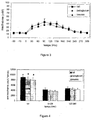
- the insulin peak was significantly lower in the presence of betaglucans than with placebo (63.0 +/- 7.7 mU / l versus 91.6 +/- 13.4 mU / l for the milk condition (p ⁇ 0.01)) ( figure 1 ).
- the area under the curve of insulinemia in the presence of betaglucans is significantly lower compared to placebo (p ⁇ 0.05) ( figure 2 and Table 2).
- the insulin peak is significantly reduced both in the presence of betaglucans and yeast peels (respectively 44.2 +/- 6.0 mU / l and 43.8 +/- 4.7 mU / l versus 56.1 +/- 8.8 mU / l for milk, p ⁇ 0.05) ( figure 3 and Table 3).
- Diabetic insulinemia Milk Yeast peel beta-glucans Insulin peak 56.1 +/- 8.8 43.8 +/- 4.7 p ⁇ 0.05 44.2 +/- 6.0 p ⁇ 0.05 Under Curved Area 0-300 min 9049 +/- 1070 7947 +/- 821 p 0.05 8248 +/- 878 p ⁇ 0.05 Under Curved Area 0-120 min 4325 +/- 619 3644 +/- 381 3708 +/- 404 Under Curved Area 120-300 min 4725 +/- 587 4303 +/- 502 4540 +/- 498
Landscapes
- Health & Medical Sciences (AREA)
- Life Sciences & Earth Sciences (AREA)
- General Health & Medical Sciences (AREA)
- Veterinary Medicine (AREA)
- Chemical & Material Sciences (AREA)
- Public Health (AREA)
- Pharmacology & Pharmacy (AREA)
- Medicinal Chemistry (AREA)
- Animal Behavior & Ethology (AREA)
- Epidemiology (AREA)
- Engineering & Computer Science (AREA)
- Diabetes (AREA)
- Molecular Biology (AREA)
- Natural Medicines & Medicinal Plants (AREA)
- Mycology (AREA)
- Chemical Kinetics & Catalysis (AREA)
- General Chemical & Material Sciences (AREA)
- Obesity (AREA)
- Organic Chemistry (AREA)
- Hematology (AREA)
- Bioinformatics & Cheminformatics (AREA)
- Nuclear Medicine, Radiotherapy & Molecular Imaging (AREA)
- Botany (AREA)
- Microbiology (AREA)
- Medical Informatics (AREA)
- Alternative & Traditional Medicine (AREA)
- Biotechnology (AREA)
- Emergency Medicine (AREA)
- Endocrinology (AREA)
- Child & Adolescent Psychology (AREA)
- Medicines Containing Material From Animals Or Micro-Organisms (AREA)
- Pharmaceuticals Containing Other Organic And Inorganic Compounds (AREA)
- Coloring Foods And Improving Nutritive Qualities (AREA)
- Medicines Containing Plant Substances (AREA)
Claims (15)
- Heferinden zu ihrer Verwendung bei der Behandlung und/oder Verhinderung von Hyperinsulinämie eines Nicht-Diabetes-Patienten, wobei die Hyperinsulinämie verbunden ist mit einer Insulinresistenz, Übergewicht, Fettsucht oder metabolischem Syndrom, wobei die Heferinden erhalten werden durch enzymatische Autolyse oder Hydrolyse von Hefezellen, und aufweisen:- einen Gesamtgehalt an Glucanen und Mannanen von mindestens 34,0 Masse-%, bezogen auf die Trockenmasse, und
einen Glykogengehalt unter 10,0 Masse-%, bezogen auf die Trockenmasse. - Heferinden zur Verwendung nach Anspruch 1, worin die enzymatische Autolyse oder Hydrolyse von Hefezellen umfasst:- Unterziehen einer wässrigen Suspension von Hefezellen einer Hydrolyse unter Verwendung von endogenen Enzymen der Hefezellen und gegebenenfalls Hinzugeben exogener Proteasen zu den Hefezellen,- Abtrennen der erzeugten unlöslichen Fraktion, und- Trocknen der abgetrennten unlöslichen Fraktion, um Heferinden zu erhalten.
- Heferinden zur Verwendung nach Anspruch 1 oder Anspruch 2, worin die enzymatische Autolyse oder Hydrolyse bei einer Temperatur, umfassend zwischen 45 °C und 55 °C für 18 bis 36 Stunden durchgeführt wird.
- Heferinden zur Verwendung nach Anspruch 2 oder Anspruch 3, worin die enzymatische Autolyse oder Hydrolyse von Hefezellen weiterhin umfasst:- Erwärmen einer wässrigen Suspension von Heferinden, erhalten in einem alkalischen Milieu bei einer Temperatur, umfassend zwischen 70 °C und 100 °C, für höchstens 3 Stunden; und- Abtrennen der unlöslichen Fraktion, um Heferinden zu erhalten, die frei von Mannanen sind.
- Heferinden zur Verwendung nach einem der Ansprüche 1 bis 4, worin die Heferinden von der Gattung Saccharomyes cerevisiae sind.
- Heferinden zur Verwendung nach einem der Ansprüche 1 bis 5, worin die Heferinden einen Gesamtgehalt an Glucanen und Mannanen von mindestens 40,0 Masse-%, bezogen auf die Trockenmasse, aufweisen.
- Heferinden zur Verwendung nach einem der Ansprüche 1 bis 6, worin die Heferinden einen Gesamtgehalt an Mannanen unter 30 Masse-%, bezogen auf die Trockenmasse, aufweisen.
- Heferinden zur Verwendung nach einem der Ansprüche 1 bis 7, worin die Heferinden einen Gesamtgehalt an Mannanen unter 2 Masse-%, bezogen auf die Trockenmasse, aufweisen.
- Heferinden zur Verwendung nach einem der Ansprüche 1 bis 8, worin die Heferinden einen Gesamtgehalt an Glucanen und Mannanen unter oder gleich 90 Masse-%, bezogen auf die Trockenmasse, aufweisen.
- Heferinden zur Verwendung nach Anspruch 12, worin der Gehalt an Glucanen und Mannanen unter oder gleich 80 Masse-%, bezogen auf die Trockenmasse, ist.
- Heferinden zur Verwendung nach einem der Ansprüche 1 bis 10, worin die Heferinden einen Gesamtgehalt an Glucanen und Mannanen von 45 Masse-% bis 90 Masse-%, bezogen auf die Trockenmasse, aufweisen.
- Heferinden zur Verwendung nach Anspruch 11, worin der Gehalt an Glucanen und Mannanen von 52 Masse-% bis 80 Masse-%, bezogen auf die Trockenmasse, ist.
- Heferinden zur Verwendung nach einem der Ansprüche 1 bis 12, worin die Heferinden einen Gesamtgehalt an Glycogen unter 8,0 Masse-%, bezogen auf die Trockenmasse, aufweisen.
- Heferinden zur Verwendung nach Anspruch 13, worin der Gesamtgehalt an Glycogen unter 5,0 Masse-%, bezogen auf die Trockenmasse, ist.
- Heferinden zur Verwendung nach einem der Ansprüche 1 bis 14, worin die Heferinden eine Trockenmasse über der gleich 90 % aufweisen.
Priority Applications (1)
| Application Number | Priority Date | Filing Date | Title |
|---|---|---|---|
| SI200831660A SI2170359T1 (sl) | 2007-07-25 | 2008-07-25 | Uporaba kvasnih kosmičev pri zdravljenju in/ali preprečevanju hiperinzulinemije |
Applications Claiming Priority (2)
| Application Number | Priority Date | Filing Date | Title |
|---|---|---|---|
| FR0756731A FR2919187B1 (fr) | 2007-07-25 | 2007-07-25 | Utilisation d'ecorces de levure pour le traitement et/ou la prevention de l'hyperinsulinemie. |
| PCT/EP2008/059815 WO2009013357A1 (fr) | 2007-07-25 | 2008-07-25 | Utilisation d'écorces de levure pour le traitement et / ou la prévention de l'hyperinsulinémie |
Publications (2)
| Publication Number | Publication Date |
|---|---|
| EP2170359A1 EP2170359A1 (de) | 2010-04-07 |
| EP2170359B1 true EP2170359B1 (de) | 2016-05-11 |
Family
ID=39271450
Family Applications (1)
| Application Number | Title | Priority Date | Filing Date |
|---|---|---|---|
| EP08786472.4A Active EP2170359B1 (de) | 2007-07-25 | 2008-07-25 | Verwendung von hefeflocken zur behandlung und/oder prävention von hyperinsulinämie |
Country Status (16)
| Country | Link |
|---|---|
| US (1) | US9750762B2 (de) |
| EP (1) | EP2170359B1 (de) |
| JP (1) | JP5530354B2 (de) |
| KR (1) | KR101593705B1 (de) |
| CN (1) | CN101801400B (de) |
| AU (1) | AU2008278975B2 (de) |
| CA (1) | CA2696462C (de) |
| ES (1) | ES2586244T3 (de) |
| FR (1) | FR2919187B1 (de) |
| NO (1) | NO342072B1 (de) |
| PL (1) | PL2170359T3 (de) |
| RU (1) | RU2463065C2 (de) |
| SG (1) | SG169346A1 (de) |
| SI (1) | SI2170359T1 (de) |
| WO (1) | WO2009013357A1 (de) |
| ZA (1) | ZA201000381B (de) |
Cited By (1)
| Publication number | Priority date | Publication date | Assignee | Title |
|---|---|---|---|---|
| US12390502B2 (en) | 2019-01-23 | 2025-08-19 | Lesaffre Et Compagnie | Method for stimulating growth of bacteria in the gut microbiota of a mammal |
Families Citing this family (6)
| Publication number | Priority date | Publication date | Assignee | Title |
|---|---|---|---|---|
| FR2949064B1 (fr) | 2009-08-14 | 2011-10-07 | Lesaffre & Cie | Nouvelles compositions destinees a la prevention et/ou au traitement du diabete |
| FR2978967B1 (fr) * | 2011-08-09 | 2020-03-20 | Lesaffre Et Compagnie | Ecorces de levure enrichies en vitamine d2, compositions les contenant, leur procede de preparation, leurs utilisations et dispositif permettant la mise en oeuvre du procede |
| EP2870969A1 (de) * | 2013-11-08 | 2015-05-13 | Biocodex | Pharmazeutische Zusammensetzung zur Reduzierung der adipösen Masse |
| CN107233298B (zh) * | 2016-03-28 | 2021-01-22 | 复旦大学 | 一种促进蛋白多肽药物口服吸收的酵母细胞壁微粒制剂 |
| WO2019170790A1 (en) * | 2018-03-08 | 2019-09-12 | Dsm Ip Assets B.V. | Yeast beta glucans |
| WO2023175153A1 (en) | 2022-03-18 | 2023-09-21 | Fumi Ingredients B.V. | A microbial cell extract, method for obtaining said microbial cell extract and use of said microbial cell extract |
Family Cites Families (7)
| Publication number | Priority date | Publication date | Assignee | Title |
|---|---|---|---|---|
| JPS61167622A (ja) * | 1985-01-22 | 1986-07-29 | Asahi Breweries Ltd | 糖尿病コントロ−ル剤 |
| JP2756907B2 (ja) * | 1993-12-28 | 1998-05-25 | 日本製紙株式会社 | 酵母エキス組成物及びその製造法並びにそれを含有する飼料 |
| FR2800076B1 (fr) * | 1999-10-22 | 2003-11-14 | Lesaffre & Cie | Mannoproteines solubles |
| FR2825004B1 (fr) * | 2001-05-22 | 2005-02-11 | Bio Springer | Produit dietetique satiant |
| EP1663266B1 (de) * | 2003-08-11 | 2013-02-20 | Lesaffre et Compagnie | Hefezellwände zur behandlung oder vorbeugung der hyperglykämie und zur blutzuckerstabilisierung |
| UA85561C2 (ru) * | 2003-08-11 | 2009-02-10 | Лезаффр Э Компани | Применение клеточных стенок дрожжей для лечения или профилактики гипергликемии или для стабилизации содержания сахара в крови |
| JP4302684B2 (ja) * | 2005-06-30 | 2009-07-29 | 株式会社 ミヤトウ野草研究所 | コタラヒンブツ葉エキスを含有した健康食品の製造方法 |
-
2007
- 2007-07-25 FR FR0756731A patent/FR2919187B1/fr active Active
-
2008
- 2008-07-25 CN CN2008801002666A patent/CN101801400B/zh active Active
- 2008-07-25 KR KR1020107004078A patent/KR101593705B1/ko not_active Expired - Fee Related
- 2008-07-25 EP EP08786472.4A patent/EP2170359B1/de active Active
- 2008-07-25 CA CA2696462A patent/CA2696462C/fr active Active
- 2008-07-25 ES ES08786472.4T patent/ES2586244T3/es active Active
- 2008-07-25 PL PL08786472.4T patent/PL2170359T3/pl unknown
- 2008-07-25 AU AU2008278975A patent/AU2008278975B2/en not_active Ceased
- 2008-07-25 WO PCT/EP2008/059815 patent/WO2009013357A1/fr not_active Ceased
- 2008-07-25 US US12/670,436 patent/US9750762B2/en active Active
- 2008-07-25 SG SG201100526-1A patent/SG169346A1/en unknown
- 2008-07-25 RU RU2010104981/15A patent/RU2463065C2/ru not_active IP Right Cessation
- 2008-07-25 JP JP2010517414A patent/JP5530354B2/ja not_active Expired - Fee Related
- 2008-07-25 SI SI200831660A patent/SI2170359T1/sl unknown
-
2010
- 2010-01-19 ZA ZA201000381A patent/ZA201000381B/xx unknown
- 2010-02-23 NO NO20100268A patent/NO342072B1/no not_active IP Right Cessation
Cited By (1)
| Publication number | Priority date | Publication date | Assignee | Title |
|---|---|---|---|---|
| US12390502B2 (en) | 2019-01-23 | 2025-08-19 | Lesaffre Et Compagnie | Method for stimulating growth of bacteria in the gut microbiota of a mammal |
Also Published As
| Publication number | Publication date |
|---|---|
| NO20100268L (no) | 2010-02-23 |
| RU2010104981A (ru) | 2011-08-27 |
| WO2009013357A1 (fr) | 2009-01-29 |
| JP2010534223A (ja) | 2010-11-04 |
| SI2170359T1 (sl) | 2016-10-28 |
| CN101801400A (zh) | 2010-08-11 |
| CN101801400B (zh) | 2013-10-16 |
| FR2919187A1 (fr) | 2009-01-30 |
| RU2463065C2 (ru) | 2012-10-10 |
| CA2696462C (fr) | 2016-08-23 |
| FR2919187B1 (fr) | 2009-11-27 |
| KR20100063039A (ko) | 2010-06-10 |
| SG169346A1 (en) | 2011-03-30 |
| NO342072B1 (no) | 2018-03-19 |
| JP5530354B2 (ja) | 2014-06-25 |
| PL2170359T3 (pl) | 2016-11-30 |
| EP2170359A1 (de) | 2010-04-07 |
| AU2008278975B2 (en) | 2013-09-19 |
| CA2696462A1 (fr) | 2009-01-29 |
| ES2586244T3 (es) | 2016-10-13 |
| US9750762B2 (en) | 2017-09-05 |
| US20100196413A1 (en) | 2010-08-05 |
| KR101593705B1 (ko) | 2016-02-12 |
| AU2008278975A1 (en) | 2009-01-29 |
| ZA201000381B (en) | 2010-10-27 |
Similar Documents
| Publication | Publication Date | Title |
|---|---|---|
| CA2696462C (fr) | Utilisation d'ecorces de levure pour le traitement et / ou la prevention de l'hyperinsulinemie | |
| US20090022758A1 (en) | Yeast cell walls for the treatment or prevention of hyperglycemia or for the stabilization of glycemia | |
| EP3650035B1 (de) | Rotalgenextrakt für den einsatz zur vorbeugung und behandlung von darmbeschwerden | |
| EP2274000B1 (de) | Pharmazeutische oder diätetische zusammensetzung enthaltend wasserextrakte von nigella sativa und olea europea und/oder phyllantus amarus | |
| FR3062795B1 (fr) | Principe actif pharmaceutique et utilisation en particulier dans la prevention et le traitement des dereglements metaboliques chez l'homme et l'animal. | |
| CN100377719C (zh) | 用于治疗或预防高血糖症或用于稳定血糖的酵母细胞壁 | |
| WO2012146881A1 (fr) | Composition anti-inflammatoire de l'intestin comprenant du maltitol | |
| WO2017148975A1 (fr) | Compositions pour le traitement des candidoses | |
| WO2022195212A1 (fr) | Inhibiteurs glycosidiques de levure | |
| WO2011018580A1 (fr) | Compositions a base de chrome et de beta-glucanes de levure destinees a la prevention et/ou au traitement du diabete | |
| WO2026099182A1 (fr) | Extrait de parois cellulaires de levures pour réduire/inhiber la formation de biofilm dentaire |
Legal Events
| Date | Code | Title | Description |
|---|---|---|---|
| PUAI | Public reference made under article 153(3) epc to a published international application that has entered the european phase |
Free format text: ORIGINAL CODE: 0009012 |
|
| 17P | Request for examination filed |
Effective date: 20100129 |
|
| AK | Designated contracting states |
Kind code of ref document: A1 Designated state(s): AT BE BG CH CY CZ DE DK EE ES FI FR GB GR HR HU IE IS IT LI LT LU LV MC MT NL NO PL PT RO SE SI SK TR |
|
| AX | Request for extension of the european patent |
Extension state: AL BA MK RS |
|
| DAX | Request for extension of the european patent (deleted) | ||
| 17Q | First examination report despatched |
Effective date: 20131010 |
|
| GRAP | Despatch of communication of intention to grant a patent |
Free format text: ORIGINAL CODE: EPIDOSNIGR1 |
|
| INTG | Intention to grant announced |
Effective date: 20151208 |
|
| GRAS | Grant fee paid |
Free format text: ORIGINAL CODE: EPIDOSNIGR3 |
|
| GRAA | (expected) grant |
Free format text: ORIGINAL CODE: 0009210 |
|
| AK | Designated contracting states |
Kind code of ref document: B1 Designated state(s): AT BE BG CH CY CZ DE DK EE ES FI FR GB GR HR HU IE IS IT LI LT LU LV MC MT NL NO PL PT RO SE SI SK TR |
|
| REG | Reference to a national code |
Ref country code: GB Ref legal event code: FG4D Free format text: NOT ENGLISH |
|
| REG | Reference to a national code |
Ref country code: CH Ref legal event code: EP |
|
| REG | Reference to a national code |
Ref country code: AT Ref legal event code: REF Ref document number: 798101 Country of ref document: AT Kind code of ref document: T Effective date: 20160515 |
|
| REG | Reference to a national code |
Ref country code: IE Ref legal event code: FG4D Free format text: LANGUAGE OF EP DOCUMENT: FRENCH |
|
| REG | Reference to a national code |
Ref country code: DE Ref legal event code: R096 Ref document number: 602008044216 Country of ref document: DE |
|
| REG | Reference to a national code |
Ref country code: NL Ref legal event code: FP |
|
| REG | Reference to a national code |
Ref country code: SE Ref legal event code: TRGR |
|
| REG | Reference to a national code |
Ref country code: LT Ref legal event code: MG4D |
|
| REG | Reference to a national code |
Ref country code: FR Ref legal event code: PLFP Year of fee payment: 9 |
|
| REG | Reference to a national code |
Ref country code: ES Ref legal event code: FG2A Ref document number: 2586244 Country of ref document: ES Kind code of ref document: T3 Effective date: 20161013 |
|
| PG25 | Lapsed in a contracting state [announced via postgrant information from national office to epo] |
Ref country code: NO Free format text: LAPSE BECAUSE OF FAILURE TO SUBMIT A TRANSLATION OF THE DESCRIPTION OR TO PAY THE FEE WITHIN THE PRESCRIBED TIME-LIMIT Effective date: 20160811 Ref country code: LT Free format text: LAPSE BECAUSE OF FAILURE TO SUBMIT A TRANSLATION OF THE DESCRIPTION OR TO PAY THE FEE WITHIN THE PRESCRIBED TIME-LIMIT Effective date: 20160511 Ref country code: FI Free format text: LAPSE BECAUSE OF FAILURE TO SUBMIT A TRANSLATION OF THE DESCRIPTION OR TO PAY THE FEE WITHIN THE PRESCRIBED TIME-LIMIT Effective date: 20160511 |
|
| REG | Reference to a national code |
Ref country code: AT Ref legal event code: MK05 Ref document number: 798101 Country of ref document: AT Kind code of ref document: T Effective date: 20160511 |
|
| PG25 | Lapsed in a contracting state [announced via postgrant information from national office to epo] |
Ref country code: PT Free format text: LAPSE BECAUSE OF FAILURE TO SUBMIT A TRANSLATION OF THE DESCRIPTION OR TO PAY THE FEE WITHIN THE PRESCRIBED TIME-LIMIT Effective date: 20160912 Ref country code: LV Free format text: LAPSE BECAUSE OF FAILURE TO SUBMIT A TRANSLATION OF THE DESCRIPTION OR TO PAY THE FEE WITHIN THE PRESCRIBED TIME-LIMIT Effective date: 20160511 Ref country code: HR Free format text: LAPSE BECAUSE OF FAILURE TO SUBMIT A TRANSLATION OF THE DESCRIPTION OR TO PAY THE FEE WITHIN THE PRESCRIBED TIME-LIMIT Effective date: 20160511 Ref country code: GR Free format text: LAPSE BECAUSE OF FAILURE TO SUBMIT A TRANSLATION OF THE DESCRIPTION OR TO PAY THE FEE WITHIN THE PRESCRIBED TIME-LIMIT Effective date: 20160812 |
|
| PG25 | Lapsed in a contracting state [announced via postgrant information from national office to epo] |
Ref country code: RO Free format text: LAPSE BECAUSE OF FAILURE TO SUBMIT A TRANSLATION OF THE DESCRIPTION OR TO PAY THE FEE WITHIN THE PRESCRIBED TIME-LIMIT Effective date: 20160511 Ref country code: DK Free format text: LAPSE BECAUSE OF FAILURE TO SUBMIT A TRANSLATION OF THE DESCRIPTION OR TO PAY THE FEE WITHIN THE PRESCRIBED TIME-LIMIT Effective date: 20160511 Ref country code: SK Free format text: LAPSE BECAUSE OF FAILURE TO SUBMIT A TRANSLATION OF THE DESCRIPTION OR TO PAY THE FEE WITHIN THE PRESCRIBED TIME-LIMIT Effective date: 20160511 Ref country code: EE Free format text: LAPSE BECAUSE OF FAILURE TO SUBMIT A TRANSLATION OF THE DESCRIPTION OR TO PAY THE FEE WITHIN THE PRESCRIBED TIME-LIMIT Effective date: 20160511 |
|
| REG | Reference to a national code |
Ref country code: DE Ref legal event code: R097 Ref document number: 602008044216 Country of ref document: DE |
|
| PG25 | Lapsed in a contracting state [announced via postgrant information from national office to epo] |
Ref country code: AT Free format text: LAPSE BECAUSE OF FAILURE TO SUBMIT A TRANSLATION OF THE DESCRIPTION OR TO PAY THE FEE WITHIN THE PRESCRIBED TIME-LIMIT Effective date: 20160511 |
|
| REG | Reference to a national code |
Ref country code: CH Ref legal event code: PL |
|
| PLBE | No opposition filed within time limit |
Free format text: ORIGINAL CODE: 0009261 |
|
| STAA | Information on the status of an ep patent application or granted ep patent |
Free format text: STATUS: NO OPPOSITION FILED WITHIN TIME LIMIT |
|
| PG25 | Lapsed in a contracting state [announced via postgrant information from national office to epo] |
Ref country code: MC Free format text: LAPSE BECAUSE OF FAILURE TO SUBMIT A TRANSLATION OF THE DESCRIPTION OR TO PAY THE FEE WITHIN THE PRESCRIBED TIME-LIMIT Effective date: 20160511 |
|
| 26N | No opposition filed |
Effective date: 20170214 |
|
| PG25 | Lapsed in a contracting state [announced via postgrant information from national office to epo] |
Ref country code: LI Free format text: LAPSE BECAUSE OF NON-PAYMENT OF DUE FEES Effective date: 20160731 Ref country code: CH Free format text: LAPSE BECAUSE OF NON-PAYMENT OF DUE FEES Effective date: 20160731 |
|
| REG | Reference to a national code |
Ref country code: IE Ref legal event code: MM4A |
|
| PG25 | Lapsed in a contracting state [announced via postgrant information from national office to epo] |
Ref country code: IE Free format text: LAPSE BECAUSE OF NON-PAYMENT OF DUE FEES Effective date: 20160725 |
|
| REG | Reference to a national code |
Ref country code: FR Ref legal event code: PLFP Year of fee payment: 10 |
|
| PG25 | Lapsed in a contracting state [announced via postgrant information from national office to epo] |
Ref country code: LU Free format text: LAPSE BECAUSE OF NON-PAYMENT OF DUE FEES Effective date: 20160725 |
|
| PG25 | Lapsed in a contracting state [announced via postgrant information from national office to epo] |
Ref country code: HU Free format text: LAPSE BECAUSE OF FAILURE TO SUBMIT A TRANSLATION OF THE DESCRIPTION OR TO PAY THE FEE WITHIN THE PRESCRIBED TIME-LIMIT; INVALID AB INITIO Effective date: 20080725 Ref country code: CY Free format text: LAPSE BECAUSE OF FAILURE TO SUBMIT A TRANSLATION OF THE DESCRIPTION OR TO PAY THE FEE WITHIN THE PRESCRIBED TIME-LIMIT Effective date: 20160511 |
|
| PG25 | Lapsed in a contracting state [announced via postgrant information from national office to epo] |
Ref country code: IS Free format text: LAPSE BECAUSE OF FAILURE TO SUBMIT A TRANSLATION OF THE DESCRIPTION OR TO PAY THE FEE WITHIN THE PRESCRIBED TIME-LIMIT Effective date: 20160511 Ref country code: MT Free format text: LAPSE BECAUSE OF FAILURE TO SUBMIT A TRANSLATION OF THE DESCRIPTION OR TO PAY THE FEE WITHIN THE PRESCRIBED TIME-LIMIT Effective date: 20160511 |
|
| REG | Reference to a national code |
Ref country code: FR Ref legal event code: PLFP Year of fee payment: 11 |
|
| PG25 | Lapsed in a contracting state [announced via postgrant information from national office to epo] |
Ref country code: BG Free format text: LAPSE BECAUSE OF FAILURE TO SUBMIT A TRANSLATION OF THE DESCRIPTION OR TO PAY THE FEE WITHIN THE PRESCRIBED TIME-LIMIT Effective date: 20160511 |
|
| PGFP | Annual fee paid to national office [announced via postgrant information from national office to epo] |
Ref country code: CZ Payment date: 20190620 Year of fee payment: 12 Ref country code: PL Payment date: 20190619 Year of fee payment: 12 |
|
| PGFP | Annual fee paid to national office [announced via postgrant information from national office to epo] |
Ref country code: NL Payment date: 20190617 Year of fee payment: 12 |
|
| PGFP | Annual fee paid to national office [announced via postgrant information from national office to epo] |
Ref country code: SE Payment date: 20190722 Year of fee payment: 12 Ref country code: ES Payment date: 20190809 Year of fee payment: 12 Ref country code: SI Payment date: 20190620 Year of fee payment: 12 Ref country code: TR Payment date: 20190716 Year of fee payment: 12 |
|
| PGFP | Annual fee paid to national office [announced via postgrant information from national office to epo] |
Ref country code: BE Payment date: 20190725 Year of fee payment: 12 |
|
| PGFP | Annual fee paid to national office [announced via postgrant information from national office to epo] |
Ref country code: GB Payment date: 20190719 Year of fee payment: 12 |
|
| REG | Reference to a national code |
Ref country code: SE Ref legal event code: EUG |
|
| REG | Reference to a national code |
Ref country code: NL Ref legal event code: MM Effective date: 20200801 |
|
| GBPC | Gb: european patent ceased through non-payment of renewal fee |
Effective date: 20200725 |
|
| REG | Reference to a national code |
Ref country code: BE Ref legal event code: MM Effective date: 20200731 |
|
| PG25 | Lapsed in a contracting state [announced via postgrant information from national office to epo] |
Ref country code: GB Free format text: LAPSE BECAUSE OF NON-PAYMENT OF DUE FEES Effective date: 20200725 Ref country code: NL Free format text: LAPSE BECAUSE OF NON-PAYMENT OF DUE FEES Effective date: 20200801 Ref country code: CZ Free format text: LAPSE BECAUSE OF NON-PAYMENT OF DUE FEES Effective date: 20200725 |
|
| PG25 | Lapsed in a contracting state [announced via postgrant information from national office to epo] |
Ref country code: BE Free format text: LAPSE BECAUSE OF NON-PAYMENT OF DUE FEES Effective date: 20200731 Ref country code: SE Free format text: LAPSE BECAUSE OF NON-PAYMENT OF DUE FEES Effective date: 20200726 |
|
| PG25 | Lapsed in a contracting state [announced via postgrant information from national office to epo] |
Ref country code: SI Free format text: LAPSE BECAUSE OF NON-PAYMENT OF DUE FEES Effective date: 20200726 |
|
| REG | Reference to a national code |
Ref country code: SI Ref legal event code: KO00 Effective date: 20210811 |
|
| REG | Reference to a national code |
Ref country code: ES Ref legal event code: FD2A Effective date: 20220110 |
|
| PG25 | Lapsed in a contracting state [announced via postgrant information from national office to epo] |
Ref country code: ES Free format text: LAPSE BECAUSE OF NON-PAYMENT OF DUE FEES Effective date: 20200726 |
|
| PG25 | Lapsed in a contracting state [announced via postgrant information from national office to epo] |
Ref country code: TR Free format text: LAPSE BECAUSE OF NON-PAYMENT OF DUE FEES Effective date: 20200725 |
|
| PG25 | Lapsed in a contracting state [announced via postgrant information from national office to epo] |
Ref country code: PL Free format text: LAPSE BECAUSE OF NON-PAYMENT OF DUE FEES Effective date: 20200725 |
|
| P01 | Opt-out of the competence of the unified patent court (upc) registered |
Effective date: 20230525 |
|
| PGFP | Annual fee paid to national office [announced via postgrant information from national office to epo] |
Ref country code: DE Payment date: 20250711 Year of fee payment: 18 |
|
| PGFP | Annual fee paid to national office [announced via postgrant information from national office to epo] |
Ref country code: IT Payment date: 20250714 Year of fee payment: 18 |
|
| PGFP | Annual fee paid to national office [announced via postgrant information from national office to epo] |
Ref country code: FR Payment date: 20250730 Year of fee payment: 18 |