EP2169519B1 - Touch position detection method for touch control device - Google Patents
Touch position detection method for touch control device Download PDFInfo
- Publication number
- EP2169519B1 EP2169519B1 EP09000218A EP09000218A EP2169519B1 EP 2169519 B1 EP2169519 B1 EP 2169519B1 EP 09000218 A EP09000218 A EP 09000218A EP 09000218 A EP09000218 A EP 09000218A EP 2169519 B1 EP2169519 B1 EP 2169519B1
- Authority
- EP
- European Patent Office
- Prior art keywords
- conductive layer
- touch
- scan detection
- conductive
- elongate
- Prior art date
- Legal status (The legal status is an assumption and is not a legal conclusion. Google has not performed a legal analysis and makes no representation as to the accuracy of the status listed.)
- Ceased
Links
Images




Classifications
-
- G—PHYSICS
- G06—COMPUTING OR CALCULATING; COUNTING
- G06F—ELECTRIC DIGITAL DATA PROCESSING
- G06F3/00—Input arrangements for transferring data to be processed into a form capable of being handled by the computer; Output arrangements for transferring data from processing unit to output unit, e.g. interface arrangements
- G06F3/01—Input arrangements or combined input and output arrangements for interaction between user and computer
- G06F3/03—Arrangements for converting the position or the displacement of a member into a coded form
- G06F3/041—Digitisers, e.g. for touch screens or touch pads, characterised by the transducing means
- G06F3/045—Digitisers, e.g. for touch screens or touch pads, characterised by the transducing means using resistive elements, e.g. a single continuous surface or two parallel surfaces put in contact
-
- G—PHYSICS
- G06—COMPUTING OR CALCULATING; COUNTING
- G06F—ELECTRIC DIGITAL DATA PROCESSING
- G06F3/00—Input arrangements for transferring data to be processed into a form capable of being handled by the computer; Output arrangements for transferring data from processing unit to output unit, e.g. interface arrangements
- G06F3/01—Input arrangements or combined input and output arrangements for interaction between user and computer
- G06F3/03—Arrangements for converting the position or the displacement of a member into a coded form
- G06F3/041—Digitisers, e.g. for touch screens or touch pads, characterised by the transducing means
- G06F3/0416—Control or interface arrangements specially adapted for digitisers
- G06F3/04162—Control or interface arrangements specially adapted for digitisers for exchanging data with external devices, e.g. smart pens, via the digitiser sensing hardware
-
- G—PHYSICS
- G06—COMPUTING OR CALCULATING; COUNTING
- G06F—ELECTRIC DIGITAL DATA PROCESSING
- G06F3/00—Input arrangements for transferring data to be processed into a form capable of being handled by the computer; Output arrangements for transferring data from processing unit to output unit, e.g. interface arrangements
- G06F3/01—Input arrangements or combined input and output arrangements for interaction between user and computer
- G06F3/03—Arrangements for converting the position or the displacement of a member into a coded form
- G06F3/041—Digitisers, e.g. for touch screens or touch pads, characterised by the transducing means
- G06F3/0416—Control or interface arrangements specially adapted for digitisers
- G06F3/04166—Details of scanning methods, e.g. sampling time, grouping of sub areas or time sharing with display driving
Definitions
- the present invention relates to a touch position detection method, and in particular to a method that determines the type of touch of a touch panel to be either a single-point touch, a continuous trace, or a multiple-point touch and selectively employs a corresponding operation mode to perform driving and scanning on the touch panel for coordinates detection.
- a conventional touch panel includes a first substrate with a first conductive layer and a second substrate with a second conductive layer.
- the first and second substrates are spaced from each other by insulation spacers therebetween.
- the first and second conductive layers can be of a continuous planar structure, or can alternatively be of a structure comprised of a plurality of elongate conductive strips.
- the position coordinates of a touched site on the touch panel can be determined by using different methods of scanning and different formulas.
- the resistive scanning touch panel comprises a first conductive layer and a second conductive layer, of which the first conductive layer is comprised of a plurality of conductive strips running parallel in a first direction and the second conductive layer is comprised of a plurality of conductive strips running parallel in a second direction, and a controller.
- the operation principle of the patent is that the controller first applies a voltage to the conductive strips of the first conductive layer and simultaneously detects a voltage difference between opposite ends of the conductive strips of the second conductive layer to determine the coordinate of a touch point in the first direction. Then, a voltage is applied to the conductive strips of the second conductive layer and simultaneously, a voltage difference between opposite ends of the conductive strips of the first conductive layer is detected to determine the coordinate of the touch point in the second direction.
- US Patent No. 5,181,030 teaches detection of a sensing signal by applying a voltage to an end of a first conductive layer and grounding an opposite end to establish a potential gradient distribution and further applying a voltage to an end of each of elongate conductive strips of a second conductive layer and connecting an opposite end to a signal sensing circuit.
- Chinese Invention Publication CN1503195A discloses applying a drive voltage to an end of each of elongate conductive strips of a first conductive layer and connecting an end of each of elongate conductive strips of a second conductive layer to a scan detection circuit to perform signal scanning.
- a touch screen device is disclosed in US Patent No. 5,818,430 that also incorporates a voltage-division arrangement.
- the touch screen comprises a pair of spaced apart overlapping conductive substrates including resistance strips.
- the strips of the first substrate are arranged orthogonally with respect to the strips of the second substrate. Reference voltages are applied to the respective resistance strips such that an X-Y voltage division occurs at a contact point on the touch screen.
- European Patent No. 487,049 discloses an electronic hand writing information entry device.
- the device includes an input/output digitizer screes and an input pen.
- an input/output digitizer screes When a user applies pressure to the screen with the pen, two resistor films come into contact at the contact point and a current flows. Detection of this current allows the determination of co-ordinate data of the contact point on the screen.
- first and second conductive layers of a touch panel as well as scan detection methods for detecting touched sites of multiple point touches, are disclosed in the prior art references, which allow the detection of touched sites of multiple touch points, yet for applications of stylus writing input
- the input of the stylus writing is a continuous trace.
- the known techniques are employed to detect the continuous trace of stylus writing input, the detected result is a discontinuous trace of stylus writing.
- the prior arts do not teach to determine if the touch operation applied to a touch panel is single-point touch, multiple-point touch, or continuous trace. Thus, such known techniques are still insufficient to meet the practical requirements for applications of the related products.
- an objective of the present invention is to provide a touch position detection method for a touch control device, which identifies different types of touch operations on a touch panel and detects coordinates of one or more touched sites by a user.
- Another objective of the present invention is to provide a touch position detection method for a touch control device, which initializes different operation modes corresponding to the input from a touch panel that may comprise a single-point touch, a multiple-point touch, or a continuous trace to detect coordinates of each touch point.
- a solution to the above problems is to employ a preset scan detection mode to carry out driving and scan detection on first and second conductive layers of a touch panel through a control circuit.
- the present invention determines the type of the touch, which may include a single-point touch, a continuous trace, and a multiple-point touch, and initializes first and second operation modes corresponding to the type of the touch to perform driving and scan detection on the first and second conductive layers of the touch panel to thereby detect coordinates of the touch point(s) or the continuous trace.
- the first conductive layer of the touch panel can be a continuous planar structure or comprised of a plurality of elongate conductive strips formed on a first substrate and the second conductive layer of the touch panel is comprised of a plurality of elongate conductive strips formed on a second substrate.
- a control circuit is electrically connected to the first and second conductive layers.
- the technical solution taken in the present invention allows a conventional resistive type touch control device to not only detect the coordinates of multiple touch points, but also to switch to different operation modes corresponding to different situations of the detection of coordinates to be thereby capable to detect coordinates for various types of touch, including a single-point touch, a multiple-point touch, and a continuous trace constituting an input of stylus writing.
- the method of the present invention can both be used to detect coordinates of a single-point touch and a multiple-point touch and be suitable for detection of coordinates of touched sites in a stylus writing application.
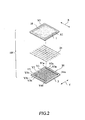
- the touch control device comprises a touch panel, which, generally designated at 100, comprises a first substrate 1 and a second, opposite substrate 2.
- the first substrate 1 has an under surface on which a first conductive layer 10 is formed in a continuous planar structure.
- the second substrate 2 has a top surface on which a second conductive layer 20 is formed.
- the first substrate 1 and the second substrate 2 are assembled together in a face-to-face manner with the first conductive layer 10 opposing the second conductive layer 20 and spaced from each other by a plurality of insulation spacers 21 (see Figure 2 ).
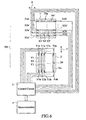
- the first conductive layer 10 has opposite ends in a first direction X, which are respectively referred to as first end X1 and second end X2, both being electrically connected to a control circuit 3.
- the second conductive layer 20 comprises a plurality of elongate conductive strips Y1, Y2, Y3, ..., Yn, which are substantially parallel with but do not engage each other.
- Each elongate conductive strip Y1, Y2, Y3, ..., Yn is extended in a second direction Y on the top surface of the second substrate 2.
- Each elongate conductive strip Y1, Y2, Y3, ..., Yn of the second conductive layer 20 has a first end Y 1 a, Y2a, Y3a, ..., Yna and a second end Y 1b, Y2b, Y3b, ..., Ynb, both being electrically connected to the control circuit 3.
- the control circuit 3 is electrically connected to a microcontroller 4 which controls the operation of the control circuit 3 and receives signals from the control circuit 3.
- the first conductive layer 10 of the first substrate 1 and the elongate conductive strips Y 1, Y2, Y3, ..., Yn of the second substrate 2, both constituting the touch panel 100, can be replaced with each other so that the first substrate 1 is formed with a structure comprising a plurality of elongate conductive strips while the second substrate 2 provides a structure of continuous planar conductive layer.
- the first conductive layer 10 of the touch panel 100 is first used as a drive layer with the first end X1 of the first conductive layer 10 being applied with a drive voltage V (such as 5V) by the control circuit 3 and the second end X2 of the first conductive layer 10 is controlled by the control circuit 3 to connect to a predetermined voltage level, which can be ground voltage, zero voltage, or any fixed-value voltage, whereby a potential gradient is established in the first conductive layer 10.
- V such as 5V
- the second conductive layer 20 of the touch panel 100 functions as a scan detection layer and the control circuit 3 carries out scan detection on the second conductive layer 20 sequentially through the first ends Y1a, Y2a, Y3a, ..., Yna of the elongate conductive strips Y1, Y2, Y3, ..., Yn of the second conductive layer 20, or alternatively, scan detection is carried out sequentially through the first ends Y1a, Y2a, Y3a, ..., Yna and second ends Y1b, Y2b, Y3b, ..., Ynb of the elongate conductive strips Y1, Y2, Y3, ..., Yn, or further alternatively, scan detection is simultaneously performed at both ends of each elongate conductive strip Y1, Y2, Y3, ..., Yn but sequentially through all the elongate conductive strips Y1, Y2, Y3, ...,
- the second conductive layer 20 of the touch panel 100 is used as the drive layer, whereby the control circuit 3 applies a drive voltage V (such as 5V) to the first end Y1a, Y2a, Y3a, ..., Yna of each elongate conductive strip Y1, Y2, Y3, ..., Yn and the second ends Y1b, Y2b, Y3b, ..., Ynb of the elongate conductive strips Y1, Y2, Y3, ..., Yn are controlled by the control circuit 3 to connect to a predetermined voltage level, which can be ground voltage, zero voltage, or any fixed-value voltage, whereby a potential gradient is established in the second conductive layer 20.
- V such as 5V
- the first conductive layer 10 of the touch panel 100 then functions as a scan detection layer and the control circuit 3 performs detection on the first conductive layer 10.
- a variation of voltage occurring in the first conductive layer 10 can thus be obtained and, based on such a variation of voltage, coordinates of a touch position can be calculated.
- Figure 3 illustrates an equivalent circuit when two touch points on the elongate conductive strip Y1 are simultaneously touched/depressed.
- the drive voltage V of the first conductive layer 10 is applied to the elongate conductive strip Y1 of the second conductive layer 20.
- V1 V x Rrefl/(R1 + Rref1) is obtained at the first end Y1a of the elongate conductive strip Y1, where V is the provided preset drive voltage.
- the microcontroller 4 initializes a preset scan detection mode to perform driving and scan detection respectively on the first conductive layer 10 and the second conductive layer 20 (step 102).
- the preset scan detection mode includes a first operation mode and a second operation mode. In practice, one of these two operation modes can be selected as the preset scan detection mode.
- the control circuit 3 applies a drive voltage to the first conductive layer 10 and carries out scan detection on at least one end of the first end Y1a, Y2a, Y3a, ..., Yna and the second end Y1b, Y2b, Y3b, ..., Ynb of each elongate conductive strip Y1, Y2, Y3, ..., Yn of the second conductive layer 20.
- the control circuit 3 applies a drive voltage to the first end X1 of the first conductive layer 10 and the second end X2 of the first conductive layer 10 is controlled by the control circuit 3 to connect to a preset voltage level, which can be ground voltage, zero voltage, or any fixed-value voltage, so as to establish a potential gradient in the first conductive layer 10.
- a preset voltage level which can be ground voltage, zero voltage, or any fixed-value voltage
- control circuit 3 carries out scan detection on at least one end of the first end Y1a, Y2a, Y3a, ..., Yna and the second end Y1b, Y2b, Y3b, ..., Ynb of each elongate conductive strip Y1, Y2, Y3, ..., Yn of the second conductive layer 20.
- control circuit 3 applies a drive voltage to the first ends Y1a, Y2a, Y3a, ..., Yna of the second conductive layer 20 and the second ends Y1b, Y2b, Y3b, ..., Ynb of the second conductive layer 20 are controlled by the control circuit 3 to connect to a preset voltage level, which can be ground voltage, zero voltage, or any fixed-value voltage, so as to establish a potential gradient in the second conductive layer 20, and meanwhile, scan detection is carried out on the first conductive layer 10. These steps are then repeated.
- a preset voltage level which can be ground voltage, zero voltage, or any fixed-value voltage
- the microcontroller 4 determines the type of the touch operation (step 103). If it is determined that the type of touch operation applied to the touch panel is a single-point or a multiple-point touch (step 104), the microcontroller 4 initializes the first operation mode to carry out respectively driving and scan detection on the first conductive layer 10 and the second conductive layer 20 to determine the coordinates of the touch point(s) (step 105).
- the microcontroller 4 initializes the second operation mode to carry out driving and scan detection on the first conductive layer 10 and the second conductive layer 20 to determine the coordinates of the continuous trace (step 107).
- step 108 it is determined if the touch sustains for a given time period (step 108) and if yes, the process goes back to step 102, otherwise the process ends.
- the microcontroller 4 uses the preset scan detection mode to carry out driving and scan detection on the first conductive layer 10 and the second conductive layer 20 respectively, if the preset scan detection mode is the first operation mode, the coordinates of the single or multiple touch point(s) can be obtained during the scan detection operation, and if the preset scan detection mode is the second operation mode, the coordinates of the continuous trace can be obtained during the scan detection operation.
- the microcontroller 4 initializes a preset scan detection mode to perform driving and scan detection respectively on the first conductive layer 10 and the second conductive layer 20 (step 202).
- the preset scan detection mode includes a first operation mode and a second operation mode. In practice, one of these two operation modes can be selected as the preset scan detection mode.
- the detailed operation flows associated with the first and second operation modes are identical to those of the first embodiment.
- the microcontroller 4 determines the type of the touch operation (step 203). If it is determined that the type of touch operation applied to the touch panel is a multiple-point touch (step 204), the microcontroller 4 initializes the first operation mode to carry out driving and scan detection on the first conductive layer 10 and the second conductive layer 20 to determine the coordinates of the touch points (step 205).
- the microcontroller 4 initializes the second operation mode to carry out driving and scan detection on the first conductive layer 10 and the second conductive layer 20 to determine the coordinates of the single touch point or the coordinates of the continuous trace (step 207).
- step 208 it is determined if the touch sustains for a given time period (step 208) and if yes, the process goes back to step 202, otherwise the process ends.
- the microcontroller 4 uses the preset scan detection mode to carry out driving and scan detection on the first conductive layer 10 and the second conductive layer 20 respectively, if the preset scan detection mode is the first operation mode, the coordinates of the multiple touch points can be obtained during the scan detection operation, and if the preset scan detection mode is the second operation mode, the coordinates of the single touch point or those of the continuous trace can be obtained during the scan detection operation.
- a touch panel generally designated at 200, comprises a first substrate 1 and a second, opposite substrate 2.
- the first substrate 1 has an under surface on which a first conductive layer 10a is formed.
- the first conductive layer 10a comprises a plurality of elongate conductive strips X1', X2', X3', ..., Xn', which are substantially parallel with but do not engage each other.
- Each elongate conductive strip X1', X2', X3', ..., Xn' extends in a first direction X on the under surface of the first substrate 1.
- the second substrate 2 has a top surface on which a second conductive layer 20 is formed.
- the second conductive layer 20 comprises a plurality of elongate conductive strips Y1, Y2, Y3, ..., Yn, which are substantially parallel with but do not engage each other.
- Each elongate conductive strip Y1, Y2, Y3, ..., Yn extends in a second direction Y on the top surface of the second substrate 2.
- the first substrate 1 and the second substrate 2 are assembled together with the first conductive layer 10a opposing the second conductive layer 20 and spaced from each other by a plurality of insulation spacers 21 (see Figure 7 ).
- Each elongate conductive strip X1', X2', X3', ..., Xn' of the first conductive layer 10a has a first end X1a', X2a', X3a', ..., Xna' and a second end X1b', X2b', X3b', ..., Xnb', which are electrically connected to the control circuit 3.
- Each elongate conductive strip Y1, Y2, Y3, ..., Yn of the second conductive layer 20 has a first end Y1a, Y2a, Y3a, ..., Yna and a second end Y1b, Y2b, Y3b, ..., Ynb, which are electrically connected to the control circuit 3.
Landscapes
- Engineering & Computer Science (AREA)
- General Engineering & Computer Science (AREA)
- Theoretical Computer Science (AREA)
- Human Computer Interaction (AREA)
- Physics & Mathematics (AREA)
- General Physics & Mathematics (AREA)
- Position Input By Displaying (AREA)
Applications Claiming Priority (1)
| Application Number | Priority Date | Filing Date | Title |
|---|---|---|---|
| TW097137456A TW201013485A (en) | 2008-09-30 | 2008-09-30 | Touch-control position sensing method for a touch-control device |
Publications (2)
| Publication Number | Publication Date |
|---|---|
| EP2169519A1 EP2169519A1 (en) | 2010-03-31 |
| EP2169519B1 true EP2169519B1 (en) | 2013-03-27 |
Family
ID=40793192
Family Applications (1)
| Application Number | Title | Priority Date | Filing Date |
|---|---|---|---|
| EP09000218A Ceased EP2169519B1 (en) | 2008-09-30 | 2009-01-09 | Touch position detection method for touch control device |
Country Status (4)
| Country | Link |
|---|---|
| US (1) | US8274485B2 (https=) |
| EP (1) | EP2169519B1 (https=) |
| JP (1) | JP5268669B2 (https=) |
| TW (1) | TW201013485A (https=) |
Families Citing this family (37)
| Publication number | Priority date | Publication date | Assignee | Title |
|---|---|---|---|---|
| JP2010186460A (ja) * | 2009-01-19 | 2010-08-26 | Panasonic Corp | タッチパネル |
| JP2010257444A (ja) * | 2009-01-19 | 2010-11-11 | Panasonic Corp | タッチパネル |
| US8508492B2 (en) * | 2009-01-19 | 2013-08-13 | Panasonic Corporation | Touch panel and method of detecting press operation position thereon |
| CN101833387B (zh) * | 2009-03-13 | 2013-09-11 | 宸鸿光电科技股份有限公司 | 感压式触控装置 |
| TWI402738B (zh) * | 2009-05-27 | 2013-07-21 | Wintek Corp | 觸控裝置以及觸控感測方法 |
| US20110043462A1 (en) * | 2009-08-24 | 2011-02-24 | Ayman Shabra | Touchscreen apparatus, integrated circuit device, electronic device and method therefor |
| WO2011047171A2 (en) | 2009-10-16 | 2011-04-21 | Kesumo, Llc | Foot-operated controller |
| KR20110055168A (ko) * | 2009-11-19 | 2011-05-25 | 삼성전자주식회사 | 터치 패널 및 이를 포함하는 표시 장치, 그리고 터치 패널의 접촉 위치 감지 방법 |
| TWI434207B (zh) | 2010-03-25 | 2014-04-11 | Novatek Microelectronics Corp | 觸控感測系統、電子觸控裝置及觸控感測方法 |
| JP5450211B2 (ja) * | 2010-04-01 | 2014-03-26 | ローム株式会社 | タッチパネルの制御回路、制御方法およびそれらを用いたタッチパネル入力装置、電子機器 |
| CN102214026B (zh) * | 2010-04-06 | 2013-06-19 | 联咏科技股份有限公司 | 触控感测系统、电子触控装置及触控感测方法 |
| US20110291950A1 (en) * | 2010-05-28 | 2011-12-01 | Research In Motion Limited | Electronic device including touch-sensitive display and method of controlling same |
| CN102375585B (zh) * | 2010-08-11 | 2014-04-09 | 普诚科技股份有限公司 | 检测触控面板的触控点的方法及触控装置 |
| US9013441B2 (en) | 2010-08-24 | 2015-04-21 | Cypress Semiconductor Corporation | Smart scanning for a capacitive sensing array |
| CN102193863A (zh) * | 2011-04-26 | 2011-09-21 | 青岛海信移动通信技术股份有限公司 | 一种多点触控操作的实现方法及装置 |
| TWI442280B (zh) * | 2011-07-29 | 2014-06-21 | Acer Inc | 省電方法及觸控顯示裝置 |
| US9076419B2 (en) | 2012-03-14 | 2015-07-07 | Bebop Sensors, Inc. | Multi-touch pad controller |
| TWM442549U (en) * | 2012-05-23 | 2012-12-01 | Xuye Technology Co Ltd | Surface capacitive touch panel |
| CN103713780B (zh) * | 2012-09-29 | 2017-12-26 | 联想(北京)有限公司 | 一种信息处理的方法及电子设备 |
| TWI556144B (zh) * | 2012-12-13 | 2016-11-01 | 奇景光電股份有限公司 | 決定觸控面板上觸控事件之觸碰位置的方法以及電腦可讀媒體 |
| US9766728B2 (en) | 2013-02-19 | 2017-09-19 | Himax Technologies Limited | Method for determining position of touch event on touch panel by dynamically adjusting threshold and related computer readable medium |
| EP2799966B1 (de) * | 2013-05-02 | 2022-10-26 | Siemens Aktiengesellschaft | Eingabevorrichtung, Kontrolleinheit und Verfahren zur Positionsbestimmung |
| US9535519B1 (en) * | 2013-06-14 | 2017-01-03 | Google Inc. | Smart housing for extending trackpad sensing |
| US9696833B2 (en) | 2014-05-15 | 2017-07-04 | Bebop Sensors, Inc. | Promoting sensor isolation and performance in flexible sensor arrays |
| US9965076B2 (en) | 2014-05-15 | 2018-05-08 | Bebop Sensors, Inc. | Piezoresistive sensors and applications |
| US9442614B2 (en) | 2014-05-15 | 2016-09-13 | Bebop Sensors, Inc. | Two-dimensional sensor arrays |
| US9753568B2 (en) | 2014-05-15 | 2017-09-05 | Bebop Sensors, Inc. | Flexible sensors and applications |
| US10362989B2 (en) | 2014-06-09 | 2019-07-30 | Bebop Sensors, Inc. | Sensor system integrated with a glove |
| US9710060B2 (en) | 2014-06-09 | 2017-07-18 | BeBop Senors, Inc. | Sensor system integrated with a glove |
| US9863823B2 (en) | 2015-02-27 | 2018-01-09 | Bebop Sensors, Inc. | Sensor systems integrated with footwear |
| US10082381B2 (en) | 2015-04-30 | 2018-09-25 | Bebop Sensors, Inc. | Sensor systems integrated with vehicle tires |
| US9827996B2 (en) | 2015-06-25 | 2017-11-28 | Bebop Sensors, Inc. | Sensor systems integrated with steering wheels |
| US9721553B2 (en) | 2015-10-14 | 2017-08-01 | Bebop Sensors, Inc. | Sensor-based percussion device |
| US10275078B1 (en) * | 2017-03-20 | 2019-04-30 | Rockwell Collins, Inc. | Split resistive touch sensor |
| US10884496B2 (en) | 2018-07-05 | 2021-01-05 | Bebop Sensors, Inc. | One-size-fits-all data glove |
| US11480481B2 (en) | 2019-03-13 | 2022-10-25 | Bebop Sensors, Inc. | Alignment mechanisms sensor systems employing piezoresistive materials |
| CN115963938A (zh) * | 2021-10-09 | 2023-04-14 | 华为技术有限公司 | 一种显示操作轨迹的方法及装置 |
Citations (1)
| Publication number | Priority date | Publication date | Assignee | Title |
|---|---|---|---|---|
| US5982302A (en) * | 1994-03-07 | 1999-11-09 | Ure; Michael J. | Touch-sensitive keyboard/mouse |
Family Cites Families (13)
| Publication number | Priority date | Publication date | Assignee | Title |
|---|---|---|---|---|
| JPS59214941A (ja) * | 1983-05-20 | 1984-12-04 | Toshiba Corp | 位置入力装置 |
| EP0435438B1 (en) * | 1989-12-28 | 1998-03-04 | Gunze Limited | Input system including resistance film touch panel |
| JP3193039B2 (ja) | 1990-11-20 | 2001-07-30 | キヤノン株式会社 | 電子装置及び情報処理方法 |
| JP2675454B2 (ja) * | 1991-05-17 | 1997-11-12 | 沖電気工業株式会社 | タッチパネル |
| JP3190407B2 (ja) | 1992-02-27 | 2001-07-23 | グンゼ株式会社 | タッチパネル装置 |
| US5818430A (en) * | 1997-01-24 | 1998-10-06 | C.A.M. Graphics Co., Inc. | Touch screen |
| JP2000112642A (ja) | 1998-09-30 | 2000-04-21 | Digital Electronics Corp | タッチパネル |
| JP2001134382A (ja) | 1999-11-04 | 2001-05-18 | Sony Corp | 図形処理装置 |
| KR100451773B1 (ko) | 2002-11-20 | 2004-10-08 | 엘지.필립스 엘시디 주식회사 | 디지털 저항막 방식의 터치 패널 |
| US7492358B2 (en) * | 2004-06-15 | 2009-02-17 | International Business Machines Corporation | Resistive scanning grid touch panel |
| US20080316182A1 (en) * | 2007-06-21 | 2008-12-25 | Mika Antila | Touch Sensor and Method for Operating a Touch Sensor |
| JP4915954B2 (ja) * | 2007-11-27 | 2012-04-11 | グンゼ株式会社 | タッチパネルおよび該タッチパネルを使用したタッチパネル装置 |
| US20090322700A1 (en) * | 2008-06-30 | 2009-12-31 | Tyco Electronics Corporation | Method and apparatus for detecting two simultaneous touches and gestures on a resistive touchscreen |
-
2008
- 2008-09-30 TW TW097137456A patent/TW201013485A/zh not_active IP Right Cessation
- 2008-12-30 US US12/318,487 patent/US8274485B2/en not_active Expired - Fee Related
-
2009
- 2009-01-09 EP EP09000218A patent/EP2169519B1/en not_active Ceased
- 2009-01-20 JP JP2009009744A patent/JP5268669B2/ja not_active Expired - Fee Related
Patent Citations (1)
| Publication number | Priority date | Publication date | Assignee | Title |
|---|---|---|---|---|
| US5982302A (en) * | 1994-03-07 | 1999-11-09 | Ure; Michael J. | Touch-sensitive keyboard/mouse |
Also Published As
| Publication number | Publication date |
|---|---|
| TWI376622B (https=) | 2012-11-11 |
| JP2010086511A (ja) | 2010-04-15 |
| US20100079389A1 (en) | 2010-04-01 |
| US8274485B2 (en) | 2012-09-25 |
| TW201013485A (en) | 2010-04-01 |
| EP2169519A1 (en) | 2010-03-31 |
| JP5268669B2 (ja) | 2013-08-21 |
Similar Documents
| Publication | Publication Date | Title |
|---|---|---|
| EP2169519B1 (en) | Touch position detection method for touch control device | |
| KR101685902B1 (ko) | 터치 감지 장치 및 그의 접근 감지 방법 | |
| EP2169518B1 (en) | Method for detecting touch points of touch control device | |
| EP0917090B1 (en) | Distinguishing a contact input | |
| US8421772B2 (en) | Resistive touch control device and driving method and driving controller thereof | |
| JP5106268B2 (ja) | タッチパネル | |
| KR100952017B1 (ko) | 터치 제어 패널의 터치 포인트를 스캐닝하고 감지하는 장치및 그 방법 | |
| US20040207606A1 (en) | Sensing the size of a touch point in a touch-sensitive panel employing resistive membranes | |
| US10025434B2 (en) | Touch system, touch panel, and display device | |
| US20130021089A1 (en) | Touch panel and method of detecting coordinate position | |
| EP1660983A2 (en) | Touch-input active matrix display device | |
| TW201516774A (zh) | 觸摸點及觸摸壓力的檢測方法 | |
| CN101727253B (zh) | 触控装置的触控位置感测方法 | |
| JP5403905B2 (ja) | 抵抗式タッチパネル | |
| KR100475114B1 (ko) | 터치 패널의 선형성 측정 장비 및 이를 이용한 터치패널의 선형성 측정 방법 | |
| CN101464768A (zh) | 触控装置的触控感测方法 | |
| JP2009199582A (ja) | タッチパネル装置のタッチ検知方法 | |
| CN101464742A (zh) | 触控装置及其方法 | |
| JP2006202006A (ja) | 抵抗膜方式タッチパネル | |
| US10180758B2 (en) | One-chip touch panel driving device, touch panel device including the same, and driving method thereof | |
| KR100456156B1 (ko) | 터치 패널의 선형성 측정 장치 및 방법 | |
| CN101996015B (zh) | 触控面板及其输出方法 | |
| JP2012014683A (ja) | 入力装置 | |
| JP2001282439A (ja) | 筆圧検出装置および筆記入力装置 | |
| JP2012168977A (ja) | 抵抗式タッチパネル |
Legal Events
| Date | Code | Title | Description |
|---|---|---|---|
| PUAI | Public reference made under article 153(3) epc to a published international application that has entered the european phase |
Free format text: ORIGINAL CODE: 0009012 |
|
| 17P | Request for examination filed |
Effective date: 20090120 |
|
| AK | Designated contracting states |
Kind code of ref document: A1 Designated state(s): AT BE BG CH CY CZ DE DK EE ES FI FR GB GR HR HU IE IS IT LI LT LU LV MC MK MT NL NO PL PT RO SE SI SK TR |
|
| AX | Request for extension of the european patent |
Extension state: AL BA RS |
|
| 17Q | First examination report despatched |
Effective date: 20100504 |
|
| AKX | Designation fees paid |
Designated state(s): DE FR GB |
|
| GRAP | Despatch of communication of intention to grant a patent |
Free format text: ORIGINAL CODE: EPIDOSNIGR1 |
|
| GRAS | Grant fee paid |
Free format text: ORIGINAL CODE: EPIDOSNIGR3 |
|
| GRAA | (expected) grant |
Free format text: ORIGINAL CODE: 0009210 |
|
| AK | Designated contracting states |
Kind code of ref document: B1 Designated state(s): DE FR GB |
|
| REG | Reference to a national code |
Ref country code: GB Ref legal event code: FG4D |
|
| REG | Reference to a national code |
Ref country code: DE Ref legal event code: R096 Ref document number: 602009014315 Country of ref document: DE Effective date: 20130523 |
|
| REG | Reference to a national code |
Ref country code: DE Ref legal event code: R082 Ref document number: 602009014315 Country of ref document: DE Representative=s name: BOEHMERT & BOEHMERT, DE Ref country code: DE Ref legal event code: R082 Ref document number: 602009014315 Country of ref document: DE Representative=s name: BOEHMERT & BOEHMERT ANWALTSPARTNERSCHAFT MBB -, DE |
|
| PLBE | No opposition filed within time limit |
Free format text: ORIGINAL CODE: 0009261 |
|
| 26N | No opposition filed |
Effective date: 20140103 |
|
| REG | Reference to a national code |
Ref country code: DE Ref legal event code: R097 Ref document number: 602009014315 Country of ref document: DE Effective date: 20140103 |
|
| REG | Reference to a national code |
Ref country code: FR Ref legal event code: PLFP Year of fee payment: 8 |
|
| REG | Reference to a national code |
Ref country code: FR Ref legal event code: PLFP Year of fee payment: 9 |
|
| REG | Reference to a national code |
Ref country code: FR Ref legal event code: PLFP Year of fee payment: 10 |
|
| PGFP | Annual fee paid to national office [announced via postgrant information from national office to epo] |
Ref country code: FR Payment date: 20211125 Year of fee payment: 14 Ref country code: GB Payment date: 20211118 Year of fee payment: 14 |
|
| PGFP | Annual fee paid to national office [announced via postgrant information from national office to epo] |
Ref country code: DE Payment date: 20211116 Year of fee payment: 14 |
|
| REG | Reference to a national code |
Ref country code: DE Ref legal event code: R119 Ref document number: 602009014315 Country of ref document: DE |
|
| GBPC | Gb: european patent ceased through non-payment of renewal fee |
Effective date: 20230109 |
|
| PG25 | Lapsed in a contracting state [announced via postgrant information from national office to epo] |
Ref country code: GB Free format text: LAPSE BECAUSE OF NON-PAYMENT OF DUE FEES Effective date: 20230109 Ref country code: DE Free format text: LAPSE BECAUSE OF NON-PAYMENT OF DUE FEES Effective date: 20230801 |
|
| PG25 | Lapsed in a contracting state [announced via postgrant information from national office to epo] |
Ref country code: FR Free format text: LAPSE BECAUSE OF NON-PAYMENT OF DUE FEES Effective date: 20230131 |