EP2169463A2 - Colored curable composition, color filter and method for producing the same - Google Patents
Colored curable composition, color filter and method for producing the same Download PDFInfo
- Publication number
- EP2169463A2 EP2169463A2 EP09011863A EP09011863A EP2169463A2 EP 2169463 A2 EP2169463 A2 EP 2169463A2 EP 09011863 A EP09011863 A EP 09011863A EP 09011863 A EP09011863 A EP 09011863A EP 2169463 A2 EP2169463 A2 EP 2169463A2
- Authority
- EP
- European Patent Office
- Prior art keywords
- group
- pigment
- curable composition
- colored curable
- mass
- Prior art date
- Legal status (The legal status is an assumption and is not a legal conclusion. Google has not performed a legal analysis and makes no representation as to the accuracy of the status listed.)
- Granted
Links
- 239000000203 mixture Substances 0.000 title claims abstract description 182
- 238000004519 manufacturing process Methods 0.000 title claims description 17
- 239000000049 pigment Substances 0.000 claims abstract description 195
- 229920005989 resin Polymers 0.000 claims abstract description 141
- 239000011347 resin Substances 0.000 claims abstract description 141
- 150000001875 compounds Chemical class 0.000 claims abstract description 109
- 239000006185 dispersion Substances 0.000 claims abstract description 95
- 125000004432 carbon atom Chemical group C* 0.000 claims abstract description 63
- 125000003277 amino group Chemical group 0.000 claims abstract description 36
- 239000003999 initiator Substances 0.000 claims abstract description 28
- 239000002904 solvent Substances 0.000 claims abstract description 26
- 125000000623 heterocyclic group Chemical group 0.000 claims abstract description 25
- 125000004435 hydrogen atom Chemical group [H]* 0.000 claims abstract description 25
- QJGQUHMNIGDVPM-UHFFFAOYSA-N nitrogen group Chemical group [N] QJGQUHMNIGDVPM-UHFFFAOYSA-N 0.000 claims abstract description 14
- 125000003178 carboxy group Chemical group [H]OC(*)=O 0.000 claims abstract description 13
- 125000000962 organic group Chemical group 0.000 claims abstract description 13
- 125000000732 arylene group Chemical group 0.000 claims abstract description 6
- 125000004093 cyano group Chemical group *C#N 0.000 claims abstract description 6
- 125000002023 trifluoromethyl group Chemical group FC(F)(F)* 0.000 claims abstract description 6
- 125000001183 hydrocarbyl group Chemical group 0.000 claims abstract 4
- -1 oxime compound Chemical class 0.000 claims description 87
- 229920000728 polyester Polymers 0.000 claims description 27
- 125000000217 alkyl group Chemical group 0.000 claims description 26
- 125000002947 alkylene group Chemical group 0.000 claims description 22
- 125000002496 methyl group Chemical group [H]C([H])([H])* 0.000 claims description 20
- 125000003118 aryl group Chemical group 0.000 claims description 13
- 125000004433 nitrogen atom Chemical group N* 0.000 claims description 12
- 150000001412 amines Chemical class 0.000 claims description 10
- 125000004122 cyclic group Chemical group 0.000 claims description 7
- 125000000843 phenylene group Chemical group C1(=C(C=CC=C1)*)* 0.000 claims description 4
- 238000000034 method Methods 0.000 description 64
- 230000015572 biosynthetic process Effects 0.000 description 49
- 238000003786 synthesis reaction Methods 0.000 description 47
- 239000000178 monomer Substances 0.000 description 41
- 230000035945 sensitivity Effects 0.000 description 35
- 238000002360 preparation method Methods 0.000 description 33
- 239000000758 substrate Substances 0.000 description 33
- 238000000576 coating method Methods 0.000 description 31
- 239000011248 coating agent Substances 0.000 description 30
- 239000002253 acid Substances 0.000 description 26
- 230000008569 process Effects 0.000 description 26
- 125000001424 substituent group Chemical group 0.000 description 26
- 239000000243 solution Substances 0.000 description 22
- KWYUFKZDYYNOTN-UHFFFAOYSA-M Potassium hydroxide Chemical compound [OH-].[K+] KWYUFKZDYYNOTN-UHFFFAOYSA-M 0.000 description 21
- RTAQQCXQSZGOHL-UHFFFAOYSA-N Titanium Chemical compound [Ti] RTAQQCXQSZGOHL-UHFFFAOYSA-N 0.000 description 19
- 239000007788 liquid Substances 0.000 description 19
- 229920000642 polymer Polymers 0.000 description 19
- 238000011161 development Methods 0.000 description 17
- 230000018109 developmental process Effects 0.000 description 17
- ARXJGSRGQADJSQ-UHFFFAOYSA-N 1-methoxypropan-2-ol Chemical compound COCC(C)O ARXJGSRGQADJSQ-UHFFFAOYSA-N 0.000 description 16
- LLHKCFNBLRBOGN-UHFFFAOYSA-N propylene glycol methyl ether acetate Chemical compound COCC(C)OC(C)=O LLHKCFNBLRBOGN-UHFFFAOYSA-N 0.000 description 16
- 238000003860 storage Methods 0.000 description 16
- CERQOIWHTDAKMF-UHFFFAOYSA-N Methacrylic acid Chemical compound CC(=C)C(O)=O CERQOIWHTDAKMF-UHFFFAOYSA-N 0.000 description 15
- XUIMIQQOPSSXEZ-UHFFFAOYSA-N Silicon Chemical compound [Si] XUIMIQQOPSSXEZ-UHFFFAOYSA-N 0.000 description 15
- 239000002270 dispersing agent Substances 0.000 description 15
- 150000002148 esters Chemical class 0.000 description 15
- 125000002887 hydroxy group Chemical group [H]O* 0.000 description 15
- 150000003839 salts Chemical class 0.000 description 15
- 229910052710 silicon Inorganic materials 0.000 description 15
- 239000010703 silicon Substances 0.000 description 15
- FBPFZTCFMRRESA-FSIIMWSLSA-N D-Glucitol Natural products OC[C@H](O)[C@H](O)[C@@H](O)[C@H](O)CO FBPFZTCFMRRESA-FSIIMWSLSA-N 0.000 description 14
- 230000002349 favourable effect Effects 0.000 description 14
- 239000012860 organic pigment Substances 0.000 description 14
- 239000000600 sorbitol Substances 0.000 description 14
- 229920002873 Polyethylenimine Polymers 0.000 description 13
- 239000003054 catalyst Substances 0.000 description 13
- 150000001732 carboxylic acid derivatives Chemical class 0.000 description 12
- 229910017053 inorganic salt Inorganic materials 0.000 description 12
- 239000000047 product Substances 0.000 description 12
- XSCHRSMBECNVNS-UHFFFAOYSA-N quinoxaline Chemical compound N1=CC=NC2=CC=CC=C21 XSCHRSMBECNVNS-UHFFFAOYSA-N 0.000 description 12
- 239000007787 solid Substances 0.000 description 12
- 238000006243 chemical reaction Methods 0.000 description 11
- 238000001723 curing Methods 0.000 description 11
- 239000003960 organic solvent Substances 0.000 description 11
- 239000000126 substance Substances 0.000 description 11
- 239000001052 yellow pigment Substances 0.000 description 11
- JUJWROOIHBZHMG-UHFFFAOYSA-N Pyridine Chemical compound C1=CC=NC=C1 JUJWROOIHBZHMG-UHFFFAOYSA-N 0.000 description 10
- IOJUPLGTWVMSFF-UHFFFAOYSA-N benzothiazole Chemical compound C1=CC=C2SC=NC2=C1 IOJUPLGTWVMSFF-UHFFFAOYSA-N 0.000 description 10
- 125000001495 ethyl group Chemical group [H]C([H])([H])C([H])([H])* 0.000 description 10
- 239000011521 glass Substances 0.000 description 10
- 239000002861 polymer material Substances 0.000 description 10
- PAPBSGBWRJIAAV-UHFFFAOYSA-N ε-Caprolactone Chemical compound O=C1CCCCCO1 PAPBSGBWRJIAAV-UHFFFAOYSA-N 0.000 description 10
- 238000010521 absorption reaction Methods 0.000 description 9
- RAXXELZNTBOGNW-UHFFFAOYSA-N imidazole Natural products C1=CNC=N1 RAXXELZNTBOGNW-UHFFFAOYSA-N 0.000 description 9
- 239000004973 liquid crystal related substance Substances 0.000 description 9
- 238000003801 milling Methods 0.000 description 9
- IEQIEDJGQAUEQZ-UHFFFAOYSA-N phthalocyanine Chemical class N1C(N=C2C3=CC=CC=C3C(N=C3C4=CC=CC=C4C(=N4)N3)=N2)=C(C=CC=C2)C2=C1N=C1C2=CC=CC=C2C4=N1 IEQIEDJGQAUEQZ-UHFFFAOYSA-N 0.000 description 9
- 229920000083 poly(allylamine) Polymers 0.000 description 9
- 238000006116 polymerization reaction Methods 0.000 description 9
- KAESVJOAVNADME-UHFFFAOYSA-N Pyrrole Chemical compound C=1C=CNC=1 KAESVJOAVNADME-UHFFFAOYSA-N 0.000 description 8
- MPIAGWXWVAHQBB-UHFFFAOYSA-N [3-prop-2-enoyloxy-2-[[3-prop-2-enoyloxy-2,2-bis(prop-2-enoyloxymethyl)propoxy]methyl]-2-(prop-2-enoyloxymethyl)propyl] prop-2-enoate Chemical compound C=CC(=O)OCC(COC(=O)C=C)(COC(=O)C=C)COCC(COC(=O)C=C)(COC(=O)C=C)COC(=O)C=C MPIAGWXWVAHQBB-UHFFFAOYSA-N 0.000 description 8
- DZBUGLKDJFMEHC-UHFFFAOYSA-N acridine Chemical compound C1=CC=CC2=CC3=CC=CC=C3N=C21 DZBUGLKDJFMEHC-UHFFFAOYSA-N 0.000 description 8
- 239000003513 alkali Substances 0.000 description 8
- 150000001408 amides Chemical class 0.000 description 8
- 125000000751 azo group Chemical group [*]N=N[*] 0.000 description 8
- 125000000118 dimethyl group Chemical group [H]C([H])([H])* 0.000 description 8
- 238000003379 elimination reaction Methods 0.000 description 8
- LZCLXQDLBQLTDK-UHFFFAOYSA-N ethyl 2-hydroxypropanoate Chemical compound CCOC(=O)C(C)O LZCLXQDLBQLTDK-UHFFFAOYSA-N 0.000 description 8
- 238000010438 heat treatment Methods 0.000 description 8
- 150000002430 hydrocarbons Chemical group 0.000 description 8
- WWZKQHOCKIZLMA-UHFFFAOYSA-N octanoic acid Chemical compound CCCCCCCC(O)=O WWZKQHOCKIZLMA-UHFFFAOYSA-N 0.000 description 8
- XLYOFNOQVPJJNP-UHFFFAOYSA-N water Substances O XLYOFNOQVPJJNP-UHFFFAOYSA-N 0.000 description 8
- FDSUVTROAWLVJA-UHFFFAOYSA-N 2-[[3-hydroxy-2,2-bis(hydroxymethyl)propoxy]methyl]-2-(hydroxymethyl)propane-1,3-diol;prop-2-enoic acid Chemical compound OC(=O)C=C.OC(=O)C=C.OC(=O)C=C.OC(=O)C=C.OC(=O)C=C.OCC(CO)(CO)COCC(CO)(CO)CO FDSUVTROAWLVJA-UHFFFAOYSA-N 0.000 description 7
- KDCGOANMDULRCW-UHFFFAOYSA-N 7H-purine Chemical compound N1=CNC2=NC=NC2=C1 KDCGOANMDULRCW-UHFFFAOYSA-N 0.000 description 7
- NIXOWILDQLNWCW-UHFFFAOYSA-M Acrylate Chemical compound [O-]C(=O)C=C NIXOWILDQLNWCW-UHFFFAOYSA-M 0.000 description 7
- OKTJSMMVPCPJKN-UHFFFAOYSA-N Carbon Chemical group [C] OKTJSMMVPCPJKN-UHFFFAOYSA-N 0.000 description 7
- RWSOTUBLDIXVET-UHFFFAOYSA-N Dihydrogen sulfide Chemical class S RWSOTUBLDIXVET-UHFFFAOYSA-N 0.000 description 7
- PPBRXRYQALVLMV-UHFFFAOYSA-N Styrene Chemical compound C=CC1=CC=CC=C1 PPBRXRYQALVLMV-UHFFFAOYSA-N 0.000 description 7
- 125000001931 aliphatic group Chemical group 0.000 description 7
- 125000003545 alkoxy group Chemical group 0.000 description 7
- 150000004056 anthraquinones Chemical class 0.000 description 7
- 230000000052 comparative effect Effects 0.000 description 7
- 229920001577 copolymer Polymers 0.000 description 7
- 125000003700 epoxy group Chemical group 0.000 description 7
- 125000005843 halogen group Chemical group 0.000 description 7
- 229910052751 metal Inorganic materials 0.000 description 7
- 239000002184 metal Substances 0.000 description 7
- 125000001997 phenyl group Chemical group [H]C1=C([H])C([H])=C(*)C([H])=C1[H] 0.000 description 7
- 239000001054 red pigment Substances 0.000 description 7
- 229910052719 titanium Inorganic materials 0.000 description 7
- 239000010936 titanium Substances 0.000 description 7
- MYWOJODOMFBVCB-UHFFFAOYSA-N 1,2,6-trimethylphenanthrene Chemical compound CC1=CC=C2C3=CC(C)=CC=C3C=CC2=C1C MYWOJODOMFBVCB-UHFFFAOYSA-N 0.000 description 6
- BAXOFTOLAUCFNW-UHFFFAOYSA-N 1H-indazole Chemical compound C1=CC=C2C=NNC2=C1 BAXOFTOLAUCFNW-UHFFFAOYSA-N 0.000 description 6
- ZWEHNKRNPOVVGH-UHFFFAOYSA-N 2-Butanone Chemical compound CCC(C)=O ZWEHNKRNPOVVGH-UHFFFAOYSA-N 0.000 description 6
- UJOBWOGCFQCDNV-UHFFFAOYSA-N 9H-carbazole Chemical compound C1=CC=C2C3=CC=CC=C3NC2=C1 UJOBWOGCFQCDNV-UHFFFAOYSA-N 0.000 description 6
- LRFVTYWOQMYALW-UHFFFAOYSA-N 9H-xanthine Chemical compound O=C1NC(=O)NC2=C1NC=N2 LRFVTYWOQMYALW-UHFFFAOYSA-N 0.000 description 6
- FBPFZTCFMRRESA-JGWLITMVSA-N D-glucitol Chemical compound OC[C@H](O)[C@@H](O)[C@H](O)[C@H](O)CO FBPFZTCFMRRESA-JGWLITMVSA-N 0.000 description 6
- XEKOWRVHYACXOJ-UHFFFAOYSA-N Ethyl acetate Chemical compound CCOC(C)=O XEKOWRVHYACXOJ-UHFFFAOYSA-N 0.000 description 6
- LYCAIKOWRPUZTN-UHFFFAOYSA-N Ethylene glycol Chemical compound OCCO LYCAIKOWRPUZTN-UHFFFAOYSA-N 0.000 description 6
- SIKJAQJRHWYJAI-UHFFFAOYSA-N Indole Chemical compound C1=CC=C2NC=CC2=C1 SIKJAQJRHWYJAI-UHFFFAOYSA-N 0.000 description 6
- PCNDJXKNXGMECE-UHFFFAOYSA-N Phenazine Natural products C1=CC=CC2=NC3=CC=CC=C3N=C21 PCNDJXKNXGMECE-UHFFFAOYSA-N 0.000 description 6
- NQRYJNQNLNOLGT-UHFFFAOYSA-N Piperidine Chemical compound C1CCNCC1 NQRYJNQNLNOLGT-UHFFFAOYSA-N 0.000 description 6
- KYQCOXFCLRTKLS-UHFFFAOYSA-N Pyrazine Chemical compound C1=CN=CC=N1 KYQCOXFCLRTKLS-UHFFFAOYSA-N 0.000 description 6
- RWRDLPDLKQPQOW-UHFFFAOYSA-N Pyrrolidine Chemical compound C1CCNC1 RWRDLPDLKQPQOW-UHFFFAOYSA-N 0.000 description 6
- SMWDFEZZVXVKRB-UHFFFAOYSA-N Quinoline Chemical compound N1=CC=CC2=CC=CC=C21 SMWDFEZZVXVKRB-UHFFFAOYSA-N 0.000 description 6
- YXFVVABEGXRONW-UHFFFAOYSA-N Toluene Chemical compound CC1=CC=CC=C1 YXFVVABEGXRONW-UHFFFAOYSA-N 0.000 description 6
- ZMANZCXQSJIPKH-UHFFFAOYSA-N Triethylamine Chemical compound CCN(CC)CC ZMANZCXQSJIPKH-UHFFFAOYSA-N 0.000 description 6
- ISAKRJDGNUQOIC-UHFFFAOYSA-N Uracil Chemical compound O=C1C=CNC(=O)N1 ISAKRJDGNUQOIC-UHFFFAOYSA-N 0.000 description 6
- PYKYMHQGRFAEBM-UHFFFAOYSA-N anthraquinone Natural products CCC(=O)c1c(O)c2C(=O)C3C(C=CC=C3O)C(=O)c2cc1CC(=O)OC PYKYMHQGRFAEBM-UHFFFAOYSA-N 0.000 description 6
- 125000004104 aryloxy group Chemical group 0.000 description 6
- 239000002585 base Substances 0.000 description 6
- AOJOEFVRHOZDFN-UHFFFAOYSA-N benzyl 2-methylprop-2-enoate Chemical compound CC(=C)C(=O)OCC1=CC=CC=C1 AOJOEFVRHOZDFN-UHFFFAOYSA-N 0.000 description 6
- JHIVVAPYMSGYDF-UHFFFAOYSA-N cyclohexanone Chemical compound O=C1CCCCC1 JHIVVAPYMSGYDF-UHFFFAOYSA-N 0.000 description 6
- MTHSVFCYNBDYFN-UHFFFAOYSA-N diethylene glycol Chemical compound OCCOCCO MTHSVFCYNBDYFN-UHFFFAOYSA-N 0.000 description 6
- 125000001570 methylene group Chemical group [H]C([H])([*:1])[*:2] 0.000 description 6
- 239000000025 natural resin Substances 0.000 description 6
- 229910052757 nitrogen Inorganic materials 0.000 description 6
- VZCYOOQTPOCHFL-UHFFFAOYSA-N trans-butenedioic acid Natural products OC(=O)C=CC(O)=O VZCYOOQTPOCHFL-UHFFFAOYSA-N 0.000 description 6
- DKPFZGUDAPQIHT-UHFFFAOYSA-N Butyl acetate Natural products CCCCOC(C)=O DKPFZGUDAPQIHT-UHFFFAOYSA-N 0.000 description 5
- 229920003171 Poly (ethylene oxide) Polymers 0.000 description 5
- XSQUKJJJFZCRTK-UHFFFAOYSA-N Urea Natural products NC(N)=O XSQUKJJJFZCRTK-UHFFFAOYSA-N 0.000 description 5
- 229910052799 carbon Inorganic materials 0.000 description 5
- 150000001733 carboxylic acid esters Chemical class 0.000 description 5
- 239000003795 chemical substances by application Substances 0.000 description 5
- 238000007334 copolymerization reaction Methods 0.000 description 5
- 230000000694 effects Effects 0.000 description 5
- 238000011156 evaluation Methods 0.000 description 5
- VOZRXNHHFUQHIL-UHFFFAOYSA-N glycidyl methacrylate Chemical compound CC(=C)C(=O)OCC1CO1 VOZRXNHHFUQHIL-UHFFFAOYSA-N 0.000 description 5
- 229920000578 graft copolymer Polymers 0.000 description 5
- 239000003112 inhibitor Substances 0.000 description 5
- IQPQWNKOIGAROB-UHFFFAOYSA-N isocyanate group Chemical group [N-]=C=O IQPQWNKOIGAROB-UHFFFAOYSA-N 0.000 description 5
- ZFSLODLOARCGLH-UHFFFAOYSA-N isocyanuric acid Chemical compound OC1=NC(O)=NC(O)=N1 ZFSLODLOARCGLH-UHFFFAOYSA-N 0.000 description 5
- 239000000463 material Substances 0.000 description 5
- 239000002245 particle Substances 0.000 description 5
- 229920000193 polymethacrylate Polymers 0.000 description 5
- 239000011164 primary particle Substances 0.000 description 5
- 238000010298 pulverizing process Methods 0.000 description 5
- 229920003002 synthetic resin Polymers 0.000 description 5
- 239000000057 synthetic resin Substances 0.000 description 5
- 150000003536 tetrazoles Chemical class 0.000 description 5
- 150000003852 triazoles Chemical class 0.000 description 5
- JIHQDMXYYFUGFV-UHFFFAOYSA-N 1,3,5-triazine Chemical class C1=NC=NC=N1 JIHQDMXYYFUGFV-UHFFFAOYSA-N 0.000 description 4
- ULQISTXYYBZJSJ-UHFFFAOYSA-N 12-hydroxyoctadecanoic acid Chemical compound CCCCCCC(O)CCCCCCCCCCC(O)=O ULQISTXYYBZJSJ-UHFFFAOYSA-N 0.000 description 4
- USVJHESRASCVOV-UHFFFAOYSA-N 2,2-bis(hydroxymethyl)propane-1,3-diol butanedioic acid prop-2-enoic acid Chemical compound OC(=O)C=C.OC(=O)C=C.OC(=O)C=C.OC(=O)CCC(O)=O.OCC(CO)(CO)CO USVJHESRASCVOV-UHFFFAOYSA-N 0.000 description 4
- NIXOWILDQLNWCW-UHFFFAOYSA-N 2-Propenoic acid Natural products OC(=O)C=C NIXOWILDQLNWCW-UHFFFAOYSA-N 0.000 description 4
- HCLJOFJIQIJXHS-UHFFFAOYSA-N 2-[2-[2-(2-prop-2-enoyloxyethoxy)ethoxy]ethoxy]ethyl prop-2-enoate Chemical compound C=CC(=O)OCCOCCOCCOCCOC(=O)C=C HCLJOFJIQIJXHS-UHFFFAOYSA-N 0.000 description 4
- XLLIQLLCWZCATF-UHFFFAOYSA-N 2-methoxyethyl acetate Chemical compound COCCOC(C)=O XLLIQLLCWZCATF-UHFFFAOYSA-N 0.000 description 4
- XDLMVUHYZWKMMD-UHFFFAOYSA-N 3-trimethoxysilylpropyl 2-methylprop-2-enoate Chemical compound CO[Si](OC)(OC)CCCOC(=O)C(C)=C XDLMVUHYZWKMMD-UHFFFAOYSA-N 0.000 description 4
- VVBLNCFGVYUYGU-UHFFFAOYSA-N 4,4'-Bis(dimethylamino)benzophenone Chemical compound C1=CC(N(C)C)=CC=C1C(=O)C1=CC=C(N(C)C)C=C1 VVBLNCFGVYUYGU-UHFFFAOYSA-N 0.000 description 4
- OIVLITBTBDPEFK-UHFFFAOYSA-N 5,6-dihydrouracil Chemical compound O=C1CCNC(=O)N1 OIVLITBTBDPEFK-UHFFFAOYSA-N 0.000 description 4
- RZVHIXYEVGDQDX-UHFFFAOYSA-N 9,10-anthraquinone Chemical group C1=CC=C2C(=O)C3=CC=CC=C3C(=O)C2=C1 RZVHIXYEVGDQDX-UHFFFAOYSA-N 0.000 description 4
- IJGRMHOSHXDMSA-UHFFFAOYSA-N Atomic nitrogen Chemical compound N#N IJGRMHOSHXDMSA-UHFFFAOYSA-N 0.000 description 4
- VZCYOOQTPOCHFL-OWOJBTEDSA-N Fumaric acid Chemical compound OC(=O)\C=C\C(O)=O VZCYOOQTPOCHFL-OWOJBTEDSA-N 0.000 description 4
- YNAVUWVOSKDBBP-UHFFFAOYSA-N Morpholine Chemical compound C1COCCN1 YNAVUWVOSKDBBP-UHFFFAOYSA-N 0.000 description 4
- GLUUGHFHXGJENI-UHFFFAOYSA-N Piperazine Chemical compound C1CNCCN1 GLUUGHFHXGJENI-UHFFFAOYSA-N 0.000 description 4
- OFOBLEOULBTSOW-UHFFFAOYSA-N Propanedioic acid Natural products OC(=O)CC(O)=O OFOBLEOULBTSOW-UHFFFAOYSA-N 0.000 description 4
- FAPWRFPIFSIZLT-UHFFFAOYSA-M Sodium chloride Chemical compound [Na+].[Cl-] FAPWRFPIFSIZLT-UHFFFAOYSA-M 0.000 description 4
- WYURNTSHIVDZCO-UHFFFAOYSA-N Tetrahydrofuran Chemical compound C1CCOC1 WYURNTSHIVDZCO-UHFFFAOYSA-N 0.000 description 4
- FZWLAAWBMGSTSO-UHFFFAOYSA-N Thiazole Chemical compound C1=CSC=N1 FZWLAAWBMGSTSO-UHFFFAOYSA-N 0.000 description 4
- 239000007877 V-601 Substances 0.000 description 4
- MCMNRKCIXSYSNV-UHFFFAOYSA-N Zirconium dioxide Chemical compound O=[Zr]=O MCMNRKCIXSYSNV-UHFFFAOYSA-N 0.000 description 4
- FZEYVTFCMJSGMP-UHFFFAOYSA-N acridone Chemical compound C1=CC=C2C(=O)C3=CC=CC=C3NC2=C1 FZEYVTFCMJSGMP-UHFFFAOYSA-N 0.000 description 4
- 229920006243 acrylic copolymer Polymers 0.000 description 4
- 239000007864 aqueous solution Substances 0.000 description 4
- 239000011324 bead Substances 0.000 description 4
- 125000002843 carboxylic acid group Chemical group 0.000 description 4
- 238000001444 catalytic combustion detection Methods 0.000 description 4
- 239000007795 chemical reaction product Substances 0.000 description 4
- 239000003086 colorant Substances 0.000 description 4
- 239000007822 coupling agent Substances 0.000 description 4
- 235000014113 dietary fatty acids Nutrition 0.000 description 4
- 229910001873 dinitrogen Inorganic materials 0.000 description 4
- WNAHIZMDSQCWRP-UHFFFAOYSA-N dodecane-1-thiol Chemical compound CCCCCCCCCCCCS WNAHIZMDSQCWRP-UHFFFAOYSA-N 0.000 description 4
- 238000001035 drying Methods 0.000 description 4
- 230000008030 elimination Effects 0.000 description 4
- 229940116333 ethyl lactate Drugs 0.000 description 4
- 229930195729 fatty acid Natural products 0.000 description 4
- 239000000194 fatty acid Substances 0.000 description 4
- 238000005227 gel permeation chromatography Methods 0.000 description 4
- 239000001056 green pigment Substances 0.000 description 4
- CATSNJVOTSVZJV-UHFFFAOYSA-N heptan-2-one Chemical compound CCCCCC(C)=O CATSNJVOTSVZJV-UHFFFAOYSA-N 0.000 description 4
- IPCSVZSSVZVIGE-UHFFFAOYSA-N hexadecanoic acid Chemical compound CCCCCCCCCCCCCCCC(O)=O IPCSVZSSVZVIGE-UHFFFAOYSA-N 0.000 description 4
- VKYKSIONXSXAKP-UHFFFAOYSA-N hexamethylenetetramine Chemical compound C1N(C2)CN3CN1CN2C3 VKYKSIONXSXAKP-UHFFFAOYSA-N 0.000 description 4
- XMBWDFGMSWQBCA-UHFFFAOYSA-N hydrogen iodide Chemical class I XMBWDFGMSWQBCA-UHFFFAOYSA-N 0.000 description 4
- 125000001449 isopropyl group Chemical group [H]C([H])([H])C([H])(*)C([H])([H])[H] 0.000 description 4
- 150000002596 lactones Chemical class 0.000 description 4
- VZCYOOQTPOCHFL-UPHRSURJSA-N maleic acid Chemical compound OC(=O)\C=C/C(O)=O VZCYOOQTPOCHFL-UPHRSURJSA-N 0.000 description 4
- 239000011976 maleic acid Substances 0.000 description 4
- 125000001624 naphthyl group Chemical group 0.000 description 4
- 125000004430 oxygen atom Chemical group O* 0.000 description 4
- NWVVVBRKAWDGAB-UHFFFAOYSA-N p-methoxyphenol Chemical compound COC1=CC=C(O)C=C1 NWVVVBRKAWDGAB-UHFFFAOYSA-N 0.000 description 4
- 125000002080 perylenyl group Chemical group C1(=CC=C2C=CC=C3C4=CC=CC5=CC=CC(C1=C23)=C45)* 0.000 description 4
- CSHWQDPOILHKBI-UHFFFAOYSA-N peryrene Natural products C1=CC(C2=CC=CC=3C2=C2C=CC=3)=C3C2=CC=CC3=C1 CSHWQDPOILHKBI-UHFFFAOYSA-N 0.000 description 4
- 125000001484 phenothiazinyl group Chemical group C1(=CC=CC=2SC3=CC=CC=C3NC12)* 0.000 description 4
- 125000001644 phenoxazinyl group Chemical group C1(=CC=CC=2OC3=CC=CC=C3NC12)* 0.000 description 4
- XUWHAWMETYGRKB-UHFFFAOYSA-N piperidin-2-one Chemical compound O=C1CCCCN1 XUWHAWMETYGRKB-UHFFFAOYSA-N 0.000 description 4
- FYNROBRQIVCIQF-UHFFFAOYSA-N pyrrolo[3,2-b]pyrrole-5,6-dione Chemical compound C1=CN=C2C(=O)C(=O)N=C21 FYNROBRQIVCIQF-UHFFFAOYSA-N 0.000 description 4
- 239000002994 raw material Substances 0.000 description 4
- KZNICNPSHKQLFF-UHFFFAOYSA-N succinimide Chemical compound O=C1CCC(=O)N1 KZNICNPSHKQLFF-UHFFFAOYSA-N 0.000 description 4
- YLQBMQCUIZJEEH-UHFFFAOYSA-N tetrahydrofuran Natural products C=1C=COC=1 YLQBMQCUIZJEEH-UHFFFAOYSA-N 0.000 description 4
- FNQJDLTXOVEEFB-UHFFFAOYSA-N 1,2,3-benzothiadiazole Chemical compound C1=CC=C2SN=NC2=C1 FNQJDLTXOVEEFB-UHFFFAOYSA-N 0.000 description 3
- KTZQTRPPVKQPFO-UHFFFAOYSA-N 1,2-benzoxazole Chemical compound C1=CC=C2C=NOC2=C1 KTZQTRPPVKQPFO-UHFFFAOYSA-N 0.000 description 3
- BCMCBBGGLRIHSE-UHFFFAOYSA-N 1,3-benzoxazole Chemical compound C1=CC=C2OC=NC2=C1 BCMCBBGGLRIHSE-UHFFFAOYSA-N 0.000 description 3
- WJFKNYWRSNBZNX-UHFFFAOYSA-N 10H-phenothiazine Chemical compound C1=CC=C2NC3=CC=CC=C3SC2=C1 WJFKNYWRSNBZNX-UHFFFAOYSA-N 0.000 description 3
- TZMSYXZUNZXBOL-UHFFFAOYSA-N 10H-phenoxazine Chemical compound C1=CC=C2NC3=CC=CC=C3OC2=C1 TZMSYXZUNZXBOL-UHFFFAOYSA-N 0.000 description 3
- HYZJCKYKOHLVJF-UHFFFAOYSA-N 1H-benzimidazole Chemical compound C1=CC=C2NC=NC2=C1 HYZJCKYKOHLVJF-UHFFFAOYSA-N 0.000 description 3
- SDQJTWBNWQABLE-UHFFFAOYSA-N 1h-quinazoline-2,4-dione Chemical compound C1=CC=C2C(=O)NC(=O)NC2=C1 SDQJTWBNWQABLE-UHFFFAOYSA-N 0.000 description 3
- AWBOSXFRPFZLOP-UHFFFAOYSA-N 2,1,3-benzoxadiazole Chemical compound C1=CC=CC2=NON=C21 AWBOSXFRPFZLOP-UHFFFAOYSA-N 0.000 description 3
- FZKCAHQKNJXICB-UHFFFAOYSA-N 2,1-benzoxazole Chemical compound C1=CC=CC2=CON=C21 FZKCAHQKNJXICB-UHFFFAOYSA-N 0.000 description 3
- GQHTUMJGOHRCHB-UHFFFAOYSA-N 2,3,4,6,7,8,9,10-octahydropyrimido[1,2-a]azepine Chemical compound C1CCCCN2CCCN=C21 GQHTUMJGOHRCHB-UHFFFAOYSA-N 0.000 description 3
- VEPOHXYIFQMVHW-XOZOLZJESA-N 2,3-dihydroxybutanedioic acid (2S,3S)-3,4-dimethyl-2-phenylmorpholine Chemical compound OC(C(O)C(O)=O)C(O)=O.C[C@H]1[C@@H](OCCN1C)c1ccccc1 VEPOHXYIFQMVHW-XOZOLZJESA-N 0.000 description 3
- FPZWZCWUIYYYBU-UHFFFAOYSA-N 2-(2-ethoxyethoxy)ethyl acetate Chemical compound CCOCCOCCOC(C)=O FPZWZCWUIYYYBU-UHFFFAOYSA-N 0.000 description 3
- JAHNSTQSQJOJLO-UHFFFAOYSA-N 2-(3-fluorophenyl)-1h-imidazole Chemical compound FC1=CC=CC(C=2NC=CN=2)=C1 JAHNSTQSQJOJLO-UHFFFAOYSA-N 0.000 description 3
- XNWFRZJHXBZDAG-UHFFFAOYSA-N 2-METHOXYETHANOL Chemical compound COCCO XNWFRZJHXBZDAG-UHFFFAOYSA-N 0.000 description 3
- TXBCBTDQIULDIA-UHFFFAOYSA-N 2-[[3-hydroxy-2,2-bis(hydroxymethyl)propoxy]methyl]-2-(hydroxymethyl)propane-1,3-diol Chemical compound OCC(CO)(CO)COCC(CO)(CO)CO TXBCBTDQIULDIA-UHFFFAOYSA-N 0.000 description 3
- SVONRAPFKPVNKG-UHFFFAOYSA-N 2-ethoxyethyl acetate Chemical compound CCOCCOC(C)=O SVONRAPFKPVNKG-UHFFFAOYSA-N 0.000 description 3
- 125000000954 2-hydroxyethyl group Chemical group [H]C([*])([H])C([H])([H])O[H] 0.000 description 3
- MMBYJYAFFGKUDC-UHFFFAOYSA-N 3-aminoisoindol-1-one Chemical compound C1=CC=C2C(N)=NC(=O)C2=C1 MMBYJYAFFGKUDC-UHFFFAOYSA-N 0.000 description 3
- RZVCEPSDYHAHLX-UHFFFAOYSA-N 3-iminoisoindol-1-amine Chemical compound C1=CC=C2C(N)=NC(=N)C2=C1 RZVCEPSDYHAHLX-UHFFFAOYSA-N 0.000 description 3
- GAMYYCRTACQSBR-UHFFFAOYSA-N 4-azabenzimidazole Chemical compound C1=CC=C2NC=NC2=N1 GAMYYCRTACQSBR-UHFFFAOYSA-N 0.000 description 3
- LCGTWRLJTMHIQZ-UHFFFAOYSA-N 5H-dibenzo[b,f]azepine Chemical compound C1=CC2=CC=CC=C2NC2=CC=CC=C21 LCGTWRLJTMHIQZ-UHFFFAOYSA-N 0.000 description 3
- CSCPPACGZOOCGX-UHFFFAOYSA-N Acetone Chemical compound CC(C)=O CSCPPACGZOOCGX-UHFFFAOYSA-N 0.000 description 3
- 239000005964 Acibenzolar-S-methyl Substances 0.000 description 3
- IAYPIBMASNFSPL-UHFFFAOYSA-N Ethylene oxide Chemical group C1CO1 IAYPIBMASNFSPL-UHFFFAOYSA-N 0.000 description 3
- KFZMGEQAYNKOFK-UHFFFAOYSA-N Isopropanol Chemical compound CC(C)O KFZMGEQAYNKOFK-UHFFFAOYSA-N 0.000 description 3
- PCKPVGOLPKLUHR-UHFFFAOYSA-N OH-Indolxyl Natural products C1=CC=C2C(O)=CNC2=C1 PCKPVGOLPKLUHR-UHFFFAOYSA-N 0.000 description 3
- ZCQWOFVYLHDMMC-UHFFFAOYSA-N Oxazole Chemical compound C1=COC=N1 ZCQWOFVYLHDMMC-UHFFFAOYSA-N 0.000 description 3
- 239000004952 Polyamide Substances 0.000 description 3
- WTKZEGDFNFYCGP-UHFFFAOYSA-N Pyrazole Chemical compound C=1C=NNC=1 WTKZEGDFNFYCGP-UHFFFAOYSA-N 0.000 description 3
- CZPWVGJYEJSRLH-UHFFFAOYSA-N Pyrimidine Chemical compound C1=CN=CN=C1 CZPWVGJYEJSRLH-UHFFFAOYSA-N 0.000 description 3
- CDBYLPFSWZWCQE-UHFFFAOYSA-L Sodium Carbonate Chemical compound [Na+].[Na+].[O-]C([O-])=O CDBYLPFSWZWCQE-UHFFFAOYSA-L 0.000 description 3
- HEMHJVSKTPXQMS-UHFFFAOYSA-M Sodium hydroxide Chemical compound [OH-].[Na+] HEMHJVSKTPXQMS-UHFFFAOYSA-M 0.000 description 3
- DGEZNRSVGBDHLK-UHFFFAOYSA-N [1,10]phenanthroline Chemical compound C1=CN=C2C3=NC=CC=C3C=CC2=C1 DGEZNRSVGBDHLK-UHFFFAOYSA-N 0.000 description 3
- HVVWZTWDBSEWIH-UHFFFAOYSA-N [2-(hydroxymethyl)-3-prop-2-enoyloxy-2-(prop-2-enoyloxymethyl)propyl] prop-2-enoate Chemical compound C=CC(=O)OCC(CO)(COC(=O)C=C)COC(=O)C=C HVVWZTWDBSEWIH-UHFFFAOYSA-N 0.000 description 3
- FHLPGTXWCFQMIU-UHFFFAOYSA-N [4-[2-(4-prop-2-enoyloxyphenyl)propan-2-yl]phenyl] prop-2-enoate Chemical compound C=1C=C(OC(=O)C=C)C=CC=1C(C)(C)C1=CC=C(OC(=O)C=C)C=C1 FHLPGTXWCFQMIU-UHFFFAOYSA-N 0.000 description 3
- UMHKOAYRTRADAT-UHFFFAOYSA-N [hydroxy(octoxy)phosphoryl] octyl hydrogen phosphate Chemical compound CCCCCCCCOP(O)(=O)OP(O)(=O)OCCCCCCCC UMHKOAYRTRADAT-UHFFFAOYSA-N 0.000 description 3
- 150000001251 acridines Chemical class 0.000 description 3
- 125000000641 acridinyl group Chemical group C1(=CC=CC2=NC3=CC=CC=C3C=C12)* 0.000 description 3
- 150000001252 acrylic acid derivatives Chemical class 0.000 description 3
- 125000004423 acyloxy group Chemical group 0.000 description 3
- 238000007259 addition reaction Methods 0.000 description 3
- 239000000654 additive Substances 0.000 description 3
- 125000003342 alkenyl group Chemical group 0.000 description 3
- 125000003282 alkyl amino group Chemical group 0.000 description 3
- 125000003785 benzimidazolyl group Chemical group N1=C(NC2=C1C=CC=C2)* 0.000 description 3
- XJHABGPPCLHLLV-UHFFFAOYSA-N benzo[de]isoquinoline-1,3-dione Chemical compound C1=CC(C(=O)NC2=O)=C3C2=CC=CC3=C1 XJHABGPPCLHLLV-UHFFFAOYSA-N 0.000 description 3
- DMMLYDCVMZEUMT-UHFFFAOYSA-N benzo[h]cinnoline Chemical compound C1=NN=C2C3=CC=CC=C3C=CC2=C1 DMMLYDCVMZEUMT-UHFFFAOYSA-N 0.000 description 3
- ISAOCJYIOMOJEB-UHFFFAOYSA-N benzoin Chemical class C=1C=CC=CC=1C(O)C(=O)C1=CC=CC=C1 ISAOCJYIOMOJEB-UHFFFAOYSA-N 0.000 description 3
- QRUDEWIWKLJBPS-UHFFFAOYSA-N benzotriazole Chemical compound C1=CC=C2N[N][N]C2=C1 QRUDEWIWKLJBPS-UHFFFAOYSA-N 0.000 description 3
- 239000012964 benzotriazole Substances 0.000 description 3
- 239000001055 blue pigment Substances 0.000 description 3
- 239000004202 carbamide Substances 0.000 description 3
- WCZVZNOTHYJIEI-UHFFFAOYSA-N cinnoline Chemical compound N1=NC=CC2=CC=CC=C21 WCZVZNOTHYJIEI-UHFFFAOYSA-N 0.000 description 3
- 238000004040 coloring Methods 0.000 description 3
- XCJYREBRNVKWGJ-UHFFFAOYSA-N copper(II) phthalocyanine Chemical compound [Cu+2].C12=CC=CC=C2C(N=C2[N-]C(C3=CC=CC=C32)=N2)=NC1=NC([C]1C=CC=CC1=1)=NC=1N=C1[C]3C=CC=CC3=C2[N-]1 XCJYREBRNVKWGJ-UHFFFAOYSA-N 0.000 description 3
- 150000004775 coumarins Chemical class 0.000 description 3
- 125000005520 diaryliodonium group Chemical group 0.000 description 3
- 125000000664 diazo group Chemical group [N-]=[N+]=[*] 0.000 description 3
- 238000009826 distribution Methods 0.000 description 3
- 125000006575 electron-withdrawing group Chemical group 0.000 description 3
- 238000005516 engineering process Methods 0.000 description 3
- 125000000816 ethylene group Chemical group [H]C([H])([*:1])C([H])([H])[*:2] 0.000 description 3
- 150000004665 fatty acids Chemical class 0.000 description 3
- 229910052731 fluorine Inorganic materials 0.000 description 3
- NVVZQXQBYZPMLJ-UHFFFAOYSA-N formaldehyde;naphthalene-1-sulfonic acid Chemical compound O=C.C1=CC=C2C(S(=O)(=O)O)=CC=CC2=C1 NVVZQXQBYZPMLJ-UHFFFAOYSA-N 0.000 description 3
- 125000002883 imidazolyl group Chemical group 0.000 description 3
- PZOUSPYUWWUPPK-UHFFFAOYSA-N indole Natural products CC1=CC=CC2=C1C=CN2 PZOUSPYUWWUPPK-UHFFFAOYSA-N 0.000 description 3
- RKJUIXBNRJVNHR-UHFFFAOYSA-N indolenine Natural products C1=CC=C2CC=NC2=C1 RKJUIXBNRJVNHR-UHFFFAOYSA-N 0.000 description 3
- JYGFTBXVXVMTGB-UHFFFAOYSA-N indolin-2-one Chemical compound C1=CC=C2NC(=O)CC2=C1 JYGFTBXVXVMTGB-UHFFFAOYSA-N 0.000 description 3
- 239000001023 inorganic pigment Substances 0.000 description 3
- UQSXHKLRYXJYBZ-UHFFFAOYSA-N iron oxide Inorganic materials [Fe]=O UQSXHKLRYXJYBZ-UHFFFAOYSA-N 0.000 description 3
- JXDYKVIHCLTXOP-UHFFFAOYSA-N isatin Chemical compound C1=CC=C2C(=O)C(=O)NC2=C1 JXDYKVIHCLTXOP-UHFFFAOYSA-N 0.000 description 3
- GWVMLCQWXVFZCN-UHFFFAOYSA-N isoindoline Chemical compound C1=CC=C2CNCC2=C1 GWVMLCQWXVFZCN-UHFFFAOYSA-N 0.000 description 3
- ZLTPDFXIESTBQG-UHFFFAOYSA-N isothiazole Chemical compound C=1C=NSC=1 ZLTPDFXIESTBQG-UHFFFAOYSA-N 0.000 description 3
- CTAPFRYPJLPFDF-UHFFFAOYSA-N isoxazole Chemical compound C=1C=NOC=1 CTAPFRYPJLPFDF-UHFFFAOYSA-N 0.000 description 3
- 150000002576 ketones Chemical class 0.000 description 3
- 239000011159 matrix material Substances 0.000 description 3
- 229910044991 metal oxide Inorganic materials 0.000 description 3
- 150000004706 metal oxides Chemical class 0.000 description 3
- LVHBHZANLOWSRM-UHFFFAOYSA-N methylenebutanedioic acid Natural products OC(=O)CC(=C)C(O)=O LVHBHZANLOWSRM-UHFFFAOYSA-N 0.000 description 3
- 125000004108 n-butyl group Chemical group [H]C([H])([H])C([H])([H])C([H])([H])C([H])([H])* 0.000 description 3
- 230000000269 nucleophilic effect Effects 0.000 description 3
- RZFVLEJOHSLEFR-UHFFFAOYSA-N phenanthridone Chemical compound C1=CC=C2C(O)=NC3=CC=CC=C3C2=C1 RZFVLEJOHSLEFR-UHFFFAOYSA-N 0.000 description 3
- 229950000688 phenothiazine Drugs 0.000 description 3
- XKJCHHZQLQNZHY-UHFFFAOYSA-N phthalimide Chemical compound C1=CC=C2C(=O)NC(=O)C2=C1 XKJCHHZQLQNZHY-UHFFFAOYSA-N 0.000 description 3
- 230000010287 polarization Effects 0.000 description 3
- 229920000962 poly(amidoamine) Polymers 0.000 description 3
- 229920002647 polyamide Polymers 0.000 description 3
- 239000003505 polymerization initiator Substances 0.000 description 3
- 229920002635 polyurethane Polymers 0.000 description 3
- 239000004814 polyurethane Substances 0.000 description 3
- 150000004032 porphyrins Chemical class 0.000 description 3
- 125000001436 propyl group Chemical group [H]C([*])([H])C([H])([H])C([H])([H])[H] 0.000 description 3
- 239000001057 purple pigment Substances 0.000 description 3
- PBMFSQRYOILNGV-UHFFFAOYSA-N pyridazine Chemical compound C1=CC=NN=C1 PBMFSQRYOILNGV-UHFFFAOYSA-N 0.000 description 3
- UMJSCPRVCHMLSP-UHFFFAOYSA-N pyridine Natural products COC1=CC=CN=C1 UMJSCPRVCHMLSP-UHFFFAOYSA-N 0.000 description 3
- JVNIAJRGELYGEG-UHFFFAOYSA-N pyridine;2h-triazole Chemical compound C1=CNN=N1.C1=CC=NC=C1 JVNIAJRGELYGEG-UHFFFAOYSA-N 0.000 description 3
- VTGOHKSTWXHQJK-UHFFFAOYSA-N pyrimidin-2-ol Chemical compound OC1=NC=CC=N1 VTGOHKSTWXHQJK-UHFFFAOYSA-N 0.000 description 3
- VZXWDGGSKPWCPO-UHFFFAOYSA-N pyrimidine;2h-triazole Chemical compound C1=CNN=N1.C1=CN=CN=C1 VZXWDGGSKPWCPO-UHFFFAOYSA-N 0.000 description 3
- 125000000714 pyrimidinyl group Chemical group 0.000 description 3
- JWVCLYRUEFBMGU-UHFFFAOYSA-N quinazoline Chemical compound N1=CN=CC2=CC=CC=C21 JWVCLYRUEFBMGU-UHFFFAOYSA-N 0.000 description 3
- 229910052717 sulfur Inorganic materials 0.000 description 3
- 125000004434 sulfur atom Chemical group 0.000 description 3
- 125000000999 tert-butyl group Chemical group [H]C([H])([H])C(*)(C([H])([H])[H])C([H])([H])[H] 0.000 description 3
- 150000003512 tertiary amines Chemical group 0.000 description 3
- 125000000383 tetramethylene group Chemical group [H]C([H])([*:1])C([H])([H])C([H])([H])C([H])([H])[*:2] 0.000 description 3
- VLLMWSRANPNYQX-UHFFFAOYSA-N thiadiazole Chemical compound C1=CSN=N1.C1=CSN=N1 VLLMWSRANPNYQX-UHFFFAOYSA-N 0.000 description 3
- YGNGABUJMXJPIJ-UHFFFAOYSA-N thiatriazole Chemical compound C1=NN=NS1 YGNGABUJMXJPIJ-UHFFFAOYSA-N 0.000 description 3
- 125000003396 thiol group Chemical group [H]S* 0.000 description 3
- ANRHNWWPFJCPAZ-UHFFFAOYSA-M thionine Chemical compound [Cl-].C1=CC(N)=CC2=[S+]C3=CC(N)=CC=C3N=C21 ANRHNWWPFJCPAZ-UHFFFAOYSA-M 0.000 description 3
- YRHRIQCWCFGUEQ-UHFFFAOYSA-N thioxanthen-9-one Chemical class C1=CC=C2C(=O)C3=CC=CC=C3SC2=C1 YRHRIQCWCFGUEQ-UHFFFAOYSA-N 0.000 description 3
- LDHQCZJRKDOVOX-UHFFFAOYSA-N trans-crotonic acid Natural products CC=CC(O)=O LDHQCZJRKDOVOX-UHFFFAOYSA-N 0.000 description 3
- 125000003258 trimethylene group Chemical group [H]C([H])([*:2])C([H])([H])C([H])([H])[*:1] 0.000 description 3
- 229940035893 uracil Drugs 0.000 description 3
- 125000000391 vinyl group Chemical group [H]C([*])=C([H])[H] 0.000 description 3
- 229940075420 xanthine Drugs 0.000 description 3
- WYTZZXDRDKSJID-UHFFFAOYSA-N (3-aminopropyl)triethoxysilane Chemical compound CCO[Si](OCC)(OCC)CCCN WYTZZXDRDKSJID-UHFFFAOYSA-N 0.000 description 2
- POTIYWUALSJREP-UHFFFAOYSA-N 1,2,3,4,4a,5,6,7,8,8a-decahydroquinoline Chemical compound N1CCCC2CCCCC21 POTIYWUALSJREP-UHFFFAOYSA-N 0.000 description 2
- JYEUMXHLPRZUAT-UHFFFAOYSA-N 1,2,3-triazine Chemical compound C1=CN=NN=C1 JYEUMXHLPRZUAT-UHFFFAOYSA-N 0.000 description 2
- UDATXMIGEVPXTR-UHFFFAOYSA-N 1,2,4-triazolidine-3,5-dione Chemical compound O=C1NNC(=O)N1 UDATXMIGEVPXTR-UHFFFAOYSA-N 0.000 description 2
- 125000000355 1,3-benzoxazolyl group Chemical group O1C(=NC2=C1C=CC=C2)* 0.000 description 2
- NQPJDJVGBDHCAD-UHFFFAOYSA-N 1,3-diazinan-2-one Chemical compound OC1=NCCCN1 NQPJDJVGBDHCAD-UHFFFAOYSA-N 0.000 description 2
- FQUYSHZXSKYCSY-UHFFFAOYSA-N 1,4-diazepane Chemical compound C1CNCCNC1 FQUYSHZXSKYCSY-UHFFFAOYSA-N 0.000 description 2
- FCEHBMOGCRZNNI-UHFFFAOYSA-N 1-benzothiophene Chemical compound C1=CC=C2SC=CC2=C1 FCEHBMOGCRZNNI-UHFFFAOYSA-N 0.000 description 2
- NFDXQGNDWIPXQL-UHFFFAOYSA-N 1-cyclooctyldiazocane Chemical compound C1CCCCCCC1N1NCCCCCC1 NFDXQGNDWIPXQL-UHFFFAOYSA-N 0.000 description 2
- UZKWTJUDCOPSNM-UHFFFAOYSA-N 1-ethenoxybutane Chemical compound CCCCOC=C UZKWTJUDCOPSNM-UHFFFAOYSA-N 0.000 description 2
- JLIDVCMBCGBIEY-UHFFFAOYSA-N 1-penten-3-one Chemical compound CCC(=O)C=C JLIDVCMBCGBIEY-UHFFFAOYSA-N 0.000 description 2
- 229940114072 12-hydroxystearic acid Drugs 0.000 description 2
- VXQBJTKSVGFQOL-UHFFFAOYSA-N 2-(2-butoxyethoxy)ethyl acetate Chemical compound CCCCOCCOCCOC(C)=O VXQBJTKSVGFQOL-UHFFFAOYSA-N 0.000 description 2
- SMZOUWXMTYCWNB-UHFFFAOYSA-N 2-(2-methoxy-5-methylphenyl)ethanamine Chemical compound COC1=CC=C(C)C=C1CCN SMZOUWXMTYCWNB-UHFFFAOYSA-N 0.000 description 2
- SBASXUCJHJRPEV-UHFFFAOYSA-N 2-(2-methoxyethoxy)ethanol Chemical compound COCCOCCO SBASXUCJHJRPEV-UHFFFAOYSA-N 0.000 description 2
- HIXDQWDOVZUNNA-UHFFFAOYSA-N 2-(3,4-dimethoxyphenyl)-5-hydroxy-7-methoxychromen-4-one Chemical compound C=1C(OC)=CC(O)=C(C(C=2)=O)C=1OC=2C1=CC=C(OC)C(OC)=C1 HIXDQWDOVZUNNA-UHFFFAOYSA-N 0.000 description 2
- INQDDHNZXOAFFD-UHFFFAOYSA-N 2-[2-(2-prop-2-enoyloxyethoxy)ethoxy]ethyl prop-2-enoate Chemical compound C=CC(=O)OCCOCCOCCOC(=O)C=C INQDDHNZXOAFFD-UHFFFAOYSA-N 0.000 description 2
- KXGFMDJXCMQABM-UHFFFAOYSA-N 2-methoxy-6-methylphenol Chemical compound [CH]OC1=CC=CC([CH])=C1O KXGFMDJXCMQABM-UHFFFAOYSA-N 0.000 description 2
- VSWICNJIUPRZIK-UHFFFAOYSA-N 2-piperideine Chemical compound C1CNC=CC1 VSWICNJIUPRZIK-UHFFFAOYSA-N 0.000 description 2
- KUDUQBURMYMBIJ-UHFFFAOYSA-N 2-prop-2-enoyloxyethyl prop-2-enoate Chemical compound C=CC(=O)OCCOC(=O)C=C KUDUQBURMYMBIJ-UHFFFAOYSA-N 0.000 description 2
- 125000003903 2-propenyl group Chemical group [H]C([*])([H])C([H])=C([H])[H] 0.000 description 2
- RSEBUVRVKCANEP-UHFFFAOYSA-N 2-pyrroline Chemical compound C1CC=CN1 RSEBUVRVKCANEP-UHFFFAOYSA-N 0.000 description 2
- WADSJYLPJPTMLN-UHFFFAOYSA-N 3-(cycloundecen-1-yl)-1,2-diazacycloundec-2-ene Chemical compound C1CCCCCCCCC=C1C1=NNCCCCCCCC1 WADSJYLPJPTMLN-UHFFFAOYSA-N 0.000 description 2
- URDOJQUSEUXVRP-UHFFFAOYSA-N 3-triethoxysilylpropyl 2-methylprop-2-enoate Chemical compound CCO[Si](OCC)(OCC)CCCOC(=O)C(C)=C URDOJQUSEUXVRP-UHFFFAOYSA-N 0.000 description 2
- XDQWJFXZTAWJST-UHFFFAOYSA-N 3-triethoxysilylpropyl prop-2-enoate Chemical compound CCO[Si](OCC)(OCC)CCCOC(=O)C=C XDQWJFXZTAWJST-UHFFFAOYSA-N 0.000 description 2
- UUEWCQRISZBELL-UHFFFAOYSA-N 3-trimethoxysilylpropane-1-thiol Chemical compound CO[Si](OC)(OC)CCCS UUEWCQRISZBELL-UHFFFAOYSA-N 0.000 description 2
- KBQVDAIIQCXKPI-UHFFFAOYSA-N 3-trimethoxysilylpropyl prop-2-enoate Chemical compound CO[Si](OC)(OC)CCCOC(=O)C=C KBQVDAIIQCXKPI-UHFFFAOYSA-N 0.000 description 2
- ZEHOVWPIGREOPO-UHFFFAOYSA-N 4,5,6,7-tetrachloro-2-[2-(4,5,6,7-tetrachloro-1,3-dioxoinden-2-yl)quinolin-8-yl]isoindole-1,3-dione Chemical compound O=C1C(C(=C(Cl)C(Cl)=C2Cl)Cl)=C2C(=O)N1C(C1=N2)=CC=CC1=CC=C2C1C(=O)C2=C(Cl)C(Cl)=C(Cl)C(Cl)=C2C1=O ZEHOVWPIGREOPO-UHFFFAOYSA-N 0.000 description 2
- YEJRWHAVMIAJKC-UHFFFAOYSA-N 4-Butyrolactone Chemical compound O=C1CCCO1 YEJRWHAVMIAJKC-UHFFFAOYSA-N 0.000 description 2
- IRQWEODKXLDORP-UHFFFAOYSA-N 4-ethenylbenzoic acid Chemical compound OC(=O)C1=CC=C(C=C)C=C1 IRQWEODKXLDORP-UHFFFAOYSA-N 0.000 description 2
- OZJPLYNZGCXSJM-UHFFFAOYSA-N 5-valerolactone Chemical compound O=C1CCCCO1 OZJPLYNZGCXSJM-UHFFFAOYSA-N 0.000 description 2
- RSWGJHLUYNHPMX-UHFFFAOYSA-N Abietic-Saeure Natural products C12CCC(C(C)C)=CC2=CCC2C1(C)CCCC2(C)C(O)=O RSWGJHLUYNHPMX-UHFFFAOYSA-N 0.000 description 2
- KWOLFJPFCHCOCG-UHFFFAOYSA-N Acetophenone Chemical compound CC(=O)C1=CC=CC=C1 KWOLFJPFCHCOCG-UHFFFAOYSA-N 0.000 description 2
- WKBOTKDWSSQWDR-UHFFFAOYSA-N Bromine atom Chemical group [Br] WKBOTKDWSSQWDR-UHFFFAOYSA-N 0.000 description 2
- KAKZBPTYRLMSJV-UHFFFAOYSA-N Butadiene Chemical compound C=CC=C KAKZBPTYRLMSJV-UHFFFAOYSA-N 0.000 description 2
- SOGAXMICEFXMKE-UHFFFAOYSA-N Butylmethacrylate Chemical compound CCCCOC(=O)C(C)=C SOGAXMICEFXMKE-UHFFFAOYSA-N 0.000 description 2
- 229940126062 Compound A Drugs 0.000 description 2
- 239000004593 Epoxy Substances 0.000 description 2
- GXBYFVGCMPJVJX-UHFFFAOYSA-N Epoxybutene Chemical compound C=CC1CO1 GXBYFVGCMPJVJX-UHFFFAOYSA-N 0.000 description 2
- LFQSCWFLJHTTHZ-UHFFFAOYSA-N Ethanol Chemical compound CCO LFQSCWFLJHTTHZ-UHFFFAOYSA-N 0.000 description 2
- JOYRKODLDBILNP-UHFFFAOYSA-N Ethyl urethane Chemical compound CCOC(N)=O JOYRKODLDBILNP-UHFFFAOYSA-N 0.000 description 2
- QUSNBJAOOMFDIB-UHFFFAOYSA-N Ethylamine Chemical compound CCN QUSNBJAOOMFDIB-UHFFFAOYSA-N 0.000 description 2
- WSFSSNUMVMOOMR-UHFFFAOYSA-N Formaldehyde Chemical compound O=C WSFSSNUMVMOOMR-UHFFFAOYSA-N 0.000 description 2
- NLDMNSXOCDLTTB-UHFFFAOYSA-N Heterophylliin A Natural products O1C2COC(=O)C3=CC(O)=C(O)C(O)=C3C3=C(O)C(O)=C(O)C=C3C(=O)OC2C(OC(=O)C=2C=C(O)C(O)=C(O)C=2)C(O)C1OC(=O)C1=CC(O)=C(O)C(O)=C1 NLDMNSXOCDLTTB-UHFFFAOYSA-N 0.000 description 2
- QIGBRXMKCJKVMJ-UHFFFAOYSA-N Hydroquinone Chemical compound OC1=CC=C(O)C=C1 QIGBRXMKCJKVMJ-UHFFFAOYSA-N 0.000 description 2
- WOBHKFSMXKNTIM-UHFFFAOYSA-N Hydroxyethyl methacrylate Chemical compound CC(=C)C(=O)OCCO WOBHKFSMXKNTIM-UHFFFAOYSA-N 0.000 description 2
- RRHGJUQNOFWUDK-UHFFFAOYSA-N Isoprene Chemical compound CC(=C)C=C RRHGJUQNOFWUDK-UHFFFAOYSA-N 0.000 description 2
- FFOPEPMHKILNIT-UHFFFAOYSA-N Isopropyl butyrate Chemical compound CCCC(=O)OC(C)C FFOPEPMHKILNIT-UHFFFAOYSA-N 0.000 description 2
- BAPJBEWLBFYGME-UHFFFAOYSA-N Methyl acrylate Chemical compound COC(=O)C=C BAPJBEWLBFYGME-UHFFFAOYSA-N 0.000 description 2
- LRHPLDYGYMQRHN-UHFFFAOYSA-N N-Butanol Chemical compound CCCCO LRHPLDYGYMQRHN-UHFFFAOYSA-N 0.000 description 2
- CTQNGGLPUBDAKN-UHFFFAOYSA-N O-Xylene Chemical compound CC1=CC=CC=C1C CTQNGGLPUBDAKN-UHFFFAOYSA-N 0.000 description 2
- 229910019142 PO4 Inorganic materials 0.000 description 2
- 235000021314 Palmitic acid Nutrition 0.000 description 2
- 239000004793 Polystyrene Substances 0.000 description 2
- WCUXLLCKKVVCTQ-UHFFFAOYSA-M Potassium chloride Chemical compound [Cl-].[K+] WCUXLLCKKVVCTQ-UHFFFAOYSA-M 0.000 description 2
- NRCMAYZCPIVABH-UHFFFAOYSA-N Quinacridone Chemical compound N1C2=CC=CC=C2C(=O)C2=C1C=C1C(=O)C3=CC=CC=C3NC1=C2 NRCMAYZCPIVABH-UHFFFAOYSA-N 0.000 description 2
- KHPCPRHQVVSZAH-HUOMCSJISA-N Rosin Natural products O(C/C=C/c1ccccc1)[C@H]1[C@H](O)[C@@H](O)[C@@H](O)[C@@H](CO)O1 KHPCPRHQVVSZAH-HUOMCSJISA-N 0.000 description 2
- 239000006087 Silane Coupling Agent Substances 0.000 description 2
- PMZURENOXWZQFD-UHFFFAOYSA-L Sodium Sulfate Chemical compound [Na+].[Na+].[O-]S([O-])(=O)=O PMZURENOXWZQFD-UHFFFAOYSA-L 0.000 description 2
- UIIMBOGNXHQVGW-UHFFFAOYSA-M Sodium bicarbonate Chemical compound [Na+].OC([O-])=O UIIMBOGNXHQVGW-UHFFFAOYSA-M 0.000 description 2
- YTPLMLYBLZKORZ-UHFFFAOYSA-N Thiophene Chemical compound C=1C=CSC=1 YTPLMLYBLZKORZ-UHFFFAOYSA-N 0.000 description 2
- ZJCCRDAZUWHFQH-UHFFFAOYSA-N Trimethylolpropane Chemical compound CCC(CO)(CO)CO ZJCCRDAZUWHFQH-UHFFFAOYSA-N 0.000 description 2
- DAKWPKUUDNSNPN-UHFFFAOYSA-N Trimethylolpropane triacrylate Chemical compound C=CC(=O)OCC(CC)(COC(=O)C=C)COC(=O)C=C DAKWPKUUDNSNPN-UHFFFAOYSA-N 0.000 description 2
- QYKIQEUNHZKYBP-UHFFFAOYSA-N Vinyl ether Chemical compound C=COC=C QYKIQEUNHZKYBP-UHFFFAOYSA-N 0.000 description 2
- CQHKDHVZYZUZMJ-UHFFFAOYSA-N [2,2-bis(hydroxymethyl)-3-prop-2-enoyloxypropyl] prop-2-enoate Chemical compound C=CC(=O)OCC(CO)(CO)COC(=O)C=C CQHKDHVZYZUZMJ-UHFFFAOYSA-N 0.000 description 2
- YPCHGLDQZXOZFW-UHFFFAOYSA-N [2-[[4-methyl-3-[[3-prop-2-enoyloxy-2,2-bis(prop-2-enoyloxymethyl)propoxy]carbonylamino]phenyl]carbamoyloxymethyl]-3-prop-2-enoyloxy-2-(prop-2-enoyloxymethyl)propyl] prop-2-enoate Chemical compound CC1=CC=C(NC(=O)OCC(COC(=O)C=C)(COC(=O)C=C)COC(=O)C=C)C=C1NC(=O)OCC(COC(=O)C=C)(COC(=O)C=C)COC(=O)C=C YPCHGLDQZXOZFW-UHFFFAOYSA-N 0.000 description 2
- HSZUHSXXAOWGQY-UHFFFAOYSA-N [2-methyl-3-prop-2-enoyloxy-2-(prop-2-enoyloxymethyl)propyl] prop-2-enoate Chemical compound C=CC(=O)OCC(C)(COC(=O)C=C)COC(=O)C=C HSZUHSXXAOWGQY-UHFFFAOYSA-N 0.000 description 2
- DPKHZNPWBDQZCN-UHFFFAOYSA-N acridine orange free base Chemical compound C1=CC(N(C)C)=CC2=NC3=CC(N(C)C)=CC=C3C=C21 DPKHZNPWBDQZCN-UHFFFAOYSA-N 0.000 description 2
- 125000002252 acyl group Chemical group 0.000 description 2
- 125000000304 alkynyl group Chemical group 0.000 description 2
- 229910052782 aluminium Inorganic materials 0.000 description 2
- XAGFODPZIPBFFR-UHFFFAOYSA-N aluminium Chemical compound [Al] XAGFODPZIPBFFR-UHFFFAOYSA-N 0.000 description 2
- UMGDCJDMYOKAJW-UHFFFAOYSA-N aminothiocarboxamide Natural products NC(N)=S UMGDCJDMYOKAJW-UHFFFAOYSA-N 0.000 description 2
- MWPLVEDNUUSJAV-UHFFFAOYSA-N anthracene Chemical compound C1=CC=CC2=CC3=CC=CC=C3C=C21 MWPLVEDNUUSJAV-UHFFFAOYSA-N 0.000 description 2
- 125000005577 anthracene group Chemical group 0.000 description 2
- 125000005110 aryl thio group Chemical group 0.000 description 2
- HNYOPLTXPVRDBG-UHFFFAOYSA-N barbituric acid Chemical compound O=C1CC(=O)NC(=O)N1 HNYOPLTXPVRDBG-UHFFFAOYSA-N 0.000 description 2
- RWCCWEUUXYIKHB-UHFFFAOYSA-N benzophenone Chemical compound C=1C=CC=CC=1C(=O)C1=CC=CC=C1 RWCCWEUUXYIKHB-UHFFFAOYSA-N 0.000 description 2
- 239000012965 benzophenone Substances 0.000 description 2
- 229920001400 block copolymer Polymers 0.000 description 2
- 238000009835 boiling Methods 0.000 description 2
- 150000001642 boronic acid derivatives Chemical class 0.000 description 2
- GKRVGTLVYRYCFR-UHFFFAOYSA-N butane-1,4-diol;2-methylidenebutanedioic acid Chemical compound OCCCCO.OC(=O)CC(=C)C(O)=O.OC(=O)CC(=C)C(O)=O GKRVGTLVYRYCFR-UHFFFAOYSA-N 0.000 description 2
- FUSUHKVFWTUUBE-UHFFFAOYSA-N buten-2-one Chemical compound CC(=O)C=C FUSUHKVFWTUUBE-UHFFFAOYSA-N 0.000 description 2
- CQEYYJKEWSMYFG-UHFFFAOYSA-N butyl acrylate Chemical compound CCCCOC(=O)C=C CQEYYJKEWSMYFG-UHFFFAOYSA-N 0.000 description 2
- XUPYJHCZDLZNFP-UHFFFAOYSA-N butyl butanoate Chemical compound CCCCOC(=O)CCC XUPYJHCZDLZNFP-UHFFFAOYSA-N 0.000 description 2
- 125000000484 butyl group Chemical group [H]C([*])([H])C([H])([H])C([H])([H])C([H])([H])[H] 0.000 description 2
- 150000001728 carbonyl compounds Chemical class 0.000 description 2
- 125000002915 carbonyl group Chemical group [*:2]C([*:1])=O 0.000 description 2
- 239000001913 cellulose Substances 0.000 description 2
- 229920002678 cellulose Polymers 0.000 description 2
- 229910052801 chlorine Inorganic materials 0.000 description 2
- 125000001309 chloro group Chemical group Cl* 0.000 description 2
- IJOOHPMOJXWVHK-UHFFFAOYSA-N chlorotrimethylsilane Chemical compound C[Si](C)(C)Cl IJOOHPMOJXWVHK-UHFFFAOYSA-N 0.000 description 2
- LDHQCZJRKDOVOX-NSCUHMNNSA-N crotonic acid Chemical compound C\C=C\C(O)=O LDHQCZJRKDOVOX-NSCUHMNNSA-N 0.000 description 2
- 125000006165 cyclic alkyl group Chemical group 0.000 description 2
- 230000003247 decreasing effect Effects 0.000 description 2
- 230000018044 dehydration Effects 0.000 description 2
- 238000006297 dehydration reaction Methods 0.000 description 2
- 239000012973 diazabicyclooctane Substances 0.000 description 2
- TXCDCPKCNAJMEE-UHFFFAOYSA-N dibenzofuran Chemical compound C1=CC=C2C3=CC=CC=C3OC2=C1 TXCDCPKCNAJMEE-UHFFFAOYSA-N 0.000 description 2
- IYYZUPMFVPLQIF-UHFFFAOYSA-N dibenzothiophene Chemical compound C1=CC=C2C3=CC=CC=C3SC2=C1 IYYZUPMFVPLQIF-UHFFFAOYSA-N 0.000 description 2
- 229940028356 diethylene glycol monobutyl ether Drugs 0.000 description 2
- XXJWXESWEXIICW-UHFFFAOYSA-N diethylene glycol monoethyl ether Chemical compound CCOCCOCCO XXJWXESWEXIICW-UHFFFAOYSA-N 0.000 description 2
- 229940075557 diethylene glycol monoethyl ether Drugs 0.000 description 2
- SBZXBUIDTXKZTM-UHFFFAOYSA-N diglyme Chemical compound COCCOCCOC SBZXBUIDTXKZTM-UHFFFAOYSA-N 0.000 description 2
- UKMSUNONTOPOIO-UHFFFAOYSA-N docosanoic acid Chemical compound CCCCCCCCCCCCCCCCCCCCCC(O)=O UKMSUNONTOPOIO-UHFFFAOYSA-N 0.000 description 2
- 239000003822 epoxy resin Substances 0.000 description 2
- FJKIXWOMBXYWOQ-UHFFFAOYSA-N ethenoxyethane Chemical compound CCOC=C FJKIXWOMBXYWOQ-UHFFFAOYSA-N 0.000 description 2
- RTZKZFJDLAIYFH-UHFFFAOYSA-N ether Substances CCOCC RTZKZFJDLAIYFH-UHFFFAOYSA-N 0.000 description 2
- BHXIWUJLHYHGSJ-UHFFFAOYSA-N ethyl 3-ethoxypropanoate Chemical compound CCOCCC(=O)OCC BHXIWUJLHYHGSJ-UHFFFAOYSA-N 0.000 description 2
- 229940093476 ethylene glycol Drugs 0.000 description 2
- 125000001153 fluoro group Chemical group F* 0.000 description 2
- 239000001530 fumaric acid Substances 0.000 description 2
- 125000000524 functional group Chemical group 0.000 description 2
- NGAZZOYFWWSOGK-UHFFFAOYSA-N heptan-3-one Chemical compound CCCCC(=O)CC NGAZZOYFWWSOGK-UHFFFAOYSA-N 0.000 description 2
- 125000005842 heteroatom Chemical group 0.000 description 2
- JTHNLKXLWOXOQK-UHFFFAOYSA-N hex-1-en-3-one Chemical compound CCCC(=O)C=C JTHNLKXLWOXOQK-UHFFFAOYSA-N 0.000 description 2
- FFUAGWLWBBFQJT-UHFFFAOYSA-N hexamethyldisilazane Chemical compound C[Si](C)(C)N[Si](C)(C)C FFUAGWLWBBFQJT-UHFFFAOYSA-N 0.000 description 2
- 239000004312 hexamethylene tetramine Substances 0.000 description 2
- 235000010299 hexamethylene tetramine Nutrition 0.000 description 2
- YAMHXTCMCPHKLN-UHFFFAOYSA-N imidazolidin-2-one Chemical compound O=C1NCCN1 YAMHXTCMCPHKLN-UHFFFAOYSA-N 0.000 description 2
- 125000001041 indolyl group Chemical group 0.000 description 2
- 230000005764 inhibitory process Effects 0.000 description 2
- 235000013980 iron oxide Nutrition 0.000 description 2
- MLFHJEHSLIIPHL-UHFFFAOYSA-N isoamyl acetate Chemical compound CC(C)CCOC(C)=O MLFHJEHSLIIPHL-UHFFFAOYSA-N 0.000 description 2
- 125000000959 isobutyl group Chemical group [H]C([H])([H])C([H])(C([H])([H])[H])C([H])([H])* 0.000 description 2
- 239000012948 isocyanate Substances 0.000 description 2
- 150000002513 isocyanates Chemical class 0.000 description 2
- DZFWNZJKBJOGFQ-UHFFFAOYSA-N julolidine Chemical compound C1CCC2=CC=CC3=C2N1CCC3 DZFWNZJKBJOGFQ-UHFFFAOYSA-N 0.000 description 2
- 238000004898 kneading Methods 0.000 description 2
- 230000007246 mechanism Effects 0.000 description 2
- FQPSGWSUVKBHSU-UHFFFAOYSA-N methacrylamide Chemical class CC(=C)C(N)=O FQPSGWSUVKBHSU-UHFFFAOYSA-N 0.000 description 2
- RBQRWNWVPQDTJJ-UHFFFAOYSA-N methacryloyloxyethyl isocyanate Chemical compound CC(=C)C(=O)OCCN=C=O RBQRWNWVPQDTJJ-UHFFFAOYSA-N 0.000 description 2
- HSDFKDZBJMDHFF-UHFFFAOYSA-N methyl 3-ethoxypropanoate Chemical compound CCOCCC(=O)OC HSDFKDZBJMDHFF-UHFFFAOYSA-N 0.000 description 2
- BDJSOPWXYLFTNW-UHFFFAOYSA-N methyl 3-methoxypropanoate Chemical compound COCCC(=O)OC BDJSOPWXYLFTNW-UHFFFAOYSA-N 0.000 description 2
- 125000006366 methylene oxy carbonyl group Chemical group [H]C([H])([*:1])OC([*:2])=O 0.000 description 2
- 125000005699 methyleneoxy group Chemical group [H]C([H])([*:1])O[*:2] 0.000 description 2
- YWFWDNVOPHGWMX-UHFFFAOYSA-N n,n-dimethyldodecan-1-amine Chemical compound CCCCCCCCCCCCN(C)C YWFWDNVOPHGWMX-UHFFFAOYSA-N 0.000 description 2
- WQEPLUUGTLDZJY-UHFFFAOYSA-N n-Pentadecanoic acid Natural products CCCCCCCCCCCCCCC(O)=O WQEPLUUGTLDZJY-UHFFFAOYSA-N 0.000 description 2
- 125000001280 n-hexyl group Chemical group C(CCCCC)* 0.000 description 2
- LKKPNUDVOYAOBB-UHFFFAOYSA-N naphthalocyanine Chemical compound N1C(N=C2C3=CC4=CC=CC=C4C=C3C(N=C3C4=CC5=CC=CC=C5C=C4C(=N4)N3)=N2)=C(C=C2C(C=CC=C2)=C2)C2=C1N=C1C2=CC3=CC=CC=C3C=C2C4=N1 LKKPNUDVOYAOBB-UHFFFAOYSA-N 0.000 description 2
- 150000004866 oxadiazoles Chemical class 0.000 description 2
- JCGNDDUYTRNOFT-UHFFFAOYSA-N oxolane-2,4-dione Chemical compound O=C1COC(=O)C1 JCGNDDUYTRNOFT-UHFFFAOYSA-N 0.000 description 2
- FZUGPQWGEGAKET-UHFFFAOYSA-N parbenate Chemical compound CCOC(=O)C1=CC=C(N(C)C)C=C1 FZUGPQWGEGAKET-UHFFFAOYSA-N 0.000 description 2
- YNPNZTXNASCQKK-UHFFFAOYSA-N phenanthrene Chemical compound C1=CC=C2C3=CC=CC=C3C=CC2=C1 YNPNZTXNASCQKK-UHFFFAOYSA-N 0.000 description 2
- 239000010452 phosphate Substances 0.000 description 2
- 229940067265 pigment yellow 138 Drugs 0.000 description 2
- KNCYXPMJDCCGSJ-UHFFFAOYSA-N piperidine-2,6-dione Chemical compound O=C1CCCC(=O)N1 KNCYXPMJDCCGSJ-UHFFFAOYSA-N 0.000 description 2
- 239000004014 plasticizer Substances 0.000 description 2
- 229920003229 poly(methyl methacrylate) Polymers 0.000 description 2
- 229920000768 polyamine Polymers 0.000 description 2
- 229920000647 polyepoxide Polymers 0.000 description 2
- 229920002223 polystyrene Polymers 0.000 description 2
- FBCQUCJYYPMKRO-UHFFFAOYSA-N prop-2-enyl 2-methylprop-2-enoate Chemical compound CC(=C)C(=O)OCC=C FBCQUCJYYPMKRO-UHFFFAOYSA-N 0.000 description 2
- BDERNNFJNOPAEC-UHFFFAOYSA-N propan-1-ol Chemical compound CCCO BDERNNFJNOPAEC-UHFFFAOYSA-N 0.000 description 2
- 125000004805 propylene group Chemical group [H]C([H])([H])C([H])([*:1])C([H])([H])[*:2] 0.000 description 2
- 125000003373 pyrazinyl group Chemical group 0.000 description 2
- BBEAQIROQSPTKN-UHFFFAOYSA-N pyrene Chemical compound C1=CC=C2C=CC3=CC=CC4=CC=C1C2=C43 BBEAQIROQSPTKN-UHFFFAOYSA-N 0.000 description 2
- WQGWDDDVZFFDIG-UHFFFAOYSA-N pyrogallol Chemical compound OC1=CC=CC(O)=C1O WQGWDDDVZFFDIG-UHFFFAOYSA-N 0.000 description 2
- HNJBEVLQSNELDL-UHFFFAOYSA-N pyrrolidin-2-one Chemical compound O=C1CCCN1 HNJBEVLQSNELDL-UHFFFAOYSA-N 0.000 description 2
- ZVJHJDDKYZXRJI-UHFFFAOYSA-N pyrroline Natural products C1CC=NC1 ZVJHJDDKYZXRJI-UHFFFAOYSA-N 0.000 description 2
- 125000000168 pyrrolyl group Chemical group 0.000 description 2
- IZMJMCDDWKSTTK-UHFFFAOYSA-N quinoline yellow Chemical compound C1=CC=CC2=NC(C3C(C4=CC=CC=C4C3=O)=O)=CC=C21 IZMJMCDDWKSTTK-UHFFFAOYSA-N 0.000 description 2
- 125000002943 quinolinyl group Chemical group N1=C(C=CC2=CC=CC=C12)* 0.000 description 2
- 230000035484 reaction time Effects 0.000 description 2
- 230000001105 regulatory effect Effects 0.000 description 2
- 229920006395 saturated elastomer Polymers 0.000 description 2
- 239000011780 sodium chloride Substances 0.000 description 2
- 229910052938 sodium sulfate Inorganic materials 0.000 description 2
- 235000011152 sodium sulphate Nutrition 0.000 description 2
- 238000003756 stirring Methods 0.000 description 2
- 125000005504 styryl group Chemical group 0.000 description 2
- 229960002317 succinimide Drugs 0.000 description 2
- 150000005846 sugar alcohols Polymers 0.000 description 2
- 125000000542 sulfonic acid group Chemical group 0.000 description 2
- 239000004094 surface-active agent Substances 0.000 description 2
- CIHOLLKRGTVIJN-UHFFFAOYSA-N tert‐butyl hydroperoxide Chemical compound CC(C)(C)OO CIHOLLKRGTVIJN-UHFFFAOYSA-N 0.000 description 2
- WGTYBPLFGIVFAS-UHFFFAOYSA-M tetramethylammonium hydroxide Chemical compound [OH-].C[N+](C)(C)C WGTYBPLFGIVFAS-UHFFFAOYSA-M 0.000 description 2
- 238000001029 thermal curing Methods 0.000 description 2
- 238000012719 thermal polymerization Methods 0.000 description 2
- 150000003573 thiols Chemical class 0.000 description 2
- OGIDPMRJRNCKJF-UHFFFAOYSA-N titanium oxide Inorganic materials [Ti]=O OGIDPMRJRNCKJF-UHFFFAOYSA-N 0.000 description 2
- KHPCPRHQVVSZAH-UHFFFAOYSA-N trans-cinnamyl beta-D-glucopyranoside Natural products OC1C(O)C(O)C(CO)OC1OCC=CC1=CC=CC=C1 KHPCPRHQVVSZAH-UHFFFAOYSA-N 0.000 description 2
- 125000005409 triarylsulfonium group Chemical group 0.000 description 2
- 150000003918 triazines Chemical class 0.000 description 2
- 125000003866 trichloromethyl group Chemical group ClC(Cl)(Cl)* 0.000 description 2
- ZNOCGWVLWPVKAO-UHFFFAOYSA-N trimethoxy(phenyl)silane Chemical compound CO[Si](OC)(OC)C1=CC=CC=C1 ZNOCGWVLWPVKAO-UHFFFAOYSA-N 0.000 description 2
- DQZNLOXENNXVAD-UHFFFAOYSA-N trimethoxy-[2-(7-oxabicyclo[4.1.0]heptan-4-yl)ethyl]silane Chemical compound C1C(CC[Si](OC)(OC)OC)CCC2OC21 DQZNLOXENNXVAD-UHFFFAOYSA-N 0.000 description 2
- 150000003673 urethanes Chemical class 0.000 description 2
- 230000000007 visual effect Effects 0.000 description 2
- 238000005406 washing Methods 0.000 description 2
- 238000009736 wetting Methods 0.000 description 2
- 239000008096 xylene Substances 0.000 description 2
- WRXCBRHBHGNNQA-UHFFFAOYSA-N (2,4-dichlorobenzoyl) 2,4-dichlorobenzenecarboperoxoate Chemical compound ClC1=CC(Cl)=CC=C1C(=O)OOC(=O)C1=CC=C(Cl)C=C1Cl WRXCBRHBHGNNQA-UHFFFAOYSA-N 0.000 description 1
- VMHYWKBKHMYRNF-UHFFFAOYSA-N (2-chlorophenyl)-phenylmethanone Chemical compound ClC1=CC=CC=C1C(=O)C1=CC=CC=C1 VMHYWKBKHMYRNF-UHFFFAOYSA-N 0.000 description 1
- CKGKXGQVRVAKEA-UHFFFAOYSA-N (2-methylphenyl)-phenylmethanone Chemical compound CC1=CC=CC=C1C(=O)C1=CC=CC=C1 CKGKXGQVRVAKEA-UHFFFAOYSA-N 0.000 description 1
- HGXJDMCMYLEZMJ-UHFFFAOYSA-N (2-methylpropan-2-yl)oxy 2,2-dimethylpropaneperoxoate Chemical compound CC(C)(C)OOOC(=O)C(C)(C)C HGXJDMCMYLEZMJ-UHFFFAOYSA-N 0.000 description 1
- FGTHNRJXIKCBGC-JIBZRZDWSA-N (2e,6e)-2,6-bis[(4-azidophenyl)methylidene]-4-ethylcyclohexan-1-one Chemical compound O=C1\C(=C\C=2C=CC(=CC=2)N=[N+]=[N-])CC(CC)C\C1=C/C1=CC=C(N=[N+]=[N-])C=C1 FGTHNRJXIKCBGC-JIBZRZDWSA-N 0.000 description 1
- JHPBZFOKBAGZBL-UHFFFAOYSA-N (3-hydroxy-2,2,4-trimethylpentyl) 2-methylprop-2-enoate Chemical compound CC(C)C(O)C(C)(C)COC(=O)C(C)=C JHPBZFOKBAGZBL-UHFFFAOYSA-N 0.000 description 1
- ZORJPNCZZRLEDF-UHFFFAOYSA-N (3-methoxy-3-methylbutoxy)carbonyloxy (3-methoxy-3-methylbutyl) carbonate Chemical compound COC(C)(C)CCOC(=O)OOC(=O)OCCC(C)(C)OC ZORJPNCZZRLEDF-UHFFFAOYSA-N 0.000 description 1
- URBLVRAVOIVZFJ-UHFFFAOYSA-N (3-methylphenyl)-phenylmethanone Chemical compound CC1=CC=CC(C(=O)C=2C=CC=CC=2)=C1 URBLVRAVOIVZFJ-UHFFFAOYSA-N 0.000 description 1
- KEOLYBMGRQYQTN-UHFFFAOYSA-N (4-bromophenyl)-phenylmethanone Chemical compound C1=CC(Br)=CC=C1C(=O)C1=CC=CC=C1 KEOLYBMGRQYQTN-UHFFFAOYSA-N 0.000 description 1
- JAMNSIXSLVPNLC-UHFFFAOYSA-N (4-ethenylphenyl) acetate Chemical compound CC(=O)OC1=CC=C(C=C)C=C1 JAMNSIXSLVPNLC-UHFFFAOYSA-N 0.000 description 1
- WXPWZZHELZEVPO-UHFFFAOYSA-N (4-methylphenyl)-phenylmethanone Chemical compound C1=CC(C)=CC=C1C(=O)C1=CC=CC=C1 WXPWZZHELZEVPO-UHFFFAOYSA-N 0.000 description 1
- OAKFFVBGTSPYEG-UHFFFAOYSA-N (4-prop-2-enoyloxycyclohexyl) prop-2-enoate Chemical compound C=CC(=O)OC1CCC(OC(=O)C=C)CC1 OAKFFVBGTSPYEG-UHFFFAOYSA-N 0.000 description 1
- DNIAPMSPPWPWGF-GSVOUGTGSA-N (R)-(-)-Propylene glycol Chemical class C[C@@H](O)CO DNIAPMSPPWPWGF-GSVOUGTGSA-N 0.000 description 1
- FGTUGLXGCCYKPJ-SPIKMXEPSA-N (Z)-but-2-enedioic acid 2-[2-(2-hydroxyethoxy)ethoxy]ethanol Chemical compound OC(=O)\C=C/C(O)=O.OC(=O)\C=C/C(O)=O.OCCOCCOCCO FGTUGLXGCCYKPJ-SPIKMXEPSA-N 0.000 description 1
- FFJCNSLCJOQHKM-CLFAGFIQSA-N (z)-1-[(z)-octadec-9-enoxy]octadec-9-ene Chemical compound CCCCCCCC\C=C/CCCCCCCCOCCCCCCCC\C=C/CCCCCCCC FFJCNSLCJOQHKM-CLFAGFIQSA-N 0.000 description 1
- SORHAFXJCOXOIC-CCAGOZQPSA-N (z)-4-[2-[(z)-3-carboxyprop-2-enoyl]oxyethoxy]-4-oxobut-2-enoic acid Chemical compound OC(=O)\C=C/C(=O)OCCOC(=O)\C=C/C(O)=O SORHAFXJCOXOIC-CCAGOZQPSA-N 0.000 description 1
- NALFRYPTRXKZPN-UHFFFAOYSA-N 1,1-bis(tert-butylperoxy)-3,3,5-trimethylcyclohexane Chemical compound CC1CC(C)(C)CC(OOC(C)(C)C)(OOC(C)(C)C)C1 NALFRYPTRXKZPN-UHFFFAOYSA-N 0.000 description 1
- HSLFISVKRDQEBY-UHFFFAOYSA-N 1,1-bis(tert-butylperoxy)cyclohexane Chemical compound CC(C)(C)OOC1(OOC(C)(C)C)CCCCC1 HSLFISVKRDQEBY-UHFFFAOYSA-N 0.000 description 1
- BEQKKZICTDFVMG-UHFFFAOYSA-N 1,2,3,4,6-pentaoxepane-5,7-dione Chemical compound O=C1OOOOC(=O)O1 BEQKKZICTDFVMG-UHFFFAOYSA-N 0.000 description 1
- BVOMRRWJQOJMPA-UHFFFAOYSA-N 1,2,3-trithiane Chemical compound C1CSSSC1 BVOMRRWJQOJMPA-UHFFFAOYSA-N 0.000 description 1
- FYADHXFMURLYQI-UHFFFAOYSA-N 1,2,4-triazine Chemical class C1=CN=NC=N1 FYADHXFMURLYQI-UHFFFAOYSA-N 0.000 description 1
- GJZFGDYLJLCGHT-UHFFFAOYSA-N 1,2-diethylthioxanthen-9-one Chemical compound C1=CC=C2C(=O)C3=C(CC)C(CC)=CC=C3SC2=C1 GJZFGDYLJLCGHT-UHFFFAOYSA-N 0.000 description 1
- KABXCMUKNKDRHI-UHFFFAOYSA-N 1,2-dimethoxypropan-2-yl hydroxy carbonate Chemical compound COCC(C)(OC)OC(=O)OO KABXCMUKNKDRHI-UHFFFAOYSA-N 0.000 description 1
- CXWGKAYMVASWDQ-UHFFFAOYSA-N 1,2-dithiane Chemical compound C1CCSSC1 CXWGKAYMVASWDQ-UHFFFAOYSA-N 0.000 description 1
- VDYWHVQKENANGY-UHFFFAOYSA-N 1,3-Butyleneglycol dimethacrylate Chemical compound CC(=C)C(=O)OC(C)CCOC(=O)C(C)=C VDYWHVQKENANGY-UHFFFAOYSA-N 0.000 description 1
- WNXJIVFYUVYPPR-UHFFFAOYSA-N 1,3-dioxolane Chemical compound C1COCO1 WNXJIVFYUVYPPR-UHFFFAOYSA-N 0.000 description 1
- OGYGFUAIIOPWQD-UHFFFAOYSA-N 1,3-thiazolidine Chemical compound C1CSCN1 OGYGFUAIIOPWQD-UHFFFAOYSA-N 0.000 description 1
- RYHBNJHYFVUHQT-UHFFFAOYSA-N 1,4-Dioxane Chemical compound C1COCCO1 RYHBNJHYFVUHQT-UHFFFAOYSA-N 0.000 description 1
- AZQWKYJCGOJGHM-UHFFFAOYSA-N 1,4-benzoquinone Chemical compound O=C1C=CC(=O)C=C1 AZQWKYJCGOJGHM-UHFFFAOYSA-N 0.000 description 1
- DKEGCUDAFWNSSO-UHFFFAOYSA-N 1,8-dibromooctane Chemical compound BrCCCCCCCCBr DKEGCUDAFWNSSO-UHFFFAOYSA-N 0.000 description 1
- QWOZZTWBWQMEPD-UHFFFAOYSA-N 1-(2-ethoxypropoxy)propan-2-ol Chemical compound CCOC(C)COCC(C)O QWOZZTWBWQMEPD-UHFFFAOYSA-N 0.000 description 1
- OGBWMWKMTUSNKE-UHFFFAOYSA-N 1-(2-methylprop-2-enoyloxy)hexyl 2-methylprop-2-enoate Chemical compound CCCCCC(OC(=O)C(C)=C)OC(=O)C(C)=C OGBWMWKMTUSNKE-UHFFFAOYSA-N 0.000 description 1
- KHUFHLFHOQVFGB-UHFFFAOYSA-N 1-aminoanthracene-9,10-dione Chemical compound O=C1C2=CC=CC=C2C(=O)C2=C1C=CC=C2N KHUFHLFHOQVFGB-UHFFFAOYSA-N 0.000 description 1
- GYSCBCSGKXNZRH-UHFFFAOYSA-N 1-benzothiophene-2-carboxamide Chemical compound C1=CC=C2SC(C(=O)N)=CC2=C1 GYSCBCSGKXNZRH-UHFFFAOYSA-N 0.000 description 1
- HNAGHMKIPMKKBB-UHFFFAOYSA-N 1-benzylpyrrolidine-3-carboxamide Chemical compound C1C(C(=O)N)CCN1CC1=CC=CC=C1 HNAGHMKIPMKKBB-UHFFFAOYSA-N 0.000 description 1
- YNSNJGRCQCDRDM-UHFFFAOYSA-N 1-chlorothioxanthen-9-one Chemical compound S1C2=CC=CC=C2C(=O)C2=C1C=CC=C2Cl YNSNJGRCQCDRDM-UHFFFAOYSA-N 0.000 description 1
- XXCVIFJHBFNFBO-UHFFFAOYSA-N 1-ethenoxyoctane Chemical compound CCCCCCCCOC=C XXCVIFJHBFNFBO-UHFFFAOYSA-N 0.000 description 1
- OVGRCEFMXPHEBL-UHFFFAOYSA-N 1-ethenoxypropane Chemical compound CCCOC=C OVGRCEFMXPHEBL-UHFFFAOYSA-N 0.000 description 1
- JOLQKTGDSGKSKJ-UHFFFAOYSA-N 1-ethoxypropan-2-ol Chemical compound CCOCC(C)O JOLQKTGDSGKSKJ-UHFFFAOYSA-N 0.000 description 1
- LIPRQQHINVWJCH-UHFFFAOYSA-N 1-ethoxypropan-2-yl acetate Chemical compound CCOCC(C)OC(C)=O LIPRQQHINVWJCH-UHFFFAOYSA-N 0.000 description 1
- OTHANJXFOXIOLL-UHFFFAOYSA-N 1-hydroxy-1-(2-methylphenyl)propan-2-one Chemical compound CC(=O)C(O)C1=CC=CC=C1C OTHANJXFOXIOLL-UHFFFAOYSA-N 0.000 description 1
- 239000012956 1-hydroxycyclohexylphenyl-ketone Substances 0.000 description 1
- KUIZKZHDMPERHR-UHFFFAOYSA-N 1-phenylprop-2-en-1-one Chemical compound C=CC(=O)C1=CC=CC=C1 KUIZKZHDMPERHR-UHFFFAOYSA-N 0.000 description 1
- VOBUAPTXJKMNCT-UHFFFAOYSA-N 1-prop-2-enoyloxyhexyl prop-2-enoate Chemical compound CCCCCC(OC(=O)C=C)OC(=O)C=C VOBUAPTXJKMNCT-UHFFFAOYSA-N 0.000 description 1
- YIKSHDNOAYSSPX-UHFFFAOYSA-N 1-propan-2-ylthioxanthen-9-one Chemical compound S1C2=CC=CC=C2C(=O)C2=C1C=CC=C2C(C)C YIKSHDNOAYSSPX-UHFFFAOYSA-N 0.000 description 1
- DMFAHCVITRDZQB-UHFFFAOYSA-N 1-propoxypropan-2-yl acetate Chemical compound CCCOCC(C)OC(C)=O DMFAHCVITRDZQB-UHFFFAOYSA-N 0.000 description 1
- HFZLSTDPRQSZCQ-UHFFFAOYSA-N 1-pyrrolidin-3-ylpyrrolidine Chemical compound C1CCCN1C1CNCC1 HFZLSTDPRQSZCQ-UHFFFAOYSA-N 0.000 description 1
- HIQAWCBKWSQMRQ-UHFFFAOYSA-N 16-methylheptadecanoic acid;2-methylprop-2-enoic acid;propan-2-ol;titanium Chemical compound [Ti].CC(C)O.CC(=C)C(O)=O.CC(=C)C(O)=O.CC(C)CCCCCCCCCCCCCCC(O)=O HIQAWCBKWSQMRQ-UHFFFAOYSA-N 0.000 description 1
- IEKHISJGRIEHRE-UHFFFAOYSA-N 16-methylheptadecanoic acid;propan-2-ol;titanium Chemical compound [Ti].CC(C)O.CC(C)CCCCCCCCCCCCCCC(O)=O.CC(C)CCCCCCCCCCCCCCC(O)=O.CC(C)CCCCCCCCCCCCCCC(O)=O IEKHISJGRIEHRE-UHFFFAOYSA-N 0.000 description 1
- AAQTWLBJPNLKHT-UHFFFAOYSA-N 1H-perimidine Chemical compound N1C=NC2=CC=CC3=CC=CC1=C32 AAQTWLBJPNLKHT-UHFFFAOYSA-N 0.000 description 1
- KGRVJHAUYBGFFP-UHFFFAOYSA-N 2,2'-Methylenebis(4-methyl-6-tert-butylphenol) Chemical compound CC(C)(C)C1=CC(C)=CC(CC=2C(=C(C=C(C)C=2)C(C)(C)C)O)=C1O KGRVJHAUYBGFFP-UHFFFAOYSA-N 0.000 description 1
- JVYDLYGCSIHCMR-UHFFFAOYSA-N 2,2-bis(hydroxymethyl)butanoic acid Chemical compound CCC(CO)(CO)C(O)=O JVYDLYGCSIHCMR-UHFFFAOYSA-N 0.000 description 1
- FEJDHNXZXABYNM-UHFFFAOYSA-N 2,2-bis(hydroxymethyl)propane-1,3-diol;cyclohex-3-ene-1,2-dicarboxylic acid;prop-2-enoic acid Chemical compound OC(=O)C=C.OC(=O)C=C.OC(=O)C=C.OCC(CO)(CO)CO.OC(=O)C1CCC=CC1C(O)=O FEJDHNXZXABYNM-UHFFFAOYSA-N 0.000 description 1
- OJQBNEXWLDFUSK-UHFFFAOYSA-N 2,2-bis(hydroxymethyl)propane-1,3-diol;phthalic acid;prop-2-enoic acid Chemical compound OC(=O)C=C.OC(=O)C=C.OC(=O)C=C.OCC(CO)(CO)CO.OC(=O)C1=CC=CC=C1C(O)=O OJQBNEXWLDFUSK-UHFFFAOYSA-N 0.000 description 1
- HQOVXPHOJANJBR-UHFFFAOYSA-N 2,2-bis(tert-butylperoxy)butane Chemical compound CC(C)(C)OOC(C)(CC)OOC(C)(C)C HQOVXPHOJANJBR-UHFFFAOYSA-N 0.000 description 1
- PIZHFBODNLEQBL-UHFFFAOYSA-N 2,2-diethoxy-1-phenylethanone Chemical compound CCOC(OCC)C(=O)C1=CC=CC=C1 PIZHFBODNLEQBL-UHFFFAOYSA-N 0.000 description 1
- KWVGIHKZDCUPEU-UHFFFAOYSA-N 2,2-dimethoxy-2-phenylacetophenone Chemical compound C=1C=CC=CC=1C(OC)(OC)C(=O)C1=CC=CC=C1 KWVGIHKZDCUPEU-UHFFFAOYSA-N 0.000 description 1
- JKTCBAGSMQIFNL-UHFFFAOYSA-N 2,3-dihydrofuran Chemical compound C1CC=CO1 JKTCBAGSMQIFNL-UHFFFAOYSA-N 0.000 description 1
- RICRAVHJCLFPFF-UHFFFAOYSA-N 2,4,6-tris(chloromethyl)-1,3,5-triazine Chemical compound ClCC1=NC(CCl)=NC(CCl)=N1 RICRAVHJCLFPFF-UHFFFAOYSA-N 0.000 description 1
- CCZNFGBAORROPB-UHFFFAOYSA-N 2,4,6-tris(dibromomethyl)-1,3,5-triazine Chemical compound BrC(Br)C1=NC(C(Br)Br)=NC(C(Br)Br)=N1 CCZNFGBAORROPB-UHFFFAOYSA-N 0.000 description 1
- LNRJBPCTMHMOFA-UHFFFAOYSA-N 2,4,6-tris(dichloromethyl)-1,3,5-triazine Chemical compound ClC(Cl)C1=NC(C(Cl)Cl)=NC(C(Cl)Cl)=N1 LNRJBPCTMHMOFA-UHFFFAOYSA-N 0.000 description 1
- URJAUSYMVIZTHC-UHFFFAOYSA-N 2,4,6-tris(tribromomethyl)-1,3,5-triazine Chemical compound BrC(Br)(Br)C1=NC(C(Br)(Br)Br)=NC(C(Br)(Br)Br)=N1 URJAUSYMVIZTHC-UHFFFAOYSA-N 0.000 description 1
- DXUMYHZTYVPBEZ-UHFFFAOYSA-N 2,4,6-tris(trichloromethyl)-1,3,5-triazine Chemical compound ClC(Cl)(Cl)C1=NC(C(Cl)(Cl)Cl)=NC(C(Cl)(Cl)Cl)=N1 DXUMYHZTYVPBEZ-UHFFFAOYSA-N 0.000 description 1
- GPWNWKWQOLEVEQ-UHFFFAOYSA-N 2,4-diaminopyrimidine-5-carbaldehyde Chemical compound NC1=NC=C(C=O)C(N)=N1 GPWNWKWQOLEVEQ-UHFFFAOYSA-N 0.000 description 1
- BTJPUDCSZVCXFQ-UHFFFAOYSA-N 2,4-diethylthioxanthen-9-one Chemical compound C1=CC=C2C(=O)C3=CC(CC)=CC(CC)=C3SC2=C1 BTJPUDCSZVCXFQ-UHFFFAOYSA-N 0.000 description 1
- LCHAFMWSFCONOO-UHFFFAOYSA-N 2,4-dimethylthioxanthen-9-one Chemical compound C1=CC=C2C(=O)C3=CC(C)=CC(C)=C3SC2=C1 LCHAFMWSFCONOO-UHFFFAOYSA-N 0.000 description 1
- DMWVYCCGCQPJEA-UHFFFAOYSA-N 2,5-bis(tert-butylperoxy)-2,5-dimethylhexane Chemical compound CC(C)(C)OOC(C)(C)CCC(C)(C)OOC(C)(C)C DMWVYCCGCQPJEA-UHFFFAOYSA-N 0.000 description 1
- JGBAASVQPMTVHO-UHFFFAOYSA-N 2,5-dihydroperoxy-2,5-dimethylhexane Chemical compound OOC(C)(C)CCC(C)(C)OO JGBAASVQPMTVHO-UHFFFAOYSA-N 0.000 description 1
- BFQFFNWLTHFJOZ-UHFFFAOYSA-N 2-(1,3-benzodioxol-5-yl)-4,6-bis(trichloromethyl)-1,3,5-triazine Chemical compound ClC(Cl)(Cl)C1=NC(C(Cl)(Cl)Cl)=NC(C=2C=C3OCOC3=CC=2)=N1 BFQFFNWLTHFJOZ-UHFFFAOYSA-N 0.000 description 1
- BQDBORJXHYJUIV-UHFFFAOYSA-N 2-(2-bromophenyl)-2-[2-(2-bromophenyl)-4,5-diphenylimidazol-2-yl]-4,5-diphenylimidazole Chemical compound BrC1=CC=CC=C1C1(C2(N=C(C(=N2)C=2C=CC=CC=2)C=2C=CC=CC=2)C=2C(=CC=CC=2)Br)N=C(C=2C=CC=CC=2)C(C=2C=CC=CC=2)=N1 BQDBORJXHYJUIV-UHFFFAOYSA-N 0.000 description 1
- MYSSRTPFZFYMLM-UHFFFAOYSA-N 2-(2-chlorophenyl)-2-[2-(2-chlorophenyl)-4,5-bis(3-methoxyphenyl)imidazol-2-yl]-4,5-bis(3-methoxyphenyl)imidazole Chemical compound COC1=CC=CC(C=2C(=NC(N=2)(C=2C(=CC=CC=2)Cl)C2(N=C(C(=N2)C=2C=C(OC)C=CC=2)C=2C=C(OC)C=CC=2)C=2C(=CC=CC=2)Cl)C=2C=C(OC)C=CC=2)=C1 MYSSRTPFZFYMLM-UHFFFAOYSA-N 0.000 description 1
- GBOJZXLCJZDBKO-UHFFFAOYSA-N 2-(2-chlorophenyl)-2-[2-(2-chlorophenyl)-4,5-diphenylimidazol-2-yl]-4,5-diphenylimidazole Chemical compound ClC1=CC=CC=C1C1(C2(N=C(C(=N2)C=2C=CC=CC=2)C=2C=CC=CC=2)C=2C(=CC=CC=2)Cl)N=C(C=2C=CC=CC=2)C(C=2C=CC=CC=2)=N1 GBOJZXLCJZDBKO-UHFFFAOYSA-N 0.000 description 1
- GYQVIILSLSOFDA-UHFFFAOYSA-N 2-(2-methylphenyl)-2-[2-(2-methylphenyl)-4,5-diphenylimidazol-2-yl]-4,5-diphenylimidazole Chemical compound CC1=CC=CC=C1C1(C2(N=C(C(=N2)C=2C=CC=CC=2)C=2C=CC=CC=2)C=2C(=CC=CC=2)C)N=C(C=2C=CC=CC=2)C(C=2C=CC=CC=2)=N1 GYQVIILSLSOFDA-UHFFFAOYSA-N 0.000 description 1
- FNHQLSVILKHZNI-UHFFFAOYSA-N 2-(2-nitrophenyl)-2-[2-(2-nitrophenyl)-4,5-diphenylimidazol-2-yl]-4,5-diphenylimidazole Chemical compound [O-][N+](=O)C1=CC=CC=C1C1(C2(N=C(C(=N2)C=2C=CC=CC=2)C=2C=CC=CC=2)C=2C(=CC=CC=2)[N+]([O-])=O)N=C(C=2C=CC=CC=2)C(C=2C=CC=CC=2)=N1 FNHQLSVILKHZNI-UHFFFAOYSA-N 0.000 description 1
- JQMHKLIYLYQITD-UHFFFAOYSA-N 2-(2-phenylethenyl)-1,3,4-oxadiazole Chemical compound N=1N=COC=1C=CC1=CC=CC=C1 JQMHKLIYLYQITD-UHFFFAOYSA-N 0.000 description 1
- DQMOHZLFVGYNAN-UHFFFAOYSA-N 2-(2-phenylethenyl)-4,6-bis(trichloromethyl)-1,3,5-triazine Chemical compound ClC(Cl)(Cl)C1=NC(C(Cl)(Cl)Cl)=NC(C=CC=2C=CC=CC=2)=N1 DQMOHZLFVGYNAN-UHFFFAOYSA-N 0.000 description 1
- NNZJWOOLGPPUKX-UHFFFAOYSA-N 2-(2-phenylethenyl)-5-(trichloromethyl)-1,3,4-oxadiazole Chemical compound O1C(C(Cl)(Cl)Cl)=NN=C1C=CC1=CC=CC=C1 NNZJWOOLGPPUKX-UHFFFAOYSA-N 0.000 description 1
- XMNIXWIUMCBBBL-UHFFFAOYSA-N 2-(2-phenylpropan-2-ylperoxy)propan-2-ylbenzene Chemical compound C=1C=CC=CC=1C(C)(C)OOC(C)(C)C1=CC=CC=C1 XMNIXWIUMCBBBL-UHFFFAOYSA-N 0.000 description 1
- NCHBYORVPVDWBJ-UHFFFAOYSA-N 2-(3-methylbutoxy)ethanol Chemical compound CC(C)CCOCCO NCHBYORVPVDWBJ-UHFFFAOYSA-N 0.000 description 1
- WJKHYAJKIXYSHS-UHFFFAOYSA-N 2-(4-chlorophenyl)-4,6-bis(trichloromethyl)-1,3,5-triazine Chemical compound C1=CC(Cl)=CC=C1C1=NC(C(Cl)(Cl)Cl)=NC(C(Cl)(Cl)Cl)=N1 WJKHYAJKIXYSHS-UHFFFAOYSA-N 0.000 description 1
- QRHHZFRCJDAUNA-UHFFFAOYSA-N 2-(4-methoxyphenyl)-4,6-bis(trichloromethyl)-1,3,5-triazine Chemical compound C1=CC(OC)=CC=C1C1=NC(C(Cl)(Cl)Cl)=NC(C(Cl)(Cl)Cl)=N1 QRHHZFRCJDAUNA-UHFFFAOYSA-N 0.000 description 1
- MPNIGZBDAMWHSX-UHFFFAOYSA-N 2-(4-methylphenyl)-4,6-bis(trichloromethyl)-1,3,5-triazine Chemical compound C1=CC(C)=CC=C1C1=NC(C(Cl)(Cl)Cl)=NC(C(Cl)(Cl)Cl)=N1 MPNIGZBDAMWHSX-UHFFFAOYSA-N 0.000 description 1
- CNBYZPJKDYMZFP-UHFFFAOYSA-N 2-(4-naphthalen-1-yloxynaphthalen-1-yl)-4,6-bis(trichloromethyl)-1,3,5-triazine Chemical compound ClC(Cl)(Cl)C1=NC(C(Cl)(Cl)Cl)=NC(C=2C3=CC=CC=C3C(OC=3C4=CC=CC=C4C=CC=3)=CC=2)=N1 CNBYZPJKDYMZFP-UHFFFAOYSA-N 0.000 description 1
- XLQIRWWNVOTDQS-UHFFFAOYSA-N 2-(7-oxabicyclo[4.1.0]hepta-1(6),2,4-trien-4-yl)-4,6-bis(trichloromethyl)-1,3,5-triazine Chemical compound ClC(Cl)(Cl)C1=NC(C(Cl)(Cl)Cl)=NC(C=2C=C3OC3=CC=2)=N1 XLQIRWWNVOTDQS-UHFFFAOYSA-N 0.000 description 1
- FALRKNHUBBKYCC-UHFFFAOYSA-N 2-(chloromethyl)pyridine-3-carbonitrile Chemical compound ClCC1=NC=CC=C1C#N FALRKNHUBBKYCC-UHFFFAOYSA-N 0.000 description 1
- SJIXRGNQPBQWMK-UHFFFAOYSA-N 2-(diethylamino)ethyl 2-methylprop-2-enoate Chemical compound CCN(CC)CCOC(=O)C(C)=C SJIXRGNQPBQWMK-UHFFFAOYSA-N 0.000 description 1
- GOXQRTZXKQZDDN-UHFFFAOYSA-N 2-Ethylhexyl acrylate Chemical compound CCCCC(CC)COC(=O)C=C GOXQRTZXKQZDDN-UHFFFAOYSA-N 0.000 description 1
- FWLHAQYOFMQTHQ-UHFFFAOYSA-N 2-N-[8-[[8-(4-aminoanilino)-10-phenylphenazin-10-ium-2-yl]amino]-10-phenylphenazin-10-ium-2-yl]-8-N,10-diphenylphenazin-10-ium-2,8-diamine hydroxy-oxido-dioxochromium Chemical compound O[Cr]([O-])(=O)=O.O[Cr]([O-])(=O)=O.O[Cr]([O-])(=O)=O.Nc1ccc(Nc2ccc3nc4ccc(Nc5ccc6nc7ccc(Nc8ccc9nc%10ccc(Nc%11ccccc%11)cc%10[n+](-c%10ccccc%10)c9c8)cc7[n+](-c7ccccc7)c6c5)cc4[n+](-c4ccccc4)c3c2)cc1 FWLHAQYOFMQTHQ-UHFFFAOYSA-N 0.000 description 1
- APJRQJNSYFWQJD-GGWOSOGESA-N 2-[(e)-but-2-enoyl]oxyethyl (e)-but-2-enoate Chemical compound C\C=C\C(=O)OCCOC(=O)\C=C\C APJRQJNSYFWQJD-GGWOSOGESA-N 0.000 description 1
- APJRQJNSYFWQJD-GLIMQPGKSA-N 2-[(z)-but-2-enoyl]oxyethyl (z)-but-2-enoate Chemical compound C\C=C/C(=O)OCCOC(=O)\C=C/C APJRQJNSYFWQJD-GLIMQPGKSA-N 0.000 description 1
- YJGHMLJGPSVSLF-UHFFFAOYSA-N 2-[2-(2-octanoyloxyethoxy)ethoxy]ethyl octanoate Chemical compound CCCCCCCC(=O)OCCOCCOCCOC(=O)CCCCCCC YJGHMLJGPSVSLF-UHFFFAOYSA-N 0.000 description 1
- MCNPOZMLKGDJGP-UHFFFAOYSA-N 2-[2-(4-methoxyphenyl)ethenyl]-4,6-bis(trichloromethyl)-1,3,5-triazine Chemical compound C1=CC(OC)=CC=C1C=CC1=NC(C(Cl)(Cl)Cl)=NC(C(Cl)(Cl)Cl)=N1 MCNPOZMLKGDJGP-UHFFFAOYSA-N 0.000 description 1
- HLUNXDCPKMLNMH-UHFFFAOYSA-N 2-[2-(4-propoxyphenyl)ethenyl]-4,6-bis(trichloromethyl)-1,3,5-triazine Chemical compound C1=CC(OCCC)=CC=C1C=CC1=NC(C(Cl)(Cl)Cl)=NC(C(Cl)(Cl)Cl)=N1 HLUNXDCPKMLNMH-UHFFFAOYSA-N 0.000 description 1
- HWSSEYVMGDIFMH-UHFFFAOYSA-N 2-[2-[2-(2-methylprop-2-enoyloxy)ethoxy]ethoxy]ethyl 2-methylprop-2-enoate Chemical compound CC(=C)C(=O)OCCOCCOCCOC(=O)C(C)=C HWSSEYVMGDIFMH-UHFFFAOYSA-N 0.000 description 1
- VIYWVRIBDZTTMH-UHFFFAOYSA-N 2-[4-[2-[4-[2-(2-methylprop-2-enoyloxy)ethoxy]phenyl]propan-2-yl]phenoxy]ethyl 2-methylprop-2-enoate Chemical compound C1=CC(OCCOC(=O)C(=C)C)=CC=C1C(C)(C)C1=CC=C(OCCOC(=O)C(C)=C)C=C1 VIYWVRIBDZTTMH-UHFFFAOYSA-N 0.000 description 1
- 125000000022 2-aminoethyl group Chemical group [H]C([*])([H])C([H])([H])N([H])[H] 0.000 description 1
- FGTYTUFKXYPTML-UHFFFAOYSA-N 2-benzoylbenzoic acid Chemical compound OC(=O)C1=CC=CC=C1C(=O)C1=CC=CC=C1 FGTYTUFKXYPTML-UHFFFAOYSA-N 0.000 description 1
- RXJXDPDHNAYULH-UHFFFAOYSA-N 2-benzyl-2-(dimethylamino)-4-morpholin-4-yl-1-phenylbutan-1-one Chemical compound C=1C=CC=CC=1CC(C(=O)C=1C=CC=CC=1)(N(C)C)CCN1CCOCC1 RXJXDPDHNAYULH-UHFFFAOYSA-N 0.000 description 1
- QEMUVGKPNFMGAZ-UHFFFAOYSA-N 2-benzylsulfanyl-4,6-bis(trichloromethyl)-1,3,5-triazine Chemical compound ClC(Cl)(Cl)C1=NC(C(Cl)(Cl)Cl)=NC(SCC=2C=CC=CC=2)=N1 QEMUVGKPNFMGAZ-UHFFFAOYSA-N 0.000 description 1
- POAOYUHQDCAZBD-UHFFFAOYSA-N 2-butoxyethanol Chemical compound CCCCOCCO POAOYUHQDCAZBD-UHFFFAOYSA-N 0.000 description 1
- GPOGMJLHWQHEGF-UHFFFAOYSA-N 2-chloroethyl 2-methylprop-2-enoate Chemical compound CC(=C)C(=O)OCCCl GPOGMJLHWQHEGF-UHFFFAOYSA-N 0.000 description 1
- WHBAYNMEIXUTJV-UHFFFAOYSA-N 2-chloroethyl prop-2-enoate Chemical compound ClCCOC(=O)C=C WHBAYNMEIXUTJV-UHFFFAOYSA-N 0.000 description 1
- KRDXTHSSNCTAGY-UHFFFAOYSA-N 2-cyclohexylpyrrolidine Chemical compound C1CCNC1C1CCCCC1 KRDXTHSSNCTAGY-UHFFFAOYSA-N 0.000 description 1
- ZVUNTIMPQCQCAQ-UHFFFAOYSA-N 2-dodecanoyloxyethyl dodecanoate Chemical compound CCCCCCCCCCCC(=O)OCCOC(=O)CCCCCCCCCCC ZVUNTIMPQCQCAQ-UHFFFAOYSA-N 0.000 description 1
- VUIWJRYTWUGOOF-UHFFFAOYSA-N 2-ethenoxyethanol Chemical compound OCCOC=C VUIWJRYTWUGOOF-UHFFFAOYSA-N 0.000 description 1
- ZNQVEEAIQZEUHB-UHFFFAOYSA-N 2-ethoxyethanol Chemical compound CCOCCO ZNQVEEAIQZEUHB-UHFFFAOYSA-N 0.000 description 1
- VGZZAZYCLRYTNQ-UHFFFAOYSA-N 2-ethoxyethoxycarbonyloxy 2-ethoxyethyl carbonate Chemical compound CCOCCOC(=O)OOC(=O)OCCOCC VGZZAZYCLRYTNQ-UHFFFAOYSA-N 0.000 description 1
- WDQMWEYDKDCEHT-UHFFFAOYSA-N 2-ethylhexyl 2-methylprop-2-enoate Chemical compound CCCCC(CC)COC(=O)C(C)=C WDQMWEYDKDCEHT-UHFFFAOYSA-N 0.000 description 1
- UPGSWASWQBLSKZ-UHFFFAOYSA-N 2-hexoxyethanol Chemical compound CCCCCCOCCO UPGSWASWQBLSKZ-UHFFFAOYSA-N 0.000 description 1
- MIRQGKQPLPBZQM-UHFFFAOYSA-N 2-hydroperoxy-2,4,4-trimethylpentane Chemical compound CC(C)(C)CC(C)(C)OO MIRQGKQPLPBZQM-UHFFFAOYSA-N 0.000 description 1
- OMIGHNLMNHATMP-UHFFFAOYSA-N 2-hydroxyethyl prop-2-enoate Chemical compound OCCOC(=O)C=C OMIGHNLMNHATMP-UHFFFAOYSA-N 0.000 description 1
- VHSHLMUCYSAUQU-UHFFFAOYSA-N 2-hydroxypropyl methacrylate Chemical compound CC(O)COC(=O)C(C)=C VHSHLMUCYSAUQU-UHFFFAOYSA-N 0.000 description 1
- GWZMWHWAWHPNHN-UHFFFAOYSA-N 2-hydroxypropyl prop-2-enoate Chemical compound CC(O)COC(=O)C=C GWZMWHWAWHPNHN-UHFFFAOYSA-N 0.000 description 1
- DPNXHTDWGGVXID-UHFFFAOYSA-N 2-isocyanatoethyl prop-2-enoate Chemical compound C=CC(=O)OCCN=C=O DPNXHTDWGGVXID-UHFFFAOYSA-N 0.000 description 1
- BQZJOQXSCSZQPS-UHFFFAOYSA-N 2-methoxy-1,2-diphenylethanone Chemical compound C=1C=CC=CC=1C(OC)C(=O)C1=CC=CC=C1 BQZJOQXSCSZQPS-UHFFFAOYSA-N 0.000 description 1
- XYKPEDAFWPOVCY-UHFFFAOYSA-N 2-methoxy-4,6-bis(tribromomethyl)-1,3,5-triazine Chemical compound COC1=NC(C(Br)(Br)Br)=NC(C(Br)(Br)Br)=N1 XYKPEDAFWPOVCY-UHFFFAOYSA-N 0.000 description 1
- 125000004200 2-methoxyethyl group Chemical group [H]C([H])([H])OC([H])([H])C([H])([H])* 0.000 description 1
- ICPWFHKNYYRBSZ-UHFFFAOYSA-M 2-methoxypropanoate Chemical compound COC(C)C([O-])=O ICPWFHKNYYRBSZ-UHFFFAOYSA-M 0.000 description 1
- LWRBVKNFOYUCNP-UHFFFAOYSA-N 2-methyl-1-(4-methylsulfanylphenyl)-2-morpholin-4-ylpropan-1-one Chemical compound C1=CC(SC)=CC=C1C(=O)C(C)(C)N1CCOCC1 LWRBVKNFOYUCNP-UHFFFAOYSA-N 0.000 description 1
- GOTIJEQQGSMAIN-UHFFFAOYSA-N 2-methyl-4,6-bis(tribromomethyl)-1,3,5-triazine Chemical compound CC1=NC(C(Br)(Br)Br)=NC(C(Br)(Br)Br)=N1 GOTIJEQQGSMAIN-UHFFFAOYSA-N 0.000 description 1
- LETDRANQSOEVCX-UHFFFAOYSA-N 2-methyl-4,6-bis(trichloromethyl)-1,3,5-triazine Chemical compound CC1=NC(C(Cl)(Cl)Cl)=NC(C(Cl)(Cl)Cl)=N1 LETDRANQSOEVCX-UHFFFAOYSA-N 0.000 description 1
- HGJDNBZIDQOMEU-UHFFFAOYSA-N 2-methyl-n,n-bis(prop-2-enyl)prop-2-enamide Chemical compound CC(=C)C(=O)N(CC=C)CC=C HGJDNBZIDQOMEU-UHFFFAOYSA-N 0.000 description 1
- TURITJIWSQEMDB-UHFFFAOYSA-N 2-methyl-n-[(2-methylprop-2-enoylamino)methyl]prop-2-enamide Chemical compound CC(=C)C(=O)NCNC(=O)C(C)=C TURITJIWSQEMDB-UHFFFAOYSA-N 0.000 description 1
- YBKWKURHPIBUEM-UHFFFAOYSA-N 2-methyl-n-[6-(2-methylprop-2-enoylamino)hexyl]prop-2-enamide Chemical compound CC(=C)C(=O)NCCCCCCNC(=O)C(C)=C YBKWKURHPIBUEM-UHFFFAOYSA-N 0.000 description 1
- VRWOCLJWLOZDAI-UHFFFAOYSA-N 2-methyl-n-propanoylprop-2-enamide Chemical compound CCC(=O)NC(=O)C(C)=C VRWOCLJWLOZDAI-UHFFFAOYSA-N 0.000 description 1
- XBIPWOJKRZBTQK-UHFFFAOYSA-N 2-methylidenebut-3-enamide Chemical compound NC(=O)C(=C)C=C XBIPWOJKRZBTQK-UHFFFAOYSA-N 0.000 description 1
- GDHSRTFITZTMMP-UHFFFAOYSA-N 2-methylidenebutanedioic acid;propane-1,2-diol Chemical compound CC(O)CO.OC(=O)CC(=C)C(O)=O.OC(=O)CC(=C)C(O)=O GDHSRTFITZTMMP-UHFFFAOYSA-N 0.000 description 1
- LYWGFACZNUMJKR-UHFFFAOYSA-N 2-methylpenta-2,4-dienamide Chemical compound NC(=O)C(C)=CC=C LYWGFACZNUMJKR-UHFFFAOYSA-N 0.000 description 1
- RUMACXVDVNRZJZ-UHFFFAOYSA-N 2-methylpropyl 2-methylprop-2-enoate Chemical compound CC(C)COC(=O)C(C)=C RUMACXVDVNRZJZ-UHFFFAOYSA-N 0.000 description 1
- CFVWNXQPGQOHRJ-UHFFFAOYSA-N 2-methylpropyl prop-2-enoate Chemical compound CC(C)COC(=O)C=C CFVWNXQPGQOHRJ-UHFFFAOYSA-N 0.000 description 1
- MIUYEAQDHPVUNY-UHFFFAOYSA-N 2-naphthalen-1-yl-5-(trichloromethyl)-1,3,4-oxadiazole Chemical compound O1C(C(Cl)(Cl)Cl)=NN=C1C1=CC=CC2=CC=CC=C12 MIUYEAQDHPVUNY-UHFFFAOYSA-N 0.000 description 1
- HAZQZUFYRLFOLC-UHFFFAOYSA-N 2-phenyl-4,6-bis(trichloromethyl)-1,3,5-triazine Chemical compound ClC(Cl)(Cl)C1=NC(C(Cl)(Cl)Cl)=NC(C=2C=CC=CC=2)=N1 HAZQZUFYRLFOLC-UHFFFAOYSA-N 0.000 description 1
- XLLXMBCBJGATSP-UHFFFAOYSA-N 2-phenylethenol Chemical compound OC=CC1=CC=CC=C1 XLLXMBCBJGATSP-UHFFFAOYSA-N 0.000 description 1
- CWZWBNXFJNGGRL-UHFFFAOYSA-N 2-phenylethenyl 2-methylprop-2-enoate Chemical compound CC(=C)C(=O)OC=CC1=CC=CC=C1 CWZWBNXFJNGGRL-UHFFFAOYSA-N 0.000 description 1
- LUDSLRVDTMIOHA-UHFFFAOYSA-N 2-phenylethenyl prop-2-enoate Chemical compound C=CC(=O)OC=CC1=CC=CC=C1 LUDSLRVDTMIOHA-UHFFFAOYSA-N 0.000 description 1
- RCUOAHPSDFRHOR-UHFFFAOYSA-N 2-phenylsulfanyl-4,6-bis(trichloromethyl)-1,3,5-triazine Chemical compound ClC(Cl)(Cl)C1=NC(C(Cl)(Cl)Cl)=NC(SC=2C=CC=CC=2)=N1 RCUOAHPSDFRHOR-UHFFFAOYSA-N 0.000 description 1
- ZCYIYBNDJKVCBR-UHFFFAOYSA-N 2-prop-2-enoxyethyl 2-methylprop-2-enoate Chemical compound CC(=C)C(=O)OCCOCC=C ZCYIYBNDJKVCBR-UHFFFAOYSA-N 0.000 description 1
- AKSBCQNPVMRHRZ-UHFFFAOYSA-N 2-prop-2-enoxyethyl prop-2-enoate Chemical compound C=CCOCCOC(=O)C=C AKSBCQNPVMRHRZ-UHFFFAOYSA-N 0.000 description 1
- VFZKVQVQOMDJEG-UHFFFAOYSA-N 2-prop-2-enoyloxypropyl prop-2-enoate Chemical compound C=CC(=O)OC(C)COC(=O)C=C VFZKVQVQOMDJEG-UHFFFAOYSA-N 0.000 description 1
- KTALPKYXQZGAEG-UHFFFAOYSA-N 2-propan-2-ylthioxanthen-9-one Chemical compound C1=CC=C2C(=O)C3=CC(C(C)C)=CC=C3SC2=C1 KTALPKYXQZGAEG-UHFFFAOYSA-N 0.000 description 1
- DOSGQNSHFPTAOA-UHFFFAOYSA-N 2-propyl-4,6-bis(trichloromethyl)-1,3,5-triazine Chemical compound CCCC1=NC(C(Cl)(Cl)Cl)=NC(C(Cl)(Cl)Cl)=N1 DOSGQNSHFPTAOA-UHFFFAOYSA-N 0.000 description 1
- HXIQYSLFEXIOAV-UHFFFAOYSA-N 2-tert-butyl-4-(5-tert-butyl-4-hydroxy-2-methylphenyl)sulfanyl-5-methylphenol Chemical compound CC1=CC(O)=C(C(C)(C)C)C=C1SC1=CC(C(C)(C)C)=C(O)C=C1C HXIQYSLFEXIOAV-UHFFFAOYSA-N 0.000 description 1
- RVBUGGBMJDPOST-UHFFFAOYSA-N 2-thiobarbituric acid Chemical class O=C1CC(=O)NC(=S)N1 RVBUGGBMJDPOST-UHFFFAOYSA-N 0.000 description 1
- FRIBMENBGGCKPD-UHFFFAOYSA-N 3-(2,3-dimethoxyphenyl)prop-2-enal Chemical compound COC1=CC=CC(C=CC=O)=C1OC FRIBMENBGGCKPD-UHFFFAOYSA-N 0.000 description 1
- QCAHUFWKIQLBNB-UHFFFAOYSA-N 3-(3-methoxypropoxy)propan-1-ol Chemical compound COCCCOCCCO QCAHUFWKIQLBNB-UHFFFAOYSA-N 0.000 description 1
- XYFRHHAYSXIKGH-UHFFFAOYSA-N 3-(5-methoxy-2-methoxycarbonyl-1h-indol-3-yl)prop-2-enoic acid Chemical compound C1=C(OC)C=C2C(C=CC(O)=O)=C(C(=O)OC)NC2=C1 XYFRHHAYSXIKGH-UHFFFAOYSA-N 0.000 description 1
- REEBWSYYNPPSKV-UHFFFAOYSA-N 3-[(4-formylphenoxy)methyl]thiophene-2-carbonitrile Chemical compound C1=CC(C=O)=CC=C1OCC1=C(C#N)SC=C1 REEBWSYYNPPSKV-UHFFFAOYSA-N 0.000 description 1
- IKYAJDOSWUATPI-UHFFFAOYSA-N 3-[dimethoxy(methyl)silyl]propane-1-thiol Chemical compound CO[Si](C)(OC)CCCS IKYAJDOSWUATPI-UHFFFAOYSA-N 0.000 description 1
- HTZFLOOLLIJZEQ-UHFFFAOYSA-N 3-butyl-5-(dimethylamino)-3-phenyl-4-(1,3,5-triazin-2-ylamino)-4h-chromen-2-one Chemical compound C1=CC=C(N(C)C)C2=C1OC(=O)C(CCCC)(C=1C=CC=CC=1)C2NC1=NC=NC=N1 HTZFLOOLLIJZEQ-UHFFFAOYSA-N 0.000 description 1
- LLPQEUFUXCVMSC-UHFFFAOYSA-N 3-chloro-5-(diethylamino)-3-phenyl-4-(1,3,5-triazin-2-ylamino)-4h-chromen-2-one Chemical compound C1=2C(N(CC)CC)=CC=CC=2OC(=O)C(Cl)(C=2C=CC=CC=2)C1NC1=NC=NC=N1 LLPQEUFUXCVMSC-UHFFFAOYSA-N 0.000 description 1
- IWTYTFSSTWXZFU-UHFFFAOYSA-N 3-chloroprop-1-enylbenzene Chemical compound ClCC=CC1=CC=CC=C1 IWTYTFSSTWXZFU-UHFFFAOYSA-N 0.000 description 1
- OXYZDRAJMHGSMW-UHFFFAOYSA-N 3-chloropropyl(trimethoxy)silane Chemical compound CO[Si](OC)(OC)CCCCl OXYZDRAJMHGSMW-UHFFFAOYSA-N 0.000 description 1
- KNTKCYKJRSMRMZ-UHFFFAOYSA-N 3-chloropropyl-dimethoxy-methylsilane Chemical compound CO[Si](C)(OC)CCCCl KNTKCYKJRSMRMZ-UHFFFAOYSA-N 0.000 description 1
- GNSFRPWPOGYVLO-UHFFFAOYSA-N 3-hydroxypropyl 2-methylprop-2-enoate Chemical compound CC(=C)C(=O)OCCCO GNSFRPWPOGYVLO-UHFFFAOYSA-N 0.000 description 1
- QZPSOSOOLFHYRR-UHFFFAOYSA-N 3-hydroxypropyl prop-2-enoate Chemical compound OCCCOC(=O)C=C QZPSOSOOLFHYRR-UHFFFAOYSA-N 0.000 description 1
- LTGIABFFKMIMIR-UHFFFAOYSA-N 3-phenyl-2-[5-(trichloromethyl)-1,3,4-oxadiazol-2-yl]prop-2-enenitrile Chemical compound O1C(C(Cl)(Cl)Cl)=NN=C1C(C#N)=CC1=CC=CC=C1 LTGIABFFKMIMIR-UHFFFAOYSA-N 0.000 description 1
- FQMIAEWUVYWVNB-UHFFFAOYSA-N 3-prop-2-enoyloxybutyl prop-2-enoate Chemical compound C=CC(=O)OC(C)CCOC(=O)C=C FQMIAEWUVYWVNB-UHFFFAOYSA-N 0.000 description 1
- JIGUICYYOYEXFS-UHFFFAOYSA-N 3-tert-butylbenzene-1,2-diol Chemical compound CC(C)(C)C1=CC=CC(O)=C1O JIGUICYYOYEXFS-UHFFFAOYSA-N 0.000 description 1
- DCQBZYNUSLHVJC-UHFFFAOYSA-N 3-triethoxysilylpropane-1-thiol Chemical compound CCO[Si](OCC)(OCC)CCCS DCQBZYNUSLHVJC-UHFFFAOYSA-N 0.000 description 1
- SJECZPVISLOESU-UHFFFAOYSA-N 3-trimethoxysilylpropan-1-amine Chemical compound CO[Si](OC)(OC)CCCN SJECZPVISLOESU-UHFFFAOYSA-N 0.000 description 1
- IICCLYANAQEHCI-UHFFFAOYSA-N 4,5,6,7-tetrachloro-3',6'-dihydroxy-2',4',5',7'-tetraiodospiro[2-benzofuran-3,9'-xanthene]-1-one Chemical compound O1C(=O)C(C(=C(Cl)C(Cl)=C2Cl)Cl)=C2C21C1=CC(I)=C(O)C(I)=C1OC1=C(I)C(O)=C(I)C=C21 IICCLYANAQEHCI-UHFFFAOYSA-N 0.000 description 1
- MUPJJZVGSOUSFH-UHFFFAOYSA-N 4-(2-cyanoethyl)-4-nitroheptanedinitrile Chemical compound N#CCCC([N+](=O)[O-])(CCC#N)CCC#N MUPJJZVGSOUSFH-UHFFFAOYSA-N 0.000 description 1
- XOJWAAUYNWGQAU-UHFFFAOYSA-N 4-(2-methylprop-2-enoyloxy)butyl 2-methylprop-2-enoate Chemical compound CC(=C)C(=O)OCCCCOC(=O)C(C)=C XOJWAAUYNWGQAU-UHFFFAOYSA-N 0.000 description 1
- MKTOIPPVFPJEQO-UHFFFAOYSA-N 4-(3-carboxypropanoylperoxy)-4-oxobutanoic acid Chemical compound OC(=O)CCC(=O)OOC(=O)CCC(O)=O MKTOIPPVFPJEQO-UHFFFAOYSA-N 0.000 description 1
- JLBJTVDPSNHSKJ-UHFFFAOYSA-N 4-Methylstyrene Chemical compound CC1=CC=C(C=C)C=C1 JLBJTVDPSNHSKJ-UHFFFAOYSA-N 0.000 description 1
- KTZOPXAHXBBDBX-FCXRPNKRSA-N 4-[(e)-but-2-enoyl]oxybutyl (e)-but-2-enoate Chemical compound C\C=C\C(=O)OCCCCOC(=O)\C=C\C KTZOPXAHXBBDBX-FCXRPNKRSA-N 0.000 description 1
- DBCAQXHNJOFNGC-UHFFFAOYSA-N 4-bromo-1,1,1-trifluorobutane Chemical compound FC(F)(F)CCCBr DBCAQXHNJOFNGC-UHFFFAOYSA-N 0.000 description 1
- ACQVEWFMUBXEMR-UHFFFAOYSA-N 4-bromo-2-fluoro-6-nitrophenol Chemical compound OC1=C(F)C=C(Br)C=C1[N+]([O-])=O ACQVEWFMUBXEMR-UHFFFAOYSA-N 0.000 description 1
- MPFIISCRTZAMEQ-UHFFFAOYSA-N 4-chloro-n-(2-methylprop-2-enoyl)benzamide Chemical compound CC(=C)C(=O)NC(=O)C1=CC=C(Cl)C=C1 MPFIISCRTZAMEQ-UHFFFAOYSA-N 0.000 description 1
- YKXAYLPDMSGWEV-UHFFFAOYSA-N 4-hydroxybutyl 2-methylprop-2-enoate Chemical compound CC(=C)C(=O)OCCCCO YKXAYLPDMSGWEV-UHFFFAOYSA-N 0.000 description 1
- NDWUBGAGUCISDV-UHFFFAOYSA-N 4-hydroxybutyl prop-2-enoate Chemical compound OCCCCOC(=O)C=C NDWUBGAGUCISDV-UHFFFAOYSA-N 0.000 description 1
- JHWGFJBTMHEZME-UHFFFAOYSA-N 4-prop-2-enoyloxybutyl prop-2-enoate Chemical compound C=CC(=O)OCCCCOC(=O)C=C JHWGFJBTMHEZME-UHFFFAOYSA-N 0.000 description 1
- CDSULTPOCMWJCM-UHFFFAOYSA-N 4h-chromene-2,3-dione Chemical compound C1=CC=C2OC(=O)C(=O)CC2=C1 CDSULTPOCMWJCM-UHFFFAOYSA-N 0.000 description 1
- ZMGMDXCADSRNCX-UHFFFAOYSA-N 5,6-dihydroxy-1,3-diazepan-2-one Chemical group OC1CNC(=O)NCC1O ZMGMDXCADSRNCX-UHFFFAOYSA-N 0.000 description 1
- QBEAJGUCDQJJOV-UHFFFAOYSA-N 5-amino-3-methyl-3-phenyl-4-(1,3,5-triazin-2-ylamino)-4h-chromen-2-one Chemical compound C12=C(N)C=CC=C2OC(=O)C(C)(C=2C=CC=CC=2)C1NC1=NC=NC=N1 QBEAJGUCDQJJOV-UHFFFAOYSA-N 0.000 description 1
- GHBSPIPJMLAMEP-UHFFFAOYSA-N 6-pentyloxan-2-one Chemical compound CCCCCC1CCCC(=O)O1 GHBSPIPJMLAMEP-UHFFFAOYSA-N 0.000 description 1
- FYYIUODUDSPAJQ-UHFFFAOYSA-N 7-oxabicyclo[4.1.0]heptan-4-ylmethyl 2-methylprop-2-enoate Chemical compound C1C(COC(=O)C(=C)C)CCC2OC21 FYYIUODUDSPAJQ-UHFFFAOYSA-N 0.000 description 1
- DPTGFYXXFXSRIR-UHFFFAOYSA-N 7-oxabicyclo[4.1.0]heptan-4-ylmethyl prop-2-enoate Chemical compound C1C(COC(=O)C=C)CCC2OC21 DPTGFYXXFXSRIR-UHFFFAOYSA-N 0.000 description 1
- ZCYVEMRRCGMTRW-UHFFFAOYSA-N 7553-56-2 Chemical group [I] ZCYVEMRRCGMTRW-UHFFFAOYSA-N 0.000 description 1
- CGLVZFOCZLHKOH-UHFFFAOYSA-N 8,18-dichloro-5,15-diethyl-5,15-dihydrodiindolo(3,2-b:3',2'-m)triphenodioxazine Chemical compound CCN1C2=CC=CC=C2C2=C1C=C1OC3=C(Cl)C4=NC(C=C5C6=CC=CC=C6N(C5=C5)CC)=C5OC4=C(Cl)C3=NC1=C2 CGLVZFOCZLHKOH-UHFFFAOYSA-N 0.000 description 1
- YDTZWEXADJYOBJ-UHFFFAOYSA-N 9-(7-acridin-9-ylheptyl)acridine Chemical compound C1=CC=C2C(CCCCCCCC=3C4=CC=CC=C4N=C4C=CC=CC4=3)=C(C=CC=C3)C3=NC2=C1 YDTZWEXADJYOBJ-UHFFFAOYSA-N 0.000 description 1
- MTRFEWTWIPAXLG-UHFFFAOYSA-N 9-phenylacridine Chemical compound C1=CC=CC=C1C1=C(C=CC=C2)C2=NC2=CC=CC=C12 MTRFEWTWIPAXLG-UHFFFAOYSA-N 0.000 description 1
- RZVAJINKPMORJF-UHFFFAOYSA-N Acetaminophen Chemical compound CC(=O)NC1=CC=C(O)C=C1 RZVAJINKPMORJF-UHFFFAOYSA-N 0.000 description 1
- GDALETGZDYOOGB-UHFFFAOYSA-N Acridone Natural products C1=C(O)C=C2N(C)C3=CC=CC=C3C(=O)C2=C1O GDALETGZDYOOGB-UHFFFAOYSA-N 0.000 description 1
- HRPVXLWXLXDGHG-UHFFFAOYSA-N Acrylamide Chemical compound NC(=O)C=C HRPVXLWXLXDGHG-UHFFFAOYSA-N 0.000 description 1
- 239000004925 Acrylic resin Substances 0.000 description 1
- 229920000178 Acrylic resin Polymers 0.000 description 1
- NLHHRLWOUZZQLW-UHFFFAOYSA-N Acrylonitrile Chemical compound C=CC#N NLHHRLWOUZZQLW-UHFFFAOYSA-N 0.000 description 1
- 102100033806 Alpha-protein kinase 3 Human genes 0.000 description 1
- 101710082399 Alpha-protein kinase 3 Proteins 0.000 description 1
- PNEYBMLMFCGWSK-UHFFFAOYSA-N Alumina Chemical class [O-2].[O-2].[O-2].[Al+3].[Al+3] PNEYBMLMFCGWSK-UHFFFAOYSA-N 0.000 description 1
- VHUUQVKOLVNVRT-UHFFFAOYSA-N Ammonium hydroxide Chemical compound [NH4+].[OH-] VHUUQVKOLVNVRT-UHFFFAOYSA-N 0.000 description 1
- 235000021357 Behenic acid Nutrition 0.000 description 1
- 239000005711 Benzoic acid Substances 0.000 description 1
- WPYMKLBDIGXBTP-UHFFFAOYSA-N Benzoic acid Natural products OC(=O)C1=CC=CC=C1 WPYMKLBDIGXBTP-UHFFFAOYSA-N 0.000 description 1
- 239000004342 Benzoyl peroxide Substances 0.000 description 1
- OMPJBNCRMGITSC-UHFFFAOYSA-N Benzoylperoxide Chemical compound C=1C=CC=CC=1C(=O)OOC(=O)C1=CC=CC=C1 OMPJBNCRMGITSC-UHFFFAOYSA-N 0.000 description 1
- LSNNMFCWUKXFEE-UHFFFAOYSA-M Bisulfite Chemical compound OS([O-])=O LSNNMFCWUKXFEE-UHFFFAOYSA-M 0.000 description 1
- NLZUEZXRPGMBCV-UHFFFAOYSA-N Butylhydroxytoluene Chemical compound CC1=CC(C(C)(C)C)=C(O)C(C(C)(C)C)=C1 NLZUEZXRPGMBCV-UHFFFAOYSA-N 0.000 description 1
- SRORDPCXIPXEAX-UHFFFAOYSA-N CCCCCCCCCCCCCP(CCCCCCCCCCCCC)(O)(OCCCCCCCC)OCCCCCCCC.CCCCCCCCCCCCCP(CCCCCCCCCCCCC)(O)(OCCCCCCCC)OCCCCCCCC Chemical compound CCCCCCCCCCCCCP(CCCCCCCCCCCCC)(O)(OCCCCCCCC)OCCCCCCCC.CCCCCCCCCCCCCP(CCCCCCCCCCCCC)(O)(OCCCCCCCC)OCCCCCCCC SRORDPCXIPXEAX-UHFFFAOYSA-N 0.000 description 1
- 101150012716 CDK1 gene Proteins 0.000 description 1
- LAKGQRZUKPZJDH-GLIMQPGKSA-N C\C=C/C(=O)OCC(CO)(CO)COC(=O)\C=C/C Chemical compound C\C=C/C(=O)OCC(CO)(CO)COC(=O)\C=C/C LAKGQRZUKPZJDH-GLIMQPGKSA-N 0.000 description 1
- RYGMFSIKBFXOCR-UHFFFAOYSA-N Copper Chemical compound [Cu] RYGMFSIKBFXOCR-UHFFFAOYSA-N 0.000 description 1
- QPLDLSVMHZLSFG-UHFFFAOYSA-N Copper oxide Chemical class [Cu]=O QPLDLSVMHZLSFG-UHFFFAOYSA-N 0.000 description 1
- XFXPMWWXUTWYJX-UHFFFAOYSA-N Cyanide Chemical group N#[C-] XFXPMWWXUTWYJX-UHFFFAOYSA-N 0.000 description 1
- GHVNFZFCNZKVNT-UHFFFAOYSA-N Decanoic acid Natural products CCCCCCCCCC(O)=O GHVNFZFCNZKVNT-UHFFFAOYSA-N 0.000 description 1
- MQIUGAXCHLFZKX-UHFFFAOYSA-N Di-n-octyl phthalate Natural products CCCCCCCCOC(=O)C1=CC=CC=C1C(=O)OCCCCCCCC MQIUGAXCHLFZKX-UHFFFAOYSA-N 0.000 description 1
- PYGXAGIECVVIOZ-UHFFFAOYSA-N Dibutyl decanedioate Chemical compound CCCCOC(=O)CCCCCCCCC(=O)OCCCC PYGXAGIECVVIOZ-UHFFFAOYSA-N 0.000 description 1
- KMSNYNIWEORQDJ-UHFFFAOYSA-N Dihydro-2(3H)-thiophenone Chemical compound O=C1CCCS1 KMSNYNIWEORQDJ-UHFFFAOYSA-N 0.000 description 1
- BUDQDWGNQVEFAC-UHFFFAOYSA-N Dihydropyran Chemical compound C1COC=CC1 BUDQDWGNQVEFAC-UHFFFAOYSA-N 0.000 description 1
- ORAWFNKFUWGRJG-UHFFFAOYSA-N Docosanamide Chemical compound CCCCCCCCCCCCCCCCCCCCCC(N)=O ORAWFNKFUWGRJG-UHFFFAOYSA-N 0.000 description 1
- VGGSQFUCUMXWEO-UHFFFAOYSA-N Ethene Chemical compound C=C VGGSQFUCUMXWEO-UHFFFAOYSA-N 0.000 description 1
- JIGUQPWFLRLWPJ-UHFFFAOYSA-N Ethyl acrylate Chemical compound CCOC(=O)C=C JIGUQPWFLRLWPJ-UHFFFAOYSA-N 0.000 description 1
- XXRCUYVCPSWGCC-UHFFFAOYSA-N Ethyl pyruvate Chemical compound CCOC(=O)C(C)=O XXRCUYVCPSWGCC-UHFFFAOYSA-N 0.000 description 1
- 239000005977 Ethylene Substances 0.000 description 1
- FPVVYTCTZKCSOJ-UHFFFAOYSA-N Ethylene glycol distearate Chemical compound CCCCCCCCCCCCCCCCCC(=O)OCCOC(=O)CCCCCCCCCCCCCCCCC FPVVYTCTZKCSOJ-UHFFFAOYSA-N 0.000 description 1
- YCKRFDGAMUMZLT-UHFFFAOYSA-N Fluorine atom Chemical compound [F] YCKRFDGAMUMZLT-UHFFFAOYSA-N 0.000 description 1
- 235000000177 Indigofera tinctoria Nutrition 0.000 description 1
- PEEHTFAAVSWFBL-UHFFFAOYSA-N Maleimide Chemical compound O=C1NC(=O)C=C1 PEEHTFAAVSWFBL-UHFFFAOYSA-N 0.000 description 1
- 239000004640 Melamine resin Substances 0.000 description 1
- 229920000877 Melamine resin Polymers 0.000 description 1
- NQSMEZJWJJVYOI-UHFFFAOYSA-N Methyl 2-benzoylbenzoate Chemical compound COC(=O)C1=CC=CC=C1C(=O)C1=CC=CC=C1 NQSMEZJWJJVYOI-UHFFFAOYSA-N 0.000 description 1
- NTIZESTWPVYFNL-UHFFFAOYSA-N Methyl isobutyl ketone Chemical compound CC(C)CC(C)=O NTIZESTWPVYFNL-UHFFFAOYSA-N 0.000 description 1
- UIHCLUNTQKBZGK-UHFFFAOYSA-N Methyl isobutyl ketone Natural products CCC(C)C(C)=O UIHCLUNTQKBZGK-UHFFFAOYSA-N 0.000 description 1
- VVQNEPGJFQJSBK-UHFFFAOYSA-N Methyl methacrylate Chemical compound COC(=O)C(C)=C VVQNEPGJFQJSBK-UHFFFAOYSA-N 0.000 description 1
- WRQNANDWMGAFTP-UHFFFAOYSA-N Methylacetoacetic acid Chemical compound COC(=O)CC(C)=O WRQNANDWMGAFTP-UHFFFAOYSA-N 0.000 description 1
- GYCMBHHDWRMZGG-UHFFFAOYSA-N Methylacrylonitrile Chemical compound CC(=C)C#N GYCMBHHDWRMZGG-UHFFFAOYSA-N 0.000 description 1
- CNCOEDDPFOAUMB-UHFFFAOYSA-N N-Methylolacrylamide Chemical compound OCNC(=O)C=C CNCOEDDPFOAUMB-UHFFFAOYSA-N 0.000 description 1
- WHNWPMSKXPGLAX-UHFFFAOYSA-N N-Vinyl-2-pyrrolidone Chemical compound C=CN1CCCC1=O WHNWPMSKXPGLAX-UHFFFAOYSA-N 0.000 description 1
- UEEJHVSXFDXPFK-UHFFFAOYSA-N N-dimethylaminoethanol Chemical compound CN(C)CCO UEEJHVSXFDXPFK-UHFFFAOYSA-N 0.000 description 1
- LRYAPECLTRYCTR-UHFFFAOYSA-N NC(=O)C=C.NC(=O)C=C.NC(=O)C=C.NCCNCCN Chemical compound NC(=O)C=C.NC(=O)C=C.NC(=O)C=C.NCCNCCN LRYAPECLTRYCTR-UHFFFAOYSA-N 0.000 description 1
- HJRBEHGGICYUDN-UHFFFAOYSA-N O=S.[B+3] Chemical class O=S.[B+3] HJRBEHGGICYUDN-UHFFFAOYSA-N 0.000 description 1
- NEDBCHQHSCGXPX-ZMKTYRQVSA-N OC(=O)C=C.OC(=O)C=C.OC(=O)C=C.OC(=O)\C=C/C(O)=O.OCC(CO)(CO)CO Chemical compound OC(=O)C=C.OC(=O)C=C.OC(=O)C=C.OC(=O)\C=C/C(O)=O.OCC(CO)(CO)CO NEDBCHQHSCGXPX-ZMKTYRQVSA-N 0.000 description 1
- YDMUKYUKJKCOEE-SPIKMXEPSA-N OC(=O)\C=C/C(O)=O.OC(=O)\C=C/C(O)=O.OCC(CO)(CO)CO Chemical compound OC(=O)\C=C/C(O)=O.OC(=O)\C=C/C(O)=O.OCC(CO)(CO)CO YDMUKYUKJKCOEE-SPIKMXEPSA-N 0.000 description 1
- BEAWHIRRACSRDJ-UHFFFAOYSA-N OCC(CO)(CO)CO.OC(=O)CC(=C)C(O)=O.OC(=O)CC(=C)C(O)=O Chemical compound OCC(CO)(CO)CO.OC(=O)CC(=C)C(O)=O.OC(=O)CC(=C)C(O)=O BEAWHIRRACSRDJ-UHFFFAOYSA-N 0.000 description 1
- AMFGWXWBFGVCKG-UHFFFAOYSA-N Panavia opaque Chemical compound C1=CC(OCC(O)COC(=O)C(=C)C)=CC=C1C(C)(C)C1=CC=C(OCC(O)COC(=O)C(C)=C)C=C1 AMFGWXWBFGVCKG-UHFFFAOYSA-N 0.000 description 1
- DIQMPQMYFZXDAX-UHFFFAOYSA-N Pentyl formate Chemical compound CCCCCOC=O DIQMPQMYFZXDAX-UHFFFAOYSA-N 0.000 description 1
- XYFCBTPGUUZFHI-UHFFFAOYSA-N Phosphine Natural products P XYFCBTPGUUZFHI-UHFFFAOYSA-N 0.000 description 1
- ABLZXFCXXLZCGV-UHFFFAOYSA-N Phosphorous acid Chemical compound OP(O)=O ABLZXFCXXLZCGV-UHFFFAOYSA-N 0.000 description 1
- RVGRUAULSDPKGF-UHFFFAOYSA-N Poloxamer Chemical compound C1CO1.CC1CO1 RVGRUAULSDPKGF-UHFFFAOYSA-N 0.000 description 1
- 239000002202 Polyethylene glycol Substances 0.000 description 1
- 239000004721 Polyphenylene oxide Substances 0.000 description 1
- YSMRWXYRXBRSND-UHFFFAOYSA-N TOTP Chemical compound CC1=CC=CC=C1OP(=O)(OC=1C(=CC=CC=1)C)OC1=CC=CC=C1C YSMRWXYRXBRSND-UHFFFAOYSA-N 0.000 description 1
- BOTDANWDWHJENH-UHFFFAOYSA-N Tetraethyl orthosilicate Chemical compound CCO[Si](OCC)(OCC)OCC BOTDANWDWHJENH-UHFFFAOYSA-N 0.000 description 1
- DHXVGJBLRPWPCS-UHFFFAOYSA-N Tetrahydropyran Chemical compound C1CCOCC1 DHXVGJBLRPWPCS-UHFFFAOYSA-N 0.000 description 1
- YPWFISCTZQNZAU-UHFFFAOYSA-N Thiane Chemical compound C1CCSCC1 YPWFISCTZQNZAU-UHFFFAOYSA-N 0.000 description 1
- GWEVSGVZZGPLCZ-UHFFFAOYSA-N Titan oxide Chemical compound O=[Ti]=O GWEVSGVZZGPLCZ-UHFFFAOYSA-N 0.000 description 1
- GSEJCLTVZPLZKY-UHFFFAOYSA-N Triethanolamine Chemical compound OCCN(CCO)CCO GSEJCLTVZPLZKY-UHFFFAOYSA-N 0.000 description 1
- OKKRPWIIYQTPQF-UHFFFAOYSA-N Trimethylolpropane trimethacrylate Chemical compound CC(=C)C(=O)OCC(CC)(COC(=O)C(C)=C)COC(=O)C(C)=C OKKRPWIIYQTPQF-UHFFFAOYSA-N 0.000 description 1
- SLGBZMMZGDRARJ-UHFFFAOYSA-N Triphenylene Natural products C1=CC=C2C3=CC=CC=C3C3=CC=CC=C3C2=C1 SLGBZMMZGDRARJ-UHFFFAOYSA-N 0.000 description 1
- 239000007983 Tris buffer Substances 0.000 description 1
- XTXRWKRVRITETP-UHFFFAOYSA-N Vinyl acetate Chemical compound CC(=O)OC=C XTXRWKRVRITETP-UHFFFAOYSA-N 0.000 description 1
- SEEVRZDUPHZSOX-WPWMEQJKSA-N [(e)-1-[9-ethyl-6-(2-methylbenzoyl)carbazol-3-yl]ethylideneamino] acetate Chemical compound C=1C=C2N(CC)C3=CC=C(C(\C)=N\OC(C)=O)C=C3C2=CC=1C(=O)C1=CC=CC=C1C SEEVRZDUPHZSOX-WPWMEQJKSA-N 0.000 description 1
- GQPVFBDWIUVLHG-UHFFFAOYSA-N [2,2-bis(hydroxymethyl)-3-(2-methylprop-2-enoyloxy)propyl] 2-methylprop-2-enoate Chemical compound CC(=C)C(=O)OCC(CO)(CO)COC(=O)C(C)=C GQPVFBDWIUVLHG-UHFFFAOYSA-N 0.000 description 1
- ULQMPOIOSDXIGC-UHFFFAOYSA-N [2,2-dimethyl-3-(2-methylprop-2-enoyloxy)propyl] 2-methylprop-2-enoate Chemical compound CC(=C)C(=O)OCC(C)(C)COC(=O)C(C)=C ULQMPOIOSDXIGC-UHFFFAOYSA-N 0.000 description 1
- JUDXBRVLWDGRBC-UHFFFAOYSA-N [2-(hydroxymethyl)-3-(2-methylprop-2-enoyloxy)-2-(2-methylprop-2-enoyloxymethyl)propyl] 2-methylprop-2-enoate Chemical compound CC(=C)C(=O)OCC(CO)(COC(=O)C(C)=C)COC(=O)C(C)=C JUDXBRVLWDGRBC-UHFFFAOYSA-N 0.000 description 1
- LAKGQRZUKPZJDH-GGWOSOGESA-N [2-[[(e)-but-2-enoyl]oxymethyl]-3-hydroxy-2-(hydroxymethyl)propyl] (e)-but-2-enoate Chemical compound C\C=C\C(=O)OCC(CO)(CO)COC(=O)\C=C\C LAKGQRZUKPZJDH-GGWOSOGESA-N 0.000 description 1
- AKCXOKXVIWTINO-UHFFFAOYSA-N [2-hydroxy-3-(3-triethoxysilylpropylamino)propyl] 2-methylprop-2-enoate Chemical compound CCO[Si](OCC)(OCC)CCCNCC(O)COC(=O)C(C)=C AKCXOKXVIWTINO-UHFFFAOYSA-N 0.000 description 1
- PVLBXNICXUCXTA-UHFFFAOYSA-N [2-hydroxy-3-(3-triethoxysilylpropylamino)propyl] prop-2-enoate Chemical compound CCO[Si](OCC)(OCC)CCCNCC(O)COC(=O)C=C PVLBXNICXUCXTA-UHFFFAOYSA-N 0.000 description 1
- SWHLOXLFJPTYTL-UHFFFAOYSA-N [2-methyl-3-(2-methylprop-2-enoyloxy)-2-(2-methylprop-2-enoyloxymethyl)propyl] 2-methylprop-2-enoate Chemical compound CC(=C)C(=O)OCC(C)(COC(=O)C(C)=C)COC(=O)C(C)=C SWHLOXLFJPTYTL-UHFFFAOYSA-N 0.000 description 1
- XQAXGZLFSSPBMK-UHFFFAOYSA-M [7-(dimethylamino)phenothiazin-3-ylidene]-dimethylazanium;chloride;trihydrate Chemical compound O.O.O.[Cl-].C1=CC(=[N+](C)C)C=C2SC3=CC(N(C)C)=CC=C3N=C21 XQAXGZLFSSPBMK-UHFFFAOYSA-M 0.000 description 1
- IIOBAWYKQQMMEQ-UHFFFAOYSA-N [B+3].I Chemical class [B+3].I IIOBAWYKQQMMEQ-UHFFFAOYSA-N 0.000 description 1
- RJRZPEGSCQEPNL-UHFFFAOYSA-N [B+3].P Chemical class [B+3].P RJRZPEGSCQEPNL-UHFFFAOYSA-N 0.000 description 1
- NOZAQBYNLKNDRT-UHFFFAOYSA-N [diacetyloxy(ethenyl)silyl] acetate Chemical compound CC(=O)O[Si](OC(C)=O)(OC(C)=O)C=C NOZAQBYNLKNDRT-UHFFFAOYSA-N 0.000 description 1
- GXDZOSLIAABYHM-UHFFFAOYSA-N [diethoxy(methyl)silyl]methyl 2-methylprop-2-enoate Chemical compound CCO[Si](C)(OCC)COC(=O)C(C)=C GXDZOSLIAABYHM-UHFFFAOYSA-N 0.000 description 1
- UIJDAGBZCJCLNO-UHFFFAOYSA-N [dimethoxy(methyl)silyl]methyl prop-2-enoate Chemical compound CO[Si](C)(OC)COC(=O)C=C UIJDAGBZCJCLNO-UHFFFAOYSA-N 0.000 description 1
- AMTPYFGPPVFBBI-UHFFFAOYSA-N acedapsone Chemical compound C1=CC(NC(=O)C)=CC=C1S(=O)(=O)C1=CC=C(NC(C)=O)C=C1 AMTPYFGPPVFBBI-UHFFFAOYSA-N 0.000 description 1
- 229950009438 acedapsone Drugs 0.000 description 1
- DHKHKXVYLBGOIT-UHFFFAOYSA-N acetaldehyde Diethyl Acetal Natural products CCOC(C)OCC DHKHKXVYLBGOIT-UHFFFAOYSA-N 0.000 description 1
- 150000008062 acetophenones Chemical class 0.000 description 1
- 125000002777 acetyl group Chemical group [H]C([H])([H])C(*)=O 0.000 description 1
- YRKCREAYFQTBPV-UHFFFAOYSA-N acetylacetone Natural products CC(=O)CC(C)=O YRKCREAYFQTBPV-UHFFFAOYSA-N 0.000 description 1
- 239000006230 acetylene black Substances 0.000 description 1
- 230000002378 acidificating effect Effects 0.000 description 1
- PEJLNXHANOHNSU-UHFFFAOYSA-N acridine-3,6-diamine;10-methylacridin-10-ium-3,6-diamine;chloride Chemical compound [Cl-].C1=CC(N)=CC2=NC3=CC(N)=CC=C3C=C21.C1=C(N)C=C2[N+](C)=C(C=C(N)C=C3)C3=CC2=C1 PEJLNXHANOHNSU-UHFFFAOYSA-N 0.000 description 1
- 150000003926 acrylamides Chemical class 0.000 description 1
- 125000005396 acrylic acid ester group Chemical group 0.000 description 1
- HFBMWMNUJJDEQZ-UHFFFAOYSA-N acryloyl chloride Chemical compound ClC(=O)C=C HFBMWMNUJJDEQZ-UHFFFAOYSA-N 0.000 description 1
- 125000003647 acryloyl group Chemical group O=C([*])C([H])=C([H])[H] 0.000 description 1
- 230000000996 additive effect Effects 0.000 description 1
- 239000000853 adhesive Substances 0.000 description 1
- 230000001070 adhesive effect Effects 0.000 description 1
- 238000004220 aggregation Methods 0.000 description 1
- 230000002776 aggregation Effects 0.000 description 1
- 150000001336 alkenes Chemical class 0.000 description 1
- 125000004453 alkoxycarbonyl group Chemical group 0.000 description 1
- 125000004466 alkoxycarbonylamino group Chemical group 0.000 description 1
- 125000005194 alkoxycarbonyloxy group Chemical group 0.000 description 1
- 125000005250 alkyl acrylate group Chemical group 0.000 description 1
- 150000003973 alkyl amines Chemical class 0.000 description 1
- 125000004644 alkyl sulfinyl group Chemical group 0.000 description 1
- 125000004390 alkyl sulfonyl group Chemical group 0.000 description 1
- 125000004414 alkyl thio group Chemical group 0.000 description 1
- 125000005377 alkyl thioxy group Chemical group 0.000 description 1
- XYLMUPLGERFSHI-UHFFFAOYSA-N alpha-Methylstyrene Chemical compound CC(=C)C1=CC=CC=C1 XYLMUPLGERFSHI-UHFFFAOYSA-N 0.000 description 1
- 125000004397 aminosulfonyl group Chemical group NS(=O)(=O)* 0.000 description 1
- QGZKDVFQNNGYKY-UHFFFAOYSA-N ammonia Natural products N QGZKDVFQNNGYKY-UHFFFAOYSA-N 0.000 description 1
- 150000003863 ammonium salts Chemical class 0.000 description 1
- 238000004873 anchoring Methods 0.000 description 1
- 239000003945 anionic surfactant Substances 0.000 description 1
- PGEHNUUBUQTUJB-UHFFFAOYSA-N anthanthrone Chemical compound C1=CC=C2C(=O)C3=CC=C4C=CC=C5C(=O)C6=CC=C1C2=C6C3=C54 PGEHNUUBUQTUJB-UHFFFAOYSA-N 0.000 description 1
- 125000005428 anthryl group Chemical group [H]C1=C([H])C([H])=C2C([H])=C3C(*)=C([H])C([H])=C([H])C3=C([H])C2=C1[H] 0.000 description 1
- 229910000410 antimony oxide Inorganic materials 0.000 description 1
- 150000001491 aromatic compounds Chemical class 0.000 description 1
- 150000004945 aromatic hydrocarbons Chemical class 0.000 description 1
- VUEDNLCYHKSELL-UHFFFAOYSA-N arsonium Chemical class [AsH4+] VUEDNLCYHKSELL-UHFFFAOYSA-N 0.000 description 1
- 125000005162 aryl oxy carbonyl amino group Chemical group 0.000 description 1
- 125000005161 aryl oxy carbonyl group Chemical group 0.000 description 1
- 125000005135 aryl sulfinyl group Chemical group 0.000 description 1
- 125000004391 aryl sulfonyl group Chemical group 0.000 description 1
- 125000005165 aryl thioxy group Chemical group 0.000 description 1
- 125000005200 aryloxy carbonyloxy group Chemical group 0.000 description 1
- 125000004429 atom Chemical group 0.000 description 1
- QVGXLLKOCUKJST-UHFFFAOYSA-N atomic oxygen Chemical compound [O] QVGXLLKOCUKJST-UHFFFAOYSA-N 0.000 description 1
- 125000000656 azaniumyl group Chemical group [H][N+]([H])([H])[*] 0.000 description 1
- 125000003828 azulenyl group Chemical group 0.000 description 1
- LFYJSSARVMHQJB-QIXNEVBVSA-N bakuchiol Chemical compound CC(C)=CCC[C@@](C)(C=C)\C=C\C1=CC=C(O)C=C1 LFYJSSARVMHQJB-QIXNEVBVSA-N 0.000 description 1
- 150000007656 barbituric acids Chemical class 0.000 description 1
- WDIHJSXYQDMJHN-UHFFFAOYSA-L barium chloride Chemical compound [Cl-].[Cl-].[Ba+2] WDIHJSXYQDMJHN-UHFFFAOYSA-L 0.000 description 1
- 229910001626 barium chloride Inorganic materials 0.000 description 1
- 229940116226 behenic acid Drugs 0.000 description 1
- RFRXIWQYSOIBDI-UHFFFAOYSA-N benzarone Chemical compound CCC=1OC2=CC=CC=C2C=1C(=O)C1=CC=C(O)C=C1 RFRXIWQYSOIBDI-UHFFFAOYSA-N 0.000 description 1
- ZYGHJZDHTFUPRJ-UHFFFAOYSA-N benzo-alpha-pyrone Natural products C1=CC=C2OC(=O)C=CC2=C1 ZYGHJZDHTFUPRJ-UHFFFAOYSA-N 0.000 description 1
- 235000010233 benzoic acid Nutrition 0.000 description 1
- 150000008366 benzophenones Chemical class 0.000 description 1
- 125000003354 benzotriazolyl group Chemical group N1N=NC2=C1C=CC=C2* 0.000 description 1
- 125000003236 benzoyl group Chemical group [H]C1=C([H])C([H])=C(C([H])=C1[H])C(*)=O 0.000 description 1
- 235000019400 benzoyl peroxide Nutrition 0.000 description 1
- GCTPMLUUWLLESL-UHFFFAOYSA-N benzyl prop-2-enoate Chemical compound C=CC(=O)OCC1=CC=CC=C1 GCTPMLUUWLLESL-UHFFFAOYSA-N 0.000 description 1
- 125000000649 benzylidene group Chemical group [H]C(=[*])C1=C([H])C([H])=C([H])C([H])=C1[H] 0.000 description 1
- 230000001588 bifunctional effect Effects 0.000 description 1
- BJQHLKABXJIVAM-UHFFFAOYSA-N bis(2-ethylhexyl) phthalate Chemical compound CCCCC(CC)COC(=O)C1=CC=CC=C1C(=O)OCC(CC)CCCC BJQHLKABXJIVAM-UHFFFAOYSA-N 0.000 description 1
- HSUIVCLOAAJSRE-UHFFFAOYSA-N bis(2-methoxyethyl) benzene-1,2-dicarboxylate Chemical compound COCCOC(=O)C1=CC=CC=C1C(=O)OCCOC HSUIVCLOAAJSRE-UHFFFAOYSA-N 0.000 description 1
- YGWAFVKXCAQAGJ-UHFFFAOYSA-N bis(2-methylpentan-2-yl) 4-[3,4-bis(2-methylpentan-2-ylperoxycarbonyl)benzoyl]benzene-1,2-dicarboperoxoate Chemical compound C1=C(C(=O)OOC(C)(C)CCC)C(C(=O)OOC(C)(C)CCC)=CC=C1C(=O)C1=CC=C(C(=O)OOC(C)(C)CCC)C(C(=O)OOC(C)(C)CCC)=C1 YGWAFVKXCAQAGJ-UHFFFAOYSA-N 0.000 description 1
- ZFMQKOWCDKKBIF-UHFFFAOYSA-N bis(3,5-difluorophenyl)phosphane Chemical compound FC1=CC(F)=CC(PC=2C=C(F)C=C(F)C=2)=C1 ZFMQKOWCDKKBIF-UHFFFAOYSA-N 0.000 description 1
- MQDJYUACMFCOFT-UHFFFAOYSA-N bis[2-(1-hydroxycyclohexyl)phenyl]methanone Chemical compound C=1C=CC=C(C(=O)C=2C(=CC=CC=2)C2(O)CCCCC2)C=1C1(O)CCCCC1 MQDJYUACMFCOFT-UHFFFAOYSA-N 0.000 description 1
- FAMJVEVTWNPFSF-UHFFFAOYSA-N bis[2-(2-hydroxypropan-2-yl)-4-propan-2-ylphenyl]methanone Chemical compound CC(O)(C)C1=CC(C(C)C)=CC=C1C(=O)C1=CC=C(C(C)C)C=C1C(C)(C)O FAMJVEVTWNPFSF-UHFFFAOYSA-N 0.000 description 1
- LZZMTLWFWQRJIS-UHFFFAOYSA-N bis[2-(4-propan-2-ylphenyl)propan-2-yl] 4-[3,4-bis[2-(4-propan-2-ylphenyl)propan-2-ylperoxycarbonyl]benzoyl]benzene-1,2-dicarboperoxoate Chemical compound C1=CC(C(C)C)=CC=C1C(C)(C)OOC(=O)C1=CC=C(C(=O)C=2C=C(C(C(=O)OOC(C)(C)C=3C=CC(=CC=3)C(C)C)=CC=2)C(=O)OOC(C)(C)C=2C=CC(=CC=2)C(C)C)C=C1C(=O)OOC(C)(C)C1=CC=C(C(C)C)C=C1 LZZMTLWFWQRJIS-UHFFFAOYSA-N 0.000 description 1
- PXKLMJQFEQBVLD-UHFFFAOYSA-N bisphenol F Chemical compound C1=CC(O)=CC=C1CC1=CC=C(O)C=C1 PXKLMJQFEQBVLD-UHFFFAOYSA-N 0.000 description 1
- 210000000988 bone and bone Anatomy 0.000 description 1
- KGBXLFKZBHKPEV-UHFFFAOYSA-N boric acid Chemical class OB(O)O KGBXLFKZBHKPEV-UHFFFAOYSA-N 0.000 description 1
- 244000309464 bull Species 0.000 description 1
- OZQCLFIWZYVKKK-UHFFFAOYSA-N butane-1,3-diol 2-methylidenebutanedioic acid Chemical compound CC(O)CCO.OC(=O)CC(=C)C(O)=O.OC(=O)CC(=C)C(O)=O OZQCLFIWZYVKKK-UHFFFAOYSA-N 0.000 description 1
- OBNCKNCVKJNDBV-UHFFFAOYSA-N butanoic acid ethyl ester Natural products CCCC(=O)OCC OBNCKNCVKJNDBV-UHFFFAOYSA-N 0.000 description 1
- IWPATTDMSUYMJV-UHFFFAOYSA-N butyl 2-methoxyacetate Chemical compound CCCCOC(=O)COC IWPATTDMSUYMJV-UHFFFAOYSA-N 0.000 description 1
- BVFSYZFXJYAPQJ-UHFFFAOYSA-N butyl(oxo)tin Chemical compound CCCC[Sn]=O BVFSYZFXJYAPQJ-UHFFFAOYSA-N 0.000 description 1
- CXKCTMHTOKXKQT-UHFFFAOYSA-N cadmium oxide Inorganic materials [Cd]=O CXKCTMHTOKXKQT-UHFFFAOYSA-N 0.000 description 1
- CFEAAQFZALKQPA-UHFFFAOYSA-N cadmium(2+);oxygen(2-) Chemical class [O-2].[Cd+2] CFEAAQFZALKQPA-UHFFFAOYSA-N 0.000 description 1
- 125000003917 carbamoyl group Chemical group [H]N([H])C(*)=O 0.000 description 1
- 125000001951 carbamoylamino group Chemical group C(N)(=O)N* 0.000 description 1
- 150000001716 carbazoles Chemical class 0.000 description 1
- 239000006229 carbon black Substances 0.000 description 1
- 125000005521 carbonamide group Chemical group 0.000 description 1
- 238000005266 casting Methods 0.000 description 1
- 125000002091 cationic group Chemical group 0.000 description 1
- 239000003093 cationic surfactant Substances 0.000 description 1
- 239000000460 chlorine Substances 0.000 description 1
- OEYIOHPDSNJKLS-UHFFFAOYSA-N choline Chemical compound C[N+](C)(C)CCO OEYIOHPDSNJKLS-UHFFFAOYSA-N 0.000 description 1
- 229960001231 choline Drugs 0.000 description 1
- UOUJSJZBMCDAEU-UHFFFAOYSA-N chromium(3+);oxygen(2-) Chemical class [O-2].[O-2].[O-2].[Cr+3].[Cr+3] UOUJSJZBMCDAEU-UHFFFAOYSA-N 0.000 description 1
- IVMYJDGYRUAWML-UHFFFAOYSA-N cobalt(ii) oxide Chemical class [Co]=O IVMYJDGYRUAWML-UHFFFAOYSA-N 0.000 description 1
- 235000019642 color hue Nutrition 0.000 description 1
- 230000000295 complement effect Effects 0.000 description 1
- 239000002131 composite material Substances 0.000 description 1
- 238000006482 condensation reaction Methods 0.000 description 1
- 150000004696 coordination complex Chemical class 0.000 description 1
- 150000001879 copper Chemical class 0.000 description 1
- 229910052802 copper Inorganic materials 0.000 description 1
- 239000010949 copper Substances 0.000 description 1
- IPHJYJHJDIGARM-UHFFFAOYSA-M copper phthalocyaninesulfonic acid, dioctadecyldimethylammonium salt Chemical compound [Cu+2].CCCCCCCCCCCCCCCCCC[N+](C)(C)CCCCCCCCCCCCCCCCCC.C=1C(S(=O)(=O)[O-])=CC=C(C(=NC2=NC(C3=CC=CC=C32)=N2)[N-]3)C=1C3=NC([C]1C=CC=CC1=1)=NC=1N=C1[C]3C=CC=CC3=C2[N-]1 IPHJYJHJDIGARM-UHFFFAOYSA-M 0.000 description 1
- 230000007797 corrosion Effects 0.000 description 1
- 238000005260 corrosion Methods 0.000 description 1
- 235000001671 coumarin Nutrition 0.000 description 1
- AFYCEAFSNDLKSX-UHFFFAOYSA-N coumarin 460 Chemical compound CC1=CC(=O)OC2=CC(N(CC)CC)=CC=C21 AFYCEAFSNDLKSX-UHFFFAOYSA-N 0.000 description 1
- 125000000332 coumarinyl group Chemical group O1C(=O)C(=CC2=CC=CC=C12)* 0.000 description 1
- SPTHWAJJMLCAQF-UHFFFAOYSA-M ctk4f8481 Chemical compound [O-]O.CC(C)C1=CC=CC=C1C(C)C SPTHWAJJMLCAQF-UHFFFAOYSA-M 0.000 description 1
- 125000002592 cumenyl group Chemical group C1(=C(C=CC=C1)*)C(C)C 0.000 description 1
- 150000003950 cyclic amides Chemical group 0.000 description 1
- 125000000753 cycloalkyl group Chemical group 0.000 description 1
- 125000002993 cycloalkylene group Chemical group 0.000 description 1
- HPXRVTGHNJAIIH-UHFFFAOYSA-N cyclohexanol Chemical compound OC1CCCCC1 HPXRVTGHNJAIIH-UHFFFAOYSA-N 0.000 description 1
- OIWOHHBRDFKZNC-UHFFFAOYSA-N cyclohexyl 2-methylprop-2-enoate Chemical compound CC(=C)C(=O)OC1CCCCC1 OIWOHHBRDFKZNC-UHFFFAOYSA-N 0.000 description 1
- 125000000113 cyclohexyl group Chemical group [H]C1([H])C([H])([H])C([H])([H])C([H])(*)C([H])([H])C1([H])[H] 0.000 description 1
- 125000004956 cyclohexylene group Chemical group 0.000 description 1
- PESYEWKSBIWTAK-UHFFFAOYSA-N cyclopenta-1,3-diene;titanium(2+) Chemical class [Ti+2].C=1C=C[CH-]C=1.C=1C=C[CH-]C=1 PESYEWKSBIWTAK-UHFFFAOYSA-N 0.000 description 1
- 229960002887 deanol Drugs 0.000 description 1
- 230000007547 defect Effects 0.000 description 1
- 239000012954 diazonium Substances 0.000 description 1
- 150000001989 diazonium salts Chemical class 0.000 description 1
- JGFBRKRYDCGYKD-UHFFFAOYSA-N dibutyl(oxo)tin Chemical compound CCCC[Sn](=O)CCCC JGFBRKRYDCGYKD-UHFFFAOYSA-N 0.000 description 1
- PUFGCEQWYLJYNJ-UHFFFAOYSA-N didodecyl benzene-1,2-dicarboxylate Chemical compound CCCCCCCCCCCCOC(=O)C1=CC=CC=C1C(=O)OCCCCCCCCCCCC PUFGCEQWYLJYNJ-UHFFFAOYSA-N 0.000 description 1
- ZBCBWPMODOFKDW-UHFFFAOYSA-N diethanolamine Chemical compound OCCNCCO ZBCBWPMODOFKDW-UHFFFAOYSA-N 0.000 description 1
- HPNMFZURTQLUMO-UHFFFAOYSA-N diethylamine Chemical compound CCNCC HPNMFZURTQLUMO-UHFFFAOYSA-N 0.000 description 1
- 238000009792 diffusion process Methods 0.000 description 1
- WASQWSOJHCZDFK-UHFFFAOYSA-N diketene Chemical compound C=C1CC(=O)O1 WASQWSOJHCZDFK-UHFFFAOYSA-N 0.000 description 1
- 239000000539 dimer Substances 0.000 description 1
- WSFMFXQNYPNYGG-UHFFFAOYSA-M dimethyl-octadecyl-(3-trimethoxysilylpropyl)azanium;chloride Chemical compound [Cl-].CCCCCCCCCCCCCCCCCC[N+](C)(C)CCC[Si](OC)(OC)OC WSFMFXQNYPNYGG-UHFFFAOYSA-M 0.000 description 1
- LIKFHECYJZWXFJ-UHFFFAOYSA-N dimethyldichlorosilane Chemical compound C[Si](C)(Cl)Cl LIKFHECYJZWXFJ-UHFFFAOYSA-N 0.000 description 1
- 239000012972 dimethylethanolamine Substances 0.000 description 1
- HTDKEJXHILZNPP-UHFFFAOYSA-N dioctyl hydrogen phosphate Chemical compound CCCCCCCCOP(O)(=O)OCCCCCCCC HTDKEJXHILZNPP-UHFFFAOYSA-N 0.000 description 1
- XMQYIPNJVLNWOE-UHFFFAOYSA-N dioctyl hydrogen phosphite Chemical compound CCCCCCCCOP(O)OCCCCCCCC XMQYIPNJVLNWOE-UHFFFAOYSA-N 0.000 description 1
- PPSZHCXTGRHULJ-UHFFFAOYSA-N dioxazine Chemical compound O1ON=CC=C1 PPSZHCXTGRHULJ-UHFFFAOYSA-N 0.000 description 1
- CZZYITDELCSZES-UHFFFAOYSA-N diphenylmethane Chemical compound C=1C=CC=CC=1CC1=CC=CC=C1 CZZYITDELCSZES-UHFFFAOYSA-N 0.000 description 1
- SZXQTJUDPRGNJN-UHFFFAOYSA-N dipropylene glycol Chemical compound OCCCOCCCO SZXQTJUDPRGNJN-UHFFFAOYSA-N 0.000 description 1
- 229940113120 dipropylene glycol Drugs 0.000 description 1
- KGGOIDKBHYYNIC-UHFFFAOYSA-N ditert-butyl 4-[3,4-bis(tert-butylperoxycarbonyl)benzoyl]benzene-1,2-dicarboperoxoate Chemical compound C1=C(C(=O)OOC(C)(C)C)C(C(=O)OOC(C)(C)C)=CC=C1C(=O)C1=CC=C(C(=O)OOC(C)(C)C)C(C(=O)OOC(C)(C)C)=C1 KGGOIDKBHYYNIC-UHFFFAOYSA-N 0.000 description 1
- LOZWAPSEEHRYPG-UHFFFAOYSA-N dithiane Natural products C1CSCCS1 LOZWAPSEEHRYPG-UHFFFAOYSA-N 0.000 description 1
- 125000003438 dodecyl group Chemical group [H]C([H])([H])C([H])([H])C([H])([H])C([H])([H])C([H])([H])C([H])([H])C([H])([H])C([H])([H])C([H])([H])C([H])([H])C([H])([H])C([H])([H])* 0.000 description 1
- 229920001971 elastomer Polymers 0.000 description 1
- 239000012776 electronic material Substances 0.000 description 1
- YQGOJNYOYNNSMM-UHFFFAOYSA-N eosin Chemical compound [Na+].OC(=O)C1=CC=CC=C1C1=C2C=C(Br)C(=O)C(Br)=C2OC2=C(Br)C(O)=C(Br)C=C21 YQGOJNYOYNNSMM-UHFFFAOYSA-N 0.000 description 1
- IINNWAYUJNWZRM-UHFFFAOYSA-L erythrosin B Chemical compound [Na+].[Na+].[O-]C(=O)C1=CC=CC=C1C1=C2C=C(I)C(=O)C(I)=C2OC2=C(I)C([O-])=C(I)C=C21 IINNWAYUJNWZRM-UHFFFAOYSA-L 0.000 description 1
- 229940011411 erythrosine Drugs 0.000 description 1
- 235000012732 erythrosine Nutrition 0.000 description 1
- 239000004174 erythrosine Substances 0.000 description 1
- NCXTWAVJIHJVRV-UHFFFAOYSA-N ethane-1,2-diol;16-methylheptadecanoic acid;titanium Chemical compound [Ti].OCCO.CC(C)CCCCCCCCCCCCCCC(O)=O.CC(C)CCCCCCCCCCCCCCC(O)=O NCXTWAVJIHJVRV-UHFFFAOYSA-N 0.000 description 1
- DAOJMFXILKTYRL-UHFFFAOYSA-N ethane-1,2-diol;2-methylidenebutanedioic acid Chemical compound OCCO.OC(=O)CC(=C)C(O)=O.OC(=O)CC(=C)C(O)=O DAOJMFXILKTYRL-UHFFFAOYSA-N 0.000 description 1
- NHOGGUYTANYCGQ-UHFFFAOYSA-N ethenoxybenzene Chemical compound C=COC1=CC=CC=C1 NHOGGUYTANYCGQ-UHFFFAOYSA-N 0.000 description 1
- XJELOQYISYPGDX-UHFFFAOYSA-N ethenyl 2-chloroacetate Chemical compound ClCC(=O)OC=C XJELOQYISYPGDX-UHFFFAOYSA-N 0.000 description 1
- FFYWKOUKJFCBAM-UHFFFAOYSA-N ethenyl 2-methylprop-2-enoate Chemical compound CC(=C)C(=O)OC=C FFYWKOUKJFCBAM-UHFFFAOYSA-N 0.000 description 1
- MEGHWIAOTJPCHQ-UHFFFAOYSA-N ethenyl butanoate Chemical compound CCCC(=O)OC=C MEGHWIAOTJPCHQ-UHFFFAOYSA-N 0.000 description 1
- BLCTWBJQROOONQ-UHFFFAOYSA-N ethenyl prop-2-enoate Chemical compound C=COC(=O)C=C BLCTWBJQROOONQ-UHFFFAOYSA-N 0.000 description 1
- FWDBOZPQNFPOLF-UHFFFAOYSA-N ethenyl(triethoxy)silane Chemical compound CCO[Si](OCC)(OCC)C=C FWDBOZPQNFPOLF-UHFFFAOYSA-N 0.000 description 1
- NKSJNEHGWDZZQF-UHFFFAOYSA-N ethenyl(trimethoxy)silane Chemical compound CO[Si](OC)(OC)C=C NKSJNEHGWDZZQF-UHFFFAOYSA-N 0.000 description 1
- WOXXJEVNDJOOLV-UHFFFAOYSA-N ethenyl-tris(2-methoxyethoxy)silane Chemical compound COCCO[Si](OCCOC)(OCCOC)C=C WOXXJEVNDJOOLV-UHFFFAOYSA-N 0.000 description 1
- 150000002170 ethers Chemical class 0.000 description 1
- WNIHNYUROPJCLW-UHFFFAOYSA-N ethyl 2-ethoxy-2-methylpropanoate Chemical compound CCOC(=O)C(C)(C)OCC WNIHNYUROPJCLW-UHFFFAOYSA-N 0.000 description 1
- CKSRFHWWBKRUKA-UHFFFAOYSA-N ethyl 2-ethoxyacetate Chemical compound CCOCC(=O)OCC CKSRFHWWBKRUKA-UHFFFAOYSA-N 0.000 description 1
- JLEKJZUYWFJPMB-UHFFFAOYSA-N ethyl 2-methoxyacetate Chemical compound CCOC(=O)COC JLEKJZUYWFJPMB-UHFFFAOYSA-N 0.000 description 1
- WHRLOJCOIKOQGL-UHFFFAOYSA-N ethyl 2-methoxypropanoate Chemical compound CCOC(=O)C(C)OC WHRLOJCOIKOQGL-UHFFFAOYSA-N 0.000 description 1
- SUPCQIBBMFXVTL-UHFFFAOYSA-N ethyl 2-methylprop-2-enoate Chemical compound CCOC(=O)C(C)=C SUPCQIBBMFXVTL-UHFFFAOYSA-N 0.000 description 1
- FJAKCEHATXBFJT-UHFFFAOYSA-N ethyl 2-oxobutanoate Chemical compound CCOC(=O)C(=O)CC FJAKCEHATXBFJT-UHFFFAOYSA-N 0.000 description 1
- IJUHLFUALMUWOM-UHFFFAOYSA-N ethyl 3-methoxypropanoate Chemical compound CCOC(=O)CCOC IJUHLFUALMUWOM-UHFFFAOYSA-N 0.000 description 1
- XPKFLEVLLPKCIW-UHFFFAOYSA-N ethyl 4-(diethylamino)benzoate Chemical compound CCOC(=O)C1=CC=C(N(CC)CC)C=C1 XPKFLEVLLPKCIW-UHFFFAOYSA-N 0.000 description 1
- XYIBRDXRRQCHLP-UHFFFAOYSA-N ethyl acetoacetate Chemical compound CCOC(=O)CC(C)=O XYIBRDXRRQCHLP-UHFFFAOYSA-N 0.000 description 1
- UHESRSKEBRADOO-UHFFFAOYSA-N ethyl carbamate;prop-2-enoic acid Chemical class OC(=O)C=C.CCOC(N)=O UHESRSKEBRADOO-UHFFFAOYSA-N 0.000 description 1
- HNPDNOZNULJJDL-UHFFFAOYSA-N ethyl n-ethenylcarbamate Chemical class CCOC(=O)NC=C HNPDNOZNULJJDL-UHFFFAOYSA-N 0.000 description 1
- 229940117360 ethyl pyruvate Drugs 0.000 description 1
- STVZJERGLQHEKB-UHFFFAOYSA-N ethylene glycol dimethacrylate Substances CC(=C)C(=O)OCCOC(=O)C(C)=C STVZJERGLQHEKB-UHFFFAOYSA-N 0.000 description 1
- GVEPBJHOBDJJJI-UHFFFAOYSA-N fluoranthrene Natural products C1=CC(C2=CC=CC=C22)=C3C2=CC=CC3=C1 GVEPBJHOBDJJJI-UHFFFAOYSA-N 0.000 description 1
- 125000003983 fluorenyl group Chemical group C1(=CC=CC=2C3=CC=CC=C3CC12)* 0.000 description 1
- GNBHRKFJIUUOQI-UHFFFAOYSA-N fluorescein Chemical compound O1C(=O)C2=CC=CC=C2C21C1=CC=C(O)C=C1OC1=CC(O)=CC=C21 GNBHRKFJIUUOQI-UHFFFAOYSA-N 0.000 description 1
- 239000011737 fluorine Substances 0.000 description 1
- 238000009472 formulation Methods 0.000 description 1
- 125000003055 glycidyl group Chemical group C(C1CO1)* 0.000 description 1
- 229940100608 glycol distearate Drugs 0.000 description 1
- 239000010439 graphite Substances 0.000 description 1
- 229910002804 graphite Inorganic materials 0.000 description 1
- 229910052736 halogen Inorganic materials 0.000 description 1
- 150000002367 halogens Chemical class 0.000 description 1
- 150000002391 heterocyclic compounds Chemical class 0.000 description 1
- 125000004836 hexamethylene group Chemical group [H]C([H])([*:2])C([H])([H])C([H])([H])C([H])([H])C([H])([H])C([H])([H])[*:1] 0.000 description 1
- FUZZWVXGSFPDMH-UHFFFAOYSA-M hexanoate Chemical compound CCCCCC([O-])=O FUZZWVXGSFPDMH-UHFFFAOYSA-M 0.000 description 1
- LNCPIMCVTKXXOY-UHFFFAOYSA-N hexyl 2-methylprop-2-enoate Chemical compound CCCCCCOC(=O)C(C)=C LNCPIMCVTKXXOY-UHFFFAOYSA-N 0.000 description 1
- 125000004051 hexyl group Chemical group [H]C([H])([H])C([H])([H])C([H])([H])C([H])([H])C([H])([H])C([H])([H])* 0.000 description 1
- LNMQRPPRQDGUDR-UHFFFAOYSA-N hexyl prop-2-enoate Chemical compound CCCCCCOC(=O)C=C LNMQRPPRQDGUDR-UHFFFAOYSA-N 0.000 description 1
- 238000001093 holography Methods 0.000 description 1
- 239000001257 hydrogen Substances 0.000 description 1
- 229910052739 hydrogen Inorganic materials 0.000 description 1
- UCNNJGDEJXIUCC-UHFFFAOYSA-L hydroxy(oxo)iron;iron Chemical compound [Fe].O[Fe]=O.O[Fe]=O UCNNJGDEJXIUCC-UHFFFAOYSA-L 0.000 description 1
- 125000004029 hydroxymethyl group Chemical group [H]OC([H])([H])* 0.000 description 1
- 150000003949 imides Chemical class 0.000 description 1
- 125000001841 imino group Chemical group [H]N=* 0.000 description 1
- 235000019239 indanthrene blue RS Nutrition 0.000 description 1
- UHOKSCJSTAHBSO-UHFFFAOYSA-N indanthrone blue Chemical compound C1=CC=C2C(=O)C3=CC=C4NC5=C6C(=O)C7=CC=CC=C7C(=O)C6=CC=C5NC4=C3C(=O)C2=C1 UHOKSCJSTAHBSO-UHFFFAOYSA-N 0.000 description 1
- 125000003454 indenyl group Chemical group C1(C=CC2=CC=CC=C12)* 0.000 description 1
- 229940097275 indigo Drugs 0.000 description 1
- COHYTHOBJLSHDF-UHFFFAOYSA-N indigo powder Natural products N1C2=CC=CC=C2C(=O)C1=C1C(=O)C2=CC=CC=C2N1 COHYTHOBJLSHDF-UHFFFAOYSA-N 0.000 description 1
- 239000004615 ingredient Substances 0.000 description 1
- 230000000977 initiatory effect Effects 0.000 description 1
- 239000000976 ink Substances 0.000 description 1
- 238000007641 inkjet printing Methods 0.000 description 1
- 150000002484 inorganic compounds Chemical class 0.000 description 1
- 239000011256 inorganic filler Substances 0.000 description 1
- 229910003475 inorganic filler Inorganic materials 0.000 description 1
- 229910010272 inorganic material Inorganic materials 0.000 description 1
- 230000003993 interaction Effects 0.000 description 1
- 229910052740 iodine Inorganic materials 0.000 description 1
- VBMVTYDPPZVILR-UHFFFAOYSA-N iron(2+);oxygen(2-) Chemical class [O-2].[Fe+2] VBMVTYDPPZVILR-UHFFFAOYSA-N 0.000 description 1
- GJRQTCIYDGXPES-UHFFFAOYSA-N iso-butyl acetate Natural products CC(C)COC(C)=O GJRQTCIYDGXPES-UHFFFAOYSA-N 0.000 description 1
- 229940117955 isoamyl acetate Drugs 0.000 description 1
- FGKJLKRYENPLQH-UHFFFAOYSA-M isocaproate Chemical compound CC(C)CCC([O-])=O FGKJLKRYENPLQH-UHFFFAOYSA-M 0.000 description 1
- LDHQCZJRKDOVOX-IHWYPQMZSA-N isocrotonic acid Chemical compound C\C=C/C(O)=O LDHQCZJRKDOVOX-IHWYPQMZSA-N 0.000 description 1
- PXZQEOJJUGGUIB-UHFFFAOYSA-N isoindolin-1-one Chemical compound C1=CC=C2C(=O)NCC2=C1 PXZQEOJJUGGUIB-UHFFFAOYSA-N 0.000 description 1
- OQAGVSWESNCJJT-UHFFFAOYSA-N isovaleric acid methyl ester Natural products COC(=O)CC(C)C OQAGVSWESNCJJT-UHFFFAOYSA-N 0.000 description 1
- 239000006233 lamp black Substances 0.000 description 1
- 229910000464 lead oxide Inorganic materials 0.000 description 1
- 239000011968 lewis acid catalyst Substances 0.000 description 1
- CDOSHBSSFJOMGT-UHFFFAOYSA-N linalool Chemical compound CC(C)=CCCC(C)(O)C=C CDOSHBSSFJOMGT-UHFFFAOYSA-N 0.000 description 1
- 229920002521 macromolecule Polymers 0.000 description 1
- 235000012245 magnesium oxide Nutrition 0.000 description 1
- AXZKOIWUVFPNLO-UHFFFAOYSA-N magnesium;oxygen(2-) Chemical class [O-2].[Mg+2] AXZKOIWUVFPNLO-UHFFFAOYSA-N 0.000 description 1
- 150000002689 maleic acids Chemical class 0.000 description 1
- QSHDDOUJBYECFT-UHFFFAOYSA-N mercury Chemical compound [Hg] QSHDDOUJBYECFT-UHFFFAOYSA-N 0.000 description 1
- 229910052753 mercury Inorganic materials 0.000 description 1
- DZVCFNFOPIZQKX-LTHRDKTGSA-M merocyanine Chemical compound [Na+].O=C1N(CCCC)C(=O)N(CCCC)C(=O)C1=C\C=C\C=C/1N(CCCS([O-])(=O)=O)C2=CC=CC=C2O\1 DZVCFNFOPIZQKX-LTHRDKTGSA-M 0.000 description 1
- 150000002736 metal compounds Chemical class 0.000 description 1
- 150000002739 metals Chemical class 0.000 description 1
- 125000005397 methacrylic acid ester group Chemical group 0.000 description 1
- 125000005395 methacrylic acid group Chemical group 0.000 description 1
- YDKNBNOOCSNPNS-UHFFFAOYSA-N methyl 1,3-benzoxazole-2-carboxylate Chemical compound C1=CC=C2OC(C(=O)OC)=NC2=C1 YDKNBNOOCSNPNS-UHFFFAOYSA-N 0.000 description 1
- PPFNAOBWGRMDLL-UHFFFAOYSA-N methyl 2-ethoxyacetate Chemical compound CCOCC(=O)OC PPFNAOBWGRMDLL-UHFFFAOYSA-N 0.000 description 1
- YVWPDYFVVMNWDT-UHFFFAOYSA-N methyl 2-ethoxypropanoate Chemical compound CCOC(C)C(=O)OC YVWPDYFVVMNWDT-UHFFFAOYSA-N 0.000 description 1
- AKWHOGIYEOZALP-UHFFFAOYSA-N methyl 2-methoxy-2-methylpropanoate Chemical compound COC(=O)C(C)(C)OC AKWHOGIYEOZALP-UHFFFAOYSA-N 0.000 description 1
- XPIWVCAMONZQCP-UHFFFAOYSA-N methyl 2-oxobutanoate Chemical compound CCC(=O)C(=O)OC XPIWVCAMONZQCP-UHFFFAOYSA-N 0.000 description 1
- CWKLZLBVOJRSOM-UHFFFAOYSA-N methyl pyruvate Chemical compound COC(=O)C(C)=O CWKLZLBVOJRSOM-UHFFFAOYSA-N 0.000 description 1
- 239000005055 methyl trichlorosilane Substances 0.000 description 1
- 229960000907 methylthioninium chloride Drugs 0.000 description 1
- JLUFWMXJHAVVNN-UHFFFAOYSA-N methyltrichlorosilane Chemical compound C[Si](Cl)(Cl)Cl JLUFWMXJHAVVNN-UHFFFAOYSA-N 0.000 description 1
- BFXIKLCIZHOAAZ-UHFFFAOYSA-N methyltrimethoxysilane Chemical compound CO[Si](C)(OC)OC BFXIKLCIZHOAAZ-UHFFFAOYSA-N 0.000 description 1
- 238000002156 mixing Methods 0.000 description 1
- JESXATFQYMPTNL-UHFFFAOYSA-N mono-hydroxyphenyl-ethylene Natural products OC1=CC=CC=C1C=C JESXATFQYMPTNL-UHFFFAOYSA-N 0.000 description 1
- 125000002950 monocyclic group Chemical group 0.000 description 1
- 238000000465 moulding Methods 0.000 description 1
- BYURCDANQKFTAN-UHFFFAOYSA-N n'-(3-dimethoxysilylpropyl)ethane-1,2-diamine Chemical compound CO[SiH](OC)CCCNCCN BYURCDANQKFTAN-UHFFFAOYSA-N 0.000 description 1
- PHQOGHDTIVQXHL-UHFFFAOYSA-N n'-(3-trimethoxysilylpropyl)ethane-1,2-diamine Chemical compound CO[Si](OC)(OC)CCCNCCN PHQOGHDTIVQXHL-UHFFFAOYSA-N 0.000 description 1
- ZIUHHBKFKCYYJD-UHFFFAOYSA-N n,n'-methylenebisacrylamide Chemical compound C=CC(=O)NCNC(=O)C=C ZIUHHBKFKCYYJD-UHFFFAOYSA-N 0.000 description 1
- BLYOHBPLFYXHQA-UHFFFAOYSA-N n,n-bis(prop-2-enyl)prop-2-enamide Chemical compound C=CCN(CC=C)C(=O)C=C BLYOHBPLFYXHQA-UHFFFAOYSA-N 0.000 description 1
- UUORTJUPDJJXST-UHFFFAOYSA-N n-(2-hydroxyethyl)prop-2-enamide Chemical compound OCCNC(=O)C=C UUORTJUPDJJXST-UHFFFAOYSA-N 0.000 description 1
- KBJFYLLAMSZSOG-UHFFFAOYSA-N n-(3-trimethoxysilylpropyl)aniline Chemical compound CO[Si](OC)(OC)CCCNC1=CC=CC=C1 KBJFYLLAMSZSOG-UHFFFAOYSA-N 0.000 description 1
- YQCFXPARMSSRRK-UHFFFAOYSA-N n-[6-(prop-2-enoylamino)hexyl]prop-2-enamide Chemical compound C=CC(=O)NCCCCCCNC(=O)C=C YQCFXPARMSSRRK-UHFFFAOYSA-N 0.000 description 1
- OJBZOTFHZFZOIJ-UHFFFAOYSA-N n-acetyl-2-methylprop-2-enamide Chemical compound CC(=O)NC(=O)C(C)=C OJBZOTFHZFZOIJ-UHFFFAOYSA-N 0.000 description 1
- PMJFVKWBSWWAKT-UHFFFAOYSA-N n-cyclohexylprop-2-enamide Chemical compound C=CC(=O)NC1CCCCC1 PMJFVKWBSWWAKT-UHFFFAOYSA-N 0.000 description 1
- BNTUIAFSOCHRHV-UHFFFAOYSA-N n-ethyl-n-phenylprop-2-enamide Chemical compound C=CC(=O)N(CC)C1=CC=CC=C1 BNTUIAFSOCHRHV-UHFFFAOYSA-N 0.000 description 1
- SWPMNMYLORDLJE-UHFFFAOYSA-N n-ethylprop-2-enamide Chemical compound CCNC(=O)C=C SWPMNMYLORDLJE-UHFFFAOYSA-N 0.000 description 1
- FYCBGURDLIKBDA-UHFFFAOYSA-N n-hexyl-2-methylprop-2-enamide Chemical compound CCCCCCNC(=O)C(C)=C FYCBGURDLIKBDA-UHFFFAOYSA-N 0.000 description 1
- DAHPIMYBWVSMKQ-UHFFFAOYSA-N n-hydroxy-n-phenylnitrous amide Chemical compound O=NN(O)C1=CC=CC=C1 DAHPIMYBWVSMKQ-UHFFFAOYSA-N 0.000 description 1
- ISRXMEYARGEVIU-UHFFFAOYSA-N n-methyl-n-propan-2-ylpropan-2-amine Chemical compound CC(C)N(C)C(C)C ISRXMEYARGEVIU-UHFFFAOYSA-N 0.000 description 1
- NXURUGRQBBVNNM-UHFFFAOYSA-N n-nitro-2-phenylprop-2-enamide Chemical compound [O-][N+](=O)NC(=O)C(=C)C1=CC=CC=C1 NXURUGRQBBVNNM-UHFFFAOYSA-N 0.000 description 1
- BPCNEKWROYSOLT-UHFFFAOYSA-N n-phenylprop-2-enamide Chemical compound C=CC(=O)NC1=CC=CC=C1 BPCNEKWROYSOLT-UHFFFAOYSA-N 0.000 description 1
- CHDKQNHKDMEASZ-UHFFFAOYSA-N n-prop-2-enoylprop-2-enamide Chemical compound C=CC(=O)NC(=O)C=C CHDKQNHKDMEASZ-UHFFFAOYSA-N 0.000 description 1
- CNPHCSFIDKZQAK-UHFFFAOYSA-N n-prop-2-enylprop-2-enamide Chemical compound C=CCNC(=O)C=C CNPHCSFIDKZQAK-UHFFFAOYSA-N 0.000 description 1
- 125000004123 n-propyl group Chemical group [H]C([H])([H])C([H])([H])C([H])([H])* 0.000 description 1
- OBJNZHVOCNPSCS-UHFFFAOYSA-N naphtho[2,3-f]quinazoline Chemical compound C1=NC=C2C3=CC4=CC=CC=C4C=C3C=CC2=N1 OBJNZHVOCNPSCS-UHFFFAOYSA-N 0.000 description 1
- YCWSUKQGVSGXJO-NTUHNPAUSA-N nifuroxazide Chemical group C1=CC(O)=CC=C1C(=O)N\N=C\C1=CC=C([N+]([O-])=O)O1 YCWSUKQGVSGXJO-NTUHNPAUSA-N 0.000 description 1
- 125000000449 nitro group Chemical group [O-][N+](*)=O 0.000 description 1
- 239000002736 nonionic surfactant Substances 0.000 description 1
- UPHWVVKYDQHTCF-UHFFFAOYSA-N octadecylazanium;acetate Chemical compound CC(O)=O.CCCCCCCCCCCCCCCCCCN UPHWVVKYDQHTCF-UHFFFAOYSA-N 0.000 description 1
- 229920002114 octoxynol-9 Polymers 0.000 description 1
- 229940065472 octyl acrylate Drugs 0.000 description 1
- ANISOHQJBAQUQP-UHFFFAOYSA-N octyl prop-2-enoate Chemical compound CCCCCCCCOC(=O)C=C ANISOHQJBAQUQP-UHFFFAOYSA-N 0.000 description 1
- 230000003287 optical effect Effects 0.000 description 1
- 150000002916 oxazoles Chemical group 0.000 description 1
- 125000002971 oxazolyl group Chemical group 0.000 description 1
- AHHWIHXENZJRFG-UHFFFAOYSA-N oxetane Chemical compound C1COC1 AHHWIHXENZJRFG-UHFFFAOYSA-N 0.000 description 1
- RPQRDASANLAFCM-UHFFFAOYSA-N oxiran-2-ylmethyl prop-2-enoate Chemical compound C=CC(=O)OCC1CO1 RPQRDASANLAFCM-UHFFFAOYSA-N 0.000 description 1
- VTRUBDSFZJNXHI-UHFFFAOYSA-N oxoantimony Chemical class [Sb]=O VTRUBDSFZJNXHI-UHFFFAOYSA-N 0.000 description 1
- HZIVRQOIUMAXID-UHFFFAOYSA-N oxocane Chemical compound C1CCCOCCC1 HZIVRQOIUMAXID-UHFFFAOYSA-N 0.000 description 1
- 239000001301 oxygen Substances 0.000 description 1
- 229910052760 oxygen Inorganic materials 0.000 description 1
- SOQBVABWOPYFQZ-UHFFFAOYSA-N oxygen(2-);titanium(4+) Chemical class [O-2].[O-2].[Ti+4] SOQBVABWOPYFQZ-UHFFFAOYSA-N 0.000 description 1
- 125000001037 p-tolyl group Chemical group [H]C1=C([H])C(=C([H])C([H])=C1*)C([H])([H])[H] 0.000 description 1
- 239000003973 paint Substances 0.000 description 1
- UCUUFSAXZMGPGH-UHFFFAOYSA-N penta-1,4-dien-3-one Chemical class C=CC(=O)C=C UCUUFSAXZMGPGH-UHFFFAOYSA-N 0.000 description 1
- GYDSPAVLTMAXHT-UHFFFAOYSA-N pentyl 2-methylprop-2-enoate Chemical compound CCCCCOC(=O)C(C)=C GYDSPAVLTMAXHT-UHFFFAOYSA-N 0.000 description 1
- ULDDEWDFUNBUCM-UHFFFAOYSA-N pentyl prop-2-enoate Chemical compound CCCCCOC(=O)C=C ULDDEWDFUNBUCM-UHFFFAOYSA-N 0.000 description 1
- PNJWIWWMYCMZRO-UHFFFAOYSA-N pent‐4‐en‐2‐one Natural products CC(=O)CC=C PNJWIWWMYCMZRO-UHFFFAOYSA-N 0.000 description 1
- 125000005010 perfluoroalkyl group Chemical group 0.000 description 1
- 125000005327 perimidinyl group Chemical group N1C(=NC2=CC=CC3=CC=CC1=C23)* 0.000 description 1
- 150000002978 peroxides Chemical class 0.000 description 1
- ZZSIDSMUTXFKNS-UHFFFAOYSA-N perylene red Chemical compound CC(C)C1=CC=CC(C(C)C)=C1N(C(=O)C=1C2=C3C4=C(OC=5C=CC=CC=5)C=1)C(=O)C2=CC(OC=1C=CC=CC=1)=C3C(C(OC=1C=CC=CC=1)=CC1=C2C(C(N(C=3C(=CC=CC=3C(C)C)C(C)C)C1=O)=O)=C1)=C2C4=C1OC1=CC=CC=C1 ZZSIDSMUTXFKNS-UHFFFAOYSA-N 0.000 description 1
- 125000005561 phenanthryl group Chemical group 0.000 description 1
- 150000002988 phenazines Chemical class 0.000 description 1
- 229920001568 phenolic resin Polymers 0.000 description 1
- 239000005011 phenolic resin Substances 0.000 description 1
- NBIIXXVUZAFLBC-UHFFFAOYSA-K phosphate Chemical compound [O-]P([O-])([O-])=O NBIIXXVUZAFLBC-UHFFFAOYSA-K 0.000 description 1
- 125000002467 phosphate group Chemical group [H]OP(=O)(O[H])O[*] 0.000 description 1
- 150000003009 phosphonic acids Chemical class 0.000 description 1
- 150000004714 phosphonium salts Chemical class 0.000 description 1
- 229910000073 phosphorus hydride Inorganic materials 0.000 description 1
- 238000000016 photochemical curing Methods 0.000 description 1
- LGRFSURHDFAFJT-UHFFFAOYSA-N phthalic anhydride Chemical class C1=CC=C2C(=O)OC(=O)C2=C1 LGRFSURHDFAFJT-UHFFFAOYSA-N 0.000 description 1
- 230000000704 physical effect Effects 0.000 description 1
- 229940110337 pigment blue 1 Drugs 0.000 description 1
- CLYVDMAATCIVBF-UHFFFAOYSA-N pigment red 224 Chemical compound C=12C3=CC=C(C(OC4=O)=O)C2=C4C=CC=1C1=CC=C2C(=O)OC(=O)C4=CC=C3C1=C42 CLYVDMAATCIVBF-UHFFFAOYSA-N 0.000 description 1
- 229920002037 poly(vinyl butyral) polymer Polymers 0.000 description 1
- 229920000058 polyacrylate Polymers 0.000 description 1
- 229920000767 polyaniline Polymers 0.000 description 1
- 229920001225 polyester resin Polymers 0.000 description 1
- 239000004645 polyester resin Substances 0.000 description 1
- 229920006149 polyester-amide block copolymer Polymers 0.000 description 1
- 229920000570 polyether Polymers 0.000 description 1
- 229920001223 polyethylene glycol Polymers 0.000 description 1
- 229920001228 polyisocyanate Polymers 0.000 description 1
- 239000005056 polyisocyanate Substances 0.000 description 1
- 239000004926 polymethyl methacrylate Substances 0.000 description 1
- 229920000259 polyoxyethylene lauryl ether Polymers 0.000 description 1
- 239000000244 polyoxyethylene sorbitan monooleate Substances 0.000 description 1
- 235000010482 polyoxyethylene sorbitan monooleate Nutrition 0.000 description 1
- 229920001451 polypropylene glycol Polymers 0.000 description 1
- 229920000053 polysorbate 80 Polymers 0.000 description 1
- 229920005749 polyurethane resin Polymers 0.000 description 1
- 239000001103 potassium chloride Substances 0.000 description 1
- 235000011164 potassium chloride Nutrition 0.000 description 1
- 239000002243 precursor Substances 0.000 description 1
- 125000002924 primary amino group Chemical group [H]N([H])* 0.000 description 1
- NARVIWMVBMUEOG-UHFFFAOYSA-N prop-1-en-2-ol Chemical group CC(O)=C NARVIWMVBMUEOG-UHFFFAOYSA-N 0.000 description 1
- UHDJLJWVPNZJJO-UHFFFAOYSA-N prop-1-enyl 2-methylprop-2-enoate Chemical compound CC=COC(=O)C(C)=C UHDJLJWVPNZJJO-UHFFFAOYSA-N 0.000 description 1
- UJEZSMGEGJNRNV-UHFFFAOYSA-N prop-1-enyl prop-2-enoate Chemical compound CC=COC(=O)C=C UJEZSMGEGJNRNV-UHFFFAOYSA-N 0.000 description 1
- QTECDUFMBMSHKR-UHFFFAOYSA-N prop-2-enyl prop-2-enoate Chemical compound C=CCOC(=O)C=C QTECDUFMBMSHKR-UHFFFAOYSA-N 0.000 description 1
- WPBNLDNIZUGLJL-UHFFFAOYSA-N prop-2-ynyl prop-2-enoate Chemical compound C=CC(=O)OCC#C WPBNLDNIZUGLJL-UHFFFAOYSA-N 0.000 description 1
- BWJUFXUULUEGMA-UHFFFAOYSA-N propan-2-yl propan-2-yloxycarbonyloxy carbonate Chemical compound CC(C)OC(=O)OOC(=O)OC(C)C BWJUFXUULUEGMA-UHFFFAOYSA-N 0.000 description 1
- 125000001501 propionyl group Chemical group O=C([*])C([H])([H])C([H])([H])[H] 0.000 description 1
- CYIRLFJPTCUCJB-UHFFFAOYSA-N propyl 2-methoxypropanoate Chemical compound CCCOC(=O)C(C)OC CYIRLFJPTCUCJB-UHFFFAOYSA-N 0.000 description 1
- NHARPDSAXCBDDR-UHFFFAOYSA-N propyl 2-methylprop-2-enoate Chemical compound CCCOC(=O)C(C)=C NHARPDSAXCBDDR-UHFFFAOYSA-N 0.000 description 1
- ILPVOWZUBFRIAX-UHFFFAOYSA-N propyl 2-oxopropanoate Chemical compound CCCOC(=O)C(C)=O ILPVOWZUBFRIAX-UHFFFAOYSA-N 0.000 description 1
- PNXMTCDJUBJHQJ-UHFFFAOYSA-N propyl prop-2-enoate Chemical compound CCCOC(=O)C=C PNXMTCDJUBJHQJ-UHFFFAOYSA-N 0.000 description 1
- 108090000623 proteins and genes Proteins 0.000 description 1
- 102000004169 proteins and genes Human genes 0.000 description 1
- 239000008213 purified water Substances 0.000 description 1
- MCSKRVKAXABJLX-UHFFFAOYSA-N pyrazolo[3,4-d]triazole Chemical class N1=NN=C2N=NC=C21 MCSKRVKAXABJLX-UHFFFAOYSA-N 0.000 description 1
- 239000005297 pyrex Substances 0.000 description 1
- 229940079877 pyrogallol Drugs 0.000 description 1
- 229940030966 pyrrole Drugs 0.000 description 1
- WVIICGIFSIBFOG-UHFFFAOYSA-N pyrylium Chemical class C1=CC=[O+]C=C1 WVIICGIFSIBFOG-UHFFFAOYSA-N 0.000 description 1
- 150000003242 quaternary ammonium salts Chemical group 0.000 description 1
- 125000002294 quinazolinyl group Chemical group N1=C(N=CC2=CC=CC=C12)* 0.000 description 1
- 230000005855 radiation Effects 0.000 description 1
- 150000003254 radicals Chemical class 0.000 description 1
- 230000009467 reduction Effects 0.000 description 1
- 230000007261 regionalization Effects 0.000 description 1
- 238000011160 research Methods 0.000 description 1
- 230000027756 respiratory electron transport chain Effects 0.000 description 1
- PYWVYCXTNDRMGF-UHFFFAOYSA-N rhodamine B Chemical compound [Cl-].C=12C=CC(=[N+](CC)CC)C=C2OC2=CC(N(CC)CC)=CC=C2C=1C1=CC=CC=C1C(O)=O PYWVYCXTNDRMGF-UHFFFAOYSA-N 0.000 description 1
- 229940043267 rhodamine b Drugs 0.000 description 1
- 229940081623 rose bengal Drugs 0.000 description 1
- 229930187593 rose bengal Natural products 0.000 description 1
- STRXNPAVPKGJQR-UHFFFAOYSA-N rose bengal A Natural products O1C(=O)C(C(=CC=C2Cl)Cl)=C2C21C1=CC(I)=C(O)C(I)=C1OC1=C(I)C(O)=C(I)C=C21 STRXNPAVPKGJQR-UHFFFAOYSA-N 0.000 description 1
- 239000004576 sand Substances 0.000 description 1
- 238000007650 screen-printing Methods 0.000 description 1
- SPVXKVOXSXTJOY-UHFFFAOYSA-O selenonium Chemical class [SeH3+] SPVXKVOXSXTJOY-UHFFFAOYSA-O 0.000 description 1
- 239000004065 semiconductor Substances 0.000 description 1
- 238000010008 shearing Methods 0.000 description 1
- FZHAPNGMFPVSLP-UHFFFAOYSA-N silanamine Chemical compound [SiH3]N FZHAPNGMFPVSLP-UHFFFAOYSA-N 0.000 description 1
- 125000003808 silyl group Chemical group [H][Si]([H])([H])[*] 0.000 description 1
- 235000017557 sodium bicarbonate Nutrition 0.000 description 1
- 229910000030 sodium bicarbonate Inorganic materials 0.000 description 1
- 229910000029 sodium carbonate Inorganic materials 0.000 description 1
- 238000001179 sorption measurement Methods 0.000 description 1
- 238000004528 spin coating Methods 0.000 description 1
- 150000003413 spiro compounds Chemical class 0.000 description 1
- 150000003440 styrenes Chemical class 0.000 description 1
- 125000000547 substituted alkyl group Chemical group 0.000 description 1
- 238000006467 substitution reaction Methods 0.000 description 1
- 150000003443 succinic acid derivatives Chemical class 0.000 description 1
- RINCXYDBBGOEEQ-UHFFFAOYSA-N succinic anhydride Chemical class O=C1CCC(=O)O1 RINCXYDBBGOEEQ-UHFFFAOYSA-N 0.000 description 1
- 229940014800 succinic anhydride Drugs 0.000 description 1
- 125000000565 sulfonamide group Chemical group 0.000 description 1
- NMOALOSNPWTWRH-UHFFFAOYSA-N tert-butyl 7,7-dimethyloctaneperoxoate Chemical compound CC(C)(C)CCCCCC(=O)OOC(C)(C)C NMOALOSNPWTWRH-UHFFFAOYSA-N 0.000 description 1
- JZFHXRUVMKEOFG-UHFFFAOYSA-N tert-butyl dodecaneperoxoate Chemical compound CCCCCCCCCCCC(=O)OOC(C)(C)C JZFHXRUVMKEOFG-UHFFFAOYSA-N 0.000 description 1
- BWSZXUOMATYHHI-UHFFFAOYSA-N tert-butyl octaneperoxoate Chemical compound CCCCCCCC(=O)OOC(C)(C)C BWSZXUOMATYHHI-UHFFFAOYSA-N 0.000 description 1
- 125000001302 tertiary amino group Chemical group 0.000 description 1
- 229940073455 tetraethylammonium hydroxide Drugs 0.000 description 1
- LRGJRHZIDJQFCL-UHFFFAOYSA-M tetraethylazanium;hydroxide Chemical compound [OH-].CC[N+](CC)(CC)CC LRGJRHZIDJQFCL-UHFFFAOYSA-M 0.000 description 1
- RAOIDOHSFRTOEL-UHFFFAOYSA-N tetrahydrothiophene Chemical compound C1CCSC1 RAOIDOHSFRTOEL-UHFFFAOYSA-N 0.000 description 1
- 150000004897 thiazines Chemical class 0.000 description 1
- 125000000101 thioether group Chemical group 0.000 description 1
- JOUDBUYBGJYFFP-FOCLMDBBSA-N thioindigo Chemical compound S\1C2=CC=CC=C2C(=O)C/1=C1/C(=O)C2=CC=CC=C2S1 JOUDBUYBGJYFFP-FOCLMDBBSA-N 0.000 description 1
- BRNULMACUQOKMR-UHFFFAOYSA-N thiomorpholine Chemical compound C1CSCCN1 BRNULMACUQOKMR-UHFFFAOYSA-N 0.000 description 1
- 229930192474 thiophene Natural products 0.000 description 1
- 229950003937 tolonium Drugs 0.000 description 1
- HNONEKILPDHFOL-UHFFFAOYSA-M tolonium chloride Chemical compound [Cl-].C1=C(C)C(N)=CC2=[S+]C3=CC(N(C)C)=CC=C3N=C21 HNONEKILPDHFOL-UHFFFAOYSA-M 0.000 description 1
- 125000005425 toluyl group Chemical group 0.000 description 1
- 125000005424 tosyloxy group Chemical group S(=O)(=O)(C1=CC=C(C)C=C1)O* 0.000 description 1
- OVTCUIZCVUGJHS-VQHVLOKHSA-N trans-dipyrrin Chemical class C=1C=CNC=1/C=C1\C=CC=N1 OVTCUIZCVUGJHS-VQHVLOKHSA-N 0.000 description 1
- 238000012546 transfer Methods 0.000 description 1
- 229910052723 transition metal Inorganic materials 0.000 description 1
- 238000002834 transmittance Methods 0.000 description 1
- URAYPUMNDPQOKB-UHFFFAOYSA-N triacetin Chemical compound CC(=O)OCC(OC(C)=O)COC(C)=O URAYPUMNDPQOKB-UHFFFAOYSA-N 0.000 description 1
- 229960002622 triacetin Drugs 0.000 description 1
- CPUDPFPXCZDNGI-UHFFFAOYSA-N triethoxy(methyl)silane Chemical compound CCO[Si](C)(OCC)OCC CPUDPFPXCZDNGI-UHFFFAOYSA-N 0.000 description 1
- JXUKBNICSRJFAP-UHFFFAOYSA-N triethoxy-[3-(oxiran-2-ylmethoxy)propyl]silane Chemical compound CCO[Si](OCC)(OCC)CCCOCC1CO1 JXUKBNICSRJFAP-UHFFFAOYSA-N 0.000 description 1
- ZIBGPFATKBEMQZ-UHFFFAOYSA-N triethylene glycol Chemical compound OCCOCCOCCO ZIBGPFATKBEMQZ-UHFFFAOYSA-N 0.000 description 1
- JLGLQAWTXXGVEM-UHFFFAOYSA-N triethylene glycol monomethyl ether Chemical compound COCCOCCOCCO JLGLQAWTXXGVEM-UHFFFAOYSA-N 0.000 description 1
- 125000004953 trihalomethyl group Chemical group 0.000 description 1
- 239000013638 trimer Substances 0.000 description 1
- JBYXACURRYATNJ-UHFFFAOYSA-N trimethoxy(1-trimethoxysilylhexyl)silane Chemical compound CCCCCC([Si](OC)(OC)OC)[Si](OC)(OC)OC JBYXACURRYATNJ-UHFFFAOYSA-N 0.000 description 1
- 239000005051 trimethylchlorosilane Substances 0.000 description 1
- KQBSGRWMSNFIPG-UHFFFAOYSA-N trioxane Chemical compound C1COOOC1 KQBSGRWMSNFIPG-UHFFFAOYSA-N 0.000 description 1
- 125000005580 triphenylene group Chemical group 0.000 description 1
- AAAQKTZKLRYKHR-UHFFFAOYSA-N triphenylmethane Chemical compound C1=CC=CC=C1C(C=1C=CC=CC=1)C1=CC=CC=C1 AAAQKTZKLRYKHR-UHFFFAOYSA-N 0.000 description 1
- 238000001291 vacuum drying Methods 0.000 description 1
- KOZCZZVUFDCZGG-UHFFFAOYSA-N vinyl benzoate Chemical compound C=COC(=O)C1=CC=CC=C1 KOZCZZVUFDCZGG-UHFFFAOYSA-N 0.000 description 1
- 229920001567 vinyl ester resin Polymers 0.000 description 1
- ZTWTYVWXUKTLCP-UHFFFAOYSA-N vinylphosphonic acid Chemical class OP(O)(=O)C=C ZTWTYVWXUKTLCP-UHFFFAOYSA-N 0.000 description 1
- YKSGNOMLAIJTLT-UHFFFAOYSA-N violanthrone Chemical compound C12=C3C4=CC=C2C2=CC=CC=C2C(=O)C1=CC=C3C1=CC=C2C(=O)C3=CC=CC=C3C3=CC=C4C1=C32 YKSGNOMLAIJTLT-UHFFFAOYSA-N 0.000 description 1
- 125000001834 xanthenyl group Chemical class C1=CC=CC=2OC3=CC=CC=C3C(C12)* 0.000 description 1
- 125000005023 xylyl group Chemical group 0.000 description 1
- 125000006839 xylylene group Chemical group 0.000 description 1
- 235000014692 zinc oxide Nutrition 0.000 description 1
- RNWHGQJWIACOKP-UHFFFAOYSA-N zinc;oxygen(2-) Chemical class [O-2].[Zn+2] RNWHGQJWIACOKP-UHFFFAOYSA-N 0.000 description 1
Classifications
-
- G—PHYSICS
- G03—PHOTOGRAPHY; CINEMATOGRAPHY; ANALOGOUS TECHNIQUES USING WAVES OTHER THAN OPTICAL WAVES; ELECTROGRAPHY; HOLOGRAPHY
- G03F—PHOTOMECHANICAL PRODUCTION OF TEXTURED OR PATTERNED SURFACES, e.g. FOR PRINTING, FOR PROCESSING OF SEMICONDUCTOR DEVICES; MATERIALS THEREFOR; ORIGINALS THEREFOR; APPARATUS SPECIALLY ADAPTED THEREFOR
- G03F7/00—Photomechanical, e.g. photolithographic, production of textured or patterned surfaces, e.g. printing surfaces; Materials therefor, e.g. comprising photoresists; Apparatus specially adapted therefor
- G03F7/0005—Production of optical devices or components in so far as characterised by the lithographic processes or materials used therefor
- G03F7/0007—Filters, e.g. additive colour filters; Components for display devices
-
- G—PHYSICS
- G02—OPTICS
- G02B—OPTICAL ELEMENTS, SYSTEMS OR APPARATUS
- G02B5/00—Optical elements other than lenses
- G02B5/20—Filters
-
- G—PHYSICS
- G02—OPTICS
- G02B—OPTICAL ELEMENTS, SYSTEMS OR APPARATUS
- G02B5/00—Optical elements other than lenses
- G02B5/20—Filters
- G02B5/201—Filters in the form of arrays
-
- G—PHYSICS
- G03—PHOTOGRAPHY; CINEMATOGRAPHY; ANALOGOUS TECHNIQUES USING WAVES OTHER THAN OPTICAL WAVES; ELECTROGRAPHY; HOLOGRAPHY
- G03F—PHOTOMECHANICAL PRODUCTION OF TEXTURED OR PATTERNED SURFACES, e.g. FOR PRINTING, FOR PROCESSING OF SEMICONDUCTOR DEVICES; MATERIALS THEREFOR; ORIGINALS THEREFOR; APPARATUS SPECIALLY ADAPTED THEREFOR
- G03F7/00—Photomechanical, e.g. photolithographic, production of textured or patterned surfaces, e.g. printing surfaces; Materials therefor, e.g. comprising photoresists; Apparatus specially adapted therefor
- G03F7/004—Photosensitive materials
-
- G—PHYSICS
- G03—PHOTOGRAPHY; CINEMATOGRAPHY; ANALOGOUS TECHNIQUES USING WAVES OTHER THAN OPTICAL WAVES; ELECTROGRAPHY; HOLOGRAPHY
- G03F—PHOTOMECHANICAL PRODUCTION OF TEXTURED OR PATTERNED SURFACES, e.g. FOR PRINTING, FOR PROCESSING OF SEMICONDUCTOR DEVICES; MATERIALS THEREFOR; ORIGINALS THEREFOR; APPARATUS SPECIALLY ADAPTED THEREFOR
- G03F7/00—Photomechanical, e.g. photolithographic, production of textured or patterned surfaces, e.g. printing surfaces; Materials therefor, e.g. comprising photoresists; Apparatus specially adapted therefor
- G03F7/004—Photosensitive materials
- G03F7/0045—Photosensitive materials with organic non-macromolecular light-sensitive compounds not otherwise provided for, e.g. dissolution inhibitors
-
- G—PHYSICS
- G03—PHOTOGRAPHY; CINEMATOGRAPHY; ANALOGOUS TECHNIQUES USING WAVES OTHER THAN OPTICAL WAVES; ELECTROGRAPHY; HOLOGRAPHY
- G03F—PHOTOMECHANICAL PRODUCTION OF TEXTURED OR PATTERNED SURFACES, e.g. FOR PRINTING, FOR PROCESSING OF SEMICONDUCTOR DEVICES; MATERIALS THEREFOR; ORIGINALS THEREFOR; APPARATUS SPECIALLY ADAPTED THEREFOR
- G03F7/00—Photomechanical, e.g. photolithographic, production of textured or patterned surfaces, e.g. printing surfaces; Materials therefor, e.g. comprising photoresists; Apparatus specially adapted therefor
- G03F7/004—Photosensitive materials
- G03F7/027—Non-macromolecular photopolymerisable compounds having carbon-to-carbon double bonds, e.g. ethylenic compounds
-
- G—PHYSICS
- G03—PHOTOGRAPHY; CINEMATOGRAPHY; ANALOGOUS TECHNIQUES USING WAVES OTHER THAN OPTICAL WAVES; ELECTROGRAPHY; HOLOGRAPHY
- G03F—PHOTOMECHANICAL PRODUCTION OF TEXTURED OR PATTERNED SURFACES, e.g. FOR PRINTING, FOR PROCESSING OF SEMICONDUCTOR DEVICES; MATERIALS THEREFOR; ORIGINALS THEREFOR; APPARATUS SPECIALLY ADAPTED THEREFOR
- G03F7/00—Photomechanical, e.g. photolithographic, production of textured or patterned surfaces, e.g. printing surfaces; Materials therefor, e.g. comprising photoresists; Apparatus specially adapted therefor
- G03F7/004—Photosensitive materials
- G03F7/027—Non-macromolecular photopolymerisable compounds having carbon-to-carbon double bonds, e.g. ethylenic compounds
- G03F7/028—Non-macromolecular photopolymerisable compounds having carbon-to-carbon double bonds, e.g. ethylenic compounds with photosensitivity-increasing substances, e.g. photoinitiators
- G03F7/031—Organic compounds not covered by group G03F7/029
-
- G—PHYSICS
- G03—PHOTOGRAPHY; CINEMATOGRAPHY; ANALOGOUS TECHNIQUES USING WAVES OTHER THAN OPTICAL WAVES; ELECTROGRAPHY; HOLOGRAPHY
- G03F—PHOTOMECHANICAL PRODUCTION OF TEXTURED OR PATTERNED SURFACES, e.g. FOR PRINTING, FOR PROCESSING OF SEMICONDUCTOR DEVICES; MATERIALS THEREFOR; ORIGINALS THEREFOR; APPARATUS SPECIALLY ADAPTED THEREFOR
- G03F7/00—Photomechanical, e.g. photolithographic, production of textured or patterned surfaces, e.g. printing surfaces; Materials therefor, e.g. comprising photoresists; Apparatus specially adapted therefor
- G03F7/004—Photosensitive materials
- G03F7/027—Non-macromolecular photopolymerisable compounds having carbon-to-carbon double bonds, e.g. ethylenic compounds
- G03F7/032—Non-macromolecular photopolymerisable compounds having carbon-to-carbon double bonds, e.g. ethylenic compounds with binders
- G03F7/033—Non-macromolecular photopolymerisable compounds having carbon-to-carbon double bonds, e.g. ethylenic compounds with binders the binders being polymers obtained by reactions only involving carbon-to-carbon unsaturated bonds, e.g. vinyl polymers
-
- G—PHYSICS
- G03—PHOTOGRAPHY; CINEMATOGRAPHY; ANALOGOUS TECHNIQUES USING WAVES OTHER THAN OPTICAL WAVES; ELECTROGRAPHY; HOLOGRAPHY
- G03F—PHOTOMECHANICAL PRODUCTION OF TEXTURED OR PATTERNED SURFACES, e.g. FOR PRINTING, FOR PROCESSING OF SEMICONDUCTOR DEVICES; MATERIALS THEREFOR; ORIGINALS THEREFOR; APPARATUS SPECIALLY ADAPTED THEREFOR
- G03F7/00—Photomechanical, e.g. photolithographic, production of textured or patterned surfaces, e.g. printing surfaces; Materials therefor, e.g. comprising photoresists; Apparatus specially adapted therefor
- G03F7/004—Photosensitive materials
- G03F7/09—Photosensitive materials characterised by structural details, e.g. supports, auxiliary layers
- G03F7/105—Photosensitive materials characterised by structural details, e.g. supports, auxiliary layers having substances, e.g. indicators, for forming visible images
Definitions
- the present invention relates to a colored curable composition that is suitable for forming color filters for liquid crystal displays (LCDs), solid-state image sensors (CCD, CMOS, etc.) or the like, a color filter having a colored region formed with the colored curable composition, and a method for producing the color filter.
- LCDs liquid crystal displays
- CCD solid-state image sensors
- CMOS complementary metal-oxide-semiconductor
- a color filter is an essential component in a liquid crystal display or solid-state image sensor.
- liquid crystal displays in TV and monitors have been required to have a higher image quality than before, and to have improved contrast and color purity.
- a colored curable composition for producing color filters has attempted to improve contrast by using pigment particles having a smaller particle size (for example, Japanese Patent Application Laid-Open (JP-A) No. 2006-30541 ).
- JP-A Japanese Patent Application Laid-Open
- a reduction in color unevenness has been required in order to increase resolution. Therefore, it is important to disperse pigments having a small particle size, while suppressing the generation of secondary aggregates.
- the present invention provides a colored curable composition that has, even when the concentration of a pigment is high, excellent fine-dispersibility and dispersion stability, high sensitivity, and excellent developability.
- the invention also provides a color filter formed from the colored curable composition, and which has excellent adhesion property to substrates, a favorable pattern shape, and favorable color properties such as improved contrast and reduced color unevenness, and a method for producing the color filter.
- a colored curable composition containing (A) a dispersion resin having an amino group in the main chain thereof, (B) a pigment, (C) a photopolymerization initiator, (D) a polymerizable compound, (E) a solvent, and (F) an alkali-soluble resin containing a repeating unit represented by the following Formula (1), storage stability and developability can be improved even when the concentration of the pigment is high.
- a colored curable composition containing: (A) a dispersion resin having an amino group in the main chain thereof, (B) a pigment, (C) a photopolymerization initiator, (D) a polymerizable compound, (E) a solvent, and (F) an alkali-soluble resin containing a repeating unit represented by the following Formula (1).
- R 1 and R 2 each independently represent a hydrogen atom or a monovalent organic group.
- R 3 represents a hydrogen atom, a hydrocarbon group having 1 to 6 carbon atoms, -COOH, -CN, -CF 3 , -CH 2 OH, -CH 2 COOH, -CH 2 COOR a , or -COOR b , where R a and R b each independently represent a hydrocarbon group having 1 to 6 carbon atoms.
- X represents -O-, -CO-, -COO-, -OCO-, -CONH-, -NHCO-, or an arylene group.
- R 4 represents a divalent organic group or a single bond, and A represents a nitrogen-containing heterocyclic group.
- R 11 represents a hydrogen atom or an alkyl group.
- R 12 represents an alkylene group.
- X 1 represents -CO-, -COO-, -OCO-, -CONH-, or a phenylene group.
- W represents -O-, -S-, -COO-, -CONH-, -COS-, -NHCONH-, -NHCOO-, -NHCOS-, -OCO-, -OCONH-, or -NHCO-.
- R 13 represents a hydrogen atom, an alkyl group, or an aryl group.
- m and n each independently represent 0 or 1.
- R 21 represents a hydrogen atom or a methyl group
- R 22 represents an alkylene group
- Z represents a nitrogen-containing heterocyclic group.
- a method for producing a color filter including forming a colored layer by applying the colored curable composition according to any one of ⁇ 1> to ⁇ 9> to a support, pattern-wise exposing the colored layer through a mask, and developing the exposed colored layer to form a colored pattern.
- a colored curable composition that has favorable fine-dispersibility and dispersion stability, high sensitivity, and favorable developability even under high pigment concentration conditions is provided.
- the invention also provides a color filter that has excellent adhesion property to substrates, has a favorable pattern shape, and has favorable color characteristics, such as favorable contrast or reduced color unevenness, by using the colored curable composition and a method for producing the same.
- the colored curable composition of the invention has excellent storage stability and developability even when the concentration of the pigment is high. The reason for this remains unknown, but is thought to be as follows.
- the storage stability increases due to strong adsorption of resin to the surface of a pigment.
- the colored curable composition of the invention contains (A) the dispersion resin having an amino group in the main chain thereof and (F) the alkali-soluble resin containing the repeating unit represented by Formula (1).
- the colored curable composition of the invention can firmly adsorb to the pigment surface via two kinds of interactions: a hydrogen bond with the pigment surface by an amino group portion of (A) the dispersion resin and a ⁇ - ⁇ bond with the pigment surface by a heterocyclic portion of (F) the alkali-soluble resin.
- the colored curable composition of the invention exhibits excellent storage stability.
- relatively high developability can be achieved since the colored curable composition of the invention contains the amino group of (A) the dispersion resin and the heterocyclic group of (F) the alkali-soluble resin, both of which are hydrophilic.
- a “colored region” as used herein includes both a colored pixel (colored pattern) region and a light-shielding film region in a color filter.
- a group an atom group
- the description is intended to include both a group not having an additional substituent and a group having one or more additional substituents.
- alkyl group includes not only an alkyl group not having a substituent (i.e., an unsubstituted alkyl group), but also an alkyl group having a substituent (i.e., a substituted alkyl group).
- a colored curable composition of the invention contains (A) a dispersion resin having an amino group in the main chain thereof.
- the colored curable composition contains (A) the dispersion resin having an amino group in the main chain thereof (hereinafter, also referred to as "(A) the dispersion resin”), dispersion stability of a pigment can be maintained.
- the main chain of (A) the dispersion resin is preferably formed from a known polymer or oligomer having an amino group. Examples of the main chain include polyethyleneimine, polyallylamine, polydiallylamine, a metaxylenediamine-epichlorohydrin polycondensate, polyvinylamine, and amino group-containing poly(meth)acrylate.
- polyethyleneimine and polyallylamine are preferable, and polyethyleneimine is more preferable.
- the dispersion resin having an amino group in the main chain thereof preferably has a graft chain.
- the dispersion resin has a graft chain
- dispersion stability of a pigment can be improved.
- the graft chain include polyester, polyamide, and poly(meth)acrylate. Among these, polyester and poly(meth)acrylate are preferable, and polyester is more preferable from the viewpoint of developability and storage stability.
- the number average molecular weight of the graft chain is preferably from 2,000 to 40,000 and more preferably from 3,000 to 20,000.
- Examples of (A) the dispersion resin having an amino group in the main chain thereof include: a condensate of an amino group-containing resin (for example, polyethyleneimine, polyallylamine, polydiallylamine, a metaxylenediamine-epichlorohydrin polycondensate, or polyvinylamine) and a polyester; a condensate of an amino group-containing resin (for example, polyethyleneimine, polyallylamine, polydiallylamine, a metaxylenediamine-epichlorohydrin polycondensate, or polyvinylamine) and a polyamide; and a copolymer of a monomer containing an amino group (for example., 2-diethylaminoethyl methacrylate) and another monomer (for example, a macromer having a graft chain).
- an amino group-containing resin for example, polyethyleneimine, polyallylamine, polydiallylamine, a metaxylenediamine-e
- a condensate of an amino group-containing resin and polyester is preferable, a condensate of polyethyleneimine and a polyester or a condensate of polyallylamine and a polyester is more preferable, and a condensate of polyethyleneimine and a polyester is still more preferable.
- the weight average molecular weight (as a polystyrene-equivalent value measured according to a GPC (gel permeation chromatography) method) of (A) the dispersion resin is preferably from 3,000 to 100,000, more preferably from 5,000 to 50,000, and still more preferably from 6,000 to 20,000.
- the amine value of (A) the dispersion resin is preferably from 10 mgKOH/g to 150 mgKOH/g, and more preferably from 30 mgKOH/g to 100 mgKOH/g. When the amine value is within the above range, excellent dispersion stability of the pigment may be obtained.
- the number average molecular weight of the amino group-containing resin is not limited, and is preferably from 200 to 1,800, more preferably from 300 to 1,200, and still more preferably from 500 to 1,000.
- the weight average molecular weight (as a polystyrene-equivalent value measured according to a GPC method) of the polyester is preferably from 1,000 to 50,000, more preferably from 2,000 to 40,000, and still more preferably from 3,000 to 20,000.
- the dispersion resin preferably further contains an alkali-soluble group.
- the alkali-soluble group is preferably a carboxylic acid group, a sulfonic acid group, a phosphate group, or -COCH 2 COCH 3 , and more preferably a carboxylic acid group.
- the acid value of the alkali-soluble group of (A) the dispersion resin is preferably from 5 mgKOH/g to 100 mgKOH/g, and more preferably from 5 mgKOH/g to 50 mgKOH/g.
- a method for introducing the alkali-soluble group a method including reacting (A) the dispersion resin with a precursor of the alkali-soluble group (for example, cyclic acid anhydride, diketene, or the like) is preferable.
- a precursor of the alkali-soluble group for example, cyclic acid anhydride, diketene, or the like
- the content of (A) the dispersion resin having an amino group in the main chain thereof is preferably from 10% by mass to 100% by mass, and more preferably from 20% by mass to 50% by mass, with respect to the content of a pigment.
- the colored curable composition of the invention contains (B) a pigment.
- the pigment various known inorganic pigments or organic pigments can be used. Considering that a high transmittance pigment is preferable, the size of the inorganic pigments or organic pigments is preferably as small as possible. In consideration of handling properties, the average primary particle diameter of (B) the pigment is preferably from 5 nm to 100 nm, more preferably from 5 nm to 70 nm, still more preferably from 5 nm to 50 nm, and even more preferably from 5 nm to 40 nm.
- metal oxides such as iron oxides, cobalt oxides, aluminum oxides, cadmium oxides, lead oxides, copper oxides, titanium oxides, magnesium oxides, chromium oxides, zinc oxides, or antimony oxides, and composite oxides of these metals.
- pigments having a basic N atom in the structure thereof may preferably be used in the invention.
- These pigments having a basic N atom exhibit good dispersibility in the colored curable composition of the invention. While the reason for this has not been sufficiently clarified, it is thought that good affinity of a pigment with a polymerizable component may influence dispersibility.
- organic pigments may be used singly, or may be used in combination of two or more kinds thereof in order to improve the color purity.
- preferable organic pigments and specific examples of the combination of the pigments include the following.
- a red pigment an anthraquinone pigment, a perylene pigment or a diketopyrrolopyrrole pigment may be used singly; or a mixture of at least one of these red pigments with at least one of a disazo yellow pigment, an isoindoline yellow pigment, a quinophthalone yellow pigment or a perylene red pigment, may be used.
- the anthraquinone pigment include C. I. pigment Red 177.
- the perylene pigment include C. I.
- Pigment Red 155 and C. I. Pigment Red 224 examples of the diketopyrrolopyrrole pigment include C. I. Pigment Red 254.
- C. I. Pigment Yellow 139 examples of the red pigments with C. I. Pigment Yellow 139 are preferable.
- the mass ratio of the yellow pigment to the red pigment is preferably from 5/100 to 50/100, and more preferably from 10/100 to 30/100. When a combination of red pigments is used, the mass ratio thereof can be adjusted according to the desired chromaticity.
- a halogenated phthalocyanine pigment may be used singly; or a mixture of this green pigment with at least one of a disazo yellow pigment, a quinophthalone yellow pigment, an azomethine yellow pigment or an isoindoline yellow pigment, may be used.
- the mixture include mixtures of at least one of C. I. Pigment Green 7, C. I. Pigment Green 36 or C. I. Pigment Green 37 with at least one of C. I. Pigment Yellow 83, C. I. Pigment Yellow 138, C. I. Pigment Yellow 139, C. I. Pigment Yellow 150, C. I. Pigment Yellow 180 or C. I. Pigment Yellow 185.
- the mass ratio of the yellow pigment to the green pigment is preferably from 5/100 to 150/100, and more preferably form 30/100 to 120/100.
- a blue pigment a phthalocyanine pigment may be used singly; or a mixture of the phthalocyanine pigment with a dioxazine purple pigment may be used.
- a mixture of C. I. Pigment Blue 15:6 with C. I. Pigment Violet 23 is preferable.
- the mass ratio of the purple pigment to the blue pigment is preferably from 0/100 to 100/100, and more preferably 10/100 or less.
- a pigment used for a black matrix include carbon, titanium black, iron oxide and titanium oxide. These pigments are used singly, or in combination of two or more thereof. Among the above, a combination of carbon and titanium black is preferable.
- the mass ratio of titanium black to carbon is preferably from 0/100 to 60/100.
- the pigment to be used is preferably subjected to a pulverization treatment beforehand.
- a method for pulverizing the primary particles of the pigment a method (a salt milling method) is well known, in which i) an organic pigment, ii) a water-soluble inorganic salt, and iii) a water-soluble organic solvent that does not substantially dissolve the water-soluble inorganic salt, are mechanically kneaded with a kneader or the like.
- (A) the dispersion resin having an amino group in the main chain thereof, and/or a high-molecular compound for pigment coating described below may be used in combination if necessary.
- Examples of i) the organic pigment are the same as those of the organic pigment descried above.
- the water-soluble inorganic salt is not limited as long as it is soluble in water.
- the water-soluble inorganic salt include sodium chloride, barium chloride, potassium chloride, and sodium sulfate. It is preferable to use sodium chloride or sodium sulfate in terms of cost.
- the amount of ii) the water-soluble inorganic salt used for salt milling is preferably from 100% by mass to 3,000% by mass, and more preferably from 500% by mass to 2,500% by mass, based on the mass of the organic pigment, in consideration of both treatment efficiency and production efficiency. As the quantitative ratio of the inorganic salt to the organic pigment is increased, the amount of pigment that can be processed at a time is decreased while the pulverizing efficiency is improved.
- the water-soluble organic solvent has a function of wetting i) the organic pigment and ii) the water-soluble inorganic salt.
- the water-soluble organic solvent is not limited as long as it is soluble (miscible) in water, and does not substantially dissolve ii) the water-soluble inorganic salt. However, since the temperature increases during the salt milling and thus the solvent easily evaporates, a solvent having a boiling point of 120°C or more is preferable in consideration of safety.
- water-soluble organic solvent examples include 2-methoxyethanol, 2-butoxyethanol, 2-(isopentyloxy)ethanol, 2-(hexyloxy)ethanol, ethylene glycol, diethylene glycol, diethylene glycol monoethyl ether, diethylene glycol monoethyl ether acetate, diethylene glycol monobutyl ether, triethylene glycol, triethylene glycol monomethyl ether, liquid polyethyleneglycol, 1-methoxy-2-propanol, 1-ethoxy-2-propanol, dipropyleneglycol, dipropyleneglycol monomethyl ether, dipropyleneglycol monoethyl ether, and liquid polypropyleneglycol.
- These water-soluble organic solvents may be used singly or in combination of two or more kinds thereof.
- the addition amount of the water-soluble organic solvent is preferably from 5% by mass to 50% by mass with respect to the total mass of the ii) the water-soluble inorganic salt.
- the addition amount of the water-soluble organic solvent is more preferably from 10% by mass to 40% by mass, and still more preferably from 15% by mass to 35% by mass, with respect to the total mass of the ii) the water-soluble inorganic salt.
- the water-soluble organic solvent may be added at one time at an early stage of the salt milling process, or may be added in batches.
- the high-molecular compound for pigment-coating that may be added at the time of salt milling is preferably a solid at room temperature, water insoluble, and at least partially soluble in the water-soluble organic solvent used for wetting during the salt milling.
- a natural resin, a modified natural resin, a synthetic resin, or a synthetic resin modified with a natural resin can be used.
- the high-molecular compound for pigment-coating is preferably a solid at room temperature.
- Examples of the natural resin include rosin; and examples of the modified natural resin include rosin derivatives, cellulose derivatives, rubber derivatives, and protein derivatives and oligomers thereof.
- Examples of the synthetic resin include an epoxy resin, an acrylic resin, a maleic acid resin, a butyral resin, a polyester resin, a melamine resin, a phenolic resin, and a polyurethane resin.
- Examples of the synthetic resin modified with a natural resin include a rosin-modified maleic acid resin and a rosin-modified phenolic resin.
- Examples of the synthetic resin include (A) the dispersion resin having an amino group in the main chain thereof, polyamidoamine and salts thereof, polycarboxylic acid and salts thereof, high-molecular-weight unsaturated acid ester, polyurethane, polyester, poly(meth)acrylate, a (meth)acrylic copolymer, and a naphthalenesulfonic acid formalin condensate.
- the high-molecular compound may be added at one time at an early stage of the salt milling process, or may be added in batches.
- the primary particle diameter of the pigment is preferably from 5 nm to 100 nm, more preferably from 5 nm to 70 nm, still more preferably from 5 nm to 50 nm, and even more preferably from 5 nm to 40 nm, in consideration of color unevenness or contrast of the color filter.
- the dispersion resin of the invention exerts more conspicuous effects on a pigment having a primary particle diameter of from 5 nm to 40 nm.
- the primary particle diameter of the pigment can be measured by a known method, for example, using an electron microscope.
- the pigment is preferably at least one pigment selected from anthraquinone pigments, azomethine pigments, benzylidene pigments, cyanine pigment, diketopyrrolopyrrole pigments, and phthalocyanine pigments.
- the pigment is preferably dispersed beforehand to form a pigment dispersion composition.
- the pigment to be used is preferably the above-described pulverized pigment.
- the pigment dispersion composition is prepared by dispersing (A) the dispersion resin having an amino group in the main chain thereof, (B) the pigment, and a solvent. If necessary, another dispersant and/or resin may be added. Furthermore, the pigment dispersion composition may further include other ingredients, such as a pigment derivative, as required.
- the method for preparing the pigment dispersion composition of the invention is not particularly limited.
- the pigment dispersion composition may be obtained by subjecting (A) the dispersion resin, (B) the pigment, and the solvent to a finely dispersing treatment with beads made of, for example, glass or zirconia and having a particle diameter of from 0.01 mm to 1 mm, using a vertical or horizontal sand grinder, a pin mill, a slit mill, a ultrasonic disperser or the like.
- a kneading-dispersing may be performed while applying a strong shearing force using a two-roll mill, a three-roll mill, a ball mill, a Tron mill, a disper mill, a kneader, a cokneader, a homogenizer, a blender, or a uniaxial or biaxial extruder.
- the content of the pigment in the pigment dispersion composition is preferably from 10% by mass to 60% by mass, and more preferably from 15% by mass to 50% by mass, with respect to the total solid content (mass) of the pigment dispersion composition.
- the content of the pigment is within the above range, a sufficient color concentration and excellent color characteristics may be obtained.
- the pigment dispersion composition may contain a dispersant such as those described below.
- a dispersant such as those described below.
- the dispersant for example, a known pigment dispersant or surfactant may be appropriately selected for use.
- the dispersant various kinds of compounds can be used.
- the dispersant include cationic surfactants such as KP341 (olgano-siloxane polymer) (trade name, manufactured by Shin-Etsu Chemical Co., Ltd.), POLYFLOW Nos.
- nonionic surfactants such as polyoxyethylene lauryl ether, polyoxyethylene stearyl ether, polyoxyethylene oleyl ether, polyoxyethylene octylphenyl ether, polyoxyethylene nonylphenyl ether, polyoxyethylene glycol dilaurate, polyoxyethylene glycol distearate and sorbitan fatty acid ester; anionic surfactants such as W004, W005 and W017 (trade name, all available from Yusho Co., Ltd.); high-molecular dispersants such as EFKA-46, EFKA-47, EFKA-47EA, EFKA Polymer 100, EFKA Polymer 400, EFKA Polymer 401 and EFKA Polymer 450 (trade name, all manufactured by Chiba
- the total content of (A) the dispersion resin and above-described other dispersants in the pigment dispersion composition is preferably form 1% by mass to 100% by mass, and more preferably from 3% by mass to 70% by mass, with respect to the total mass of the pigment.
- the pigment dispersion liquid of the invention may further contain a pigment derivative.
- the pigment derivative preferably has a structure in which a part of an organic pigment, an anthraquinone or an acridone is substituted by an acid group, a basic group, or a phthalimidomethyl group.
- organic pigment for forming the pigment derivative examples include diketopyrrolopyrrole pigments; azo pigments such as azo compounds, disazo compounds and polyazo compounds; phthalocyanine pigments such as copper phthalocyanines, halogenated copper phthalocyanines and metal-free phthalocyanines; anthraquinone pigments such as aminoanthraquinone, diaminodianthraquinone, anthrapyrimidine, flavanthrone, anthanthrone, indanthrone, pyranethrone and violanthrone; quinacridone pigments, dioxazine pigments, perynone pigments, perylene pigments, thioindigo pigments, isoindoline pigments, isoindolinone pigments, quinophthalone pigments, threne pigments, and metal complex pigments.
- diketopyrrolopyrrole pigments examples include diketopyrrolopyrrole pigments;
- the acid group that the pigment derivative may have is preferably a sulfonic acid group, a carboxylic acid group, or quaternary ammonium salt group thereof.
- the basic group that the pigment derivative may have is preferably an amino group, and more preferably a tertiary amino group.
- the amount of the pigment derivative to be used is not specifically limited, and is preferably from 5% by mass to 50% by mass, and more preferably from 10% by mass to 30% by mass, with respect to the content of the pigment.
- the pigment dispersion composition may further contain a high-molecular compound such as an alkali-soluble resin described below.
- the alkali-soluble resin has a polar group such as an acid group, and may be effective for dispersing the pigment and thus may be effective for improving the dispersion stability of a pigment dispersion liquid.
- Examples of the solvent of the pigment dispersion composition include 1-methoxy-2-propyl acetate, 1-methoxy-2-propanol, ethyleneglycol monomethyl ether, diethyleneglycol monomethyl ether, ethyl acetate, butyl acetate, ethyl lactate, acetone, methyl ethyl ketone, methyl isobutyl ketone, cyclohexanone, n-propanol, 2-propanol, n-butanol, cyclohexanol, ethyleneglycol, diethyleneglycol, toluene and xylene.
- the content of the solvent in the pigment dispersion composition is suitably determined according to, for example, the application of the pigment dispersion composition.
- the content of the solvent may be adjusted such that the total solid content of the pigment dispersion composition, including the pigment and the dispersant, is from 5% by mass to 50% by mass with respect to the total mass of the pigment dispersion composition, in consideration of handling properties.
- the content of the pigment in the pigment dispersion composition of the invention is preferably from 30% by mass or more, more preferably from 35% by mass to 80% by mass, and still more preferably from 40% by mass to 70% by mass, with respect to the total solid content of the pigment dispersion composition.
- the dispersion resin having an amino group in the main chain thereof of the invention is used as the pigment dispersant, dispersing effects thereof are more conspicuous when the pigment content is as high as 40% by mass or more; in contrast, it is difficult to stably and uniformly disperse a pigment at such a high content by using a known dispersant.
- the colored curable composition of the invention includes (C) a photopolymerization initiator.
- the photopolymerization initiator of the invention is decomposed by light, thereby initiating and accelerating polymerization of a polymerizable component such as (D) the polymerizable compound described below.
- the photopolymerization initiator preferably has an absorption in the wavelength region of from 300 nm to 500 nm.
- the photopolymerization initiator may be used singly, or in combination of two or more thereof.
- Examples of (C) the photopolymerization initiator include organic halogenated compounds, oxadiazole compounds, carbonyl compounds, ketal compounds, benzoin compounds, acridine compounds, organic peroxide compounds, azo compounds, coumarin compounds, azide compounds, metallocene compounds, hexaarylbiimidazole compounds, organic borate compounds, disulfonic acid compounds, oxime compounds, onium salt compounds, acylphosphine (oxide) compounds and alkylamino compounds.
- organic halogenated compounds oxadiazole compounds
- carbonyl compounds ketal compounds
- benzoin compounds acridine compounds
- organic peroxide compounds organic peroxide compounds
- azo compounds coumarin compounds
- azide compounds metallocene compounds
- hexaarylbiimidazole compounds organic borate compounds
- disulfonic acid compounds oxime compounds
- oxime compounds onium salt compounds
- organic halogenated compounds include the compounds described in Wakabayashi et al., "Bull. Chem. Soc. Japan” 42, 2924 (1969 ), U.S. Patent No. 3,905,815 , JP-B No. 46-4605 , JP-A Nos. 48-36281 , 55-32070 , 60-239736 , 61-169835 , 61-169837 , 62-58241 , 62-212401 , 63-70243 and 63-298339 , and M.P. Hutt, "Journal of Heterocyclic Chemistry” Vol. 1, No. 3 (1970 ). Specific examples thereof include oxazole compounds substituted by a trihalomethyl group, and s-triazine compounds.
- s-triazine compounds include a s-triazine derivative in which at least one monohalogen-substituted, dihalogen-substituted, or trihalogen-substituted methyl group is bound to an s-triazine ring.
- oxadiazole compounds examples include 2-trichloromethyl-5-styryl-1,3,4-oxadiazole, 2-trichloromethyl-5-(cyanostyryl)-1,3,4-oxadiazole, 2-trichloromethyl-5-(naphth-1-yl)-1,3,4-oxadiazole, and 2-trichloromethyl-5-(4-styryl)styryl-1,3,4-oxadiazole.
- carbonyl compounds examples include benzophenone derivatives such as benzophenone, Michler's ketone, 2-methylbenzophenone, 3-methylbenzophenone, 4-methylbenzophenone, 2-chlorobenzophenone, 4-bromobenzophenone and 2-carboxybenzophenone; acetophenone derivatives such as 2,2-dimethoxy-2-phenylacetophenone, 2,2-diethoxyacetophenone, 1-hydroxycyclohexylphenyl ketone, ⁇ -hydroxy-2-methylphenylpropanone, 1-hydroxy-1-methylethyl-(p-isopropylphenyl) ketone, 1-hydroxy-1-(p-dodecylphenyl) ketone, 2-methyl-(4'-(methylthio)phenyl)-2-morpholino-1-propanone, 1,1,1-trichloromethyl-(p-butylphenyl) ketone, and 2-benzyl-2-dimethylamino-4-morpholin
- Examples of the ketal compounds include benzyl methyl ketal and benzyl- ⁇ -methoxyethyl ethyl acetal.
- Examples of the benzoin compounds include m-benzoin isopropyl ether, benzoin isobutyl ether, benzoin methyl ether, and methyl o-benzoylbenzoate.
- acridine compounds examples include 9-phenylacridine and 1,7-bis(9-acridinyl)heptane.
- organic peroxide compounds examples include trimethylcyclohexanone peroxide, acetylacetone peroxide, 1,1-bis(tert-butylperoxy)-3,3,5-trimethylcyclohexane, 1,1-bis(tert-butylperoxy)cyclohexane, 2,2-bis(tert-butylperoxy)butane, tert-butyl hydroperoxide, cumene hydroperoxide, diisopropylbenzene hydroperoxide, 2,5-dimethylhexane-2,5-dihydroperoxide, 1,1,3,3-tetramethylbutyl hydroperoxide, tert-butylcumyl peroxide, dicumyl peroxide, 2,5-dimethyl-2,5-di(tert-butylperoxy)hexane, 2,5-oxanoyl peroxide, succinic acid peroxide, benzoyl peroxide, 2,4-dichloro
- azo compounds examples include azo compounds such as those described in JP-A No. 8-108621 .
- Examples of the coumarin compounds include 3-methyl-5-amino-((s-triazin-2-yl)amino)-3-phenylcoumarin, 3-chloro-5-diethylamino-((s-triazin-2-yl)amino)-3-phenylcoumarin, and 3-butyl-5-dimethylamino-((s-triazin-2-yl)amino)-3-phenylcoumarin.
- azide compounds examples include organic azide compounds such as those described in U.S. Patent Nos. 2,848,328 , 2,852,379 and 2,940,853 , and 2,6-bis-(4-azidobenzylidene)-4-ethylcyclohexanone (BAC-E).
- organic azide compounds such as those described in U.S. Patent Nos. 2,848,328 , 2,852,379 and 2,940,853
- BAC-E 2,6-bis-(4-azidobenzylidene)-4-ethylcyclohexanone
- metallocene compounds include various titanocene compounds described in JP-A Nos. 59-152396 , 61-151197 , 63-41484 , 2-249 and 2-4705 ; dicyclopentadienyl-Ti-bis-phenyl, dicyclopentadienyl-Ti-bis-2,6-difluorophen-1-yl, dicyclopentadienyl-Ti-bis-2,4-difluorophen-1-yl, dicyclopentadienyl-Ti-bis-2,4,6-trifluorophen-1-yl, dicyclopentadienyl-Ti-bis-2,3,5,6-tetrafluorophen-1-yl, dicyclopentadienyl-Ti-bis-2,3,4,5,6-pentafluorophen-1-yl, dimethylcyclopentadienyl-Ti-bis-2,6-difluorophen-1-yl, di
- hexaarylbiimidazole compounds include various compounds such as those described, for example, in JP-B No. 6-29285 , U.S. Patent Nos. 3,479,185 , 4,311,783 , and 4,622,286 .
- organic borate compounds include organic boric acid salts such as those described in JP-A Nos. 62-143044 , 62-150242 , 9-188685 , 9-188686 , 9-188710 , 2000-131837 , 2002-107916 , and 2002-116539 , Japanese Patent No. 2764769 , Kunz, Martin, "Rad Tech '98, Proceedings, April 19-22, 1998, Chicago", and the like ; organic boron-sulfonium complexes or organic boron-oxosulfonium complexes such as those described in JP-A Nos.
- organic boron-iodonium complexes such as those described in JP-A Nos. 6-175554 and 6-175553 ; organic boron-phosphonium complexes such as those described in JP-A No. 9-188710 ; and organic boron-transition metal coordination complexes such as those described in JP-A Nos. 6-348011 , 7-128785 , 7-140589 , 7-306527 and 7-292014 .
- disulfonic acid compounds examples include compounds such as those described in JP-A Nos. 61-166544 and 2002-328465 .
- Examples of the oxime compounds include compounds such as those described in J.C.S. Perkin II (1979) 1653-1660 , J.C.S. Perkin II (1979) 156-162 , Journal of Photopolymer Science and Technology (1995) 202-232 , and JP-A No. 2000-66385 ; and compounds such as those described in JP-A No. 2000-80068 and Japanese Patent Application National Publication (Laid-Open) No. 2004-534797 .
- onium salt compound examples include diazonium salts such as those described in S. I. Schlesinger, Photogr. Sci. Eng., 18, 387 (1974 ) and T. S. Bal et al, Polymer, 21, 423 (1980 ), ammonium salts such as those described in USP No. 4,069,055 and JP-A No. 4-365049 , phosphonium salts such as those described in USP Nos. 4,069,055 and 4,069,056 , and iodonium salts such as those described in EP No. 104,143 , USP Nos. 339,049 and 410,201 and JP-A Nos. 2-150848 and 2-296514 .
- iodonium salts examples include a diaryl iodonium salt, which is preferably substituted by two or more electron-donating groups such as an alkyl group, an alkoxy group, or an aryloxy group, in consideration of stability. More preferably, the diaryl iodonium salt is substituted by three or more alkoxy groups, and most preferably by four or more alkoxy groups.
- another preferable diaryl iodonium salt that has excellent photosetting property is an iodonium salt in which at least one of the diaryl forms a part of a chromophore having an absorption at a wavelength of 300 nm or more, or an iodonium salt that has a functional group having an absorption at a wavelength of 300 nm or more as a substituent.
- sulfonium salts examples include sulfonium salts such as those described in EP Nos. 370,693 , 390,214 , 233,567 , 297,443 and 297,442 , USP Nos. 4,933,377 , 161,811 , 410,201 , 339,049 , 4,760,013 , 4,734,444 and 2,833,827 , and DE Nos. 2,904,626 , 3,604,580 and 3,604,581 .
- the sulfonium salt is preferably substituted by an electron-withdrawing group in consideration of stability.
- the electron-withdrawing group preferably has a Hammett value of larger than 0.
- Preferable examples of electron-withdrawing groups include a halogen atom and a carboxylic acid.
- the sulfonium salt further include a sulfonium salt having absorption at a wavelength of 300 nm or more in which one substituent of a triarylsulfonium salt has a coumarin structure or an anthraquinone structure.
- preferable examples of the sulfonium salt include a sulfonium salt having absorption at a wavelength of 300 nm or more in which a triarylsulfonium salt has an aryloxy group or an arylthio group as a substituent.
- onium salt compounds examples include selenonium salts such as those described in Macromolecules, 10(6), 1307 (1977 ) by J. V. Crivello et al. and J. Polymer Sci., Polymer Chem. Ed., 17, 1047 (1979 ) by J. V. Crivello et al.; and arsonium salts such as those described in Teh, Proc. Conf. Rad. Curing ASIA, p. 478 Tokyo, Oct. (1988 ) by C. S. Wen et al.
- acyl phosphine (oxide) compounds examples include IRGACURE 819, DAROCUR 4265, and DAROCUR TPO (trade name, all manufactured by Ciba Specialty Chemicals Inc.).
- alkylamino compounds examples include a compound having a dialkylaminophenyl group and an alkylamine compound such as those described in paragraph [0047] of JP-A No. 9-281698 , and in JP-A Nos. 6-19240 and 6-19249 .
- Specific examples of the compounds having a dialkylaminophenyl group include ethyl p-dimethylaminobenzoate, and dialkylaminophenyl carbaldehyde such as p-diethylaminobenzcarbaldehyde or 9-julolidylcarbaldehyde.
- Specific examples of the alkylamine compounds include triethanolamine, diethanolamine and triethylamine.
- the above initiators can be appropriately used.
- a colored curable composition When a colored curable composition is used for the formation of colored pixels in color filters for solid-state image sensors, the pigment concentration in the colored curable composition is high due to the requirements for color filters for solid-state image sensors. Therefore, the concentration of a photopolymerization initiator in the colored curable composition is decreased and thus exposure sensitivity is reduced.
- a stepper exposure is conducted using an initiator that generates a halogen-containing compound during the exposure such as triazine compounds, corrosion of the device may be caused.
- oxime compounds are preferable, and oxime compounds having an absorption at a wavelength of 365 nm are more preferable.
- a compound represented by the following Formula (a) is preferable in consideration of exposure sensitivity, stability over time, and coloring at the time of post-heating.
- IRGACURE OXE-01 and OXE-02 are also preferable.
- R and X each independently represent a monovalent substituent
- A represents a divalent organic group
- Ar represents an aryl group
- n represents an integer of from 0 to 5.
- R preferably represents an acyl group, and, specifically, an acetyl group, a propionyl group, a benzoyl group, and a toluyl group are preferable.
- A preferably represents an unsubstituted alkylene group, an alkylene group substituted by an alkyl group (such as a methyl group, an ethyl group, a tert-butyl group, or a dodecyl group), an alkylene group substituted by an alkenyl group (such as a vinyl group or an allyl group) or an alkylene group substituted by an aryl group (such as a phenyl group, a p-tolyl group, a xylyl group, a cumenyl group, a naphthyl group, an anthryl group, a phenanthryl group, or a styryl group).
- an alkyl group such as a methyl group, an ethyl group, a tert-butyl group, or a dodecyl group
- an alkylene group substituted by an alkenyl group such as a vinyl group or an allyl group
- Ar preferably represents a substituted or unsubstituted phenyl group.
- substituent in the substituted phenyl group include a halogen group such as a fluorine atom, a chlorine atom, a bromine atom, or an iodine atom.
- X preferably represents a substituted or unsubstituted alkyl group, a substituted or unsubstituted aryl group, a substituted or unsubstituted alkenyl group, a substituted or unsubstituted alkynyl group, a substituted or unsubstituted alkoxy group, a substituted or unsubstituted aryloxy group, a substituted or unsubstituted alkylthioxy group, a substituted or unsubstituted arylthioxy group, and a substituted or unsubstituted amino group.
- n preferably represents 1 or 2.
- oxime compounds suitable for the colored curable composition of the invention are shown below, but the invention is not limited to these examples.
- the content of (C) the photopolymerization initiator in the colored curable composition of the invention is preferably from 0.1% by mass to 50% by mass, more preferably from 0.5 to 30% by mass, and still more preferably from 1% by mass to 20% by mass, with respect to the total solid content of the colored curable composition.
- content of (C) the photopolymerization initiator is within the above range, excellent sensitivity and pattern forming property can be realized.
- the curable composition of the invention contains (D) the polymerizable compound.
- the polymerizable compound that can be used in the invention is an addition-polymerizable compound having at least one ethylenic unsaturated double bond, which has a structure different from that of (F) an alkali-soluble resin described below.
- the addition-polymerizable compound having at least one ethylenic unsaturated double bond may be selected from compounds each having at least one terminal ethylenic unsaturated bond, preferably having two or more terminal ethylenic unsaturated bonds. Such a class of compounds is widely known in the relevant industrial field, and such compounds may be used in the invention without particular limitations.
- Such compounds may be in the chemical form of a monomer or a prepolymer (such as a dimer, a trimer, or an oligomer), or a mixture of a monomer and a prepolymer, or a copolymer of a monomer and a prepolymer.
- the monomer and copolymers thereof include an unsaturated carboxylic acid (such as acrylic acid, methacrylic acid, itaconic acid, crotonic acid, isocrotonic acid, or maleic acid), and an esters or amides of the unsaturated carboxylic acid.
- an ester of an unsaturated carboxylic acid and an aliphatic polyhydric alcohol compound or an amide of an unsaturated carboxylic acid and an aliphatic polyamine.
- Specific examples thereof include an addition reaction product of an unsaturated carboxylic acid ester or amide having a nucleophilic substituent such as a hydroxyl group, an amino group or a mercapto group, with a monofunctional or polyfunctional, isocyanate or epoxy compound; and a dehydration condensation reaction product of such an unsaturated carboxylic acid ester or amide having a nucleophilic substituent with a monofunctional or polyfunctional carboxylic acid.
- Other examples include a compound obtained by replacing the unsaturated carboxylic acid in any of the above examples with an unsaturated phosphonic acid, styrene, vinyl ether, or the like.
- ester monomer of an aliphatic polyhydric alcohol compound and an unsaturated carboxylic acid examples include acrylic esters such as ethyleneglycol diacrylate, triethyleneglycol diacrylate, 1,3-butanediol diacrylate, tetramethyleneglycol diacrylate, propyleneglycol diacrylate, neopentylglycol diacrylate, trimethylolpropane triacrylate, trimethylolpropane tri(acryloyloxypropyl)ether, trimethylolethane triacrylate, hexanediol diacrylate, 1,4-cyclohexanediol diacrylate, tetraethyleneglycol diacrylate, pentaerythritol diacrylate, pentaerythritol triacrylate, pentaerythritol tetraacrylate, dipentaerythritol diacrylate, dipentaerythritol hexaacrylate,
- ester monomer examples include methacrylic esters such as tetramethyleneglycol dimethacrylate, triethyleneglycol dimethacrylate, neopentylglycol dimethacrylate, trimethylolpropane trimethacrylate, trimethylolethane trimethacrylate, ethyleneglycol dimethacrylate, 1,3-butanediol dimethacrylate, hexanediol dimethacrylate, pentaerythritol dimethacrylate, pentaerythritol trimethacrylate, pentaerythritol tetramethacrylate, dipentaerythritol dimethacrylate, dipentaerythritol hexamethacrylate, sorbitol trimethacrylate, sorbitol tetramethacrylate, bis[p-(3-methacryloxy-2-hydroxypropoxy)phenyl]di
- ester monomer examples include itaconic esters such as ethyleneglycol diitaconate, propyleneglycol diitaconate, 1,3-butanediol diitaconate, 1,4-butanediol diitaconate, tetramethylene glycol diitaconate, pentaerythritol diitaconate, and sorbitol tetraitaconate; crotonic esters such as ethyleneglycol dicrotonate, tetramethylene glycol dicrotonate, pentaerythritol dicrotonate, and sorbitol tetradicrotonate; isocrotonic esters such as ethyleneglycol diisocrotonate, pentaerythritol diisocrotonate, and sorbitol tetraisocrotonate; and maleic esters such as ethyleneglycol dimaleate, triethyleneglycol di
- esters examples include aliphatic alcohol esters such as those described in Japanese Patent Publication (JP-B) No. 51-47334 and JP-A No. 57-196231 , aromatic skeleton-containing compounds such as those described in JP-A Nos. 59-5240 , 59-5241 and 02-226149 , and amino group-containing compounds such as those described in JP-A No. 01-165613 .
- a mixture of monomers selected from the ester monomers described above may be used.
- a monomer having an acid group may be used as the compound having an ethylenic unsaturated double bond.
- Examples thereof include (meth)acrylic acid, pentaerythritol triacrylate monosuccinate, dipentaerythritol pentaacrylate monosuccinate, pentaerythritol triacrylate monomaleate, dipentaerythritol pentaacrylate monomaleate, pentaerythritol triacrylate monophthalate, dipentaerythritol pentaacrylate monophthalate, pentaerythritol triacrylate mono-tetrahydrophthalate, and dipentaerythritol pentaacrylate mono-tetrahydrophthalate.
- pentaerythritol triacrylate monosuccinate is preferable in terms of developability and sensitivity.
- Examples of the amide monomer of an aliphatic polyamine compound and an unsaturated carboxylic acid include methylene bisacrylamide, methylene bismethacrylamide, 1,6-hexamethylene bisacrylamide, 1,6-hexamethylene bismethacrylamide, diethylenetriamine trisacrylamide, xylylene bisacrylamide, and xylylene bismethacrylamide.
- Examples of other preferred amide monomers include cyclohexylene structure-containing compounds such as those described in JP-B No. 54-21726 .
- Addition-polymerizable urethane compounds produced by an addition reaction of isocyanate with a hydroxyl group are also preferable.
- examples thereof include vinyl urethane compounds such as those described in JP-B No. 48-41708 , which have two or more polymerizable vinyl groups within a molecule thereof and which are produced by adding a compound represented by the following Formula (4) to a polyisocyanate compound having two or more isocyanate groups within a molecule thereof.
- R 10 and R 11 each independently represent H or CH 3 .
- urethane acrylates such as those disclosed in JP-A No. 51-37193 and JP-B Nos. 2-32293 and 2-16765 and urethane compounds having an ethylene oxide skeleton such as those disclosed in JP-B Nos. 58-49860 , 56-17654 , 62-39417 , and 62-39418 are preferable.
- addition-polymerizable compounds having an amino structure and/or a sulfide structure in a molecule thereof such as those disclosed in JP-A Nos. 63-277653 , 63-260909 , and 1-105238 , are preferable.
- polyfunctional (meth)acrylates such as polyester (meth)acrylates and epoxy (meth)acrylates obtained by reacting an epoxy resin and (meth)acrylic acid, such as those disclosed in JP-A No. 48-64183 and JP-B Nos. 49-43191 and 52-30490 ; specific unsaturated compounds such as those described in JP-B Nos. 46-43946 , 1-40337 , and 1-40336 ; and vinyl phosphonic acid compounds such as those described in JP-A No. 2-25493 .
- a structure containing a perfluoroalkyl group such as those described in JP-A No. 61-22048 can be suitably used.
- the polymerizable compound may be freely determined depending on the desired performance of the curable composition. For example, they may be selected from the following viewpoints.
- the polymerizable compound preferably has a structure having a higher content of unsaturated groups per molecule, and bifunctional or higher functional structures are preferable in many cases.
- the polymerizable compound preferably has a tri- or higher-functional structure.
- a method of using a combination of compounds having different numbers of functional groups and/or different types of polymerizable groups is also effective for regulating both of sensitivity and strength.
- the polymerizable compound preferably contains an EO-modified product from the viewpoint of curing sensitivity and developability of an unexposed area.
- the polymerizable compound preferably contains a carboxylic acid group or an EO-modified structure from the viewpoint of curing sensitivity and developability of an unexposed area.
- the polymerizable compound is preferably a compound containing a urethane bond from the viewpoint of curing sensitivity and strength of an exposed area.
- selection and usage mode of the polymerizable compound are very important factors affecting the compatibility with other components contained in the colored curable composition (for example, a resin, a photopolymerization initiator and a colorant) and dispersibility.
- the compatibility may be improved by using a low-purity compound or by using two or more polymerizable compounds in combination.
- a specific structure may be selected in order to improve the adhesiveness to a surface of a substrate.
- the polymerizable compound include bisphenol A diacrylate, a bisphenol A diacrylate EO-modified product, trimethylolpropane triacrylate, trimethylolpropane tri(acryloyloxypropyl) ether, trimethylolethane triacrylate, tetraethylene glycol diacrylate, pentaerythritol diacrylate, pentaerythritol triacrylate, pentaerythritol tetraacrylate, dipentaerythritol tetraacrylate, dipentaerythritol pentaacrylate, dipentaerythritol hexaacrylate, sorbitol triacrylate, sorbitol tetraacrylate, sorbitol pentaacrylate, sorbitol hexaacrylate, tri(acryloyloxyethyl) isocyanurate, a pent
- a bisphenol A diacrylate EO-modified product pentaerythritol triacrylate, pentaerythritol tetraacrylate, dipentaerythritol pentaacrylate, dipentaerythritol hexaacrylate, tri(acryloyloxyethyl) isocyanurate, a pentaerythritol tetraacrylate EO-modified product, a dipentaerythritol hexaacrylate EO-modified product, and pentaerythritol triacrylate monosuccinate are more preferable, and, as commercially available products, DPHA-40H (trade name, manufactured by Nippon Kayaku Co., Ltd.) and UA-306H, UA-306T, UA-306I, AH-600, T-600 and AI-600 (trade name, manufactured by Kyoeisha Chemical Co., Ltd.) are more preferable.
- the content of (D) the polymerizable compound is preferably from 1% by mass to 90% by mass, more preferably from 5% by mass to 80% by mass, and still more preferably from 10% by mass to 70% by mass, with respect to the total solid content of the colored curable composition of the invention.
- the colored curable composition of the invention contains at least one solvent as (E) the solvent.
- the solvent include organic solvents as described in the following, and may be selected considering the solubility of the respective components contained in a pigment dispersion liquid, and the coating properties when used in the colored curable composition.
- the solvent is basically not particularly restricted as long as it satisfies desired properties, and is preferably selected in consideration of safety.
- the solvent include esters, such as ethyl acetate, n-butyl acetate, isobutyl acetate, amyl formate, isoamyl acetate, butyl propionate, ethyl lactate, isopropyl butyrate, ethyl butyrate, butyl butyrate, methyl oxyacetate, ethyl oxyacetate, butyl oxyacetate, methyl methoxyacetate, ethyl methoxyacetate, butyl methoxyacetate, methyl ethoxyacetate, ethyl ethoxyacetate, methyl 3-oxypropionate, ethyl 3-oxypropionate, methyl 3-methoxypropionate, ethyl 3-methoxypropionate, methyl 3-ethoxypropionate, ethyl 3-methoxypropionate, methyl 3-ethoxypropionate, ethyl 3-methoxypropionate,
- ethers such as diethyleneglycol dimethyl ether, tetrahydrofuran, ethyleneglycol monomethyl ether, ethyleneglycol monoethyl ether, methyl cellosolve acetate (ethyleneglycol monomethyl ether acetate), ethyl cellosolve acetate (ethyleneglycol monoethyl ether acetate), diethyleneglycol monomethyl ether, diethyleneglycol monoethyl ether, diethyleneglycol monobutyl ether, diethyleneglycol monoethyl ether acetate, diethyleneglycol monobutyl ether acetate, propyleneglycol methyl ether, propyleneglycol monomethyl ether acetate (PGMEA), propyleneglycol ethyl ether acetate, and propyleneglycol propyl ether acetate; ketones, such as methyl ethyl ketone, cyclohexanone, 2-heptanone
- methyl 3-ethoxypropionate, ethyl 3-ethoxypropionate, ethyl cellosolve acetate, ethyl lactate, diethyleneglycol dimethyl ether, n-butyl acetate, methyl 3-methoxypropionate, 2-heptanone, cyclohexanone, diethyleneglycol monoethyl ether acetate, diethyleneglycol monobutyl ether acetate, propyleneglycol methyl ether, and propyleneglycol monomethyl ether acetate (PGMEA) are more preferable.
- the content of (E) the solvent in the colored curable composition of the invention is preferably from 50% by mass to 90% by mass, more preferably from 60% by mass to 90 % by mass, and still more preferably from 70% by mass to 90% by mass, with respect to the total mass of the colored curable composition.
- content of (E) the solvent is within the above range, generation of residual matter can be suppressed.
- the colored curable composition of the invention contains (F) the alkali-soluble resin containing a repeating unit represented by the following Formula (1) (hereinafter sometimes referred to as a "specific alkali-soluble resin”.).
- R 1 and R 2 each independently represent a hydrogen atom or a monovalent organic group.
- R 3 represents a hydrogen atom, a hydrocarbon group having 1 to 6 carbon atoms, -COOH, -CN, -CF 3 , -CH 2 OH, -CH 2 COOH, -CH 2 COOR a , or -COOR b , where R a and R b each independently represent a hydrocarbon group having 1 to 6 carbon atoms.
- X represents -O-, -CO-, -COO-, -OCO-, -CONH-, -NHCO-, or an arylene group.
- R 4 represents a divalent organic group or a single bond, and A represents a nitrogen-containing heterocyclic group.
- examples of the monovalent organic group represented by R 1 or R 2 include an alkyl group having 1 to 6 carbon atoms and an aryl group having 6 to 12 carbon atoms. Among these, a methyl group, an ethyl group and a phenyl group are preferable.
- R 1 or R 2 is preferably a hydrogen atom.
- R 3 preferably represents a hydrogen atom, a methyl group, -COOH, -CN, -CF 3 , - CH 2 OH, -CH 2 COOH, -CH 2 COOR a or -COOR b , and more preferably a hydrogen atom or a methyl group.
- the divalent organic group represented by R 4 is preferably an alkylene group having 2 to 60 carbon atoms or arylene group having 2 to 60 carbon atoms, which may have at least one partial structure selected from an oxygen atom, a nitrogen atom, a sulfur atom, a hydrocarbon ring structure having 3 to 20 carbon atoms, a heterocyclic ring structure (details will be described below), an ester bond, a sulfonic acid ester bond, a phosphoric acid ester bond, a urethane bond, a thiourethane bond, an amide bond, a urea bond and a thiourea bond.
- R 4 is more preferably a linear or branched alkylene group having 1 to 40 carbon atoms, which may have at least one partial structure selected from an oxygen atom, a nitrogen atom, a sulfur atom, a hydrocarbon ring structure having 3 to 20 carbon atoms, an ester bond, a urethane bond, a thiourethane bond, an amide bond, a urea bond and a thiourea bond.
- R 4 is even more preferably a linear or branched alkyl group having 1 to 40 carbon atoms, which may have at least one partial structure selected from an oxygen atom, a nitrogen atom, a hydrocarbon ring structure having 3 to 12 carbon atoms, an ester bond, a urethane bond, an amide bond and a urea bond.
- the divalent organic group represented by R 4 may be further substituted, if introduction of a substituent is possible.
- a substituent that may be introduced include a linear, branched or cyclic alkyl group having 1 to 20 carbon atoms, a linear, branched or cyclic alkenyl group having 2 to 20 carbon atoms, an alkynyl group having 2 to 20 carbon atoms, an aryl group having 6 to 20 carbon atoms, an acyloxy group having 1 to 20 carbon atoms, an alkoxycarbonyloxy group having 2 to 20 carbon atoms, an aryloxycarbonyloxy group having 7 to 20 carbon atoms, a carbamoyloxy group having 1 to 20 carbon atoms, a carbonamide group having 1 to 20 carbon atoms, a sulfonamide group having 1 to 20 carbon atoms, a carbamoyl group having 1 to 20 carbon atoms, a sulfamoyl group having 0 to 20 carbon atom
- a linear, branched or cyclic alkyl group having 1 to 10 carbon atoms is preferable in terms of availability of raw materials, and a hydroxyl group and a mercapto group are preferable in terms of sensitivity and developability. In terms of balance between sensitivity and developability, a hydroxyl group is more preferable.
- the divalent organic group represented by R 4 may be a heterocyclic ring structure that has a heteroatom (for example, a nitrogen atom, a sulfur atom or an oxygen atom) in the ring structure thereof.
- the ring may be a saturated ring or an unsaturated ring, may be a single ring or a condensed ring, and may be unsubstituted or substituted.
- heterocyclic ring structure examples include ethylene oxide, trimethylene oxide, tetrahydrofuran, dihydrofuran, tetrahydropyran, dihydropyran, oxocane, dioxolane, dioxane, trioxane, tetrahydrothiophene, dithiane, pentamethylenesulfide, trithiane, pyrrolidine, pyrroline, tetrahydropyridine, piperazine, homopiperazine, piperidine, triazine, morpholine, hexamethylenetetramine, diazabicycloundecene, decahydroquinoline, diazabicyclooctane, ⁇ -butyrolactone, ⁇ -thiobutyrolactone, ⁇ -valerolactone, thiazolidine, thiomorpholine, pyrrolidinone, ⁇ -valerolactam, succinimide, glutarimide, imidazolid
- the nitrogen-containing heterocyclic group represented by A has a nitrogen atom in the ring structure thereof.
- the ring may be a saturated ring or an unsaturated ring, may be a single ring or a condensed ring, and may be unsubstituted or substituted.
- nitrogen-containing heterocyclic ring examples include pyrrolidine, pyrroline, tetrahydropyridine, piperazine, homopiperazine, piperidine, triazine, morpholine, hexamethylenetetramine, diazabicycloundecene, decahydroquinoline, diazabicyclooctane, pyrrolidinone, ⁇ -valerolactam, succinimide, glutarimide, imidazolidone, tetrahydropyrimidone, urazole, dihydrouracil, barbituric acid, indole, carbazole, julolidine, phenoxazine, phenothiazine, oxindole, phenanthridinone, isatine, phthalimide, diiminoisoindoline, iminoisoindolinone, diiminobenzisoindoline, naphthalimide, quinazolinedione,
- nitrogen-containing heterocyclic ring examples include indole, carbazole, phenoxazine, phenothiazine, oxindole, phenanthridinone, isatine, phthalimide, diiminoisoindoline, iminoisoindolinone, diiminobenzisoindoline, naphthalimide, quinazolinedione, pyrrole, pyrazole, imidazole, triazole, tetrazole, isoxazole, oxazole, isothiazole, thiazole, thiadiazole, thiatriazole, iminostilbene, azaindole, indazole, benzimidazole, benzotriazole, azabenzimidazole, anthranil, benzisoxazole, benzoxazole, benzothiazole, benzofurazan, benzothiadiazole, triazole-pyrimidine,
- the nitrogen-containing heterocyclic ring represented by A may have a substituent, and examples of the substituent include the substituents that may be introduced into R 4 described above.
- Examples of the hydrocarbon group having 1 to 6 carbon atoms represented by R a or R b include a methyl group, an ethyl group, a butyl group, a propyl group and a hexyl group. Among these, a methyl group and an ethyl group are preferable, and a methyl group is more preferable.
- the repeating unit represented by Formula (1) is preferably a repeating unit represented by the following Formula (2) or a repeating unit represented by the following Formula (3).
- R 11 represents a hydrogen atom, or a substituted or unsubstituted alkyl group
- R 12 represents an alkylene group
- X 1 represents -CO-, -COO-, OCO-, -CONH- or a phenylene group
- W represents -O-, -S-, -COO-, -CONH-, -COS-, -NHCONH-, -NHCOO-, -NHCOS-, -OCO-, -OCONH- or -NHCO-
- Y is linked to the N atom via an atomic group adjacent to Y to form a cyclic structure.
- R 13 represents a hydrogen atom, an alkyl group, or aryl group.
- m and n each independently represents 0 or 1.
- R 11 represents a hydrogen atom, or a substituted or unsubstituted alkyl group.
- the alkyl group represented by R 11 is preferably an alkyl group having 1 to 12 carbon atoms, more preferably an alkyl group having 1 to 8 carbon atoms, and still more preferably an alkyl group having 1 to 4 carbon atoms.
- examples of the substituent that may be introduced include a hydroxyl group, an alkoxy group, an aryloxy group, an acyloxy group and a halogen group.
- Preferable examples of the alkyl group represented by R 11 include a methyl group, an ethyl group, a propyl group, an n -butyl group, an i -butyl group, a t -butyl group, an n -hexyl group, a cyclohexyl group, a 2-hydroxyethyl group, a 3-hydroxypropyl group, a 2-hydroxypropyl group and a 2-methoxyethyl group.
- R 12 represents an alkylene group.
- the alkylene group represented by R 12 is preferably an alkylene group having 1 to 12 carbon atoms, more preferably an alkylene group having 1 to 8 carbon atoms, and particularly preferably an alkylene group having 1 to 4 carbon atoms.
- the alkylene group represented by R 12 may have a substituent, and examples of the substituent include a hydroxyl group, an alkoxy group, an aryloxy group and an acyloxy group.
- Preferable examples of the alkylene group represented by R 12 include a methylene group, an ethylene group, a propylene group, a trimethylene group and a tetramethylene group.
- X 1 represents -CO-, -COO-, -OCO-, -CONH-, or a phenylene group, and preferably represents -COO- or -CONH-.
- Examples of the cyclic structure formed by Y being linked to the N atom via an adjacent atomic group include monocyclic structures such as an imidazole ring, a pyrimidine ring, a triazole ring, a tetrazole ring, a thiazole ring and an oxazole ring; and condensed-ring structures such as a benzimidazole ring, a benzothiazole ring, a benzoxazole ring, a purine ring, a quinazoline ring and a perimidine ring.
- the cyclic structure is preferably a fused-ring structure.
- fused-ring structures a benzimidazole ring, a benzothiazole ring and a benzoxazole ring are more preferable.
- W represents -O-, -S-, -COO-, -CONH-, -COS-, -NHCONH-, -NHCOO-, -NHCOS-, -OCO-, -OCONH- or -NHCO-.
- W represents preferably -O-, -S-, -CONH-, -NHCONH- or - NHCOS-.
- n and n each independently represent 0 or 1. Preferably, both m and n represent 1.
- Preferable examples of the repeating unit represented by Formula (2) include the following compounds (M-1) to (M-18), but the invention is not intended to be limited to these examples.
- the repeating unit represented by the following Formula (3) is a preferable example of the repeating unit represented by Formula (1), similarly to the repeating unit represented by Formula (2).
- the repeating unit represented by Formula (3) will be described in detail.
- R 21 represents a hydrogen atom or a methyl group
- R 22 represents an alkylene group
- Z represents a nitrogen-containing heterocyclic group.
- the alkylene group represented by R 22 may have a substituent, and examples of the substituent include a methylene group, an ethylene group, a trimethylene group, a tetramethylene group, a hexamethylene group, a 2-hydroxypropylene group, a methyleneoxy group, an ethyleneoxy group, a methyleneoxycarbonyl group and a methylenethio group.
- a methylene group, a methyleneoxy group, a methyleneoxycarbonyl group and a methylenethio group are preferable.
- Z represents a nitrogen-containing heterocyclic group.
- a heterocyclic structure represented by Z is preferably a structure represented by the following Formula (4) or Formula (5).
- R represents a hydrogen atom or an alkyl group.
- alkyl group represented by R examples include a methyl group, an ethyl group, an n -propyl group, an i -propyl group, an n -butyl group, a t-butyl group, an n -hexyl group, an n -octyl group, a 2-ethylhexyl group and an n-octadecyl group.
- Ring A, Ring B and Ring C each independently represent an aromatic ring.
- the aromatic ring include a benzene ring, a naphthalene ring, an indene ring, an azulene ring, a fluorene ring, an anthracene ring, a pyridine ring, a pyrazine ring, a pyrimidine ring, a pyrrole ring, an imidazole ring, an indole ring, a quinoline ring, an acridine ring, a phenothiazine ring, a phenoxazine ring, an acridone ring and an anthraquinone ring.
- a benzene ring, a naphthalene ring, an anthracene ring, a pyridine ring, a phenoxazine ring, an acridine ring, a phenothiazine ring, a phenoxazine ring, an acridone ring and an anthraquinone ring are preferable, and a benzene ring, a naphthalene ring and a pyridine ring are more preferable.
- repeating unit represented by Formula (3) include the following (M-21) to (M-27), but the invention is not intended to be limited to these examples.
- the repeating unit having a nitrogen-containing heterocyclic group according to the invention is preferably M-2, M-4, M-11, M-13, M-14, M-21, M-24, M-25 or M-26, and more preferably M-4, M-21 or M-26.
- the content of the repeating unit having a nitrogen-containing heterocyclic group in the specific alkaline-soluble resin is preferably from 1% by mass to 50% by mass, more preferably from 5% by mass to 30% by mass, and still more preferably from 10% by mass to 20% by mass, with respect to the total mass of the specific alkaline-soluble resin.
- the specific alkali-soluble resin preferably further contains a repeating unit having an ethylenic unsaturated double bond at a side chain thereof.
- a method for introducing the repeating unit having an ethylenic unsaturated double bond into a side chain include (a) a method of reacting the specific alkali-soluble resin with a compound having an ethylenic unsaturated double bond, (b) a method of incorporating a monomer having an ethylenic unsaturated double bond through copolymerization, and (c) a method of incorporating a monomer having an elimination group with the specific alkali-soluble resin through copolymerization and introducing an ethylenic unsaturated double bond by an elimination reaction.
- these methods will be described in detail.
- the method (a) includes reacting a reaction site (site having a nucleophilic group such as a carboxyl group or a hydroxyl group) of the specific alkali-soluble resin with the compound having an ethylenic unsaturated double bond (for example, glycidyl (meth)acrylate, 2-isocyanatoethyl (meth)acrylate, 2-vinyloxirane, and (meth)acryloyl chloride) thereby performing introduction.
- a reaction site site having a nucleophilic group such as a carboxyl group or a hydroxyl group
- the compound having an ethylenic unsaturated double bond for example, glycidyl (meth)acrylate, 2-isocyanatoethyl (meth)acrylate, 2-vinyloxirane, and (meth)acryloyl chloride
- (a-1) a method of reacting a carboxyl group of the specific alkali-soluble resin with a compound having an epoxy group and an ethylenic unsaturated double bond in a molecule thereof; and (a-2) a method of reacting a hydroxyl group of the specific alkali-soluble resin with a compound having an isocyanate group and an ethylenic unsaturated double bond in a molecule thereof, are preferable from the viewpoint of productivity.
- known compounds having an epoxy group and an ethylenic unsaturated double bond in a molecule thereof can be used without limitation.
- glycidyl methacrylate and 2-vinyloxirane are preferable, and glycidyl methacrylate is more preferable.
- the reaction is preferably performed in the presence of a catalyst.
- any catalyst can be used without limitation as long as the catalyst can promote the reaction of a carboxyl group and an epoxy group.
- the catalyst is preferably a catalyst not containing a halogen atom.
- the catalyst is preferably a tertiary amine having a boiling point of 90°C or more, and more preferably a tertiary amine represented by NR 31 (CH 3 ) 2 (where R 31 represents an alkyl group or a cycloalkyl group having 10 to 30 carbon atoms).
- the catalyst is preferably used in an amount of from 0.1 % by mol to 10% by mol, and more preferably from 2% by mol to 7% by mol, with respect to the molar amount of the compound having an epoxy group and an ethylenic unsaturated double bond in a molecule thereof.
- the reaction temperature is preferably from 50°C to 150°C, more preferably from 60°C to 130°C, and still more preferably from 70°C to 110°C.
- known compounds having an isocyanate group and an ethylenic unsaturated double bond in the a molecule thereof can be used without limitation.
- 2-isocyanatoethyl methacrylate and 2-isocyanatoethyl acrylate are preferable, and 2-isocyanatoethyl methacrylate is more preferable.
- the reaction is preferably performed in the presence of a catalyst.
- the catalyst any catalyst can be used without limitation as long as the catalyst can promote a reaction of a carboxyl group and an epoxy group.
- a Lewis acid catalyst is preferable, and Bi (for example, NEOSTAN (trade name, manufactured by NITTO KASEI CO., LTD.)) and Sn (for example, dibutyltin oxide) are more preferable.
- the catalyst is preferably used in an amount of from 0.1 % by mol to 10% by mol, and more preferably from 2% by mol to 7% by mol, with respect to the molar amount of the compound having an epoxy group and an ethylenic unsaturated double bond in a molecule thereof.
- the reaction temperature is preferably from 50°C to 150°C, more preferably from 60°C to 130°C, and still more preferably from 70°C to 110°C.
- the reaction is preferably performed under dehydration conditions.
- the monomer having an ethylenic unsaturated double bond is preferably a (meth)acrylic monomer having an allyl group having low copolymerization activities, and more preferably allyl methacrylate.
- the polymerization is preferably performed such that the total concentration of monomer is from 0.5% by mass to 20% by mass, and more preferably from 1% by mass to 10% by mass, with respect to the mass of solvent.
- concentration of the monomer is lower than the above range, polymerization rate may decrease and productivity may deteriorate.
- the concentration is higher than the above range, a gelling is likely to occur.
- the monomer having an elimination group refers to a monomer that can generate an ethylenic unsaturated double bond as a result of an elimination reaction caused by a base.
- monomers represented by the following Formula (6-1) and Formula (6-2) are preferable.
- R 32 represents a hydrogen atom, a methyl group, a hydroxymethyl group, or a trifluoromethyl group
- R 33 represents an alkylene group having 1 to 10 carbon atoms, a cycloalkylene group having 4 to 10 carbon atoms, or an arylene group having 6 to 15 carbon atoms
- X represents a halogen atom
- the elimination reaction is preferably performed in the presence of a base.
- the base is preferably used in an amount of from 1 to 2 molar equivalents with respect to one molar equivalent of the monomer having an elimination group.
- any known base can be used without limitation.
- the base is preferably a tertiary amine such as a triethylamine or diisopropylmethylamine, or 1,8-diazabicyclo[5.4.0]-7-undecene (DBU).
- the monomers to be copolymerized to form the (F) the specific alkali-soluble resin of the invention may further include other monomers.
- Preferable examples of the other monomers include the following monomers (1) to (11):
- examples of other monomers include monomers having a carboxy group and monomers having a hydroxyl group.
- Specific examples of the monomers having a carboxy group include acrylic acid, methacrylic acid, itaconic acid, crotonic acid, maleic acid, fumaric acid and 4-carboxylstyrene. Acidic cellulose derivatives having a carboxyl group at a side chain thereof may also be used. Examples of other monomers further include products formed by adding a cyclic acid anhydride to a polymer having a hydroxyl group.
- Examples of the monomers having a hydroxyl group include acrylic acid esters having an aliphatic hydroxyl group and methacrylic acid esters having an aliphatic hydroxyl group, such as 2-hydroxyethyl acrylate, 2-hydroxypropyl acrylate, 3-hydroxypropyl acrylate, 4-hydroxybutyl acrylate, 2-hydroxyethyl methacrylate, 2-hydroxypropyl methacrylate, 3-hydroxypropyl methacrylate and 4-hydroxybutyl methacrylate; ethyleneoxy-modified products thereof; and hydroxystyrene.
- acrylic acid esters having an aliphatic hydroxyl group such as 2-hydroxyethyl acrylate, 2-hydroxypropyl acrylate, 3-hydroxypropyl acrylate, 4-hydroxybutyl acrylate, 2-hydroxyethyl methacrylate, 2-hydroxypropyl methacrylate, 3-hydroxypropyl methacrylate and 4-hydroxybutyl methacrylate; ethyleneoxy-modified products thereof; and hydroxyst
- the weight average molecular weight of (F) the specific alkali-soluble resin is preferably from 3,000 to 300,000, more preferably from 4,000 to 100,000, even more preferably from 5,000 to 50,000, and still more preferably from 6,000 to 25,000.
- the quantity of ethylenic unsaturated bond per 1 g of (F) the specific alkali-soluble resin (unit: mol/g) is preferably 0.00001 mol/g or more, more preferably from 0.0001 mol/g to 0.01 mol/g, and still more preferably from 0.001 mol/g to 0.008 mol/g, from the viewpoints of sensitivity and storage stability.
- the acid value of (F) the specific alkali-soluble resin is preferably from 40 mg KOH/g to 250 mg KOH/g, more preferably from 50 mg KOH/g to 200 mg KOH/g, and still more preferably from 70 mg KOH/g to 120 mg KOH/g.
- monomers having an acid group include (meth)acrylic acid, p-vinylbenzoic acid, maleic acid, fumaric acid, itaconic acid, succinic anhydride adducts of 2-hydroxyethyl (meth)acrylate and phthalic anhydride adducts of 2-hydroxyethyl (meth)acrylate.
- the specific alkali-soluble resin may further contain a graft structure having branches.
- a graft structure it is preferable to use polymerizable oligomers (macromonomers).
- the polymerizable oligomers include polymethyl (meth)acrylate, poly-n-butyl (meth)acrylate, poly- i -butyl (meth)acrylate, and a polymer produced by attaching a (meth)acryloyl group at one end of a polystyrene molecule.
- the content of (F) the alkali-soluble resin in the colored curable composition in the invention is preferably from 10% by mass to 100% by mass, more preferably from 20% by mass to 80% by mass, and still more preferably from 20% by mass to 50% by mass, with respect to the mass of the pigment.
- the specific alkali-soluble resin may be added during a process of pulverizing (salt milling) the pigment, or added at the time of preparing the pigment dispersion liquid, or added to the pigment dispersion liquid after a dispersion process.
- the specific alkali-soluble resin may be added during a process of preparing the colored curable composition or may be separately added in each process.
- the colored curable composition of the invention may further contain at least one of the following components if necessary.
- the colored curable composition of the invention may include a sensitizer for the purposes of improving the radical generation efficiency of (C) the photopolymerization initiator and shifting the wavelength at which (C) the photopolymerization initiator has sensitivity to a longer wavelength side.
- the sensitizer used in the invention is preferably a sensitizer that sensitizes the (C) the photopolymerization initiator by an electron transfer mechanism or an energy transfer mechanism.
- Examples of the sensitizer for use in the colored curable composition of the invention include compounds which belong to any of the groups of compounds described below and which have an absorption wavelength in the wavelength range of 300 nm to 450 nm.
- the sensitizer include compounds which belong to any of the groups of compounds described below and have an absorption wavelength in the wavelength range of 330 nm to 450 nm.
- Specific examples of the sensitizer include polynuclear aromatic compounds (such as phenanthrene, anthracene, pyrene, perylene, triphenylene, and 9,10-dialkoxyanthracene), xanthenes (such as fluorescein, eosin, erythrosine, rhodamine B, and rose bengal), thioxanthones (such as isopropylthioxanthone, diethylthioxanthone and chlorothioxanthone), cyanines (such as thiacarbocyanine and oxacarbocyanine), merocyanines (such as merocyanine and carbomerocyanine), phthalocyanines, thiazines (such as thionine, methylene blue and to
- a thermal polymerization inhibitor may preferably be added in order to inhibit unnecessary polymerization of the compound having a polymerizable ethylenic unsaturated double bond during the production or storage of the colored curable composition.
- the thermal polymerization inhibitor include hydroquinone, p-methoxyphenol, di-tert-butyl- p -cresol, pyrogallol, tert-butylcatechol, benzoquinone, 4,4'-thiobis(3-methyl-6-tert-butylphenol), 2,2'-methylenebis(4-methyl-6-tert-butylphenol), and N-nitrosophenylhydroxylamine cerous salt.
- the addition amount of polymerization inhibitor is preferably from 0.10 parts by mass to 5 parts by mass, with respect to the total mass of the colored curable composition.
- behenic acid or a higher fatty acid derivative such as behenic acid amide may be added to prevent oxygen-induced inhibition of polymerization and may be localized to the surface of a photosensitive layer during a drying process after coating.
- the content of the higher fatty acid derivative is preferably from about 0.5% by mass to about 10% by mass with respect to the total mass of the colored curable composition.
- the colored curable composition of the invention may further contain a dispersant, examples of which include other polymer materials (e.g., polyamidoamine and salts thereof, polycarboxylic acid and salts thereof, high-molecular-weight unsaturated acid esters, modified polyurethanes, modified polyesters, modified poly(meth)acrylates, (meth)acrylic copolymers, naphthalene sulfonic acid formalin condensates), polyoxyethylene alkyl phosphate, polyoxyethylene alkylamine, and alkanolamine.
- the polymer materials can be further classified into straight-chain polymers, terminal-modified polymers, graft polymers, and block polymers according to their structures.
- the above polymer materials are supposed to be adsorbed on the surface of the pigment, and work to prevent the pigment from aggregation. Accordingly, preferable structures of the polymer materials include terminal modified polymers, graft polymers, and block polymers, each of which has an anchoring site to the pigment surface.
- polymer materials usable in the invention include DISPERBYK 101 (polyamidoamine phosphate), 107 (carboxylic acid ester), 110 (acid group-containing copolymer), 130 (polyamide), 161, 162, 163, 164, 165, 166, and 170 (high-molecular-weight copolymer), and BYK-P104 and P105 (high-molecular-weight unsaturated polycarboxylic acid) (trade name, all manufactured by BYK Chemie); EFKA 4047, 4050, 4010, and 4165 (polyurethane dispersants), EFKA 4330, 4340 (block copolymer), 4400, 4402 (modified polyacrylate), 5010 (polyester amide), 5765 (high-molecular-weight polycarboxylic acid salt), 6220 (fatty acid polyester), 6745 (phthalocyanine derivative), and 6750 (azo pigment derivative) (trade name, all manufactured by EFKA); AJISPER PB821
- polymer materials may be used singly, or in combination two or more kinds thereof.
- the total content of the polymer material is preferably from 1% by mass to 100% by mass, more preferably from 3% by mass to 80% by mass, and still more preferably from 5% by mass to 50% by mass, with respect to the mass of (F) the specific alkali-soluble resin.
- These polymer materials may be added at the time of the dispersion, or may be added after the dispersion.
- known additives such as an inorganic filler or a plasticizer, and/or a substrate-adhesion agent that can improve adhesiveness to a substrate, may be added, so as to improve the physical properties of the cured film.
- the plasticizer include dioctyl phthalate, didodecyl phthalate, triethyleneglycol dicaprylate, dimethylglycol phthalate, tricresyl phosphate, dioctyl adipate, dibutyl sebacate, and triacetyl glycerol.
- an additive that improves adhesiveness to the hard surface may be added to the colored curable composition.
- the substrate-adhesion agent include a silane coupling agent, a titanium coupling agent and an aluminum coupling agent.
- silane coupling agent examples include ⁇ -(2-aminoethyl)aminopropyltrimethoxysilane, ⁇ -(2-aminoethyl)aminopropyldimethoxysilane, ⁇ -(3,4-epoxycyclohexyl)ethyltrimethoxysilane, ⁇ -aminopropyltrimethoxysilane, ⁇ -aminopropyltriethoxysilane, ⁇ -methacryloxypropyltrimethoxysilane, ⁇ -methacryloxypropyltriethoxysilane, ⁇ -acryloxypropyltrimethoxysilane, ⁇ -acryloxypropyltriethoxysilane, ⁇ -acryloxypropyltrimethoxysilane, ⁇ -acryloxypropyltriethoxysilane, ⁇ -isocyanatepropyltrimethoxysilane, ⁇ -isocyanatepropyltrie
- ⁇ -methacryloxypropyltrimethoxysilane, ⁇ -methacryloxypropyltriethoxysilane, ⁇ -acryloxypropyltrimethoxysilane, ⁇ -acryloxypropyltriethoxysilane, ⁇ -mercaptopropyltrimethoxysilane, ⁇ -aminopropyltriethoxysilane, and phenyltrimethoxysilane are preferable, and ⁇ -methacryloxypropyltrimethoxysilane is more preferable.
- titanate coupling agent examples include isopropyl triisostearoyl titanate, isopropyl tridecylbenzenesulfonyl titanate, isopropyl tris(dioctylpyrophosphate) titanate, tetraisopropyl bis(dioctylphosphite) titanate, tetraoctyl bis(ditridecylphosphite) titanate, tetra(2,2-diallyloxymethyl) bis(di-tridecyl)phosphite titanate, bis(dioctylpyrophosphate) oxyacetate titanate, bis(dioctylpyrophosphate) ethylene titanate, isopropyl trioctanoyl titanate, isopropyl dimethacryl isostearoyl titanate, isopropyl isostearoyl diacryl titanate, triisopropyl tri(dio)
- the aluminum coupling agent is, for example, acetoalkoxyaluminum diisopropylate.
- the addition amount of the substrate-adhesion agent is preferably from 0.1 % by mass to 30% by mass, more preferably from 0.5% by mass to 20% by mass, and still more preferably from 1% by mass to 10% by mass, with respect to the total solid content of the colored curable composition, from the viewpoint of preventing a residue of an uncured colored curable composition from remaining in an unexposed area.
- the colored curable composition of the invention can be cured with high sensitivity and has favorable storage stability.
- the colored curable composition of the invention has excellent adhesiveness to a surface of a hard material, such as a substrate, to which the curable composition is applied. Therefore, the colored curable composition of the invention can be preferably used in the fields of image forming materials such as three-dimensional optical molding, holography, or color filters; inks, coating materials, adhesives, and coating agents.
- the colored curable composition of the invention contains a pigment having a small size at a high concentration, pigment dispersion stability and developability of the colored curable composition are excellent and a colored region having high definition and favorable color characteristics can be formed therefrom, and these effects are particularly significant when the colored curable composition of the invention is used for forming color filters for solid-state image sensors, particularly for forming pixels having a film thickness of 0.8 ⁇ m or less, and preferably in the range of from 0.1 to 0.5 ⁇ m.
- the color filter of the invention has a colored pattern formed, on a substrate, by using the colored curable composition of the invention.
- the color filter of the invention will be described in detail by way of its production method (method for producing the color filter of the invention).
- the method of producing the color filter of the invention includes a colored layer forming process of applying the colored curable composition of the invention to a surface of a substrate to form a colored layer, an exposure process of pattern-wise exposing the colored layer through a mask, and a development process of developing the colored layer after exposure to form a colored pattern.
- a colored layer forming process of applying the colored curable composition of the invention to a surface of a substrate to form a colored layer
- an exposure process of pattern-wise exposing the colored layer through a mask and a development process of developing the colored layer after exposure to form a colored pattern.
- the colored curable composition of the invention is applied to a surface of a substrate to form a colored layer.
- Examples of the substrate that can be used in the colored layer forming process include non-alkali glass, soda glass, PYREX (registered trademark) glass, and substrates each obtained by attaching a transparent conductive film to any of these materials, which are used in a liquid crystal display and the like; photoelectric conversion element substrates that are used in solid-state image sensors, such as a silicon substrate; and a complementary metal-oxide semiconductor (CMOS). These substrates may have black stripes that separate respective pixels. Furthermore, on these substrates, an undercoat layer may be provided, if necessary, for the purpose of improving the adhesion with upper layers, preventing material diffusion, or flattening the substrate surface.
- CMOS complementary metal-oxide semiconductor
- Examples of the method for applying the curable composition of the invention to the substrate include various methods such as slit coating method, ink-jetting method, spin coating method, flow casting method, roll coating method and screen printing method.
- the thickness of the colored layer immediately after the application of the curable composition is preferably from 0.1 ⁇ m to 10 ⁇ m, more preferably from 0.2 ⁇ m to 5 ⁇ m and still more preferably from 0.2 ⁇ m to 3 ⁇ m, in terms of the uniformity of film thickness and facilitating drying of the applied solvent.
- Drying (prebaking) of a colored layer (a colored curable composition layer) formed on the substrate may be conducted by heating at a temperature of from 50°C to 140°C for 10 sec to 300 sec using a hot plate, an oven or the like.
- the film thickness of the coated colored curable composition after drying is preferably 0.1 ⁇ m or more but less than 2.0 ⁇ m, more preferably 0.2 ⁇ m or more but 1.8 ⁇ m or less, and still more preferably 0.3 ⁇ m or more but 1.75 ⁇ m or less, in order to apply the film to LCDs having reduced thickness and secure favorable color density.
- the dry film thickness is preferably 0.05 ⁇ m or more but less than 1.0 ⁇ m, more preferably 0.1 ⁇ m or more but 0.8 ⁇ m or less, and sill more preferably 0.2 ⁇ m or more but 0.7 ⁇ m or less, in view of securing favorable color density, and in view of reducing defects such as inability of light traveling in an oblique direction to reach a light-receiving portion and significant difference in light collecting efficiency between periheral and central regions of a device.
- the colored layer (the colored curable composition layer) formed in the colored layer forming process is exposed to light through a mask having a predetermined mask pattern, thereby curing only an area of the coating film that is irradiated with the light.
- a radiation used in the exposure UV-rays such as g-line, h-line or i-line are preferable.
- the irradiation intensity is preferably in the range of from 5 mJ/cm 2 to 1500 mJ/cm 2 , more preferably in the range of from 10 mJ/cm 2 to 1000 mJ/cm 2 , and still more preferably in the range of from 10 mJ/cm 2 to 500 mJ/cm 2 .
- the irradiation intensity is preferably in the range of from 5 mJ/cm 2 to 200 mJ/cm 2 , more preferably in the range of from 10 mJ/cm 2 to 150 mJ/cm 2 , and still more preferably in the range of from 10 mJ/cm 2 to 100 mJ/cm 2 .
- the irradiation intensity is preferably in the range of from 30 mJ/cm 2 to 1500 mJ/cm 2 , more preferably in the range of from 50 mJ/cm 2 to 1000 mJ/cm 2 , and still more preferably in the range of from 80 mJ/cm 2 to 500 mJ/cm 2 .
- alkali development (development process) is performed to elute an area, which has not been exposed to light in the exposure process, into an alkali aqueous solution. Thereby, only an area that has been cured by light is left.
- the developer is preferably an organic alkali developer that does not damage an underlying circuit.
- the development temperature is usually in the range of from 20°C to 30°C, and the development time may be in the range of 20 sec to 90 sec.
- an alkali compound used for the developer examples include organic alkali compounds such as aqueous ammonia, ethylamine, diethylamine, dimethylethanolamine, tetramethylammonium hydroxide, tetraethylammonium hydroxide, choline, pyrrole, piperidine, and 1,8-diazacyclo-[5.4.0]-7-undecene; and inorganic compounds such sodium hydroxide, potassium hydroxide, sodium carbonate, and sodium hydrogen carbonate.
- organic alkali compounds such as aqueous ammonia, ethylamine, diethylamine, dimethylethanolamine, tetramethylammonium hydroxide, tetraethylammonium hydroxide, choline, pyrrole, piperidine, and 1,8-diazacyclo-[5.4.0]-7-undecene
- inorganic compounds such sodium hydroxide, potassium hydroxide, sodium carbonate, and sodium hydrogen carbonate
- the developer is preferably an alkaline aqueous solution in which the alkali compound is diluted with pure water to a concentration of from 0.001 % by mass to 10% by mass, preferably from 0.01 % by mass to 1% by mass.
- washing (rinsing) treatment with pure water is usually performed after the development. Subsequently, excess developer solution is removed by washing treatment and then dried.
- the production method of the invention may further include, after condunting the above-described colored layer forming process, exposure process and development process, a curing process for curing the formed colored pattern by post-heating (post-baking) and/or post-exposing, if necessary.
- the post-baking treatment is a heat treatment to complete the curing after development, and the thermal curing treatment is usually conducted at 100°C to 240°C. Within the above temperature range, when a glass substrate or a silicon substrate is used as the substrate, the temperature for thermal curing treatment is preferably from 200°C to 240°C.
- This post-baking treatment of the developed film may be performed continuously or batch-wise, using a heating apparatus such as a hot plate, a convection oven (hot air circulating drier) or a high frequency heater, under conditions as described above.
- a color filter with desired number of color hues (for example, three or four colors) can be produced by repeating the above-described colored layer forming process, exposure process and developing process (and the curing process, if necessary) in accordance with the number of colors as desired.
- the colored curable composition of the invention may also be applied to the black matrix between the color pixels of the color filter.
- the black matrix may be formed by performing pattern-wise exposure, alkali development and then post-baking to accelerate the curing of a film, in the same manner as the method of producing color pixels as descrived above, and except that a black pigment such as carbon black or titanium black is added as the colorant to the colored curable composition of the invention.
- the color filter of the invention is obtained from the colored curable composition having excellent exposure sensitivity, the cured colored composition in the exposure areas has excellent adhesiveness to a substrate and resistance to development. As a result, a high-resolution pattern having excellent adhesiveness to a substrate in an exposed region and having a desired sectional shape may be formed. Accordingly, the color filter of the invention is preferably applied to liquid crystal display devices and solid-state image sensors such as CCDs, and particularly preferably applied to high resolution CCDs and CMOSs having more than 1,000,000 pixels.
- the color filter of the invention may be used as, for example, a color filter disposed between a light receiving portion of each of plural pixels that form a CCD element and a condenser microlens.
- polyester (i-1) 6.4 g of n-octanoic acid, 200 g of ⁇ -caprolactone, and 5 g of monobutyl tin oxide were mixed. The mixture was heated at 160°C for 8 hours, and cooled to room temperature, thereby obtaining polyester (i-1). The scheme is shown below.
- Polyesters (i-2) to (i-10) were obtained in a manner substantially similar to Synthesis Example 1, except that the type of lactone, the type of carboxylic acid, and the charge amount of carboxylic acid is changed as shown in Table 1.
- the weight average molecular weight and the number average molecular weight of the polyesters obtained by these Synthesis Examples were measured by the GPC method described above. The results are shown in Table 1.
- the number of units of lactone repeating units calculated from a charging ratio of the raw material is also shown in Table 1.
- polyester (i-1) and 10 g of polyethyleneimine (trade name: SP-006, manufactured by NIPPON SHOKUBAI CO., LTD.) were mixed and heated at 110°C for 3 hours, thereby obtaining a resin (A-1).
- the weight average molecular weight of the resin (A-1) was 10,000, the number average molecular weight thereof was 7,000, and the amine value thereof was 80 mgKOH/g.
- PGMEA propylene glycol-1-monomethylether-2-acetate
- Resins (A-2) to (A-10) were synthesized in a manner substantially similar to Synthesis Example 11, except that polyester (100 g), amino group-containing resin, a reaction temperature, and a reaction time were changed as shown in Table 2.
- the amino group-containing resins shown in Table 2 are as follows. Water was removed from PAA-01 by concentration before use.
- A-6 i-6 SP-006 (10 g) 110°C 3 h 6,000 4,000 80 Synthesis Ex. 17 A-7 i-7 SP-006 (14 g) 110°C 3 h 7,000 5,000 100 Synthesis Ex. 18 A-8 i-8 SP-006 (7 g) 120°C 3 h 25,000 18,000 40 Synthesis Ex. 19 A-9 i-9 PAA-01 (10 g) 110°C 3 h 20,000 15,000 70 Synthesis Ex. 20 A-10 i-10 SP-006 (10 g) 120°C 4 h 10,000 7,500 60 Synthesis Ex. Synthesis Example; Mw: the weight average molecular weight; Mn: the number average molecular weight
- polyester (i-1) and 10 g of polyethyleneimine (trade name: SP-006, manufactured by NIPPON SHOKUBAI CO., LTD.) were mixed and heated at 110°C for 3 hours, thereby obtaining a resin.
- the weight average molecular weight of the resin was 10,000, the number average molecular weight thereof was 7,000, and the amine value thereof was 80 mgKOH/g.
- the resin was allowed to cool to 65°C, and then 200 g of PGMEA containing 7.6 g of succinic anhydride was slowly added. The resultant was then stirred for 2 hours. Thereafter, PGMEA was added, thereby obtaining a 10% PGMEA solution of a resin (A-11).
- the weight average molecular weight of the resin (A-11) was 11,000, the number average molecular weight thereof was 7,500, the acid value thereof was 40 mgKOH/g, and the amine value thereof was 40 mgKOH/g.
- Resins (F-2) to (F-6) were synthesized in a manner substantially similar to Synthesis Example 22, except that the type and amount of the compound corresponding to the repeating unit represented by Formula (1), and the type and amount of the monomers to be copolymerized are changed.
- the structure and molecular weight of resins (F-2) to (F-6) are shown below.
- the composition ratio is represented by a mass ratio.
- the weight average molecular weight of the obtained resin (F-8) was 15,000, the number average molecular weight thereof was 8,000, and the acid value thereof was 90 mgKOH/g.
- DISPER BYK-174 (trade name, manufactured by BYK Chemie) is a block copolymer having an affinity for pigments and has an acid value of 22 mgKOH/g and a solid content of 53% by mass.
- the pigments mentioned in Table 3 are as shown below.
- the components of the following composition were mixed at the following amounts by stirring, thereby preparing colored curable compositions.
- the colored curable composition was applied as a resist solution to a glass substrate (550 mm ⁇ 650 mm) by slit coating under the following conditions. Then, the resultant was subjected to vacuum drying and prebaking (at 100°C for 80 seconds), thereby forming a coating film (a curable composition layer) of the colored curable composition.
- Width of an opening at a coating head end 50 ⁇ m Coating rate: 100 mm/second Clearance between a substrate and a coating head: 150 ⁇ m Dry film thickness 1.75 ⁇ m Coating temperature: 23°C
- the coating film of the colored curable composition was exposed to form a pattern at 100 mJ/cm 2 by LE4000A (trade name, manufactured by Hitachi High-Technologies Corporation) using a 2.5 kW ultrahigh pressure mercury lamp and a photomask with a line width of 20 ⁇ m.
- the surface of the coating film was thoroughly coated with a 1% aqueous inorganic developer solution (trade name: CDK-1, manufactured by Fujifilm Electronic Materials. Co.), and shower development was carried out.
- the viscosity of each of the colored curable compositions obtained in section 1-2 above was evaluated as follows: the viscosity of the colored curable composition was measured with a cone-plate type viscometer (trade name: TV-22, manufactured by Toki Sangyo Co., Ltd.) one day after the preparation and one month after the preparation. A smaller viscosity value indicates better pigment dispersibility. A smaller viscosity value and a smaller increase in viscosity over time indicate better pigment dispersion stability.
- exposure was performed at an exposure amount varied in the range of from 10 mJ/cm 2 to 500 mJ/cm 2 .
- the exposure amount at which the pattern line width after post-baking was 20 ⁇ m was evaluated as the exposure requirement amount. A smaller value of exposure requirement amount indicates higher sensitivity.
- the color filter obtained in section 1-5 above was disposed between two polarizing plates, and the luminance of transmitted light when the polarization axes of the polarizing plates were respectively parallel and vertical was measured using a color luminance meter (trade name: COLOR LUMINANCE METER BM-7, manufactured by TOPCON CORP.). Then, the contrast was calculated by dividing the value of the luminance when the polarization axes were parallel by the value of the luminance when the polarization axes were vertical. A larger value of contrast indicates a better performance as a color filter for a liquid crystal display.
- the photopolymerization initiators (Z-1) to (Z-7) mentioned in Table 4 are as shown below.
- the photopolymerization initiator (Z-1) shown below is a mixture of (Z-1-a) and (Z-1-b) at a mixing ratio of 20:10 (parts by mass).
- the colored curable compositions of Examples 1 to 32 each of which contained a dispersion resin having an amino group in the main chain thereof and a specific alkali-soluble resin of the invention, had excellent storage stability and developability. Furthermore, it was found that the colored pattern formed on the support using the colored curable composition exhibited high sensitivity and high contrast in Examples 1 to 32. On the other hand, in each of Comparative Examples 1 to 4, in which the colored curable composition of the invention was not used, the viscosity increased during storage, the storage stability over time was poor, residues were generated by development, and the sensitivity and the contrast were low.
- a 6-inch silicon wafer was heat-treated in an oven at 200°C for 30 minutes. Subsequently, the above resist solution was applied to the silicon wafer such that dry film thickness of the film was 1.5 ⁇ m. Then, the silicon wafer was further heated to dry in an oven at 220°C for 1 hour to form an undercoat layer, whereby a silicon wafer substrate having an undercoat layer was obtained.
- Respective colored curable compositions prepared as described above was applied to the undercoat layer of the silicon wafer having the undercoat layer obtained in section 2-1 above, to form a colored layer (coating film). Subsequently, the silicon wafer was heat-treated (prebaking) for 120 sec using a hot plate at 100°C, such that the dry film thickness of the coating film was 0.5 ⁇ m.
- an i-line stepper FPA-3000i5 + (trade name, manufactured by Canon Inc.) was used to expose the coating film to light through a patterned mask having a 1.2 ⁇ m-square island pattern at various exposure amounts from 50 mJ/cm 2 to 1200 mJ/cm 2 at a wavelength of 365 nm.
- the silicon wafer substrate on which the irradiated coating film was formed was placed on a horizontal rotary table of a spin-shower developing apparatus (DW-30 type; manufactured by Chemitronics Co., Ltd.), and subjected to paddle development at 23°C for 60 sec using a CD-2000 (manufactured by Fujifilm Electronic Materials Co., Ltd.), whereby a colored pattern was formed on the silicon wafer.
- DW-30 type manufactured by Chemitronics Co., Ltd.
- CD-2000 manufactured by Fujifilm Electronic Materials Co., Ltd.
- the silicon wafer on which a colored pattern had been formed was fixed to the horizontal rotary table by a vacuum chuck method. While the silicon wafer was rotated by a rotating apparatus at a rotation speed of 50 rpm, a rinsing treatment was conducted by supplying purified water in a shower from an ejection nozzle placed upper side of the rotational center of the silicon wafer, and then the silicon wafer was spray-dried. Thereafter, the size of the colored pattern was measured using a length measuring SEM (trade name: S-9260A, manufactured by Hitachi High-Technologies Corporation). Regarding the exposure sensitivity, the exposure amount at which the pattern size 1.2 ⁇ m was evaluated as the exposure requirement amount.
- the viscosity of each of the colored curable compositions obtained in section 2-3 above was evaluated as follows: the viscosity of the colored curable composition was measured with a cone-plate type viscometer (trade name: TV-22, manufactured by Toki Sangyo Co., Ltd.) one day after the preparation and one month after the preparation. A smaller viscosity value indicates better pigment dispersibility. A smaller viscosity value and a smaller increase in viscosity over time indicate better pigment dispersion stability.
- the exposure was performed at various exposure amounts from 10 mJ/cm 2 to 500 mJ/cm 2 .
- the exposure amount at which the pattern line width after post-baking was 1.2 ⁇ m was evaluated as the exposure requirement amount. A smaller value of exposure requirement amount indicates higher sensitivity.
- the color unevenness of the color filter obtained in section 2.4 above was evaluated according to the following method: the brightness distribution was analyzed by the method described below, and the proportion of pixels deviating from the average of the entire number of pixels by ⁇ 5% was determined. The evaluation criteria are as described below. Hereinafter, a method for analyzing the brightness distribution is explained.
- the colored curable composition obtained in section 2-3 above was coated on the glass substrate having an undercoat layer, which was obtained in a manner similar to that described in section 2-2 above, whereby a colored layer (coating film) was obtained. Subsequently, the coating film was heat-treated (prebaked) for 120 sec using a hot plate at 100°C, such that the dry film thickness of the coating film was 0.7 ⁇ m.
- the brightness distribution of the coated glass substrate was analyzed based on images taken with a microscope MX-50 (trade name, manufactured by Olympus Corporation), and then the ratio (percentage) of pixels deviating from the average by ⁇ 5% was calculated. A higher value of this ratio indicates better properties as a color filter, with less color unevenness.
Landscapes
- Physics & Mathematics (AREA)
- General Physics & Mathematics (AREA)
- Spectroscopy & Molecular Physics (AREA)
- Engineering & Computer Science (AREA)
- Architecture (AREA)
- Structural Engineering (AREA)
- Optics & Photonics (AREA)
- Chemical & Material Sciences (AREA)
- Chemical Kinetics & Catalysis (AREA)
- Materials For Photolithography (AREA)
- Optical Filters (AREA)
- Polymerisation Methods In General (AREA)
- Graft Or Block Polymers (AREA)
Abstract
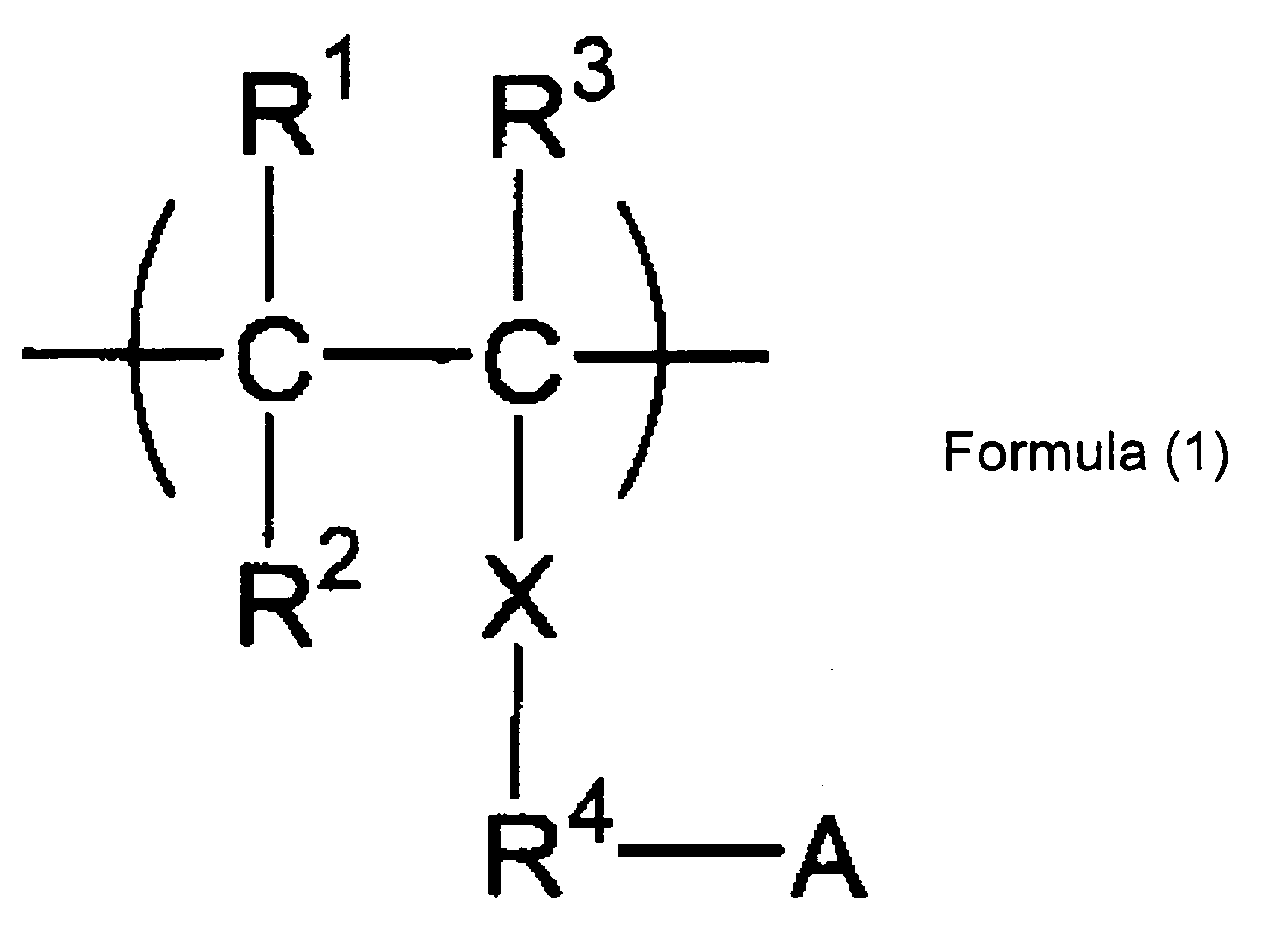
Description
- The present invention relates to a colored curable composition that is suitable for forming color filters for liquid crystal displays (LCDs), solid-state image sensors (CCD, CMOS, etc.) or the like, a color filter having a colored region formed with the colored curable composition, and a method for producing the color filter.
- A color filter is an essential component in a liquid crystal display or solid-state image sensor. In recent years, liquid crystal displays in TV and monitors have been required to have a higher image quality than before, and to have improved contrast and color purity. A colored curable composition for producing color filters has attempted to improve contrast by using pigment particles having a smaller particle size (for example, Japanese Patent Application Laid-Open (JP-A) No.
2006-30541
In color filters for solid-state image sensors, a reduction in color unevenness has been required in order to increase resolution. Therefore, it is important to disperse pigments having a small particle size, while suppressing the generation of secondary aggregates. - In recent years, increases in color purity have been demanded for color filters for liquid crystal displays. To achieve this end, the content of pigments must be increased. Color filters for solid-state image sensors have also been required to reduce stray light due to scattering as a means of increasing resolution, and thus there is a strong desire to obtain a thin colored layer. For this reason as well, the content of pigments in a color filter must be increased. In order to increase the content of pigments, the pigment concentration in a colored curable composition needs to be increased. However, when pigment concentration is increased, the relative content of dispersion resins and curable components (monomers, polymerization initiators, etc.) in a colored curable composition is inevitably reduced, thereby reducing storage stability and developability of a colored curable composition, and pattern formability also becomes poor. In particular, when color filters for solid-state image sensor become very small in order to increase pixel numbers and reduce overall size, the developability of a colored curable composition (the inhibition of generation of residues at unexposed areas) is deteriorated. To address these issues, a comb resin containing a trunk polymer having a cationic group, or a graft polymer containing polyallylamine has been used (see, for example,
JP-A Nos. 9-176511 2001-272524 - The present invention provides a colored curable composition that has, even when the concentration of a pigment is high, excellent fine-dispersibility and dispersion stability, high sensitivity, and excellent developability.
The invention also provides a color filter formed from the colored curable composition, and which has excellent adhesion property to substrates, a favorable pattern shape, and favorable color properties such as improved contrast and reduced color unevenness, and a method for producing the color filter. - As a result of the extensive researches in view of the above issues, the present inventors have found that, by using a colored curable composition containing (A) a dispersion resin having an amino group in the main chain thereof, (B) a pigment, (C) a photopolymerization initiator, (D) a polymerizable compound, (E) a solvent, and (F) an alkali-soluble resin containing a repeating unit represented by the following Formula (1), storage stability and developability can be improved even when the concentration of the pigment is high. In addition, by using the colored curable composition of the invention, a color filter having excellent adhesion property to a surface of a substrate, a favorable pattern shape, and favorable color properties such as improved contrast and reduced color unevenness, can be obtained.
Aspects of the invention include the following. - <1> A colored curable composition, containing: (A) a dispersion resin having an amino group in the main chain thereof, (B) a pigment, (C) a photopolymerization initiator, (D) a polymerizable compound, (E) a solvent, and (F) an alkali-soluble resin containing a repeating unit represented by the following Formula (1).
-

- In Formula (1), R1 and R2 each independently represent a hydrogen atom or a monovalent organic group. R3 represents a hydrogen atom, a hydrocarbon group having 1 to 6 carbon atoms, -COOH, -CN, -CF3, -CH2OH, -CH2COOH, -CH2COORa, or -COORb, where Ra and Rb each independently represent a hydrocarbon group having 1 to 6 carbon atoms. X represents -O-, -CO-, -COO-, -OCO-, -CONH-, -NHCO-, or an arylene group. R4 represents a divalent organic group or a single bond, and A represents a nitrogen-containing heterocyclic group.
- <2> The colored curable composition according to <1>, in which the repeating unit represented by Formula (1) in (F) the alkali-soluble resin is represented by the following Formula (2) or Formula (3).
-

- In Formula (2), R11 represents a hydrogen atom or an alkyl group. R12 represents an alkylene group. X1 represents -CO-, -COO-, -OCO-, -CONH-, or a phenylene group. W represents -O-, -S-, -COO-, -CONH-, -COS-, -NHCONH-, -NHCOO-, -NHCOS-, -OCO-, -OCONH-, or -NHCO-. Y represents -NR13, -O-, -S-, or -N=, and is linked to the N atom via an atomic group adjacent to Y to form a cyclic structure. R13 represents a hydrogen atom, an alkyl group, or an aryl group. m and n each independently represent 0 or 1.
-

- In Formula (3), R21 represents a hydrogen atom or a methyl group, R22 represents an alkylene group, and Z represents a nitrogen-containing heterocyclic group.
-
- <3> The colored curable composition according to to <1> or <2>, in which (F) the alkali-soluble resin further contains a repeating unit having an ethylenic unsaturated double bond at a side chain thereof.
- <4> The colored curable composition according to any one of <1> to <3>, in which the content of (F) the alkali-soluble resin is from 10% by mass to 100% by mass with respect to the mass of (B) the pigment.
- <5> The colored curable composition according to any one of <1> to <4>, in which (A) the dispersion resin is a condensate of an amino group-containing resin and a polyester.
- <6> The colored curable composition according to any one of <1> to <5>, in which the weight average molecular weight of (A) the dispersion resin is from 3,000 to 100,000.
- <7> The colored curable composition according to any one of <1> to <6>, in which the amine value of (A) the dispersion resin is from 10 mgKOH/g to 150 mgKOH/g.
- <8> The colored curable composition according to any one of <1> to <7>, in which the content of (A) the dispersion resin is from 20% by mass to 50% by mass with respect to the content of (B) the pigment.
-
- <9> The colored curable composition according to any one of <1> to <8>, in which (C) the photopolymerization initiator is an oxime compound.
- <10> A color filter, which has a colored pattern formed on a support by the colored curable composition according to any one of <1> to <9>.
- <11> A method for producing a color filter, including forming a colored layer by applying the colored curable composition according to any one of <1> to <9> to a support, pattern-wise exposing the colored layer through a mask, and developing the exposed colored layer to form a colored pattern.
- According to the invention, a colored curable composition that has favorable fine-dispersibility and dispersion stability, high sensitivity, and favorable developability even under high pigment concentration conditions is provided.
The invention also provides a color filter that has excellent adhesion property to substrates, has a favorable pattern shape, and has favorable color characteristics, such as favorable contrast or reduced color unevenness, by using the colored curable composition and a method for producing the same. - The colored curable composition of the invention has excellent storage stability and developability even when the concentration of the pigment is high. The reason for this remains unknown, but is thought to be as follows. The storage stability increases due to strong adsorption of resin to the surface of a pigment. The colored curable composition of the invention contains (A) the dispersion resin having an amino group in the main chain thereof and (F) the alkali-soluble resin containing the repeating unit represented by Formula (1). The colored curable composition of the invention can firmly adsorb to the pigment surface via two kinds of interactions: a hydrogen bond with the pigment surface by an amino group portion of (A) the dispersion resin and a π-π bond with the pigment surface by a heterocyclic portion of (F) the alkali-soluble resin. As a result, the colored curable composition of the invention exhibits excellent storage stability. In addition, relatively high developability can be achieved since the colored curable composition of the invention contains the amino group of (A) the dispersion resin and the heterocyclic group of (F) the alkali-soluble resin, both of which are hydrophilic.
- Hereinafter, the present invention is described in detail. A "colored region" as used herein includes both a colored pixel (colored pattern) region and a light-shielding film region in a color filter. When a group (an atom group) is described herein without an indication of "substituted" or "unsubstituted", the description is intended to include both a group not having an additional substituent and a group having one or more additional substituents. For example, the scope of an expression, "alkyl group", includes not only an alkyl group not having a substituent (i.e., an unsubstituted alkyl group), but also an alkyl group having a substituent (i.e., a substituted alkyl group).
- A colored curable composition of the invention contains (A) a dispersion resin having an amino group in the main chain thereof. When the colored curable composition contains (A) the dispersion resin having an amino group in the main chain thereof (hereinafter, also referred to as "(A) the dispersion resin"), dispersion stability of a pigment can be maintained.
The main chain of (A) the dispersion resin is preferably formed from a known polymer or oligomer having an amino group. Examples of the main chain include polyethyleneimine, polyallylamine, polydiallylamine, a metaxylenediamine-epichlorohydrin polycondensate, polyvinylamine, and amino group-containing poly(meth)acrylate. Among the above, polyethyleneimine and polyallylamine are preferable, and polyethyleneimine is more preferable. - (A) The dispersion resin having an amino group in the main chain thereof preferably has a graft chain. When (A) the dispersion resin has a graft chain, dispersion stability of a pigment can be improved. Examples of the graft chain include polyester, polyamide, and poly(meth)acrylate. Among these, polyester and poly(meth)acrylate are preferable, and polyester is more preferable from the viewpoint of developability and storage stability. The number average molecular weight of the graft chain is preferably from 2,000 to 40,000 and more preferably from 3,000 to 20,000.
- Examples of (A) the dispersion resin having an amino group in the main chain thereof include: a condensate of an amino group-containing resin (for example, polyethyleneimine, polyallylamine, polydiallylamine, a metaxylenediamine-epichlorohydrin polycondensate, or polyvinylamine) and a polyester; a condensate of an amino group-containing resin (for example, polyethyleneimine, polyallylamine, polydiallylamine, a metaxylenediamine-epichlorohydrin polycondensate, or polyvinylamine) and a polyamide; and a copolymer of a monomer containing an amino group (for example., 2-diethylaminoethyl methacrylate) and another monomer (for example, a macromer having a graft chain). Among the above, a condensate of an amino group-containing resin and polyester is preferable, a condensate of polyethyleneimine and a polyester or a condensate of polyallylamine and a polyester is more preferable, and a condensate of polyethyleneimine and a polyester is still more preferable.
- The weight average molecular weight (as a polystyrene-equivalent value measured according to a GPC (gel permeation chromatography) method) of (A) the dispersion resin is preferably from 3,000 to 100,000, more preferably from 5,000 to 50,000, and still more preferably from 6,000 to 20,000. When the weight average molecular weight is lower than the above range, the dispersion stability of the pigment may be deteriorated. When the weight average molecular weight exceeds the above range, the developability of the colored curable composition may be deteriorated. The amine value of (A) the dispersion resin is preferably from 10 mgKOH/g to 150 mgKOH/g, and more preferably from 30 mgKOH/g to 100 mgKOH/g. When the amine value is within the above range, excellent dispersion stability of the pigment may be obtained.
- When an amino group-containing resin is used for a raw material of (A) the dispersion resin, the number average molecular weight of the amino group-containing resin is not limited, and is preferably from 200 to 1,800, more preferably from 300 to 1,200, and still more preferably from 500 to 1,000. When a polyester is used for a raw material of (A) the dispersion resin, the weight average molecular weight (as a polystyrene-equivalent value measured according to a GPC method) of the polyester is preferably from 1,000 to 50,000, more preferably from 2,000 to 40,000, and still more preferably from 3,000 to 20,000.
- (A) The dispersion resin preferably further contains an alkali-soluble group. When (A) the dispersion resin contains the alkali-soluble group, the developability of the colored curable composition at a high pigment concentration can further be improved.
The alkali-soluble group is preferably a carboxylic acid group, a sulfonic acid group, a phosphate group, or -COCH2COCH3, and more preferably a carboxylic acid group.
The acid value of the alkali-soluble group of (A) the dispersion resin is preferably from 5 mgKOH/g to 100 mgKOH/g, and more preferably from 5 mgKOH/g to 50 mgKOH/g. As a method for introducing the alkali-soluble group, a method including reacting (A) the dispersion resin with a precursor of the alkali-soluble group (for example, cyclic acid anhydride, diketene, or the like) is preferable. - The content of (A) the dispersion resin having an amino group in the main chain thereof is preferably from 10% by mass to 100% by mass, and more preferably from 20% by mass to 50% by mass, with respect to the content of a pigment.
- The colored curable composition of the invention contains (B) a pigment. As (B) the pigment, various known inorganic pigments or organic pigments can be used.
Considering that a high transmittance pigment is preferable, the size of the inorganic pigments or organic pigments is preferably as small as possible. In consideration of handling properties, the average primary particle diameter of (B) the pigment is preferably from 5 nm to 100 nm, more preferably from 5 nm to 70 nm, still more preferably from 5 nm to 50 nm, and even more preferably from 5 nm to 40 nm. - Examples of inorganic pigments that can be used in the colored curable composition of the invention include metal compounds such as metal oxides or metal complex salts. Specific examples thereof include metal oxides such as iron oxides, cobalt oxides, aluminum oxides, cadmium oxides, lead oxides, copper oxides, titanium oxides, magnesium oxides, chromium oxides, zinc oxides, or antimony oxides, and composite oxides of these metals.
- Examples of organic pigments that can be used in the colored curable composition of the invention include:
- C. I. Pigment Yellow 1, 1:1, 2, 3, 4, 5, 6, 9, 10, 12, 13, 14, 16, 17, 24, 31, 32, 34, 35, 35:1, 36, 36:1, 37, 37:1, 40, 41, 42, 43, 48, 53, 55, 61, 62, 62:1, 63, 65, 73, 74, 75, 81, 83, 87, 93, 94, 95, 97, 100, 101, 104, 105, 108, 109, 110, 111, 116, 117, 119, 120, 126, 127, 127:1, 128, 129, 133, 134, 136, 138, 139, 142, 147, 148, 150, 151, 153, 154, 155, 157, 158, 159, 160, 161, 162, 163, 164, 165, 166, 167, 168, 169, 170, 172, 173, 174, 175, 176, 180, 181, 182, 183, 184, 185, 188, 189, 190, 191, 191:1, 192, 193, 194, 195, 196, 197, 198, 199, 200, 202, 203, 204, 205, 206, 207, and 208;
- C. I. Pigment Orange 1, 2, 5, 13, 16, 17, 19, 20, 21, 22, 23, 24, 34, 36, 38, 39, 43, 46, 48, 49, 61, 62, 64, 65, 67, 68, 69, 70, 71, 72, 73, 74, 75, 77, 78, and 79;
- C. I. Pigment Red 1, 2, 3, 4, 5, 6, 7, 8, 9, 12, 14, 15, 16, 17, 21, 22, 23, 31, 32, 37, 38, 41, 47, 48, 48:1, 48:2, 48:3, 48:4, 49, 49:1, 49:2, 50:1, 52: 1, 52: 2, 53, 53:1, 53:2, 53:3, 57, 57:1, 57: 2, 58:4, 60, 63, 63:1, 63:2, 64, 64:1, 68, 69, 81, 81:1, 81:2 81:3 81:4, 83, 88, 90:1, 101, 101:1, 104, 108, 108:1, 109, 112, 113, 114, 122, 123, 144, 146, 147, 149, 151, 166, 168, 169, 170, 172, 173, 174, 175, 176, 177, 178, 179, 181, 184, 185, 187, 188, 190, 193, 194, 200, 202, 206, 207, 208, 209, 210, 214, 216, 220, 221, 224, 230, 231, 232, 233, 235, 236, 237, 238, 239, 242, 243, 245, 247, 249, 250, 251, 253, 254, 255, 256, 257, 258, 259, 260, 262, 263, 264, 265, 266, 267, 268, 269, 270, 271, 272, 273, 274, 275, and 276;
- C. I. Pigment Violet 1, 1:1, 2, 2:2, 3, 3:1, 3:3, 5, 5:1, 14, 15, 16, 19, 23, 25, 27, 29, 31, 32, 37, 39, 42, 44, 47, 49, and 50;
- C. I. Pigment Blue 1, 1:2, 9, 14, 15, 15:1, 15:2, 15:3, 15:4, 15:6, 16, 17, 19, 25, 27, 28, 29, 33, 35, 36, 56, 56:1, 60, 61, 61:1, 62, 63, 66, 67, 68, 71, 72, 73, 74, 75, 76, 78, 79, and C. I. Pigment Blue 79 in which the Cl substituent group has been substituted by OH;
- C. I. Pigment Green 1, 2, 4, 7, 8, 10, 13, 14, 15, 17, 18, 19, 26, 36, 45, 48, 50, 51, 54, and 55;
- C. I. Pigment Brown 23, 25, and 26;
- C. I. Pigment Black 1 and 7; and
- carbon black, acetylene black, lamp black, bone black, graphite, iron black, aniline black, cyanine black, and titanium black.
- In particular, pigments having a basic N atom in the structure thereof may preferably be used in the invention. These pigments having a basic N atom exhibit good dispersibility in the colored curable composition of the invention. While the reason for this has not been sufficiently clarified, it is thought that good affinity of a pigment with a polymerizable component may influence dispersibility.
- Examples of pigments that can preferably be used in the invention include the following. However, the invention is not limited to these examples.
- C. I. Pigment Yellow 11, 24, 108, 109, 110, 138, 139, 150, 151, 154, 167, 180 and 185;
- C. I. Pigment Orange 36 and 71;
- C. I. Pigment Red 122, 150, 171, 175, 177, 209, 224, 242, 254, 255 and 264;
- C. I. Pigment Violet 19, 23 and 32;
- C. I. Pigment Blue 15:1, 15:3, 15:6, 16, 22, 60 and 66;
- C. I. Pigment Green 7, 36, 37 and 55; and
- C. I. Pigment Black 1.
- These organic pigments may be used singly, or may be used in combination of two or more kinds thereof in order to improve the color purity. Examples of preferable organic pigments and specific examples of the combination of the pigments include the following.
For example, as a red pigment, an anthraquinone pigment, a perylene pigment or a diketopyrrolopyrrole pigment may be used singly; or a mixture of at least one of these red pigments with at least one of a disazo yellow pigment, an isoindoline yellow pigment, a quinophthalone yellow pigment or a perylene red pigment, may be used. Examples of the anthraquinone pigment include C. I. pigment Red 177. Examples of the perylene pigment include C. I. Pigment Red 155 and C. I. Pigment Red 224. Examples of the diketopyrrolopyrrole pigment include C. I. Pigment Red 254. In consideration of color reproducibility, mixtures of the red pigments with C. I. Pigment Yellow 139 are preferable.
The mass ratio of the yellow pigment to the red pigment (yellow pigment/ red pigment) is preferably from 5/100 to 50/100, and more preferably from 10/100 to 30/100. When a combination of red pigments is used, the mass ratio thereof can be adjusted according to the desired chromaticity. - As a green pigment, a halogenated phthalocyanine pigment may be used singly; or a mixture of this green pigment with at least one of a disazo yellow pigment, a quinophthalone yellow pigment, an azomethine yellow pigment or an isoindoline yellow pigment, may be used. Preferable examples of the mixture include mixtures of at least one of C. I. Pigment Green 7, C. I. Pigment Green 36 or C. I. Pigment Green 37 with at least one of C. I. Pigment Yellow 83, C. I. Pigment Yellow 138, C. I. Pigment Yellow 139, C. I. Pigment Yellow 150, C. I. Pigment Yellow 180 or C. I. Pigment Yellow 185.
The mass ratio of the yellow pigment to the green pigment (yellow pigment/ green pigment) is preferably from 5/100 to 150/100, and more preferably form 30/100 to 120/100. - As a blue pigment, a phthalocyanine pigment may be used singly; or a mixture of the phthalocyanine pigment with a dioxazine purple pigment may be used. For example, a mixture of C. I. Pigment Blue 15:6 with C. I. Pigment Violet 23 is preferable.
The mass ratio of the purple pigment to the blue pigment (purple pigment/blue pigment) is preferably from 0/100 to 100/100, and more preferably 10/100 or less. - As a pigment used for a black matrix include carbon, titanium black, iron oxide and titanium oxide. These pigments are used singly, or in combination of two or more thereof. Among the above, a combination of carbon and titanium black is preferable.
The mass ratio of titanium black to carbon (titanium black/ carbon) is preferably from 0/100 to 60/100. - In the invention, the pigment to be used is preferably subjected to a pulverization treatment beforehand.
As a method for pulverizing the primary particles of the pigment, a method (a salt milling method) is well known, in which i) an organic pigment, ii) a water-soluble inorganic salt, and iii) a water-soluble organic solvent that does not substantially dissolve the water-soluble inorganic salt, are mechanically kneaded with a kneader or the like. In this method, (A) the dispersion resin having an amino group in the main chain thereof, and/or a high-molecular compound for pigment coating described below may be used in combination if necessary. - Examples of i) the organic pigment are the same as those of the organic pigment descried above.
- ii) The water-soluble inorganic salt is not limited as long as it is soluble in water. Examples of ii) the water-soluble inorganic salt include sodium chloride, barium chloride, potassium chloride, and sodium sulfate. It is preferable to use sodium chloride or sodium sulfate in terms of cost.
The amount of ii) the water-soluble inorganic salt used for salt milling is preferably from 100% by mass to 3,000% by mass, and more preferably from 500% by mass to 2,500% by mass, based on the mass of the organic pigment, in consideration of both treatment efficiency and production efficiency. As the quantitative ratio of the inorganic salt to the organic pigment is increased, the amount of pigment that can be processed at a time is decreased while the pulverizing efficiency is improved. - iii) The water-soluble organic solvent has a function of wetting i) the organic pigment and ii) the water-soluble inorganic salt. iii) The water-soluble organic solvent is not limited as long as it is soluble (miscible) in water, and does not substantially dissolve ii) the water-soluble inorganic salt. However, since the temperature increases during the salt milling and thus the solvent easily evaporates, a solvent having a boiling point of 120°C or more is preferable in consideration of safety.
Examples of the water-soluble organic solvent include 2-methoxyethanol, 2-butoxyethanol, 2-(isopentyloxy)ethanol, 2-(hexyloxy)ethanol, ethylene glycol, diethylene glycol, diethylene glycol monoethyl ether, diethylene glycol monoethyl ether acetate, diethylene glycol monobutyl ether, triethylene glycol, triethylene glycol monomethyl ether, liquid polyethyleneglycol, 1-methoxy-2-propanol, 1-ethoxy-2-propanol, dipropyleneglycol, dipropyleneglycol monomethyl ether, dipropyleneglycol monoethyl ether, and liquid polypropyleneglycol.
These water-soluble organic solvents may be used singly or in combination of two or more kinds thereof. - In order to obtain uniformly-sized particles, homogeneous kneading, and to apply a favorable shear force to a composition to be kneaded to obtain a sufficient pulverizing effect, the addition amount of the water-soluble organic solvent is preferably from 5% by mass to 50% by mass with respect to the total mass of the ii) the water-soluble inorganic salt. The addition amount of the water-soluble organic solvent is more preferably from 10% by mass to 40% by mass, and still more preferably from 15% by mass to 35% by mass, with respect to the total mass of the ii) the water-soluble inorganic salt.
The water-soluble organic solvent may be added at one time at an early stage of the salt milling process, or may be added in batches. - The high-molecular compound for pigment-coating that may be added at the time of salt milling is preferably a solid at room temperature, water insoluble, and at least partially soluble in the water-soluble organic solvent used for wetting during the salt milling. As the high-molecular compound, a natural resin, a modified natural resin, a synthetic resin, or a synthetic resin modified with a natural resin can be used.
In order to obtain a dry pulverized pigment is obtained after salt milling, the high-molecular compound for pigment-coating is preferably a solid at room temperature. - Examples of the natural resin include rosin; and examples of the modified natural resin include rosin derivatives, cellulose derivatives, rubber derivatives, and protein derivatives and oligomers thereof.
Examples of the synthetic resin include an epoxy resin, an acrylic resin, a maleic acid resin, a butyral resin, a polyester resin, a melamine resin, a phenolic resin, and a polyurethane resin.
Examples of the synthetic resin modified with a natural resin include a rosin-modified maleic acid resin and a rosin-modified phenolic resin.
Examples of the synthetic resin include (A) the dispersion resin having an amino group in the main chain thereof, polyamidoamine and salts thereof, polycarboxylic acid and salts thereof, high-molecular-weight unsaturated acid ester, polyurethane, polyester, poly(meth)acrylate, a (meth)acrylic copolymer, and a naphthalenesulfonic acid formalin condensate.
The high-molecular compound may be added at one time at an early stage of the salt milling process, or may be added in batches. - When the colored curable composition of the invention is used to form a colored region of a color filter, the primary particle diameter of the pigment is preferably from 5 nm to 100 nm, more preferably from 5 nm to 70 nm, still more preferably from 5 nm to 50 nm, and even more preferably from 5 nm to 40 nm, in consideration of color unevenness or contrast of the color filter. (A) The dispersion resin of the invention exerts more conspicuous effects on a pigment having a primary particle diameter of from 5 nm to 40 nm.
The primary particle diameter of the pigment can be measured by a known method, for example, using an electron microscope. - The pigment is preferably at least one pigment selected from anthraquinone pigments, azomethine pigments, benzylidene pigments, cyanine pigment, diketopyrrolopyrrole pigments, and phthalocyanine pigments.
- When the colored curable composition of the invention is prepared, the pigment is preferably dispersed beforehand to form a pigment dispersion composition. The pigment to be used is preferably the above-described pulverized pigment.
The pigment dispersion composition is prepared by dispersing (A) the dispersion resin having an amino group in the main chain thereof, (B) the pigment, and a solvent. If necessary, another dispersant and/or resin may be added. Furthermore, the pigment dispersion composition may further include other ingredients, such as a pigment derivative, as required. - The method for preparing the pigment dispersion composition of the invention is not particularly limited. For example, the pigment dispersion composition may be obtained by subjecting (A) the dispersion resin, (B) the pigment, and the solvent to a finely dispersing treatment with beads made of, for example, glass or zirconia and having a particle diameter of from 0.01 mm to 1 mm, using a vertical or horizontal sand grinder, a pin mill, a slit mill, a ultrasonic disperser or the like.
- Before the dispersing with beads is performed, a kneading-dispersing may be performed while applying a strong shearing force using a two-roll mill, a three-roll mill, a ball mill, a Tron mill, a disper mill, a kneader, a cokneader, a homogenizer, a blender, or a uniaxial or biaxial extruder.
- Details regarding the kneading and dispersing are described in, for example, "Paint Flow and Pigment Dispersion", by T. C. Patton (published by John Wiley and Sons Co. 1964).
- The content of the pigment in the pigment dispersion composition is preferably from 10% by mass to 60% by mass, and more preferably from 15% by mass to 50% by mass, with respect to the total solid content (mass) of the pigment dispersion composition. When the content of the pigment is within the above range, a sufficient color concentration and excellent color characteristics may be obtained.
- In addition to (A) the dispersion resin, the pigment dispersion composition may contain a dispersant such as those described below. When the pigment dispersion composition contains the dispersant in addition to the dispersion resin, the dispersibility of the pigment may be improved.
As the dispersant, for example, a known pigment dispersant or surfactant may be appropriately selected for use. - As the dispersant, various kinds of compounds can be used. Specific examples of the dispersant include cationic surfactants such as KP341 (olgano-siloxane polymer) (trade name, manufactured by Shin-Etsu Chemical Co., Ltd.), POLYFLOW Nos. 75, 90, and 95 ((meth)acrylic acid-based (co)polymer) (trade name, all manufactured by Kyoeisha Chemical Co., Ltd.) and W001 (trade name, available from Yusho Co., Ltd.); nonionic surfactants such as polyoxyethylene lauryl ether, polyoxyethylene stearyl ether, polyoxyethylene oleyl ether, polyoxyethylene octylphenyl ether, polyoxyethylene nonylphenyl ether, polyoxyethylene glycol dilaurate, polyoxyethylene glycol distearate and sorbitan fatty acid ester; anionic surfactants such as W004, W005 and W017 (trade name, all available from Yusho Co., Ltd.); high-molecular dispersants such as EFKA-46, EFKA-47, EFKA-47EA, EFKA Polymer 100, EFKA Polymer 400, EFKA Polymer 401 and EFKA Polymer 450 (trade name, all manufactured by Chiba Specialty Chemicals Inc.); various SOLSPERSE dispersants such as SOLSPERSE 3000, 5000, 9000, 12000, 13240, 13940, 17000, 24000, 26000 and 28000 (trade name, all available form Lubrizol Corporation); ADEKA PLURONIC L31, F38, L42, L44, L61, L64, F68, L72, P95, F77, P84, F87, P94, L101, P103, F108, L121 and P-123 (trade name, all manufactured by ADEKA CORPORATION); IONET S-20 (trade name, manufactured by Sanyo Chemical Industries, Ltd.); and DISPER BYK 101, 103, 106, 108, 109, 111, 112, 116, 130, 140, 142, 162, 163, 164, 166, 167, 170, 171, 174, 176, 180, 182, 2000, 2001, 2050, and 2150 (trade name, all manufactured by BYK Chemie). Other examples include a oligomer or a polymer having a polar group at a molecular terminal thereof or at a side chain thereof such as an acrylic copolymer.
- The total content of (A) the dispersion resin and above-described other dispersants in the pigment dispersion composition is preferably form 1% by mass to 100% by mass, and more preferably from 3% by mass to 70% by mass, with respect to the total mass of the pigment.
- The pigment dispersion liquid of the invention may further contain a pigment derivative.
The pigment derivative preferably has a structure in which a part of an organic pigment, an anthraquinone or an acridone is substituted by an acid group, a basic group, or a phthalimidomethyl group. Examples of the organic pigment for forming the pigment derivative include diketopyrrolopyrrole pigments; azo pigments such as azo compounds, disazo compounds and polyazo compounds; phthalocyanine pigments such as copper phthalocyanines, halogenated copper phthalocyanines and metal-free phthalocyanines; anthraquinone pigments such as aminoanthraquinone, diaminodianthraquinone, anthrapyrimidine, flavanthrone, anthanthrone, indanthrone, pyranethrone and violanthrone; quinacridone pigments, dioxazine pigments, perynone pigments, perylene pigments, thioindigo pigments, isoindoline pigments, isoindolinone pigments, quinophthalone pigments, threne pigments, and metal complex pigments. - The acid group that the pigment derivative may have is preferably a sulfonic acid group, a carboxylic acid group, or quaternary ammonium salt group thereof. The basic group that the pigment derivative may have is preferably an amino group, and more preferably a tertiary amino group.
- The amount of the pigment derivative to be used is not specifically limited, and is preferably from 5% by mass to 50% by mass, and more preferably from 10% by mass to 30% by mass, with respect to the content of the pigment.
- The pigment dispersion composition may further contain a high-molecular compound such as an alkali-soluble resin described below. The alkali-soluble resin has a polar group such as an acid group, and may be effective for dispersing the pigment and thus may be effective for improving the dispersion stability of a pigment dispersion liquid.
- Examples of the solvent of the pigment dispersion composition include 1-methoxy-2-propyl acetate, 1-methoxy-2-propanol, ethyleneglycol monomethyl ether, diethyleneglycol monomethyl ether, ethyl acetate, butyl acetate, ethyl lactate, acetone, methyl ethyl ketone, methyl isobutyl ketone, cyclohexanone, n-propanol, 2-propanol, n-butanol, cyclohexanol, ethyleneglycol, diethyleneglycol, toluene and xylene.
- The content of the solvent in the pigment dispersion composition is suitably determined according to, for example, the application of the pigment dispersion composition. When the pigment dispersion composition is used for the preparation of the colored curable composition of the invention, the content of the solvent may be adjusted such that the total solid content of the pigment dispersion composition, including the pigment and the dispersant, is from 5% by mass to 50% by mass with respect to the total mass of the pigment dispersion composition, in consideration of handling properties.
- The content of the pigment in the pigment dispersion composition of the invention is preferably from 30% by mass or more, more preferably from 35% by mass to 80% by mass, and still more preferably from 40% by mass to 70% by mass, with respect to the total solid content of the pigment dispersion composition.
When (A) the dispersion resin having an amino group in the main chain thereof of the invention is used as the pigment dispersant, dispersing effects thereof are more conspicuous when the pigment content is as high as 40% by mass or more; in contrast, it is difficult to stably and uniformly disperse a pigment at such a high content by using a known dispersant. - The colored curable composition of the invention includes (C) a photopolymerization initiator.
The photopolymerization initiator of the invention is decomposed by light, thereby initiating and accelerating polymerization of a polymerizable component such as (D) the polymerizable compound described below. The photopolymerization initiator preferably has an absorption in the wavelength region of from 300 nm to 500 nm.
The photopolymerization initiator may be used singly, or in combination of two or more thereof. - Examples of (C) the photopolymerization initiator include organic halogenated compounds, oxadiazole compounds, carbonyl compounds, ketal compounds, benzoin compounds, acridine compounds, organic peroxide compounds, azo compounds, coumarin compounds, azide compounds, metallocene compounds, hexaarylbiimidazole compounds, organic borate compounds, disulfonic acid compounds, oxime compounds, onium salt compounds, acylphosphine (oxide) compounds and alkylamino compounds.
Hereinafter, each of these compounds is described in detail. - Specific examples of the organic halogenated compounds include the compounds described in Wakabayashi et al., "Bull. Chem. Soc. Japan" 42, 2924 (1969),
U.S. Patent No. 3,905,815 ,JP-B No. 46-4605 JP-A Nos. 48-36281 55-32070 60-239736 61-169835 61-169837 62-58241 62-212401 63-70243 63-298339 - Preferable examples of the s-triazine compounds include a s-triazine derivative in which at least one monohalogen-substituted, dihalogen-substituted, or trihalogen-substituted methyl group is bound to an s-triazine ring. Specific examples thereof include 2,4,6-tris(monochloromethyl)-s-triazine, 2,4,6-tris(dichloromethyl)-s-triazine, 2,4,6-tris(trichloromethyl)-s-triazine, 2-methyl-4,6-bis(trichloromethyl)-s-triazine, 2-n-propyl-4,6-bis(trichloromethyl)-s-triazine, 2-(α,α,β-trichloroethyl)-4,6-bis(trichloromethyl)-s-triazine, 2-phenyl-4,6-bis(trichloromethyl)-s-triazine, 2-(p-methoxyphenyl)-4,6-bis(trichloromethyl)-s-triazine, 2-(3,4-epoxyphenyl)-4,6-bis(trichloromethyl)-s-triazine, 2-(p-chlorophenyl)-4,6-bis(trichloromethyl)-s-triazine, 2-[1-(p-methoxyphenyl)-2,4-butadienyl]-4,6-bis(trichloromethyl)-s-triazine, 2-styryl-4,6-bis(trichloromethyl)-s-triazine, 2-(p-methoxystyryl)-4,6-bis(trichloromethyl)-s-triazine, 2-(p-i-propyloxystyryl)-4,6-bis(trichloromethyl)-s-triazine, 2-(p-tolyl)-4,6-bis(trichloromethyl)-s-triazine, 2-(4-naphthoxynaphthyl)-4,6-bis(trichloromethyl)-s-triazine, 2-phenylthio-4,6-bis(trichloromethyl)-s-triazine, 2-benzylthio-4,6-bis(trichloromethyl)-s-triazine, 2,4,6-tris(dibromomethyl)-s-triazine, 2,4,6-tris(tribromomethyl)-s-triazine, 2-methyl-4,6-bis(tribromomethyl)-s-triazine, and 2-methoxy-4,6-bis(tribromomethyl)-s-triazine.
- Examples of the oxadiazole compounds include 2-trichloromethyl-5-styryl-1,3,4-oxadiazole, 2-trichloromethyl-5-(cyanostyryl)-1,3,4-oxadiazole, 2-trichloromethyl-5-(naphth-1-yl)-1,3,4-oxadiazole, and 2-trichloromethyl-5-(4-styryl)styryl-1,3,4-oxadiazole.
- Examples of the carbonyl compounds include benzophenone derivatives such as benzophenone, Michler's ketone, 2-methylbenzophenone, 3-methylbenzophenone, 4-methylbenzophenone, 2-chlorobenzophenone, 4-bromobenzophenone and 2-carboxybenzophenone; acetophenone derivatives such as 2,2-dimethoxy-2-phenylacetophenone, 2,2-diethoxyacetophenone, 1-hydroxycyclohexylphenyl ketone, α-hydroxy-2-methylphenylpropanone, 1-hydroxy-1-methylethyl-(p-isopropylphenyl) ketone, 1-hydroxy-1-(p-dodecylphenyl) ketone, 2-methyl-(4'-(methylthio)phenyl)-2-morpholino-1-propanone, 1,1,1-trichloromethyl-(p-butylphenyl) ketone, and 2-benzyl-2-dimethylamino-4-morpholinobutyrophenone; thioxanthone derivatives such as thioxanthone, 2-ethylthioxantone, 2-isopropylthioxantone, 2-chlorothioxantone, 2,4-dimethylthioxantone, 2,4-diethylthioxantone, and 2,4-diisopropylthioxantone; and benzoic acid ester derivatives such as ethyl p-dimethylaminobenzoate and ethyl p-diethylaminobenzoate.
- Examples of the ketal compounds include benzyl methyl ketal and benzyl-β-methoxyethyl ethyl acetal.
Examples of the benzoin compounds include m-benzoin isopropyl ether, benzoin isobutyl ether, benzoin methyl ether, and methyl o-benzoylbenzoate. - Examples of the acridine compounds include 9-phenylacridine and 1,7-bis(9-acridinyl)heptane.
- Examples of the organic peroxide compounds include trimethylcyclohexanone peroxide, acetylacetone peroxide, 1,1-bis(tert-butylperoxy)-3,3,5-trimethylcyclohexane, 1,1-bis(tert-butylperoxy)cyclohexane, 2,2-bis(tert-butylperoxy)butane, tert-butyl hydroperoxide, cumene hydroperoxide, diisopropylbenzene hydroperoxide, 2,5-dimethylhexane-2,5-dihydroperoxide, 1,1,3,3-tetramethylbutyl hydroperoxide, tert-butylcumyl peroxide, dicumyl peroxide, 2,5-dimethyl-2,5-di(tert-butylperoxy)hexane, 2,5-oxanoyl peroxide, succinic acid peroxide, benzoyl peroxide, 2,4-dichlorobenzoyl peroxide, diisopropyl peroxydicarbonate, di-2-ethylhexyl peroxydicarbonate, di-2-ethoxyethyl peroxydicarbonate, dimethoxyisopropyl peroxycarbonate, di(3-methyl-3-methoxybutyl) peroxydicarbonate, tert-butyl peroxyacetate, tert-butyl peroxypivalate, tert-butyl peroxyneodecanoate, tert-butyl peroxyoctanoate, tert-butyl peroxylaurate, 3,3',4,4'-tetra-(t-butylperoxycarbonyl)benzophenone, 3,3',4,4'-tetra-(t-hexylperoxycarbonyl)benzophenone, 3,3',4,4'-tetra-(p-isopropylcumylperoxycarbonyl)benzophenone, carbonyl di(t-butylperoxy dihydrogen diphthalate), and carbonyl di(t-hexylperoxy dihydrogen diphthalate).
- Examples of the azo compounds include azo compounds such as those described in
JP-A No. 8-108621 - Examples of the coumarin compounds include 3-methyl-5-amino-((s-triazin-2-yl)amino)-3-phenylcoumarin, 3-chloro-5-diethylamino-((s-triazin-2-yl)amino)-3-phenylcoumarin, and 3-butyl-5-dimethylamino-((s-triazin-2-yl)amino)-3-phenylcoumarin.
- Examples of the azide compounds include organic azide compounds such as those described in
U.S. Patent Nos. 2,848,328 ,2,852,379 and2,940,853 , and 2,6-bis-(4-azidobenzylidene)-4-ethylcyclohexanone (BAC-E). - Examples of the metallocene compounds include various titanocene compounds described in
JP-A Nos. 59-152396 61-151197 63-41484 2-249 2-4705 JP-A Nos. 1-304453 1-152109 - Examples of the hexaarylbiimidazole compounds include various compounds such as those described, for example, in
JP-B No. 6-29285 U.S. Patent Nos. 3,479,185 ,4,311,783 , and4,622,286 . Specific examples thereof include 2,2'-bis(o-chlorophenyl)-4,4',5,5'-tetraphenylbiimidazole, 2,2'-bis(o-bromophenyl)-4,4',5,5'-tetraphenylbiimidazole, 2,2'-bis(o,p-dichlorophenyl)-4,4',5,5'-tetraphenylbiimidazole, 2,2'-bis(o-chlorophenyl)-4,4',5,5'-tetra(m-methoxyphenyl)biimidazole, 2,2'-bis(o,o'-dichlorophenyl)-4,4',5,5'-tetraphenylbiimidazole, 2,2'-bis(o-nitrophenyl)-4,4',5,5'-tetraphenylbiimidazole, 2,2'-bis(o-methylphenyl)-4,4',5,5'-tetraphenylbiimidazole, and 2,2'-bis(o-trifluorophenyl)-4,4',5,5'-tetraphenylbiimidazole. - Specific examples of the organic borate compounds include organic boric acid salts such as those described in
JP-A Nos. 62-143044 62-150242 9-188685 9-188686 9-188710 2000-131837 2002-107916 2002-116539 2764769 JP-A Nos. 6-157623 6-175564 6-175561 JP-A Nos. 6-175554 6-175553 JP-A No. 9-188710 JP-A Nos. 6-348011 7-128785 7-140589 7-306527 7-292014 - Examples of the disulfonic acid compounds include compounds such as those described in
JP-A Nos. 61-166544 2002-328465 - Examples of the oxime compounds include compounds such as those described in J.C.S. Perkin II (1979) 1653-1660, J.C.S. Perkin II (1979) 156-162, Journal of Photopolymer Science and Technology (1995) 202-232, and
JP-A No. 2000-66385 JP-A No. 2000-80068 2004-534797 - Examples of the onium salt compound include diazonium salts such as those described in S. I. Schlesinger, Photogr. Sci. Eng., 18, 387 (1974) and T. S. Bal et al, Polymer, 21, 423 (1980), ammonium salts such as those described in
USP No. 4,069,055 andJP-A No. 4-365049 USP Nos. 4,069,055 and4,069,056 , and iodonium salts such as those described inEP No. 104,143 USP Nos. 339,049 and410,201 andJP-A Nos. 2-150848 2-296514 - Examples of the iodonium salts that can be used in the invention include a diaryl iodonium salt, which is preferably substituted by two or more electron-donating groups such as an alkyl group, an alkoxy group, or an aryloxy group, in consideration of stability. More preferably, the diaryl iodonium salt is substituted by three or more alkoxy groups, and most preferably by four or more alkoxy groups. Further, another preferable diaryl iodonium salt that has excellent photosetting property is an iodonium salt in which at least one of the diaryl forms a part of a chromophore having an absorption at a wavelength of 300 nm or more, or an iodonium salt that has a functional group having an absorption at a wavelength of 300 nm or more as a substituent.
- Examples of sulfonium salts that can be used in the invention include sulfonium salts such as those described in
EP Nos. 370,693 390,214 233,567 297,443 297,442 USP Nos. 4,933,377 ,161,811 ,410,201 ,339,049 ,4,760,013 ,4,734,444 and2,833,827 , andDE Nos. 2,904,626 ,3,604,580 and3,604,581 . The sulfonium salt is preferably substituted by an electron-withdrawing group in consideration of stability. The electron-withdrawing group preferably has a Hammett value of larger than 0. Preferable examples of electron-withdrawing groups include a halogen atom and a carboxylic acid.
Preferable examples of the sulfonium salt further include a sulfonium salt having absorption at a wavelength of 300 nm or more in which one substituent of a triarylsulfonium salt has a coumarin structure or an anthraquinone structure. Furthermore, preferable examples of the sulfonium salt include a sulfonium salt having absorption at a wavelength of 300 nm or more in which a triarylsulfonium salt has an aryloxy group or an arylthio group as a substituent. - Examples of the onium salt compounds include selenonium salts such as those described in Macromolecules, 10(6), 1307 (1977) by J. V. Crivello et al. and J. Polymer Sci., Polymer Chem. Ed., 17, 1047 (1979) by J. V. Crivello et al.; and arsonium salts such as those described in Teh, Proc. Conf. Rad. Curing ASIA, p. 478 Tokyo, Oct. (1988) by C. S. Wen et al.
- Examples of acyl phosphine (oxide) compounds include IRGACURE 819, DAROCUR 4265, and DAROCUR TPO (trade name, all manufactured by Ciba Specialty Chemicals Inc.).
- Examples of the alkylamino compounds include a compound having a dialkylaminophenyl group and an alkylamine compound such as those described in paragraph [0047] of
JP-A No. 9-281698 JP-A Nos. 6-19240 6-19249 - As the (C) photopolymerization initiator of the invention, the above initiators can be appropriately used. In consideration of exposure sensitivity, it is preferable to use at least one of the following: triazine compounds of the organic halogenated compounds; the ketal compounds; the benzoin compounds; the metallocene compounds; the hexaarylbiimidazole compounds; the oxime compounds; the acylphosphine (oxide) compounds; and the hexa-alkylamino compounds. It is more preferable to use at least one of the triazine compounds, the oxime compounds, the hexaarylbiimidazole compounds or the alkylamino compounds. It is still more preferable to use the oxime compounds.
- When a colored curable composition is used for the formation of colored pixels in color filters for solid-state image sensors, the pigment concentration in the colored curable composition is high due to the requirements for color filters for solid-state image sensors. Therefore, the concentration of a photopolymerization initiator in the colored curable composition is decreased and thus exposure sensitivity is reduced. When a stepper exposure is conducted using an initiator that generates a halogen-containing compound during the exposure such as triazine compounds, corrosion of the device may be caused. In consideration of these issues, as a photopolymerization initiator that can satisfy both exposure sensitivity and various properties, oxime compounds are preferable, and oxime compounds having an absorption at a wavelength of 365 nm are more preferable.
- In the invention, among the oxime compounds, a compound represented by the following Formula (a) is preferable in consideration of exposure sensitivity, stability over time, and coloring at the time of post-heating. In addition, IRGACURE OXE-01 and OXE-02 (trade name, all manufactured by Ciba Specialty Chemicals Inc) are also preferable.
-
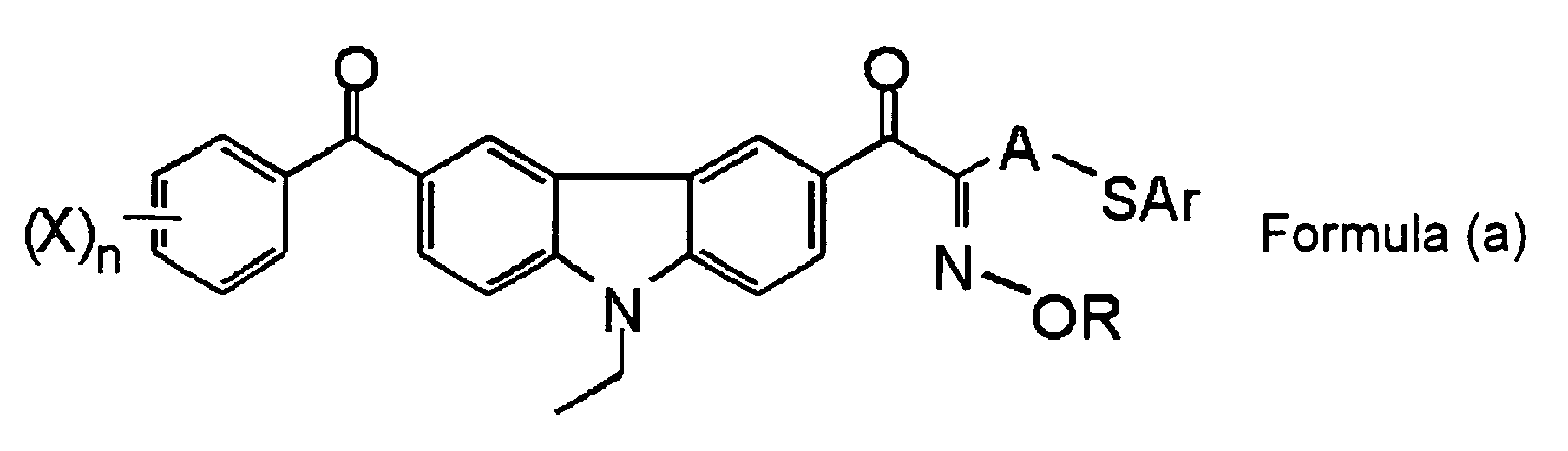
- In Formula (a), R and X each independently represent a monovalent substituent, A represents a divalent organic group, Ar represents an aryl group, and n represents an integer of from 0 to 5.
- In order to achieve high sensitivity, R preferably represents an acyl group, and, specifically, an acetyl group, a propionyl group, a benzoyl group, and a toluyl group are preferable.
- In order to achieve high sensitivity and/or to suppress coloring caused by heating over time, A preferably represents an unsubstituted alkylene group, an alkylene group substituted by an alkyl group (such as a methyl group, an ethyl group, a tert-butyl group, or a dodecyl group), an alkylene group substituted by an alkenyl group (such as a vinyl group or an allyl group) or an alkylene group substituted by an aryl group (such as a phenyl group, a p-tolyl group, a xylyl group, a cumenyl group, a naphthyl group, an anthryl group, a phenanthryl group, or a styryl group).
- In order to achieve high sensitivity and/or to suppress coloring caused by heating over time, Ar preferably represents a substituted or unsubstituted phenyl group. Preferable examples of the substituent in the substituted phenyl group include a halogen group such as a fluorine atom, a chlorine atom, a bromine atom, or an iodine atom.
- In order to improve solubility in solvents and to improve absorption efficiency in a long wavelength region, X preferably represents a substituted or unsubstituted alkyl group, a substituted or unsubstituted aryl group, a substituted or unsubstituted alkenyl group, a substituted or unsubstituted alkynyl group, a substituted or unsubstituted alkoxy group, a substituted or unsubstituted aryloxy group, a substituted or unsubstituted alkylthioxy group, a substituted or unsubstituted arylthioxy group, and a substituted or unsubstituted amino group.
In Formula (a), n preferably represents 1 or 2. - Specific examples of oxime compounds suitable for the colored curable composition of the invention are shown below, but the invention is not limited to these examples.
-


-


-
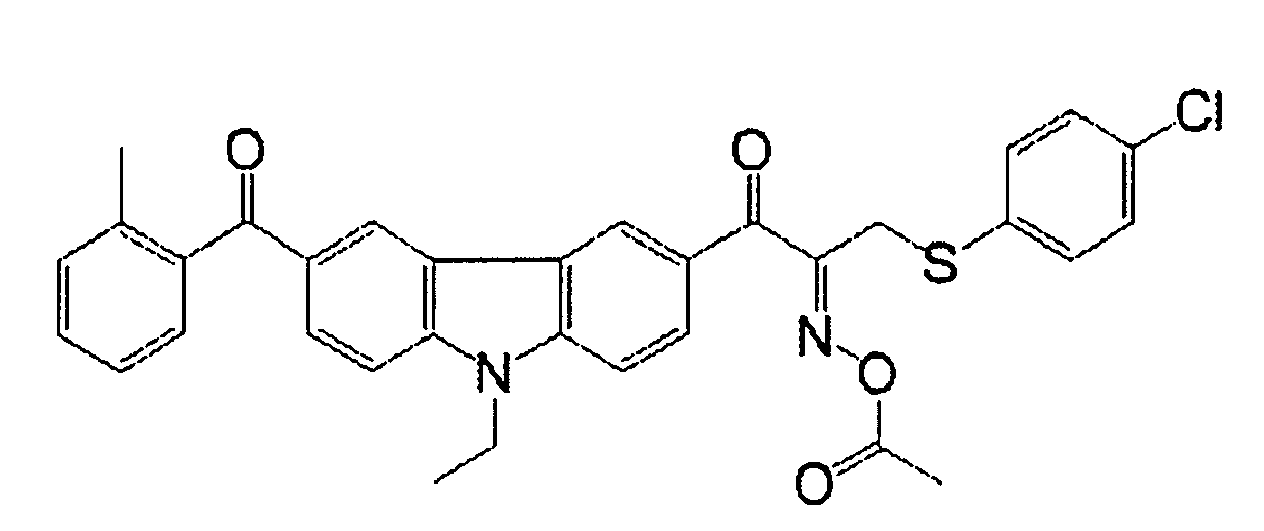


-


-


-


-


-


-


-


-


-


- The content of (C) the photopolymerization initiator in the colored curable composition of the invention is preferably from 0.1% by mass to 50% by mass, more preferably from 0.5 to 30% by mass, and still more preferably from 1% by mass to 20% by mass, with respect to the total solid content of the colored curable composition. When the content of (C) the photopolymerization initiator is within the above range, excellent sensitivity and pattern forming property can be realized.
- The curable composition of the invention contains (D) the polymerizable compound.
(D) The polymerizable compound that can be used in the invention is an addition-polymerizable compound having at least one ethylenic unsaturated double bond, which has a structure different from that of (F) an alkali-soluble resin described below. The addition-polymerizable compound having at least one ethylenic unsaturated double bond may be selected from compounds each having at least one terminal ethylenic unsaturated bond, preferably having two or more terminal ethylenic unsaturated bonds.
Such a class of compounds is widely known in the relevant industrial field, and such compounds may be used in the invention without particular limitations. - Such compounds may be in the chemical form of a monomer or a prepolymer (such as a dimer, a trimer, or an oligomer), or a mixture of a monomer and a prepolymer, or a copolymer of a monomer and a prepolymer. Examples of the monomer and copolymers thereof include an unsaturated carboxylic acid (such as acrylic acid, methacrylic acid, itaconic acid, crotonic acid, isocrotonic acid, or maleic acid), and an esters or amides of the unsaturated carboxylic acid.
It is preferable to use an ester of an unsaturated carboxylic acid and an aliphatic polyhydric alcohol compound, or an amide of an unsaturated carboxylic acid and an aliphatic polyamine. Specific examples thereof include an addition reaction product of an unsaturated carboxylic acid ester or amide having a nucleophilic substituent such as a hydroxyl group, an amino group or a mercapto group, with a monofunctional or polyfunctional, isocyanate or epoxy compound; and a dehydration condensation reaction product of such an unsaturated carboxylic acid ester or amide having a nucleophilic substituent with a monofunctional or polyfunctional carboxylic acid.
It is also preferable to use an addition reaction product of an unsaturated carboxylic acid ester or amide having an electrophilic substituent such as an isocyanate group or an epoxy group, with a monofunctional or polyfunctional alcohol, amine, or thiol, and a substitution reaction product of an unsaturated carboxylic acid ester or amide having a halogen group or having a leaving substituent such as a tosyloxy group, with a monofunctional or polyfunctional alcohol, amine, or thiol.
Other examples include a compound obtained by replacing the unsaturated carboxylic acid in any of the above examples with an unsaturated phosphonic acid, styrene, vinyl ether, or the like. - Examples of the ester monomer of an aliphatic polyhydric alcohol compound and an unsaturated carboxylic acid include acrylic esters such as ethyleneglycol diacrylate, triethyleneglycol diacrylate, 1,3-butanediol diacrylate, tetramethyleneglycol diacrylate, propyleneglycol diacrylate, neopentylglycol diacrylate, trimethylolpropane triacrylate, trimethylolpropane tri(acryloyloxypropyl)ether, trimethylolethane triacrylate, hexanediol diacrylate, 1,4-cyclohexanediol diacrylate, tetraethyleneglycol diacrylate, pentaerythritol diacrylate, pentaerythritol triacrylate, pentaerythritol tetraacrylate, dipentaerythritol diacrylate, dipentaerythritol hexaacrylate, sorbitol triacrylate, sorbitol tetraacrylate, sorbitol pentaacrylate, sorbitol hexaacrylate, tri(acryloyloxyethyl)isocyanurate, polyester acrylate oligomers, and isocyanuric acid EO-modified triacrylate.
- Examples of the ester monomer also include methacrylic esters such as tetramethyleneglycol dimethacrylate, triethyleneglycol dimethacrylate, neopentylglycol dimethacrylate, trimethylolpropane trimethacrylate, trimethylolethane trimethacrylate, ethyleneglycol dimethacrylate, 1,3-butanediol dimethacrylate, hexanediol dimethacrylate, pentaerythritol dimethacrylate, pentaerythritol trimethacrylate, pentaerythritol tetramethacrylate, dipentaerythritol dimethacrylate, dipentaerythritol hexamethacrylate, sorbitol trimethacrylate, sorbitol tetramethacrylate, bis[p-(3-methacryloxy-2-hydroxypropoxy)phenyl]dimethylmethane, and bis[p-(methacryloxyethoxy)phenyl]dimethylmethane.
- Examples of the ester monomer also include itaconic esters such as ethyleneglycol diitaconate, propyleneglycol diitaconate, 1,3-butanediol diitaconate, 1,4-butanediol diitaconate, tetramethylene glycol diitaconate, pentaerythritol diitaconate, and sorbitol tetraitaconate; crotonic esters such as ethyleneglycol dicrotonate, tetramethylene glycol dicrotonate, pentaerythritol dicrotonate, and sorbitol tetradicrotonate; isocrotonic esters such as ethyleneglycol diisocrotonate, pentaerythritol diisocrotonate, and sorbitol tetraisocrotonate; and maleic esters such as ethyleneglycol dimaleate, triethyleneglycol dimaleate, pentaerythritol dimaleate, and sorbitol tetramaleate.
- Examples of other esters include aliphatic alcohol esters such as those described in Japanese Patent Publication (JP-B) No.
51-47334 JP-A No. 57-196231 JP-A Nos. 59-5240 59-5241 02-226149 JP-A No. 01-165613 - A monomer having an acid group may be used as the compound having an ethylenic unsaturated double bond. Examples thereof include (meth)acrylic acid, pentaerythritol triacrylate monosuccinate, dipentaerythritol pentaacrylate monosuccinate, pentaerythritol triacrylate monomaleate, dipentaerythritol pentaacrylate monomaleate, pentaerythritol triacrylate monophthalate, dipentaerythritol pentaacrylate monophthalate, pentaerythritol triacrylate mono-tetrahydrophthalate, and dipentaerythritol pentaacrylate mono-tetrahydrophthalate. Among these, pentaerythritol triacrylate monosuccinate is preferable in terms of developability and sensitivity.
- Examples of the amide monomer of an aliphatic polyamine compound and an unsaturated carboxylic acid include methylene bisacrylamide, methylene bismethacrylamide, 1,6-hexamethylene bisacrylamide, 1,6-hexamethylene bismethacrylamide, diethylenetriamine trisacrylamide, xylylene bisacrylamide, and xylylene bismethacrylamide.
Examples of other preferred amide monomers include cyclohexylene structure-containing compounds such as those described inJP-B No. 54-21726 - Addition-polymerizable urethane compounds produced by an addition reaction of isocyanate with a hydroxyl group are also preferable. Examples thereof include vinyl urethane compounds such as those described in
JP-B No. 48-41708 -
CH2 = C (R10) COOCH2CH (R11) OH Formula (4)
In Formula (4), R10 and R11 each independently represent H or CH3. - In addition, urethane acrylates such as those disclosed in
JP-A No. 51-37193 JP-B Nos. 2-32293 2-16765 JP-B Nos. 58-49860 56-17654 62-39417 62-39418 JP-A Nos. 63-277653 63-260909 1-105238 - Other examples include polyfunctional (meth)acrylates, such as polyester (meth)acrylates and epoxy (meth)acrylates obtained by reacting an epoxy resin and (meth)acrylic acid, such as those disclosed in
JP-A No. 48-64183 JP-B Nos. 49-43191 52-30490 JP-B Nos. 46-43946 1-40337 1-40336 JP-A No. 2-25493 JP-A No. 61-22048 - Details of how to use (D) the polymerizable compound, such as what structure is used, whether they are used alone or in combination, or what amount is added, may be freely determined depending on the desired performance of the curable composition. For example, they may be selected from the following viewpoints.
In view of sensitivity, the polymerizable compound preferably has a structure having a higher content of unsaturated groups per molecule, and bifunctional or higher functional structures are preferable in many cases. In order to increase the strength of an image area (cured film in an image area), the polymerizable compound preferably has a tri- or higher-functional structure. A method of using a combination of compounds having different numbers of functional groups and/or different types of polymerizable groups (for example, compounds selected from an acrylic ester, a methacrylic ester, a styrene compound, a vinyl ether compound) is also effective for regulating both of sensitivity and strength. The polymerizable compound preferably contains an EO-modified product from the viewpoint of curing sensitivity and developability of an unexposed area.
In view of curing sensitivity, it is preferable to use a compound containing at least two (meth)acrylic acid ester structures, more preferably a compound containing at least three (meth)acrylic acid ester structures, and still more preferably a compound containing at least four (meth)acrylic acid ester structures. The polymerizable compound preferably contains a carboxylic acid group or an EO-modified structure from the viewpoint of curing sensitivity and developability of an unexposed area. The polymerizable compound is preferably a compound containing a urethane bond from the viewpoint of curing sensitivity and strength of an exposed area. - In addition, selection and usage mode of the polymerizable compound are very important factors affecting the compatibility with other components contained in the colored curable composition (for example, a resin, a photopolymerization initiator and a colorant) and dispersibility. For example, the compatibility may be improved by using a low-purity compound or by using two or more polymerizable compounds in combination. Furthermore, a specific structure may be selected in order to improve the adhesiveness to a surface of a substrate.
- From the above-mentioned viewpoints, preferable examples of (D) the polymerizable compound include bisphenol A diacrylate, a bisphenol A diacrylate EO-modified product, trimethylolpropane triacrylate, trimethylolpropane tri(acryloyloxypropyl) ether, trimethylolethane triacrylate, tetraethylene glycol diacrylate, pentaerythritol diacrylate, pentaerythritol triacrylate, pentaerythritol tetraacrylate, dipentaerythritol tetraacrylate, dipentaerythritol pentaacrylate, dipentaerythritol hexaacrylate, sorbitol triacrylate, sorbitol tetraacrylate, sorbitol pentaacrylate, sorbitol hexaacrylate, tri(acryloyloxyethyl) isocyanurate, a pentaerythritol tetraacrylate EO-modified product, a dipentaerythritol hexaacrylate EO-modified product, and pentaerythritol triacrylate monosuccinate; and commercially available products, for example, urethane oligomers such as UAS-10 and UAB-140 (trade name, manufactured by Sanyo-Kokusaku Pulp Co., Ltd.); DPHA-40H (trade name, manufactured by Nippon Kayaku Co., Ltd.); UA-306H, UA-306T, UA-306I, AH-600, T-600 and AI-600 (trade name, manufactured by Kyoeisha Chemical Co., Ltd.) and UA-7200 (trade name, manufactured by Shin-Nakamura Chemical Co., Ltd.).
- Of these, a bisphenol A diacrylate EO-modified product, pentaerythritol triacrylate, pentaerythritol tetraacrylate, dipentaerythritol pentaacrylate, dipentaerythritol hexaacrylate, tri(acryloyloxyethyl) isocyanurate, a pentaerythritol tetraacrylate EO-modified product, a dipentaerythritol hexaacrylate EO-modified product, and pentaerythritol triacrylate monosuccinate are more preferable, and, as commercially available products, DPHA-40H (trade name, manufactured by Nippon Kayaku Co., Ltd.) and UA-306H, UA-306T, UA-306I, AH-600, T-600 and AI-600 (trade name, manufactured by Kyoeisha Chemical Co., Ltd.) are more preferable.
- The content of (D) the polymerizable compound is preferably from 1% by mass to 90% by mass, more preferably from 5% by mass to 80% by mass, and still more preferably from 10% by mass to 70% by mass, with respect to the total solid content of the colored curable composition of the invention.
- The colored curable composition of the invention contains at least one solvent as (E) the solvent.
Examples of (E) the solvent include organic solvents as described in the following, and may be selected considering the solubility of the respective components contained in a pigment dispersion liquid, and the coating properties when used in the colored curable composition. The solvent is basically not particularly restricted as long as it satisfies desired properties, and is preferably selected in consideration of safety. - Specific examples of the solvent include esters, such as ethyl acetate, n-butyl acetate, isobutyl acetate, amyl formate, isoamyl acetate, butyl propionate, ethyl lactate, isopropyl butyrate, ethyl butyrate, butyl butyrate, methyl oxyacetate, ethyl oxyacetate, butyl oxyacetate, methyl methoxyacetate, ethyl methoxyacetate, butyl methoxyacetate, methyl ethoxyacetate, ethyl ethoxyacetate, methyl 3-oxypropionate, ethyl 3-oxypropionate, methyl 3-methoxypropionate, ethyl 3-methoxypropionate, methyl 3-ethoxypropionate, ethyl 3-ethoxypropionate, methyl 2-oxypropionate, ethyl 2-oxypropionate, propyl 2-oxypropionate, methyl 2-methoxypropionate, ethyl 2-methoxypropionate, propyl 2-methoxypropionate, methyl 2-ethoxypropionate, ethyl 2-ethoxypropionate, methyl 2-oxy-2-methylpropionate, ethyl 2-oxy-2-methylpropionate, methyl 2-methoxy-2-methylpropionate, ethyl 2-ethoxy-2-methylpropionate, methyl pyruvate, ethyl pyruvate, propyl pyruvate, methyl acetoacetate, ethyl acetoacetate, methyl 2-oxobutanoate, and ethyl 2-oxobutanoate;
- ethers, such as diethyleneglycol dimethyl ether, tetrahydrofuran, ethyleneglycol monomethyl ether, ethyleneglycol monoethyl ether, methyl cellosolve acetate (ethyleneglycol monomethyl ether acetate), ethyl cellosolve acetate (ethyleneglycol monoethyl ether acetate), diethyleneglycol monomethyl ether, diethyleneglycol monoethyl ether, diethyleneglycol monobutyl ether, diethyleneglycol monoethyl ether acetate, diethyleneglycol monobutyl ether acetate, propyleneglycol methyl ether, propyleneglycol monomethyl ether acetate (PGMEA), propyleneglycol ethyl ether acetate, and propyleneglycol propyl ether acetate;
ketones, such as methyl ethyl ketone, cyclohexanone, 2-heptanone, and 3-heptanone; and
aromatic hydrocarbons, such as toluene and xylene. - Among these, methyl 3-ethoxypropionate, ethyl 3-ethoxypropionate, ethyl cellosolve acetate, ethyl lactate, diethyleneglycol dimethyl ether, n-butyl acetate, methyl 3-methoxypropionate, 2-heptanone, cyclohexanone, diethyleneglycol monoethyl ether acetate, diethyleneglycol monobutyl ether acetate, propyleneglycol methyl ether, and propyleneglycol monomethyl ether acetate (PGMEA) are more preferable.
- The content of (E) the solvent in the colored curable composition of the invention is preferably from 50% by mass to 90% by mass, more preferably from 60% by mass to 90 % by mass, and still more preferably from 70% by mass to 90% by mass, with respect to the total mass of the colored curable composition. When the content of (E) the solvent is within the above range, generation of residual matter can be suppressed.
- The colored curable composition of the invention contains (F) the alkali-soluble resin containing a repeating unit represented by the following Formula (1) (hereinafter sometimes referred to as a "specific alkali-soluble resin".).
-

- In Formula (1), R1 and R2 each independently represent a hydrogen atom or a monovalent organic group. R3 represents a hydrogen atom, a hydrocarbon group having 1 to 6 carbon atoms, -COOH, -CN, -CF3, -CH2OH, -CH2COOH, -CH2COORa, or -COORb, where Ra and Rb each independently represent a hydrocarbon group having 1 to 6 carbon atoms. X represents -O-, -CO-, -COO-, -OCO-, -CONH-, -NHCO-, or an arylene group. R4 represents a divalent organic group or a single bond, and A represents a nitrogen-containing heterocyclic group.
- In Formula (1), examples of the monovalent organic group represented by R1 or R2 include an alkyl group having 1 to 6 carbon atoms and an aryl group having 6 to 12 carbon atoms. Among these, a methyl group, an ethyl group and a phenyl group are preferable. In consideration of polymerization properties, R1 or R2 is preferably a hydrogen atom.
R3 preferably represents a hydrogen atom, a methyl group, -COOH, -CN, -CF3, - CH2OH, -CH2COOH, -CH2COORa or -COORb, and more preferably a hydrogen atom or a methyl group. - The divalent organic group represented by R4 is preferably an alkylene group having 2 to 60 carbon atoms or arylene group having 2 to 60 carbon atoms, which may have at least one partial structure selected from an oxygen atom, a nitrogen atom, a sulfur atom, a hydrocarbon ring structure having 3 to 20 carbon atoms, a heterocyclic ring structure (details will be described below), an ester bond, a sulfonic acid ester bond, a phosphoric acid ester bond, a urethane bond, a thiourethane bond, an amide bond, a urea bond and a thiourea bond. R4 is more preferably a linear or branched alkylene group having 1 to 40 carbon atoms, which may have at least one partial structure selected from an oxygen atom, a nitrogen atom, a sulfur atom, a hydrocarbon ring structure having 3 to 20 carbon atoms, an ester bond, a urethane bond, a thiourethane bond, an amide bond, a urea bond and a thiourea bond. R4 is even more preferably a linear or branched alkyl group having 1 to 40 carbon atoms, which may have at least one partial structure selected from an oxygen atom, a nitrogen atom, a hydrocarbon ring structure having 3 to 12 carbon atoms, an ester bond, a urethane bond, an amide bond and a urea bond.
- The divalent organic group represented by R4 may be further substituted, if introduction of a substituent is possible. Examples of a substituent that may be introduced include a linear, branched or cyclic alkyl group having 1 to 20 carbon atoms, a linear, branched or cyclic alkenyl group having 2 to 20 carbon atoms, an alkynyl group having 2 to 20 carbon atoms, an aryl group having 6 to 20 carbon atoms, an acyloxy group having 1 to 20 carbon atoms, an alkoxycarbonyloxy group having 2 to 20 carbon atoms, an aryloxycarbonyloxy group having 7 to 20 carbon atoms, a carbamoyloxy group having 1 to 20 carbon atoms, a carbonamide group having 1 to 20 carbon atoms, a sulfonamide group having 1 to 20 carbon atoms, a carbamoyl group having 1 to 20 carbon atoms, a sulfamoyl group having 0 to 20 carbon atoms, an alkoxy group having 1 to 20 carbon atoms, an aryloxy group having 6 to 20 carbon atoms, an aryloxycarbonyl group having 7 to 20 carbon atoms, an alkoxycarbonyl group having 2 to 20 carbon atoms, an N-acylsulfamoyl group having 1 to 20 carbon atoms, an N-sulfamoylcarbamoyl group having 1 to 20 carbon atoms, an alkylsulfonyl group having 1 to 20 carbon atoms, an arylsulfonyl group having 6 to 20 carbon atoms, an alkoxycarbonylamino group having 2 to 20 carbon atoms, an aryloxycarbonylamino group having 7 to 20 carbon atoms, an amino group having 0 to 20 carbon atoms, an imino group having 1 to 20 carbon atoms, an ammonio group having 3 to 20 carbon atoms, a heterocyclic group, a hydroxyl group, a mercapto group, an alkylsulfinyl group having 1 to 20 carbon atoms, an arylsulfinyl group having 6 to 20 carbon atoms, an alkylthio group having 1 to 20 carbon atoms, an arylthio group having 6 to 20 carbon atoms, a ureido group having 1 to 20 carbon atoms, a heterocyclic group having 2 to 20 carbon atoms, an acyl group having 1 to 20 carbon atoms, a sulfamoylamino group having 0 to 2 carbon atoms, a silyl group having 2 to 20 carbon atoms, an isocyanate group, an isocyanide group, a halogen atom (for example, a fluorine atom, a chlorine atom, a bromine atom, etc.), a cyano group, a nitro group and an onium group.
- Among these substituents that may be introduced, a linear, branched or cyclic alkyl group having 1 to 10 carbon atoms is preferable in terms of availability of raw materials, and a hydroxyl group and a mercapto group are preferable in terms of sensitivity and developability. In terms of balance between sensitivity and developability, a hydroxyl group is more preferable.
- The divalent organic group represented by R4 may be a heterocyclic ring structure that has a heteroatom (for example, a nitrogen atom, a sulfur atom or an oxygen atom) in the ring structure thereof. The ring may be a saturated ring or an unsaturated ring, may be a single ring or a condensed ring, and may be unsubstituted or substituted.
Examples of the heterocyclic ring structure include ethylene oxide, trimethylene oxide, tetrahydrofuran, dihydrofuran, tetrahydropyran, dihydropyran, oxocane, dioxolane, dioxane, trioxane, tetrahydrothiophene, dithiane, pentamethylenesulfide, trithiane, pyrrolidine, pyrroline, tetrahydropyridine, piperazine, homopiperazine, piperidine, triazine, morpholine, hexamethylenetetramine, diazabicycloundecene, decahydroquinoline, diazabicyclooctane, γ-butyrolactone, γ-thiobutyrolactone, δ-valerolactone, thiazolidine, thiomorpholine, pyrrolidinone, δ-valerolactam, succinimide, glutarimide, imidazolidone, tetrahydropyrimidone, urazole, dihydrouracil, barbituric acid, indole, carbazole, julolidine, phenoxazine, phenothiazine, oxindole, phenanthridinone, isatine, phthalimide, diiminoisoindoline, iminoisoindolinone, diiminobenzisoindoline, naphthalimide, quinazolinedione, pyrrole, porphyrin, porphyrin-metal complexes, phthalocyanine, phthalocyanine-metal complexes, naphthalocyanine, naphthalocyanine-metal complexes, furan, thiophene, pyrazole, imidazole, triazole, tetrazole, isoxazole, oxazole, isothiazole, thiazole, thiadiazole, thiatriazole, iminostilbene, azaindole, benzofuran, dibenzofuran, dibenzothiophene, thianaphthene, indazole, benzimidazole, benzotriazole, azabenzimidazole, anthranil, benzisoxazole, benzoxazole, benzothiazole, benzofurazan, benzothiadiazole, triazole-pyrimidine, triazole-pyridine, purine, xanthine, pyridine, pyridazine, pyrimidine, pyrimidone, uracil, pyrazine, quinoline, acridine, cinnoline, benzocinnoline, quinoxaline, quinazoline, quinoxaline, phenazine, and phenanthroline. These heterocyclic ring structures may be unsubstituted or substituted. - The nitrogen-containing heterocyclic group represented by A has a nitrogen atom in the ring structure thereof. The ring may be a saturated ring or an unsaturated ring, may be a single ring or a condensed ring, and may be unsubstituted or substituted.
Specific examples of the nitrogen-containing heterocyclic ring include pyrrolidine, pyrroline, tetrahydropyridine, piperazine, homopiperazine, piperidine, triazine, morpholine, hexamethylenetetramine, diazabicycloundecene, decahydroquinoline, diazabicyclooctane, pyrrolidinone, δ-valerolactam, succinimide, glutarimide, imidazolidone, tetrahydropyrimidone, urazole, dihydrouracil, barbituric acid, indole, carbazole, julolidine, phenoxazine, phenothiazine, oxindole, phenanthridinone, isatine, phthalimide, diiminoisoindoline, iminoisoindolinone, diiminobenzisoindoline, naphthalimide, quinazolinedione, pyrrole, porphyrin, porphyrin-metal complexes, phthalocyanine, phthalocyanine-metal complexes, naphthalocyanine, naphthalocyanine-metal complexes, pyrazole, imidazole, triazole, tetrazole, isoxazole, oxazole, isothiazole, thiazole, thiadiazole, thiatriazole, iminostilbene, azaindole, indazole, benzimidazole, benzotriazole, azabenzimidazole, anthranil, benzisoxazole, benzoxazole, benzothiazole, benzofurazan, benzothiadiazole, triazole-pyrimidine, triazole-pyridine, purine, xanthine, pyridine, pyridazine, pyrimidine, pyrimidone, uracil, pyrazine, quinoline, acridine, cinnoline, benzocinnoline, quinoxaline, quinazoline, quinoxaline, phenazine, phenanthroline and perimidine. These heterocyclic rings may be unsubstituted or substituted. - Preferable examples of the nitrogen-containing heterocyclic ring include indole, carbazole, phenoxazine, phenothiazine, oxindole, phenanthridinone, isatine, phthalimide, diiminoisoindoline, iminoisoindolinone, diiminobenzisoindoline, naphthalimide, quinazolinedione, pyrrole, pyrazole, imidazole, triazole, tetrazole, isoxazole, oxazole, isothiazole, thiazole, thiadiazole, thiatriazole, iminostilbene, azaindole, indazole, benzimidazole, benzotriazole, azabenzimidazole, anthranil, benzisoxazole, benzoxazole, benzothiazole, benzofurazan, benzothiadiazole, triazole-pyrimidine, triazole-pyridine, purine, xanthine, pyridine, pyridazine, pyrimidine, pyrimidone, uracil, pyrazine, quinoline, acridine, cinnoline, benzocinnoline, quinoxaline, quinazoline, quinoxaline, phenazine and phenanthroline.
- The nitrogen-containing heterocyclic ring represented by A may have a substituent, and examples of the substituent include the substituents that may be introduced into R4 described above.
- Examples of the hydrocarbon group having 1 to 6 carbon atoms represented by Ra or Rb include a methyl group, an ethyl group, a butyl group, a propyl group and a hexyl group. Among these, a methyl group and an ethyl group are preferable, and a methyl group is more preferable.
- The repeating unit represented by Formula (1) is preferably a repeating unit represented by the following Formula (2) or a repeating unit represented by the following Formula (3).
-

- In Formula (2), R11 represents a hydrogen atom, or a substituted or unsubstituted alkyl group; R12 represents an alkylene group; X1 represents -CO-, -COO-, OCO-, -CONH- or a phenylene group; W represents -O-, -S-, -COO-, -CONH-, -COS-, -NHCONH-, -NHCOO-, -NHCOS-, -OCO-, -OCONH- or -NHCO-; Y represents -NR13-, -O-, -S- or -N=. Y is linked to the N atom via an atomic group adjacent to Y to form a cyclic structure. R13 represents a hydrogen atom, an alkyl group, or aryl group. m and n each independently represents 0 or 1.
- Hereinafter, the repeating unit represented by Formula (2) will be described in detail.
- In Formula (2), R11 represents a hydrogen atom, or a substituted or unsubstituted alkyl group. The alkyl group represented by R11 is preferably an alkyl group having 1 to 12 carbon atoms, more preferably an alkyl group having 1 to 8 carbon atoms, and still more preferably an alkyl group having 1 to 4 carbon atoms. When the alkyl group represented by R11 has a substituent, examples of the substituent that may be introduced include a hydroxyl group, an alkoxy group, an aryloxy group, an acyloxy group and a halogen group.
Preferable examples of the alkyl group represented by R11 include a methyl group, an ethyl group, a propyl group, an n-butyl group, an i-butyl group, a t-butyl group, an n-hexyl group, a cyclohexyl group, a 2-hydroxyethyl group, a 3-hydroxypropyl group, a 2-hydroxypropyl group and a 2-methoxyethyl group. - R12 represents an alkylene group.
The alkylene group represented by R12 is preferably an alkylene group having 1 to 12 carbon atoms, more preferably an alkylene group having 1 to 8 carbon atoms, and particularly preferably an alkylene group having 1 to 4 carbon atoms.
The alkylene group represented by R12 may have a substituent, and examples of the substituent include a hydroxyl group, an alkoxy group, an aryloxy group and an acyloxy group.
Preferable examples of the alkylene group represented by R12 include a methylene group, an ethylene group, a propylene group, a trimethylene group and a tetramethylene group. - X1 represents -CO-, -COO-, -OCO-, -CONH-, or a phenylene group, and preferably represents -COO- or -CONH-.
- Y represents -NR13-, -O-, -S- or -N=, and Y is linked to the N atom via an atomic group adjacent to Y to form a cyclic structure. Here, R13 represents a hydrogen atom, an alkyl group or an aryl group, and preferably represents a hydrogen atom or a methyl group.
More preferably, Y represents -S-, -NH- or -N=. - Examples of the cyclic structure formed by Y being linked to the N atom via an adjacent atomic group include monocyclic structures such as an imidazole ring, a pyrimidine ring, a triazole ring, a tetrazole ring, a thiazole ring and an oxazole ring; and condensed-ring structures such as a benzimidazole ring, a benzothiazole ring, a benzoxazole ring, a purine ring, a quinazoline ring and a perimidine ring. In consideration of the affinity to pigments, the cyclic structure is preferably a fused-ring structure. Among fused-ring structures, a benzimidazole ring, a benzothiazole ring and a benzoxazole ring are more preferable.
- W represents -O-, -S-, -COO-, -CONH-, -COS-, -NHCONH-, -NHCOO-, -NHCOS-, -OCO-, -OCONH- or -NHCO-. W represents preferably -O-, -S-, -CONH-, -NHCONH- or - NHCOS-.
- m and n each independently represent 0 or 1. Preferably, both m and n represent 1.
- Preferable examples of the repeating unit represented by Formula (2) include the following compounds (M-1) to (M-18), but the invention is not intended to be limited to these examples.
-


-


- The repeating unit represented by the following Formula (3) is a preferable example of the repeating unit represented by Formula (1), similarly to the repeating unit represented by Formula (2). Hereinafter, the repeating unit represented by Formula (3) will be described in detail.

- In Formula (3), R21 represents a hydrogen atom or a methyl group; R22 represents an alkylene group; and Z represents a nitrogen-containing heterocyclic group.
The alkylene group represented by R22 may have a substituent, and examples of the substituent include a methylene group, an ethylene group, a trimethylene group, a tetramethylene group, a hexamethylene group, a 2-hydroxypropylene group, a methyleneoxy group, an ethyleneoxy group, a methyleneoxycarbonyl group and a methylenethio group. Among these, a methylene group, a methyleneoxy group, a methyleneoxycarbonyl group and a methylenethio group are preferable. - In Formula (3), Z represents a nitrogen-containing heterocyclic group. Specific examples thereof include groups having a pyridine ring, a pyrazine ring, a pyrimidine ring, a pyrrole ring, an imidazole ring, a triazole ring, a tetrazole ring, an indole ring, a quinoline ring, an acridine ring, a phenothiazine ring, an phenoxazine ring, an acridone ring, an anthraquinone ring, a benzimidazole structure, a benzotriazole structure, a benzothiazole structure, a cyclic amide structure, a cyclic urea structure, or a cyclic imide structure.
Among these, a heterocyclic structure represented by Z is preferably a structure represented by the following Formula (4) or Formula (5). -

- In Formula (4), X2 represents a single bond, an alkylene group (for example, a methylene group, an ethylene group, a propylene group, a trimethylene group, a tetramethylene group), -O-, -S-, -NR- or -C(=O)-. Here, R represents a hydrogen atom or an alkyl group. Examples of the alkyl group represented by R include a methyl group, an ethyl group, an n-propyl group, an i-propyl group, an n-butyl group, a t-butyl group, an n-hexyl group, an n-octyl group, a 2-ethylhexyl group and an n-octadecyl group.
Among these, X2 preferably represents a single bond, a methylene group, -O- or -C(=O)-, and more preferably represents -C(=O)-. - In Formulae (4) and (5), Ring A, Ring B and Ring C each independently represent an aromatic ring. Examples of the aromatic ring include a benzene ring, a naphthalene ring, an indene ring, an azulene ring, a fluorene ring, an anthracene ring, a pyridine ring, a pyrazine ring, a pyrimidine ring, a pyrrole ring, an imidazole ring, an indole ring, a quinoline ring, an acridine ring, a phenothiazine ring, a phenoxazine ring, an acridone ring and an anthraquinone ring. Among these, a benzene ring, a naphthalene ring, an anthracene ring, a pyridine ring, a phenoxazine ring, an acridine ring, a phenothiazine ring, a phenoxazine ring, an acridone ring and an anthraquinone ring are preferable, and a benzene ring, a naphthalene ring and a pyridine ring are more preferable.
- Preferable examples of the repeating unit represented by Formula (3) include the following (M-21) to (M-27), but the invention is not intended to be limited to these examples.
-


- The repeating unit having a nitrogen-containing heterocyclic group according to the invention is preferably M-2, M-4, M-11, M-13, M-14, M-21, M-24, M-25 or M-26, and more preferably M-4, M-21 or M-26.
The content of the repeating unit having a nitrogen-containing heterocyclic group in the specific alkaline-soluble resin is preferably from 1% by mass to 50% by mass, more preferably from 5% by mass to 30% by mass, and still more preferably from 10% by mass to 20% by mass, with respect to the total mass of the specific alkaline-soluble resin. - (F) The specific alkali-soluble resin preferably further contains a repeating unit having an ethylenic unsaturated double bond at a side chain thereof. Examples of a method for introducing the repeating unit having an ethylenic unsaturated double bond into a side chain include (a) a method of reacting the specific alkali-soluble resin with a compound having an ethylenic unsaturated double bond, (b) a method of incorporating a monomer having an ethylenic unsaturated double bond through copolymerization, and (c) a method of incorporating a monomer having an elimination group with the specific alkali-soluble resin through copolymerization and introducing an ethylenic unsaturated double bond by an elimination reaction. Hereinafter, these methods will be described in detail.
- The method (a) includes reacting a reaction site (site having a nucleophilic group such as a carboxyl group or a hydroxyl group) of the specific alkali-soluble resin with the compound having an ethylenic unsaturated double bond (for example, glycidyl (meth)acrylate, 2-isocyanatoethyl (meth)acrylate, 2-vinyloxirane, and (meth)acryloyl chloride) thereby performing introduction. Specifically, (a-1) a method of reacting a carboxyl group of the specific alkali-soluble resin with a compound having an epoxy group and an ethylenic unsaturated double bond in a molecule thereof; and (a-2) a method of reacting a hydroxyl group of the specific alkali-soluble resin with a compound having an isocyanate group and an ethylenic unsaturated double bond in a molecule thereof, are preferable from the viewpoint of productivity.
- In method (a-1), known compounds having an epoxy group and an ethylenic unsaturated double bond in a molecule thereof can be used without limitation. Among such compounds, glycidyl methacrylate and 2-vinyloxirane are preferable, and glycidyl methacrylate is more preferable. The reaction is preferably performed in the presence of a catalyst. As the catalyst, any catalyst can be used without limitation as long as the catalyst can promote the reaction of a carboxyl group and an epoxy group. The catalyst is preferably a catalyst not containing a halogen atom. The catalyst is preferably a tertiary amine having a boiling point of 90°C or more, and more preferably a tertiary amine represented by NR31(CH3)2 (where R31 represents an alkyl group or a cycloalkyl group having 10 to 30 carbon atoms). The catalyst is preferably used in an amount of from 0.1 % by mol to 10% by mol, and more preferably from 2% by mol to 7% by mol, with respect to the molar amount of the compound having an epoxy group and an ethylenic unsaturated double bond in a molecule thereof. The reaction temperature is preferably from 50°C to 150°C, more preferably from 60°C to 130°C, and still more preferably from 70°C to 110°C.
- In method (a-2), known compounds having an isocyanate group and an ethylenic unsaturated double bond in the a molecule thereof can be used without limitation. Among such compounds, 2-isocyanatoethyl methacrylate and 2-isocyanatoethyl acrylate are preferable, and 2-isocyanatoethyl methacrylate is more preferable. The reaction is preferably performed in the presence of a catalyst. As the catalyst, any catalyst can be used without limitation as long as the catalyst can promote a reaction of a carboxyl group and an epoxy group. In particular, a Lewis acid catalyst is preferable, and Bi (for example, NEOSTAN (trade name, manufactured by NITTO KASEI CO., LTD.)) and Sn (for example, dibutyltin oxide) are more preferable. The catalyst is preferably used in an amount of from 0.1 % by mol to 10% by mol, and more preferably from 2% by mol to 7% by mol, with respect to the molar amount of the compound having an epoxy group and an ethylenic unsaturated double bond in a molecule thereof. The reaction temperature is preferably from 50°C to 150°C, more preferably from 60°C to 130°C, and still more preferably from 70°C to 110°C. The reaction is preferably performed under dehydration conditions.
- The monomer having an ethylenic unsaturated double bond is preferably a (meth)acrylic monomer having an allyl group having low copolymerization activities, and more preferably allyl methacrylate. The polymerization is preferably performed such that the total concentration of monomer is from 0.5% by mass to 20% by mass, and more preferably from 1% by mass to 10% by mass, with respect to the mass of solvent. When the concentration of the monomer is lower than the above range, polymerization rate may decrease and productivity may deteriorate. When the concentration is higher than the above range, a gelling is likely to occur.
- Here, the monomer having an elimination group refers to a monomer that can generate an ethylenic unsaturated double bond as a result of an elimination reaction caused by a base. In particular, monomers represented by the following Formula (6-1) and Formula (6-2) are preferable.
-

- In Formula (6-1) and Formula (6-2), R32 represents a hydrogen atom, a methyl group, a hydroxymethyl group, or a trifluoromethyl group; R33 represents an alkylene group having 1 to 10 carbon atoms, a cycloalkylene group having 4 to 10 carbon atoms, or an arylene group having 6 to 15 carbon atoms; and X represents a halogen atom.
- The elimination reaction is preferably performed in the presence of a base. The base is preferably used in an amount of from 1 to 2 molar equivalents with respect to one molar equivalent of the monomer having an elimination group. As the base, any known base can be used without limitation. The base is preferably a tertiary amine such as a triethylamine or diisopropylmethylamine, or 1,8-diazabicyclo[5.4.0]-7-undecene (DBU).
- Among the above methods (a) to (c), (a) the method of reacting the specific alkali-soluble resin with the compound having an ethylenic unsaturated double bond is preferable since the production cost can be reduced.
- The monomers to be copolymerized to form the (F) the specific alkali-soluble resin of the invention may further include other monomers. Preferable examples of the other monomers include the following monomers (1) to (11):
- (1) alkyl acrylates such as methyl acrylate, ethyl acrylate, propyl acrylate, butyl acrylate, isobutyl acrylate, amyl acrylate, hexyl acrylate, 2-ethylhexyl acrylate, octyl acrylate, benzyl acrylate, 2-chloroethyl acrylate, glycidyl acrylate, 3,4-epoxycyclohexylmethyl acrylate, vinyl acrylate, 2-phenylvinyl acrylate, 1-propenyl acrylate, allyl acrylate, 2-allyloxyethyl acrylate and propargyl acrylate;
- (2) alkyl methacrylates such as methyl methacrylate, ethyl methacrylate, propyl methacrylate, butyl methacrylate, isobutyl methacrylate, amyl methacrylate, hexyl methacrylate, 2-ethylhexyl methacrylate, cyclohexyl methacrylate, benzyl methacrylate, 2-chloroethyl methacrylate, glycidyl methacrylate, 3,4-epoxycyclohexylmethyl methacrylate, vinyl methacrylate, 2-phenylvinyl methacrylate, 1-propenyl methacrylate, allyl methacrylate, 2-allyloxyethyl methacrylate and propargyl methacrylate;
- (3) acrylamides or methacrylamides, such as acrylamide, methacrylamide, N-methylolacrylamide, N-ethylacrylamide, N-hexylmethacrylamide, N-cyclohexylacrylamide, N-hydroxyethylacrylamide, N-phenylacrylamide, N-nitrophenylacrylamide, N-ethyl-N-phenylacrylamide, vinylacrylamide, vinylmethacrylamide, N,N-diallylacrylamide, N,N-diallylmethacrylamide, allylacrylamide and allylmethacrylamide;
-
- (4) vinyl ethers such as ethyl vinyl ether, 2-chloroethyl vinyl ether, hydroxyethyl vinyl ether, propyl vinyl ether, butyl vinyl ether, octyl vinyl ether and phenyl vinyl ether;
- (5) vinyl esters such as vinyl acetate, vinyl chloroacetate, vinyl butyrate and vinyl benzoate;
- (6) styrenes such as styrene, α-methylstyrene, methylstyrene, chloromethylstyrene and p-acetoxystyrene;
- (7) vinyl ketones such as methyl vinyl ketone, ethyl vinyl ketone, propyl vinyl ketone and phenyl vinyl ketone;
- (8) olefins such as ethylene, propylene, isobutylene, butadiene and isoprene;
-
- (9) N-vinylpyrrolidone, acrylonitrile and methacrylonitrile;
- (10) unsaturated imides such as maleimide, N-acryloylacrylamide, N-acetylmethacrylamide, N-propionylmethacrylamide and N-(p-chlorobenzoyl)methacrylamide; and
- (11) methacrylic acid monomers having a heteroatom bound to the α-position such as the compounds described in
JP-A Nos. 2002-309057 2002-311569 - In addition, examples of other monomers include monomers having a carboxy group and monomers having a hydroxyl group. Specific examples of the monomers having a carboxy group include acrylic acid, methacrylic acid, itaconic acid, crotonic acid, maleic acid, fumaric acid and 4-carboxylstyrene. Acidic cellulose derivatives having a carboxyl group at a side chain thereof may also be used. Examples of other monomers further include products formed by adding a cyclic acid anhydride to a polymer having a hydroxyl group.
Examples of the monomers having a hydroxyl group include acrylic acid esters having an aliphatic hydroxyl group and methacrylic acid esters having an aliphatic hydroxyl group, such as 2-hydroxyethyl acrylate, 2-hydroxypropyl acrylate, 3-hydroxypropyl acrylate, 4-hydroxybutyl acrylate, 2-hydroxyethyl methacrylate, 2-hydroxypropyl methacrylate, 3-hydroxypropyl methacrylate and 4-hydroxybutyl methacrylate; ethyleneoxy-modified products thereof; and hydroxystyrene. - From the viewpoints of sensitivity, developability and storage stability, the weight average molecular weight of (F) the specific alkali-soluble resin is preferably from 3,000 to 300,000, more preferably from 4,000 to 100,000, even more preferably from 5,000 to 50,000, and still more preferably from 6,000 to 25,000.
- The quantity of ethylenic unsaturated bond per 1 g of (F) the specific alkali-soluble resin (unit: mol/g) is preferably 0.00001 mol/g or more, more preferably from 0.0001 mol/g to 0.01 mol/g, and still more preferably from 0.001 mol/g to 0.008 mol/g, from the viewpoints of sensitivity and storage stability.
- The acid value of (F) the specific alkali-soluble resin is preferably from 40 mg KOH/g to 250 mg KOH/g, more preferably from 50 mg KOH/g to 200 mg KOH/g, and still more preferably from 70 mg KOH/g to 120 mg KOH/g. Preferable examples of monomers having an acid group include (meth)acrylic acid, p-vinylbenzoic acid, maleic acid, fumaric acid, itaconic acid, succinic anhydride adducts of 2-hydroxyethyl (meth)acrylate and phthalic anhydride adducts of 2-hydroxyethyl (meth)acrylate.
- (F) the specific alkali-soluble resin may further contain a graft structure having branches. In order to form the graft structure, it is preferable to use polymerizable oligomers (macromonomers). Preferable examples of the polymerizable oligomers include polymethyl (meth)acrylate, poly-n-butyl (meth)acrylate, poly-i-butyl (meth)acrylate, and a polymer produced by attaching a (meth)acryloyl group at one end of a polystyrene molecule. Examples of commercially available polymerizable oligomers include a polystyrene oligomer having a methacryloyl group at one end (Mn = 6000, trade name: AS-6, manufactured by Toagosei Co., Ltd.), a polymethyl methacrylate oligomer having a methacryloyl group at one end (Mn = 6000, trade name: AA-6, manufactured by Toagosei Co., Ltd.) poly-n-butyl acrylate oligomer having a methacryloyl group at one end (Mn = 6000, trade name: AB-6, manufactured by Toagosei Co., Ltd.), and products manufactured by Toagosei Co., Ltd. such as UM-9001, XM-9053, WM-9054, UC-3000, UC-3900, UC-3910, UC-3920, UF-5022 (all containing a COOH group), AA-714, AX-714, AY-707, AY-714, UH-2000, UH-2032, UH-2041, UH-2170, and UHE-2012 (all containing a OH group).
- The content of (F) the alkali-soluble resin in the colored curable composition in the invention is preferably from 10% by mass to 100% by mass, more preferably from 20% by mass to 80% by mass, and still more preferably from 20% by mass to 50% by mass, with respect to the mass of the pigment. (F) The specific alkali-soluble resin may be added during a process of pulverizing (salt milling) the pigment, or added at the time of preparing the pigment dispersion liquid, or added to the pigment dispersion liquid after a dispersion process. (F) The specific alkali-soluble resin may be added during a process of preparing the colored curable composition or may be separately added in each process.
- The colored curable composition of the invention may further contain at least one of the following components if necessary.
- The colored curable composition of the invention may include a sensitizer for the purposes of improving the radical generation efficiency of (C) the photopolymerization initiator and shifting the wavelength at which (C) the photopolymerization initiator has sensitivity to a longer wavelength side. The sensitizer used in the invention is preferably a sensitizer that sensitizes the (C) the photopolymerization initiator by an electron transfer mechanism or an energy transfer mechanism. Examples of the sensitizer for use in the colored curable composition of the invention include compounds which belong to any of the groups of compounds described below and which have an absorption wavelength in the wavelength range of 300 nm to 450 nm.
- Preferable examples of the sensitizer include compounds which belong to any of the groups of compounds described below and have an absorption wavelength in the wavelength range of 330 nm to 450 nm.
Specific examples of the sensitizer include polynuclear aromatic compounds (such as phenanthrene, anthracene, pyrene, perylene, triphenylene, and 9,10-dialkoxyanthracene), xanthenes (such as fluorescein, eosin, erythrosine, rhodamine B, and rose bengal), thioxanthones (such as isopropylthioxanthone, diethylthioxanthone and chlorothioxanthone), cyanines (such as thiacarbocyanine and oxacarbocyanine), merocyanines (such as merocyanine and carbomerocyanine), phthalocyanines, thiazines (such as thionine, methylene blue and toluidine blue), acridines (such as acridine orange, chloroflavin and acriflavin), anthraquinones (such as anthraquinone), squaryliums (such as squarylium), acridine orange, coumarins (such as 7-diethylamino-4-methylcoumarin), ketocoumarin, phenothiazines, phenazines, styrylbenzenes, azo compounds, diphenylmethane, triphenylmethane, distyrylbenzenes, carbazoles, porphyrin, spiro compounds, quinacridone, indigo, styryl compounds, pyrylium compounds, pyrromethene compounds, pyrazolotriazole compounds, benzothiazole compounds, barbituric acid derivatives, thiobarbituric acid derivatives, aromatic ketone compounds such as acetophenone, benzophenone, thioxanthone, and Michler's ketone, heterocyclic compounds such as N-aryloxazolidinone, and compounds such as those described inEP No. 568,993 USP Nos. 4,508,811 and5,227,227 , andJP-A Nos. 2001-125255 11-271969 - In the invention, a thermal polymerization inhibitor may preferably be added in order to inhibit unnecessary polymerization of the compound having a polymerizable ethylenic unsaturated double bond during the production or storage of the colored curable composition.
Examples of the thermal polymerization inhibitor include hydroquinone, p-methoxyphenol, di-tert-butyl-p-cresol, pyrogallol, tert-butylcatechol, benzoquinone, 4,4'-thiobis(3-methyl-6-tert-butylphenol), 2,2'-methylenebis(4-methyl-6-tert-butylphenol), and N-nitrosophenylhydroxylamine cerous salt. - The addition amount of polymerization inhibitor is preferably from 0.10 parts by mass to 5 parts by mass, with respect to the total mass of the colored curable composition. If necessary, behenic acid or a higher fatty acid derivative such as behenic acid amide may be added to prevent oxygen-induced inhibition of polymerization and may be localized to the surface of a photosensitive layer during a drying process after coating. The content of the higher fatty acid derivative is preferably from about 0.5% by mass to about 10% by mass with respect to the total mass of the colored curable composition.
- From the viewpoints of improving dispersion stability, regulating developability, and the like, the colored curable composition of the invention may further contain a dispersant, examples of which include other polymer materials (e.g., polyamidoamine and salts thereof, polycarboxylic acid and salts thereof, high-molecular-weight unsaturated acid esters, modified polyurethanes, modified polyesters, modified poly(meth)acrylates, (meth)acrylic copolymers, naphthalene sulfonic acid formalin condensates), polyoxyethylene alkyl phosphate, polyoxyethylene alkylamine, and alkanolamine. The polymer materials can be further classified into straight-chain polymers, terminal-modified polymers, graft polymers, and block polymers according to their structures.
- The above polymer materials are supposed to be adsorbed on the surface of the pigment, and work to prevent the pigment from aggregation. Accordingly, preferable structures of the polymer materials include terminal modified polymers, graft polymers, and block polymers, each of which has an anchoring site to the pigment surface.
Examples of polymer materials usable in the invention include DISPERBYK 101 (polyamidoamine phosphate), 107 (carboxylic acid ester), 110 (acid group-containing copolymer), 130 (polyamide), 161, 162, 163, 164, 165, 166, and 170 (high-molecular-weight copolymer), and BYK-P104 and P105 (high-molecular-weight unsaturated polycarboxylic acid) (trade name, all manufactured by BYK Chemie); EFKA 4047, 4050, 4010, and 4165 (polyurethane dispersants), EFKA 4330, 4340 (block copolymer), 4400, 4402 (modified polyacrylate), 5010 (polyester amide), 5765 (high-molecular-weight polycarboxylic acid salt), 6220 (fatty acid polyester), 6745 (phthalocyanine derivative), and 6750 (azo pigment derivative) (trade name, all manufactured by EFKA); AJISPER PB821 and PB822 (trade name, manufactured by Ajinomoto Fine-Techno Co., Inc.); FLOWLEN TG-710 (urethane oligomer) and POLYFLOW Nos. 50E and 300 (acrylic copolymer) (trade name, all manufactured by Kyoeisha Chemical Co., Ltd.); DISPARLON KS-860, 873SN, 874, #2150 (aliphatic polycarboxylic acid), #7004 (polyether ester), DA-703-50, DA-705, and DA-725 (trade name, all manufactured by Kusumoto Chemicals, Ltd.); DEMOL RN, N (naphthalenesulfonic acid formalin polycondensate), MS, C, SN-B (aromatic sulfonic acid formalin polycondensate), HOMOGENOL L- 18 (high-molecular-weight polycarboxylic acid), EMULGEN 920, 930, 935, and 985 (polyoxyethylene nonyl phenyl ether), and ACETAMIN 86 (stearylamine acetate) (trade name, all manufactured by Kao Corporation); SOLSPERSE 5000 (phthalocyanine derivative), 22000 (azo pigment derivative), 13240 (polyester amine), 3000, 17000, 27000 (polymer having a functional part at a terminal), 24000, 28000, 32000, and 38500 (graft polymers) (trade name, all available from The Lubrizol Corporation); and NIKKOL T106 (polyoxyethylene sorbitan monooleate) and MYS-IEX (polyoxyethylene monostearate) (trade name, all manufactured by Nikko Chemicals Co., Ltd). - These polymer materials may be used singly, or in combination two or more kinds thereof. When two or more kinds of polymer materials are used in combination, the total content of the polymer material is preferably from 1% by mass to 100% by mass, more preferably from 3% by mass to 80% by mass, and still more preferably from 5% by mass to 50% by mass, with respect to the mass of (F) the specific alkali-soluble resin. These polymer materials may be added at the time of the dispersion, or may be added after the dispersion.
- Furthermore, in the invention, known additives such as an inorganic filler or a plasticizer, and/or a substrate-adhesion agent that can improve adhesiveness to a substrate, may be added, so as to improve the physical properties of the cured film.
Examples of the plasticizer include dioctyl phthalate, didodecyl phthalate, triethyleneglycol dicaprylate, dimethylglycol phthalate, tricresyl phosphate, dioctyl adipate, dibutyl sebacate, and triacetyl glycerol. - When the colored curable composition of the invention is applied to a hard surface such as a surface of a substrate, an additive that improves adhesiveness to the hard surface (hereinafter, referred to as a "substrate-adhesion agent") may be added to the colored curable composition.
Examples of the substrate-adhesion agent include a silane coupling agent, a titanium coupling agent and an aluminum coupling agent. - Examples of the silane coupling agent include γ-(2-aminoethyl)aminopropyltrimethoxysilane, γ-(2-aminoethyl)aminopropyldimethoxysilane, β-(3,4-epoxycyclohexyl)ethyltrimethoxysilane, γ-aminopropyltrimethoxysilane, γ-aminopropyltriethoxysilane, γ-methacryloxypropyltrimethoxysilane, γ-methacryloxypropyltriethoxysilane, γ-acryloxypropyltrimethoxysilane, γ-acryloxypropyltriethoxysilane, γ-isocyanatepropyltrimethoxysilane, γ-isocyanatepropyltriethoxysilane, N-β-(N-vinylbenzylaminoethyl)- γ-aminopropyltrimethoxysilane hydrochloride, γ-glycidoxypropyltrimetoxysilane, γ-glycidoxypropyltriethoxysilane, aminosilane, γ-mercaptopropyltrimethoxysilane, γ-mercaptopropyltriethoxysilane, methyltrimethoxysilane, methyltriethoxysilane, vinyltriacetoxysilane, γ-chloropropyltrimethoxysilane, hexamethyldisilazane, γ-anilinopropyltrimethoxysilane, vinyltrimethoxysilane, vinyltriethoxysilane, vinyltris(β-methoxyethoxy)silane, octadecyldimethyl[3-(trimethoxysilyl)propyl]ammonium chloride, γ-chloropropylmethyldimethoxysilane, γ-mercaptopropylmethyl dimethoxysilane, methyltrichlorosilane, dimethyldichlorosilane, trimethylchlorosilane, 2-(3,4-epoxycyclohexyl)ethyltrimethoxysilane, bisallyltrimethoxysilane, tetraethoxysilane, bis(trimethoxysilyl)hexane, phenyltrimethoxysilane, N-(3-acryloxy-2-hydroxypropyl)-3-aminopropyltriethoxysilane, N-(3-methacryloxy-2-hydroxypropyl)-3-aminopropyltriethoxysilane, (methacryloxymethyl)methyldiethoxysilane, and (acryloxymethyl)methyldimethoxysilane.
Among the above, γ-methacryloxypropyltrimethoxysilane, γ-methacryloxypropyltriethoxysilane, γ-acryloxypropyltrimethoxysilane, γ-acryloxypropyltriethoxysilane, γ-mercaptopropyltrimethoxysilane, γ-aminopropyltriethoxysilane, and phenyltrimethoxysilane are preferable, and γ-methacryloxypropyltrimethoxysilane is more preferable. - Examples of the titanate coupling agent include isopropyl triisostearoyl titanate, isopropyl tridecylbenzenesulfonyl titanate, isopropyl tris(dioctylpyrophosphate) titanate, tetraisopropyl bis(dioctylphosphite) titanate, tetraoctyl bis(ditridecylphosphite) titanate, tetra(2,2-diallyloxymethyl) bis(di-tridecyl)phosphite titanate, bis(dioctylpyrophosphate) oxyacetate titanate, bis(dioctylpyrophosphate) ethylene titanate, isopropyl trioctanoyl titanate, isopropyl dimethacryl isostearoyl titanate, isopropyl isostearoyl diacryl titanate, triisopropyl tri(dioctylphosphate) titanate, isopropyl tricumylphenyl titanate, isopropyl tri(N-amidoethyl, aminoethyl) titanate, dicumylphenyl oxyacetate titanate, and diisostearoyl ethylene titanate.
- The aluminum coupling agent is, for example, acetoalkoxyaluminum diisopropylate.
- The addition amount of the substrate-adhesion agent is preferably from 0.1 % by mass to 30% by mass, more preferably from 0.5% by mass to 20% by mass, and still more preferably from 1% by mass to 10% by mass, with respect to the total solid content of the colored curable composition, from the viewpoint of preventing a residue of an uncured colored curable composition from remaining in an unexposed area.
- The colored curable composition of the invention can be cured with high sensitivity and has favorable storage stability. In addition, the colored curable composition of the invention has excellent adhesiveness to a surface of a hard material, such as a substrate, to which the curable composition is applied. Therefore, the colored curable composition of the invention can be preferably used in the fields of image forming materials such as three-dimensional optical molding, holography, or color filters; inks, coating materials, adhesives, and coating agents.
Even when the colored curable composition of the invention contains a pigment having a small size at a high concentration, pigment dispersion stability and developability of the colored curable composition are excellent and a colored region having high definition and favorable color characteristics can be formed therefrom, and these effects are particularly significant when the colored curable composition of the invention is used for forming color filters for solid-state image sensors, particularly for forming pixels having a film thickness of 0.8 µm or less, and preferably in the range of from 0.1 to 0.5 µm. - Hereinafter, the color filter of the invention and a method for producing the color filter will be described.
The color filter of the invention has a colored pattern formed, on a substrate, by using the colored curable composition of the invention.
In the following, the color filter of the invention will be described in detail by way of its production method (method for producing the color filter of the invention). - The method of producing the color filter of the invention includes a colored layer forming process of applying the colored curable composition of the invention to a surface of a substrate to form a colored layer, an exposure process of pattern-wise exposing the colored layer through a mask, and a development process of developing the colored layer after exposure to form a colored pattern.
Hereinafter, the respective processes in the production method of the invention will be discussed. - In the colored layer forming process, the colored curable composition of the invention is applied to a surface of a substrate to form a colored layer.
- Examples of the substrate that can be used in the colored layer forming process include non-alkali glass, soda glass, PYREX (registered trademark) glass, and substrates each obtained by attaching a transparent conductive film to any of these materials, which are used in a liquid crystal display and the like; photoelectric conversion element substrates that are used in solid-state image sensors, such as a silicon substrate; and a complementary metal-oxide semiconductor (CMOS). These substrates may have black stripes that separate respective pixels.
Furthermore, on these substrates, an undercoat layer may be provided, if necessary, for the purpose of improving the adhesion with upper layers, preventing material diffusion, or flattening the substrate surface. - Examples of the method for applying the curable composition of the invention to the substrate include various methods such as slit coating method, ink-jetting method, spin coating method, flow casting method, roll coating method and screen printing method.
The thickness of the colored layer immediately after the application of the curable composition is preferably from 0.1 µm to 10 µm, more preferably from 0.2 µm to 5 µm and still more preferably from 0.2 µm to 3 µm, in terms of the uniformity of film thickness and facilitating drying of the applied solvent. - Drying (prebaking) of a colored layer (a colored curable composition layer) formed on the substrate may be conducted by heating at a temperature of from 50°C to 140°C for 10 sec to 300 sec using a hot plate, an oven or the like.
- When a film is used as a color filter for a LCD, the film thickness of the coated colored curable composition after drying (hereinafter, sometimes referred to as "dry film thickness") is preferably 0.1 µm or more but less than 2.0 µm, more preferably 0.2 µm or more but 1.8 µm or less, and still more preferably 0.3 µm or more but 1.75 µm or less, in order to apply the film to LCDs having reduced thickness and secure favorable color density.
When a film is used as a color filter for a solid-state image sensor, the dry film thickness is preferably 0.05 µm or more but less than 1.0 µm, more preferably 0.1 µm or more but 0.8 µm or less, and sill more preferably 0.2 µm or more but 0.7 µm or less, in view of securing favorable color density, and in view of reducing defects such as inability of light traveling in an oblique direction to reach a light-receiving portion and significant difference in light collecting efficiency between periheral and central regions of a device. - In the exposure process, the colored layer (the colored curable composition layer) formed in the colored layer forming process is exposed to light through a mask having a predetermined mask pattern, thereby curing only an area of the coating film that is irradiated with the light.
As a radiation used in the exposure, UV-rays such as g-line, h-line or i-line are preferable. The irradiation intensity is preferably in the range of from 5 mJ/cm2 to 1500 mJ/cm2, more preferably in the range of from 10 mJ/cm2 to 1000 mJ/cm2, and still more preferably in the range of from 10 mJ/cm2 to 500 mJ/cm2.
Within the above ranges, more specifically, the following ranges are preferable. When the color filter of the invention is used for liquid crystal displays, the irradiation intensity is preferably in the range of from 5 mJ/cm2 to 200 mJ/cm2, more preferably in the range of from 10 mJ/cm2 to 150 mJ/cm2, and still more preferably in the range of from 10 mJ/cm2 to 100 mJ/cm2. When the color filter of the invention is used for solid-state image sensors, the irradiation intensity is preferably in the range of from 30 mJ/cm2 to 1500 mJ/cm2, more preferably in the range of from 50 mJ/cm2 to 1000 mJ/cm2, and still more preferably in the range of from 80 mJ/cm2 to 500 mJ/cm2. - After the exposure process, alkali development (development process) is performed to elute an area, which has not been exposed to light in the exposure process, into an alkali aqueous solution. Thereby, only an area that has been cured by light is left. As a result of the development using a developer, a patterned film having a desired color can be formed.
The developer is preferably an organic alkali developer that does not damage an underlying circuit. The development temperature is usually in the range of from 20°C to 30°C, and the development time may be in the range of 20 sec to 90 sec. - Examples of an alkali compound used for the developer include organic alkali compounds such as aqueous ammonia, ethylamine, diethylamine, dimethylethanolamine, tetramethylammonium hydroxide, tetraethylammonium hydroxide, choline, pyrrole, piperidine, and 1,8-diazacyclo-[5.4.0]-7-undecene; and inorganic compounds such sodium hydroxide, potassium hydroxide, sodium carbonate, and sodium hydrogen carbonate. The developer is preferably an alkaline aqueous solution in which the alkali compound is diluted with pure water to a concentration of from 0.001 % by mass to 10% by mass, preferably from 0.01 % by mass to 1% by mass. When such an alkaline aqueous solution is used as a developer, washing (rinsing) treatment with pure water is usually performed after the development.
Subsequently, excess developer solution is removed by washing treatment and then dried. - The production method of the invention may further include, after condunting the above-described colored layer forming process, exposure process and development process, a curing process for curing the formed colored pattern by post-heating (post-baking) and/or post-exposing, if necessary.
- The post-baking treatment is a heat treatment to complete the curing after development, and the thermal curing treatment is usually conducted at 100°C to 240°C. Within the above temperature range, when a glass substrate or a silicon substrate is used as the substrate, the temperature for thermal curing treatment is preferably from 200°C to 240°C.
This post-baking treatment of the developed film may be performed continuously or batch-wise, using a heating apparatus such as a hot plate, a convection oven (hot air circulating drier) or a high frequency heater, under conditions as described above. - A color filter with desired number of color hues (for example, three or four colors) can be produced by repeating the above-described colored layer forming process, exposure process and developing process (and the curing process, if necessary) in accordance with the number of colors as desired.
- In the above, the application of the colored curable composition of the invention to the color pixels of a color filter is mainly described. However, the colored curable composition of the invention may also be applied to the black matrix between the color pixels of the color filter. The black matrix may be formed by performing pattern-wise exposure, alkali development and then post-baking to accelerate the curing of a film, in the same manner as the method of producing color pixels as descrived above, and except that a black pigment such as carbon black or titanium black is added as the colorant to the colored curable composition of the invention.
- Since the color filter of the invention is obtained from the colored curable composition having excellent exposure sensitivity, the cured colored composition in the exposure areas has excellent adhesiveness to a substrate and resistance to development. As a result, a high-resolution pattern having excellent adhesiveness to a substrate in an exposed region and having a desired sectional shape may be formed.
Accordingly, the color filter of the invention is preferably applied to liquid crystal display devices and solid-state image sensors such as CCDs, and particularly preferably applied to high resolution CCDs and CMOSs having more than 1,000,000 pixels. The color filter of the invention may be used as, for example, a color filter disposed between a light receiving portion of each of plural pixels that form a CCD element and a condenser microlens. - Hereinafter, the present invention is described in more detail by reference to examples. However, the invention is not restricted to the examples described below as long as the gist of the invention is maintained. In the examples, a condensed aqueous solution of polyallylamine is used as polyallylamine. Unless otherwise specified, "parts" and "%" are based on weight.
- 6.4 g of n-octanoic acid, 200 g of ε-caprolactone, and 5 g of monobutyl tin oxide were mixed. The mixture was heated at 160°C for 8 hours, and cooled to room temperature, thereby obtaining polyester (i-1).
The scheme is shown below. -

- Polyesters (i-2) to (i-10) were obtained in a manner substantially similar to Synthesis Example 1, except that the type of lactone, the type of carboxylic acid, and the charge amount of carboxylic acid is changed as shown in Table 1. The weight average molecular weight and the number average molecular weight of the polyesters obtained by these Synthesis Examples were measured by the GPC method described above. The results are shown in Table 1. The number of units of lactone repeating units calculated from a charging ratio of the raw material is also shown in Table 1.
-
Table 1 Polyester Carboxylic acid (Charge amount: g) Lactone Mw Mn Number of lactone repeating unit Synthesis Ex. 1 i-1 n-octanoic acid (6.4) ε-caprolactone 15,000 10,000 40 Synthesis Ex. 2 i-2 n-octanoic acid (12.6) ε-caprolactone 8,000 6,000 20 Synthesis Ex. 3 i-3 n-octanoic acid (5.1) ε-caprolactone 18,000 14,000 50 Synthesis Ex. 4 i-4 palmitic acid (5.6) ε-caprolactone 25,000 16,500 80 Synthesis Ex. 5 i-5 palmitic acid (7.5) ε-caprolactone 23,000 19,000 60 Synthesis Ex. 6 i-6 decanoic acid (15.1) ε-caprolactone 8,000 5,500 20 Synthesis Ex. 7 i-7 12-hydroxy stearic acid (17.5) ε-caprolactone 10,000 8,000 30 Synthesis Ex. 8 i-8 12-hydroxy stearic acid (5.25) acid (5.25) ε-decanolactone 30,000 21,000 100 Synthesis Ex. 9 i-9 recinoleic acid (10.4) ε-caprolactone 19,000 14,000 50 Synthesis Ex. 10 i-10 2,2-bis(hydroxymethyl) butyric acid (6.5) ε-caprolactone 15,000 1,200 20 Synthesis Ex. Synthesis Example; Mw: the weight average molecular weight; Mn: the number average molecular weight - 100 g of polyester (i-1) and 10 g of polyethyleneimine (trade name: SP-006, manufactured by NIPPON SHOKUBAI CO., LTD.) were mixed and heated at 110°C for 3 hours, thereby obtaining a resin (A-1). The weight average molecular weight of the resin (A-1) was 10,000, the number average molecular weight thereof was 7,000, and the amine value thereof was 80 mgKOH/g. To the obtained resin (A-1), propylene glycol-1-monomethylether-2-acetate (hereinafter referred to as PGMEA) was added, thereby obtaining a 10% by mass solution of the resin (A-1).
- Resins (A-2) to (A-10) were synthesized in a manner substantially similar to Synthesis Example 11, except that polyester (100 g), amino group-containing resin, a reaction temperature, and a reaction time were changed as shown in Table 2. The amino group-containing resins shown in Table 2 are as follows. Water was removed from PAA-01 by concentration before use.
- SP-003 (polyethyleneimine, manufactured by NIPPON SHOKUBAI CO., LTD., Number average molecular weight: 300)
- SP-006 (polyethyleneimine, manufactured by NIPPON SHOKUBAI CO., LTD., Number average molecular weight: 600)
- SP-012 (polyethyleneimine, manufactured by NIPPON SHOKUBAI CO., LTD., Number average molecular weight: 1,200)
- SP-018 (polyethyleneimine, manufactured by NIPPON SHOKUBAI CO., LTD., Number average molecular weight: 1,800)
- PAA-01 (polyallylamine, manufactured by Nittobo, Weight average molecular weight: 1,000)
-
Table 2 Resin Polyester Amino group-containing resin (Content: g) Reaction temperature Reaction Time Mw Mn Amine value (mgKOH/g) Synthesis Ex. 11 A-1 i-1 SP-006 (10 g) 110°C 3 h 10,000 7,000 80 Synthesis Ex. 12 A-2 i-2 SP-012 (10 g) 110°C 2 h 11,000 7,000 90 Synthesis Ex. 13 A-3 i-3 SP-018 (10 g) 120°C 3 h 34,000 20,000 75 Synthesis Ex. 14 A-4 i-4 SP-003 (10 g) 100°C 8 h 15,000 10,000 70 Synthesis Ex. 15 A-5 i-5 SP-006 (10 g) 130°C 3 h 19,000 12,000 55 Synthesis Ex. 16 A-6 i-6 SP-006 (10 g) 110°C 3 h 6,000 4,000 80 Synthesis Ex. 17 A-7 i-7 SP-006 (14 g) 110°C 3 h 7,000 5,000 100 Synthesis Ex. 18 A-8 i-8 SP-006 (7 g) 120°C 3 h 25,000 18,000 40 Synthesis Ex. 19 A-9 i-9 PAA-01 (10 g) 110°C 3 h 20,000 15,000 70 Synthesis Ex. 20 A-10 i-10 SP-006 (10 g) 120°C 4 h 10,000 7,500 60 Synthesis Ex. Synthesis Example; Mw: the weight average molecular weight; Mn: the number average molecular weight - 100 g of polyester (i-1) and 10 g of polyethyleneimine (trade name: SP-006, manufactured by NIPPON SHOKUBAI CO., LTD.) were mixed and heated at 110°C for 3 hours, thereby obtaining a resin. The weight average molecular weight of the resin was 10,000, the number average molecular weight thereof was 7,000, and the amine value thereof was 80 mgKOH/g. Thereafter, the resin was allowed to cool to 65°C, and then 200 g of PGMEA containing 7.6 g of succinic anhydride was slowly added. The resultant was then stirred for 2 hours. Thereafter, PGMEA was added, thereby obtaining a 10% PGMEA solution of a resin (A-11). The weight average molecular weight of the resin (A-11) was 11,000, the number average molecular weight thereof was 7,500, the acid value thereof was 40 mgKOH/g, and the amine value thereof was 40 mgKOH/g.
- 15 g of a compound A having the following structure (corresponding to the repeating unit (M-2) described above), 31 g of benzyl methacrylate, 29 g of methacrylic acid, and 150 g of propyleneglycol monomethyl ether were mixed and heated at 75°C for 1 hour under a nitrogen gas stream. Subsequently, 2.5 g of dodecyl mercaptan and 0.5 g of dimethyl 2,2'-bisisobutyrate (trade name: V-601, manufactured by Wako Pure Chemical Ind., Ltd.) were added thereto, and the mixture was heated for 2 hours. Then, another 0.5 g of dimethyl 2,2'-bisisobutyrate was added, and the mixture was heated at 90°C for 2 hours. To the resultant solution, 25 g of glycidyl methacrylate, 2 g of N,N-dimethyldodecylamine, and 0.2 g of p-methoxyphenol were added, and the mixture was heated at 90°C for 10 hours. To the obtained solution, propyleneglycol monomethyl ether was added, thereby obtaining a 30% by mass solution of a resin (F-1). The weight average molecular weight of the obtained resin (F-1) was 15,000, the number average molecular weight thereof was 8,000, and the acid value thereof was 90 mgKOH/g. The structure and molecular weight of the resin (F-1) are shown below. Here, the composition ratio is represented by a mass ratio.

- Resins (F-2) to (F-6) were synthesized in a manner substantially similar to Synthesis Example 22, except that the type and amount of the compound corresponding to the repeating unit represented by Formula (1), and the type and amount of the monomers to be copolymerized are changed. The structure and molecular weight of resins (F-2) to (F-6) are shown below. Here, the composition ratio is represented by a mass ratio.
-


- 15 g of a compound A having the following structure (corresponding to the repeating unit (M-2) described above), 71 g of benzyl methacrylate, 14 g of methacrylic acid, and 150 g of propyleneglycol monomethyl ether were mixed and heated at 75°C for 1 hour under a nitrogen gas stream. Subsequently, 2.5 g of dodecyl mercaptan and 0.5 g of dimethyl 2,2'-bisisobutyrate (trade name: V-601, manufactured by Wako Pure Chemical Ind., Ltd.) were added thereto, and the mixture was heated for 2 hours. Then, another 0.5 g of dimethyl 2,2'-bisisobutyrate was added, and the mixture was heated at 90°C for 2 hours. To the obtained solution, propyleneglycol monomethyl ether was added, thereby obtaining a 30% by mass solution of a resin (F-7). The weight average molecular weight of the obtained resin (F-7) was 15,000, the number average molecular weight thereof was 8,000 and the acid value thereof was 90 mgKOH/g.

- 86 g of benzyl methacrylate, 14 g of methacrylic acid, and 150 g of propyleneglycol monomethyl ether were mixed and heated at 75°C for 1 hour under a nitrogen gas stream. Subsequently, 2.5 g of dodecyl mercaptan and 0.5 g of dimethyl 2,2'-bisisobutyrate (trade name: V-601, manufactured by Wako Pure Chemical Ind., Ltd.) were added thereto, and the mixture was heated for 2 hours. Then, another 0.5 g of dimethyl 2,2'-bisisobutyrate was added, and the mixture was heated at 90°C for 2 hours. To the obtained solution, propyleneglycol monomethyl ether was added, thereby obtaining a 30% by mass solution of a resin (F-8). The weight average molecular weight of the obtained resin (F-8) was 15,000, the number average molecular weight thereof was 8,000, and the acid value thereof was 90 mgKOH/g.
- 15 g of styrene, 31 g of benzyl methacrylate, 29 g of methacrylic acid, and 150 g of propyleneglycol monomethyl ether were mixed and heated at 75°C for 1 hour under a nitrogen gas stream. Subsequently, 2.5 g of dodecyl mercaptan and 0.5 g of dimethyl 2,2'-bisisobutyrate (trade name: V-601, manufactured by Wako Pure Chemical Ind., Ltd.) were added thereto, and the mixture was heated for 2 hours. Then, another 0.5 g of dimethyl 2,2'-bisisobutyrate was added, and the mixture was heated at 90°C for 2 hours. To the solution, 25 g of glycidyl methacrylate, 2 g of N,N-dimethyldodecylamine, and 0.2 g of p-methoxyphenol were added, and the mixture was heated at 90°C for 10 hours. To the obtained solution, propyleneglycol monomethyl ether was added, thereby obtaining a 30% by mass solution of a resin (F-9). The weight average molecular weight of the obtained resin (F-9) was 16,000, the number average molecular weight thereof was 8,000, and the acid value thereof was 90 mgKOH/g.
- Here, examples in which a colored curable composition containing a pigment was prepared for forming a color filter for liquid crystal displays will be described.
- According to the formulation shown in Table 3, a mixed liquid containing 40 parts of the pigment shown in Table 3, resins 1 and 2 (types and amounts thereof are shown in Table 3), and 300 parts of propyleneglycol monomethyl ether acetate was mixed and dispersed for 3 hours with a bead mill (using zirconia beads having a diameter of 0.3 mm), thereby preparing a pigment dispersion liquid (each of X-1 to X-20).
-
Table 3 Pigment dispersion liquid Pigment Resin 1 Resin 2 Preparation Ex. 1 X-1 PG36 (A-1) 150 parts (15) - Preparation Ex. 2 X-2 PG36 (A-2) 150 parts (15) - Preparation Ex. 3 X-3 PG36 (A-3) 150 parts (15) - Preparation Ex. 4 X-4 PG36 (A-4) 150 parts (15) - Preparation Ex. 5 X-5 PG36 (A-5) 150 parts (15) - Preparation Ex. 6 X-6 PG36 (A-6) 150 parts (15) - Preparation Ex. 7 X-7 PG36 (A-7) 150 parts (15) - Preparation Ex. 8 X-8 PG36 (A-8) 150 parts (15) - Preparation Ex. 9 X-9 PG36 (A-9) 150 parts (15) - Preparation Ex. 10 X-10 PG36 (A-10) 150 parts (15) - Preparation Ex. 11 X-11 PG36 (A-11) 150 parts (15) - Preparation Ex. 12 X-12 PG36 (A-11) 100 parts (10) (F-6) 16.7 (5) Preparation Ex. 13 X-13 PR254 (A-11) 100 parts (10) - Preparation Ex. 14 X-14 PR177 (A-11) 100 parts (10) - Preparation Ex. 15 X-15 PG58 (A-11) 100 parts (10) - Preparation Ex. 16 X-16 PY138 (A-11) 100 parts (10) - Preparation Ex. 17 X-17 PY139 (A-11) 100 parts (10) - Preparation Ex. 18 X-18 PY150 (A-11) 100 parts (10) - Preparation Ex. 19 X-19 PB15:6 (A-11) 100 parts (10) - Preparation Ex. 20 X-20 PG36 (Disper BYK174) 28 parts (15) - Preparation Ex.: Preparation Example - In Table 3, "parts" of the resin 1 and the resin 2 indicate the amount of the solution used, and the numerals in the brackets each indicate the solid content of the resin 1 or the resin 2 by "part."
The DISPER BYK-174 (trade name, manufactured by BYK Chemie) is a block copolymer having an affinity for pigments and has an acid value of 22 mgKOH/g and a solid content of 53% by mass.
The pigments mentioned in Table 3 are as shown below. - PG36: C. I. Pigment Green 36
- PR254: C. I. Pigment Red 254
- PR177: C. I. Pigment Red 177
- PG58: C. I. Pigment Green 58
- PY138: C. I. Pigment Yellow 138
- PY139: C. I. Pigment Yellow 139
- PY150: C. I. Pigment Yellow 150
- PB15:6: C. I. Pigment Blue 15:6
- Using the above pigment dispersion liquid, the components of the following composition were mixed at the following amounts by stirring, thereby preparing colored curable compositions.
- Pigment dispersion liquid described above 600 parts
- Photopolymerization initiator (shown in Table 4) 20 parts
- Pentaerythritol tetraacrylate 20 parts
- Resin (shown in Table 4) 20 parts
(equivalent to 6 parts in terms of solid content) - Solvent: PGMEA 900 parts
- Substrate adhesion agent (3-methacryloxypropyltrimethoxysilane) 1 part
- The colored curable composition was applied as a resist solution to a glass substrate (550 mm × 650 mm) by slit coating under the following conditions. Then, the resultant was subjected to vacuum drying and prebaking (at 100°C for 80 seconds), thereby forming a coating film (a curable composition layer) of the colored curable composition.
-
Width of an opening at a coating head end: 50 µm Coating rate: 100 mm/second Clearance between a substrate and a coating head: 150 µm Dry film thickness 1.75 µm Coating temperature: 23°C - Thereafter, the coating film of the colored curable composition was exposed to form a pattern at 100 mJ/cm2 by LE4000A (trade name, manufactured by Hitachi High-Technologies Corporation) using a 2.5 kW ultrahigh pressure mercury lamp and a photomask with a line width of 20 µm. After the exposure, the surface of the coating film was thoroughly coated with a 1% aqueous inorganic developer solution (trade name: CDK-1, manufactured by Fujifilm Electronic Materials. Co.), and shower development was carried out.
- Pure water was sprayed in a shower to wash off the developer solution. Then, the coating film subjected to the exposure (photocuring) treatment and development treatment was heated in an oven at 220°C for 1 hour (post-baking), whereby a color filter having a pattern (colored layer) of the colored curable composition formed on the glass substrate was obtained.
- The storage stability, developability, and exposure sensitivity of each of the colored curable compositions prepared above, and the contrast of each of the curable composition coating films (colored layers) each of which was formed on the glass substrate using the colored curable composition were evaluated as follows. The results are shown in Table 4.
- The viscosity of each of the colored curable compositions obtained in section 1-2 above was evaluated as follows: the viscosity of the colored curable composition was measured with a cone-plate type viscometer (trade name: TV-22, manufactured by Toki Sangyo Co., Ltd.) one day after the preparation and one month after the preparation.
A smaller viscosity value indicates better pigment dispersibility. A smaller viscosity value and a smaller increase in viscosity over time indicate better pigment dispersion stability. - After developing in section 1-4 above, 20 developed areas (unexposed areas) were observed by SEM (visual field: 10 µm × 10 µm), and the number of residues was counted.
Fewer residues indicate better developability. - In section 1-4 above, exposure was performed at an exposure amount varied in the range of from 10 mJ/cm2 to 500 mJ/cm2. Regarding the exposure sensitivity, the exposure amount at which the pattern line width after post-baking was 20 µm was evaluated as the exposure requirement amount. A smaller value of exposure requirement amount indicates higher sensitivity.
- The color filter obtained in section 1-5 above was disposed between two polarizing plates, and the luminance of transmitted light when the polarization axes of the polarizing plates were respectively parallel and vertical was measured using a color luminance meter (trade name: COLOR LUMINANCE METER BM-7, manufactured by TOPCON CORP.). Then, the contrast was calculated by dividing the value of the luminance when the polarization axes were parallel by the value of the luminance when the polarization axes were vertical. A larger value of contrast indicates a better performance as a color filter for a liquid crystal display.
-
Table 4 Pigment dispersion liquid Photo-polymerization initiator Resin Viscosity (after one day) (mPa·s) Viscosity (after one month) (mPa·s) Developability Exposure requirement amounts (mJ/cm2) Contrast Ex. 1 X-1 Z-1 F-1 12 16 7 60 20,000 Ex. 2 X-1 Z-1 F-2 10 12 5 60 20,000 Ex. 3 X-1 Z-1 F-3 10 12 5 60 20,000 Ex. 4 X-1 Z-1 F-4 12 16 5 60 20,000 Ex. 5 X-1 Z-1 F-5 12 16 8 60 20,000 Ex. 6 X-1 Z-1 F-6 10 12 5 60 20,000 Ex. 7 X-1 Z-1 F-7 12 16 7 90 20,000 Ex. 8 X-2 Z-1 F-6 12 16 7 60 14,000 Ex. 9 X-3 Z-1 F-6 15 20 7 60 14,000 Ex. 10 X-4 Z-1 F-6 12 16 8 60 14,000 Ex. 11 X-5 Z-1 F-6 10 12 5 60 20,000 Ex. 12 X-6 Z-1 F-6 10 12 4 60 18,000 Ex. 13 X-7 Z-1 F-6 10 12 3 60 18,000 Ex. 14 X-8 Z-1 F-6 10 12 4 60 17,000 Ex. 15 X-9 Z-1 F-6 15 20 8 60 14,000 Ex. 16 X-10 Z-1 F-6 10 12 4 60 20,000 Ex. 17 X-11 Z-1 F-6 8 8 2 60 24,000 Ex. 18 X-11 Z-1 F-6 8 8 1 60 24,000 Ex. 19 X-11 Z-2 F-6 8 8 0 50 24,000 Ex. 20 X-11 Z-3 F-6 8 8 0 60 24,000 Ex. 21 X-11 Z-4 F-6 8 8 2 90 24,000 Ex. 22 X-11 Z-5 F-6 8 8 2 90 24,000 Ex. 23 X-11 Z-6 F-6 8 8 2 90 24,000 Ex. 24 X-11 Z-7 F-6 8 8 2 60 24,000 Ex. 25 X-12 Z-1 F-6 8 8 1 60 24,000 Ex. 26 X-13 Z-1 F-2 8 8 1 60 21,000 Ex. 27 X-14 Z-1 F-2 8 8 0 60 16,000 Ex. 28 X-15 Z-2 F-2 8 8 0 50 18,000 Ex. 29 X-16 Z-2 F-3 8 8 0 50 22,000 Ex. 30 X-17 Z-2 F-3 8 8 0 50 19,000 Ex. 31 X-18 Z-2 F-3 8 8 0 50 22,000 Ex. 32 X-19 Z-2 F-3 8 8 0 50 24,000 Comp. Ex. 1 X-20 Z-4 F-1 20 50 50 120 8,000 Comp. Ex. 2 X-3 Z-4 F-8 20 90 70 150 7,000 Comp. Ex. 3 X-20 Z-4 F-8 30 gelated 100 160 5,000 Comp. Ex. 4 X-20 Z-4 F-9 30 gelated 100 80 5,000 Ex.: Example; Comp. Ex.: Comparative Example - The photopolymerization initiators (Z-1) to (Z-7) mentioned in Table 4 are as shown below. The photopolymerization initiator (Z-1) shown below is a mixture of (Z-1-a) and (Z-1-b) at a mixing ratio of 20:10 (parts by mass).
-


- As shown in Table 4, it was found that the colored curable compositions of Examples 1 to 32, each of which contained a dispersion resin having an amino group in the main chain thereof and a specific alkali-soluble resin of the invention, had excellent storage stability and developability. Furthermore, it was found that the colored pattern formed on the support using the colored curable composition exhibited high sensitivity and high contrast in Examples 1 to 32. On the other hand, in each of Comparative Examples 1 to 4, in which the colored curable composition of the invention was not used, the viscosity increased during storage, the storage stability over time was poor, residues were generated by development, and the sensitivity and the contrast were low.
- Hereinafter, examples in which a colored curable composition was prepared for forming a color filter for solid-state image sensors will be described.
- The components of the following composition were mixed at the following amounts and dissolved to prepare a resist solution.
-
- Solvent: Propyleneglycol monomethyl ether acetate 19.20 parts
- Solvent: Ethyl lactate 36.67 parts
- Alkali-soluble resin: 40% solution of benzyl methacrylate/methacrylic acid/2-hydroxyethyl methacrylate (molar ratio = 60/22/18) copolymer in propyleneglycol monomethyl ether acetate (PGMEA) 30.51 parts
- Compound having an ethylenic unsaturated double bond: Dipentaerythritol hexaacrylate 12.20 parts
- Polymerization inhibitor: p-methoxyphenol 0.0061 parts
- Fluorine surfactant: F-475 (trade name, manufactured by DIC Corporation) 0.83 parts
- Photopolymerization initiator: TAZ-107 (trade name, manufactured by Midori Kagaku Co., Ltd.; trihalomethyl triazine compound) 0.586 parts
- A 6-inch silicon wafer was heat-treated in an oven at 200°C for 30 minutes. Subsequently, the above resist solution was applied to the silicon wafer such that dry film thickness of the film was 1.5 µm. Then, the silicon wafer was further heated to dry in an oven at 220°C for 1 hour to form an undercoat layer, whereby a silicon wafer substrate having an undercoat layer was obtained.
- Using each of the pigment dispersion liquids (X-1) to (X-20) above, the components of the following composition were mixed at the following amounts by stirring, thereby preparing a colored curable composition.
- Pigment dispersion liquid described above 600 parts
- Resin (shown in Table 5) 20 parts (equivalent to 6 parts in terms of solid content)
- Photopolymerization initiator (shown in Table 5) 20 parts
- Polymerizable compound: TO-1382 (trade name, manufactured by Toagosei Co., Ltd.; a mixture of dipentaerythritol hexaacrylate, dipentaerythritol pentaacrylate, and a succinic acid derivative of dipentaerythritol pentaacrylate) 20 parts
- Polymerizable compound: Dipentaerythritol hexaacrylate 30 parts
- Solvent: PGMEA 900 parts
- Respective colored curable compositions prepared as described above was applied to the undercoat layer of the silicon wafer having the undercoat layer obtained in section 2-1 above, to form a colored layer (coating film). Subsequently, the silicon wafer was heat-treated (prebaking) for 120 sec using a hot plate at 100°C, such that the dry film thickness of the coating film was 0.5 µm.
- Subsequently, an i-line stepper FPA-3000i5+ (trade name, manufactured by Canon Inc.) was used to expose the coating film to light through a patterned mask having a 1.2 µm-square island pattern at various exposure amounts from 50 mJ/cm2 to 1200 mJ/cm2 at a wavelength of 365 nm.
After irradiation, the silicon wafer substrate on which the irradiated coating film was formed was placed on a horizontal rotary table of a spin-shower developing apparatus (DW-30 type; manufactured by Chemitronics Co., Ltd.), and subjected to paddle development at 23°C for 60 sec using a CD-2000 (manufactured by Fujifilm Electronic Materials Co., Ltd.), whereby a colored pattern was formed on the silicon wafer. - The silicon wafer on which a colored pattern had been formed was fixed to the horizontal rotary table by a vacuum chuck method. While the silicon wafer was rotated by a rotating apparatus at a rotation speed of 50 rpm, a rinsing treatment was conducted by supplying purified water in a shower from an ejection nozzle placed upper side of the rotational center of the silicon wafer, and then the silicon wafer was spray-dried.
Thereafter, the size of the colored pattern was measured using a length measuring SEM (trade name: S-9260A, manufactured by Hitachi High-Technologies Corporation). Regarding the exposure sensitivity, the exposure amount at which the pattern size 1.2 µm was evaluated as the exposure requirement amount. - The dispersibility, dispersion stability, exposure sensitivity, coating property and developability of each of the colored curable compositions prepared were evaluated as follows. The results are shown in Table 5.
The color unevenness of each of the color filters obtained above was evaluated as follows. The results are shown in Table 5. - The viscosity of each of the colored curable compositions obtained in section 2-3 above was evaluated as follows: the viscosity of the colored curable composition was measured with a cone-plate type viscometer (trade name: TV-22, manufactured by Toki Sangyo Co., Ltd.) one day after the preparation and one month after the preparation.
A smaller viscosity value indicates better pigment dispersibility. A smaller viscosity value and a smaller increase in viscosity over time indicate better pigment dispersion stability. - After developing in section 2-4 above, 20 developed areas (unexposed areas) were observed by SEM (visual field: 10 µm × 10 µm), and the number of residues was counted.
- The exposure was performed at various exposure amounts from 10 mJ/cm2 to 500 mJ/cm2. Regarding the exposure sensitivity, the exposure amount at which the pattern line width after post-baking was 1.2 µm was evaluated as the exposure requirement amount. A smaller value of exposure requirement amount indicates higher sensitivity.
- The color unevenness of the color filter obtained in section 2.4 above was evaluated according to the following method: the brightness distribution was analyzed by the method described below, and the proportion of pixels deviating from the average of the entire number of pixels by ± 5% was determined. The evaluation criteria are as described below.
Hereinafter, a method for analyzing the brightness distribution is explained. First, the colored curable composition obtained in section 2-3 above was coated on the glass substrate having an undercoat layer, which was obtained in a manner similar to that described in section 2-2 above, whereby a colored layer (coating film) was obtained.
Subsequently, the coating film was heat-treated (prebaked) for 120 sec using a hot plate at 100°C, such that the dry film thickness of the coating film was 0.7 µm.
The brightness distribution of the coated glass substrate was analyzed based on images taken with a microscope MX-50 (trade name, manufactured by Olympus Corporation), and then the ratio (percentage) of pixels deviating from the average by ± 5% was calculated. A higher value of this ratio indicates better properties as a color filter, with less color unevenness. -
Table 5 Pigment dispersion liquid Photo-polymerization initiator Resin Viscosity (after one day) (mPa·s) Viscosity (after one month) (mPa·s) Developability Exposure requirement amount (mJ/cm2) Color unevenness (%) Ex. 33 X-1 Z-1 F-1 12 16 10 130 97 Ex.34 X-1 Z-1 F-2 10 12 5 120 97 Ex.35 X-1 Z-1 F-3 10 12 5 120 97 Ex.36 X-1 Z-1 F-4 12 16 6 130 97 Ex.37 X-1 Z-1 F-5 12 16 11 120 97 Ex.38 X-1 Z-1 F-6 10 12 5 120 97 Ex.39 X-1 Z-1 F-7 12 16 10 190 97 Ex. 40 X-2 Z-1 F-6 12 16 10 120 96 Ex. 41 X-3 Z-1 F-6 15 20 12 120 96 Ex.42 X-4 Z-1 F-6 12 16 11 120 96 Ex.43 X-5 Z-1 F-6 10 12 5 110 98 Ex. 44 X-6 Z-1 F-6 10 12 3 110 97 Ex.45 X-7 Z-1 F-6 10 12 3 120 97 Ex.46 X-8 Z-1 F-6 10 12 3 120 97 Ex.47 X-9 Z-1 F-6 15 20 11 130 96 Ex.48 X-10 Z-1 F-6 10 12 6 120 97 Ex.49 X-11 Z-1 F-6 8 8 1 120 99 Ex.50 X-11 Z-1 F-6 8 8 1 120 99 Ex.51 X-11 Z-2 F-6 8 8 0 90 99 Ex.52 X-11 Z-3 F-6 8 8 0 100 99 Ex. 53 X-11 Z-4 F-6 8 8 2 180 99 Ex. 54 X-11 Z-5 F-6 8 8 2 180 99 Ex. 55 X-11 Z-6 F-6 8 8 2 180 99 Ex. 56 X-11 Z-1 F-6 8 8 1 120 99 Ex. 57 X-12 Z-1 F-6 8 8 1 120 99 Ex. 58 X-13 Z-1 F-2 8 8 1 120 99 Ex. 59 X-14 Z-1 F-2 8 8 1 120 99 Ex. 60 X-15 Z-2 F-2 8 8 0 90 99 Ex. 61 X-16 Z-2 F-3 8 8 0 100 99 Ex. 62 X-17 Z-2 F-3 8 8 0 90 99 Ex. 63 X-18 Z-2 F-3 8 8 0 90 99 Ex. 64 X-19 Z-2 F-3 8 8 0 100 99 Comp. Ex. 5 X-20 Z-4 F-1 20 50 60 250 90 Comp. Ex. 6 X-3 Z-4 F-8 20 90 90 310 90 Com. Ex. 7 X-20 Z-4 F-8 30 gelated 120 330 85 Comp. Ex. 8 X-20 Z-4 F-9 30 gelated 120 250 85 - As shown in Table 5, it was found that each of the colored curable compositions of Examples 33 to 64 of the invention used for forming color filters for solid-state image sensors had excellent storage stability. In addition, it was found that when a colored pattern is formed on a support using the colored curable composition of the invention, color filters having fewer residues, superior developability and reduced color unevenness as compared with the Comparative Examples were obtained.
Claims (11)
- A colored curable composition, comprising:(A) a dispersion resin having an amino group in the main chain thereof;(B) a pigment;(C) a photopolymerization initiator;(D) a polymerizable compound;(E) a solvent; and(F) an alkali-soluble resin containing a repeating unit represented by the following Formula (1):wherein, R1 and R2 each independently represent a hydrogen atom or a monovalent organic group; R3 represents a hydrogen atom, a hydrocarbon group having 1 to 6 carbon atoms, -COOH, -CN, -CF3, -CH2OH, -CH2COOH, -CH2COORa, or -COORb, wherein Ra and Rb each independently represent a hydrocarbon group having 1 to 6 carbon atoms; X represents -O-, -CO-, -COO-, -OCO-, -CONH-, -NHCO-, or an arylene group; R4 represents a divalent organic group or a single bond; and A represents a nitrogen-containing heterocyclic group.

- The colored curable composition of claim 1, wherein the repeating unit represented by Formula (1) in (F) the alkali-soluble resin is represented by the following Formula (2) or Formula (3)


- The colored curable composition of claim 1 or 2, wherein (F) the alkali-soluble resin further comprises a repeating unit having an ethylenic unsaturated double bond at a side chain thereof.
- The colored curable composition of any one of claims 1 to 3, wherein the content of (F) the alkali-soluble resin is from 10% by mass to 100% by mass with respect to the mass of (B) the pigment.
- The colored curable composition according to any one of claims 1 to 4, wherein (A) the dispersion resin is a condensate of an amino group-containing resin and a polyester.
- The colored curable composition according to any one of claims 1 to 5, wherein the weight average molecular weight of (A) the dispersion resin is from 3,000 to 100,000.
- The colored curable composition according to any one of claims 1 to 6, wherein the amine value of (A) the dispersion resin is from 10 mgKOH/g to 150 mgKOH/g.
- The colored curable composition according to any one of claims 1 to 7, wherein the content of (A) the dispersion resin is from 20% by mass to 50% by mass with respect to the content of (B) the pigment.
- The colored curable composition according to any one of claims 1 to 8, wherein (C) the photopolymerization initiator is an oxime compound.
- A color filter, which has a colored pattern formed on a support by the colored curable composition according to any one of claims 1 to 9.
- A method for producing a color filter, comprising forming a colored layer by applying the colored curable composition according to any one of claims 1 to 9 to a support, pattern-wise exposing the colored layer through a mask, and developing the exposed colored layer to form a colored pattern.
Applications Claiming Priority (1)
| Application Number | Priority Date | Filing Date | Title |
|---|---|---|---|
| JP2008251321A JP5171514B2 (en) | 2008-09-29 | 2008-09-29 | Colored curable composition, color filter, and method for producing color filter |
Publications (3)
| Publication Number | Publication Date |
|---|---|
| EP2169463A2 true EP2169463A2 (en) | 2010-03-31 |
| EP2169463A3 EP2169463A3 (en) | 2010-09-15 |
| EP2169463B1 EP2169463B1 (en) | 2012-03-28 |
Family
ID=41566239
Family Applications (1)
| Application Number | Title | Priority Date | Filing Date |
|---|---|---|---|
| EP09011863A Not-in-force EP2169463B1 (en) | 2008-09-29 | 2009-09-17 | Colored curable composition, color filter and method for producing the same |
Country Status (4)
| Country | Link |
|---|---|
| EP (1) | EP2169463B1 (en) |
| JP (1) | JP5171514B2 (en) |
| KR (1) | KR101321380B1 (en) |
| AT (1) | ATE551632T1 (en) |
Cited By (2)
| Publication number | Priority date | Publication date | Assignee | Title |
|---|---|---|---|---|
| EP2420871A4 (en) * | 2009-04-16 | 2012-12-05 | Fujifilm Corp | POLYMERIZABLE COMPOSITION FOR A COLOR FILTER, COLOR FILTER AND SOLID-BODY IMAGING ELEMENT |
| EP2246385A4 (en) * | 2008-01-31 | 2013-12-25 | Fujifilm Corp | Resin, pigment dispersion liquid, coloring curable composition, color filter produced by using the composition, and method for producing the color filter |
Families Citing this family (7)
| Publication number | Priority date | Publication date | Assignee | Title |
|---|---|---|---|---|
| JP2012172003A (en) * | 2011-02-18 | 2012-09-10 | Fujifilm Corp | Method for producing colored composition, colored composition, color filter, liquid crystal display and organic el display |
| JP2016049135A (en) * | 2014-08-28 | 2016-04-11 | 株式会社ユニバーサルエンターテインメント | Player tracking device, gaming machine, and information terminal |
| JP7150295B2 (en) * | 2017-10-06 | 2022-10-11 | 国立大学法人横浜国立大学 | Photocurable slurry |
| JP7299036B2 (en) * | 2019-02-21 | 2023-06-27 | サカタインクス株式会社 | Coloring composition and coloring resist composition |
| JP7294926B2 (en) * | 2019-07-23 | 2023-06-20 | 理想科学工業株式会社 | Permanent ink |
| KR20230017398A (en) * | 2021-07-27 | 2023-02-06 | 덕산네오룩스 주식회사 | Resin composition and display device using the same |
| WO2026042523A1 (en) * | 2024-08-21 | 2026-02-26 | 株式会社トクヤマデンタル | Curable composition for three-dimensional stereolithography and method for producing dental member |
Citations (107)
| Publication number | Priority date | Publication date | Assignee | Title |
|---|---|---|---|---|
| US161811A (en) | 1875-04-06 | Improvement in mechanisms for feeding heel-stiffeners or counter-blanks | ||
| US339049A (en) | 1886-03-30 | Sole-edge-burnishing | ||
| US410201A (en) | 1889-09-03 | Bent for suspension-bridges | ||
| US2833827A (en) | 1955-01-17 | 1958-05-06 | Bayer Ag | Tri (3, 5-di lower alkyl-4-hydroxy phenyl)-sulfonium chlorides and method of preparing same |
| US2848328A (en) | 1954-06-16 | 1958-08-19 | Eastman Kodak Co | Light sensitive diazo compound and binder composition |
| US2852379A (en) | 1955-05-04 | 1958-09-16 | Eastman Kodak Co | Azide resin photolithographic composition |
| US2940853A (en) | 1958-08-21 | 1960-06-14 | Eastman Kodak Co | Azide sensitized resin photographic resist |
| US3479185A (en) | 1965-06-03 | 1969-11-18 | Du Pont | Photopolymerizable compositions and layers containing 2,4,5-triphenylimidazoyl dimers |
| JPS4643946B1 (en) | 1967-11-09 | 1971-12-27 | ||
| JPS4836281A (en) | 1971-09-03 | 1973-05-28 | ||
| JPS4864183A (en) | 1971-12-09 | 1973-09-05 | ||
| JPS4841708B1 (en) | 1970-01-13 | 1973-12-07 | ||
| JPS4943191B1 (en) | 1969-07-11 | 1974-11-19 | ||
| US3905815A (en) | 1971-12-17 | 1975-09-16 | Minnesota Mining & Mfg | Photopolymerizable sheet material with diazo resin layer |
| JPS5137193A (en) | 1974-09-25 | 1976-03-29 | Toyo Boseki | |
| JPS5147334B1 (en) | 1970-11-02 | 1976-12-14 | ||
| JPS5230490B2 (en) | 1972-03-21 | 1977-08-09 | ||
| US4069056A (en) | 1974-05-02 | 1978-01-17 | General Electric Company | Photopolymerizable composition containing group Va aromatic onium salts |
| US4069055A (en) | 1974-05-02 | 1978-01-17 | General Electric Company | Photocurable epoxy compositions containing group Va onium salts |
| JPS5421726B2 (en) | 1970-12-31 | 1979-08-01 | ||
| DE2904626A1 (en) | 1978-02-08 | 1979-08-09 | Minnesota Mining & Mfg | TRIARYLSULFONIUM COMPLEX SALTS, METHOD FOR THE PRODUCTION THEREOF AND PHOTOPOLYMERIZABLE MIXTURES CONTAINING THESE SALTS |
| JPS5532070A (en) | 1978-08-29 | 1980-03-06 | Fuji Photo Film Co Ltd | Photosensitive resin composition |
| JPS5617654B2 (en) | 1970-12-28 | 1981-04-23 | ||
| US4311783A (en) | 1979-08-14 | 1982-01-19 | E. I. Du Pont De Nemours And Company | Dimers derived from unsymmetrical 2,4,5,-triphenylimidazole compounds as photoinitiators |
| JPS57196231A (en) | 1981-05-20 | 1982-12-02 | Hoechst Ag | Mixture able to be polymerized by radiation and copying material mainly composed thereof |
| JPS5849860B2 (en) | 1973-12-07 | 1983-11-07 | ヘキスト アクチェンゲゼルシャフト | Kouji Yugosei Fuchsia Yazairiyo |
| JPS595240A (en) | 1982-06-21 | 1984-01-12 | ヘキスト・アクチエンゲゼルシヤフト | Radiation polymerizable mixture |
| JPS595241A (en) | 1982-06-21 | 1984-01-12 | ヘキスト・アクチエンゲゼルシヤフト | Radiation polymerizable mixture |
| EP0104143A1 (en) | 1982-09-18 | 1984-03-28 | Ciba-Geigy Ag | Photopolymerizable compositions containing diaryliodosyl salts |
| JPS59152396A (en) | 1983-02-11 | 1984-08-31 | チバ−ガイギ− アクチエンゲゼルシヤフト | Metallocene, manufacture and photopolymerizable composition containing same |
| US4508811A (en) | 1983-01-17 | 1985-04-02 | U.S. Philips Corporation | Recording element having a pyrylium or thiopyrylium-squarylium dye layer and new pyrylium or thiopyrylium-squarylium compounds |
| JPS60239736A (en) | 1984-05-14 | 1985-11-28 | Fuji Photo Film Co Ltd | Photosensitive composition |
| JPS6122048A (en) | 1984-06-08 | 1986-01-30 | ヘキスト・アクチエンゲゼルシヤフト | Polymerizable compound, manufacture and radiation sensitive copying layer |
| JPS61151197A (en) | 1984-12-20 | 1986-07-09 | チバ‐ガイギー アーゲー | Titanocenes and radiation-curable composition containing same |
| JPS61166544A (en) | 1985-01-18 | 1986-07-28 | Fuji Photo Film Co Ltd | Photosolubilizable composition |
| JPS61169835A (en) | 1985-01-22 | 1986-07-31 | Fuji Photo Film Co Ltd | Photosolubilizable composition |
| JPS61169837A (en) | 1985-01-22 | 1986-07-31 | Fuji Photo Film Co Ltd | Photosolubilizable composition |
| US4622286A (en) | 1985-09-16 | 1986-11-11 | E. I. Du Pont De Nemours And Company | Photoimaging composition containing admixture of leuco dye and 2,4,5-triphenylimidazolyl dimer |
| JPS6258241A (en) | 1985-09-09 | 1987-03-13 | Fuji Photo Film Co Ltd | Photosensitive composition |
| JPS62143044A (en) | 1985-11-20 | 1987-06-26 | サイカラー・インコーポレーテッド | Photosetting composition containing dye borate complex and photosensitive material using the same |
| JPS62150242A (en) | 1985-11-20 | 1987-07-04 | サイカラー・インコーポレーテッド | Photosensitive material containing ion dye compound as initiator |
| DE3604580A1 (en) | 1986-02-14 | 1987-08-20 | Basf Ag | CURABLE MIXTURES CONTAINING N-SULFONYLAMINOSULFONIUM SALTS AS CATIONICALLY EFFECTIVE CATALYSTS |
| DE3604581A1 (en) | 1986-02-14 | 1987-08-20 | Basf Ag | 4-Acylbenzylsulphonium salts, their preparation, and photocurable mixtures and recording materials containing these compounds |
| JPS6239417B2 (en) | 1978-05-20 | 1987-08-22 | Hoechst Ag | |
| JPS6239418B2 (en) | 1978-05-20 | 1987-08-22 | Hoechst Ag | |
| JPS62212401A (en) | 1986-03-14 | 1987-09-18 | Fuji Photo Film Co Ltd | Photopolymerizable composition |
| JPS6341484A (en) | 1986-08-01 | 1988-02-22 | チバ−ガイギ− ア−ゲ− | Titanocene, its production and composition containing the same |
| JPS6370243A (en) | 1986-09-11 | 1988-03-30 | Fuji Photo Film Co Ltd | Photosensitive composition |
| US4760013A (en) | 1987-02-17 | 1988-07-26 | International Business Machines Corporation | Sulfonium salt photoinitiators |
| JPS63260909A (en) | 1987-03-28 | 1988-10-27 | ヘキスト・アクチエンゲゼルシヤフト | Photopolymerizable mixture and recording material produced therefrom |
| JPS63277653A (en) | 1987-03-28 | 1988-11-15 | ヘキスト・アクチエンゲゼルシヤフト | Polymerizable compound, radiation polymerizable mixture and radiation polymerizable recording material |
| JPS63298339A (en) | 1987-05-29 | 1988-12-06 | Fuji Photo Film Co Ltd | Photosensitive composition |
| EP0297443A2 (en) | 1987-07-01 | 1989-01-04 | BASF Aktiengesellschaft | Light sensitive mixture for light sensitive coating materials |
| EP0297442A1 (en) | 1987-07-01 | 1989-01-04 | BASF Aktiengesellschaft | Sulfonium salts comprising groups which are labile in acid environment |
| JPH01105238A (en) | 1987-03-28 | 1989-04-21 | Hoechst Ag | Photopolymerizable mixture and photopolymerizable material |
| JPH01152109A (en) | 1987-12-09 | 1989-06-14 | Toray Ind Inc | Photopolymerizable composition |
| JPH01165613A (en) | 1987-11-16 | 1989-06-29 | Hoechst Ag | Polymerizable compound, radiation polymerizable mixture thereof and radiation polymerized recording material |
| JPH0140337B2 (en) | 1979-12-29 | 1989-08-28 | Hoechst Ag | |
| JPH0140336B2 (en) | 1979-12-29 | 1989-08-28 | Hoechst Ag | |
| JPH01304453A (en) | 1988-06-02 | 1989-12-08 | Toyobo Co Ltd | Photopolymerizable composition |
| JPH02249A (en) | 1987-12-01 | 1990-01-05 | Ciba Geigy Ag | Titanocene and photopolymerizable composition containing it |
| JPH024705A (en) | 1988-03-24 | 1990-01-09 | Dentsply Internatl Inc | Titanate initiator for a photosetting composition |
| JPH0225493A (en) | 1988-05-21 | 1990-01-26 | Hoechst Ag | Alkenylphosphonic ester and alkenylphoshinic ester, production thereof, radiation polymerizable mixture containing the same and recording material |
| JPH0216765B2 (en) | 1980-09-29 | 1990-04-18 | Hoechst Ag | |
| EP0370693A2 (en) | 1988-11-21 | 1990-05-30 | Eastman Kodak Company | Novel onium salts and the use thereof as photoinitiators |
| JPH02150848A (en) | 1988-12-02 | 1990-06-11 | Hitachi Ltd | Photobleachable radiation-sensitive composition and pattern formation method using the same |
| US4933377A (en) | 1988-02-29 | 1990-06-12 | Saeva Franklin D | Novel sulfonium salts and the use thereof as photoinitiators |
| JPH0232293B2 (en) | 1980-12-22 | 1990-07-19 | Hoechst Ag | |
| JPH02226149A (en) | 1988-12-22 | 1990-09-07 | Hoechst Ag | Photopolymerizing compound, photopolymerizing mixture containing the same and photopolymerizing copying material manufactured therefrom |
| EP0390214A2 (en) | 1989-03-31 | 1990-10-03 | E.F. Johnson Company | Method and apparatus for a distributive wide area network for a land mobile transmission trunked communication system |
| JPH02296514A (en) | 1989-05-12 | 1990-12-07 | Matsushita Electric Ind Co Ltd | Vehicle suspension control device |
| JPH04365049A (en) | 1991-06-12 | 1992-12-17 | Fuji Photo Film Co Ltd | Photosensitive composition material |
| US5227227A (en) | 1990-03-05 | 1993-07-13 | Johnson & Johnson Inc. | Non-woven fabric with a thermally activated adhesive surface, resulting product and applications thereof |
| EP0568993A2 (en) | 1992-05-06 | 1993-11-10 | Kyowa Hakko Kogyo Co., Ltd. | Chemical amplification resist composition |
| JPH0619249A (en) | 1992-06-30 | 1994-01-28 | Ricoh Co Ltd | Original feeder |
| JPH0619240A (en) | 1992-06-30 | 1994-01-28 | Canon Inc | Image forming device |
| JPH0629285B2 (en) | 1983-10-14 | 1994-04-20 | 三菱化成株式会社 | Photopolymerizable composition |
| JPH06157623A (en) | 1992-08-14 | 1994-06-07 | Toyo Ink Mfg Co Ltd | Polymerizable composition and polymerization method |
| JPH06175553A (en) | 1992-12-03 | 1994-06-24 | Toyo Ink Mfg Co Ltd | Holographic recording medium and volume phase hologram manufacturing method using the same |
| JPH06175561A (en) | 1992-12-04 | 1994-06-24 | Toyo Ink Mfg Co Ltd | Hologram recording medium and production of volume phase type hologram by using the recording medium |
| JPH06175554A (en) | 1992-12-03 | 1994-06-24 | Toyo Ink Mfg Co Ltd | Method for manufacturing volume phase hologram |
| JPH06175564A (en) | 1992-12-04 | 1994-06-24 | Toyo Ink Mfg Co Ltd | Hologram recording material and production of volume phase type hologram by using the recording material |
| JPH06348011A (en) | 1993-06-04 | 1994-12-22 | Toyo Ink Mfg Co Ltd | Photopolymerizable composition |
| JPH07128785A (en) | 1993-11-02 | 1995-05-19 | Konica Corp | Material and method for forming image |
| JPH07140589A (en) | 1993-11-19 | 1995-06-02 | Konica Corp | Image forming material and image forming method |
| JPH07292014A (en) | 1994-04-25 | 1995-11-07 | Nippon Paint Co Ltd | Near infrared photopolymerizable composition |
| JPH07306527A (en) | 1994-05-11 | 1995-11-21 | Konica Corp | Image forming material and image forming method |
| JPH08108621A (en) | 1994-10-06 | 1996-04-30 | Konica Corp | Image recording medium and image forming method using the medium |
| JPH09176511A (en) | 1995-12-21 | 1997-07-08 | Nippon Steel Chem Co Ltd | Pigment dispersion composition and color resist ink |
| JPH09188710A (en) | 1995-11-24 | 1997-07-22 | Ciba Geigy Ag | Borate photoinitiator derived from monoborane |
| JPH09188685A (en) | 1995-11-24 | 1997-07-22 | Ciba Geigy Ag | Borate auxiliary initiator for photo polymerization |
| JPH09188686A (en) | 1995-11-24 | 1997-07-22 | Ciba Geigy Ag | Borate salt for photo polymerization initiator stable in acidic medium |
| JPH09281698A (en) | 1996-04-11 | 1997-10-31 | Mitsubishi Chem Corp | Photopolymerizable composition for color filter |
| JP2764769B2 (en) | 1991-06-24 | 1998-06-11 | 富士写真フイルム株式会社 | Photopolymerizable composition |
| JPH11271969A (en) | 1998-01-21 | 1999-10-08 | Mitsubishi Chemical Corp | Photopolymerizable composition and photosensitive lithographic printing plate |
| JP2000066385A (en) | 1998-08-18 | 2000-03-03 | Ciba Specialty Chem Holding Inc | Sulfonyl oximes for i-line photoresists with high sensitivity and high resist thickness |
| JP2000080068A (en) | 1998-06-26 | 2000-03-21 | Ciba Specialty Chem Holding Inc | New O-acyl oxime photoinitiator |
| JP2000131837A (en) | 1998-08-17 | 2000-05-12 | Mitsubishi Chemicals Corp | Photopolymerizable composition, photopolymerizable lithographic printing plate, and image forming method |
| JP2001125255A (en) | 1999-10-27 | 2001-05-11 | Fuji Photo Film Co Ltd | Photosensitive lithographic printing plate |
| JP2001272524A (en) | 2000-03-24 | 2001-10-05 | Jsr Corp | Radiation-sensitive composition for color filter, color filter and color liquid crystal display |
| JP2002107916A (en) | 2000-09-27 | 2002-04-10 | Fuji Photo Film Co Ltd | Original plate for planographic printing plate |
| JP2002116539A (en) | 2000-10-11 | 2002-04-19 | Fuji Photo Film Co Ltd | Original plate of planographic printing plate |
| JP2002309057A (en) | 2001-04-13 | 2002-10-23 | Fuji Photo Film Co Ltd | Acid decomposition type photosensitive composition and acid decomposition type litho printing plate |
| JP2002311569A (en) | 2001-04-13 | 2002-10-23 | Fuji Photo Film Co Ltd | Photosensitive composition and negative type planographic printing plate |
| JP2002328465A (en) | 2001-04-27 | 2002-11-15 | Fuji Photo Film Co Ltd | Original plate of planographic printing plate |
| JP2004534797A (en) | 2001-06-11 | 2004-11-18 | チバ スペシャルティ ケミカルズ ホールディング インコーポレーテッド | Oxime ester photoinitiators with combined structures |
| JP2006030541A (en) | 2004-07-15 | 2006-02-02 | Jsr Corp | Radiation sensitive composition for color filter and preparation method thereof |
Family Cites Families (8)
| Publication number | Priority date | Publication date | Assignee | Title |
|---|---|---|---|---|
| JP4195323B2 (en) * | 2003-03-24 | 2008-12-10 | 大日本印刷株式会社 | Pigment dispersion for coloring resist, photosensitive coloring composition, and color filter |
| JP4195328B2 (en) * | 2003-03-24 | 2008-12-10 | 大日本印刷株式会社 | Pigment dispersion for coloring resist, photosensitive coloring composition, and color filter |
| JP2005202252A (en) * | 2004-01-16 | 2005-07-28 | Dainippon Printing Co Ltd | Photosensitive coloring composition for solid-state image sensor color filter, solid-state image sensor color filter, solid-state image sensor, and solid-state image sensor color filter manufacturing method |
| JP2006045262A (en) * | 2004-07-30 | 2006-02-16 | Mitsubishi Chemicals Corp | Colored resin composition, color filter, and liquid crystal display device |
| JP4752649B2 (en) * | 2006-07-12 | 2011-08-17 | Jsr株式会社 | Radiation-sensitive composition for forming colored layer, color filter, and color liquid crystal display element |
| JP4586783B2 (en) * | 2006-09-22 | 2010-11-24 | 東洋インキ製造株式会社 | Photosensitive coloring composition and color filter |
| JP2008134583A (en) * | 2006-10-30 | 2008-06-12 | Fujifilm Corp | Color filter, liquid crystal display device, and curable composition used for manufacturing the same |
| EP2048539A1 (en) * | 2007-09-06 | 2009-04-15 | FUJIFILM Corporation | Processed pigment, pigment-dispersed composition, colored photosensitive composition, color filter, liquid crystal display element, and solid image pickup element |
-
2008
- 2008-09-29 JP JP2008251321A patent/JP5171514B2/en active Active
-
2009
- 2009-09-07 KR KR1020090084066A patent/KR101321380B1/en not_active Expired - Fee Related
- 2009-09-17 EP EP09011863A patent/EP2169463B1/en not_active Not-in-force
- 2009-09-17 AT AT09011863T patent/ATE551632T1/en active
Patent Citations (109)
| Publication number | Priority date | Publication date | Assignee | Title |
|---|---|---|---|---|
| US161811A (en) | 1875-04-06 | Improvement in mechanisms for feeding heel-stiffeners or counter-blanks | ||
| US339049A (en) | 1886-03-30 | Sole-edge-burnishing | ||
| US410201A (en) | 1889-09-03 | Bent for suspension-bridges | ||
| US2848328A (en) | 1954-06-16 | 1958-08-19 | Eastman Kodak Co | Light sensitive diazo compound and binder composition |
| US2833827A (en) | 1955-01-17 | 1958-05-06 | Bayer Ag | Tri (3, 5-di lower alkyl-4-hydroxy phenyl)-sulfonium chlorides and method of preparing same |
| US2852379A (en) | 1955-05-04 | 1958-09-16 | Eastman Kodak Co | Azide resin photolithographic composition |
| US2940853A (en) | 1958-08-21 | 1960-06-14 | Eastman Kodak Co | Azide sensitized resin photographic resist |
| US3479185A (en) | 1965-06-03 | 1969-11-18 | Du Pont | Photopolymerizable compositions and layers containing 2,4,5-triphenylimidazoyl dimers |
| JPS4643946B1 (en) | 1967-11-09 | 1971-12-27 | ||
| JPS4943191B1 (en) | 1969-07-11 | 1974-11-19 | ||
| JPS4841708B1 (en) | 1970-01-13 | 1973-12-07 | ||
| JPS5147334B1 (en) | 1970-11-02 | 1976-12-14 | ||
| JPS5617654B2 (en) | 1970-12-28 | 1981-04-23 | ||
| JPS5421726B2 (en) | 1970-12-31 | 1979-08-01 | ||
| JPS4836281A (en) | 1971-09-03 | 1973-05-28 | ||
| JPS4864183A (en) | 1971-12-09 | 1973-09-05 | ||
| US3905815A (en) | 1971-12-17 | 1975-09-16 | Minnesota Mining & Mfg | Photopolymerizable sheet material with diazo resin layer |
| JPS5230490B2 (en) | 1972-03-21 | 1977-08-09 | ||
| JPS5849860B2 (en) | 1973-12-07 | 1983-11-07 | ヘキスト アクチェンゲゼルシャフト | Kouji Yugosei Fuchsia Yazairiyo |
| US4069055A (en) | 1974-05-02 | 1978-01-17 | General Electric Company | Photocurable epoxy compositions containing group Va onium salts |
| US4069056A (en) | 1974-05-02 | 1978-01-17 | General Electric Company | Photopolymerizable composition containing group Va aromatic onium salts |
| JPS5137193A (en) | 1974-09-25 | 1976-03-29 | Toyo Boseki | |
| DE2904626A1 (en) | 1978-02-08 | 1979-08-09 | Minnesota Mining & Mfg | TRIARYLSULFONIUM COMPLEX SALTS, METHOD FOR THE PRODUCTION THEREOF AND PHOTOPOLYMERIZABLE MIXTURES CONTAINING THESE SALTS |
| JPS6239417B2 (en) | 1978-05-20 | 1987-08-22 | Hoechst Ag | |
| JPS6239418B2 (en) | 1978-05-20 | 1987-08-22 | Hoechst Ag | |
| JPS5532070A (en) | 1978-08-29 | 1980-03-06 | Fuji Photo Film Co Ltd | Photosensitive resin composition |
| US4311783A (en) | 1979-08-14 | 1982-01-19 | E. I. Du Pont De Nemours And Company | Dimers derived from unsymmetrical 2,4,5,-triphenylimidazole compounds as photoinitiators |
| JPH0140337B2 (en) | 1979-12-29 | 1989-08-28 | Hoechst Ag | |
| JPH0140336B2 (en) | 1979-12-29 | 1989-08-28 | Hoechst Ag | |
| JPH0216765B2 (en) | 1980-09-29 | 1990-04-18 | Hoechst Ag | |
| JPH0232293B2 (en) | 1980-12-22 | 1990-07-19 | Hoechst Ag | |
| JPS57196231A (en) | 1981-05-20 | 1982-12-02 | Hoechst Ag | Mixture able to be polymerized by radiation and copying material mainly composed thereof |
| JPS595241A (en) | 1982-06-21 | 1984-01-12 | ヘキスト・アクチエンゲゼルシヤフト | Radiation polymerizable mixture |
| JPS595240A (en) | 1982-06-21 | 1984-01-12 | ヘキスト・アクチエンゲゼルシヤフト | Radiation polymerizable mixture |
| EP0104143A1 (en) | 1982-09-18 | 1984-03-28 | Ciba-Geigy Ag | Photopolymerizable compositions containing diaryliodosyl salts |
| US4508811A (en) | 1983-01-17 | 1985-04-02 | U.S. Philips Corporation | Recording element having a pyrylium or thiopyrylium-squarylium dye layer and new pyrylium or thiopyrylium-squarylium compounds |
| JPS59152396A (en) | 1983-02-11 | 1984-08-31 | チバ−ガイギ− アクチエンゲゼルシヤフト | Metallocene, manufacture and photopolymerizable composition containing same |
| JPH0629285B2 (en) | 1983-10-14 | 1994-04-20 | 三菱化成株式会社 | Photopolymerizable composition |
| JPS60239736A (en) | 1984-05-14 | 1985-11-28 | Fuji Photo Film Co Ltd | Photosensitive composition |
| JPS6122048A (en) | 1984-06-08 | 1986-01-30 | ヘキスト・アクチエンゲゼルシヤフト | Polymerizable compound, manufacture and radiation sensitive copying layer |
| JPS61151197A (en) | 1984-12-20 | 1986-07-09 | チバ‐ガイギー アーゲー | Titanocenes and radiation-curable composition containing same |
| JPS61166544A (en) | 1985-01-18 | 1986-07-28 | Fuji Photo Film Co Ltd | Photosolubilizable composition |
| JPS61169837A (en) | 1985-01-22 | 1986-07-31 | Fuji Photo Film Co Ltd | Photosolubilizable composition |
| JPS61169835A (en) | 1985-01-22 | 1986-07-31 | Fuji Photo Film Co Ltd | Photosolubilizable composition |
| JPS6258241A (en) | 1985-09-09 | 1987-03-13 | Fuji Photo Film Co Ltd | Photosensitive composition |
| US4622286A (en) | 1985-09-16 | 1986-11-11 | E. I. Du Pont De Nemours And Company | Photoimaging composition containing admixture of leuco dye and 2,4,5-triphenylimidazolyl dimer |
| JPS62143044A (en) | 1985-11-20 | 1987-06-26 | サイカラー・インコーポレーテッド | Photosetting composition containing dye borate complex and photosensitive material using the same |
| JPS62150242A (en) | 1985-11-20 | 1987-07-04 | サイカラー・インコーポレーテッド | Photosensitive material containing ion dye compound as initiator |
| DE3604580A1 (en) | 1986-02-14 | 1987-08-20 | Basf Ag | CURABLE MIXTURES CONTAINING N-SULFONYLAMINOSULFONIUM SALTS AS CATIONICALLY EFFECTIVE CATALYSTS |
| US4734444A (en) | 1986-02-14 | 1988-03-29 | Basf Aktiengesellschaft | Curable mixtures containing N-sulfonylaminosulfonium salts as cationically active catalysts |
| EP0233567A2 (en) | 1986-02-14 | 1987-08-26 | BASF Aktiengesellschaft | Curable compositions containing N-sulfonylaminosulfonium salts as cationically active catalysts |
| DE3604581A1 (en) | 1986-02-14 | 1987-08-20 | Basf Ag | 4-Acylbenzylsulphonium salts, their preparation, and photocurable mixtures and recording materials containing these compounds |
| JPS62212401A (en) | 1986-03-14 | 1987-09-18 | Fuji Photo Film Co Ltd | Photopolymerizable composition |
| JPS6341484A (en) | 1986-08-01 | 1988-02-22 | チバ−ガイギ− ア−ゲ− | Titanocene, its production and composition containing the same |
| JPS6370243A (en) | 1986-09-11 | 1988-03-30 | Fuji Photo Film Co Ltd | Photosensitive composition |
| US4760013A (en) | 1987-02-17 | 1988-07-26 | International Business Machines Corporation | Sulfonium salt photoinitiators |
| JPS63277653A (en) | 1987-03-28 | 1988-11-15 | ヘキスト・アクチエンゲゼルシヤフト | Polymerizable compound, radiation polymerizable mixture and radiation polymerizable recording material |
| JPH01105238A (en) | 1987-03-28 | 1989-04-21 | Hoechst Ag | Photopolymerizable mixture and photopolymerizable material |
| JPS63260909A (en) | 1987-03-28 | 1988-10-27 | ヘキスト・アクチエンゲゼルシヤフト | Photopolymerizable mixture and recording material produced therefrom |
| JPS63298339A (en) | 1987-05-29 | 1988-12-06 | Fuji Photo Film Co Ltd | Photosensitive composition |
| EP0297443A2 (en) | 1987-07-01 | 1989-01-04 | BASF Aktiengesellschaft | Light sensitive mixture for light sensitive coating materials |
| EP0297442A1 (en) | 1987-07-01 | 1989-01-04 | BASF Aktiengesellschaft | Sulfonium salts comprising groups which are labile in acid environment |
| JPH01165613A (en) | 1987-11-16 | 1989-06-29 | Hoechst Ag | Polymerizable compound, radiation polymerizable mixture thereof and radiation polymerized recording material |
| JPH02249A (en) | 1987-12-01 | 1990-01-05 | Ciba Geigy Ag | Titanocene and photopolymerizable composition containing it |
| JPH01152109A (en) | 1987-12-09 | 1989-06-14 | Toray Ind Inc | Photopolymerizable composition |
| US4933377A (en) | 1988-02-29 | 1990-06-12 | Saeva Franklin D | Novel sulfonium salts and the use thereof as photoinitiators |
| JPH024705A (en) | 1988-03-24 | 1990-01-09 | Dentsply Internatl Inc | Titanate initiator for a photosetting composition |
| JPH0225493A (en) | 1988-05-21 | 1990-01-26 | Hoechst Ag | Alkenylphosphonic ester and alkenylphoshinic ester, production thereof, radiation polymerizable mixture containing the same and recording material |
| JPH01304453A (en) | 1988-06-02 | 1989-12-08 | Toyobo Co Ltd | Photopolymerizable composition |
| EP0370693A2 (en) | 1988-11-21 | 1990-05-30 | Eastman Kodak Company | Novel onium salts and the use thereof as photoinitiators |
| JPH02150848A (en) | 1988-12-02 | 1990-06-11 | Hitachi Ltd | Photobleachable radiation-sensitive composition and pattern formation method using the same |
| JPH02226149A (en) | 1988-12-22 | 1990-09-07 | Hoechst Ag | Photopolymerizing compound, photopolymerizing mixture containing the same and photopolymerizing copying material manufactured therefrom |
| EP0390214A2 (en) | 1989-03-31 | 1990-10-03 | E.F. Johnson Company | Method and apparatus for a distributive wide area network for a land mobile transmission trunked communication system |
| JPH02296514A (en) | 1989-05-12 | 1990-12-07 | Matsushita Electric Ind Co Ltd | Vehicle suspension control device |
| US5227227A (en) | 1990-03-05 | 1993-07-13 | Johnson & Johnson Inc. | Non-woven fabric with a thermally activated adhesive surface, resulting product and applications thereof |
| JPH04365049A (en) | 1991-06-12 | 1992-12-17 | Fuji Photo Film Co Ltd | Photosensitive composition material |
| JP2764769B2 (en) | 1991-06-24 | 1998-06-11 | 富士写真フイルム株式会社 | Photopolymerizable composition |
| EP0568993A2 (en) | 1992-05-06 | 1993-11-10 | Kyowa Hakko Kogyo Co., Ltd. | Chemical amplification resist composition |
| JPH0619249A (en) | 1992-06-30 | 1994-01-28 | Ricoh Co Ltd | Original feeder |
| JPH0619240A (en) | 1992-06-30 | 1994-01-28 | Canon Inc | Image forming device |
| JPH06157623A (en) | 1992-08-14 | 1994-06-07 | Toyo Ink Mfg Co Ltd | Polymerizable composition and polymerization method |
| JPH06175553A (en) | 1992-12-03 | 1994-06-24 | Toyo Ink Mfg Co Ltd | Holographic recording medium and volume phase hologram manufacturing method using the same |
| JPH06175554A (en) | 1992-12-03 | 1994-06-24 | Toyo Ink Mfg Co Ltd | Method for manufacturing volume phase hologram |
| JPH06175561A (en) | 1992-12-04 | 1994-06-24 | Toyo Ink Mfg Co Ltd | Hologram recording medium and production of volume phase type hologram by using the recording medium |
| JPH06175564A (en) | 1992-12-04 | 1994-06-24 | Toyo Ink Mfg Co Ltd | Hologram recording material and production of volume phase type hologram by using the recording material |
| JPH06348011A (en) | 1993-06-04 | 1994-12-22 | Toyo Ink Mfg Co Ltd | Photopolymerizable composition |
| JPH07128785A (en) | 1993-11-02 | 1995-05-19 | Konica Corp | Material and method for forming image |
| JPH07140589A (en) | 1993-11-19 | 1995-06-02 | Konica Corp | Image forming material and image forming method |
| JPH07292014A (en) | 1994-04-25 | 1995-11-07 | Nippon Paint Co Ltd | Near infrared photopolymerizable composition |
| JPH07306527A (en) | 1994-05-11 | 1995-11-21 | Konica Corp | Image forming material and image forming method |
| JPH08108621A (en) | 1994-10-06 | 1996-04-30 | Konica Corp | Image recording medium and image forming method using the medium |
| JPH09188710A (en) | 1995-11-24 | 1997-07-22 | Ciba Geigy Ag | Borate photoinitiator derived from monoborane |
| JPH09188685A (en) | 1995-11-24 | 1997-07-22 | Ciba Geigy Ag | Borate auxiliary initiator for photo polymerization |
| JPH09188686A (en) | 1995-11-24 | 1997-07-22 | Ciba Geigy Ag | Borate salt for photo polymerization initiator stable in acidic medium |
| JPH09176511A (en) | 1995-12-21 | 1997-07-08 | Nippon Steel Chem Co Ltd | Pigment dispersion composition and color resist ink |
| JPH09281698A (en) | 1996-04-11 | 1997-10-31 | Mitsubishi Chem Corp | Photopolymerizable composition for color filter |
| JPH11271969A (en) | 1998-01-21 | 1999-10-08 | Mitsubishi Chemical Corp | Photopolymerizable composition and photosensitive lithographic printing plate |
| JP2000080068A (en) | 1998-06-26 | 2000-03-21 | Ciba Specialty Chem Holding Inc | New O-acyl oxime photoinitiator |
| JP2000131837A (en) | 1998-08-17 | 2000-05-12 | Mitsubishi Chemicals Corp | Photopolymerizable composition, photopolymerizable lithographic printing plate, and image forming method |
| JP2000066385A (en) | 1998-08-18 | 2000-03-03 | Ciba Specialty Chem Holding Inc | Sulfonyl oximes for i-line photoresists with high sensitivity and high resist thickness |
| JP2001125255A (en) | 1999-10-27 | 2001-05-11 | Fuji Photo Film Co Ltd | Photosensitive lithographic printing plate |
| JP2001272524A (en) | 2000-03-24 | 2001-10-05 | Jsr Corp | Radiation-sensitive composition for color filter, color filter and color liquid crystal display |
| JP2002107916A (en) | 2000-09-27 | 2002-04-10 | Fuji Photo Film Co Ltd | Original plate for planographic printing plate |
| JP2002116539A (en) | 2000-10-11 | 2002-04-19 | Fuji Photo Film Co Ltd | Original plate of planographic printing plate |
| JP2002309057A (en) | 2001-04-13 | 2002-10-23 | Fuji Photo Film Co Ltd | Acid decomposition type photosensitive composition and acid decomposition type litho printing plate |
| JP2002311569A (en) | 2001-04-13 | 2002-10-23 | Fuji Photo Film Co Ltd | Photosensitive composition and negative type planographic printing plate |
| JP2002328465A (en) | 2001-04-27 | 2002-11-15 | Fuji Photo Film Co Ltd | Original plate of planographic printing plate |
| JP2004534797A (en) | 2001-06-11 | 2004-11-18 | チバ スペシャルティ ケミカルズ ホールディング インコーポレーテッド | Oxime ester photoinitiators with combined structures |
| JP2006030541A (en) | 2004-07-15 | 2006-02-02 | Jsr Corp | Radiation sensitive composition for color filter and preparation method thereof |
Non-Patent Citations (13)
| Title |
|---|
| C. S. WEN, TEH, PROC. CONF. RAD. CURING ASIA, October 1988 (1988-10-01), pages 478 |
| J. V. CRIVELLO, J. POLYMER SCI., POLYMER CHEM. ED., vol. 17, 1979, pages 1047 |
| J. V. CRIVELLO, MACROMOLECULES, vol. 10, no. 6, 1977, pages 1307 |
| J.C.S. PERKIN II, 1979, pages 156 - 162 |
| J.C.S. PERKIN II, 1979, pages 1653 - 1660 |
| JOURNAL OF PHOTOPOLYMER SCIENCE AND TECHNOLOGY, 1995, pages 202 - 232 |
| KUNZ; MARTIN, RAD TECH '98, PROCEEDINGS, 19 April 1998 (1998-04-19) |
| M.P. HUTT, JOURNAL OF HETEROCYCLIC CHEMISTRY, vol. 1, no. 3, 1970 |
| NIHON SECCHAKU KYOUKAI-SHI, vol. 20, no. 7, 1984, pages 300 - 308 |
| S. I. SCHLESINGER, PHOTOGR. SCI. ENG., vol. 18, 1974, pages 387 |
| T. C. PATTON: "Paint Flow and Pigment Dispersion", 1964, JOHN WILEY AND SONS CO. |
| T. S. BAL ET AL., POLYMER, vol. 21, 1980, pages 423 |
| WAKABAYASHI ET AL., BULL. CHEM. SOC. JAPAN, vol. 42, 1969, pages 2924 |
Cited By (3)
| Publication number | Priority date | Publication date | Assignee | Title |
|---|---|---|---|---|
| EP2246385A4 (en) * | 2008-01-31 | 2013-12-25 | Fujifilm Corp | Resin, pigment dispersion liquid, coloring curable composition, color filter produced by using the composition, and method for producing the color filter |
| EP2420871A4 (en) * | 2009-04-16 | 2012-12-05 | Fujifilm Corp | POLYMERIZABLE COMPOSITION FOR A COLOR FILTER, COLOR FILTER AND SOLID-BODY IMAGING ELEMENT |
| US8663880B2 (en) | 2009-04-16 | 2014-03-04 | Fujifilm Corporation | Polymerizable composition for color filter, color filter, and solid-state imaging device |
Also Published As
| Publication number | Publication date |
|---|---|
| JP5171514B2 (en) | 2013-03-27 |
| KR101321380B1 (en) | 2013-10-23 |
| EP2169463A3 (en) | 2010-09-15 |
| KR20100036175A (en) | 2010-04-07 |
| JP2010085452A (en) | 2010-04-15 |
| ATE551632T1 (en) | 2012-04-15 |
| EP2169463B1 (en) | 2012-03-28 |
Similar Documents
| Publication | Publication Date | Title |
|---|---|---|
| EP2270594B1 (en) | Colored curable composition, color filter and method for producing color filter | |
| EP2036957B1 (en) | Pigment dispersion liquid, curable composition, color filter, produced using the same, and solid state imaging device | |
| EP2102708B1 (en) | Curable composition, color filter, and manufacturing method of the same | |
| EP2137264B1 (en) | Pigment-dispersed composition, curable composition, and color filter and production method thereof | |
| TWI435917B (en) | Pigment-dispersed composition, curable composition, color filter and production method thereof | |
| EP1975702B1 (en) | Colored photocurable composition for solid state image pick-up device, color filter and method for production thereof, and solid state image pick-up device | |
| US8303860B2 (en) | Colored curable composition, color filter and solid-state imaging device | |
| KR20100119874A (en) | Resin, pigment dispersion liquid, coloring curable composition, color filter produced by using the composition, and method for producing the color filter | |
| KR20090124938A (en) | Colored curable compositions, color filters and solid state imaging devices | |
| EP2169463A2 (en) | Colored curable composition, color filter and method for producing the same | |
| US8822109B2 (en) | Colored curable composition, color filter, and solid image pickup element | |
| JP5586828B2 (en) | Pigment dispersion composition, curable composition, color filter and method for producing the same | |
| JP2008274022A (en) | Pigment, pigment dispersion composition, curable composition, color filter and method for producing the same | |
| KR20080037583A (en) | Color curable composition for color filters, color filter and manufacturing method thereof | |
| JP2010072633A (en) | Color filter, method for manufacturing color filter, and liquid crystal display device | |
| JP5105867B2 (en) | Curable composition, color filter and method for producing the same |
Legal Events
| Date | Code | Title | Description |
|---|---|---|---|
| PUAI | Public reference made under article 153(3) epc to a published international application that has entered the european phase |
Free format text: ORIGINAL CODE: 0009012 |
|
| AK | Designated contracting states |
Kind code of ref document: A2 Designated state(s): AT BE BG CH CY CZ DE DK EE ES FI FR GB GR HR HU IE IS IT LI LT LU LV MC MK MT NL NO PL PT RO SE SI SK SM TR |
|
| AX | Request for extension of the european patent |
Extension state: AL BA RS |
|
| PUAL | Search report despatched |
Free format text: ORIGINAL CODE: 0009013 |
|
| AK | Designated contracting states |
Kind code of ref document: A3 Designated state(s): AT BE BG CH CY CZ DE DK EE ES FI FR GB GR HR HU IE IS IT LI LT LU LV MC MK MT NL NO PL PT RO SE SI SK SM TR |
|
| AX | Request for extension of the european patent |
Extension state: AL BA RS |
|
| 17P | Request for examination filed |
Effective date: 20110310 |
|
| 17Q | First examination report despatched |
Effective date: 20110419 |
|
| GRAP | Despatch of communication of intention to grant a patent |
Free format text: ORIGINAL CODE: EPIDOSNIGR1 |
|
| RIC1 | Information provided on ipc code assigned before grant |
Ipc: G03F 7/032 20060101ALI20110915BHEP Ipc: G03F 7/00 20060101AFI20110915BHEP Ipc: G03F 7/105 20060101ALN20110915BHEP Ipc: G03F 7/033 20060101ALI20110915BHEP |
|
| GRAS | Grant fee paid |
Free format text: ORIGINAL CODE: EPIDOSNIGR3 |
|
| GRAA | (expected) grant |
Free format text: ORIGINAL CODE: 0009210 |
|
| AK | Designated contracting states |
Kind code of ref document: B1 Designated state(s): AT BE BG CH CY CZ DE DK EE ES FI FR GB GR HR HU IE IS IT LI LT LU LV MC MK MT NL NO PL PT RO SE SI SK SM TR |
|
| REG | Reference to a national code |
Ref country code: GB Ref legal event code: FG4D |
|
| REG | Reference to a national code |
Ref country code: CH Ref legal event code: EP |
|
| REG | Reference to a national code |
Ref country code: CH Ref legal event code: NV Representative=s name: BOVARD AG |
|
| REG | Reference to a national code |
Ref country code: AT Ref legal event code: REF Ref document number: 551632 Country of ref document: AT Kind code of ref document: T Effective date: 20120415 |
|
| REG | Reference to a national code |
Ref country code: IE Ref legal event code: FG4D |
|
| REG | Reference to a national code |
Ref country code: DE Ref legal event code: R096 Ref document number: 602009006071 Country of ref document: DE Effective date: 20120524 |
|
| REG | Reference to a national code |
Ref country code: NL Ref legal event code: T3 |
|
| PG25 | Lapsed in a contracting state [announced via postgrant information from national office to epo] |
Ref country code: LT Free format text: LAPSE BECAUSE OF FAILURE TO SUBMIT A TRANSLATION OF THE DESCRIPTION OR TO PAY THE FEE WITHIN THE PRESCRIBED TIME-LIMIT Effective date: 20120328 Ref country code: NO Free format text: LAPSE BECAUSE OF FAILURE TO SUBMIT A TRANSLATION OF THE DESCRIPTION OR TO PAY THE FEE WITHIN THE PRESCRIBED TIME-LIMIT Effective date: 20120628 Ref country code: HR Free format text: LAPSE BECAUSE OF FAILURE TO SUBMIT A TRANSLATION OF THE DESCRIPTION OR TO PAY THE FEE WITHIN THE PRESCRIBED TIME-LIMIT Effective date: 20120328 |
|
| LTIE | Lt: invalidation of european patent or patent extension |
Effective date: 20120328 |
|
| PG25 | Lapsed in a contracting state [announced via postgrant information from national office to epo] |
Ref country code: LV Free format text: LAPSE BECAUSE OF FAILURE TO SUBMIT A TRANSLATION OF THE DESCRIPTION OR TO PAY THE FEE WITHIN THE PRESCRIBED TIME-LIMIT Effective date: 20120328 Ref country code: GR Free format text: LAPSE BECAUSE OF FAILURE TO SUBMIT A TRANSLATION OF THE DESCRIPTION OR TO PAY THE FEE WITHIN THE PRESCRIBED TIME-LIMIT Effective date: 20120629 Ref country code: FI Free format text: LAPSE BECAUSE OF FAILURE TO SUBMIT A TRANSLATION OF THE DESCRIPTION OR TO PAY THE FEE WITHIN THE PRESCRIBED TIME-LIMIT Effective date: 20120328 |
|
| REG | Reference to a national code |
Ref country code: AT Ref legal event code: MK05 Ref document number: 551632 Country of ref document: AT Kind code of ref document: T Effective date: 20120328 |
|
| PG25 | Lapsed in a contracting state [announced via postgrant information from national office to epo] |
Ref country code: CY Free format text: LAPSE BECAUSE OF FAILURE TO SUBMIT A TRANSLATION OF THE DESCRIPTION OR TO PAY THE FEE WITHIN THE PRESCRIBED TIME-LIMIT Effective date: 20120328 |
|
| PG25 | Lapsed in a contracting state [announced via postgrant information from national office to epo] |
Ref country code: PL Free format text: LAPSE BECAUSE OF FAILURE TO SUBMIT A TRANSLATION OF THE DESCRIPTION OR TO PAY THE FEE WITHIN THE PRESCRIBED TIME-LIMIT Effective date: 20120328 Ref country code: EE Free format text: LAPSE BECAUSE OF FAILURE TO SUBMIT A TRANSLATION OF THE DESCRIPTION OR TO PAY THE FEE WITHIN THE PRESCRIBED TIME-LIMIT Effective date: 20120328 Ref country code: SE Free format text: LAPSE BECAUSE OF FAILURE TO SUBMIT A TRANSLATION OF THE DESCRIPTION OR TO PAY THE FEE WITHIN THE PRESCRIBED TIME-LIMIT Effective date: 20120328 Ref country code: IS Free format text: LAPSE BECAUSE OF FAILURE TO SUBMIT A TRANSLATION OF THE DESCRIPTION OR TO PAY THE FEE WITHIN THE PRESCRIBED TIME-LIMIT Effective date: 20120728 Ref country code: CZ Free format text: LAPSE BECAUSE OF FAILURE TO SUBMIT A TRANSLATION OF THE DESCRIPTION OR TO PAY THE FEE WITHIN THE PRESCRIBED TIME-LIMIT Effective date: 20120328 Ref country code: RO Free format text: LAPSE BECAUSE OF FAILURE TO SUBMIT A TRANSLATION OF THE DESCRIPTION OR TO PAY THE FEE WITHIN THE PRESCRIBED TIME-LIMIT Effective date: 20120328 Ref country code: SI Free format text: LAPSE BECAUSE OF FAILURE TO SUBMIT A TRANSLATION OF THE DESCRIPTION OR TO PAY THE FEE WITHIN THE PRESCRIBED TIME-LIMIT Effective date: 20120328 |
|
| PG25 | Lapsed in a contracting state [announced via postgrant information from national office to epo] |
Ref country code: PT Free format text: LAPSE BECAUSE OF FAILURE TO SUBMIT A TRANSLATION OF THE DESCRIPTION OR TO PAY THE FEE WITHIN THE PRESCRIBED TIME-LIMIT Effective date: 20120730 Ref country code: SK Free format text: LAPSE BECAUSE OF FAILURE TO SUBMIT A TRANSLATION OF THE DESCRIPTION OR TO PAY THE FEE WITHIN THE PRESCRIBED TIME-LIMIT Effective date: 20120328 |
|
| PG25 | Lapsed in a contracting state [announced via postgrant information from national office to epo] |
Ref country code: AT Free format text: LAPSE BECAUSE OF FAILURE TO SUBMIT A TRANSLATION OF THE DESCRIPTION OR TO PAY THE FEE WITHIN THE PRESCRIBED TIME-LIMIT Effective date: 20120328 Ref country code: DK Free format text: LAPSE BECAUSE OF FAILURE TO SUBMIT A TRANSLATION OF THE DESCRIPTION OR TO PAY THE FEE WITHIN THE PRESCRIBED TIME-LIMIT Effective date: 20120328 |
|
| PLBE | No opposition filed within time limit |
Free format text: ORIGINAL CODE: 0009261 |
|
| STAA | Information on the status of an ep patent application or granted ep patent |
Free format text: STATUS: NO OPPOSITION FILED WITHIN TIME LIMIT |
|
| 26N | No opposition filed |
Effective date: 20130103 |
|
| REG | Reference to a national code |
Ref country code: DE Ref legal event code: R097 Ref document number: 602009006071 Country of ref document: DE Effective date: 20130103 |
|
| PG25 | Lapsed in a contracting state [announced via postgrant information from national office to epo] |
Ref country code: ES Free format text: LAPSE BECAUSE OF FAILURE TO SUBMIT A TRANSLATION OF THE DESCRIPTION OR TO PAY THE FEE WITHIN THE PRESCRIBED TIME-LIMIT Effective date: 20120709 Ref country code: MC Free format text: LAPSE BECAUSE OF NON-PAYMENT OF DUE FEES Effective date: 20120930 |
|
| REG | Reference to a national code |
Ref country code: IE Ref legal event code: MM4A |
|
| PG25 | Lapsed in a contracting state [announced via postgrant information from national office to epo] |
Ref country code: DE Free format text: LAPSE BECAUSE OF NON-PAYMENT OF DUE FEES Effective date: 20130403 Ref country code: BG Free format text: LAPSE BECAUSE OF FAILURE TO SUBMIT A TRANSLATION OF THE DESCRIPTION OR TO PAY THE FEE WITHIN THE PRESCRIBED TIME-LIMIT Effective date: 20120628 Ref country code: IE Free format text: LAPSE BECAUSE OF NON-PAYMENT OF DUE FEES Effective date: 20120917 |
|
| REG | Reference to a national code |
Ref country code: DE Ref legal event code: R119 Ref document number: 602009006071 Country of ref document: DE Effective date: 20130403 |
|
| PG25 | Lapsed in a contracting state [announced via postgrant information from national office to epo] |
Ref country code: MT Free format text: LAPSE BECAUSE OF FAILURE TO SUBMIT A TRANSLATION OF THE DESCRIPTION OR TO PAY THE FEE WITHIN THE PRESCRIBED TIME-LIMIT Effective date: 20120328 |
|
| PG25 | Lapsed in a contracting state [announced via postgrant information from national office to epo] |
Ref country code: TR Free format text: LAPSE BECAUSE OF FAILURE TO SUBMIT A TRANSLATION OF THE DESCRIPTION OR TO PAY THE FEE WITHIN THE PRESCRIBED TIME-LIMIT Effective date: 20120328 |
|
| GBPC | Gb: european patent ceased through non-payment of renewal fee |
Effective date: 20130917 |
|
| PG25 | Lapsed in a contracting state [announced via postgrant information from national office to epo] |
Ref country code: SM Free format text: LAPSE BECAUSE OF FAILURE TO SUBMIT A TRANSLATION OF THE DESCRIPTION OR TO PAY THE FEE WITHIN THE PRESCRIBED TIME-LIMIT Effective date: 20120328 Ref country code: LU Free format text: LAPSE BECAUSE OF NON-PAYMENT OF DUE FEES Effective date: 20120917 |
|
| PG25 | Lapsed in a contracting state [announced via postgrant information from national office to epo] |
Ref country code: GB Free format text: LAPSE BECAUSE OF NON-PAYMENT OF DUE FEES Effective date: 20130917 Ref country code: HU Free format text: LAPSE BECAUSE OF FAILURE TO SUBMIT A TRANSLATION OF THE DESCRIPTION OR TO PAY THE FEE WITHIN THE PRESCRIBED TIME-LIMIT Effective date: 20090917 |
|
| PG25 | Lapsed in a contracting state [announced via postgrant information from national office to epo] |
Ref country code: MK Free format text: LAPSE BECAUSE OF FAILURE TO SUBMIT A TRANSLATION OF THE DESCRIPTION OR TO PAY THE FEE WITHIN THE PRESCRIBED TIME-LIMIT Effective date: 20120328 |
|
| PGFP | Annual fee paid to national office [announced via postgrant information from national office to epo] |
Ref country code: CH Payment date: 20150911 Year of fee payment: 7 |
|
| PGFP | Annual fee paid to national office [announced via postgrant information from national office to epo] |
Ref country code: BE Payment date: 20150911 Year of fee payment: 7 |
|
| PGFP | Annual fee paid to national office [announced via postgrant information from national office to epo] |
Ref country code: IT Payment date: 20150925 Year of fee payment: 7 |
|
| REG | Reference to a national code |
Ref country code: FR Ref legal event code: PLFP Year of fee payment: 8 |
|
| PG25 | Lapsed in a contracting state [announced via postgrant information from national office to epo] |
Ref country code: BE Free format text: LAPSE BECAUSE OF NON-PAYMENT OF DUE FEES Effective date: 20160930 |
|
| REG | Reference to a national code |
Ref country code: CH Ref legal event code: PL |
|
| PG25 | Lapsed in a contracting state [announced via postgrant information from national office to epo] |
Ref country code: LI Free format text: LAPSE BECAUSE OF NON-PAYMENT OF DUE FEES Effective date: 20160930 Ref country code: CH Free format text: LAPSE BECAUSE OF NON-PAYMENT OF DUE FEES Effective date: 20160930 |
|
| REG | Reference to a national code |
Ref country code: FR Ref legal event code: PLFP Year of fee payment: 9 |
|
| PG25 | Lapsed in a contracting state [announced via postgrant information from national office to epo] |
Ref country code: IT Free format text: LAPSE BECAUSE OF NON-PAYMENT OF DUE FEES Effective date: 20160917 |
|
| REG | Reference to a national code |
Ref country code: BE Ref legal event code: MM Effective date: 20160930 |
|
| REG | Reference to a national code |
Ref country code: FR Ref legal event code: PLFP Year of fee payment: 10 |
|
| PGFP | Annual fee paid to national office [announced via postgrant information from national office to epo] |
Ref country code: NL Payment date: 20190814 Year of fee payment: 11 |
|
| REG | Reference to a national code |
Ref country code: NL Ref legal event code: MM Effective date: 20201001 |
|
| PG25 | Lapsed in a contracting state [announced via postgrant information from national office to epo] |
Ref country code: NL Free format text: LAPSE BECAUSE OF NON-PAYMENT OF DUE FEES Effective date: 20201001 |
|
| PGFP | Annual fee paid to national office [announced via postgrant information from national office to epo] |
Ref country code: FR Payment date: 20220808 Year of fee payment: 14 |
|
| P01 | Opt-out of the competence of the unified patent court (upc) registered |
Effective date: 20230515 |
|
| PG25 | Lapsed in a contracting state [announced via postgrant information from national office to epo] |
Ref country code: FR Free format text: LAPSE BECAUSE OF NON-PAYMENT OF DUE FEES Effective date: 20230930 |