EP2154209A1 - Water-based ink composition for inkjet recording - Google Patents
Water-based ink composition for inkjet recording Download PDFInfo
- Publication number
- EP2154209A1 EP2154209A1 EP20090010385 EP09010385A EP2154209A1 EP 2154209 A1 EP2154209 A1 EP 2154209A1 EP 20090010385 EP20090010385 EP 20090010385 EP 09010385 A EP09010385 A EP 09010385A EP 2154209 A1 EP2154209 A1 EP 2154209A1
- Authority
- EP
- European Patent Office
- Prior art keywords
- group
- formula
- carbon atoms
- water
- inkjet recording
- Prior art date
- Legal status (The legal status is an assumption and is not a legal conclusion. Google has not performed a legal analysis and makes no representation as to the accuracy of the status listed.)
- Granted
Links
- XLYOFNOQVPJJNP-UHFFFAOYSA-N water Substances O XLYOFNOQVPJJNP-UHFFFAOYSA-N 0.000 title claims abstract description 148
- 239000000203 mixture Substances 0.000 title claims abstract description 123
- 239000000049 pigment Substances 0.000 claims abstract description 176
- 125000000623 heterocyclic group Chemical group 0.000 claims abstract description 151
- 125000000217 alkyl group Chemical group 0.000 claims abstract description 140
- 125000004435 hydrogen atom Chemical group [H]* 0.000 claims abstract description 126
- 125000001424 substituent group Chemical group 0.000 claims abstract description 86
- 125000003277 amino group Chemical group 0.000 claims abstract description 73
- PPBRXRYQALVLMV-UHFFFAOYSA-N Styrene Chemical group C=CC1=CC=CC=C1 PPBRXRYQALVLMV-UHFFFAOYSA-N 0.000 claims abstract description 70
- 125000003545 alkoxy group Chemical group 0.000 claims abstract description 69
- 229920001577 copolymer Polymers 0.000 claims abstract description 59
- 239000002245 particle Substances 0.000 claims abstract description 58
- CERQOIWHTDAKMF-UHFFFAOYSA-N Methacrylic acid Chemical compound CC(=C)C(O)=O CERQOIWHTDAKMF-UHFFFAOYSA-N 0.000 claims abstract description 45
- SMZOUWXMTYCWNB-UHFFFAOYSA-N 2-(2-methoxy-5-methylphenyl)ethanamine Chemical compound COC1=CC=C(C)C=C1CCN SMZOUWXMTYCWNB-UHFFFAOYSA-N 0.000 claims abstract description 38
- NIXOWILDQLNWCW-UHFFFAOYSA-N 2-Propenoic acid Natural products OC(=O)C=C NIXOWILDQLNWCW-UHFFFAOYSA-N 0.000 claims abstract description 38
- 239000007788 liquid Substances 0.000 claims abstract description 33
- 150000003839 salts Chemical class 0.000 claims abstract description 33
- 229920002554 vinyl polymer Polymers 0.000 claims abstract description 21
- 125000004432 carbon atom Chemical group C* 0.000 claims description 241
- 125000003118 aryl group Chemical group 0.000 claims description 93
- 125000002496 methyl group Chemical group [H]C([H])([H])* 0.000 claims description 45
- 125000001997 phenyl group Chemical group [H]C1=C([H])C([H])=C(*)C([H])=C1[H] 0.000 claims description 33
- 125000003282 alkyl amino group Chemical group 0.000 claims description 28
- 125000003342 alkenyl group Chemical group 0.000 claims description 26
- 125000004390 alkyl sulfonyl group Chemical group 0.000 claims description 26
- 125000003710 aryl alkyl group Chemical group 0.000 claims description 26
- 239000002253 acid Substances 0.000 claims description 24
- 125000000304 alkynyl group Chemical group 0.000 claims description 24
- 125000004391 aryl sulfonyl group Chemical group 0.000 claims description 24
- 125000002252 acyl group Chemical group 0.000 claims description 23
- 125000000753 cycloalkyl group Chemical group 0.000 claims description 23
- 239000000539 dimer Substances 0.000 claims description 15
- 239000013638 trimer Substances 0.000 claims description 13
- 125000002816 methylsulfanyl group Chemical group [H]C([H])([H])S[*] 0.000 claims description 10
- 229910052727 yttrium Inorganic materials 0.000 claims description 7
- 229910052721 tungsten Inorganic materials 0.000 claims description 6
- 229920003067 (meth)acrylic acid ester copolymer Polymers 0.000 claims description 3
- CXOWAAOGUKAJNP-UHFFFAOYSA-N C(C(=C)C)(=O)O.C(C(=C)C)(=O)O.C(=CC1=CC=CC=C1)C=CC(=O)O Chemical group C(C(=C)C)(=O)O.C(C(=C)C)(=O)O.C(=CC1=CC=CC=C1)C=CC(=O)O CXOWAAOGUKAJNP-UHFFFAOYSA-N 0.000 claims description 3
- 230000032683 aging Effects 0.000 abstract description 5
- 238000003860 storage Methods 0.000 abstract description 5
- 230000007774 longterm Effects 0.000 abstract description 4
- -1 i-propylstyrene Chemical compound 0.000 description 242
- 125000000751 azo group Chemical group [*]N=N[*] 0.000 description 136
- 150000001875 compounds Chemical class 0.000 description 102
- VVQNEPGJFQJSBK-UHFFFAOYSA-N Methyl methacrylate Chemical compound COC(=O)C(C)=C VVQNEPGJFQJSBK-UHFFFAOYSA-N 0.000 description 68
- 238000000034 method Methods 0.000 description 66
- NIXOWILDQLNWCW-UHFFFAOYSA-M Acrylate Chemical compound [O-]C(=O)C=C NIXOWILDQLNWCW-UHFFFAOYSA-M 0.000 description 53
- 239000000178 monomer Substances 0.000 description 51
- QTBSBXVTEAMEQO-UHFFFAOYSA-N Acetic acid Chemical compound CC(O)=O QTBSBXVTEAMEQO-UHFFFAOYSA-N 0.000 description 43
- 235000002639 sodium chloride Nutrition 0.000 description 33
- 125000000714 pyrimidinyl group Chemical group 0.000 description 32
- 229920000642 polymer Polymers 0.000 description 30
- 230000008569 process Effects 0.000 description 29
- 239000002904 solvent Substances 0.000 description 29
- 239000006185 dispersion Substances 0.000 description 28
- 125000000999 tert-butyl group Chemical group [H]C([H])([H])C(*)(C([H])([H])[H])C([H])([H])[H] 0.000 description 27
- 239000013078 crystal Substances 0.000 description 26
- 239000003960 organic solvent Substances 0.000 description 26
- 125000000956 methoxy group Chemical group [H]C([H])([H])O* 0.000 description 25
- 125000001449 isopropyl group Chemical group [H]C([H])([H])C([H])(*)C([H])([H])[H] 0.000 description 22
- ZWEHNKRNPOVVGH-UHFFFAOYSA-N 2-Butanone Chemical compound CCC(C)=O ZWEHNKRNPOVVGH-UHFFFAOYSA-N 0.000 description 21
- 125000003373 pyrazinyl group Chemical group 0.000 description 20
- 239000011347 resin Substances 0.000 description 20
- 229920005989 resin Polymers 0.000 description 20
- OKKJLVBELUTLKV-UHFFFAOYSA-N Methanol Chemical compound OC OKKJLVBELUTLKV-UHFFFAOYSA-N 0.000 description 18
- 239000000126 substance Substances 0.000 description 17
- 0 CSC(C1C(*)=**(*)C1)=O Chemical compound CSC(C1C(*)=**(*)C1)=O 0.000 description 16
- JUJWROOIHBZHMG-UHFFFAOYSA-N Pyridine Chemical group C1=CC=NC=C1 JUJWROOIHBZHMG-UHFFFAOYSA-N 0.000 description 16
- 125000001495 ethyl group Chemical group [H]C([H])([H])C([H])([H])* 0.000 description 16
- 239000001257 hydrogen Substances 0.000 description 16
- 229910052739 hydrogen Inorganic materials 0.000 description 16
- 125000004123 n-propyl group Chemical group [H]C([H])([H])C([H])([H])C([H])([H])* 0.000 description 16
- 239000000123 paper Substances 0.000 description 16
- HRPVXLWXLXDGHG-UHFFFAOYSA-N Acrylamide Chemical compound NC(=O)C=C HRPVXLWXLXDGHG-UHFFFAOYSA-N 0.000 description 15
- 125000002490 anilino group Chemical group [H]N(*)C1=C([H])C([H])=C([H])C([H])=C1[H] 0.000 description 15
- MTHSVFCYNBDYFN-UHFFFAOYSA-N diethylene glycol Chemical compound OCCOCCO MTHSVFCYNBDYFN-UHFFFAOYSA-N 0.000 description 15
- JIHQDMXYYFUGFV-UHFFFAOYSA-N 1,3,5-triazine Chemical group C1=NC=NC=N1 JIHQDMXYYFUGFV-UHFFFAOYSA-N 0.000 description 13
- PEDCQBHIVMGVHV-UHFFFAOYSA-N Glycerine Chemical compound OCC(O)CO PEDCQBHIVMGVHV-UHFFFAOYSA-N 0.000 description 13
- 125000001301 ethoxy group Chemical group [H]C([H])([H])C([H])([H])O* 0.000 description 13
- PBMFSQRYOILNGV-UHFFFAOYSA-N pyridazine Chemical group C1=CC=NN=C1 PBMFSQRYOILNGV-UHFFFAOYSA-N 0.000 description 13
- 125000004076 pyridyl group Chemical group 0.000 description 13
- HEMHJVSKTPXQMS-UHFFFAOYSA-M Sodium hydroxide Chemical compound [OH-].[Na+] HEMHJVSKTPXQMS-UHFFFAOYSA-M 0.000 description 12
- 125000001559 cyclopropyl group Chemical group [H]C1([H])C([H])([H])C1([H])* 0.000 description 12
- 125000001624 naphthyl group Chemical group 0.000 description 12
- 125000001037 p-tolyl group Chemical group [H]C1=C([H])C(=C([H])C([H])=C1*)C([H])([H])[H] 0.000 description 12
- 238000003786 synthesis reaction Methods 0.000 description 12
- KFZMGEQAYNKOFK-UHFFFAOYSA-N Isopropanol Chemical compound CC(C)O KFZMGEQAYNKOFK-UHFFFAOYSA-N 0.000 description 11
- 125000002883 imidazolyl group Chemical group 0.000 description 11
- 229920003176 water-insoluble polymer Polymers 0.000 description 11
- LYCAIKOWRPUZTN-UHFFFAOYSA-N Ethylene glycol Chemical compound OCCO LYCAIKOWRPUZTN-UHFFFAOYSA-N 0.000 description 10
- 125000004442 acylamino group Chemical group 0.000 description 10
- 125000004414 alkyl thio group Chemical group 0.000 description 10
- 230000015572 biosynthetic process Effects 0.000 description 10
- 125000002915 carbonyl group Chemical group [*:2]C([*:1])=O 0.000 description 10
- 238000006243 chemical reaction Methods 0.000 description 10
- 230000001976 improved effect Effects 0.000 description 10
- 239000007787 solid Substances 0.000 description 10
- 238000011282 treatment Methods 0.000 description 10
- KWYUFKZDYYNOTN-UHFFFAOYSA-M Potassium hydroxide Chemical compound [OH-].[K+] KWYUFKZDYYNOTN-UHFFFAOYSA-M 0.000 description 9
- DNIAPMSPPWPWGF-UHFFFAOYSA-N Propylene glycol Chemical compound CC(O)CO DNIAPMSPPWPWGF-UHFFFAOYSA-N 0.000 description 9
- 125000002777 acetyl group Chemical group [H]C([H])([H])C(*)=O 0.000 description 9
- 239000012295 chemical reaction liquid Substances 0.000 description 9
- 239000003795 chemical substances by application Substances 0.000 description 9
- 239000007789 gas Substances 0.000 description 9
- 125000004170 methylsulfonyl group Chemical group [H]C([H])([H])S(*)(=O)=O 0.000 description 9
- 229910052757 nitrogen Inorganic materials 0.000 description 9
- 125000004433 nitrogen atom Chemical group N* 0.000 description 9
- 238000006116 polymerization reaction Methods 0.000 description 9
- SOGAXMICEFXMKE-UHFFFAOYSA-N Butylmethacrylate Chemical compound CCCCOC(=O)C(C)=C SOGAXMICEFXMKE-UHFFFAOYSA-N 0.000 description 8
- LFQSCWFLJHTTHZ-UHFFFAOYSA-N Ethanol Chemical compound CCO LFQSCWFLJHTTHZ-UHFFFAOYSA-N 0.000 description 8
- 230000000052 comparative effect Effects 0.000 description 8
- 125000002147 dimethylamino group Chemical group [H]C([H])([H])N(*)C([H])([H])[H] 0.000 description 8
- 125000000250 methylamino group Chemical group [H]N(*)C([H])([H])[H] 0.000 description 8
- 239000000243 solution Substances 0.000 description 8
- 239000004094 surface-active agent Substances 0.000 description 8
- 125000001797 benzyl group Chemical group [H]C1=C([H])C([H])=C(C([H])=C1[H])C([H])([H])* 0.000 description 7
- 238000004040 coloring Methods 0.000 description 7
- 239000002270 dispersing agent Substances 0.000 description 7
- 238000005227 gel permeation chromatography Methods 0.000 description 7
- 238000010438 heat treatment Methods 0.000 description 7
- 125000003226 pyrazolyl group Chemical group 0.000 description 7
- 239000011734 sodium Substances 0.000 description 7
- 229910052708 sodium Inorganic materials 0.000 description 7
- YLQBMQCUIZJEEH-UHFFFAOYSA-N tetrahydrofuran Natural products C=1C=COC=1 YLQBMQCUIZJEEH-UHFFFAOYSA-N 0.000 description 7
- 239000006097 ultraviolet radiation absorber Substances 0.000 description 7
- 125000004105 2-pyridyl group Chemical group N1=C([*])C([H])=C([H])C([H])=C1[H] 0.000 description 6
- VEXZGXHMUGYJMC-UHFFFAOYSA-N Hydrochloric acid Chemical compound Cl VEXZGXHMUGYJMC-UHFFFAOYSA-N 0.000 description 6
- ZMXDDKWLCZADIW-UHFFFAOYSA-N N,N-Dimethylformamide Chemical compound CN(C)C=O ZMXDDKWLCZADIW-UHFFFAOYSA-N 0.000 description 6
- YXFVVABEGXRONW-UHFFFAOYSA-N Toluene Chemical compound CC1=CC=CC=C1 YXFVVABEGXRONW-UHFFFAOYSA-N 0.000 description 6
- 239000003963 antioxidant agent Substances 0.000 description 6
- 235000006708 antioxidants Nutrition 0.000 description 6
- 239000007864 aqueous solution Substances 0.000 description 6
- 125000003236 benzoyl group Chemical group [H]C1=C([H])C([H])=C(C([H])=C1[H])C(*)=O 0.000 description 6
- 150000001602 bicycloalkyls Chemical group 0.000 description 6
- 125000003917 carbamoyl group Chemical group [H]N([H])C(*)=O 0.000 description 6
- 125000003178 carboxy group Chemical group [H]OC(*)=O 0.000 description 6
- SZXQTJUDPRGNJN-UHFFFAOYSA-N dipropylene glycol Chemical compound OCCCOCCCO SZXQTJUDPRGNJN-UHFFFAOYSA-N 0.000 description 6
- 238000009826 distribution Methods 0.000 description 6
- 238000005562 fading Methods 0.000 description 6
- 235000011187 glycerol Nutrition 0.000 description 6
- 125000000842 isoxazolyl group Chemical group 0.000 description 6
- 238000003801 milling Methods 0.000 description 6
- 239000011259 mixed solution Substances 0.000 description 6
- 125000004108 n-butyl group Chemical group [H]C([H])([H])C([H])([H])C([H])([H])C([H])([H])* 0.000 description 6
- 125000002971 oxazolyl group Chemical group 0.000 description 6
- 239000003002 pH adjusting agent Substances 0.000 description 6
- 125000003170 phenylsulfonyl group Chemical group C1(=CC=CC=C1)S(=O)(=O)* 0.000 description 6
- 239000000843 powder Substances 0.000 description 6
- 125000000168 pyrrolyl group Chemical group 0.000 description 6
- JYEUMXHLPRZUAT-UHFFFAOYSA-N 1,2,3-triazine Chemical group C1=CN=NN=C1 JYEUMXHLPRZUAT-UHFFFAOYSA-N 0.000 description 5
- YQTCQNIPQMJNTI-UHFFFAOYSA-N 2,2-dimethylpropan-1-one Chemical group CC(C)(C)[C]=O YQTCQNIPQMJNTI-UHFFFAOYSA-N 0.000 description 5
- LRHPLDYGYMQRHN-UHFFFAOYSA-N N-Butanol Chemical compound CCCCO LRHPLDYGYMQRHN-UHFFFAOYSA-N 0.000 description 5
- NBIIXXVUZAFLBC-UHFFFAOYSA-N Phosphoric acid Chemical compound OP(O)(O)=O NBIIXXVUZAFLBC-UHFFFAOYSA-N 0.000 description 5
- FZWLAAWBMGSTSO-UHFFFAOYSA-N Thiazole Chemical group C1=CSC=N1 FZWLAAWBMGSTSO-UHFFFAOYSA-N 0.000 description 5
- YTPLMLYBLZKORZ-UHFFFAOYSA-N Thiophene Chemical group C=1C=CSC=1 YTPLMLYBLZKORZ-UHFFFAOYSA-N 0.000 description 5
- 229960000583 acetic acid Drugs 0.000 description 5
- 125000004453 alkoxycarbonyl group Chemical group 0.000 description 5
- 125000004466 alkoxycarbonylamino group Chemical group 0.000 description 5
- 125000004656 alkyl sulfonylamino group Chemical group 0.000 description 5
- 125000004397 aminosulfonyl group Chemical group NS(=O)(=O)* 0.000 description 5
- 125000005162 aryl oxy carbonyl amino group Chemical group 0.000 description 5
- 125000005161 aryl oxy carbonyl group Chemical group 0.000 description 5
- 125000004657 aryl sulfonyl amino group Chemical group 0.000 description 5
- 125000005110 aryl thio group Chemical group 0.000 description 5
- 125000004104 aryloxy group Chemical group 0.000 description 5
- 239000011575 calcium Substances 0.000 description 5
- 229910052791 calcium Inorganic materials 0.000 description 5
- 239000002274 desiccant Substances 0.000 description 5
- 238000001035 drying Methods 0.000 description 5
- 125000006125 ethylsulfonyl group Chemical group 0.000 description 5
- 238000011156 evaluation Methods 0.000 description 5
- 125000002485 formyl group Chemical group [H]C(*)=O 0.000 description 5
- 125000005842 heteroatom Chemical group 0.000 description 5
- 229910017053 inorganic salt Inorganic materials 0.000 description 5
- 230000009878 intermolecular interaction Effects 0.000 description 5
- 230000008863 intramolecular interaction Effects 0.000 description 5
- ZLTPDFXIESTBQG-UHFFFAOYSA-N isothiazole Chemical group C=1C=NSC=1 ZLTPDFXIESTBQG-UHFFFAOYSA-N 0.000 description 5
- 238000004898 kneading Methods 0.000 description 5
- 229910052751 metal Inorganic materials 0.000 description 5
- 239000002184 metal Substances 0.000 description 5
- 125000001820 oxy group Chemical group [*:1]O[*:2] 0.000 description 5
- 125000005328 phosphinyl group Chemical group [PH2](=O)* 0.000 description 5
- 125000004469 siloxy group Chemical group [SiH3]O* 0.000 description 5
- 125000004149 thio group Chemical group *S* 0.000 description 5
- 125000000391 vinyl group Chemical group [H]C([*])=C([H])[H] 0.000 description 5
- 239000000080 wetting agent Substances 0.000 description 5
- 238000005160 1H NMR spectroscopy Methods 0.000 description 4
- SVTBMSDMJJWYQN-UHFFFAOYSA-N 2-methylpentane-2,4-diol Chemical compound CC(O)CC(C)(C)O SVTBMSDMJJWYQN-UHFFFAOYSA-N 0.000 description 4
- 125000003903 2-propenyl group Chemical group [H]C([*])([H])C([H])=C([H])[H] 0.000 description 4
- 125000001494 2-propynyl group Chemical group [H]C#CC([H])([H])* 0.000 description 4
- 125000005330 8 membered heterocyclic group Chemical group 0.000 description 4
- 239000004925 Acrylic resin Substances 0.000 description 4
- 229920000178 Acrylic resin Polymers 0.000 description 4
- OYPRJOBELJOOCE-UHFFFAOYSA-N Calcium Chemical compound [Ca] OYPRJOBELJOOCE-UHFFFAOYSA-N 0.000 description 4
- VZCYOOQTPOCHFL-OWOJBTEDSA-N Fumaric acid Chemical compound OC(=O)\C=C\C(O)=O VZCYOOQTPOCHFL-OWOJBTEDSA-N 0.000 description 4
- DGAQECJNVWCQMB-PUAWFVPOSA-M Ilexoside XXIX Chemical compound C[C@@H]1CC[C@@]2(CC[C@@]3(C(=CC[C@H]4[C@]3(CC[C@@H]5[C@@]4(CC[C@@H](C5(C)C)OS(=O)(=O)[O-])C)C)[C@@H]2[C@]1(C)O)C)C(=O)O[C@H]6[C@@H]([C@H]([C@@H]([C@H](O6)CO)O)O)O.[Na+] DGAQECJNVWCQMB-PUAWFVPOSA-M 0.000 description 4
- SECXISVLQFMRJM-UHFFFAOYSA-N N-Methylpyrrolidone Chemical compound CN1CCCC1=O SECXISVLQFMRJM-UHFFFAOYSA-N 0.000 description 4
- 238000005481 NMR spectroscopy Methods 0.000 description 4
- PXHVJJICTQNCMI-UHFFFAOYSA-N Nickel Chemical compound [Ni] PXHVJJICTQNCMI-UHFFFAOYSA-N 0.000 description 4
- OFOBLEOULBTSOW-UHFFFAOYSA-N Propanedioic acid Natural products OC(=O)CC(O)=O OFOBLEOULBTSOW-UHFFFAOYSA-N 0.000 description 4
- WYURNTSHIVDZCO-UHFFFAOYSA-N Tetrahydrofuran Chemical compound C1CCOC1 WYURNTSHIVDZCO-UHFFFAOYSA-N 0.000 description 4
- HEDRZPFGACZZDS-MICDWDOJSA-N Trichloro(2H)methane Chemical compound [2H]C(Cl)(Cl)Cl HEDRZPFGACZZDS-MICDWDOJSA-N 0.000 description 4
- 235000010724 Wisteria floribunda Nutrition 0.000 description 4
- 235000011054 acetic acid Nutrition 0.000 description 4
- 150000003926 acrylamides Chemical class 0.000 description 4
- 125000004423 acyloxy group Chemical group 0.000 description 4
- 238000004220 aggregation Methods 0.000 description 4
- 230000002776 aggregation Effects 0.000 description 4
- 125000005194 alkoxycarbonyloxy group Chemical group 0.000 description 4
- 125000004448 alkyl carbonyl group Chemical group 0.000 description 4
- 125000004644 alkyl sulfinyl group Chemical group 0.000 description 4
- 150000001412 amines Chemical class 0.000 description 4
- 125000006598 aminocarbonylamino group Chemical group 0.000 description 4
- 150000004945 aromatic hydrocarbons Chemical class 0.000 description 4
- 125000005135 aryl sulfinyl group Chemical group 0.000 description 4
- 125000005200 aryloxy carbonyloxy group Chemical group 0.000 description 4
- 229910052799 carbon Inorganic materials 0.000 description 4
- 150000001732 carboxylic acid derivatives Chemical class 0.000 description 4
- 125000000392 cycloalkenyl group Chemical group 0.000 description 4
- 125000002534 ethynyl group Chemical group [H]C#C* 0.000 description 4
- 125000005843 halogen group Chemical group 0.000 description 4
- 125000002887 hydroxy group Chemical group [H]O* 0.000 description 4
- 239000004816 latex Substances 0.000 description 4
- 229920000126 latex Polymers 0.000 description 4
- QJGQUHMNIGDVPM-UHFFFAOYSA-N nitrogen group Chemical group [N] QJGQUHMNIGDVPM-UHFFFAOYSA-N 0.000 description 4
- 239000002736 nonionic surfactant Substances 0.000 description 4
- 238000002360 preparation method Methods 0.000 description 4
- BDERNNFJNOPAEC-UHFFFAOYSA-N propan-1-ol Chemical compound CCCO BDERNNFJNOPAEC-UHFFFAOYSA-N 0.000 description 4
- 125000003808 silyl group Chemical group [H][Si]([H])([H])[*] 0.000 description 4
- VZCYOOQTPOCHFL-UHFFFAOYSA-N trans-butenedioic acid Natural products OC(=O)C=CC(O)=O VZCYOOQTPOCHFL-UHFFFAOYSA-N 0.000 description 4
- ZIBGPFATKBEMQZ-UHFFFAOYSA-N triethylene glycol Chemical compound OCCOCCOCCO ZIBGPFATKBEMQZ-UHFFFAOYSA-N 0.000 description 4
- YGTAZGSLCXNBQL-UHFFFAOYSA-N 1,2,4-thiadiazole Chemical group C=1N=CSN=1 YGTAZGSLCXNBQL-UHFFFAOYSA-N 0.000 description 3
- MBIZXFATKUQOOA-UHFFFAOYSA-N 1,3,4-thiadiazole Chemical group C1=NN=CS1 MBIZXFATKUQOOA-UHFFFAOYSA-N 0.000 description 3
- ARXJGSRGQADJSQ-UHFFFAOYSA-N 1-methoxypropan-2-ol Chemical compound COCC(C)O ARXJGSRGQADJSQ-UHFFFAOYSA-N 0.000 description 3
- RWLALWYNXFYRGW-UHFFFAOYSA-N 2-Ethyl-1,3-hexanediol Chemical compound CCCC(O)C(CC)CO RWLALWYNXFYRGW-UHFFFAOYSA-N 0.000 description 3
- POAOYUHQDCAZBD-UHFFFAOYSA-N 2-butoxyethanol Chemical compound CCCCOCCO POAOYUHQDCAZBD-UHFFFAOYSA-N 0.000 description 3
- QCAHUFWKIQLBNB-UHFFFAOYSA-N 3-(3-methoxypropoxy)propan-1-ol Chemical compound COCCCOCCCO QCAHUFWKIQLBNB-UHFFFAOYSA-N 0.000 description 3
- 125000004179 3-chlorophenyl group Chemical group [H]C1=C([H])C(*)=C([H])C(Cl)=C1[H] 0.000 description 3
- WFDIJRYMOXRFFG-UHFFFAOYSA-N Acetic anhydride Chemical compound CC(=O)OC(C)=O WFDIJRYMOXRFFG-UHFFFAOYSA-N 0.000 description 3
- CSCPPACGZOOCGX-UHFFFAOYSA-N Acetone Chemical compound CC(C)=O CSCPPACGZOOCGX-UHFFFAOYSA-N 0.000 description 3
- WEVYAHXRMPXWCK-UHFFFAOYSA-N Acetonitrile Chemical compound CC#N WEVYAHXRMPXWCK-UHFFFAOYSA-N 0.000 description 3
- UHOVQNZJYSORNB-UHFFFAOYSA-N Benzene Chemical compound C1=CC=CC=C1 UHOVQNZJYSORNB-UHFFFAOYSA-N 0.000 description 3
- YMWUJEATGCHHMB-UHFFFAOYSA-N Dichloromethane Chemical compound ClCCl YMWUJEATGCHHMB-UHFFFAOYSA-N 0.000 description 3
- XEKOWRVHYACXOJ-UHFFFAOYSA-N Ethyl acetate Chemical compound CCOC(C)=O XEKOWRVHYACXOJ-UHFFFAOYSA-N 0.000 description 3
- WOBHKFSMXKNTIM-UHFFFAOYSA-N Hydroxyethyl methacrylate Chemical compound CC(=C)C(=O)OCCO WOBHKFSMXKNTIM-UHFFFAOYSA-N 0.000 description 3
- WMFOQBRAJBCJND-UHFFFAOYSA-M Lithium hydroxide Chemical compound [Li+].[OH-] WMFOQBRAJBCJND-UHFFFAOYSA-M 0.000 description 3
- FXHOOIRPVKKKFG-UHFFFAOYSA-N N,N-Dimethylacetamide Chemical compound CN(C)C(C)=O FXHOOIRPVKKKFG-UHFFFAOYSA-N 0.000 description 3
- 229920003171 Poly (ethylene oxide) Polymers 0.000 description 3
- 239000002202 Polyethylene glycol Substances 0.000 description 3
- 239000004793 Polystyrene Substances 0.000 description 3
- PMZURENOXWZQFD-UHFFFAOYSA-L Sodium Sulfate Chemical compound [Na+].[Na+].[O-]S([O-])(=O)=O PMZURENOXWZQFD-UHFFFAOYSA-L 0.000 description 3
- QAOWNCQODCNURD-UHFFFAOYSA-N Sulfuric acid Chemical compound OS(O)(=O)=O QAOWNCQODCNURD-UHFFFAOYSA-N 0.000 description 3
- 239000007877 V-601 Substances 0.000 description 3
- 239000000654 additive Substances 0.000 description 3
- 125000001931 aliphatic group Chemical group 0.000 description 3
- 150000003973 alkyl amines Chemical class 0.000 description 3
- 235000011114 ammonium hydroxide Nutrition 0.000 description 3
- 239000003945 anionic surfactant Substances 0.000 description 3
- 229940121375 antifungal agent Drugs 0.000 description 3
- 239000003429 antifungal agent Substances 0.000 description 3
- 125000001769 aryl amino group Chemical group 0.000 description 3
- 125000005129 aryl carbonyl group Chemical group 0.000 description 3
- WPYMKLBDIGXBTP-UHFFFAOYSA-N benzoic acid Chemical compound OC(=O)C1=CC=CC=C1 WPYMKLBDIGXBTP-UHFFFAOYSA-N 0.000 description 3
- 229920001400 block copolymer Polymers 0.000 description 3
- CQEYYJKEWSMYFG-UHFFFAOYSA-N butyl acrylate Chemical compound CCCCOC(=O)C=C CQEYYJKEWSMYFG-UHFFFAOYSA-N 0.000 description 3
- 239000003093 cationic surfactant Substances 0.000 description 3
- KRKNYBCHXYNGOX-UHFFFAOYSA-N citric acid Chemical compound OC(=O)CC(O)(C(O)=O)CC(O)=O KRKNYBCHXYNGOX-UHFFFAOYSA-N 0.000 description 3
- 238000007334 copolymerization reaction Methods 0.000 description 3
- 125000004093 cyano group Chemical group *C#N 0.000 description 3
- 125000004122 cyclic group Chemical group 0.000 description 3
- 125000000113 cyclohexyl group Chemical group [H]C1([H])C([H])([H])C([H])([H])C([H])(*)C([H])([H])C1([H])[H] 0.000 description 3
- 125000001511 cyclopentyl group Chemical group [H]C1([H])C([H])([H])C([H])([H])C([H])(*)C1([H])[H] 0.000 description 3
- 125000000664 diazo group Chemical group [N-]=[N+]=[*] 0.000 description 3
- 239000000839 emulsion Substances 0.000 description 3
- 238000010528 free radical solution polymerization reaction Methods 0.000 description 3
- 125000005597 hydrazone group Chemical group 0.000 description 3
- ZMZDMBWJUHKJPS-UHFFFAOYSA-N hydrogen thiocyanate Natural products SC#N ZMZDMBWJUHKJPS-UHFFFAOYSA-N 0.000 description 3
- 125000001041 indolyl group Chemical group 0.000 description 3
- 239000003999 initiator Substances 0.000 description 3
- 125000000959 isobutyl group Chemical group [H]C([H])([H])C([H])(C([H])([H])[H])C([H])([H])* 0.000 description 3
- 159000000003 magnesium salts Chemical class 0.000 description 3
- 238000004519 manufacturing process Methods 0.000 description 3
- 239000000463 material Substances 0.000 description 3
- 125000000449 nitro group Chemical group [O-][N+](*)=O 0.000 description 3
- 150000007524 organic acids Chemical class 0.000 description 3
- SFJGCXYXEFWEBK-UHFFFAOYSA-N oxazepine Chemical group O1C=CC=CC=N1 SFJGCXYXEFWEBK-UHFFFAOYSA-N 0.000 description 3
- 125000004430 oxygen atom Chemical group O* 0.000 description 3
- 239000003961 penetration enhancing agent Substances 0.000 description 3
- 230000000737 periodic effect Effects 0.000 description 3
- 229920001223 polyethylene glycol Polymers 0.000 description 3
- 229920005862 polyol Polymers 0.000 description 3
- 229920002223 polystyrene Polymers 0.000 description 3
- 125000002098 pyridazinyl group Chemical group 0.000 description 3
- 125000004943 pyrimidin-6-yl group Chemical group N1=CN=CC=C1* 0.000 description 3
- 230000001105 regulatory effect Effects 0.000 description 3
- 125000002914 sec-butyl group Chemical group [H]C([H])([H])C([H])([H])C([H])(*)C([H])([H])[H] 0.000 description 3
- 150000005846 sugar alcohols Polymers 0.000 description 3
- 239000000725 suspension Substances 0.000 description 3
- 238000012546 transfer Methods 0.000 description 3
- PUPZLCDOIYMWBV-UHFFFAOYSA-N (+/-)-1,3-Butanediol Chemical compound CC(O)CCO PUPZLCDOIYMWBV-UHFFFAOYSA-N 0.000 description 2
- ARXKVVRQIIOZGF-UHFFFAOYSA-N 1,2,4-butanetriol Chemical compound OCCC(O)CO ARXKVVRQIIOZGF-UHFFFAOYSA-N 0.000 description 2
- ZWVMLYRJXORSEP-UHFFFAOYSA-N 1,2,6-Hexanetriol Chemical compound OCCCCC(O)CO ZWVMLYRJXORSEP-UHFFFAOYSA-N 0.000 description 2
- RFFLAFLAYFXFSW-UHFFFAOYSA-N 1,2-dichlorobenzene Chemical compound ClC1=CC=CC=C1Cl RFFLAFLAYFXFSW-UHFFFAOYSA-N 0.000 description 2
- JOLQKTGDSGKSKJ-UHFFFAOYSA-N 1-ethoxypropan-2-ol Chemical compound CCOCC(C)O JOLQKTGDSGKSKJ-UHFFFAOYSA-N 0.000 description 2
- XDRLAGOBLZATBG-UHFFFAOYSA-N 1-phenylpenta-1,4-dien-3-one Chemical compound C=CC(=O)C=CC1=CC=CC=C1 XDRLAGOBLZATBG-UHFFFAOYSA-N 0.000 description 2
- JCTXKRPTIMZBJT-UHFFFAOYSA-N 2,2,4-trimethylpentane-1,3-diol Chemical compound CC(C)C(O)C(C)(C)CO JCTXKRPTIMZBJT-UHFFFAOYSA-N 0.000 description 2
- SBASXUCJHJRPEV-UHFFFAOYSA-N 2-(2-methoxyethoxy)ethanol Chemical compound COCCOCCO SBASXUCJHJRPEV-UHFFFAOYSA-N 0.000 description 2
- DJCYDDALXPHSHR-UHFFFAOYSA-N 2-(2-propoxyethoxy)ethanol Chemical compound CCCOCCOCCO DJCYDDALXPHSHR-UHFFFAOYSA-N 0.000 description 2
- XYVAYAJYLWYJJN-UHFFFAOYSA-N 2-(2-propoxypropoxy)propan-1-ol Chemical compound CCCOC(C)COC(C)CO XYVAYAJYLWYJJN-UHFFFAOYSA-N 0.000 description 2
- 125000001340 2-chloroethyl group Chemical group [H]C([H])(Cl)C([H])([H])* 0.000 description 2
- 125000001731 2-cyanoethyl group Chemical group [H]C([H])(*)C([H])([H])C#N 0.000 description 2
- 125000002941 2-furyl group Chemical group O1C([*])=C([H])C([H])=C1[H] 0.000 description 2
- RZVINYQDSSQUKO-UHFFFAOYSA-N 2-phenoxyethyl prop-2-enoate Chemical compound C=CC(=O)OCCOC1=CC=CC=C1 RZVINYQDSSQUKO-UHFFFAOYSA-N 0.000 description 2
- 125000000175 2-thienyl group Chemical group S1C([*])=C([H])C([H])=C1[H] 0.000 description 2
- RXQNKKRGJJRMKD-UHFFFAOYSA-N 5-bromo-2-methylaniline Chemical compound CC1=CC=C(Br)C=C1N RXQNKKRGJJRMKD-UHFFFAOYSA-N 0.000 description 2
- DLFVBJFMPXGRIB-UHFFFAOYSA-N Acetamide Chemical compound CC(N)=O DLFVBJFMPXGRIB-UHFFFAOYSA-N 0.000 description 2
- VHUUQVKOLVNVRT-UHFFFAOYSA-N Ammonium hydroxide Chemical class [NH4+].[OH-] VHUUQVKOLVNVRT-UHFFFAOYSA-N 0.000 description 2
- CIWBSHSKHKDKBQ-JLAZNSOCSA-N Ascorbic acid Chemical compound OC[C@H](O)[C@H]1OC(=O)C(O)=C1O CIWBSHSKHKDKBQ-JLAZNSOCSA-N 0.000 description 2
- IJGRMHOSHXDMSA-UHFFFAOYSA-N Atomic nitrogen Chemical compound N#N IJGRMHOSHXDMSA-UHFFFAOYSA-N 0.000 description 2
- WKBOTKDWSSQWDR-UHFFFAOYSA-N Bromine atom Chemical group [Br] WKBOTKDWSSQWDR-UHFFFAOYSA-N 0.000 description 2
- HEDRZPFGACZZDS-UHFFFAOYSA-N Chloroform Chemical compound ClC(Cl)Cl HEDRZPFGACZZDS-UHFFFAOYSA-N 0.000 description 2
- SRBFZHDQGSBBOR-IOVATXLUSA-N D-xylopyranose Chemical compound O[C@@H]1COC(O)[C@H](O)[C@H]1O SRBFZHDQGSBBOR-IOVATXLUSA-N 0.000 description 2
- RTZKZFJDLAIYFH-UHFFFAOYSA-N Diethyl ether Chemical compound CCOCC RTZKZFJDLAIYFH-UHFFFAOYSA-N 0.000 description 2
- IAZDPXIOMUYVGZ-WFGJKAKNSA-N Dimethyl sulfoxide Chemical compound [2H]C([2H])([2H])S(=O)C([2H])([2H])[2H] IAZDPXIOMUYVGZ-WFGJKAKNSA-N 0.000 description 2
- IAZDPXIOMUYVGZ-UHFFFAOYSA-N Dimethylsulphoxide Chemical compound CS(C)=O IAZDPXIOMUYVGZ-UHFFFAOYSA-N 0.000 description 2
- ZHNUHDYFZUAESO-UHFFFAOYSA-N Formamide Chemical compound NC=O ZHNUHDYFZUAESO-UHFFFAOYSA-N 0.000 description 2
- AEMRFAOFKBGASW-UHFFFAOYSA-N Glycolic acid Chemical compound OCC(O)=O AEMRFAOFKBGASW-UHFFFAOYSA-N 0.000 description 2
- TWRXJAOTZQYOKJ-UHFFFAOYSA-L Magnesium chloride Chemical compound [Mg+2].[Cl-].[Cl-] TWRXJAOTZQYOKJ-UHFFFAOYSA-L 0.000 description 2
- AFVFQIVMOAPDHO-UHFFFAOYSA-N Methanesulfonic acid Chemical compound CS(O)(=O)=O AFVFQIVMOAPDHO-UHFFFAOYSA-N 0.000 description 2
- BAPJBEWLBFYGME-UHFFFAOYSA-N Methyl acrylate Chemical compound COC(=O)C=C BAPJBEWLBFYGME-UHFFFAOYSA-N 0.000 description 2
- PVNIIMVLHYAWGP-UHFFFAOYSA-N Niacin Chemical compound OC(=O)C1=CC=CN=C1 PVNIIMVLHYAWGP-UHFFFAOYSA-N 0.000 description 2
- ISWSIDIOOBJBQZ-UHFFFAOYSA-N Phenol Chemical compound OC1=CC=CC=C1 ISWSIDIOOBJBQZ-UHFFFAOYSA-N 0.000 description 2
- WCUXLLCKKVVCTQ-UHFFFAOYSA-M Potassium chloride Chemical compound [Cl-].[K+] WCUXLLCKKVVCTQ-UHFFFAOYSA-M 0.000 description 2
- VYPSYNLAJGMNEJ-UHFFFAOYSA-N Silicium dioxide Chemical compound O=[Si]=O VYPSYNLAJGMNEJ-UHFFFAOYSA-N 0.000 description 2
- FAPWRFPIFSIZLT-UHFFFAOYSA-M Sodium chloride Chemical compound [Na+].[Cl-] FAPWRFPIFSIZLT-UHFFFAOYSA-M 0.000 description 2
- UWHCKJMYHZGTIT-UHFFFAOYSA-N Tetraethylene glycol, Natural products OCCOCCOCCOCCO UWHCKJMYHZGTIT-UHFFFAOYSA-N 0.000 description 2
- GSEJCLTVZPLZKY-UHFFFAOYSA-N Triethanolamine Chemical compound OCCN(CCO)CCO GSEJCLTVZPLZKY-UHFFFAOYSA-N 0.000 description 2
- XSQUKJJJFZCRTK-UHFFFAOYSA-N Urea Chemical compound NC(N)=O XSQUKJJJFZCRTK-UHFFFAOYSA-N 0.000 description 2
- XTXRWKRVRITETP-UHFFFAOYSA-N Vinyl acetate Chemical compound CC(=O)OC=C XTXRWKRVRITETP-UHFFFAOYSA-N 0.000 description 2
- 238000002441 X-ray diffraction Methods 0.000 description 2
- 125000003668 acetyloxy group Chemical group [H]C([H])([H])C(=O)O[*] 0.000 description 2
- 230000002378 acidificating effect Effects 0.000 description 2
- 150000001252 acrylic acid derivatives Chemical class 0.000 description 2
- XYLMUPLGERFSHI-UHFFFAOYSA-N alpha-Methylstyrene Chemical compound CC(=C)C1=CC=CC=C1 XYLMUPLGERFSHI-UHFFFAOYSA-N 0.000 description 2
- 239000000908 ammonium hydroxide Substances 0.000 description 2
- 238000004458 analytical method Methods 0.000 description 2
- 125000000129 anionic group Chemical group 0.000 description 2
- 230000003078 antioxidant effect Effects 0.000 description 2
- 239000013556 antirust agent Substances 0.000 description 2
- PYMYPHUHKUWMLA-UHFFFAOYSA-N arabinose Natural products OCC(O)C(O)C(O)C=O PYMYPHUHKUWMLA-UHFFFAOYSA-N 0.000 description 2
- 125000001204 arachidyl group Chemical group [H]C([*])([H])C([H])([H])C([H])([H])C([H])([H])C([H])([H])C([H])([H])C([H])([H])C([H])([H])C([H])([H])C([H])([H])C([H])([H])C([H])([H])C([H])([H])C([H])([H])C([H])([H])C([H])([H])C([H])([H])C([H])([H])C([H])([H])C([H])([H])[H] 0.000 description 2
- 125000006615 aromatic heterocyclic group Chemical group 0.000 description 2
- AOJOEFVRHOZDFN-UHFFFAOYSA-N benzyl 2-methylprop-2-enoate Chemical compound CC(=C)C(=O)OCC1=CC=CC=C1 AOJOEFVRHOZDFN-UHFFFAOYSA-N 0.000 description 2
- SRBFZHDQGSBBOR-UHFFFAOYSA-N beta-D-Pyranose-Lyxose Natural products OC1COC(O)C(O)C1O SRBFZHDQGSBBOR-UHFFFAOYSA-N 0.000 description 2
- IISBACLAFKSPIT-UHFFFAOYSA-N bisphenol A Chemical compound C=1C=C(O)C=CC=1C(C)(C)C1=CC=C(O)C=C1 IISBACLAFKSPIT-UHFFFAOYSA-N 0.000 description 2
- WERYXYBDKMZEQL-UHFFFAOYSA-N butane-1,4-diol Chemical compound OCCCCO WERYXYBDKMZEQL-UHFFFAOYSA-N 0.000 description 2
- 235000013877 carbamide Nutrition 0.000 description 2
- 125000001951 carbamoylamino group Chemical group C(N)(=O)N* 0.000 description 2
- 239000002738 chelating agent Substances 0.000 description 2
- 229910052801 chlorine Inorganic materials 0.000 description 2
- 125000001309 chloro group Chemical group Cl* 0.000 description 2
- MVPPADPHJFYWMZ-UHFFFAOYSA-N chlorobenzene Chemical compound ClC1=CC=CC=C1 MVPPADPHJFYWMZ-UHFFFAOYSA-N 0.000 description 2
- 230000001276 controlling effect Effects 0.000 description 2
- 150000004696 coordination complex Chemical class 0.000 description 2
- 238000005859 coupling reaction Methods 0.000 description 2
- JHIVVAPYMSGYDF-UHFFFAOYSA-N cyclohexanone Chemical compound O=C1CCCCC1 JHIVVAPYMSGYDF-UHFFFAOYSA-N 0.000 description 2
- OIWOHHBRDFKZNC-UHFFFAOYSA-N cyclohexyl 2-methylprop-2-enoate Chemical compound CC(=C)C(=O)OC1CCCCC1 OIWOHHBRDFKZNC-UHFFFAOYSA-N 0.000 description 2
- XXJWXESWEXIICW-UHFFFAOYSA-N diethylene glycol monoethyl ether Chemical compound CCOCCOCCO XXJWXESWEXIICW-UHFFFAOYSA-N 0.000 description 2
- 229940075557 diethylene glycol monoethyl ether Drugs 0.000 description 2
- 229910001873 dinitrogen Inorganic materials 0.000 description 2
- 239000012153 distilled water Substances 0.000 description 2
- 238000004945 emulsification Methods 0.000 description 2
- XLLIQLLCWZCATF-UHFFFAOYSA-N ethylene glycol monomethyl ether acetate Natural products COCCOC(C)=O XLLIQLLCWZCATF-UHFFFAOYSA-N 0.000 description 2
- 239000001530 fumaric acid Substances 0.000 description 2
- 235000011087 fumaric acid Nutrition 0.000 description 2
- 230000009477 glass transition Effects 0.000 description 2
- KWIUHFFTVRNATP-UHFFFAOYSA-N glycine betaine Chemical compound C[N+](C)(C)CC([O-])=O KWIUHFFTVRNATP-UHFFFAOYSA-N 0.000 description 2
- 125000004051 hexyl group Chemical group [H]C([H])([H])C([H])([H])C([H])([H])C([H])([H])C([H])([H])C([H])([H])* 0.000 description 2
- 239000003906 humectant Substances 0.000 description 2
- IKDUDTNKRLTJSI-UHFFFAOYSA-N hydrazine hydrate Chemical compound O.NN IKDUDTNKRLTJSI-UHFFFAOYSA-N 0.000 description 2
- 230000002209 hydrophobic effect Effects 0.000 description 2
- 230000000977 initiatory effect Effects 0.000 description 2
- 238000005342 ion exchange Methods 0.000 description 2
- 150000002500 ions Chemical class 0.000 description 2
- JVTAAEKCZFNVCJ-UHFFFAOYSA-N lactic acid Chemical compound CC(O)C(O)=O JVTAAEKCZFNVCJ-UHFFFAOYSA-N 0.000 description 2
- 239000011777 magnesium Substances 0.000 description 2
- 229910052749 magnesium Inorganic materials 0.000 description 2
- VZCYOOQTPOCHFL-UPHRSURJSA-N maleic acid Chemical compound OC(=O)\C=C/C(O)=O VZCYOOQTPOCHFL-UPHRSURJSA-N 0.000 description 2
- 239000011976 maleic acid Substances 0.000 description 2
- BDAGIHXWWSANSR-UHFFFAOYSA-N methanoic acid Natural products OC=O BDAGIHXWWSANSR-UHFFFAOYSA-N 0.000 description 2
- 125000001160 methoxycarbonyl group Chemical group [H]C([H])([H])OC(*)=O 0.000 description 2
- 125000006626 methoxycarbonylamino group Chemical group 0.000 description 2
- 125000006608 n-octyloxy group Chemical group 0.000 description 2
- 229910052759 nickel Inorganic materials 0.000 description 2
- 150000002989 phenols Chemical class 0.000 description 2
- 125000006678 phenoxycarbonyl group Chemical group 0.000 description 2
- 235000011007 phosphoric acid Nutrition 0.000 description 2
- 150000003016 phosphoric acids Chemical class 0.000 description 2
- 230000000704 physical effect Effects 0.000 description 2
- 125000000246 pyrimidin-2-yl group Chemical group [H]C1=NC(*)=NC([H])=C1[H] 0.000 description 2
- 150000003254 radicals Chemical class 0.000 description 2
- 229920005604 random copolymer Polymers 0.000 description 2
- 239000000741 silica gel Substances 0.000 description 2
- 229910002027 silica gel Inorganic materials 0.000 description 2
- LPXPTNMVRIOKMN-UHFFFAOYSA-M sodium nitrite Chemical compound [Na+].[O-]N=O LPXPTNMVRIOKMN-UHFFFAOYSA-M 0.000 description 2
- 239000003381 stabilizer Substances 0.000 description 2
- 125000003696 stearoyl group Chemical group O=C([*])C([H])([H])C([H])([H])C([H])([H])C([H])([H])C([H])([H])C([H])([H])C([H])([H])C([H])([H])C([H])([H])C([H])([H])C([H])([H])C([H])([H])C([H])([H])C([H])([H])C([H])([H])C([H])([H])C([H])([H])[H] 0.000 description 2
- 238000006467 substitution reaction Methods 0.000 description 2
- 150000003460 sulfonic acids Chemical class 0.000 description 2
- 150000004867 thiadiazoles Chemical group 0.000 description 2
- 125000003396 thiol group Chemical group [H]S* 0.000 description 2
- JOXIMZWYDAKGHI-UHFFFAOYSA-N toluene-4-sulfonic acid Chemical compound CC1=CC=C(S(O)(=O)=O)C=C1 JOXIMZWYDAKGHI-UHFFFAOYSA-N 0.000 description 2
- URAYPUMNDPQOKB-UHFFFAOYSA-N triacetin Chemical compound CC(=O)OCC(OC(C)=O)COC(C)=O URAYPUMNDPQOKB-UHFFFAOYSA-N 0.000 description 2
- 150000003852 triazoles Chemical group 0.000 description 2
- 125000001425 triazolyl group Chemical group 0.000 description 2
- PYOKUURKVVELLB-UHFFFAOYSA-N trimethyl orthoformate Chemical compound COC(OC)OC PYOKUURKVVELLB-UHFFFAOYSA-N 0.000 description 2
- 229960004418 trolamine Drugs 0.000 description 2
- DGVVWUTYPXICAM-UHFFFAOYSA-N β‐Mercaptoethanol Chemical compound OCCS DGVVWUTYPXICAM-UHFFFAOYSA-N 0.000 description 2
- HDTRYLNUVZCQOY-UHFFFAOYSA-N α-D-glucopyranosyl-α-D-glucopyranoside Natural products OC1C(O)C(O)C(CO)OC1OC1C(O)C(O)C(O)C(CO)O1 HDTRYLNUVZCQOY-UHFFFAOYSA-N 0.000 description 1
- VCGRFBXVSFAGGA-UHFFFAOYSA-N (1,1-dioxo-1,4-thiazinan-4-yl)-[6-[[3-(4-fluorophenyl)-5-methyl-1,2-oxazol-4-yl]methoxy]pyridin-3-yl]methanone Chemical compound CC=1ON=C(C=2C=CC(F)=CC=2)C=1COC(N=C1)=CC=C1C(=O)N1CCS(=O)(=O)CC1 VCGRFBXVSFAGGA-UHFFFAOYSA-N 0.000 description 1
- YRIOTLGRXFJRTJ-UHFFFAOYSA-N (1,1-diphenyl-2-phosphonooxyethyl) prop-2-enoate Chemical compound C=1C=CC=CC=1C(OC(=O)C=C)(COP(O)(=O)O)C1=CC=CC=C1 YRIOTLGRXFJRTJ-UHFFFAOYSA-N 0.000 description 1
- JNYAEWCLZODPBN-JGWLITMVSA-N (2r,3r,4s)-2-[(1r)-1,2-dihydroxyethyl]oxolane-3,4-diol Chemical compound OC[C@@H](O)[C@H]1OC[C@H](O)[C@H]1O JNYAEWCLZODPBN-JGWLITMVSA-N 0.000 description 1
- NAWXUBYGYWOOIX-SFHVURJKSA-N (2s)-2-[[4-[2-(2,4-diaminoquinazolin-6-yl)ethyl]benzoyl]amino]-4-methylidenepentanedioic acid Chemical compound C1=CC2=NC(N)=NC(N)=C2C=C1CCC1=CC=C(C(=O)N[C@@H](CC(=C)C(O)=O)C(O)=O)C=C1 NAWXUBYGYWOOIX-SFHVURJKSA-N 0.000 description 1
- MAYZWDRUFKUGGP-VIFPVBQESA-N (3s)-1-[5-tert-butyl-3-[(1-methyltetrazol-5-yl)methyl]triazolo[4,5-d]pyrimidin-7-yl]pyrrolidin-3-ol Chemical compound CN1N=NN=C1CN1C2=NC(C(C)(C)C)=NC(N3C[C@@H](O)CC3)=C2N=N1 MAYZWDRUFKUGGP-VIFPVBQESA-N 0.000 description 1
- BJEPYKJPYRNKOW-REOHCLBHSA-N (S)-malic acid Chemical compound OC(=O)[C@@H](O)CC(O)=O BJEPYKJPYRNKOW-REOHCLBHSA-N 0.000 description 1
- MOWXJLUYGFNTAL-DEOSSOPVSA-N (s)-[2-chloro-4-fluoro-5-(7-morpholin-4-ylquinazolin-4-yl)phenyl]-(6-methoxypyridazin-3-yl)methanol Chemical compound N1=NC(OC)=CC=C1[C@@H](O)C1=CC(C=2C3=CC=C(C=C3N=CN=2)N2CCOCC2)=C(F)C=C1Cl MOWXJLUYGFNTAL-DEOSSOPVSA-N 0.000 description 1
- ORTVZLZNOYNASJ-UPHRSURJSA-N (z)-but-2-ene-1,4-diol Chemical compound OC\C=C/CO ORTVZLZNOYNASJ-UPHRSURJSA-N 0.000 description 1
- SCYULBFZEHDVBN-UHFFFAOYSA-N 1,1-Dichloroethane Chemical compound CC(Cl)Cl SCYULBFZEHDVBN-UHFFFAOYSA-N 0.000 description 1
- 125000004514 1,2,4-thiadiazolyl group Chemical group 0.000 description 1
- 229940015975 1,2-hexanediol Drugs 0.000 description 1
- 229940031723 1,2-octanediol Drugs 0.000 description 1
- 125000004520 1,3,4-thiadiazolyl group Chemical group 0.000 description 1
- CYSGHNMQYZDMIA-UHFFFAOYSA-N 1,3-Dimethyl-2-imidazolidinon Chemical compound CN1CCN(C)C1=O CYSGHNMQYZDMIA-UHFFFAOYSA-N 0.000 description 1
- RYHBNJHYFVUHQT-UHFFFAOYSA-N 1,4-Dioxane Chemical compound C1COCCO1 RYHBNJHYFVUHQT-UHFFFAOYSA-N 0.000 description 1
- APWRZPQBPCAXFP-UHFFFAOYSA-N 1-(1-oxo-2H-isoquinolin-5-yl)-5-(trifluoromethyl)-N-[2-(trifluoromethyl)pyridin-4-yl]pyrazole-4-carboxamide Chemical compound O=C1NC=CC2=C(C=CC=C12)N1N=CC(=C1C(F)(F)F)C(=O)NC1=CC(=NC=C1)C(F)(F)F APWRZPQBPCAXFP-UHFFFAOYSA-N 0.000 description 1
- QWOZZTWBWQMEPD-UHFFFAOYSA-N 1-(2-ethoxypropoxy)propan-2-ol Chemical compound CCOC(C)COCC(C)O QWOZZTWBWQMEPD-UHFFFAOYSA-N 0.000 description 1
- ABDDQTDRAHXHOC-QMMMGPOBSA-N 1-[(7s)-5,7-dihydro-4h-thieno[2,3-c]pyran-7-yl]-n-methylmethanamine Chemical compound CNC[C@@H]1OCCC2=C1SC=C2 ABDDQTDRAHXHOC-QMMMGPOBSA-N 0.000 description 1
- DLNPJWYSCKUGHI-UHFFFAOYSA-N 1-hydroxypyridine-2-thione;sodium Chemical compound [Na].ON1C=CC=CC1=S DLNPJWYSCKUGHI-UHFFFAOYSA-N 0.000 description 1
- RTBFRGCFXZNCOE-UHFFFAOYSA-N 1-methylsulfonylpiperidin-4-one Chemical compound CS(=O)(=O)N1CCC(=O)CC1 RTBFRGCFXZNCOE-UHFFFAOYSA-N 0.000 description 1
- FENFUOGYJVOCRY-UHFFFAOYSA-N 1-propoxypropan-2-ol Chemical compound CCCOCC(C)O FENFUOGYJVOCRY-UHFFFAOYSA-N 0.000 description 1
- GQCZPFJGIXHZMB-UHFFFAOYSA-N 1-tert-Butoxy-2-propanol Chemical compound CC(O)COC(C)(C)C GQCZPFJGIXHZMB-UHFFFAOYSA-N 0.000 description 1
- IGGDKDTUCAWDAN-UHFFFAOYSA-N 1-vinylnaphthalene Chemical compound C1=CC=C2C(C=C)=CC=CC2=C1 IGGDKDTUCAWDAN-UHFFFAOYSA-N 0.000 description 1
- OWEGMIWEEQEYGQ-UHFFFAOYSA-N 100676-05-9 Natural products OC1C(O)C(O)C(CO)OC1OCC1C(O)C(O)C(O)C(OC2C(OC(O)C(O)C2O)CO)O1 OWEGMIWEEQEYGQ-UHFFFAOYSA-N 0.000 description 1
- CISIJYCKDJSTMX-UHFFFAOYSA-N 2,2-dichloroethenylbenzene Chemical compound ClC(Cl)=CC1=CC=CC=C1 CISIJYCKDJSTMX-UHFFFAOYSA-N 0.000 description 1
- KMZHZAAOEWVPSE-UHFFFAOYSA-N 2,3-dihydroxypropyl acetate Chemical compound CC(=O)OCC(O)CO KMZHZAAOEWVPSE-UHFFFAOYSA-N 0.000 description 1
- DBTGFWMBFZBBEF-UHFFFAOYSA-N 2,4-dimethylpentane-2,4-diol Chemical compound CC(C)(O)CC(C)(C)O DBTGFWMBFZBBEF-UHFFFAOYSA-N 0.000 description 1
- ZWNMRZQYWRLGMM-UHFFFAOYSA-N 2,5-dimethylhexane-2,5-diol Chemical compound CC(C)(O)CCC(C)(C)O ZWNMRZQYWRLGMM-UHFFFAOYSA-N 0.000 description 1
- BNGLZYYFFZFNDJ-UHFFFAOYSA-N 2-(2-heptadec-1-enyl-4,5-dihydroimidazol-1-yl)ethanol Chemical compound CCCCCCCCCCCCCCCC=CC1=NCCN1CCO BNGLZYYFFZFNDJ-UHFFFAOYSA-N 0.000 description 1
- JSMWMVVVPBPVPX-UHFFFAOYSA-N 2-(2-methylprop-2-enoyloxymethyl)butanedioic acid Chemical compound CC(=C)C(=O)OCC(C(O)=O)CC(O)=O JSMWMVVVPBPVPX-UHFFFAOYSA-N 0.000 description 1
- JAHNSTQSQJOJLO-UHFFFAOYSA-N 2-(3-fluorophenyl)-1h-imidazole Chemical compound FC1=CC=CC(C=2NC=CN=2)=C1 JAHNSTQSQJOJLO-UHFFFAOYSA-N 0.000 description 1
- NCHBYORVPVDWBJ-UHFFFAOYSA-N 2-(3-methylbutoxy)ethanol Chemical compound CC(C)CCOCCO NCHBYORVPVDWBJ-UHFFFAOYSA-N 0.000 description 1
- INFFATMFXZFLAO-UHFFFAOYSA-N 2-(methoxymethoxy)ethanol Chemical compound COCOCCO INFFATMFXZFLAO-UHFFFAOYSA-N 0.000 description 1
- QVDLZEROFKISTC-UHFFFAOYSA-N 2-(octadecylamino)ethane-1,1-diol Chemical compound CCCCCCCCCCCCCCCCCCNCC(O)O QVDLZEROFKISTC-UHFFFAOYSA-N 0.000 description 1
- 229920000536 2-Acrylamido-2-methylpropane sulfonic acid Polymers 0.000 description 1
- XNWFRZJHXBZDAG-UHFFFAOYSA-N 2-METHOXYETHANOL Chemical compound COCCO XNWFRZJHXBZDAG-UHFFFAOYSA-N 0.000 description 1
- XHZPRMZZQOIPDS-UHFFFAOYSA-N 2-Methyl-2-[(1-oxo-2-propenyl)amino]-1-propanesulfonic acid Chemical compound OS(=O)(=O)CC(C)(C)NC(=O)C=C XHZPRMZZQOIPDS-UHFFFAOYSA-N 0.000 description 1
- WYGWHHGCAGTUCH-UHFFFAOYSA-N 2-[(2-cyano-4-methylpentan-2-yl)diazenyl]-2,4-dimethylpentanenitrile Chemical compound CC(C)CC(C)(C#N)N=NC(C)(C#N)CC(C)C WYGWHHGCAGTUCH-UHFFFAOYSA-N 0.000 description 1
- BDLXTDLGTWNUFM-UHFFFAOYSA-N 2-[(2-methylpropan-2-yl)oxy]ethanol Chemical compound CC(C)(C)OCCO BDLXTDLGTWNUFM-UHFFFAOYSA-N 0.000 description 1
- COBPKKZHLDDMTB-UHFFFAOYSA-N 2-[2-(2-butoxyethoxy)ethoxy]ethanol Chemical compound CCCCOCCOCCOCCO COBPKKZHLDDMTB-UHFFFAOYSA-N 0.000 description 1
- LCZVSXRMYJUNFX-UHFFFAOYSA-N 2-[2-(2-hydroxypropoxy)propoxy]propan-1-ol Chemical compound CC(O)COC(C)COC(C)CO LCZVSXRMYJUNFX-UHFFFAOYSA-N 0.000 description 1
- GICQWELXXKHZIN-UHFFFAOYSA-N 2-[2-[(2-methylpropan-2-yl)oxy]ethoxy]ethanol Chemical compound CC(C)(C)OCCOCCO GICQWELXXKHZIN-UHFFFAOYSA-N 0.000 description 1
- NXBXJOWBDCQIHF-UHFFFAOYSA-N 2-[hydroxy-[2-(2-methylprop-2-enoyloxy)ethoxy]phosphoryl]oxyethyl 2-methylprop-2-enoate Chemical compound CC(=C)C(=O)OCCOP(O)(=O)OCCOC(=O)C(C)=C NXBXJOWBDCQIHF-UHFFFAOYSA-N 0.000 description 1
- IOAOAKDONABGPZ-UHFFFAOYSA-N 2-amino-2-ethylpropane-1,3-diol Chemical compound CCC(N)(CO)CO IOAOAKDONABGPZ-UHFFFAOYSA-N 0.000 description 1
- HXLLCROMVONRRO-UHFFFAOYSA-N 2-butoxyethenylbenzene Chemical compound CCCCOC=CC1=CC=CC=C1 HXLLCROMVONRRO-UHFFFAOYSA-N 0.000 description 1
- SBYMUDUGTIKLCR-UHFFFAOYSA-N 2-chloroethenylbenzene Chemical compound ClC=CC1=CC=CC=C1 SBYMUDUGTIKLCR-UHFFFAOYSA-N 0.000 description 1
- IVQAFXNGLBXHGJ-UHFFFAOYSA-N 2-ethoxybutyl prop-2-enoate Chemical compound CCOC(CC)COC(=O)C=C IVQAFXNGLBXHGJ-UHFFFAOYSA-N 0.000 description 1
- ZNQVEEAIQZEUHB-UHFFFAOYSA-N 2-ethoxyethanol Chemical compound CCOCCO ZNQVEEAIQZEUHB-UHFFFAOYSA-N 0.000 description 1
- FWWXYLGCHHIKNY-UHFFFAOYSA-N 2-ethoxyethyl prop-2-enoate Chemical compound CCOCCOC(=O)C=C FWWXYLGCHHIKNY-UHFFFAOYSA-N 0.000 description 1
- VNAWKNVDKFZFSU-UHFFFAOYSA-N 2-ethyl-2-methylpropane-1,3-diol Chemical compound CCC(C)(CO)CO VNAWKNVDKFZFSU-UHFFFAOYSA-N 0.000 description 1
- WDQMWEYDKDCEHT-UHFFFAOYSA-N 2-ethylhexyl 2-methylprop-2-enoate Chemical compound CCCCC(CC)COC(=O)C(C)=C WDQMWEYDKDCEHT-UHFFFAOYSA-N 0.000 description 1
- SMNDYUVBFMFKNZ-UHFFFAOYSA-N 2-furoic acid Chemical compound OC(=O)C1=CC=CO1 SMNDYUVBFMFKNZ-UHFFFAOYSA-N 0.000 description 1
- UPGSWASWQBLSKZ-UHFFFAOYSA-N 2-hexoxyethanol Chemical compound CCCCCCOCCO UPGSWASWQBLSKZ-UHFFFAOYSA-N 0.000 description 1
- 125000000954 2-hydroxyethyl group Chemical group [H]C([*])([H])C([H])([H])O[H] 0.000 description 1
- CTHJQRHPNQEPAB-UHFFFAOYSA-N 2-methoxyethenylbenzene Chemical compound COC=CC1=CC=CC=C1 CTHJQRHPNQEPAB-UHFFFAOYSA-N 0.000 description 1
- JVZZUPJFERSVRN-UHFFFAOYSA-N 2-methyl-2-propylpropane-1,3-diol Chemical compound CCCC(C)(CO)CO JVZZUPJFERSVRN-UHFFFAOYSA-N 0.000 description 1
- BTOVVHWKPVSLBI-UHFFFAOYSA-N 2-methylprop-1-enylbenzene Chemical compound CC(C)=CC1=CC=CC=C1 BTOVVHWKPVSLBI-UHFFFAOYSA-N 0.000 description 1
- HWVKPAQFICYMKO-UHFFFAOYSA-N 2-methylprop-2-enoic acid;prop-2-enoic acid;styrene Chemical compound OC(=O)C=C.CC(=C)C(O)=O.C=CC1=CC=CC=C1 HWVKPAQFICYMKO-UHFFFAOYSA-N 0.000 description 1
- CEXQWAAGPPNOQF-UHFFFAOYSA-N 2-phenoxyethyl 2-methylprop-2-enoate Chemical compound CC(=C)C(=O)OCCOC1=CC=CC=C1 CEXQWAAGPPNOQF-UHFFFAOYSA-N 0.000 description 1
- AGBXYHCHUYARJY-UHFFFAOYSA-N 2-phenylethenesulfonic acid Chemical compound OS(=O)(=O)C=CC1=CC=CC=C1 AGBXYHCHUYARJY-UHFFFAOYSA-N 0.000 description 1
- FMFHUEMLVAIBFI-UHFFFAOYSA-N 2-phenylethenyl acetate Chemical compound CC(=O)OC=CC1=CC=CC=C1 FMFHUEMLVAIBFI-UHFFFAOYSA-N 0.000 description 1
- YEYKMVJDLWJFOA-UHFFFAOYSA-N 2-propoxyethanol Chemical compound CCCOCCO YEYKMVJDLWJFOA-UHFFFAOYSA-N 0.000 description 1
- DXIJHCSGLOHNES-UHFFFAOYSA-N 3,3-dimethylbut-1-enylbenzene Chemical compound CC(C)(C)C=CC1=CC=CC=C1 DXIJHCSGLOHNES-UHFFFAOYSA-N 0.000 description 1
- YVHAOWGRHCPODY-UHFFFAOYSA-N 3,3-dimethylbutane-1,2-diol Chemical compound CC(C)(C)C(O)CO YVHAOWGRHCPODY-UHFFFAOYSA-N 0.000 description 1
- RQHHHJZJCUJGRR-UHFFFAOYSA-N 3,5-diphenoxy-1h-1,2,4-triazole Chemical compound C=1C=CC=CC=1OC(N=1)=NNC=1OC1=CC=CC=C1 RQHHHJZJCUJGRR-UHFFFAOYSA-N 0.000 description 1
- HCDMJFOHIXMBOV-UHFFFAOYSA-N 3-(2,6-difluoro-3,5-dimethoxyphenyl)-1-ethyl-8-(morpholin-4-ylmethyl)-4,7-dihydropyrrolo[4,5]pyrido[1,2-d]pyrimidin-2-one Chemical compound C=1C2=C3N(CC)C(=O)N(C=4C(=C(OC)C=C(OC)C=4F)F)CC3=CN=C2NC=1CN1CCOCC1 HCDMJFOHIXMBOV-UHFFFAOYSA-N 0.000 description 1
- BYHQTRFJOGIQAO-GOSISDBHSA-N 3-(4-bromophenyl)-8-[(2R)-2-hydroxypropyl]-1-[(3-methoxyphenyl)methyl]-1,3,8-triazaspiro[4.5]decan-2-one Chemical compound C[C@H](CN1CCC2(CC1)CN(C(=O)N2CC3=CC(=CC=C3)OC)C4=CC=C(C=C4)Br)O BYHQTRFJOGIQAO-GOSISDBHSA-N 0.000 description 1
- WNEODWDFDXWOLU-QHCPKHFHSA-N 3-[3-(hydroxymethyl)-4-[1-methyl-5-[[5-[(2s)-2-methyl-4-(oxetan-3-yl)piperazin-1-yl]pyridin-2-yl]amino]-6-oxopyridin-3-yl]pyridin-2-yl]-7,7-dimethyl-1,2,6,8-tetrahydrocyclopenta[3,4]pyrrolo[3,5-b]pyrazin-4-one Chemical compound C([C@@H](N(CC1)C=2C=NC(NC=3C(N(C)C=C(C=3)C=3C(=C(N4C(C5=CC=6CC(C)(C)CC=6N5CC4)=O)N=CC=3)CO)=O)=CC=2)C)N1C1COC1 WNEODWDFDXWOLU-QHCPKHFHSA-N 0.000 description 1
- IWTYTFSSTWXZFU-UHFFFAOYSA-N 3-chloroprop-1-enylbenzene Chemical compound ClCC=CC1=CC=CC=C1 IWTYTFSSTWXZFU-UHFFFAOYSA-N 0.000 description 1
- JLQPFUOYJQUKIH-UHFFFAOYSA-N 3-ethoxybutyl prop-2-enoate Chemical compound CCOC(C)CCOC(=O)C=C JLQPFUOYJQUKIH-UHFFFAOYSA-N 0.000 description 1
- UACBZRBYLSMNGV-UHFFFAOYSA-N 3-ethoxypropyl prop-2-enoate Chemical compound CCOCCCOC(=O)C=C UACBZRBYLSMNGV-UHFFFAOYSA-N 0.000 description 1
- ZTHJQCDAHYOPIK-UHFFFAOYSA-N 3-methylbut-2-en-2-ylbenzene Chemical compound CC(C)=C(C)C1=CC=CC=C1 ZTHJQCDAHYOPIK-UHFFFAOYSA-N 0.000 description 1
- XPFCZYUVICHKDS-UHFFFAOYSA-N 3-methylbutane-1,3-diol Chemical compound CC(C)(O)CCO XPFCZYUVICHKDS-UHFFFAOYSA-N 0.000 description 1
- DBTMGCOVALSLOR-UHFFFAOYSA-N 32-alpha-galactosyl-3-alpha-galactosyl-galactose Natural products OC1C(O)C(O)C(CO)OC1OC1C(O)C(OC2C(C(CO)OC(O)C2O)O)OC(CO)C1O DBTMGCOVALSLOR-UHFFFAOYSA-N 0.000 description 1
- MXZMACXOMZKYHJ-UHFFFAOYSA-N 4,4-dimethyl-3-oxopentanenitrile Chemical compound CC(C)(C)C(=O)CC#N MXZMACXOMZKYHJ-UHFFFAOYSA-N 0.000 description 1
- XJPZKYIHCLDXST-UHFFFAOYSA-N 4,6-dichloropyrimidine Chemical compound ClC1=CC(Cl)=NC=N1 XJPZKYIHCLDXST-UHFFFAOYSA-N 0.000 description 1
- OSWFIVFLDKOXQC-UHFFFAOYSA-N 4-(3-methoxyphenyl)aniline Chemical compound COC1=CC=CC(C=2C=CC(N)=CC=2)=C1 OSWFIVFLDKOXQC-UHFFFAOYSA-N 0.000 description 1
- AMOCOBXCNIBDMC-UHFFFAOYSA-N 4-Methyl-1,2-dihydroxypentane Chemical compound CC(C)CC(O)CO AMOCOBXCNIBDMC-UHFFFAOYSA-N 0.000 description 1
- KVCQTKNUUQOELD-UHFFFAOYSA-N 4-amino-n-[1-(3-chloro-2-fluoroanilino)-6-methylisoquinolin-5-yl]thieno[3,2-d]pyrimidine-7-carboxamide Chemical compound N=1C=CC2=C(NC(=O)C=3C4=NC=NC(N)=C4SC=3)C(C)=CC=C2C=1NC1=CC=CC(Cl)=C1F KVCQTKNUUQOELD-UHFFFAOYSA-N 0.000 description 1
- SXIFAEWFOJETOA-UHFFFAOYSA-N 4-hydroxy-butyl Chemical group [CH2]CCCO SXIFAEWFOJETOA-UHFFFAOYSA-N 0.000 description 1
- ZZTIQZXRIJXCPC-UHFFFAOYSA-N 5-(phosphonooxymethyl)nonan-5-yl prop-2-enoate Chemical compound CCCCC(CCCC)(COP(O)(O)=O)OC(=O)C=C ZZTIQZXRIJXCPC-UHFFFAOYSA-N 0.000 description 1
- IRPVABHDSJVBNZ-RTHVDDQRSA-N 5-[1-(cyclopropylmethyl)-5-[(1R,5S)-3-(oxetan-3-yl)-3-azabicyclo[3.1.0]hexan-6-yl]pyrazol-3-yl]-3-(trifluoromethyl)pyridin-2-amine Chemical compound C1=C(C(F)(F)F)C(N)=NC=C1C1=NN(CC2CC2)C(C2[C@@H]3CN(C[C@@H]32)C2COC2)=C1 IRPVABHDSJVBNZ-RTHVDDQRSA-N 0.000 description 1
- ODHCTXKNWHHXJC-VKHMYHEASA-N 5-oxo-L-proline Chemical compound OC(=O)[C@@H]1CCC(=O)N1 ODHCTXKNWHHXJC-VKHMYHEASA-N 0.000 description 1
- FEIQOMCWGDNMHM-UHFFFAOYSA-N 5-phenylpenta-2,4-dienoic acid Chemical compound OC(=O)C=CC=CC1=CC=CC=C1 FEIQOMCWGDNMHM-UHFFFAOYSA-N 0.000 description 1
- KCBWAFJCKVKYHO-UHFFFAOYSA-N 6-(4-cyclopropyl-6-methoxypyrimidin-5-yl)-1-[[4-[1-propan-2-yl-4-(trifluoromethyl)imidazol-2-yl]phenyl]methyl]pyrazolo[3,4-d]pyrimidine Chemical compound C1(CC1)C1=NC=NC(=C1C1=NC=C2C(=N1)N(N=C2)CC1=CC=C(C=C1)C=1N(C=C(N=1)C(F)(F)F)C(C)C)OC KCBWAFJCKVKYHO-UHFFFAOYSA-N 0.000 description 1
- GZVHEAJQGPRDLQ-UHFFFAOYSA-N 6-phenyl-1,3,5-triazine-2,4-diamine Chemical compound NC1=NC(N)=NC(C=2C=CC=CC=2)=N1 GZVHEAJQGPRDLQ-UHFFFAOYSA-N 0.000 description 1
- ZCYVEMRRCGMTRW-UHFFFAOYSA-N 7553-56-2 Chemical group [I] ZCYVEMRRCGMTRW-UHFFFAOYSA-N 0.000 description 1
- CYJRNFFLTBEQSQ-UHFFFAOYSA-N 8-(3-methyl-1-benzothiophen-5-yl)-N-(4-methylsulfonylpyridin-3-yl)quinoxalin-6-amine Chemical compound CS(=O)(=O)C1=C(C=NC=C1)NC=1C=C2N=CC=NC2=C(C=1)C=1C=CC2=C(C(=CS2)C)C=1 CYJRNFFLTBEQSQ-UHFFFAOYSA-N 0.000 description 1
- QTBSBXVTEAMEQO-UHFFFAOYSA-M Acetate Chemical compound CC([O-])=O QTBSBXVTEAMEQO-UHFFFAOYSA-M 0.000 description 1
- GUBGYTABKSRVRQ-XLOQQCSPSA-N Alpha-Lactose Chemical compound O[C@@H]1[C@@H](O)[C@@H](O)[C@@H](CO)O[C@H]1O[C@@H]1[C@@H](CO)O[C@H](O)[C@H](O)[C@H]1O GUBGYTABKSRVRQ-XLOQQCSPSA-N 0.000 description 1
- QGZKDVFQNNGYKY-UHFFFAOYSA-O Ammonium Chemical compound [NH4+] QGZKDVFQNNGYKY-UHFFFAOYSA-O 0.000 description 1
- 239000005711 Benzoic acid Substances 0.000 description 1
- LSNNMFCWUKXFEE-UHFFFAOYSA-M Bisulfite Chemical compound OS([O-])=O LSNNMFCWUKXFEE-UHFFFAOYSA-M 0.000 description 1
- DKPFZGUDAPQIHT-UHFFFAOYSA-N Butyl acetate Natural products CCCCOC(C)=O DKPFZGUDAPQIHT-UHFFFAOYSA-N 0.000 description 1
- GAWIXWVDTYZWAW-UHFFFAOYSA-N C[CH]O Chemical group C[CH]O GAWIXWVDTYZWAW-UHFFFAOYSA-N 0.000 description 1
- UXVMQQNJUSDDNG-UHFFFAOYSA-L Calcium chloride Chemical compound [Cl-].[Cl-].[Ca+2] UXVMQQNJUSDDNG-UHFFFAOYSA-L 0.000 description 1
- VEXZGXHMUGYJMC-UHFFFAOYSA-M Chloride anion Chemical compound [Cl-] VEXZGXHMUGYJMC-UHFFFAOYSA-M 0.000 description 1
- ORGPJDKNYMVLFL-UHFFFAOYSA-N Coumalic acid Chemical compound OC(=O)C=1C=CC(=O)OC=1 ORGPJDKNYMVLFL-UHFFFAOYSA-N 0.000 description 1
- 229920001651 Cyanoacrylate Polymers 0.000 description 1
- GUBGYTABKSRVRQ-CUHNMECISA-N D-Cellobiose Chemical compound O[C@@H]1[C@@H](O)[C@H](O)[C@@H](CO)O[C@H]1O[C@@H]1[C@@H](CO)OC(O)[C@H](O)[C@H]1O GUBGYTABKSRVRQ-CUHNMECISA-N 0.000 description 1
- FBPFZTCFMRRESA-JGWLITMVSA-N D-glucitol Chemical compound OC[C@H](O)[C@@H](O)[C@H](O)[C@H](O)CO FBPFZTCFMRRESA-JGWLITMVSA-N 0.000 description 1
- RXVWSYJTUUKTEA-UHFFFAOYSA-N D-maltotriose Natural products OC1C(O)C(OC(C(O)CO)C(O)C(O)C=O)OC(CO)C1OC1C(O)C(O)C(O)C(CO)O1 RXVWSYJTUUKTEA-UHFFFAOYSA-N 0.000 description 1
- WQZGKKKJIJFFOK-QTVWNMPRSA-N D-mannopyranose Chemical compound OC[C@H]1OC(O)[C@@H](O)[C@@H](O)[C@@H]1O WQZGKKKJIJFFOK-QTVWNMPRSA-N 0.000 description 1
- HMFHBZSHGGEWLO-SOOFDHNKSA-N D-ribofuranose Chemical compound OC[C@H]1OC(O)[C@H](O)[C@@H]1O HMFHBZSHGGEWLO-SOOFDHNKSA-N 0.000 description 1
- FEWJPZIEWOKRBE-JCYAYHJZSA-N Dextrotartaric acid Chemical compound OC(=O)[C@H](O)[C@@H](O)C(O)=O FEWJPZIEWOKRBE-JCYAYHJZSA-N 0.000 description 1
- IEPRKVQEAMIZSS-UHFFFAOYSA-N Di-Et ester-Fumaric acid Natural products CCOC(=O)C=CC(=O)OCC IEPRKVQEAMIZSS-UHFFFAOYSA-N 0.000 description 1
- IEPRKVQEAMIZSS-WAYWQWQTSA-N Diethyl maleate Chemical compound CCOC(=O)\C=C/C(=O)OCC IEPRKVQEAMIZSS-WAYWQWQTSA-N 0.000 description 1
- ZGTMUACCHSMWAC-UHFFFAOYSA-L EDTA disodium salt (anhydrous) Chemical compound [Na+].[Na+].OC(=O)CN(CC([O-])=O)CCN(CC(O)=O)CC([O-])=O ZGTMUACCHSMWAC-UHFFFAOYSA-L 0.000 description 1
- JIGUQPWFLRLWPJ-UHFFFAOYSA-N Ethyl acrylate Chemical compound CCOC(=O)C=C JIGUQPWFLRLWPJ-UHFFFAOYSA-N 0.000 description 1
- BDAGIHXWWSANSR-UHFFFAOYSA-M Formate Chemical compound [O-]C=O BDAGIHXWWSANSR-UHFFFAOYSA-M 0.000 description 1
- 229930091371 Fructose Natural products 0.000 description 1
- RFSUNEUAIZKAJO-ARQDHWQXSA-N Fructose Chemical compound OC[C@H]1O[C@](O)(CO)[C@@H](O)[C@@H]1O RFSUNEUAIZKAJO-ARQDHWQXSA-N 0.000 description 1
- 239000005715 Fructose Substances 0.000 description 1
- WQZGKKKJIJFFOK-GASJEMHNSA-N Glucose Natural products OC[C@H]1OC(O)[C@H](O)[C@@H](O)[C@@H]1O WQZGKKKJIJFFOK-GASJEMHNSA-N 0.000 description 1
- 239000004348 Glyceryl diacetate Substances 0.000 description 1
- GUBGYTABKSRVRQ-QKKXKWKRSA-N Lactose Natural products OC[C@H]1O[C@@H](O[C@H]2[C@H](O)[C@@H](O)C(O)O[C@@H]2CO)[C@H](O)[C@@H](O)[C@H]1O GUBGYTABKSRVRQ-QKKXKWKRSA-N 0.000 description 1
- FYYHWMGAXLPEAU-UHFFFAOYSA-N Magnesium Chemical compound [Mg] FYYHWMGAXLPEAU-UHFFFAOYSA-N 0.000 description 1
- GUBGYTABKSRVRQ-PICCSMPSSA-N Maltose Natural products O[C@@H]1[C@@H](O)[C@H](O)[C@@H](CO)O[C@@H]1O[C@@H]1[C@@H](CO)OC(O)[C@H](O)[C@H]1O GUBGYTABKSRVRQ-PICCSMPSSA-N 0.000 description 1
- CERQOIWHTDAKMF-UHFFFAOYSA-M Methacrylate Chemical compound CC(=C)C([O-])=O CERQOIWHTDAKMF-UHFFFAOYSA-M 0.000 description 1
- MWCLLHOVUTZFKS-UHFFFAOYSA-N Methyl cyanoacrylate Chemical compound COC(=O)C(=C)C#N MWCLLHOVUTZFKS-UHFFFAOYSA-N 0.000 description 1
- NTIZESTWPVYFNL-UHFFFAOYSA-N Methyl isobutyl ketone Chemical compound CC(C)CC(C)=O NTIZESTWPVYFNL-UHFFFAOYSA-N 0.000 description 1
- AYCPARAPKDAOEN-LJQANCHMSA-N N-[(1S)-2-(dimethylamino)-1-phenylethyl]-6,6-dimethyl-3-[(2-methyl-4-thieno[3,2-d]pyrimidinyl)amino]-1,4-dihydropyrrolo[3,4-c]pyrazole-5-carboxamide Chemical compound C1([C@H](NC(=O)N2C(C=3NN=C(NC=4C=5SC=CC=5N=C(C)N=4)C=3C2)(C)C)CN(C)C)=CC=CC=C1 AYCPARAPKDAOEN-LJQANCHMSA-N 0.000 description 1
- 229910002651 NO3 Inorganic materials 0.000 description 1
- 229910052779 Neodymium Inorganic materials 0.000 description 1
- NHNBFGGVMKEFGY-UHFFFAOYSA-N Nitrate Chemical compound [O-][N+]([O-])=O NHNBFGGVMKEFGY-UHFFFAOYSA-N 0.000 description 1
- GRYLNZFGIOXLOG-UHFFFAOYSA-N Nitric acid Chemical compound O[N+]([O-])=O GRYLNZFGIOXLOG-UHFFFAOYSA-N 0.000 description 1
- CTQNGGLPUBDAKN-UHFFFAOYSA-N O-Xylene Chemical compound CC1=CC=CC=C1C CTQNGGLPUBDAKN-UHFFFAOYSA-N 0.000 description 1
- IDRGFNPZDVBSSE-UHFFFAOYSA-N OCCN1CCN(CC1)c1ccc(Nc2ncc3cccc(-c4cccc(NC(=O)C=C)c4)c3n2)c(F)c1F Chemical compound OCCN1CCN(CC1)c1ccc(Nc2ncc3cccc(-c4cccc(NC(=O)C=C)c4)c3n2)c(F)c1F IDRGFNPZDVBSSE-UHFFFAOYSA-N 0.000 description 1
- 229910019142 PO4 Inorganic materials 0.000 description 1
- TZRXHJWUDPFEEY-UHFFFAOYSA-N Pentaerythritol Tetranitrate Chemical compound [O-][N+](=O)OCC(CO[N+]([O-])=O)(CO[N+]([O-])=O)CO[N+]([O-])=O TZRXHJWUDPFEEY-UHFFFAOYSA-N 0.000 description 1
- 239000000026 Pentaerythritol tetranitrate Substances 0.000 description 1
- ALQSHHUCVQOPAS-UHFFFAOYSA-N Pentane-1,5-diol Chemical compound OCCCCCO ALQSHHUCVQOPAS-UHFFFAOYSA-N 0.000 description 1
- OAICVXFJPJFONN-UHFFFAOYSA-N Phosphorus Chemical compound [P] OAICVXFJPJFONN-UHFFFAOYSA-N 0.000 description 1
- PYMYPHUHKUWMLA-LMVFSUKVSA-N Ribose Natural products OC[C@@H](O)[C@@H](O)[C@@H](O)C=O PYMYPHUHKUWMLA-LMVFSUKVSA-N 0.000 description 1
- 239000004288 Sodium dehydroacetate Substances 0.000 description 1
- DBMJMQXJHONAFJ-UHFFFAOYSA-M Sodium laurylsulphate Chemical compound [Na+].CCCCCCCCCCCCOS([O-])(=O)=O DBMJMQXJHONAFJ-UHFFFAOYSA-M 0.000 description 1
- 239000004283 Sodium sorbate Substances 0.000 description 1
- 229920002125 Sokalan® Polymers 0.000 description 1
- 239000002174 Styrene-butadiene Substances 0.000 description 1
- KDYFGRWQOYBRFD-UHFFFAOYSA-N Succinic acid Natural products OC(=O)CCC(O)=O KDYFGRWQOYBRFD-UHFFFAOYSA-N 0.000 description 1
- CZMRCDWAGMRECN-UGDNZRGBSA-N Sucrose Chemical compound O[C@H]1[C@H](O)[C@@H](CO)O[C@@]1(CO)O[C@@H]1[C@H](O)[C@@H](O)[C@H](O)[C@@H](CO)O1 CZMRCDWAGMRECN-UGDNZRGBSA-N 0.000 description 1
- 229930006000 Sucrose Natural products 0.000 description 1
- QAOWNCQODCNURD-UHFFFAOYSA-L Sulfate Chemical compound [O-]S([O-])(=O)=O QAOWNCQODCNURD-UHFFFAOYSA-L 0.000 description 1
- NINIDFKCEFEMDL-UHFFFAOYSA-N Sulfur Chemical compound [S] NINIDFKCEFEMDL-UHFFFAOYSA-N 0.000 description 1
- LSNNMFCWUKXFEE-UHFFFAOYSA-N Sulfurous acid Chemical compound OS(O)=O LSNNMFCWUKXFEE-UHFFFAOYSA-N 0.000 description 1
- FEWJPZIEWOKRBE-UHFFFAOYSA-N Tartaric acid Natural products [H+].[H+].[O-]C(=O)C(O)C(O)C([O-])=O FEWJPZIEWOKRBE-UHFFFAOYSA-N 0.000 description 1
- ZMZDMBWJUHKJPS-UHFFFAOYSA-M Thiocyanate anion Chemical compound [S-]C#N ZMZDMBWJUHKJPS-UHFFFAOYSA-M 0.000 description 1
- HDTRYLNUVZCQOY-WSWWMNSNSA-N Trehalose Natural products O[C@@H]1[C@@H](O)[C@@H](O)[C@@H](CO)O[C@@H]1O[C@@H]1[C@H](O)[C@@H](O)[C@@H](O)[C@@H](CO)O1 HDTRYLNUVZCQOY-WSWWMNSNSA-N 0.000 description 1
- ZJCCRDAZUWHFQH-UHFFFAOYSA-N Trimethylolpropane Chemical compound CCC(CO)(CO)CO ZJCCRDAZUWHFQH-UHFFFAOYSA-N 0.000 description 1
- BZHJMEDXRYGGRV-UHFFFAOYSA-N Vinyl chloride Chemical compound ClC=C BZHJMEDXRYGGRV-UHFFFAOYSA-N 0.000 description 1
- HCHKCACWOHOZIP-UHFFFAOYSA-N Zinc Chemical compound [Zn] HCHKCACWOHOZIP-UHFFFAOYSA-N 0.000 description 1
- LXRZVMYMQHNYJB-UNXOBOICSA-N [(1R,2S,4R)-4-[[5-[4-[(1R)-7-chloro-1,2,3,4-tetrahydroisoquinolin-1-yl]-5-methylthiophene-2-carbonyl]pyrimidin-4-yl]amino]-2-hydroxycyclopentyl]methyl sulfamate Chemical compound CC1=C(C=C(S1)C(=O)C1=C(N[C@H]2C[C@H](O)[C@@H](COS(N)(=O)=O)C2)N=CN=C1)[C@@H]1NCCC2=C1C=C(Cl)C=C2 LXRZVMYMQHNYJB-UNXOBOICSA-N 0.000 description 1
- YMOONIIMQBGTDU-VOTSOKGWSA-N [(e)-2-bromoethenyl]benzene Chemical compound Br\C=C\C1=CC=CC=C1 YMOONIIMQBGTDU-VOTSOKGWSA-N 0.000 description 1
- QROGIFZRVHSFLM-QHHAFSJGSA-N [(e)-prop-1-enyl]benzene Chemical compound C\C=C\C1=CC=CC=C1 QROGIFZRVHSFLM-QHHAFSJGSA-N 0.000 description 1
- 125000000738 acetamido group Chemical group [H]C([H])([H])C(=O)N([H])[*] 0.000 description 1
- 125000005396 acrylic acid ester group Chemical group 0.000 description 1
- 230000002411 adverse Effects 0.000 description 1
- 239000005456 alcohol based solvent Substances 0.000 description 1
- 239000003513 alkali Substances 0.000 description 1
- 229910052783 alkali metal Inorganic materials 0.000 description 1
- 229910000288 alkali metal carbonate Inorganic materials 0.000 description 1
- 150000008041 alkali metal carbonates Chemical class 0.000 description 1
- 150000008044 alkali metal hydroxides Chemical class 0.000 description 1
- 150000001340 alkali metals Chemical class 0.000 description 1
- 229910052784 alkaline earth metal Inorganic materials 0.000 description 1
- 150000001342 alkaline earth metals Chemical class 0.000 description 1
- 125000003806 alkyl carbonyl amino group Chemical group 0.000 description 1
- 125000005196 alkyl carbonyloxy group Chemical group 0.000 description 1
- 150000005215 alkyl ethers Chemical class 0.000 description 1
- 125000005037 alkyl phenyl group Chemical group 0.000 description 1
- 125000005233 alkylalcohol group Chemical group 0.000 description 1
- HDTRYLNUVZCQOY-LIZSDCNHSA-N alpha,alpha-trehalose Chemical compound O[C@@H]1[C@@H](O)[C@H](O)[C@@H](CO)O[C@@H]1O[C@@H]1[C@H](O)[C@@H](O)[C@H](O)[C@@H](CO)O1 HDTRYLNUVZCQOY-LIZSDCNHSA-N 0.000 description 1
- HMFHBZSHGGEWLO-UHFFFAOYSA-N alpha-D-Furanose-Ribose Natural products OCC1OC(O)C(O)C1O HMFHBZSHGGEWLO-UHFFFAOYSA-N 0.000 description 1
- WQZGKKKJIJFFOK-PHYPRBDBSA-N alpha-D-galactose Chemical compound OC[C@H]1O[C@H](O)[C@H](O)[C@@H](O)[C@H]1O WQZGKKKJIJFFOK-PHYPRBDBSA-N 0.000 description 1
- BJEPYKJPYRNKOW-UHFFFAOYSA-N alpha-hydroxysuccinic acid Natural products OC(=O)C(O)CC(O)=O BJEPYKJPYRNKOW-UHFFFAOYSA-N 0.000 description 1
- 229910052782 aluminium Inorganic materials 0.000 description 1
- XAGFODPZIPBFFR-UHFFFAOYSA-N aluminium Chemical compound [Al] XAGFODPZIPBFFR-UHFFFAOYSA-N 0.000 description 1
- 229910000147 aluminium phosphate Inorganic materials 0.000 description 1
- 239000002280 amphoteric surfactant Substances 0.000 description 1
- JFCQEDHGNNZCLN-UHFFFAOYSA-N anhydrous glutaric acid Natural products OC(=O)CCCC(O)=O JFCQEDHGNNZCLN-UHFFFAOYSA-N 0.000 description 1
- 239000002518 antifoaming agent Substances 0.000 description 1
- 239000004599 antimicrobial Substances 0.000 description 1
- PYMYPHUHKUWMLA-WDCZJNDASA-N arabinose Chemical compound OC[C@@H](O)[C@@H](O)[C@H](O)C=O PYMYPHUHKUWMLA-WDCZJNDASA-N 0.000 description 1
- 125000004658 aryl carbonyl amino group Chemical group 0.000 description 1
- 125000005199 aryl carbonyloxy group Chemical group 0.000 description 1
- 235000010323 ascorbic acid Nutrition 0.000 description 1
- 239000011668 ascorbic acid Substances 0.000 description 1
- 229960005070 ascorbic acid Drugs 0.000 description 1
- 239000005441 aurora Substances 0.000 description 1
- 229910052788 barium Inorganic materials 0.000 description 1
- 239000002585 base Substances 0.000 description 1
- 125000005501 benzalkonium group Chemical class 0.000 description 1
- 125000000043 benzamido group Chemical group [H]N([*])C(=O)C1=C([H])C([H])=C([H])C([H])=C1[H] 0.000 description 1
- 125000003785 benzimidazolyl group Chemical group N1=C(NC2=C1C=CC=C2)* 0.000 description 1
- 125000004604 benzisothiazolyl group Chemical group S1N=C(C2=C1C=CC=C2)* 0.000 description 1
- 125000004603 benzisoxazolyl group Chemical group O1N=C(C2=C1C=CC=C2)* 0.000 description 1
- DMSMPAJRVJJAGA-UHFFFAOYSA-N benzo[d]isothiazol-3-one Chemical compound C1=CC=C2C(=O)NSC2=C1 DMSMPAJRVJJAGA-UHFFFAOYSA-N 0.000 description 1
- JBIROUFYLSSYDX-UHFFFAOYSA-M benzododecinium chloride Chemical compound [Cl-].CCCCCCCCCCCC[N+](C)(C)CC1=CC=CC=C1 JBIROUFYLSSYDX-UHFFFAOYSA-M 0.000 description 1
- 125000004618 benzofuryl group Chemical group O1C(=CC2=C1C=CC=C2)* 0.000 description 1
- 235000010233 benzoic acid Nutrition 0.000 description 1
- RWCCWEUUXYIKHB-UHFFFAOYSA-N benzophenone Chemical compound C=1C=CC=CC=1C(=O)C1=CC=CC=C1 RWCCWEUUXYIKHB-UHFFFAOYSA-N 0.000 description 1
- 239000012965 benzophenone Substances 0.000 description 1
- 125000001164 benzothiazolyl group Chemical group S1C(=NC2=C1C=CC=C2)* 0.000 description 1
- 125000004196 benzothienyl group Chemical group S1C(=CC2=C1C=CC=C2)* 0.000 description 1
- QRUDEWIWKLJBPS-UHFFFAOYSA-N benzotriazole Chemical compound C1=CC=C2N[N][N]C2=C1 QRUDEWIWKLJBPS-UHFFFAOYSA-N 0.000 description 1
- 239000012964 benzotriazole Substances 0.000 description 1
- 125000004541 benzoxazolyl group Chemical group O1C(=NC2=C1C=CC=C2)* 0.000 description 1
- 125000001231 benzoyloxy group Chemical group C(C1=CC=CC=C1)(=O)O* 0.000 description 1
- WQZGKKKJIJFFOK-VFUOTHLCSA-N beta-D-glucose Chemical compound OC[C@H]1O[C@@H](O)[C@H](O)[C@@H](O)[C@@H]1O WQZGKKKJIJFFOK-VFUOTHLCSA-N 0.000 description 1
- GUBGYTABKSRVRQ-QUYVBRFLSA-N beta-maltose Chemical compound OC[C@H]1O[C@H](O[C@H]2[C@H](O)[C@@H](O)[C@H](O)O[C@@H]2CO)[C@H](O)[C@@H](O)[C@@H]1O GUBGYTABKSRVRQ-QUYVBRFLSA-N 0.000 description 1
- 229960003237 betaine Drugs 0.000 description 1
- 238000012662 bulk polymerization Methods 0.000 description 1
- MPMBRWOOISTHJV-UHFFFAOYSA-N but-1-enylbenzene Chemical compound CCC=CC1=CC=CC=C1 MPMBRWOOISTHJV-UHFFFAOYSA-N 0.000 description 1
- MTAZNLWOLGHBHU-UHFFFAOYSA-N butadiene-styrene rubber Chemical compound C=CC=C.C=CC1=CC=CC=C1 MTAZNLWOLGHBHU-UHFFFAOYSA-N 0.000 description 1
- OWBTYPJTUOEWEK-UHFFFAOYSA-N butane-2,3-diol Chemical compound CC(O)C(C)O OWBTYPJTUOEWEK-UHFFFAOYSA-N 0.000 description 1
- KDYFGRWQOYBRFD-NUQCWPJISA-N butanedioic acid Chemical compound O[14C](=O)CC[14C](O)=O KDYFGRWQOYBRFD-NUQCWPJISA-N 0.000 description 1
- 125000004744 butyloxycarbonyl group Chemical group 0.000 description 1
- 239000001110 calcium chloride Substances 0.000 description 1
- 229910001628 calcium chloride Inorganic materials 0.000 description 1
- 239000004202 carbamide Substances 0.000 description 1
- 150000001720 carbohydrates Chemical class 0.000 description 1
- 150000007942 carboxylates Chemical class 0.000 description 1
- 150000001768 cations Chemical class 0.000 description 1
- 239000000919 ceramic Substances 0.000 description 1
- YMKDRGPMQRFJGP-UHFFFAOYSA-M cetylpyridinium chloride Chemical compound [Cl-].CCCCCCCCCCCCCCCC[N+]1=CC=CC=C1 YMKDRGPMQRFJGP-UHFFFAOYSA-M 0.000 description 1
- 229960001927 cetylpyridinium chloride Drugs 0.000 description 1
- 239000003153 chemical reaction reagent Substances 0.000 description 1
- 125000003016 chromanyl group Chemical class O1C(CCC2=CC=CC=C12)* 0.000 description 1
- 125000000259 cinnolinyl group Chemical group N1=NC(=CC2=CC=CC=C12)* 0.000 description 1
- HNEGQIOMVPPMNR-IHWYPQMZSA-N citraconic acid Chemical compound OC(=O)C(/C)=C\C(O)=O HNEGQIOMVPPMNR-IHWYPQMZSA-N 0.000 description 1
- 229940018557 citraconic acid Drugs 0.000 description 1
- 235000015165 citric acid Nutrition 0.000 description 1
- 239000003086 colorant Substances 0.000 description 1
- 238000009833 condensation Methods 0.000 description 1
- 230000005494 condensation Effects 0.000 description 1
- LDHQCZJRKDOVOX-NSCUHMNNSA-N crotonic acid Chemical compound C\C=C\C(O)=O LDHQCZJRKDOVOX-NSCUHMNNSA-N 0.000 description 1
- 150000001925 cycloalkenes Chemical class 0.000 description 1
- KBLWLMPSVYBVDK-UHFFFAOYSA-N cyclohexyl prop-2-enoate Chemical compound C=CC(=O)OC1CCCCC1 KBLWLMPSVYBVDK-UHFFFAOYSA-N 0.000 description 1
- 230000003247 decreasing effect Effects 0.000 description 1
- 125000004985 dialkyl amino alkyl group Chemical group 0.000 description 1
- FBXLWLWOWVAPGD-UHFFFAOYSA-N diazanium;2-(2-oxido-2-sulfanylideneethoxy)acetate Chemical compound [NH4+].[NH4+].[O-]C(=O)COCC([O-])=S FBXLWLWOWVAPGD-UHFFFAOYSA-N 0.000 description 1
- 239000012954 diazonium Substances 0.000 description 1
- 150000001989 diazonium salts Chemical class 0.000 description 1
- ZFAKTZXUUNBLEB-UHFFFAOYSA-N dicyclohexylazanium;nitrite Chemical compound [O-]N=O.C1CCCCC1[NH2+]C1CCCCC1 ZFAKTZXUUNBLEB-UHFFFAOYSA-N 0.000 description 1
- ZBCBWPMODOFKDW-UHFFFAOYSA-N diethanolamine Chemical compound OCCNCCO ZBCBWPMODOFKDW-UHFFFAOYSA-N 0.000 description 1
- 229940043237 diethanolamine Drugs 0.000 description 1
- 229940028356 diethylene glycol monobutyl ether Drugs 0.000 description 1
- LDCRTTXIJACKKU-ARJAWSKDSA-N dimethyl maleate Chemical compound COC(=O)\C=C/C(=O)OC LDCRTTXIJACKKU-ARJAWSKDSA-N 0.000 description 1
- 235000019329 dioctyl sodium sulphosuccinate Nutrition 0.000 description 1
- USIUVYZYUHIAEV-UHFFFAOYSA-N diphenyl ether Natural products C=1C=CC=CC=1OC1=CC=CC=C1 USIUVYZYUHIAEV-UHFFFAOYSA-N 0.000 description 1
- YHAIUSTWZPMYGG-UHFFFAOYSA-L disodium;2,2-dioctyl-3-sulfobutanedioate Chemical compound [Na+].[Na+].CCCCCCCCC(C([O-])=O)(C(C([O-])=O)S(O)(=O)=O)CCCCCCCC YHAIUSTWZPMYGG-UHFFFAOYSA-L 0.000 description 1
- GVGUFUZHNYFZLC-UHFFFAOYSA-N dodecyl benzenesulfonate;sodium Chemical compound [Na].CCCCCCCCCCCCOS(=O)(=O)C1=CC=CC=C1 GVGUFUZHNYFZLC-UHFFFAOYSA-N 0.000 description 1
- 238000009837 dry grinding Methods 0.000 description 1
- 230000000694 effects Effects 0.000 description 1
- 239000003995 emulsifying agent Substances 0.000 description 1
- 238000007720 emulsion polymerization reaction Methods 0.000 description 1
- 239000003822 epoxy resin Substances 0.000 description 1
- XJELOQYISYPGDX-UHFFFAOYSA-N ethenyl 2-chloroacetate Chemical compound ClCC(=O)OC=C XJELOQYISYPGDX-UHFFFAOYSA-N 0.000 description 1
- AFIQVBFAKUPHOA-UHFFFAOYSA-N ethenyl 2-methoxyacetate Chemical compound COCC(=O)OC=C AFIQVBFAKUPHOA-UHFFFAOYSA-N 0.000 description 1
- MEGHWIAOTJPCHQ-UHFFFAOYSA-N ethenyl butanoate Chemical compound CCCC(=O)OC=C MEGHWIAOTJPCHQ-UHFFFAOYSA-N 0.000 description 1
- BNKAXGCRDYRABM-UHFFFAOYSA-N ethenyl dihydrogen phosphate Chemical compound OP(O)(=O)OC=C BNKAXGCRDYRABM-UHFFFAOYSA-N 0.000 description 1
- UIWXSTHGICQLQT-UHFFFAOYSA-N ethenyl propanoate Chemical compound CCC(=O)OC=C UIWXSTHGICQLQT-UHFFFAOYSA-N 0.000 description 1
- 125000003754 ethoxycarbonyl group Chemical group C(=O)(OCC)* 0.000 description 1
- 125000006627 ethoxycarbonylamino group Chemical group 0.000 description 1
- SYGAXBISYRORDR-UHFFFAOYSA-N ethyl 2-(hydroxymethyl)prop-2-enoate Chemical compound CCOC(=O)C(=C)CO SYGAXBISYRORDR-UHFFFAOYSA-N 0.000 description 1
- SUPCQIBBMFXVTL-UHFFFAOYSA-N ethyl 2-methylprop-2-enoate Chemical compound CCOC(=O)C(C)=C SUPCQIBBMFXVTL-UHFFFAOYSA-N 0.000 description 1
- 239000004403 ethyl p-hydroxybenzoate Substances 0.000 description 1
- 235000010228 ethyl p-hydroxybenzoate Nutrition 0.000 description 1
- 229940043351 ethyl-p-hydroxybenzoate Drugs 0.000 description 1
- NUVBSKCKDOMJSU-UHFFFAOYSA-N ethylparaben Chemical compound CCOC(=O)C1=CC=C(O)C=C1 NUVBSKCKDOMJSU-UHFFFAOYSA-N 0.000 description 1
- 125000004705 ethylthio group Chemical group C(C)S* 0.000 description 1
- 238000002474 experimental method Methods 0.000 description 1
- 239000004744 fabric Substances 0.000 description 1
- 239000010419 fine particle Substances 0.000 description 1
- 229910052731 fluorine Inorganic materials 0.000 description 1
- 125000001153 fluoro group Chemical group F* 0.000 description 1
- 235000019253 formic acid Nutrition 0.000 description 1
- 125000000524 functional group Chemical group 0.000 description 1
- 125000002541 furyl group Chemical group 0.000 description 1
- 229930182830 galactose Natural products 0.000 description 1
- 125000002350 geranyl group Chemical group [H]C([*])([H])/C([H])=C(C([H])([H])[H])/C([H])([H])C([H])([H])C([H])=C(C([H])([H])[H])C([H])([H])[H] 0.000 description 1
- 239000012362 glacial acetic acid Substances 0.000 description 1
- 239000011521 glass Substances 0.000 description 1
- 239000008103 glucose Substances 0.000 description 1
- 235000019443 glyceryl diacetate Nutrition 0.000 description 1
- 239000001087 glyceryl triacetate Substances 0.000 description 1
- 235000013773 glyceryl triacetate Nutrition 0.000 description 1
- 238000000227 grinding Methods 0.000 description 1
- 150000008282 halocarbons Chemical class 0.000 description 1
- 125000003187 heptyl group Chemical group [H]C([*])([H])C([H])([H])C([H])([H])C([H])([H])C([H])([H])C([H])([H])C([H])([H])[H] 0.000 description 1
- KETWBQOXTBGBBN-UHFFFAOYSA-N hex-1-enylbenzene Chemical compound CCCCC=CC1=CC=CC=C1 KETWBQOXTBGBBN-UHFFFAOYSA-N 0.000 description 1
- WGTGQGJDNAGBCC-UHFFFAOYSA-N hex-5-ene-1,2-diol Chemical compound OCC(O)CCC=C WGTGQGJDNAGBCC-UHFFFAOYSA-N 0.000 description 1
- FHKSXSQHXQEMOK-UHFFFAOYSA-N hexane-1,2-diol Chemical compound CCCCC(O)CO FHKSXSQHXQEMOK-UHFFFAOYSA-N 0.000 description 1
- XXMIOPMDWAUFGU-UHFFFAOYSA-N hexane-1,6-diol Chemical compound OCCCCCCO XXMIOPMDWAUFGU-UHFFFAOYSA-N 0.000 description 1
- FUZZWVXGSFPDMH-UHFFFAOYSA-N hexanoic acid Chemical compound CCCCCC(O)=O FUZZWVXGSFPDMH-UHFFFAOYSA-N 0.000 description 1
- 229920001903 high density polyethylene Polymers 0.000 description 1
- 239000004700 high-density polyethylene Substances 0.000 description 1
- 229920002674 hyaluronan Polymers 0.000 description 1
- 150000004677 hydrates Chemical class 0.000 description 1
- 229960000443 hydrochloric acid Drugs 0.000 description 1
- 125000000687 hydroquinonyl group Chemical class C1(O)=C(C=C(O)C=C1)* 0.000 description 1
- WGCNASOHLSPBMP-UHFFFAOYSA-N hydroxyacetaldehyde Natural products OCC=O WGCNASOHLSPBMP-UHFFFAOYSA-N 0.000 description 1
- 125000002768 hydroxyalkyl group Chemical group 0.000 description 1
- 125000004029 hydroxymethyl group Chemical group [H]OC([H])([H])* 0.000 description 1
- 125000002632 imidazolidinyl group Chemical group 0.000 description 1
- 150000004693 imidazolium salts Chemical class 0.000 description 1
- 230000006872 improvement Effects 0.000 description 1
- 238000010348 incorporation Methods 0.000 description 1
- 125000003387 indolinyl group Chemical group N1(CCC2=CC=CC=C12)* 0.000 description 1
- 239000004615 ingredient Substances 0.000 description 1
- 230000003993 interaction Effects 0.000 description 1
- 229910052740 iodine Inorganic materials 0.000 description 1
- OWFXIOWLTKNBAP-UHFFFAOYSA-N isoamyl nitrite Chemical compound CC(C)CCON=O OWFXIOWLTKNBAP-UHFFFAOYSA-N 0.000 description 1
- ZXEKIIBDNHEJCQ-UHFFFAOYSA-N isobutanol Chemical compound CC(C)CO ZXEKIIBDNHEJCQ-UHFFFAOYSA-N 0.000 description 1
- 125000002183 isoquinolinyl group Chemical group C1(=NC=CC2=CC=CC=C12)* 0.000 description 1
- 125000001786 isothiazolyl group Chemical group 0.000 description 1
- 239000004310 lactic acid Substances 0.000 description 1
- 235000014655 lactic acid Nutrition 0.000 description 1
- 239000008101 lactose Substances 0.000 description 1
- 229910052747 lanthanoid Inorganic materials 0.000 description 1
- 150000002602 lanthanoids Chemical class 0.000 description 1
- 229910052746 lanthanum Inorganic materials 0.000 description 1
- FZLIPJUXYLNCLC-UHFFFAOYSA-N lanthanum atom Chemical compound [La] FZLIPJUXYLNCLC-UHFFFAOYSA-N 0.000 description 1
- 229910052744 lithium Inorganic materials 0.000 description 1
- 229910001629 magnesium chloride Inorganic materials 0.000 description 1
- 238000012423 maintenance Methods 0.000 description 1
- 150000002688 maleic acid derivatives Chemical class 0.000 description 1
- 239000001630 malic acid Substances 0.000 description 1
- 235000011090 malic acid Nutrition 0.000 description 1
- FYGDTMLNYKFZSV-UHFFFAOYSA-N mannotriose Natural products OC1C(O)C(O)C(CO)OC1OC1C(CO)OC(OC2C(OC(O)C(O)C2O)CO)C(O)C1O FYGDTMLNYKFZSV-UHFFFAOYSA-N 0.000 description 1
- 238000005259 measurement Methods 0.000 description 1
- NYGZLYXAPMMJTE-UHFFFAOYSA-M metanil yellow Chemical group [Na+].[O-]S(=O)(=O)C1=CC=CC(N=NC=2C=CC(NC=3C=CC=CC=3)=CC=2)=C1 NYGZLYXAPMMJTE-UHFFFAOYSA-M 0.000 description 1
- 125000005397 methacrylic acid ester group Chemical group 0.000 description 1
- 229940098779 methanesulfonic acid Drugs 0.000 description 1
- RFUCOAQWQVDBEU-UHFFFAOYSA-N methyl 2-(hydroxymethyl)prop-2-enoate Chemical compound COC(=O)C(=C)CO RFUCOAQWQVDBEU-UHFFFAOYSA-N 0.000 description 1
- MPHUYCIKFIKENX-UHFFFAOYSA-N methyl 2-ethenylbenzoate Chemical compound COC(=O)C1=CC=CC=C1C=C MPHUYCIKFIKENX-UHFFFAOYSA-N 0.000 description 1
- ANGDWNBGPBMQHW-UHFFFAOYSA-N methyl cyanoacetate Chemical compound COC(=O)CC#N ANGDWNBGPBMQHW-UHFFFAOYSA-N 0.000 description 1
- LVHBHZANLOWSRM-UHFFFAOYSA-N methylenebutanedioic acid Natural products OC(=O)CC(=C)C(O)=O LVHBHZANLOWSRM-UHFFFAOYSA-N 0.000 description 1
- 125000006216 methylsulfinyl group Chemical group [H]C([H])([H])S(*)=O 0.000 description 1
- 238000001000 micrograph Methods 0.000 description 1
- 150000007522 mineralic acids Chemical class 0.000 description 1
- 238000002156 mixing Methods 0.000 description 1
- 238000012986 modification Methods 0.000 description 1
- 230000004048 modification Effects 0.000 description 1
- HDZGCSFEDULWCS-UHFFFAOYSA-N monomethylhydrazine Chemical compound CNN HDZGCSFEDULWCS-UHFFFAOYSA-N 0.000 description 1
- ADABARLJFURQEM-UHFFFAOYSA-N n-(1-methylpyridin-1-ium-2-yl)octadecanamide;chloride Chemical compound [Cl-].CCCCCCCCCCCCCCCCCC(=O)NC1=CC=CC=[N+]1C ADABARLJFURQEM-UHFFFAOYSA-N 0.000 description 1
- QEFYFXOXNSNQGX-UHFFFAOYSA-N neodymium atom Chemical compound [Nd] QEFYFXOXNSNQGX-UHFFFAOYSA-N 0.000 description 1
- 235000001968 nicotinic acid Nutrition 0.000 description 1
- 229960003512 nicotinic acid Drugs 0.000 description 1
- 239000011664 nicotinic acid Substances 0.000 description 1
- 229910017604 nitric acid Inorganic materials 0.000 description 1
- 239000012299 nitrogen atmosphere Substances 0.000 description 1
- 125000001400 nonyl group Chemical group [H]C([*])([H])C([H])([H])C([H])([H])C([H])([H])C([H])([H])C([H])([H])C([H])([H])C([H])([H])C([H])([H])[H] 0.000 description 1
- AEIJTFQOBWATKX-UHFFFAOYSA-N octane-1,2-diol Chemical compound CCCCCCC(O)CO AEIJTFQOBWATKX-UHFFFAOYSA-N 0.000 description 1
- 229920002114 octoxynol-9 Polymers 0.000 description 1
- 125000002347 octyl group Chemical group [H]C([*])([H])C([H])([H])C([H])([H])C([H])([H])C([H])([H])C([H])([H])C([H])([H])C([H])([H])[H] 0.000 description 1
- 229940049964 oleate Drugs 0.000 description 1
- 125000001117 oleyl group Chemical group [H]C([*])([H])C([H])([H])C([H])([H])C([H])([H])C([H])([H])C([H])([H])C([H])([H])C([H])([H])/C([H])=C([H])\C([H])([H])C([H])([H])C([H])([H])C([H])([H])C([H])([H])C([H])([H])C([H])([H])C([H])([H])[H] 0.000 description 1
- 229920000620 organic polymer Polymers 0.000 description 1
- 230000001590 oxidative effect Effects 0.000 description 1
- JCGNDDUYTRNOFT-UHFFFAOYSA-N oxolane-2,4-dione Chemical compound O=C1COC(=O)C1 JCGNDDUYTRNOFT-UHFFFAOYSA-N 0.000 description 1
- 239000012188 paraffin wax Substances 0.000 description 1
- 229960004321 pentaerithrityl tetranitrate Drugs 0.000 description 1
- JLFNLZLINWHATN-UHFFFAOYSA-N pentaethylene glycol Chemical compound OCCOCCOCCOCCOCCO JLFNLZLINWHATN-UHFFFAOYSA-N 0.000 description 1
- WCVRQHFDJLLWFE-UHFFFAOYSA-N pentane-1,2-diol Chemical compound CCCC(O)CO WCVRQHFDJLLWFE-UHFFFAOYSA-N 0.000 description 1
- LQPLDXQVILYOOL-UHFFFAOYSA-I pentasodium;2-[bis[2-[bis(carboxylatomethyl)amino]ethyl]amino]acetate Chemical compound [Na+].[Na+].[Na+].[Na+].[Na+].[O-]C(=O)CN(CC([O-])=O)CCN(CC(=O)[O-])CCN(CC([O-])=O)CC([O-])=O LQPLDXQVILYOOL-UHFFFAOYSA-I 0.000 description 1
- 125000001147 pentyl group Chemical group C(CCCC)* 0.000 description 1
- PNJWIWWMYCMZRO-UHFFFAOYSA-N pent‐4‐en‐2‐one Natural products CC(=O)CC=C PNJWIWWMYCMZRO-UHFFFAOYSA-N 0.000 description 1
- 239000002530 phenolic antioxidant Substances 0.000 description 1
- 239000005011 phenolic resin Substances 0.000 description 1
- 125000000951 phenoxy group Chemical group [H]C1=C([H])C([H])=C(O*)C([H])=C1[H] 0.000 description 1
- 125000000286 phenylethyl group Chemical group [H]C1=C([H])C([H])=C(C([H])=C1[H])C([H])([H])C([H])([H])* 0.000 description 1
- 125000003356 phenylsulfanyl group Chemical group [*]SC1=C([H])C([H])=C([H])C([H])=C1[H] 0.000 description 1
- DJFBJKSMACBYBD-UHFFFAOYSA-N phosphane;hydrate Chemical compound O.P DJFBJKSMACBYBD-UHFFFAOYSA-N 0.000 description 1
- NBIIXXVUZAFLBC-UHFFFAOYSA-K phosphate Chemical compound [O-]P([O-])([O-])=O NBIIXXVUZAFLBC-UHFFFAOYSA-K 0.000 description 1
- 239000010452 phosphate Substances 0.000 description 1
- 125000005499 phosphonyl group Chemical group 0.000 description 1
- 229960004838 phosphoric acid Drugs 0.000 description 1
- 229910052698 phosphorus Inorganic materials 0.000 description 1
- 239000011574 phosphorus Substances 0.000 description 1
- 125000004592 phthalazinyl group Chemical group C1(=NN=CC2=CC=CC=C12)* 0.000 description 1
- SIOXPEMLGUPBBT-UHFFFAOYSA-N picolinic acid Chemical compound OC(=O)C1=CC=CC=N1 SIOXPEMLGUPBBT-UHFFFAOYSA-N 0.000 description 1
- 125000004193 piperazinyl group Chemical group 0.000 description 1
- 125000003386 piperidinyl group Chemical group 0.000 description 1
- 229920000083 poly(allylamine) Polymers 0.000 description 1
- 239000004584 polyacrylic acid Substances 0.000 description 1
- 229920000768 polyamine Polymers 0.000 description 1
- 229920002857 polybutadiene Polymers 0.000 description 1
- 229920000647 polyepoxide Polymers 0.000 description 1
- 239000003505 polymerization initiator Substances 0.000 description 1
- 102000054765 polymorphisms of proteins Human genes 0.000 description 1
- 229920000259 polyoxyethylene lauryl ether Polymers 0.000 description 1
- 229920001451 polypropylene glycol Polymers 0.000 description 1
- 229910052700 potassium Inorganic materials 0.000 description 1
- 239000001103 potassium chloride Substances 0.000 description 1
- 235000011164 potassium chloride Nutrition 0.000 description 1
- 229940096992 potassium oleate Drugs 0.000 description 1
- MLICVSDCCDDWMD-KVVVOXFISA-M potassium;(z)-octadec-9-enoate Chemical compound [K+].CCCCCCCC\C=C/CCCCCCCC([O-])=O MLICVSDCCDDWMD-KVVVOXFISA-M 0.000 description 1
- 238000000634 powder X-ray diffraction Methods 0.000 description 1
- 238000012673 precipitation polymerization Methods 0.000 description 1
- XRVCFZPJAHWYTB-UHFFFAOYSA-N prenderol Chemical compound CCC(CC)(CO)CO XRVCFZPJAHWYTB-UHFFFAOYSA-N 0.000 description 1
- 229950006800 prenderol Drugs 0.000 description 1
- 125000001844 prenyl group Chemical group [H]C([*])([H])C([H])=C(C([H])([H])[H])C([H])([H])[H] 0.000 description 1
- 238000004321 preservation Methods 0.000 description 1
- 239000011164 primary particle Substances 0.000 description 1
- QQONPFPTGQHPMA-UHFFFAOYSA-N propylene Natural products CC=C QQONPFPTGQHPMA-UHFFFAOYSA-N 0.000 description 1
- 125000004805 propylene group Chemical group [H]C([H])([H])C([H])([*:1])C([H])([H])[*:2] 0.000 description 1
- 238000000746 purification Methods 0.000 description 1
- UMJSCPRVCHMLSP-UHFFFAOYSA-N pyridine Natural products COC1=CC=CN=C1 UMJSCPRVCHMLSP-UHFFFAOYSA-N 0.000 description 1
- WRHZVMBBRYBTKZ-UHFFFAOYSA-N pyrrole-2-carboxylic acid Chemical compound OC(=O)C1=CC=CN1 WRHZVMBBRYBTKZ-UHFFFAOYSA-N 0.000 description 1
- HNJBEVLQSNELDL-UHFFFAOYSA-N pyrrolidin-2-one Chemical compound O=C1CCCN1 HNJBEVLQSNELDL-UHFFFAOYSA-N 0.000 description 1
- 125000000719 pyrrolidinyl group Chemical group 0.000 description 1
- 229940079889 pyrrolidonecarboxylic acid Drugs 0.000 description 1
- 125000001453 quaternary ammonium group Chemical group 0.000 description 1
- 125000002294 quinazolinyl group Chemical group N1=C(N=CC2=CC=CC=C12)* 0.000 description 1
- 125000002943 quinolinyl group Chemical group N1=C(C=CC2=CC=CC=C12)* 0.000 description 1
- 125000001567 quinoxalinyl group Chemical group N1=C(C=NC2=CC=CC=C12)* 0.000 description 1
- 230000005855 radiation Effects 0.000 description 1
- 230000035484 reaction time Effects 0.000 description 1
- 238000010992 reflux Methods 0.000 description 1
- 238000001226 reprecipitation Methods 0.000 description 1
- 238000000518 rheometry Methods 0.000 description 1
- YGSDEFSMJLZEOE-UHFFFAOYSA-M salicylate Chemical compound OC1=CC=CC=C1C([O-])=O YGSDEFSMJLZEOE-UHFFFAOYSA-M 0.000 description 1
- 229960001860 salicylate Drugs 0.000 description 1
- 229920002050 silicone resin Polymers 0.000 description 1
- XGVXKJKTISMIOW-ZDUSSCGKSA-N simurosertib Chemical compound N1N=CC(C=2SC=3C(=O)NC(=NC=3C=2)[C@H]2N3CCC(CC3)C2)=C1C XGVXKJKTISMIOW-ZDUSSCGKSA-N 0.000 description 1
- WXMKPNITSTVMEF-UHFFFAOYSA-M sodium benzoate Chemical compound [Na+].[O-]C(=O)C1=CC=CC=C1 WXMKPNITSTVMEF-UHFFFAOYSA-M 0.000 description 1
- 239000004299 sodium benzoate Substances 0.000 description 1
- 235000010234 sodium benzoate Nutrition 0.000 description 1
- 239000011780 sodium chloride Substances 0.000 description 1
- 235000019259 sodium dehydroacetate Nutrition 0.000 description 1
- 229940079839 sodium dehydroacetate Drugs 0.000 description 1
- 229940080264 sodium dodecylbenzenesulfonate Drugs 0.000 description 1
- 235000019333 sodium laurylsulphate Nutrition 0.000 description 1
- DZCAZXAJPZCSCU-UHFFFAOYSA-K sodium nitrilotriacetate Chemical compound [Na+].[Na+].[Na+].[O-]C(=O)CN(CC([O-])=O)CC([O-])=O DZCAZXAJPZCSCU-UHFFFAOYSA-K 0.000 description 1
- 235000010288 sodium nitrite Nutrition 0.000 description 1
- RYYKJJJTJZKILX-UHFFFAOYSA-M sodium octadecanoate Chemical compound [Na+].CCCCCCCCCCCCCCCCCC([O-])=O RYYKJJJTJZKILX-UHFFFAOYSA-M 0.000 description 1
- LROWVYNUWKVTCU-STWYSWDKSA-M sodium sorbate Chemical compound [Na+].C\C=C\C=C\C([O-])=O LROWVYNUWKVTCU-STWYSWDKSA-M 0.000 description 1
- 235000019250 sodium sorbate Nutrition 0.000 description 1
- 229910052938 sodium sulfate Inorganic materials 0.000 description 1
- 235000011152 sodium sulphate Nutrition 0.000 description 1
- AKHNMLFCWUSKQB-UHFFFAOYSA-L sodium thiosulfate Chemical compound [Na+].[Na+].[O-]S([O-])(=O)=S AKHNMLFCWUSKQB-UHFFFAOYSA-L 0.000 description 1
- 235000019345 sodium thiosulphate Nutrition 0.000 description 1
- DSOWAKKSGYUMTF-GZOLSCHFSA-M sodium;(1e)-1-(6-methyl-2,4-dioxopyran-3-ylidene)ethanolate Chemical compound [Na+].C\C([O-])=C1/C(=O)OC(C)=CC1=O DSOWAKKSGYUMTF-GZOLSCHFSA-M 0.000 description 1
- HCJLVWUMMKIQIM-UHFFFAOYSA-M sodium;2,3,4,5,6-pentachlorophenolate Chemical compound [Na+].[O-]C1=C(Cl)C(Cl)=C(Cl)C(Cl)=C1Cl HCJLVWUMMKIQIM-UHFFFAOYSA-M 0.000 description 1
- 238000001179 sorption measurement Methods 0.000 description 1
- 230000006641 stabilisation Effects 0.000 description 1
- 238000011105 stabilization Methods 0.000 description 1
- 230000003335 steric effect Effects 0.000 description 1
- 239000011115 styrene butadiene Substances 0.000 description 1
- 229920003048 styrene butadiene rubber Polymers 0.000 description 1
- 239000005720 sucrose Substances 0.000 description 1
- 125000000020 sulfo group Chemical group O=S(=O)([*])O[H] 0.000 description 1
- HXJUTPCZVOIRIF-UHFFFAOYSA-N sulfolane Chemical compound O=S1(=O)CCCC1 HXJUTPCZVOIRIF-UHFFFAOYSA-N 0.000 description 1
- BDHFUVZGWQCTTF-UHFFFAOYSA-M sulfonate Chemical compound [O-]S(=O)=O BDHFUVZGWQCTTF-UHFFFAOYSA-M 0.000 description 1
- 125000000542 sulfonic acid group Chemical group 0.000 description 1
- 125000000472 sulfonyl group Chemical group *S(*)(=O)=O 0.000 description 1
- 239000011593 sulfur Substances 0.000 description 1
- 229910052717 sulfur Inorganic materials 0.000 description 1
- 229940032330 sulfuric acid Drugs 0.000 description 1
- 238000010557 suspension polymerization reaction Methods 0.000 description 1
- 238000001308 synthesis method Methods 0.000 description 1
- 239000011975 tartaric acid Substances 0.000 description 1
- 235000002906 tartaric acid Nutrition 0.000 description 1
- 150000005621 tetraalkylammonium salts Chemical class 0.000 description 1
- 229920002803 thermoplastic polyurethane Polymers 0.000 description 1
- 125000001113 thiadiazolyl group Chemical group 0.000 description 1
- 125000002769 thiazolinyl group Chemical group 0.000 description 1
- 125000000335 thiazolyl group Chemical group 0.000 description 1
- 125000001544 thienyl group Chemical group 0.000 description 1
- QERYCTSHXKAMIS-UHFFFAOYSA-N thiophene-2-carboxylic acid Chemical compound OC(=O)C1=CC=CS1 QERYCTSHXKAMIS-UHFFFAOYSA-N 0.000 description 1
- LDHQCZJRKDOVOX-UHFFFAOYSA-N trans-crotonic acid Natural products CC=CC(O)=O LDHQCZJRKDOVOX-UHFFFAOYSA-N 0.000 description 1
- 229910052723 transition metal Inorganic materials 0.000 description 1
- 150000003624 transition metals Chemical class 0.000 description 1
- 229960002622 triacetin Drugs 0.000 description 1
- 125000004306 triazinyl group Chemical group 0.000 description 1
- JLGLQAWTXXGVEM-UHFFFAOYSA-N triethylene glycol monomethyl ether Chemical compound COCCOCCOCCO JLGLQAWTXXGVEM-UHFFFAOYSA-N 0.000 description 1
- 125000002023 trifluoromethyl group Chemical group FC(F)(F)* 0.000 description 1
- 125000000026 trimethylsilyl group Chemical group [H]C([H])([H])[Si]([*])(C([H])([H])[H])C([H])([H])[H] 0.000 description 1
- USIPWJRLUGPSJM-UHFFFAOYSA-K trisodium 2-(2-aminoethylamino)ethanol triacetate Chemical compound [Na+].[Na+].[Na+].CC([O-])=O.CC([O-])=O.CC([O-])=O.NCCNCCO USIPWJRLUGPSJM-UHFFFAOYSA-K 0.000 description 1
- 150000003672 ureas Chemical class 0.000 description 1
- KOZCZZVUFDCZGG-UHFFFAOYSA-N vinyl benzoate Chemical compound C=COC(=O)C1=CC=CC=C1 KOZCZZVUFDCZGG-UHFFFAOYSA-N 0.000 description 1
- 229920001567 vinyl ester resin Polymers 0.000 description 1
- ZTWTYVWXUKTLCP-UHFFFAOYSA-N vinylphosphonic acid Chemical compound OP(O)(=O)C=C ZTWTYVWXUKTLCP-UHFFFAOYSA-N 0.000 description 1
- 239000004034 viscosity adjusting agent Substances 0.000 description 1
- 238000005406 washing Methods 0.000 description 1
- 239000003021 water soluble solvent Substances 0.000 description 1
- 239000008096 xylene Substances 0.000 description 1
- 239000001052 yellow pigment Substances 0.000 description 1
- 229910052725 zinc Inorganic materials 0.000 description 1
- 239000011701 zinc Substances 0.000 description 1
- FYGDTMLNYKFZSV-BYLHFPJWSA-N β-1,4-galactotrioside Chemical compound O[C@@H]1[C@@H](O)[C@H](O)[C@@H](CO)O[C@H]1O[C@@H]1[C@H](CO)O[C@@H](O[C@@H]2[C@@H](O[C@@H](O)[C@H](O)[C@H]2O)CO)[C@H](O)[C@H]1O FYGDTMLNYKFZSV-BYLHFPJWSA-N 0.000 description 1
Classifications
-
- C—CHEMISTRY; METALLURGY
- C09—DYES; PAINTS; POLISHES; NATURAL RESINS; ADHESIVES; COMPOSITIONS NOT OTHERWISE PROVIDED FOR; APPLICATIONS OF MATERIALS NOT OTHERWISE PROVIDED FOR
- C09B—ORGANIC DYES OR CLOSELY-RELATED COMPOUNDS FOR PRODUCING DYES, e.g. PIGMENTS; MORDANTS; LAKES
- C09B29/00—Monoazo dyes prepared by diazotising and coupling
- C09B29/0025—Monoazo dyes prepared by diazotising and coupling from diazotized amino heterocyclic compounds
-
- C—CHEMISTRY; METALLURGY
- C09—DYES; PAINTS; POLISHES; NATURAL RESINS; ADHESIVES; COMPOSITIONS NOT OTHERWISE PROVIDED FOR; APPLICATIONS OF MATERIALS NOT OTHERWISE PROVIDED FOR
- C09B—ORGANIC DYES OR CLOSELY-RELATED COMPOUNDS FOR PRODUCING DYES, e.g. PIGMENTS; MORDANTS; LAKES
- C09B29/00—Monoazo dyes prepared by diazotising and coupling
- C09B29/34—Monoazo dyes prepared by diazotising and coupling from other coupling components
- C09B29/36—Monoazo dyes prepared by diazotising and coupling from other coupling components from heterocyclic compounds
- C09B29/3604—Monoazo dyes prepared by diazotising and coupling from other coupling components from heterocyclic compounds containing only a nitrogen as heteroatom
- C09B29/3647—Monoazo dyes prepared by diazotising and coupling from other coupling components from heterocyclic compounds containing only a nitrogen as heteroatom containing a five-membered ring with two nitrogen atoms as heteroatoms
- C09B29/3652—Monoazo dyes prepared by diazotising and coupling from other coupling components from heterocyclic compounds containing only a nitrogen as heteroatom containing a five-membered ring with two nitrogen atoms as heteroatoms containing a 1,2-diazoles or hydrogenated 1,2-diazoles
- C09B29/3656—Monoazo dyes prepared by diazotising and coupling from other coupling components from heterocyclic compounds containing only a nitrogen as heteroatom containing a five-membered ring with two nitrogen atoms as heteroatoms containing a 1,2-diazoles or hydrogenated 1,2-diazoles containing amino-1,2-diazoles
-
- C—CHEMISTRY; METALLURGY
- C09—DYES; PAINTS; POLISHES; NATURAL RESINS; ADHESIVES; COMPOSITIONS NOT OTHERWISE PROVIDED FOR; APPLICATIONS OF MATERIALS NOT OTHERWISE PROVIDED FOR
- C09B—ORGANIC DYES OR CLOSELY-RELATED COMPOUNDS FOR PRODUCING DYES, e.g. PIGMENTS; MORDANTS; LAKES
- C09B33/00—Disazo and polyazo dyes of the types A->K<-B, A->B->K<-C, or the like, prepared by diazotising and coupling
- C09B33/02—Disazo dyes
- C09B33/12—Disazo dyes in which the coupling component is a heterocyclic compound
-
- C—CHEMISTRY; METALLURGY
- C09—DYES; PAINTS; POLISHES; NATURAL RESINS; ADHESIVES; COMPOSITIONS NOT OTHERWISE PROVIDED FOR; APPLICATIONS OF MATERIALS NOT OTHERWISE PROVIDED FOR
- C09B—ORGANIC DYES OR CLOSELY-RELATED COMPOUNDS FOR PRODUCING DYES, e.g. PIGMENTS; MORDANTS; LAKES
- C09B33/00—Disazo and polyazo dyes of the types A->K<-B, A->B->K<-C, or the like, prepared by diazotising and coupling
- C09B33/18—Trisazo or higher polyazo dyes
- C09B33/24—Trisazo dyes of the type
-
- C—CHEMISTRY; METALLURGY
- C09—DYES; PAINTS; POLISHES; NATURAL RESINS; ADHESIVES; COMPOSITIONS NOT OTHERWISE PROVIDED FOR; APPLICATIONS OF MATERIALS NOT OTHERWISE PROVIDED FOR
- C09B—ORGANIC DYES OR CLOSELY-RELATED COMPOUNDS FOR PRODUCING DYES, e.g. PIGMENTS; MORDANTS; LAKES
- C09B67/00—Influencing the physical, e.g. the dyeing or printing properties of dyestuffs without chemical reactions, e.g. by treating with solvents grinding or grinding assistants, coating of pigments or dyes; Process features in the making of dyestuff preparations; Dyestuff preparations of a special physical nature, e.g. tablets, films
- C09B67/0071—Process features in the making of dyestuff preparations; Dehydrating agents; Dispersing agents; Dustfree compositions
- C09B67/0084—Dispersions of dyes
-
- C—CHEMISTRY; METALLURGY
- C09—DYES; PAINTS; POLISHES; NATURAL RESINS; ADHESIVES; COMPOSITIONS NOT OTHERWISE PROVIDED FOR; APPLICATIONS OF MATERIALS NOT OTHERWISE PROVIDED FOR
- C09D—COATING COMPOSITIONS, e.g. PAINTS, VARNISHES OR LACQUERS; FILLING PASTES; CHEMICAL PAINT OR INK REMOVERS; INKS; CORRECTING FLUIDS; WOODSTAINS; PASTES OR SOLIDS FOR COLOURING OR PRINTING; USE OF MATERIALS THEREFOR
- C09D11/00—Inks
- C09D11/30—Inkjet printing inks
- C09D11/32—Inkjet printing inks characterised by colouring agents
- C09D11/322—Pigment inks
-
- C—CHEMISTRY; METALLURGY
- C09—DYES; PAINTS; POLISHES; NATURAL RESINS; ADHESIVES; COMPOSITIONS NOT OTHERWISE PROVIDED FOR; APPLICATIONS OF MATERIALS NOT OTHERWISE PROVIDED FOR
- C09D—COATING COMPOSITIONS, e.g. PAINTS, VARNISHES OR LACQUERS; FILLING PASTES; CHEMICAL PAINT OR INK REMOVERS; INKS; CORRECTING FLUIDS; WOODSTAINS; PASTES OR SOLIDS FOR COLOURING OR PRINTING; USE OF MATERIALS THEREFOR
- C09D11/00—Inks
- C09D11/30—Inkjet printing inks
- C09D11/32—Inkjet printing inks characterised by colouring agents
- C09D11/324—Inkjet printing inks characterised by colouring agents containing carbon black
- C09D11/326—Inkjet printing inks characterised by colouring agents containing carbon black characterised by the pigment dispersant
Definitions
- Q represents a 5- to 7-membered heterocycle together with two carbon atoms to which Q is bonded
- W represents an alkoxy group, an amino group, an alkyl group, or an aryl group
- X 1 represents a hydrogen atom, an alkyl group, an acyl group, an alkylsulfonyl group, or an arylsulfonyl group
- R 1 represents a hydrogen atom or a substituent
- R 2 represents a heterocyclic group
- Formula (2) represents a dimer, a trimer or a tetramer which is bonded via Q, W, X 1 , R 1 , or R 2 .
- Y represents a hydrogen atom or a substituent
- G represents a hydrogen atom, an alkyl group, a cycloalkyl group, an aralkyl group, an alkenyl group, an alkynyl group, an aryl group, or a heterocyclic group
- W represents an alkoxy group, an amino group, an alkyl group, or an aryl group
- X 1 and X 2 each independently represent a hydrogen atom, an alkyl group, an acyl group, an alkylsulfonyl group, or an arylsulfonyl group
- R 1 represents a hydrogen atom or a substituent
- R 2 represents a heterocyclic group
- Formula (3) represents a dimer, a trimer o a tetramer which is bonded via G, Y, W, X 1 , X 2 , R 1 , or
- Z represents a divalent group derived from a 5-to 8-membered nitrogen-containing heterocycle
- Y 1 , Y 2 , R 11 , and R 12 each independently represent a hydrogen atom or a substituent
- G 1 and G 2 each independently represent a hydrogen atom, an alkyl group, an aralkyl group, an alkenyl group, an alkynyl group, an aryl group, or a heterocyclic group
- W 1 and W 2 each independently represent an alkoxy group, an amino group, an alkyl group, or an aryl group.
- the inventors of the invention has found out that colored particles are formed using an azo pigment having a carbonyl group which may form an intramolecular hydrogen bond with the carbon atom adjacent to the carbon atom to which an azo group is bonded and a vinyl polymer having a specific structure, thereby providing a water-based ink composition for ink jet recording which is excellent in discharge stability even after the long-term storage or after aging at high temperatures and may suppress density unevenness and streaked unevenness.
- Vinyl polymer particles (colored particles) in the invention include at least one of styrene-acrylic acid copolymer and at least one of an azo pigment represented by Formula (1), a tautomer thereof, a salt of the azo pigment or tautomer, or a hydrate of the azo pigment or tautomer.
- the styrene-acrylic acid copolymer in the invention may include a constitutional unit derived from other monomers which may be copolymerized with monomers such as the styrene monomer, acrylic acid, and methacrylic acid, if necessary.
- (meth)acrylic acid esters as other monomers from the viewpoint of dispersion stability, more preferable to use (meth)acrylic acid alkyl esters, and further preferable to use (meth)acrylic acid esters with an alkyl group having 1 to 4 carbon atoms.
- (meth)acrylic ester means either acrylic acid ester or methacrylic acid ester. Additionally, one or two or more of these other monomers may be used as a monomer component constituting the styrene-acrylic acid copolymer.
- the styrene-acrylic acid copolymer is a copolymer of, for example, styrene, acrylic acid, methacrylic acid, and methyl methacrylate
- the styrene-acrylic acid copolymer in the invention may be a random copolymer in which respective structural units are randomly introduced or may be a block copolymer in which respective structural units are regularly introduced.
- respective structural units may be synthesized in any order of introduction and the same structural component may be used twice or more.
- the styrene-acrylic acid copolymer in the invention is a random copolymer from the viewpoints of multiplicity of use and manufacturability.
- the weight average molecular weight (Mw) is preferably from 10,000 to 150,000, more preferably from 20,000 to 50,000, and further preferably from 30,000 to 40,000.
- Mw weight average molecular weight
- the molecular weight is within the above-mentioned range, there is a tendency to increase the steric repulsion effect as the dispersing agent. Additionally, it is preferable that from the viewpoint that there is a tendency to lessen the time for the adsorption to the pigment because of the steric effect.
- the constitutional unit derived from the styrene monomer is from 40% by mass to 70% by mass, the total content of the constitutional units derived from the styrene monomer, acrylic acid, and methacrylic acid is from 50% by mass to 80% by mass, the constitutional unit derived from other monomers is derived from (meth)acrylic acid alkyl ester, and the weight average molecular weight is from 20,000 to 50,000.
- a solution polymerization method using a radical initiator is preferable.
- various organic solvents such as ethyl acetate, butyl acetate, acetone, methyl ethyl ketone, methyl i-butyl ketone, cyclohexanone, tetrahydrofuran, dioxane, N,N-dimethylformamide, N,N-dimethylacetamide, benzene, toluene, acetonitrile, methylene chloride, chloroform, dichloroethane, methanol, ethanol, 1-propanol, 2-propanol, 1-butanol may be used singly, or in a mixture of two or more of them. Alternatively, these solvents may be mixed with water.
- the azo pigment to be used in the invention is typically represented by Formula (1) and constitutes the vinyl polymer particles together with the styrene-acrylic acid copolymer.
- the azo pigment may have the structure represented Formula (1), may be a tautomer thereof, or may be included in the vinyl polymer particles as at least one of salts and hydrates of the azo pigment or tautomer.
- the azo pigment represented by Formula (1) will be described.
- the pigment molecule of the compound represented by Formula (1) easily causes intramolecular or intermolecular interaction due to its specific structure. Since the compound has a low solubility in water or organic solvents, it may be used as the preferable azo pigment in the exemplary embodiment of the invention.
- the pigment is different from a dye which is used by dissolving in water or an organic solvent in a molecular dispersion state and is used by finely-dispersing it, as a solid particle such as a molecular aggregate, in a medium.
- the azo pigment represented by Formula (1) represents a mono-azo pigment.
- the azo pigment represented by Formula (1) represents a bis-azo pigment in which the two azo compounds in parenthesis are mutually bonded via any of Q, W, X 1 , X 2 , R 1 and R 2 .
- the azo pigment represented by Formula (1) represents a tris-azo pigment in which the three azo compounds in parenthesis are mutually bonded via any of Q, W, X 1 , X 2 , R 1 and R 2 .
- the bonding mode of each of the azo compounds for example, two of Q, W, X 1 , X 2 , R 1 , and R 2 in one of the azo compounds are divalent groups, and any of Q, W, X 1 , X 2 , R 1 , and R 2 in the respective other two azo compounds is a divalent group; one of Q, W, X 1 , X 2 , R 1 , and R 2 in one of the azo compounds is a trivalent group, and any of Q, W, X 1 , X 2 , R 1 , and R 2 in the respective other two azo compounds is a divalent group.
- examples of the alkylsulfonyl group and arylsulfonyl group represented by X 1 or X 2 include a methylsulfonyl group, an ethylsulfonyl group, a phenylsulfonyl group, and a p-methylphenylsulfonyl group.
- an amino group, a substituted or unsubstituted alkylamino group having 1 to 8 carbon atoms, and a substituted or unsubstituted anilino group having 6 to 18 carbon atoms are preferable, and an amino group, a substituted or unsubstituted alkylamino group having 1 to 4 carbon atoms, and a substituted or unsubstituted anilino group having 6 to 12 carbon atoms are more preferable.
- an amino group (-NH 2 ), a methylamino group (-NHCH 3 ), a dimethylamino group ⁇ -N(CH 3 ) 2 ⁇ , an anilino group (-NHPh), an N-methyl-anilino group ⁇ -N(CH 3 )Ph ⁇ , a diphenylamino group ⁇ -N(Ph) 2 ⁇ and the like are listed.
- alkyl group represented by W a straight chain, branched, or cyclic, substituted or unsubstituted alkyl group is listed. Examples thereof include a cycloalkyl group, a bicycloalkyl group, and a tricyclo structure and the like having many ring structures.
- Alkyl groups in the substituents to be described hereinafter represent the alkyl group of the above-described concept.
- bicycloalkyl group examples include a substituted or unsubstituted bicycloalkyl group having 5 to 30 carbon atoms, namely, a monovalent group in which a hydrogen atom is removed from bicycloalkane having 5 to 30 carbon atoms, for example, a bicyclo [1.2.2] heptan-2-yl group and a bicyclo [2.2.2] octan-3-yl group.
- W is preferably an alkoxy group (for example, a methoxy group, an ethoxy group, an i-propoxy group, or a t-butoxy group), an amino group (for example, an -NH 2 group, a methylamino group, a dimethylamino group, or an anilino group), an alkyl group (for example, a methyl group, an ethyl group, an n-propyl group, an i-propyl group, an n-butyl group, a t-butyl group, or a cyclopropyl group) or an aryl group (for example, a phenyl group, a p-tolyl group, or a naphthyl group).
- an alkoxy group for example, a methoxy group, an ethoxy group, an i-propoxy group, or a t-butoxy group
- an amino group for example, an -NH 2 group, a methyl
- a methoxy group (an -OCH 3 group) and an ethoxy group (an -OC 2 H 5 group) are particularly preferable, and a methoxy group is most preferable from the viewpoints of a good hue and an increase in lightfastness.
- R 1 represents a hydrogen atom or a substituent.
- substituents when R 1 represents a substituent include a straight chain or branched alkyl group having 1 to 12 carbon atoms, a straight chain or branched aralkyl group having 7 to 18 carbon atoms, a straight chain or branched alkenyl group of having 2 to 12 carbon atoms, a straight chain or branched alkynyl group having 2 to 12 carbon atoms, a straight chain or branched cycloalkyl group having 3 to 12 carbon atoms, a straight chain or branched cycloalkenyl group having 3 to 12 carbon atoms (for example, methyl, ethyl, n-propyl, i-propyl, n-butyl, i-butyl, sec-butyl, t-butyl, 2-ethylhexyl, 2-methylsulfonylethyl, 3-phenoxypropyl, trifluor fluor
- heterocyclic group represented by R 2 without limiting the substitution position thereof include pyridyl, pyrazinyl, pyridazinyl, pyrimidinyl, triazinyl, quinolinyl, isoquinolinyl, quinazolinyl, cinnolinyl, phthalazinyl, quinoxalinyl, pyrrolyl, indolyl, furyl, benzofuryl, thienyl, benzothienyl, pyrazolyl, imidazolyl, benzimidazolyl, triazolyl, oxazolyl, benzoxazolyl, thiazolyl, benzothiazolyl, isothiazolyl, benzisothiazolyl, thiadiazolyl, isoxazolyl, benzisoxazolyl, pyrrolidinyl, piperidinyl, piperazinyl, imidazolidinyl, thia
- Examples of the heterocyclic group represented by R 2 preferably include pyridyl, pyrimidinyl, s-triazinyl, pyridazinyl, pyrazinyl, 1,2,4-thiadiazolyl, 1,3,4-thiadiazolyl, and imidazolyl, and more preferably pyridyl, pyrimidinyl, s-triazinyl, pyridazinyl, pyrazinyl. Particularly, from the viewpoints of hue, coloring power and image fastness, pyrimidinyl or s-triazinyl is preferable as R 2 .
- Ra represents a hydrogen atom or a substituent.
- Rb and Rc independently represent a hydrogen atom, an alkyl group, a cycloalkyl group, an aralkyl group, an alkenyl group, an alkynyl group, an aryl group, or a heterocyclic group.
- W is synonymous with W in Formula (1), and preferable examples thereof are also the same.
- W is preferably an alkoxy group (for example, a methoxy group, an ethoxy group, an i-propoxy group, or a t-butoxy group), an amino group (for example, an -NH 2 group, a methylamino group, a dimethylamino group, or an anilino group), an alkyl group (for example, a methyl group, an ethyl group, an n-propyl group, an i-propyl group, an n-butyl group, a t-butyl group, or a cyclopropyl group) or an aryl group (for example, a phenyl group, a p-tolyl group, or a naphthyl group).
- an alkoxy group for example, a methoxy group, an ethoxy group, an i-propoxy group, or a t-butoxy group
- an amino group for example, an -NH 2 group, a methyl
- W is more preferably an alkoxy group, an amino group, or an alkyl group, and even more preferably an alkoxy group or an amino group. Further preferably, W is an alkoxy group whose total number of carbon atoms is 5 or less, an amino group (an -NH 2 group), or an alkylamino group whose total number of carbon atoms is 5 or less. When W is an alkoxy group whose total number of carbon atoms is 5 or less, an amino group, or an alkylamino group whose total number of carbon atoms is 5 or less, it is preferable from the viewpoints of a good hue and high fastness (for example, fastness against light, gas, heat, water, or chemicals).
- a good hue and high fastness for example, fastness against light, gas, heat, water, or chemicals.
- Ra is a hydrogen atom, a substituted or unsubstituted alkyl group whose total number of carbon atoms is from 1 to 12, a substituted or unsubstituted aryl group whose total number of carbon atoms is from 6 to 18, or a substituted or unsubstituted heterocyclic group whose total number of carbon atoms is from 4 to 12. More preferably, Ra is a hydrogen atom, a straight chain or branched alkyl group having 1 to 8 carbon atoms. Particularly preferably, Ra is a hydrogen atom or a straight alkyl group whose total number of carbon atoms is from 1 to 4. Further, from the viewpoints of hue and lightfastness, a hydrogen atom or a methyl group is preferable, and a hydrogen atom is particularly preferable as Ra.
- Rb and Rc preferably include a hydrogen atom, a substituted or unsubstituted alkyl group, a substituted or unsubstituted cycloalkyl group, a substituted or unsubstituted alkenyl group, a substituted or unsubstituted alkynyl group, a substituted or unsubstituted aralkyl group, a substituted or unsubstituted aryl group and a substituted or unsubstituted heterocyclic group, and more preferably a substituted or unsubstituted alkyl group, a substituted or unsubstituted aryl group and a substituted or unsubstituted heterocyclic group.
- an alkyl group whose total number of carbon atoms is 3 or less is preferable.
- a methyl group is particularly preferable from the viewpoints of a good hue and an increase in lightfastness.
- a substituted or unsubstituted aralkyl group is listed.
- an aralkyl group having 7 to 30 carbon atoms is preferable.
- a benzyl group and a 2-phenethyl group are listed.
- cycloalkenyl group examples include a substituted or unsubstituted cycloalkenyl group having 3 to 30 carbon atoms, namely, a monovalent group in which a hydrogen atom of cycloalkene having 3 to 30 carbon atoms is removed (for example, a 2-cyclopenten-1-yl group and a 2-cyclohexen-1-yl group).
- bicycloalkenyl group examples include a substituted or unsubstituted bicycloalkenyl group, preferably a bicycloalkenyl group having 5 to 30 carbon atoms, namely, a monovalent group in which a hydrogen atom of bicycloalkene having one double bond is removed (for example, a bicyclo[2.2.1]hept-2-en-1-yl group and a bicyclo[2.2.2]oct-2-en-4-yl group).
- a substituted or unsubstituted bicycloalkenyl group preferably a bicycloalkenyl group having 5 to 30 carbon atoms, namely, a monovalent group in which a hydrogen atom of bicycloalkene having one double bond is removed (for example, a bicyclo[2.2.1]hept-2-en-1-yl group and a bicyclo[2.2.2]oct-2-en-4-yl group).
- alkynyl group examples include a substituted or unsubstituted alkynyl group having 2 to 30 carbon atoms such as an ethynyl group, a propargyl group, and a trimethylsilylethynyl group.
- aryl group examples include a substituted or unsubstituted aryl group having 6 to 30 carbon atoms such as a phenyl group, a p-tolyl group, a naphthyl group, an m-chlorophenyl group, and an o-hexadecanoylaminophenyl group.
- heterocyclic group a monovalent group in which a hydrogen atom is removed from a 5- or 6-membered substituted or unsubstituted aromatic or non-aromatic heterocyclic compound is preferable. Further preferable examples thereof include a 5- or 6-membered aromatic heterocyclic group having 3 to 30 carbon atoms such as a 2-furyl group, a 2-thienyl group, a 2-pyrimidinyl group, and a 2-benzothiazolyl group.
- the alkoxy group include a substituted or unsubstituted alkoxy group having 1 to 30 carbon atoms such as a methoxy group, an ethoxy group, an i-propoxy group, a t-butoxy group, an n-octyloxy group, and a 2-methoxyethoxy group.
- aryloxy group examples include a substituted or unsubstituted aryloxy group having 6 to 30 carbon atoms such as a phenoxy group, a 2-methylphenoxy group, a 4-t-butylphenoxy group, a 3-nitrophenoxy group, and a 2-tetradecanoylaminophenoxy group.
- silyloxy group examples include a substituted or unsubstituted silyloxy group having 0 to 20 carbon atoms such as a trimethylsilyloxy group and a diphenylmethylsilyloxy group.
- heterocyclic oxy group examples include a substituted or unsubstituted heterocyclic oxy group having 2 to 30 carbon atoms such as a 1-phenyltetrazole-5-oxy group and a 2-tetrahydropyranyloxy group.
- carbamoyloxy group examples include a substituted or unsubstituted carbamoyloxy group having 1 to 30 carbon atoms such as an N,N-dimethylcarbamoyloxy group, an N,N-diethylcarbamoyloxy group, a morpholinocarbonyloxy group, an N,N-di-n-octylaminocarbonyloxy group, and an N-n-octylcarbamoyloxy group.
- a substituted or unsubstituted carbamoyloxy group having 1 to 30 carbon atoms such as an N,N-dimethylcarbamoyloxy group, an N,N-diethylcarbamoyloxy group, a morpholinocarbonyloxy group, an N,N-di-n-octylaminocarbonyloxy group, and an N-n-octylcarbamoyloxy group.
- alkoxycarbonyloxy group examples include a substituted or unsubstituted alkoxycarbonyloxy group having 2 to 30 carbon atoms such as a methoxycarbonyloxy group, an ethoxycarbonyloxy group, a t-butoxycarbonyloxy group, and an n-octyloxycarbonyloxy group.
- aryloxycarbonyloxy group examples include a substituted or unsubstituted aryloxycarbonyloxy group having 7 to 30 carbon atoms such as a phenoxycarbonyloxy group, a p-methoxyphenoxycarbonyloxy group, and a p-n-hexadecyloxyphenoxycarbonyloxy group.
- amino group examples include an alkylamino group, an arylamino group, and a heterocyclic amino group.
- Preferable examples thereof include an amino group, a substituted or unsubstituted alkylamino group having 1 to 30 carbon atoms, a substituted or unsubstituted anilino group having 6 to 30 carbon atoms, for example, a methylamino group, a dimethylamino group, an anilino group, an N-methyl-anilino group, and a diphenylamino group.
- acylamino group examples include a formylamino group, a substituted or unsubstituted alkylcarbonylamino group having 1 to 30 carbon atoms, a substituted or unsubstituted arylcarbonylamino group having 6 to 3 0 carbon atoms, for example, an acetylamino group, a pivaloylamino group, a lauroylamino group, a benzoylamino group, and a 3,4,5-tri-n-octyloxyphenylcarbonylamino group.
- alkoxycarbonylamino group examples include a substituted or unsubstituted alkoxycarbonylamino group having 2 to 30 carbon atoms such as a methoxycarbonylamino group, an ethoxycarbonylamino group, a t-butoxycarbonylamino group, an n-octadecyloxycarbonylamino group, and an N-methyl-methoxycarbonylamino group.
- aryloxycarbonylamino group examples include a substituted or unsubstituted aryloxycarbonylamino group having 7 to 30 carbon atoms such as a phenoxycarbonylamino group, a p-chlorophenoxycarbonylamino group, and an m-n-octyloxyphenoxycarbonylamino group.
- the sulfamoylamino group include a substituted or unsubstituted sulfamoylamino group having 0 to 30 carbon atoms such as a sulfamoylamino group, an N,N-dimethylaminosulfonylamino group, and an N-n-octylaminosulfonylamino group.
- alkylsulfonylamino group and the arylsulfonylamino group include a substituted or unsubstituted alkylsulfonylamino group having 1 to 30 carbon atoms, and a substituted or unsubstituted arylsulfonylamino group having 6 to 30 carbon atoms, for example, a methylsulfonylamino group, a butylsulfonylamino group, a phenylsulfonylamino group, a 2,3,5-trichlorophenylsulfonylamino group, and a p-methylphenylsulfonylamino group.
- alkylthio group examples include a substituted or unsubstituted alkylthio group having 1 to 30 carbon atoms such as a methylthio group, an ethylthio group, and an n-hexadecylthio group.
- heterocyclic thio group examples include a substituted or unsubstituted heterocyclic thio group having 2 to 30 carbon atoms such as a 2-benzothiazolylthio group and a 1-phenyltetrazol-5-ylthio group.
- the sulfamoyl group include a substituted or unsubstituted sulfamoyl group having 0 to 30 carbon atoms such as an N-ethylsulfamoyl group, an N-(3-dodecyloxy propyl) sulfamoyl group, an N,N-dimethylsulfamoyl group, an N-acetylsulfamoyl group, an N-benzoyl sulfamoyl group, and an N-(N'-phenylcarbamoyl) sulfamoyl group.
- a substituted or unsubstituted sulfamoyl group having 0 to 30 carbon atoms such as an N-ethylsulfamoyl group, an N-(3-dodecyloxy propyl) sulfamoyl group, an N,N-dimethylsulfamoyl
- alkylsulfinyl group and arylsulfinyl group include a substituted or unsubstituted alkylsulfinyl group having 1 to 30 carbon atoms, and a substituted or unsubstituted arylsulfinyl group having 6 to 30 carbon atoms, for example, a methylsulfinyl group, an ethylsulfinyl group, a phenylsulfinyl group, and a p-methylphenylsulfinyl group.
- alkylsulfonyl group and arylsulfonyl group include a substituted or unsubstituted alkylsulfonyl group having 1 to 30 carbon atoms, and a substituted or unsubstituted arylsulfonyl group having 6 to 30 carbon atoms, for example, a methylsulfonyl group, an ethylsulfonyl group, a phenylsulfonyl group, and a p-methylphenylsulfonyl group.
- acyl group examples include a formyl group, a substituted or unsubstituted alkylcarbonyl group having 2 to 30 carbon atoms, a substituted or unsubstituted aryl carbonyl group having 7 to 30 carbon atoms, and a substituted or unsubstituted heterocyclic carbonyl group having 2 to 30 carbon atoms in which the carbonyl group thereof is bonded to a carbon atoms of the heterocycle thereof, for example, an acetyl group, a pivaloyl group, a 2-chloroacetyl group, a stearoyl group, a benzoyl group, a p-n-octyloxyphenylcarbonyl group, a 2-pyridylcarbonyl group, and a 2-furylcarbonyl group.
- aryloxycarbonyl group examples include a substituted or unsubstituted aryloxycarbonyl group having 7 to 30 carbon atoms such as a phenoxycarbonyl group, an o-chlorophenoxycarbonyl group, an m-nitrophenoxycarbonyl group, and a p-t-butylphenoxycarbonyl group.
- alkoxycarbonyl group examples include a substituted or unsubstituted alkoxycarbonyl group having 2 to 30 carbon atoms such as a methoxycarbonyl group, an ethoxycarbonyl group, a t-butoxycarbonyl group, and an n-octadecyloxycarbonyl group.
- carbamoyl group examples include a substituted or unsubstituted carbamoyl group having 1 to 30 carbon atoms such as a carbamoyl group, an N-methylcarbamoyl group, an N,N-dimethylcarbamoyl group, an N,N-di-n-octylcarbamoyl group, and an N-(methylsulfonyl) carbamoyl group.
- arylazo group and heterocyclic azo group include a substituted or unsubstituted arylazo group having 6 to 30 carbon atoms and a substituted or unsubstituted heterocyclic azo group having 3 to 30 carbon atoms (for example, a phenylazo group, a p-chlorophenylazo group, and a 5-ethylthio-1,3,4-thiadiazol-2-ylazo group).
- imido group examples include an N-succinimido group and an N-phthalimido group.
- the phosphino group include a substituted or unsubstituted phosphino group having 0 to 30 carbon atoms such as a dimethylphosphino group, a diphenylphosphino group, and a methylphenoxyphosphino group.
- the phosphinyl group include a substituted or unsubstituted phosphinyl group having 0 to 30 carbon atoms such as a phosphinyl group, a dioctyloxyphosphinyl group, and a diethoxyphosphinyl group.
- the phosphinyloxy group include a substituted or unsubstituted phosphinyloxy group having 0 to 30 carbon atoms such as a diphenoxyphosphinyloxy group and a dioctyloxyphosphinyl oxy group.
- the phosphinylamino group include a substituted or unsubstituted phosphinylamino group having 0 to 30 carbon atoms such as a dimethoxyphosphinylamino group and a dimethylaminophosphinylamino group.
- the hydrogen atom may be substituted with the above substituent.
- substituents include an alkylcarbonylaminosulfonyl group, an arylcarbonylaminosulfonyl group, an alkylsulfonylaminocarbonyl group, and an arylsulfonylaminocarbonyl group.
- substituents include a methylsulfonylaminocarbonyl group, a p-methylphenylsulfonylaminocarbonyl group, an acetylaminosulfonyl group, and a benzoylaminosulfonyl group.
- the compound in which at least one of various substituents are the above-described preferred groups is more preferred, the compound in which more various substituents are the above-described preferred groups is more preferred, and the compound in which all substituents are the above-described preferred groups is particularly preferred.
- a particularly preferable combination of the substituents includes the following (1) to (6):
- X 1 and X 2 are each independently a hydrogen atom, an alkyl group (for example, a methyl group, an ethyl group, an n-propyl group, an i-propyl group, a t-butyl group, or a cyclopropyl group), an acyl group (for example, a formyl group, an acetyl group, a pivaloyl group, or a benzoyl group), an alkylsulfonyl group (for example, a methylsulfonyl group or an ethylsulfonyl group), an arylsulfonyl group (for example, a phenylsulfonyl group).
- an alkyl group for example, a methyl group, an ethyl group, an n-propyl group, an i-propyl group, a t-butyl group, or a cyclopropyl group
- a hydrogen atom, an acetyl group, and a methylsulfonyl group are preferable.
- a hydrogen atom is preferable.
- W is preferably an alkoxy group (for example, a methoxy group, an ethoxy group, an i-propoxy group, or a t-butoxy group), an amino group (for example, an -NH 2 group, a methylamino group, a dimethylamino group, or an anilino group), an alkyl group (for example, a methyl group, an ethyl group, an n-propyl group, an i-propyl group, a t-butyl group, or a cyclopropyl group) or an aryl group (for example, a phenyl group, a p-tolyl group, or a naphthyl group).
- an alkoxy group for example, a methoxy group, an ethoxy group, an i-propoxy group, or a t-butoxy group
- an amino group for example, an -NH 2 group, a methylamino group, a dimethyl
- an alkoxy group, an amino group, and an alkyl group are preferable.
- An alkoxy group and an amino group are more preferable.
- An alkoxy group whose total number of carbon atoms is 5 or less, an amino group (an -NH 2 group), and an alkylamino group whose total number of carbon atoms is 5 or less are more preferable from the viewpoints of a good hue and high fastness (for example, fastness against light, gas, heat, water, or chemicals).
- a straight chain or branched alkyl group having 1 to 8 carbon atoms in total, a substituted or unsubstituted aryl group whose total number of carbon atoms is from 6 to 10 and a substituted or unsubstituted heterocyclic group whose total number of carbon atoms is from 4 to 8 are more preferable.
- a methyl group, an i-propyl group, a t-butyl group, a phenyl group, or a pyridyl group is further preferable.
- a t-butyl group is particularly preferable as R 1 .
- R 2 represents a heterocyclic group and it may be further condensed.
- R 2 is preferably a 5- to 8-membered heterocyclic group, more preferably a 5- or 6-membered substituted or unsubstituted heterocyclic group, and particularly preferably a 6-membered nitrogen-containing heterocyclic group having 3 to 10 carbon atoms.
- the heterocycle include a pyridine ring, a pyrimidine ring, an s-triazine ring, a pyridazine ring, a pyrazine ring, a 1,2,4-thiadiazole ring, a 1,3,4-thiadiazole ring, and an imidazole ring.
- Ra represents a hydrogen atom or a substituent.
- Rb and Rc each independently represent a hydrogen atom, an alkyl group, a cycloalkyl group, an aralkyl group, an alkenyl group, an alkynyl group, an aryl group, or a heterocyclic group.
- W is synonymous with W in Formula (1) and preferable examples thereof are also the same.
- Rb and Rc include a hydrogen atom, a substituted or unsubstituted alkyl group, a substituted or unsubstituted cycloalkyl group, a substituted or unsubstituted alkenyl group, a substituted or unsubstituted alkynyl group, a substituted or unsubstituted aralkyl group, a substituted or unsubstituted aryl group and a substituted or unsubstituted heterocyclic group. More preferable examples thereof include a substituted or unsubstituted alkyl group, a substituted or unsubstituted aryl group and a substituted or unsubstituted heterocyclic group. Particularly, an alkyl group whose total number of carbon atoms is 3 or less is preferable. A methyl group is particularly preferable as Rb or Rc.
- n is preferably an integer of 1 to 3, and more preferably 1 or 2. It is particularly preferable that n equals to 2.
- the azo pigment represented by Formula (1) is an azo pigment represented by the following Formula (2).
- the azo pigment represented by Formula (2) will be described in detail.
- W is preferably an alkoxy group (for example, a methoxy group, an ethoxy group, an i-propoxy group, or a t-butoxy group), an amino group (for example, an -NH 2 group, a methylamino group, a dimethylamino group, or an anilino group), an alkyl group (for example, a methyl group, an ethyl group, an n-propyl group, an i-propyl group, a t-butyl group, or a cyclopropyl group) or an aryl group (for example, a phenyl group, a p-tolyl group, or a naphthyl group).
- an alkoxy group for example, a methoxy group, an ethoxy group, an i-propoxy group, or a t-butoxy group
- an amino group for example, an -NH 2 group, a methylamino group, a dimethyl
- an alkoxy group whose total number of carbon atoms is 3 or less, an amino group (an -NH 2 group), and an alkylamino group whose total number of carbon atoms is 3 or less are particularly preferable.
- a methoxy group (an -OCH 3 group) or an ethoxy group (an -OC 2 H 5 group) is preferable, and a methoxy group is particularly preferable, from the viewpoints of a good hue and an increase in lightfastness.
- R 1 is preferably a hydrogen atom or a substituent such as a substituted or unsubstituted acylamino group whose total number of carbon atoms is from 1 to 8, a substituted or unsubstituted alkyl group whose total number of carbon atoms is from 1 to 12, a substituted or unsubstituted aryl group whose total number of carbon atoms is from 6 to 18, or a substituted or unsubstituted heterocyclic group whose total number of carbon atoms is from 4 to 12, and more preferably a straight chain or branched alkyl group whose total number of carbon atoms is from 1 to 8, a substituted or unsubstituted aryl group whose total number of carbon atoms is from 6 to 10, or a substituted or unsubstituted heterocyclic group whose total number of carbon atoms is from 4 to 8.
- a substituent such as a substituted or unsubstituted acylamino group whose total number
- a methyl group, an i-propyl group, a t-butyl group, a phenyl group or a pyridyl group is further preferable, and a t-butyl group is particularly preferable.
- R 2 represents a heterocyclic group and it may be further condensed.
- R 2 is preferably a 5- to 8-membered heterocyclic group, more preferably a 5- or 6-membered substituted or unsubstituted heterocyclic group, particularly preferably a 6-membered nitrogen-containing heterocyclic group having 3 to 10 carbon atoms.
- the heterocycle include a pyridine ring, a pyrimidine ring, an s-triazine ring, a pyridazine ring, a pyrazine ring, a 1,2,4-thiadiazole ring, a 1,3,4-thiadiazole ring, and an imidazole ring.
- More preferable examples thereof include a pyridine ring, a pyrimidine ring, an s-triazine ring, a pyridazine ring, and a pyrazine ring.
- the pyrimidine ring and the s-triazine ring are particularly preferable.
- a pyrimidine ring is particularly preferable as the heterocycle from which heterocyclic group is derived for R 2 .
- Q represents a 5- to 7-membered heterocycle together with carbon atoms.
- An aliphatic ring, aromatic ring, or another heterocycle may be condensed with the heterocycle.
- Particularly preferable examples of the 5- to 7-membered heterocycle formed by Q together with carbon atoms include a thiophene ring, a furan ring, a pyrrole ring, an indole ring, an imidazole ring, a pyrazole ring, a thiazole ring, an isothiazole ring, an oxazole ring, an isoxazole ring, a triazine ring, a pyridine ring, a pyrazine ring, a pyridazine ring, and an oxazepine ring.
- Each heterocyclic group may further have a substituent.
- a 5-membered nitrogen-containing heterocycle is preferable. Any of heterocycles represented by Formulae (a) to (j) described below are particularly preferable.
- “*" denotes a bond with an azo group in Formula (2) at this position.
- Ra represents a hydrogen atom or a substituent.
- Rb and Rc each independently represent a hydrogen atom, an alkyl group, a cycloalkyl group, an aralkyl group, an alkenyl group, an alkynyl group, an aryl group, or a heterocyclic group.
- W is synonymous with W in Formula (1) and preferable examples thereof are also the same.
- Ra is a hydrogen atom, a substituted or unsubstituted alkyl group whose total number of carbon atoms is from 1 to 12 carbon atoms, a substituted or unsubstituted aryl group whose total number of carbon atoms is from 6 to 18 carbon atoms, or a substituted or unsubstituted heterocyclic group whose total number of carbon atoms is from 4 to 12. More preferably, Ra is a hydrogen atom or a straight chain or branched alkyl group having 1 to 8 carbon atoms in total. Particularly preferably, Ra is a hydrogen atom or a straight chain alkyl group whose total number of carbon atoms is from 1 to 4. A hydrogen atom and methyl group are preferable. A hydrogen atom is particularly preferable as Ra.
- Rb and Rc include a hydrogen atom, a substituted or unsubstituted alkyl group, a substituted or unsubstituted cycloalkyl group, a substituted or unsubstituted alkenyl group, a substituted or unsubstituted alkynyl group, a substituted or unsubstituted aralkyl group, a substituted or unsubstituted aryl group and a substituted or unsubstituted heterocyclic group. More preferable examples thereof include a substituted or unsubstituted alkyl group, a substituted or unsubstituted aryl group and a substituted or unsubstituted heterocyclic group. Particularly, an alkyl group whose total number of carbon atoms is 3 or less is preferable. Particularly, a methyl group is the most preferable.
- an azo-hydrazone tautomer represented by Formula (2') described below may be considered for the azo pigment represented by Formula (2).
- the compound represented by Formula (2') which is a tautomer of the azo pigment represented by Formula (2) is included in the scope of the invention.
- R 1 , R 2 , Q, W, X 1 , and n in Formula (2') are each synonymous with R 1 , R 2 , Q, W, X 1 , and n in Formula (2) and preferable ranges thereof are the same.
- the azo pigment represented by Formula (1) in the invention is an azo pigment represented by the following Formula (3).
- Y in Formula (3) represents a hydrogen atom or a substituent.
- G represents a hydrogen atom, an alkyl group, a cycloalkyl group, an aralkyl group, an alkenyl group, an alkynyl group, an aryl group, or a heterocyclic group.
- W, X 1 , X 2 , R 1 , R 2 , and n are each respectively synonymous with W, X 1 , X 2 , R 1 , R 2 , and n in Formula (1).
- Formula (3) represents a dimer, a trimer or a tetramer in which the two to four azo compounds in parenthesis are mutually bonded via G, Y, W, X 1 , X 2 , R 1 , or R 2 .
- W, X 1 , X 2 , R 1 , R 2 , G, Y, and n will be described in more detail.
- Examples of W, X 1 , X 2 , R 1 , R 2 , and n are respectively synonymous with examples of W, X 1 , X 2 , R 1 , R 2 , and n in Formula (1) and the preferable examples thereof are respectively the same.
- G represents a hydrogen atom, an alkyl group, a cycloalkyl group, an aralkyl group, an alkenyl group, an alkynyl group, an aryl group, or a heterocyclic group.
- a hydrogen atom, a methyl group, a phenyl group, a pyridyl group, a pyrimidinyl group, a pyrazinyl group are preferable.
- a methyl group, a 2-pyridyl group, a 2,6-pyrimidinyl group, and a 2,5-pyrazinyl group are preferable.
- G represents an alkyl group
- G is preferably an alkyl group whose total number of carbon atoms is 5 or less, more preferably an alkyl group whose total number of carbon atoms is 3 or less, and particularly preferably a methyl group.
- Y include a hydrogen atom, an alkyl group (e.g., a methyl group), an aryl group (e.g. a phenyl group), a heterocyclic group (e.g., a 2-pyridyl group), and an alkylthio group (e.g., a methylthio group).
- a hydrogen atom, a methyl group, a phenyl group, and a methylthio group are preferable.
- a hydrogen atom is particularly preferable.
- a particularly preferable combination of the substituents includes the following (1) to (7).
- a hydrogen atom is preferable.
- at least one of X 1 and X 2 is a hydrogen atom.
- both X 1 and X 2 are hydrogen atoms.
- at least one of X 1 and X 2 is the hydrogen atom, not only intermolecular interaction of pigment molecules but also intramolecular interaction is firmly formed. As a result, a pigment with a more stable molecular arrangement is easily formed, which is preferable from the viewpoints of good hue and high fastness (for example, fastness against light, gas, heat, water, or chemicals).
- W is preferably an alkoxy group (for example, a methoxy group, an ethoxy group, an i-propoxy group, or a t-butoxy group), an amino group (for example, an -NH 2 group, a methylamino group, a dimethylamino group, or an anilino group), an alkyl group (for example, a methyl group, an ethyl group, an n-propyl group, an i-propyl group, a t-butyl group, or a cyclopropyl group) or an aryl group (for example, a phenyl group, a p-tolyl group, or a naphthyl group).
- an alkoxy group for example, a methoxy group, an ethoxy group, an i-propoxy group, or a t-butoxy group
- an amino group for example, an -NH 2 group, a methylamino group, a dimethyl
- W is more preferably an alkoxy group whose total number of carbon atoms is 3 or less, an amino group (an -NH 2 group), or an alkylamino group whose total number of carbon atoms is 3 or less.
- a methoxy group (an -OCH 3 group) or an ethoxy group (an -OC 2 H 5 group) is preferable, and a methoxy group is particularly preferable, from the viewpoints of good hue and increase in lightfasmess.
- R 1 is preferably a hydrogen atom or a substituent (for example, a substituted or unsubstituted acylamino group whose total number of carbon atoms is from 1 to 8, a substituted or unsubstituted alkyl group whose total number of carbon atoms is from 1 to 12, a substituted or unsubstituted aryl group whose total number of carbon atoms is from 6 to 18, or a substituted or unsubstituted heterocyclic group whose total number of carbon atoms is from 4 to 12).
- a substituent for example, a substituted or unsubstituted acylamino group whose total number of carbon atoms is from 1 to 8, a substituted or unsubstituted alkyl group whose total number of carbon atoms is from 1 to 12, a substituted or unsubstituted aryl group whose total number of carbon atoms is from 6 to 18, or a substituted or unsubstituted heterocyclic group
- a straight chain or branched alkyl group having 1 to 8 carbon atoms in total, a substituted or unsubstituted aryl group whose total number of carbon atoms is from 6 to 10, or a substituted or unsubstituted heterocyclic group whose total number of carbon atoms is from 4 to 8 is more preferable.
- a methyl group, an i-propyl group, a t-butyl group, a phenyl group or a pyridyl group is preferable, and the t-butyl group is particularly preferable as R 1 .
- R 2 represents a heterocyclic group and it may be further condensed.
- R 2 is preferably a 5- to 8-membered heterocyclic group, more preferably a 5- or 6-membered substituted or unsubstituted heterocyclic group, and particularly preferably a 6-membered nitrogen-containing heterocyclic group having 3 to 10 carbon atoms.
- the heterocycle include a pyridine ring, a pyrimidine ring, an s-triazine ring, a pyridazine ring, a pyrazine ring, a 1,2,4-thiadiazole ring, a 1,3,4-thiadiazole ring, and an imidazole ring.
- More preferable examples thereof include a pyridine ring, a pyrimidine ring, an s-triazine ring, a pyridazine ring, and a pyrazine ring.
- a pyrimidine ring and the s-triazine ring are particularly preferable.
- a pyrimidine ring is particularly preferable as the heterocycle from which heterocyclic group is derived for R 2 .
- G is preferably a hydrogen atom, or an alkyl group, cycloalkyl group, aralkyl group, alkenyl group, alkynyl group, aryl group, or heterocyclic group, each of which has a total number of carbon atoms of 12 or less.
- G is an alkyl group whose total number of carbon atoms is 6 or less, a cycloalkyl group whose total number of carbon atoms is 6 or less, an aralkyl group whose total number of carbon atoms is 12 or less, an alkenyl group whose total number of carbon atoms is 12 or less, an alkynyl group whose total number of carbon atoms is 12 or less, an aryl group whose total number of carbon atoms is 12 or less, or a heterocyclic group whose total number of carbon atoms is 12 or less.
- G represents a hydrogen atom, a methyl group, an ethyl group, an n-propyl group, an i-propyl group, a t-butyl group, a cyclopropyl group, a benzyl group, a 2-phenethyl group, a vinyl group, an allyl group, an ethynyl group, a propargyl group, a phenyl group, a p-tolyl group, a naphthyl group, a pyridyl group, a pyrimidinyl group, or a pyrazinyl group.
- a hydrogen atom, a phenyl group, a pyridyl group, a pyrimidinyl group, a pyrazinyl group are preferable.
- a methyl group, a 2-pyridyl group, a 2,6-pyrimidinyl group, and a 2,5-pyrazinyl group are preferable.
- a methyl group is most preferable as G.
- Y is preferably a hydrogen atom, an alkyl group (for example, a methyl group), an aryl group (for example, a phenyl group), a heterocyclic group (for example, a 2-pyridyl group), or an alkylthio group (for example, a methylthio group).
- a hydrogen atom, a methyl group, a phenyl group, and a methylthio group are further preferable.
- a hydrogen atom is particularly preferable as Y.
- n is preferably an integer of 1 to 3, and more preferably 1 or 2. It is particularly preferable that n equals to 2.
- n is preferably 2 or 3, and particularly preferably 2.
- n is 2, a high coloring power and an excellent light resistance are provided, and further, fastness against chemicals is improved.
- azo pigment in the invention represents a dimer
- examples thereof include bonding modes represented by Formulae (4), (5), (6), (7), (8), and (9) described below.
- Z represents a divalent group derived from a 5- to 8-membered nitrogen-containing heterocycle.
- the 5- to 8-membered nitrogen-containing heterocycle is synonymous with the nitrogen-containing heterocycle in the heterocycles listed as the examples of the 5- to 8-membered nitrogen-containing heterocycle in R 2 in Formula (3), and preferable range thereof is also the same.
- a divalent group derived from a nitrogen-containing heterocycle means a divalent group formed by removing two hydrogen atoms from a nitrogen-containing heterocyclic compound. The position where the hydrogen atom is removed is not particularly limited.
- Y 5 represents a divalent group and is synonymous with the substituent which may be a divalent substituent among the substituents exemplified as Y in Formula (3). Specifically, it is preferable that Y 5 is a divalent group derived from an alkyl group, an aryl group, a heterocyclic group, or an alkylthio group.
- G 1 and G 2 are each independently synonymous with G in Formula (3).
- R 11 and R 12 are each independently synonymous with R 1 in Formula (3).
- W 1 and W 2 are each independently synonymous with W in Formula (3).
- Y 1 and Y 2 are each independently synonymous with Y in Formula (3).
- Z 1 and Z 2 are each independently synonymous with R 2 in Formula (3).
- X 6 represents a divalent group and is synonymous with the substituent which may be a divalent substituent among the substituents exemplified as X 1 or X 2 in Formula (3). Specifically, it is preferable that X 6 is a divalent group derived from an alkyl group, an acyl group, an alkylsulfonyl group, or an arylsulfonyl group.
- G 1 and G 2 are each independently synonymous with G in Formula (3).
- R 11 and R 12 are each independently synonymous with R 1 in Formula (3).
- Y 1 and Y 2 are each independently synonymous with Y in Formula (3).
- Z 1 and Z 2 are each independently synonymous with R 2 in Formula (3).
- R 8 represents a divalent group and is synonymous with the substituent which may be a divalent substituent among the substituents exemplified as R 1 in Formula (3). Specifically, it is preferable that R 8 is a divalent group derived from an acylamino group, an alkyl group, an aryl group, or a heterocyclic group.
- G 9 represents a divalent group and is synonymous with the substituent which may be a divalent substituent among the substituents exemplified as G in Formula (3). Specifically, it is preferable that G 9 is a divalent group derived from an alkyl group, a cycloalkyl group, an aralkyl group, an alkenyl group, an alkynyl group, an aryl group, or a heterocyclic group.
- Z represents a divalent group derived from a 5- to 8-membered nitrogen-containing heterocycle.
- the nitrogen-containing heterocycle without limiting the substitution position thereof include a pyrrole ring, a pyrazole ring, a triazole ring, an imidazole ring, a thiazole ring, an isothiazole ring, an oxazole ring, an isoxazole ring, a thiadiazole ring, a thiophene ring, a furan ring, a pyridine ring, a pyrimidine ring, a triazine ring, and a pyridazine ring.
- More preferable examples include a 6-membered nitrogen-containing heterocycle such as a pyridine ring, a pyrimidine ring, and an s-triazine ring.
- a 6-membered nitrogen-containing heterocycle such as a pyridine ring, a pyrimidine ring, and an s-triazine ring.
- Z is a divalent group derived from a pyrimidine ring.
- Z is a divalent group derived from a 6-membered nitrogen-containing heterocycle, the intramolecular and intermolecular interactions of pigment molecules are more easily improved from the viewpoint of hydrogen bonding and planarity of the molecules. Thus, it is preferable.
- a tautomer of the azo pigment represented by Formula (4) is included in the scope thereof.
- Formula (4) is shown as a canonical structure among several tautomers with chemically acceptable structures. Tautomers other than the above-described structure may be used.
- the azo pigment may be used as a mixture containing plural tautomers.
- an azo-hydrazone tautomer represented by Formula (4') described below may be thought for the azo pigment represented by Formula (4).
- the compound represented by Formula (4') which is a tautomer of the azo pigment represented by Formula (4) is included in the scope of the invention.
- R 11 , R 12 , W 1 , W 2 , Y 1 , Y 2 , G 1 , G 2 , and Z in Formula (4') are respectively synonymous with R 11 , R 12 , W 1 , W 2 , Y 1 , Y 2 , G 1 , G 2 , and Z in Formula (4).
- W 1 and W 2 are each independently an alkoxy group (for example, a methoxy group, an ethoxy group, an i-propoxy group, or a t-butoxy group), an amino group (for example, an -NH 2 group, a methylamino group, a dimethylamino group, or an anilino group), an alkyl group (for example, a methyl group, an ethyl group, an n-propyl group, an i-propyl group, a t-butyl group, or a cyclopropyl group) or an aryl group (for example, a phenyl group, a p-tolyl group, or a naphthyl group).
- an alkoxy group for example, a methoxy group, an ethoxy group, an i-propoxy group, or a t-butoxy group
- an amino group for example, an -NH 2 group, a methylamino group,
- an alkoxy group, an amino group, and an alkyl group are preferable. Further, an alkoxy group and an amino group are preferable. An alkoxy group whose total number of carbon atoms is 5 or less, an amino group (an -NH 2 group), and an alkylamino group whose total number of carbon atoms is 5 or less are further preferable. An alkoxy group whose total number of carbon atoms is 3 or less, an amino group (an -NH 2 group), an alkylamino group whose total number of carbon atoms is 3 or less are particularly preferable. A methoxy group (an -OCH 3 group) is particularly preferable as W 1 or W 2 .
- R 11 and R 12 are each independently a hydrogen atom or a substituent (for example, a substituted or unsubstituted acylamino group having 1 to 8 carbon atoms in total, a substituted or unsubstituted alkyl group having 1 to 12 carbon atoms in total, a substituted or unsubstituted aryl group having 6 to 18 carbon atoms in total, or a substituted or unsubstituted heterocyclic group having 4 to 12 carbon atoms in total).
- a substituent for example, a substituted or unsubstituted acylamino group having 1 to 8 carbon atoms in total, a substituted or unsubstituted alkyl group having 1 to 12 carbon atoms in total, a substituted or unsubstituted aryl group having 6 to 18 carbon atoms in total, or a substituted or unsubstituted heterocyclic group having 4 to 12 carbon atoms in total).
- a straight chain or branched alkyl group having 1 to 8 carbon atoms in total, a substituted or unsubstituted aryl group having 6 to 10 carbon atoms in total, and a substituted or unsubstituted heterocyclic group having 4 to 8 carbon atoms in total are more preferable.
- a methyl group, an i-propyl group, a t-butyl group, a phenyl group or a pyridyl group is preferable, and a tert-butyl group is particularly preferable as each of R 11 and R 12 .
- a 6-membered nitrogen-containing heterocycle having 3 to 10 carbon atoms is preferable.
- the heterocycle include a pyridine ring, a pyrimidine ring, an s-triazine ring, a pyridazine ring, and a pyrazine ring. More preferable examples thereof include a pyridine ring, a pyrimidine ring, an s-triazine ring, a pyridazine ring, and a pyrazine ring.
- a pyrimidine ring and an s-triazine ring are further preferable.
- a pyrimidine ring is particularly preferable as the heterocycle from which a divalent group is derived for Z.
- G 1 and G 2 each independently represent a hydrogen atom, an alkyl group, a cycloalkyl group, an aralkyl group, an alkenyl group, an alkynyl group, an aryl group, or a heterocyclic group.
- a hydrogen atom, a methyl group, an ethyl group, an n-propyl group, an i-propyl group, a t-butyl group, a cyclopropyl group, a benzyl group, a 2-phenethyl group, a vinyl group, an allyl group, an ethynyl group, a propargyl group, a phenyl group, a p-tolyl group, a naphthyl group, a pyridyl group, a pyrimidinyl group, and a pyrazinyl group are preferable.
- a hydrogen atom, a methyl group, a phenyl group, a pyridyl group, a pyrimidinyl group, a pyrazinyl group are preferable.
- a methyl group, a 2-pyridyl group, a 2,6-pyrimidinyl group, and a 2,5-pyrazinyl group are particularly preferable.
- the alkyl group represented by G 1 or G 2 an alkyl group whose total number of carbon atoms is 5 or less is more preferable, an alkyl group whose total number of carbon atoms is 3 or less is further preferable, and a methyl group is particularly preferable.
- Y 1 and Y 2 each independently represent a hydrogen atom, an alkyl group (for example, a methyl group) an aryl group (for example, a phenyl group), a heterocyclic group (for example, a 2-pyridyl group), or an alkylthio group (for example, a methylthio group), and more preferably, a hydrogen atom, a methyl group, a phenyl group, or a methylthio group.
- a hydrogen atom is particularly preferable as Y 1 or Y 2 .
- n is preferably 2 or 3, and particularly preferably 2.
- n 2 or 3
- fastness against chemicals is improved.
- azo pigments represented by Formulae (1), (2), (3), or (4) in the invention preferable examples thereof include the azo pigments represented by Formulae (10) to (13) described below.
- G 1 , G 2 , R 11 , R 12 , W 1 , W 2 , Y 1 , and Y 2 in Formula (12) are respectively synonymous with G 1 , G 2 , R 11 , R 12 , W 1 , W 2 , Y 1 , and Y 2 in Formula (4).
- X 11 and X 12 each independently represent a heteroatom in a divalent group (Het.) derived from a nitrogen-containing heterocycle represented by Z in Formula (4).
- G 1 , G 2 , and G 3 are each independently synonymous with G in Formula (3).
- W 1 , W 2 , and W 3 are each independently synonymous with W in Formula (3).
- Y 1 , Y 2 , and Y 3 are each independently synonymous with Y in Formula (3).
- R 11 , R 12 , and R 13 are each independently synonymous with R 1 in Formula (3).
- X 11 , X 12 , and X 13 each independently represent a heteroatom in a trivalent heterocyclic group (Het.) formed by three R 2 s in the azo compounds shown in parenthesis in Formula (3).
- the azo pigment represented by Formula (1) has a substituent which forms an intramolecular hydrogen bond or an intramolecular cross hydrogen bond. It is preferable that the azo pigment represented by Formula (1) in the invention has at least one of the substituent which forms an intramolecular cross hydrogen bond. It is more preferable that the azo pigment has at least three of the substituent which forms an intramolecular hydrogen bond. It is particularly preferable that the azo pigment has at least three of the substituent which forms an intramolecular hydrogen bond and at least two of the hydrogen bonds form an intramolecular cross hydrogen bond.
- azo pigments represented by Formula (1), (2), (3), or (4) particularly preferable examples of the azo pigment include the azo pigments represented by Formulae (10) to (13).
- a nitrogen atom which forms a heterocyclic group, a hydrogen atom, and a heteroatom (a nitrogen atom of an azo group or its tautomer, i.e., hydrazone group, an oxygen atom of a carbonyl group or a nitrogen atom of an amino group) contained in an azo pigment structure easily form at least one intramolecular cross hydrogen bond (intramolecular hydrogen bond).
- a nitrogen atom which forms a heterocyclic group, a hydrogen atom of an amino group, and a heteroatom (for example, a nitrogen atom of an azo group or its tautomer, i.e., hydrazone group, an oxygen atom of a carbonyl group or a nitrogen atom of an amino group) contained in an azo pigment structure easily form at least one intramolecular cross hydrogen bond.
- a nitrogen atom which forms a heterocyclic group, a hydrogen atom of an amino group, and a heteroatom contained in an azo pigment structure easily form at least four intramolecular hydrogen bonds and easily form at least two intramolecular cross hydrogen bonds.
- the planarity of the molecules is improved and intramolecular and intermolecular interactions are improved.
- the crystallinity of the azo pigment represented by Formula (12) becomes high (a higher order structure is easily formed).
- required performances as the pigment for example, lightfastness, thermal stability, wet heat stability, waterproof properties, gas resistance or solvent resistance are significantly improved. Thus, it is the most preferable example.
- an isotope for example, 2 H, 3 H, 13 C, or 15 N
- an isotope may be contained in the compounds represented by Formulae (1) to (13).
- Pig.-1 to Pig.-70 will be exemplified as specific examples of the azo pigments represented by Formulae (1) to (13).
- the azo pigment to be used in the invention is not limited thereto.
- the structure of the following specific example is shown as a canonical structure among several tautomers with chemically acceptable structures. Needless to say, the structure may be the structure of tautomers other than the above-described structure.
- the chemical structures of the azo pigment represented by Formulae (1) to (4) in the invention are Formulae (1) to (4) or tautomers thereof.
- the crystalline form is not particularly limited.
- the pigment may have any crystalline form, for example, a so-called polymorph (crystalline polymorphism).
- crystalline polymorphism means a crystal which has the same chemical composition, but whose arrangement of building block (molecule or ion) in the crystal is different.
- chemical and physical properties are determined by its crystal structure and each crystalline polymorphism may be distinguished based on rheology, hue, and other color characteristics. Further, a different crystalline polymorphism may be confirmed by X-Ray Diffraction (powder X-ray diffraction measurement result) or X-Ray Analysis (X-ray crystal structure analysis result).
- the crystal form may be any polymorphism or may be a mixture of two or more polymorphisms.
- the azo pigment represented by Formula (1) when the azo pigment represented by Formula (1) has an acid group, a part or all of the acid groups may be a salt type; or a salt type pigment and a free acid type pigment may be mixed.
- the salt type include a salt of alkali metals such as Na, Li, and K; a salt of ammonium which may be substituted by an alkyl group or a hydroxyalkyl group; and a salt of organic amine.
- the organic amine include lower alkylamine, hydroxy-substituted lower alkylamine, carboxy-substituted lower alkylamine, and polyamine having 2 to 10 alkyleneimine units having 2 to 4 carbon atoms.
- the type is not limited to one kind and a plurality of kinds may be mixed and used.
- the plurality of acid groups when a plurality of acid groups are included in one molecule, the plurality of acid groups may be respectively the salt type or acid type or they may be mutually different.
- the azo pigment represented by Formula (1) may be a hydrate containing water molecules in the crystal and the number of water molecules in the crystal is not particularly limited.
- azo pigment represented by Formula (1) For example, a heterocyclic amine represented by Formula (A) described below is diazotized under acid condition, which is subjected to coupling reaction with the compound represented by the following Formula (B). The resulting product is subjected to post-treatment in the ordinary manner. Thus, the azo pigment represented by Formula (1) may be produced.
- A a heterocyclic amine represented by Formula (A) described below is diazotized under acid condition, which is subjected to coupling reaction with the compound represented by the following Formula (B).
- the resulting product is subjected to post-treatment in the ordinary manner.
- the azo pigment represented by Formula (1) may be produced.
- the heterocyclic amine represented by Formula (A) may be generally produced by a well-known and common used method, for example, the method described in Helv. Chim. Acta, 41, 1958, 1052-1056 , the method described in Helv. Chim. Acta, 42, 1959, 349-352 , and the method in accordance with them.
- the compound represented by Formula (B) may be produced by the methods described in PCT International publication No. 06/082669 and JP-A No. 2006-57076 or the methods based on these methods.
- a crystal is precipitated in the reaction liquid.
- a crystal is precipitated by adding water or an alcohol solvent to the reaction liquid and then the crystal may be filtered.
- a crystal is also precipitated by adding the reaction liquid to an alcohol solvent or water and then precipitated crystal may be filtered.
- the azo pigment represented by Formula (1) may be obtained by washing and drying the filtered crystal, if necessary.
- the azo pigment represented by Formula (1) of the invention is subjected to solvent heating treatment and/or solvent salt milling as post-treatment.
- the solvent to be used for the solvent heating treatment include water; aromatic hydrocarbon solvents such as toluene and xylene; halogenated hydrocarbon solvents such as chlorobenzene and o-dichlorobenzene; alcohol solvents such as i-propanol and i-butanol; polar aprotic organic solvents such as N,N-dimethylformamide, N,N-dimethylacetamide, and N-methyl-2-pyrrolidone; glacial acetic acid, pyridine, and mixtures thereof.
- Organic or inorganic acids or bases may be further added to the above-described solvents.
- the temperature of solvent heating treatment varies depending on the primary particle diameter of the desired pigment and the temperature is preferably from 40°C to 150°C, and further preferably from 60°C to 100°C. Further, the time for the treatment is preferably from 30 minutes to 24 hours.
- the amount of the water-soluble organic solvent is preferably from 0.1 parts by mass to 5 parts by mass based on the crude azo pigment.
- the kneading temperature is preferably from 20°C to 130°C, and particularly preferably from 40°C to 110°C. Usable examples of the kneading machine include kneaders and mix maulers.
- the preparation method of the vinyl polymer particles containing the styrene-acrylic acid copolymer in the invention and the azo pigment represented by Formula (1) is not particularly limited.
- it may be produced by the production method of an encapsulated pigment described in JP-A No. 10-140065 .
- the styrene-acrylic acid copolymer and the azo pigment represented by Formula (1) are dispersed in a water-based medium containing a water-soluble organic solvent. Thereafter, at least a part of the water-soluble organic solvent is removed therefrom and a water dispersion of colored particles is obtained.
- the water-based ink composition for inkjet recording (hereinafter, may be simply referred to as an "ink") of the invention includes a water-based liquid medium.
- An essential ingredient, water and a water-soluble organic solvent are included in the water-based liquid medium.
- the water-soluble organic solvent is used, for example, for the purpose of an anti-drying agent, a wetting agent or a penetration-enhancing agent.
- the anti-drying agent is used in order to prevent clogging due to drying of the water-based ink composition for inkjet recording at the inkjet tip of a nozzle.
- the water soluble organic solvent which has a vapor pressure lower than that of water is more preferable.
- the water soluble organic solvent is suitably used as the penetration-enhancing agent.
- the water-soluble organic solvent is preferably a polyol compound, and examples thereof include glycerin, ethylene glycol, diethylene glycol, triethylene glycol, propylene glycol, dipropylene glycol, tripropylene glycol, 1,3-butanediol, 2,3-butanediol, 1,4-butanediol, 3-methyl-1,3-butanediol, 1,5-pentanediol, tetraethylene glycol, 1,6-hexanediol, 2-methyl-2,4-pentanediol, polyethylene glycol, 1,2,4-butanetriol, and 1,2,6-hexanetriol.
- the water-soluble organic solvent as an anti-drying agent or a wetting agent may be used singly, or in a combination of two or more of them.
- the water-soluble organic solvent is preferably a polyol compound.
- the polyol compound include aliphatic diols such as 2-ethyl-2-methyl-1,3-propanediol, 3,3-dimethyl-1,2-butanediol, 2,2-diethyl-1,3-propanediol, 2-methyl-2-propyl-1,3-propanediol, 2,4-dimethyl-2,4-pentanediol, 2,5-dimethyl-2,5-hexanediol, 5-hexene-1,2-diol, 2-ethyl-1,3-hexanediol or 2,2,4-trimethyl-1,3-pentanediol.
- 2-ethyl-1,3-hexanediol and 2,2,4-trimethyl-1,3-pentanediol 2-ethyl-1,3-hexanediol and 2,2,
- the water-soluble organic solvent used in the invention may be used singly, or two or more kinds of them may be mixed and used.
- Preferable examples of the water-soluble organic solvent include glycerin, dipropylene glycol, polyoxyethylene glyceryl ether and polyoxypropylene glyceryl ether.
- the content of the water-soluble organic solvent in the water-based ink composition is preferably from 5% by mass to 60% by mass, and more preferably from 10% by mass to 40% by mass.
- the addition amount of water used in the water-based ink composition of the invention is not particularly limited.
- the addition amount of water is preferably from 10% by mass to 99% by mass, more preferably from 30% by mass to 80% by mass, and still more preferably from 50% by mass to 70% by mass.
- the water-based ink composition for inkjet recording of the invention may preferably contain a surface tension regulating agent. Any of a nonionic surfactant, a cationic surfactant, an anionic surfactant or a betaine surfactant can be used as the surface tension regulating agent.
- the addition amount of the surface tension regulating agent is such an amount that the surface tension of the ink composition for inkjet recording of the invention is adjusted preferably to a range of from 20 mN/m to 60 mN/m, more preferably from 20 mN/m to 45 mN/m, and still more preferably from 25 mN/m to 40 mN/m.
- the surfactant in the invention a compound having a structure in which a hydrophilic moiety and a hydrophobic moiety are included in the molecule thereof can be effectively used. Any of an anionic surfactant, a cationic surfactant, an amphoteric surfactant, or a nonionic surfactant can be used. Furthermore, the above-mentioned polymer substance (polymer dispersing agent) is also usable as a surfactant.
- anionic surfactant examples include sodium dodecylbenzene sulfonate, sodium lauryl sulfate, sodium alkyl diphenyl ether disulfonate, sodium alkylnaphthalene sulfonate, sodium dialkylsulfosuccinate, sodium stearate, potassium oleate, sodium dioctylsulfosuccinate, sodium polyoxyethylene alkyl ether sulfate, sodium polyoxyethylene alkylphenyl ether sulfate, sodium oleate, and sodium t-octylphenoxyethoxy-polyethoxyethyl sulfate. These surfactants may be used singly, or in a combination of two or more of them.
- nonionic surfactant examples include polyoxyethylene lauryl ether, polyoxyethylene octyl phenyl ether, polyoxyethylene oleyl phenyl ether, polyoxyethylene nonyl phenyl ether, oxyethylene-oxypropylene block copolymer, t-octyl phenoxyethyl polyethoxyethanol, and nonylphenoxyethyl polyethoxyethanol.
- the nonionic surfactants may be used singly, or in a combination of two or more of them.
- the addition amount of the surfactant to be added to the water-based ink composition for inkjet recording of the invention is not specifically limited, but is preferably 1% by mass or more, more preferably from 1% by mass to 10% by mass, and even more preferably from 1% by mass to 3% by mass with respect to the total amount of the water-based ink composition for inkjet recording.
- the ink composition of the invention may contain other additives.
- other additives include known additives such as a solid humectant, an ultraviolet absorber, an anti-fading agent, an antifungal agent, a pH adjuster, an antirust agent, an antioxidant, an emulsion stabilizer, an antiseptic agent, a defoaming agent, a viscosity adjusting agent, a dispersion stabilizer, a chelating agent, and a solid wetting agent.
- solid humectant examples include saccharides such as glucose, mannose, fructose, ribose, xylose, arabinose, galactose, aldonic acid, glucitol, maltose, cellobiose, lactose, sucrose, trehalose, and maltotriose; sugar alcohols; hyaluronic acids; and ureas.
- the ultraviolet absorber examples include a benzophenone ultraviolet absorber, a benzotriazole ultraviolet absorber, a salicylate ultraviolet absorber, a cyanoacrylate ultraviolet absorber, and a nickel complex salt ultraviolet absorber.
- anti-fading agents various organic anti-fading agents and metal complex anti-fading agents can be used.
- organic anti-fading agents include hydroquinones, alkoxyphenols, dialkoxyphenols, phenols, anilines, amines, indans, chromanes, alkoxy anilines, and heterocycles.
- metal complex anti-fading agents include a nickel complex and a zinc complex.
- antifungal agent examples include sodium dehydroacetate, sodium benzoate, sodium pyridinethione-1-oxide, ethyl p-hydroxybenzoate, 1,2-benzisothiazolin-3-one, sodium sorbate, and sodium pentachlorophenol.
- the content of antifungal agent in the ink composition for inkjet recording is preferably from 0.02% by mass to 1.00% by mass.
- the pH adjuster is not specifically limited as long as the pH adjuster can adjust a pH value to a desired value without exerting an adverse influence on an ink composition for inkjet recording to which the pH adjuster is added.
- the pH adjuster may be selected appropriately in accordance with the purpose.
- Examples of the pH adjuster include alcohol amines (such as diethanol amine, triethanol amine or 2-amino-2-ethyl-1,3-propanediol); alkali metal hydroxides (such as lithium hydroxide, sodium hydroxide or potassium hydroxide); ammonium hydroxides (such as ammonium hydroxide or quaternary ammonium hydroxide); phosphonium hydroxide; and alkali metal carbonates.
- antirust agent examples include acid sulfite, sodium thiosulfate, ammonium thiodiglycolate, dii-propyl ammonium nitrite, pentaerythritol tetranitrate, and dicyclohexyl ammonium nitrite.
- Examples of the chelating agent include sodium ethylenediamine tetraacetate, sodium nitrilotriacetate, sodium hydroxyethyl ethylenediamine triacetate, sodium diethylenetriamine pentaacetate, and sodium uranyl diacetate.
- the water-based ink composition for inkjet recording according to the invention may include resin particles or polymer latexes.
- the resin particles or the polymer latexes include particles of any of the following: an acrylic resin, a vinyl acetate resin, a styrene-butadiene resin, a vinyl chloride resin, an acryl-styrene resin, a butadiene resin, a styrene resin, a crosslinked acrylic resin, a crosslinked styrene resin, a benzoguanamine resin, a phenol resin, a silicone resin, an epoxy resin, a urethane resin, a paraffin resin, and a fluororesin.
- resin particles of an acrylic resin, an acryl-styrene resin, a styrene resin, a crosslinked acrylic resin, and a crosslinked styrene resin are preferable.
- self-dispersing fine polymer particles means fine particles of a water-insoluble polymer which may be dispersed in a water-based medium by a functional group (particularly, an acidic group or its salt) which is included in the polymer in the absence of another surfactant and does not contain a free emulsifying agent.
- the term "dispersion state” includes an emulsified state (emulsion) in which the water-insoluble polymer is dispersed in the water-based medium in the liquid state and a dispersion state (suspension) in which the water-insoluble polymer is dispersed in the water-based medium in the solid state.
- the water-insoluble polymer may be in a dispersion state in which the water-insoluble polymer is dispersed in the solid state.
- the self-dispersing fine polymer particles preferably used in the invention include a water-insoluble polymer containing a hydrophilic constitutional unit and a constitutional unit derived from an aromatic group-containing monomer from the viewpoint of self-dispersibility.
- the hydrophilic constitutional unit is not particularly limited as long as it is derived from a hydrophilic group-containing monomer.
- the hydrophilic constitutional unit may be derived from one kind of hydrophilic group-containing monomer or two or more kinds of hydrophilic group-containing monomers.
- the hydrophilic group is not particularly limited and it may be a dissociative group or a nonionic hydrophilic group.
- the hydrophilic group is preferably a dissociative group, and more preferably an anionic dissociative group.
- the dissociative group include a carboxy group, a phosphoric acid group, and a sulfonic acid group. Among them, a carboxy group is preferable from the viewpoint of fixability when an ink composition is formed.
- the dissociative group-containing monomer include an unsaturated carboxylic acid monomer, an unsaturated sulfonic acid monomer, and an unsaturated phosphoric acid monomer.
- the unsaturated carboxylic acid monomer examples include acrylic acid, methacrylic acid, crotonic acid, itaconic acid, maleic acid, fumaric acid, citraconic acid, and 2-methacryloyloxymethyl succinic acid.
- Specific examples of the unsaturated sulfonic acid monomer include styrene sulfonic acid, 2-acrylamido-2-methylpropanesulfonic acid, 3-sulfopropyl (meth) acrylate, and bis-(3-sulfopropyl)-itaconic acid ester.
- the unsaturated phosphoric acid monomer examples include vinylphosphonic acid, vinyl phosphate, bis(methacryloxyethyl)phosphate, diphenyl-2-acryloyloxyethyl phosphate, diphenyl-2-metacryloyloxyethyl phosphate, and dibutyl-2-acryloyloxyethyl phosphate.
- the unsaturated carboxylic acid monomer is preferable. Acrylic acid and methacrylic acid are more preferable.
- the aromatic group-containing monomer is a compound which contains an aromatic group and a polymerizable group, it is not particularly limited.
- the aromatic group may be a group derived from aromatic hydrocarbon or a group derived from an aromatic heterocycle. From the viewpoint of particle shape stability in the water-based medium, an aromatic group derived from aromatic hydrocarbon is preferable.
- the polymerizable group may be a condensation polymerizable group or an addition polymerizable group. In the invention, an addition polymerizable group is preferable and a group having an ethylenically unsaturated bond is more preferable from the viewpoint of particle shape stability in the water-based medium.
- the aromatic group-containing monomer is preferably a monomer having an aromatic group derived from aromatic hydrocarbon and an ethylenically unsaturated bond, and more preferably an aromatic group-containing (meth)acrylate monomer.
- aromatic group-containing monomer include phenoxyethyl (meth)acrylate, benzyl (meth)acrylate, phenyl (meth)acrylate, and styrene monomer.
- phenoxyethyl (meth)acrylate at least one selected from phenoxyethyl (meth)acrylate, benzyl (meth)acrylate, and phenyl (meth)acrylate is preferable, phenoxyethyl (meth)acrylate is more preferable, phenoxyethyl acrylate is particularly preferable from the viewpoints of the balance between hydrophilicity and hydrophobicity in the polymer chain as well as ink fixability.
- the content is preferably from 15% by mass to 90% by mass, more preferably 15% by mass to 80% by mass, and particularly preferably 25% by mass to 70% by mass.
- the self-dispersing fine polymer particles may be formed of a constitutional unit consisting of the aromatic group-containing monomer and a constitutional unit consisting of the dissociative group-containing monomer, and may further include other constitutional units, if necessary.
- the monomer which forms other constitutional units is not particularly limited as long as it may be copolymerized with the aromatic group-containing monomer and the dissociative group-containing monomer.
- an alkyl group-containing monomer is preferable from the viewpoints of the flexibility of the polymer skeleton and the easiness of control of the glass transition temperature (Tg).
- Examples of the monomer containing an alkyl group include alkyl (meth)acrylates such as methyl (meth)acrylate, ethyl (meth)acrylate, n-propyl (meth)acrylate, i-propyl (meth)acrylate, n-butyl (meth)acrylate, i-butyl (meth)acrylate, t-butyl (meth)acrylate, hexyl (meth)acrylate, or ethylhexyl (meth)acrylate; ethylenically unsaturated monomer having a hydroxy group such as hydroxymethyl (meth)acrylate, 2-hydroxyethyl (meth)acrylate, 2-hydroxypropyl (meth)acrylate, 4-hydroxybutyl (meth)acrylate, hydroxypentyl (meth)acrylate, or hydroxyhexyl (meth)acrylate; dialkylaminoalkyl (meth)acrylates such as dimethylamino
- the weight average molecular weight is preferably from 3000 to 200,000, more preferably from 5000 to 150,000, and further preferably from 10000 to 100,000.
- the weight average molecular weight is 3000 or more, the amount of water-soluble components may be suppressed effectively.
- the weight average molecular weight is 200,000 or less, the self-dispersion stability may be improved.
- the weight average molecular weight may be measured by gel permeation chromatography (GPC).
- the water-insoluble polymer constituting the self-dispersing fine polymer particles contains an aromatic group-containing (meth)acrylate monomer in an amount of 15% by mass to 90% by mass in term of copolymerization ratio, a carboxy group-containing monomer, and an alkyl group-containing monomer, an acid value of the water-insoluble polymer being from 25 mgKOH/g to 100 mgKOH/g, and the weight average molecular weight of the water-insoluble polymer being from 3000 to 200,000.
- the average particle diameter of the self-dispersing fine polymer particles is preferably from 10 nm to 1 ⁇ m, more preferably from 10 nm to 200 nm, further preferably 20 nm to 100 nm, and particularly preferably 20 nm to 50 nm.
- the addition amount of the self-dispersing fine polymer particles is preferably 0.5% by mass to 20% by mass, more preferably 3% by mass to 20% by mass, and further preferably 5% by mass to 15% by mass based on the ink.
- the glass transition temperature (Tg) of the self-dispersing fine polymer particles is preferably 30°C or higher, more preferably 40°C or higher, further preferably 50°C or higher.
- the particle size distribution of the polymer particles is not particularly limited and the polymer particles may have either a large particle size distribution or a monodispersed particle size distribution. Additionally, two or more kinds of the polymer particles having a monodispersed particle size distribution may be mixed and used.
- Preferable examples of the inkjet recording method using the inkjet recording liquid of the invention include an inkjet recording method including a process of applying a printability-improving liquid composition onto a recording medium.
- Preferable examples of the printability-improving liquid composition include a liquid composition that, when mixed with an inkjet recording liquid, causes aggregation by changing the pH of the inkjet recording liquid.
- the pH of the liquid composition is preferably from 1 to 6, more preferably from 2 to 5, and still more preferably from 3 to 5.
- the printability-improving liquid composition may include a component that causes aggregation of the pigment, and examples of the component includes a polyvalent metal salt, an organic acid, a polyallylamine, and derivatives thereof.
- the polyvalent metal salt include a metal salt of any of the following: a salt of an alkaline earth metal belonging to Group 2 of the Periodic Table (for example, magnesium or calcium), a salt of a transition metal belonging to Group 3 of the Periodic Table (for example, lanthanum), a salt of a cation derived from an element belonging to Group 13 of the Periodic Table (for example, aluminum), or a salt a lanthanide (for example, neodymium).
- the metal salt include a carboxylate (for example, a formate, an acetate, or a benzoate), a nitrate, a chloride, or a thiocyanate.
- a carboxylate for example, a formate, an acetate, or a benzoate
- a nitrate for example, a chloride, or a thiocyanate.
- more preferable examples include a calcium or magnesium salt of a carboxylic acid (such as formic acid, acetic acid, or benzoic acid), a calcium or magnesium salt of nitric acid, calcium chloride, magnesium chloride, and a calcium or magnesium salt of thiocyanic acid.
- the organic acid is preferably selected, for example, from the following: polyacrylic acid, acetic acid, glycolic acid, malonic acid, malic acid, maleic acid, ascorbic acid, succinic acid, glutaric acid, fumaric acid, citric acid, tartaric acid, lactic acid, sulfonic acid, orthophosphoric acid, pyrrolidonecarboxylic acid, pyronecarboxylic acid, pyrrolecarboxylic acid, furancarboxylic acid, pyridinecarboxylic acid, coumalic acid, thiophenecarboxylic acid, nicotinic acid, derivatives thereof, and salts thereof.
- the component that causes aggregation of the pigment may be used singly or in a combination of two or more of them.
- the content of the component that causes aggregation of the pigment in the printability-improving liquid composition is preferably from 1% by mass to 10% by mass, more preferably from 1.5% by mass to 7% by mass, and still more preferably from 2% by mass to 6% by mass.
- the surface tension of the ink of the invention is preferably from 20 mN/m to 60 mN/m, more preferably from 20 mN/m to 45 mN/m, and still more preferably from 25 mN/m to 40 mN/m.
- the viscosity of the ink of the invention is preferably from 1.2 mPa•s to 15.0 mPa•s, more preferably 2 mPa•s or more but less than 13 mPa•s, and still more preferably 2.5 mPa•s or more but less than 10 mPa•s at 20°C.
- inkjet recording method energy is supplied to the ink for inkjet recording to form an image on a known image receiving material such as plain paper, resin coated paper, inkjet paper as those described in JP-A Nos. 8-169172 , 8-27693 , 2-276670 , 7-276789 , 9-323475 , 62-238783 , 10-153989 , 10-217473 , 10-235995 , 10-337947 , and 10-217597 , a film, electrophotographic common paper, fabrics, glass, metal or ceramics.
- the inkjet recording method described in the paragraphs [0093] to [0105] of JP-A No. 2003-306623 is preferable.
- a polymer latex compound When forming an image, a polymer latex compound may be used together for the purpose of imparting glossiness and water resistance or of improving weather-resistance.
- the time when the latex compound is added to the image receiving material may be before, after, or simultaneously with application of a colorant. Accordingly, the latex compound may be added to an image receiving paper or added to an ink, or may be used as an independent liquid of the polymer latex. More specifically, methods described in JP-A Nos. 2002-166638 , 2002-121440 , 2002-154201 , 2002-144696 and 2002-080759 can be preferably used.
- a preferable image forming system in the invention includes inkjet recording method including the following processes.
- a first process being a process of applying a printability-improving liquid composition onto an intermediate transfer medium
- a second process being a process of applying an inkjet recording liquid onto the intermediate transfer medium onto which the liquid composition has been applied
- a third process being a process of transferring an ink image formed on the intermediate transfer medium onto a recording medium
- other additional processes which are not particularly limited, and may be suitably selected according to the purpose.
- the additional processes include a drying and removing process, and a heating and fixing process.
- the diazo solution A was slowly added dropwise to the mixed solution (inside temperature: 10°C or lower).
- the reaction liquid was stirred at room temperature for 2 hours.
- a crystal precipitated was filtered, washed with methanol.
- water was added to the crude crystal, which was stirred.
- the pH of the suspension was adjusted to 7 using a sodium hydroxide aqueous solution.
- 20 mL of dimethylacetamide was added thereto and stirred at 80°C for 2 hours.
- a crystal precipitated was filtered and was suspended and washed with methanol.
- each solution of styrene-acrylic acid copolymer having the monomer composition described in Table 1 was produced in a manner substantially similar to the above-described method.
- the weight average molecular weight was calculated by gel permeation chromatography (GPC) in polystyrene conversion.
- the columns TSKgel SuperHZM-H, TSKgel SuperHZ4000, TSKgel SuperHZ200, (trade names; all manufactured by TOSOH CORPORATION) were used.
- TSKgel SuperHZM-H TSKgel SuperHZ4000, TSKgel SuperHZ200 (trade names; all manufactured by TOSOH CORPORATION) were used.
- the acid value was 38.9 (mgKOH/g).
- 668.3 g of the obtained polymerization solution was weighed.
- 388.3 g of i-propanol and 145.7 mL of an NaOH aqueous solution (1 mol/L) were added thereto and the inside temperature of the reaction vessel was elevated to 80°C.
- 720.1 g of distilled water was added dropwise thereto at a rate of 20 mL/min and water dispersion was performed.
- reaction vessel was depressurized. A total of 913.7 g of i-propanol, methyl ethyl ketone, and distilled water was distilled away and a water dispersion (emulsion) of self-dispersing fine polymer particles (B-01) having a solid matter concentration of 28.0% was obtained.
- Respective components shown in the following ink composition were mixed to prepare a water-based ink composition for inkjet recording of Example 101.
- the pH of the water-based ink composition for inkjet recording was measured using a pH meter (trade name: WM-50EG, manufactured by DKK-TOA CORPORATION) and pH was 8.5.
- composition of ink Water dispersion of vinyl polymer particles containing azo pigment 25 parts by mass Glycerin 5 parts by mass Diethylene glycol 5 parts by mass Triethylene glycol monobutyl ether 10 parts by mass Polyoxypropylene glyceryl ether 5 parts by mass Dipropylene glycol 5 parts by mass Triethanolamine 1 part by mass OLFINE E1010 (trade name: manufactured by Nissin Chemical Industry Co., Ltd.) 1 part by mass Water dispersion of self-dispersing fine polymer particle (B-01) 15 parts by mass Ion exchanged water 28 parts by mass
- the obtained water-based ink composition for inkjet recording was placed into a container made of PET, which was sealed and left at 62°C for 3 weeks.
- Color photofinishing PRO (trade name; manufactured by Fuji Photo Film) was used as the recording medium and 1 million dots were printed using an inkjet recording apparatus (trade name: DMP-2831 PRINTER, manufactured by Fuji Photo Film Dimatix) under the following conditions; ink droplet amount: 2 pL, and discharge frequency: 20 kHz.
- the printhead was capped and left under the general environment (temperature: 25 ⁇ 1°C, humidity: 50 ⁇ 5%RH) for 1 month. Thereafter, dummy jet (2000 shots) was carried out without maintenance and then a ratio of the number of undischarged nozzles was used to evaluate the dischargeability.
- Table 1 The results of evaluation by the following evaluation criteria are shown in Table 1.
- water-based ink compositions for inkjet recording of Examples 102 to 159 were respectively prepared in a manner substantially similar to the method described above except that the monomer composition of the styrene-acrylic acid copolymer, the addition amount (percent relative to the azo pigment) of the styrene-acrylic acid copolymer, and the type of azo pigment were changed to those shown in the following Table 1 in the preparation of the water-based ink composition for inkjet recording of Example 101. Then, the dischargeability was evaluated in a manner substantially similar to the method described above.
- a vinyl polymer was synthesized using C.I. Pigment Yellow 74 or the exemplified compound (Pig.-1) in the invention as the pigment in accordance with Synthesis Example described in JP-A No. 2000-239594 (paragraphs 0053 to 0059), and a dispersion liquid of vinyl polymer particles containing the pigment was produced. Then, a water-based ink composition for inkjet recording containing the dispersion liquid was prepared according to the method of Example 1 in the invention. The dischargeability as to the above-described ink was evaluated in accordance with the method of Example 1 in the invention. The obtained results are shown in Table 2.
- Water-based ink compositions for inkjet recording were prepared in a manner substantially similar to those in Examples 105, 128 to 156 except that methyl methacrylate of the styrene-acrylic acid copolymer in Examples 105, 128 to 156 of Example 1 was changed to methyl acrylate, ethyl acrylate, ethyl methacrylate, butyl methacrylate, 2-ethylhexyl methacrylate, cyclohexyl methacrylate, cyclohexyl acrylate, benzyl methacrylate, or phenoxy ethyl methacrylate.
- the dischargeability was evaluated in a manner substantially similar to that in Example 1 and good performance similar to those of Examples 105, 128 to 156 was exhibited.
- Water-based ink compositions for inkjet recording were prepared in a manner substantially similar to those in Examples 103 to 127 except that acrylic acid in Examples 103 to 127 of Example 1 was changed to methacrylic acid so as to have an equivalent acid value.
- the dischargeability was evaluated in a manner substantially similar to that of Example 1 and good performance similar to those in Examples 103 to 127 was exhibited.
- Example 1 to 4 the water-based ink composition for inkjet recording was placed into a high density polyethylene container (instead of the container made of PET), which was sealed and left at room temperature for 3 months (instead of leaving at 62°C for 3 weeks). Thereafter, the dischargeability was evaluated in a manner substantially similar to that in Example 1. It is confirmed that the water-based ink composition for inkjet recording of the invention exhibited good performance as those in Examples 1 to 4.
- Water-based ink compositions for inkjet recording were produced in a manner substantially similar to those in Examples 1 to 5 except that the ink in which the water dispersion of self-dispersing fine polymer particle (B-01) was changed to ion exchange water was prepared in the preparation of the water-based ink in Examples 1 to 5. The dischargeability was evaluated in a manner substantially similar to that in Example 1 and good performance similar to those in Examples 1 to 5 was exhibited.
- Dischargeability was evaluated in a manner substantially similar to that in Example 1 except that, as a recording medium, YOU RIGHT (trade name;manufactured by Nippon Paper Industries Co., Ltd.), XEROX 4024 (trade name; manufactured by Fuji Xerox Co., Ltd.), OK PRINCE HIGH QUALITY (trade name; manufactured by Oji Paper Co., Ltd.), SHIORAI (trade name; manufactured by Nippon Paper Industries Co., Ltd.), OK EVER LIGHT COAT (trade name; manufactured by Oji Paper Co., Ltd.), AURORA COAT (trade name; manufactured by Nippon Paper Industries Co., Ltd.) or TOKUBISHI ART (trade name; manufactured by Mitsubishi Paper Mills Limited) was used in place of color photofinishing PRO (trade name; manufactured by Fuji Photo Film) in Examples 1 to 6. It is confirmed that good performance as those in Examples 1 to 6 was obtained when the water-based ink composition for inkjet recording of the invention was used.
- a water-based ink composition for inkjet recording which is excellent in discharge stability after long-term storage or after aging at high temperatures may be provided.
- the present invention may provide the following items ⁇ 1> to ⁇ 19>.
- Q represents a 5- to 7-membered heterocycle together with two carbon atoms to which Q is bonded
- W represents an alkoxy group, an amino group, an alkyl group, or an aryl group
- X 1 and X 2 each independently represent a hydrogen atom, an alkyl group, an acyl group, an alkylsulfonyl group, or an arylsulfonyl group
- R 1 represents a hydrogen atom or a substituent
- R 2 represents a heterocyclic group
- Formula (1) represents a dimer, a trimer, or a tetramer which is bonded via Q, W, X 1 , X 2 , R 1 , or R 2 .
- ⁇ 4> The water-based ink composition for inkjet recording according to any one of the items ⁇ 1> to ⁇ 3>, wherein a weight average molecular weight (Mw) of the styrene-acrylic acid copolymer is from 20,000 to 50,000.
- Mw weight average molecular weight
- styrene-acrylic acid copolymer is a styrene-acrylic acid-methacrylic acid-methacrylic acid ester copolymer.
- Q represents a 5- to 7-membered heterocycle together with two carbon atoms to which Q is bonded
- W represents an alkoxy group, an amino group, an alkyl group, or an aryl group
- X 1 represents a hydrogen atom, an alkyl group, an acyl group, an alkylsulfonyl group, or an arylsulfonyl group
- R 1 represents a hydrogen atom or a substituent
- R 2 represents a heterocyclic group
- Formula (2) represents a dimer, a trimer or a tetramer which is bonded via Q, W, X 1 , R 1 , or R 2 .
- Y represents a hydrogen atom or a substituent
- G represents a hydrogen atom, an alkyl group, a cycloalkyl group, an aralkyl group, an alkenyl group, an alkynyl group, an aryl group, or a heterocyclic group
- W represents an alkoxy group, an amino group, an alkyl group, or an aryl group
- X 1 and X 2 each independently represent a hydrogen atom, an alkyl group, an acyl group, an alkylsulfonyl group, or an arylsulfonyl group
- R 1 represents a hydrogen atom or a substituent
- R 2 represents a heterocyclic group
- Formula (3) represents a dimer, a trimer or a tetramer which is bonded via G, Y, W, X 1 , X 2 , R 1 , or R
- Z represents a divalent group derived from a 5-to 8-membered nitrogen-containing heterocycle
- Y 1 , Y 2 , R 11 , and R 12 each independently represent a hydrogen atom or a substituent
- G 1 and G 2 each independently represent a hydrogen atom, an alkyl group, an aralkyl group, an alkenyl group, an alkynyl group, an aryl group, or a heterocyclic group
- W 1 and W 2 each independently represent an alkoxy group, an amino group, an alkyl group, or an aryl group.
- W 1 and W 2 in Formula (4) each independently represent an alkoxy group whose total number of carbon atoms is 3 or less, an amino group, or an alkylamino group whose total number of carbon atoms is 3 or less.
- Y 1 and Y 2 in Formula (4) each independently represent a hydrogen atom, a methyl group, a phenyl group, or a methylthio group.
Landscapes
- Chemical & Material Sciences (AREA)
- Organic Chemistry (AREA)
- Life Sciences & Earth Sciences (AREA)
- Engineering & Computer Science (AREA)
- Materials Engineering (AREA)
- Wood Science & Technology (AREA)
- Dispersion Chemistry (AREA)
- Chemical Kinetics & Catalysis (AREA)
- Ink Jet Recording Methods And Recording Media Thereof (AREA)
- Inks, Pencil-Leads, Or Crayons (AREA)
- Ink Jet (AREA)
Abstract

Description
- The present invention relates to a water-based ink composition for inkjet recording (with which an image is recorded by an inkjet method).
- Various media have been used as a recording medium for ink jet recording. A high-definition image quality has been required for not only inkjet dedicated paper, but also commercially available plain paper and printing media such as fine paper, coat paper, or art paper. When the plain paper or the printing media is used, it is suitable to use a pigment as an ink color material which gives fastness such as waterproof properties or light resistance. From the viewpoints of cost and the like, the application of a water-based pigment ink has been variously examined.
Among them, an azo pigment (for example, C.I. Pigment Yellow 74) has been preferably used as a yellow pigment which is used for a water-based pigment ink for inkjet recording. - As the water-based pigment ink, a water-based ink composition for inkjet recording which includes a pigment dispersion containing C. I. Pigment Yellow 74 pigment and an anionic group-containing organic polymer is disclosed (for example, refer to Japanese Patent Application Laid-Open (JP-A) No.
2000-239594 - It is found that when the water-based ink composition for inkjet recording formed using the pigment dispersion described in
JP-A No. 2000-239594 
- The present inventors found, after studying hard the problems, that the obj ects to solve the problems may be achieved by items <1> to <19> shown below.
- <1> A water-based ink composition for inkjet recording, including vinyl polymer particles and a water-based liquid medium, the vinyl polymer particles including: a styrene-acrylic acid copolymer including a constitutional unit derived from a styrene monomer and a constitutional unit derived from at least either acrylic acid or methacrylic acid, in which the total content of the constitutional units derived from the styrene monomer, acrylic acid, and methacrylic acid is 45% by mass or more, and at least one of an azo pigment represented by the following Formula (1), a tautomer thereof, a salt of the azo pigment or tautomer, or a hydrate of the azo pigment or tautomer:

- wherein, in Formula 1, Q represents a 5- to 7-membered heterocycle together with two carbon atoms to which Q is bonded; W represents an alkoxy group, an amino group, an alkyl group, or an aryl group; X1 and X2 each independently represent a hydrogen atom, an alkyl group, an acyl group, an alkylsulfonyl group, or an arylsulfonyl group; R1 represents a hydrogen atom or a substituent; R2 represents a heterocyclic group; and n represents an integer of 1 to 4, provided that in the case of n = 2 to 4, Formula (1) represents a dimer, a trimer, or a tetramer which is bonded via Q, W, X1, X2, R1, or R2.
-
- <2> The water-based ink composition for inkjet recording according to the item <1>, wherein the total content of the constitutional unit derived from the styrene monomer, acrylic acid, and methacrylic acid is in a range of from 60% by mass to 90% by mass in the styrene-acrylic acid copolymer.
- <3> The water-based ink composition for inkjet recording according to the item <1> or the item <2>, wherein an acid value of the styrene-acrylic acid copolymer is in a range of from 50 mgKOH/g to 250 mgKOH/g.
-
- <4> The water-based ink composition for inkjet recording according to any one of the items <1> to <3>, wherein a weight average molecular weight (Mw) of the styrene-acrylic acid copolymer is from 20,000 to 50,000.
- <5> The water-based ink composition for inkjet recording according to any one of the items <1> to <4>, wherein the styrene-acrylic acid copolymer is a styrene-acrylic acid-methacrylic acid-methacrylic acid ester copolymer.
-
- <6> The water-based ink composition for inkjet recording according to any one of the items <1> to <5>, wherein the azo pigment represented by Formula (1) is represented by the following Formula (2):

- wherein, in Formula (2), Q represents a 5- to 7-membered heterocycle together with two carbon atoms to which Q is bonded; W represents an alkoxy group, an amino group, an alkyl group, or an aryl group; X1 represents a hydrogen atom, an alkyl group, an acyl group, an alkylsulfonyl group, or an arylsulfonyl group; R1 represents a hydrogen atom or a substituent; R2 represents a heterocyclic group; and n represents an integer of 1 to 4 provided that in the case of n = 2 to 4, Formula (2) represents a dimer, a trimer or a tetramer which is bonded via Q, W, X1, R1, or R2.
-
- <7> The water-based ink composition for inkjet recording according to any one of the items <1> to <6>, wherein Q in Formula (1) or Formula (2) represents a 5-membered nitrogen-containing heterocycle together with two carbon atoms to which Q is bonded.
-
- <8> The water-based ink composition for inkjet recording according to any one of the items <1> to <7>, wherein n in Formula (1) or Formula (2) is 2.
- <9> The water-based ink composition for inkjet recording according to any one of the items <6> to <8>, wherein X1 in Formula (2) is a hydrogen atom.
-
- <10> The water-based ink composition for inkjet recording according to any one of the items <1> to <5>, wherein the azo pigment represented by Formula (1) is represented by the following Formula (3):

- wherein, in Formula (3), Y represents a hydrogen atom or a substituent; G represents a hydrogen atom, an alkyl group, a cycloalkyl group, an aralkyl group, an alkenyl group, an alkynyl group, an aryl group, or a heterocyclic group; W represents an alkoxy group, an amino group, an alkyl group, or an aryl group; X1 and X2 each independently represent a hydrogen atom, an alkyl group, an acyl group, an alkylsulfonyl group, or an arylsulfonyl group; R1 represents a hydrogen atom or a substituent; R2 represents a heterocyclic group; and n represents an integer of 1 to 4 provided that in the case of n = 2 to 4, Formula (3) represents a dimer, a trimer o a tetramer which is bonded via G, Y, W, X1, X2, R1, or R2.
-
- <11> The water-based ink composition for inkjet recording according to any one of the items <1> to <10>, wherein W in any one of Formulae (1) to (3) is an alkoxy group whose total number of carbon atoms is 3 or less, an amino group, or an alkylamino group whose total number of carbon atoms is 3 or less.
-
- <12> The water-based ink composition for inkjet recording according to the item <10>, wherein G in Formula (3) is an alkyl group whose total number of carbon atoms is 3 or less.
- <13> The water-based ink composition for inkjet recording according to any one of the items <10> to <12>, wherein X1 in Formula (3) is a hydrogen atom.
-
- <14> The water-based ink composition for inkjet recording according to any one of the items <10> to <13>, wherein the azo pigment represented by Formula (3) is represented by the following Formula (4):

- wherein, in Formula (4), Z represents a divalent group derived from a 5-to 8-membered nitrogen-containing heterocycle; Y1, Y2, R11, and R12 each independently represent a hydrogen atom or a substituent; G1 and G2 each independently represent a hydrogen atom, an alkyl group, an aralkyl group, an alkenyl group, an alkynyl group, an aryl group, or a heterocyclic group; and W1 and W2 each independently represent an alkoxy group, an amino group, an alkyl group, or an aryl group.
-
- <15> The water-based ink composition for inkjet recording according to the item <14>, wherein W1 and W2 in Formula (4) each independently represent an alkoxy group whose total number of carbon atoms is 3 or less, an amino group, or an alkylamino group whose total number of carbon atoms is 3 or less.
-
- <16> The water-based ink composition for inkjet recording according to the items <14> or <15>, wherein G1 and G2 in Formula (4) each independently represent an alkyl group whose total number of carbon atoms is 3 or less.
- <17> The water-based ink composition for inkjet recording according to any one of the items <14> to <16>, wherein Z in Formula (4) is a divalent group derived from a 6-membered nitrogen-containing heterocycle.
-
- <18> The water-based ink composition for inkjet recording according to any one of the items <14> to <17>, wherein Y1 and Y2 in Formula (4) each independently represent a hydrogen atom, a methyl group, a phenyl group, or a methylthio group.
- <19> The water-based ink composition for inkjet recording according to any one of the items <14> to <18>, wherein R11 and R12 in Formula (4) each independently represents a straight chain or branched alkyl group whose total number of carbon atoms is from 1 to 8.
- The inventors of the invention has found out that colored particles are formed using an azo pigment having a carbonyl group which may form an intramolecular hydrogen bond with the carbon atom adjacent to the carbon atom to which an azo group is bonded and a vinyl polymer having a specific structure, thereby providing a water-based ink composition for ink jet recording which is excellent in discharge stability even after the long-term storage or after aging at high temperatures and may suppress density unevenness and streaked unevenness.
- Vinyl polymer particles (colored particles) in the invention include at least one of styrene-acrylic acid copolymer and at least one of an azo pigment represented by Formula (1), a tautomer thereof, a salt of the azo pigment or tautomer, or a hydrate of the azo pigment or tautomer.
- The styrene-acrylic acid copolymer to be used in the invention includes a constitutional unit derived from a styrene monomer and at least one of a constitutional unit derived from acrylic acid and a constitutional unit derived from methacrylic acid.
In the invention, the total amount of the styrene monomer, acrylic acid, and methacrylic acid constituting the styrene-acrylic acid copolymer is 45% by mass or more with respect to the total amount of all monomers constituting the styrene-acrylic acid copolymer. It is preferably 50% by mass or more, and further preferably from 60% by mass to 90% by mass. - Known compounds may be used as the styrene monomer constituting the styrene-acrylic acid copolymer to be used in the invention. Examples thereof include an alkylstyrene monomer such as styrene, α-methylstyrene, β-methylstyrene, dimethylstyrene, trimethylstyrene, ethylstyrene, i-propylstyrene, n-butylstyrene, t-butylstyrene; methoxystyrene, butoxystyrene, acetoxystyrene, chlorostyrene, dichlorostyrene, bromostyrene, chloromethylstyrene, methyl vinylbenzoate, α-methylstyrene, and vinylnaphthalene.
Among these styrene monomers, an alkylstyrene monomer is preferably used, and a styrene monomer is particularly preferably used. - The styrene-acrylic acid copolymer in the invention may include a constitutional unit derived from other monomers which may be copolymerized with monomers such as the styrene monomer, acrylic acid, and methacrylic acid, if necessary.
- Examples of the other monomer include (meth)acrylic acid esters such as methyl (meth)acrylate, ethyl (meth)acrylate, n-propyl (meth)acrylate, i-propyl (meth)acrylate, n-butyl (meth)acrylate, s-butyl (meth)acrylate, t-butyl (meth)acrylate, pentyl (meth)acrylate, hexyl (meth)acrylate, cyclohexyl (meth)acrylate, 2-ethylhexyl (meth)acrylate, heptyl (meth)acrylate, octyl (meth)acrylate, nonyl (meth)acrylate, 2-ethoxyethyl acrylate, 3-ethoxypropyl acrylate, 2-ethoxybutyl acrylate, 3-ethoxybutyl acrylate, dimethylaminoethyl (meth)acrylate, hydroxyethyl (meth)acrylate, hydroxypropyl (meth)acrylate, hydroxybutyl (meth)acrylate, ethyl α-(hydroxymethyl)acrylate, methyl α-(hydroxymethyl)acrylate, phenyl (meth)acrylate, benzyl (meth)acrylate, phenylethyl (meth)acrylate or phenoxylethyl (meth)acrylate; mono(meth)acrylic acid esters of polyhydric alcohols or polyhydric phenols such as diethylene glycol, triethylene glycol, polyethylene glycol, glycerin or bisphenol A; dialkyl maleates such as dimethyl maleate or diethyl maleate; (meth)acrylamides such as N-cyclohexyl (meth)acrylamide, N-2-(methoxyethyl) (meth)acrylamide, N,N-diallyl (meth)acrylamide or N-allyl (meth)acrylamide; and vinyl esters such as vinyl acetate, vinyl chloroacetate, vinyl propionate, vinyl butyrate, vinyl methoxyacetate or vinyl benzoate.
- In the invention, it is preferable to use (meth)acrylic acid esters as other monomers from the viewpoint of dispersion stability, more preferable to use (meth)acrylic acid alkyl esters, and further preferable to use (meth)acrylic acid esters with an alkyl group having 1 to 4 carbon atoms.
In this regard, (meth)acrylic ester means either acrylic acid ester or methacrylic acid ester.
Additionally, one or two or more of these other monomers may be used as a monomer component constituting the styrene-acrylic acid copolymer. - In the invention, in the case where the styrene-acrylic acid copolymer is a copolymer of, for example, styrene, acrylic acid, methacrylic acid, and methyl methacrylate, the copolymerization ratio of these monomers is preferably styrene: acrylic acid: methacrylic acid: methyl methacrylate = 25 to 90: 0 to 17: 0 to 17: 10 to 55, and more preferably 40 to 70: 4 to 10: 5 to 11: 20 to 55.
- Hereinafter, specific examples of a monomer structure of the styrene-acrylic acid copolymer in the invention will be described, however, the invention is not limited thereto.
- Styrene: acrylic acid: methacrylic acid: methyl methacrylate = 25:10:10:55
- Styrene: acrylic acid: methacrylic acid: methyl methacrylate = 40:10:10:40
- Styrene: acrylic acid: methacrylic acid: methyl methacrylate = 55:18:18:9
- Styrene: acrylic acid: methacrylic acid: methyl methacrylate = 70:10:10:10
- Styrene: acrylic acid: methacrylic acid: methyl methacrylate = 55:4:3:38
- Styrene: acrylic acid: methacrylic acid = 80:10:10
- Styrene: acrylic acid: methacrylic acid = 90:5:5
- Styrene: acrylic acid: methacrylic acid: benzyl methacrylate = 55:5:5:35
- Styrene: acrylic acid: methacrylic acid: cyclohexyl methacrylate = 55:5:5:35
- The acid value of the styrene-acrylic acid copolymer in the invention is preferably in a range of from 50 mgKOH/g/g to 250 mgKOH/g/g, more preferably in a range of 60 mgKOH/g/g or more and less than 150 mgKOH/g/g from the viewpoints of pigment dispersibility and preservation stability.
In this regard, the term "acid value" used herein is defined as a mass (mg) of KOH necessary to completely neutralize 1 g of the styrene-acrylic acid copolymer and may be measured by the method described in JIS (Japanese Industrial Standards) (JISK0070, 1992). - The styrene-acrylic acid copolymer in the invention may be a random copolymer in which respective structural units are randomly introduced or may be a block copolymer in which respective structural units are regularly introduced. In the case of the block copolymer, respective structural units may be synthesized in any order of introduction and the same structural component may be used twice or more.
It is preferable that the styrene-acrylic acid copolymer in the invention is a random copolymer from the viewpoints of multiplicity of use and manufacturability. - As for the molecular weight range of the styrene-acrylic acid copolymer to be used in the invention, the weight average molecular weight (Mw) is preferably from 10,000 to 150,000, more preferably from 20,000 to 50,000, and further preferably from 30,000 to 40,000.
When the molecular weight is within the above-mentioned range, there is a tendency to increase the steric repulsion effect as the dispersing agent.
Additionally, it is preferable that from the viewpoint that there is a tendency to lessen the time for the adsorption to the pigment because of the steric effect. - The molecular weight distribution (represented by weight average molecular weight value/number average molecular weight value) of the styrene-acrylic acid copolymer to be used in the invention is preferably from 1 to 6, and more preferably from 1 to 4.
It is preferable that the molecular weight distribution is within the above-mentioned range from the viewpoints of dispersion stability of ink and discharge stability. - Here, the term "number average molecular weight and weight average molecular weight" means a molecular weight obtained by detecting it with a differential refractometer (solvent: tetrahydrofuran) using a GPC analyzer using columns (trade names: TSKgel Super HZM-H, TSKgel Super HZ4000, TSKgel Super HZ00, all manufactured by TOSOH CORPORATION) and converting it using polystyrene as a standard substance.
- As for the styrene-acrylic acid copolymer in the invention, it is preferable that the content of the constitutional unit derived from the styrene monomer is 25% by mass or more, the total content of the constitutional units derived from the styrene monomer, acrylic acid, and methacrylic acid is 45% by mass or more, the constitutional unit derived from other monomers is derived from (meth)acrylic acid esters, and the weight average molecular weight is from 10,000 to 150,000.
More preferably, the constitutional unit derived from the styrene monomer is from 40% by mass to 70% by mass, the total content of the constitutional units derived from the styrene monomer, acrylic acid, and methacrylic acid is from 50% by mass to 80% by mass, the constitutional unit derived from other monomers is derived from (meth)acrylic acid alkyl ester, and the weight average molecular weight is from 20,000 to 50,000. - The styrene-acrylic acid copolymer used in the invention may be synthesized by various polymerization methods such as solution polymerization, precipitation polymerization, suspension polymerization, bulk polymerization, and emulsion polymerization. Further, the polymerization reaction may be performed by known operations such as batch system, semi-continuous system, and continuous system.
Examples of the method for initiating polymerization include a method using a radical initiator and a method for applying light or radiation. The polymerization methods and the methods for initiating polymerization are described in, for example, "Macromolecular Synthesis Method, Teiji Tsuruta, Revised Edition, THE NIKKAN KOGYO SHINNIBUN,LTD., (1971)" and " "Experimental Technique For Macromolecular Synthesis, co-authored by Takayuki Otsu and Masayoshi Kinoshita, pages 124 to 154, Kagaku-dojin Publishing Company, INC, (1972)". - Among the above polymerization methods, particularly a solution polymerization method using a radical initiator is preferable. In the solvent to be used in the solution polymerization method, for example, various organic solvents such as ethyl acetate, butyl acetate, acetone, methyl ethyl ketone, methyl i-butyl ketone, cyclohexanone, tetrahydrofuran, dioxane, N,N-dimethylformamide, N,N-dimethylacetamide, benzene, toluene, acetonitrile, methylene chloride, chloroform, dichloroethane, methanol, ethanol, 1-propanol, 2-propanol, 1-butanol may be used singly, or in a mixture of two or more of them. Alternatively, these solvents may be mixed with water.
- It is necessary to set the polymerization temperature in association with the molecular weight of the polymer to be produced and the kinds of initiators. Usually, it is from about 0°C to about 100°C. It is preferable that the polymerization is performed at from 50°C to 100°C.
The reaction pressure may be selected appropriately. Usually, it is from 1 kgf/cm2 to 100 kgf/cm2, and particularly preferably from about 1 kgf/cm2 to about 30 kgf/cm2. The reaction time is about 5 hours to about 30 hours. The obtained resin may be subjected to purification such as reprecipitation. - The content of the styrene-acrylic acid copolymer in the vinyl polymer particles is preferably in a range of from 10% by mass to 90% by mass, more preferably in a range of from 20% by mass to 60% by mass with respect to the azo pigment from the viewpoint of dispersion stability.
- The azo pigment to be used in the invention is typically represented by Formula (1) and constitutes the vinyl polymer particles together with the styrene-acrylic acid copolymer. The azo pigment may have the structure represented Formula (1), may be a tautomer thereof, or may be included in the vinyl polymer particles as at least one of salts and hydrates of the azo pigment or tautomer.
Hereinafter, the azo pigment represented by Formula (1) will be described.
The pigment molecule of the compound represented by Formula (1) easily causes intramolecular or intermolecular interaction due to its specific structure. Since the compound has a low solubility in water or organic solvents, it may be used as the preferable azo pigment in the exemplary embodiment of the invention. The pigment is different from a dye which is used by dissolving in water or an organic solvent in a molecular dispersion state and is used by finely-dispersing it, as a solid particle such as a molecular aggregate, in a medium. -

- In Formula (1), Q represents a 5- to 7-membered heterocycle together with two carbon atoms to which Q is bonded. W represents an alkoxy group, an amino group, an alkyl group, or an aryl group, X1 and X2 each independently represent a hydrogen atom, an alkyl group, an acyl group, an alkylsulfonyl group, or an arylsulfonyl group, R1 represents a hydrogen atom or a substituent, R2 represents a heterocyclic group, and n represents an integer of 1 to 4. In a case of n = 2 to 4, Formula (1) represents a dimer, a trimer or a tetramer which is connected via Q, W, X1, X2, R1, or R2.
- When n is 1, the azo pigment represented by Formula (1) represents a mono-azo pigment.
When n is 2, the azo pigment represented by Formula (1) represents a bis-azo pigment in which the two azo compounds in parenthesis are mutually bonded via any of Q, W, X1, X2, R1 and R2. - When n is 3, the azo pigment represented by Formula (1) represents a tris-azo pigment in which the three azo compounds in parenthesis are mutually bonded via any of Q, W, X1, X2, R1 and R2. In the bonding mode of each of the azo compounds, for example, two of Q, W, X1, X2, R1, and R2 in one of the azo compounds are divalent groups, and any of Q, W, X1, X2, R1, and R2 in the respective other two azo compounds is a divalent group; one of Q, W, X1, X2, R1, and R2 in one of the azo compounds is a trivalent group, and any of Q, W, X1, X2, R1, and R2 in the respective other two azo compounds is a divalent group.
- When n is 4, the azo pigment represented by Formula (1) represents a tetrakis-azo pigment in which the four azo compounds in parenthesis are mutually bonded via any of Q, W, X1, X2, R1 and R2. In the bonding mode of each of the azo compounds, for example, three of Q, W, X1, X2, R1, and R2 in one of the azo compounds are divalent groups, and any of Q, W, X1, X2, R1, and R2 in the respective other three azo compounds is a divalent group; or two of Q, W, X1, X2, R1, and R2 in one of the azo compounds are divalent groups and the other one is a trivalent group, and any of Q, W, X1, X2, R1, and R2 in the respective other three azo compounds is a divalent group; or one of Q, W, X1, X2, R1, and R2 in one of the azo compounds is a tetravalent group, and any of Q, W, X1, X2, R1, and R2 in the respective other three azo compounds is a divalent group.
- In the invention, n is preferably an integer of 1 to 3, more preferably 1 or 2, and particularly preferably 2. When n is 2, the solubility in water or an organic solvent is decreased (substantially insolubilized), and further, waterproof properties and fastness against chemicals are improved and thus it is preferable.
- In Formula (1), X1 and X2 each independently represent a hydrogen atom, an alkyl group, an acyl group, an alkylsulfonyl group, or an arylsulfonyl group.
- As the alkyl group represented by X1 and X2, a straight chain, branched, or cyclic, substituted or unsubstituted alkyl group is listed. Examples thereof include a cycloalkyl group, a bicycloalkyl group, and a tricyclo structure and the like having many ring structures. Alkyl groups in the substituents to be described hereinafter (for example, alkyl groups of an alkoxy group, an alkylcarbonyl group and an alkylsulfonyl group) represent the alkyl group of the above-described concept.
Examples of the alkyl group preferably include an alkyl group having 1 to 30 carbon atoms, and particularly preferably an alkyl group having 1 to 8 carbon atoms. Specifically, examples of the alkyl group include a methyl group, an ethyl group, an n-propyl group, an i-propyl group, a t-butyl group, an n-octyl group, an eicosyl group, a 2-chloroethyl group, a 2-cyanoethyl group, a 2-ethylhexyl group and the like. Preferable examples of the cycloalkyl group include a substituted or unsubstituted cycloalkyl group having 3 to 30 carbon atoms such as a cyclohexyl group, a cyclopentyl group, and a 4-n-dodecylcyclohexyl group. Preferable examples of the bicycloalkyl group include a substituted or unsubstituted bicycloalkyl group having 5 to 30 carbon atoms, namely, a monovalent group in which a hydrogen atom is removed from bicycloalkane having 5 to 30 carbon atoms, for example, a bicyclo [1.2.2] heptan-2-yl group and a bicyclo [2.2.2] octan-3-yl group. - Examples of the acyl group represented by X1 or X2 preferably include a formyl group, a substituted or unsubstituted alkylcarbonyl group having 2 to 30 carbon atoms, a substituted or unsubstituted aryl carbonyl group having 7 to 30 carbon atoms, and a substituted or unsubstituted heterocyclic carbonyl group having 2 to 30 carbon atoms in which the carbonyl group thereof is bonded to a carbon atom of the heterocycle thereof, and particularly preferably an alkylcarbonyl group having 2 to 8 carbon atoms, a substituted or unsubstituted arylcarbonyl group having 7 to 18 carbon atoms, and a substituted or unsubstituted heterocyclic carbonyl group having 2 to 18 carbon atoms in which the carbonyl group thereof is bonded to a carbon atom of the heterocycle thereof. Specifically, examples of the acyl group represented by X1 or X2 include an acetyl group, a pivaloyl group, a 2-chloroacetyl group, a stearoyl group, a benzoyl group, a p-n-octyloxyphenylcarbonyl group, a 2-pyridylcarbonyl group, and a 2-furylcarbonyl group.
- Examples of the alkylsulfonyl group and arylsulfonyl group represented by X1 or X2 preferably include a substituted or unsubstituted alkylsulfonyl group having 1 to 30 carbon atoms and a substituted or unsubstituted arylsulfonyl group having 6 to 30 carbon atoms, and particularly preferably a substituted or unsubstituted alkylsulfonyl group having 1 to 8 carbon atoms and a substituted or unsubstituted arylsulfonyl group having 6 to 18 carbon atoms. Specifically, examples of the alkylsulfonyl group and arylsulfonyl group represented by X1 or X2 include a methylsulfonyl group, an ethylsulfonyl group, a phenylsulfonyl group, and a p-methylphenylsulfonyl group.
- Among them, preferable examples of X1 and X2 include a hydrogen atom, an acyl group, and an alkylsulfonyl group. More preferably, at least one of X1 and X2 is a hydrogen atom. It is particularly preferable that both of X1 and X2 are hydrogen atoms. In a case where at least one of X1 and X2 is a hydrogen atom, a pigment molecule easily forms a stronger hydrogen bond in the molucule and/or between the molucules, and thereby becomes to easily construct a pigment structure with more stable molecular arrengement, which may lead to achieve a better hue and higher fastness (for example, fastness against light, gas, heat, water, or chemicals).
- In Formula (1), W represents an alkoxy group, an amino group, an alkyl group, or an aryl group.
- Examples of the alkoxy group represented by W preferably include a substituted or unsubstituted alkoxy group having 1 to 30 carbon atoms, and particularly preferably a substituted or unsubstituted alkoxy group having 1 to 5 carbon atoms. Specifically, examples of the alkoxy group represented by W include a methoxy group, an ethoxy group, an i-propoxy group, a t-butoxy group, an n-octyloxy group, and a 2-methoxyethoxy group.
- The amino group represented by W includes an alkylamino group, an arylamino group, and a heterocyclic amino group. Preferable examples thereof include an amino group, a substituted or unsubstituted alkylamino group having 1 to 30 carbon atoms, and a substituted or unsubstituted anilino group having 6 to 30 carbon atoms. Among them, an amino group, a substituted or unsubstituted alkylamino group having 1 to 8 carbon atoms, and a substituted or unsubstituted anilino group having 6 to 18 carbon atoms are preferable, and an amino group, a substituted or unsubstituted alkylamino group having 1 to 4 carbon atoms, and a substituted or unsubstituted anilino group having 6 to 12 carbon atoms are more preferable. For example, an amino group (-NH2), a methylamino group (-NHCH3), a dimethylamino group {-N(CH3)2}, an anilino group (-NHPh), an N-methyl-anilino group {-N(CH3)Ph}, a diphenylamino group {-N(Ph)2} and the like are listed.
- As the alkyl group represented by W, a straight chain, branched, or cyclic, substituted or unsubstituted alkyl group is listed. Examples thereof include a cycloalkyl group, a bicycloalkyl group, and a tricyclo structure and the like having many ring structures. Alkyl groups in the substituents to be described hereinafter (for example, alkyl groups of an alkoxy group and an alkylthio group) represent the alkyl group of the above-described concept. Specifically, preferable examples of the alkyl group include an alkyl group having 1 to 30 carbon atoms such as a methyl group, an ethyl group, an n-propyl group, an i-propyl group, an n-butyl group, an i-butyl group, an s-butyl group, a t-butyl group, an n-octyl group, an eicosyl group, a 2-chloroethyl group, a 2-cyanoethyl group, and a 2-ethylhexyl group. Preferable examples of the cycloalkyl group include a substituted or unsubstituted cycloalkyl group having 3 to 30 carbon atoms such as a cyclohexyl group, a cyclopentyl group, and a 4-n-dodecylcyclohexyl group. Preferable examples of the bicycloalkyl group include a substituted or unsubstituted bicycloalkyl group having 5 to 30 carbon atoms, namely, a monovalent group in which a hydrogen atom is removed from bicycloalkane having 5 to 30 carbon atoms, for example, a bicyclo [1.2.2] heptan-2-yl group and a bicyclo [2.2.2] octan-3-yl group.
- Preferable examples of the aryl group represented by W include a substituted or unsubstituted aryl group having 6 to 30 carbon atoms such as a phenyl group, a p-tolyl group, a naphthyl group, an m-chlorophenyl group, and an o-hexadecanoylaminophenyl group.
The aryl group represented by W is preferably a substituted or unsubstituted aryl group having 6 to 30 carbon atoms, more preferably a substituted or unsubstituted aryl group having 6 to 18 carbon atoms, and even more preferably a substituted or unsubstituted aryl group having 6 to 12 carbon atoms. For example, a phenyl group, a p-tolyl group, a naphthyl group, an m-chlorophenyl group, and an o-hexadecanoylaminophenyl group are listed. - W is preferably an alkoxy group (for example, a methoxy group, an ethoxy group, an i-propoxy group, or a t-butoxy group), an amino group (for example, an -NH2 group, a methylamino group, a dimethylamino group, or an anilino group), an alkyl group (for example, a methyl group, an ethyl group, an n-propyl group, an i-propyl group, an n-butyl group, a t-butyl group, or a cyclopropyl group) or an aryl group (for example, a phenyl group, a p-tolyl group, or a naphthyl group). W is more preferably an alkoxy group, an amino group, a phenyl group, or an alkyl group, and even more preferably an alkoxy group or an amino group.
Further preferably, W is an alkoxy group whose total number of carbon atoms is 5 or less, an amino group (an -NN2 group), or an alkylamino group whose total number of carbon atoms is 5 or less. When W is an alkoxy group whose total number of carbon atoms is 5 or less, an amino group, or an alkylamino group whose total number of carbon atoms is 5 or less, a pigment molecule easily forms a stronger hydrogen bond in the molecule and/or between the molecules, which is preferable from the viewpoints of a good hue and high fastness (for example, fastness against light, gas, heat, water, or chemicals).
From the viewpoints of hue, lightfastness and solvent resistance, W is particularly preferably an alkoxy group whose total number of carbon atoms is 3 or less, an amino group (an -NH2 group), or an alkylamino group whose total number of carbon atoms is 3 or less. Among them, a methoxy group (an -OCH3 group) and an ethoxy group (an -OC2H5 group) are particularly preferable, and a methoxy group is most preferable from the viewpoints of a good hue and an increase in lightfastness. - In Formula (1), R1 represents a hydrogen atom or a substituent. Examples of the substituent when R1 represents a substituent include a straight chain or branched alkyl group having 1 to 12 carbon atoms, a straight chain or branched aralkyl group having 7 to 18 carbon atoms, a straight chain or branched alkenyl group of having 2 to 12 carbon atoms, a straight chain or branched alkynyl group having 2 to 12 carbon atoms, a straight chain or branched cycloalkyl group having 3 to 12 carbon atoms, a straight chain or branched cycloalkenyl group having 3 to 12 carbon atoms (for example, methyl, ethyl, n-propyl, i-propyl, n-butyl, i-butyl, sec-butyl, t-butyl, 2-ethylhexyl, 2-methylsulfonylethyl, 3-phenoxypropyl, trifluoromethyl, or cyclopentyl), a halogen atom (for example, a chlorine atom or a bromine atom), an aryl group (for example, phenyl, 4-t-butylphenyl, or 2,4-di-t-amylphenyl), a heterocyclic group (for example, imidazolyl, pyrazolyl, triazolyl, 2-furyl, 2-thienyl, 2-pyrimidinyl, or 2-benzothiazolyl), a cyano group, a hydroxy group, a nitro group, a carboxy group, an amino group, an alkyloxy group (for example, methoxy, ethoxy, 2-methoxyethoxy, or 2-methylsulfonylethoxy), an aryloxy group (for example, phenoxy, 2-methylphenoxy, 4-t-butylphenoxy, 3-nitrophenoxy, 3-t-butyloxycarbonylphenoxy, or 3-methoxycarbonylphenyloxy), an acylamino group (for example, acetamido, benzamido, or 4-(3-t-butyl-4-hydroxyphenoxy)butaneamido), an alkylamino group (for example, methylamino, butylamino, diethylamino, or methylbutylamino), an arylamino group (for example, phenylamino or 2-chloroanilino), a ureido group (for example, phenylureido, methylureido, or N,N-dibutylureido), a sulfamoylamino group (for example, N,N-dipropylsulfamoylamino), an alkylthio group (for example, methylthio, octylthio, or 2-phenoxyethylthio), an arylthio group (for example, phenylthio, 2-butoxy-5-t-octylphenylthio, or 2-carboxyphenylthio), an alkyloxycarbonylamino group (for example, methoxycarbonylamino), an alkylsulfonylamino group and an arylsulfonylamino group (for example, methylsulfonylamino, phenylsulfonylamino, p-toluenesulfonylamino), a carbamoyl group (for example, N-ethylcarbamoyl or N,N-dibutylcarbamoyl), a sulfamoyl group (for example, N-ethylsulfamoyl, N,N-dipropylsulfamoyl, or N-phenylsulfamoyl), a sulfonyl group (for example, methylsulfonyl, octylsulfonyl, phenylsulfonyl, or p-toluenesulfonyl), an alkyloxycarbonyl group (for example, methoxycarbonyl or butyloxycarbonyl), a heterocyclic oxy group (for example, 1-phenyltetrazole-5-oxy or 2-tetrahydropyranyloxy), azo group (for example, phenylazo, 4-methoxyphenylazo, 4-pivaloylaminophenylazo, or 2-hydroxy-4-propanoylphenylazo), an acyloxy group (for example, acetoxy), a carbamoyloxy group (for example, N-methylcarbamoyloxy or N-phenylcarbamoyloxy), a silyloxy group (for example, trimethylsilyloxy or dibutylmethylsilyloxy), an aryloxycarbonylamino group (for example, phenoxycarbonylamino), an imido group (for example, N-succinimido, or N-phthalimido), a heterocyclic thio group (for example, 2-benzothiazolythio, 2,4-di-phenoxy-1,3,5-triazole 6-thio, or 2-pyridylthio), a sulfmyl group (for example, 3-phenoxypropylsulfinyl), a phosphonyl group (for example, phenoxyphosphonyl, octyloxyphosphonyl, or phenylphosphonyl), an aryloxycarbonyl group (for example, phenoxycarbonyl), an acyl group (for example, acetyl, 3-phenylpropanoyl, or benzoyl), and an ionic hydrophilic group (for example, a carboxy group, or a sulfo group).
- Examples of R1 in Formula (1) preferably include a substituted or unsubstituted acylamino group whose total number of carbon atoms is from 1 to 8, a substituted or unsubstituted alkyl group whose total number of carbon atoms is from 1 to 12, a substituted or unsubstituted aryl group whose total number of carbon atoms is from 6 to 18, and a substituted or unsubstituted heterocyclic group whose total number of carbon atoms is from 4 to 12, more preferably a straight chain or branched alkyl group having 1 to 8 carbon atoms, and even more preferably a straight chain or branched alkyl group having 1 to 4 carbon atoms. Specifically, R1 in Formula (1) is preferably a methyl group, an i-propyl group or a t-butyl group, more preferably an i-propyl group or a t-butyl group, and particularly preferably a t-butyl group. In a case where R1 in Formula (1) is a straight chain or branched alkyl group having a small number of carbon atoms (for example, 1 to 4), a more excellent hue, a higher coloring power and an increased image fastness may be achieved by using a pigment represented by Formula (1).
- In Formula (1), R2 represents a heterocyclic group and it may be further condensed. R2 is preferably a 5- to 8-membered heterocyclic group, more preferably a 5- or 6-membered substituted or unsubstituted heterocyclic group, and particularly preferably a 6-membered nitrogen-containing heterocyclic group having 3 to 10 carbon atoms.
- Examples of the heterocyclic group represented by R2 without limiting the substitution position thereof include pyridyl, pyrazinyl, pyridazinyl, pyrimidinyl, triazinyl, quinolinyl, isoquinolinyl, quinazolinyl, cinnolinyl, phthalazinyl, quinoxalinyl, pyrrolyl, indolyl, furyl, benzofuryl, thienyl, benzothienyl, pyrazolyl, imidazolyl, benzimidazolyl, triazolyl, oxazolyl, benzoxazolyl, thiazolyl, benzothiazolyl, isothiazolyl, benzisothiazolyl, thiadiazolyl, isoxazolyl, benzisoxazolyl, pyrrolidinyl, piperidinyl, piperazinyl, imidazolidinyl, thiazolinyl, and sulfolanyl.
- Examples of the heterocyclic group represented by R2 preferably include pyridyl, pyrimidinyl, s-triazinyl, pyridazinyl, pyrazinyl, 1,2,4-thiadiazolyl, 1,3,4-thiadiazolyl, and imidazolyl, and more preferably pyridyl, pyrimidinyl, s-triazinyl, pyridazinyl, pyrazinyl. Particularly, from the viewpoints of hue, coloring power and image fastness, pyrimidinyl or s-triazinyl is preferable as R2. Further, from the viewpoints of hue and image fastness, pyrimidinyl having substituents at 4- and 6-positions of it or s-triazinyl substituted by an alkoxy group having 1 to 4 carbon atoms at 2-position of it is preferable as R2. Among them, pyrimidinyl having substituents at 4- and 6-positions of it is particularly preferable as R2.
- In Formula (1), Q represents a 5- to 7-membered heterocycle together with two carbon atoms to which Q is bonded. An aliphatic ring, aromatic ring, or another heterocycle may be condensed with the heterocycle.
Examples of a 5- to 7-membered heterocycle formed by Q together with carbon atoms include a thiophene ring, a furan ring, a pyrrole ring, an indoline ring, an imidazole ring, a pyrazole ring, a thiazole ring, an isothiazole ring, an oxazole ring, an isoxazole ring, a triazine ring, a pyridine ring, a pyrazine ring, a pyridazine ring, and an oxazepine ring. Each heterocycle may further have a substituent. The substituent is synonymous with the substituent in R1 in Formula (1). - The 5- to 7-membered heterocycle represented by Q together with carbon atoms is preferably a 5-membered nitrogen-containing heterocycle, and more preferably any of heterocycles represented by Formula (a) to (j) described below. From the viewpoints of hue, coloring power and image fastness, the 5- to 7-membered heterocycle represented by Q together with carbon atoms is preferably any of heterocycles represented by Formula (a) to (f), or (j) described below, more preferably any of heterocycles represented by Formula (a), (b), (c), (e) or (j), even more preferably any of heterocycles represented by Formula (a) or (c), and particularly preferably a heterocycle represented by Formula (a).
In Formula (a) to (j) described below, "*" denotes a bond with an azo group in Formula (1) at this position. -


- In Formulae (a) to (j), Ra represents a hydrogen atom or a substituent. Rb and Rc independently represent a hydrogen atom, an alkyl group, a cycloalkyl group, an aralkyl group, an alkenyl group, an alkynyl group, an aryl group, or a heterocyclic group.
W is synonymous with W in Formula (1), and preferable examples thereof are also the same.
W is preferably an alkoxy group (for example, a methoxy group, an ethoxy group, an i-propoxy group, or a t-butoxy group), an amino group (for example, an -NH2 group, a methylamino group, a dimethylamino group, or an anilino group), an alkyl group (for example, a methyl group, an ethyl group, an n-propyl group, an i-propyl group, an n-butyl group, a t-butyl group, or a cyclopropyl group) or an aryl group (for example, a phenyl group, a p-tolyl group, or a naphthyl group). W is more preferably an alkoxy group, an amino group, or an alkyl group, and even more preferably an alkoxy group or an amino group.
Further preferably, W is an alkoxy group whose total number of carbon atoms is 5 or less, an amino group (an -NH2 group), or an alkylamino group whose total number of carbon atoms is 5 or less. When W is an alkoxy group whose total number of carbon atoms is 5 or less, an amino group, or an alkylamino group whose total number of carbon atoms is 5 or less, it is preferable from the viewpoints of a good hue and high fastness (for example, fastness against light, gas, heat, water, or chemicals).
From the viewpoints of hue, lightfastness and solvent resistance, W is particularly preferably an alkoxy group whose total number of carbon atoms is 3 or less, an amino group (an -NH2 group), or an alkylamino group whose total number of carbon atoms is 3 or less. Among them, a methoxy group (an -OCH3 group) and an ethoxy group (an -OC2H5 group) are particularly preferable, and a methoxy group is most preferable from the viewpoints of a good hue and an increase in lightfastness. - Preferably, Ra is a hydrogen atom, a substituted or unsubstituted alkyl group whose total number of carbon atoms is from 1 to 12, a substituted or unsubstituted aryl group whose total number of carbon atoms is from 6 to 18, or a substituted or unsubstituted heterocyclic group whose total number of carbon atoms is from 4 to 12. More preferably, Ra is a hydrogen atom, a straight chain or branched alkyl group having 1 to 8 carbon atoms. Particularly preferably, Ra is a hydrogen atom or a straight alkyl group whose total number of carbon atoms is from 1 to 4. Further, from the viewpoints of hue and lightfastness, a hydrogen atom or a methyl group is preferable, and a hydrogen atom is particularly preferable as Ra.
- Examples of Rb and Rc preferably include a hydrogen atom, a substituted or unsubstituted alkyl group, a substituted or unsubstituted cycloalkyl group, a substituted or unsubstituted alkenyl group, a substituted or unsubstituted alkynyl group, a substituted or unsubstituted aralkyl group, a substituted or unsubstituted aryl group and a substituted or unsubstituted heterocyclic group, and more preferably a substituted or unsubstituted alkyl group, a substituted or unsubstituted aryl group and a substituted or unsubstituted heterocyclic group. Further, from the viewpoints of hue and lightfastness, an alkyl group whose total number of carbon atoms is 3 or less is preferable. Particularly, a methyl group is particularly preferable from the viewpoints of a good hue and an increase in lightfastness.
- Examples of a substituent when Q, W, X1, X2, R1, or R2 further have a substituent in the invention include the following substituents (hereinafter referred to as a "substituent J").
- Examples of the substituent include a halogen atom, an alkyl group, an aralkyl group, an alkenyl group, an alkynyl group, an aryl group, a heterocyclic group, a cyano group, a hydroxy group, a nitro group, an alkoxy group, an aryloxy group, a silyloxy group, a heterocyclic oxy group, an acyloxy group, a carbamoyloxy group, an alkoxycarbonyloxy group, an aryloxycarbonyloxy group, an amino group, an acylamino group, an aminocarbonylamino group, an alkoxycarbonylamino group, an aryloxycarbonylamino group, a sulfamoylamino group, an alkylsulfonylamino group, an arylsulfonylamino group, a mercapto group, an alkylthio group, an arylthio group, a heterocyclic thio group, a sulfamoyl group, an alkylsulfinyl group, an arylsulfinyl group, an alkylsulfonyl group, an arylsulfonyl group, an acyl group, an aryloxycarbonyl group, an alkoxycarbonyl group, a carbamoyl group, an arylazo group, a heterocyclic azo group, an imido group, a phosphino group, a phosphinyl group, a phosphinyloxy group, a phosphinylamino group, a silyl group and an ionic hydrophilic group.
- More specifically, examples of the halogen atom include a fluorine atom, a chlorine atom, a bromine atom, and an iodine atom.
- The alkyl group is synonymous with the alkyl group represented by X1 or X2 in Formula (1), and preferable range thereof is also the same.
- As the aralkyl group, a substituted or unsubstituted aralkyl group is listed. As the substituted or unsubstituted aralkyl group, an aralkyl group having 7 to 30 carbon atoms is preferable. For example, a benzyl group and a 2-phenethyl group are listed.
- As the alkenyl group, a straight chain, branched, or cyclic, substituted or unsubstituted alkenyl group is listed. Examples thereof include a cycloalkenyl group and a bicycloalkenyl group. Specifically, preferable examples of the alkenyl group include a substituted or unsubstituted alkenyl group having 2 to 30 carbon atoms such as a vinyl group, an allyl group, a prenyl group, a geranyl group, and an oleyl group. Preferable examples of the cycloalkenyl group include a substituted or unsubstituted cycloalkenyl group having 3 to 30 carbon atoms, namely, a monovalent group in which a hydrogen atom of cycloalkene having 3 to 30 carbon atoms is removed (for example, a 2-cyclopenten-1-yl group and a 2-cyclohexen-1-yl group). Examples of the bicycloalkenyl group include a substituted or unsubstituted bicycloalkenyl group, preferably a bicycloalkenyl group having 5 to 30 carbon atoms, namely, a monovalent group in which a hydrogen atom of bicycloalkene having one double bond is removed (for example, a bicyclo[2.2.1]hept-2-en-1-yl group and a bicyclo[2.2.2]oct-2-en-4-yl group).
- Preferable examples of the alkynyl group include a substituted or unsubstituted alkynyl group having 2 to 30 carbon atoms such as an ethynyl group, a propargyl group, and a trimethylsilylethynyl group.
- Preferable examples of the aryl group include a substituted or unsubstituted aryl group having 6 to 30 carbon atoms such as a phenyl group, a p-tolyl group, a naphthyl group, an m-chlorophenyl group, and an o-hexadecanoylaminophenyl group.
- As the heterocyclic group, a monovalent group in which a hydrogen atom is removed from a 5- or 6-membered substituted or unsubstituted aromatic or non-aromatic heterocyclic compound is preferable. Further preferable examples thereof include a 5- or 6-membered aromatic heterocyclic group having 3 to 30 carbon atoms such as a 2-furyl group, a 2-thienyl group, a 2-pyrimidinyl group, and a 2-benzothiazolyl group.
- Preferable examples of the alkoxy group include a substituted or unsubstituted alkoxy group having 1 to 30 carbon atoms such as a methoxy group, an ethoxy group, an i-propoxy group, a t-butoxy group, an n-octyloxy group, and a 2-methoxyethoxy group.
- Preferable examples of the aryloxy group include a substituted or unsubstituted aryloxy group having 6 to 30 carbon atoms such as a phenoxy group, a 2-methylphenoxy group, a 4-t-butylphenoxy group, a 3-nitrophenoxy group, and a 2-tetradecanoylaminophenoxy group.
- Preferable examples of the silyloxy group include a substituted or unsubstituted silyloxy group having 0 to 20 carbon atoms such as a trimethylsilyloxy group and a diphenylmethylsilyloxy group.
- Preferable examples of the heterocyclic oxy group include a substituted or unsubstituted heterocyclic oxy group having 2 to 30 carbon atoms such as a 1-phenyltetrazole-5-oxy group and a 2-tetrahydropyranyloxy group.
- Preferable examples of the acyloxy group include a formyloxy group, a substituted or unsubstituted alkylcarbonyloxy group having 2 to 30 carbon atoms, a substituted or unsubstituted arylcarbonyloxy group having 6 to 30 carbon atoms, for example, an acetyloxy group, a pivaloyloxy group, a stearoyloxy group, a benzoyloxy group, and a p-methoxyphenycarbonyloxy group.
- Preferable examples of the carbamoyloxy group include a substituted or unsubstituted carbamoyloxy group having 1 to 30 carbon atoms such as an N,N-dimethylcarbamoyloxy group, an N,N-diethylcarbamoyloxy group, a morpholinocarbonyloxy group, an N,N-di-n-octylaminocarbonyloxy group, and an N-n-octylcarbamoyloxy group.
- Preferable examples of the alkoxycarbonyloxy group include a substituted or unsubstituted alkoxycarbonyloxy group having 2 to 30 carbon atoms such as a methoxycarbonyloxy group, an ethoxycarbonyloxy group, a t-butoxycarbonyloxy group, and an n-octyloxycarbonyloxy group.
- Preferable examples of the aryloxycarbonyloxy group include a substituted or unsubstituted aryloxycarbonyloxy group having 7 to 30 carbon atoms such as a phenoxycarbonyloxy group, a p-methoxyphenoxycarbonyloxy group, and a p-n-hexadecyloxyphenoxycarbonyloxy group.
- Examples of the amino group include an alkylamino group, an arylamino group, and a heterocyclic amino group. Preferable examples thereof include an amino group, a substituted or unsubstituted alkylamino group having 1 to 30 carbon atoms, a substituted or unsubstituted anilino group having 6 to 30 carbon atoms, for example, a methylamino group, a dimethylamino group, an anilino group, an N-methyl-anilino group, and a diphenylamino group.
- Preferable examples of the acylamino group include a formylamino group, a substituted or unsubstituted alkylcarbonylamino group having 1 to 30 carbon atoms, a substituted or unsubstituted arylcarbonylamino group having 6 to 3 0 carbon atoms, for example, an acetylamino group, a pivaloylamino group, a lauroylamino group, a benzoylamino group, and a 3,4,5-tri-n-octyloxyphenylcarbonylamino group.
- Preferable examples of the aminocarbonylamino group include a substituted or unsubstituted aminocarbonylamino group having 1 to 30 carbon atoms such as a carbamoylamino group, an N,N-dimethylaminocarbonylamino group, an N,N-diethylaminocarbonylamino group, and a morpholinocarbonylamino group.
- Preferable examples of the alkoxycarbonylamino group include a substituted or unsubstituted alkoxycarbonylamino group having 2 to 30 carbon atoms such as a methoxycarbonylamino group, an ethoxycarbonylamino group, a t-butoxycarbonylamino group, an n-octadecyloxycarbonylamino group, and an N-methyl-methoxycarbonylamino group.
- Preferable examples of the aryloxycarbonylamino group include a substituted or unsubstituted aryloxycarbonylamino group having 7 to 30 carbon atoms such as a phenoxycarbonylamino group, a p-chlorophenoxycarbonylamino group, and an m-n-octyloxyphenoxycarbonylamino group.
- Preferable examples of the sulfamoylamino group include a substituted or unsubstituted sulfamoylamino group having 0 to 30 carbon atoms such as a sulfamoylamino group, an N,N-dimethylaminosulfonylamino group, and an N-n-octylaminosulfonylamino group.
- Preferable examples of the alkylsulfonylamino group and the arylsulfonylamino group include a substituted or unsubstituted alkylsulfonylamino group having 1 to 30 carbon atoms, and a substituted or unsubstituted arylsulfonylamino group having 6 to 30 carbon atoms, for example, a methylsulfonylamino group, a butylsulfonylamino group, a phenylsulfonylamino group, a 2,3,5-trichlorophenylsulfonylamino group, and a p-methylphenylsulfonylamino group.
Preferable examples of the alkylthio group include a substituted or unsubstituted alkylthio group having 1 to 30 carbon atoms such as a methylthio group, an ethylthio group, and an n-hexadecylthio group. - Preferable examples of the arylthio group include a substituted or unsubstituted arylthio group having 6 to 30 carbon atoms such as a phenylthio group, a p-chlorophenylthio group, and an m-methoxyphenylthio group.
- Preferable examples of the heterocyclic thio group include a substituted or unsubstituted heterocyclic thio group having 2 to 30 carbon atoms such as a 2-benzothiazolylthio group and a 1-phenyltetrazol-5-ylthio group.
- Preferable examples of the sulfamoyl group include a substituted or unsubstituted sulfamoyl group having 0 to 30 carbon atoms such as an N-ethylsulfamoyl group, an N-(3-dodecyloxy propyl) sulfamoyl group, an N,N-dimethylsulfamoyl group, an N-acetylsulfamoyl group, an N-benzoyl sulfamoyl group, and an N-(N'-phenylcarbamoyl) sulfamoyl group.
- Preferable examples of the alkylsulfinyl group and arylsulfinyl group include a substituted or unsubstituted alkylsulfinyl group having 1 to 30 carbon atoms, and a substituted or unsubstituted arylsulfinyl group having 6 to 30 carbon atoms, for example, a methylsulfinyl group, an ethylsulfinyl group, a phenylsulfinyl group, and a p-methylphenylsulfinyl group.
- Preferable examples of the alkylsulfonyl group and arylsulfonyl group include a substituted or unsubstituted alkylsulfonyl group having 1 to 30 carbon atoms, and a substituted or unsubstituted arylsulfonyl group having 6 to 30 carbon atoms, for example, a methylsulfonyl group, an ethylsulfonyl group, a phenylsulfonyl group, and a p-methylphenylsulfonyl group.
- Preferable examples of the acyl group include a formyl group, a substituted or unsubstituted alkylcarbonyl group having 2 to 30 carbon atoms, a substituted or unsubstituted aryl carbonyl group having 7 to 30 carbon atoms, and a substituted or unsubstituted heterocyclic carbonyl group having 2 to 30 carbon atoms in which the carbonyl group thereof is bonded to a carbon atoms of the heterocycle thereof, for example, an acetyl group, a pivaloyl group, a 2-chloroacetyl group, a stearoyl group, a benzoyl group, a p-n-octyloxyphenylcarbonyl group, a 2-pyridylcarbonyl group, and a 2-furylcarbonyl group.
- Preferable examples of the aryloxycarbonyl group include a substituted or unsubstituted aryloxycarbonyl group having 7 to 30 carbon atoms such as a phenoxycarbonyl group, an o-chlorophenoxycarbonyl group, an m-nitrophenoxycarbonyl group, and a p-t-butylphenoxycarbonyl group.
- Preferable examples of the alkoxycarbonyl group include a substituted or unsubstituted alkoxycarbonyl group having 2 to 30 carbon atoms such as a methoxycarbonyl group, an ethoxycarbonyl group, a t-butoxycarbonyl group, and an n-octadecyloxycarbonyl group.
- Preferable examples of the carbamoyl group include a substituted or unsubstituted carbamoyl group having 1 to 30 carbon atoms such as a carbamoyl group, an N-methylcarbamoyl group, an N,N-dimethylcarbamoyl group, an N,N-di-n-octylcarbamoyl group, and an N-(methylsulfonyl) carbamoyl group.
- Preferable examples of the arylazo group and heterocyclic azo group include a substituted or unsubstituted arylazo group having 6 to 30 carbon atoms and a substituted or unsubstituted heterocyclic azo group having 3 to 30 carbon atoms (for example, a phenylazo group, a p-chlorophenylazo group, and a 5-ethylthio-1,3,4-thiadiazol-2-ylazo group).
- Preferable examples of the imido group include an N-succinimido group and an N-phthalimido group.
- Preferable examples of the phosphino group include a substituted or unsubstituted phosphino group having 0 to 30 carbon atoms such as a dimethylphosphino group, a diphenylphosphino group, and a methylphenoxyphosphino group.
- Preferable examples of the phosphinyl group include a substituted or unsubstituted phosphinyl group having 0 to 30 carbon atoms such as a phosphinyl group, a dioctyloxyphosphinyl group, and a diethoxyphosphinyl group.
- Preferable examples of the phosphinyloxy group include a substituted or unsubstituted phosphinyloxy group having 0 to 30 carbon atoms such as a diphenoxyphosphinyloxy group and a dioctyloxyphosphinyl oxy group.
- Preferable examples of the phosphinylamino group include a substituted or unsubstituted phosphinylamino group having 0 to 30 carbon atoms such as a dimethoxyphosphinylamino group and a dimethylaminophosphinylamino group.
- Preferable examples of the silyl group include a substituted or unsubstituted silyl group such as a trimethylsilyl group, a t-butyldimethylsilyl group, and a phenyldimethylsilyl group. Preferable examples of the ionic hydrophilic group include -SO3M and -CO2M, wherein M is Ca, Mg, Ba, or the like, such that the azo pigment represented by Formula (1) assumes a form of a lake pigment.
- When the above-described substituents have a hydrogen atom, the hydrogen atom may be substituted with the above substituent. Examples of such a substituent include an alkylcarbonylaminosulfonyl group, an arylcarbonylaminosulfonyl group, an alkylsulfonylaminocarbonyl group, and an arylsulfonylaminocarbonyl group. Examples thereof include a methylsulfonylaminocarbonyl group, a p-methylphenylsulfonylaminocarbonyl group, an acetylaminosulfonyl group, and a benzoylaminosulfonyl group.
- With reference to the combination of preferable substituents of the pigment represented by Formula (1) of the invention, the compound in which at least one of various substituents are the above-described preferred groups is more preferred, the compound in which more various substituents are the above-described preferred groups is more preferred, and the compound in which all substituents are the above-described preferred groups is particularly preferred.
- As for the azo pigment represented by Formula (1) of the invention, a particularly preferable combination of the substituents includes the following (1) to (6):
- (1) Preferably, X1 and X2 are each independently a hydrogen atom, an alkyl group (for example, a methyl group, an ethyl group, an n-propyl group, an i-propyl group, a t-butyl group, or a cyclopropyl group), an acyl group (for example, a formyl group, an acetyl group, a pivaloyl group, or a benzoyl group), an alkylsulfonyl group (for example, a methylsulfonyl group or an ethylsulfonyl group), an arylsulfonyl group (for example, a phenylsulfonyl group). Among them, a hydrogen atom, an acetyl group, and a methylsulfonyl group are preferable. Particularly, a hydrogen atom is preferable. Particularly, it is the most preferable that both X1 and X2 are hydrogen atoms.
- (2) W is preferably an alkoxy group (for example, a methoxy group, an ethoxy group, an i-propoxy group, or a t-butoxy group), an amino group (for example, an -NH2 group, a methylamino group, a dimethylamino group, or an anilino group), an alkyl group (for example, a methyl group, an ethyl group, an n-propyl group, an i-propyl group, a t-butyl group, or a cyclopropyl group) or an aryl group (for example, a phenyl group, a p-tolyl group, or a naphthyl group). Among them, an alkoxy group, an amino group, and an alkyl group are preferable. An alkoxy group and an amino group are more preferable. An alkoxy group whose total number of carbon atoms is 5 or less, an amino group (an -NH2 group), and an alkylamino group whose total number of carbon atoms is 5 or less are more preferable from the viewpoints of a good hue and high fastness (for example, fastness against light, gas, heat, water, or chemicals). From the viewpoints of hue, lightfastness and solvent resistance, an alkoxy group whose total number of carbon atoms is 3 or less, an amino group (an -NH2 group), and an alkylamino group whose total number of carbon atoms is 3 or less are fparticularly preferable. Among them, a methoxy group (an -OCH3 group) or an ethoxy group (-OC2H5 group) is preferable, and a methoxy group is more preferable from the viewpoints of a good hue and an increase in lightfastness.
- (3) R1 is preferably a hydrogen atom or a substituent (for example, a substituted or unsubstituted acylamino group whose total number of carbon atoms is from 1 to 8, a substituted or unsubstituted alkyl group whose total number of carbon atoms is from 1 to 12, a substituted or unsubstituted aryl group whose total number of carbon atoms is from 6 to 18, or a substituted or unsubstituted heterocyclic group whose total number of carbon atoms is from 4 to 12). A straight chain or branched alkyl group having 1 to 8 carbon atoms in total, a substituted or unsubstituted aryl group whose total number of carbon atoms is from 6 to 10 and a substituted or unsubstituted heterocyclic group whose total number of carbon atoms is from 4 to 8 are more preferable. A methyl group, an i-propyl group, a t-butyl group, a phenyl group, or a pyridyl group is further preferable. A t-butyl group is particularly preferable as R1.
- (4) R2 represents a heterocyclic group and it may be further condensed. R2 is preferably a 5- to 8-membered heterocyclic group, more preferably a 5- or 6-membered substituted or unsubstituted heterocyclic group, and particularly preferably a 6-membered nitrogen-containing heterocyclic group having 3 to 10 carbon atoms. Further, preferable examples of the heterocycle include a pyridine ring, a pyrimidine ring, an s-triazine ring, a pyridazine ring, a pyrazine ring, a 1,2,4-thiadiazole ring, a 1,3,4-thiadiazole ring, and an imidazole ring. More preferable examples thereof include a pyridine ring, a pyrimidine ring, an s-triazine ring, a pyridazine ring, and a pyrazine ring. A pyrimidine ring and an s-triazine ring are particularly preferable. A pyrimidine ring is particularly, preferable as R2.
- (5) Q represents a 5- to 7-membered heterocycle together with two carbon atoms to which Q is bonded. An aliphatic ring, aromatic ring, or another heterocycle may be condensed with the heterocycle. Particularly preferable examples of the 5- to 7-membered heterocycle formed by Q together with carbon atoms include a thiophene ring, a furan ring, a pyrrole ring, an indole ring, an imidazole ring, a pyrazole ring, a thiazole ring, an isothiazole ring, an oxazole ring, an isoxazole ring, a triazine ring, a pyridine ring, a pyrazine ring, a pyridazine ring, and an oxazepine ring. Each heterocycle may further have a substituent.
Particularly, as the 5- to 7-membered heterocycle formed by Q together with carbon atoms, a 5-membered nitrogen-containing heterocycle is preferable. Any of heterocycles represented by Formulae (a) to (j) described below are particularly preferable as Q. In Formula (a) to (j) described below, "*" denotes a bond with an azo group in Formula (1) at this position. -

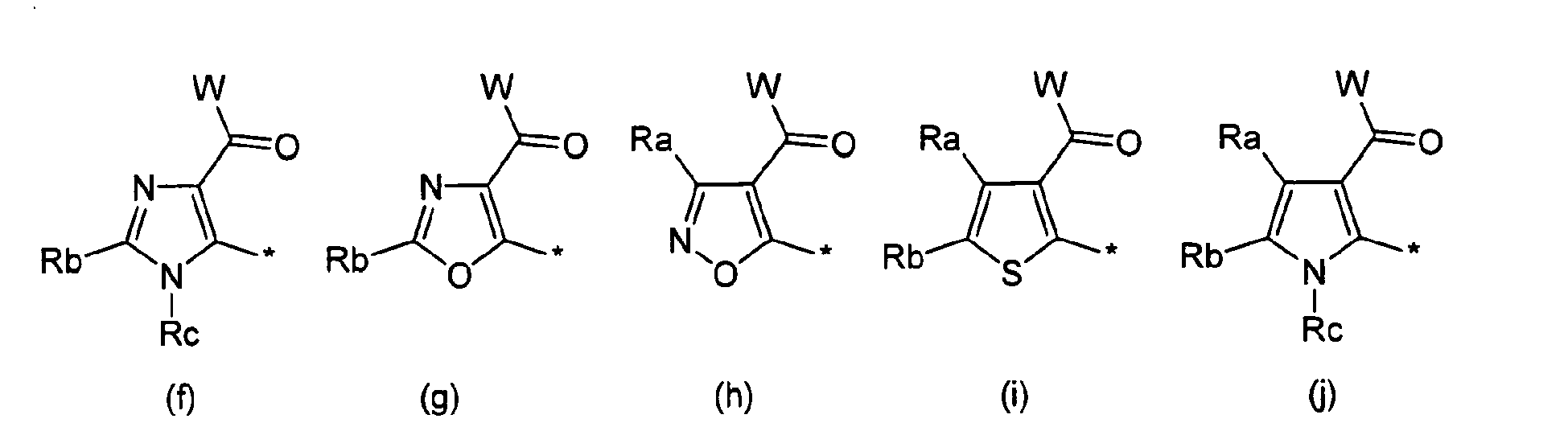
- In Formulae (a) to (j), Ra represents a hydrogen atom or a substituent. Rb and Rc each independently represent a hydrogen atom, an alkyl group, a cycloalkyl group, an aralkyl group, an alkenyl group, an alkynyl group, an aryl group, or a heterocyclic group. W is synonymous with W in Formula (1) and preferable examples thereof are also the same.
- Preferably, Ra is a hydrogen atom, a substituted or unsubstituted alkyl group whose total number of carbon atoms is from 1 to 12 carbon atoms, a substituted or unsubstituted aryl group whose total number of carbon atoms is from 6 to 18 carbon atoms, or a substituted or unsubstituted heterocyclic group whose total number of carbon atoms is from 4 to 12. More preferably, Ra is a hydrogen atom, or a straight chain or branched alkyl group having 1 to 8 carbon atoms in total. Particularly preferably, Ra is a hydrogen atom or a straight chain alkyl group whose total number of carbon atoms is from 1 to 4. A hydrogen atom and a methyl group are preferable. A hydrogen atom is particularly preferable as Ra.
- Preferable examples of Rb and Rc include a hydrogen atom, a substituted or unsubstituted alkyl group, a substituted or unsubstituted cycloalkyl group, a substituted or unsubstituted alkenyl group, a substituted or unsubstituted alkynyl group, a substituted or unsubstituted aralkyl group, a substituted or unsubstituted aryl group and a substituted or unsubstituted heterocyclic group. More preferable examples thereof include a substituted or unsubstituted alkyl group, a substituted or unsubstituted aryl group and a substituted or unsubstituted heterocyclic group. Particularly, an alkyl group whose total number of carbon atoms is 3 or less is preferable. A methyl group is particularly preferable as Rb or Rc.
- The 5-membered heterocycle represented by Q together with carbon atoms, is preferably a heterocycle represented by any one of Formula (a) to (f), or (j), more preferably a heterocycle represented by any one of Formula (a), (b), (c), (e) or (j), even more preferably a heterocycle represented by any one of Formula (a) or (c), particularly preferably a heterocycle represented by Formula (a), from the viewpoints of hue, coloring power and image fastness.
- (6) n is preferably an integer of 1 to 3, and more preferably 1 or 2. It is particularly preferable that n equals to 2.
- It is the most preferable that the azo pigment represented by Formula (1) is an azo pigment represented by the following Formula (2). Hereinafter, the azo pigment represented by Formula (2) will be described in detail.
-

- Each of Q, W, X1, R1, R2, and n in Formula (2) is respectively synonymous with each of Q, W, X1, R1, R2, and n in Formula (1). In the case of n = 2 to 4, Formula (2) represents a dimer, a trimer or a tetramer in which the two to four azo compounds in parenthesis are mutually bonded via Q, W, X1, R1, or R2.
- Hereinafter, Q, W, X1, R1, R2, and n described above will be described in more detail.
Examples of Q, W, X1, R1, R2, and n are respectively synonymous with examples of Q, W, X1, R1, R2, and n in Formula (1). Preferable examples thereof are respectively the same. - With reference to the combination of preferable substituents of the pigment represented by Formula (2) of the invention, the compound in which at least one of various substituents are the above-described preferred groups is preferred, the compound in which more various substituents are the above-described preferred groups is more preferred, and the compound in which all substituents are the above-described preferred groups is particularly preferred.
- A particularly preferable combination of substituents as for the azo pigment represented by Formula (2) of the invention includes combinations similar to those combinations described above in (1) to (6) in the azo pigment represented by Formula (1).
- (1) X1 is preferably a hydrogen atom, an alkyl group (for example, a methyl group, an ethyl group, an n-propyl group, an i-propyl group, a t-butyl group, or a cyclopropyl group), an acyl group (for example, a formyl group, an acetyl group, a pivaloyl group, or a benzoyl group), an alkylsulfonyl group (for example, a methylsulfonyl group or an ethylsulfonyl group), an arylsulfonyl group (for example, a phenylsulfonyl group). Among them, a hydrogen atom, an acetyl group, and a methylsulfonyl group are preferable. A hydrogen atom is particularly preferable as X1.
- (2) W is preferably an alkoxy group (for example, a methoxy group, an ethoxy group, an i-propoxy group, or a t-butoxy group), an amino group (for example, an -NH2 group, a methylamino group, a dimethylamino group, or an anilino group), an alkyl group (for example, a methyl group, an ethyl group, an n-propyl group, an i-propyl group, a t-butyl group, or a cyclopropyl group) or an aryl group (for example, a phenyl group, a p-tolyl group, or a naphthyl group). Among them, an alkoxy group, an amino group, and an alkyl group are preferable. An alkoxy group and an amino group are more preferable. An alkoxy group whose total number of carbon atoms is 5 or less, an amino group (an -NH2 group), and an alkylamino group whose total number of carbon atoms is 5 or less are more preferable. In a case where W is an alkoxy group whose total number of carbon atoms is 5 or less, an amino group, or an alkylamino group whose total number of carbon atoms is 5 or less, it is preferable from the viewpoints of a good hue and high fastness (for example, fastness against light, gas, heat, water, or chemicals). From the viewpoints of hue, lightfastness and solvent resitance, an alkoxy group whose total number of carbon atoms is 3 or less, an amino group (an -NH2 group), and an alkylamino group whose total number of carbon atoms is 3 or less are particularly preferable. Among them, a methoxy group (an -OCH3 group) or an ethoxy group (an -OC2H5 group) is preferable, and a methoxy group is particularly preferable, from the viewpoints of a good hue and an increase in lightfastness.
- (3) R1 is preferably a hydrogen atom or a substituent such as a substituted or unsubstituted acylamino group whose total number of carbon atoms is from 1 to 8, a substituted or unsubstituted alkyl group whose total number of carbon atoms is from 1 to 12, a substituted or unsubstituted aryl group whose total number of carbon atoms is from 6 to 18, or a substituted or unsubstituted heterocyclic group whose total number of carbon atoms is from 4 to 12, and more preferably a straight chain or branched alkyl group whose total number of carbon atoms is from 1 to 8, a substituted or unsubstituted aryl group whose total number of carbon atoms is from 6 to 10, or a substituted or unsubstituted heterocyclic group whose total number of carbon atoms is from 4 to 8. Among them, a methyl group, an i-propyl group, a t-butyl group, a phenyl group or a pyridyl group is further preferable, and a t-butyl group is particularly preferable.
- (4) R2 represents a heterocyclic group and it may be further condensed.
R2 is preferably a 5- to 8-membered heterocyclic group, more preferably a 5- or 6-membered substituted or unsubstituted heterocyclic group, particularly preferably a 6-membered nitrogen-containing heterocyclic group having 3 to 10 carbon atoms. Further, preferable examples of the heterocycle include a pyridine ring, a pyrimidine ring, an s-triazine ring, a pyridazine ring, a pyrazine ring, a 1,2,4-thiadiazole ring, a 1,3,4-thiadiazole ring, and an imidazole ring. More preferable examples thereof include a pyridine ring, a pyrimidine ring, an s-triazine ring, a pyridazine ring, and a pyrazine ring. The pyrimidine ring and the s-triazine ring are particularly preferable. A pyrimidine ring is particularly preferable as the heterocycle from which heterocyclic group is derived for R2. - (5) Q represents a 5- to 7-membered heterocycle together with carbon atoms. An aliphatic ring, aromatic ring, or another heterocycle may be condensed with the heterocycle. Particularly preferable examples of the 5- to 7-membered heterocycle formed by Q together with carbon atoms include a thiophene ring, a furan ring, a pyrrole ring, an indole ring, an imidazole ring, a pyrazole ring, a thiazole ring, an isothiazole ring, an oxazole ring, an isoxazole ring, a triazine ring, a pyridine ring, a pyrazine ring, a pyridazine ring, and an oxazepine ring. Each heterocyclic group may further have a substituent. Particularly, as the 5- to 7-membered heterocycle formed by Q together with carbon atoms, a 5-membered nitrogen-containing heterocycle is preferable. Any of heterocycles represented by Formulae (a) to (j) described below are particularly preferable. In Formula (a) to (j) described below, "*" denotes a bond with an azo group in Formula (2) at this position.
-


- In Formulae (a) to (j), Ra represents a hydrogen atom or a substituent. Rb and Rc each independently represent a hydrogen atom, an alkyl group, a cycloalkyl group, an aralkyl group, an alkenyl group, an alkynyl group, an aryl group, or a heterocyclic group. W is synonymous with W in Formula (1) and preferable examples thereof are also the same.
- Preferably, Ra is a hydrogen atom, a substituted or unsubstituted alkyl group whose total number of carbon atoms is from 1 to 12 carbon atoms, a substituted or unsubstituted aryl group whose total number of carbon atoms is from 6 to 18 carbon atoms, or a substituted or unsubstituted heterocyclic group whose total number of carbon atoms is from 4 to 12. More preferably, Ra is a hydrogen atom or a straight chain or branched alkyl group having 1 to 8 carbon atoms in total. Particularly preferably, Ra is a hydrogen atom or a straight chain alkyl group whose total number of carbon atoms is from 1 to 4. A hydrogen atom and methyl group are preferable. A hydrogen atom is particularly preferable as Ra.
- Preferable examples of Rb and Rc include a hydrogen atom, a substituted or unsubstituted alkyl group, a substituted or unsubstituted cycloalkyl group, a substituted or unsubstituted alkenyl group, a substituted or unsubstituted alkynyl group, a substituted or unsubstituted aralkyl group, a substituted or unsubstituted aryl group and a substituted or unsubstituted heterocyclic group. More preferable examples thereof include a substituted or unsubstituted alkyl group, a substituted or unsubstituted aryl group and a substituted or unsubstituted heterocyclic group. Particularly, an alkyl group whose total number of carbon atoms is 3 or less is preferable. Particularly, a methyl group is the most preferable.
- The 5-membered heterocycle represented by Q together with carbon atoms is preferably a heterocycle represented by any one of Formula (a) to (f), or (j), more preferably a heterocycle represented by any one of Formula (a), (b), (c), (e) or (j), even more preferably a heterocycle represented by any one of Formula (a) or (c), and particularly preferably a heterocycle represented by Formula (a), from the viewpoints of hue, coloring power and image fastness.
- (6) n is preferably an integer of 1 to 3, and more preferably 1 or 2. Particularly, it is the most preferable that n equals to 2.
- In the azo pigment in the invention, a tautomer of the azo pigment represented by Formula (1) or (2) is included in the scope thereof. Formulae (1) and (2) are shown as canonical structures among several tautomers with chemically acceptable structures. Tautomers other than an explicitly described structure may be used. The azo pigment may be a mixture containing a plurality of tautomers.
- For example, an azo-hydrazone tautomer represented by Formula (2') described below may be considered for the azo pigment represented by Formula (2). The compound represented by Formula (2') which is a tautomer of the azo pigment represented by Formula (2) is included in the scope of the invention.
-

- R1, R2, Q, W, X1, and n in Formula (2') are each synonymous with R1, R2, Q, W, X1, and n in Formula (2) and preferable ranges thereof are the same.
- More preferably, the azo pigment represented by Formula (1) in the invention is an azo pigment represented by the following Formula (3).
-

- Y in Formula (3) represents a hydrogen atom or a substituent. G represents a hydrogen atom, an alkyl group, a cycloalkyl group, an aralkyl group, an alkenyl group, an alkynyl group, an aryl group, or a heterocyclic group. W, X1, X2, R1, R2, and n are each respectively synonymous with W, X1, X2, R1, R2, and n in Formula (1). In the case of n = 2 to 4, Formula (3) represents a dimer, a trimer or a tetramer in which the two to four azo compounds in parenthesis are mutually bonded via G, Y, W, X1, X2, R1, or R2.
- Hereinafter, W, X1, X2, R1, R2, G, Y, and n will be described in more detail.
Examples of W, X1, X2, R1, R2, and n are respectively synonymous with examples of W, X1, X2, R1, R2, and n in Formula (1) and the preferable examples thereof are respectively the same. - G represents a hydrogen atom, an alkyl group, a cycloalkyl group, an aralkyl group, an alkenyl group, an alkynyl group, an aryl group, or a heterocyclic group. Particularly, a hydrogen atom, a methyl group, an ethyl group, a n-propyl group, an i-propyl group, a t-butyl group, a cyclopropyl group, a benzyl group, a 2-phenethyl group, a vinyl group, an allyl group, an ethynyl group, a propargyl group, a phenyl group, a p-tolyl group, a naphthyl group, a pyridyl group, a pyrimidinyl group, and a pyrazinyl group are preferable. Further, a hydrogen atom, a methyl group, a phenyl group, a pyridyl group, a pyrimidinyl group, a pyrazinyl group are preferable. Among them, a methyl group, a 2-pyridyl group, a 2,6-pyrimidinyl group, and a 2,5-pyrazinyl group are preferable.
When G represents an alkyl group, G is preferably an alkyl group whose total number of carbon atoms is 5 or less, more preferably an alkyl group whose total number of carbon atoms is 3 or less, and particularly preferably a methyl group. - When Y represents a substituent, examples of Y include a halogen atom, an alkyl group, an aralkyl group, an alkenyl group, an alkynyl group, an aryl group, a heterocyclic group, a cyano group, a hydroxy group, a nitro group, an alkoxy group, an aryloxy group, a silyloxy group, a heterocyclic oxy group, an acyloxy group, a carbamoyloxy group, an alkoxycarbonyloxy group, an aryloxycarbonyloxy group, an amino group, an acylamino group, an aminocarbonylamino group, an alkoxycarbonylamino group, an aryloxycarbonylamino group, a sulfamoylamino group, an alkylsulfonylamino group, an arylsulfonylamino group, a mercapto group, an alkylthio group, an arylthio group, a heterocyclic thio group, a sulfamoyl group, an alkylsulfinyl group, arylsulfinyl group, an alkylsulfonyl group, an arylsulfonyl group, an acyl group, an aryloxycarbonyl group, an alkoxycarbonyl group, a carbamoyl group, an arylazo group, a heterocyclic azo group, an imido group, a phosphino group, a phosphinyl group, a phosphinyloxy group, a phosphinylamino group, and a silyl group.
Particularly preferable examples of Y include a hydrogen atom, an alkyl group (e.g., a methyl group), an aryl group (e.g. a phenyl group), a heterocyclic group (e.g., a 2-pyridyl group), and an alkylthio group (e.g., a methylthio group). Further, a hydrogen atom, a methyl group, a phenyl group, and a methylthio group are preferable. Among them, a hydrogen atom is particularly preferable. - With reference to the combination of preferable substituents of the pigment represented by Formula (3) of the invention, the compound in which at least one of various substituents are the above-described preferred groups is more preferred, the compound in which more various substituents are the above-described preferred groups is preferred, and the compound in which all substituents are the above-described preferred groups is particularly preferred.
- As for the azo pigment represented by Formula (3) of the invention, a particularly preferable combination of the substituents includes the following (1) to (7).
- (1) Preferably, X1 and X2 are each independently a hydrogen atom, an alkyl group (for example, a methyl or and a cyclopropyl group), an acyl group (for example, a formyl group, an acetyl group, a pivaloyl group, or a benzoyl group), an alkylsulfonyl group (for example, a methylsulfonyl group or an ethylsulfonyl group), an arylsulfonyl group (for example, a phenylsulfonyl group). Among them, a hydrogen atom, an acetyl group, and a methylsulfonyl group are preferable. Particularly, a hydrogen atom is preferable. Particularly, it is preferable that at least one of X1 and X2 is a hydrogen atom. It is particularly preferable that both X1 and X2 are hydrogen atoms.
When at least one of X1 and X2 is the hydrogen atom, not only intermolecular interaction of pigment molecules but also intramolecular interaction is firmly formed. As a result, a pigment with a more stable molecular arrangement is easily formed, which is preferable from the viewpoints of good hue and high fastness (for example, fastness against light, gas, heat, water, or chemicals). - (2) W is preferably an alkoxy group (for example, a methoxy group, an ethoxy group, an i-propoxy group, or a t-butoxy group), an amino group (for example, an -NH2 group, a methylamino group, a dimethylamino group, or an anilino group), an alkyl group (for example, a methyl group, an ethyl group, an n-propyl group, an i-propyl group, a t-butyl group, or a cyclopropyl group) or an aryl group (for example, a phenyl group, a p-tolyl group, or a naphthyl group). Among them, an alkoxy group, an amino group, and an alkyl group are preferable, and an alkoxy group and an amino group are more preferable. From the viewpoints of good hue and high fastness (for example, fastness against light, gas, heat, water, or chemicals), W is preferably an alkoxy group whose total number of carbon atoms is 5 or less, an amino group (an -NH2 group), and an alkylamino group whose total number of carbon atoms is 5 or less. From the viewpoints of hue, lightfastness and solvent resistance, W is more preferably an alkoxy group whose total number of carbon atoms is 3 or less, an amino group (an -NH2 group), or an alkylamino group whose total number of carbon atoms is 3 or less. Specifically, a methoxy group (an -OCH3 group) or an ethoxy group (an -OC2H5 group) is preferable, and a methoxy group is particularly preferable, from the viewpoints of good hue and increase in lightfasmess.
- (3) R1 is preferably a hydrogen atom or a substituent (for example, a substituted or unsubstituted acylamino group whose total number of carbon atoms is from 1 to 8, a substituted or unsubstituted alkyl group whose total number of carbon atoms is from 1 to 12, a substituted or unsubstituted aryl group whose total number of carbon atoms is from 6 to 18, or a substituted or unsubstituted heterocyclic group whose total number of carbon atoms is from 4 to 12). A straight chain or branched alkyl group having 1 to 8 carbon atoms in total, a substituted or unsubstituted aryl group whose total number of carbon atoms is from 6 to 10, or a substituted or unsubstituted heterocyclic group whose total number of carbon atoms is from 4 to 8 is more preferable. Specifically, a methyl group, an i-propyl group, a t-butyl group, a phenyl group or a pyridyl group is preferable, and the t-butyl group is particularly preferable as R1.
- (4) R2 represents a heterocyclic group and it may be further condensed.
R2 is preferably a 5- to 8-membered heterocyclic group, more preferably a 5- or 6-membered substituted or unsubstituted heterocyclic group, and particularly preferably a 6-membered nitrogen-containing heterocyclic group having 3 to 10 carbon atoms. Further, preferable examples of the heterocycle include a pyridine ring, a pyrimidine ring, an s-triazine ring, a pyridazine ring, a pyrazine ring, a 1,2,4-thiadiazole ring, a 1,3,4-thiadiazole ring, and an imidazole ring. More preferable examples thereof include a pyridine ring, a pyrimidine ring, an s-triazine ring, a pyridazine ring, and a pyrazine ring. A pyrimidine ring and the s-triazine ring are particularly preferable. A pyrimidine ring is particularly preferable as the heterocycle from which heterocyclic group is derived for R2. - (5) G is preferably a hydrogen atom, or an alkyl group, cycloalkyl group, aralkyl group, alkenyl group, alkynyl group, aryl group, or heterocyclic group, each of which has a total number of carbon atoms of 12 or less.
More preferably, G is an alkyl group whose total number of carbon atoms is 6 or less, a cycloalkyl group whose total number of carbon atoms is 6 or less, an aralkyl group whose total number of carbon atoms is 12 or less, an alkenyl group whose total number of carbon atoms is 12 or less, an alkynyl group whose total number of carbon atoms is 12 or less, an aryl group whose total number of carbon atoms is 12 or less, or a heterocyclic group whose total number of carbon atoms is 12 or less. Even more preferably, G represents a hydrogen atom, a methyl group, an ethyl group, an n-propyl group, an i-propyl group, a t-butyl group, a cyclopropyl group, a benzyl group, a 2-phenethyl group, a vinyl group, an allyl group, an ethynyl group, a propargyl group, a phenyl group, a p-tolyl group, a naphthyl group, a pyridyl group, a pyrimidinyl group, or a pyrazinyl group.
Further, a hydrogen atom, a phenyl group, a pyridyl group, a pyrimidinyl group, a pyrazinyl group are preferable. Among them, a methyl group, a 2-pyridyl group, a 2,6-pyrimidinyl group, and a 2,5-pyrazinyl group are preferable. A methyl group is most preferable as G. - (6) Y is preferably a hydrogen atom, an alkyl group (for example, a methyl group), an aryl group (for example, a phenyl group), a heterocyclic group (for example, a 2-pyridyl group), or an alkylthio group (for example, a methylthio group). A hydrogen atom, a methyl group, a phenyl group, and a methylthio group are further preferable. Among them, a hydrogen atom is particularly preferable as Y.
- (7) n is preferably an integer of 1 to 3, and more preferably 1 or 2. It is particularly preferable that n equals to 2.
- In Formulae (1), (2), and (3), n is preferably 2 or 3, and particularly preferably 2. When n is 2, a high coloring power and an excellent light resistance are provided, and further, fastness against chemicals is improved.
- In Formulae (1), (2), and (3), the azo pigment in the case of n = 2 represents a dimer in which the two azo compounds in parenthesis are mutually bonded via Q, W, X1, X2, R1, or R2.
- When the azo pigment in the invention represents a dimer, examples thereof include bonding modes represented by Formulae (4), (5), (6), (7), (8), and (9) described below.
-

- In Formula (4), G1 and G2 are each independently synonymous with G in Formula (3). R11 and R12 are each independently synonymous with R1 in Formula (3). W1 and W2 are each independently synonymous with W in Formula (3). Y1 and Y2 are each independently synonymous with Y in Formula (3).
- Z represents a divalent group derived from a 5- to 8-membered nitrogen-containing heterocycle.
The 5- to 8-membered nitrogen-containing heterocycle is synonymous with the nitrogen-containing heterocycle in the heterocycles listed as the examples of the 5- to 8-membered nitrogen-containing heterocycle in R2 in Formula (3), and preferable range thereof is also the same.
Further, the term "a divalent group derived from a nitrogen-containing heterocycle" means a divalent group formed by removing two hydrogen atoms from a nitrogen-containing heterocyclic compound. The position where the hydrogen atom is removed is not particularly limited. -

- In Formula (5), G1 and G2 are each independently synonymous with G in Formula (3). R11 and R12 are each independently synonymous with R1 in Formula (3). W1 and W2 are each independently synonymous with W in Formula (3).
Z1 and Z2 are each independently synonymous with R2 in Formula (3). - Y5 represents a divalent group and is synonymous with the substituent which may be a divalent substituent among the substituents exemplified as Y in Formula (3). Specifically, it is preferable that Y5 is a divalent group derived from an alkyl group, an aryl group, a heterocyclic group, or an alkylthio group.
-

- In Formula (6), G1 and G2 are each independently synonymous with G in Formula (3). R11 and R12 are each independently synonymous with R1 in Formula (3). W1 and W2 are each independently synonymous with W in Formula (3). Y1 and Y2 are each independently synonymous with Y in Formula (3). Z1 and Z2 are each independently synonymous with R2 in Formula (3).
- X6 represents a divalent group and is synonymous with the substituent which may be a divalent substituent among the substituents exemplified as X1 or X2 in Formula (3). Specifically, it is preferable that X6 is a divalent group derived from an alkyl group, an acyl group, an alkylsulfonyl group, or an arylsulfonyl group.
-

- In Formula (7), G1 and G2 are each independently synonymous with G in Formula (3). R11 and R12 are each independently synonymous with R1 in Formula (3). Y1 and Y2 are each independently synonymous with Y in Formula (3). Z1 and Z2 are each independently synonymous with R2 in Formula (3).
- W7 represents a divalent group and is synonymous with the substituent which may be a divalent substituent among the substituents exemplified as W in Formula (3). Specifically, it is preferable that W7 is a divalent group derived from an alkoxy group, an alkyl group, or an aryl group.
-

- In Formula (8), G1 and G2 are each independently synonymous with G in Formula (3). W1 and W2 are each independently synonymous with W in Formula (3). Y1 and Y2 are each independently synonymous with Y in Formula (3). Z1 and Z2 are each independently synonymous with R2 in Formula (3).
- R8 represents a divalent group and is synonymous with the substituent which may be a divalent substituent among the substituents exemplified as R1 in Formula (3). Specifically, it is preferable that R8 is a divalent group derived from an acylamino group, an alkyl group, an aryl group, or a heterocyclic group.
-

- In Formula (9), R11 and R12 are each independently synonymous with R1 in Formula (3). W1 and W2 are each independently synonymous with W in Formula (3). Y1 and Y2 are each independently synonymous with Y in Formula (3). Z1 and Z2 are each independently synonymous with R1 in Formula (3).
- G9 represents a divalent group and is synonymous with the substituent which may be a divalent substituent among the substituents exemplified as G in Formula (3). Specifically, it is preferable that G9 is a divalent group derived from an alkyl group, a cycloalkyl group, an aralkyl group, an alkenyl group, an alkynyl group, an aryl group, or a heterocyclic group.
- In the invention, the azo pigment represented by Formula (3) is particularly preferably the azo pigments represented by Formulae (4) (5), (7), (8), or (9), more preferably the azo pigments represented by Formulae (4), (5), (7), or (9). Among them, the azo pigment represented by Formula (4) is particularly preferable.
- Hereinafter, the azo pigment represented by Formula (4) and a tautomer thereof will be described in detail.
-

- In Formula (4), Z represents a divalent group derived from a 5- to 8-membered nitrogen-containing heterocycle. Y1, Y2, R11, and R12 each independently represent a hydrogen atom or a substituent. G1 and G2 each independently represent a hydrogen atom, an alkyl group, a cycloalkyl group, an aralkyl group, an alkenyl group, an alkynyl group, an aryl group, or a heterocyclic group. W1 and W2 each independently represent an alkoxy group, an amino group, an alkyl group, or an aryl group.
- In formula (4), Z represents a divalent group derived from a 5- to 8-membered nitrogen-containing heterocycle. Preferable examples of the nitrogen-containing heterocycle without limiting the substitution position thereof include a pyrrole ring, a pyrazole ring, a triazole ring, an imidazole ring, a thiazole ring, an isothiazole ring, an oxazole ring, an isoxazole ring, a thiadiazole ring, a thiophene ring, a furan ring, a pyridine ring, a pyrimidine ring, a triazine ring, and a pyridazine ring. More preferable examples include a 6-membered nitrogen-containing heterocycle such as a pyridine ring, a pyrimidine ring, and an s-triazine ring. Particularly, it is preferable that Z is a divalent group derived from a pyrimidine ring.
When Z is a divalent group derived from a 6-membered nitrogen-containing heterocycle, the intramolecular and intermolecular interactions of pigment molecules are more easily improved from the viewpoint of hydrogen bonding and planarity of the molecules. Thus, it is preferable. - In Formula (4), Y1 and Y2 are synonymous with Y in Formula (3) and preferable examples thereof are also the same. G1 and G2 are synonymous with G in Formula (3) and preferable examples thereof are also the same. R11 and R12 are synonymous with R1 in Formula (3) and preferable examples thereof are also the same. W1 and W2 are synonymous with W in Formula (1) and preferable examples thereof are also the same.
- In the azo pigment in the invention, a tautomer of the azo pigment represented by Formula (4) is included in the scope thereof. Formula (4) is shown as a canonical structure among several tautomers with chemically acceptable structures. Tautomers other than the above-described structure may be used. The azo pigment may be used as a mixture containing plural tautomers.
For example, an azo-hydrazone tautomer represented by Formula (4') described below may be thought for the azo pigment represented by Formula (4).
The compound represented by Formula (4') which is a tautomer of the azo pigment represented by Formula (4) is included in the scope of the invention. -

- R11, R12, W1, W2, Y1, Y2, G1, G2, and Z in Formula (4') are respectively synonymous with R11, R12, W1, W2, Y1, Y2, G1, G2, and Z in Formula (4).
- In this regard, with reference to the combination of preferable substituents of the compound represented by Formula (4), the compound in which at least one of various substituents are the above-described preferred groups is more preferred, the compound in which more various substituents are the above-described preferred groups is more preferred, and the compound in which all substituents are the above-described preferred groups is particularly preferred.
- Examples of a particularly preferable combination of the azo pigment represented by Formula (4) of the invention include the following combinations
- (1) to (5):
- (1) Preferably, W1 and W2 are each independently an alkoxy group (for example, a methoxy group, an ethoxy group, an i-propoxy group, or a t-butoxy group), an amino group (for example, an -NH2 group, a methylamino group, a dimethylamino group, or an anilino group), an alkyl group (for example, a methyl group, an ethyl group, an n-propyl group, an i-propyl group, a t-butyl group, or a cyclopropyl group) or an aryl group (for example, a phenyl group, a p-tolyl group, or a naphthyl group). Among them, an alkoxy group, an amino group, and an alkyl group are preferable. Further, an alkoxy group and an amino group are preferable. An alkoxy group whose total number of carbon atoms is 5 or less, an amino group (an -NH2 group), and an alkylamino group whose total number of carbon atoms is 5 or less are further preferable. An alkoxy group whose total number of carbon atoms is 3 or less, an amino group (an -NH2 group), an alkylamino group whose total number of carbon atoms is 3 or less are particularly preferable. A methoxy group (an -OCH3 group) is particularly preferable as W1 or W2.
- (2) Preferably, R11 and R12 are each independently a hydrogen atom or a substituent (for example, a substituted or unsubstituted acylamino group having 1 to 8 carbon atoms in total, a substituted or unsubstituted alkyl group having 1 to 12 carbon atoms in total, a substituted or unsubstituted aryl group having 6 to 18 carbon atoms in total, or a substituted or unsubstituted heterocyclic group having 4 to 12 carbon atoms in total). A straight chain or branched alkyl group having 1 to 8 carbon atoms in total, a substituted or unsubstituted aryl group having 6 to 10 carbon atoms in total, and a substituted or unsubstituted heterocyclic group having 4 to 8 carbon atoms in total are more preferable. Specifically, a methyl group, an i-propyl group, a t-butyl group, a phenyl group or a pyridyl group is preferable, and a tert-butyl group is particularly preferable as each of R11 and R12.
- (3) Z represents a divalent group derived from a 5- to 8-membered nitrogen-containing heterocycle and it may be further condensed. Preferable examples of the nitrogen-containing heterocycle in Z include a 5- or 6-membered substituted or unsubstituted nitrogen-containing heterocycle such as a pyrrole ring, a pyrazole ring, a triazole ring, an imidazole ring, a thiazole ring, an isothiazole ring, an oxazole ring, an isoxazole ring, a thiadiazole ring, a thiophene ring, a furan ring, a pyridine ring, a pyrimidine ring, a triazine ring, and a pyridazine ring. Particularly, a 6-membered nitrogen-containing heterocycle having 3 to 10 carbon atoms is preferable. Further, preferable examples of the heterocycle include a pyridine ring, a pyrimidine ring, an s-triazine ring, a pyridazine ring, and a pyrazine ring. More preferable examples thereof include a pyridine ring, a pyrimidine ring, an s-triazine ring, a pyridazine ring, and a pyrazine ring. A pyrimidine ring and an s-triazine ring are further preferable. A pyrimidine ring is particularly preferable as the heterocycle from which a divalent group is derived for Z.
- (4) G1 and G2 each independently represent a hydrogen atom, an alkyl group, a cycloalkyl group, an aralkyl group, an alkenyl group, an alkynyl group, an aryl group, or a heterocyclic group. Particularly, a hydrogen atom, a methyl group, an ethyl group, an n-propyl group, an i-propyl group, a t-butyl group, a cyclopropyl group, a benzyl group, a 2-phenethyl group, a vinyl group, an allyl group, an ethynyl group, a propargyl group, a phenyl group, a p-tolyl group, a naphthyl group, a pyridyl group, a pyrimidinyl group, and a pyrazinyl group are preferable. Further, a hydrogen atom, a methyl group, a phenyl group, a pyridyl group, a pyrimidinyl group, a pyrazinyl group are preferable. Among them, a methyl group, a 2-pyridyl group, a 2,6-pyrimidinyl group, and a 2,5-pyrazinyl group are particularly preferable.
As the alkyl group represented by G1 or G2, an alkyl group whose total number of carbon atoms is 5 or less is more preferable, an alkyl group whose total number of carbon atoms is 3 or less is further preferable, and a methyl group is particularly preferable. - (5) Y1 and Y2 each independently represent a hydrogen atom, an alkyl group (for example, a methyl group) an aryl group (for example, a phenyl group), a heterocyclic group (for example, a 2-pyridyl group), or an alkylthio group (for example, a methylthio group), and more preferably, a hydrogen atom, a methyl group, a phenyl group, or a methylthio group. Among them, a hydrogen atom is particularly preferable as Y1 or Y2.
- As for the azo pigment of the invention, in Formulae (1), (2), and (3), n is preferably 2 or 3, and particularly preferably 2. When n is 2, a high coloring power and an excellent light resistance are provided, and further, fastness against chemicals is improved.
- In the azo pigments represented by Formulae (1), (2), (3), or (4) in the invention, preferable examples thereof include the azo pigments represented by Formulae (10) to (13) described below.
-

- R1, R2, W, and Q in Formula (10) are respectively synonymous with R1, R2, W, and Q in Formula (2). G, R1, R2, W, and Y in Formula (11) are respectively synonymous with G, R1, R2, W, and Y in Formula (3).
-

- G1, G2, R11, R12, W1, W2, Y1, and Y2 in Formula (12) are respectively synonymous with G1, G2, R11, R12, W1, W2, Y1, and Y2 in Formula (4).
X11 and X12 each independently represent a heteroatom in a divalent group (Het.) derived from a nitrogen-containing heterocycle represented by Z in Formula (4). -

- In Formula (13), G1, G2, and G3 are each independently synonymous with G in Formula (3). W1, W2, and W3 are each independently synonymous with W in Formula (3). Y1, Y2, and Y3 are each independently synonymous with Y in Formula (3). R11, R12, and R13 are each independently synonymous with R1 in Formula (3).
Further, X11, X12, and X13 each independently represent a heteroatom in a trivalent heterocyclic group (Het.) formed by three R2s in the azo compounds shown in parenthesis in Formula (3). - In the invention, a large number of tautomers may be thought for the azo pigments represented by Formulae (1), (2), (3), or (4).
Further, in the invention, it is preferable that the azo pigment represented by Formula (1) has a substituent which forms an intramolecular hydrogen bond or an intramolecular cross hydrogen bond. It is preferable that the azo pigment represented by Formula (1) in the invention has at least one of the substituent which forms an intramolecular cross hydrogen bond. It is more preferable that the azo pigment has at least three of the substituent which forms an intramolecular hydrogen bond. It is particularly preferable that the azo pigment has at least three of the substituent which forms an intramolecular hydrogen bond and at least two of the hydrogen bonds form an intramolecular cross hydrogen bond. - Among the azo pigments represented by Formula (1), (2), (3), or (4), particularly preferable examples of the azo pigment include the azo pigments represented by Formulae (10) to (13).
- As shown in Formulae (10) to (13), the reason why these structures are preferable is that a nitrogen atom which forms a heterocyclic group, a hydrogen atom, and a heteroatom (a nitrogen atom of an azo group or its tautomer, i.e., hydrazone group, an oxygen atom of a carbonyl group or a nitrogen atom of an amino group) contained in an azo pigment structure easily form at least one intramolecular cross hydrogen bond (intramolecular hydrogen bond).
As shown in Formulae (10) and (11), the reason why these structures are preferable is that a nitrogen atom which forms a heterocyclic group, a hydrogen atom of an amino group, and a heteroatom (for example, a nitrogen atom of an azo group or its tautomer, i.e., hydrazone group, an oxygen atom of a carbonyl group or a nitrogen atom of an amino group) contained in an azo pigment structure easily form at least one intramolecular cross hydrogen bond. - Further preferably, as shown in Formulae (12) and (13), a nitrogen atom which forms a heterocyclic group, a hydrogen atom of an amino group, and a heteroatom (for example, a nitrogen atom of an azo group or its tautomer, i.e., hydrazone group, an oxygen atom of a carbonyl group or a nitrogen atom of an amino group) contained in an azo pigment structure easily form at least four intramolecular hydrogen bonds and easily form at least two intramolecular cross hydrogen bonds.
As a result, the planarity of the molecules is improved and intramolecular and intermolecular interactions are improved. For example, the crystallinity of the azo pigment represented by Formula (12) becomes high (a higher order structure is easily formed). Further, required performances as the pigment, for example, lightfastness, thermal stability, wet heat stability, waterproof properties, gas resistance or solvent resistance are significantly improved. Thus, it is the most preferable example. - In the azo pigment in the invention, an isotope (for example, 2H, 3H, 13C, or 15N) may be contained in the compounds represented by Formulae (1) to (13).
- Hereinafter, Pig.-1 to Pig.-70 will be exemplified as specific examples of the azo pigments represented by Formulae (1) to (13). However, the azo pigment to be used in the invention is not limited thereto. In addition, the structure of the following specific example is shown as a canonical structure among several tautomers with chemically acceptable structures. Needless to say, the structure may be the structure of tautomers other than the above-described structure.
-


-


-


-


-


-


-


-


-


-


-


-


-
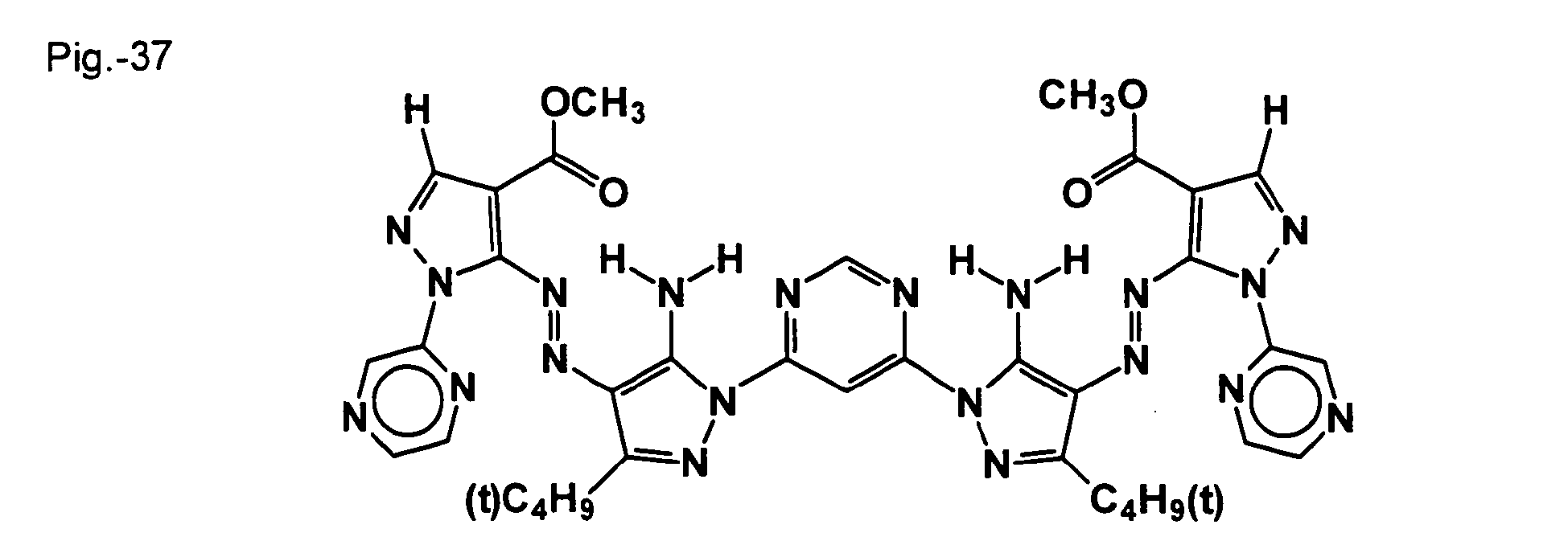


-


-


-


-


-


-


-


-


-
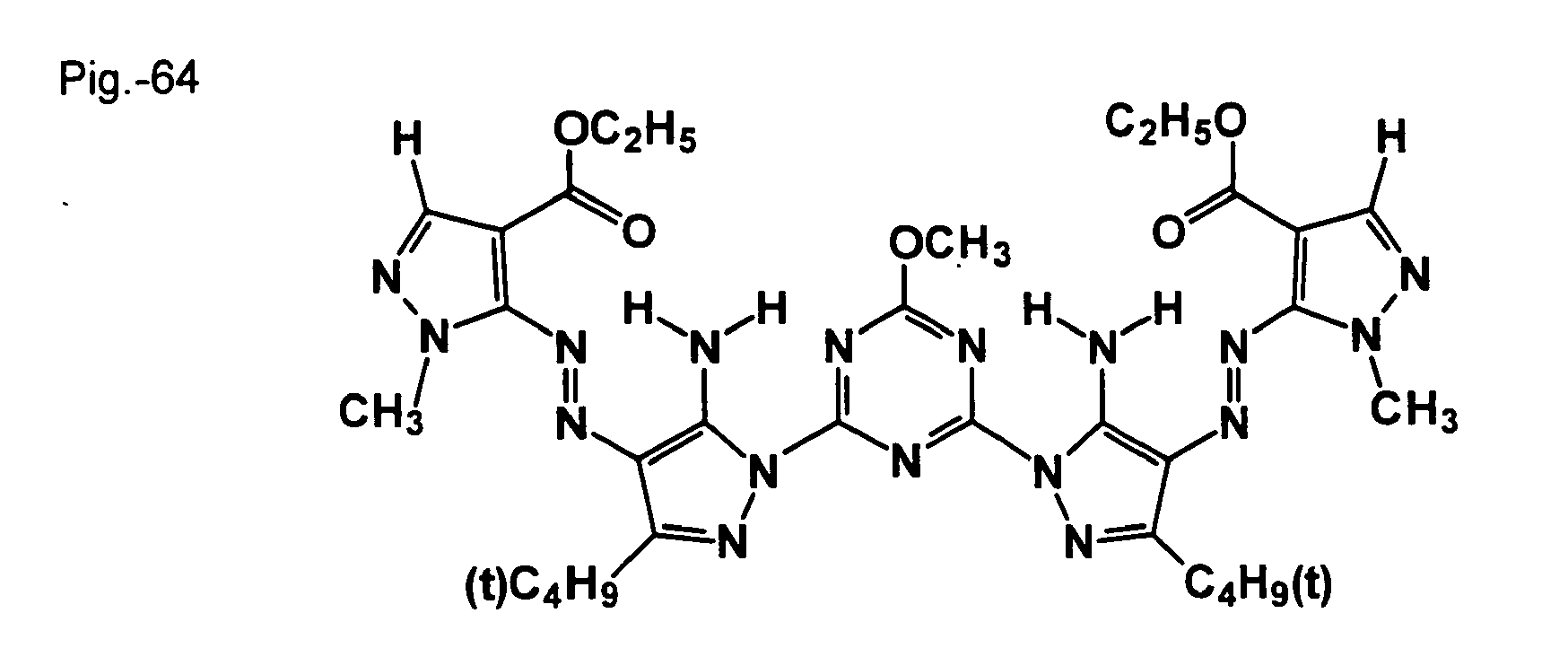


-


-

- It is enough that the chemical structures of the azo pigment represented by Formulae (1) to (4) in the invention are Formulae (1) to (4) or tautomers thereof. The crystalline form is not particularly limited. The pigment may have any crystalline form, for example, a so-called polymorph (crystalline polymorphism).
- The term "crystalline polymorphism" means a crystal which has the same chemical composition, but whose arrangement of building block (molecule or ion) in the crystal is different. In the crystalline polymorphism, chemical and physical properties are determined by its crystal structure and each crystalline polymorphism may be distinguished based on rheology, hue, and other color characteristics. Further, a different crystalline polymorphism may be confirmed by X-Ray Diffraction (powder X-ray diffraction measurement result) or X-Ray Analysis (X-ray crystal structure analysis result).
When the crystalline polymorphism is present in the azo pigment represented by Formulae (1) to (4) in the invention, the crystal form may be any polymorphism or may be a mixture of two or more polymorphisms. It is preferable that the crystal form includes a single polymorphism as a main component. That is, it is preferable that the level of the incorporation of crystalline polymorphism is small. The content of the azo pigment having a single crystal form is from 70% to 100%, preferably from 80% to 100%, more preferably from 90% to 100%, further preferably from 95% to 100%, and particularly preferably 100% based on the whole azo pigment. - When the azo pigment having a single crystal form is included as a main component, the regularity for the arrangement of pigment molecules is improved and the intramolecular and intermolecular interactions are enhanced. Thus, a high level three-dimensional network is easily formed. As a result, it is preferable from the viewpoint of performances required for the pigment such as improvement in the hue, lightfastness, heat fastness, humidity fastness, oxidizing gas fastness, and solvent resistance.
The mixing ratio of the crystalline polymorphism in the azo pigment may be confirmed by the value of the solid which is physicochemically measured by Single crystal X-ray crystal structure analysis, Powder X diffraction (XRD), Micrograph (TEM) of crystal, or IR (KBr method). - In the invention, when the azo pigment represented by Formula (1) has an acid group, a part or all of the acid groups may be a salt type; or a salt type pigment and a free acid type pigment may be mixed. Examples of the salt type include a salt of alkali metals such as Na, Li, and K; a salt of ammonium which may be substituted by an alkyl group or a hydroxyalkyl group; and a salt of organic amine. Examples of the organic amine include lower alkylamine, hydroxy-substituted lower alkylamine, carboxy-substituted lower alkylamine, and polyamine having 2 to 10 alkyleneimine units having 2 to 4 carbon atoms. In the case of the salt type, the type is not limited to one kind and a plurality of kinds may be mixed and used.
- In the structure of the azo pigment to be used in the invention, when a plurality of acid groups are included in one molecule, the plurality of acid groups may be respectively the salt type or acid type or they may be mutually different.
- In the invention, the azo pigment represented by Formula (1) may be a hydrate containing water molecules in the crystal and the number of water molecules in the crystal is not particularly limited.
- Subsequently, an example of the production method of the azo pigment represented by Formula (1) will be described. For example, a heterocyclic amine represented by Formula (A) described below is diazotized under acid condition, which is subjected to coupling reaction with the compound represented by the following Formula (B). The resulting product is subjected to post-treatment in the ordinary manner. Thus, the azo pigment represented by Formula (1) may be produced.
-

- W, Q, R1, R2, X1, and X2 in Formulae (A) and (B) are respectively synonymous with W, Q, R1, R2, X1, and X2 in Formula (1).
- The heterocyclic amine represented by Formula (A) may be generally produced by a well-known and common used method, for example, the method described in Helv. Chim. Acta, 41, 1958, 1052-1056, the method described in Helv. Chim. Acta, 42, 1959, 349-352, and the method in accordance with them.
The compound represented by Formula (B) may be produced by the methods described in PCT International publication No.06/082669 JP-A No. 2006-57076 - The diazotizing reaction of the heterocyclic amine represented by Formula (A) may be performed by allowing the heterocyclic amine to react with reagents such as sodium nitrite, nitrosylsulfuric acid, and isoamyl nitrite in an acidic solvent such as sulfuric acid, phosphoric acid, acetic acid, hydrochloric acid, or methanesulfonic acid at a temperature of 15°C or lower for about 10 minutes to about 6 hours.
The coupling reaction may be carried out by reacting the diazonium salt obtained by the above-described method with the compound represented by Formula (B) at 40°C or lower, preferably 25°C or lower for about 10 minutes to about 12 hours. - In some cases, a crystal is precipitated in the reaction liquid. Generally, a crystal is precipitated by adding water or an alcohol solvent to the reaction liquid and then the crystal may be filtered. A crystal is also precipitated by adding the reaction liquid to an alcohol solvent or water and then precipitated crystal may be filtered. The azo pigment represented by Formula (1) may be obtained by washing and drying the filtered crystal, if necessary.
- The azo pigment represented by Formula (1) is obtained as a crude azo pigment by the above production method. When the azo pigment is used as the pigment of the invention, it is preferred to perform a post-treatment. Examples of the post-treatment include milling treatments such as solvent salt milling, salt milling, dry milling, solvent milling, and acid pasting; a process of controlling the pigment particles by solvent heating treatment; and a process of treating the surface with resins, surfactants, and dispersing agents.
- It is preferable that the azo pigment represented by Formula (1) of the invention is subjected to solvent heating treatment and/or solvent salt milling as post-treatment.
Examples of the solvent to be used for the solvent heating treatment include water; aromatic hydrocarbon solvents such as toluene and xylene; halogenated hydrocarbon solvents such as chlorobenzene and o-dichlorobenzene; alcohol solvents such as i-propanol and i-butanol; polar aprotic organic solvents such as N,N-dimethylformamide, N,N-dimethylacetamide, and N-methyl-2-pyrrolidone; glacial acetic acid, pyridine, and mixtures thereof. Organic or inorganic acids or bases may be further added to the above-described solvents. The temperature of solvent heating treatment varies depending on the primary particle diameter of the desired pigment and the temperature is preferably from 40°C to 150°C, and further preferably from 60°C to 100°C. Further, the time for the treatment is preferably from 30 minutes to 24 hours. - An example of the solvent salt milling includes a method including the steps of placing a crude azo pigment, an inorganic salt, and an organic solvent which does not dissolve the organic salt into a kneading machine and kneading and grinding in it. As the inorganic salt, a water-soluble inorganic salt may be suitably used. Preferable examples thereof include inorganic salts such as sodium chloride, potassium chloride, and sodium sulfate. It is more preferable to use an inorganic salt having an average particle diameter of 0.5 µm to 50 µm. The amount of the inorganic salt is preferably 3 parts by mass to 20 parts by mass, more preferably 5 parts by mass to 15 parts by mass with respect to the crude azo pigment. A water-soluble organic solvent may be suitably used as the organic solvent. However, the solvent evaporates easily due to the temperature rise at the time of kneading and, thus a high-boiling-point solvent is preferable from a viewpoint of safety.
- Examples of the organic solvent include diethylene glycol, glycerol, ethylene glycol, propylene glycol, liquid polyethylene glycol, liquid polypropylene glycol, 2-(methoxymethoxy) ethanol, 2-butoxyethanol, 2-(isopentyloxy) ethanol, 2-(hexyloxy) ethanol, diethylene glycol monomethyl ether, diethylene glycol monoethyl ether, diethylene glycol monobutyl ether, triethylene glycol, triethylene glycol monomethyl ether, 1-methoxy-2-propanol, 1-ethoxy-2-propanol, dipropylene glycol, dipropylene glycol monomethyl ether, dipropylene glycol monomethyl ether, dipropylene glycol, and mixtures thereof. The amount of the water-soluble organic solvent is preferably from 0.1 parts by mass to 5 parts by mass based on the crude azo pigment. The kneading temperature is preferably from 20°C to 130°C, and particularly preferably from 40°C to 110°C. Usable examples of the kneading machine include kneaders and mix maulers.
- The preparation method of the vinyl polymer particles containing the styrene-acrylic acid copolymer in the invention and the azo pigment represented by Formula (1) is not particularly limited. For example, it may be produced by the production method of an encapsulated pigment described in
JP-A No. 10-140065 - The content of the vinyl polymer particles in the water-based ink composition for inkjet recording of the invention may be suitably set according to the purpose. For example, it may be set to 1% by mass to 10% by mass. From the viewpoint of image density and ink stability, the content is preferably from 1.5% by mass to 7% by mass, and more preferably from 2% by mass to 6% by mass.
- The water-based ink composition for inkjet recording (hereinafter, may be simply referred to as an "ink") of the invention includes a water-based liquid medium. An essential ingredient, water and a water-soluble organic solvent are included in the water-based liquid medium.
In this regard, the water-soluble organic solvent is used, for example, for the purpose of an anti-drying agent, a wetting agent or a penetration-enhancing agent. Specifically, the anti-drying agent is used in order to prevent clogging due to drying of the water-based ink composition for inkjet recording at the inkjet tip of a nozzle. As the anti-drying agent and the wetting agent, the water soluble organic solvent which has a vapor pressure lower than that of water is more preferable. For purpose of allowing the water-based ink composition for inkjet recording to penetrate the paper, the water soluble organic solvent is suitably used as the penetration-enhancing agent. - Examples of the water-soluble organic solvent include alkanediols (polyhydric alcohols) including glycerin, 1,2,6-hexanetriol, trimethylolpropane, ethylene glycol, propylene glycol, diethylene glycol, triethylene glycol, tetraethylene glycol, pentaethylene glycol, dipropylene glycol, polyoxyethylene glyceryl ether, polyoxypropylene glyceryl ether, 2-butene-1,4-diol, 2-ethyl-1,3-hexanediol, 2-methyl-2,4-pentanediol, 1,2-hexanediol, 1,2-octanediol, 1,2-pentanediol, and 4-methyl-1,2-pentanediol; alkyl alcohols having 1 to 4 carbon atoms such as ethanol, methanol, butanol, propanol or i-propanol; glycol ethers such as ethylene glycol monomethyl ether, ethylene glycol monoethyl ether, ethylene glycol monobutyl ether, ethylene glycol monomethyl ether acetate, diethylene glycol monomethyl ether, diethylene glycol monoethyl ether, diethylene glycol mono-n-propyl ether, ethylene glycol mono-i-propyl ether, diethylene glycol mono-i-propyl ether, ethylene glycol mono-n-butyl ether, ethylene glycol mono-t-butyl ether, diethylene glycol mono-t-butyl ether, propylene glycol monomethyl ether, propylene glycol monoethyl ether, propylene glycol mono-t-butyl ether, propylene glycol mono-n-propyl ether, propylene glycolmono-i-propyl ether, dipropylene glycol monomethyl ether, dipropylene glycol monoethyl ether, dipropylene glycol mono-n-propyl ether, or dipropylene glycol mono-i-propyl ether; 2-pyrrolidone, N-methyl 2-pyrrolidone, 1,3-dimethyl-2-imidazolidinone, formamide, acetamide, dimethylsulfoxide, sorbit, sorbitan, acetin, diacetin, triacetin, and sulfolane. These solvents may be used singly, or in a combination of two or more of them.
- When the water-soluble organic solvent is used for the purpose of an anti-drying agent or a wetting agent, the water-soluble organic solvent is preferably a polyol compound, and examples thereof include glycerin, ethylene glycol, diethylene glycol, triethylene glycol, propylene glycol, dipropylene glycol, tripropylene glycol, 1,3-butanediol, 2,3-butanediol, 1,4-butanediol, 3-methyl-1,3-butanediol, 1,5-pentanediol, tetraethylene glycol, 1,6-hexanediol, 2-methyl-2,4-pentanediol, polyethylene glycol, 1,2,4-butanetriol, and 1,2,6-hexanetriol. The water-soluble organic solvent as an anti-drying agent or a wetting agent may be used singly, or in a combination of two or more of them.
- When the water-soluble organic solvent is used for the purpose of a penetration-enhancing agent, the water-soluble organic solvent is preferably a polyol compound. Examples of the polyol compound include aliphatic diols such as 2-ethyl-2-methyl-1,3-propanediol, 3,3-dimethyl-1,2-butanediol, 2,2-diethyl-1,3-propanediol, 2-methyl-2-propyl-1,3-propanediol, 2,4-dimethyl-2,4-pentanediol, 2,5-dimethyl-2,5-hexanediol, 5-hexene-1,2-diol, 2-ethyl-1,3-hexanediol or 2,2,4-trimethyl-1,3-pentanediol. Among these compounds, 2-ethyl-1,3-hexanediol and 2,2,4-trimethyl-1,3-pentanediol are preferable.
- The water-soluble organic solvent used in the invention may be used singly, or two or more kinds of them may be mixed and used. Preferable examples of the water-soluble organic solvent include glycerin, dipropylene glycol, polyoxyethylene glyceryl ether and polyoxypropylene glyceryl ether.
The content of the water-soluble organic solvent in the water-based ink composition is preferably from 5% by mass to 60% by mass, and more preferably from 10% by mass to 40% by mass.
The addition amount of water used in the water-based ink composition of the invention is not particularly limited. The addition amount of water is preferably from 10% by mass to 99% by mass, more preferably from 30% by mass to 80% by mass, and still more preferably from 50% by mass to 70% by mass. - The water-based ink composition for inkjet recording of the invention may preferably contain a surface tension regulating agent. Any of a nonionic surfactant, a cationic surfactant, an anionic surfactant or a betaine surfactant can be used as the surface tension regulating agent. In order for the ink of the invention to be satisfactorily applied by an inkjet system, the addition amount of the surface tension regulating agent is such an amount that the surface tension of the ink composition for inkjet recording of the invention is adjusted preferably to a range of from 20 mN/m to 60 mN/m, more preferably from 20 mN/m to 45 mN/m, and still more preferably from 25 mN/m to 40 mN/m.
As the surfactant in the invention, a compound having a structure in which a hydrophilic moiety and a hydrophobic moiety are included in the molecule thereof can be effectively used. Any of an anionic surfactant, a cationic surfactant, an amphoteric surfactant, or a nonionic surfactant can be used. Furthermore, the above-mentioned polymer substance (polymer dispersing agent) is also usable as a surfactant. - Examples of the anionic surfactant include sodium dodecylbenzene sulfonate, sodium lauryl sulfate, sodium alkyl diphenyl ether disulfonate, sodium alkylnaphthalene sulfonate, sodium dialkylsulfosuccinate, sodium stearate, potassium oleate, sodium dioctylsulfosuccinate, sodium polyoxyethylene alkyl ether sulfate, sodium polyoxyethylene alkylphenyl ether sulfate, sodium oleate, and sodium t-octylphenoxyethoxy-polyethoxyethyl sulfate. These surfactants may be used singly, or in a combination of two or more of them.
- Examples of the nonionic surfactant include polyoxyethylene lauryl ether, polyoxyethylene octyl phenyl ether, polyoxyethylene oleyl phenyl ether, polyoxyethylene nonyl phenyl ether, oxyethylene-oxypropylene block copolymer, t-octyl phenoxyethyl polyethoxyethanol, and nonylphenoxyethyl polyethoxyethanol. The nonionic surfactants may be used singly, or in a combination of two or more of them.
- Examples of the cationic surfactant include a tetraalkyl ammonium salt, an alkylamine salt, a benzalkonium salt, an alkylpyridinium salt, and an imidazolium salt. Specific examples include dihydroxyethyl stearylamine, 2-heptadecenyl-hydroxyethyl imidazoline, lauryldimethyl benzyl ammonium chloride, cetyl pyridinium chloride, and stearamidomethylpyridinium chloride.
- The addition amount of the surfactant to be added to the water-based ink composition for inkjet recording of the invention is not specifically limited, but is preferably 1% by mass or more, more preferably from 1% by mass to 10% by mass, and even more preferably from 1% by mass to 3% by mass with respect to the total amount of the water-based ink composition for inkjet recording.
- The ink composition of the invention may contain other additives. Examples of other additives include known additives such as a solid humectant, an ultraviolet absorber, an anti-fading agent, an antifungal agent, a pH adjuster, an antirust agent, an antioxidant, an emulsion stabilizer, an antiseptic agent, a defoaming agent, a viscosity adjusting agent, a dispersion stabilizer, a chelating agent, and a solid wetting agent.
- Examples of the solid humectant include saccharides such as glucose, mannose, fructose, ribose, xylose, arabinose, galactose, aldonic acid, glucitol, maltose, cellobiose, lactose, sucrose, trehalose, and maltotriose; sugar alcohols; hyaluronic acids; and ureas.
- Examples of the ultraviolet absorber include a benzophenone ultraviolet absorber, a benzotriazole ultraviolet absorber, a salicylate ultraviolet absorber, a cyanoacrylate ultraviolet absorber, and a nickel complex salt ultraviolet absorber.
- As anti-fading agents, various organic anti-fading agents and metal complex anti-fading agents can be used. Examples of the organic anti-fading agents include hydroquinones, alkoxyphenols, dialkoxyphenols, phenols, anilines, amines, indans, chromanes, alkoxy anilines, and heterocycles. Examples of the metal complex anti-fading agents include a nickel complex and a zinc complex.
- Examples of the antifungal agent include sodium dehydroacetate, sodium benzoate, sodium pyridinethione-1-oxide, ethyl p-hydroxybenzoate, 1,2-benzisothiazolin-3-one, sodium sorbate, and sodium pentachlorophenol. The content of antifungal agent in the ink composition for inkjet recording is preferably from 0.02% by mass to 1.00% by mass.
- The pH adjuster is not specifically limited as long as the pH adjuster can adjust a pH value to a desired value without exerting an adverse influence on an ink composition for inkjet recording to which the pH adjuster is added. The pH adjuster may be selected appropriately in accordance with the purpose. Examples of the pH adjuster include alcohol amines (such as diethanol amine, triethanol amine or 2-amino-2-ethyl-1,3-propanediol); alkali metal hydroxides (such as lithium hydroxide, sodium hydroxide or potassium hydroxide); ammonium hydroxides (such as ammonium hydroxide or quaternary ammonium hydroxide); phosphonium hydroxide; and alkali metal carbonates.
- Examples of the antirust agent include acid sulfite, sodium thiosulfate, ammonium thiodiglycolate, dii-propyl ammonium nitrite, pentaerythritol tetranitrate, and dicyclohexyl ammonium nitrite.
- Examples of the antioxidant include phenolic antioxidants (including hindered phenol antioxidants), amine antioxidants, sulfur antioxidants, and phosphorus antioxidants.
- Examples of the chelating agent include sodium ethylenediamine tetraacetate, sodium nitrilotriacetate, sodium hydroxyethyl ethylenediamine triacetate, sodium diethylenetriamine pentaacetate, and sodium uranyl diacetate.
- The water-based ink composition for inkjet recording according to the invention may include resin particles or polymer latexes. Preferable examples of the resin particles or the polymer latexes include particles of any of the following: an acrylic resin, a vinyl acetate resin, a styrene-butadiene resin, a vinyl chloride resin, an acryl-styrene resin, a butadiene resin, a styrene resin, a crosslinked acrylic resin, a crosslinked styrene resin, a benzoguanamine resin, a phenol resin, a silicone resin, an epoxy resin, a urethane resin, a paraffin resin, and a fluororesin. Among them, resin particles of an acrylic resin, an acryl-styrene resin, a styrene resin, a crosslinked acrylic resin, and a crosslinked styrene resin are preferable.
- As a preferable example of the resin particles, self-dispersing fine polymer particles are listed. Here, the term "self- dispersing fine polymer particles" means fine particles of a water-insoluble polymer which may be dispersed in a water-based medium by a functional group (particularly, an acidic group or its salt) which is included in the polymer in the absence of another surfactant and does not contain a free emulsifying agent. Here, the term "dispersion state" includes an emulsified state (emulsion) in which the water-insoluble polymer is dispersed in the water-based medium in the liquid state and a dispersion state (suspension) in which the water-insoluble polymer is dispersed in the water-based medium in the solid state. In the invention, it is preferable that the water-insoluble polymer may be in a dispersion state in which the water-insoluble polymer is dispersed in the solid state.
- It is preferable that the self-dispersing fine polymer particles preferably used in the invention include a water-insoluble polymer containing a hydrophilic constitutional unit and a constitutional unit derived from an aromatic group-containing monomer from the viewpoint of self-dispersibility.
The hydrophilic constitutional unit is not particularly limited as long as it is derived from a hydrophilic group-containing monomer. The hydrophilic constitutional unit may be derived from one kind of hydrophilic group-containing monomer or two or more kinds of hydrophilic group-containing monomers. The hydrophilic group is not particularly limited and it may be a dissociative group or a nonionic hydrophilic group. From the viewpoints of facilitation of self-dispersion, and stability of the formed emulsification state or stability of dispersion state, the hydrophilic group is preferably a dissociative group, and more preferably an anionic dissociative group. Examples of the dissociative group include a carboxy group, a phosphoric acid group, and a sulfonic acid group. Among them, a carboxy group is preferable from the viewpoint of fixability when an ink composition is formed. Examples of the dissociative group-containing monomer include an unsaturated carboxylic acid monomer, an unsaturated sulfonic acid monomer, and an unsaturated phosphoric acid monomer.
Specific examples of the unsaturated carboxylic acid monomer include acrylic acid, methacrylic acid, crotonic acid, itaconic acid, maleic acid, fumaric acid, citraconic acid, and 2-methacryloyloxymethyl succinic acid. Specific examples of the unsaturated sulfonic acid monomer include styrene sulfonic acid, 2-acrylamido-2-methylpropanesulfonic acid, 3-sulfopropyl (meth) acrylate, and bis-(3-sulfopropyl)-itaconic acid ester. Specific examples of the unsaturated phosphoric acid monomer include vinylphosphonic acid, vinyl phosphate, bis(methacryloxyethyl)phosphate, diphenyl-2-acryloyloxyethyl phosphate, diphenyl-2-metacryloyloxyethyl phosphate, and dibutyl-2-acryloyloxyethyl phosphate. From the viewpoints of dispersion stability and discharge stability, the unsaturated carboxylic acid monomer is preferable. Acrylic acid and methacrylic acid are more preferable. - As long as the aromatic group-containing monomer is a compound which contains an aromatic group and a polymerizable group, it is not particularly limited. The aromatic group may be a group derived from aromatic hydrocarbon or a group derived from an aromatic heterocycle. From the viewpoint of particle shape stability in the water-based medium, an aromatic group derived from aromatic hydrocarbon is preferable. The polymerizable group may be a condensation polymerizable group or an addition polymerizable group. In the invention, an addition polymerizable group is preferable and a group having an ethylenically unsaturated bond is more preferable from the viewpoint of particle shape stability in the water-based medium.
The aromatic group-containing monomer is preferably a monomer having an aromatic group derived from aromatic hydrocarbon and an ethylenically unsaturated bond, and more preferably an aromatic group-containing (meth)acrylate monomer. Examples of the aromatic group-containing monomer include phenoxyethyl (meth)acrylate, benzyl (meth)acrylate, phenyl (meth)acrylate, and styrene monomer. Among them, at least one selected from phenoxyethyl (meth)acrylate, benzyl (meth)acrylate, and phenyl (meth)acrylate is preferable, phenoxyethyl (meth)acrylate is more preferable, phenoxyethyl acrylate is particularly preferable from the viewpoints of the balance between hydrophilicity and hydrophobicity in the polymer chain as well as ink fixability. - In this regard the term "(meth)acrylate " means acrylate or methacrylate. The self-dispersing fine polymer particles include a constitutional unit derived from an aromatic group containing (meth)acrylate monomer and the content is preferably from 10% by mass to 95% by mass. When the content of the aromatic group containing (meth)acrylate monomer is from 10% by mass to 95% by mass, stability of the self-emulsification or self-dispersion state is improved. Further, an increase in ink viscosity may be suppressed. From the viewpoints of stability of the self-dispersion state, stabilization of particle shape in the water-based medium by hydrophobic interaction between aromatic rings, and decrease in the amount of water-soluble components caused by adequate hydrophobization of the particles, the content is preferably from 15% by mass to 90% by mass, more preferably 15% by mass to 80% by mass, and particularly preferably 25% by mass to 70% by mass.
- For example, the self-dispersing fine polymer particles may be formed of a constitutional unit consisting of the aromatic group-containing monomer and a constitutional unit consisting of the dissociative group-containing monomer, and may further include other constitutional units, if necessary.
The monomer which forms other constitutional units is not particularly limited as long as it may be copolymerized with the aromatic group-containing monomer and the dissociative group-containing monomer. Among them, an alkyl group-containing monomer is preferable from the viewpoints of the flexibility of the polymer skeleton and the easiness of control of the glass transition temperature (Tg). - Examples of the monomer containing an alkyl group include alkyl (meth)acrylates such as methyl (meth)acrylate, ethyl (meth)acrylate, n-propyl (meth)acrylate, i-propyl (meth)acrylate, n-butyl (meth)acrylate, i-butyl (meth)acrylate, t-butyl (meth)acrylate, hexyl (meth)acrylate, or ethylhexyl (meth)acrylate; ethylenically unsaturated monomer having a hydroxy group such as hydroxymethyl (meth)acrylate, 2-hydroxyethyl (meth)acrylate, 2-hydroxypropyl (meth)acrylate, 4-hydroxybutyl (meth)acrylate, hydroxypentyl (meth)acrylate, or hydroxyhexyl (meth)acrylate; dialkylaminoalkyl (meth)acrylates such as dimethylaminoethyl (meth)acrylate; (meth)acrylamides including N-hydroxyalkyl (meth)acrylamides such as N-hydroxymethyl (meth)acrylamide, N-hydroxyethyl (meth)acrylamide, or N-hydroxybutyl (meth)acrylamide; N-alkoxyalkyl (meth)acrylamides such as N-methoxymethyl (meth)acrylamide, N-ethoxymethyl (meth)acrylamide, N-n-butoxymethyl (meth)acrylamide, N-i-butoxymethyl (meth)acrylamide, N-methoxyethyl (meth)acrylamide, N-ethoxyethyl (meth)acrylamide, N-n-butoxyethyl (meth)acrylamide, N-i-butoxyethyl (meth)acrylamide and the like.
- As for the molecular weight range of the water-insoluble polymer constituting the self-dispersing fine polymer particles in the invention, the weight average molecular weight is preferably from 3000 to 200,000, more preferably from 5000 to 150,000, and further preferably from 10000 to 100,000. When the weight average molecular weight is 3000 or more, the amount of water-soluble components may be suppressed effectively. Further, when the weight average molecular weight is 200,000 or less, the self-dispersion stability may be improved.
In this regard, the weight average molecular weight may be measured by gel permeation chromatography (GPC). - From the viewpoint of controlling hydrophilicity and hydrophobicity of the polymer, it is preferable that the water-insoluble polymer constituting the self-dispersing fine polymer particles contains an aromatic group-containing (meth)acrylate monomer in an amount of 15% by mass to 90% by mass in term of copolymerization ratio, a carboxy group-containing monomer, and an alkyl group-containing monomer, an acid value of the water-insoluble polymer being from 25 mgKOH/g to 100 mgKOH/g, and the weight average molecular weight of the water-insoluble polymer being from 3000 to 200,000. It is more preferable that the water-insoluble polymer constituting the self-dispersing fine polymer particles contains an aromatic group-containing (meth)acrylate monomer in an amount of 15% by mass to 80% by mass in terms of copolymerization ratio, a carboxy group-containing monomer, and an alkyl group-containing monomer, the acid value being from 25 mgKOH/g to 95 mgKOH/g, and the weight average molecular weight being from 5000 to 150,000.
- The average particle diameter of the self-dispersing fine polymer particles is preferably from 10 nm to 1 µm, more preferably from 10 nm to 200 nm, further preferably 20 nm to 100 nm, and particularly preferably 20 nm to 50 nm.
The addition amount of the self-dispersing fine polymer particles is preferably 0.5% by mass to 20% by mass, more preferably 3% by mass to 20% by mass, and further preferably 5% by mass to 15% by mass based on the ink.
The glass transition temperature (Tg) of the self-dispersing fine polymer particles is preferably 30°C or higher, more preferably 40°C or higher, further preferably 50°C or higher.
The particle size distribution of the polymer particles is not particularly limited and the polymer particles may have either a large particle size distribution or a monodispersed particle size distribution. Additionally, two or more kinds of the polymer particles having a monodispersed particle size distribution may be mixed and used. - Preferable examples of the inkjet recording method using the inkjet recording liquid of the invention include an inkjet recording method including a process of applying a printability-improving liquid composition onto a recording medium.
Preferable examples of the printability-improving liquid composition include a liquid composition that, when mixed with an inkjet recording liquid, causes aggregation by changing the pH of the inkjet recording liquid. The pH of the liquid composition is preferably from 1 to 6, more preferably from 2 to 5, and still more preferably from 3 to 5. - The printability-improving liquid composition may include a component that causes aggregation of the pigment, and examples of the component includes a polyvalent metal salt, an organic acid, a polyallylamine, and derivatives thereof.
Examples of the polyvalent metal salt include a metal salt of any of the following: a salt of an alkaline earth metal belonging to Group 2 of the Periodic Table (for example, magnesium or calcium), a salt of a transition metal belonging to Group 3 of the Periodic Table (for example, lanthanum), a salt of a cation derived from an element belonging to Group 13 of the Periodic Table (for example, aluminum), or a salt a lanthanide (for example, neodymium). Preferable examples of the metal salt include a carboxylate (for example, a formate, an acetate, or a benzoate), a nitrate, a chloride, or a thiocyanate. Among them, more preferable examples include a calcium or magnesium salt of a carboxylic acid (such as formic acid, acetic acid, or benzoic acid), a calcium or magnesium salt of nitric acid, calcium chloride, magnesium chloride, and a calcium or magnesium salt of thiocyanic acid. - The organic acid is preferably selected, for example, from the following: polyacrylic acid, acetic acid, glycolic acid, malonic acid, malic acid, maleic acid, ascorbic acid, succinic acid, glutaric acid, fumaric acid, citric acid, tartaric acid, lactic acid, sulfonic acid, orthophosphoric acid, pyrrolidonecarboxylic acid, pyronecarboxylic acid, pyrrolecarboxylic acid, furancarboxylic acid, pyridinecarboxylic acid, coumalic acid, thiophenecarboxylic acid, nicotinic acid, derivatives thereof, and salts thereof.
- The component that causes aggregation of the pigment may be used singly or in a combination of two or more of them.
The content of the component that causes aggregation of the pigment in the printability-improving liquid composition is preferably from 1% by mass to 10% by mass, more preferably from 1.5% by mass to 7% by mass, and still more preferably from 2% by mass to 6% by mass. - The surface tension of the ink of the invention is preferably from 20 mN/m to 60 mN/m, more preferably from 20 mN/m to 45 mN/m, and still more preferably from 25 mN/m to 40 mN/m. The viscosity of the ink of the invention is preferably from 1.2 mPa•s to 15.0 mPa•s, more preferably 2 mPa•s or more but less than 13 mPa•s, and still more preferably 2.5 mPa•s or more but less than 10 mPa•s at 20°C.
- In a preferable inkjet recording method in the invention, energy is supplied to the ink for inkjet recording to form an image on a known image receiving material such as plain paper, resin coated paper, inkjet paper as those described in
JP-A Nos. 8-169172 8-27693 2-276670 7-276789 9-323475 62-238783 10-153989 10-217473 10-235995 10-337947 10-217597 JP-A No. 2003-306623 - When forming an image, a polymer latex compound may be used together for the purpose of imparting glossiness and water resistance or of improving weather-resistance. The time when the latex compound is added to the image receiving material may be before, after, or simultaneously with application of a colorant. Accordingly, the latex compound may be added to an image receiving paper or added to an ink, or may be used as an independent liquid of the polymer latex. More specifically, methods described in
JP-A Nos. 2002-166638 2002-121440 2002-154201 2002-144696 2002-080759 - A preferable example of an image forming method using the inkjet recording liquid of the invention is an inkjet recording method including the following processes:
- a first process, being a process of applying a printability-improving liquid composition onto a recording medium;
- a second process, being a process of applying an inkjet recording liquid onto the recording medium onto which the liquid composition has been applied; and
- other additional processes, which are not particularly limited, and may be suitably selected according to the purpose.
- Another example of a preferable image forming system in the invention includes inkjet recording method including the following processes.
a first process, being a process of applying a printability-improving liquid composition onto an intermediate transfer medium;
a second process, being a process of applying an inkjet recording liquid onto the intermediate transfer medium onto which the liquid composition has been applied;
a third process, being a process of transferring an ink image formed on the intermediate transfer medium onto a recording medium; and
other additional processes, which are not particularly limited, and may be suitably selected according to the purpose. Examples of the additional processes include a drying and removing process, and a heating and fixing process. This application is intended to refer entire disclosure of Japanese Patent Application No.2008-209008 filed on August 14, 2008 - Hereinafter, the invention will be described in more detail with reference to examples, but the invention is not limited to the examples. Further, "parts" and "%" are expressed in terms of mass, unless otherwise specified.
- The synthetic scheme of the exemplified compound (Pig.-1) is shown below.
-

- 42.4 g (0.4 mol) of trimethyl orthoformate, 20.4 g (0.2 mol) of acetic anhydride, and 0.5 g of p-toluenesulfonic acid were added to 29.7 g (0.3 mol) of methyl cyanoacetate, which was heated at 110°C (outside temperature) and then stirred for 20 hours while a low-boiling-point component formed from the reaction system was distilled away. The reaction liquid was concentrated under reduced pressure. Thereafter, the resulting product was purified on a silica gel column, and 14.1 g of the intermediate (a) (yellow powder, yield: 30%) was obtained. The results of NMR measurement of the obtained intermediate (a) are shown below.
1H-NMR(300MHz, CDCl3) 7.96(s,1H), 4.15(s,3H), 3.81(s,3H) - 150 mL of i-propanol was added to 7.4 mL (141 mmol) of methylhydrazine, which was cooled to 15°C (inside temperature). 7.0 g (49.6 mmol) of the intermediate (a) was gradually added to the mixed solution, which was then heated at 50°C and stirred for 1 hour and 40 minutes. The reaction liquid was concentrated under reduced pressure. Thereafter, the resulting product was purified on a silica gel column, and 10.5 g of the intermediate (b) (white powder, yield: 50%) was obtained. The results of NMR measurement of the obtained intermediate (b) are shown below.
1H-NMR(300MHz, CDCl3) 7.60(s,1H), 4.95(brs,2H), 3.80(s,3H), 3.60(s,3H) - 100 mL of methanol was added to 130 mL of hydrazine monohydrate, which was cooled to 10°C (inside temperature). 50.0 g (336 mmol) of 4,6-dichloropyrimidine was gradually added to the mixed solution (inside temperature: 20°C or lower), which was then heated at 50°C and stirred for 4 hours and 30 minutes. A crystal precipitated from the reaction liquid was filtered, washed with i-propanol, and dried. Thereby, 43.1 g of the intermediate (c) (white powder, yield: 92%) was obtained. The results of NMR measurement of the obtained intermediate (c) are shown below.
1H-NMR(300MHz, d6-DMSO) 7.82(s,1H), 7.55(s,2H), 5.96(s,1H), 4.12(s,4H) - 900 mL of water was added to 35.0 g (0.25 mol) of the intermediate (c) and 68.8 g (0.55 mol) of pivaloylacetonitrile, which was stirred at room temperature. 1 M hydrochloric acid aqueous solution was added dropwise into the suspension so as to give the pH of 3, which was then heated at 50°C and stirred for 8 hours.
8 M potassium hydroxide aqueous solution was added dropwise into the reaction liquid, so as to adjust the pH to 8. Further, 1 M hydrochloric acid aqueous solution was added dropwise thereto so as to give the pH of 6. The precipitated crystal was filtered, washed with i-propanol, and dried. Thereby, 83.0 g of the intermediate (d) (white powder, yield: 94%) was obtained. The results of NMR measurement of the obtained intermediate (d) are shown below.
1H-NMR(300MHz, d6-DMSO) 8.73(s,1H), 7.97(s,1H), 6.88(s,4H), 5.35(s,2H), 1.22(s,18H) - 18.5 mL of acetic acid was added to 4.1 mL of concentrated sulfuric acid, which was cooled on ice and stirred. 3.85 g (12.1 mmol) of 40% nitrosylsulfuric acid was added dropwise thereto. 1.71 g (11.0 mmol) of the intermediate (b) was gradually added to the mixed solution (inside temperature: 0°C or lower), which was then stirred at 0°C for 2 hours. 150 mg of urea was added to the reaction liquid, which was stirred at 0°C for 15 minutes to prepare a diazo solution A.
50 mL of methanol was added to the intermediate (d), which was heated and dissolved. Then, the resulting mixed solution was cooled on ice and stirred. The diazo solution A was slowly added dropwise to the mixed solution (inside temperature: 10°C or lower). The reaction liquid was stirred at room temperature for 2 hours. A crystal precipitated was filtered, washed with methanol. Thereby, a crude crystal of the exemplified compound (Pig.-1) was obtained. Further, water was added to the crude crystal, which was stirred. The pH of the suspension was adjusted to 7 using a sodium hydroxide aqueous solution. 20 mL of dimethylacetamide was added thereto and stirred at 80°C for 2 hours. A crystal precipitated was filtered and was suspended and washed with methanol. The obtained crystal was filtered and dried to give 2.0 g of the exemplified compound (Pig.-1) (yellow powder, yield: 79%).
Exemplified compounds (Pig.-18), (Pig.-49), and (Pig.-52) were synthesized in a manner substantially similar to the synthetic scheme described above. - The components having the following monomer composition were mixed so that the whole content of monomer components was 100 parts by mass. As a polymerization initiator, 1 part by mass of 2,2'-azobis(2,4-dimethylvaleronitrile) was added thereto. Then, the nitrogen gas replacement was sufficiently carried out and a synthetic mixture was obtained.
-
Styrene 45 parts by mass Acrylic acid 10 parts by mass Methacrylic acid 10 parts by mass Methyl methacrylate 35 parts by mass 2-mercaptoethanol 0.1 part by mass - Subsequently, while 100 parts by mass of methyl ethyl ketone was stirred under nitrogen atmosphere, the temperature was increased to 75°C. While the compound was stirred at 75°C, the synthetic mixture was added dropwise into the compound over 2 hours. Further, the reaction was continued while the mixture was stirred at 75 °C for 4 hours. Then, the synthetic compound was naturally cooled to 25 °C. Thereafter, methyl ethyl ketone was added thereto so as to have a solid content of 50% to obtain a solution of styrene-acrylic acid copolymer having a weight average molecular weight of 35000.
Further, each solution of styrene-acrylic acid copolymer having the monomer composition described in Table 1 was produced in a manner substantially similar to the above-described method.
In this regard, the weight average molecular weight was calculated by gel permeation chromatography (GPC) in polystyrene conversion. The columns TSKgel SuperHZM-H, TSKgel SuperHZ4000, TSKgel SuperHZ200, (trade names; all manufactured by TOSOH CORPORATION) were used. - 350.0 g of methyl ethyl ketone was placed in a 2 L three-necked flask equipped with a stirrer, a thermometer, a reflux condenser, and a nitrogen gas introducing tube, which was heated to 75°C. While the inside temperature of the reaction vessel was kept at 75 °C, a mixed solution of 162.0 g of phenoxyethyl acrylate, 180.0 g of methyl methacrylate, 18.0 g of acrylic acid, 70 g of methyl ethyl ketone, and 1.44 g of V-601 (trade name; manufactured by Wako Pure Chemical Industries, Ltd.) was added dropwise at a constant speed so as to complete the dropping within 2 hours. After the dropping, a solution of 0.72 g of "V-601" and 36.0 g of methyl ethyl ketone was added thereto, which was stirred at 75 °C for 2 hours.
A solution of 0.72 g of "V-601" and 36.0 g of i-propanol was added to the resulting mixture, which was stirred at 75°C for 2 hours, then heated to 85°C, and further stirred for 2 hours. The weight average molecular weight (Mw) of the obtained copolymer was 64000 which was calculated by gel permeation chromatography (GPC) in polystyrene conversion. The columns TSKgel SuperHZM-H, TSKgel SuperHZ4000, TSKgel SuperHZ200 (trade names; all manufactured by TOSOH CORPORATION) were used. The acid value was 38.9 (mgKOH/g).
Subsequently, 668.3 g of the obtained polymerization solution was weighed. 388.3 g of i-propanol and 145.7 mL of an NaOH aqueous solution (1 mol/L) were added thereto and the inside temperature of the reaction vessel was elevated to 80°C.
Subsequently, 720.1 g of distilled water was added dropwise thereto at a rate of 20 mL/min and water dispersion was performed. Thereafter, the inside temperature of the reaction vessel was kept at atmospheric pressure at 80°C for 2 hours and then kept at 85°C for 2 hours. Then, it was kept at 90°C for 2 hours. Thereafter, the reaction vessel was depressurized. A total of 913.7 g of i-propanol, methyl ethyl ketone, and distilled water was distilled away and a water dispersion (emulsion) of self-dispersing fine polymer particles (B-01) having a solid matter concentration of 28.0% was obtained. - 5 mol/L sodium hydroxide aqueous solution was added to 7 parts by mass of the resulting 50% styrene-acrylic acid copolymer solution, which was neutralized. In this regard, the amount of alkali which completely neutralizes methacrylic acid or acrylic acid in the styrene-acrylic acid copolymer was added. The exemplified compound (Pig.-1), i.e., the azo pigment according to the invention (10 parts by mass) was added thereto, which was kneaded using a roll mill for 2 hours to 8 hours as needed. Thereafter, the kneaded product was dispersed in 100 parts by mass of ion exchange water. The organic solvent was completely removed from the obtained dispersion under reduced pressure at 55°C. The resulting product was concentrated by removing water and a water dispersion of vinyl polymer particles containing the azo pigment having a solid matter concentration of 15% was obtained.
- Respective components shown in the following ink composition were mixed to prepare a water-based ink composition for inkjet recording of Example 101. The pH of the water-based ink composition for inkjet recording was measured using a pH meter (trade name: WM-50EG, manufactured by DKK-TOA CORPORATION) and pH was 8.5.
[Composition of ink] Water dispersion of vinyl polymer particles containing azo pigment 25 parts by mass Glycerin 5 parts by mass Diethylene glycol 5 parts by mass Triethylene glycol monobutyl ether 10 parts by mass Polyoxypropylene glyceryl ether 5 parts by mass Dipropylene glycol 5 parts by mass Triethanolamine 1 part by mass OLFINE E1010 (trade name: manufactured by Nissin Chemical Industry Co., Ltd.) 1 part by mass Water dispersion of self-dispersing fine polymer particle (B-01) 15 parts by mass Ion exchanged water 28 parts by mass - The obtained water-based ink composition for inkjet recording was placed into a container made of PET, which was sealed and left at 62°C for 3 weeks.
Color photofinishing PRO (trade name; manufactured by Fuji Photo Film) was used as the recording medium and 1 million dots were printed using an inkjet recording apparatus (trade name: DMP-2831 PRINTER, manufactured by Fuji Photo Film Dimatix) under the following conditions; ink droplet amount: 2 pL, and discharge frequency: 20 kHz.
The printhead was capped and left under the general environment (temperature: 25 ± 1°C, humidity: 50 ± 5%RH) for 1 month. Thereafter, dummy jet (2000 shots) was carried out without maintenance and then a ratio of the number of undischarged nozzles was used to evaluate the dischargeability. The results of evaluation by the following evaluation criteria are shown in Table 1. -
- AA ... The ratio of the number of undischarged nozzles is less than 4%.
- A The ratio of the number of undischarged nozzles is 4% or more but less than 8%.
- B The ratio of the number of undischarged nozzles is 8% or more but less than 12%.
- C The ratio of the number of undischarged nozzles is 12% or more.
- Next, water-based ink compositions for inkjet recording of Examples 102 to 159 were respectively prepared in a manner substantially similar to the method described above except that the monomer composition of the styrene-acrylic acid copolymer, the addition amount (percent relative to the azo pigment) of the styrene-acrylic acid copolymer, and the type of azo pigment were changed to those shown in the following Table 1 in the preparation of the water-based ink composition for inkjet recording of Example 101. Then, the dischargeability was evaluated in a manner substantially similar to the method described above.
-
[Table 1] Example number Pigment Composition of styrene-acrylic acid copolymer (% by mass) Acid value (mgK OH/g) Weight average molecular weight Addition amount relative to pigment Dischargeability Remark Styrene Acryli c acid Methacrylic acid Other components Example 101 Exemplified compound (Pig.-1) 0 10 10 Methyl methacrylate =80 142.9 33000 35% C Comparative example Example 102 Exemplified compound (Pig.-1) 20 10 10 Methyl methacrylate =60 142.9 36000 35% C Comparative example Example 103 Exemplified compound (Pig.-1) 25 10 10 Methyl methacrylate =55 142.9 34000 35% A Present invention Example 104 Exemplified compound (Pig.-1) 35 10 10 Methyl methacrylate =45 142.9 35500 35% A Present invention Example 105 Exemplified compound (Pig.-1) 40 10 10 Methyl methacrylate =40 142.9 35000 35% AA Present invention Example 106 Exemplified compound (Pig.-1) 55 10 10 Methyl methacrylate =25 142.9 36500 35% AA Present invention Example 107 Exemplified compound (Pig.-1) 70 10 10 Methyl methacrylate =10 142.9 33500 35% AA Present invention Example 108 Exemplified compound (Pig.-1) 75 10 10 Methyl methacrylate =5 142.9 34000 35% A Present invention Example 109 Exemplified compound (Pig.-1) 80 10 10 none 142.9 36000 35% A Present invention Example 110 Exemplified compound (Pig.-1) 54 3 3 Methyl methacrylate =40 42.9 34500 35% B Present invention Example 111 Exemplified compound (Pig.-1) 55 4 3 Methyl methacrylate =38 50.6 36500 35% A Present invention Example 112 Exemplified compound (Pig.-1) 55 4 5 Methyl methacrylate =36 63.7 33500 35% AA Present invention Example 113 Exemplified compound (Pig.-1) 55 10 11 Methyl methacrylate =24 149.4 34500 35% AA Present invention Example 114 Exemplified compound (Pig.-1) 55 11 11 Methyl methacrylate =23 157.2 36000 35% A Present invention Example 115 Exemplified compound (Pig.-1) 55 17 17 Methyl methacrylate =11 242.9 34500 35% A Present invention Example 116 Exemplified compound (Pig.-1) 55 18 18 Methyl methacrylate =9 257.2 36500 35% B Present invention Example 117 Exemplified compound (Pig.-1) 40 10 10 Methyl methacrylate =40 142.9 20000 35% A Present invention Example 118 Exemplified compound (Pig.-1) 40 10 10 Methyl methacrylate =40 142.9 30000 35% AA Present invention Example 119 Exemplified compound (Pig.-1) 40 10 10 Methyl methacrylate =40 142.9 40000 35% AA Present invention Example 120 Exemplified compound (Pig.-1) 40 10 10 Methyl methacrylate =40 142.9 49000 35% A Present invention Example 121 Exemplified compound (Pig.-1) 40 10 10 Methyl methacrylate =40 142.9 100000 35% B Present invention Example 122 Exemplified compound (Pig.-1) 40 10 10 Methyl methacrylate =40 142.9 35000 15% A Present invention Example 123 Exemplified compound (Pig.-1) 40 10 10 Methyl methacrylate =40 142.9 35000 20% AA Present invention Example 124 Exemplified compound (Pig.-1) 40 10 10 Methyl methacrylate =40 142.9 35000 35% AA Present invention Example 125 Exemplified compound (Pig.-1) 40 10 10 Methyl methacrylate =40 142.9 35000 60% AA Present invention Example 126 Exemplified compound (Pig.-1) 40 10 10 Methyl methacrylate =40 142.9 35000 65% A Present invention Example 127 Exemplified compound (Pig.-1) 40 10 10 Methyl methacrylate =40 142.9 35000 100% B Present invention Example 128 Exemplified compound (Pig.-2) 40 10 10 Methyl methacrylate =40 142.9 35000 35% AA Present invention Example 129 Exemplified compound (Pig.-3) 40 10 10 Methyl methacrylate =40 142.9 35000 35% AA Present invention Example 130 Exemplified compound (Pig.-4) 40 10 10 Methyl methacrylate =40 142.9 35000 35% AA Present invention Example 131 Exemplified compound (Pig.-6) 40 10 10 Methyl methacrylate =40 142.9 35000 35% AA Present invention Example 132 Exemplified compound (Pig.-9) 40 10 10 Methyl methacrylate =40 142.9 35000 35% AA Present invention Example 133 Exemplified compound (Pig.-10) 40 10 10 Methyl methacrylate =40 142.9 35000 35% AA Present invention Example 134 Exemplified compound (Pig.-11) 40 10 10 Methyl methacrylate =40 142.9 35000 35% AA Present invention Example 135 Exemplified compound (Pig.-12) 40 10 10 Methyl methacrylate =40 142.9 35000 35% AA Present invention Example 136 Exemplified compound (Pig.-15) 40 10 10 Methyl methacrylate =40 142.9 35000 35% AA Present invention Example 137 Exemplified compound (Pig.-18) 40 10 10 Methyl methacrylate =40 142.9 35000 35% AA Present invention Example 138 Exemplified compound (Pig.-19) 40 10 10 Methyl methacrylate =40 142.9 35000 35% AA Present invention Example 139 Exemplified compound (Pig.-21) 40 10 10 Methyl methacrylate =40 142.9 35000 35% AA Present invention Example 140 Exemplified compound (Pig.-24) 40 10 10 Methyl methacrylate =40 142.9 35000 35% AA Present invention Example 141 Exemplified compound (Pig.-25) 40 10 10 Methyl methacrylate =40 142.9 35000 35% AA Present invention Example 142 Exemplified compound (Pig.-34) 40 10 10 Methyl methacrylate =40 142.9 35000 35% AA Present invention Example 143 Exemplified compound (Pig.-35) 40 10 10 Methyl methacrylate =40 142.9 35000 35% AA Present invention Example 144 Exemplified compound (Pig.-36) 40 10 10 Methyl methacrylate =40 142.9 35000 35% AA Present invention Example 145 Exemplified compound (Pig.-37) 40 10 10 Methyl methacrylate =40 142.9 35000 35% AA Present invention Example 146 Exemplified compound (Pig.-42) 40 10 10 Methyl methacrylate =40 142.9 35000 35% A Present invention Example 147 Exemplified compound (Pig.-43) 40 10 10 Methyl methacrylate =40 142.9 35000 35% A Present invention Example 148 Exemplified compound (Pig.-45) 40 10 10 Methyl methacrylate =40 142.9 35000 35% A Present invention Example 149 Exemplified compound (Pig.-46) 40 10 10 Methyl methacrylate =40 142.9 35000 35% A Present invention Example 150 Exemplified compound (Pig.-47) 40 10 10 Methyl methacrylate =40 142.9 35000 35% A Present invention Example 151 Exemplified compound (Pig.-50) 40 10 10 Methyl methacrylate =40 142.9 35000 35% A Present invention Example 152 Exemplified compound (Pig.-51) 40 10 10 Methyl methacrylate =40 142.9 35000 35% A Present invention Example 153 Exemplified compound (Pig.-57) 40 10 10 Methyl methacrylate =40 142.9 35000 35% A Present invention Example 154 Exemplified compound (Pig.-60) 40 10 10 Methyl methacrylate =40 142.9 35000 35% A Present invention Example 155 Exemplified compound (Pig.-69) 40 10 10 Methyl methacrylate =40 142.9 35000 35% B Present invention Example 156 Exemplified compound (Pig.-70) 40 10 10 Methyl methacrylate =40 142.9 35000 35% B Present invention Example 157 C.I. Pigment Yellow 74 0 10 10 Methyl methacrylate =80 142.9 33000 35% C Comparative example Example 158 C.I. Pigment Yellow 74 20 10 10 Methyl methacrylate =60 142.9 36000 35% C Comparative example Example 159 C.I. Pigment Yellow 74 40 10 10 Methyl methacrylate =40 142.9 35000 35% C Comparative example - From Examples 101 to 109, it is found that a good result was obtained in the evaluation of the clogging in ink discharge even after storage at high temperatures when the exemplified compound (Pig.-1) of the invention was used as the pigment and the total amount of styrene, acrylic acid, and methacrylic acid in the styrene-acrylic acid copolymer was in a range of from 45% by weight to 100% by weight, and a particularly good result was obtained when the total amount of styrene, acrylic acid, and methacrylic acid in the styrene-acrylic acid copolymer was in a range of from 60% by weight to 90% by weight.
- From Examples 110 to 116, it is found that a good result was obtained when the exemplified compound (Pig.-1) of the invention was used as the pigment, the styrene-acrylic acid copolymer contained styrene, acrylic acid, and methacrylic acid, and the acid value of the styrene-acrylic acid copolymer was in a range of from 50 mgKOH/g to 250 mgKOH/g, and a particularly good result was obtained when the acid value was in a range of from 60 mgKOH/g to 150 mgKOH/g.
- From Examples 117 to 121, it is found that a good result was obtained when the exemplified compound (Pig.-1) of the invention was used as the pigment and the weight average molecular weight of the styrene-acrylic acid copolymer was in a range of from 20,000 to 50,000, and a particularly good result was obtained when the weight average molecular weight of the styrene-acrylic acid copolymer was in a range of from 30,000 to 40,000.
- From Examples 122 to 127, it is found that a particularly good result was obtained when the exemplified compound (Pig.-1) of the invention was used as the pigment and the addition amount of the styrene-acrylic acid copolymer relative to the pigment was in a range of from 20% by weight to 60% by weight.
- From Examples 105, 128 to 145, 153 and 154, it is found that a good result was obtained when the exemplified compounds (Pig.-1) to (Pig.-4), (Pig.-6), (Pig.-9) to (Pig.-12), (Pig.-15), (Pig.-18), (Pig.-19), (Pig.-21), (Pig.-24), (Pig.-25), (Pig.-35) to (Pig.-37), (Pig.-57) or (Pig.-60) of the invention was used as the pigment. Further, it is found that a particularly good result was obtained in the case of n = 2 in the azo pigment represented by Formula (1).
- From Examples 105, 146 to 152, 155 and 156, it is found that a good result was obtained when the exemplified compounds (Pig.-42), (Pig.-43), (Pig.-45) to (Pig.-47), (Pig.-50), (Pig.-51), (Pig.-69) or (Pig.-70) of the invention was used as the pigment. Further, it is found that a particularly good result was obtained in the case of n = 2 in the azo pigment represented by Formula (1).
- From Examples 157 to 159, it is found that the dischargeability was deteriorated when C.I. Pigment Yellow 74 was used as the pigment.
- A vinyl polymer was synthesized using C.I. Pigment Yellow 74 or the exemplified compound (Pig.-1) in the invention as the pigment in accordance with Synthesis Example described in
JP-A No. 2000-239594
The dischargeability as to the above-described ink was evaluated in accordance with the method of Example 1 in the invention. The obtained results are shown in Table 2. -
[Table 2] Example number Pigment Dispersing agent Addition amount of polymer dispersing agent relative to pigment (% by weight) Dischargeability Remark 1 Remark 2 Example 201 C.l.Pigment Yellow 74 [a copolymer of n-butyl methacrylate (35% by weight), n-butyl acrylate (10% by weight), 2-hydroxyethyl methacrylate (15% by weight), methacrylic acid (20% by weight) and styrene (20% by weight)] 35 C Comparative example Example 1 of JP-A No. 2000-239594 Example 202 Exemplified compound (Pig.-1) [a copolymer of n-butyl methacrylate (35% by weight), n-butyl acrylate (10% by weight), 2-hydroxyethyl methacrylate (15% by weight), methacrylic acid (20% by weight) and styrene (20% by weight)] 35 C Comparative example Example 1 of JP-A No. 2000-239594 - From Examples 201 and 202, a good dischargeability was not obtained when the water-based dispersion liquid described in
JP-A No. 2000-239594 JP-A No. 2000-239594 - Water-based ink compositions for inkjet recording were prepared in a manner substantially similar to those in Examples 105, 128 to 156 except that methyl methacrylate of the styrene-acrylic acid copolymer in Examples 105, 128 to 156 of Example 1 was changed to methyl acrylate, ethyl acrylate, ethyl methacrylate, butyl methacrylate, 2-ethylhexyl methacrylate, cyclohexyl methacrylate, cyclohexyl acrylate, benzyl methacrylate, or phenoxy ethyl methacrylate. The dischargeability was evaluated in a manner substantially similar to that in Example 1 and good performance similar to those of Examples 105, 128 to 156 was exhibited.
- Water-based ink compositions for inkjet recording were prepared in a manner substantially similar to those in Examples 103 to 127 except that methacrylic acid in Examples 103 to 127 of Example 1 was changed to acrylic acid so as to have an equivalent acid value. The dischargeability was evaluated in a manner substantially similar to that in Example 1 and good performance similar to those of Examples 103 to 127 was exhibited.
- Water-based ink compositions for inkjet recording were prepared in a manner substantially similar to those in Examples 103 to 127 except that acrylic acid in Examples 103 to 127 of Example 1 was changed to methacrylic acid so as to have an equivalent acid value. The dischargeability was evaluated in a manner substantially similar to that of Example 1 and good performance similar to those in Examples 103 to 127 was exhibited.
- In Examples 1 to 4, the water-based ink composition for inkjet recording was placed into a high density polyethylene container (instead of the container made of PET), which was sealed and left at room temperature for 3 months (instead of leaving at 62°C for 3 weeks). Thereafter, the dischargeability was evaluated in a manner substantially similar to that in Example 1. It is confirmed that the water-based ink composition for inkjet recording of the invention exhibited good performance as those in Examples 1 to 4.
- Water-based ink compositions for inkjet recording were produced in a manner substantially similar to those in Examples 1 to 5 except that the ink in which the water dispersion of self-dispersing fine polymer particle (B-01) was changed to ion exchange water was prepared in the preparation of the water-based ink in Examples 1 to 5. The dischargeability was evaluated in a manner substantially similar to that in Example 1 and good performance similar to those in Examples 1 to 5 was exhibited.
- Dischargeability was evaluated in a manner substantially similar to that in Example 1 except that, as a recording medium, YOU RIGHT (trade name;manufactured by Nippon Paper Industries Co., Ltd.), XEROX 4024 (trade name; manufactured by Fuji Xerox Co., Ltd.), OK PRINCE HIGH QUALITY (trade name; manufactured by Oji Paper Co., Ltd.), SHIORAI (trade name; manufactured by Nippon Paper Industries Co., Ltd.), OK EVER LIGHT COAT (trade name; manufactured by Oji Paper Co., Ltd.), AURORA COAT (trade name; manufactured by Nippon Paper Industries Co., Ltd.) or TOKUBISHI ART (trade name; manufactured by Mitsubishi Paper Mills Limited) was used in place of color photofinishing PRO (trade name; manufactured by Fuji Photo Film) in Examples 1 to 6. It is confirmed that good performance as those in Examples 1 to 6 was obtained when the water-based ink composition for inkjet recording of the invention was used.
- According to the invention, a water-based ink composition for inkjet recording which is excellent in discharge stability after long-term storage or after aging at high temperatures may be provided.
-
- <1> A water-based ink composition for inkjet recording, including vinyl polymer particles and a water-based liquid medium, the vinyl polymer particles including: a styrene-acrylic acid copolymer including a constitutional unit derived from a styrene monomer and a constitutional unit derived from at least either acrylic acid or methacrylic acid in which the total content of the constitutional units derived from the styrene monomer, acrylic acid, and methacrylic acid is 45% by mass or more; and at least one of an azo pigment represented by the following Formula (1), a tautomer thereof, a salt of the azo pigment or tautomer, or a hydrate of the azo pigment or tautomer:
-

- wherein, in Formula 1, Q represents a 5- to 7-membered heterocycle together with two carbon atoms to which Q is bonded; W represents an alkoxy group, an amino group, an alkyl group, or an aryl group; X1 and X2 each independently represent a hydrogen atom, an alkyl group, an acyl group, an alkylsulfonyl group, or an arylsulfonyl group; R1 represents a hydrogen atom or a substituent; R2 represents a heterocyclic group; and n represents an integer of 1 to 4, provided that in the case of n = 2 to 4, Formula (1) represents a dimer, a trimer, or a tetramer which is bonded via Q, W, X1, X2, R1, or R2.
- <2> The water-based ink composition for inkjet recording according to the item <1>, wherein the total content of the constitutional unit derived from the styrene monomer, acrylic acid, and methacrylic acid is in a range of from 60% by mass to 90% by mass in the styrene-acrylic acid copolymer.
- <3> The water-based ink composition for inkjet recording according to the item <1> or the item <2>, wherein an acid value of the styrene-acrylic acid copolymer is in a range of from 50 mgKOH/g to 250 mgKOH/g.
- <4> The water-based ink composition for inkjet recording according to any one of the items <1> to <3>, wherein a weight average molecular weight (Mw) of the styrene-acrylic acid copolymer is from 20,000 to 50,000.
- <5> The water-based ink composition for inkjet recording according to any one of the items <1> to <4>, wherein the styrene-acrylic acid copolymer is a styrene-acrylic acid-methacrylic acid-methacrylic acid ester copolymer.
- <6> The water-based ink composition for inkjet recording according to any one of the items <1> to <5>, wherein the azo pigment represented by Formula (1) is represented by the following Formula (2):

- wherein, in Formula (2), Q represents a 5- to 7-membered heterocycle together with two carbon atoms to which Q is bonded; W represents an alkoxy group, an amino group, an alkyl group, or an aryl group; X1 represents a hydrogen atom, an alkyl group, an acyl group, an alkylsulfonyl group, or an arylsulfonyl group; R1 represents a hydrogen atom or a substituent; R2 represents a heterocyclic group; and n represents an integer of 1 to 4 provided that in the case of n = 2 to 4, Formula (2) represents a dimer, a trimer or a tetramer which is bonded via Q, W, X1, R1, or R2.
- <7> The water-based ink composition for inkjet recording according to any one of the items <1> to <6>, wherein Q in Formula (1) or Formula (2) represents a 5-membered nitrogen-containing heterocycle together with two carbon atoms to which Q is bonded.
- <8> The water-based ink composition for inkjet recording according to any one of the items <1> to <7>, wherein n in Formula (1) or Formula (2) is 2.
- <9> The water-based ink composition for inkjet recording according to any one of the items <6> to <8>, wherein X1 in Formula (2) is a hydrogen atom.
- <10> The water-based ink composition for inkjet recording according to any one of the items <1> to <5>, wherein the azo pigment represented by Formula (1) is represented by the following Formula (3):

- wherein, in Formula (3), Y represents a hydrogen atom or a substituent; G represents a hydrogen atom, an alkyl group, a cycloalkyl group, an aralkyl group, an alkenyl group, an alkynyl group, an aryl group, or a heterocyclic group; W represents an alkoxy group, an amino group, an alkyl group, or an aryl group; X1 and X2 each independently represent a hydrogen atom, an alkyl group, an acyl group, an alkylsulfonyl group, or an arylsulfonyl group; R1 represents a hydrogen atom or a substituent; R2 represents a heterocyclic group; and n represents an integer of 1 to 4 provided that in the case of n = 2 to 4, Formula (3) represents a dimer, a trimer or a tetramer which is bonded via G, Y, W, X1, X2, R1, or R2.
- <11> The water-based ink composition for inkjet recording according to any one of the items <1> to <10>, wherein W in any one of Formulae (1) to (3) is an alkoxy group whose total number of carbon atoms is 3 or less, an amino group, or an alkylamino group whose total number of carbon atoms is 3 or less.
- <12> The water-based ink composition for inkjet recording according to the item <10>, wherein G in Formula (3) is an alkyl group whose total number of carbon atoms is 3 or less.
- <13> The water-based ink composition for inkjet recording according to any one of the items <10> to <12>, wherein X1 in Formula (3) is a hydrogen atom.
- <14> The water-based ink composition for inkjet recording according to any one of the items <10> to <13>, wherein the azo pigment represented by Formula (3) is represented by the following Formula (4):

- wherein, in Formula (4), Z represents a divalent group derived from a 5-to 8-membered nitrogen-containing heterocycle; Y1, Y2, R11, and R12 each independently represent a hydrogen atom or a substituent; G1 and G2 each independently represent a hydrogen atom, an alkyl group, an aralkyl group, an alkenyl group, an alkynyl group, an aryl group, or a heterocyclic group; and W1 and W2 each independently represent an alkoxy group, an amino group, an alkyl group, or an aryl group.
- <15> The water-based ink composition for inkjet recording according to the item <14>, wherein W1 and W2 in Formula (4) each independently represent an alkoxy group whose total number of carbon atoms is 3 or less, an amino group, or an alkylamino group whose total number of carbon atoms is 3 or less.
- <16> The water-based ink composition for inkjet recording according to the items <14> or <15>, wherein G1 and G2 in Formula (4) each independently represent an alkyl group whose total number of carbon atoms is 3 or less.
- <17> The water-based ink composition for inkjet recording according to any one of the items <14> to <16>, wherein Z in Formula (4) is a divalent group derived from a 6-membered nitrogen-containing heterocycle.
- <18> The water-based ink composition for inkjet recording according to any one of the items <14> to <17>, wherein Y1 and Y2 in Formula (4) each independently represent a hydrogen atom, a methyl group, a phenyl group, or a methylthio group.
- <19> The water-based ink composition for inkjet recording according to any one of the items <14> to <18>, wherein R11 and R12 in Formula (4) each independently represent a straight chain or branched alkyl group whose total number of carbon atoms is from 1 to 8.
- The foregoing description of the exemplary embodiments of the present invention has been provided for the purposes of illustration and description. It is not intended to be exhaustive or to limit the invention to the precise forms disclosed. The embodiments were chosen and described in order to best explain the principles of the invention and its practical applications, thereby enabling others skilled in the art to understand the invention for various embodiments and with the various modifications as are suited to the particular use contemplated. It will be obvious to those having skill in the art that many changes may be made in the above-described details of the preferred embodiments of the present invention. It is intended that the scope of the invention be defined by the following claims.
Claims (19)
- A water-based ink composition for inkjet recording, comprising vinyl polymer particles and a water-based liquid medium, the vinyl polymer particles including:a styrene-acrylic acid copolymer including a constitutional unit derived from a styrene monomer and a constitutional unit derived from at least either acrylic acid or methacrylic acid in which the total content of the constitutional units derived from the styrene monomer, acrylic acid, and methacrylic acid is 45% by mass or more; andat least one of an azo pigment represented by the following Formula (1), a tautomer thereof, a salt of the azo pigment or tautomer, or a hydrate of the azo pigment or tautomer:wherein, in Formula (1), Q represents a 5- to 7-membered heterocycle together with two carbon atoms to which Q is bonded; W represents an alkoxy group, an amino group, an alkyl group, or an aryl group; X1 and X2 each independently represent a hydrogen atom, an alkyl group, an acyl group, an alkylsulfonyl group, or an arylsulfonyl group; R1 represents a hydrogen atom or a substituent; R2 represents a heterocyclic group; and n represents an integer of 1 to 4, provided that in the case of n = 2 to 4, Formula (1) represents a dimer, a trimer or a tetramer which is bonded via Q, W, X1, X2, R1, or R2.

- The water-based ink composition for inkjet recording according to claim 1, wherein the total content of the constitutional units derived from the styrene monomer, acrylic acid, and methacrylic acid is in a range of from 60% by mass to 90% by mass in the styrene-acrylic acid copolymer.
- The water-based ink composition for inkjet recording according to claim 1 or claim 2, wherein an acid value of the styrene-acrylic acid copolymer is in a range of from 50 mgKOH/g to 250 mgKOH/g.
- The water-based ink composition for inkjet recording according to any one of claims 1 to 3, wherein a weight average molecular weight (Mw) of the styrene-acrylic acid copolymer is from 20,000 to 50,000.
- The water-based ink composition for inkjet recording according any one of claims 1 to 4, wherein the styrene-acrylic acid copolymer is a styrene-acrylic acid-methacrylic acid-methacrylic acid ester copolymer.
- The water-based ink composition for inkjet recording according to any one of claims 1 to 5, wherein the azo pigment represented by Formula (1) is represented by the following Formula (2):

- The water-based ink composition for inkjet recording according to any one of claims 1 to 6, wherein Q in Formula (1) or Formula (2) represents a 5-membered nitrogen-containing heterocycle together with two carbon atoms to which Q is bonded.
- The water-based ink composition for inkjet recording according to any one of claims 1 to 7, wherein n in Formula (1) or Formula (2) is 2.
- The water-based ink composition for inkjet recording according to any one of claims 6 to 8, wherein X1 in Formula (2) is a hydrogen atom.
- The water-based ink composition for inkjet recording according to any one of claims 1 to 5, wherein the azo pigment represented by Formula (1) is represented by the following Formula (3):

- The water-based ink composition for inkjet recording according to any one of claims 1 to 10, wherein W in any one of Formulae (1) to (3) is an alkoxy group whose total number of carbon atoms is 3 or less, an amino group, or an alkylamino group whose total number of carbon atoms is 3 or less.
- The water-based ink composition for inkjet recording according to claim 10, wherein G in Formula (3) is an alkyl group whose total number of carbon atoms is 3 or less.
- The water-based ink composition for inkjet recording according to any one of claims 10 to 12, wherein X1 in Formula (3) is a hydrogen atom.
- The water-based ink composition for inkjet recording according to any one of claims 10 to 13, wherein the azo pigment represented by Formula (3) is represented by the following Formula (4):

- The water-based ink composition for inkjet recording according to claim 14, wherein W1 and W2 in Formula (4) each independently represent an alkoxy group whose total number of carbon atoms is 3 or less, an amino group, or an alkylamino group whose total number of carbon atoms is 3 or less.
- The water-based ink composition for inkjet recording according to claim 14 or claim 15, wherein G1 and G2 in Formula (4) each independently represent an alkyl group whose total number of carbon atoms is 3 or less.
- The water-based ink composition for inkjet recording according to any one of claims 14 to 16, wherein Z in Formula (4) is a divalent group derived from a 6-membered nitrogen-containing heterocycle.
- The water-based ink composition for inkjet recording according to any one of claims 14 to 17, wherein Y1 and Y2 in Formula (4) each independently represent a hydrogen atom, a methyl group, a phenyl group, or a methylthio group.
- The water-based ink composition for inkjet recording according to any one of claims 14 to 18, wherein R11 and R12 in Formula (4) each independently represent a straight chain or branched alkyl group whose total number of carbon atoms is from 1 to 8.
Applications Claiming Priority (1)
| Application Number | Priority Date | Filing Date | Title |
|---|---|---|---|
| JP2008209008 | 2008-08-14 |
Publications (2)
| Publication Number | Publication Date |
|---|---|
| EP2154209A1 true EP2154209A1 (en) | 2010-02-17 |
| EP2154209B1 EP2154209B1 (en) | 2014-12-31 |
Family
ID=41203937
Family Applications (1)
| Application Number | Title | Priority Date | Filing Date |
|---|---|---|---|
| EP20090010385 Not-in-force EP2154209B1 (en) | 2008-08-14 | 2009-08-12 | Water-based ink composition for inkjet recording |
Country Status (3)
| Country | Link |
|---|---|
| US (1) | US8222326B2 (en) |
| EP (1) | EP2154209B1 (en) |
| JP (1) | JP5398407B2 (en) |
Cited By (9)
| Publication number | Priority date | Publication date | Assignee | Title |
|---|---|---|---|---|
| WO2010104210A1 (en) * | 2009-03-11 | 2010-09-16 | Fujifilm Corporation | Yellow pigment mixture dispersion for inkjet recording |
| EP2230282A1 (en) * | 2009-03-19 | 2010-09-22 | FUJIFILM Corporation | Oil-based inkjet recording ink |
| EP2230278A3 (en) * | 2009-03-11 | 2010-11-17 | FUJIFILM Corporation | Color composition for color filter, method for preparing it, and color filter |
| EP2228409A3 (en) * | 2009-03-11 | 2010-11-17 | FUJIFILM Corporation | Color composition for color filter, method for preparing it, and color filter |
| WO2010104211A3 (en) * | 2009-03-11 | 2011-03-31 | Fujifilm Corporation | Yellow pigment mixture dispersion for inkjet recording |
| EP2407518A1 (en) * | 2010-07-15 | 2012-01-18 | Kabushiki Kaisha Toshiba | Aqueous inkjet ink |
| EP2474574A4 (en) * | 2009-09-04 | 2014-03-19 | Fujifilm Corp | Process for production of azo pigment, azo pigment, and coloring composition |
| EP2671926A4 (en) * | 2011-02-04 | 2015-07-22 | Fujifilm Corp | Aqueous pigment dispersion and process for production thereof, and ink for inkjet recording |
| EP2474580A4 (en) * | 2009-09-04 | 2016-04-13 | Fujifilm Corp | Pigment dispersion including azo pigment and aqueous ink for inkjet recording using the same |
Families Citing this family (12)
| Publication number | Priority date | Publication date | Assignee | Title |
|---|---|---|---|---|
| JP5114007B2 (en) * | 2006-01-19 | 2013-01-09 | 富士フイルム株式会社 | Ink, ink-jet ink, ink-jet recording method, and method for improving weather resistance of colored image material |
| JP5469951B2 (en) * | 2008-08-29 | 2014-04-16 | 富士フイルム株式会社 | Water-based ink for inkjet recording containing azo pigment |
| JP5401299B2 (en) * | 2008-12-26 | 2014-01-29 | 富士フイルム株式会社 | Ink set, recorded matter and printed matter |
| JP5241565B2 (en) * | 2009-02-27 | 2013-07-17 | 富士フイルム株式会社 | Water-based ink for inkjet recording |
| JP5322862B2 (en) * | 2009-09-01 | 2013-10-23 | 富士フイルム株式会社 | Water-based ink composition for inkjet recording and image forming method |
| JP5624835B2 (en) * | 2009-09-04 | 2014-11-12 | 富士フイルム株式会社 | Ink set, recording method, recorded matter and printed matter |
| AU2010290462B2 (en) | 2009-09-04 | 2014-09-25 | Fujifilm Corporation | Aqueous pigment dispersion, and aqueous ink for inkjet recording |
| JP5663215B2 (en) * | 2010-06-30 | 2015-02-04 | 富士フイルム株式会社 | Water-based ink for thermal ink jet recording |
| JP5667800B2 (en) * | 2010-06-30 | 2015-02-12 | 富士フイルム株式会社 | Water-based ink for inkjet recording |
| JP2012025866A (en) * | 2010-07-23 | 2012-02-09 | Fujifilm Corp | Aqueous ink for inkjet recording |
| JP5608514B2 (en) * | 2010-10-29 | 2014-10-15 | 富士フイルム株式会社 | Method for producing water-based pigment dispersion, water-based pigment dispersion, and water-based ink for inkjet recording |
| JP6713538B2 (en) * | 2016-07-26 | 2020-06-24 | 富士フイルム株式会社 | Pigment dispersion and inkjet ink |
Citations (26)
| Publication number | Priority date | Publication date | Assignee | Title |
|---|---|---|---|---|
| JPS62238783A (en) | 1986-04-10 | 1987-10-19 | Nitto Boseki Co Ltd | Ink jet recording paper |
| JPH02276670A (en) | 1988-12-16 | 1990-11-13 | Asahi Glass Co Ltd | Recording sheet |
| JPH07276789A (en) | 1994-04-05 | 1995-10-24 | Fuji Photo Film Co Ltd | Recording sheet |
| JPH0827693A (en) | 1994-07-12 | 1996-01-30 | Mitsubishi Paper Mills Ltd | Recording paper and base paper for coating |
| JPH08169172A (en) | 1994-12-20 | 1996-07-02 | Mitsubishi Paper Mills Ltd | Inkjet recording sheet |
| JPH09323475A (en) | 1996-06-06 | 1997-12-16 | Konica Corp | Ink jet recording sheet and recording method using it |
| JPH10140065A (en) | 1996-09-11 | 1998-05-26 | Dainippon Ink & Chem Inc | Aqueous recording liquid |
| JPH10153989A (en) | 1996-11-22 | 1998-06-09 | Nec Home Electron Ltd | Dot clock circuit |
| JPH10217473A (en) | 1996-10-14 | 1998-08-18 | Canon Inc | Liquid jet recording head and method of manufacturing the same |
| JPH10217597A (en) | 1997-02-10 | 1998-08-18 | Fuji Photo Film Co Ltd | Image forming method |
| JPH10235995A (en) | 1996-12-26 | 1998-09-08 | Fuji Photo Film Co Ltd | Image-recording medium and image record method |
| JPH10337947A (en) | 1997-06-04 | 1998-12-22 | Fuji Photo Film Co Ltd | Image recording medium |
| JP2000239594A (en) | 1999-02-24 | 2000-09-05 | Dainippon Ink & Chem Inc | Aqueous pigment dispersion, and aqueous recording liquid |
| JP2002080759A (en) | 2000-09-05 | 2002-03-19 | Fuji Photo Film Co Ltd | Ink composition for ink jet printing and method for ink jet printing |
| JP2002121440A (en) | 2000-10-16 | 2002-04-23 | Fuji Photo Film Co Ltd | Inkjet image recording method |
| JP2002144696A (en) | 2000-11-10 | 2002-05-22 | Fuji Photo Film Co Ltd | Method for ink jet image recording |
| JP2002154201A (en) | 2000-11-21 | 2002-05-28 | Fuji Photo Film Co Ltd | Method of recording ink jet image |
| JP2002166638A (en) | 2000-11-29 | 2002-06-11 | Fuji Photo Film Co Ltd | Method for recording ink jet image |
| JP2003306623A (en) | 2002-04-16 | 2003-10-31 | Fuji Photo Film Co Ltd | Aqueous ink |
| WO2006006703A1 (en) * | 2004-07-13 | 2006-01-19 | Fujifilm Corporation | Ink set and ink jet recording method |
| JP2006057076A (en) | 2004-07-20 | 2006-03-02 | Fuji Photo Film Co Ltd | Ink composition and inkjet recording method |
| EP1666547A1 (en) * | 2003-09-11 | 2006-06-07 | Dainippon Ink And Chemicals, Inc. | Aqueous pigment dispersion for ink-jet ink and ink-jet ink composition |
| WO2008056828A2 (en) * | 2006-11-10 | 2008-05-15 | Fujifilm Corporation | Process for producing 5-aminopyrazole derivative, and azo dye |
| JP2008209008A (en) | 2008-06-06 | 2008-09-11 | Hitachi Metals Ltd | Electrofusion joint |
| WO2009005137A2 (en) * | 2007-06-29 | 2009-01-08 | Fujifilm Corporation | Azo pigments, process for producing the azo pigments, and pigment dispersion, coloring composition and ink for inkjet recording containing the pigment |
| EP2042570A1 (en) * | 2007-09-27 | 2009-04-01 | FUJIFILM Corporation | Photo-curable composition including polymerizable compound, polymerization initiator, and dye |
Family Cites Families (7)
| Publication number | Priority date | Publication date | Assignee | Title |
|---|---|---|---|---|
| US5298535A (en) * | 1992-10-05 | 1994-03-29 | Hoechst Celanese Corporation | Pigment compositions for solvent and water-based ink systems and the methods for producing them |
| JP4442141B2 (en) * | 2003-08-11 | 2010-03-31 | Dic株式会社 | Aqueous pigment dispersion for ink-jet recording, water-based ink for ink-jet recording, and method for producing the same |
| JP4073453B2 (en) * | 2004-10-20 | 2008-04-09 | 富士フイルム株式会社 | Dye, ink, inkjet ink, inkjet recording method, ink sheet, color toner, and color filter |
| US7125446B2 (en) * | 2004-11-19 | 2006-10-24 | Eastman Kodak Company | Yellow dyes for ink jet inks |
| JP4692505B2 (en) * | 2007-03-28 | 2011-06-01 | Dic株式会社 | Water-based ink composition for inkjet recording |
| JP5469951B2 (en) * | 2008-08-29 | 2014-04-16 | 富士フイルム株式会社 | Water-based ink for inkjet recording containing azo pigment |
| JP5241565B2 (en) * | 2009-02-27 | 2013-07-17 | 富士フイルム株式会社 | Water-based ink for inkjet recording |
-
2009
- 2009-08-05 US US12/535,702 patent/US8222326B2/en not_active Expired - Fee Related
- 2009-08-05 JP JP2009182572A patent/JP5398407B2/en not_active Expired - Fee Related
- 2009-08-12 EP EP20090010385 patent/EP2154209B1/en not_active Not-in-force
Patent Citations (26)
| Publication number | Priority date | Publication date | Assignee | Title |
|---|---|---|---|---|
| JPS62238783A (en) | 1986-04-10 | 1987-10-19 | Nitto Boseki Co Ltd | Ink jet recording paper |
| JPH02276670A (en) | 1988-12-16 | 1990-11-13 | Asahi Glass Co Ltd | Recording sheet |
| JPH07276789A (en) | 1994-04-05 | 1995-10-24 | Fuji Photo Film Co Ltd | Recording sheet |
| JPH0827693A (en) | 1994-07-12 | 1996-01-30 | Mitsubishi Paper Mills Ltd | Recording paper and base paper for coating |
| JPH08169172A (en) | 1994-12-20 | 1996-07-02 | Mitsubishi Paper Mills Ltd | Inkjet recording sheet |
| JPH09323475A (en) | 1996-06-06 | 1997-12-16 | Konica Corp | Ink jet recording sheet and recording method using it |
| JPH10140065A (en) | 1996-09-11 | 1998-05-26 | Dainippon Ink & Chem Inc | Aqueous recording liquid |
| JPH10217473A (en) | 1996-10-14 | 1998-08-18 | Canon Inc | Liquid jet recording head and method of manufacturing the same |
| JPH10153989A (en) | 1996-11-22 | 1998-06-09 | Nec Home Electron Ltd | Dot clock circuit |
| JPH10235995A (en) | 1996-12-26 | 1998-09-08 | Fuji Photo Film Co Ltd | Image-recording medium and image record method |
| JPH10217597A (en) | 1997-02-10 | 1998-08-18 | Fuji Photo Film Co Ltd | Image forming method |
| JPH10337947A (en) | 1997-06-04 | 1998-12-22 | Fuji Photo Film Co Ltd | Image recording medium |
| JP2000239594A (en) | 1999-02-24 | 2000-09-05 | Dainippon Ink & Chem Inc | Aqueous pigment dispersion, and aqueous recording liquid |
| JP2002080759A (en) | 2000-09-05 | 2002-03-19 | Fuji Photo Film Co Ltd | Ink composition for ink jet printing and method for ink jet printing |
| JP2002121440A (en) | 2000-10-16 | 2002-04-23 | Fuji Photo Film Co Ltd | Inkjet image recording method |
| JP2002144696A (en) | 2000-11-10 | 2002-05-22 | Fuji Photo Film Co Ltd | Method for ink jet image recording |
| JP2002154201A (en) | 2000-11-21 | 2002-05-28 | Fuji Photo Film Co Ltd | Method of recording ink jet image |
| JP2002166638A (en) | 2000-11-29 | 2002-06-11 | Fuji Photo Film Co Ltd | Method for recording ink jet image |
| JP2003306623A (en) | 2002-04-16 | 2003-10-31 | Fuji Photo Film Co Ltd | Aqueous ink |
| EP1666547A1 (en) * | 2003-09-11 | 2006-06-07 | Dainippon Ink And Chemicals, Inc. | Aqueous pigment dispersion for ink-jet ink and ink-jet ink composition |
| WO2006006703A1 (en) * | 2004-07-13 | 2006-01-19 | Fujifilm Corporation | Ink set and ink jet recording method |
| JP2006057076A (en) | 2004-07-20 | 2006-03-02 | Fuji Photo Film Co Ltd | Ink composition and inkjet recording method |
| WO2008056828A2 (en) * | 2006-11-10 | 2008-05-15 | Fujifilm Corporation | Process for producing 5-aminopyrazole derivative, and azo dye |
| WO2009005137A2 (en) * | 2007-06-29 | 2009-01-08 | Fujifilm Corporation | Azo pigments, process for producing the azo pigments, and pigment dispersion, coloring composition and ink for inkjet recording containing the pigment |
| EP2042570A1 (en) * | 2007-09-27 | 2009-04-01 | FUJIFILM Corporation | Photo-curable composition including polymerizable compound, polymerization initiator, and dye |
| JP2008209008A (en) | 2008-06-06 | 2008-09-11 | Hitachi Metals Ltd | Electrofusion joint |
Non-Patent Citations (4)
| Title |
|---|
| HELV. CHIM. ACTA, vol. 41, 1958, pages 1052 - 1056 |
| HELV. CHIM. ACTA, vol. 42, 1959, pages 349 - 352 |
| TAKAYUKI OTSU; MASAYOSHI KINOSHITA: "Experimental Technique For Macromolecular Synthesis", 1972, KAGAKU-DOJIN PUBLISHING COMPANY, INC, pages: 124 - 154 |
| TEIJI TSURUTA: "Macromolecular Synthesis Method", 1971, THE NIKKAN KOGYO SHINNIBUN,LTD. |
Cited By (9)
| Publication number | Priority date | Publication date | Assignee | Title |
|---|---|---|---|---|
| WO2010104210A1 (en) * | 2009-03-11 | 2010-09-16 | Fujifilm Corporation | Yellow pigment mixture dispersion for inkjet recording |
| EP2230278A3 (en) * | 2009-03-11 | 2010-11-17 | FUJIFILM Corporation | Color composition for color filter, method for preparing it, and color filter |
| EP2228409A3 (en) * | 2009-03-11 | 2010-11-17 | FUJIFILM Corporation | Color composition for color filter, method for preparing it, and color filter |
| WO2010104211A3 (en) * | 2009-03-11 | 2011-03-31 | Fujifilm Corporation | Yellow pigment mixture dispersion for inkjet recording |
| EP2230282A1 (en) * | 2009-03-19 | 2010-09-22 | FUJIFILM Corporation | Oil-based inkjet recording ink |
| EP2474574A4 (en) * | 2009-09-04 | 2014-03-19 | Fujifilm Corp | Process for production of azo pigment, azo pigment, and coloring composition |
| EP2474580A4 (en) * | 2009-09-04 | 2016-04-13 | Fujifilm Corp | Pigment dispersion including azo pigment and aqueous ink for inkjet recording using the same |
| EP2407518A1 (en) * | 2010-07-15 | 2012-01-18 | Kabushiki Kaisha Toshiba | Aqueous inkjet ink |
| EP2671926A4 (en) * | 2011-02-04 | 2015-07-22 | Fujifilm Corp | Aqueous pigment dispersion and process for production thereof, and ink for inkjet recording |
Also Published As
| Publication number | Publication date |
|---|---|
| US8222326B2 (en) | 2012-07-17 |
| JP5398407B2 (en) | 2014-01-29 |
| JP2010065212A (en) | 2010-03-25 |
| US20100160504A1 (en) | 2010-06-24 |
| EP2154209B1 (en) | 2014-12-31 |
Similar Documents
| Publication | Publication Date | Title |
|---|---|---|
| EP2154209B1 (en) | Water-based ink composition for inkjet recording | |
| JP5469951B2 (en) | Water-based ink for inkjet recording containing azo pigment | |
| JP5624835B2 (en) | Ink set, recording method, recorded matter and printed matter | |
| JP5530683B2 (en) | Pigment dispersion containing azo pigment and water-based ink for ink jet recording using the same | |
| JP5667816B2 (en) | Water-based pigment dispersion and water-based ink for inkjet recording | |
| JP2012025867A (en) | Ink composition containing azo pigment | |
| JP5608514B2 (en) | Method for producing water-based pigment dispersion, water-based pigment dispersion, and water-based ink for inkjet recording | |
| JP5663215B2 (en) | Water-based ink for thermal ink jet recording | |
| JP5530834B2 (en) | Water-based ink for inkjet recording | |
| JP5548539B2 (en) | Water-based ink for thermal ink jet recording | |
| JP5667800B2 (en) | Water-based ink for inkjet recording | |
| JP2012025865A (en) | Aqueous ink for inkjet recording | |
| JP2011057731A (en) | Pigment derivative, pigment dispersion using the same and pigment aqueous ink | |
| JP5530833B2 (en) | Water-based ink containing azo pigment | |
| JP2011213916A (en) | Method for manufacturing water-based pigment dispersion, water-based pigment dispersion, and water-based ink for inkjet recording | |
| JP2011213917A (en) | Method for manufacturing water-based pigment dispersion, water-based pigment dispersion, and water-based ink for inkjet recording | |
| JP2012012503A (en) | Water-based ink for inkjet recording | |
| JP2012012499A (en) | Water-based ink |
Legal Events
| Date | Code | Title | Description |
|---|---|---|---|
| PUAI | Public reference made under article 153(3) epc to a published international application that has entered the european phase |
Free format text: ORIGINAL CODE: 0009012 |
|
| 17P | Request for examination filed |
Effective date: 20091208 |
|
| AK | Designated contracting states |
Kind code of ref document: A1 Designated state(s): AT BE BG CH CY CZ DE DK EE ES FI FR GB GR HR HU IE IS IT LI LT LU LV MC MK MT NL NO PL PT RO SE SI SK SM TR |
|
| AX | Request for extension of the european patent |
Extension state: AL BA RS |
|
| GRAP | Despatch of communication of intention to grant a patent |
Free format text: ORIGINAL CODE: EPIDOSNIGR1 |
|
| INTG | Intention to grant announced |
Effective date: 20140819 |
|
| GRAS | Grant fee paid |
Free format text: ORIGINAL CODE: EPIDOSNIGR3 |
|
| GRAA | (expected) grant |
Free format text: ORIGINAL CODE: 0009210 |
|
| AK | Designated contracting states |
Kind code of ref document: B1 Designated state(s): AT BE BG CH CY CZ DE DK EE ES FI FR GB GR HR HU IE IS IT LI LT LU LV MC MK MT NL NO PL PT RO SE SI SK SM TR |
|
| REG | Reference to a national code |
Ref country code: CH Ref legal event code: EP Ref country code: GB Ref legal event code: FG4D |
|
| REG | Reference to a national code |
Ref country code: IE Ref legal event code: FG4D |
|
| REG | Reference to a national code |
Ref country code: AT Ref legal event code: REF Ref document number: 704394 Country of ref document: AT Kind code of ref document: T Effective date: 20150215 |
|
| REG | Reference to a national code |
Ref country code: DE Ref legal event code: R096 Ref document number: 602009028633 Country of ref document: DE Effective date: 20150226 |
|
| PG25 | Lapsed in a contracting state [announced via postgrant information from national office to epo] |
Ref country code: NO Free format text: LAPSE BECAUSE OF FAILURE TO SUBMIT A TRANSLATION OF THE DESCRIPTION OR TO PAY THE FEE WITHIN THE PRESCRIBED TIME-LIMIT Effective date: 20150331 Ref country code: FI Free format text: LAPSE BECAUSE OF FAILURE TO SUBMIT A TRANSLATION OF THE DESCRIPTION OR TO PAY THE FEE WITHIN THE PRESCRIBED TIME-LIMIT Effective date: 20141231 Ref country code: LT Free format text: LAPSE BECAUSE OF FAILURE TO SUBMIT A TRANSLATION OF THE DESCRIPTION OR TO PAY THE FEE WITHIN THE PRESCRIBED TIME-LIMIT Effective date: 20141231 |
|
| REG | Reference to a national code |
Ref country code: NL Ref legal event code: VDEP Effective date: 20141231 |
|
| REG | Reference to a national code |
Ref country code: LT Ref legal event code: MG4D |
|
| PG25 | Lapsed in a contracting state [announced via postgrant information from national office to epo] |
Ref country code: GR Free format text: LAPSE BECAUSE OF FAILURE TO SUBMIT A TRANSLATION OF THE DESCRIPTION OR TO PAY THE FEE WITHIN THE PRESCRIBED TIME-LIMIT Effective date: 20150401 Ref country code: HR Free format text: LAPSE BECAUSE OF FAILURE TO SUBMIT A TRANSLATION OF THE DESCRIPTION OR TO PAY THE FEE WITHIN THE PRESCRIBED TIME-LIMIT Effective date: 20141231 Ref country code: LV Free format text: LAPSE BECAUSE OF FAILURE TO SUBMIT A TRANSLATION OF THE DESCRIPTION OR TO PAY THE FEE WITHIN THE PRESCRIBED TIME-LIMIT Effective date: 20141231 Ref country code: SE Free format text: LAPSE BECAUSE OF FAILURE TO SUBMIT A TRANSLATION OF THE DESCRIPTION OR TO PAY THE FEE WITHIN THE PRESCRIBED TIME-LIMIT Effective date: 20141231 |
|
| REG | Reference to a national code |
Ref country code: AT Ref legal event code: MK05 Ref document number: 704394 Country of ref document: AT Kind code of ref document: T Effective date: 20141231 |
|
| REG | Reference to a national code |
Ref country code: FR Ref legal event code: PLFP Year of fee payment: 7 |
|
| PG25 | Lapsed in a contracting state [announced via postgrant information from national office to epo] |
Ref country code: NL Free format text: LAPSE BECAUSE OF FAILURE TO SUBMIT A TRANSLATION OF THE DESCRIPTION OR TO PAY THE FEE WITHIN THE PRESCRIBED TIME-LIMIT Effective date: 20141231 |
|
| PG25 | Lapsed in a contracting state [announced via postgrant information from national office to epo] |
Ref country code: RO Free format text: LAPSE BECAUSE OF FAILURE TO SUBMIT A TRANSLATION OF THE DESCRIPTION OR TO PAY THE FEE WITHIN THE PRESCRIBED TIME-LIMIT Effective date: 20141231 Ref country code: SK Free format text: LAPSE BECAUSE OF FAILURE TO SUBMIT A TRANSLATION OF THE DESCRIPTION OR TO PAY THE FEE WITHIN THE PRESCRIBED TIME-LIMIT Effective date: 20141231 Ref country code: ES Free format text: LAPSE BECAUSE OF FAILURE TO SUBMIT A TRANSLATION OF THE DESCRIPTION OR TO PAY THE FEE WITHIN THE PRESCRIBED TIME-LIMIT Effective date: 20141231 Ref country code: CZ Free format text: LAPSE BECAUSE OF FAILURE TO SUBMIT A TRANSLATION OF THE DESCRIPTION OR TO PAY THE FEE WITHIN THE PRESCRIBED TIME-LIMIT Effective date: 20141231 |
|
| PG25 | Lapsed in a contracting state [announced via postgrant information from national office to epo] |
Ref country code: IS Free format text: LAPSE BECAUSE OF FAILURE TO SUBMIT A TRANSLATION OF THE DESCRIPTION OR TO PAY THE FEE WITHIN THE PRESCRIBED TIME-LIMIT Effective date: 20150430 Ref country code: AT Free format text: LAPSE BECAUSE OF FAILURE TO SUBMIT A TRANSLATION OF THE DESCRIPTION OR TO PAY THE FEE WITHIN THE PRESCRIBED TIME-LIMIT Effective date: 20141231 Ref country code: PL Free format text: LAPSE BECAUSE OF FAILURE TO SUBMIT A TRANSLATION OF THE DESCRIPTION OR TO PAY THE FEE WITHIN THE PRESCRIBED TIME-LIMIT Effective date: 20141231 |
|
| REG | Reference to a national code |
Ref country code: DE Ref legal event code: R097 Ref document number: 602009028633 Country of ref document: DE |
|
| PG25 | Lapsed in a contracting state [announced via postgrant information from national office to epo] |
Ref country code: EE Free format text: LAPSE BECAUSE OF FAILURE TO SUBMIT A TRANSLATION OF THE DESCRIPTION OR TO PAY THE FEE WITHIN THE PRESCRIBED TIME-LIMIT Effective date: 20141231 Ref country code: DK Free format text: LAPSE BECAUSE OF FAILURE TO SUBMIT A TRANSLATION OF THE DESCRIPTION OR TO PAY THE FEE WITHIN THE PRESCRIBED TIME-LIMIT Effective date: 20141231 |
|
| PGFP | Annual fee paid to national office [announced via postgrant information from national office to epo] |
Ref country code: DE Payment date: 20150804 Year of fee payment: 7 Ref country code: GB Payment date: 20150812 Year of fee payment: 7 |
|
| PLBE | No opposition filed within time limit |
Free format text: ORIGINAL CODE: 0009261 |
|
| STAA | Information on the status of an ep patent application or granted ep patent |
Free format text: STATUS: NO OPPOSITION FILED WITHIN TIME LIMIT |
|
| PGFP | Annual fee paid to national office [announced via postgrant information from national office to epo] |
Ref country code: FR Payment date: 20150629 Year of fee payment: 7 |
|
| 26N | No opposition filed |
Effective date: 20151001 |
|
| PG25 | Lapsed in a contracting state [announced via postgrant information from national office to epo] |
Ref country code: IT Free format text: LAPSE BECAUSE OF FAILURE TO SUBMIT A TRANSLATION OF THE DESCRIPTION OR TO PAY THE FEE WITHIN THE PRESCRIBED TIME-LIMIT Effective date: 20141231 |
|
| PG25 | Lapsed in a contracting state [announced via postgrant information from national office to epo] |
Ref country code: SI Free format text: LAPSE BECAUSE OF FAILURE TO SUBMIT A TRANSLATION OF THE DESCRIPTION OR TO PAY THE FEE WITHIN THE PRESCRIBED TIME-LIMIT Effective date: 20141231 |
|
| PG25 | Lapsed in a contracting state [announced via postgrant information from national office to epo] |
Ref country code: LU Free format text: LAPSE BECAUSE OF FAILURE TO SUBMIT A TRANSLATION OF THE DESCRIPTION OR TO PAY THE FEE WITHIN THE PRESCRIBED TIME-LIMIT Effective date: 20150812 Ref country code: MC Free format text: LAPSE BECAUSE OF FAILURE TO SUBMIT A TRANSLATION OF THE DESCRIPTION OR TO PAY THE FEE WITHIN THE PRESCRIBED TIME-LIMIT Effective date: 20141231 |
|
| REG | Reference to a national code |
Ref country code: CH Ref legal event code: PL |
|
| PG25 | Lapsed in a contracting state [announced via postgrant information from national office to epo] |
Ref country code: CH Free format text: LAPSE BECAUSE OF NON-PAYMENT OF DUE FEES Effective date: 20150831 Ref country code: LI Free format text: LAPSE BECAUSE OF NON-PAYMENT OF DUE FEES Effective date: 20150831 |
|
| PG25 | Lapsed in a contracting state [announced via postgrant information from national office to epo] |
Ref country code: BE Free format text: LAPSE BECAUSE OF FAILURE TO SUBMIT A TRANSLATION OF THE DESCRIPTION OR TO PAY THE FEE WITHIN THE PRESCRIBED TIME-LIMIT Effective date: 20141231 |
|
| REG | Reference to a national code |
Ref country code: IE Ref legal event code: MM4A |
|
| PG25 | Lapsed in a contracting state [announced via postgrant information from national office to epo] |
Ref country code: IE Free format text: LAPSE BECAUSE OF NON-PAYMENT OF DUE FEES Effective date: 20150812 |
|
| REG | Reference to a national code |
Ref country code: DE Ref legal event code: R119 Ref document number: 602009028633 Country of ref document: DE |
|
| PG25 | Lapsed in a contracting state [announced via postgrant information from national office to epo] |
Ref country code: MT Free format text: LAPSE BECAUSE OF FAILURE TO SUBMIT A TRANSLATION OF THE DESCRIPTION OR TO PAY THE FEE WITHIN THE PRESCRIBED TIME-LIMIT Effective date: 20141231 |
|
| GBPC | Gb: european patent ceased through non-payment of renewal fee |
Effective date: 20160812 |
|
| REG | Reference to a national code |
Ref country code: FR Ref legal event code: ST Effective date: 20170428 |
|
| PG25 | Lapsed in a contracting state [announced via postgrant information from national office to epo] |
Ref country code: SM Free format text: LAPSE BECAUSE OF FAILURE TO SUBMIT A TRANSLATION OF THE DESCRIPTION OR TO PAY THE FEE WITHIN THE PRESCRIBED TIME-LIMIT Effective date: 20141231 Ref country code: HU Free format text: LAPSE BECAUSE OF FAILURE TO SUBMIT A TRANSLATION OF THE DESCRIPTION OR TO PAY THE FEE WITHIN THE PRESCRIBED TIME-LIMIT; INVALID AB INITIO Effective date: 20090812 Ref country code: BG Free format text: LAPSE BECAUSE OF FAILURE TO SUBMIT A TRANSLATION OF THE DESCRIPTION OR TO PAY THE FEE WITHIN THE PRESCRIBED TIME-LIMIT Effective date: 20141231 |
|
| PG25 | Lapsed in a contracting state [announced via postgrant information from national office to epo] |
Ref country code: CY Free format text: LAPSE BECAUSE OF FAILURE TO SUBMIT A TRANSLATION OF THE DESCRIPTION OR TO PAY THE FEE WITHIN THE PRESCRIBED TIME-LIMIT Effective date: 20141231 |
|
| PG25 | Lapsed in a contracting state [announced via postgrant information from national office to epo] |
Ref country code: DE Free format text: LAPSE BECAUSE OF NON-PAYMENT OF DUE FEES Effective date: 20170301 Ref country code: FR Free format text: LAPSE BECAUSE OF NON-PAYMENT OF DUE FEES Effective date: 20160831 Ref country code: GB Free format text: LAPSE BECAUSE OF NON-PAYMENT OF DUE FEES Effective date: 20160812 |
|
| PG25 | Lapsed in a contracting state [announced via postgrant information from national office to epo] |
Ref country code: TR Free format text: LAPSE BECAUSE OF FAILURE TO SUBMIT A TRANSLATION OF THE DESCRIPTION OR TO PAY THE FEE WITHIN THE PRESCRIBED TIME-LIMIT Effective date: 20141231 |
|
| PG25 | Lapsed in a contracting state [announced via postgrant information from national office to epo] |
Ref country code: MK Free format text: LAPSE BECAUSE OF FAILURE TO SUBMIT A TRANSLATION OF THE DESCRIPTION OR TO PAY THE FEE WITHIN THE PRESCRIBED TIME-LIMIT Effective date: 20141231 |
|
| PG25 | Lapsed in a contracting state [announced via postgrant information from national office to epo] |
Ref country code: PT Free format text: LAPSE BECAUSE OF FAILURE TO SUBMIT A TRANSLATION OF THE DESCRIPTION OR TO PAY THE FEE WITHIN THE PRESCRIBED TIME-LIMIT Effective date: 20141231 |