EP2148924B1 - Nukleinsäuremoleküle codierend für ein protein mit deacetylase-aktivität, besagtes protein, sowie verfahren zur herstellung von chitosan - Google Patents
Nukleinsäuremoleküle codierend für ein protein mit deacetylase-aktivität, besagtes protein, sowie verfahren zur herstellung von chitosan Download PDFInfo
- Publication number
- EP2148924B1 EP2148924B1 EP08784498.1A EP08784498A EP2148924B1 EP 2148924 B1 EP2148924 B1 EP 2148924B1 EP 08784498 A EP08784498 A EP 08784498A EP 2148924 B1 EP2148924 B1 EP 2148924B1
- Authority
- EP
- European Patent Office
- Prior art keywords
- nucleic acid
- protein
- acid molecule
- chitosan
- deacetylase
- Prior art date
- Legal status (The legal status is an assumption and is not a legal conclusion. Google has not performed a legal analysis and makes no representation as to the accuracy of the status listed.)
- Not-in-force
Links
- 229920001661 Chitosan Polymers 0.000 title claims description 58
- 108090000623 proteins and genes Proteins 0.000 title claims description 52
- 102000004169 proteins and genes Human genes 0.000 title claims description 51
- 150000007523 nucleic acids Chemical class 0.000 title claims description 46
- 108020004707 nucleic acids Proteins 0.000 title claims description 44
- 102000039446 nucleic acids Human genes 0.000 title claims description 44
- 230000000694 effects Effects 0.000 title claims description 30
- 238000000034 method Methods 0.000 title claims description 22
- 238000004519 manufacturing process Methods 0.000 title claims description 12
- 108090000765 processed proteins & peptides Proteins 0.000 claims description 32
- 229920001184 polypeptide Polymers 0.000 claims description 30
- 102000004196 processed proteins & peptides Human genes 0.000 claims description 29
- 229920002101 Chitin Polymers 0.000 claims description 26
- 108010054033 Chitin deacetylase Proteins 0.000 claims description 26
- 108010076504 Protein Sorting Signals Proteins 0.000 claims description 22
- MSWZFWKMSRAUBD-IVMDWMLBSA-N 2-amino-2-deoxy-D-glucopyranose Chemical compound N[C@H]1C(O)O[C@H](CO)[C@@H](O)[C@@H]1O MSWZFWKMSRAUBD-IVMDWMLBSA-N 0.000 claims description 20
- 230000021736 acetylation Effects 0.000 claims description 20
- 238000006640 acetylation reaction Methods 0.000 claims description 20
- OVRNDRQMDRJTHS-UHFFFAOYSA-N N-acelyl-D-glucosamine Natural products CC(=O)NC1C(O)OC(CO)C(O)C1O OVRNDRQMDRJTHS-UHFFFAOYSA-N 0.000 claims description 19
- MBLBDJOUHNCFQT-LXGUWJNJSA-N N-acetylglucosamine Natural products CC(=O)N[C@@H](C=O)[C@@H](O)[C@H](O)[C@H](O)CO MBLBDJOUHNCFQT-LXGUWJNJSA-N 0.000 claims description 19
- OVRNDRQMDRJTHS-RTRLPJTCSA-N N-acetyl-D-glucosamine Chemical compound CC(=O)N[C@H]1C(O)O[C@H](CO)[C@@H](O)[C@@H]1O OVRNDRQMDRJTHS-RTRLPJTCSA-N 0.000 claims description 17
- MSWZFWKMSRAUBD-UHFFFAOYSA-N beta-D-galactosamine Natural products NC1C(O)OC(CO)C(O)C1O MSWZFWKMSRAUBD-UHFFFAOYSA-N 0.000 claims description 17
- 241000221301 Puccinia graminis Species 0.000 claims description 16
- 239000000047 product Substances 0.000 claims description 16
- 239000013604 expression vector Substances 0.000 claims description 14
- 230000008569 process Effects 0.000 claims description 14
- 108090000790 Enzymes Proteins 0.000 claims description 13
- 102000004190 Enzymes Human genes 0.000 claims description 13
- 125000003275 alpha amino acid group Chemical group 0.000 claims description 13
- 229920000642 polymer Polymers 0.000 claims description 10
- 239000012634 fragment Substances 0.000 claims description 7
- 229960002442 glucosamine Drugs 0.000 claims description 7
- 239000000178 monomer Substances 0.000 claims description 7
- 238000000746 purification Methods 0.000 claims description 6
- 241000209140 Triticum Species 0.000 claims description 5
- 235000021307 Triticum Nutrition 0.000 claims description 5
- 125000000539 amino acid group Chemical group 0.000 claims description 5
- 229920001577 copolymer Polymers 0.000 claims description 5
- 235000013305 food Nutrition 0.000 claims description 5
- 238000011534 incubation Methods 0.000 claims description 5
- 239000002773 nucleotide Substances 0.000 claims description 5
- 125000003729 nucleotide group Chemical group 0.000 claims description 5
- 238000000855 fermentation Methods 0.000 claims description 4
- 230000004151 fermentation Effects 0.000 claims description 4
- 239000012528 membrane Substances 0.000 claims description 4
- 238000010367 cloning Methods 0.000 claims description 3
- 230000006698 induction Effects 0.000 claims description 3
- 239000000543 intermediate Substances 0.000 claims description 3
- 230000003248 secreting effect Effects 0.000 claims description 3
- 238000003786 synthesis reaction Methods 0.000 claims description 3
- 241001465754 Metazoa Species 0.000 claims description 2
- 239000005862 Whey Substances 0.000 claims description 2
- 102000007544 Whey Proteins Human genes 0.000 claims description 2
- 108010046377 Whey Proteins Proteins 0.000 claims description 2
- 230000015572 biosynthetic process Effects 0.000 claims description 2
- 239000003054 catalyst Substances 0.000 claims description 2
- 238000004040 coloring Methods 0.000 claims description 2
- 230000000295 complement effect Effects 0.000 claims description 2
- 235000015872 dietary supplement Nutrition 0.000 claims description 2
- 230000035622 drinking Effects 0.000 claims description 2
- 239000003651 drinking water Substances 0.000 claims description 2
- 238000001493 electron microscopy Methods 0.000 claims description 2
- 239000002158 endotoxin Substances 0.000 claims description 2
- 239000012847 fine chemical Substances 0.000 claims description 2
- 235000011389 fruit/vegetable juice Nutrition 0.000 claims description 2
- 239000005022 packaging material Substances 0.000 claims description 2
- 238000012545 processing Methods 0.000 claims description 2
- 238000005728 strengthening Methods 0.000 claims description 2
- 238000001890 transfection Methods 0.000 claims description 2
- 229960005486 vaccine Drugs 0.000 claims description 2
- 241000221535 Pucciniales Species 0.000 claims 3
- 235000005911 diet Nutrition 0.000 claims 2
- 230000000378 dietary effect Effects 0.000 claims 2
- 238000005189 flocculation Methods 0.000 claims 2
- 230000016615 flocculation Effects 0.000 claims 2
- 238000010521 absorption reaction Methods 0.000 claims 1
- 239000003795 chemical substances by application Substances 0.000 claims 1
- 238000005352 clarification Methods 0.000 claims 1
- 239000011248 coating agent Substances 0.000 claims 1
- 238000000576 coating method Methods 0.000 claims 1
- 239000002361 compost Substances 0.000 claims 1
- 239000000835 fiber Substances 0.000 claims 1
- 239000000463 material Substances 0.000 claims 1
- 239000002105 nanoparticle Substances 0.000 claims 1
- 238000004321 preservation Methods 0.000 claims 1
- 239000013589 supplement Substances 0.000 claims 1
- 239000002351 wastewater Substances 0.000 claims 1
- 235000018102 proteins Nutrition 0.000 description 34
- 235000001014 amino acid Nutrition 0.000 description 16
- 229940024606 amino acid Drugs 0.000 description 15
- 150000001413 amino acids Chemical class 0.000 description 12
- 210000004027 cell Anatomy 0.000 description 12
- 239000000758 substrate Substances 0.000 description 12
- 230000006196 deacetylation Effects 0.000 description 11
- 238000003381 deacetylation reaction Methods 0.000 description 11
- 238000006243 chemical reaction Methods 0.000 description 9
- OWMVSZAMULFTJU-UHFFFAOYSA-N bis-tris Chemical compound OCCN(CCO)C(CO)(CO)CO OWMVSZAMULFTJU-UHFFFAOYSA-N 0.000 description 8
- 239000002299 complementary DNA Substances 0.000 description 7
- 210000002472 endoplasmic reticulum Anatomy 0.000 description 7
- 241000233866 Fungi Species 0.000 description 6
- OVRNDRQMDRJTHS-FMDGEEDCSA-N N-acetyl-beta-D-glucosamine Chemical compound CC(=O)N[C@H]1[C@H](O)O[C@H](CO)[C@@H](O)[C@@H]1O OVRNDRQMDRJTHS-FMDGEEDCSA-N 0.000 description 6
- HEMHJVSKTPXQMS-UHFFFAOYSA-M Sodium hydroxide Chemical compound [OH-].[Na+] HEMHJVSKTPXQMS-UHFFFAOYSA-M 0.000 description 6
- 108020004414 DNA Proteins 0.000 description 5
- 241000196324 Embryophyta Species 0.000 description 5
- 240000004808 Saccharomyces cerevisiae Species 0.000 description 5
- 235000014680 Saccharomyces cerevisiae Nutrition 0.000 description 5
- 239000000872 buffer Substances 0.000 description 5
- 230000035772 mutation Effects 0.000 description 5
- QTBSBXVTEAMEQO-UHFFFAOYSA-M Acetate Chemical compound CC([O-])=O QTBSBXVTEAMEQO-UHFFFAOYSA-M 0.000 description 4
- 241000238424 Crustacea Species 0.000 description 4
- 241000235347 Schizosaccharomyces pombe Species 0.000 description 4
- -1 aliphatic amino acids Chemical class 0.000 description 4
- 238000003556 assay Methods 0.000 description 4
- 210000002421 cell wall Anatomy 0.000 description 4
- 239000007795 chemical reaction product Substances 0.000 description 4
- 239000001963 growth medium Substances 0.000 description 4
- JEIPFZHSYJVQDO-UHFFFAOYSA-N iron(III) oxide Inorganic materials O=[Fe]O[Fe]=O JEIPFZHSYJVQDO-UHFFFAOYSA-N 0.000 description 4
- 229950006780 n-acetylglucosamine Drugs 0.000 description 4
- 239000000126 substance Substances 0.000 description 4
- 238000004809 thin layer chromatography Methods 0.000 description 4
- OUYCCCASQSFEME-QMMMGPOBSA-N L-tyrosine Chemical compound OC(=O)[C@@H](N)CC1=CC=C(O)C=C1 OUYCCCASQSFEME-QMMMGPOBSA-N 0.000 description 3
- FSVCELGFZIQNCK-UHFFFAOYSA-N N,N-bis(2-hydroxyethyl)glycine Chemical compound OCCN(CCO)CC(O)=O FSVCELGFZIQNCK-UHFFFAOYSA-N 0.000 description 3
- 238000013459 approach Methods 0.000 description 3
- 239000007998 bicine buffer Substances 0.000 description 3
- 238000010828 elution Methods 0.000 description 3
- 229910021645 metal ion Inorganic materials 0.000 description 3
- 239000013612 plasmid Substances 0.000 description 3
- 238000006116 polymerization reaction Methods 0.000 description 3
- 238000012216 screening Methods 0.000 description 3
- 230000028327 secretion Effects 0.000 description 3
- 238000013519 translation Methods 0.000 description 3
- 230000032258 transport Effects 0.000 description 3
- OUYCCCASQSFEME-UHFFFAOYSA-N tyrosine Natural products OC(=O)C(N)CC1=CC=C(O)C=C1 OUYCCCASQSFEME-UHFFFAOYSA-N 0.000 description 3
- 235000002374 tyrosine Nutrition 0.000 description 3
- BTBUEUYNUDRHOZ-UHFFFAOYSA-N Borate Chemical compound [O-]B([O-])[O-] BTBUEUYNUDRHOZ-UHFFFAOYSA-N 0.000 description 2
- DHMQDGOQFOQNFH-UHFFFAOYSA-N Glycine Chemical compound NCC(O)=O DHMQDGOQFOQNFH-UHFFFAOYSA-N 0.000 description 2
- WHUUTDBJXJRKMK-VKHMYHEASA-N L-glutamic acid Chemical compound OC(=O)[C@@H](N)CCC(O)=O WHUUTDBJXJRKMK-VKHMYHEASA-N 0.000 description 2
- 101710175625 Maltose/maltodextrin-binding periplasmic protein Proteins 0.000 description 2
- 108091028043 Nucleic acid sequence Proteins 0.000 description 2
- BQCADISMDOOEFD-UHFFFAOYSA-N Silver Chemical compound [Ag] BQCADISMDOOEFD-UHFFFAOYSA-N 0.000 description 2
- FAPWRFPIFSIZLT-UHFFFAOYSA-M Sodium chloride Chemical compound [Na+].[Cl-] FAPWRFPIFSIZLT-UHFFFAOYSA-M 0.000 description 2
- 239000007983 Tris buffer Substances 0.000 description 2
- 238000001042 affinity chromatography Methods 0.000 description 2
- 230000008901 benefit Effects 0.000 description 2
- 230000004071 biological effect Effects 0.000 description 2
- 229920001222 biopolymer Polymers 0.000 description 2
- 210000004899 c-terminal region Anatomy 0.000 description 2
- 239000003814 drug Substances 0.000 description 2
- 238000002474 experimental method Methods 0.000 description 2
- ZFKJVJIDPQDDFY-UHFFFAOYSA-N fluorescamine Chemical compound C12=CC=CC=C2C(=O)OC1(C1=O)OC=C1C1=CC=CC=C1 ZFKJVJIDPQDDFY-UHFFFAOYSA-N 0.000 description 2
- 230000006870 function Effects 0.000 description 2
- 239000000499 gel Substances 0.000 description 2
- 125000000487 histidyl group Chemical group [H]N([H])C(C(=O)O*)C([H])([H])C1=C([H])N([H])C([H])=N1 0.000 description 2
- 230000015784 hyperosmotic salinity response Effects 0.000 description 2
- 238000004949 mass spectrometry Methods 0.000 description 2
- 239000002609 medium Substances 0.000 description 2
- 239000002245 particle Substances 0.000 description 2
- 108091008146 restriction endonucleases Proteins 0.000 description 2
- 229910052709 silver Inorganic materials 0.000 description 2
- 239000004332 silver Substances 0.000 description 2
- 238000001179 sorption measurement Methods 0.000 description 2
- 238000006467 substitution reaction Methods 0.000 description 2
- 210000001519 tissue Anatomy 0.000 description 2
- 238000012546 transfer Methods 0.000 description 2
- 108010087967 type I signal peptidase Proteins 0.000 description 2
- 239000013598 vector Substances 0.000 description 2
- MTCFGRXMJLQNBG-REOHCLBHSA-N (2S)-2-Amino-3-hydroxypropansäure Chemical compound OC[C@H](N)C(O)=O MTCFGRXMJLQNBG-REOHCLBHSA-N 0.000 description 1
- HOZBSSWDEKVXNO-BXRBKJIMSA-N (2s)-2-azanylbutanedioic acid Chemical compound OC(=O)[C@@H](N)CC(O)=O.OC(=O)[C@@H](N)CC(O)=O HOZBSSWDEKVXNO-BXRBKJIMSA-N 0.000 description 1
- 235000001674 Agaricus brunnescens Nutrition 0.000 description 1
- 239000004475 Arginine Substances 0.000 description 1
- 241000238421 Arthropoda Species 0.000 description 1
- DCXYFEDJOCDNAF-UHFFFAOYSA-N Asparagine Natural products OC(=O)C(N)CC(N)=O DCXYFEDJOCDNAF-UHFFFAOYSA-N 0.000 description 1
- 102100021935 C-C motif chemokine 26 Human genes 0.000 description 1
- 102000000584 Calmodulin Human genes 0.000 description 1
- 108010041952 Calmodulin Proteins 0.000 description 1
- 102100039370 Carbohydrate deacetylase Human genes 0.000 description 1
- 101710140281 Carbohydrate deacetylase Proteins 0.000 description 1
- 235000008733 Citrus aurantifolia Nutrition 0.000 description 1
- 241001120669 Colletotrichum lindemuthianum Species 0.000 description 1
- 101710096382 Diacetylchitobiose deacetylase Proteins 0.000 description 1
- 241000701959 Escherichia virus Lambda Species 0.000 description 1
- 108091092584 GDNA Proteins 0.000 description 1
- WHUUTDBJXJRKMK-UHFFFAOYSA-N Glutamic acid Natural products OC(=O)C(N)CCC(O)=O WHUUTDBJXJRKMK-UHFFFAOYSA-N 0.000 description 1
- 239000004471 Glycine Substances 0.000 description 1
- 241000238631 Hexapoda Species 0.000 description 1
- 101000897493 Homo sapiens C-C motif chemokine 26 Proteins 0.000 description 1
- 241000235058 Komagataella pastoris Species 0.000 description 1
- XUJNEKJLAYXESH-REOHCLBHSA-N L-Cysteine Chemical compound SC[C@H](N)C(O)=O XUJNEKJLAYXESH-REOHCLBHSA-N 0.000 description 1
- QNAYBMKLOCPYGJ-REOHCLBHSA-N L-alanine Chemical compound C[C@H](N)C(O)=O QNAYBMKLOCPYGJ-REOHCLBHSA-N 0.000 description 1
- ODKSFYDXXFIFQN-BYPYZUCNSA-P L-argininium(2+) Chemical compound NC(=[NH2+])NCCC[C@H]([NH3+])C(O)=O ODKSFYDXXFIFQN-BYPYZUCNSA-P 0.000 description 1
- DCXYFEDJOCDNAF-REOHCLBHSA-N L-asparagine Chemical compound OC(=O)[C@@H](N)CC(N)=O DCXYFEDJOCDNAF-REOHCLBHSA-N 0.000 description 1
- ZDXPYRJPNDTMRX-VKHMYHEASA-N L-glutamine Chemical compound OC(=O)[C@@H](N)CCC(N)=O ZDXPYRJPNDTMRX-VKHMYHEASA-N 0.000 description 1
- HNDVDQJCIGZPNO-YFKPBYRVSA-N L-histidine Chemical compound OC(=O)[C@@H](N)CC1=CN=CN1 HNDVDQJCIGZPNO-YFKPBYRVSA-N 0.000 description 1
- AGPKZVBTJJNPAG-WHFBIAKZSA-N L-isoleucine Chemical compound CC[C@H](C)[C@H](N)C(O)=O AGPKZVBTJJNPAG-WHFBIAKZSA-N 0.000 description 1
- ROHFNLRQFUQHCH-YFKPBYRVSA-N L-leucine Chemical compound CC(C)C[C@H](N)C(O)=O ROHFNLRQFUQHCH-YFKPBYRVSA-N 0.000 description 1
- KDXKERNSBIXSRK-YFKPBYRVSA-N L-lysine Chemical compound NCCCC[C@H](N)C(O)=O KDXKERNSBIXSRK-YFKPBYRVSA-N 0.000 description 1
- FFEARJCKVFRZRR-BYPYZUCNSA-N L-methionine Chemical compound CSCC[C@H](N)C(O)=O FFEARJCKVFRZRR-BYPYZUCNSA-N 0.000 description 1
- COLNVLDHVKWLRT-QMMMGPOBSA-N L-phenylalanine Chemical compound OC(=O)[C@@H](N)CC1=CC=CC=C1 COLNVLDHVKWLRT-QMMMGPOBSA-N 0.000 description 1
- AYFVYJQAPQTCCC-GBXIJSLDSA-N L-threonine Chemical compound C[C@@H](O)[C@H](N)C(O)=O AYFVYJQAPQTCCC-GBXIJSLDSA-N 0.000 description 1
- QIVBCDIJIAJPQS-VIFPVBQESA-N L-tryptophane Chemical compound C1=CC=C2C(C[C@H](N)C(O)=O)=CNC2=C1 QIVBCDIJIAJPQS-VIFPVBQESA-N 0.000 description 1
- KZSNJWFQEVHDMF-BYPYZUCNSA-N L-valine Chemical compound CC(C)[C@H](N)C(O)=O KZSNJWFQEVHDMF-BYPYZUCNSA-N 0.000 description 1
- ROHFNLRQFUQHCH-UHFFFAOYSA-N Leucine Natural products CC(C)CC(N)C(O)=O ROHFNLRQFUQHCH-UHFFFAOYSA-N 0.000 description 1
- KDXKERNSBIXSRK-UHFFFAOYSA-N Lysine Natural products NCCCCC(N)C(O)=O KDXKERNSBIXSRK-UHFFFAOYSA-N 0.000 description 1
- 239000004472 Lysine Substances 0.000 description 1
- 102000005431 Molecular Chaperones Human genes 0.000 description 1
- 108010006519 Molecular Chaperones Proteins 0.000 description 1
- 125000003047 N-acetyl group Chemical group 0.000 description 1
- 108700038881 N-acetylglucosaminyl-phosphatidylinositol de-N-acetylases Proteins 0.000 description 1
- 102000051391 N-acetylglucosaminyl-phosphatidylinositol de-N-acetylases Human genes 0.000 description 1
- 101800000135 N-terminal protein Proteins 0.000 description 1
- IOVCWXUNBOPUCH-UHFFFAOYSA-N Nitrous acid Chemical compound ON=O IOVCWXUNBOPUCH-UHFFFAOYSA-N 0.000 description 1
- 241000320412 Ogataea angusta Species 0.000 description 1
- 101800001452 P1 proteinase Proteins 0.000 description 1
- 229910019142 PO4 Inorganic materials 0.000 description 1
- 241000567197 Puccinia graminis f. sp. tritici Species 0.000 description 1
- 241001123583 Puccinia striiformis Species 0.000 description 1
- 101710203782 Putative polysaccharide deacetylase Proteins 0.000 description 1
- 101001062854 Rattus norvegicus Fatty acid-binding protein 5 Proteins 0.000 description 1
- 241001615096 Schizosaccharomyces pombe/Puccinia graminis mixed DNA library Species 0.000 description 1
- 102000040739 Secretory proteins Human genes 0.000 description 1
- 108091058545 Secretory proteins Proteins 0.000 description 1
- MTCFGRXMJLQNBG-UHFFFAOYSA-N Serine Natural products OCC(N)C(O)=O MTCFGRXMJLQNBG-UHFFFAOYSA-N 0.000 description 1
- 108010051611 Signal Recognition Particle Proteins 0.000 description 1
- 102000013598 Signal recognition particle Human genes 0.000 description 1
- 206010042602 Supraventricular extrasystoles Diseases 0.000 description 1
- 241000205188 Thermococcus Species 0.000 description 1
- 241001235254 Thermococcus kodakarensis Species 0.000 description 1
- AYFVYJQAPQTCCC-UHFFFAOYSA-N Threonine Natural products CC(O)C(N)C(O)=O AYFVYJQAPQTCCC-UHFFFAOYSA-N 0.000 description 1
- 239000004473 Threonine Substances 0.000 description 1
- 235000011941 Tilia x europaea Nutrition 0.000 description 1
- QIVBCDIJIAJPQS-UHFFFAOYSA-N Tryptophan Natural products C1=CC=C2C(CC(N)C(O)=O)=CNC2=C1 QIVBCDIJIAJPQS-UHFFFAOYSA-N 0.000 description 1
- KZSNJWFQEVHDMF-UHFFFAOYSA-N Valine Natural products CC(C)C(N)C(O)=O KZSNJWFQEVHDMF-UHFFFAOYSA-N 0.000 description 1
- 230000002378 acidificating effect Effects 0.000 description 1
- 239000000654 additive Substances 0.000 description 1
- 230000000996 additive effect Effects 0.000 description 1
- 235000004279 alanine Nutrition 0.000 description 1
- 125000000129 anionic group Chemical group 0.000 description 1
- 230000001857 anti-mycotic effect Effects 0.000 description 1
- 239000002543 antimycotic Substances 0.000 description 1
- 238000009360 aquaculture Methods 0.000 description 1
- 244000144974 aquaculture Species 0.000 description 1
- ODKSFYDXXFIFQN-UHFFFAOYSA-N arginine Natural products OC(=O)C(N)CCCNC(N)=N ODKSFYDXXFIFQN-UHFFFAOYSA-N 0.000 description 1
- 235000009582 asparagine Nutrition 0.000 description 1
- 229960001230 asparagine Drugs 0.000 description 1
- 230000003816 axenic effect Effects 0.000 description 1
- 238000011138 biotechnological process Methods 0.000 description 1
- 238000006555 catalytic reaction Methods 0.000 description 1
- 150000001768 cations Chemical class 0.000 description 1
- 230000032823 cell division Effects 0.000 description 1
- 229920002678 cellulose Polymers 0.000 description 1
- 239000001913 cellulose Substances 0.000 description 1
- 235000013339 cereals Nutrition 0.000 description 1
- 238000012512 characterization method Methods 0.000 description 1
- 150000003841 chloride salts Chemical class 0.000 description 1
- 239000008395 clarifying agent Substances 0.000 description 1
- 239000008199 coating composition Substances 0.000 description 1
- 238000009264 composting Methods 0.000 description 1
- 235000018417 cysteine Nutrition 0.000 description 1
- XUJNEKJLAYXESH-UHFFFAOYSA-N cysteine Natural products SCC(N)C(O)=O XUJNEKJLAYXESH-UHFFFAOYSA-N 0.000 description 1
- 230000000850 deacetylating effect Effects 0.000 description 1
- 230000020176 deacylation Effects 0.000 description 1
- 238000005947 deacylation reaction Methods 0.000 description 1
- 238000004042 decolorization Methods 0.000 description 1
- 230000004665 defense response Effects 0.000 description 1
- 230000007850 degeneration Effects 0.000 description 1
- 238000011161 development Methods 0.000 description 1
- 235000014113 dietary fatty acids Nutrition 0.000 description 1
- 235000013325 dietary fiber Nutrition 0.000 description 1
- 201000010099 disease Diseases 0.000 description 1
- 231100000676 disease causative agent Toxicity 0.000 description 1
- 208000037265 diseases, disorders, signs and symptoms Diseases 0.000 description 1
- 238000009826 distribution Methods 0.000 description 1
- 229940079593 drug Drugs 0.000 description 1
- 230000002255 enzymatic effect Effects 0.000 description 1
- 229930195729 fatty acid Natural products 0.000 description 1
- 239000000194 fatty acid Substances 0.000 description 1
- 150000004665 fatty acids Chemical class 0.000 description 1
- 239000008394 flocculating agent Substances 0.000 description 1
- 238000005558 fluorometry Methods 0.000 description 1
- 238000001641 gel filtration chromatography Methods 0.000 description 1
- 230000002068 genetic effect Effects 0.000 description 1
- 229930195712 glutamate Natural products 0.000 description 1
- 235000013922 glutamic acid Nutrition 0.000 description 1
- 239000004220 glutamic acid Substances 0.000 description 1
- ZDXPYRJPNDTMRX-UHFFFAOYSA-N glutamine Natural products OC(=O)C(N)CCC(N)=O ZDXPYRJPNDTMRX-UHFFFAOYSA-N 0.000 description 1
- 238000010438 heat treatment Methods 0.000 description 1
- HNDVDQJCIGZPNO-UHFFFAOYSA-N histidine Natural products OC(=O)C(N)CC1=CN=CN1 HNDVDQJCIGZPNO-UHFFFAOYSA-N 0.000 description 1
- 230000002209 hydrophobic effect Effects 0.000 description 1
- 238000001597 immobilized metal affinity chromatography Methods 0.000 description 1
- 238000009776 industrial production Methods 0.000 description 1
- 208000015181 infectious disease Diseases 0.000 description 1
- 230000003993 interaction Effects 0.000 description 1
- 238000004255 ion exchange chromatography Methods 0.000 description 1
- 229960000310 isoleucine Drugs 0.000 description 1
- AGPKZVBTJJNPAG-UHFFFAOYSA-N isoleucine Natural products CCC(C)C(N)C(O)=O AGPKZVBTJJNPAG-UHFFFAOYSA-N 0.000 description 1
- 238000002372 labelling Methods 0.000 description 1
- 239000003446 ligand Substances 0.000 description 1
- 239000004571 lime Substances 0.000 description 1
- 229920005684 linear copolymer Polymers 0.000 description 1
- 230000004807 localization Effects 0.000 description 1
- 210000004962 mammalian cell Anatomy 0.000 description 1
- 238000001819 mass spectrum Methods 0.000 description 1
- 239000011159 matrix material Substances 0.000 description 1
- 238000001840 matrix-assisted laser desorption--ionisation time-of-flight mass spectrometry Methods 0.000 description 1
- 230000007246 mechanism Effects 0.000 description 1
- 230000010534 mechanism of action Effects 0.000 description 1
- 239000013028 medium composition Substances 0.000 description 1
- 108020004999 messenger RNA Proteins 0.000 description 1
- 229930182817 methionine Natural products 0.000 description 1
- 244000005700 microbiome Species 0.000 description 1
- 208000024191 minimally invasive lung adenocarcinoma Diseases 0.000 description 1
- MRKTUVZZZRUSQR-URSAZOBZSA-N n-[(2r,3r,4r,5s,6r)-4,5-dihydroxy-6-(hydroxymethyl)-2-[(2r,3s,5r,6r)-2,3,4,5,6-pentahydroxycyclohexyl]oxyoxan-3-yl]acetamide Chemical compound CC(=O)N[C@@H]1[C@@H](O)[C@H](O)[C@@H](CO)O[C@@H]1OC1[C@H](O)[C@H](O)C(O)[C@H](O)[C@H]1O MRKTUVZZZRUSQR-URSAZOBZSA-N 0.000 description 1
- 150000007524 organic acids Chemical class 0.000 description 1
- 235000005985 organic acids Nutrition 0.000 description 1
- 230000000149 penetrating effect Effects 0.000 description 1
- COLNVLDHVKWLRT-UHFFFAOYSA-N phenylalanine Natural products OC(=O)C(N)CC1=CC=CC=C1 COLNVLDHVKWLRT-UHFFFAOYSA-N 0.000 description 1
- NBIIXXVUZAFLBC-UHFFFAOYSA-K phosphate Chemical compound [O-]P([O-])([O-])=O NBIIXXVUZAFLBC-UHFFFAOYSA-K 0.000 description 1
- 239000010452 phosphate Substances 0.000 description 1
- 150000003904 phospholipids Chemical class 0.000 description 1
- 230000004962 physiological condition Effects 0.000 description 1
- 108010045801 polysaccharide deacetylase Proteins 0.000 description 1
- 230000004481 post-translational protein modification Effects 0.000 description 1
- 238000002360 preparation method Methods 0.000 description 1
- 230000001737 promoting effect Effects 0.000 description 1
- 239000000376 reactant Substances 0.000 description 1
- 239000011535 reaction buffer Substances 0.000 description 1
- 230000011514 reflex Effects 0.000 description 1
- 230000000717 retained effect Effects 0.000 description 1
- 150000003839 salts Chemical class 0.000 description 1
- 239000011257 shell material Substances 0.000 description 1
- 108010000633 signal peptide receptor Proteins 0.000 description 1
- 239000011780 sodium chloride Substances 0.000 description 1
- 238000001228 spectrum Methods 0.000 description 1
- 238000010186 staining Methods 0.000 description 1
- 239000007858 starting material Substances 0.000 description 1
- 238000012360 testing method Methods 0.000 description 1
- 230000007704 transition Effects 0.000 description 1
- 239000004474 valine Substances 0.000 description 1
- 238000004065 wastewater treatment Methods 0.000 description 1
- XLYOFNOQVPJJNP-UHFFFAOYSA-N water Substances O XLYOFNOQVPJJNP-UHFFFAOYSA-N 0.000 description 1
- 238000001262 western blot Methods 0.000 description 1
- 210000005253 yeast cell Anatomy 0.000 description 1
Images




Classifications
-
- C—CHEMISTRY; METALLURGY
- C12—BIOCHEMISTRY; BEER; SPIRITS; WINE; VINEGAR; MICROBIOLOGY; ENZYMOLOGY; MUTATION OR GENETIC ENGINEERING
- C12N—MICROORGANISMS OR ENZYMES; COMPOSITIONS THEREOF; PROPAGATING, PRESERVING, OR MAINTAINING MICROORGANISMS; MUTATION OR GENETIC ENGINEERING; CULTURE MEDIA
- C12N9/00—Enzymes; Proenzymes; Compositions thereof; Processes for preparing, activating, inhibiting, separating or purifying enzymes
- C12N9/14—Hydrolases (3)
- C12N9/78—Hydrolases (3) acting on carbon to nitrogen bonds other than peptide bonds (3.5)
- C12N9/80—Hydrolases (3) acting on carbon to nitrogen bonds other than peptide bonds (3.5) acting on amide bonds in linear amides (3.5.1)
-
- C—CHEMISTRY; METALLURGY
- C12—BIOCHEMISTRY; BEER; SPIRITS; WINE; VINEGAR; MICROBIOLOGY; ENZYMOLOGY; MUTATION OR GENETIC ENGINEERING
- C12P—FERMENTATION OR ENZYME-USING PROCESSES TO SYNTHESISE A DESIRED CHEMICAL COMPOUND OR COMPOSITION OR TO SEPARATE OPTICAL ISOMERS FROM A RACEMIC MIXTURE
- C12P19/00—Preparation of compounds containing saccharide radicals
- C12P19/26—Preparation of nitrogen-containing carbohydrates
Definitions
- the present invention relates to nucleic acid molecules according to the preamble of claim 1 coding for a protein having deacetylase activity, said protein and methods for producing the same.
- Said protein having deacetylase activity is of particular interest for the production of chitosan which, due to its particular properties, has recently received increased attention.
- Chitosan is the generic term for linear copolymers of ⁇ -1,4-glycosidically linked N-acetyl-glucosamine (GlcNAc) and glucosamine residues (GlcN).
- Chitosan is one of the few biopolymers that carries a net positive charge under physiological conditions. Due to this fact, chitosan interacts with anionic substances such as proteins, DNA, fatty acids, and phospholipids. These physicochemical interactions are responsible for the various biological effects of chitosan.
- Chitosan is very rare in nature; it is found mainly in the cell wall of fungi of the genus Zygomycetes.
- Chitosan for commercial purposes is therefore made from chitin.
- Chitin is a widely used biopolymer and is found in particular in the cell walls of fungi and in the exoskeleton of most arthropods, in particular crustaceans.
- the crustacean shells accumulating in large quantities in aquaculture and crab fishing represent a low-cost source of chitin.
- chitosan is chemically produced from chitin.
- the crustacean shells are first ground and then treated with an excess of HCl (0.25-1%, 12-24 h, room temperature) to remove lime, which represents a weight fraction of 30% (w / w) of the shell material. It is then washed, followed by a deproteination step using an excess of hot, aqueous NaOH (0.25-1 M, 1-3 h, 60-70 ° C). The product is then washed, neutralized and dried.
- the chitin thus obtained is then subjected to partial deacetylation.
- the chitin is repeatedly treated with a hot concentrated liquor, preferably NaOH (35-50%, 1-3 h, 90-130 ° C).
- a decolorization step for example with UV, O 3 or H 2 O 2 .
- the product is then washed, neutralized and dried.
- the described process leads to products with a random acetylation pattern, and moreover to a partial depolymerization of the polymer.
- the product may have insoluble areas of very high degree of acetylation resulting from the internal crystalline areas of the chitin particles.
- the chitosan thus produced has a great heterogeneity in degree of polymerization, degree of acetylation and acetylation pattern. Nevertheless, this product is suitable for a number of applications.
- Chitosans with more precisely defined degree of polymerization (DP), degree of acetylation (DA) and acetylation pattern.
- Such chitosans can be prepared or purified, if at all, only with great effort from the products as described above.
- Tanaka et al. J Biol Chem. 2004; 279: 30021-7 ) have described a diacetylchitobiose deacetylase from the hyperthermophilic archaebacterium Thermococcus kodakaraensi .
- the recombinant deacetylase showed deacetylase activity towards N-acetyl chitooligosaccharides; the deacetylating domain has specificity for the non-reducing GlcNAc residue.
- the enzyme also had deacetylase activity towards GlcNAc monomers.
- the deduced amino acid sequence has been assigned to the LmbE protein family, which also classifies N-acetylglucosaminyl-phosphatidylinositol-De-N-acetylases and 1-D-myo-inosityl-2-acetamido-2-deoxy-alpha-D-glucopyranoside deacetylases ,
- Thermococcus deacetylase is not suitable for the economically meaningful production of chitosan from chitin. At best, it can be used for the production of fewer, more specific oligomers.
- this protein has its maximum activity at 75 ° C and pH 8.5. These conditions are not suitable for many applications.
- said protein deacetylates only the first GlcNac position at the nonreducing end and accepts a maximum of one pentamer as the substrate, in hexamer or even high polymer chitosans but no deacetylase activity occurs more.
- Another object of the present invention is to provide a process for producing chitosan from chitin, which is more economical and environmentally friendly than the method described above and / or allows the production of more precisely defined chitosans.
- chitin deacylases are known inter alia from the EMBL database, keyword "Ps68 Wheat stripe rust fungus cDNA library Puccinia striiformis f.sp tritici cDNA 5 'similar to carbohydrate deacetylase, mRNA sequence”.
- fragment is to be understood below a polypeptide having at least one amino acid less than the originally claimed polypeptide.
- derivative is to be understood in the following to mean a polypeptide which has at least one amino acid substitution compared to the originally claimed polypeptide.
- the above definition also covers those nucleic acid molecules which, although having a sequence deviating from the claimed sequences SEQ ID No: 1 or SEQ ID No: 2, in which these sequence differences do not manifest themselves in sequence deviations of the coded polypeptide since are so-called "silent point mutations" (point mutations in the third place of a triplet), which do not lead to an amino acid exchange due to the degeneration of the genetic code (so-called "wobble” mutations).
- conservatively substituted in the following a substitution of a nucleic acid molecule, i. one or more base-exchange mutations, which result in an amino acid originally present at a site being replaced by an amino acid that does not or not substantially alter the properties of the polypeptide. This usually applies to substituting amino acids with similar chemical properties.
- amino acids alanine, glycine, isoleucine, leucine, methionine and valine combined to form the aliphatic amino acids.
- Phenylalanine, tryptophan and tyrosine are among the aromatic amino acids
- serine, threonine, asparagine, glutamine and tyrosine are among the polar amino acids
- lysine, arginine and histidine are among the basic amino acids
- aspartic acid (aspartate) and glutamic acid (glutamate) are among the acidic amino acids and cysteine and tyrosine to the amino acids with ionizable residues.
- the encoded polypeptide having deacetylase activity is, as the inventors have surprisingly found, a Chitin deacetylase (CDA), namely a chitin-deacetylase from wheat black rust (Puccinia graminis).
- CDA Chitin deacetylase
- the primary identification was based on the recognition of the polysacch_deac_1 pattern stored in the PFAM database. With the information obtained, the inventors were able to isolate the corresponding genomic sequence from the P. graminis genome and analyze it for intron / exon structure.
- the protein has the already named sequence pattern of a typical polysaccharide deacetylase (PFAM: polysacch_deac_1). This pattern extends almost the full length of the amino acid sequence, but consists of only a few conserved positions and longer, intervening, variable regions.
- PFAM polysacch_deac_1
- This pattern extends almost the full length of the amino acid sequence, but consists of only a few conserved positions and longer, intervening, variable regions.
- the N-terminal protein carries a secretion signal unambiguously recognized by Signal_P, which is why the inventors suspected extracellular localization of the protein.
- the inventors have found that mushrooms of the species Puccinia graminis (scientifically Puccinia graminis f.sp. tritici, abbr .: "Pgt") at the moment of infection partially part of their cell wall penetrating into the host plant deacetylate. The inventors suspect that the fungi camouflage in this manner to suppress an antimycotic defense response of the plant.
- chitosan products could find application in, among other things, medicine and plant protection, since their biological activity depends heavily on named special distribution patterns that are not conventionally chemically imageable.
- nucleic acid molecule which consists of a secretory signal sequence and the said nucleic acid molecule coding for said deacetylase.
- the mentioned signal sequence codes for a secretory signal peptide.
- a secretory signal peptide is a component of a protein that is encoded on the cDNA along with the sequence for the actual protein and that contains information about how and where this protein is to be transported within the cell.
- Proteins that are intended for transport into the endoplasmic reticulum (ER) and thus possibly for later secretion have a signal in their amino acid sequence that specifically targets the ER membrane.
- the signal consists of a 15 to 40 amino acids long N-terminal localized amino acid sequence.
- a central hydrophobic core is N-terminal flanked by positively charged amino acids and C-terminal of polar amino acids.
- the signal peptide is proteolytically cleaved from the actual protein by the enzyme signal peptidase after the membrane has passed through.
- the interface is defined by small amino acid residues in positions -3 and -1 of the C-terminal polar region of the signal sequence.
- the signal coding for the signal peptide sequence since it is located in the region of the 5 'end of the nucleic acid sequence, first synthesized in the translation on the ribosome, so that when the signal peptide protrudes far enough from the ribosome, the SRP ("Signal Recognition Particle ", a medium-sized riboprotein) attached to the nascent polypeptide chain and the ribosome and the translation stops.
- SRP Signal Recognition Particle
- On the surface of the (rough) ER is an SRP receptor that binds the ribosome and places it in position on the translocon. The SRP is then split off and can be used again for marking.
- the polypeptide chain is now further synthesized by the translocon into the lumen of the ER.
- the enzyme signal peptidase removes the signal sequence.
- the protein is folded in the ER lumen, possibly with the help of chaperones.
- a cDNA coding for the protein to be produced is cloned into a 3 'region of a signal coding for a signal peptide cDNA.
- this is done via a restriction interface located downstream of the signal sequence. Since this usually has at least two nucleotide triplets, a construct is thus obtained in which the signal sequence and the sequence coding for the protein to be produced are separated by at least two nucleotide triplets; the tranlated protein thus has at least two amino acid residues between the signal peptide and the protein to be produced.
- a nucleic acid molecule is provided which codes for a signal peptide, and which is characterized in that the nucleic acid molecule in the region of its 3 'end has an interface for a restriction endonuclease.
- native nucleic acid molecules encoding signal peptides lack a restriction site, at least not in the region of their 3 'ends. It is therefore preferred that the restriction endonuclease site is created by a silent point mutation in the native nucleotide sequence of the nucleic acid molecule for the signal peptide. In this way, the function of the signal peptide is retained, and the above-mentioned advantages come into play.
- the expressed protein is a chitin-deacetylase from wheat black rust ( Puccinia graminis ).
- nucleic acid molecule is to be understood below to mean all techniques which make it possible to integrate a nucleic acid molecule according to the above definition into an expression vector.
- a variety of techniques are known to those skilled in the art, the essentials of which are e.g. in the textbook “Molecular Biotechnology” by Michael Wink (1st Edition, (September 2004, Wiley-VCH), or in other textbooks and publications known to those skilled in the art.
- expression vector which is to be used optionally, is to be understood by the person skilled in the art as known transport molecules for the transfer of a foreign nucleic acid molecule into a recipient cell.
- transport molecules include in particular plasmids, ⁇ phages, cosmids, phasmids, P1 phage, BACs, PACs, and YACs.
- Further suitable vectors are described, for example, in the textbook “Molecular Biotechnology” by Michael Wink (1st Edition, (September 2004, Wiley-VCH) or in other textbooks and publications known to the person skilled in the art.
- the optionally used expression vector is preferably the plasmid pMel1, which is used in particular in Schizosaccharomyces pombe as a preferred expression system. This plasmid is in Fig. 3 shown.
- transfection is to be understood in the following as the introduction of a foreign nucleic acid molecule into a recipient cell, in particular with the aid of an expression vector.
- the expressed protein with deacetylase activity is purified by affinity chromatography, gel filtration and / or ion exchange chromatography.
- affinity chromatography gel filtration and / or ion exchange chromatography.
- His-tag comes into question. This is a multiple histidine residue tag attached to the protein to be purified.
- the DNA coding for this is usually part of the expression vector and is translated together with the cDNA of the protein to be expressed.
- IMAC Immobilized Metal Affinity Chromatography
- doubly positively charged cations such as Cu 2+ , Ni 2+ , Co 2+ or Zn 2 ⁇ are immobilized on a matrix via a chelating ligand, and interact with the side groups of the histidine residues of the His tag.
- Useful affinity tags include maltose-binding protein (MBP) or glutathionyl-S-transferase (GST), but also the S-tag, HAT-tag, calmodulin-binding peptide, chitin-binding peptide and some cellulose-binding domains.
- MBP maltose-binding protein
- GST glutathionyl-S-transferase
- S-tag S-tag
- HAT-tag glutathionyl-S-transferase
- calmodulin-binding peptide chitin-binding peptide and some cellulose-binding domains.
- similar purification mechanisms
- an expression vector which contains the above-described nucleic acid molecule.
- Such an expression vector is eg in Fig. 2 shown.
- Also according to the invention is a host cell which has been transformed with such a nucleic acid molecule in such an expression vector, said cell functioning as an expression system.
- a host cell it may be z.
- B. may be a eukaryotic host cell.
- Yeast cells are preferably used here, in particular brewer's yeast ( Saccharomyces cerevisiae ) and fission yeast ( Schizosaccharomyces pombe ).
- yeasts including yeasts, protozoa, plants, insect cells and mammalian cells.
- functional proteins can only be expressed and secreted in combination with a secretion signal which functions well in the corresponding system. It is therefore preferred to use the described vector in other yeasts or to transfer the principle.
- yeasts are thought of here: Pichia pastoris, Hansenula polymorpha, Klyveromyces lactis.
- a polypeptide or protein is furthermore provided which is encoded by the above-described nucleic acid molecule or can be prepared by the method described above, this polypeptide or protein having a deacetylase activity.
- this polypeptide or protein has an amino acid sequence which is shown in SEQ ID No 3.
- polypeptide or protein may have an amino acid sequence in which one or more amino acid residues are conservatively substituted.
- conservatively substituted reference is made to the above statements.
- This polypeptide or protein is a chitin deacetylase from wheat black rust ( Puccinia graminis ).
- a process for the production of chitosan from chitin wherein N-acetyl-glucosamine residues (GlcNAc) in a GlcNAc mono- or oligomer, a GlcNAc polymer, a copolymer of GlcNAc and glucosamine or in a chitin molecule with a be deacetylated such chitin deacetylase.
- GlcNAc N-acetyl-glucosamine residues
- a pH between 3 and 12 and a temperature between 5 and 80 ° C is preferably set.
- Suitable buffers are, in particular, tris, bicines, phosphate and borate.
- the buffer concentration is preferably 10-100 mM, most preferably 40-60 mM.
- cofactors e.g. Zn (1mM).
- the pH is in the range of 6 to 11, and most preferably the pH is 8 to 10. More preferably, the temperature is in the range of 20 to 60 ° C, and most preferably the temperature is intermediate 30 and 50 ° C.
- the inventors experimentally optimized chitohexamers with a degree of acetylation of 100% (DP6 / DA100) and 42% (DP6 / DA42) for 27 hours at 37 ° C and to optimize the process conditions experimentally different pH values digested with the Pgt-CDA according to the invention.
- the reaction products and controls without enzyme were separated by TLC and analyzed by fluorescamine assay.
- pH 9.0 the highest deacetylation activity was observed (from 100% to 64% and from 43% to 33%, respectively), at pH 6.0 (from 100% to 84% and from 43% to 35%, respectively) %) or at pH 4.0 (from 100% to 99% or from 43% to 39%), the activity was significantly lower.
- a process for producing chitosan in which N-acetyl-glucosamine monomers (GlcNAc) are deacetylated with such chitin deacetylase so as to produce glucosamine monomers (GlcN), which are then e.g. in a further substep with untreated GlcNAc monomers are copolymerized to obtain chitosan.
- GlcNAc N-acetyl-glucosamine monomers
- GlcN glucosamine monomers
- the chitin deacetylase according to the invention is used for the acetylation of glucosamine residues (GlcN) in a GlcN mono- or oligomer, a GlcN polymer, a copolymer of GlcNAc and glucosamine or a chitosan molecule.
- GlcN glucosamine residues
- the CDA can be reversed in its direction of reaction, as in virtually all enzymatically catalyzed reactions of the Case is. If this is done, the CDA can be used for the reacetylation of, in particular, chitosan substrates.
- the resulting products are hereinafter called "acetylated products"; Of course, it may also be chitosans with different acetylation patterns and proportions, but especially chitin.
- a chitosan or an acetylated product as described above is provided, which can be prepared by one of the methods mentioned.
- Such a chitosan or acetylated product is characterized by a precisely definable degree of polymerization and acetylation as well as a precisely definable acetylation pattern.
- chitohexaose and chitohexose are used synonymously in the examples below.
- Fig. 1 shows a screening of the culture medium in which with a construct (pMel-CDA) transformed Schizosaccharomyces pombe cells were cultured.
- the cells were cultured in 10 ml cultures (Falcontubes).
- the culture medium was 20h examined after induction.
- the purification of the Pgt-CDA according to the invention from the culture medium was carried out by NiNTA-IMAC affinity chromatography.
- the webs were each charged with 15 ⁇ l sample.
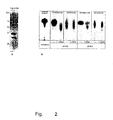
- Fig. 2 shows the results of activity test of recombinant Pgt-CDA against chitosan substrates. It shows Fig. 2a ) a zymogram (substrate: glycol-chitin, incubation: 37 ° C in 50 mM BisTris, pH6 overnight, negative staining with Calcofluor after depolimerization of chitosan with nitrous acid).
- Fig. 2b shows the results of thin layer chromatography (TLC).
- TLC thin layer chromatography
- the mark "---" corresponds to an approach without enzyme
- the mark "CDA” corresponds to an approach with enzyme
- Fig. 3 shows the structural formula of a section of a copolymer of N-acetyl-glucosamine (GlcNAc, left) and glucosamine (GlcN, right), which are ⁇ -1,4-glycosidically linked together.
- This section is ideal for the structure of chitosan.
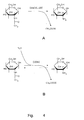
- Fig. 4 shows the reaction scheme of the deacetylation of N-acetyl-glucosamine by chemical means ( 4A ) or with the aid of the chitin deacetylase according to the invention ( 4B ). Analogously, the reaction schemes also apply to the deacetylation of N-acetyl-glucosamine residues in a chitin or chitosan molecule.
- a chitin deacetylase enables the production of better defined and reproducible chitosans compared to the classical chemical deacetylation.
- Fig. 5 shows the mass spectrometric analysis of the reaction products.
- 25 ⁇ g chitohexaose was incubated for 24 h at 40 ° C with 0.5 ⁇ g Pgt-CDA in reaction buffer (50 mM BisTris, pH 6.9, 100 mM NaCl, 1 mM ZnCl).
- the reaction products as well as the starting material incubated in the same way but without enzyme were analyzed by Maldi-TOF-MS (Bruker Daltonik Reflex 4). analyzed. Shown are the mass spectrum of the reactant (black, top) and that of the product (bottom, gray).
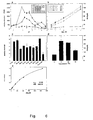
- Fig. 6 shows the characterization and kinetics of Pgt-CDA. It shows Fig. 6a Determination of the pH optimum: 27 nM Pgt-CDA was incubated at different pH values in different buffers with 0.88 mM chitohexose as substrate at 37 ° C. for 19 h and subsequently the Pgt-CDA activity was determined. For pHs in the range of 5.8-7.2, Bis Tris buffers were used for the range between pH 7.4-9.4 bicine buffer. All buffers had a concentration of 25 mM. Fig.
- Fig. 6c shows the influence of metal ions on Pgt-CDA activity: 106 nM Pgt-CDA was dissolved in 50 mM Bicine buffer (pH 8.0) at 37 ° C for 2 h with 0.22 mM chitohexose and various metal ions in its form Chloride salts at a concentration of 1 mM incubated. As a control, 50 mM Bicine buffer without metal ions was used.
- Fig. 6e shows a Michaelis-Menten kinetics: 76 nM Pgt-CDA was incubated in 50 mM BisTris pH 6.9 1 mM ZnCl 2 at 37 ° C. for 24 h with different substrate concentrations (S) of chitohexaose. KM and v max were determined by nonlinear regression using the GraphPad Prism software.
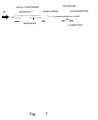
- Fig. 7 shows the mass spectrometric analysis of recombinant Pgt-CDA. Purified, recombinant Pgt-CDA was prepared according to Naumann et al. (2005). Found peptides as well as their position in the native protein are shown in the picture.
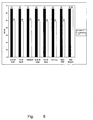
- Fig. 8 shows the enzymatic deacylation of chitosan substrates.
- Five different chitosans were deacetylated by Pgt-CDA.
- the initial substrates were (black bars from left to right): DP737 / DA11; DP818 / DA27; DP713 / DA35; DP1442 / DA56; DP3726 / DA66.
- the substrates were incubated for 24 h at 37 ° C in 50 mM BisTris pH 6.9, 1 mM ZnCl with 20 nM Pgt-CDA.
- the amount of acetate released was determined for each reaction using a commercial acetate assay (R-Biopharm, Darmstadt) and the resulting degree of acetylation (DA) determined (white bars).
- Fig. 9 shows the salt tolerance of Pgt-CDA.
- Chitosan DP3726 / DA66 - black bars
- the amount of acetate released was determined for each reaction using a commercial acetate assay (R-Biopharm, Darmstadt) and the resulting degree of acetylation (DA) determined (white bars).
- the experiments demonstrate a high stability of the enzyme in widely variable abiotic conditions.
- the extreme salt tolerance coupled with high thermostability and a broad pH spectrum should allow the development of a one to two step process for the deacetylation of crystalline chitin.
Landscapes
- Life Sciences & Earth Sciences (AREA)
- Chemical & Material Sciences (AREA)
- Organic Chemistry (AREA)
- Health & Medical Sciences (AREA)
- Engineering & Computer Science (AREA)
- Zoology (AREA)
- Wood Science & Technology (AREA)
- Genetics & Genomics (AREA)
- Bioinformatics & Cheminformatics (AREA)
- Biotechnology (AREA)
- Microbiology (AREA)
- Biochemistry (AREA)
- General Engineering & Computer Science (AREA)
- General Health & Medical Sciences (AREA)
- Molecular Biology (AREA)
- General Chemical & Material Sciences (AREA)
- Chemical Kinetics & Catalysis (AREA)
- Medicinal Chemistry (AREA)
- Biomedical Technology (AREA)
- Micro-Organisms Or Cultivation Processes Thereof (AREA)
- Enzymes And Modification Thereof (AREA)
- Preparation Of Compounds By Using Micro-Organisms (AREA)
Description
- Die vorliegende Erfindung betrifft Nukleinsäuremoleküle gemäß dem Oberbegriff des Anspruchs 1 codierend für ein Protein mit Deacetylase-Aktivität, besagtes Protein sowie Verfahren zur Herstellung derselben.
- Besagtes Protein mit Deacetylase-Aktivität ist insbesondere interessant für die Herstellung von Chitosan, das aufgrund seiner besonderen Eigenschaften in jüngerer Zeit erhöhte Aufmerksamkeit gefunden hat.
- Bei Chitosan handelt es sich um den Oberbegriff für lineare Copolymere aus ß-1,4-glycosidisch verknüpften N-Acetyl-Glucosamin- (GlcNAc) und Glucosamin-Resten(GlcN).
- Im Prinzip handelt es sich dabei um partiell deacetyliertes Chitin (Poly-GlcNAc); es gibt aus diesem Grund keinen genau definierten Übergang zwischen Chitin und Chitosan. In der Regel spricht man ab einem Deacetylierungsgrad (d.h. ab einem GlcN-Anteil) von mehr als 40 % von Chitosan. Aufgrund der Deacetylierung ist Chitosan im Unterschied zu Chitin in organischen Säuren löslich.
- Man unterscheidet weiterhin zwischen niedermolekularen (M ∼ 150 000 D), mittelmolekularen (M ∼ 400 000 D) und hochmolekularen (M - 600 000 D) Chitosanen.
- Chitosan ist eines der wenigen Biopolymere, das unter physiologischen Bedingungen eine positive Nettoladung trägt. Aufgrund dieser Tatsache interagiert Chitosan mit anionischen Substanzen wie Proteinen, DNA, Fettsäuren, und Phospholipiden. Diese physiko-chemischen Interaktionen werden für die verschiedenen biologischen Wirkungen von Chitosan verantwortlich gemacht.
- Chitosan kommt in der Natur nur sehr selten vor; es findet sich hauptsächlich in der Zellwand von Pilzen der Klasse der Zygomycetes.
- Chitosan für kommerzielle Zwecke wird daher aus Chitin hergestellt. Chitin ist ein weit verbreitetes Biopolymer und kommt insbesondere in den Zellwänden von Pilzen sowie im Exoskelett der meisten Arthropoden, insbesondere Crustaceen, vor. Vor allem die in der Aquakultur sowie dem Krabbenfang in großer Menge anfallenden Crustaceenschalen stellen eine kostengünstige Quelle für Chitin dar.
- Im Stand der Technik wird Chitosan auf chemischem Weg aus Chitin hergestellt. Dazu werden die Crustaceenschalen zunächst vermahlen und anschließend zur Entfernung von Kalk, das einen Gewichtsanteil von 30 % (w/w) an dem Schalenmaterial stellt, mit einem Überschuß von HCl (0.25-1 %, 12-24 h, Raumtemperatur) behandelt. Anschließend wird gewaschen, und dann folgt ein Deproteinierungsschritt unter Verwendung eines Überschusses an heißer, wässriger NaOH (0.25-1 M, 1-3 h, 60-70°C). Das Produkt wird dann gewaschen, neutralisiert und getrocknet.
- Das auf diese Weise gewonnene Chitin wird dann einer partiellen Deacetylierung unterzogen. Hierzu wird das Chitin wiederholt mit einer heißen konzentrierten Lauge, bevorzugt NaOH, behandelt (35-50 %, 1-3 h, 90-130 °C).
- Es schließt sich in einigen Fällen ein Entfärbungsschritt, z.B. mit UV, O3 oder H2O2, an. Das Produkt wird dann gewaschen, neutralisiert und getrocknet.
- Das beschriebene Verfahren führt zu Produkten mit einem zufälligen Acetylierungsmuster, und überdies zu einer teilweisen Depolymerisierung des Polymers.
- Überdies kann das Produkt unlösliche Bereiche mit sehr hohem Acetylierungsgrad aufweisen, die aus den inneren, kristallinen Bereichen der Chitin-Partikel herrühren.
- Das so hergestellte Chitosan weist daher in Bezug auf Polymerisierungsgrad, Acetylierungsgrad und Acetylierungsmuster eine große Heterogenität auf. Gleichwohl ist dieses Produkt für eine Reihe von Anwendungen geeignet.
- Anspruchsvollere Anwendungen erfordern jedoch Chitosane höherer Qualität, d.h. Chitosane mit genauer definiertem Polymerisierungsgrad (DP), Acetylierungsgrad (DA) und Acetylierungsmuster.
- Solche Chitosane lassen sich, wenn überhaupt, nur unter großem Aufwand aus den wie oben beschriebenen Produkten herstellen bzw. aufreinigen.
- Seit einiger Zeit wird daher der Ansatz verfolgt, Chitosan mit Hilfe geeigneter Chitin-Deacetylasen aus Chitin herzustellen. Es wird vermutet, dass insbesondere marine Mikroorganismen Chitin-Deacetylasen aufweisen, um z.B. Exoskelette von Crustaceen-Kadavern abbauen zu können.
- Tanaka et al. (J Biol Chem. 2004; 279: 30021-7) haben eine Diacetylchitobiose-Deacetylase aus dem hyperthermophilen Archaebacterium Thermococcus kodakaraensi beschrieben. Die rekombinante Deacetylase zeigte Deacetylase-Aktivität gegenüber N-Acetylchitooligosacchariden; die deacetylierende Domäne weist eine Spezifität für den nichtreduzierenden GlcNAc-Rest auf. Das Enzym wies ebenfalls eine Deacetylase-Aktivität gegenüber GlcNAc-Monomeren auf. Die abgeleitete Aminosäuresequenz wurde der LmbE-Proteinfamilie zugeordnet, in welche auch N-Acetylglucosaminyl-phosphatidylinositol-De-N-acetylasen und 1-D-myo-inosityl-2-acetamido-2-deoxy-alpha-D-glucopyranoside-Deacetylasen eingeordnet werden.
- Es stellte sich heraus, dass sich die Thermococcus-Deacetylase nicht für die wirtschaftlich sinnvolle Produktion von Chitosan aus Chitin eignet. Es lässt sich allenfalls für die Produktion weniger, spezifischer Oligomere verwenden.
- Hinzu kommt, dass die Expressionsrate dieses Proteins verhältnismäßig schlecht ist, so dass das gesuchte Protein nur in geringen Mengen hergestellt werden kann. Überdies weist das Protein sein Aktivitätsmaximum bei 75° C und pH 8.5 auf. Diese Bedingungen sind für viele Anwendungen nicht geeignet. Hinzu kommt, dass besagtes Protein nur die erste GlcNac-Position am nichtreduzierenden Ende deacetyliert und maximal ein Pentamer als Substrat akzeptiert, beim Hexamer oder gar hochpolymeren Chitosanen jedoch keine Deacetylase-Aktivität mehr auftritt.
- In der Summe ist die einzig denkbare kommerzielle Anwendung daher die Deacetylierung der ersten, nichtreduzierenden Position von Oligomeren mit einer Maximallänge von 5 Einheiten.
- Blair et al. (Biochemistry, 2006, 45 (31), 9416 -9426) haben erstmals die Struktur und den Wirkmechanismus einer Chitin-Deacetylase des pathogenen Pilzes Colletotrichum lindemuthianum (Erreger der Brennfleckenkrankheit) aufgezeigt. Auch diese Deacetylase weist eine Reihe von Nachteilen auf, die sie für die industrielle Eignung nicht oder zumindest kaum geeignet machen. So kann diese Deacetylase nur maximal jede zweite Zuckerposition deacetylieren. Daher liegt der theoretisch erreichbare maximale Deacetylierungsgrad bei 50%. Hinzu kommt, dass mit dieser Deacetylase eine blockweise Deacetylierung nicht möglich ist.
- Es ist daher eine Aufgabe der vorliegenden Erfindung, ein Deacetylase-Enzym mit Deacetylase-Aktivität gegenüber GlcNAc-Molekülen und -Polymeren (Chitin, Chitosanen) bereitzustellen, das sich in großen Mengen kostengünstig herstellen läßt und Aktivitätsbedingungen aufweist, die es besser für industrielle Prozesse geeignet machen.
- Eine andere Aufgabe der vorliegenden Erfindung liegt darin, ein Verfahren zur Herstellung von Chitosan aus Chitin bereitzustellen, das wirtschaftlicher und umweltfreundlicher ist als das eingangs beschrieben Verfahren und/oder die Herstellung von genauer definierten Chitosanen ermöglicht.
- Es ist eine weitere Aufgabe der vorliegenden Erfindung, die Aminosäuresequenz sowie die betreffende Nukleinsäuresequenz für besagtes Deacetylase-Enzym bereitzustellen.
- Diese Aufgabe wird mit einem Nukleinsäuremolekül, einem Protein bzw. einem Verfahren gemäß den unabhängigen Ansprüchen gelöst. Die Unteransprüche geben bevorzugte Ausführungsformen an.
- Weitere Chitin-Deacylasen sind u.a. aus der EMBL-Datenbank, Stichwort "Ps68 Wheat stripe rust fungus cDNA library Puccinia striiformis f. sp. tritici cDNA 5' similar to carbohydrate deacetylase, mRNA sequence" bekannt.
- Demnach ist ein Nukleinsäuremolekül vorgesehen, das ausgewählt ist aus der Gruppe bestehend aus:
- a) Nukleinsäuremoleküle, die für eine Form des Polypeptids mit der abgeleiteten Aminosäuresequenz gemäß SEQ ID No: 3 codieren, wobei besagtes Polypeptid eine Deacetylase-Aktivität aufweist;
- b) Nukleinsäuremoleküle, die die Nukleotidsequenz gemäß SEQ ID No: 1 oder SEQ ID No: 2 aufweisen, und die für eine Form des besagten Polypeptids codieren;
- c) Nukleinsäuremoleküle, die für ein Fragment oder ein Derivat eines Polypeptids, das durch ein Nukleinsäuremolekül gemäß a) oder b) codiert wird, codieren, wobei in besagtem Derivat ein oder mehrere Aminosäurereste im Vergleich zu besagtem Polypeptid konservativ substituiert sind, und wobei besagtes Fragment oder Derivat eine Deacetylase-Aktivität hat, und die eine mindestens 95 %ige Sequenzidentität mit einem Nukleinsäuremolekül gemäß a) oder b) aufweisen,
- d) oder der komplementäre Strang eines Nukleinsäuremoleküls gemäß a)- e).
- Unter dem Begriff "Fragment" soll im Folgenden ein Polypeptid verstanden werden, das mindestens eine Aminosäure weniger als das ursprünglich beanspruchte Polypeptid aufweist.
- Unter dem Begriff "Derivat" soll im Folgenden ein Polypeptid verstanden werden, das mindestens eine Aminosäuren-Substitution im Vergleich zu dem ursprünglich beanspruchten Polypeptid aufweist.
- Grundsätzlich sind jedoch durch die obige Definition auch solche Nukleinsäuremoleküle erfasst, die zwar eine von den beanspruchten Sequenzen SEQ ID No: 1 oder SEQ ID No: 2 abweichende Sequenz aufweisen, bei denen sich diese Sequenzunterscheide jedoch nicht in Sequenzabweichungen des codierten Polypeptids äußern, da es sich um sogenannte "stille Punktmutationen" (Punktmutationen in der dritten Stelle eines Tripletts) handelt, die aufgrund der Degenerierung des Genetischen Codes nicht zu einem Aminosäureaustausch führen (sogenannte "wobble"-Mutationen).
- Unter dem Begriff "konservativ substituiert" soll im folgenden eine Substitution eines Nukleinsäuremoleküls, d.h. eine oder mehrere Basenaustauschmutationen, verstanden werden, die dazu führen, dass eine an einer Stelle ursprünglich vorhandene Aminosäure durch eine Aminosäure ersetzt wird, die die Eigenschaften des Polypeptids nicht oder nicht wesentlich verändert. In der Regel trifft dies für substituierende Aminosäuren mit ähnlichen chemischen Eigenschaften zu.
- So fasst man u.A. die Aminosäuren Alanin, Glycin, Isoleucin, Leucin, Methionin und Valin zu den aliphatischen Aminosäuren zusammen. Phenylalanin, Tryptophan und Tyrosin werden zu den aromatischen Aminosäuren gezählt, Serin, Threonin, Asparagin, Glutamin und Tyrosin zählen zu den polaren Aminosäuren, Lysin, Arginin und Histidin zählen zu den basischen Aminosäuren, Asparaginsäure (Aspartat) und Glutaminsäure (Glutamat) zählen zu den sauren Aminosäuren und Cystein und Tyrosin zu den Aminosäuren mit ionisierbaren Resten.
- Bei dem codierten Polypeptid mit Deacetylase-Aktivität handelt es sich, wie die Erfinder überraschend gefunden haben, um eine Chitin-Deacetylase (CDA), und zwar um eine Chitin-Deacetylase aus Weizenschwarzrost (Puccinia graminis).
- Hinweise auf die Existenz einer Chitin-Deacetylase ergaben sich aus Experimenten mit axenischen Kulturen des Pilzes, die weltweit einzig in den Laboren der Erfinder durchgeführt werden können. Hier konnte zum Einen nachgewiesen werden, dass P. graminis seine Zellwand ab dem Moment des Eindringens in die Pflanze von Chitin nach Chitosan modifiziert, zum Zweiten fanden sich in Zymogrammen mit Chitin-Substrat wenigstens zwei (Iso-)Formen Chitin-deacetylierender Enzyme. Den Erfindern gelang es daraufhin durch Durchmusterung einer Lambda-cDNA-Bank die Sequenz einer putativen Polysaccharid-Deacetylase zu isolieren. Die primäre Identifikation fußte auf der Erkennung des in der PFAM-Datenbank hinterlegten polysacch_deac_1-Musters. Mit der erlangten Information war es den Erfindern möglich, die korrespondierende genomischen Sequenz aus dem P. graminis-Genom zu isolieren und hinsichtlich ihrer Intron-/Exon-Struktur zu analysieren.
- Hinsichtlich der Peptidsequenz weist das Protein das bereits benannte Sequenzpattern einer typischen Polysaccharid-Deacetylase auf (PFAM: polysacch_deac_1). Dieses Pattern erstreckt sich nahezu über die volle Länge der Aminosäuresequenz, besteht aber nur aus wenigen konservierten Positionen und längeren, intervenierenden, variablen Bereichen. N-terminal trägt das Protein zusätzlich ein durch Signal_P eindeutig erkanntes Sekretionssignal, weshalb die Erfinder eine extrazelluläre Lokalisation des Proteins vermuteten.
- Die Erfinder haben festgestellt, dass Pilze der Art Puccinia graminis (wissenschaftlich Puccinia graminis f.sp. tritici; Abk.: "Pgt") im Augenblick der Infektion den in die Wirtspflanze eindringenden Teil ihrer Zellwand partiell deacetylieren. Die Erfinder vermuten, dass die Pilze sich auf diese Weise tarnen, um eine antimykotische Abwehrreaktion der Pflanze zu unterdrücken.
- Die Erfinder haben daraufhin diese Deacetylase vorliegend erstmals beschrieben, isoliert, ihre Wirkung nachgewiesen und ihre Eignung zur industriellen Herstellung von Chitosan erkannt und beschrieben.
- Im Speziellen vermuten die Erfinder eine herausragende Eignung derartiger Enzyme zur Produktion von Chitosanen mit nicht zufälligen und nicht blockweisen Acetylierungsmuster. Solche Chitosanprodukte könnten unter Anderem in der Medizin und im Pflanzenschutz Anwendung finden, da Ihre biologische Aktivität stark von benannten speziellen Verteilungsmustern abhängt, die auf konventionell chemischem Wege nicht darstellbar sind.
- Besonders bevorzugt ist dabei ein Nukleinsäuremolekül vorgesehen, das aus einer sekretorischen Signalsequenz sowie dem besagten Nukleinsäuremolekül codierend für die genannte Deacetylase besteht.
- Die erwähnte Signalsequenz codiert für ein sekretorisches Signalpeptid. Ein solches Signalpeptid ist ein Bestandteil eines Proteins, der zusammen mit der Sequenz für das eigentliche Protein auf der cDNA codiert ist, und der Informationen darüber enthält, wie und wohin dieses Protein innerhalb der Zelle transportiert werden soll. Proteine, die z.B. für den Transport in das Endoplasmatische Retikulum (ER) und damit u.U. für die spätere Sekretion bestimmt sind, besitzen in ihrer Aminosäuresequenz ein Signal, das sie spezifisch zur ER-Membran zielleitet. Bei sekretorischen Proteinen besteht das Signal aus einer 15 bis 40 Aminosäuren langen N-terminal lokalisierten Aminosäuresequenz. Obwohl die Primärstruktur dieser Signalpeptide nicht konserviert ist, können drei verschiedene Bereiche unterschieden werden: ein zentraler hydrophober Kern wird N-terminal von positiv geladenen Aminosäuren und C-terminal von polaren Aminosäuren flankiert. In den meisten Fällen wird das Signalpeptid nach dem Membrandurchtritt proteolytisch vom eigentlichen Protein durch das Enzym Signalpeptidase abgespalten. Die Schnittstelle wird dabei durch kleine Aminosäurereste in den Positionen -3 und -1 der C-terminalen polaren Region der Signalsequenz definiert.
- Ein typisches eukaryontisches Signalpeptid, das den Transport des zu synthetisierenden Proteins ins ER bewerkstelligt, weist z.B. folgende Aminosäuresequenz auf:
- MMSFVSLLVGIFWATEAEQLTKCEVFQ
- Die für das Signalpeptid codierende Sequenz wird, da sie im Bereich des 5'-Endes der Nukleinsäuresequenz angeordnet ist, bei der Translation am Ribosom als erstes synthetisiert, so dass sich, wenn das Signalpeptid weit genug aus dem Ribosom herausragt, das SRP ("Signal Recognition Particle", ein mittelgroßes Riboprotein) an die naszierende Polypeptidkette und das Ribosom anlagert und die Translation stoppt. An der Oberfläche des (rauhen) ER befindet sich ein SRP-Rezeptor, der das Ribosom bindet und in Position an das Translocon bringt. Das SRP wird daraufhin abgespalten und kann erneut zur Markierung dienen. Die Polypeptidkette wird nun durch das Translocon in das Lumen des ER weitersynthetisiert. Anschließend entfernt das Enzym Signalpeptidase die Signalsequenz. Ist die Translation abgeschlossen, wird das Protein im ER-Lumen - ggf. mit Hilfe von Chaperonen - gefaltet. Hinzu kommt ggf. weitere Schritte, die unter dem oben bereits eingeführten Begriff der posttranslationalen Modifikation zusammengefasst werden.
- In der Biotechnologie macht man sich solche Signalpeptide zunutze, um sicherzustellen, dass das herzustellende Protein in das die Zellen umgebende Medium sezerniert wird. Hierzu wird ein Expressionssystem verwendet, bei dem eine für das herzustellende Protein codierende cDNA in einen 3' gelegenen Bereich einer für ein Signalpeptid codierenden cDNA einkloniert wird. In der Regel geschieht das über eine downstream von der Signalsequenz gelegene Restrictionsschnittstelle. Da diese in der Regel mindestens zwei Nukleotidtripletts aufweist, erhält man auf diese Weise ein Konstrukt, bei welchem die Signalsequenz und die für das herzustellende Protein codierdende Sequenz durch mindestens zwei Nukleotidtripletts getrennt ist; das tranlatierte Protein weist also mindestens zwei Aminosäurereste zwischen dem Signalpeptid und dem herzustellenden Protein auf. Demnach ist ein Nukleinsäuremolekül vorgesehen, das für ein Signalpeptid codiert, und das dadurch gekennzeichnet ist, dass das Nukleinsäuremolekül im Bereich seines 3'-Endes eine Schnittstelle für eine Restriktionsendonuklease aufweist.
- Häufig weisen native Nukleinsäuremoleküle, die für Signalpeptide codieren, keine Restriktionsschnittstelle auf, zumindest nicht im Bereich ihrer 3'-Enden. Es ist daher bevorzugt vorgesehen, dass die Schnittstelle für eine Restriktionsendonuklease durch eine stille Punktmutation in der nativen Nukleotidsequenz des Nukleinsäuremoleküls für das Signalpeptid erzeugt ist. Auf diese Weise bleibt die Funktion des Signalpeptides erhalten, und es kommen die oben genannten Vorteile zum Tragen.
- Erfindungsgemäß ist weiterhin ein Verfahren zur Herstellung eines Proteins mit Deacetylase-Aktivität vorgesehen, aufweisend die folgenden Schritte:
- a) ggf. Klonieren eines Nukleinsäuremoleküls gemäß obiger Definition in einen Expressionsvektor,
- b) Transfektion Nukleinsäuremoleküls bzw. des Expressionsvektors in ein Expressionssystem,
- c) Inkubation und/oder Fermentation des Expressionssystems;
- d) ggf. spezifische Induktion der Proteinexpression;
- e) Aufreinigung des exprimierten Proteins mit Deacetylase-Aktivität.
- Bei dem exprimierten Protein handelt es sich um eine Chitin-Deacetylase aus Weizenschwarzrost (Puccinia graminis).
- Unter dem Begriff "klonieren" sollen im folgenden alle Techniken verstanden werden die es erlauben, ein Nukleinsäuremoleküls gemäß obiger Definition in einen Expressionsvektor zu integrieren. Dem Fachmann sind hier eine Vielzahl von Techniken bekannt, deren wesentliche z.B. in dem Lehrbuch "Molekulare Biotechnologie" von Michael Wink (1. Auflage, (September 2004, Wiley-VCH), oder in anderen dem Fachmann bekannten Lehrbüchern und Veröffentlichungen beschrieben sind.
- Unter dem Begriff "Expressionsvektor", der optional zu verwenden ist, sollen dem Fachmann an sich bekannte Transportmoleküle zur Übertragung eines Fremd-Nukleinsäuremoleküls in eine Empfängerzelle verstanden werden. Hierzu zählen insbesondere Plasmide, λ-Phagen, Cosmide, Phasmide, P1-Phage, BACs, PACs, und YACs. Weitere geeignete Vektoren sind z.B. in dem Lehrbuch "Molekulare Biotechnologie" von Michael Wink (1. Auflage, (September 2004, Wiley-VCH), oder in anderen dem Fachmann bekannten Lehrbüchern und Veröffentlichungen beschrieben.
- Bei dem optional verwendeten Expressionsvektor handelt es sich bevorzugt um das Plasmid pMel1, das insbesondere in Schizosaccharomyces pombe als bevorzugtem Expressionssystem zum Einsatz kommt. Dieses Plasmid ist in
Fig. 3 dargestellt. - Unter dem Begriff "Transfektion" soll im folgenden das Einbringen eines Fremd- Nukleinsäuremoleküls in eine Empfängerzelle verstanden werden, insbesondere unter Zuhilfenahme eines Expressionsvektors.
- Unter den Begriffen "Inkubation" und/oder Fermentation des Expressionssystems soll imfolgenden das Hältern des Expressionssytems unter Wachstums- und zellteilungsfördernden Bedingungen verstanden werden., Dem Fachmann sind diese Bedingungen (insbesondere pO2, pH, Temperatur, Medienzusammensetzung, etc.) aus der Fachliteratur bekannt.
- Weiterhin ist bevorzugt vorgesehen, dass das exprimierte Protein mit Deacetylase-Aktivität durch Affinitätschromatographie, Gelfiltration und/oder Ionenaustauschchromatographie aufgereinigt wird. Hier kommt insbesondere die Kombination mit einem His-Tag in Frage. Hierbei handelt es sich um ein aus mehreren Histidin-Resten bestehendes Tag, dass an das aufzureinigende Protein angehängt ist. Die hierfür codierende DNA ist in der Regel Bestandteil des Expressionsvektors und wird zusammen mit der cDNA des zu exprimierenden Proteins translatiert.
- Grundprinzip dieses Aufreinigungsverfahrens ist die sogenannte "IMAC" (Immobilized Metal Affinity Chromatography). Dabei werden zweifach positiv geladene Kationen wie Cu2+, Ni2+, Co2+ oder Zn2◆ über einen chelierenden Liganden an eine Matrix immobilisiert, und interagieren mit den Seitengruppen der Histidin-reste des His-Tag. Weitere, erfindungsgemäß einsetzbare Affinitäts-Tags sind z.B. Maltose-bindendes Protein (MBP) oder Glutathionyl-S-Transferase (GST), aber auch das S-Tag, HAT-Tag, Calmodulin-Binde-Peptid, Chitin-Binde-Peptid und einige Cellulose-Binde-Domänen. Hier kommen ähnliche Aufreinigungsmechanismen zum Einsatz.
- Erfindungsgemäß ist weiterhin ein Expressionsvektor vorgesehen, der das oben beschriebene Nukleinsäuremolekül enthält. Ein solcher Expressionsvektor ist z.B. in
Fig. 2 gezeigt. - Ebenso ist erfindungsgemäß eine Wirtszelle, die mit einem solchen Nukleinsäuremolekül in einem solchen Expressionsvektor transformiert wurde, wobei diese Zelle als Expressionssystem fungiert. Bei einer solchen Wirtszelle kann es sich z. B. um eine eukaryontische Wirtszelle handeln. Bevorzugt werden hier Hefezellen verwendet, insbesondere Bierhefe (Saccharomyces cerevisiae) und Spalthefe (Schizosaccharomyces pombe).
- Geeignet sind zwar prinzipiell alle eukaryontischen Expressionssysteme (also Pilze inkl. Hefen, Einzeller, Pflanzen, Insektenzellen und Säugerzellen). In der Regel können funktionelle Proteine jedoch nur in Kombination mit einem im entsprechenden System gut funktionierenden Sekretionssignal exprimiert und sezerniert werden. Es ist daher bevorzugt, den beschriebenen Vektor in anderen Hefen einzusetzen oder das Prinzip zu übertragen. Hierbei ist insbesondere an die folgenden Hefen gedacht: Pichia pastoris, Hansenula polymorpha, Klyveromyces lactis.
- Erfindungsgemäß ist weiterhin ein Polypeptid bzw. Protein vorgesehen, das durch das oben beschriebene Nukleinsäuremolekül codiert ist oder mit dem oben beschriebenen Verfahren herstellbar ist, wobei dieses Polypeptid bzw. Protein eine Deacetylase-Aktivität aufweist. Bevorzugt weist dieses Polypeptid bzw. Protein eine Aminosäuresequenz auf, die in SEQ ID No 3 dargestellt ist.
- Abweichend davon kann das Polypeptid bzw. Protein eine Aminosäuresequenz aufweisen, in welcher ein oder mehrere Aminosäurereste konservativ substituiert sind. In Bezug auf den begriff "konservativ substituiert" wird auf die obigen Ausführungen verwiesen.
- Bei diesem Polypeptid bzw. Protein handelt es sich um eine Chitin-Deacetylase aus Weizenschwarzrost (Puccinia graminis).
- Es ist weiterhin ein Verfahren zur Herstellung von Chitosan aus Chitin vorgesehen, bei welchem N-Acetyl-Glucosaminreste (GlcNAc) in einem GlcNAc-Mono- oder -Oligomer, einem GlcNAc-Polymer, einem Copolymer aus GlcNAc und Glucosamin oder in einem Chitinmolekül mit einer solchen Chitin-Deacetylase deacetyliert werden.
- Dabei wird bevorzugt ein pH-Wert zwischen 3 und 12 sowie eine Temperatur zwischen 5 und 80 °C eingestellt. Als Puffer kommen insbesondere Tris, Bicine, Phosphat und Borat in Frage. Die Pufferkonzentration beträgt bevorzugt 10 - 100 mM, ganz besonders bevorzugt 40 - 60 mM. Bevorzugt werden außerdem Kofaktoren verwendet, so z.B. Zn (1mM).
- Besonders bevorzugt liegt der pH-Wert im Bereich zwischen 6 und 11, und ganz besonders bevorzugt liegt der pH-Wert zwischen 8 und 10. Besonders bevorzugt liegt die Temperatur im Bereich zwischen 20 und 60 °C, und ganz besonders bevorzugt liegt die Temperatur zwischen 30 und 50 °C.
- Die Erfinder haben, um die Verfahrensbedinungen experimentell zu optimieren, Chitohexamere mit einem Acetylierungsgrad von 100% (DP6/DA100) und 42% (DP6/DA42) 27h lang bei 37°C und verschiedenen pH-Werten mit der erfindungsgemäßen Pgt-CDA verdaut. Die Reaktionsprodukte sowie Kontrollansätze ohne Enzym wurden mittels DC aufgetrennt und mittels Fluorescamin-Assay ausgewertet. Dabei wurde bei einem pH-Wert 9,0 die höchste Deacetylierungsaktivität (von 100% auf 64% bzw. von 43% auf 33%) festgestellt, bei pH 6,0 (von 100% auf 84% bzw. von 43% auf 35%) bzw. bei pH 4,0(von 100% auf 99% bzw. von 43% auf 39%) lag die Aktivität deutlich geringer.
- Alternativ hierzu ist ein Verfahren zur Herstellung von Chitosan vorgesehen, in welchem N-Acetyl-Glucosamin-Monomere (GlcNAc) mit einer solchen Chitin-Deacetylase deacetyliert werden, um so Glucosamin-Monomere (GlcN) herzustellen, die dann z.B. in einem weiteren Teilschritt mit unbehandelten GlcNAc-Monomeren copolymerisiert werden, um Chitosan zu erhalten.
- Ebenso kann jedoch vorgesehen sein, dass die erfindungsgemäße Chitin-Deacetylase zur Acetylierung von Glucosaminresten (GlcN) in einem GlcN-Mono- oder Oligomer, einem GlcN-Polymer, einem Copolymer aus GlcNAc und Glucosamin oder einem Chitosanmolekül verwendet wird.
- Durch die Wahl geeigneter (d.h. im Prinzip ungünstiger) Reaktionsbedingungen (Temperatur, pH, Umkehrung des Reaktionsgleichgewichts durch Abfuhr der acetylierten Substrate und Zufuhr deacetylierter Substrate) kann die CDA zu einer Umkehr ihrer Reaktionsrichtung gebracht werden, so wie es in praktisch allen enzymatisch katalysierten Reaktionen der Fall ist. Tut man dies, kann man die CDA zur Reacetylierung insbesondere von Chitosansubstraten nutzen. Die dabei entstehenden Produkte werden im Folgenden "acetylierte Produkte" genannt; es kann sich hier selbstverständlich auch um Chitosane mit unterschiedlichen Acetylierungsmustern und - anteilen handeln, aber insbesondere auch um Chitin. Diese Anwendung ist von hohem allgemeinem Interesse, da sie wiederum zu Produkten mit definiertem Acetylierungsmuster und Acetylierungsanteil definiertem führen kann.
- Weiterhin ist erfindungsgemäß ein Chitosan oder ein wie gerade beschrieben acetyliertes Produkt vorgesehen, das mit einem der genannten Verfahren herstellbar ist. Ein solches Chitosan oder acetyliertes Produkt zeichnet sich durch einen genau definierbaren Polymerisations- und Acetylierungsgrad sowie ein genau definierbares Acetylierungsmuster aus.
- Schließlich ist erfindungsgemäß die Verwendung eines solchen Chitosans oder acetylierten Produkts für mindestens einen der Zwecke vorgesehen, ausgewählt aus der Gruppe enthaltend:
- a) Immobilisierung von Enzymen und Zellen in biotechnologischen Verfahren;
- b) Verstärkung und/oder Färbung von menschlichen und/oder tierischem Haar;
- c) Haut- und/oder Haarpflege;
- d) Schutz und Konservierung von Saatgut und/oder Getreide;
- e) Adsorption von Endotoxinen und Nukleinsäuren
- f) Papierverarbeitung.
- Weitere, erfindungsgemäß vorgesehene Verwendungen umfassen:
- a) Polymer-Träger für Katalysatoren;
- b) Zwischenprodukt für die Synthese von Feinchemikalien;
- c) Zusatz für Molkefutter;
- d) Kompostierungsbeschleuniger;
- e) Verpackungsmaterial;
- f) Klärungsmittel für Säfte;
- g) Flockenbildungmittel;
- h) diätetische Faser für Nahrungsmittel;
- i) Beschichtungsmittel für Nahrungsmittel;
- j) Wundauflage;
- k) chirurgisches Nahtmaterial;
- l) diätetischer Nahrungszusatz;
- m) Kontaktlinsen;
- n) Lautsprechermembrane;
- o) Einbettungsmittel für die Elektronenmikroskopie;
- p) oder Fällungsmittel für die Trink- und Abwasserreinigung.
- q) Matrizes für das Tissue Engineering
- r) Chitosan-Partikel für Drug-, Gene- und Vaccine-Delivery
- Viele dieser Verwendungen profitieren von dem genau definierbaren Acetylierungsgrad sowie dem genau definierbaren Acetylierungsmuster der erfindungsgemäß herstellbaren Chitosane, der sich insbesondere in einer definierten Löslichkeit sowie in einer definierten Nettoladung des betreffenden Polymers äußert. Beide Parameter sind entscheidend für die genannten Verwendungszwecke.
- Die vorliegende Erfindung wird durch die im Folgenden gezeigten und diskutierten Figuren und Beispiele genauer erläutert. Dabei ist zu beachten, dass die Figuren nur beschreibenden Charakter haben und nicht dazu gedacht sind, die Erfindung in irgendeiner Form einzuschränken.
- Die Begriffe Chitohexaose und Chitohexose werden in den nachstehenden Beispielen synonym verwendet.
-
Fig. 1 zeigt ein Screening des Kulturmediums, in welchem mit einem Konstrukt (pMel-CDA) transformierte Schizosaccharomyces pombe-Zellen kultiviert wurden. Die Zellen wurden in 10 ml-Kulturen (Falcontubes) kultiviert. Das Kulturmedium wurde 20h nach Induktion untersucht. Die Aufreinigung der erfindungsgemäßen Pgt-CDA aus dem Kulturmedium erfolgte mittels NiNTA-IMAC-Affinitätschromatographie. - Dabei zeigt
Fig. 1a ) die mit Silber gefärbten PAGE-Gele der wichtigsten Aufreinigungsschritte,Fig. 1b ) ein Silbergel der Haupt-Elutionsfraktionen, undFig. 1c ) einen Western-blot der Haupt-Elutionsfraktion (anti-His-tag). Die Gelbahnen sind wie folgt beschickt: - R: Rohfraktion (konz. Kulturmedium)
- FT: Durchflussfraktion
- W: Waschfraktion
- E8 - E12: Elutionsfraktionen
- Die Gesamtvolumina der Fraktionen betrugen:
- R: 100ml
- FT: 100ml
- W: 50 ml
- E8-12: 1ml
- Die Bahnen wurden jeweils mit 15µl Probe beschickt.
-
Fig. 2 zeigt die Ergebnisse von Aktivitätstest rekombinanter Pgt-CDA gegenüber Chitosan-Substraten. Dabei zeigtFig. 2a ) ein Zymogramm (Substrat: Glykol-Chitin, Inkubation: 37°C in 50 mM BisTris, pH6 über Nacht, Negativfärbung mit Calcofluor nach Depolimerisation von Chitosan mit salpetriger Säure). -
Fig. 2b ) zeigt die Ergebnisse einer Dünnschichtchromatographie (DC). Dabei wurden Chitohexamere mit einem Acetylierungsgrad von 100% (DP6/DA100) und 42% (DP6/DA42) 27h lang bei 37°C unter zwei verschiedenen Pufferbedingungen (50 mM BisTris, pH 6,0 und 50 mM Borat, pH 9,0) mit rekombinanter Pgt-CDA verdaut. Die Reaktionsprodukte sowie Kontrollansätze ohne Enzym wurden mittels DC aufgetrennt und anschliessend visualisiert. - Die Markierung "---" entspricht einem Ansatz ohne Enzym, die Markierung "CDA" entspricht einem Ansatz mit Enzym.
-
Fig. 3 zeigt die Strukturformel eines Ausschnitts aus einem Copolymer aus N-Acetyl-Glucosamin (GlcNAc; links) und Glucosamin (GlcN; rechts), die ß-1,4-glycosidisch miteinander verknüpft sind. Dieser Ausschnitt steht idealtypisch für die Struktur von Chitosan. -
Fig. 4 zeigt das Reaktionsschema der Deacetylierung von N-Acetyl-Glucosamin auf chemischem Wege (Fig.4A ) bzw. mit Hilfe der erfindungsgemäßen Chitin-Deacetylase (Fig.4B ). Analog gelten die Reaktionsschemata auch für die Deacetylierung von N-Acetyl-Glucosaminresten in einem Chitin- bzw. Chitosanmolekül. - Die Verwendung einer erfindungsgemäßen Chitin-Deacetylase ermöglicht gegenüber der klassischen chemischen Deacetylierung die Herstellung von besser definierten und reproduzierbaren Chitosanen.
- Die ebenfalls beschriebene Verwendung der erfindungsgemäßen CDA zur Reacetylierung ist in
Fig. 4 durch den unterbrochen dargestellten Reaktionspfeil angegeben. -
Fig. 5 zeigt die massenspektrometrische Analyse der Reaktionsprodukte. 25 µg Chitohexaose wurden 24h bei 40°C mit 0,5 µg Pgt-CDA in Reaktionspuffer (50 mM BisTris, pH 6,9; 100 mM NaCl; 1 mM ZnCl) inkubiert. Die Reaktionsprodukte, sowie das auf gleiche Weise, aber ohne Enzym inkubierte Edukt wurde mittels Maldi-TOF-MS (Bruker Daltonik Reflex 4) analysiert. Abgebildet sind das Massenspektrum des Edukts (schwarz, oben) sowie das des Produktes (unten, grau). -
Fig. 6 zeigt die Charakterisierung und Kinetiken von Pgt-CDA. Dabei zeigtFig. 6a ) die Bestimmung des pH-Optimums: 27 nM Pgt-CDA wurde bei unterschiedlichen pH-Werten in verschiedenen Puffern mit 0,88 mM Chitohexose als Substrat bei 37°C für 19 h inkubiert und anschließend die Pgt-CDA-Aktivität bestimmt. Für pH-Werte im Bereich 5,8-7,2 wurden Bis Tris-Puffer, für den Bereich zwischen pH 7,4-9,4 Bicine-Puffer verwendet. Alle Puffer hatten eine Konzentration von 25 mM.Fig. 6b +d) zeigen den Einfluss der Inkubationstemperatur auf die Aktivität: 74 nM Pgt-CDA wurde mit 0,88 mM Chitohexaose in 50 mM BisTris pH 6,9 1 mM ZnCl2 bei unterschiedlichen Temperaturen im Wasserbad inkubiert. Zu den angegebenen Zeitpunkten wurden Proben genommen, durch Wärmebehandlung inaktiviert und verschlossen bei Raumtemperatur aufbewahrt. -
Fig. 6c ) zeigt den Einfluss von Metallionen auf die Pgt-CDA Aktivität: 106 nM Pgt-CDA wurde in 50 mM Bicine-Puffer (pH 8,0) bei 37°C für 2 h mit 0,22 mM Chitohexose und verschiedenen Metallionen in Form ihrer Chloridsalze bei einer Konzentration von 1 mM inkubiert. Als Kontrolle wurde 50 mM Bicine-Puffer ohne Metallionen eingesetzt.Fig. 6e )zeigt eine Michaelis-Menten Kinetik: 76 nM Pgt-CDA wurde in 50 mM BisTris pH 6,9 1mM ZnCl2 bei 37 °C für 24 h mit unterschiedlichen Substratkonzentrationen (S) von Chitohexaose inkubiert. KM and vmax wurden mittels nichtlinearer Regression mit Hilfe der GraphPad Prism Software ermittelt. - In allen Assays wurde die relative oder absolute Aktivität durch Fluorescamin-Markierung des erhaltenen GlcN und anschließende Fluorometrie bestimmt. Die Werte zeigen den Mittelwert von drei (6a+c) oder zwei (6b,d+e) unabhängigen Reaktionen.
-
Fig. 7 zeigt die massenspektrometrische Analyse rekombinanter Pgt-CDA. Aufgereinigte, rekombinante Pgt-CDA wurde nach Naumann et al. (2005) analysiert. Gefundene Peptide sowie ihre Position im nativen Protein sind in der Abbildung dargestellt. -
Fig. 8 zeigt die enzymatische Deacytylierung von Chitosan-Substraten. Fünf verschiedene Chitosane wurden durch Pgt-CDA deacetyliert. Die Anfangssubstrate waren (schwarze Balken von Links nach Rechts): DP737/DA11; DP818/DA27; DP713/DA35; DP1442/DA56; DP3726/DA66. Die Substrate wurden 24 h bei 37°C in 50 mM BisTris pH 6,9, 1 mM ZnCl mit 20 nM Pgt-CDA inkubiert. Die Menge an freigesetztem Acetat wurde für jede Reaktion mit Hilfe eines kommerziellen Acetat-Assays (R-Biopharm, Darmstadt) bestimmt und der resultierende Acetylierungsgrad (DA) bestimmt (weiße Balken). -
Fig. 9 zeigt die Salztoleranz von Pgt-CDA. Chitosan (DP3726/DA66 - schwarze Balken) wurde mit 80 nM Pgt-CDA in 50 mM BisTris, pH 6,9, 1mM ZnCl und variablen Salzkonzentrationen bei 40°C für 19h inkubiert. Die Menge an freigesetztem Acetat wurde für jede Reaktion mit Hilfe eines kommerziellen Acetat-Assays (R-Biopharm, Darmstadt) bestimmt und der resultierende Acetylierungsgrad (DA) bestimmt .(weiße Balken). - In der Summe demonstrieren die Versuche eine hohe Stabilität des Enzyms in breit variablen abiotischen Bedingungen. Die extreme Salztoleranz in Verbindung mit hoher Thermostabilität und einem breiten pH-Spektrum sollten die Entwicklung eines Ein- bis Zweistufenprozesses zur Deacetylierung kristallinen Chitins ermöglichen.
-
- <110> Westfaelische Wilhelms-universitaet Muenster
- <120> pMel-CDA
- <130>
- <160> 4
- <170> PatentIn version 3.3
- <210> 1
<211> 818
<212> DNA
<213> Puccinia graminis - <220>
<221> CDA
<222> (1)..(818)
<223> CDNA of Chitosan Deacetylase from Puccinia graminis - <400> 1

- <210> 2
<211> 1205
<212> DNA
<213> Puccinia graminis - <220>
<221> CDA
<222> (1)..(1205)
<223> gDNA of Chitosan Deacetylase from Puccinia graminis - <400> 2


- <210> 3
<211> 247
<212> PRT
<213> Puccinia graminis - <220>
<221> CDA
<222> (1)..(247)
<223> Chitosan Deacetylase from Puccinia graminis - <400> 3


- <210> 4
<211> 818
<212> DNA
<213> Schizosaccharomyces pombe and Puccinia graminis - <220>
<221> pMel-CDA
<222> (1)..(818)
<223> construct of a modified Mel1 signal peptide of S.pombe and a chitosan deacetylase of Puccinia graminis cloned at the 3' terminus of Mel1 with help of an artificially introduced restriction site for Nco I - <400> 4


Claims (15)
- Nukleinsäuremolekül ausgewählt aus der Gruppe bestehend aus:a) Nukleinsäuremoleküle, die für eine Form des Polypeptids mit der abgeleiteten Aminosäuresequenz gemäß SEQ ID No: 3 codieren, wobei besagtes Polypeptid eine Deacetylase-Aktivität aufweist;b) Nukleinsäuremoleküle, die die Nukleotidsequenz gemäß SEQ ID No: 1 oder SEQ ID No: 2 aufweisen, und die für eine Form des besagten Polypeptids codieren;c) Nukleinsäuremoleküle, die für ein Fragment oder ein Derivat eines Polypeptids, das durch ein Nukleinsäuremolekül gemäß a) oder b) codiert wird, codieren, wobei in besagtem Derivat ein oder mehrere Aminosäurereste im Vergleich zu besagtem Polypeptid konservativ substituiert sind, und wobei besagtes Fragment oder Derivat eine Deacetylase-Aktivität hat, und die eine mindestens 95 %ige Sequenzidentität mit einem Nukleinsäuremolekül gemäß a) oder b) aufweisen;d) oder der komplementäre Strang eines Nukleinsäuremoleküls gemäß a)- c).
- Nukleinsäuremolekül gemäß Anspruch 1, wobei es sich bei dem codierten Polypeptid mit Deacetylase-Aktivität um eine Chitin-Deacetylase (CDA) handelt.
- Nukleinsäuremolekül gemäß Anspruch 2, wobei es sich bei dem codierten Polypeptid um eine Chitin-Deacetylase aus Weizenschwarzrost (Puccinia graminis) handelt.
- Nukleinsäuremolekül, dadurch gekennzeichnet, dass dieses aus einer sekretorischen Signalsequenz sowie einem Nukleinsäuremolekül gemäß einem der vorherigen Ansprüche besteht.
- Verfahren zur Herstellung eines Proteins mit Deacetylase-Aktivität, aufweisend die folgenden Schritte:a) Klonieren eines Nukleinsäuremoleküls gemäß einem der Ansprüche 1 bis 4 in einen Expressionsvektor,b) Transfektion des Nukleinsäuremoleküls bzw. des Expressionsvektors in ein Expressionssystem,c) Inkubation und/oder Fermentation des Expressionssystems;d) ggf. spezifische Induktion der Proteinexpression;e) Aufreinigung des exprimierten Proteins mit Deacetylase-Aktivität.
- Verfahren gemäß Anspruch 5, wobei es sich bei dem exprimierten Protein um eine Chitin-Deacetylase aus Weizenschwarzrost (Puccinia graminis) handelt.
- Expressionsvektor, enthaltend das Nukleinsäuremolekül gemäß einem der Ansprüche 1 - 4.
- Wirtszelle, die mit einem Nukleinsäuremolekül gemäß Anspruch 1 - 4 oder mit dem Expressionsvektor gemäß Anspruch 6 transformiert wurde, wobei diese Zelle als Expressionssystem fungiert.
- Polypeptid bzw. Protein, dass durch das Nukleinsäuremolekül gemäß Anspruch 1 bis 4 codiert ist, eine Aminosäuresequenz gemäß Anspruch 1 aufweist oder mit dem Verfahren gemäß Anspruch 5 - 6 herstellbar ist, wobei dieses Protein eine Deacetylase-Aktivität aufweist.
- Polypeptid bzw. Protein gemäß Anspruch 9, wobei es sich bei diesem Protein um eine Chitin-Deacetylase aus Weizenschwarzrost (Puccinia graminis) handelt.
- Verfahren zur Herstellung von Chitosan aus Chitin, bei welchem N-Acetyl-Glucosaminreste (GlcNAc) in einem GlcNAc-Mono- oder -Oligomer, einem GlcNAc-Polymer, einem Copolymer aus GlcNAc und Glucosamin oder in einem Chitinmolekül mit einem Protein gemäß Anspruch 9 - 10 deacetyliert werden.
- Verfahren zur Herstellung von Chitosan, in welchem N-Acetyl-Glucosamin-Monomere (GlcNAc) mit einem Protein gemäß Anspruch 9 - 10 deacetyliert werden, um so Glucosamin-Monomere (GlcN) herzustellen, die dann z.B. mit unbehandelten GlcNAc-Monomeren copolymerisiert werden, um Chitosan zu erhalten.
- Verfahren zur Acetylierung von Glucosaminresten (GlcN) in einem GlcN-Mono- oder Oligomer, einem GlcN-Polymer, einem Copolymer aus GlcNAc und Glucosamin oder einem Chitosanmolekül dadurch gekennzeichnet, dass dabei ein Protein gemäß Anspruch 9 - 10 verwendet wird.
- Chitosan bzw. acetyliertes Produkt, das mit einem der verfahren gemäß einem der Ansprüche 11 - 13 herstellbar ist.
- Verwendung eines Chitosans bzw. eines acetylierten Produkts gemäß Anspruch 14 für mindestens einen der Zwecke ausgewählt aus der Gruppe enthaltend:a. Immobilisierung von Enzymen und Zellen in biotechnologischen Verfahren;b. Verstärkung und/oder Färbung von menschlichen und/oder tierischem Haar;c. Haut- und/oder Haarpflege;d. Schutz und Konservierung von Saatgut und/oder Getreide;e. Adsorption von Endotoxinen und Nukleinsäurenf. Papierverarbeitungg. Polymer-Träger für Katalysatoren;h.Zwischenprodukt für die Synthese von Feinchemikalien;i. Zusatz für Molkefutter;j. Komostierungsbeschleuniger;k. Verpackungsmaterial;l. Klärungsmittel für säfte;m. Flockenbildungmittel;n. diätetische Faser für Nahrungsmittel;o. Beschichtungsmittel für Nahrungsmittel;p. Wundauflage;q. chirurgisches Nahtmaterial;r. diätetischer Nahrungszusatz;s. Kontaktlinsen;t. Lautsprechermembrane;u. Einbettungsmittel für die Elektronenmikroskopie; oderv. Fällungsmittel für die Trink- und Abwasserreinigung.w. Matrizes für das tissue engeneeringx. Chitosan-Nanopartikel für drug-, gene- und vaccine-delivery
Applications Claiming Priority (2)
| Application Number | Priority Date | Filing Date | Title |
|---|---|---|---|
| DE102007024085A DE102007024085A1 (de) | 2007-05-22 | 2007-05-22 | Nukleinsäuremoleküle codierend für ein Protein mit Deacetylase-Aktivität, besagtes Protein, sowie Verfahren zur Herstellung von Chitosan |
| PCT/EP2008/004079 WO2008141818A1 (de) | 2007-05-22 | 2008-05-21 | Nukleinsäuremoleküle codierend für ein protein mit deacetylase-aktivität, besagtes protein, sowie verfahren zur herstellung von chitosan |
Publications (2)
| Publication Number | Publication Date |
|---|---|
| EP2148924A1 EP2148924A1 (de) | 2010-02-03 |
| EP2148924B1 true EP2148924B1 (de) | 2014-06-25 |
Family
ID=39731519
Family Applications (1)
| Application Number | Title | Priority Date | Filing Date |
|---|---|---|---|
| EP08784498.1A Not-in-force EP2148924B1 (de) | 2007-05-22 | 2008-05-21 | Nukleinsäuremoleküle codierend für ein protein mit deacetylase-aktivität, besagtes protein, sowie verfahren zur herstellung von chitosan |
Country Status (4)
| Country | Link |
|---|---|
| US (1) | US20110087012A1 (de) |
| EP (1) | EP2148924B1 (de) |
| DE (1) | DE102007024085A1 (de) |
| WO (1) | WO2008141818A1 (de) |
Family Cites Families (5)
| Publication number | Priority date | Publication date | Assignee | Title |
|---|---|---|---|---|
| US6004795A (en) * | 1991-10-09 | 1999-12-21 | Institute For Molecular Biology And Biotechnology | DNA encoding chitin deacetylase preparations |
| US5525502A (en) * | 1991-10-09 | 1996-06-11 | Institute For Molecular Biology & Biotechnology/Forth | DNA encoding chitin deacetylase |
| JP3030431B2 (ja) * | 1997-12-02 | 2000-04-10 | 農林水産省食品総合研究所長 | キチン脱アセチル化酵素遺伝子、該遺伝子を含むベクター及び形質転換体 |
| US20060277632A1 (en) * | 2005-05-13 | 2006-12-07 | Athenix Corporation | Methods for production of chitin and chitosan |
| EP1884567A1 (de) * | 2006-08-04 | 2008-02-06 | Institute of Molecular Biology and Biotechnology | Nukleinsäuremoleküle, die ein bakterielles Protein mit deacetylase Tätigkeit kodieren, solches Protein, und Verfahren zu ihrer Herstellung und Gebrauch davon |
-
2007
- 2007-05-22 DE DE102007024085A patent/DE102007024085A1/de not_active Withdrawn
-
2008
- 2008-05-21 EP EP08784498.1A patent/EP2148924B1/de not_active Not-in-force
- 2008-05-21 WO PCT/EP2008/004079 patent/WO2008141818A1/de not_active Ceased
- 2008-05-21 US US12/601,440 patent/US20110087012A1/en not_active Abandoned
Also Published As
| Publication number | Publication date |
|---|---|
| WO2008141818A1 (de) | 2008-11-27 |
| DE102007024085A1 (de) | 2008-11-27 |
| US20110087012A1 (en) | 2011-04-14 |
| EP2148924A1 (de) | 2010-02-03 |
Similar Documents
| Publication | Publication Date | Title |
|---|---|---|
| DE69928121T2 (de) | Verwendungen von sulfatierten fuko-oligosacchariden zum pflanzenschutz | |
| DE112014003580B4 (de) | Endo-β-1,3-Glucanase, Polynukleotid, rekombinanter Vektor, Transformant, Herstellungsverfahren für Endo-β-1,3-Glucanase, Enzymherstellung und Herstellung von Paramylon mit reduziertem Molekulargewicht | |
| DE69703371T2 (de) | Nährungszusammensetzung aus dem Maisquellwasser und Verfahren zu deren Herstellung | |
| DE69434497T2 (de) | Verwendung von alpha-1,4-glukanlyase zur herstellung von 1,5 d-anhydrofruktose | |
| DE60108102T2 (de) | E. coli extrakt zur synthese von proteinen | |
| DE69328033T2 (de) | Nukleinsaeureabbau unter mitverwendung von peroxiden | |
| EP3274465A1 (de) | Biokatalytische herstellung von l-fucose | |
| DE69736588T2 (de) | Subtilisin Dimer mit verbesserter Aktivität und verfahren zur Herstellung davon. | |
| Beena et al. | Propyl gallate synthesis using acidophilic tannase and simultaneous production of tannase and gallic acid by marine Aspergillus awamori BTMFW032 | |
| Jung et al. | Enzymatic production of N-acetyl chitooligosaccharides by crude enzyme derived from Paenibacillus illioisensis KJA-424 | |
| DE69333185T2 (de) | Für chitin-deacetylase kodierende dna | |
| WO1999051723A2 (de) | Bakterielle transglutaminasen | |
| WO2008141818A1 (de) | Nukleinsäuremoleküle codierend für ein protein mit deacetylase-aktivität, besagtes protein, sowie verfahren zur herstellung von chitosan | |
| DE10006147A1 (de) | Verfahren zur Herstellung von monoglycosidierten Flavonoiden | |
| DE10111083B4 (de) | Chitindeacetylase und Verfahren zu seiner Herstellung | |
| El Kady | Current trends in fungal biosynthesis of chitin and chitosan | |
| EP1196606B1 (de) | Lytisches enzym | |
| EP2090651A1 (de) | Chitinosanase | |
| DE102007041861A1 (de) | Herstellung von Polymeren mit reduziertem Acylgehalt | |
| DE69814067T2 (de) | Dna, welche für eine chitin-synthase aus arthropoden kodiert | |
| DE10309691B4 (de) | Gewinnung von löslichen Proteinen aus der Biomasse rekombinanter Mikroorganismen | |
| DE69908748T2 (de) | Verfahren zur Aktivierung von epidermalem Wachstumsfaktor (EGF) | |
| EP1696032A1 (de) | Verfahren und Mittel zur Herstellung von Hyaluronan in Pilzen | |
| CN1417324A (zh) | 一种高效几丁质降解菌豚鼠气单胞菌及其产生的几丁质酶系 | |
| DE202024104234U1 (de) | Peptid-Struktur-Partikel mit Signalübertragung |
Legal Events
| Date | Code | Title | Description |
|---|---|---|---|
| PUAI | Public reference made under article 153(3) epc to a published international application that has entered the european phase |
Free format text: ORIGINAL CODE: 0009012 |
|
| 17P | Request for examination filed |
Effective date: 20091217 |
|
| AK | Designated contracting states |
Kind code of ref document: A1 Designated state(s): AT BE BG CH CY CZ DE DK EE ES FI FR GB GR HR HU IE IS IT LI LT LU LV MC MT NL NO PL PT RO SE SI SK TR |
|
| AX | Request for extension of the european patent |
Extension state: AL BA MK RS |
|
| 17Q | First examination report despatched |
Effective date: 20100629 |
|
| DAX | Request for extension of the european patent (deleted) | ||
| GRAP | Despatch of communication of intention to grant a patent |
Free format text: ORIGINAL CODE: EPIDOSNIGR1 |
|
| INTG | Intention to grant announced |
Effective date: 20131119 |
|
| GRAS | Grant fee paid |
Free format text: ORIGINAL CODE: EPIDOSNIGR3 |
|
| GRAA | (expected) grant |
Free format text: ORIGINAL CODE: 0009210 |
|
| AK | Designated contracting states |
Kind code of ref document: B1 Designated state(s): AT BE BG CH CY CZ DE DK EE ES FI FR GB GR HR HU IE IS IT LI LT LU LV MC MT NL NO PL PT RO SE SI SK TR |
|
| REG | Reference to a national code |
Ref country code: GB Ref legal event code: FG4D Free format text: NOT ENGLISH |
|
| REG | Reference to a national code |
Ref country code: CH Ref legal event code: EP |
|
| REG | Reference to a national code |
Ref country code: AT Ref legal event code: REF Ref document number: 674747 Country of ref document: AT Kind code of ref document: T Effective date: 20140715 |
|
| REG | Reference to a national code |
Ref country code: IE Ref legal event code: FG4D Free format text: LANGUAGE OF EP DOCUMENT: GERMAN |
|
| REG | Reference to a national code |
Ref country code: DE Ref legal event code: R096 Ref document number: 502008011946 Country of ref document: DE Effective date: 20140807 |
|
| PG25 | Lapsed in a contracting state [announced via postgrant information from national office to epo] |
Ref country code: CY Free format text: LAPSE BECAUSE OF FAILURE TO SUBMIT A TRANSLATION OF THE DESCRIPTION OR TO PAY THE FEE WITHIN THE PRESCRIBED TIME-LIMIT Effective date: 20140625 Ref country code: FI Free format text: LAPSE BECAUSE OF FAILURE TO SUBMIT A TRANSLATION OF THE DESCRIPTION OR TO PAY THE FEE WITHIN THE PRESCRIBED TIME-LIMIT Effective date: 20140625 Ref country code: LT Free format text: LAPSE BECAUSE OF FAILURE TO SUBMIT A TRANSLATION OF THE DESCRIPTION OR TO PAY THE FEE WITHIN THE PRESCRIBED TIME-LIMIT Effective date: 20140625 Ref country code: NO Free format text: LAPSE BECAUSE OF FAILURE TO SUBMIT A TRANSLATION OF THE DESCRIPTION OR TO PAY THE FEE WITHIN THE PRESCRIBED TIME-LIMIT Effective date: 20140925 Ref country code: GR Free format text: LAPSE BECAUSE OF FAILURE TO SUBMIT A TRANSLATION OF THE DESCRIPTION OR TO PAY THE FEE WITHIN THE PRESCRIBED TIME-LIMIT Effective date: 20140926 |
|
| REG | Reference to a national code |
Ref country code: NL Ref legal event code: VDEP Effective date: 20140625 |
|
| REG | Reference to a national code |
Ref country code: LT Ref legal event code: MG4D |
|
| PG25 | Lapsed in a contracting state [announced via postgrant information from national office to epo] |
Ref country code: SE Free format text: LAPSE BECAUSE OF FAILURE TO SUBMIT A TRANSLATION OF THE DESCRIPTION OR TO PAY THE FEE WITHIN THE PRESCRIBED TIME-LIMIT Effective date: 20140625 Ref country code: HR Free format text: LAPSE BECAUSE OF FAILURE TO SUBMIT A TRANSLATION OF THE DESCRIPTION OR TO PAY THE FEE WITHIN THE PRESCRIBED TIME-LIMIT Effective date: 20140625 Ref country code: LV Free format text: LAPSE BECAUSE OF FAILURE TO SUBMIT A TRANSLATION OF THE DESCRIPTION OR TO PAY THE FEE WITHIN THE PRESCRIBED TIME-LIMIT Effective date: 20140625 |
|
| PG25 | Lapsed in a contracting state [announced via postgrant information from national office to epo] |
Ref country code: EE Free format text: LAPSE BECAUSE OF FAILURE TO SUBMIT A TRANSLATION OF THE DESCRIPTION OR TO PAY THE FEE WITHIN THE PRESCRIBED TIME-LIMIT Effective date: 20140625 Ref country code: ES Free format text: LAPSE BECAUSE OF FAILURE TO SUBMIT A TRANSLATION OF THE DESCRIPTION OR TO PAY THE FEE WITHIN THE PRESCRIBED TIME-LIMIT Effective date: 20140625 Ref country code: CZ Free format text: LAPSE BECAUSE OF FAILURE TO SUBMIT A TRANSLATION OF THE DESCRIPTION OR TO PAY THE FEE WITHIN THE PRESCRIBED TIME-LIMIT Effective date: 20140625 Ref country code: PT Free format text: LAPSE BECAUSE OF FAILURE TO SUBMIT A TRANSLATION OF THE DESCRIPTION OR TO PAY THE FEE WITHIN THE PRESCRIBED TIME-LIMIT Effective date: 20141027 Ref country code: RO Free format text: LAPSE BECAUSE OF FAILURE TO SUBMIT A TRANSLATION OF THE DESCRIPTION OR TO PAY THE FEE WITHIN THE PRESCRIBED TIME-LIMIT Effective date: 20140625 Ref country code: SK Free format text: LAPSE BECAUSE OF FAILURE TO SUBMIT A TRANSLATION OF THE DESCRIPTION OR TO PAY THE FEE WITHIN THE PRESCRIBED TIME-LIMIT Effective date: 20140625 |
|
| PG25 | Lapsed in a contracting state [announced via postgrant information from national office to epo] |
Ref country code: PL Free format text: LAPSE BECAUSE OF FAILURE TO SUBMIT A TRANSLATION OF THE DESCRIPTION OR TO PAY THE FEE WITHIN THE PRESCRIBED TIME-LIMIT Effective date: 20140625 Ref country code: IS Free format text: LAPSE BECAUSE OF FAILURE TO SUBMIT A TRANSLATION OF THE DESCRIPTION OR TO PAY THE FEE WITHIN THE PRESCRIBED TIME-LIMIT Effective date: 20141025 Ref country code: NL Free format text: LAPSE BECAUSE OF FAILURE TO SUBMIT A TRANSLATION OF THE DESCRIPTION OR TO PAY THE FEE WITHIN THE PRESCRIBED TIME-LIMIT Effective date: 20140625 |
|
| REG | Reference to a national code |
Ref country code: DE Ref legal event code: R097 Ref document number: 502008011946 Country of ref document: DE |
|
| PG25 | Lapsed in a contracting state [announced via postgrant information from national office to epo] |
Ref country code: IT Free format text: LAPSE BECAUSE OF FAILURE TO SUBMIT A TRANSLATION OF THE DESCRIPTION OR TO PAY THE FEE WITHIN THE PRESCRIBED TIME-LIMIT Effective date: 20140625 Ref country code: DK Free format text: LAPSE BECAUSE OF FAILURE TO SUBMIT A TRANSLATION OF THE DESCRIPTION OR TO PAY THE FEE WITHIN THE PRESCRIBED TIME-LIMIT Effective date: 20140625 |
|
| PLBE | No opposition filed within time limit |
Free format text: ORIGINAL CODE: 0009261 |
|
| STAA | Information on the status of an ep patent application or granted ep patent |
Free format text: STATUS: NO OPPOSITION FILED WITHIN TIME LIMIT |
|
| 26N | No opposition filed |
Effective date: 20150326 |
|
| REG | Reference to a national code |
Ref country code: DE Ref legal event code: R097 Ref document number: 502008011946 Country of ref document: DE Effective date: 20150326 |
|
| PG25 | Lapsed in a contracting state [announced via postgrant information from national office to epo] |
Ref country code: SI Free format text: LAPSE BECAUSE OF FAILURE TO SUBMIT A TRANSLATION OF THE DESCRIPTION OR TO PAY THE FEE WITHIN THE PRESCRIBED TIME-LIMIT Effective date: 20140625 |
|
| REG | Reference to a national code |
Ref country code: CH Ref legal event code: PL |
|
| PG25 | Lapsed in a contracting state [announced via postgrant information from national office to epo] |
Ref country code: MC Free format text: LAPSE BECAUSE OF FAILURE TO SUBMIT A TRANSLATION OF THE DESCRIPTION OR TO PAY THE FEE WITHIN THE PRESCRIBED TIME-LIMIT Effective date: 20140625 Ref country code: CH Free format text: LAPSE BECAUSE OF NON-PAYMENT OF DUE FEES Effective date: 20150531 Ref country code: LI Free format text: LAPSE BECAUSE OF NON-PAYMENT OF DUE FEES Effective date: 20150531 Ref country code: LU Free format text: LAPSE BECAUSE OF FAILURE TO SUBMIT A TRANSLATION OF THE DESCRIPTION OR TO PAY THE FEE WITHIN THE PRESCRIBED TIME-LIMIT Effective date: 20150521 |
|
| REG | Reference to a national code |
Ref country code: IE Ref legal event code: MM4A |
|
| PG25 | Lapsed in a contracting state [announced via postgrant information from national office to epo] |
Ref country code: IE Free format text: LAPSE BECAUSE OF NON-PAYMENT OF DUE FEES Effective date: 20150521 |
|
| REG | Reference to a national code |
Ref country code: FR Ref legal event code: PLFP Year of fee payment: 9 |
|
| REG | Reference to a national code |
Ref country code: AT Ref legal event code: MM01 Ref document number: 674747 Country of ref document: AT Kind code of ref document: T Effective date: 20150521 |
|
| PG25 | Lapsed in a contracting state [announced via postgrant information from national office to epo] |
Ref country code: AT Free format text: LAPSE BECAUSE OF NON-PAYMENT OF DUE FEES Effective date: 20150521 |
|
| PG25 | Lapsed in a contracting state [announced via postgrant information from national office to epo] |
Ref country code: MT Free format text: LAPSE BECAUSE OF FAILURE TO SUBMIT A TRANSLATION OF THE DESCRIPTION OR TO PAY THE FEE WITHIN THE PRESCRIBED TIME-LIMIT Effective date: 20140625 |
|
| REG | Reference to a national code |
Ref country code: FR Ref legal event code: PLFP Year of fee payment: 10 |
|
| PG25 | Lapsed in a contracting state [announced via postgrant information from national office to epo] |
Ref country code: BG Free format text: LAPSE BECAUSE OF FAILURE TO SUBMIT A TRANSLATION OF THE DESCRIPTION OR TO PAY THE FEE WITHIN THE PRESCRIBED TIME-LIMIT Effective date: 20140625 Ref country code: HU Free format text: LAPSE BECAUSE OF FAILURE TO SUBMIT A TRANSLATION OF THE DESCRIPTION OR TO PAY THE FEE WITHIN THE PRESCRIBED TIME-LIMIT; INVALID AB INITIO Effective date: 20080521 |
|
| PG25 | Lapsed in a contracting state [announced via postgrant information from national office to epo] |
Ref country code: BE Free format text: LAPSE BECAUSE OF NON-PAYMENT OF DUE FEES Effective date: 20150531 |
|
| PGFP | Annual fee paid to national office [announced via postgrant information from national office to epo] |
Ref country code: FR Payment date: 20170523 Year of fee payment: 10 Ref country code: GB Payment date: 20170519 Year of fee payment: 10 Ref country code: DE Payment date: 20170530 Year of fee payment: 10 |
|
| PG25 | Lapsed in a contracting state [announced via postgrant information from national office to epo] |
Ref country code: TR Free format text: LAPSE BECAUSE OF FAILURE TO SUBMIT A TRANSLATION OF THE DESCRIPTION OR TO PAY THE FEE WITHIN THE PRESCRIBED TIME-LIMIT Effective date: 20140625 |
|
| REG | Reference to a national code |
Ref country code: DE Ref legal event code: R119 Ref document number: 502008011946 Country of ref document: DE |
|
| GBPC | Gb: european patent ceased through non-payment of renewal fee |
Effective date: 20180521 |
|
| PG25 | Lapsed in a contracting state [announced via postgrant information from national office to epo] |
Ref country code: DE Free format text: LAPSE BECAUSE OF NON-PAYMENT OF DUE FEES Effective date: 20181201 Ref country code: GB Free format text: LAPSE BECAUSE OF NON-PAYMENT OF DUE FEES Effective date: 20180521 Ref country code: FR Free format text: LAPSE BECAUSE OF NON-PAYMENT OF DUE FEES Effective date: 20180531 |