EP2116264A1 - Preparation for transnasal application - Google Patents
Preparation for transnasal application Download PDFInfo
- Publication number
- EP2116264A1 EP2116264A1 EP07860016A EP07860016A EP2116264A1 EP 2116264 A1 EP2116264 A1 EP 2116264A1 EP 07860016 A EP07860016 A EP 07860016A EP 07860016 A EP07860016 A EP 07860016A EP 2116264 A1 EP2116264 A1 EP 2116264A1
- Authority
- EP
- European Patent Office
- Prior art keywords
- crystalline cellulose
- flowability
- nasal
- less
- calcium phosphate
- Prior art date
- Legal status (The legal status is an assumption and is not a legal conclusion. Google has not performed a legal analysis and makes no representation as to the accuracy of the status listed.)
- Granted
Links
Images







Classifications
-
- A—HUMAN NECESSITIES
- A61—MEDICAL OR VETERINARY SCIENCE; HYGIENE
- A61K—PREPARATIONS FOR MEDICAL, DENTAL OR TOILETRY PURPOSES
- A61K9/00—Medicinal preparations characterised by special physical form
- A61K9/0012—Galenical forms characterised by the site of application
- A61K9/0043—Nose
-
- A—HUMAN NECESSITIES
- A61—MEDICAL OR VETERINARY SCIENCE; HYGIENE
- A61K—PREPARATIONS FOR MEDICAL, DENTAL OR TOILETRY PURPOSES
- A61K31/00—Medicinal preparations containing organic active ingredients
- A61K31/33—Heterocyclic compounds
- A61K31/395—Heterocyclic compounds having nitrogen as a ring hetero atom, e.g. guanethidine or rifamycins
- A61K31/40—Heterocyclic compounds having nitrogen as a ring hetero atom, e.g. guanethidine or rifamycins having five-membered rings with one nitrogen as the only ring hetero atom, e.g. sulpiride, succinimide, tolmetin, buflomedil
- A61K31/403—Heterocyclic compounds having nitrogen as a ring hetero atom, e.g. guanethidine or rifamycins having five-membered rings with one nitrogen as the only ring hetero atom, e.g. sulpiride, succinimide, tolmetin, buflomedil condensed with carbocyclic rings, e.g. carbazole
- A61K31/404—Indoles, e.g. pindolol
- A61K31/4045—Indole-alkylamines; Amides thereof, e.g. serotonin, melatonin
-
- A—HUMAN NECESSITIES
- A61—MEDICAL OR VETERINARY SCIENCE; HYGIENE
- A61K—PREPARATIONS FOR MEDICAL, DENTAL OR TOILETRY PURPOSES
- A61K31/00—Medicinal preparations containing organic active ingredients
- A61K31/33—Heterocyclic compounds
- A61K31/395—Heterocyclic compounds having nitrogen as a ring hetero atom, e.g. guanethidine or rifamycins
- A61K31/41—Heterocyclic compounds having nitrogen as a ring hetero atom, e.g. guanethidine or rifamycins having five-membered rings with two or more ring hetero atoms, at least one of which being nitrogen, e.g. tetrazole
- A61K31/4164—1,3-Diazoles
- A61K31/4178—1,3-Diazoles not condensed 1,3-diazoles and containing further heterocyclic rings, e.g. pilocarpine, nitrofurantoin
-
- A—HUMAN NECESSITIES
- A61—MEDICAL OR VETERINARY SCIENCE; HYGIENE
- A61K—PREPARATIONS FOR MEDICAL, DENTAL OR TOILETRY PURPOSES
- A61K31/00—Medicinal preparations containing organic active ingredients
- A61K31/33—Heterocyclic compounds
- A61K31/395—Heterocyclic compounds having nitrogen as a ring hetero atom, e.g. guanethidine or rifamycins
- A61K31/435—Heterocyclic compounds having nitrogen as a ring hetero atom, e.g. guanethidine or rifamycins having six-membered rings with one nitrogen as the only ring hetero atom
- A61K31/4353—Heterocyclic compounds having nitrogen as a ring hetero atom, e.g. guanethidine or rifamycins having six-membered rings with one nitrogen as the only ring hetero atom ortho- or peri-condensed with heterocyclic ring systems
- A61K31/4375—Heterocyclic compounds having nitrogen as a ring hetero atom, e.g. guanethidine or rifamycins having six-membered rings with one nitrogen as the only ring hetero atom ortho- or peri-condensed with heterocyclic ring systems the heterocyclic ring system containing a six-membered ring having nitrogen as a ring heteroatom, e.g. quinolizines, naphthyridines, berberine, vincamine
-
- A—HUMAN NECESSITIES
- A61—MEDICAL OR VETERINARY SCIENCE; HYGIENE
- A61K—PREPARATIONS FOR MEDICAL, DENTAL OR TOILETRY PURPOSES
- A61K31/00—Medicinal preparations containing organic active ingredients
- A61K31/33—Heterocyclic compounds
- A61K31/395—Heterocyclic compounds having nitrogen as a ring hetero atom, e.g. guanethidine or rifamycins
- A61K31/435—Heterocyclic compounds having nitrogen as a ring hetero atom, e.g. guanethidine or rifamycins having six-membered rings with one nitrogen as the only ring hetero atom
- A61K31/44—Non condensed pyridines; Hydrogenated derivatives thereof
- A61K31/445—Non condensed piperidines, e.g. piperocaine
- A61K31/4523—Non condensed piperidines, e.g. piperocaine containing further heterocyclic ring systems
- A61K31/4535—Non condensed piperidines, e.g. piperocaine containing further heterocyclic ring systems containing a heterocyclic ring having sulfur as a ring hetero atom, e.g. pizotifen
-
- A—HUMAN NECESSITIES
- A61—MEDICAL OR VETERINARY SCIENCE; HYGIENE
- A61K—PREPARATIONS FOR MEDICAL, DENTAL OR TOILETRY PURPOSES
- A61K31/00—Medicinal preparations containing organic active ingredients
- A61K31/33—Heterocyclic compounds
- A61K31/395—Heterocyclic compounds having nitrogen as a ring hetero atom, e.g. guanethidine or rifamycins
- A61K31/435—Heterocyclic compounds having nitrogen as a ring hetero atom, e.g. guanethidine or rifamycins having six-membered rings with one nitrogen as the only ring hetero atom
- A61K31/47—Quinolines; Isoquinolines
- A61K31/485—Morphinan derivatives, e.g. morphine, codeine
-
- A—HUMAN NECESSITIES
- A61—MEDICAL OR VETERINARY SCIENCE; HYGIENE
- A61K—PREPARATIONS FOR MEDICAL, DENTAL OR TOILETRY PURPOSES
- A61K31/00—Medicinal preparations containing organic active ingredients
- A61K31/56—Compounds containing cyclopenta[a]hydrophenanthrene ring systems; Derivatives thereof, e.g. steroids
- A61K31/57—Compounds containing cyclopenta[a]hydrophenanthrene ring systems; Derivatives thereof, e.g. steroids substituted in position 17 beta by a chain of two carbon atoms, e.g. pregnane or progesterone
- A61K31/573—Compounds containing cyclopenta[a]hydrophenanthrene ring systems; Derivatives thereof, e.g. steroids substituted in position 17 beta by a chain of two carbon atoms, e.g. pregnane or progesterone substituted in position 21, e.g. cortisone, dexamethasone, prednisone or aldosterone
-
- A—HUMAN NECESSITIES
- A61—MEDICAL OR VETERINARY SCIENCE; HYGIENE
- A61K—PREPARATIONS FOR MEDICAL, DENTAL OR TOILETRY PURPOSES
- A61K45/00—Medicinal preparations containing active ingredients not provided for in groups A61K31/00 - A61K41/00
- A61K45/06—Mixtures of active ingredients without chemical characterisation, e.g. antiphlogistics and cardiaca
-
- A—HUMAN NECESSITIES
- A61—MEDICAL OR VETERINARY SCIENCE; HYGIENE
- A61K—PREPARATIONS FOR MEDICAL, DENTAL OR TOILETRY PURPOSES
- A61K9/00—Medicinal preparations characterised by special physical form
- A61K9/14—Particulate form, e.g. powders, Processes for size reducing of pure drugs or the resulting products, Pure drug nanoparticles
- A61K9/16—Agglomerates; Granulates; Microbeadlets ; Microspheres; Pellets; Solid products obtained by spray drying, spray freeze drying, spray congealing,(multiple) emulsion solvent evaporation or extraction
- A61K9/1605—Excipients; Inactive ingredients
- A61K9/1611—Inorganic compounds
-
- A—HUMAN NECESSITIES
- A61—MEDICAL OR VETERINARY SCIENCE; HYGIENE
- A61K—PREPARATIONS FOR MEDICAL, DENTAL OR TOILETRY PURPOSES
- A61K9/00—Medicinal preparations characterised by special physical form
- A61K9/14—Particulate form, e.g. powders, Processes for size reducing of pure drugs or the resulting products, Pure drug nanoparticles
- A61K9/16—Agglomerates; Granulates; Microbeadlets ; Microspheres; Pellets; Solid products obtained by spray drying, spray freeze drying, spray congealing,(multiple) emulsion solvent evaporation or extraction
- A61K9/1605—Excipients; Inactive ingredients
- A61K9/1629—Organic macromolecular compounds
- A61K9/1652—Polysaccharides, e.g. alginate, cellulose derivatives; Cyclodextrin
-
- A—HUMAN NECESSITIES
- A61—MEDICAL OR VETERINARY SCIENCE; HYGIENE
- A61P—SPECIFIC THERAPEUTIC ACTIVITY OF CHEMICAL COMPOUNDS OR MEDICINAL PREPARATIONS
- A61P1/00—Drugs for disorders of the alimentary tract or the digestive system
- A61P1/08—Drugs for disorders of the alimentary tract or the digestive system for nausea, cinetosis or vertigo; Antiemetics
-
- A—HUMAN NECESSITIES
- A61—MEDICAL OR VETERINARY SCIENCE; HYGIENE
- A61P—SPECIFIC THERAPEUTIC ACTIVITY OF CHEMICAL COMPOUNDS OR MEDICINAL PREPARATIONS
- A61P11/00—Drugs for disorders of the respiratory system
-
- A—HUMAN NECESSITIES
- A61—MEDICAL OR VETERINARY SCIENCE; HYGIENE
- A61P—SPECIFIC THERAPEUTIC ACTIVITY OF CHEMICAL COMPOUNDS OR MEDICINAL PREPARATIONS
- A61P11/00—Drugs for disorders of the respiratory system
- A61P11/02—Nasal agents, e.g. decongestants
-
- A—HUMAN NECESSITIES
- A61—MEDICAL OR VETERINARY SCIENCE; HYGIENE
- A61P—SPECIFIC THERAPEUTIC ACTIVITY OF CHEMICAL COMPOUNDS OR MEDICINAL PREPARATIONS
- A61P15/00—Drugs for genital or sexual disorders; Contraceptives
- A61P15/08—Drugs for genital or sexual disorders; Contraceptives for gonadal disorders or for enhancing fertility, e.g. inducers of ovulation or of spermatogenesis
-
- A—HUMAN NECESSITIES
- A61—MEDICAL OR VETERINARY SCIENCE; HYGIENE
- A61P—SPECIFIC THERAPEUTIC ACTIVITY OF CHEMICAL COMPOUNDS OR MEDICINAL PREPARATIONS
- A61P19/00—Drugs for skeletal disorders
- A61P19/08—Drugs for skeletal disorders for bone diseases, e.g. rachitism, Paget's disease
- A61P19/10—Drugs for skeletal disorders for bone diseases, e.g. rachitism, Paget's disease for osteoporosis
-
- A—HUMAN NECESSITIES
- A61—MEDICAL OR VETERINARY SCIENCE; HYGIENE
- A61P—SPECIFIC THERAPEUTIC ACTIVITY OF CHEMICAL COMPOUNDS OR MEDICINAL PREPARATIONS
- A61P25/00—Drugs for disorders of the nervous system
- A61P25/06—Antimigraine agents
-
- A—HUMAN NECESSITIES
- A61—MEDICAL OR VETERINARY SCIENCE; HYGIENE
- A61P—SPECIFIC THERAPEUTIC ACTIVITY OF CHEMICAL COMPOUNDS OR MEDICINAL PREPARATIONS
- A61P29/00—Non-central analgesic, antipyretic or antiinflammatory agents, e.g. antirheumatic agents; Non-steroidal antiinflammatory drugs [NSAID]
-
- A—HUMAN NECESSITIES
- A61—MEDICAL OR VETERINARY SCIENCE; HYGIENE
- A61P—SPECIFIC THERAPEUTIC ACTIVITY OF CHEMICAL COMPOUNDS OR MEDICINAL PREPARATIONS
- A61P3/00—Drugs for disorders of the metabolism
- A61P3/08—Drugs for disorders of the metabolism for glucose homeostasis
- A61P3/10—Drugs for disorders of the metabolism for glucose homeostasis for hyperglycaemia, e.g. antidiabetics
-
- A—HUMAN NECESSITIES
- A61—MEDICAL OR VETERINARY SCIENCE; HYGIENE
- A61P—SPECIFIC THERAPEUTIC ACTIVITY OF CHEMICAL COMPOUNDS OR MEDICINAL PREPARATIONS
- A61P43/00—Drugs for specific purposes, not provided for in groups A61P1/00-A61P41/00
-
- A—HUMAN NECESSITIES
- A61—MEDICAL OR VETERINARY SCIENCE; HYGIENE
- A61P—SPECIFIC THERAPEUTIC ACTIVITY OF CHEMICAL COMPOUNDS OR MEDICINAL PREPARATIONS
- A61P5/00—Drugs for disorders of the endocrine system
- A61P5/14—Drugs for disorders of the endocrine system of the thyroid hormones, e.g. T3, T4
-
- A—HUMAN NECESSITIES
- A61—MEDICAL OR VETERINARY SCIENCE; HYGIENE
- A61K—PREPARATIONS FOR MEDICAL, DENTAL OR TOILETRY PURPOSES
- A61K38/00—Medicinal preparations containing peptides
-
- A—HUMAN NECESSITIES
- A61—MEDICAL OR VETERINARY SCIENCE; HYGIENE
- A61K—PREPARATIONS FOR MEDICAL, DENTAL OR TOILETRY PURPOSES
- A61K9/00—Medicinal preparations characterised by special physical form
- A61K9/48—Preparations in capsules, e.g. of gelatin, of chocolate
- A61K9/4841—Filling excipients; Inactive ingredients
- A61K9/4866—Organic macromolecular compounds
Definitions
- the present invention relates to nasal preparations. Specifically, the present invention relates to nasal preparations that enable high nasal drug absorption and have improved flowability for efficient productivity.
- Nasal administration of drugs has long been commonly used as a method for administering drugs with local effects such as in rhinitis treatments.
- nasal administration has also drawn attention as an administration route for drugs with systemic effects, for example, peptide/protein drugs such as insulin and calcitonin, and low molecular-weight drugs such as morphine.
- peptide/protein drugs such as insulin and calcitonin
- low molecular-weight drugs such as morphine.
- the reasons include the facts that nasal mucosa has well-developed vascular plexus and is histologically advantageous for drug absorption, drugs absorbed through nasal mucosa can avoid first-pass metabolism in the gastrointestinal tract and liver, and self administration is easy and painless.
- Methods for nasal drug administration include, for example, methods in which a drug is dissolved and the resulting liquid or suspension is administered and methods in which a drug is administered as a powdery preparation.
- nasal drugs in liquid form are more common than powdery nasal preparations.
- Ishikawa et al. have reported that powdery preparations are superior to liquid preparations in drug retention in a nasal cavity and thus show improved nasal drug absorption (Non-Patent Document 1). The same tendency has also been observed in the present inventors' studies.
- divalent metal ions such as calcium with an average particle diameter of 250 ⁇ m or less have been disclosed as carriers for nasal administration (Patent Document 1).
- Patent Document 3 nasal drug absorption of a formulation containing water-absorbing and water-insoluble base such as crystalline cellulose was improved by combining it with a water-absorbing and gel-forming base such as hydroxypropyl cellulose, in comparison with a formulation containing crystalline cellulose alone (Patent Document 2).
- the present inventors have reported that when used alone, crystalline cellulose of a particular particle size distribution enables efficient absorption of drugs, such as insulin, through nasal mucosa (Patent Documents 4, 5, and 6).
- required amounts of said effective powdery nasal preparations are delivered into the nasal cavity by methods, such as those that use a single-dose nasal administration device or the like utilizing capsules or blister packs which are filled by an automatic filling machine (Patent Documents 7 and 8) or those that use a multiple-dose nasal administration device or the like containing a drug reservoir filled with the preparation and, at the time of use, a single dose amount is measured from the reservoir and dispensed in a small chamber and delivered into the nasal cavity (Patent Document 9).
- an automated process In general, to fill capsules or blister packs with a pre-determined amount of powdery preparation, an automated process must fill measuring cavities with a pre-determined amount of powdery preparation. In this filling process, because the flowability of a powdery preparation significantly affects the uniformity in the filling amount, having adequate flowability for the filling system is important for the quality of the filling, such as the variability in the amount, and stability in the filling process.
- powdery nasal preparations need to be delivered into a nasal cavity from a capsule or blister pack by air flow generated by pressing the pump component of a nasal device. Since powdery preparations with poor flowability tend to remain in the preparation channel of a capsule or device, an adequate dose cannot be delivered into a nasal cavity and thus sometimes the expected therapeutic effect cannot be produced.
- Improving the flowability of a powdery preparation is usually attempted to solve these various flowability-associated problems.
- the most common method for improving the flowability of powdery preparations is adding lubricants such as magnesium stearate, or fluidizing agents such as talc and silicon dioxide.
- lubricants and fluidizing agents are thought to reduce the friction and adhesion among powder particles by adhering onto the powder surface and increasing the space among the particles and, as a result, produce the flowability-improving effect.
- the present inventors added the lubricants and fluidizing agents described above in an attempt to improve the poor flowability of crystalline cellulose which is useful as a carrier for nasal administration, but failed to improve the flowability to a satisfactory level.
- an objective of the present invention is to provide carriers and preparations with improved flowability, which deeply affects productivity in the process of automated capsule filling and issues related to a device's spray efficiency, by using a specific crystalline cellulose which is useful as a carrier of nasal administration and previously provided by the present inventors (hereinafter referred to as "first crystalline cellulose") ( WO 03-004048 , JP-A (Kokai) 2003-206227 , and WO 2006/016530 ).
- Another important objective is to improve the flowability using methods that have no influence on the effect of the crystalline cellulose to increase nasal drug absorption.
- the present inventors conducted dedicated studies on carriers that have improved flowability without affecting nasal drug absorption.
- preparations containing a physiologically active substance and a powder flowability-improving component obtained by combining a first crystalline cellulose with tribasic calcium phosphate and another particular crystalline cellulose (a second crystalline cellulose) or starch, had superior flowability, and the present inventors completed the present invention.
- the present invention includes:
- the nasal preparations of the present invention comprise at least one complex of a physiologically active substance and a flowability-improving component.
- the "powder flowability-improving component” refers to a component that is added to improve the flowability of nasal preparations of the invention of the present application.
- Such flowability-improving components include, for example, crystalline cellulose having particular powder properties, tribasic calcium phosphate, and starch.
- the "physiologically active substance” is not particularly limited, and includes drugs having systemic or local effects, drugs for enhancing biological defense function, drugs that target the brain, and peptide/protein drugs and non-peptide/non-protein drugs including low-molecular-weight drugs.
- the substance is not also limited by the type of derivatives, salts, or the like.
- such peptide/protein drugs include, for example, insulin, growth hormone, growth hormone releasing peptide, ghrelin, glucagon, calcitonin, interferon, erythropoietin, interleukin, PTH(1-84), PTH(1-34), PTH-related peptides, GLP-1, vasopressin, leuprorelin, granulocyte-colony stimulating factor, prolactin, human menopausal gonadotropin, chorionic gonadotropin, follicle stimulating hormone, luteinizing hormone, leptin, nerve growth factor (NGF), stem cell growth factor (SCGF), keratinocyte growth factor (KGF), thioredoxin, cyclosporin, influenza vaccine, and analogs thereof.
- preferred peptide/protein drugs are insulin, PTH(1-34), and human menopausal gonadotropin.
- the low-molecular-weight drugs include, for example, analgesic agents such as morphine, fentanyl, oxycodone, butorphanol, and tramadol; antiemetic agents such as granisetron, ondansetron, tropisetron, palonosetron, and indisetron; antimigraine agents such as sumatriptan, zolmitriptan, rizatriptan, naratriptan, and ergotamine; sleep-inducing agents such as triazolam and melatonin; anticonvulsants such as carbamazepine; sedatives such as midazolam; antidementia agents such as donepezil; brain activators such as tiapride; antibiotics such as cefaclor; antibacterial agents such as enoxacin; antiviral agents such as aciclovir, zidvudine, didanosine, nevirapine, and indinavir; muscle
- preferred drugs are morphine, granisetron, ondansetron, fentanyl, oxycodone, sumatriptan, zolmitriptan, beclomethasone, and ketotifen.
- the low-molecular-weight drugs also include antithrombotic agents such as low-molecular-weight heparin; tacrolimus; RNA; RNAi; siRNA; antisense DNA; and allergen extract powder which is used in hyposensitization treatments for pollinosis.
- antithrombotic agents such as low-molecular-weight heparin; tacrolimus; RNA; RNAi; siRNA; antisense DNA; and allergen extract powder which is used in hyposensitization treatments for pollinosis.
- the ratio of physiologically active substance added in the nasal preparations of the present application depends on the type of physiologically active substance.
- the physiologically active substance is added at a weight ratio of preferably 0.0001 to 1.2, more preferably 0.01 to 0.6 in its free form without being converted to the salt form, when the total weight of the flowability-improving component is taken as 1.
- the present invention comprises the use of tribasic calcium phosphate to improve the flowability of a first crystalline cellulose, and the use of a specific second crystalline cellulose or starch to synergistically enhance the flowability-improving effect of the tribasic calcium phosphate.
- the flowability-improving effect provided by the present invention is not obtained when magnesium stearate or talc, both of which are commonly used as a lubricant or fluidizing agent, is used instead of tribasic calcium phosphate.
- the present invention is highly unique.
- An embodiment of the nasal preparations of the present invention is nasal preparations comprising at least a complex of a physiologically active substance and a powder flowability-improving component comprising crystalline cellulose (A) (first crystalline cellulose) that has an untapped bulk density of 0.13 to 0.29 g/cm 3 , a specific surface area of 1.3 m 2 /g or more, an average particle diameter of 30 ⁇ m or less, and an angle of repose of 55° or more; tribasic calcium phosphate (B); and crystalline cellulose (C) (second crystalline cellulose) that has an untapped bulk density of 0.26 to 0.48 g/cm 3 , a specific surface area of 1.3 m 2 /g or less, an angle of repose of 50° or less, and an average particle diameter of 150 ⁇ m or less.
- A crystalline cellulose
- C second crystalline cellulose
- crystalline cellulose that can be used in the present invention includes crystalline cellulose obtained by decomposing cellulose materials such as pulp by either or both of acid and alkaline hydrolyses, then purifying the hydrolysate, and crushing or grinding it before, during, or after drying.
- Ceolus ® and their derivatives can be used in the present invention after fine grinding using a high-speed rotary impact mill or air attrition mill as necessary, and size sorting for particles with a desired particle diameter; for example, crystalline cellulose whose average particle diameter is at most 30 ⁇ m and specific surface area is 1.3 m 2 /g (Japanese Patent Application Kokoku Publication No.
- JP-B H05-038732 (examined, approved Japanese patent application published for opposition)
- compositions comprising 35% to 80% microcrystalline cellulose aggregates and water ( JP-B S39-12469 ), and crystalline cellulose whose average polymerization degree is 60 to 375, apparent specific volume is 1.60 to 3.10 cc/g, angle of repose is 35° to 42°, powder flowability is 200, and mesh fraction is 2 to 80 (W/W)% ( JP-B S56-38128 ).
- first crystalline cellulose (A) refers to the above-described crystalline cellulose that have an untapped bulk density of 0.13 to 0.29 g/cm 3 , a specific surface area of 1.3 m 2 /g or more, an average particle diameter of 30 ⁇ m or less, and an angle of repose of 55°or more.
- the untapped bulk density of a first crystalline cellulose (A) is preferably 0.21 to 0.28 g/cm 3 .
- the specific surface area is preferably 1.8 to 6.0 m 2 /g, and more preferably 2.0 to 3.5 m 2 /g.
- the average particle diameter is preferably 10 to 25 ⁇ m, and more preferably 12 to 22 ⁇ m.
- the angle of repose is preferably 55° to 75°, and more preferably 59° to 70°.
- such crystalline cellulose includes crystalline cellulose products that are available under the trade names of Ceolus ® ) PH-F20JP and Avicel ® PH-105 from Asahi Kasei Chemicals Corporation and FMC Corporation (US), respectively, and can be used as they are or after they are sorted.
- Ceolus ® PH-F20JP is a crystalline cellulose disclosed in JP-A (Kokai) S63-267731 , and reported to be able to drastically increase the binder effect in tablet formation.
- Tribasic calcium phosphate (B) (also known as hydroxyapatite) used in the present invention is represented by the formula: 3Ca 3 (PO 4 ) 2 -Ca(OH) 2 , and is added to improve flowability.
- the tribasic calcium phosphate that can be used in the present invention is not particularly limited; however, in consideration of the dispersity in crystalline cellulose mixtures, its average particle diameter is preferably 100 ⁇ m or less, more preferably 10 to 75 ⁇ m, and even more preferably 10 to 50 ⁇ m.
- the ratio of tribasic calcium phosphate added is not particularly limited, as long as it does not affect nasal drug absorption and can increase the flowability of preparations.
- the content of tribasic calcium phosphate (B) is 0.1 to 10 (W/W)%, preferably 0.5 to 5.0 (W/W)% of the total weight of the first crystalline cellulose (A), tribasic calcium phosphate (B), and second crystalline cellulose (C) ((A)+(B)+(C)).
- the "second crystalline cellulose (C)" used in the present invention refers to crystalline cellulose with an untapped bulk density of 0.26 to 0.48 g/cm 3 , a specific surface area of 1.3 m 2 /g or less, an angle of repose of 50° or less, and an average particle diameter of 150 ⁇ m or less.
- the second crystalline cellulose is added to improve flowability.
- the untapped bulk density of a second crystalline cellulose (C) is preferably 0.30 to 0.46 g/cm 3 , more preferably 0.38 to 0.43 g/cm 3 .
- the specific surface area is preferably 0.4 to 1.3 m 2 /g, and more preferably 0.5 to 1.0 m 2 /g.
- the average particle diameter is preferably 30 to 100 ⁇ m, and more preferably 40 to 75 ⁇ m.
- the angle of repose is preferably 30° to 50°, and more preferably 35° to 45°.
- such second crystalline cellulose includes crystalline cellulose products that are available under the trade names of Ceolus ® , and Avicel ® PH-101, PH-102, PH-301, and PH-302 from Asahi Kasei Chemicals Corporation and FMC Corporation (US); and can be used as they are or after they are sorted.
- Particularly preferred second crystalline cellulose includes crystalline cellulose products that are available under the trade names of Ceolus ® PH-301 and Avicel ® PH-301.
- the ratio of second crystalline cellulose (C) added is not particularly limited, as long as it does not affect nasal drug absorption and can increase the flowability of preparations.
- the content is 5 to 30 (W/W)%, preferably 10 to 20 (W/W)% of the total weight of the first crystalline cellulose (A), tribasic calcium phosphate (B), and second crystalline cellulose (C) ((A)+(B)+(C)).
- the flowability-improving component used in this embodiment comprises a first crystalline cellulose (A), tribasic calcium phosphate (B), and a second crystalline cellulose (C).
- Such flowability-improving components are preferably powder.
- the angle of repose of the flowability-improving component in this embodiment depends on the ratios of added tribasic calcium phosphate and second crystalline cellulose.
- the angle is preferably 35° to 55°, and more preferably 40° to 53°.
- the flowability-improving component can drastically increase flowability compared to when only a first crystalline cellulose is used as a carrier.
- angles of repose of the nasal preparations in this embodiment depend on the repose angles of the above-described flowability-improving components, the type and ratio of the added physiologically active substance, and the like.
- the angle is preferably 35° to 55°, and more preferably 40° to 53°.
- the flowability of the nasal preparations can be increased drastically as compared to nasal preparations using only a first crystalline cellulose as the carrier.
- Complexes comprising the above-described flowability-improving component and a physiologically active substance in this embodiment can be produced by mixing the above-described first crystalline cellulose (A), tribasic calcium phosphate (B), second crystalline cellulose (C), and physiologically active substance while applying a shearing force.
- preparations containing a complex produced as such it is not necessary that all of the first crystalline cellulose (A), tribasic calcium phosphate (B), second crystalline cellulose (C), and physiologically active substance contained in the preparations form the complex. As long as at least one complex is formed in the preparations, they are included in the present invention.
- the nasal preparations can be prepared using conventional methods that homogeneously mix powdery drugs with powdery flowability-improving components (for example, mortar, V-blender, and high shear mixer/stirrer). If required, malaxation after addition of water, freeze-drying, and a sorting step can be incorporated into the methods.
- powdery flowability-improving components for example, mortar, V-blender, and high shear mixer/stirrer.
- the order of mixing is not particularly limited.
- the mixing methods include methods that mix a physiologically active substance with a first crystalline cellulose, add a second crystalline cellulose, and finally add and mix tribasic calcium phosphate; methods that first mix a physiologically active substance, second crystalline cellulose, and tribasic calcium phosphate together, and then add a first crystalline cellulose; and methods that mix a physiologically active substance with a first crystalline cellulose, and then add a second crystalline cellulose and tribasic calcium phosphate simultaneously.
- An alternative embodiment of the present invention is nasal preparations comprising at least a complex of a physiologically active substance and a powder flowability-improving component comprising crystalline cellulose (A) (first crystalline cellulose) with an untapped bulk density of 0.13 to 0.29 g/cm 3 , a specific surface area of 1.3 m 2 /g or more, an average particle diameter of 30 ⁇ m or less, and an angle of repose of 55° or more; tribasic calcium phosphate (B); and starch (D) with an untapped bulk density of 0.35 to 0.65 g/cm 3 , a specific surface area of 1.3 m 2 /g or less, an angle of repose of 55° or less, and an average particle diameter of 150 ⁇ m or less.
- A crystalline cellulose
- B tribasic calcium phosphate
- D starch
- the same first crystalline cellulose described above can be used as the first crystalline cellulose in this embodiment.
- the same tribasic calcium phosphate described above can be used as the tribasic calcium phosphate in this embodiment.
- the ratio of added tribasic calcium phosphate used in this embodiment is not particularly limited, as long as it does not affect nasal drug absorption and can increase the flowability of preparations. However, the ratio is 0.1 to 10 (W/W)%, preferably 0.5 to 5.0 (W/W)% of the total weight of the first crystalline cellulose (A), tribasic calcium phosphate (B), and starch (D) ((A)+(B)+(D)).
- Starch (D) used in the present invention refers to particles with an untapped bulk density of 0.35 to 0.65 g/cm 3 , a specific surface area of 1.3 m 2 /g or less, an angle of repose of 55° or less, and an average particle diameter of 150 ⁇ m or less. Such starch is added to increase flowability.
- the materials for starch of the present invention include corn and potato, but are not limited thereto.
- the untapped bulk density of starch (D) is preferably 0.35 to 0.60 g/cm 3 , and more preferably 0.40 to 0.60g/em 3 .
- the specific surface area is preferably 0.5 to 1.3 m 2 /g, and more preferably 0.7 to 1.0m 2 /g.
- the average particle diameter is preferably 30 to 100 ⁇ m, and more preferably 40 to 70 ⁇ m.
- the angle of repose is preferably 40° to 50°.
- starch (D) includes cornstarch (Merck).
- the ratio of added starch (D) is not particularly limited, as long as it does not affect nasal drug absorption and can increase the flowability of preparations. However, the ratio is preferably 5 to 30 (W/W)%, more preferably 10 to 20 (W/W)% of the total weight of the first crystalline cellulose (A), tribasic calcium phosphate (B), and starch (D) ((A)+(B)+(D)).
- the flowability-improving component used in this embodiment comprises a first crystalline cellulose (A), tribasic calcium phosphate (B), and starch (D). Such flowability-improving components are preferably powder.
- the angle of repose of a flowability-improving component depends on the ratios of added tribasic calcium phosphate and starch.
- the angle is preferably 35° to 55°, and more preferably 40° to 53°.
- the flowability-improving component can drastically increase flowability compared to when only a first crystalline cellulose is used as the carrier.
- physiologically active substances described above can be used as the physiologically active substance in this embodiment.
- the angle of repose of the nasal preparations in this embodiment depends on the angle of repose of the above-described flowability-improving component, the type and ratio of the added physiologically active substance, and the like.
- the angle is preferably 35° to 55°, and more preferably 40° to 53°.
- the flowability of the nasal preparations can be drastically increased as compared to nasal preparations using only a first crystalline cellulose as the carrier.
- Complexes comprising the above-described flowability-improving component and physiologically active substance can be produced by mixing the above-described first crystalline cellulose (A), tribasic calcium phosphate (B), starch (D), and the physiologically active substance while applying a shearing force.
- preparations containing the complex produced as described above it is not necessary that all of the first crystalline cellulose (A), tribasic calcium phosphate (B), starch (D), and physiologically active substance contained in the preparations form complexes. As long as at least one complex is formed in the preparations, they are included in the present invention.
- the nasal preparations can be prepared using conventional methods that homogeneously mix powdery drugs with powdery carriers for nasal administration (for example, mortar, V-type mixer, and high-speed mixer/stirrer). If required, malaxation after addition of water, freeze-drying, and a sorting step can be incorporated into the methods.
- powdery carriers for nasal administration for example, mortar, V-type mixer, and high-speed mixer/stirrer. If required, malaxation after addition of water, freeze-drying, and a sorting step can be incorporated into the methods.
- the order of mixing is not particularly limited.
- the mixing methods include methods that mix a physiologically active substance with a first crystalline cellulose, add starch, and finally add and mix tribasic calcium phosphate; methods that first mix a physiologically active substance, starch, and tribasic calcium phosphate together, and then add a first crystalline cellulose; and methods that mix a physiologically active substance with a first crystalline cellulose, and then add starch and tribasic calcium phosphate simultaneously.
- PH-F20JP Ceolus ® PH-F20JP
- PH-105 Avicel ® PH-105
- PH-101 Ceolus ® PH-101
- PH-102 Ceolus ® PH-102
- PH-301 Ceolus ® PH-301
- PH-302 Ceolus ® PH-302
- STARCH Ceolus ® PH-302
- the "average particle diameters" of Ceolus ® PH-F20JP and Avicel ® PH-105 were median diameters determined using a laser-diffraction particle size distribution analyzer, and the "average particle diameters" of other crystalline cellulose products were determined based on the particle size distribution by a sorting method.
- the “median diameter” refers to a diameter that divides particles into two groups of equal numbers: a group with greater diameters and a group with smaller diameters.
- the median diameter determined using a laser-diffraction particle size distribution analyzer corresponds to 50% volume in a determined cumulative particle size distribution curve.
- the average particle diameter determined by a sorting method corresponds to 50 (W/W)% on a cumulative particle size distribution curve obtained by sorting 10 g of crystalline cellulose or starch of use for ten minutes on a electromagnetic sieve shaker, using standard sieves (which meet Japanese Industrial Standards (JIS)) layered in the order of aperture sizes 38 45, 53, 75, 106, 180, and 300 ⁇ m, and weighing the sample that remained on each sieve.
- JIS Japanese Industrial Standards
- untapped bulk density can be measured based on the second method for determination of bulk and tapped densities, among the general tests described in Part I of Supplement I to Japanese Pharmacopoeia, Fourteenth Edition. Specifically, the density can be determined by pouring the sample evenly from above into a cylindrical vessel with an inner diameter of 46 mm and a height of 110 mm (measured volume, 180 ml) through a 1000- ⁇ m JIS standard sieve, and weighing the sample after smoothly leveling off the top of the vessel.
- the untapped bulk density varies depending on particle size, shape, cohesion force, and such.
- the untapped bulk density tends to decrease as the particle takes on a more irregular shape away from the sphere shape.
- the force of inter-particle cohesion rather than the weight of particle itself, has more impact on the density, and thus the untapped bulk density tends to be smaller.
- the untapped bulk density is an important parameter that characterizes particles.
- the measured untapped bulk densities were compared to the values shown in catalogs to assess the adequacy of the method for determining bulk densities employed in this examination.
- the measured densities were not different from the values shown in the catalogs.
- the "specific surface area” can be determined by the second method for determination of specific surface area (BET method), among the general tests described in the Japanese Pharmacopoeia, Fourteenth Edition, Part I. Specifically, the specific surface area can be determined based on the BET formula from the amount of nitrogen molecules adsorbed onto the powder surface after six hours of pre-vacuation at a fixed temperature (77.35 Kelvin).
- the specific surface area varies depending on particle size, surface properties, presence of pores, and the like. In general, as the particle diameter becomes smaller, the specific surface area tends to be greater. However, there was no significant difference in the specific surface area between Ceolus ® PH-101 and PH-102 or Ceolus ® PH-301 and PH-302, which belong to the same series but differ in their average particle diameters. As inferred from JP-B S56-38128, the reason is because crystalline cellulose is originally present as porous powder, and the specific surface area is not significantly altered even when the diameter is changed as a result of sorting.
- the specific surface area of crystalline cellulose is assumed to vary depending on factors other than particle diameter, for example, particle morphology such as particle surface structure and number of pores.
- particle morphology such as particle surface structure and number of pores.
- the great specific surface areas observed in Ceolus ® PH-F20JP and Avicel ® PH-105 become important values that indicate particle characteristics for crystalline cellulose with characteristic particle morphology.
- the "angle of repose” refers to a slope angle that can maintain a pile of powder accumulated in a way that it does not spontaneously collapse when dropped in the gravitational field.
- the angle can be measured by a funnel flow method. For example, measurement by the funnel flow method calculates the slope for a pile of powder that has been freely dropped through a funnel onto a disc and piled on a horizontal plane, based on the diameter of the circular bottom plane and the height of the powder pile.
- the angle of repose varies depending on particle size, surface properties, and the like. In general, the angle tends to be greater as the particle diameter becomes smaller.
- the angle of repose serves as an indicator for powder flowability, and a smaller angle of repose means higher powder flowability.
- the measured angles of repose were compared with the catalog values to assess the adequacy of the conventional funnel flow method for determining the angles of repose employed in this examination. There was no difference between the measured angles and catalog values.
- the average particle diameter, untapped bulk density, specific surface area, and angle of repose are representative characteristic values for identifying the physical properties of crystalline cellulose.
- the characteristic values of untapped bulk density, specific surface area, and angle of repose are complex parameters that are not simply dependent on the particle diameter alone.
- Crystalline cellulose can be characterized by specifying the respective particle properties. Those skilled in the art can readily determine the respective parameters according to the above-described measurement methods.
- the carriers or bases include, for example, hydroxypropyl cellulose, alginic acid, chitosan, and gamma polyglutamate.
- the pH adjustors include, for example, dibasic sodium phosphate, citric acid, and sodium citrate.
- the preservatives include, for example, benzalkonium chloride.
- the flavors include, for example, D-sorbitol, glycyrrhizia, saccharin, and stevia.
- the absorbefacients include, for example, bile acid.
- divalent calcium ion of added tribasic calcium phosphate enhances multimer formation of negatively charged drugs via coordinate bonds or the like, and as a result reduces the nasal absorption of drugs, sodium alginate, sodium citrate, sodium glutamate, EDTA, or such can be added as a substance to capture divalent calcium ions.
- the angle of repose serves as a representative indicator for assessing powder flowability. In general, larger angle means poorer powder flowability.
- Table 2 shows the angles of repose determined when various ratios ((W/W)% of the total weight) of magnesium stearate (Wako Pure Chemical Industries), talc (Wako Pure Chemical Industries), tribasic calcium phosphate (Taihei Chemical Industrial Co., particles selected to have a diameter of 38 ⁇ m or less by sorting), Ceolus ® PH-301 (Asahi Kasei Chemicals Corporation), or cornstarch (Merck) was added to Ceolus ® PH-F20JP (Asahi Kasei Chemicals Corporation), a crystalline cellulose product (first crystalline cellulose) serving as an effective carrier for nasal administration.
- the above-described components were prepared by homogeneously mixing Ceolus ® PH-F20JP with one selected from magnesium stearate, talc, tribasic calcium phosphate, Ceolus ® PH-301, and cornstarch in a mortar under conditions of room temperature and a relative humidity of 60% or less.
- 1-1 and 1-2 show the angles of repose determined when one or two agents selected from one of magnesium stearate (Wako Pure Chemical Industries), talc (Wako Pure Chemical Industries), and tribasic calcium phosphate (Taihei Chemical Industrial Co., particles selected to have a diameter of 38 ⁇ m or less by sorting), and one of Ceolus ® PH-101 (Asahi Kasei Chemicals Corporation), Ceolus ® PH-102 (Asahi Kasei Chemicals Corporation), Ceolus ® PH-301 (Asahi Kasei Chemicals Corporation), Ceolus ® PH-302 (Asahi Kasei Chemicals Corporation), and cornstarch (Merck) as the second crystalline cellulose, were added at various ratios ((W/W)% of the total weight) to Ceolus ® PH-F20JP (Asahi Kasei Chemicals Corporation), which is a crystalline cellulose product (the first crystalline cellulose) serving as an effective
- Ceolus ® PH-F20JP was mixed with any one selected from Ceolus PH-101, Ceolus ® PH-102, Ceolus ® PH-301, Ceolus ® PH-302, and cornstarch in a mortar under the conditions of room temperature and a relative humidity of 60% or less. Then, any one selected from magnesium stearate, talc, and tribasic calcium phosphate was added, and the resulting mixture was mixed homogeneously.
- Ceolus ® PH-301 when crystalline cellulose was used as a flowability-enhancing agent in combination, Ceolus ® PH-301 was revealed to be most effective. Flowability was improved even when only 5 (W/W)% of Ceolus ® PH-301 was added.
- cornstarch as a flowability-enhancing agent at a content of 5 (W/W)% or more was also revealed to improve flowability.
- the combinations contain Ceolus ® PH-F20JP (Asahi Kasei Chemicals Corporation) as a carrier for nasal administration, either Ceolus ® PH-301 (Asahi Kasei Chemicals Corporation) or cornstarch (Merck) as a flowability-enhancing agent, and tribasic calcium phosphate (Taihei Chemical Industrial Co., particles selected to have a diameter of 38 ⁇ m or less by sorting) as a fluidizing agent.
- various preparations were prepared under the conditions of room temperature and a relative humidity of 60% or less.
- the flowability-improving component comprised a first crystalline cellulose and tribasic calcium phosphate
- preparations were prepared by first mixing a physiologically active substance and Ceolus ® PH-F20JP together, and then mixing tribasic calcium phosphate with the resulting mixture.
- the flowability-improving component comprised a first crystalline cellulose, tribasic calcium phosphate, and a second crystalline cellulose or starch
- preparations were prepared by first mixing a physiologically active substance and Ceolus ® PH-F20JP together, then adding Ceolus ® PH-301 or cornstarch, and finally adding tribasic calcium phosphate to the resulting mixture in a mortar.
- the drugs that are used are granisetron hydrochloride (Chemagis), ondansetron hydrochloride (LKT Laboratories), and tropisetron hydrochloride (LKT Laboratories), all of which are antiemetic agents; morphine hydrochloride trihydrate (Takeda Pharmaceutical Company), fentanyl citrate (Fine Chemicals), and oxycodone hydrochloride (Mallinckrodt), all of which are analgesic agents; sumatriptan succinate (Tronto Research Chemicals) and zolmitriptan (Lundbeck), both of which are antimigraine agents; beclomethasone dipropionate (USP Convention) and ketotifen maleate (LKT Laboratories), both of which are therapeutic agents for rhinitis; human insulin (Intergen), a therapeutic agent for diabetes; human menopausal gonadotropin (Wako Pure Chemical Industries), a therapeutic agent for infertility; and parathyroid hormone (1-34) (Bachem), a
- the preparations were prepared by mixing various drugs with Ceolus ® PH-F20JP (Asahi Kasei Chemicals Corporation) as a carrier for nasal administration in a mortar, or by mixing various drugs with Ceolus ® PH-F20JP (Asahi Kasei Chemicals Corporation) as a carrier for nasal administration, either Ceolus ® PH-301 (Asahi Kasei Chemicals Corporation) or cornstarch (Merck) as a flowability-enhancing agent, and either magnesium stearate (Wako Pure Chemical Industries) or talc (Wako Pure Chemical Industries) as a lubricant/fluidizing agent.
- nasal preparations were prepared by mixing Ceolus ® PH-F20JP with a physiologically active substance.
- nasal preparations were prepared by first mixing Ceolus ® PH-F20JP with a physiologically active substance and then adding magnesium stearate or talc thereto.
- nasal preparations were prepared by first mixing Ceolus ® PH-F20JP with a physiologically active substance, then adding Ceolus ® PH-301 or cornstarch, and finally adding magnesium stearate or talc thereto in a mortar.
- Table 6 shows the measurement results for the angles of repose of nasal preparations prepared according to the formulations shown in Tables 4 and 5.
- Table 6 Angles of repose for various nasal preparations DRUG REPOSE ANGLE (DEGREE) GRANISETRON EXAMPLE 1 51.8 EXAMPLE 2 50.0 COMPARATIVE EXAMPLE 1 57.0 COMPARATIVE EXAMPLE 2 57.6 ONDANSETRON EXAMPLE 3-1 51.8 EXAMPLE 3-2 52.0 COMPARATIVE EXAMPLE 3 57.0 MORPHINE EXAMPLE 4 52.6 EXAMPLE 5-1 50.1 EXAMPLE 5-2 49.8 EXAMPLE 6 52.6 COMPARATIVE EXAMPLE 4 62.1 COMPARATIVE EXAMPLE 5 58.8 COMPARATIVE EXAMPLE 6 58.2 COMPARATIVE EXAMPLE 7 58.2 FENTANYL EXAMPLE 7-1 51.8 EXAMPLE 7-2 51.8 COMPARATIVE EXAMPLE 8 61.6 OXYCODONE
- the nasal preparations of the present invention were shown to have an effect of reducing the angle of repose, that is, the flowability-improving effect.
- the same tendency in Table 3 was confirmed.
- the filling amount tends to vary among capsules. This is because gaps tend to form among powder particles, and powder flow tends to be uneven due to poor flowability in pouring the powder into capsules.
- the variation in the filling amount per capsule markedly changes the amount of drug added, and results in variations in the single dosage of drug among capsules. Consequently, the uniformity in the filling amount per capsule contributes to the productivity of capsule preparations, and is an important factor for determining an adequate dosage.
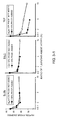
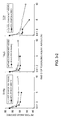
- a capsule filling test was conducted to assess whether flowability improvement affects variation in the filling amount per capsule. After striking, various carriers for nasal administration were filled into 50 capsules (gelatin, size-1 capsule) using a manual capsule filling device (a commercially available manual capsule filling machine; Cap-M-QuickTM, S.L. Sanderson and Co.), and the amount of filling in each capsule was determined to compare the variations. Table 7 shows the percentages of minimal and maximal filling amounts using the average filling amount for 50 capsules as standard, and the standard deviations (SDs) of the variations in the filling amounts (%) of 50 capsules. Fig. 4 shows filling variations among 50 capsules. Fig. 5 shows the relationship between the angle of repose and the variation in the filling amount per capsule (%).
- the variation in the filling amount per capsule was reduced by the combined use of Ceolus ® PH-F20JP (Asahi Kasei Chemicals Corporation) as a carrier, either Ceolus ® PH-301 (Asahi Kasei Chemicals Corporation) or cornstarch (Merck) as a flowability-enhancing agent, and tribasic calcium phosphate (Taihei Chemical Industrial Co., particles with a diameter of 38 ⁇ m or less were selected by sorting) as a fluidizing agent. It was found that the preparation H shown in Fig. 4 could be filled into capsules within the variation range of ⁇ 5%.
- Table 8 shows data related to the uniformity in capsule filling.
- Table 8 Uniformity in the filling amount per capsule DRUG MINIMUM (%) MAXIMUM (%) SD GRANISETRON EXAMPLE 1 96.0 102.9 2.1 COMPARATIVE EXAMPLE 1 84.1 120.7 6.4 COMPARATIVE EXAMPLE 2 89.3 117.5 5.0 ONDANSETRON EXAMPLE 3-1 94.5 104.9 2.5 EXAMPLE 3-2 95.0 106.0 2.6 COMPARATIVE EXAMPLE 3 82.3 120.1 5.5 MORPHINE EXAMPLE 4 93.7 104.4 2.4 EXAMPLE 5-1 95.9 103.2 2.1 EXAMPLE 5-2 95.2 103.0 2.2 EXAMPLE 6 92.0 108.4 3.2 COMPARATIVE EXAMPLE 4 80.3 122.2 7.3 COMPARATIVE EXAMPLE 5 87.5 117.7 5.7 COMPARATIVE EXAMPLE 5
- the degree of variation in the filling amount per capsule was evidently smaller in preparations obtained by combining various drugs with Ceolus ® PH-F20JP (Asahi Kasei Chemicals Corporation) as a carrier, either Ceolus ® PH-301 (Asahi Kasei Chemicals Corporation) or cornstarch (Merck) as a flowability-enhancing agent, and tribasic calcium phosphate (Taihei Chemical Industrial Co., particles with a diameter of 38 ⁇ m or less were selected by sorting) as a fluidizing agent.
- This tendency in capsule filling was the same as that of those carriers of nasal administration shown in Table 7 that did not contain drug.
- the nasal preparations of the present invention exhibited the effect of markedly improving uniformity in the filling amount per capsule.
- the collapsing property of piles of accumulated powdery carriers was tested to assess the flowability of powdery carriers using a method different from that used for determining the angle of repose.
- the test was conducted with the following procedure: powdery carriers were poured into a vessel of a particular volume (7.5-cm height x 2.5-cm width x 2.5-cm depth) from above, and after striking the powder at the top of the filled vessel, the filing weight (A) was determined. Then, a lateral wall of the vessel was removed and the weight (B) of the powder outflowing from the vessel was determined.
- This method enables one to numerically compare the sliding/outflowing effect of particles of powdery carriers.
- the ratio serves as an indicator as to whether powdery carriers flow evenly through the flow path of a capsule filling machine and flow evenly into the mortar with a particular volume placed on a rotating plate to determine the filling amount per capsule (see Fig. 6 ).
- the collapse-slide ratios of various carriers are shown in Table 9.
- Table 9 Ratio of particles collapsed/slid from a vessel MEAN RATIO OF PARTICLES COLLAPSED/SLID (%) SD PH-F20JP 0.0 0.0 PH-F20JP +10%PH-301 0.0 0.0 PH-F20JP +1%St-Mg 0.0 0.0 PH-F20JP +10%PH-301 +1%St-Mg 0.0 0.0 PH-F20JP +1%TALC 0.0 0.0 PH-F20JP +10%PH-301 +1%TALC 11.5 3.3 PH-F20JP +1%TCP 30.2 5.1 PH-F20JP +10%PH-301 +1%TCP 61.5 2.5 PH-F20JP +10%STARCH 0.0 0.0 PH-F20JP +10%STARCH +5%St-Mg 0.0 0.0 PH-F20JP +10%STARCH +5%TALC 8.
- talc or tribasic calcium phosphate was added, among cases where any one of magnesium stearate, talc, and tribasic calcium phosphate was added as a fluidizing agent to a mixture of Ceolus ® PH-F20JP (Asahi Kasei Chemicals Corporation) as a carrier and either Ceolus ® PH-301 (Asahi Kasei Chemicals Corporation) or cornstarch (Merck) as a flowability-enhancing agent.
- Ceolus ® PH-F20JP Asa carrier
- Ceolus ® PH-301 Ceolus ® PH-301
- cornstarch Merck
- nasal preparations of the present invention were demonstrated to have markedly improved collapsing/sliding property related to flowability.
- Various carriers (10, 25, or 50 mg) were filled with high accuracy into size-2 HPMC capsules, and the pump component of a nasal device was pressed with a constant external pressure (30 kPa).
- the spraying amount was determined based on the change in the weight of the nasal device.
- the pump component was pressed five times consecutively for Publizer ® , and once for Fit-lizer ® .
- a spray device that uses an air cylinder for pressing was prepared and used in the test. The minimal pressure when a healthy woman presses the pump is adopted as the external pressure (30 kPa) for pressing the pump component.
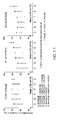
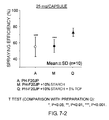
- Tables 11 and 12 show average spraying efficiencies of spraying and their standard deviations (SDs) for 10 capsules filled with each of the various powder carriers when they are sprayed using a nasal device. Corresponding diagrams are shown in Figs. 7-1 and 7-2 .
- the amount of the carrier of PH-F20JP plus PH-301 and tribasic calcium phosphate sprayed from a nasal device was demonstrated to be statistically significantly higher than that of other carriers.
- the spraying efficiency for the carrier of PH-F20JP plus PH-301 and tribasic calcium phosphate was found to be stably high, regardless of the changes in the amount of preparation in a capsule.
- the amount of the carrier of PH-F20JP plus starch and tribasic calcium phosphate sprayed from a nasal device was also demonstrated to be statistically significantly higher than that of other carriers.
- Preparations (25 mg) were filled with high accuracy into size-2 HPMC capsules, and the pump component of Publizer ® was pressed five times consecutively with a constant external pressure (30 kPa). The spraying amount was determined based on the change in the weight of the nasal device. A spray device that uses an air cylinder for pressing the pump component of the nasal device was prepared and used in the test. Table 13 shows average spraying efficiencies for 10 capsules and their standard deviations (SDs).
- the nasal preparations of the present invention showed increased uniformity and amount sprayed by the nasal device, and the spraying efficiency was constant regardless of the amount of preparation in a capsule. Accordingly, the nasal preparations of the present invention enable accurate dosages to be administered into a nasal cavity.
- the dosage of nasal preparation administered into a nasal cavity varies due to variations in the amount of preparation in a capsule and the amount sprayed by a device.
- the nasal preparations of the present invention improved uniformity in the amount filled in a capsule and the amount sprayed by a nasal device, and the improved uniformity is very important in terms of achieving steady and safe treatment by using adequate doses of drug.
- the nasal granisetron preparations prepared as described in Examples 1 and 2, and Comparative Example 1 were administered at a dose of 50 mg/head (equivalent to the granisetron dose of 2 mg/head) into the right nasal cavities of male cynomolgus monkeys (body weight: 4.62 to 7.10 kg). Nearly the full doses of the preparations were administered to the animals by pressing the pump of the nasal device until the full preparations were sprayed.
- the nasal morphine preparations obtained as described in Examples 4 to 6, and Comparative Example 4 were administered at a dose of 50 mg/head (equivalent to the morphine dose of 4 mg/head) into the right nasal cavities of male cynomolgus monkeys (body weight: 4.95 to 6.97 kg). Nearly the full doses of the preparations were administered to the animals by pressing the pump of the nasal device until the full preparations were sprayed.
- Plasma morphine concentration was determined by the HPLC method.
- Fig. 10 shows a time course of plasma morphine concentration.
- Table 15 shows plasma morphine concentrations and pharmacokinetic parameters.
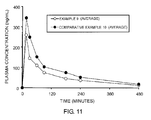
- the nasal sumatriptan preparations prepared as described in Example 9 and Comparative Example 10 were administered at a dose of 50 mg/head (equivalent to the sumatriptan dose of 6 mg/head) into the right nasal cavities of male cynomolgus monkeys (body weight: 5.86 to 6.79 kg). Nearly the full doses of the preparations were administered to the animals by pressing the pump of the nasal device until the full preparations were sprayed.
- Plasma sumatriptan concentration was determined by the HPLC method.
- Fig. 11 shows a time course of plasma sumatriptan concentration.
- Table 16 shows plasma sumatriptan concentrations and pharmacokinetic parameters.
- Example 9 Regarding the blood sumatriptan concentrations determined in Example 9 and Comparative Example 10-1, there was no difference in absorption between the two when considering the difference in the distribution volume due to the weight difference between the animals. Thus, the preparations of the present invention which have improved flowability were demonstrated to have no effect on the nasal absorption of sumatriptan.
- the nasal HMG preparations prepared as described in Example 15 and Comparative Example 16 were administered at a dose of 50 mg/head (equivalent to the FSH dose of 50 U/head) into the right nasal cavities of male cynomolgus monkeys (body weight: 5.61 to 6.91 kg). Nearly the full doses of the preparations were administered to the animals by pressing the pump of the nasal device until the full preparations were sprayed.
- Fig. 12 shows a time course of serum FSH concentration.
- Table 17 shows serum FSH concentrations and pharmacokinetic parameters.
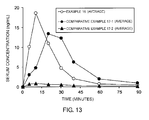
- the nasal PTH(1-34) preparations prepared as described in Example 16 and Comparative Example 17 were administered at a dose of 50 mg/head (equivalent to the PTH(1-34) dose of 120 ⁇ g/head) into the right nasal cavities of male cynomolgus monkeys (body weight: 5.97 to 6.74 kg).
- the nearly whole contents of the preparations were administered to the animals by pressing the pump of the nasal device until the whole amounts of preparations were sprayed.
- Fig. 13 shows a time course of serum PTH(1-34) concentration.
- Table 18 shows serum PTH(1-34) concentrations and pharmacokinetic parameters.
- Example 16 There was no marked difference in the absorption efficiency between Example 16 and Comparative Example 17-1. As can be seen from the difference in the Tmax value (time required to reach the maximal blood concentration), the absorption ofPTH(1-34) in Example 16 was accelerated. This suggests that the dispersibility of the nasal preparation improved and the intranasal distribution of the preparation sprayed by the nasal device became broad as a result of improved flowability, and thus the rate of PTH(1-34) absorption from nasal mucosa was increased. Furthermore, regarding the serum PTH(1-34) concentration after administration of the magnesium stearate-containing preparation of Example 17-2, the maximal blood concentration (Cmax) and the area under the blood concentration vs.
- Tmax time required to reach the maximal blood concentration
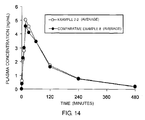
- the nasal fentanyl preparations prepared as described in Example 7-2 and Comparative Example 8 were administered at a dose of 25 mg/head (equivalent to the fentanyl dose of 100 ⁇ g/head) into the right nasal cavities of male cynomolgus monkeys (body weight of 6.41 to 7.26 kg). Nearly the full doses of the preparations were administered to the animals by pressing the pump of the nasal device until the full preparations were sprayed.
- Plasma fentanyl concentration was determined by the LC-MS/MS method.
- Fig. 14 shows a time course of plasma fentanyl concentration.
- Table 9 shows plasma fentanyl concentrations and pharmacokinetic parameters.
- Example 7-2 There was no difference in the blood fentanyl concentration between Example 7-2 and Comparative Example 8. Thus, the preparations of the present invention which have improved flowability were demonstrated to have no effect on the nasal absorption of fentanyl.
- Nasal preparations containing a complex of a physiologically active substance and a flowability-improving component of the present invention have superior flowability and are useful for nasal administrations. Furthermore, there is no difference in the nasal absorption between when a preparation of the present invention is nasally administered, and when a preparation that uses only the first crystalline cellulose as a carrier and contains the same amount of a physiologically active substance (a wide variety of drugs ranging from non-peptide/non-protein drugs, including low-molecular-weight drugs, to peptide/protein drugs) as the preparations of the present invention is sprayed under the same conditions.
- a physiologically active substance a wide variety of drugs ranging from non-peptide/non-protein drugs, including low-molecular-weight drugs, to peptide/protein drugs
- the present invention improves the productivity of preparations as well as the efficiency and uniformity of spraying preparations by nasal devices, and provides nasal preparations that achieve high drug absorption through nasal mucosa.
Landscapes
- Health & Medical Sciences (AREA)
- Chemical & Material Sciences (AREA)
- Life Sciences & Earth Sciences (AREA)
- Veterinary Medicine (AREA)
- Public Health (AREA)
- Medicinal Chemistry (AREA)
- General Health & Medical Sciences (AREA)
- Animal Behavior & Ethology (AREA)
- Pharmacology & Pharmacy (AREA)
- Epidemiology (AREA)
- Engineering & Computer Science (AREA)
- Bioinformatics & Cheminformatics (AREA)
- Chemical Kinetics & Catalysis (AREA)
- Organic Chemistry (AREA)
- Nuclear Medicine, Radiotherapy & Molecular Imaging (AREA)
- General Chemical & Material Sciences (AREA)
- Otolaryngology (AREA)
- Diabetes (AREA)
- Emergency Medicine (AREA)
- Rheumatology (AREA)
- Physical Education & Sports Medicine (AREA)
- Endocrinology (AREA)
- Inorganic Chemistry (AREA)
- Reproductive Health (AREA)
- Orthopedic Medicine & Surgery (AREA)
- Pulmonology (AREA)
- Pain & Pain Management (AREA)
- Biomedical Technology (AREA)
- Neurology (AREA)
- Hospice & Palliative Care (AREA)
- Gynecology & Obstetrics (AREA)
- Pregnancy & Childbirth (AREA)
- Obesity (AREA)
- Neurosurgery (AREA)
- Hematology (AREA)
- Medicinal Preparation (AREA)
- Pharmaceuticals Containing Other Organic And Inorganic Compounds (AREA)
- Medicines That Contain Protein Lipid Enzymes And Other Medicines (AREA)
- Medicines Containing Material From Animals Or Micro-Organisms (AREA)
Abstract
a first crystalline cellulose (A) having particular powder properties;
tribasic calcium phosphate (B) having particular powder properties; and
a second crystalline cellulose (C) or starch (D) having particular powder properties.
Description
- The present invention relates to nasal preparations. Specifically, the present invention relates to nasal preparations that enable high nasal drug absorption and have improved flowability for efficient productivity.
- Nasal administration of drugs has long been commonly used as a method for administering drugs with local effects such as in rhinitis treatments. However, nasal administration has also drawn attention as an administration route for drugs with systemic effects, for example, peptide/protein drugs such as insulin and calcitonin, and low molecular-weight drugs such as morphine. The reasons include the facts that nasal mucosa has well-developed vascular plexus and is histologically advantageous for drug absorption, drugs absorbed through nasal mucosa can avoid first-pass metabolism in the gastrointestinal tract and liver, and self administration is easy and painless.
- Methods for nasal drug administration include, for example, methods in which a drug is dissolved and the resulting liquid or suspension is administered and methods in which a drug is administered as a powdery preparation. In the market, nasal drugs in liquid form are more common than powdery nasal preparations. However, Ishikawa et al. have reported that powdery preparations are superior to liquid preparations in drug retention in a nasal cavity and thus show improved nasal drug absorption (Non-Patent Document 1). The same tendency has also been observed in the present inventors' studies. Also, in order to nasally administer a powdery drug preparation and achieve effective absorption and drug efficacy, it is preferable to administer the preparation in combination with a carrier. Many effective carriers have been reported. For example, divalent metal ions such as calcium with an average particle diameter of 250 µm or less have been disclosed as carriers for nasal administration (Patent Document 1). Also, according to a report (Patent Document 3), nasal drug absorption of a formulation containing water-absorbing and water-insoluble base such as crystalline cellulose was improved by combining it with a water-absorbing and gel-forming base such as hydroxypropyl cellulose, in comparison with a formulation containing crystalline cellulose alone (Patent Document 2). Meanwhile, the present inventors have reported that when used alone, crystalline cellulose of a particular particle size distribution enables efficient absorption of drugs, such as insulin, through nasal mucosa (
Patent Documents - Generally, required amounts of said effective powdery nasal preparations are delivered into the nasal cavity by methods, such as those that use a single-dose nasal administration device or the like utilizing capsules or blister packs which are filled by an automatic filling machine (
Patent Documents 7 and 8) or those that use a multiple-dose nasal administration device or the like containing a drug reservoir filled with the preparation and, at the time of use, a single dose amount is measured from the reservoir and dispensed in a small chamber and delivered into the nasal cavity (Patent Document 9). - Non-Patent Document 1: International Journal of Pharmaceutics, 224, 105-114, 2001
- Patent Document 1: Japanese Patent Application Kokai Publication No. (JP-A)
H08-27031 - Patent Document 2:
JP-A (Kokai) S59-163313 - Patent Document 3:
JP-A (Kokai) H10-59841 - Patent Document 4: International Patent Application Publication
WO 03-004048 JP-A (Kokai) 2003-206227 - Patent Document 6: International Patent Application Publication
WO 2006/016530 pamphlet Patent Document 7:JP-A (Kokai) H08-206208 - Patent Document 8:
JP-A (Kokai) 2003-154006 - Patent Document 9:
JP-A (Kokai) 2003-175103 - To improve productivity in the methods described above, it is necessary to be able to fill a pre-determined amount of powdery preparation into capsules with ease and high accuracy, or to dispense a pre-determined amount of powdery preparation with ease and high accuracy within a device. Thus, among the powder properties of powdery preparations, there is a need for high flowability.
- Various effective carriers of nasal administration for improving nasal drug absorption have been reported. One of such useful carriers for nasal administration is crystalline cellulose with a particular particle size distribution reported by the present inventors in International Patent Application Publication
WO 03-004048 JP-A (Kokai) 2003-206227 WO 2006/016530 pamphlet. - However, the flowability of conventional crystalline cellulose is poor, and thus it is still industrially problematic considering the manufacturing efficiency associated with the process of capsule filling by automated machines and the spraying efficiency of nasal devices.
- In general, to fill capsules or blister packs with a pre-determined amount of powdery preparation, an automated process must fill measuring cavities with a pre-determined amount of powdery preparation. In this filling process, because the flowability of a powdery preparation significantly affects the uniformity in the filling amount, having adequate flowability for the filling system is important for the quality of the filling, such as the variability in the amount, and stability in the filling process.
- Meanwhile, powdery nasal preparations need to be delivered into a nasal cavity from a capsule or blister pack by air flow generated by pressing the pump component of a nasal device. Since powdery preparations with poor flowability tend to remain in the preparation channel of a capsule or device, an adequate dose cannot be delivered into a nasal cavity and thus sometimes the expected therapeutic effect cannot be produced.
- Improving the flowability of a powdery preparation is usually attempted to solve these various flowability-associated problems. The most common method for improving the flowability of powdery preparations is adding lubricants such as magnesium stearate, or fluidizing agents such as talc and silicon dioxide. Such lubricants and fluidizing agents are thought to reduce the friction and adhesion among powder particles by adhering onto the powder surface and increasing the space among the particles and, as a result, produce the flowability-improving effect.
- Previously, the present inventors added the lubricants and fluidizing agents described above in an attempt to improve the poor flowability of crystalline cellulose which is useful as a carrier for nasal administration, but failed to improve the flowability to a satisfactory level.
- Thus, an objective of the present invention is to provide carriers and preparations with improved flowability, which deeply affects productivity in the process of automated capsule filling and issues related to a device's spray efficiency, by using a specific crystalline cellulose which is useful as a carrier of nasal administration and previously provided by the present inventors (hereinafter referred to as "first crystalline cellulose") (
WO 03-004048 JP-A (Kokai) 2003-206227 WO 2006/016530 ). - Another important objective is to improve the flowability using methods that have no influence on the effect of the crystalline cellulose to increase nasal drug absorption.
- To achieve the above-described objectives, the present inventors conducted dedicated studies on carriers that have improved flowability without affecting nasal drug absorption. As a result, the present inventors discovered that preparations containing a physiologically active substance and a powder flowability-improving component, obtained by combining a first crystalline cellulose with tribasic calcium phosphate and another particular crystalline cellulose (a second crystalline cellulose) or starch, had superior flowability, and the present inventors completed the present invention. Specifically, the present invention includes:
- [1] a nasal preparation, which comprises at least a complex of a physiologically active substance and a powder flowability-improving component comprising:
- crystalline cellulose (A), which is a first crystalline cellulose with an untapped bulk density of 0.13 to 0.29 g/cm3, a specific surface area of 1.3 m2/g or more, an average particle diameter of 30 µm or less, and an angle of repose of 55° or more;
- tribasic calcium phosphate (B); and
- crystalline cellulose (C), which is a second crystalline cellulose with an untapped bulk density of 0.26 to 0.48 g/cm3, a specific surface area of 1.3 m2/g or less, an angle of repose of 50° or less, and an average particle diameter of 150 µm or less, or starch (D) with an untapped bulk density of 0.35 to 0.65 g/cm3, a specific surface area of 1.3 m2/g or less, an angle of repose of 55° or less, and an average particle diameter of 150 µm or less;
the nasal preparation comprises the physiologically active substance at a weight ratio of 0.0001 1 to 1.2 in its free form without being converted to the salt form, when the total weight of the flowability-improving component is taken as 1; - [2] a nasal preparation, which comprises at least a complex of a physiologically active substance and a powder flowability-improving component comprising:
- crystalline cellulose (A), which is a first crystalline cellulose with an untapped bulk density of 0.13 to 0.29 g/cm3, a specific surface area of 1.3 m2/g or more, an average particle diameter of 30 µm or less, and an angle of repose of 55° or more;
- tribasic calcium phosphate (B); and
- crystalline cellulose (C), which is a second crystalline cellulose with an untapped bulk density of 0.26 to 0.48 g/cm3, a specific surface area of 1.3 m2/g or less, an angle of repose of 50° or less, an average particle diameter of 150 µm, or less, or starch (D) with an untapped bulk density of 0.35 to 0.65 g/cm3, a specific surface area of 1.3 m2/g or less, an angle of repose of 55° or less, an average particle diameter of 150 µm or less;
and the nasal preparation is produced by applying a shearing force to the first crystalline cellulose (A), tribasic calcium phosphate (B), second crystalline cellulose (C) or starch (D), and physiologically active substance, and mixing the physiologically active substance at a weight ratio of 0.0001 to 1.2 in its free form without being converted to the salt form, when the total weight of the flowability-improving component is taken as 1; - [3] the nasal preparation of [1] or [2], wherein the second crystalline cellulose (C) has an untapped bulk density of 0.35 to 0.46 g/cm3, a specific surface area of 1.0 m2/g or less, an angle of repose of 45° or less, and a average particle diameter of 75 µm or less;
- [4] the nasal preparation of any one of [1] to [3], wherein the average particle diameter of tribasic calcium phosphate (B) is 100 µm or less;
- [5] the nasal preparation of any one of [1] to [4], wherein the angle of repose is 53° or less;
- [6] the nasal preparation of any one of [1] to [5], wherein the physiologically active substance is a peptide/protein drug and/or a non-peptide/non-protein drug including a low-molecular-weight drug;
- [7] the nasal preparation of [6], wherein the peptide/protein drug is at least one selected from the group consisting of insulin, growth hormone, growth hormone releasing peptide, ghrelin, glucagon, calcitonin, interferon, erythropoietin, interleukin, PTH(1-84), PTH(1-34), PTH-related peptides, GLP-1, vasopressin, leuprorelin, granulocyte-colony stimulating factor, prolactin, human menopausal gonadotropin, chorionic gonadotropin, follicle stimulating hormone, luteinizing hormone, leptin, nerve growth factor (NGF), stem cell growth factor (SCGF), keratinocyte growth factor (KGF), thioredoxin, cyclosporin, influenza vaccine, and analogs thereof;
- [8] the nasal preparation of [6], wherein the non-peptide/non-protein drug including a low-molecular-weight drug is at least one selected from the group consisting of morphine, fentanyl, oxycodone, butorphanol, tramadol, granisetron, ondansetron, tropisetron, palonosetron, indisetron, sumatriptan, zolmitriptan, rizatriptan, naratriptan, ergotamine, triazolam, melatonin, carbamazepine, midazolam, donepezil, tiapride, cefaclor, enoxacin, aciclovir, zidvudine, didanosine, nevirapine, indinavir, dantrolene, digoxin, trihexyphenidyl, biperiden, dextromethorphan, naloxone, betahistine, naphazoline, diltiazem, tranilast, loperamide, diclofenac, beclomethasone, chlorpheniramine, sildenafil, vardenafil, cyanocobalamin, finasteride, epinephrine, 5-FU, low-molecular-weight heparin, tacrolimus, RNA, RNAi, siRNA, antisense DNA, and allergen extract powder; and
- [9] the nasal preparation of any one of [1] to [8], which further comprises a pH adjustor, preservative, stabilizer, flavor, absorbefacient, or substance that captures a divalent calcium ion.
- The nasal preparations of the present invention comprise at least one complex of a physiologically active substance and a flowability-improving component.
- Herein, the "powder flowability-improving component" refers to a component that is added to improve the flowability of nasal preparations of the invention of the present application. Such flowability-improving components include, for example, crystalline cellulose having particular powder properties, tribasic calcium phosphate, and starch.
- Herein, the "physiologically active substance" is not particularly limited, and includes drugs having systemic or local effects, drugs for enhancing biological defense function, drugs that target the brain, and peptide/protein drugs and non-peptide/non-protein drugs including low-molecular-weight drugs. The substance is not also limited by the type of derivatives, salts, or the like.
- Specifically, such peptide/protein drugs include, for example, insulin, growth hormone, growth hormone releasing peptide, ghrelin, glucagon, calcitonin, interferon, erythropoietin, interleukin, PTH(1-84), PTH(1-34), PTH-related peptides, GLP-1, vasopressin, leuprorelin, granulocyte-colony stimulating factor, prolactin, human menopausal gonadotropin, chorionic gonadotropin, follicle stimulating hormone, luteinizing hormone, leptin, nerve growth factor (NGF), stem cell growth factor (SCGF), keratinocyte growth factor (KGF), thioredoxin, cyclosporin, influenza vaccine, and analogs thereof. Of these, preferred peptide/protein drugs are insulin, PTH(1-34), and human menopausal gonadotropin.
- Specifically, the low-molecular-weight drugs include, for example, analgesic agents such as morphine, fentanyl, oxycodone, butorphanol, and tramadol; antiemetic agents such as granisetron, ondansetron, tropisetron, palonosetron, and indisetron; antimigraine agents such as sumatriptan, zolmitriptan, rizatriptan, naratriptan, and ergotamine; sleep-inducing agents such as triazolam and melatonin; anticonvulsants such as carbamazepine; sedatives such as midazolam; antidementia agents such as donepezil; brain activators such as tiapride; antibiotics such as cefaclor; antibacterial agents such as enoxacin; antiviral agents such as aciclovir, zidvudine, didanosine, nevirapine, and indinavir; muscle relaxants such as dantrolene; cardiac stimulants such as digoxin; therapeutic agents for Parkinson's disease such as trihexyphenidyl and biperiden; antitussive agents and expectorants such as dextromethorphan; respiratory stimulants such as naloxone; antidinic agents such as betahistine; angiotonic agents such as naphazoline; coronary vasodilators such as diltiazem; therapeutic agents for asthma such as tranilast; antidiarrheal agents such as loperamide; NSAIDs such as diclofenac; steroids such as beclomethasone; antihistamic agents such as chlorpheniramine; agents for improvement in sexual function such as sildenafil and vardenafil; vitamins such as cyanocobalamin; hair growing agents such as finasteride; antianaphylactic agents such as epinephrine; and antitumor agents such as 5-FU. Of these low-molecular-weight drugs, preferred drugs are morphine, granisetron, ondansetron, fentanyl, oxycodone, sumatriptan, zolmitriptan, beclomethasone, and ketotifen.
- In addition to the above examples, the low-molecular-weight drugs also include antithrombotic agents such as low-molecular-weight heparin; tacrolimus; RNA; RNAi; siRNA; antisense DNA; and allergen extract powder which is used in hyposensitization treatments for pollinosis.
- The ratio of physiologically active substance added in the nasal preparations of the present application depends on the type of physiologically active substance. The physiologically active substance is added at a weight ratio of preferably 0.0001 to 1.2, more preferably 0.01 to 0.6 in its free form without being converted to the salt form, when the total weight of the flowability-improving component is taken as 1.
- The present invention comprises the use of tribasic calcium phosphate to improve the flowability of a first crystalline cellulose, and the use of a specific second crystalline cellulose or starch to synergistically enhance the flowability-improving effect of the tribasic calcium phosphate.
- The flowability-improving effect provided by the present invention is not obtained when magnesium stearate or talc, both of which are commonly used as a lubricant or fluidizing agent, is used instead of tribasic calcium phosphate. Thus, the present invention is highly unique.
-
-
Fig. 1-1 shows the angles of repose when a fluidizing agent was added alone or added simultaneously with a flowability-enhancing agent (crystalline cellulose) to Ceolus® PH-F20JP. In this diagram, "St-Mg" indicates magnesium stearate; "TALC" indicates talc; "TCP" indicates tribasic calcium phosphate; "PH-F20JP" indicates Ceolus® PH-F20JP; "PH-101" indicates Ceolus® PH-101; "PH-102" indicates Ceolus® PH-102; "PH-301" indicates Ceolus® PH-301; and "PH-302" indicates Ceolus® PH-302. -
Fig. 1-2 shows the angles of repose when a fluidizing agent was added alone or added simultaneously with a flowability-enhancing agent (cornstarch) to Ceolus® PH-F20JP. In this diagram, "St-Mg" indicates magnesium stearate; "TALC" indicates talc; "TCP" indicates tribasic calcium phosphate; "PH-F20JP" indicates Ceolus® PH-F20JP; and "STARCH" indicates cornstarch. -
Fig. 2 shows the angles of repose when 1% tribasic calcium phosphate as a fluidizing agent and Ceolus® PH-101, Ceolus® PH-102, Ceolus® PH-301, Ceolus® PH-302, or cornstarch as a flowability-enhancing agent were added at various ratios to Ceolus® PH-F20JP. In this graph, "TCP" indicates tribasic calcium phosphate; "PH-101" indicates Ceolus® PH-101; "PH-102" indicates Ceolus® PH-102; "PH-301" indicates Ceolus® PH-301; "PH-302" indicates Ceolus® PH-302; and "STARCH" indicates cornstarch. -
Fig. 3-1 shows the angles of repose when tribasic calcium phosphate, magnesium stearate, or talc was added to Ceolus® PH-F20JP as a fluidizing agent at various ratios in combination with 10% Ceolus® PH-301 as a flowability-enhancing agent. In these graphs, "St-Mg" indicates magnesium stearate; "TALC" indicates talc; "TCP" indicates tribasic calcium phosphate; and "PH-301" indicates Ceolus® PH-301. -
Fig. 3-2 shows the angles of repose when tribasic calcium phosphate, magnesium stearate, or talc was added to Ceolus® PH-F20JP as a fluidizing agent at various ratios in combination with 10% cornstarch as a flowability-enhancing agent. In these graphs, "St-Mg" indicates magnesium stearate; "TALC" indicates talc; TCP indicates tribasic calcium phosphate; and "STARCH" indicates cornstarch. -
Fig. 4 shows variations in the filling amount when 50 capsules (gelatin, size 1) were filled with various compounding agents. The filling amount in each capsule is shown in percentage when the average filling amount is taken as standard. The various compounding agents used in the assessment include: fluidizing agents added alone to Ceolus® PH-F20JP, and fluidizing agents and flowability-enhancing agents added simultaneously to Ceolus® PH-F20JP. In these diagrams, "St-Mg" indicates magnesium stearate; "TALC" indicates talc; "TCP" indicates tribasic calcium phosphate; "PH-F20JP" indicates Ceolus® PH-F20JP; "PH-301" indicates Ceolus® PH-301; and "STARCH" indicates cornstarch. -
Fig. 5 shows the relationship between the angle of repose and variation in the filling amount (standard deviation when the average filling amount is taken as standard) when 50 capsules (gelatin, size 1) were filled with various compounding agents. The various compounding agents used in the assessment include: fluidizing agents added alone to Ceolus® PH-F20JP, and fluidizing agents and flowability-enhancing agents added simultaneously to Ceolus® PH-F20JP. In these graphs, "St-Mg" indicates magnesium stearate; "TALC" indicates talc; "TCP" indicates tribasic calcium phosphate; "PH-F20JP" indicates Ceolus® PH-F20JP; "PH-301" indicates Ceolus® PH-301; and "STARCH" indicates cornstarch. -
Fig. 6 is a diagram showing the procedure of collapse-slide test of carriers for nasal administration. -
Fig. 7-1 shows the spray efficiency (%) of a nasal device (Publizer®) for various compounding agents. The various compounding agents used in the assessment include: fluidizing agents added alone to Ceolus® PH-F20JP, and fluidizing agents and flowability-enhancing agent (crystalline cellulose) added simultaneously to Ceolus® PH-F20JP. In these diagrams, "St-Mg" indicates magnesium stearate; "TALC" indicates talc; "TCP" indicates tribasic calcium phosphate; "PH-F20JP" indicates Ceolus® PH-F20JP; and "PH-301" indicates Ceolus® PH-301. -
Fig. 7-2 is a diagram showing the spray efficiency (%) of a nasal device (Publizer®) for various compounding agents. The various compounding agents used in the assessment include: a flowability-enhancing agent (cornstarch) added alone to Ceolus® PH-F20JP, and fluidizing agent (tribasic calcium phosphate) and flowability-enhancing agent (cornstarch) added simultaneously to Ceolus® PH-F20JP. In this diagram, "TCP" indicates tribasic calcium phosphate; "PH-F20JP" indicates Ceolus® PH-F20JP; and "STARCH" indicates cornstarch. -
Fig. 8 is a diagram showing the spray efficiency (%) of a nasal device (Fit-lizer®) for various compounding agents. The various compounding agents used in the assessment include: fluidizing agents added alone to Ceolus® PH-F20JP, and fluidizing agents and flowability-enhancing agent (crystalline cellulose) added simultaneously to Ceolus® PH-F20JP. In this diagram, "St-Mg" indicates magnesium stearate; "TALC" indicates talc; "TCP" indicates tribasic calcium phosphate; "PH-F20JP" indicates Ceolus® PH-F20JP; and "PH-301" indicates Ceolus® PH-301. -
Fig. 9 is a graph showing the time course of plasma granisetron concentration after nasal administration of a nasal granisetron preparation to the monkeys. -
Fig. 10 is a graph showing the time course of plasma morphine concentration after administration of a nasal morphine preparation to the monkeys. -
Fig. 11 is a graph showing the time course of plasma sumatriptan concentration after administration of a nasal sumatriptan preparation to the monkeys. -
Fig. 12 is a graph showing the time course of serum FSH concentration after administration of a nasal HMG preparation to the monkeys. -
Fig. 13 is a graph showing the time course of serum PTH(1-34) concentration after administration of a nasal PTH(1-34) preparation to the monkeys. -
Fig. 14 is a graph showing the time course of plasma fentanyl concentration after administration of a nasal fentanyl preparation to the monkeys. - An embodiment of the nasal preparations of the present invention is nasal preparations comprising at least a complex of a physiologically active substance and a powder flowability-improving component comprising crystalline cellulose (A) (first crystalline cellulose) that has an untapped bulk density of 0.13 to 0.29 g/cm3, a specific surface area of 1.3 m2/g or more, an average particle diameter of 30 µm or less, and an angle of repose of 55° or more; tribasic calcium phosphate (B); and crystalline cellulose (C) (second crystalline cellulose) that has an untapped bulk density of 0.26 to 0.48 g/cm3, a specific surface area of 1.3 m2/g or less, an angle of repose of 50° or less, and an average particle diameter of 150 µm or less.
- In general, "crystalline cellulose" that can be used in the present invention includes crystalline cellulose obtained by decomposing cellulose materials such as pulp by either or both of acid and alkaline hydrolyses, then purifying the hydrolysate, and crushing or grinding it before, during, or after drying.
- More specifically, various types of Ceolus® and their derivatives can be used in the present invention after fine grinding using a high-speed rotary impact mill or air attrition mill as necessary, and size sorting for particles with a desired particle diameter; for example, crystalline cellulose whose average particle diameter is at most 30 µm and specific surface area is 1.3 m2/g (Japanese Patent Application Kokoku Publication No. (JP-B)
H05-038732 JP-B S39-12469 JP-B S56-38128 - Herein, "first crystalline cellulose (A)" refers to the above-described crystalline cellulose that have an untapped bulk density of 0.13 to 0.29 g/cm3, a specific surface area of 1.3 m2/g or more, an average particle diameter of 30 µm or less, and an angle of repose of 55°or more.
- The untapped bulk density of a first crystalline cellulose (A) is preferably 0.21 to 0.28 g/cm3. The specific surface area is preferably 1.8 to 6.0 m2/g, and more preferably 2.0 to 3.5 m2/g. The average particle diameter is preferably 10 to 25 µm, and more preferably 12 to 22 µm. The angle of repose is preferably 55° to 75°, and more preferably 59° to 70°.
- Specifically, such crystalline cellulose includes crystalline cellulose products that are available under the trade names of Ceolus®) PH-F20JP and Avicel® PH-105 from Asahi Kasei Chemicals Corporation and FMC Corporation (US), respectively, and can be used as they are or after they are sorted. Ceolus® PH-F20JP is a crystalline cellulose disclosed in
JP-A (Kokai) S63-267731 - "Tribasic calcium phosphate (B)" (also known as hydroxyapatite) used in the present invention is represented by the formula: 3Ca3(PO4)2-Ca(OH)2, and is added to improve flowability. The tribasic calcium phosphate that can be used in the present invention is not particularly limited; however, in consideration of the dispersity in crystalline cellulose mixtures, its average particle diameter is preferably 100 µm or less, more preferably 10 to 75 µm, and even more preferably 10 to 50 µm.
- The ratio of tribasic calcium phosphate added is not particularly limited, as long as it does not affect nasal drug absorption and can increase the flowability of preparations. However, the content of tribasic calcium phosphate (B) is 0.1 to 10 (W/W)%, preferably 0.5 to 5.0 (W/W)% of the total weight of the first crystalline cellulose (A), tribasic calcium phosphate (B), and second crystalline cellulose (C) ((A)+(B)+(C)).
- The "second crystalline cellulose (C)" used in the present invention refers to crystalline cellulose with an untapped bulk density of 0.26 to 0.48 g/cm3, a specific surface area of 1.3 m2/g or less, an angle of repose of 50° or less, and an average particle diameter of 150 µm or less. The second crystalline cellulose is added to improve flowability.
- The untapped bulk density of a second crystalline cellulose (C) is preferably 0.30 to 0.46 g/cm3, more preferably 0.38 to 0.43 g/cm3. The specific surface area is preferably 0.4 to 1.3 m2/g, and more preferably 0.5 to 1.0 m2/g. The average particle diameter is preferably 30 to 100 µm, and more preferably 40 to 75 µm. The angle of repose is preferably 30° to 50°, and more preferably 35° to 45°.
- Specifically, such second crystalline cellulose includes crystalline cellulose products that are available under the trade names of Ceolus®, and Avicel® PH-101, PH-102, PH-301, and PH-302 from Asahi Kasei Chemicals Corporation and FMC Corporation (US); and can be used as they are or after they are sorted. Particularly preferred second crystalline cellulose includes crystalline cellulose products that are available under the trade names of Ceolus® PH-301 and Avicel® PH-301.
- The ratio of second crystalline cellulose (C) added is not particularly limited, as long as it does not affect nasal drug absorption and can increase the flowability of preparations. However, the content is 5 to 30 (W/W)%, preferably 10 to 20 (W/W)% of the total weight of the first crystalline cellulose (A), tribasic calcium phosphate (B), and second crystalline cellulose (C) ((A)+(B)+(C)).
- The flowability-improving component used in this embodiment comprises a first crystalline cellulose (A), tribasic calcium phosphate (B), and a second crystalline cellulose (C). Such flowability-improving components are preferably powder.
- The angle of repose of the flowability-improving component in this embodiment depends on the ratios of added tribasic calcium phosphate and second crystalline cellulose. The angle is preferably 35° to 55°, and more preferably 40° to 53°. The flowability-improving component can drastically increase flowability compared to when only a first crystalline cellulose is used as a carrier.
- Furthermore, the angles of repose of the nasal preparations in this embodiment depend on the repose angles of the above-described flowability-improving components, the type and ratio of the added physiologically active substance, and the like. The angle is preferably 35° to 55°, and more preferably 40° to 53°. The flowability of the nasal preparations can be increased drastically as compared to nasal preparations using only a first crystalline cellulose as the carrier.
- Complexes comprising the above-described flowability-improving component and a physiologically active substance in this embodiment can be produced by mixing the above-described first crystalline cellulose (A), tribasic calcium phosphate (B), second crystalline cellulose (C), and physiologically active substance while applying a shearing force.
- In preparations containing a complex produced as such, it is not necessary that all of the first crystalline cellulose (A), tribasic calcium phosphate (B), second crystalline cellulose (C), and physiologically active substance contained in the preparations form the complex. As long as at least one complex is formed in the preparations, they are included in the present invention.
- Specifically, in this embodiment, the nasal preparations can be prepared using conventional methods that homogeneously mix powdery drugs with powdery flowability-improving components (for example, mortar, V-blender, and high shear mixer/stirrer). If required, malaxation after addition of water, freeze-drying, and a sorting step can be incorporated into the methods.
- The order of mixing is not particularly limited. The mixing methods include methods that mix a physiologically active substance with a first crystalline cellulose, add a second crystalline cellulose, and finally add and mix tribasic calcium phosphate; methods that first mix a physiologically active substance, second crystalline cellulose, and tribasic calcium phosphate together, and then add a first crystalline cellulose; and methods that mix a physiologically active substance with a first crystalline cellulose, and then add a second crystalline cellulose and tribasic calcium phosphate simultaneously.
- An alternative embodiment of the present invention is nasal preparations comprising at least a complex of a physiologically active substance and a powder flowability-improving component comprising crystalline cellulose (A) (first crystalline cellulose) with an untapped bulk density of 0.13 to 0.29 g/cm3, a specific surface area of 1.3 m2/g or more, an average particle diameter of 30 µm or less, and an angle of repose of 55° or more; tribasic calcium phosphate (B); and starch (D) with an untapped bulk density of 0.35 to 0.65 g/cm3, a specific surface area of 1.3 m2/g or less, an angle of repose of 55° or less, and an average particle diameter of 150 µm or less.
- The same first crystalline cellulose described above can be used as the first crystalline cellulose in this embodiment.
- The same tribasic calcium phosphate described above can be used as the tribasic calcium phosphate in this embodiment.
- The ratio of added tribasic calcium phosphate used in this embodiment is not particularly limited, as long as it does not affect nasal drug absorption and can increase the flowability of preparations. However, the ratio is 0.1 to 10 (W/W)%, preferably 0.5 to 5.0 (W/W)% of the total weight of the first crystalline cellulose (A), tribasic calcium phosphate (B), and starch (D) ((A)+(B)+(D)).
- "Starch (D)" used in the present invention refers to particles with an untapped bulk density of 0.35 to 0.65 g/cm3, a specific surface area of 1.3 m2/g or less, an angle of repose of 55° or less, and an average particle diameter of 150 µm or less. Such starch is added to increase flowability.
- The materials for starch of the present invention include corn and potato, but are not limited thereto.
- The untapped bulk density of starch (D) is preferably 0.35 to 0.60 g/cm3, and more preferably 0.40 to 0.60g/em3. The specific surface area is preferably 0.5 to 1.3 m2/g, and more preferably 0.7 to 1.0m2/g. The average particle diameter is preferably 30 to 100 µm, and more preferably 40 to 70 µm. The angle of repose is preferably 40° to 50°.
- Specifically, such starch (D) includes cornstarch (Merck).
- The ratio of added starch (D) is not particularly limited, as long as it does not affect nasal drug absorption and can increase the flowability of preparations. However, the ratio is preferably 5 to 30 (W/W)%, more preferably 10 to 20 (W/W)% of the total weight of the first crystalline cellulose (A), tribasic calcium phosphate (B), and starch (D) ((A)+(B)+(D)).
- The flowability-improving component used in this embodiment comprises a first crystalline cellulose (A), tribasic calcium phosphate (B), and starch (D). Such flowability-improving components are preferably powder.
- In this embodiment, the angle of repose of a flowability-improving component depends on the ratios of added tribasic calcium phosphate and starch. The angle is preferably 35° to 55°, and more preferably 40° to 53°. Thus, the flowability-improving component can drastically increase flowability compared to when only a first crystalline cellulose is used as the carrier.
- The same physiologically active substances described above can be used as the physiologically active substance in this embodiment.
- The angle of repose of the nasal preparations in this embodiment depends on the angle of repose of the above-described flowability-improving component, the type and ratio of the added physiologically active substance, and the like. The angle is preferably 35° to 55°, and more preferably 40° to 53°. The flowability of the nasal preparations can be drastically increased as compared to nasal preparations using only a first crystalline cellulose as the carrier.
- Complexes comprising the above-described flowability-improving component and physiologically active substance can be produced by mixing the above-described first crystalline cellulose (A), tribasic calcium phosphate (B), starch (D), and the physiologically active substance while applying a shearing force.
- In preparations containing the complex produced as described above, it is not necessary that all of the first crystalline cellulose (A), tribasic calcium phosphate (B), starch (D), and physiologically active substance contained in the preparations form complexes. As long as at least one complex is formed in the preparations, they are included in the present invention.
- Specifically, the nasal preparations can be prepared using conventional methods that homogeneously mix powdery drugs with powdery carriers for nasal administration (for example, mortar, V-type mixer, and high-speed mixer/stirrer). If required, malaxation after addition of water, freeze-drying, and a sorting step can be incorporated into the methods.
- The order of mixing is not particularly limited. The mixing methods include methods that mix a physiologically active substance with a first crystalline cellulose, add starch, and finally add and mix tribasic calcium phosphate; methods that first mix a physiologically active substance, starch, and tribasic calcium phosphate together, and then add a first crystalline cellulose; and methods that mix a physiologically active substance with a first crystalline cellulose, and then add starch and tribasic calcium phosphate simultaneously.
- Specific powder properties of various kinds of crystalline cellulose (Ceolus®, Asahi Kasei Chemicals Corporation; Avicel®, FMC Corporation) and a starch product (Merck) are listed in Table 1.
Table 1 Powder properties ITEM CRYSTALLINE CELLULOSE STARCH FIRST CRYSTALLINE CELLULOSE SECOND CRYSTALLINE CELLULOSE STARCH PH-F20JP PH-105 PH-101 PH-102 PH-301 PH-302 MEAN PARTICLE DIAMETER1 (µm) 20 20 50 90 50 90 - ACTUAL MEAN PARTICLE DIAMETER (µm) 19 18 55 95 55 100 68 UNTAPPED BULK DENSITY1 (g/cm3) 0.23 0.25 0.29 0.30 0.41 0.43 - ACTUAL UNTAPPED BULK DENSITY (g/cm3) 0.24 0.27 0.32 0.33 0.42 0.44 0.41 ACTUAL SPECIFIC SURFACE AREA (m2/g) 2.23 2.27 1.28 1.30 0.87 0.92 0.92 REPOSE ANGLE1 (DEGREE) >60 - 45 42 41 38 - ACTUALREPOSE ANGLE (DEGREE) 62 59 46 42 42 38 47 1Catalog values (Ceolus, http://www.ceolus.com/jpn/product/ceolus/index.html; Avicel, http://www.pformulate.com/mcch.htm).
PH-F20JP, Ceolus® PH-F20JP; PH-105, Avicel® PH-105; PH-101, Ceolus® PH-101; PH-102, Ceolus® PH-102; PH-301, Ceolus® PH-301; PH-302, Ceolus® PH-302; STARCH, comstarch. - Herein, the "average particle diameters" of Ceolus® PH-F20JP and Avicel® PH-105 were median diameters determined using a laser-diffraction particle size distribution analyzer, and the "average particle diameters" of other crystalline cellulose products were determined based on the particle size distribution by a sorting method.
- The "median diameter" refers to a diameter that divides particles into two groups of equal numbers: a group with greater diameters and a group with smaller diameters. The median diameter determined using a laser-diffraction particle size distribution analyzer corresponds to 50% volume in a determined cumulative particle size distribution curve.
- The average particle diameter determined by a sorting method corresponds to 50 (W/W)% on a cumulative particle size distribution curve obtained by sorting 10 g of crystalline cellulose or starch of use for ten minutes on a electromagnetic sieve shaker, using standard sieves (which meet Japanese Industrial Standards (JIS)) layered in the order of aperture sizes 38 45, 53, 75, 106, 180, and 300 µm, and weighing the sample that remained on each sieve. This procedure is based on the second method of particle size distribution test, among the general tests described in the Japanese Pharmacopoeia, Fourteenth Edition, Part I.
- Herein, "untapped bulk density" can be measured based on the second method for determination of bulk and tapped densities, among the general tests described in Part I of Supplement I to Japanese Pharmacopoeia, Fourteenth Edition. Specifically, the density can be determined by pouring the sample evenly from above into a cylindrical vessel with an inner diameter of 46 mm and a height of 110 mm (measured volume, 180 ml) through a 1000-µm JIS standard sieve, and weighing the sample after smoothly leveling off the top of the vessel.
- The untapped bulk density varies depending on particle size, shape, cohesion force, and such. In general, the untapped bulk density tends to decrease as the particle takes on a more irregular shape away from the sphere shape. Furthermore, as the particle diameter becomes smaller, the force of inter-particle cohesion, rather than the weight of particle itself, has more impact on the density, and thus the untapped bulk density tends to be smaller. However, there was no significant difference in the untapped bulk density between Ceolus® PH-101 and PH-102, or Ceolus® PH-301 and PH-302, which belong to the same series but differ in their average particle diameters. Therefore, in crystalline cellulose, the untapped bulk density is assumed to vary depending on factors other than particle diameter, for example, the difference in particle morphology such as particle shape. The untapped bulk density is an important parameter that characterizes particles.
- The measured untapped bulk densities were compared to the values shown in catalogs to assess the adequacy of the method for determining bulk densities employed in this examination. The measured densities were not different from the values shown in the catalogs.
- Herein, the "specific surface area" can be determined by the second method for determination of specific surface area (BET method), among the general tests described in the Japanese Pharmacopoeia, Fourteenth Edition, Part I. Specifically, the specific surface area can be determined based on the BET formula from the amount of nitrogen molecules adsorbed onto the powder surface after six hours of pre-vacuation at a fixed temperature (77.35 Kelvin).
- The specific surface area varies depending on particle size, surface properties, presence of pores, and the like. In general, as the particle diameter becomes smaller, the specific surface area tends to be greater. However, there was no significant difference in the specific surface area between Ceolus® PH-101 and PH-102 or Ceolus® PH-301 and PH-302, which belong to the same series but differ in their average particle diameters. As inferred from JP-B S56-38128, the reason is because crystalline cellulose is originally present as porous powder, and the specific surface area is not significantly altered even when the diameter is changed as a result of sorting. Specifically, the specific surface area of crystalline cellulose is assumed to vary depending on factors other than particle diameter, for example, particle morphology such as particle surface structure and number of pores. The great specific surface areas observed in Ceolus® PH-F20JP and Avicel® PH-105 become important values that indicate particle characteristics for crystalline cellulose with characteristic particle morphology.
- Herein, the "angle of repose" refers to a slope angle that can maintain a pile of powder accumulated in a way that it does not spontaneously collapse when dropped in the gravitational field. The angle can be measured by a funnel flow method. For example, measurement by the funnel flow method calculates the slope for a pile of powder that has been freely dropped through a funnel onto a disc and piled on a horizontal plane, based on the diameter of the circular bottom plane and the height of the powder pile.
- The angle of repose varies depending on particle size, surface properties, and the like. In general, the angle tends to be greater as the particle diameter becomes smaller. The angle of repose serves as an indicator for powder flowability, and a smaller angle of repose means higher powder flowability.
- The measured angles of repose were compared with the catalog values to assess the adequacy of the conventional funnel flow method for determining the angles of repose employed in this examination. There was no difference between the measured angles and catalog values.
- The average particle diameter, untapped bulk density, specific surface area, and angle of repose are representative characteristic values for identifying the physical properties of crystalline cellulose. The characteristic values of untapped bulk density, specific surface area, and angle of repose are complex parameters that are not simply dependent on the particle diameter alone. Crystalline cellulose can be characterized by specifying the respective particle properties. Those skilled in the art can readily determine the respective parameters according to the above-described measurement methods.
- In another embodiment of the present invention, other carriers or bases, pH adjustors, preservatives, stabilizers, flavors, and absorbefacients can be added to the above-described nasal preparations, as long as there is no adverse effect on the objective of the present invention. The carriers or bases include, for example, hydroxypropyl cellulose, alginic acid, chitosan, and gamma polyglutamate. The pH adjustors include, for example, dibasic sodium phosphate, citric acid, and sodium citrate. The preservatives include, for example, benzalkonium chloride. The flavors include, for example, D-sorbitol, glycyrrhizia, saccharin, and stevia. The absorbefacients include, for example, bile acid.
- Furthermore, when the divalent calcium ion of added tribasic calcium phosphate enhances multimer formation of negatively charged drugs via coordinate bonds or the like, and as a result reduces the nasal absorption of drugs, sodium alginate, sodium citrate, sodium glutamate, EDTA, or such can be added as a substance to capture divalent calcium ions.
- All prior art documents cited herein are incorporated herein by reference.
- Hereinbelow, the present invention will be described more specifically with reference to the Examples, but is not to be construed as being limited thereto.
- The angle of repose serves as a representative indicator for assessing powder flowability. In general, larger angle means poorer powder flowability. Table 2 shows the angles of repose determined when various ratios ((W/W)% of the total weight) of magnesium stearate (Wako Pure Chemical Industries), talc (Wako Pure Chemical Industries), tribasic calcium phosphate (Taihei Chemical Industrial Co., particles selected to have a diameter of 38 µm or less by sorting), Ceolus® PH-301 (Asahi Kasei Chemicals Corporation), or cornstarch (Merck) was added to Ceolus® PH-F20JP (Asahi Kasei Chemicals Corporation), a crystalline cellulose product (first crystalline cellulose) serving as an effective carrier for nasal administration.
- The above-described components were prepared by homogeneously mixing Ceolus® PH-F20JP with one selected from magnesium stearate, talc, tribasic calcium phosphate, Ceolus® PH-301, and cornstarch in a mortar under conditions of room temperature and a relative humidity of 60% or less.
Table 2 Angles of repose measured when a single agent was added ADDITION RATIO
((W/W) %)St-Mg TALC TCP PH-301 STARCH 0.5% 60.0 57.1 56.2 - - 1.0% 57.1 57.1 55.2 - - 2.0% 56.2 56.2 54.2 - - 5.0% 55.7 55.7 53.1 59.6 57.1 10.0% 56.2 55.2 50.8 58.4 57.1 20.0% - - - 56.7 57.1 St-Mg, magnesium stearate; TALC, talc; TCP, tribasic calcium phosphate; PH-301, Ceolus® PH-301; STARCH, cornstarch. - In comparison with when only Ceolus® PH-F20JP was added (62°), the angle of repose was slightly improved by adding magnesium stearate or talc. However, neither magnesium stearate nor talc produced a sufficient flowability-improving effect. On the other hand, the addition of tribasic calcium phosphate reduced the angle of repose according to the ratio of addition, and its effect was stronger than that of magnesium stearate or talc. Alternatively, when Ceolus® PH-301 or cornstarch was added at a ratio of 5% to 20%, the effect of reducing the angle of repose was barely observed even when compared with the addition of magnesium stearate or talc. Table 3,
Figs. 1-1 and1-2 show the angles of repose determined when one or two agents selected from one of magnesium stearate (Wako Pure Chemical Industries), talc (Wako Pure Chemical Industries), and tribasic calcium phosphate (Taihei Chemical Industrial Co., particles selected to have a diameter of 38 µm or less by sorting), and one of Ceolus® PH-101 (Asahi Kasei Chemicals Corporation), Ceolus® PH-102 (Asahi Kasei Chemicals Corporation), Ceolus® PH-301 (Asahi Kasei Chemicals Corporation), Ceolus® PH-302 (Asahi Kasei Chemicals Corporation), and cornstarch (Merck) as the second crystalline cellulose, were added at various ratios ((W/W)% of the total weight) to Ceolus® PH-F20JP (Asahi Kasei Chemicals Corporation), which is a crystalline cellulose product (the first crystalline cellulose) serving as an effective carrier for nasal administration. - The above-described components were prepared by the following procedure. First, Ceolus® PH-F20JP was mixed with any one selected from Ceolus PH-101, Ceolus® PH-102, Ceolus® PH-301, Ceolus® PH-302, and cornstarch in a mortar under the conditions of room temperature and a relative humidity of 60% or less. Then, any one selected from magnesium stearate, talc, and tribasic calcium phosphate was added, and the resulting mixture was mixed homogeneously.
Table 3 Angles of repose measured when a fluidizing agent and a flowability-enhancing agent were used in combination ADDITION RATIO ((W/W)%) 0.5% 1.0% 2.0% 5.0% St-Mg TALC TCP St-Mg TALC TCP St-Mg TALC TCP St-Mg TALC TCP 5% PH-101 - - - - - 55.2 - - 54.7 - - - PH-102 - - - - - 55.2 - - 55.2 - - - PH-301 - - 54.2 55.7 56.2 51.4 55.7 54.7 51.4 49.6 PH-302 - - - - - 54.2 - - 54.2 - - - STARCH - - 53.7 - - 53.1 - - 54.2 - - 50.8 10% PH-101 - - - 58.4 56.7 54.7 56.7 56.2 56.7 - PH-102 - - - - 58.4 55.7 55.2 56.2 55.2 55.2 - - - PH-301 57.7 56.9 54.7 57.7 56.7 50.8 55.2 56.2 50.2 55.7 55.2 48.9 PH-302 - - - 56.7 55.7 54.2 56.2 56.2 54.2 - - - STARCH 57.7 55.9 53.5 55.7 55.2 53.1 54.7 54.7 53.1 54.0 54.9 48.5 20% PH-101 - - - - - 53.7 - - 53.7 - - - PH-102 - - - - - 52.6 - - 52.6 - - - PH-301 - - 53.1 56.2 54.7 48.2 53.7 54.2 48.2 - - 47.6 PH-302 - - - - - 51.4 - - 52.6 - - - STARCH - 55.1 - - 51.4 - - 52.6 - - 48.5 St-Mg, magnesium stearate; TALC, talc; TCP, tribasic calcium phosphate; PH-101, Ceolus® PH-101; PH-102, Ceolus® PH-102; PH-341, Ceolus® PH-301; PH-302, Ceolus® PH-302; STARCH, cornstarch. - There was no difference in the angle of repose between using magnesium stearate or talc as a fluidizing agent in combination with crystalline cellulose or cornstarch. as a flowability-enhancing agent, and using magnesium stearate or talc alone. The combination was not found to produce any flowability-enhancing effect. By contrast, the combined use of tribasic calcium phosphate as a fluidizing agent and crystalline cellulose or cornstarch as a flowability-enhancing agent was found to produce the flowability-improving effect when compared with the use of it alone.
- In particular, when crystalline cellulose was used as a flowability-enhancing agent in combination, Ceolus® PH-301 was revealed to be most effective. Flowability was improved even when only 5 (W/W)% of Ceolus® PH-301 was added.
- Alternatively, the combined use of cornstarch as a flowability-enhancing agent at a content of 5 (W/W)% or more was also revealed to improve flowability.
- Furthermore, when tribasic calcium phosphate was used in combination with a crystalline cellulose product other than Ceolus® PH-301, the combination effect was detected when crystalline cellulose was added as a flowability-enhancing agent at a ratio of 20% or more (
Fig. 2 ). - It is noteworthy that crystalline cellulose and starch had almost no contribution on the flowability-improving effect when used alone, but enhanced flowability when used in combination with tribasic calcium phosphate.
- Furthermore, as shown in
Fig. 3-1 , the flowability-improving effect of the combined use of tribasic calcium phosphate and Ceolus® PH-301 was enhanced according to the ratio of tribasic calcium phosphate added, demonstrating that flowability can be controlled by adjusting the ratio of tribasic calcium phosphate. - In addition, as shown in
Fig. 3-2 , it was demonstrated that the flowability-improving effect of the combined use of tribasic calcium phosphate and cornstarch could be markedly improved by adding 5 (W/W)% or more of tribasic calcium phosphate. - Next, further investigation was carried out by adding various drugs to combinations of the flowability-improving components observed to have the flowability-improving effect. The combinations contain Ceolus® PH-F20JP (Asahi Kasei Chemicals Corporation) as a carrier for nasal administration, either Ceolus® PH-301 (Asahi Kasei Chemicals Corporation) or cornstarch (Merck) as a flowability-enhancing agent, and tribasic calcium phosphate (Taihei Chemical Industrial Co., particles selected to have a diameter of 38 µm or less by sorting) as a fluidizing agent.
- According to the formulations listed in Table 4, various preparations were prepared under the conditions of room temperature and a relative humidity of 60% or less. When the flowability-improving component comprised a first crystalline cellulose and tribasic calcium phosphate, preparations were prepared by first mixing a physiologically active substance and Ceolus® PH-F20JP together, and then mixing tribasic calcium phosphate with the resulting mixture.
- Alternatively, when the flowability-improving component comprised a first crystalline cellulose, tribasic calcium phosphate, and a second crystalline cellulose or starch, preparations were prepared by first mixing a physiologically active substance and Ceolus® PH-F20JP together, then adding Ceolus® PH-301 or cornstarch, and finally adding tribasic calcium phosphate to the resulting mixture in a mortar.
- The drugs that are used are granisetron hydrochloride (Chemagis), ondansetron hydrochloride (LKT Laboratories), and tropisetron hydrochloride (LKT Laboratories), all of which are antiemetic agents; morphine hydrochloride trihydrate (Takeda Pharmaceutical Company), fentanyl citrate (Fine Chemicals), and oxycodone hydrochloride (Mallinckrodt), all of which are analgesic agents; sumatriptan succinate (Tronto Research Chemicals) and zolmitriptan (Lundbeck), both of which are antimigraine agents; beclomethasone dipropionate (USP Convention) and ketotifen maleate (LKT Laboratories), both of which are therapeutic agents for rhinitis; human insulin (Intergen), a therapeutic agent for diabetes; human menopausal gonadotropin (Wako Pure Chemical Industries), a therapeutic agent for infertility; and parathyroid hormone (1-34) (Bachem), a therapeutic agent for osteoporosis.
Table 4 List of formulations for nasal preparations containing various drugs EXAMPLE COMPOSITION TOTAL AMOUNT DRUG* CARRIER FOR NASAL ADMINISTRATION FLOWABILITY-ENHANCING AGENT LUBRICANT/ FLUIDIZING AGENT PH-F20JP PH-301 STARCH St-Mg TALC TCP GRANISETRON EXAMPLE 1 0.40 g 8.45 g 1 g - - - 0.1g 10 g EXAMPLE 2 0.40 g 7.45 g 2 g - - - 0.1 g 10 g ONDANSETRON EXAMPLE 3-1 0.40 g 8.40 g 1 g - - - 0.1 g 10 g EXAMPLE 3-2 3.20 g 4.86 g 1 g - - - 0.15 g 10 g MORPHINE EXAMPLE 4 0.80 g 7.85 g 1 g - - - 0.1 g 10 g EXAMPLE 5-1 0.80 g 7.75 g 1 g - - - 0.2 g 10 g EXAMPLE 5-2 4.50 g 2.97 g 1 g - - - 0.1 g 10 g EXAMPLE 6 0.80 g 7.85 g - 1 g - - 0.1 g 10 g FENTANYL EXAMPLE 7-1 0.06 g 8.81 g 1 g - - - 0.1 g 10 g EXAMPLE 7-2 0.04 g 8.86 g 1 g - - - 0.08 g 10 g OXYCODONE EXAMPLE 8 1.50 g 7.23 g 1 g - - - 0.1 g 10 g SUMATRIPTAN EXAMPLE 9-1 1.20 g 7.22 g 1g g - - - 0.1 g 10 g EXAMPLE 9-2 4.00 g 3.30 g 1g - - - 0.1g 10 g BECLOMETASONE EXAMPLE 10 2.0 mg 8.898 g 1 g - - - 0.1 g 10 g KETOTIFEN EXAMPLE 11 2.0 mg 8.897 g 1 g - - - o.1g 10 g INSULIN EXAMPLE 12 121.7 mg
(3200 U)8.78 g 1 g - - - 0.1 g 10 g EXAMPLE 13 121.7 mg
(3200 U)8.68 g 1 g - - - 0.2 g 10 g EXAMPLE14 121.7 mg
(3200 U)8.78 g - 1 g - - 0.1 g 10 g HMG EXAMPLE 1 5 9.6 mg U)
(500 U)0.435 g 0.05 g - - - 0.005 g 0.5 g PTH(f-34) EXAMPLE 16 1.6 mg** 0.430 g 0.05 g - - - 0.004 g 0.5 g ZOLMITRIPTAN EXAMPLE 17 1.00 g 7.90 g 1 g - - - 0.1 g 10 g PH-F20JP, Ceolus® PH-F20JP; PH-301, Ceolus® PH-301; STARCH, cornstarch; St-Mg, magnesium stearate; TALC, talc; TCP, tribasic calcium phosphate.
HMG, human menopausal gonadotrophin; PTH(1-34), parathyroid hormone.
* Free base equivalent.
** Peptide content 76%. - Meanwhile, as comparative examples, some nasal preparations were prepared and assessed. The preparations were prepared by mixing various drugs with Ceolus®PH-F20JP (Asahi Kasei Chemicals Corporation) as a carrier for nasal administration in a mortar, or by mixing various drugs with Ceolus® PH-F20JP (Asahi Kasei Chemicals Corporation) as a carrier for nasal administration, either Ceolus® PH-301 (Asahi Kasei Chemicals Corporation) or cornstarch (Merck) as a flowability-enhancing agent, and either magnesium stearate (Wako Pure Chemical Industries) or talc (Wako Pure Chemical Industries) as a lubricant/fluidizing agent.
- According to the formulations listed in Table 5, various preparations were prepared under the conditions of room temperature and a relative humidity of 60% or less by the procedure described below.
- When only the first crystalline cellulose was used as a flowability-improving component, nasal preparations were prepared by mixing Ceolus® PH-F20JP with a physiologically active substance.
- When the flowability-improving component included the first crystalline cellulose and a lubricant/fluidizing agent, nasal preparations were prepared by first mixing Ceolus® PH-F20JP with a physiologically active substance and then adding magnesium stearate or talc thereto.
- When the flowability-improving component contained the first crystalline cellulose, a lubricant/fluidizing agent, and second crystalline cellulose or starch, nasal preparations were prepared by first mixing Ceolus® PH-F20JP with a physiologically active substance, then adding Ceolus® PH-301 or cornstarch, and finally adding magnesium stearate or talc thereto in a mortar.
Table 5 List of formulations for nasal preparations containing various drugs (Comparative Examples) COMPARATIVE EXAMPLE COMPOSITION TOTAL AMOUNT DRUG* CARRIER FOR NASAL ADMINISTRATION FLOWABILITY-ENHANCING AGENT LUBRICANT/ FLUIDIZING AGENT PH-F20JP PH-301 STARCH St-Mg TALC TCP GRANISETRON COMPARATIVE EXAMPLE 1 0.40 g 9.55 g - - - - - 10 g COMPARATIVE EXAMPLE 2 0.40 g 8.45 g 1 g - 0.01 g - - 10 g ONDAN SETRON COMPARATIVE EXAMPLE3 0.40 g 9.5 g - - - - - 10 g MORPHINE COMPARATIVE EXAMPLE 4 0.80 g 8.95 g - - - - - 10 g COMPARATIVE EXAMPLE 5 0.80 g 7.85 g 1 g - 0.1 g - - 10 g COMPARATIVE EXAMPLE 6 0.80 g 2.86 g 1 g - - 0.1 g - 10 g COMPARATIVE EXAMPLE 7 0.80 g 7.85 g - 1 g 0.1 g - - 10 g FENTANYL COMPARATIVE EXAMPLE 8 0.06 g 9.91 g - - - - - 10 g OXYCODONE COMPARATIVE EXAMPLE 9 1.50 g 8.33 g - - - - - 10 g SUMA TRIPTAN COMPARATIVE EXAMPLE 10-1 1.20 g 8.32 g - - - - - 10 g COMPARATIVE EXAMPLE 10-2 1.20 g 7.22 g 1 g - 0.1 g - - 10 g BECLOMETASONE COMPARATIVE EXAMPLE 11 2.0 mg 9.998 g - - - - 10 g KETOTIFEN COMPARATIVE EXAMPLE12 2.0 mg 9.997 g - - - - - 10 g INSULIN COMPARATIVE EXAMPLE 13 121.7 mg
(3200 U)9.88 g - - - - 10 g COMPARATIVE EXAMPLE 14 121.7 mg
(3200 U)8.78 g 1 g - 0.1 g - - 10 g COMPARATIVE EXAMPLE 15 121.7 mg
(3200 U)8.78 g - 1 g - 0.1 g - 10 g HMG COMPARATIVE EXAMPLE 16 9.6 mg
(500 U)0.490 g - - - - - 0.5 g PTH(1-34) COMPARATIVE EXAMPLE 17-1 1 1.6 mg** 0.498 g - - - - - 0.5 g COMPARATIVE EXAMPLE 17-2 1.6 mg** 0.444 g 0.05 g - 0.005 g - - 0.5 g ZOLMITRIPTAN COMPARATIVE EXAMPLE 18 1.00 g 9.00 g - - - - - 10 g PH-F20JP, Ceolus® PH-F20JP; PH-301, Ceolus® PH-301; STARCH, cornstarch; St-Mg, magnesium stearate; TALC, talc; TCP, tribasic calcium phosphate.
HMG, human menopausal gonadotrophin; PTH(1-34), parathyroid hormone.
* Free base equivalent.
** Peptide content 76%. - Table 6 shows the measurement results for the angles of repose of nasal preparations prepared according to the formulations shown in Tables 4 and 5.
Table 6 Angles of repose for various nasal preparations DRUG REPOSE ANGLE (DEGREE) GRANISETRON EXAMPLE 1 51.8 EXAMPLE 2 50.0 COMPARATIVE EXAMPLE 1 57.0 COMPARATIVE EXAMPLE 2 57.6 ONDANSETRON EXAMPLE 3-1 51.8 EXAMPLE 3-2 52.0 COMPARATIVE EXAMPLE 3 57.0 MORPHINE EXAMPLE 4 52.6 EXAMPLE 5-1 50.1 EXAMPLE 5-2 49.8 EXAMPLE 6 52.6 COMPARATIVE EXAMPLE 4 62.1 COMPARATIVE EXAMPLE 5 58.8 COMPARATIVE EXAMPLE 6 58.2 COMPARATIVE EXAMPLE 7 58.2 FENTANYL EXAMPLE 7-1 51.8 EXAMPLE 7-2 51.8 COMPARATIVE EXAMPLE 8 61.6 OXYCODONE EXAMPLE 8 52.6 COMPARATIVE EXAMPLE 9 62.1 SUMATRIPTAN EXAMPLE 9-1 51.8 EXAMPLE 9-2 51.3 COMPARATIVE EXAMPLE 10-1 61.6 COMPARATIVE EXAMPLE 10-2 57.7 BECLOMETASONE EXAMPLE 10 50.8 COMPARATIVE EXAMPLE 11 61.6 KETOTIFEN EXAMPLE 11 51.8 COMPARATIVE EXAMPLE 12 62.1 INSULIN EXAMPLE 12 51.8 EXAMPLE 13 50.1 EXAMPLE 14 52.6 COMPARATIVE EXAMPLE 13 59.4 COMPARATIVE EXAMPLE 14 57.6 COMPARATIVE EXAMPLE 15 56.3 ZOLMITRIPTAN EXAMPLE 17 50.1 COMPARATIVE EXAMPLE 18 59.4 - Regardless of the type of drug added, the nasal preparations of the present invention were shown to have an effect of reducing the angle of repose, that is, the flowability-improving effect. The same tendency in Table 3 was confirmed.
- Next, carriers containing various flowability-improving components were tested for variation in the filling amount per capsule to assess the flowability-improving effect.
- When a powder with poor flowability is used to fill capsules, in general, the filling amount tends to vary among capsules. This is because gaps tend to form among powder particles, and powder flow tends to be uneven due to poor flowability in pouring the powder into capsules. The variation in the filling amount per capsule markedly changes the amount of drug added, and results in variations in the single dosage of drug among capsules. Consequently, the uniformity in the filling amount per capsule contributes to the productivity of capsule preparations, and is an important factor for determining an adequate dosage.
- A capsule filling test was conducted to assess whether flowability improvement affects variation in the filling amount per capsule. After striking, various carriers for nasal administration were filled into 50 capsules (gelatin, size-1 capsule) using a manual capsule filling device (a commercially available manual capsule filling machine; Cap-M-Quick™, S.L. Sanderson and Co.), and the amount of filling in each capsule was determined to compare the variations. Table 7 shows the percentages of minimal and maximal filling amounts using the average filling amount for 50 capsules as standard, and the standard deviations (SDs) of the variations in the filling amounts (%) of 50 capsules.
Fig. 4 shows filling variations among 50 capsules.Fig. 5 shows the relationship between the angle of repose and the variation in the filling amount per capsule (%).Table 7 Uniformity of the filling amount per capsule MINIMUM (%) MAXIMUM (%) SD PH-F20JP 87.1 115.0 6.1 PH-F20JP +10%PH-301 91.3 112.8 5.0 PH-F20JP +1%St-Mg 90.6 109.8 5.2 PH-F20JP +10%PH-301 +1%St-Mg 91.8 115.3 4.4 PH-F20JP +1%TALC 91.7 109.4 4.3 PH-F20JP +10%PH-301 +1%TALC 87.8 109.7 5.2 PH-F20JP +1%TCP 92.1 107.8 4.0 PH-F20JP +10%PH-301 +1 %TCP 95.9 104.3 2.3 PH-F20JP +10%PH-301 +0.5%TCP 91.7 107.4 3.9 PH-F20JP +5%PH-301 +1%TCP 90.3 104.4 2.8 PH-F20JP +10%PH-301 +2%TCP 95.0 104.4 2.3 PH-F20JP +20%PH-301 +1%TCP 95.7 104.5 2.2 PH-F20JP +10%STARCH 87.8 109.7 4.9 PH-F20JP +10%STARCH+5%St-Mg 90.1 108.9 4.0 PH-F20JP +10%STARCH+5%TALC 90.5 136.1 7.0 PH-F20JP +5%TCP 91.4 107.8 3.9 PH-F20JP +10%STARCH+5%TCP 94.1 105.7 2.8 St-Mg, magnesium stearate; TALC, talc; TCP, tribasic calcium phosphate; PH-F20JP, Ceolus® PH-F20JP; PH-301, Ceolus® PH-301; STARCH, cornstarch. - As shown in
Fig. 4 , the variation in the filling amount per capsule was reduced by the combined use of Ceolus® PH-F20JP (Asahi Kasei Chemicals Corporation) as a carrier, either Ceolus® PH-301 (Asahi Kasei Chemicals Corporation) or cornstarch (Merck) as a flowability-enhancing agent, and tribasic calcium phosphate (Taihei Chemical Industrial Co., particles with a diameter of 38 µm or less were selected by sorting) as a fluidizing agent. It was found that the preparation H shown inFig. 4 could be filled into capsules within the variation range of±5%. - Alternatively, as shown in
Fig. 5 , there is a positive correlation between the angle of repose and the variation in the filling amount per capsule (%). Thus, the angle of repose is demonstrated to serve as an indicator for assessing the uniformity in capsule filling. - Next, various nasal preparations containing the drugs listed in Tables 4 and 5 were also tested for the capsule filling according to the same procedure. Table 8 shows data related to the uniformity in capsule filling.
Table 8 Uniformity in the filling amount per capsule DRUG MINIMUM (%) MAXIMUM (%) SD GRANISETRON EXAMPLE 1 96.0 102.9 2.1 COMPARATIVE EXAMPLE 1 84.1 120.7 6.4 COMPARATIVE EXAMPLE 2 89.3 117.5 5.0 ONDANSETRON EXAMPLE 3-1 94.5 104.9 2.5 EXAMPLE 3-2 95.0 106.0 2.6 COMPARATIVE EXAMPLE 3 82.3 120.1 5.5 MORPHINE EXAMPLE 4 93.7 104.4 2.4 EXAMPLE 5-1 95.9 103.2 2.1 EXAMPLE 5-2 95.2 103.0 2.2 EXAMPLE 6 92.0 108.4 3.2 COMPARATIVE EXAMPLE 4 80.3 122.2 7.3 COMPARATIVE EXAMPLE 5 87.5 117.7 5.7 COMPARATIVE EXAMPLE 6 85.1 120.3 6.3 COMPARATIVE EXAMPLE 7 84.0 121.1 5.9 FENTANYL EXAMPLE 7-2 95.2 104.0 2.3 COMPARATIVE EXAMPLE 8 85.9 113.5 5.3 OXYCODONE EXAMPLE 8 94.1 106.5 2.9 COMPARATIVE EXAMPLE 9 92.2 109.0 3.5 SUMATRIPTAN EXAMPLE 9-1 93.9 103.0 2.4 EXAMPLE 9-2 94.2 102.8 2.3 COMPARATIVE EXAMPLE 10-1 79.8 123.3 7.5 COMPARATIVE EXAMPLE 10-2 89.4 118.7 4.7 BECLOMETASONE EXAMPLE 10 95.3 104.8 2.2 COMPARATIVE EXAMPLE 11 83.7 119.0 5.9 KETOTIFEN EXAMPLE 11 96.1 103.8 2.3 COMPARATIVE EXAMPLE 12 85.9 121.3 6.2 INSULIN EXAMPLE 12 94.5 105.0 2.6 EXAMPLE 14 92.1 109.9 3.3 COMPARATIVE EXAMPLE 13 78.4 124.7 8.1 COMPARATIVE EXAMPLE 14 83.1 117.9 7.0 COMPARATIVE EXAMPLE 15 82.3 125.3 7.8 ZOLMITRIPTAN EXAMPLE 17 95.6 103.2 2.2 COMPARATIVE EXAMPLE 18 83.2 129.7 5.9 - The degree of variation in the filling amount per capsule was evidently smaller in preparations obtained by combining various drugs with Ceolus® PH-F20JP (Asahi Kasei Chemicals Corporation) as a carrier, either Ceolus® PH-301 (Asahi Kasei Chemicals Corporation) or cornstarch (Merck) as a flowability-enhancing agent, and tribasic calcium phosphate (Taihei Chemical Industrial Co., particles with a diameter of 38 µm or less were selected by sorting) as a fluidizing agent. This tendency in capsule filling was the same as that of those carriers of nasal administration shown in Table 7 that did not contain drug.
- As described above, due to the improved flowability of powdery preparations, the nasal preparations of the present invention exhibited the effect of markedly improving uniformity in the filling amount per capsule.
- Next, carriers containing various flowability-improving components were assessed for flowability by the collapse-slide test.
- The collapsing property of piles of accumulated powdery carriers was tested to assess the flowability of powdery carriers using a method different from that used for determining the angle of repose. The test was conducted with the following procedure: powdery carriers were poured into a vessel of a particular volume (7.5-cm height x 2.5-cm width x 2.5-cm depth) from above, and after striking the powder at the top of the filled vessel, the filing weight (A) was determined. Then, a lateral wall of the vessel was removed and the weight (B) of the powder outflowing from the vessel was determined. The ratio of outflow powder (= B/A x 100) was referred to as collapse-slide ratio and used as an indicator of flowability. This method enables one to numerically compare the sliding/outflowing effect of particles of powdery carriers. The ratio serves as an indicator as to whether powdery carriers flow evenly through the flow path of a capsule filling machine and flow evenly into the mortar with a particular volume placed on a rotating plate to determine the filling amount per capsule (see
Fig. 6 ). - The collapse-slide ratios of various carriers (averages in triplicate) are shown in Table 9.
Table 9 Ratio of particles collapsed/slid from a vessel MEAN RATIO OF PARTICLES COLLAPSED/SLID (%) SD PH-F20JP 0.0 0.0 PH-F20JP +10%PH-301 0.0 0.0 PH- F20JP + 1%St-Mg0.0 0.0 PH-F20JP +10%PH-301 +1%St-Mg 0.0 0.0 PH- F20JP + 1%TALC0.0 0.0 PH-F20JP +10%PH-301 +1%TALC 11.5 3.3 PH- F20JP + 1%TCP30.2 5.1 PH-F20JP +10%PH-301 +1%TCP 61.5 2.5 PH-F20JP +10%STARCH 0.0 0.0 PH-F20JP +10%STARCH +5%St-Mg 0.0 0.0 PH-F20JP +10%STARCH +5%TALC 8.9 2.6 PH-F20JP +10%STARCH +5%TCP 40.0 5.7 - As shown in Table 9, collapsing/sliding from the vessel was observed only in the preparations containing tribasic calcium phosphate, among cases where Ceolus® PH-F20JP (Asahi Kasei Chemicals Corporation) as a carrier, and any one of magnesium stearate, talc, and tribasic calcium phosphate as a fluidizing agent were added. Furthermore, collapsing/sliding from the vessel was also observed when talc or tribasic calcium phosphate was added, among cases where any one of magnesium stearate, talc, and tribasic calcium phosphate was added as a fluidizing agent to a mixture of Ceolus® PH-F20JP (Asahi Kasei Chemicals Corporation) as a carrier and either Ceolus® PH-301 (Asahi Kasei Chemicals Corporation) or cornstarch (Merck) as a flowability-enhancing agent. The preparations containing tribasic calcium phosphate as an additive were demonstrated to significantly more easily collapse and slide than preparations containing talc as an additive.
- Furthermore, various nasal preparations containing the drugs listed in Tables 4 and 5 were also assessed for the collapsing/sliding property according to the same procedure. The collapse-slide ratios (averages in triplicate) are shown in Table 10.
Table 10 Ratio of particles collapsed/slid from a vessel DRUG MEAN RATIO OF PARTICLES COLLAPSED/SLID (%) SD GRANISETRON EXAMPLE 1 63.1 2.1 COMPARATIVE EXAMPLE 1 0.0 0.0 COMPARATIVE EXAMPLE 2 0.0 0.0 ONDANSETRON EXAMPLE 3-1 60.8 1.7 EXAMPLE 3-2 58.7 1.0 COMPARATIVE EXAMPLE 3 0.0 0.0 MORPHINE EXAMPLE 4 61.0 1.8 EXAMPLE 5-1 65.9 2.6 EXAMPLE 5-2 69.8 1.3 EXAMPLE 6 28.7 3.4 COMPARATIVE EXAMPLE 4 0.0 0.0 COMPARATIVE EXAMPLE 5 0.0 0.0 COMPARATIVE EXAMPLE 6 7.1 3.0 COMPARATIVE EXAMPLE 7 0.0 0.0 FENTANYL EXAMPLE 7-2 70.1 3.0 COMPARATIVE EXAMPLE 8 0.0 0.0 OXYCODONE EXAMPLE 8 64.1 2.7 COMPARATIVE EXAMPLE 9 0.0 0.0 SUMATRIPTAN EXAMPLE 9-1 61.0 2.5 EXAMPLE 9-2 62.5 1.2 COMPARATIVE EXAMPLE 10-1 0.0 0.0 COMPARATIVE EXAMPLE 10-2 0.0 0.0 BECLOMETASONE EXAMPLE 10 65.0 2.9 COMPARATIVE EXAMPLE 11 0.0 0.0 KETOTIFEN EXAMPLE 11 64.6 3.2 COMPARATIVE EXAMPLE 12 0.0 0.0 INSULIN EXAMPLE 12 67.7 2.3 EXAMPLE 14 24.3 3.9 COMPARATIVE EXAMPLE 13 0.0 0.0 COMPARATIVE EXAMPLE 14 0.0 0.0 COMPARATIVE EXAMPLE 15 10.2 2.6 ZOLMITRIPTAN EXAMPLE 17 63.1 2.0 COMPARATIVE EXAMPLE 18 0.0 0.0 - Preparations obtained by combining various drugs with Ceolus® PH-F20JP (Asahi Kasei Chemicals Corporation) as a carrier, either Ceolus® PH-301 (Asahi Kasei Chemicals Corporation) or cornstarch (Merck) as a flowability-enhancing agent, and tribasic calcium phosphate (Taihei Chemical Industrial Co., particles with a diameter of 38 µm or less were selected by sorting) as a fluidizing agent were demonstrated to collapse and slide much more easily.
- As described above, the nasal preparations of the present invention were demonstrated to have markedly improved collapsing/sliding property related to flowability.
- Next, carriers containing various flowability-improving components were assessed for their spray efficiency by a nasal device.
- It is necessary to use a nasal device or such to spray a capsule powdery preparation into a nasal cavity, which is the administration site. Since the flowability of powdery preparations is an important factor that determines the amount of spray by a nasal device and the uniformity of spraying, the efficiencies of spray by a nasal device were compared among powdery carriers. The commercially available Publizer® (Teijin Pharma) and Fit-lizer® (Bioactis, Ltd.), which was under development, were used for assessment as nasal devices for capsule powdery preparations.
- Various carriers (10, 25, or 50 mg) were filled with high accuracy into size-2 HPMC capsules, and the pump component of a nasal device was pressed with a constant external pressure (30 kPa). The spraying amount was determined based on the change in the weight of the nasal device. The pump component was pressed five times consecutively for Publizer®, and once for Fit-lizer®. In order to press the pump component of a nasal device with a constant pressure, a spray device that uses an air cylinder for pressing was prepared and used in the test. The minimal pressure when a healthy woman presses the pump is adopted as the external pressure (30 kPa) for pressing the pump component.
- Tables 11 and 12 show average spraying efficiencies of spraying and their standard deviations (SDs) for 10 capsules filled with each of the various powder carriers when they are sprayed using a nasal device. Corresponding diagrams are shown in
Figs. 7-1 and7-2 .Table 11 Efficiency of spray by the Publizer nasal device NASAL DEVICE: PUBLIZER CAPSULE FILLING AMOUNT (mg/CAPSULE) MEAN SPRAYING EFFICIENCY (%) SD PH- F20JP 10 64.2 9.6 25 54.9 12.2 50 57.0 10.4 PH-F20JP +10%PH-301 10 69.9 10.0 25 56.7 9.6 50 58.4 7.3 PH-F20JP +10%PH-301 +1%St- Mg 10 70.5 7.8 25 62.8 8.7 50 58.0 6.7 PH-F20JP +10%PH-301 +1 %TALC 10 66.7 14.0 25 63.2 8.2 50 57.8 8.1 PH- F20JP + 1%TCP 10 71.2 8.0 25 69.7 8.0 50 66.0 8.1 PH-F20JP +10%PH-301 +1 %TCP 10 78.9 3.4 25 82.7 5.2 50 76.0 7.7 PH-F20JP +10 %STARCH 25 57.8 9.7 PH-F20JP +10%STARCH+5 %TCP 25 72.9 5.2 St-Mg, magnesium stearate; TALC, talc; TCP, tribasic calcium phosphate; PH-F20JP, Ceolus® PH-F20JP; PH-301, Ceolus® PH-301; STARCH, cornstarch. Table 12 Efficiency of spray by a nasal device (Fit-lizer) NASAL DEVICE: FIT-LIZER CAPSULE FILLING AMOUNT (mg/CAPSULE) MEAN SPRAYING EFFICIENCY (%) SD PH- F20JP 50 91.0 4.7 PH-F20JP +10%PH-301 50 92.3 2.9 PH-F20JP +10%PH-301 +1%St- Mg 50 92.5 2.1 PH-F20JP +10%PH-301 +1 %TALC 50 92.7 2.6 PH- F20JP + 1%TCP 50 93.2 2.5 PH-F20JP +10%PH-301 +1 %TCP 50 95.2 0.7 St-Mg, magnesium stearate; TALC, talc; TCP, tribasic calcium phosphate; PH-F20JP, Ceolus® PH-F20JP; PH-301, Ceolus® PH-301. - As clearly seen in Tables 11 and 12, and
Figs. 7-1 and8 , the amount of the carrier of PH-F20JP plus PH-301 and tribasic calcium phosphate sprayed from a nasal device was demonstrated to be statistically significantly higher than that of other carriers. Furthermore, as shown inFig. 7-2 , the spraying efficiency for the carrier of PH-F20JP plus PH-301 and tribasic calcium phosphate was found to be stably high, regardless of the changes in the amount of preparation in a capsule. In addition, as shown inFig. 7-2 , the amount of the carrier of PH-F20JP plus starch and tribasic calcium phosphate sprayed from a nasal device was also demonstrated to be statistically significantly higher than that of other carriers. - Various nasal preparations containing the drugs listed in Tables 4 and 5 were also assessed for the efficiency of spray by the nasal device.
- Preparations (25 mg) were filled with high accuracy into size-2 HPMC capsules, and the pump component of Publizer® was pressed five times consecutively with a constant external pressure (30 kPa). The spraying amount was determined based on the change in the weight of the nasal device. A spray device that uses an air cylinder for pressing the pump component of the nasal device was prepared and used in the test. Table 13 shows average spraying efficiencies for 10 capsules and their standard deviations (SDs).
Table 13 Efficiency of spray by the Publizer nasal device NASAL DEVICE: PUBLIZER CAPSULE FILLING AMOUNT (mg/CAPSULE) MEAN SPRAYING EFFICIENCY (%) SD GRANISETRON EXAMPLE 1 25 79.1 3.4 COMPARATIVE EXAMPLE 1 25 52.4 10.4 COMPARATIVE EXAMPLE 2 25 56.4 8.7 ONDANSETRON EXAMPLE 3-1 25 77.5 4.8 EXAMPLE 3-2 25 79.4 4.5 COMPARATIVE EXAMPLE 3 25 51.1 10.7 MORPHINE EXAMPLE 4 25 78.3 3.6 EXAMPLE 5-1 25 80.1 2.6 EXAMPLE 5-2 25 83.9 2.5 EXAMPLE 6 25 73.8 6.0 COMPARATIVE EXAMPLE 4 25 48.1 10.0 COMPARATIVE EXAMPLE 5 25 50.5 7.9 COMPARATIVE EXAMPLE 6 25 46.8 8.0 COMPARATIVE EXAMPLE 7 25 47.8 9.2 FENTANYL EXAMPLE 7-2 25 82.3 3.8 COMPARATIVE EXAMPLE 8 25 56.9 10.2 OXYCODONE EXAMPLE 8 25 77.4 4.7 COMPARATIVE EXAMPLE 9 25 64.0 9.1 SUMATRIPTAN EXAMPLE 9-1 25 83.5 3.5 EXAMPLE 9-2 25 83.8 2.6 COMPARATIVE EXAMPLE 10-1 25 55.5 10.4 COMPARATIVE EXAMPLE 10-2 25 58.2 8.0 BECLOMETASONE EXAMPLE 10 25 81.3 5.1 COMPARATIVE EXAMPLE 11 25 52.5 10.5 KETOTIFEN EXAMPLE 11 25 80.2 4.6 COMPARATIVE EXAMPLE 12 25 53.3 10.1 INSULIN EXAMPLE 12 25 79.7 3.4 EXAMPLE 14 25 74.1 6.3 COMPARATIVE EXAMPLE 13 25 50.7 10.4 COMPARATIVE EXAMPLE 14 25 51.1 10.0 COMPARATIVE EXAMPLE 15 25 48.6 9.2 HMG EXAMPLE 15 25 8.6 3.2 COMPARATIVE EXAMPLE 16 25 49.6 9.8 PTH(1-34) EXAMPLE 16 25 83.3 3.0 COMPARATIVE EXAMPLE 17-1 25 54.7 9.8 COMPARATIVE EXAMPLE 17-2 25 50.9 9.0 ZOLMITRIPTAN EXAMPLE 17 25 79.5 3.7 COMPARATIVE EXAMPLE 18 25 56.3 11.3 - It was demonstrated that the amount sprayed by the nasal device was increased and the degree of variation was reduced when preparations were produced by combining various drugs with Ceolus® PH-F20JP (Asahi Kasei Chemicals Corporation) as a carrier, either Ceolus® PH-301 (Asahi Kasei Chemicals Corporation) or cornstarch (Merck) as a flowability-enhancing agent, and tribasic calcium phosphate (Taihei Chemical Industrial Co.; particles with a diameter of 38 µm or less were selected by sorting) as a fluidizing agent.
- As described above, the nasal preparations of the present invention showed increased uniformity and amount sprayed by the nasal device, and the spraying efficiency was constant regardless of the amount of preparation in a capsule. Accordingly, the nasal preparations of the present invention enable accurate dosages to be administered into a nasal cavity.
- The dosage of nasal preparation administered into a nasal cavity varies due to variations in the amount of preparation in a capsule and the amount sprayed by a device. In that regard, the nasal preparations of the present invention improved uniformity in the amount filled in a capsule and the amount sprayed by a nasal device, and the improved uniformity is very important in terms of achieving steady and safe treatment by using adequate doses of drug.
- Next, animal tests were performed to assess the preparations of the present invention with improved flowability for the effect on nasal drug absorption.
- Using a nasal device (Fit-lizer®, Bioactis, Ltd.), the nasal granisetron preparations prepared as described in Examples 1 and 2, and Comparative Example 1 were administered at a dose of 50 mg/head (equivalent to the granisetron dose of 2 mg/head) into the right nasal cavities of male cynomolgus monkeys (body weight: 4.62 to 7.10 kg). Nearly the full doses of the preparations were administered to the animals by pressing the pump of the nasal device until the full preparations were sprayed.
- Blood was collected from the
femoral vein Fig. 9 shows a time course of plasma granisetron concentration. Table 14 shows plasma granisetron concentrations and pharmacokinetic parameters.Table 14 Plasma granisetron concentration GRANISETRON TIME (MIN) / PLASMA CONCENTRATION (ng/mL) PK PARAMETER 5 10 30 60 120 240 480 Tmax (min) Cmax (ng/mL) AUC0-480 (ng-min/mL) EXAMPLE 1 ANIMAL 1 (7.00kg) 23.8 44.6 99.2 53.6 34.6 9.5 N.D. 30 99.2 10392.5 ANIMAL 2 (5.99kg) 17.7 68.2 58.2 47.3 14.2 8.1 N.D. 10 68.2 7788.5 MEAN (6.50kg) 20.8 56.4 78.7 50.5 24.4 8.8 N.D. 20 83.7 9090.5 EXAMPLE2 ANIMAL 1 (5.77kg) 24.1 44.8 53.5 46.3 26.0 12.8 5.0 30 53.5 9345.5 ANIMAL 2 (7.10kg) 49.6 61.9 48.3 47.2 19.5 13.9 N.D. 10 61.9 8610.3 MEAN (6.44kg) 36.9 53.4 50.9 46.8 22.8 13.4 N.D. 20 57.7 8977.9 COMPARATIVE EXAMPLE 1 ANIMAL 1 (6.51kg) 14.2 37.5 58.9 47.4 18.8 6.4 N.D. 30 58.9 6989.3 ANIMAL 2 (4.62kg) 24.6 92.4 83.8 54.4 21.8 9.0 N.D. 10 92.4 9403.0 MEAN (5.57kg) 19.4 65.0 71.4 50.9 20.3 7.7 N.D. 20 75.7 8196.1 N.D.: below the limit of determination (< 5 ng/mL)
Tmax: time required to reach the maximal blood drug concentration
Cmax: maximal blood drug concentration
AUC: area under the blood drug concentration vs. time curve - There was no difference in the blood granisetron concentration between Examples 1 and 2, and Comparative Example 1. Thus, the preparations of the present invention which have improved flowability were demonstrated to have no effect on the nasal absorption of granisetron.
- Using a nasal device (Fit-lizer®, Bioactis, Ltd.), the nasal morphine preparations obtained as described in Examples 4 to 6, and Comparative Example 4 were administered at a dose of 50 mg/head (equivalent to the morphine dose of 4 mg/head) into the right nasal cavities of male cynomolgus monkeys (body weight: 4.95 to 6.97 kg). Nearly the full doses of the preparations were administered to the animals by pressing the pump of the nasal device until the full preparations were sprayed.
- Blood was collected from the
femoral vein Fig. 10 shows a time course of plasma morphine concentration. Table 15 shows plasma morphine concentrations and pharmacokinetic parameters.Table 15 Plasma morphine concentration MORPHINE TIME (MIN) / PLASMA CONCENTRATION (ng/mL) PK PARAMETER 5 10 20 30 60 120 240 Tmax (min) Cmax (ng/mL) AUC0-240 (ng-min/mL) EXAMPLE 4 ANIMAL 1 (5.84kg) 143.3 153.5 129.9 93.5 51.0 32.3 10.6 10 163.5 10877.1 ANIMAL 2 (6.63kg) 146.0 168.0 110.9 83.6 42.6 36.9 12.9 10 168.0 10783.2 MEAN (6.24kg) 144.7 160.8 120.4 88.6 46.8 34.6 11.7 10 160.8 10830.1 EXAMPLE 5 ANIMAL 1 (5.87kg) 130.0 110.1 51.9 46.9 72.4 47.5 N.D. 5 130.0 10465.8 ANIMAL 2 (5.96kg) 226.8 169.9 124.0 99.2 44.3 21.6 N.D. 5 226.8 9569.8 MEAN (5.92kg) 178.4 140.0 88.0 73.1 58.4 34.6 N.D. 5 178.4 10017.8 EXAMPLE 6 ANIMAL 1 (5.80kg) 168.4 150.7 94.4 79.8 59.4 22.5 N.D. 5 168.4 9210.3 ANIMAL 2 (6.97kg) 220.9 157.8 122.2 112.2 79.9 48.4 N.D. 5 220.9 13705.5 MEAN (6.39kg) 194.7 154.3 108.3 96.0 69.7 35.5 N.D. 5 194.7 11457.9 COMPARATIVE EXAMPLE 4 ANIMAL 1 (5.74kg) 143.7 172.9 101.8 79.7 45.2 - N.D. 10 172.9 9987.0 ANIMAL 2 (4.94kg) 82.5 120.2 104.4 120.7 89.3 - 15.8 10 120.2 15572.2 MEAN (5.34kg) 113.1 146.5 103.1 100.2 67.2 - 7.9 10 146.6 12779.6 COMPARATIVE EXAMPLE 5 ANIMAL 1 (5.94kg) 86.9 78.4 67.6 66.6 42.0 20.7 N.D 5 86.9 6783.5 ANIMAL 2 (6.48kg) 95.9 109.0 73.1 59.5 40.7 21.1 N.D 10 109.0 6948.5 MEAN (6.21kg) 91.4 93.7 70.4 63.1 41.4 20.9 N.D 7.5 98.0 6866.0 - There was no difference in the blood morphine concentration between Examples 4 to 6, and Comparative Example 4. Thus, the preparations of the present invention which have improved flowability were demonstrated to have no effect on the nasal absorption of morphine. Furthermore, regarding the plasma morphine concentration after administration of the magnesium stearate-containing preparation of Comparative Example 5, the maximal blood concentration (Cmax) decreased down to 50% and the area under the blood concentration vs. time curve decreased down to 54%, as compared with those of other Examples and Comparative Example 4. This suggests that the structural lipid-soluble portion of magnesium stearate, which is a fatty acid, inhibits the affinity of drug to nasal mucus when it is in contact and as a result, the drug absorption was decreased.
- Using a nasal device (Fit-lizer®, Bioactis, Ltd.), the nasal sumatriptan preparations prepared as described in Example 9 and Comparative Example 10 were administered at a dose of 50 mg/head (equivalent to the sumatriptan dose of 6 mg/head) into the right nasal cavities of male cynomolgus monkeys (body weight: 5.86 to 6.79 kg). Nearly the full doses of the preparations were administered to the animals by pressing the pump of the nasal device until the full preparations were sprayed.
- Blood was collected from the
femoral vein Fig. 11 shows a time course of plasma sumatriptan concentration. Table 16 shows plasma sumatriptan concentrations and pharmacokinetic parameters.Table 16 Plasma sumatriptan concentration SUMATRIPTAN TIME (MIN) / PLASMA CONCENTRATION (ng/mL) PK PARAMETER 15 30 60 90 180 240 480 Tmax (min) Cmax (ng/mL) AUC0-480 (ng-min/mL) EXAMPLE 9 ANIMAL 1 (6.79kg) 314.8 177.7 139.3 78.0 45.2 32.7 10.7 15 314.8 27158.3 ANIMAL 2 (6.61kg) 203.9 111.6 81.3 70.3 44.5 41.6 15.4 15 203.9 23652.0 MEAN (6.70kg) 259.4 144.7 110.3 74.2 44.9 37.2 13.1 15 259.4 25405.1 COMPARATIVE EXAMPLE10-1 ANIMAL 1 (5.86kg) 317.8 307.3 191.5 130.2 100.6 68.9 26.3 15 317.8 46274.3 ANIMAL 2 (5.88kg) 370.5 191.3 114.0 75.0 49.6 35.3 9.8 15 370.5 27972.8 MEAN (5.87kg) 344.2 249.3 152.8 102.6 75.1 52.1 18.1 15 344.2 37123.5 Tmax: time required to reach the maximal blood drug concentration
Cmax: maximal blood drug concentration
AUC: area under the blood drug concentration vs. time curve - Regarding the blood sumatriptan concentrations determined in Example 9 and Comparative Example 10-1, there was no difference in absorption between the two when considering the difference in the distribution volume due to the weight difference between the animals. Thus, the preparations of the present invention which have improved flowability were demonstrated to have no effect on the nasal absorption of sumatriptan.
- Using a nasal device (Fit-lizer®, Bioactis, Ltd.), the nasal HMG preparations prepared as described in Example 15 and Comparative Example 16 were administered at a dose of 50 mg/head (equivalent to the FSH dose of 50 U/head) into the right nasal cavities of male cynomolgus monkeys (body weight: 5.61 to 6.91 kg). Nearly the full doses of the preparations were administered to the animals by pressing the pump of the nasal device until the full preparations were sprayed.
- Blood was collected from the femoral vein 0.5, 1, 2, 4, 6, 12, and 24 hours after administration, and serum FSH concentration was determined by EIA (IBL Co.).
Fig. 12 shows a time course of serum FSH concentration. Table 17 shows serum FSH concentrations and pharmacokinetic parameters.Table 17 Serum FSH concentration FSH TIME (HR) / SERUM CONCENTRATION (mU/mL) PK PARAMETER 0.5 1 2 4 6 12 24 Tmax (min) Cmax (mU/mL) AUC0-24 (mU-min/mL) EXAMPLE 15 ANIMAL 1 (5.61kg) 1.5 3.3 5.0 6.5 6.6 5.8 2.8 6 6.6 7173.0 ANIMAL 2 (6.70kg) 2.8 4.4 5.9 6.5 5.9 4.7 2.8 4 6.5 6545.7 MEAN (6.16kg) 2.2 3.9 5.5 6.5 6.2 5.3 2.8 5 6.6 6859.4 COMPARATIVE EXAMPLE 16 ANIMAL 1(5.72kg) 0.0 3.0 5.5 8.1 7.4 5.8 3.0 4 8.1 7575.3 ANIMAL 2 (6.91 kg) 1.4 3.3 4.2 5.0 4.6 3.7 1.6 4 5.0 4827.3 MEAN (6.32kg) 0.7 3.1 4.8 6.5 6.0 4.7 2.3 4 6.6 6201.3 - There was no difference in the blood FSH concentration between Example 15 and Comparative Example 16. Thus, the preparations of the present invention which have improved flowability were demonstrated to have no effect on the nasal absorption of FSH.
- Using a nasal device (Fit-lizer®, Bioactis, Ltd.), the nasal PTH(1-34) preparations prepared as described in Example 16 and Comparative Example 17 were administered at a dose of 50 mg/head (equivalent to the PTH(1-34) dose of 120 µg/head) into the right nasal cavities of male cynomolgus monkeys (body weight: 5.97 to 6.74 kg). The nearly whole contents of the preparations were administered to the animals by pressing the pump of the nasal device until the whole amounts of preparations were sprayed.
- Blood was collected from the
femoral vein Fig. 13 shows a time course of serum PTH(1-34) concentration. Table 18 shows serum PTH(1-34) concentrations and pharmacokinetic parameters.Table 18 Serum PTH(1-34) concentration PTH(1-34) TIME (MIN)/SERUM CONCENTRATION (ng/mL) PK PARAMETER 5 10 20 30 40 60 90 Tmax (min) Cmax (ng/mL) AUC0-90 (ng·min/mL) EXAMPLE 16 ANIMAL 1 (6.74kg) 7.9 16.7 12.6 5.7 2.5 1.0 0.7 10 16.7 420.8 ANIMAL2 (6.62kg) 12.4 20.5 9.2 3.7 1.6 0.5 0.3 10 20.5 385.8 MEAN (6.68kg) 10.2 18.6 10.9 4.7 2.1 0.8 0.5 10 18.6 403.3 COMPARATIVE EXAMPLE 17-1 ANIMAL1 (6.65kg) 2.7 2.8 9.9 15.7 7.1 2.3 1.1 30 15.7 471.0 ANIMAL 2 (5.97 kg) 3.4 6.7 16.8 8.9 5.4 1.7 0.8 20 16.8 459.8 MEAN (6.31kg) 3.1 4.8 13.4 12.3 6.3 2.0 1.0 25 16.3 465.4 COMPARATIVE EXAMPLE 17-2 ANIMAL 1 (6.86kg) 0.4 0.8 0.7 0.6 0.4 0.3 0.2 10 0.8 37.5 ANIMAL 2 (6.59kg) 0.9 0.9 0.9 0.6 0.5 0.4 0.2 0.2 5 0.9 36.3 MEAN (6.73kg) 0.7 0.9 0.7 0.6 0.4 0.3 0.2 7.5 0.9 36.9 - There was no marked difference in the absorption efficiency between Example 16 and Comparative Example 17-1. As can be seen from the difference in the Tmax value (time required to reach the maximal blood concentration), the absorption ofPTH(1-34) in Example 16 was accelerated. This suggests that the dispersibility of the nasal preparation improved and the intranasal distribution of the preparation sprayed by the nasal device became broad as a result of improved flowability, and thus the rate of PTH(1-34) absorption from nasal mucosa was increased. Furthermore, regarding the serum PTH(1-34) concentration after administration of the magnesium stearate-containing preparation of Example 17-2, the maximal blood concentration (Cmax) and the area under the blood concentration vs. time curve markedly decreased down to 5% and 8%, respectively, in comparison with Example 16 and Comparative Example 17-1. This suggests that the structural lipid-soluble portion of magnesium stearate, which is a fatty acid, inhibits the affinity of drug to nasal mucus when it is in contact and as a result, the drug absorption was decreased.
- Next, using a nasal device (Fit-lizer®, Bioactis, Ltd.), the nasal fentanyl preparations prepared as described in Example 7-2 and Comparative Example 8 were administered at a dose of 25 mg/head (equivalent to the fentanyl dose of 100 µg/head) into the right nasal cavities of male cynomolgus monkeys (body weight of 6.41 to 7.26 kg). Nearly the full doses of the preparations were administered to the animals by pressing the pump of the nasal device until the full preparations were sprayed.
- Blood was collected from the
femoral vein Fig. 14 shows a time course of plasma fentanyl concentration. Table 9 shows plasma fentanyl concentrations and pharmacokinetic parameters.Table 19 Plasma fentanyl concentration FENTANYL TIME (MIN)/PLASMA CONCENTRATION (ng/mL) PK PARAMETER 2 5 10 15 30 60 120 240 480 Tmax (min) Cmax (ng/mL) AUC0-480 (ng·min/mL) EXAMPLE 7-2 ANIMAL 1 (6.61kg) 0.53 2.61 3.96 5.21 5.32 3.93 1.83 0.71 0.24 30 5.32 701.5 ANIMAL 2 (7.26kg) 0.67 1.70 1.61 4.83 3.76 2.95 1.60 0.82 0.18 15 4.83 595.4 MEAN (6.94kg) 0.60 2.16 2.79 5.02 4.54 3.44 1.72 0.77 0.21 22.5 5.08 648.5 COMPARATIVE EXAMPLE 8 ANIMAL 1 (6.40kg) 0 .31 1.99 2.87 4.78 4.24 3.68 1.73 0.82 0.20 15 4.78 659.2 ANIMAL 2 (7.10kg) 0.45 2.51 3.10 4.35 4.00 3.23 1.49 0.63 0.18 15 4.35 574.6 MEAN (6.75kg) 0.38 2.25 2.99 4.56 4.12 3.46 1.61 0.73 0.19 15 4.57 616.9 - There was no difference in the blood fentanyl concentration between Example 7-2 and Comparative Example 8. Thus, the preparations of the present invention which have improved flowability were demonstrated to have no effect on the nasal absorption of fentanyl.
- Nasal preparations containing a complex of a physiologically active substance and a flowability-improving component of the present invention have superior flowability and are useful for nasal administrations. Furthermore, there is no difference in the nasal absorption between when a preparation of the present invention is nasally administered, and when a preparation that uses only the first crystalline cellulose as a carrier and contains the same amount of a physiologically active substance (a wide variety of drugs ranging from non-peptide/non-protein drugs, including low-molecular-weight drugs, to peptide/protein drugs) as the preparations of the present invention is sprayed under the same conditions.
- As described above, the present invention improves the productivity of preparations as well as the efficiency and uniformity of spraying preparations by nasal devices, and provides nasal preparations that achieve high drug absorption through nasal mucosa.
Claims (9)
- A nasal preparation, which comprises at least a complex of a physiologically active substance and a powder flowability-improving component comprising:crystalline cellulose (A), which is a first crystalline cellulose with an untapped bulk density of 0.13 to 0.29 g/cm3, a specific surface area of 1.3 m2/g or more, an average particle diameter of 30 µm or less, and an angle of repose of 55° or more;tribasic calcium phosphate (B); andcrystalline cellulose (C), which is a second crystalline cellulose with an untapped bulk density of 0.26 to 0.48 g/cm3, a specific surface area of 1.3 m2/g or less, an angle of repose of 50° or less, and an average particle diameter of 150 µm or less, or starch (D) with an untapped bulk density of 0.35 to 0.65 g/cm3, a specific surface area of 1.3 m2/g or less, an angle of repose of 55° or less, and an average particle diameter of 150 µm or less;wherein the flowability-improving component comprises 0.1 to 10 (W/W)% tribasic calcium phosphate (B), 5.0 to 30 (W/W)% second crystalline cellulose (C) and/or starch (D), and the remainder is the first crystalline cellulose (A); and
the nasal preparation comprises the physiologically active substance at a weight ratio of 0.0001 to 1.2 in its free form without being converted to the salt form, when the total weight of the flowability-improving component is taken as 1. - A nasal preparation, which comprises at least a complex of a physiologically active substance and a powder flowability-improving component comprising:crystalline cellulose (A), which is a first crystalline cellulose with an untapped bulk density of 0.13 to 0.29 g/cm3, a specific surface area of 1.3 m2/g or more, an average particle diameter of 30 µm or less, and an angle of repose of 55° or more;tribasic calcium phosphate (B); andcrystalline cellulose (C), which is a second crystalline cellulose with an untapped bulk density of 0.26 to 0.48 g/cm3, a specific surface area of 1.3 m2/g or less, an angle of repose of 50° or less, an average particle diameter of 150 µm, or less, or starch (D) with an untapped bulk density of 0.35 to 0.65 g/cm3, a specific surface area of 1.3 m2/g or less, an angle of repose of 55° or less, an average particle diameter of 150 µm or less;wherein the flowability-improving component comprises 0.1 to 10 (W/W)% tribasic calcium phosphate (B), 5.0 to 30 (W/W)% second crystalline cellulose (C) and/or starch (D), and the remainder is the first crystalline cellulose (A);
and the nasal preparation is produced by applying a shearing force to the first crystalline cellulose (A), tribasic calcium phosphate (B), second crystalline cellulose (C) or starch (D), and physiologically active substance, and mixing the physiologically active substance at a weight ratio of 0.0001 to 1.2 in its free form without being converted to the salt form, when the total weight of the flowability-improving component is taken as 1. - The nasal preparation of claim 1 or 2, wherein the second crystalline cellulose (C) has an untapped bulk density of 0.35 to 0.46 g/cm3, a specific surface area of 1.0 m2/g or less, an angle of repose of 45° or less, and a average particle diameter of 75 µm or less.
- The nasal preparation of any one of claims 1 to 3, wherein the average particle diameter of tribasic calcium phosphate (B) is 100 µm or less.
- The nasal preparation of any one of claims 1 to 4, wherein the angle of repose is 53° or less,
- The nasal preparation of any one of claims 1 to 5, wherein the physiologically active substance is a peptide/protein drug and/or a non-peptide/non-protein drug including a low-molecular-weight drug.
- The nasal preparation of claim 6, wherein the peptide/protein drug is at least one selected from the group consisting of insulin, growth hormone, growth hormone releasing peptide, ghrelin, glucagon, calcitonin, interferon, erythropoietin, interleukin, PTH(1-84), PTH(1-34), PTH-related peptides, GLP-1, vasopressin, leuprorelin, granulocyte-colony stimulating factor, prolactin, human menopausal gonadotropin, chorionic gonadotropin, follicle stimulating hormone, luteinizing hormone, leptin, nerve growth factor (NGF), stem cell growth factor (SCGF), keratinocyte growth factor (KGF), thioredoxin, cyclosporin, influenza vaccine, and analogs thereof.
- The nasal preparation of claim 6, wherein the non-peptide/non-protein drug including a low-molecular-weight drug is at least one selected from the group consisting of morphine, fentanyl, oxycodone, butorphanol, tramadol, granisetron, ondansetron, tropisetron, palonosetron, indisetron, sumatriptan, zolmitriptan, rizatriptan, naratriptan, ergotamine, triazolam, melatonin, carbamazepine, midazolam, donepezil, tiapride, cefaclor, enoxacin, aciclovir, zidvudine, didanosine, nevirapine, indinavir, dantrolene, digoxin, trihexyphenidyl, biperiden, dextromethorphan, naloxone, betahistine, naphazoline, diltiazem, tranilast, loperamide, diclofenac, beclomethasone, chlorpheniramine, sildenafil, vardenafil, cyanocobalamin, finasteride, epinephrine, 5-FU, low-molecular-weight heparin, tacrolimus, RNA, RNAi, siRNA, antisense DNA, and allergen extract powder.
- The nasal preparation of any one of claims 1 to 8, which further comprises a pH adjustor, preservative, stabilizer, flavor, absorbefacient, or substance that captures a divalent calcium ion.
Applications Claiming Priority (2)
| Application Number | Priority Date | Filing Date | Title |
|---|---|---|---|
| JP2006350094 | 2006-12-26 | ||
| PCT/JP2007/074787 WO2008078730A1 (en) | 2006-12-26 | 2007-12-25 | Preparation for transnasal application |
Publications (3)
| Publication Number | Publication Date |
|---|---|
| EP2116264A1 true EP2116264A1 (en) | 2009-11-11 |
| EP2116264A4 EP2116264A4 (en) | 2012-01-18 |
| EP2116264B1 EP2116264B1 (en) | 2017-09-27 |
Family
ID=39562519
Family Applications (1)
| Application Number | Title | Priority Date | Filing Date |
|---|---|---|---|
| EP07860016.0A Active EP2116264B1 (en) | 2006-12-26 | 2007-12-25 | Preparation for transnasal application |
Country Status (6)
| Country | Link |
|---|---|
| US (2) | US8337817B2 (en) |
| EP (1) | EP2116264B1 (en) |
| JP (2) | JP5415769B2 (en) |
| CN (1) | CN101668544B (en) |
| ES (1) | ES2652415T3 (en) |
| WO (1) | WO2008078730A1 (en) |
Cited By (7)
| Publication number | Priority date | Publication date | Assignee | Title |
|---|---|---|---|---|
| WO2010126818A1 (en) * | 2009-04-27 | 2010-11-04 | Usworldmeds Llc | Intranasal delivery system for dantrolene |
| WO2014137877A1 (en) | 2013-03-04 | 2014-09-12 | Besins Healthcare Luxembourg Sarl | Dry pharmaceutical compositions comprising active agent nanoparticles bound to carrier particles |
| US9687536B2 (en) | 2010-04-15 | 2017-06-27 | Shin Nippon Biomedical Laboratories, Ltd. | Methods and compositions for intranasal delivery |
| US10806709B2 (en) | 2012-06-27 | 2020-10-20 | G2B Pharma, Inc. | Intranasal formulation of epinephrine for the treatment of anaphylaxis |
| US11020343B2 (en) | 2011-05-13 | 2021-06-01 | Harm Reduction Therapeutics, Inc. | Intranasal pharmaceutical dosage forms comprising naloxone |
| EP3760189A4 (en) * | 2018-02-26 | 2022-01-05 | Shin Nippon Biomedical Laboratories, Ltd. | PULVERULENT PREPARATION, CARTRIDGE AND DEVICE |
| WO2022132018A1 (en) * | 2020-12-16 | 2022-06-23 | Liw Innovation Ab | A new powder composition |
Families Citing this family (37)
| Publication number | Priority date | Publication date | Assignee | Title |
|---|---|---|---|---|
| ES2224792B1 (en) * | 2002-06-28 | 2007-02-16 | Era Plantech, S.L. | PRODUCTION OF PEPTIDES AND PROTEINS BY ACCUMULATION OF PROTEIN BODIES DERIVED FROM ENDOPLASMIC RETICLES IN PLANTS. |
| US7638138B2 (en) | 2003-02-21 | 2009-12-29 | Translational Research, Ltd. | Compositions for nasal administration of pharmaceuticals |
| USRE45404E1 (en) | 2003-03-27 | 2015-03-03 | Shin Nippon Biomedical Laboratories, Ltd. | Powder medicine applicator for nasal cavity |
| WO2006016530A1 (en) | 2004-08-10 | 2006-02-16 | Translational Research, Ltd. | Transnasal composition having immediate action and high absorbability |
| ES2652415T3 (en) | 2006-12-26 | 2018-02-02 | Shin Nippon Biomedical Laboratories, Ltd. | Preparation for transnasal application |
| JP5439366B2 (en) * | 2008-05-21 | 2014-03-12 | 旭化成ケミカルズ株式会社 | Cellulose powder excellent in segregation preventing effect and composition thereof |
| ES2419204T3 (en) * | 2008-05-27 | 2013-08-19 | The University Of Melbourne | Methods to treat mammals with eustachian tube dysfunctions |
| EP2356133B1 (en) | 2008-10-10 | 2019-07-31 | Zera Intein Protein Solutions, S.L. | Recombinant protein bodies as immunogen-specific adjuvants |
| US9101539B2 (en) * | 2009-05-15 | 2015-08-11 | Shin Nippon Biomedical Laboratories, Ltd. | Intranasal pharmaceutical compositions with improved pharmacokinetics |
| US8827946B2 (en) * | 2009-07-31 | 2014-09-09 | Shin Nippon Biomedical Laboratories, Ltd. | Intranasal granisetron and nasal applicator |
| WO2012138532A2 (en) * | 2011-04-06 | 2012-10-11 | Dow Global Technologies Llc | Process for producing cellulose derivatives of high bulk density and good flowability |
| WO2013059213A1 (en) | 2011-10-18 | 2013-04-25 | Amidebio, Llc | Chemically and thermodynamically stable insulin analogues and improved methods for their production |
| CN104379130B (en) * | 2012-03-30 | 2018-01-02 | 诺弗米克斯有限公司 | Tranilast composition and co-crystal thereof |
| US11554229B2 (en) | 2013-03-26 | 2023-01-17 | OptiNose Inc. | Nasal administration |
| US20160045687A1 (en) * | 2013-03-26 | 2016-02-18 | Optinose As | Nasal administration |
| US9163073B2 (en) | 2013-04-17 | 2015-10-20 | Amidebio, Llc | Chemically and thermodynamically stable insulin analogues and improved methods for their production |
| US20160220489A1 (en) * | 2013-09-03 | 2016-08-04 | G2B Pharma Inc. | Intranasal Formulation for the Treatment of Cardiopulmonary Resuscitation (CPR), Cardiac Life Support (CLS), Anaphylaxis and/or Anaphylactoid Reactions |
| EP3049059B1 (en) | 2013-09-24 | 2021-11-03 | Satsuma Pharmaceuticals, Inc. | Intranasal dhe formulation for the treatment of headache |
| US9192570B2 (en) | 2013-12-20 | 2015-11-24 | AntiOP, Inc. | Intranasal naloxone compositions and methods of making and using same |
| AU2015228541B2 (en) * | 2014-03-14 | 2020-09-03 | Opiant Pharmaceuticals, Inc. | Nasal drug products and methods of their use |
| JP6945614B2 (en) * | 2014-03-26 | 2021-10-06 | オプティノーズ アズ | Nasal administration |
| EP3160556A1 (en) * | 2014-06-25 | 2017-05-03 | Optinose AS | Nasal administration |
| EP3233817B1 (en) | 2014-12-19 | 2020-10-14 | Nederlandse Organisatie voor toegepast- natuurwetenschappelijk onderzoek TNO | Improved process for the preparation of a benzene compound |
| CN104474534A (en) * | 2014-12-22 | 2015-04-01 | 哈德逊(天津)生物技术有限责任公司 | IL-18 (interleukin-18) contained anti-virus oral spray |
| JP2016153391A (en) * | 2015-02-16 | 2016-08-25 | 日本合成化学工業株式会社 | Anhydrous sodium acetate crystal |
| EP3316865A4 (en) | 2015-07-02 | 2019-01-23 | Civitas Therapeutics, Inc. | POWDERS CONTAINING TRIPTAN, FOR PULMONARY DELIVERY |
| CA3030359A1 (en) * | 2016-08-05 | 2018-02-08 | Shin Nippon Biomedical Laboratories, Ltd. | Intranasal pharmaceutical powder compositions |
| US11744967B2 (en) | 2017-09-26 | 2023-09-05 | Shin Nippon Biomedical Laboratories, Ltd. | Intranasal delivery devices |
| WO2019182745A1 (en) | 2018-03-19 | 2019-09-26 | Bryn Pharma, LLC | Epinephrine spray formulations |
| CA3122396A1 (en) | 2018-12-11 | 2020-06-18 | Satsuma Pharmaceuticals, Inc. | Compositions, devices, and methods for treating or preventing headaches |
| US11433063B1 (en) | 2019-03-12 | 2022-09-06 | Belhaven Biopharma, Inc. | Intranasal composition of pharmaceutical countermeasures for chemical warfare nerve agents and accidental exposure to organophosphate pesticides |
| JP7900916B2 (en) * | 2019-05-16 | 2026-08-05 | 株式会社新日本科学 | Powdered formulation for nasal administration and method for manufacturing the same |
| US11400045B2 (en) | 2020-03-16 | 2022-08-02 | Nasus Pharma Ltd. | Treatment with powdered intranasal epinephrine |
| US11617716B2 (en) | 2021-06-10 | 2023-04-04 | Belhaven BioPharma Inc. | Dry powder formulations of epinephrine and associated methods |
| US12661315B2 (en) | 2021-06-10 | 2026-06-23 | Belhaven BioPharma Inc. | Dry powder formulations of epinephrine and associated methods |
| US12414916B2 (en) | 2021-06-10 | 2025-09-16 | Belhaven BioPharma Inc. | Dry powder formulations of epinephrine and associated methods |
| IL324950A (en) * | 2023-05-31 | 2026-01-01 | Shin Nippon Biomedical Laboratories Ltd | Compositions to improve penetration into the mucosa |
Family Cites Families (131)
| Publication number | Priority date | Publication date | Assignee | Title |
|---|---|---|---|---|
| FR2224175B1 (en) | 1973-04-04 | 1978-04-14 | Isf Spa | |
| IT1017153B (en) * | 1974-07-15 | 1977-07-20 | Isf Spa | APPARATUS FOR INHALATIONS |
| JPS5420126A (en) | 1977-07-12 | 1979-02-15 | Asahi Chem Ind Co Ltd | Pharmaceutical composition |
| AU508480B2 (en) * | 1977-04-13 | 1980-03-20 | Asahi Kasei Kogyo Kabushiki Kaisha | Microcrystalline cellulose excipient and pharmaceutical composition containing thesame |
| JPS53127553A (en) | 1977-04-13 | 1978-11-07 | Asahi Chem Ind Co Ltd | Vehicle |
| JPS5462328A (en) | 1977-10-24 | 1979-05-19 | Asahi Chem Ind Co Ltd | Additive for cosmetics |
| US4226233A (en) * | 1978-10-10 | 1980-10-07 | Longevity Products, Inc. | Respirators |
| US4300545A (en) | 1980-06-23 | 1981-11-17 | Schering Corporation | Method and nozzle for nasal vaccination of immature mammals |
| JPS5934267A (en) | 1982-08-23 | 1984-02-24 | 帝人株式会社 | Powdery drug applying apparatus |
| JPS59163313A (en) * | 1983-03-09 | 1984-09-14 | Teijin Ltd | Peptide hormone composition for nasal administration |
| DE3345722A1 (en) | 1983-12-17 | 1985-06-27 | Boehringer Ingelheim KG, 6507 Ingelheim | INHALATOR |
| JPS60224616A (en) | 1984-04-24 | 1985-11-09 | Teijin Ltd | Composition for administration through nose |
| JPS6242888A (en) | 1985-08-21 | 1987-02-24 | カシオ計算機株式会社 | IC card with solar cell |
| US5731303A (en) | 1985-12-04 | 1998-03-24 | Conrex Pharmaceutical Corporation | Transdermal and trans-membrane delivery compositions |
| JPS63267731A (en) | 1987-04-23 | 1988-11-04 | Asahi Chem Ind Co Ltd | Tablet composition |
| NZ226557A (en) | 1987-10-15 | 1990-07-26 | Syntex Inc | Pharmaceutical compositions for the intranasal administration of a biologically active polypeptide in powder form and process for their preparation |
| JPH02196719A (en) | 1989-01-24 | 1990-08-03 | Green Cross Corp:The | Powdery drug composition |
| US4947097A (en) | 1989-06-12 | 1990-08-07 | The Grass Valley Group, Inc. | Automatic switching of motion control with tactile feedback |
| JP2726177B2 (en) | 1991-08-01 | 1998-03-11 | 帝人株式会社 | Stabilized calcitonin pharmaceutical composition |
| DK198591D0 (en) * | 1991-12-10 | 1991-12-10 | Novo Nordisk As | APPARATUS |
| US5320094A (en) | 1992-01-10 | 1994-06-14 | The Johns Hopkins University | Method of administering insulin |
| US5647345A (en) * | 1992-05-12 | 1997-07-15 | Saul; Gilbert D. | Respiratory stimulator & methods of use |
| GB2269992A (en) | 1992-08-14 | 1994-03-02 | Rh Ne Poulenc Rorer Limited | Powder inhalation formulations |
| US5417984A (en) | 1992-12-14 | 1995-05-23 | Biocontrol, Inc. | Low crystallinity cellulose excipients |
| US5672581A (en) | 1993-01-29 | 1997-09-30 | Aradigm Corporation | Method of administration of insulin |
| ES2154673T3 (en) | 1993-01-29 | 2001-04-16 | Aradigm Corp | INTRAPULMONARY SUPPLY OF HORMONES. |
| DE69434304T2 (en) | 1993-03-26 | 2005-12-29 | Merkus, Franciscus Wilhelmus H.M. | Pharmaceutical compositions for the intranasal administration of dihydroergotamine |
| JPH07165613A (en) * | 1993-10-19 | 1995-06-27 | Dot:Kk | Carrier for nasal absorption medicine and physiologically active peptide composition |
| SE9303574D0 (en) | 1993-11-01 | 1993-11-01 | Kabi Pharmacia Ab | Composition for drug delivery and method of manufacturing thereof |
| JP3414539B2 (en) | 1994-05-11 | 2003-06-09 | 有限会社ドット | Composition for nasal absorption |
| US5958458A (en) * | 1994-06-15 | 1999-09-28 | Dumex-Alpharma A/S | Pharmaceutical multiple unit particulate formulation in the form of coated cores |
| AU692565B2 (en) * | 1994-06-16 | 1998-06-11 | Pharmacia & Upjohn S.P.A. | Bioadhesive starches and process for their preparation |
| JPH0898888A (en) | 1994-09-30 | 1996-04-16 | Teijin Ltd | Powdered drug spray dispensing device |
| JP3308419B2 (en) | 1995-02-06 | 2002-07-29 | 株式会社ユニシアジェックス | Nasal administration device |
| JP3308425B2 (en) | 1995-03-10 | 2002-07-29 | 株式会社ユニシアジェックス | Nasal administration device |
| JPH08243164A (en) | 1995-03-13 | 1996-09-24 | Unisia Jecs Corp | Nasal drug dispenser |
| JP3320261B2 (en) * | 1995-06-01 | 2002-09-03 | 株式会社ユニシアジェックス | Inhaler type dispenser |
| JP3098401B2 (en) * | 1995-07-12 | 2000-10-16 | 株式会社エルティーティー研究所 | Formulation for nasal administration |
| JP3317827B2 (en) * | 1995-10-09 | 2002-08-26 | 株式会社ユニシアジェックス | Dosing device |
| JP3197221B2 (en) | 1996-02-27 | 2001-08-13 | 帝人株式会社 | Powdery nasal composition having improved absorption |
| CN1155368C (en) | 1996-02-27 | 2004-06-30 | 帝人株式会社 | Powder composition for nasal administration |
| JP3197223B2 (en) | 1996-02-28 | 2001-08-13 | 帝人株式会社 | A powdery composition for nasal administration that has both immediate effect and sustainability |
| JPH09253208A (en) | 1996-03-21 | 1997-09-30 | Unisia Jecs Corp | Nasal administration device |
| JPH09276405A (en) | 1996-04-15 | 1997-10-28 | Unisia Jecs Corp | Nasal administration device |
| US5874064A (en) * | 1996-05-24 | 1999-02-23 | Massachusetts Institute Of Technology | Aerodynamically light particles for pulmonary drug delivery |
| JP3020141B2 (en) * | 1996-10-07 | 2000-03-15 | 株式会社富士薬品 | Formulation for nasal administration |
| GB9700624D0 (en) | 1997-01-14 | 1997-03-05 | Danbiosyst Uk | Drug delivery composition |
| EP0898978B1 (en) * | 1997-01-30 | 2005-03-02 | Unisia Jecs Corporation | Suction type medicator |
| US6565885B1 (en) | 1997-09-29 | 2003-05-20 | Inhale Therapeutic Systems, Inc. | Methods of spray drying pharmaceutical compositions |
| ATE248583T1 (en) * | 1997-09-29 | 2003-09-15 | Nektar Therapeutics | STABILIZED PREPARATIONS USABLE IN DOSAGE INHALERS |
| EP1020193A4 (en) | 1997-09-30 | 2006-05-24 | Daiichi Seiyaku Co | Oral preparation |
| FR2771012B1 (en) * | 1997-11-17 | 2000-03-10 | Sofab | NASAL SPRAYER |
| JPH11216357A (en) | 1998-02-03 | 1999-08-10 | Tsutsumi Techno Planning Kk | Adsorption carrier for biologically active substances |
| JP3530004B2 (en) * | 1998-02-06 | 2004-05-24 | 株式会社日立ユニシアオートモティブ | Inhalation type dispenser |
| GB9807232D0 (en) | 1998-04-03 | 1998-06-03 | Univ Cardiff | Aerosol composition |
| JPH11322582A (en) * | 1998-05-06 | 1999-11-24 | Dot:Kk | Nasal mucosal sticking and retention type carrier for pernasal absorption |
| GT199900061A (en) * | 1998-05-15 | 2000-10-14 | Pfizer | PHARMACEUTICAL FORMULATIONS. |
| CA2330581A1 (en) * | 1998-06-05 | 1999-12-09 | Warner-Lambert Company | Stabilization of compositions containing ace inhibitors using magnesium oxide |
| TWI223598B (en) * | 1998-06-22 | 2004-11-11 | Pfizer Ireland Pharmaceuticals | An intranasal pharmaceutical composition for the treatment of male erectile dysfunction or female sexual disorders, an intranasal delivery system or device and sildenafil mesylate |
| CA2341732C (en) * | 1998-08-26 | 2008-08-19 | Teijin Limited | Powder composition for nasal administration |
| AU762145C (en) | 1998-08-26 | 2005-03-17 | Teijin Limited | Powdery pernasal compositions |
| US6264975B1 (en) | 1998-10-20 | 2001-07-24 | The University Of North Carolina At Chapel Hill | Methods of hydrating mucosal surfaces |
| GB9828721D0 (en) | 1998-12-24 | 1999-02-17 | Glaxo Group Ltd | Novel apparatus and process |
| JP2000229859A (en) | 1999-02-12 | 2000-08-22 | Teijin Ltd | Stable buprenorphine nasal formulation |
| JP2000239187A (en) | 1999-02-22 | 2000-09-05 | Dotto:Kk | Composition for nasal absorption |
| US6248363B1 (en) * | 1999-11-23 | 2001-06-19 | Lipocine, Inc. | Solid carriers for improved delivery of active ingredients in pharmaceutical compositions |
| JP3912469B2 (en) | 1999-05-13 | 2007-05-09 | セイコーエプソン株式会社 | Forged printed matter judgment ink |
| JP2001055323A (en) * | 1999-08-12 | 2001-02-27 | Teijin Ltd | Powdery composition for nasal administration |
| US6197328B1 (en) * | 1999-08-20 | 2001-03-06 | Dott Research Laboratory | Nasally administrable compositions |
| AU7685200A (en) * | 1999-10-12 | 2001-04-23 | Kaken Pharmaceutical Co., Ltd. | Powdery inhalational preparations and process for producing the same |
| DE10049392A1 (en) | 1999-10-14 | 2001-04-19 | Becton Dickinson Co | One-shot liquid dispenser, comprises reservoir bubble pack containing liquid, with outlet tube and removable cap |
| GB9925934D0 (en) | 1999-11-03 | 1999-12-29 | Glaxo Group Ltd | Novel apparatus and process |
| BR0107764A (en) * | 2000-01-20 | 2002-11-12 | Basilea Pharmaceutica Ag | Nasally administrable cyclic peptide compositions |
| PT1291031E (en) * | 2000-06-12 | 2006-10-31 | Teijin Ltd | DEVICE FOR ADMINISTRATION OF MULTIPLE DOSES OF MEDICINES IN PO |
| DE10031043A1 (en) | 2000-06-26 | 2002-02-14 | Bayer Ag | Retarded preparations of quinolone antibiotics and process for their preparation |
| WO2002032406A2 (en) | 2000-10-18 | 2002-04-25 | Massachusetts Institute Of Technology | Methods and products related to pulmonary delivery of polysaccharides |
| US6595210B2 (en) | 2000-11-27 | 2003-07-22 | Unisia Jecs Corporation | Inhalator for administering powder composition |
| JP2002255795A (en) | 2001-02-26 | 2002-09-11 | Teijin Ltd | Composition for nasal administration |
| WO2002094233A1 (en) | 2001-05-24 | 2002-11-28 | Alexza Molecular Delivery Corporation | Delivery of antiemetics through an inhalation route |
| MXPA03005980A (en) * | 2001-07-05 | 2003-09-10 | Translational Res Ltd | Compositions for nasal administration of insulin. |
| EP1487417A4 (en) | 2001-09-17 | 2010-03-17 | Glaxo Group Ltd | Dry powder medicament formulations |
| JP2005508939A (en) | 2001-10-12 | 2005-04-07 | エラン ファーマ インターナショナル,リミティド | Composition having combined immediate release and sustained release characteristics |
| JP3975327B2 (en) | 2001-11-19 | 2007-09-12 | 株式会社 バイオアクティス | Nasal powder medicine administration device |
| AU2002357012A1 (en) | 2001-11-27 | 2003-06-10 | Transform Pharmaceuticals, Inc. | Oral pharmaceutical formulations comprising paclitaxel, derivatives and methods of administration thereof |
| JP2003175103A (en) | 2001-12-12 | 2003-06-24 | Teijin Ltd | Powder drug multi-dose device |
| FR2834212B1 (en) * | 2001-12-27 | 2004-07-09 | Besins Int Belgique | USE OF IMMEDIATE RELEASE POWDER IN PHARMACEUTICAL AND NUTRACEUTICAL COMPOSITIONS |
| JP4212019B2 (en) | 2002-01-09 | 2009-01-21 | Translational Research 株式会社 | Composition for nasal administration of a drug |
| CN1642524B (en) | 2002-03-12 | 2011-05-18 | 微计量治疗公司 | Site-specific delivery of co-administered drugs by inhalation |
| US20030199424A1 (en) | 2002-03-20 | 2003-10-23 | Smith Maree Therese | Method of treatment and/or prophylaxis |
| JP3950738B2 (en) * | 2002-05-14 | 2007-08-01 | 株式会社 バイオアクティス | Nasal powder medicine administration device |
| EP1531794B1 (en) | 2002-06-28 | 2017-05-10 | Civitas Therapeutics, Inc. | Inhalable epinephrine |
| MY137846A (en) | 2002-07-08 | 2009-03-31 | Ranbaxy Lab Ltd | Processes for the preparation of oral dosage formulations of modafinil |
| GB0215904D0 (en) | 2002-07-09 | 2002-08-21 | Team Holdings Uk Ltd | Drug delivery system and method |
| US6855913B2 (en) | 2002-08-06 | 2005-02-15 | Hobart Brothers Company | Flux-cored wire formulation for welding |
| GB2395900A (en) | 2002-12-04 | 2004-06-09 | Elan Drug Delivery Ltd | Therapeutic composition for respiratory delivery |
| GB0228826D0 (en) * | 2002-12-11 | 2003-01-15 | Okpala Joseph | Hair technology in creating particles with improved delivery capabilities |
| US20040173211A1 (en) * | 2003-01-14 | 2004-09-09 | Boehringer Ingelheim International Gmbh | Powder inhaler |
| SI1587514T1 (en) | 2003-01-31 | 2006-10-31 | Orexo Ab | A rapid-acting pharmaceutical composition |
| US7638138B2 (en) * | 2003-02-21 | 2009-12-29 | Translational Research, Ltd. | Compositions for nasal administration of pharmaceuticals |
| JP4136724B2 (en) | 2003-03-05 | 2008-08-20 | 株式会社日立製作所 | Nasal medication dispenser |
| WO2004082506A1 (en) | 2003-03-21 | 2004-09-30 | Alfred Schmid Ag Gossau | Mixing capsule |
| USRE45404E1 (en) * | 2003-03-27 | 2015-03-03 | Shin Nippon Biomedical Laboratories, Ltd. | Powder medicine applicator for nasal cavity |
| BRPI0410807A (en) | 2003-06-06 | 2006-06-27 | Glaxo Group Ltd | pharmaceutical composition and method for treating a mammal suffering from or susceptible to conditions associated with headache |
| AU2004249166B2 (en) | 2003-06-13 | 2008-10-09 | Alkermes, Inc. | Low dose pharmaceutical powders for inhalation |
| US20050042177A1 (en) * | 2003-07-23 | 2005-02-24 | Elan Pharma International Ltd. | Novel compositions of sildenafil free base |
| CA2540204A1 (en) | 2003-10-09 | 2005-04-21 | Bioactis Limited | Device to deliver powdery medicine into nasal cavity |
| GB0328186D0 (en) * | 2003-12-05 | 2004-01-07 | West Pharm Serv Drug Res Ltd | Intranasal compositions |
| US8545881B2 (en) | 2004-04-19 | 2013-10-01 | Eurand Pharmaceuticals, Ltd. | Orally disintegrating tablets and methods of manufacture |
| BRPI0510119A (en) * | 2004-04-23 | 2007-09-25 | Cydex Inc | formulation for dpi containing sulfoaquil cyclodextrin ether |
| WO2006016530A1 (en) | 2004-08-10 | 2006-02-16 | Translational Research, Ltd. | Transnasal composition having immediate action and high absorbability |
| AU2005291427A1 (en) | 2004-10-06 | 2006-04-13 | Boehringer Ingelheim International Gmbh | Dispensing device, storage device and method for dispensing powder |
| EP1802276A1 (en) * | 2004-10-15 | 2007-07-04 | Pfizer Products Inc. | Compositions and methods for intranasal, buccal, sublingual and pulmonary delivery of varenicline |
| GB0425758D0 (en) * | 2004-11-23 | 2004-12-22 | Vectura Ltd | Preparation of pharmaceutical compositions |
| US7036787B1 (en) * | 2005-02-04 | 2006-05-02 | Taiwan Thick-Film Ind. Corp. | Display strut adjusting structure |
| JP5694643B2 (en) * | 2005-08-05 | 2015-04-01 | スリーエム イノベイティブ プロパティズ カンパニー | Composition exhibiting improved fluidity |
| US8591457B2 (en) | 2005-08-10 | 2013-11-26 | Alza Corporation | Method for making a needle-free jet injection drug delivery device |
| KR20070067173A (en) | 2005-08-29 | 2007-06-27 | 테바 파마슈티컬 인더스트리즈 리미티드 | Solid particulate tadalafil with peak particle size distribution |
| WO2007066646A1 (en) * | 2005-12-06 | 2007-06-14 | Asahi Kasei Chemicals Corporation | Process for producing tablet by high-speed direct compression |
| US20070178164A1 (en) | 2006-01-31 | 2007-08-02 | Sigal Blau | Pharmaceutical formulations of oxcarbazepine and methods for its preparation |
| TW200811104A (en) | 2006-04-25 | 2008-03-01 | Theravance Inc | Crystalline forms of a dimethylphenyl compound |
| US7806117B2 (en) | 2006-06-07 | 2010-10-05 | Shin Nippon Biomedical Laboratories, Ltd. | Peroral powder delivery device |
| US20080031959A1 (en) | 2006-07-28 | 2008-02-07 | Blondino Frank E | Anti-migraine oral spray formulations and methods |
| US20080029084A1 (en) | 2006-08-04 | 2008-02-07 | Nastech Pharmaceutical Company Inc. | Device for improved peptide delivery |
| AU2007294547A1 (en) | 2006-09-07 | 2008-03-13 | Parion Sciences, Inc. | Methods of enhancing mucosal hydration and mucosal clearance by treatment with sodium channel blockers and osmolytes |
| GB0625322D0 (en) | 2006-12-19 | 2007-01-24 | Pharmakodex Ltd | Pharmaceutical compositions |
| ES2652415T3 (en) | 2006-12-26 | 2018-02-02 | Shin Nippon Biomedical Laboratories, Ltd. | Preparation for transnasal application |
| GB2448183A (en) | 2007-04-05 | 2008-10-08 | Optinose As | Nasal powder delivery device |
| WO2009049304A1 (en) | 2007-10-12 | 2009-04-16 | Map Pharmaceuticals, Inc. | Inhalation drug delivery |
| US20110077272A1 (en) | 2008-02-01 | 2011-03-31 | Vectura Limited | Pulmonary formulations of triptans |
| US9101539B2 (en) | 2009-05-15 | 2015-08-11 | Shin Nippon Biomedical Laboratories, Ltd. | Intranasal pharmaceutical compositions with improved pharmacokinetics |
| US8827946B2 (en) | 2009-07-31 | 2014-09-09 | Shin Nippon Biomedical Laboratories, Ltd. | Intranasal granisetron and nasal applicator |
-
2007
- 2007-12-25 ES ES07860016.0T patent/ES2652415T3/en active Active
- 2007-12-25 WO PCT/JP2007/074787 patent/WO2008078730A1/en not_active Ceased
- 2007-12-25 US US12/521,116 patent/US8337817B2/en active Active
- 2007-12-25 JP JP2008551108A patent/JP5415769B2/en active Active
- 2007-12-25 CN CN2007800510411A patent/CN101668544B/en active Active
- 2007-12-25 EP EP07860016.0A patent/EP2116264B1/en active Active
-
2012
- 2012-10-11 US US13/649,515 patent/US10195139B2/en active Active
-
2013
- 2013-10-07 JP JP2013209951A patent/JP2014028848A/en active Pending
Cited By (14)
| Publication number | Priority date | Publication date | Assignee | Title |
|---|---|---|---|---|
| WO2010126818A1 (en) * | 2009-04-27 | 2010-11-04 | Usworldmeds Llc | Intranasal delivery system for dantrolene |
| US9687536B2 (en) | 2010-04-15 | 2017-06-27 | Shin Nippon Biomedical Laboratories, Ltd. | Methods and compositions for intranasal delivery |
| US11806428B2 (en) | 2011-05-13 | 2023-11-07 | Harm Reduction Therapeutics, Inc. | Intranasal pharmaceutical dosage forms comprising naloxone |
| US11020343B2 (en) | 2011-05-13 | 2021-06-01 | Harm Reduction Therapeutics, Inc. | Intranasal pharmaceutical dosage forms comprising naloxone |
| US12458591B2 (en) | 2011-05-13 | 2025-11-04 | Harm Reduction Therapeutics, Inc. | Intranasal pharmaceutical dosage forms comprising naloxone |
| US10806709B2 (en) | 2012-06-27 | 2020-10-20 | G2B Pharma, Inc. | Intranasal formulation of epinephrine for the treatment of anaphylaxis |
| US10695295B2 (en) | 2013-03-04 | 2020-06-30 | Besins Healthcare Luxembourg Sarl | Spray-dried pharmaceutical compositions comprising active agent nanoparticles |
| US10918601B2 (en) | 2013-03-04 | 2021-02-16 | Besins Healthcare Luxembourg Sarl | Spray-dried pharmaceutical compositions comprising active agent nanoparticles |
| WO2014137877A1 (en) | 2013-03-04 | 2014-09-12 | Besins Healthcare Luxembourg Sarl | Dry pharmaceutical compositions comprising active agent nanoparticles bound to carrier particles |
| EP3760189A4 (en) * | 2018-02-26 | 2022-01-05 | Shin Nippon Biomedical Laboratories, Ltd. | PULVERULENT PREPARATION, CARTRIDGE AND DEVICE |
| AU2019225031B2 (en) * | 2018-02-26 | 2024-04-18 | Shin Nippon Biomedical Laboratories, Ltd. | Powder preparation, cartridge, and device |
| US12343472B2 (en) | 2018-02-26 | 2025-07-01 | Shin Nippon Biomedical Laboratories, Ltd. | Powder preparation, cartridge, and device |
| WO2022132018A1 (en) * | 2020-12-16 | 2022-06-23 | Liw Innovation Ab | A new powder composition |
| US12564210B2 (en) | 2020-12-16 | 2026-03-03 | Liw Innovation Ab | Powder composition |
Also Published As
| Publication number | Publication date |
|---|---|
| JPWO2008078730A1 (en) | 2010-04-30 |
| EP2116264A4 (en) | 2012-01-18 |
| US10195139B2 (en) | 2019-02-05 |
| JP5415769B2 (en) | 2014-02-12 |
| HK1142001A1 (en) | 2010-11-26 |
| US20100178331A1 (en) | 2010-07-15 |
| JP2014028848A (en) | 2014-02-13 |
| US8337817B2 (en) | 2012-12-25 |
| CN101668544B (en) | 2013-04-24 |
| ES2652415T3 (en) | 2018-02-02 |
| CN101668544A (en) | 2010-03-10 |
| US20130095145A1 (en) | 2013-04-18 |
| US20150017212A9 (en) | 2015-01-15 |
| WO2008078730A1 (en) | 2008-07-03 |
| EP2116264B1 (en) | 2017-09-27 |
Similar Documents
| Publication | Publication Date | Title |
|---|---|---|
| EP2116264B1 (en) | Preparation for transnasal application | |
| US9101539B2 (en) | Intranasal pharmaceutical compositions with improved pharmacokinetics | |
| US9545414B2 (en) | Unitary pharmaceutical dosage form | |
| US6197328B1 (en) | Nasally administrable compositions | |
| AU2021200503B2 (en) | Composition comprising at least one dry powder obtained by spray drying to increase the stability of the formulation | |
| JPH05508616A (en) | therapeutic aerosol | |
| AU2025201057A1 (en) | Dry powder ketamine composition for use in the treatment of depression by pulmonary administration | |
| AU2016257729A1 (en) | Zolmitriptan powders for pulmonary delivery | |
| CN109464429A (en) | A kind of inhalation pressure quantitative aerosol pharmaceutical composition and preparation method thereof | |
| KR102913096B1 (en) | A pharmaceutical dry powder composition for inhalation comprising a thyroid hormone | |
| EP3628313B1 (en) | Ketamine composition for use in a method of treatment of depression by pulmonary administration | |
| HK1142001B (en) | Preparation for transnasal application | |
| US20060222599A1 (en) | Inhalative powder formulations containing the CGRP-antagonist 1 [N2-[3,5-dibromo-N-[[4-(3,4-dihydro-2(1H)-oxoquinazolin-3-yl)-1-piperidinyl]carbonyl]-D-tyrosyl]-L-lysyl]-4-(4-pyridinyl)-piperazine | |
| JP2007502791A (en) | CGRP antagonist 1- [N2- [3,5-dibromo-N-[[4- (3,4-dihydro-2 (1H) -oxoquinazolin-3-yl) -1-piperidinyl] carbonyl] -D-tyrosyl ] -L-lysyl] -4- (4-pyridinyl) -piperazine | |
| WO2025220002A1 (en) | Sustained-release intranasal pharmaceutical compositions | |
| WO2005115092A2 (en) | Micronized oral pharmaceutical composition |
Legal Events
| Date | Code | Title | Description |
|---|---|---|---|
| PUAI | Public reference made under article 153(3) epc to a published international application that has entered the european phase |
Free format text: ORIGINAL CODE: 0009012 |
|
| 17P | Request for examination filed |
Effective date: 20090723 |
|
| AK | Designated contracting states |
Kind code of ref document: A1 Designated state(s): AT BE BG CH CY CZ DE DK EE ES FI FR GB GR HU IE IS IT LI LT LU LV MC MT NL PL PT RO SE SI SK TR |
|
| DAX | Request for extension of the european patent (deleted) | ||
| RAP1 | Party data changed (applicant data changed or rights of an application transferred) |
Owner name: SHIN NIPPON BIOMEDICAL LABORATORIES, LTD. |
|
| A4 | Supplementary search report drawn up and despatched |
Effective date: 20111219 |
|
| RIC1 | Information provided on ipc code assigned before grant |
Ipc: A61K 38/28 20060101ALI20111213BHEP Ipc: A61K 31/573 20060101ALI20111213BHEP Ipc: A61K 31/4375 20060101ALI20111213BHEP Ipc: A61K 31/485 20060101ALI20111213BHEP Ipc: A61K 31/4535 20060101ALI20111213BHEP Ipc: A61P 25/06 20060101ALI20111213BHEP Ipc: A61K 9/00 20060101ALN20111213BHEP Ipc: A61K 45/06 20060101ALN20111213BHEP Ipc: A61P 5/14 20060101ALI20111213BHEP Ipc: A61K 47/38 20060101ALI20111213BHEP Ipc: A61K 9/16 20060101ALN20111213BHEP Ipc: A61P 11/02 20060101ALI20111213BHEP Ipc: A61K 47/02 20060101AFI20111213BHEP Ipc: A61P 15/08 20060101ALI20111213BHEP Ipc: A61P 19/10 20060101ALI20111213BHEP Ipc: A61K 31/4178 20060101ALI20111213BHEP Ipc: A61K 9/72 20060101ALI20111213BHEP Ipc: A61K 9/12 20060101ALI20111213BHEP Ipc: A61K 31/4045 20060101ALI20111213BHEP Ipc: A61P 3/10 20060101ALI20111213BHEP Ipc: A61P 1/08 20060101ALI20111213BHEP Ipc: A61K 38/22 20060101ALI20111213BHEP Ipc: A61K 45/00 20060101ALI20111213BHEP Ipc: A61K 47/36 20060101ALI20111213BHEP |
|
| GRAP | Despatch of communication of intention to grant a patent |
Free format text: ORIGINAL CODE: EPIDOSNIGR1 |
|
| STAA | Information on the status of an ep patent application or granted ep patent |
Free format text: STATUS: GRANT OF PATENT IS INTENDED |
|
| RIC1 | Information provided on ipc code assigned before grant |
Ipc: A61K 9/72 20060101ALI20170322BHEP Ipc: A61K 9/16 20060101ALN20170322BHEP Ipc: A61P 11/02 20060101ALI20170322BHEP Ipc: A61K 31/573 20060101ALI20170322BHEP Ipc: A61K 31/485 20060101ALI20170322BHEP Ipc: A61K 45/00 20060101ALI20170322BHEP Ipc: A61K 31/4375 20060101ALI20170322BHEP Ipc: A61K 31/4045 20060101ALI20170322BHEP Ipc: A61K 47/02 20060101AFI20170322BHEP Ipc: A61K 38/22 20060101ALI20170322BHEP Ipc: A61K 38/28 20060101ALI20170322BHEP Ipc: A61P 5/14 20060101ALI20170322BHEP Ipc: A61K 45/06 20060101ALN20170322BHEP Ipc: A61P 15/08 20060101ALI20170322BHEP Ipc: A61P 1/08 20060101ALI20170322BHEP Ipc: A61P 25/06 20060101ALI20170322BHEP Ipc: A61K 31/4535 20060101ALI20170322BHEP Ipc: A61K 9/00 20060101ALN20170322BHEP Ipc: A61K 47/36 20060101ALI20170322BHEP Ipc: A61K 9/12 20060101ALI20170322BHEP Ipc: A61P 3/10 20060101ALI20170322BHEP Ipc: A61K 31/4178 20060101ALI20170322BHEP Ipc: A61P 19/10 20060101ALI20170322BHEP Ipc: A61K 47/38 20060101ALI20170322BHEP |
|
| INTG | Intention to grant announced |
Effective date: 20170407 |
|
| GRAS | Grant fee paid |
Free format text: ORIGINAL CODE: EPIDOSNIGR3 |
|
| GRAA | (expected) grant |
Free format text: ORIGINAL CODE: 0009210 |
|
| STAA | Information on the status of an ep patent application or granted ep patent |
Free format text: STATUS: THE PATENT HAS BEEN GRANTED |
|
| AK | Designated contracting states |
Kind code of ref document: B1 Designated state(s): AT BE BG CH CY CZ DE DK EE ES FI FR GB GR HU IE IS IT LI LT LU LV MC MT NL PL PT RO SE SI SK TR |
|
| REG | Reference to a national code |
Ref country code: GB Ref legal event code: FG4D |
|
| REG | Reference to a national code |
Ref country code: CH Ref legal event code: EP |
|
| REG | Reference to a national code |
Ref country code: AT Ref legal event code: REF Ref document number: 931386 Country of ref document: AT Kind code of ref document: T Effective date: 20171015 |
|
| REG | Reference to a national code |
Ref country code: IE Ref legal event code: FG4D |
|
| REG | Reference to a national code |
Ref country code: DE Ref legal event code: R096 Ref document number: 602007052524 Country of ref document: DE |
|
| REG | Reference to a national code |
Ref country code: FR Ref legal event code: PLFP Year of fee payment: 11 |
|
| PG25 | Lapsed in a contracting state [announced via postgrant information from national office to epo] |
Ref country code: LT Free format text: LAPSE BECAUSE OF FAILURE TO SUBMIT A TRANSLATION OF THE DESCRIPTION OR TO PAY THE FEE WITHIN THE PRESCRIBED TIME-LIMIT Effective date: 20170927 Ref country code: FI Free format text: LAPSE BECAUSE OF FAILURE TO SUBMIT A TRANSLATION OF THE DESCRIPTION OR TO PAY THE FEE WITHIN THE PRESCRIBED TIME-LIMIT Effective date: 20170927 Ref country code: SE Free format text: LAPSE BECAUSE OF FAILURE TO SUBMIT A TRANSLATION OF THE DESCRIPTION OR TO PAY THE FEE WITHIN THE PRESCRIBED TIME-LIMIT Effective date: 20170927 |
|
| REG | Reference to a national code |
Ref country code: NL Ref legal event code: MP Effective date: 20170927 |
|
| REG | Reference to a national code |
Ref country code: ES Ref legal event code: FG2A Ref document number: 2652415 Country of ref document: ES Kind code of ref document: T3 Effective date: 20180202 |
|
| REG | Reference to a national code |
Ref country code: LT Ref legal event code: MG4D |
|
| REG | Reference to a national code |
Ref country code: AT Ref legal event code: MK05 Ref document number: 931386 Country of ref document: AT Kind code of ref document: T Effective date: 20170927 |
|
| PG25 | Lapsed in a contracting state [announced via postgrant information from national office to epo] |
Ref country code: LV Free format text: LAPSE BECAUSE OF FAILURE TO SUBMIT A TRANSLATION OF THE DESCRIPTION OR TO PAY THE FEE WITHIN THE PRESCRIBED TIME-LIMIT Effective date: 20170927 Ref country code: BG Free format text: LAPSE BECAUSE OF FAILURE TO SUBMIT A TRANSLATION OF THE DESCRIPTION OR TO PAY THE FEE WITHIN THE PRESCRIBED TIME-LIMIT Effective date: 20171227 Ref country code: GR Free format text: LAPSE BECAUSE OF FAILURE TO SUBMIT A TRANSLATION OF THE DESCRIPTION OR TO PAY THE FEE WITHIN THE PRESCRIBED TIME-LIMIT Effective date: 20171228 |
|
| PG25 | Lapsed in a contracting state [announced via postgrant information from national office to epo] |
Ref country code: NL Free format text: LAPSE BECAUSE OF FAILURE TO SUBMIT A TRANSLATION OF THE DESCRIPTION OR TO PAY THE FEE WITHIN THE PRESCRIBED TIME-LIMIT Effective date: 20170927 |
|
| PG25 | Lapsed in a contracting state [announced via postgrant information from national office to epo] |
Ref country code: CZ Free format text: LAPSE BECAUSE OF FAILURE TO SUBMIT A TRANSLATION OF THE DESCRIPTION OR TO PAY THE FEE WITHIN THE PRESCRIBED TIME-LIMIT Effective date: 20170927 Ref country code: RO Free format text: LAPSE BECAUSE OF FAILURE TO SUBMIT A TRANSLATION OF THE DESCRIPTION OR TO PAY THE FEE WITHIN THE PRESCRIBED TIME-LIMIT Effective date: 20170927 |
|
| PG25 | Lapsed in a contracting state [announced via postgrant information from national office to epo] |
Ref country code: AT Free format text: LAPSE BECAUSE OF FAILURE TO SUBMIT A TRANSLATION OF THE DESCRIPTION OR TO PAY THE FEE WITHIN THE PRESCRIBED TIME-LIMIT Effective date: 20170927 Ref country code: SK Free format text: LAPSE BECAUSE OF FAILURE TO SUBMIT A TRANSLATION OF THE DESCRIPTION OR TO PAY THE FEE WITHIN THE PRESCRIBED TIME-LIMIT Effective date: 20170927 Ref country code: IS Free format text: LAPSE BECAUSE OF FAILURE TO SUBMIT A TRANSLATION OF THE DESCRIPTION OR TO PAY THE FEE WITHIN THE PRESCRIBED TIME-LIMIT Effective date: 20180127 Ref country code: EE Free format text: LAPSE BECAUSE OF FAILURE TO SUBMIT A TRANSLATION OF THE DESCRIPTION OR TO PAY THE FEE WITHIN THE PRESCRIBED TIME-LIMIT Effective date: 20170927 |
|
| REG | Reference to a national code |
Ref country code: DE Ref legal event code: R097 Ref document number: 602007052524 Country of ref document: DE |
|
| PG25 | Lapsed in a contracting state [announced via postgrant information from national office to epo] |
Ref country code: DK Free format text: LAPSE BECAUSE OF FAILURE TO SUBMIT A TRANSLATION OF THE DESCRIPTION OR TO PAY THE FEE WITHIN THE PRESCRIBED TIME-LIMIT Effective date: 20170927 |
|
| REG | Reference to a national code |
Ref country code: CH Ref legal event code: PL |
|
| PLBE | No opposition filed within time limit |
Free format text: ORIGINAL CODE: 0009261 |
|
| STAA | Information on the status of an ep patent application or granted ep patent |
Free format text: STATUS: NO OPPOSITION FILED WITHIN TIME LIMIT |
|
| PG25 | Lapsed in a contracting state [announced via postgrant information from national office to epo] |
Ref country code: PL Free format text: LAPSE BECAUSE OF FAILURE TO SUBMIT A TRANSLATION OF THE DESCRIPTION OR TO PAY THE FEE WITHIN THE PRESCRIBED TIME-LIMIT Effective date: 20170927 |
|
| 26N | No opposition filed |
Effective date: 20180628 |
|
| REG | Reference to a national code |
Ref country code: IE Ref legal event code: MM4A |
|
| PG25 | Lapsed in a contracting state [announced via postgrant information from national office to epo] |
Ref country code: LU Free format text: LAPSE BECAUSE OF NON-PAYMENT OF DUE FEES Effective date: 20171225 Ref country code: MT Free format text: LAPSE BECAUSE OF NON-PAYMENT OF DUE FEES Effective date: 20171225 |
|
| REG | Reference to a national code |
Ref country code: BE Ref legal event code: MM Effective date: 20171231 |
|
| PG25 | Lapsed in a contracting state [announced via postgrant information from national office to epo] |
Ref country code: IE Free format text: LAPSE BECAUSE OF NON-PAYMENT OF DUE FEES Effective date: 20171225 |
|
| PG25 | Lapsed in a contracting state [announced via postgrant information from national office to epo] |
Ref country code: CH Free format text: LAPSE BECAUSE OF NON-PAYMENT OF DUE FEES Effective date: 20171231 Ref country code: LI Free format text: LAPSE BECAUSE OF NON-PAYMENT OF DUE FEES Effective date: 20171231 Ref country code: BE Free format text: LAPSE BECAUSE OF NON-PAYMENT OF DUE FEES Effective date: 20171231 Ref country code: SI Free format text: LAPSE BECAUSE OF FAILURE TO SUBMIT A TRANSLATION OF THE DESCRIPTION OR TO PAY THE FEE WITHIN THE PRESCRIBED TIME-LIMIT Effective date: 20170927 |
|
| PG25 | Lapsed in a contracting state [announced via postgrant information from national office to epo] |
Ref country code: HU Free format text: LAPSE BECAUSE OF FAILURE TO SUBMIT A TRANSLATION OF THE DESCRIPTION OR TO PAY THE FEE WITHIN THE PRESCRIBED TIME-LIMIT; INVALID AB INITIO Effective date: 20071225 Ref country code: MC Free format text: LAPSE BECAUSE OF FAILURE TO SUBMIT A TRANSLATION OF THE DESCRIPTION OR TO PAY THE FEE WITHIN THE PRESCRIBED TIME-LIMIT Effective date: 20170927 |
|
| PG25 | Lapsed in a contracting state [announced via postgrant information from national office to epo] |
Ref country code: CY Free format text: LAPSE BECAUSE OF NON-PAYMENT OF DUE FEES Effective date: 20170927 |
|
| PG25 | Lapsed in a contracting state [announced via postgrant information from national office to epo] |
Ref country code: TR Free format text: LAPSE BECAUSE OF FAILURE TO SUBMIT A TRANSLATION OF THE DESCRIPTION OR TO PAY THE FEE WITHIN THE PRESCRIBED TIME-LIMIT Effective date: 20170927 |
|
| PG25 | Lapsed in a contracting state [announced via postgrant information from national office to epo] |
Ref country code: PT Free format text: LAPSE BECAUSE OF FAILURE TO SUBMIT A TRANSLATION OF THE DESCRIPTION OR TO PAY THE FEE WITHIN THE PRESCRIBED TIME-LIMIT Effective date: 20170927 |
|
| P01 | Opt-out of the competence of the unified patent court (upc) registered |
Effective date: 20230418 |
|
| PGFP | Annual fee paid to national office [announced via postgrant information from national office to epo] |
Ref country code: DE Payment date: 20251211 Year of fee payment: 19 |
|
| PGFP | Annual fee paid to national office [announced via postgrant information from national office to epo] |
Ref country code: GB Payment date: 20251219 Year of fee payment: 19 |
|
| PGFP | Annual fee paid to national office [announced via postgrant information from national office to epo] |
Ref country code: IT Payment date: 20251223 Year of fee payment: 19 |
|
| PGFP | Annual fee paid to national office [announced via postgrant information from national office to epo] |
Ref country code: FR Payment date: 20251222 Year of fee payment: 19 |
|
| PGFP | Annual fee paid to national office [announced via postgrant information from national office to epo] |
Ref country code: ES Payment date: 20260130 Year of fee payment: 19 |