EP2114815B1 - Verfahren zur reinigung von getränkeabfüllanlagen - Google Patents
Verfahren zur reinigung von getränkeabfüllanlagen Download PDFInfo
- Publication number
- EP2114815B1 EP2114815B1 EP08701033A EP08701033A EP2114815B1 EP 2114815 B1 EP2114815 B1 EP 2114815B1 EP 08701033 A EP08701033 A EP 08701033A EP 08701033 A EP08701033 A EP 08701033A EP 2114815 B1 EP2114815 B1 EP 2114815B1
- Authority
- EP
- European Patent Office
- Prior art keywords
- beverage
- process according
- beverage filling
- filling
- cleaning agent
- Prior art date
- Legal status (The legal status is an assumption and is not a legal conclusion. Google has not performed a legal analysis and makes no representation as to the accuracy of the status listed.)
- Revoked
Links
Images

Classifications
-
- B—PERFORMING OPERATIONS; TRANSPORTING
- B67—OPENING, CLOSING OR CLEANING BOTTLES, JARS OR SIMILAR CONTAINERS; LIQUID HANDLING
- B67C—CLEANING, FILLING WITH LIQUIDS OR SEMILIQUIDS, OR EMPTYING, OF BOTTLES, JARS, CANS, CASKS, BARRELS, OR SIMILAR CONTAINERS, NOT OTHERWISE PROVIDED FOR; FUNNELS
- B67C3/00—Bottling liquids or semiliquids; Filling jars or cans with liquids or semiliquids using bottling or like apparatus; Filling casks or barrels with liquids or semiliquids
- B67C3/001—Cleaning of filling devices
-
- B—PERFORMING OPERATIONS; TRANSPORTING
- B65—CONVEYING; PACKING; STORING; HANDLING THIN OR FILAMENTARY MATERIAL
- B65B—MACHINES, APPARATUS OR DEVICES FOR, OR METHODS OF, PACKAGING ARTICLES OR MATERIALS; UNPACKING
- B65B55/00—Preserving, protecting or purifying packages or package contents in association with packaging
- B65B55/02—Sterilising, e.g. of complete packages
- B65B55/04—Sterilising wrappers or receptacles prior to, or during, packaging
- B65B55/10—Sterilising wrappers or receptacles prior to, or during, packaging by liquids or gases
-
- B—PERFORMING OPERATIONS; TRANSPORTING
- B65—CONVEYING; PACKING; STORING; HANDLING THIN OR FILAMENTARY MATERIAL
- B65G—TRANSPORT OR STORAGE DEVICES, e.g. CONVEYORS FOR LOADING OR TIPPING, SHOP CONVEYOR SYSTEMS OR PNEUMATIC TUBE CONVEYORS
- B65G45/00—Lubricating, cleaning, or clearing devices
- B65G45/10—Cleaning devices
- B65G45/22—Cleaning devices comprising fluid applying means
-
- B—PERFORMING OPERATIONS; TRANSPORTING
- B67—OPENING, CLOSING OR CLEANING BOTTLES, JARS OR SIMILAR CONTAINERS; LIQUID HANDLING
- B67C—CLEANING, FILLING WITH LIQUIDS OR SEMILIQUIDS, OR EMPTYING, OF BOTTLES, JARS, CANS, CASKS, BARRELS, OR SIMILAR CONTAINERS, NOT OTHERWISE PROVIDED FOR; FUNNELS
- B67C3/00—Bottling liquids or semiliquids; Filling jars or cans with liquids or semiliquids using bottling or like apparatus; Filling casks or barrels with liquids or semiliquids
- B67C3/001—Cleaning of filling devices
- B67C3/005—Cleaning outside parts of filling devices
Definitions
- the present invention relates to a method for cleaning beverage filling plants.
- Beverage bottling plants are subject to continuous contamination by the beverage to be filled, for example, because between two filling operations from the filling head drips drink, overflows the container or the beverage foams out of the container and the like.
- the moist, contaminated areas of the bottling plant provide an ideal breeding ground for microorganisms of all kinds. It is therefore necessary, both from the point of view of aesthetics and hygiene, to clean the parts of the bottling plant which are subject to contamination in order to ensure hygienically perfect filling guarantee.
- the cleaning of such systems has been accomplished by means of the so-called "surge".
- the operation of the machine is interrupted and by means of nozzles, e.g. Wide jet nozzles, for a few minutes, e.g. Hot, for example, 85 ° C hot water sprayed on the entire machine parts for 5 minutes.
- the nozzles are arranged so that all essential parts of the filling device can be sprayed.
- This swelling has some significant disadvantages.
- the plant must be shut down to carry out the cleaning; This is an economic disadvantage.
- the very hot water poses a potential danger to humans. Hot water also damages rubber and water Plastic parts of the filling filling device and the associated conveyor belts.
- the steam generated during the swelling burdens the room and leads to cooler places to the formation of condensate, which promotes the growth of microorganisms.
- a desirable disinfection is also not guaranteed.
- the hot sprayed water cools down strongly after hitting the components and thus loses its disinfecting effect.
- a disinfection is only spoken at a kill rate of log 5, i. a disinfecting effect that leaves one out of every 100,000 micro-organisms.
- the object of the invention was to provide an alternative method for cleaning beverage filling plants.
- the cleaning of the parts of the bottling plant contaminated by the product (beverage) and microorganisms is carried out continuously or intermittently (at intervals) during the operation of the bottling plant.
- the nozzles already installed for the surge in a system can be used.
- the installation of additional nozzles for spraying additional equipment and the container into which the beverage is to be filled, filled or filled must be optionally installed in addition.
- the filling heads during the entire filling operation ie before the filling process, during the filling process and after the filling process, continuously or intermittently sprayed during operation of the bottling plant, ie in the case of circulating bottling plants the entire outer circle of the filler carousel, where the containers are filled.
- One, several or preferably all filling heads are rinsed continuously or intermittently in this way.
- the cleaning medium is sprayed at ambient temperature. It is a different from native water, aqueous, sanitary cleansing medium.
- harmful to health is meant that ingestion of the cleanser by a human is not significantly more hazardous to health than the ingestion of clean native water, i. Water, as recovered from nature (optionally after purification), e.g. Tap or bottled water; Preferably, the cleaning medium has drinking water quality.
- the cleaning medium is harmless to health, it is also possible for the parts of the containers located near the container opening, e.g. the bottlenecks in bottles, are rinsed with the cleaning medium.
- the parts of the filling device which come into contact with the beverage for example the filling heads and their seals.
- the sealing unit is sprayed continuously or intermittently with the cleaning medium.
- the cleaning ie any cleaning process described herein, may be performed continuously or intermittently at appropriate time intervals.
- the intermittent cleaning is advantageous when water is to be saved.
- the time intervals are determined by the degree of contamination of the system. For example, cleaning could be done synchronously every 3, 5, 7, 10 minutes for 30 seconds, 1 minute, 2 minutes.
- the bottling plant and apparatus may be any.
- a beverage bottling plant comprises at least one beverage filling device with a filling head, a conveyor for bottles, which is usually circulated, and a device for closing (closing) the filled containers (eg by means of a crown cork, screw cap, the bottom of the can, etc.). which is seen in the direction of the beverage filling device.
- the beverage filling plant further assemblies to the fully automatic supply of empty containers and for fully automatic packaging of the filled containers, for. in boxes, cartons, etc.
- conveyor chains As a conveyor belt bands, conveyor chains, link chains or similar modules can serve.
- the containers for the drinks are generally bottles, cans or even small barrels (for example for wine or beer).
- the conveyor is preferably rinsed intensively with the cleaning medium within the filling chamber. It is then preferable to rinse them again after leaving the filling chamber. Otherwise, it will definitely be rinsed after leaving the filling chamber. The same goes for the containers.
- conveyor belts with a closed surface can also be provided as a conveyor. In these, generally only the top of the belt moving to the device for closing the containers is to be cleaned.
- the conveyor is again cleaned in the same manner before returning to the filling chamber to remove any potentially new contaminants.
- the containers are also preferably rinsed in the filling chamber with the cleaning medium. Then, between the filling chamber and the container closing device, they are preferably rinsed again from their upper part downwards (eg at the bottleneck and below) in order to remove any residual drinks on the outside of the container, which in many cases are sticky but can also be a breeding ground for harmful microorganisms which can possibly take a consumer. If the containers are not rinsed in the filling chamber, this will definitely happen after they leave the chamber.
- the cleaning medium is preferably sprayed from nozzles onto the objects to be cleaned.
- nozzles onto the objects to be cleaned.
- it may be, for example, wide jet nozzles, flat fan nozzles, milling nozzles, etc.
- Breitstrahldüsen are already available in already in operation bottling available, which are used earlier for surge. They can be used in the process according to the invention. For the cleaning of the containers and the conveyor additional nozzles can be installed.
- the upward-facing areas of the band ie the upper, leading away from the filling of the conveyor and the lower, returning filling device direction of the conveyor
- flat jet nozzles are used, which are directed obliquely to the surface to the To flush contaminants through the voids between the chain links, from where they drip down.
- the lower fan jet nozzle should be located downstream (with respect to the lower belt portion) of the upper fan jet nozzle, so that the liquid residue dripping from the latter nozzle on the lower belt portion can be removed from the former nozzle.
- the nozzles flushing the undersides of the conveyor may, but need not, be skewed.
- the cleaning medium is automatically added to the nozzles as needed.
- the term "on demand" is intended to indicate that e.g. at locations of less contamination the cleaning medium can be sprayed under reduced pressure on the contaminated sites. It has been found that the consumption of cleaning medium when demanded dosage is lower than the water requirement in the case of cleaning by surge.
- the cleaning medium is preferably prepared by mixing a cleaning concentrate in tap water.
- Such concentrates can, if they are in one stored in closed, light-protected containers, are to be stored for long periods.
- the cleaning medium is usually a disinfecting cleaning medium. It has already been mentioned above that the term "disinfecting" is used when the rate of removal of the microorganisms is at least log 5, that is, at most one per 100,000 microorganisms present after application of the disinfectant (disinfecting cleaning medium).
- a disinfecting cleaning medium may contain one or more molecules / ions / radicals selected from ClO ⁇ ; ClO - ; HClO; OH ⁇ ; HO 2 - ; H 2 O 2 ; O 3 ; S 2 O 8 2- ; Cl 2 ; Cl ⁇ ; HO 2 ⁇ ; O 2 ; O 2 ⁇ ; 3O 2 ; 10 2 ; O ⁇ ; H 3 O; H ⁇ ; Cl 2 O; ClO 2 ; HCl; Cl 2 O 7 ; H 2 SO 4 ; and HSO 3 Cl are selected.
- the pH may be 2 to 8, preferably 7, and the redox potential may be +300 mV to +1200 mV.
- a rinse with a basic cleaning agent may advantageously be carried out to increase its wettability or to combat thermophilic spores upstream of the rinse with the above cleaning medium.
- This may, for example a pH of 7 to 13, a redox potential of -200 mV to -1100 mV, preferably -800 mV, and have contained one or more molecules / ions / radicals selected from OH -; H 3 - ; O 2 ; H 2 ; HO 2 ; HO 2 - and O 2 - are selected.
- the cleaning agent is preferably the cleaning concentrate commercially available under the trade name NADES (concentrate) (aquagroup GmbH, Regensburg, Germany).
- NADES Concentrate
- NADES Concentrate
- oxidizer especially sodium hypochlorite ( ⁇ 197.5 ppm) and chlorine dioxide ( ⁇ 2.5 ppm) at pH ⁇ 7.0.
- NADES concentration
- NADES concentration
- NADES Base contains 880 ppm (0.088%) of NaOH as the total alkalinity and may contain, among other reducing species, nitrite (14.79 ppm), chloride (11.70 ppm), phosphate (11.48 ppm), sulfate (7 , 89 ppm), nitrate (1.14 ppm), sodium (439.00) ppm and potassium (3.60 ppm). Due to the low content of NaOH (0.088%), no danger to humans, animals or the environment is possible through NADES Base. Therefore, NADES Base does not fall under the Hazardous Substances Ordinance.
- NADES Base can be used in concentrations up to 100%, but is generally added to ordinary water at 0.1 to 50% for cleaning purposes.
- NADES Base and NADES can also be used as a mixture in special cases.
- the drinks that are bottled in the bottling plant can be any beverage. Beer is a particularly preferred beverage because its bottling, because of its foaming, generally causes a particularly severe contamination of the plant.
- Other beverages that may be bottled during the process of the invention include mineral water, juice, wine, spirits, other alcoholic beverages (e.g., alcopops), non-alcoholic mixed drinks (including the so-called "energy drinks”), and milk.
- FIG. 1 shows a schematic side view of a beverage bottling plant with a transparent beverage filling chamber, in which a o Beverage bottling device are located, a conveyor and an indicated closure station for beverage containers and various nozzles for spraying the cleaning medium.
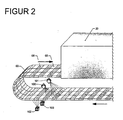
- FIG. 2 is a perspective view of the reversal point of a chain links existing conveyor belt with nozzles for spraying cleaning medium.
- FIG. 1 schematically a beverage bottling plant 10 is shown.
- a Getränkeab spallhunt 20 which is often transparent, there is a Getränkeab spallvoriques 30 from which a bottling 32, a drink 35 in bottles 40a (or another container) is filled.
- beverage 35 or foam 37 can escape from the bottle (40a), which contaminates a conveyor belt 60 or 71. Even dripping waste from the filling head 32 can contaminate the belt while a filled bottle 40b is conveyed away from the filling head 32 and an empty misfit (not shown) is transported below the filling head 32.
- cleaning medium 110 is continuously sprayed from the nozzles 80, 82, 84, which may be wide-jet nozzles, onto the filling device 30 and its filling head 32 and onto the bottles 40a and the conveyor belt 60. Liquid residues 70a of the beverage-mixed cleaning medium remain on the surface 62 of the conveyor belt 60 moving in the direction of the upper arrow.
- the band 60 is usually constructed of chain links 68 containing voids 65, as in FIG. 2 the liquid residues 70b can reach the underside 64 of the conveyor belt 60, from where they drip downwards 70c and on the opposite side 64 'of the turned band 60 (now the lower side 64) moving in the direction of the lower arrow. can hit 70d. From there they can continue on the outside 62 'of the inverted band (the previous top 62) and drip onto the floor (not shown).
- the filled, but unsealed bottles 40 b are also moved on the conveyor belt in the direction of the upper arrow to a closure station 50.
- the bottles are closed with corks, bottle caps or the like (not shown).
- the sealed bottles 45 are then removed from the belt and packed in boxes or cartons (not shown).
- further beverage or further foam may escape from the bottle by the vibration of the bottle 40b through the belt or by the bottles 40b abutting one another.
- the band 60 is on its way to the closure station 50 and on the opposite side of this away further sprayed with cleaning medium 110 from nozzles 86,88,90,92.
- the nozzles 86,90 and 100 which are directed to the tops 64 and 64 'of the conveyor belt, are preferably a flat jet nozzle, which are aligned obliquely opposite to the direction of movement of the belt.
- a jet of cleaning medium 110 emerging from such a nozzle 86,80,100 impinges obliquely on the chain links 68 of the belt, so that the liquid residues 70a pass through the voids 65 between the chain links 68 (see FIG FIG. 2 ) and drip down.
- the nozzle 90 which sprays the upper side 64 'of the inverted, returning to the filling chamber tape, seen in the direction of the spraying the top 64 nozzle 86 and after the underside 62' spraying nozzle 88 should be arranged to the dropped from above liquid residues Rinse away 70d.
- the bottom 64 and the outside 62 'of the conveyor belt can be rinsed, for example, with wide jet nozzles 88,92.
- nozzles 100, 101 and 102, 103 before the turning point (see FIG. 2 ).
- the nozzles 100,101 and 102,103 are each arranged transversely to the running direction and parallel to the chain links 68.
- the nozzles 100, 101 are in turn shown as opposed to the direction oblique flat jet nozzles, while the nozzles 102, 103 are shown as wide jet nozzles.
Landscapes
- Engineering & Computer Science (AREA)
- Mechanical Engineering (AREA)
- Filling Of Jars Or Cans And Processes For Cleaning And Sealing Jars (AREA)
- Cleaning By Liquid Or Steam (AREA)
- Manufacturing Of Electric Cables (AREA)
- Cleaning In General (AREA)
- Treatment Of Water By Ion Exchange (AREA)
- Apparatus For Making Beverages (AREA)
- Detergent Compositions (AREA)
Description
- Die vorliegende Erfindung betrifft ein Verfahren zur Reinigung von Getränkeabfüllanlagen.
- Getränkeabfüllanlagen unterliegen einer fortwährenden Kontamination durch das abzufüllende Getränk, zum Beispiel weil zwischen zwei Abfüllvorgängen aus dem Abfüllkopf Getränk nachtropft, der Behälter überläuft oder das Getränk aus dem Behälter herausschäumt und dergleichen mehr. Die feuchten, kontaminierten Bereiche der Abfüllanlage bilden einen idealen Nährboden für Mikroorganismen aller Art. Es ist also sowohl unter dem Gesichtspunkt der Ästhetik als auch der Hygiene erforderlich, die Teile der Abfüllanlage, die einer Kontamination unterliegen, zu reinigen, um eine hygienisch einwandfreie Abfüllung zu gewährleisten.
- Bisher wurde die Reinigung derartiger Anlagen mittels des sogenannten "Schwallens" bewerkstelligt. Dazu wird beispielsweise alle 1 bis 4 Stunden der Betrieb der Maschine unterbrochen und mittels Düsen, z.B. Breitstrahldüsen, einige Minuten lang, z.B. 5 Minuten lang, heißes, beispielsweise 85 °C heißes Wasser auf die gesamten Maschinenteile gespritzt. Die Düsen sind so angeordnet, dass damit alle wesentlichen Teile der Abfüllvorrichtung besprüht werden können.
- Dieses Schwallen weist einige erhebliche Nachteile auf. Erstens muss die Anlage stillgelegt werden, um die Reinigung durchzuführen; dies ist ein wirtschaftlicher Nachteil. Weiter stellt das sehr heiße Wasser eine potenzielle Gefahr für Menschen dar. Heißes Wasser beschädigt auch Gummi- und Kunststoffteile der Abüllfüllvorrichtung und der zugehörigen Transportbänder. Außerdem belastet der beim Schwallen entstehende Wasserdampf den Raum und führt an kühleren Stellen zur Bildung von Kondensat, welches das Wachstum von Mikroorganismen fördert.
- In düsem Rusammenhang beschreiber die
DE 18 25 422U , dieUS 2973267 , sowei dieDE 199 21 709 Vorrichtunger und Verfahrer sum Reingen von getränkeabfüllanlager - Eine wünschenswerte Desinfektion ist ebenfalls nicht gewährleistet. Das heiße versprühte Wasser kühlt sich nach dem Auftreffen auf die Bauteile stark ab und verliert so seine desinfizierende Wirkung. In der Praxis hat es sich gezeigt, dass nur 60 bis 70 % der vorhandenen Mikroorganismen durch das Schwallen abgetötet werden. Von einer Desinfektion spricht man aber erst bei einer Abtötungsrate von log 5, d.h. einer Desinfektionswirkung, bei der von 100 000 Mikroorganismen ein einziger übrig bleibt.
- Aufgabe der Erfindung war es, ein alternatives Verfahren zur Reinigung von Getränkeabfüllanlagen zu schaffen.
- Diese Aufgabe wird durch das Verfahren nach Anspruch 1 erfüllt.
- Die Unteransprüche geben bevorzugte Ausführungsformen der Erfindung an.
- In der vorliegenden Erfindung wird die Reinigung der durch das Produkt (Getränk) und durch Mikroorganismen kontaminierten Teile der Abfüllanlage kontinuierlich oder intermittierend (in Zeitabständen) während des Betriebs der Abfüllanlage vorgenommen. Die bereits für die Schwallung in einer Anlage installierten Düsen können dabei benutzt werden. Die Installation von weiteren Düsen zum Besprühen zusätzlicher Anlagenteile und des Behälters, in den das Getränk zu füllen ist, gefüllt wird oder gefüllt worden ist, sind gegebenenfalls zusätzlich zu installieren.
- Insbesondere werden erfindungsgemäß die Abfüllköpfe während des gesamten Füllbetriebs, d.h. vor dem Abfüllvorgang, während des Abfüllvorgangs und nach dem Abfüllvorgang, bei laufendem Betrieb der Abfüllanlage kontinuierlich oder intermittierend abgesprüht, d.h. bei im Kreis geführten Abfüllanlagen der gesamte äußere Kreis des Füllerkarussells, wo die Behälter abgefüllt werden. Ein, meherere oder bevorzugt alle Abfüllköpfe werden auf diese Weise kontinuierlich oder intermittierend abgespült.
- Das Reinigungsmedium wird bei Umgebungstemperatur versprüht. Es handelt sich dabei um ein von nativem Wasser verschiedenes, wässriges, gesundheitlich unbedenkliches Reinigungsmedium. Unter "gesundheitlich unbedenklich" versteht man, dass eine Einnahme des Reinigungsmittels durch einen Menschen nicht signifikant gesundheitsgefährdender ist als die Einnahme von sauberem nativem Wasser, d.h. Wasser, wie es aus der Natur (gegebenenfalls nach Reinigung) gewonnen wird, z.B. Leitungs- oder Mineralwasser; bevorzugt hat das Reinigungsmedium Trinkwasserqualität.
- Da das Reinigungsmedium gesundheitlich unbedenklich ist, können auch die nahe der Behälteröffnung vorliegenden Teile der Behälter, z.B. die Flaschenhälse bei Flaschen, mit dem Reinigungsmedium gespült werden. Das gleiche gilt für die Teile der Abfüllvorrichtung, die mit dem Getränk in Kontakt kommen, beispielsweise die Abfüllköpfe und deren Dichtungen. Bevorzugt wird auch die Verschließeinheit kontinuierlich oder intermittierend mit dem Reiningungsmedium besprüht.
- Es ist vollkommen unschädlich, wenn Spuren des oben definierten Reinigungsmediums in die Getränke gelangen.
- Die Reinigung, d.h. jeder hierin beschriebene Reinigungsvorgang, kann kontinuierlich oder intermittierend in geeigneten Zeitintervallen vorgenommen werden. Die intermittierende Reinigung ist dann vorteilhaft, wenn Wasser eingespart werden soll. Dabei werden die Zeitintervalle durch den Verschmutzungsgrad der Anlage bestimmt. So könnte die Reinigung z.B. synchron alle 3, 5, 7, 10 Minuten für 30 Sekunden, 1 Minute, 2 Minuten vorgenommen werden.
- Bei der Getränkeabfüllanlage und -vorrichtung kann es sich um jede beliebige handeln. Im allgemeinen umfasst eine Getränkeabfüllanlage mindestens eine Getränkeabfüllvorrichtung mit einem Abfüllkopf, eine Fördereinrichtung für Flaschen, die gewöhnlich im Kreis geführt wird, und eine Vorrichtung zum Verschließen (Verschließeinheit) der gefüllten Behälter (z.B. mittels eines Kronkorkens, Schraubverschlusses, des Bodens der Dose usw.) die sich in Laufrichtung gesehen nach der Getränkeabfüllvorrichtung befindet. Natürlich kann die Getränkeabfüllanlage weitere Baugruppen bis hin zur vollautomatischen Zufuhr der leeren Behälter sowie zum vollautomatischen Verpacken der gefüllten Behälter z.B. in Kästen, Kartons usw. umfassen.
- Als Fördereinrichtung können dabei Bänder, Förderketten, Gliederketten oder ähnliche Baugruppen dienen.
- Bei den Behältern für die Getränke handelt es sich im Allgemeinen um Flaschen, Dosen oder auch kleine Fässer (z.B. für Wein oder Bier).
- Die Fördereinrichtung wird bevorzugt innerhalb der Abfüllkammer intensiv mit dem Reinigungsmedium gespült. Es ist dann vorzuziehen, sie auch nach Verlassen der Abfüllkammer nochmals zu spülen. Ansonsten wird sie auf jeden Fall nach Verlassen der Abfüllkammer gespült. Das gleiche gilt für die Behälter.
- Nach Verlassen der Abfüllkammer befinden sich auf der Oberseite der Fördereinrichtung (immer noch) Flüssigkeitsreste oder kontaminierte Bereiche, die Produkt enthalten können. Weiter kann aus den noch offenen Behältern durch die vom Band oder vom Zusammenstoß von Behältern auf dem Band verursachte Bewegung der Behälter weiteres Produkt aus diesen austreten. Da die Fördereinrichtung im Allgemeinen eine Gliederkette mit offenen Zwischenräumen ist, können diese Flüssigkeitsreste auf den darunter liegenden, zur Abfüllvorrichtung zurückkehrenden Teil der Fördereinrichtung (wenn sie im Kreis geführt wird) tropfen. Die Fördereinrichtung wird also bevorzugt nicht nur auf ihrer Oberseite, sondern auch auf ihrer Unterseite sowie auf der Ober- und Unterseite des darunterliegenden zurücklaufenden Teils der Fördereinrichtung zwischen Abfüllkammer und Vorrichtung zum Verschließen der Behälter gereinigt werden.
- Es können natürlich auch Transportbänder mit geschlossener Oberfläche als Fördereinrichtung vorgesehen sein. Bei diesen ist im Allgemeinen nur die Oberseite des sich zu der Vorrichtung zum Verschließen der Behälter bewegenden Bandes zu reinigen.
- Noch weiter bevorzugt wird die Fördereinrichtung, wenn sie im Kreis geführt wird, auf die gleiche Weise nochmals gereinigt, bevor sie in die Abfüllkammer zurückkehrt, um jegliche möglicherweise neu hinzugekommen Verunreinigungen zu entfernen.
- Auch die Behälter werden bevorzugt in der Abfüllkammer mit dem Reinigungsmedium gespült. Dann werden sie zwischen Abfüllkammer und Vorrichtung zum Verschließen der Behälter bevorzugt nochmals von ihrem oberen Teil an abwärts (z.B. am Flaschenhals und darunter) gespült, um jegliche Getränkereste am Behälteräußeren zu entfernen, die in vielen Fällen klebrig sind, aber auch Brutstätte für schädliche Mikroorganismen sein können, welche unter Umständen ein Konsument aufnimmt. Wenn die Behälter nicht in der Abfüllkammer gespült werden, geschieht dies auf jeden Fall nach ihrem Austritt aus der Kammer.
- Das Reinigungsmedium wird bevorzugt aus Düsen auf die zu reinigenden Gegenstände gesprüht. Je nach Bedarf kann es sich zum Beispiel um Breitstrahldüsen, Flachstrahldüsen, Fräsdüsen usw. handeln.
- Zur Reinigung der Abfüllvorrichtung sind häufig bei in bereits in Betrieb genommenen Abfüllanlagen Breitstrahldüsen verfügbar, die früher zur Schwallung eingesetzt werden. Sie können im erfindungsgemäßen Verfahren verwendet werden. Für die Reinigung der Behälter und der Fördereinrichtung können zusätzliche Düsen installiert werden.
- Für die Reinigung der Fördereinrichtung werden die nach oben weisenden Bereiche des Bandes (also des oberen, von der Abfülleinrichtung wegführenden Bereiche der Fördereinrichtung sowie des unteren, Richtung Abfülleinrichtung zurücklaufenden Bereiche der Fördereinrichtung) bevorzugt Flachstrahldüsen verwendet, die schräg auf die Oberfläche gerichtet sind, um die Verunreinigungen durch die Leerräume zwischen den Kettengliedern hindurch zu spülen, von wo sie nach unten tropfen. Dabei sollte die untere Flachstrahldüse stromabwärts (mit Bezug auf den unteren Bandteil) von der oberen Flachstrahldüse angeordnet sein, damit die Flüssigkeitsreste, die von der letztgenannten Düse auf den unteren Bandteil tropfen, von der zuerst genannten Düse entfernt werden können.
- Die Düsen, welche die Unterseiten der Fördereinrichtung spülen, können, müssen aber nicht schräg gestellt werden.
- Das Reinigungsmedium wird den Düsen nach Bedarf automatisch zudosiert. Der Ausdruck "nach Bedarf" soll anzeigen, dass z.B. an Stellen geringerer Kontamination das Reinigungsmedium unter geringerem Druck auf die kontaminierten Stellen gesprüht werden kann. Es hat sich herausgestellt, dass der Verbrauch an Reinigungsmedium bei bedarfsgerechter Dosierung geringer ist als der Wasserbedarf im Fall einer Reinigung durch Schwallung.
- Das Reinigungsmedium wird bevorzugt durch Einmischen eines Reinigungskonzentrats in Leitungswasser hergestellt. Derartige Konzentrate können, wenn sie in einem verschlossenen, lichtgeschützten Behälter aufbewahrt werden, über längere Zeiträume gelagert werden.
- Das Reinigungsmedium ist in der Regel ein desinfizierendes Reinigungsmedium. Es wurde bereits oben erwähnt, dass der Ausdruck "desinfizierend" dann verwendet wird, wenn die Rate der Entfernung der Mikroorganismen mindestens log 5 beträgt, d.h., dass pro 100 000 vorhandenen Mikroorganismen nach Anwendung des Desinfektionsmittels (desinfizierenden Reinigungsmediums) höchstens einer übrig bleibt.
- Ein desinfizierendes Reinigungsmedium kann z.B. ein oder mehrere Moleküle/Ionen/Radikale enthalten, die aus ClO·; ClO-; HClO; OH·; HO2 -; H2O2; O3; S2O8 2-; Cl2; Cl·; HO2·; O2; O2·; 3O2; lO2; O·; H3O; H·; Cl2O; ClO2; HCl; Cl2O7; H2SO4; und HSO3Cl ausgewählt sind. Der pH kann 2 bis 8, bevorzugt 7, betragen und das Redoxpotential kann +300 mV bis +1200 mV betragen.
- Im Fall einer mit Fett oder Öl verunreinigten Transportvorrichtung kann zur Erhöhung ihrer Benetzbarkeit oder zur Bekämpfung thermophiler Sporen stromaufwärts zur Spülung mit dem vorstehenden Reinigungsmedium vorteilhaft eine Spülung mit einem basischen Reinigungsmittel vorgenommen werden. Dieses kann z.B. einen pH von 7 bis 13, ein Redoxpotential von -200 mV bis -1100 mV, bevorzugt -800 mV, aufweisen und ein oder mehrere Moleküle/Ionen/Radikale enthalten, die aus OH-; H3 -; O2; H2; HO2; HO2 - und O2 - ausgewählt sind.
- Bevorzugt handelt es sich bei dem Reinigungsmittel um das im Handel unter dem Handelsnamen NADES (Konzentrat) (aquagroup GmbH, Regensburg, Deutschland) erhältliche Reinigungskonzentrat. NADES (Konzentrat) enthält etwa 99,98 % Wasser und etwa 0,02 % (200 ppm) Oxidationsmittel, vor allem Natriumhypochlorit (<197,5 ppm) und Chlordioxid (<2,5 ppm) bei pH ≈ 7,0.
- NADES (Konzentrat) kann in Ausnahmefällen bis zu 100%, d.h im Grenzfall als solches im erfindungsgemäßen Verfahren eingesetzt werden, häufiger bis zu 50 % des Reinigungsmediums ausmachen, wobei der Rest Wasser ist; es wird aber im Allgemeinen Wasser (gewöhnlich Leitungswasser) zu 0,1 bis 10 % zugesetzt, um das in der Erfindung verwendete Reinigungsmedium zu erhalten.
- Es soll noch erwähnt werden, dass im Fall einer mit Fett oder Öl verunreinigten Transportvorrichtung, zur Erhöhung ihrer Benetzbarkeit oder zur Bekämpfung thermophiler Sporen stromaufwärts zur Spülung mit NADES (Konzentrat) vorteilhaft eine Spülung mit NADES Base (Konzentrat) oder einer Verdünnung desselben in Wasser vorgenommen werden kann.
- NADES Base (Konzentrat) enthält neben Wasser 880 ppm (0,088 %) NaOH als Gesamtalkalinität und kann neben anderen reduzierenden Spezies Nitrit (14,79 ppm), Chlorid (11,70 ppm), Phosphat (11,48 ppm), Sulfat (7,89 ppm), Nitrat (1,14 ppm), Natrium (439,00) ppm und Kalium (3,60 ppm) enthalten. Aufgrund des geringen Gehalts an NaOH (0,088%) ist keine Gefährdung von Mensch, Tier oder Umwelt Durch NADES Base möglich. Daher fällt NADES Base auch nicht in die Gefahrstoffverordnung.
- NADES Base (Konzentrat) kann in Konzentrationen bis zu 100% eingesetzt werden, wird aber im allgemeinen für Reinigungszwecke gewöhnlichem Wasser zu 0,1 bis 50% zugesetzt.
- NADES Base und NADES können in speziellen Fällen auch als Mischung verwendet werden.
- Eine Spülung mit einem neutralen Reinigungsmittel, z.B. NADES (Konzentrat) oder dessen Verdünnungen in Wasser stromabwärts von einer Spülung mit NADES Base enthaltendem Reinigungsmittel ist zu empfehlen.
- Bei den Getränken, die in der Getränkeabfüllanlage abgefüllt werden, kann es sich um jedes beliebige Getränk handeln. Bier ist ein besonders bevorzugtes Getränk, da bei seiner Abfüllung wegen seines Schäumens im Allgemeinen eine besonders starke Kontamination der Anlage stattfindet. Andere Getränke, die während des erfindungsgemäßen Verfahrens abgefüllt werden können, sind beispielsweise Mineralwasser, Saft, Wein, Spirituosen, sonstige alkoholische Getränke (z.B. Alkopops), alkoholfreie Mischgetränke (darunter die sogenannten "Energy Drinks") und Milch.
-
Figur 1 zeigt eine schematische Seitenansicht einer Getränkeabfüllanlage mit einer durchsichtigen Getränkeabfüllkammer, in der sich eine o Getränkeabfüllvorrichtung befinden, eine Fördereinrichtung und eine angedeutete Verschlussstation für Getränkebehälter sowie verschiedenen Düsen zum Versprühen des Reinigungsmediums. -
Figur 2 ist ein perspektivische Ansicht des Umkehrpunktes eines aus Kettengliedern bestehenden Transportbandes mit Düsen zum Versprühen von Reinigungsmedium. - Das erfindungsgemäße Verfahren wir nun anhand eines Ausführungsbeispiels näher beschrieben.
- In
Figur 1 ist schematisch eine Getränkeabfüllanlage 10 gezeigt. In einer Getränkeabfüllkammer 20, die häufig durchsichtig ist, befindet sich eine Getränkeabfüllvorrichtung 30, aus der über einen Abfüllkopf 32 ein Getränk 35 in Flaschen 40a (oder einen anderen Behälter) abgefüllt wird. Dabei kann Getränk 35 oder Schaum 37 aus der Flasche (40a) austreten, das bzw. der ein Transportband 60 kontaminiert 71. Auch nachtropfendes Getränk aus dem Abfüllkopf 32 kann das Band kontaminieren, während eine gefüllte Flasche 40b vom Abfüllkopf 32 weg befördert und eine leere Falsche (nicht gezeigt) unter den Abfüllkopf 32 transportiert wird. - Während des Abfüllvorganges wird aus Düsen 80, 82, 84, bei denen es sich um Breitstrahldüsen handeln kann, kontinuierlich Reinigungsmedium 110 auf die Abfüllvorrichtung 30 und deren Abfüllkopf 32 sowie auf die Flaschen 40a und das Transportband 60 gesprüht. Flüssige Reste 70a des mit Getränk gemischten Reinigungsmedium verbleiben auf der Oberfläche 62 des sich in Richtung des oberen Pfeils bewegenden Transportbandes 60.
- Da das Band 60 gewöhnlich aus Kettengliedern 68 aufgebaut ist, die Leerräume 65 enthalten, wie in
Figur 2 gezeigt, können die flüssigen Reste 70b auf die Unterseite 64 des Transportbands 60 gelangen, von wo aus sie nach unten tropfen 70c und auf der Gegenseite 64' des gewendeten, sich nun in Richtung des unteren Pfeils bewegenden Bandes 60 (also die vorherige Unterseite 64) auftreffen können 70d. Von dort können sie weiter auf die Außenseite 62' des gewendeten Bandes (die vorherige Oberseite 62) gelangen und auf den Boden tropfen (nicht gezeigt). - Die gefüllten, aber unverschlossenen Flaschen 40 b werden auf dem Transportband ebenfalls in Richtung des oberen Pfeils zu einer Verschlussstation 50 bewegt. In der Verschlussstation 50 werden die Flaschen mit Korken, Kronkorken oder dergleichen verschlossen (nicht gezeigt). Die verschlossenen Flaschen 45 werden dann vom Band entfernt und in Kästen oder Kartons gepackt (nicht gezeigt). Auf dem Weg zur Verschlussstation 50 kann durch die Erschütterung der Flasche 40b durch das Band oder durch Aneinanderstoßen der Flaschen 40b weiteres Getränk oder weiterer Schaum (nicht gezeigt) aus der Flasche austreten.
- Aus diesem Grund wird das Band 60 auf seinem Weg zur Verschlussstation 50 bzw. auf der Gegenseite von dieser weg weiter mit Reinigungsmedium 110 aus Düsen 86,88,90,92 besprüht. Die Düsen 86,90 und 100, welche auf die Oberseiten 64 und 64' des Transportbandes gerichtet sind, sind bevorzugt eine Flachstrahldüse, die schräg entgegengesetzt zur Bewegungsrichtung des Bandes ausgerichtet sind. Ein aus einer derartigen Düse 86,80,100 austretender Strahl mit Reinigungsmedium 110 trifft schräg auf die Kettenglieder 68 des Bandes auf, so dass die Flüssigkeitsreste 70a durch die Leerräume 65 zwischen den Kettengliedern 68 (siehe
Figur 2 ) gespült werden und nach unten tropfen. Dabei sollte die Düse 90, welche die Oberseite 64' des gewendeten, zur Abfüllkammer zurücklaufenden Bandes besprüht, in Laufrichtung gesehen nach der die Oberseite 64 besprühenden Düse 86 sowie nach der die Unterseite 62' besprühenden Düse 88 angeordnet sein, um die von oben herabgetropften Flüssigkeitsreste 70d wegzuspülen. Die Unterseite 64 und die Außenseite 62' des Transportbandes können zum Beispiel mit Breitstrahldüsen 88,92 gespült werden. Statt der gezeigten einzelnen Düsen 86,88,90,92 können auch mehrere quer zur Laufrichtung nebeneinander angeordnete Einzeldüsen vorgesehen sein, die gemeinsam die Bandbreite überspannen. - Vor dem Wiedereintritt des in die Abfüllkammer zurückkehrenden Bandes wird dieses zum Beispiel vor dem Umkehrpunkt erneut mit Düsen 100, 101 und 102, 103 (siehe
Figur 2 ) gespült. Die Düsen 100,101 und 102,103 sind jeweils quer zur Laufrichtung und parallel zu den Kettengliedern 68 angeordnet. Die Düsen 100, 101 sind wiederum als entgegensetzt zur Laufrichtung schräg gestellte Flachstrahldüsen gezeigt, während die Düsen 102, 103 als Breitstrahldüsen gezeigt sind.
Claims (11)
- Verfahren zur Reinigung von Getränkeabfüllanlagen, bei dem eine oder mehrere Getränkeabfüllvorrichtungen (30) mit einem Abfüllkopf (32) in einer Getränkeabfüllkammer (20) der Getränkeabfüllanlage , während des Betriebs der Getränkeabfüllanlage kontinuierlich oder intermittierend mit einem von nativem Wasser verschiedenen, wässrigen, gesundheitlich unbedenklichen, bei Umgebungstemperatur vorliegenden Reinigungsmedium (110) gespült werden, wobei auch eine Fördereinrichtung (60) zum Transportieren der Behälter (40a) bei ihrer Bewegung durch die Getränkeabfüllkammer (20) kontinuierlich mit Reinigungsmedium (110) gespült wird.
- Verfahren nach Anspruch 1, dadurch gekennzeichnet, dass auch Behälter (40a), die in der Getränkeabfüllkammer (20) mit einem Getränk (35) befüllt werden, kontinuierlich während des Betriebs der Getränkeabfüllanlage in der Getränkeabfüllkammer (20) mit dem Reinigungsmedium (110) gespült werden.
- Verfahren nach einem der Ansprüche 1 bis 2, dadurch gekennzeichnet, dass es sich bei den Behältern (40a) um Flaschen, Dosen oder kleine Fässer handelt.
- Verfahren nach einem der Ansprüche 1 bis 3, dadurch gekennzeichnet, dass die Fördereinrichtung(60) und die geförderten, gefüllten, unverschlossenen Behälter (40b) nach dem Verlassen der Abfüllkammer (20) kontinuierlich während des Betriebs der Getränkeabfüllanlage mit dem Reinigungsmedium (110) gespült werden, wobei die Spülung gegebenenfalls eine weitere Spülung ist.
- Verfahren nach einem der Ansprüche 1 bis 4, dadurch gekennzeichnet, dass die Fördereinrichtung (60) im Kreis geführt wird und vor ihrem Wiedereintritt in die Abfüllkammer (20) kontinuierlich während des Betriebs der Getränkeabfüllanlage erneut gespült wird.
- Verfahren nach einem der Ansprüche 1 bis 5, dadurch gekennzeichnet, dass das Reinigungsmedium (110) aus Düsen (82, 84, 85, 86, 88, 90, 92, 100, 101, 102, 103) auf die in einem der Ansprüche 1 bis 4 genannten zu reinigenden Gegenstände (30, 32, 40a, 40b, 60) gesprüht wird.
- Verfahren nach einem der Ansprüche 1 bis 6, dadurch gekennzeichnet, dass das Reinigungsmedium (110) entsprechend seinem Bedarf in die Düsen (82, 84, 85, 86, 88, 90, 92, 100, 101, 102, 103) eindosiert wird.
- Verfahren nach einem der Ansprüche 1 bis 7, dadurch gekennzeichnet, dass das Reinigungsmedium ein oder mehrere Moleküle/Ionen/Radikale enthält, die aus ClO-·; ClO-; HClO; OH·; HO2 -; H2O2;O3; S2O8 2-;Cl2; Cl·; ; HO2·; O2; O2·; 3O2; lO;O·; H3O; H·; Cl2O; ClO2; HCl; Cl2O7; H2SO4; und HSO3 ausgewählt sind, und der pH 2 bis 8, bevorzugt 7, beträgt und das Redoxpotential +300 mV bis +1200 mV beträgt.
- Verfahren nach einem der vorhergehenden Ansprüche, dadurch gekennzeichnet, dass es sich bei dem Reinigungsmittel um NADES (Konzentrat) handelt.
- Verfahren nach einem der Ansprüche 1 bis 8, dadurch gekennzeichnet, dass es sich bei dem in der Getränkeabfüllanlage verarbeiteten Getränk (35) um Bier handelt.
- Verfahren nach einem der Ansprüche 1 bis 8, dadurch gekennzeichnet, dass es sich bei dem in der Gefränhe abfüllantage Verarbeitchen Getränk (35) um Mineralwasser, Saft, Wein, Spirituosen, sonstige alkoholhaltige Getränke, alkoholfreie Mischgetränke oder Milch handelt.
Priority Applications (3)
| Application Number | Priority Date | Filing Date | Title |
|---|---|---|---|
| PL08701033T PL2114815T4 (pl) | 2007-01-08 | 2008-01-08 | Sposób czyszczenia instalacji do rozlewania napojów |
| SI200830432T SI2114815T1 (sl) | 2007-01-08 | 2008-01-08 | Postopek za čiščenje polnilnih linij za pijače |
| CY20111101179T CY1112489T1 (el) | 2007-01-08 | 2011-11-30 | Μεθοδος για τον καθαρισμο γραμμων εμφιαλωσης ποτων |
Applications Claiming Priority (3)
| Application Number | Priority Date | Filing Date | Title |
|---|---|---|---|
| DE102007001294 | 2007-01-08 | ||
| DE102007017523A DE102007017523A1 (de) | 2007-01-08 | 2007-04-13 | Verfahren zur Reinigung von Getränkeabfüllanlagen |
| PCT/EP2008/000099 WO2008083955A2 (de) | 2007-01-08 | 2008-01-08 | Verfahren zur reinigung von getränkeabfüllanlagen |
Related Child Applications (1)
| Application Number | Title | Priority Date | Filing Date |
|---|---|---|---|
| EP11159773.8 Division-Into | 2011-03-25 |
Publications (2)
| Publication Number | Publication Date |
|---|---|
| EP2114815A2 EP2114815A2 (de) | 2009-11-11 |
| EP2114815B1 true EP2114815B1 (de) | 2011-08-31 |
Family
ID=39477803
Family Applications (2)
| Application Number | Title | Priority Date | Filing Date |
|---|---|---|---|
| EP11159773A Withdrawn EP2351700A1 (de) | 2007-01-08 | 2008-01-08 | Reinigung von Getränkeabfüllanlagen |
| EP08701033A Revoked EP2114815B1 (de) | 2007-01-08 | 2008-01-08 | Verfahren zur reinigung von getränkeabfüllanlagen |
Family Applications Before (1)
| Application Number | Title | Priority Date | Filing Date |
|---|---|---|---|
| EP11159773A Withdrawn EP2351700A1 (de) | 2007-01-08 | 2008-01-08 | Reinigung von Getränkeabfüllanlagen |
Country Status (15)
| Country | Link |
|---|---|
| US (1) | US20100139709A1 (de) |
| EP (2) | EP2351700A1 (de) |
| CN (1) | CN101583555A (de) |
| AT (1) | ATE522471T1 (de) |
| CA (1) | CA2673723C (de) |
| CY (1) | CY1112489T1 (de) |
| DE (2) | DE202007018501U1 (de) |
| DK (1) | DK2114815T3 (de) |
| ES (1) | ES2371978T3 (de) |
| HR (1) | HRP20110842T1 (de) |
| PL (1) | PL2114815T4 (de) |
| PT (1) | PT2114815E (de) |
| SI (1) | SI2114815T1 (de) |
| WO (1) | WO2008083955A2 (de) |
| ZA (1) | ZA200904709B (de) |
Families Citing this family (20)
| Publication number | Priority date | Publication date | Assignee | Title |
|---|---|---|---|---|
| DE102008011807A1 (de) * | 2008-02-29 | 2009-09-10 | Aquagroup Ag | Verfahren zur In-Prozess-Dekontamination bei der Lebensmittelverarbeitung und -behandlung und zur Reduzierung des Keimgehalts von Kosmetika, Pharmazeuti-ka, Daily-Care-Produkten und tierischen und pflanzlichen Lebensmitteln, sowie zur Behandlung von Oberflächen |
| DE102010062797A1 (de) * | 2010-12-10 | 2012-06-14 | Krones Aktiengesellschaft | Verfahren und Vorrichtung zum aseptischen Abfüllen |
| CN102344108B (zh) * | 2011-03-29 | 2014-07-30 | 北京洲际资源环保科技有限公司 | 饮用液体灌装装置的清洗及杀菌系统 |
| DE102011054683B4 (de) * | 2011-10-21 | 2023-11-09 | Krones Aktiengesellschaft | Trocknungsvorrichtung für Behälter und Verfahren zum Reinigen einer solchen Trocknungsvorrichtung |
| CA2856196C (en) | 2011-12-06 | 2020-09-01 | Masco Corporation Of Indiana | Ozone distribution in a faucet |
| DE102012206389A1 (de) * | 2012-04-18 | 2013-10-24 | Krones Ag | Sterilisation von Verpackungsbehältern |
| US20140102484A1 (en) * | 2012-10-11 | 2014-04-17 | Krones Ag | Drying device for containers and method for cleaning such a drying device |
| CN106256719A (zh) * | 2015-06-18 | 2016-12-28 | 天津市飞奥达风能设备有限公司 | 一种镀铝锌板清洗装置 |
| CN105540517A (zh) * | 2015-12-18 | 2016-05-04 | 长沙汇一制药机械有限公司 | 一种用于药液罐装设备 |
| CN115093008B (zh) | 2015-12-21 | 2024-05-14 | 德尔塔阀门公司 | 包括消毒装置的流体输送系统 |
| WO2017172942A1 (en) * | 2016-03-29 | 2017-10-05 | Jet Air Technologies, Inc. | System for removing shards from table-top conveyors |
| CN107413716A (zh) * | 2016-05-24 | 2017-12-01 | 密封空气印度Pvt有限公司 | 对食品接触表面去污、清洁和消毒的方法 |
| US10507986B2 (en) * | 2018-05-08 | 2019-12-17 | General Mills, Inc. | Apparatus and method for cleaning a conveyor belt |
| CN112912335B (zh) | 2018-08-24 | 2023-09-12 | 贝德福德系统有限责任公司 | 含酒精浓缩物灌装系统及其使用方法 |
| JP6729671B2 (ja) * | 2018-12-12 | 2020-07-22 | 大日本印刷株式会社 | 無菌充填機チャンバー内の殺菌方法 |
| US12337357B2 (en) * | 2020-03-30 | 2025-06-24 | Chemtreat, Inc. | Methods and systems for online cleaning of beverage fillers |
| US11358804B1 (en) | 2021-04-01 | 2022-06-14 | General Mills, Inc. | Apparatus and method for cleaning bidirectional food conveyor belt |
| CN113428450A (zh) * | 2021-06-11 | 2021-09-24 | 上海博灼包装机械有限公司 | 全自动无菌制袋加嘴灌装机及其加工工艺 |
| DE102021124219A1 (de) | 2021-09-20 | 2023-03-23 | Sig Technology Ag | Reinigungsverfahren zur Reinigung einer Füllmaschine und Füllmaschine zur Durchführung des Reinigungsverfahrens |
| CN114405328A (zh) * | 2021-12-21 | 2022-04-29 | 浙江永金生物科技有限公司 | 一种温和的酵素多功能清洁剂及其加工设备 |
Family Cites Families (12)
| Publication number | Priority date | Publication date | Assignee | Title |
|---|---|---|---|---|
| DE926350C (de) * | 1953-01-01 | 1955-04-14 | Seitz Werke Gmbh | Einrichtung an Flaschenfuellmaschinen |
| NL233234A (de) * | 1957-11-14 | |||
| DE1825422U (de) * | 1958-01-30 | 1961-01-19 | Holstein & Kappert Maschf | Vorrichtung zum abspuelen der fuerllelemente an flaschenfuellern. |
| DE8907915U1 (de) * | 1989-06-29 | 1989-08-31 | Holstein Und Kappert Ag, 4600 Dortmund | Transportvorrichtung für Gefäße |
| DE3928747A1 (de) * | 1989-08-30 | 1991-03-07 | Henkel Kgaa | Verfahren zur desinfektion von harten oberflaechen mit chlordioxid |
| JP3589674B2 (ja) * | 1992-03-02 | 2004-11-17 | 凸版印刷株式会社 | 無菌充填包装方法 |
| US5873946A (en) * | 1993-09-23 | 1999-02-23 | Henkel-Ecolab Gmbh & Co. Ohg | Installation and a process for lubricating, cleaning and/or disinfecting conveyor belts |
| DE19845619B4 (de) * | 1998-10-05 | 2004-04-29 | Habla Chemie Gmbh | Düsenstock für ein Transportband |
| DE19921709A1 (de) * | 1999-05-12 | 2000-11-16 | Henkel Ecolab Gmbh & Co Ohg | Verfahren und Anlage zur Schmierung und zur Reinigung von Abfüllanlagen für Getränke und Lebensmittel |
| DE60114174T2 (de) * | 2000-04-28 | 2006-07-20 | Ecolab Inc., St. Paul | Antimikrobielle zusammensetzung |
| AU2002212955B8 (en) * | 2000-08-04 | 2005-10-06 | Ch20 Incorporated | Method and composition for cleaning and maintaining water delivery systems |
| DE102004032786A1 (de) * | 2004-07-06 | 2006-01-26 | Cfs Germany Gmbh | Verpackungsmaschine mit einer Entkeimungsvorrichtung |
-
2007
- 2007-04-13 DE DE202007018501U patent/DE202007018501U1/de not_active Expired - Lifetime
- 2007-04-13 DE DE102007017523A patent/DE102007017523A1/de not_active Withdrawn
-
2008
- 2008-01-08 WO PCT/EP2008/000099 patent/WO2008083955A2/de not_active Ceased
- 2008-01-08 DK DK08701033.6T patent/DK2114815T3/da active
- 2008-01-08 CN CNA2008800018099A patent/CN101583555A/zh active Pending
- 2008-01-08 EP EP11159773A patent/EP2351700A1/de not_active Withdrawn
- 2008-01-08 EP EP08701033A patent/EP2114815B1/de not_active Revoked
- 2008-01-08 US US12/448,768 patent/US20100139709A1/en not_active Abandoned
- 2008-01-08 PL PL08701033T patent/PL2114815T4/pl unknown
- 2008-01-08 AT AT08701033T patent/ATE522471T1/de active
- 2008-01-08 CA CA2673723A patent/CA2673723C/en not_active Expired - Fee Related
- 2008-01-08 PT PT08701033T patent/PT2114815E/pt unknown
- 2008-01-08 HR HR20110842T patent/HRP20110842T1/hr unknown
- 2008-01-08 ES ES08701033T patent/ES2371978T3/es active Active
- 2008-01-08 SI SI200830432T patent/SI2114815T1/sl unknown
-
2009
- 2009-07-06 ZA ZA200904709A patent/ZA200904709B/xx unknown
-
2011
- 2011-11-30 CY CY20111101179T patent/CY1112489T1/el unknown
Also Published As
| Publication number | Publication date |
|---|---|
| CA2673723C (en) | 2015-06-16 |
| WO2008083955A3 (de) | 2008-10-16 |
| ZA200904709B (en) | 2010-04-28 |
| HRP20110842T1 (hr) | 2011-12-31 |
| CY1112489T1 (el) | 2015-12-09 |
| EP2351700A1 (de) | 2011-08-03 |
| DE202007018501U1 (de) | 2008-10-23 |
| PL2114815T4 (pl) | 2012-04-30 |
| US20100139709A1 (en) | 2010-06-10 |
| PL2114815T3 (pl) | 2012-01-31 |
| ES2371978T3 (es) | 2012-01-12 |
| DK2114815T3 (da) | 2011-12-05 |
| SI2114815T1 (sl) | 2011-12-30 |
| DE102007017523A1 (de) | 2008-07-10 |
| PT2114815E (pt) | 2011-12-06 |
| ATE522471T1 (de) | 2011-09-15 |
| WO2008083955A2 (de) | 2008-07-17 |
| CN101583555A (zh) | 2009-11-18 |
| EP2114815A2 (de) | 2009-11-11 |
| CA2673723A1 (en) | 2008-07-17 |
Similar Documents
| Publication | Publication Date | Title |
|---|---|---|
| EP2351700A1 (de) | Reinigung von Getränkeabfüllanlagen | |
| DE202008009165U1 (de) | Reinigung von Getränkeabfüllanlagen | |
| EP0893397B1 (de) | Verfahren und Vorrichtung zum hochreinen Abfüllen von Getränken in Flaschen | |
| DE102012109758B3 (de) | Verfahren zum Reinigen, Desinfizieren und/oder Sterilisieren von Packmitteln und/oder von Komponenten von Behälterbehandlungsanlagen | |
| EP2956288B1 (de) | Verfahren zum verpacken von flüssigen produkten unter druck in flaschen aus kunststoff oder dgl. behälter | |
| DE112006000405T5 (de) | Verfahren und Vorrichtung zum Sterilisieren von Behältern | |
| DE60306525T2 (de) | Verfahren zum aseptischen lagern einer grossmenge eines sterilen produkts | |
| EP2261169A1 (de) | Verfahren und Vorrichtung zum Desinfizieren von Getränkeverpackungen bei der Befüllung mit Produkt und Vorrichtung zum Aufbringen und/oder Sprühen von Desinfektionsmittel auf Getränkeverpackungen | |
| EP3079993B1 (de) | Verfahren zum entkeimen von packmitteln | |
| US20250289035A1 (en) | Methods and systems for online cleaning of beverage fillers | |
| DE102008017524A1 (de) | Vorrichtung zum Behandeln von Flaschen oder dergleichen Behältern | |
| DE102007033197B4 (de) | Desinfektionsverfahren | |
| EP1230144B1 (de) | Vorrichtung und verfahren zum sterilen befüllen von behältern | |
| EP1500595A2 (de) | Verfahren zum schützen von verpackten lebensmitteln vor verderben während der lagerung und verpackung oder vorgeschnittene verpackung zum lagern von lebensmitteln | |
| DE10213343A1 (de) | Vorrichtung und Verfahren für kaltsterile Abfüllung und Verschluß von Behältern | |
| CA3167948C (en) | Methods and systems for online cleaning of beverage fillers | |
| DE102019133164A1 (de) | Transportstrecke und Behälterbehandlungsanlage mit einer solchen Transportstrecke | |
| DE2437588C3 (de) | Verfahren zur Sterilabfüllung alkoholhaltiger, hefegefährdeter stiller Trinkflüssigkeiten, insbesondere Wein | |
| EP4631634A1 (de) | Desinfektionsvorrichtung zum desinfizieren von dosen | |
| DE102004039084A1 (de) | Vorrichtung zum Reinigen oder Pasteurisieren von Gegenständen | |
| EP4582369A1 (de) | Anlage und verfahren zum behandeln von behältern | |
| DE102022122542A1 (de) | Vorrichtung und Verfahren zur Behandlung von Behältern |
Legal Events
| Date | Code | Title | Description |
|---|---|---|---|
| PUAI | Public reference made under article 153(3) epc to a published international application that has entered the european phase |
Free format text: ORIGINAL CODE: 0009012 |
|
| 17P | Request for examination filed |
Effective date: 20090807 |
|
| AK | Designated contracting states |
Kind code of ref document: A2 Designated state(s): AT BE BG CH CY CZ DE DK EE ES FI FR GB GR HR HU IE IS IT LI LT LU LV MC MT NL NO PL PT RO SE SI SK TR |
|
| DAX | Request for extension of the european patent (deleted) | ||
| 17Q | First examination report despatched |
Effective date: 20101229 |
|
| GRAP | Despatch of communication of intention to grant a patent |
Free format text: ORIGINAL CODE: EPIDOSNIGR1 |
|
| GRAS | Grant fee paid |
Free format text: ORIGINAL CODE: EPIDOSNIGR3 |
|
| GRAA | (expected) grant |
Free format text: ORIGINAL CODE: 0009210 |
|
| AK | Designated contracting states |
Kind code of ref document: B1 Designated state(s): AT BE BG CH CY CZ DE DK EE ES FI FR GB GR HR HU IE IS IT LI LT LU LV MC MT NL NO PL PT RO SE SI SK TR |
|
| REG | Reference to a national code |
Ref country code: GB Ref legal event code: FG4D Free format text: NOT ENGLISH Ref country code: CH Ref legal event code: EP |
|
| REG | Reference to a national code |
Ref country code: IE Ref legal event code: FG4D Free format text: LANGUAGE OF EP DOCUMENT: GERMAN |
|
| REG | Reference to a national code |
Ref country code: HR Ref legal event code: TUEP Ref document number: P20110842 Country of ref document: HR |
|
| REG | Reference to a national code |
Ref country code: CH Ref legal event code: NV Representative=s name: ING. MARCO ZARDI C/O M. ZARDI & CO. S.A. Ref country code: RO Ref legal event code: EPE |
|
| REG | Reference to a national code |
Ref country code: DE Ref legal event code: R096 Ref document number: 502008004669 Country of ref document: DE Effective date: 20111124 |
|
| REG | Reference to a national code |
Ref country code: DK Ref legal event code: T3 |
|
| REG | Reference to a national code |
Ref country code: PT Ref legal event code: SC4A Free format text: AVAILABILITY OF NATIONAL TRANSLATION Effective date: 20111115 |
|
| REG | Reference to a national code |
Ref country code: SE Ref legal event code: TRGR |
|
| REG | Reference to a national code |
Ref country code: NL Ref legal event code: T3 |
|
| REG | Reference to a national code |
Ref country code: HR Ref legal event code: T1PR Ref document number: P20110842 Country of ref document: HR |
|
| REG | Reference to a national code |
Ref country code: NO Ref legal event code: T2 Effective date: 20110831 |
|
| REG | Reference to a national code |
Ref country code: ES Ref legal event code: FG2A Ref document number: 2371978 Country of ref document: ES Kind code of ref document: T3 Effective date: 20120112 |
|
| REG | Reference to a national code |
Ref country code: PL Ref legal event code: T3 |
|
| REG | Reference to a national code |
Ref country code: SK Ref legal event code: T3 Ref document number: E 10495 Country of ref document: SK |
|
| REG | Reference to a national code |
Ref country code: GR Ref legal event code: EP Ref document number: 20110402790 Country of ref document: GR Effective date: 20120117 |
|
| REG | Reference to a national code |
Ref country code: EE Ref legal event code: FG4A Ref document number: E006285 Country of ref document: EE Effective date: 20111124 |
|
| REG | Reference to a national code |
Ref country code: PL Ref legal event code: T4 |
|
| PLBI | Opposition filed |
Free format text: ORIGINAL CODE: 0009260 |
|
| REG | Reference to a national code |
Ref country code: HU Ref legal event code: AG4A Ref document number: E012960 Country of ref document: HU |
|
| 26 | Opposition filed |
Opponent name: KRONES AG Effective date: 20120531 |
|
| PLAX | Notice of opposition and request to file observation + time limit sent |
Free format text: ORIGINAL CODE: EPIDOSNOBS2 |
|
| REG | Reference to a national code |
Ref country code: DE Ref legal event code: R026 Ref document number: 502008004669 Country of ref document: DE Effective date: 20120531 |
|
| PG25 | Lapsed in a contracting state [announced via postgrant information from national office to epo] |
Ref country code: MC Free format text: LAPSE BECAUSE OF NON-PAYMENT OF DUE FEES Effective date: 20120131 |
|
| PLBB | Reply of patent proprietor to notice(s) of opposition received |
Free format text: ORIGINAL CODE: EPIDOSNOBS3 |
|
| PLBI | Opposition filed |
Free format text: ORIGINAL CODE: 0009260 |
|
| 26 | Opposition filed |
Opponent name: INNOWATECH GMBH Effective date: 20121123 Opponent name: KRONES AG Effective date: 20120531 |
|
| REG | Reference to a national code |
Ref country code: HR Ref legal event code: ODRP Ref document number: P20110842 Country of ref document: HR Payment date: 20130103 Year of fee payment: 6 |
|
| PGFP | Annual fee paid to national office [announced via postgrant information from national office to epo] |
Ref country code: SK Payment date: 20121231 Year of fee payment: 6 |
|
| PGFP | Annual fee paid to national office [announced via postgrant information from national office to epo] |
Ref country code: RO Payment date: 20130107 Year of fee payment: 6 Ref country code: IS Payment date: 20130123 Year of fee payment: 6 Ref country code: LT Payment date: 20130103 Year of fee payment: 6 |
|
| PGFP | Annual fee paid to national office [announced via postgrant information from national office to epo] |
Ref country code: CY Payment date: 20130107 Year of fee payment: 6 Ref country code: SI Payment date: 20130102 Year of fee payment: 6 |
|
| PGFP | Annual fee paid to national office [announced via postgrant information from national office to epo] |
Ref country code: PT Payment date: 20130103 Year of fee payment: 6 |
|
| PG25 | Lapsed in a contracting state [announced via postgrant information from national office to epo] |
Ref country code: MT Free format text: LAPSE BECAUSE OF FAILURE TO SUBMIT A TRANSLATION OF THE DESCRIPTION OR TO PAY THE FEE WITHIN THE PRESCRIBED TIME-LIMIT Effective date: 20110831 |
|
| REG | Reference to a national code |
Ref country code: DE Ref legal event code: R082 Ref document number: 502008004669 Country of ref document: DE Representative=s name: BARDEHLE PAGENBERG PARTNERSCHAFT PATENTANWAELT, DE |
|
| REG | Reference to a national code |
Ref country code: DE Ref legal event code: R082 Ref document number: 502008004669 Country of ref document: DE Representative=s name: BARDEHLE PAGENBERG PARTNERSCHAFT PATENTANWAELT, DE Effective date: 20130820 Ref country code: DE Ref legal event code: R081 Ref document number: 502008004669 Country of ref document: DE Owner name: AQUAGROUP AG, DE Free format text: FORMER OWNER: AQUAGROUP AG, 93055 REGENSBURG, DE Effective date: 20130820 Ref country code: DE Ref legal event code: R082 Ref document number: 502008004669 Country of ref document: DE Representative=s name: PATENTANWAELTE STOLMAR & PARTNER, DE Effective date: 20130820 Ref country code: DE Ref legal event code: R082 Ref document number: 502008004669 Country of ref document: DE Representative=s name: STOLMAR & PARTNER PATENTANWAELTE PARTG MBB, DE Effective date: 20130820 |
|
| PG25 | Lapsed in a contracting state [announced via postgrant information from national office to epo] |
Ref country code: LU Free format text: LAPSE BECAUSE OF NON-PAYMENT OF DUE FEES Effective date: 20120108 |
|
| REG | Reference to a national code |
Ref country code: PT Ref legal event code: MM4A Free format text: LAPSE DUE TO NON-PAYMENT OF FEES Effective date: 20140708 |
|
| REG | Reference to a national code |
Ref country code: HR Ref legal event code: PBON Ref document number: P20110842 Country of ref document: HR Effective date: 20140108 |
|
| REG | Reference to a national code |
Ref country code: LT Ref legal event code: MM4D Effective date: 20140108 |
|
| PLAB | Opposition data, opponent's data or that of the opponent's representative modified |
Free format text: ORIGINAL CODE: 0009299OPPO |
|
| PLAB | Opposition data, opponent's data or that of the opponent's representative modified |
Free format text: ORIGINAL CODE: 0009299OPPO |
|
| REG | Reference to a national code |
Ref country code: SK Ref legal event code: MM4A Ref document number: E 10495 Country of ref document: SK Effective date: 20140108 |
|
| REG | Reference to a national code |
Ref country code: DE Ref legal event code: R082 Ref document number: 502008004669 Country of ref document: DE Representative=s name: STOLMAR & PARTNER PATENTANWAELTE PARTG MBB, DE Ref country code: DE Ref legal event code: R082 Ref document number: 502008004669 Country of ref document: DE Representative=s name: PATENTANWAELTE STOLMAR & PARTNER, DE |
|
| REG | Reference to a national code |
Ref country code: SI Ref legal event code: KO00 Effective date: 20140910 |
|
| PG25 | Lapsed in a contracting state [announced via postgrant information from national office to epo] |
Ref country code: RO Free format text: LAPSE BECAUSE OF NON-PAYMENT OF DUE FEES Effective date: 20140108 Ref country code: IS Free format text: LAPSE BECAUSE OF FAILURE TO SUBMIT A TRANSLATION OF THE DESCRIPTION OR TO PAY THE FEE WITHIN THE PRESCRIBED TIME-LIMIT Effective date: 20140801 Ref country code: CY Free format text: LAPSE BECAUSE OF NON-PAYMENT OF DUE FEES Effective date: 20140108 Ref country code: LT Free format text: LAPSE BECAUSE OF NON-PAYMENT OF DUE FEES Effective date: 20140108 |
|
| RAP2 | Party data changed (patent owner data changed or rights of a patent transferred) |
Owner name: AQUAGROUP AG |
|
| REG | Reference to a national code |
Ref country code: CH Ref legal event code: PK Free format text: BERICHTIGUNG INHABER |
|
| PG25 | Lapsed in a contracting state [announced via postgrant information from national office to epo] |
Ref country code: SI Free format text: LAPSE BECAUSE OF NON-PAYMENT OF DUE FEES Effective date: 20140109 Ref country code: SK Free format text: LAPSE BECAUSE OF NON-PAYMENT OF DUE FEES Effective date: 20140108 Ref country code: HR Free format text: LAPSE BECAUSE OF NON-PAYMENT OF DUE FEES Effective date: 20140108 |
|
| PLAY | Examination report in opposition despatched + time limit |
Free format text: ORIGINAL CODE: EPIDOSNORE2 |
|
| PG25 | Lapsed in a contracting state [announced via postgrant information from national office to epo] |
Ref country code: PT Free format text: LAPSE BECAUSE OF NON-PAYMENT OF DUE FEES Effective date: 20140708 |
|
| PLBC | Reply to examination report in opposition received |
Free format text: ORIGINAL CODE: EPIDOSNORE3 |
|
| PGFP | Annual fee paid to national office [announced via postgrant information from national office to epo] |
Ref country code: TR Payment date: 20150106 Year of fee payment: 8 |
|
| PLCK | Communication despatched that opposition was rejected |
Free format text: ORIGINAL CODE: EPIDOSNREJ1 |
|
| APAH | Appeal reference modified |
Free format text: ORIGINAL CODE: EPIDOSCREFNO |
|
| APBM | Appeal reference recorded |
Free format text: ORIGINAL CODE: EPIDOSNREFNO |
|
| APBP | Date of receipt of notice of appeal recorded |
Free format text: ORIGINAL CODE: EPIDOSNNOA2O |
|
| APBM | Appeal reference recorded |
Free format text: ORIGINAL CODE: EPIDOSNREFNO |
|
| APBP | Date of receipt of notice of appeal recorded |
Free format text: ORIGINAL CODE: EPIDOSNNOA2O |
|
| APBQ | Date of receipt of statement of grounds of appeal recorded |
Free format text: ORIGINAL CODE: EPIDOSNNOA3O |
|
| APBQ | Date of receipt of statement of grounds of appeal recorded |
Free format text: ORIGINAL CODE: EPIDOSNNOA3O |
|
| REG | Reference to a national code |
Ref country code: FR Ref legal event code: PLFP Year of fee payment: 9 |
|
| PGFP | Annual fee paid to national office [announced via postgrant information from national office to epo] |
Ref country code: PL Payment date: 20151229 Year of fee payment: 9 |
|
| PGFP | Annual fee paid to national office [announced via postgrant information from national office to epo] |
Ref country code: NL Payment date: 20160120 Year of fee payment: 9 |
|
| PGFP | Annual fee paid to national office [announced via postgrant information from national office to epo] |
Ref country code: CZ Payment date: 20160107 Year of fee payment: 9 Ref country code: IE Payment date: 20160125 Year of fee payment: 9 Ref country code: EE Payment date: 20160113 Year of fee payment: 9 Ref country code: NO Payment date: 20160125 Year of fee payment: 9 Ref country code: CH Payment date: 20160120 Year of fee payment: 9 Ref country code: DK Payment date: 20160120 Year of fee payment: 9 Ref country code: IT Payment date: 20160127 Year of fee payment: 9 Ref country code: ES Payment date: 20160112 Year of fee payment: 9 Ref country code: BG Payment date: 20160113 Year of fee payment: 9 |
|
| PGFP | Annual fee paid to national office [announced via postgrant information from national office to epo] |
Ref country code: FR Payment date: 20160121 Year of fee payment: 9 Ref country code: LV Payment date: 20151221 Year of fee payment: 9 Ref country code: GR Payment date: 20160121 Year of fee payment: 9 Ref country code: GB Payment date: 20160120 Year of fee payment: 9 Ref country code: FI Payment date: 20160113 Year of fee payment: 9 Ref country code: SE Payment date: 20160120 Year of fee payment: 9 Ref country code: HU Payment date: 20160120 Year of fee payment: 9 Ref country code: BE Payment date: 20160120 Year of fee payment: 9 |
|
| PG25 | Lapsed in a contracting state [announced via postgrant information from national office to epo] |
Ref country code: BE Free format text: LAPSE BECAUSE OF NON-PAYMENT OF DUE FEES Effective date: 20170131 |
|
| PG25 | Lapsed in a contracting state [announced via postgrant information from national office to epo] |
Ref country code: CZ Free format text: LAPSE BECAUSE OF NON-PAYMENT OF DUE FEES Effective date: 20170108 |
|
| REG | Reference to a national code |
Ref country code: EE Ref legal event code: MM4A Ref document number: E006285 Country of ref document: EE Effective date: 20170131 |
|
| REG | Reference to a national code |
Ref country code: DK Ref legal event code: EBP Effective date: 20170131 |
|
| REG | Reference to a national code |
Ref country code: NO Ref legal event code: MMEP |
|
| PGFP | Annual fee paid to national office [announced via postgrant information from national office to epo] |
Ref country code: MT Payment date: 20160106 Year of fee payment: 9 |
|
| REG | Reference to a national code |
Ref country code: CH Ref legal event code: PL |
|
| REG | Reference to a national code |
Ref country code: NL Ref legal event code: MM Effective date: 20170201 |
|
| GBPC | Gb: european patent ceased through non-payment of renewal fee |
Effective date: 20170108 |
|
| REG | Reference to a national code |
Ref country code: FR Ref legal event code: ST Effective date: 20170929 |
|
| PG25 | Lapsed in a contracting state [announced via postgrant information from national office to epo] |
Ref country code: FR Free format text: LAPSE BECAUSE OF NON-PAYMENT OF DUE FEES Effective date: 20170131 Ref country code: FI Free format text: LAPSE BECAUSE OF NON-PAYMENT OF DUE FEES Effective date: 20170108 Ref country code: CH Free format text: LAPSE BECAUSE OF NON-PAYMENT OF DUE FEES Effective date: 20170131 Ref country code: EE Free format text: LAPSE BECAUSE OF NON-PAYMENT OF DUE FEES Effective date: 20170131 Ref country code: NO Free format text: LAPSE BECAUSE OF NON-PAYMENT OF DUE FEES Effective date: 20170131 Ref country code: GR Free format text: LAPSE BECAUSE OF NON-PAYMENT OF DUE FEES Effective date: 20170811 Ref country code: LI Free format text: LAPSE BECAUSE OF NON-PAYMENT OF DUE FEES Effective date: 20170131 |
|
| REG | Reference to a national code |
Ref country code: IE Ref legal event code: MM4A |
|
| PG25 | Lapsed in a contracting state [announced via postgrant information from national office to epo] |
Ref country code: GB Free format text: LAPSE BECAUSE OF NON-PAYMENT OF DUE FEES Effective date: 20170108 Ref country code: SE Free format text: LAPSE BECAUSE OF NON-PAYMENT OF DUE FEES Effective date: 20170109 Ref country code: LV Free format text: LAPSE BECAUSE OF NON-PAYMENT OF DUE FEES Effective date: 20170108 Ref country code: HU Free format text: LAPSE BECAUSE OF NON-PAYMENT OF DUE FEES Effective date: 20170109 Ref country code: NL Free format text: LAPSE BECAUSE OF NON-PAYMENT OF DUE FEES Effective date: 20170201 |
|
| PG25 | Lapsed in a contracting state [announced via postgrant information from national office to epo] |
Ref country code: DK Free format text: LAPSE BECAUSE OF NON-PAYMENT OF DUE FEES Effective date: 20170131 |
|
| REG | Reference to a national code |
Ref country code: BE Ref legal event code: MM Effective date: 20170131 |
|
| PG25 | Lapsed in a contracting state [announced via postgrant information from national office to epo] |
Ref country code: IT Free format text: LAPSE BECAUSE OF NON-PAYMENT OF DUE FEES Effective date: 20170108 Ref country code: IE Free format text: LAPSE BECAUSE OF NON-PAYMENT OF DUE FEES Effective date: 20170108 |
|
| PG25 | Lapsed in a contracting state [announced via postgrant information from national office to epo] |
Ref country code: ES Free format text: LAPSE BECAUSE OF NON-PAYMENT OF DUE FEES Effective date: 20170109 |
|
| REG | Reference to a national code |
Ref country code: ES Ref legal event code: FD2A Effective date: 20180626 |
|
| PG25 | Lapsed in a contracting state [announced via postgrant information from national office to epo] |
Ref country code: PL Free format text: LAPSE BECAUSE OF NON-PAYMENT OF DUE FEES Effective date: 20170108 |
|
| PG25 | Lapsed in a contracting state [announced via postgrant information from national office to epo] |
Ref country code: MT Free format text: LAPSE BECAUSE OF FAILURE TO SUBMIT A TRANSLATION OF THE DESCRIPTION OR TO PAY THE FEE WITHIN THE PRESCRIBED TIME-LIMIT Effective date: 20170108 |
|
| PG25 | Lapsed in a contracting state [announced via postgrant information from national office to epo] |
Ref country code: BG Free format text: LAPSE BECAUSE OF NON-PAYMENT OF DUE FEES Effective date: 20170808 |
|
| REG | Reference to a national code |
Ref country code: DE Ref legal event code: R064 Ref document number: 502008004669 Country of ref document: DE Ref country code: DE Ref legal event code: R103 Ref document number: 502008004669 Country of ref document: DE |
|
| PGFP | Annual fee paid to national office [announced via postgrant information from national office to epo] |
Ref country code: DE Payment date: 20190124 Year of fee payment: 12 |
|
| PGFP | Annual fee paid to national office [announced via postgrant information from national office to epo] |
Ref country code: AT Payment date: 20190118 Year of fee payment: 12 |
|
| APBU | Appeal procedure closed |
Free format text: ORIGINAL CODE: EPIDOSNNOA9O |
|
| RDAF | Communication despatched that patent is revoked |
Free format text: ORIGINAL CODE: EPIDOSNREV1 |
|
| STAA | Information on the status of an ep patent application or granted ep patent |
Free format text: STATUS: PATENT REVOKED |
|
| RDAG | Patent revoked |
Free format text: ORIGINAL CODE: 0009271 |
|
| REG | Reference to a national code |
Ref country code: FI Ref legal event code: MGE |
|
| 27W | Patent revoked |
Effective date: 20190316 |
|
| REG | Reference to a national code |
Ref country code: SK Ref legal event code: MC4A Ref document number: E 10495 Country of ref document: SK Effective date: 20190316 |
|
| REG | Reference to a national code |
Ref country code: EE Ref legal event code: MF4A Ref document number: E006285 Country of ref document: EE Effective date: 20200429 |
|
| REG | Reference to a national code |
Ref country code: AT Ref legal event code: MA03 Ref document number: 522471 Country of ref document: AT Kind code of ref document: T Effective date: 20190316 |
|
| PG25 | Lapsed in a contracting state [announced via postgrant information from national office to epo] |
Ref country code: TR Free format text: LAPSE BECAUSE OF NON-PAYMENT OF DUE FEES Effective date: 20170108 |