EP2113534A1 - Resin composition, prepreg and metal-foil-clad laminate - Google Patents
Resin composition, prepreg and metal-foil-clad laminate Download PDFInfo
- Publication number
- EP2113534A1 EP2113534A1 EP20090250984 EP09250984A EP2113534A1 EP 2113534 A1 EP2113534 A1 EP 2113534A1 EP 20090250984 EP20090250984 EP 20090250984 EP 09250984 A EP09250984 A EP 09250984A EP 2113534 A1 EP2113534 A1 EP 2113534A1
- Authority
- EP
- European Patent Office
- Prior art keywords
- resin
- formula
- weight
- resin composition
- parts
- Prior art date
- Legal status (The legal status is an assumption and is not a legal conclusion. Google has not performed a legal analysis and makes no representation as to the accuracy of the status listed.)
- Granted
Links
Classifications
-
- H—ELECTRICITY
- H05—ELECTRIC TECHNIQUES NOT OTHERWISE PROVIDED FOR
- H05K—PRINTED CIRCUITS; CASINGS OR CONSTRUCTIONAL DETAILS OF ELECTRIC APPARATUS; MANUFACTURE OF ASSEMBLAGES OF ELECTRICAL COMPONENTS
- H05K1/00—Printed circuits
- H05K1/02—Details
- H05K1/03—Use of materials for the substrate
- H05K1/0313—Organic insulating material
- H05K1/0353—Organic insulating material consisting of two or more materials, e.g. two or more polymers, polymer + filler, + reinforcement
- H05K1/0373—Organic insulating material consisting of two or more materials, e.g. two or more polymers, polymer + filler, + reinforcement containing additives, e.g. fillers
-
- B—PERFORMING OPERATIONS; TRANSPORTING
- B32—LAYERED PRODUCTS
- B32B—LAYERED PRODUCTS, i.e. PRODUCTS BUILT-UP OF STRATA OF FLAT OR NON-FLAT, e.g. CELLULAR OR HONEYCOMB, FORM
- B32B15/00—Layered products comprising a layer of metal
- B32B15/04—Layered products comprising a layer of metal comprising metal as the main or only constituent of a layer, which is next to another layer of the same or of a different material
- B32B15/08—Layered products comprising a layer of metal comprising metal as the main or only constituent of a layer, which is next to another layer of the same or of a different material of synthetic resin
-
- C—CHEMISTRY; METALLURGY
- C08—ORGANIC MACROMOLECULAR COMPOUNDS; THEIR PREPARATION OR CHEMICAL WORKING-UP; COMPOSITIONS BASED THEREON
- C08G—MACROMOLECULAR COMPOUNDS OBTAINED OTHERWISE THAN BY REACTIONS ONLY INVOLVING UNSATURATED CARBON-TO-CARBON BONDS
- C08G65/00—Macromolecular compounds obtained by reactions forming an ether link in the main chain of the macromolecule
- C08G65/34—Macromolecular compounds obtained by reactions forming an ether link in the main chain of the macromolecule from hydroxy compounds or their metallic derivatives
- C08G65/48—Polymers modified by chemical after-treatment
- C08G65/485—Polyphenylene oxides
-
- C—CHEMISTRY; METALLURGY
- C08—ORGANIC MACROMOLECULAR COMPOUNDS; THEIR PREPARATION OR CHEMICAL WORKING-UP; COMPOSITIONS BASED THEREON
- C08J—WORKING-UP; GENERAL PROCESSES OF COMPOUNDING; AFTER-TREATMENT NOT COVERED BY SUBCLASSES C08B, C08C, C08F, C08G or C08H
- C08J5/00—Manufacture of articles or shaped materials containing macromolecular substances
- C08J5/24—Impregnating materials with prepolymers which can be polymerised in situ, e.g. manufacture of prepregs
-
- C—CHEMISTRY; METALLURGY
- C08—ORGANIC MACROMOLECULAR COMPOUNDS; THEIR PREPARATION OR CHEMICAL WORKING-UP; COMPOSITIONS BASED THEREON
- C08K—Use of inorganic or non-macromolecular organic substances as compounding ingredients
- C08K3/00—Use of inorganic substances as compounding ingredients
- C08K3/01—Use of inorganic substances as compounding ingredients characterized by their specific function
- C08K3/013—Fillers, pigments or reinforcing additives
-
- C—CHEMISTRY; METALLURGY
- C08—ORGANIC MACROMOLECULAR COMPOUNDS; THEIR PREPARATION OR CHEMICAL WORKING-UP; COMPOSITIONS BASED THEREON
- C08K—Use of inorganic or non-macromolecular organic substances as compounding ingredients
- C08K7/00—Use of ingredients characterised by shape
- C08K7/02—Fibres or whiskers
- C08K7/04—Fibres or whiskers inorganic
- C08K7/14—Glass
-
- C—CHEMISTRY; METALLURGY
- C08—ORGANIC MACROMOLECULAR COMPOUNDS; THEIR PREPARATION OR CHEMICAL WORKING-UP; COMPOSITIONS BASED THEREON
- C08L—COMPOSITIONS OF MACROMOLECULAR COMPOUNDS
- C08L67/00—Compositions of polyesters obtained by reactions forming a carboxylic ester link in the main chain; Compositions of derivatives of such polymers
- C08L67/02—Polyesters derived from dicarboxylic acids and dihydroxy compounds
- C08L67/03—Polyesters derived from dicarboxylic acids and dihydroxy compounds the dicarboxylic acids and dihydroxy compounds having the carboxyl- and the hydroxy groups directly linked to aromatic rings
-
- C—CHEMISTRY; METALLURGY
- C08—ORGANIC MACROMOLECULAR COMPOUNDS; THEIR PREPARATION OR CHEMICAL WORKING-UP; COMPOSITIONS BASED THEREON
- C08L—COMPOSITIONS OF MACROMOLECULAR COMPOUNDS
- C08L71/00—Compositions of polyethers obtained by reactions forming an ether link in the main chain; Compositions of derivatives of such polymers
- C08L71/08—Polyethers derived from hydroxy compounds or from their metallic derivatives
- C08L71/10—Polyethers derived from hydroxy compounds or from their metallic derivatives from phenols
- C08L71/12—Polyphenylene oxides
- C08L71/126—Polyphenylene oxides modified by chemical after-treatment
-
- C—CHEMISTRY; METALLURGY
- C08—ORGANIC MACROMOLECULAR COMPOUNDS; THEIR PREPARATION OR CHEMICAL WORKING-UP; COMPOSITIONS BASED THEREON
- C08J—WORKING-UP; GENERAL PROCESSES OF COMPOUNDING; AFTER-TREATMENT NOT COVERED BY SUBCLASSES C08B, C08C, C08F, C08G or C08H
- C08J2365/00—Characterised by the use of macromolecular compounds obtained by reactions forming a carbon-to-carbon link in the main chain; Derivatives of such polymers
-
- C—CHEMISTRY; METALLURGY
- C08—ORGANIC MACROMOLECULAR COMPOUNDS; THEIR PREPARATION OR CHEMICAL WORKING-UP; COMPOSITIONS BASED THEREON
- C08J—WORKING-UP; GENERAL PROCESSES OF COMPOUNDING; AFTER-TREATMENT NOT COVERED BY SUBCLASSES C08B, C08C, C08F, C08G or C08H
- C08J2467/00—Characterised by the use of polyesters obtained by reactions forming a carboxylic ester link in the main chain; Derivatives of such polymers
- C08J2467/02—Polyesters derived from dicarboxylic acids and dihydroxy compounds
- C08J2467/03—Polyesters derived from dicarboxylic acids and dihydroxy compounds the dicarboxylic acids and dihydroxy compounds having the hydroxy and the carboxyl groups directly linked to aromatic rings
-
- C—CHEMISTRY; METALLURGY
- C08—ORGANIC MACROMOLECULAR COMPOUNDS; THEIR PREPARATION OR CHEMICAL WORKING-UP; COMPOSITIONS BASED THEREON
- C08K—Use of inorganic or non-macromolecular organic substances as compounding ingredients
- C08K3/00—Use of inorganic substances as compounding ingredients
- C08K3/34—Silicon-containing compounds
- C08K3/36—Silica
-
- C—CHEMISTRY; METALLURGY
- C08—ORGANIC MACROMOLECULAR COMPOUNDS; THEIR PREPARATION OR CHEMICAL WORKING-UP; COMPOSITIONS BASED THEREON
- C08K—Use of inorganic or non-macromolecular organic substances as compounding ingredients
- C08K7/00—Use of ingredients characterised by shape
- C08K7/16—Solid spheres
- C08K7/18—Solid spheres inorganic
- C08K7/20—Glass
-
- C—CHEMISTRY; METALLURGY
- C08—ORGANIC MACROMOLECULAR COMPOUNDS; THEIR PREPARATION OR CHEMICAL WORKING-UP; COMPOSITIONS BASED THEREON
- C08L—COMPOSITIONS OF MACROMOLECULAR COMPOUNDS
- C08L63/00—Compositions of epoxy resins; Compositions of derivatives of epoxy resins
-
- C—CHEMISTRY; METALLURGY
- C08—ORGANIC MACROMOLECULAR COMPOUNDS; THEIR PREPARATION OR CHEMICAL WORKING-UP; COMPOSITIONS BASED THEREON
- C08L—COMPOSITIONS OF MACROMOLECULAR COMPOUNDS
- C08L65/00—Compositions of macromolecular compounds obtained by reactions forming a carbon-to-carbon link in the main chain; Compositions of derivatives of such polymers
-
- C—CHEMISTRY; METALLURGY
- C08—ORGANIC MACROMOLECULAR COMPOUNDS; THEIR PREPARATION OR CHEMICAL WORKING-UP; COMPOSITIONS BASED THEREON
- C08L—COMPOSITIONS OF MACROMOLECULAR COMPOUNDS
- C08L67/00—Compositions of polyesters obtained by reactions forming a carboxylic ester link in the main chain; Compositions of derivatives of such polymers
-
- C—CHEMISTRY; METALLURGY
- C08—ORGANIC MACROMOLECULAR COMPOUNDS; THEIR PREPARATION OR CHEMICAL WORKING-UP; COMPOSITIONS BASED THEREON
- C08L—COMPOSITIONS OF MACROMOLECULAR COMPOUNDS
- C08L69/00—Compositions of polycarbonates; Compositions of derivatives of polycarbonates
-
- H—ELECTRICITY
- H05—ELECTRIC TECHNIQUES NOT OTHERWISE PROVIDED FOR
- H05K—PRINTED CIRCUITS; CASINGS OR CONSTRUCTIONAL DETAILS OF ELECTRIC APPARATUS; MANUFACTURE OF ASSEMBLAGES OF ELECTRICAL COMPONENTS
- H05K2201/00—Indexing scheme relating to printed circuits covered by H05K1/00
- H05K2201/01—Dielectrics
- H05K2201/0104—Properties and characteristics in general
- H05K2201/012—Flame-retardant; Preventing of inflammation
-
- H—ELECTRICITY
- H05—ELECTRIC TECHNIQUES NOT OTHERWISE PROVIDED FOR
- H05K—PRINTED CIRCUITS; CASINGS OR CONSTRUCTIONAL DETAILS OF ELECTRIC APPARATUS; MANUFACTURE OF ASSEMBLAGES OF ELECTRICAL COMPONENTS
- H05K2201/00—Indexing scheme relating to printed circuits covered by H05K1/00
- H05K2201/02—Fillers; Particles; Fibers; Reinforcement materials
- H05K2201/0203—Fillers and particles
- H05K2201/0206—Materials
- H05K2201/0209—Inorganic, non-metallic particles
-
- Y—GENERAL TAGGING OF NEW TECHNOLOGICAL DEVELOPMENTS; GENERAL TAGGING OF CROSS-SECTIONAL TECHNOLOGIES SPANNING OVER SEVERAL SECTIONS OF THE IPC; TECHNICAL SUBJECTS COVERED BY FORMER USPC CROSS-REFERENCE ART COLLECTIONS [XRACs] AND DIGESTS
- Y10—TECHNICAL SUBJECTS COVERED BY FORMER USPC
- Y10T—TECHNICAL SUBJECTS COVERED BY FORMER US CLASSIFICATION
- Y10T428/00—Stock material or miscellaneous articles
- Y10T428/31504—Composite [nonstructural laminate]
- Y10T428/31678—Of metal
-
- Y—GENERAL TAGGING OF NEW TECHNOLOGICAL DEVELOPMENTS; GENERAL TAGGING OF CROSS-SECTIONAL TECHNOLOGIES SPANNING OVER SEVERAL SECTIONS OF THE IPC; TECHNICAL SUBJECTS COVERED BY FORMER USPC CROSS-REFERENCE ART COLLECTIONS [XRACs] AND DIGESTS
- Y10—TECHNICAL SUBJECTS COVERED BY FORMER USPC
- Y10T—TECHNICAL SUBJECTS COVERED BY FORMER US CLASSIFICATION
- Y10T442/00—Fabric [woven, knitted, or nonwoven textile or cloth, etc.]
- Y10T442/30—Woven fabric [i.e., woven strand or strip material]
Definitions
- the present invention relates to a resin composition excellent in moldability, electric characteristics, peel strength, flame resistance and heat resistance after moisture absorption and to a prepreg and a metal-foil-clad laminate each of which uses the resin composition.
- the resin composition is suitably used for a mother board and a semiconductor plastic package having a semiconductor chip mounted thereon, as a resin composition for use in a printed wiring board coping with lead-free soldering reflow, high frequency and high multilayer.
- an information terminal apparatus such as a personal computer or a server and a telecommunications apparatus such as an internet router or optical communication are required to process mass data at high speed so that an increase in the speed and frequency of an electric signal has taken place.
- a decrease in a dielectric constant and a decrease in a dielectric loss tangent are required in order to cope with a demand for high frequency.
- a decrease in a dielectric loss tangent is required.
- a fluororesin, a cyanate ester resin (for example, see JP-A-2005-120173 ), a polyphenylene ether resin (for example, see JP-A-2005-112981 ) and a vinyl compound composed mainly of styrene (for example, see JP-2005-89636 ) are conventionally known concerning a laminate for high frequency uses.
- a material using the cyanate ester resin, the polyphenylene ether resin or the vinyl compound, which is used for a high multilayer board for high frequency uses, has the following problems. That is, a problem thereof is that a crack occurs on a wall surface of a through hole at a drilling time since the resin is rigid and fragile.
- Another problem thereof is that there is a problem about moldability since the molecular weight of the resin is large. Further, these resins are insufficient in copper foil adhesive strength because of their nonpolarity (for example, see JP-2005-89636 and J- A-6-207096 ).
- the present inventors have made diligent studies for attaining the above object and as a result found that, when a resin composition obtained by incorporating two kinds of specific cyanate ester resins into a terminal vinyl compound of a bifunctional phenylene ether oligomer having a specific polyphenylene ether structure is used in combination with a brominated flame retardant and an inorganic filler, the resultant resin composition maintains flame retardancy and is improved in both moldability and peel strength without any decrease in heat resistance after moisture absorption and electric characteristics.
- the present inventors have arrived at the present invention.
- the present invention provides a resin composition containing a terminal vinyl compound (a) of a bifunctional phenylene ether oligomer having a polyphenylene ether structure, a naphthol aralkyl type cyanate ester resin (b), a bisphenol A cyanate ester resin (c), a brominated flame retardant (d) and an inorganic filler (e).
- a terminal vinyl compound (a) of a bifunctional phenylene ether oligomer having a polyphenylene ether structure a naphthol aralkyl type cyanate ester resin (b), a bisphenol A cyanate ester resin (c), a brominated flame retardant (d) and an inorganic filler (e).
- the present invention also provides a prepreg comprising the above resin composition and a glass woven fabric (f), a metal-foil-clad laminate obtained by placing one thus-obtained prepreg or stacking at least two thus-obtained prepregs, disposing metal foil (s) on one side or both sides of the prepreg or the stacked prepregs and laminate-molding the metal foil(s) and the prepreg or the stacked prepregs, and a resin sheet obtained by applying the above resin composition to a metal foil or a film.
- a prepreg comprising the above resin composition and a glass woven fabric (f), a metal-foil-clad laminate obtained by placing one thus-obtained prepreg or stacking at least two thus-obtained prepregs, disposing metal foil (s) on one side or both sides of the prepreg or the stacked prepregs and laminate-molding the metal foil(s) and the prepreg or the stacked prepregs, and
- a printed wiring board using the prepreg or metal-foil-clad laminate obtained from the resin composition of the present invention is improved in both moldability and peel strength without any decrease in properties such as flame retardancy, heat resistance after moisture absorption and electric characteristics. Therefore, the resin composition of the present invention is suitable for a printed wiring board material which copes with high multilayer and high frequency. Industrial utilities thereof are remarkably high.
- the vinyl compound (a) represented by the formula (1) used in the present invention is not specially limited so long as it is a vinyl compound which is represented by the formula (1) wherein -(O-X-O)- is a structural unit defined by the formula (2) or the formula (3) in which R 1 , R 2 , R 3 , R 7 and R 8 are the same or different and represent a halogen atom, an alkyl group having 6 or less carbon atoms or a phenyl group, R 4 , R 5 , R 6 , R 9 , R 10 , R 11 , R 12 , R 13 , R 14 , R 15 and R 16 are the same or different and represent a hydrogen atom, a halogen atom, an alkyl group having 6 or less carbon atoms or a phenyl group, and -A-represents a linear, branched or cyclic bivalent hydrocarbon group having 20 or less carbon atoms; -(Y-O)- represents an arrangement of one kind of a structural unit
- Examples of -A- in the formula (3) include bivalent organic groups such as methylene, ethylidene, 1-methylethylidene, 1,1-propylidene, 1,4-phenylenebis(1-methylethylidene), 1,3-phenylenebis(1-methylethylidene), cyclohexylidene, phenyl methylene, naphthyl methylene and 1-phenylethylidene.
- -A- is not limited to these examples.
- a vinyl compound of the formula (1) in which R 1 , R 2 , R 3 , R 7 , R 8 , R 17 and R 18 represent an alkyl group having 3 or less carbon atoms and R 4 , R 5 , R 6 , R 9 , R 10 , R 11 , R 12 , R 13 , R 14 , R 15 , R 16 , R 19 and R 20 represent a hydrogen atom or an alkyl group having 3 or less carbon atoms.
- a vinyl compound of the formula (1) in which -(O-X-O)-represented by the formula (2) or the formula (3) is represented by the formula (6), the formula (7) or the formula (8) and -(Y-O)-represented by the formula (4) is an arrangement of a structural unit of the formula (9) or the formula (10) or a random arrangement of structural units of the formula (9) and the formula (10).
- R 11 , R 12 , R 13 and R 14 are the same or different and represent a hydrogen atom or a methyl group and -A-represents a linear, branched or cyclic bivalent hydrocarbon group having 20 or less carbon atoms.
- -A- represents a linear, branched or cyclic bivalent hydrocarbon group having 20 or less carbon atoms.
- the vinyl compound (a) has a number average molecular weight, calculated as polystyrene by a GPC method, of 500 to 3, 000. When the number average molecular weight is smaller than 500, a coating film obtained from the resin composition is apt to be sticky. When the number average molecular weight is larger than 3,000, the solubility of the vinyl compound (a) in a solvent is decreased.
- the method of producing the vinyl compound (a) is not specially limited.
- the vinyl compound (a) can be produced by vinylbenzyl etherification of a terminal phenolic hydroxyl group of a bifunctional phenylene ether oligomer obtained by oxidatively coupling a bifunctional phenol compound and a monofunctional phenol compound.
- the bifunctional phenylene ether oligomer can be produced by dissolving the bifunctional phenol compound, the monofunctional phenol compound and a catalyst in a solvent and then introducing oxygen into the resultant solution under heat with stirring.
- the bifunctional phenol compound include 2,2',3,3',5,5'-hexamethyl-(1,1'-biphenol)-4,4'-diol, 4,4'-methylenebis(2,6-dimethylphenol), 4,4'-dihydroxyphenylmethane and 4,4'-dihydroxy-2,2'-diphenylpropane.
- the bifunctional phenol compound is not limited to these examples.
- the monofunctional phenol compound is typically 2, 6-dimethylphenol or 2,3,6-trimethylphenol.
- the monofunctional phenol compound is not limited to these.
- An example of the catalyst is a combination of a copper salt and an amine.
- the copper salt include CuCl, CuBr, CuI, CuCl 2 and CuBr 2 .
- Examples of the amine include di-n-butylamine, n-butyldimethylamine, N,N'-di-t-butylethylenediamine, pyridine, N,N,N',N'-tetramethylethylenediamine, piperidine and imidazole.
- the catalyst is not limited to these.
- As the solvent for example, toluene, methanol, methyl ethyl ketone and xylene can be used. The solvent is not limited to these examples.
- the vinylbenzyl etherification of a terminal phenolic hydroxyl group of the bifunctional phenylene ether oligomer can be carried out by, for example, dissolving the bifunctional phenylene ether oligomer and vinylbenzyl chloride in a solvent, adding a base to the resultant solution under heat with stirring to allow the mixture to react, and then solidifying a resin.
- the vinylbenzyl chloride include o-vinylbenzylchloride, m-vinylbenzylchloride, p-vinylbenzylchloride and mixtures of these.
- the vinylbenzyl chloride is not limited to these examples.
- Examples of the base include sodium hydroxide, potassium hydroxide, sodium methoxide and sodium ethoxide.
- the base is not limited to these examples. It is possible to use an acid for the purpose of neutralizing the base which is left after the reaction.
- Examples of the acid include hydrochloric acid, sulfuric acid, phosphoric acid, boric acid and nitric acid.
- the acid is not limited to these examples.
- Examples of the solvent include toluene, xylene, acetone, methyl ethyl ketone, methyl isobutyl ketone, dimethylformamide, dimethylacetamide, methylene chloride and chloroform.
- the solvent is not limited to these examples.
- the method of the solidification is typically a method in which the resin is dried and solidified by evaporating the solvent or a method in which the resin is precipitated by mixing a reaction liquid with a poor solvent. The method of the solidification is not limited to these methods.
- the amount of the vinyl compound (a) is preferably 30 to 95 parts by weight, especially preferably 50 to 80 parts by weight, based on 100 parts by weight of a resin solid content in the resin composition.
- the amount of the vinyl compound (a) is not in the above range, there is a problem in terms of electrical characteristics or reactivity.
- the naphthol aralkyl type cyanate ester resin (b) used in the present invention is not specially limited so long as it is a cyanate ester resin represented by the formula (5) or its prepolymer.
- the amount of the naphthol aralkyl type cyanate ester resin (b) is preferably 2 to 15 parts by weight, especially preferably 3 to 10 parts by weight, based on 100 parts by weight of a resin solid content in the resin composition. When it is not in the above range, a decrease in heat resistance after moisture absorption or peel strength or a problem of reactivity arises in some cases.
- the cyanate ester resin (b) represented by the formula (5) is obtained by condensation of a cyanic acid and a naphthol aralkyl resin obtained by reacting a naphthol such as ⁇ -naphthol or ⁇ -naphthol with p-xylyleneglycol, ⁇ , ⁇ '-dimethoxy-p-xylene, 1,4-di(2-hydroxy-2-propyl)benzene or the like.
- the method of producing the naphthol aralkyl type cyanate ester resin (b) is not specially limited. It may be produced by any known cyanate ester synthesis method.
- the naphthol aralkyl type cyanate ester resin (b) can be obtained by reacting a naphthol aralkyl resin represented by the formula (11) with cyanogen halide in an inactive organic solvent in the presence of a basic compound.
- the naphthol aralkyl type cyanate ester resin (b) can be also synthesized by forming a salt of a similar naphthol aralkyl resin and a basic compound in a water-containing solution and then reacting the salt with cyanogen halide in a two-phase interface reaction.
- R represents a hydrogen atom or a methyl group and n is 1 to 10 as an average value.
- R represents a hydrogen atom or a methyl group and n is 1 to 10 as an average value.
- the bisphenol A cyanate ester resin (c) used in the present invention is obtained by converting two phenolic hydroxyl groups of bisphenol A into cyanate ester groups and a prepolymer thereof is also included.
- the amount of the bisphenol A cyanate ester resin (c) is preferably in the range of 2 to 15 parts by weight, especially preferably 3 to 10 parts by weight, based on 100 parts by weight of a resin solid content in the resin composition. When it is not in the above range, a decrease in heat resistance after moisture absorption or peel strength or a problem of reactivity arises in some cases.
- the brominated flame retardant (d) used in the present invention is not specially limited so long as it is a bromine-atom-containing compound having at least two epoxy groups in a molecule or a bromine-atom-containing oligomer having a polycarbonate structure. Specific example thereof include a brominated bisphenol A type epoxy resin, a brominated phenol novolak type epoxy resin and a brominated polycarbonate oligomer.
- the brominated flame retardant (d) can be used singly or at least two brominated flame retardants (d) can be used in combination, as required.
- the molecular weight of the brominated polycarbonate oligomer is not specially limited.
- a brominated polycarbonate oligomer having a weight average molecular weight of 500 to 3,000 is preferred.
- the amount of the brominated flame retardant (d) is not specially limited. It is preferably in the range of 5 to 35 parts by weight, especially preferably 10 to 30 parts by weight, based on 100 parts by weight of a resin solid content in the resin composition. When it is smaller than the lower limit of the above range, peel strength is decreased and flame retardancy is insufficient in some cases. When it is larger than the upper limit of the above range, heat resistance and electric characteristics are largely decreased in some cases.
- the inorganic filler (e) used in the present invention can be selected from general inorganic fillers for use in laminates. Specific examples thereof include silicas such as natural silica, fused silica, synthetic silica, amorphous silica and hollow silica, molybdenum compounds such as molybdenum oxide and zinc molybdate, zinc borate, zinc stannate, alumina, clay, kaolin, talc, calcined clay, calcined kaolin, calcined talc, mica, short glass fiber (fine powders of glasses such as E glass or D glass) and hollow glass.
- the inorganic filler (e) can be used singly or at least two inorganic fillers (e) can be used in combination as required.
- the average particle diameter (D50) of the inorganic filler (e) is not specially limited. In terms of dispersibility, preferred are a mesoporous silica, a spherical fused silica, a spherical synthetic silica and a hollow spherical silica, each of which has an average particle diameter (D50) of 0.1 to 3 ⁇ m. When the average particle diameter (D50) is not in the range of from 0.1 to 3 ⁇ m, a problem of flowing characteristic arises at the time of molding or a problem of breakage of a small-diameter drill bit arises during its use in some cases.
- the amount of the inorganic filler (e) is not specially limited.
- the average particle diameter (D50) is obtained as follows. A predetermined amount of a powder is added to an aqueous dispersion medium. The powder is measured for particle size distribution with a laser diffraction type particle size distribution instrument. The volumes of particles are added in ascending order of size. The average particle diameter (D50) is represented by a particle diameter at 50 % of the total volume of the particles.
- a silane coupling agent or a wetting and dispersing agent can be jointly used together with the inorganic filler (e) .
- the silane coupling agent is not specially limited so long as it is a general silane coupling agent which is used for the surface-treatment of an inorganic substance.
- silane coupling agent examples include aminosilane coupling agents such as ⁇ -aminopropyltriethoxysilane and N- ⁇ -(aminoethyl)- ⁇ -aminopropyltrimethoxysilane, epoxysilane coupling agents such as ⁇ -glycidoxypropyltrimethoxysilane, vinylsilane coupling agents such as ⁇ -methacryloxypropyl trimethoxysilane, cationic silane coupling agents such as N- ⁇ -(N-vinylbenzylaminoethyl)- ⁇ -aminopropyltrimethoxysilane hydrochloride and phenylsilane coupling agents.
- the silane coupling agent can be used singly or at least two silane coupling agents can be used in combination, as required.
- the resin composition of the present invention can further jointly contain a curing accelerator for adjusting a curing speed, as required.
- the curing accelerator is not specially limited so long as it is a general curing accelerator which is used as a curing accelerator for the vinyl compound (a), the naphthol aralkyl type cyanate ester resin (b), the bisphenol A cyanate ester resin (c) and a brominated epoxy resin.
- Specific examples of the curing accelerator include organic salts of metals such as copper, zinc, cobalt and nickel, imidazoles and derivatives thereof, tertiary amines and a radical polymerization initiator.
- a cross-linking type curing agent can be further incorporated into the resin composition of the present invention, as required.
- the cross-linking type curing agent has an effect of increasing the fluidity of the resin composition and improving copper foil peel strength.
- a cross-linking type curing agent having good compatibility with a terminal vinyl compound of a bifunctional phenylene ether oligomer having a polyphenylene ether structure is preferably used.
- cross-linking type curing agent examples include a polyfunctional vinyl compound such as divinylbenzene, divinylnaphthalene or divinylbiphenyl, a vinylbenzyl ether compound synthesized by a reaction between phenol and vinylbenzyl chloride, and an allyl ether compound synthesized by a reaction between a styrene monomer, phenol and allyl chloride.
- trialkenyl isocyanurate is preferred.
- trialkenyl isocyanurate having good compatibility is preferable.
- triallyl isocyanurate (TAIC) or triallyl cyanurate (TAC) is preferred since these are excellent in moldability and a laminate excellent in copper foil peel strength can be obtained.
- a silane coupling agent can be further incorporated into the resin composition of the present invention, as required.
- the silane coupling agent is not specially limited so long as it is a general silane coupling agent. Specific example thereof include aminosilane coupling agents such as ⁇ -aminopropyltriethoxysilane and N- ⁇ -(aminoethyl)- ⁇ - aminopropyltrimethoxysilane, epoxysilane coupling agents such as ⁇ -glycidoxypropyltrimethoxysilane, vinylsilane coupling agents such as ⁇ -methacryloxypropyltrimethoxysilane, cationic silane coupling agents such as N- ⁇ -(N-vinylbenzylaminoethyl)- ⁇ -aminopropyltrimethoxysilane hydrochloride and phenylsilane coupling agents.
- the silane coupling agent can be used singly or at least two silane coupling agents can be used in combination, as required.
- a polymerization inhibitor can be further incorporated into the resin composition of the present invention in order to increase shelf life.
- a generally known polymerization inhibitor can be used as the above polymerization inhibitor.
- the polymerization inhibitor include quinones such as hydroquinone, methyl hydroquinone, p-benzoquinone, chloranil and trimethylquinone, aromatic diols, and di-t-butylhydroxytoluene.
- the resin composition of the present invention can further contain a variety of high molecular weight compounds such as a different thermosetting resin, a thermoplastic resin and an oligomer thereof, and elastomers, a different flame retardant compound and an additive so long as the inherent properties of the resin composition are not impaired.
- the high molecular weight compounds, the flame retardant compound and the additive are not specially limited so long as they are selected from those which are generally used.
- the flame retardant compound include a bromine compound such as 4,4'-dibromobiphenyl, phosphoric acid ester, melamine phosphate, a phosphorus-containing epoxy resin, a nitrogen compound such as melamine or benzoguanamine, an oxazine-ring-containing compound and a silicone compound.
- the additive examples include an ultraviolet absorber, an antioxidant, a photopolymerization initiator, a fluorescent brightening agent, a photosensitizer, a dye, a pigment, a thickener, a lubricant, an antifoamer, a dispersing agent, a leveling agent and a brightener. These can be used in combination as required.
- the resin composition of the present invention can be used in the form of a solution of the resin composition dissolved in an organic solvent, as required.
- the organic solvent is not specially limited so long as it is capable of dissolving a mixture of the vinyl compound (a), the naphthol aralkyl type cyanate ester resin (b), the bisphenol A cyanate ester resin (c) and the brominated flame retardant (d) .
- Specific examples thereof include ketones such as acetone, methyl ethyl ketone and methyl isobutyl ketone; polar solvents such as dimethylacetamide and dimethylformamide; and aromatic hydrocarbon solvents such as toluene and xylene.
- the organic solvent can be used singly or a mixture of at least two organic solvents can be used in combination.
- Examples of the glass woven fabric (f) used in the present invention includes woven fabrics of E glass, D glass, S glass, T glass, NE glass, quartz and liquid crystal polyester.
- the thickness of the glass woven fabric (f) is not specially limited. In terms of dimensional stability, a woven fabric having a thickness of 0.01 to 0.2 mm for use in a laminate is preferred and, in particular, a woven fabric which is subjected to super opening treatment or clogging treatment is preferred. Further, a glass woven fabric surface-treated with a silane-coupling agent such as epoxysilane or aminosilane is preferably used in terms of heat resistance after moisture absorption. A liquid crystal polyester woven fabric is preferably used in terms of electric characteristics.
- the method of producing the prepreg of the present invention is not specially limited so long as the prepreg is produced by combining the above resin composition and the glass woven fabric (f). Specifically, a solution of the resin composition of the present invention is impregnated into the glass woven fabric (f) and the impregnated glass woven fabric is B-staged by drying, for instance, at 130 to 180 °C for approximately 3 to 20 minutes, to produce a prepreg having a resin amount of 30 to 90 % by weight.
- the above resin amount includes the amount of the inorganic filler (e).
- the metal-foil-clad laminate of the present invention is obtained by laminate-molding using the above prepreg. Specifically, a predetermined number of the above prepregs are stacked, a copper foil is disposed on one side or both sides of the stacked prepregs, the copper foil and the prepregs are laminate-molded, for instance, at a temperature of 180 to 220 °C for a heating time of 100 to 300 minutes under a surface pressure of 20 to 40 kg/cm 2 , to obtain a copper-clad laminate.
- the thickness of the copper foil is not specially limited, while an electrolytic copper foil having a thickness of 3 to 35 ⁇ m is preferably used.
- the electrolytic copper foil is not specially limited so long as it is a general electrolytic copper foil for use in a laminate.
- An electrolytic copper foil having small mat surface roughness is preferred in consideration of a conductor loss in a high frequency region.
- an example of the method of producing a multilayer board is explained hereinafter.
- copper foils having a thickness of 35 ⁇ m each are disposed on both sides, one copper foil on each side, of one prepreg of the present invention, the copper foils and the prepreg are laminate-molded under the above conditions, then an inner layer circuit is formed and the circuit is subjected to blacking treatment, to form an inner layer circuit board.
- Such inner layer circuit boards and the prepregs of the present invention are one by one disposed alternatively, copper foils are disposed as outermost layers and the resultant set is laminate-molded under the above conditions, preferably in vacuum, to obtain a multilayer board.
- the resin sheet of the present invention is obtained by applying the above solution of the resin composition to a base material and drying the applied solution. Then, the base material can be peeled off or etched as required.
- the base material include organic film base materials such as a polyethylene film, a polypropylene film, a polycarbonate film, a polyethylene terephthalate film, an ethylene tetrafluoroethylene copolymer film, a releasing film obtained by applying a releasing agent to the surface of any one of these films, and a polyimide film, conductive foils such as a copper foil and an aluminum foil, and plate-like base materials such as a glass plate, a SUS plate and FRP.
- the application method is typically a method in which the solution of the resin composition is applied to the base material with a bar coater, a die coater, a doctor blade, a baker applicator or the like and the solvent is removed by drying.
- the drying conditions for the drying of the solvent are not specially limited.
- the temperature for drying is low, the solvent is apt to remain in the resin composition.
- the temperature is high, the resin composition undergoes curing.
- the solvent is dried at a temperature of 20 °C to 150 °C for 1 to 90 minutes.
- the thickness of the resin layer can be adjusted by the concentration of the resin composition solution and the thickness of the application of the resin composition solution.
- the thickness of the application is preferably 0.1 to 500 ⁇ m.
- the resin composition of the present invention can be used as a material for an insulation layer of a printed wiring board and a material for a semiconductor package.
- a solution of the curable resin composition of the present invention in a solvent is applied to a copper foil as a base material and the applied solution is dried, whereby a resin-attached copper foil can be obtained.
- a solution of the curable resin composition of the present invention in a solvent is applied to a separable plastic film as a base material, followed by drying, whereby a film for buildup, a dry film solder resist or a die attach film can be obtained.
- the solvent can be dried by heating at a temperature of 20 °C to 150 °C for 1 to 90 minutes.
- the curable resin composition can be used in an uncured state only after drying the solvent.
- the curable resin composition can be also used in a semi-cured state, as required.
- a mixed solution was obtained by dissolving 129.32 g (0.48 mol) of 2,2',3,3',5,5'-hexamethyl-(1,1'-biphenol)-4,4'-diol, 878.4 g (7.2 mol) of 2,6-dimethylphenol, 1.22 g (7.2 mmol) of N,N'-di-t-butylethylenediamine and 26.35 g (260.9 mmol) of n-butyldimethylamine in 2,300 g of methanol in advance.
- the mixed solution was dropwise added to the mixture in the reactor over 230 minutes with stirring while bubbling was carried out with a nitrogen-air mixed gas having an oxygen concentration of 8 % at a flow rate of 5.2L/min.
- 1,500 g of water containing 48.06 g (126.4 mmol) of tetrasodium ethylenediamine tetraacetate dissolved therein was added to the stirred mixture to terminate the reaction.
- An aqueous layer and an organic layer were separated. Then, the organic layer was washed with 1N hydrochloric acid aqueous solution and then washed with pure water.
- the thus-obtained solution was concentrated to 50 wt% with an evaporator, to obtain 1,981 g of a toluene solution of a bifunctional phenylene ether oligomer compound (resin "A").
- the resin "A” had a number average molecular weight of 1,975, a weight average molecular weight of 3,514 and a hydroxyl group equivalent of 990.
- the thus-obtained solution was concentrated with an evaporator, and the concentrated solution was dropwise added to methanol to obtain a solid.
- the solid was recovered by filtering, and the recovered solid was dried in vacuum to obtain 450.1 g of a vinyl compound "B".
- the vinyl compound "B” had a number average molecular weight of 2,250, a weight average molecular weight of 3,920 and a vinyl group equivalent of 1,189 g/vinyl group.
- a mixed solution was obtained by dissolving 129.3 g (0.48 mol) of 2,2',3,3',5,5'-hexamethyl-(1,1'-biphenol)-4,4'-diol, 233.7 g (1.92 mol) of 2,6-dimethylphenol, 64.9 g (0.48 mol) of 2,3,6-trimethylphenol, 0.51 g (2.9 mmol) of N,N'-di-t-butylethylenediamine and 10.90 g (108.0 mmol) of n-butyldimethylamine in 2,300 g of methanol in advance.
- the mixed solution was dropwise added to the mixture in the reactor over 230 minutes with stirring while bubbling was carried out with a nitrogen-air mixed gas having an oxygen concentration of 8 % at a flow rate of 5.2L/min.
- 1,500 g of water containing 19.89 g (52.3 mmol) of tetrasodium ethylenediamine tetraacetate dissolved therein was added to the stirred mixture to terminate the reaction.
- An aqueous layer and an organic layer were separated. The organic layer was washed with 1N hydrochloric acid aqueous solution and then washed with pure water.
- the thus-obtained solution was concentrated to 50 wt% with an evaporator, to obtain 836.5 g of a toluene solution of a bifunctional phenylene ether oligomer compound (resin "C").
- the resin "C” had a number average molecular weight of 986, a weight average molecular weight of 1,530 and a hydroxyl group equivalent of 471.
- the thus-obtained solution was concentrated with an evaporator, and the concentrated solution was dropwise added to methanol to obtain a solid.
- the solid was recovered by filtering, and the recovered solid was dried in vacuum to obtain 503.5 g of a vinyl compound "D".
- the vinyl compound "D" had a number average molecular weight of 1,187, a weight average molecular weight of 1,675 and a vinyl group equivalent of 590 g/vinyl group.
- n ⁇ -naphthol aralkyl type cyanate ester resin was synthesized in the same manner as in Synthetic Example 3 except that 103 g (OH group 0.47 mol) of the ⁇ -naphthol aralkyl resin (SN485, OH group equivalent: 219 g/eq., softening point: 86°C, supplied by Nippon Steel Chemical Co., Ltd.) was replaced with 102 g (OH group 0.
- the mixture was diluted with methyl ethyl ketone, to obtain a varnish having a resin solid content concentration of 65 %.
- Table 1 shows the evaluation results of the shelf life of the varnish.
- the varnish was impregnated into an E glass cloth having a thickness of 0.08 mm (IPC No.-#3313) and the varnish-impregnated glass cloth was dried under heat at 160°C for 8 minutes, whereby eight prepregs having a resin amount of 55 % by weight were obtained. These eight prepregs having a resin amount of 55 % by weight were stacked.
- 18 ⁇ m copper foils (3EC-III, supplied by Mitsui Mining & Smelting Co., LTD.) were disposed on both sides of the stacked prepregs, one copper foil on each side.
- the copper foils and the prepregs were vacuum-pressed under a pressure of 30 kg/cm 2 at a temperature of 210 °C for 150 minutes, to obtain an 18 ⁇ m-copper-clad laminate having a thickness of 0.8 mm.
- Table 2 shows the values of physical properties of the copper-clad laminate.
- Example 7 68 parts by weight of the vinyl compound "D" (number average molecular weight 1,187, vinyl group equivalent 590 g/vinyl group) obtained in Synthetic Example 2, 9 parts by weight of the naphthol aralkyl type cyanate ester resin (cyanate equivalent: 244 g/eq.) obtained in Synthetic Example 4, 12 parts by weight of a brominated polycarbonate resin (FR53, bromine content 58 %, supplied by Mitsubishi Gas Chemical Co., Inc.), 4 parts by weight of a bisphenol A cyanate ester resin (CA210, supplied by Mitsubishi Gas Chemical Co., Inc.), 3 parts by weight of a brominated novolak type epoxy resin (BREN-S, bromine content 35.5 %, supplied by Nippon Kayaku Co., Ltd.), 4 parts by weight of a brominated bisphenol A epoxy resin (1123P, bromine content 23 %, supplied by DIC Corporation) and 50 parts by weight of a spherical silica (SC2050, average
- the varnish was weighed and placed in a separable flask equipped with a stirrer. Methyl ethyl ketone was added to the varnish such that the concentration of a solid content became 20 % by weight.
- the resultant mixture was heated to 60 °C and stirred for 1 hour, to prepare a solution of a resin composition.
- the so-obtained solution was stored in a cold insulation box at 5 °C for 2 weeks. Then, the solution was applied to a mat surface of an 18 ⁇ m electrolytic copper foil (3EC-HTE: supplied by Mitsui Mining & Smelting Co., LTD.) with a doctor blade (gap 200 ⁇ m).
- the applied solution was air-dried at room temperature for 10 minutes and then dried with an air blowing dryer at 50°C for 20 minutes, whereby two copper-foil-attached resin sheets having a resin layer thickness of about 15 ⁇ m each were obtained.
- These two copper-foil-attached resin sheets were disposed on the upper and lower sides of an etched core material having a thickness of 0.8 mm (CCL-EL190T, supplied by Mitsubishi Gas Chemical Co., Inc.), one resin sheet on each side, and the resin sheets and the core material were vacuum-pressed under a pressure of 30 kg/cm 2 at a temperature of 210 °C for 150 minutes, whereby a resin-sheet-attached 18 ⁇ m-copper-clad laminate having a thickness of 0.85 mm was obtained.
- Table 2 shows the values of physical properties of the copper-clad laminate.
- Example 2 The mixture was diluted with methyl ethyl ketone, to obtain a varnish having a resin solid content concentration of 65 %.
- a copper-clad laminate was obtained in the same manner as in Example 2 except that this varnish was used in place of the varnish used in Example 2.
- Table 3 shows the values of physical properties of the copper-clad laminate.
- a number average molecular weight and a weight average molecular weight were obtained by a gel permeation chromatography (GPC) method. Data processing was carried out based on the GPC curve and molecular weight calibration curve of a sample.
- a cyanate equivalent was determined by confirming the absorption of a cyanate ester group around 2264cm -1 in an infrared absorption spectrum, then identifying a structure by 13C-NMR and 1H-NMR, measuring a conversion rate of from OH groups into OCN groups and calculating, on the basis of the conversion rate, the cyanate equivalent from the OH equivalent of a naphthol aralkyl resin used for evaluation.
- Comparative Examples 1, 5 and 6 where only one kind of cyanate ester resin, including the above two kinds of cyanate ester resins, was contained and Comparative Examples 2, 3, 4 and 7 where a combination of two kinds of cyanate ester resins other than the above combination of the above two kinds of cyanate ester resins was contained, it is found that at least one of moldability, peel strength and heat resistance after moisture absorption was inferior.
Landscapes
- Chemical & Material Sciences (AREA)
- Polymers & Plastics (AREA)
- Health & Medical Sciences (AREA)
- Chemical Kinetics & Catalysis (AREA)
- Medicinal Chemistry (AREA)
- Organic Chemistry (AREA)
- General Chemical & Material Sciences (AREA)
- Engineering & Computer Science (AREA)
- Materials Engineering (AREA)
- Microelectronics & Electronic Packaging (AREA)
- Manufacturing & Machinery (AREA)
- Laminated Bodies (AREA)
- Reinforced Plastic Materials (AREA)
- Compositions Of Macromolecular Compounds (AREA)
Abstract
Description
- The present invention relates to a resin composition excellent in moldability, electric characteristics, peel strength, flame resistance and heat resistance after moisture absorption and to a prepreg and a metal-foil-clad laminate each of which uses the resin composition. The resin composition is suitably used for a mother board and a semiconductor plastic package having a semiconductor chip mounted thereon, as a resin composition for use in a printed wiring board coping with lead-free soldering reflow, high frequency and high multilayer.
- Recently, an information terminal apparatus such as a personal computer or a server and a telecommunications apparatus such as an internet router or optical communication are required to process mass data at high speed so that an increase in the speed and frequency of an electric signal has taken place. Accordingly, with regard to a laminate for a printed wiring board to be used for these apparatuses, a decrease in a dielectric constant and a decrease in a dielectric loss tangent are required in order to cope with a demand for high frequency. In particular, a decrease in a dielectric loss tangent is required. In order to meet these demands, a fluororesin, a cyanate ester resin (for example, see
JP-A-2005-120173 JP-A-2005-112981 JP-2005-89636 JP-2005-89636 A-6-207096 - It is an object of the present invention to provide a vinyl-compound-based resin composition for use in a printed wiring board for high multilayer and high frequency, which resin composition is improved in moldability and copper foil peel strength, which are conventional problems, without any decrease in electric characteristics and heat resistance after moisture absorption while keeping flame retardancy, and a prepreg, a metal-foil-clad laminate and a resin sheet, each of which uses the above resin composition.
- The present inventors have made diligent studies for attaining the above object and as a result found that, when a resin composition obtained by incorporating two kinds of specific cyanate ester resins into a terminal vinyl compound of a bifunctional phenylene ether oligomer having a specific polyphenylene ether structure is used in combination with a brominated flame retardant and an inorganic filler, the resultant resin composition maintains flame retardancy and is improved in both moldability and peel strength without any decrease in heat resistance after moisture absorption and electric characteristics. On the basis of the above finding, the present inventors have arrived at the present invention.
- That is, the present invention provides a resin composition containing a terminal vinyl compound (a) of a bifunctional phenylene ether oligomer having a polyphenylene ether structure, a naphthol aralkyl type cyanate ester resin (b), a bisphenol A cyanate ester resin (c), a brominated flame retardant (d) and an inorganic filler (e).
- Further, the present invention also provides a prepreg comprising the above resin composition and a glass woven fabric (f), a metal-foil-clad laminate obtained by placing one thus-obtained prepreg or stacking at least two thus-obtained prepregs, disposing metal foil (s) on one side or both sides of the prepreg or the stacked prepregs and laminate-molding the metal foil(s) and the prepreg or the stacked prepregs, and a resin sheet obtained by applying the above resin composition to a metal foil or a film.
- A printed wiring board using the prepreg or metal-foil-clad laminate obtained from the resin composition of the present invention is improved in both moldability and peel strength without any decrease in properties such as flame retardancy, heat resistance after moisture absorption and electric characteristics. Therefore, the resin composition of the present invention is suitable for a printed wiring board material which copes with high multilayer and high frequency. Industrial utilities thereof are remarkably high.
- The vinyl compound (a) represented by the formula (1) used in the present invention is not specially limited so long as it is a vinyl compound which is represented by the formula (1) wherein -(O-X-O)- is a structural unit defined by the formula (2) or the formula (3) in which R1, R2, R3, R7 and R8 are the same or different and represent a halogen atom, an alkyl group having 6 or less carbon atoms or a phenyl group, R4, R5, R6, R9, R10, R11, R12, R13, R14, R15 and R16 are the same or different and represent a hydrogen atom, a halogen atom, an alkyl group having 6 or less carbon atoms or a phenyl group, and -A-represents a linear, branched or cyclic bivalent hydrocarbon group having 20 or less carbon atoms; -(Y-O)- represents an arrangement of one kind of a structural unit defined by the formula (4) or a random arrangement of at least two kinds of structural units defined by the formula (4) in which R17 and R18 are the same or different and represent a halogen atom, an alkyl group having 6 or less carbon atoms or a phenyl group and R19 and R20 are the same or different and represent a hydrogen atom, a halogen atom, an alkyl group having 6 or less carbon atoms or a phenyl group; and each of a and b is an integer of 0 to 100, provided that at least one of a and b is not 0. Further, at least two kinds of vinyl compounds (a), which are different from each other in terms of structure, can be contained in the resin composition of the present invention.
-

-

-

-

- Examples of -A- in the formula (3) include bivalent organic groups such as methylene, ethylidene,
1-methylethylidene, 1,1-propylidene,
1,4-phenylenebis(1-methylethylidene),
1,3-phenylenebis(1-methylethylidene), cyclohexylidene,
phenyl methylene, naphthyl methylene and 1-phenylethylidene.
-A- is not limited to these examples. - Among the vinyl compounds (a) in the present invention, preferred is a vinyl compound of the formula (1) in which R1, R2, R3, R7, R8, R17 and R18 represent an alkyl group having 3 or less carbon atoms and R4, R5, R6, R9, R10, R11, R12, R13, R14, R15, R16, R19 and R20 represent a hydrogen atom or an alkyl group having 3 or less carbon atoms. In particular, more preferred is a vinyl compound of the formula (1) in which -(O-X-O)-represented by the formula (2) or the formula (3) is represented by the formula (6), the formula (7) or the formula (8) and -(Y-O)-represented by the formula (4) is an arrangement of a structural unit of the formula (9) or the formula (10) or a random arrangement of structural units of the formula (9) and the formula (10).
-

-

-

-

-

- It is preferred that the vinyl compound (a) has a number average molecular weight, calculated as polystyrene by a GPC method, of 500 to 3, 000. When the number average molecular weight is smaller than 500, a coating film obtained from the resin composition is apt to be sticky. When the number average molecular weight is larger than 3,000, the solubility of the vinyl compound (a) in a solvent is decreased. The method of producing the vinyl compound (a) is not specially limited. For example, the vinyl compound (a) can be produced by vinylbenzyl etherification of a terminal phenolic hydroxyl group of a bifunctional phenylene ether oligomer obtained by oxidatively coupling a bifunctional phenol compound and a monofunctional phenol compound.
- For example, the bifunctional phenylene ether oligomer can be produced by dissolving the bifunctional phenol compound, the monofunctional phenol compound and a catalyst in a solvent and then introducing oxygen into the resultant solution under heat with stirring. Examples of the bifunctional phenol compound include 2,2',3,3',5,5'-hexamethyl-(1,1'-biphenol)-4,4'-diol, 4,4'-methylenebis(2,6-dimethylphenol), 4,4'-dihydroxyphenylmethane and 4,4'-dihydroxy-2,2'-diphenylpropane. The bifunctional phenol compound is not limited to these examples. The monofunctional phenol compound is typically 2, 6-dimethylphenol or 2,3,6-trimethylphenol. The monofunctional phenol compound is not limited to these. An example of the catalyst is a combination of a copper salt and an amine. Examples of the copper salt include CuCl, CuBr, CuI, CuCl2 and CuBr2. Examples of the amine include di-n-butylamine, n-butyldimethylamine, N,N'-di-t-butylethylenediamine, pyridine, N,N,N',N'-tetramethylethylenediamine, piperidine and imidazole. The catalyst is not limited to these. As the solvent, for example, toluene, methanol, methyl ethyl ketone and xylene can be used. The solvent is not limited to these examples.
- The vinylbenzyl etherification of a terminal phenolic hydroxyl group of the bifunctional phenylene ether oligomer can be carried out by, for example, dissolving the bifunctional phenylene ether oligomer and vinylbenzyl chloride in a solvent, adding a base to the resultant solution under heat with stirring to allow the mixture to react, and then solidifying a resin. Examples of the vinylbenzyl chloride include o-vinylbenzylchloride, m-vinylbenzylchloride, p-vinylbenzylchloride and mixtures of these. The vinylbenzyl chloride is not limited to these examples. Examples of the base include sodium hydroxide, potassium hydroxide, sodium methoxide and sodium ethoxide. The base is not limited to these examples. It is possible to use an acid for the purpose of neutralizing the base which is left after the reaction. Examples of the acid include hydrochloric acid, sulfuric acid, phosphoric acid, boric acid and nitric acid. The acid is not limited to these examples. Examples of the solvent include toluene, xylene, acetone, methyl ethyl ketone, methyl isobutyl ketone, dimethylformamide, dimethylacetamide, methylene chloride and chloroform. The solvent is not limited to these examples. The method of the solidification is typically a method in which the resin is dried and solidified by evaporating the solvent or a method in which the resin is precipitated by mixing a reaction liquid with a poor solvent. The method of the solidification is not limited to these methods.
- The amount of the vinyl compound (a) is preferably 30 to 95 parts by weight, especially preferably 50 to 80 parts by weight, based on 100 parts by weight of a resin solid content in the resin composition. When the amount of the vinyl compound (a) is not in the above range, there is a problem in terms of electrical characteristics or reactivity.
- The naphthol aralkyl type cyanate ester resin (b) used in the present invention is not specially limited so long as it is a cyanate ester resin represented by the formula (5) or its prepolymer. The amount of the naphthol aralkyl type cyanate ester resin (b) is preferably 2 to 15 parts by weight, especially preferably 3 to 10 parts by weight, based on 100 parts by weight of a resin solid content in the resin composition. When it is not in the above range, a decrease in heat resistance after moisture absorption or peel strength or a problem of reactivity arises in some cases. The cyanate ester resin (b) represented by the formula (5) is obtained by condensation of a cyanic acid and a naphthol aralkyl resin obtained by reacting a naphthol such as α-naphthol or β-naphthol with p-xylyleneglycol, α,α'-dimethoxy-p-xylene, 1,4-di(2-hydroxy-2-propyl)benzene or the like. The method of producing the naphthol aralkyl type cyanate ester resin (b) is not specially limited. It may be produced by any known cyanate ester synthesis method. For example, specifically, the naphthol aralkyl type cyanate ester resin (b) can be obtained by reacting a naphthol aralkyl resin represented by the formula (11) with cyanogen halide in an inactive organic solvent in the presence of a basic compound. Further, the naphthol aralkyl type cyanate ester resin (b) can be also synthesized by forming a salt of a similar naphthol aralkyl resin and a basic compound in a water-containing solution and then reacting the salt with cyanogen halide in a two-phase interface reaction.
-

-

- The bisphenol A cyanate ester resin (c) used in the present invention is obtained by converting two phenolic hydroxyl groups of bisphenol A into cyanate ester groups and a prepolymer thereof is also included. The amount of the bisphenol A cyanate ester resin (c) is preferably in the range of 2 to 15 parts by weight, especially preferably 3 to 10 parts by weight, based on 100 parts by weight of a resin solid content in the resin composition. When it is not in the above range, a decrease in heat resistance after moisture absorption or peel strength or a problem of reactivity arises in some cases.
- The brominated flame retardant (d) used in the present invention is not specially limited so long as it is a bromine-atom-containing compound having at least two epoxy groups in a molecule or a bromine-atom-containing oligomer having a polycarbonate structure. Specific example thereof include a brominated bisphenol A type epoxy resin, a brominated phenol novolak type epoxy resin and a brominated polycarbonate oligomer. The brominated flame retardant (d) can be used singly or at least two brominated flame retardants (d) can be used in combination, as required. The molecular weight of the brominated polycarbonate oligomer is not specially limited. A brominated polycarbonate oligomer having a weight average molecular weight of 500 to 3,000 is preferred. The amount of the brominated flame retardant (d) is not specially limited. It is preferably in the range of 5 to 35 parts by weight, especially preferably 10 to 30 parts by weight, based on 100 parts by weight of a resin solid content in the resin composition. When it is smaller than the lower limit of the above range, peel strength is decreased and flame retardancy is insufficient in some cases. When it is larger than the upper limit of the above range, heat resistance and electric characteristics are largely decreased in some cases.
- The inorganic filler (e) used in the present invention can be selected from general inorganic fillers for use in laminates. Specific examples thereof include silicas such as natural silica, fused silica, synthetic silica, amorphous silica and hollow silica, molybdenum compounds such as molybdenum oxide and zinc molybdate, zinc borate, zinc stannate, alumina, clay, kaolin, talc, calcined clay, calcined kaolin, calcined talc, mica, short glass fiber (fine powders of glasses such as E glass or D glass) and hollow glass. The inorganic filler (e) can be used singly or at least two inorganic fillers (e) can be used in combination as required. The average particle diameter (D50) of the inorganic filler (e) is not specially limited. In terms of dispersibility, preferred are a mesoporous silica, a spherical fused silica, a spherical synthetic silica and a hollow spherical silica, each of which has an average particle diameter (D50) of 0.1 to 3 µm. When the average particle diameter (D50) is not in the range of from 0.1 to 3 µm, a problem of flowing characteristic arises at the time of molding or a problem of breakage of a small-diameter drill bit arises during its use in some cases. The amount of the inorganic filler (e) is not specially limited. It is preferably in the range of 10 to 150 parts by weight, especially preferably 20 to 100 parts by weight, based on 100 parts by weight of a resin solid content in the resin composition. When the amount of the inorganic filler (e) is too large, moldability is decreased in some cases. Therefore, the amount of the inorganic filler (e) is especially preferably 100 parts by weight or less. The average particle diameter (D50) is obtained as follows. A predetermined amount of a powder is added to an aqueous dispersion medium. The powder is measured for particle size distribution with a laser diffraction type particle size distribution instrument. The volumes of particles are added in ascending order of size. The average particle diameter (D50) is represented by a particle diameter at 50 % of the total volume of the particles.
- A silane coupling agent or a wetting and dispersing agent can be jointly used together with the inorganic filler (e) . The silane coupling agent is not specially limited so long as it is a general silane coupling agent which is used for the surface-treatment of an inorganic substance. Specific examples of the silane coupling agent include aminosilane coupling agents such as γ-aminopropyltriethoxysilane and N-β-(aminoethyl)-γ-aminopropyltrimethoxysilane, epoxysilane coupling agents such as γ-glycidoxypropyltrimethoxysilane, vinylsilane coupling agents such as γ-methacryloxypropyl trimethoxysilane, cationic silane coupling agents such as N-β-(N-vinylbenzylaminoethyl)-γ-aminopropyltrimethoxysilane hydrochloride and phenylsilane coupling agents. The silane coupling agent can be used singly or at least two silane coupling agents can be used in combination, as required.
- The resin composition of the present invention can further jointly contain a curing accelerator for adjusting a curing speed, as required. The curing accelerator is not specially limited so long as it is a general curing accelerator which is used as a curing accelerator for the vinyl compound (a), the naphthol aralkyl type cyanate ester resin (b), the bisphenol A cyanate ester resin (c) and a brominated epoxy resin. Specific examples of the curing accelerator include organic salts of metals such as copper, zinc, cobalt and nickel, imidazoles and derivatives thereof, tertiary amines and a radical polymerization initiator.
- A cross-linking type curing agent can be further incorporated into the resin composition of the present invention, as required. The cross-linking type curing agent has an effect of increasing the fluidity of the resin composition and improving copper foil peel strength. In particular, a cross-linking type curing agent having good compatibility with a terminal vinyl compound of a bifunctional phenylene ether oligomer having a polyphenylene ether structure is preferably used. Specific examples of the cross-linking type curing agent include a polyfunctional vinyl compound such as divinylbenzene, divinylnaphthalene or divinylbiphenyl, a vinylbenzyl ether compound synthesized by a reaction between phenol and vinylbenzyl chloride, and an allyl ether compound synthesized by a reaction between a styrene monomer, phenol and allyl chloride. Further, trialkenyl isocyanurate is preferred. In particular, trialkenyl isocyanurate having good compatibility is preferable. Specifically, triallyl isocyanurate (TAIC) or triallyl cyanurate (TAC) is preferred since these are excellent in moldability and a laminate excellent in copper foil peel strength can be obtained.
- A silane coupling agent can be further incorporated into the resin composition of the present invention, as required. The silane coupling agent is not specially limited so long as it is a general silane coupling agent. Specific example thereof include aminosilane coupling agents such as γ-aminopropyltriethoxysilane and N-β-(aminoethyl)-γ- aminopropyltrimethoxysilane, epoxysilane coupling agents such as γ-glycidoxypropyltrimethoxysilane, vinylsilane coupling agents such as γ-methacryloxypropyltrimethoxysilane, cationic silane coupling agents such as N-β-(N-vinylbenzylaminoethyl)-γ-aminopropyltrimethoxysilane hydrochloride and phenylsilane coupling agents. The silane coupling agent can be used singly or at least two silane coupling agents can be used in combination, as required.
- A polymerization inhibitor can be further incorporated into the resin composition of the present invention in order to increase shelf life. A generally known polymerization inhibitor can be used as the above polymerization inhibitor. Examples of the polymerization inhibitor include quinones such as hydroquinone, methyl hydroquinone, p-benzoquinone, chloranil and trimethylquinone, aromatic diols, and di-t-butylhydroxytoluene.
- The resin composition of the present invention can further contain a variety of high molecular weight compounds such as a different thermosetting resin, a thermoplastic resin and an oligomer thereof, and elastomers, a different flame retardant compound and an additive so long as the inherent properties of the resin composition are not impaired. The high molecular weight compounds, the flame retardant compound and the additive are not specially limited so long as they are selected from those which are generally used. Examples of the flame retardant compound include a bromine compound such as 4,4'-dibromobiphenyl, phosphoric acid ester, melamine phosphate, a phosphorus-containing epoxy resin, a nitrogen compound such as melamine or benzoguanamine, an oxazine-ring-containing compound and a silicone compound. Examples of the additive include an ultraviolet absorber, an antioxidant, a photopolymerization initiator, a fluorescent brightening agent, a photosensitizer, a dye, a pigment, a thickener, a lubricant, an antifoamer, a dispersing agent, a leveling agent and a brightener. These can be used in combination as required.
- The resin composition of the present invention can be used in the form of a solution of the resin composition dissolved in an organic solvent, as required. The organic solvent is not specially limited so long as it is capable of dissolving a mixture of the vinyl compound (a), the naphthol aralkyl type cyanate ester resin (b), the bisphenol A cyanate ester resin (c) and the brominated flame retardant (d) . Specific examples thereof include ketones such as acetone, methyl ethyl ketone and methyl isobutyl ketone; polar solvents such as dimethylacetamide and dimethylformamide; and aromatic hydrocarbon solvents such as toluene and xylene. The organic solvent can be used singly or a mixture of at least two organic solvents can be used in combination.
- Examples of the glass woven fabric (f) used in the present invention includes woven fabrics of E glass, D glass, S glass, T glass, NE glass, quartz and liquid crystal polyester. The thickness of the glass woven fabric (f) is not specially limited. In terms of dimensional stability, a woven fabric having a thickness of 0.01 to 0.2 mm for use in a laminate is preferred and, in particular, a woven fabric which is subjected to super opening treatment or clogging treatment is preferred. Further, a glass woven fabric surface-treated with a silane-coupling agent such as epoxysilane or aminosilane is preferably used in terms of heat resistance after moisture absorption. A liquid crystal polyester woven fabric is preferably used in terms of electric characteristics.
- The method of producing the prepreg of the present invention is not specially limited so long as the prepreg is produced by combining the above resin composition and the glass woven fabric (f). Specifically, a solution of the resin composition of the present invention is impregnated into the glass woven fabric (f) and the impregnated glass woven fabric is B-staged by drying, for instance, at 130 to 180 °C for approximately 3 to 20 minutes, to produce a prepreg having a resin amount of 30 to 90 % by weight. The above resin amount includes the amount of the inorganic filler (e).
- The metal-foil-clad laminate of the present invention is obtained by laminate-molding using the above prepreg. Specifically, a predetermined number of the above prepregs are stacked, a copper foil is disposed on one side or both sides of the stacked prepregs, the copper foil and the prepregs are laminate-molded, for instance, at a temperature of 180 to 220 °C for a heating time of 100 to 300 minutes under a surface pressure of 20 to 40 kg/cm2, to obtain a copper-clad laminate. The thickness of the copper foil is not specially limited, while an electrolytic copper foil having a thickness of 3 to 35 µm is preferably used. The electrolytic copper foil is not specially limited so long as it is a general electrolytic copper foil for use in a laminate. An electrolytic copper foil having small mat surface roughness is preferred in consideration of a conductor loss in a high frequency region. Further, an example of the method of producing a multilayer board is explained hereinafter. For example, copper foils having a thickness of 35 µm each are disposed on both sides, one copper foil on each side, of one prepreg of the present invention, the copper foils and the prepreg are laminate-molded under the above conditions, then an inner layer circuit is formed and the circuit is subjected to blacking treatment, to form an inner layer circuit board. Such inner layer circuit boards and the prepregs of the present invention are one by one disposed alternatively, copper foils are disposed as outermost layers and the resultant set is laminate-molded under the above conditions, preferably in vacuum, to obtain a multilayer board.
- The resin sheet of the present invention is obtained by applying the above solution of the resin composition to a base material and drying the applied solution. Then, the base material can be peeled off or etched as required. Examples of the base material include organic film base materials such as a polyethylene film, a polypropylene film, a polycarbonate film, a polyethylene terephthalate film, an ethylene tetrafluoroethylene copolymer film, a releasing film obtained by applying a releasing agent to the surface of any one of these films, and a polyimide film, conductive foils such as a copper foil and an aluminum foil, and plate-like base materials such as a glass plate, a SUS plate and FRP. The application method is typically a method in which the solution of the resin composition is applied to the base material with a bar coater, a die coater, a doctor blade, a baker applicator or the like and the solvent is removed by drying.
- The drying conditions for the drying of the solvent are not specially limited. When the temperature for drying is low, the solvent is apt to remain in the resin composition. When the temperature is high, the resin composition undergoes curing. For these reasons, it is preferred that the solvent is dried at a temperature of 20 °C to 150 °C for 1 to 90 minutes. The thickness of the resin layer can be adjusted by the concentration of the resin composition solution and the thickness of the application of the resin composition solution. When the thickness of the application is large, the solvent is apt to remain at a drying time. For this reason, the thickness of the application is preferably 0.1 to 500 µm.
- The resin composition of the present invention can be used as a material for an insulation layer of a printed wiring board and a material for a semiconductor package. For example, a solution of the curable resin composition of the present invention in a solvent is applied to a copper foil as a base material and the applied solution is dried, whereby a resin-attached copper foil can be obtained. Moreover, a solution of the curable resin composition of the present invention in a solvent is applied to a separable plastic film as a base material, followed by drying, whereby a film for buildup, a dry film solder resist or a die attach film can be obtained. The solvent can be dried by heating at a temperature of 20 °C to 150 °C for 1 to 90 minutes. Further, the curable resin composition can be used in an uncured state only after drying the solvent. Furthermore, the curable resin composition can be also used in a semi-cured state, as required.
- The present invention will be concretely explained with reference to Examples and Comparative Examples, hereinafter, while the present invention shall not be limited to these.
- 9.36 g (42.1 mmol) of CuBr2, 1.81 g (10.5 mmol) of N,N'-di-t-butylethylenediamine, 67.77 g (671.0 mmol) of n-butyldimethylamine and 2, 600 g of toluene were charged into a longitudinally long reactor having a volume of 12 liters and equipped with a stirrer, a thermometer, an air-introducing tube and baffleplates. The mixture was stirred at a reaction temperature of 40 °C. A mixed solution was obtained by dissolving 129.32 g (0.48 mol) of 2,2',3,3',5,5'-hexamethyl-(1,1'-biphenol)-4,4'-diol, 878.4 g (7.2 mol) of 2,6-dimethylphenol, 1.22 g (7.2 mmol) of N,N'-di-t-butylethylenediamine and 26.35 g (260.9 mmol) of n-butyldimethylamine in 2,300 g of methanol in advance. The mixed solution was dropwise added to the mixture in the reactor over 230 minutes with stirring while bubbling was carried out with a nitrogen-air mixed gas having an oxygen concentration of 8 % at a flow rate of 5.2L/min. After the completion of the addition, 1,500 g of water containing 48.06 g (126.4 mmol) of tetrasodium ethylenediamine tetraacetate dissolved therein was added to the stirred mixture to terminate the reaction. An aqueous layer and an organic layer were separated. Then, the organic layer was washed with 1N hydrochloric acid aqueous solution and then washed with pure water. The thus-obtained solution was concentrated to 50 wt% with an evaporator, to obtain 1,981 g of a toluene solution of a bifunctional phenylene ether oligomer compound (resin "A"). The resin "A" had a number average molecular weight of 1,975, a weight average molecular weight of 3,514 and a hydroxyl group equivalent of 990.
- 833.40 g of the toluene solution of the resin "A", 76.7 g of vinylbenzyl chloride (trade name CMS-P; supplied by Seimi Chemical Co., Ltd.), 1,600 g of methylene chloride, 6.2 g of benzyldimethylamine, 199.5 g of pure water and 83.6 g of 30.5wt% NaOH aqueous solution were charged into a reactor equipped with a stirrer, a thermometer and a reflux tube. The mixture was stirred at a reaction temperature of 40 °C. The stirring was carried out for 24 hours. Then, an organic layer was washed with 1N hydrochloric acid aqueous solution and then washed with pure water. The thus-obtained solution was concentrated with an evaporator, and the concentrated solution was dropwise added to methanol to obtain a solid. The solid was recovered by filtering, and the recovered solid was dried in vacuum to obtain 450.1 g of a vinyl compound "B". The vinyl compound "B" had a number average molecular weight of 2,250, a weight average molecular weight of 3,920 and a vinyl group equivalent of 1,189 g/vinyl group.
- 3.88 g (17.4 mmol) of CuBr2, 0.75 g (4.4 mmol) of N,N'-di-t-butylethylenediamine, 28.04 g (277.6 mmol) of n-butyldimethylamine and 2,600 g of toluene were charged into a longitudinally long reactor having a volume of 12 liters and equipped with a stirrer, a thermometer, an air-introducing tube and baffleplates. The mixture was stirred at a reaction temperature of 40 °C. A mixed solution was obtained by dissolving 129.3 g (0.48 mol) of 2,2',3,3',5,5'-hexamethyl-(1,1'-biphenol)-4,4'-diol, 233.7 g (1.92 mol) of 2,6-dimethylphenol, 64.9 g (0.48 mol) of 2,3,6-trimethylphenol, 0.51 g (2.9 mmol) of N,N'-di-t-butylethylenediamine and 10.90 g (108.0 mmol) of n-butyldimethylamine in 2,300 g of methanol in advance. The mixed solution was dropwise added to the mixture in the reactor over 230 minutes with stirring while bubbling was carried out with a nitrogen-air mixed gas having an oxygen concentration of 8 % at a flow rate of 5.2L/min. After the completion of the addition, 1,500 g of water containing 19.89 g (52.3 mmol) of tetrasodium ethylenediamine tetraacetate dissolved therein was added to the stirred mixture to terminate the reaction. An aqueous layer and an organic layer were separated. The organic layer was washed with 1N hydrochloric acid aqueous solution and then washed with pure water. The thus-obtained solution was concentrated to 50 wt% with an evaporator, to obtain 836.5 g of a toluene solution of a bifunctional phenylene ether oligomer compound (resin "C"). The resin "C" had a number average molecular weight of 986, a weight average molecular weight of 1,530 and a hydroxyl group equivalent of 471.
- 836.5 g of the toluene solution of the resin "C", 162.6 g of vinylbenzyl chloride (trade name CMS-P; supplied by Seimi Chemical Co., Ltd.), 1, 600 g of methylene chloride, 12.95 g of benzyldimethylamine, 420 g of pure water and 178.0 g of 30.5wt% NaOH aqueous solution were charged into a reactor equipped with a stirrer, a thermometer and a reflux tube. The mixture was stirred at a reaction temperature of 40 °C. The stirring was carried out for 24 hours. Then, an organic layer was washed with 1N hydrochloric acid aqueous solution and then washed with pure water. The thus-obtained solution was concentrated with an evaporator, and the concentrated solution was dropwise added to methanol to obtain a solid. The solid was recovered by filtering, and the recovered solid was dried in vacuum to obtain 503.5 g of a vinyl compound "D". The vinyl compound "D" had a number average molecular weight of 1,187, a weight average molecular weight of 1,675 and a vinyl group equivalent of 590 g/vinyl group.
-
-

- 103 g (OH group 0.47 mol) of an α-naphthol aralkyl resin represented by the formula (12) (SN485, OH group equivalent: 219g/eq., softeningpoint: 86°C, supplied by Nippon Steel Chemical Co., Ltd.) was dissolved in 500 ml of chloroform. Then, 0.7 mol of triethylamine was mixed with the resultant solution. The mixture was dropwise added to 300 g of a chloroform solution of 0.93 mol of cyanogen chloride at -10 °C over 1.5 hours. The mixture was stirred for 30 minutes. Then, a mixed solution of 0.1 mol of triethylamine and 30 g of chloroform was dropwise added to the stirred mixture and the mixture was stirred for 30 minutes to complete the reaction. A hydrochloride of triethylamine generated was separated by filtering, to obtain a filtrate. The filtrate was washed with 500 ml of 0.1N hydrochloric acid and then washing with 500 ml of water was repeated four times. Then, a chloroform layer of the chloroform/water mixed solution was extracted by liquid-separation treatment. Sodium sulfate was added to the chloroform solution to carry out dehydration treatment. The sodium sulfate was separated by filtering. Then, the resultant solution was evaporated at 75 °C and then further deaerated under reduced pressure at 90 °C, to obtain a blackish brown solid α-naphthol aralkyl type cyanate ester resin represented by the formula (13). Absorption of a cyanate ester group was confirmed around 2264cm-1 in an infrared absorption spectrum. Further, it was confirmed based on 13C-NMR and 1H-NMR that the conversion rate of from OH groups to OCN groups was 99 % or higher.
-
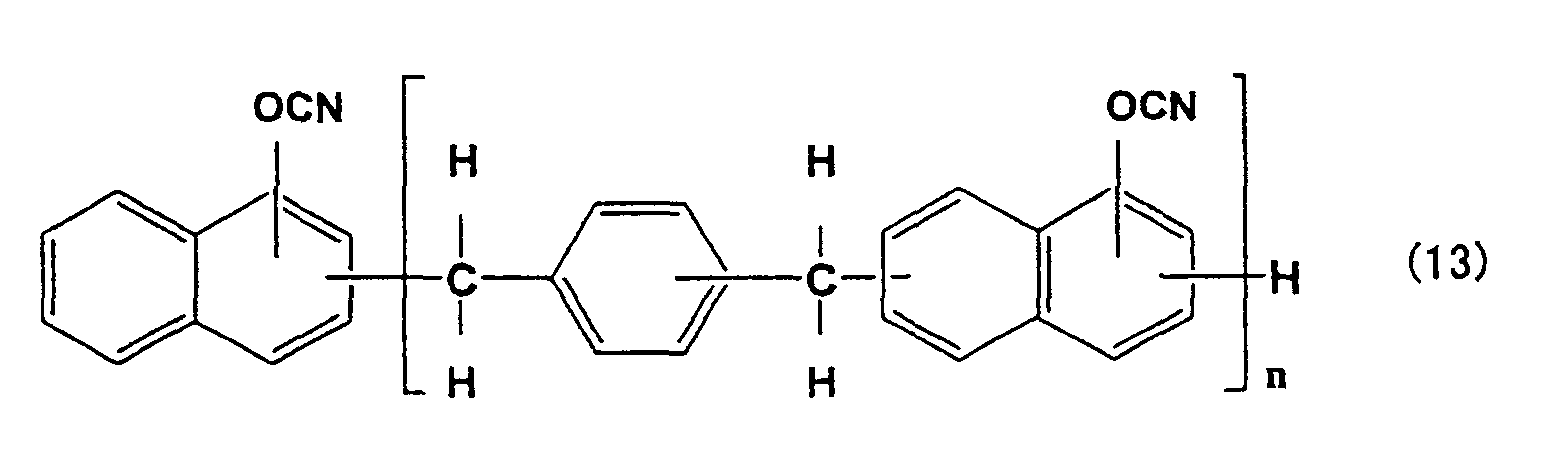
- n α-naphthol aralkyl type cyanate ester resin was synthesized in the same manner as in Synthetic Example 3 except that 103 g (OH group 0.47 mol) of the α-naphthol aralkyl resin (SN485, OH group equivalent: 219 g/eq., softening point: 86°C, supplied by Nippon Steel Chemical Co., Ltd.) was replaced with 102 g (OH group 0. 45 mol) of an α-naphthol aralkyl resin (SN4105, OH group equivalent: 226 g/eq., softening point: 105 °C, supplied by Nippon Steel Chemical Co., Ltd.) and that the amount of the cyanogen chloride was changed to 0.90 mol. The conversion rate of from OH groups to OCN groups was 99 % or higher.
- 70 parts by weight of the vinyl compound "D" (number average molecular weight 1,187, vinyl group equivalent 590 g/vinyl group) obtained in Synthetic Example 2, 10 parts by weight of the naphthol aralkyl type cyanate ester resin (cyanate equivalent: 244 g/eq.) obtained in Synthetic Example 4, 15 parts by weight of a brominated polycarbonate resin (FR53, bromine content 58 %, supplied by Mitsubishi Gas Chemical Co., Inc.), 5 parts by weight of a bisphenol A cyanate ester resin (CA210, supplied by Mitsubishi Gas Chemical Co., Inc.), 50 parts by weight of a spherical silica (SC2050, average particle diameter 0.5 µm, supplied by Admatechs Company Limited) and 0.1 part by weight of di-t-butylhydroxytoluene (supplied by Kawaguchi Chemical Industry Co., LTD.) were mixed. The mixture was diluted with methyl ethyl ketone, to obtain a varnish having a resin solid content concentration of 65 %. Table 1 shows the evaluation results of the shelf life of the varnish.
- 70 parts by weight of the vinyl compound "D" (number average molecular weight 1,187, vinyl group equivalent 590 g/vinyl group) obtained in Synthetic Example 2, 10 parts by weight of the naphthol aralkyl type cyanate ester resin (cyanate equivalent: 244 g/eq.) obtained in Synthetic Example 4, 15 parts by weight of a brominated polycarbonate resin (FR53, bromine content 58 %, supplied by Mitsubishi Gas Chemical Co., Inc.), 5 parts by weight of a bisphenol A cyanate ester resin (CA210, supplied by Mitsubishi Gas Chemical Co., Inc.) and 50 parts by weight of a spherical silica (SC2050, average particle diameter 0.5 µm, supplied by Admatechs Company Limited) were mixed. The mixture was diluted with methyl ethyl ketone, to obtain a varnish having a resin solid content concentration of 65 %. Table 1 shows the evaluation results of the shelf life of the varnish. The varnish was impregnated into an E glass cloth having a thickness of 0.08 mm (IPC No.-#3313) and the varnish-impregnated glass cloth was dried under heat at 160°C for 8 minutes, whereby eight prepregs having a resin amount of 55 % by weight were obtained. These eight prepregs having a resin amount of 55 % by weight were stacked. 18µm copper foils (3EC-III, supplied by Mitsui Mining & Smelting Co., LTD.) were disposed on both sides of the stacked prepregs, one copper foil on each side. The copper foils and the prepregs were vacuum-pressed under a pressure of 30 kg/cm2 at a temperature of 210 °C for 150 minutes, to obtain an 18µm-copper-clad laminate having a thickness of 0.8 mm. Table 2 shows the values of physical properties of the copper-clad laminate.
- 68 parts by weight of the vinyl compound "D" (number average molecular weight 1,187, vinyl group equivalent 590 g/vinyl group) obtained in Synthetic Example 2, 9 parts by weight of the naphthol aralkyl type cyanate ester resin (cyanate equivalent: 244g/eq.) obtained in Synthetic Example 4, 12 parts by weight of a brominated polycarbonate resin (FR53, bromine content 58 %, supplied by Mitsubishi Gas Chemical Co., Inc.), 4 parts by weight of a bisphenol A cyanate ester resin (CA210, supplied by Mitsubishi Gas Chemical Co., Inc.), 3 parts by weight of a brominated novolak type epoxy resin (BREN-S, bromine content 35.5 %, supplied by Nippon Kayaku Co., Ltd.), 4 parts by weight of a brominated bisphenol A epoxy resin (1123P, bromine content 23 %, supplied by DIC Corporation) and 50 parts by weight of a spherical silica (SC2050, average particle diameter 0.5 µm, supplied by Admatechs Company Limited) were diluted with methyl ethyl ketone, to obtain a varnish having a resin solid content concentration of 65 %. A copper-clad laminate was obtained in the same manner as in Example 2 except that this varnish was used in place of the varnish used in Example 2. Table 2 shows the values of physical properties of the copper-clad laminate.
- 68 parts by weight of the vinyl compound "B" (number average molecular weight 2,250, vinyl group equivalent 1,189 g/vinyl group) obtained in Synthetic Example 1, 9 parts by weight of the naphthol aralkyl type cyanate ester resin (cyanate equivalent: 244 g/eq.) obtained in Synthetic Example 4, 12 parts by weight of a brominated polycarbonate resin (FR53, bromine content 58 %, supplied by Mitsubishi Gas Chemical Co., Inc.), 4 parts by weight of a bisphenol A cyanate ester resin (CA210, supplied by Mitsubishi Gas Chemical Co., Inc.), 3 parts by weight of a brominated novolak type epoxy resin (BREN-S, bromine content 35.5 %, supplied by Nippon Kayaku Co., Ltd.), 4 parts by weight of a brominated bisphenol A epoxy resin (1123P, bromine content 23 %, supplied by DIC Corporation) and 100 parts by weight of a spherical silica (SC2050, average particle diameter 0.5 µm, supplied by Admatechs Company Limited) were diluted with methyl ethyl ketone, to obtain a varnish having a resin solid content concentration of 65 %. A copper-clad laminate was obtained in the same manner as in Example 2 except that this varnish was used in place of the varnish used in Example 2. Table 2 shows the values of physical properties of the copper-clad laminate.
- 68 parts by weight of the vinyl compound "D" (number average molecular weight 1,187, vinyl group equivalent 590 g/vinyl group) obtained in Synthetic Example 2, 9 parts by weight of the naphthol aralkyl type cyanate ester resin (cyanate equivalent: 237 g/eq.) obtained in Synthetic Example 3, 12 parts by weight of a brominated polycarbonate resin (FR53, bromine content 58 %, supplied by Mitsubishi Gas Chemical Co., Inc.), 4 parts by weight of a bisphenol A cyanate ester resin (CA210, supplied by Mitsubishi Gas Chemical Co., Inc.), 3 parts by weight of a brominated novolak type epoxy resin (BREN-S, bromine content 35.5 %, supplied by Nippon Kayaku Co., Ltd.), 4 parts by weight of a brominated bisphenol A epoxy resin (1123P, bromine content 23 %, supplied by DIC Corporation) and 50 parts by weight of a spherical silica (SC2050, average particle diameter 0.5 µm, supplied by Admatechs Company Limited) were diluted with methyl ethyl ketone, to obtain a varnish having a resin solid content concentration of 65 %. A copper-clad laminate was obtained in the same manner as in Example 2 except that this varnish was used in place of the varnish used in Example 2. Table 2 shows the values of physical properties of the copper-clad laminate.
- 68 parts by weight of the vinyl compound "D" (number average molecular weight 1,187, vinyl group equivalent 590 g/vinyl group) obtained in Synthetic Example 2, 4 parts by weight of the naphthol aralkyl type cyanate ester resin (cyanate equivalent: 244 g/eq.) obtained in Synthetic Example 4, 12 parts by weight of a brominated polycarbonate resin (FR53, bromine content 58 %, supplied by Mitsubishi Gas Chemical Co., Inc.), 9 parts by weight of a bisphenol A cyanate ester resin (CA210, supplied by Mitsubishi Gas Chemical Co., Inc.), 3 parts by weight of a brominated novolak type epoxy resin (BREN-S, bromine content 35.5 %, supplied by Nippon Kayaku Co., Ltd.), 4 parts by weight of a brominated bisphenol A epoxy resin (1123P, bromine content 23 %, supplied by DIC Corporation) and 50 parts by weight of a spherical silica (SC2050, average particle diameter 0.5 µm, supplied by Admatechs Company Limited) were diluted with methyl ethyl ketone, to obtain a varnish having a resin solid content concentration of 65 %. A copper-clad laminate was obtained in the same manner as in Example 2 except that this varnish was used in place of the varnish used in Example 2. Table 2 shows the values of physical properties of the copper-clad laminate.
- (Example 7) 68 parts by weight of the vinyl compound "D" (number average molecular weight 1,187, vinyl group equivalent 590 g/vinyl group) obtained in Synthetic Example 2, 9 parts by weight of the naphthol aralkyl type cyanate ester resin (cyanate equivalent: 244 g/eq.) obtained in Synthetic Example 4, 12 parts by weight of a brominated polycarbonate resin (FR53, bromine content 58 %, supplied by Mitsubishi Gas Chemical Co., Inc.), 4 parts by weight of a bisphenol A cyanate ester resin (CA210, supplied by Mitsubishi Gas Chemical Co., Inc.), 3 parts by weight of a brominated novolak type epoxy resin (BREN-S, bromine content 35.5 %, supplied by Nippon Kayaku Co., Ltd.), 4 parts by weight of a brominated bisphenol A epoxy resin (1123P, bromine content 23 %, supplied by DIC Corporation) and 50 parts by weight of a spherical silica (SC2050, average particle diameter 0.5 µm, supplied by Admatechs Company Limited) were diluted with methyl ethyl ketone, to obtain a varnish having a resin solid content concentration of 65 %. The varnish was weighed and placed in a separable flask equipped with a stirrer. Methyl ethyl ketone was added to the varnish such that the concentration of a solid content became 20 % by weight. The resultant mixture was heated to 60 °C and stirred for 1 hour, to prepare a solution of a resin composition. The so-obtained solution was stored in a cold insulation box at 5 °C for 2 weeks. Then, the solution was applied to a mat surface of an 18µm electrolytic copper foil (3EC-HTE: supplied by Mitsui Mining & Smelting Co., LTD.) with a doctor blade (gap 200µm). The applied solution was air-dried at room temperature for 10 minutes and then dried with an air blowing dryer at 50°C for 20 minutes, whereby two copper-foil-attached resin sheets having a resin layer thickness of about 15 µm each were obtained. These two copper-foil-attached resin sheets were disposed on the upper and lower sides of an etched core material having a thickness of 0.8 mm (CCL-EL190T, supplied by Mitsubishi Gas Chemical Co., Inc.), one resin sheet on each side, and the resin sheets and the core material were vacuum-pressed under a pressure of 30 kg/cm2 at a temperature of 210 °C for 150 minutes, whereby a resin-sheet-attached 18µm-copper-clad laminate having a thickness of 0.85 mm was obtained. Table 2 shows the values of physical properties of the copper-clad laminate.
- 70 parts by weight of the vinyl compound "D" (number average molecular weight 1,187, vinyl group equivalent 590 g/vinyl group) obtained in Synthetic Example 2, 15 parts by weight of the naphthol aralkyl type cyanate ester resin (cyanate equivalent: 244 g/eq.) obtained in Synthetic Example 4, 15 parts by weight of a brominated polycarbonate resin (FR53, bromine content 58 %, supplied by Mitsubishi Gas Chemical Co., Inc.), and 50 parts by weight of a spherical silica (SC2050, average particle diameter 0.5 µm, supplied by Admatechs Company Limited) were mixed. The mixture was diluted with methyl ethyl ketone, to obtain a varnish having a resin solid content concentration of 65 %. A copper-clad laminate was obtained in the same manner as in Example 2 except that this varnish was used in place of the varnish used in Example 2. Table 3 shows the values of physical properties of the copper-clad laminate.
- 68 parts by weight of the vinyl compound "D" (number average molecular weight 1,187, vinyl group equivalent 590 g/vinyl group) obtained in Synthetic Example 2, 9 parts by weight of the naphthol aralkyl type cyanate ester resin (cyanate equivalent: 244 g/eq.) obtained in Synthetic Example 4, 12 parts by weight of a brominated polycarbonate resin (FR53, bromine content 58 %, supplied by Mitsubishi Gas Chemical Co., Inc.), 4 parts by weight of a bisphenol M type cyanate ester resin (HF-7, supplied by Shanghai Huifeng Technical & Business Co., LTD), 3 parts by weight of a brominated novolak type epoxy resin (BREN-S, bromine content 35.5 %, supplied by Nippon Kayaku Co., Ltd.), 4 parts by weight of a brominated bisphenol A epoxy resin (1123P, bromine content 23 %, supplied by DIC Corporation) and 50 parts by weight of a spherical silica (SC2050, average particle diameter 0.5 µm, supplied by Admatechs Company Limited) were diluted with methyl ethyl ketone, to obtain a varnish having a resin solid content concentration of 65 %. A copper-clad laminate was obtained in the same manner as in Example 2 except that this varnish was used in place of the varnish used in Example 2. Table 3 shows the values of physical properties of the copper-clad laminate.
- 68 parts by weight of the vinyl compound "D" (number average molecular weight 1,187, vinyl group equivalent 590 g/vinyl group) obtained in Synthetic Example 2, 9 parts by weight of the naphthol aralkyl type cyanate ester resin (cyanate equivalent: 244 g/eq.) obtained in Synthetic Example 4, 12 parts by weight of a brominated polycarbonate resin (FR53, bromine content 58 %, supplied by Mitsubishi Gas Chemical Co., Inc.), 4 parts by weight of a dicyclopentadiene type cyanate ester resin (HF-3, supplied by Shanghai Huifeng Technical & Business Co., LTD), 3 parts by weight of a brominated novolak type epoxy resin (BREN-S, bromine content 35.5 %, supplied by Nippon Kayaku Co., Ltd.), 4 parts by weight of a brominated bisphenol A epoxy resin (1123P, bromine content 23 %, supplied by DIC Corporation) and 50 parts by weight of a spherical silica (SC2050, average particle diameter 0.5 µm, supplied by Admatechs Company Limited) were diluted with methyl ethyl ketone, to obtain a varnish having a resin solid content concentration of 65 %. A copper-clad laminate was obtained in the same manner as in Example 2 except that this varnish was used in place of the varnish used in Example 2. Table 3 shows the values of physical properties of the copper-clad laminate.
- 68 parts by weight of the vinyl compound "D" (number average molecular weight 1,187, vinyl group equivalent 590 g/vinyl group) obtained in Synthetic Example 2, 9 parts by weight of the naphthol aralkyl type cyanate ester resin (cyanate equivalent: 244 g/eq.) obtained in Synthetic Example 4, 12 parts by weight of a brominated polycarbonate resin (FR53, bromine content 58 %, supplied by Mitsubishi Gas Chemical Co., Inc.), 4 parts by weight of a phenol novolak type cyanate ester resin (PT-30, supplied by LONZA Co., LTD), 3 parts by weight of a brominated novolak type epoxy resin (BREN-S, bromine content 35.5%, supplied by Nippon Kayaku Co., Ltd.), 4 parts by weight of a brominated bisphenol A epoxy resin (1123P, bromine content 23 %, supplied by DIC Corporation) and 50 parts by weight of a spherical silica (SC2050, average particle diameter 0.5 µm, supplied by Admatechs Company Limited) were diluted with methyl ethyl ketone, to obtain a varnish having a resin solid content concentration of 65 %. A copper-clad laminate was obtained in the same manner as in Example 2 except that this varnish was used in place of the varnish used in Example 2. Table 3 shows the values of physical properties of the copper-clad laminate.
- 66 parts by weight of the vinyl compound "D" (number average molecular weight 1,187, vinyl group equivalent 590 g/vinyl group) obtained in Synthetic Example 2, 12 parts by weight of a brominated polycarbonate resin (FR53, bromine content 58 %, supplied by Mitsubishi Gas Chemical Co., Inc.), 15 parts by weight of a bisphenol A cyanate ester resin (CA210, supplied by Mitsubishi Gas Chemical Co., Inc.), 3 parts by weight of a brominated novolak type epoxy resin (BREN-S, bromine content 35.5 %, supplied by Nippon Kayaku Co., Ltd.), 4 parts by weight of a brominated bisphenol A epoxy resin (1123P, bromine content 23 %, supplied by DIC Corporation) and 50 parts by weight of a spherical silica (SC2050, average particle diameter 0.5 µm, supplied by Admatechs Company Limited) were diluted with methyl ethyl ketone, to obtain a varnish having a resin solid content concentration of 65 %. A copper-clad laminate was obtained in the same manner as in Example 2 except that this varnish was used in place of the varnish used in Example 2. Table 3 shows the values of physical properties of the copper-clad laminate.
- 66 parts by weight of the vinyl compound "D" (number average molecular weight 1,187, vinyl group equivalent 590 g/vinyl group) obtained in Synthetic Example 2, 15 parts by weight of a bisphenol M type cyanate ester resin (HF-7, supplied by Shanghai Huifeng Technical & Business Co., LTD), 12 parts by weight of a brominated polycarbonate resin (FR53, bromine content 58 %, supplied by Mitsubishi Gas Chemical Co., Inc.), 3 parts by weight of a brominated novolak type epoxy resin (BREN-S, bromine content 35.5 %, supplied by Nippon Kayaku Co., Ltd.), 4 parts by weight of a brominated bisphenol A epoxy resin (1123P, bromine content 23 %, supplied by DIC Corporation) and 50 parts by weight of a spherical silica (SC2050, average particle diameter 0.5 µm, supplied by Admatechs Company Limited) were diluted with methyl ethyl ketone, to obtain a varnish having a resin solid content concentration of 65 %. A copper-clad laminate was obtained in the same manner as in Example 2 except that this varnish was used in place of the varnish used in Example 2. Table 3 shows the values of physical properties of the copper-clad laminate.
- 68 parts by weight of the vinyl compound "D" (number average molecular weight 1,187, vinyl group equivalent 590 g/vinyl group) obtained in Synthetic Example 2, 4 parts by weight of a dicyclopentadiene type cyanate ester resin (HF-3, supplied by Shanghai Huifeng Technical & Business Co., LTD), 9 parts by weight of a bisphenol A cyanate ester resin (CA210, supplied by Mitsubishi Gas Chemical Co., Inc.), 12 parts by weight of a brominated polycarbonate resin (FR53, bromine content 58 %, supplied by Mitsubishi Gas Chemical Co., Inc.), 3 parts by weight of a brominated novolak type epoxy resin (BREN-S, bromine content 35.5 %, supplied by Nippon Kayaku Co., Ltd.), 4 parts by weight of a brominated bisphenol A epoxy resin (1123P, bromine content 23 %, supplied by DIC Corporation) and 50 parts by weight of a spherical silica (SC2050, average particle diameter 0.5 µm, supplied by Admatechs Company Limited) were diluted with methyl ethyl ketone, to obtain a varnish having a resin solid content concentration of 65 %. A copper-clad laminate was obtained in the same manner as in Example 2 except that this varnish was used in place of the varnish used in Example 2. Table 3 shows the values of physical properties of the copper-clad laminate.
-
[Table 1] Shelf life of varnish Example 1 Example 2 Generation of high molecular weight compound Immediately after preparation No No After 4 weeks No Yes -
[Table 2] Evaluation results of copper-clad laminate Ex.2 Ex.3 Ex.4 Ex.5 Ex.6 Ex.7 Moldability (resin flow) (Spec: >5mm) ○ ○ ○ ○ ○ ○ Flame retardancy (UL94) V-0 V-0 V-0 V-0 V-0 V-0 Dielectric loss tangent (10GHz) 0.0052 0.0051 0.0050 0.0052 0.0054 Not measured Peel strength (Spec.:>0.7kg/cm) ○ ○ ○ ○ ○ ○ Heat resistance after moisture absorption PCT-3 hours 260°C/30second immersion ○○○○ ○○○○ ○○○○ ○○○○ ○○○○ ○○○○ Ex.=Example -
[Table 3] Evaluation results of copper-clad laminate CEx.1 CEx.2 CEx.3 CEx.4 CEx.5 CEx.6 CEx.7 Moldability (resin flow) (Spec:>5mm) ○ ○ ○ × × ○ × Flame retardancy (UL94) V-0 V-0 V-0 V-0 V-0 V-0 V-0 Dielectric loss tangent (10GHz) 0.0051 0.0051 0.0048 0.0061 0.0055 0.0050 0.0054 Peel strength (Spec.:>0.7kg/cm) × × × × ○ × ○ Heat resistance after moisture absorption PCT-3 hours 260°C/30second immersion ○××× ○××× ○××× ○××× ○○○○ ○××× ○××× CEx.=Comparative Example - 1) A number average molecular weight and a weight average molecular weight were obtained by a gel permeation chromatography (GPC) method. Data processing was carried out based on the GPC curve and molecular weight calibration curve of a sample. The molecular weight calibration curve was obtained by making an approximation of a relation between the molecular weight of a standard polystyrene and an elution time with the following equation, LogM = A0X3 + A1X2 +A2X + A3 + A4/X2, wherein M is a molecular weight, X is an elution time - 19 (minute) and A is a coefficient.
- 2) A hydroxyl group equivalent was determined from an absorption intensity at 3, 600 cm-1 in an IR analysis (solution cell method; cell thickness = 1mm) in which 2, 6-dimethylphenol was used as a standard reference material and dry dichloromethane was used as a solvent.
- 3) A vinyl group equivalent was determined from an absorption intensity at 910 cm-1 in an IR analysis (solution cell method; cell thickness = 1mm) in which 1-octene was used as a standard reference material and carbon disulfide was used as a solvent.
- 4) A cyanate equivalent was determined by confirming the absorption of a cyanate ester group around 2264cm-1 in an infrared absorption spectrum, then identifying a structure by 13C-NMR and 1H-NMR, measuring a conversion rate of from OH groups into OCN groups and calculating, on the basis of the conversion rate, the cyanate equivalent from the OH equivalent of a naphthol aralkyl resin used for evaluation.
- 5) Shelf life of varnish A varnish was measured by a GPC method immediately after its preparation and after leaving the varnish to stand for 4 weeks at room temperature (25°C). "Yes" represents that a peak showing the generation of a high molecular weight compound appeared in a chart. "No" represents that a peak showing the generation of a high molecular weight compound did not appear.
- 6) Moldability (resin flow) After press molding, the maximum length among the lengths of resin flows, which flowed out from four edge sides, was measured with a scale. "○" (passing) represents that the above length was at least 5 mm. "×" (not passing) represents that the above length was less than 5 mm.
- 7) Peel strength An 18µm-copper-foil-attached specimen (30mm × 150mm × 0.8mm) was measured for the peel strength of a copper foil two times in conformity with JIS C6481 and an average value was obtained from these two measurements. "○" (passing) represents that the average value was at least 0.7 kg/cm. "×" (not passing) represents that the average value was less than 0.7 kg/cm. (n=2).
- 8) Dielectric loss tangent A copper foil was removed from a copper-clad laminate having a thickness of 0.8 mm, to prepare a specimen. The specimen was measured for a dielectric loss tangent at 10 GHz by a cavity resonator perturbation method (Agilent 8722ES, supplied by Agilent technologies). (n=1).
- 9) Heat resistance after moisture absorption A copper foil of an 18µm-copper-foil-attached laminate having a thickness of about 0.8 mm was etched to prepare a 5cm × 5cm sample (n=4). The sample was dried at 115 °C for 20 hours. Then, the sample was treated with a pressure cooker tester (supplied by Hirayama Manufacturing Corporation, PC-3 type) at 121 °C at 2 atmospheric pressure for 3 hours. Then, the sample was immersed in a solder bath at 260 °C for 30 seconds. The sample was observed for the presence or absence of swelling by visual observation. "○" represents no defect. "×" represents the occurrence of swelling.
- 10) Flame retardancy Measured in conformity with a UL94 vertical test method (n=5).
- From the above results, it is found that moldability, peel strength and heat resistance after moisture absorption can be well-balanced and satisfied owing to the combinational use of two kinds of specific cyanate ester resins, i.e., the naphthol aralkyl type cyanate ester resin and the bisphenol A cyanate ester resin, in the resin composition of the present invention. With regard to Comparative Examples 1, 5 and 6 where only one kind of cyanate ester resin, including the above two kinds of cyanate ester resins, was contained and Comparative Examples 2, 3, 4 and 7 where a combination of two kinds of cyanate ester resins other than the above combination of the above two kinds of cyanate ester resins was contained, it is found that at least one of moldability, peel strength and heat resistance after moisture absorption was inferior.
Claims (5)
- A resin composition containing a vinyl compound (a) represented by the formula (1) or at least two kinds of vinyl compounds (a) represented by the formula (1) which are different in structure from each other, a naphthol aralkyl type cyanate ester resin (b) represented by the formula (5), a bisphenol A cyanate ester resin (c), a brominated flame retardant (d) and an inorganic filler (e),


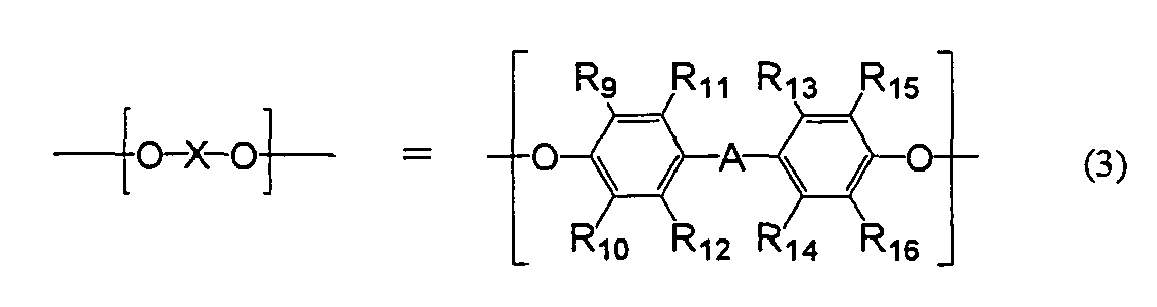


- The resin composition according to claim 1,
wherein, in the vinyl compound (a), -(O-X-O)- is a structural unit of the formula (6), the formula (7) or the formula (8) and -(Y-O)- is an arrangement of a structural unit of the formula (9) or the formula (10) or a random arrangement of structural units of the formula (9) and the formula (10),


- A prepreg comprising the resin composition as defined in claim 1 and a glass woven fabric (f).
- A metal-foil-clad laminate obtained by placing one prepreg as defined in claim 3 or stacking at least two prepregs as defined in claim 3, disposing a metal foil on one side or both sides of the prepreg or the stacked prepregs and laminate-molding the metal foil and the prepreg or the stacked prepregs.
- A resin sheet obtained by applying a solution of the resin composition as defined in claim 1 to a surface of a metal foil or a film and drying the applied solution.
Applications Claiming Priority (2)
| Application Number | Priority Date | Filing Date | Title |
|---|---|---|---|
| JP2008094858 | 2008-04-01 | ||
| JP2008292281 | 2008-11-14 |
Publications (3)
| Publication Number | Publication Date |
|---|---|
| EP2113534A1 true EP2113534A1 (en) | 2009-11-04 |
| EP2113534B1 EP2113534B1 (en) | 2010-11-10 |
| EP2113534B8 EP2113534B8 (en) | 2011-09-21 |
Family
ID=41095662
Family Applications (1)
| Application Number | Title | Priority Date | Filing Date |
|---|---|---|---|
| EP20090250984 Active EP2113534B8 (en) | 2008-04-01 | 2009-03-31 | Resin composition, prepreg and metal-foil-clad laminate |
Country Status (7)
| Country | Link |
|---|---|
| US (1) | US9743515B2 (en) |
| EP (1) | EP2113534B8 (en) |
| JP (1) | JP5369838B2 (en) |
| KR (2) | KR101614922B1 (en) |
| CN (1) | CN101550221B (en) |
| DE (1) | DE602009000326D1 (en) |
| TW (1) | TWI448484B (en) |
Cited By (4)
| Publication number | Priority date | Publication date | Assignee | Title |
|---|---|---|---|---|
| EP2522698A4 (en) * | 2010-01-08 | 2014-07-02 | Mitsubishi Gas Chemical Co | RESIN COMPOSITION, PREPREG, AND LAMINATED LAMINATE |
| EP2762507A4 (en) * | 2011-09-30 | 2015-12-09 | Mitsubishi Gas Chemical Co | RESIN COMPOSITION, PREPREG AND LAMINATE PLATED WITH METAL SHEET |
| WO2022110356A1 (en) * | 2020-11-30 | 2022-06-02 | 科之杰新材料集团有限公司 | High-early-strength cement dispersion polymer and preparation method therefor |
| EP3808726B1 (en) * | 2018-09-14 | 2023-08-02 | Lg Chem, Ltd. | Diol compound, polycarbonate, and method for producing same |
Families Citing this family (28)
| Publication number | Priority date | Publication date | Assignee | Title |
|---|---|---|---|---|
| WO2009040921A1 (en) * | 2007-09-27 | 2009-04-02 | Panasonic Electric Works Co., Ltd. | Epoxy resin composition and, produced therewith, prepreg and metal clad laminate |
| US8658719B2 (en) | 2009-06-11 | 2014-02-25 | Arlon | Low loss pre-pregs and laminates and compositions useful for the preparation thereof |
| KR20170133431A (en) * | 2010-03-02 | 2017-12-05 | 미츠비시 가스 가가쿠 가부시키가이샤 | Resin composition, prepreg, and laminated sheet |
| ES2642061T3 (en) | 2010-04-16 | 2017-11-15 | Valspar Sourcing, Inc. | Coating compositions for packaging items and coating methods |
| JP5830940B2 (en) * | 2010-05-31 | 2015-12-09 | 日立化成株式会社 | Prepreg, metal-clad laminate and printed wiring board |
| WO2012109278A2 (en) | 2011-02-07 | 2012-08-16 | Valspar Sourcing, Inc. | Coating compositions for containers and other articles and methods of coating |
| US8598281B2 (en) | 2011-09-01 | 2013-12-03 | Sabic Innovative Plastics Ip B.V. | Epoxybenzyl-terminated poly(arylene ether)s, method for preparation thereof, and curable compositions comprising same |
| EP2810971B1 (en) * | 2012-01-31 | 2018-09-19 | Mitsubishi Gas Chemical Company, Inc. | Metal foil-clad laminate and printed wiring board using a resin composition |
| US9051465B1 (en) | 2012-02-21 | 2015-06-09 | Park Electrochemical Corporation | Thermosetting resin composition containing a polyphenylene ether and a brominated fire retardant compound |
| US9243164B1 (en) | 2012-02-21 | 2016-01-26 | Park Electrochemical Corporation | Thermosetting resin composition containing a polyphenylene ether and a brominated fire retardant compound |
| CN103608387B (en) * | 2012-03-19 | 2016-02-03 | 旭化成电子材料株式会社 | Prepregs containing polyphenylene ether particles |
| WO2013141298A1 (en) * | 2012-03-23 | 2013-09-26 | 三菱瓦斯化学株式会社 | Prepreg and laminated board |
| CN102807658B (en) | 2012-08-09 | 2014-06-11 | 广东生益科技股份有限公司 | Polyphenyl ether resin composite and prepreg and copper clad laminate made of polyphenyl ether resin composite |
| AU2013299578A1 (en) | 2012-08-09 | 2015-02-19 | Valspar Sourcing, Inc. | Compositions for containers and other articles and methods of using same |
| TWI490251B (en) * | 2013-02-21 | 2015-07-01 | Chin Yee Chemical Industres Co Ltd | Containing unsaturated polyphenylene ether resin and its composition, thermosetting resin composition |
| KR101556658B1 (en) | 2013-11-26 | 2015-10-01 | 주식회사 두산 | Thermoplastic resin composition having excellent heat resistance and low permittivity, prepreg and copper clad laminate using the same |
| CN103668669B (en) * | 2013-11-27 | 2015-09-16 | 卡尔丹顿服饰股份有限公司 | A kind of thread water absorben perspiring shell fabric and preparation method thereof |
| JP6746501B2 (en) | 2014-04-14 | 2020-08-26 | ヴァルスパー・ソーシング・インコーポレーテッド | Method of preparing compositions for containers and other articles and methods of use thereof |
| KR101865649B1 (en) * | 2014-12-22 | 2018-07-04 | 주식회사 두산 | Thermoplastic resin composition for high frequency, prepreg, laminate sheet and printed circuit board using the same |
| TWI614275B (en) | 2015-11-03 | 2018-02-11 | Valspar Sourcing Inc | Liquid epoxy resin composition for preparing a polymer |
| JP6070812B2 (en) * | 2015-12-25 | 2017-02-01 | 日立化成株式会社 | Resin composition for printed wiring board, prepreg, laminated board, and printed wiring board |
| JP6672954B2 (en) * | 2016-03-29 | 2020-03-25 | 味の素株式会社 | Resin sheet |
| CN106280387B (en) * | 2016-08-19 | 2019-01-15 | 浙江华正新材料股份有限公司 | There is halogen fire-proof resin composition and uses its manufactured resin, laminate |
| WO2018060803A1 (en) | 2016-09-28 | 2018-04-05 | Sabic Global Technologies B.V. | Phenylene ether copolymer and compositions comprising same |
| JP7465093B2 (en) * | 2017-10-10 | 2024-04-10 | 味の素株式会社 | Cured product and method for producing same, resin sheet and resin composition |
| CN110499014B (en) * | 2018-05-18 | 2022-05-10 | 臻鼎科技股份有限公司 | Polymer resin composition, polymer resin and polymer film |
| CN111253888A (en) * | 2020-03-30 | 2020-06-09 | 广东生益科技股份有限公司 | Circuit material and circuit board comprising same |
| WO2021251052A1 (en) * | 2020-06-09 | 2021-12-16 | Dic株式会社 | Curable resin, curable resin composition, and cured product |
Citations (5)
| Publication number | Priority date | Publication date | Assignee | Title |
|---|---|---|---|---|
| JPH06207096A (en) | 1993-01-11 | 1994-07-26 | Sumitomo Bakelite Co Ltd | Low-permittivity thermosetting resin composition |
| JP2005089636A (en) | 2003-09-18 | 2005-04-07 | Mitsubishi Gas Chem Co Inc | Prepreg for laminate and laminate |
| JP2005112981A (en) | 2003-10-07 | 2005-04-28 | Hitachi Chem Co Ltd | Low-permittivity resin composition, prepreg using the same, metal-clad laminate, and printed circuit board |
| JP2005120173A (en) | 2003-10-15 | 2005-05-12 | Mitsubishi Gas Chem Co Inc | Curable resin composition. |
| EP1566377A1 (en) * | 2004-02-18 | 2005-08-24 | Mitsubishi Gas Chemical Company, Inc. | Cyanate ester compound flame-retardant resin composition and cured product thereof |
Family Cites Families (14)
| Publication number | Priority date | Publication date | Assignee | Title |
|---|---|---|---|---|
| US6586533B1 (en) * | 1987-05-14 | 2003-07-01 | World Properties, Inc. | Method of manufacture of polybutadiene and polyisoprene based thermosetting compositions |
| CN1036402C (en) * | 1991-01-11 | 1997-11-12 | 旭化成工业株式会社 | Curable polyphenoxy resin composition and film made therefrom |
| JPH06184397A (en) * | 1992-12-21 | 1994-07-05 | Matsushita Electric Works Ltd | Polycyanate ester resin composition, thermosetting product and method for producing the same |
| US6632893B2 (en) * | 1999-05-28 | 2003-10-14 | Henkel Loctite Corporation | Composition of epoxy resin, cyanate ester, imidazole and polysulfide tougheners |
| EP1384733B1 (en) * | 2002-07-25 | 2007-04-25 | Mitsubishi Gas Chemical Company, Inc. | Vinyl compound and cured product thereof |
| JP2004182850A (en) * | 2002-12-03 | 2004-07-02 | Mitsubishi Gas Chem Co Inc | Prepreg and laminate with excellent property balance |
| JP4300401B2 (en) * | 2003-01-29 | 2009-07-22 | 三菱瓦斯化学株式会社 | Curable resin composition and cured product thereof |
| JP2005060635A (en) * | 2003-08-20 | 2005-03-10 | Mitsubishi Gas Chem Co Inc | Resin composition for laminate, prepreg and metal-clad laminate |
| JP2005097362A (en) * | 2003-09-22 | 2005-04-14 | Mitsubishi Gas Chem Co Inc | Prepreg for laminate and laminate |
| US7192651B2 (en) * | 2003-08-20 | 2007-03-20 | Mitsubishi Gas Chemical Company, Inc. | Resin composition and prepreg for laminate and metal-clad laminate |
| JP4407823B2 (en) | 2004-02-18 | 2010-02-03 | 三菱瓦斯化学株式会社 | Novel cyanate ester compound, flame retardant resin composition, and cured product thereof |
| JP4843944B2 (en) * | 2005-01-13 | 2011-12-21 | 三菱瓦斯化学株式会社 | Resin composition and prepreg and laminate using the same |
| JP4784198B2 (en) | 2005-08-11 | 2011-10-05 | 三菱瓦斯化学株式会社 | Thermosetting resin composition |
| JP5135705B2 (en) | 2006-04-04 | 2013-02-06 | 三菱瓦斯化学株式会社 | Prepreg, metal foil-clad laminate, printed wiring board |
-
2009
- 2009-03-31 DE DE200960000326 patent/DE602009000326D1/en active Active
- 2009-03-31 EP EP20090250984 patent/EP2113534B8/en active Active
- 2009-04-01 US US12/385,194 patent/US9743515B2/en active Active
- 2009-04-01 JP JP2009089273A patent/JP5369838B2/en active Active
- 2009-04-01 KR KR1020090028206A patent/KR101614922B1/en active Active
- 2009-04-01 TW TW98110827A patent/TWI448484B/en active
- 2009-04-01 CN CN2009101323837A patent/CN101550221B/en active Active
-
2016
- 2016-04-11 KR KR1020160044363A patent/KR101687276B1/en active Active
Patent Citations (5)
| Publication number | Priority date | Publication date | Assignee | Title |
|---|---|---|---|---|
| JPH06207096A (en) | 1993-01-11 | 1994-07-26 | Sumitomo Bakelite Co Ltd | Low-permittivity thermosetting resin composition |
| JP2005089636A (en) | 2003-09-18 | 2005-04-07 | Mitsubishi Gas Chem Co Inc | Prepreg for laminate and laminate |
| JP2005112981A (en) | 2003-10-07 | 2005-04-28 | Hitachi Chem Co Ltd | Low-permittivity resin composition, prepreg using the same, metal-clad laminate, and printed circuit board |
| JP2005120173A (en) | 2003-10-15 | 2005-05-12 | Mitsubishi Gas Chem Co Inc | Curable resin composition. |
| EP1566377A1 (en) * | 2004-02-18 | 2005-08-24 | Mitsubishi Gas Chemical Company, Inc. | Cyanate ester compound flame-retardant resin composition and cured product thereof |
Cited By (5)
| Publication number | Priority date | Publication date | Assignee | Title |
|---|---|---|---|---|
| EP2522698A4 (en) * | 2010-01-08 | 2014-07-02 | Mitsubishi Gas Chemical Co | RESIN COMPOSITION, PREPREG, AND LAMINATED LAMINATE |
| EP2762507A4 (en) * | 2011-09-30 | 2015-12-09 | Mitsubishi Gas Chemical Co | RESIN COMPOSITION, PREPREG AND LAMINATE PLATED WITH METAL SHEET |
| US10028377B2 (en) | 2011-09-30 | 2018-07-17 | Mitsubishi Gas Chemical Company, Inc. | Resin composition, prepreg and metal foil-clad laminate |
| EP3808726B1 (en) * | 2018-09-14 | 2023-08-02 | Lg Chem, Ltd. | Diol compound, polycarbonate, and method for producing same |
| WO2022110356A1 (en) * | 2020-11-30 | 2022-06-02 | 科之杰新材料集团有限公司 | High-early-strength cement dispersion polymer and preparation method therefor |
Also Published As
| Publication number | Publication date |
|---|---|
| KR101614922B1 (en) | 2016-04-22 |
| JP2010138366A (en) | 2010-06-24 |
| JP5369838B2 (en) | 2013-12-18 |
| DE602009000326D1 (en) | 2010-12-23 |
| HK1135122A1 (en) | 2010-05-28 |
| CN101550221A (en) | 2009-10-07 |
| TW200948856A (en) | 2009-12-01 |
| US9743515B2 (en) | 2017-08-22 |
| KR20090105859A (en) | 2009-10-07 |
| KR101687276B1 (en) | 2016-12-16 |
| EP2113534B1 (en) | 2010-11-10 |
| KR20160045658A (en) | 2016-04-27 |
| US20090247032A1 (en) | 2009-10-01 |
| TWI448484B (en) | 2014-08-11 |
| EP2113534B8 (en) | 2011-09-21 |
| CN101550221B (en) | 2012-09-19 |
Similar Documents
| Publication | Publication Date | Title |
|---|---|---|
| EP2113534B1 (en) | Resin composition, prepreg and metal-foil-clad laminate | |
| EP2090612B1 (en) | Resin composition, prepreg and their uses | |
| EP2762507B1 (en) | Resin composition, prepreg, and metal foil-clad laminate | |
| EP2690120B1 (en) | Resin composition, prepreg and resin sheet, and metal foil-clad laminate | |
| JP6981007B2 (en) | Resin composition, resin sheet and printed wiring board | |
| EP2829568B1 (en) | Prepreg and laminated board | |
| JP6623640B2 (en) | Prepreg | |
| JP7082454B2 (en) | Prepregs, laminates and printed wiring boards | |
| EP1454937A2 (en) | Epoxy resin curing agent, curable epoxy resin composition and cured products | |
| JP2017141314A (en) | Prepreg | |
| HK1135122B (en) | Resin composition, prepreg and metal-foil-clad laminate | |
| CN109825039B (en) | Cyanate ester resin composition and use thereof | |
| HK1134312B (en) | Resin composition, prepreg and laminate using the same |
Legal Events
| Date | Code | Title | Description |
|---|---|---|---|
| PUAI | Public reference made under article 153(3) epc to a published international application that has entered the european phase |
Free format text: ORIGINAL CODE: 0009012 |
|
| AK | Designated contracting states |
Kind code of ref document: A1 Designated state(s): AT BE BG CH CY CZ DE DK EE ES FI FR GB GR HR HU IE IS IT LI LT LU LV MC MK MT NL NO PL PT RO SE SI SK TR |
|
| AX | Request for extension of the european patent |
Extension state: AL BA RS |
|
| 17P | Request for examination filed |
Effective date: 20100121 |
|
| GRAP | Despatch of communication of intention to grant a patent |
Free format text: ORIGINAL CODE: EPIDOSNIGR1 |
|
| AKX | Designation fees paid |
Designated state(s): DE FR GB |
|
| GRAS | Grant fee paid |
Free format text: ORIGINAL CODE: EPIDOSNIGR3 |
|
| GRAA | (expected) grant |
Free format text: ORIGINAL CODE: 0009210 |
|
| AK | Designated contracting states |
Kind code of ref document: B1 Designated state(s): DE FR GB |
|
| REG | Reference to a national code |
Ref country code: GB Ref legal event code: FG4D |
|
| REF | Corresponds to: |
Ref document number: 602009000326 Country of ref document: DE Date of ref document: 20101223 Kind code of ref document: P |
|
| RBV | Designated contracting states (corrected) |
Designated state(s): DE FR GB |
|
| RBV | Designated contracting states (corrected) |
Designated state(s): BE DE FR GB IT |
|
| PG25 | Lapsed in a contracting state [announced via postgrant information from national office to epo] |
Ref country code: BE Free format text: LAPSE BECAUSE OF FAILURE TO SUBMIT A TRANSLATION OF THE DESCRIPTION OR TO PAY THE FEE WITHIN THE PRESCRIBED TIME-LIMIT Effective date: 20101110 |
|
| PLBE | No opposition filed within time limit |
Free format text: ORIGINAL CODE: 0009261 |
|
| STAA | Information on the status of an ep patent application or granted ep patent |
Free format text: STATUS: NO OPPOSITION FILED WITHIN TIME LIMIT |
|
| 26N | No opposition filed |
Effective date: 20110811 |
|
| REG | Reference to a national code |
Ref country code: DE Ref legal event code: R097 Ref document number: 602009000326 Country of ref document: DE Effective date: 20110811 |
|
| REG | Reference to a national code |
Ref country code: FR Ref legal event code: PLFP Year of fee payment: 8 |
|
| REG | Reference to a national code |
Ref country code: FR Ref legal event code: PLFP Year of fee payment: 9 |
|
| REG | Reference to a national code |
Ref country code: FR Ref legal event code: PLFP Year of fee payment: 10 |
|
| PGFP | Annual fee paid to national office [announced via postgrant information from national office to epo] |
Ref country code: IT Payment date: 20200221 Year of fee payment: 12 |
|
| PG25 | Lapsed in a contracting state [announced via postgrant information from national office to epo] |
Ref country code: IT Free format text: LAPSE BECAUSE OF NON-PAYMENT OF DUE FEES Effective date: 20210331 |
|
| P01 | Opt-out of the competence of the unified patent court (upc) registered |
Effective date: 20230515 |
|
| PGFP | Annual fee paid to national office [announced via postgrant information from national office to epo] |
Ref country code: GB Payment date: 20260209 Year of fee payment: 18 |
|
| PGFP | Annual fee paid to national office [announced via postgrant information from national office to epo] |
Ref country code: DE Payment date: 20260204 Year of fee payment: 18 |
|
| PGFP | Annual fee paid to national office [announced via postgrant information from national office to epo] |
Ref country code: BE Payment date: 20260217 Year of fee payment: 18 |
|
| PGFP | Annual fee paid to national office [announced via postgrant information from national office to epo] |
Ref country code: FR Payment date: 20260209 Year of fee payment: 18 |