EP2104357A2 - Verfahren und Vorrichtung zur Erzeugung eines Bilddatenstroms, Verfahren und Vorrichtung zur Rekonstruktion eines aktuellen Bildes aus einem Bilddatenstrom, Bilddatenstrom und Speichermedium, das den Bilddatenstrom trägt - Google Patents
Verfahren und Vorrichtung zur Erzeugung eines Bilddatenstroms, Verfahren und Vorrichtung zur Rekonstruktion eines aktuellen Bildes aus einem Bilddatenstrom, Bilddatenstrom und Speichermedium, das den Bilddatenstrom trägt Download PDFInfo
- Publication number
- EP2104357A2 EP2104357A2 EP09154337A EP09154337A EP2104357A2 EP 2104357 A2 EP2104357 A2 EP 2104357A2 EP 09154337 A EP09154337 A EP 09154337A EP 09154337 A EP09154337 A EP 09154337A EP 2104357 A2 EP2104357 A2 EP 2104357A2
- Authority
- EP
- European Patent Office
- Prior art keywords
- data stream
- macro blocks
- image
- image data
- srm
- Prior art date
- Legal status (The legal status is an assumption and is not a legal conclusion. Google has not performed a legal analysis and makes no representation as to the accuracy of the status listed.)
- Withdrawn
Links
- 238000000034 method Methods 0.000 title claims abstract description 27
- 239000013598 vector Substances 0.000 claims description 45
- 101150080085 SEG1 gene Proteins 0.000 claims description 15
- 101100202858 Saccharomyces cerevisiae (strain ATCC 204508 / S288c) SEG2 gene Proteins 0.000 claims description 15
- 101100421134 Schizosaccharomyces pombe (strain 972 / ATCC 24843) sle1 gene Proteins 0.000 claims description 15
- XYDVHKCVOMGRSY-UHFFFAOYSA-N 4-(4-benzylphenyl)-1,3-thiazol-2-amine Chemical compound S1C(N)=NC(C=2C=CC(CC=3C=CC=CC=3)=CC=2)=C1 XYDVHKCVOMGRSY-UHFFFAOYSA-N 0.000 claims description 2
- 101001050286 Homo sapiens Jupiter microtubule associated homolog 1 Proteins 0.000 claims description 2
- 101000928034 Homo sapiens Proteasomal ubiquitin receptor ADRM1 Proteins 0.000 claims description 2
- 102100023133 Jupiter microtubule associated homolog 1 Human genes 0.000 claims description 2
- 102100036915 Proteasomal ubiquitin receptor ADRM1 Human genes 0.000 claims description 2
- 238000005070 sampling Methods 0.000 claims description 2
- 230000015654 memory Effects 0.000 description 22
- 230000008520 organization Effects 0.000 description 6
- 230000008901 benefit Effects 0.000 description 3
- 230000008569 process Effects 0.000 description 3
- 230000003292 diminished effect Effects 0.000 description 2
- 230000009286 beneficial effect Effects 0.000 description 1
- 230000005540 biological transmission Effects 0.000 description 1
- 238000004364 calculation method Methods 0.000 description 1
- 230000001419 dependent effect Effects 0.000 description 1
- 230000003467 diminishing effect Effects 0.000 description 1
- 230000006870 function Effects 0.000 description 1
- 230000009467 reduction Effects 0.000 description 1
- 230000002195 synergetic effect Effects 0.000 description 1
Images




Classifications
-
- H—ELECTRICITY
- H04—ELECTRIC COMMUNICATION TECHNIQUE
- H04N—PICTORIAL COMMUNICATION, e.g. TELEVISION
- H04N21/00—Selective content distribution, e.g. interactive television or video on demand [VOD]
- H04N21/20—Servers specifically adapted for the distribution of content, e.g. VOD servers; Operations thereof
- H04N21/23—Processing of content or additional data; Elementary server operations; Server middleware
- H04N21/234—Processing of video elementary streams, e.g. splicing of video streams or manipulating encoded video stream scene graphs
-
- H—ELECTRICITY
- H04—ELECTRIC COMMUNICATION TECHNIQUE
- H04N—PICTORIAL COMMUNICATION, e.g. TELEVISION
- H04N19/00—Methods or arrangements for coding, decoding, compressing or decompressing digital video signals
- H04N19/50—Methods or arrangements for coding, decoding, compressing or decompressing digital video signals using predictive coding
- H04N19/503—Methods or arrangements for coding, decoding, compressing or decompressing digital video signals using predictive coding involving temporal prediction
- H04N19/51—Motion estimation or motion compensation
- H04N19/53—Multi-resolution motion estimation; Hierarchical motion estimation
-
- H—ELECTRICITY
- H04—ELECTRIC COMMUNICATION TECHNIQUE
- H04N—PICTORIAL COMMUNICATION, e.g. TELEVISION
- H04N19/00—Methods or arrangements for coding, decoding, compressing or decompressing digital video signals
- H04N19/10—Methods or arrangements for coding, decoding, compressing or decompressing digital video signals using adaptive coding
- H04N19/102—Methods or arrangements for coding, decoding, compressing or decompressing digital video signals using adaptive coding characterised by the element, parameter or selection affected or controlled by the adaptive coding
-
- H—ELECTRICITY
- H04—ELECTRIC COMMUNICATION TECHNIQUE
- H04N—PICTORIAL COMMUNICATION, e.g. TELEVISION
- H04N19/00—Methods or arrangements for coding, decoding, compressing or decompressing digital video signals
- H04N19/10—Methods or arrangements for coding, decoding, compressing or decompressing digital video signals using adaptive coding
- H04N19/134—Methods or arrangements for coding, decoding, compressing or decompressing digital video signals using adaptive coding characterised by the element, parameter or criterion affecting or controlling the adaptive coding
- H04N19/136—Incoming video signal characteristics or properties
- H04N19/137—Motion inside a coding unit, e.g. average field, frame or block difference
- H04N19/139—Analysis of motion vectors, e.g. their magnitude, direction, variance or reliability
-
- H—ELECTRICITY
- H04—ELECTRIC COMMUNICATION TECHNIQUE
- H04N—PICTORIAL COMMUNICATION, e.g. TELEVISION
- H04N19/00—Methods or arrangements for coding, decoding, compressing or decompressing digital video signals
- H04N19/10—Methods or arrangements for coding, decoding, compressing or decompressing digital video signals using adaptive coding
- H04N19/169—Methods or arrangements for coding, decoding, compressing or decompressing digital video signals using adaptive coding characterised by the coding unit, i.e. the structural portion or semantic portion of the video signal being the object or the subject of the adaptive coding
- H04N19/17—Methods or arrangements for coding, decoding, compressing or decompressing digital video signals using adaptive coding characterised by the coding unit, i.e. the structural portion or semantic portion of the video signal being the object or the subject of the adaptive coding the unit being an image region, e.g. an object
- H04N19/174—Methods or arrangements for coding, decoding, compressing or decompressing digital video signals using adaptive coding characterised by the coding unit, i.e. the structural portion or semantic portion of the video signal being the object or the subject of the adaptive coding the unit being an image region, e.g. an object the region being a slice, e.g. a line of blocks or a group of blocks
-
- H—ELECTRICITY
- H04—ELECTRIC COMMUNICATION TECHNIQUE
- H04N—PICTORIAL COMMUNICATION, e.g. TELEVISION
- H04N19/00—Methods or arrangements for coding, decoding, compressing or decompressing digital video signals
- H04N19/10—Methods or arrangements for coding, decoding, compressing or decompressing digital video signals using adaptive coding
- H04N19/169—Methods or arrangements for coding, decoding, compressing or decompressing digital video signals using adaptive coding characterised by the coding unit, i.e. the structural portion or semantic portion of the video signal being the object or the subject of the adaptive coding
- H04N19/17—Methods or arrangements for coding, decoding, compressing or decompressing digital video signals using adaptive coding characterised by the coding unit, i.e. the structural portion or semantic portion of the video signal being the object or the subject of the adaptive coding the unit being an image region, e.g. an object
- H04N19/176—Methods or arrangements for coding, decoding, compressing or decompressing digital video signals using adaptive coding characterised by the coding unit, i.e. the structural portion or semantic portion of the video signal being the object or the subject of the adaptive coding the unit being an image region, e.g. an object the region being a block, e.g. a macroblock
-
- H—ELECTRICITY
- H04—ELECTRIC COMMUNICATION TECHNIQUE
- H04N—PICTORIAL COMMUNICATION, e.g. TELEVISION
- H04N19/00—Methods or arrangements for coding, decoding, compressing or decompressing digital video signals
- H04N19/42—Methods or arrangements for coding, decoding, compressing or decompressing digital video signals characterised by implementation details or hardware specially adapted for video compression or decompression, e.g. dedicated software implementation
- H04N19/43—Hardware specially adapted for motion estimation or compensation
-
- H—ELECTRICITY
- H04—ELECTRIC COMMUNICATION TECHNIQUE
- H04N—PICTORIAL COMMUNICATION, e.g. TELEVISION
- H04N19/00—Methods or arrangements for coding, decoding, compressing or decompressing digital video signals
- H04N19/42—Methods or arrangements for coding, decoding, compressing or decompressing digital video signals characterised by implementation details or hardware specially adapted for video compression or decompression, e.g. dedicated software implementation
- H04N19/436—Methods or arrangements for coding, decoding, compressing or decompressing digital video signals characterised by implementation details or hardware specially adapted for video compression or decompression, e.g. dedicated software implementation using parallelised computational arrangements
-
- H—ELECTRICITY
- H04—ELECTRIC COMMUNICATION TECHNIQUE
- H04N—PICTORIAL COMMUNICATION, e.g. TELEVISION
- H04N19/00—Methods or arrangements for coding, decoding, compressing or decompressing digital video signals
- H04N19/60—Methods or arrangements for coding, decoding, compressing or decompressing digital video signals using transform coding
- H04N19/61—Methods or arrangements for coding, decoding, compressing or decompressing digital video signals using transform coding in combination with predictive coding
Definitions
- the invention is related to the generation of an image data stream and the reconstruction of an image from an image data stream. More specifically, the invention is related to encoding of a current image by help of a reference image and to decoding of the encoded current image.
- Encoding techniques known in the art make use of information comprised in previously encoded reference images. This is done by searching for each source macro block of the current image a best matching reference macro block in the reference image such that a residual between the reference macro block and the source macro block is minimized. Then, the source macro block is encoded by help of the residual and of a motion vector indicating the spatial relationship between the source macro block and the best match reference macro block. The process of searching a best match reference macro block is also known as motion estimation.
- the best matching reference macro block might be located everywhere in the reference image, finding the best match reference macro block is a computationally expensive task.
- a way to reduce the computational effort is hierarchical motion estimation.
- Hierarchical Motion Estimation is based on the following ideas:
- the source image and the reference image are downscaled by pixel merging or subsampling.
- the downscaled images consist only of a few macro blocks, it is not very computation intensive to calculate matches of each source block of the downscaled source image with all reference macro blocks of the downscaled reference image and to determine a best match among these matches as well as a corresponding preliminary motion vector.
- the preliminary motion vectors of all source blocks of the downscaled source image are used to predict motion vectors in the full resolution images.
- the best matching reference macro block of the full resolution reference image is then searched only in a small search region determined by help of the preliminary motion vector. Therefore, the computation effort for the calculation of the motion vectors for the full resolution images can be reduced significantly.
- the approach may be further improved by determining several preliminary motion vectors based on motion vectors of spatially or temporally adjacent macro blocks.
- the downscaled images may be further downscaled
- first level preliminary motion vectors may be determined by help of a full search in the further downscaled images and searching for second level preliminary motion vectors in the downscaled images may be limited to search areas determined by help of the first level preliminary motion vectors.
- the second level preliminary motion vectors are used to predict motion vectors in the full resolution images.
- the macro block aligned storage organization has the advantage of direct and therefore fast access to reference macro blocks at regular positions. This advantage comes along with the drawback that macro blocks at positions other than the regular positions are not directly accessible. Reconstruction of a non-regularly positioned macro block requires retrieval of up to four regularly positioned macro blocks intersecting the non-regularly positioned macro block and composition of the non-regularly positioned macro block from sections of the regularly positioned macro blocks.
- the invention proposes a method and a device for generating an image data stream, said method comprising the features of claim 1 and said device comprising the features of claim 7.
- the invention further proposes a method and a device for reconstructing a current image from an image data stream, said reconstructing method comprising the features of claim 9 and said reconstructing device comprising the features of claim 10.
- the invention yet further proposes an image data stream comprising the features of claim 8, and a storage medium according to claim 11, said storage medium carrying said proposed image data stream.
- the method for generating an image data stream comprises the steps of (a) assigning search regions in a reference image to source macro blocks of a current image; (b) determining in the search regions best matches and corresponding residuals and (c) encoding the determined residuals in a data stream.
- a further feature of the method is related to the fact that the macro block processing order in at least one of the steps (b) and (c) depends on positions of said search regions in the reference image.
- the variation in the processing order in best match determination allows for execution of best match searches in a search area assigned to two different source macro blocks in succession, so the search area assigned to the two search macro blocks need to be loaded only once.
- the variation in the processing order during encoding enables the decoder to retrieve the intersecting part of the reference macro blocks only once without any necessity for re-order.
- more efficient determination of best matches is enabled and/or processing requirements at decoder side are reduced due to the order of encoding.
- the method further comprising the step of generating a low resolution image by down sampling the reference image or by merging pixels of the reference image; wherein step (a) comprises determining preliminary motion vectors by help of preliminary matches of the source macro blocks in said low resolution image and determining the search regions by help of the preliminary motion vectors.
- the processing order in step (b) depends on intersections of the search regions.
- a first source macro block has the search region with the largest intersection with the search region of a second source macro block and the best match of a third source macro block is determined between determining the best match of the first source macro block and determining the best match of the second source macro block, if said third source macro block's search region is comprised in said largest intersection.
- the reference image is stored in a macro block-wise accessible storage device and reconstructing an arbitrary search region requires retrieving a set of macro blocks from the storage device, a first set of macro blocks required for reconstructing a fourth source macro block's search region has the largest number of macro blocks in common with a second set of macro blocks required for reconstructing the search region of a fifth source macro block and the best match of a sixth source macro block is determined between determining the best match of the fourth source macro block and determining the best match of the fifth source macro block, if said sixth source macro block's best match is reconstructible from said macro blocks in common.
- a seventh source macro block's best match has the largest intersection with the best match of a eighth source macro block and the residual of a ninth source macro block is encoded between encoding of the residual of the seventh source macro block and encoding of the residual of the eighth source macro block, if said ninth source macro block's best match is comprised in said largest intersection.
- the reference image is stored in a macro block-wise accessible storage device and reconstructing an arbitrary macro block requires retrieving a further set of up to four macro blocks from the storage device, a first further set required for reconstructing a tenth source macro block' best match has the most macro blocks in common with a second further set required for reconstructing the best match of a eleventh source macro block and the residual of a twelfth source macro block is encoded between encoding of the residual of the tenth source macro block and encoding of the residual of the eleventh source macro block, if said twelfth source macro block's best match is reconstructible from said macro blocks in common.
- information of the position of the source macro block and/or information of the position of the best match is encoded together with the residual.
- a pyramid of downscaled source images and reference images is built as exemplarily depicted in Fig. 1 .
- a scaling factor of 2 is applied and results in a pyramid of image levels from full resolution level 0 to lowest resolution level n.
- level 0 has a resolution of 720 x 576 pel and n equals 4:
- motion estimation is performed for the highest level LvL4 of the source pyramid. Because this level LvL4 consists only of a few macro blocks, it is not very computation intensive to calculate matches of each source blocks with all reference blocks and to determine the best match among the matches as well as a corresponding motion vector. That is, as search area the entire highest level of the reference pyramid is used.
- the resulting motion vectors from the highest level n are used to predict motion vectors for the level n -1.
- the search for the motion vectors for level n -1 can be restricted to search areas surrounding the locations indicated by the motion vectors from the highest level n. It is also possible, to further take highest level motion vectors from spatially adjacent macro blocks into account when predictions of motion vectors for the level n -1. Additionally or alternatively, motion vectors determined for the macro blocks of an immediately preceding image may be taken into account. Among the motion vectors predicted from the highest level and/or the preceding image, the one with the lowest distortion is chosen. Or, a larger search area comprising some or all locations indicated by the motion vector predictions is formed.
- a set of Predictor Try commands is computed, each of the Predictor Try commands corresponding one motion vector prediction.
- the distortion function for a source macro block is computed for just one search macro block of the reference image wherein the search macro block is determined by the corresponding motion vector prediction.
- a set of Full Search commands is computed, each of the Full Search commands corresponding one search macro block position within a small search area surrounding the best matching motion vector prediction.
- Macro block aligned storage organization means allows for fast accessing of aligned reference macro blocks in their entirety (i.e. with a burst of consecutive memory accesses with increasing addresses), but it is difficult to access a non-aligned reference search macro block which may be located anywhere in the image and does not fit in the macro block aligned structure.
- Fig.2 shows that for retrieving a selected macro block SRM most likely 4 neighboured and aligned reference macro blocks ARM1, ARM2, ARM3, ARM4 have to be loaded from the memory in order to built the non-aligned reference search macro block SRM.
- Hierarchical Motion Estimators are built with large on-chip memories providing the required bandwidth.
- complete reference frames have to be stored, the die size of these on-chip memories is significant.
- the Predictor Try commands are executed in the order of the source macro blocks they belonging to. That means, first all Predictor Tries PTC() for source macro block SMB#0 are computed, than all for source macro block SMB#1 and so on. This is depicted in Fig. 3 .
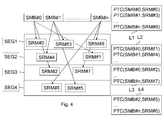
- the invention proposes re-ordering of the Predictor Try command sequence dependent on the reference search macro block they are pointing at.
- the Predictor Try commands PTC() are re-ordered into k lists L1, L2, L3, L4 such that pointing to a reference search macro block SRM located in a certain segment SEG1, SEG2, SEG3, SEG4 are sorted into one list.
- an overlap of the segments is required as exemplarily depicted in Fig. 5 .
- reference search macro blocks located at the border of a segment SEG1 may be partly located also in a vertically adjacent segment SEG2.
- each reference search macro block is located completely within at least one segment SEG1', SEG2'.
- FIG.6 A flowgraph of an exemplary embodiment of the sorting algorithm for the Predictor Try commands is exemplarily shown in Fig.6 .
- a set of k List L1, L2, L3, L4 is initialized wherein k is the number of overlapping segments SEG1', SEG2' into which the image is portioned.
- a Predictor Try Command PTC(SMB# m ,SRM# 1 ) for comparison of m -th source macro block SMB# m with 1 -th selected reference macro block SRM#1 is generated or the already generated Predictor Try Command PTC(SMB# m ,SRM# 1 ) is loaded.
- counter variable N is set to Zero and position variable P is initialized to the position of the selected reference macro block SRM#1.
- P is diminished by the width S of a segment in a loop wherein the loop is left if P drops below zero due to the diminishing. If not, N is in creased by 1 and P is diminished by S again.
- Predictor Try Command PTC(SMB# m ,SRM# 1 ) is appended to list N . Then it is checked in step LAST whether there are further comparisons for which a Predictor Try Command PTC(SMB# m ,SRM# 1 ) can be loaded or generated. If so, the method returns to step LG. If not, sorting ends.
- k lists of Predictor Try commands PTC(SMB# m ,SRM# 1 ) have been generated.
- SEG2' of the reference frames has to be stored into a local memory because the previous sorting step ensures that all Predictor Tries PTC() within this list require the same reference image segment SEG1', SEG2' to be processed. This reduces the on-chip memory requirements by a factor of k .
- the residuals of the source macro blocks are encoded together with the determined motion vectors in an image data stream according their position in the source image.
- Two residuals adjacent in the image data stream as known refer to two adjacent source macro blocks in the current image.
- the motion vectors may point anywhere in the reference image in an unpredictable way, memory access to the reference macro blocks for motion compensation leads to the same bandwidth issue as described before for motion estimation.
- the decoder may first receive all residuals and motion vectors related to the current image and sort the residuals and motion vectors into lists such that the residuals and motion vectors in each list are all related to the same segment SEG1, SEG2, SEG3, SEG4 of the reference image. Then during reconstruction of the macro blocks related to the residuals and motion vectors in one of the lists, only a segment SEG1, SEG2, SEG3, SEG4 of the reference image instead of he entire reference image has to be present in the local memory or cache which therefore may be small.
- the re-ordering in the decoder can be made redundant by transmitting the residuals and motion vectors re-ordered. That is, even if no re-ordering is applied at encoder side for motion estimation, encoder's re-ordering for transmission which makes re-ordering at decoder side may be beneficial.
- invention proposes that residuals and corresponding motion vectors related to the same segment SEG1, SEG2, SEG3, SEG4 are encoded in separated contiguous sections of the image data stream. Then during decoding of each subsection, only a segment SEG1, SEG2, SEG3, SEG4 of the reference image instead of he entire reference image has to be present in the local memory or cache which therefore may be small. Similarly as for the encoder, the on-chip memory requirements and the bandwidth requirements to the external memory are reduced significantly through the re-ordering of the processing order.
- the position of a source macro block to which a residual belongs can no longer be deducted from the position of the residual in the image data stream, information regarding the position of the source macro blocks in the source image is comprised in the image data stream.
- This information may be formed by the relative position of a currently referred reference macro block with respect to a previously referred reference macro block.
- the position of a current source macro block can then be deducted by help of the motion vector. This minimizes the additional band width required for transmitting the position information.
- the encoder mainly has to re-order the processing of the macro blocks for motion estimation in the proposed manner. This ensures that the motion vectors of subsequently processed macro blocks are pointing to the same reference area. If now the residuals are transmitted in exactly that order, no re-ordering step at the decoder is required.
- This proposal combines the advantages of low on-chip memory requirements and low bandwidth requirements at encoder and decoder with fast processing time for motion compensation at the decoder.
Landscapes
- Engineering & Computer Science (AREA)
- Multimedia (AREA)
- Signal Processing (AREA)
- Computing Systems (AREA)
- Theoretical Computer Science (AREA)
- Compression Or Coding Systems Of Tv Signals (AREA)
Priority Applications (1)
| Application Number | Priority Date | Filing Date | Title |
|---|---|---|---|
| EP09154337A EP2104357A3 (de) | 2008-03-18 | 2009-03-04 | Verfahren und Vorrichtung zur Erzeugung eines Bilddatenstroms, Verfahren und Vorrichtung zur Rekonstruktion eines aktuellen Bildes aus einem Bilddatenstrom, Bilddatenstrom und Speichermedium, das den Bilddatenstrom trägt |
Applications Claiming Priority (2)
| Application Number | Priority Date | Filing Date | Title |
|---|---|---|---|
| EP08102732A EP2104356A1 (de) | 2008-03-18 | 2008-03-18 | Verfahren und Vorrichtung zur Erzeugung eines Bilddatenstroms, Verfahren und Vorrichtung zur Rekonstruktion eines aktuellen Bildes aus einem Bilddatenstrom, Bilddatenstrom und Speichermedium, das den Bilddatenstrom trägt |
| EP09154337A EP2104357A3 (de) | 2008-03-18 | 2009-03-04 | Verfahren und Vorrichtung zur Erzeugung eines Bilddatenstroms, Verfahren und Vorrichtung zur Rekonstruktion eines aktuellen Bildes aus einem Bilddatenstrom, Bilddatenstrom und Speichermedium, das den Bilddatenstrom trägt |
Publications (2)
| Publication Number | Publication Date |
|---|---|
| EP2104357A2 true EP2104357A2 (de) | 2009-09-23 |
| EP2104357A3 EP2104357A3 (de) | 2009-11-11 |
Family
ID=39934653
Family Applications (2)
| Application Number | Title | Priority Date | Filing Date |
|---|---|---|---|
| EP08102732A Withdrawn EP2104356A1 (de) | 2008-03-18 | 2008-03-18 | Verfahren und Vorrichtung zur Erzeugung eines Bilddatenstroms, Verfahren und Vorrichtung zur Rekonstruktion eines aktuellen Bildes aus einem Bilddatenstrom, Bilddatenstrom und Speichermedium, das den Bilddatenstrom trägt |
| EP09154337A Withdrawn EP2104357A3 (de) | 2008-03-18 | 2009-03-04 | Verfahren und Vorrichtung zur Erzeugung eines Bilddatenstroms, Verfahren und Vorrichtung zur Rekonstruktion eines aktuellen Bildes aus einem Bilddatenstrom, Bilddatenstrom und Speichermedium, das den Bilddatenstrom trägt |
Family Applications Before (1)
| Application Number | Title | Priority Date | Filing Date |
|---|---|---|---|
| EP08102732A Withdrawn EP2104356A1 (de) | 2008-03-18 | 2008-03-18 | Verfahren und Vorrichtung zur Erzeugung eines Bilddatenstroms, Verfahren und Vorrichtung zur Rekonstruktion eines aktuellen Bildes aus einem Bilddatenstrom, Bilddatenstrom und Speichermedium, das den Bilddatenstrom trägt |
Country Status (5)
| Country | Link |
|---|---|
| US (1) | US8619862B2 (de) |
| EP (2) | EP2104356A1 (de) |
| JP (1) | JP5266096B2 (de) |
| KR (1) | KR101579472B1 (de) |
| CN (1) | CN101540911B (de) |
Cited By (1)
| Publication number | Priority date | Publication date | Assignee | Title |
|---|---|---|---|---|
| DE102021101749A1 (de) | 2021-01-27 | 2022-07-28 | Carl Zeiss Industrielle Messtechnik Gmbh | Schnittstellenanordnung zur kopplung von systemkomponenten einer messvorrichtung |
Families Citing this family (12)
| Publication number | Priority date | Publication date | Assignee | Title |
|---|---|---|---|---|
| US20120014451A1 (en) * | 2009-01-15 | 2012-01-19 | Wei Siong Lee | Image Encoding Methods, Image Decoding Methods, Image Encoding Apparatuses, and Image Decoding Apparatuses |
| US9877033B2 (en) | 2009-12-21 | 2018-01-23 | Qualcomm Incorporated | Temporal and spatial video block reordering in a decoder to improve cache hits |
| KR101484171B1 (ko) * | 2011-01-21 | 2015-01-23 | 에스케이 텔레콤주식회사 | 예측 움직임벡터 색인부호화에 기반한 움직임정보 생성/복원 장치 및 방법, 및 그것을 이용한 영상 부호화/복호화 장치 및 방법 |
| CN102223543B (zh) * | 2011-06-13 | 2013-09-04 | 四川虹微技术有限公司 | 参考像素读取存储系统 |
| HUE044009T2 (hu) | 2011-06-28 | 2019-09-30 | Lg Electronics Inc | Eljárás mozgásvektorlista felállítására |
| US8897355B2 (en) * | 2011-11-30 | 2014-11-25 | Avago Technologies General Ip (Singapore) Pte. Ltd. | Cache prefetch during motion estimation |
| CN104142939B (zh) * | 2013-05-07 | 2019-07-02 | 杭州智棱科技有限公司 | 一种基于运动特征信息匹配特征码的方法与设备 |
| CN104144520A (zh) | 2013-05-07 | 2014-11-12 | 李东舸 | 一种设备间建立连接的方法、装置与系统 |
| GB2539241B (en) | 2015-06-11 | 2019-10-23 | Advanced Risc Mach Ltd | Video processing system |
| CN106650778B (zh) * | 2016-10-14 | 2019-08-06 | 北京邮电大学 | 一种词袋模型优化和图像识别的方法及装置 |
| US10824877B2 (en) * | 2017-06-29 | 2020-11-03 | Texas Instruments Incorporated | Hierarchical data organization for dense optical flow processing in a computer vision system |
| WO2022110131A1 (zh) * | 2020-11-30 | 2022-06-02 | 深圳市大疆创新科技有限公司 | 帧间预测方法、装置、编码器、解码器和存储介质 |
Family Cites Families (24)
| Publication number | Priority date | Publication date | Assignee | Title |
|---|---|---|---|---|
| AU9388298A (en) * | 1997-09-19 | 1999-04-12 | Sony Electronics Inc. | Motion compensated digital video decoding with buffered picture storage memory map |
| AU9482698A (en) | 1997-09-29 | 1999-04-23 | Medsim Advanced Radiology Medical Simulation Ltd. | Interventional radiology guidance system |
| US6163576A (en) * | 1998-04-13 | 2000-12-19 | Lsi Logic Corporation | Video encoder having reduced memory bandwidth requirements |
| US6195389B1 (en) * | 1998-04-16 | 2001-02-27 | Scientific-Atlanta, Inc. | Motion estimation system and methods |
| EP1056293A1 (de) * | 1999-05-25 | 2000-11-29 | Deutsche Thomson-Brandt Gmbh | Verfahren und Vorrichtung zur Bewegungsschätzung mittels Blockübereinstimmung |
| EP1061747A1 (de) * | 1999-05-25 | 2000-12-20 | Deutsche Thomson-Brandt Gmbh | Verfahren und Vorrichtung zur block-bewegungsschätzung |
| EP1152621A1 (de) * | 2000-05-05 | 2001-11-07 | STMicroelectronics S.r.l. | Verfahren und System zur Bewegungsschätzung |
| EP1378124B1 (de) * | 2001-02-13 | 2005-06-01 | Koninklijke Philips Electronics N.V. | Verfahren zur codierung und decodierung von bewegungsschätzungen |
| US6687301B2 (en) * | 2001-03-19 | 2004-02-03 | Fulvio Moschetti | Method for block matching motion estimation in digital video sequences |
| US7242717B2 (en) * | 2001-06-08 | 2007-07-10 | Sharp Laboratories Of America, Inc. | Wavelet domain motion compensation system |
| US20050207663A1 (en) * | 2001-07-31 | 2005-09-22 | Weimin Zeng | Searching method and system for best matching motion vector |
| JP2004165803A (ja) * | 2002-11-11 | 2004-06-10 | Matsushita Electric Ind Co Ltd | 動き検出方法、装置、プログラムおよび記録媒体 |
| US7453940B2 (en) * | 2003-07-15 | 2008-11-18 | Lsi Corporation | High quality, low memory bandwidth motion estimation processor |
| DE102004017145B4 (de) * | 2004-04-07 | 2006-02-16 | Micronas Gmbh | Verfahren und Vorrichtung zur Ermittlung von Bewegungvektoren, die Bildbereichen eines Bildes zugeordnet sind |
| TWI243600B (en) * | 2004-09-17 | 2005-11-11 | Primax Electronics Ltd | Selected area comparison method with high-operational efficient |
| KR100694058B1 (ko) | 2004-09-30 | 2007-03-12 | 삼성전자주식회사 | 멀티 타임 스캔 방식에 기초한 인트라 모드 인코딩 및디코딩 방법 및 장치 |
| US8009174B2 (en) * | 2005-03-21 | 2011-08-30 | Koninklijke Philips Electronics N.V. | Processing a data array with a meandering scanning order using a circular buffer memory |
| KR100763182B1 (ko) * | 2005-05-02 | 2007-10-05 | 삼성전자주식회사 | 다계층 기반의 가중 예측을 이용한 비디오 코딩 방법 및장치 |
| US8009923B2 (en) * | 2006-03-14 | 2011-08-30 | Celestial Semiconductor, Inc. | Method and system for motion estimation with multiple vector candidates |
| KR100786426B1 (ko) * | 2006-03-17 | 2007-12-17 | 주식회사 팬택앤큐리텔 | 다 해상도 탐색 방법을 이용한 움직임 벡터 추출 방법 및장치 |
| JP2008053875A (ja) * | 2006-08-23 | 2008-03-06 | Sony Corp | 画像処理装置および方法、プログラム、並びにプログラム格納媒体 |
| US9307122B2 (en) * | 2006-09-27 | 2016-04-05 | Core Wireless Licensing S.A.R.L. | Method, apparatus, and computer program product for providing motion estimation for video encoding |
| US20080137741A1 (en) * | 2006-12-05 | 2008-06-12 | Hari Kalva | Video transcoding |
| JP5082548B2 (ja) * | 2007-03-30 | 2012-11-28 | 富士通株式会社 | 画像処理方法、符号化器および復号化器 |
-
2008
- 2008-03-18 EP EP08102732A patent/EP2104356A1/de not_active Withdrawn
-
2009
- 2009-02-27 JP JP2009046583A patent/JP5266096B2/ja not_active Expired - Fee Related
- 2009-03-03 US US12/380,699 patent/US8619862B2/en not_active Expired - Fee Related
- 2009-03-04 EP EP09154337A patent/EP2104357A3/de not_active Withdrawn
- 2009-03-05 CN CN200910126936.8A patent/CN101540911B/zh not_active Expired - Fee Related
- 2009-03-17 KR KR1020090022650A patent/KR101579472B1/ko not_active Expired - Fee Related
Non-Patent Citations (1)
| Title |
|---|
| None * |
Cited By (1)
| Publication number | Priority date | Publication date | Assignee | Title |
|---|---|---|---|---|
| DE102021101749A1 (de) | 2021-01-27 | 2022-07-28 | Carl Zeiss Industrielle Messtechnik Gmbh | Schnittstellenanordnung zur kopplung von systemkomponenten einer messvorrichtung |
Also Published As
| Publication number | Publication date |
|---|---|
| US20090238282A1 (en) | 2009-09-24 |
| EP2104357A3 (de) | 2009-11-11 |
| CN101540911B (zh) | 2014-09-17 |
| JP2009225442A (ja) | 2009-10-01 |
| CN101540911A (zh) | 2009-09-23 |
| EP2104356A1 (de) | 2009-09-23 |
| JP5266096B2 (ja) | 2013-08-21 |
| KR101579472B1 (ko) | 2015-12-23 |
| US8619862B2 (en) | 2013-12-31 |
| KR20090100279A (ko) | 2009-09-23 |
Similar Documents
| Publication | Publication Date | Title |
|---|---|---|
| EP2104357A2 (de) | Verfahren und Vorrichtung zur Erzeugung eines Bilddatenstroms, Verfahren und Vorrichtung zur Rekonstruktion eines aktuellen Bildes aus einem Bilddatenstrom, Bilddatenstrom und Speichermedium, das den Bilddatenstrom trägt | |
| US9471843B2 (en) | Apparatus and method for ultra-high resolution video processing | |
| US10542276B2 (en) | Data caching method and apparatus for video decoder | |
| US8098733B2 (en) | Multi-directional motion estimation using parallel processors and pre-computed search-strategy offset tables | |
| US10931964B2 (en) | Video data processing system | |
| US8660191B2 (en) | Software video decoder display buffer underflow prediction and recovery | |
| US9167260B2 (en) | Apparatus and method for video processing | |
| KR20120066305A (ko) | 비디오 움직임 예측 및 보상용 캐싱 장치 및 방법 | |
| US7408989B2 (en) | Method of video encoding using windows and system thereof | |
| TWI601075B (zh) | 移動補償影像處理裝置與影像處理方法 | |
| JP2008141288A (ja) | 動きベクトル検出装置および動きベクトル検出方法 | |
| US6690727B1 (en) | Image processing | |
| US7881367B2 (en) | Method of video coding for handheld apparatus | |
| US8135224B2 (en) | Generating image data | |
| CN105427235A (zh) | 一种图像浏览方法及系统 | |
| WO2019052452A1 (zh) | 一种图像数据处理方法、用户终端、服务器和存储介质 | |
| WO2020062226A1 (zh) | 编码设备的控制方法、装置及存储介质 | |
| JP4488805B2 (ja) | 動きベクトル検出装置および方法 | |
| JP5906993B2 (ja) | 符号化装置、符号化方法、及びプログラム | |
| CN101300849B (zh) | 数据处理系统 | |
| JPH11289536A (ja) | 動画像伸長装置及び方法 | |
| CN115174916B (zh) | 视频数据存储方法、装置、电子设备和可读存储介质 | |
| Song et al. | Environmental condition aware super-resolution acceleration framework in server-client hierarchies | |
| CN121418579A (zh) | 基于多维像素角度进行像素搜索的方法及装置 | |
| US20240056601A1 (en) | Hierarchical motion search processing |
Legal Events
| Date | Code | Title | Description |
|---|---|---|---|
| PUAI | Public reference made under article 153(3) epc to a published international application that has entered the european phase |
Free format text: ORIGINAL CODE: 0009012 |
|
| AK | Designated contracting states |
Kind code of ref document: A2 Designated state(s): AT BE BG CH CY CZ DE DK EE ES FI FR GB GR HR HU IE IS IT LI LT LU LV MC MK MT NL NO PL PT RO SE SI SK TR |
|
| AX | Request for extension of the european patent |
Extension state: AL BA RS |
|
| PUAL | Search report despatched |
Free format text: ORIGINAL CODE: 0009013 |
|
| AK | Designated contracting states |
Kind code of ref document: A3 Designated state(s): AT BE BG CH CY CZ DE DK EE ES FI FR GB GR HR HU IE IS IT LI LT LU LV MC MK MT NL NO PL PT RO SE SI SK TR |
|
| AX | Request for extension of the european patent |
Extension state: AL BA RS |
|
| RAP1 | Party data changed (applicant data changed or rights of an application transferred) |
Owner name: THOMSON LICENSING SA |
|
| 17P | Request for examination filed |
Effective date: 20100423 |
|
| AKX | Designation fees paid |
Designated state(s): DE FR GB |
|
| 17Q | First examination report despatched |
Effective date: 20100716 |
|
| RAP1 | Party data changed (applicant data changed or rights of an application transferred) |
Owner name: THOMSON LICENSING DTV |
|
| STAA | Information on the status of an ep patent application or granted ep patent |
Free format text: STATUS: EXAMINATION IS IN PROGRESS |
|
| RAP1 | Party data changed (applicant data changed or rights of an application transferred) |
Owner name: INTERDIGITAL MADISON PATENT HOLDINGS |
|
| GRAP | Despatch of communication of intention to grant a patent |
Free format text: ORIGINAL CODE: EPIDOSNIGR1 |
|
| STAA | Information on the status of an ep patent application or granted ep patent |
Free format text: STATUS: GRANT OF PATENT IS INTENDED |
|
| RIC1 | Information provided on ipc code assigned before grant |
Ipc: H04N 19/53 20140101ALI20181211BHEP Ipc: H04N 19/139 20140101AFI20181211BHEP Ipc: H04N 19/102 20140101ALI20181211BHEP Ipc: H04N 19/436 20140101ALI20181211BHEP Ipc: H04N 19/176 20140101ALI20181211BHEP Ipc: H04N 19/43 20140101ALI20181211BHEP Ipc: H04N 19/174 20140101ALI20181211BHEP Ipc: H04N 19/61 20140101ALI20181211BHEP |
|
| INTG | Intention to grant announced |
Effective date: 20190107 |
|
| RIC1 | Information provided on ipc code assigned before grant |
Ipc: H04N 19/102 20140101ALI20181211BHEP Ipc: H04N 19/53 20140101ALI20181211BHEP Ipc: H04N 19/176 20140101ALI20181211BHEP Ipc: H04N 19/61 20140101ALI20181211BHEP Ipc: H04N 19/43 20140101ALI20181211BHEP Ipc: H04N 19/139 20140101AFI20181211BHEP Ipc: H04N 19/436 20140101ALI20181211BHEP Ipc: H04N 19/174 20140101ALI20181211BHEP |
|
| STAA | Information on the status of an ep patent application or granted ep patent |
Free format text: STATUS: THE APPLICATION IS DEEMED TO BE WITHDRAWN |
|
| 18D | Application deemed to be withdrawn |
Effective date: 20190518 |