EP2089196B1 - Verfahren zur Herstellung von Bambusmatten - Google Patents
Verfahren zur Herstellung von Bambusmatten Download PDFInfo
- Publication number
- EP2089196B1 EP2089196B1 EP07851876.8A EP07851876A EP2089196B1 EP 2089196 B1 EP2089196 B1 EP 2089196B1 EP 07851876 A EP07851876 A EP 07851876A EP 2089196 B1 EP2089196 B1 EP 2089196B1
- Authority
- EP
- European Patent Office
- Prior art keywords
- bamboo
- strips
- bamboo strips
- mat
- width
- Prior art date
- Legal status (The legal status is an assumption and is not a legal conclusion. Google has not performed a legal analysis and makes no representation as to the accuracy of the status listed.)
- Not-in-force
Links
- 235000017166 Bambusa arundinacea Nutrition 0.000 title claims description 256
- 235000017491 Bambusa tulda Nutrition 0.000 title claims description 256
- 241001330002 Bambuseae Species 0.000 title claims description 256
- 235000015334 Phyllostachys viridis Nutrition 0.000 title claims description 256
- 239000011425 bamboo Substances 0.000 title claims description 256
- 238000000034 method Methods 0.000 title claims description 31
- 238000004519 manufacturing process Methods 0.000 title claims description 18
- 230000008878 coupling Effects 0.000 claims description 17
- 238000010168 coupling process Methods 0.000 claims description 17
- 238000005859 coupling reaction Methods 0.000 claims description 17
- 238000003754 machining Methods 0.000 claims description 16
- 239000000463 material Substances 0.000 claims description 14
- 238000001035 drying Methods 0.000 claims description 13
- 239000002390 adhesive tape Substances 0.000 claims description 11
- 238000012545 processing Methods 0.000 claims description 10
- 239000010410 layer Substances 0.000 description 16
- 239000000047 product Substances 0.000 description 9
- 238000005728 strengthening Methods 0.000 description 7
- 238000005520 cutting process Methods 0.000 description 4
- 238000010276 construction Methods 0.000 description 3
- 239000004744 fabric Substances 0.000 description 3
- 239000012467 final product Substances 0.000 description 3
- 238000009413 insulation Methods 0.000 description 3
- 240000000491 Corchorus aestuans Species 0.000 description 2
- 235000011777 Corchorus aestuans Nutrition 0.000 description 2
- 235000010862 Corchorus capsularis Nutrition 0.000 description 2
- 229920002430 Fibre-reinforced plastic Polymers 0.000 description 2
- 239000004698 Polyethylene Substances 0.000 description 2
- 238000004026 adhesive bonding Methods 0.000 description 2
- 239000012790 adhesive layer Substances 0.000 description 2
- 238000010924 continuous production Methods 0.000 description 2
- 239000011151 fibre-reinforced plastic Substances 0.000 description 2
- 238000005259 measurement Methods 0.000 description 2
- 239000002985 plastic film Substances 0.000 description 2
- 229920000573 polyethylene Polymers 0.000 description 2
- 229920006395 saturated elastomer Polymers 0.000 description 2
- 238000012360 testing method Methods 0.000 description 2
- 239000004753 textile Substances 0.000 description 2
- 229920005830 Polyurethane Foam Polymers 0.000 description 1
- 241000826860 Trapezium Species 0.000 description 1
- 230000000843 anti-fungal effect Effects 0.000 description 1
- 238000010923 batch production Methods 0.000 description 1
- 238000007796 conventional method Methods 0.000 description 1
- 229910003460 diamond Inorganic materials 0.000 description 1
- 239000010432 diamond Substances 0.000 description 1
- 230000002349 favourable effect Effects 0.000 description 1
- 229920002457 flexible plastic Polymers 0.000 description 1
- 239000004816 latex Substances 0.000 description 1
- 229920000126 latex Polymers 0.000 description 1
- 238000003801 milling Methods 0.000 description 1
- 239000000203 mixture Substances 0.000 description 1
- 229920006255 plastic film Polymers 0.000 description 1
- 239000002984 plastic foam Substances 0.000 description 1
- -1 polyethylene Polymers 0.000 description 1
- 239000011496 polyurethane foam Substances 0.000 description 1
- KNVAYBMMCPLDOZ-UHFFFAOYSA-N propan-2-yl 12-hydroxyoctadecanoate Chemical compound CCCCCCC(O)CCCCCCCCCCC(=O)OC(C)C KNVAYBMMCPLDOZ-UHFFFAOYSA-N 0.000 description 1
- 230000000717 retained effect Effects 0.000 description 1
- 238000005096 rolling process Methods 0.000 description 1
- 238000007789 sealing Methods 0.000 description 1
- 238000003860 storage Methods 0.000 description 1
- 239000000126 substance Substances 0.000 description 1
- XLYOFNOQVPJJNP-UHFFFAOYSA-N water Substances O XLYOFNOQVPJJNP-UHFFFAOYSA-N 0.000 description 1
Images


Classifications
-
- B—PERFORMING OPERATIONS; TRANSPORTING
- B27—WORKING OR PRESERVING WOOD OR SIMILAR MATERIAL; NAILING OR STAPLING MACHINES IN GENERAL
- B27J—MECHANICAL WORKING OF CANE, CORK, OR SIMILAR MATERIALS
- B27J1/00—Mechanical working of cane or the like
- B27J1/003—Joining the cane side by side
-
- E—FIXED CONSTRUCTIONS
- E04—BUILDING
- E04F—FINISHING WORK ON BUILDINGS, e.g. STAIRS, FLOORS
- E04F13/00—Coverings or linings, e.g. for walls or ceilings
- E04F13/07—Coverings or linings, e.g. for walls or ceilings composed of covering or lining elements; Sub-structures therefor; Fastening means therefor
- E04F13/08—Coverings or linings, e.g. for walls or ceilings composed of covering or lining elements; Sub-structures therefor; Fastening means therefor composed of a plurality of similar covering or lining elements
- E04F13/10—Coverings or linings, e.g. for walls or ceilings composed of covering or lining elements; Sub-structures therefor; Fastening means therefor composed of a plurality of similar covering or lining elements of wood or with an outer layer of wood
-
- E—FIXED CONSTRUCTIONS
- E04—BUILDING
- E04F—FINISHING WORK ON BUILDINGS, e.g. STAIRS, FLOORS
- E04F15/00—Flooring
- E04F15/16—Flooring, e.g. parquet on flexible web, laid as flexible webs; Webs specially adapted for use as flooring; Parquet on flexible web
- E04F15/166—Flooring consisting of a number of elements carried by a common flexible web, e.g. rollable parquet
-
- Y—GENERAL TAGGING OF NEW TECHNOLOGICAL DEVELOPMENTS; GENERAL TAGGING OF CROSS-SECTIONAL TECHNOLOGIES SPANNING OVER SEVERAL SECTIONS OF THE IPC; TECHNICAL SUBJECTS COVERED BY FORMER USPC CROSS-REFERENCE ART COLLECTIONS [XRACs] AND DIGESTS
- Y10—TECHNICAL SUBJECTS COVERED BY FORMER USPC
- Y10T—TECHNICAL SUBJECTS COVERED BY FORMER US CLASSIFICATION
- Y10T156/00—Adhesive bonding and miscellaneous chemical manufacture
- Y10T156/10—Methods of surface bonding and/or assembly therefor
- Y10T156/1052—Methods of surface bonding and/or assembly therefor with cutting, punching, tearing or severing
- Y10T156/1059—Splitting sheet lamina in plane intermediate of faces
-
- Y—GENERAL TAGGING OF NEW TECHNOLOGICAL DEVELOPMENTS; GENERAL TAGGING OF CROSS-SECTIONAL TECHNOLOGIES SPANNING OVER SEVERAL SECTIONS OF THE IPC; TECHNICAL SUBJECTS COVERED BY FORMER USPC CROSS-REFERENCE ART COLLECTIONS [XRACs] AND DIGESTS
- Y10—TECHNICAL SUBJECTS COVERED BY FORMER USPC
- Y10T—TECHNICAL SUBJECTS COVERED BY FORMER US CLASSIFICATION
- Y10T156/00—Adhesive bonding and miscellaneous chemical manufacture
- Y10T156/10—Methods of surface bonding and/or assembly therefor
- Y10T156/1052—Methods of surface bonding and/or assembly therefor with cutting, punching, tearing or severing
- Y10T156/1062—Prior to assembly
- Y10T156/1075—Prior to assembly of plural laminae from single stock and assembling to each other or to additional lamina
-
- Y—GENERAL TAGGING OF NEW TECHNOLOGICAL DEVELOPMENTS; GENERAL TAGGING OF CROSS-SECTIONAL TECHNOLOGIES SPANNING OVER SEVERAL SECTIONS OF THE IPC; TECHNICAL SUBJECTS COVERED BY FORMER USPC CROSS-REFERENCE ART COLLECTIONS [XRACs] AND DIGESTS
- Y10—TECHNICAL SUBJECTS COVERED BY FORMER USPC
- Y10T—TECHNICAL SUBJECTS COVERED BY FORMER US CLASSIFICATION
- Y10T156/00—Adhesive bonding and miscellaneous chemical manufacture
- Y10T156/10—Methods of surface bonding and/or assembly therefor
- Y10T156/1052—Methods of surface bonding and/or assembly therefor with cutting, punching, tearing or severing
- Y10T156/1062—Prior to assembly
- Y10T156/1075—Prior to assembly of plural laminae from single stock and assembling to each other or to additional lamina
- Y10T156/1077—Applying plural cut laminae to single face of additional lamina
-
- Y—GENERAL TAGGING OF NEW TECHNOLOGICAL DEVELOPMENTS; GENERAL TAGGING OF CROSS-SECTIONAL TECHNOLOGIES SPANNING OVER SEVERAL SECTIONS OF THE IPC; TECHNICAL SUBJECTS COVERED BY FORMER USPC CROSS-REFERENCE ART COLLECTIONS [XRACs] AND DIGESTS
- Y10—TECHNICAL SUBJECTS COVERED BY FORMER USPC
- Y10T—TECHNICAL SUBJECTS COVERED BY FORMER US CLASSIFICATION
- Y10T156/00—Adhesive bonding and miscellaneous chemical manufacture
- Y10T156/10—Methods of surface bonding and/or assembly therefor
- Y10T156/1089—Methods of surface bonding and/or assembly therefor of discrete laminae to single face of additional lamina
- Y10T156/1092—All laminae planar and face to face
-
- Y—GENERAL TAGGING OF NEW TECHNOLOGICAL DEVELOPMENTS; GENERAL TAGGING OF CROSS-SECTIONAL TECHNOLOGIES SPANNING OVER SEVERAL SECTIONS OF THE IPC; TECHNICAL SUBJECTS COVERED BY FORMER USPC CROSS-REFERENCE ART COLLECTIONS [XRACs] AND DIGESTS
- Y10—TECHNICAL SUBJECTS COVERED BY FORMER USPC
- Y10T—TECHNICAL SUBJECTS COVERED BY FORMER US CLASSIFICATION
- Y10T428/00—Stock material or miscellaneous articles
- Y10T428/17—Three or more coplanar interfitted sections with securing means
Definitions
- the invention relates to a method for manufacturing bamboo mats.
- the invention further relates to bamboo mats manufactured according to the method.
- bamboo strips It is known to process bamboo into bamboo strips, wherein the strips are cut directly from a 'wet' bamboo stem. Diverse products, such as mats, can be made herefrom. A drawback is that bamboo strips have a certain curvature and are found to deform a great deal in the course of time. bamboo strips are hereby only suitable for low-grade applications.
- the British patent application GB 2 292 336 discloses a method for manufacturing of a multi-layered bamboo product according to the preamble of claim 1, wherein bamboo is processed into bamboo strips, after which the bamboo strips are machined. The bamboo strips are attached to each other resulting in the bamboo product.
- a known application of bamboo strips is the production of bamboo mats, wherein a plurality of parallel bamboo strips are mutually connected. In the case of the known bamboo strips this however results in a low-grade product with poor durability and form-retention.
- the invention provides for this purpose a method for manufacturing a bamboo mat according to claim 1.
- This method is found to produce bamboo mats with an improved form-retention and durability compared to known bamboo mats made of strips obtained directly from the 'wet' bamboo stem.
- the bamboo strips in the bamboo mat preferably have substantially equal dimensions in the final product.
- Form-retention is understood to mean that, although the bamboo mats still expand and contract under the influence of for instance air humidity, the form is here substantially retained at a relative air humidity of 50-65% and temperature between 15-25°C, while in conventional bamboo mats deformation does occur in similar conditions.
- the bamboo strips can be positioned at shorter mutual distances because the bamboo strips have a more regular form and tend to warp less in changing ambient conditions, in particular air humidity and temperature.
- the invention provides a method for manufacturing a bamboo mat, comprising of adjacent parallel positioning of a plurality of bamboo strips according to the invention, and mutual connection of the bamboo strips by means of coupling means.
- a bamboo mat of improved quality is thus obtained in simple manner. Due to the form-retention of the bamboo strips according to the invention it is possible to work with lower tolerances, so that the intermediate space between two adjacent bamboo strips in the mat can be smaller.
- the bamboo mats according to the invention are hereby suitable for higher-grade applications, in particular for applications in interior construction, such as furniture upholstery, floor covering, wall covering and ceiling covering.
- step F) at least 1 mm, more preferably at least 2 mm, is preferably removed in the width from the bamboo mat on either side in the longitudinal direction of the bamboo strips. The removal can for instance take place by sawing, planing or cutting.
- the processing of bamboo to bamboo strips comprises of machining the wet bamboo stem using usual techniques such as cutting, sawing and planing. Drying of the bamboo strips to a predetermined moisture content can take place in a special space with a predetermined moisture content or in the air if it has a suitable air humidity.
- the desired moisture content after drying must correspond as closely as possible to the environment in which the bamboo strips will be applied, preferably with a variation of a maximum of ⁇ 2% by weight of the average degree of humidity in the intended environment of use.
- Known methods for determining moisture contents are based on measurement of electrical resistance or the difference in weight between a wet and fully dried bamboo. Levelling at least the longitudinal sides of the dried bamboo strip makes use of techniques such as planing, cutting and sawing.
- the bamboo has a greater deformation than at other parts of the bamboo strip.
- a rectangular cross-sectional profile is created which is constant over the full length of the bamboo strip, whereby the bamboo strips according to the invention can be positioned adjoining more closely, and this is advantageous for many bamboo products, such as bamboo mats.
- Different means can be envisaged as coupling means, such as for instance adhesive tape or wire, or a material layer such as textile or plastic film which connects the bamboo strips by means of glueing.
- bamboo tiles of different dimensions can thus be manufactured in simple manner from one bamboo mat.
- a width of the bamboo strip is smaller at the position of at least one node in the bamboo than a maximum width of the bamboo strip, wherein during the machining in step C) bamboo is removed on the longitudinal sides of the bamboo strip until the bamboo strip has substantially the same width over the longitudinal direction. It is thus possible to manufacture a closely fitting bamboo mat from the bamboo strips. With the method according to the invention it is possible to realize an average distance between the adjoining bamboo strips of less than 0.5 mm. In bamboo mats manufactured according to the usual methods (so without machining C) the best result which can be achieved is generally between 0.5 and 1 mm, and larger gaps are sometimes even visible between the adjoining bamboo strips, particularly at the position of the nodes of the bamboo. Machining of the longitudinal sides can for instance take place by means of planing.
- a thickness of the bamboo strip at the position of at least one node in the bamboo is smaller during drying in step B) than a maximum thickness of the bamboo strip, wherein during the machining in step C) bamboo is removed from the top side and bottom side of the bamboo strip adjacent to the longitudinal sides until the bamboo strip has substantially the same thickness over the longitudinal direction. Machining and levelling the bottom side in this manner makes it readily possible to arrange the bamboo mat according to the invention flat on a flat surface or a carrier layer, wherein minimal stresses are caused in the bamboo material when the bamboo mat is for instance glued to a surface or carrier. Machining of the top side in this manner results in an exceptionally plane surface of the top side of the resulting bamboo mat. A product with a very regular form becomes possible when material is removed on all sides to the level of the bamboo strip at the position of the nodes.
- the predetermined moisture content in step B) preferably lies between 6 and 12% by weight, more preferably between 6 and 10% by weight.
- the average degree of humidity and temperature indoors is found to result in exceptionally little deformation in the bamboo mats according to the invention, particularly at a relative degree of humidity between 50 and 65% relative to saturated air and temperatures between 15 and 25°C.
- bamboo strips are machined to a thickness between 1 and 2.5 mm. Such strips are found to reduce the time required for the drying step. Bamboo strips smaller than 1 mm have too low a mechanical strength for many applications, and can be damaged relatively more easily in further machining steps.
- the coupling means in step E) preferably comprise adhesive tape, wherein the adhesive tape is arranged over a plurality of adjoining bamboo strips such that the bamboo strips are coupled pivotally to each other.
- Adhesive tape can be arranged particularly quickly and easily and provides a good mutual fixation of the position of the bamboo strips, wherein the coupling can also readily pivot or hinge, whereby the mat can for instance be fully or partially rolled up.
- the coupling means in step E) comprise a flexible material layer which substantially covers adjoining bamboo strips on at least one side.
- the flexible layer preferably comprises a tensively strong material such as a fibre-reinforced plastic film, such as latex, polyethylene (PE) or polyurethane foam, or textile fabric such as jute.
- the flexible fabric can also have further functionality, such as heat insulation, for which purpose a flexible plastic film or a plastic foam can for instance be used. It is advantageous to combine different stacked flexible layers with different functionality, for instance in order of stacking a first adhesive layer, a tensively strong layer, a second adhesive layer and an insulating layer.
- the strengthening element can optionally be used in combination with other coupling means such as adhesive tape.
- the bamboo strips of the bamboo mat which are located at the outermost positions have a greater width than the bamboo strips located between the outermost positions, wherein the bamboo strips located at the outermost positions are narrowed during the narrowing of the bamboo mat to a width substantially equal to the width of the bamboo strips located between the outermost positions. It is thus readily possible to obtain the desired width of the bamboo strips at the outermost positions.
- a bamboo mat is made in which all the bamboo strips, including the bamboo strips located at the outermost positions, must have a substantially equal width. It is for instance possible to envisage using strips with a width of 15 mm, wherein strips with a width of 17 mm are used at the outermost positions.
- step G parts of bamboo are sawn off parallel in step G) on the opposite end surfaces of the bamboo mat at a predetermined angle to the longitudinal direction of the bamboo strips.
- a reproducible form of the bamboo mat is hereby obtained, whereby it becomes easier to lay a regular pattern.
- a particularly favourable angle is an angle of 90 degrees, but a large number of different geometric laying forms can also be envisaged for bamboo mats sawn off at an angle of 30, 45 or 60 degrees.
- Machining step G is preferably performed after machining step F since it is easier to measure the angle in step G) if the longitudinal sides have first been levelled in step F).
- a rolled-up bamboo mat can be stored or transported more compactly, optionally while awaiting further machining steps such as the above stated steps F and/or G.
- bamboo mats obtained according to the method according to the invention may be used for interior construction, in particular for manufacturing furniture, floor covering, wall covering and/or ceiling covering. Owing to the form-retention and reproducibility bamboo mats can be produced according to the invention with exact dimensions and relatively low tolerances. It is hereby possible to manufacture high-grade furniture or covering with relatively low tolerances and a good durability.
- a bamboo mat obtained in accordance with the method according to the invention comprising a plurality of bamboo strips which are positioned mutually adjoining and parallel and mutually connected using coupling means, wherein the bamboo strips are connected pivotally to each other using coupling means, and wherein the bamboo mat is narrowed to a predetermined width by removal of bamboo on either side parallel to the longitudinal direction of the bamboo strips.
- a mat can have different dimensions and can for instance comprise 10, 100 or 1000 mutually connected bamboo strips.
- the mutual distance between adjoining bamboo strips is a maximum of 0.5 mm.
- the average mutual distance is preferably a maximum of 0.5 mm, more preferably the absolute mutual distance being a maximum of 0.5 mm.
- the greatest distance between adjoining bamboo strips is generally to be found at the position of nodes of the bamboo.
- the bamboo strips in the bamboo mat preferably have a width between 2 and 22 mm, preferably between 10 and 20 mm, more preferably between 14 and 16 mm.
- a bamboo mat from strips enables efficient material use and also a minimal chance of deformation and material stress in the case of fluctuations in the relative air humidity, in particular between 50 and 65% moisture content relative to saturated air.
- a width between 14 and 16 mm is optimal.
- the bamboo strips preferably have substantially the same width. It is however also possible to envisage making a mat of bamboo strips with different widths.
- the bamboo strips in the bamboo mat have a thickness between 1 and 2.5 mm. At such a thickness the bamboo is flexible such that it lies substantially flat when laid on a surface. In the case of bamboo with a thickness greater than 2.5 mm the rigidity of the bamboo strips is such that laying them flat is more difficult, whereby pressure or adhesion to the surface is sometimes required in order to force the bamboo mat into the plane.
- the coupling means are flexible such that the bamboo mat can be rolled up. Rolling up and unrolling of the bamboo mat are thus easily possible. It is moreover simpler to lay the mat flat on a surface. Owing to the flexible coupling means the bamboo mat can adjust to small variations and irregularities in the surface. In the rolled-up position the bamboo mat can be stored and/or transported compactly.
- a rolled-up bamboo mat can for instance comprise between 100 and 1000 bamboo strips, which can be divided in further processing steps into smaller, more easily manageable bamboo mats, each comprising for instance between 10 and 20 bamboo strips.
- the coupling means comprise adhesive tape, wherein the adhesive tape spans a plurality of adjoining bamboo strips. An exceptionally firm fixation of the bamboo strips is thus effected.
- the coupling means comprise a flexible material layer which substantially covers adjoining bamboo strips on at least one side.
- the flexible material layer can also have other functionalities such as water sealing and/or heat insulation.
- the bamboo mat has a rectangular form. Surfaces can be fully covered in simple manner with a rectangular form.
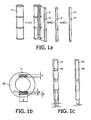
- FIG 1a shows bamboo 1, from which an elongate part 2 is made for instance by milling, cutting and/or sawing.
- Elongate part 2 is made from a so-called 'wet' bamboo stem 1.
- This elongate part still has nodes 3.
- elongate part 2 is machined to a rectangular bamboo strip 4 in which the locations of nodes 3 are still recognisable as zones 5 with a material density differing from the rest of the bamboo.
- bamboo 1 is chosen such that a bamboo strip with a thickness between 1-2.5 mm can be cut therefrom. In the prior art the thus cut bamboo strips 4 are used directly for making products such as bamboo mats.
- Figure 1b shows a cross-section of a bamboo stem 10, wherein one or two bamboo strips 11,12 are manufactured from a wall thickness in the diameter direction. Instead of making one bamboo strip 11 with thickness A from the wall, two bamboo strips 12 are preferably made with a smaller thickness B.
- the thinner bamboo strips 12 with thickness B between 1-2.5 mm have the advantage that they can be dried quickly to the desired degree of humidity.
- Figure 1c shows a bamboo strip 15 after drying.
- the bamboo strip 15 obtained from a 'wet' bamboo stem has a degree of humidity which can rise to 30%.
- the degree of humidity after drying preferably corresponds with the average humidity in the geographic location where the bamboo strips will be used.
- bamboo strips are dried to a degree of humidity of 6-12% by weight, preferably between 6 and 10% by weight, most preferably to about 8%.
- bamboo strips with such a degree of humidity are found generally to be readily applicable and result in minimal deformation.
- the drying process produces a greater shrinkage of the bamboo at the position of nodes 16 because the bamboo has a different composition and material density at these positions.
- This irregularity is planed off by reducing the width of the original width C to a new width D, wherein D is equal to or smaller than the smallest width at nodes 16. Assuming a width D of for instance 22 mm, 1 to 3 mm of material must be removed on either side, whereby the width is for instance reduced from 17 mm to 15 mm. The thickness is generally also planed away or sanded down since irregularities can also occur in this direction, albeit smaller than in width direction D.
- the final product is a bamboo strip 18 with width D which, also without further chemical treatment, has a relatively stable form in the intended environment of use compared to the prior art bamboo strips which are processed into products directly from the 'wet' bamboo stem.
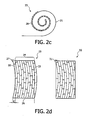
- FIGs 2a-d show the processing of the bamboo strips manufactured in figures 1a-1c into a bamboo mat according to the invention.
- bamboo strips 20 according to the invention (comparable to bamboo strip 18 of figure 1 c) are positioned parallel and adjacently in a plane.
- bamboo strips 20 are mutually connected by arranging adhesive tape 21 on one side of the adjacently positioned strips so as to thus form mats 22.
- This is possible in a batch process, although it is also particularly suitable for a continuous process in which new bamboo strips 20 are added one at a time to the mat as according to arrow E and fixed with tape 21.
- the bamboo strips according to the invention are particularly form-retaining, it is possible to use much smaller distances between adjoining bamboo strips. In the known bamboo strips processed directly from the wet bamboo stem, this is not possible because they have too many irregularities and deform too much in the course of time.
- connection made by tape 21 is flexible in the direction at right angles to the longitudinal direction of bamboo strips 20 so that mat 22 can be rolled up to form a roll 23, as can be seen in figure 2c .
- a roll 23 is easy to transport and makes it easier to process bamboo strips 20 simultaneously or in a continuous process.
- Roll 23 can optionally be divided into smaller units later for further processing.
- this mat only a few bamboo strips 20 are incorporated into bamboo mat 22, it is possible to envisage manufacturing much larger mats than shown, with for instance hundreds or thousands of mutually connected bamboo strips 20. These can be divided into smaller, more manageable units at a later stage (for instance after transport and/or storage) for further processing or use in for instance covering for floors, walls or ceilings, or in the construction of furniture such as a table, cabinet, couch or chair.
- FIG. 2d shows another further processing of bamboo mat 25.
- bamboo strips 26 tend to curve slightly to a particular side (exaggerated in figure 2d ). This curvature which occurs naturally in bamboo is known as "banana-forming".
- the corner points of mat 27 are hereby not precisely 90 degrees, which makes a geometric pattern impossible when laying multiple mats 25.
- This problem is solved by first parallel sawing a distance E of for instance 1 or 2 mm from both sides (depending on the extent of "banana-forming”).
- extra-wide bamboo strips of 17 mm are used on bamboo strips 32, 33 located at the outermost positions of mat 27, wherein the rest of strips 34 each have a width of about 15 mm.
- Figure 3a shows the manufacture of a bamboo mat 40, wherein a strengthening layer 42 is arranged on one side of bamboo strips 41 as a coupling means.
- This strengthening layer 42 is preferably a fibre-reinforced plastic or natural fabric such as jute.
- Strengthening layer 42 can for instance be arranged on bamboo strips 41 by means of glueing. It is also possible to place a plurality of strengthening layers, optionally with added functionality such as heat insulation or moisture-proof and anti-fungal function. All these layers are preferably flexible such that the mat can be rolled up.
- Figure 3b shows another preferred embodiment of a strengthened bamboo mat 45, wherein bamboo strips 46 are first mutually connected by means of an adhesive tape 47 (similarly to figure 2b ), after which a strengthening layer 48 is then arranged.
- This method has the advantage that tape 47 fixes bamboo strips 46 during the placing, whereby placing of strengthening layer 48 is easier.
Landscapes
- Engineering & Computer Science (AREA)
- Architecture (AREA)
- Life Sciences & Earth Sciences (AREA)
- Civil Engineering (AREA)
- Structural Engineering (AREA)
- Wood Science & Technology (AREA)
- Mechanical Engineering (AREA)
- Forests & Forestry (AREA)
- Floor Finish (AREA)
- Chemical And Physical Treatments For Wood And The Like (AREA)
Claims (7)
- Verfahren zur Herstellung einer Bambusmatte, die die Verfahrensschritte umfasst:A) Verarbeiten von Bambus zu Bambusstreifen,B) Trocknen der Bambusstreifen auf einen vorher festgelegten Feuchtigkeitsgehalt,C) Bearbeiten mindestens der Längsseiten der gemäß Schritt B) getrockneten Bambusstreifen, zur Bildung einer gleichmäßigen Fläche,D) paralleles Positionieren einer Vielzahl bearbeiteter Bambusstreifen mit nebeneinanderliegenden Längsseiten, undE) gemeinsames zentrales Verbinden der parallel positionierten Bambusstreifen mit Hilfe von Verbindungsmitteln,dadurch gekennzeichnet, dass die Bearbeitung der Bambusstreifen in Schritt C) nach dem Trocknen in Schritt B) stattfindet, und dass nach dem Verbinden gemäß Schritt E) die Bambusmatte in einem folgenden Schritt F) auf eine vorher festgelegte Breite verschmälert wird, indem Bambus auf beiden Seiten parallel zur Längsrichtung der Bambusstreifen entfernt wird.
- Verfahren nach Anspruch 1, dadurch gekennzeichnet, dass
während des Trocknungsvorgangs in Schritt B) die Breite des Bambusstreifens an der Stelle von mindestens einem Knoten im Bambus schmaler ist als die maximale Breite des Bambusstreifens, worin während der Bearbeitung in Schritt C) Bambus an den Längsseiten des Bambusstreifens entfernt wird, bis der Bambusstreifen über die Längsrichtung im Wesentlichen dieselbe Breite besitzt. - Verfahren nach Anspruch 2, dadurch gekennzeichnet, dass
während des Trocknungsvorgangs in Schritt B) eine Dicke des Bambusstreifens an der Stelle von mindestens einem Knoten im Bambus ebenfalls schmaler ist als eine Dicke des Bambusstreifens zwischen den Knoten, worin während der Bearbeitung in Schritt C) Bambus von der Ober- und der Unterseite des Bambusstreifens angrenzend an die Längsseiten entfernt wird, bis der Bambusstreifen im Wesentlichen dieselbe Dicke über die Längsrichtung hat. - Verfahren nach einem der vorhergehenden Ansprüche, dadurch gekennzeichnet, dass die Verbindungsmittel in Schritt E) Klebeband umfassen, worin das Klebeband über eine Vielzahl nebeneinanderliegender Bambusstreifen angeordnet ist, derart, dass die Bambusstreifen miteinander zentral verbunden sind.
- Verfahren nach einem der vorhergehenden Ansprüche, dadurch gekennzeichnet, dass die Verbindungsmittel in Schritt E) eine flexible Werkstoffschicht umfassen, die mindestens auf einer Seite im Wesentlichen nebeneinanderliegende Bambusstreifen abdeckt.
- Verfahren nach einem der vorhergehenden Ansprüche, dadurch gekennzeichnet, dass vor dem Verschmälern in Schritt F) die Bambusstreifen der Bambusmatte, die an den äußersten Stellen liegen, eine größere Breite haben als die Bambusstreifen, die zwischen den äußersten Stellen liegen, worin die an den äußersten Stellen liegenden Bambusstreifen während des Verschmälerns der Bambusmatte auf eine im Wesentlichen gleiche Breite mit der Breite der zwischen den äußersten Stellen liegenden Bambusstreifen verschmälert werden.
- Verfahren nach einem der vorhergehenden Ansprüche, dadurch gekennzeichnet, dass nach der Durchführung von Schritt E) Teile des Bambus in Schritt G) ebenfalls an den gegenüberliegenden Enden der Bambusmatte in einem vorher festgelegten Winkel zur Längsrichtung der Bambusstreifen parallel abgesägt werden.
Applications Claiming Priority (2)
| Application Number | Priority Date | Filing Date | Title |
|---|---|---|---|
| NL2000349A NL2000349C2 (nl) | 2006-12-01 | 2006-12-01 | Werkwijze voor het vervaardigen van bamboematten, bamboematten en gebruik daarvan. |
| PCT/NL2007/050616 WO2008066386A1 (en) | 2006-12-01 | 2007-12-03 | Method for manufacturing bamboo mats, bamboo mats and use thereof |
Publications (2)
| Publication Number | Publication Date |
|---|---|
| EP2089196A1 EP2089196A1 (de) | 2009-08-19 |
| EP2089196B1 true EP2089196B1 (de) | 2013-07-10 |
Family
ID=39103020
Family Applications (1)
| Application Number | Title | Priority Date | Filing Date |
|---|---|---|---|
| EP07851876.8A Not-in-force EP2089196B1 (de) | 2006-12-01 | 2007-12-03 | Verfahren zur Herstellung von Bambusmatten |
Country Status (6)
| Country | Link |
|---|---|
| US (1) | US8206542B2 (de) |
| EP (1) | EP2089196B1 (de) |
| CN (1) | CN101600547A (de) |
| CA (1) | CA2671385A1 (de) |
| NL (1) | NL2000349C2 (de) |
| WO (1) | WO2008066386A1 (de) |
Cited By (1)
| Publication number | Priority date | Publication date | Assignee | Title |
|---|---|---|---|---|
| DE102018126956A1 (de) * | 2018-10-29 | 2020-04-30 | Joachim Wachner | Bambuseinheit |
Families Citing this family (16)
| Publication number | Priority date | Publication date | Assignee | Title |
|---|---|---|---|---|
| CN101676078A (zh) | 2008-09-19 | 2010-03-24 | 斯戴尔有限责任上市公司 | 人造木材产品及其生产方法 |
| US20100178451A1 (en) * | 2009-01-15 | 2010-07-15 | Style Limited | Method for producing bamboo boards and products |
| CN101486214B (zh) * | 2009-02-19 | 2011-11-09 | 中国林业科学研究院木材工业研究所 | 一种大片竹束帘及其制造方法和所用的设备 |
| CN102151039B (zh) * | 2011-03-21 | 2012-11-28 | 郭荣才 | 一种竹木凉席结构 |
| US8719981B2 (en) * | 2011-04-28 | 2014-05-13 | John Jaskot | Pillow with neck support |
| FR2985212B1 (fr) * | 2011-12-28 | 2019-06-14 | Cobratex | Procede et dispositif pour la fabrication d'un renfort pour materiau composite a base de fibres naturelles, notamment de bambou, et renfort obtenu par un tel procede |
| USD699997S1 (en) * | 2013-04-19 | 2014-02-25 | Kikkerland Design, Inc. | Drinking straw with bamboo appearance |
| US9834937B2 (en) | 2013-11-04 | 2017-12-05 | Steel Grip Samm, Inc. | Non-skid safety mat for providing adhering support when placed upon a sloping roof |
| US9593497B2 (en) * | 2013-11-04 | 2017-03-14 | Steel Grip Samm, Inc. | Nonskid magnetized safety mat incorporating nonskid flex hinged location for providing adhering support when placed upon a metal roof |
| CN104210006A (zh) * | 2014-07-24 | 2014-12-17 | 桐城市诚信木塑科技材料有限公司 | 一种竹制地板加工工艺 |
| CN105751347B (zh) * | 2016-03-11 | 2018-01-05 | 赖建强 | 一种楠竹利用长枝部分主杆制板的方法 |
| EP3472399A4 (de) * | 2016-06-19 | 2019-07-17 | Marcel Eric Morokutti | Bauvorrichtung und -verfahren |
| CN106182244A (zh) * | 2016-08-26 | 2016-12-07 | 湖南城市学院 | 一种竹片凉席的竹片的生产方法 |
| USD828960S1 (en) * | 2017-04-04 | 2018-09-18 | Ronnie Shugar | Bamboo lip balm container |
| US20190105871A1 (en) * | 2017-10-06 | 2019-04-11 | Neauvotec, LLC | Process for creating plyfiber sheets for construction applications |
| USD932458S1 (en) * | 2018-07-05 | 2021-10-05 | John Peng Chang Yang | Bamboo amplifier and holder |
Family Cites Families (11)
| Publication number | Priority date | Publication date | Assignee | Title |
|---|---|---|---|---|
| US4674967A (en) * | 1985-08-15 | 1987-06-23 | Oseka John A | Apparatus for forming rolled food products |
| GB2292336B (en) | 1994-08-18 | 1998-06-03 | Qingdao Jinyuan Co | High strength bamboo plywood and the process for manufacturing the same |
| CN1197720A (zh) | 1997-04-30 | 1998-11-04 | 湖南永达竹业有限公司 | 碳化竹地板生产工艺 |
| US5896903A (en) * | 1998-04-07 | 1999-04-27 | Chen; Feng-Yuan | Method of fabricating bamboo slats for bamboo blinds |
| TW396100B (en) * | 1998-05-01 | 2000-07-01 | Cheng Sung Feng Industry Co Lt | Method for making a bamboo mat |
| GB2363753B (en) * | 1999-01-20 | 2003-05-14 | Feng-Yuan Chen | Method of fabricating bamboo slats for venetian blinds |
| CN1401464A (zh) | 2001-08-16 | 2003-03-12 | 许雪慧 | 以竹材成型帘叶片的制造方法 |
| US6622763B2 (en) | 2001-12-31 | 2003-09-23 | Dong Liang Industrial Co., Ltd. | Bamboo venetian blind panels and method for manufacturing the same |
| NL1019971C2 (nl) | 2002-01-11 | 2003-07-15 | Mvp Internat B V | Werkwijze voor het vervaardigen van bamboefineer en bamboefineer te vervaardigen door toepassing van zo een werkwijze. |
| US7021346B2 (en) | 2004-01-26 | 2006-04-04 | Ao Yu Chang | Bamboo mat board and method for producing the same |
| DE202005000380U1 (de) * | 2005-01-12 | 2005-03-24 | Schmitter Hans Joerg | Bauelement |
-
2006
- 2006-12-01 NL NL2000349A patent/NL2000349C2/nl not_active IP Right Cessation
-
2007
- 2007-12-03 EP EP07851876.8A patent/EP2089196B1/de not_active Not-in-force
- 2007-12-03 WO PCT/NL2007/050616 patent/WO2008066386A1/en not_active Ceased
- 2007-12-03 CN CNA2007800489389A patent/CN101600547A/zh active Pending
- 2007-12-03 US US12/312,908 patent/US8206542B2/en not_active Expired - Fee Related
- 2007-12-03 CA CA002671385A patent/CA2671385A1/en not_active Abandoned
Cited By (1)
| Publication number | Priority date | Publication date | Assignee | Title |
|---|---|---|---|---|
| DE102018126956A1 (de) * | 2018-10-29 | 2020-04-30 | Joachim Wachner | Bambuseinheit |
Also Published As
| Publication number | Publication date |
|---|---|
| US20100028589A1 (en) | 2010-02-04 |
| WO2008066386A1 (en) | 2008-06-05 |
| CA2671385A1 (en) | 2008-06-05 |
| US8206542B2 (en) | 2012-06-26 |
| CN101600547A (zh) | 2009-12-09 |
| EP2089196A1 (de) | 2009-08-19 |
| NL2000349C2 (nl) | 2008-06-03 |
Similar Documents
| Publication | Publication Date | Title |
|---|---|---|
| US8206542B2 (en) | Method for manufacturing bamboo mats, bamboo mats and use thereof | |
| US3956555A (en) | Load carrying member constructed of oriented wood strands and process for making same | |
| CN100375823C (zh) | 地板及其铺设和制造方法 | |
| RU2143970C1 (ru) | Конструктивный элемент из древесины, состоящий из слоев древесины | |
| US20120015131A1 (en) | Bamboo lumber products | |
| US3234074A (en) | Composite wooden panel | |
| US20150292217A1 (en) | Prefabricated Element For Floors Or Floor Baseboards | |
| CA2178204A1 (en) | Hollow veneered pole | |
| CA2714284A1 (en) | Insulation apparatus and method | |
| DK2644478T3 (en) | PLYWOOD PANEL | |
| US11060306B2 (en) | Engineered hardwood flooring and manufacture thereof | |
| FI58454B (fi) | Foerfaringssaett foer framstaellning av formbestaendiga lamellskivor av mineralull klaedda aotminstone pao ena sidan med ett styvt ytbeklaednadsskikt | |
| JP5675687B2 (ja) | 軟質木質繊維ボードを含む成形ブロック | |
| JP6901884B2 (ja) | 集成材の製造方法 | |
| CZ248794A3 (en) | Building panel | |
| RU2565711C1 (ru) | Способ изготовления сотового заполнителя | |
| CN101186046A (zh) | 竹层积板及其加工方法 | |
| RU147252U1 (ru) | Деревянная строительная конструкция (варианты) | |
| CN118991153A (zh) | 一种玻璃布蜂窝芯及其制备方法 | |
| WO2017072687A1 (en) | Engineered wood products and methods of their manufacture | |
| EP3224395B1 (de) | Verfahren zur herstellung eines sandwichelements aus mineralwollfasern | |
| EP1540100A1 (de) | Faserdämmstoffplatte mit falz- oder nutüberlappung | |
| WO2022039608A1 (en) | Honeycomb sandwich panel | |
| EP4520495A1 (de) | Verfahren zur herstellung einer sperrholzplatte und durch solch ein verfahren erhaltene sperrholzplatte | |
| KR102424564B1 (ko) | 조습성을 갖는 플로어링보드 |
Legal Events
| Date | Code | Title | Description |
|---|---|---|---|
| PUAI | Public reference made under article 153(3) epc to a published international application that has entered the european phase |
Free format text: ORIGINAL CODE: 0009012 |
|
| 17P | Request for examination filed |
Effective date: 20090701 |
|
| AK | Designated contracting states |
Kind code of ref document: A1 Designated state(s): AT BE BG CH CY CZ DE DK EE ES FI FR GB GR HU IE IS IT LI LT LU LV MC MT NL PL PT RO SE SI SK TR |
|
| 17Q | First examination report despatched |
Effective date: 20091029 |
|
| DAX | Request for extension of the european patent (deleted) | ||
| GRAP | Despatch of communication of intention to grant a patent |
Free format text: ORIGINAL CODE: EPIDOSNIGR1 |
|
| GRAS | Grant fee paid |
Free format text: ORIGINAL CODE: EPIDOSNIGR3 |
|
| GRAA | (expected) grant |
Free format text: ORIGINAL CODE: 0009210 |
|
| AK | Designated contracting states |
Kind code of ref document: B1 Designated state(s): AT BE BG CH CY CZ DE DK EE ES FI FR GB GR HU IE IS IT LI LT LU LV MC MT NL PL PT RO SE SI SK TR |
|
| REG | Reference to a national code |
Ref country code: GB Ref legal event code: FG4D |
|
| REG | Reference to a national code |
Ref country code: AT Ref legal event code: REF Ref document number: 620679 Country of ref document: AT Kind code of ref document: T Effective date: 20130715 Ref country code: CH Ref legal event code: EP |
|
| REG | Reference to a national code |
Ref country code: IE Ref legal event code: FG4D |
|
| REG | Reference to a national code |
Ref country code: DE Ref legal event code: R096 Ref document number: 602007031605 Country of ref document: DE Effective date: 20130905 |
|
| PG25 | Lapsed in a contracting state [announced via postgrant information from national office to epo] |
Ref country code: SI Free format text: LAPSE BECAUSE OF FAILURE TO SUBMIT A TRANSLATION OF THE DESCRIPTION OR TO PAY THE FEE WITHIN THE PRESCRIBED TIME-LIMIT Effective date: 20130710 |
|
| REG | Reference to a national code |
Ref country code: NL Ref legal event code: T3 |
|
| REG | Reference to a national code |
Ref country code: AT Ref legal event code: MK05 Ref document number: 620679 Country of ref document: AT Kind code of ref document: T Effective date: 20130710 |
|
| REG | Reference to a national code |
Ref country code: LT Ref legal event code: MG4D |
|
| PG25 | Lapsed in a contracting state [announced via postgrant information from national office to epo] |
Ref country code: BE Free format text: LAPSE BECAUSE OF FAILURE TO SUBMIT A TRANSLATION OF THE DESCRIPTION OR TO PAY THE FEE WITHIN THE PRESCRIBED TIME-LIMIT Effective date: 20130710 Ref country code: CY Free format text: LAPSE BECAUSE OF FAILURE TO SUBMIT A TRANSLATION OF THE DESCRIPTION OR TO PAY THE FEE WITHIN THE PRESCRIBED TIME-LIMIT Effective date: 20130807 Ref country code: IS Free format text: LAPSE BECAUSE OF FAILURE TO SUBMIT A TRANSLATION OF THE DESCRIPTION OR TO PAY THE FEE WITHIN THE PRESCRIBED TIME-LIMIT Effective date: 20131110 Ref country code: SE Free format text: LAPSE BECAUSE OF FAILURE TO SUBMIT A TRANSLATION OF THE DESCRIPTION OR TO PAY THE FEE WITHIN THE PRESCRIBED TIME-LIMIT Effective date: 20130710 Ref country code: AT Free format text: LAPSE BECAUSE OF FAILURE TO SUBMIT A TRANSLATION OF THE DESCRIPTION OR TO PAY THE FEE WITHIN THE PRESCRIBED TIME-LIMIT Effective date: 20130710 Ref country code: LT Free format text: LAPSE BECAUSE OF FAILURE TO SUBMIT A TRANSLATION OF THE DESCRIPTION OR TO PAY THE FEE WITHIN THE PRESCRIBED TIME-LIMIT Effective date: 20130710 Ref country code: PT Free format text: LAPSE BECAUSE OF FAILURE TO SUBMIT A TRANSLATION OF THE DESCRIPTION OR TO PAY THE FEE WITHIN THE PRESCRIBED TIME-LIMIT Effective date: 20131111 |
|
| PG25 | Lapsed in a contracting state [announced via postgrant information from national office to epo] |
Ref country code: PL Free format text: LAPSE BECAUSE OF FAILURE TO SUBMIT A TRANSLATION OF THE DESCRIPTION OR TO PAY THE FEE WITHIN THE PRESCRIBED TIME-LIMIT Effective date: 20130710 Ref country code: GR Free format text: LAPSE BECAUSE OF FAILURE TO SUBMIT A TRANSLATION OF THE DESCRIPTION OR TO PAY THE FEE WITHIN THE PRESCRIBED TIME-LIMIT Effective date: 20131011 Ref country code: ES Free format text: LAPSE BECAUSE OF FAILURE TO SUBMIT A TRANSLATION OF THE DESCRIPTION OR TO PAY THE FEE WITHIN THE PRESCRIBED TIME-LIMIT Effective date: 20131021 Ref country code: LV Free format text: LAPSE BECAUSE OF FAILURE TO SUBMIT A TRANSLATION OF THE DESCRIPTION OR TO PAY THE FEE WITHIN THE PRESCRIBED TIME-LIMIT Effective date: 20130710 Ref country code: FI Free format text: LAPSE BECAUSE OF FAILURE TO SUBMIT A TRANSLATION OF THE DESCRIPTION OR TO PAY THE FEE WITHIN THE PRESCRIBED TIME-LIMIT Effective date: 20130710 |
|
| PG25 | Lapsed in a contracting state [announced via postgrant information from national office to epo] |
Ref country code: CY Free format text: LAPSE BECAUSE OF FAILURE TO SUBMIT A TRANSLATION OF THE DESCRIPTION OR TO PAY THE FEE WITHIN THE PRESCRIBED TIME-LIMIT Effective date: 20130710 |
|
| PG25 | Lapsed in a contracting state [announced via postgrant information from national office to epo] |
Ref country code: RO Free format text: LAPSE BECAUSE OF FAILURE TO SUBMIT A TRANSLATION OF THE DESCRIPTION OR TO PAY THE FEE WITHIN THE PRESCRIBED TIME-LIMIT Effective date: 20130710 Ref country code: EE Free format text: LAPSE BECAUSE OF FAILURE TO SUBMIT A TRANSLATION OF THE DESCRIPTION OR TO PAY THE FEE WITHIN THE PRESCRIBED TIME-LIMIT Effective date: 20130710 Ref country code: SK Free format text: LAPSE BECAUSE OF FAILURE TO SUBMIT A TRANSLATION OF THE DESCRIPTION OR TO PAY THE FEE WITHIN THE PRESCRIBED TIME-LIMIT Effective date: 20130710 Ref country code: DK Free format text: LAPSE BECAUSE OF FAILURE TO SUBMIT A TRANSLATION OF THE DESCRIPTION OR TO PAY THE FEE WITHIN THE PRESCRIBED TIME-LIMIT Effective date: 20130710 Ref country code: CZ Free format text: LAPSE BECAUSE OF FAILURE TO SUBMIT A TRANSLATION OF THE DESCRIPTION OR TO PAY THE FEE WITHIN THE PRESCRIBED TIME-LIMIT Effective date: 20130710 |
|
| PLBE | No opposition filed within time limit |
Free format text: ORIGINAL CODE: 0009261 |
|
| STAA | Information on the status of an ep patent application or granted ep patent |
Free format text: STATUS: NO OPPOSITION FILED WITHIN TIME LIMIT |
|
| PG25 | Lapsed in a contracting state [announced via postgrant information from national office to epo] |
Ref country code: IT Free format text: LAPSE BECAUSE OF FAILURE TO SUBMIT A TRANSLATION OF THE DESCRIPTION OR TO PAY THE FEE WITHIN THE PRESCRIBED TIME-LIMIT Effective date: 20130710 |
|
| 26N | No opposition filed |
Effective date: 20140411 |
|
| REG | Reference to a national code |
Ref country code: DE Ref legal event code: R097 Ref document number: 602007031605 Country of ref document: DE Effective date: 20140411 |
|
| REG | Reference to a national code |
Ref country code: CH Ref legal event code: PL |
|
| PG25 | Lapsed in a contracting state [announced via postgrant information from national office to epo] |
Ref country code: LU Free format text: LAPSE BECAUSE OF FAILURE TO SUBMIT A TRANSLATION OF THE DESCRIPTION OR TO PAY THE FEE WITHIN THE PRESCRIBED TIME-LIMIT Effective date: 20131203 Ref country code: MC Free format text: LAPSE BECAUSE OF FAILURE TO SUBMIT A TRANSLATION OF THE DESCRIPTION OR TO PAY THE FEE WITHIN THE PRESCRIBED TIME-LIMIT Effective date: 20130710 |
|
| REG | Reference to a national code |
Ref country code: IE Ref legal event code: MM4A |
|
| PG25 | Lapsed in a contracting state [announced via postgrant information from national office to epo] |
Ref country code: LI Free format text: LAPSE BECAUSE OF NON-PAYMENT OF DUE FEES Effective date: 20131231 Ref country code: CH Free format text: LAPSE BECAUSE OF NON-PAYMENT OF DUE FEES Effective date: 20131231 Ref country code: IE Free format text: LAPSE BECAUSE OF NON-PAYMENT OF DUE FEES Effective date: 20131203 |
|
| PGFP | Annual fee paid to national office [announced via postgrant information from national office to epo] |
Ref country code: GB Payment date: 20141229 Year of fee payment: 8 |
|
| PGFP | Annual fee paid to national office [announced via postgrant information from national office to epo] |
Ref country code: FR Payment date: 20141217 Year of fee payment: 8 Ref country code: NL Payment date: 20141226 Year of fee payment: 8 |
|
| PGFP | Annual fee paid to national office [announced via postgrant information from national office to epo] |
Ref country code: DE Payment date: 20141230 Year of fee payment: 8 |
|
| PG25 | Lapsed in a contracting state [announced via postgrant information from national office to epo] |
Ref country code: TR Free format text: LAPSE BECAUSE OF FAILURE TO SUBMIT A TRANSLATION OF THE DESCRIPTION OR TO PAY THE FEE WITHIN THE PRESCRIBED TIME-LIMIT Effective date: 20130710 |
|
| PG25 | Lapsed in a contracting state [announced via postgrant information from national office to epo] |
Ref country code: BG Free format text: LAPSE BECAUSE OF FAILURE TO SUBMIT A TRANSLATION OF THE DESCRIPTION OR TO PAY THE FEE WITHIN THE PRESCRIBED TIME-LIMIT Effective date: 20130710 Ref country code: HU Free format text: LAPSE BECAUSE OF FAILURE TO SUBMIT A TRANSLATION OF THE DESCRIPTION OR TO PAY THE FEE WITHIN THE PRESCRIBED TIME-LIMIT; INVALID AB INITIO Effective date: 20071203 |
|
| PG25 | Lapsed in a contracting state [announced via postgrant information from national office to epo] |
Ref country code: MT Free format text: LAPSE BECAUSE OF FAILURE TO SUBMIT A TRANSLATION OF THE DESCRIPTION OR TO PAY THE FEE WITHIN THE PRESCRIBED TIME-LIMIT Effective date: 20130710 |
|
| REG | Reference to a national code |
Ref country code: DE Ref legal event code: R119 Ref document number: 602007031605 Country of ref document: DE |
|
| GBPC | Gb: european patent ceased through non-payment of renewal fee |
Effective date: 20151203 |
|
| REG | Reference to a national code |
Ref country code: NL Ref legal event code: MM Effective date: 20160101 |
|
| REG | Reference to a national code |
Ref country code: FR Ref legal event code: ST Effective date: 20160831 |
|
| PG25 | Lapsed in a contracting state [announced via postgrant information from national office to epo] |
Ref country code: NL Free format text: LAPSE BECAUSE OF NON-PAYMENT OF DUE FEES Effective date: 20160101 Ref country code: DE Free format text: LAPSE BECAUSE OF NON-PAYMENT OF DUE FEES Effective date: 20160701 Ref country code: GB Free format text: LAPSE BECAUSE OF NON-PAYMENT OF DUE FEES Effective date: 20151203 |
|
| PG25 | Lapsed in a contracting state [announced via postgrant information from national office to epo] |
Ref country code: FR Free format text: LAPSE BECAUSE OF NON-PAYMENT OF DUE FEES Effective date: 20151231 |