EP2089129B1 - Verfahren zum verdampfen von bestandteilen einer flüssigkeit mit chlorosilanen durch wechselstrom - Google Patents
Verfahren zum verdampfen von bestandteilen einer flüssigkeit mit chlorosilanen durch wechselstrom Download PDFInfo
- Publication number
- EP2089129B1 EP2089129B1 EP07822156.1A EP07822156A EP2089129B1 EP 2089129 B1 EP2089129 B1 EP 2089129B1 EP 07822156 A EP07822156 A EP 07822156A EP 2089129 B1 EP2089129 B1 EP 2089129B1
- Authority
- EP
- European Patent Office
- Prior art keywords
- constituents
- liquid
- boiling
- alternating current
- process according
- Prior art date
- Legal status (The legal status is an assumption and is not a legal conclusion. Google has not performed a legal analysis and makes no representation as to the accuracy of the status listed.)
- Not-in-force
Links
- 239000007788 liquid Substances 0.000 title claims description 33
- 238000000034 method Methods 0.000 title claims description 12
- 238000001704 evaporation Methods 0.000 title claims description 7
- 239000005046 Chlorosilane Substances 0.000 title claims description 4
- KOPOQZFJUQMUML-UHFFFAOYSA-N chlorosilane Chemical compound Cl[SiH3] KOPOQZFJUQMUML-UHFFFAOYSA-N 0.000 title claims description 4
- 238000009835 boiling Methods 0.000 claims description 24
- 239000000470 constituent Substances 0.000 claims description 23
- 238000004821 distillation Methods 0.000 claims description 8
- 230000015572 biosynthetic process Effects 0.000 claims description 6
- 238000003786 synthesis reaction Methods 0.000 claims description 6
- 150000002500 ions Chemical class 0.000 claims description 4
- YGZSVWMBUCGDCV-UHFFFAOYSA-N chloro(methyl)silane Chemical class C[SiH2]Cl YGZSVWMBUCGDCV-UHFFFAOYSA-N 0.000 claims description 3
- 239000011541 reaction mixture Substances 0.000 claims description 3
- 238000010438 heat treatment Methods 0.000 description 16
- 239000000203 mixture Substances 0.000 description 8
- LFQSCWFLJHTTHZ-UHFFFAOYSA-N Ethanol Chemical compound CCO LFQSCWFLJHTTHZ-UHFFFAOYSA-N 0.000 description 7
- 230000008020 evaporation Effects 0.000 description 5
- 239000012535 impurity Substances 0.000 description 5
- VEXZGXHMUGYJMC-UHFFFAOYSA-N Hydrochloric acid Chemical compound Cl VEXZGXHMUGYJMC-UHFFFAOYSA-N 0.000 description 4
- 230000008016 vaporization Effects 0.000 description 4
- 241001136792 Alle Species 0.000 description 3
- OKKJLVBELUTLKV-UHFFFAOYSA-N Methanol Chemical compound OC OKKJLVBELUTLKV-UHFFFAOYSA-N 0.000 description 3
- 229910052804 chromium Inorganic materials 0.000 description 3
- OKTJSMMVPCPJKN-UHFFFAOYSA-N Carbon Chemical compound [C] OKTJSMMVPCPJKN-UHFFFAOYSA-N 0.000 description 2
- 238000006243 chemical reaction Methods 0.000 description 2
- IJOOHPMOJXWVHK-UHFFFAOYSA-N chlorotrimethylsilane Chemical compound C[Si](C)(C)Cl IJOOHPMOJXWVHK-UHFFFAOYSA-N 0.000 description 2
- LIKFHECYJZWXFJ-UHFFFAOYSA-N dimethyldichlorosilane Chemical group C[Si](C)(Cl)Cl LIKFHECYJZWXFJ-UHFFFAOYSA-N 0.000 description 2
- 238000010292 electrical insulation Methods 0.000 description 2
- 239000007772 electrode material Substances 0.000 description 2
- 239000010408 film Substances 0.000 description 2
- 229910002804 graphite Inorganic materials 0.000 description 2
- 239000010439 graphite Substances 0.000 description 2
- 239000000463 material Substances 0.000 description 2
- 229910052751 metal Inorganic materials 0.000 description 2
- 239000002184 metal Substances 0.000 description 2
- 150000002739 metals Chemical class 0.000 description 2
- 229910052759 nickel Inorganic materials 0.000 description 2
- 229910000831 Steel Inorganic materials 0.000 description 1
- 239000002253 acid Substances 0.000 description 1
- 150000007513 acids Chemical class 0.000 description 1
- 229910052782 aluminium Inorganic materials 0.000 description 1
- 229910052796 boron Inorganic materials 0.000 description 1
- 229910052791 calcium Inorganic materials 0.000 description 1
- 229910052799 carbon Inorganic materials 0.000 description 1
- 239000002800 charge carrier Substances 0.000 description 1
- 150000001805 chlorine compounds Chemical class 0.000 description 1
- NEHMKBQYUWJMIP-UHFFFAOYSA-N chloromethane Chemical compound ClC NEHMKBQYUWJMIP-UHFFFAOYSA-N 0.000 description 1
- 150000001875 compounds Chemical class 0.000 description 1
- 229910052802 copper Inorganic materials 0.000 description 1
- 230000007423 decrease Effects 0.000 description 1
- 230000008021 deposition Effects 0.000 description 1
- 230000005684 electric field Effects 0.000 description 1
- 230000005611 electricity Effects 0.000 description 1
- 230000003628 erosive effect Effects 0.000 description 1
- 238000002474 experimental method Methods 0.000 description 1
- 239000012530 fluid Substances 0.000 description 1
- 239000011521 glass Substances 0.000 description 1
- 239000004615 ingredient Substances 0.000 description 1
- 229910052742 iron Inorganic materials 0.000 description 1
- 238000002955 isolation Methods 0.000 description 1
- 229910052749 magnesium Inorganic materials 0.000 description 1
- 229910052748 manganese Inorganic materials 0.000 description 1
- 238000005259 measurement Methods 0.000 description 1
- 238000010327 methods by industry Methods 0.000 description 1
- 239000005055 methyl trichlorosilane Substances 0.000 description 1
- JLUFWMXJHAVVNN-UHFFFAOYSA-N methyltrichlorosilane Chemical compound C[Si](Cl)(Cl)Cl JLUFWMXJHAVVNN-UHFFFAOYSA-N 0.000 description 1
- 238000006384 oligomerization reaction Methods 0.000 description 1
- 229910052698 phosphorus Inorganic materials 0.000 description 1
- 238000006116 polymerization reaction Methods 0.000 description 1
- 239000002994 raw material Substances 0.000 description 1
- 230000001105 regulatory effect Effects 0.000 description 1
- 150000003839 salts Chemical class 0.000 description 1
- 229920006395 saturated elastomer Polymers 0.000 description 1
- 238000000926 separation method Methods 0.000 description 1
- 150000004756 silanes Chemical class 0.000 description 1
- FDNAPBUWERUEDA-UHFFFAOYSA-N silicon tetrachloride Chemical compound Cl[Si](Cl)(Cl)Cl FDNAPBUWERUEDA-UHFFFAOYSA-N 0.000 description 1
- 239000010959 steel Substances 0.000 description 1
- 239000010409 thin film Substances 0.000 description 1
- 229910052718 tin Inorganic materials 0.000 description 1
- 229910052719 titanium Inorganic materials 0.000 description 1
- 239000005051 trimethylchlorosilane Substances 0.000 description 1
- 238000009834 vaporization Methods 0.000 description 1
- 238000010792 warming Methods 0.000 description 1
- XLYOFNOQVPJJNP-UHFFFAOYSA-N water Substances O XLYOFNOQVPJJNP-UHFFFAOYSA-N 0.000 description 1
- 229910052725 zinc Inorganic materials 0.000 description 1
Images
Classifications
-
- B—PERFORMING OPERATIONS; TRANSPORTING
- B01—PHYSICAL OR CHEMICAL PROCESSES OR APPARATUS IN GENERAL
- B01D—SEPARATION
- B01D1/00—Evaporating
-
- B—PERFORMING OPERATIONS; TRANSPORTING
- B01—PHYSICAL OR CHEMICAL PROCESSES OR APPARATUS IN GENERAL
- B01D—SEPARATION
- B01D1/00—Evaporating
- B01D1/0011—Heating features
- B01D1/0017—Use of electrical or wave energy
-
- B—PERFORMING OPERATIONS; TRANSPORTING
- B01—PHYSICAL OR CHEMICAL PROCESSES OR APPARATUS IN GENERAL
- B01D—SEPARATION
- B01D17/00—Separation of liquids, not provided for elsewhere, e.g. by thermal diffusion
- B01D17/06—Separation of liquids from each other by electricity
Definitions
- the invention relates to a method for vaporizing constituents of a liquid by passing through alternating current.
- Alkylchlorosilanes are prepared by the so-called direct synthesis of Si and MeCl. In this case, a complex mixture of different alkylchlorosilanes with different boiling points is obtained.
- Target product is dichlorodimethylsilane with a boiling point of 71 ° C (1013mbar).
- composition of these so-called high boilers is for example in EP 0 635 510 described in more detail.
- further impurities in the product stream of direct synthesis are found in addition to Si in the form of Cu, Zn, Sn, Al, Fe, Ca, Mn, Ti, Mg, Ni, Cr, B, P and C.
- the impurities are in suspended or dissolved form. Most of the dissolved impurities are chlorides.
- the apparatus must be cleaned often. The distillate yield drops. The plant availability is unsatisfactory.
- the heating or evaporation temperature can be regulated very quickly and within narrow tolerances since there is no heat transfer over hot surfaces.
- the liquid In the event of an interruption of the liquid flow, the liquid can not be overheated by hot surfaces and the heat input can be abruptly interrupted by switching off the AC supply.
- the electric field generated by the alternating current causes charge carriers to vibrate, causing the liquid to heat up.
- a previously non-conductive liquid can be made electrically conductive by the addition of suitable salts, so that the desired warming occurs in systems of voltage.
- the high-boiling and non-boiling constituents A can be partially or completely dissociated to ions, ie be electrically conductive, or non-conductive. If the high boiling and non-boiling constituents A are non-conductive, then the constituents B must be electrically conductive. Examples of electrically conductive constituents B are gaseous and low-boiling acids, such as hydrochloric acid.
- the constituents B boil at least 40 ° K, in particular at least 50 ° K lower than the high-boiling constituents A.
- the AC voltage is at least 10, in particular at least 50 V and preferably at most 1000 V.
- the frequency of the AC voltage is preferably at least 10, in particular at least 30 Hz and preferably at most 10000 Hz, in particular at most 10000 Hz.
- AC also includes three-phase current.
- the specific electrical resistance of the liquid is preferably from 10 10 m to 10 6 m, in particular 10 9 m to 10 8 m.
- the process can be carried out continuously or batchwise.
- a preferred apparatus for the method is constructed as follows: The liquid stands or circulates in a tube-like heater of two or more nested tubes that act as electrodes. The electrical alternating voltage is applied to the electrodes.
- the intermediate space of the preferably rotationally symmetrical tubes is filled with the liquid which is heated by the alternating current.
- the two or more inner tubes are separated by an electrical insulation and connected to the outside liquid-tight.
- the materials of the electrodes must be electrically conductive and may be, for example, metals or graphite.
- electrically conductive fractions of the alkylchlorosilane distillation such as the previously described distillation residues from the direct synthesis of methylchlorosilanes having a boiling point> 71 ° C., are heated by passing through alternating current. Due to the impurities contained they have sufficient electrical conductivity. Values for the specific electrical resistance of 1.10 9 m to 10.10 7 m are determined. The components dissociated into ions remain in the bottom of the evaporator during a distillation or are continuously discharged via the bottom outlet and do not affect the quality of the distillates.
- the electrically conductive reaction mixture is prepared from Chlorosilanes, such as tetrachlorosilane, methyltrichlorosilane, dimethyldichlorosilane, trimethylchlorosilane or mixtures thereof, and an optionally hydrous alcohol, such as ethanol or methanol heated by passage of alternating current.
- the reaction can only be completed by expelling the HCl gas formed during the reaction by raising the temperature. Since this mixture is saturated with HCl, forms in the case of heating by means of heat exchanger immediately a thermally insulating gas layer at its interface. The heating by alternating current avoids this problem and allows a cost-effective, based on the space very effective heating, since the heat is generated directly in the liquid volume and does not have to be transported over a large interface of a heat exchanger.
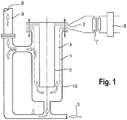
- FIG. 1 shows a heating and vaporizing device as a sectional view.
- the liquid (5) enters the heating and evaporation device from below, heats the liquid in the intermediate space (4) and exits at the top again as heated liquid or vapor (6).
- the electrodes (1) and (2) are separated from each other by an electrical insulation (3).
- the electrodes (1) and (2) are installed in a glass container (10).
- the vapor is passed into a packed column (9).
- the isolation transformer (7) and the current regulator unit (8) feed the electrodes (1) and (2) with controllable electrical energy.
- the surfaces of the electrodes (1) and (2) showed neither a deposit nor an encrustation after the operation of 50 hours, it was also no erosion of the electrode material can be seen.
Landscapes
- Chemical & Material Sciences (AREA)
- Chemical Kinetics & Catalysis (AREA)
- Physics & Mathematics (AREA)
- Thermal Sciences (AREA)
- Vaporization, Distillation, Condensation, Sublimation, And Cold Traps (AREA)
- Physical Or Chemical Processes And Apparatus (AREA)
Description
- Die Erfindung betrifft ein Verfahren zum Verdampfen von Bestandteilen einer Flüssigkeit durch Durchleiten von Wechselstrom.
- Im Bereich der Verfahrenstechnik ist seit langem bekannt, dass für eine effiziente Wärmeübertragung über heiße Oberflächen der Temperaturunterschied zwischen Heizfläche und zu erwärmender Flüssigkeit möglichst hoch sein muß. Bei der Verfolgung dieser Maxime ergeben sich jedoch Probleme beim Erhitzen von gashaltigen bzw. niedrigsiedende Anteile enthaltenden Flüssigkeiten. Übersteigt die Oberflächentemperatur eine kritische Temperaturdifferenz zum Siedepunkt der niedrigsiedenden Komponente so bildet sich auf der Heizfläche ein Dampffilm, der die Flüssigkeit von der Heizfläche thermisch isoliert und deshalb den Wärmefluß verschlechtert. Dieses Phänomen ist als "Leidenfrost'sches Phänomen" bekannt. Deshalb kann der notwendige Wärmeeintrag in die Flüssigkeit in solchen Fällen nur durch Erhöhung der Wärmeaustauschfläche erreicht werden. Andererseits ist aber oft aufgrund apparativer Gegebenheiten und Voraussetzungen eine derartige Erhöhung der Heizfläche nicht möglich bzw. sehr kostspielig.
- Alkylchlorsilane werden auf dem Weg der sogenannten Direktsynthese aus Si und MeCl hergestellt. Dabei wird ein komplexes Gemisch verschiedenler Alkylchlorsilane mit unterschiedlichen Siedepunkten erhalten. Zielprodukt ist Dichlordimethylsilan mit einem Siedepunkt von 71°C (1013mbar).
- Bei der destillativen Gewinnung der reinen Alkylchlorsilane aus dem durch die Direktsynthese erhältlichen Produktgemisch fallen Destillationsrückstände mit einem Siedunkt > 71°C an. Es handelt sich um komplexe Stoffgemische, die Verbindungen mit SiSi, SiOSi, SiCSi, SiCCSi und SiCCCSi-Strukturen enthalten.
- Die Zusammensetzung dieser sogenannten Hochsieder ist beispielsweise in
EP 0 635 510 genauer beschrieben. Rohstoffbedingt oder in Folge des gezielten Zusatzes katalytisch wirksamer Bestandteile findet man im Produktstrom der Direktsynthese neben Si weitere Verunreinigungen in Form von Cu, Zn, Sn, Al, Fe, Ca, Mn, Ti, Mg, Ni, Cr, B, P sowie C. Die Verunreinigungen liegen in suspendierter oder gelöster Form vor. Bei den gelösten Verunreinigungen handelt es sich meistens um Chloride. - Das Dokument
US4296085 offenbart die Verdampfung einer Mischung von P2O5 durch Elektrizität. - Zum Aufheizen der Destillationsrückstände werden nach dem Stand der Technik z.B. Umlaufverdampfer, Dünnschichtverdampfer, Kurzwegverdampfer oder Rohrwärmetauscher eingesetzt. Nach Abtrennung der leichter siedenden Komponenten, bei der die vorstehenden Probleme bei der Wärmeübertragung bestehen, nimmt unter Hitzeeinfluss und in Gegenwart der suspendierten oder gelösten Verunreinigungen jedoch die thermische Stabilität der noch enthaltenen flüssigen Bestandteile ab. Es kommt zu Oligomerisierungen und Polymerisationsreaktionen. Die Viskositäten der Gemische steigen an. Es kommt zur Abscheidung von unerwünschten Ablagerungen in Rohrleitungen und vor allem auf den heißen Oberflächen der verwendeten Verdampfer. Der Stoff- und Energieaustausch wird zunehmend behindert. Aufgrund des dadurch verringerten Wärmeüberganges muss die Oberflächentemperatur der Verdampferflächen weiter erhöht werden, was wiederum zu einer beschleunigten Belegung dieser führt.
- Die Apparate müssen oft gereinigt werden. Die Destillatausbeute sinkt. Die Anlagenverfügbarkeit ist unbefriedigend.
- Nachteil der oben beschriebenen Verfahren nach Stand der Technik ist das Prinzip des Wärmeeintrags. Die Wärmeübertragung auf die flüssigen Silane geschieht über heiße Oberflächen wie z.B. Metalle oder Graphit die wiederum durch Wärmeträger ( Wasserdampf, Wärmeträgeröl) oder elektrischen Heizelementen beheizt werden. Bei dieser Art von Wärmeübertragung muss die Oberflächentemperatur des wärmeübertragenden Mediums höher sein als die zu erwärmende Flüssigkeit. Diese höheren Oberflächentemperaturen sind die Ursache der beschriebenen Probleme.
- Gegenstand der Erfindung ist ein Verfahren zum Verdampfen von Bestandteilen einer Flüssigkeit, die ausgewählt wird aus
- a) Destillationsrückständen aus der Direktsynthese von Methylchlorsilanen mit einem Siedepunkt > 71°C und
- b) elektrisch leitfähigen Reaktionsgemischen von Chlorsilanen und wasserhaltigen oder wasserfreien Alkohol,
- Beim Erhitzen von gashaltigen bzw. niedrigsiedende Anteile enthaltenden, elektrisch leitenden Flüssigkeiten wird nahezu die gesamte Energie in der Flüssigkeit zum Erwärmen genutzt, weil kein wärmeisolierender Dampffilm die Wärmeübertragung behindert. Die Oberflächen der Behälter und Rohrleitungen bleiben frei von Belägen.
- Die Erwärmungs-, bzw. Verdampfungstemperatur ist sehr schnell und in engen Toleranzen regelbar, da keine Wärmeübertragung über heiße Oberflächen vorhanden ist.
- Bei einer Unterbrechung des Flüssigkeitsstromes ist nicht mit einer Überhitzung der Flüssigkeit durch heiße Oberflächen zu rechnen und der Wärmeintrag kann abrupt durch die Abschaltung der Wechselstromzufuhr unterbrochen werden.
- Das durch den Wechselstrom erzeugte elektrische Feld bringt Ladungsträger zum Schwingen wodurch sich die Flüssigkeit erwärmt. Eine vorher nicht leitende Flüssigkeit kann durch Zusatz von geeigneten Salzen elektrisch leitend gemacht werden, so dass das bei Anlagen einer Spannung die gewünsche Erwärmung eintritt.
- Die hochsiedenden und nichtsiedenden Bestandteile A können teilweise oder vollständig zu Ionen dissoziiert, also elektrisch leitfähig sein, oder nicht leitend sein. Wenn die hochsiedenden und nichtsiedenden Bestandteile A nicht leitend sind, dann müssen die Bestandteile B elektrisch leitfähig sein. Beispiele für elektrisch leitfähige Bestandteile B sind gasförmige und niedrigsiedende Säuren, wie Salzsäure.
- Vorzugsweise sieden die Bestandteile B mindestens 40 °K, insbesondere mindestens 50 °K tiefer als die hochsiedenden Bestandteile A.
- Vorzugsweise beträgt die Wechselspannung mindestens 10, insbesondere mindestens 50 V und vorzugsweise höchstens 1000 V. Vorzugsweise beträgt die Frequenz der Wechselspannung mindestens 10, insbesondere mindestens 30 Hz und vorzugsweise höchstens 10000 Hz, insbesondere höchstens 10000 Hz. Wechselstrom schliesst auch Drehstrom mit ein.
- Der spezifische elektrische Widerstand der Flüssigkeit beträgt vorzugsweise von 1010 m bis 106 m, insbesondere 109 m bis 108 m.
- Das Verfahren kann kontinuierlich oder diskontinuierlich durchgeführt werden.
- Eine bevorzugte Vorrichtung für das Verfahren ist wie folgt aufgebaut: Die Flüssigkeit steht oder zirkuliert in einem rohrähnlichen Erhitzer aus zwei oder mehreren ineinander geschachtelten Rohren, die als Elektroden fungieren. An den Elektroden wird die elektrische Wechselspannung angelegt.
- Der Zwischenraum der vorzugsweise rotationssymmetrisch angeordneten Rohre wird mit der Flüssigkeit gefüllt, die durch den Wechselstrom erwärmt wird. Die zwei oder mehreren innen liegenden Rohre werden durch eine elektrische Isolation getrennt und miteinander nach außen flüssigkeitsdicht verbunden.
- Die Materialien der Elektroden müssen elektrisch leitfähig sein und können beispielsweise Metalle oder Graphit sein.
- In Ausführungsform a werden elektrisch leitfähige Fraktionen der Alkylchlorsilandestillation, wie die vorstehend beschriebenen Destillationsrückstände aus der Direktsynthese von Methylchlorsilanen mit einem Siedunkt > 71°C durch Durchleiten von Wechselstrom erwärmt. Aufgrund der enthaltenen Verunreinigungen besitzen diese eine ausreichende elektrische Leitfähigeit. Es werden Werte für den spezifischen elektrischen Widerstand von 1.109 m bis 10.107 m ermittelt. Die zu Ionen dissoziierten Bestandteile bleiben bei einer Detillation im Sumpf des Verdampfers zurück oder werden über den Sumpfablauf kontinuierlich ausgeschleust und beeinflussen die Qualität der Destillate nicht.
- In Ausführungsform b wird die elektrisch leitfähige Reaktionsmischung hergestellt aus Chlorsilanen, wie Tetrachlorsilan, Methyltrichlorsilan, Dimethyldichlorsilan, Trimethylchlorsilan oder deren Mischungen, und einem gegebenenfalls wasserhaltigen Alkohol, wie Ethanol oder Methanol mittels Durchleitung von Wechselstrom erwärmt. Die Umsetzung der Reaktion läßt sich nur dadurch vervollständigen, dass das bei der Reaktion entstehende HCl-Gas durch Temperaturerhöhung ausgetrieben wird. Da diese Mischung mit HCl gesättigt ist, bildet sich im Falle der Erwärmung mittels Wärmetauschers sofort eine thermisch isolierende Gasschicht an dessen Grenzfläche. Die Erwärmung durch Wechselstrom vermeidet dieses Problem und erlaubt eine kostengünstige, bezogen auf den Raumbedarf sehr effektive Heizung, da die Wärme direkt im Flüssigkeitsvolumen erzeugt wird und nicht über eine große Grenzfläche eines Wärmetauschers transportiert werden muß.
- Im nachfolgenden Beispiel sind, falls nicht anders angegeben,
- a) alle Mengen auf die Masse bezogen;
- b) alle Drücke 0,10 MPa (abs.);
- c) alle Temperaturen 20°C.
- Das Beispiel wird mit
Figur 1 erläutert, welche eine Heiz-, Verdampfungsvorrichtung als Schnittansicht zeigt. - Dabei tritt die Flüssigkeit (5) von unten in die Heiz-, Verdampfungsvorrichtung ein, erwärmt die Flüssigkeit im Zwischenraum (4) und tritt als erwärmte Flüssigkeit bzw. als Dampf (6) oben wieder aus. Zwischen den rotationssymmetrisch angeordneten Elektroden (1) und(2) fließt ein elektrischer Wechselstrom. Die Elektroden (1) und (2) sind durch eine elektrische Isolation (3) voneinander getrennt. Die Elektroden(1) und (2) sind in einem Glasbehälter (10) eingebaut. Der Dampf wird in eine Füllkörperkolonne (9) geleitet. Der Trenntransformator (7) und die Stromreglereinheit (8) speisen die Elektroden (1) und (2) mit regelbarer elektrischer Energie.
- Technische Daten der Heiz-, Verdampfungsvorrichtung:
- Elektrodenmaterial: Cr, Ni-Stahl
- Länge der Elektrode(1): 200 mm
- Durchmesser der Elektrode (1): 50 mm
- Durchmesser der Elektrode (2): 30 mm
- Elektrodenabstand (4) : 10 mm
- Flüssigkeitsvolumen: 700 ml
- Messergebnisse:
- Beginn der Verdampfungsversuches:
- Temperatur der Flüssigkeit im Eintritt(5) 30°C
- Temperatur der Flüssigkeit im Behälter(4) 30°C
- Spannung: 240V, Frequenz: 50 Hz Strom : 0,3 A
- Spezifischer elektrischer Widerstand: 4,5.109 Ωm
- Temperatur (Dampf) am Austritt (6) 30°C
- Temperatur der Elektroden (1) und (2): 30°C
- Während des kontinuierlichen Verdampfungsvorganges:
- Temperatur der Flüssigkeit im Eintritt(5) 30°C
- Spannung: 240V, Frequenz: 50 Hz Strom : 0,3 A
- Temperatur der Flüssigkeit im Behälter (4) 220°C
- Spezifischer elektrischer Widerstand: 4,5.108 Ωm
- Temperatur (Dampf) am Austritt (6) 190°C
- Temperatur der Elektroden (1) und (2): 220°C
- Die Oberflächen der Elektroden (1) und(2) zeigten nach dem Betrieb von 50 Std. weder eine Ablagerung noch eine Verkrustung, es war auch kein Abtrag des Elektrodenmaterials zu erkennen.
Bestandteile A, welche ausgewählt werden aus bei 1013 mbar hochsiedenden und nichtsiedenden Bestandteilen und Bestandteile B aufweist, welche ausgewählt werden aus bei 20°C und 1013 mbar gasförmigen und mindestens 30 °K tiefer als die hochsiedenden Bestandteile A siedenden Bestandteilen,
wobei mindestens ein Bestandteil mindestens teilweise zu Ionen dissoziiert ist,
bei dem die Flüssigkeit durch Durchleiten von Wechselstrom erwärmt wird.
Claims (5)
- Verfahren zum Verdampfen von Bestandteilen einer Flüssigkeit, die ausgewählt wird ausa) Destillationsrückständen aus der Direktsynthese von Methylchlorsilanen mit einem Siedepunkt > 71°C undb) elektrisch leitfähigen Reaktionsgemischen von Chlorsilanen und wasserhaltigen oder wasserfreien Alkohol, wobei die FlüssigkeitBestandteile A, welche ausgewählt werden aus bei 1013 mbar hochsiedenden und nichtsiedenden Bestandteilen und
Bestandteile B aufweist, welche ausgewählt werden aus bei 20°C und 1013 mbar gasförmigen und mindestens 30 °K tiefer als die hochsiedenden Bestandteile A siedenden Bestandteilen,
wobei mindestens ein Bestandteil mindestens teilweise zu Ionen dissoziiert ist,
bei dem die Flüssigkeit durch Durchleiten von Wechselstrom erwärmt wird. - Verfahren nach Anspruch 1, bei dem die Bestandteile B mindestens 40 °K tiefer als die hochsiedenden Bestandteile A sieden.
- Verfahren nach Anspruch 1 oder 2, bei dem die Wechselspannung 10 bis 1000 V beträgt.
- Verfahren nach Anspruch 1 bis 3, bei dem die Frequenz der Wechselspannung 10 bis 10000 Hz beträgt.
- Verfahren nach Anspruch 1 bis 4, bei dem der spezifische elektrische Widerstand der Flüssigkeit 1010 Ωm bis 106 Ωm beträgt.
Applications Claiming Priority (2)
| Application Number | Priority Date | Filing Date | Title |
|---|---|---|---|
| DE102006053157A DE102006053157A1 (de) | 2006-11-10 | 2006-11-10 | Verfahren zum Verdampfen von Bestandteilen einer Flüssigkeit |
| PCT/EP2007/061825 WO2008055853A2 (de) | 2006-11-10 | 2007-11-02 | Verfahren zum verdampfen von bestandteilen einer flüssigkeit |
Publications (2)
| Publication Number | Publication Date |
|---|---|
| EP2089129A2 EP2089129A2 (de) | 2009-08-19 |
| EP2089129B1 true EP2089129B1 (de) | 2017-01-04 |
Family
ID=39277121
Family Applications (1)
| Application Number | Title | Priority Date | Filing Date |
|---|---|---|---|
| EP07822156.1A Not-in-force EP2089129B1 (de) | 2006-11-10 | 2007-11-02 | Verfahren zum verdampfen von bestandteilen einer flüssigkeit mit chlorosilanen durch wechselstrom |
Country Status (7)
| Country | Link |
|---|---|
| US (1) | US8354002B2 (de) |
| EP (1) | EP2089129B1 (de) |
| JP (1) | JP5274471B2 (de) |
| KR (1) | KR101176058B1 (de) |
| CN (1) | CN101522275B (de) |
| DE (1) | DE102006053157A1 (de) |
| WO (1) | WO2008055853A2 (de) |
Families Citing this family (2)
| Publication number | Priority date | Publication date | Assignee | Title |
|---|---|---|---|---|
| DE102009045930A1 (de) | 2009-10-22 | 2011-04-28 | Wacker Chemie Ag | Verfahren zur Herstellung von Organopolysiloxanen |
| JP7311140B2 (ja) * | 2019-07-03 | 2023-07-19 | 株式会社フロンティアエンジニアリング | 蒸留方法および蒸留装置 |
Family Cites Families (15)
| Publication number | Priority date | Publication date | Assignee | Title |
|---|---|---|---|---|
| US2598435A (en) * | 1949-08-18 | 1952-05-27 | Gen Electric | Process for treating organoplysilanes |
| CA865710A (en) * | 1968-06-04 | 1971-03-09 | Cominco Ltd. | Concentration of phosphoric acid |
| US4251715A (en) * | 1977-12-06 | 1981-02-17 | Boliden Aktiebolag | Method for directly heating concentrated sulfuric acid by electric current flow between surface-passivated electrodes |
| US4296082A (en) * | 1978-04-26 | 1981-10-20 | Albright & Wilson Limited | Purification of wet process phosphoric acid |
| US4252602A (en) * | 1978-10-04 | 1981-02-24 | Ruthner Industrieanlagen-Aktiengesellschaft | Apparatus for recovering nitric acid and hydrofluoric acid from solutions |
| JP2659831B2 (ja) * | 1989-11-10 | 1997-09-30 | 工業技術院長 | 沸騰蒸発方法及び装置 |
| FR2680700B1 (fr) * | 1991-09-02 | 1994-05-13 | Armines | Procede et dispositif de vaporisation d'un liquide contenu dans un corps poreux. |
| JPH05212201A (ja) * | 1992-01-31 | 1993-08-24 | Toshiba Corp | 遠心薄膜乾燥機 |
| US5292912A (en) | 1993-07-19 | 1994-03-08 | Dow Corning Corporation | Catalytic conversion of direct process high-boiling component to chlorosilane monomers in the presence of hydrogen chloride |
| FR2741547B1 (fr) | 1995-11-27 | 1998-02-13 | Electricite De France | Procede et dispositif de concentration de melanges fluides par chauffage ohmique |
| DE19711693A1 (de) * | 1997-03-20 | 1998-09-24 | Wacker Chemie Gmbh | Verfahren zur Herstellung von Alkylchlorsilanen aus den Rückständen der Direktsynthese von Alkylchlorsilanen |
| US6875801B2 (en) | 1999-12-10 | 2005-04-05 | Construction Research & Technology Gmbh | Solubilized defoamers for cementitious compositions |
| DE10039172C1 (de) * | 2000-08-10 | 2001-09-13 | Wacker Chemie Gmbh | Verfahren zum Aufarbeiten von Rückständen der Direktsynthese von Organochlorsilanen |
| DE10336545B3 (de) * | 2003-08-05 | 2005-04-14 | Ge Bayer Silicones Gmbh & Co. Kg | Verfahren zur Herstellung von Chlorsilanen |
| DE102008000410A1 (de) * | 2008-02-26 | 2009-08-27 | Wacker Chemie Ag | Verfahren zur Herstellung von Alkylchlorsilanen aus den Rückständen der Direktsynthese von Alkylchlorsilanen |
-
2006
- 2006-11-10 DE DE102006053157A patent/DE102006053157A1/de not_active Withdrawn
-
2007
- 2007-11-02 US US12/446,959 patent/US8354002B2/en not_active Expired - Fee Related
- 2007-11-02 EP EP07822156.1A patent/EP2089129B1/de not_active Not-in-force
- 2007-11-02 CN CN2007800377824A patent/CN101522275B/zh not_active Expired - Fee Related
- 2007-11-02 WO PCT/EP2007/061825 patent/WO2008055853A2/de not_active Ceased
- 2007-11-02 KR KR1020097009559A patent/KR101176058B1/ko not_active Expired - Fee Related
- 2007-11-02 JP JP2009535690A patent/JP5274471B2/ja not_active Expired - Fee Related
Non-Patent Citations (1)
| Title |
|---|
| None * |
Also Published As
| Publication number | Publication date |
|---|---|
| CN101522275A (zh) | 2009-09-02 |
| WO2008055853A3 (de) | 2008-06-26 |
| US20090287009A1 (en) | 2009-11-19 |
| CN101522275B (zh) | 2012-09-19 |
| DE102006053157A1 (de) | 2008-05-15 |
| KR101176058B1 (ko) | 2012-08-24 |
| JP2010509267A (ja) | 2010-03-25 |
| EP2089129A2 (de) | 2009-08-19 |
| US8354002B2 (en) | 2013-01-15 |
| WO2008055853A2 (de) | 2008-05-15 |
| JP5274471B2 (ja) | 2013-08-28 |
| KR20090079930A (ko) | 2009-07-22 |
Similar Documents
| Publication | Publication Date | Title |
|---|---|---|
| DE102005046703A1 (de) | Verfahren und Vorrichtung zur Hydrierung von Chlorsilanen | |
| KR20180094071A (ko) | 막힘을 감소시키면서 석유계 조성물을 업그레이드시키기 위한 초임계수 방법 | |
| KR20120114256A (ko) | 3염화실란을 생산하는 시스템 및 방법 | |
| TW200946479A (en) | Method for reducing fouling in furnaces | |
| EP2089129A2 (de) | Verfahren zum verdampfen von bestandteilen einer flüssigkeit | |
| DE69600736T2 (de) | Verfahren zur Rückgewinnung teilchenförmigen Siliciums aus einem Nebenproduktstrom | |
| DE69622893T2 (de) | Verfahren zur reinigung von tetraethoxysilan | |
| CN100339145C (zh) | 用于处理叔胺的精馏装置 | |
| JPH07110948B2 (ja) | 原油精製所において真空蒸留残油を継続処理する方法 | |
| WO2019116122A1 (en) | Method for preheating naphtha in naphtha catalytic cracking processes | |
| US1828691A (en) | Process and apparatus for cracking hydrocarbon oils or their distillates by distillation under pressure | |
| JP7130269B2 (ja) | トリアルコキシシランの選択的合成方法 | |
| US1922491A (en) | Conversion of hydrocarbons of high boiling point into those of low boiling point | |
| US1616515A (en) | Cracking liquid hydrocarbons | |
| DE69228461T2 (de) | Thermische Disproportionierung von Arylhalosilanen | |
| RU2263702C1 (ru) | Способ перегонки жидкой углеводородной смеси | |
| US1348265A (en) | Art of cracking hydrocarbons | |
| US1345134A (en) | Apparatus for distilling hydrocarbons | |
| JPS63218202A (ja) | 多成分系有機物溶液の処理方法及び装置 | |
| Leslie et al. | The Vaporization of Petroleum | |
| AT90467B (de) | Verfahren zur fraktionierten Destillation mittels elektrischer Widerstandsheizung. | |
| US1365603A (en) | Treatment of hydrocarbons | |
| US1131309A (en) | Manufacture of gasolene. | |
| US1365604A (en) | Treatment of hydrocarbons | |
| US1923526A (en) | Treating hydrocarbon oils |
Legal Events
| Date | Code | Title | Description |
|---|---|---|---|
| PUAI | Public reference made under article 153(3) epc to a published international application that has entered the european phase |
Free format text: ORIGINAL CODE: 0009012 |
|
| 17P | Request for examination filed |
Effective date: 20090430 |
|
| AK | Designated contracting states |
Kind code of ref document: A2 Designated state(s): AT BE BG CH CY CZ DE DK EE ES FI FR GB GR HU IE IS IT LI LT LU LV MC MT NL PL PT RO SE SI SK TR |
|
| DAX | Request for extension of the european patent (deleted) | ||
| 17Q | First examination report despatched |
Effective date: 20130822 |
|
| GRAP | Despatch of communication of intention to grant a patent |
Free format text: ORIGINAL CODE: EPIDOSNIGR1 |
|
| INTG | Intention to grant announced |
Effective date: 20160622 |
|
| GRAJ | Information related to disapproval of communication of intention to grant by the applicant or resumption of examination proceedings by the epo deleted |
Free format text: ORIGINAL CODE: EPIDOSDIGR1 |
|
| GRAR | Information related to intention to grant a patent recorded |
Free format text: ORIGINAL CODE: EPIDOSNIGR71 |
|
| GRAS | Grant fee paid |
Free format text: ORIGINAL CODE: EPIDOSNIGR3 |
|
| INTC | Intention to grant announced (deleted) | ||
| INTG | Intention to grant announced |
Effective date: 20161004 |
|
| GRAA | (expected) grant |
Free format text: ORIGINAL CODE: 0009210 |
|
| AK | Designated contracting states |
Kind code of ref document: B1 Designated state(s): AT BE BG CH CY CZ DE DK EE ES FI FR GB GR HU IE IS IT LI LT LU LV MC MT NL PL PT RO SE SI SK TR |
|
| REG | Reference to a national code |
Ref country code: GB Ref legal event code: FG4D Free format text: NOT ENGLISH |
|
| REG | Reference to a national code |
Ref country code: CH Ref legal event code: EP |
|
| REG | Reference to a national code |
Ref country code: AT Ref legal event code: REF Ref document number: 858675 Country of ref document: AT Kind code of ref document: T Effective date: 20170115 |
|
| REG | Reference to a national code |
Ref country code: IE Ref legal event code: FG4D Free format text: LANGUAGE OF EP DOCUMENT: GERMAN |
|
| REG | Reference to a national code |
Ref country code: DE Ref legal event code: R096 Ref document number: 502007015373 Country of ref document: DE |
|
| REG | Reference to a national code |
Ref country code: LT Ref legal event code: MG4D Ref country code: NL Ref legal event code: MP Effective date: 20170104 |
|
| PG25 | Lapsed in a contracting state [announced via postgrant information from national office to epo] |
Ref country code: NL Free format text: LAPSE BECAUSE OF FAILURE TO SUBMIT A TRANSLATION OF THE DESCRIPTION OR TO PAY THE FEE WITHIN THE PRESCRIBED TIME-LIMIT Effective date: 20170104 |
|
| PG25 | Lapsed in a contracting state [announced via postgrant information from national office to epo] |
Ref country code: FI Free format text: LAPSE BECAUSE OF FAILURE TO SUBMIT A TRANSLATION OF THE DESCRIPTION OR TO PAY THE FEE WITHIN THE PRESCRIBED TIME-LIMIT Effective date: 20170104 Ref country code: GR Free format text: LAPSE BECAUSE OF FAILURE TO SUBMIT A TRANSLATION OF THE DESCRIPTION OR TO PAY THE FEE WITHIN THE PRESCRIBED TIME-LIMIT Effective date: 20170405 Ref country code: LT Free format text: LAPSE BECAUSE OF FAILURE TO SUBMIT A TRANSLATION OF THE DESCRIPTION OR TO PAY THE FEE WITHIN THE PRESCRIBED TIME-LIMIT Effective date: 20170104 Ref country code: IS Free format text: LAPSE BECAUSE OF FAILURE TO SUBMIT A TRANSLATION OF THE DESCRIPTION OR TO PAY THE FEE WITHIN THE PRESCRIBED TIME-LIMIT Effective date: 20170504 |
|
| PG25 | Lapsed in a contracting state [announced via postgrant information from national office to epo] |
Ref country code: ES Free format text: LAPSE BECAUSE OF FAILURE TO SUBMIT A TRANSLATION OF THE DESCRIPTION OR TO PAY THE FEE WITHIN THE PRESCRIBED TIME-LIMIT Effective date: 20170104 Ref country code: BG Free format text: LAPSE BECAUSE OF FAILURE TO SUBMIT A TRANSLATION OF THE DESCRIPTION OR TO PAY THE FEE WITHIN THE PRESCRIBED TIME-LIMIT Effective date: 20170404 Ref country code: PL Free format text: LAPSE BECAUSE OF FAILURE TO SUBMIT A TRANSLATION OF THE DESCRIPTION OR TO PAY THE FEE WITHIN THE PRESCRIBED TIME-LIMIT Effective date: 20170104 Ref country code: LV Free format text: LAPSE BECAUSE OF FAILURE TO SUBMIT A TRANSLATION OF THE DESCRIPTION OR TO PAY THE FEE WITHIN THE PRESCRIBED TIME-LIMIT Effective date: 20170104 Ref country code: SE Free format text: LAPSE BECAUSE OF FAILURE TO SUBMIT A TRANSLATION OF THE DESCRIPTION OR TO PAY THE FEE WITHIN THE PRESCRIBED TIME-LIMIT Effective date: 20170104 Ref country code: PT Free format text: LAPSE BECAUSE OF FAILURE TO SUBMIT A TRANSLATION OF THE DESCRIPTION OR TO PAY THE FEE WITHIN THE PRESCRIBED TIME-LIMIT Effective date: 20170504 |
|
| REG | Reference to a national code |
Ref country code: DE Ref legal event code: R097 Ref document number: 502007015373 Country of ref document: DE |
|
| PG25 | Lapsed in a contracting state [announced via postgrant information from national office to epo] |
Ref country code: EE Free format text: LAPSE BECAUSE OF FAILURE TO SUBMIT A TRANSLATION OF THE DESCRIPTION OR TO PAY THE FEE WITHIN THE PRESCRIBED TIME-LIMIT Effective date: 20170104 Ref country code: IT Free format text: LAPSE BECAUSE OF FAILURE TO SUBMIT A TRANSLATION OF THE DESCRIPTION OR TO PAY THE FEE WITHIN THE PRESCRIBED TIME-LIMIT Effective date: 20170104 Ref country code: CZ Free format text: LAPSE BECAUSE OF FAILURE TO SUBMIT A TRANSLATION OF THE DESCRIPTION OR TO PAY THE FEE WITHIN THE PRESCRIBED TIME-LIMIT Effective date: 20170104 Ref country code: SK Free format text: LAPSE BECAUSE OF FAILURE TO SUBMIT A TRANSLATION OF THE DESCRIPTION OR TO PAY THE FEE WITHIN THE PRESCRIBED TIME-LIMIT Effective date: 20170104 Ref country code: RO Free format text: LAPSE BECAUSE OF FAILURE TO SUBMIT A TRANSLATION OF THE DESCRIPTION OR TO PAY THE FEE WITHIN THE PRESCRIBED TIME-LIMIT Effective date: 20170104 |
|
| PLBE | No opposition filed within time limit |
Free format text: ORIGINAL CODE: 0009261 |
|
| STAA | Information on the status of an ep patent application or granted ep patent |
Free format text: STATUS: NO OPPOSITION FILED WITHIN TIME LIMIT |
|
| REG | Reference to a national code |
Ref country code: FR Ref legal event code: PLFP Year of fee payment: 11 |
|
| PG25 | Lapsed in a contracting state [announced via postgrant information from national office to epo] |
Ref country code: DK Free format text: LAPSE BECAUSE OF FAILURE TO SUBMIT A TRANSLATION OF THE DESCRIPTION OR TO PAY THE FEE WITHIN THE PRESCRIBED TIME-LIMIT Effective date: 20170104 |
|
| 26N | No opposition filed |
Effective date: 20171005 |
|
| PG25 | Lapsed in a contracting state [announced via postgrant information from national office to epo] |
Ref country code: SI Free format text: LAPSE BECAUSE OF FAILURE TO SUBMIT A TRANSLATION OF THE DESCRIPTION OR TO PAY THE FEE WITHIN THE PRESCRIBED TIME-LIMIT Effective date: 20170104 |
|
| PG25 | Lapsed in a contracting state [announced via postgrant information from national office to epo] |
Ref country code: MC Free format text: LAPSE BECAUSE OF FAILURE TO SUBMIT A TRANSLATION OF THE DESCRIPTION OR TO PAY THE FEE WITHIN THE PRESCRIBED TIME-LIMIT Effective date: 20170104 |
|
| PG25 | Lapsed in a contracting state [announced via postgrant information from national office to epo] |
Ref country code: LI Free format text: LAPSE BECAUSE OF NON-PAYMENT OF DUE FEES Effective date: 20171130 Ref country code: CH Free format text: LAPSE BECAUSE OF NON-PAYMENT OF DUE FEES Effective date: 20171130 |
|
| PG25 | Lapsed in a contracting state [announced via postgrant information from national office to epo] |
Ref country code: LU Free format text: LAPSE BECAUSE OF NON-PAYMENT OF DUE FEES Effective date: 20171102 |
|
| REG | Reference to a national code |
Ref country code: BE Ref legal event code: MM Effective date: 20171130 |
|
| REG | Reference to a national code |
Ref country code: IE Ref legal event code: MM4A |
|
| PG25 | Lapsed in a contracting state [announced via postgrant information from national office to epo] |
Ref country code: MT Free format text: LAPSE BECAUSE OF FAILURE TO SUBMIT A TRANSLATION OF THE DESCRIPTION OR TO PAY THE FEE WITHIN THE PRESCRIBED TIME-LIMIT Effective date: 20170104 |
|
| PG25 | Lapsed in a contracting state [announced via postgrant information from national office to epo] |
Ref country code: IE Free format text: LAPSE BECAUSE OF NON-PAYMENT OF DUE FEES Effective date: 20171102 |
|
| PG25 | Lapsed in a contracting state [announced via postgrant information from national office to epo] |
Ref country code: BE Free format text: LAPSE BECAUSE OF NON-PAYMENT OF DUE FEES Effective date: 20171130 |
|
| REG | Reference to a national code |
Ref country code: AT Ref legal event code: MM01 Ref document number: 858675 Country of ref document: AT Kind code of ref document: T Effective date: 20171102 |
|
| PG25 | Lapsed in a contracting state [announced via postgrant information from national office to epo] |
Ref country code: AT Free format text: LAPSE BECAUSE OF NON-PAYMENT OF DUE FEES Effective date: 20171102 |
|
| PG25 | Lapsed in a contracting state [announced via postgrant information from national office to epo] |
Ref country code: HU Free format text: LAPSE BECAUSE OF FAILURE TO SUBMIT A TRANSLATION OF THE DESCRIPTION OR TO PAY THE FEE WITHIN THE PRESCRIBED TIME-LIMIT; INVALID AB INITIO Effective date: 20071102 |
|
| PG25 | Lapsed in a contracting state [announced via postgrant information from national office to epo] |
Ref country code: CY Free format text: LAPSE BECAUSE OF NON-PAYMENT OF DUE FEES Effective date: 20170104 |
|
| PGFP | Annual fee paid to national office [announced via postgrant information from national office to epo] |
Ref country code: DE Payment date: 20191121 Year of fee payment: 13 |
|
| PGFP | Annual fee paid to national office [announced via postgrant information from national office to epo] |
Ref country code: FR Payment date: 20191120 Year of fee payment: 13 |
|
| PG25 | Lapsed in a contracting state [announced via postgrant information from national office to epo] |
Ref country code: TR Free format text: LAPSE BECAUSE OF FAILURE TO SUBMIT A TRANSLATION OF THE DESCRIPTION OR TO PAY THE FEE WITHIN THE PRESCRIBED TIME-LIMIT Effective date: 20170104 |
|
| PGFP | Annual fee paid to national office [announced via postgrant information from national office to epo] |
Ref country code: GB Payment date: 20191120 Year of fee payment: 13 |
|
| REG | Reference to a national code |
Ref country code: DE Ref legal event code: R119 Ref document number: 502007015373 Country of ref document: DE |
|
| GBPC | Gb: european patent ceased through non-payment of renewal fee |
Effective date: 20201102 |
|
| PG25 | Lapsed in a contracting state [announced via postgrant information from national office to epo] |
Ref country code: FR Free format text: LAPSE BECAUSE OF NON-PAYMENT OF DUE FEES Effective date: 20201130 |
|
| PG25 | Lapsed in a contracting state [announced via postgrant information from national office to epo] |
Ref country code: DE Free format text: LAPSE BECAUSE OF NON-PAYMENT OF DUE FEES Effective date: 20210601 Ref country code: GB Free format text: LAPSE BECAUSE OF NON-PAYMENT OF DUE FEES Effective date: 20201102 |