EP2085359A1 - Process for producing trichlorosilane and trichlorosilane producing apparatus - Google Patents
Process for producing trichlorosilane and trichlorosilane producing apparatus Download PDFInfo
- Publication number
- EP2085359A1 EP2085359A1 EP07830675A EP07830675A EP2085359A1 EP 2085359 A1 EP2085359 A1 EP 2085359A1 EP 07830675 A EP07830675 A EP 07830675A EP 07830675 A EP07830675 A EP 07830675A EP 2085359 A1 EP2085359 A1 EP 2085359A1
- Authority
- EP
- European Patent Office
- Prior art keywords
- gas
- hydrogen
- reaction
- cooling
- cooling gas
- Prior art date
- Legal status (The legal status is an assumption and is not a legal conclusion. Google has not performed a legal analysis and makes no representation as to the accuracy of the status listed.)
- Granted
Links
Images
Classifications
-
- C—CHEMISTRY; METALLURGY
- C01—INORGANIC CHEMISTRY
- C01B—NON-METALLIC ELEMENTS; COMPOUNDS THEREOF; METALLOIDS OR COMPOUNDS THEREOF NOT COVERED BY SUBCLASS C01C
- C01B33/00—Silicon; Compounds thereof
- C01B33/08—Compounds containing halogen
- C01B33/107—Halogenated silanes
-
- C—CHEMISTRY; METALLURGY
- C01—INORGANIC CHEMISTRY
- C01B—NON-METALLIC ELEMENTS; COMPOUNDS THEREOF; METALLOIDS OR COMPOUNDS THEREOF NOT COVERED BY SUBCLASS C01C
- C01B33/00—Silicon; Compounds thereof
- C01B33/08—Compounds containing halogen
- C01B33/107—Halogenated silanes
- C01B33/1071—Tetrachloride, trichlorosilane or silicochloroform, dichlorosilane, monochlorosilane or mixtures thereof
Definitions
- the present invention relates to a method for producing trichlorosilane by converting silicon tetrachloride to trichlorosilane and to an apparatus for producing trichlorosilane.
- Priority is claimed on Japanese Patent Application No. 2006-302056 filed on November 7, 2006 , and Japanese Patent Application No. 2007-273545 filed on October 22, 2007 , the content of which is incorporated herein by reference.
- Polycrystalline silicon of high purity may be produced, for example, using trichlorosilane (SiHCl 3 :TCS in initial name), silicon tetrachloride (SiCl 4 : STC in initial name ), and hydrogen as raw materials, by hydrogen reduction of trichlorosilane shown by the below-described formula (1) and thermolysis of trichlorosilane shown by the below-described formula (2).
- a gas exhausted during the above-described reaction to generate polycrystalline silicon includes by-products as well as unreacted silicon tetrachloride, trichlorosilane, and hydrogen.
- the by-products include hydrogen chloride, a low boiling point chrolosilane group such as dichlorosilane, and a small amount of a high boiling point chlorosilane group such as tetrachlorodisilane or hexachlorodisilane. These chlorosilane groups are subjected to fractional distillation in accordance with their boiling points and, where necessary, are reused.
- silicon tetrachloride recovered by fractional distillation of the exhausted gas of the above-described generation reaction may be used as a raw material for generation of trichlorosilane by hydrogenation conversion shown by the below-described formula (3).
- the trichlorosilane may be recovered and reused as a raw material for the above-described production of polycrystalline silicon.
- a conversion reaction apparatus for example, described in Patent Document 1 is known as an apparatus for producing the trichlorosilane.
- a reaction chamber surrounded by a heating element has a dual chamber structure having an outer chamber and an inner chamber constituted of two tubes in a concentric alignment.
- a heat exchanger is disposed below the reaction chamber.
- a raw gas supply pipe passage for supplying hydrogen and silicon tetrachloride through the heat exchanger to the reaction chamber and an exhaustion pipe passage for exhausting the reaction product gas from the reaction chamber are connected to the heat exchanger.
- the apparatus is constituted such that the supply gas to be supplied to the reaction chamber is preheated in the heat exchanger while cooling the exhausted reaction product gas by heat conduction to the supply gas from the reaction product gas being exhausted from the reaction chamber.
- the reaction product gas is cooled by heat exchange with the supply gas in the heat exchanger disposed below the reaction chamber.
- a reverse reaction to decompose the trichlorosilane to silicon tetrachloride and hydrogen occurs during the cooling process of the reaction product gas. Therefore, in order to suppress the generation of the reverse reaction to as low as possible, it is devised to increase the cooling rate of the reaction product gas and rapidly cool the reaction product gas within a short time to a temperature at which the reverse reaction does not remarkably occur.
- the above-described cooling device included a disadvantage that it was impossible to avoid the generation of the reverse reaction because of a not so rapid cooling rate, resulting in a low conversion ratio to the trichlorosilane. This disadvantage was prominent when the conversion reaction was exerted at relatively high temperature, especially at a temperature exceeding 1200°C.
- the above-described polymer is of a chlorosilane group of a higher order structure having at least two silicon atoms, for example. Si 2 Cl 6 , Si 3 Cl 8 , Si 2 H 2 Cl 4 , and the like.
- An object of the present invention is to provide a method for producing trichlorosilane and an apparatus for producing trichlorosilane which enable the conversion ratio to be enhanced by introducing a cooling gas into a mixed gas generated during a conversion reaction, thereby quenching the mixed product gas while controlling the chemical reaction.
- the present invention relates to a method for producing trichlorosilane, in which the above-described problems were solved by the below-described constitutions [1] to [6].
- the present invention is further related to an apparatus for producing trichlorosilane, in which the above-described problems are solved by the below described constitutions [7] to [11].
- the description of the cooling gas of "containing a main component selected from at least one of hydrogen, silicon tetrachloride, or hydrogen chloride” means that the cooling gas may contain an additional component in a small amount such that the effect of the main component is not largely disturbed by the additional component.
- the temperature of the cooling gas mainly composed of hydrogen, silicon tetrachloride, or hydrogen chloride may be controlled based on a consideration on the cooling rate of the above-described product mixed gas. For example, as shown in the above-described [2], it is possible to use the cooling gas at -60 to 650°C. It is also possible to preheat the cooling gas before introducing the cooling gas into the mixed gas.
- the cooling gas of the above-described constitutions may be used in combination with another cooling device.
- the temperature of the conversion reaction to produce trichlorosilane is not lower than 800°C.
- the reaction temperature is not lower than 1200°C. Where the temperature of the conversion reaction is lower than 800°C. the production ratio of trichlorosilane (conversion ratio to trichlorosilane) decreases largely. At a reaction temperature of not lower than 1200°C, the conversion reaction is enhanced, and the conversion ratio to trichlorosilane can be improved.
- the cooling gas mainly composed of hydrogen or silicon tetrachloride is introduced to cool the above-described produced gas to a temperature of not higher than 650°C. Therefore, the product gas is cooled to a temperature range at which reverse reaction of the conversion reaction does not remarkably occur. Simultaneously, the reverse reaction of the conversion reaction is suppressed by hydrogen or silicon tetrachloride.
- the mixing of the hydrogen or silicon tetrachloride either one may be introduced, or alternatively, both may be introduced simultaneously.
- the cooling gas mainly composed of hydrogen chloride is introduced to quench the mixed gas with a rapid cooling rate to a temperature of not higher than 650°C within 1 second.
- the cooling to a temperature of not higher than 650°C at which reverse reaction of the conversion reaction does not remarkably occurs is performed rapidly within an extremely short time of 1 second or shorter, by-production of polymer is suppressed by hydrogen chloride.
- reduction of conversion ratio by the generation of polymer by-product can be effectively suppressed.
- reverse reaction of conversion reaction can be suppressed. Therefore it is possible to further improve the conversion ratio.
- the mixed gas introduced with the cooling gas is introduced to the condenser to condense and separate hydrogen, and the separated hydrogen-containing gas is reused as the cooling gas. Therefore it is possible to enhance the efficiency of using hydrogen.
- cooling gas mainly composed of hydrogen, silicon tetrachloride, or hydrogen chloride is introduced to cool the product gas. Therefore, by suppressing a reverse reaction of the conversion reaction and suppressing the by-production of polymer while rapidly cooling the product gas from the high temperature state, it is possible to obtain trichlorosilane with a high conversion ratio.
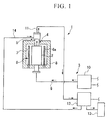
- FIG. 1 is a schematic diagram of an embodiment showing the method of producing trichlorosilane and the apparatus for producing trichlorosilane according to the present invention.
- An apparatus (conversion furnace) 1 for producing trichlorosilane comprises: a reaction chamber 2 for producing a mixed gas containing trichlorosilane and hydrogen chloride by subjecting silicon tetrachloride and hydrogen to reaction at a temperature of not lower than 800°C; a gas supply device 3 connected to the reaction chamber 2; a product gas discharging device 4 for discharging the mixed gas to the outside; and a cooling gas introducing device 5 connected to the product gas discharging device 4.
- a heating device 6 for heating the reaction chamber 2 is disposed around the reaction chamber 2.
- a heat insulating member 7 is disposed so as to cover the periphery of the reaction chamber 2 and the heating device 6.
- the reaction chamber 2, heating device 6, and insulating member 7 are stored in a storage container 8.
- the heating device 6 comprises a heater 6a constituted of a heating element which is disposed around the reaction chamber 2 so as to cover the reaction chamber 2.
- the heater 6a is made of carbon.
- the heating device 6 performs a heat control such that a temperature in the interior of the reaction chamber 2 is in a range of 800°C to 1900°C.
- the temperature in the interior of the reaction chamber 2 is set to be 1200°C or higher, conversion ratio is improved. That is, by the conversion reaction at a temperature exceeding 1200°C, it is possible to recover a relatively large amount of trichlorosilane.
- the reaction chamber 2 may be made of carbon, and a surface of the carbon may be coated with silicon carbide.
- the storage container 8 is made of stainless steel.
- the gas supply device 3 comprises a gas supply pipe 9 for supplying raw gas to the reaction chamber 2, and a mixing unit 10 connected to the gas supply pipe 9. Hydrogen is introduced to the mixing unit 10, and silicon tetrachloride from an evaporator (not shown) is introduced to the mixing unit 10. Those gasses are mixed in the mixing unit 10 and are introduced to the reaction chamber 2.
- the silicon tetrachloride to be introduced may include disilane group. Alternatively, disilane group may be removed from the silicon tetrachloride.
- the product gas discharging device 4 connected to the reaction chamber 2 comprises a gas exhaustion pipe 11 for discharging the product mixed gas in the reaction chamber 2 to the outside, a cooling separator 12 connected to the gas exhaustion pipe 11, and a distillation device 13 connected to the cooling separator 12.
- the above-described cooling gas introducing device 5 is connected to the product gas discharging device 4.
- the cooling gas introducing device 5 comprises a gas introducing pipe 14, and the gas introducing pipe 14 is connected to the inside of a basal end portion of the above-described gas exhaustion pipe 11.
- the cooling gas introducing pipe 14 is connected to a supply source (not shown) of the cooling gas, that is, through a supply pipe passage (not shown), connected to a supply source (not shown) of, for example, hydrogen, silicon tetrachloride, or hydrogen chloride.
- a supply source not shown
- the cooling gas introducing pipe 14 the cooling gas mainly composed of hydrogen, silicon tetrachloride, or hydrogen chloride is introduced to the product gas.
- the embodiment shown in FIG. 1 is constituted such that the cooling gas introducing pipe 14 is connected to the above-described cooling separator 12, and unreacted hydrogen separated in the cooling separator 12 is introduced to the gas exhaustion pipe 11 through the cooling gas introducing pipe 14.
- the cooling gas introducing device 5 is constituted such that the amount of the cooling gas to be introduced can be controlled so as to cool the reaction product gas to a temperature of not higher than 650°C.
- a temperature sensor may be provided inside the basal end portion of the gas exhaustion pipe 11 in order to measure and control the temperature of the reaction product gas being subjected to quenching.
- a raw gas composed of silicon tetrachloride and hydrogen is introduced from the mixing unit 10 into the reaction chamber 2 through the gas supply pipe 9.
- the interior of the reaction chamber 2 is heated to the reaction temperature by the heating device 6, and trichlorosilane, hydrogen chloride and the like are produced by a reaction of the raw gas.
- the reaction product gas is discharged to the outside through the gas exhaustion pipe 11.
- a cooling gas is introduced to the inside of the basal end portion of the gas exhaustion pipe 11 through the cooling gas introducing pipe 14 and is mixed in the reaction product gas.
- the reaction product gas is rapidly cooled to a temperature of not higher than 650°C.
- the temperature and an introduced amount of the cooling gas are controlled so as to cool the reaction product gas to 650°C or lower. In that time, it is preferable to cool the reaction product to 650°C within I second in order to obtain sufficient quenching effect for suppressing the reverse reaction in which decomposition of trichlorosilane occurs.
- the reaction product gas mixed with the cooling gas is introduced to the cooling separator 12, where the reaction product gas is further cooled. Trichlorislane separated in the cooling separator 12 is introduced to the distillation device 13 and is condensed and collected.
- unreacted hydrogen gas and the like is separated in the above-described cooling separator 12.
- the hydrogen gas is introduced to the inside of the basal end portion of the gas exhaustion pipe 11 through the cooling gas introducing pipe 14 and is reused as the cooling gas.
- silicon tetrachloride is used as the cooling gas as an alternative to hydrogen or being mixed with hydrogen, it is possible to obtain a similar effect as in the case of using hydrogen as the cooling gas.
- a partial amount of silicon tetrachloride separated in the distillation device 13 may be introduced to the gas exhaustion pipe 11 through the cooling gas introducing pipe 14.
- the hydrogen chloride is introduced into the gas exhaustion pipe 11 through the cooling gas introducing pipe 14.
- the hydrogen chloride it is possible to cool the reaction product gas to a temperature of not higher than 650°C with a cooling rate to perform the cooling within 1 second while suppressing the by-production of polymer, thereby enhancing the conversion ratio to trichlorisilane.
- hydrogen chloride has an effect of suppressing the by-production of polymer in accordance with the reaction formula of the above-described (4), since the hydrogen chloride enhances a reaction to produce trichlorosilane by reacting with SiCl 2 as shown in the below-described formula (6).
- the hydrogen chloride has an effect of decomposing once by-produced polymer.
- reaction product gas is rapidly cooled to a temperature of not higher than 650°C within 1 second using hydrogen chloride as the cooling gas, it is possible to quench the reaction product gas to a temperature of not higher than 650°C by the introduction of hydrogen chloride while suppressing by-production of polymer, thereby improving the conversion ratio to triclorosilane.
- problems such as blocking of piping by adhesion of polymer by-product to the wall of the piping are prevented and the piping is maintained at satisfactory conditions.
- the above-described effect is enlarged when the conversion reaction is performed at a relatively high temperature. The effect is especially remarkable, when the reaction temperature exceeds 1200°C.
- a mixed gas of hydrogen and silicon tetrachloride (H 2 /STC molar ratio: 2) was supplied in the reaction chamber and was subjected to reaction at a reaction temperature listed in Table 1, and trichlorosilane was produced.
- a cooling gas shown in Table 1 was introduced to the above-described product mixed gas through the cooling gas introducing device 14, thereby cooling the product mixed gas to the temperature listed in Table 1. The results are shown in Table 1.
- the product mixed gas could be quenched to 650°C or lower within 1 second or shorter, thereby enhancing the production rate of trichlorosilane (TCS).
- the present invention in the method for producing trichlorosilane and the apparatus for producing trichlorosilane according to the present invention, when a product gas is discharged from the reaction chamber, the product gas is cooled by being introduced with a cooling gas mainly composed of hydrogen, silicon tetrachloride, or hydrogen chloride.
- a cooling gas mainly composed of hydrogen, silicon tetrachloride, or hydrogen chloride.
Landscapes
- Chemical & Material Sciences (AREA)
- Organic Chemistry (AREA)
- Inorganic Chemistry (AREA)
- Silicon Compounds (AREA)
Abstract
Description
- The present invention relates to a method for producing trichlorosilane by converting silicon tetrachloride to trichlorosilane and to an apparatus for producing trichlorosilane.
Priority is claimed on Japanese Patent Application No.2006-302056 filed on November 7, 2006 2007-273545 filed on October 22, 2007 - Polycrystalline silicon of high purity may be produced, for example, using trichlorosilane (SiHCl3:TCS in initial name), silicon tetrachloride (SiCl4: STC in initial name ), and hydrogen as raw materials, by hydrogen reduction of trichlorosilane shown by the below-described formula (1) and thermolysis of trichlorosilane shown by the below-described formula (2).
SiHCl3+H2→Si+3HCl (1)
4SiHCl3→Si+3SiCl4+2H2 (2)
- A gas exhausted during the above-described reaction to generate polycrystalline silicon includes by-products as well as unreacted silicon tetrachloride, trichlorosilane, and hydrogen. The by-products include hydrogen chloride, a low boiling point chrolosilane group such as dichlorosilane, and a small amount of a high boiling point chlorosilane group such as tetrachlorodisilane or hexachlorodisilane. These chlorosilane groups are subjected to fractional distillation in accordance with their boiling points and, where necessary, are reused.
- For example, silicon tetrachloride recovered by fractional distillation of the exhausted gas of the above-described generation reaction may be used as a raw material for generation of trichlorosilane by hydrogenation conversion shown by the below-described formula (3). The trichlorosilane may be recovered and reused as a raw material for the above-described production of polycrystalline silicon.
SiCl4+H2→SiHCl3+HCl (3)
- A conversion reaction apparatus (conversion furnace), for example, described in Patent Document 1 is known as an apparatus for producing the trichlorosilane. In this conversion reaction apparatus, a reaction chamber surrounded by a heating element has a dual chamber structure having an outer chamber and an inner chamber constituted of two tubes in a concentric alignment. A heat exchanger is disposed below the reaction chamber. A raw gas supply pipe passage for supplying hydrogen and silicon tetrachloride through the heat exchanger to the reaction chamber and an exhaustion pipe passage for exhausting the reaction product gas from the reaction chamber are connected to the heat exchanger. Thus, the apparatus is constituted such that the supply gas to be supplied to the reaction chamber is preheated in the heat exchanger while cooling the exhausted reaction product gas by heat conduction to the supply gas from the reaction product gas being exhausted from the reaction chamber.
- Patent Document 1: Japanese Patent No.
3781439 - In the above-described conventional apparatus for producing trichlorosilane, the reaction product gas is cooled by heat exchange with the supply gas in the heat exchanger disposed below the reaction chamber. On the other hand, a reverse reaction to decompose the trichlorosilane to silicon tetrachloride and hydrogen occurs during the cooling process of the reaction product gas. Therefore, in order to suppress the generation of the reverse reaction to as low as possible, it is devised to increase the cooling rate of the reaction product gas and rapidly cool the reaction product gas within a short time to a temperature at which the reverse reaction does not remarkably occur. However, the above-described cooling device included a disadvantage that it was impossible to avoid the generation of the reverse reaction because of a not so rapid cooling rate, resulting in a low conversion ratio to the trichlorosilane. This disadvantage was prominent when the conversion reaction was exerted at relatively high temperature, especially at a temperature exceeding 1200°C.
- Although it is possible to rapidly cool the gas to a temperature at which the reverse reaction does not remarkably occur within an extremely short time within 1 second, this case included a problem that a polymer was by-produced, thereby reducing the conversion ratio. In addition, there was a disadvantage that the polymer as the by-product blocked the piping by adhesion to the pipe wall and the like, and satisfactory performance of the piping and the like could not be maintained. Here, the above-described polymer is of a chlorosilane group of a higher order structure having at least two silicon atoms, for example. Si2Cl6, Si3Cl8, Si2H2Cl4, and the like.
- The present invention solved the above-described problems in the conventional method for producing trichlorosilane. An object of the present invention is to provide a method for producing trichlorosilane and an apparatus for producing trichlorosilane which enable the conversion ratio to be enhanced by introducing a cooling gas into a mixed gas generated during a conversion reaction, thereby quenching the mixed product gas while controlling the chemical reaction.
- The present invention relates to a method for producing trichlorosilane, in which the above-described problems were solved by the below-described constitutions [1] to [6].
- [1] A method for producing trichlorosilane, comprising: performing a production of a mixed gas containing trichlorosilane and hydrogen chloride by introducing silicon tetrachloride and hydrogen to a reaction chamber and subjecting them to reaction at a temperature of not lower than 800°C; and cooling the mixed gas by introducing a cooling gas to the mixed gas while discharging the mixed gas from the reaction chamber, the cooling gas containing a main component selected from at least one of hydrogen, silicon tetrachloride, or hydrogen chloride.
- [2] A method for producing trichlorosilane according to the above-described [1], wherein a temperature of the cooling gas introduced to the mixed gas is -60 to 650°C.
- [3] A method for producing trichlorosilane according to the above-described [1] or [2], wherein a reaction temperature during the production of the mixed gas is not lower than 1200°C.
- [4] A method for producing trichlorosilane according to the above-described [1] to [3], wherein the mixed gas is cooled to a temperature of not higher than 650°C by introducing the cooling gas containing hydrogen or silicon tetrachloride as the main component.
- [5] A method for producing trichlorosilane according to the above-described [1] to [3], wherein the mixed gas is cooled to a temperature of not higher than 650°C within a time of not longer than 1 second by introducing the cooling gas containing hydrogen chloride as the main component.
- [6] A method for producing trichlorosilane according to the above-described [1] to [4], further comprising: introducing the mixed gas to which the cooling gas has been introduced to a condenser (cooling vessel) to condense and separate unreacted hydrogen, and reusing the separated hydrogen-containing gas as the cooling gas.
- The present invention is further related to an apparatus for producing trichlorosilane, in which the above-described problems are solved by the below described constitutions [7] to [11].
- [7] An apparatus for producing trichlorosilane, comprising: a reaction chamber in which a mixed gas containing trichlorosilane and hydrogen chloride is produced by subjecting silicon tetrachloride and hydrogen to reaction at a temperature of not lower than 800°C; a mixed gas discharging device that discharges the mixed gas to the outside of the reaction chamber; a cooling gas introducing device that introduce a cooling gas to the mixed gas, the cooling gas containing a main component selected from at least one of hydrogen, silicon tetrachloride, and hydrogen chloride, wherein the cooling gas introducing device is connected to the mixed gas discharging device.
- [8] An apparatus for producing trichlorosilane according to the above-described [7], wherein the reaction is performed at a temperature of not lower than 1200°C.
- [9] An apparatus for producing trichlorosilane according to the above-described [7] or [8], wherein a supply pipe passage of the cooling gas containing hydrogen or silicon tetrachloride as the main component is connected to the cooling gas introducing device, and the cooling gas containing hydrogen or silicon tetrachloride as the main component is introduced to the mixed gas to cool the mixed gas to a temperature of not higher than 650°C.
- [10] An apparatus for producing trichlorosilane according to the above-described [7] or [8], wherein a supply pipe passage of the cooling gas containing hydrogen chloride as the main component is connected to the cooling gas introducing device, and the cooling gas containing hydrogen chloride as the main component is introduced to the mixed gas to cool the mixed gas to a temperature of not higher than 650°C within 1 second.
- [11] An apparatus for producing trichlorosilane according to the above-described [7] to [10], further comprising: a condenser into which the mixed gas which has been introduced with the cooling gas is introduced; a recycling pipe passage that supplies a hydrogen-containing gas mainly composed of unreacted hydrogen condensed and separated in the condenser to the cooling gas introducing device.
- In the method of the above-described [1] and the apparatus of the above-described [7], when a mixed gas is produced in the conversion reaction for producing trichlorosilane by reaction of silicon tetrachloride and hydrogen, a cooling gas containing a main component selected from at least one of hydrogen, silicon tetrachloride, and hydrogen chloride is introduced to the mixed gas, thereby cooling the mixed gas. As a result, while cooling the mixed gas at a high temperature, the reverse reaction of trichlorosilane is suppressed by the introduced hydrogen and/or silicon tetrachloride, and a by-production of polymer is suppressed by hydrogen chloride. Therefore, it is possible to improve the conversion ratio to trichlorosilane.
Here, the description of the cooling gas of "containing a main component selected from at least one of hydrogen, silicon tetrachloride, or hydrogen chloride" means that the cooling gas may contain an additional component in a small amount such that the effect of the main component is not largely disturbed by the additional component. - In the introduction of hydrogen, silicon tetrachloride, or hydrogen chrolide, single species may be mixed in the mixed gas, or alternatively, plural species may be mixed simultaneously in the mixed gas. The temperature of the cooling gas mainly composed of hydrogen, silicon tetrachloride, or hydrogen chloride may be controlled based on a consideration on the cooling rate of the above-described product mixed gas. For example, as shown in the above-described [2], it is possible to use the cooling gas at -60 to 650°C. It is also possible to preheat the cooling gas before introducing the cooling gas into the mixed gas. The cooling gas of the above-described constitutions may be used in combination with another cooling device.
- In the method of the above-described [1] and the apparatus of the above-described [7], the temperature of the conversion reaction to produce trichlorosilane is not lower than 800°C. In the method of the above-described [3] and the apparatus of the above-described [8], the reaction temperature is not lower than 1200°C. Where the temperature of the conversion reaction is lower than 800°C. the production ratio of trichlorosilane (conversion ratio to trichlorosilane) decreases largely. At a reaction temperature of not lower than 1200°C, the conversion reaction is enhanced, and the conversion ratio to trichlorosilane can be improved.
- Although the conversion reaction to trichlorosilane is enhanced in accordance with increasing temperature, when the temperature exceeds 1000°C, trichlorosilane in the reaction product gas partially decomposes to hydrogen chloride and SiCl2 as an intermediate product. The decomposition reaction proceeds with increasing temperature. Especially, at a temperature exceeding 1200°C, SiCl2 constitutes a main component in the reaction product gas.
- In the production method and the production apparatus of the present invention, hydrogen, silicon tetrachloride, or hydrogen chloride in the cooling gas being introduced in the product mixed gas of the conversion reaction reacts with the SiCl2. Therefore, even when the conversion reaction is progressed at a temperature exceeding 1200°C, a reverse reaction to decompose the trichlorosilane is effectively suppressed, and the conversion ratio to trichlorosilane can be improved.
- In the method of the above-described [4] and the apparatus of the above-described [9], the cooling gas mainly composed of hydrogen or silicon tetrachloride is introduced to cool the above-described produced gas to a temperature of not higher than 650°C. Therefore, the product gas is cooled to a temperature range at which reverse reaction of the conversion reaction does not remarkably occur. Simultaneously, the reverse reaction of the conversion reaction is suppressed by hydrogen or silicon tetrachloride. Here, in the mixing of the hydrogen or silicon tetrachloride, either one may be introduced, or alternatively, both may be introduced simultaneously.
- In the above-described method of [5] and the apparatus of [10], the cooling gas mainly composed of hydrogen chloride is introduced to quench the mixed gas with a rapid cooling rate to a temperature of not higher than 650°C within 1 second. In this case, although the cooling to a temperature of not higher than 650°C at which reverse reaction of the conversion reaction does not remarkably occurs is performed rapidly within an extremely short time of 1 second or shorter, by-production of polymer is suppressed by hydrogen chloride. As a result, reduction of conversion ratio by the generation of polymer by-product can be effectively suppressed. In the same time, reverse reaction of conversion reaction can be suppressed. Therefore it is possible to further improve the conversion ratio. In addition, by preventing problematic blocking of piping caused by e.g., adhesion of polymer by-product to the wall of the piping, it is possible to maintain the piping and the like at satisfactory conditions. The above-described effects are enlarged when the conversion reaction is performed at relatively high temperature. The effects are especially remarkable, where the conversion reaction temperature exceeds 1200°C.
- In the above-described method of [6] and the apparatus of [11], the mixed gas introduced with the cooling gas is introduced to the condenser to condense and separate hydrogen, and the separated hydrogen-containing gas is reused as the cooling gas. Therefore it is possible to enhance the efficiency of using hydrogen.
- As described-above, in accordance with the method for producing trichlosilane and the apparatus for producing trichlorosilane according to the present invention, when the product gas is discharged from the reaction vessel, cooling gas mainly composed of hydrogen, silicon tetrachloride, or hydrogen chloride is introduced to cool the product gas. Therefore, by suppressing a reverse reaction of the conversion reaction and suppressing the by-production of polymer while rapidly cooling the product gas from the high temperature state, it is possible to obtain trichlorosilane with a high conversion ratio.
-
FIG. 1 is a schematic diagram of an embodiment showing the method of producing trichlorosilane and the apparatus for producing trichlorosilane according to the present invention. -
- 1: Apparatus for producing trichlorosilane.
- 2: Reaction Chamber
- 4: Reaction product gas discharging device
- 5: Cooling gas introducing device
- 6: Heating device
- 9: Gas supply pipe
- 11: Gas exhaustion pipe
- 14: Cooling gas introducing pipe
- In the following, an embodiment of the method of producing trichlorosilane and the apparatus for producing trichlorosilane according to the present invention is explained with reference to
FIG. 1 . - An apparatus (conversion furnace) 1 for producing trichlorosilane according to the embodiment shown in
FIG. 1 comprises: areaction chamber 2 for producing a mixed gas containing trichlorosilane and hydrogen chloride by subjecting silicon tetrachloride and hydrogen to reaction at a temperature of not lower than 800°C; agas supply device 3 connected to thereaction chamber 2; a product gas discharging device 4 for discharging the mixed gas to the outside; and a coolinggas introducing device 5 connected to the product gas discharging device 4. - A heating device 6 for heating the
reaction chamber 2 is disposed around thereaction chamber 2. Aheat insulating member 7 is disposed so as to cover the periphery of thereaction chamber 2 and the heating device 6. Thereaction chamber 2, heating device 6, and insulatingmember 7 are stored in a storage container 8. - The heating device 6 comprises a
heater 6a constituted of a heating element which is disposed around thereaction chamber 2 so as to cover thereaction chamber 2. Theheater 6a is made of carbon. The heating device 6 performs a heat control such that a temperature in the interior of thereaction chamber 2 is in a range of 800°C to 1900°C. When the temperature in the interior of thereaction chamber 2 is set to be 1200°C or higher, conversion ratio is improved. That is, by the conversion reaction at a temperature exceeding 1200°C, it is possible to recover a relatively large amount of trichlorosilane. - The
reaction chamber 2 may be made of carbon, and a surface of the carbon may be coated with silicon carbide. Preferably, the storage container 8 is made of stainless steel. - The
gas supply device 3 comprises a gas supply pipe 9 for supplying raw gas to thereaction chamber 2, and amixing unit 10 connected to the gas supply pipe 9. Hydrogen is introduced to the mixingunit 10, and silicon tetrachloride from an evaporator (not shown) is introduced to the mixingunit 10. Those gasses are mixed in the mixingunit 10 and are introduced to thereaction chamber 2. The silicon tetrachloride to be introduced may include disilane group. Alternatively, disilane group may be removed from the silicon tetrachloride. - The product gas discharging device 4 connected to the
reaction chamber 2 comprises agas exhaustion pipe 11 for discharging the product mixed gas in thereaction chamber 2 to the outside, a coolingseparator 12 connected to thegas exhaustion pipe 11, and adistillation device 13 connected to thecooling separator 12. The above-described coolinggas introducing device 5 is connected to the product gas discharging device 4. The coolinggas introducing device 5 comprises agas introducing pipe 14, and thegas introducing pipe 14 is connected to the inside of a basal end portion of the above-describedgas exhaustion pipe 11. - The cooling
gas introducing pipe 14 is connected to a supply source (not shown) of the cooling gas, that is, through a supply pipe passage (not shown), connected to a supply source (not shown) of, for example, hydrogen, silicon tetrachloride, or hydrogen chloride. Through the coolinggas introducing pipe 14, the cooling gas mainly composed of hydrogen, silicon tetrachloride, or hydrogen chloride is introduced to the product gas. - The embodiment shown in
FIG. 1 is constituted such that the coolinggas introducing pipe 14 is connected to the above-describedcooling separator 12, and unreacted hydrogen separated in thecooling separator 12 is introduced to thegas exhaustion pipe 11 through the coolinggas introducing pipe 14. - The cooling
gas introducing device 5 is constituted such that the amount of the cooling gas to be introduced can be controlled so as to cool the reaction product gas to a temperature of not higher than 650°C. A temperature sensor may be provided inside the basal end portion of thegas exhaustion pipe 11 in order to measure and control the temperature of the reaction product gas being subjected to quenching. - Next, a method for producing trichlorosilane using the above-described apparatus for producing trichlorosilane is explained.
- Firstly, a raw gas composed of silicon tetrachloride and hydrogen is introduced from the mixing
unit 10 into thereaction chamber 2 through the gas supply pipe 9. The interior of thereaction chamber 2 is heated to the reaction temperature by the heating device 6, and trichlorosilane, hydrogen chloride and the like are produced by a reaction of the raw gas. The reaction product gas is discharged to the outside through thegas exhaustion pipe 11. In that time, by the coolinggas introducing device 5, a cooling gas is introduced to the inside of the basal end portion of thegas exhaustion pipe 11 through the coolinggas introducing pipe 14 and is mixed in the reaction product gas. - By the introduction of the cooling gas, the reaction product gas is rapidly cooled to a temperature of not higher than 650°C. The temperature and an introduced amount of the cooling gas are controlled so as to cool the reaction product gas to 650°C or lower. In that time, it is preferable to cool the reaction product to 650°C within I second in order to obtain sufficient quenching effect for suppressing the reverse reaction in which decomposition of trichlorosilane occurs. Next, through the
gas exhaustion pipe 11, the reaction product gas mixed with the cooling gas is introduced to thecooling separator 12, where the reaction product gas is further cooled. Trichlorislane separated in thecooling separator 12 is introduced to thedistillation device 13 and is condensed and collected. - In the embodiment shown in
FIG. 1 , unreacted hydrogen gas and the like is separated in the above-describedcooling separator 12. The hydrogen gas is introduced to the inside of the basal end portion of thegas exhaustion pipe 11 through the coolinggas introducing pipe 14 and is reused as the cooling gas. - Where hydrogen is used as the cooling gas in an embodiment of the present invention, by mixing hydrogen in the reaction product gas to cool the reaction product gas in the time of discharging the reaction product gas from the
reaction chamber 2, the reaction product gas at a high temperature state is cooled rapidly, and at the same time, a reverse reaction of conversion is suppressed. Therefore, it is possible to enhance the rate of conversion to trichlorosilane.
The above-described effect is increased when the conversion reaction is performed at a relatively high temperature. The effect is especially remarkable, when the reaction temperature exceeds 1200°C. Especially, where the reaction product gas is cooled to 650°C or lower by being mixed with hydrogen, the reaction product gas is rapidly cooled to a temperature range at which the reverse reaction of the conversion reaction can be suppressed sufficiently. Therefore, it is possible to enhance the rate of conversion to trichlorosilane. - Where silicon tetrachloride is used as the cooling gas as an alternative to hydrogen or being mixed with hydrogen, it is possible to obtain a similar effect as in the case of using hydrogen as the cooling gas. In this case, a partial amount of silicon tetrachloride separated in the
distillation device 13 may be introduced to thegas exhaustion pipe 11 through the coolinggas introducing pipe 14. - Where hydrogen chloride is used as the cooling gas in an embodiment of the present invention, the hydrogen chloride is introduced into the
gas exhaustion pipe 11 through the coolinggas introducing pipe 14. By mixing the hydrogen chloride, it is possible to cool the reaction product gas to a temperature of not higher than 650°C with a cooling rate to perform the cooling within 1 second while suppressing the by-production of polymer, thereby enhancing the conversion ratio to trichlorisilane. - In general, when the reaction product gas is cooled rapidly within an extremely short time of 1 second or shorter to a temperature at which the reverse reaction causing decomposition of trichlorosilane, polymer is easily generated as by-product in the cooling process. For example, SiCl2 is generated by decomposition of trichlorosilane as shown in the below-described formula (4), and the SiCl2 is reacted with SiCl4 to generate the polymer as shown in the below-described formula (5). The SiCl2 is generated in larger amount at a high temperature. Therefore, the by-production of polymer increases where the conversion reaction is caused to occur at relatively high temperature, and is especially remarkable at a temperature exceeding 1200°C.
-
SiHCl3→SiCl2+HCl (4)
SiCl2+SiCl4→Si2Cl6 (5)
- On the other hand, hydrogen chloride has an effect of suppressing the by-production of polymer in accordance with the reaction formula of the above-described (4), since the hydrogen chloride enhances a reaction to produce trichlorosilane by reacting with SiCl2 as shown in the below-described formula (6). In addition, as shown in the below-described reaction formulae (7), (8), and (9), the hydrogen chloride has an effect of decomposing once by-produced polymer.
SiCl2+HCl→SiHCl3 (6)
Si2Cl6+HCl-SiHCl3+SiCl4 (7)
Si3Cl8+2HCl→2SiHCl3+SiCl4 (8)
Si2H2Cl4+2HCl→2SiHCl3 (9)
- Therefore, where the reaction product gas is rapidly cooled to a temperature of not higher than 650°C within 1 second using hydrogen chloride as the cooling gas, it is possible to quench the reaction product gas to a temperature of not higher than 650°C by the introduction of hydrogen chloride while suppressing by-production of polymer, thereby improving the conversion ratio to triclorosilane. In addition, problems such as blocking of piping by adhesion of polymer by-product to the wall of the piping are prevented and the piping is maintained at satisfactory conditions. The above-described effect is enlarged when the conversion reaction is performed at a relatively high temperature. The effect is especially remarkable, when the reaction temperature exceeds 1200°C.
- In the following, Examples according to the present invention are shown. The technical scope of the present invention is not limited to the above-described embodiments and the below-described Examples. Various modifications can be made without departing from the spirit of the present invention.
- In each case, using the production apparatus shown in
FIG. 1 , a mixed gas of hydrogen and silicon tetrachloride (H2/STC molar ratio: 2) was supplied in the reaction chamber and was subjected to reaction at a reaction temperature listed in Table 1, and trichlorosilane was produced. When the product mixed gas was discharged outside the chamber through theexhaustion pipe 11, a cooling gas shown in Table 1 was introduced to the above-described product mixed gas through the coolinggas introducing device 14, thereby cooling the product mixed gas to the temperature listed in Table 1. The results are shown in Table 1. - As shown in the results of Table 1, by introducing H2 or STC as the cooling gas to the product mixed gas, the product mixed gas could be quenched to 650°C or lower within 1 second or shorter, thereby enhancing the production rate of trichlorosilane (TCS).
-
Table 1 Reaction temperature Cooling gas Cooling time (second) Post-cooling temperature of product gas Production Ratio of TCS Species Amount of introduction Temperature 1200°C Not added - - 598°C 34.5 H2 3.2 mol Room temperature 0.06 596°C 39 H2 6.8 mol Room temperature 0.06 596°C 41 STC 0.9 mol Room temperature 0.06 599°C 39 STC 1.9 mol Room temperature 0.06 601°C 40 [Remarks]
The amount of introduction of the cooling gas denotes an amount relative to 1 mol of Si contained in STC of raw material.
The production ratio of TCS denotes a ratio ( by mol %) of the amount of production of TCS to the STC in the raw material. - In each case, HCl was used as the cooling gas. Under conditions shown in Table 2, HCl was introduced to the product mixed gas, thereby cooling the product mixed gas to the temperature shown in Table 2. The results are shown in Table 2. As shown in the results of Table 2, by introducing HCl as the cooling gas to the product mixed gas, polymer was not generated even under rapid cooling.
-
Table 2 Reaction temperature Cooling gas Cooling time (second) Post-cooling temperature of product gas Polymer Species Amount of introduction Temperature 1200°C Not added - - 598°C Present HCl 3.7 mol Room temperature 0.06 602°C Absent HCl 6.7 mol Room temperature 0.06 603°C Absent [Remark] The amount of introduction of the cooling gas denotes an amount relative to 1 mol of Si contained in STC of raw material. - As described-above, in the method for producing trichlorosilane and the apparatus for producing trichlorosilane according to the present invention, when a product gas is discharged from the reaction chamber, the product gas is cooled by being introduced with a cooling gas mainly composed of hydrogen, silicon tetrachloride, or hydrogen chloride. As a result, the product gas at a high temperature state is quenched, and at the same time, a reverse reaction of the conversion reaction is suppressed, and by-production of polymer is suppressed. Therefore, it is possible to obtain trichlorosilane at a high conversion ratio. Therefore, the present invention is highly useful in industrial applications.
Claims (11)
- A method for producing trichlorosilane, comprising:performing production of a mixed gas containing trichlorosilane and hydrogen chloride by introducing silicon tetrachloride and hydrogen into a reaction chamber and subjecting them to reaction at a temperature of not lower than 800°C; andcooling the mixed gas by introducing a cooling gas to the mixed gas while discharging the mixed gas from the reaction chamber, the cooling gas containing a main component selected from at least one of hydrogen, silicon tetrachloride, or hydrogen chloride.
- The method for producing trichlorosilane according to claim 1, wherein a temperature of the cooling gas introduced to the mixed gas is -60 to 650°C.
- The method for producing trichlorosilane according to claim 1, wherein a reaction temperature during the production of the mixed gas is not lower than 1200°C.
- The method for producing trichlorosilane according to claim 1, wherein the mixed gas is cooled to a temperature of not higher than 650°C by introducing the cooling gas containing hydrogen or silicon tetrachloride as the main component.
- The method for producing trichlorosilane according to claim 1, wherein the mixed gas is cooled to a temperature of not higher than 650°C within a time of not longer than 1 second by introducing the cooling gas containing hydrogen chloride as the main component.
- The method for producing trichlorosilane according to claim 1, further comprising: introducing the mixed gas to which the cooling gas has been introduced to a condenser to condense and separate unreacted hydrogen, and reusing the separated hydrogen-containing gas as the cooling gas.
- An apparatus for producing trichlorosilane, comprising:a reaction chamber in which a mixed gas containing trichlorosilane and hydrogen chloride is produced by subjecting silicon tetrachloride and hydrogen to reaction at a temperature of not lower than 800°C;a mixed gas discharging device that discharges the mixed gas to the outside of the reaction chamber;a cooling gas introducing device that introduces a cooling gas to the mixed gas, the cooling gas containing a main component selected from at least one of hydrogen, silicon tetrachloride, and hydrogen chloride,wherein the cooling gas introducing device is connected to the mixed gas discharging device.
- An apparatus for producing trichlorosilane according to claim 7, wherein the reaction is performed at a temperature of not lower than 1200°C.
- An apparatus for producing trichlorosilane according to claim 7, wherein a supply pipe passage of the cooling gas mainly containing hydrogen or silicon tetrachloride as the main component is connected to the cooling gas introducing device, and the cooling gas containing hydrogen or silicon tetrachloride as the main component is introduced to the mixed gas to cool the mixed gas to a temperature of not higher than 650°C.
- An apparatus for producing trichlorosilane according to claim 7, wherein a supply pipe passage of the cooling gas containing hydrogen chloride as the main component is connected to the cooling gas introducing device, and the cooling gas containing hydrogen chloride as the main component is introduced to the mixed gas to cool the mixed gas to a temperature of not higher than 650°C within 1 second.
- An apparatus for producing trichlorosilane according to claim 7, further comprising: a condenser into which the mixed gas which has been introduced with the cooling gas is introduced; a recycling pipe passage that supplies a hydrogen-containing gas mainly composed of unreacted hydrogen condensed and separated in the condenser to the cooling gas introducing device.
Applications Claiming Priority (3)
| Application Number | Priority Date | Filing Date | Title |
|---|---|---|---|
| JP2006302056 | 2006-11-07 | ||
| JP2007273545A JP5601438B2 (en) | 2006-11-07 | 2007-10-22 | Trichlorosilane production method and trichlorosilane production apparatus |
| PCT/JP2007/070941 WO2008056550A1 (en) | 2006-11-07 | 2007-10-26 | Process for producing trichlorosilane and trichlorosilane producing apparatus |
Publications (3)
| Publication Number | Publication Date |
|---|---|
| EP2085359A1 true EP2085359A1 (en) | 2009-08-05 |
| EP2085359A4 EP2085359A4 (en) | 2011-02-23 |
| EP2085359B1 EP2085359B1 (en) | 2017-11-29 |
Family
ID=39364372
Family Applications (1)
| Application Number | Title | Priority Date | Filing Date |
|---|---|---|---|
| EP07830675.0A Not-in-force EP2085359B1 (en) | 2006-11-07 | 2007-10-26 | Process for producing trichlorosilane |
Country Status (7)
| Country | Link |
|---|---|
| US (1) | US20090324477A1 (en) |
| EP (1) | EP2085359B1 (en) |
| JP (1) | JP5601438B2 (en) |
| KR (1) | KR101388323B1 (en) |
| CN (1) | CN103553055A (en) |
| TW (1) | TWI448429B (en) |
| WO (1) | WO2008056550A1 (en) |
Cited By (7)
| Publication number | Priority date | Publication date | Assignee | Title |
|---|---|---|---|---|
| EP2233436A1 (en) * | 2009-03-11 | 2010-09-29 | Mitsubishi Materials Corporation | Apparatus and method for producing trichlorosilane |
| WO2011085902A1 (en) * | 2010-01-18 | 2011-07-21 | Evonik Degussa Gmbh | "closed loop" method for producing trichlorosilane from metallurgical silicon |
| WO2011098064A1 (en) * | 2010-02-12 | 2011-08-18 | Centrotherm Sitec Gmbh | Method for hydrogenating chlorosilanes and converter for carrying out the method |
| WO2012047658A1 (en) * | 2010-09-27 | 2012-04-12 | Gtat Corporation | Heater and related methods therefor |
| US8524819B2 (en) | 2009-06-04 | 2013-09-03 | Sumitomo Chemical Company, Limited | Thermoplastic polymer composition and production method thereof |
| EP2746222A1 (en) | 2012-12-19 | 2014-06-25 | Wacker Chemie AG | Process for converting silicon tetrachloride to trichlorosilane |
| US9217609B2 (en) | 2011-06-21 | 2015-12-22 | Gtat Corporation | Apparatus and methods for conversion of silicon tetrachloride to trichlorosilane |
Families Citing this family (23)
| Publication number | Priority date | Publication date | Assignee | Title |
|---|---|---|---|---|
| JP5397580B2 (en) * | 2007-05-25 | 2014-01-22 | 三菱マテリアル株式会社 | Method and apparatus for producing trichlorosilane and method for producing polycrystalline silicon |
| JP5392488B2 (en) * | 2008-10-30 | 2014-01-22 | 三菱マテリアル株式会社 | Production method and use of trichlorosilane |
| TW201031591A (en) * | 2008-10-30 | 2010-09-01 | Mitsubishi Materials Corp | Process for production of trichlorosilane and method for use thereof |
| US8178051B2 (en) * | 2008-11-05 | 2012-05-15 | Stephen Michael Lord | Apparatus and process for hydrogenation of a silicon tetrahalide and silicon to the trihalosilane |
| US20100124525A1 (en) * | 2008-11-19 | 2010-05-20 | Kuyen Li | ZERO-HEAT-BURDEN FLUIDIZED BED REACTOR FOR HYDRO-CHLORINATION OF SiCl4 and M.G.-Si |
| WO2010086996A1 (en) * | 2009-01-30 | 2010-08-05 | 電気化学工業株式会社 | Process for production of trichlorosilane |
| JP5412447B2 (en) * | 2009-01-30 | 2014-02-12 | 電気化学工業株式会社 | Reactor provided with reaction vessel made of carbon-containing material, corrosion prevention method for the reactor, and method for producing chlorosilanes using the reactor |
| WO2010100750A1 (en) * | 2009-03-06 | 2010-09-10 | 電気化学工業株式会社 | Trichlorosilane cooling tower and process for producing trichlorosilane with the same |
| JP5442715B2 (en) * | 2009-03-11 | 2014-03-12 | 電気化学工業株式会社 | Trichlorosilane production equipment |
| SG174957A1 (en) | 2009-03-30 | 2011-11-28 | Denki Kagaku Kogyo Kk | Method for collection of hexachlorodisilane and plant for the method |
| JP5436541B2 (en) * | 2009-03-31 | 2014-03-05 | 電気化学工業株式会社 | Reactor |
| JP5511795B2 (en) * | 2009-04-01 | 2014-06-04 | 電気化学工業株式会社 | Gas phase reactor |
| WO2010113298A1 (en) * | 2009-04-01 | 2010-10-07 | 電気化学工業株式会社 | Gas phase reactor |
| JP5436542B2 (en) * | 2009-04-03 | 2014-03-05 | 電気化学工業株式会社 | How to prevent damage to carbon reaction vessels |
| JP5374581B2 (en) * | 2009-04-03 | 2013-12-25 | 電気化学工業株式会社 | How to prevent damage to carbon reaction vessels |
| WO2010116500A1 (en) * | 2009-04-08 | 2010-10-14 | 電気化学工業株式会社 | Trichlorosilane cooling tower and trichlorosilane manufacturing method using the same |
| US8298490B2 (en) * | 2009-11-06 | 2012-10-30 | Gtat Corporation | Systems and methods of producing trichlorosilane |
| US20120107216A1 (en) * | 2010-10-27 | 2012-05-03 | Gt Solar Incorporated | Hydrochlorination heater and related methods therefor |
| US9222733B2 (en) * | 2011-02-03 | 2015-12-29 | Memc Electronic Materials S.P.A. | Reactor apparatus and methods for reacting compounds |
| JP5974857B2 (en) * | 2011-11-28 | 2016-08-23 | 三菱マテリアル株式会社 | Trichlorosilane production equipment |
| WO2014165165A1 (en) * | 2013-03-13 | 2014-10-09 | Centrotherm Photovoltaics Usa, Inc. | Temperature management in chlorination processes and systems related thereto |
| US9688703B2 (en) | 2013-11-12 | 2017-06-27 | Dow Corning Corporation | Method for preparing a halosilane |
| JP6725510B2 (en) | 2014-12-18 | 2020-07-22 | ダウ シリコーンズ コーポレーション | Method for producing aryl functional silanes |
Family Cites Families (12)
| Publication number | Priority date | Publication date | Assignee | Title |
|---|---|---|---|---|
| US4217334A (en) * | 1972-02-26 | 1980-08-12 | Deutsche Gold- Und Silber-Scheideanstalt Vormals Roessler | Process for the production of chlorosilanes |
| BE795913A (en) * | 1972-02-26 | 1973-06-18 | Degussa | CHLOROSILANES PREPARATION PROCESS |
| JPS57156318A (en) * | 1981-03-16 | 1982-09-27 | Koujiyundo Silicon Kk | Production of trichlorosilane |
| FR2530638A1 (en) * | 1982-07-26 | 1984-01-27 | Rhone Poulenc Spec Chim | PROCESS FOR THE PREPARATION OF A TRICHLOROSILANE MIXTURE USEFUL FOR THE PREPARATION OF HIGH-PURITY SILICON |
| JPS6081010A (en) * | 1983-10-13 | 1985-05-09 | Denki Kagaku Kogyo Kk | Manufacture of trichlorosilane |
| JPS6221707A (en) * | 1985-07-22 | 1987-01-30 | Nippon Steel Corp | Production of trichlorosilane |
| JPS638207A (en) * | 1986-06-27 | 1988-01-14 | Mitsubishi Kakoki Kaisha Ltd | Hydrogenation of silicon tetrachloride |
| JPS63112410A (en) * | 1986-10-31 | 1988-05-17 | Nippon Steel Corp | Production of trichlorosilane |
| DE3809784C1 (en) * | 1988-03-23 | 1989-07-13 | Huels Ag, 4370 Marl, De | |
| JP2710382B2 (en) * | 1989-01-25 | 1998-02-10 | 電気化学工業株式会社 | Method for producing high-purity dichlorosilane |
| US5906799A (en) * | 1992-06-01 | 1999-05-25 | Hemlock Semiconductor Corporation | Chlorosilane and hydrogen reactor |
| DE102005005044A1 (en) * | 2005-02-03 | 2006-08-10 | Consortium für elektrochemische Industrie GmbH | Process for the preparation of trichlorosilane by means of thermal hydrogenation of silicon tetrachloride |
-
2007
- 2007-10-22 JP JP2007273545A patent/JP5601438B2/en not_active Expired - Fee Related
- 2007-10-26 CN CN201310417262.3A patent/CN103553055A/en active Pending
- 2007-10-26 EP EP07830675.0A patent/EP2085359B1/en not_active Not-in-force
- 2007-10-26 WO PCT/JP2007/070941 patent/WO2008056550A1/en not_active Ceased
- 2007-10-26 KR KR1020097001713A patent/KR101388323B1/en not_active Expired - Fee Related
- 2007-10-26 US US12/309,627 patent/US20090324477A1/en not_active Abandoned
-
2008
- 2008-05-05 TW TW097116484A patent/TWI448429B/en not_active IP Right Cessation
Non-Patent Citations (1)
| Title |
|---|
| See references of WO2008056550A1 * |
Cited By (12)
| Publication number | Priority date | Publication date | Assignee | Title |
|---|---|---|---|---|
| EP2233436A1 (en) * | 2009-03-11 | 2010-09-29 | Mitsubishi Materials Corporation | Apparatus and method for producing trichlorosilane |
| US8491862B2 (en) | 2009-03-11 | 2013-07-23 | Mitsubishi Materials Corporation | Apparatus and method for producing trichlorosilane |
| US8524819B2 (en) | 2009-06-04 | 2013-09-03 | Sumitomo Chemical Company, Limited | Thermoplastic polymer composition and production method thereof |
| WO2011085902A1 (en) * | 2010-01-18 | 2011-07-21 | Evonik Degussa Gmbh | "closed loop" method for producing trichlorosilane from metallurgical silicon |
| WO2011098064A1 (en) * | 2010-02-12 | 2011-08-18 | Centrotherm Sitec Gmbh | Method for hydrogenating chlorosilanes and converter for carrying out the method |
| WO2012047658A1 (en) * | 2010-09-27 | 2012-04-12 | Gtat Corporation | Heater and related methods therefor |
| TWI620906B (en) * | 2010-09-27 | 2018-04-11 | Gtat股份有限公司 | Heater and related methods therefor |
| US10315181B2 (en) | 2010-09-27 | 2019-06-11 | Gtat Corporation | Heater and related methods therefor |
| US9217609B2 (en) | 2011-06-21 | 2015-12-22 | Gtat Corporation | Apparatus and methods for conversion of silicon tetrachloride to trichlorosilane |
| EP2746222A1 (en) | 2012-12-19 | 2014-06-25 | Wacker Chemie AG | Process for converting silicon tetrachloride to trichlorosilane |
| DE102012223784A1 (en) | 2012-12-19 | 2014-06-26 | Wacker Chemie Ag | Process for converting silicon tetrachloride to trichlorosilane |
| US9776878B2 (en) | 2012-12-19 | 2017-10-03 | Wacker Chemie Ag | Process for converting silicon tetrachloride to trichlorosilane |
Also Published As
| Publication number | Publication date |
|---|---|
| KR101388323B1 (en) | 2014-04-22 |
| KR20090079875A (en) | 2009-07-22 |
| US20090324477A1 (en) | 2009-12-31 |
| TWI448429B (en) | 2014-08-11 |
| EP2085359B1 (en) | 2017-11-29 |
| WO2008056550A1 (en) | 2008-05-15 |
| EP2085359A4 (en) | 2011-02-23 |
| CN103553055A (en) | 2014-02-05 |
| JP2008137885A (en) | 2008-06-19 |
| JP5601438B2 (en) | 2014-10-08 |
| TW200918452A (en) | 2009-05-01 |
Similar Documents
| Publication | Publication Date | Title |
|---|---|---|
| EP2085359B1 (en) | Process for producing trichlorosilane | |
| EP2154110B1 (en) | Process for producing trichlorosilane | |
| KR101400481B1 (en) | Process for producing trichlorosilane and apparatus for producing trichlorosilane | |
| KR101573933B1 (en) | Method and apparatus for producing trichlorosilane | |
| EP2070871B1 (en) | Process for production of multicrystal silicon and facility for production of multicrystal silicon | |
| EP1720800B1 (en) | Process for producing silicon | |
| KR101644239B1 (en) | Process for producing trichlorosilane | |
| CN101479192A (en) | Method for producing trichlorosilane and apparatus for producing trichlorosilane | |
| CN102196995B (en) | The preparation method of trichlorosilane and Application way | |
| JP4780271B2 (en) | Method for producing polycrystalline silicon | |
| JP5321827B2 (en) | Polycrystalline silicon manufacturing method and manufacturing apparatus | |
| JP5333725B2 (en) | Method for producing and using trichlorosilane | |
| KR20160102807A (en) | Dispersion of silicon metal powder and process for producing chlorosilane using same | |
| US20130243683A1 (en) | Method for the production of high-purity silicon | |
| KR20160069380A (en) | Dispersion of silicon metal powder and process for producing chlorosilane using same |
Legal Events
| Date | Code | Title | Description |
|---|---|---|---|
| PUAI | Public reference made under article 153(3) epc to a published international application that has entered the european phase |
Free format text: ORIGINAL CODE: 0009012 |
|
| 17P | Request for examination filed |
Effective date: 20090421 |
|
| AK | Designated contracting states |
Kind code of ref document: A1 Designated state(s): AT BE BG CH CY CZ DE DK EE ES FI FR GB GR HU IE IS IT LI LT LU LV MC MT NL PL PT RO SE SI SK TR |
|
| DAX | Request for extension of the european patent (deleted) | ||
| A4 | Supplementary search report drawn up and despatched |
Effective date: 20110120 |
|
| 17Q | First examination report despatched |
Effective date: 20111228 |
|
| STAA | Information on the status of an ep patent application or granted ep patent |
Free format text: STATUS: EXAMINATION IS IN PROGRESS |
|
| GRAP | Despatch of communication of intention to grant a patent |
Free format text: ORIGINAL CODE: EPIDOSNIGR1 |
|
| STAA | Information on the status of an ep patent application or granted ep patent |
Free format text: STATUS: GRANT OF PATENT IS INTENDED |
|
| INTG | Intention to grant announced |
Effective date: 20170731 |
|
| GRAS | Grant fee paid |
Free format text: ORIGINAL CODE: EPIDOSNIGR3 |
|
| GRAA | (expected) grant |
Free format text: ORIGINAL CODE: 0009210 |
|
| STAA | Information on the status of an ep patent application or granted ep patent |
Free format text: STATUS: THE PATENT HAS BEEN GRANTED |
|
| AK | Designated contracting states |
Kind code of ref document: B1 Designated state(s): AT BE BG CH CY CZ DE DK EE ES FI FR GB GR HU IE IS IT LI LT LU LV MC MT NL PL PT RO SE SI SK TR |
|
| REG | Reference to a national code |
Ref country code: GB Ref legal event code: FG4D |
|
| REG | Reference to a national code |
Ref country code: CH Ref legal event code: EP |
|
| REG | Reference to a national code |
Ref country code: AT Ref legal event code: REF Ref document number: 950203 Country of ref document: AT Kind code of ref document: T Effective date: 20171215 |
|
| REG | Reference to a national code |
Ref country code: IE Ref legal event code: FG4D |
|
| REG | Reference to a national code |
Ref country code: DE Ref legal event code: R096 Ref document number: 602007053231 Country of ref document: DE |
|
| REG | Reference to a national code |
Ref country code: NL Ref legal event code: MP Effective date: 20171129 |
|
| REG | Reference to a national code |
Ref country code: LT Ref legal event code: MG4D |
|
| REG | Reference to a national code |
Ref country code: AT Ref legal event code: MK05 Ref document number: 950203 Country of ref document: AT Kind code of ref document: T Effective date: 20171129 |
|
| PG25 | Lapsed in a contracting state [announced via postgrant information from national office to epo] |
Ref country code: LT Free format text: LAPSE BECAUSE OF FAILURE TO SUBMIT A TRANSLATION OF THE DESCRIPTION OR TO PAY THE FEE WITHIN THE PRESCRIBED TIME-LIMIT Effective date: 20171129 Ref country code: FI Free format text: LAPSE BECAUSE OF FAILURE TO SUBMIT A TRANSLATION OF THE DESCRIPTION OR TO PAY THE FEE WITHIN THE PRESCRIBED TIME-LIMIT Effective date: 20171129 Ref country code: SE Free format text: LAPSE BECAUSE OF FAILURE TO SUBMIT A TRANSLATION OF THE DESCRIPTION OR TO PAY THE FEE WITHIN THE PRESCRIBED TIME-LIMIT Effective date: 20171129 Ref country code: ES Free format text: LAPSE BECAUSE OF FAILURE TO SUBMIT A TRANSLATION OF THE DESCRIPTION OR TO PAY THE FEE WITHIN THE PRESCRIBED TIME-LIMIT Effective date: 20171129 |
|
| PG25 | Lapsed in a contracting state [announced via postgrant information from national office to epo] |
Ref country code: AT Free format text: LAPSE BECAUSE OF FAILURE TO SUBMIT A TRANSLATION OF THE DESCRIPTION OR TO PAY THE FEE WITHIN THE PRESCRIBED TIME-LIMIT Effective date: 20171129 Ref country code: BG Free format text: LAPSE BECAUSE OF FAILURE TO SUBMIT A TRANSLATION OF THE DESCRIPTION OR TO PAY THE FEE WITHIN THE PRESCRIBED TIME-LIMIT Effective date: 20180228 Ref country code: GR Free format text: LAPSE BECAUSE OF FAILURE TO SUBMIT A TRANSLATION OF THE DESCRIPTION OR TO PAY THE FEE WITHIN THE PRESCRIBED TIME-LIMIT Effective date: 20180301 Ref country code: LV Free format text: LAPSE BECAUSE OF FAILURE TO SUBMIT A TRANSLATION OF THE DESCRIPTION OR TO PAY THE FEE WITHIN THE PRESCRIBED TIME-LIMIT Effective date: 20171129 |
|
| PG25 | Lapsed in a contracting state [announced via postgrant information from national office to epo] |
Ref country code: NL Free format text: LAPSE BECAUSE OF FAILURE TO SUBMIT A TRANSLATION OF THE DESCRIPTION OR TO PAY THE FEE WITHIN THE PRESCRIBED TIME-LIMIT Effective date: 20171129 |
|
| PG25 | Lapsed in a contracting state [announced via postgrant information from national office to epo] |
Ref country code: CZ Free format text: LAPSE BECAUSE OF FAILURE TO SUBMIT A TRANSLATION OF THE DESCRIPTION OR TO PAY THE FEE WITHIN THE PRESCRIBED TIME-LIMIT Effective date: 20171129 Ref country code: SK Free format text: LAPSE BECAUSE OF FAILURE TO SUBMIT A TRANSLATION OF THE DESCRIPTION OR TO PAY THE FEE WITHIN THE PRESCRIBED TIME-LIMIT Effective date: 20171129 Ref country code: CY Free format text: LAPSE BECAUSE OF FAILURE TO SUBMIT A TRANSLATION OF THE DESCRIPTION OR TO PAY THE FEE WITHIN THE PRESCRIBED TIME-LIMIT Effective date: 20171129 Ref country code: EE Free format text: LAPSE BECAUSE OF FAILURE TO SUBMIT A TRANSLATION OF THE DESCRIPTION OR TO PAY THE FEE WITHIN THE PRESCRIBED TIME-LIMIT Effective date: 20171129 Ref country code: DK Free format text: LAPSE BECAUSE OF FAILURE TO SUBMIT A TRANSLATION OF THE DESCRIPTION OR TO PAY THE FEE WITHIN THE PRESCRIBED TIME-LIMIT Effective date: 20171129 |
|
| REG | Reference to a national code |
Ref country code: DE Ref legal event code: R097 Ref document number: 602007053231 Country of ref document: DE |
|
| PG25 | Lapsed in a contracting state [announced via postgrant information from national office to epo] |
Ref country code: RO Free format text: LAPSE BECAUSE OF FAILURE TO SUBMIT A TRANSLATION OF THE DESCRIPTION OR TO PAY THE FEE WITHIN THE PRESCRIBED TIME-LIMIT Effective date: 20171129 Ref country code: IT Free format text: LAPSE BECAUSE OF FAILURE TO SUBMIT A TRANSLATION OF THE DESCRIPTION OR TO PAY THE FEE WITHIN THE PRESCRIBED TIME-LIMIT Effective date: 20171129 Ref country code: PL Free format text: LAPSE BECAUSE OF FAILURE TO SUBMIT A TRANSLATION OF THE DESCRIPTION OR TO PAY THE FEE WITHIN THE PRESCRIBED TIME-LIMIT Effective date: 20171129 |
|
| PLBE | No opposition filed within time limit |
Free format text: ORIGINAL CODE: 0009261 |
|
| STAA | Information on the status of an ep patent application or granted ep patent |
Free format text: STATUS: NO OPPOSITION FILED WITHIN TIME LIMIT |
|
| 26N | No opposition filed |
Effective date: 20180830 |
|
| PG25 | Lapsed in a contracting state [announced via postgrant information from national office to epo] |
Ref country code: SI Free format text: LAPSE BECAUSE OF FAILURE TO SUBMIT A TRANSLATION OF THE DESCRIPTION OR TO PAY THE FEE WITHIN THE PRESCRIBED TIME-LIMIT Effective date: 20171129 |
|
| REG | Reference to a national code |
Ref country code: CH Ref legal event code: PL |
|
| GBPC | Gb: european patent ceased through non-payment of renewal fee |
Effective date: 20181026 |
|
| REG | Reference to a national code |
Ref country code: BE Ref legal event code: MM Effective date: 20181031 |
|
| PG25 | Lapsed in a contracting state [announced via postgrant information from national office to epo] |
Ref country code: MC Free format text: LAPSE BECAUSE OF FAILURE TO SUBMIT A TRANSLATION OF THE DESCRIPTION OR TO PAY THE FEE WITHIN THE PRESCRIBED TIME-LIMIT Effective date: 20171129 Ref country code: LU Free format text: LAPSE BECAUSE OF NON-PAYMENT OF DUE FEES Effective date: 20181026 |
|
| REG | Reference to a national code |
Ref country code: IE Ref legal event code: MM4A |
|
| PG25 | Lapsed in a contracting state [announced via postgrant information from national office to epo] |
Ref country code: LI Free format text: LAPSE BECAUSE OF NON-PAYMENT OF DUE FEES Effective date: 20181031 Ref country code: CH Free format text: LAPSE BECAUSE OF NON-PAYMENT OF DUE FEES Effective date: 20181031 Ref country code: FR Free format text: LAPSE BECAUSE OF NON-PAYMENT OF DUE FEES Effective date: 20181031 Ref country code: BE Free format text: LAPSE BECAUSE OF NON-PAYMENT OF DUE FEES Effective date: 20181031 |
|
| PG25 | Lapsed in a contracting state [announced via postgrant information from national office to epo] |
Ref country code: GB Free format text: LAPSE BECAUSE OF NON-PAYMENT OF DUE FEES Effective date: 20181026 Ref country code: IE Free format text: LAPSE BECAUSE OF NON-PAYMENT OF DUE FEES Effective date: 20181026 |
|
| PG25 | Lapsed in a contracting state [announced via postgrant information from national office to epo] |
Ref country code: MT Free format text: LAPSE BECAUSE OF NON-PAYMENT OF DUE FEES Effective date: 20181026 |
|
| PG25 | Lapsed in a contracting state [announced via postgrant information from national office to epo] |
Ref country code: TR Free format text: LAPSE BECAUSE OF FAILURE TO SUBMIT A TRANSLATION OF THE DESCRIPTION OR TO PAY THE FEE WITHIN THE PRESCRIBED TIME-LIMIT Effective date: 20171129 |
|
| PG25 | Lapsed in a contracting state [announced via postgrant information from national office to epo] |
Ref country code: PT Free format text: LAPSE BECAUSE OF FAILURE TO SUBMIT A TRANSLATION OF THE DESCRIPTION OR TO PAY THE FEE WITHIN THE PRESCRIBED TIME-LIMIT Effective date: 20171129 |
|
| PG25 | Lapsed in a contracting state [announced via postgrant information from national office to epo] |
Ref country code: HU Free format text: LAPSE BECAUSE OF FAILURE TO SUBMIT A TRANSLATION OF THE DESCRIPTION OR TO PAY THE FEE WITHIN THE PRESCRIBED TIME-LIMIT; INVALID AB INITIO Effective date: 20071026 |
|
| PG25 | Lapsed in a contracting state [announced via postgrant information from national office to epo] |
Ref country code: IS Free format text: LAPSE BECAUSE OF FAILURE TO SUBMIT A TRANSLATION OF THE DESCRIPTION OR TO PAY THE FEE WITHIN THE PRESCRIBED TIME-LIMIT Effective date: 20180329 |
|
| PGFP | Annual fee paid to national office [announced via postgrant information from national office to epo] |
Ref country code: DE Payment date: 20231020 Year of fee payment: 17 |
|
| REG | Reference to a national code |
Ref country code: DE Ref legal event code: R119 Ref document number: 602007053231 Country of ref document: DE |
|
| PG25 | Lapsed in a contracting state [announced via postgrant information from national office to epo] |
Ref country code: DE Free format text: LAPSE BECAUSE OF NON-PAYMENT OF DUE FEES Effective date: 20250501 |