EP2085288B1 - Chariot hospitalier multi-bouteilles polyvalent - Google Patents
Chariot hospitalier multi-bouteilles polyvalent Download PDFInfo
- Publication number
- EP2085288B1 EP2085288B1 EP09290069A EP09290069A EP2085288B1 EP 2085288 B1 EP2085288 B1 EP 2085288B1 EP 09290069 A EP09290069 A EP 09290069A EP 09290069 A EP09290069 A EP 09290069A EP 2085288 B1 EP2085288 B1 EP 2085288B1
- Authority
- EP
- European Patent Office
- Prior art keywords
- bottles
- plane
- ground
- wheels
- handcart
- Prior art date
- Legal status (The legal status is an assumption and is not a legal conclusion. Google has not performed a legal analysis and makes no representation as to the accuracy of the status listed.)
- Not-in-force
Links
- 238000005096 rolling process Methods 0.000 claims abstract description 4
- 239000002184 metal Substances 0.000 claims description 3
- 238000006073 displacement reaction Methods 0.000 abstract 1
- 239000007789 gas Substances 0.000 description 14
- 229940075473 medical gases Drugs 0.000 description 5
- 229910000831 Steel Inorganic materials 0.000 description 2
- 239000000463 material Substances 0.000 description 2
- 239000000203 mixture Substances 0.000 description 2
- 239000010959 steel Substances 0.000 description 2
- QVGXLLKOCUKJST-UHFFFAOYSA-N atomic oxygen Chemical compound [O] QVGXLLKOCUKJST-UHFFFAOYSA-N 0.000 description 1
- 239000002131 composite material Substances 0.000 description 1
- 229940079593 drug Drugs 0.000 description 1
- 239000003814 drug Substances 0.000 description 1
- 239000001301 oxygen Substances 0.000 description 1
- 229910052760 oxygen Inorganic materials 0.000 description 1
- 238000012856 packing Methods 0.000 description 1
- 229920000642 polymer Polymers 0.000 description 1
- 230000006641 stabilisation Effects 0.000 description 1
- 238000011105 stabilization Methods 0.000 description 1
- 230000001225 therapeutic effect Effects 0.000 description 1
- XLYOFNOQVPJJNP-UHFFFAOYSA-N water Substances O XLYOFNOQVPJJNP-UHFFFAOYSA-N 0.000 description 1
Images


Classifications
-
- B—PERFORMING OPERATIONS; TRANSPORTING
- B62—LAND VEHICLES FOR TRAVELLING OTHERWISE THAN ON RAILS
- B62B—HAND-PROPELLED VEHICLES, e.g. HAND CARTS OR PERAMBULATORS; SLEDGES
- B62B3/00—Hand carts having more than one axis carrying transport wheels; Steering devices therefor; Equipment therefor
- B62B3/002—Hand carts having more than one axis carrying transport wheels; Steering devices therefor; Equipment therefor characterised by a rectangular shape, involving sidewalls or racks
-
- B—PERFORMING OPERATIONS; TRANSPORTING
- B62—LAND VEHICLES FOR TRAVELLING OTHERWISE THAN ON RAILS
- B62B—HAND-PROPELLED VEHICLES, e.g. HAND CARTS OR PERAMBULATORS; SLEDGES
- B62B3/00—Hand carts having more than one axis carrying transport wheels; Steering devices therefor; Equipment therefor
- B62B3/10—Hand carts having more than one axis carrying transport wheels; Steering devices therefor; Equipment therefor characterised by supports specially adapted to objects of definite shape
- B62B3/104—Hand carts having more than one axis carrying transport wheels; Steering devices therefor; Equipment therefor characterised by supports specially adapted to objects of definite shape the object being of cylindrical shape, e.g. barrels, buckets, dustbins
-
- F—MECHANICAL ENGINEERING; LIGHTING; HEATING; WEAPONS; BLASTING
- F17—STORING OR DISTRIBUTING GASES OR LIQUIDS
- F17C—VESSELS FOR CONTAINING OR STORING COMPRESSED, LIQUEFIED OR SOLIDIFIED GASES; FIXED-CAPACITY GAS-HOLDERS; FILLING VESSELS WITH, OR DISCHARGING FROM VESSELS, COMPRESSED, LIQUEFIED, OR SOLIDIFIED GASES
- F17C13/00—Details of vessels or of the filling or discharging of vessels
- F17C13/08—Mounting arrangements for vessels
- F17C13/084—Mounting arrangements for vessels for small-sized storage vessels, e.g. compressed gas cylinders or bottles, disposable gas vessels, vessels adapted for automotive use
- F17C13/085—Mounting arrangements for vessels for small-sized storage vessels, e.g. compressed gas cylinders or bottles, disposable gas vessels, vessels adapted for automotive use on wheels
-
- B—PERFORMING OPERATIONS; TRANSPORTING
- B62—LAND VEHICLES FOR TRAVELLING OTHERWISE THAN ON RAILS
- B62B—HAND-PROPELLED VEHICLES, e.g. HAND CARTS OR PERAMBULATORS; SLEDGES
- B62B2202/00—Indexing codes relating to type or characteristics of transported articles
- B62B2202/02—Cylindrically-shaped articles, e.g. drums, barrels, flasks
- B62B2202/022—Gas bottles
-
- B—PERFORMING OPERATIONS; TRANSPORTING
- B62—LAND VEHICLES FOR TRAVELLING OTHERWISE THAN ON RAILS
- B62B—HAND-PROPELLED VEHICLES, e.g. HAND CARTS OR PERAMBULATORS; SLEDGES
- B62B2501/00—Manufacturing; Constructional features
- B62B2501/02—Dimensions
-
- B—PERFORMING OPERATIONS; TRANSPORTING
- B62—LAND VEHICLES FOR TRAVELLING OTHERWISE THAN ON RAILS
- B62B—HAND-PROPELLED VEHICLES, e.g. HAND CARTS OR PERAMBULATORS; SLEDGES
- B62B5/00—Accessories or details specially adapted for hand carts
- B62B5/02—Accessories or details specially adapted for hand carts providing for travelling up or down a flight of stairs
-
- F—MECHANICAL ENGINEERING; LIGHTING; HEATING; WEAPONS; BLASTING
- F17—STORING OR DISTRIBUTING GASES OR LIQUIDS
- F17C—VESSELS FOR CONTAINING OR STORING COMPRESSED, LIQUEFIED OR SOLIDIFIED GASES; FIXED-CAPACITY GAS-HOLDERS; FILLING VESSELS WITH, OR DISCHARGING FROM VESSELS, COMPRESSED, LIQUEFIED, OR SOLIDIFIED GASES
- F17C2205/00—Vessel construction, in particular mounting arrangements, attachments or identifications means
- F17C2205/01—Mounting arrangements
- F17C2205/0103—Exterior arrangements
- F17C2205/0107—Frames
-
- F—MECHANICAL ENGINEERING; LIGHTING; HEATING; WEAPONS; BLASTING
- F17—STORING OR DISTRIBUTING GASES OR LIQUIDS
- F17C—VESSELS FOR CONTAINING OR STORING COMPRESSED, LIQUEFIED OR SOLIDIFIED GASES; FIXED-CAPACITY GAS-HOLDERS; FILLING VESSELS WITH, OR DISCHARGING FROM VESSELS, COMPRESSED, LIQUEFIED, OR SOLIDIFIED GASES
- F17C2205/00—Vessel construction, in particular mounting arrangements, attachments or identifications means
- F17C2205/01—Mounting arrangements
- F17C2205/0123—Mounting arrangements characterised by number of vessels
- F17C2205/013—Two or more vessels
-
- F—MECHANICAL ENGINEERING; LIGHTING; HEATING; WEAPONS; BLASTING
- F17—STORING OR DISTRIBUTING GASES OR LIQUIDS
- F17C—VESSELS FOR CONTAINING OR STORING COMPRESSED, LIQUEFIED OR SOLIDIFIED GASES; FIXED-CAPACITY GAS-HOLDERS; FILLING VESSELS WITH, OR DISCHARGING FROM VESSELS, COMPRESSED, LIQUEFIED, OR SOLIDIFIED GASES
- F17C2205/00—Vessel construction, in particular mounting arrangements, attachments or identifications means
- F17C2205/01—Mounting arrangements
- F17C2205/0153—Details of mounting arrangements
- F17C2205/0157—Details of mounting arrangements for transport
- F17C2205/0161—Details of mounting arrangements for transport with wheels
-
- F—MECHANICAL ENGINEERING; LIGHTING; HEATING; WEAPONS; BLASTING
- F17—STORING OR DISTRIBUTING GASES OR LIQUIDS
- F17C—VESSELS FOR CONTAINING OR STORING COMPRESSED, LIQUEFIED OR SOLIDIFIED GASES; FIXED-CAPACITY GAS-HOLDERS; FILLING VESSELS WITH, OR DISCHARGING FROM VESSELS, COMPRESSED, LIQUEFIED, OR SOLIDIFIED GASES
- F17C2205/00—Vessel construction, in particular mounting arrangements, attachments or identifications means
- F17C2205/03—Fluid connections, filters, valves, closure means or other attachments
- F17C2205/0302—Fittings, valves, filters, or components in connection with the gas storage device
- F17C2205/0308—Protective caps
-
- F—MECHANICAL ENGINEERING; LIGHTING; HEATING; WEAPONS; BLASTING
- F17—STORING OR DISTRIBUTING GASES OR LIQUIDS
- F17C—VESSELS FOR CONTAINING OR STORING COMPRESSED, LIQUEFIED OR SOLIDIFIED GASES; FIXED-CAPACITY GAS-HOLDERS; FILLING VESSELS WITH, OR DISCHARGING FROM VESSELS, COMPRESSED, LIQUEFIED, OR SOLIDIFIED GASES
- F17C2221/00—Handled fluid, in particular type of fluid
- F17C2221/01—Pure fluids
- F17C2221/011—Oxygen
-
- F—MECHANICAL ENGINEERING; LIGHTING; HEATING; WEAPONS; BLASTING
- F17—STORING OR DISTRIBUTING GASES OR LIQUIDS
- F17C—VESSELS FOR CONTAINING OR STORING COMPRESSED, LIQUEFIED OR SOLIDIFIED GASES; FIXED-CAPACITY GAS-HOLDERS; FILLING VESSELS WITH, OR DISCHARGING FROM VESSELS, COMPRESSED, LIQUEFIED, OR SOLIDIFIED GASES
- F17C2221/00—Handled fluid, in particular type of fluid
- F17C2221/01—Pure fluids
- F17C2221/016—Noble gases (Ar, Kr, Xe)
- F17C2221/017—Helium
-
- F—MECHANICAL ENGINEERING; LIGHTING; HEATING; WEAPONS; BLASTING
- F17—STORING OR DISTRIBUTING GASES OR LIQUIDS
- F17C—VESSELS FOR CONTAINING OR STORING COMPRESSED, LIQUEFIED OR SOLIDIFIED GASES; FIXED-CAPACITY GAS-HOLDERS; FILLING VESSELS WITH, OR DISCHARGING FROM VESSELS, COMPRESSED, LIQUEFIED, OR SOLIDIFIED GASES
- F17C2221/00—Handled fluid, in particular type of fluid
- F17C2221/03—Mixtures
-
- F—MECHANICAL ENGINEERING; LIGHTING; HEATING; WEAPONS; BLASTING
- F17—STORING OR DISTRIBUTING GASES OR LIQUIDS
- F17C—VESSELS FOR CONTAINING OR STORING COMPRESSED, LIQUEFIED OR SOLIDIFIED GASES; FIXED-CAPACITY GAS-HOLDERS; FILLING VESSELS WITH, OR DISCHARGING FROM VESSELS, COMPRESSED, LIQUEFIED, OR SOLIDIFIED GASES
- F17C2223/00—Handled fluid before transfer, i.e. state of fluid when stored in the vessel or before transfer from the vessel
- F17C2223/01—Handled fluid before transfer, i.e. state of fluid when stored in the vessel or before transfer from the vessel characterised by the phase
- F17C2223/0107—Single phase
- F17C2223/0123—Single phase gaseous, e.g. CNG, GNC
-
- F—MECHANICAL ENGINEERING; LIGHTING; HEATING; WEAPONS; BLASTING
- F17—STORING OR DISTRIBUTING GASES OR LIQUIDS
- F17C—VESSELS FOR CONTAINING OR STORING COMPRESSED, LIQUEFIED OR SOLIDIFIED GASES; FIXED-CAPACITY GAS-HOLDERS; FILLING VESSELS WITH, OR DISCHARGING FROM VESSELS, COMPRESSED, LIQUEFIED, OR SOLIDIFIED GASES
- F17C2223/00—Handled fluid before transfer, i.e. state of fluid when stored in the vessel or before transfer from the vessel
- F17C2223/03—Handled fluid before transfer, i.e. state of fluid when stored in the vessel or before transfer from the vessel characterised by the pressure level
- F17C2223/036—Very high pressure (>80 bar)
-
- F—MECHANICAL ENGINEERING; LIGHTING; HEATING; WEAPONS; BLASTING
- F17—STORING OR DISTRIBUTING GASES OR LIQUIDS
- F17C—VESSELS FOR CONTAINING OR STORING COMPRESSED, LIQUEFIED OR SOLIDIFIED GASES; FIXED-CAPACITY GAS-HOLDERS; FILLING VESSELS WITH, OR DISCHARGING FROM VESSELS, COMPRESSED, LIQUEFIED, OR SOLIDIFIED GASES
- F17C2270/00—Applications
- F17C2270/02—Applications for medical applications
Definitions
- the present invention relates to a multi-purpose gas bottle transport trolley for easily transporting several gas bottles, for example from 3 to 12 gas bottles, in particular in a hospital establishment.
- medical gases such as oxygen, N 2 O / O 2 mixtures, NO, He / O 2 mixtures, etc. may, depending on the case, be distributed by pipes or networks of gas pipes, or be packaged in gas cylinders which are brought to the place of their use, in particular in treatment rooms or the like.
- the gas cylinders used for this purpose can be classified into three categories, according to their capacity (expressed in liters of water), namely: "large” bottles (about 50 liters), “small” bottles (about 5 1 or less) and so-called “medium” bottles (approximately 15 to 201).
- medical gases which are now considered as drugs, are commonly used by emergency services, such as the UAS or firefighters; during transfers of patients between different departments and / or between different institutions, particularly as a result of specializations and groupings of institutions; or to increase the mobility of patients treated at home ...
- the user can either wear them or use a transport cart especially when the bottle is heavy or several bottles must be moved.
- Transport trolleys currently available in hospitals allow either the transport of a single "big” bottle or a “medium” bottle, or the transport of a few “small” bottles.
- currently used trolleys have drawbacks, namely that they are generally not suitable for transporting more than 2 large or medium bottles, or that when they are intended to carry several small bottles, they are not or that not very ergonomic and generally do not allow to carry more than 6 to 8 bottles, even small (5 l).
- these trolleys generally have a flat bottom provided with wheels, on which are positioned the bottle or bottles to be transported, being held there by a securing means such as a chain or the like.
- a securing means such as a chain or the like.
- the document JP-A-07117675 discloses a carriage for transporting gas cylinders according to the preamble of claim 1 formed of a frame mounted on four wheels of the same diameter, the bottom is parallel to the surface of the ground.
- a similar cart is disclosed for the document US-2006/0043094 .
- the document JP-A-2003011826 teaches a load transport device comprising a bottom inclined with respect to the ground.
- this device comprises wheels of different diameters, those at the rear are coupled to a particular load lifting system comprising guides on which the wheels slide.
- An object of the invention is therefore to provide an improved multipurpose carriage for transporting not only several bottles, including more than 10 "small” bottles (capacity: 5 liters maximum), but also several “medium” bottles (capacity: 15 to 20 liters), which does not have the aforementioned drawbacks.
- Another object of the invention is therefore to provide a truck leading to increased safety of use and, if possible, better ergonomics facilitating its maneuvers by the user.
- the solution of the invention is a carriage for transporting gas cylinders
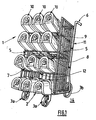
- FIGs 1 and 2 represent an embodiment of a carriage 1 for transporting gas cylinders according to the invention carrying 12 small bottles 10 of gas of 5 liters capacity ( figure 1 ) or, alternatively, 3 medium bottles of 20 liters ( figure 2 ).
- the carriage 1 comprises a bottom 2 for receiving a plurality of gas cylinders 10 in the "standing" position ( Fig. 2 ) or “lying down” ( Fig. 1 ).
- the bottom 2 is surmounted by a rear wall 4 and two side walls 5, facing each other, and arranged so as to form, with the rear wall 4, an internal volume 12 where the gas bottles are arranged.
- the bottom 2, the rear wall 4 and / or the side walls 5 are preferably perforated and made of a resistant material, for example a sort of wire mesh, for example steel, as visible on the figures 1 and 2 .
- a resistant material for example a sort of wire mesh, for example steel
- other materials may also contain, for example, they may be made of polymer, composite material or other.
- a frame structure 11 supports the bottom 2, the rear wall 4 and / or the side walls 5.
- the frame structure 11 is made of metal, for example steel, and the bottom 2 and the walls 4, 5 are welded to said frame structure 11.
- the frame structure 11 has been made from tubular elements shaped and welded together in a desired three-dimensional shape.
- wheels 3a, 3b allow the carriage 1 to be moved by rolling on the ground 14.
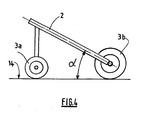
- it comprises two front wheels 3a and two rear wheels 3b, the rear wheels 3b having a wheel diameter greater than the wheel diameter of the front wheels 3a. , which facilitates the passage of obstacles, such as the borders 15, as illustrated in FIG. figure 3 .
- the rear wheels may have a diameter of about 20 cm and the front wheels of the order of 12 cm.
- the wheels 3a, 3b can be fixed directly to the chassis structure 11 or else carried by an axle itself connected to the chassis structure 11, in particular the rear wheels 3b are preferably carried by an axle 13.
- the plane comprising the bottom 2 forms an angle ⁇ between 5 ° and 40 ° relative to the plane formed by the ground 14, that is to say the plane on which the wheels 3a, 3b rest.
- the storage angle of the bottles 10 is increased (compared to a horizontal positioning according to the prior art) and it is then avoided that they fall or tilt, in case in sudden stop of the carriage 1 or during a sudden maneuver of the operator.
- the angle ⁇ may be of the order of 10 ° to 15 °.
- the carriage 1 is provided with 3 shelves 7, 8, 9 retractable to receive 12 small bottles (of maximum 5 1) in "lying" position, as shown in figure 1 , or when the shelves 7, 8, 9 are raised or folded, 3 or 4 medium bottles, 20 1 or 15 1, respectively, in "standing” position, as visible in FIG. figure 2 ; an adjustable chain or other suitable lashing system is used to keep the transported bottles in the "standing" position.
- the shelves 7, 8, 9 are retractable, that is to say that they can be either completely disassembled and removed from the carriage 1, or simply be folded (for example by pivoting) to release the internal space 12 while remaining secured to the carriage 1; in this case, when they are folded, they are positioned along the rear wall 4 or one of the side walls 5.
- the shelves 7, 8, 9 also form an angle of between 5 ° and 40 ° with respect to the plane formed by the floor, in particular the plane of each shelf 7, 8 , 9 is parallel to the plane of the bottom 2. It is not mandatory but is preferred that the plane of each shelf 7, 8, 9 is parallel to that of the bottom 2, so that each shelf 7, 8, 9 forms an angle ⁇ equal to that of the bottom 2 with the plane on which the wheels 3a, 3b rests, that is to say with generally the horizontal formed by the surface of the ground.
- a mat can also be fixed to the bottom 2 of the carriage 1 in order to protect it from the impacts generated by the bottles 10 of "average" capacity, especially when they are loaded onto the carriage 1.
- the dimensions of a carriage according to the invention may be, for example, a height of between 90 and 120 cm, a width of between 45 and 65 cm, and a depth of between 75 and 90 cm.
- Handles 6 or a roll bar allows the operator to maneuver the carriage 1 on the ground and move it by rolling.
- the handles 6 or the like are also carried by the frame structure 11.
- the carriage 1 of the invention has many advantages, namely a great versatility since it is suitable for the transport of all gas cylinders up to 20 liters of capacity; improved safety (drop of bottles) and ergonomics (standing position of the user during transport); increased efficiency (fewer trips, centralization on a person for the distribution of bottles in services); and greater handling (external dimensions compatible with doors and lifts, crossing curbs ..).
- the potential uses of the trolley 1 of the invention are the transfer of the bottles, either within the packing centers, or between the delivery truck and their place of storage, or in the health establishments or others in which a distribution of bottles between different services is required.
Landscapes
- Engineering & Computer Science (AREA)
- Mechanical Engineering (AREA)
- Chemical & Material Sciences (AREA)
- Combustion & Propulsion (AREA)
- Transportation (AREA)
- General Engineering & Computer Science (AREA)
- Handcart (AREA)
- Refuse Collection And Transfer (AREA)
- Discharge Of Articles From Conveyors (AREA)
Description
- La présente invention porte sur un chariot de transport de bouteilles de gaz polyvalent permettant de transporter facilement plusieurs bouteilles de gaz, par exemple de 3 à 12 bouteilles de gaz, en particulier au sein d'un établissement hospitalier.
- Au sein des bâtiments hospitaliers, les gaz médicaux, tel l'oxygène, les mélanges N2O/O2, le NO, les mélanges He/O2... peuvent être, selon le cas, soit distribués par des canalisations ou des réseaux de canalisations de gaz, soit être conditionnés en bouteilles de gaz qui sont amenées jusque sur le lieu de leur utilisation, notamment dans les salles de soins ou analogues.
- Les bouteilles de gaz utilisés à cette fin peuvent être classées en trois catégories, en fonction de leur capacité (exprimée en litres d'eau), à savoir: les « grandes » bouteilles (environ 50 litres), les « petites » bouteilles (environ 5 1 ou moins) et les bouteilles dites « moyennes » (15 à 201 environ).
- L'utilisation des gaz médicaux ou des dispositifs médicaux associés tend à être de plus en plus « mobile ». Ainsi, les gaz médicaux, qui sont désormais considérés comme des médicaments, sont couramment mis en oeuvre par les secours d'urgence, tel le SAMU ou les pompiers ; lors des transferts de malades entre différents services et/ou entre différents établissements, notamment du fait des spécialisations et des regroupements d'établissements ; ou encore pour accroitre la mobilité des patients soignés à domicile...
- Par ailleurs, l'arrivée de nouveaux gaz à usage thérapeutique engendre un retour de bouteilles de capacité « moyenne » au sein même des services.
- Ce phénomène a pour conséquence une stabilisation des besoins en gaz médicaux conditionnés en « grandes » bouteilles et, à contrario, une croissance régulière des besoins en gaz médicaux conditionnés en « petites » bouteilles ou en bouteilles « moyennes ».
- Pour transporter ces bouteilles, l'utilisateur peut soit les porter, soit utiliser un chariot de transport notamment lorsque la bouteille est lourde ou que plusieurs bouteilles doivent être déplacées.
- Les chariots de transport actuellement disponibles en milieu hospitalier permettent soit le transport d'une seule « grande » bouteille ou d'une bouteille « moyenne », soit le transport de quelques « petites » bouteilles. Toutefois, les chariots actuellement utilisés présentent des inconvénients, à savoir qu'ils ne sont généralement pas adaptés au transport de plus de 2 bouteilles grandes ou moyennes, ou que lorsqu'ils sont prévus pour transporter plusieurs petites bouteilles, ils ne sont pas ou que peu ergonomiques et ne permettent généralement pas de transporter plus de 6 à 8 bouteilles, même de petite taille (5 l).
- En outre, ces chariots présentent généralement un fond plat muni de roues, sur lequel sont positionnées la ou les bouteilles à transporter, en y étant retenues par un moyen d'arrimage, telle une chaîne ou analogue. Or, on comprend aisément que lorsque plusieurs bouteilles sont positionnées sur le chariot, lors d'un déplacement du chariot d'un endroit à un autre, toute manoeuvre d'arrêt d'urgence du chariot par l'opérateur ou d'évitement d'un obstacle, peut engendrer un basculement des bouteilles vers l'avant conduisant à un risque de rupture du moyen d'arrimage du fait du poids des bouteilles et leur chute subséquente. Ce risque de chute existe également avec les bouteilles « moyennes » et surtout avec les « petites » bouteilles qui peuvent elles passer sous le moyen d'arrimage.
- Ainsi, le document
JP-A-07117675 US-A-2006/0043094 . - Par ailleurs, le document
JP-A-2003011826 - Un but de l'invention est dès lors de proposer un chariot polyvalent amélioré pour transporter non seulement plusieurs bouteilles, notamment plus de 10 « petites » bouteilles (capacité : 5 litres maximum), mais aussi plusieurs bouteilles « moyennes » (capacité : 15 à 20 litres), lequel ne présente pas les inconvénients susmentionnés.
- Un autre but de l'invention est dès lors de proposer un chariot conduisant à une sécurité d'utilisation accrue et, si possible, à une meilleure ergonomie facilitant ses manoeuvres par l'utilisateur.
- La solution de l'invention est un chariot de transport de bouteilles de gaz
- selon la revendication 1.
- Selon le cas, le chariot de l'invention peut comprendre l'une ou plusieurs des caractéristiques suivantes : - une ou plusieurs étagères, escamotables ou repliables, venant se positionner au dessus du fond dans le volume interne formé par les parois latérales et la paroi arrière,
- le plan comprenant le fond forme un angle (α) supérieur ou égal à 8° par rapport au plan formé par le sol, de préférence supérieur ou égal à 10°.
- le plan comprenant le fond forme un angle (α) inférieur ou égal à 35° par rapport au plan formé par le sol, de préférence inférieur ou égal à 30°.
- le fond, la paroi arrière et les parois latérales sont ajourées.
- il comporte, en outre, des moyens de guidage permettant de manoeuvrer le chariot lors de ses déplacements sur le sol, en particulier une ou plusieurs poignées ou arceau de manipulation.
- la paroi arrière et les parois latérales sont métalliques et sont soudés sur la structure-châssis.
- les roues sont fixées à la structure-châssis.
- il comporte, par ailleurs, une ou plusieurs étagères venant se positionner au dessus du fond dans le volume interne formé par les parois latérales et la paroi arrière, de préférence le
- plan comprenant chaque étagère forme un angle (α) compris entre 5° et 40° par rapport au plan formé par le sol, en particulier le plan de chaque étagère est parallèle au plan du fond.
- il comporte 3 étagères, de préférence les étagères sont escamotables ou repliables.
- il comporte un système d'arrimage permettant de maintenir les bouteilles en position
« debout ». - tout ou partie du fond, de la paroi arrière et des parois latérales est formée d'un treillis métallique.
- il est dimensionné pour recevoir, dans son volume interne, au moins 12 bouteilles de capacité inférieure ou égale à 5 litres, en position « couchée », ou 4 bouteilles de capacité égale à 15 litres, en position « debout », ou 3 bouteilles de capacité égale à 20 litres, en position « debout ».
- L'invention va maintenant être mieux comprise grâce à la description illustrative suivante, faite en références aux figures annexées.
- Les
Figures 1 et2 représentent un mode de réalisation d'un chariot 1 de transport de bouteilles de gaz selon l'invention portant 12 petites bouteilles 10 de gaz de 5 litres de capacité (figure 1 ) ou, de façon alternative, 3 bouteilles moyennes de 20 litres (figure 2 ). - Le chariot 1 comprend un fond 2 permettant de recevoir plusieurs bouteilles de gaz 10, en position « debout » (
fig. 2 ) ou « couchée » (fig. 1 ). Le fond 2 est surmonté d'une paroi arrière 4 et de deux parois latérales 5, se faisant face, et disposées de manière à former, avec la paroi arrière 4, un volume interne 12 où sont disposées les bouteilles de gaz. - Afin d'obtenir une structure rigide mais aussi légère que possible, le fond 2, la paroi arrière 4 et/ou les parois latérales 5 sont de préférence ajourés et réalisés en un matériau résistant, par exemple en une sorte de treillis métallique, par exemple en acier, comme visible sur les
figures 1 et2 . Toutefois, d'autres matériaux peuvent également contenir, par exemple, on peut les réaliser en polymère, en matériau composite ou autres. - Une structure-châssis 11 supporte le fond 2, la paroi arrière 4 et/ou les parois latérales 5. Avantageusement, la structure-châssis 11 est métallique, par exemple en acier, et le fond 2 et les parois 4, 5 sont soudées à ladite structure-châssis 11. Sur les figures, la structure-châssis 11 a été réalisée à partir d'éléments tubulaires conformés et soudés ensemble selon une forme tridimensionnelle désirée.
- Plusieurs roues 3a, 3b permettent le déplacement du chariot 1 par roulage sur le sol 14. Avantageusement, il comporte deux roues avant 3a et deux roues arrière 3b, les roues arrière 3b ayant un diamètre de roue supérieur au diamètre de roue des roues avant 3a, ce qui facile notamment le passage d'obstacles, telles les bordures 15, comme illustré en
figure 3 . A titre d'exemple, les roues arrière peuvent avoir un diamètre de l'ordre de 20 cm et les roues avant de l'ordre de 12 cm. - Les roues 3a, 3b peuvent être fixées directement à la structure-châssis 11 ou alors portées par un essieu lui-même relié à la structure-châssis 11, en particulier les roues arrières 3b sont préférentiellement portées par un essieu 13.
- Selon l'invention, comme illustré en
figure 4 , le plan comprenant le fond 2 forme un angle α compris entre 5° et 40° par rapport au plan formé par le sol 14, c'est-à-dire le plan sur lequel reposent les roues 3a, 3b. En effet, grâce à une telle inclinaison, on augmente l'angle de stockage des bouteilles 10 (par rapport à un positionnement à l'horizontal selon l'art antérieur) et on évite alors qu'elles ne tombent ou ne basculent, en cas en d'arrêt soudain du chariot 1 ou lors d'une manoeuvre brusque de l'opérateur. A titre d'exemple, l'angle α peut être de l'ordre de 10° à 15°. - Par ailleurs, afin d'augmenter la capacité de transport, notamment de petites bouteilles, selon l'invention, le chariot 1 est muni de 3 étagères 7, 8, 9 escamotables permettant de recevoir 12 petites bouteilles (de maxi. 5 1) en position « couchée », comme montré en
figure 1 , ou lorsque les étagères 7, 8, 9 sont relevées ou repliées, 3 ou 4 bouteilles moyennes, de 20 1 ou de 15 1, respectivement, en position « debout », comme visible enfigure 2 ; une chaine ajustable ou tout autre système d'arrimage adapté est utilisée afin de maintenir les bouteilles transportées en position « debout ». - Les étagères 7, 8, 9 sont escamotables, c'est-à-dire qu'elles peuvent être soit totalement démontées et retirées du chariot 1, soit simplement être repliées (par exemple par pivotement) pour libérer l'espace interne 12 tout en restant solidarisées au chariot 1 ; dans ce cas, lorsqu'elles sont repliées, elles viennent se positionner le long de la paroi arrière 4 ou d'une des parois latérales 5.
- Afin d'éviter la chute des bouteilles qui y sont positionnées, les étagères 7, 8, 9 forment également un angle compris entre 5° et 40° par rapport au plan formé par le sol, en particulier le plan de chaque étagère 7, 8, 9 est parallèle au plan du fond 2. Il n'est pas obligatoire mais est préférentiel que le plan de chaque étagère 7, 8, 9 soit parallèle à celui du fond 2, donc que chaque étagère 7, 8, 9 forme un angle α égale à celui du fond 2 avec le plan sur lequel repose les roues 3a, 3b, c'est-à-dire avec généralement l'horizontal formé par la surface du sol.
- En outre, un tapis peut également fixé au fond 2 du chariot 1 afin de le protéger des impacts engendrés par les bouteilles 10 de capacité « moyenne », notamment lors que leur chargement sur le chariot 1.
- Les dimensions d'un chariot selon l'invention peuvent être, par exemple, une hauteur comprise entre 90 et 120 cm, une largeur comprise entre 45 et 65 cm, et une profondeur comprise entre 75 et 90 cm.
- Des poignées 6 ou un arceau de manipulation permet à l'opérateur de manoeuvrer le chariot 1 sur le sol et de le déplacer par roulage. Les poignées 6 ou analogues sont également portées par la structure-châssis 11.
- Le chariot 1 de l'invention présente de nombreux avantages, à savoir une grande polyvalence puisqu'il est adapté au transport de toutes les bouteilles de gaz jusqu'à 20 litres de contenance ; une sécurité (chute de bouteilles) et une ergonomie accrues (position debout de l'utilisateur lors du transport) ; une efficacité augmentée (moins de déplacements, centralisation sur une personne pour la répartition des bouteilles dans les services) ; et une maniabilité plus importante (dimensions externes compatibles avec les portes et les ascenseurs, franchissement des bordures..).
- Les utilisations potentielles du chariot 1 de l'invention sont le transfert des bouteilles, soit au sein les centres de conditionnement, soit entre le camion de livraison et leur lieu de stockage, soit dans les établissements de santé ou autres au sein desquels une répartition de bouteilles entre différents services est requise.
Claims (13)
- Chariot (1) de transport de bouteilles de gaz (10) comprenant un fond (2) conçu pour et apte à recevoir une ou plusieurs bouteilles de gaz (10), plusieurs roues (3a, 3b) permettant le déplacement du chariot (1) par roulage sur le sol, et une structure-châssis (11) sur laquelle sont fixées une paroi arrière (4) et des parois latérales (5) disposées de manière à former un volume interne (12) apte à et conçu pour recevoir des bouteilles de gaz (10), caractérisé en ce que le plan comprenant le fond (2) forme un angle (α) compris entre 5° et 40° par rapport au plan formé par le sol, mesuré lorsque les roues (3a, 3b) sont sur le sol, et en ce qu'il comporte, en outre, une ou plusieurs roues avant (3a) et deux roues arrière (3b), les roues arrière (3b) ayant un diamètre de roue supérieur au diamètre de roue de la ou des roues avant (3a).
- Chariot selon la revendication 1, caractérisé en ce que le plan comprenant le fond (2) forme un angle (α) supérieur ou égal à 8° par rapport au plan formé par le sol, de préférence supérieur ou égal à 10°.
- Chariot selon l'une des revendications 1 ou 2, caractérisé en ce que le plan comprenant le fond (2) forme un angle (α) inférieur ou égal à 35° par rapport au plan formé par le sol, de préférence inférieur ou égal à 30°.
- Chariot selon l'une des revendications 1 à 3, caractérisé en ce que le fond (2), la paroi arrière (4) et les parois latérales (5) sont ajourées.
- Chariot selon l'une des revendications 1 à 4, caractérisé en ce qu'il comporte, en outre, des moyens de guidage (6) permettant de manoeuvrer le chariot (1) lors de ses déplacements sur le sol, en particulier une ou plusieurs poignées ou arceau de manipulation.
- Chariot selon l'une des revendications 1 à 5, caractérisé en ce que le fond (2), la paroi arrière (4) et les parois latérales sont métalliques et sont soudés sur la structure-châssis (11).
- Chariot selon l'une des revendications 1 à 6, caractérisé en ce que les roues (3a, 3b) sont fixées à la structure-châssis (11) ou alors portées par un essieu lui-même fixé à la structure-châssis (11).
- Chariot selon l'une des revendications 1 à 7, caractérisé en ce qu'il comporte, par ailleurs, une ou plusieurs étagères (7, 8, 9) venant se positionner au dessus du fond (2) dans le volume interne (12) formé par les parois latérales (5) et la paroi arrière (4), de préférence le plan comprenant chaque étagère (7, 8, 9) forme un angle (α) compris entre 5° et 40° par rapport au plan formé par le sol, en particulier le plan de chaque étagère (7, 8, 9) est parallèle au plan du fond (2).
- Chariot selon la revendication 8, caractérisé en ce qu'il comporte 3 étagères (7, 8, 9), de préférence les étagères sont escamotables ou repliables.
- Chariot selon l'une des revendications 1 à 9, caractérisé en ce qu'il comporte un système d'arrimage permettant de maintenir les bouteilles en position « debout ».
- Chariot selon l'une des revendications 1 à 10, caractérisé en ce que tout ou partie du fond (2), de la paroi arrière (4) et des parois latérales sont formées d'un treillis métallique.
- Chariot selon l'une des revendications 1 à 11, caractérisé en ce qu'il est dimensionné pour recevoir, dans son volume interne (12), au moins 12 bouteilles de capacité inférieure ou égale à 5 litres, en position « couchée », 4 bouteilles de capacité égale à 15 litres, en position « debout », ou 3 bouteilles de capacité égale à 20 litres, en position « debout ».
- Utilisation d'un chariot selon l'une des revendications précédentes pour transporter plusieurs bouteilles de gaz au sein d'un bâtiment hospitalier.
Applications Claiming Priority (1)
| Application Number | Priority Date | Filing Date | Title |
|---|---|---|---|
| FR0850590A FR2927044B1 (fr) | 2008-01-31 | 2008-01-31 | Chariot hospitalier multi-bouteilles polyvalent |
Publications (2)
| Publication Number | Publication Date |
|---|---|
| EP2085288A1 EP2085288A1 (fr) | 2009-08-05 |
| EP2085288B1 true EP2085288B1 (fr) | 2010-12-29 |
Family
ID=39719118
Family Applications (1)
| Application Number | Title | Priority Date | Filing Date |
|---|---|---|---|
| EP09290069A Not-in-force EP2085288B1 (fr) | 2008-01-31 | 2009-01-30 | Chariot hospitalier multi-bouteilles polyvalent |
Country Status (6)
| Country | Link |
|---|---|
| EP (1) | EP2085288B1 (fr) |
| AT (1) | ATE493314T1 (fr) |
| DE (1) | DE602009000470D1 (fr) |
| ES (1) | ES2358085T3 (fr) |
| FR (1) | FR2927044B1 (fr) |
| PT (1) | PT2085288E (fr) |
Cited By (1)
| Publication number | Priority date | Publication date | Assignee | Title |
|---|---|---|---|---|
| US11554943B2 (en) | 2018-08-07 | 2023-01-17 | Milwaukee Electric Tool Corporation | Material transport cart |
Families Citing this family (7)
| Publication number | Priority date | Publication date | Assignee | Title |
|---|---|---|---|---|
| FR2957334A1 (fr) * | 2010-03-11 | 2011-09-16 | Air Liquide | Procede de conditionnement et de distribution d'une pluralite de bouteilles de fluide sous pression a remplissages successifs |
| CN101973293A (zh) * | 2010-09-28 | 2011-02-16 | 昆山市星月昭源金属制品有限公司 | 一种新型的医用氧气罐推车 |
| EP3006303B1 (fr) * | 2014-10-06 | 2022-08-17 | Landgard Service GmbH | Support mobile de presentation et de transport de marchandises |
| FR3068000A1 (fr) * | 2017-06-17 | 2018-12-28 | Patrick Gehin | Systeme de transport pouvant monter et descendre les escaliers adaptable sur valise, diable, poussette de courses |
| CN108343838A (zh) * | 2018-01-16 | 2018-07-31 | 宁波卫生职业技术学院 | 一种医疗氧气瓶用搬运装置 |
| CN108545108A (zh) * | 2018-05-21 | 2018-09-18 | 通州宏仁气体有限公司 | 一种用于气体制造的气体瓶搬运装置 |
| CN111963896A (zh) * | 2020-07-24 | 2020-11-20 | 广东电网有限责任公司 | 一种色谱试验气瓶集成装置 |
Family Cites Families (8)
| Publication number | Priority date | Publication date | Assignee | Title |
|---|---|---|---|---|
| FR1282944A (fr) * | 1961-03-04 | 1962-01-27 | Knapsack Ag | Transporteur pour bouteilles à gaz |
| US4967934A (en) * | 1988-06-07 | 1990-11-06 | Andonian Martin D | Pack of high pressure gas containers |
| US5445399A (en) * | 1993-08-17 | 1995-08-29 | Salvucci, Sr.; Frank S. | Retractable hand truck having positive leg lock |
| JPH07117675A (ja) * | 1993-10-29 | 1995-05-09 | Nippon Sanso Kk | 容器搬送車 |
| US6224071B1 (en) * | 1999-02-01 | 2001-05-01 | James K. Dummer | Three wheeled cart for gas cylinders |
| JP2003011826A (ja) * | 2001-06-28 | 2003-01-15 | Amao Seisakusho:Kk | 容器運搬車 |
| US7347429B2 (en) * | 2004-03-17 | 2008-03-25 | California Diving Company, Llc | Tote device having a distributed weight load for reducing the total weight load borne by a user |
| US20060043094A1 (en) * | 2004-09-02 | 2006-03-02 | Farley Sean S | Modular machine for storage or transportation of compressed gas cylinders |
-
2008
- 2008-01-31 FR FR0850590A patent/FR2927044B1/fr not_active Expired - Fee Related
-
2009
- 2009-01-30 EP EP09290069A patent/EP2085288B1/fr not_active Not-in-force
- 2009-01-30 PT PT09290069T patent/PT2085288E/pt unknown
- 2009-01-30 AT AT09290069T patent/ATE493314T1/de not_active IP Right Cessation
- 2009-01-30 DE DE602009000470T patent/DE602009000470D1/de active Active
- 2009-01-30 ES ES09290069T patent/ES2358085T3/es active Active
Cited By (2)
| Publication number | Priority date | Publication date | Assignee | Title |
|---|---|---|---|---|
| US11554943B2 (en) | 2018-08-07 | 2023-01-17 | Milwaukee Electric Tool Corporation | Material transport cart |
| US11952249B2 (en) | 2018-08-07 | 2024-04-09 | Milwaukee Electric Tool Corporation | Material transport cart |
Also Published As
| Publication number | Publication date |
|---|---|
| ATE493314T1 (de) | 2011-01-15 |
| ES2358085T3 (es) | 2011-05-05 |
| FR2927044B1 (fr) | 2010-06-11 |
| EP2085288A1 (fr) | 2009-08-05 |
| FR2927044A1 (fr) | 2009-08-07 |
| DE602009000470D1 (de) | 2011-02-10 |
| PT2085288E (pt) | 2011-03-17 |
Similar Documents
| Publication | Publication Date | Title |
|---|---|---|
| EP2085288A1 (fr) | Chariot hospitalier multi-bouteilles polyvalent | |
| US8789801B2 (en) | Self-leveling receptacle with a positioning lock | |
| US8602425B1 (en) | Compact portable safety compliance station and method of making same | |
| US20160332649A1 (en) | Utility cart for transport of payloads | |
| EP1476343B1 (fr) | Engin de manutention de type diable | |
| EP3257720B1 (fr) | Base de transport roulante et modulable | |
| US20120248721A1 (en) | Wood Log and Article Wheeled Barrow | |
| FR3013022A1 (fr) | Chariot de transport ameliore | |
| US10654505B1 (en) | Dump cart with enhanced unloading mechanism | |
| US9845100B2 (en) | Trolley for transporting loads | |
| FR2847222A1 (fr) | Chariot de manutention et de levage d'un appareil pour son installation sur une structure haute, notamment un plafond | |
| WO2016071591A1 (fr) | Piètement roulant pour un mât télescopique d'un appareil de levage de plaques, appareil muni d'un tel piètement, et procédé de mise en œuvre | |
| US20140021698A1 (en) | Collapsible Cart for Transporting Bags | |
| US20170232986A1 (en) | Keg Transporter | |
| JP2005074159A (ja) | 消防ポンプ車載ユニット | |
| US20040057821A1 (en) | Stone and boulder conveying apparatus | |
| EP4096986B1 (fr) | Chariot multifonctionnel a dossier pivotant | |
| FR2859437A1 (fr) | Chariot a bras tout terrain pour le transport de charges | |
| FR3019164A1 (fr) | Dispositif elevateur de charge avec un plateau comportant au moins une glissiere pour prolonger sa surface | |
| WO2005056462A1 (fr) | Support pour chariot elevateur | |
| FR3015948A1 (fr) | Chariot chevalet | |
| EP0374335A1 (fr) | Dispositif de manutention de type "diable" à une roue | |
| FR3164198A1 (fr) | Grue de chantier portable et mobile sous charge | |
| US20090152026A1 (en) | Mulch Distribution Device and Process | |
| FR2886875A1 (fr) | Chariot de manutention leste de sa charge facile a embarquer et debarquer par son utilisateur de tout vehicule |
Legal Events
| Date | Code | Title | Description |
|---|---|---|---|
| PUAI | Public reference made under article 153(3) epc to a published international application that has entered the european phase |
Free format text: ORIGINAL CODE: 0009012 |
|
| AK | Designated contracting states |
Kind code of ref document: A1 Designated state(s): AT BE BG CH CY CZ DE DK EE ES FI FR GB GR HR HU IE IS IT LI LT LU LV MC MK MT NL NO PL PT RO SE SI SK TR |
|
| AX | Request for extension of the european patent |
Extension state: AL BA RS |
|
| 17P | Request for examination filed |
Effective date: 20100205 |
|
| 17Q | First examination report despatched |
Effective date: 20100301 |
|
| AKX | Designation fees paid |
Designated state(s): AT BE BG CH CY CZ DE DK EE ES FI FR GB GR HR HU IE IS IT LI LT LU LV MC MK MT NL NO PL PT RO SE SI SK TR |
|
| GRAP | Despatch of communication of intention to grant a patent |
Free format text: ORIGINAL CODE: EPIDOSNIGR1 |
|
| GRAS | Grant fee paid |
Free format text: ORIGINAL CODE: EPIDOSNIGR3 |
|
| GRAA | (expected) grant |
Free format text: ORIGINAL CODE: 0009210 |
|
| AK | Designated contracting states |
Kind code of ref document: B1 Designated state(s): AT BE BG CH CY CZ DE DK EE ES FI FR GB GR HR HU IE IS IT LI LT LU LV MC MK MT NL NO PL PT RO SE SI SK TR |
|
| REG | Reference to a national code |
Ref country code: GB Ref legal event code: FG4D Free format text: NOT ENGLISH |
|
| REG | Reference to a national code |
Ref country code: CH Ref legal event code: EP |
|
| REG | Reference to a national code |
Ref country code: IE Ref legal event code: FG4D Free format text: LANGUAGE OF EP DOCUMENT: FRENCH |
|
| REF | Corresponds to: |
Ref document number: 602009000470 Country of ref document: DE Date of ref document: 20110210 Kind code of ref document: P |
|
| REG | Reference to a national code |
Ref country code: DE Ref legal event code: R096 Ref document number: 602009000470 Country of ref document: DE Effective date: 20110210 |
|
| REG | Reference to a national code |
Ref country code: PT Ref legal event code: SC4A Free format text: AVAILABILITY OF NATIONAL TRANSLATION Effective date: 20110311 |
|
| REG | Reference to a national code |
Ref country code: NL Ref legal event code: VDEP Effective date: 20101229 |
|
| PG25 | Lapsed in a contracting state [announced via postgrant information from national office to epo] |
Ref country code: LT Free format text: LAPSE BECAUSE OF FAILURE TO SUBMIT A TRANSLATION OF THE DESCRIPTION OR TO PAY THE FEE WITHIN THE PRESCRIBED TIME-LIMIT Effective date: 20101229 |
|
| REG | Reference to a national code |
Ref country code: ES Ref legal event code: FG2A Ref document number: 2358085 Country of ref document: ES Kind code of ref document: T3 Effective date: 20110420 |
|
| LTIE | Lt: invalidation of european patent or patent extension |
Effective date: 20101229 |
|
| PG25 | Lapsed in a contracting state [announced via postgrant information from national office to epo] |
Ref country code: HR Free format text: LAPSE BECAUSE OF FAILURE TO SUBMIT A TRANSLATION OF THE DESCRIPTION OR TO PAY THE FEE WITHIN THE PRESCRIBED TIME-LIMIT Effective date: 20101229 Ref country code: BG Free format text: LAPSE BECAUSE OF FAILURE TO SUBMIT A TRANSLATION OF THE DESCRIPTION OR TO PAY THE FEE WITHIN THE PRESCRIBED TIME-LIMIT Effective date: 20110329 Ref country code: AT Free format text: LAPSE BECAUSE OF FAILURE TO SUBMIT A TRANSLATION OF THE DESCRIPTION OR TO PAY THE FEE WITHIN THE PRESCRIBED TIME-LIMIT Effective date: 20101229 Ref country code: SE Free format text: LAPSE BECAUSE OF FAILURE TO SUBMIT A TRANSLATION OF THE DESCRIPTION OR TO PAY THE FEE WITHIN THE PRESCRIBED TIME-LIMIT Effective date: 20101229 Ref country code: CY Free format text: LAPSE BECAUSE OF FAILURE TO SUBMIT A TRANSLATION OF THE DESCRIPTION OR TO PAY THE FEE WITHIN THE PRESCRIBED TIME-LIMIT Effective date: 20101229 Ref country code: SI Free format text: LAPSE BECAUSE OF FAILURE TO SUBMIT A TRANSLATION OF THE DESCRIPTION OR TO PAY THE FEE WITHIN THE PRESCRIBED TIME-LIMIT Effective date: 20101229 Ref country code: LV Free format text: LAPSE BECAUSE OF FAILURE TO SUBMIT A TRANSLATION OF THE DESCRIPTION OR TO PAY THE FEE WITHIN THE PRESCRIBED TIME-LIMIT Effective date: 20101229 Ref country code: FI Free format text: LAPSE BECAUSE OF FAILURE TO SUBMIT A TRANSLATION OF THE DESCRIPTION OR TO PAY THE FEE WITHIN THE PRESCRIBED TIME-LIMIT Effective date: 20101229 |
|
| REG | Reference to a national code |
Ref country code: IE Ref legal event code: FD4D |
|
| PG25 | Lapsed in a contracting state [announced via postgrant information from national office to epo] |
Ref country code: CZ Free format text: LAPSE BECAUSE OF FAILURE TO SUBMIT A TRANSLATION OF THE DESCRIPTION OR TO PAY THE FEE WITHIN THE PRESCRIBED TIME-LIMIT Effective date: 20101229 Ref country code: NO Free format text: LAPSE BECAUSE OF FAILURE TO SUBMIT A TRANSLATION OF THE DESCRIPTION OR TO PAY THE FEE WITHIN THE PRESCRIBED TIME-LIMIT Effective date: 20110329 Ref country code: IS Free format text: LAPSE BECAUSE OF FAILURE TO SUBMIT A TRANSLATION OF THE DESCRIPTION OR TO PAY THE FEE WITHIN THE PRESCRIBED TIME-LIMIT Effective date: 20110429 Ref country code: GR Free format text: LAPSE BECAUSE OF FAILURE TO SUBMIT A TRANSLATION OF THE DESCRIPTION OR TO PAY THE FEE WITHIN THE PRESCRIBED TIME-LIMIT Effective date: 20110330 Ref country code: EE Free format text: LAPSE BECAUSE OF FAILURE TO SUBMIT A TRANSLATION OF THE DESCRIPTION OR TO PAY THE FEE WITHIN THE PRESCRIBED TIME-LIMIT Effective date: 20101229 |
|
| PG25 | Lapsed in a contracting state [announced via postgrant information from national office to epo] |
Ref country code: NL Free format text: LAPSE BECAUSE OF FAILURE TO SUBMIT A TRANSLATION OF THE DESCRIPTION OR TO PAY THE FEE WITHIN THE PRESCRIBED TIME-LIMIT Effective date: 20101229 Ref country code: PL Free format text: LAPSE BECAUSE OF FAILURE TO SUBMIT A TRANSLATION OF THE DESCRIPTION OR TO PAY THE FEE WITHIN THE PRESCRIBED TIME-LIMIT Effective date: 20101229 Ref country code: SK Free format text: LAPSE BECAUSE OF FAILURE TO SUBMIT A TRANSLATION OF THE DESCRIPTION OR TO PAY THE FEE WITHIN THE PRESCRIBED TIME-LIMIT Effective date: 20101229 Ref country code: RO Free format text: LAPSE BECAUSE OF FAILURE TO SUBMIT A TRANSLATION OF THE DESCRIPTION OR TO PAY THE FEE WITHIN THE PRESCRIBED TIME-LIMIT Effective date: 20101229 Ref country code: MC Free format text: LAPSE BECAUSE OF NON-PAYMENT OF DUE FEES Effective date: 20110131 |
|
| PG25 | Lapsed in a contracting state [announced via postgrant information from national office to epo] |
Ref country code: IE Free format text: LAPSE BECAUSE OF FAILURE TO SUBMIT A TRANSLATION OF THE DESCRIPTION OR TO PAY THE FEE WITHIN THE PRESCRIBED TIME-LIMIT Effective date: 20101229 Ref country code: DK Free format text: LAPSE BECAUSE OF FAILURE TO SUBMIT A TRANSLATION OF THE DESCRIPTION OR TO PAY THE FEE WITHIN THE PRESCRIBED TIME-LIMIT Effective date: 20101229 |
|
| PLBE | No opposition filed within time limit |
Free format text: ORIGINAL CODE: 0009261 |
|
| STAA | Information on the status of an ep patent application or granted ep patent |
Free format text: STATUS: NO OPPOSITION FILED WITHIN TIME LIMIT |
|
| 26N | No opposition filed |
Effective date: 20110930 |
|
| PG25 | Lapsed in a contracting state [announced via postgrant information from national office to epo] |
Ref country code: MT Free format text: LAPSE BECAUSE OF FAILURE TO SUBMIT A TRANSLATION OF THE DESCRIPTION OR TO PAY THE FEE WITHIN THE PRESCRIBED TIME-LIMIT Effective date: 20101229 |
|
| REG | Reference to a national code |
Ref country code: DE Ref legal event code: R097 Ref document number: 602009000470 Country of ref document: DE Effective date: 20110930 |
|
| PG25 | Lapsed in a contracting state [announced via postgrant information from national office to epo] |
Ref country code: MK Free format text: LAPSE BECAUSE OF FAILURE TO SUBMIT A TRANSLATION OF THE DESCRIPTION OR TO PAY THE FEE WITHIN THE PRESCRIBED TIME-LIMIT Effective date: 20101229 |
|
| PG25 | Lapsed in a contracting state [announced via postgrant information from national office to epo] |
Ref country code: LU Free format text: LAPSE BECAUSE OF NON-PAYMENT OF DUE FEES Effective date: 20110130 |
|
| REG | Reference to a national code |
Ref country code: CH Ref legal event code: PL |
|
| GBPC | Gb: european patent ceased through non-payment of renewal fee |
Effective date: 20130130 |
|
| PG25 | Lapsed in a contracting state [announced via postgrant information from national office to epo] |
Ref country code: TR Free format text: LAPSE BECAUSE OF FAILURE TO SUBMIT A TRANSLATION OF THE DESCRIPTION OR TO PAY THE FEE WITHIN THE PRESCRIBED TIME-LIMIT Effective date: 20101229 |
|
| PG25 | Lapsed in a contracting state [announced via postgrant information from national office to epo] |
Ref country code: CH Free format text: LAPSE BECAUSE OF NON-PAYMENT OF DUE FEES Effective date: 20130131 Ref country code: HU Free format text: LAPSE BECAUSE OF FAILURE TO SUBMIT A TRANSLATION OF THE DESCRIPTION OR TO PAY THE FEE WITHIN THE PRESCRIBED TIME-LIMIT Effective date: 20101229 Ref country code: LI Free format text: LAPSE BECAUSE OF NON-PAYMENT OF DUE FEES Effective date: 20130131 |
|
| PG25 | Lapsed in a contracting state [announced via postgrant information from national office to epo] |
Ref country code: GB Free format text: LAPSE BECAUSE OF NON-PAYMENT OF DUE FEES Effective date: 20130130 |
|
| PGFP | Annual fee paid to national office [announced via postgrant information from national office to epo] |
Ref country code: DE Payment date: 20140122 Year of fee payment: 6 Ref country code: BE Payment date: 20140121 Year of fee payment: 6 |
|
| PGFP | Annual fee paid to national office [announced via postgrant information from national office to epo] |
Ref country code: FR Payment date: 20140123 Year of fee payment: 6 Ref country code: ES Payment date: 20140129 Year of fee payment: 6 Ref country code: IT Payment date: 20140130 Year of fee payment: 6 |
|
| PGFP | Annual fee paid to national office [announced via postgrant information from national office to epo] |
Ref country code: PT Payment date: 20140124 Year of fee payment: 6 |
|
| PG25 | Lapsed in a contracting state [announced via postgrant information from national office to epo] |
Ref country code: BE Free format text: LAPSE BECAUSE OF NON-PAYMENT OF DUE FEES Effective date: 20150131 |
|
| REG | Reference to a national code |
Ref country code: DE Ref legal event code: R119 Ref document number: 602009000470 Country of ref document: DE |
|
| REG | Reference to a national code |
Ref country code: PT Ref legal event code: MM4A Free format text: LAPSE DUE TO NON-PAYMENT OF FEES Effective date: 20150730 |
|
| PG25 | Lapsed in a contracting state [announced via postgrant information from national office to epo] |
Ref country code: PT Free format text: LAPSE BECAUSE OF NON-PAYMENT OF DUE FEES Effective date: 20150730 Ref country code: DE Free format text: LAPSE BECAUSE OF NON-PAYMENT OF DUE FEES Effective date: 20150801 |
|
| REG | Reference to a national code |
Ref country code: FR Ref legal event code: ST Effective date: 20150930 |
|
| PG25 | Lapsed in a contracting state [announced via postgrant information from national office to epo] |
Ref country code: FR Free format text: LAPSE BECAUSE OF NON-PAYMENT OF DUE FEES Effective date: 20150202 |
|
| PG25 | Lapsed in a contracting state [announced via postgrant information from national office to epo] |
Ref country code: IT Free format text: LAPSE BECAUSE OF NON-PAYMENT OF DUE FEES Effective date: 20150130 |
|
| PG25 | Lapsed in a contracting state [announced via postgrant information from national office to epo] |
Ref country code: ES Free format text: LAPSE BECAUSE OF NON-PAYMENT OF DUE FEES Effective date: 20160131 |