EP2080503A1 - Dentalmaterialien mit oberflächenfunktionalisierten Füllstoffen - Google Patents
Dentalmaterialien mit oberflächenfunktionalisierten Füllstoffen Download PDFInfo
- Publication number
- EP2080503A1 EP2080503A1 EP08000956A EP08000956A EP2080503A1 EP 2080503 A1 EP2080503 A1 EP 2080503A1 EP 08000956 A EP08000956 A EP 08000956A EP 08000956 A EP08000956 A EP 08000956A EP 2080503 A1 EP2080503 A1 EP 2080503A1
- Authority
- EP
- European Patent Office
- Prior art keywords
- filler
- groups
- formula
- carbon atoms
- functionalized
- Prior art date
- Legal status (The legal status is an assumption and is not a legal conclusion. Google has not performed a legal analysis and makes no representation as to the accuracy of the status listed.)
- Granted
Links
- PORZVTWTKJNPPJ-UHFFFAOYSA-N CO[Si](C)(CCCOc(cc1)ccc1S(OCO[Si](CCCOc(cc1)ccc1S(O)(=O)=O)(OC)OC)(=O)=O)O Chemical compound CO[Si](C)(CCCOc(cc1)ccc1S(OCO[Si](CCCOc(cc1)ccc1S(O)(=O)=O)(OC)OC)(=O)=O)O PORZVTWTKJNPPJ-UHFFFAOYSA-N 0.000 description 1
Classifications
-
- A—HUMAN NECESSITIES
- A61—MEDICAL OR VETERINARY SCIENCE; HYGIENE
- A61K—PREPARATIONS FOR MEDICAL, DENTAL OR TOILETRY PURPOSES
- A61K6/00—Preparations for dentistry
- A61K6/70—Preparations for dentistry comprising inorganic additives
- A61K6/71—Fillers
- A61K6/76—Fillers comprising silicon-containing compounds
-
- A—HUMAN NECESSITIES
- A61—MEDICAL OR VETERINARY SCIENCE; HYGIENE
- A61K—PREPARATIONS FOR MEDICAL, DENTAL OR TOILETRY PURPOSES
- A61K6/00—Preparations for dentistry
- A61K6/15—Compositions characterised by their physical properties
- A61K6/17—Particle size
-
- A—HUMAN NECESSITIES
- A61—MEDICAL OR VETERINARY SCIENCE; HYGIENE
- A61K—PREPARATIONS FOR MEDICAL, DENTAL OR TOILETRY PURPOSES
- A61K6/00—Preparations for dentistry
- A61K6/20—Protective coatings for natural or artificial teeth, e.g. sealings, dye coatings or varnish
-
- A—HUMAN NECESSITIES
- A61—MEDICAL OR VETERINARY SCIENCE; HYGIENE
- A61K—PREPARATIONS FOR MEDICAL, DENTAL OR TOILETRY PURPOSES
- A61K6/00—Preparations for dentistry
- A61K6/30—Compositions for temporarily or permanently fixing teeth or palates, e.g. primers for dental adhesives
-
- A—HUMAN NECESSITIES
- A61—MEDICAL OR VETERINARY SCIENCE; HYGIENE
- A61K—PREPARATIONS FOR MEDICAL, DENTAL OR TOILETRY PURPOSES
- A61K6/00—Preparations for dentistry
- A61K6/80—Preparations for artificial teeth, for filling teeth or for capping teeth
- A61K6/884—Preparations for artificial teeth, for filling teeth or for capping teeth comprising natural or synthetic resins
- A61K6/891—Compounds obtained otherwise than by reactions only involving carbon-to-carbon unsaturated bonds
- A61K6/896—Polyorganosilicon compounds
Definitions
- the present invention relates to compositions based on surface-functionalized fillers which are particularly suitable as dental materials.
- the invention also relates to surface-functionalized fillers, to a process for the preparation of the compositions according to the invention and to fillers, and to their use as dental materials for the production of adhesives, coatings or composites.
- certain acids are also used as reaction components in dental cements, for example, simple acids such as phosphoric acid as a reaction partner for ZnO in phosphate cements, polyacrylic acid as a reaction partner for ZnO in Polycarboxylatzementen, copolymers of acrylic acid and itaconic acid as a reaction partner for calcium aluminosilicate glasses in Glasionomerzementen or certain acid monomers as the reaction component for calcium aluminosilicate glasses in compomers (cf. EC Combe, FJT Burke, WH Douglas, Dental Biomaterials, Kluwer Academic. Publishers, Boston etc. 1999, 211ff., 221ff., 233ff. ; U.Salz, SW Shalaby, Polymers for Dental and Orthopedic Applications, CRC Press, Boca Raton, etc. 2007, 49 ff ).
- simple acids such as phosphoric acid as a reaction partner for ZnO in phosphate cements, polyacrylic acid as a reaction partner for Zn
- silicate and non-silicate inorganic fillers are often used, in particular silicate and non-silicate inorganic fillers.
- ground glasses such as barium silicate glasses ( US 4,220,582 ), Strontium silicate glasses ( DE 43 23 143 ), Lithium aluminum silicate glasses ( GB 1 488 403 ) and X-ray opaque aluminum fluoro-silicate glasses, which are mainly used in methacrylate-reinforced glass ionomers ( US 5,367,002 . US 5,871,360 ).
- Pure silica fillers are also used in dental materials ( DE 24 05 578 ).
- mixed oxides based on silicon and zirconium oxide DE 32 47 800 ).
- Non-silicate fillers are used in particular as X-ray contrast agents, for example zirconium oxide ( WO 00/69392 ), Tantalum oxide ( WO 98/13008 ) or yttrium oxide ( DE 100 18 405 ).
- Aluminum and titanium oxide serve as opacifiers because of their high refractive index.
- fillers By modifying their surface different properties of fillers can be adjusted.
- siliceous fillers for example, a silanization can be carried out for this purpose.
- UV absorptivity and dirt-repellent properties of fillers and to improve their suspensibility and ability to integrate into a plastic matrix of the DE 10 2004 022 566 A1 discloses a process for coating glass, glass-ceramic and / or ceramic powders in which silanes containing certain functional groups are used as coating reagents.
- fillers In the dental field, the use of fillers is known whose surfaces are modified with polymerizable groups, so that they are covalently connected by copolymerization in the curing of the material with the polymer matrix (for example, a methacrylate matrix).
- Silicate fillers can be silanized for this purpose, for example, with prehydrolyzed (meth) acryloxyalkyltrialkoxysilanes (cf., for example, for filling and fixing materials DE 40 29 230 , or for coatings US 2002/0065337 ).
- Non-silicate fillers such as zirconium oxide can be prepared, for example, by methacrylate-modified polyethercarboxylic acids ( US 6,387,981 ) or (meth) acryloyloxyalkyl dihydrogen phosphate ( US 6,417,244 ) are surface modified.
- Silicate materials surface-functionalized with aldehyde or acid groups are used in molecular biology or affinity chromatography, for example for the immobilization of proteins and polypeptides.
- the preparation of functionalized with CHO groups SiO 2 particles or SiO 2 nanotubes via a reaction with aldehyd phenomenon inconveniencen silanes, such as trimethoxysilyl butyraldehyde or trimethoxysilylpropionaldehyde (see. MT Dulay et al., Analyt. Chem. 77 (2005) 4604-4610 ; G. MacBeath, SL Schreiber, Science 289 (2000) 1760-1763 ; Clarke, W., et al., J. Chromatography A 2000 (888) 13-22 ; SB Lee et al., Science 296 (2002) 2198-2200 ).
- the invention has for its object to provide fillers that can be incorporated easily into a variety of resin or polymer matrix systems and are suitable for the production of dental adhesives, cements, composites or coatings, have good mechanical properties and show improved adhesion to the hard tooth substance.
- linked refers to a chemical bond, preferably a covalent chemical bond.
- a group can be interrupted by a group such as an ether group is understood to mean that the group is inserted into the carbon chain of the group, i. is bounded on both sides by carbon atoms.
- the number of these groups is therefore at least 1 smaller than the number of carbon atoms, and the groups can not be terminal.
- radicals which are not interrupted by the groups mentioned are preferred.
- A is a divalent group, especially -C (O) -O-C (O) -, the two terminal carbon atoms of this group are each bonded to different carbon atoms of the Z group.
- the group of the formula (I) contains more than one group A, the plural groups A may each be bonded to the same and / or preferably to different carbon atoms of the group Z.
- compositions according to the invention which contain surface-functionalized filler with groups of the formula (I) are particularly suitable as dental materials which are distinguished by improved adhesion to the dental hard material, in particular an improved shear bond strength to dentin and tooth enamel.
- surface-functionalized fillers can form covalent bonds via the functional groups A with hydroxyapatite and / or collagen of the hard tooth substance.
- acid groups can react with hydroxyapatite and carboxylic anhydrides or aldehydes with collagen.
- A is each independently -COOH, -P (O) (OH) 2 , -OP (O) (OH) 2 , -SO 2 OH, -CHO, -NH-C (O) -CHO, -C ( O) -CHO, -C (O) -CH 2 -C (O) -CH 3 or -OC (O) -CH 2 -C (O) -CH 3 .
- R 1 is C 1 -C 3 alkyl, most preferably methyl.
- R 2 is particularly preferably C 1 -C 3 -alkylene.
- Y is particularly preferably an ether or thioether group.
- Z particularly preferably represents an at least divalent linear or branched aliphatic radical having 2 to 10 carbon atoms which may be interrupted by one or more ether or ester groups and one or more cycloaliphatic groups having at least 3 carbon atoms and / or one or more aromatic groups contain at least 6 carbon atoms, an at least divalent cycloaliphatic radical having at least 3 carbon atoms or an at least bivalent aromatic radical having at least 6 carbon atoms.
- each A is independently -P (O) (OH) 2 , -OP (O) (OH) 2 , -CHO or -NH-C (O) -CHO.
- a is 1 or 2.
- alkyl and alkylene radicals are preferably linear groups.
- compositions of the invention contain at least one filler whose surface is functionalized.
- Suitable fillers are, in particular, inorganic particles and fibers.
- Particulate materials having an average particle size of from 1 nm to 10 ⁇ m, preferably from 5 nm to 5 ⁇ m, are preferably used as the filler.
- the term mean particle size here refers to the volume average.
- Preferred fillers are inorganic, preferably amorphous materials. Particular preference is given to monodisperse, nanoparticulate fillers, preferably based on SiO 2 , such as fumed silica or precipitated silica, oxides of the elements Zr, Ti, Al, Y, La, Ce and / or Yb and their mixed oxides with SiO 2 . It is preferred that the filler has an average particle size from 5 to 200 nm, more preferably 10 to 100 nm, most preferably 10 to 50 nm.
- A is preferably each independently -COOH, -P (O) (OR 3 ) 2 , -OP (O) (OR 3 ) 2 , -SO 2 OH, -CHO, -NH-C (O) -CHO or - OC (O) -CH 2 -C (O) -CH 3 .
- X is particularly preferably halogen or C 1 -C 3 -alkoxy, in particular Cl, methoxy, ethoxy or n-propoxy, most preferably methoxy.
- each A is independently -P (O) (OR 3 ) 2 , -OP (O) (OR 3 ) 2 , -CHO or -NH-C (O) -CHO.
- R 3 is H or C 1 -C 3 alkoxy, most preferably H, methoxy or ethoxy.
- silanes according to formula (II) include:
- compositions which have at least one filler surface-functionalized with groups of the formula (I) in which the groups of the formula (I) derive from one of the abovementioned silanes of the formula (II) are particularly preferred according to the invention.
- silanes according to formula (II) can be prepared analogously to from silicon chemistry (for example MA Brook, Silicon in Organic, Organometallic, and Polymer Chemistry, John Wiley & Sons Inc., New York, etc. 1999 ) and organic chemistry (for example W. Walter, W. Franke, Bayer-Walter Textbook of Organic Chemistry, 24th ed., S. Hirzel Verlag, Stuttgart and Stuttgart 2004 ; Author collective, Organikum, 21st edition, Wiley-VCH, Weinheim etc. 2001 ) produce known methods.
- silicon chemistry for example MA Brook, Silicon in Organic, Organometallic, and Polymer Chemistry, John Wiley & Sons Inc., New York, etc. 1999
- organic chemistry for example W. Walter, W. Franke, Bayer-Walter Textbook of Organic Chemistry, 24th ed., S. Hirzel Verlag, Stuttgart and Stuttgart 2004 ; Author collective, Organikum, 21st edition, Wiley-VCH, Weinheim etc. 2001
- a synthesis method is, for example, the linking of Si-H and vinyl group-containing compounds by hydrosilylation:
- Surface-modified fillers with groups of the formula (I) are obtainable in particular by reacting the filler with a silane.
- siliceous fillers stable siloxane bonds are formed Silanol groups on the surface of the filler and silicon atoms of the silane.
- a filler surface-modified with groups of formula (I) is obtained by reacting the filler with at least one silane of formula (II).
- the filler in a first step, is reacted with a silane which is a precursor of a silane of the formula (II), and the resulting product is subsequently reacted in one or more steps to form a filler surface-functionalized with groups of the formula (I) , Silanes which are a precursor of a silane of the formula (II) according to one of the methods discussed above are particularly preferred.
- silylation of the filler with trimethoxysilane subsequent reaction of the product with allyl alcohol and final oxidation of the primary OH group to the aldehyde group.
- an aldehyde group-containing filler silanization of the filler with 3-isocyanatopropyltriethoxysilane and subsequent reaction of the product with 4-hydroxymethylbenzaldehyde.
- the phosphonic acid group is then released by hydrolysis of the phosphonic acid ester group.
- this is shown in the following scheme:
- a surface-functionalized with groups of the formula (I) filler by reacting a filler with a silane can be done in different ways.
- a liquid silane can be mixed directly with filler and then dried to remove condensation products.
- a filler is dispersed in a solution of the silane in a suitable solvent.
- the interaction of the silane with the filler surface can be influenced by the polarity of the solvent. It has been found that such a method leads to a better wetting of the filler surface and is particularly advantageous for very finely divided fillers having a specific surface area greater than 30 m 2 / g, in particular greater than 40 m 2 / g.
- Suitable solvents are C 1 -C 6 -alkanols, such as ethanol or isopropanol, cyclic ethers, such as tetrahydrofuran or dioxane, aliphatic esters, such as ethyl acetate or butyl acetate, aliphatic hydrocarbons, such as hexane, and cycloaliphatic hydrocarbons, such as cyclohexane.
- C 1 -C 6 -alkanols such as ethanol or isopropanol
- cyclic ethers such as tetrahydrofuran or dioxane
- aliphatic esters such as ethyl acetate or butyl acetate
- aliphatic hydrocarbons such as hexane
- cycloaliphatic hydrocarbons such as cyclohexane.
- the filler After completion of the reaction, the filler is separated, optionally washed once or more times with the same and / or another solvent, optionally a heat treatment subjected if necessary, washed again and then dried. After the surface functionalization, the filler is optionally ground. This can be advantageous in particular with fillers which tend to form agglomerates.
- organosol refers in particular to colloidal suspensions in which the continuous phase is an organic compound, in particular an organic solvent or a polymerizable monomer which is liquid at room temperature. Examples of suitable polymerizable monomers are as described below.
- the degree of surface functionalization depends, inter alia, on the filler or surface area of the filler, the amount and structure of the silane, the reaction time, the temperature, the type of catalyst used and the filler pretreatment , such as a pre-drying.
- the various influencing factors are generally very well studied, especially in the silanization of SiO 2 (cf. EP Plueddemann, "Silane Coupling Agents", Plenary Press, 2nd ed., New York and London, 1991 ; A. Guillet, Macromol. Symp. 194 (2003) 63 ).
- surface-functionalized fillers are preferred with groups of the formula (I) which can be obtained by using a filler with at least 0.01 mmol, preferably 0.1-5 mmol, more preferably 0.5 to 2 mmol of a suitable silane per gram the filler is reacted.
- silanes of the formula (II) and silanes which are a precursor of a silane of the formula (II), as described above, are particularly preferred.
- the degree of surface functionalization of the filler surface-functionalized with groups of the formula (I) can be determined, for example, by means of elemental analysis. In the case of groups of the formula (I) which contain phosphorus and / or sulfur, in particular the content of the surface-functionalized filler on one of these elements can be used to determine the degree of functionalization.
- the filler surface-functionalized with groups of the formula (I) contains at least 0.01 mmol, preferably 0.05-2 mmol, more preferably 0.1-1 mmol, of groups of the formula (I) per gram of the filler.
- the filler surface-functionalized with groups of the formula (I) is at least 0.01 mmol, preferably 0.05-2 mmol, more preferably 0.1-1 mmol groups of the formula Contains (I) per gram of SiO 2 .
- the filler surface-functionalized with groups of the formula (I) may additionally be modified with further groups.
- the term "another group” refers to a group which does not have the formula (I).
- the filler surface-functionalized with groups of the formula (I) may additionally be modified with polymerizable and / or non-functionalized groups.
- Preferred polymerizable groups are groups which have at least one (meth) acrylic ester and / or (meth) acrylamide functionality, in particular (meth) acryloyloxyalkylsilyl groups or (meth) acrylamidoalkylsilyl groups.
- alkyl is preferably understood radicals having 1 to 6, in particular 1 to 3 carbon atoms.
- Non-functionalized groups are understood to mean those groups which do not have the formula (I) and are not polymerizable.
- An additional surface modification of the Filler for example, with polymerizable groups, in particular, the incorporability of the filler in the compositions of the invention and the mechanical properties of dental materials prepared therefrom improve.
- Fillers which have been surface-functionalized with groups of the formula (I) and which are additionally modified with further groups are obtainable in particular by reacting the filler with at least one further silane before, after or together with the surface functionalization with at least one group of the formula (I) ,
- Another variant consists in carrying out a silanization of the filler with one or more polymerizable and / or non-functionalized further silanes before or after the surface modification of a filler with at least one silane of the formula (II).
- suitable polymerizable silanes are (meth) acryloyloxyalkyltrialkoxysilanes such as 3-methacryloyloxypropyltrimethoxysilane, 3-acryloyloxypropyltrimethoxysilane, 3-methacryloyloxypropylmethyldimethoxysilane, 3-methacryloyloxypropyldimethylmethoxysilane, 3-acryloyloxypropylmethyldimethoxysilane or 3-acryloyloxypropyldimethylmethoxysilane.
- Polymerizable silanes carrying two methacrylate radicals can be easily prepared, for example, by reacting glycerol dimethacrylate with 3-isocyanatopropyltriethoxysilane or 3- (methyldiethoxysilyl) -propylsuccinic anhydride or with glutaric anhydride and then with 3-aminopropyltriethoxysilane.
- polymerizable (meth) acrylamidoalkyltrialkoxysilanes such as, for example, 3- (N-methacryloylamino) -propyltrimethoxysilane, 3- (N-acryloylamino) -propyltrimethoxysilane, 3- (N-Methacryloylamino) -propyltriethoxysilane, 3- (N-Methacryloyl-N-ethylamino) -propyltrimethoxysilane, 3- (N-Methacryloyl-N-ethyl-amino) -propyltrimethoxysilane, 3- (N-Acryloyl-N -ethyl-amino) -propyltrimethoxysilane, 3- (N-methacryloyl-N-methyl-amino) -propyltrimethoxysilane or 3- (N-acryloyl-N-me
- compositions according to the invention contain at least one polymerisable monomer.
- polymerizable monomers are particularly suitable radically polymerizable monomers.
- radically polymerizable monomers may have one or more radically polymerizable groups.
- Preferred free-radically polymerizable monomers are liquid monomers which are suitable at room temperature and are suitable as diluent monomers. Preference is given to monomers having a viscosity of 0.01 to 10 Pa ⁇ s at room temperature, in particular mono- or polyfunctional (meth) acrylates.
- hydrolysis-stable diluent monomers in particular mono (meth) acrylates, such as mesityl methacrylate, 2- (alkoxymethyl) acrylic acids, such as 2- (ethoxymethyl) acrylic acid and 2- (hydroxymethyl) acrylic acid, N-mono-alkyl-substituted acrylamides, such as N Ethylacrylamide or N- (2-hydroxyethyl) acrylamide, N-monoalkyl-substituted methacrylamides such as N-ethylmethacrylamide, N- (2-hydroxyethyl) methacrylamide or N- (5-hydroxypentyl) methacrylamide, N, N-dialkyl substituted acrylamides such as N, N-dimethylacrylamide or N-methyl-N- (2-hydroxyethyl) acrylamide, and N-vinylpyrrolidone.
- mono (meth) acrylates such as mesityl methacrylate, 2- (alkoxymethyl) acrylic acids,
- alkyl is preferably understood radicals having 1 to 6, in particular 1 to 3 carbon atoms.
- further diluent monomers are mono (meth) acrylates, such as, for example, methyl, ethyl, butyl, benzyl, furfuryl or phenyl (meth) acrylate.
- compositions according to the invention preferably comprise 0 to 50% by weight, preferably 5 to 40% by weight and very particularly preferably 10 to 30% by weight of diluent monomer. These and, unless otherwise indicated, all other percentages are by weight based on the total weight of the composition.
- compositions according to the invention preferably comprise at least one monomer having 2 or more, in particular 2 to 5, radically polymerizable groups.
- Monomers having 2 or more polymerizable groups act as crosslinkers, thus increasing the mechanical stability of the cured compositions.
- Preferred crosslinker monomers are hydrolysis-stable crosslinker monomers, in particular crosslinking pyrrolidones, such as 1,6-bis (3-vinyl-2-pyrrolidonyl) hexane or commercially available bis (meth) acrylamides, such as methylene or ethylenebisacrylamide, N, N'-diethyl 1,3-bis (acrylamido) -propane, 1,3-bis (methacrylamido) -propane, 1,4-bis (acrylamido) -butane, 1,4-bis (acryloyl) -piperazine, 2,6-dimethylene 4-oxa-heptane-1,7-dicarboxylic acid bis (propylamide), 1,6-bis (acrylamido) -2,2,4 (2,4,4) -trimethyl-hexane and N, N ' dimethyl-1,6-bis (acrylamido) hexane.
- crosslinkers are polyfunctional (meth) acrylates, for example bisphenol A di (meth) acrylate, bis-GMA (an addition product of methacrylic acid and bisphenol A diglycidyl ether), UDMA (an addition product of 2-hydroxyethyl methacrylate and 2, 2,4-hexamethylene diisocyanate), di-, tri- or tetraethylene glycol di (meth) acrylate, trimethylolpropane tri (meth) acrylate, pentaerythritol tetra (meth) acrylate, butanediol di (meth) acrylate, 1,10-decanediol di (meth) acrylate or 1,12-dodecanediol di (meth) acrylate.
- polyfunctional (meth) acrylates for example bisphenol A di (meth) acrylate, bis-GMA (an addition product of methacrylic acid and bisphenol A diglycidyl ether),
- compositions which, in addition to the filler surface-functionalized with groups of the formula (I), contain 0 to 45% by weight, preferably 1 to 30% by weight and very particularly preferably 5 to 20% by weight of crosslinking monomer, in particular bis (meth) acrylamide , are particularly preferred according to the invention.
- the compositions contain at least one acidic radically polymerizable monomer, i. a monomer having one or more acidic groups such as carboxylic anhydride, carboxylic acid, phosphoric acid, dihydrogen phosphate, phosphonic acid and sulfonic acid groups.
- acidic groups are carboxylic acid, phosphoric acid and phosphonic acid groups.
- Such monomers are suitable as adhesive monomers, in particular for enamel / dentin adhesives or self-adhesive composites.
- Particularly preferred acidic monomers are polymerizable acrylate ether phosphonic acids, such as 2- [4- (dihydroxyphosphoryl) -2-oxa-butyl] -acrylic acid ethyl ester, 2- [4- (dihydroxyphosphoryl) -2-oxa-butyl] -acrylic acid or 2- [4 - (Dihydroxyphosphoryl) -2-oxa-butyl] -acrylic acid 2,4,6-trimethylphenyl ester, (meth) acrylamidoalkylenephosphonic acids or (meth) acrylamidoalkylenebisphosphonic acids.
- 2- [4- (dihydroxyphosphoryl) -2-oxa-butyl] -acrylic acid ethyl ester 2- [4- (dihydroxyphosphoryl) -2-oxa-butyl] -acrylic acid or 2- [4 - (Dihydroxyphosphoryl) -2-oxa-butyl] -acrylic acid 2,4,
- hydrolysis-stable, polymerizable dihydrogen phosphates such as (meth) acrylamidoalkylene phosphates, (meth) acrylamido cycloalkylene phosphates or (meth) acrylamidoaryl dihydrogen phosphates, eg 2- (N-acryloylamino) ethyl dihydrogen phosphate, 2- (N-methacryloylamino) ethyl dihydrogen phosphate, 6- (N-acryloylamino ) hexyl dihydrogen phosphate, 6- (N-methacryloylamino) hexyl dihydrogen phosphate, 4- (N-acryloylamino) phenyl dihydrogen phosphate, 4- (N-methacryloylamino) phenyl dihydrogen phosphate, 1,3-bis (N-acryloylamino) -propan-2-yl dihydrogen phosphat
- compositions which, in addition to the surface-functionalized with groups of formula (I) filler 1 to 50 wt .-%, preferably 5 to 40 wt .-% and most preferably 10 to 30 wt .-% acidic monomer, in particular acidic monomer with dihydrogen phosphate , Phosphonic acid and / or sulfonic acid groups are particularly preferred according to the invention.
- the composition according to the invention may preferably contain at least one further filler which is not surface-modified with groups of the formula (I).
- suitable further fillers are fillers that are not surface-modified, fillers that are surface-modified with polymerizable groups, and fillers that are surface-modified with nonfunctionalized groups.
- Preferred polymerizable groups are groups which have at least one (meth) acrylic ester and / or (meth) acrylamide functionality, in particular (meth) acryloyloxyalkylsilyl groups or (meth) acrylamidoalkylsilyl groups.
- alkyl is preferably understood radicals having 1 to 6, in particular 1 to 3 carbon atoms.
- Non-functionalized groups are understood to mean those groups which do not have the formula (I) and are not polymerizable.
- Such surface-modified fillers are obtainable in particular by silanization of a filler with suitable silanes.
- fillers surface-modified with polymerizable groups can be obtained by silanizing a filler with at least one of the above-described polymerizable silanes.
- composition according to the invention preferably contains surface-functionalized compounds in addition to those having groups of the formula (I) Filler 0 to 40 wt .-%, in particular 1 to 30 wt .-% further filler which is not surface-modified with groups of the formula (I).
- the compositions according to the invention preferably contain an initiator for the free-radical polymerization, in particular for the photochemically or redox-induced free radical polymerization.
- suitable initiators for the photopolymerization are benzophenone, benzoin and their derivatives or ⁇ -diketones or derivatives thereof, such as 9,10-phenanthrenequinone, 1-phenyl-propane-1,2-dione, diacetyl or 4,4'-dichlorobenzil.
- Particularly preferred camphorquinone and 2,2-dimethoxy-2-phenyl-acetophenone and most preferably ⁇ -diketones are used in combination with amines as reducing agents.
- Preferred amines are 4- (N, N-dimethylamino) benzoic acid esters, N, N-dimethylaminoethyl methacrylate, N, N-dimethyl-sym-xylidine and triethanolamine.
- acylphosphines e.g. 2,4,6-trimethylbenzoyldiphenyl or bis (2,6-dichlorobenzoyl) -4-N-propylphenylphosphine oxide is particularly suitable.
- redox initiator combinations e.g. Combinations of benzoyl peroxide with N, N-dimethyl-sym-xylidine or N, N-dimethyl-p-toluidine.
- redox systems consisting of peroxides and reducing agents, e.g. Ascorbic acid, barbiturates or sulfinic acids, particularly suitable.
- compositions in addition to the surface-functionalized filler 0.1 to 5.0 wt .-%, preferably 0.2 to 2.0 wt .-% and most preferably 0.2 to 1.0 wt .-% initiator for the radical Polymerization are particularly preferred according to the invention.
- compositions according to the invention may additionally contain solvents, such as water, ethyl acetate or ethanol, or solvent mixtures.
- solvents such as water, ethyl acetate or ethanol, or solvent mixtures.
- hydrolysis-stable solvents such as water or ethanol, or solvent mixtures are preferred.
- compositions of the invention may contain other additives, in particular stabilizers, flavorings, colorants, microbiocidal agents, fluoride ion donating additives, optical brighteners, plasticizers and UV absorbers.
- compositions comprising at least one acidic monomer or at least one Crosslinking monomer, in particular at least one acidic monomer and at least one crosslinking monomer or at least one acidic crosslinking monomer.
- compositions according to the invention are particularly suitable as dental materials, in particular as adhesives, cements, preferably self-adhesive cements such as e.g. Fixing cements, and composites, preferably filling composites.
- dental materials are characterized by a very good adhesion to the hard tooth substance, i. on enamel and dentin, out.
- compositions of the present invention cure to form highly crosslinked polymer networks that have little or no swelling in water.
- the invention also relates to a surface-functionalized filler as defined above.
- the invention further relates to a process for the preparation of a composition or of a surface-functionalized filler according to the invention in which the filler is reacted with at least one silane and the resultant surface-functionalized filler is mixed with the further constituents of the composition.
- Preferred embodiments of the reaction of the filler with at least one silane are as described above.
- the invention also relates to the use of a filler surface-functionalized with groups of the formula (I) for producing a dental material, in particular an adhesive or cement.
- acrolein Under argon, 0.605 g (10.8 mmol) of acrolein and a spatula tip of hydroquinone were placed in the flask. At 0 to 5 ° C then 75.3 g of the organosol produced in the 1st stage were added dropwise within 11 h. The ice bath was removed and the dispersion was stirred for 1 week at room temperature. In the resulting organosol no acrolein was present. The product contained about 58% aldehyde groups, based on the used trialkoxysilane. The ignition residue of the slightly viscous, cloudy and thixotropic organosol was 7.1% SiO 2 .
- the powder was dispersed in 50 g of ethanol, centrifuged, finally dispersed in cyclohexane and again centrifuged off.
- the powder obtained was dried on a rotary evaporator at 8 ⁇ 10 -2 mbar.
- the occupancy with mercapto groups was 0.12 mmol / g SiO 2 and was determined by the sulfur content (0.38 wt .-%, elemental analysis) of the sample.
- Aerosil 200 25.0 g of Aerosil 200 were suspended in 750 g of cyclohexane. Then, 13.6 g (41.4 mmol) of diethylphosphorylethyltriethoxysilane and 3.68 g (62.25 mmol) of n-propylamine were added. The mixture was stirred at 70 ° C for 30 hours. The solvent was removed at 40 ° C on a rotary evaporator and the product dried for 3 days at 50 ° C in a drying oven. The powder was then washed for washing in 150 ml of ethanol and separated by pressure filtration (0.45 microns) from the solvent. The powder was again washed analogously with ethanol and then once with cyclohexane.
- the functionalized silane occupancy was 0.66 mmol / g SiO 2 and was determined by the phosphorus content (1.78 wt%, elemental analysis) of the sample.
- silanized Aerosil 200 from the 1st stage were suspended in 460 g of hydrochloric acid (32 wt .-%) and heated for 46 h under reflux. Then, the hydrochloric acid solution was removed in vacuo at 40 ° C and the powder dried for 3 days in a drying oven at 50 ° C. The modified particles were then redispersed in 150 ml of water and filtered by pressure filtration (0.45 ⁇ m). The process was repeated twice more and then dried the powder for 3 days in a drying oven at 50 ° C. The residue on ignition was 96.0% by weight.
- the functionalized silane occupancy was 0.58 mmol / g SiO 2 and was determined by the phosphorus content (1.85 wt.%, Elemental analysis) of the sample.
- the particles were dispersed in 150 ml of ethanol and filtered by pressure filtration (0.45 ⁇ m), dispersed a second time in ethanol and filtered and finally dispersed once more in 150 ml of cyclohexane and filtered off.
- the powder was dried in a drying oven at 50 ° C for 3 days. The residue on ignition was 94.8% by weight.
- IR spectroscopy revealed the presence of methacrylate groups by the appearance of a new band at 1636 cm -1 .
- the powder was again washed analogously with ethanol and then once with 50 ml of cyclohexane. It is then dried again for 3 days at 50 ° C in a drying oven.
- the functionalized silane occupancy was 0.11 mmol / g SiO 2 and was determined by the phosphorus content (0.32% by weight, elemental analysis) of the sample.
- Adhesives A according to the invention
- B comparative example
- Bovine teeth were embedded in plastic cylinders in such a way that the dentin or tooth enamel and the plastic were in one plane.
- a layer of adhesive of the above formulation was rubbed onto the surface of the dentin for 30 s with a microbrush, slightly blown with an air blower and exposed for 20 s to a photopolymerization lamp Astralis 7 (Ivoclar Vivadent AG).
- the filling composite Tetric® Ceram was applied to the adhesive layer (Icoclar Vivadent AG) applied and cured for 40 s with the lamp Astralis 7.
- the test specimens were stored in water at 37 ° C.
Landscapes
- Health & Medical Sciences (AREA)
- Oral & Maxillofacial Surgery (AREA)
- Animal Behavior & Ethology (AREA)
- Epidemiology (AREA)
- Life Sciences & Earth Sciences (AREA)
- General Health & Medical Sciences (AREA)
- Public Health (AREA)
- Veterinary Medicine (AREA)
- Inorganic Chemistry (AREA)
- Chemical & Material Sciences (AREA)
- Plastic & Reconstructive Surgery (AREA)
- Dental Preparations (AREA)
- Pigments, Carbon Blacks, Or Wood Stains (AREA)
- Compositions Of Macromolecular Compounds (AREA)
Abstract
Description
- Die vorliegende Erfindung betrifft Zusammensetzungen auf Basis von oberflächenfunktionalisierten Füllstoffen, die sich besonders als Dentalmaterialien eignen. Die Erfindung betrifft auch oberflächenfunktionalisierte Füllstoffe, ein Verfahren zur Herstellung der erfindungsgemäßen Zusammensetzungen und Füllstoffe, sowie deren Verwendung als Dentalmaterialien zur Herstellung von Adhäsiven, Beschichtungen oder Kompositen.
- Zur Vermittlung der Haftung von Dentalmaterialien auf der Zahnhartsubstanz (Schmelz und Dentin) ist es bekannt, in den Dentalmaterialien polymerisationsfähige Monomere zu verwenden, die mit Hydroxylapatit oder Kollagen bindende Wechselwirkungen eingehen können, beispielsweise ethylenisch ungesättigte Monomere, die Aldehyd-, β-Diketon-, β-Ketoester-, Carbonsäureanhydrid- oder Säuregruppen enthalten (vgl. N. Moszner, U. Salz, J. Zimmermann, Dental Materials 21 (2005) 895-910; U. Salz, S. W. Shalaby, Polymers for Dental and Orthopedic Applications, CRC Press, Boca Raton etc. 2007, 69ff.). So werden Methacrylate, die Carbonsäure-, Carbonsäureanhydrid-, Phosphonsäure-, Phosphorsäure- oder Sulfonsäuregruppen enthalten, oder Glutaraldehyd als Komponenten in kommerziellen Schmelz-Dentin-Adhäsiven eingesetzt.
- Darüber hinaus werden bestimmte Säuren auch als Reaktionskomponenten in dentalen Zementen eingesetzt, beispielsweise einfache Säuren wie Phosphorsäure als Reaktionspartner für ZnO in Phosphatzementen, Polyacrylsäure als Reaktionspartner für ZnO in Polycarboxylatzementen, Copolymere aus Acrylsäure und Itaconsäure als Reaktionspartner für Calciumaluminiumsilikatgläser in Glasionomerzementen oder auch bestimmte Säuremonomere als Reaktionskomponente für Calciumaluminiumsilikatgläser in Compomeren (vgl. E. C. Combe, F. J. T. Burke, W. H. Douglas, Dental Biomaterials, Kluwer Academic. Publishers, Boston etc. 1999, 211ff., 221ff., 233ff.; U. Salz, S. W. Shalaby, Polymers for Dental and Orthopedic Applications, CRC Press, Boca Raton etc. 2007, 49 ff).
- Zur mechanischen Verstärkung von Dentalmaterialien werden häufig Füllstoffe verwendet, insbesondere silikatische und nichtsilikatische anorganische Füllstoffe. Zu den hauptsächlich eingesetzten silikatischen Füllstoffen gehören gemahlene Gläser wie z.B. Barium-Silikatgläser (
US 4,220,582 ), Strontium-Silikatgläser (DE 43 23 143 ), Lithium-Aluminium-Silikat-Gläser (GB 1 488 403 US 5,367,002 ,US 5,871,360 ). Reine Siliziumoxid-Füllstoffe finden ebenfalls in Dentalmaterialien Anwendung (DE 24 05 578 ). Bekannt sind auch Mischoxide auf Basis von Silizium- und Zirkonoxid (DE 32 47 800 ). Neben der mechanischen Verstärkung werden Füllstoffe auch zur Erhöhung der Röntgenopazität sowie zur Einstellung von Konsistenz und Transparenz verwendet. Nichtsilikatische Füllstoffe werden insbesondere als Röntgenkontrastmittel eingesetzt, beispielweise Zirkonoxid (WO 00/69392 WO 98/13008 DE 100 18 405 ). Aluminium- und Titanoxid dienen wegen ihres hohen Brechungsindex als Trübungsmittel. - Durch Modifizierung ihrer Oberfläche können verschiedene Eigenschaften von Füllstoffen eingestellt werden. Im Falle von anorganischen, silikatischen Füllstoffen kann hierzu beispielsweise eine Silanisierung durchgeführt werden. So ist zur Einstellung von hydrophilen bzw. hydrophoben Eigenschaften, UV-Absorptionsvermögen und schmutzabweisenden Eigenschaften von Füllstoffen sowie zur Verbesserung ihrer Suspendierbarkeit und Einbindungsfähigkeit in eine Kunststoffmatrix aus der
DE 10 2004 022 566 A1 ein Verfahren zur Beschichtung von Glas-, Glaskeramik- und/oder Keramikpulvern bekannt, in dem mit bestimmten funktionellen Gruppen versehene Silane als Beschichtungsreagenzien verwendet werden. - Im Dentalbereich ist die Verwendung von Füllstoffen bekannt, deren Oberflächen mit polymerisationsfähigen Gruppen modifiziert sind, so dass diese bei der Aushärtung des Materials durch Copolymerisation kovalent mit der Polymermatrix (beispielsweise einer Methacrylatmatrix) verbunden werden. Silikatische Füllstoffe können zu diesem Zweck beispielsweise mit vorhydrolysierten (Meth)acryloxyalkyltrialkoxysilanen silanisiert werden (vgl. z.B. für Füllungs- und Befestigungsmaterialien
DE 40 29 230 , oder für BeschichtungenUS 2002/0065337 ). Nichtsilikatische Füllstoffe wie z.B. Zirkonoxid können beispielsweise durch methacrylatmodifizierte Polyethercarbonsäuren (US 6,387,981 ) oder (Meth)acryloyloxyalkyldihydrogen-phosphate (US 6,417,244 ) oberflächenmodifiziert werden. - Durch die Verwendung solcher Füllstoffe können die mechanischen Eigenschaften von Dentalmaterialien verbessert werden. Es hat sich jedoch gezeigt, dass bekannte Dentalmaterialien eine in vielen Fällen nicht optimale Haftung auf dem Zahnmaterial aufweisen.
- Mit Aldehyd- oder Säuregruppen oberflächenfunktionalisierte Silikatmaterialien finden in der Molekularbiologie oder der Affinitätschromatographie beispielsweise zur Immobilisierung von Proteinen und Polypeptiden Verwendung. Dabei erfolgt z.B. die Herstellung von mit CHO-Gruppen funktionalisierten SiO2-Partikeln oder SiO2-Nanoröhren über eine Umsetzung mit aldehydgruppenhaltigen Silanen, wie z.B. Trimethoxysilylbutyraldehyd oder Trimethoxysilylpropionaldehyd (vgl. M.T. Dulay et al., Analyt. Chem. 77 (2005) 4604-4610; G. MacBeath, S. L. Schreiber, Science 289 (2000) 1760-1763; W. Clarke et al., J. Chromatography A 2000 (888) 13-22; S. B. Lee et al., Science 296 (2002) 2198-2200).
- Der Erfindung liegt die Aufgabe zugrunde, Füllstoffe bereitzustellen, die sich in verschiedenste Harz- bzw. Polymermatrixsysteme einfach einarbeiten lassen und zur Herstellung von dentalen Adhäsiven, Zementen, Kompositen oder Beschichtungen geeignet sind, gute mechanische Eigenschaften haben und eine verbesserte Haftung auf der Zahnhartsubstanz zeigen.
- Die Aufgabe wird erfindungsgemäß durch eine polymerisierbare Zusammensetzung gelöst, die mindestens einen mit Gruppen der Formel (I) oberflächenfunktionalisierten Füllstoff enthält, bei dem Gruppen der Formel (I)
(A)a -Z-Y-R2-SiR1 3-m -(O---)m (I),
in der - R1
- für C1-C15-Alkyl, C2-C5-Alkenyl oder Phenyl steht,
- R2
- entfällt oder für einen linearen oder verzweigten C1-C6-Alkylenrest steht,
- Y
- entfällt oder für eine Ether-, Thioether-, Amid-, Ester- oder Urethangruppe steht,
- Z
- entfällt oder für einen mindestens zweiwertigen linearen oder verzweigten aliphatischen Rest mit 2 bis 20 Kohlenstoffatomen, der durch eine oder mehrere Ether-, Thioether-, Amid- oder Estergruppen unterbrochen sein kann und eine oder mehrere cycloaliphatische Gruppen mit mindestens 3 Kohlenstoffatomen und/oder eine oder mehrere aromatische Gruppen mit mindestens 6 Kohlenstoffatomen enthalten kann, einen mindestens zweiwertigen cycloaliphatischen Rest mit mindestens 3 Kohlenstoffatomen oder einen mindestens zweiwertigen aromatischen Rest mit mindestens 6 Kohlenstoffatomen steht,
- A
- jeweils unabhängig für -COOH, -P(O)(OH)2, -O-P(O)(OH)2, -SO2OH, -C(O)-O-C(O)-, -CHO, -NH-C(O)-CHO, -C(O)-CHO, -C(O)-CH2-C(O)-CH3, -N=C=O oder -O-C(O)-CH2-C(O)-CH3 steht,
- a
- 1 bis 6 ist und
- m
- 1 bis 3 ist,
- Der Begriff "verknüpft" bezieht sich hier auf eine chemische Bindung, vorzugsweise eine kovalente chemische Bindung.
- Der Hinweis, dass ein Rest durch eine Gruppe wie beispielsweise eine Ethergruppe unterbrochen sein kann, ist so zu verstehen, dass die Gruppe in die Kohlenstoffkette des Restes eingeschoben wird, d.h. beidseitig von Kohlenstoffatomen begrenzt wird. Die Anzahl dieser Gruppen ist daher um mindestens 1 kleiner als die Zahl der Kohlenstoffatome, und die Gruppen können nicht endständig sein. Erfindungsgemäß sind Reste, die nicht durch die genannten Gruppen unterbrochen sind, bevorzugt.
- Wenn A eine zweiwertige Gruppe, insbesondere -C(O)-O-C(O)-ist, sind die beiden endständigen Kohlenstoffatome dieser Gruppe jeweils an unterschiedliche Kohlenstoffatome der Gruppe Z gebunden. Wenn die Gruppe der Formel (I) mehr als eine Gruppe A enthält, können die mehreren Gruppen A jeweils an dasselbe und/oder vorzugsweise an unterschiedliche Kohlenstoffatome der Gruppe Z gebunden sein.
- Erfindungsgemäß werden nur solche Verbindungen in Erwägung gezogen, die in mit der chemischen Valenzlehre vereinbar sind.
- Es wurde überraschend gefunden, dass die erfindungsgemäßen Zusammensetzungen, die mit Gruppen der Formel (I) oberflächenfunktionalisierten Füllstoff enthalten, insbesondere als Dentalmaterialien geeignet sind, die sich durch eine verbesserte Haftung auf dem Zahnhartmaterial, insbesondere eine verbesserte Scherhaftfestigkeit auf Dentin und Zahnschmelz auszeichnen. Ohne Beschränkung auf eine bestimmte Theorie wird davon ausgegangen, dass mit Gruppen der Formel (I) oberflächenfunktionalisierte Füllstoffe über die funktionellen Gruppen A mit Hydroxylapatit und/oder Kollagen der Zahnhartsubstanz kovalente Bindungen eingehen können. Insbesondere können Säuregruppen mit Hydroxylapatit und Carbonsäureanhydride bzw. Aldehyde mit Kollagen reagieren.
- Bevorzugt steht A jeweils unabhängig für -COOH, -P(O)(OH)2, -O-P(O)(OH)2, -SO2OH, -CHO, -NH-C(O)-CHO, -C(O)-CHO, -C(O)-CH2-C(O)-CH3 oder -O-C(O)-CH2-C(O)-CH3.
- Eine bevorzugte Ausführungsform der polymerisierbaren Zusammensetzung ist dadurch gekennzeichnet, dass
- R1
- für C1-C6-Alkyl oder Phenyl steht,
- R2
- für lineares oder verzweigtes C1-C3-Alkylen steht,
- Y
- entfällt oder für eine Ether-, Thioether-, Ester- oder Urethangruppe steht,
- Z
- entfällt oder für einen mindestens zweiwertigen linearen oder verzweigten aliphatischen Rest mit 2 bis 20 Kohlenstoffatomen, der durch eine oder mehrere Ether-, Thioether-, Amid- oder Estergruppen unterbrochen sein kann und eine oder mehrere cycloaliphatische Gruppen mit mindestens 3 Kohlenstoffatomen und/oder eine oder mehrere aromatische Gruppen mit mindestens 6 Kohlenstoffatomen enthalten kann, einen mindestens zweiwertigen cycloaliphatischen Rest mit mindestens 3 Kohlenstoffatomen oder einen mindestens zweiwertigen aromatischen Rest mit mindestens 6 Kohlenstoffatomen steht,
- A
- jeweils unabhängig für -COOH, -P(O)(OH)2, -O-P(O)(OH)2, -SO2OH, -CHO, -NH-C(O)-CHO oder -O-C(O)-CH2-C(O)-CH3 steht,
- a
- 1 bis 3 ist und
- m
- 1 bis 3 ist.
- Besonders bevorzugt steht R1 für C1-C3-Alkyl, am meisten bevorzugt für Methyl.
- Besonders bevorzugt steht R2 für C1-C3-Alkylen.
- Besonders bevorzugt steht Y für eine Ether- oder Thioethergruppe.
- Besonders bevorzugt steht Z für einen mindestens zweiwertigen linearen oder verzweigten aliphatischen Rest mit 2 bis 10 Kohlenstoffatomen, der durch eine oder mehrere Ether- oder Estergruppen unterbrochen sein kann und eine oder mehrere cycloaliphatische Gruppen mit mindestens 3 Kohlenstoffatomen und/oder eine oder mehrere aromatische Gruppen mit mindestens 6 Kohlenstoffatomen enthalten kann, einen mindestens zweiwertigen cycloaliphatischen Rest mit mindestens 3 Kohlenstoffatomen oder einen mindestens zweiwertigen aromatischen Rest mit mindestens 6 Kohlenstoffatomen.
- Besonders bevorzugt steht A jeweils unabhängig für -P(O)(OH)2, -O-P(O)(OH)2, -CHO oder -NH-C(0)-CHO.
- Besonders bevorzugt ist a 1 oder 2.
- Bei den genannten Alkyl- und Alkylenresten handelt es sich vorzugsweise um lineare Gruppen.
- Die erfindungsgemäßen Zusammensetzungen enthalten mindestens einen Füllstoff, dessen Oberfläche funktionalisiert ist. Als Füllstoff eignen sich insbesondere anorganische Partikel und Fasern. Bevorzugt werden als Füllstoff partikuläre Materialien mit einer mittleren Partikelgröße von 1 nm bis 10 µm, vorzugsweise von 5 nm bis 5 µm verwendet. Der Begriff mittlere Partikelgröße bezieht sich hier auf das Volumenmittel.
- Bevorzugte Füllstoffe sind anorganische, vorzugsweise amorphe Materialien. Besonders bevorzugt sind monodisperse, nanopartikuläre Füllstoffe, vorzugsweise auf Basis von SiO2, wie pyrogene Kieselsäure oder Fällungskieselsäure, Oxiden der Elemente Zr, Ti, A1, Y, La, Ce und/oder Yb und deren Mischoxiden mit SiO2. Es ist bevorzugt, dass der Füllstoff eine mittlere Partikelgröße von 5 bis 200 nm, besonders bevorzugt 10 bis 100 nm, ganz besonders bevorzugt 10 bis 50 nm aufweist.
- Die Gruppen der Formel (I) können allgemein abgeleitet werden von Silanen der Formel (II)
(A)a-Z-Y-R2-SiXnR1 3-n (II),
in der - X
- für Halogen, Hydroxy, C1-C5-Alkoxy oder C1-C3-Acyloxy steht,
- A
- jeweils unabhängig für -COOH, -P(O)(OR3)2, -O-P(O)(OR3)2, -SO2OH, -C(O)-O-C(O)-, -CHO, -NH-C(O)-CHO, -C(O)-CHO, -C(O)-CH2-C(O)-CH3, -N=C=O oder -O-C(O)-CH2-C(O)-CH3 steht,
- R3
- jeweils unabhängig für H oder C1-C5-Alkoxy steht,
- n
- 1 bis 3 ist
- Bevorzugt steht A jeweils unabhängig für -COOH, -P(O)(OR3)2, -O-P(O)(OR3)2, -SO2OH, -CHO, -NH-C(O)-CHO oder -O-C(O)-CH2-C(O) - CH3.
- Besonders bevorzugt steht X für Halogen oder C1-C3-Alkoxy, insbesondere Cl, Methoxy, Ethoxy oder n-Propoxy, am meisten bevorzugt Methoxy.
- Besonders bevorzugt steht A jeweils unabhängig für -P(O)(OR3)2, -O-P(O)(OR3)2, -CHO oder -NH-C(O)-CHO.
- Besonders bevorzugt steht R3 für H oder C1-C3-Alkoxy, am meisten bevorzugt H, Methoxy oder Ethoxy.
- Beispiele für Silane gemäß Formel (II) sind u.a.:


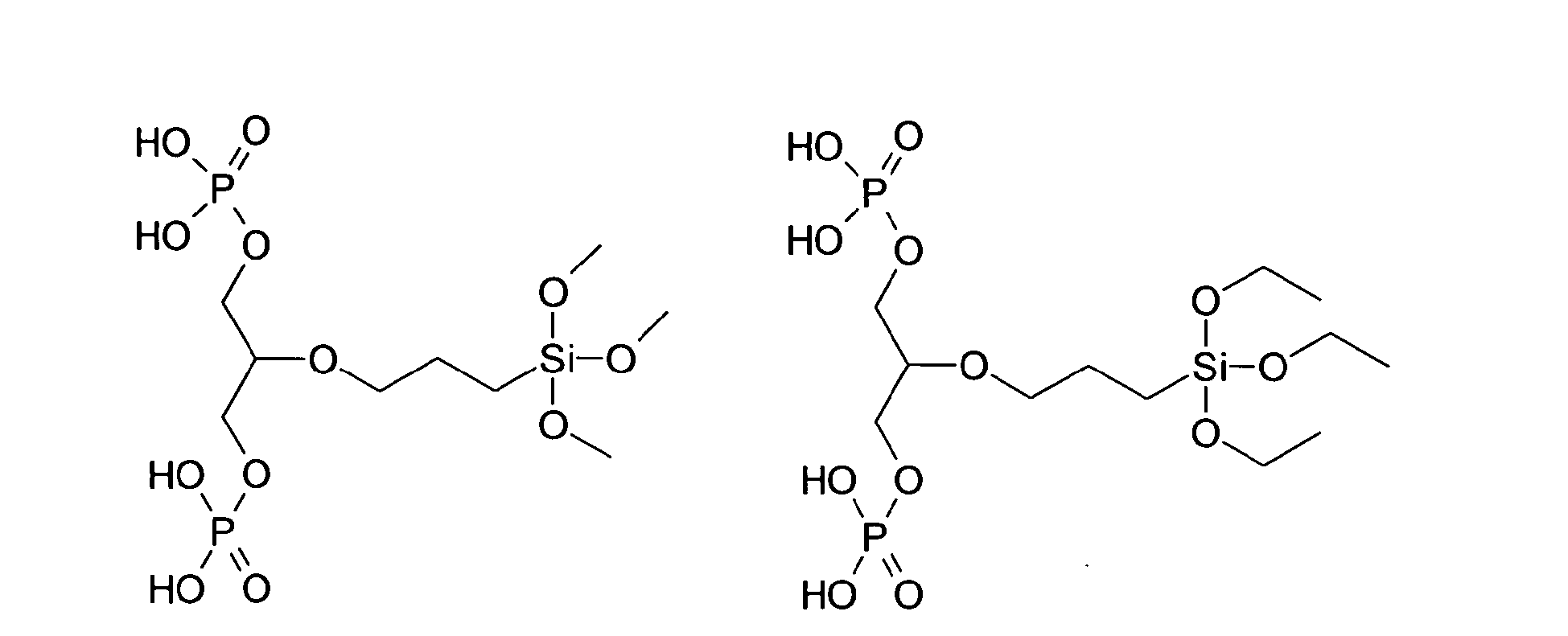


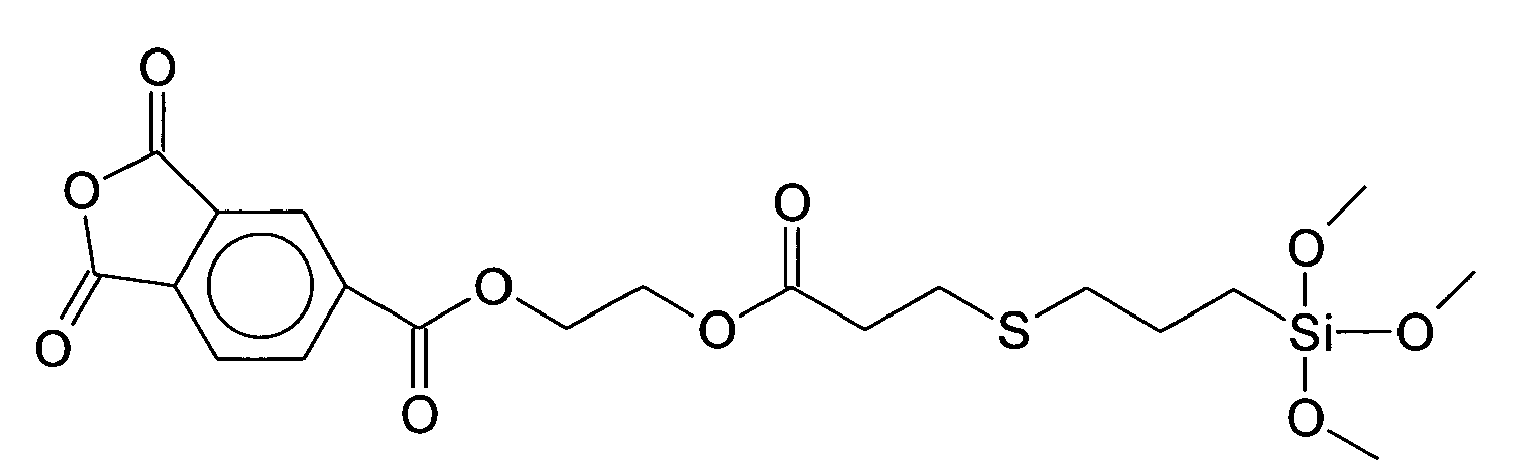

- Zusammensetzungen, die mindestens einen mit Gruppen der Formel (I) oberflächenfunktionalisierten Füllstoff aufweisen, bei dem sich die Gruppen der Formel (I) von einem der oben genannten Silane der Formel (II) ableiten, sind erfindungsgemäß besonders bevorzugt.
- Funktionalisierte Silane gemäß Formel (II) sind teilweise bekannt oder kommerziell erhältlich. Beispielsweise sind folgende Silane kommerziell erhältlich:


- Silane gemäß Formel (II) lassen sich grundsätzlich analog zu aus der Siliciumchemie (beispielweise M. A. Brook, Silicon in Organic, Organometallic, and Polymer Chemistry, John Wiley & Sons Inc., New York etc. 1999) und organischen Chemie (beispielsweise W. Walter, W. Franke, Bayer-Walter Lehrbuch der organischen Chemie, 24. Aufl., S. Hirzel Verlag, Stuttgart und Leipzig 2004; Autorenkollektiv, Organikum, 21. Aufl., Wiley-VCH, Weinheim etc. 2001) bekannten Methoden herstellen.
- Eine Synthesemethode ist beispielsweise die Verknüpfung von Si-H- und vinylgruppenhaltigen Verbindungen durch Hydrosilylierung:

- Konkretes Beispiel zur Herstellung eines aldehydgruppenhaltigen Silans: Hydrosilylierung von Allylalkohol mit Trimethoxysilan und nachfolgende Oxidation der primären OH-Gruppe zur Aldehydgruppe:

- Eine andere Synthesemethode stellt die Thiol-En-Addition dar:

- Konkretes Beispiel zur Herstellung eines aldehydgruppenhaltigen Silans: Thiol-En-Addition von Acrolein mit 3-Mercaptopropyltrimethoxysilan:

- Eine weitere Synthesemethode ist die Addition an Isocyanatgruppen:

- Konkretes Beispiel zur Herstellung eines aldehydgruppenhaltigen Silans: Umsetzung von 4-Hydroxymethylbenzaldehyd mit 3-Isocyanatopropyltriethoxysilan:

- Neben den oben beispielhaft erwähnten Synthesemethoden zur Herstellung der Silane gemäß Formel (II) sind dem Fachmann weitere Methoden allgemein bekannt.
- Mit Gruppen der Formel (I) oberflächenmodifizierte Füllstoffe sind insbesondere durch Umsetzung des Füllstoffs mit einem Silan erhältlich. Im Falle von silikatischen Füllstoffen kommt es dabei zur Ausbildung von stabilen Siloxanbindungen zwischen Silanol-Gruppen auf der Oberfläche des Füllstoffs und Siliciumatomen des Silans.
- In einer Ausführungsform wird ein mit Gruppen der Formel (I) oberflächenmodifizierter Füllstoff dadurch erhalten, dass der Füllstoff mit mindestens einem Silan der Formel (II) umgesetzt wird.
- In einer anderen Ausführungsform wird in einem ersten Schritt der Füllstoff mit einem Silan umgesetzt, das eine Vorstufe eines Silans der Formel (II) darstellt, und das erhaltene Produkt nachfolgend in einem oder mehreren Schritten zu einem mit Gruppen der Formel (I) oberflächenfunktionalisierten Füllstoff umgesetzt. Dabei sind Silane, die eine Vorstufe eines Silans der Formel (II) gemäß einem der oben diskutierten Verfahren darstellen, besonders bevorzugt.
- Beispielsweise kann in einem ersten Schritt eine Silylierung des Füllstoffs mit einem Hydrosilan der Formel H-SiXnR1 3-n erfolgen und das so erhaltene Produkt anschließend in einer Hydrosilylierung mit einer vinylgruppenhaltigen Verbindung der Formel (A)a-Z-Y-R'-CH=CH2 umgesetzt werden. Konkretes Beispiel zur Herstellung eines aldehydgruppenhaltigen Füllstoffs: Silylierung des Füllstoffs mit Trimethoxysilan, nachfolgende Umsetzung des Produkts mit Allylalkohol und abschließende Oxidation der primären OH-Gruppe zur Aldehydgruppe.
- Gemäß einer anderen Synthesemethode wird der Füllstoff in einem ersten Schritt mit einem Mercaptoalkylsilan der Formel HS-R2-SiXnR1 3-n silanisiert und das so erhaltene Produkt in einer Thiol-En-Addition mit einer vinylgruppenhaltigen Verbindung der Formel (A)a-Z'-CH=CH2 umgesetzt. Konkretes Beispiel zur Herstellung eines aldehydgruppenhaltigen Füllstoffs: Silylierung des Füllstoffs mit 3-Mercaptopropyltrimethoxysilan und nachfolgende Umsetzung des Produkts mit Acrolein.
- Gemäß einer weiteren Synthesemethode wird in einem ersten Schritt der Füllstoff mit einem Isocyanatoalkylsilan der Formel O=C=N-R2-SiXnR1 3-n silanisiert und das so erhaltene Produkt mit einem Alkohol der Formel (A)a-Z-OH umgesetzt. Konkretes Beispiel zur Herstellung eines aldehydgruppenhaltigen Füllstoffs: Silanisierung des Füllstoffs mit 3-Isocyanatopropyltriethoxysilan und nachfolgende Umsetzung des Produkts mit 4-Hydroxymethylbenzaldehyd.
- Im Falle der Funktionalisierung mit Phosphonsäuregruppen -P(O)(OH)2 oder Dihydrogenphosphatgruppen -O-P(O)(OH)2 kann auch so vorgegangen werden, dass zunächst eine Oberflächenfunktionalisierung des Füllstoffs mit einem Silan erfolgt, das mindestens eine Phosphonsäureestergruppe -P(O)(OR3)2 oder Phosphorsäureestergruppe -O-P(O)(OR3)2 enthält. Anschließend wird eine Freisetzung der entsprechenden Säuregruppe(n) durch Hydrolyse oder Alkoholyse durchgeführt.
- Beispielsweise kann ein Füllstoff zur Funktionalisierung mit Phosphonsäuregruppen in einem ersten Syntheseschritt mit kommerziell erhältlichem Diethoxyphosphorylethyltriethoxysilan (R3 = Et) umgesetzt werden, wobei eine Verknüpfung des Silans mit dem Füllstoff erfolgt. Im zweiten Schritt wird dann die Phosphonsäuregruppe durch Hydrolyse der Phosphonsäureestergruppe freigesetzt. Dies ist beispielsweise für den Fall eines silikatischen Füllstoffs im folgenden Schema dargestellt:

- Die Herstellung eines mit Gruppen der Formel (I) oberflächenfunktionalisierten Füllstoffs durch Umsetzung eines Füllstoffs mit einem Silan kann auf unterschiedlichen Wegen erfolgen. Beispielsweise kann ein flüssiges Silan direkt mit Füllstoff vermischt und anschließend zur Abtrennung von Kondensationsprodukten getrocknet werden.
- In einer anderen Ausführungsform wird ein Füllstoff in einer Lösung des Silans in einem geeigneten Lösungsmittel dispergiert. Dabei lässt sich die Wechselwirkung des Silans mit der Füllstoffoberfläche durch die Polarität des Lösungsmittels beeinflussen. Es hat sich gezeigt, dass ein solches Verfahren zu einer besseren Benetzung der Füllstoffoberfläche führt und insbesondere bei sehr feinteiligen Füllstoffen mit einer spezifischen Oberfläche größer 30 m2/g, insbesondere größer 40 m2/g vorteilhaft ist. Beispiele für geeignete Lösungsmittel sind C1-C6-Alkanole, wie z.B. Ethanol oder Isopropanol, cyclische Ether, wie z.B. Tetrahydrofuran oder Dioxan, aliphatische Ester, wie z.B. Ethylacetat oder Butylacetat, aliphatische Kohlenwasserstoffe, wie z.B. Hexan, und cycloaliphatische Kohlenwasserstoffe, wie z.B. Cyclohexan.
- Nach Beendigung der Reaktion wird der Füllstoff abgetrennt, gegebenenfalls einmal oder mehrmals mit demselben und/oder einem anderen Lösungsmittel gewaschen, gegebenenfalls einer Wärmebehandlung unterzogen, gegebenenfalls nochmals gewaschen und dann getrocknet. Nach der Oberflächenfunktionalisierung wird der Füllstoff gegebenenfalls gemahlen. Dies kann insbesondere bei Füllstoffen vorteilhaft sein, die zur Agglomeratbildung neigen.
- Insbesondere bei der Verwendung von Nanopartikeln als Füllstoff kann es vorteilhaft sein, den Füllstoff in Form eines Organosols einzusetzen. Der Begriff "Organosol" bezeichnet hier insbesondere kolloidale Suspensionen, in denen die kontinuierliche Phase eine organische Verbindung, insbesondere ein organisches Lösungsmittel oder ein bei Raumtemperatur flüssiges polymerisierbares Monomer ist. Beispiele für geeignete polymerisierbare Monomere sind wie unten beschrieben.
- Bei der Umsetzung eines Füllstoffs mit einem Silan hängt der Grad der Oberflächenfunktionalisierung unter anderem ab von der Füllstoffmenge bzw. der spezifischen Oberfläche des Füllstoffs, von der Menge und Struktur des Silans, der Reaktionszeit, der Temperatur, der Art des verwendeten Katalysators und von der Füllstoffvorbehandlung, wie z.B. einer Vortrocknung. Die verschiedenen Einflussfaktoren sind allgemein vor allem bei der Silanisierung von SiO2 sehr gut untersucht (vgl. E. P. Plueddemann, "Silane Coupling Agents", Plenum Press, 2nd Ed., New York und London, 1991; A. Guillet, Macromol. Symp. 194 (2003) 63).
- Erfindungsgemäß sind mit Gruppen der Formel (I) oberflächenfunktionalisierte Füllstoffe bevorzugt, die dadurch erhalten werden können, dass ein Füllstoff mit mindestens 0,01 mmol, vorzugsweise 0,1 - 5 mmol, besonders bevorzugt 0,5 bis 2 mmol eines geeigneten Silans pro Gramm des Füllstoffs umgesetzt wird. Dabei sind Silane der Formel (II) und Silane, die eine Vorstufe eines Silans der Formel (II) darstellen, wie oben beschrieben, besonders bevorzugt.
- Der Grad der Oberflächenfunktionalisierung des mit Gruppen der Formel (I) oberflächenfunktionalisierten Füllstoffs lässt sich beispielsweise mittels Elementaranalyse bestimmen. Bei Gruppen der Formel (I), die Phosphor und/oder Schwefel enthalten, kann insbesondere der Gehalt des oberflächenfunktionalisierten Füllstoffs an einem dieser Elemente zur Bestimmung des Funktionalisierungsgrads verwendet werden.
- Es ist bevorzugt, dass der mit Gruppen der Formel (I) oberflächenfunktionalisierte Füllstoff mindestens 0,01 mmol, vorzugsweise 0,05 - 2 mmol, besonders bevorzugt 0,1 bis 1 mmol Gruppen der Formel (I) pro Gramm des Füllstoffs enthält. Im Falle von Füllstoffen auf Basis von SiO2 ist es insbesondere bevorzugt, dass der mit Gruppen der Formel (I) oberflächenfunktionalisierte Füllstoff mindestens 0,01 mmol, vorzugsweise 0,05 - 2 mmol, besonders bevorzugt 0,1 bis 1 mmol Gruppen der Formel (I) pro Gramm SiO2 enthält.
- In den erfindungsgemäßen Zusammensetzungen kann der mit Gruppen der Formel (I) oberflächenfunktionalisierte Füllstoff zusätzlich mit weiteren Gruppen modifiziert sein. Der Begriff "weitere Gruppe" bezeichnet hier eine Gruppe, die nicht die Formel (I) aufweist. Beispielweise kann der mit Gruppen der Formel (I) oberflächenfunktionalisierte Füllstoff zusätzlich mit polymerisationsfähigen und/oder nichtfunktionalisierten Gruppen modifiziert sein. Bevorzugte polymerisationsfähige Gruppen sind Gruppen, die mindestens eine (Meth)acrylester- und/oder (Meth)acrylamidfunktionalität aufweisen, insbesondere (Meth)acryloyloxyalkylsilylgruppen bzw. (Meth)acrylamidoalkylsilylgruppen. Unter Alkyl werden bevorzugt Reste mit 1 bis 6, insbesondere 1 bis 3 Kohlenstoffatomen verstanden. Unter nichtfunktionalisierten Gruppen werden solche Gruppen verstanden, die nicht die Formel (I) aufweisen und nicht polymerisationsfähig sind. Eine zusätzliche Oberflächenmodifizierung des Füllstoffs, beispielsweise mit polymerisationsfähigen Gruppen, kann insbesondere die Einarbeitbarkeit des Füllstoffs in die erfindungsgemäßen Zusammensetzungen und die mechanischen Eigenschaften von daraus hergestellten Dentalmaterialien verbessern.
- Mit Gruppen der Formel (I) oberflächenfunktionalisierte Füllstoffe, die zusätzlich mit weiteren Gruppen modifiziert sind, sind insbesondere dadurch zugänglich, dass der Füllstoff vor, nach oder zusammen mit der Oberflächenfunktionalisierung mit mindestens einer Gruppe der Formel (I) mit mindestens einem weiteren Silan umgesetzt wird. Vorzugsweise lässt sich bei der Oberflächenfunktionalisierung des Füllstoffs eine Mischung von mindestens einem Silan der Formel (II) mit mindestens einem weiteren Silan einsetzen. Eine andere Variante besteht darin, vor oder nach der Oberflächenmodifizierung eines Füllstoffs mit mindestens einem Silan der Formel (II) eine Silanisierung des Füllstoffs mit einem oder mehreren polymerisationsfähigen und/oder nichtfunktionalisierten weiteren Silanen durchzuführen.
- Beispiele für geeignete polymerisationsfähige Silane sind (Meth)acryloyloxyalkyltrialkoxysilane, wie z.B. 3-Methacryloyloxypropyltrimethoxysilan, 3-Acryloyloxypropyltrimethoxysilan, 3-Methacryloyloxypropylmethyldimethoxysilan, 3-Methacryloyloxypropyldimethylmethoxysilan, 3-Acryloyloxypropylmethyldimethoxysilan oder 3-Acryloyloxypropyldimethylmethoxysilan. Polymerisationsfähige Silane, die zwei Methacrylatreste tragen, lassen sich z.B. durch Umsetzung von Glycerindimethacrylat mit 3-Isocyanatopropyltriethoxysilan oder 3-(Methyldiethoxysilyl)-propylbernsteinsäureanhydrid bzw. mit Glutarsäureanhydrid und anschließend mit 3-Aminopropyltriethoxysilan einfach herstellen. Geeignet sind auch polymerisationsfähige (Meth)acrylamidoalkyltrialkoxysilane, wie z.B. 3-(N-Methacryloylamino)-propyltrimethoxysilan, 3-(N-Acryloylamino)-propyltrimethoxysilan, 3-(N-Methacryloylamino)-propyltriethoxysilan, 3-(N-Methacryloyl-N-ethyl-amino)-propyltrimethoxysilan, 3-(N-Methacryloyl-N-ethyl-amino)-propyltrimethoxysilan, 3-(N-Acryloyl-N-ethyl-amino)-propyltrimethoxysilan, 3-(N-Methacryloyl-N-methyl-amino)-propyltrimethoxysilan oder 3-(N-Acryloyl-N-methyl-amino)-propyl-trimethoxysilan, deren polymerisationsfähige (Meth)acrylamidgruppen besonders gute Hydrolysestabilität aufweisen.
- Neben mit Gruppen der Formel (I) oberflächenfunktionalisiertem Füllstoff enthalten die erfindungsgemäßen Zusammensetzungen mindestens ein polymerisierbares Monomer. Als polymerisierbare Monomere eignen sich besonders radikalisch polymerisierbare Monomere.
- Diese radikalisch polymerisierbaren Monomere können eine oder mehrere radikalisch polymerisierbare Gruppen aufweisen. Als radikalisch polymerisierbare Monomere sind bei Raumtemperatur flüssige Monomere bevorzugt, die sich als Verdünnermonomere eignen. Bevorzugt sind Monomere mit einer Viskosität von 0,01 bis 10 Pa·s bei Raumtemperatur, insbesondere mono- oder mehrfach funktionelle (Meth)acrylate. Besonders bevorzugt sind hydrolysestabile Verdünnermonomere, insbesondere Mono(meth)acrylate, wie z.B. Mesitylmethacrylat, 2-(Alkoxymethyl)acrylsäuren, wie z.B. 2-(Ethoxymethyl)acrylsäure und 2-(Hydroxymethyl)acrylsäure, N-mono-alkylsubstituierte Acrylamide, wie z.B. N-Ethylacrylamid oder N-(2-Hydroxyethyl)-acrylamid, N-mono-alkylsubstituierte Methacrylamide, wie z.B. N-Ethylmethacrylamid, N-(2-Hydroxyethyl)methacrylamid oder N-(5-Hydroxypentyl)methacrylamid, N,N-dialkylsubstituierte Acrylamide, wie z.B. N,N-Dimethylacrylamid oder N-Methyl-N-(2-hydroxyethyl)acrylamid, und N-Vinylpyrrolidon. Unter Alkyl werden bevorzugt Reste mit 1 bis 6, insbesondere 1 bis 3 Kohlenstoffatomen verstanden. Beispiele für weitere Verdünnermonomere sind Mono(meth)acrylate, wie z.B. Methyl-, Ethyl-, Butyl-, Benzyl-, Furfuryl- oder Phenyl(meth)acrylat.
- Die erfindungsgemäßen Zusammensetzungen enthalten neben dem mit Gruppen der Formel (I) oberflächenfunktionalisierten Füllstoff vorzugsweise 0 bis 50 Gew.-%, vorzugsweise 5 bis 40 Gew.-% und ganz besonders bevorzugt 10 bis 30 Gew.-% Verdünnermonomer. Diese und, wenn nicht anders angegeben, alle anderen Prozentangaben beziehen sich auf die Gesamtmasse der Zusammensetzung.
- Vorzugsweise enthalten die erfindungsgemäßen Zusammensetzungen mindestens ein Monomer mit 2 oder mehr, insbesondere 2 bis 5 radikalisch polymerisierbaren Gruppen. Monomere mit 2 oder mehr polymerisierbaren Gruppen wirken als Vernetzer und erhöhen so die mechanische Stabilität der gehärteten Zusammensetzungen.
- Bevorzugte Vernetzermonomere sind hydrolysestabile Vernetzermonomere, insbesondere vernetzende Pyrrolidone, wie z.B. 1,6-Bis(3-vinyl-2-pyrrolidonyl)-hexan oder kommerziell zugängliche Bis(meth)acrylamide, wie z.B. Methylen- oder Ethylenbisacrylamid, N,N'-Diethyl-1,3-bis(acrylamido)-propan, 1,3-Bis(methacrylamido)-propan, 1,4-Bis(acrylamido)-butan, 1,4-Bis(acryloyl)-piperazin, 2,6-Dimethylen-4-oxa-heptan-1,7-dicarbonsäure-bis-(propylamid), 1,6-Bis-(acrylamido)-2,2,4(2,4,4)-trimethyl-hexan und N,N'-Dimethyl-1,6-bis-(acrylamido)-hexan. Beispiele für weitere Vernetzer sind mehrfunktionelle (Meth)acrylate, wie z.B. Bisphenol-A-di(meth)acrylat, Bis-GMA (ein Additionsprodukt aus Methacrylsäure und Bisphenol-A-diglycidylether), UDMA (ein Additionsprodukt aus 2-Hydroxyethylmethacrylat und 2,2,4-Hexamethy-lendiisocyanat), Di-, Tri- oder Tetraethylen-glycoldi(meth)acrylat, Trimethylolpropantri(meth)acrylat, Pentaerythrittetra(meth)acrylat, Butandioldi(meth)acrylat, 1,10-Decandioldi(meth)acrylat oder 1,12-Dodecandioldi(meth)acrylat.
- Zusammensetzungen, die neben dem mit Gruppen der Formel (I) oberflächenfunktionalisierten Füllstoff 0 bis 45 Gew.-%, vorzugsweise 1 bis 30 Gew.-% und ganz besonders bevorzugt 5 bis 20 Gew.-% Vernetzermonomer enthalten, insbesondere Bis(meth)acrylamid, sind erfindungsgemäß besonders bevorzugt.
- Gemäß einer weiteren bevorzugten Ausführungsform enthalten die Zusammensetzungen mindestens ein acides radikalisch polymerisierbares Monomer, d.h. ein Monomer mit einer oder mehreren aciden Gruppen, wie Carbonsäureanhydrid-, Carbonsäure-, Phosphorsäure-, Dihydrogenphosphat-, Phosphonsäure- und Sulfonsäuregruppen. Bevorzugte acide Gruppen sind Carbonsäure-, Phosphorsäure- und Phosphonsäuregruppen. Solche Monomere eignen sich als Adhäsivmonomere insbesondere für Schmelz/Dentin-Adhäsive oder selbsthaftende Komposite.
- Besonders bevorzugte acide Monomere sind polymerisationsfähige Acrylatetherphosphonsäuren, wie z.B. 2-[4-(Dihydroxyphosphoryl)-2-oxa-butyl]-acrylsäureethylester, 2-[4-(Dihydroxyphosphoryl)-2-oxa-butyl]-acrylsäure oder 2-[4-(Dihydroxyphosphoryl)-2-oxa-butyl]-acrylsäure-2,4,6-trimethylphenylester, (Meth)acrylamidoalkylenphosphonsäuren oder (Meth)acrylamidoalkylenbisphosphonsäuren. Weiterhin sind als Adhäsivmonomere auch hydrolysestabile, polymerisationsfähige Dihydrogenphosphate wie (Meth)acrylamidoalkylenphosphate, (Meth)acrylamidocycloalkylenphosphate oder (Meth)acrylamidoarylendihydrogenphosphate, z.B. 2-(N-Acryloylamino)ethyldihydrogenphosphat, 2-(N-Methacryloylamino)ethyldihydrogenphosphat, 6-(N-Acryloylamino)hexyldihydrogenphosphat, 6-(N-Methacryloylamino)hexyldihydrogenphosphat, 4-(N-Acryloylamino)phenyldihydrogenphosphat, 4-(N-Methacryloylamino)phenyldihydrogenphosphat, 1,3-Bis-(N-acryloylamino)-propan-2-yl-dihydrogenphosphat, 1,3-Bis-(N-methacryloylamino)-propan-2-yl-dihydrogenphosphat, 1,3-Bis-(N-acryloyl-N-methyl-amino)-propan-2-yl-dihydrogenphosphat oder 1,3-Bis-(N-acryloyl-N-ethyl-amino)-propan-2-yl-dihydrogenphosphat besonders geeignet.
- Zusammensetzungen, die neben dem mit Gruppen der Formel (I) oberflächenfunktionalisierten Füllstoff 1 bis 50 Gew.-%, vorzugsweise 5 bis 40 Gew.-% und ganz besonders bevorzugt 10 bis 30 Gew.-% acides Monomer enthalten, insbesondere acides Monomer mit Dihydrogenphosphat-, Phosphonsäure- und/oder Sulfonsäuregruppen, sind erfindungsgemäß besonders bevorzugt.
- Neben dem mit Gruppen der Formel (I) oberflächenfunktionalisierten Füllstoff kann die erfindungsgemäße Zusammensetzung vorzugsweise mindestens einen weiteren Füllstoff enthalten, der nicht mit Gruppen der Formel (I) oberflächenmodifiziert ist. Beispiele für geeignete weitere Füllstoffe sind Füllstoffe, die nicht oberflächenmodifiziert sind, Füllstoffe, die mit polymerisierbaren Gruppen oberflächenmodifiziert sind, und Füllstoffe, die mit nichtfunktionalisierten Gruppen oberflächenmodifiziert sind. Bevorzugte polymerisationsfähige Gruppen sind Gruppen, die mindestens eine (Meth)acrylester- und/oder (Meth)acrylamidfunktionalität aufweisen, insbesondere (Meth)acryloyloxyalkylsilylgruppen bzw. (Meth)acrylamidoalkylsilylgruppen. Unter Alkyl werden bevorzugt Reste mit 1 bis 6, insbesondere 1 bis 3 Kohlenstoffatomen verstanden. Unter nichtfunktionalisierten Gruppen werden solche Gruppen verstanden, die nicht die Formel (I) aufweisen und nicht polymerisationsfähig sind. Solche oberflächenmodifizierten Füllstoffe sind insbesondere durch Silanisierung eines Füllstoffs mit geeigneten Silanen erhältlich. Beispielsweise können Füllstoffe, die mit polymerisierbaren Gruppen oberflächenmodifiziert sind, durch Silanisierung eines Füllstoffs mit mindestens einem der oben beschriebenen polymerisationsfähigen Silane erhalten werden.
- Vorzugsweise enthält die erfindungsgemäße Zusammensetzung neben dem mit Gruppen der Formel (I) oberflächenfunktionalisierten Füllstoff 0 bis 40 Gew.-%, insbesondere 1 bis 30 Gew.-% weiteren Füllstoff, der nicht mit Gruppen der Formel (I) oberflächenmodifiziert ist.
- Zur Initiierung der Polymerisation enthalten die erfindungsgemäßen Zusammensetzungen vorzugsweise einen Initiator für die radikalische Polymerisation, insbesondere für die photochemisch oder redoxinduzierte radikalische Polymerisation. Beispiele für geeignete Initiatoren für die Photopolymerisation sind Benzophenon, Benzoin sowie deren Derivate oder α-Diketone oder deren Derivate, wie 9,10-Phenanthrenchinon, 1-Phenyl-propan-1,2-dion, Diacetyl oder 4,4'-Dichlorbenzil. Besonders bevorzugt werden Campherchinon und 2,2-Dimethoxy-2-phenyl-acetophenon und ganz besonders bevorzugt α-Diketone in Kombination mit Aminen als Reduktionsmitteln eingesetzt. Bevorzugte Amine sind 4-(N,N-Dimethylamino)-benzoesäureester, N,N-Dimethylaminoethylmethacrylat, N,N-Dimethyl-sym.-xylidin und Triethanolamin. Darüber hinaus sind auch Acylphosphine, wie z.B. 2,4,6-Trimethylbenzoyldiphenyl- oder Bis-(2,6-dichlorbenzoyl)-4-N-propylphenylphosphinoxid besonders geeignet.
- Als Initiatoren für eine bei Raumtemperatur durchgeführte Polymerisation werden Redox-Initiatorkombinationen, wie z.B. Kombinationen von Benzoylperoxid mit N,N-Dimethyl-sym.-xylidin oder N,N-Dimethyl-p-toluidin, verwendet. Darüber hinaus sind auch Redoxsysteme bestehend aus Peroxiden und Reduktionsmitteln, wie z.B. Ascorbinsäure, Barbituraten oder Sulfinsäuren, besonders geeignet.
- Zusammensetzungen, die neben dem oberflächenfunktionalisierten Füllstoff 0,1 bis 5,0 Gew.-%, vorzugsweise 0,2 bis 2,0 Gew.-% und ganz besonders bevorzugt 0,2 bis 1,0 Gew.-% Initiator für die radikalische Polymerisation enthalten, sind erfindungsgemäß besonders bevorzugt.
- Die erfindungsgemäßen Zusammensetzungen können zudem Lösungsmittel, wie Wasser, Ethylacetat oder Ethanol, oder Lösungsmittelgemische enthalten. Dabei sind hydrolysestabile Lösungsmittel, wie Wasser oder Ethanol, oder Lösungsmittelgemische bevorzugt.
- Darüber hinaus können die erfindungsgemäßen Zusammensetzungen weitere Additive enthalten, insbesondere Stabilisatoren, Aromastoffe, Farbmittel, mikrobiocide Wirkstoffe, fluoridionenabgebende Additive, optische Aufheller, Weichmacher und UV-Absorber.
- Erfindungsgemäß sind solche Zusammensetzungen bevorzugt, die die folgenden Komponenten enthalten:
- a) 1 bis 60 Gew.-%, insbesondere 5 bis 40 Gew.-% mit Gruppen der Formel (I) oberflächenfunktionalisierten Füllstoff,
- b) 0 bis 40 Gew.-%, insbesondere 0 bis 30 Gew.-% Füllstoff, der nicht mit Gruppen der Formel (I) oberflächenfunktionalisiert ist,
- c) 0 bis 70 Gew.-%, insbesondere 1 bis 40 Gew.-% Verdünner- und/oder Vernetzermonomer,
- d) 0,1 bis 5,0 Gew.-%, insbesondere 0,2 bis 2,0 Gew.-%, besonders bevorzugt 0,2 bis 1,0 Gew.-% Initiator für die radikalische Polymerisation,
- e) 0 bis 70 Gew.-%, insbesondere 0 bis 50 Gew.-% acides Monomer und/oder Lösungsmittel.
- Alle Prozentangaben beziehen sich auf die Gesamtmasse der Zusammensetzung. Ganz besonders bevorzugt sind Zusammensetzungen, die mindestens ein acides Monomer oder mindestens ein Vernetzermonomer, insbesondere mindestens ein acides Monomer und mindestens ein Vernetzermonomer oder mindestens ein acides Vernetzermonomer enthalten.
- Die erfindungsgemäßen Zusammensetzungen eignen sich besonders als Dentalmaterialien, insbesondere als Adhäsive, Zemente, vorzugsweise selbsthaftende Zemente wie z.B. Befestigungszemente, und Komposite, vorzugsweise Füllungskomposite. Solche Dentalmaterialien zeichnen sich durch eine sehr gute Haftung auf der Zahnhartsubstanz, d.h. auf Schmelz und Dentin, aus.
- Die bevorzugten erfindungsgemäßen Zusammensetzungen härten unter Ausbildung von stark vernetzten Polymernetzwerken aus, die in Wasser wenig oder gar nicht quellen.
- Die Erfindung betrifft auch einen wie oben definierten oberflächenfunktionalisierten Füllstoff. Die Erfindung betrifft ferner auch ein Verfahren zur Herstellung einer erfindungsgemäßen Zusammensetzung oder eines erfindungsgemäßen oberflächenfunktionalisierten Füllstoffs, bei dem der Füllstoff mit mindestens einem Silan umgesetzt wird und der erhaltene oberflächenfunktionalisierte Füllstoff mit den weiteren Bestandteilen der Zusammensetzung gemischt wird. Bevorzugte Ausführungsformen der Umsetzung des Füllstoffs mit mindestens einem Silan sind wie oben beschrieben.
- Die Erfindung betrifft schließlich auch die Verwendung eines mit Gruppen der Formel (I) oberflächenfunktionalisierten Füllstoffs zur Herstellung eines Dentalmaterials, insbesondere eines Adhäsivs oder Zements.
- Die Erfindung wird im Folgenden anhand von Beispielen näher erläutert.
- 2,12 g 3-Mercaptopropyltrimethoxysilan (10,8 mmol) wurden zu 60,0 g SiO2-Organosol (NanO G 502-31, Clariant; 30 Gew.-% SiO2 in Isopropanol) gegeben. Anschließend wurden 0,584 g (32,4 mmol bezogen auf Wasser) einer 0,5 N HCl-Lösung zugegeben und 48 h bei Raumtemperatur gerührt. Dann wurde die Dispersion auf 0 °C gekühlt und 0,98 g (9,0 mmol) Chlortrimethylsilan zugetropft. Nach 24 h Rühren bei Raumtemperatur wurden 40 ml Toluol zugegeben und bei 40 °C und 140 mbar - 80 mbar wurden das Isopropanol und das entstandene Methanol abdestilliert. Das dabei mit abdestillierende Toluol wurde anschlieβend wieder zugegeben, so dass die Konzentration an SiO2 in der Dispersion nicht über 30,0 Gew.-% stieg. Es wurden 75,3 g einer leicht viskosen, trüben und thixotropen Flüssigkeit erhalten.
- Unter Argon wurden 0,605 g (10,8 mmol) Acrolein sowie eine Spatelspitze Hydrochinon im Kolben vorgelegt. Bei 0 bis 5 °C wurden dann 75,3 g des in der 1. Stufe hergestellten Organosols innerhalb von 11 h zugetropft. Das Eisbad wurde entfernt und die Dispersion wurde 1 Woche bei Raumtemperatur gerührt. In dem erhaltenen Organosol war kein Acrolein mehr vorhanden. Das Produkt enthielt etwa 58 % Aldehydgruppen, bezogen auf das eingesetzte Trialkoxysilan. Der Glührückstand des leicht viskosen, trüben und thixotropen Organosols betrug 7,1 % SiO2.
- 25,0 g N,N'-Diethyl-1,3-bis(acrylamido)-propan wurden in 70,7 g des mit Aldehydgruppen funktionalisierten SiO2-Organosols aus der 2. Stufe von Beispiel 1 (SiO2-Gehalt: 5 g) gelöst. Es entstand eine transluzente Lösung. Anschließend wurde das Toluol am Rotationsverdampfer bei 40 °C entfernt. Es wurde eine leicht bräunliche, transluzent-trübe Flüssigkeit mit einer Viskosität von 7,0-5,5 Pa·s (1-100 s-1) und einem Glührückstand von 15,8 % erhalten, die sich nach Zugabe eines radikalischen Initiators zu einem unlöslichen Feststoff aushärten ließ.
- 20,0 g pyrogene Kieselsäure OX-50 wurden in 200 g Ethanol suspendiert. Dann wurden 0,56 g einer 0,5 N HCl-Lösung zugegeben und die Suspension auf 70 °C erwärmt. Es wurden 2,04 g (10,4 mmol) 3-Mercaptopropyltrimethoxysilan zugegeben, und die Suspension wurde 30 h bei 70 °C gerührt. Anschließend wurde das Lösungsmittel bei 40 °C am Rotationsverdampfer entfernt. Das erhaltene weiße Pulver wurde in 40 g Aceton dispergiert und dann durch Zentrifugation wieder abgetrennt. Anschließend wurde das Pulver in 50 g Ethanol dispergiert, abzentrifugiert, zuletzt in Cyclohexan dispergiert und wieder abzentrifugiert. Das erhaltene Pulver wurde am Rotationsverdampfer bei 8·10-2 mbar getrocknet. Die Belegung mit Mercaptogruppen betrug 0,12 mmol/g SiO2 und wurde über den Schwefel-Gehalt (0,38 Gew.-%, Elementaranalyse) der Probe bestimmt.
- 10,0 g funktionalisierte Partikel aus der 1. Stufe wurden in 30 g Toluol im Ultraschall dispergiert. Anschließend wurden 0,24 g (4,3 mmol) Acrolein zugetropft und die Suspension 48 h bei 50 °C gerührt. Dann wurden das Lösungsmittel und nicht abreagiertes Acrolein bei 40 °C am Rotationsverdampfer entfernt und das Pulver bei 8·10-2 mbar getrocknet. Die Belegung mit funktionalisiertem Silan betrug 0,10 mmol/g SiO2 und wurde über den Schwefel-Gehalt (0,33 Gew.-%, Elementaranalyse) der Probe bestimmt.
- 25,0 g Aerosil 200 wurden in 750 g Cyclohexan suspendiert. Dann wurden 13,6 g (41,4 mmol) Diethylphosphorylethyltriethoxysilan und 3,68 g (62,25 mmol) n-Propylamin zugegeben. Das Gemisch wurde 30 h bei 70 °C gerührt. Das Lösungsmittel wurde bei 40 °C am Rotationsverdampfer entfernt und das Produkt noch 3 Tage bei 50 °C im Trockenschrank getrocknet. Das Pulver wurde dann zum Waschen in 150 ml Ethanol suspendiert und mittels Druckfiltration (0,45 µm) vom Lösungsmittel abgetrennt. Das Pulver wurde noch einmal analog mit Ethanol und dann einmal mit Cyclohexan gewaschen. Es wurde anschließend nochmals 3 Tage bei 50 °C im Trockenschrank getrocknet. Der Glührückstand betrug 93,1 Gew.-%. Die Belegung mit funktionalisiertem Silan betrug 0,66 mmol/g SiO2 und wurde über den Phosphor-Gehalt (1,78 Gew.-%, Elementaranalyse) der Probe bestimmt.
- 25,0 g silanisiertes Aerosil 200 aus der 1. Stufe wurden in 460 g Salzsäure (32 Gew.-%) suspendiert und 46 h unter Rückfluss erhitzt. Dann wurde die Salzsäurelösung im Vakuum bei 40 °C entfernt und das Pulver 3 Tage im Trockenschrank bei 50 °C getrocknet. Die modifizierten Partikel wurden dann in 150 ml Wasser redispergiert und mittels Druckfiltration (0,45 µm) filtriert. Der Vorgang wurde noch zweimal wiederholt und das Pulver anschließend 3 Tage im Trockenschrank bei 50 °C getrocknet. Der Glührückstand betrug 96,0 Gew.-%. Die Belegung mit funktionalisiertem Silan betrug 0,58 mmol/g SiO2 und wurde über den Phosphor-Gehalt (1,85 Gew.-%, Elementaranalyse) der Probe bestimmt.
- 11,0 g modifiziertes Aerosil aus der 2. Stufe von Beispiel 4 wurden in 330 g n-Hexan suspendiert. Anschließend wurden 1,99 g (9,0 mmol) 3-Methacryloyloxypropyldimethylchlorsilan (ABCR), gelöst in 30 ml n-Hexan, langsam zugetropft. Das Gemisch wurde noch 47 h bei Raumtemperatur gerührt. Dann wurde das Lösungsmittel im Vakuum bei 40 °C entfernt und das Pulver 3 Tage im Trockenschrank bei 50 °C getrocknet. Die Partikel wurden in 150 ml Ethanol dispergiert und mittels Druckfiltration (0,45 µm) filtriert, ein zweites Mal in Ethanol dispergiert und filtriert und schließlich noch einmal in 150 ml Cyclohexan dispergiert und abfiltriert. Das Pulver wurde 3 Tage im Trockenschrank bei 50 °C getrocknet. Der Glührückstand betrug 94,8 Gew.-%. IR-spektroskopisch konnte durch das Auftreten einer neuen Bande bei 1636 cm-1 das Vorhandensein von Methacrylatgruppen nachgewiesen werden.
- 20,0 g pyrogene Kieselsäure OX-50 wurden in 200 g Ethanol suspendiert. Dann wurden zunächst 3,41 g (10,4 mmol) Diethylphosphorylethyltriethoxysilan und anschließend 0,56 g einer 0,5 N Salzsäure-Lösung zugegeben. Die Suspension wurde auf 70 °C erwärmt und 30 h bei dieser Temperatur gerührt. Dann wurden die flüchtigen Bestandteile bei 40 °C am Rotationsverdampfer entfernt und das Pulver 3 Tage bei 50 °C im Trockenschrank getrocknet. Das Pulver wurde zum Waschen in 50 ml Ethanol suspendiert und mittels Zentrifugation (bis 5000 U/min) vom Lösungsmittel abgetrennt. Das Pulver wurde noch einmal analog mit Ethanol und dann einmal mit 50 ml Cyclohexan gewaschen. Es wird anschließend nochmals 3 Tage bei 50 °C im Trockenschrank getrocknet. Die Belegung mit funktionalisiertem Silan betrug 0,11 mmol/g SiO2 und wurde über den Phosphor-Gehalt (0,32 Gew.-%, Elementaranalyse) der Probe bestimmt.
- 10,0 g modifiziertes OX-50 aus der 1. Stufe wurden in 100 g Salzsäure (32 Gew.-%) dispergiert und 24 h bei 100 °C unter Rückfluss erhitzt. Dann wurde die Salzsäurelösung am Rotationsverdampfer bei 40 °C im Vakuum entfernt. Das Pulver wurde anschließend 3 Tage bei 50 °C im Trockenschrank getrocknet. Die modifizierten Partikel wurden dann in 50 ml Wasser redispergiert und mittels Zentrifugation wieder abgetrennt. Der Vorgang wurde noch zweimal wiederholt und das Pulver anschließend 3 Tage im Trockenschrank bei 50 °C getrocknet. Die Belegung mit funktionalisiertem Silan betrug 0,12 mmol/g SiO2 und wurde über den Phosphor-Gehalt (0,36 Gew.-%, Elementaranalyse) der Probe bestimmt.
- Zur Untersuchung der Schmelz- und Dentinhaftung wurden die Adhäsive A (erfindungsgemäß) und B (Vergleichsbeispiel) durch Mischen der Ausgangskomponenten mit der in nachfolgender Tabelle dargestellten Zusammensetzung (Angabe in Gew.-%) hergestellt. Anschließend wurde die Haftung der Adhäsive auf Zahnschmelz und Dentin ermittelt.
- Dazu wurden Rinderzähne so in Kunststoffzylinder eingebettet, dass sich das Dentin bzw. der Zahnschmelz und der Kunststoff in einer Ebene befanden. Nach Anschleifen der Prüfkörper wurde mit einem Microbrush eine Schicht Adhäsiv obiger Formulierung 30 s auf die Dentinoberfläche einmassiert, mit einem Luftbläser leicht verblasen und mit einer Photopolymerisationslampe Astralis 7 (Ivoclar Vivadent AG) für 20 s belichtet. Dann wurde auf die Adhäsivschicht das Füllungskomposit Tetric® Ceram (Icoclar Vivadent AG) aufgebracht und 40 s mit der Lampe Astralis 7 ausgehärtet. Anschließend wurden die Prüfkörper 24 h bei 37 °C in Wasser gelagert und die Scherhaftfestigkeit gemäß der ISO-Richtlinie "ISO 1994-ISO TR 11405: Dental Materials Guidance on Testing of Adhesion to Tooth Structure" bestimmt. Die Ergebnisse belegen, dass die aldehydfunktionalisierten Partikel zu einer Verbesserung der Scherhaftfestigkeit auf Dentin und Zahnschmelz führen.
Komponenten/Haftwerte Adhäsiv A Adhäsiv B (erfindungsgemäß) (Vergleich) Bismethacrylamidphosphat1) 14,6 14,6 2-(Acryloylamino)-bernsteinsäure 9,7 9,7 Wasser 23,0 23,0 Aerosil 200, unmodifiziert - 3 SiO2-Partikel aus Beispiel 22) 2,4 - N,N'-Diethyl-1,3-bis(acrylamido)-propan3) 47,6 47,0 N-(5-Hydroxypentyl)methacrylamid 2,0 2,0 Photoinitiator4) 0,7 0,7 Schmelzhaftung (MPa) 21 16 Dentinhaftung (MPa) 23 21 1) 1,3-Bis-(N-methacryloylamino)-propan-2-yl-dihydrogenphosphat
2) als Organosol eingearbeitet, Angabe ohne das im Organosol enthaltene N,N'-Diethyl-1,3-bis(acrylamido)-propan
3) bei Adhäsiv A einschließlich der im verwendeten Organosol enthaltenen Menge
4) Photoinitiator: 0,3 Gew.-% Campherchinon, 0,4 Gew.-% 4-Dimethylaminobenzoesäureethylester
wobei R2 und Z jeweils nur entfallen können, wenn zugleich auch Y entfällt, und
wobei a 1 ist, wenn Z entfällt,
über mindestens ein an das Siliciumatom der Gruppe der Formel (I) gebundenes Sauerstoffatom mit dem Füllstoff verknüpft sind.
Claims (24)
- Polymerisierbare Zusammensetzung, dadurch gekennzeichnet, dass sie mindestens einen mit Gruppen der Formel (I) oberflächenfunktionalisierten Füllstoff enthält, bei dem Gruppen der Formel (I)
(A)a -Z -Y-R2-SiR1 3-m -(O---)m (I),
in derR1 für C1-C15-Alkyl, C2-C5-Alkenyl oder Phenyl steht,R2 entfällt oder für unverzweigtes oder verzweigtes C1-C6-Alkylen steht,Y entfällt oder für eine Ether-, Thioether-, Amid-, Ester- oder Urethangruppe steht,Z entfällt oder für einen mindestens zweiwertigen line-aren oder verzweigten aliphatischen Rest mit 2 bis 40 Kohlenstoffatomen, der durch eine oder mehrere Ether-, Thioether-, Amid- oder Estergruppen unterbrochen sein kann und eine oder mehrere cycloaliphatische Gruppen mit mindestens 3 Kohlenstoffatomen und/oder eine oder mehrere aromatische Gruppen mit mindestens 6 Kohlenstoffatomen enthalten kann, einen mindestens zweiwertigen cycloaliphatischen Rest mit mindestens 3 Kohlenstoffatomen oder einen mindestens zweiwertigen aromatischen Rest mit mindestens 6 Kohlenstoffatomen steht,A jeweils unabhängig für -COOH, -P(O)(OH)2, -0-P(O)(OH)2, -SO2OH, -C(O)-O-C(O)-, -CHO, -NH-C(O)-CHO, -C(O)-CHO, -C(O)-CH2-C(O)-CH3, -N=C=O oder -O-C(O)-CH2-C(O)-CH3 steht,a 1 bis 6 ist undm 1 bis 3 ist,wobei R2 und Z nicht beide entfallen können,
wobei R2 und Z jeweils nur entfallen können, wenn zugleich auch Y entfällt, und
wobei a 1 ist, wenn Z entfällt,
über mindestens ein an das Siliciumatom der Gruppe der Formel (I) gebundenes Sauerstoffatom mit dem Füllstoff verknüpft sind. - Polymerisierbare Zusammensetzung nach Anspruch 1, bei derR1 für C1-C6-Alkyl oder Phenyl steht,R2 für lineares oder verzweigtes C1-C3-Alkylen steht,Y entfällt oder für eine Ether-, Thioether-, Ester oder Urethangruppe steht,Z entfällt oder für einen mindestens zweiwertigen linearen oder verzweigten aliphatischen Rest mit 2 bis 20 Kohlenstoffatomen, der durch eine oder mehrere Ether-, Thioether-, Amid- oder Estergruppen unterbrochen sein kann und eine oder mehrere cycloaliphatische Gruppen mit mindestens 3 Kohlenstoffatomen und/oder eine oder mehrere aromatische Gruppen mit mindestens 6 Kohlenstoffatomen enthalten kann, einen mindestens zweiwertigen cycloaliphatischen Rest mit mindestens 3 Kohlenstoffatomen oder einen mindestens zweiwertigen aromatischen Rest mit mindestens 6 Kohlenstoffatomen steht,A jeweils unabhängig für -COOH, -P(O)(OH)2, -O-P(O)(OH)2, -SO2OH, -CHO, -NH-C(O)-CHO oder -O-C(O)-CH2(O)-CH3 steht,a 1 bis 3 ist undm 1 bis 3 ist.
- Polymerisierbare Zusammensetzung nach Anspruch 1 oder 2, dadurch gekennzeichnet, dass der Füllstoff ein partikulärer Füllstoff mit einer mittleren Partikelgröße von 1 nm bis 10 µm ist.
- Polymerisierbare Zusammensetzung nach einem der Ansprüche 1 bis 3, dadurch gekennzeichnet, dass der Füllstoff monodisperser, nanopartikulärer Füllstoff auf Basis von SiO2, Oxiden der Elemente Zr, Ti, Al, Y, La, Ce und/oder Yb oder deren Mischoxiden mit SiO2 ist.
- Polymerisierbare Zusammensetzung nach einem der Ansprüche 1 bis 4, dadurch gekennzeichnet, dass der Füllstoff eine mittlere Partikelgröße von 5 bis 200 nm, besonders bevorzugt 10 bis 100 nm, ganz besonders bevorzugt 10 bis 50 nm aufweist.
- Polymerisierbare Zusammensetzung nach einem der Ansprüche 1 bis 5, dadurch gekennzeichnet, dass der mit Gruppen der Formel (I) oberflächenfunktionalisierte Füllstoff mindestens 0,01 mmol, vorzugsweise 0,05 - 2 mmol, besonders bevorzugt 0,1 bis 1 mmol Gruppen der Formel (I) pro Gramm des Füllstoffs enthält.
- Polymerisierbare Zusammensetzung nach einem der Ansprüche 1 bis 6, dadurch gekennzeichnet, dass der Füllstoff zusätzlich mit mindestens einer weiteren Gruppe oberflächenmodifiziert ist.
- Polymerisierbare Zusammensetzung nach einem der Ansprüche 1 bis 7, dadurch gekennzeichnet, dass sie mindestens ein radikalisch polymerisierbares Monomer enthält.
- Zusammensetzung nach einem der Ansprüche 1 bis 8, dadurch gekennzeichnet, dass sie einen Initiator für die radikalische Polymerisation enthält.
- Zusammensetzung nach einem der Ansprüche 1 bis 9, dadurch gekennzeichnet, dass sie mindestens ein Monomer mit 2 oder mehr polymerisierbaren Gruppen und/oder mindestens ein Monomer mit einer oder mehreren aciden Gruppen enthält.
- Zusammensetzung nach Anspruch 9 oder 10, dadurch gekennzeichnet, dass sie einen Initiator für die Photopolymerisation enthält.
- Zusammensetzung nach einem der Ansprüche 1 bis 11, dadurch gekennzeichnet, dass sie ferner einen Füllstoff enthält, der nicht mit Gruppen der Formel (I) oberflächenfunktionalisiert ist.
- Zusammensetzung nach einem der Ansprüche 1 bis 12, dadurch gekennzeichnet, dass siea) 1 bis 60 Gew.-% mit Gruppen der Formel (I) oberflächenfunktionalisierten Füllstoff,b) 0 bis 40 Gew.-% Füllstoff, der nicht mit Gruppen der Formel (I) oberflächenfunktionalisiert ist,c) 1 bis 70 Gew.-% Verdünner- und/oder Vernetzermonomer,d) 0,1 bis 5,0 Gew.-% Initiator für die radikalische Polymerisation,e) 0 bis 70 Gew.-% acides Monomer und/oder Lösungsmittelenthält.
- Oberflächenfunktionalisierter Füllstoff, bei dem Gruppen der Formel (I)
(A)a-Z-Y-R2-SiR1 3-m-(O---)m (I),
in derR1 für C1-C15-Alkyl, C2-C5-Alkenyl oder Phenyl steht,R2 entfällt oder für unverzweigtes oder verzweigtes C1-C6-Alkylen steht,Y entfällt oder für eine Ether-, Thioether-, Amid-, Ester- oder Urethangruppe steht,Z entfällt oder für einen mindestens zweiwertigen line-aren oder verzweigten aliphatischen Rest mit 2 bis 40 Kohlenstoffatomen, der durch eine oder mehrere Ether-, Thioether-, Amid- oder Estergruppen unterbrochen sein kann und eine oder mehrere cycloaliphatische Gruppen mit mindestens 3 Kohlenstoffatomen und/oder eine oder mehrere aromatische Gruppen mit mindestens 6 Kohlenstoffatomen enthalten kann, einen mindestens zweiwertigen cycloaliphatischen Rest mit mindestens 3 Kohlenstoffatomen oder einen mindestens zweiwertigen aromatischen Rest mit mindestens 6 Kohlenstoffatomen steht,A jeweils unabhängig für -COOH, -P(O)(OH)2, -O-P(O)(OH)2, -SO2OH, -C(O)-O-C(O)-, -CHO, -NH-C(O)-CHO, -C(O)-CHO, -C(O)-CH2-C(O)-CH3, -N=C=O oder -O-C(O)-CH2-C(O)-CH3 steht,a 1 bis 6 ist undm 1 bis 3 ist,wobei R2 und Z nicht beide entfallen können,
wobei R2 und Z jeweils nur entfallen können, wenn zugleich auch Y entfällt, und
wobei a 1 ist, wenn Z entfällt,
über mindestens ein an das Siliciumatom der Gruppe der Formel (I) gebundenes Sauerstoffatom mit dem Füllstoff verknüpft sind. - Verfahren zur Herstellung einer Zusammensetzung gemäß einem der Ansprüche 1 bis 13 oder eines oberflächenfunktionalisierten Füllstoffs gemäß Anspruch 14, bei dem der Füllstoff mit mindestens einem Silan umgesetzt wird und der erhaltene oberflächenfunktionalisierte Füllstoff mit den weiteren Bestandteilen der Zusammensetzung gemischt wird.
- Verfahren nach Anspruch 15, bei der das Silan die Formel (II) aufweist
(A)a-Z-Y-R2-SiXnR1 3-n (II),
in derX für Halogen, Hydroxy, C1-C5-Alkoxy oder C1-C3-Acyloxy steht undn 1 bis 3 ist. - Verfahren nach Anspruch 15 oder 16, bei dema) das Silan in flüssiger Form mit dem Füllstoff vermischt wird undb) der Füllstoff zur Abtrennung von Kondensationsprodukten getrocknet wird.
- Verfahren nach Anspruch 15 oder 16, bei dema) der Füllstoff in einer Lösung des Silans in einem Lösungsmittel dispergiert wird undb) der Füllstoff abgetrennt und gegebenenfalls einmal oder mehrmals mit dem Lösungsmittel aus Schritt (a) und/oder mindestens einem anderen Lösungsmittel gewaschen wird,c) gegebenenfalls der Füllstoff einer Wärmebehandlung unterzogen und gegebenenfalls nochmals gewaschen wird,d) der Füllstoff getrocknet wird unde) gegebenenfalls der Füllstoff gemahlen wird.
- Polymerisierbare Zusammensetzung, die nach einem Verfahren gemäß einem der Ansprüche 15 bis 18 erhältlich ist.
- Verwendung einer Zusammensetzung gemäß einem der Ansprüche 1 bis 13 oder 19 als Dentalmaterial.
- Verwendung nach Anspruch 20 als Adhäsiv oder Zement.
- Oberflächenfunktionalisierter Füllstoff, der nach einem Verfahren gemäß einem der Ansprüche 15 bis 18 erhältlich ist.
- Verwendung eines oberflächenfunktionalisierten Füllstoffs gemäß Anspruch 14 oder 22 zur Herstellung eines Dentalmaterials.
- Verwendung nach Anspruch 23, zur Herstellung eines Adhäsivs oder Zements.
Priority Applications (4)
| Application Number | Priority Date | Filing Date | Title |
|---|---|---|---|
| EP08000956A EP2080503B1 (de) | 2008-01-18 | 2008-01-18 | Dentalmaterialien mit oberflächenfunktionalisierten Füllstoffen |
| AT08000956T ATE524154T1 (de) | 2008-01-18 | 2008-01-18 | Dentalmaterialien mit oberflächenfunktionalisierten füllstoffen |
| US12/275,700 US20090186960A1 (en) | 2008-01-18 | 2008-11-21 | Dental materials with surface-functionalized fillers |
| JP2008334466A JP5308809B2 (ja) | 2008-01-18 | 2008-12-26 | 表面官能化充填材を含む歯科材料 |
Applications Claiming Priority (1)
| Application Number | Priority Date | Filing Date | Title |
|---|---|---|---|
| EP08000956A EP2080503B1 (de) | 2008-01-18 | 2008-01-18 | Dentalmaterialien mit oberflächenfunktionalisierten Füllstoffen |
Publications (2)
| Publication Number | Publication Date |
|---|---|
| EP2080503A1 true EP2080503A1 (de) | 2009-07-22 |
| EP2080503B1 EP2080503B1 (de) | 2011-09-14 |
Family
ID=39342752
Family Applications (1)
| Application Number | Title | Priority Date | Filing Date |
|---|---|---|---|
| EP08000956A Active EP2080503B1 (de) | 2008-01-18 | 2008-01-18 | Dentalmaterialien mit oberflächenfunktionalisierten Füllstoffen |
Country Status (4)
| Country | Link |
|---|---|
| US (1) | US20090186960A1 (de) |
| EP (1) | EP2080503B1 (de) |
| JP (1) | JP5308809B2 (de) |
| AT (1) | ATE524154T1 (de) |
Cited By (1)
| Publication number | Priority date | Publication date | Assignee | Title |
|---|---|---|---|---|
| EP4717251A3 (de) * | 2024-09-28 | 2026-04-29 | Shofu Inc. | Dentale härtbare zusammensetzung mit hoher mechanischer festigkeit |
Families Citing this family (9)
| Publication number | Priority date | Publication date | Assignee | Title |
|---|---|---|---|---|
| DE102005019600A1 (de) * | 2005-04-27 | 2006-11-09 | Ivoclar Vivadent Ag | Oberflächenmodifizierte Füllstoffe |
| JP5914071B2 (ja) * | 2012-03-16 | 2016-05-11 | 株式会社トクヤマデンタル | 歯科用接着性組成物 |
| US9303149B2 (en) * | 2012-06-21 | 2016-04-05 | Prc-Desoto International, Inc. | Adhesion promoting adducts containing metal ligands, compositions thereof, and uses thereof |
| JP6147610B2 (ja) * | 2013-08-27 | 2017-06-14 | 株式会社トクヤマデンタル | 歯科用接着性組成物 |
| US9328275B2 (en) | 2014-03-07 | 2016-05-03 | Prc Desoto International, Inc. | Phosphine-catalyzed, michael addition-curable sulfur-containing polymer compositions |
| JP6279391B2 (ja) * | 2014-03-31 | 2018-02-14 | 株式会社松風 | 高靭性歯質接着性シランカップリング剤およびそれを含む歯科用組成物 |
| JP6279392B2 (ja) * | 2014-03-31 | 2018-02-14 | 株式会社松風 | 機能性複合微粒子を含む高靭性歯科用硬化性組成物 |
| JP6684173B2 (ja) * | 2016-06-30 | 2020-04-22 | 株式会社ジーシー | 歯科用組成物 |
| US12064985B2 (en) * | 2021-05-25 | 2024-08-20 | Canon Kabushiki Kaisha | Active energy ray-curable liquid composition, recording method, and recording apparatus |
Citations (19)
| Publication number | Priority date | Publication date | Assignee | Title |
|---|---|---|---|---|
| DE2405578A1 (de) | 1974-02-06 | 1975-08-14 | Kulzer & Co Gmbh | Polymerisierbares bindemittel enthaltender dentalwerkstoff und daraus hergestellte zaehne und zahnersatzteile |
| GB1488403A (en) | 1974-01-23 | 1977-10-12 | Perdent Gmbh | Dental material |
| US4220582A (en) | 1979-01-03 | 1980-09-02 | Lee Pharmaceuticals | Dental restorative compositions of improved X-ray opacity |
| DE3247800A1 (de) | 1981-12-23 | 1983-07-07 | Tokuyama Soda K.K., Tokuyama, Yamaguchi | Amorphe, kugelfoermige anorganische verbindungen, verfahren zu ihrer herstellung und ihre verwendung |
| DE4029230A1 (de) | 1990-09-14 | 1992-03-19 | Ivoclar Ag | Polymerisierbarer dentalwerkstoff |
| US5367002A (en) | 1992-02-06 | 1994-11-22 | Dentsply Research & Development Corp. | Dental composition and method |
| DE4323143C1 (de) | 1993-07-10 | 1994-12-01 | Schott Glaswerke | Verwendung eines Glases als bariumfreies Dentalglas mit guter Röntgenabsorption |
| WO1998013008A1 (en) | 1996-09-27 | 1998-04-02 | Southwest Research Institute | Metal oxide compositions and methods |
| US5871360A (en) | 1996-12-31 | 1999-02-16 | Gc Corporation | Method for restoration of a cavity of a tooth using a resin reinforced type glass ionomer cement |
| WO2000069392A1 (en) | 1999-05-19 | 2000-11-23 | Southwest Research Institute | Mechanically strong and transparent or translucent composites made using zirconium oxide nanoparticles |
| DE10018405A1 (de) | 2000-04-13 | 2001-10-25 | Fraunhofer Ges Forschung | Sphärische oxidische Partikel und deren Verwendung |
| US6387981B1 (en) | 1999-10-28 | 2002-05-14 | 3M Innovative Properties Company | Radiopaque dental materials with nano-sized particles |
| US20020065337A1 (en) | 1997-10-03 | 2002-05-30 | Dentsply Detrey Gmbh. | Dental materials having a nanoscale filler |
| US6417244B1 (en) | 1993-04-13 | 2002-07-09 | Southwest Research Institute | Metal oxide compositions and methods |
| WO2003070198A1 (en) * | 2002-02-15 | 2003-08-28 | Dentsply International Inc. | Dental adhesive composition |
| US20030175217A1 (en) * | 2000-06-16 | 2003-09-18 | Christian Kropf | Thixotropic oral and dental care agents |
| DE102004022566A1 (de) | 2004-05-07 | 2005-12-01 | Schott Ag | Mit funktionellen Gruppen homogen beschichtete Pulverteilchen, ein Verfahren zu deren Herstellung und ihre Verwendung |
| US20060247329A1 (en) * | 2005-04-27 | 2006-11-02 | Ivoclar Vivadent Ag | Surface-modified fillers |
| FR2889704A1 (fr) * | 2005-08-12 | 2007-02-16 | Rhodia Chimie Sa | Particules minerales de surface modifiee par des composes porteurs de fonctions xanthate et silane. |
Family Cites Families (8)
| Publication number | Priority date | Publication date | Assignee | Title |
|---|---|---|---|---|
| US3816550A (en) * | 1972-10-02 | 1974-06-11 | Union Carbide Corp | Catalytic process for hydration of olefins |
| US4463114A (en) * | 1982-03-31 | 1984-07-31 | Minnesota Mining And Manufacturing Company | Antistatic films |
| AU564534B2 (en) * | 1982-07-14 | 1987-08-13 | Battelle Development Corporation | Method for producing cross-linked resin coatings on substrates |
| US4451343A (en) * | 1983-09-02 | 1984-05-29 | The Standard Oil Company | Photo-initiators for decarboxylation reactions |
| US5736249A (en) * | 1994-08-16 | 1998-04-07 | Decora, Incorporated | Non-stick polymer-coated articles of manufacture |
| JP2001089128A (ja) * | 1998-04-10 | 2001-04-03 | Asahi Glass Co Ltd | 球状シリカ粒子の製造方法 |
| US6765037B2 (en) * | 2001-11-03 | 2004-07-20 | Dymax Corporation | Photopolymerizable epoxy composition |
| DE10304849A1 (de) * | 2003-02-06 | 2004-08-19 | Institut für Neue Materialien gemeinnützige Gesellschaft mit beschränkter Haftung | Chemomechanische Herstellung von Funktionskolloiden |
-
2008
- 2008-01-18 AT AT08000956T patent/ATE524154T1/de active
- 2008-01-18 EP EP08000956A patent/EP2080503B1/de active Active
- 2008-11-21 US US12/275,700 patent/US20090186960A1/en not_active Abandoned
- 2008-12-26 JP JP2008334466A patent/JP5308809B2/ja active Active
Patent Citations (19)
| Publication number | Priority date | Publication date | Assignee | Title |
|---|---|---|---|---|
| GB1488403A (en) | 1974-01-23 | 1977-10-12 | Perdent Gmbh | Dental material |
| DE2405578A1 (de) | 1974-02-06 | 1975-08-14 | Kulzer & Co Gmbh | Polymerisierbares bindemittel enthaltender dentalwerkstoff und daraus hergestellte zaehne und zahnersatzteile |
| US4220582A (en) | 1979-01-03 | 1980-09-02 | Lee Pharmaceuticals | Dental restorative compositions of improved X-ray opacity |
| DE3247800A1 (de) | 1981-12-23 | 1983-07-07 | Tokuyama Soda K.K., Tokuyama, Yamaguchi | Amorphe, kugelfoermige anorganische verbindungen, verfahren zu ihrer herstellung und ihre verwendung |
| DE4029230A1 (de) | 1990-09-14 | 1992-03-19 | Ivoclar Ag | Polymerisierbarer dentalwerkstoff |
| US5367002A (en) | 1992-02-06 | 1994-11-22 | Dentsply Research & Development Corp. | Dental composition and method |
| US6417244B1 (en) | 1993-04-13 | 2002-07-09 | Southwest Research Institute | Metal oxide compositions and methods |
| DE4323143C1 (de) | 1993-07-10 | 1994-12-01 | Schott Glaswerke | Verwendung eines Glases als bariumfreies Dentalglas mit guter Röntgenabsorption |
| WO1998013008A1 (en) | 1996-09-27 | 1998-04-02 | Southwest Research Institute | Metal oxide compositions and methods |
| US5871360A (en) | 1996-12-31 | 1999-02-16 | Gc Corporation | Method for restoration of a cavity of a tooth using a resin reinforced type glass ionomer cement |
| US20020065337A1 (en) | 1997-10-03 | 2002-05-30 | Dentsply Detrey Gmbh. | Dental materials having a nanoscale filler |
| WO2000069392A1 (en) | 1999-05-19 | 2000-11-23 | Southwest Research Institute | Mechanically strong and transparent or translucent composites made using zirconium oxide nanoparticles |
| US6387981B1 (en) | 1999-10-28 | 2002-05-14 | 3M Innovative Properties Company | Radiopaque dental materials with nano-sized particles |
| DE10018405A1 (de) | 2000-04-13 | 2001-10-25 | Fraunhofer Ges Forschung | Sphärische oxidische Partikel und deren Verwendung |
| US20030175217A1 (en) * | 2000-06-16 | 2003-09-18 | Christian Kropf | Thixotropic oral and dental care agents |
| WO2003070198A1 (en) * | 2002-02-15 | 2003-08-28 | Dentsply International Inc. | Dental adhesive composition |
| DE102004022566A1 (de) | 2004-05-07 | 2005-12-01 | Schott Ag | Mit funktionellen Gruppen homogen beschichtete Pulverteilchen, ein Verfahren zu deren Herstellung und ihre Verwendung |
| US20060247329A1 (en) * | 2005-04-27 | 2006-11-02 | Ivoclar Vivadent Ag | Surface-modified fillers |
| FR2889704A1 (fr) * | 2005-08-12 | 2007-02-16 | Rhodia Chimie Sa | Particules minerales de surface modifiee par des composes porteurs de fonctions xanthate et silane. |
Non-Patent Citations (4)
| Title |
|---|
| G. MACBEATH; S. L. SCHREIBER, SCIENCE, vol. 289, 2000, pages 1760 - 1763 |
| M.T. DULAY ET AL., ANALYT. CHEM., vol. 77, 2005, pages 4604 - 4610 |
| S. B. LEE ET AL., SCIENCE, vol. 296, 2002, pages 2198 - 2200 |
| W. CLARKE ET AL., J. CHROMATOGRAPHY A, vol. 888, 2000, pages 13 - 22 |
Cited By (1)
| Publication number | Priority date | Publication date | Assignee | Title |
|---|---|---|---|---|
| EP4717251A3 (de) * | 2024-09-28 | 2026-04-29 | Shofu Inc. | Dentale härtbare zusammensetzung mit hoher mechanischer festigkeit |
Also Published As
| Publication number | Publication date |
|---|---|
| JP5308809B2 (ja) | 2013-10-09 |
| US20090186960A1 (en) | 2009-07-23 |
| EP2080503B1 (de) | 2011-09-14 |
| JP2009167186A (ja) | 2009-07-30 |
| ATE524154T1 (de) | 2011-09-15 |
Similar Documents
| Publication | Publication Date | Title |
|---|---|---|
| EP2080503B1 (de) | Dentalmaterialien mit oberflächenfunktionalisierten Füllstoffen | |
| DE68908087T2 (de) | Dentales Restaurationsmaterial. | |
| DE19903177C2 (de) | Dentalmaterialien auf der Basis von Polysiloxanen | |
| EP3120827B1 (de) | Adhäsive dentalwerkstoffe mit stark aciden haftpolymeren | |
| EP2103296B1 (de) | Polymerbeschichteter Glasfüllstoff zur Verwendung in Dentalwerkstoffen | |
| EP3020361A1 (de) | Verwendung radikalisch härtbarer zusammensetzungen in generativen fertigungsverfahren | |
| CN111228124B (zh) | 快速固化和低收缩应力的可光聚合牙科复合材料 | |
| EP1716836B1 (de) | Oberflächenmodifizierte Füllstoffe | |
| EP3166569B1 (de) | Komposite mit gesteuerter netzwerkstruktur | |
| EP3020360B1 (de) | Radikalisch härtbare dentale zusammensetzungen | |
| EP3782599B1 (de) | Dentale polymerisierbare zusammensetzung auf der basis kondensierter silane | |
| WO2016177680A1 (de) | Durch kettenübertragungspolymerisation härtbare dentalmaterialien | |
| EP3868767B1 (de) | Langwellig absorbierende photoinitiatoren | |
| EP4039220A1 (de) | Dentalmaterialien auf der basis von polymerisationsfähigen thioharnstoff-derivaten | |
| JP7094165B2 (ja) | シランベースの移動試薬を含むポリマー材料 | |
| EP2004131B1 (de) | Dentalmaterialien enthaltend hydrophobe, nanopartikuläre kieselsäurecokondensate und deren verwendung | |
| EP2289483A1 (de) | Verwendung von polymerisierbaren makrocyclischen Polyethern und makrocyclischen heteroanalogen Polyethern in Dentalmaterialien | |
| EP4356893A1 (de) | Lagerstabile selbsthaftende kompositzemente mit guter transparenz und guter röntgenopazität | |
| EP2883528B1 (de) | Dentalwerkstoffe auf Basis von polymerisierbaren Aziden und Alkinen | |
| EP3932383B1 (de) | Komposite mit verringerter polymerisationsschrumpfungsspannung | |
| EP2489344A1 (de) | Dentalwerkstoff auf der Basis einer antimikrobiell wirksamen Verbindung | |
| EP4488243A1 (de) | Säurestabile glasfüllstoffe und diese enthaltende selbsthaftende dentale kompositzemente mit guter transparenz | |
| EP2846757A2 (de) | Verwendung eines ungefüllten oder mit füllstoff gefüllten, organisch modifizierten kieselsäure(hetero)polykondensats zum verändern der oberfläche eines körpers aus einem bereits ausgehärteten, ungefüllten oder mit füllstoff gefüllten kieselsäure(hetero)polykondensat |
Legal Events
| Date | Code | Title | Description |
|---|---|---|---|
| PUAI | Public reference made under article 153(3) epc to a published international application that has entered the european phase |
Free format text: ORIGINAL CODE: 0009012 |
|
| AK | Designated contracting states |
Kind code of ref document: A1 Designated state(s): AT BE BG CH CY CZ DE DK EE ES FI FR GB GR HR HU IE IS IT LI LT LU LV MC MT NL NO PL PT RO SE SI SK TR |
|
| AX | Request for extension of the european patent |
Extension state: AL BA MK RS |
|
| 17P | Request for examination filed |
Effective date: 20100121 |
|
| AKX | Designation fees paid |
Designated state(s): AT BE BG CH CY CZ DE DK EE ES FI FR GB GR HR HU IE IS IT LI LT LU LV MC MT NL NO PL PT RO SE SI SK TR |
|
| 17Q | First examination report despatched |
Effective date: 20100429 |
|
| GRAP | Despatch of communication of intention to grant a patent |
Free format text: ORIGINAL CODE: EPIDOSNIGR1 |
|
| GRAS | Grant fee paid |
Free format text: ORIGINAL CODE: EPIDOSNIGR3 |
|
| RIN1 | Information on inventor provided before grant (corrected) |
Inventor name: RHEINBERGER, VOLKER, DR. Inventor name: ANGERMANN, JOERG, DR. Inventor name: MOSZNER, NORBERT, PROF. DR. Inventor name: KLAPDOHR, SIMONE, DR. |
|
| GRAA | (expected) grant |
Free format text: ORIGINAL CODE: 0009210 |
|
| AK | Designated contracting states |
Kind code of ref document: B1 Designated state(s): AT BE BG CH CY CZ DE DK EE ES FI FR GB GR HR HU IE IS IT LI LT LU LV MC MT NL NO PL PT RO SE SI SK TR |
|
| REG | Reference to a national code |
Ref country code: GB Ref legal event code: FG4D Free format text: NOT ENGLISH |
|
| REG | Reference to a national code |
Ref country code: CH Ref legal event code: EP Ref country code: CH Ref legal event code: NV Representative=s name: KELLER & PARTNER PATENTANWAELTE AG |
|
| REG | Reference to a national code |
Ref country code: IE Ref legal event code: FG4D Free format text: LANGUAGE OF EP DOCUMENT: GERMAN |
|
| REG | Reference to a national code |
Ref country code: DE Ref legal event code: R096 Ref document number: 502008004833 Country of ref document: DE Effective date: 20111110 |
|
| REG | Reference to a national code |
Ref country code: NL Ref legal event code: VDEP Effective date: 20110914 |
|
| PG25 | Lapsed in a contracting state [announced via postgrant information from national office to epo] |
Ref country code: SE Free format text: LAPSE BECAUSE OF FAILURE TO SUBMIT A TRANSLATION OF THE DESCRIPTION OR TO PAY THE FEE WITHIN THE PRESCRIBED TIME-LIMIT Effective date: 20110914 Ref country code: NO Free format text: LAPSE BECAUSE OF FAILURE TO SUBMIT A TRANSLATION OF THE DESCRIPTION OR TO PAY THE FEE WITHIN THE PRESCRIBED TIME-LIMIT Effective date: 20111214 Ref country code: FI Free format text: LAPSE BECAUSE OF FAILURE TO SUBMIT A TRANSLATION OF THE DESCRIPTION OR TO PAY THE FEE WITHIN THE PRESCRIBED TIME-LIMIT Effective date: 20110914 Ref country code: LT Free format text: LAPSE BECAUSE OF FAILURE TO SUBMIT A TRANSLATION OF THE DESCRIPTION OR TO PAY THE FEE WITHIN THE PRESCRIBED TIME-LIMIT Effective date: 20110914 Ref country code: HR Free format text: LAPSE BECAUSE OF FAILURE TO SUBMIT A TRANSLATION OF THE DESCRIPTION OR TO PAY THE FEE WITHIN THE PRESCRIBED TIME-LIMIT Effective date: 20110914 |
|
| LTIE | Lt: invalidation of european patent or patent extension |
Effective date: 20110914 |
|
| PG25 | Lapsed in a contracting state [announced via postgrant information from national office to epo] |
Ref country code: SI Free format text: LAPSE BECAUSE OF FAILURE TO SUBMIT A TRANSLATION OF THE DESCRIPTION OR TO PAY THE FEE WITHIN THE PRESCRIBED TIME-LIMIT Effective date: 20110914 Ref country code: LV Free format text: LAPSE BECAUSE OF FAILURE TO SUBMIT A TRANSLATION OF THE DESCRIPTION OR TO PAY THE FEE WITHIN THE PRESCRIBED TIME-LIMIT Effective date: 20110914 Ref country code: CY Free format text: LAPSE BECAUSE OF FAILURE TO SUBMIT A TRANSLATION OF THE DESCRIPTION OR TO PAY THE FEE WITHIN THE PRESCRIBED TIME-LIMIT Effective date: 20110914 Ref country code: GR Free format text: LAPSE BECAUSE OF FAILURE TO SUBMIT A TRANSLATION OF THE DESCRIPTION OR TO PAY THE FEE WITHIN THE PRESCRIBED TIME-LIMIT Effective date: 20111215 |
|
| REG | Reference to a national code |
Ref country code: IE Ref legal event code: FD4D |
|
| PG25 | Lapsed in a contracting state [announced via postgrant information from national office to epo] |
Ref country code: SK Free format text: LAPSE BECAUSE OF FAILURE TO SUBMIT A TRANSLATION OF THE DESCRIPTION OR TO PAY THE FEE WITHIN THE PRESCRIBED TIME-LIMIT Effective date: 20110914 Ref country code: IS Free format text: LAPSE BECAUSE OF FAILURE TO SUBMIT A TRANSLATION OF THE DESCRIPTION OR TO PAY THE FEE WITHIN THE PRESCRIBED TIME-LIMIT Effective date: 20120114 Ref country code: CZ Free format text: LAPSE BECAUSE OF FAILURE TO SUBMIT A TRANSLATION OF THE DESCRIPTION OR TO PAY THE FEE WITHIN THE PRESCRIBED TIME-LIMIT Effective date: 20110914 Ref country code: IE Free format text: LAPSE BECAUSE OF FAILURE TO SUBMIT A TRANSLATION OF THE DESCRIPTION OR TO PAY THE FEE WITHIN THE PRESCRIBED TIME-LIMIT Effective date: 20110914 |
|
| PG25 | Lapsed in a contracting state [announced via postgrant information from national office to epo] |
Ref country code: RO Free format text: LAPSE BECAUSE OF FAILURE TO SUBMIT A TRANSLATION OF THE DESCRIPTION OR TO PAY THE FEE WITHIN THE PRESCRIBED TIME-LIMIT Effective date: 20110914 Ref country code: NL Free format text: LAPSE BECAUSE OF FAILURE TO SUBMIT A TRANSLATION OF THE DESCRIPTION OR TO PAY THE FEE WITHIN THE PRESCRIBED TIME-LIMIT Effective date: 20110914 Ref country code: PT Free format text: LAPSE BECAUSE OF FAILURE TO SUBMIT A TRANSLATION OF THE DESCRIPTION OR TO PAY THE FEE WITHIN THE PRESCRIBED TIME-LIMIT Effective date: 20120116 Ref country code: PL Free format text: LAPSE BECAUSE OF FAILURE TO SUBMIT A TRANSLATION OF THE DESCRIPTION OR TO PAY THE FEE WITHIN THE PRESCRIBED TIME-LIMIT Effective date: 20110914 Ref country code: EE Free format text: LAPSE BECAUSE OF FAILURE TO SUBMIT A TRANSLATION OF THE DESCRIPTION OR TO PAY THE FEE WITHIN THE PRESCRIBED TIME-LIMIT Effective date: 20110914 |
|
| PLBE | No opposition filed within time limit |
Free format text: ORIGINAL CODE: 0009261 |
|
| STAA | Information on the status of an ep patent application or granted ep patent |
Free format text: STATUS: NO OPPOSITION FILED WITHIN TIME LIMIT |
|
| BERE | Be: lapsed |
Owner name: IVOCLAR VIVADENT AG Effective date: 20120131 |
|
| PG25 | Lapsed in a contracting state [announced via postgrant information from national office to epo] |
Ref country code: DK Free format text: LAPSE BECAUSE OF FAILURE TO SUBMIT A TRANSLATION OF THE DESCRIPTION OR TO PAY THE FEE WITHIN THE PRESCRIBED TIME-LIMIT Effective date: 20110914 |
|
| 26N | No opposition filed |
Effective date: 20120615 |
|
| PG25 | Lapsed in a contracting state [announced via postgrant information from national office to epo] |
Ref country code: MC Free format text: LAPSE BECAUSE OF NON-PAYMENT OF DUE FEES Effective date: 20120131 |
|
| REG | Reference to a national code |
Ref country code: DE Ref legal event code: R097 Ref document number: 502008004833 Country of ref document: DE Effective date: 20120615 |
|
| PG25 | Lapsed in a contracting state [announced via postgrant information from national office to epo] |
Ref country code: BE Free format text: LAPSE BECAUSE OF NON-PAYMENT OF DUE FEES Effective date: 20120131 |
|
| PG25 | Lapsed in a contracting state [announced via postgrant information from national office to epo] |
Ref country code: ES Free format text: LAPSE BECAUSE OF FAILURE TO SUBMIT A TRANSLATION OF THE DESCRIPTION OR TO PAY THE FEE WITHIN THE PRESCRIBED TIME-LIMIT Effective date: 20111225 |
|
| PG25 | Lapsed in a contracting state [announced via postgrant information from national office to epo] |
Ref country code: BG Free format text: LAPSE BECAUSE OF FAILURE TO SUBMIT A TRANSLATION OF THE DESCRIPTION OR TO PAY THE FEE WITHIN THE PRESCRIBED TIME-LIMIT Effective date: 20111214 |
|
| PG25 | Lapsed in a contracting state [announced via postgrant information from national office to epo] |
Ref country code: MT Free format text: LAPSE BECAUSE OF FAILURE TO SUBMIT A TRANSLATION OF THE DESCRIPTION OR TO PAY THE FEE WITHIN THE PRESCRIBED TIME-LIMIT Effective date: 20110914 |
|
| REG | Reference to a national code |
Ref country code: AT Ref legal event code: MM01 Ref document number: 524154 Country of ref document: AT Kind code of ref document: T Effective date: 20130118 |
|
| PG25 | Lapsed in a contracting state [announced via postgrant information from national office to epo] |
Ref country code: TR Free format text: LAPSE BECAUSE OF FAILURE TO SUBMIT A TRANSLATION OF THE DESCRIPTION OR TO PAY THE FEE WITHIN THE PRESCRIBED TIME-LIMIT Effective date: 20110914 |
|
| PG25 | Lapsed in a contracting state [announced via postgrant information from national office to epo] |
Ref country code: AT Free format text: LAPSE BECAUSE OF NON-PAYMENT OF DUE FEES Effective date: 20130118 Ref country code: LU Free format text: LAPSE BECAUSE OF NON-PAYMENT OF DUE FEES Effective date: 20120118 |
|
| PG25 | Lapsed in a contracting state [announced via postgrant information from national office to epo] |
Ref country code: HU Free format text: LAPSE BECAUSE OF FAILURE TO SUBMIT A TRANSLATION OF THE DESCRIPTION OR TO PAY THE FEE WITHIN THE PRESCRIBED TIME-LIMIT Effective date: 20080118 |
|
| REG | Reference to a national code |
Ref country code: CH Ref legal event code: PCAR Free format text: NEW ADDRESS: EIGERSTRASSE 2 POSTFACH, 3000 BERN 14 (CH) |
|
| REG | Reference to a national code |
Ref country code: FR Ref legal event code: PLFP Year of fee payment: 9 |
|
| REG | Reference to a national code |
Ref country code: FR Ref legal event code: PLFP Year of fee payment: 10 |
|
| PGFP | Annual fee paid to national office [announced via postgrant information from national office to epo] |
Ref country code: IT Payment date: 20161228 Year of fee payment: 10 |
|
| REG | Reference to a national code |
Ref country code: FR Ref legal event code: PLFP Year of fee payment: 11 |
|
| PG25 | Lapsed in a contracting state [announced via postgrant information from national office to epo] |
Ref country code: IT Free format text: LAPSE BECAUSE OF NON-PAYMENT OF DUE FEES Effective date: 20180118 |
|
| REG | Reference to a national code |
Ref country code: DE Ref legal event code: R079 Ref document number: 502008004833 Country of ref document: DE Free format text: PREVIOUS MAIN CLASS: A61K0006083000 Ipc: A61K0006887000 |
|
| REG | Reference to a national code |
Ref country code: CH Ref legal event code: PFA Owner name: IVOCLAR VIVADENT AG, LI Free format text: FORMER OWNER: IVOCLAR VIVADENT AG, LI |
|
| P01 | Opt-out of the competence of the unified patent court (upc) registered |
Effective date: 20230607 |
|
| REG | Reference to a national code |
Ref country code: CH Ref legal event code: U11 Free format text: ST27 STATUS EVENT CODE: U-0-0-U10-U11 (AS PROVIDED BY THE NATIONAL OFFICE) Effective date: 20260312 |
|
| PGFP | Annual fee paid to national office [announced via postgrant information from national office to epo] |
Ref country code: GB Payment date: 20260123 Year of fee payment: 19 |
|
| PGFP | Annual fee paid to national office [announced via postgrant information from national office to epo] |
Ref country code: DE Payment date: 20260116 Year of fee payment: 19 |
|
| PGFP | Annual fee paid to national office [announced via postgrant information from national office to epo] |
Ref country code: FR Payment date: 20260126 Year of fee payment: 19 |
|
| PGFP | Annual fee paid to national office [announced via postgrant information from national office to epo] |
Ref country code: CH Payment date: 20260312 Year of fee payment: 19 |