EP2075531A2 - Vorrichtung, Verfahren und Programm zur Verarbeitung magnetischer Daten - Google Patents
Vorrichtung, Verfahren und Programm zur Verarbeitung magnetischer Daten Download PDFInfo
- Publication number
- EP2075531A2 EP2075531A2 EP08022305A EP08022305A EP2075531A2 EP 2075531 A2 EP2075531 A2 EP 2075531A2 EP 08022305 A EP08022305 A EP 08022305A EP 08022305 A EP08022305 A EP 08022305A EP 2075531 A2 EP2075531 A2 EP 2075531A2
- Authority
- EP
- European Patent Office
- Prior art keywords
- data
- magnetic
- acceleration
- magnetic data
- data set
- Prior art date
- Legal status (The legal status is an assumption and is not a legal conclusion. Google has not performed a legal analysis and makes no representation as to the accuracy of the status listed.)
- Withdrawn
Links
- 238000012545 processing Methods 0.000 title claims abstract description 20
- 238000003672 processing method Methods 0.000 title claims description 4
- 230000001133 acceleration Effects 0.000 claims abstract description 110
- 239000013598 vector Substances 0.000 claims description 26
- 238000009795 derivation Methods 0.000 claims description 21
- 238000000034 method Methods 0.000 claims description 16
- 239000011159 matrix material Substances 0.000 claims description 8
- 238000012937 correction Methods 0.000 claims description 7
- 230000006870 function Effects 0.000 description 23
- 230000005389 magnetism Effects 0.000 description 10
- 238000010586 diagram Methods 0.000 description 6
- 238000007619 statistical method Methods 0.000 description 4
- 230000005415 magnetization Effects 0.000 description 3
- 230000004044 response Effects 0.000 description 3
- 238000013459 approach Methods 0.000 description 2
- 238000005259 measurement Methods 0.000 description 2
- 238000012935 Averaging Methods 0.000 description 1
- 238000006243 chemical reaction Methods 0.000 description 1
- 230000003247 decreasing effect Effects 0.000 description 1
- 238000001514 detection method Methods 0.000 description 1
- 238000005516 engineering process Methods 0.000 description 1
- 238000009499 grossing Methods 0.000 description 1
- 238000012986 modification Methods 0.000 description 1
- 230000004048 modification Effects 0.000 description 1
- 238000005457 optimization Methods 0.000 description 1
- 230000002093 peripheral effect Effects 0.000 description 1
- 230000035945 sensitivity Effects 0.000 description 1
- 230000003068 static effect Effects 0.000 description 1
Images


Classifications
-
- G—PHYSICS
- G01—MEASURING; TESTING
- G01R—MEASURING ELECTRIC VARIABLES; MEASURING MAGNETIC VARIABLES
- G01R33/00—Arrangements or instruments for measuring magnetic variables
- G01R33/02—Measuring direction or magnitude of magnetic fields or magnetic flux
-
- G—PHYSICS
- G01—MEASURING; TESTING
- G01C—MEASURING DISTANCES, LEVELS OR BEARINGS; SURVEYING; NAVIGATION; GYROSCOPIC INSTRUMENTS; PHOTOGRAMMETRY OR VIDEOGRAMMETRY
- G01C17/00—Compasses; Devices for ascertaining true or magnetic north for navigation or surveying purposes
- G01C17/02—Magnetic compasses
- G01C17/28—Electromagnetic compasses
-
- G—PHYSICS
- G01—MEASURING; TESTING
- G01C—MEASURING DISTANCES, LEVELS OR BEARINGS; SURVEYING; NAVIGATION; GYROSCOPIC INSTRUMENTS; PHOTOGRAMMETRY OR VIDEOGRAMMETRY
- G01C17/00—Compasses; Devices for ascertaining true or magnetic north for navigation or surveying purposes
- G01C17/38—Testing, calibrating, or compensating of compasses
Definitions
- the present invention relates to a magnetic data processing device, a magnetic data processing method and a magnetic data processing program, and more particularly to a technology for determining the reliability of magnetic data.
- the output of the magnetic sensor includes not only components of a measurement target such as Earth's magnetism (geomagnetism) but also noise or offset components.
- a measurement target such as Earth's magnetism (geomagnetism)
- noise or offset components For example, in the case where Earth's magnetism is measured by a magnetic sensor in a Personal Navigation Device (PND) mounted in a transportation device such as a vehicle, the offset component is caused by magnetization of the transportation device or the PND itself, or is caused by temperature characteristics of the magnetic sensor.
- PND Personal Navigation Device
- the offset component varies as operating environments such as magnetization of the vehicle or temperature vary. Therefore, the output of the magnetic sensor is corrected by subtracting an offset component derived based on the output of the magnetic sensor from the output of the magnetic sensor (for example, see Patent Reference 1).
- Patent Reference 1 Japanese Patent Application Publication No. 2007-240270
- the offset component is caused by a magnetic field generated by an electronic circuit mounted in the transportation device or the PND or is caused by a magnetic field that the transportation device receives when traveling near a strong magnetic field source such as a grade crossing. Accordingly, it is difficult to perform the correction for perfectly negating the noise component. Therefore, in a system using such a magnetic sensor, an error is included in data derived from the output of the magnetic sensor. However, when the output of the magnetic sensor contains a great error or when an error in one magnetic data element is amplified by an error in another magnetic data element, the reliability of the system is significantly hampered. Thus, it is important to determine the reliability of magnetic data output from the magnetic sensor.
- a magnetic data processing device for achieving the above object includes a magnetic data input part for sequentially receiving magnetic data output from a three-dimensional (3D) magnetic sensor, a storage part for storing a plurality of the magnetic data as a data set of statistical population, an acceleration data input part for receiving acceleration data output from a 3D acceleration sensor, and a reliability determination part for deriving a reliability index that is a function of an angular difference between a direction of a line perpendicular to an approximate plane representing a distribution of the data set of statistical population and a direction of acceleration represented by the acceleration data.
- 3D three-dimensional
- a 3D magnetic sensor In the case where a 3D magnetic sensor is attached to a moving object such as a land or marine transportation device which moves on a substantially horizontal plane, the moving object rotates about a nearly vertical axis and therefore an output of the 3D magnetic sensor, which measures Earth's magnetism while the moving object rotates, is distributed over a planar range in a 3D coordinate system. Accordingly, the direction of a line perpendicular to an approximate plane representing a distribution of a data set of statistical population including a plurality of magnetic data output from the 3D magnetic sensor is almost parallel to the vertical axis.
- acceleration data output from an acceleration sensor attached to a moving object that is stationary or is in linear and uniform motion represents gravitational acceleration.
- the direction of a line perpendicular to an approximate plane representing a distribution of a data set of statistical population including a plurality of magnetic data output from the 3D magnetic sensor is nearly parallel to the direction of acceleration represented by the acceleration data.
- the angular difference between the direction of the gravitational acceleration and the direction of the line perpendicular to the approximate plane representing the distribution of the data set of statistical population including a plurality of magnetic data output from the 3D magnetic sensor and the direction of acceleration represented by the acceleration data is great.
- the angular difference between the direction of the gravitational acceleration and the direction of the line perpendicular to the approximate plane representing the distribution of the data set of statistical population including a plurality of magnetic data output from the 3D magnetic sensor represents the reliability of magnetic data as data representing Earth's magnetism. Therefore, in the invention, a reliability index which is a function of the angular difference between the direction of the gravitational acceleration and the direction of the line perpendicular to the approximate plane representing the distribution of the data set of statistical population including a plurality of magnetic data output from the 3D magnetic sensor is derived as an index representing the reliability of the magnetic data. Thus, according to the invention, it is possible to determine the reliability of magnetic data as data representing Earth's magnetism.
- the direction of acceleration may be derived from acceleration data.
- an indicator vector may be derived using a plurality of the acceleration data
- the reliability index which is a function of the angular difference between the direction of the line perpendicular to the approximate plane representing the distribution of the data set of statistical population and the direction of the acceleration, may be derived using the direction of the indicator vector as the direction of the acceleration.
- the indicator vector is obtained by weighting the plurality of the acceleration data and summing the plurality of the weighted acceleration data.
- the difference between the gravitational acceleration and dynamic acceleration at a certain moment may be great since the moving object such as a vehicle is moving while accelerating various directions.
- the reliability index may be a function of the angular difference between the direction of acceleration represented by the acceleration data and the direction of the line perpendicular to the approximate plane representing the data set of statistical population. For example, a function of an inner product of the indicator vector and an eigenvector corresponding to a minimum eigenvalue of a variance-covariance matrix of the data set of statistical population may be derived as the reliability index.
- a reliability index may be used when one magnetic data element include in a data set of statistical population is used as data representing the direction of an object. More importantly, the derivation of an offset of magnetic data based on the data set of statistical population whose reliability has been guaranteed by the reliability index is very practical.
- the offset of magnetic data varies as operating environments such as magnetization of the vehicle or temperature vary and is used for an offset correction process which subtracts an offset component caused by such offset factors from magnetic data. In the case where a great error is included in such an offset, all offset-corrected magnetic data will contain a great error.
- the magnetic data processing device further includes an offset derivation part for deriving an offset of the magnetic data by using the data set of statistical population according to the reliability index.
- the offset derivation part derives the offset of the magnetic data by using the data set of the statistical population only when the reliability index indicates that the data set is acceptable, while the offset derivation part does not use the data set of the statistical population when the reliability index indicates that the data set is unacceptable.
- the offset derivation part derives the offset of the magnetic data by using the data set of the statistical population while weighting the data set by a value of the reliability index.
- the magnetic data processing device of the invention may be constructed with or without a 3D magnetic sensor and a 3D acceleration sensor.
- the invention also provides a navigation apparatus including a magnetic data processing device, a correction part for correcting the magnetic data based on the offset, and an orientation notification part for providing notification of an orientation based on the corrected magnetic data.
- the invention also provides a magnetic data processing method including the steps of sequentially receiving magnetic data output from a 3D magnetic sensor, storing a plurality of the magnetic data as a data set of statistical population, receiving acceleration data output from a 3D acceleration sensor, and deriving a reliability index that is a function of an angular difference between a direction of a line perpendicular to an approximate plane representing a distribution of the data set of statistical population and a direction of acceleration represented by the acceleration data.
- the invention also provides a machine readable medium containing a magnetic data processing program causing a computer to perform a process comprising: sequentially receiving magnetic data output from a 3D magnetic sensor; storing a plurality of the magnetic data as a data set of statistical population; receiving acceleration data output from a 3D acceleration sensor; and deriving a reliability index that is a function of an angular difference between a direction of a line perpendicular to an approximate plane representing a distribution of the data set of the statistical population and a direction of acceleration represented by the acceleration data.
- the order of the operations described above is not limited to that described unless there is a technical problem, and the operations may be performed at the same time or may be performed in a reversed order and need not be performed in the sequential order.
- the functions of each part described above are implemented by hardware resources whose functions are specified by the configuration itself, hardware resources whose functions are specified by a program, or a combination thereof.
- the functions of each part are not limited to those implemented by physically independent hardware resources.
- the invention also provides a recording medium containing the magnetic data processing program.
- the recording medium containing the magnetic data processing program may be a magnetic recording medium or a magneto-optical recording medium and may be any other recording medium developed in the future.
- a land or marine transportation device such as an automobile moves on a substantially horizontal plane.
- a 3D magnetic sensor attached to the automobile rotates about a nearly vertical axis together with the automobile.
- the rotation axis of the 3D magnetic sensor deviates from the vertical axis when the automobile travels on a slope, an error in a reliability index caused by the deviation may be ignored in this embodiment.
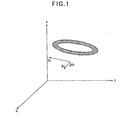
- a plurality of magnetic data that are sequentially output from a 3D magnetic sensor at discrete times while an automobile turns 360 degrees are plotted on a coordinate system fixed to the magnetic sensor, the plurality of magnetic data are distributed over a donut-shaped region as hatched in FIG. 1 .
- variation of the rotation axis of the automobile is small since the automobile moves in a nearly horizontal plane. Accordingly, the distribution of 3D magnetic data becomes thin and can be approximated as a plane.
- a vertical axis in a coordinate system fixed to the 3D magnetic sensor nearly coincides with a line perpendicular to the approximate plane. Accordingly, when the automobile is rotating, the direction of the vertical axis in the coordinate system fixed to the magnetic sensor can be derived based on the magnetic data. In this embodiment, the direction of the line perpendicular to the approximate plane of the distribution can be derived using eigenvalues of the distribution of the magnetic data.
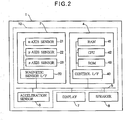
- FIG. 2 is a block diagram illustrating an embodiment of a navigation apparatus according to the invention.
- the navigation apparatus 1 acquires the magnitudes of magnetic fields of 3 orthogonal (x, y, z) directions to detect the direction of the Earth's magnetism and notifies a user of the detected direction of the Earth's magnetism.
- the navigation apparatus 1 is a PND mounted in a vehicle such as an automobile.
- the magnetic data processing device 10 includes a magnetic sensor 2, an acceleration sensor 6, and a controller 4.
- the controller 4 receives magnetic data from the magnetic sensor 2 and notifies the driver of a travel direction or an expected travel route determined based on offset-corrected magnetic data using image information or voice information.
- An image indicating the travel direction or the expected travel route is displayed on a display 7 that is controlled by the controller 4.
- a sound indicating the travel direction or the expected travel route is output from a speaker 8 that is controlled by the controller 4.
- the magnetic sensor 2 is a 3D magnetic sensor including an x-axis sensor 21, a y-axis sensor 22, and a z-axis sensor 23 that detect x-direction, y-direction, and z-direction components of a magnetic vector.
- the x-axis sensor 21, the y-axis sensor 22, and the z-axis sensor 23 each include a magnetic resistance element, a hall element, or the like and may each be any type of directional 1D magnetic sensor.
- the x-axis sensor 21, the y-axis sensor 22, and the z-axis sensor 23 are fixed such that sensitivity directions thereof are orthogonal to each other.
- Outputs of the x-axis sensor 21, the y-axis sensor 22, and the z-axis sensor 23 are input in a time division manner to a magnetic sensor interface 20.
- the magnetic sensor interface 20 amplifies signals received from the x-axis sensor 21, the y-axis sensor 22, and the z-axis sensor 23 and then performs analog to digital conversion on the amplified signals.
- Digital magnetic data output from the magnetic sensor interface 20 is input to the controller 4 through a bus 5.
- the coordinate axis of the acceleration sensor 6 is coincident with the coordinate axis of the magnetic sensor 2.
- the acceleration sensor 6 may be constructed using any of a variety of types such as a capacitance type, a piezoelectric type, a strain gauge type, or a thermal detection type.
- Digital acceleration data output from the acceleration sensor 6 is input to the controller 4 through the bus 5. Since a direction associated with the acceleration data output from the acceleration sensor 6 that is motionless indicates the direction of the vertical axis, the output of the acceleration sensor 6 can be used as data indicating the direction of the vertical axis.
- the controller 4 is a computer that includes a CPU 42, a ROM 43, a RAM 41, and a control interface 40.
- the CPU 42 is a processor that is responsible for overall control of the navigation apparatus 1.
- the controller 4 transmits and receives data to and from peripheral devices such as the magnetic sensor 2 and the acceleration sensor 6 through the control interface 40.
- the ROM 43 is a nonvolatile and machine-readable storage medium that stores a magnetic data processing program executed by the CPU 42 and a variety of programs for implementing functions of the navigation apparatus.
- the RAM 41 is a volatile storage medium that temporarily stores data to be processed by the CPU 42.
- the controller 4 and the magnetic sensor 2 may be constructed as a one-chip magnetic data processing device, or alternatively the controller 4, the magnetic sensor 2, and the acceleration sensor 6 may be constructed as a one-chip magnetic data processing device.
- FIG. 3 is a block diagram illustrating a configuration of a magnetic data processing program 90.
- the magnetic data processing program 90 is a program for outputting orientation data to a navigation program 98 and is stored in the ROM 43.
- the orientation data is vector data indicating the direction of Earth's magnetism (i.e., Earth's magnetic field).
- the magnetic data processing program 90 includes a group of modules such as a buffer management module 91, a reliability determination module 92, an acceleration input module 93, an offset derivation module 94, and an orientation derivation module 96.
- the buffer management module 91 is a program module for sequentially receiving magnetic data, which is sequentially output from the magnetic sensor 2, at specific time intervals, and storing the received magnetic data in a buffer in order to use the received magnetic data for updating the offset.
- the buffer management module 91 causes the controller 4 to function as both a magnetic data input part and a storage part.
- a set of magnetic data stored in the RAM 41 as a buffer is a data set of statistical population.
- the acceleration input module 93 is a program module for sequentially receiving acceleration data, which is sequentially output from the acceleration sensor 6, at specific time intervals.
- the reliability determination module 92 is a program module for deriving a reliability index which is a function of an angular difference between the direction of a line perpendicular to an approximate plane representing the distribution of the data set of statistical population stored in the buffer management module 91 and the direction of acceleration represented by the acceleration data received from the acceleration input module 93, and comparing the reliability index with a threshold to determine whether or not the reliability of the data set of statistical population is acceptable.
- the reliability determination module 92 causes the controller 4 to function as a reliability determination part.
- the offset derivation module 94 is a program module for deriving a new offset based on the data set of statistical population, the reliability of which has been determined to be acceptable by the reliability determination module 92, and updating an old offset with the new offset.
- the offset derivation module 94 causes the controller 4 to function as an offset derivation part.
- the old offset is updated with the new offset, the new offset becomes an old offset. Therefore, the old offset is simply referred to as an "offset" in contexts not causing misunderstanding.
- the offset used for orientation data correction is set as one variable and the new offset is derived as a different variable and the different variable is set as the variable used for orientation data correction when the new offset is derived.
- the orientation derivation module 96 is a program module for correcting magnetic data sequentially received by the buffer management module 91 using the offset stored in the offset derivation module 94 to generate orientation data.
- the orientation derivation module 96 causes the controller 4 to function as a correction part.
- the orientation derivation module 96 subtracts components of the offset from components of magnetic data which is vector data and outputs the vector data, from which the offset has been' subtracted, as orientation data.
- the navigation program 98 is a well-known program for notifying the driver of the direction of turning at an expected intersection for turning based on current location information, map information, and a current travel orientation represented by the orientation data.
- the navigation program 98 causes the controller 4 to function as an orientation notification part.
- the orientation data may be used only to notify the driver of the north, south, east and west travel directions through text, an arrow, or voice and may also be used to perform a heading-up process on a map displayed on the display 7.
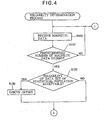
- FIG. 4 is a flow chart illustrating a process for deriving an offset.
- the process illustrated in FIG. 4 is performed as the CPU 42 executes the magnetic data processing program 90 when an offset update request has been issued.
- the offset update request may be issued at regular time intervals or may be issued in response to an explicit instruction from the driver.
- the buffer management module 91 receives and stores magnetic data in a buffer. If the buffer management module 91 sequentially receives magnetic data from the magnetic sensor 2 at short time intervals when the travel direction of the automobile changes little, the distance between two consecutively received magnetic data is small. Storing a plurality of magnetic data at a small distance from each other in a buffer with a limited capacity wastes memory resources and causes unnecessary buffer update processes. In addition, if a new offset is derived based on a set of magnetic data at a small distance therebetween, there is a possibility that a new offset with low accuracy may be derived based on a data set of statistical population having a biased distribution. Therefore, the need to update the buffer may be determined in the following manner. For example, if the distance between magnetic data most recently stored in the buffer and last received magnetic data is smaller than a threshold, it is determined that there is no need to update the buffer and the last received magnetic data is discarded without being stored in the buffer.
- the buffer management module 91 determines whether or not a predetermined number of magnetic data required to derive a new offset have been stored in the buffer. That is, the number of elements of the data set of statistical population has been predetermined. The processes of steps S100 and S110 are repeated until the predetermined number of magnetic data are stored in the buffer.
- the reliability determination module 92 determines whether or not the reliability of the data set of statistical population is acceptable (step S120). Specifically, the reliability determination module 92 derives a reliability index based on both the data set of statistical population and acceleration data, and determines whether or not the reliability of the data set of statistical population is acceptable based on the reliability index and a predetermined threshold p.
- the reliability determination module 92 derives a vector parallel to a line perpendicular to an approximate plane representing a distribution of the data set of statistical population where each magnetic data is expressed by the following Equation (1).
- Equation (1) The distribution of the data set of statistical population expressed by Equation (1) can be expressed using, as indicators, eigenvalue of a symmetric matrix A that is defined as in Equations (2), (3), and (4) using the sum of vectors, each of which starts with the center of the data set of statistical population and ends with corresponding magnetic data.
- the matrix A is N times a variance-covariance matrix since the matrix A can be written as Equation (5).
- Eigenvalues of the matrix A are ⁇ 1 , ⁇ 2 , and ⁇ 3 in decreasing order.
- the direction of the eigenvector l 3 corresponding to the minimum eigenvalue ⁇ 3 is parallel to a line perpendicular to a plane including most of the donut-shaped distribution of the data set of statistical population illustrated in FIG. 1 , i.e., an approximate plane representing the distribution of the data set of statistical population.
- the reliability determination module 92 derives the eigenvector l 3 .
- the reliability determination module 92 derives, as a reliability index, the angular difference between the direction of the eigenvector 13 and the direction of acceleration represented by the acceleration data.
- the reliability determination module 92 derives an indicator vector G corresponding to gravitational acceleration using a plurality of acceleration data and derives, as the reliability index, a function of the angular difference between the direction of the derived indicator vector G and the direction of the eigenvector l 3 , instead of directly using the direction of acceleration data which is 3D vector data to derive the reliability index.
- IIR Infinite Impulse Response
- FIR Finite Impulse Response
- a plurality of sequentially input acceleration data are weighted and summed and a plurality of weighted sums are weighted and summed and the resulting value is then fed back.
- the FIR filter a plurality of sequentially input acceleration data are weighted and summed. If the moving object to which the navigation apparatus 1 is attached is an automobile, the cutoff frequency of the IIR filter and the FIR filter may be very small.
- the inner product of the eigenvector l 3 and the indicator vector G is a function of the angular difference between the direction of the eigenvector l 3 and the direction of acceleration represented by the acceleration data. Therefore, the reliability determination module 92 derives a reliability index S expressed by the following Equation (6) and compares the reliability index S with a predetermined threshold p and determines that the reliability of the data set of statistical population is acceptable when the reliability index S is equal to or greater than the threshold p.
- S l 3 T ⁇ G
- the offset derivation module 94 derives a new offset based on the data set of statistical population (step S130).
- the Inventor has suggested a method for deriving an offset of magnetic data based on a data set of statistical population including a plurality of magnetic data sequentially received from the magnetic sensor 2 (see Japanese Patent Application Publications Nos. 2007-240270 , 2007-205944 , 2007-139715 , and 2007-107921 ).
- the method for deriving an offset from a data set of statistical population, the reliability of which has been determined to be acceptable, may or may not be a statistical method.
- the following is an example of the statistical method.
- a position vector c (c x , c y , c z ) of the center of the sphere is obtained by soling simultaneous equations (7).
- the number of equality constraints is 4 for 3 variables, the equations (7) must have a solution since one of the 4 equality constraints is redundant.
- Equation (12) the value of "c” which minimizes the objective function f(c) of Equation (12) is derived as a new offset.
- step S130 When the process of step S130 is completed, the procedure returns to the process of step S100 to repeat the processes described above. When it is determined that the reliability of the data set of statistical population is unacceptable, the data set of statistical population is discarded without deriving the new offset.
- the orientation derivation module 96 corrects the magnetic data using the new offset that is derived through the above procedure as needed to derive orientation data and outputs the orientation data to the navigation program 98.
- the magnetic data may be used to derive the offset even when the reliability of the magnetic data is low.
- a temporary offset c 1 derived based on a data set of statistical population, regardless of the magnitude of a reliability index S, may be weighted according to the reliability index S and a weighted average of the temporary offset c 1 and an old offset c 0 may be derived as a new offset c.
- the new offset c is an internal point of division of the temporary offset c 1 and the old offset c 0 as shown in FIG. 5 .
- c S ⁇ c 1 + 1 - S ⁇ c 0
- the new offset approaches the old offset so that the offset is prevented from significantly varying based on the data set of statistical population whose reliability is low.
- the new offset approaches the temporary offset so that the offset is accurately updated based on the data set of statistical population whose reliability is high.
- the scope of the invention is not limited to the above embodiments and a variety of modifications can be made without departing from the scope of the invention.
- the navigation apparatus to which the invention is applied is exemplified by a Portable Navigation Device (PND)
- the invention may also be applied to a stationary navigation device or a pedestrian navigation device.
- PND Portable Navigation Device
Landscapes
- Engineering & Computer Science (AREA)
- Radar, Positioning & Navigation (AREA)
- Remote Sensing (AREA)
- Physics & Mathematics (AREA)
- General Physics & Mathematics (AREA)
- Electromagnetism (AREA)
- Condensed Matter Physics & Semiconductors (AREA)
- Navigation (AREA)
- Complex Calculations (AREA)
- Measuring Magnetic Variables (AREA)
Applications Claiming Priority (1)
| Application Number | Priority Date | Filing Date | Title |
|---|---|---|---|
| JP2007339478A JP5067155B2 (ja) | 2007-12-28 | 2007-12-28 | 磁気データ処理装置、ナビゲーション装置、磁気データ処理方法および磁気データ処理プログラム |
Publications (2)
| Publication Number | Publication Date |
|---|---|
| EP2075531A2 true EP2075531A2 (de) | 2009-07-01 |
| EP2075531A3 EP2075531A3 (de) | 2016-06-15 |
Family
ID=40482028
Family Applications (1)
| Application Number | Title | Priority Date | Filing Date |
|---|---|---|---|
| EP08022305.0A Withdrawn EP2075531A3 (de) | 2007-12-28 | 2008-12-22 | Vorrichtung, Verfahren und Programm zur Verarbeitung magnetischer Daten |
Country Status (6)
| Country | Link |
|---|---|
| US (1) | US8862418B2 (de) |
| EP (1) | EP2075531A3 (de) |
| JP (1) | JP5067155B2 (de) |
| KR (1) | KR101006812B1 (de) |
| CN (1) | CN101470177B (de) |
| TW (1) | TW200942775A (de) |
Cited By (1)
| Publication number | Priority date | Publication date | Assignee | Title |
|---|---|---|---|---|
| EP2525274A3 (de) * | 2011-05-20 | 2015-11-11 | Sony Computer Entertainment Inc. | Mobile Vorrichtung mit einem Magnetfeldsensor und Verfahren zum Kalibrieren des Magnetfeldsensors |
Families Citing this family (8)
| Publication number | Priority date | Publication date | Assignee | Title |
|---|---|---|---|---|
| JP4935427B2 (ja) * | 2007-03-01 | 2012-05-23 | ヤマハ株式会社 | 磁気データ処理装置、方法およびプログラムならびに磁気処理システム。 |
| JP2011203243A (ja) * | 2010-03-02 | 2011-10-13 | Yamaha Corp | 磁気データ処理装置、方法及びプログラム |
| ES2530019T3 (es) | 2011-05-24 | 2015-02-25 | Huawei Device Co., Ltd. | Método y aparato para reducir consumo de alimentación de teléfono móvil y teléfono móvil |
| JP2013064695A (ja) * | 2011-09-20 | 2013-04-11 | Yamaha Corp | 状態推定装置、オフセット更新方法およびオフセット更新プログラム |
| EP2687955B1 (de) * | 2012-07-20 | 2018-08-22 | Nintendo Co., Ltd. | Informationsverarbeitungsprogramm, Informationsverarbeitungssystem und Lageberechnungssverfahren zur Berechnung der Lage einer Eingabeeinheit |
| CN105676303B (zh) * | 2016-01-19 | 2018-08-10 | 南京理工大学 | 地磁数据采集装置 |
| EP3537098B1 (de) * | 2016-11-04 | 2021-07-21 | Fujidenolo Co., Ltd. | Messvorrichtung |
| CN109545113B (zh) * | 2018-09-30 | 2022-09-06 | 合肥鑫晟光电科技有限公司 | 一种异常数据处理方法及装置 |
Citations (4)
| Publication number | Priority date | Publication date | Assignee | Title |
|---|---|---|---|---|
| JP2007107921A (ja) | 2005-10-11 | 2007-04-26 | Yamaha Corp | 磁気センサ制御装置、方法及びプログラム |
| JP2007139715A (ja) | 2005-11-22 | 2007-06-07 | Yamaha Corp | 磁気センサ制御装置、方法及びプログラム |
| JP2007205944A (ja) | 2006-02-02 | 2007-08-16 | Yamaha Corp | 磁気センサ制御装置、磁気測定装置、オフセット設定方法及びオフセット設定プログラム |
| JP2007240270A (ja) | 2006-03-07 | 2007-09-20 | Yamaha Corp | 磁気データ処理装置、方法及びプログラム |
Family Cites Families (10)
| Publication number | Priority date | Publication date | Assignee | Title |
|---|---|---|---|---|
| CN1152237C (zh) * | 2001-03-30 | 2004-06-02 | 清华大学 | 基于微机电技术的微型导航系统 |
| JP4126388B2 (ja) * | 2002-04-08 | 2008-07-30 | カシオ計算機株式会社 | 歩行方向検出装置及びプログラム |
| WO2005003683A1 (ja) * | 2003-07-03 | 2005-01-13 | Asahi Kasei Emd Corporation | 方位角計測装置及び方位角計測方法 |
| EP1698857B1 (de) * | 2003-12-22 | 2009-11-25 | Asahi Kasei EMD Corporation | Azimut-messeinrichtung |
| KR100565794B1 (ko) * | 2003-12-30 | 2006-03-29 | 삼성전자주식회사 | 기울기의 영향을 보상하여 방위각을 연산하는 지자기센서, 및 그 연산방법 |
| JP4615287B2 (ja) | 2004-11-01 | 2011-01-19 | 東京計器株式会社 | 方位姿勢検出装置 |
| JP4552658B2 (ja) * | 2005-01-13 | 2010-09-29 | 日立金属株式会社 | 2軸磁気センサを用いた姿勢検知方法およびそのプログラム |
| JP4919142B2 (ja) * | 2005-10-19 | 2012-04-18 | アイチ・マイクロ・インテリジェント株式会社 | 磁気コンパス |
| JP2007163388A (ja) * | 2005-12-16 | 2007-06-28 | Citizen Holdings Co Ltd | 方位センサおよび記録媒体 |
| US7532991B2 (en) * | 2006-03-07 | 2009-05-12 | Yamaha Corporation | Magnetic data processing device |
-
2007
- 2007-12-28 JP JP2007339478A patent/JP5067155B2/ja not_active Expired - Fee Related
-
2008
- 2008-12-22 EP EP08022305.0A patent/EP2075531A3/de not_active Withdrawn
- 2008-12-23 US US12/342,964 patent/US8862418B2/en not_active Expired - Fee Related
- 2008-12-24 TW TW097150470A patent/TW200942775A/zh unknown
- 2008-12-26 CN CN2008101892231A patent/CN101470177B/zh not_active Expired - Fee Related
- 2008-12-26 KR KR1020080134881A patent/KR101006812B1/ko not_active Expired - Fee Related
Patent Citations (4)
| Publication number | Priority date | Publication date | Assignee | Title |
|---|---|---|---|---|
| JP2007107921A (ja) | 2005-10-11 | 2007-04-26 | Yamaha Corp | 磁気センサ制御装置、方法及びプログラム |
| JP2007139715A (ja) | 2005-11-22 | 2007-06-07 | Yamaha Corp | 磁気センサ制御装置、方法及びプログラム |
| JP2007205944A (ja) | 2006-02-02 | 2007-08-16 | Yamaha Corp | 磁気センサ制御装置、磁気測定装置、オフセット設定方法及びオフセット設定プログラム |
| JP2007240270A (ja) | 2006-03-07 | 2007-09-20 | Yamaha Corp | 磁気データ処理装置、方法及びプログラム |
Cited By (1)
| Publication number | Priority date | Publication date | Assignee | Title |
|---|---|---|---|---|
| EP2525274A3 (de) * | 2011-05-20 | 2015-11-11 | Sony Computer Entertainment Inc. | Mobile Vorrichtung mit einem Magnetfeldsensor und Verfahren zum Kalibrieren des Magnetfeldsensors |
Also Published As
| Publication number | Publication date |
|---|---|
| JP2009162510A (ja) | 2009-07-23 |
| KR20090073038A (ko) | 2009-07-02 |
| KR101006812B1 (ko) | 2011-01-10 |
| US20090171608A1 (en) | 2009-07-02 |
| TW200942775A (en) | 2009-10-16 |
| EP2075531A3 (de) | 2016-06-15 |
| JP5067155B2 (ja) | 2012-11-07 |
| US8862418B2 (en) | 2014-10-14 |
| CN101470177B (zh) | 2012-05-30 |
| CN101470177A (zh) | 2009-07-01 |
Similar Documents
| Publication | Publication Date | Title |
|---|---|---|
| US8862418B2 (en) | Magnetic data processing device, magnetic data processing method, and magnetic data processing program | |
| USRE44582E1 (en) | Magnetic data processing device | |
| CN103153790B (zh) | 使用运动传感器和附接至装置的磁力计的测量数据估计该装置在重力参照系中的偏航角的设备和方法 | |
| US9645202B2 (en) | Geomagnetic sensor calibration apparatus and method thereof | |
| EP2553392B1 (de) | Kalibrierung von sensormessungen auf mobilgeräten | |
| US7930133B2 (en) | Magnetic-sensor controller, magnetism measurement apparatus, offset setting method, and computer-readable medium on which offset setting program is recorded | |
| US20130238269A1 (en) | Apparatuses and methods for dynamic tracking and compensation of magnetic near field | |
| JP4412381B2 (ja) | 方位検出装置 | |
| KR101152095B1 (ko) | 자기 데이터 처리 장치, 방법, 및 컴퓨터 판독가능한 저장 매체 | |
| US7548827B2 (en) | Magnetic data processing apparatus, method and machine readable medium | |
| US7248967B2 (en) | Autonomous velocity estimation and navigation | |
| US20190212146A1 (en) | Positioning system and positioning method | |
| CN114485641A (zh) | 一种基于惯导卫导方位融合的姿态解算方法及装置 | |
| US8413034B2 (en) | Magnetic data processing device, magnetic data processing method, and magnetic data processing program | |
| US20110015888A1 (en) | Magnetic data processing device, magnetic data processing method, and magnetic data processing program | |
| JP2012194066A (ja) | 端末装置及び地磁気環境判定プログラム | |
| US20110015895A1 (en) | Magnetic data processing device, magnetic data processing method, and magnetic data processing program | |
| EP4431874B1 (de) | Richtungsberechnungsvorrichtung, richtungsberechnungsverfahren und programm | |
| JP2011180097A (ja) | 磁気データ処理装置、方法及びプログラムならびに磁気測定装置 | |
| JP5621181B2 (ja) | 磁気データ処理装置、磁気データ処理方法および磁気データ処理プログラム | |
| US20110010121A1 (en) | Magnetic data processing device, magnetic data processing method, and magnetic data processing program | |
| JP2007327934A (ja) | 磁気データ処理装置、方法およびプログラム |
Legal Events
| Date | Code | Title | Description |
|---|---|---|---|
| PUAI | Public reference made under article 153(3) epc to a published international application that has entered the european phase |
Free format text: ORIGINAL CODE: 0009012 |
|
| AK | Designated contracting states |
Kind code of ref document: A2 Designated state(s): AT BE BG CH CY CZ DE DK EE ES FI FR GB GR HR HU IE IS IT LI LT LU LV MC MT NL NO PL PT RO SE SI SK TR |
|
| AX | Request for extension of the european patent |
Extension state: AL BA MK RS |
|
| PUAL | Search report despatched |
Free format text: ORIGINAL CODE: 0009013 |
|
| AK | Designated contracting states |
Kind code of ref document: A3 Designated state(s): AT BE BG CH CY CZ DE DK EE ES FI FR GB GR HR HU IE IS IT LI LT LU LV MC MT NL NO PL PT RO SE SI SK TR |
|
| AX | Request for extension of the european patent |
Extension state: AL BA MK RS |
|
| RIC1 | Information provided on ipc code assigned before grant |
Ipc: G01C 17/28 20060101AFI20160506BHEP Ipc: G01C 17/38 20060101ALI20160506BHEP Ipc: G01C 21/16 20060101ALI20160506BHEP |
|
| AKY | No designation fees paid | ||
| AXX | Extension fees paid |
Extension state: MK Extension state: BA Extension state: RS Extension state: AL |
|
| REG | Reference to a national code |
Ref country code: DE Ref legal event code: R108 |
|
| STAA | Information on the status of an ep patent application or granted ep patent |
Free format text: STATUS: THE APPLICATION IS DEEMED TO BE WITHDRAWN |
|
| 18D | Application deemed to be withdrawn |
Effective date: 20161216 |