EP2058362A1 - Vergussmassen enthaltend Wachse speziell auf Basis von metallocen-katalysierten Polyolefinen insbesondere zur Verkapselungen von elektronischen Geräten und Bauteilen - Google Patents
Vergussmassen enthaltend Wachse speziell auf Basis von metallocen-katalysierten Polyolefinen insbesondere zur Verkapselungen von elektronischen Geräten und Bauteilen Download PDFInfo
- Publication number
- EP2058362A1 EP2058362A1 EP08019173A EP08019173A EP2058362A1 EP 2058362 A1 EP2058362 A1 EP 2058362A1 EP 08019173 A EP08019173 A EP 08019173A EP 08019173 A EP08019173 A EP 08019173A EP 2058362 A1 EP2058362 A1 EP 2058362A1
- Authority
- EP
- European Patent Office
- Prior art keywords
- potting compound
- bis
- compound according
- waxes
- sand
- Prior art date
- Legal status (The legal status is an assumption and is not a legal conclusion. Google has not performed a legal analysis and makes no representation as to the accuracy of the status listed.)
- Withdrawn
Links
- 229920000098 polyolefin Polymers 0.000 title claims abstract description 36
- 150000001875 compounds Chemical class 0.000 title claims description 55
- 238000005538 encapsulation Methods 0.000 title claims description 7
- 238000007789 sealing Methods 0.000 title 1
- 239000000203 mixture Substances 0.000 claims abstract description 31
- 239000001993 wax Substances 0.000 claims abstract description 28
- 239000011256 inorganic filler Substances 0.000 claims abstract description 7
- 229910003475 inorganic filler Inorganic materials 0.000 claims abstract description 7
- 230000009477 glass transition Effects 0.000 claims abstract description 3
- 238000004382 potting Methods 0.000 claims description 40
- 239000000945 filler Substances 0.000 claims description 19
- 238000004519 manufacturing process Methods 0.000 claims description 13
- 239000000654 additive Substances 0.000 claims description 10
- 229920001577 copolymer Polymers 0.000 claims description 10
- 239000003054 catalyst Substances 0.000 claims description 8
- VGGSQFUCUMXWEO-UHFFFAOYSA-N Ethene Chemical compound C=C VGGSQFUCUMXWEO-UHFFFAOYSA-N 0.000 claims description 5
- 239000005977 Ethylene Substances 0.000 claims description 5
- 230000000712 assembly Effects 0.000 claims description 5
- 238000000429 assembly Methods 0.000 claims description 5
- 239000000155 melt Substances 0.000 claims description 5
- OKTJSMMVPCPJKN-UHFFFAOYSA-N Carbon Chemical compound [C] OKTJSMMVPCPJKN-UHFFFAOYSA-N 0.000 claims description 4
- 239000004566 building material Substances 0.000 claims description 4
- VTYYLEPIZMXCLO-UHFFFAOYSA-L calcium carbonate Substances [Ca+2].[O-]C([O-])=O VTYYLEPIZMXCLO-UHFFFAOYSA-L 0.000 claims description 4
- 229920000642 polymer Polymers 0.000 claims description 4
- 238000006116 polymerization reaction Methods 0.000 claims description 4
- QQONPFPTGQHPMA-UHFFFAOYSA-N propylene Natural products CC=C QQONPFPTGQHPMA-UHFFFAOYSA-N 0.000 claims description 4
- 125000004805 propylene group Chemical group [H]C([H])([H])C([H])([*:1])C([H])([H])[*:2] 0.000 claims description 4
- 125000001931 aliphatic group Chemical group 0.000 claims description 3
- 229920006272 aromatic hydrocarbon resin Polymers 0.000 claims description 3
- 239000010439 graphite Substances 0.000 claims description 3
- 229910002804 graphite Inorganic materials 0.000 claims description 3
- 239000013543 active substance Substances 0.000 claims description 2
- 239000002318 adhesion promoter Substances 0.000 claims description 2
- 230000000845 anti-microbial effect Effects 0.000 claims description 2
- 239000003963 antioxidant agent Substances 0.000 claims description 2
- TZCXTZWJZNENPQ-UHFFFAOYSA-L barium sulfate Chemical compound [Ba+2].[O-]S([O-])(=O)=O TZCXTZWJZNENPQ-UHFFFAOYSA-L 0.000 claims description 2
- 229910052601 baryte Inorganic materials 0.000 claims description 2
- 239000010428 baryte Substances 0.000 claims description 2
- 239000011230 binding agent Substances 0.000 claims description 2
- 235000010216 calcium carbonate Nutrition 0.000 claims description 2
- BRPQOXSCLDDYGP-UHFFFAOYSA-N calcium oxide Chemical compound [O-2].[Ca+2] BRPQOXSCLDDYGP-UHFFFAOYSA-N 0.000 claims description 2
- 239000000292 calcium oxide Substances 0.000 claims description 2
- ODINCKMPIJJUCX-UHFFFAOYSA-N calcium oxide Inorganic materials [Ca]=O ODINCKMPIJJUCX-UHFFFAOYSA-N 0.000 claims description 2
- HHSPVTKDOHQBKF-UHFFFAOYSA-J calcium;magnesium;dicarbonate Chemical class [Mg+2].[Ca+2].[O-]C([O-])=O.[O-]C([O-])=O HHSPVTKDOHQBKF-UHFFFAOYSA-J 0.000 claims description 2
- 229910052799 carbon Inorganic materials 0.000 claims description 2
- 239000006229 carbon black Substances 0.000 claims description 2
- 239000000975 dye Substances 0.000 claims description 2
- 239000003205 fragrance Substances 0.000 claims description 2
- 239000004611 light stabiliser Substances 0.000 claims description 2
- 239000010445 mica Substances 0.000 claims description 2
- 229910052618 mica group Inorganic materials 0.000 claims description 2
- 229910052615 phyllosilicate Inorganic materials 0.000 claims description 2
- 239000000049 pigment Substances 0.000 claims description 2
- 150000004760 silicates Chemical class 0.000 claims description 2
- 239000000454 talc Substances 0.000 claims description 2
- 229910052623 talc Inorganic materials 0.000 claims description 2
- 239000010455 vermiculite Substances 0.000 claims description 2
- 229910052902 vermiculite Inorganic materials 0.000 claims description 2
- 235000019354 vermiculite Nutrition 0.000 claims description 2
- 150000007934 α,β-unsaturated carboxylic acids Chemical class 0.000 claims description 2
- 239000011248 coating agent Substances 0.000 claims 1
- 238000000576 coating method Methods 0.000 claims 1
- 239000002131 composite material Substances 0.000 claims 1
- 239000008393 encapsulating agent Substances 0.000 claims 1
- VYPSYNLAJGMNEJ-UHFFFAOYSA-N Silicium dioxide Chemical compound O=[Si]=O VYPSYNLAJGMNEJ-UHFFFAOYSA-N 0.000 description 39
- 239000004576 sand Substances 0.000 description 38
- 239000004743 Polypropylene Substances 0.000 description 29
- -1 polypropylene Polymers 0.000 description 19
- 238000005266 casting Methods 0.000 description 14
- 229920005989 resin Polymers 0.000 description 11
- 239000011347 resin Substances 0.000 description 11
- ZSWFCLXCOIISFI-UHFFFAOYSA-N endo-cyclopentadiene Natural products C1C=CC=C1 ZSWFCLXCOIISFI-UHFFFAOYSA-N 0.000 description 9
- 238000009472 formulation Methods 0.000 description 9
- 239000003822 epoxy resin Substances 0.000 description 8
- 239000000463 material Substances 0.000 description 8
- 229920000647 polyepoxide Polymers 0.000 description 8
- 150000003254 radicals Chemical class 0.000 description 8
- 238000000034 method Methods 0.000 description 7
- 229920003002 synthetic resin Polymers 0.000 description 7
- 239000000057 synthetic resin Substances 0.000 description 7
- 230000006399 behavior Effects 0.000 description 6
- LNEPOXFFQSENCJ-UHFFFAOYSA-N haloperidol Chemical compound C1CC(O)(C=2C=CC(Cl)=CC=2)CCN1CCCC(=O)C1=CC=C(F)C=C1 LNEPOXFFQSENCJ-UHFFFAOYSA-N 0.000 description 6
- QCWXUUIWCKQGHC-UHFFFAOYSA-N Zirconium Chemical compound [Zr] QCWXUUIWCKQGHC-UHFFFAOYSA-N 0.000 description 5
- 230000001070 adhesive effect Effects 0.000 description 5
- 125000000058 cyclopentadienyl group Chemical group C1(=CC=CC1)* 0.000 description 5
- 239000003446 ligand Substances 0.000 description 5
- 229910052751 metal Inorganic materials 0.000 description 5
- 239000002184 metal Substances 0.000 description 5
- 239000000047 product Substances 0.000 description 5
- 239000000126 substance Substances 0.000 description 5
- 235000007586 terpenes Nutrition 0.000 description 5
- 229910052726 zirconium Inorganic materials 0.000 description 5
- YBYIRNPNPLQARY-UHFFFAOYSA-N 1H-indene Natural products C1=CC=C2CC=CC2=C1 YBYIRNPNPLQARY-UHFFFAOYSA-N 0.000 description 4
- 239000000853 adhesive Substances 0.000 description 4
- 125000003118 aryl group Chemical group 0.000 description 4
- 125000004429 atom Chemical group 0.000 description 4
- 229910052801 chlorine Inorganic materials 0.000 description 4
- 238000005336 cracking Methods 0.000 description 4
- 239000004033 plastic Substances 0.000 description 4
- 229920003023 plastic Polymers 0.000 description 4
- 238000002360 preparation method Methods 0.000 description 4
- 238000003860 storage Methods 0.000 description 4
- 150000003505 terpenes Chemical class 0.000 description 4
- RFFLAFLAYFXFSW-UHFFFAOYSA-N 1,2-dichlorobenzene Chemical compound ClC1=CC=CC=C1Cl RFFLAFLAYFXFSW-UHFFFAOYSA-N 0.000 description 3
- UHOVQNZJYSORNB-UHFFFAOYSA-N Benzene Chemical compound C1=CC=CC=C1 UHOVQNZJYSORNB-UHFFFAOYSA-N 0.000 description 3
- 125000000217 alkyl group Chemical group 0.000 description 3
- 229910052731 fluorine Inorganic materials 0.000 description 3
- 239000011737 fluorine Substances 0.000 description 3
- 125000005843 halogen group Chemical group 0.000 description 3
- 125000004435 hydrogen atom Chemical group [H]* 0.000 description 3
- 125000003454 indenyl group Chemical group C1(C=CC2=CC=CC=C12)* 0.000 description 3
- 239000007788 liquid Substances 0.000 description 3
- 125000002496 methyl group Chemical group [H]C([H])([H])* 0.000 description 3
- 229920005606 polypropylene copolymer Polymers 0.000 description 3
- 229910052710 silicon Inorganic materials 0.000 description 3
- 238000007711 solidification Methods 0.000 description 3
- 230000008023 solidification Effects 0.000 description 3
- 239000002904 solvent Substances 0.000 description 3
- 229920001187 thermosetting polymer Polymers 0.000 description 3
- 238000004804 winding Methods 0.000 description 3
- 125000006273 (C1-C3) alkyl group Chemical group 0.000 description 2
- 125000006656 (C2-C4) alkenyl group Chemical group 0.000 description 2
- RSWGJHLUYNHPMX-UHFFFAOYSA-N Abietic-Saeure Natural products C12CCC(C(C)C)=CC2=CCC2C1(C)CCCC2(C)C(O)=O RSWGJHLUYNHPMX-UHFFFAOYSA-N 0.000 description 2
- WKBOTKDWSSQWDR-UHFFFAOYSA-N Bromine atom Chemical group [Br] WKBOTKDWSSQWDR-UHFFFAOYSA-N 0.000 description 2
- KZBUYRJDOAKODT-UHFFFAOYSA-N Chlorine Chemical compound ClCl KZBUYRJDOAKODT-UHFFFAOYSA-N 0.000 description 2
- 239000004593 Epoxy Substances 0.000 description 2
- PXGOKWXKJXAPGV-UHFFFAOYSA-N Fluorine Chemical compound FF PXGOKWXKJXAPGV-UHFFFAOYSA-N 0.000 description 2
- 239000004698 Polyethylene Substances 0.000 description 2
- KHPCPRHQVVSZAH-HUOMCSJISA-N Rosin Natural products O(C/C=C/c1ccccc1)[C@H]1[C@H](O)[C@@H](O)[C@@H](O)[C@@H](CO)O1 KHPCPRHQVVSZAH-HUOMCSJISA-N 0.000 description 2
- PPBRXRYQALVLMV-UHFFFAOYSA-N Styrene Chemical compound C=CC1=CC=CC=C1 PPBRXRYQALVLMV-UHFFFAOYSA-N 0.000 description 2
- RTAQQCXQSZGOHL-UHFFFAOYSA-N Titanium Chemical compound [Ti] RTAQQCXQSZGOHL-UHFFFAOYSA-N 0.000 description 2
- IJWJAVHBOCRHSP-UHFFFAOYSA-L [Cl-].[Cl-].C1=CC=C2C([Zr+2])C(C)=CC2=C1 Chemical compound [Cl-].[Cl-].C1=CC=C2C([Zr+2])C(C)=CC2=C1 IJWJAVHBOCRHSP-UHFFFAOYSA-L 0.000 description 2
- 229920013640 amorphous poly alpha olefin Polymers 0.000 description 2
- 238000004458 analytical method Methods 0.000 description 2
- 239000003990 capacitor Substances 0.000 description 2
- 239000000460 chlorine Substances 0.000 description 2
- 125000001309 chloro group Chemical group Cl* 0.000 description 2
- 239000000835 fiber Substances 0.000 description 2
- 125000003983 fluorenyl group Chemical group C1(=CC=CC=2C3=CC=CC=C3CC12)* 0.000 description 2
- 239000012634 fragment Substances 0.000 description 2
- 238000005227 gel permeation chromatography Methods 0.000 description 2
- 229910052732 germanium Inorganic materials 0.000 description 2
- GNPVGFCGXDBREM-UHFFFAOYSA-N germanium atom Chemical compound [Ge] GNPVGFCGXDBREM-UHFFFAOYSA-N 0.000 description 2
- 229910052735 hafnium Inorganic materials 0.000 description 2
- VBJZVLUMGGDVMO-UHFFFAOYSA-N hafnium atom Chemical compound [Hf] VBJZVLUMGGDVMO-UHFFFAOYSA-N 0.000 description 2
- 229910052736 halogen Inorganic materials 0.000 description 2
- 150000002367 halogens Chemical class 0.000 description 2
- 229920001519 homopolymer Polymers 0.000 description 2
- 239000000178 monomer Substances 0.000 description 2
- 230000035515 penetration Effects 0.000 description 2
- WXZMFSXDPGVJKK-UHFFFAOYSA-N pentaerythritol Chemical class OCC(CO)(CO)CO WXZMFSXDPGVJKK-UHFFFAOYSA-N 0.000 description 2
- 125000000538 pentafluorophenyl group Chemical group FC1=C(F)C(F)=C(*)C(F)=C1F 0.000 description 2
- 239000003208 petroleum Substances 0.000 description 2
- 125000001997 phenyl group Chemical group [H]C1=C([H])C([H])=C(*)C([H])=C1[H] 0.000 description 2
- 229920000573 polyethylene Polymers 0.000 description 2
- 229920001155 polypropylene Polymers 0.000 description 2
- 150000003097 polyterpenes Chemical class 0.000 description 2
- 238000012545 processing Methods 0.000 description 2
- 239000010703 silicon Substances 0.000 description 2
- 125000001424 substituent group Chemical group 0.000 description 2
- 238000012360 testing method Methods 0.000 description 2
- 239000010936 titanium Substances 0.000 description 2
- 229910052719 titanium Inorganic materials 0.000 description 2
- KHPCPRHQVVSZAH-UHFFFAOYSA-N trans-cinnamyl beta-D-glucopyranoside Natural products OC1C(O)C(O)C(CO)OC1OCC=CC1=CC=CC=C1 KHPCPRHQVVSZAH-UHFFFAOYSA-N 0.000 description 2
- 150000003623 transition metal compounds Chemical class 0.000 description 2
- 238000009736 wetting Methods 0.000 description 2
- 125000004178 (C1-C4) alkyl group Chemical group 0.000 description 1
- OSIHYASBAJHECK-UHFFFAOYSA-L 1,2-dimethylcyclopenta-1,3-diene;zirconium(4+);dichloride Chemical compound [Cl-].[Cl-].[Zr+4].CC1=C(C)[C-]=CC1.CC1=C(C)[C-]=CC1 OSIHYASBAJHECK-UHFFFAOYSA-L 0.000 description 1
- LIKMAJRDDDTEIG-UHFFFAOYSA-N 1-hexene Chemical compound CCCCC=C LIKMAJRDDDTEIG-UHFFFAOYSA-N 0.000 description 1
- BGGKSZPSSRGVTP-UHFFFAOYSA-L 2-methyl-1h-inden-1-ide;zirconium(4+);dichloride Chemical compound [Cl-].[Cl-].[Zr+4].C1=CC=C2[CH-]C(C)=CC2=C1.C1=CC=C2[CH-]C(C)=CC2=C1 BGGKSZPSSRGVTP-UHFFFAOYSA-L 0.000 description 1
- UQRONKZLYKUEMO-UHFFFAOYSA-N 4-methyl-1-(2,4,6-trimethylphenyl)pent-4-en-2-one Chemical group CC(=C)CC(=O)Cc1c(C)cc(C)cc1C UQRONKZLYKUEMO-UHFFFAOYSA-N 0.000 description 1
- RSPAIISXQHXRKX-UHFFFAOYSA-L 5-butylcyclopenta-1,3-diene;zirconium(4+);dichloride Chemical compound Cl[Zr+2]Cl.CCCCC1=CC=C[CH-]1.CCCCC1=CC=C[CH-]1 RSPAIISXQHXRKX-UHFFFAOYSA-L 0.000 description 1
- STJZZMMGFPUUNK-UHFFFAOYSA-N C(CCCCCCCCCCCCCCCCC)C1(C=CC=C1)[Zr] Chemical compound C(CCCCCCCCCCCCCCCCC)C1(C=CC=C1)[Zr] STJZZMMGFPUUNK-UHFFFAOYSA-N 0.000 description 1
- WJZMFTYEIIOPIC-UHFFFAOYSA-N C1(C=CC=C1)[Zr]C1C=CC2=CC=CC=C12 Chemical compound C1(C=CC=C1)[Zr]C1C=CC2=CC=CC=C12 WJZMFTYEIIOPIC-UHFFFAOYSA-N 0.000 description 1
- AGKZDUBMFACJPR-UHFFFAOYSA-L C12=CC=CC=C2C2=CC=CC=C2C1[Zr](Cl)(Cl)(=C(C)C)C1C=CC=C1 Chemical compound C12=CC=CC=C2C2=CC=CC=C2C1[Zr](Cl)(Cl)(=C(C)C)C1C=CC=C1 AGKZDUBMFACJPR-UHFFFAOYSA-L 0.000 description 1
- JAKYKQHNJUDFCT-UHFFFAOYSA-N C1=CC=C2C([Zr])C=CC2=C1 Chemical compound C1=CC=C2C([Zr])C=CC2=C1 JAKYKQHNJUDFCT-UHFFFAOYSA-N 0.000 description 1
- KPWMGUMUJVLSHH-UHFFFAOYSA-L CC(C)=[Zr](Cl)(Cl)(C1C=CC=C1)C1C=CC2=CC=CC=C12 Chemical compound CC(C)=[Zr](Cl)(Cl)(C1C=CC=C1)C1C=CC2=CC=CC=C12 KPWMGUMUJVLSHH-UHFFFAOYSA-L 0.000 description 1
- MBVIIPUAENVLDG-UHFFFAOYSA-N CC1(C=CC=C1)[Zr]C1(C=CC=C1)C Chemical compound CC1(C=CC=C1)[Zr]C1(C=CC=C1)C MBVIIPUAENVLDG-UHFFFAOYSA-N 0.000 description 1
- RVEYJJWOHLDJPA-UHFFFAOYSA-N CC1=C(C)C(C)=C(C)C1(C)[Zr]C1(C)C(C)=C(C)C(C)=C1C Chemical compound CC1=C(C)C(C)=C(C)C1(C)[Zr]C1(C)C(C)=C(C)C(C)=C1C RVEYJJWOHLDJPA-UHFFFAOYSA-N 0.000 description 1
- OXLXAPYJCPFBFT-UHFFFAOYSA-L CC1=CC(C)(C=C1)[Zr](Cl)(Cl)C1(C)C=CC(C)=C1 Chemical compound CC1=CC(C)(C=C1)[Zr](Cl)(Cl)C1(C)C=CC(C)=C1 OXLXAPYJCPFBFT-UHFFFAOYSA-L 0.000 description 1
- CKNXPIUXGGVRME-UHFFFAOYSA-L CCCCC1(C=CC(C)=C1)[Zr](Cl)(Cl)C1(CCCC)C=CC(C)=C1 Chemical compound CCCCC1(C=CC(C)=C1)[Zr](Cl)(Cl)C1(CCCC)C=CC(C)=C1 CKNXPIUXGGVRME-UHFFFAOYSA-L 0.000 description 1
- JDZFQGRUOMKKTK-UHFFFAOYSA-N C[Si](C)(C)[Zr][Si](C)(C)C Chemical compound C[Si](C)(C)[Zr][Si](C)(C)C JDZFQGRUOMKKTK-UHFFFAOYSA-N 0.000 description 1
- 239000004215 Carbon black (E152) Substances 0.000 description 1
- VYZAMTAEIAYCRO-UHFFFAOYSA-N Chromium Chemical compound [Cr] VYZAMTAEIAYCRO-UHFFFAOYSA-N 0.000 description 1
- RYGMFSIKBFXOCR-UHFFFAOYSA-N Copper Chemical compound [Cu] RYGMFSIKBFXOCR-UHFFFAOYSA-N 0.000 description 1
- YCKRFDGAMUMZLT-UHFFFAOYSA-N Fluorine atom Chemical group [F] YCKRFDGAMUMZLT-UHFFFAOYSA-N 0.000 description 1
- 238000005727 Friedel-Crafts reaction Methods 0.000 description 1
- ZOKXTWBITQBERF-UHFFFAOYSA-N Molybdenum Chemical compound [Mo] ZOKXTWBITQBERF-UHFFFAOYSA-N 0.000 description 1
- 229920005987 OPPANOL® Polymers 0.000 description 1
- 239000004952 Polyamide Substances 0.000 description 1
- 229920002367 Polyisobutene Polymers 0.000 description 1
- OFOBLEOULBTSOW-UHFFFAOYSA-N Propanedioic acid Natural products OC(=O)CC(O)=O OFOBLEOULBTSOW-UHFFFAOYSA-N 0.000 description 1
- 239000006004 Quartz sand Substances 0.000 description 1
- XUIMIQQOPSSXEZ-UHFFFAOYSA-N Silicon Chemical compound [Si] XUIMIQQOPSSXEZ-UHFFFAOYSA-N 0.000 description 1
- ATJFFYVFTNAWJD-UHFFFAOYSA-N Tin Chemical compound [Sn] ATJFFYVFTNAWJD-UHFFFAOYSA-N 0.000 description 1
- 241000276425 Xiphophorus maculatus Species 0.000 description 1
- JWCAYMSCCIFHCW-UHFFFAOYSA-L [Cl-].[Cl-].C1=CC(C(=CC=C2)C)=C2C1[Zr+2]C1C(C=CC=C2C)=C2C=C1 Chemical compound [Cl-].[Cl-].C1=CC(C(=CC=C2)C)=C2C1[Zr+2]C1C(C=CC=C2C)=C2C=C1 JWCAYMSCCIFHCW-UHFFFAOYSA-L 0.000 description 1
- CUNNBZZJTYAIAL-UHFFFAOYSA-L [Cl-].[Cl-].C1=CC2=CC(C)=CC=C2C1[Zr+2]C1C2=CC=C(C)C=C2C=C1 Chemical compound [Cl-].[Cl-].C1=CC2=CC(C)=CC=C2C1[Zr+2]C1C2=CC=C(C)C=C2C=C1 CUNNBZZJTYAIAL-UHFFFAOYSA-L 0.000 description 1
- JENZZDVXJFMHSJ-UHFFFAOYSA-L [Cl-].[Cl-].C1=CC=C2C(C)C([Zr+2]C=3C(C4=CC=CC=C4C=3)C)=CC2=C1 Chemical compound [Cl-].[Cl-].C1=CC=C2C(C)C([Zr+2]C=3C(C4=CC=CC=C4C=3)C)=CC2=C1 JENZZDVXJFMHSJ-UHFFFAOYSA-L 0.000 description 1
- AWXKEFJIQBQSSC-UHFFFAOYSA-L [Cl-].[Cl-].CC1=CC(C)([Zr++]C2(C)C=C(C)C(C)=C2)C=C1C Chemical compound [Cl-].[Cl-].CC1=CC(C)([Zr++]C2(C)C=C(C)C(C)=C2)C=C1C AWXKEFJIQBQSSC-UHFFFAOYSA-L 0.000 description 1
- 230000004913 activation Effects 0.000 description 1
- 230000002411 adverse Effects 0.000 description 1
- 150000001336 alkenes Chemical class 0.000 description 1
- 125000003545 alkoxy group Chemical group 0.000 description 1
- XYLMUPLGERFSHI-UHFFFAOYSA-N alpha-Methylstyrene Chemical compound CC(=C)C1=CC=CC=C1 XYLMUPLGERFSHI-UHFFFAOYSA-N 0.000 description 1
- 125000003710 aryl alkyl group Chemical group 0.000 description 1
- 230000015572 biosynthetic process Effects 0.000 description 1
- DQXBYHZEEUGOBF-UHFFFAOYSA-N but-3-enoic acid;ethene Chemical compound C=C.OC(=O)CC=C DQXBYHZEEUGOBF-UHFFFAOYSA-N 0.000 description 1
- 125000000484 butyl group Chemical group [H]C([*])([H])C([H])([H])C([H])([H])C([H])([H])[H] 0.000 description 1
- BVKZGUZCCUSVTD-UHFFFAOYSA-N carbonic acid Chemical compound OC(O)=O BVKZGUZCCUSVTD-UHFFFAOYSA-N 0.000 description 1
- 125000003636 chemical group Chemical group 0.000 description 1
- 238000006243 chemical reaction Methods 0.000 description 1
- 229910052804 chromium Inorganic materials 0.000 description 1
- 239000011651 chromium Substances 0.000 description 1
- 238000007906 compression Methods 0.000 description 1
- 230000006835 compression Effects 0.000 description 1
- 239000004567 concrete Substances 0.000 description 1
- 239000000470 constituent Substances 0.000 description 1
- 238000010276 construction Methods 0.000 description 1
- 229910052802 copper Inorganic materials 0.000 description 1
- 239000010949 copper Substances 0.000 description 1
- 125000004122 cyclic group Chemical group 0.000 description 1
- 125000000113 cyclohexyl group Chemical group [H]C1([H])C([H])([H])C([H])([H])C([H])(*)C([H])([H])C1([H])[H] 0.000 description 1
- 238000013016 damping Methods 0.000 description 1
- 238000009795 derivation Methods 0.000 description 1
- 238000013461 design Methods 0.000 description 1
- 238000005516 engineering process Methods 0.000 description 1
- 150000002148 esters Chemical class 0.000 description 1
- 125000001495 ethyl group Chemical group [H]C([H])([H])C([H])([H])* 0.000 description 1
- 239000005038 ethylene vinyl acetate Substances 0.000 description 1
- 230000002349 favourable effect Effects 0.000 description 1
- 230000009969 flowable effect Effects 0.000 description 1
- 125000003709 fluoroalkyl group Chemical group 0.000 description 1
- 125000004407 fluoroaryl group Chemical group 0.000 description 1
- 238000007306 functionalization reaction Methods 0.000 description 1
- 230000004927 fusion Effects 0.000 description 1
- 239000007789 gas Substances 0.000 description 1
- 238000007429 general method Methods 0.000 description 1
- 150000002314 glycerols Chemical class 0.000 description 1
- 239000008187 granular material Substances 0.000 description 1
- 239000011440 grout Substances 0.000 description 1
- 125000001188 haloalkyl group Chemical group 0.000 description 1
- 229930195733 hydrocarbon Natural products 0.000 description 1
- 238000005984 hydrogenation reaction Methods 0.000 description 1
- 229910052500 inorganic mineral Inorganic materials 0.000 description 1
- 229910052740 iodine Inorganic materials 0.000 description 1
- VZCYOOQTPOCHFL-UPHRSURJSA-N maleic acid Chemical compound OC(=O)\C=C/C(O)=O VZCYOOQTPOCHFL-UPHRSURJSA-N 0.000 description 1
- 239000011976 maleic acid Substances 0.000 description 1
- FPYJFEHAWHCUMM-UHFFFAOYSA-N maleic anhydride Chemical group O=C1OC(=O)C=C1 FPYJFEHAWHCUMM-UHFFFAOYSA-N 0.000 description 1
- 230000008018 melting Effects 0.000 description 1
- 238000002844 melting Methods 0.000 description 1
- 239000012968 metallocene catalyst Substances 0.000 description 1
- 150000002739 metals Chemical class 0.000 description 1
- 125000000956 methoxy group Chemical group [H]C([H])([H])O* 0.000 description 1
- 239000011707 mineral Substances 0.000 description 1
- 235000010755 mineral Nutrition 0.000 description 1
- 229910052750 molybdenum Inorganic materials 0.000 description 1
- 239000011733 molybdenum Substances 0.000 description 1
- 229910052758 niobium Inorganic materials 0.000 description 1
- 239000010955 niobium Substances 0.000 description 1
- GUCVJGMIXFAOAE-UHFFFAOYSA-N niobium atom Chemical compound [Nb] GUCVJGMIXFAOAE-UHFFFAOYSA-N 0.000 description 1
- 229910052757 nitrogen Inorganic materials 0.000 description 1
- 125000004433 nitrogen atom Chemical group N* 0.000 description 1
- 239000003921 oil Substances 0.000 description 1
- JRZJOMJEPLMPRA-UHFFFAOYSA-N olefin Natural products CCCCCCCC=C JRZJOMJEPLMPRA-UHFFFAOYSA-N 0.000 description 1
- 230000000737 periodic effect Effects 0.000 description 1
- 229910052698 phosphorus Inorganic materials 0.000 description 1
- 239000002574 poison Substances 0.000 description 1
- 231100000614 poison Toxicity 0.000 description 1
- 229920001200 poly(ethylene-vinyl acetate) Polymers 0.000 description 1
- 229920002647 polyamide Polymers 0.000 description 1
- 229920000768 polyamine Polymers 0.000 description 1
- 239000004848 polyfunctional curative Substances 0.000 description 1
- 239000000843 powder Substances 0.000 description 1
- 239000002244 precipitate Substances 0.000 description 1
- 230000002035 prolonged effect Effects 0.000 description 1
- 125000001436 propyl group Chemical group [H]C([*])([H])C([H])([H])C([H])([H])[H] 0.000 description 1
- 150000003839 salts Chemical class 0.000 description 1
- 238000005204 segregation Methods 0.000 description 1
- 230000001235 sensitizing effect Effects 0.000 description 1
- 238000004904 shortening Methods 0.000 description 1
- 210000002023 somite Anatomy 0.000 description 1
- 241000894007 species Species 0.000 description 1
- 230000006641 stabilisation Effects 0.000 description 1
- 238000011105 stabilization Methods 0.000 description 1
- 239000004575 stone Substances 0.000 description 1
- 238000006467 substitution reaction Methods 0.000 description 1
- 239000000725 suspension Substances 0.000 description 1
- 238000003786 synthesis reaction Methods 0.000 description 1
- 239000003784 tall oil Substances 0.000 description 1
- 229910052715 tantalum Inorganic materials 0.000 description 1
- GUVRBAGPIYLISA-UHFFFAOYSA-N tantalum atom Chemical compound [Ta] GUVRBAGPIYLISA-UHFFFAOYSA-N 0.000 description 1
- 229920001897 terpolymer Chemical class 0.000 description 1
- 125000000999 tert-butyl group Chemical group [H]C([H])([H])C(*)(C([H])([H])[H])C([H])([H])[H] 0.000 description 1
- 229920001169 thermoplastic Polymers 0.000 description 1
- 239000004416 thermosoftening plastic Substances 0.000 description 1
- 229910052718 tin Inorganic materials 0.000 description 1
- 125000003944 tolyl group Chemical group 0.000 description 1
- 231100000331 toxic Toxicity 0.000 description 1
- 230000002588 toxic effect Effects 0.000 description 1
- VZCYOOQTPOCHFL-UHFFFAOYSA-N trans-butenedioic acid Natural products OC(=O)C=CC(O)=O VZCYOOQTPOCHFL-UHFFFAOYSA-N 0.000 description 1
- SQBBHCOIQXKPHL-UHFFFAOYSA-N tributylalumane Chemical compound CCCC[Al](CCCC)CCCC SQBBHCOIQXKPHL-UHFFFAOYSA-N 0.000 description 1
- VOITXYVAKOUIBA-UHFFFAOYSA-N triethylaluminium Chemical compound CC[Al](CC)CC VOITXYVAKOUIBA-UHFFFAOYSA-N 0.000 description 1
- WFKWXMTUELFFGS-UHFFFAOYSA-N tungsten Chemical compound [W] WFKWXMTUELFFGS-UHFFFAOYSA-N 0.000 description 1
- 229910052721 tungsten Inorganic materials 0.000 description 1
- 239000010937 tungsten Substances 0.000 description 1
- 229910052720 vanadium Inorganic materials 0.000 description 1
- GPPXJZIENCGNKB-UHFFFAOYSA-N vanadium Chemical compound [V]#[V] GPPXJZIENCGNKB-UHFFFAOYSA-N 0.000 description 1
- XLYOFNOQVPJJNP-UHFFFAOYSA-N water Substances O XLYOFNOQVPJJNP-UHFFFAOYSA-N 0.000 description 1
- 239000002023 wood Substances 0.000 description 1
- 125000005023 xylyl group Chemical group 0.000 description 1
- VPGLGRNSAYHXPY-UHFFFAOYSA-L zirconium(2+);dichloride Chemical compound Cl[Zr]Cl VPGLGRNSAYHXPY-UHFFFAOYSA-L 0.000 description 1
Classifications
-
- C—CHEMISTRY; METALLURGY
- C08—ORGANIC MACROMOLECULAR COMPOUNDS; THEIR PREPARATION OR CHEMICAL WORKING-UP; COMPOSITIONS BASED THEREON
- C08K—Use of inorganic or non-macromolecular organic substances as compounding ingredients
- C08K3/00—Use of inorganic substances as compounding ingredients
- C08K3/34—Silicon-containing compounds
Definitions
- the present invention relates to the use of waxes and metallocene-catalyzed polyolefins as encapsulations of electronic circuits, electrical equipment, motors, pumps and individual components and assemblies.
- Waxes and metallocene-catalyzed polyolefins are used as material or as constituent of formulations, especially in combination with a large amount of filler (eg sand).
- stators are hermetically encapsulated by submersible pump units with co-ordinated wet-running motors. This is usually done with a mixture of sand (quartz sand), resins (epoxy resin) and Glasschlagstoffen (additives).
- a submersible pump unit is for example off DE-C-36 09 311 known. From this document, the basic structure of such aggregates can be seen, which are mainly used for the promotion of pure or slightly polluted water.
- mixtures of fillers for example sand
- thermosetting synthetic resins essentially epoxy resin, hardeners and additives
- potting compound essentially epoxy resin, hardeners and additives
- Epoxy resins for this application are known.
- special demands are placed on them when casting the stators of electric motors.
- the potting compound must ensure a tight enclosure of the stator embedded in the motor housing and, on the other hand, at least dissipate part of the heat generated in the stator (lost heat).
- increased demands are made on the elasticity and strength of the potting compound to accommodate the vibrations occurring during operation and mechanical alternating loads.
- the present invention is therefore based on the object in electronic devices or components, such as submersible pump units, the potting compound in such a way that on the one hand mentioned in the use of an epoxy or Polyamidvergussmasse disadvantages are avoided and on the other hand Material and manufacturing cost advantages can be achieved in order to allow a rational production of such aggregates.
- the present invention seeks to provide a potting compound is available, which does not have the aforementioned disadvantages and to provide a suitable for mass production, cost-effective potting compound, which has a comparatively high elasticity and strength in wide temperature ranges, in order to prevent the danger of cracking, which is otherwise common in fast-curing systems.
- this is surprisingly not the case with the potting compound according to the invention.
- compositions consisting of ethylene / C3-C20 copolymers or C3-C30 homopolymers or Coplymeren and at least 40 wt .-% of a filler, and their improved processability to manufactured articles, such as films, floor coverings or wall coverings. Notes on adhesive properties of these compositions or their use as potting compound are not given.
- fillers such as e.g. Sand
- waxes especially based on metallocene-catalyzed polyolefins as potting compounds with increased elasticity and strength can be used.
- the potting compound of the invention has a comparatively high strength and elasticity over wide temperature ranges, which is of particular importance in engines with high alternating load.
- the potting compound in question is therefore particularly well suited for the aforementioned process (casting the stator of an electric motor) in mass production, since the liquid and readily flowable wax or the metallocene-catalyzed polyolefins have very good wetting properties and processed at relatively low pressure without much effort can be.
- the processing pressure usually has to be increased to a certain extent due to the high viscosity and there is the risk that the stator winding will be damaged: this is not the case when using the casting compounds according to the invention.
- the invention further relates to the production and use of the above-mentioned potting compound for the encapsulation of electronic circuits, electrical equipment, motors, pumps and individual components and assemblies.
- waxes a) based on polyolefin which have been prepared in particular by polymerization of ethylene and propylene in the presence of metallocenes as catalyst, and preferably a melt index MFI of more than 30 g / 10 min, measured according to ISO 1133 at a temperature of 190 ° C and have a weight of 2.16 kg.
- the storage modulus G ' is in the range of 10,000 MPa to 0.0015 MPa, preferably 1000 MPa to 0, 1 MPa, more preferably at 100 MPa to 0.2 MPa.
- Suitable inorganic fillers are a multiplicity of inorganic salts and minerals, preferably sand, chalk, natural ground or precipitated calcium carbonates, calcium magnesium carbonates, calcium oxide, silicates, barite, graphite and carbon black.
- platy fillers such as e.g. Vermiculite, mica, talc or similar phyllosilicates are suitable as fillers. If appropriate, it may be expedient for at least part of the fillers to be surface-treated.
- Preferred embodiments of the compositions used according to the invention contain as filler a natural fine beach sand.
- the weight ratio of the abovementioned waxes and metallocene-catalyzed polyolefins to inorganic filler in the compositions used according to the invention is in the range from 1:99 to 99: 1, preferably 10:90 to 90:10. In particular, the composition receives from 61 to 89% by weight.
- the casting compounds used according to the invention preferably contain waxes based on metallocene-catalyzed polyolefins with melt viscosities, measured at a temperature of 170 ° C., of 50 to 30,000 mPa ⁇ s, more preferably 100 to 20,000 mPa ⁇ s.
- polyolefins having a number average molecular weight M n in the range of 500 and 20,000 g / mol, preferably in the range of 800 and 10,000 g / mol, more preferably in the range of 1,000 to 5,000 g / mol and a weight average molecular weight M w in the range of 1,000 to 40,000 g / mol, preferably in the range of 1,600 to 30,000 g / mol, more preferably in the range of 2,000 and 20,000 g / mol, and most preferably in the range of 2,500 and 10,000 g / mol.
- the molecular weight is determined by gel permeation chromatography.
- the determination of G 'and G " is carried out in DMA (Dynamic Mechanical Analysis) of TA Instruments Q800.
- compositions according to the invention contain, in particular, waxes and metallocene-catalyzed polyolefins selected from homopolymers of propylene and / or copolymers of propylene and ethylene, the copolymers preferably being from 70 to 99.9, particularly preferably from 80 to 99,% by weight, consist of an olefin species.
- the compositions contain copolymers of propylene and ethylene, wherein the content of structural units derived from propylene, 61 wt .-% to 99.9 wt .-%, preferably 70 to 99, particularly preferably 80 to 95 wt. -% is.
- compositions according to the invention in addition to the components a) and b) still contain the component c) wherein c) one or more polar modified copolymer waxes, prepared by reacting the polyolefin a) with an ⁇ , ⁇ -unsaturated carboxylic acid or derivatives thereof in the presence of radical formers.
- the polar modified copolymer waxes mentioned under c) can be prepared according to the method described in EP-A-0 941 257 be prepared method described. Preference is given to polar modified copolymer waxes which are derived from polyolefins, preferably from polypropylene, modified with maleic anhydride and / or maleic acid.
- the compositions according to the invention of the components a) and b) or a), b) and c) can, when used as building materials, potting compound or Connecting elements are used without further additives and optionally additionally one or more adhesive component d) selected from the group of resins.
- aliphatic and cycloaliphatic or aromatic hydrocarbon resins into consideration. These can be prepared by polymerization of certain resinous oil fractions resulting from the treatment of petroleum. Such resins, for example, may be modified by hydrogenation or functionalization, are obtainable for example under the trade names Eastoflex ®, RegaIREZ ®, ® Kristalex, Eastotac ®, Piccotac ® (Eastman Chemical Company) or Escorez ® (ExxonMobil Chemical Company).
- polyterpene resins prepared by polymerization of terpenes, for example pinene in the presence of Friedel-Crafts catalysts, likewise hydrogenated polyterpenes, copolymers and terpolymers of natural terpenes, for example styrene / terpene or .alpha.-methylstyrene / terpene copolymers.
- rosin resins in particular rosin esters, glycerol esters of tree resins, pentaerythritol esters of tree resins and tall oil resins and their hydrogenated derivatives, and phenol-modified pentaerythritol esters of resins and phenol-modified terpene resins.
- the cited resins d) are present in the potting compound according to the invention individually or in any combination in amounts by weight, based on the total weight of the composition, in the range from 0 to 90% by weight, preferably from 10 to 50% by weight, more preferably from 15 to 40 wt .-%, contained.
- APAOs amorphous poly-alpha-olefins
- polystyrene resins such as low-pressure polyethylenes, as they are available, for example, under the name Affinity ® at Dow Chemical, be contained, further high-pressure polyethylenes, including those with polar comonomers such as ethylene-vinyl acetate.
- the total mixture of casting compositions thus obtained have a viscosity in the range of 100 to 10,000 mPa ⁇ s at 170 ° C, preferably from 120 to 9,000 mPa ⁇ s at 170 ° C, more preferably from 130 to 8,000 mPa ⁇ s at 170 ° C.
- the potting compounds of the invention may also contain pigments, dyes, antioxidants, odor binders, antimicrobial active substances, light stabilizers, fragrances, adhesion promoters and additives for increasing the thermal conductivity and / or increasing / reducing the electrical conductivity (for example copper, graphite).
- Such usable additives are known in the art and therefore will not be described in detail here.
- metallocene compounds of the formula I are used as a catalyst.
- This formula also includes compounds of the formula Ia, the formula Ib, and the formula Ic.
- M 1 is a metal of group IVb, Vb or VIb of the periodic table, for example titanium, zirconium, hafnium, vanadium, niobium, tantalum, chromium, molybdenum, tungsten, preferably titanium, zirconium and hafnium.
- R 1 and R 2 are identical or different and denote a hydrogen atom, a C 1 -C 10 -, preferably C 1 -C 3 -alkyl group, in particular methyl, a C 1 -C 10 -, preferably C 1 -C 3 -alkoxy group , a C 6 -C 10 -, preferably C 6 -C 8 -aryl group, a C 6 -C 10 -, preferably C 6 -C 8 -aryloxy group, a C 2 -C 10 -, preferably C 2 -C 4 - Alkenyl group, a C 7 -C 40 , preferably C 7 -C 10 arylalkyl group, a C 7 -C 40 -, preferably C 7 -C 12 -alkylaryl group, a C 8 -C 40 -, preferably C 8 -C 12 -aryl-alkenyl group or a halogen, preferably chlorine atom.
- R 3 and R 4 are identical or different and denote a mononuclear or polynuclear hydrocarbon radical which can form a sandwich structure with the central atom M 1 .
- R 3 and R 4 are preferably cyclopentadienyl, indenyl, tetrahydroindenyl, benzoindenyl or fluorenyl, it being possible for the basic bodies to carry additional substituents or to bond them to one another.
- one of the radicals R 3 and R 4 may be a substituted nitrogen atom, wherein R 24 has the meaning of R 17 and is preferably methyl, tert-butyl or cyclohexyl.
- R 5 , R 6 , R 7 , R 8 , R 9 and R 10 are identical or different and denote a hydrogen atom, a halogen atom, preferably a fluorine, chlorine or bromine atom, a C 1 -C 10 -, preferably C 1 C 4 alkyl group, a C 6 -C 10 , preferably C 6 -C 8 aryl group, a C 1 -C 10 , preferably C 1 -C 3 alkoxy group, an -NR 16 2 -, -SR 16 -, -OSiR 16 3 -, -SiR 16 3 - or -PR 16 2 radical, wherein R 16 is a C 1 -C 10 -, preferably C 1 -C 3 alkyl group or C 6 -C 10 -, preferably C 6- C 8 -aryl group or in the case of Si or P-containing radicals is also a halogen atom, preferably chlorine atom or two adjacent radicals R 5 , R
- M 2 is silicon, germanium or tin, preferably silicon and germanium.
- R 11 and R 12 are the same or different and have the meaning given for R 17 .
- m and n are the same or different and are zero, 1 or 2, preferably zero or 1, where m plus n is zero, 1 or 2, preferably zero or 1.
- R 14 and R 15 have the meaning of R 17 and R 18 .
- Suitable cocatalysts for metallocenes of the formula I are organoaluminum compounds, in particular alumoxanes or else aluminum-free systems such as R 20 x NH 4 -x BR 21 4 , R 20 x PH 4-x BR 21 4 , R 20 3 CBR 21 4 or BR 21 3 ,
- x is a number from 1 to 4
- the radicals R 20 are identical or different, preferably identical, and are C 1 -C 10 -alkyl or C 6 -C 18 -aryl or two radicals R 20 form together with the they join a ring
- the radicals R 21 are the same or different, preferably the same, and are C 6 -C 18 -aryl which may be substituted by alkyl, haloalkyl or fluorine.
- R 20 is ethyl, propyl, butyl or phenyl and R 21 is phenyl, pentafluorophenyl, 3,5-bis-trifluoromethylphenyl, mesityl, xylyl or tolyl.
- organoaluminum compound e.g. Triethylaluminum, tributylaluminum and others and mixtures of these are suitable.
- supported single-center catalysts can also be used. Preference is given to catalyst systems in which the residual contents of support material and cocatalyst do not exceed a concentration of 100 ppm in the product.
- EP-A-0 321 851 is, for example, in the prior art such as EP-A-0 321 851 .
- EP-A-0 321 852 is, for example, in the prior art.
- EP-A-0 384 264 .
- Metallocene catalysts for the preparation of metallocene-catalyzed polyolefins are chiral or achiral transition metal compounds of the formula M 1 L x .
- the transition metal compound M 1 L x contains at least one metal central atom M 1 , to which at least one ⁇ ligand, for example a cyclopentadienyl ligand, is bound.
- substituents such as halogen, alkyl, alkoxy or aryl groups may be bonded to the central metal atom M 1 .
- M 1 is preferably an element of III., IV., V. or VI.
- Cyclopentadienyl ligand is understood as meaning unsubstituted cyclopentadienyl radicals and substituted cyclopentadienyl radicals, such as methylcyclopentadienyl, indenyl, 2-methylindenyl, 2-methyl-4-phenylindenyl, tetrahydroindenyl or octahydrofluorenyl radicals.
- the ⁇ ligands may be bridged or unbridged, with single and multiple bridging - including ring systems - are possible.
- metallocene also includes compounds having more than one metallocene fragment, so-called polynuclear metallocenes. These can have any substitution patterns and bridging variants.
- the individual metallocene fragments of such polynuclear metallocenes may be both the same and different. Examples of such polynuclear metallocenes are described, for example in EP-A-0 632 063 ,
- polyolefins thus produced contain no reactive chemical groups, they are chemically inert, so that no chemical reaction takes place with commercially available materials such as metals and plastics, which is extremely advantageous in terms of the design of the component groups and the lifetime.
- the waxes a) are for the production of the casting compound according to the invention for use in electronic and mechanical component groups as granules, powder or block and can be easily formed into plates, profiles, three-dimensional body.
- the waxes used a) based on metallocene-catalyzed polyolefins have a very high enthalpy of fusion enthalpy (70 to 280 J / g at densities of 0.9 kg / dm 3 to 0.97 kg / m 3 ).
- the melting points are in the range of 80 to 160 ° C.
- they are toxicologically harmless, chemically inert and have no segregation.
- the compositions of the invention are suitable for use in the production of potting compounds and building materials, in particular for the production of fasteners for fastening and fixing of electrical and mechanical components in component groups and units, such as Statorbefest Trent in submersible pump units.
- Manufacturer of the aforementioned usable metallocene-catalyzed polyolefin (Licocene ® Performance Polymers) is z. B. the Clariant products (Germany) GmbH.
- the grout according to the invention has the advantage over the building materials known in the art that they have a shorter setting time (solidification time) without suffering a loss of adhesion and cohesion forces, an improved tensile strength (tensile N) and rigidity (elongation) without brittleness to be and at the same time has a favorable viscosity behavior, and is toxicologically and ecologically safe and easy to handle.
- the connecting elements can be mounted in a simple manner within a very short time.
- Particularly advantageous are casting compounds with a filler content higher than 40 wt .-% based on the total compositions.
- Another advantage of the casting compounds according to the invention is the fact that waxes and metallocene-catalyzed polyolefins exhibit a thermoplastic behavior and in contrast to thermosets (epoxy resins) have a pronounced creep behavior. As a result, the casting compound body (sand body) compresses itself during the operating time.
- the melt viscosities were determined according to DIN 53019 using a rotational viscosimeter, the dropping points according to ASTM D3954, the ring / ball softening according to ASTM D3104 with pure Licocene ® determined.
- the molecular weight average M w and the molecular weight average M n were determined by gel permeation chromatography at a temperature of 135 ° C in 1,2-dichlorobenzene.
- the values for the memory modules G 'and the loss moduli G " were determined in a temperature range of -40 to 200 ° C. at 1 Hz in a DMA of TA Instruments Q800, compression kit.
- the sample (dimensions: 29 ⁇ 9.5 ⁇ 4, 5 mm) was stored under standard conditions for 24 h before testing.
- the tensile strength (tensile N) is determined by subjecting a test specimen (shoulder bar) to tensile force and measuring the force at which the specimen breaks. Elongation (elongation at break%) is the extensibility until tearing of the specimen.
Landscapes
- Chemical & Material Sciences (AREA)
- Health & Medical Sciences (AREA)
- Chemical Kinetics & Catalysis (AREA)
- Medicinal Chemistry (AREA)
- Polymers & Plastics (AREA)
- Organic Chemistry (AREA)
- Compositions Of Macromolecular Compounds (AREA)
Abstract
Vergussmasse enthaltend
a) ein oder mehrere Wachse auf Basis von metallocen-katalysierten Polyolefinen, die
€¢ einen Erweichungspunkt Ring/Kugel im Bereich von 50 bis 165 °C,
€¢ eine Schmelzviskosität, gemessen bei einer Temperatur von 170 °C, im Bereich von 20 bis 40.000 mPa·s und
€¢ eine Glasübergangstemperatur T g von maximal -10 °C besitzen und
b) einen oder mehrere anorganische Füllstoff/e. Die Vergussmassen eignen sich zur Herstellung von Baumaterialien, insbesondere für die Herstellung von Verbindungselementen zur Verkapselungen von elektronischen Schaltungen, elektrischen Geräten, Motoren, Pumpen, wie z. B. Statorbefestigungen bei Tauchpumpenaggregaten, insbesondere als Vergussmittel für den Stator eines Elektromotors.
Description
- Die vorliegende Erfindung betrifft den Einsatz von Wachsen und metallocene-katalysierten Polyolefinen als Verkapselungen von elektronischen Schaltungen, elektrischen Geräten, Motoren, Pumpen sowie einzelne Bauteile und Baugruppen. Dabei werden Wachse und metallocene-katalysierte Polyolefine als Material oder als Bestandteil von Formulierungen, insbesondere in Verbindung mit einer großen Menge an Füllstoff (z. B. Sand), eingesetzt.
- Polymere, Kunststoffe, Füllstoffe und deren Mischungen zur Verkapselung von elektrischen Baugruppen verwendet. Bisher wurde Verkapselung (Sandfixierung) nur mit Hilfe von giftigen und umweltbelastenden Stoffen (wie z. B. Monomere von Kunstharzen) oder nur mit Hilfe von schädlichen Lösungsmitteln wie Petroleum, Schwerbenzin, Leichtbenzin und Benzol als Lösungsmittel nach dem komplizierten Kohlensäure-Erstarrungsverfahren hergestellt.
- Beispielsweise werden Statoren von Tauchpumpenaggregaten mit achsgleich angeordneten Nasslaufmotoren hermetisch gekapselt. Dies erfolgt in der Regel mit einem Gemisch aus Sand (Quarzsand), Harzen (Epoxidharz) und Zugschlagstoffen (Additive).
Ein derartiges Tauchpumpenaggregat ist beispielsweise ausDE-C-36 09 311 bekannt. Aus dieser Druckschrift ist auch der grundsätzliche Aufbau solcher Aggregate zu entnehmen, die vorwiegend zur Förderung von reinem oder leicht verschmutztem Wassers benutzt werden. - Beim Verzicht auf das Vergussmaterial im Bauteil (Stator) können Probleme auftreten. Es besteht die Gefahr, dass aufgrund des fehlenden Vergussmaterials der Wicklungskopf an seinem Außenumfang in unmittelbaren Gehäusekontakt kommt und dies zu einem elektrischen Kurzschluss führt.
Weiterhin besteht das Problem, dass innerhalb des Statorraums üblicherweise ein Kondensator angeordnet ist, der bei bekannten Konstruktionen in die Vergussmasse eingebettet ist und durch diese innerhalb des Gehäuses gehalten wird. Bei fehlender Vergussmasse ist somit eine zusätzliche Halterung für den Kondensator zu schaffen, wodurch die Fertigung des Aggregats sich aufwendiger gestaltet.
Zudem können, je nach Belastung des Motors, beim Fehlen der Vergussmasse thermische Probleme innerhalb der Statorwicklung auftreten, da die dort entstehende Verlustwärme nicht mehr in ausreichendem Masse abgeführt werden kann.
Außerdem nimmt die Vergussmasse bei schnell laufenden Bauteilgruppen aufgrund ihrer hohen Masse positiven Einfluss auf das Resonanzverhalten (Eigenschwingungsverhalten) und dient zur mechanischen Stabilisierung respektive Geräuschdämpfung und zur Laufruhe bei. - Im Allgemeinen werden als Vergussmasse Mischungen aus Füllstoffen (z. B. Sand) und warmaushärtbaren Kunstharzen, im wesentlichen Epoxidharz, Härter sowie Zusatzstoffen, verwendet. Epoxidharze für diese Anwendung sind bekannt. An sie werden insbesondere beim Verguss der Statoren von Elektromotoren besondere Anforderungen gestellt. Die Vergussmasse muss einerseits einen dichten Einschluss des darin eingebetteten Stators im Motorgehäuse gewährleisten und andererseits zumindest einen Teil der im Stator erzeugten Wärme (Verlustwärme) ableiten. Schließlich sind in allen Betriebszuständen erhöhte Anforderungen an die Elastizität und Festigkeit der Vergussmasse gestellt, um die beim Betrieb auftretenden Schwingungen und mechanische Wechselbelastungen aufnehmen zu können.
- Nachteile einer Epoxid-Vergussmasse sind:
- zeitintensiver Fertigungsprozess aufgrund von langen Aushärtzeiten, lange Gelierzeiten, hohe Fertigungs- und Materialkosten
- Kunstharze (Epoxidharze) weisen meist eine hohe Viskosität auf und somit ein schlechtes Eindringverhalten in den Füllstoff (z. B. Sand). Die Benetzung von Füllstoffen (Sandkörner) erfolgt meist unter hoher Druckbeaufschlagung
- Elastizität und mechanische Festigkeit der Vergussmasse verschlechtern sich bei längerer Betriebsdauer. Epoxidharze härten durch und werden spröde. Es entstehen Risse sowohl im Sandkörper als auch zwischen Sandkörper und Gehäusewand. Dies kann eine Verkürzung der Lebenszeit bedingen
- derartige Vergussmassen sind nur in hohem Temperaturbereich elastisch, in übrigen jedoch eher spröde, so dass sie vermehrt zur Rissbildung neigen
- Kunstharze härten aus und führen zu Sprödbruch. Eine Sandfixierung ist nicht mehr gewährleistet. Die Ableitung der Verlustwärme ist nicht mehr gegeben
- Monomere der Epoxidharze gelten als sensibilisierend und haben während der Verarbeitung eine Geruchsbelästigung zur Folge. Der Umgang mit Epoxidharzen stellt entsprechende hohe Anforderungen an Arbeitshygiene und Sicherheitseinrichtungen.
- Zwar kann die vorher erwähnte Sprödigkeit der Vergussmasse bei niedrigen Temperaturen durch den Zusatz von Faserstoffen verhindert werden, hierbei wird die Viskosität des (noch flüssigen) Kunstharzes allerdings so stark erhöht, dass die Fliessfähigkeit erheblich vermindert wird. Faserzusatzstoffe sind im Allgemeinen verhältnismäßig teuer. Der Zusatz von kautschukartigen Substanzen zur Elastifizierung von Vergussmassen unter Bildung von elastischen Phasen ist ebenfalls bekannt. Auch hierdurch wird die Fliessfähigkeit des Kunstharzes stark beeinflusst.
- Ferner ist bekannt, Polyamine (Polyamide) in kaltaushärtenden Systemen einzusetzen. In warmaushärtenden Systemen hat man bisher solche Zusatzstoffe nicht eingesetzt, da eine die Viskosität ungünstig beeinflussende Ausscheidung zu befürchten ist und solche Zusatzstoffe nicht in ausreichendem Masse temperaturbeständig sind.
- Der vorliegenden Erfindung liegt daher die Aufgabe zugrunde, bei elektronischen Geräten oder Bauteilen, wie z.B. Tauchpumpenaggregaten, die Vergussmasse so auszubilden, dass einerseits die beim Einsatz einer Epoxid- oder Polyamidvergussmasse genannten Nachteile vermieden werden und andererseits Material- sowie Fertigungskostenvorteile erreicht werden, um eine rationelle Herstellung solcher Aggregate zu ermöglichen.
- Ausgehend von diesem Stand der Technik liegt der Erfindung die Aufgabe zugrunde, eine Vergussmasse zur Verfügung zu stellen, welche die vorgenannten Nachteile nicht aufweiset und eine für die Massenfertigung geeignete, kostengünstige Vergussmasse zu schaffen, welche eine vergleichsweise hohe Elastizität und Festigkeit in weiten Temperaturbereichen aufweist, um gerade die sonst häufig bei schnellaushärtenden Systemen zu beobachtende Gefahr der Rissbildung zu verhindern. Bei der erfindungsgemäßen Vergussmasse ist dies jedoch erstaunlicherweise nicht der Fall.
-
EP-A-1 290 100 beschreibt Polyolefine, insbesondere Copolymere aus Propylen und Hexen, gekennzeichnet durch Speichermodul-Werte G' von > 0,01 Pa und G''/G'Verhältnisse von > 18 bei G' = 10 Pa. Diese Werte stehen für ein hohes Deformationspotential dieser Copolymere. - In
US 2006-0100335 werden Kompositionen beschrieben, die aus Ethylen/ C3-C20 Copolymeren oder C3-C30-Homopolymeren oder Coplymeren und mindestens 40 Gew.-% eines Füllstoffes bestehen, sowie deren verbesserte Verarbeitbarkeit zu gefertigten Artikeln, beispielsweise Folien, Bodenbelägen oder Wandverkleidungen. Hinweise zu Klebeeigenschaften dieser Kompositionen oder deren Verwendung als Vergussmasse sind nicht gegeben. - Keine der vorstehend aufgeführten Druckschriften gibt Hinweise auf die Verwendungsmöglichkeit von Polyolefinen für den Einsatz als Befestigungsmaterial respektive als Vergussmasse für die Verkapselungen von elektronischen Schaltungen, elektrischen Geräten, Motoren, Pumpen sowie einzelne Bauteile und Baugruppen, beispielsweise in Beton, Holz, Metall, Kunststoff oder Stein.
- Überraschenderweise wurde gefunden, dass Füllstoffe, wie z.B. Sand, in Verbindung mit Wachsen, speziell auf Basis von metallocene-katalysierten Polyolefinen als Vergussmassen mit erhöhter Elastizität und Festigkeit eingesetzt werden können.
- Die vorliegende Erfindung betrifft daher Vergussmassen enthaltend:
- a) ein oder mehrere Wachse speziell auf Basis von metallocen-katalysierten Polyolefinen, und
- b) einen oder mehreren Füllstoff/e, insbesondere anorganische Füllstoffe, wobei die Wachse a)
- einen Erweichungspunkt Ring/Kugel im Bereich von 50 bis 165 °C,
- eine Schmelzviskosität, gemessen bei einer Temperatur von 170 °C, im Bereich von 20 bis 40.000 mPa·s und
- eine Glasübergangstemperatur Tg von maximal-10 °C besitzen.
- Die erfindungsgemäße Vergussmasse besitzt eine über weite Temperaturbereiche vergleichsweise hohe Festigkeit und Elastizität, welche insbesondere von hoher Bedeutung bei Motoren mit hoher Wechselbelastung ist. Die betreffende Vergussmasse ist daher insbesondere für den vorgenannten Prozess (Vergießen des Stators eines Elektromotors) in der Massenfertigung gut geeignet, da das flüssige und gut fließfähige Wachs bzw. die metallocene-katalysierten Polyolefine sehr gute Benetzungseigenschaften aufweisen und ohne großen Aufwand bei vergleichsweise geringem Druck verarbeitet werden können.
- Bei Kunstharzen muss der Verarbeitungsdruck aufgrund hoher Viskosität meist über ein gewisses Maß angehoben werden und es besteht die Gefahr, dass die Statorwicklung beschädigt wird: dies ist beim Einsatz der erfindungsgemäßen Vergussmassen nicht gegeben.
- Die Erfindung betrifft ferner die Herstellung und Verwendung der vorstehend genannten Vergussmasse zur Verkapselung von elektronischen Schaltungen, elektrischen Geräten, Motoren, Pumpen sowie einzelner Bauteile und Baugruppen.
- Bevorzugt werden die Wachse a) auf Polyolefinbasis die insbesondere durch Polymerisation von Ethylen und Propylen in Gegenwart von Metallocenen als Katalysator hergestellt wurden und vorzugsweise einen Schmelzindex MFI von mehr als 30 g/10 min, gemessen nach ISO 1133 bei einer Temperatur von 190 °C und einem Auflagegewicht von 2,16 kg aufweisen.
- Das Verhältnis von Verlustmodul G" zu Speichermodul G' beträgt dabei vorzugsweise < 18 bei G'= 10 Pa . Der Speichermodulwert (storage modulus) G' liegt dabei im Bereich von 10.000 MPa bis 0,0015 MPa, bevorzugt bei 1.000 MPa bis 0,1 MPa, besonders bevorzugt bei 100 MPa bis 0,2 MPa.
- Als anorganischen Füllstoffe kommen eine Vielzahl von anorganischen Salzen und Mineralien in Frage, bevorzugt sind hier zu nennen, Sande, Kreiden, natürliche gemahlene oder gefällte Calciumcarbonate, Calcium-Magnesium-Carbonate, Calciumoxid, Silicate, Schwerspat, Graphit sowie Russ. Auch blättchenförmige Füllstoffe, wie z.B. Vermiculit, Glimmer, Talk oder ähnliche Schichtsilikate, sind als Füllstoffe geeignet. Es kann gegebenenfalls zweckmäßig sein, dass zumindest ein Teil der Füllstoffe oberflächenbehandelt ist. Bevorzugte Ausführungsformen der erfindungsgemäß verwendeten Zusammensetzungen enthalten als Füllstoff einen naturbelassenen feinen Strandsand.
- Das Gewichtsverhältnis der oben genannten Wachse und metallocene-katalysierten Polyolefinen zu anorganischem Füllstoff in den erfindungsgemäß verwendeten Zusammensetzungen liegt im Bereich von 1 : 99 bis 99 :1, bevorzugt 10 : 90 bis 90 : 10. Insbesondere erhält die Zusammensetzung 61 bis 89 Gew.% Polyolefin und 11 bis 39 Gew.% Füllstoff, außerordentlich bevorzugt 65 bis 85 Gew.% Polyolefin zu 15 bis 35 Gew.% Füllstoff.
- Bevorzugt enthalten die erfindungsgemäß verwendeten Vergussmassen Wachse speziell auf Basis von metallocen-katalysierten Polyolefinen mit Schmelzviskositäten, gemessen bei einer Temperatur von 170 °C, von 50 bis 30.000 mPa·s, besonders bevorzugt 100 bis 20.000 mPa·s.
- In einer bevorzugten Ausführungsform werden Polyolefine mit einer zahlenmittleren Molmasse Mn im Bereich von 500 und 20.000 g/mol, bevorzugt im Bereich von 800 und 10.000 g/mol, besonders bevorzugt im Bereich von 1.000 und 5.000 g/mol eingesetzt und einer gewichtsmittleren Molmasse Mw im Bereich von 1.000 und 40.000 g/mol, bevorzugt im Bereich von 1.600 und 30.000 g/mol, besonders bevorzugt im Bereich von 2.000 und 20.000 g/mol und außerordentlich bevorzugt im Bereich von 2.500 und 10.000 g/mol. Die Bestimmung der Molmasse erfolgt gelpermeationschromatographisch.
- Weiter bevorzugt sind Zusammensetzungen, welche die vorstehend genannten Wachse und metallocene-katalysierten Polyolefine enthalten, bei denen das Verhältnis von Verlustmodul G" zu Speichermodul G' bei einem Wert G' = 10 Pa im Bereich von 17 bis 0,1 bevorzugt im Bereich von 10 bis 0,2 besonders bevorzugt im Bereich von 5 bis 0,3 liegt. Die Bestimmung von G'und G" erfolgt in DMA (Dynamisch-Mechanischen-Analyse)) von TA Instruments Q800.
- Die erfindungsgemäßen Zusammensetzungen enthalten insbesondere Wachse und metallocene-katalysierten Polyolefine, die aus Homopolymeren des Propylens und/oder Copolymeren aus Propylen und Ethylen ausgewählt sind, wobei die Copolymeren vorzugsweise zu 70 bis 99,9, besonders bevorzugt zu 80 bis 99 Gew.-%, aus einer Olefinart bestehen.
In einer weiteren bevorzugten Ausführungsform enthalten die Zusammensetzungen Copolymere aus Propylen und Ethylen, wobei der Gehalt an Struktureinheiten, hervorgegangen aus Propylen, 61 Gew.-% bis 99,9 Gew.-%, bevorzugt 70 bis 99, besonders bevorzugt 80 bis 95 Gew.-% beträgt. - In einer bevorzugten Ausführungsform enthalten die erfindungsgemäßen Zusammensetzungen, zusätzlich zu den Komponenten a) und b) noch die Komponente c) wobei
c) für ein oder mehrere polar modifizierte Copolymerwachse, hergestellt durch Umsetzung des Polyolefins a) mit einer α, β -ungesättigten Carbonsäure oder deren Derivaten in Gegenwart von Radikalbildnern steht. - Die unter c) genannten polar modifizierten Copolymerwachse können nach der in
EP-A-0 941 257 beschriebenen Methode hergestellt werden. Bevorzugt sind polar modifizierte Copolymerwachse, die sich ableiten aus Polyolefinen, bevorzugt aus Polypropylen, modifiziert mit Maleinsäureanhydrid und/ oder Maleinsäure. Die erfindungsgemäßen Zusammensetzungen aus den Komponenten a) und b) oder a), b) und c) können bei der Verwendung als Baumaterialien, Vergussmasse oder Verbindungselementen ohne weitere Zusatzstoffe zum Einsatz kommen und gegebenenfalls zusätzlich eine oder mehrere Klebekomponente d), ausgewählt aus der Gruppe der Harze enthalten. - Als weitere zusätzliche Klebekomponente d) kommen aliphatische und cycloaliphatische oder aromatische Kohlenwasserstoffharze in Betracht. Diese können durch Polymerisation bestimmter Harzölfraktionen hergestellt werden, die bei der Aufbereitung von Erdöl anfallen. Derartige Harze, die z.B. durch Hydrierung oder Funktionalisierung modifiziert werden können, sind beispielsweise unter den Handelsnamen Eastoflex®, RegaIREZ®, Kristalex®, Eastotac®, Piccotac® (Eastman Chemical Company) oder Escorez® (ExxonMobil Chemical Company) erhältlich.
- Weiter kommen als zusätzliche Klebekomponente d) Polyterpen-Harze in Betracht, hergestellt durch Polymerisation von Terpenen, beispielsweise Pinen in Gegenwart von Friedel-Crafts-Katalysatoren, desgleichen hydrierte Polyterpene, Copolymere und Terpolymere von natürlichen Terpenen, beispielsweise Styrol/Terpen- oder α-Methylstyrol/Terpen-Copolymere. Weiter in Betracht kommen natürliche und modifizierte Kolophoniumharze, insbesondere Harzester, Glycerinester von Baumharzen, Pentaerithrolester von Baumharzen und Tallölharzen und deren hydrierte Derivate sowie phenol-modifizierte Pentaerithrolester von Harzen und phenol-modifizierte Terpen-Harze.
- Die genannten Harze d) sind in der erfindungsgemäßen Vergussmasse einzeln oder in beliebiger Kombination in Gewichtsmengen, bezogen auf das Gesamtgewicht der Zusammensetzung, im Bereich von 0 bis 90 Gew.-%, bevorzugt von 10 bis 50 Gew.-%, besonders bevorzugt von 15 bis 40 Gew.-%, enthalten.
- In einer ganz besonders bevorzugten Ausführungsform enthält die Vergussmasse ein oder mehrere Klebekomponenten d), ausgewählt aus amorphen Poly-alpha-Olefinen (= APAOs), z.B. den Typen der Vestoplast®-Reihe (Degussa) oder den Rextac®-Typen der Fa. Huntsman, aliphatischen, cycloaliphatischen oder aromatischen Kohlenwasserstoffharzen, wie sie z.B. unter dem Handelsnamen Escorez® bei Exxon Mobile erhältlich sind, ferner Polyisobutylen, erhältlich z.B. unter dem Handelsnamen Oppanol® bei BASF. Weiterhin können auch andere Polyolefine, etwa Niederdruck-Polyethylene, wie sie z.B. unter dem Namen Affinity® bei Dow Chemical verfügbar sind, enthalten sein, ferner Hochdruckpolyethylene, auch solche mit polaren Comonomeren wie z.B. Ethylen-Vinylacetat. Die Gesamtmischung der so beschaffenen Vergussmassen-Zusammensetzungen haben eine Viskosität im Bereich von 100 bis 10.000 mPa·s bei 170 °C, bevorzugt von 120 bis 9.000 mPa·s bei 170 °C, besonders bevorzugt von 130 bis 8.000 mPa·s bei 170 °C.
- Gegebenenfalls können die erfindungsgemäßen Vergussmassen noch Pigmente, Farbstoffe, Antioxidantien, Geruchsbinder, antimikrobielle Wirksubstanzen, Lichtschutzmittel, Duftstoffe, Haftvermittler sowie Additive zur Erhöhung der Wärmeleitfähigkeit und oder Erhöhung/Reduzierung der elektrischen Leitfähigkeit (z.B. Kupfer, Graphit) enthalten. Solche einsetzbaren Zusatzstoffe sind dem Fachmann bekannt und werden daher hier nicht weiter im Detail beschrieben.
- Für die Herstellung, der in den erfindungsgemäß verwendeten Vergussmassen enthaltenenen Wachse auf Basis von metallocen-katalysierten Polyolefinen, werden Metallocenverbindungen der Formel I als Katalysator eingesetzt.
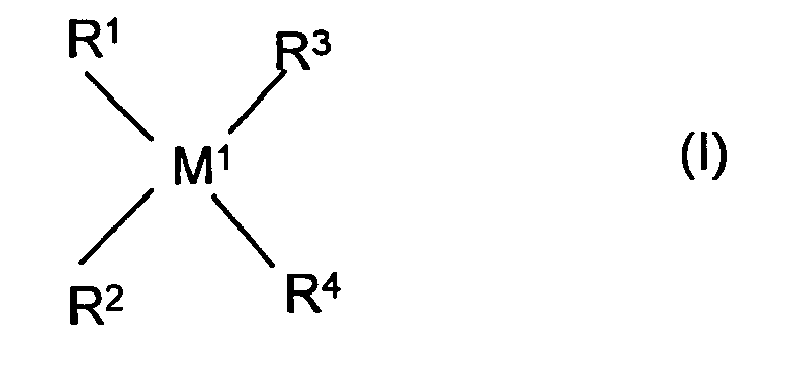
- Diese Formel umfasst auch Verbindungen der Formel la,


- In den Formeln I, la und Ib ist M1 ein Metall der Gruppe IVb, Vb oder Vlb des Periodensystems, beispielsweise Titan, Zirkonium, Hafnium, Vanadium, Niob, Tantal, Chrom, Molybdän, Wolfram, vorzugsweise Titan, Zirkonium und Hafnium.
- R1 und R2 sind gleich oder verschieden und bedeuten ein Wasserstoffatom, eine C1-C10-, vorzugsweise C1-C3-Alkylgruppe, insbesondere Methyl, eine C1-C10-, vorzugsweise C1-C3-Alkoxygruppe, eine C6-C10-, vorzugsweise C6-C8-Arylgruppe, eine C6-C10-, vorzugsweise C6-C8-Aryloxygruppe, eine C2-C10-, vorzugsweise C2-C4-Alkenylgruppe, eine C7-C40-, vorzugsweise C7-C10-Arylalkylgruppe, eine C7-C40-, vorzugsweise C7-C12-Alkylarylgruppe, eine C8-C40-, vorzugsweise C8-C12-Arylalkenylgruppe oder ein Halogen-, vorzugsweise Chloratom.
- R3 und R4 sind gleich oder verschieden und bedeuten einen ein- oder mehrkernigen Kohlenwasserstoffrest, welcher mit dem Zentralatom M1 eine Sandwichstruktur bilden kann. Bevorzugt sind R3 und R4 Cyclopentadienyl, Indenyl, Tetrahydroindenyl, Benzoindenyl oder Fluorenyl, wobei die Grundkörper noch zusätzliche Substituenten tragen oder miteinander verbunden sein können. Außerdem kann einer der Reste R3 und R4 ein substituiertes Stickstoffatom sein, wobei R24 die Bedeutung von R17 hat und vorzugsweise Methyl, tert.-Butyl oder Cyclohexyl ist.
- R5, R6, R7, R8, R9 und R10 sind gleich oder verschieden und bedeuten ein Wasserstoffatom, ein Halogenatom, vorzugsweise ein Fluor-, Chlor- oder Bromatom, eine C1-C10-, vorzugsweise C1-C4-Alkylgruppe, eine C6-C10-, vorzugsweise C6-C8-Arylgruppe, eine C1-C10-, vorzugsweise C1-C3-Alkoxygruppe, einen -NR16 2-, -SR16-, -OSiR16 3-, -SiR16 3- oder -PR16 2-Rest, worin R16 eine C1-C10-, vorzugsweise C1-C3-Alkylgruppe oder C6-C10-, vorzugsweise C6-C8-Arylgruppe oder im Falle Si oder P enthaltender Reste auch ein Halogenatom, vorzugsweise Chloratom ist oder je zwei benachbarte Reste R5, R6, R7, R8, R9 oder R10 bilden mit den sie verbindenden C-Atomen einen Ring. Besonders bevorzugte Liganden sind die substituierten Verbindungen der Grundkörper Cyclopentadienyl, Indenyl, Tetrahydroindenyl, Benzoindenyl oder Fluorenyl.
- R13 ist


- M2 ist Silizium, Germanium oder Zinn, bevorzugt Silizium und Germanium. R13 ist vorzugsweise =CR17R18, =SiR17R18, =GeR17R18, -O-, -S-, =SO, =PR17 oder =P(O)R17.
- R11 und R12 sind gleich oder verschieden und haben die für R17 genannte Bedeutung. m und n sind gleich oder verschieden und bedeuten null, 1 oder 2, bevorzugt null oder 1, wobei m plus n null, 1 oder 2, bevorzugt null oder 1 ist.
- R14 und R15 haben die Bedeutung von R17 und R18.
- Konkrete Beispiele für geeignete Metallocene sind:
- Bis(1,2,3-trimethylcyclopentadienyl)zirkoniumdichlorid,
- Bis(1,2,4-trimethylcyclopentadienyl)zirkoniumdichlorid,
- Bis(1,2-dimethylcyclopentadienyl)zirkoniumdichlorid,
- Bis(1,3-dimethylcyclopentadienyl)zirkoniumdichlorid,
- Bis(1-methylindenyl)zirkoniumdichlorid,
- Bis(1-n-butyl-3-methyl-cyclopentadienyl)zirkoniumdichlorid,
- Bis(2-methyl-4,6-di-i.propyl-indenyl)zirkoniumdichlorid,
- Bis(2-methylindenyl)zirkoniumdichlorid,
- Bis(4-methylindenyl)zirkoniumdichlorid,
- Bis(5-methylindenyl)zirkoniumdichlorid,
- Bis(alkylcyclopentadienyl)zirkoniumdichlorid,
- Bis(alkylindenyl)zirkoniumdichlorid,
- Bis(cyclopentadienyl)zirkoniumdichlorid,
- Bis(indenyl)zirkoniumdichlorid,
- Bis(methylcyclopentadienyl)zirkoniumdichlorid,
- Bis(n-butylcyclopentadienyl)zirkoniumdichlorid,
- Bis(octadecylcyclopentadienyl)zirkoniumdichlorid,
- Bis(pentamethylcyclopentadienyl)zirkoniumdichlorid,
- Bis(trimethylsilylcyclopentadienyl)zirkoniumdichlorid,
- Biscyclopentadienylzirkoniumdibenzyl,
- Biscyclopentadienylzirkoniumdimethyl,
- Bistetrahydroindenylzirkoniumdichlorid,
- Dimethylsilyl-9-fluorenylcyclopentadienylzirkoniumdichlorid,
- Dimethylsilyl-bis-1-(2,3,5-trimethylcyclopentadienyl)zirkoniumdichlorid,
- Dimethylsilyl-bis-1-(2,4-dimethyl-cyclopentadienyl)zirkoniumdichlorid,
- Dimethylsilyl-bis-1-(2-methyl-4,5-benzoindenyl)zirkoniumdichlorid,
- Dimethylsilyl-bis-1-(2-methyl-4-ethylindenyl)zirkoniumdichlorid,
- Dimethylsilyl-bis-1-(2-methyl-4-i-propylindenyl)zirkoniumdichlorid,
- Dimethylsilyl-bis-1-(2-methyl-4-phenylindenyl)zirkoniumdichlorid,
- Dimethylsilyl-bis-1-(2-methyl-indenyl)zirkoniumdichlorid,
- Dimethylsilyl-bis-1-(2-methyltetrahydroindenyl)zirkoniumdichlorid,
- Dimethylsilyl-bis-1-indenylzirkoniumdichlorid,
- Dimethylsilyl-bis-1-indenylzirkoniumdimethyl,
- Dimethylsilyl-bis-1-tetrahydroindenylzirkoniumdichlorid,
- Diphenylmethylen-9-fluorenylcyclopentadienylzirkoniumdichlorid,
- Diphenylsilyl-bis-1-indenylzirkoniumdichlorid,
- Ethylen-bis-1-(2-methyl-4,5-benzoindenyl)zirkoniumdichlorid,
- Ethylen-bis-1-(2-methyl-4-phenylindenyl)zirkoniumdichlorid,
- Ethylen-bis-1-(2-methyl-tetrahydroindenyl)zirkoniumdichlorid,
- Ethylen-bis-1-(4,7-dimethyl-indenyl)zirkoniumdichlorid,
- Ethylen-bis-1-indenylzirkoniumdichlorid,
- Ethylen-bis-1-tetrahydroindenylzirkoniumdichlorid,
- Indenyl-cyclopentadienyl-zirkoniumdichlorid
- Isopropyliden(1-indenyl)(cyclopentadienyl)zirkoniumdichlorid,
- Isopropyliden(9-fluorenyl)(cyclopentadienyl)zirkoniumdichlorid,
- Phenylmethylsilyl-bis-1-(2-methyl-indenyl)zirkoniumdichlorid,
- sowie jeweils die Alkyl- oder Aryl-Derivate dieser Metallocendichloride.
- Zur Aktivierung der Einzentren-Katalysatorsysteme werden geeignete Cokatalysatoren eingesetzt. Geeignete Cokatalysatoren für Metallocene der Formel I sind aluminiumorganische Verbindungen, insbesondere Alumoxane oder auch aluminiumfreie Systeme wie R20 xNH4-xBR21 4, R20 xPH4-xBR21 4, R20 3CBR21 4 oder BR21 3. In diesen Formeln bedeutet x eine Zahl von 1 bis 4, die Reste R20 sind gleich oder verschieden, bevorzugt gleich, und bedeuten C1-C10-Alkyl oder C6-C18-Aryl oder zwei Reste R20 bilden zusammen mit dem sie verbindenden Atom einen Ring, und die Reste R21 sind gleich oder verschieden, bevorzugt gleich, und stehen für C6-C18-Aryl, das durch Alkyl, Haloalkyl oder Fluor substituiert sein kann. Insbesondere steht R20 für Ethyl, Propyl, Butyl oder Phenyl und R21 für Phenyl, Pentafluorphenyl, 3,5-Bis-trifluormethylphenyl, Mesityl, Xylyl oder Tolyl.
- Zusätzlich ist häufig eine dritte Komponente erforderlich, um einen Schutz von polaren Katalysator-Giften aufrecht zu erhalten. Hierzu sind aluminiumorganische Verbindung wie z.B. Triethylaluminium, Tributylaluminium und andere sowie Mischungen aus diesen geeignet.
- Je nach Verfahren können auch geträgerte Einzentren-Katalysatoren zur Verwendung kommen. Bevorzugt sind Katalysatorsysteme, bei welchen die Restgehalte von Trägermaterial und Cokatalysator eine Konzentration von 100 ppm im Produkt nicht überschreiten.
- Verfahren zur Herstellung derartiger metallocene-katalysierten Polyolefine sind beispielsweise im Stand der Technik wie
EP-A-0 321 851 ,EP-A-0 321 852 ,EP-A-0 384 264 ,EP-A-0 571 882 undEP-A-0 890 584 beschrieben. - Die Synthese der Wachse a) kann unter einem Druck von 0,1 bis 10 MPa in Gasphase oder in Suspension oder in Lösung in einem geeigneten Suspendier-/Lösungsmittel nach bekannten Technologien erfolgen.
Metallocenkatalysatoren zur Herstellung von metallocene-katalysierten Polyolefinen sind chirale oder achirale Übergangsmetallverbindungen der Formel M1Lx. Die Übergangsmetallverbindung M1Lx enthält mindestens ein Metallzentralatom M1, an das mindestens ein π-Ligand, z.B. ein Cyclopentadienylligand, gebunden ist. Darüber hinaus können Substituenten, wie z.B. Halogen-, Alkyl-, Alkoxy- oder Arylgruppen an das Metallzentralatom M1 gebunden sein. M1 ist bevorzugt ein Element der III., IV., V. oder VI. Hauptgruppe des Periodensystems der Elemente, wie Ti, Zr oder Hf. Unter Cyclopentadienylligand sind unsubstituierte Cyclopentadienylreste und substituierte Cyclopentadienylreste wie Methylcyclopentadienyl-, Indenyl-, 2-Methylindenyl-, 2-Methyl-4-phenylindenyl-, Tetrahydroindenyl- oder Octahydrofluorenylreste zu verstehen. Die π-Liganden können verbrückt oder unverbrückt sein, wobei einfache und mehrfache Verbrückungen - auch über Ringsysteme - möglich sind. Die Bezeichnung Metallocen umfasst auch Verbindungen mit mehr als einem Metallocenfragment, so genannte mehrkernige Metallocene. Diese können beliebige Substitutionsmuster und Verbrückungsvarianten aufweisen. Die einzelnen Metallocenfragmente solcher mehrkernigen Metallocene können sowohl gleichartig als auch voneinander verschieden sein. Beispiele für solche mehrkernigen Metallocene sind z.B. beschrieben inEP-A-0 632 063 . - Beispiele für allgemeine Strukturformeln von Metallocenen sowie für deren Aktivierung mit einem Cokatalysator sind u.a. in
EP-A-0 571 882 gegeben. - Da die so hergestellten Polyolefine keine reaktiven chemischen Gruppen enthalten, sind sie chemisch inert, so dass mit handelsüblichen Materialien wie Metallen und Kunststoffen keine chemische Reaktion stattfindet, was in Bezug auf die Auslegung der Bauteilgruppen und der Lebensdauer von außerordentlichem Vorteil ist.
- Die Wachse a) liegen zur Herstellung der erfindungsgemäßen Vergussmasse für den Gebrauch in elektronischen und mechanischen Bauteilgruppen als Granulat, Pulver oder Block vor und können in Platten, Profile, dreidimensionale Körper problemlos geformt werden.
- Die verwendeten Wachse a) auf Basis von metallocen-katalysierten Polyolefinen weisen eine sehr hohe Schmelzenthalpiedichte (70 bis 280 J/g bei Dichten von 0,9 kg/dm3 bis 0,97 kg/m3) auf. Die Schmelzpunkte liegen im Bereich von 80 bis 160 °C. Zudem sind sie toxikologisch unbedenklich, chemisch inert und weisen keine Entmischung auf. Die erfindungsgemäßen Zusammensetzungen eignen sich für die Verwendung zur Herstellung von Vergussmassen und Baumaterialien, insbesondere für die Herstellung von Verbindungselementen zur Befestigung und Fixierung von elektrischen und mechanischen Bauteilen in Bauteilgruppen und Aggregaten, wie z.B. Statorbefestigung in Tauchpumpenaggregaten.
Hersteller der vorgenannten einsetzbaren metallocene-katalysierten Polyolefinwachse (Licocene® Performance Polymers) ist z. B. die Clariant Produkte (Deutschland) GmbH. - Die erfindungsgemäße Vergussmasse hat den Vorteil zu den im Stand der Technik bekannten Baumaterialien, dass sie eine kürzere Abbindezeit (Erstarrungszeit) aufweisen ohne einen Verlust an Adhäsions- und Kohäsionskräften zu erleiden, eine verbesserte Zugfestigkeit (tensile N) und Steifheit (elongation) zeigen ohne spröde zu sein und gleichzeitig ein günstiges Viskositätsverhalten hat, sowie toxikologisch und ökologisch unbedenklich ist und in einfacher Weise zu handhaben sind.
Das Dehnvermögen bzw. die Steifheit der Vergussmassen, ermittelt durch die "Elongation in % ist für den Bestimmungszweck ideal, d.h. es wird eine gute Steifheit erzielt ohne dass diese spröde sind und beim Einsatz Risse und Sprödbruch auftritt. Vergussmassen mit sehr hohen Anteilen an Füllstoff (Sand) zeigen kaum eine Dehnung (Elongation = 0%) und haben eine hohe Tendenz zur Rissbildung und Sprödbruch. - Da die Abbindezeiten (Erstarrungszeit) der Vergussmassen sehr gering sind, können die Verbindungselemente in einfacher Weise innerhalb sehr kurzer Zeit montiert werden. Besonders vorteilhaft sind Vergussmassen mit einem Füllstoffanteil höher als 40 Gew.-% bezogen auf die Gesamtzusammensetzungen.
- Ein weiterer Vorteil der erfindungsgemäßen Vergussmassen ist die Tatsache, dass Wachse und metallocene-katalysierte Polyolefine ein thermoplastisches Verhalten zeigen und im Gegensatz zu Duroplasten (Epoxidharze) ein ausgeprägtes Kriechverhalten aufweisen. Dies führt dazu, dass der Vergussmassenkörper (Sandkörper) sich während der Betriebszeit selbst verdichtet.
- Die nachfolgenden Beispiele sollen die Erfindung näher erläutern, ohne sie jedoch auf die konkret angegebenen Ausführungsformen zu beschränken. Prozentangaben sind, wenn nicht anders angegeben, als Gewichtsprozente zu verstehen.
- Die Schmelzviskositäten wurden nach DIN 53019 mit einem Rotationsviskosimeter, die Tropfpunkte nach ASTM D3954, die Erweichungspunkte Ring/Kugel nach ASTM D3104 bei puren Licocene®, bestimmt. Das Molmassengewichtsmittel Mw und das Molmassenzahlenmittel Mn wurden durch Gelpermeationschromatographie bei einer Temperatur von 135 °C in 1,2-Dichlorbenzol ermittelt.
- Die Werte für die Speichermodule G'und die Verlustmodule G" wurden in einem Temperaturbereich von -40 bis 200 °C bei 1 Hz in einer DMA von TA Instruments Q800, Kompressionskit bestimmt. Die Probe (Maße: 29 x 9,5 x 4,5 mm) wurde vor dem Prüfen 24 h unter Normbedingungen gelagert.
Die Zugfestigkeit (tensile N) wird ermittelt, indem ein Prüfkörper (Schulterstab) einer Zugkraft ausgesetzt wird und die Kraft gemessen wird bei der der Prüfkörper reißt. Die Dehnung (elongation at break %) ist die Dehnfähigkeit bis zum Reißen des Prüfkörpers. - Das erfindungsgemäß eingesetzte Ethylen-Propylen Copolymer Licocene® Performance Polymer nach im Stand der Technik gemäß
EP 0 384 264 angegebenen Verfahren hergestellt.Formulierung 1 (F1) Licocene® PP 6102 90 % Sand 10 % Formulierung 2 (F2) Licocene® PP 6102 70 % Sand 30 % Formulierung 3 (F3) Licocene® PP 6102 50 % Sand 50 % Formulierung 4 (F4) Licocene® PP 6102 30 % Sand 70 % Formulierung 5 (F5) Licocene® PP 6102 10 % Sand 90 % Formulierung 6 (F6) Licocene® PP 2602 30 % Sand 70 % Formulierung 7 (F7) Licocene® PP 1602 30 % Sand 70 % -
Form. Produkt Last Durchmesser Eindringtiefe [µm] DGF M-III 9c (98) in Anlehnung an ISO 2039-1 Anteil [%] [kg] [m] Belastung Entlastung [KPa] [N/mm2] elastisch plastisch F1 10 % Sand + 90 % PP 6102 10 0,005 219 165 28.517 29 25 75 F2 30 % Sand + 70 % PP 6102 10 0,005 220 181 28.387 28 18 82 F3 50 % Sand + 50 % PP 6102 10 0,005 214 167 29.183 29 22 78 F4 70 % Sand + 30 % PP 6102 10 0,005 242 223 25.807 26 8 92 F5 90 % Sand + 10 % PP 6102 10 0,005 > 1.400 - - - - F6 30 % Sand + 70 % PP 2602 10 0,005 317 138 19.701 20 56 44 F7 30 % Sand + 70 % PP 1602 10 0,005 1089 378 5.735 6 65 35 -
Form. Produkt Elastizitätsmodul E-Modul MPa Kraftmaximum Rm N/mm2 Bruchkraft RB N/mm2 Dehnung bei Kraftmaximum {epsilon}-F max % Licocene PP 1602 20 3 - 225 Licocene PP 2602 90 7 - 40 F 7 30 % Sand + 70 % PP 1602 160 5 4 9 F 6 30 % Sand + 70 % PP 2602 500 7 6 4 -
Formulierung Produkt DMA Speichermodul Verlustmodul tan Delta max. tan Delta / Temperatur in °C Temperatur in °C G' in MPa G" in MPa F1 90 % Licocene® PP 6102 + 10 % Sand 0 27,37 3,65 0,13 68 20 10,11 1,15 0,12 50 3,50 0,66 0,19 100 0,69 0,13 0,19 F2 70 % Licocene® PP 6102 + 30 % Sand 0 27,48 3,38 0,12 74 20 11,00 1,26 0,11 50 4,50 0,90 0,20 100 0,72 0,15 0,21 F3 50 % Licocene® PP 6102 + 50 % Sand 0 24,97 2,76 0,11 66 20 10,61 1,25 0,12 50 5,26 1,08 0,21 100 1,10 0,23 0,20 F4 30 % Licocene® PP 6102 + 70 % Sand 0 63,35 7,81 0,12 68 20 31,68 5,01 0,16 50 14,11 3,67 0,26 100 4,10 1,31 0,32 F5 10 % Licocene® PP 6102 + 90 % Sand 0 29,25 2,66 0,09 69 20 17,09 2,16 0,13 50 7,27 1,35 0,19 100 4,76 1,40 0,30 F6 30 % Licocene® PP 2602 + 70 % Sand 0 14,38 2,93 0,20 68 20 4,40 0,59 0,13 50 1,26 0,16 0,13 100 - - - F7 30 % Licocene® PP 1602 + 70 % Sand 0 10,64 3,65 0,34 63 20 3,30 0,51 0,15 50 0,81 0,11 0,14 100 - - - Licocene® PP 1602 pur 0 1,58 0,88 0,55 64 20 0,06 0,01 0,19 50 0,02 0,002 0,13 100 - - - Licocene® PP 2602 pur 0 9,24 3,61 0,38 61 20 1,37 0,24 0,18 50 0,37 0,05 0,09 100 - - - Licocene® PP 6102 pur 0 17,59 2,24 0,12 81 20 7,97 0,94 0,12 50 3,26 0,57 0,18 100 0,56 0,13 0,23 - Allgemeine Herstellweise: die eingesetzten Wachse und metallocene-katalysierten Polyolefine werden bei < 200 °C aufgeschmolzen bis sie geschmolzen sind und beispielsweise im Vakkumverfahren in den Füllstoffkörper (Sand) gesaugt bzw. das flüssige Wachs und metallocene-katalysierten Polyolefine wird unter leichter Druckbeaufschlagung in den Füllstoffkörper gegossen respektive gedrückt.
Claims (12)
- Vergussmasse enthaltenda) ein oder mehrere Wachse auf Basis von metallocen-katalysierten Polyolefinen, die• einen Erweichungspunkt Ring/Kugel im Bereich von 50 bis 165 °C,• eine Schmelzviskosität, gemessen bei einer Temperatur von 170 °C, im Bereich von 20 bis 40.000 mPa·s und• eine Glasübergangstemperatur Tg von maximal -10 °C besitzen undb) einen oder mehrere anorganische Füllstoff/e.
- Vergussmasse nach Anspruch 1, dadurch gekennzeichnet, dass die Polyolefinwachse durch Polymerisation von Ethylen und/oder Propylen in Gegenwart von Metallocenen als Katalysator hergestellt wurden.
- Vergussmasse nach Anspruch 1 und/ oder 2, dadurch gekennzeichnet, dass die Polyolefinwachse a) und einen Schmelzflussindex MFI von mehr als 30 g/10 min, gemessen nach ISO 1133 bei einer Temperatur von 190 °C und einem Auflagegewicht von 2,16 kg besitzen.
- Vergussmasse nach mindestens einem der vorhergehenden Ansprüche dadurch gekennzeichnet, dass als anorganische Füllstoffe Sande, Kreiden, natürliche gemahlene oder gefällte Calciumcarbonate, Calcium-Magnesium-Carbonate, Calciumoxid, Silicate, Schwerspat, Graphit, Russ und/oder Vermiculit, Glimmer, Talk oder Schichtsilikate eingesetzt werden.
- Vergussmasse nach mindestens einem der vorhergehenden Ansprüche dadurch gekennzeichnet, dass das Gewichtsverhältnis Polyolefinwachs zu anorganischem Füllstoff im Bereich von 1 : 99 bis 99 : 1 liegt.
- Vergussmasse nach mindestens einem der vorhergehenden Ansprüche dadurch gekennzeichnet, dass diese 61 bis 89 Gew.-% Polyolefin und 11 bis 39 Gew.-% Füllstoff enthält.
- Vergussmasse nach mindestens einem der vorhergehenden Ansprüche, dadurch gekennzeichnet, dass diese zusätzlich zu den Komponenten a) und b) noch die Komponente c) enthalten, wobei c) für
ein oder mehrere polar modifizierte Copolymerwachse, hergestellt durch Umsetzung des Polyolefins a) mit einer α, β -ungesättigten Carbonsäure oder deren Derivaten in Gegenwart von Radikalbildnern steht. - Vergussmasse nach mindestens einem der vorhergehenden Ansprüche, dadurch gekennzeichnet, dass diese zusätzlich 0 bis 90 Gew.-% aliphatische und cycloaliphatische oder aromatische Kohlenwasserstoffharze als Komponente d), bezogen auf das Gesamtgewicht der Zusammensetzung, enthält.
- Vergussmasse nach Anspruch 8, dadurch gekennzeichnet, dass diese eine Viskosität im Bereich von 100 bis 10.000 mPa·s bei 170 °C besitzt.
- Verbundmasse nach mindestens einem der vorhergehenden Ansprüche, dadurch gekennzeichnet, dass diese weitere Additive aus der folgenden Gruppe enthält: Pigmenten, Farbstoffen, Antioxidantien, Geruchsbinderen, antimikrobielle Wirksubstanzen, Lichtschutzmittelen, Duftstoffen, Haftvermittlern sowie Additive zur Erhöhung der Wärmeleitfähigkeit und/oder Erhöhung/Reduzierung der elektrischen Leitfähigkeit.
- Verwendung der Zusammensetzung, welche im Wesentlichen aus Licocene® Performance Polymer und Füllstoff als Vergussmasse bestehen.
- Verwendung einer Vergussmasse nach mindestens einem der Ansprüche 1 bis 11 zur Herstellung von Baumaterialien, insbesondere für die Herstellung von Verbindungselementen zur Verkapselungen von elektronischen Schaltungen, elektrischen Geräten, Motoren, Pumpen sowie einzelne Bauteile und Baugruppen, insbesondere Statorbefestigung bei Tauchpumpenaggregate, insbesondere als Vergussmittel für den Stator eines Elektromotors.
Applications Claiming Priority (1)
| Application Number | Priority Date | Filing Date | Title |
|---|---|---|---|
| DE102007052965A DE102007052965A1 (de) | 2007-11-07 | 2007-11-07 | Vergussmassen enthaltend Wachse speziell auf Basis von metallocen-katalysierten Polyolefinen insbesondere zur Verkapselung von elektronischen Geräten und Bauteilen |
Publications (1)
| Publication Number | Publication Date |
|---|---|
| EP2058362A1 true EP2058362A1 (de) | 2009-05-13 |
Family
ID=40336368
Family Applications (1)
| Application Number | Title | Priority Date | Filing Date |
|---|---|---|---|
| EP08019173A Withdrawn EP2058362A1 (de) | 2007-11-07 | 2008-11-03 | Vergussmassen enthaltend Wachse speziell auf Basis von metallocen-katalysierten Polyolefinen insbesondere zur Verkapselungen von elektronischen Geräten und Bauteilen |
Country Status (4)
| Country | Link |
|---|---|
| US (1) | US20090118409A1 (de) |
| EP (1) | EP2058362A1 (de) |
| JP (1) | JP2009114444A (de) |
| DE (1) | DE102007052965A1 (de) |
Cited By (1)
| Publication number | Priority date | Publication date | Assignee | Title |
|---|---|---|---|---|
| CN105969279A (zh) * | 2016-06-03 | 2016-09-28 | 安徽福源光电科技有限公司 | 一种led路灯显示屏用纳米石墨改性的高弹复合环氧灌封胶 |
Families Citing this family (1)
| Publication number | Priority date | Publication date | Assignee | Title |
|---|---|---|---|---|
| DE102007031967A1 (de) * | 2007-07-10 | 2009-01-15 | Clariant International Limited | Baumaterialien auf Polyolefin-Basis |
Citations (13)
| Publication number | Priority date | Publication date | Assignee | Title |
|---|---|---|---|---|
| EP0321852A1 (de) | 1987-12-21 | 1989-06-28 | Hoechst Aktiengesellschaft | 1-Olefinpolymerwachs und Verfahren zu seiner Herstellung |
| EP0321851A1 (de) | 1987-12-21 | 1989-06-28 | Hoechst Aktiengesellschaft | Polyethylenwachs und Verfahren zu seiner Herstellung |
| DE3609311C2 (de) | 1986-03-20 | 1990-04-05 | Homa Pumpenfabrik Gmbh, 5206 Neunkirchen-Seelscheid, De | |
| EP0384264A1 (de) | 1989-02-15 | 1990-08-29 | Hoechst Aktiengesellschaft | Polypropylenwachs und Verfahren zu seiner Herstellung |
| EP0571882A2 (de) | 1992-05-26 | 1993-12-01 | Hoechst Aktiengesellschaft | Verfahren zur Herstellung von Polyolefinwachsen |
| EP0632063A1 (de) | 1993-06-03 | 1995-01-04 | Bayer Rubber Inc. | Bimetallisches-Metallocene Alumoxan Katalysatorsystem und seine Verwendung für die Herstellung von elastomeren Ethylencopolymerisaten |
| EP0890584A1 (de) | 1997-07-11 | 1999-01-13 | Clariant GmbH | Polypropylenwachs |
| EP0941257A1 (de) | 1996-11-26 | 1999-09-15 | Clariant GmbH | Polar modifizierte polypropylen-wachse |
| EP1290100A1 (de) | 2000-04-21 | 2003-03-12 | ExxonMobil Chemical Patents Inc. | Verfahren zur versprühung eines schmelzklebers |
| WO2004035680A1 (en) * | 2002-10-17 | 2004-04-29 | Dow Global Technologies Inc. | Highly filled polymer compositions |
| EP1645608A1 (de) * | 2004-10-06 | 2006-04-12 | Clariant Produkte (Deutschland) GmbH | Verwendung von Polyolefinwachsen in Heissschmelzmassen |
| DE102006048893A1 (de) * | 2006-10-17 | 2008-04-24 | Clariant International Limited | Geschossfangmasse mit verbessertem Abfangverhalten für Geschossprojektile |
| EP2014736A1 (de) * | 2007-07-10 | 2009-01-14 | Clariant International Ltd. | Baumaterialien auf Polyolefin-Basis |
Family Cites Families (8)
| Publication number | Priority date | Publication date | Assignee | Title |
|---|---|---|---|---|
| US2570282A (en) * | 1946-06-25 | 1951-10-09 | Speck C Harold | Adjustable floor leveling device |
| US4354678A (en) * | 1979-06-11 | 1982-10-19 | Will Heddon | Modular approach fill system |
| US4779868A (en) * | 1985-12-13 | 1988-10-25 | Ayre Jr Fred P | Bowling alley |
| JP2528502Y2 (ja) * | 1990-03-20 | 1997-03-12 | フクビ化学工業株式会社 | 二重床用パネル |
| US5516069A (en) * | 1994-09-15 | 1996-05-14 | Hanna; Maxwell H. | Adjustable construction support apparatus |
| US5960489A (en) * | 1997-07-29 | 1999-10-05 | E. Missel Gmbh | Support system for bath or shower tubs |
| US6094873A (en) * | 1997-11-24 | 2000-08-01 | Hoffman; Keith M. | Foundation for manufactured homes |
| BR0315341B1 (pt) * | 2002-10-15 | 2014-02-18 | Adesivos compreendendo poliolefina. |
-
2007
- 2007-11-07 DE DE102007052965A patent/DE102007052965A1/de not_active Withdrawn
-
2008
- 2008-11-03 EP EP08019173A patent/EP2058362A1/de not_active Withdrawn
- 2008-11-06 JP JP2008285409A patent/JP2009114444A/ja not_active Withdrawn
- 2008-11-07 US US12/291,241 patent/US20090118409A1/en not_active Abandoned
Patent Citations (14)
| Publication number | Priority date | Publication date | Assignee | Title |
|---|---|---|---|---|
| DE3609311C2 (de) | 1986-03-20 | 1990-04-05 | Homa Pumpenfabrik Gmbh, 5206 Neunkirchen-Seelscheid, De | |
| EP0321851A1 (de) | 1987-12-21 | 1989-06-28 | Hoechst Aktiengesellschaft | Polyethylenwachs und Verfahren zu seiner Herstellung |
| EP0321852A1 (de) | 1987-12-21 | 1989-06-28 | Hoechst Aktiengesellschaft | 1-Olefinpolymerwachs und Verfahren zu seiner Herstellung |
| EP0384264A1 (de) | 1989-02-15 | 1990-08-29 | Hoechst Aktiengesellschaft | Polypropylenwachs und Verfahren zu seiner Herstellung |
| EP0571882A2 (de) | 1992-05-26 | 1993-12-01 | Hoechst Aktiengesellschaft | Verfahren zur Herstellung von Polyolefinwachsen |
| EP0632063A1 (de) | 1993-06-03 | 1995-01-04 | Bayer Rubber Inc. | Bimetallisches-Metallocene Alumoxan Katalysatorsystem und seine Verwendung für die Herstellung von elastomeren Ethylencopolymerisaten |
| EP0941257A1 (de) | 1996-11-26 | 1999-09-15 | Clariant GmbH | Polar modifizierte polypropylen-wachse |
| EP0890584A1 (de) | 1997-07-11 | 1999-01-13 | Clariant GmbH | Polypropylenwachs |
| EP1290100A1 (de) | 2000-04-21 | 2003-03-12 | ExxonMobil Chemical Patents Inc. | Verfahren zur versprühung eines schmelzklebers |
| WO2004035680A1 (en) * | 2002-10-17 | 2004-04-29 | Dow Global Technologies Inc. | Highly filled polymer compositions |
| US20060100335A1 (en) | 2002-10-17 | 2006-05-11 | Selim Yalvac | Highly filled polymer compositions |
| EP1645608A1 (de) * | 2004-10-06 | 2006-04-12 | Clariant Produkte (Deutschland) GmbH | Verwendung von Polyolefinwachsen in Heissschmelzmassen |
| DE102006048893A1 (de) * | 2006-10-17 | 2008-04-24 | Clariant International Limited | Geschossfangmasse mit verbessertem Abfangverhalten für Geschossprojektile |
| EP2014736A1 (de) * | 2007-07-10 | 2009-01-14 | Clariant International Ltd. | Baumaterialien auf Polyolefin-Basis |
Cited By (1)
| Publication number | Priority date | Publication date | Assignee | Title |
|---|---|---|---|---|
| CN105969279A (zh) * | 2016-06-03 | 2016-09-28 | 安徽福源光电科技有限公司 | 一种led路灯显示屏用纳米石墨改性的高弹复合环氧灌封胶 |
Also Published As
| Publication number | Publication date |
|---|---|
| US20090118409A1 (en) | 2009-05-07 |
| JP2009114444A (ja) | 2009-05-28 |
| DE102007052965A1 (de) | 2009-05-14 |
Similar Documents
| Publication | Publication Date | Title |
|---|---|---|
| EP1645608B1 (de) | Verwendung von Polyolefinwachsen in Heissschmelzmassen | |
| EP2976403B1 (de) | Gebrauchsfertige heissschmelzklebemasse mit verbessertem eigenschaftsprofil | |
| US7781510B2 (en) | Highly filled polymer compositions | |
| EP1788056A1 (de) | Verwendung von Polyolefinwachsen in Heissschmelzmassen | |
| DE69803116T2 (de) | Polyamidharzmischung und Verfahren zu ihrer Herstellung | |
| JP5580743B2 (ja) | ビチューメンとポリマー組成物との混合物 | |
| CN1264401A (zh) | 填充的聚合物组合物 | |
| EP1788054A1 (de) | Verwendung von Polyolefinwachsen in Heissschmelzmassen | |
| EP1881047B1 (de) | Formstabile Klebemasse und ihre Verwendung für Klebestifte | |
| EP3824037B1 (de) | Polyolefinbasierte schmelzhaftkleberzusammensetzung | |
| EP2014736B1 (de) | Baumaterialien auf Polyolefin-Basis | |
| JP2020513430A (ja) | 接着剤用途のためのポリマー組成物 | |
| EP1619010A1 (de) | Verwendung von Polyolefinwachsen in Polykondensaten | |
| DE102007052965A1 (de) | Vergussmassen enthaltend Wachse speziell auf Basis von metallocen-katalysierten Polyolefinen insbesondere zur Verkapselung von elektronischen Geräten und Bauteilen | |
| DE102016220263A1 (de) | Haftklebstoffe | |
| KR101496711B1 (ko) | 폴리부텐-1 중합체 조성물, 이를 성형하여 제조된 성형체 및 폴리부텐-1 중합체 조성물의 제조방법 | |
| EP1788055A1 (de) | Verwendung von Polyelefinwachsen in Heissschmelzmassen | |
| JP3873708B2 (ja) | 熱可塑性樹脂組成物及びその射出成形体 | |
| JP5575219B2 (ja) | 押出成形用エラストマー組成物およびフィルム | |
| RU2054023C1 (ru) | Полимерный адгезив | |
| JP2011148872A (ja) | 酸変性重合体含有の溶融延展物製造用エラストマー組成物およびフィルム | |
| WO2021222650A1 (en) | High flow propylene-based interpolymer compositions | |
| JPH01170629A (ja) | 樹脂組成物 |
Legal Events
| Date | Code | Title | Description |
|---|---|---|---|
| PUAI | Public reference made under article 153(3) epc to a published international application that has entered the european phase |
Free format text: ORIGINAL CODE: 0009012 |
|
| AK | Designated contracting states |
Kind code of ref document: A1 Designated state(s): AT BE BG CH CY CZ DE DK EE ES FI FR GB GR HR HU IE IS IT LI LT LU LV MC MT NL NO PL PT RO SE SI SK TR |
|
| AX | Request for extension of the european patent |
Extension state: AL BA MK RS |
|
| STAA | Information on the status of an ep patent application or granted ep patent |
Free format text: STATUS: THE APPLICATION HAS BEEN WITHDRAWN |
|
| 18W | Application withdrawn |
Effective date: 20090912 |