EP2058166A1 - Lehne für einen Kraftfahrzeugsitz - Google Patents
Lehne für einen Kraftfahrzeugsitz Download PDFInfo
- Publication number
- EP2058166A1 EP2058166A1 EP08168974A EP08168974A EP2058166A1 EP 2058166 A1 EP2058166 A1 EP 2058166A1 EP 08168974 A EP08168974 A EP 08168974A EP 08168974 A EP08168974 A EP 08168974A EP 2058166 A1 EP2058166 A1 EP 2058166A1
- Authority
- EP
- European Patent Office
- Prior art keywords
- cross member
- rest according
- backrest
- deformation element
- headrest
- Prior art date
- Legal status (The legal status is an assumption and is not a legal conclusion. Google has not performed a legal analysis and makes no representation as to the accuracy of the status listed.)
- Granted
Links
- 238000006073 displacement reaction Methods 0.000 description 3
- 239000006260 foam Substances 0.000 description 3
- 208000014674 injury Diseases 0.000 description 3
- 229910052751 metal Inorganic materials 0.000 description 3
- 239000002184 metal Substances 0.000 description 3
- 208000027418 Wounds and injury Diseases 0.000 description 2
- XAGFODPZIPBFFR-UHFFFAOYSA-N aluminium Chemical compound [Al] XAGFODPZIPBFFR-UHFFFAOYSA-N 0.000 description 2
- 230000006378 damage Effects 0.000 description 2
- 210000004394 hip joint Anatomy 0.000 description 2
- 229910000838 Al alloy Inorganic materials 0.000 description 1
- FYYHWMGAXLPEAU-UHFFFAOYSA-N Magnesium Chemical compound [Mg] FYYHWMGAXLPEAU-UHFFFAOYSA-N 0.000 description 1
- 229910000861 Mg alloy Inorganic materials 0.000 description 1
- 206010071366 Post-traumatic neck syndrome Diseases 0.000 description 1
- 229910000831 Steel Inorganic materials 0.000 description 1
- 208000021567 Whiplash injury Diseases 0.000 description 1
- 229910052782 aluminium Inorganic materials 0.000 description 1
- 238000005452 bending Methods 0.000 description 1
- 238000010276 construction Methods 0.000 description 1
- 238000011161 development Methods 0.000 description 1
- 230000018109 developmental process Effects 0.000 description 1
- 238000007598 dipping method Methods 0.000 description 1
- 238000001125 extrusion Methods 0.000 description 1
- 238000007654 immersion Methods 0.000 description 1
- 230000001771 impaired effect Effects 0.000 description 1
- 229910052749 magnesium Inorganic materials 0.000 description 1
- 239000011777 magnesium Substances 0.000 description 1
- 229910001092 metal group alloy Inorganic materials 0.000 description 1
- 230000002265 prevention Effects 0.000 description 1
- 239000010959 steel Substances 0.000 description 1
- 208000011580 syndromic disease Diseases 0.000 description 1
- 230000008733 trauma Effects 0.000 description 1
- 238000003466 welding Methods 0.000 description 1
Images
Classifications
-
- B—PERFORMING OPERATIONS; TRANSPORTING
- B60—VEHICLES IN GENERAL
- B60N—SEATS SPECIALLY ADAPTED FOR VEHICLES; VEHICLE PASSENGER ACCOMMODATION NOT OTHERWISE PROVIDED FOR
- B60N2/00—Seats specially adapted for vehicles; Arrangement or mounting of seats in vehicles
- B60N2/68—Seat frames
-
- B—PERFORMING OPERATIONS; TRANSPORTING
- B60—VEHICLES IN GENERAL
- B60N—SEATS SPECIALLY ADAPTED FOR VEHICLES; VEHICLE PASSENGER ACCOMMODATION NOT OTHERWISE PROVIDED FOR
- B60N2/00—Seats specially adapted for vehicles; Arrangement or mounting of seats in vehicles
- B60N2/24—Seats specially adapted for vehicles; Arrangement or mounting of seats in vehicles for particular purposes or particular vehicles
- B60N2/42—Seats specially adapted for vehicles; Arrangement or mounting of seats in vehicles for particular purposes or particular vehicles the seat constructed to protect the occupant from the effect of abnormal g-forces, e.g. crash or safety seats
- B60N2/4207—Seats specially adapted for vehicles; Arrangement or mounting of seats in vehicles for particular purposes or particular vehicles the seat constructed to protect the occupant from the effect of abnormal g-forces, e.g. crash or safety seats characterised by the direction of the g-forces
- B60N2/4214—Seats specially adapted for vehicles; Arrangement or mounting of seats in vehicles for particular purposes or particular vehicles the seat constructed to protect the occupant from the effect of abnormal g-forces, e.g. crash or safety seats characterised by the direction of the g-forces longitudinal
- B60N2/4228—Seats specially adapted for vehicles; Arrangement or mounting of seats in vehicles for particular purposes or particular vehicles the seat constructed to protect the occupant from the effect of abnormal g-forces, e.g. crash or safety seats characterised by the direction of the g-forces longitudinal due to impact coming from the rear
-
- B—PERFORMING OPERATIONS; TRANSPORTING
- B60—VEHICLES IN GENERAL
- B60N—SEATS SPECIALLY ADAPTED FOR VEHICLES; VEHICLE PASSENGER ACCOMMODATION NOT OTHERWISE PROVIDED FOR
- B60N2/00—Seats specially adapted for vehicles; Arrangement or mounting of seats in vehicles
- B60N2/80—Head-rests
- B60N2/888—Head-rests with arrangements for protecting against abnormal g-forces, e.g. by displacement of the head-rest
Definitions
- the invention relates to a backrest for a seat of a motor vehicle.
- Leaning for motor vehicle seats have as a safety feature on a headrest, which prevents an impact, for example, on the rear of the vehicle that the head of the occupant kinks backwards and thereby it comes to a whiplash / whiplash syndrome.
- DE 689 08 581 T2 describes a trained as a hollow cross member of a seat back, are performed by the pursuit of a headrest. Laterally, the cross member is connected to a respective side spar of the seat.
- US 5,816,658 B describes a height-adjustable attachment of a headrest.
- DE 42 38 549 A1 For example, a vehicle seat is described that includes a seat frame and a crash-molded cast seat back frame.
- the head of the occupant of the vehicle is shifted as little as possible to the rear and after the head hits the head, the head together with the upper body merely performs a movement in the form of a rotation about the hip joint a movement in the neck vertebrae is almost avoided.
- the headrest could be mounted further forward near the head. However, this would significantly limit the comfort.
- backrests are constructed from deep-drawn sheet steel parts which are welded together, with the connection of the headrest to the backrest via a cross member in the Upper area of the back associated guiding system is accomplished.
- the cross member which has the guide system, which is arranged in the upper region of the back, is also made of a deep-drawn sheet metal part, which does not have sufficient torsional stiffness on impact.
- the task of the cross member is to initiate all forces exerted on the headrest forces in the backrest and to allow no displacement of the headrest.
- deep-drawn sheet metal parts must be completely welded, so that structurally high torsional stiffness can be realized.
- the impact energy of the upper body of the occupants located on the motor vehicle seat is initially absorbed by the seat upholstery.
- the impact energy is so great that it can no longer be completely absorbed by the seat upholstery and the upper body strikes against the deformation element in the region of the shoulder part, part of this energy is dissipated by deformation of the deformation element.
- the head of the occupant is brought into abutment with the headrest.
- the cross member is designed as a hollow profile with very high torsional stiffness, consequently, the head is not displaced further to the rear relative to the upper body, whereby the risk of whiplash and kinking of the occupant's head is at least minimized.
- a structurally stable behavior of the headrest is made possible by the torsion-resistant cross member.
- the deformation elements can be designed and arranged so that by this additional space (block length) for the backrest foam is made available, whereby the deformation element is easily deformed only in an excessive sinking of the shoulders of the occupant, without the cross member is damaged.
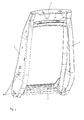
- a backrest according to an embodiment of the invention is shown in a perspective view.
- the backrest comprises two lateral uprights 2, 3, which essentially define the lateral contour of the backrest and the fastening possibilities 8 for the Lehnenne Trentsversteller and z. B. have side airbags.
- the spars 2, 3 are connected at a lower portion by a cross member 5 and in an upper portion by a cross member 1, for example by welding and / or screw connections.
- the side rails 2, 3, the cross member 5 and the cross member 1 may be formed of a metal, preferably aluminum or magnesium, of a metal alloy, also preferably an aluminum or magnesium alloy or of a plastic having the required mechanical properties.
- the cross member 1 has two flanges 1c, which, except at the end portions of the cross member 1, where it is connected to the side rails 2, 3, extend over the entire length of the cross member.
- the two flanges 1c each have coaxially arranged openings 1d for receiving the struts of a headrest 7.
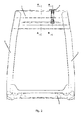
- Fig. 2 is the back off Fig. 1 represented from the front, in which the position of the sectional views explained below by the sectional lines AA and BB is indicated. Furthermore, in Fig. 2 a guide 4 shown, by means of which the headrest (not shown) can be adjusted in height.
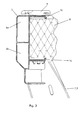
- Fig. 3 shows a sectional view along the section line AA Fig. 2 , From which it is apparent that the cross member 1 over substantially the entire width of the backrest is a hollow profile-shaped extruded profile with two chambers or cavities 1a, 1b, which have a substantially rectangular cross-section.
- the cross-sectional shape of the chambers 1a, 1b is not limited to the illustrated shape, and extrusion profiles having other cross sections and a different number of chambers 1b may be used.
- From this extruded L-shaped flanges extend 1 c, which are integrally formed with the cross member 1.
- the in Fig. 3 illustrated upper flange 1c is flush with the upper edge of the cross member 1, and the lower flange is spaced from the lower edge of the cross member 1.
- Each chamber 1a, 1b of the cross member is associated with a flange 1c.
- the backrest foam 6 in the region of the shoulders of the occupant can be made very voluminous, whereby the upper body or the shoulder of the occupant in the case of a collision of the vehicle can dive very far into the backrest, without causing a relative movement of the head relative to the upper body of the occupant.
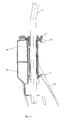
- Fig. 4 is the cross member 1 in a sectional view along the section line BB Fig. 2 , ie along the inserted guide 4 for a headrest, shown.
- the guide 4 is tubular and the openings 1d are arranged coaxially with one another. It is also conceivable that the displacement of the headrest describes a circular path and the guide 4 or the openings 1 d are adapted or arranged accordingly.
- a strut used in the guide 4 a headrest 7 shown. By means of the guide 4, the headrest 7 is adjustable in height via their struts.
- the cross member 1 Due to the structural design of the cross member 1 as an extruded profile with hollow profile of this has a very high torsional resistance, with the result that the head of the occupant is not displaced further to the rear, whereby excessive movement of the cervical vertebrae is avoided. It thus finds, as stated above, only a rotation of the upper body and the head of the occupant around the hip joint, thereby minimizing the risk of injury to the cervical vertebrae or whiplash. It is also possible that in plastic deformation of the flanges 1c by bending down the headrest is moved towards the head of the occupant and thus the head is brought earlier in contact with the headrest, which in the event of a collision, a displacement of the head is further limited.
- the backrest of the present invention can be used to avoid or reduce neck trauma injuries and the risk of whiplash injury.
Landscapes
- Engineering & Computer Science (AREA)
- Aviation & Aerospace Engineering (AREA)
- Transportation (AREA)
- Mechanical Engineering (AREA)
- Seats For Vehicles (AREA)
- Chair Legs, Seat Parts, And Backrests (AREA)
Abstract
Description
- Die Erfindung betrifft eine Lehne für einen Sitz eines Kraftfahrzeuges.
- Lehnen für Kraftfahrzeugsitze weisen als Sicherheitsmerkmal eine Kopfstütze auf, die bei einem Aufprall beispielsweise auf das Heck des Kraftfahrzeuges verhindert, dass der Kopf des Insassen nach hinten abknickt und es dadurch zu einem Schleudertrauma/Peitschenschlagsyndrom kommt.
-
DE 689 08 581 T2 beschreibt einen als Hohlprofil ausgebildeten Querträger einer Sitzlehne, durch den Streben einer Kopfstütze durchgeführt sind. Seitlich ist der Querträger mit jeweils einem Seitenholm des Sitzes verbunden.US 5,816,658 B beschreibt eine höhenverstellbare Befestigung einer Kopfstütze. InDE 42 38 549 A1 ist ein Fahrzeugsitz beschrieben, der einen Sitzrahmen und einen im Kollisionsfall verformbaren, gegossenen Rückenlehnenrahmen umfasst. - Für eine effektive Verhinderung eines Schleudertraumas ist es wichtig, dass der Kopf des Insassen des Fahrzeuges möglichst wenig nach hinten verlagert wird und nach Auftreffen des Kopfes auf die Kopfstütze der Kopf zusammen mit dem Oberkörper lediglich eine Bewegung in Form einer Rotation um das Hüftgelenk durchführt, wodurch eine Bewegung im Bereich der Nackenwirbel nahezu vermieden wird.
- Um dies zu erreichen, könnte die Kopfstütze weiter vorne in der Nähe des Kopfes montiert werden. Dies würde allerdings den Sitzkomfort erheblich einschränken.
- Weiterhin besteht die Möglichkeit, aktive Kopfstützen zu verwenden, die sich im Fall einer Kollision des Kraftfahrzeuges nach vorne bewegen. Diese Möglichkeit ist jedoch aufwendig und teuer.
- Im Allgemeinen werden Lehnen aus tiefgezogenen Blechteilen aus Stahl, die miteinander verschweißt werden, konstruiert, wobei die Verbindung der Kopfstütze mit der Lehne über ein mit einem Querträger im oberen Bereich der Lehne verbundenes Führungssystem bewerkstelligt wird. Nachteil hierbei ist, dass der das Führungssystem aufweisende Querträger, der im oberen Bereich der Lehne angeordnet ist, ebenfalls aus einem tiefgezogenen Blechteil hergestellt ist, das beim Aufprall keine ausreichende Torsionssteifigkeit aufweist. Aufgabe des Querträgers ist es, alle auf die Kopfstütze ausgeübten Kräfte in die Lehne einzuleiten und keine Verschiebung der Kopfstütze zuzulassen. Außerdem müssen tiefgezogene Blechteile vollständig verschweißt werden, damit sich konstruktiv hohe Torsionssteifigkeiten realisieren lassen.
- Es ist daher eine Aufgabe der Erfindung, eine Lehne für einen Kraftfahrzeugsitz zu schaffen, die das Risiko eines Schleudertraumas im Falle einer Kollision des Fahrzeuges vermeidet bzw. verringert.
- Diese Aufgabe wird durch eine Lehne für einen Sitz eines Kraftfahrzeuges mit den Merkmalen des Anspruches 1 gelöst.
- Im Kollisionsfall des Kraftfahrzeuges wird die Aufprallenergie des Oberkörpers des auf dem Kraftfahrzeugsitz befindlichen Insassen zunächst von der Sitzpolsterung aufgenommen. Ist die Aufprallenergie allerdings derart groß, dass diese nicht mehr vollständig von der Sitzpolsterung aufgenommen werden kann und der Oberkörper im Bereich der Schulterpartie an das Deformationselement anschlägt, wird ein Teil dieser Energie durch Deformation des Deformationselements abgeführt. Während dieser Deformation wird der Kopf des Insassen in Anlage mit der Kopfstütze gebracht. Dadurch, dass der Querträger als Hohlprofil mit sehr hoher Torsionssteifigkeit ausgebildet ist, wird folglich der Kopf relativ zum Oberkörper nicht weiter nach hinten verlagert, wodurch das Risiko eines Schleudertraumas und ein Abknicken des Kopfes des Insassen zumindest minimiert wird. Ebenso wird durch den torsionssteifen Querträger ein struktursteifes Verhalten der Kopfstütze ermöglicht.
- Die Deformationselemente können so ausgebildet und angeordnet sein, dass durch diese zusätzlicher Bauraum (Blocklänge) für den Lehnenschaum zur Verfügung gestellt wird, wodurch erst bei einem übermäßigen Einsinken der Schulterpartie des Insassen das Deformationselement leicht deformiert wird, ohne dass der Querträger beschädigt wird.
- Bevorzugte Ausgestaltungen und Weiterbildungen der Erfindung sind Gegenstand der Unteransprüche 2 bis 10.
- Im Folgenden wird eine bevorzugte Ausführungsform der erfindungsgemäßen Lehne unter Bezug auf die beigefügten Zeichnungen erläutert.
-
Fig. 1 zeigt eine perspektivische Ansicht einer Lehne gemäß einer Ausführungsform der Erfindung, -
Fig. 2 zeigt die Lehne ausFig. 1 von vorne, in der Schnittlinien der in denFiguren 3 und4 gezeigten Schnittansichten enthalten sind, -
Fig. 3 ist eine Schnittansicht entlang der Schnittlinie A-A ausFig. 2 , und -
Fig. 4 ist eine Schnittansicht entlang der Schnittlinie B-B ausFig. 2 . - In
Fig. 1 ist eine Lehne gemäß einer Ausführungsform der Erfindung in einer perspektivischen Ansicht dargestellt. Die Lehne umfasst zwei seitliche Holme 2, 3, die im Wesentlichen die seitliche Kontur der Lehne festlegen und die Befestigungsmöglichkeiten 8 für den Lehnenneigungsversteller und z. B. Seitenairbags aufweisen. Zur Erreichung einer stabilen Konstruktion sind die Holme 2, 3 an einem unteren Abschnitt durch einen Querträger 5 und in einem oberen Abschnitt durch einen Querträger 1 z.B. durch Schweiß- und/oder Schraubverbindungen verbunden. Die Seitenholme 2, 3, der Querträger 5 und der Querträger 1 können aus einem Metall, vorzugsweise Aluminium oder Magnesium, aus einer Metalllegierung, ebenfalls vorzugsweise eine Aluminium- oder Magnesiumlegierung oder auch aus einem die benötigten mechanischen Eigenschaften aufweisenden Kunststoff gebildet sein. - Der Querträger 1 weist zwei Flansche 1c auf, die mit Ausnahme an den Endabschnitten des Querträgers 1, an denen dieser mit den Seitenholmen 2, 3 verbunden ist, über die gesamte Länge des Querträgers sich erstrecken. Die beiden Flansche 1c weisen jeweils koaxial zueinander angeordnete Öffnungen 1d für die Aufnahme der Streben einer Kopfstütze 7 auf.
- In
Fig. 2 ist die Lehne ausFig. 1 von vorne dargestellt, in der die Lage der im Folgenden erläuterten Schnittansichten durch die Schnittlinien A-A und B-B angegeben ist. Weiterhin ist inFig. 2 eine Führung 4 dargestellt, mittels derer die Kopfstütze (nicht gezeigt) in der Höhe verstellt werden kann. -
Fig. 3 zeigt eine Schnittansicht entlang der Schnittlinie A-A ausFig. 2 , aus der ersichtlich ist, dass der Querträger 1 über im Wesentlichen die gesamte Breite der Lehne ein hohlprofilförmiges Strangpressprofil ist mit zwei Kammern bzw. Hohlräumen 1a, 1b, die einen im Wesentlichen rechteckigen Querschnitt aufweisen. Die Querschnittsform der Kammern 1a, 1b ist nicht auf die dargestellte Form beschränkt und es können Strangpressprofile mit anderen Querschnitten und einer anderen Anzahl an Kammern 1b verwendet werden. Von diesem Strangpressprofil erstrecken sich L-förmige Flansche 1c, die einteilig mit dem Querträger 1 ausgebildet sind. Der inFig. 3 dargestellte obere Flansch 1c verläuft dabei bündig mit der Oberkante des Querträgers 1, und der untere Flansch ist von der Unterkante des Querträgers 1 beabstandet. Jeder Kammer 1a, 1b des Querträgers ist ein Flansch 1c zugeordnet. - Einerseits dienen die Flansche 1c zur Aufnahme der Führungen 4 bzw. der Streben der Kopfstütze 7 (siehe
Fig. 4 ), andererseits wird durch die Anordnung der Flansche 1c und deren Dimensionierung senkrecht zum Querträger 1 zusätzlicher Bauraum für den Lehnenschaum 6 geschaffen. Dadurch kann der Lehnenschaum 6 im Bereich der Schulterpartie des Insassen sehr voluminös ausgestaltet werden, wodurch der Oberkörper bzw. die Schulterpartie des Insassen im Falle einer Kollision des Fahrzeuges sehr weit in die Lehne eintauchen kann, ohne dass es dabei zu einer Relativbewegung des Kopfes gegenüber dem Oberkörper des Insassen kommt. - In
Fig. 4 ist der Querträger 1 in einer Schnittansicht entlang der Schnittlinie B-B ausFig. 2 , d. h. entlang der eingesetzten Führung 4 für eine Kopfstütze, dargestellt. InFig. 4 ist die Führung 4 rohrförmig ausgebildet und sind die Öffnungen 1d koaxial zueinander angeordnet. Es ist auch denkbar, dass die Verschiebung der Kopfstütze eine Kreisbahn beschreibt und die Führung 4 bzw. die Öffnungen 1d entsprechend angepasst bzw. angeordnet sind. Weiterhin ist inFig. 4 eine in die Führung 4 eingesetzte Strebe einer Kopfstütze 7 gezeigt. Mittels der Führung 4 ist die Kopfstütze 7 über ihre Streben in der Höhe verstellbar. - Ist im Kollisionsfall des Fahrzeuges bei niedriger Geschwindigkeit, beispielsweise 5-50 km/h, die Aufprallenergie des Oberkörpers des Insassen auf die Lehne derart groß, dass beim Eintauchen der Oberkörper in Kontakt mit den beiden Flanschen 1c kommt, können diese sich deformieren, wodurch durch die plastische Verformung der Flansche 1c zusätzlich Energie absorbiert wird, ohne dass der dahinterliegende Querträger beschädigt und die Steifigkeit der Kopfstütze beeinträchtigt wird. Durch die Deformation der Flansche 1c wird ein noch tieferes Eintauchen der Schulterpartie des Insassen in die Lehne ermöglicht und der Kopf in Anlage mit der Kopfstütze gebracht. Dabei wird eine Torsionskraft um die Längsachse des Querträgers 3 auf diesen ausgeübt und in diesen eingeleitet. Aufgrund der konstruktiven Ausgestaltung des Querträgers 1 als Strangpressprofil mit Hohlprofil hat dieser einen sehr hohen Torsionswiderstand, mit der Folge, dass der Kopf des Insassen nicht weiter nach hinten verlagert wird, wodurch eine übermäßige Bewegung der Halswirbel vermieden wird. Es findet somit, wie oben ausgeführt, lediglich eine Rotation des Oberkörpers und des Kopfes des Insassen um das Hüftgelenk statt, wodurch das Risiko einer Verletzung der Halswirbel bzw. eines Schleudertraumas minimiert wird. Ebenso ist es möglich, dass bei plastischer Deformation der Flansche 1c durch Abknicken nach unten die Kopfstütze in Richtung Kopf des Insassen bewegt wird und somit der Kopf frühzeitiger in Anlage mit der Kopfstütze gebracht wird, wodurch im Kollisionsfall eine Verlagerung des Kopfes weiter begrenzt ist.
- Wie aus dem Obigen klar verständlich, können mit der erfindungsgemäßen Lehne Nackenwirbelsäulenverletzungen und das Risiko eines Schleudertraumas vermieden bzw. verringert werden.
Claims (10)
- Lehne für einen Sitz eines Kraftfahrzeuges, mit einem als Hohlprofil ausgebildeten Querträger (1) zur Befestigung einer Kopfstütze (7) und mindestens einem Deformationselement (1c), das zur Aufnahme einer senkrecht zum Querträger (1) wirkenden Kraft angeordnet ist.
- Lehne nach Anspruch 1, wobei der Querträger (1) ein Strangpressprofil ist.
- Lehne nach Anspruch 1 oder 2, wobei der Querträger (1) über seine gesamte Länge als Hohlprofil ausgebildet ist.
- Lehne nach einem der vorhergehenden Ansprüche, wobei der Querträger (1) zwei vertikal übereinander angeordnete Hohlräume (1a, 1b) aufweist.
- Lehne nach einem der vorhergehenden Ansprüche, wobei das Deformationselement (1c) derart ausgebildet ist, dass es im Kollisionsfall des Kraftfahrzeuges bei einer Geschwindigkeit im Bereich von 5-50 km/h durch den Schulterbereich der auf dem Sitz befindlichen Person plastisch deformiert wird.
- Lehne nach einem der vorhergehenden Ansprüche, wobei das Deformationselement (1c) zur Aufnahme des Lehnenpolsters (6) ausgebildet ist.
- Lehne nach einem der vorhergehenden Ansprüche, wobei das Deformationselement (1c) einteilig mit dem Querträger (1) ausgebildet ist.
- Lehne nach einem der vorhergehenden Ansprüche, wobei das Deformationselement (1c) L-förmig ausgebildet ist und senkrecht zur Längsachse des Querträgers (1) verläuft.
- Lehne nach einem der vorhergehenden Ansprüche, bei der zwei Deformationselemente (1c) vorgesehen sind, wobei ein Deformationselement (1c) bündig mit einer Oberkante des Querträgers (1) und das andere Deformationselement von der Unterkante des Querträgers (1) beabstandet angeordnet ist.
- Lehne nach Anspruch 9, wobei in den beiden Deformationselementen (1c) jeweils eine Öffnung zur Aufnahme einer Strebe der Kopfstütze (7) vorgesehen ist und die Öffnungen koaxial zueinander angeordnet sind.
Applications Claiming Priority (1)
| Application Number | Priority Date | Filing Date | Title |
|---|---|---|---|
| DE102007053896A DE102007053896A1 (de) | 2007-11-12 | 2007-11-12 | Lehne für einen Kraftfahrzeugsitz |
Publications (2)
| Publication Number | Publication Date |
|---|---|
| EP2058166A1 true EP2058166A1 (de) | 2009-05-13 |
| EP2058166B1 EP2058166B1 (de) | 2010-10-20 |
Family
ID=40351801
Family Applications (1)
| Application Number | Title | Priority Date | Filing Date |
|---|---|---|---|
| EP08168974A Not-in-force EP2058166B1 (de) | 2007-11-12 | 2008-11-12 | Lehne für einen Kraftfahrzeugsitz |
Country Status (2)
| Country | Link |
|---|---|
| EP (1) | EP2058166B1 (de) |
| DE (2) | DE102007053896A1 (de) |
Citations (6)
| Publication number | Priority date | Publication date | Assignee | Title |
|---|---|---|---|---|
| DE3050958C2 (de) * | 1980-06-04 | 1987-12-23 | Eugen Otto 4010 Hilden De Butz | |
| EP0330594A1 (de) * | 1988-02-22 | 1989-08-30 | Grammer-Sable | Gefüge für einen oder mehrere Sitze |
| DE4238549A1 (de) | 1992-11-14 | 1994-05-19 | Daimler Benz Ag | Kraftfahrzeugsitz |
| DE4442588A1 (de) * | 1994-11-30 | 1996-06-05 | Fahrzeugsitze Bad Schandau Gmb | Sitz, insbesondere Fahrzeugsitz für öffentliche Verkehrsmittel |
| US5816658A (en) | 1997-05-23 | 1998-10-06 | Flexsteel Industries, Inc. | Head rest lock |
| DE29918761U1 (de) * | 1999-10-25 | 2000-01-20 | Fehrer F S Gmbh & Co Kg | Kopfstützenanordnung für einen Fahrzeugsitz |
-
2007
- 2007-11-12 DE DE102007053896A patent/DE102007053896A1/de not_active Withdrawn
-
2008
- 2008-11-12 EP EP08168974A patent/EP2058166B1/de not_active Not-in-force
- 2008-11-12 DE DE502008001575T patent/DE502008001575D1/de active Active
Patent Citations (7)
| Publication number | Priority date | Publication date | Assignee | Title |
|---|---|---|---|---|
| DE3050958C2 (de) * | 1980-06-04 | 1987-12-23 | Eugen Otto 4010 Hilden De Butz | |
| EP0330594A1 (de) * | 1988-02-22 | 1989-08-30 | Grammer-Sable | Gefüge für einen oder mehrere Sitze |
| DE68908581T2 (de) | 1988-02-22 | 1994-03-17 | Grammer Sable Roche La Moliere | Gefüge für einen oder mehrere Sitze. |
| DE4238549A1 (de) | 1992-11-14 | 1994-05-19 | Daimler Benz Ag | Kraftfahrzeugsitz |
| DE4442588A1 (de) * | 1994-11-30 | 1996-06-05 | Fahrzeugsitze Bad Schandau Gmb | Sitz, insbesondere Fahrzeugsitz für öffentliche Verkehrsmittel |
| US5816658A (en) | 1997-05-23 | 1998-10-06 | Flexsteel Industries, Inc. | Head rest lock |
| DE29918761U1 (de) * | 1999-10-25 | 2000-01-20 | Fehrer F S Gmbh & Co Kg | Kopfstützenanordnung für einen Fahrzeugsitz |
Also Published As
| Publication number | Publication date |
|---|---|
| DE102007053896A1 (de) | 2009-05-20 |
| EP2058166B1 (de) | 2010-10-20 |
| DE502008001575D1 (de) | 2010-12-02 |
Similar Documents
| Publication | Publication Date | Title |
|---|---|---|
| DE60020028T2 (de) | Verbesserungen an einem fahrersitz | |
| DE102004030215B4 (de) | Kopfstütze für Sitze | |
| DE102018204461A1 (de) | Fahrzeugsitz | |
| DE20217258U1 (de) | Kopfstützenverstellvorrichtung | |
| DE69811672T2 (de) | Einziehbare kopfstütze für kraftwagen | |
| DE102014001920A1 (de) | Sitzstruktur für ein Fahrzeug, Verfahren zum Abstützen eines rückwärtigen Abschnitts eines Fahrzeugsitzes und Abstützstruktur eines Fahrzeugsitzes | |
| WO2012110208A1 (de) | STOßFÄNGER FÜR KRAFTFAHRZEUGE MIT INTEGRIERTERN FUßGÄNGERSCHUTZSYSTEM | |
| DE102008050501B4 (de) | Armlehne, wie Mittelarmlehne für Fahrzeuge | |
| DE102011004627A1 (de) | Fahrzeugsitz | |
| EP2910412B1 (de) | Sitz, insbesondere Fahrgastsitz | |
| EP2058166B1 (de) | Lehne für einen Kraftfahrzeugsitz | |
| DE19614141C2 (de) | Kinderschutz für Kraftfahrzeuge | |
| DE10318927B4 (de) | Kopfstütze in Form eines mehrteiligen Netzes | |
| EP1190892B1 (de) | Sitz für ein Kraftfahrzeug | |
| DE102004014420A1 (de) | Rohrrahmen für einen Sitz | |
| DE20209141U1 (de) | Griffeinrichtung für einen Fahrzeuginnenraum | |
| DE19849994C5 (de) | Fahrzeugsitz | |
| DE10133414B4 (de) | Fahrzeugsitz mit begrenzter Rückverlagerung von Sitzkomponenten unter Energieabsorption bei einem Heckaufprall | |
| EP1332066A1 (de) | Gelenkhebelkonstruktion für ein sitzgestell | |
| DE102020201512A1 (de) | Sitzanordnung für ein Kraftfahrzeug | |
| DE10245253A1 (de) | Kraftfahrzeugsitz | |
| DE102018128309B4 (de) | Sitzanlage für ein Fahrzeug sowie Fahrzeug mit wenigstens einer solchen Sitzanlage | |
| DE102010009356A1 (de) | Sitz in einem Fortbewegungsmittel | |
| DE102006056081A1 (de) | Fahrzeugsitz insbesondere für einen Kraftwagen | |
| DE20019217U1 (de) | Sitzrückenlehne mit Kopfstütze |
Legal Events
| Date | Code | Title | Description |
|---|---|---|---|
| PUAI | Public reference made under article 153(3) epc to a published international application that has entered the european phase |
Free format text: ORIGINAL CODE: 0009012 |
|
| AK | Designated contracting states |
Kind code of ref document: A1 Designated state(s): AT BE BG CH CY CZ DE DK EE ES FI FR GB GR HR HU IE IS IT LI LT LU LV MC MT NL NO PL PT RO SE SI SK TR |
|
| AX | Request for extension of the european patent |
Extension state: AL BA MK RS |
|
| RAP1 | Party data changed (applicant data changed or rights of an application transferred) |
Owner name: ALUTECH GESELLSCHAFT M.B.H. |
|
| 17P | Request for examination filed |
Effective date: 20091112 |
|
| AKX | Designation fees paid |
Designated state(s): DE FR GB IT |
|
| GRAP | Despatch of communication of intention to grant a patent |
Free format text: ORIGINAL CODE: EPIDOSNIGR1 |
|
| GRAC | Information related to communication of intention to grant a patent modified |
Free format text: ORIGINAL CODE: EPIDOSCIGR1 |
|
| GRAS | Grant fee paid |
Free format text: ORIGINAL CODE: EPIDOSNIGR3 |
|
| GRAA | (expected) grant |
Free format text: ORIGINAL CODE: 0009210 |
|
| AK | Designated contracting states |
Kind code of ref document: B1 Designated state(s): DE FR GB IT |
|
| REG | Reference to a national code |
Ref country code: GB Ref legal event code: FG4D Free format text: NOT ENGLISH |
|
| REF | Corresponds to: |
Ref document number: 502008001575 Country of ref document: DE Date of ref document: 20101202 Kind code of ref document: P |
|
| PLBE | No opposition filed within time limit |
Free format text: ORIGINAL CODE: 0009261 |
|
| STAA | Information on the status of an ep patent application or granted ep patent |
Free format text: STATUS: NO OPPOSITION FILED WITHIN TIME LIMIT |
|
| 26N | No opposition filed |
Effective date: 20110721 |
|
| REG | Reference to a national code |
Ref country code: DE Ref legal event code: R097 Ref document number: 502008001575 Country of ref document: DE Effective date: 20110721 |
|
| REG | Reference to a national code |
Ref country code: DE Ref legal event code: R082 Ref document number: 502008001575 Country of ref document: DE Representative=s name: KOTITSCHKE & HEURUNG PARTNERSCHAFT MBB PATENT-, DE Ref country code: DE Ref legal event code: R082 Ref document number: 502008001575 Country of ref document: DE Representative=s name: KOTITSCHKE & HEURUNG PARTNERSCHAFT MBB, DE Ref country code: DE Ref legal event code: R082 Ref document number: 502008001575 Country of ref document: DE Representative=s name: DR. RALF KOTITSCHKE, DE |
|
| PGFP | Annual fee paid to national office [announced via postgrant information from national office to epo] |
Ref country code: FR Payment date: 20141119 Year of fee payment: 7 Ref country code: GB Payment date: 20141119 Year of fee payment: 7 Ref country code: DE Payment date: 20141127 Year of fee payment: 7 |
|
| PGFP | Annual fee paid to national office [announced via postgrant information from national office to epo] |
Ref country code: IT Payment date: 20141124 Year of fee payment: 7 |
|
| REG | Reference to a national code |
Ref country code: DE Ref legal event code: R119 Ref document number: 502008001575 Country of ref document: DE |
|
| GBPC | Gb: european patent ceased through non-payment of renewal fee |
Effective date: 20151112 |
|
| PG25 | Lapsed in a contracting state [announced via postgrant information from national office to epo] |
Ref country code: IT Free format text: LAPSE BECAUSE OF NON-PAYMENT OF DUE FEES Effective date: 20151112 |
|
| REG | Reference to a national code |
Ref country code: FR Ref legal event code: ST Effective date: 20160729 |
|
| PG25 | Lapsed in a contracting state [announced via postgrant information from national office to epo] |
Ref country code: GB Free format text: LAPSE BECAUSE OF NON-PAYMENT OF DUE FEES Effective date: 20151112 Ref country code: DE Free format text: LAPSE BECAUSE OF NON-PAYMENT OF DUE FEES Effective date: 20160601 |
|
| PG25 | Lapsed in a contracting state [announced via postgrant information from national office to epo] |
Ref country code: FR Free format text: LAPSE BECAUSE OF NON-PAYMENT OF DUE FEES Effective date: 20151130 |