EP2046526B1 - High hardness/high wear resistant iron based weld overlay materials - Google Patents
High hardness/high wear resistant iron based weld overlay materials Download PDFInfo
- Publication number
- EP2046526B1 EP2046526B1 EP07813043.2A EP07813043A EP2046526B1 EP 2046526 B1 EP2046526 B1 EP 2046526B1 EP 07813043 A EP07813043 A EP 07813043A EP 2046526 B1 EP2046526 B1 EP 2046526B1
- Authority
- EP
- European Patent Office
- Prior art keywords
- composition
- alloy
- welding
- point
- hardness
- Prior art date
- Legal status (The legal status is an assumption and is not a legal conclusion. Google has not performed a legal analysis and makes no representation as to the accuracy of the status listed.)
- Active
Links
Images








Classifications
-
- B—PERFORMING OPERATIONS; TRANSPORTING
- B23—MACHINE TOOLS; METAL-WORKING NOT OTHERWISE PROVIDED FOR
- B23K—SOLDERING OR UNSOLDERING; WELDING; CLADDING OR PLATING BY SOLDERING OR WELDING; CUTTING BY APPLYING HEAT LOCALLY, e.g. FLAME CUTTING; WORKING BY LASER BEAM
- B23K35/00—Rods, electrodes, materials, or media, for use in soldering, welding, or cutting
- B23K35/22—Rods, electrodes, materials, or media, for use in soldering, welding, or cutting characterised by the composition or nature of the material
- B23K35/24—Selection of soldering or welding materials proper
- B23K35/30—Selection of soldering or welding materials proper with the principal constituent melting at less than 1550°C
- B23K35/3026—Mn as the principal constituent
-
- B—PERFORMING OPERATIONS; TRANSPORTING
- B23—MACHINE TOOLS; METAL-WORKING NOT OTHERWISE PROVIDED FOR
- B23K—SOLDERING OR UNSOLDERING; WELDING; CLADDING OR PLATING BY SOLDERING OR WELDING; CUTTING BY APPLYING HEAT LOCALLY, e.g. FLAME CUTTING; WORKING BY LASER BEAM
- B23K35/00—Rods, electrodes, materials, or media, for use in soldering, welding, or cutting
- B23K35/22—Rods, electrodes, materials, or media, for use in soldering, welding, or cutting characterised by the composition or nature of the material
- B23K35/24—Selection of soldering or welding materials proper
- B23K35/30—Selection of soldering or welding materials proper with the principal constituent melting at less than 1550°C
- B23K35/3053—Fe as the principal constituent
-
- C—CHEMISTRY; METALLURGY
- C22—METALLURGY; FERROUS OR NON-FERROUS ALLOYS; TREATMENT OF ALLOYS OR NON-FERROUS METALS
- C22C—ALLOYS
- C22C1/00—Making non-ferrous alloys
- C22C1/11—Making amorphous alloys
-
- C—CHEMISTRY; METALLURGY
- C22—METALLURGY; FERROUS OR NON-FERROUS ALLOYS; TREATMENT OF ALLOYS OR NON-FERROUS METALS
- C22C—ALLOYS
- C22C22/00—Alloys based on manganese
-
- C—CHEMISTRY; METALLURGY
- C22—METALLURGY; FERROUS OR NON-FERROUS ALLOYS; TREATMENT OF ALLOYS OR NON-FERROUS METALS
- C22C—ALLOYS
- C22C33/00—Making ferrous alloys
- C22C33/003—Making ferrous alloys making amorphous alloys
-
- C—CHEMISTRY; METALLURGY
- C22—METALLURGY; FERROUS OR NON-FERROUS ALLOYS; TREATMENT OF ALLOYS OR NON-FERROUS METALS
- C22C—ALLOYS
- C22C33/00—Making ferrous alloys
- C22C33/02—Making ferrous alloys by powder metallurgy
- C22C33/0207—Using a mixture of pre-alloyed powders or a master alloy
- C22C33/0228—Using a mixture of pre-alloyed powders or a master alloy comprising other non-metallic compounds or more than 5% of graphite
-
- C—CHEMISTRY; METALLURGY
- C22—METALLURGY; FERROUS OR NON-FERROUS ALLOYS; TREATMENT OF ALLOYS OR NON-FERROUS METALS
- C22C—ALLOYS
- C22C33/00—Making ferrous alloys
- C22C33/02—Making ferrous alloys by powder metallurgy
- C22C33/0257—Making ferrous alloys by powder metallurgy characterised by the range of the alloying elements
- C22C33/0278—Making ferrous alloys by powder metallurgy characterised by the range of the alloying elements with at least one alloying element having a minimum content above 5%
- C22C33/0285—Making ferrous alloys by powder metallurgy characterised by the range of the alloying elements with at least one alloying element having a minimum content above 5% with Cr, Co, or Ni having a minimum content higher than 5%
-
- C—CHEMISTRY; METALLURGY
- C22—METALLURGY; FERROUS OR NON-FERROUS ALLOYS; TREATMENT OF ALLOYS OR NON-FERROUS METALS
- C22C—ALLOYS
- C22C33/00—Making ferrous alloys
- C22C33/02—Making ferrous alloys by powder metallurgy
- C22C33/0257—Making ferrous alloys by powder metallurgy characterised by the range of the alloying elements
- C22C33/0278—Making ferrous alloys by powder metallurgy characterised by the range of the alloying elements with at least one alloying element having a minimum content above 5%
- C22C33/0292—Making ferrous alloys by powder metallurgy characterised by the range of the alloying elements with at least one alloying element having a minimum content above 5% with more than 5% preformed carbides, nitrides or borides
-
- C—CHEMISTRY; METALLURGY
- C22—METALLURGY; FERROUS OR NON-FERROUS ALLOYS; TREATMENT OF ALLOYS OR NON-FERROUS METALS
- C22C—ALLOYS
- C22C38/00—Ferrous alloys, e.g. steel alloys
- C22C38/02—Ferrous alloys, e.g. steel alloys containing silicon
-
- C—CHEMISTRY; METALLURGY
- C22—METALLURGY; FERROUS OR NON-FERROUS ALLOYS; TREATMENT OF ALLOYS OR NON-FERROUS METALS
- C22C—ALLOYS
- C22C38/00—Ferrous alloys, e.g. steel alloys
- C22C38/04—Ferrous alloys, e.g. steel alloys containing manganese
-
- C—CHEMISTRY; METALLURGY
- C22—METALLURGY; FERROUS OR NON-FERROUS ALLOYS; TREATMENT OF ALLOYS OR NON-FERROUS METALS
- C22C—ALLOYS
- C22C38/00—Ferrous alloys, e.g. steel alloys
- C22C38/18—Ferrous alloys, e.g. steel alloys containing chromium
-
- C—CHEMISTRY; METALLURGY
- C22—METALLURGY; FERROUS OR NON-FERROUS ALLOYS; TREATMENT OF ALLOYS OR NON-FERROUS METALS
- C22C—ALLOYS
- C22C38/00—Ferrous alloys, e.g. steel alloys
- C22C38/18—Ferrous alloys, e.g. steel alloys containing chromium
- C22C38/22—Ferrous alloys, e.g. steel alloys containing chromium with molybdenum or tungsten
-
- C—CHEMISTRY; METALLURGY
- C22—METALLURGY; FERROUS OR NON-FERROUS ALLOYS; TREATMENT OF ALLOYS OR NON-FERROUS METALS
- C22C—ALLOYS
- C22C38/00—Ferrous alloys, e.g. steel alloys
- C22C38/18—Ferrous alloys, e.g. steel alloys containing chromium
- C22C38/26—Ferrous alloys, e.g. steel alloys containing chromium with niobium or tantalum
-
- C—CHEMISTRY; METALLURGY
- C22—METALLURGY; FERROUS OR NON-FERROUS ALLOYS; TREATMENT OF ALLOYS OR NON-FERROUS METALS
- C22C—ALLOYS
- C22C38/00—Ferrous alloys, e.g. steel alloys
- C22C38/18—Ferrous alloys, e.g. steel alloys containing chromium
- C22C38/34—Ferrous alloys, e.g. steel alloys containing chromium with more than 1.5% by weight of silicon
-
- C—CHEMISTRY; METALLURGY
- C22—METALLURGY; FERROUS OR NON-FERROUS ALLOYS; TREATMENT OF ALLOYS OR NON-FERROUS METALS
- C22C—ALLOYS
- C22C38/00—Ferrous alloys, e.g. steel alloys
- C22C38/18—Ferrous alloys, e.g. steel alloys containing chromium
- C22C38/38—Ferrous alloys, e.g. steel alloys containing chromium with more than 1.5% by weight of manganese
-
- C—CHEMISTRY; METALLURGY
- C22—METALLURGY; FERROUS OR NON-FERROUS ALLOYS; TREATMENT OF ALLOYS OR NON-FERROUS METALS
- C22C—ALLOYS
- C22C45/00—Amorphous alloys
-
- C—CHEMISTRY; METALLURGY
- C22—METALLURGY; FERROUS OR NON-FERROUS ALLOYS; TREATMENT OF ALLOYS OR NON-FERROUS METALS
- C22C—ALLOYS
- C22C45/00—Amorphous alloys
- C22C45/02—Amorphous alloys with iron as the major constituent
-
- B—PERFORMING OPERATIONS; TRANSPORTING
- B22—CASTING; POWDER METALLURGY
- B22F—WORKING METALLIC POWDER; MANUFACTURE OF ARTICLES FROM METALLIC POWDER; MAKING METALLIC POWDER; APPARATUS OR DEVICES SPECIALLY ADAPTED FOR METALLIC POWDER
- B22F1/00—Metallic powder; Treatment of metallic powder, e.g. to facilitate working or to improve properties
- B22F1/05—Metallic powder characterised by the size or surface area of the particles
-
- B—PERFORMING OPERATIONS; TRANSPORTING
- B22—CASTING; POWDER METALLURGY
- B22F—WORKING METALLIC POWDER; MANUFACTURE OF ARTICLES FROM METALLIC POWDER; MAKING METALLIC POWDER; APPARATUS OR DEVICES SPECIALLY ADAPTED FOR METALLIC POWDER
- B22F9/00—Making metallic powder or suspensions thereof
- B22F9/02—Making metallic powder or suspensions thereof using physical processes
- B22F9/06—Making metallic powder or suspensions thereof using physical processes starting from liquid material
- B22F9/08—Making metallic powder or suspensions thereof using physical processes starting from liquid material by casting, e.g. through sieves or in water, by atomising or spraying
- B22F9/082—Making metallic powder or suspensions thereof using physical processes starting from liquid material by casting, e.g. through sieves or in water, by atomising or spraying atomising using a fluid
- B22F2009/0824—Making metallic powder or suspensions thereof using physical processes starting from liquid material by casting, e.g. through sieves or in water, by atomising or spraying atomising using a fluid with a specific atomising fluid
- B22F2009/0828—Making metallic powder or suspensions thereof using physical processes starting from liquid material by casting, e.g. through sieves or in water, by atomising or spraying atomising using a fluid with a specific atomising fluid with water
-
- B—PERFORMING OPERATIONS; TRANSPORTING
- B22—CASTING; POWDER METALLURGY
- B22F—WORKING METALLIC POWDER; MANUFACTURE OF ARTICLES FROM METALLIC POWDER; MAKING METALLIC POWDER; APPARATUS OR DEVICES SPECIALLY ADAPTED FOR METALLIC POWDER
- B22F9/00—Making metallic powder or suspensions thereof
- B22F9/02—Making metallic powder or suspensions thereof using physical processes
- B22F9/06—Making metallic powder or suspensions thereof using physical processes starting from liquid material
- B22F9/08—Making metallic powder or suspensions thereof using physical processes starting from liquid material by casting, e.g. through sieves or in water, by atomising or spraying
-
- B—PERFORMING OPERATIONS; TRANSPORTING
- B22—CASTING; POWDER METALLURGY
- B22F—WORKING METALLIC POWDER; MANUFACTURE OF ARTICLES FROM METALLIC POWDER; MAKING METALLIC POWDER; APPARATUS OR DEVICES SPECIALLY ADAPTED FOR METALLIC POWDER
- B22F9/00—Making metallic powder or suspensions thereof
- B22F9/02—Making metallic powder or suspensions thereof using physical processes
- B22F9/06—Making metallic powder or suspensions thereof using physical processes starting from liquid material
- B22F9/08—Making metallic powder or suspensions thereof using physical processes starting from liquid material by casting, e.g. through sieves or in water, by atomising or spraying
- B22F9/082—Making metallic powder or suspensions thereof using physical processes starting from liquid material by casting, e.g. through sieves or in water, by atomising or spraying atomising using a fluid
-
- C—CHEMISTRY; METALLURGY
- C22—METALLURGY; FERROUS OR NON-FERROUS ALLOYS; TREATMENT OF ALLOYS OR NON-FERROUS METALS
- C22C—ALLOYS
- C22C2200/00—Crystalline structure
- C22C2200/02—Amorphous
-
- C—CHEMISTRY; METALLURGY
- C22—METALLURGY; FERROUS OR NON-FERROUS ALLOYS; TREATMENT OF ALLOYS OR NON-FERROUS METALS
- C22C—ALLOYS
- C22C2200/00—Crystalline structure
- C22C2200/04—Nanocrystalline
Definitions
- the present disclosure relates to iron based glass forming alloys and a method of producing the alloys to produce feedstock for a variety of weld overlay hardfacing application techniques.
- the present application also relates to targeted alloy chemistries that may be processed into industrial products using conventional industrial processing strategies without the necessity to macroscopically blend to form a macrocomposite.
- Weld overlay materials may be macrocomposites which may be developed by starting with hard particles which may include carbides (i.e. WC, VC, Cr 3 C 2 , Cr 23 C 6 , TiC, HfC, etc.), borides (TiB 2 , ZrB 2 , etc.), borocarbides (M(BC) 2 , M(BC) 3 , M 23 (BC) 6 , etc.), nitrides (i.e. BN, TiN, A l N, etc.), and/or other specific hard phases like diamond, etc.
- hard particles may include carbides (i.e. WC, VC, Cr 3 C 2 , Cr 23 C 6 , TiC, HfC, etc.), borides (TiB 2 , ZrB 2 , etc.), borocarbides (M(BC) 2 , M(BC) 3 , M 23 (BC) 6 , etc.), nitrides (i.e. BN, TiN, A l
- binder which may be incorporated at various volume fractions (i.e typically 15 to 90 at% hard particle) to an appropriate binder which may be nickel (or nickel alloy) based, cobalt (or cobalt alloy) based, or iron (or iron alloy) based.
- the binder may provide a matrix to hold the hard particles by wetting its surface sufficiently so that it is captured while not completely dissolving.
- the binder may also provide a measure of toughness / crack resistance to enable the composite to perform adequately in service.
- the present application relates to the composition as defined in claim 1
- the composition forms a ductile matrix of ⁇ -Fe and/or ⁇ -Fe including phases of complex boride, complex carbides or borocarbides.
- a further exemplary embodiment also relates to a metallic alloy composition which may be used for hardfacing weld overlay applications.
- the alloy composition may include 44.2 to 55.4 at% of a base metal made up of iron and manganese, 20.2 to 39.3 at% of a interstitial element selected from the group boron, carbon, silicon and combinations thereof, 13.3 to 20.5 at% of a transition metal selected from the group chromium, molybdenum, tungsten and combinations thereof, and 3.2 to 4.4 at% of niobium.
- An additional exemplary embodiment relates to a method of hardfacing a substrate.
- the present invention relates to a method according to claim 8.
- the present invention relates to alloy designs that may form liquid melts of a homogeneous nature.
- the targeted alloy chemistries may be processed into industrial products using conventional industrial processing strategies without the necessity to macroscopically blend to form a macrocomposite.
- methods such as atomization may be used break up liquid melts into powder particles.
- the powder particles may then be sized to yield targeted powder sizes for various overlay application strategies.
- the particles may be used alone, in conjunction with or in combination with commercially available powders to form cored wires and stick electrodes for various welding processes.
- the alloy designs for hardfacing may be formulated around glass forming chemical formulations.
- the metallic alloy composition may be composed of a base metal, at least one interstitial element, at least one transition metal and niobium.
- the base metal is present in the range of 44.2 to 55.4 at%
- one or more interstitial elements may be present in the range of 20.2 to 39.3 at%
- one or more transition metals may be present in the range of 13.3 to 20.5 at%
- niobium may be present in the range of 3.2 to 4.4 at%.
- Exemplary alloy chemistries are summarized in Table 1.
- the alloys may be produced either on a pilot or production scale and then further processed as feedstock for hardfacing for various weld overlay application strategies.
- the atomic percent of each alloy is further graphed as a function of Fe + Mn, B + C + Si, Cr + Mo + W, and Niobium.
- these exemplary chemistries while not all encompassing, represent chemistries that may achieve specific refined structures having a desired specific hardness and wear resistance properties.
- the alloy composition may be atomized to provide a powder.
- Exemplary atomization processes may include gas atomization, centrifugal atomization or water atomization.
- the powder particles may be sized using various techniques such as screening, classification and air classification. In an exemplary embodiment, at least 50% of the powder particles may fall within the ranges of 10 to 300 ⁇ m, including all values and increments therein such as in the range of 53 to 106 ⁇ m, 53 to 150 ⁇ m or 45 to 180 ⁇ m, etc. It should be appreciated however, that other particles size ranges may be contemplated and that the ranges may be tighter or broader as well as the particles sizes larger or smaller depending upon the application or desired hardfacing overlay weld technique. For example, during laser fusing particles 53 to 106 ⁇ m may be used as feedstock and for plasma transferred arc-welding (PTAW), 45 to 180 ⁇ m powders may be used for feedstock.
- PTAW plasma transferred arc-welding
- the powders contemplated herein may be used alone, in combination with or in conjunction with commercially available powders, or commercially available powders may be used alone to hit specific target chemistries and put into the inside of a cored wire to make metal powder cored wires.
- the cored wires may be manufactured in various diameters in the range of 0.01 to 0.5 inches, including but not limited to all values and increments therein such as 0.045", 1/16", 7/64", 1/8", and 3/16".
- the cored wires may be used as feedstock for various welding processes which use wire. Examples of wire feed hardfacing techniques include, but are not limited to, gas metal arc-welding (GMAW), metal inert gas (MIG) welding, submerged arc welding, and open arc welding.
- GMAW gas metal arc-welding
- MIG metal inert gas
- the powder may also be used alone, with commercially available powders, or in conjuction with commercially available powders and put inside of a cored wire to make stick electrodes of various diameters including but not limited to 0.045", 1/16", 5/64", 3/32", 1/8", and 3/16" and welded through various hardfacing strategies including but not limited to shielded metal arc welding (SMAW) or stick welding.
- SMAW shielded metal arc welding
- the alloys may be applied to any number of substrates, including various steel alloys.
- the alloys may be used in various overlay processes such as laser welding, plasma transferred arc-welding (PTAW), gas metal arc-welding (GMAW), metal inert gas welding (MIG), submerged arc welding, open arc welding, shielded metal arc welding (SMAW) or stick welding.
- PTAW plasma transferred arc-welding
- GMAW gas metal arc-welding
- MIG metal inert gas welding
- SMAW shielded metal arc welding
- the alloys may be formulated to form substantially glassy compositions.
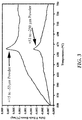
- exemplary DTA scans are shown for ALLOY 6 which was processed at high and low cooling rates.
- the upper curve illustrates an exemplary DTA scan of ALLOY 6 produced at high cooling rates and the lower curve illustrates an exemplary DTA scan of ALLOY 6 produced at lower cooling rates.
- the single exemplary glass to crystalline transformation peak on each curve is seen near a peak temperature of 660°C.
- the alloy may be produced in both powder and wire form for various hardfacing applications including laser, PTAW, GMAW, and MIG.
- the formation of glass alloys may refine the scale of the crystalline microstructure.
- the level of refinement may depend on a variety of factors including the glass forming ability of the alloy, the cooling rate of the industrial processing method, the total heat input, the thickness of the weld overlay deposit, etc.
- the average cooling rate of the industrial welding process may be greater (i.e. faster) than the critical cooling rate for metallic glass formation of the feedstock material, and metallic glass weld deposits may be formed during welding. If the total heat input is insufficient to cause devitrification, metallic glass overlays may be formed with an angstrom scale microstructure but if the total heat input is too great, then partial or complete devitrification may occur resulting in the formation of a nanoscale composite microstructure.
- Undercooling may be understood to be the lowering of the temperature of a liquid beyond the freezing temperature and still maintaining a liquid form.
- the undercooling which may be many hundreds of degrees greater than that obtained in conventional alloys, may result in higher driving forces for nucleation, while a reduction in the temperature dependant diffusional processes, may result in an increased nucleation frequency and reduced time for grain / phase growth.
- the level of undercooling is increased, the resulting average grain / phase size may be reduced.
- Fine particles may also preferentially wear the matrix of conventional macrocomposite weld overlay materials.
- conventional PTA powders may be made up using 45 to 180 ⁇ m coarse WC particulates and may be added to a nickel based matrix powder which may be an alloy containing nickel, chromium, boron, and silicon. While the resulting 45 to 180 ⁇ m (if no dissolution occurs) WC particles may be very hard, commonly the nickel matrix based on its chemistry may be Rc 35 to 50. Thus, if fine particles like sand are present, the matrix may preferentially wear resulting in pull-out of the WC hard phases.
- the hard carbide, boride, borocarbide, and/ or nitride particulates may be 5 to 100 nm in size, in other cases where high undercooling may achieved, the scale of the hard phases may be 400 to 1000 nm (i.e. 1 ⁇ m), and in other cases where limited undercooling may be achieved, the scale of the hard phases may be 1,000 nm to 25,000 nm (i.e. 25 ⁇ m). Thus, in almost all cases the scale of the hard particulates may be finer than those achieved in conventional commercially available hardfacing materials. The finer distribution of hard particle sizes may prevent preferential wear of the matrix under abrasive conditions.
- the volume fraction of precipitates may be increased to high levels which may generally not be obtainable by conventional approaches.
- various high volume fractions of hard boride, carbide, and/or borocarbide precipitates may be precipitated out during welding in the range of greater than 15% and at least up to 75% hard phase.
- any ratio of hard metal to binder may easily be mixed, generally only up to 65% hard metal may be used due to problems with incomplete wetting and brittleness.
- less hard phases may be incorporated into the middle of the metal wire core. For example, commonly 35%, 40%, and 45% are the maximum fill ratios in making up metal cored wire in the range of 0.01 inches to 0.5 inches, including all values and increments therein such as 0.045", 1/16", and 7/64" respectively.
- the alloys herein may be utilized at higher welding rates (i.e. inches per minute (IPM) wire feed welding or pounds per hour (lb/hr) in powder feed systems).
- IPM inches per minute
- lb/hr pounds per hour
- higher deposition rates may necessitate higher heat input which may cause problems since the hard particulates which are added in the composite mix can often break down, dissolve completely or partially, and/or cause secondary precipitation of inferior phases which are either more brittle, or softer.
- the hard particles may form during solidification and therefore these issues may not cause problems.
- the alloys may exhibit hardness values greater than about 64 Rc and all values and ranges greater than 64 Rc.
- the maximum hardness of the alloy may occur within 250 microns of the base metal surface.
- utilizing the composition of 44.2 to 55.4 at% of a base metal 20.2 to 39.3 at% of at least one interstitial element, 13.3 to 20.5 at% of at least one transition metal and 3.2 to 4.4 at% of niobium a hardness of greater than about Rc 68 may be obtained.
- the alloys may exhibit wear resistance as measured by ASTM G65 Procedure A (6,000 cycles) having a mass loss of less than 0.20 g, including all values and increments therein such as 0.1, 0.08 etc.
- the alloys may include a ductile matrix consisting of ⁇ -Fe and/or ⁇ -Fe phases including phases of complex borides (i.e. M 2 B and M 3 B, wherein M may be a transition metal present in the alloy composition), complex carbides (M 1 C 1 and M 23 C 6 , wherein M may be a transition metal present in the alloy composition) and/or borocarbides.
- M 2 B and M 3 B phases of complex borides
- M 1 C 1 and M 23 C 6 wherein M may be a transition metal present in the alloy composition
- borocarbides borocarbides
- the hardness of the weld overlays of the alloys shown in Table 1 was measured with Rockwell C.
- Tables 2, 3, 4, and 5 the hardness is shown of the single and double pass weld overlays which were welded using GMAW.
- ALLOY 5 hardness is shown in hardfacing deposits made from three different diameter wires; 1/16", 0.045", and 7/64".
- the 7/64" weld overlay data are for samples welded in the open-arc condition (i.e. no cover gas).
- Tables 6 and 7 the hardnesses of the single pass and double pass PTAW weld overlays are shown.
- the high single pass hardness in the alloys may not be because dilution may not occur but instead because the alloys are "overalloyed," that is the alloys take into account that dilution may occur and the alloys may be adjusted accordingly, allowing for maximum hardness to be obtained.
- the wear resistance of the weld overlays was measured using a Falex Friction & Wear Test Machine following the dry rubber wheel sand abrasion ASTM G65 standard under the Procedure A conditions. Note that Procedure A involves testing for a duration of 6000 cycles. After performing the ASTM G65 Procedure A test, another subsequent Procedure A test was taken directly in the wear scar of the first. In Tables 8 and 9, selected ASTM G65 mass loss results are shown for the single and double pass GMAW and single pass PTAW weld overlay samples respectively. Note that the mass losses measured were indicative of very high wear rates with all of the samples showing mass losses which were below 0.20 g.
- ALLOY 5 was inert gas atomized using argon to produce a powder with a distribution from 1 to 250 ⁇ m with an average mean size (d50) of 92.5 ⁇ m.
- DTA scans are shown of two different powder sizes, 15 to 53 ⁇ m and 53 to 250 ⁇ m. In both cases, glass to crystalline peaks were found showing that the starting powders were at least partially amorphous (i.e. contained metallic glass).
- the powder was sieved in several different sizes but downselected to yield a feedstock powder from 53 to 150 ⁇ m appropriate for PTAW welding.
- the feedstock powder was plasma transfer arc-welded to form single pass hardface deposits onto A36 steel using a Eutectic GAP 375 PTA weld system.
- the powder was welded at two different deposit rates of 3.5 and 18.0 lbs/hr.
- the Rockwell C hardness and ASTM G65 dry sand rubber wheel wear resistance (Procedure A) of the deposits were measured and are shown in Table 10. As shown, very high hardness ( ⁇ Rc 70) and very low wear rates ( ⁇ 0.05-0.07 g mass loss) were obtained.
- Table 10 Hardness /Wear Resistance of ALLOY 5 PTAW Weld Overlay Alloy Lbs/Hr Hardness Rc average ASTM G65 1 st 6000 cycles mass loss (g) ASTM G65 2nd 6000 cycles mass loss (g) ALLOY 5 3.5 69.9 0.0673 0.0543 ALLOY 5 18.0 70.7 0.0550 0.0502
- the microstructure of the weld overlay deposits were analyzed using X-ray diffraction to primarily identify the phases present and by using backscattered electrons in the SEM to primarily show the size and distribution of the phases present.
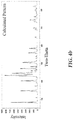
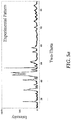
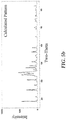
- the X-ray diffraction diagrams were further analyzed using Rietveld analysis to identify the phases present.
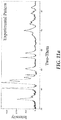
- exemplary experimental (a) and Rietveld refined (b) X-Ray diffraction patterns for an ALLOY 5 PTAW weld overlay deposited at 3.5 lbs hour are shown.
- FIGS. 4a and 4b exemplary experimental (a) and Rietveld refined (b) X-Ray diffraction patterns for an ALLOY 5 PTAW weld overlay deposited at 3.5 lbs hour are shown.
- FIGS. 4a and 4b exemplary experimental (a) and Rietveld refined (b) X-Ray diffraction patterns for an ALLOY 5 PTAW weld overlay deposited at 3.5 lbs hour are shown.
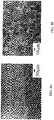
- FIGS. 6a, 6b , 7a and 7b illustrate SEM backscattered electron micrographs of an ALLOY 5 PTAW sample which was welded at 3.5 lb / hr at a) low magnification and b) high magnification.
- FIG. 7a and 7b illustrate SEM backscattered electron micrographs of an ALLOY 5 PTAW sample which was welded at 18.0 lb / hr at a) low magnification and b) high magnification.
- a range of carbide and boride precipitates can be found which are various shapes including cubic, tetragonal, and irregular shaped.
- limited EDS studies of the various phases formed indicate that many of these phases contain both boron and carbon indicating that rather than distinct complex borides or carbides, they may be considered complex borocarbide phases.
- the scale of these borocarbide phases vary but typically are found to be in three size classes, large primary rectangular shaped phases 2 to 10 ⁇ m wide and 10 to 60 ⁇ m long, medium cubic shaped 2 to 10 ⁇ m in size, and small secondary precipitates from 300 nm to 1000 nm in size.
- the wear scar was examined after ASTM G65 wear testing using secondary electrons. Secondary electrons are useful since they may illustrate height changes in the sample.
- FIGS. 8a and 8b secondary electron images are shown at two different magnifications of the wear scar surface after ASTM G65 wear testing of the 3.5 lb/hr ALLOY 5 PTA sample. As shown, on the microscale level, no preferential wearing of individual phases can be found but instead a uniform wear scar develops. Note that the standard sand in the ASTM G65 test is AFS 50/70 which is a coarse sand from 212 to 300 ⁇ m in size.
- ALLOY 5 was produced as a continuous metal cored wire in 1/16" diameter (1.6 mm) which may be an appropriate feedstock for hardfacing.
- the ALLOY 5 cored wire was deposited as a hardfacing overlay onto A36 substrates using a Miller Delta-Fab MIG welding system.
- the hardfacing was deposited over a wide parameter range but for the results in this example the parameters that were used are shown in Table 12.
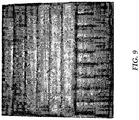
- FIG. 9 a picture of a two pass GMAW weld overlay wear plate (8" by 8" outside dimensions) of ALLOY 5 is shown.
- Table 12 Weld Parameters for ALLOY 5 GMAW Current DCRP Volts 23 Wire feed 250 ipm wire Shielding Gas 75%Ar-25%CO 2 Stickout 1 ⁇ 2"
- Hardness of single pass and double pass GMAW weld overlay samples of ALLOY 5 was measured using Rockwell C and the results are summarized in Table 13. As shown, very high hardness was obtained with the average being over Rc 71.
- FIGS. 10a and 10b pictures are shown of the a) 1-pass and b) 2-pass GMAW samples of ALLOY 5 and the resulting results of wear testing are shown following ASTMG65 Procedure A in Table 14. Note that additionally, a second 6,000 cycle measurement was done in the wear scar of the first. As shown, very low wear rates were obtained with mass losses found from 0.05 to 0.07 g.
- the microstructure of the weld overlay deposits were analyzed using X-ray diffraction to identify the phases present and by using backscattered electrons in the SEM to show the size and distribution of the phases present.
- the X-ray diffraction diagrams were further analyzed using Rietveld analysis to identify the phases present.
- FIG. 11a an X-ray diffraction diagram is shown of the ALLOY 5 double pass GMAW sample.
- FIG. 11b After Rietveld refinement illustrated in FIG. 11b , the phases were identified in the alloy and are shown in Table 15. The results show that a range of complex borides (i.e.
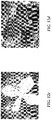
- FIGS. 12a, 12b , 12c and 12d SEM backscattered electron micrographs are shown at a range of magnification for the ALLOY 5 GMAW samples in FIGS. 12a, 12b , 12c and 12d .
- a range of carbide and boride precipitates can be found which are various shapes including cubic, tetragonal, and irregular shaped. Note that limited EDS studies of the various phases formed indicate that many of these phases contain both boron and carbon indicating that rather than distinct complex borides or carbides, they may be best considered complex borocarbide phases.
- the scale of these borocarbide phases vary but typically are found to be in three size classes, large primary rectangular shaped phases 5 to 20 ⁇ m wide and 50 to 175 ⁇ m long, medium cubic shaped 10 to 20 ⁇ m in size, and small secondary precipitates from 500 nm to 1.5 ⁇ m in size.
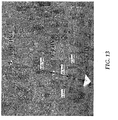
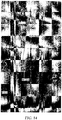
- FIGS. 13 and 14 exemplary SEM backscattered electron micrographs are shown of ALLOY 5 and ALLOY 6 respectively at the interface of the base metal /weld overlay and then up into the weld overlay. Note that the difference in hardness readings may easily be discerned from the size of the hardness indentation and the individual points are located from the point number in Table 16. In the ALLOY 5 single pass case, it can be seen that high hardness is obtained in 41 microns from the base metal interface. Note that Rc 68 is roughly equivalent to HV300 of 940 so this may be considered a very high hardness point in the weld overlay metal.
- the microhardness point spacing was greater but it is clear that high hardness was obtained at the 210 ⁇ m point away from the base metal interface but since the microstructure looks similar in the range of distance from 41 to 210 ⁇ m, it is quite likely that the high hardness was obtained in a similar fashion to the ALLOY 5 sample, that is before the 210 ⁇ m point.
- the dilution layer of the weld material would be approximately 30%. Since the single pass thickness is approximately 0.15" (0.381 cm), then the expected dilution layer would be expected to extend to ⁇ 1150 ⁇ m. Thus, while the dilution layer, which is governed by diffusion does exist, the weld overlays were designed so that when welded onto base steel substrates the dilution would not lower hardness. Note that these results are in agreement with the single and double pass hardness and wear results presented for a large number of these alloys in Tables 2 through 9. In conventional GMAW alloys, often 2, 3, or more passes may be necessary to reach the maximum hardness and wear resistance but in the alloys presented in this disclosure the maximum hardness /wear can be reached in one layer.
Landscapes
- Chemical & Material Sciences (AREA)
- Engineering & Computer Science (AREA)
- Mechanical Engineering (AREA)
- Materials Engineering (AREA)
- Metallurgy (AREA)
- Organic Chemistry (AREA)
- Powder Metallurgy (AREA)
- Arc Welding In General (AREA)
- Nonmetallic Welding Materials (AREA)
Applications Claiming Priority (2)
| Application Number | Priority Date | Filing Date | Title |
|---|---|---|---|
| US11/458,209 US8704134B2 (en) | 2005-02-11 | 2006-07-18 | High hardness/high wear resistant iron based weld overlay materials |
| PCT/US2007/073757 WO2008011448A2 (en) | 2006-07-18 | 2007-07-18 | High hardness/high wear resistant iron based weld overlay materials |
Publications (3)
| Publication Number | Publication Date |
|---|---|
| EP2046526A2 EP2046526A2 (en) | 2009-04-15 |
| EP2046526A4 EP2046526A4 (en) | 2016-05-25 |
| EP2046526B1 true EP2046526B1 (en) | 2020-05-27 |
Family
ID=38957576
Family Applications (1)
| Application Number | Title | Priority Date | Filing Date |
|---|---|---|---|
| EP07813043.2A Active EP2046526B1 (en) | 2006-07-18 | 2007-07-18 | High hardness/high wear resistant iron based weld overlay materials |
Country Status (8)
| Country | Link |
|---|---|
| US (1) | US8704134B2 (enExample) |
| EP (1) | EP2046526B1 (enExample) |
| JP (1) | JP5788637B2 (enExample) |
| CN (1) | CN101516567B (enExample) |
| AU (1) | AU2007275296B2 (enExample) |
| BR (1) | BRPI0714305B1 (enExample) |
| CA (1) | CA2658296C (enExample) |
| WO (1) | WO2008011448A2 (enExample) |
Families Citing this family (49)
| Publication number | Priority date | Publication date | Assignee | Title |
|---|---|---|---|---|
| US7935198B2 (en) * | 2005-02-11 | 2011-05-03 | The Nanosteel Company, Inc. | Glass stability, glass forming ability, and microstructural refinement |
| US7939142B2 (en) * | 2007-02-06 | 2011-05-10 | Ut-Battelle, Llc | In-situ composite formation of damage tolerant coatings utilizing laser |
| US20100300750A1 (en) * | 2009-05-28 | 2010-12-02 | Halliburton Energy Services, Inc. | Perforating Apparatus for Enhanced Performance in High Pressure Wellbores |
| WO2011005404A2 (en) * | 2009-07-08 | 2011-01-13 | Sandvik Intelectual Property Ab | Wear resistant weld overlay on downhole mining components |
| WO2011005403A1 (en) * | 2009-07-08 | 2011-01-13 | Sandvik Intellectual Property Ab | Wear resistant weld overlay on bearing surfaces in tricone mining rockbits |
| KR101719018B1 (ko) * | 2009-08-10 | 2017-03-23 | 더 나노스틸 컴퍼니, 인코포레이티드 | 고경도 오버레이를 생산하기 위한 공급원료 파우더 |
| KR100935816B1 (ko) * | 2009-08-18 | 2010-01-08 | 한양대학교 산학협력단 | 내마모성이 우수한 무크롬 철계 경면처리 합금 |
| US8647449B2 (en) * | 2009-09-17 | 2014-02-11 | Scoperta, Inc. | Alloys for hardbanding weld overlays |
| US20110064963A1 (en) * | 2009-09-17 | 2011-03-17 | Justin Lee Cheney | Thermal spray processes and alloys for use in same |
| US8562759B2 (en) * | 2009-09-17 | 2013-10-22 | Scoperta, Inc. | Compositions and methods for determining alloys for thermal spray, weld overlay, thermal spray post processing applications, and castings |
| US8562760B2 (en) * | 2009-09-17 | 2013-10-22 | Scoperta, Inc. | Compositions and methods for determining alloys for thermal spray, weld overlay, thermal spray post processing applications, and castings |
| CA2779308C (en) * | 2009-10-30 | 2019-01-29 | The Nanosteel Company, Inc. | Glass forming hardbanding material |
| US8497027B2 (en) * | 2009-11-06 | 2013-07-30 | The Nanosteel Company, Inc. | Utilization of amorphous steel sheets in honeycomb structures |
| US9314880B2 (en) * | 2010-10-21 | 2016-04-19 | Stoody Company | Chromium free hardfacing welding consumable |
| CN102619477B (zh) * | 2011-01-28 | 2014-03-26 | 中国石油大学(华东) | 一种耐磨耐蚀铁基合金激光熔覆石油钻杆接头 |
| US8640941B2 (en) | 2011-03-23 | 2014-02-04 | Scoperta, Inc. | Fine grained Ni-based alloys for resistance to stress corrosion cracking and methods for their design |
| CN104039483B (zh) | 2011-12-30 | 2017-03-01 | 思高博塔公司 | 涂层组合物 |
| CN104271788B (zh) * | 2012-03-06 | 2017-03-01 | 思高博塔公司 | 用于环形加硬焊接覆盖层的合金 |
| WO2013152306A1 (en) * | 2012-04-05 | 2013-10-10 | Chevron U.S.A. Inc. | Metal alloy compositions and applications thereof |
| US20130266798A1 (en) * | 2012-04-05 | 2013-10-10 | Justin Lee Cheney | Metal alloy compositions and applications thereof |
| US20130266820A1 (en) * | 2012-04-05 | 2013-10-10 | c/o Chevron Corporation | Metal alloy compositions and applications thereof |
| AU2013329190B2 (en) | 2012-10-11 | 2017-09-28 | Scoperta, Inc. | Non-magnetic metal alloy compositions and applications |
| US20160047028A1 (en) * | 2013-03-15 | 2016-02-18 | Liquidmetal Coatings, Llc | Composite coating material with amorphous-containing matrix |
| US9475154B2 (en) | 2013-05-30 | 2016-10-25 | Lincoln Global, Inc. | High boron hardfacing electrode |
| EP3052671B1 (en) * | 2013-10-02 | 2020-08-26 | The Nanosteel Company, Inc. | Recrystallization, refinement, and strengthening mechanisms for production of advanced high strength metal alloys |
| CA2927074C (en) | 2013-10-10 | 2022-10-11 | Scoperta, Inc. | Methods of selecting material compositions and designing materials having a target property |
| US9802387B2 (en) | 2013-11-26 | 2017-10-31 | Scoperta, Inc. | Corrosion resistant hardfacing alloy |
| CN103737332A (zh) * | 2014-01-07 | 2014-04-23 | 烟台开发区蓝鲸金属修复有限公司 | 一种硬质高线辊环的生产方法 |
| KR20160120747A (ko) * | 2014-02-14 | 2016-10-18 | 더 나노스틸 컴퍼니, 인코포레이티드 | 쇼트 물질 및 쇼트 피닝 방법 |
| WO2015191458A1 (en) | 2014-06-09 | 2015-12-17 | Scoperta, Inc. | Crack resistant hardfacing alloys |
| US10465269B2 (en) | 2014-07-24 | 2019-11-05 | Scoperta, Inc. | Impact resistant hardfacing and alloys and methods for making the same |
| US10465267B2 (en) | 2014-07-24 | 2019-11-05 | Scoperta, Inc. | Hardfacing alloys resistant to hot tearing and cracking |
| EP3234209B1 (en) * | 2014-12-16 | 2024-07-24 | Scoperta, Inc. | Tough and wear resistant ferrous alloys containing multiple hardphases |
| KR102235612B1 (ko) | 2015-01-29 | 2021-04-02 | 삼성전자주식회사 | 일-함수 금속을 갖는 반도체 소자 및 그 형성 방법 |
| JP6999081B2 (ja) * | 2015-09-04 | 2022-01-18 | エリコン メテコ(ユーエス)インコーポレイテッド | 非クロム及び低クロム耐摩耗性合金 |
| US10851444B2 (en) | 2015-09-08 | 2020-12-01 | Oerlikon Metco (Us) Inc. | Non-magnetic, strong carbide forming alloys for powder manufacture |
| MX393339B (es) | 2015-11-10 | 2025-03-24 | Scoperta Inc | Materiales de rociado por arco de dos hilos controlado por oxidación. |
| US11279996B2 (en) | 2016-03-22 | 2022-03-22 | Oerlikon Metco (Us) Inc. | Fully readable thermal spray coating |
| KR20200019184A (ko) | 2017-06-13 | 2020-02-21 | 오를리콘 메트코 (유에스) 아이엔씨. | 높은 경질상 분율 비자성 합금 |
| CN107699843B (zh) * | 2017-09-21 | 2019-10-15 | 河海大学 | 一种制备高非晶含量涂层用的粉芯丝材及其制备方法和应用 |
| WO2019191400A1 (en) | 2018-03-29 | 2019-10-03 | Oerlikon Metco (Us) Inc. | Reduced carbides ferrous alloys |
| CN113195759B (zh) | 2018-10-26 | 2023-09-19 | 欧瑞康美科(美国)公司 | 耐腐蚀和耐磨镍基合金 |
| CA3134191A1 (en) | 2019-03-28 | 2020-10-01 | Oerlikon Metco (Us) Inc. | Thermal spray iron-based alloys for coating engine cylinder bores |
| CA3136967A1 (en) | 2019-05-03 | 2020-11-12 | Oerlikon Metco (Us) Inc. | Powder feedstock for wear resistant bulk welding configured to optimize manufacturability |
| MX2022000309A (es) | 2019-07-09 | 2022-03-17 | Oerlikon Metco Us Inc | Aleaciones a base de hierro dise?adas para resistencia al desgaste y la corrosion. |
| CN110549035B (zh) * | 2019-10-14 | 2021-02-26 | 湘潭大学 | 一种埋弧堆焊高硼合金的复合粉粒及其应用方法 |
| US11781205B2 (en) * | 2019-12-31 | 2023-10-10 | Liquidmetal Coatings Enterprises, Llc | Structured amorphous metals (SAM) feedstock and products thereof |
| CN115379911A (zh) | 2020-02-25 | 2022-11-22 | 欧瑞康美科(美国)公司 | 类球状碳化钨颗粒 |
| CA3198648A1 (en) * | 2020-10-13 | 2022-04-21 | Centre De Recherches Metallurgiques Asbl | Method of manufacturing a hot rolling mill roll by laser cladding |
Family Cites Families (29)
| Publication number | Priority date | Publication date | Assignee | Title |
|---|---|---|---|---|
| DE2522690C3 (de) * | 1975-05-22 | 1982-03-04 | Goetze Ag, 5093 Burscheid | Plasmaauftragsschweißpulver für die Herstellung verschleißfester Schichten |
| DE2829702C3 (de) * | 1978-07-06 | 1982-02-18 | Metallgesellschaft Ag, 6000 Frankfurt | Nickel-Basis-Legierung |
| JPS6016512B2 (ja) | 1979-01-30 | 1985-04-25 | 東北金属工業株式会社 | 耐食性,耐応力腐食割れに優れた非晶質磁性合金 |
| US4365994A (en) * | 1979-03-23 | 1982-12-28 | Allied Corporation | Complex boride particle containing alloys |
| JPS6030734B2 (ja) * | 1979-04-11 | 1985-07-18 | 健 増本 | 鉄族元素とジルコニウムを含む脆性が小さく熱的安定性に優れる非晶質合金 |
| US4297135A (en) * | 1979-11-19 | 1981-10-27 | Marko Materials, Inc. | High strength iron, nickel and cobalt base crystalline alloys with ultrafine dispersion of borides and carbides |
| DE3120168C2 (de) | 1980-05-29 | 1984-09-13 | Allied Corp., Morris Township, N.J. | Verwendung eines Metallkörpers als Elektromagnetkern |
| JPS57160513A (en) * | 1981-03-31 | 1982-10-02 | Takeshi Masumoto | Maunfacture of amorphous metallic fine wire |
| DE3274562D1 (en) | 1981-08-21 | 1987-01-15 | Allied Corp | Metallic glasses having a combination of high permeability, low coercivity, low ac core loss, low exciting power and high thermal stability |
| JPS5855557A (ja) | 1981-09-29 | 1983-04-01 | Takeshi Masumoto | 鉄族系非晶質合金 |
| JPS5913056A (ja) | 1983-06-06 | 1984-01-23 | Res Inst Iron Steel Tohoku Univ | 高強度、耐疲労、耐全面腐食、耐孔食、耐隙間腐食、耐応力腐食割れ、耐水素脆性用アモルフアス鉄合金 |
| US6007922A (en) * | 1984-09-18 | 1999-12-28 | Union Carbide Coatings Service Corporation | Chromium boride coatings |
| JPS61157661A (ja) | 1984-12-28 | 1986-07-17 | Kobe Steel Ltd | コロナワイヤ用アモルフアス合金 |
| JPS6425943A (en) | 1988-07-06 | 1989-01-27 | Takeshi Masumoto | Amorphous metallic filament |
| US5003155A (en) * | 1989-09-11 | 1991-03-26 | The Lincoln Electric Company | Basic metal cored electrode |
| US5250355A (en) * | 1991-12-17 | 1993-10-05 | Kennametal Inc. | Arc hardfacing rod |
| JP3233313B2 (ja) * | 1993-07-21 | 2001-11-26 | 日立金属株式会社 | パルス減衰特性に優れたナノ結晶合金の製造方法 |
| JP3877893B2 (ja) * | 1999-01-08 | 2007-02-07 | アルプス電気株式会社 | 高周波用高透磁率金属ガラス合金 |
| US6258185B1 (en) * | 1999-05-25 | 2001-07-10 | Bechtel Bwxt Idaho, Llc | Methods of forming steel |
| US6645314B1 (en) | 2000-10-02 | 2003-11-11 | Vacuumschmelze Gmbh | Amorphous alloys for magneto-acoustic markers in electronic article surveillance having reduced, low or zero co-content and method of annealing the same |
| US6689234B2 (en) * | 2000-11-09 | 2004-02-10 | Bechtel Bwxt Idaho, Llc | Method of producing metallic materials |
| KR20040081784A (ko) | 2002-02-11 | 2004-09-22 | 유니버시티 오브 버지니아 페이턴트 파운데이션 | 벌크 응고형 고망간 비강자성 비정질 강철 합금, 이의이용 방법 및 제조 방법 |
| JP3929327B2 (ja) | 2002-03-01 | 2007-06-13 | 独立行政法人科学技術振興機構 | 軟磁性金属ガラス合金 |
| WO2004074522A2 (en) * | 2003-02-14 | 2004-09-02 | The Nanosteel Company | Method of modifying iron based glasses to increase crytallization temperature without changing melting temperature |
| CN1520956A (zh) * | 2003-02-15 | 2004-08-18 | 北京中煤矿山工程有限公司 | 耐磨堆焊药芯焊丝 |
| JP4576854B2 (ja) * | 2004-03-10 | 2010-11-10 | 大同特殊鋼株式会社 | 高温耐摩耗性部材およびそれに使用する肉盛溶接材料 |
| CN1304161C (zh) * | 2004-12-23 | 2007-03-14 | 北京工业大学 | 高硬度高耐磨自保护金属芯堆焊焊丝 |
| US7553382B2 (en) * | 2005-02-11 | 2009-06-30 | The Nanosteel Company, Inc. | Glass stability, glass forming ability, and microstructural refinement |
| US7935198B2 (en) * | 2005-02-11 | 2011-05-03 | The Nanosteel Company, Inc. | Glass stability, glass forming ability, and microstructural refinement |
-
2006
- 2006-07-18 US US11/458,209 patent/US8704134B2/en active Active
-
2007
- 2007-07-18 CA CA2658296A patent/CA2658296C/en active Active
- 2007-07-18 CN CN2007800341678A patent/CN101516567B/zh active Active
- 2007-07-18 BR BRPI0714305-2A patent/BRPI0714305B1/pt not_active IP Right Cessation
- 2007-07-18 EP EP07813043.2A patent/EP2046526B1/en active Active
- 2007-07-18 WO PCT/US2007/073757 patent/WO2008011448A2/en not_active Ceased
- 2007-07-18 AU AU2007275296A patent/AU2007275296B2/en active Active
- 2007-07-18 JP JP2009520971A patent/JP5788637B2/ja not_active Expired - Fee Related
Non-Patent Citations (1)
| Title |
|---|
| None * |
Also Published As
| Publication number | Publication date |
|---|---|
| US8704134B2 (en) | 2014-04-22 |
| AU2007275296B2 (en) | 2013-11-07 |
| JP2009543699A (ja) | 2009-12-10 |
| BRPI0714305B1 (pt) | 2014-09-16 |
| EP2046526A4 (en) | 2016-05-25 |
| CA2658296C (en) | 2015-11-17 |
| CN101516567A (zh) | 2009-08-26 |
| BRPI0714305A2 (pt) | 2013-05-07 |
| WO2008011448A2 (en) | 2008-01-24 |
| CA2658296A1 (en) | 2008-01-24 |
| AU2007275296A1 (en) | 2008-01-24 |
| CN101516567B (zh) | 2011-09-28 |
| EP2046526A2 (en) | 2009-04-15 |
| US20070029295A1 (en) | 2007-02-08 |
| JP5788637B2 (ja) | 2015-10-07 |
| WO2008011448A3 (en) | 2008-05-02 |
Similar Documents
| Publication | Publication Date | Title |
|---|---|---|
| US8704134B2 (en) | High hardness/high wear resistant iron based weld overlay materials | |
| CA2597562C (en) | Improved glass stability, glass forming ability, and microstructural refinement | |
| EP2493685B1 (en) | Glass forming hardbanding material | |
| JP6063744B2 (ja) | 高硬度オーバーレイの製造のための原料粉末 | |
| US7935198B2 (en) | Glass stability, glass forming ability, and microstructural refinement | |
| JP2009543699A5 (enExample) | ||
| EP3814543B1 (en) | Copper-based hardfacing alloy | |
| Chen et al. | Microstructure and wear properties of multicomponent alloy cladding formed by gas tungsten arc welding (GTAW) | |
| EP4705535A2 (en) | Heat treatment of cast tungsten carbide particles to improve impact resistance |
Legal Events
| Date | Code | Title | Description |
|---|---|---|---|
| PUAI | Public reference made under article 153(3) epc to a published international application that has entered the european phase |
Free format text: ORIGINAL CODE: 0009012 |
|
| 17P | Request for examination filed |
Effective date: 20090122 |
|
| AK | Designated contracting states |
Kind code of ref document: A2 Designated state(s): AT BE BG CH CY CZ DE DK EE ES FI FR GB GR HU IE IS IT LI LT LU LV MC MT NL PL PT RO SE SI SK TR |
|
| AX | Request for extension of the european patent |
Extension state: AL BA HR MK RS |
|
| DAX | Request for extension of the european patent (deleted) | ||
| RAP1 | Party data changed (applicant data changed or rights of an application transferred) |
Owner name: THE NANOSTEEL COMPANY, INC. |
|
| A4 | Supplementary search report drawn up and despatched |
Effective date: 20160421 |
|
| RIC1 | Information provided on ipc code assigned before grant |
Ipc: C22C 38/38 20060101ALI20160415BHEP Ipc: C22C 38/12 20060101ALI20160415BHEP Ipc: C22C 38/36 20060101ALI20160415BHEP Ipc: C22C 45/02 20060101ALI20160415BHEP Ipc: C22C 1/00 20060101ALI20160415BHEP Ipc: B23K 35/22 20060101AFI20160415BHEP |
|
| STAA | Information on the status of an ep patent application or granted ep patent |
Free format text: STATUS: EXAMINATION IS IN PROGRESS |
|
| 17Q | First examination report despatched |
Effective date: 20170529 |
|
| GRAP | Despatch of communication of intention to grant a patent |
Free format text: ORIGINAL CODE: EPIDOSNIGR1 |
|
| STAA | Information on the status of an ep patent application or granted ep patent |
Free format text: STATUS: GRANT OF PATENT IS INTENDED |
|
| INTG | Intention to grant announced |
Effective date: 20191023 |
|
| GRAJ | Information related to disapproval of communication of intention to grant by the applicant or resumption of examination proceedings by the epo deleted |
Free format text: ORIGINAL CODE: EPIDOSDIGR1 |
|
| STAA | Information on the status of an ep patent application or granted ep patent |
Free format text: STATUS: EXAMINATION IS IN PROGRESS |
|
| GRAP | Despatch of communication of intention to grant a patent |
Free format text: ORIGINAL CODE: EPIDOSNIGR1 |
|
| STAA | Information on the status of an ep patent application or granted ep patent |
Free format text: STATUS: GRANT OF PATENT IS INTENDED |
|
| INTC | Intention to grant announced (deleted) | ||
| INTG | Intention to grant announced |
Effective date: 20191219 |
|
| GRAS | Grant fee paid |
Free format text: ORIGINAL CODE: EPIDOSNIGR3 |
|
| GRAA | (expected) grant |
Free format text: ORIGINAL CODE: 0009210 |
|
| STAA | Information on the status of an ep patent application or granted ep patent |
Free format text: STATUS: THE PATENT HAS BEEN GRANTED |
|
| AK | Designated contracting states |
Kind code of ref document: B1 Designated state(s): AT BE BG CH CY CZ DE DK EE ES FI FR GB GR HU IE IS IT LI LT LU LV MC MT NL PL PT RO SE SI SK TR |
|
| REG | Reference to a national code |
Ref country code: GB Ref legal event code: FG4D |
|
| REG | Reference to a national code |
Ref country code: CH Ref legal event code: EP |
|
| REG | Reference to a national code |
Ref country code: AT Ref legal event code: REF Ref document number: 1274070 Country of ref document: AT Kind code of ref document: T Effective date: 20200615 |
|
| REG | Reference to a national code |
Ref country code: DE Ref legal event code: R096 Ref document number: 602007060295 Country of ref document: DE |
|
| REG | Reference to a national code |
Ref country code: LT Ref legal event code: MG4D |
|
| PG25 | Lapsed in a contracting state [announced via postgrant information from national office to epo] |
Ref country code: FI Free format text: LAPSE BECAUSE OF FAILURE TO SUBMIT A TRANSLATION OF THE DESCRIPTION OR TO PAY THE FEE WITHIN THE PRESCRIBED TIME-LIMIT Effective date: 20200527 Ref country code: IS Free format text: LAPSE BECAUSE OF FAILURE TO SUBMIT A TRANSLATION OF THE DESCRIPTION OR TO PAY THE FEE WITHIN THE PRESCRIBED TIME-LIMIT Effective date: 20200927 Ref country code: LT Free format text: LAPSE BECAUSE OF FAILURE TO SUBMIT A TRANSLATION OF THE DESCRIPTION OR TO PAY THE FEE WITHIN THE PRESCRIBED TIME-LIMIT Effective date: 20200527 Ref country code: GR Free format text: LAPSE BECAUSE OF FAILURE TO SUBMIT A TRANSLATION OF THE DESCRIPTION OR TO PAY THE FEE WITHIN THE PRESCRIBED TIME-LIMIT Effective date: 20200828 Ref country code: SE Free format text: LAPSE BECAUSE OF FAILURE TO SUBMIT A TRANSLATION OF THE DESCRIPTION OR TO PAY THE FEE WITHIN THE PRESCRIBED TIME-LIMIT Effective date: 20200527 Ref country code: PT Free format text: LAPSE BECAUSE OF FAILURE TO SUBMIT A TRANSLATION OF THE DESCRIPTION OR TO PAY THE FEE WITHIN THE PRESCRIBED TIME-LIMIT Effective date: 20200928 |
|
| REG | Reference to a national code |
Ref country code: NL Ref legal event code: MP Effective date: 20200527 |
|
| PG25 | Lapsed in a contracting state [announced via postgrant information from national office to epo] |
Ref country code: BG Free format text: LAPSE BECAUSE OF FAILURE TO SUBMIT A TRANSLATION OF THE DESCRIPTION OR TO PAY THE FEE WITHIN THE PRESCRIBED TIME-LIMIT Effective date: 20200827 Ref country code: LV Free format text: LAPSE BECAUSE OF FAILURE TO SUBMIT A TRANSLATION OF THE DESCRIPTION OR TO PAY THE FEE WITHIN THE PRESCRIBED TIME-LIMIT Effective date: 20200527 |
|
| REG | Reference to a national code |
Ref country code: AT Ref legal event code: MK05 Ref document number: 1274070 Country of ref document: AT Kind code of ref document: T Effective date: 20200527 |
|
| PG25 | Lapsed in a contracting state [announced via postgrant information from national office to epo] |
Ref country code: NL Free format text: LAPSE BECAUSE OF FAILURE TO SUBMIT A TRANSLATION OF THE DESCRIPTION OR TO PAY THE FEE WITHIN THE PRESCRIBED TIME-LIMIT Effective date: 20200527 |
|
| PG25 | Lapsed in a contracting state [announced via postgrant information from national office to epo] |
Ref country code: DK Free format text: LAPSE BECAUSE OF FAILURE TO SUBMIT A TRANSLATION OF THE DESCRIPTION OR TO PAY THE FEE WITHIN THE PRESCRIBED TIME-LIMIT Effective date: 20200527 Ref country code: ES Free format text: LAPSE BECAUSE OF FAILURE TO SUBMIT A TRANSLATION OF THE DESCRIPTION OR TO PAY THE FEE WITHIN THE PRESCRIBED TIME-LIMIT Effective date: 20200527 Ref country code: IT Free format text: LAPSE BECAUSE OF FAILURE TO SUBMIT A TRANSLATION OF THE DESCRIPTION OR TO PAY THE FEE WITHIN THE PRESCRIBED TIME-LIMIT Effective date: 20200527 Ref country code: RO Free format text: LAPSE BECAUSE OF FAILURE TO SUBMIT A TRANSLATION OF THE DESCRIPTION OR TO PAY THE FEE WITHIN THE PRESCRIBED TIME-LIMIT Effective date: 20200527 Ref country code: CZ Free format text: LAPSE BECAUSE OF FAILURE TO SUBMIT A TRANSLATION OF THE DESCRIPTION OR TO PAY THE FEE WITHIN THE PRESCRIBED TIME-LIMIT Effective date: 20200527 Ref country code: EE Free format text: LAPSE BECAUSE OF FAILURE TO SUBMIT A TRANSLATION OF THE DESCRIPTION OR TO PAY THE FEE WITHIN THE PRESCRIBED TIME-LIMIT Effective date: 20200527 Ref country code: AT Free format text: LAPSE BECAUSE OF FAILURE TO SUBMIT A TRANSLATION OF THE DESCRIPTION OR TO PAY THE FEE WITHIN THE PRESCRIBED TIME-LIMIT Effective date: 20200527 |
|
| PG25 | Lapsed in a contracting state [announced via postgrant information from national office to epo] |
Ref country code: MC Free format text: LAPSE BECAUSE OF FAILURE TO SUBMIT A TRANSLATION OF THE DESCRIPTION OR TO PAY THE FEE WITHIN THE PRESCRIBED TIME-LIMIT Effective date: 20200527 Ref country code: PL Free format text: LAPSE BECAUSE OF FAILURE TO SUBMIT A TRANSLATION OF THE DESCRIPTION OR TO PAY THE FEE WITHIN THE PRESCRIBED TIME-LIMIT Effective date: 20200527 Ref country code: SK Free format text: LAPSE BECAUSE OF FAILURE TO SUBMIT A TRANSLATION OF THE DESCRIPTION OR TO PAY THE FEE WITHIN THE PRESCRIBED TIME-LIMIT Effective date: 20200527 |
|
| REG | Reference to a national code |
Ref country code: CH Ref legal event code: PL |
|
| REG | Reference to a national code |
Ref country code: DE Ref legal event code: R097 Ref document number: 602007060295 Country of ref document: DE |
|
| PLBE | No opposition filed within time limit |
Free format text: ORIGINAL CODE: 0009261 |
|
| STAA | Information on the status of an ep patent application or granted ep patent |
Free format text: STATUS: NO OPPOSITION FILED WITHIN TIME LIMIT |
|
| REG | Reference to a national code |
Ref country code: BE Ref legal event code: MM Effective date: 20200731 |
|
| PG25 | Lapsed in a contracting state [announced via postgrant information from national office to epo] |
Ref country code: FR Free format text: LAPSE BECAUSE OF NON-PAYMENT OF DUE FEES Effective date: 20200727 Ref country code: LU Free format text: LAPSE BECAUSE OF NON-PAYMENT OF DUE FEES Effective date: 20200718 Ref country code: LI Free format text: LAPSE BECAUSE OF NON-PAYMENT OF DUE FEES Effective date: 20200731 Ref country code: CH Free format text: LAPSE BECAUSE OF NON-PAYMENT OF DUE FEES Effective date: 20200731 |
|
| 26N | No opposition filed |
Effective date: 20210302 |
|
| PG25 | Lapsed in a contracting state [announced via postgrant information from national office to epo] |
Ref country code: SI Free format text: LAPSE BECAUSE OF FAILURE TO SUBMIT A TRANSLATION OF THE DESCRIPTION OR TO PAY THE FEE WITHIN THE PRESCRIBED TIME-LIMIT Effective date: 20200527 Ref country code: BE Free format text: LAPSE BECAUSE OF NON-PAYMENT OF DUE FEES Effective date: 20200731 |
|
| PG25 | Lapsed in a contracting state [announced via postgrant information from national office to epo] |
Ref country code: IE Free format text: LAPSE BECAUSE OF NON-PAYMENT OF DUE FEES Effective date: 20200718 |
|
| PGFP | Annual fee paid to national office [announced via postgrant information from national office to epo] |
Ref country code: GB Payment date: 20211220 Year of fee payment: 15 |
|
| PG25 | Lapsed in a contracting state [announced via postgrant information from national office to epo] |
Ref country code: TR Free format text: LAPSE BECAUSE OF FAILURE TO SUBMIT A TRANSLATION OF THE DESCRIPTION OR TO PAY THE FEE WITHIN THE PRESCRIBED TIME-LIMIT Effective date: 20200527 Ref country code: MT Free format text: LAPSE BECAUSE OF FAILURE TO SUBMIT A TRANSLATION OF THE DESCRIPTION OR TO PAY THE FEE WITHIN THE PRESCRIBED TIME-LIMIT Effective date: 20200527 Ref country code: CY Free format text: LAPSE BECAUSE OF FAILURE TO SUBMIT A TRANSLATION OF THE DESCRIPTION OR TO PAY THE FEE WITHIN THE PRESCRIBED TIME-LIMIT Effective date: 20200527 |
|
| PGFP | Annual fee paid to national office [announced via postgrant information from national office to epo] |
Ref country code: DE Payment date: 20220621 Year of fee payment: 16 |
|
| GBPC | Gb: european patent ceased through non-payment of renewal fee |
Effective date: 20220718 |
|
| PG25 | Lapsed in a contracting state [announced via postgrant information from national office to epo] |
Ref country code: GB Free format text: LAPSE BECAUSE OF NON-PAYMENT OF DUE FEES Effective date: 20220718 |
|
| REG | Reference to a national code |
Ref country code: DE Ref legal event code: R119 Ref document number: 602007060295 Country of ref document: DE |
|
| PG25 | Lapsed in a contracting state [announced via postgrant information from national office to epo] |
Ref country code: DE Free format text: LAPSE BECAUSE OF NON-PAYMENT OF DUE FEES Effective date: 20240201 |