EP2045429A2 - Heat-insulating body for forming sections for thermal break door and window frames - Google Patents
Heat-insulating body for forming sections for thermal break door and window frames Download PDFInfo
- Publication number
- EP2045429A2 EP2045429A2 EP08165573A EP08165573A EP2045429A2 EP 2045429 A2 EP2045429 A2 EP 2045429A2 EP 08165573 A EP08165573 A EP 08165573A EP 08165573 A EP08165573 A EP 08165573A EP 2045429 A2 EP2045429 A2 EP 2045429A2
- Authority
- EP
- European Patent Office
- Prior art keywords
- heat
- insulating material
- compressibility
- degree
- insulating
- Prior art date
- Legal status (The legal status is an assumption and is not a legal conclusion. Google has not performed a legal analysis and makes no representation as to the accuracy of the status listed.)
- Withdrawn
Links
- 239000000463 material Substances 0.000 claims abstract description 45
- 239000011810 insulating material Substances 0.000 claims abstract description 36
- 239000004033 plastic Substances 0.000 claims abstract description 8
- 229920003023 plastic Polymers 0.000 claims abstract description 8
- 239000007769 metal material Substances 0.000 claims abstract description 3
- 239000004952 Polyamide Substances 0.000 claims description 9
- 229920002647 polyamide Polymers 0.000 claims description 9
- 239000011347 resin Substances 0.000 claims description 9
- 229920005989 resin Polymers 0.000 claims description 9
- 239000003292 glue Substances 0.000 claims description 4
- 239000013521 mastic Substances 0.000 claims description 3
- 239000000853 adhesive Substances 0.000 claims description 2
- 230000001070 adhesive effect Effects 0.000 claims description 2
- 239000004727 Noryl Substances 0.000 description 6
- 229920001207 Noryl Polymers 0.000 description 6
- 238000003754 machining Methods 0.000 description 6
- 238000004519 manufacturing process Methods 0.000 description 4
- 238000001125 extrusion Methods 0.000 description 3
- 229910000838 Al alloy Inorganic materials 0.000 description 2
- XAGFODPZIPBFFR-UHFFFAOYSA-N aluminium Chemical compound [Al] XAGFODPZIPBFFR-UHFFFAOYSA-N 0.000 description 2
- 229910052782 aluminium Inorganic materials 0.000 description 2
- 239000004411 aluminium Substances 0.000 description 2
- 238000003780 insertion Methods 0.000 description 2
- 230000037431 insertion Effects 0.000 description 2
- 238000005304 joining Methods 0.000 description 2
- 230000035515 penetration Effects 0.000 description 2
- 238000005096 rolling process Methods 0.000 description 2
- AZDRQVAHHNSJOQ-UHFFFAOYSA-N alumane Chemical group [AlH3] AZDRQVAHHNSJOQ-UHFFFAOYSA-N 0.000 description 1
- 230000005540 biological transmission Effects 0.000 description 1
- 238000005520 cutting process Methods 0.000 description 1
- 238000000034 method Methods 0.000 description 1
- 239000007779 soft material Substances 0.000 description 1
- 238000002834 transmittance Methods 0.000 description 1
Images


Classifications
-
- E—FIXED CONSTRUCTIONS
- E06—DOORS, WINDOWS, SHUTTERS, OR ROLLER BLINDS IN GENERAL; LADDERS
- E06B—FIXED OR MOVABLE CLOSURES FOR OPENINGS IN BUILDINGS, VEHICLES, FENCES OR LIKE ENCLOSURES IN GENERAL, e.g. DOORS, WINDOWS, BLINDS, GATES
- E06B3/00—Window sashes, door leaves, or like elements for closing wall or like openings; Layout of fixed or moving closures, e.g. windows in wall or like openings; Features of rigidly-mounted outer frames relating to the mounting of wing frames
- E06B3/04—Wing frames not characterised by the manner of movement
- E06B3/263—Frames with special provision for insulation
- E06B3/26301—Frames with special provision for insulation with prefabricated insulating strips between two metal section members
-
- Y—GENERAL TAGGING OF NEW TECHNOLOGICAL DEVELOPMENTS; GENERAL TAGGING OF CROSS-SECTIONAL TECHNOLOGIES SPANNING OVER SEVERAL SECTIONS OF THE IPC; TECHNICAL SUBJECTS COVERED BY FORMER USPC CROSS-REFERENCE ART COLLECTIONS [XRACs] AND DIGESTS
- Y10—TECHNICAL SUBJECTS COVERED BY FORMER USPC
- Y10T—TECHNICAL SUBJECTS COVERED BY FORMER US CLASSIFICATION
- Y10T428/00—Stock material or miscellaneous articles
- Y10T428/21—Circular sheet or circular blank
- Y10T428/215—Seal, gasket, or packing
-
- Y—GENERAL TAGGING OF NEW TECHNOLOGICAL DEVELOPMENTS; GENERAL TAGGING OF CROSS-SECTIONAL TECHNOLOGIES SPANNING OVER SEVERAL SECTIONS OF THE IPC; TECHNICAL SUBJECTS COVERED BY FORMER USPC CROSS-REFERENCE ART COLLECTIONS [XRACs] AND DIGESTS
- Y10—TECHNICAL SUBJECTS COVERED BY FORMER USPC
- Y10T—TECHNICAL SUBJECTS COVERED BY FORMER US CLASSIFICATION
- Y10T428/00—Stock material or miscellaneous articles
- Y10T428/24—Structurally defined web or sheet [e.g., overall dimension, etc.]
- Y10T428/24479—Structurally defined web or sheet [e.g., overall dimension, etc.] including variation in thickness
- Y10T428/24521—Structurally defined web or sheet [e.g., overall dimension, etc.] including variation in thickness with component conforming to contour of nonplanar surface
-
- Y—GENERAL TAGGING OF NEW TECHNOLOGICAL DEVELOPMENTS; GENERAL TAGGING OF CROSS-SECTIONAL TECHNOLOGIES SPANNING OVER SEVERAL SECTIONS OF THE IPC; TECHNICAL SUBJECTS COVERED BY FORMER USPC CROSS-REFERENCE ART COLLECTIONS [XRACs] AND DIGESTS
- Y10—TECHNICAL SUBJECTS COVERED BY FORMER USPC
- Y10T—TECHNICAL SUBJECTS COVERED BY FORMER US CLASSIFICATION
- Y10T428/00—Stock material or miscellaneous articles
- Y10T428/24—Structurally defined web or sheet [e.g., overall dimension, etc.]
- Y10T428/24777—Edge feature
-
- Y—GENERAL TAGGING OF NEW TECHNOLOGICAL DEVELOPMENTS; GENERAL TAGGING OF CROSS-SECTIONAL TECHNOLOGIES SPANNING OVER SEVERAL SECTIONS OF THE IPC; TECHNICAL SUBJECTS COVERED BY FORMER USPC CROSS-REFERENCE ART COLLECTIONS [XRACs] AND DIGESTS
- Y10—TECHNICAL SUBJECTS COVERED BY FORMER USPC
- Y10T—TECHNICAL SUBJECTS COVERED BY FORMER US CLASSIFICATION
- Y10T428/00—Stock material or miscellaneous articles
- Y10T428/24—Structurally defined web or sheet [e.g., overall dimension, etc.]
- Y10T428/24942—Structurally defined web or sheet [e.g., overall dimension, etc.] including components having same physical characteristic in differing degree
- Y10T428/24992—Density or compression of components
Definitions
- the present invention relates to the sector of aluminium or aluminium alloy sections for forming door and window frames or the like.
- it relates to a heat-insulating body for forming a section for a thermal break door or window frame.
- half-shell shall be used to indicate a longitudinally elongated body with a substantially rectilinear axis which has any cross-sectional form and which, when assembled with another corresponding half-shell and a heat-insulating body, forms a section.
- Each half-shell is typically made of aluminium or aluminium alloy and is typically obtained by means of extrusion.
- section shall be used to indicate the assembly consisting of two half-shells and a heat-insulating body.
- the heat-insulating body is also a longitudinally elongated with any cross-sectional form. Typically, this heat-insulating body is a part obtained by means of extrusion and made of a heat-insulating material.
- thermal break sections for forming thermal break door and window frames have been known.
- the aluminium part exposed externally is separated from the inner part by means of heat-insulating bodies.
- a thermal break chamber with walls consisting of heat-insulating material is formed inside these sections.
- this material is a plastic material.
- this plastic material is a polyamide.
- This chamber made partially of plastic material interrupts the transmission of the heat by means of conduction between the outer part and inner part and provides the frame with a high heat-insulating power.
- the thermal break chamber is formed by inserting the end of two polyamide bars inside special seats provided in two half-shells of the section.
- heat-insulating bodies with a tubular shape are used. Engagement of the polyamide bars or the tubular body is performed in the flat condition. In other words, the fixing points are positioned on two parallel surfaces.
- Each of the above-mentioned special seats is delimited by a pair of deformable longitudinal teeth or a deformable longitudinal tooth and a fixed shoulder.
- the teeth are all open so as to allow, precisely, easy insertion of the bars or the tubular body, respectively.
- rolling compresses the teeth of either seat and ensures rigid joining together of the bars, or the tubular body, made of heat-insulating material and the half-shells.
- this knurling of the bottom of the receiving seats constitutes a further machining operation and involves the use of a special apparatus with knurling rollers.
- the knurling apparatus must be adapted to the shape and form of the sections.
- the Applicant aims to provide a section which can be assembled on a production line ensuring greater productivity, but which, at the same time, has high pull-out strength properties.
- the fact of being able to assemble a thermal break section on a production line constitutes a significant advantage and results in major advantages from a cost point of view. In fact, being able to dispense with performing a machining operation avoids the associated costs of the machining apparatus (knurling rollers) and reduces the machining times.
- the above objects, together with others, are obtained owing to the fact that at least one second snug is provided on the tooth which locks the heat-insulating body.
- this second snug engages with the heat-insulating body and locks it firmly.
- the second snug engages with the heat-insulating body along a portion thereof which has a density less than that of the remainder of the heat-insulating body. This portion, which has, precisely, a density less than that of the remainder of the heat-insulating body, is compressed by the second snug and stably locks the heat-insulating body, preventing it from sliding.
- the present invention provides a heat-insulating body designed to be assembled with two half-shells made of metallic material, so as to form a section configured to produce a thermal break door or window frame, said body of heat-insulating material comprising a first plastic material having a first degree of compressibility, characterized in that it also comprises a second material with a second degree of compressibility, wherein said second degree of compressibility is greater than said first degree of compressibility.
- “Degree of compressibility” in the present description and in the claims is understood as meaning the capacity of a body, made of a certain material, to be compressed.
- a low degree of compressibility indicates that the material is substantially rigid and may be penetrated with difficulty.
- a greater degree of compressibility indicates that the material may be penetrated more easily than a material with a smaller degree of compressibility.
- the first material is preferably chosen from the group composed of: polyamide, PVC, ABS or Tefanyl.
- the first material is preferably chosen from the group composed of: a substantially flexible PVC, a rubber, a glue, a mastic or a resin.
- the second material has preferably a density less than that of the first material.
- the second material is in the form of a cord with any cross-sectional form which is inset at least partially inside a special cavity formed in the body of heat-insulating material.
- the cord may be obtained by means of coextrusion with the remainder of the body of heat-insulating material.
- the cord may comprise a glue which can be activated when exposed to a certain mechanical pressure and/or to a certain temperature.
- the cord may have a form, viewed in cross-section, which is approximately circular, with a diameter ranging generally between about 1.0 mm and 1.5 mm.
- the cord may have an open form, viewed in cross-section, for example an ⁇ , C or I shaped form, or a closed form.
- the body of heat-insulating material comprises two end heads and the second material with a second degree of compressibility is arranged in the region of said heads.
- this shows an enlarged cross-sectional view of a portion of a known half-shell 1 for forming a section for a thermal break door or window frame.
- a seat 2 designed to receive the end of a heat-insulating body (not shown in Figure 1 ).
- the seat 2 defines a roughly trapezoidal space and is delimited by a bottom surface 21 and by two sides 22, 23.
- the first side 22 is a fixed shoulder, while the second side 23 is formed by a deformable tooth 3.
- the shoulder is replaced by another deformable tooth and therefore the seat 2 is delimited by two deformable teeth 3.
- a groove 24 is provided in the zone where the bottom 21 of the seat 2 joins the deformable tooth 3.
- the deformable tooth 3 of the seat 2 which receives the heat-insulating body terminates in a snug 31 which extends towards the inside of the seat 2.
- Figure 2 shows a cross-sectional view of a portion of a half-shell 1 designed to mate with a body of heat-insulating material according to a second embodiment of the present invention so as to form a section of a thermal break door or window frame.
- FIG. 2 shows an enlarged view of a seat 2 designed to receive the end of a heat-insulating body (not shown in Figure 2 ).
- the seat 2 defines a roughly trapezoidal space and is delimited by a bottom surface 21 and by two sides 22, 23.
- the first side 22 is a fixed shoulder, while the second side 23 is formed by a deformable tooth 3.
- the shoulder is replaced by another deformable tooth 3 and therefore the seat 2 is delimited by two deformable teeth 3.
- a groove 24 is provided in the zone where the bottom 21 of the seat 2 joins the deformable tooth 3.
- the deformable tooth 3 of the seat 2 which receives the heat-insulating body terminates in a first snug 31 which extends towards the inside of the seat 2.
- at least one second snug 4 designed to penetrate into the heat-insulating body is provided, as will be explained more fully below.
- the second snug 4 is provided in a lower position than the first snug 31, in the side of the tooth 3 which delimits the seat 2.
- said second snug 4 is provided between the groove 24 and the first snug 31.
- the second snug 4 may have any cross-sectional form, i.e. for example that of an isosceles triangle with a rounded vertex. It could, however, have a form with a sharp corner and a square, pentagonal, hexagonal or similar cross-section.
- Figure 3 shows a cross-section of a constructional form of a heat-insulating body 5 designed to form a section according to an embodiment of the present invention.
- the heat-insulating body 5 comprises an elongated central part 51, two approximately trapezoidal heads 52 and two sections 53 which connect the heads 52 to the ends of the central part 51.
- the central part 51 and the two connecting sections 53 form roughly an ⁇ (omega) shape.
- the two approximately trapezoidal heads 52 are configured so as to engage inside the seats 2.
- the body of heat-insulating material has a substantially straight, I-shaped, cross-sectional form.
- the body of heat-insulating material could have any open or closed (tubular) cross-sectional form.
- the body of heat-insulating material 5 may be made of polyamide, PVC, ABS or other plastic which is substantially rigid and cannot be easily compressed.
- an advantageous material in terms of weight and (low) thermal conductivity is Tefanyl.
- the heat-insulating body 5 comprises a portion 54 thereof made of soft material.
- This portion 54 of softer material may be in the form of a cord with a roughly circular cross-sectional form suitable for housing inside a special cavity formed in the body of heat-insulating material 5.
- "softer material” is understood as meaning a material suitable for being compressed more easily than the remainder of the heat-insulating body.
- this material has a density less than that of the remainder of the heat-insulating body 5.
- the cross-section of the cavity which receives the cord 54 is substantially circular with a diameter of between about 1.0 mm and 1.5 mm. In a preferred embodiment, the diameter of the cavity is equal to about 1.2 mm.
- the cord is obtained by means of coextrusion.
- This cord may consist of glue or the like which can be activated when exposed to a certain pressure and/or to a certain temperature.
- the portion 54 of softer material projects slightly from the profile of the body of heat-insulating material 5.
- the amount of this projection may be in the region of 0.1 mm to 0.2 mm and preferably is equal to about 0.15 mm.
- the portion 54 of softer material is substantially flush with the profile of the body of heat-insulating material 5.
- the portion 54 of softer material is inset with respect to the profile of the body of heat-insulating material 5.
- the number and position of the portions 54 of softer material depends on the number of second snugs 4 and their position. In one embodiment (that shown in Figure 3 ) two portions 54 of softer material are provided since each receiving seat 2 is formed by a fixed shoulder and by a deformable tooth 3 and only the latter is provided with a second snug 4. In other embodiments (not shown), for each head 52, two portions 54 of softer material, one on each opposite side of each head, may be provided. In other embodiment (not shown), for each side of each head 52, two (or more) portions 54 of softer material may be provided.
- the portions 54 of softer material may be made with a substantially flexible PVC, a rubber, an adhesive, a mastic or similar material.
- a material which is considered particular suitable for the purpose is resin from the family NORYL® available, for example, from GE plastics, which has its head office in Pittsfield, Massachusetts, United States of America, a division of General Electric.
- the resin NORYL PPX7110 (unreinforced), the resin NORYL PPX7112 (paintable/unreinforced), the resin NORYL PPX7115 (unreinforced), the resin NORYL PPX630 (30% reinforced) or the resin NORYL PPX640 (40% reinforced) may be used.
- these resins have a better transmittance than polyamide or a similar material.
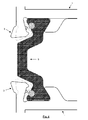
- Figure 4 shows an enlarged cross-section of a portion of a section according to an embodiment of the invention, comprising a heat-insulating body 5 and two half-shells 1.
- assembly of the heat-insulating body 5 on the half-shells 1 is shown: inside each seat 2 the tooth passes from its initial position (where it allows the head 52 of the body 5 of heat-insulating material to be inserted inside the respective seat 2), into its locking position (indicated by broken lines).
- the second snug 4 of each tooth 3 has penetrated into the respective portion 54 of softer material, firmly fixing the body 5 of heat-insulating material to the section. Penetration of the second snug occurs, advantageously, in succession after penetration of the first snug.
- the Applicant has measured the pull-out strength - in accordance with that stipulated by the standard UNI ENI 14024 category W - of the half-shells 1 when assembled with the body of heat-insulating material according to the embodiment of Figure 4 . According to this standard, the minimum pull-out value must be 24 Newton per mm. The Applicant has measured a pull-out strength value of about 400 to 500 kg on a 10 cm sample, i.e. far greater than that stipulated by the above-mentioned standard.
- the body of heat-insulating material is formed by co-extruding a first material which has a first density with a second material which has a second density less than the first density.
- machining of the half-shells with knurling of the bottom of the seat is avoided.
- the section, together with the second snug (or with more than one second snug), is obtained by means of drawing and the assembly process may be performed continuously on a production line. This results in a considerable reduction in costs and machining time.
- the two half-shells may be obtained by means of extrusion separately and independently of one another or may be obtained by means of a single die with subsequent cutting of a bridge-piece joining them together.
Landscapes
- Engineering & Computer Science (AREA)
- Civil Engineering (AREA)
- Structural Engineering (AREA)
- Wing Frames And Configurations (AREA)
- Thermal Insulation (AREA)
- Special Wing (AREA)
Applications Claiming Priority (1)
| Application Number | Priority Date | Filing Date | Title |
|---|---|---|---|
| IT001933A ITMI20071933A1 (it) | 2007-10-05 | 2007-10-05 | Corpo termoisolante per realizzare profilati per serramenti a taglio termico |
Publications (1)
| Publication Number | Publication Date |
|---|---|
| EP2045429A2 true EP2045429A2 (en) | 2009-04-08 |
Family
ID=40266120
Family Applications (1)
| Application Number | Title | Priority Date | Filing Date |
|---|---|---|---|
| EP08165573A Withdrawn EP2045429A2 (en) | 2007-10-05 | 2008-10-01 | Heat-insulating body for forming sections for thermal break door and window frames |
Country Status (6)
| Country | Link |
|---|---|
| US (1) | US20090226660A1 (pt) |
| EP (1) | EP2045429A2 (pt) |
| CN (1) | CN101403274A (pt) |
| BR (1) | BRPI0804237A2 (pt) |
| IT (1) | ITMI20071933A1 (pt) |
| MA (1) | MA30375B1 (pt) |
Cited By (2)
| Publication number | Priority date | Publication date | Assignee | Title |
|---|---|---|---|---|
| GB2591294A (en) * | 2020-01-27 | 2021-07-28 | Garner Aluminium Extrusions Ltd | A method |
| GB2603213A (en) * | 2021-01-28 | 2022-08-03 | Garner Aluminium Extrusions Ltd | A window frame assembly |
Families Citing this family (3)
| Publication number | Priority date | Publication date | Assignee | Title |
|---|---|---|---|---|
| ITMI20071932A1 (it) * | 2007-10-05 | 2009-04-06 | Norsk Hydro As | Semiguscio per realizzare serramenti a taglio termico o simili, relativo profilato e relativo processo di assemblaggio |
| US9670671B2 (en) | 2015-02-13 | 2017-06-06 | The Bilco Company | Hatch with thermally broken frame |
| US11248412B2 (en) * | 2019-11-18 | 2022-02-15 | Rehme Custom Doors & Lighting, Inc. | Metallic fenestration systems with improved thermal performance and methods of manufacturing same |
Family Cites Families (1)
| Publication number | Priority date | Publication date | Assignee | Title |
|---|---|---|---|---|
| DE4427682C2 (de) * | 1994-08-04 | 1996-12-12 | Ensinger Gmbh & Co | Verbundprofil für Rahmen von Fenstern, Türen, Fassadenelementen u. dgl. |
-
2007
- 2007-10-05 IT IT001933A patent/ITMI20071933A1/it unknown
-
2008
- 2008-09-27 CN CNA2008101769542A patent/CN101403274A/zh active Pending
- 2008-10-01 EP EP08165573A patent/EP2045429A2/en not_active Withdrawn
- 2008-10-03 US US12/244,881 patent/US20090226660A1/en not_active Abandoned
- 2008-10-03 BR BRPI0804237-3A patent/BRPI0804237A2/pt not_active IP Right Cessation
- 2008-10-06 MA MA31269A patent/MA30375B1/fr unknown
Cited By (2)
| Publication number | Priority date | Publication date | Assignee | Title |
|---|---|---|---|---|
| GB2591294A (en) * | 2020-01-27 | 2021-07-28 | Garner Aluminium Extrusions Ltd | A method |
| GB2603213A (en) * | 2021-01-28 | 2022-08-03 | Garner Aluminium Extrusions Ltd | A window frame assembly |
Also Published As
| Publication number | Publication date |
|---|---|
| ITMI20071933A1 (it) | 2009-04-06 |
| MA30375B1 (fr) | 2009-05-04 |
| CN101403274A (zh) | 2009-04-08 |
| BRPI0804237A2 (pt) | 2010-01-19 |
| US20090226660A1 (en) | 2009-09-10 |
Similar Documents
| Publication | Publication Date | Title |
|---|---|---|
| EP2045430A2 (en) | Half-shell for forming thermal break door and window frames or the like, associated section and associated assembly process | |
| EP2045429A2 (en) | Heat-insulating body for forming sections for thermal break door and window frames | |
| EP1910639B1 (en) | Spacer arrangement with fusable connector for insulating glass units | |
| DK151116B (da) | Forbindelsesprofil, isaer til vinduer, doere og facader | |
| KR101507484B1 (ko) | 분리가 용이한 고 기밀성 단열 창호 및 이의 제조방법 | |
| WO2007084746A3 (en) | Spinal rod parallel coupler | |
| US11859438B2 (en) | Bead for a frame member | |
| EP2770882A2 (de) | Kühl- und/oder gefriergerät | |
| KR102068702B1 (ko) | 프로파일부 벨트 및 그 제조 방법 | |
| EP2472021B1 (en) | A method for attachment of an object to a thin-walled fibre glass reinforced profile made by pultrusion, and window with such a profile | |
| US7937904B2 (en) | Corner joint for pultruded window frame | |
| US20160356077A1 (en) | Window frame and/or opening frame | |
| US10987836B2 (en) | Hollow profile member such as a tube made of thermosetting composite materials and corresponding method | |
| KR101646378B1 (ko) | 냉장고 도어 프레임 및 그 제조방법 | |
| EP2180460B1 (en) | Attachment member and method of manufacturing the same | |
| KR102173386B1 (ko) | 저온 저장고용 조립식 패널의 결합구조 | |
| EA018490B1 (ru) | Способ установки разжимной втулки в мягкий материал | |
| KR20140046832A (ko) | 기밀성을 향상시킨 창호용 단열 스트립바 | |
| CA2592689A1 (en) | Calibrating plate for an extrusion die for producing plastic profiles | |
| PT2080864E (pt) | Perfil isolado com núcleo de isolamento e respectivo processo de fabrico | |
| US10174776B2 (en) | Modular rail system | |
| WO2006042592A3 (de) | Montageschraube zur befestigung von beschlagteilen, insbesondere von bandteilen an hohlkammerprofilen | |
| DE202009014203U1 (de) | Duschabtrennung und Halteprofil | |
| EP1580387A2 (en) | Thermal-break section for door and window frames or the like and associated method for assembling said section | |
| KR20160109950A (ko) | 미닫이문의 손잡이 조립체 |
Legal Events
| Date | Code | Title | Description |
|---|---|---|---|
| PUAI | Public reference made under article 153(3) epc to a published international application that has entered the european phase |
Free format text: ORIGINAL CODE: 0009012 |
|
| AK | Designated contracting states |
Kind code of ref document: A2 Designated state(s): AT BE BG CH CY CZ DE DK EE ES FI FR GB GR HR HU IE IS IT LI LT LU LV MC MT NL NO PL PT RO SE SI SK TR |
|
| AX | Request for extension of the european patent |
Extension state: AL BA MK RS |
|
| STAA | Information on the status of an ep patent application or granted ep patent |
Free format text: STATUS: THE APPLICATION IS DEEMED TO BE WITHDRAWN |
|
| 18D | Application deemed to be withdrawn |
Effective date: 20130503 |