EP2043025A1 - Radio frequency identification tag - Google Patents
Radio frequency identification tag Download PDFInfo
- Publication number
- EP2043025A1 EP2043025A1 EP08252823A EP08252823A EP2043025A1 EP 2043025 A1 EP2043025 A1 EP 2043025A1 EP 08252823 A EP08252823 A EP 08252823A EP 08252823 A EP08252823 A EP 08252823A EP 2043025 A1 EP2043025 A1 EP 2043025A1
- Authority
- EP
- European Patent Office
- Prior art keywords
- antenna
- rfid tag
- chip
- disk medium
- tag
- Prior art date
- Legal status (The legal status is an assumption and is not a legal conclusion. Google has not performed a legal analysis and makes no representation as to the accuracy of the status listed.)
- Withdrawn
Links
Images





Classifications
-
- G—PHYSICS
- G11—INFORMATION STORAGE
- G11B—INFORMATION STORAGE BASED ON RELATIVE MOVEMENT BETWEEN RECORD CARRIER AND TRANSDUCER
- G11B20/00—Signal processing not specific to the method of recording or reproducing; Circuits therefor
- G11B20/00086—Circuits for prevention of unauthorised reproduction or copying, e.g. piracy
-
- G—PHYSICS
- G06—COMPUTING OR CALCULATING; COUNTING
- G06K—GRAPHICAL DATA READING; PRESENTATION OF DATA; RECORD CARRIERS; HANDLING RECORD CARRIERS
- G06K19/00—Record carriers for use with machines and with at least a part designed to carry digital markings
- G06K19/06—Record carriers for use with machines and with at least a part designed to carry digital markings characterised by the kind of the digital marking, e.g. shape, nature, code
- G06K19/067—Record carriers with conductive marks, printed circuits or semiconductor circuit elements, e.g. credit or identity cards also with resonating or responding marks without active components
- G06K19/07—Record carriers with conductive marks, printed circuits or semiconductor circuit elements, e.g. credit or identity cards also with resonating or responding marks without active components with integrated circuit chips
-
- G—PHYSICS
- G06—COMPUTING OR CALCULATING; COUNTING
- G06K—GRAPHICAL DATA READING; PRESENTATION OF DATA; RECORD CARRIERS; HANDLING RECORD CARRIERS
- G06K19/00—Record carriers for use with machines and with at least a part designed to carry digital markings
- G06K19/04—Record carriers for use with machines and with at least a part designed to carry digital markings characterised by the shape
-
- G—PHYSICS
- G06—COMPUTING OR CALCULATING; COUNTING
- G06K—GRAPHICAL DATA READING; PRESENTATION OF DATA; RECORD CARRIERS; HANDLING RECORD CARRIERS
- G06K19/00—Record carriers for use with machines and with at least a part designed to carry digital markings
- G06K19/04—Record carriers for use with machines and with at least a part designed to carry digital markings characterised by the shape
- G06K19/041—Constructional details
- G06K19/042—Constructional details the record carrier having a form factor of a credit card and including a small sized disc, e.g. a CD or DVD
- G06K19/045—Constructional details the record carrier having a form factor of a credit card and including a small sized disc, e.g. a CD or DVD the record carrier being of the non-contact type, e.g. RFID, and being specially adapted for attachment to a disc, e.g. a CD or DVD
-
- G—PHYSICS
- G11—INFORMATION STORAGE
- G11B—INFORMATION STORAGE BASED ON RELATIVE MOVEMENT BETWEEN RECORD CARRIER AND TRANSDUCER
- G11B20/00—Signal processing not specific to the method of recording or reproducing; Circuits therefor
- G11B20/00086—Circuits for prevention of unauthorised reproduction or copying, e.g. piracy
- G11B20/00876—Circuits for prevention of unauthorised reproduction or copying, e.g. piracy wherein physical copy protection means are attached to the medium, e.g. holograms, sensors, or additional semiconductor circuitry
-
- G—PHYSICS
- G11—INFORMATION STORAGE
- G11B—INFORMATION STORAGE BASED ON RELATIVE MOVEMENT BETWEEN RECORD CARRIER AND TRANSDUCER
- G11B23/00—Record carriers not specific to the method of recording or reproducing; Accessories, e.g. containers, specially adapted for co-operation with the recording or reproducing apparatus ; Intermediate mediums; Apparatus or processes specially adapted for their manufacture
- G11B23/0014—Record carriers not specific to the method of recording or reproducing; Accessories, e.g. containers, specially adapted for co-operation with the recording or reproducing apparatus ; Intermediate mediums; Apparatus or processes specially adapted for their manufacture record carriers not specifically of filamentary or web form
- G11B23/0021—Record carriers not specific to the method of recording or reproducing; Accessories, e.g. containers, specially adapted for co-operation with the recording or reproducing apparatus ; Intermediate mediums; Apparatus or processes specially adapted for their manufacture record carriers not specifically of filamentary or web form discs
- G11B23/0028—Details
- G11B23/0035—Details means incorporated in the disc, e.g. hub, to enable its guiding, loading or driving
- G11B23/0042—Details means incorporated in the disc, e.g. hub, to enable its guiding, loading or driving with provision for auxiliary features
-
- G—PHYSICS
- G11—INFORMATION STORAGE
- G11B—INFORMATION STORAGE BASED ON RELATIVE MOVEMENT BETWEEN RECORD CARRIER AND TRANSDUCER
- G11B23/00—Record carriers not specific to the method of recording or reproducing; Accessories, e.g. containers, specially adapted for co-operation with the recording or reproducing apparatus ; Intermediate mediums; Apparatus or processes specially adapted for their manufacture
- G11B23/30—Record carriers not specific to the method of recording or reproducing; Accessories, e.g. containers, specially adapted for co-operation with the recording or reproducing apparatus ; Intermediate mediums; Apparatus or processes specially adapted for their manufacture with provision for auxiliary signals
Definitions
- the present invention relates to an RFID (Radio Frequency Identification) tag for wirelessly transmitting information such as ID (Identification) recorded in an IC chip.
- RFID Radio Frequency Identification
- An RFID tag comprises an IC chip and an antenna and can wirelessly transmit information such as an ID number recorded in the IC chip from the antenna. Accordingly, when communicating with the RFID tag using a reader/writer, information recorded in the IC chip can be read without contact. Thanks to radio transmission, information on IC chips can be read even in articles stored in a bag or box. Therefore, the RFID tag is widely used for manufacturing management and logistics of articles.
- CD Compact Disk
- DVD Digital Versatile Disk
- U.S. Patent 6,359,842 B1 discloses that when relative to the mass eccentricity due to the attaching of the IC chip to the disk, a balancer is provided at a position being point-symmetric to the IC chip with the center of the disk as the starting point, the amount of mass eccentricity is reduced.
- An RFID tag can be mounted on a disk medium by the technology described in U.S. Patent 6,359,842 B1 .
- a balancer must be prepared and extra operation such as provision of the balancer also occurs.
- the DVD having recorded thereon data on both surfaces of the disk medium it is difficult to attach the balancer on a data storage area as described in U.S. Patent 6,359,842 B1 .
- An example of the DVD is consistently one example, and the present invention described below can also be applied to the CD having recorded thereon data on one surface of the disk medium.
- a metal conductive layer such as Au or Al is used as a light reflection film.
- This metal conductive layer is normally formed on a substrate of the disk medium using an evaporation method or a sputtering technique.
- a formation range of the metal conductive layer is different for each application or manufacturer.
- the metal conductive layer is formed up to an edge of an opening in the center of the disk medium in some times.
- the present invention has been devised in the light of the above-described problems, and the amount of mass eccentricity due to the attachment of the RFID tag is reduced. Further, it is a preferred aim thereof to provide the RFID tag which may not depend on a structure of the disk medium and with which stable communication characteristics may be obtained.
- the RFID tag according to the present invention is an RFID tag having mounted thereon an IC chip capable of receiving and delivering information from and to an external source without contact.
- the central axis of the RFID tag is determined from the central axes of the IC chip, the antenna and the substrate, and the mass eccentricity is reduced by allowing the central axis of the RFID tag to coincide with the rotation axis of the disk medium.
- the adjustment of an antenna width also relates to the present invention.
- a position of the central axis may be required not only from structure of the disk media but also from design.
- An RFID tag according to the present invention is capable of receiving and delivering information from and to an IC chip without contact even if mounted on a high-speed rotating body.
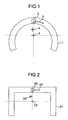
- FIG. 1 shows an antenna of the circular RFID tag.
- an L-type slit 3 for performing impedance matching between an IC chip having recorded therein information and the antenna 1 is formed on this antenna 1.
- the IC chip 2 having recorded therein information is mounted on this antenna 1.
- There exists a center 5 being a center of a shape determined from a width and length of the antenna 1.
- a central axis of the antenna 1 having mounted thereon the IC chip 2 is located at a position shown in a central axis 4. When the antenna 1 is rotated around this central axis, a mass eccentricity can be canceled without using a balancer.
- the central axis used herein means an axis almost vertically penetrating an antenna surface via a center of gravity.
- a method of attaching the RFID tag on a rotating table and measuring by laser interferometry the amount of mass eccentricity at an end of the rotating table As another method, the measurement using a vibration sensor is used.
- FIG. 3A shows a construction view of the RFID tag and FIG. 3B shows a top plan view of the RFID tag.
- an appellation of the antenna such that the IC chip 2 is mounted on the antenna 1 described in FIG. 1 is defined as a tag antenna. That is, a reference numeral 7 shown in FIG. 3A depicts a tag antenna 7.
- a central axis of the tag antenna 7 is a central axis 4 and a central axis of the substrate 6 for retaining the tag antenna is a central axis 8.
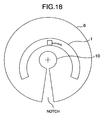
- the substrate 6 shows a circular one; but is not limited thereto and may have an arbitrary shape. As shown in FIG.
- a notched region may be formed so as to be contacted with an opening in the substrate.
- an IC chip and an antenna may be directly formed on disk medium without using a substrate.
- the tag antenna 7 and the substrate 6 are arranged such that the central axes 4 and 8 of the tag antenna 7 and the substrate 6 coincide with each other and both are fixed with an adhesive or tacky adhesive.
- a film having laminated thereon a metal such as Al namely, an antenna material on a large film sheet or film tape-like substrate is coated with resist and then, antenna patterns are transferred to the film by a printing, a photolithography method or the like.
- an antenna pattern is formed by etching, and an IC chip is mounted.
- the desired RFID tag 9 with a shape of FIG. 3B can be manufactured.
- a protective film such as PP (Polypropylene) and PET (Polyethylene-terephthalate) is attached on an antenna surface. Accordingly, a structure of the RFID tag has a shape in which the protective film, IC chip, antenna, substrate and adhesive are laminated in this order and each thickness is 20, 50, 10, 20 and 10 ⁇ m.
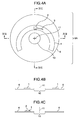
- FIGS. 4A, 4B and 4C show tag shapes taking an attaching to the disk medium into consideration.
- FIG. 4A shows a top view of the RFID tag.
- An opening 10 is formed around the point in which the central axis 8A of the RFID tag shown in FIG. 3B and the center 11 of the RFID tag coincide with each other.
- FIG. 4B shows a cross sectional shape of the RFID tag taken along line IVB-IVB
- FIG. 4C shows a cross sectional shape of the RFID tag taken along line IVC-IVC.
- the opening 10 may be a non-penetrated hole.
- a position of the central axis may be marked to the extent to be recognized. In doing so, even in a rotating body incapable of attaching the RFID tag on the central axis, such as a gear, the RFID tag can also be attached on an end of the rotating axis of the rotating body.
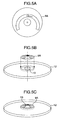
- the RFID tag 9A shown in FIG. 5A depicts a tag in which the central axes of the tag antenna, the substrate and the center of an opening of the RFID tag coincide with each other.
- the RFID tag 9A is attached on the disk medium such that the center of an opening of the RFID tag 9A and that of the disk medium 12 coincide with each other.
- a tacky adhesive or adhesive As a tacky adhesive for use in the attachment, acrylic adhesive is frequently used. Since heat generation from the drive mechanism is large at the high speed rotation drive, when a tacky adhesive having high heat resistance is used, durability of the RFID tag can be more improved.
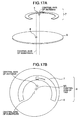
- each of the central axes of the IC chip, the antenna and the substrate may be deviated as shown in FIG. 17B .
- a combined central axis resulting from dynamically combining each of the central axes of the IC chip, the antenna and the substrate may substantially coincide with the center of the opening of the substrate or the rotation axis of the disk medium.
- the disk medium 12C shown in FIG. 6 has a fundamental structure common to general optical disk media such as the CD and DVD. More specifically, a central opening 13 is provided in the disk medium 12C and when the disk medium 12C is set in a player or disk drive, the disk medium 12C is rotated around the central opening 13 to irradiate an information recording surface of the disk with laser light, whereby signals are read out according to the quantity of light reflected from the surface. Further, in the outside area R1 as much as the prescribed distance from the central opening 13, a light reflecting film made of Au and Al is formed on a resin substrate, such as polycarbonate, being a substrate of the disk medium. This light reflecting film forms a thin film metal conductive layer having a thickness of several dozen nm.
- an area R2 that is a part of the area R1 having formed therein the metal conductive layer forms an information recording area.
- An area R4 serves as a clamping area and is an area in which a disk drive retains the disk medium.
- the metal conductive layer is not formed on the clamping area R4 in many cases.
- the metal conductive layer is increasingly formed also on the clamping area R4 in order to improve a design property on a label surface as a disk medium surface, in short, in order to have uniform gloss on a disk surface.
- An area R3 of the metal conductive layer within the clamping area R4 is different for each application or manufacturer.
- FIG. 7A shows a top plan view of a disk medium 12A in which a metal conductive layer 14A is not formed in the clamping area.
- FIGS. 7B and 7C show cross sectional structures taken along line VIIC-VIIC.
- FIG. 7B shows a case where the metal conductive layer 14A is formed between resin substrates 15A.
- FIG. 7C shows a case where the metal conductive layer 14A is formed on a resin substrate 15B.
- FIG. 7B shows a structure of the disk medium such as the DVD and
- FIG. 7C shows a structure of the disk medium such as the CD.
- a structure of FIG. 8 is the same as that of FIG. 7 , and FIG. 8 shows a structure of the disk medium in which the metal conductive layer 14B is formed up to the clamping area.
- the resin substrate 15B has a thickness of about 1.2 mm.
- the CD and DVD used at the moment each have a diameter of 120 mm.
- the area R1 having formed thereon the metal conductive layer has a diameter of 17 to 119 mm and the information recording area R2 in the area R1 has a diameter of 44 to 117 mm.
- the clamping area R4 has a diameter of 36 mm and the central opening 13 has a diameter of 15 mm.
- FIG. 8B shows a method of attaching the RFID tag on the disk medium 12B having a DVD structure and in which the metal conductive layer 14B is formed up to the clamping area.
- the metal conductive layer 14B is formed in the clamping area R4 having attached thereon the RFID tag. Accordingly, even if the RFID tag 9A described in the first embodiment is attached on the clamping area R4, the RFID tag cannot sufficiently respond to signals outputted from a reader due to the effect of the metal conductive layer 14B.
- the RFID tag can be operated by a method of inserting a spacer between the metal conductive layer and the RFID tag 9A.
- the RFID tag 9A becomes thicker and therefore, cannot be attached on the disk medium.
- the IC chip 2 when the IC chip 2 is mounted at a position at which lengths are different from each other in the lateral direction in an antenna having mounted thereon the IC chip 2, there is realized a tag antenna such that a relatively long communication distance is obtained even if the RFID tag is placed on the metal conductive layer of the disk medium.
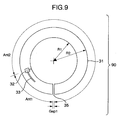
- an antenna portion including the slit 33 is referred to as the first antenna and set to a portion with an antenna length of Ant 1 shown in the drawing.
- An antenna portion not including the slit 33 is referred to as the second antenna and set to a portion with an antenna length of Ant 2 shown in the drawing.
- each of the antennas is set such that the first antenna is equal in length to the second antenna.
- the antenna of this type is located near the metal conductive layer, the function of the antenna is deteriorated.
- each of the antennas is set such that the first antenna is shorter in length than the second antenna, and a length of the second antenna is set to an electrical length of ⁇ /2 ( ⁇ : wavelength) or to be approximated to an electrical length of ⁇ /2 at the operating frequency. Further, a length of the first antenna is set equal to or less than an electrical length of ⁇ /4 at the operating frequency.
- an electrical wavelength means a length in consideration of the effect of reduction in an antenna length due to the dielectric constant of a member on which the tag is attached.
- An antenna material used is Al with a thickness of 20 ⁇ m and a substrate material used is PEN (Poly Ethylene Naphthalate) with a thickness of 20 ⁇ m. These materials are not limited to the above description; further, if being antenna materials, materials for use in the RFID tag, such as Cu and Ag paste can be used. In the same manner, PET and paper can be used as the substrate material.
- the substrate has the effect as a spacer between the antenna and the metal conductive layer, and the effect of improving a communication distance in the structure of FIG. 8C typified by the CD.
- a central axis of the tag antenna is found and an opening is formed around the position in which the central axis of the tag antenna and the central axis of the substrate coincide with each other.
- An RFID tag 9C (not shown) coated with acrylic adhesive with a thickness of 10 ⁇ m is applied to the back side of the substrate of the RFID tag 9B (not shown) herein formed is prepared and attached onto a recording type DVD-R disk having formed thereon the metal conductive layer up to the clamping area R4.
- the communication distance of this RFID tag As the communication distance of this RFID tag, the communication distance of 100 mm from an attaching surface of the RFID tag and that of 40 mm from a back side of the disk medium are obtained on the condition that an operating frequency is 2.45 GHz, a high-frequency output is 200 mW, and a reader antenna 6dBi a patch antenna (circular polarization) is used.
- the RFID tag in which the mass eccentricity is canceled is realized by adjusting positions of the IC chip and tag antenna on the substrate, namely, by adjusting positions of these central axes.
- the mass eccentricity cannot be canceled, in some cases, in a correction processing only for adjusting a position of the central axis.
- the mass eccentricity is caused by the IC chip 32 attached on the antenna 31, the slit 33 and the gap 35 between the antenna ends.
- the mass eccentricity is caused by weight of the IC chip. Accordingly, when the weight of antenna materials around the IC chip 32 is reduced as much as that of the IC chip 32, the mass eccentricity due to the IC chip can be canceled.
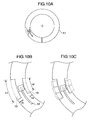
- the slit 33 can be considered integrally with the IC chip. That is, since the slit 33 is formed by removing an antenna material, formation of the slit 33 acts in the direction of canceling the weight of the IC chip 32. A method of correcting the mass eccentricity through the antenna shapes will be described with reference to FIGS.
- FIG. 10A shows a top plan view of a tag antenna 17.
- FIG. 10B shows a detailed portion to be removed of the antenna material.
- FIG. 10C schematically shows the amount of the antenna material to be removed.
- a main constituent material of the IC chip is Si and a density thereof is 2.33 g/cm 3 .
- a density of Al of the antenna material is 2.7 g/cm 3 .
- Another antenna material includes Cu and a density thereof is 8.92 g/cm 3 .
- the area is 1.08 (mm 2 ).
- the area approximately corresponds to an area of four chips and corresponds to the removal of a part of the antenna, being 0.5 mm wide and about 2 mm long.
- antenna materials of an outer peripheral part 18 and an inner peripheral part 19 are removed from the open ring-shaped antenna having mounted thereon the IC chip.
- the mass eccentricity due to the IC chip can be substantially canceled.
- the antenna area is calculated.
- the antenna made of Cu has a thickness of 10 ⁇ m, the antenna area is equal to 0.0033 (mm 2 ).
- a material with a large density can correct the mass eccentricity by a small removal area.
- the circular tag antenna can be changed into a tag antenna having an open ring-shape with higher symmetry by using a method in which the central axis of the tag antenna coincides with the center of the RFID tag, as described in the first embodiment.
- FIG. 11 shows a variation in which a removal area 18A of the antenna is set to an outer peripheral portion of the antenna.
- a distance from the center of rotation becomes long. That is, when increasing, torque has an effect capable of reducing the removal area of the antenna.
- the mass eccentricity can be further corrected with higher accuracy by using a method in which the central axis of the tag antenna coincides with the center of the RFID tag, as described in the first embodiment.
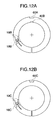
- FIGS. 12A and 12B description will be made on an example in which the mass eccentricity of the tag antenna 90 shown in FIG. 9 is corrected with higher accuracy.
- the mass eccentricity due to the IC chip and the slit portion is taken notice of and corrected.
- FIGS. 12A and 12B show an example in which the gap 35 between the antenna ends shown in FIG. 9 is also taken notice of and corrected.
- the gap 35 is a portion in which the antenna material is absent. Accordingly, when removing the antenna material at a position being point-symmetric with respect to the rotation center, namely, at removal areas 60A and 60B, the mass eccentricity can be corrected.
- FIG. 12A shows an example in which the removal areas 60A and 60B are set in the inner peripheral side and the outer peripheral side of the antenna.
- FIG. 12B shows an example in which the removal area 60C is set in the outer peripheral side of the antenna.
- the mass eccentricity can be further corrected with higher accuracy by using at the same time a method in which the central axis of the tag antenna coincides with the center of the RFID tag, as described in the first embodiment.
- the third variation shows a mode in which when removing the antenna material at a position being point-symmetric with respect to the rotation center, the mass eccentricity due to the gap 35 is corrected.
- the fourth variation shows a case in which when adding to the antenna ends the antenna material corresponding to the weight of the gap 35, the mass eccentricity is corrected.
- a correction method will be described.
- the fourth variation has a shape in which the antenna ends 61A and 61B are wider in width than the other antenna portions.
- the addition method of the antenna material to the outer peripheral side has an advantage in that a portion corresponding to the antenna ends 61A and 61B is reduced.
- the reading speed of the disk medium is increased and the number of rotations of the disk medium is increased and therefore, a reading error may be caused by vibrations due to the turbulence of air flow generated within the disk drive.
- description will be made on a structure of the RFID tag for preventing the turbulence of air flow generated within the disk drive.
- the RFID tag described in the first and the second embodiments has a structure in which the IC chip is formed on the disk medium.
- the RFID tag has a shape in which the IC chip has a thickness of 50 ⁇ m and only the IC chip having a protrusion with a height of 50 ⁇ m is formed on the antenna.
- a protective film is formed on the tag antenna; however, the periphery of the IC chip is projected.
- the disk medium rotates at high velocity, the turbulence of air flow is generated within the disk drive due to this protrusion and vibrations of the disk medium occur. As a result, the reading error is caused.
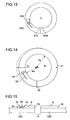
- the RFID tag has a structure in which the IC chip is prevented from being projected on the surface, that is, a structure in which a substrate 6 of the tag antenna faces outward as shown in FIG. 15 , the protrusion of the IC chip can be eliminated on the surface of the RFID tag.
- a surface of the RFID tag can be flattened.
- a material with a shape in which a hollow or hole for storing the IC chip is opened is used as this film.
- a resin such as PET, PEN and PP, or paper is used as this film.
- FIGS. 16A to 16D are process drawings showing a process for mounting the IC chip 2 on the feeding section of the antenna 41, in which FIG. 16A shows feeding sections of the antenna 41 and the IC chip 2, FIG. 16B shows a perspective enlarged view of the feeding section when mounting the IC chip 2 on the antenna 41, and FIG. 16C shows a cross sectional view of the junction between the antenna 41 and the IC chip 2.
- a key-like (L-shaped) slit 43 for performing the impedance matching between the IC chip 2 and the antenna 41 is formed on the feeding section of the antenna 41 and a portion surrounded by the key-like slit 43 is formed as a stub 41b. Further, in the IC chip 2, signal input/output electrodes 2a and 2b are formed at a distance to straddle the slit 43.
- a width of the slit 43 is somewhat narrower than a distance between signal input/output electrodes 2a and 2b of the IC chip 2. Therefore, as shown in FIG. 16B , when the IC chip 2 is mounted on the antenna 41, the signal input/output electrodes 2a and 2b of the IC chip 2 are connected to the antenna 41 so as to straddle the slit 43.
- a stub 41b formed by formation of the slit 43 is serially connected between the antenna 41 and the IC chip 2
- the stub 41b between the antenna 41 and the IC chip 2 operates as a serially connected inductance component. Accordingly, the input/output impedance between the antenna 41 and the IC chip 2 is matched due to this inductance component.
- a matching circuit is formed by the slit 43 and the stub 41b.
- the signal input/output electrodes 2a and 2b of the IC chip 2 is electrically joined to the antenna 41 using gold bump by an ultrasonic joining method, a metal eutectic joining method, or a joining method via an anisotropic conductive film (not shown).
- FIG. 16D is a conceptual diagram for mounting the IC chip 2 on a feeder section of the T shaped slit 43A in the antenna 41A.
- the impedance between the antenna 41A and the IC chip 2 can be matched in the same manner as in the case of the L shaped slit 43.
- the RFID tag according to the present embodiment is attached on a CD or DVD, the amount of mass eccentricity can be reduced, and therefore, the RFID tag can be read by a high-speed rotation type reader. Further, the RFID tag can be attached on the disk medium without regard to a forming position of the metal conductive layer of the CD or DVD. Accordingly, in a field of managing a large amount of disk media, information of each disk medium can be effectively managed, and further, management enhancement of recording media on sensitive information and personal information can be realized.
Landscapes
- Engineering & Computer Science (AREA)
- Physics & Mathematics (AREA)
- General Physics & Mathematics (AREA)
- Theoretical Computer Science (AREA)
- Computer Security & Cryptography (AREA)
- Signal Processing (AREA)
- Computer Hardware Design (AREA)
- Microelectronics & Electronic Packaging (AREA)
- Optical Record Carriers And Manufacture Thereof (AREA)
- Credit Cards Or The Like (AREA)
- Details Of Aerials (AREA)
Applications Claiming Priority (1)
| Application Number | Priority Date | Filing Date | Title |
|---|---|---|---|
| JP2007253027A JP5065833B2 (ja) | 2007-09-28 | 2007-09-28 | Rfidタグ |
Publications (1)
| Publication Number | Publication Date |
|---|---|
| EP2043025A1 true EP2043025A1 (en) | 2009-04-01 |
Family
ID=39968054
Family Applications (1)
| Application Number | Title | Priority Date | Filing Date |
|---|---|---|---|
| EP08252823A Withdrawn EP2043025A1 (en) | 2007-09-28 | 2008-08-26 | Radio frequency identification tag |
Country Status (6)
| Country | Link |
|---|---|
| US (1) | US8098133B2 (enExample) |
| EP (1) | EP2043025A1 (enExample) |
| JP (1) | JP5065833B2 (enExample) |
| KR (1) | KR101054182B1 (enExample) |
| CN (1) | CN101398911A (enExample) |
| TW (1) | TWI409704B (enExample) |
Cited By (2)
| Publication number | Priority date | Publication date | Assignee | Title |
|---|---|---|---|---|
| CN107342461A (zh) * | 2017-07-04 | 2017-11-10 | 北京邮电大学 | 一种uhf频段rfid窄带陷波掩膜 |
| CN111211399A (zh) * | 2020-03-04 | 2020-05-29 | 电子科技大学 | 一种共形于石油管套壁的抗金属超高频电子标签天线 |
Families Citing this family (15)
| Publication number | Priority date | Publication date | Assignee | Title |
|---|---|---|---|---|
| TW200935315A (en) * | 2008-02-01 | 2009-08-16 | Taiwan Name Plate Co Ltd | An ordering catalog with electronic bookmarks |
| US8249263B2 (en) * | 2008-05-15 | 2012-08-21 | International Business Machines Corporation | Method and apparatus for providing audio motion feedback in a simulated three-dimensional environment |
| US8344861B2 (en) * | 2009-01-14 | 2013-01-01 | International Business Machines Corporation | Haptic motion feedback mechanism |
| US8493188B2 (en) * | 2009-01-14 | 2013-07-23 | International Business Machines Corporation | Haptic motion feedback device |
| JP5671874B2 (ja) | 2009-12-28 | 2015-02-18 | 富士通株式会社 | 無線タグ |
| US9760750B1 (en) * | 2015-01-12 | 2017-09-12 | The United States Of America As Represented By The Administrator Of The National Aeronautics And Space Administration | System for RFID-enabled information collection |
| CN106785352B (zh) * | 2016-12-30 | 2023-08-25 | 歌尔科技有限公司 | 一种手机天线及其手机 |
| WO2018120037A1 (en) * | 2016-12-30 | 2018-07-05 | Hong Kong R&D Centre for Logistics and Supply Chain Management Enabling Technologies Limited | A switchable rfid tag and a method for operating a switchable rfid circuit |
| DE102017104046A1 (de) * | 2017-02-27 | 2018-08-30 | Infineon Technologies Ag | Nahfeld-datenübertragungsring |
| CN107194454A (zh) * | 2017-05-26 | 2017-09-22 | 宝钢轧辊科技有限责任公司 | Rfid芯片及其在森吉米尔轧辊识别与管理上的应用 |
| CN109754053A (zh) * | 2018-12-17 | 2019-05-14 | 广东工业大学 | 基于介质谐振器的小型化高增益抗金属标签天线 |
| CN110703000B (zh) * | 2019-08-26 | 2021-12-03 | 中汽研汽车检验中心(天津)有限公司 | 一种应用于汽车天线性能测试的偏心修正方法 |
| WO2021061122A1 (en) * | 2019-09-25 | 2021-04-01 | Hewlett-Packard Development Company, L.P. | Developer roller authentication |
| CN113421389B (zh) * | 2021-06-23 | 2022-08-12 | 深圳市中天迅通信技术股份有限公司 | 一种用于pos机的天线装置 |
| EP4381108A4 (en) * | 2021-08-02 | 2025-08-06 | Citizen Digital Inc | VINYL RECORD RECORDING WITH BUILT-IN AUTHENTICITY |
Citations (4)
| Publication number | Priority date | Publication date | Assignee | Title |
|---|---|---|---|---|
| WO1999038162A1 (en) * | 1998-01-22 | 1999-07-29 | Nds Ltd. | Protection of data on media recording disks |
| US6359842B1 (en) | 1998-10-22 | 2002-03-19 | Hitachi, Ltd. | Disc having a semiconductor memory |
| WO2004107261A1 (en) * | 2003-05-29 | 2004-12-09 | Finanziaria Sammarinese, S.A. | Optical read disk and production method for the same |
| US20060028344A1 (en) * | 2003-04-25 | 2006-02-09 | Forster Ian J | Extended range RFID system |
Family Cites Families (13)
| Publication number | Priority date | Publication date | Assignee | Title |
|---|---|---|---|---|
| JP2000132871A (ja) * | 1998-10-22 | 2000-05-12 | Hitachi Ltd | ディスク及びこれを用いた記録再生装置 |
| JP2000268415A (ja) * | 1999-03-16 | 2000-09-29 | Rohm Co Ltd | ディスク状記録担体 |
| JP3746396B2 (ja) * | 1999-04-27 | 2006-02-15 | 富士通株式会社 | 出力回路及び入出力回路 |
| JP2001297568A (ja) | 2000-04-12 | 2001-10-26 | Mitsubishi Materials Corp | インデックス装置及びこの装置に用いられる目次記憶用rfid付記録媒体並びにそのrfid |
| JP3713476B2 (ja) * | 2002-09-10 | 2005-11-09 | 株式会社東芝 | 移動通信端末 |
| JP2005190514A (ja) * | 2003-12-24 | 2005-07-14 | Dainippon Printing Co Ltd | デジタル記録媒体および再生装置 |
| KR100603761B1 (ko) * | 2004-04-22 | 2006-07-24 | 삼성전자주식회사 | 마이크로웨이브 트랜스폰더 |
| JP4328682B2 (ja) | 2004-07-13 | 2009-09-09 | 富士通株式会社 | 光記録媒体用の無線タグアンテナ構造および無線タグアンテナ付き光記録媒体の収納ケース |
| JP2006092630A (ja) * | 2004-09-22 | 2006-04-06 | Sony Corp | 光ディスクおよびその製造方法 |
| JP4639857B2 (ja) * | 2005-03-07 | 2011-02-23 | 富士ゼロックス株式会社 | Rfidタグが取り付けられた物品を収納する収納箱、その配置方法、通信方法、通信確認方法および包装構造。 |
| TWI339358B (en) * | 2005-07-04 | 2011-03-21 | Hitachi Ltd | Rfid tag and manufacturing method thereof |
| WO2007015205A1 (en) * | 2005-08-02 | 2007-02-08 | Nxp B.V. | Antenna structure, transponder and method of manufacturing an antenna structure |
| JP4200464B2 (ja) * | 2006-08-04 | 2008-12-24 | ソニー株式会社 | 成形体及びその製造方法 |
-
2007
- 2007-09-28 JP JP2007253027A patent/JP5065833B2/ja not_active Expired - Fee Related
-
2008
- 2008-08-06 CN CNA2008101313402A patent/CN101398911A/zh active Pending
- 2008-08-06 TW TW097129874A patent/TWI409704B/zh not_active IP Right Cessation
- 2008-08-07 KR KR1020080077378A patent/KR101054182B1/ko not_active Expired - Fee Related
- 2008-08-26 EP EP08252823A patent/EP2043025A1/en not_active Withdrawn
- 2008-08-28 US US12/200,349 patent/US8098133B2/en not_active Expired - Fee Related
Patent Citations (4)
| Publication number | Priority date | Publication date | Assignee | Title |
|---|---|---|---|---|
| WO1999038162A1 (en) * | 1998-01-22 | 1999-07-29 | Nds Ltd. | Protection of data on media recording disks |
| US6359842B1 (en) | 1998-10-22 | 2002-03-19 | Hitachi, Ltd. | Disc having a semiconductor memory |
| US20060028344A1 (en) * | 2003-04-25 | 2006-02-09 | Forster Ian J | Extended range RFID system |
| WO2004107261A1 (en) * | 2003-05-29 | 2004-12-09 | Finanziaria Sammarinese, S.A. | Optical read disk and production method for the same |
Cited By (2)
| Publication number | Priority date | Publication date | Assignee | Title |
|---|---|---|---|---|
| CN107342461A (zh) * | 2017-07-04 | 2017-11-10 | 北京邮电大学 | 一种uhf频段rfid窄带陷波掩膜 |
| CN111211399A (zh) * | 2020-03-04 | 2020-05-29 | 电子科技大学 | 一种共形于石油管套壁的抗金属超高频电子标签天线 |
Also Published As
| Publication number | Publication date |
|---|---|
| JP5065833B2 (ja) | 2012-11-07 |
| CN101398911A (zh) | 2009-04-01 |
| TWI409704B (zh) | 2013-09-21 |
| TW200926005A (en) | 2009-06-16 |
| JP2009086799A (ja) | 2009-04-23 |
| KR20090032954A (ko) | 2009-04-01 |
| US8098133B2 (en) | 2012-01-17 |
| US20090085751A1 (en) | 2009-04-02 |
| KR101054182B1 (ko) | 2011-08-03 |
Similar Documents
| Publication | Publication Date | Title |
|---|---|---|
| US8098133B2 (en) | Radio frequency identification tag | |
| JP4437965B2 (ja) | 無線タグ | |
| US7248221B2 (en) | Radio tag antenna structure for an optical recording medium and a case for an optical recording medium with a radio tag antenna | |
| EP1776660B1 (en) | Method of variable position strap mounting for rfid transponder | |
| CN101142711B (zh) | 适用于金属的rfid标签及其rfid标签部 | |
| US20050179552A1 (en) | RFID tag and its manufacturing method | |
| EP1618517B1 (en) | Extended range rfid system | |
| JP2010525465A (ja) | 導電性標識に結合された無線周波数識別機能 | |
| HU224786B1 (en) | Electronic label | |
| TWI402830B (zh) | 由至少一介質基片被覆導電層所形成資料載體內識別電路之整合方法 | |
| CN101118765B (zh) | 盘介质以及盘介质制造方法 | |
| US20080074793A1 (en) | Disk medium with antenna and method for manufacturing the same | |
| JP4693638B2 (ja) | Rfidタグ | |
| JP4644742B2 (ja) | 光記録媒体用の無線タグアンテナ構造 | |
| JP2007108847A (ja) | 無線タグ |
Legal Events
| Date | Code | Title | Description |
|---|---|---|---|
| PUAI | Public reference made under article 153(3) epc to a published international application that has entered the european phase |
Free format text: ORIGINAL CODE: 0009012 |
|
| 17P | Request for examination filed |
Effective date: 20080912 |
|
| AK | Designated contracting states |
Kind code of ref document: A1 Designated state(s): AT BE BG CH CY CZ DE DK EE ES FI FR GB GR HR HU IE IS IT LI LT LU LV MC MT NL NO PL PT RO SE SI SK TR |
|
| AX | Request for extension of the european patent |
Extension state: AL BA MK RS |
|
| 17Q | First examination report despatched |
Effective date: 20090612 |
|
| AKX | Designation fees paid |
Designated state(s): DE FR GB |
|
| GRAP | Despatch of communication of intention to grant a patent |
Free format text: ORIGINAL CODE: EPIDOSNIGR1 |
|
| INTG | Intention to grant announced |
Effective date: 20140514 |
|
| RIN1 | Information on inventor provided before grant (corrected) |
Inventor name: HESAKI, SHIMPEI Inventor name: KUDO, NOBUHIRO Inventor name: SAKAMA, ISAO |
|
| STAA | Information on the status of an ep patent application or granted ep patent |
Free format text: STATUS: THE APPLICATION IS DEEMED TO BE WITHDRAWN |
|
| 18D | Application deemed to be withdrawn |
Effective date: 20140925 |