EP2037877B1 - Anti schuppen-shampoo - Google Patents
Anti schuppen-shampoo Download PDFInfo
- Publication number
- EP2037877B1 EP2037877B1 EP07723810.3A EP07723810A EP2037877B1 EP 2037877 B1 EP2037877 B1 EP 2037877B1 EP 07723810 A EP07723810 A EP 07723810A EP 2037877 B1 EP2037877 B1 EP 2037877B1
- Authority
- EP
- European Patent Office
- Prior art keywords
- surfactant
- und
- acid
- agent
- bis
- Prior art date
- Legal status (The legal status is an assumption and is not a legal conclusion. Google has not performed a legal analysis and makes no representation as to the accuracy of the status listed.)
- Active
Links
Classifications
-
- A—HUMAN NECESSITIES
- A61—MEDICAL OR VETERINARY SCIENCE; HYGIENE
- A61Q—SPECIFIC USE OF COSMETICS OR SIMILAR TOILETRY PREPARATIONS
- A61Q5/00—Preparations for care of the hair
- A61Q5/02—Preparations for cleaning the hair
-
- A—HUMAN NECESSITIES
- A61—MEDICAL OR VETERINARY SCIENCE; HYGIENE
- A61K—PREPARATIONS FOR MEDICAL, DENTAL OR TOILETRY PURPOSES
- A61K8/00—Cosmetics or similar toiletry preparations
- A61K8/18—Cosmetics or similar toiletry preparations characterised by the composition
- A61K8/92—Oils, fats or waxes; Derivatives thereof, e.g. hydrogenation products thereof
- A61K8/922—Oils, fats or waxes; Derivatives thereof, e.g. hydrogenation products thereof of vegetable origin
-
- A—HUMAN NECESSITIES
- A61—MEDICAL OR VETERINARY SCIENCE; HYGIENE
- A61P—SPECIFIC THERAPEUTIC ACTIVITY OF CHEMICAL COMPOUNDS OR MEDICINAL PREPARATIONS
- A61P31/00—Antiinfectives, i.e. antibiotics, antiseptics, chemotherapeutics
- A61P31/10—Antimycotics
-
- A—HUMAN NECESSITIES
- A61—MEDICAL OR VETERINARY SCIENCE; HYGIENE
- A61Q—SPECIFIC USE OF COSMETICS OR SIMILAR TOILETRY PREPARATIONS
- A61Q5/00—Preparations for care of the hair
- A61Q5/006—Antidandruff preparations
Definitions
- the invention relates to surfactant-containing cleaning compositions which comprise stabilized castor oil hardened in an insoluble antidandruff agent, and to a method for stabilizing insoluble antidandruff agents in surfactant-containing formulations.
- Skin and hair cleansers such as those commercially available as liquid soaps, shampoos, shower baths, bubble baths, shower gels, and wash gels, not only must have good detergency, but should also be well tolerated by the skin and hair if used frequently, do not cause excessive defatting or dryness.
- skin and hair cleaners based on anionic, nonionic and / or amphoteric surfactants, but most preferably based on anionic surfactants are formulated. While such compositions have good detergency, their associated cosmetic properties are inadequate, especially due to the removal of skin and hair lipids and proteins from the skin or hair surface.
- anti-dandruff treatment is understood to mean the control of the phytosporum ovale yeast fungus which, in the case of excessive occurrence, is the cause of cosmetic dandruff.
- anti-dandruff agent the solid zinc pyrithione has been proven, but must be stabilized in the Shampoomatrix, as it is also present in the Shampoomatrix in solid, undissolved form. Without adequate stabilization, the active ingredient would otherwise sink to the bottom and thus lose the shampoo's anti-dandruff action.
- the object of the present invention was therefore to produce a surfactant-containing cleanser for the skin and hair, which not only provides a thorough and gentle cleansing of the (head) skin and / or the hair ensures, but at the same time has an anti-dandruff effect, and is characterized by application technology by a stable dispersion of the anti-dandruff agent in the Shampoomatrix.
- Cleaning agents which comprise a mixture of at least one anionic surfactant with an amphoteric and / or zwitterionic and / or a nonionic surfactant are preferred according to the invention.
- the total surfactant content in the cleaning agent is 5 to 35%, preferably 7 to 25% and in particular 8 to 15% - based on the total weight of the cleaning agent.
- Preferred anionic surfactants are alkyl sulfates, alkyl polyglycol ether sulfates and ether carboxylic acid salts having from 10 to 18 carbon atoms in the alkyl group and up to 12 glycol ether groups in the molecule and sulfosuccinic acid mono- and dialkyl esters having 8 to 18 carbon atoms in the alkyl group and sulfosuccinic acid mono-alkyl polyoxyethyl esters having 8 to 18 C atoms in the alkyl group and 1 to 6 oxyethyl groups.
- Particularly preferred anionic surfactants are the alkali metal or ammonium salts of lauryl ether sulfate having a degree of ethoxylation of 2 to 4 EO.
- Zwitterionic surfactants are those surface-active compounds which carry in the molecule at least one quaternary ammonium group and at least one -COO (-) or -SO 3 (-) group.
- Particularly suitable zwitterionic surfactants are the so-called betaines such as the N-alkyl-N, N-dimethylammoniumglycinate, for example Kokosalkyldimethylammoniumglycinat, N-acyl-aminopropyl-N, N-dimethylammoniumglycinate, for example Kokosacylaminopropyl-dimethylammoniumglycinat, and 2-alkyl-3-carboxymethyl 3-hydroxyethyl-imidazolines each having 8 to 18 carbon atoms in the alkyl or acyl group and cocoacylaminoethylhydroxyethylcarboxymethylglycinate.
- a preferred zwitterionic surfactant is the fatty acid amide derivative known by the INCI
- Amphoteric surfactants are to be understood as meaning those surface-active compounds which, apart from a C 8 -C 24 -alkyl or -acyl group in the molecule, contain at least one free amino group and at least one -COOH or -SO 3 H group and are capable of forming internal salts
- suitable ampholytic surfactants are N-alkylglycines, N-alkylpropionic acids, N-alkylaminobutyric acids, N-alkyliminodipropionic acids, N-hydroxyethyl-N-alkylamidopropylglycines, N-alkyltaurines, N-alkylsarcosines, 2-alkylaminopropionic acids and alkylaminoacetic acids each having about 8 to 24 C Atoms in the alkyl group.
- Particularly preferred ampholytic surfactants are N-cocoalkylaminopropionate, cocoacylaminoethylaminopropionate and C 12
- sugar building block Z it is possible to use any desired mono- or oligosaccharides.
- sugars with 5 or 6 carbon atoms and the corresponding oligosaccharides are used.
- Such sugars are, for example, glucose, fructose, galactose, arabinose, ribose, xylose, lyxose, allose, altrose, mannose, gulose, idose, talose and sucrose.
- Preferred sugar building blocks are glucose, fructose, galactose, arabinose and sucrose; Glucose is particularly preferred.
- alkyl polyglycosides which can be used according to the invention contain on average from 1.1 to 5 sugar units. Alkyl polyglycosides having x values of 1.1 to 2.0 are preferred. Very particular preference is given to alkyl glycosides in which x is 1.1 to 1.8.
- alkoxylated homologs of said alkyl polyglycosides can also be used according to the invention. These homologs may contain on average up to 10 ethylene oxide and / or propylene oxide units per alkyl glycoside unit.
- Preferred nonionic surfactants are the alkylene oxide addition products of saturated linear fatty alcohols and fatty acids each having from 2 to 30 moles of ethylene oxide per mole Fatty alcohol or fatty acid proved. Preparations having excellent properties are also obtained if they contain fatty acid esters of ethoxylated glycerol as nonionic surfactants.
- the alkyl radical R contains 6 to 22 carbon atoms and may be both linear and branched. Preference is given to primary linear and methyl-branched in the 2-position aliphatic radicals.
- Such alkyl radicals are, for example, 1-octyl, 1-decyl, 1-lauryl, 1-myristyl, 1-cetyl and 1-stearyl. Particularly preferred are 1-octyl, 1-decyl, 1-lauryl, 1-myristyl.
- oxo-alcohols compounds with an odd number of carbon atoms in the alkyl chain predominate.
- the compounds used as surfactant with alkyl groups may each be uniform substances. However, it is usually preferred to start from the production of these substances from native plant or animal raw materials, so as to obtain substance mixtures with different, depending on the particular raw material alkyl chain lengths.
- both products with a "normal” homolog distribution and those with a narrow homolog distribution can be used.
- "normal” homolog distribution are meant mixtures of homologs obtained in the reaction of fatty alcohol and alkylene oxide using alkali metals, alkali metal hydroxides or alkali metal alcoholates as catalysts. Narrowed homolog distributions are obtained when, for example, hydrotalcites, alkaline earth metal salts of ether carboxylic acids, alkaline earth metal oxides, hydroxides or alkoxides are used as catalysts. The use of products with narrow homolog distribution may be preferred.
- the surfactant-containing cleaning agents may further contain cationic surfactants of the quaternary ammonium compound type, the esterquats and the amidoamines.
- Preferred quaternary ammonium compounds are ammonium halides, especially chlorides and bromides, such as alkyltrimethylammonium chlorides, dialkyldimethylammonium chlorides and trialkylmethylammonium chlorides, e.g. Cetyltrimethylammonium chloride, stearyltrimethylammonium chloride, distearyldimethylammonium chloride, lauryldimethylammonium chloride, Lauryldimethylbenzylammoniumchlorid and tricetylmethylammonium chloride, as well as under the INCI names Quaternium-27 and Quaternium-83 known imidazolium compounds.
- the long alkyl chains of the above-mentioned surfactants preferably have 10 to 18 carbon atoms.
- Esterquats are known substances which contain both at least one ester function and at least one quaternary ammonium group as a structural element.
- Preferred ester quats are quaternized ester salts of fatty acids with triethanolamine, quaternized ester salts of fatty acids with diethanolalkylamines and quaternized ester salts of fatty acids with 1,2-dihydroxypropyldialkylamines.
- Such products are marketed under the trade names Stepantex® ®, ® and Dehyquart® Armocare® ®.
- the alkylamidoamines are usually prepared by amidation of natural or synthetic fatty acids and fatty acid cuts with dialkylaminoamines.
- An inventively particularly suitable compound from this group of substances under the name Tegoamid ® S 18 commercial stearamidopropyl dimethylamine is.
- the cationic surfactants are contained in the agents according to the invention preferably in amounts of 0.05 to 10 wt .-%, based on the total agent. Amounts of 0.1 to 5 wt .-% are particularly preferred.
- the antidandruff agent in the surfactant-containing cleaning agents is preferably selected from Ketagenazole, Climbazole, zinc pyridinethiones, salicylic acid, zinc carbonates and Piroctone Olamine.
- compositions - based on the total weight - in an amount of 0.05 to 2.0%, preferably in an amount of 0.25 to 1.5% and in particular in an amount of 0.5 to 1, 0% used.
- the antidandruff agent is zinc pyrithione.
- the zinc pyrithione preferably has a particle size of from 0.1 to 10 ⁇ m, preferably from 0.5 to 5 ⁇ m, and in particular from 0.8 to 3 ⁇ m.
- hardened castor oil is a third compulsory component in the cleansing compositions according to the invention.
- these are to the hydrogenated under the INCI name "Hydrogenated Castor Oil” castor oil, as it is available, for example from the company Cognis under the name Cutina HR ® commercially.
- the hydrogenated castor oil is used in the compositions according to the invention - based on their total weight - in an amount of 0.01 to 5%, preferably in an amount of 0.05 to 3% and in particular in an amount of 0.1 to 2% ,
- the surfactant-containing cleaning agents further comprise at least one cationic polymer.
- Cationic polymers are polymers which have groups in the main and / or side chain which may be “temporary” or “permanent” cationic.
- “permanently cationic” refers to those polymers which have a cationic group, irrespective of the pH of the agent. These are usually polymers containing a quaternary nitrogen atom, for example in the form of an ammonium group.
- Preferred cationic groups are quaternary ammonium groups.
- those polymers in which the quaternary ammonium group is bonded via a C 1-4 hydrocarbon group to a polymer main chain constructed from acrylic acid, methacrylic acid or derivatives thereof have proven to be particularly suitable.
- Suitable physiologically tolerated counterions X - include, for example, halide ions, sulfate ions, phosphate ions, methosulfate ions and organic ions such as lactate, citrate, tartrate and acetate ions. Preference is given to halide ions, in particular chloride.
- a suitable homopolymer is the, if desired cross-linked, poly (methacryloyloxyethyltrimethylammonium chloride) with the INCI name Polyquaternium-37.
- the crosslinking can be carried out with the aid of poly olefinically unsaturated compounds, for example divinylbenzene, tetraallyloxyethane, methylenebisacrylamide, diallyl ether, polyallylpolyglyceryl ethers, or allyl ethers of sugars or sugar derivatives such as erythritol, pentaerythritol, arabitol, mannitol, sorbitol, sucrose or glucose.
- Methylenebisacrylamide is a preferred crosslinking agent.
- the homopolymer is preferably used in the form of a nonaqueous polymer dispersion which should not have a polymer content of less than 30% by weight.
- Such polymer dispersions are (under the names Salcare ® SC 95 about 50% polymer content, additional components: mineral oil (INCI name: Mineral Oil) and tridecyl-polyoxypropylene-polyoxyethylene-ether (INCI name: PPG-1 trideceth-6) ) and Salcare ® SC 96 (about 50% polymer content, additional components: mixture of diesters of propylene glycol with a mixture of caprylic and capric acid (INCI name: propylene glycol Dicaprylate / Dicaprate) and tridecyl-polyoxypropylene-polyoxyethylene-ether (INCI Designation: PPG-1-trideceth-6)) are commercially available.
- Copolymers having monomer units of the formula (VI) contain as nonionic monomer units preferably acrylamide, methacrylamide, acrylic acid-C 1-4 -alkyl esters and methacrylic acid-C 1-4 -alkyl esters. Among these nonionic monomers, the acrylamide is particularly preferred. These copolymers can also be crosslinked, as described above in the case of the homopolymers. A copolymer preferred according to the invention is the crosslinked acrylamide-methacryloyloxyethyltrimethylammonium chloride copolymer. Such copolymers in which the monomers are present in a weight ratio of about 20:80, are commercially available as approximately 50% non-aqueous polymer dispersion 92 under the name Salcare ® SC.
- Can be used as cationic polymers are sold under the names Polyquaternium-24 (commercial product z. B. Quatrisoft ® LM 200), known polymers.
- Gaffix ® VC 713 manufactured by ISP:
- the copolymers of vinylpyrrolidone such as the commercial products Copolymer 845 (ISP manufacturer) are Gafquat ® ASCP 1011, Gafquat ® HS 110, Luviquat ® 8155 and Luviquat ® MS 370 available are.
- cationic polymers are the so-called "temporary cationic" polymers. These polymers usually contain an amino group which, at certain pH values, is present as quaternary ammonium group and thus cationic.
- chitosan and its derivatives are preferred as Hydagen CMF ®, Hydagen HCMF ®, Kytamer ® PC and Chitolam ® NB / 101 are freely available commercially, for example under the trade names.
- Chitosans are deacetylated chitins, which are commercially available in different degrees of deacetylation and different degrees of degradation (molecular weights). Their production is eg in DE 44 40 625 A1 and in DE 1 95 03 465 A1 described.
- Particularly suitable chitosans have a degree of deacetylation of at least 80% and a molecular weight of 5 ⁇ 10 5 to 5 ⁇ 10 6 (g / mol).
- the chitosan must be converted into the salt form. This can be done by dissolving in dilute aqueous acids.
- acids both mineral acids, e.g. Hydrochloric acid, sulfuric acid and phosphoric acid as well as organic acids, e.g. low molecular weight carboxylic acids, polycarboxylic acids and hydroxycarboxylic acids suitable.
- organic acids e.g. low molecular weight carboxylic acids, polycarboxylic acids and hydroxycarboxylic acids suitable.
- higher molecular weight alkyl sulfonic acids or alkyl sulfuric acids or organophosphoric acids can be used, provided that they have the required physiological compatibility.
- Suitable acids for converting the chitosan into the salt form are e.g.
- Acetic acid, glycolic acid, tartaric acid, malic acid, citric acid, lactic acid, 2-pyrrolidinone-5-carboxylic acid, benzoic acid or salicylic acid Preferred are low molecular weight hydroxycarboxylic acids such as e.g. Glycolic acid or lactic acid.
- At least one polymer from the group Polyquaternium-7 (Merquat 550), Polyquaternium-6 or Polyquaternium-10 is contained in the cleaning agents as the cationic polymer.
- the cationic polymers are contained in the agents according to the invention preferably in amounts of 0.1 to 5 wt .-%, based on the total agent. Amounts of from 0.2 to 3, especially from 0.5 to 2 wt .-%, are particularly preferred.
- the surfactant-containing cleaning agents also contain at least one component from the group of water-insoluble oil components, vitamins, provitamins, protein hydrolysates, plant extracts, UV filters, amino acids, water-insoluble silicones, water-soluble silicones and / or the amodimethicone.
- Suitable water-insoluble oil components according to the invention are vegetable, mineral or synthetic oils, as well as mixtures of these components.
- natural (vegetable) oils usually triglycerides and mixtures of triglycerides are used.
- Preferred natural oils according to the invention are coconut oil, (sweet) almond oil, walnut oil, peach kernel oil, avocado oil, tea tree oil, soybean oil, sesame oil, sunflower oil, tsubaki oil, evening primrose oil, rice bran oil, palm kernel oil, mango seed oil, meadowfoam oil, thistle oil, macadamia nut oil, Grapeseed oil, apricot kernel oil, babushu oil, olive oil, wheat germ oil, pumpkin seed oil, mallow oil, hazelnut oil, safflower oil, canola oil, sasanqua oil, jojoba oil and shea butter.
- mineral oils are used in particular mineral oils, paraffin and Isoparaffinöle and synthetic hydrocarbons.
- An inventively employable hydrocarbon is for example that available as a commercial product 1,3-di- (2-ethylhexyl) -cyclohexane (Cetiol ® S).
- Suitable synthetic oils are silicone compounds, in particular dialkyl and alkylaryl silicones, such as, for example, dimethylpolysiloxane and methylphenylpolysiloxane, and their hydroxy-terminated, alkoxylated and quaternized analogs.
- silicones are those sold by Dow Corning under the names DC 190, DC 200, DC 344 and DC 345 (cyclomethicone).
- oil component may further serve a dialkyl ether.
- Dialkyl ethers which can be used according to the invention are, in particular, di-n-alkyl ethers having a total of from 12 to 36 carbon atoms, in particular from 12 to 24 carbon atoms, such as, for example, di-n-octyl ether, Di-n-decyl ether, di-n-nonyl ether, di-n-undecyl ether, di-n-dodecyl ether, n-hexyl n-octyl ether, n-octyl n-decyl ether, n-decyl n-undecyl ether, n- Undecyl-n-dodecyl ether and n-hexyl n-undecyl ether and di-tert-butyl ether, di-iso-pentyl ether, di-3-ethyldecyl ether, tert-but
- di-n-octyl ether which is commercially available under the name Cetiol ® OE.
- the cleaning agents according to the invention preferably contain the water-insoluble oil component in an amount range of from 0.1 to 5% by weight, in particular from 0.5 to 2% by weight, based on the total weight of the composition.
- the effect of the active compound combination according to the invention can be further optimized by further fatty substances.
- Other fatty substances are to be understood fatty acids, fatty alcohols and natural and synthetic waxes, which may be present both in solid form and liquid in aqueous dispersion.
- the fatty acids used can be linear and / or branched, saturated and / or unsaturated fatty acids having 6 to 30 carbon atoms. Preference is given to fatty acids having 10 to 22 carbon atoms. Among these could be mentioned, for example, isostearic as the commercial products Emersol ® 871 and Emersol ® 875, and isopalmitic acids such as the commercial product Edenor ® IP 95, and all other products sold under the trade names Edenor ® (Cognis) fatty acids.
- fatty acids are caproic, caprylic, 2-ethylhexanoic, capric, lauric, isotridecanoic, myristic, palmitic, palmitoleic, stearic, isostearic, oleic, elaidic, petroselic, linoleic, linolenic as well as their technical mixtures, which are obtained, for example, in the pressure splitting of natural fats and oils, in the oxidation of aldehydes from Roelen's oxosynthesis or the dimerization of unsaturated fatty acids.
- Particularly preferred are usually the fatty acid cuttings obtainable from coconut oil or palm oil; In particular, the use of stearic acid is usually preferred.
- the amount used is 0.1 to 15 wt .-%, based on the total agent. In a preferred embodiment, the amount is 0.5-10% by weight, very particularly preferably amounts of 1-5% by weight.
- fatty alcohols it is possible to use saturated, mono- or polyunsaturated, branched or unbranched fatty alcohols with C 6 -C 30 -, preferably C 10 -C 22 - and very particularly preferably C 12 -C 22 -carbon atoms.
- Decanols, octanols, dodecadienol, decadienol, oleyl alcohol, eruca alcohol, ricinoleic alcohol, stearyl alcohol, isostearyl alcohol, cetyl alcohol, lauryl alcohol, myristyl alcohol, arachidyl alcohol, caprylic alcohol, capric alcohol, linoleyl alcohol, linolenyl alcohol and behenyl alcohol are, for example, decanol, octanolol, dodecadienol, decadienol , as well as their Guerbet alcohols, this list should have exemplary and non-limiting character.
- the fatty alcohols are derived from preferably natural fatty acids, which can usually be based on recovery from the esters of fatty acids by reduction.
- those fatty alcohol cuts which are produced by reduction of naturally occurring triglycerides such as beef tallow, palm oil, peanut oil, rapeseed oil, cottonseed oil, soybean oil, sunflower oil and linseed oil or fatty acid esters formed from their transesterification products with corresponding alcohols, and thus represent a mixture of different fatty alcohols.
- Such substances are, for example, under the names Stenol ® such as Stenol ® 1618 or Lanette ® such as Lanette ® O or Lorol ®, for example, Lorol ® C8, Lorol C14 ®, Lorol C18 ®, ® Lorol C8-18, HD-Ocenol ®, Crodacol ®, for example Crodacol® CS, Novol ®, Eutanol ® G, Guerbitol ® 16, Guerbitol ® 18, Guerbitol ® 20, Isofol ® 12, Isofol ® 16, Isofol ® 24, Isofol ® 36, Isocarb 12 ®, ® Isocarb 16 or acquire Isocarb® ® 24 for sale.
- wool wax alcohols as are commercially available, for example under the names of Corona ®, White Swan ®, Coronet ® or Fluilan ® can be used according to the invention.
- the fatty alcohols are used in amounts of from 0.1 to 20% by weight, based on the total preparation, preferably in amounts of from 0.1 to 10% by weight.
- the natural or synthetic waxes used according to the invention are solid paraffins or isoparaffins, carnauba waxes, beeswaxes, candelilla waxes, ozokerites, ceresin, spermaceti, sunflower wax, fruit waxes such as apple wax or citrus wax, microwaxes of PE or PP.
- Such waxes are available, for example, from Kahl & Co., Trittau.
- the amount used is 0.1-50 wt.% Based on the total agent, preferably 0.1 to 20 wt.% And particularly preferably 0.1 to 15 wt.% Based on the total agent.
- the total amount of oil and fat components in the compositions according to the invention is usually from 6 to 45% by weight, based on the total agent. Amounts of 10-35% by weight are preferred according to the invention.
- vitamins, provitamins and vitamin precursors and derivatives thereof are those representatives which are usually assigned to the groups A, B, C, E, F and H.
- vitamin A includes retinol (vitamin A 1 ) and 3,4-didehydroretinol (vitamin A 2 ).
- the ⁇ -carotene is the provitamin of retinol.
- vitamin A component according to the invention for example, vitamin A acid and its esters, vitamin A aldehyde and vitamin A alcohol and its esters such as the palmitate and the acetate into consideration.
- the agents according to the invention preferably contain the vitamin A component in amounts of 0.01-1% by weight, based on the total preparation.
- the preparations used according to the invention preferably contain vitamins, provitamins and vitamin precursors from groups A, E, F and H. Of course, several vitamins and vitamin precursors may also be present at the same time.
- the total amount used of the vitamins, provitamins, vitamin precursors and derivatives thereof in the compositions according to the invention is 0.01 to 5% by weight, preferably 0.02 to 4% by weight, and in particular 0, based on the total weight of the composition. From 05 to 3% by weight.
- Protein hydrolyzates in the context of the invention are understood as meaning protein hydrolysates and / or amino acids and their derivatives (H). Protein hydrolysates are product mixtures obtained by acid, alkaline or enzymatically catalyzed degradation of proteins (proteins). According to the invention, the term protein hydrolyzates also means total hydrolyzates as well as individual amino acids and their derivatives as well as mixtures of different amino acids. Furthermore, according to the invention, polymers made up of amino acids and amino acid derivatives are understood by the term protein hydrolyzates. The latter include, for example, polyalanine, polyasparagine, polyserine, etc.
- L-alanyl-L-proline polyglycine, glycyl-L-glutamine or D / L-methionine-S-methylsulfonium chloride.
- ⁇ -amino acids and their derivatives such as ⁇ -alanine, anthranilic acid or hippuric acid can also be used.
- the molecular weight of the protein hydrolysates which can be used according to the invention is between 75, the molecular weight for glycine, and 200,000, preferably the molecular weight is 75 to 50,000 and very particularly preferably 75 to 20,000 daltons.
- protein hydrolysates of both vegetable and animal or marine or synthetic origin can be used.
- Animal protein hydrolysates are, for example, elastin, collagen, keratin, silk and milk protein protein hydrolysates, which may also be in the form of salts.
- Such products are, for example, under the trademarks Dehylan ® (Cognis), Promois® ® (Interorgana) Collapuron ® (Cognis), Nutrilan® ® (Cognis), Gelita-Sol ® (German Gelatinefabriken Stoess & Co), Lexein ® (Inolex) and kerasol tm ® (Croda) sold.
- Preferred according to the invention is the use of protein hydrolysates of plant origin, eg. Soybean, almond, pea, potato and wheat protein hydrolysates.
- Such products are, for example, under the trademarks Gluadin ® (Cognis), diamine ® (Diamalt) ® (Inolex), Hydrosoy ® (Croda), hydro Lupine ® (Croda), hydro Sesame ® (Croda), Hydro tritium ® (Croda) and Crotein ® (Croda) available.
- protein hydrolysates Although the use of the protein hydrolysates is preferred as such, amino acid mixtures otherwise obtained may be used in their place, if appropriate. Also possible is the use of derivatives of protein hydrolysates, for example in the form of their fatty acid condensation products. Such products are sold, for example, under the names Lamepon® ® (Cognis), Lexein ® (Inolex), Crolastin ® (Croda) or crotein ® (Croda).
- the protein hydrolysates or their derivatives are preferably contained in the preparations used according to the invention in amounts of from 0.1 to 10% by weight, based on the total agent. Amounts of 0.1 to 5 wt .-% are particularly preferred.
- Surfactant-containing cleaning agents which are preferred according to the invention are the plant extracts of green tea, oak bark, stinging nettle, witch hazel, hops, henna, chamomile, burdock root, horsetail, Hawthorn, lime blossom, almond, aloe vera, spruce needle, horse chestnut, sandalwood, juniper, coconut, mango, apricot, lime, wheat, kiwi, melon, orange, grapefruit, sage, rosemary, birch, mallow, meadowfoam, quenelle, yarrow, thyme , Melissa, hominy, coltsfoot, vanilla, marshmallow, meristem, ginseng and ginger root included.
- Particularly preferred according to the invention are the extracts of green tea, almond, aloe vera, coconut, mango, apricot, lime, wheat, vanilla, kiwi and melon, and particularly preferably the extracts of aloe vera, vanilla and melon.
- extracts are produced by extraction of the whole plant. However, in individual cases it may also be preferred to prepare the extracts exclusively from flowers and / or leaves of the plant.
- alcohols and mixtures thereof can be used as extraction agent for the preparation of said plant extracts water.
- the alcohols are lower alcohols such as ethanol and isopropanol, but especially polyhydric alcohols such as ethylene glycol and propylene glycol, both as sole extractant and in admixture with water, are preferred.
- Plant extracts based on water / propylene glycol in a ratio of 1:10 to 10: 1 have proven to be particularly suitable.
- the plant extracts can be used according to the invention both in pure and in diluted form. If they are used in diluted form, they usually contain about 2 to 80 wt .-% of active substance and as a solvent used in their extraction agent or extractant mixture.
- the plant extracts are used in the cleaning agent according to the invention - based on its weight - in an amount of 0.01 to 5 wt .-%, preferably 0.02 to 4 wt .-% and in particular 0.05 to 3 wt .-%.
- the effect of the preparations can be increased by UV filters.
- the UV filters to be used according to the invention are not subject to any general restrictions with regard to their structure and their physical properties. On the contrary, all UV filters which can be used in the cosmetics sector are suitable, their absorption maximum being in the UVA (315-400 nm), in the UVB (280-315 nm) or in the UVC ( ⁇ 280 nm) range lies. UV filters with an absorption maximum in the UVB range, in particular in the range from about 280 to about 300 nm, are particularly preferred.
- the UV filters used according to the invention can be selected, for example, from substituted benzophenones, p-aminobenzoic acid esters, diphenylacrylic acid esters, cinnamic acid esters, salicylic acid esters, benzimidazoles and o-aminobenzoic acid esters.
- UV filters which can be used according to the invention are 4-aminobenzoic acid, N, N, N-trimethyl-4- (2-oxoborn-3-ylidenemethyl) aniline-methylsulfate, 3,3,5-trimethyl-cyclohexylsalicylate (homosalates), 2-hydroxy-4-methoxy-benzophenone (benzophenone-3; Uvinul ® M 40, Uvasorb MET ®, ® Neo Heliopan BB, Eusolex ® 4360), 2-phenylbenzimidazole-5-sulfonic acid and potassium, sodium and triethanolamine salts ( Phenylbenzimidazole Sulfonic Acid; Parsol ® HS; Neo Heliopan Hydro ®), 3,3 '- (1,4-phenylenedimethylene) -bis (7,7-dimethyl-2-oxo-bicyclo [2.2.1] hept-1- yl-methane sulfonic acid) and salts thereof, 1- (4-tert
- water-insoluble in the teaching of the invention has the higher effect compared to such water-soluble compounds that differ from it by one or more additional ionic groups.
- water-insoluble are to be understood as meaning those UV filters which dissolve in water at 20 ° C. to not more than 1% by weight, in particular not more than 0.1% by weight.
- these compounds should be soluble in the usual cosmetic oil components at room temperature to at least 0.1, in particular at least 1 wt .-%).
- the use of water-insoluble UV filters may therefore be preferred according to the invention.
- UV filters which have a cationic group, in particular a quaternary ammonium group.
- UV filters have the general structure U - Q.
- the structural part U stands for a UV-absorbing group.
- This group can in principle be derived from the known UV filters which can be used in the cosmetics sector, in which a group, generally a hydrogen atom, of the UV filter is replaced by a cationic group Q, in particular having a quaternary amino function ,
- Structural parts U which are derived from cinnamic acid amide or from N, N-dimethylaminobenzoic acid amide are preferred according to the invention.
- the structural parts U can in principle be chosen such that the absorption maximum of the UV filters can be in both the UVA (315-400 nm) and in the UVB (280-315 nm) or in the UVC ( ⁇ 280 nm) range. UV filters with an absorption maximum in the UVB range, in particular in the range from about 280 to about 300 nm, are particularly preferred.
- the structural part U also as a function of structural part Q, is preferably selected so that the molar extinction coefficient of the UV filter at the absorption maximum is above 15,000, in particular above 20,000.
- the structural part Q preferably contains, as a cationic group, a quaternary ammonium group.
- This quaternary ammonium group can in principle be connected directly to the structural part U, so that the structural part U represents one of the four substituents of the positively charged nitrogen atom.
- one of the four substituents on the positively charged nitrogen atom is a group, especially an alkylene group of 2 to 6 carbon atoms, which functions as a compound between the structural portion U and the positively charged nitrogen atom.
- the group Q has the general structure - (CH 2 ) x -N + R 1 R 2 R 3 X - , in which x is an integer from 1 to 4, R 1 and R 2 independently of one another are C 1 - 4 alkyl groups, R 3 is a C 1-22 alkyl group or a benzyl group and X - is a physiologically acceptable anion.
- x preferably represents the number 3
- R 1 and R 2 each represent a methyl group and R 3 represents either a methyl group or a saturated or unsaturated, linear or branched hydrocarbon chain having 8 to 22, in particular 10 to 18, carbon atoms.
- Physiologically acceptable anions are, for example, inorganic anions such as halides, in particular chloride, bromide and fluoride, sulfate ions and phosphate ions and organic anions such as lactate, citrate, acetate, tartrate, methosulfate and tosylate.
- inorganic anions such as halides, in particular chloride, bromide and fluoride, sulfate ions and phosphate ions and organic anions such as lactate, citrate, acetate, tartrate, methosulfate and tosylate.
- UV filters with cationic groups are the commercially available compounds cinnamic acid trimethyl ammonium chloride (Incroquat ® UV-283) and Dodecyldimethylaminobenzamidopropyl-tosylate (Escalol ® HP 610).
- the teaching of the invention also includes the use of a combination of several UV filters.
- the combination of at least one water-insoluble UV filter with at least one UV filter with a cationic group is preferred.
- the UV filters (I) are contained in the compositions according to the invention usually in amounts of 0.1-5 wt .-%, based on the total agent. Levels of 0.4-2.5 wt .-% are preferred.
- the surfactant-containing cleaning agents also contain at least one further water-insoluble silicone, a water-soluble silicone and / or an amino-functionalized silicone.
- suitable silicones cause a variety of effects. For example, at the same time they influence the dry and wet combability, the grip of dry and wet hair and the shine.
- silicones the skilled person understands several structures of organosilicon compounds.
- Dimethiconols (S1) form the first group of silicones which are particularly preferred according to the invention.
- the dimethiconols according to the invention can be both linear and branched as well as cyclic or cyclic and branched.
- Linear dimethiconols can be represented by the following structural formula (S1-I): (SiOHR 1 2 ) - O - (SiR 2 2 - O -) x (SiOHR 1 2 ) (S1 - I)
- Branched dimethiconols can be represented by the structural formula (S1-II):
- the radicals R 1 and R 2 are each independently hydrogen, a methyl radical, a C 2 to C 30 linear, saturated or unsaturated hydrocarbon radical, a phenyl radical and / or an aryl radical.
- the groups represented by R 1 and R 2 include alkyl groups such as methyl, ethyl, propyl, isopropyl, butyl, isobutyl, pentyl, isopentyl, neopentyl, amyl, isoamyl, hexyl, isohexyl and the like; Alkenyl radicals such as vinyl, halovinyl, alkylvinyl, allyl, haloallyl, alkylallyl; Cycloalkyl radicals such as cyclobutyl, cyclopentyl, cyclohexyl and the like; Phenyl radicals, benzyl radicals, halohydrocarbon radicals such as 3-chloropropyl, 4-
- R 1 examples include methylene, ethylene, propylene, hexamethylene, decamethylene, -CH 2 CH (CH 3 ) CH 2 -, phenylene, naphthylene, -CH 2 CH 2 SCH 2 CH 2 -, -CH 2 CH 2 OCH 2 - , -OCH 2 CH 2 -, -OCH 2 CH 2 CH 2 -, -CH 2 CH (CH 3 ) C (O) OCH 2 -, - (CH 2 ) 3 CC (O) OCH 2 CH 2 -, C 6 H 4 C 6 H 4 -, -C 6 H 4 CH 2 C 6 H 4 -; and - (CH 2 ) 3 C (O) SCH 2 CH 2 -.
- R 1 and R 2 are methyl, phenyl and C 2 to C 22 alkyl radicals. Of the C2 to C22 alkyl radicals, lauryl, stearyl and behenyl radicals are particularly preferred.
- the numbers x, y and z are integers and each run independently from 0 to 50,000.
- the molecular weights of the dimethicones are between 1000 D and 10,000,000 D.
- the viscosities are between 100 and 10,000,000 cPs measured at 25 ° C. with the aid of a glass capillary viscometer according to the Dow Corning Corporate Test Method CTM 0004 of 20 July 1970.
- Preferred viscosities are between 1,000 and 5,000,000 cps, particularly preferred viscosities are between 10,000 and 3,000,000 cps. The most preferred range is between 50,000 and 2,000,000 cps.
- the teaching of the invention also includes that the dimethiconols may already be present as an emulsion.
- the corresponding emulsion of the dimethiconols can be prepared both after the preparation of the corresponding dimethiconols from these and the usual methods of emulsification known to the person skilled in the art.
- both cationic, anionic, nonionic or zwitterionic surfactants and emulsifiers can be used as auxiliaries for the preparation of the corresponding emulsions.
- the emulsions of the dimethiconols can also be prepared directly by an emulsion polymerization process. Such methods are also well known to the person skilled in the art. For example, refer to the " Encyclopedia of Polymer Science and Engineering, Volume 15, Second Edition, pages 204 to 308, John Wiley & Sons, Inc. 1989 , This reference is expressly incorporated by reference.
- the droplet size of the emulsified particles according to the invention is 0.01 ⁇ m to 10000 ⁇ m, preferably 0.01 to 100 microns, more preferably 0.01 to 20 microns and most preferably 0.01 to 10 microns.
- the particle size is determined by the method of light scattering.
- branched dimethiconols are used, it is to be understood that the branching is greater than a random branching, which occurs by impurities of the respective monomers randomly.
- branched dimethiconols are therefore to be understood as meaning that the degree of branching is greater than 0.01%.
- a degree of branching is greater than 0.1%, and most preferably greater than 0.5%.
- the degree of branching is determined from the ratio of unbranched monomers, that is, the amount of monofunctional siloxane, to the branching monomers, that is, the amount of tri- and tetrafunctional siloxanes. According to the invention, both low-branched and highly branched dimethiconols can be very particularly preferred.
- Examples of such products include the following commercial products: Botanisil NU-150M (Botanigenics), Dow Coming 1-1254 Fluid, Dow Corning 2-9023 Fluid, Dow Corning 2-9026 Fluid, Ultrapure Dimethiconol (Ultra Chemical), Unisil SF- R (Universal Preserve), X-21-5619 (Shin-Etsu Chemical Co.), Abil OSW 5 (Degussa Care Specialties), ACC DL-9430 Emulsion (Taylor Chemical Company), AEC Dimethiconol & Sodium Dodecylbenzenesulfonate (A & E Connock (Perfumery & Cosmetics) Ltd.), BC Dimethiconol Emulsion 95 (Basildon Chemical Company, Ltd.), Cosmetic Fluid 1401, Cosmetic Fluid 1403, Cosmetic Fluid 1501, Cosmetic Fluid 1401DC (all aforementioned Chemsil Silicones, Inc.), Dow Corning 1401 Fluid, Dow Corning 1403 Fluid, Dow Corning 1501 Fluid, Dow Corning 1784 HVF
- these compositions contain from 0.01 to 10% by weight, preferably 0.1 to 8% by weight, more preferably 0.25 to 7.5% by weight and especially 0 , 5 to 5 wt.% Dimethiconol based on the composition.
- dimethicones S2
- S2 dimethicones
- S2 Linear dimethicones
- S2-I structural formula (S2-I): (SiR 1 3 ) - O - (SiR 2 2 - O -) x - (SiR 1 3 ) (S2 - I)
- Branched dimethicones can be represented by the structural formula (S2 - II):
- the radicals R 1 and R 2 are each independently hydrogen, a methyl radical, a C 2 to C 30 linear, saturated or unsaturated hydrocarbon radical, a phenyl radical and / or an aryl radical.
- the groups represented by R 1 and R 2 include alkyl groups such as methyl, ethyl, propyl, isopropyl, butyl, isobutyl, pentyl, isopentyl, neopentyl, amyl, isoamyl, hexyl, isohexyl and the like; Alkenyl radicals such as vinyl, halovinyl, alkylvinyl, allyl, haloallyl, alkylallyl; Cycloalkyl radicals such as cyclobutyl, cyclopentyl, cyclohexyl and the like; Phenyl radicals, benzyl radicals, halohydrocarbon radicals such as 3-chloropropyl, 4-
- R 1 examples include methylene, ethylene, propylene, hexamethylene, decamethylene, -CH 2 CH (CH 3 ) CH 2 -, phenylene, naphthylene, -CH 2 CH 2 SCH 2 CH 2 -, -CH 2 CH 2 OCH 2 - , -OCH 2 CH 2 -, -OCH 2 CH 2 CH 2 -, -CH 2 CH (CH 3 ) C (O) OCH 2 -, - (CH 2 ) 3 CC (O) OCH 2 CH 2 -, C 6 H 4 C 6 H 4 -, -C 6 H 4 CH 2 C 6 H 4 -; and - (CH 2 ) 3 C (O) SCH 2 CH 2 -.
- R 1 and R 2 are methyl, phenyl and C 2 to C 22 alkyl radicals. Of the C2 to C22 alkyl radicals, lauryl, stearyl and behenyl radicals are particularly preferred.
- the numbers x, y and z are integers and each run independently from 0 to 50,000.
- linear polydialkylsiloxanes particularly preference is given in accordance with the invention to the linear polydialkylsiloxanes, the polyalkylaryl siloxanes, the polydiarylsiloxanes and / or the dihydroxypolydimethylsiloxanes.
- the molecular weights of the dimethicones suitable according to the invention are between 1000 D and 10,000,000 D.
- suitable dimethicones are usually between 0.01 and 10,000,000 cPs measured at 25 ° C using a glass capillary viscometer according to the Dow Corning Corporate Test Method CTM 0004 of 20 July 1970.
- Preferred viscosities are between 0.1 and 5000000 cPs, completely particularly preferred viscosities are between 0.1 and 3,000,000 cps.
- the most preferred viscosity range of dimethicones is between 0.6 and 600,000 cps.
- the teaching of the invention also includes that the dimethicones may already be present as an emulsion.
- the corresponding emulsion of the dimethicones can be prepared both after the preparation of the corresponding dimethicones from these and the usual methods of emulsification known to the person skilled in the art.
- both cationic, anionic, nonionic or zwitterionic surfactants and emulsifiers can be used as auxiliaries for the preparation of the corresponding emulsions.
- the emulsions of dimethicones can also be prepared directly by an emulsion polymerization process. Such methods are also well known to the person skilled in the art. For example, refer to the " Encyclopedia of Polymer Science and Engineering, Volume 15, Second Edition, pages 204 to 308, John Wiley & Sons, Inc. 1989 , This reference is expressly incorporated by reference.
- the droplet size of the emulsified particles according to the invention is 0.01 ⁇ m to 10000 ⁇ m, preferably 0.01 to 100 ⁇ m, very particularly preferably 0.01 to 20 ⁇ m and most preferably 0.01 to 10 microns.
- the particle size is determined by the method of light scattering.
- branched dimethicones are used, it is to be understood that the branching is greater than a random branching, which occurs by impurities of the respective monomers randomly.
- branched dimethicones are therefore to be understood as meaning that the degree of branching is greater than 0.01%.
- a degree of branching is greater than 0.1%, and most preferably greater than 0.5%.
- the degree of branching is determined from the ratio of unbranched monomers, that is, the amount of monofunctional siloxane, to the branching monomers, that is, the amount of tri- and tetrafunctional siloxanes. According to the invention, both low-branched and highly branched dimethicones can be very particularly preferred.
- these compositions contain from 0.01 to 10% by weight, preferably 0.1 to 8% by weight, more preferably 0.25 to 7.5% by weight and especially 0 , 5 to 5% by weight of dimethicone, based on the composition.
- Dimethicone copolyols form another group of preferred silicones. Dimethiconols can be represented by the following structural formulas: (SiR 1 3) - O - (SiR 2 2 - O -) x - (Sirpe - O -) y - (SiR 1 3) (S3 - I) or by the following structural formula: PE - (SiR 1 2 ) - O - (SiR 2 2 - O -) x - (SiR 1 2 ) - PE (S3 - II)
- Branched dimethicone copolyols can be represented by the structural formula (S3-III): or by the structural formula (S3 - IV):
- the radicals R 1 and R 2 are each independently hydrogen, a methyl radical, a C 2 to C 30 linear, saturated or unsaturated hydrocarbon radical, a phenyl radical and / or an aryl radical.
- the groups represented by R 'and R 2 include alkyl groups such as methyl, ethyl, propyl, isopropyl, butyl, isobutyl, pentyl, isopentyl, neopentyl, amyl, isoamyl, hexyl, isohexyl and the like; Alkenyl radicals such as vinyl, halovinyl, alkylvinyl, allyl, haloallyl, alkylallyl; Cycloalkyl radicals such as cyclobutyl, cyclopentyl, cyclohexyl and the like; Phenyl radicals, benzyl radicals, halohydrocarbon radicals such as 3-chloropropyl,
- R 1 examples include methylene, ethylene, propylene, hexamethylene, decamethylene, -CH 2 CH (CH 3 ) CH 2 -, phenylene, naphthylene, -CH 2 CH 2 SCH 2 CH 2 -, -CH 2 CH 2 OCH 2 - , -OCH 2 CH 2 -, -OCH 2 CH 2 CH 2 -, -CH 2 CH (CH 3 ) C (O) OCH 2 -, - (CH 2 ) 3 CC (O) OCH 2 CH 2 -, C 6 H 4 C 6 H 4 -, -C 6 H 4 CH 2 C 6 H 4 -; and - (CH 2 ) 3 C (O) SCH 2 CH 2 -.
- Preferred as R 1 and R 2 are methyl, phenyl and C 2 to C 22 alkyl radicals. Of the C2 to C22 alkyl radicals, lauryl, stearyl and behenyl radicals are particularly preferred. PE stands
- polyoxyalkylene radicals are derived from ethylene oxide, propylene oxide and glycerol.
- the numbers x, y and z are integers and each run independently from 0 to 50,000.
- the molecular weights of the dimethicones are between 1000 D and 10,000,000 D.
- the viscosities are between 100 and 10,000,000 cPs measured at 25 ° C. with the aid of a glass capillary viscometer according to the Dow Corning Corporate Test Method CTM 0004 of 20 July 1970.
- Preferred viscosities are between 1,000 and 5,000,000 cps, particularly preferred viscosities are between 10,000 and 3,000,000 cps. The most preferred range is between 50,000 and 2,000,000 cps.
- the teaching of the invention also includes that the Dimethiconcopolymere can already be present as an emulsion.
- the corresponding emulsion of the dimethicone copolyols can be prepared both after the preparation of the corresponding dimethicone copolyols from these and the usual methods of emulsification known to the person skilled in the art.
- both cationic, anionic, nonionic or zwitterionic surfactants and emulsifiers can be used as auxiliaries for the preparation of the corresponding emulsions.
- the emulsions of dimethicone copolyols can also be prepared directly by an emulsion polymerization process. Such methods are also well known to the person skilled in the art. For example, reference may be made to the "Encyclopedia of Polymer Science and
- the droplet size of the emulsified particles is according to the invention from 0.01 ⁇ m to 10000 ⁇ m, preferably from 0.1 to 100 ⁇ m, very particularly preferably from 0.01 to 20 ⁇ m and most preferably from 0.01 to 10 microns.
- the particle size is determined by the method of light scattering.
- branched dimethicone copolyols are used, it is to be understood that the branching is greater than a random branching, which occurs by impurities of the respective monomers randomly.
- branched dimethicone copolyols are therefore to be understood as meaning that the degree of branching is greater than 0.01%.
- a degree of branching is greater than 0.1%, and most preferably greater than 0.5%.
- the degree of branching is from the ratio of the unbranched monomers, that is, the amount of monofunctional siloxane, to the branching monomers, that is, the amount of tri- and tetrafunctional
- Siloxanes determined. According to the invention, both low-branched and highly branched dimethicone copolyols can be very particularly preferred.
- these compositions contain 0.01 to 10% by weight, preferably 0.1 to 8% by weight, more preferably 0.25 to 7.5% by weight, and especially 0% , 5 to 5 wt.% Dimethiconecopolyol based on the composition.
- Aminofunctional silicones or also called amodimethicones (S4), are silicones which have at least one (optionally substituted) amino group.
- Such silicones may be represented, for example, by the formula (S4-I) M (R a Q b SiO (4-ab) / 2) x (R c SiO (4-c) / 2) y M (S4-I)
- R is a hydrocarbon or a hydrocarbon radical having from 1 to about 6 carbon atoms
- Q is a polar radical of the general formula -R 1 HZ, wherein R 1 is a divalent connecting group attached to hydrogen and the Z is bonded, composed of carbon and hydrogen atoms, carbon, hydrogen and oxygen atoms or carbon, hydrogen and nitrogen atoms, and Z is an organic, amino-functional group containing at least one amino-functional group;
- "a” assumes values in the range of about 0 to about 2
- "b” assumes values in the range of about 1 to about 3
- "a” + "b” is less than or equal to 3
- "c” is a number in the range from about 1 to about 3
- x is a number ranging from 1 to about 2,000, preferably from about 3 to about 50, and most preferably from about 3 to about 25
- y is a number ranging from about 20 to about 10,000 , preferably from about 125 to about 10,000, and most preferably from about 150 to about 1,000,
- Non-limiting examples of the groups represented by R include alkyl groups such as methyl, ethyl, propyl, isopropyl, isopropyl, butyl, isobutyl, amyl, isoamyl, hexyl, isohexyl and the like; Alkenyl radicals such as vinyl, halovinyl, alkylvinyl, allyl, haloallyl, alkylallyl; Cycloalkyl radicals such as cyclobutyl, cyclopentyl, cyclohexyl and the like; Phenyl radicals, benzyl radicals, halohydrocarbon radicals such as 3-chloropropyl, 4-bromobutyl, 3,3,3-trifluoropropyl, chlorocyclohexyl, bromophenyl, chlorophenyl and the like, and sulfur containing radicals such as mercaptoethyl, mercaptopropyl,
- R 1 examples include methylene, ethylene, propylene, hexamethylene, decamethylene, -CH 2 CH (CH 3 ) CH 2 -, phenylene, naphthylene, -CH 2 CH 2 SCH 2 CH 2 -, - CH 2 CH 2 OCH 2 - , -OCH 2 CH 2 -, -OCH 2 CH 2 CH 2 -, -CH 2 CH (CH 3 ) C (O) OCH 2 -, - (CH 2 ) 3 CC (O) OCH 2 CH 2 -, C 6 H 4 C 6 H 4 -, -C 6 H 4 CH 2 C 6 H 4 -; and - (CH 2 ) 3 C (O) SCH 2 CH 2 -.
- Z is an organic, amino-functional radical containing at least one functional amino group.
- a possible formula for Z is NH (CH 2 ) z NH 2 , wherein z is 1 or more.
- Another possible formula for Z is -NH (CH 2 ) z (CH 2 ) zz NH, wherein both z and zz are independently 1 or more, which structure includes diamino ring structures, such as piperazinyl.
- Z is most preferably a -NHCH 2 CH 2 NH 2 radical.
- Z is -N (CH 2 ) z (CH 2 ) zz NX 2 or -NX 2 , wherein each X of X 2 is independently selected from the group consisting of hydrogen and alkyl groups of 1 to 12 carbon atoms, and z is 0.
- Q is most preferably a polar, amine functional group of the formula -CH 2 CH 2 CH 2 NHCH 2 CH 2 NH 2 .
- "a” assumes values in the range of about 0 to about 2
- "b” assumes values in the range of about 2 to about 3
- "a” + “b” is less than or equal to 3
- the molar ratio of the R a Q b SiO (4-ab) / 2 units to the R c SiO (4-c) / 2 units is in the range of about From 1: 2 to 1:65, preferably from about 1: 5 to about 1: 65, and most preferably from about 1: 15 to about 1: 20.
- the various variable substituents in the above Formula may be different for the various silicone components present in the silicone blend.
- Particularly preferred agents according to the invention are characterized in that they contain an amino-functional silicone of the formula (S4-III) in which m and n are numbers whose sum (m + n) is between 1 and 2000, preferably between 50 and 150, where n preferably values of 0 to 1999 and in particular of 49 to 149 and m preferably values of 1 to 2000 , in particular from 1 to 10 assumes.
- S4-III amino-functional silicone of the formula (S4-III) in which m and n are numbers whose sum (m + n) is between 1 and 2000, preferably between 50 and 150, where n preferably values of 0 to 1999 and in particular of 49 to 149 and m preferably values of 1 to 2000 , in particular from 1 to 10 assumes.
- silicones are referred to as trimethylsilylamodimethicones according to the INCI declaration.
- Agents according to the invention which are characterized in that they contain an amino-functional silicone of the formula (S4-IV) are also particularly preferred.
- R is -OH, -O-CH 3 or a -CH 3 group and m
- n1 and n2 are numbers whose sum (m + n1 + n2) is between 1 and 2,000, preferably between 50 and 150 , where the sum (n1 + n2) preferably assumes values from 0 to 1999 and in particular from 49 to 149 and m preferably values from 1 to 2000, in particular from 1 to 10.
- silicones are referred to as amodimethicones according to the INCI declaration.
- agents according to the invention are preferred in which the amino-functional silicone has an amine number above 0.25 meq / g, preferably above 0.3 meq / g and in particular above 0.4 meq / g ,
- the amine number stands for the milliequivalents of amine per gram of amino-functional silicone. It can be determined by titration and also expressed in mg KOH / g.
- these compositions contain 0.01 to 10% by weight, preferably 0.1 to 8% by weight, more preferably 0.25 to 7.5% by weight, and especially 0 , 5 to 5 wt.% Amodimethicone based on the composition.
- the mixing ratio is largely variable.
- all silicones used for mixing are used in a ratio of 5: 1 to 1: 5 in the case of a binary mixture.
- a ratio of 3: 1 to 1: 3 is particularly preferred.
- Very particularly preferred mixtures contain all the silicones contained in the mixture largely in a ratio of about 1: 1, in each case based on the amounts used in wt.%.
- these compositions contain 0.01 to 10% by weight, preferably 0.1 to 8% by weight, more preferably 0.25 to 7.5% by weight, and especially 0.5 to 5% by weight of silicone mixture based on the composition.
- the agents according to the invention preferably contain the emulsifiers in amounts of 0.1-25% by weight, in particular 0.5-15% by weight, based on the total agent.
- compositions according to the invention may preferably comprise at least one nonionic emulsifier having an HLB value of 8 to 18, according to the methods described in US Pat Rompp Lexicon Chemistry (ed. J. Falbe, M. Regitz), 10th edition, Georg Thieme Verlag Stuttgart, New York, (1997), page 1764 , listed definitions.
- Nonionic emulsifiers having an HLB value of 10 to 15 may be particularly preferred according to the invention.
- polymers can further support the action of the preparations according to the invention.
- polymers are therefore added to the compositions according to the invention, both anionic, amphoteric and nonionic polymers having proven effective.
- anionic polymers which can support the action of the preparations according to the invention are anionic polymers which have carboxylate and / or sulfonate groups.
- anionic monomers from which such polymers may consist are acrylic acid, methacrylic acid, crotonic acid, maleic anhydride and 2-acrylamido-2-methylpropanesulfonic acid.
- the acidic groups may be wholly or partly present as sodium, potassium, ammonium, mono- or triethanolammonium salt.
- Preferred monomers are 2-acrylamido-2-methylpropanesulfonic acid and acrylic acid.
- Anionic polymers which contain 2-acrylamido-2-methylpropanesulfonic acid as the sole or co-monomer can be found to be particularly effective, it being possible for all or part of the sulfonic acid group to be in the form of sodium, potassium, ammonium, mono- or triethanolammonium salt ,
- the homopolymer of 2-acrylamido-2-methyl propane sulfonic acid which is available for example under the name Rheothik ® 11-80 is commercially.
- copolymers of at least one anionic monomer and at least one nonionic monomer are preferable to use copolymers of at least one anionic monomer and at least one nonionic monomer.
- anionic monomers reference is made to the substances listed above.
- Preferred nonionic monomers are acrylamide, methacrylamide, acrylic esters, methacrylic esters, vinylpyrrolidone, vinyl ethers and vinyl esters.
- Preferred anionic copolymers are acrylic acid-acrylamide copolymers and in particular polyacrylamide copolymers with sulfonic acid-containing monomers.
- a particularly preferred anionic copolymer consists of 70 to 55 mole percent acrylamide and 30
- This copolymer may also be crosslinked, with crosslinking agents preferably polyolefinically unsaturated compounds such as tetraallyloxyethane, allylsucrose, allylpentaerythritol and methylene-bisacrylamide are used.
- crosslinking agents preferably polyolefinically unsaturated compounds such as tetraallyloxyethane, allylsucrose, allylpentaerythritol and methylene-bisacrylamide are used.
- crosslinking agents preferably polyolefinically unsaturated compounds such as tetraallyloxyethane, allylsucrose, allylpentaerythritol and methylene-bisacrylamide are used.
- Such a polymer is contained in the commercial product Sepigel ® 305 from SEPPIC.
- this compound which in addition to the polymer component contains a hydrocarbon mixture (C 13 -C 14 isoparaffin) and a nonionic emulsifier (laureth-7), has proved to be particularly advantageous within the scope of the teaching according to the invention.
- Simulgel ® 600 as a compound with isohexadecane and polysorbate-80 Natriumacryloyldimethyltaurat copolymers have proved to be particularly effective according to the invention.
- anionic homopolymers are uncrosslinked and crosslinked polyacrylic acids. Allyl ethers of pentaerythritol, sucrose and propylene may be preferred crosslinking agents. Such compounds are for example available under the trademark Carbopol ® commercially.
- Copolymers of maleic anhydride and methyl vinyl ether, especially those with crosslinks, are also color-retaining polymers.
- a with 1,9-decadiene crosslinked maleic acid-methyl vinyl ether copolymer is commercially available under the name Stabileze® ® QM.
- amphoteric polymers can be used as polymers to increase the activity of the preparations according to the invention.
- amphoteric polymers includes both those polymers which contain in the molecule both free amino groups and free -COOH or SO 3 H groups and are capable of forming internal salts, as well as zwitterionic polymers which in the molecule have quaternary ammonium groups and -COO - or -SO 3 - groups, and summarized those polymers containing -COOH or SO 3 H groups and quaternary ammonium groups.
- amphopolymer suitable is the acrylic resin commercially available as Amphomer ® is a copolymer of tert-butylaminoethyl methacrylate, N- (1,1,3,3-tetramethylbutyl) -acrylamide and two or more monomers from the group of acrylic acid, Represents methacrylic acid and its simple esters.
- amphoteric polymers are those in the British patent application 2 104 091 , the European patent application 47 714 , the European patent application 217 274 , the European patent application 283 817 and the German Offenlegungsschrift 28 17 369 mentioned compounds.
- the agents according to the invention may contain nonionogenic polymers.
- the preparations used contain a plurality, in particular two, different polymers of the same charge and / or in each case an ionic and an amphoteric and / or nonionic polymer.
- the polymers are contained in the agents used according to the invention preferably in amounts of 0.05 to 10 wt .-%, based on the total agent. Amounts of 0.1 to 5, in particular from 0.1 to 3 wt.%, Are particularly preferred.
- the cleaning agents according to the invention are not subject to any restrictions with regard to their formulation form and can be formulated as emulsion, cream, solution, gel or mousse.
- a second subject of the invention is a process for stabilizing insoluble antidandruff agents in surfactant systems, characterized in that hardened castor oil is introduced in a finely distributed manner via a hot process into the surface-active mixture containing the insoluble antidandruff agent.
- a third object of the invention is the use of hardened castor oil, which is introduced via a hot process finely distributed in the surfactant mixture, for the stabilization of insoluble antidandruff agents in surfactant systems.
Landscapes
- Health & Medical Sciences (AREA)
- Life Sciences & Earth Sciences (AREA)
- Animal Behavior & Ethology (AREA)
- General Health & Medical Sciences (AREA)
- Public Health (AREA)
- Veterinary Medicine (AREA)
- Chemical & Material Sciences (AREA)
- Oil, Petroleum & Natural Gas (AREA)
- Birds (AREA)
- Epidemiology (AREA)
- Communicable Diseases (AREA)
- Oncology (AREA)
- Chemical Kinetics & Catalysis (AREA)
- General Chemical & Material Sciences (AREA)
- Medicinal Chemistry (AREA)
- Nuclear Medicine, Radiotherapy & Molecular Imaging (AREA)
- Organic Chemistry (AREA)
- Pharmacology & Pharmacy (AREA)
- Cosmetics (AREA)
Description
- Die Erfindung betrifft tensidhaltige Reinigungsmittel, die zur Stabilisierung eines darin unlöslichen Antischuppenmittels gehärtetes Rizinusöl umfassen, sowie ein Verfahren zur Stabilisierung unlöslicher Antischuppenmittel in tensidhaltigen Formulierungen.
- Reinigungsmittel für Haut und Haar, wie sie beispielsweise als flüssige Seifen, Shampoos, Duschbäder, Schaumbäder, Dusch- und Waschgele im Handel erhältlich sind, müssen nicht nur ein gutes Reinigungsvermögen aufweisen, sondern sollen weiterhin für die Haut und das Haar gut verträglich sein und auch bei häufiger Anwendung nicht zu starker Entfettung oder Trockenheit führen.
- Üblicherweise werden Haut- und Haarreinigungsmittel auf der Basis von anionischen, nichtionischen und/oder amphoteren grenzflächenaktiven Stoffen, jedoch ganz besonders bevorzugt auf der Basis von anionischen Tensiden formuliert. Solche Zusammensetzungen weisen zwar ein gutes Waschvermögen auf, die mit ihnen verbundenen kosmetischen Eigenschaften sind jedoch unzureichend, insbesondere aufgrund der Entfernung haut- und haareigener Lipide und Proteine aus der Haut- bzw. der Haaroberfläche.
- Einen weiteren wichtigen Aspekt bei der Haarreinigung und -pflege stellt die Bekämpfung von Schuppen dar. Im allgemeinen wird unter Anti-Schuppen-Behandlung die Bekämpfung des Phytosporum Ovale-Hefepilzes verstanden, der bei übermäßigem Auftreten ursächlich ist für kosmetische Schuppen. Als wirksamer Antischuppenwirkstoff hat sich der Feststoff Zink-Pyrithion bewährt, der in der Shampoomatrix allerdings stabilisiert werden muss, da er auch in der Shampoomatrix in fester, ungelöster Form vorliegt. Ohne ausreichende Stabilisierung würde der Wirkstoff anderenfalls zu Boden sinken und das Shampoo damit seine Antischuppenwirkung verlieren.
- In der Literatur und der Praxis bekannt ist die wirksame Stabilisierung von Zink-Pyrithion durch Acrylat-Polymere (Carbopol-Typen) oder Xanthan-Gum-Gelbildner.
- Der Einsatz von Gelbildnern weist jedoch Nachteile auf, da diese sich negativ auf die Schaumbildung eines tensidhaltigen Reinigungsmittels auswirken können.
- Aufgabe der vorliegenden Erfindung war daher ein tensidhaltiges Reinigungsmittel für Haut und Haare herzustellen, das nicht nur eine gründliche und schonende Reinigung der (Kopf)haut und/oder der Haare gewährleistet, sondern gleichzeitig eine Antischuppenwirkung aufweist, und sich anwendungstechnisch durch eine stabile Dispergierung des Antischuppenmittels in der Shampoomatrix auszeichnet.
- Optimalerweise soll auf eine zusätzliche Stabilisierung des Antischuppenmittels durch Gelbildner aufgrund der oben genannten Nachteile verzichtet werden können.
- Diese Aufgabe wurde gelöst, indem gehärtetes Rizinusöl zur Stabilisierung des unlöslichen Antischuppenmittels über einen Heißprozess feinverteilt in das tensidhaltige Reinigungsmittel eingearbeitet wurde.
- Erfindungsgemäß bevorzugt sind Reinigungsmittel, die ein Gemisch aus mindestens einem anionischen Tensid mit einem amphoteren und/oder zwitterionischen und/oder einem nichtionischen Tensid umfassen.
- Der Gesamttensidgehalt in dem Reinigungsmittel beträgt 5 bis 35%, bevorzugt 7 bis 25% und insbesondere 8 bis 15% - bezogen auf das Gesamtgewicht des Reinigungsmittels.
- Als anionische Tenside eignen sich in erfindungsgemäßen Zubereitungen alle für die Verwendung am menschlichen Körper geeigneten anionischen oberflächenaktiven Stoffe. Diese sind gekennzeichnet durch eine wasserlöslich machende, anionische Gruppe wie z. B. eine Carboxylat-, Sulfat-, Sulfonat- oder Phosphat-Gruppe und eine lipophile Alkylgruppe mit etwa 8 bis 30 C-Atomen. Zusätzlich können im Molekül Glykol- oder Polyglykolether-Gruppen, Ester-, Ether- und Amidgruppen sowie Hydroxylgruppen enthalten sein. Beispiele für geeignete anionische Tenside sind, jeweils in Form der Natrium-, Kalium- und Ammonium- sowie der Mono-, Di- und Trialkanolammoniumsalze mit 2 bis 4 C-Atomen in der Alkanolgruppe,
- lineare und verzweigte Fettsäuren mit 8 bis 30 C-Atomen (Seifen),
- Ethercarbonsäuren der Formel R-O-(CH2-CH2O)x-CH2-COOH, in der R eine lineare Alkylgruppe mit 8 bis 30 C-Atomen und x = 0 oder 1 bis 16 ist,
- Acylsarcoside mit 8 bis 24 C-Atomen in der Acylgruppe,
- Acyltauride mit 8 bis 24 C-Atomen in der Acylgruppe,
- Acylisethionate mit 8 bis 24 C-Atomen in der Acylgruppe,
- Sulfobernsteinsäuremono- und -dialkylester mit 8 bis 24 C-Atomen in der Alkylgruppe und Sulfobernsteinsäuremono-alkylpolyoxyethylester mit 8 bis 24 C-Atomen in der Alkylgruppe und 1 bis 6 Oxyethylgruppen,
- lineare Alkansulfonate mit 8 bis 24 C-Atomen,
- lineare Alpha-Olefinsulfonate mit 8 bis 24 C-Atomen,
- Alpha-Sulfofettsäuremethylester von Fettsäuren mit 8 bis 30 C-Atomen,
- Alkylsulfate und Alkylpolyglykolethersulfate der Formel R-O(CH2-CH2O)x-OSO3H, in der R eine bevorzugt lineare Alkylgruppe mit 8 bis 30 C-Atomen und x = 0 oder 1 bis 12 ist,
- Gemische oberflächenaktiver Hydroxysulfonate gemäß
DE-A-37 25 030 , - sulfatierte Hydroxyalkylpolyethylen- und/oder Hydroxyalkylenpropylenglykolether gemäß
DE-A-37 23 354 , - Sulfonate ungesättigter Fettsäuren mit 8 bis 24 C-Atomen und 1 bis 6 Doppelbindungen gemäß
DE-A-39 26 344 , - Ester der Weinsäure und Zitronensäure mit Alkoholen, die Anlagerungsprodukte von etwa 2-15 Molekülen Ethylenoxid und/oder Propylenoxid an Fettalkohole mit 8 bis 22 C-Atomen darstellen,
- Alkyl- und/oder Alkenyletherphosphate der Formel (II),

- sulfatierte Fettsäurealkylenglykolester der Formel (III),
R12CO(AlkO)nSO3M (III)
in der R12CO- für einen linearen oder verzweigten, aliphatischen, gesättigten und/oder ungesättigten Acylrest mit 6 bis 22 C-Atomen, Alk für CH2CH2, CHCH3CH2 und/oder CH2CHCH3, n für Zahlen von 0,5 bis 5 und M für ein Kation steht, wie sie in der DE-OS 197 36' 906.5 beschrieben sind, - Monoglyceridsulfate und Monoglyceridethersulfate der Formel (IV), wie sie beispielsweise in der
EP-B1 0 561 825 , derEP-B1 0 561 999 , derDE-A1 42 04 700 oder von A.K.Biswas et al. in J.Am.OiLChem.Soc. 37, 171 (1960) und F.U.Ahmed in J.Am.Oil.Chem.Soc. 67, 8 (1990) beschrieben worden sind,
- Bevorzugte anionische Tenside sind Alkylsulfate, Alkylpolyglykolethersulfate und Ethercarbonsäuresalze mit 10 bis 18 C-Atomen in der Alkylgruppe und bis zu 12 Glykolethergruppen im Molekül und Sulfobernsteinsäuremono- und -dialkylester mit 8 bis 18 C-Atomen in der Alkylgruppe und Sulfobernsteinsäuremono-alkylpolyoxyethylester mit 8 bis 18 C-Atomen in der Alkylgruppe und 1 bis 6 Oxyethylgruppen.
- Besonders bevorzugte anionische Tenside sind die Alkali- oder Ammoniumsalze des Laurylethersulfates mit einem Ethoxylierungsgrad von 2 bis 4 EO.
- Als zwitterionische Tenside werden solche oberflächenaktiven Verbindungen bezeichnet, die im Molekül mindestens eine quartäre Ammoniumgruppe und mindestens eine -COO(-) - oder -SO3 (-)-Gruppe tragen. Besonders geeignete zwitterionische Tenside sind die sogenannten Betaine wie die N-Alkyl-N,N-dimethylammoniumglycinate, beispielsweise das Kokosalkyldimethylammoniumglycinat, N-Acyl-aminopropyl-N,N-dimethylammoniumglycinate, beispielsweise das Kokosacylaminopropyl-dimethylammoniumglycinat, und 2-Alkyl-3-carboxymethyl-3-hydroxyethyl-imidazoline mit jeweils 8 bis 18 C-Atomen in der Alkyl- oder Acylgruppe sowie das Kokosacylaminoethylhydroxyethylcarboxymethylglycinat. Ein bevorzugtes zwitterionisches Tensid ist das unter der INCI-Bezeichnung Cocamidopropyl Betaine bekannte Fettsäureamid-Derivat.
- Unter amphoteren Tensiden werden solche oberflächenaktiven Verbindungen verstanden, die außer einer C8 - C24 - Alkyl- oder -Acylgruppe im Molekül mindestens eine freie Aminogruppe und mindestens eine -COOH- oder -SO3H-Gruppe enthalten und zur Ausbildung innerer Salze befähigt sind. Beispiele für geeignete ampholytische Tenside sind N-Alkylglycine, N-Alkylpropionsäuren, N-Alkylaminobuttersäuren, N-Alkyliminodipropionsäuren, N-Hydroxyethyl-N-alkylamidopropylglycine, N-Alkyltaurine, N-Alkylsarcosine, 2-Alkylaminopropionsäuren und Alkylaminoessigsäuren mit jeweils etwa 8 bis 24 C-Atomen in der Alkylgruppe. Besonders bevorzugte ampholytische Tenside sind das N-Kokosalkylaminopropionat, das Kokosacylaminoethylaminopropionat und das C12- C18 - Acylsarcosin.
- Nichtionische Tenside enthalten als hydrophile Gruppe z. B. eine Polyolgruppe, eine Polyalkylenglykolethergruppe oder eine Kombination aus Polyol- und Polyglykolethergruppe. Solche Verbindungen sind beispielsweise
- Anlagerungsprodukte von 2 bis 50 Mol Ethylenoxid und/oder 0 bis 5 Mol Propylenoxid an lineare und verzweigte Fettalkohole mit 8 bis 30 C-Atomen, an Fettsäuren mit 8 bis 30 C-Atomen und an Alkylphenole mit 8 bis 15 C-Atomen in der Alkylgruppe,
- mit einem Methyl- oder C2-C6- Alkylrest endgruppenverschlossene Anlagerungsprodukte von 2 bis 50 Mol Ethylenoxid und/oder 0 bis 5 Mol Propylenoxid an lineare und verzweigte Fettalkohole mit 8 bis 30 C-Atomen, an Fettsäuren mit 8 bis 30 C-Atomen und an Alkylphenole mit 8 bis 15 C-Atomen in der Alkylgruppe, wie beispielsweise die unter den Verkaufsbezeichnungen Dehydol® LS, Dehydol® LT (Cognis) erhältlichen Typen,
- C12-C30-Fettsäuremono- und -diester von Anlagerungsprodukten von 1 bis 30 Mol Ethylenoxid an Glycerin,
- Anlagerungsprodukte von 5 bis 60 Mol Ethylenoxid an Rizinusöl und gehärtetes Rizinusöl, beispielsweise Rizinusöl-hydriert+40 EO, wie es beispielsweise unter dem Handelsnamen Cremophor CO 455 von der Firma SHC im Handel erhältlich ist,
- Polyolfettsäureester, wie beispielsweise das Handelsprodukt Hydagen® HSP (Cognis) oder Sovermol - Typen (Cognis),
- alkoxilierte Triglyceride,
- alkoxilierte Fettsäurealkylester der Formel (V)
R14CO-(OCH2CHR15)wOR16 (V)
in der R14CO für einen linearen oder verzweigten, gesättigten und/oder ungesättigten Acylrest mit 6 bis 22 Kohlenstoffatomen, R15 für Wasserstoff oder Methyl, R16 für lineare oder verzweigte Alkylreste mit 1 bis 4 Kohlenstoffatomen und w für Zahlen von 1 bis 20 steht, - Aminoxide,
- Hydroxymischether, wie sie beipielsweise in der
DE-OS 19738866 - Sorbitanfettsäureester und Anlagerungeprodukte von Ethylenoxid an Sorbitanfettsäureester wie beispielsweise die Polysorbate,
- Zuckerfettsäureester und Anlagerungsprodukte von Ethylenoxid an Zuckerfettsäureester,
- Anlagerungsprodukte von Ethylenoxid an Fettsäurealkanolamide und Fettamine,
- Fettsäure-N-alkylglucamide,
- Alkylpolygykoside entsprechend der allgemeinen Formel RO-(Z)x wobei R für Alkyl, Z für Zucker sowie x für die Anzahl der Zuckereinheiten steht. Die erfindungsgemäß verwendbaren Alkylpolyglykoside können lediglich einen bestimmten Alkylrest R enthalten. Üblicherweise werden diese Verbindungen aber ausgehend von natürlichen Fetten und Ölen oder Mineralölen hergestellt. In diesem Fall liegen als Alkylreste R Mischungen entsprechend den Ausgangsverbindungen bzw. entsprechend der jeweiligen Aufarbeitung dieser Verbindungen vor.
- Besonders bevorzugt sind solche Alkylpolyglykoside, bei denen R
- im wesentlichen aus C8- und C10-Alkylgruppen,
- im wesentlichen aus C12- und C14-Alkylgruppen,
- im wesentlichen aus C8- bis C16-Alkylgruppen oder
- im wesentlichen aus C12- bis C16-Alkylgruppen oder
- im wesentlichen aus C16 bis C18-Alkylgruppen besteht.
- Als Zuckerbaustein Z können beliebige Mono- oder Oligosaccharide eingesetzt werden. Üblicherweise werden Zucker mit 5 bzw. 6 Kohlenstoffatomen sowie die entsprechenden Oligosaccharide eingesetzt. Solche Zucker sind beispielsweise Glucose, Fructose, Galactose, Arabinose, Ribose, Xylose, Lyxose, Allose, Altrose, Mannose, Gulose, Idose, Talose und Sucrose. Bevorzugte Zuckerbausteine sind Glucose, Fructose, Galactose, Arabinose und Sucrose; Glucose ist besonders bevorzugt.
- Die erfindungsgemäß verwendbaren Alkylpolyglykoside enthalten im Schnitt 1,1 bis 5 Zuckereinheiten. Alkylpolyglykoside mit x-Werten von 1,1 bis 2,0 sind bevorzugt. Ganz besonders bevorzugt sind Alkylglykoside, bei denen x 1,1 bis 1,8 beträgt.
- Auch die alkoxylierten Homologen der genannten Alkylpolyglykoside können erfindungsgemäß eingesetzt werden. Diese Homologen können durchschnittlich bis zu 10 Ethylenoxid- und/oder Propylenoxideinheiten pro Alkylglykosideinheit enthalten.
- Als bevorzugte nichtionische Tenside haben sich die Alkylenoxid-Anlagerungsprodukte an gesättigte lineare Fettalkohole und Fettsäuren mit jeweils 2 bis 30 Mol Ethylenoxid pro Mol Fettalkohol bzw. Fettsäure erwiesen. Zubereitungen mit hervorragenden Eigenschaften werden ebenfalls erhalten, wenn sie als nichtionische Tenside Fettsäureester von ethoxyliertem Glycerin enthalten.
- Diese Verbindungen sind durch die folgenden Parameter gekennzeichnet. Der Alkylrest R enthält 6 bis 22 Kohlenstoffatome und kann sowohl linear als auch verzweigt sein. Bevorzugt sind primäre lineare und in 2-Stellung methylverzweigte aliphatische Reste. Solche Alkylreste sind beispielsweise 1-Octyl, 1-Decyl, 1-Lauryl, 1-Myristyl, 1-Cetyl und 1-Stearyl. Besonders bevorzugt sind 1-Octyl, 1-Decyl, 1-Lauryl, 1-Myristyl. Bei Verwendung sogenannter "Oxo-Alkohole" als Ausgangsstoffe überwiegen Verbindungen mit einer ungeraden Anzahl von Kohlenstoffatomen in der Alkylkette.
- Bei den als Tensid eingesetzten Verbindungen mit Alkylgruppen kann es sich jeweils um einheitliche Substanzen handeln. Es ist jedoch in der Regel bevorzugt, bei der Herstellung dieser Stoffe von nativen pflanzlichen oder tierischen Rohstoffen auszugehen, so daß man Substanzgemische mit unterschiedlichen, vom jeweiligen Rohstoff abhängigen Alkylkettenlängen erhält.
- Bei den Tensiden, die Anlagerungsprodukte von Ethylen- und/oder Propylenoxid an Fettalkohole oder Derivate dieser Anlagerungsprodukte darstellen, können sowohl Produkte mit einer "normalen" Homologenverteilung als auch solche mit einer eingeengten Homologenverteilung verwendet werden. Unter "normaler" Homologenverteilung werden dabei Mischungen von Homologen verstanden, die man bei der Umsetzung von Fettalkohol und Alkylenoxid unter Verwendung von Alkalimetallen, Alkalimetallhydroxiden oder Alkalimetallalkoholaten als Katalysatoren erhält. Eingeengte Homologenverteilungen werden dagegen erhalten, wenn beispielsweise Hydrotalcite, Erdalkalimetallsalze von Ethercarbonsäuren, Erdalkalimetalloxide, -hydroxide oder - alkoholate als Katalysatoren verwendet werden. Die Verwendung von Produkten mit eingeengter Homologenverteilung kann bevorzugt sein.
- Gemäß einer weiteren Ausführungsform der Erfindung können die tensidhaltigen Reinigungsmittel weiterhin kationische Tenside vom Typ der quartären Ammoniumverbindungen, der Esterquats und der Amidoamine enthalten.
- Bevorzugte quaternäre Ammoniumverbindungen sind Ammoniumhalogenide, insbesondere Chloride und Bromide, wie Alkyltrimethylammoniumchloride, Dialkyldimethylammoniumchloride und Trialkylmethylammoniumchloride, z. B. Cetyltrimethylammoniumchlorid, Stearyltri-methylammoniumchlorid, Distearyldimethylammoniumchlorid, Lauryldimethylammoniumchlorid, Lauryldimethylbenzylammoniumchlorid und Tricetylmethylammoniumchlorid, sowie die unter den INCI-Bezeichnungen Quaternium-27 und Quaternium-83 bekannten Imidazolium-Verbindungen. Die langen Alkylketten der oben genannten Tenside weisen bevorzugt 10 bis 18 Kohlenstoffatome auf.
- Bei Esterquats handelt es sich um bekannte Stoffe, die sowohl mindestens eine Esterfunktion als auch mindestens eine quartäre Ammoniumgruppe als Strukturelement enthalten. Bevorzugte Esterquats sind quaternierte Estersalze von Fettsäuren mit Triethanolamin, quaternierte Estersalze von Fettsäuren mit Diethanolalkylaminen und quaternierten Estersalzen von Fettsäuren mit 1,2-Dihydroxypropyldialkylaminen. Solche Produkte werden beispielsweise unter den Warenzeichen Stepantex®, Dehyquart® und Armocare® vertrieben. Die Produkte Armocare® VGH-70, ein N,N-Bis(2-Palmitoyloxyethyl)dimethylammoniumchlorid, sowie Dehyquart® F-75, Dehyquart® C-4046, Dehyquart® L80 und Dehyquart® AU-35 sind Beispiele für solche Esterquats.
- Die Alkylamidoamine werden üblicherweise durch Amidierung natürlicher oder synthetischer Fettsäuren und Fettsäureschnitte mit Dialkylaminoaminen hergestellt. Eine erfindungsgemäß besonders geeignete Verbindung aus dieser Substanzgruppe stellt das unter der Bezeichnung Tegoamid® S 18 im Handel erhältliche Stearamidopropyl-dimethylamin dar.
- Die kationischen Tenside sind in den erfindungsgemäßen Mitteln bevorzugt in Mengen von 0,05 bis 10 Gew.-%, bezogen auf das gesamte Mittel, enthalten. Mengen von 0,1 bis 5 Gew.-% sind besonders bevorzugt.
- Das Antischuppenmittel in den tensidhaltigen Reinigungsmitteln ist bevorzugt ausgewählt aus Ketagenazole, Climbazole, Zink-Pyridinthione, Salicysäure, Zink-Carbonate und Piroctone Olamine.
- Es wird in den erfindungsgemäßen Mitteln - bezogen auf das Gesamtgewicht - in einer Menge von 0,05 bis 2,0 %, bevorzugt in einer Menge von 0,25 bis 1,5% und insbesondere in einer Menge von 0,5 bis 1,0% eingesetzt.
- In einer besonders bevorzugten Ausführungsform der Erfindung ist das Antischuppenmittel Zink-Pyrithion.
- Bevorzugt weist das Zink-Pyrithion eine Teilchengröße von 0,1 bis 10 µm, bevorzugt von 0,5 bis 5 µm, und insbesondere von 0,8 bis 3 µm auf.
- Neben dem Antischuppenmittel und den Tensiden ist gehärtetes Rizinusöl eine dritte zwingend erforderliche Komponente in den erfindungsgemäßen Reinigungsmitteln.
- Erfindungsgemäß bevorzugt handelt es sich dabei um das unter der INCI-Bezeichnung "Hydrogenated Castor Oil" hydrierte Rizinusöl, wie es beispielsweise von der Firma Cognis unter der Bezeichnung Cutina HR® im Handel erhältlich ist.
- Das Hydrogenated Castor Oil wird in den erfindungsgemäßen Zusammensetzungen - bezogen auf ihr Gesamtgewicht - in einer Menge von 0,01 bis 5% bevorzugt in einer Menge von 0,05 bis 3% und insbesondere in einer Menge von 0,1 bis 2%, eingesetzt.
- In einer besonders bevorzugten Ausführungsform der Erfindung enthalten die tensidhaltigen Reinigungsmittel weiterhin mindestens ein kationisches Polymer.
- Unter kationischen Polymeren sind Polymere zu verstehen, welche in der Haupt- und/oder Seitenkette Gruppen aufweisen, welche "temporär" oder "permanent" kationisch sein kann. Als "permanent kationisch" werden erfindungsgemäß solche Polymere bezeichnet, die unabhängig vom pH-Wert des Mittels eine kationische Gruppe aufweisen. Dies sind in der Regel Polymere, die ein quartäres Stickstoffatom, beispielsweise in Form einer Ammoniumgruppe, enthalten. Bevorzugte kationische Gruppen sind quartäre Ammoniumgruppen. Insbesondere solche Polymere, bei denen die quartäre Ammoniumgruppe über eine C1-4-Kohlenwasserstoffgruppe an eine aus Acrylsäure, Methacrylsäure oder deren Derivaten aufgebaute Polymerhauptkette gebunden sind, haben sich als besonders geeignet erwiesen.
- Homopolymere der allgemeinen Formel (IV),

- R17 steht für eine Methylgruppe
- R18, R19 und R20 stehen für Methylgruppen
- m hat den Wert 2.
- Als physiologisch verträgliches Gegenionen X- kommen beispielsweise Halogenidionen, Sulfationen, Phosphationen, Methosulfationen sowie organische Ionen wie Lactat-, Citrat-, Tartrat- und Acetationen in Betracht. Bevorzugt sind Halogenidionen, insbesondere Chlorid.
- Ein geeignetes Homopolymer ist das, gewünschtenfalls vernetzte, Poly(methacryloyloxyethyltrimethylammoniumchlorid) mit der INCI-Bezeichnung Polyquaternium-37. Die Vernetzung kann gewünschtenfalls mit Hilfe mehrfach olefinisch ungesättigter Verbindungen, beispielsweise Divinylbenzol, Tetraallyloxyethan, Methylenbisacrylamid, Diallylether, Polyallylpolyglycerylether, oder Allylethern von Zuckern oder Zuckerderivaten wie Erythritol, Pentaerythritol, Arabitol, Mannitol, Sorbitol, Sucrose oder Glucose erfolgen. Methylenbisacrylamid ist ein bevorzugtes Vernetzungsagens.
- Das Homopolymer wird bevorzugt in Form einer nichtwäßrigen Polymerdispersion, die einen Polymeranteil nicht unter 30 Gew.-% aufweisen sollte, eingesetzt. Solche Polymerdispersionen sind unter den Bezeichnungen Salcare® SC 95 (ca. 50 % Polymeranteil, weitere Komponenten: Mineralöl (INCI-Bezeichnung: Mineral Oil) und Tridecyl-polyoxypropylen-polyoxyethylen-ether (INCI-Bezeichnung: PPG-1-Trideceth-6)) und Salcare® SC 96 (ca. 50 % Polymeranteil, weitere Komponenten: Mischung von Diestern des Propylenglykols mit einer Mischung aus Capryl- und Caprinsäure (INCI-Bezeichnung: Propylene Glycol Dicaprylate/Dicaprate) und Tridecyl-polyoxypropylen-polyoxyethylen-ether (INCI-Bezeichnung: PPG-1-Trideceth-6)) im Handel erhältlich.
- Copolymere mit Monomereinheiten gemäß Formel (VI) enthalten als nichtionogene Monomereinheiten bevorzugt Acrylamid, Methacrylamid, Acrylsäure-C1-4-alkylester und Methacrylsäure-C1-4-alkylester. Unter diesen nichtionogenen Monomeren ist das Acrylamid besonders bevorzugt. Auch diese Copolymere können, wie im Falle der Homopolymere oben beschrieben, vernetzt sein. Ein erfindungsgemäß bevorzugtes Copolymer ist das vernetzte Acrylamid-Methacryloyloxyethyltrimethylammoniumchlorid-Copolymer. Solche Copolymere, bei denen die Monomere in einem Gewichtsverhältnis von etwa 20:80 vorliegen, sind im Handel als ca. 50 %ige nichtwäßrige Polymerdispersion unter der Bezeichnung Salcare® SC 92 erhältlich.
- Weitere bevorzugte kationische Polymere sind beispielsweise
- quaternisierte Cellulose-Derivate, wie sie unter den Bezeichnungen Celquat® und Polymer JR® im Handel erhältlich sind. Die Verbindungen Celquat® H 100, Celquat® L 200 und Polymer JR®400 sind bevorzugte quaternierte Cellulose-Derivate,
- kationische Alkylpolyglycoside gemäß der
DE-PS 44 13 686 - kationiserter Honig, beispielsweise das Handelsprodukt Honeyquat® 50,
- kationische Guar-Derivate, wie insbesondere die unter den Handelsnamen Cos-media®Guar und Jaguar® vertriebenen Produkte,
- Polysiloxane mit quaternären Gruppen, wie beispielsweise die im Handel erhältlichen erhältlichen Produkte Q2-7224 (Hersteller: Dow Corning; ein stabilisiertes Trimethylsilylamodimethicon), Dow Corning® 929 Emulsion (enthaltend ein hydroxyl-aminomodifiziertes Silicon, das auch als Amodimethicone bezeichnet wird), SM-2059 (Hersteller: General Electric), SLM-55067 (Hersteller: Wacker) sowie Abil®-Quat 3270 und 3272 (Hersteller: Th. Goldschmidt; diquaternäre Polydimethylsiloxane, Quaternium-80),
- polymere Dimethyldiallylammoniumsalze und deren Copolymere mit Estern und Amiden von Acrylsäure und Methacrylsäure. Die unter den Bezeichnungen Merquat®100 (Poly(dimethyldiallylammoniumchlorid)) und Merquat®550 (Dimethyldiallylammoniumchlorid-Acrylamid-Copolymer) im Handel erhältlichen Produkte sind Beispiele für solche kationischen Polymere,
- Copolymere des Vinylpyrrolidons mit quaternierten Derivaten des Dialkylaminoalkylacrylats und -methacrylats, wie beispielsweise mit Diethylsulfat quaternierte Vinylpyrrolidon-Dimethylaminoethylmethacrylat-Copolymere. Solche Verbindungen sind unter den Bezeichnungen Gafquat®734 und Gafquat®755 im Handel erhältlich,
- Vinylpyrrolidon-Vinylimidazoliummethochlorid-Copolymere, wie sie unter den Bezeichnungen Luviquat® FC 370, FC 550, FC 905 und HM 552 angeboten werden,
- quaternierter Polyvinylalkohol,
- Polyquaternium 2,
- Polyquaternium 17,
- Polyquaternium 18 und
- Polyquaternium 27 bekannten Polymeren mit quartären Stickstoffatomen in der Polymerhauptkette.
- Gleichfalls als kationische Polymere eingesetzt werden können die unter den Bezeichnungen Polyquaternium-24 (Handelsprodukt z. B. Quatrisoft® LM 200), bekannten Polymere. Ebenfalls erfindungsgemäß verwendbar sind die Copolymere des Vinylpyrrolidons, wie sie als Handelsprodukte Copolymer 845 (Hersteller: ISP), Gaffix® VC 713 (Hersteller: ISP), Gafquat®ASCP 1011, Gafquat®HS 110, Luviquat®8155 und Luviquat® MS 370 erhältlich sind.
- Weitere erfindungsgemäße kationische Polymere sind die sogenannten "temporär kationischen" Polymere. Diese Polymere enthalten üblicherweise eine Aminogruppe, die bei bestimmten pH-Werten als quartäre Ammoniumgruppe und somit kationisch vorliegt. Bevorzugt sind beispielsweise Chitosan und dessen Derivate, wie sie beispielsweise unter den Handelsbezeichnungen Hydagen® CMF, Hydagen® HCMF, Kytamer® PC und Chitolam® NB/101 im Handel frei verfügbar sind. Chitosane sind deacetylierte Chitine, die in unterschiedlichen Deacetylierungsgraden und unterschiedlichen Abbaugraden (Molekulargewichten) im Handel erhältlich sind. Ihre Herstellung ist z.B. in
DE 44 40 625 A1 und inDE 1 95 03 465 A1 beschrieben. - Besonders gut geeignete Chitosane weisen einen Deacetylierungsgrad von wenigstens 80 % und ein Molekulargewicht von 5 · 105 bis 5 · 106 (g/mol) auf.
- Zur Herstellung erfindungsgemäßer Zubereitungen muß das Chitosan in die Salzform überführt werden. Dies kann durch Auflösen in verdünnten wäßrigen Säuren erfolgen. Als Säuren sind sowohl Mineralsäuren wie z.B. Salzsäure, Schwefelsäure und Phosphorsäure als auch organische Säuren, z.B. niedermolekulare Carbonsäuren, Polycarbonsäuren und Hydroxycarbonsäuren geeignet. Weiterhin können auch höhermolekulare Alkylsulfonsäuren oder Alkylschwefelsäuren oder Organophosphorsäuren verwendet werden, soweit diese die erforderliche physiologische Verträglichkeit aufweisen. Geeignete Säuren zur Überführung des Chitosans in die Salzform sind z.B. Essigsäure, Glycolsäure, Weinsäure, Apfelsäure, Citronensäure, Milchsäure, 2-Pyrrolidinon-5-carbonsäure, Benzoesäure oder Salicylsäure. Bevorzugt werden niedermolekulare Hydroxycarbonsäuren wie z.B. Glycolsäure oder Milchsäure verwendet.
- In einer besonders bevorzugten Ausführungsform der Erfindung ist als kationisches Polymer mindestens ein Polymer aus der Gruppe Polyquaternium-7 (Merquat 550), Polyquaternium-6 oder Polyquaternium-10 in den Reinigungsmitteln enthalten.
- Die kationischen Polymere sind in den erfindungsgemäßen Mitteln bevorzugt in Mengen von 0,1 bis 5 Gew.-%, bezogen auf das gesamte Mittel, enthalten. Mengen von 0,2 bis 3, insbesondere von 0,5 bis 2 Gew.-%, sind besonders bevorzugt.
- In einer weiteren bevorzugten Ausführungsform der Erfindung enthalten die tensidhaltigen Reinigungsmittel außerdem mindestens einen Bestandteil aus der Gruppe der wasserunlöslichen Ölkomponenten, der Vitamine, der Provitamine, der Proteinhydrolysate, der Pflanzenextrakte, der UV-Filter, der Aminosäuren, der wasserunlöslichen Silikone, der wasserlöslichen Silikone und/oder der Amodimethicone.
- Als wasserunlösliche Ölkomponenten eignen sich erfindungsgemäß pflanzliche, mineralische oder synthetische Öle, sowie Gemische dieser Komponenten.
- Als natürliche (pflanzliche) Öle werden üblicherweise Triglyceride und Mischungen von Triglyceriden eingesetzt. Bevorzugte natürliche Öle im Sinne der Erfindung sind Kokosnussöl, (süßes) Mandelöl, Walnussöl, Pfirsichkernöl, Avocadoöl, Teebaumöl (Tea Tree Oil), Sojaöl, Sesamöl, Sonnenblumenöl, Tsubakiöl, Nachtkerzenöl, Reiskleieöl, Palmkernöl, Mangokernöl, Wiesenschaumkrautöl, Distelöl, Macadamianussöl, Traubenkernöl, Aprikosenkernöl, Babssuöl, Olivenöl, Weizenkeimöl, Kürbiskernöl, Malvenöl, Haselnussöl, Safloröl, Canolaöl, Sasanquaöl, Jojobaöl und Shea-Butter.
- Als mineralische Öle kommen insbesondere Mineralöle, Paraffin- und Isoparaffinöle sowie synthetische Kohlenwasserstoffe zum Einsatz. Ein erfindungsgemäß einsetzbarer Kohlenwasserstoff ist beispielsweise das als Handelsprodukt erhältliche 1,3-Di-(2-ethylhexyl)-cyclohexan (Cetiol® S).
- Als synthetische Öle kommen Silikonverbindungen, insbesondere Dialkyl- und Alkylarylsilikone, wie beispielsweise Dimethylpolysiloxan und Methylphenylpolysiloxan, sowie deren hydroxy-terminierte, alkoxylierte und quaternierte Analoga in Betracht. Beispiele für solche Silikone sind die von Dow Corning unter den Bezeichnungen DC 190, DC 200, DC 344 und DC 345 (Cyclomethicone) vertriebenen Produkte.
- Als Ölkomponente kann weiterhin ein Dialkylether dienen.
- Erfindungsgemäß einsetzbare Dialkylether sind insbesondere Di-n-alkylether mit insgesamt zwischen 12 bis 36 C-Atomen, insbesondere 12 bis 24 C-Atomen, wie beispielsweise Di-n-octylether, Di-n-decylether, Di-n-nonylether, Di-n-undecylether, Di-n-dodecylether, n-Hexyl-n-octylether, n-Octyl-n-decylether, n-Decyl-n-undecylether, n-Undecyl-n-dodecylether und n-Hexyl-n-undecylether sowie Di-tert.-butylether, Di-iso-pentylether, Di-3-ethyldecylether, tert.-Butyl-n-octylether, iso-Pentyl-n-octylether und 2-Methylpentyl-n-octylether.
- Erfindungsgemäß besonders bevorzugt ist der Di-n-octylether, der im Handel unter der Bezeichnung Cetiol® OE erhältlich ist.
- Die erfindungsgemäßen Reinigungsmittel enthalten die wasserunlösliche Ölkomponente bevorzugt in einem Mengenbereich von 0,1 bis 5 Gew.-%, insbesondere von 0,5 bis 2 Gew.-%, bezogen auf das Gesamtgewicht des Mittels.
- In einer weiteren bevorzugten Ausführungsform der Erfindung kann die Wirkung der erfindungsgemäßen Wirkstoffkombination durch weitere Fettstoffe noch weiter optimiert werden. Unter weiteren Fettstoffen sind zu verstehen Fettsäuren, Fettalkohole sowie natürliche und synthetische Wachse, welche sowohl in fester Form als auch flüssig in wäßriger Dispersion vorliegen können.
- Als Fettsäuren können eingesetzt werden lineare und/oder verzweigte, gesättigte und/oder ungesättigte Fettsäuren mit 6 - 30 Kohlenstoffatomen. Bevorzugt sind Fettsäuren mit 10 - 22 Kohlenstoffatomen. Hierunter wären beispielsweise zu nennen die Isostearinsäuren, wie die Handelsprodukte Emersol® 871 und Emersol® 875, und Isopalmitinsäuren wie das Handelsprodukt Edenor® IP 95, sowie alle weiteren unter den Handelsbezeichnungen Edenor® (Cognis) vertriebenen Fettsäuren. Weitere typische Beispiele für solche Fettsäuren sind Capronsäure, Caprylsäure, 2-Ethylhexansäure, Caprinsäure, Laurinsäure, Isotridecansäure, Myristinsäure, Palmitinsäure, Palmitoleinsäure, Stearinsäure, Isostearinsäure, Ölsäure, Elaidinsäure, Petroselinsäure, Linolsäure, Linolensäure, Elaeostearinsäure, Arachinsäure, Gadoleinsäure, Behensäure und Erucasäure sowie deren technische Mischungen, die z.B. bei der Druckspaltung von natürlichen Fetten und Ölen, bei der Oxidation von Aldehyden aus der Roelen'schen Oxosynthese oder der Dimerisierung von ungesättigten Fettsäuren anfallen. Besonders bevorzugt sind üblicherweise die Fettsäureschnitte, welche aus Cocosöl oder Palmöl erhältlich sind; insbesondere bevorzugt ist in der Regel der Einsatz von Stearinsäure.
- Die Einsatzmenge beträgt dabei 0,1 - 15 Gew.-%, bezogen auf das gesamte Mittel. In einer bevorzugten Ausführungsform beträgt die Menge 0,5 - 10 Gew.%, wobei ganz besonders vorteilhaft Mengen von 1 - 5 Gew.% sind.
- Als Fettalkohole können eingesetzt werden gesättigte, ein- oder mehrfach ungesättigte, verzweigte oder unverzweigte Fettalkohole mit C6 - C30-, bevorzugt C10 - C22- und ganz besonders bevorzugt C12 - C22- Kohlenstoffatomen. Einsetzbar im Sinne der Erfindung sind beispielsweise Decanol, Octanol, Octenol, Dodecenol, Decenol, Octadienol, Dodecadienol, Decadienol, Oleylalkohol, Erucaalkohol, Ricinolalkohol, Stearylalkohol, Isostearylalkohol, Cetylalkohol, Laurylalkohol, Myristylalkohol, Arachidylalkohol, Caprylalkohol, Caprinalkohol, Linoleylalkohol, Linolenylalkohol und Behenylalkohol, sowie deren Guerbetalkohole, wobei diese Aufzählung beispielhaften und nicht limitierenden Charakter haben soll. Die Fettalkohole stammen jedoch von bevorzugt natürlichen Fettsäuren ab, wobei üblicherweise von einer Gewinnung aus den Estern der Fettsäuren durch Reduktion ausgegangen werden kann. Erfindungsgemäß einsetzbar sind ebenfalls solche Fettalkoholschnitte, die durch Reduktion natürlich vorkommender Triglyceride wie Rindertalg, Palmöl, Erdnußöl, Rüböl, Baumwollsaatöl, Sojaöl, Sonnenblumenöl und Leinöl oder aus deren Umesterungsprodukten mit entsprechenden Alkoholen entstehenden Fettsäureestern erzeugt werden, und somit ein Gemisch von unterschiedlichen Fettalkoholen darstellen. Solche Substanzen sind beispielsweise unter den Bezeichnungen Stenol®, z.B. Stenol® 1618 oder Lanette®, z.B. Lanette® O oder Lorol®, z.B. Lorol® C8, Lorol® C14, Lorol® C18, Lorol® C8-18, HD-Ocenol®, Crodacol®, z.B. Crodacol® CS, Novol®, Eutanol® G, Guerbitol® 16, Guerbitol® 18, Guerbitol® 20, Isofol® 12, Isofol® 16, Isofol® 24, Isofol® 36, Isocarb® 12, Isocarb® 16 oder Isocarb® 24 käuflich zu erwerben. Selbstverständlich können erfindungsgemäß auch Wollwachsalkohole, wie sie beispielsweise unter den Bezeichnungen Corona®, White Swan®, Coronet® oder Fluilan® käuflich zu erwerben sind, eingesetzt werden.
- Die Fettalkohole werden in Mengen von 0,1 - 20 Gew.-%, bezogen auf die gesamte Zubereitung, bevorzugt in Mengen von 0,1 - 10 Gew.-% eingesetzt.
- Als natürliche oder synthetische Wachse können erfindungsgemäß eingesetzt werden feste Paraffine oder Isoparaffine, Carnaubawachse, Bienenwachse, Candelillawachse, Ozokerite, Ceresin, Walrat, Sonnenblumenwachs, Fruchtwachse wie beispielsweise Apfelwachs oder Citruswachs, Microwachse aus PE- oder PP. Derartige Wachse sind beispielsweise erhältlich über die Fa. Kahl & Co., Trittau.
- Weitere Fettstoffe sind beispielsweise
- Esteröle. Unter Esterölen sind zu verstehen die Ester von C6 - C30 - Fettsäuren mit C2 - C30 - Fettalkoholen. Bevorzugt sind die Monoester der Fettsäuren mit Alkoholen mit 2 bis 24 C-Atomen. Beispiele für eingesetzte Fettsäurenanteile in den Estern sind Capronsäure, Caprylsäure, 2-Ethylhexansäure, Caprinsäure, Laurinsäure, Isotridecansäure, Myristinsäure, Palmitinsäure, Palmitoleinsäure, Stearinsäure, Isostearinsäure, Ölsäure, Elaidinsäure, Petroselinsäure, Linolsäure, Linolensäure, Elaeostearinsäure, Arachinsäure, Gadoleinsäure, Behensäure und Erucasäure sowie deren technische Mischungen, die z.B. bei der Druckspaltung von natürlichen Fetten und Ölen, bei der Oxidation von Aldehyden aus der Roelen'schen Oxosynthese oder der Dimerisierung von ungesättigten Fettsäuren anfallen. Beispiele für die Fettalkoholanteile in den Esterölen sind Isopropylalkohol, Capronalkohol, Caprylalkohol, 2-Ethylhexylalkohol, Caprinalkohol, Laurylalkohol, Isotridecylalkohol, Myristylalkohol, Cetylalkohol, Palmoleylalkohol, Stearylalkohol, Isostearylalkohol, Oleylalkohol, Elaidylalkohol, Petroselinylalkohol, Linolylalkohol, Linolenylalkohol, Elaeostearylalkohol, Arachylalkohol, Gadoleylalkohol, Behenylalkohol, Erucylalkohol und Brassidylalkohol sowie deren technische Mischungen, die z.B. bei der Hochdruckhydrierung von technischen Methylestern auf Basis von Fetten und Ölen oder Aldehyden aus der Roelen'schen Oxosynthese sowie als Monomerfraktion bei der Dimerisierung von ungesättigten Fettalkoholen anfallen. Erfindungsgemäß besonders bevorzugt sind Isopropylmyristat (Rilanit® IPM), Isononansäure-C16-18-alkylester (Cetiol© SN), 2-Ethylhexylpalmitat (Cegesoft® 24), Stearinsäure-2-ethylhexylester (Cetiol® 868), Cetyloleat, Glycerintricaprylat, Kokosfettalkohol-caprinat/-caprylat (Cetiol® LC), n-Butylstearat, Oleylerucat (Cetiol® J 600), Isopropylpalmitat (Rilanit® IPP), Oleyl Oleate (Cetiol®), Laurinsäurehexylester (Cetiol® A), Di-n-butyladipat (Cetiol® B), Myristylmyristat (Cetiol® MM), Cetearyl Isononanoate (Cetiol® SN), Ölsäuredecylester (Cetiol® V).
- Dicarbonsäureester wie Di-n-butyladipat, Di-(2-ethylhexyl)-adipat, Di-(2-ethylhexyl)-succinat und Di-isotridecylacelaat sowie Diolester wie Ethylenglykol-dioleat, Ethylenglykol-diisotridecanoat, Propylenglykol-di(2-ethylhexanoat), Propylenglykol-di-isostearat, Propylenglykol-di-pelargonat, Butandiol-di-isostearat, Neopentylglykoldicaprylat,
- symmetrische, unsymmetrische oder cyclische Ester der Kohlensäure mit Fettalkoholen, beispielsweise beschrieben in der DE-OS 197 56 454, Glycerincarbonat oder Dicaprylylcarbonat (Cetiol® CC),
- ethoxylierte oder nicht ethoxylierte Mono,- Di- und Trifettsäureester von gesättigten und/oder ungesättigten linearen und/oder verzweigten Fettsäuren mit Glycerin, wie beispielsweise Monomuls® 90-O18, Monomuls® 90-L12, Cetiol® HE oder Cutina® MD.
- Die Einsatzmenge beträgt 0,1 - 50 Gew.% bezogen auf das gesamte Mittel, bevorzugt 0,1 - 20 Gew.% und besonders bevorzugt 0,1 - 15 Gew.% bezogen auf das gesamte Mittel.
- Die Gesamtmenge an Öl- und Fettkomponenten in den erfindungsgemäßen Mitteln beträgt üblicherweise 6 - 45 Gew.-%, bezogen auf das gesamte Mittel. Mengen von 10- 35 Gew.-% sind erfindungsgemäß bevorzugt.
- Unter erfindungsgemäß bevorzugten Vitaminen, Provitaminen und Vitaminvorstufen sowie deren Derivaten sind solche Vertreter zu verstehen, die üblicherweise den Gruppen A, B, C, E, F und H zugeordnet werden.
- Zur Gruppe der als Vitamin A bezeichneten Substanzen gehören das Retinol (Vitamin A1) sowie das 3,4-Didehydroretinol (Vitamin A2). Das β-Carotin ist das Provitamin des Retinols. Als Vitamin A-Komponente kommen erfindungsgemäß beispielsweise Vitamin A-Säure und deren Ester, Vitamin A-Aldehyd und Vitamin A-Alkohol sowie dessen Ester wie das Palmitat und das Acetat in Betracht. Die erfindungsgemäßen Mittel enthalten die Vitamin A-Komponente bevorzugt in Mengen von 0,01-1 Gew.-%, bezogen auf die gesamte Zubereitung.
- Zur Vitamin B-Gruppe oder zu dem Vitamin B-Komplex gehören u. a.
- Vitamin B1 (Thiamin)
- Vitamin B2 (Riboflavin)
- Vitamin B3. Unter dieser Bezeichnung werden häufig die Verbindungen Nicotinsäure und Nicotinsäureamid (Niacinamid) geführt. Erfindungsgemäß bevorzugt ist das Nicotinsäureamid, das in den erfindungsgemäßen Mitteln bevorzugt in Mengen von 0,05 bis 1 Gew.-%, bezogen auf das gesamte Mittel, enthalten ist.
- Vitamin B5 (Pantothensäure, Panthenol und Pantolacton). Im Rahmen dieser Gruppe wird bevorzugt das Panthenol und/oder Pantolacton eingesetzt. Erfindungsgemäß einsetzbare Derivate des Panthenols sind insbesondere die Ester und Ether des Panthenols sowie kationisch derivatisierte Panthenole. Einzelne Vertreter sind beispielsweise das Panthenoltriacetat, der Panthenolmonoethylether und dessen Monoacetat sowie die in der WO 92/13829 offenbarten kationischen Panthenolderivate.
- Vitamin B6 (Pyridoxin sowie Pyridoxamin und Pyridoxal).
- Die genannten Verbindungen der Vitamin B-Gruppe sind in den erfindungsgemäßen Mitteln bevorzugt in Mengen von 0,01 - 2 Gew.-%, bezogen auf das gesamte Mittel, enthalten. Mengen von 0,03 - 1 Gew.-% sind besonders bevorzugt.
- Vitamin C (Ascorbinsäure). Vitamin C wird in den erfindungsgemäß verwendeten Mitteln bevorzugt in Mengen von 0,01 bis 3 Gew.-%, bezogen auf das gesamte Mittel eingesetzt. Die Verwendung in Form des Palmitinsäureesters, der Glucoside oder Phosphate kann bevorzugt sein. Die Verwendung in Kombination mit Tocopherolen kann ebenfalls bevorzugt sein.
- Vitamin E (Tocopherole, insbesondere α-Tocopherol). Tocopherol und seine Derivate, worunter insbesondere die Ester wie das Acetat, das Nicotinat, das Phosphat und das Succinat fallen, sind in den erfindungsgemäß verwendeten Mitteln bevorzugt in Mengen von 0,01-1 Gew.-%, bezogen auf das gesamte Mittel, enthalten.
- Vitamin F. Unter dem Begriff "Vitamin F" werden üblicherweise essentielle Fettsäuren, insbesondere Linolsäure, Linolensäure und Arachidonsäure, verstanden.
- Vitamin H. Als Vitamin H wird die Verbindung (3aS,4S,6aR)-2-Oxohexahydrothienol[3,4-d]-imidazol-4-valeriansäure bezeichnet, für die sich aber inzwischen der Trivialname Biotin durchgesetzt hat. Biotin ist in den erfindungsgemäß verwendeten Mitteln bevorzugt in Mengen von 0,0001 bis 1,0 Gew.-%, insbesondere in Mengen von 0,001 bis 0,01 Gew.-% enthalten.
- Bevorzugt enthalten die erfindungsgemäß verwendeten Zubereitungen Vitamine, Provitamine und Vitaminvorstufen aus den Gruppen A, E, F und H. Selbstverständlich können auch mehrere Vitamine und Vitaminvorstufen gleichzeitig enthalten sein.
- Die Gesamt-Einsatzmenge der Vitamine, Provitamine, Vitaminvorstufen sowie deren Derivaten in den erfindungsgemäßen Mitteln beträgt - bezogen auf das Gesamtgewicht des Mittels - 0,01 bis 5 Gew.-%, vorzugsweise 0,02 bis 4 Gew.-% und insbesondere 0,05 bis 3 Gew.-%.
- Als Proteinhydrolysate im Sinne der Erfindung werden Proteinhydrolysate und/oder Aminosäuren und deren Derivate (H) verstanden. Proteinhydrolysate sind Produktgemische, die durch sauer, basisch oder enzymatisch katalysierten Abbau von Proteinen (Eiweißen) erhalten werden. Unter dem Begriff Proteinhydrolysate werden erfindungsgemäß auch Totalhydrolysate sowie einzelne Aminosäuren und deren Derivate sowie Gemische aus verschiedenen Aminosäuren verstanden. Weiterhin werden erfindungsgemäß aus Aminosäuren und Aminosäurederivaten aufgebaute Polymere unter dem Begriff Proteinhydrolysate verstanden. Zu letzteren sind beispielsweise Polyalanin, Polyasparagin, Polyserin etc. zu zählen. Weitere Beispiele für erfindungsgemäß einsetzbare Verbindungen sind L-Alanyl-L-prolin, Polyglycin, Glycyl-L-glutamin oder D/L-Methionin-S-Methylsulfoniumchlorid. Selbstverständlich können erfindungsgemäß auch ß-Aminosäuren und deren Derivate wie ß-Alanin, Anthranilsäure oder Hippursäure eingesetzt werden. Das Molgeweicht der erfindungsgemäß einsetzbaren Proteinhydrolysate liegt zwischen 75, dem Molgewicht für Glycin, und 200000, bevorzugt beträgt das Molgewicht 75 bis 50000 und ganz besonders bevorzugt 75 bis 20000 Dalton.
- Erfindungsgemäß können Proteinhydrolysate sowohl pflanzlichen als auch tierischen oder marinen oder synthetischen Ursprungs eingesetzt werden.
- Tierische Proteinhydrolysate sind beispielsweise Elastin-, Kollagen-, Keratin-, Seiden- und Milcheiweiß-Proteinhydrolysate, die auch in Form von Salzen vorliegen können. Solche Produkte werden beispielsweise unter den Warenzeichen Dehylan® (Cognis), Promois® (Interorgana), Collapuron® (Cognis), Nutrilan® (Cognis), Gelita-Sol® (Deutsche Gelatine Fabriken Stoess & Co), Lexein® (Inolex) und Kerasol® (Croda) vertrieben.
- Erfindungsgemäß bevorzugt ist die Verwendung von Proteinhydrolysaten pflanzlichen Ursprungs, z. B. Soja-, Mandel-, Erbsen-, Kartoffel- und Weizenproteinhydrolysate. Solche Produkte sind beispielsweise unter den Warenzeichen Gluadin® (Cognis), DiaMin® (Diamalt), Lexein® (Inolex), Hydrosoy® (Croda), Hydrolupin® (Croda), Hydrosesame® (Croda), Hydrotritium® (Croda) und Crotein® (Croda) erhältlich.
- Wenngleich der Einsatz der Proteinhydrolysate als solche bevorzugt ist, können an deren Stelle gegebenenfalls auch anderweitig erhaltene Aminosäuregemische eingesetzt werden. Ebenfalls möglich ist der Einsatz von Derivaten der Proteinhydrolysate, beispielsweise in Form ihrer Fettsäure-Kondensationsprodukte. Solche Produkte werden beispielsweise unter den Bezeichnungen Lamepon® (Cognis), Lexein® (Inolex), Crolastin® (Croda) oder Crotein® (Croda) vertrieben.
- Die Proteinhydrolysate oder deren Derivate sind in den erfindungsgemäß verwendeten Zubereitungen bevorzugt in Mengen von 0,1 bis 10 Gew.-%, bezogen auf das gesamte Mittel, enthalten. Mengen von 0,1 bis 5 Gew.-% sind besonders bevorzugt.
- Erfindungsgemäß bevorzugt sind tensidhaltige Reinigungsmittel, die Pflanzenextrakte aus grünem Tee, Eichenrinde, Brennessel, Hamamelis, Hopfen, Henna, Kamille, Klettenwurzel, Schachtelhalm, Weißdorn, Lindenblüten, Mandel, Aloe Vera, Fichtennadel, Roßkastanie, Sandelholz, Wacholder, Kokosnuß, Mango, Aprikose, Limone, Weizen, Kiwi, Melone, Orange, Grapefruit, Salbei, Rosmarin, Birke, Malve, Wiesenschaumkraut, Quendel, Schafgarbe, Thymian, Melisse, Hauhechel, Huflattich, Vanille, Eibisch, Meristem, Ginseng und Ingwerwurzel enthalten.
- Besonders bevorzugt sind erfindungsgemäß die Extrakte aus Grünem Tee, Mandel, Aloe Vera, Kokosnuß, Mango, Aprikose, Limone, Weizen, Vanille, Kiwi und Melone und insbesondere bevorzugt die Extrakte aus Aloe Vera, Vanille und Melone.
- Üblicherweise werden diese Extrakte durch Extraktion der gesamten Pflanze hergestellt. Es kann aber in einzelnen Fällen auch bevorzugt sein, die Extrakte ausschließlich aus Blüten und/oder Blättern der Pflanze herzustellen.
- Als Extraktionsmittel zur Herstellung der genannten Pflanzenextrakte können Wasser, Alkohole sowie deren Mischungen verwendet werden. Unter den Alkoholen sind dabei niedere Alkohole wie Ethanol und Isopropanol, insbesondere aber mehrwertige Alkohole wie Ethylenglykol und Propylenglykol, sowohl als alleiniges Extraktionsmittel als auch in Mischung mit Wasser, bevorzugt. Pflanzenextrakte auf Basis von Wasser/Propylenglykol im Verhältnis 1:10 bis 10:1 haben sich als besonders geeignet erwiesen.
- Die Pflanzenextrakte können erfindungsgemäß sowohl in reiner als auch in verdünnter Form eingesetzt werden. Sofern sie in verdünnter Form eingesetzt werden, enthalten sie üblicherweise ca. 2 - 80 Gew.-% Aktivsubstanz und als Lösungsmittel das bei ihrer Gewinnung eingesetzte Extraktionsmittel oder Extraktionsmittelgemisch.
- Die Pflanzenextrakte werden in dem erfindungsgemäßen Reinigungsmittel - bezogen auf sein Gewicht - in einer Menge von 0,01 bis 5 Gew.-%, vorzugsweise 0,02 bis 4 Gew.-% und insbesondere 0,05 bis 3 Gew.-% eingesetzt.
- Weiterhin kann in einer bevorzugten Ausführungsform der Erfindung die Wirkung der Zubereitungen durch UV - Filter gesteigert werden. Die erfindungsgemäß zu verwendenden UV-Filter unterliegen hinsichtlich ihrer Struktur und ihrer physikalischen Eigenschaften keinen generellen Einschränkungen. Vielmehr eignen sich alle im Kosmetikbereich einsetzbaren UV-Filter, deren Absorptionsmaximum im UVA(315-400 nm)-, im UVB(280-315nm)- oder im UVC(<280 nm)-Bereich liegt. UV-Filter mit einem Absorptionsmaximum im UVB-Bereich, insbesondere im Bereich von etwa 280 bis etwa 300 nm, sind besonders bevorzugt.
- Die erfindungsgemäß verwendeten UV-Filter können beispielsweise ausgewählt werden aus substituierten Benzophenonen, p-Aminobenzoesäureestern, Diphenylacrylsäureestern, Zimtsäureestern, Salicylsäureestern, Benzimidazolen und o-Aminobenzoesäureestern.
- Beispiele für erfindungsgemäß verwendbar UV-Filter sind 4-Amino-benzoesäure, N,N,N-Trimethyl-4-(2-oxoborn-3-ylidenmethyl)anilin-methylsulfat, 3,3,5-Trimethyl-cyclohexylsalicylat (Homosalate), 2-Hydroxy-4-methoxy-benzophenon (Benzophenone-3; Uvinul®M 40, Uvasorb®MET, Neo Heliopan®BB, Eusolex®4360), 2-Phenylbenzimidazol-5-sulfonsäure und deren Kalium-, Natrium- und Triethanolaminsalze (Phenylbenzimidazole sulfonic acid; Parsol®HS; Neo Heliopan®Hydro), 3,3'-(1,4-Phenylendimethylen)-bis(7,7-dimethyl-2-oxo-bicyclo-[2.2.1]hept-1-yl-methan-sulfonsäure) und deren Salze, 1-(4-tert.-Butylphenyl)-3-(4-methoxyphenyl)-propan-1,3-dion (Butyl methoxydibenzoylmethane; Parsol®1789, Eusolex®9020), α-(2-Oxoborn-3-yliden)-toluol-4-sulfonsäure und deren Salze, ethoxylierte 4-Aminobenzoesäure-ethylester (PEG-25 PABA; Uvinul®P 25), 4-Dimethylaminobenzoesäure-2-ethylhexylester (Octyl Dimethyl PABA; Uvasorb®DMO, Escalol®507, Eusolex®6007), Salicylsäure-2-ethylhexylester (Octyl Salicylat; Escalol®587, Neo Heliopan®OS, Uvinul®O18), 4-Methoxyzimtsäure-isopentylester (Isoamyl p-Methoxycinnamate; Neo Heliopan®E 1000), 4-Methoxyzimtsäure-2-ethylhexyl-ester (Octyl Methoxycinnamate; Parsol®MCX, Escalol®557, Neo Heliopan®AV), 2-Hydroxy-4-methoxybenzophenon-5-sulfonsäure und deren Natriumsalz (Benzophenone-4; Uvinul®MS 40; Uvasorb®S 5), 3-(4'-Methylbenzyliden)-D,L-Campher (4-Methylbenzylidene camphor; Parsol®5000, Eusolex®6300), 3-Benzyliden-campher (3-Benzylidene camphor), 4-Isopropylbenzylsalicylat, 2,4,6-Trianilino-(p-carbo-2'-ethylhexyl-1'-oxi)-1,3,5-triazin, 3-Imidazol-4-yl-acrylsäure und deren Ethylester, Polymere des N-{(2 und 4)-[2-oxoborn-3-ylidenmethyl]benzyl}-acrylamids, 2,4-Dihydroxybenzophenon (Benzophenone-1; Uvasorb®20 H, Uvinul®400), 1,1'-Diphenylacrylonitrilsäure-2-ethylhexyl-ester (Octocrylene; Eusolex®OCR, Neo Heliopan®Type 303, Uvinul®N 539 SG), o-Aminobenzoesäure-menthylester (Menthyl Anthranilate; Neo Heliopan®MA), 2,2',4,4'-Tetrahydroxybenzophenon (Benzophenone-2; Uvinul®D-50), 2,2'-Dihydroxy-4,4'-dimethoxybenzophenon (Benzophenone-6), 2,2'-Dihydroxy-4,4'-dimethoxybenzophenon-5-natriumsulfonat und 2-Cyano-3,3-diphenylacrylsäure-2'-ethylhexylester. Bevorzugt sind 4-Amino-benzoesäure, N,N,N-Trimethyl-4-(2-oxoborn-3-ylidenmethyl)anilin-methylsulfat, 3,3,5-Trimethyl-cyclohexylsalicylat, 2-Hydroxy-4-methoxy-benzophenon, 2-Phenylbenzimidazol-5-sulfonsäure und deren Kalium-, Natrium- und Triethanolaminsalze, 3,3'-(1,4-Phenylendimethylen)-bis(7,7-dimethyl-2-oxo-bicyclo-[2.2.1]hept-1-yl-methan-sulfonsäure) und deren Salze, 1-(4-tert.-Butylphenyl)-3-(4-methoxyphenyl)-propan-1,3-dion, α-(2-Oxoborn-3-yliden)-toluol-4-sulfonsäure und deren Salze, ethoxylierte 4-Aminobenzoesäure-ethylester, 4-Dimethylaminobenzoesäure-2-ethylhexylester, Salicylsäure-2-ethylhexylester, 4-Methoxyzimtsäure-isopentylester, 4-Methoxyzimtsäure-2-ethylhexyl-ester, 2-Hydroxy-4-methoxybenzophenon-5-sulfonsäure und deren Natriumsalz, 3-(4'-Methylbenzyliden)-D,L-Campher, 3-Benzyliden-campher, 4-Isopropylbenzylsalicylat, 2,4,6-Trianilino-(p-carbo-2'-ethylhexyl-1'-oxi)-1,3,5-triazin, 3-Imidazol-4-yl-acrylsäure und deren Ethylester, Polymere des N-{(2 und 4)-[2-oxoborn-3-ylidenmethyl]benzyl}-acrylamid. Erfindungsgemäß ganz besonders bevorzugt sind 2-Hydroxy-4-methoxy-benzophenon, 2-Phenylbenzimidazol-5-sulfonsäure und deren Kalium-, Natrium- und Triethanolaminsalze, 1-(4-tert.-Butylphenyl)-3-(4-methoxyphenyl)-propan-1,3-dion, 4-Methoxyzimtsäure-2-ethylhexyl-ester und 3-(4'-Methylbenzyliden)-D,L-Campher.
- Bevorzugt sind solche UV-Filter, deren molarer Extinktionskoeffizient am Absorptionsmaximum oberhalb von 15 000, insbesondere oberhalb von 20000, liegt.
- Weiterhin wurde gefunden, daß bei strukturell ähnlichen UV-Filtern in vielen Fällen die wasserunlösliche Verbindung im Rahmen der erfindungsgemäßen Lehre die höhere Wirkung gegenüber solchen wasserlöslichen Verbindungen aufweist, die sich von ihr durch eine oder mehrere zusätzlich ionische Gruppen unterscheiden. Als wasserunlöslich sind im Rahmen der Erfindung solche UV-Filter zu verstehen, die sich bei 20 °C zu nicht mehr als 1 Gew.-%, insbesondere zu nicht mehr als 0,1 Gew.-%, in Wasser lösen. Weiterhin sollten diese Verbindungen in üblichen kosmetischen Ölkomponenten bei Raumtemperatur zu mindestens 0,1, insbesondere zu mindestens 1 Gew.-% löslich sein). Die Verwendung wasserunlöslicher UV-Filter kann daher erfindungsgemäß bevorzugt sein.
- Gemäß einer weiteren Ausführungsform der Erfindung sind solche UV-Filter bevorzugt, die eine kationische Gruppe, insbesondere eine quartäre Ammoniumgruppe, aufweisen.
- Diese UV-Filter weisen die allgemeine Struktur U - Q auf.
- Der Strukturteil U steht dabei für eine UV-Strahlen absorbierende Gruppe. Diese Gruppe kann sich im Prinzip von den bekannten, im Kosmetikbereich einsetzbaren, oben genannten UV-Filtern ableiten, in dem eine Gruppe, in der Regel ein Wasserstoffatom, des UV-Filters durch eine kationische Gruppe Q, insbesondere mit einer quartären Aminofunktion, ersetzt wird.
- Verbindungen, von denen sich der Strukturteil U ableiten kann, sind beispielsweise
- substituierte Benzophenone,
- p-Aminobenzoesäureester,
- Diphenylacrylsäureester,
- Zimtsäureester,
- Salicylsäureester,
- Benzimidazole und
- o-Aminobenzoesäureester.
- Strukturteile U, die sich vom Zimtsäureamid oder vom N,N-Dimethylamino-benzoesäureamid ableiten, sind erfindungsgemäß bevorzugt.
- Die Strukturteile U können prinzipiell so gewählt werden, daß das Absorptionsmaximum der UV-Filter sowohl im UVA(315-400 nm)-, als auch im UVB(280-315nm)- oder im UVC(<280 nm)-Bereich liegen kann. UV-Filter mit einem Absorptionsmaximum im UVB-Bereich, insbesondere im Bereich von etwa 280 bis etwa 300 nm, sind besonders bevorzugt.
- Weiterhin wird der Strukturteil U, auch in Abhängigkeit von Strukturteil Q, bevorzugt so gewählt, daß der molare Extinktionskoeffizient des UV-Filters am Absorptionsmaximum oberhalb von 15 000, insbesondere oberhalb von 20000, liegt.
- Der Strukturteil Q enthält als kationische Gruppe bevorzugt eine quartäre Ammoniumgruppe. Diese quartäre Ammoniumgruppe kann prinzipiell direkt mit dem Strukturteil U verbunden sein, so daß der Strukturteil U einen der vier Substituenten des positiv geladenen Stickstoffatomes darstellt. Bevorzugt ist jedoch einer der vier Substituenten am positiv geladenen Stickstoffatom eine Gruppe, insbesondere eine Alkylengruppe mit 2 bis 6 Kohlenstoffatomen, die als Verbindung zwischen dem Strukturteil U und dem positiv geladenen Stickstoffatom fungiert.
- Vorteilhafterweise hat die Gruppe Q die allgemeine Struktur -(CH2)x-N+R1R2R3 X-, in der x steht für eine ganze Zahl von 1 bis 4, R1 und R2 unabhängig voneinander stehen für C1-4-Alkylgruppen, R3 steht für eine C1-22-Alkylgruppe oder eine Benzylgruppe und X- für ein physiologisch verträgliches Anion. Im Rahmen dieser allgemeinen Struktur steht x bevorzugt für die die Zahl 3, R1 und R2 jeweils für eine Methylgruppe und R3 entweder für eine Methylgruppe oder eine gesättigte oder ungesättigte, lineare oder verzweigte Kohlenwasserstoffkette mit 8 bis 22, insbesondere 10 bis 18, Kohlenstoffatomen.
- Physiologisch verträgliche Anionen sind beispielsweise anorganische Anionen wie Halogenide, insbesondere Chlorid, Bromid und Fluorid, Sulfationen und Phosphationen sowie organische Anionen wie Lactat, Citrat, Acetat, Tartrat, Methosulfat und Tosylat.
- Zwei bevorzugte UV-Filter mit kationischen Gruppen sind die als Handelsprodukte erhältlichen Verbindungen Zimtsäureamidopropyl-trimethylammoniumchlorid (Incroquat®UV-283) und Dodecyldimethylaminobenzamidopropyl-dimethylammoniumtosylat (Escalol® HP 610).
- Selbstverständlich umfasst die erfindungsgemäße Lehre auch die Verwendung einer Kombination von mehreren UV-Filtern. Im Rahmen dieser Ausführungsform ist die Kombination mindestens eines wasserunlöslichen UV-Filters mit mindestens einem UV-Filter mit einer kationischen Gruppe bevorzugt.
- Die UV-Filter (I) sind in den erfindungsgemäß verwendeten Mitteln üblicherweise in Mengen 0,1-5 Gew.-%, bezogen auf das gesamte Mittel, enthalten. Mengen von 0,4-2,5 Gew.-% sind bevorzugt.
- Gemäß einer weiteren bevorzugten Ausführungsform der Erfindung enthalten die tensidhaltigen Reinigungsmittel außerdem mindestens ein weiteres wasserunlösliches Silikon, ein wasserlösliches Silikon und/oder ein aminofuktionalisiertes Silikon.
- Erfindungsgemäß geeignete Silikone bewirken die unterschiedlichsten Effekte. So beeinflussen sie beispielsweise gleichzeitig die Trocken- und Naßkämmbarkeiten, den Griff des trockenen und nassen Haares sowie den Glanz. Unter dem Begriff Silikone versteht der Fachmann mehrere Strukturen siliciumorganischer Verbindungen.
- Dimethiconole (S1) bilden die erste Gruppe der Silikone, welche erfindungsgemäß besonders bevorzugt sind. Die erfindungsgemäßen Dimethiconole können sowohl linear als auch verzweigt als auch cyclisch oder cyclisch und verzweigt sein. Lineare Dimethiconole können durch die folgende Strukturformel (S1 - I) dargestellt werden:
(SiOHR1 2) - O - (SiR2 2 - O - )x (SiOHR1 2) (S1 - I)
- Verzweigte Dimethiconole können durch die Strukturformel (S1 - II) dargestellt werden:

- Die Reste R1 und R2 stehen unabhängig voneinander jeweils für Wasserstoff, einen Methylrest, einen C2 bis C30 linearen, gesättigten oder ungesättigten Kohlenwasserstoffrest, einen Phenylrest und/oder eine Arylrest. Nicht einschränkende Beispiele der durch R1 und R2 repräsentierten Reste schließen Alkylreste, wie Methyl, Ethyl, Propyl, Isopropyl, Butyl, Isobutyl, Pentyl, Isopentyl, Neopentyl, Amyl, Isoamyl, Hexyl, Isohexyl und ähnliche; Alkenylreste, wie Vinyl, Halogenvinyl, Alkylvinyl, Allyl, Halogenallyl, Alkylallyl; Cycloalkylreste, wie Cyclobutyl, Cyclopentyl, Cyclohexyl und ähnliche; Phenylreste, Benzylreste, Halogenkohlenwasserstoffreste, wie 3- Chlorpropyl, 4-Brombutyl, 3,3,3-Trifluorpropyl, Chlorcyclohexyl, Bromphenyl, Chlorphenyl und ähnliche sowie schwefelhaltige Reste, wie Mercaptoethyl, Mercaptopropyl, Mercaptohexyl, Mercaptophenyl und ähnliche ein; vorzugsweise ist R1 und R2 ein Alkylrest, der 1 bis etwa 6 Kohlenstoffatomen enthält, und am bevorzugtesten ist R1 und R2 Methyl. Beispiele von R1 schließen Methylen, Ethylen, Propylen, Hexamethylen, Decamethylen, -CH2CH(CH3)CH2-, Phenylen, Naphthylen, -CH2CH2SCH2CH 2-, -CH2CH2OCH2-, -OCH2CH2-, -OCH2 CH2CH2-, -CH2CH(CH3)C(O)OCH2-,-(CH2)3 CC(O)OCH2CH2-, -C6H4C6H4-, -C6H4CH2C6H4-; und -(CH 2)3C(O)SCH2CH2- ein. Bevorzugt als R1 und R2 sind Methyl, Phenyl und C2 bis C22 - Alkylreste. Bei den C2 bis C22 Alkylresten sind ganz besonders Lauryl-, Stearyl-, und Behenylreste bevorzugt. Die Zahlen x, y und z sind ganze Zahlen und laufen jeweils unabhängig voneinander von 0 bis 50.000. Die Molgewichte der Dimethicone liegen zwischen 1000 D und 10000000 D. Die Viskositäten liegen zwischen 100 und 10000000 cPs gemessen bei 25 °C mit Hilfe eines Glaskapillarviskosimeters nach der Dow Corning Corporate Testmethode CTM 0004 vom 20. Juli 1970. Bevorzugte Viskositäten liegen zwischen 1000 und 5000000 cPs, banz besonders bevorzugte Vsikositäten liegen zwischen 10000 und 3000000 cPs. Der bevorzugteste Bereich liegt zwischen 50000 und 2000000 cPs.
- Selbstverständlich umfasst die erfindungsgemäße Lehre auch, dass die Dimethiconole bereits als Emulsion vorliegen können. Dabei kann die entsprechende Emulsion der Dimethiconole sowohl nach der Herstellung der entsprechenden Dimethiconole aus diesen und den dem Fachmann bekannten üblichen Verfahren zur Emulgierung hergestellt werden. Hierzu können als Hilfsmittel zur Herstellung der entsprechenden Emulsionen sowohl kationische, anionische, nichtionische oder zwitterionische Tenside und Emulgatoren als Hilfsstoffe verwendet werden. Selbstverständlich können die Emulsionen der Dimethiconole auch direkt durch ein Emulsionspolymerisationsverfahren hergestellt werden. Auch derartige Verfahren sind dem Fachmann wohl bekannt. Hierzu sei beispielsweise verwiesen auf die "Encyclopedia of Polymer Science and Engineering, Volume 15, Second Edition, Seiten 204 bis 308, John Wiley & Sons, Inc. 1989. Auf dieses Standardwerk wird ausdrücklich Bezug genommen.
- Wenn die erfindungsgemäßen Dimethiconole als Emulsion verwendet werden, dann beträgt die Tröpfchengröße der emulgierten Teilchen erfingdungsgemäß 0,01 µm bis 10000 µm, bevorzugt 0,01 bis 100 µm, ganz besonders bevorzugt 0,01 bis 20 µm und am bevorzugtesten 0,01 bis 10 µm. Die Teilchengröße wird dabei nach der Methode der Lichtstreuung bestimmt.
- Werden verzweigte Dimethiconole verwendet, so ist darunter zu verstehen, dass die Verzweigung größer ist, als eine zufällige Verzweigung, welche durch Verunreinigungen der jeweiligen Monomere zufällig entsteht. Im Sinne der vorliegenden Verbindung ist daher unter verzweigten Dimethiconolen zu verstehen, dass der Verzweigungsgrad größer als 0,01 % ist. Bevorzugt ist ein Verzweigungsgrad größer als 0,1 % und ganz besonders bevorzugt von größer als 0,5 %. Der Grad der Verzweigung wird dabei aus dem Verhältnis der unverzweigten Monomeren, das heißt der Menge des monofunktionalen Siloxanes, zu den verzweigenden Monomeren, das heißt der Menge an tri- und tetrafunktionalen Siloxanen, bestimmt. Erfindungsgemäß können sowohl niedrigverzweigte als auch hochverzweigte Dimethiconole ganz besonders bevorzugt sein.
- Als Beispiele für derartige Produkte werden die folgenden Handelsprodukte genannt: Botanisil NU-150M (Botanigenics), Dow Corning 1-1254 Fluid, Dow Corning 2-9023 Fluid, Dow Corning 2-9026 Fluid, Ultrapure Dimethiconol (Ultra Chemical), Unisil SF-R (Universal Preserve), X-21-5619 (Shin-Etsu Chemical Co.), Abil OSW 5 (Degussa Care Specialties), ACC DL-9430 Emulsion (Taylor Chemical Company), AEC Dimethiconol & Sodium Dodecylbenzenesulfonate (A & E Connock (Perfumery & Cosmetics) Ltd.), B C Dimethiconol Emulsion 95 (Basildon Chemical Company, Ltd.), Cosmetic Fluid 1401, Cosmetic Fluid 1403, Cosmetic Fluid 1501, Cosmetic Fluid 1401DC (alle zuvor genannten Chemsil Silicones, Inc.), Dow Corning 1401 Fluid, Dow Corning 1403 Fluid, Dow Corning 1501 Fluid, Dow Corning 1784 HVF Emulsion, Dow Corning 9546 Silicone Elastomer Blend (alle zuvor genannten Dow Corning Corporation), Dub Gel SI 1400 (Stearinerie Dubois Fils), HVM 4852 Emulsion (Crompton Corporation), Jeesilc 6056 (Jeen International Corporation), Lubrasil, Lubrasil DS ( beide Guardian Laboratories), Nonychosine E, Nonychosine V (beide Exsymol), SanSurf Petrolatum-25, Satin Finish ( beide Collaborative Laboratories, Inc.), Silatex-D30 (Cosmetic Ingredient Resources), Silsoft 148, Silsoft E-50, Silsoft E-623 (alle zuvor genannten Crompton Corporation), SM555, SM2725, SM2765, SM2785 (alle zuvor genannten GE Silicones), Taylor T-Sil CD-1, Taylor TME-4050E (alle Taylor Chemical Company), TH V 148 (Crompton Corporation), Tixogel CYD-1429 (Sud-Chemie Performance Additives), Wacker-Belsil CM 1000, Wacker-Belsil CM 3092, Wacker-Belsil CM 5040, Wacker-Belsil DM 3096, Wacker-Belsil DM 3112 VP, Wacker-Belsil DM 8005 VP, Wacker-Belsil DM 60081 VP (alle zuvor genannten Wacker-Chemie GmbH).
- Wenn die Dimethiconole (S1) in der Basiszusammensetzung enthalten sind, so enthalten diese Zusammensetzungen 0,01 bis 10 Gew.%, vorzugsweise 0,1 bis 8 Gew.%, besonders bevorzugt 0,25 bis 7,5 Gew.% und insbesondere 0,5 bis 5 Gew.% an Dimethiconol bezogen auf die Zusammensetzung.
- Erfindungsgemäß besonders geeignet sind auch die sogenannten Dimethicone (S2). Diese können sowohl linear als auch verzweigt als auch cyclisch oder cyclisch und verzweigt sein. Lineare Dimethicone können durch die folgende Strukturformel (S2 - I) dargestellt werden:
(SiR1 3) - O - (SiR2 2 - O - )x - (SiR1 3) (S2 - I)
- Verzweigte Dimethicone können durch die Strukturformel (S2 - II) dargestellt werden:

- Die Reste R1 und R2 stehen unabhängig voneinander jeweils für Wasserstoff, einen Methylrest, einen C2 bis C30 linearen, gesättigten oder ungesättigten Kohlenwasserstoffrest, einen Phenylrest und/oder eine Arylrest. Nicht einschränkende Beispiele der durch R1 und R2 repräsentierten Reste schließen Alkylreste, wie Methyl, Ethyl, Propyl, Isopropyl, Butyl, Isobutyl, Pentyl, Isopentyl, Neopentyl, Amyl, Isoamyl, Hexyl, Isohexyl und ähnliche; Alkenylreste, wie Vinyl, Halogenvinyl, Alkylvinyl, Allyl, Halogenallyl, Alkylallyl; Cycloalkylreste, wie Cyclobutyl, Cyclopentyl, Cyclohexyl und ähnliche; Phenylreste, Benzylreste, Halogenkohlenwasserstoffreste, wie 3- Chlorpropyl, 4-Brombutyl, 3,3,3-Trifluorpropyl, Chlorcyclohexyl, Bromphenyl, Chlorphenyl und ähnliche sowie schwefelhaltige Reste, wie Mercaptoethyl, Mercaptopropyl, Mercaptohexyl, Mercaptophenyl und ähnliche ein; vorzugsweise ist R1 und R2 ein Alkylrest, der 1 bis etwa 6 Kohlenstoffatomen enthält, und am bevorzugtesten ist R1 und R2 Methyl. Beispiele von R1 schließen Methylen, Ethylen, Propylen, Hexamethylen, Decamethylen, -CH2CH(CH3)CH2-, Phenylen, Naphthylen, -CH2CH2SCH2CH2-, -CH2CH2OCH2-, -OCH2CH2-, -OCH2 CH2CH2-, -CH2CH(CH3)C(O)OCH2-, - (CH2)3 CC(O)OCH2CH2-, -C6H 4C6H4-, -C6H 4CH2C6H4-; und -(CH 2)3C(O)SCH2CH2- ein. Bevorzugt als R1 und R2 sind Methyl, Phenyl und C2 bis C22 - Alkylreste. Bei den C2 bis C22 Alkylresten sind ganz besonders Lauryl-, Stearyl-, und Behenylreste bevorzugt. Die Zahlen x, y und z sind ganze Zahlen und laufen jeweils unabhängig voneinander von 0 bis 50.000.
- Insbesondere bevorzugt sind erfindungsgemäß die linearen Polydialkylsiloxane, die Polyalkylarylsiloxane, die Polydiarylsiloxane und/oder die Dihydroxypolydimethylsiloxane.
- Die Molgewichte der erfindungsgemäß geeigneten Dimethicone liegen zwischen 1000 D und 10000000 D.
- Die Viskositäten der erfindungsgemäß geeigneten Dimethicone liegen üblicherweise zwischen 0,01 und 10000000 cPs gemessen bei 25 °C mit Hilfe eines Glaskapillarviskosimeters nach der Dow Corning Corporate Testmethode CTM 0004 vom 20. Juli 1970. Bevorzugte Viskositäten liegen zwischen 0,1 und 5000000 cPs, ganz besonders bevorzugte Vsikositäten liegen zwischen 0,1 und 3000000 cPs. Der am meisten bevorzugte Viskositätsbereich der Dimethicone liegt zwischen 0,6 und 600000 cPs.
- Selbstverständlich umfasst die erfindungsgemäße Lehre auch, dass die Dimethicone bereits als Emulsion vorliegen können. Dabei kann die entsprechende Emulsion der Dimethicone sowohl nach der Herstellung der entsprechenden Dimethicone aus diesen und den dem Fachmann bekannten üblichen Verfahren zur Emulgierung hergestellt werden. Hierzu können als Hilfsmittel zur Herstellung der entsprechenden Emulsionen sowohl kationische, anionische, nichtionische oder zwitterionische Tenside und Emulgatoren als Hilfsstoffe verwendet werden. Selbstverständlich können die Emulsionen der Dimethicone auch direkt durch ein Emulsionspolymerisationsverfahren hergestellt werden. Auch derartige Verfahren sind dem Fachmann wohl bekannt. Hierzu sei beispielsweise verwiesen auf die "Encyclopedia of Polymer Science and Engineering, Volume 15, Second Edition, Seiten 204 bis 308, John Wiley & Sons, Inc. 1989. Auf dieses Standardwerk wird ausdrücklich Bezug genommen.
- Wenn die erfindungsgemäßen Dimethicone als Emulsion verwendet werden, dann beträgt die Tröpfchengröße der emulgierten Teilchen erfindungsgemäß 0,01 µm bis 10000 µm, bevorzugt 0,01 bis 100 µm, ganz besonders bevorzugt 0,01 bis 20 µm und am bevorzugtesten 0,01 bis 10 µm. Die Teilchengröße wird dabei nach der Methode der Lichtstreuung bestimmt.
- Werden verzweigte Dimethicone verwendet, so ist darunter zu verstehen, dass die Verzweigung größer ist, als eine zufällige Verzweigung, welche durch Verunreinigungen der jeweiligen Monomere zufällig entsteht. Im Sinne der vorliegenden Verbindung ist daher unter verzweigten Dimethiconen zu verstehen, dass der Verzweigungsgrad größer als 0,01 % ist. Bevorzugt ist ein Verzweigungsgrad größer als 0,1 % und ganz besonders bevorzugt von größer als 0,5 %. Der Grad der Verzweigung wird dabei aus dem Verhältnis der unverzweigten Monomeren, das heißt der Menge des monofunktionalen Siloxanes, zu den verzweigenden Monomeren, das heißt der Menge an tri- und tetrafunktionalen Siloxanen, bestimmt. Erfindungsgemäß können sowohl niedrigverzweigte als auch hochverzweigte Dimethicone ganz besonders bevorzugt sein.
- Wenn die Dimethicone (S2) in der Basiszusammensetzung enthalten sind, so enthalten diese Zusammensetzungen 0,01 bis 10 Gew.%, vorzugsweise 0,1 bis 8 Gew.%, besonders bevorzugt 0,25 bis 7,5 Gew.% und insbesondere 0,5 bis 5 Gew.% an Dimethicon, bezogen auf die Zusammensetzung.
- Dimethiconcopolyole (S3) bilden eine weitere Gruppe bevorzugter Silikone. Dimethiconole können durch die folgende Strukturformeln dargestellt werden:
(SiR1 3) - O - (SiR2 2 - O - )x - (SiRPE - O - )y - (SiR1 3) (S3 - I)
oder durch die nachfolgende Strukturformel:
PE - (SiR1 2) - O - (SiR2 2 - O - )x -(SiR1 2) - PE (S3 - II)
- Verzweigte Dimethiconcopolyole können durch die Strukturformel (S3 - III) dargestellt werden:


- Die Reste R1 und R2 stehen unabhängig voneinander jeweils für Wasserstoff, einen Methylrest, einen C2 bis C30 linearen, gesättigten oder ungesättigten Kohlenwasserstoffrest, einen Phenylrest und/oder eine Arylrest. Nicht einschränkende Beispiele der durch R' und R2 repräsentierten Reste schließen Alkylreste, wie Methyl, Ethyl, Propyl, Isopropyl, Butyl, Isobutyl, Pentyl, Isopentyl, Neopentyl, Amyl, Isoamyl, Hexyl, Isohexyl und ähnliche; Alkenylreste, wie Vinyl, Halogenvinyl, Alkylvinyl, Allyl, Halogenallyl, Alkylallyl; Cycloalkylreste, wie Cyclobutyl, Cyclopentyl, Cyclohexyl und ähnliche; Phenylreste, Benzylreste, Halogenkohlenwasserstoffreste, wie 3- Chlorpropyl, 4-Brombutyl, 3,3,3-Trifluorpropyl, Chlorcyclohexyl, Bromphenyl, Chlorphenyl und ähnliche sowie schwefelhaltige Reste, wie Mercaptoethyl, Mercaptopropyl, Mercaptohexyl, Mercaptophenyl und ähnliche ein; vorzugsweise ist R1 und R2 ein Alkylrest, der 1 bis etwa 6 Kohlenstoffatomen enthält, und am bevorzugtesten ist R1 und R2 Methyl. Beispiele von R1 schließen Methylen, Ethylen, Propylen, Hexamethylen, Decamethylen, -CH2CH(CH3)CH2-, Phenylen, Naphthylen, -CH2CH2SCH2CH2-, -CH2CH2OCH2-, -OCH2CH2-, -OCH2 CH2CH2-, -CH2CH(CH3)C(O)OCH2-,-(CH2)3 CC(O)OCH2CH2-, -C6H 4C6H4-, -C6H 4CH2C6H4-; und -(CH2)3C(O)SCH2CH2- ein. Bevorzugt als R1 und R2 sind Methyl, Phenyl und C2 bis C22 - Alkylreste. Bei den C2 bis C22 Alkylresten sind ganz besonders Lauryl-, Stearyl-, und Behenylreste bevorzugt. PE steht
- für einen Polyoxyalkylenrest. Bevorzugte Polyoxyalkylenreste leiten sich ab von Ethylenoxid, Propylenoxid und Glycerin. Die Zahlen x, y und z sind ganze Zahlen und laufen jeweils unabhängig voneinander von 0 bis 50.000. Die Molgewichte der Dimethicone liegen zwischen 1000 D und 10000000 D. Die Viskositäten liegen zwischen 100 und 10000000 cPs gemessen bei 25 °C mit Hilfe eines Glaskapillarviskosimeters nach der Dow Corning Corporate Testmethode CTM 0004 vom 20. Juli 1970. Bevorzugte Viskositäten liegen zwischen 1000 und 5000000 cPs, banz besonders bevorzugte Vsikositäten liegen zwischen 10000 und 3000000 cPs. Der bevorzugteste Bereich liegt zwischen 50000 und 2000000 cPs.
- Selbstverständlich umfasst die erfindungsgemäße Lehre auch, dass die Dimethiconcopolymere bereits als Emulsion vorliegen können. Dabei kann die entsprechende Emulsion der Dimethiconcopolyole sowohl nach der Herstellung der entsprechenden Dimethiconcopolyole aus diesen und den dem Fachmann bekannten üblichen Verfahren zur Emulgierung hergestellt werden. Hierzu können als Hilfsmittel zur Herstellung der entsprechenden Emulsionen sowohl kationische, anionische, nichtionische oder zwitterionische Tenside und Emulgatoren als Hilfsstoffe verwendet werden. Selbstverständlich können die Emulsionen der Dimethiconcopolyole auch direkt durch ein Emulsionspolymerisationsverfahren hergestellt werden. Auch derartige Verfahren sind dem Fachmann wohl bekannt. Hierzu sei beispielsweise verwiesen auf die "Encyclopedia of Polymer Science and
- Engineering, Volume 15, Second Edition, Seiten 204 bis 308, John Wiley & Sons, Inc. 1989. Auf dieses Standardwerk wird ausdrücklich Bezug genommen.
- Wenn die erfindungsgemäße Dimethiconcopolyole als Emulsion verwendet werden, dann beträgt die Tröpfchengröße der emulgierten Teilchen erfindungsgemäß 0,01 µm bis 10000 µm, bevorzugt Ö,01 bis 100 µm, ganz besonders bevorzugt 0,01 bis 20 µm und am bevorzugtesten 0,01 bis 10 µm. Die Teilchengröße wird dabei nach der Methode der Lichtstreuung bestimmt.
- Werden verzweigte Dimethiconcopolyole verwendet, so ist darunter zu verstehen, dass die Verzweigung größer ist, als eine zufällige Verzweigung, welche durch Verunreinigungen der jeweiligen Monomere zufällig entsteht. Im Sinne der vorliegenden Verbindung ist daher unter verzweigten Dimethiconcopolyolen zu verstehen, dass der Verzweigungsgrad größer als 0,01 % ist. Bevorzugt ist ein Verzweigungsgrad größer als 0,1 % und ganz besonders bevorzugt von größer als 0,5 %. Der Grad der Verzweigung wird dabei aus dem Verhältnis der unverzweigten Monomeren, das heißt der Menge des monofunktionalen Siloxanes, zu den verzweigenden Monomeren, das heißt der Menge an tri- und tetrafunktionalen
- Siloxanen, bestimmt. Erfindungsgemäß können sowohl niedrigverzweigte als auch hochverzweigte Dimethiconcopolyole ganz besonders bevorzugt sein.
- Wenn die Dimethiconcopolyole (S3) in der Basiszusammensetzung enthalten sind, so enthalten diese Zusammensetzungen 0,01 bis 10 Gel.%, vorzugsweise 0,1 bis 8 Gew.%, besonders bevorzugt 0,25 bis 7,5 Gew.% und insbesondere 0,5 bis 5 Gew.% an Dimethiconcopolyol bezogen auf die Zusammensetzung.
- Aminofunktionelle Silikone oder auch Amodimethicone (S4) genannt, sind Silicone, welche mindestens eine (gegebenenfalls substituierte) Aminogruppe aufweisen.
- Solche Silicone können z.B. durch die Formel (S4 - I)
M(RaQbSiO(4-a-b)/2)x(RcSiO(4-c)/2)yM (S4 - I)
- Beschreiben werden, wobei in der obigen Formel R ein Kohlenwasserstoff oder ein Kohlenwasserstoffrest mit 1 bis etwa 6 Kohlenstoffatomen ist, Q ein polarer Rest der allgemeinen Formel -R1HZ ist, worin R1 eine zweiwertige, verbindende Gruppe ist, die an Wasserstoff und den Rest Z gebunden ist, zusammengesetzt aus Kohlenstoff- und Wasserstoffatomen, Kohlenstoff-, Wasserstoff- und Sauerstoffatomen oder Kohlenstoff-, Wasserstoff- und Stickstoffatomen, und Z ein organischer, aminofunktioneller Rest ist, der mindestens eine aminofunktionelle Gruppe enthält; "a" Werte im Bereich von etwa 0 bis etwa 2 annimmt, "b" Werte im Bereich von etwa 1 bis etwa 3 annimmt, "a" + "b" kleiner als oder gleich 3 ist, und "c" eine Zahl im Bereich von etwa 1 bis etwa 3 ist, und x eine Zahl im Bereich von 1 bis etwa 2.000, vorzugsweise von etwa 3 bis etwa 50 und am bevorzugtesten von etwa 3 bis etwa 25 ist, und y eine Zahl im Bereich von etwa 20 bis etwa 10.000, vorzugsweise von etwa 125 bis etwa 10.000 und am bevorzugtesten von etwa 150 bis etwa 1.000 ist, und M eine geeignete Silicon-Endgruppe ist, wie sie im Stande der Technik bekannt ist, vorzugsweise Trimethylsiloxy. Nicht einschränkende Beispiele der durch R repräsentierten Reste schließen Alkylreste, wie Methyl, Ethyl, Propyl, Isopropyl, Isopropyl, Butyl, Isobutyl, Amyl, Isoamyl, Hexyl, Isohexyl und ähnliche; Alkenylreste, wie Vinyl, Halogenvinyl, Alkylvinyl, Allyl, Halogenallyl, Alkylallyl; Cycloalkylreste, wie Cyclobutyl, Cyclopentyl, Cyclohexyl und ähnliche; Phenylreste, Benzylreste, Halogenkohlenwasserstoffreste, wie 3- Chlorpropyl, 4-Brombutyl, 3,3,3-Trifluorpropyl, Chlorcyclohexyl, Bromphenyl, Chlorphenyl und ähnliche sowie schwefelhaltige Reste, wie Mercaptoethyl, Mercaptopropyl, Mercaptohexyl, Mercaptophenyl und ähnliche ein;
vorzugsweise ist R ein Alkylrest, der 1 bis etwa 6 Kohlenstoffatomen enthält, und am bevorzugtesten ist R Methyl. Beispiele von R1 schließen Methylen, Ethylen, Propylen, Hexamethylen, Decamethylen, -CH2CH(CH3)CH2-, Phenylen, Naphthylen, -CH2CH2SCH2CH2-,-CH2CH2OCH2-, -OCH2CH2-, -OCH2 CH2CH2-, -CH2CH(CH3)C(O)OCH2-, -(CH2)3 CC(O)OCH2CH2-, -C6H 4C6H4-, -C6H 4CH2C6H4-; und -(CH2)3C(O)SCH2CH2- ein. - Z ist ein organischer, aminofunktioneller Rest, enthaltend mindestens eine funktionelle Aminogruppe. Eine mögliche Formel für Z ist NH(CH2)zNH2, worin z 1 oder mehr ist. Eine andere mögliche Formel für Z ist -NH(CH2)z(CH2)zzNH, worin sowohl z als auch zz unabhängig 1 oder mehr sind, wobei diese Struktur Diamino-Ringstrukturen umfaßt, wie Piperazinyl. Z ist am bevorzugtesten ein -NHCH2CH2NH2-Rest. Eine andere mögliche Formel für Z ist-N(CH2)z(CH2)zzNX2 oder -NX2, worin jedes X von X2 unabhängig ausgewählt ist aus der Gruppe bestehend aus Wasserstoff und Alkylgruppen mit 1 bis 12 Kohlenstoffatomen, und z 0 ist.
- Q ist am bevorzugtesten ein polarer, aminfunktioneller Rest der Formel -CH2CH2CH2NHCH2CH2NH 2. In den Formeln nimmt "a" Werte im Bereich von etwa 0 bis etwa 2 an, "b" nimmt Werte im Bereich von etwa 2 bis etwa 3 an, "a" + "b" ist kleiner als oder gleich 3, und "c" ist eine Zahl im Bereich von etwa 1 bis etwa 3. Das molare Verhältnis der RaQb SiO(4-a-b)/2-Einheiten zu den RcSiO (4-c)/2-Einheiten liegt im Bereich von etwa 1 : 2 bis 1 : 65, vorzugsweise von etwa 1 : 5 bis etwa 1 : 65 und am bevorzugtesten von etwa 1 : 15 bis etwa 1 : 20. Werden ein oder mehrere Silicone der obigen Formel eingesetzt, dann können die verschiedenen variablen Substituenten in der obigen Formel bei den verschiedenen Siliconkomponenten, die in der Siliconmischung vorhanden sind, verschieden sein.
- Bevorzugte erfindungsgemäße Mittel sind dadurch gekennzeichnet, daß sie ein aminofunktionelles Silikon der Formel (S4 - 11)
R'aG3-a-Si(OSiG2)n-(OSiGbR'2-b)m-O-SiG3-a-R'a (S4-II),
enthalten, worin bedeutet: - G ist-H, eine Phenylgruppe, -OH, -O-CH3, -CH3, -CH2CH3, -CH2CH2CH3, -CH(CH3)2, -CH2CH2CH2H3, -CH2CH(CH3)2, -CH(CH3)CH2CH3, -C(CH3)3;
- a steht für eine Zahl zwischen 0 und 3, insbesondere 0;
- b steht für eine Zahl zwischen 0 und 1, insbesondere 1,
- m und n sind Zahlen, deren Summe (m + n) zwischen 1 und 2000, vorzugsweise zwischen 50 und 150 beträgt, wobei n vorzugsweise Werte von 0 bis 1999 und insbesondere von 49 bis 149 und m vorzugsweise Werte von 1 bis 2000, insbesondere von 1 bis 10 annimmt,
- R' ist ein monovalenter Rest ausgewählt aus
- ○ -N(R")-CH2-CH2- N(R")2
- ○ -N(R")2
- ○ -N+(R")3A-
- ○ -N+H(R")2A-
- ○ -N+H2(R")A-
- ○ -N(R")-CH2-CH2-N+R"H2A-,
wobei jedes R" für gleiche oder verschiedene Reste aus der Gruppe -H, - Phenyl, -Benzyl, der C1-20-Alkylreste, vorzugsweise -CH3, -CH2CH3,-CH2CH2CH3, -CH(CH3)2, -CH2CH2CH2H3, -CH2CH(CH3)2, -CH(CH3)CH2CH3,-C(CH3)3, steht und A ein Anion repräsentiert, welches vorzugsweise ausgewählt ist aus Chlorid, Bromid, Iodid oder Methosulfat.
- Besonders bevorzugte erfindungsgemäße Mittel sind dadurch gekennzeichnet, daß sie ein aminofunktionelles Silikon der Formel (S4 - III)

- Diese Silicone werden nach der INCI-Deklaration als Trimethylsilylamodimethicone bezeichnet.
- Besonders bevorzugt sind auch erfindungsgemäße Mittel, die dadurch gekennzeichnet sind, dass sie ein aminofunktionelles Silikon der Formel (S4 - IV)
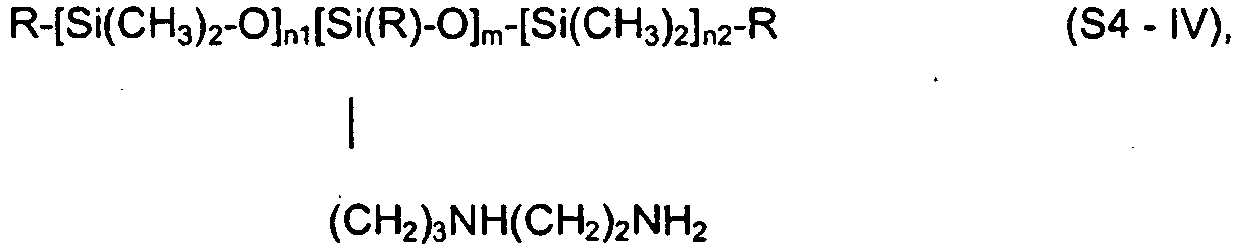
- Diese Silicone werden nach der INCI-Deklaration als Amodimethicone bezeichnet.
- Unabhängig davon, welche aminofunktionellen Silicone eingesetzt werden, sind erfindungsgemäße Mittel bevorzugt, bei denen das aminofunktionelle Silikon eine Aminzahl oberhalb von 0,25 meq/g, vorzugsweise oberhalb von 0,3 meq/g und insbesondere oberhalb von 0,4 meq/g aufweist. Die Aminzahl steht dabei für die Milli-Äquivalente Amin pro Gramm des aminofunktioinelen Silicons. Sie kann durch Titration ermittelt und auch in der Einheit mg KOH/g angegeben werden.
- Wenn die Amodimethicone (S4) in der Basiszusammensetzung enthalten sind, so enthalten diese Zusammensetzungen 0,01 bis 10 Gew.%, vorzugsweise 0,1 bis 8 Gew.%, besonders bevorzugt 0,25 bis 7,5 Gew.% und insbesondere 0,5 bis 5 Gew.% an Amodimethicon bezogen auf die Zusammensetzung.
- Werden unterschiedliche Silikone als Mischung verwendet, so ist das Mischungsverhältnis weitgehend variabel. Bevorzugt werden jedoch alle zur Mischung verwendeten Silikone in einem Verhältnis von 5 : 1 bis 1 : 5 im Falle einer binären Mischung verwendet. Ein Verhältnis von 3 : 1 bis 1 : 3 ist besonders bevorzugt. Ganz besonders bevorzugte Mischungen enthalten alle in der Mischung enthaltenen Silikone weitestgehend in einem Verhältnis von etwa 1 : 1, jeweils bezogen auf die eingesetzten Mengen in Gew.%.
- Wenn die Silikonmischung in der Basiszusammensetzung enthalten sind, so enthalten diese Zusammensetzungen 0,01 bis 10 Gew.%, vorzugsweise 0,1 bis 8 Gew.%, besonders bevorzugt 0,25 bis 7,5 Gew.% und insbesondere 0,5 bis 5 Gew.% an Silikonmischung bezogen auf die Zusammensetzung.
- In einer weiteren bevorzugten Ausführungsform kann die Wirkung des erfindungsgemäßen Wirkstoffes durch Emulgatoren gesteigert werden. Solche Emulgatoren sind beispielsweise
- Anlagerungsprodukte von 4 bis 30 Mol Ethylenoxid und/oder 0 bis 5 Mol Propylenoxid an lineare Fettalkohole mit 8 bis 22 C-Atomen, an Fettsäuren mit 12 bis 22 C-Atomen und an Alkylphenole mit 8 bis 15 C-Atomen in der Alkylgruppe,
- C12-C22-Fettsäuremono- und diester von Anlagerungsprodukten von 1 bis 30 Mol Ethylenoxid an Polyole mit 3 bis 6 Kohlenstoffatomen, insbesondere an Glycerin,
- Ethylenoxid- und Polyglycerin-Anlagerungsprodukte an Methylglucosid-Fettsäureester, Fettsäurealkanolamide und Fettsäureglucamide,
- C8-C22-Alkylmono- und oligoglycoside und deren ethoxylierte Analoga, wobei Oligomerisierungsgrade von 1,1 bis 5, insbesondere 1,2 bis 2,0, und Glucose als Zuckerkomponente bevorzugt sind,
- Gemische aus Alkyl-(oligo)-glucosiden und Fettalkoholen zu Beispiel das im Handel erhältliche Produkt Montanov®68,
- Anlagerungsprodukte von 5 bis 60 Mol Ethylenoxid an Rizinusöl und gehärtetes Rizinusöl,
- Partialester von Polyolen mit 3 bis 6 Kohlenstoffatomen mit gesättigten Fettsäuren mit 8 bis 22 C-Atomen,
- Sterine. Als Sterine wird eine Gruppe von Steroiden verstanden, die am C-Atom 3 des Steroid-Gerüsts eine Hydroxylgruppe tragen und sowohl aus tierischem Gewebe (Zoosterine) wie auch aus pflanzlichen Fetten (Phytosterine) isoliert werden. Beispiele für Zoosterine sind das Cholersterin und das Lanosterin. Beispiele geeigneter Phytosterine sind Ergosterin, Stigmasterin und Sitosterin. Auch aus Pilzen und Hefen werden Sterine, die sogenannten Mykosterine, isoliert.
- Phospholipide. Hierunter werden vor allem die Glucose-Phospholipide, die z.B. als Lecithine bzw. Phosphatidylcholine aus z.B. Eidotter oder Pflanzensamen (z.B. Sojabohnen) gewonnen werden, verstanden.
- Fettsäureestervon Zuckern und Zuckeralkoholen, wie Sorbit,
- Polyglycerine und Polyglycerinderivate wie beispielsweise Polyglycerinpoly-12-hydroxystearat (Handelsprodukt Dehymuls®PGPH),
- Lineare und verzweigte Fettsäuren mit 8 bis 30 C-Atomen und deren Na-, K-, Ammonium-, Ca-, Mg- und Zn-Salze.
- Die erfindungsgemäßen Mittel enthalten die Emulgatoren bevorzugt in Mengen von 0,1 - 25 Gew.-%, insbesondere 0,5 - 15 Gew.-%, bezogen auf das gesamte Mittel.
- Bevorzugt können die erfindungsgemäßen Zusammensetzungen mindestens einen nichtionogenen Emulgator mit einem HLB-Wert von 8 bis 18, gemäß den im Römpp-Lexikon Chemie (Hrg. J. Falbe, M.Regitz), 10. Auflage, Georg Thieme Verlag Stuttgart, New York, (1997), Seite 1764, aufgeführten Definitionen enthalten. Nichtionogene Emulgatoren mit einem HLB-Wert von 10 - 15 können erfindungsgemäß besonders bevorzugt sein.
- Als weiterhin vorteilhaft hat es sich gezeigt, dass weitere Polymere die Wirkung der erfindungsgemäßen Zubereitungen weiter unterstützen können. In einer bevorzugten Ausführungsform werden den erfindungsgemäßen Mitteln daher Polymere zugesetzt, wobei sich sowohl anionische, amphotere als auch nichtionische Polymere als wirksam erwiesen haben.
- Bei den anionischen Polymeren, welche die Wirkung der erfindungsgemäßen Zubereitungen unterstützen können, handelt es sich um anionische Polymere, welche Carboxylat- und/oder Sulfonatgruppen aufweisen. Beispiele für anionische Monomere, aus denen derartige Polymere bestehen können, sind Acrylsäure, Methacrylsäure, Crotonsäure, Maleinsäureanhydrid und 2-Acrylamido-2-methylpropansulfonsäure. Dabei können die sauren Gruppen ganz oder teilweise als Natrium-, Kalium-, Ammonium-, Mono- oder Triethanolammonium-Salz vorliegen. Bevorzugte Monomere sind 2-Acrylamido-2-methylpropansulfonsäure und Acrylsäure.
- Als ganz besonders wirkungsvoll haben sich anionische Polymere erwiesen, die als alleiniges oder Co-Monomer 2-Acrylamido-2-methylpropansulfonsäure enthalten, wobei die Sulfonsäuregruppe ganz oder teilweise als Natrium-, Kalium-, Ammonium-, Mono- oder Triethanolammonium-Salz vorliegen kann.
- Besonders bevorzugt ist das Homopolymer der 2-Acrylamido-2-methylpropansulfonsäure, das beispielsweise unter der Bezeichnung Rheothik®11-80 im Handel erhältlich ist.
- Innerhalb dieser Ausführungsform kann es bevorzugt sein, Copolymere aus mindestens einem anionischen Monomer und mindestens einem nichtionogenen Monomer einzusetzen. Bezüglich der anionischen Monomere wird auf die oben aufgeführten Substanzen verwiesen. Bevorzugte nichtionogene Monomere sind Acrylamid, Methacrylamid, Acrylsäureester, Methacrylsäureester, Vinylpyrrolidon, Vinylether und Vinylester.
- Bevorzugte anionische Copolymere sind Acrylsäure-Acrylamid-Copolymere sowie insbesondere Polyacrylamidcopolymere mit Sulfonsäuregruppen-haltigen Monomeren. Ein besonders bevorzugtes anionisches Copolymer besteht aus 70 bis 55 Mol-% Acrylamid und 30
- bis 45 Mol-% 2-Acrylamido-2-methylpropansulfonsäure, wobei die Sulfonsäuregruppe ganz oder teilweise als Natrium-, Kalium-, Ammonium-, Mono- oder Triethanolammonium-Salz vorliegt. Dieses Copolymer kann auch vernetzt vorliegen, wobei als Vernetzungsagentien bevorzugt polyolefinisch ungesättigte Verbindungen wie Tetraallyloxyethan, Allylsucrose, Allylpentaerythrit und Methylen-bisacrylamid zum Einsatz kommen. Ein solches Polymer ist in dem Handelsprodukt Sepigel®305 der Firma SEPPIC enthalten. Die Verwendung dieses Compounds, das neben der Polymerkomponente eine Kohlenwasserstoffmischung (C13-C14-Isoparaffin) und einen nichtionogenen Emulgator (Laureth-7) enthält, hat sich im Rahmen der erfindungsgemäßen Lehre als besonders vorteilhaft erwiesen.
- Auch die unter der Bezeichnung Simulgel®600 als Compound mit Isohexadecan und Polysorbat-80 vertriebenen Natriumacryloyldimethyltaurat-Copolymere haben sich als erfindungsgemäß besonders wirksam erwiesen.
- Ebenfalls bevorzugte anionische Homopolymere sind unvernetzte und vernetzte Polyacrylsäuren. Dabei können Allylether von Pentaerythrit, von Sucrose und von Propylen bevorzugte Vernetzungsagentien sein. Solche Verbindungen sind beispielsweise unter dem Warenzeichen Carbopol® im Handel erhältlich.
- Copolymere aus Maleinsäureanhydrid und Methylvinylether, insbesondere solche mit Vernetzungen, sind ebenfalls farberhaltende Polymere. Ein mit 1,9-Decadiene vernetztes Maleinsäure-Methylvinylether-Copolymer ist unter der Bezeichnungg Stabileze® QM im Handel erhältlich.
- Weiterhin können als Polymere zur Steigerung der Wirkung der erfindungsgemäßen Zubereitungen amphotere Polymere verwendet werden. Unter dem Begriff amphotere Polymere werden sowohl solche Polymere, die im Molekül sowohl freie Aminogruppen als auch freie -COOH- oder SO3H-Gruppen enthalten und zur Ausbildung innerer Salze befähigt sind, als auch zwitterionische Polymere, die im Molekül quartäre Ammoniumgruppen und -COO-- oder -SO3 --Gruppen enthalten, und solche Polymere zusammengefaßt, die -COOH- oder SO3H-Gruppen und quartäre Ammoniumgruppen enthalten.
- Ein Beispiel für ein erfindungsgemäß einsetzbares Amphopolymer ist das unter der Bezeichnung Amphomer® erhältliche Acrylharz, das ein Copolymeres aus tert.-Butylaminoethylmethacrylat, N-(1,1,3,3-Tetramethylbutyl)acrylamid sowie zwei oder mehr Monomeren aus der Gruppe Acrylsäure, Methacrylsäure und deren einfachen Estern darstellt.
- Weitere erfindungsgemäß einsetzbare amphotere Polymere sind die in der britischen Offenlegungsschrift
2 104 091 47 714 217 274 283 817 28 17 369 genannten Verbindungen. - Bevorzugt eingesetzte amphotere Polymere sind solche Polymerisate, die sich im wesentlichen zusammensetzen aus
- (a) Monomeren mit quartären Ammoniumgruppen der allgemeinen Formel (G3-I),
R1-CH=CR2-CO-Z-(CnH2n)-N(+)R3R4R5 A(-) (G3-I)
in der R1 und R2 unabhängig voneinander stehen für Wasserstoff oder eine Methylgruppe und R3, R4 und R5 unabhängig voneinander für Alkylgruppen mit 1 bis 4 Kohlenstoffatomen, Z eine NH-Gruppe oder ein Sauerstoffatom, n eine ganze Zahl von 2 bis 5 und A(-) das Anion einer organischen oder anorganischen Säure ist, und - (b) monomeren Carbonsäuren der allgemeinen Formel (G3-II),
R6-CH=CR7-COOH (G3-II)
in denen R6 und R7 unabhängig voneinander Wasserstoff oder Methylgruppen sind. - Diese Verbindungen können sowohl direkt als auch in Salzform, die durch Neutralisation der Polymerisate, beispielsweise mit einem Alkalihydroxid, erhalten wird, erfindungsgemäß eingesetzt werden. Bezüglich der Einzelheiten der Herstellung dieser Polymerisate wird ausdrücklich auf den Inhalt der deutschen Offenlegungsschrift
39 29 973 Bezug genommen. Ganz besonders bevorzugt sind solche Polymerisate, bei denen Monomere des Typs (a) eingesetzt werden, bei denen R3, R4 und R5 Methylgruppen sind, Z eine NH-Gruppe und A(-) ein Halogenid-, Methoxysulfat- oder Ethoxysulfat-Ion ist; Acrylamidopropyl-trimethyl-ammoniumchlorid ist ein besonders bevorzugtes Monomeres (a). Als Monomeres (b) für die genannten Polymerisate wird bevorzugt Acrylsäure verwendet. - Die erfindungsgemäßen Mittel können in einer weiteren Ausführungsform nichtionogene Polymere enthalten.
- Geeignete nichtionogene Polymere sind beispielsweise:
- Vinylpyrrolidon/Vinylester-Copolymere, wie sie beispielsweise unter dem Warenzeichen Luviskol® (BASF) vertrieben werden. Luviskol® VA 64 und Luviskol® VA 73, jeweils Vihylpyrrolidon/Vinylacetat-Copolymere, sind ebenfalls bevorzugte nichtionische Polymere.
- Celluloseether, wie Hydroxypropylcellulose, Hydroxyethylcellulose und Methylhydroxypropylcellulose, wie sie beispielsweise unter den Warenzeichen Culminal® und Benecel® (AQUALON) vertrieben werden.
- Schellack
- Polyvinylpyrrolidone, wie sie beispielsweise unter der Bezeichnung Luviskol® (BASF) vertrieben werden.
- Siloxane. Diese Siloxane können sowohl wasserlöslich als auch wasserunlöslich sein. Geeignet sind sowohl flüchtige als auch nichtflüchtige Siloxane, wobei als nichtflüchtige Siloxane solche Verbindungen verstanden werden, deren Siedepunkt bei Normaldruck oberhalb von 200 °C liegt. Bevorzugte Siloxane sind Polydialkylsiloxane, wie beispielsweise Polydimethylsiloxan, Polyalkylarylsiloxane, wie beispielsweise Polyphenylmethylsiloxan, ethoxylierte Polydialkylsiloxane sowie Polydialkylsiloxane, die Amin- und/oder HydroxyGruppen enthalten.
- Glycosidisch substituierte Silicone gemäß der
EP 0612759 B1 . - Es ist erfindungsgemäß auch möglich, dass die verwendeten Zubereitungen mehrere, insbesondere zwei verschiedene Polymere gleicher Ladung und/oder jeweils ein ionisches und ein amphoteres und/oder nicht ionisches Polymer enthalten.
- Die Polymere sind in den erfindungsgemäß verwendeten Mitteln bevorzugt in Mengen von 0,05 bis 10 Gew.-%, bezogen auf das gesamte Mittel, enthalten. Mengen von 0,1 bis 5, insbesondere von 0,1 bis 3 Gew.%, sind besonders bevorzugt.
- Weitere Wirk-, Hilfs- und Zusatzstoffe sind beispielsweise
- Verdickungsmittel wie Agar-Agar, Guar-Gum, Alginate, Xanthan-Gum, Gummi arabicum, Karaya-Gummi, Johannisbrotkernmehl, Leinsamengummen, Dextrane, Cellulose-Derivate, z. B. Methylcellulose, Hydroxyalkylcellulose und Carboxymethylcellulose, Stärke-Fraktionen und Derivate wie Amylose, Amylopektin und Dextrine, Tone wie z. B. Bentonit oder vollsynthetische Hydrokolloide wie z. B. Polyvinylalkohol,
- haarkonditionierende Verbindungen wie Phospholipide, beispielsweise Sojalecithin, Ei-Lecitin und Kephaline, sowie Silikonöle,
- Parfümöle, Dimethylisosorbid und Cyclodextrine,
- Lösungsmittel und -vermittler wie Ethanol, Isopropanol, Ethylenglykol, Propylenglykol, Glycerin und Diethylenglykol,
- faserstrukturverbessernde Wirkstoffe, insbesondere Mono-, Di- und Oligosaccharide, wie beispielsweise Glucose, Galactose, Fructose, Fruchtzucker und Lactose,
- Entschäumer wie Silikone,
- Farbstoffe zum Anfärben des Mittels,
- Weitere Antischuppenwirkstoffe wie Piroctone Olamine, Zink Omadine und Climbazol,
- Wirkstoffe wie Allantoin und Bisabolol, Cholesterin,
- Konsistenzgeber wie Zuckerester, Polyolester oder Polyolalkylether,
- Fette und Wachse wie Walrat, Bienenwachs, Montanwachs und Paraffine,
- Fettsäurealkanolamide,
- Komplexbildner wie EDTA, NTA, β-Alanindiessigsäure und Phosphonsäuren,
- Quell- und Penetrationsstoffe wie primäre, sekundäre und tertiäre Phosphate,
- Trübungsmittel wie Latex, Styrol/PVP- und Styrol/Acrylamid-Copolymere,
- Perlglanzmittel wie Ethylenglykolmono- und -distearat sowie PEG-3-distearat,
- Pigmente,
- Treibmittel wie Propan-Butan-Gemische, N2O, Dimethylether, CO2 und Luft,
- Antioxidantien.
- Bezüglich weiterer fakultativer Komponenten sowie die eingesetzten Mengen dieser Komponenten wird ausdrücklich auf die dem Fachmann bekannten einschlägigen Handbücher, z. B. die Monographie von K. H. Schrader, Grundlagen und Rezepturen der Kosmetika, 2. Auflage, Hüthig Buch Verlag Heidelberg, 1989, verwiesen.
- Die erfindungsgemäßen Reinigungsmittel unterliegen hinsichtlich ihrer Konfektionierungsform keinerlei Beschränkungen und können als Emulsion, Creme, Lösung, Gel oder Mousse formuliert werden.
- Ein zweiter Gegenstand der Erfindung ist Verfahren zur Stabilisierung unlöslicher Antischuppenmittel in tensidischen Sytemen, dadurch gekennzeichnet, dass gehärtetes Rizinusöl über einen Heißprozess feinverteilt in die tensidische Mischung, enthaltend das unlösliche Antischuppenmittel, eingebracht wird.
- Ein dritter Gegenstand der Erfindung ist die Verwendung von gehärtetem Rizinusöl, welches über einen Heißprozess feinverteilt in die tensidische Mischung eingebracht wird, zur Stabilisierung unlöslicher Antischuppenmittel in tensidischen Systemen.
- Die folgenden Beispiele sollen die Erfindung näher erläutern, ohne sie darauf zu beschränken.
- Die aufgeführten Mengenangaben in den Beispielen beziehen sich, sofern nicht anders angegeben, auf Gew.-%.
-
Rohstoffgruppe Rohstoff Formulierungen (Menge) A B C D E F G H I J 1 Wasser ad 100 ad 100 ad 100 ad 100 ad 100 ad 100 ad 100 ad 100 ad 100 ad 100 1A Sodium Laureth Sulfate 10,00 10,00 9,50 9,50 10,00 10,00 9,00 9,00 1A Sodium Lauryl Sulfate 2,50 2,50 1A Ammonium Laureth Sulfate 7,50 7,50 1B Hydrogenated Castor Oil (Cutina HR) 0,50 0,25 0,30 0,50 0,30 1C Dimethicone 60,000 cSt. 0,60 0,60 1C Dimethicone 300,000 cSt. 1,30 1,30 1D Cetylalcohol 0,50 0,50 0,30 0,30 1D Glycol Stearate 0,50 0,50 1D Glycol Distearate 0,80 0,80 0,80 0,80 0,50 0,50 1D Styrene/VP Copolymer 0,30 0,30 1D Titanoxide 0,10 0,10 0,10 0,10 1D Mica 0,10 0,10 0,10 0,10 2A Wasser 20,00 20,00 20,00 20,00 2B Carbomer 0,40 0,40 2B Acrylates/C10-30-Alkylacrylates-Crosspolymer 0,40 0,40 2B Sodium Hydroxide 0,20 0,20 0,20 0,20 3A Wasser 35,00 35,00 35,00 35,00 35,00 35,00 15,00 15,00 15,00 15,00 3B Sodium Salicylate 0,15 0,15 0,15 0,15 0,15 0,15 3B Sodium Benzoate 0,45 0,45 0,50 0,50 0,45 0,45 3B Methylparabene/Propylparabene/ Butylparabene 0,30 0,30 0,30 0,30 3B Methylisothiazolinone 0,01 0,01 0,01 0,01 3C Polyquaternium-10 0,15 0,15 3C Polyquaternium-7 0,30 0,30 0,30 0,30 3C Guar Hydroxypropyl Trimonium Chloride 0,40 0,40 3D Panthenol 0,50 0,50 0,50 0,50 0,50 0,50 0,50 0,50 3D Niacinamide 0,30 0,30 0,30 0,30 0,30 0,30 3D Hydrolized Wheat Protein 0,20 0,20 0,10 0,10 3D Pantolacton 0,30 0,30 3D Laurdimonium Hydroxypropyl Hydrolized Wheat Protein 0,15 0,15 4A Zink Pyrithione 50% 2,00 2,00 2,00 2,00 2,00 2,00 2,00 2,00 2,00 2,00 4A Cocoamidopropyl Betaine 3,50 3,50 4A Disodium Cocoamphodiacetate 3,00 3,00 3,70 3,70 4A Coco-Betaine 2,90 2,90 4A Coco-Glucoside 1,20 1,20 4A Sodium Cocoamphoacetate 3,00 3,00 4B Laureth-2 0,30 0,30 4B Propylene Glycol & PEG-55 Propylene Glycol Oleate 0,10 0,10 4B PEG-120 Methyl Glucose Dioleate 0,20 0,20 4C Parfum 0,50 0,50 0,50 0,50 0,50 0,50 0,50 0,50 0,50 0,50 5A Citric Acid 0,1-0,5 0,1-0,5 0,1-0,5 0,1-0,5 0,1-0,5 0,1-0,5 0,1-0,5 0,1-0,5 5A Lactic Acid 0,1-0,5 0,1-0,5 6A Sodium Chloride 0,05-1,00 0,05-1,00 0,05-1,00 0,05-1,00 0,05-1,00 0,05-1,00 0,05-1,00 0,05-1,00 0.05-1,00 0,05-1,00 pH-Wert 5,3 5,3 6,0 6,0 5,0 5,0 6,5 6,5 5,0 5,0 Viskosität (Brookfield DV2; +20°C; 20 UPM) 7000-9000 7000-9000 7000-9000 7000-9000 7000-9000 7000-9000 5000-7000 5000-7000 5000-7000 5000-7000 Stabilitätsauswertung nach 12 Wochen bei 45°C Lagerung k.V. S.-E. k.V. S.-E. k.V. S.-E. k.V. I.S.-E. k.V. I.S.-E k.V.: keine Veränderungen
S.-E. ( I.S.-E.): Separations-Erscheinungen (leichte Separations-Erscheinungen)
Herstellungsanweisung:
1: Reaktionsgemisch 1 und 1 A vorlegen und auf 75 - 80°C erwärmen
2: Reaktionsgemisch 1 B schmelzen und unter Rühren zugeben
3: Reaktionsgemisch 1C unter Rühren zugeben
4: homogenisieren
5: Reaktionsgemisch 1 D unter Rühren zugeben
6: Reaktionsgemisch 2A separat vorlegen
7: Reaktionsgemisch 2A unter Rühren in Reaktionsgemisch 2 quellen lassen und anschließend mit NaOH neutralisieren auf pH 7
8: Reaktionsgemisch 2 (Schritte 6 bis 7) zu Reaktionsgemisch 1 (Schritte 1 bis 5) geben
9: Reaktionsgemisch 3A separat vorlegen
10: Reaktionsgemisch 3B in Reaktionsgemisch 3A lösen
11: Reaktionsgemisch 3C in Reaktionsgemisch 3 quellen
12: Reaktionsgemisch 3D in Reaktionsgemisch 3 lösen
13: Reaktionsgemisch 3 (Schritte 9 bis 12) unter Rühren zum Ansatz (Reaktionsgemisch 1 + Reaktionsgemisch 2) geben
14: Reaktionsgemisch 4A unter Rühren zum Ansatz geben
15: Reaktionsgemisch 4B unter Rühren zum Ansatz geben
16: Reaktionsgemisch 4C unter Rühren zum Ansatz geben
17: mit Reaktionsgemisch 5A wird der pH-Wert des Ansatzes eingestellt
18: mit Reaktionsgemisch 6A wird die Viskosität des Ansatzes hergestellt
Claims (12)
- Tensidhaltiges Reinigungsmittel, dadurch gekennzeichnet, dass es zur Stabilisierung eines in dem Reinigungsmittel unlöslichen Antischuppenmittels gehärtetes Rizinusöl enthält, welches über einen Heißprozess feinverteilt in die tensidische Mischung eingebracht wurde.
- Tensidhaltiges Reinigungsmittel nach Anspruch 1, dadurch gekennzeichnet, dass es ein Gemisch aus mindestens einem anionischen Tensid mit einem amphoteren und/oder zwitterionischen und/oder einem nichtionischen Tensid umfasst.
- Tensidhaltiges Reinigungsmittel nach einem der Ansprüche 1 oder 2, dadurch gekennzeichnet, dass es - bezogen auf sein Gesamtgewicht - 5 bis 35%, bevorzugt 7 bis 25% und insbesondere 8 bis 15% Tenside enthält.
- Tensidhaltiges Reinigungsmittel nach einem der Ansprüche 1 bis 3, dadurch gekennzeichnet, dass das Antischuppenmittel ausgewählt ist aus Ketagenazole, Climbazole, Zink-Pyrithione, Salicysäure, Zink-Carbonate und Piroctone Olamine.
- Tensidhaltiges Reinigungsmittel nach einem der Ansprüche 1 bis 4, dadurch gekennzeichnet, dass es - bezogen auf sein Gesamtgewicht - 0,05 bis 2,0 %, bevorzugt 0,25 bis 1,5%, und insbesondere 0,5 bis 1,0% des Antischuppenmittels enthält.
- Tensidhaltiges Reinigungsmittel nach einem der Ansprüche 1 bis 5, dadurch gekennzeichnet, dass das Antischuppenmittel Zinkpyrithion ist.
- Tensidhaltiges Reinigungsmittel nach einem der Ansprüche 1 bis 6, dadurch gekennzeichnet, dass es das gehärtete Rizinusöl - bezogen auf sein Gesamtgewicht - in einer Menge von 0,01 bis 5%, bevorzugt 0,05 bis 3% und insbesondere 0,1 bis 2%, enthält.
- Tensidhaltiges Reinigungsmittel nach einem der Ansprüche 1 bis 7, dadurch gekennzeichnet, dass es weiterhin mindestens ein kationisches Polymer enthält.
- Tensidhaltiges Reinigungsmittel nach einem der Ansprüche 1 bis 8, dadurch gekennzeichnet, dass weiterhin mindestens einen Vertreter aus der Gruppe der wasserunlöslichen Ölkomponenten, der Vitamine, der Provitamine, der Proteinhydrolysate, der Pflanzenextrakte, der UV-Filter, der Aminosäuren, der wasserunlöslichen Silikone, der wasserlöslichen Silikone und/oder der Amodimethicone enthält.
- Tensidhaltiges Reinigungsmittel nach Anspruch 9, dadurch gekennzeichnet, dass es als wasserunlösliche Ölkomponente mineralische, pflanzliche, tierische und/oder synthetische Öle enthält.
- Verfahren zur Stabilisierung unlöslicher Antischuppenmittel in tensidischen Sytemen, dadurch gekennzeichnet, dass gehärtetes Rizinusöl über einen Heißprozeß feinverteilt in die tensidische Mischung, enthaltend das unlösliche Antischuppenmittel, eingebracht wird.
- Verwendung von gehärtetem Rizinusöl zur Stabilisierung unlöslicher Antischuppenmittel in tensidischen Systemen, dadurch gekennzeichnet, dass das gehärtete Rizinusöl über einen Heißprozess feinverteilt in die tensidische Mischung eingebracht wird.
Applications Claiming Priority (2)
| Application Number | Priority Date | Filing Date | Title |
|---|---|---|---|
| DE102006032505A DE102006032505A1 (de) | 2006-07-12 | 2006-07-12 | Anti-Schuppen-Shampoo |
| PCT/EP2007/002868 WO2008006412A1 (de) | 2006-07-12 | 2007-03-30 | Anti schuppen-shampoo |
Publications (2)
| Publication Number | Publication Date |
|---|---|
| EP2037877A1 EP2037877A1 (de) | 2009-03-25 |
| EP2037877B1 true EP2037877B1 (de) | 2013-10-16 |
Family
ID=38222599
Family Applications (1)
| Application Number | Title | Priority Date | Filing Date |
|---|---|---|---|
| EP07723810.3A Active EP2037877B1 (de) | 2006-07-12 | 2007-03-30 | Anti schuppen-shampoo |
Country Status (8)
| Country | Link |
|---|---|
| US (1) | US20090169644A1 (de) |
| EP (1) | EP2037877B1 (de) |
| AU (1) | AU2007272062A1 (de) |
| CA (1) | CA2659191A1 (de) |
| CO (1) | CO6150120A2 (de) |
| DE (1) | DE102006032505A1 (de) |
| RU (1) | RU2009104477A (de) |
| WO (1) | WO2008006412A1 (de) |
Cited By (3)
| Publication number | Priority date | Publication date | Assignee | Title |
|---|---|---|---|---|
| DE102015213478A1 (de) | 2015-07-17 | 2017-01-19 | Henkel Ag & Co. Kgaa | Stabilisierungsgemisch |
| WO2020182784A1 (en) | 2019-03-13 | 2020-09-17 | Basf Se | Stabilizer concentrates for wax dispersions |
| WO2021052856A1 (en) | 2019-09-18 | 2021-03-25 | Basf Se | Stabilizer concentrates for wax dispersions |
Families Citing this family (23)
| Publication number | Priority date | Publication date | Assignee | Title |
|---|---|---|---|---|
| GB201002356D0 (en) * | 2010-02-12 | 2010-03-31 | Reckitt Benckiser Nv | Composition |
| DE102012206949A1 (de) * | 2012-04-26 | 2013-10-31 | Henkel Ag & Co. Kgaa | Haarbehandlungsmittel mit hydroxy-terminierten Organopolysiloxan(en) und Konditioniermittel(n) |
| DE102012214040A1 (de) * | 2012-08-08 | 2014-02-13 | Henkel Ag & Co. Kgaa | Haarpflegemittel mit ausgewählten Fettsäureamiden und ausgewählten Proteinhydrolysaten |
| DE102012214140A1 (de) * | 2012-08-09 | 2014-02-13 | Henkel Ag & Co. Kgaa | Haarpflegemittel mit Antischuppenmitteln und ausgewählte Komplexe aus sauren Proteinhydrolysaten und basischen Fettsäureamidoaminen |
| DE102012214142A1 (de) * | 2012-08-09 | 2014-02-13 | Henkel Ag & Co. Kgaa | Haarpflegemittel mit ausgewählten Aminosäuren und ausgewählten Komplexen aus sauren Proteinhydrolysaten und basischen Fettsäureamidoaminen |
| DE102012214145A1 (de) * | 2012-08-09 | 2014-02-13 | Henkel Ag & Co. Kgaa | Haarbehandlungsmittel enthaltend ausgewählte Riechstoffe und ausgewählte Komplexe aus sauren Proteinhydrolysaten und basischen Fettsäureamidoaminen |
| DE102012214151A1 (de) * | 2012-08-09 | 2014-02-13 | Henkel Ag & Co. Kgaa | Haarbehandlungsmittel enthaltend ausgewählte UV-Filter und ausgewählte Komplexe aus sauren Proteinhydrolysaten und basischen Fettsäureamidoaminen |
| DE102012214150A1 (de) * | 2012-08-09 | 2014-02-13 | Henkel Ag & Co. Kgaa | Haarpflegemittel mit ausgewählten Tensiden und ausgewählten Komplexen aus sauren Proteinhydrolysaten und basischen Fettsäureamidoaminen |
| DE102012214139A1 (de) * | 2012-08-09 | 2014-02-13 | Henkel Ag & Co. Kgaa | Haarpflegemittel mit ausgewählten Proteinhydrolysaten und ausgewählten Komplexen aus sauren Proteinhydrolysaten und basischen Fettsäureamidoaminen |
| DE102012214141A1 (de) * | 2012-08-09 | 2014-02-13 | Henkel Ag & Co. Kgaa | Haarbehandlungsmittel enthaltend ausgewählte Silikone und ausgewählte Komplexe aus sauren Proteinhydrolysaten und basischen Fettsäureamidoaminen |
| DE102015223855A1 (de) * | 2015-12-01 | 2017-06-01 | Henkel Ag & Co. Kgaa | Leistungsstarke Haarbehandlungsmittel mit Anti-Auswasch-Effekt |
| US11179309B2 (en) * | 2015-12-09 | 2021-11-23 | Conopco, Inc. | Hair care composition |
| FR3051361B1 (fr) * | 2016-05-18 | 2018-05-18 | L'oreal | Composition cosmetique comprenant des tensioactifs anioniques, des tensioactifs amphoteres, des polymeres cationiques et des corps gras liquides choisis parmi les alcools gras et les esters gras, et procede de traitement cosmetique |
| CN110662526A (zh) * | 2017-03-23 | 2020-01-07 | 荷兰联合利华有限公司 | 毛发护理组合物 |
| JP7091361B2 (ja) * | 2017-03-30 | 2022-06-27 | ユニリーバー・アイピー・ホールディングス・ベスローテン・ヴェンノーツハップ | 抗菌パーソナルクレンジング組成物 |
| DE102017223063A1 (de) * | 2017-12-18 | 2019-06-19 | Henkel Ag & Co. Kgaa | Haarbehandlungsmittel mit Antischuppenwirkung |
| WO2019222338A1 (en) * | 2018-05-15 | 2019-11-21 | The Procter & Gamble Company | Synergistic antioxidant compositions |
| WO2021013476A1 (en) | 2019-07-22 | 2021-01-28 | Unilever N.V. | Hair care composition |
| CA3153523A1 (en) | 2019-10-24 | 2021-04-29 | The Procter & Gamble Company | Personal care composition preservatives level optimization |
| JP2022551149A (ja) * | 2019-10-24 | 2022-12-07 | ザ プロクター アンド ギャンブル カンパニー | パーソナルケア組成物の防腐剤濃度の最適化 |
| EP4048409A1 (de) | 2019-10-24 | 2022-08-31 | The Procter & Gamble Company | Optimierung des konservierungsmittelgehalts einer kosmetischen zusammensetzung |
| MX2022005758A (es) | 2019-12-19 | 2022-06-09 | Procter & Gamble | Composicion transparente con activo soluble para la salud del cuero cabelludo. |
| EP4127645B1 (de) | 2020-03-24 | 2025-08-13 | The Procter & Gamble Company | Verfahren zum testen von hautproben |
Family Cites Families (21)
| Publication number | Priority date | Publication date | Assignee | Title |
|---|---|---|---|---|
| US4237253A (en) * | 1977-04-21 | 1980-12-02 | L'oreal | Copolymers, their process of preparation, and cosmetic compounds containing them |
| JPS5662899A (en) * | 1979-10-29 | 1981-05-29 | Sunstar Hamigaki | Hair shampoo |
| EP0047714B1 (de) * | 1980-09-05 | 1985-10-30 | Ciba-Geigy Ag | Gemische aus quaternären, polymeren, hochmolekularen Ammoniumsalzen auf Acrylbasis und Tensiden, deren Herstellung und Verwendung in kosmetischen Mitteln |
| EP0173259B1 (de) * | 1984-08-29 | 1991-11-06 | Kao Corporation | Antimikrobische Suspensionen und antimikrobische Haarbehandlungsmittel |
| US4728667A (en) * | 1984-12-21 | 1988-03-01 | Shiseido Company Ltd. | Hair treatment composition for prevention of dandruff in hair |
| JPH0621050B2 (ja) * | 1985-07-11 | 1994-03-23 | 尚子 浮田 | フケ取りシヤンプ− |
| EP0217274A3 (de) * | 1985-09-30 | 1988-06-29 | Kao Corporation | Haarkosmetikum |
| DE3708451A1 (de) * | 1987-03-16 | 1988-10-06 | Henkel Kgaa | Zwitterionische polymere und deren verwendung in haarbehandlungsmitteln |
| DE3712986A1 (de) * | 1987-04-16 | 1988-10-27 | Marbert Gmbh | Medizinische zubereitungen auf der grundlage von biertreberextrakt, verfahren zu deren herstellung sowie verwendung von biertreberextrakt zur herstellung von kosmetischen zubereitungen und ein spezieller biertreberextrakt |
| DE3723354A1 (de) * | 1987-07-15 | 1989-01-26 | Henkel Kgaa | Sulfatierte hydroxy-mischether, verfahren zu ihrer herstellung und ihre verwendung |
| DE3725030A1 (de) * | 1987-07-29 | 1989-02-09 | Henkel Kgaa | Oberflaechenaktive hydroxysulfonate |
| DE3926344A1 (de) * | 1989-08-09 | 1991-02-28 | Henkel Kgaa | Verfahren zur herstellung von hellfarbigen oelsaeuresulfonaten |
| DE4038477A1 (de) * | 1990-12-03 | 1992-06-04 | Henkel Kgaa | Verfahren zur kontinuierlichen herstellung von partialglyceridsulfaten |
| DE4038478A1 (de) * | 1990-12-03 | 1992-06-04 | Henkel Kgaa | Verfahren zur herstellung von partialglyceridsulfaten |
| DE4204700A1 (de) * | 1992-02-17 | 1993-08-19 | Henkel Kgaa | Verfahren zur abtrennung anorganischer salze |
| DE4413686C2 (de) * | 1994-04-20 | 1996-10-24 | Henkel Kgaa | Kationische Zuckertenside, Verfahren zu ihrer Herstellung und deren Verwendung |
| EP0767191B1 (de) * | 1995-10-05 | 2003-03-12 | Mitsui Chemicals, Inc. | Polymer, Verfahren zur Herstellung, Haarbehandlungszusammensetzungen und kosmetische Zusammensetzungen |
| CA2206717A1 (en) * | 1996-06-03 | 1997-12-03 | Shiseido Company, Ltd. | Hair revitalizing tonic composition containing a lipid derivative and use thereof |
| DE19736906A1 (de) * | 1997-08-25 | 1999-03-04 | Henkel Kgaa | Verfahren zur Herstellung von sulfatierten Fettsäurealkylenglykolestern |
| DE19738866A1 (de) * | 1997-09-05 | 1999-03-11 | Henkel Kgaa | Schaumarme Tensidmischungen mit Hydroxymischethern |
| DE19916211C2 (de) * | 1999-04-10 | 2001-06-07 | Cognis Deutschland Gmbh | Kosmetische und/oder pharmazeutische Zubereitungen |
-
2006
- 2006-07-12 DE DE102006032505A patent/DE102006032505A1/de not_active Withdrawn
-
2007
- 2007-03-30 WO PCT/EP2007/002868 patent/WO2008006412A1/de not_active Ceased
- 2007-03-30 EP EP07723810.3A patent/EP2037877B1/de active Active
- 2007-03-30 AU AU2007272062A patent/AU2007272062A1/en not_active Abandoned
- 2007-03-30 CA CA002659191A patent/CA2659191A1/en not_active Abandoned
- 2007-03-30 RU RU2009104477/15A patent/RU2009104477A/ru not_active Application Discontinuation
-
2009
- 2009-01-09 US US12/351,306 patent/US20090169644A1/en not_active Abandoned
- 2009-01-09 CO CO09001682A patent/CO6150120A2/es unknown
Cited By (4)
| Publication number | Priority date | Publication date | Assignee | Title |
|---|---|---|---|---|
| DE102015213478A1 (de) | 2015-07-17 | 2017-01-19 | Henkel Ag & Co. Kgaa | Stabilisierungsgemisch |
| WO2017012727A1 (de) | 2015-07-17 | 2017-01-26 | Henkel Ag & Co. Kgaa | Stabilisierungsgemisch |
| WO2020182784A1 (en) | 2019-03-13 | 2020-09-17 | Basf Se | Stabilizer concentrates for wax dispersions |
| WO2021052856A1 (en) | 2019-09-18 | 2021-03-25 | Basf Se | Stabilizer concentrates for wax dispersions |
Also Published As
| Publication number | Publication date |
|---|---|
| AU2007272062A1 (en) | 2008-01-17 |
| CA2659191A1 (en) | 2008-01-17 |
| CO6150120A2 (es) | 2010-04-20 |
| RU2009104477A (ru) | 2010-08-20 |
| WO2008006412A1 (de) | 2008-01-17 |
| US20090169644A1 (en) | 2009-07-02 |
| DE102006032505A1 (de) | 2008-01-17 |
| EP2037877A1 (de) | 2009-03-25 |
Similar Documents
| Publication | Publication Date | Title |
|---|---|---|
| EP2037877B1 (de) | Anti schuppen-shampoo | |
| EP2049073A1 (de) | Mittel zur bekämpfung von kopfhautschuppen | |
| EP1714678A1 (de) | Körperreinigungszusammensetzung mit vermindertem Wassergehalt | |
| EP1970045A2 (de) | Haarbehandlungsmittel mit Antischuppenwirkung | |
| DE102008050430A1 (de) | Anti-Schuppen- und Anti-Rückfall-Shampoo | |
| DE102007036499A1 (de) | Naturkosmetisches Haarbehandlungsmittel | |
| DE102008034388A1 (de) | Tensidhaltige Zusammensetzung mit spezieller Emulgatormischung | |
| EP1977728A2 (de) | Stabilisierung tensidhaltiger Mittel | |
| EP1932512B1 (de) | Moisturizing-Duschbad mit optimierten Schaumeigenschaften | |
| DE102008036073A1 (de) | Reinigungsmittel mit Terpolymer | |
| EP2173317A1 (de) | Enzymatische aufhellung keratinischer fasern | |
| EP2263645B1 (de) | Stylingmittel mit hohem Haltegrad bei Feuchtigkeit | |
| EP1789010B1 (de) | Wirkstoffgemisch zur behandlung keratinischer fasern | |
| EP1752138B1 (de) | Amaranthsamenöl in Haarbehandlungsmitteln | |
| WO2007042085A1 (de) | Stabilisierung von wasserunlöslichen silikonen | |
| WO2009019046A1 (de) | Haarbehandlungsmittel zur volumensteigerung | |
| EP2489345A1 (de) | Stylingmittel mit hohem Haltegrad bei Feuchtigkeit III | |
| EP1759686B1 (de) | Quarz in kosmetischen Mitteln | |
| DE102005057917A1 (de) | Wasserbeständige Frisiermittel | |
| DE102004041569A1 (de) | Verfahren zur Pflege keratinischer Fasern | |
| WO2006066641A1 (de) | Mittel zur behandlung von grün-stichigem blonden haar | |
| DE102006042228A1 (de) | Neue Verwendung von Pantolacton |
Legal Events
| Date | Code | Title | Description |
|---|---|---|---|
| PUAI | Public reference made under article 153(3) epc to a published international application that has entered the european phase |
Free format text: ORIGINAL CODE: 0009012 |
|
| 17P | Request for examination filed |
Effective date: 20090105 |
|
| AK | Designated contracting states |
Kind code of ref document: A1 Designated state(s): AT BE BG CH CY CZ DE DK EE ES FI FR GB GR HU IE IS IT LI LT LU LV MC MT NL PL PT RO SE SI SK TR |
|
| AX | Request for extension of the european patent |
Extension state: AL BA HR MK RS |
|
| 17Q | First examination report despatched |
Effective date: 20090730 |
|
| DAX | Request for extension of the european patent (deleted) | ||
| GRAP | Despatch of communication of intention to grant a patent |
Free format text: ORIGINAL CODE: EPIDOSNIGR1 |
|
| RIC1 | Information provided on ipc code assigned before grant |
Ipc: A61Q 5/00 20060101ALI20130507BHEP Ipc: A61K 8/92 20060101AFI20130507BHEP Ipc: A61Q 5/02 20060101ALI20130507BHEP |
|
| INTG | Intention to grant announced |
Effective date: 20130527 |
|
| GRAS | Grant fee paid |
Free format text: ORIGINAL CODE: EPIDOSNIGR3 |
|
| GRAA | (expected) grant |
Free format text: ORIGINAL CODE: 0009210 |
|
| AK | Designated contracting states |
Kind code of ref document: B1 Designated state(s): AT BE BG CH CY CZ DE DK EE ES FI FR GB GR HU IE IS IT LI LT LU LV MC MT NL PL PT RO SE SI SK TR |
|
| REG | Reference to a national code |
Ref country code: GB Ref legal event code: FG4D Free format text: NOT ENGLISH |
|
| REG | Reference to a national code |
Ref country code: CH Ref legal event code: EP |
|
| REG | Reference to a national code |
Ref country code: IE Ref legal event code: FG4D Free format text: LANGUAGE OF EP DOCUMENT: GERMAN |
|
| REG | Reference to a national code |
Ref country code: AT Ref legal event code: REF Ref document number: 636099 Country of ref document: AT Kind code of ref document: T Effective date: 20131115 |
|
| REG | Reference to a national code |
Ref country code: DE Ref legal event code: R096 Ref document number: 502007012389 Country of ref document: DE Effective date: 20131212 |
|
| REG | Reference to a national code |
Ref country code: NL Ref legal event code: VDEP Effective date: 20131016 |
|
| REG | Reference to a national code |
Ref country code: LT Ref legal event code: MG4D |
|
| PG25 | Lapsed in a contracting state [announced via postgrant information from national office to epo] |
Ref country code: LT Free format text: LAPSE BECAUSE OF FAILURE TO SUBMIT A TRANSLATION OF THE DESCRIPTION OR TO PAY THE FEE WITHIN THE PRESCRIBED TIME-LIMIT Effective date: 20131016 Ref country code: IS Free format text: LAPSE BECAUSE OF FAILURE TO SUBMIT A TRANSLATION OF THE DESCRIPTION OR TO PAY THE FEE WITHIN THE PRESCRIBED TIME-LIMIT Effective date: 20140216 Ref country code: SE Free format text: LAPSE BECAUSE OF FAILURE TO SUBMIT A TRANSLATION OF THE DESCRIPTION OR TO PAY THE FEE WITHIN THE PRESCRIBED TIME-LIMIT Effective date: 20131016 Ref country code: NL Free format text: LAPSE BECAUSE OF FAILURE TO SUBMIT A TRANSLATION OF THE DESCRIPTION OR TO PAY THE FEE WITHIN THE PRESCRIBED TIME-LIMIT Effective date: 20131016 Ref country code: FI Free format text: LAPSE BECAUSE OF FAILURE TO SUBMIT A TRANSLATION OF THE DESCRIPTION OR TO PAY THE FEE WITHIN THE PRESCRIBED TIME-LIMIT Effective date: 20131016 |
|
| PG25 | Lapsed in a contracting state [announced via postgrant information from national office to epo] |
Ref country code: LV Free format text: LAPSE BECAUSE OF FAILURE TO SUBMIT A TRANSLATION OF THE DESCRIPTION OR TO PAY THE FEE WITHIN THE PRESCRIBED TIME-LIMIT Effective date: 20131016 Ref country code: ES Free format text: LAPSE BECAUSE OF FAILURE TO SUBMIT A TRANSLATION OF THE DESCRIPTION OR TO PAY THE FEE WITHIN THE PRESCRIBED TIME-LIMIT Effective date: 20131016 Ref country code: CY Free format text: LAPSE BECAUSE OF FAILURE TO SUBMIT A TRANSLATION OF THE DESCRIPTION OR TO PAY THE FEE WITHIN THE PRESCRIBED TIME-LIMIT Effective date: 20131016 |
|
| PG25 | Lapsed in a contracting state [announced via postgrant information from national office to epo] |
Ref country code: PT Free format text: LAPSE BECAUSE OF FAILURE TO SUBMIT A TRANSLATION OF THE DESCRIPTION OR TO PAY THE FEE WITHIN THE PRESCRIBED TIME-LIMIT Effective date: 20140217 |
|
| REG | Reference to a national code |
Ref country code: DE Ref legal event code: R097 Ref document number: 502007012389 Country of ref document: DE |
|
| PG25 | Lapsed in a contracting state [announced via postgrant information from national office to epo] |
Ref country code: EE Free format text: LAPSE BECAUSE OF FAILURE TO SUBMIT A TRANSLATION OF THE DESCRIPTION OR TO PAY THE FEE WITHIN THE PRESCRIBED TIME-LIMIT Effective date: 20131016 |
|
| PLBE | No opposition filed within time limit |
Free format text: ORIGINAL CODE: 0009261 |
|
| STAA | Information on the status of an ep patent application or granted ep patent |
Free format text: STATUS: NO OPPOSITION FILED WITHIN TIME LIMIT |
|
| PG25 | Lapsed in a contracting state [announced via postgrant information from national office to epo] |
Ref country code: CZ Free format text: LAPSE BECAUSE OF FAILURE TO SUBMIT A TRANSLATION OF THE DESCRIPTION OR TO PAY THE FEE WITHIN THE PRESCRIBED TIME-LIMIT Effective date: 20131016 Ref country code: IT Free format text: LAPSE BECAUSE OF FAILURE TO SUBMIT A TRANSLATION OF THE DESCRIPTION OR TO PAY THE FEE WITHIN THE PRESCRIBED TIME-LIMIT Effective date: 20131016 Ref country code: RO Free format text: LAPSE BECAUSE OF FAILURE TO SUBMIT A TRANSLATION OF THE DESCRIPTION OR TO PAY THE FEE WITHIN THE PRESCRIBED TIME-LIMIT Effective date: 20131016 Ref country code: SK Free format text: LAPSE BECAUSE OF FAILURE TO SUBMIT A TRANSLATION OF THE DESCRIPTION OR TO PAY THE FEE WITHIN THE PRESCRIBED TIME-LIMIT Effective date: 20131016 Ref country code: PL Free format text: LAPSE BECAUSE OF FAILURE TO SUBMIT A TRANSLATION OF THE DESCRIPTION OR TO PAY THE FEE WITHIN THE PRESCRIBED TIME-LIMIT Effective date: 20131016 |
|
| REG | Reference to a national code |
Ref country code: DE Ref legal event code: R084 Ref document number: 502007012389 Country of ref document: DE |
|
| 26N | No opposition filed |
Effective date: 20140717 |
|
| PG25 | Lapsed in a contracting state [announced via postgrant information from national office to epo] |
Ref country code: DK Free format text: LAPSE BECAUSE OF FAILURE TO SUBMIT A TRANSLATION OF THE DESCRIPTION OR TO PAY THE FEE WITHIN THE PRESCRIBED TIME-LIMIT Effective date: 20131016 |
|
| REG | Reference to a national code |
Ref country code: DE Ref legal event code: R084 Ref document number: 502007012389 Country of ref document: DE Effective date: 20140830 |
|
| REG | Reference to a national code |
Ref country code: DE Ref legal event code: R097 Ref document number: 502007012389 Country of ref document: DE Effective date: 20140717 |
|
| PG25 | Lapsed in a contracting state [announced via postgrant information from national office to epo] |
Ref country code: LU Free format text: LAPSE BECAUSE OF FAILURE TO SUBMIT A TRANSLATION OF THE DESCRIPTION OR TO PAY THE FEE WITHIN THE PRESCRIBED TIME-LIMIT Effective date: 20140330 |
|
| REG | Reference to a national code |
Ref country code: IE Ref legal event code: MM4A |
|
| PG25 | Lapsed in a contracting state [announced via postgrant information from national office to epo] |
Ref country code: IE Free format text: LAPSE BECAUSE OF NON-PAYMENT OF DUE FEES Effective date: 20140330 |
|
| PG25 | Lapsed in a contracting state [announced via postgrant information from national office to epo] |
Ref country code: SI Free format text: LAPSE BECAUSE OF FAILURE TO SUBMIT A TRANSLATION OF THE DESCRIPTION OR TO PAY THE FEE WITHIN THE PRESCRIBED TIME-LIMIT Effective date: 20131016 |
|
| PGFP | Annual fee paid to national office [announced via postgrant information from national office to epo] |
Ref country code: CH Payment date: 20150319 Year of fee payment: 9 |
|
| PGFP | Annual fee paid to national office [announced via postgrant information from national office to epo] |
Ref country code: AT Payment date: 20150320 Year of fee payment: 9 |
|
| PG25 | Lapsed in a contracting state [announced via postgrant information from national office to epo] |
Ref country code: MT Free format text: LAPSE BECAUSE OF FAILURE TO SUBMIT A TRANSLATION OF THE DESCRIPTION OR TO PAY THE FEE WITHIN THE PRESCRIBED TIME-LIMIT Effective date: 20131016 |
|
| REG | Reference to a national code |
Ref country code: FR Ref legal event code: PLFP Year of fee payment: 10 |
|
| PG25 | Lapsed in a contracting state [announced via postgrant information from national office to epo] |
Ref country code: MC Free format text: LAPSE BECAUSE OF FAILURE TO SUBMIT A TRANSLATION OF THE DESCRIPTION OR TO PAY THE FEE WITHIN THE PRESCRIBED TIME-LIMIT Effective date: 20131016 Ref country code: BG Free format text: LAPSE BECAUSE OF FAILURE TO SUBMIT A TRANSLATION OF THE DESCRIPTION OR TO PAY THE FEE WITHIN THE PRESCRIBED TIME-LIMIT Effective date: 20131016 |
|
| PG25 | Lapsed in a contracting state [announced via postgrant information from national office to epo] |
Ref country code: GR Free format text: LAPSE BECAUSE OF FAILURE TO SUBMIT A TRANSLATION OF THE DESCRIPTION OR TO PAY THE FEE WITHIN THE PRESCRIBED TIME-LIMIT Effective date: 20140117 |
|
| PG25 | Lapsed in a contracting state [announced via postgrant information from national office to epo] |
Ref country code: BE Free format text: LAPSE BECAUSE OF FAILURE TO SUBMIT A TRANSLATION OF THE DESCRIPTION OR TO PAY THE FEE WITHIN THE PRESCRIBED TIME-LIMIT Effective date: 20140331 Ref country code: TR Free format text: LAPSE BECAUSE OF FAILURE TO SUBMIT A TRANSLATION OF THE DESCRIPTION OR TO PAY THE FEE WITHIN THE PRESCRIBED TIME-LIMIT Effective date: 20131016 Ref country code: HU Free format text: LAPSE BECAUSE OF FAILURE TO SUBMIT A TRANSLATION OF THE DESCRIPTION OR TO PAY THE FEE WITHIN THE PRESCRIBED TIME-LIMIT; INVALID AB INITIO Effective date: 20070330 |
|
| REG | Reference to a national code |
Ref country code: CH Ref legal event code: PL |
|
| REG | Reference to a national code |
Ref country code: AT Ref legal event code: MM01 Ref document number: 636099 Country of ref document: AT Kind code of ref document: T Effective date: 20160330 |
|
| PG25 | Lapsed in a contracting state [announced via postgrant information from national office to epo] |
Ref country code: CH Free format text: LAPSE BECAUSE OF NON-PAYMENT OF DUE FEES Effective date: 20160331 Ref country code: LI Free format text: LAPSE BECAUSE OF NON-PAYMENT OF DUE FEES Effective date: 20160331 |
|
| PG25 | Lapsed in a contracting state [announced via postgrant information from national office to epo] |
Ref country code: AT Free format text: LAPSE BECAUSE OF NON-PAYMENT OF DUE FEES Effective date: 20160330 |
|
| REG | Reference to a national code |
Ref country code: FR Ref legal event code: PLFP Year of fee payment: 11 |
|
| REG | Reference to a national code |
Ref country code: FR Ref legal event code: PLFP Year of fee payment: 12 |
|
| P01 | Opt-out of the competence of the unified patent court (upc) registered |
Effective date: 20230705 |
|
| PGFP | Annual fee paid to national office [announced via postgrant information from national office to epo] |
Ref country code: DE Payment date: 20240320 Year of fee payment: 18 Ref country code: GB Payment date: 20240320 Year of fee payment: 18 |
|
| PGFP | Annual fee paid to national office [announced via postgrant information from national office to epo] |
Ref country code: FR Payment date: 20240322 Year of fee payment: 18 |
|
| REG | Reference to a national code |
Ref country code: DE Ref legal event code: R119 Ref document number: 502007012389 Country of ref document: DE |
|
| GBPC | Gb: european patent ceased through non-payment of renewal fee |
Effective date: 20250330 |