EP2036931A1 - Feuchtigkeitsreaktive Klebstoffzusammensetzungen mit sehr geringer Temperaturabhängigkeit des Schubmoduls - Google Patents
Feuchtigkeitsreaktive Klebstoffzusammensetzungen mit sehr geringer Temperaturabhängigkeit des Schubmoduls Download PDFInfo
- Publication number
- EP2036931A1 EP2036931A1 EP07116117A EP07116117A EP2036931A1 EP 2036931 A1 EP2036931 A1 EP 2036931A1 EP 07116117 A EP07116117 A EP 07116117A EP 07116117 A EP07116117 A EP 07116117A EP 2036931 A1 EP2036931 A1 EP 2036931A1
- Authority
- EP
- European Patent Office
- Prior art keywords
- adhesive composition
- moisture
- atoms
- formula
- composition according
- Prior art date
- Legal status (The legal status is an assumption and is not a legal conclusion. Google has not performed a legal analysis and makes no representation as to the accuracy of the status listed.)
- Withdrawn
Links
- 239000000203 mixture Substances 0.000 title claims abstract description 91
- 239000000853 adhesive Substances 0.000 title claims abstract description 47
- 230000001070 adhesive effect Effects 0.000 title claims abstract description 47
- 239000004814 polyurethane Substances 0.000 claims abstract description 46
- 229920002635 polyurethane Polymers 0.000 claims abstract description 46
- 229920000642 polymer Polymers 0.000 claims abstract description 39
- 239000004823 Reactive adhesive Substances 0.000 claims abstract description 30
- IQPQWNKOIGAROB-UHFFFAOYSA-N isocyanate group Chemical group [N-]=C=O IQPQWNKOIGAROB-UHFFFAOYSA-N 0.000 claims abstract description 22
- 239000004215 Carbon black (E152) Substances 0.000 claims abstract description 20
- 229930195733 hydrocarbon Natural products 0.000 claims abstract description 20
- 239000000758 substrate Substances 0.000 claims abstract description 20
- 238000003860 storage Methods 0.000 claims abstract description 17
- 125000001931 aliphatic group Chemical group 0.000 claims abstract description 10
- 239000007788 liquid Substances 0.000 claims abstract description 7
- 125000002485 formyl group Chemical class [H]C(*)=O 0.000 claims abstract 4
- 229920005862 polyol Polymers 0.000 claims description 35
- 150000003077 polyols Chemical class 0.000 claims description 34
- 125000004432 carbon atom Chemical group C* 0.000 claims description 28
- 125000004435 hydrogen atom Chemical group [H]* 0.000 claims description 17
- 125000003118 aryl group Chemical group 0.000 claims description 15
- 229910052751 metal Inorganic materials 0.000 claims description 15
- 239000002184 metal Substances 0.000 claims description 15
- 150000004985 diamines Chemical class 0.000 claims description 14
- 125000000217 alkyl group Chemical group 0.000 claims description 13
- 125000003710 aryl alkyl group Chemical group 0.000 claims description 10
- 239000004417 polycarbonate Substances 0.000 claims description 8
- 229920000515 polycarbonate Polymers 0.000 claims description 8
- XFNJVJPLKCPIBV-UHFFFAOYSA-N trimethylenediamine Chemical compound NCCCN XFNJVJPLKCPIBV-UHFFFAOYSA-N 0.000 claims description 8
- 125000003277 amino group Chemical group 0.000 claims description 7
- 239000011521 glass Substances 0.000 claims description 7
- 229920005906 polyester polyol Polymers 0.000 claims description 7
- 239000004721 Polyphenylene oxide Substances 0.000 claims description 6
- VHRGRCVQAFMJIZ-UHFFFAOYSA-N cadaverine Chemical compound NCCCCCN VHRGRCVQAFMJIZ-UHFFFAOYSA-N 0.000 claims description 6
- RTZKZFJDLAIYFH-UHFFFAOYSA-N ether Substances CCOCC RTZKZFJDLAIYFH-UHFFFAOYSA-N 0.000 claims description 6
- NAQMVNRVTILPCV-UHFFFAOYSA-N hexane-1,6-diamine Chemical compound NCCCCCCN NAQMVNRVTILPCV-UHFFFAOYSA-N 0.000 claims description 6
- 229920000570 polyether Polymers 0.000 claims description 6
- KIDHWZJUCRJVML-UHFFFAOYSA-N putrescine Chemical compound NCCCCN KIDHWZJUCRJVML-UHFFFAOYSA-N 0.000 claims description 6
- 239000007787 solid Substances 0.000 claims description 5
- DZIHTWJGPDVSGE-UHFFFAOYSA-N 4-[(4-aminocyclohexyl)methyl]cyclohexan-1-amine Chemical compound C1CC(N)CCC1CC1CCC(N)CC1 DZIHTWJGPDVSGE-UHFFFAOYSA-N 0.000 claims description 4
- PIICEJLVQHRZGT-UHFFFAOYSA-N Ethylenediamine Chemical compound NCCN PIICEJLVQHRZGT-UHFFFAOYSA-N 0.000 claims description 4
- ISKQADXMHQSTHK-UHFFFAOYSA-N [4-(aminomethyl)phenyl]methanamine Chemical compound NCC1=CC=C(CN)C=C1 ISKQADXMHQSTHK-UHFFFAOYSA-N 0.000 claims description 4
- 125000002837 carbocyclic group Chemical group 0.000 claims description 4
- 238000010276 construction Methods 0.000 claims description 4
- VKIRRGRTJUUZHS-UHFFFAOYSA-N cyclohexane-1,4-diamine Chemical compound NC1CCC(N)CC1 VKIRRGRTJUUZHS-UHFFFAOYSA-N 0.000 claims description 4
- QFTYSVGGYOXFRQ-UHFFFAOYSA-N dodecane-1,12-diamine Chemical compound NCCCCCCCCCCCCN QFTYSVGGYOXFRQ-UHFFFAOYSA-N 0.000 claims description 4
- PWGJDPKCLMLPJW-UHFFFAOYSA-N 1,8-diaminooctane Chemical compound NCCCCCCCCN PWGJDPKCLMLPJW-UHFFFAOYSA-N 0.000 claims description 3
- OXIKYYJDTWKERT-UHFFFAOYSA-N [4-(aminomethyl)cyclohexyl]methanamine Chemical compound NCC1CCC(CN)CC1 OXIKYYJDTWKERT-UHFFFAOYSA-N 0.000 claims description 3
- 125000000753 cycloalkyl group Chemical group 0.000 claims description 3
- YQLZOAVZWJBZSY-UHFFFAOYSA-N decane-1,10-diamine Chemical compound NCCCCCCCCCCN YQLZOAVZWJBZSY-UHFFFAOYSA-N 0.000 claims description 3
- 125000003342 alkenyl group Chemical group 0.000 claims description 2
- 125000003545 alkoxy group Chemical group 0.000 claims description 2
- 125000002947 alkylene group Chemical group 0.000 claims description 2
- 125000005018 aryl alkenyl group Chemical group 0.000 claims description 2
- 125000004429 atom Chemical group 0.000 claims description 2
- 125000002993 cycloalkylene group Chemical group 0.000 claims description 2
- 125000001072 heteroaryl group Chemical group 0.000 claims description 2
- 238000000034 method Methods 0.000 abstract description 8
- 150000001875 compounds Chemical class 0.000 abstract description 6
- 238000004026 adhesive bonding Methods 0.000 abstract description 2
- 238000013008 moisture curing Methods 0.000 abstract 1
- -1 hydrocarbon radical Chemical class 0.000 description 57
- 150000001299 aldehydes Chemical class 0.000 description 36
- 239000005056 polyisocyanate Substances 0.000 description 17
- 229920001228 polyisocyanate Polymers 0.000 description 17
- 238000006243 chemical reaction Methods 0.000 description 14
- PEDCQBHIVMGVHV-UHFFFAOYSA-N Glycerine Chemical compound OCC(O)CO PEDCQBHIVMGVHV-UHFFFAOYSA-N 0.000 description 13
- 229920001577 copolymer Polymers 0.000 description 13
- UPMLOUAZCHDJJD-UHFFFAOYSA-N 4,4'-Diphenylmethane Diisocyanate Chemical compound C1=CC(N=C=O)=CC=C1CC1=CC=C(N=C=O)C=C1 UPMLOUAZCHDJJD-UHFFFAOYSA-N 0.000 description 12
- MTHSVFCYNBDYFN-UHFFFAOYSA-N diethylene glycol Chemical compound OCCOCCO MTHSVFCYNBDYFN-UHFFFAOYSA-N 0.000 description 11
- XLYOFNOQVPJJNP-UHFFFAOYSA-N water Substances O XLYOFNOQVPJJNP-UHFFFAOYSA-N 0.000 description 11
- KWYUFKZDYYNOTN-UHFFFAOYSA-M Potassium hydroxide Chemical compound [OH-].[K+] KWYUFKZDYYNOTN-UHFFFAOYSA-M 0.000 description 10
- 150000002009 diols Chemical class 0.000 description 10
- 239000000126 substance Substances 0.000 description 10
- 150000001298 alcohols Chemical class 0.000 description 9
- 150000001412 amines Chemical class 0.000 description 9
- 239000003054 catalyst Substances 0.000 description 9
- 239000003921 oil Substances 0.000 description 9
- KAKZBPTYRLMSJV-UHFFFAOYSA-N Butadiene Chemical compound C=CC=C KAKZBPTYRLMSJV-UHFFFAOYSA-N 0.000 description 8
- IISBACLAFKSPIT-UHFFFAOYSA-N bisphenol A Chemical compound C=1C=C(O)C=CC=1C(C)(C)C1=CC=C(O)C=C1 IISBACLAFKSPIT-UHFFFAOYSA-N 0.000 description 8
- 229920000573 polyethylene Polymers 0.000 description 8
- 229920001451 polypropylene glycol Polymers 0.000 description 8
- 150000003254 radicals Chemical class 0.000 description 8
- 239000004698 Polyethylene Substances 0.000 description 7
- 235000014113 dietary fatty acids Nutrition 0.000 description 7
- 150000002148 esters Chemical class 0.000 description 7
- 229930195729 fatty acid Natural products 0.000 description 7
- 239000000194 fatty acid Substances 0.000 description 7
- 150000004072 triols Chemical class 0.000 description 7
- NLHHRLWOUZZQLW-UHFFFAOYSA-N Acrylonitrile Chemical compound C=CC#N NLHHRLWOUZZQLW-UHFFFAOYSA-N 0.000 description 6
- LYCAIKOWRPUZTN-UHFFFAOYSA-N Ethylene glycol Chemical compound OCCO LYCAIKOWRPUZTN-UHFFFAOYSA-N 0.000 description 6
- RRHGJUQNOFWUDK-UHFFFAOYSA-N Isoprene Chemical compound CC(=C)C=C RRHGJUQNOFWUDK-UHFFFAOYSA-N 0.000 description 6
- 239000004743 Polypropylene Substances 0.000 description 6
- HEMHJVSKTPXQMS-UHFFFAOYSA-M Sodium hydroxide Chemical compound [OH-].[Na+] HEMHJVSKTPXQMS-UHFFFAOYSA-M 0.000 description 6
- 239000002253 acid Substances 0.000 description 6
- 125000005442 diisocyanate group Chemical group 0.000 description 6
- 229920001155 polypropylene Polymers 0.000 description 6
- 238000002360 preparation method Methods 0.000 description 6
- 125000002924 primary amino group Chemical group [H]N([H])* 0.000 description 6
- YGSDEFSMJLZEOE-UHFFFAOYSA-N salicylic acid Chemical compound OC(=O)C1=CC=CC=C1O YGSDEFSMJLZEOE-UHFFFAOYSA-N 0.000 description 6
- QTBSBXVTEAMEQO-UHFFFAOYSA-N Acetic acid Chemical compound CC(O)=O QTBSBXVTEAMEQO-UHFFFAOYSA-N 0.000 description 5
- PAYRUJLWNCNPSJ-UHFFFAOYSA-N Aniline Chemical compound NC1=CC=CC=C1 PAYRUJLWNCNPSJ-UHFFFAOYSA-N 0.000 description 5
- ZVFDTKUVRCTHQE-UHFFFAOYSA-N Diisodecyl phthalate Chemical compound CC(C)CCCCCCCOC(=O)C1=CC=CC=C1C(=O)OCCCCCCCC(C)C ZVFDTKUVRCTHQE-UHFFFAOYSA-N 0.000 description 5
- 239000005058 Isophorone diisocyanate Substances 0.000 description 5
- ZJCCRDAZUWHFQH-UHFFFAOYSA-N Trimethylolpropane Chemical compound CCC(CO)(CO)CO ZJCCRDAZUWHFQH-UHFFFAOYSA-N 0.000 description 5
- YIMQCDZDWXUDCA-UHFFFAOYSA-N [4-(hydroxymethyl)cyclohexyl]methanol Chemical compound OCC1CCC(CO)CC1 YIMQCDZDWXUDCA-UHFFFAOYSA-N 0.000 description 5
- 150000007513 acids Chemical class 0.000 description 5
- WPYMKLBDIGXBTP-UHFFFAOYSA-N benzoic acid Chemical compound OC(=O)C1=CC=CC=C1 WPYMKLBDIGXBTP-UHFFFAOYSA-N 0.000 description 5
- 150000001735 carboxylic acids Chemical class 0.000 description 5
- 239000003925 fat Substances 0.000 description 5
- 235000011187 glycerol Nutrition 0.000 description 5
- NIMLQBUJDJZYEJ-UHFFFAOYSA-N isophorone diisocyanate Chemical compound CC1(C)CC(N=C=O)CC(C)(CN=C=O)C1 NIMLQBUJDJZYEJ-UHFFFAOYSA-N 0.000 description 5
- 229920000728 polyester Polymers 0.000 description 5
- FJJYHTVHBVXEEQ-UHFFFAOYSA-N 2,2-dimethylpropanal Chemical compound CC(C)(C)C=O FJJYHTVHBVXEEQ-UHFFFAOYSA-N 0.000 description 4
- FTZILAQGHINQQR-UHFFFAOYSA-N 2-Methylpentanal Chemical compound CCCC(C)C=O FTZILAQGHINQQR-UHFFFAOYSA-N 0.000 description 4
- YIWUKEYIRIRTPP-UHFFFAOYSA-N 2-ethylhexan-1-ol Chemical compound CCCCC(CC)CO YIWUKEYIRIRTPP-UHFFFAOYSA-N 0.000 description 4
- BYGQBDHUGHBGMD-UHFFFAOYSA-N 2-methylbutanal Chemical compound CCC(C)C=O BYGQBDHUGHBGMD-UHFFFAOYSA-N 0.000 description 4
- FERIUCNNQQJTOY-UHFFFAOYSA-N Butyric acid Chemical compound CCCC(O)=O FERIUCNNQQJTOY-UHFFFAOYSA-N 0.000 description 4
- VGGSQFUCUMXWEO-UHFFFAOYSA-N Ethene Chemical compound C=C VGGSQFUCUMXWEO-UHFFFAOYSA-N 0.000 description 4
- IAYPIBMASNFSPL-UHFFFAOYSA-N Ethylene oxide Chemical compound C1CO1 IAYPIBMASNFSPL-UHFFFAOYSA-N 0.000 description 4
- KFZMGEQAYNKOFK-UHFFFAOYSA-N Isopropanol Chemical compound CC(C)O KFZMGEQAYNKOFK-UHFFFAOYSA-N 0.000 description 4
- AMIMRNSIRUDHCM-UHFFFAOYSA-N Isopropylaldehyde Chemical compound CC(C)C=O AMIMRNSIRUDHCM-UHFFFAOYSA-N 0.000 description 4
- LRHPLDYGYMQRHN-UHFFFAOYSA-N N-Butanol Chemical compound CCCCO LRHPLDYGYMQRHN-UHFFFAOYSA-N 0.000 description 4
- 229920002367 Polyisobutene Polymers 0.000 description 4
- WYURNTSHIVDZCO-UHFFFAOYSA-N Tetrahydrofuran Chemical compound C1CCOC1 WYURNTSHIVDZCO-UHFFFAOYSA-N 0.000 description 4
- XTXRWKRVRITETP-UHFFFAOYSA-N Vinyl acetate Chemical compound CC(=O)OC=C XTXRWKRVRITETP-UHFFFAOYSA-N 0.000 description 4
- 101150023727 ald2 gene Proteins 0.000 description 4
- 150000004705 aldimines Chemical class 0.000 description 4
- 230000015572 biosynthetic process Effects 0.000 description 4
- HUCVOHYBFXVBRW-UHFFFAOYSA-M caesium hydroxide Chemical compound [OH-].[Cs+] HUCVOHYBFXVBRW-UHFFFAOYSA-M 0.000 description 4
- 150000001993 dienes Chemical class 0.000 description 4
- 125000000524 functional group Chemical group 0.000 description 4
- 125000002887 hydroxy group Chemical group [H]O* 0.000 description 4
- KQNPFQTWMSNSAP-UHFFFAOYSA-N isobutyric acid Chemical compound CC(C)C(O)=O KQNPFQTWMSNSAP-UHFFFAOYSA-N 0.000 description 4
- 239000012948 isocyanate Substances 0.000 description 4
- 150000002513 isocyanates Chemical class 0.000 description 4
- 229920002521 macromolecule Polymers 0.000 description 4
- 229920000098 polyolefin Polymers 0.000 description 4
- 239000002904 solvent Substances 0.000 description 4
- BKUSIKGSPSFQAC-RRKCRQDMSA-N 2'-deoxyinosine-5'-diphosphate Chemical compound O1[C@H](CO[P@@](O)(=O)OP(O)(O)=O)[C@@H](O)C[C@@H]1N1C(NC=NC2=O)=C2N=C1 BKUSIKGSPSFQAC-RRKCRQDMSA-N 0.000 description 3
- UNNGUFMVYQJGTD-UHFFFAOYSA-N 2-Ethylbutanal Chemical compound CCC(CC)C=O UNNGUFMVYQJGTD-UHFFFAOYSA-N 0.000 description 3
- RNLHGQLZWXBQNY-UHFFFAOYSA-N 3-(aminomethyl)-3,5,5-trimethylcyclohexan-1-amine Chemical compound CC1(C)CC(N)CC(C)(CN)C1 RNLHGQLZWXBQNY-UHFFFAOYSA-N 0.000 description 3
- JJMOMMLADQPZNY-UHFFFAOYSA-N 3-hydroxy-2,2-dimethylpropanal Chemical compound OCC(C)(C)C=O JJMOMMLADQPZNY-UHFFFAOYSA-N 0.000 description 3
- 102100020970 ATP-binding cassette sub-family D member 2 Human genes 0.000 description 3
- QGZKDVFQNNGYKY-UHFFFAOYSA-N Ammonia Chemical compound N QGZKDVFQNNGYKY-UHFFFAOYSA-N 0.000 description 3
- 239000005977 Ethylene Substances 0.000 description 3
- 101100321983 Homo sapiens ABCD2 gene Proteins 0.000 description 3
- 229920003171 Poly (ethylene oxide) Polymers 0.000 description 3
- 239000004952 Polyamide Substances 0.000 description 3
- 229920002396 Polyurea Polymers 0.000 description 3
- DNIAPMSPPWPWGF-UHFFFAOYSA-N Propylene glycol Chemical compound CC(O)CO DNIAPMSPPWPWGF-UHFFFAOYSA-N 0.000 description 3
- BLRPTPMANUNPDV-UHFFFAOYSA-N Silane Chemical compound [SiH4] BLRPTPMANUNPDV-UHFFFAOYSA-N 0.000 description 3
- PPBRXRYQALVLMV-UHFFFAOYSA-N Styrene Chemical compound C=CC1=CC=CC=C1 PPBRXRYQALVLMV-UHFFFAOYSA-N 0.000 description 3
- GWEVSGVZZGPLCZ-UHFFFAOYSA-N Titan oxide Chemical compound O=[Ti]=O GWEVSGVZZGPLCZ-UHFFFAOYSA-N 0.000 description 3
- 101150063578 ald1 gene Proteins 0.000 description 3
- 229910052782 aluminium Inorganic materials 0.000 description 3
- XAGFODPZIPBFFR-UHFFFAOYSA-N aluminium Chemical compound [Al] XAGFODPZIPBFFR-UHFFFAOYSA-N 0.000 description 3
- 235000012211 aluminium silicate Nutrition 0.000 description 3
- 229920013640 amorphous poly alpha olefin Polymers 0.000 description 3
- CMCJNODIWQEOAI-UHFFFAOYSA-N bis(2-butoxyethyl)phthalate Chemical compound CCCCOCCOC(=O)C1=CC=CC=C1C(=O)OCCOCCCC CMCJNODIWQEOAI-UHFFFAOYSA-N 0.000 description 3
- WERYXYBDKMZEQL-UHFFFAOYSA-N butane-1,4-diol Chemical compound OCCCCO WERYXYBDKMZEQL-UHFFFAOYSA-N 0.000 description 3
- 238000006482 condensation reaction Methods 0.000 description 3
- 239000000470 constituent Substances 0.000 description 3
- KVFDZFBHBWTVID-UHFFFAOYSA-N cyclohexanecarbaldehyde Chemical compound O=CC1CCCCC1 KVFDZFBHBWTVID-UHFFFAOYSA-N 0.000 description 3
- 239000000539 dimer Substances 0.000 description 3
- WOZVHXUHUFLZGK-UHFFFAOYSA-N dimethyl terephthalate Chemical compound COC(=O)C1=CC=C(C(=O)OC)C=C1 WOZVHXUHUFLZGK-UHFFFAOYSA-N 0.000 description 3
- GHLKSLMMWAKNBM-UHFFFAOYSA-N dodecane-1,12-diol Chemical compound OCCCCCCCCCCCCO GHLKSLMMWAKNBM-UHFFFAOYSA-N 0.000 description 3
- 150000002170 ethers Chemical class 0.000 description 3
- 150000004665 fatty acids Chemical class 0.000 description 3
- 150000002191 fatty alcohols Chemical class 0.000 description 3
- 239000000945 filler Substances 0.000 description 3
- 239000002241 glass-ceramic Substances 0.000 description 3
- 238000006460 hydrolysis reaction Methods 0.000 description 3
- 230000003301 hydrolyzing effect Effects 0.000 description 3
- QQVIHTHCMHWDBS-UHFFFAOYSA-N isophthalic acid Chemical compound OC(=O)C1=CC=CC(C(O)=O)=C1 QQVIHTHCMHWDBS-UHFFFAOYSA-N 0.000 description 3
- 239000000463 material Substances 0.000 description 3
- 150000002739 metals Chemical class 0.000 description 3
- SLCVBVWXLSEKPL-UHFFFAOYSA-N neopentyl glycol Chemical compound OCC(C)(C)CO SLCVBVWXLSEKPL-UHFFFAOYSA-N 0.000 description 3
- 239000003973 paint Substances 0.000 description 3
- FJKROLUGYXJWQN-UHFFFAOYSA-N papa-hydroxy-benzoic acid Natural products OC(=O)C1=CC=C(O)C=C1 FJKROLUGYXJWQN-UHFFFAOYSA-N 0.000 description 3
- 229920001200 poly(ethylene-vinyl acetate) Polymers 0.000 description 3
- 229920002647 polyamide Polymers 0.000 description 3
- 238000006068 polycondensation reaction Methods 0.000 description 3
- 238000006116 polymerization reaction Methods 0.000 description 3
- 239000004800 polyvinyl chloride Substances 0.000 description 3
- 229920000915 polyvinyl chloride Polymers 0.000 description 3
- 230000008569 process Effects 0.000 description 3
- YPFDHNVEDLHUCE-UHFFFAOYSA-N propane-1,3-diol Chemical compound OCCCO YPFDHNVEDLHUCE-UHFFFAOYSA-N 0.000 description 3
- 229960004889 salicylic acid Drugs 0.000 description 3
- 125000000467 secondary amino group Chemical group [H]N([*:1])[*:2] 0.000 description 3
- 238000003756 stirring Methods 0.000 description 3
- 150000005846 sugar alcohols Polymers 0.000 description 3
- 239000002562 thickening agent Substances 0.000 description 3
- JOXIMZWYDAKGHI-UHFFFAOYSA-N toluene-4-sulfonic acid Chemical compound CC1=CC=C(S(O)(=O)=O)C=C1 JOXIMZWYDAKGHI-UHFFFAOYSA-N 0.000 description 3
- ZIBGPFATKBEMQZ-UHFFFAOYSA-N triethylene glycol Chemical compound OCCOCCOCCO ZIBGPFATKBEMQZ-UHFFFAOYSA-N 0.000 description 3
- QXJQHYBHAIHNGG-UHFFFAOYSA-N trimethylolethane Chemical compound OCC(C)(CO)CO QXJQHYBHAIHNGG-UHFFFAOYSA-N 0.000 description 3
- XSQUKJJJFZCRTK-UHFFFAOYSA-N urea group Chemical group NC(=O)N XSQUKJJJFZCRTK-UHFFFAOYSA-N 0.000 description 3
- 239000003981 vehicle Substances 0.000 description 3
- DNIAPMSPPWPWGF-VKHMYHEASA-N (+)-propylene glycol Chemical compound C[C@H](O)CO DNIAPMSPPWPWGF-VKHMYHEASA-N 0.000 description 2
- GXYDISAHHSQZRO-UHFFFAOYSA-N (2,2-dimethyl-3-oxopropyl) acetate Chemical compound CC(=O)OCC(C)(C)C=O GXYDISAHHSQZRO-UHFFFAOYSA-N 0.000 description 2
- YRDQAIWXWUHXPQ-UHFFFAOYSA-N (2,2-dimethyl-3-oxopropyl) dodecanoate Chemical compound CCCCCCCCCCCC(=O)OCC(C)(C)C=O YRDQAIWXWUHXPQ-UHFFFAOYSA-N 0.000 description 2
- 239000001893 (2R)-2-methylbutanal Substances 0.000 description 2
- 0 *CC1C2C1CCCC2 Chemical compound *CC1C2C1CCCC2 0.000 description 2
- TYVMZSWNEDFDKQ-UHFFFAOYSA-N 1-(hydroxymethyl)cyclopentane-1-carbaldehyde Chemical compound OCC1(C=O)CCCC1 TYVMZSWNEDFDKQ-UHFFFAOYSA-N 0.000 description 2
- HLLGFGBLKOIZOM-UHFFFAOYSA-N 2,2-diphenylacetaldehyde Chemical compound C=1C=CC=CC=1C(C=O)C1=CC=CC=C1 HLLGFGBLKOIZOM-UHFFFAOYSA-N 0.000 description 2
- PQXKWPLDPFFDJP-UHFFFAOYSA-N 2,3-dimethyloxirane Chemical compound CC1OC1C PQXKWPLDPFFDJP-UHFFFAOYSA-N 0.000 description 2
- UCEILBKMJKUVFS-UHFFFAOYSA-N 2-(hydroxymethyl)-2-methylbutanal Chemical compound CCC(C)(CO)C=O UCEILBKMJKUVFS-UHFFFAOYSA-N 0.000 description 2
- FKNUYPBTCINVEP-UHFFFAOYSA-N 2-(hydroxymethyl)-2-methylpentanal Chemical compound CCCC(C)(CO)C=O FKNUYPBTCINVEP-UHFFFAOYSA-N 0.000 description 2
- LCZVSXRMYJUNFX-UHFFFAOYSA-N 2-[2-(2-hydroxypropoxy)propoxy]propan-1-ol Chemical class CC(O)COC(C)COC(C)CO LCZVSXRMYJUNFX-UHFFFAOYSA-N 0.000 description 2
- ICSNLGPSRYBMBD-UHFFFAOYSA-N 2-aminopyridine Chemical compound NC1=CC=CC=N1 ICSNLGPSRYBMBD-UHFFFAOYSA-N 0.000 description 2
- SLXGMYKTPUPXNX-UHFFFAOYSA-N 2-benzyl-3-hydroxy-2-methylpropanal Chemical compound OCC(C)(C=O)CC1=CC=CC=C1 SLXGMYKTPUPXNX-UHFFFAOYSA-N 0.000 description 2
- RCQAUUCWIIQGEP-UHFFFAOYSA-N 2-ethyl-2-(hydroxymethyl)butanal Chemical compound CCC(CC)(CO)C=O RCQAUUCWIIQGEP-UHFFFAOYSA-N 0.000 description 2
- UVEFAZXHHJHMGK-UHFFFAOYSA-N 2-ethyl-2-(hydroxymethyl)hexanal Chemical compound CCCCC(CC)(CO)C=O UVEFAZXHHJHMGK-UHFFFAOYSA-N 0.000 description 2
- HNVAGBIANFAIIL-UHFFFAOYSA-N 2-hydroxy-2-methylpropanal Chemical compound CC(C)(O)C=O HNVAGBIANFAIIL-UHFFFAOYSA-N 0.000 description 2
- JZUHIOJYCPIVLQ-UHFFFAOYSA-N 2-methylpentane-1,5-diamine Chemical compound NCC(C)CCCN JZUHIOJYCPIVLQ-UHFFFAOYSA-N 0.000 description 2
- SLAMLWHELXOEJZ-UHFFFAOYSA-N 2-nitrobenzoic acid Chemical compound OC(=O)C1=CC=CC=C1[N+]([O-])=O SLAMLWHELXOEJZ-UHFFFAOYSA-N 0.000 description 2
- NRUZMSHBQGMUGR-UHFFFAOYSA-N 3-hydroxy-2,2-diphenylpropanal Chemical compound C=1C=CC=CC=1C(C=O)(CO)C1=CC=CC=C1 NRUZMSHBQGMUGR-UHFFFAOYSA-N 0.000 description 2
- DEBRVWHWFXLIRK-UHFFFAOYSA-N 3-hydroxy-2-methyl-2-phenylpropanal Chemical compound OCC(C)(C=O)C1=CC=CC=C1 DEBRVWHWFXLIRK-UHFFFAOYSA-N 0.000 description 2
- SKIKWYMNQLOTQO-UHFFFAOYSA-N 3-methylhexane-1,5-diol Chemical compound CC(O)CC(C)CCO SKIKWYMNQLOTQO-UHFFFAOYSA-N 0.000 description 2
- ZMSQJSMSLXVTKN-UHFFFAOYSA-N 4-[2-(2-morpholin-4-ylethoxy)ethyl]morpholine Chemical compound C1COCCN1CCOCCN1CCOCC1 ZMSQJSMSLXVTKN-UHFFFAOYSA-N 0.000 description 2
- SEVSMVUOKAMPDO-UHFFFAOYSA-N 4-acetoxy benzaldehyde Chemical compound CC(=O)OC1=CC=C(C=O)C=C1 SEVSMVUOKAMPDO-UHFFFAOYSA-N 0.000 description 2
- CNPURSDMOWDNOQ-UHFFFAOYSA-N 4-methoxy-7h-pyrrolo[2,3-d]pyrimidin-2-amine Chemical compound COC1=NC(N)=NC2=C1C=CN2 CNPURSDMOWDNOQ-UHFFFAOYSA-N 0.000 description 2
- 241001136792 Alle Species 0.000 description 2
- 239000005711 Benzoic acid Substances 0.000 description 2
- ZTQSAGDEMFDKMZ-UHFFFAOYSA-N Butyraldehyde Chemical compound CCCC=O ZTQSAGDEMFDKMZ-UHFFFAOYSA-N 0.000 description 2
- ODINCKMPIJJUCX-UHFFFAOYSA-N Calcium oxide Chemical compound [Ca]=O ODINCKMPIJJUCX-UHFFFAOYSA-N 0.000 description 2
- XFXPMWWXUTWYJX-UHFFFAOYSA-N Cyanide Chemical compound N#[C-] XFXPMWWXUTWYJX-UHFFFAOYSA-N 0.000 description 2
- MQIUGAXCHLFZKX-UHFFFAOYSA-N Di-n-octyl phthalate Chemical compound CCCCCCCCOC(=O)C1=CC=CC=C1C(=O)OCCCCCCCC MQIUGAXCHLFZKX-UHFFFAOYSA-N 0.000 description 2
- IMROMDMJAWUWLK-UHFFFAOYSA-N Ethenol Chemical compound OC=C IMROMDMJAWUWLK-UHFFFAOYSA-N 0.000 description 2
- 229920013646 Hycar Polymers 0.000 description 2
- VQTUBCCKSQIDNK-UHFFFAOYSA-N Isobutene Chemical compound CC(C)=C VQTUBCCKSQIDNK-UHFFFAOYSA-N 0.000 description 2
- 229920002633 Kraton (polymer) Polymers 0.000 description 2
- AFVFQIVMOAPDHO-UHFFFAOYSA-N Methanesulfonic acid Chemical compound CS(O)(=O)=O AFVFQIVMOAPDHO-UHFFFAOYSA-N 0.000 description 2
- 229930040373 Paraformaldehyde Natural products 0.000 description 2
- ALQSHHUCVQOPAS-UHFFFAOYSA-N Pentane-1,5-diol Chemical compound OCCCCCO ALQSHHUCVQOPAS-UHFFFAOYSA-N 0.000 description 2
- YGYAWVDWMABLBF-UHFFFAOYSA-N Phosgene Chemical compound ClC(Cl)=O YGYAWVDWMABLBF-UHFFFAOYSA-N 0.000 description 2
- LGRFSURHDFAFJT-UHFFFAOYSA-N Phthalic anhydride Natural products C1=CC=C2C(=O)OC(=O)C2=C1 LGRFSURHDFAFJT-UHFFFAOYSA-N 0.000 description 2
- 229920000538 Poly[(phenyl isocyanate)-co-formaldehyde] Polymers 0.000 description 2
- DUFKCOQISQKSAV-UHFFFAOYSA-N Polypropylene glycol (m w 1,200-3,000) Chemical class CC(O)COC(C)CO DUFKCOQISQKSAV-UHFFFAOYSA-N 0.000 description 2
- NBBJYMSMWIIQGU-UHFFFAOYSA-N Propionic aldehyde Chemical compound CCC=O NBBJYMSMWIIQGU-UHFFFAOYSA-N 0.000 description 2
- GOOHAUXETOMSMM-UHFFFAOYSA-N Propylene oxide Chemical compound CC1CO1 GOOHAUXETOMSMM-UHFFFAOYSA-N 0.000 description 2
- 239000003677 Sheet moulding compound Substances 0.000 description 2
- KKEYFWRCBNTPAC-UHFFFAOYSA-N Terephthalic acid Chemical compound OC(=O)C1=CC=C(C(O)=O)C=C1 KKEYFWRCBNTPAC-UHFFFAOYSA-N 0.000 description 2
- BZHJMEDXRYGGRV-UHFFFAOYSA-N Vinyl chloride Chemical compound ClC=C BZHJMEDXRYGGRV-UHFFFAOYSA-N 0.000 description 2
- FDLQZKYLHJJBHD-UHFFFAOYSA-N [3-(aminomethyl)phenyl]methanamine Chemical compound NCC1=CC=CC(CN)=C1 FDLQZKYLHJJBHD-UHFFFAOYSA-N 0.000 description 2
- UKLDJPRMSDWDSL-UHFFFAOYSA-L [dibutyl(dodecanoyloxy)stannyl] dodecanoate Chemical compound CCCCCCCCCCCC(=O)O[Sn](CCCC)(CCCC)OC(=O)CCCCCCCCCCC UKLDJPRMSDWDSL-UHFFFAOYSA-L 0.000 description 2
- 229960000583 acetic acid Drugs 0.000 description 2
- XECAHXYUAAWDEL-UHFFFAOYSA-N acrylonitrile butadiene styrene Chemical compound C=CC=C.C=CC#N.C=CC1=CC=CC=C1 XECAHXYUAAWDEL-UHFFFAOYSA-N 0.000 description 2
- 239000004676 acrylonitrile butadiene styrene Substances 0.000 description 2
- 229920000122 acrylonitrile butadiene styrene Polymers 0.000 description 2
- 230000009471 action Effects 0.000 description 2
- 239000002318 adhesion promoter Substances 0.000 description 2
- WNLRTRBMVRJNCN-UHFFFAOYSA-N adipic acid Chemical compound OC(=O)CCCCC(O)=O WNLRTRBMVRJNCN-UHFFFAOYSA-N 0.000 description 2
- 238000005575 aldol reaction Methods 0.000 description 2
- 150000001343 alkyl silanes Chemical class 0.000 description 2
- 229910045601 alloy Inorganic materials 0.000 description 2
- 239000000956 alloy Substances 0.000 description 2
- 150000008064 anhydrides Chemical class 0.000 description 2
- 235000012216 bentonite Nutrition 0.000 description 2
- HUMNYLRZRPPJDN-UHFFFAOYSA-N benzaldehyde Chemical compound O=CC1=CC=CC=C1 HUMNYLRZRPPJDN-UHFFFAOYSA-N 0.000 description 2
- 235000010233 benzoic acid Nutrition 0.000 description 2
- ZFMQKOWCDKKBIF-UHFFFAOYSA-N bis(3,5-difluorophenyl)phosphane Chemical compound FC1=CC(F)=CC(PC=2C=C(F)C=C(F)C=2)=C1 ZFMQKOWCDKKBIF-UHFFFAOYSA-N 0.000 description 2
- 238000007664 blowing Methods 0.000 description 2
- 239000011449 brick Substances 0.000 description 2
- CDQSJQSWAWPGKG-UHFFFAOYSA-N butane-1,1-diol Chemical class CCCC(O)O CDQSJQSWAWPGKG-UHFFFAOYSA-N 0.000 description 2
- JHIWVOJDXOSYLW-UHFFFAOYSA-N butyl 2,2-difluorocyclopropane-1-carboxylate Chemical compound CCCCOC(=O)C1CC1(F)F JHIWVOJDXOSYLW-UHFFFAOYSA-N 0.000 description 2
- VTYYLEPIZMXCLO-UHFFFAOYSA-L calcium carbonate Substances [Ca+2].[O-]C([O-])=O VTYYLEPIZMXCLO-UHFFFAOYSA-L 0.000 description 2
- 239000003795 chemical substances by application Substances 0.000 description 2
- KJPRLNWUNMBNBZ-UHFFFAOYSA-N cinnamic aldehyde Natural products O=CC=CC1=CC=CC=C1 KJPRLNWUNMBNBZ-UHFFFAOYSA-N 0.000 description 2
- 230000000052 comparative effect Effects 0.000 description 2
- 238000004132 cross linking Methods 0.000 description 2
- QSAWQNUELGIYBC-UHFFFAOYSA-N cyclohexane-1,2-dicarboxylic acid Chemical compound OC(=O)C1CCCCC1C(O)=O QSAWQNUELGIYBC-UHFFFAOYSA-N 0.000 description 2
- VELDYOPRLMJFIK-UHFFFAOYSA-N cyclopentanecarbaldehyde Chemical compound O=CC1CCCC1 VELDYOPRLMJFIK-UHFFFAOYSA-N 0.000 description 2
- KSMVZQYAVGTKIV-UHFFFAOYSA-N decanal Chemical compound CCCCCCCCCC=O KSMVZQYAVGTKIV-UHFFFAOYSA-N 0.000 description 2
- FOTKYAAJKYLFFN-UHFFFAOYSA-N decane-1,10-diol Chemical compound OCCCCCCCCCCO FOTKYAAJKYLFFN-UHFFFAOYSA-N 0.000 description 2
- 239000007857 degradation product Substances 0.000 description 2
- 239000012975 dibutyltin dilaurate Substances 0.000 description 2
- IEJIGPNLZYLLBP-UHFFFAOYSA-N dimethyl carbonate Chemical compound COC(=O)OC IEJIGPNLZYLLBP-UHFFFAOYSA-N 0.000 description 2
- XBDQKXXYIPTUBI-UHFFFAOYSA-N dimethylselenoniopropionate Natural products CCC(O)=O XBDQKXXYIPTUBI-UHFFFAOYSA-N 0.000 description 2
- ROORDVPLFPIABK-UHFFFAOYSA-N diphenyl carbonate Chemical compound C=1C=CC=CC=1OC(=O)OC1=CC=CC=C1 ROORDVPLFPIABK-UHFFFAOYSA-N 0.000 description 2
- HFJRKMMYBMWEAD-UHFFFAOYSA-N dodecanal Chemical compound CCCCCCCCCCCC=O HFJRKMMYBMWEAD-UHFFFAOYSA-N 0.000 description 2
- NKSJNEHGWDZZQF-UHFFFAOYSA-N ethenyl(trimethoxy)silane Chemical compound CO[Si](OC)(OC)C=C NKSJNEHGWDZZQF-UHFFFAOYSA-N 0.000 description 2
- 239000005038 ethylene vinyl acetate Substances 0.000 description 2
- 229920001002 functional polymer Polymers 0.000 description 2
- LEQAOMBKQFMDFZ-UHFFFAOYSA-N glyoxal Chemical compound O=CC=O LEQAOMBKQFMDFZ-UHFFFAOYSA-N 0.000 description 2
- FXHGMKSSBGDXIY-UHFFFAOYSA-N heptanal Chemical compound CCCCCCC=O FXHGMKSSBGDXIY-UHFFFAOYSA-N 0.000 description 2
- MHIBEGOZTWERHF-UHFFFAOYSA-N heptane-1,1-diol Chemical class CCCCCCC(O)O MHIBEGOZTWERHF-UHFFFAOYSA-N 0.000 description 2
- JARKCYVAAOWBJS-UHFFFAOYSA-N hexanal Chemical compound CCCCCC=O JARKCYVAAOWBJS-UHFFFAOYSA-N 0.000 description 2
- ACCCMOQWYVYDOT-UHFFFAOYSA-N hexane-1,1-diol Chemical class CCCCCC(O)O ACCCMOQWYVYDOT-UHFFFAOYSA-N 0.000 description 2
- XXMIOPMDWAUFGU-UHFFFAOYSA-N hexane-1,6-diol Chemical compound OCCCCCCO XXMIOPMDWAUFGU-UHFFFAOYSA-N 0.000 description 2
- FUZZWVXGSFPDMH-UHFFFAOYSA-N hexanoic acid Chemical compound CCCCCC(O)=O FUZZWVXGSFPDMH-UHFFFAOYSA-N 0.000 description 2
- 238000007037 hydroformylation reaction Methods 0.000 description 2
- 238000005984 hydrogenation reaction Methods 0.000 description 2
- 230000007062 hydrolysis Effects 0.000 description 2
- 239000004615 ingredient Substances 0.000 description 2
- BUZRAOJSFRKWPD-UHFFFAOYSA-N isocyanatosilane Chemical compound [SiH3]N=C=O BUZRAOJSFRKWPD-UHFFFAOYSA-N 0.000 description 2
- 238000004519 manufacturing process Methods 0.000 description 2
- BDAGIHXWWSANSR-UHFFFAOYSA-N methanoic acid Natural products OC=O BDAGIHXWWSANSR-UHFFFAOYSA-N 0.000 description 2
- 150000004702 methyl esters Chemical class 0.000 description 2
- 239000000178 monomer Substances 0.000 description 2
- 239000012299 nitrogen atmosphere Substances 0.000 description 2
- GYHFUZHODSMOHU-UHFFFAOYSA-N nonanal Chemical compound CCCCCCCCC=O GYHFUZHODSMOHU-UHFFFAOYSA-N 0.000 description 2
- BDJRBEYXGGNYIS-UHFFFAOYSA-N nonanedioic acid Chemical compound OC(=O)CCCCCCCC(O)=O BDJRBEYXGGNYIS-UHFFFAOYSA-N 0.000 description 2
- NUJGJRNETVAIRJ-UHFFFAOYSA-N octanal Chemical compound CCCCCCCC=O NUJGJRNETVAIRJ-UHFFFAOYSA-N 0.000 description 2
- OEIJHBUUFURJLI-UHFFFAOYSA-N octane-1,8-diol Chemical compound OCCCCCCCCO OEIJHBUUFURJLI-UHFFFAOYSA-N 0.000 description 2
- HGBOYTHUEUWSSQ-UHFFFAOYSA-N pentanal Chemical compound CCCCC=O HGBOYTHUEUWSSQ-UHFFFAOYSA-N 0.000 description 2
- UWJJYHHHVWZFEP-UHFFFAOYSA-N pentane-1,1-diol Chemical class CCCCC(O)O UWJJYHHHVWZFEP-UHFFFAOYSA-N 0.000 description 2
- 150000002989 phenols Chemical class 0.000 description 2
- XNGIFLGASWRNHJ-UHFFFAOYSA-N phthalic acid Chemical compound OC(=O)C1=CC=CC=C1C(O)=O XNGIFLGASWRNHJ-UHFFFAOYSA-N 0.000 description 2
- 239000004014 plasticizer Substances 0.000 description 2
- 229920001083 polybutene Polymers 0.000 description 2
- 229920001195 polyisoprene Polymers 0.000 description 2
- 229920006324 polyoxymethylene Polymers 0.000 description 2
- 229920000166 polytrimethylene carbonate Polymers 0.000 description 2
- 239000000843 powder Substances 0.000 description 2
- 239000000047 product Substances 0.000 description 2
- BDERNNFJNOPAEC-UHFFFAOYSA-N propan-1-ol Chemical compound CCCO BDERNNFJNOPAEC-UHFFFAOYSA-N 0.000 description 2
- 239000000565 sealant Substances 0.000 description 2
- 229910000077 silane Inorganic materials 0.000 description 2
- 150000004756 silanes Chemical class 0.000 description 2
- 235000012239 silicon dioxide Nutrition 0.000 description 2
- 239000011343 solid material Substances 0.000 description 2
- 239000004071 soot Substances 0.000 description 2
- 239000007858 starting material Substances 0.000 description 2
- 150000003512 tertiary amines Chemical class 0.000 description 2
- 125000001302 tertiary amino group Chemical group 0.000 description 2
- YLQBMQCUIZJEEH-UHFFFAOYSA-N tetrahydrofuran Natural products C=1C=COC=1 YLQBMQCUIZJEEH-UHFFFAOYSA-N 0.000 description 2
- IMNIMPAHZVJRPE-UHFFFAOYSA-N triethylenediamine Chemical compound C1CN2CCN1CC2 IMNIMPAHZVJRPE-UHFFFAOYSA-N 0.000 description 2
- ARCGXLSVLAOJQL-UHFFFAOYSA-N trimellitic acid Chemical compound OC(=O)C1=CC=C(C(O)=O)C(C(O)=O)=C1 ARCGXLSVLAOJQL-UHFFFAOYSA-N 0.000 description 2
- KMPQYAYAQWNLME-UHFFFAOYSA-N undecanal Chemical compound CCCCCCCCCCC=O KMPQYAYAQWNLME-UHFFFAOYSA-N 0.000 description 2
- GRXOWOKLKIZFNP-UHFFFAOYSA-N undecane-1,1-diol Chemical class CCCCCCCCCCC(O)O GRXOWOKLKIZFNP-UHFFFAOYSA-N 0.000 description 2
- NQPDZGIKBAWPEJ-UHFFFAOYSA-N valeric acid Chemical compound CCCCC(O)=O NQPDZGIKBAWPEJ-UHFFFAOYSA-N 0.000 description 2
- UKRDPEFKFJNXQM-UHFFFAOYSA-N vinylsilane Chemical compound [SiH3]C=C UKRDPEFKFJNXQM-UHFFFAOYSA-N 0.000 description 2
- 239000003039 volatile agent Substances 0.000 description 2
- 238000010792 warming Methods 0.000 description 2
- 239000002023 wood Substances 0.000 description 2
- PAPBSGBWRJIAAV-UHFFFAOYSA-N ε-Caprolactone Chemical compound O=C1CCCCCO1 PAPBSGBWRJIAAV-UHFFFAOYSA-N 0.000 description 2
- APOPEBBNNFTQET-UHFFFAOYSA-N (2,2-dimethyl-3-oxopropyl) 2-methylpropanoate Chemical compound CC(C)C(=O)OCC(C)(C)C=O APOPEBBNNFTQET-UHFFFAOYSA-N 0.000 description 1
- CWGSZWACFKZXEU-UHFFFAOYSA-N (2,2-dimethyl-3-oxopropyl) butanoate Chemical compound CCCC(=O)OCC(C)(C)C=O CWGSZWACFKZXEU-UHFFFAOYSA-N 0.000 description 1
- GRHFIUHWZZQMGE-UHFFFAOYSA-N (2,2-dimethyl-3-oxopropyl) formate Chemical compound O=CC(C)(C)COC=O GRHFIUHWZZQMGE-UHFFFAOYSA-N 0.000 description 1
- GKXCMPUGSQAOFF-UHFFFAOYSA-N (2,2-dimethyl-3-oxopropyl) hexanoate Chemical compound CCCCCC(=O)OCC(C)(C)C=O GKXCMPUGSQAOFF-UHFFFAOYSA-N 0.000 description 1
- OKAVHKIFBZUALT-UHFFFAOYSA-N (2,2-dimethyl-3-oxopropyl) pentanoate Chemical compound CCCCC(=O)OCC(C)(C)C=O OKAVHKIFBZUALT-UHFFFAOYSA-N 0.000 description 1
- DFWJCCPPZWUQBI-UHFFFAOYSA-N (2,2-dimethyl-3-oxopropyl) propanoate Chemical compound CCC(=O)OCC(C)(C)C=O DFWJCCPPZWUQBI-UHFFFAOYSA-N 0.000 description 1
- OBETXYAYXDNJHR-SSDOTTSWSA-M (2r)-2-ethylhexanoate Chemical compound CCCC[C@@H](CC)C([O-])=O OBETXYAYXDNJHR-SSDOTTSWSA-M 0.000 description 1
- SZCWBURCISJFEZ-UHFFFAOYSA-N (3-hydroxy-2,2-dimethylpropyl) 3-hydroxy-2,2-dimethylpropanoate Chemical compound OCC(C)(C)COC(=O)C(C)(C)CO SZCWBURCISJFEZ-UHFFFAOYSA-N 0.000 description 1
- MUTGBJKUEZFXGO-OLQVQODUSA-N (3as,7ar)-3a,4,5,6,7,7a-hexahydro-2-benzofuran-1,3-dione Chemical compound C1CCC[C@@H]2C(=O)OC(=O)[C@@H]21 MUTGBJKUEZFXGO-OLQVQODUSA-N 0.000 description 1
- KJPRLNWUNMBNBZ-QPJJXVBHSA-N (E)-cinnamaldehyde Chemical compound O=C\C=C\C1=CC=CC=C1 KJPRLNWUNMBNBZ-QPJJXVBHSA-N 0.000 description 1
- OPCJOXGBLDJWRM-UHFFFAOYSA-N 1,2-diamino-2-methylpropane Chemical compound CC(C)(N)CN OPCJOXGBLDJWRM-UHFFFAOYSA-N 0.000 description 1
- NBWRHTJEHJHXCK-UHFFFAOYSA-N 1-(hydroxymethyl)cyclohexane-1-carbaldehyde Chemical compound OCC1(C=O)CCCCC1 NBWRHTJEHJHXCK-UHFFFAOYSA-N 0.000 description 1
- ODJFPJKKFJKPPB-UHFFFAOYSA-N 1-(hydroxymethyl)cyclohexane-1-carbaldehyde;1-(hydroxymethyl)cyclohex-3-ene-1-carbaldehyde Chemical compound OCC1(C=O)CCCCC1.OCC1(C=O)CCC=CC1 ODJFPJKKFJKPPB-UHFFFAOYSA-N 0.000 description 1
- SMNOVRZDAZZQTI-UHFFFAOYSA-N 1-[dibutyl(dodecanoyl)stannyl]dodecan-1-one Chemical compound CCCCCCCCCCCC(=O)[Sn](CCCC)(CCCC)C(=O)CCCCCCCCCCC SMNOVRZDAZZQTI-UHFFFAOYSA-N 0.000 description 1
- FXZFFVCJWZTTMX-UHFFFAOYSA-N 1-methylcyclohexane-1-carbaldehyde Chemical compound O=CC1(C)CCCCC1 FXZFFVCJWZTTMX-UHFFFAOYSA-N 0.000 description 1
- ZUGYJALETFVYJV-UHFFFAOYSA-N 1-methylcyclopentane-1-carbaldehyde Chemical compound O=CC1(C)CCCC1 ZUGYJALETFVYJV-UHFFFAOYSA-N 0.000 description 1
- SQAINHDHICKHLX-UHFFFAOYSA-N 1-naphthaldehyde Chemical compound C1=CC=C2C(C=O)=CC=CC2=C1 SQAINHDHICKHLX-UHFFFAOYSA-N 0.000 description 1
- HDYFAPRLDWYIBU-UHFFFAOYSA-N 1-silylprop-2-en-1-one Chemical class [SiH3]C(=O)C=C HDYFAPRLDWYIBU-UHFFFAOYSA-N 0.000 description 1
- GBURUDXSBYGPBL-UHFFFAOYSA-N 2,2,3-trimethylhexanedioic acid Chemical compound OC(=O)C(C)(C)C(C)CCC(O)=O GBURUDXSBYGPBL-UHFFFAOYSA-N 0.000 description 1
- RNFJDJUURJAICM-UHFFFAOYSA-N 2,2,4,4,6,6-hexaphenoxy-1,3,5-triaza-2$l^{5},4$l^{5},6$l^{5}-triphosphacyclohexa-1,3,5-triene Chemical compound N=1P(OC=2C=CC=CC=2)(OC=2C=CC=CC=2)=NP(OC=2C=CC=CC=2)(OC=2C=CC=CC=2)=NP=1(OC=1C=CC=CC=1)OC1=CC=CC=C1 RNFJDJUURJAICM-UHFFFAOYSA-N 0.000 description 1
- VGKUQBORKKSJMG-UHFFFAOYSA-N 2,2,6-trimethylcyclohexane-1,4-diamine Chemical compound CC1CC(N)CC(C)(C)C1N VGKUQBORKKSJMG-UHFFFAOYSA-N 0.000 description 1
- BVNYROHOUZCIEL-UHFFFAOYSA-N 2,2-diethylbutanal Chemical compound CCC(CC)(CC)C=O BVNYROHOUZCIEL-UHFFFAOYSA-N 0.000 description 1
- KLNKSFKJPAJHIC-UHFFFAOYSA-N 2,2-dimethyl-3-octadecoxypropanal Chemical compound CCCCCCCCCCCCCCCCCCOCC(C)(C)C=O KLNKSFKJPAJHIC-UHFFFAOYSA-N 0.000 description 1
- SUMZWDXUXLTFFX-UHFFFAOYSA-N 2,2-dimethyl-3-oxopropanoic acid Chemical compound O=CC(C)(C)C(O)=O SUMZWDXUXLTFFX-UHFFFAOYSA-N 0.000 description 1
- UWFLLCCUAHIWKU-UHFFFAOYSA-N 2,2-dimethyl-3-phenoxypropanal Chemical compound O=CC(C)(C)COC1=CC=CC=C1 UWFLLCCUAHIWKU-UHFFFAOYSA-N 0.000 description 1
- QYPLKDUOPJZROX-UHFFFAOYSA-N 2,2-dimethylbutanal Chemical compound CCC(C)(C)C=O QYPLKDUOPJZROX-UHFFFAOYSA-N 0.000 description 1
- BOHKXQAJUVXBDQ-UHFFFAOYSA-N 2,3-dimethylpentanal Chemical compound CCC(C)C(C)C=O BOHKXQAJUVXBDQ-UHFFFAOYSA-N 0.000 description 1
- DPQHRXRAZHNGRU-UHFFFAOYSA-N 2,4,4-trimethylhexane-1,6-diamine Chemical compound NCC(C)CC(C)(C)CCN DPQHRXRAZHNGRU-UHFFFAOYSA-N 0.000 description 1
- GISVICWQYMUPJF-UHFFFAOYSA-N 2,4-Dimethylbenzaldehyde Chemical compound CC1=CC=C(C=O)C(C)=C1 GISVICWQYMUPJF-UHFFFAOYSA-N 0.000 description 1
- YXOKJIRTNWHPFS-UHFFFAOYSA-N 2,5-dimethylhexane-1,6-diamine Chemical compound NCC(C)CCC(C)CN YXOKJIRTNWHPFS-UHFFFAOYSA-N 0.000 description 1
- BPRJQFIHEGORJE-UHFFFAOYSA-N 2-(1-hydroxypropan-2-yloxy)propan-1-ol 1-(2-hydroxypropoxy)propan-2-ol Chemical compound CC(O)COCC(C)O.CC(CO)OC(C)CO BPRJQFIHEGORJE-UHFFFAOYSA-N 0.000 description 1
- FZZMTSNZRBFGGU-UHFFFAOYSA-N 2-chloro-7-fluoroquinazolin-4-amine Chemical compound FC1=CC=C2C(N)=NC(Cl)=NC2=C1 FZZMTSNZRBFGGU-UHFFFAOYSA-N 0.000 description 1
- LGYNIFWIKSEESD-UHFFFAOYSA-N 2-ethylhexanal Chemical compound CCCCC(CC)C=O LGYNIFWIKSEESD-UHFFFAOYSA-N 0.000 description 1
- YSEFYOVWKJXNCH-UHFFFAOYSA-N 2-methoxyacetaldehyde Chemical compound COCC=O YSEFYOVWKJXNCH-UHFFFAOYSA-N 0.000 description 1
- HEPHYCJJLAUKSB-UHFFFAOYSA-N 2-methyl-3-phenylpropanal Chemical compound O=CC(C)CC1=CC=CC=C1 HEPHYCJJLAUKSB-UHFFFAOYSA-N 0.000 description 1
- NFAVNWJJYQAGNB-UHFFFAOYSA-N 2-methylundecanal Chemical compound CCCCCCCCCC(C)C=O NFAVNWJJYQAGNB-UHFFFAOYSA-N 0.000 description 1
- PJKVFARRVXDXAD-UHFFFAOYSA-N 2-naphthaldehyde Chemical compound C1=CC=CC2=CC(C=O)=CC=C21 PJKVFARRVXDXAD-UHFFFAOYSA-N 0.000 description 1
- CMWKITSNTDAEDT-UHFFFAOYSA-N 2-nitrobenzaldehyde Chemical compound [O-][N+](=O)C1=CC=CC=C1C=O CMWKITSNTDAEDT-UHFFFAOYSA-N 0.000 description 1
- YQRRSRIXFYXCMY-UHFFFAOYSA-N 2-phenylpropanal Chemical compound O=CC(C)C1=CC=CC=C1.O=CC(C)C1=CC=CC=C1 YQRRSRIXFYXCMY-UHFFFAOYSA-N 0.000 description 1
- WMRCTEPOPAZMMN-UHFFFAOYSA-N 2-undecylpropanedioic acid Chemical compound CCCCCCCCCCCC(C(O)=O)C(O)=O WMRCTEPOPAZMMN-UHFFFAOYSA-N 0.000 description 1
- OIUKJBJURCIFTN-UHFFFAOYSA-N 3,3-dimethyl-4-oxobutanoic acid Chemical compound O=CC(C)(C)CC(O)=O OIUKJBJURCIFTN-UHFFFAOYSA-N 0.000 description 1
- HFCHWQRAWARZRT-UHFFFAOYSA-N 3-(2-ethylhexoxy)-2,2-dimethylpropanal Chemical compound CCCCC(CC)COCC(C)(C)C=O HFCHWQRAWARZRT-UHFFFAOYSA-N 0.000 description 1
- BBHZWGKQJPIQFO-UHFFFAOYSA-N 3-cyclohexyloxy-2,2-dimethylpropanal Chemical compound O=CC(C)(C)COC1CCCCC1 BBHZWGKQJPIQFO-UHFFFAOYSA-N 0.000 description 1
- JDHXMEFRAIAHFO-UHFFFAOYSA-N 3-dodecoxy-2,2-dimethylpropanal Chemical compound CCCCCCCCCCCCOCC(C)(C)C=O JDHXMEFRAIAHFO-UHFFFAOYSA-N 0.000 description 1
- YJWJGLQYQJGEEP-UHFFFAOYSA-N 3-methylpentanal Chemical compound CCC(C)CC=O YJWJGLQYQJGEEP-UHFFFAOYSA-N 0.000 description 1
- ZETIVVHRRQLWFW-UHFFFAOYSA-N 3-nitrobenzaldehyde Chemical compound [O-][N+](=O)C1=CC=CC(C=O)=C1 ZETIVVHRRQLWFW-UHFFFAOYSA-N 0.000 description 1
- OSWFIVFLDKOXQC-UHFFFAOYSA-N 4-(3-methoxyphenyl)aniline Chemical compound COC1=CC=CC(C=2C=CC(N)=CC=2)=C1 OSWFIVFLDKOXQC-UHFFFAOYSA-N 0.000 description 1
- IGSBHTZEJMPDSZ-UHFFFAOYSA-N 4-[(4-amino-3-methylcyclohexyl)methyl]-2-methylcyclohexan-1-amine Chemical compound C1CC(N)C(C)CC1CC1CC(C)C(N)CC1 IGSBHTZEJMPDSZ-UHFFFAOYSA-N 0.000 description 1
- ARIREUPIXAKDAY-UHFFFAOYSA-N 4-butylbenzaldehyde Chemical compound CCCCC1=CC=C(C=O)C=C1 ARIREUPIXAKDAY-UHFFFAOYSA-N 0.000 description 1
- KWXICGTUELOLSQ-UHFFFAOYSA-N 4-dodecylbenzenesulfonic acid Chemical compound CCCCCCCCCCCCC1=CC=C(S(O)(=O)=O)C=C1 KWXICGTUELOLSQ-UHFFFAOYSA-N 0.000 description 1
- JRHHJNMASOIRDS-UHFFFAOYSA-N 4-ethoxybenzaldehyde Chemical compound CCOC1=CC=C(C=O)C=C1 JRHHJNMASOIRDS-UHFFFAOYSA-N 0.000 description 1
- VLJQDHDVZJXNQL-UHFFFAOYSA-N 4-methyl-n-(oxomethylidene)benzenesulfonamide Chemical compound CC1=CC=C(S(=O)(=O)N=C=O)C=C1 VLJQDHDVZJXNQL-UHFFFAOYSA-N 0.000 description 1
- QTKDDPSHNLZGRO-UHFFFAOYSA-N 4-methylcyclohexane-1,3-diamine Chemical compound CC1CCC(N)CC1N QTKDDPSHNLZGRO-UHFFFAOYSA-N 0.000 description 1
- JGEGJYXHCFUMJF-UHFFFAOYSA-N 4-methylpentanal Chemical compound CC(C)CCC=O JGEGJYXHCFUMJF-UHFFFAOYSA-N 0.000 description 1
- BXRFQSNOROATLV-UHFFFAOYSA-N 4-nitrobenzaldehyde Chemical compound [O-][N+](=O)C1=CC=C(C=O)C=C1 BXRFQSNOROATLV-UHFFFAOYSA-N 0.000 description 1
- QWLHJVDRPZNVBS-UHFFFAOYSA-N 4-phenoxybenzaldehyde Chemical compound C1=CC(C=O)=CC=C1OC1=CC=CC=C1 QWLHJVDRPZNVBS-UHFFFAOYSA-N 0.000 description 1
- PJMDLNIAGSYXLA-UHFFFAOYSA-N 6-iminooxadiazine-4,5-dione Chemical class N=C1ON=NC(=O)C1=O PJMDLNIAGSYXLA-UHFFFAOYSA-N 0.000 description 1
- NIXOWILDQLNWCW-UHFFFAOYSA-M Acrylate Chemical compound [O-]C(=O)C=C NIXOWILDQLNWCW-UHFFFAOYSA-M 0.000 description 1
- PNEYBMLMFCGWSK-UHFFFAOYSA-N Alumina Chemical class [O-2].[O-2].[O-2].[Al+3].[Al+3] PNEYBMLMFCGWSK-UHFFFAOYSA-N 0.000 description 1
- 239000005995 Aluminium silicate Substances 0.000 description 1
- GMTFURRRXIRGLH-UHFFFAOYSA-N C12CCCC2C2(CN)CC1CC2 Chemical compound C12CCCC2C2(CN)CC1CC2 GMTFURRRXIRGLH-UHFFFAOYSA-N 0.000 description 1
- 239000004971 Cross linker Substances 0.000 description 1
- 241000447394 Desmos Species 0.000 description 1
- NEHDRDVHPTWWFG-UHFFFAOYSA-N Dioctyl hexanedioate Chemical compound CCCCCCCCOC(=O)CCCCC(=O)OCCCCCCCC NEHDRDVHPTWWFG-UHFFFAOYSA-N 0.000 description 1
- LROJZZICACKNJL-UHFFFAOYSA-N Duryl aldehyde Chemical compound CC1=CC(C)=C(C=O)C=C1C LROJZZICACKNJL-UHFFFAOYSA-N 0.000 description 1
- 239000004593 Epoxy Substances 0.000 description 1
- VZCYOOQTPOCHFL-OWOJBTEDSA-N Fumaric acid Chemical compound OC(=O)\C=C\C(O)=O VZCYOOQTPOCHFL-OWOJBTEDSA-N 0.000 description 1
- 241001295925 Gegenes Species 0.000 description 1
- 229910000831 Steel Inorganic materials 0.000 description 1
- BOTDANWDWHJENH-UHFFFAOYSA-N Tetraethyl orthosilicate Chemical compound CCO[Si](OCC)(OCC)OCC BOTDANWDWHJENH-UHFFFAOYSA-N 0.000 description 1
- XSTXAVWGXDQKEL-UHFFFAOYSA-N Trichloroethylene Chemical compound ClC=C(Cl)Cl XSTXAVWGXDQKEL-UHFFFAOYSA-N 0.000 description 1
- 239000007983 Tris buffer Substances 0.000 description 1
- AXMVYSVVTMKQSL-UHFFFAOYSA-N UNPD142122 Natural products OC1=CC=C(C=CC=O)C=C1O AXMVYSVVTMKQSL-UHFFFAOYSA-N 0.000 description 1
- QLBRROYTTDFLDX-UHFFFAOYSA-N [3-(aminomethyl)cyclohexyl]methanamine Chemical compound NCC1CCCC(CN)C1 QLBRROYTTDFLDX-UHFFFAOYSA-N 0.000 description 1
- DPNYVVLIXCRDQZ-UHFFFAOYSA-N [5-(aminomethyl)-2-bicyclo[2.2.1]heptanyl]methanamine [6-(aminomethyl)-2-bicyclo[2.2.1]heptanyl]methanamine Chemical compound NCC1CC2CC1CC2CN.NCC1CC2CC(CN)C1C2 DPNYVVLIXCRDQZ-UHFFFAOYSA-N 0.000 description 1
- XQBCVRSTVUHIGH-UHFFFAOYSA-L [dodecanoyloxy(dioctyl)stannyl] dodecanoate Chemical compound CCCCCCCCCCCC(=O)O[Sn](CCCCCCCC)(CCCCCCCC)OC(=O)CCCCCCCCCCC XQBCVRSTVUHIGH-UHFFFAOYSA-L 0.000 description 1
- 235000011054 acetic acid Nutrition 0.000 description 1
- 239000003377 acid catalyst Substances 0.000 description 1
- 150000001252 acrylic acid derivatives Chemical class 0.000 description 1
- 238000007792 addition Methods 0.000 description 1
- 239000000654 additive Substances 0.000 description 1
- WNLRTRBMVRJNCN-UHFFFAOYSA-L adipate(2-) Chemical compound [O-]C(=O)CCCCC([O-])=O WNLRTRBMVRJNCN-UHFFFAOYSA-L 0.000 description 1
- IBVAQQYNSHJXBV-UHFFFAOYSA-N adipic acid dihydrazide Chemical compound NNC(=O)CCCCC(=O)NN IBVAQQYNSHJXBV-UHFFFAOYSA-N 0.000 description 1
- 238000006136 alcoholysis reaction Methods 0.000 description 1
- 239000003619 algicide Substances 0.000 description 1
- 229910052783 alkali metal Inorganic materials 0.000 description 1
- 125000004448 alkyl carbonyl group Chemical group 0.000 description 1
- OBETXYAYXDNJHR-UHFFFAOYSA-N alpha-ethylcaproic acid Natural products CCCCC(CC)C(O)=O OBETXYAYXDNJHR-UHFFFAOYSA-N 0.000 description 1
- WNROFYMDJYEPJX-UHFFFAOYSA-K aluminium hydroxide Chemical class [OH-].[OH-].[OH-].[Al+3] WNROFYMDJYEPJX-UHFFFAOYSA-K 0.000 description 1
- 150000001414 amino alcohols Chemical class 0.000 description 1
- 229910021529 ammonia Inorganic materials 0.000 description 1
- 238000010539 anionic addition polymerization reaction Methods 0.000 description 1
- 239000011952 anionic catalyst Substances 0.000 description 1
- YMNKUHIVVMFOFO-UHFFFAOYSA-N anthracene-9-carbaldehyde Chemical compound C1=CC=C2C(C=O)=C(C=CC=C3)C3=CC2=C1 YMNKUHIVVMFOFO-UHFFFAOYSA-N 0.000 description 1
- 238000013459 approach Methods 0.000 description 1
- 150000003934 aromatic aldehydes Chemical class 0.000 description 1
- 229940067597 azelate Drugs 0.000 description 1
- QVQLCTNNEUAWMS-UHFFFAOYSA-N barium oxide Chemical compound [Ba]=O QVQLCTNNEUAWMS-UHFFFAOYSA-N 0.000 description 1
- TZCXTZWJZNENPQ-UHFFFAOYSA-L barium sulfate Chemical compound [Ba+2].[O-]S([O-])(=O)=O TZCXTZWJZNENPQ-UHFFFAOYSA-L 0.000 description 1
- 229910001864 baryta Inorganic materials 0.000 description 1
- 239000010428 baryte Substances 0.000 description 1
- 229910052601 baryte Inorganic materials 0.000 description 1
- 230000008901 benefit Effects 0.000 description 1
- 239000000440 bentonite Substances 0.000 description 1
- 229910000278 bentonite Inorganic materials 0.000 description 1
- SVPXDRXYRYOSEX-UHFFFAOYSA-N bentoquatam Chemical compound O.O=[Si]=O.O=[Al]O[Al]=O SVPXDRXYRYOSEX-UHFFFAOYSA-N 0.000 description 1
- 239000003139 biocide Substances 0.000 description 1
- 229940049580 biozide Drugs 0.000 description 1
- BJQHLKABXJIVAM-UHFFFAOYSA-N bis(2-ethylhexyl) phthalate Chemical compound CCCCC(CC)COC(=O)C1=CC=CC=C1C(=O)OCC(CC)CCCC BJQHLKABXJIVAM-UHFFFAOYSA-N 0.000 description 1
- 229910052797 bismuth Inorganic materials 0.000 description 1
- JCXGWMGPZLAOME-UHFFFAOYSA-N bismuth atom Chemical compound [Bi] JCXGWMGPZLAOME-UHFFFAOYSA-N 0.000 description 1
- 150000001622 bismuth compounds Chemical class 0.000 description 1
- NSPSPMKCKIPQBH-UHFFFAOYSA-K bismuth;7,7-dimethyloctanoate Chemical compound [Bi+3].CC(C)(C)CCCCCC([O-])=O.CC(C)(C)CCCCCC([O-])=O.CC(C)(C)CCCCCC([O-])=O NSPSPMKCKIPQBH-UHFFFAOYSA-K 0.000 description 1
- 229920001400 block copolymer Polymers 0.000 description 1
- 239000002981 blocking agent Substances 0.000 description 1
- 230000001680 brushing effect Effects 0.000 description 1
- HQABUPZFAYXKJW-UHFFFAOYSA-N butan-1-amine Chemical compound CCCCN HQABUPZFAYXKJW-UHFFFAOYSA-N 0.000 description 1
- RGTXVXDNHPWPHH-UHFFFAOYSA-N butane-1,3-diamine Chemical compound CC(N)CCN RGTXVXDNHPWPHH-UHFFFAOYSA-N 0.000 description 1
- 235000010216 calcium carbonate Nutrition 0.000 description 1
- BRPQOXSCLDDYGP-UHFFFAOYSA-N calcium oxide Chemical compound [O-2].[Ca+2] BRPQOXSCLDDYGP-UHFFFAOYSA-N 0.000 description 1
- 239000000292 calcium oxide Substances 0.000 description 1
- CJZGTCYPCWQAJB-UHFFFAOYSA-L calcium stearate Chemical class [Ca+2].CCCCCCCCCCCCCCCCCC([O-])=O.CCCCCCCCCCCCCCCCCC([O-])=O CJZGTCYPCWQAJB-UHFFFAOYSA-L 0.000 description 1
- 150000001718 carbodiimides Chemical class 0.000 description 1
- 229910052799 carbon Inorganic materials 0.000 description 1
- 239000006229 carbon black Substances 0.000 description 1
- BVKZGUZCCUSVTD-UHFFFAOYSA-N carbonic acid Chemical class OC(O)=O BVKZGUZCCUSVTD-UHFFFAOYSA-N 0.000 description 1
- 150000004649 carbonic acid derivatives Chemical class 0.000 description 1
- 125000002915 carbonyl group Chemical group [*:2]C([*:1])=O 0.000 description 1
- 150000001244 carboxylic acid anhydrides Chemical class 0.000 description 1
- 150000001733 carboxylic acid esters Chemical class 0.000 description 1
- 239000004359 castor oil Substances 0.000 description 1
- 235000019438 castor oil Nutrition 0.000 description 1
- 239000000919 ceramic Substances 0.000 description 1
- 238000007385 chemical modification Methods 0.000 description 1
- 229940117916 cinnamic aldehyde Drugs 0.000 description 1
- 238000004140 cleaning Methods 0.000 description 1
- 239000002131 composite material Substances 0.000 description 1
- 239000004567 concrete Substances 0.000 description 1
- 238000001816 cooling Methods 0.000 description 1
- 239000013078 crystal Substances 0.000 description 1
- WTWBUQJHJGUZCY-UHFFFAOYSA-N cuminaldehyde Chemical group CC(C)C1=CC=C(C=O)C=C1 WTWBUQJHJGUZCY-UHFFFAOYSA-N 0.000 description 1
- DCFDVJPDXYGCOK-UHFFFAOYSA-N cyclohex-3-ene-1-carbaldehyde Chemical compound O=CC1CCC=CC1 DCFDVJPDXYGCOK-UHFFFAOYSA-N 0.000 description 1
- JMYVMOUINOAAPA-UHFFFAOYSA-N cyclopropanecarbaldehyde Chemical compound O=CC1CC1 JMYVMOUINOAAPA-UHFFFAOYSA-N 0.000 description 1
- 238000006731 degradation reaction Methods 0.000 description 1
- 230000001419 dependent effect Effects 0.000 description 1
- 239000002274 desiccant Substances 0.000 description 1
- RJGHQTVXGKYATR-UHFFFAOYSA-L dibutyl(dichloro)stannane Chemical compound CCCC[Sn](Cl)(Cl)CCCC RJGHQTVXGKYATR-UHFFFAOYSA-L 0.000 description 1
- AYOHIQLKSOJJQH-UHFFFAOYSA-N dibutyltin Chemical compound CCCC[Sn]CCCC AYOHIQLKSOJJQH-UHFFFAOYSA-N 0.000 description 1
- 150000001991 dicarboxylic acids Chemical class 0.000 description 1
- HBGGXOJOCNVPFY-UHFFFAOYSA-N diisononyl phthalate Chemical compound CC(C)CCCCCCOC(=O)C1=CC=CC=C1C(=O)OCCCCCCC(C)C HBGGXOJOCNVPFY-UHFFFAOYSA-N 0.000 description 1
- 239000003085 diluting agent Substances 0.000 description 1
- 238000006471 dimerization reaction Methods 0.000 description 1
- SZXQTJUDPRGNJN-UHFFFAOYSA-N dipropylene glycol Chemical compound OCCCOCCCO SZXQTJUDPRGNJN-UHFFFAOYSA-N 0.000 description 1
- 230000008030 elimination Effects 0.000 description 1
- 238000003379 elimination reaction Methods 0.000 description 1
- 150000002081 enamines Chemical class 0.000 description 1
- 238000006735 epoxidation reaction Methods 0.000 description 1
- 239000003822 epoxy resin Substances 0.000 description 1
- 230000007717 exclusion Effects 0.000 description 1
- 239000004744 fabric Substances 0.000 description 1
- 239000000835 fiber Substances 0.000 description 1
- 239000003063 flame retardant Substances 0.000 description 1
- 235000019253 formic acid Nutrition 0.000 description 1
- 238000009472 formulation Methods 0.000 description 1
- CNUDBTRUORMMPA-UHFFFAOYSA-N formylthiophene Chemical compound O=CC1=CC=CS1 CNUDBTRUORMMPA-UHFFFAOYSA-N 0.000 description 1
- 230000002538 fungal effect Effects 0.000 description 1
- 239000000417 fungicide Substances 0.000 description 1
- HYBBIBNJHNGZAN-UHFFFAOYSA-N furfural Chemical compound O=CC1=CC=CO1 HYBBIBNJHNGZAN-UHFFFAOYSA-N 0.000 description 1
- 239000007789 gas Substances 0.000 description 1
- 239000012362 glacial acetic acid Substances 0.000 description 1
- ZEMPKEQAKRGZGQ-XOQCFJPHSA-N glycerol triricinoleate Natural products CCCCCC[C@@H](O)CC=CCCCCCCCC(=O)OC[C@@H](COC(=O)CCCCCCCC=CC[C@@H](O)CCCCCC)OC(=O)CCCCCCCC=CC[C@H](O)CCCCCC ZEMPKEQAKRGZGQ-XOQCFJPHSA-N 0.000 description 1
- 229940015043 glyoxal Drugs 0.000 description 1
- HHLFWLYXYJOTON-UHFFFAOYSA-N glyoxylic acid Chemical class OC(=O)C=O HHLFWLYXYJOTON-UHFFFAOYSA-N 0.000 description 1
- 239000010438 granite Substances 0.000 description 1
- 238000000227 grinding Methods 0.000 description 1
- 239000010440 gypsum Substances 0.000 description 1
- 229910052602 gypsum Inorganic materials 0.000 description 1
- LNEPOXFFQSENCJ-UHFFFAOYSA-N haloperidol Chemical compound C1CC(O)(C=2C=CC(Cl)=CC=2)CCN1CCCC(=O)C1=CC=C(F)C=C1 LNEPOXFFQSENCJ-UHFFFAOYSA-N 0.000 description 1
- 150000002374 hemiaminals Chemical class 0.000 description 1
- PWSKHLMYTZNYKO-UHFFFAOYSA-N heptane-1,7-diamine Chemical compound NCCCCCCCN PWSKHLMYTZNYKO-UHFFFAOYSA-N 0.000 description 1
- 229920001519 homopolymer Polymers 0.000 description 1
- QWPPOHNGKGFGJK-UHFFFAOYSA-N hypochlorous acid Chemical compound ClO QWPPOHNGKGFGJK-UHFFFAOYSA-N 0.000 description 1
- 125000001841 imino group Chemical group [H]N=* 0.000 description 1
- 230000002401 inhibitory effect Effects 0.000 description 1
- 239000011256 inorganic filler Substances 0.000 description 1
- 239000000543 intermediate Substances 0.000 description 1
- UQSXHKLRYXJYBZ-UHFFFAOYSA-N iron oxide Inorganic materials [Fe]=O UQSXHKLRYXJYBZ-UHFFFAOYSA-N 0.000 description 1
- 235000013980 iron oxide Nutrition 0.000 description 1
- VBMVTYDPPZVILR-UHFFFAOYSA-N iron(2+);oxygen(2-) Chemical class [O-2].[Fe+2] VBMVTYDPPZVILR-UHFFFAOYSA-N 0.000 description 1
- NLYAJNPCOHFWQQ-UHFFFAOYSA-N kaolin Chemical compound O.O.O=[Al]O[Si](=O)O[Si](=O)O[Al]=O NLYAJNPCOHFWQQ-UHFFFAOYSA-N 0.000 description 1
- 150000004658 ketimines Chemical class 0.000 description 1
- 150000002596 lactones Chemical class 0.000 description 1
- 239000010985 leather Substances 0.000 description 1
- 229920001684 low density polyethylene Polymers 0.000 description 1
- 239000004702 low-density polyethylene Substances 0.000 description 1
- OVWYEQOVUDKZNU-UHFFFAOYSA-N m-tolualdehyde Chemical compound CC1=CC=CC(C=O)=C1 OVWYEQOVUDKZNU-UHFFFAOYSA-N 0.000 description 1
- 239000004579 marble Substances 0.000 description 1
- 150000002736 metal compounds Chemical class 0.000 description 1
- RTWNYYOXLSILQN-UHFFFAOYSA-N methanediamine Chemical compound NCN RTWNYYOXLSILQN-UHFFFAOYSA-N 0.000 description 1
- 229940098779 methanesulfonic acid Drugs 0.000 description 1
- WSFSSNUMVMOOMR-NJFSPNSNSA-N methanone Chemical compound O=[14CH2] WSFSSNUMVMOOMR-NJFSPNSNSA-N 0.000 description 1
- SMUVTFSHWISULV-UHFFFAOYSA-N methyl 2-methylprop-2-enoate;prop-2-enenitrile Chemical compound C=CC#N.COC(=O)C(C)=C SMUVTFSHWISULV-UHFFFAOYSA-N 0.000 description 1
- KFKXSMSQHIOMSO-UHFFFAOYSA-N methyl 2-oxoacetate Chemical compound COC(=O)C=O KFKXSMSQHIOMSO-UHFFFAOYSA-N 0.000 description 1
- 125000002496 methyl group Chemical group [H]C([H])([H])* 0.000 description 1
- VYKXQOYUCMREIS-UHFFFAOYSA-N methylhexahydrophthalic anhydride Chemical compound C1CCCC2C(=O)OC(=O)C21C VYKXQOYUCMREIS-UHFFFAOYSA-N 0.000 description 1
- 150000007522 mineralic acids Chemical class 0.000 description 1
- 238000002156 mixing Methods 0.000 description 1
- 238000012986 modification Methods 0.000 description 1
- 239000002808 molecular sieve Substances 0.000 description 1
- 239000004570 mortar (masonry) Substances 0.000 description 1
- 230000006855 networking Effects 0.000 description 1
- SXJVFQLYZSNZBT-UHFFFAOYSA-N nonane-1,9-diamine Chemical compound NCCCCCCCCCN SXJVFQLYZSNZBT-UHFFFAOYSA-N 0.000 description 1
- KHLCTMQBMINUNT-UHFFFAOYSA-N octadecane-1,12-diol Chemical compound CCCCCCC(O)CCCCCCCCCCCO KHLCTMQBMINUNT-UHFFFAOYSA-N 0.000 description 1
- 150000007524 organic acids Chemical class 0.000 description 1
- 239000012766 organic filler Substances 0.000 description 1
- 125000001181 organosilyl group Chemical group [SiH3]* 0.000 description 1
- 150000002917 oxazolidines Chemical class 0.000 description 1
- 150000002924 oxiranes Chemical class 0.000 description 1
- 238000005949 ozonolysis reaction Methods 0.000 description 1
- ZRSNZINYAWTAHE-UHFFFAOYSA-N p-methoxybenzaldehyde Chemical compound COC1=CC=C(C=O)C=C1 ZRSNZINYAWTAHE-UHFFFAOYSA-N 0.000 description 1
- FXLOVSHXALFLKQ-UHFFFAOYSA-N p-tolualdehyde Chemical compound CC1=CC=C(C=O)C=C1 FXLOVSHXALFLKQ-UHFFFAOYSA-N 0.000 description 1
- 238000004806 packaging method and process Methods 0.000 description 1
- 239000000123 paper Substances 0.000 description 1
- QNGNSVIICDLXHT-UHFFFAOYSA-N para-ethylbenzaldehyde Natural products CCC1=CC=C(C=O)C=C1 QNGNSVIICDLXHT-UHFFFAOYSA-N 0.000 description 1
- WXZMFSXDPGVJKK-UHFFFAOYSA-N pentaerythritol Chemical compound OCC(CO)(CO)CO WXZMFSXDPGVJKK-UHFFFAOYSA-N 0.000 description 1
- WTSXICLFTPPDTL-UHFFFAOYSA-N pentane-1,3-diamine Chemical compound CCC(N)CCN WTSXICLFTPPDTL-UHFFFAOYSA-N 0.000 description 1
- 150000003014 phosphoric acid esters Chemical class 0.000 description 1
- 125000005498 phthalate group Chemical class 0.000 description 1
- XNGIFLGASWRNHJ-UHFFFAOYSA-L phthalate(2-) Chemical compound [O-]C(=O)C1=CC=CC=C1C([O-])=O XNGIFLGASWRNHJ-UHFFFAOYSA-L 0.000 description 1
- 239000000049 pigment Substances 0.000 description 1
- 229920003023 plastic Polymers 0.000 description 1
- 239000004033 plastic Substances 0.000 description 1
- 229920003229 poly(methyl methacrylate) Polymers 0.000 description 1
- 229920000058 polyacrylate Polymers 0.000 description 1
- 229920000647 polyepoxide Polymers 0.000 description 1
- 229920000582 polyisocyanurate Polymers 0.000 description 1
- 229920000193 polymethacrylate Polymers 0.000 description 1
- 239000004926 polymethyl methacrylate Substances 0.000 description 1
- 238000002203 pretreatment Methods 0.000 description 1
- 150000003141 primary amines Chemical class 0.000 description 1
- SCUZVMOVTVSBLE-UHFFFAOYSA-N prop-2-enenitrile;styrene Chemical compound C=CC#N.C=CC1=CC=CC=C1 SCUZVMOVTVSBLE-UHFFFAOYSA-N 0.000 description 1
- RQAGEUFKLGHJPA-UHFFFAOYSA-N prop-2-enoylsilicon Chemical compound [Si]C(=O)C=C RQAGEUFKLGHJPA-UHFFFAOYSA-N 0.000 description 1
- 235000019260 propionic acid Nutrition 0.000 description 1
- AOHJOMMDDJHIJH-UHFFFAOYSA-N propylenediamine Chemical compound CC(N)CN AOHJOMMDDJHIJH-UHFFFAOYSA-N 0.000 description 1
- QJZUKDFHGGYHMC-UHFFFAOYSA-N pyridine-3-carbaldehyde Chemical compound O=CC1=CC=CN=C1 QJZUKDFHGGYHMC-UHFFFAOYSA-N 0.000 description 1
- BGUWFUQJCDRPTL-UHFFFAOYSA-N pyridine-4-carbaldehyde Chemical compound O=CC1=CC=NC=C1 BGUWFUQJCDRPTL-UHFFFAOYSA-N 0.000 description 1
- 238000000197 pyrolysis Methods 0.000 description 1
- 239000010453 quartz Substances 0.000 description 1
- IUVKMZGDUIUOCP-BTNSXGMBSA-N quinbolone Chemical compound O([C@H]1CC[C@H]2[C@H]3[C@@H]([C@]4(C=CC(=O)C=C4CC3)C)CC[C@@]21C)C1=CCCC1 IUVKMZGDUIUOCP-BTNSXGMBSA-N 0.000 description 1
- WPYJKGWLDJECQD-UHFFFAOYSA-N quinoline-2-carbaldehyde Chemical compound C1=CC=CC2=NC(C=O)=CC=C21 WPYJKGWLDJECQD-UHFFFAOYSA-N 0.000 description 1
- 230000005855 radiation Effects 0.000 description 1
- 230000009467 reduction Effects 0.000 description 1
- 239000006254 rheological additive Substances 0.000 description 1
- 238000007142 ring opening reaction Methods 0.000 description 1
- 238000010079 rubber tapping Methods 0.000 description 1
- 238000005488 sandblasting Methods 0.000 description 1
- 229940116351 sebacate Drugs 0.000 description 1
- CXMXRPHRNRROMY-UHFFFAOYSA-L sebacate(2-) Chemical compound [O-]C(=O)CCCCCCCCC([O-])=O CXMXRPHRNRROMY-UHFFFAOYSA-L 0.000 description 1
- CXMXRPHRNRROMY-UHFFFAOYSA-N sebacic acid Chemical class OC(=O)CCCCCCCCC(O)=O CXMXRPHRNRROMY-UHFFFAOYSA-N 0.000 description 1
- 125000005624 silicic acid group Chemical class 0.000 description 1
- VYPSYNLAJGMNEJ-UHFFFAOYSA-N silicon dioxide Inorganic materials O=[Si]=O VYPSYNLAJGMNEJ-UHFFFAOYSA-N 0.000 description 1
- URGAHOPLAPQHLN-UHFFFAOYSA-N sodium aluminosilicate Chemical compound [Na+].[Al+3].[O-][Si]([O-])=O.[O-][Si]([O-])=O URGAHOPLAPQHLN-UHFFFAOYSA-N 0.000 description 1
- 239000000243 solution Substances 0.000 description 1
- 238000005507 spraying Methods 0.000 description 1
- 239000003381 stabilizer Substances 0.000 description 1
- 239000010959 steel Substances 0.000 description 1
- 239000004575 stone Substances 0.000 description 1
- 229920000638 styrene acrylonitrile Polymers 0.000 description 1
- 125000001424 substituent group Chemical group 0.000 description 1
- 238000006467 substitution reaction Methods 0.000 description 1
- 150000003459 sulfonic acid esters Chemical class 0.000 description 1
- 150000003460 sulfonic acids Chemical class 0.000 description 1
- 239000004094 surface-active agent Substances 0.000 description 1
- 229920001897 terpolymer Polymers 0.000 description 1
- 229920001169 thermoplastic Polymers 0.000 description 1
- 239000013008 thixotropic agent Substances 0.000 description 1
- 239000012974 tin catalyst Substances 0.000 description 1
- 239000004408 titanium dioxide Substances 0.000 description 1
- 238000005809 transesterification reaction Methods 0.000 description 1
- 150000003628 tricarboxylic acids Chemical class 0.000 description 1
- SRPWOOOHEPICQU-UHFFFAOYSA-N trimellitic anhydride Chemical compound OC(=O)C1=CC=C2C(=O)OC(=O)C2=C1 SRPWOOOHEPICQU-UHFFFAOYSA-N 0.000 description 1
- KLNPWTHGTVSSEU-UHFFFAOYSA-N undecane-1,11-diamine Chemical compound NCCCCCCCCCCCN KLNPWTHGTVSSEU-UHFFFAOYSA-N 0.000 description 1
- 150000003672 ureas Chemical class 0.000 description 1
- JOYRKODLDBILNP-UHFFFAOYSA-N urethane group Chemical group NC(=O)OCC JOYRKODLDBILNP-UHFFFAOYSA-N 0.000 description 1
- 229940005605 valeric acid Drugs 0.000 description 1
- 239000002966 varnish Substances 0.000 description 1
- 125000000391 vinyl group Chemical group [H]C([*])=C([H])[H] 0.000 description 1
- 229920002554 vinyl polymer Polymers 0.000 description 1
- 239000001993 wax Substances 0.000 description 1
- 239000000080 wetting agent Substances 0.000 description 1
Classifications
-
- C—CHEMISTRY; METALLURGY
- C08—ORGANIC MACROMOLECULAR COMPOUNDS; THEIR PREPARATION OR CHEMICAL WORKING-UP; COMPOSITIONS BASED THEREON
- C08G—MACROMOLECULAR COMPOUNDS OBTAINED OTHERWISE THAN BY REACTIONS ONLY INVOLVING UNSATURATED CARBON-TO-CARBON BONDS
- C08G18/00—Polymeric products of isocyanates or isothiocyanates
- C08G18/06—Polymeric products of isocyanates or isothiocyanates with compounds having active hydrogen
- C08G18/28—Polymeric products of isocyanates or isothiocyanates with compounds having active hydrogen characterised by the compounds used containing active hydrogen
- C08G18/30—Low-molecular-weight compounds
- C08G18/302—Water
- C08G18/307—Atmospheric humidity
-
- C—CHEMISTRY; METALLURGY
- C08—ORGANIC MACROMOLECULAR COMPOUNDS; THEIR PREPARATION OR CHEMICAL WORKING-UP; COMPOSITIONS BASED THEREON
- C08G—MACROMOLECULAR COMPOUNDS OBTAINED OTHERWISE THAN BY REACTIONS ONLY INVOLVING UNSATURATED CARBON-TO-CARBON BONDS
- C08G18/00—Polymeric products of isocyanates or isothiocyanates
- C08G18/06—Polymeric products of isocyanates or isothiocyanates with compounds having active hydrogen
- C08G18/08—Processes
- C08G18/10—Prepolymer processes involving reaction of isocyanates or isothiocyanates with compounds having active hydrogen in a first reaction step
- C08G18/12—Prepolymer processes involving reaction of isocyanates or isothiocyanates with compounds having active hydrogen in a first reaction step using two or more compounds having active hydrogen in the first polymerisation step
-
- C—CHEMISTRY; METALLURGY
- C08—ORGANIC MACROMOLECULAR COMPOUNDS; THEIR PREPARATION OR CHEMICAL WORKING-UP; COMPOSITIONS BASED THEREON
- C08G—MACROMOLECULAR COMPOUNDS OBTAINED OTHERWISE THAN BY REACTIONS ONLY INVOLVING UNSATURATED CARBON-TO-CARBON BONDS
- C08G18/00—Polymeric products of isocyanates or isothiocyanates
- C08G18/06—Polymeric products of isocyanates or isothiocyanates with compounds having active hydrogen
- C08G18/28—Polymeric products of isocyanates or isothiocyanates with compounds having active hydrogen characterised by the compounds used containing active hydrogen
- C08G18/2805—Compounds having only one group containing active hydrogen
- C08G18/285—Nitrogen containing compounds
- C08G18/2865—Compounds having only one primary or secondary amino group; Ammonia
-
- C—CHEMISTRY; METALLURGY
- C08—ORGANIC MACROMOLECULAR COMPOUNDS; THEIR PREPARATION OR CHEMICAL WORKING-UP; COMPOSITIONS BASED THEREON
- C08G—MACROMOLECULAR COMPOUNDS OBTAINED OTHERWISE THAN BY REACTIONS ONLY INVOLVING UNSATURATED CARBON-TO-CARBON BONDS
- C08G18/00—Polymeric products of isocyanates or isothiocyanates
- C08G18/06—Polymeric products of isocyanates or isothiocyanates with compounds having active hydrogen
- C08G18/28—Polymeric products of isocyanates or isothiocyanates with compounds having active hydrogen characterised by the compounds used containing active hydrogen
- C08G18/40—High-molecular-weight compounds
- C08G18/48—Polyethers
- C08G18/4804—Two or more polyethers of different physical or chemical nature
-
- C—CHEMISTRY; METALLURGY
- C08—ORGANIC MACROMOLECULAR COMPOUNDS; THEIR PREPARATION OR CHEMICAL WORKING-UP; COMPOSITIONS BASED THEREON
- C08G—MACROMOLECULAR COMPOUNDS OBTAINED OTHERWISE THAN BY REACTIONS ONLY INVOLVING UNSATURATED CARBON-TO-CARBON BONDS
- C08G18/00—Polymeric products of isocyanates or isothiocyanates
- C08G18/06—Polymeric products of isocyanates or isothiocyanates with compounds having active hydrogen
- C08G18/70—Polymeric products of isocyanates or isothiocyanates with compounds having active hydrogen characterised by the isocyanates or isothiocyanates used
- C08G18/72—Polyisocyanates or polyisothiocyanates
- C08G18/74—Polyisocyanates or polyisothiocyanates cyclic
- C08G18/76—Polyisocyanates or polyisothiocyanates cyclic aromatic
- C08G18/7657—Polyisocyanates or polyisothiocyanates cyclic aromatic containing two or more aromatic rings
-
- C—CHEMISTRY; METALLURGY
- C09—DYES; PAINTS; POLISHES; NATURAL RESINS; ADHESIVES; COMPOSITIONS NOT OTHERWISE PROVIDED FOR; APPLICATIONS OF MATERIALS NOT OTHERWISE PROVIDED FOR
- C09J—ADHESIVES; NON-MECHANICAL ASPECTS OF ADHESIVE PROCESSES IN GENERAL; ADHESIVE PROCESSES NOT PROVIDED FOR ELSEWHERE; USE OF MATERIALS AS ADHESIVES
- C09J175/00—Adhesives based on polyureas or polyurethanes; Adhesives based on derivatives of such polymers
- C09J175/04—Polyurethanes
- C09J175/08—Polyurethanes from polyethers
-
- C—CHEMISTRY; METALLURGY
- C08—ORGANIC MACROMOLECULAR COMPOUNDS; THEIR PREPARATION OR CHEMICAL WORKING-UP; COMPOSITIONS BASED THEREON
- C08K—Use of inorganic or non-macromolecular organic substances as compounding ingredients
- C08K5/00—Use of organic ingredients
- C08K5/04—Oxygen-containing compounds
- C08K5/10—Esters; Ether-esters
- C08K5/12—Esters; Ether-esters of cyclic polycarboxylic acids
Definitions
- the invention relates to the field of moisture-reactive adhesives, in particular the moisture-reactive one-component polyurethane window adhesives.
- Moisture-reactive adhesives have been in use for a long time.
- moisture-reactive one-component polyurethane adhesives are widely used in industrial processes, such as in vehicle construction.
- These known one-component polyurethane adhesives have a very marked temperature dependence of the shear modulus. Particularly striking is the drop in the shear modulus between -20 ° C and 23 ° C.
- the adhesive formulator is limited in its formulation freedom, especially by the value of the low-temperature module (-20 ° C) of the adhesive upwards to prevent substrate breakage at cold temperatures. In glazing, the critical substrate is glass.
- the critical value of the shear modulus is therefore about 6 MPa for a window adhesive at -20 ° C. Due to the strong temperature dependence, however, such adhesives are at high temperatures (at 23 ° C, especially at 80 ° C), however, very low modulus, which is disadvantageous for a mechanical stress of the adhesive bond at higher temperatures at low temperatures.
- the object of the present invention is therefore to provide adhesives which have the lowest possible temperature dependence of the shear modulus.
- a moisture-reactive adhesive composition according to claim 1 a very small temperature dependence of the module. This enables bonds which have very similar modules over a wide temperature range, and thus are easier to calculate.
- Adhesives of this kind can now also have shear modulus values which are close to the substrate breakage value even at these temperatures. This possibility now allows completely new approaches in the design of bonds to tread, which were previously closed.
- the adhesive compositions also have a ratio after 7 days of storage at room temperature and 50% relative humidity of the shear modulus measured at -20 ° C. for the shear modulus measured at 23 ° C. of less than 1.7, in particular less than 1.5, preferably less than 1.4, on, the shear moduli being measured at the indicated temperatures according to DIN 54 451.
- polymer in the present document comprises on the one hand a collective of chemically uniform, but differing in terms of degree of polymerization, molecular weight and chain length macromolecules, which was prepared by a polyreaction (polymerization, polyaddition, polycondensation).
- polyreaction polymerization, polyaddition, polycondensation
- the term also encompasses derivatives of such a collective of macromolecules from polyreactions, compounds which have been obtained by reactions, such as additions or substitutions, of functional groups on given macromolecules and which may be chemically uniform or chemically nonuniform.
- prepolymers ie reactive oligomeric pre-adducts whose functional groups are involved in the construction of macromolecules.
- polyurethane polymer encompasses all polymers which are prepared by the so-called diisocyanate-polyaddition process. This also includes those polymers which are almost or completely free of urethane groups.
- polyurethane polymers are polyether-polyurethanes, polyester-polyurethanes, polyether-polyureas, polyureas, polyester-polyureas, polyisocyanurates and polycarbodiimides.
- Substance names beginning with "poly”, such as polyol or polyisocyanate, in the present document refer to substances which formally contain two or more of the functional groups occurring in their name per molecule.
- cycloaliphatic primary diamine refers to a diamine having two primary amino groups attached to a hydrocarbon radical which is cycloaliphatic or has cycloaliphatic moieties.
- primary amino group in the present document denotes an NH 2 group which is bonded to an organic radical
- secondary amino group denotes an NH group which is bonded to two organic radicals, which may also together be part of a ring. Accordingly, an amine having a primary amino group is referred to as a "primary amine", one having a secondary amino group is referred to as a "secondary amine” and one having a tertiary amino group as a "tertiary amine”.
- aliphatic amino group is meant an amino group which is bonded to an aliphatic, cycloaliphatic or arylaliphatic radical. It thus differs from an "aromatic amino group” which is bonded directly to an aromatic or heteroaromatic radical, such as in aniline or 2-aminopyridine.
- room temperature is 23 ° C.
- open time in this document refers to the time during which the composition can be processed after the isocyanate groups of the polyisocyanate have come into contact with water.
- a curable composition in which all components of the composition are stored mixed in the same container, and which is storage stable at room temperature over a longer period, ie not in their application or use properties by storage or only slightly changed, and which cures after application by the action of moisture and / or heat.
- an “adhesive” or “adhesive composition” has in this document after 7 days storage at room temperature and 50% relative humidity, a shear modulus at 23 ° C, measured according to DIN 54 451, of more than 1 MPa, and borders
- a shear modulus at 23 ° C measured according to DIN 54 451, of more than 1 MPa
- a “sealant”, or a “sealant composition” which or which has a shear modulus at 23 ° C, measured according to DIN 54 451 of such a maximum of 1 MPa.
- Dotted lines in formulas in this document each represent the bond between a substituent and the associated moiety.
- a dialdimine (I) can be prepared from at least one diamine of the formula (III) and at least one aldehyde of the formula (IV), in particular at least one aldehyde of the formula (IV a) or (IV b).
- the reaction between at least one diamine of the formula (III) and at least one aldehyde of the formula (IV) or (IVa) or (IVb) takes place in a condensation reaction with elimination of water.
- condensation reactions are well known and described, for example in Houben-Weyl, "Methods of Organic Chemistry", Vol. XI / 2, page 73ff.
- the aldehyde is used in this case with respect to the primary amino groups of the amine stoichiometric or in stoichiometric excess.
- condensation reactions are carried out in the presence of a solvent, by means of which the water formed during the reaction is removed azeotropically.
- Suitable aldehydes are on the one hand aldehydes of the formula (IV) such as, for example, propanal, 2-methylpropanal, butanal, 2-methylbutanal, 2-ethylbutanal, pentanal, 2-methylpentanal, 3-methylpentanal, 4-methylpentanal, 2,3-dimethylpentanal, Hexanal, 2-ethylhexanal, heptanal, octanal, nonanal, decanal, undecanal, 2-methyl-undecanal, dodecanal, methoxyacetaldehyde, cyclopropanecarboxaldehyde, cyclopentanecarboxaldehyde, cyclohexanecarboxaldehyde and diphenylacetaldehyde.
- aldehydes of the formula (IV) such as, for example, propanal, 2-methylpropanal, butanal, 2-methylbutanal, 2-ethy
- aldehydes are aldehydes of the formula (IVb), for example aromatic aldehydes, such as benzaldehyde, 2- and 3- and 4-tolualdehyde, 4-ethyl and 4-propyl and 4-isopropyl and 4-butyl benzaldehyde, 2,4-dimethylbenzaldehyde, 2,4,5-trimethylbenzaldehyde, 4-acetoxybenzaldehyde, 4-anisaldehyde, 4-ethoxybenzaldehyde, the isomeric di- and trialkoxybenzaldehydes, 2-, 3- and 4-nitrobenzaldehyde, 2- and 3- and 4-formylpyridine, 2-furfuraldehyde, 2-thiophenecarbaldehyde, 1- and 2-naphthylaldehyde, 3- and 4-phenyloxybenzaldehyde; Quinoline-2-carbaldehyde and its 3-, 4-, 5-, 6-, 7- and 8
- Z 1 , Z 2 , R 3 and R 4 have the meanings already mentioned.
- Z 1 and Z 2 are each preferably a methyl group and R 3 is a hydrogen atom.
- a particularly suitable aldehyde of the formula (V) is in one embodiment an aldehyde ALD1 of the formula (V a) where R 4a is a hydrocarbon radical having 1 to 30 C atoms, in particular 11 to 30 C atoms, which optionally contains ether oxygen atoms.
- R 4a is a hydrocarbon radical having 1 to 30 C atoms, in particular 11 to 30 C atoms, which optionally contains ether oxygen atoms.
- Z 1 , Z 2 and R 3 have the meanings already mentioned.
- the aldehydes ALD1 of the formula (V a) are ethers of aliphatic, cycloaliphatic or arylaliphatic 2,2-disubstituted 3-hydroxyaldehydes with alcohols or phenols of the formula R 4a -OH, for example fatty alcohols or phenols.
- Suitable 2,2-disubstituted 3-hydroxy aldehydes are in turn obtainable from aldol reactions, in particular crossed aldol reactions, between primary or secondary aliphatic aldehydes, in particular formaldehyde, and secondary aliphatic, secondary cycloaliphatic or secondary arylaliphatic aldehydes, such as, for example, isobutyraldehyde, 2- Methylbutyraldehyde, 2-ethylbutyraldehyde, 2-methylvaleraldehyde, 2-ethylcaproic aldehyde, cyclopentanecarboxaldehyde, cyclohexanecarboxaldehyde, 1,2,3,6-tetrahydrobenzaldehyde, 2-methyl-3-phenylpropionaldehyde, 2-phenylpropionaldehyde (hydratropaldehyde) or diphenylacetaldehyde.
- aldol reactions in particular
- Examples of suitable 2,2-disubstituted 3-hydroxyaldehydes are 2,2-dimethyl-3-hydroxypropanal, 2-hydroxymethyl-2-methylbutanal, 2-hydroxymethyl-2-ethylbutanal, 2-hydroxymethyl-2-methyl pentanal, 2-hydroxymethyl-2-ethyl-hexanal, 1-hydroxymethyl-cyclopentanecarboxaldehyde, 1-hydroxymethylcyclohexanecarboxaldehyde, 1-hydroxymethylcyclohex-3-enoxypoxaldehyde, 2-hydroxymethyl-2-methyl-3-phenylpropanal, 3- Hydroxy-2-methyl-2-phenyl-propanal and 3-hydroxy-2,2-diphenyl-propanal.
- aldehydes ALD1 of the formula (V a) are 2,2-dimethyl-3-phenoxy-propanal, 3-cyclohexyloxy-2,2-dimethyl-propanal, 2,2-dimethyl-3- (2-ethylhexyloxy) Propanal, 2,2-dimethyl-3-lauroxy-propanal and 2,2-dimethyl-3-stearoxy-propanal.
- a particularly suitable aldehyde of the formula (V) is, in a further embodiment, an aldehyde ALD2 of the formula (Vb),
- Z 1 , Z 2 , R 3 and R 5 have the meanings already mentioned.
- R 5 is a hydrogen atom or a hydrocarbon radical having 1 to 20, in particular 1 to 5, C atoms.
- the aldehydes ALD2 of the formula ( Vb ) are esters of 2,2-disubstituted 3-hydroxy aldehydes already described, such as 2,2-dimethyl-3-hydroxypropanal, 2-hydroxymethyl-2-methyl-butanal, 2-hydroxymethyl-2 ethyl-butanal, 2-hydroxymethyl-2-methyl-pentanal, 2-hydroxymethyl-2-ethyl-hexanal, 1-hydroxymethyl-cyclopentanecarboxaldehyde, 1-hydroxymethyl-cyclohexanecarboxaldehyde 1-hydroxymethyl-cyclohex-3-encarboxaldehyde, 2- Hydroxymethyl-2-methyl-3-phenyl-propanal, 3-hydroxy-2-methyl-2-phenyl-propanal and 3-hydroxy-2,2-diphenyl-propanal, with carboxylic acids such as formic acid, acetic acid, propionic acid, butyric acid, isobutyric acid , Valeric acid and caproic acid.
- carboxylic acids
- aldehydes ALD2 of the formula ( Vb ) are 2,2-dimethyl-3-formyloxypropanal, 3-acetoxy-2,2-dimethylpropanal, 2,2-dimethyl-3-propionoxypropanal, 3-butyroxy-2 , 2-dimethylpropanal, 2,2-dimethyl-3-isobutyroxypropanal, 2,2-dimethyl-3-pentoyloxypropanal and 2,2-dimethyl-3-hexoyloxypropanal.
- Preferred aldehydes are the aldehydes of the formula (IV a) and the formula (IV b). Particularly preferred are the aldehydes of the formula (V). Most preferred are the aldehydes ALD2 of formula (Vb), especially 3-acetoxy-2,2-dimethylpropanal.
- Suitable primary aliphatic diamines of the formula (III) are aliphatic, cycloaliphatic or arylaliphatic diamines, for example ethylenediamine, 1,2-propanediamine, 1,3-propanediamine, 2-methyl-1,2-propanediamine, 2,2-dimethylamine 1,3-propanediamine, 1,3-butanediamine, 1,4-butanediamine, 1,3-pentanediamine (DAMP), 1,5-pentanediamine, 1,5-diamino-2-methylpentane (MPMD), 1,6- Hexanediamine, 2,5-dimethyl-1,6-hexanediamine, 2,2,4- and 2,4,4-trimethylhexamethylenediamine (TMD), 1,7-heptanediamine, 1,8-octanediamine, 1,9-nonanediamine, 1,10-decanediamine, 1,11-undecanediamine, 1,12-dodecanediamine, 1,2-, 1,3- and 1,4-di
- Preferred diamines are symmetrical diamines.
- symmetrical diamines in the present document diamines of the formula (III) are referred to, in which the two primary amino groups are symmetry equivalent, that can be converted into each other by a symmetry operation, such as a rotation or a reflection.
- Preferred symmetrical diamines of the formula (III) are selected from the group consisting of ethylenediamine, 1,3-propanediamine, 1,4-butanediamine, 1,5-pentanediamine, 1,6-hexanediamine, 1,8-octanediamine, 1,10 Decanediamine, 1,12-dodecanediamine, 1,3- and 1,4-diaminocyclohexane, bis (4-aminocyclohexyl) methane, 1,3- and 1,4-bis (aminomethyl) cyclohexane and 1,3- and 1,4-xylylenediamine.
- Particularly preferred symmetrical diamines of the formula (III) are selected from the group consisting of ethylenediamine, 1,6-hexanediamine, 1,12-dodecanediamine, 1,4-diaminocyclohexane, bis (4-aminocyclohexyl) methane, 1,3- Bis (aminomethyl) cyclohexane and 1,3-xylylenediamine.
- Most preferred as the symmetrical diamine of formula (III) is 1,6-hexanediamine.
- the radical A in the dialdimine of the formula (I) corresponds to the diamine of the formula (III) after removal of the two amino groups.
- the adhesive composition furthermore contains at least one isocyanate-functional polyurethane polymer P1 which is liquid at room temperature .
- a suitable isocyanate group-containing polyurethane polymer P1 is obtainable by the reaction of at least one polyol with at least one polyisocyanate.
- These stated polyols preferably have an average molecular weight of from 250 to 30,000 g / mol, in particular from 400 to 20,000 g / mol, and preferably have an average OH functionality in the range from 1.6 to 3.
- small amounts of low molecular weight di- or polyhydric alcohols such as 1,2-ethanediol, 1,2- and 1,3-propanediol, neopentyl glycol, diethylene glycol, triethylene glycol, the isomeric dipropylene glycols and tripropylene glycols, the isomeric butanediols, Pentanediols, hexanediols, heptanediols, octanediols, nonanediols, decanediols, undecanediols, 1,3- and 1,4-cyclohexanedimethanol, hydrogenated bisphenol A, dimeric fatty alcohols such as dimer fatty acid diols, 1,1,1-trimethylolethane, 1,1,1-trimethylolpropane , Glycerol, pentaerythritol
- polyisocyanates for the preparation of a polyurethane polymer P1 it is possible to use aliphatic, cycloaliphatic or aromatic polyisocyanates, in particular diisocyanates, for example the monomeric diisocyanates which have already been mentioned as suitable polyisocyanates PI , as well as oligomers and polymers of these monomeric diisocyanates, and also optional mixtures of these isocyanates. Preference is given to monomeric diisocyanates, in particular MDI, TDI, HDI and IPDI.
- the preparation of a polyurethane polymer P1 is carried out in a known manner directly from the polyisocyanates and the polyols, or by stepwise adduction, as they are known as chain extension reactions.
- the polyurethane polymer P1 is prepared via a reaction of at least one polyisocyanate and at least one polyol, wherein the isocyanate groups are present in a stoichiometric excess over the hydroxyl groups.
- the ratio between isocyanate and hydroxyl groups is 1.3 to 10, in particular 1.5 to 5.
- the polyurethane polymer P1 has a molecular weight of preferably more than 500 g / mol, in particular such between 1000 and 30,000 g / mol. Furthermore, the polyurethane polymer P1 preferably has an average NCO functionality in the range from 1.8 to 3.
- Suitable polyisocyanate P are finally also mixtures comprising a polyurethane polymer P1 and a polyisocyanate PI, in particular mixtures containing an MDI-based polyurethane polymer P1 and monomeric and / or polymeric MDI, and also mixtures comprising an IPDI-based polyurethane polymer P1 and monomeric and / or oligomeric IPDI.
- the adhesive composition comprises several polyurethane polymers P1 , preferably one based on a polyol having a molecular weight below 2000 g / mol.
- the combination of a polyether polyol based polyurethane polymer P1 and a polycarbonate polyol based polyurethane polymer P1 has proven particularly advantageous.
- isocyanate group-containing polyurethane polymers P2 can be prepared from the polyols and polyisocyanates which have already been described in the preparation of polyurethane polymers P1 .
- Polyurethane polymers P2 which are solid at room temperature are polyurethane polymers which have isocyanate groups and are prepared from polyester polyols and / or polycarbonate polyols.
- the moisture-reactive adhesive composition may contain inorganic and organic fillers.
- inorganic and organic fillers are ground or precipitated calcium carbonates, which are optionally coated with fatty acids, in particular stearates, baryta (BaSO 4 , also called barite), quartz, calcined kaolins, aluminum oxides, aluminum hydroxides, silicic acids, especially finely divided silicas from pyrolysis, Russian , in particular industrially produced Russian (hereinafter referred to as "soot"), PVC powder or hollow spheres.
- Most preferred fillers are Russian, calcined kaolins and chalks and mixtures thereof.
- the total amount of fillers is preferably between 25 and 55, in particular 30-45,% by weight, based on the moisture-reactive adhesive composition.
- the moisture-reactive adhesive composition contains 10-35% by weight of carbon black.
- the one-component moisture-reactive composition preferably contains at least one catalyst.
- the catalyst is in particular one of said acids, such as benzoic acid or salicylic acid, or one of said metal compounds, or one of said tertiary amines. It may well be advantageous to use different catalysts or different types of catalysts.
- the one-component moisture-reactive composition is prepared and stored in the absence of moisture. It is storage-stable, ie it can be stored in the absence of moisture in a suitable packaging or arrangement, such as a keg, bucket, bag, cartridge or bottle, for a period of, for example, several months without being absorbed into its own Application properties or in their properties after curing in a relevant for their use to the extent changed. Depending on the consistency of the composition, it is customary to determine the storage stability by measuring the viscosity.
- the aldimine groups of the aldimine of the formula (I) have the property of hydrolyzing on contact with moisture.
- the formally released primary amino groups react with the isocyanate groups present in the composition to form urea groups, and the corresponding aldehyde of the formula Y-CHO is liberated.
- excess isocyanate groups react directly with moisture and also form urea groups.
- blocked isocyanate groups generally also react with the release of the blocking agent to form urea groups, this reaction optionally taking place only under the action of heat.
- the composition cures to a solid material; This process is also referred to as networking.
- the reaction of the isocyanate groups with the hydrolyzing aldimine does not necessarily have to take place via free amino groups.
- reactions with intermediates of the hydrolysis reaction are possible.
- a hydrolyzing aldimino group in the form of a hemiaminal reacts directly with an isocyanate group.
- the water needed for the curing reaction can either come from the air (atmospheric moisture), or the composition can be contacted with a water-containing component, for example by spraying, or it can be added to the composition in the application of a water-containing component ,
- the one-part moisture-reactive composition generally cures upon contact with moisture without the formation of bubbles.
- the curing rate can be influenced by the type and amount of one or more optionally present catalysts, the temperature prevailing during the curing and the humidity or the amount of added water. As a result of these reactions with water, especially in the formula of humidity, the composition cross-links and eventually hardens to a solid material.
- the proportion of the dialdimines of the formula (I) in the composition is particularly dimensioned in the composition such that the ratio of the number of aldimino groups to the number of NCO groups in the composition 0.5 - ⁇ 1, preferably at least 0.6 - 0.8, most preferably 0.65-0.75.
- dialdimine of the formula (I) is substantially responsible for the fact that a temperature independence, or a reduction of the temperature dependence, of the shear modulus takes place.
- the dialdimine of formula (I), as described above can be used to reduce the temperature dependence of the shear modulus according to DIN 54 451 of moisture-reactive polyurethane adhesives.
- the shear modulus of the adhesive can be greatly increased at elevated temperatures (eg at room temperature or at 80 ° C).
- elevated temperatures eg at room temperature or at 80 ° C.
- the maximum increase is in practice based on the module of the adhesive approaching but not exceeding that of the materials to be bonded in the expected temperature range of use.
- substrates S1 and S2 can be bonded by means of the described moisture-reactive adhesive composition, wherein the substrates S1 and S2 can be the same or different from one another.
- suitable substrates S1 and / or S2 are inorganic substrates such as glass, glass-ceramic, concrete, mortar, brick, brick, gypsum and natural stones such as granite or marble; Metals or alloys such as aluminum, steel, non-ferrous metals, galvanized metals; organic substrates such as leather, fabrics, paper, wood, resin-bonded wood materials, resin-Texil composites, plastics such as polyvinyl chloride (hard and soft PVC), acrylonitrile-butadiene-styrene copolymers (ABS), SMC (Sheet Molding Composites ), Polycarbonate (PC), polyamide (PA), polyesters, PMMA, polyesters, epoxy resins, polyurethanes (PUR), polyoxymethylene (POM), polyolefins (PO
- the moisture-reactive adhesive composition described can be used particularly well in the bonding of wheels in transport construction, in particular in the automotive industry. Due to the combination of the materials to be bonded, ie glass and metal, or painted metal, it is of great advantage that the shear modulus of the adhesive over the entire temperature range, ie from -20 ° C to 80 ° C, measured at 6 MPa according to DIN 54 451), but does not exceed this value.
- the adhesive is applied to the pane, typically to the glass ceramic present in the edge region of the pane, and then joined within the open time of the adhesive to the body of the means of transport, in particular a metal flange which is typically painted.
- the adhesive is applied to the body of the means of transport, in particular to a metal flange which is typically painted, and then joined to the pane within the open time of the adhesive, typically to the glass ceramic present in the edge region of the pane.
- the substrates can be pretreated before applying the composition.
- pretreatments include, in particular, physical and / or chemical cleaning methods, for example grinding, sandblasting, brushing or the like, or treatment with cleaners or solvents or the application of an adhesion promoter, a primer solution or a primer.
- another aspect of the invention is a bonded article obtained by adhering two substrates S1 and S2 through a previously described moisture-reactive adhesive composition and curing the adhesive composition by moisture.
- the article is such that the substrate S1 is a disk, in particular a glass pane, and the substrate S2 is a metal, in particular a painted metal.
- the moisture-reactive adhesive composition hardens without bubbles, achieves good mechanical properties and has a fast curing. Furthermore, good adhesion to various substrates, especially glass, ceramic, metal and paint can be achieved.
- the amine content of the dialdimines prepared ie the content of blocked amino groups in the form of aldimino groups, was determined titrimetrically (with 0.1N HClO 4 in glacial acetic acid, against crystal violet) and is always given in mmol N / g.
- the polyurethane polymer PUP - 1 was prepared as follows:
- the thickener was prepared as follows: And 480 g of 4,4'-methylene diphenyl diisocyanate; In a vacuum mixer, 3000 g of diisodecyl phthalate (Palatinol ® Z, BASF DIDP) were (MDI; desmo dur ® 44 MC L, Bayer) were charged and gently heated. Then, with vigorous stirring, 270 g of monobutylamine were slowly added dropwise. The resulting paste was further stirred under vacuum and cooling for one hour. The ratio between the isocyanate groups and the aldimino groups in Examples 1 and 2 is 1.00 / 0.75.
- the one-component elastic adhesives thus obtained were tested for application properties, skin formation time and mechanical properties after curing.
- Shear modules were measured according to DIN 54 451 after storage after storage for 7 days at room temperature and 50% relative humidity at the temperature indicated in Table 1.
- the aluminum substrates used for this purpose were pretreated prior to bonding with Sika® Primer 204, available from Sika für AG.
- the skin formation time time to tack-free, "tack-free time" was used.
- the adhesive was heated to 40 ° C and applied in a layer thickness of about 2 mm on cardboard and determined at 23 ° C and 50% relative humidity, the time it took to lightly tapping the surface For the first time, no residues on the pipette remained behind the composition by means of a pipette made of LDPE.
- Table 1 Composition of one-component elastic window adhesives of the examples ⁇ b> ⁇ i> 1 ⁇ / i> ⁇ /b> and ⁇ b> ⁇ i> 2 ⁇ / i> ⁇ /b> and of the comparative example ⁇ b> ⁇ i> Ref. ⁇ / i> ⁇ /b> Ref.
- Compositions 1 and 2 showed excellent adhesion to glass (pretreated by Sika® Primer-206 G + P) and coated sheets (pretreated by Sika® Primer-209C).
Landscapes
- Chemical & Material Sciences (AREA)
- Organic Chemistry (AREA)
- Health & Medical Sciences (AREA)
- Chemical Kinetics & Catalysis (AREA)
- Medicinal Chemistry (AREA)
- Polymers & Plastics (AREA)
- Adhesives Or Adhesive Processes (AREA)
- Polyurethanes Or Polyureas (AREA)
Abstract
Die vorliegende Erfindung betrifft feuchtigkeitsreaktive Klebstoffzusammensetzungen, welche ein spezifisches Dialdimin der Formel (I) sowie ein bei Raumtemperatur flüssiges, Isocyanatgruppen aufweisendes Polyurethanpolymer P1 umfassen und welche aufweisen. Diese Zusammensetzungen zeichnen sich durch eine sehr geringe Temperaturabhängigkeit des Schubmoduls aus, d.h. nach 7 Tagen Lagerung bei Raumtemperatur und 50% relativer Luftfeuchtigkeit weisen sie ein Verhältnis des bei -20°C gemessenen Schubmoduls zum bei 23°C gemessenen Schubmodul kleiner als 1.7 auf.
Diese Klebstoffzusammensetzungen eignen sich insbesondere als Scheibenklebstoffe für Transportmittel.
Description
- Die Erfindung betrifft das Gebiet der feuchtigkeitsreaktiven Klebstoffe, insbesondere der feuchtigkeitsreaktiven einkomponentigen Polyurethan-Scheibenklebstoffe.
- Feuchtigkeitsreaktive Klebstoffe sind schon lange im Gebrauch. Insbesondere feuchtigkeitsreaktive einkomponentige Polyurethanklebstoffe werden in industriellen Prozessen, wie im Fahrzeugbau, breit eingesetzt. Eine klassische Anwendung finden sie als Klebstoffe beim Einglasen von Fahrzeugen, d.h. beim Einkleben von Scheiben in die Fahrzeug-Karosserie.
Diese bekannten einkomponentigen Polyurethanklebstoffe weisen eine sehr markante Temperaturabhängigkeit des Schubmodules auf. Besonders markant ist der Abfall des Schubmoduls zwischen -20 °C und 23°C. Der Klebstoff-Formulierer ist in seiner Formulierfreiheit vor allem durch den Wert des Tieftemperaturmoduls (-20°C) des Klebstoffs nach oben begrenzt, um bei kalten Temperaturen einen Substratbruch zu verhindern. Im Verglasen ist das kritische Substrat Glas. Der kritische Wert des Schubmoduls liegt demzufolge für einen Scheibenklebstoff bei -20°C bei etwa 6 MPa. Durch die starke Temperaturabhängigkeit bedingt sind jedoch derartige Klebstoffe bei hohen Temperaturen (bei 23°C, insbesondere bei 80°C) jedoch sehr tiefmodulig, was aber nachteilig für eine mechanische Beanspruchung des Klebverbundes bei höheren Temperaturen bei tiefen Temperaturen ist. - Aufgabe der vorliegenden Erfindung ist es daher, Klebstoffe zur Verfügung zu stellen, welche eine möglichst geringe Temperaturabhängigkeit des Schubmoduls aufweisen.
Überraschenderweise hat sich gezeigt, dass eine feuchtigkeitsreaktive Klebstoffzusammensetzung gemäss Anspruch 1, eine sehr kleine Temperaturabhängigkeit des Moduls aufweisen. Damit sind Verklebungen ermöglicht, welche über einen breiten Temperaturbereich sehr ähnliche Module aufweisen, und somit einfacher berechenbar sind. Es ist nun zudem möglich, Klebstoffe zu formulieren, welche bei Raumtemperatur und/oder bei 80°C sehr hohe Module aufweisen und trotzdem bei -20°C lediglich ein Modul aufweisen, welches noch kein Risiko eines Substartbruches in sich birgt. Derartige Klebstoffe können sich nun auch bei diesen Temperaturen Schubmodulwerte aufweisen, welche nahe am Substratbruchwert liegen. Diese Möglichkeit erlaubt es nun, völlig neue Wege in der Gestaltung von Verklebungen zu beschreiten, welche bisher verschlossen waren.
Weitere Aspekte der Erfindung bilden die Verwendungen der feuchtigkeitsreaktiven Klebstoffzusammensetzung gemäss Anspruch 15 und 16 sowie ein verklebter Artikel gemäss Anspruch 18.
Weitere Aspekte der Erfindung sind Gegenstand weiterer unabhängiger Ansprüche. Besonders bevorzugte Ausführungsformen der Erfindung sind Gegenstand der abhängigen Ansprüche. - Die vorliegende Erfindung betrifft in einem ersten Aspekt feuchtigkeitsreaktive Klebstoffzusammensetzungen, welche
- a) mindestens ein Dialdimin der Formel (I),

- b) mindestens ein bei Raumtemperatur flüssiges, Isocyanatgruppen aufweisendes Polyurethanpolymer P1
umfassen, - Die Klebstoffzusammensetzungen weisen zudem nach 7 Tagen Lagerung bei Raumtemperatur und 50% relativer Luftfeuchtigkeit ein Verhältnis des bei -20°C gemessenen Schubmoduls zum bei 23°C gemessenen Schubmodul kleiner als 1.7, insbesondere kleiner als 1.5, bevorzugt kleiner als 1.4, auf, wobei die Schubmodule bei den angegebenen Temperaturen nach DIN 54 451 gemessen wurden.
- Der Begriff "Polymer" umfasst im vorliegenden Dokument einerseits ein Kollektiv von chemisch einheitlichen, sich aber in Bezug auf Polymerisationsgrad, Molmasse und Kettenlänge unterscheidenden Makromolekülen, das durch eine Polyreaktion (Polymerisation, Polyaddition, Polykondensation) hergestellt wurde. Der Begriff umfasst andererseits auch Derivate eines solchen Kollektivs von Makromolekülen aus Polyreaktionen, Verbindungen also, die durch Umsetzungen, wie beispielsweise Additionen oder Substitutionen, von funktionellen Gruppen an vorgegebenen Makromolekülen erhalten wurden und die chemisch einheitlich oder chemisch uneinheitlich sein können. Der Begriff umfasst im Weiteren auch sogenannte Prepolymere, das heisst reaktive oligomere Voraddukte, deren funktionelle Gruppen am Aufbau von Makromolekülen beteiligt sind.
Der Begriff "Polyurethanpolymer" umfasst sämtliche Polymere, welche nach dem sogenannten Diisocyanat-Polyadditions-Verfahren hergestellt werden. Dies schliesst auch solche Polymere ein, die nahezu oder gänzlich frei sind von Urethangruppen. Beispiele für Polyurethanpolymere sind Polyether-Polyurethane, Polyester-Polyurethane, Polyether-Polyharnstoffe, Polyharnstoffe, Polyester-Polyharnstoffe, Polyisocyanurate und Polycarbodiimide.
Mit "Poly" beginnende Substanznamen wie Polyol oder Polyisocyanat bezeichnen im vorliegenden Dokument Substanzen, die formal zwei oder mehr der in ihrem Namen vorkommenden funktionellen Gruppen pro Molekül enthalten.
Der Begriff "cycloaliphatisches primäres Diamin" bezeichnet hier und im Folgenden ein Diamin, welches zwei primäre Aminogruppen aufweist, die an einen Kohlenwasserstoffrest gebunden sind, welcher cycloaliphatisch ist oder cycloaliphatische Anteile aufweist.
Der Begriff "primäre Aminogruppe" bezeichnet im vorliegenden Dokument eine NH2-Gruppe, die an einen organischen Rest gebunden ist, während der Begriff "sekundäre Aminogruppe" eine NH-Gruppe bezeichnet, die an zwei organische Reste, welche auch gemeinsam Teil eines Rings sein können, gebunden ist. Demzufolge wird ein Amin, welches eine primäre Aminogruppe aufweist, als "primäres Amin" bezeichnet, ein solches mit einer sekundären Aminogruppe wird entsprechend als "sekundäres Amin" und ein solches mit einer tertiären Aminogruppe als "tertiäres Amin" bezeichnet.
Als "aliphatische Aminogruppe" wird eine Aminogruppe bezeichnet, die an einen aliphatischen, cycloaliphatischen oder arylaliphatischen Rest gebunden ist. Sie unterscheidet sich damit von einer "aromatischen Aminogruppe", welche direkt an einen aromatischen oder heteroaromatischen Rest gebunden ist, wie beispielsweise in Anilin oder 2-Aminopyridin.
Als "Raumtemperatur" wird 23°C bezeichnet.
Als "Offenzeit" wird in diesem Dokument die Zeit bezeichnet, während der die Zusammensetzung verarbeitet werden kann, nachdem die Isocyanatgruppen des Polyisocyanats mit Wasser in Kontakt gekommen sind.
Als "einkomponentig" wird im vorliegenden Dokument eine härtbare Zusammensetzung bezeichnet, bei welcher alle Bestandteile der Zusammensetzung vermischt im gleichen Gebinde gelagert werden, und welche bei Raumtemperatur über einen längeren Zeitraum lagerstabil ist, sich also in ihren Anwendungs- oder Gebrauchseigenschaften durch die Lagerung nicht oder nur unwesentlich verändert, und welche nach der Applikation durch die Einwirkung von Feuchtigkeit und / oder Wärme aushärtet.
Ein "Klebstoff", bzw. eine "Klebstoffzusammensetzung", weist in diesem Dokument nach 7 Tagen Lagerung bei Raumtemperatur und 50% relativer Luftfeuchtigkeit, ein Schubmodul bei 23°C, gemessen nach DIN 54 451, von mehr als 1 MPa auf, und grenzt sich somit von einem ein "Dichtstoff", bzw. einer "Dichtstoffzusammensetzung", welcher oder welche ein Schubmodul bei 23°C, gemessen nach DIN 54 451 solches von maximal 1 MPa aufweist.
Gestrichelte Linien in Formeln in diesem Dokument stellen jeweils die Bindung zwischen einem Substituenten und dem zugehörigen Molekülrest dar. - Die Klebstoffzusammensetzung enthält mindestens ein Dialdimin der Formel (I). Besonders bevorzugte Dialdimine der Formel (I) sind solche, deren α-Kohlenstoff zur Imino-Gruppe keine Wasserstoffatome aufweisen, d.h. insbesondere Dialdimine, bei denen der Rest Y die Formel (II a) oder (II b) aufweist,

--- Z4 (II b)
wobei - Z1 und Z2 entweder
unabhängig voneinander jeweils für einen einwertigen Kohlenwasserstoffrest mit 1 bis 12 C-Atomen stehen,
oder
zusammen für einen zweiwertigen Kohlenwasserstoffrest mit 4 bis 20 C-Atomen, der Teil eines, gegebenenfalls substituierten, carbocyclischen Rings mit 5 bis 8, bevorzugt 6, C-Atomen, ist, stehen; und - Z3 entweder
für eine verzweigte oder unverzweigte Alkyl-, Cycloalkyl-, Alkylen- oder Cycloalkylengruppe steht,
oder für eine substituierte oder unsubstituierte Aryl- oder Arylalkylgruppe steht,
oder für einen Rest der Formel O-R2 oder

für eine Aryl-, Arylalkyl- oder Alkylgruppe steht und jeweils substituiert oder unsubstituiert ist, insbesondere für eine Aryl-, Arylalkyl- oder Alkylgruppe mit 1 bis 32 C-Atomen, welche, gegebenenfalls Ethersauerstoffatome enthält, steht,
oder für einen Rest der Formel (VI) steht,
R3 für ein Wasserstoffatom oder für eine Alkyl- oder Arylalkylgruppe, bevorzugt für ein Wasserstoffatom, steht, und
R4 entweder
für einen Kohlenwasserstoffrest mit 1 bis 30 C-Atomen, der gegebenenfalls Ethersauerstoffatome enthält, steht,
oder für einen Rest
und wobei - Z4 entweder
für eine substituierte oder unsubstituierte Aryl- oder Heteroaryl-Gruppe, welche eine Ringgrösse von 5 bis 8, bevorzugt 6, Atomen aufweist, steht,
oder für
für ein Wasserstoffatom oder für eine Alkoxygruppe steht, oder für eine substituierte oder unsubstituierte Alkenyl- oder Arylalkenylgruppe mit mindestens 6 C-Atomen steht. - Ein Dialdimin (I) lässt sich aus mindestens einem Diamin der Formel (III) und mindestens einem Aldehyd der Formel (IV), insbesondere mindestens einem Aldehyd der Formel (IV a) oder (IV b), herstellen.
H2N-A-NH2 (III)


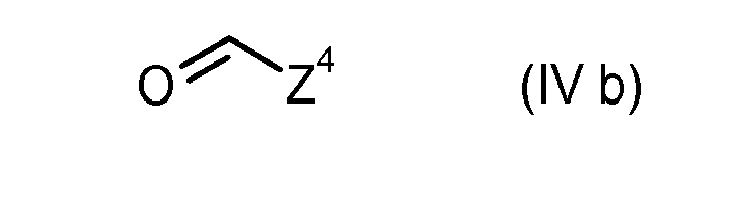
- Die Umsetzung zwischen mindestens einem Diamin der Formel (III) und mindestens einem Aldehyd der Formel (IV) oder (IV a) oder (IV b) erfolgt in einer Kondensationsreaktion unter Abspaltung von Wasser. Solche Kondensationsreaktionen sind bestens bekannt und beschrieben, beispielsweise in Houben-Weyl, "Methoden der organischen Chemie", Vol. XI/2, Seite 73ff. Der Aldehyd wird hierbei in Bezug auf die primären Aminogruppen des Amins stöchiometrisch oder in stöchiometrischem Überschuss eingesetzt. Üblicherweise werden solche Kondensationsreaktionen in Anwesenheit eines Lösemittels durchgeführt, mittels welchem das bei der Reaktion entstehende Wasser azeotrop entfernt wird.
- Als Aldehyd geeignet sind zum einen Aldehyde der Formel (IV) wie beispielsweise Propanal, 2-Methylpropanal, Butanal, 2-Methylbutanal, 2-Ethylbutanal, Pentanal, 2-Methylpentanal, 3-Methylpentanal, 4-Methylpentanal, 2,3-Dimethylpentanal, Hexanal, 2-Ethyl-hexanal, Heptanal, Octanal, Nonanal, Decanal, Undecanal, 2-Methyl-undecanal, Dodecanal, Methoxyacetaldehyd, Cyclopropancarboxaldehyd, Cyclopentancarboxaldehyd, Cyclohexancarboxaldehyd und Diphenylacetaldehyd.
Als Aldehyd geeignet sind zum anderen Aldehyde der Formel (IV b), wie beispielsweise aromatische Aldehyde, wie Benzaldehyd, 2- und 3- und 4-Tolualdehyd, 4-Ethyl- und 4-Propyl- und 4-Isopropyl und 4-Butyl-benzaldehyd, 2,4-Dimethylbenzaldehyd, 2,4,5-Trimethylbenzaldehyd, 4-Acetoxybenzaldehyd, 4-Anisaldehyd, 4-Ethoxybenzaldehyd, die isomeren Di- und Trialkoxybenzaldehyde, 2-, 3- und 4-Nitrobenzaldehyd, 2- und 3- und 4-Formylpyridin, 2-Furfuraldehyd, 2-Thiophencarbaldehyd, 1- und 2-Naphthylaldehyd, 3- und 4-Phenyloxy-benzaldehyd; Chinolin-2-carbaldehyd und dessen 3-, 4-, 5-, 6-, 7-und 8-Stellungsisomere, sowie Anthracen-9-carbaldehyd; sowie weiterhin Glyoxal, Glyoxalsäureester wie zum Beispiel Glyoxalsäuremethylester, Zimtaldehyd und substituierte Zimtaldehyde.
Insbesondere geeignete Aldehyde sind die sogenannten tertiären Aldehyde, das heisst Aldehyde der Formel (IV a), welche in α-Stellung zur Carbonylgruppe kein Wasserstoffatom aufweisen. - Geeignete Aldehyde der Formel (IV a) sind beispielsweise Pivalaldehyd (= 2,2-Dimethyl-propanal), 2,2-Dimethyl-butanal, 2,2-Diethyl-butanal, 1-Methyl-cyclopentancarboxaldehyd, 1-Methyl-cyclohexancarboxaldehyd; Ether aus 2-Hydroxy-2-methylpropanal und Alkoholen wie Propanol, Isopropanol, Butanol und 2-Ethylhexanol; Ester aus 2-Formyl-2-methylpropionsäure oder 3-Formyl-3-methylbuttersäure und Alkoholen wie Propanol, Isopropanol, Butanol und 2-Ethylhexanol; Ester aus 2-Hydroxy-2-methylpropanal und Carbonsäuren wie Buttersäure, Isobuttersäure und 2-Ethylhexansäure; sowie die im folgenden als besonders geeignet beschriebenen Ether und Ester von 2,2-disubstituierten 3-Hydroxypropanalen, -butanalen oder analogen höheren Aldehyden, insbesondere von 2,2-Dimethyl-3-hydroxypropanal.
Weiterhin geeignete Aldehyde der Formel (IV a) sind Aldehyde der Formel (V).
- In Formel (V) weisen Z1, Z2, R3 und R4 die bereits genannten Bedeutungen auf.
Bevorzugt stehen in Formel (V) Z1 und Z2 für je eine Methylgruppe und R3 für ein Wasserstoffatom. - Ein besonders geeigneter Aldehyd der Formel (V) ist in einer Ausführungsform ein Aldehyd ALD1 der Formel (V a),

- Die Aldehyde ALD1 der Formel (V a) stellen Ether von aliphatischen, cycloaliphatischen oder arylaliphatischen 2,2-disubstituierten 3-Hydroxyaldehyden mit Alkoholen oder Phenolen der Formel R4a-OH dar, beispielsweise Fettalkoholen oder Phenolen. Geeignete 2,2-disubstituierte 3-Hydroxyaldehyde sind ihrerseits erhältlich aus Aldol-Reaktionen, insbesondere gekreuzten Aldol-Reaktionen, zwischen primären oder sekundären aliphatischen Aldehyden, insbesondere Formaldehyd, und sekundären aliphatischen, sekundären cycloaliphatischen oder sekundären arylaliphatischen Aldehyden, wie beispielsweise Isobutyraldehyd, 2-Methylbutyraldehyd, 2-Ethylbutyraldehyd, 2-Methylvaleraldehyd, 2-Ethylcapronaldehyd, Cyclopentancarboxaldehyd, Cyclohexancarboxaldehyd, 1,2,3,6-Tetrahydrobenzaldehyd, 2-Methyl-3-phenylpropionaldehyd, 2-Phenylpropionaldehyd (Hydratropaldehyd) oder Diphenylacetaldehyd. Beispiele geeigneter 2,2-disubstituierter 3-Hydroxyaldehyde sind 2,2-Dimethyl-3-hydr-oxypropanal, 2-Hydroxymethyl-2-methyl-butanal, 2-Hydroxymethyl-2-ethyl-butanal, 2-Hydroxymethyl-2-methyl-pentanal, 2-Hydroxymethyl-2-ethyl-hexanal, 1-Hydroxymethyl-cyclopentancarboxaldehyd, 1-Hydroxymethyl-cyclohexancarboxaldehyd 1-Hydroxymethyl-cyclohex-3-encarboxaldehyd, 2-Hydroxymethyl-2-methyl-3-phenyl-propanal, 3-Hydroxy-2-methyl-2-phenyl-propanal und 3-Hydroxy-2,2-diphenyl-propanal.
Als Beispiele solcher Aldehyde ALD1 der Formel (V a) genannt sind 2,2-Dimethyl-3-phenoxy-propanal, 3-Cyclohexyloxy-2,2-dimethyl-propanal, 2,2-Dimethyl-3-(2-ethylhexyloxy)-propanal, 2,2-Dimethyl-3-lauroxy-propanal und 2,2-Dimethyl-3-stearoxy-propanal. - Ein besonders geeigneter Aldehyd der Formel (V) ist in einer weiteren Ausführungsform ein Aldehyd ALD2 der Formel (V b),

- In Formel (V b) weisen Z1, Z2, R3 und R5 die bereits genannten Bedeutungen auf.
wobei R5 für ein Wasserstoffatom oder für einen Kohlenwasserstoffrest mit 1 bis 20, insbesondere 1 bis 5, C-Atomen steht. - Die Aldehyde ALD2 der Formel (V b) stellen Ester der bereits beschriebenen 2,2-disubstituierten 3-Hydroxyaldehyde, wie beispielsweise 2,2-Dimethyl-3-hydroxypropanal, 2-Hydroxymethyl-2-methyl-butanal, 2-Hydroxymethyl-2-ethyl-butanal, 2-Hydroxymethyl-2-methyl-pentanal, 2-Hydroxymethyl-2-ethyl-hexanal, 1-Hydroxymethyl-cyclopentancarboxaldehyd, 1-Hydroxymethyl-cyclohexancarboxaldehyd 1-Hydroxymethyl-cyclohex-3-encarboxalde-hyd, 2-Hydroxymethyl-2-methyl-3-phenyl-propanal, 3-Hydroxy-2-methyl-2-phenyl-propanal und 3-Hydroxy-2,2-diphenyl-propanal, mit Carbonsäuren wie Ameisensäure, Essigsäure, Propionsäure, Buttersäure, Isobuttersäure, Valeriansäure und Capronsäure.
Als Beispiele solcher Aldehyde ALD2 der Formel (V b) genannt sind 2,2-Dimethyl-3-formyloxy-propanal, 3-Acetoxy-2,2-dimethylpropanal, 2,2-Dimethyl-3-propionoxypropanal, 3-Butyroxy-2,2-dimethyl-propanal, 2,2-Dimethyl-3-isobutyroxy-propanal, 2,2-Dimethyl-3-pentoyloxy-propanal und 2,2-Dimethyl-3-hexoyloxy-propanal. - Bevorzugte Aldehyde sind die Aldehyde der Formel (IV a) und der Formel (IV b).
Insbesondere bevorzugt sind die Aldehyde der Formel (V).
Am meisten bevorzugt sind die Aldehyde ALD2 der Formel (V b), insbesondere 3-Acetoxy-2,2-dimethylpropanal. - Beispiele für geeignete primäre aliphatische Diamine der Formel (III) sind aliphatische, cycloaliphatische oder arylaliphatische Diamine, beispielsweise Ethylendiamin, 1,2-Propandiamin, 1,3-Propandiamin, 2-Methyl-1,2-propandiamin, 2,2-Dimethyl-1,3-propandiamin, 1,3-Butandiamin, 1,4-Butandiamin, 1,3-Pentandiamin (DAMP), 1,5-Pentandiamin, 1,5-Diamino-2-methylpentan (MPMD), 1,6-Hexandiamin, 2,5-Dimethyl-1,6-hexandiamin, 2,2,4- und 2,4,4-Trimethylhexamethylendiamin (TMD), 1,7-Heptandiamin, 1,8-Octandiamin, 1,9-Nonandiamin, 1,10-Decandiamin, 1,11-Undecandiamin, 1,12-Dodecandiamin, 1,2-, 1,3- und 1,4-Diaminocyclohexan, Bis-(4-aminocyclohexyl)-methan, Bis-(4-amino-3-methylcyclohexyl)-methan, 1-Amino-3-aminomethyl-3,5,5-trimethylcyclohexan (= Isophorondiamin oder IPDA), 2- und 4-Methyl-1,3-diaminocyclohexan und Mischungen davon, 1,3- und 1,4-Bis-(aminomethyl)cyclohexan, 2,5(2,6)-Bis-(aminomethyl)-bicyclo[2.2.1]heptan (NBDA), 3(4),8(9)-Bis-(aminomethyl)-tricyclo[5.2.1.02,6]decan, 1,4-Diamino-2,2,6-trimethylcyclohexan(TMCDA) sowie 1,3- und 1,4-Xylylendiamin.
- Als Diamine bevorzugt sind symmetrische Diamine. Als "symmetrische Diamine" werden im vorliegenden Dokument Diamine der Formel (III) bezeichnet, in welchen die beiden primären Aminogruppen symmetrie-äquivalent sind, d.h. durch eine Symmetrieoperation, beispielsweise eine Drehung oder eine Spiegelung, ineinander übergeführt werden können.
Bevorzugte symmetrische Diamine der Formel (III) sind ausgewählt aus der Gruppe bestehend aus Ethylendiamin, 1,3-Propandiamin, 1,4-Butandiamin, 1,5-Pentandiamin, 1,6-Hexandiamin, 1,8-Octandiamin, 1,10-Decandiamin, 1,12-Dodecandiamin, 1,3- und 1,4-Diaminocyclohexan, Bis-(4-aminocyclohexyl)-methan, 1,3- und 1,4-Bis-(aminomethyl)cyclohexan sowie 1,3- und 1,4-Xylylendiamin.
Besonders bevorzugte symmetrische Diamine der Formel (III) sind ausgewählt aus der Gruppe bestehend aus Ethylendiamin, 1,6-Hexandiamin, 1,12-Dodecandiamin, 1,4-Diaminocyclohexan, Bis-(4-aminocyclohexyl)-methan, 1,3-Bis-(aminomethyl)cyclohexan sowie 1,3-Xylylendiamin.
Als symmetrisches Diamin der Formel (III) am meisten bevorzugt ist 1,6-Hexandiamin.
Der Rest A im Dialdimin der Formel (I) entspricht dem Diamin der Formel (III) nach Entfernung der zwei Aminogruppen. - Die Klebstoffzusammensetzung enthält weiterhin mindestens ein bei Raumtemperatur flüssiges, Isocyanatgruppen aufweisendes Polyurethanpolymer P1.
Ein geeignetes Isocyanatgruppen aufweisendes Polyurethanpolymer P1 ist erhältlich durch die Umsetzung von mindestens einem Polyol mit mindestens einem Polyisocyanat. - Als Polyole für die Herstellung eines Polyurethanpolymers P1 können beispielsweise die folgenden Polyole oder Mischungen davon eingesetzt werden:
- Polyetherpolyole, auch Polyoxyalkylenpolyole oder Oligoetherole genannt, welche Polymerisationsprodukte von Ethylenoxid, 1,2-Propylenoxid, 1,2-oder 2,3-Butylenoxid, Tetrahydrofuran oder Mischungen davon sind, eventuell polymerisiert mit Hilfe eines Startermoleküls wie beispielsweise Wasser, Ammoniak, 1,2-Ethandiol, 1,2- und 1,3-Propandiol, Neopentylglykol, Diethylenglykol, Triethylenglykol, die isomeren Dipropylenglykole und Tripropylenglykole, die isomeren Butandiole, Pentandiole, Hexandiole, Heptandiole, Octandiole, Nonandiole, Decandiole, Undecandiole, 1,3- und 1,4-Cyclohexandimethanol, Bisphenol A, hydriertes Bisphenol A, 1,1,1-Trimethylolethan, 1,1,1-Trimethylolpropan, Glycerin, Anilin, sowie Mischungen der vorgenannten Verbindungen. Eingesetzt werden können sowohl Polyoxyalkylenpolyole, die einen niedrigen Ungesättigtheitsgrad aufweisen (gemessen nach ASTM D-2849-69 und angegeben in Milliequivalent Ungesättigtheit pro Gramm Polyol (mEq/g)), hergestellt beispielsweise mit Hilfe von sogenannten Double Metal Cyanide Complex-Katalysatoren (DMC-Katalysatoren), als auch Polyoxyalkylenpolyole mit einem höheren Ungesättigtheitsgrad, hergestellt beispielsweise mit Hilfe von anionischen Katalysatoren wie NaOH, KOH, CsOH oder Alkalialkoholaten.
Als Polyetherpolyole besonders geeignet sind Polyoxyalkylendiole und -triole, insbesondere Polyoxyalkylendiole. Besonders geeignete Polyoxyalkylendi- und triole sind Polyoxyethylendi- und -triole sowie Polyoxypropylendi- und -triole.
Besonders geeignet sind Polyoxypropylendiole und -triole mit einem Ungesättigtheitsgrad tiefer als 0.02 mEq/g und einem Molekulargewicht im Bereich von 1000 bis 30'000 g/mol, sowie Polyoxypropylendiole und -triole mit einem Molekulargewicht von 400 bis 8'000 g/mol. Unter ,Molekulargewicht' oder 'Molgewicht' versteht man im vorliegenden Dokument stets das Molekulargewichtsmittel Mn. Insbesondere geeignet sind Polyoxypropylendiole mit einem Ungesättigtheitsgrad tiefer als 0.02 mEq/g und einem Molekulargewicht im Bereich von 1000 bis 12'000, insbesondere zwischen 1000 und 8000 g/mol. Solche Polyetherpolyole werden beispielsweise unter dem Handelsnamen Acclaim® von Bayer vertrieben.
Ebenfalls besonders geeignet sind sogenannte "EO-endcapped" (ethylene oxide-endcapped) Polyoxypropylendiole und -triole. Letztere sind spezielle Polyoxypropylenpolyoxyethylenpolyole, die beispielsweise dadurch erhalten werden, dass reine Polyoxypropylenpolyole nach Abschluss der Polypropoxylierung mit Ethylenoxid alkoxyliert werden und dadurch primäre Hydroxylgruppen aufweisen. - Styrol-Acrylnitril- oder Acrylnitril-Methylmethacrylat-gepfropfte Polyetherpolyole.
- Polyesterpolyole, auch Oligoesterole genannt, hergestellt nach bekannten Verfahren, insbesondere der Polykondensation von Hydroxycarbonsäuren oder der Polykondensation von aliphatischen und/oder aromatischen Polycarbonsäuren mit zwei- oder mehrwertigen Alkoholen.
Insbesondere geeignet sind Polyesterpolyole, welche hergestellt sind aus zwei- bis dreiwertigen, insbesondere zweiwertigen, Alkoholen, wie beispielsweise Ethylenglykol, Diethylenglykol, Propylenglykol, Dipropylenglykol, Neopentylglykol, 1,4-Butandiol, 1,5-Pentandiol, 3-Methyl-1,5-hexandiol, 1,6-Hexandiol, 1,8-Octandiol, 1,10-Decandiol, 1,12-Dodecandiol, 1,12-Hydroxystearylalkohol, 1,4-Cyclohexandimethanol, Dimerfettsäurediol (Dimerdiol), Hydroxypivalinsäureneopentylglykolester, Glycerin, 1,1,1-Trimethylolpropan oder Mischungen der vorgenannten Alkohole, mit organischen Di- oder Tricarbonsäuren, insbesondere Dicarbonsäuren, oder deren Anhydride oder Ester, wie beispielsweise Bernsteinsäure, Glutarsäure, Adipinsäure, Trimethyladipinsäure, Korksäure, Azelainsäure, Sebacinsäure, Dodecandicarbonsäure, Maleinsäure, Fumarsäure, Dimerfettsäure, Phthalsäure, Phthalsäureanhydrid, Isophthalsäure, Terephthalsäure, Dimethylterephthalat, Hexahydrophthalsäure, Trimellithsäure und Trimellithsäureanhydrid, oder Mischungen der vorgenannten Säuren, sowie Polyesterpolyole aus Lactonen wie beispielsweise aus ε-Caprolacton und Startern wie den vorgenannten zwei- oder dreiwertigen Alkoholen.
Besonders geeignete Polyesterpolyole sind Polyesterdiole. - Polycarbonatpolyole, wie sie durch Umsetzung beispielsweise der oben genannten - zum Aufbau der Polyesterpolyole eingesetzten - Alkohole mit Dialkylcarbonaten, wie Dimethylcarbonat, Diarylcarbonaten, wie Diphenylcarbonat, oder Phosgen zugänglich sind.
Besonders geeignet sind Polycarbonatdiole. - Als Polyole ebenfalls geeignet sind mindestens zwei Hydroxylgruppen tragende Blockcopolymere, welche mindestens zwei verschiedene Blöcke mit Polyether-, Polyester- und/oder Polycarbonatstruktur der oben beschriebenen Art aufweisen.
- Polyacrylat- und Polymethacrylatpolyole.
- Polyhydroxyfunktionelle Fette und Öle, beispielsweise natürliche Fette und Öle, inbesondere Ricinusöl; oder durch chemische Modifizierung von natürlichen Fetten und Ölen gewonnene - sogenannte oleochemische - Polyole, beispielsweise die durch Epoxidierung ungesättigter Öle und anschliessender Ringöffnung mit Carbonsäuren bzw. Alkoholen erhaltenen Epoxypolyester bzw. Epoxypolyether, oder durch Hydroformylierung und Hydrierung ungesättigter Öle erhaltene Polyole; oder aus natürlichen Fetten und Ölen durch Abbauprozesse wie Alkoholyse oder Ozonolyse und anschliessender chemischer Verknüpfung, beispielsweise durch Umesterung oder Dimerisierung, der so gewonnenen Abbauprodukte oder Derivaten davon erhaltene Polyole. Geeignete Abbauprodukte von natürlichen Fetten und Ölen sind insbesondere Fettsäuren und Fettalkohole sowie Fettsäureester, insbesondere die Methylester (FAME), welche beispielsweise durch Hydroformylierung und Hydrierung zu Hydroxyfettsäureestern derivatisiert werden können.
- Polykohlenwasserstoffpolyole, auch Oligohydrocarbonole genannt, wie beispielsweise polyhydroxyfunktionelle Polyolefine, Polyisobutylene, Polyisoprene; polyhydroxyfunktionelle Ethylen-Propylen-, Ethylen-Butylen-oder Ethylen-Propylen-Dien-Copolymere, wie sie beispielsweise von der Firma Kraton Polymers hergestellt werden; polyhydroxyfunktionelle Polymere von Dienen, insbesondere von 1,3-Butadien, welche insbesondere auch aus anionischer Polymerisation hergestellt sein können; polyhydroxyfunktionelle Copolymere aus Dienen wie 1,3-Butadien oder Diengemischen und Vinylmonomeren wie Styrol, Acrylnitril, Vinylchlorid, Vinylacetat, Vinylalkohol, Isobutylen und Isopren, beispielsweise polyhydroxyfunktionelle Acrylnitril/Butadien-Copolymere, welche zum Beispiel aus carboxylterminierten Acrylnitril/Butadien-Copolymeren (kommerziell erhältlich unter dem Namen Hycar® CTBN von Noveon) und Epoxiden oder Aminoalkoholen herstellbar sind; sowie hydrierte polyhydroxyfunktionelle Polymere oder Copolymere von Dienen.
- Diese genannten Polyole weisen bevorzugt ein mittleres Molekulargewicht von 250 - 30'000 g/mol, insbesondere von 400 - 20'000 g/mol, und weisen bevorzugt eine mittlere OH-Funktionalität im Bereich von 1.6 bis 3 auf.
- Zusätzlich zu diesen genannten Polyolen können kleine Mengen von niedrigmolekularen zwei- oder mehrwertigen Alkoholen wie beispielsweise 1,2-Ethandiol, 1,2- und 1,3-Propandiol, Neopentylglykol, Diethylenglykol, Triethylenglykol, die isomeren Dipropylenglykole und Tripropylenglykole, die isomeren Butandiole, Pentandiole, Hexandiole, Heptandiole, Octandiole, Nonandiole, Decandiole, Undecandiole, 1,3- und 1,4-Cyclohexandimethanol, hydriertes Bisphenol A, dimere Fettalkohole wie beispielsweise Dimerfettsäurediole, 1,1,1-Trimethylolethan, 1,1,1-Trimethylolpropan, Glycerin, Pentaerythrit, niedrigmolekulare Alkoxylierungsprodukte der vorgenannten zwei- und mehrwertigen Alkohole, sowie Mischungen der vorgenannten Alkohole bei der Herstellung eines Polyurethanpolymers P1 mitverwendet werden.
- Als Polyisocyanate für die Herstellung eines Polyurethanpolymers P1 können aliphatische, cycloaliphatische oder aromatische Polyisocyanate, insbesondere Diisocyanate, verwendet werden, beispielsweise die monomeren Diisocyanate, welche bereits als geeignete Polyisocyanate PI erwähnt wurden, sowie Oligomere und Polymere dieser monomeren Diisocyanate, sowie beiliebige Mischungen dieser Isocyanate. Bevorzugt sind monomere Diisocyanate, insbesondere MDI, TDI, HDI und IPDI.
- Die Herstellung eines Polyurethanpolymers P1 erfolgt in bekannter Art und Weise direkt aus den Polyisocyanaten und den Polyolen, oder durch schrittweise Adduktionsverfahren, wie sie auch als Kettenverlängerungsreaktionen bekannt sind.
In einer bevorzugten Ausführungsform wird das Polyurethanpolymer P1 über eine Reaktion von mindestens einem Polyisocyanat und mindestens einem Polyol hergestellt, wobei die Isocyanatgruppen gegenüber den Hydroxylgruppen im stöchiometrischen Überschuss vorliegen. Vorteilhaft beträgt das Verhältnis zwischen Isocyanat- und Hydroxylgruppen 1.3 bis 10, insbesondere 1.5 bis 5. - Das Polyurethanpolymer P1 weist ein Molekulargewicht von vorzugsweise über 500 g/mol, insbesondere ein solches zwischen 1000 und 30'000 g/mol, auf.
Weiterhin weist das Polyurethanpolymer P1 bevorzugt eine mittlere NCO-Funktionalität im Bereich von 1.8 bis 3 auf. - Als Polyisocyanat P geeignet sind schliesslich auch Gemische enthaltend ein Polyurethanpolymer P1 und ein Polyisocyanat PI, insbesondere Gemische enthaltend ein MDI-basiertes Polyurethanpolymer P1 und monomeres und/oder polymeres MDI, sowie weiterhin Gemische enthaltend ein IPDIbasiertes Polyurethanpolymer P1 und monomeres und/oder oligomeres IPDI.
- Als besonders geeignet hat sich gezeigt, wenn die Klebstoffzusammensetzung mehrere Polyurethanpolymere P1 aufweist, wobei vorzugsweise eines auf einem Polyol mit einem Molekulargewicht unter 2000 g/mol basiert. Als besonders vorteilhaft hat sich die Kombination eines auf Polyetherpolyol basierenden Polyurethanpolymers P1, und eines auf Polycarbonatpolyol basierenden Polyurethanpolymers P1erwiesen.
Andererseits hat sich gezeigt, dass es besonders vorteilhaft ist, mindestens ein bei Raumtemperatur flüssiges, Isocyanatgruppen aufweisendes Polyurethanpolymer P1 mit mindestens einem bei Raumtemperatur festen Isocyanatgruppen aufweisenden Polyurethanpolymer P2 zu kombinieren. Bei Raumtemperatur feste, Isocyanatgruppen aufweisenden Polyurethanpolymere P2 können aus den Polyolen und Polyisocyanaten hergestellt werden, welche bereits bei der Herstellung der Polyurethanpolymeren P1 beschrieben worden sind. Besonders bevorzugt als Polyurethanpolymer P2 sind bei Raumtemperatur feste Polyurethanpolymere, welche Isocyanatgruppen aufweisen und aus Polyesterpolyolen und/oder Polycarbonatpolyolen hergestellt werden. - Es hat sich gezeigt, dass es besonderes vorteilhaft ist, wenn die feuchtigkeitsreaktive Klebstoffzusammensetzung anorganische und organische Füllstoffe enthält. Als Beispiel für derartige Füllstoffe sind gemahlene oder gefällte Calciumcarbonate, welche gegebenenfalls mit Fettsäuren, insbesondere Stearaten, beschichtet sind, Baryt (BaSO4, auch Schwerspat genannt), Quarzmehle, calcinierte Kaoline, Aluminiumoxide, Aluminiumhydroxide, Kieselsäuren, insbesondere hochdisperse Kieselsäuren aus Pyrolyseprozessen, Russe, insbesondere industriell hergestellte Russe (im Folgenden als "Russ" bezeichnet), PVC-Pulver oder Hohlkugeln.
Meist bevorzugte Füllstoffe sind Russe, calcinierte Kaoline und Kreiden sowie deren Mischungen untereinander.
Der Gesamtmenge an Füllstoffen liegt vorzugsweise zwischen 25 und 55, insbesondere 30 - 45, Gew.-%, bezogen auf die feuchtigkeitsreaktive Klebstoffzusammensetzung. Meist bevorzugt enthält die feuchtigkeitsreaktive Klebstoffzusammensetzung 10 - 35 Gew.-% Russ. - Die feuchtigkeitsreaktive Klebstoffzusammensetzung enthält gegebenenfalls weitere Bestandteile, insbesondere in Polyurethanzusammensetzungen üblicherweise eingesetzte Hilfs- und Zusatzstoffe, wie beispielsweise die folgenden:
- Weichmacher, beispielsweise Carbonsäureester wie Phthalate, beispielsweise Dioctylphthalat, Diisononylphthalat oder Diisodecylphthalat, Adipate, beispielsweise Dioctyladipat, Azelate und Sebacate, organische Phosphor- und Sulfonsäureester oder Polybutene;
- nicht-reaktive thermoplastische Polymere, wie beispielsweise Homo- oder Copolymere von ungesättigten Monomeren, insbesondere aus der Gruppe umfassend Ethylen, Propylen, Butylen, Isobutylen, Isopren, Vinylacetat und Alkyl(meth)acrylate, insbesondere Polyethylene (PE), Polypropylene (PP), Polyisobutylene, Ethylenvinylacetat-Copolymere (EVA) und ataktische Poly-α-Olefine (APAO);
- Lösemittel;
- Fasern, beispielsweise aus Polyethylen;
- Pigmente, beispielsweise Titandioxid oder Eisenoxide;
- Katalysatoren, welche die Hydrolyse der Aldiminogruppen beschleunigen, insbesondere Säuren, beispielsweise organische Carbonsäuren wie Benzoesäure, Salicylsäure oder 2-Nitrobenzoesäure, organische Carbonsäureanhydride wie Phthalsäureanhydrid, Hexahydrophthalsäureanhydrid und Hexahydromethylphthalsäureanhydrid, Silylester von organischen Carbonsäuren, organische Sulfonsäuren wie Methansulfonsäure, p-Toluolsulfonsäure oder 4-Dodecylbenzolsulfonsäure, Sulfonsäureester, andere organische oder anorganische Säuren, oder Mischungen der vorgenannten Säuren und Säureester;
- Katalysatoren, welche die Reaktion der Isocyanatgruppen beschleunigen, beispielsweise Organozinnverbindungen wie Dibutylzinndiacetat, Dibutylzinndilaurat, Dibutylzinndichlorid, Dibutylzinndiacetylacetonat und Dioctylzinndilaurat, Bismutverbindungen wie Bismuttrioctoat und Bismut-tris(neodecanoat), und tertiäre Aminogruppen enthaltende Verbindungen wie 2,2'-Dimorpholinodiethylether und 1,4-Diazabicyclo[2.2.2]octan;
- Rheologie-Modifizierer wie beispielsweise Verdickungsmittel oder Thixotropiermittel, zum Beispiel Harnstoffverbindungen, Polyamidwachse, Bentonite oder pyrogene Kieselsäuren;
- Reaktivverdünner und Vernetzer, beispielsweise monomere Diisocyanate wie MDI, PMDI, TDI, HDI, 1,12-Dodecamethylendiisocyanat, Cyclohexan-1,3- oder 1,4-diisocyanat, IPDI, Perhydro-2,4'- und -4,4'-diphenylmethandiisocyanat, 1,3- und 1,4-Tetramethylxylylendiisocyanat, sowie Oligomere und Derivate dieser Polyisocyanate, insbesondere in Form von Isocyanuraten, Carbodiimiden, Uretoniminen, Biureten, Allophanaten oder Iminooxadiazindionen, Addukte monomerer Polyisocyanate mit kurzkettigen Polyolen, sowie Adipinsäuredihydrazid und andere Dihydrazide, sowie Polyisocyanate mit blockierten aromatischen Isocyanatgruppen, wie beispielsweise die Desmocap®-Typen 11, 12 und XP 2540 (alle von Bayer) und die Trixene®-Typen BI 7641, BI 7642, BI 7770, BI 7771, BI 7772, BI 7774 und BI 7779 (alle von Baxenden);
- blockierte Amine, beispielsweise in Form von Ketiminen, Oxazolidinen, Enaminen oder anderen Aldiminen;
- Trocknungsmittel, wie beispielsweise Molekularsiebe, Calciumoxid, hochreaktive Isocyanate wie p-Tosylisocyanat, Orthoameisensäureester, Alkoxysilane wie Tetraethoxysilan, Organoalkoxysilane wie Vinyltrimethoxysilan, und Organoalkoxysilane, welche in α-Stellung zur Silangruppe eine funktionelle Gruppe aufweisen;
- Haftvermittler, insbesondere Organoalkoxysilane ("Silane") wie beispielsweise Epoxysilane, Vinylsilane, (Meth)acrylsilane, Isocyanatosilane, Carbamatosilane, Alkylsilane, S-(Alkylcarbonyl)-mercaptosilane und Aldiminosilane, sowie oligomere Formen dieser Silane;
- Stabilisatoren gegen Wärme, Licht- und UV-Strahlung;
- flammhemmende Substanzen;
- oberflächenaktive Substanzen wie beispielsweise Netzmittel, Verlaufsmittel, Entlüftungsmittel oder Entschäumer;
- Biozide wie beispielsweise Algizide, Fungizide oder das Pilzwachstum hemmende Substanzen.
- Es ist vorteilhaft, beim Einsatz solcher weiteren Bestandteile darauf zu achten, dass diese die Lagerstabilität der Zusammensetzung nicht stark beeinträchtigen. Das heisst, dass diese Bestandteile während der Lagerung die zur Vernetzung führenden Reaktionen, wie Hydrolyse der Aldiminogruppen oder Vernetzung der Isocyanatgruppen, nicht in signifikantem Ausmass auslösen dürfen. Insbesondere bedeutet dies, dass all diese Bestandteile kein oder höchstens Spuren von Wasser enthalten sollten. Es kann sinnvoll sein, gewisse Bestandteile vor dem Einmischen in die Zusammensetzung chemisch oder physikalisch zu trocknen.
- Bevorzugt enthält die einkomponentige feuchtigkeitsreaktive Zusammensetzung mindestens einen Katalysator. Der Katalysator ist insbesondere eine der genannten Säuren, wie Benzoesäure oder Salicylsäure, oder eine der genannten Metallverbindungen, oder eines der genannten tertiären Amine. Es kann durchaus vorteilhaft sein, unterschiedliche Katalysatoren, bzw. unterschiedliche Katalysatorenarten, einzusetzen.
Die einkomponentige feuchtigkeitsreaktive Zusammensetzung wird unter Ausschluss von Feuchtigkeit hergestellt und aufbewahrt. Sie ist lagerstabil, d.h. sie kann unter Ausschluss von Feuchtigkeit in einer geeigneten Verpackung oder Anordnung, wie beispielsweise einem Fass, einem Eimer, einem Beutel, einer Kartusche oder einer Flasche über einen Zeitraum von beispielsweise mehreren Monaten aufbewahrt werden, ohne dass sie sich in ihren Anwendungseigenschaften oder in ihren Eigenschaften nach der Aushärtung in einem für ihren Gebrauch relevanten Ausmass verändert. Je nach Konsistenz der Zusammensetzung ist es üblich, die Lagerstabilität über die Messung der Viskosität zu ermitteln. - Die Aldiminogruppen des Aldimins der Formel (I) haben die Eigenschaft, bei Kontakt mit Feuchtigkeit zu hydrolysieren. Die dabei formal frei werdenden primären Aminogruppen reagieren dabei mit den in der Zusammensetzung vorhandenen Isocyanatgruppen zu Harnstoffgruppen, und es wird der entsprechende Aldehyd der Formel Y-CHO freigesetzt. Im Verhältnis zu den Aldiminogruppen überschüssige Isocyanatgruppen reagieren direkt mit Feuchtigkeit und bilden ebenfalls Harnstoffgruppen. Gegebenenfalls vorhandene blockierte Isocyanatgruppen reagieren im Allgemeinen unter Freisetzung des Blockierungsmittels ebenfalls zu Harnstoffgruppen, wobei diese Reaktion gegebenenfalls erst unter Einwirkung von Hitze abläuft. Als Ergebnis dieser Reaktionen härtet die Zusammensetzung zu einem festen Material aus; dieser Prozess wird auch als Vernetzung bezeichnet. Die Reaktion der Isocyanatgruppen mit dem hydrolysierenden Aldimin muss dabei nicht notwendigerweise über freie Aminogruppen erfolgen. Selbstverständlich sind auch Reaktionen mit Zwischenstufen der Hydrolysereaktion möglich. Beispielsweise ist es denkbar, dass eine hydrolysierende Aldiminogruppe in der Form eines Halbaminals direkt mit einer Isocyanatgruppe reagiert.
Das für die Aushärtungsreaktion benötigte Wasser kann entweder aus der Luft stammen (Luftfeuchtigkeit), oder aber die Zusammensetzung kann mit einer Wasser enthaltenden Komponente in Kontakt gebracht werden, zum Beispiel durch Besprühen, oder es kann der Zusammensetzung bei der Applikation eine Wasser enthaltende Komponente zugesetzt werden.
Die einkomponentige feuchtigkeitsreaktive Zusammensetzung härtet bei Kontakt mit Feuchtigkeit im Allgemeinen ohne die Bildung von Blasen aus. Die Aushärtungsgeschwindigkeit lässt sich über die Art und Menge eines oder mehrerer gegebenenfalls vorhandener Katalysatoren, über die bei der Aushärtung herrschende Temperatur sowie über die Luftfeuchtigkeit bzw. die Menge zugesetzten Wassers beeinflussen.
Als Ergebnis dieser Reaktionen mit Wasser, insbesondere in der Formel von Luftfeuchtigkeit, vernetzt die Zusammensetzung und härtet schliesslich zu einem festen Material aus. - Der Anteil des Dialdimines der Formel (I) in der Zusammensetzung ist in der Zusammensetzung insbesondere derart bemessen, dass das Verhältnis der Anzahl Aldimino-Gruppen zur Anzahl der NCO-Gruppen in der Zusammensetzung 0.5 - < 1, bevorzugt mindestens 0.6 - 0.8, meist bevorzugt 0.65 - 0.75, beträgt.
- Es hat sich gezeigt, dass die das Vorhandensein des Dialdimins der Formel (I) wesentlich dafür verantwortlich ist, dass eine Temperaturunabhängigkeit, bzw. eine Reduktion der Temperaturabhängigkeit, des Schubmodul erfolgt. Somit ist es ein weiterer Aspekt der Erfindung, dass das Dialdimin der Formel (I), wie es vorgängig beschrieben wurde, zur Reduktion der Temperaturabhängigkeit des Schubmoduls gemäss DIN 54 451 von feuchtigkeitsreaktiven Polyurethanklebstoffen verwendet werden kann.
- Dank der vorliegenden Erfindung ist es ermöglicht, dass der Schubmodul des Klebstoffs bei erhöhten Temperaturen (z. B. bei Raumtemperatur oder bei 80°C) stark erhöht werden kann. Die maximale Erhöhung orientiert sich jedoch in der Praxis daran, dass der Modul des Klebstoffs im erwarteten Temperaturverwendungsbereich denjenigen der zu verklebenden Materialien annähert, aber nicht überschreitet.
- Grundsätzlich können verschiedenste Substrate S1 und S2 mittels der beschriebenen feuchtigkeitsreaktiven Klebstoffzusammensetzung verklebt werden, wobei die Substrate S1 und S2 gleich oder verschieden voneinander sein können. Beispielsweise sind geeignete Substrate S1 und/oder S2 anorganische Substrate wie Glas, Glaskeramik, Beton, Mörtel, Backstein, Ziegel, Gips und Natursteine wie Granit oder Marmor; Metalle oder Legierungen wie Aluminium, Stahl, Buntmetalle, verzinkte Metalle; organische Substrate wie Leder, Stoffe, Papier, Holz, mit Harz gebundene Holzwerkstoffe, Harz-Texil-Compositewerkstoffe, Kunststoffe wie Polyvinylchlorid (Hart- und Weich-PVC), Acrylonitril-Butadien-Styrol-Copolymere (ABS), SMC (Sheet Moulding Composites), Polycarbonat (PC), Polyamid (PA), Polyester, PMMA, Polyester, Epoxidharze, Polyurethane (PUR), Polyoxymethylen (POM), Polyolefine (PO), insbesondere mittels Plasma, Corona oder Flammen oberflächenbehandeltes Polyethylen (PE) oder Polypropylen (PP), Ethylen/Propylen-Copolymere (EPM) und Ethylen/Propylen-Dien-Terpolymere (EPDM); beschichtete Substrate wie pulverbeschichtete Metalle oder Legierungen; sowie Farben und Lacke, insbesondere Automobillacke.
- Die beschriebene feuchtigkeitsreaktive Klebstoffzusammensetzung kann jedoch insbesondere gut verwendet werden bei der Verklebung von Scheiben im Transportmittelbau, insbesondere im Automobilbau. Infolge der Kombination der zu verklebenden Materialien, d.h. Glasscheibe und Metall, bzw. lackiertem Metall, ist es von grossem Vorteil, dass der Schubmodul des Klebstoffs sich im gesamten Temperaturbereich, d.h. von -20°C bis 80 °C, an 6 MPa (gemessen nach DIN 54 451) annähert, aber diesen Wert nicht überschreitet.
- Das Einglasen von Scheiben in Transportmittel erfolgt in einer an und für sich bekannten Art und Weise. In einer üblichen Variante wird der Klebstoff auf die Scheibe, typischerweise auf die im Randbereich der Scheibe vorhandene Glaskeramik, aufgetragen und anschliessend innerhalb der Offenzeit des Klebstoffs mit der Karosserie des Transportmittels, insbesondere eines Metallflansches, welcher typischerweise lackiert ist, gefügt. In einer weiteren Variante wird der Klebstoff auf die Karosserie des Transportmittels, insbesondere auf einen Metallflansch, welcher typischerweise lackiert ist, aufgetragen und dann innerhalb der Offenzeit des Klebstoffs mit der Scheibe, typischerweise auf die im Randbereich der Scheibe vorhandene Glaskeramik, gefügt.
- Die Substrate können bei Bedarf vor dem Applizieren der Zusammensetzung vorbehandelt werden. Derartige Vorbehandlungen umfassen insbesondere physikalische und/oder chemische Reinigungsverfahren, beispielsweise Schleifen, Sandstrahlen, Bürsten oder dergleichen, oder Behandeln mit Reinigern oder Lösemitteln oder das Aufbringen eines Haftvermittlers, einer Haftvermittlerlösung oder eines Primers.
- Somit bildet ein weiterer Aspekt der Erfindung ein verklebter Artikel, welcher durch ein Verkleben von zwei Substraten S1 und S2 durch eine vorgängig beschriebene feuchtigkeitsreaktive Klebstoffzusammensetzung und der Härtung der Klebstoffzusammensetzung durch Feuchtigkeit erhalten wird.
Insbesondere ist der Artikel derart, dass das Substrat S1 eine Scheibe, insbesondere eine Glasscheibe, und das Substrat S2 ein Metall, insbesondere ein lackiertes Metall, ist. - Es zeigt sich, dass die feuchtigkeitsreaktive Klebstoffzusammensetzung blasenfrei aushärtet, gute mechanische Werte erzielt und über eine schnelle Durchhärtung verfügt. Weiterhin lassen sich gute Haftung auf diversen Untergründen, insbesondere Glas, Keramik, Metall und Lack erzielen.
- Der Amingehalt der hergestellten Dialdimine, das heisst der Gehalt an blockierten Aminogruppen in Form von Aldiminogruppen, wurde titrimetrisch bestimmt (mit 0.1N HClO4 in Eisessig, gegen Kristallviolett) und ist stets angegeben in mmol N/g.
- In einem Rundkolben wurden unter Stickstoffatmosphäre 50.9 g (0.18 mol) 2,2-Dimethyl-3-lauroyloxy-propanal vorgelegt. Unter kräftigem Rühren wurden aus einem beheizten Eintropftrichter 10.0 g (0.17 mol N) 1,6-Hexandiamin (BASF; Amingehalt 17.04 mmol N/g) langsam zugegeben, wobei sich die Mischung erwärmte und zunehmend eintrübte. Danach wurden die flüchtigen Bestandteile im Vakuum entfernt (10 mbar, 80 °C). Ausbeute: 57.7 g eines klaren, blassgelben Öls mit einem Amingehalt von 2.94 mmol N/g.
- In einem Rundkolben wurden unter Stickstoffatmosphäre 87.0 g (0.31 mol) 2,2-Dimethyl-3-lauroyloxy-propanal vorgelegt. Unter kräftigem Rühren wurden aus einem Eintropftrichter 20.0 g (0.29 mol N) 1,3-Xylylendiamin (Mitsubishi Gas Chemical; Amingehalt 14.56 mmol N/g) langsam zugegeben, wobei sich die Mischung erwärmte und zunehmend eintrübte. Danach wurden die flüchtigen Bestandteile im Vakuum entfernt (10 mbar, 80 °C). Ausbeute: 101.0 g eines klaren, blassgelben Öls mit einem Amingehalt von 2.85 mmol N/g.
- Für jedes Beispiel wurden die jeweiligen Bestandteile gemäss Tabelle 1 in den angegebenen Gewichtsteilen in einem Vakuummischer unter Feuchtigkeitsausschluss zu einer homogenen Paste verarbeitet, diese unverzüglich in eine innenlackierte Aluminium-Kartusche abgefüllt und die Kartusche luftdicht verschlossen.
- Das Polyurethanpolymer PUP-1 wurde wie folgt hergestellt:
- 1300 g Polyoxypropylen-Diol (Acclaim® 4200 N, Bayer; OH-Zahl 28.5 mg KOH/g), 2600 g Polyoxypropylenpolyoxyethylen-Triol (Caradol® MD34-02, Shell; OH-Zahl 35.0 mg KOH/g), 600 g 4,4'-Methylendiphenyldiisocyanat (MDI, Desmodur® 44 MC L, Bayer) und 500 g Diisodecylphthalat (DIDP; Palatinol® Z, BASF) wurden bei 80 °C zu einem NCO-terminierten Polyurethanpolymeren mit einem Gehalt an freien Isocyanat-Gruppen von 2.01 Gewichts-% umgesetzt.
- Das Verdickungsmittel wurde wie folgt hergestellt:
In einem Vakuummischer wurden 3000 g Diisodecylphthalat (DIDP; Palatinol® Z, BASF) und 480 g 4,4'-Methylendiphenyldiisocyanat (MDI; Desmo-dur® 44 MC L, Bayer) vorgelegt und leicht aufgewärmt. Dann wurden unter starkem Rühren 270 g Monobutylamin langsam zugetropft. Die entstehende Paste wurde unter Vakuum und Kühlung eine Stunde weitergerührt.
Das Verhältnis zwischen den Isocyanatgruppen und den Aldimino-gruppen in den Beispielen 1 und 2 beträgt 1.00 / 0.75. - Die so erhaltenen einkomponentigen elastischen Klebstoffe wurden auf Applikationseigenschaften, Hautbildungszeit und mechanische Eigenschaften nach der Aushärtung geprüft.
- Schubmodule wurden nach DIN 54 451 nach Lagerung nach 7 Tagen Lagerung bei Raumtemperatur und 50% relativer Luftfeuchtigkeit bei der in Tabelle 1 angegebenen Temperatur gemessen. Die hierfür verwendeten Aluminiumsubstrate wurden vor der Verklebung mit Sika® Primer 204, erhältlich bei Sika Schweiz AG, vorbehandelt.
Als Mass für die Offenzeit wurde die Hautbildungszeit (Zeit bis zur Klebefreiheit, "tack-free time") herangezogen. Zur Messung der Hautbildungszeit wurde ein der Klebstoff auf bei 40 °C aufgewärmt und in einer Schichtdicke von ca. 2 mm auf Pappkarton aufgetragen und bei 23 °C und 50% relativer Luftfeuchtigkeit die Zeit bestimmt, die es dauerte, bis beim leichten Antippen der Oberfläche der Zusammensetzung mittels einer Pipette aus LDPE erstmals keine Rückstände auf der Pipette mehr zurückblieben.Tabelle 1: Zusammensetzung von einkomponentigen elastischen Scheibenklebstoffen der Beispiele 1 und 2 sowie des Vergleichsbeispiels Ref. Ref. 1 2 Polyurethanpolymer PUP-1 44.0 44.0 44.0 Dialdimin - A-2, A-1, 0.0 8.0 7.8 Flüssiges MDI 1.3 1.3 1.3 Weichmachera 9.5 1.5 1.6 Russ 15.0 15.0 15.0 Verdickungsmittel 10.0 10.0 10.0 Kaolin 20.0 20.0 20.0 Säurekatalysatorb - 0.2 0.2 Zinnkatalysatorc 0.2 - - Hautbildungszeit [min] 25 20-25 12-14 Blasenbildung wenig keine keine Schubmodul -20°C 5.9 MPa 5.3 MPa 4.4 MPa Schubmodul 23°C 3.2 MPa 3.6 MPa 3.7 MPa Schubmodul 80°C 2.5 MPa 1.5 MPa 3.4 MPa 
1.84 1.47 1.19 a Diisodecylphthalat (DIDP; Palatinol® Z, BASF).
b Salicylsäure (5 Gew.-% in Dioctyladipat).
c 25 Gew.-% Dibutylzinndilaurat in Diisodecylphthalat. - Die Zusammensetzungen 1 und 2 zeigten ausgezeichnete Haftung auf Glas (vorbehandelt durch Sika® Primer-206 G+P) und Lackblechen (vorbehandelt durch Sika®Primer-209 C).
Claims (19)
- Feuchtigkeitsreaktive Klebstoffzusammensetzung umfassenda) mindestens ein Dialdimin der Formel (I)

sowieb) mindestens ein bei Raumtemperatur flüssiges, Isocyanatgruppen aufweisendes Polyurethanpolymer P1dadurch gekennzeichnet, dass die Klebstoffzusammensetzung nach 7 Tagen Lagerung bei Raumtemperatur und 50% relativer Luftfeuchtigkeit ein Verhältnis des bei -20°C gemessenen Schubmoduls zum bei 23°C gemessenen Schubmodul kleiner als 1.7, insbesondere kleiner als 1.5, bevorzugt kleiner als 1.4, aufweist, wobei die Schubmodule bei den angegebenen Temperaturen nach DIN 54 451 gemessen wurden. - Feuchtigkeitsreaktive Klebstoffzusammensetzung gemäss Anspruch 1, dadurch gekennzeichnet, die Klebstoffzusammensetzung nach 7 Tagen Lagerung bei Raumtemperatur und 50% relativer Luftfeuchtigkeit, bei 80 °C ein Schubmodul, gemessen nach DIN 54 451, von mehr als 1 MPa, insbesondere zwischen 1 und 5 MPa, aufweist.
- Feuchtigkeitsreaktive Klebstoffzusammensetzung gemäss Anspruch 1 oder 2, dadurch gekennzeichnet, dass die Klebstoffzusammensetzung nach 7 Tagen Lagerung bei Raumtemperatur und 50% relativer Luftfeuchtigkeit bei -20°C ein Schubmodul, gemessen nach DIN 54 451, von weniger als 6 MPa, vorzugsweise zwischen 4 und 6 MPa, aufweist.
- Feuchtigkeitsreaktive Klebstoffzusammensetzung gemäss einem der vorhergehenden Ansprüche, dadurch gekennzeichnet, dass die Klebstoffzusammensetzung nach 7 Tagen Lagerung bei Raumtemperatur und 50% relativer Luftfeuchtigkeit bei 23°C ein Schubmodul, gemessen nach DIN 54 451, von mehr als 3 MPa, vorzugsweise zwischen 4 und 6 MPa, aufweist.
- Feuchtigkeitsreaktive Klebstoffzusammensetzung gemäss einem der vorhergehenden Ansprüche, dadurch gekennzeichnet, dass die Klebstoffzusammensetzung nach 7 Tagen Lagerung bei Raumtemperatur und 50% relativer Luftfeuchtigkeit, bei 80 °C ein Schubmodul, gemessen nach DIN 54 451 von mehr als 2, insbesondere von mehr als 3 MPa, bevorzugt zwischen 3 und 5 MPa, aufweist.
- Feuchtigkeitsreaktive Klebstoffzusammensetzung gemäss einem der vorhergehenden Ansprüche, dadurch gekennzeichnet, dass die Klebstoffzusammensetzung nach 7 Tagen Lagerung bei Raumtemperatur und 50% relativer Luftfeuchtigkeit, bei 23°C ein Schubmodul, gemessen nach DIN 54 451, zwischen 3 und 5 MPa, vorzugsweise zwischen 3.5 und 5.5 MPa, aufweist.
- Feuchtigkeitsreaktive Klebstoffzusammensetzung gemäss einem der vorhergehenden Ansprüche, dadurch gekennzeichnet, dass A für ein Diamin der Formel (III) nach Entfernung der zwei Aminogruppen steht,
H2N-A-NH2 (III)
dadurch gekennzeichnet, dass dieses Diamin der Formel (III) ausgewählt ist aus der Gruppe bestehend aus Ethylendiamin, 1,3-Propandiamin, 1,4-Butandiamin, 1,5-Pentandiamin, 1,6-Hexandiamin, 1,8-Octandiamin, 1,10-Decandiamin, 1,12-Dodecandiamin, 1,3- und 1,4-Diaminocyclohexan, Bis-(4-aminocyclohexyl)-methan, 1,3- und 1,4-Bis-(aminomethyl)-cyclohexan sowie 1,3- und 1,4-Xylylendiamin. - Feuchtigkeitsreaktive Klebstoffzusammensetzung gemäss einem der vorhergehenden Ansprüche, dadurch gekennzeichnet, dass der Rest Y die Formel (II a) oder (II b) aufweist

--- Z4 (II b)
wobeiZ1 und Z2 entweder
unabhängig voneinander jeweils für einen einwertigen Kohlenwasserstoffrest mit 1 bis 12 C-Atomen stehen,
oder
zusammen für einen zweiwertigen Kohlenwasserstoffrest mit 4 bis 20 C-Atomen, der Teil eines, gegebenenfalls substituierten, carbocyclischen Rings mit 5 bis 8, bevorzugt 6, C-Atomen, ist, stehen; undZ3 entweder
für eine verzweigte oder unverzweigte Alkyl-, Cycloalkyl-, Alkylen- oder Cycloalkylengruppe steht,
oder für eine substituierte oder unsubstituierte Aryl- oder Arylalkylgruppe steht,
oder für einen Rest der Formel O-R2 oder

für eine Aryl-, Arylalkyl- oder Alkylgruppe steht und jeweils substituiert oder unsubstituiert ist, insbesondere für eine Aryl-, Arylalkyl- oder Alkylgruppe mit 1 bis 32 C-Atomen steht, welche, gegebenenfalls Ethersauerstoffatome enthält,
oder für einen Rest der Formel (VI) steht, R3 für ein Wasserstoffatom oder für eine Alkyl- oder Arylalkylgruppe, bevorzugt für ein Wasserstoffatom, steht, undR4 entweder
für einen Kohlenwasserstoffrest mit 1 bis 30 C-Atomen, der gegebenenfalls Ethersauerstoffatome enthält, steht,
oder für einen Rest Z4 entweder
für eine substituierte oder unsubstituierte Aryl- oder Heteroaryl-Gruppe, welche eine Ringgrösse von 5 bis 8, bevorzugt 6, Atomen aufweist, steht,
oder für
für ein Wasserstoffatom oder für eine Alkoxygruppe steht, oder für eine substituierte oder unsubstituierte Alkenyl- oder Arylalkenylgruppe mit mindestens 6 C-Atomen steht. - Feuchtigkeitsreaktive Klebstoffzusammensetzung gemäss einem der vorhergehenden Ansprüche, dadurch gekennzeichnet, dass der Aldehyd, aus dem sich der Rest Y ableitet, die Formel (V a) aufweist
 Z1 und Z2 entweder
unabhängig voneinander jeweils für einen einwertigen Kohlenwasserstoffrest mit 1 bis 12 C-Atomen stehen,
oder
zusammen für einen zweiwertigen Kohlenwasserstoffrest mit 4 bis 20 C-Atomen, der Teil eines, gegebenenfalls substituierten, carbocyclischen Rings mit 5 bis 8, bevorzugt 6, C-Atomen, ist, stehen;R3 für ein Wasserstoffatom oder für eine Alkyl- oder Arylalkylgruppe, bevorzugt für ein Wasserstoffatom, steht; undR4a für einen Kohlenwasserstoffrest mit 1 bis 30 C-Atomen, insbesondere 11 bis 30 C-Atomen, der gegebenenfalls Ethersauerstoffatome enthält, steht; - Feuchtigkeitsreaktive Klebstoffzusammensetzung gemäss einem der Ansprüche 1 bis 8, dadurch gekennzeichnet, dass der Aldehyd, aus dem sich der Rest Y ableitet, die Formel (V b) aufweist
 Z1 und Z2 entweder
unabhängig voneinander jeweils für einen einwertigen Kohlenwasserstoffrest mit 1 bis 12 C-Atomen stehen,
oder
zusammen für einen zweiwertigen Kohlenwasserstoffrest mit 4 bis 20 C-Atomen, der Teil eines, gegebenenfalls substituierten, carbocyclischen Rings mit 5 bis 8, bevorzugt 6, C-Atomen, ist, stehen;R3 für ein Wasserstoffatom oder für eine Alkyl- oder Arylalkylgruppe, bevorzugt für ein Wasserstoffatom, steht; undR5 für ein Wasserstoffatom oder für einen Kohlenwasserstoffrest mit 1 bis 20, insbesondere 1 bis 5, C-Atomen steht. - Feuchtigkeitsreaktive Klebstoffzusammensetzung gemäss einem der vorhergehenden Ansprüche, dadurch gekennzeichnet, dass die Klebstoffzusammensetzung eine mehrere Polyurethanpolymere P1 aufweist, wobei vorzugsweise eines auf einem Polyol mit einem Molekulargewicht unter 2000 g/mol basiert.
- Feuchtigkeitsreaktive Klebstoffzusammensetzung gemäss Anspruch 11,
dadurch gekennzeichnet, dass die Klebstoffzusammensetzung ein auf Polyetherpolyol basierendes Polyurethanpolymer P1 und ein auf Polycarbonatpolyol basierendes Polyurethanpolymer P1 aufweist. - Feuchtigkeitsreaktive Klebstoffzusammensetzung gemäss einem der vorhergehenden Ansprüche, dadurch gekennzeichnet, dass die Klebstoffzusammensetzung zusätzlich mindestens ein bei Raumtemperatur festes, Isocyanatgruppen aufweisenden Polyurethanpolymer P2 aufweist.
- Feuchtigkeitsreaktive Klebstoffzusammensetzung gemäss Anspruch 13,
dadurch gekennzeichnet, dass das bei Raumtemperatur feste Polyurethanpolymer P2 aus Polyesterpolyolen und/oder Polycarbonatpolyolen hergestellt wird. - Feuchtigkeitsreaktive Klebstoffzusammensetzung gemäss einem der vorhergehenden Ansprüche, dadurch gekennzeichnet, dass der Anteil des Dialdimines der Formel (I) in der Zusammensetzung so gewählt ist, dass das Verhältnis der Anzahl Aldimino-Gruppen zur Anzahl der NCO-Gruppen in der Zusammensetzung 0.5 - < 1, bevorzugt mindestens 0.6 - 0.8, meist bevorzugt 0.65 - 0.75, beträgt.
- Verwendung einer feuchtigkeitsreaktiven Klebstoffzusammensetzung gemäss einem der Ansprüche 1 bis 15 zur Verklebung von Scheiben im Transportmittelbau, insbesondere im Automobilbau.
- Verwendung eines Dialdimines der Formel (I), wie es in einer Zusammensetzung gemäss einem der Ansprüche 1 bis 15 offenbart wird, zur Reduktion der Temperaturabhängigkeit des Schubmoduls gemäss DIN 54 451 von feuchtigkeitsreaktiven Polyurethanklebstoffen.
- Verklebter Artikel, welcher durch ein Verkleben von zwei Substraten S1 und S2 durch eine feuchtigkeitsreaktive Klebstoffzusammensetzung gemäss einem der Ansprüche 1 bis 15 und der Härtung der Klebstoffzusammensetzung durch Feuchtigkeit erhalten wird.
- Verklebter Artikel gemäss Anspruch 18, dadurch gekennzeichnet, dass das Substrat S1 eine Scheibe, insbesondere eine Glasscheibe, und das Substrat S2 ein Metall, insbesondere ein lackiertes Metall, ist.
Priority Applications (7)
| Application Number | Priority Date | Filing Date | Title |
|---|---|---|---|
| EP07116117A EP2036931A1 (de) | 2007-09-11 | 2007-09-11 | Feuchtigkeitsreaktive Klebstoffzusammensetzungen mit sehr geringer Temperaturabhängigkeit des Schubmoduls |
| US12/222,507 US20090068479A1 (en) | 2007-09-11 | 2008-08-11 | Moisture-reactive adhesive compositions with very low temperature dependency of the shear modulus |
| JP2008232640A JP2009114428A (ja) | 2007-09-11 | 2008-09-10 | 剪断弾性率の温度依存性が非常に低い湿気反応性接着剤組成物 |
| BRPI0804111-3A BRPI0804111A2 (pt) | 2007-09-11 | 2008-09-10 | composições adesivas reativas à umidade com dependência de temperatura muito baixa do módulo de cisalhamento |
| EP08164148.2A EP2090601B1 (de) | 2007-09-11 | 2008-09-11 | Feuchtigkeitsreaktive Klebstoffzusammensetzungen mit sehr geringer Temperaturabhängigkeit des Schubmoduls |
| KR1020080089679A KR20090027176A (ko) | 2007-09-11 | 2008-09-11 | 전단 탄성율의 온도의존성이 매우 낮은 수분 반응성 접착 조성물 |
| CN 200810213869 CN101386776B (zh) | 2007-09-11 | 2008-09-11 | 剪切模量温度依赖性很低的水分-反应性粘合剂组合物 |
Applications Claiming Priority (1)
| Application Number | Priority Date | Filing Date | Title |
|---|---|---|---|
| EP07116117A EP2036931A1 (de) | 2007-09-11 | 2007-09-11 | Feuchtigkeitsreaktive Klebstoffzusammensetzungen mit sehr geringer Temperaturabhängigkeit des Schubmoduls |
Publications (1)
| Publication Number | Publication Date |
|---|---|
| EP2036931A1 true EP2036931A1 (de) | 2009-03-18 |
Family
ID=38704949
Family Applications (1)
| Application Number | Title | Priority Date | Filing Date |
|---|---|---|---|
| EP07116117A Withdrawn EP2036931A1 (de) | 2007-09-11 | 2007-09-11 | Feuchtigkeitsreaktive Klebstoffzusammensetzungen mit sehr geringer Temperaturabhängigkeit des Schubmoduls |
Country Status (2)
| Country | Link |
|---|---|
| EP (1) | EP2036931A1 (de) |
| CN (1) | CN101386776B (de) |
Cited By (1)
| Publication number | Priority date | Publication date | Assignee | Title |
|---|---|---|---|---|
| CN110538601A (zh) * | 2019-07-18 | 2019-12-06 | 中山市马里奥机械科技有限公司 | 一种聚氨酯胶黏剂的生产输送系统 |
Families Citing this family (1)
| Publication number | Priority date | Publication date | Assignee | Title |
|---|---|---|---|---|
| US11104601B2 (en) | 2016-03-17 | 2021-08-31 | Corning Incorporated | Bendable electronic device modules, articles and bonding methods of making the same |
Citations (10)
| Publication number | Priority date | Publication date | Assignee | Title |
|---|---|---|---|---|
| US3426097A (en) * | 1965-08-24 | 1969-02-04 | Gen Motors Corp | Latent curing agents for epoxide polymers and polyurethanes |
| DE3133769A1 (de) * | 1981-08-26 | 1983-03-10 | Basf Ag, 6700 Ludwigshafen | Feuchtigkeitshaertendes, lagerstabiles einkomponenten-polyurethansystem |
| EP0469751A1 (de) * | 1990-07-20 | 1992-02-05 | MITSUI TOATSU CHEMICALS, Inc. | Feuchtigkeitshärtende Polyaldimin enthaltende Polyurethanzusammensetzung |
| EP0527568A2 (de) * | 1991-08-08 | 1993-02-17 | Imperial Chemical Industries Plc | Klebverfahren unter Verwendung von Polyisocyanat-Klebstoffen |
| JPH08302960A (ja) * | 1995-04-27 | 1996-11-19 | Mitsui Toatsu Chem Inc | 防水機能を付与するタイル接着工法 |
| JPH10139849A (ja) * | 1996-11-11 | 1998-05-26 | Toyo Polymer Kk | 潜在性硬化剤 |
| WO1999016619A1 (en) * | 1997-09-26 | 1999-04-08 | Ashland Inc. | Imine-containing curative for two component polyurethane structural adhesives |
| WO2003059978A1 (de) * | 2002-01-18 | 2003-07-24 | Sika Technology Ag | Zweikomponentige polyurethanzusammensetzung mit hoher frühfestigkeit |
| WO2005037885A1 (de) * | 2003-10-15 | 2005-04-28 | Sika Technology Ag | Zweikomponentige polyurethanzusammensetzung mit hoher frühfestigkeit |
| EP1770107A1 (de) * | 2005-09-30 | 2007-04-04 | Sika Technology AG | Feuchtigkeitshärtende Polyurethanzusammensetzung |
-
2007
- 2007-09-11 EP EP07116117A patent/EP2036931A1/de not_active Withdrawn
-
2008
- 2008-09-11 CN CN 200810213869 patent/CN101386776B/zh active Active
Patent Citations (10)
| Publication number | Priority date | Publication date | Assignee | Title |
|---|---|---|---|---|
| US3426097A (en) * | 1965-08-24 | 1969-02-04 | Gen Motors Corp | Latent curing agents for epoxide polymers and polyurethanes |
| DE3133769A1 (de) * | 1981-08-26 | 1983-03-10 | Basf Ag, 6700 Ludwigshafen | Feuchtigkeitshaertendes, lagerstabiles einkomponenten-polyurethansystem |
| EP0469751A1 (de) * | 1990-07-20 | 1992-02-05 | MITSUI TOATSU CHEMICALS, Inc. | Feuchtigkeitshärtende Polyaldimin enthaltende Polyurethanzusammensetzung |
| EP0527568A2 (de) * | 1991-08-08 | 1993-02-17 | Imperial Chemical Industries Plc | Klebverfahren unter Verwendung von Polyisocyanat-Klebstoffen |
| JPH08302960A (ja) * | 1995-04-27 | 1996-11-19 | Mitsui Toatsu Chem Inc | 防水機能を付与するタイル接着工法 |
| JPH10139849A (ja) * | 1996-11-11 | 1998-05-26 | Toyo Polymer Kk | 潜在性硬化剤 |
| WO1999016619A1 (en) * | 1997-09-26 | 1999-04-08 | Ashland Inc. | Imine-containing curative for two component polyurethane structural adhesives |
| WO2003059978A1 (de) * | 2002-01-18 | 2003-07-24 | Sika Technology Ag | Zweikomponentige polyurethanzusammensetzung mit hoher frühfestigkeit |
| WO2005037885A1 (de) * | 2003-10-15 | 2005-04-28 | Sika Technology Ag | Zweikomponentige polyurethanzusammensetzung mit hoher frühfestigkeit |
| EP1770107A1 (de) * | 2005-09-30 | 2007-04-04 | Sika Technology AG | Feuchtigkeitshärtende Polyurethanzusammensetzung |
Cited By (1)
| Publication number | Priority date | Publication date | Assignee | Title |
|---|---|---|---|---|
| CN110538601A (zh) * | 2019-07-18 | 2019-12-06 | 中山市马里奥机械科技有限公司 | 一种聚氨酯胶黏剂的生产输送系统 |
Also Published As
| Publication number | Publication date |
|---|---|
| CN101386776A (zh) | 2009-03-18 |
| CN101386776B (zh) | 2013-04-03 |
Similar Documents
| Publication | Publication Date | Title |
|---|---|---|
| EP2021391B1 (de) | Zweikomponentige polyurethanzusammensetzung mit hoher frühfestigkeit | |
| EP2189485B1 (de) | Alpha-Silan enthaltende Polyurethanzusammensetzung mit anisotropen Materialeigenschaften | |
| EP1470173B1 (de) | Zweikomponentige polyurethanzusammensetzung mit hoher fr hfe stigkeit | |
| EP2132245B1 (de) | Isocyanat- und aldiminogruppen aufweisende zusammensetzung mit niedrigem isocyanat-monomergehalt | |
| EP1996635B1 (de) | Feuchtigkeitshärtende polyurethanzusammensetzung mit gutem tieftemperaturverhalten | |
| EP1937741B1 (de) | Feuchtigkeitshärtende polyurethanzusammensetzungen enthaltend aldimin-haltige verbindungen | |
| EP1678230B1 (de) | Zweikomponentige polyurethanzusammensetzung mit hoher frühfestigkeit | |
| EP2220034B1 (de) | Aromatische aldimine und aldimin enthaltende polyurethanzusammensetzungen | |
| EP1527115B1 (de) | Polyaldimin enthaltende polyurethanzusammensetzung | |
| EP2189484B1 (de) | Organomethoxysilan enthaltende Polyurethanzusammensetzung mit anisotropen Materialeigenschaften | |
| EP2139936B1 (de) | Polyurethanzusammensetzung enthaltend asymmetrisches dialdimin | |
| EP2089447B1 (de) | Polyurethanzusammensetzung mit guter anfangsfestigkeit | |
| EP2225302B1 (de) | Aldimin enthaltende primerzusammensetzung | |
| EP2062926A1 (de) | Polyurethanpolymer für reversible Klebeverbindungen | |
| EP2090601B1 (de) | Feuchtigkeitsreaktive Klebstoffzusammensetzungen mit sehr geringer Temperaturabhängigkeit des Schubmoduls | |
| EP1975187A1 (de) | Verfahren zur Herstellung von Polyurethanzusammensetzungen mit niedrigem Isocyanat-Monomergehalt | |
| EP1967510A1 (de) | Dialdimin, Dialdimin enthaltende Emulsion, sowie zweikomponentige Polyurethanzusammensetzung und deren Verwendungen | |
| EP2200970B1 (de) | Hydroxylgruppen aufweisende aldehyde | |
| EP1923445B1 (de) | Polyaldimin enthaltende feuchtigkeitshärtende Heissschmelzklebstoff-Zusammensetzung |
Legal Events
| Date | Code | Title | Description |
|---|---|---|---|
| PUAI | Public reference made under article 153(3) epc to a published international application that has entered the european phase |
Free format text: ORIGINAL CODE: 0009012 |
|
| AK | Designated contracting states |
Kind code of ref document: A1 Designated state(s): AT BE BG CH CY CZ DE DK EE ES FI FR GB GR HU IE IS IT LI LT LU LV MC MT NL PL PT RO SE SI SK TR |
|
| AX | Request for extension of the european patent |
Extension state: AL BA HR MK RS |
|
| AKX | Designation fees paid | ||
| REG | Reference to a national code |
Ref country code: DE Ref legal event code: 8566 |
|
| STAA | Information on the status of an ep patent application or granted ep patent |
Free format text: STATUS: THE APPLICATION IS DEEMED TO BE WITHDRAWN |
|
| 18D | Application deemed to be withdrawn |
Effective date: 20090919 |