EP2036532A2 - One pack type dental adhesive composition - Google Patents
One pack type dental adhesive composition Download PDFInfo
- Publication number
- EP2036532A2 EP2036532A2 EP20080015778 EP08015778A EP2036532A2 EP 2036532 A2 EP2036532 A2 EP 2036532A2 EP 20080015778 EP20080015778 EP 20080015778 EP 08015778 A EP08015778 A EP 08015778A EP 2036532 A2 EP2036532 A2 EP 2036532A2
- Authority
- EP
- European Patent Office
- Prior art keywords
- component
- group
- meth
- dental
- polymerizable monomer
- Prior art date
- Legal status (The legal status is an assumption and is not a legal conclusion. Google has not performed a legal analysis and makes no representation as to the accuracy of the status listed.)
- Granted
Links
- 0 CC1**CC1 Chemical compound CC1**CC1 0.000 description 2
- YGRXDUYBUNBNHK-UHFFFAOYSA-N CC1SSCC1 Chemical compound CC1SSCC1 YGRXDUYBUNBNHK-UHFFFAOYSA-N 0.000 description 1
- YGRXDUYBUNBNHK-BYPYZUCNSA-N C[C@@H]1SSCC1 Chemical compound C[C@@H]1SSCC1 YGRXDUYBUNBNHK-BYPYZUCNSA-N 0.000 description 1
Classifications
-
- A—HUMAN NECESSITIES
- A61—MEDICAL OR VETERINARY SCIENCE; HYGIENE
- A61K—PREPARATIONS FOR MEDICAL, DENTAL OR TOILETRY PURPOSES
- A61K6/00—Preparations for dentistry
- A61K6/80—Preparations for artificial teeth, for filling teeth or for capping teeth
- A61K6/884—Preparations for artificial teeth, for filling teeth or for capping teeth comprising natural or synthetic resins
- A61K6/891—Compounds obtained otherwise than by reactions only involving carbon-to-carbon unsaturated bonds
- A61K6/896—Polyorganosilicon compounds
-
- A—HUMAN NECESSITIES
- A61—MEDICAL OR VETERINARY SCIENCE; HYGIENE
- A61K—PREPARATIONS FOR MEDICAL, DENTAL OR TOILETRY PURPOSES
- A61K6/00—Preparations for dentistry
- A61K6/30—Compositions for temporarily or permanently fixing teeth or palates, e.g. primers for dental adhesives
-
- A—HUMAN NECESSITIES
- A61—MEDICAL OR VETERINARY SCIENCE; HYGIENE
- A61K—PREPARATIONS FOR MEDICAL, DENTAL OR TOILETRY PURPOSES
- A61K6/00—Preparations for dentistry
- A61K6/80—Preparations for artificial teeth, for filling teeth or for capping teeth
- A61K6/884—Preparations for artificial teeth, for filling teeth or for capping teeth comprising natural or synthetic resins
- A61K6/887—Compounds obtained by reactions only involving carbon-to-carbon unsaturated bonds
Definitions
- the present invention relates to a one-pack type dental adhesive composition which can exhibit excellent adhesion to any material, for example, dental ceramics, organic composites containing inorganic compounds (hereinafter referred to as "composite materials"), noble and non-noble metals for use in dental procedures, and which also exhibits excellent storage stability.
- any material for example, dental ceramics, organic composites containing inorganic compounds (hereinafter referred to as "composite materials"), noble and non-noble metals for use in dental procedures, and which also exhibits excellent storage stability.
- Composite materials of inorganic materials and inorganic/organic composite materials are often used as dental restorative materials. Typical examples thereof include dental porcelain (containing silicon dioxide as a main component), alumina core, zirconia core and composite. Composites are prepared by mixing an inorganic powder with a resin and the resultant mixture is in the form of a paste. Metallic materials are also used.
- silane coupling agents improve adhesion to materials having silicon dioxide as a main component.
- acid monomers improve adhesion to materials having alumina or zirconia as a main component.
- non-noble metal alloys contain nickel, chromium, copper and titanium as main components.
- Japanese Examined Patent Publication (Kokoku) No. 60-42222 discloses the use of 4-acryloxylethyltrimellitate esters and acid anhydrides thereof and phosphate ester derivatives thereof so as to solve non-noble metal adhesion, however, adhesion to noble metals is insufficient.
- noble metal alloys contain gold, platinum, palladium and silver as main components. The surface of these metals was usually subjected to tin plating or oxidation treatment in advance of bonding. However, this treatment was complicated and a sufficient adhesive force was not obtained.
- Japanese Examined Patent Publication (Kokoku) No. 5-67146 reports that an adhesive force to a noble metal alloy can be improved similarly by applying a composition comprising a (meth)acrylate ester having a triazinethiol group and a volatile solvent on the surface, on which the noble metal is to be deposited, before applying an adhesive.
- a composition comprising a (meth)acrylate ester having a triazinethiol group and a volatile solvent on the surface, on which the noble metal is to be deposited, before applying an adhesive.
- adhesion to the non-noble metal alloy was found to be insufficient.
- Japanese Unexamined Patent Publication (Kokai) No. 7-258248 proposes the use of a (meth)acrylate ester derivative having a disulfide cyclic group so as to solve noble metal adhesion. That is, a disulfide cyclic group-containing compound has a high adhesive force to noble metal and this technique using an adhesive composition comprising a (meth)acrylate ester derivative having a disulfide cyclic group and an organic solvent was expected to improve adhesion of an organic material to a noble metal alloy. However, the adhesive composition did not have enough adhesion to endure the severe intraoral environment and is also insufficient with respect to adhesion to a non-noble metal alloy.
- Japanese Unexamined Patent Publication (Kokai) No. 9-67546 proposes a composition containing an acidic compound blended therein so as to enhance noble metal adhesion of the sulfur-containing triazine ring compound.
- a technique using the composition was expected to improve adhesion of an organic material to a non-noble metal and a noble metal alloy, water resistance was still insufficient.
- a sufficient adhesive force may not be obtained if a proper kind of a surface treating agent (primer) is not used.
- a sufficient adhesion cannot be obtained when a surface treating agent for a non-noble metal (primer) is used for a noble metal alloy or when a surface treating agent for a noble metal (primer) is used for a non-noble metal alloy, a sufficient adhesion cannot be obtained.
- Japanese Unexamined Patent Publication (Kokai) No. 63-51308 and Japanese Unexamined Patent Publication (Kokai) No. 7-277913 disclose dental adhesive compositions using a combination of a silane coupling agent and a phosphate ester monomer to bond a dental porcelain containing silicon dioxide with dental restorative materials such as a dental resin and a dental alloy.
- a silane coupling agent and a phosphate ester monomer to bond a dental porcelain containing silicon dioxide with dental restorative materials such as a dental resin and a dental alloy.
- the silane coupling agent and the acid monomer do not readily coexist, it was necessary to mix them before use.
- Japanese Unexamined Patent Publication (Kokai) No. 9-137129 discloses a dental adhesive composition comprising a coating solution containing a silane coupling agent and an acidic compound such as an organic carboxylic acid, and a coating material constituted by a polymerizable monomer which is applied on a surface on which the coating solution is to be applied, and which is polymerized in the presence of a polymerization catalyst.
- this dental adhesive composition displays almost no adhesion to aluminum oxide or zirconium oxide, selective use with respect to the adherend was required.
- Japanese Unexamined Patent Publication (Kokai) No. 2006-45179 discloses a dental adhesive composition for bonding a dental material composed of an inorganic compound or an organic composite containing an inorganic compound, and also proposes a dental adhesive composition having adhesion to aluminum oxide or zirconium oxide.
- silane coupling agent is deteriorated by a phosphonic acid group-containing a (meth)acrylate-based monomer, it is difficult to stably exhibit the bonding effect for a long term.
- the silane coupling agent and an acid monomer do not readily and it was necessary to mix them before use.
- Japanese Unexamined Patent Publication (Kokai) No. 2006-45094 describes a two-pack mixing type primer composition used for a pretreatment of the surface, on which a prosthesis made of a cured dental composite material is to be deposited, thereby improving adhesion before application of the adhesive material when the cured dental composite material is bonded with a dental material.
- this adhesive material has no adhesion to porcelain and has a primer composition which requires mixing of two liquids before bonding.
- Japanese Unexamined Patent Publication (Kokai) No. 2000-248201 discloses a composition which exhibits sufficient adhesion to any of a base metal, a noble metal alloy and ceramics.
- a silane coupling agent and an acidic group-containing polymerizable monomer are used as a one-pack type composition, serious defects with respect to storage stability of the one-pack type composition occurred.
- Japanese Unexamined Patent Publication (Kokai) No. 2002-265312 discloses a technique using a composition which exhibits sufficient adhesion to any of dentin, a base metal alloy, a noble metal alloy and ceramics.
- a silane coupling agent and an acidic group-containing polymerizable monomer are used as a one-pack type composition, serious defects with respect to storage stability of a one-pack type composition occurred.
- An object of the present invention is to exhibit excellent adhesion to any material, for example, dental ceramics, organic composites containing inorganic compounds, dental noble metals and dental non-noble metals.
- any material for example, dental ceramics, organic composites containing inorganic compounds, dental noble metals and dental non-noble metals.
- Another object of the present invention is to provide a dental adhesive composition which displays excellent use characteristics and which incorporates many user requirements such as reductions in operation time and reductions in technical errors. In other words a one-pack type dental adhesive composition is provided.
- typical examples of the dental adhesive composition include a dental primer, a dental adhesive material and a dental adhesive restorative material.
- the dental adhesive composition of the present invention is a one-pack type dental adhesive composition prepared so that a silane coupling agent, an acidic group-containing polymerizable monomer and a sulfur atom-containing polymerizable monomer coexist in the same solution.
- the present invention provides a one-pack type dental primer comprising a silane coupling agent as a component (a), an acidic group-containing polymerizable monomer as a component (b), a volatile organic solvent as a component (c), and a sulfur atom-containing polymerizable monomer as a component (d), wherein the content of the component (a) is from 1 to 60 parts by weight based on the entire composition and the content of the component (b) is from 1.0 to 20.0 parts by weight based on 100 parts by weight of the component (a).
- the one-pack type dental primer of the present invention has an acidic group-containing polymerizable monomer as the component (b) is a phosphonic acid group-containing (meth)acrylate-based monomer represented by the following general formula [1]: wherein R 1 represents a hydrogen atom or a methyl group, R 2 represents an optionally substituted an alkylene group having 1 to 20 carbon atoms, and R 3 represents an optionally substituted an alkylene group having 1 to 15 carbon atoms.
- the sulfur atom-containing polymerizable monomer as the component (d) is a (meth)acrylate ester derivative having a disulfide cyclic group represented by the general formula [2]: wherein R 4 represents a hydrogen atom or a hydrocarbon group having 1 to 3 carbon atoms, R 5 represents an optionally substituted alkylene group having 1 to 30 carbon atoms, and n represents an integer of 0 to 15.
- the present invention also provides a one-pack type dental primer comprising a silane coupling agent as a component (a), an acidic group-containing polymerizable monomer as a component (b), a sulfur atom-containing polymerizable monomer as a component (d), a radical polymerizable monomer as a component (e), and a photopolymerization initiator as a component (f), wherein the content of the component (b) is from 1.0 to 20.0 parts by weight based on 100 parts by weight of the component (a).
- the one-pack type dental primer of the present invention has an acidic group-containing polymerizable monomer as the component (b) is a phosphonic acid group-containing (meth)acrylate-based monomer represented by the following general formula [1]: wherein R 1 represents a hydrogen atom or a methyl group, R 2 represents an optionally substituted alkylene group having 1 to 20 carbon atoms, and R 3 represents an optionally substituted alkylene group having 1 to 15 carbon atoms.
- the sulfur atom-containing polymerizable monomer as the component (d) is a (meth)acrylate ester derivative having a disulfide cyclic group represented by the general formula [2]: wherein R 4 represents a hydrogen atom or a hydrocarbon group having 1 to 3 carbon atoms, R 5 represents an optionally substituted alkylene group having 1 to 30 carbon atoms, and n represents an integer of 0 to 15.
- the present invention further provides a one-pack type dental primer comprising a silane coupling agent as a component (a), an acidic group-containing polymerizable monomer as a component (b), a radical polymerizable monomer as a component (e), a photopolymerization initiator as a component (f), and a filler as a component (g), wherein the content of the component (b) is from 1.0 to 20.0 parts by weight based on 100 parts by weight of the component (a).
- the present invention has a silane coupling agent as the component (a) is represented by the following general formula [3]: wherein R 6 represents an organic residue having at least one functional group selected from the group consisting of a (meth)acryloyl group, a vinyl group, a styryl group, a mercapto group and an epoxy group; R 7 represents a hydroxyl group, an alkyl group having 1 to 5 carbon atoms or an alkoxy group having 1 to 5 carbon atoms; and R 8 and R 9 each represents a hydroxyl group or an alkoxy group having 1 to 5 carbon atoms.
- R 6 represents an organic residue having at least one functional group selected from the group consisting of a (meth)acryloyl group, a vinyl group, a styryl group, a mercapto group and an epoxy group
- R 7 represents a hydroxyl group, an alkyl group having 1 to 5 carbon atoms or an alkoxy group having 1 to 5 carbon atoms
- a silane coupling agent as the component (a) is preferably a compound of the general formula [3] in which R 6 represents an organic residue having at least one functional group selected from the group consisting of a (meth)acryloyl group and a vinyl group; R 7 represents a hydroxyl group, an alkyl group having 1 to 5 carbon atoms or an alkoxy group having 1 to 5 carbon atoms; and R 8 and R 9 each represents a hydroxyl group or an alkoxy group having 1 to 5 carbon atoms.
- the present invention has an acidic group-containing polymerizable monomer as the component (b) is 4-(meth)acryloxyethyltrimellitic acid, 4-(meth)acryloxyethyltrimellitic anhydride, 6-(meth)acryloxyhexylphosphonoacetate, 6-(meth)acryloxyhexylphosphonopropionate, or 10-(meth)acryloxydecylhydrogen phosphate.
- the present invention has a volatile organic solvent as the component (c) is methanol, ethanol, isopropanol, butanol, acetone, ethyl acetate, or isopropylether, or a radical polymerizable monomer such as (meth)acrylate ester, (meth)acrylamide or vinyl ester.
- the present invention has a sulfur atom-containing polymerizable monomer as the component (d) is a (meth)acrylate ester derivative having a disulfide cyclic group.
- the dental adhesive composition of the present invention enables excellent adhesion and durability to any material, for example, dental ceramics, organic composites containing inorganic compounds, dental noble metals and dental non-noble metals. Furthermore, the resultant dental adhesive composition displays excellent storage stability and can be used simply and easily. Adhesion is particularly excellent to silica-based, alumina-based and zirconia-based dental materials, noble metals and inorganic/organic composite materials.
- a specific example of using the dental adhesive composition of the present invention is as follows: when any one of a dental restorative component, a dental restorative material and a dental device are bonded to each other, the dental adhesive composition of the present invention is used for bonding with a resin-based material when the dental restorative component is formed from dental ceramics containing silicon dioxide as a main component, dental ceramics containing aluminum dioxide and zirconium dioxide as main components, a resin-based material containing ceramics or an inorganic filler, a noble metallic material or an non-noble metallic material.
- the dental adhesive restorative material has adhesive characteristics resulting from use of a technique of the present invention with respect to a dental restorative material. Specifically, it is an adhesive composite resin for a facing crown or breakage restoration.
- the present invention relates to a dental adhesive composition and the method of use is almost the same as in case of various adhesive compositions which have conventionally been used. Namely, since the method of use is the same regardless of an adhesive composition having an essentially new function, the dental adhesive composition of the present invention will be easily accepted by dentists as users and thus the present invention is an invention which is useful for all dental procedures.
- the dental adhesive composition in the present invention is a one-pack type adhesive composition and therefore can be simply and easily used. Since a conventional dental adhesive composition is in a two-pack mixing form, a mixing operation is required before use and the operation is complicated, leading to loss as a result of the time involved. Furthermore, it is unclear whether or not a proper mixing ratio of two liquid is ensured and a sufficient mixing operation is carried out and technical errors may occur, leading to loss.
- the dental adhesive composition of the present invention can also be used as a primer and can be used in combination with other adhesive materials.
- dental adhesive composition of the present invention are dental ceramics, organic composites containing inorganic compounds, dental noble metals, one-pack type dental primers for dental non-noble metals, dental adhesive materials, and dental adhesive restorative materials.
- Adhesive composite resins are contained in dental adhesive restorative material, and resin cements are contained in dental adhesive materials.
- the one-pack type dental primer can exhibit high adhesion by a very simple treatment in the use as dental ceramics, organic composites containing inorganic compounds, dental noble metals, and dental non-noble metals.
- aspects of the dental adhesive composition of the present invention include excellent use as dental bonding agents as dental adhesives, orthodontic adhesive materials, resin cements and dual-cure type resin cements.
- the dental adhesive composition can be used in opaque agents, compomers, resin cores, and adhesive composite resin facing crown materials.
- the silane coupling agent as the component (a) used in the present invention is preferably a silane coupling agent having a functional group, which is copolymerizable with a polymerizable monomer component in a dental adhesive composition and an adherend material or is capable of forming a chemical bond, so as to obtain good adhesion to ceramic materials.
- a silane compound represented by the above general formula [3] is used as the silane coupling agent which satisfies these conditions.
- a (meth)acryloyl group, a vinyl group and a styryl group are connected to a polymer of a (meth)acrylate ester by copolymerization with a (meth)acrylate ester monomer.
- a mercapto group is connected to the polymer by formation of a chemical bond derived from a chain transfer/chain termination reaction.
- An epoxy group is connected to the polymer by formation of a chemical bond with a monomer having an amino group or carboxyl group capable of reacting with the epoxy group.
- R 7 , R 8 and R 9 each preferably represents a lower alkoxy group having 1 to 5 carbon atoms or a hydroxyl group.
- R 7 may be an alkyl group having 1 to 5 carbon atoms.
- the silane coupling agent as the component (a) is preferably a compound of the above general formula [3] in which R 6 has at least one functional group selected from the group consisting of a (meth)acryloyl group and a vinyl group; R 7 has a hydroxyl group, an alkyl group having 1 to 5 carbon atoms or an alkoxy group having 1 to 5 carbon atoms; and R 8 and R 9 each has a hydroxyl group or an alkoxy group having 1 to 5 carbon atoms.
- the silane coupling agent as the component (a) is particularly preferably 3-methacryloxypropylmethyldimethoxysilane, 3-methacryloxypropyltrimethoxysilane, 3-methacryloxypropylmethyldiethoxysilane, 3-methacryloxypropyltriethoxysilane, or 3-acryloxypropyltrimethoxysilane.
- the amount of the silane coupling agent as the component (a) may be appropriately selected according to the intended purposes of the composition, and is adjusted within a range from 1 to 60 parts by weight, and preferably from 5.0 to 50 parts by weight, based on the entire composition.
- the acidic group-containing polymerizable monomer as the component (b) in the present invention all polymerizable monomers, which have been conventionally used as a dental acidic group-containing polymerizable monomer, can be used. Particularly, it is possible to select from a polymerizable monomer having a carboxyl group, a phosphate ester group, a phosphonic acid group, a pyrophosphoric acid group or a sulfonic acid group before use.
- Examples of the monomer having a carboxyl group in the molecule include methacrylic acid, 4-(meth)acryloxyethyltrimellitic acid, 4-(meth)acryloyloxyethoxycarbonylphthalic acid, 4-(meth)acryloyloxybutyloxycarbonylphthalic acid, 4-(meth)acryloyloxyhexyloxycarbonylphthalic acid, 4-(meth)acryloyloxyoctyloxycarbonylphthalic acid, 4-(meth)acryloyloxydecyloxycarbonylphthalic acid, maleic acid, acid anhydrides thereof, 5-(meth)acryloylaminopentylcarboxylic acid, 6-(meth)acryloyloxy-1,1-hexanedicarboxylic acid, 7-(meth)acryloyloxy-1,1-heptanedicarboxylic acid, 8
- Examples of the monomer having a phosphate ester group, a phosphonic acid group or a pyrophosphoric acid group, among the acidic group-containing polymerizable monomer as the component (b) in the present invention include 3-(meth)acryloxypropyl-3-phosphonopropionate, 3-(meth)acryloxypropyl-3-phosphonoacetate, 4-(meth)acryloxybutyl-3-phosphonopropionate, 4-(meth)acryloxybutylphosphonoacetate, 5-(meth)acryloxypentylphos-3-phonopropionate, 5-(meth)acryloxypentyl-3-phosphonoacetate, 6-(meth)acryloxyhexyl-3-phosphonopropionate, 6-(meth)acryloxyhexyl-3-phosphonoacetate, 10-(meth)acryloxydecyl-3-phosphonopropionate, 10-(meth)acryloxydecyl-3-phosphonopropionate, 10-(meth)acryl
- the monomer further includes acid chlorides, alkali metal salts, alkali earth metal salts and ammonium salts thereof.
- Examples of the monomer having a sulfonic acid group in the molecule include styrenesulfonic acid, 2-sulfoethyl (meth)acrylate, 6-sulfohexyl (meth)acrylate, 10-sulfodecyl (meth)acrylate and 2-(meth)acrylamide-2-methylpropanesulfonic acid.
- the monomer further includes acid chlorides, alkali metal salts, alkali earth metal salts and ammonium salts.
- preferred polymerizable monomer is a (meth)acrylate-based monomer having a phosphonic acid group represented by the following general formula:
- (meth)acrylate means acrylate or methacrylate.
- alkylene group examples include those described as for the general formula [1].
- the substituent which may be combined with R 2 or R 3 include, for example, an unsaturated group such as an alkenyl group or an alkynyl group, an alkyl group, or an alkyl group combined with a phenyl group.
- Examples of the alkenyl group include: and examples of the alkyl group include -CH 3 , -C 2 H 5 and - C 3 H 7 , and examples of the alkyl group combined with a phenyl group include -CH 2 CH 2 OC 6 H 5 .
- Specific examples of the compound represented by the general formula [1] include the followings.
- Particularly preferred phosphonic acid group-containing (meth)acrylate-based monomers are 6-methacryloxyhexyl-phosphonoacetate, 6-methacryloxyhexyl-3-phosphonopropionate, 10-methacryloxydecyl-3-phosphonopropionate or 10-methacryloxydecyl-phosphonoacetate, and particularly preferred phosphonic acid group-containing (meth)acrylate-based monomers are 6-methacryloxyhexyl-phosphonoacetate or 6-methacryloxyhexyl-3-phosphonopropionate.
- the amount of the acidic group-containing polymerizable monomer as a component (b) may be appropriately selected according to the intended purposes of the composition, and is adjusted within a range from 1.0 to 20.0 parts by weight, and preferably from 4.0 to 15.5 parts by weight, based on 100 parts by weight of the silane coupling agent as the component (a).
- the present invention has a volatile organic solvent as the component (c) is methanol, ethanol, isopropanol, butanol, acetone, ethyl acetate or isopropylether, or a radical polymerizable monomer such as (meth)acrylate ester, (meth)acrylamide or vinyl ester.
- the volatile organic solvent is preferably ethanol or acetone, and the volatile organic solvent as the component (c) may be appropriately selected according to the intended purposes of the composition, and is adjusted within a range from 28 to 99 parts by weight, and preferably from 42.25 to 94.8 parts by weight.
- the sulfur group-containing polymerizable monomer in the present invention all polymerizable monomers, which have conventionally been used as the dental sulfur group-containing polymerizable monomer, can be used.
- Particularly preferred is a (meth)acrylate ester derivative having a disulfide cyclic group represented by the following general formula [2]: wherein R 4 represents a hydrogen atom or a hydrocarbon group having 1 to 3 carbon atoms; R 5 represents an optionally substituted alkylene group having 1 to 30 carbon atoms; and n represents an integer of 0 to 15.
- R 4 represents a hydrogen atom or a hydrocarbon group having 1 to 3 carbon atoms.
- the hydrocarbon group having 1 to 3 carbon atoms include -CH 3 , -C 2 H 5 and -C 3 H 7 .
- R 4 is preferably a hydrogen atom or a methyl group.
- R 5 represents an optionally substituted alkylene group having 1 to 30 carbon atoms, preferably 1 to 14 carbon atoms, and more preferably 2 to 12 carbon atoms.
- Examples of the alkylene group include -C 2 H 4 -, -C 3 H 6 -, - C 4 H 8 - and -C 10 H 20 -.
- the substituent which may be combined with R 5 , is an alkenyl group or an alkyl group, or an alkyl group combined with a phenyl group.
- alkenyl group examples include: and examples of the alkyl group include -CH 3 , -C 2 H 5 and - C 3 H 7 , and examples of the alkyl group combined with a phenyl group include -CH 2 CH 2 OC 5 H 6 .
- n represents an integer of 0 to 15.
- "(meth)acrylate means acrylate or methacrylate.
- Particularly preferred compounds are 10-methacryloxydecyl-6,8-dithioctanate or 6-methacryloxyhexyl-6,8-dithioctanate.
- the dental adhesive composition of the present invention contains the silane coupling agent as a component (a), the acidic group-containing polymerizable monomer as a component (b) and the volatile organic solvent as a component (c) as essential components, and other components can be appropriately selected and added.
- additive components such as radical polymerizable monomers, photopolymerization initiators, photopolymerization promoters, thermal polymerization initiators, polymerization catalysts, inorganic/organic fillers, polymerization inhibitors and pigment may be appropriately blended.
- a radical polymerizable monomer as a component (e) can be added to the dental adhesive composition in the present invention.
- the radical polymerizable monomer as the component (e) include (meth)acrylates such as (meth)acrylic acid, methyl (meth)acrylate and ethyl (meth)acrylate, and alkyl side chain substituents with a hydroxyl group or halogen; urethane (meth)acrylates such as methoxydiethylene glycol (meth)acrylate, methoxypolyethylene glycol (meth)acrylate, ethylene glycol di(meth)acrylate, triethylene glycol di(meth)acrylate, tetraethylene glycol di(meth)acrylate, hexamethylene glycol di(meth)acrylate, polyethylene glycol di(meth)acrylate, propylene glycol di(meth)acrylate, polypropylene glycol di(meth)acrylate, neopentyl glycol di(meth)acrylate
- radical polymerizable monomers are used alone or in combination, and a combination of a bisphenol A diglycidyl (meth)acrylate of a polymerizable monomer, such as di(meth)acrylate, and triethylene glycol di(meth)acrylate is preferred.
- a polymerization initiator as a component (f) in the present invention, known compounds, which are usually used in the dental composition, are used without any limitation.
- the polymerization initiator is usually classified into a thermal polymerization initiator and a photopolymerization initiator.
- a photosensitizer which generates a radical under light irradiation
- the ultraviolet photosensitizer include benzoin-based compounds such as benzoin, benzoin methyl ether and benzoin ethyl ether; benzophenone-based compounds such as acetoinbenzophenone, p-chlorobenzophenone and p-methoxybenzophenone; and thioxanthone-based compounds such as thioxanthone, 2-chlorothioxanthone, 2-methylthioxanthone, 2-isopropylthioxanthone, 2-methoxythioxanthone, 2-hydroxythioxanthone, 2,4-diethylthioxanthone and 2,4-diisopropylthioxanthone.
- Photosensitizers capable of initiating polymerization under irradiation with visible ray are preferably used since it does not required ultraviolet ray which is harmful to the human body.
- examples thereof include ⁇ -diketones such as benzyl, camphorquinone, ⁇ -naphthyl, acetonaphthene, p,p'-dimethoxybenzyl, p,p'-dichlorobenzylacetyl, pentanedion, 1,2-phenanthrenequinone, 1,4-phenanthrenequinone, 3,4-phenanthrenequinone, 9,10-phenanthrenequinone and naphthoquinone.
- camphorquinone is used.
- the above photosensitizer in combination with a photopolymerization promoter.
- a compound having an aromatic group substituted directly with a nitrogen atom is preferred.
- tertiary amines such as N,N-dimethylaniline, N,N-diethylaniline, N,N-di-n-butylaniline, N,N-dibenzylaniline, N,N-dimethyl-p-toluidine, N,N-dimethyl-m-toluidine, N,N-diethyl-p-toluidine, p-bromo-N,N-dimethylaniline, m-chloro-N,N-dimethylaniline, p-dimethylaminobenzaldehyde, p-dimethylaminoacetophenone, p-dimethylaminobenzoic acid, ethyl p-dimethylaminobenzoate, amino p-dimethylaminobenzoate, N,N-dimethylanthralinic acid methyl ester, N,N-dihydroxy
- oxycarboxylic acids such as citric acid, malic acid, tartaric acid, glycolic acid, gluconic acid, ⁇ -oxyisobutyric acid, 2-hydroxypropanoic acid, 3-hydroxypropanoic acid, 3-hydroxybutanoic acid, 4-hydroxybutanoic acid and dimethylolpropionic acid, in addition to the tertiary amine, so as to improve photopolymerization promotion ability.
- thermal polymerization initiator which is preferably used, include organic peroxides such as benzoyl peroxide, parachlorobenzoyl peroxide, 2,4-dichlorobenzoyl peroxide, acetyl peroxide, lauroyl peroxide, tertiary butyl peroxide, cumen hydroperoxide, 2,5-dimethylhexane-2,5-dihydro peroxide, methyl ethyl ketone peroxide and tertiary butyl peroxybenzoate; and azo compounds such as azobisisobutyronitrile, methyl azobisisobutyrate and azobiscyanovaleric acid.
- organic peroxides such as benzoyl peroxide, parachlorobenzoyl peroxide, 2,4-dichlorobenzoyl peroxide, acetyl peroxide, lauroyl peroxide, tertiary butyl peroxide, cumen hydro
- Polymerization can be carried out at normal temperature by using the above organic peroxide in combination with an amine compound.
- an amine compound a secondary or tertiary amine in which an amine group is combined with an aryl group is preferably used in view of promotion of curing.
- N,N-dimethyl-p-toluidine, N,N-dimethylaniline, N,N- ⁇ -hydroxyethyl-aniline, N,N-di( ⁇ -hydroxyethyl)-aniline, N,N-di( ⁇ -hydroxyethyl)-p-toluidine, N-methyl-aniline and N-methyl-p-toluidine are preferred.
- sulfinates include sodium benzenesulfinate, lithium benzenesulfinate and sodium p-toluenesulfinate.
- borate include trialkylphenylboron, and sodium salts, lithium salts, potassium salts, magnesium salts, tetrabutylammonium salts and tetramethylammonium salts of trialkyl(p-fluorophenyl)boron (alkyl group is an n-butyl group, an n-octyl group, n-dodecyl group, etc.).
- Organoboron compounds, which react with oxygen or water to generate a radical such as tributylborane and tributylborane partial oxide can also be used as an organic metal type polymerization initiator.
- the dental adhesive composition of the present invention can be blended with various known additives as required.
- the additive include polymerization inhibitors, colorants, antitarnish agents, fluorescent agents, ultraviolet absorbers and antibacterial agents.
- the component (g) of the present invention include an inorganic/organic filler.
- the inorganic/organic filler include organic polymer powders such as polymethyl methacrylate, polyethyl methacrylate, copolymer of methyl methacrylate and ethyl methacrylate, and polystyrene; organic fillers obtained by grinding a thermosetting resin cured article or a thermosetting resin cured article containing an inorganic filler; inorganic fillers (kaolin, talc, quartz, silica, colloidal silica, alumina, aluminosilicate, silicon nitride, barium sulfate, calcium phosphate, barium sulfate, glass powder) and composite fillers of inorganic fillers and organic fillers, which are suited for use of the composition in the form of powder/liquid, paste or slurry.
- Their surface may be coated with a coupling agent having a silanol group ( ⁇ -methacryloxypropy
- polymerization inhibitor examples include hydroquinone, hydroquinone monomethyl ether and butylated hydroxytoluene, and are suitable for stabilization of the shelf life of the composition.
- Resin cement "RESICEM” [manufactured by SHOFU, INC.]
- Aluminum oxide plate measuring about 15 ⁇ 15 ⁇ 2 mm [manufactured by JAPAN FINE CERAMICS CO., LTD.]
- Zirconium hydroxide plate measuring about 15 ⁇ 15 ⁇ 2 mm [manufactured by JAPAN FINE CERAMICS CO., LTD.]
- Porcelain disk-shaped plate measuring 15.0 in diameter ⁇ 5.0 mm [Porcelain for firing dental metal [manufactured by SHOFU, INC. under the trade name of "VINTAGE HALO"]
- Gold alloy plate measuring 15 ⁇ 15 ⁇ 2 mm [manufactured by SHOFU, INC. under the trade name of "Super Gold Type 4"]
- Thermal cycle testing machine manufactured by Tokyo Giken Inc. Instron's universal testing machine: manufactured by Instron Corp.
- Test Nos. 1 to 21 Examples of dental primer or dental adhesive material
- a test regarding tensile adhesive strength was carried out on an example of a dental ceramic material of aluminum oxide or zirconium oxide using an aluminum oxide plate (measuring about 15 ⁇ 15 ⁇ 2 mm [manufactured by JAPAN FINE CERAMICS CO., LTD.]) and a zirconium oxide plate (measuring about 15 ⁇ 15 ⁇ 2 mm [manufactured by JAPAN FINE CERAMICS CO., LTD.]).
- An adhesive composition was prepared by mixing components in each weight ratio shown in Tables 1 to 4.
- a flat surface of an aluminum oxide or zirconium oxide plate measuring about 15 ⁇ 15 ⁇ 2 mm was polished under running water using a silicone carbide paper #240 [manufactured by Sankyo-Rikagaku Co., Ltd.] and then polished using a silicone carbide paper #600 to obtain a smooth surface.
- the smooth surface was subjected to air abrasion (50 ⁇ m alumina beads, under a pressure of 2.5 kgf/cm 2 ), ultrasonic-cleaned and then air-dried to obtain an adherend.
- An adhesive composition was applied on an adhesive surface of the adherend using a small brush and, after standing for 30 seconds, the adherend was dried using an air syringe until fluidity of the adhesive composition disappeared.
- an adhesive surface of a cylindrical stainless steel bar measuring 5 mm in diameter ⁇ 10 mm in height was subjected to air abrasion (50 ⁇ m alumina beads, under a pressure of 5 kgf/cm 2 ), ultrasonic-cleaned and then air-dried to obtain a jig for measurement of an adhesive strength.
- "RESICEM” in the form of a uniform paste prepared by kneading was interposed between the adhesive surface of the adherend and the adhesive surface of the stainless steel bar, followed by bonding. Excess cement was removed by a small brush and a cement margin was photopolymerized for 10 seconds using "Shofu GRIP LIGHT II".
- An adhesive composition was prepared at each weight ratio shown in Tables 1 to 4, followed by mixing.
- the resultant adhesive composition was stored in a sealed state under a storage environment at 23°C within 24 hours.
- the measured tensile adhesive strength was taken as an "initial" tensile adhesive strength.
- an adhesive composition was prepared at each weight ratio shown in Tables 1 to 4, followed by mixing.
- the resultant adhesive composition was stored in a sealed state under a storage environment at 50°C for 2 months.
- the measured tensile adhesive strength was taken as a tensile adhesive strength "after storage at 50°C for 2 months".
- a flat surface of the disk-shaped (measuring 15.0 in diameter ⁇ 5.0 mm) fired material was polished under running water using a silicone carbide paper #240 [manufactured by Sankyo-Rikagaku Co., Ltd.] and then polished using a silicone carbide paper #600 to obtain a smooth surface.
- the smooth surface was subjected to air abrasion (50 ⁇ m alumina beads, under a pressure of 2.5 kgf/cm 2 ), ultrasonic-cleaned and then air-dried to obtain an adherend.
- An adhesive composition was applied on an adhesive surface of the adherend using a small brush and, after standing for 30 seconds, the adherend was dried using an air syringe until fluidity of the adhesive composition disappeared.
- an adhesive surface of a cylindrical stainless COBALTAM (cobalt-chromium alloy: manufactured by SHOFU, INC.) bar measuring 5 mm in diameter ⁇ 10 mm in height was subjected to air abrasion (50 ⁇ m alumina beads, under a pressure of 5 kgf/cm 2 ), ultrasonic-cleaned and then air-dried to obtain a jig for measurement of an adhesive strength.
- "RESICEM” in the form of a uniform paste prepared by kneading was interposed between the adhesive surface of the adherend and the adhesive surface of the stainless steel bar, followed by bonding.
- An adhesive composition was prepared at each weight ratio shown in Tables 1 to 4, followed by mixing.
- the resultant adhesive composition was stored in a sealed state under a storage environment at 23°C within 24 hours.
- the measured tensile adhesive strength was taken as an "initial" tensile adhesive strength.
- an adhesive composition was prepared at each weight ratio shown in Tables 1 to 4, followed by mixing.
- the resultant adhesive composition was stored in a sealed state under a storage environment at 50°C for 2 months.
- the measured tensile adhesive strength was taken as a tensile adhesive strength "after storage at 50°C for 2 months".
- a flat surface of an aluminum oxide or zirconium oxide plate measuring about 15 ⁇ 15 ⁇ 2 mm was polished under running water using a silicone carbide paper #600 [manufactured by Sankyo-Rikagaku Co., Ltd.] to obtain a smooth surface.
- the smooth surface was subjected to air abrasion (50 ⁇ m alumina beads, under a pressure of 2.5 kgf/cm 2 ), ultrasonic-cleaned and then air-dried to obtain an adherend.
- An adhesive composition was applied on an adhesive surface of the adherend using a small brush and, after standing for 30 seconds, the adherend was dried using an air syringe until fluidity of the adhesive composition disappeared.
- an adhesive surface of a cylindrical stainless steel bar measuring 5 mm in diameter ⁇ 10 mm in height was subjected to air abrasion (50 ⁇ m alumina beads, under a pressure of 5 kgf/cm 2 ), ultrasonic-cleaned and then air-dried to obtain a jig for measurement of an adhesive strength.
- "RESICEM” in the form of a uniform paste prepared by kneading was interposed between the adhesive surface of the adherend and the adhesive surface of the stainless steel bar, followed by bonding. Excess cement was removed by a small brush and a cement margin was photopolymerized for 10 seconds using "Shofu GRIP LIGHT II".
- An adhesive composition was prepared at each weight ratio shown in Tables 1 to 4, followed by mixing.
- the resultant adhesive composition was stored in a sealed state under a storage environment at 23°C within 24 hours.
- the measured tensile adhesive strength was taken as an "initial" tensile adhesive strength.
- an adhesive composition was prepared at each weight ratio shown in Tables 1 to 4, followed by mixing.
- the resultant adhesive composition was stored in a sealed state under a storage environment at 50°C for 2 months.
- the measured tensile adhesive strength was taken as a tensile adhesive strength "after storage at 50°C for 2 months".
- Test Nos. 22 to 23 Examples of dental primer or dental adhesive material Using an aluminum oxide plate (measuring about 15 x 15 x 2 mm [manufactured by JAPAN FINE CERAMICS CO., LTD.]) and a zirconium oxide plate (measuring about 15 x 15 x 2 mm [manufactured by JAPAN FINE CERAMICS CO., LTD.]) as examples of a dental ceramic material of aluminum oxide or zirconium oxide, a test on a shear adhesive strength was carried out. An adhesive composition was prepared by mixing components in each weight ratio shown in Table 5.
- a flat surface of an aluminum oxide or zirconium oxide plate measuring about 15 x 15 x 2 mm was polished under running water using a silicone carbide paper #240 [manufactured by Sankyo-Rikagaku Co., Ltd.] and then polished using a silicone carbide paper #600 to obtain a smooth surface.
- the smooth surface was subjected to air abrasion (50 ⁇ m alumina beads, under a pressure of 2.5 kgf/cm 2 ), ultrasonic-cleaned and then air-dried to obtain an adherend.
- a double-stick tape with holes having a diameter of 4 mm was applied on the polished adhesive surface thereby defining the adhesive surface.
- An adhesive composition was applied on an adhesive surface of the adherend using a small brush and, after standing for 30 seconds, the adherend was dried using an air syringe until fluidity of the adhesive composition disappeared. Subsequently, the adherend was irradiated with light using Shofu GRIP LIGHT II [manufactured by SHOFU, INC.] for 10 seconds. After fixing a plastic mold measuring 4 mm in diameter and 2 mm in height to an adhesion defined surface frame, a photopolymerizable composite resin "Beautiful" [manufactured by SHOFU, INC.] was filled in the mold.
- a composite resin was cured by irradiating with light for 30 seconds using Shofu GRIP LIGHT II and the mold was removed to make an adhesion test specimen. All seven specimens were immersed in water at 37°C and immersed in water at 37°C for 24 hours, and then a shear adhesive strength was measured. In the measurement of the adhesive strength, the shear adhesive strength was measured under conditions of a crosshead speed of 1 mm/min using a universal testing machine (manufactured by Instron Corp.). The entire adhesion test was carried out at room temperature of 23°C ⁇ 1°C.
- An adhesive composition was prepared at each weight ratio shown in Table 5, followed by mixing.
- the resultant adhesive composition was stored in a sealed state under a storage environment at 23°C within 24 hours.
- the measured shear adhesive strength was taken as an "initial" shear adhesive strength.
- an adhesive composition was prepared at each weight ratio shown in Table 5, followed by mixing.
- the resultant adhesive composition was stored in a sealed state under a storage environment at 50°C for 2 months.
- the measured shear adhesive strength was taken as a shear adhesive strength. "after storage at 50°C for 2 months".
- a flat surface of the disk-shaped (measuring 15.0 in diameter x 5.0 mm) fired material was polished under running water using a silicone carbide paper #240 [manufactured by Sankyo-Rikagaku Co., Ltd.] and then polished using a silicone carbide paper #600 to obtain a smooth surface.
- the smooth surface was ultrasonic-cleaned and then air-dried to obtain an adherend.
- An adhesive composition was applied on an adhesive surface of the adherend using a small brush and, after standing for 30 seconds, the adherend was dried using an air syringe until fluidity of the adhesive composition disappeared.
- the adherend was irradiated with light using Shofu GRIP LIGHT II [manufactured by SHOFU, INC.] for 10 seconds.
- a plastic mold measuring 4 mm in diameter and 2 mm in height to an adhesion defined surface frame
- a photopolymerizable composite resin "Beautifil” manufactured by SHOFU, INC.] was filled in the mold.
- a composite resin was cured by irradiating with light for 30 seconds using Shofu GRIP LIGHT II and the mold was removed to make an adhesion test specimen.
- An adhesive composition was prepared at each weight ratio shown in Table 5, followed by mixing.
- the resultant adhesive composition was stored in a sealed state under a storage environment at 23°C within 24 hours.
- the measured shear adhesive strength was taken as an "initial" shear adhesive strength.
- an adhesive composition was prepared at each weight ratio shown in Table 5, followed by mixing.
- the resultant adhesive composition was stored in a sealed state under a storage environment at 50°C for 2 months.
- the measured shear adhesive strength was taken as a shear adhesive strength "after storage at 50°C for 2 months".
- a flat surface of a gold alloy plate measuring 15 x 15 x 2 mm was polished under running water using a silicone carbide paper #600 [manufactured by Sankyo-Rikagaku Co., Ltd.] to obtain a smooth surface.
- the smooth surface was ultrasonic-cleaned and then air-dried to obtain an adherend.
- a double-stick tape with holes having a diameter of 4 mm was applied on the polished adhesive surface thereby defining the adhesive surface.
- An adhesive composition was applied on an adhesive surface of the adherend using a small brush and, after standing for 30 seconds, the adherend was dried using an air syringe until fluidity of the adhesive composition disappeared.
- the adherend was irradiated with light using Shofu GRIP LIGHT II [manufactured by SHOFU, INC.] for 10 seconds.
- a plastic mold measuring 4 mm in diameter and 2 mm in height to an adhesion defined surface frame
- a photopolymerizable composite resin "Beautifil” manufactured by SHOFU, INC.] was filled in the mold.
- a composite resin was cured by irradiating with light for 30 seconds using Shofu GRIP LIGHT II and the mold was removed to make an adhesion test specimen.
- An adhesive composition was prepared at each weight ratio shown in Table 5, followed by mixing.
- the resultant adhesive composition was stored in a sealed state under a storage environment at 23°C within 24 hours.
- the measured shear adhesive strength was taken as an "initial" shear adhesive strength.
- an adhesive composition was prepared at each weight ratio shown in Table 5, followed by mixing.
- the resultant adhesive composition was stored in a sealed state under a storage environment at 50°C for 2 months.
- the measured tensile adhesive strength was taken as a shear adhesive strength "after storage at 50°C for 2 months".
- Example 1 Test No. 1 2 3 4 5 6 7 8 Examples and Comparative Examples Example 1 Example 2 Example 3 Example 4 Example 5 Example 6 Example 7 Example 8 Amounts [parts by weight] and names of components (a), (b), (c) and (d) (a) Silane coupling agent 3MPTES 40.0 40.0 40.0 4.00 4.00 20.00 50.00 60.00 (b) Acidic group- containing polymerizable monomer 6-MHPA 0.64 2.48 7.44 0.25 0.06 1.24 6.20 3.72 (c) Volatile Acetone 29.18 28.26 52.06 47.45 95.44 78.26 21.40 organic solvent Ethanol 29.68 28.76 47.80 21.90 35.78 (d) Sulfur atom-containing polymerizable monomer 10-MDDT 0.50 0.50 0.50 0.50 0.50 0.50 0.50 0.50 0.50 Total amount of components (a), (b), (c) and (d) [parts by weight] 100.0 100.0 100.0 100.0 100.0 100.0 100.0 100.0 100.0 100.0 100.0
- Example 11 Comparative Example 7 Amounts [parts by weight] and names of and components (a), (b), (c) and (d) (a) Silane coupling agent 3MPTES 20.0 20.0 20.0 20.0 20.0 20.0 (b) Acidic group- containing polymerizable monomer PM 0.05 0.6 1.2 2.4 5.00 (c) Volatile organic solvent Acetone Ethanol 79.5 79.5 78.9 78.3 77.1 74.5 (d) Sulfur atom- containing polymerizable monomer 10-MDDT 0.5 0.50 0.5 0.5 0.5.
- Example 14 Amounts [parts by weight] and names of components (a), (b), (c) and (d) (a) Silane coupling agent 3MPTES 40.00 40.00 40.00 (b) Acidic group-containing polymerizable monomer 6-MHPP 3.72 10-MHPP 3.72 4-META 3.72 (c) Volatile organic solvent Acetone 7.98 55.78 18.26 Ethanol 47.80 37.52 (d) Sulfur atom-containing polymerizable monomer 10-MDDT 0.50 0.50 0.50 Total amount of components (a), (b), (c) and (d) [parts by weight] 100.0 100.0 100.0 Amount of component (b) based on 100 parts by weight of component (a) [parts by weight] 9.3 9.3 9.3 Tensile adhesive strength [MPa] Porcelain Initial 24.9 25.6 26.0 After storage at 50°C for 2 months 21.9 22.2 20.6 Alumina Initial 23.9 22.8 24.9 After storage at 50°C for 2
- Example 16 Amounts [parts by weight] and names of components (a), (b), (c) and (d) (a) Silane coupling agent 3MPTES 33.17 28.60 (b) Acidic group- containing polymerizable monomer 6-MHPA 2.06 2.10 (c) Volatile organic solvent Ethanol 47.18 16.80 (d) Sulfur atom- containing polymerizable monomer 10-MDDT 0.50 0.50 Radical polymerizable initiator Bis-GMA 3G 11.61 32.00 4.98 14.50 Photopolymerization initiator CQ 0.25 0.25 Photopolymerization promoter DMBE 0.25 0.25 Filler R-972 0.00 5.00 Total amount of components [parts by weight] 100.00 100.00 Amount of component (b) based on 100 parts by weight of component (a) [parts by weight] 6.2 7.3 Shear adhesive strength [MPa] Porcelain Initial 20.7 18.6 After storage at 50°C for 2 months 18.5 19.2 Alumina
Landscapes
- Health & Medical Sciences (AREA)
- Oral & Maxillofacial Surgery (AREA)
- Epidemiology (AREA)
- Life Sciences & Earth Sciences (AREA)
- Animal Behavior & Ethology (AREA)
- General Health & Medical Sciences (AREA)
- Public Health (AREA)
- Veterinary Medicine (AREA)
- Plastic & Reconstructive Surgery (AREA)
- Dental Preparations (AREA)
Abstract
Disclosed is a one-pack type dental adhesive composition comprising a silane coupling agent as a component (a), an acidic group-containing polymerizable monomer as a component (b), a sulfur atom-containing polymerizable monomer as a component (d), and other components.
Description
- The present invention relates to a one-pack type dental adhesive composition which can exhibit excellent adhesion to any material, for example, dental ceramics, organic composites containing inorganic compounds (hereinafter referred to as "composite materials"), noble and non-noble metals for use in dental procedures, and which also exhibits excellent storage stability.
- Composite materials of inorganic materials and inorganic/organic composite materials are often used as dental restorative materials. Typical examples thereof include dental porcelain (containing silicon dioxide as a main component), alumina core, zirconia core and composite. Composites are prepared by mixing an inorganic powder with a resin and the resultant mixture is in the form of a paste. Metallic materials are also used.
- There have hitherto been made a trial of improving surface adhesion using silane coupling agents and a trial of improving surface adhesion using acid monomers. It is known that the silane coupling agents improve adhesion to materials having silicon dioxide as a main component. The acid monomers improve adhesion to materials having alumina or zirconia as a main component.
- Among metals used in dental procedures (hereafter "dental metals"), non-noble metal alloys contain nickel, chromium, copper and titanium as main components. Japanese Examined Patent Publication (Kokoku) No.
60-42222 - Japanese Examined Patent Publication (Kokoku) No.
5-67146 - Japanese Unexamined Patent Publication (Kokai) No.
7-258248 - Furthermore, Japanese Unexamined Patent Publication (Kokai) No.
9-67546 - However, as described above, since silica-based, alumina-based, zirconia-based and metal-based materials are used in dental restorative materials, it was necessary to select and apply an adhesive material according to the adherend.
- To solve these problems, adhesive materials containing both a silane coupling agent and an acid monomer have recently been marketed. However, since the silane coupling agent and the acid monomer cannot be stored in the same solvent for a long period, it was necessary to mix the two kinds of materials immediately before use.
- There has been a need for materials which can be used regardless of the kind of adherend and which do not require a troublesome mixing operation before use.
- Japanese Unexamined Patent Publication (Kokai) No.
63-51308 7-277913
However, since the silane coupling agent and the acid monomer do not readily coexist, it was necessary to mix them before use. - Japanese Unexamined Patent Publication (Kokai) No.
9-137129 - Japanese Unexamined Patent Publication (Kokai) No.
2006-45179 - However, since a silane coupling agent is deteriorated by a phosphonic acid group-containing a (meth)acrylate-based monomer, it is difficult to stably exhibit the bonding effect for a long term. The silane coupling agent and an acid monomer do not readily and it was necessary to mix them before use.
- Japanese Unexamined Patent Publication (Kokai) No.
2006-45094 - Japanese Unexamined Patent Publication (Kokai) No.
2000-248201 - Japanese Unexamined Patent Publication (Kokai) No.
2002-265312 - An object of the present invention is to exhibit excellent adhesion to any material, for example, dental ceramics, organic composites containing inorganic compounds, dental noble metals and dental non-noble metals. There has been a particular need for materials which enable adhesion in a one-pack form without selecting the kind of silica-based, alumina-based, zirconia-based and metal-based materials.
Another object of the present invention is to provide a dental adhesive composition which displays excellent use characteristics and which incorporates many user requirements such as reductions in operation time and reductions in technical errors. In other words a one-pack type dental adhesive composition is provided. - In the present invention, typical examples of the dental adhesive composition include a dental primer, a dental adhesive material and a dental adhesive restorative material.
The dental adhesive composition of the present invention is a one-pack type dental adhesive composition prepared so that a silane coupling agent, an acidic group-containing polymerizable monomer and a sulfur atom-containing polymerizable monomer coexist in the same solution. - The present invention provides a one-pack type dental primer comprising a silane coupling agent as a component (a), an acidic group-containing polymerizable monomer as a component (b), a volatile organic solvent as a component (c), and a sulfur atom-containing polymerizable monomer as a component (d), wherein the content of the component (a) is from 1 to 60 parts by weight based on the entire composition and the content of the component (b) is from 1.0 to 20.0 parts by weight based on 100 parts by weight of the component (a).
- The one-pack type dental primer of the present invention has an acidic group-containing polymerizable monomer as the component (b) is a phosphonic acid group-containing (meth)acrylate-based monomer represented by the following general formula [1]:


- The present invention also provides a one-pack type dental primer comprising a silane coupling agent as a component (a), an acidic group-containing polymerizable monomer as a component (b), a sulfur atom-containing polymerizable monomer as a component (d), a radical polymerizable monomer as a component (e), and a photopolymerization initiator as a component (f), wherein the content of the component (b) is from 1.0 to 20.0 parts by weight based on 100 parts by weight of the component (a).
- The one-pack type dental primer of the present invention has an acidic group-containing polymerizable monomer as the component (b) is a phosphonic acid group-containing (meth)acrylate-based monomer represented by the following general formula [1]:


- The present invention further provides a one-pack type dental primer comprising a silane coupling agent as a component (a), an acidic group-containing polymerizable monomer as a component (b), a radical polymerizable monomer as a component (e), a photopolymerization initiator as a component (f), and a filler as a component (g), wherein the content of the component (b) is from 1.0 to 20.0 parts by weight based on 100 parts by weight of the component (a).
- Employment of these configurations imparts excellent adhesion and durability, which have never been attained by the prior art, to dental ceramics, organic composites containing inorganic compounds, dental noble metals and dental non-noble metals, and thus resultant dental adhesive composition has simple and easy use characteristics and excellent storage stability.
- The present invention has a silane coupling agent as the component (a) is represented by the following general formula [3]:

- A silane coupling agent as the component (a) is preferably a compound of the general formula [3] in which R6 represents an organic residue having at least one functional group selected from the group consisting of a (meth)acryloyl group and a vinyl group; R7 represents a hydroxyl group, an alkyl group having 1 to 5 carbon atoms or an alkoxy group having 1 to 5 carbon atoms; and R8 and R9 each represents a hydroxyl group or an alkoxy group having 1 to 5 carbon atoms.
- The present invention has an acidic group-containing polymerizable monomer as the component (b) is 4-(meth)acryloxyethyltrimellitic acid, 4-(meth)acryloxyethyltrimellitic anhydride, 6-(meth)acryloxyhexylphosphonoacetate, 6-(meth)acryloxyhexylphosphonopropionate, or 10-(meth)acryloxydecylhydrogen phosphate.
- The present invention has a volatile organic solvent as the component (c) is methanol, ethanol, isopropanol, butanol, acetone, ethyl acetate, or isopropylether, or a radical polymerizable monomer such as (meth)acrylate ester, (meth)acrylamide or vinyl ester.
- The present invention has a sulfur atom-containing polymerizable monomer as the component (d) is a (meth)acrylate ester derivative having a disulfide cyclic group.
- Use of the dental adhesive composition of the present invention enables excellent adhesion and durability to any material, for example, dental ceramics, organic composites containing inorganic compounds, dental noble metals and dental non-noble metals. Furthermore, the resultant dental adhesive composition displays excellent storage stability and can be used simply and easily. Adhesion is particularly excellent to silica-based, alumina-based and zirconia-based dental materials, noble metals and inorganic/organic composite materials.
- A specific example of using the dental adhesive composition of the present invention is as follows: when any one of a dental restorative component, a dental restorative material and a dental device are bonded to each other, the dental adhesive composition of the present invention is used for bonding with a resin-based material when the dental restorative component is formed from dental ceramics containing silicon dioxide as a main component, dental ceramics containing aluminum dioxide and zirconium dioxide as main components, a resin-based material containing ceramics or an inorganic filler, a noble metallic material or an non-noble metallic material.
The dental adhesive restorative material has adhesive characteristics resulting from use of a technique of the present invention with respect to a dental restorative material. Specifically, it is an adhesive composite resin for a facing crown or breakage restoration. - However, dentists can carry out a bonding operation simply and easily by using the dental adhesive composition of the present invention without selecting the adherend. Furthermore, the present invention relates to a dental adhesive composition and the method of use is almost the same as in case of various adhesive compositions which have conventionally been used. Namely, since the method of use is the same regardless of an adhesive composition having an essentially new function, the dental adhesive composition of the present invention will be easily accepted by dentists as users and thus the present invention is an invention which is useful for all dental procedures.
- The dental adhesive composition in the present invention is a one-pack type adhesive composition and therefore can be simply and easily used. Since a conventional dental adhesive composition is in a two-pack mixing form, a mixing operation is required before use and the operation is complicated, leading to loss as a result of the time involved. Furthermore, it is unclear whether or not a proper mixing ratio of two liquid is ensured and a sufficient mixing operation is carried out and technical errors may occur, leading to loss.
- The dental adhesive composition of the present invention can also be used as a primer and can be used in combination with other adhesive materials.
- Concrete embodiments of the dental adhesive composition of the present invention are dental ceramics, organic composites containing inorganic compounds, dental noble metals, one-pack type dental primers for dental non-noble metals, dental adhesive materials, and dental adhesive restorative materials. Adhesive composite resins are contained in dental adhesive restorative material, and resin cements are contained in dental adhesive materials.
- Particularly, the one-pack type dental primer can exhibit high adhesion by a very simple treatment in the use as dental ceramics, organic composites containing inorganic compounds, dental noble metals, and dental non-noble metals.
Aspects of the dental adhesive composition of the present invention include excellent use as dental bonding agents as dental adhesives, orthodontic adhesive materials, resin cements and dual-cure type resin cements. As applications for dental adhesion restored materials, the dental adhesive composition can be used in opaque agents, compomers, resin cores, and adhesive composite resin facing crown materials. - The silane coupling agent as the component (a) used in the present invention is preferably a silane coupling agent having a functional group, which is copolymerizable with a polymerizable monomer component in a dental adhesive composition and an adherend material or is capable of forming a chemical bond, so as to obtain good adhesion to ceramic materials.
- In the present invention, a silane compound represented by the above general formula [3] is used as the silane coupling agent which satisfies these conditions. Among the above functional groups of R6, a (meth)acryloyl group, a vinyl group and a styryl group are connected to a polymer of a (meth)acrylate ester by copolymerization with a (meth)acrylate ester monomer. A mercapto group is connected to the polymer by formation of a chemical bond derived from a chain transfer/chain termination reaction. An epoxy group is connected to the polymer by formation of a chemical bond with a monomer having an amino group or carboxyl group capable of reacting with the epoxy group.
In order to promote condensation of the silane coupling agent with a silanol group on the surface of the adherend, R7, R8 and R9 each preferably represents a lower alkoxy group having 1 to 5 carbon atoms or a hydroxyl group. R7 may be an alkyl group having 1 to 5 carbon atoms. Specific examples of the silane coupling agent which satisfies the above conditions include the following. - 3-methacryloxypropylmethyldimethoxysilane

- 3-methacryloxypropyltrimethoxysilane

- 3-methacryloxypropylmethyldiethoxysilane

- 3-methacryloxypropyltriethoxysilane

- 3-acryloxypropyltrimethoxysilane
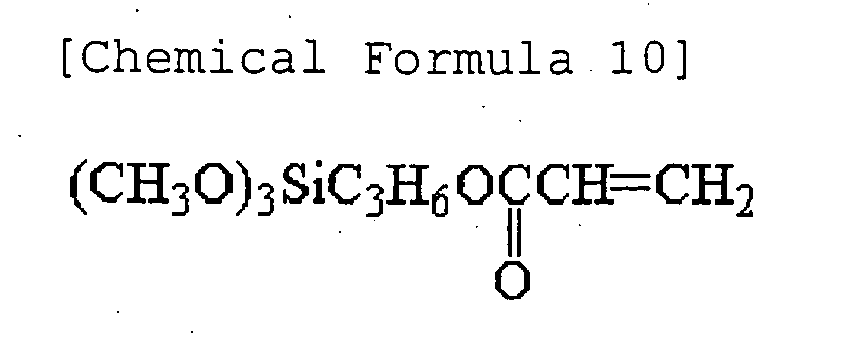
- vinyltrimethoxysilane
(CH3O)3SiCH=CH2 [Chemical Formula 11]
- vinyltriethoxysilane
(C2H5O)3SiCH=CH2 [Chemical Formula 12]
- p-styryltrimethoxysilane

- 3-mercaptopropyltrimethoxysilane
(CH3O)3SiC3H6SH [Chemical Formula 14]
- 3-mercaptopropylmethyldimethoxysilane

- 2-(3, 4 epoxycyclohexyl)ethyltrimethoxysilane

- 3-glycidoxypropyltrimethoxysilane

- 3-glycidoxypropylmethyldiethoxysilane

- 3-glycidoxypropyltriethoxysilane

- The silane coupling agent as the component (a) is preferably a compound of the above general formula [3] in which R6 has at least one functional group selected from the group consisting of a (meth)acryloyl group and a vinyl group; R7 has a hydroxyl group, an alkyl group having 1 to 5 carbon atoms or an alkoxy group having 1 to 5 carbon atoms; and R8 and R9 each has a hydroxyl group or an alkoxy group having 1 to 5 carbon atoms.
- The silane coupling agent as the component (a) is particularly preferably 3-methacryloxypropylmethyldimethoxysilane, 3-methacryloxypropyltrimethoxysilane, 3-methacryloxypropylmethyldiethoxysilane, 3-methacryloxypropyltriethoxysilane, or 3-acryloxypropyltrimethoxysilane.
- The amount of the silane coupling agent as the component (a) may be appropriately selected according to the intended purposes of the composition, and is adjusted within a range from 1 to 60 parts by weight, and preferably from 5.0 to 50 parts by weight, based on the entire composition.
- As the acidic group-containing polymerizable monomer as the component (b) in the present invention, all polymerizable monomers, which have been conventionally used as a dental acidic group-containing polymerizable monomer, can be used. Particularly, it is possible to select from a polymerizable monomer having a carboxyl group, a phosphate ester group, a phosphonic acid group, a pyrophosphoric acid group or a sulfonic acid group before use.
- Examples of the monomer having a carboxyl group in the molecule, among the acidic group-containing polymerizable monomer as the component (b) in the present invention, include methacrylic acid, 4-(meth)acryloxyethyltrimellitic acid, 4-(meth)acryloyloxyethoxycarbonylphthalic acid, 4-(meth)acryloyloxybutyloxycarbonylphthalic acid, 4-(meth)acryloyloxyhexyloxycarbonylphthalic acid, 4-(meth)acryloyloxyoctyloxycarbonylphthalic acid, 4-(meth)acryloyloxydecyloxycarbonylphthalic acid, maleic acid, acid anhydrides thereof, 5-(meth)acryloylaminopentylcarboxylic acid, 6-(meth)acryloyloxy-1,1-hexanedicarboxylic acid, 7-(meth)acryloyloxy-1,1-heptanedicarboxylic acid, 8-(meth)acryloyloxy-1,1-octanedicarboxylic acid, 10-(meth)acryloyloxy-1,1-decanedicarboxylic acid and 11-(meth)acryloyloxy-1,1-undecanedicarboxylic acid. The monomer further includes acid chlorides, alkali metal salts, alkali earth metal salts and ammonium salts thereof.
- Examples of the monomer having a phosphate ester group, a phosphonic acid group or a pyrophosphoric acid group, among the acidic group-containing polymerizable monomer as the component (b) in the present invention, include 3-(meth)acryloxypropyl-3-phosphonopropionate, 3-(meth)acryloxypropyl-3-phosphonoacetate, 4-(meth)acryloxybutyl-3-phosphonopropionate, 4-(meth)acryloxybutylphosphonoacetate, 5-(meth)acryloxypentylphos-3-phonopropionate, 5-(meth)acryloxypentyl-3-phosphonoacetate, 6-(meth)acryloxyhexyl-3-phosphonopropionate, 6-(meth)acryloxyhexyl-3-phosphonoacetate, 10-(meth)acryloxydecyl-3-phosphonopropionate, 10-(meth)acryloxydecyl-3-phosphonoacetate, bis[2-(meth)acryloxyethyl]phosphate, 2-(meth)acryloyloxyethyldihydrogen phosphate, 3-(meth)acryloyloxypropyldihydrogen phosphate, 4-(meth)acryloyloxybutyldihydrogen phosphate, 5-(meth)acryloyloxypentyldihydrogen phosphate, 6-(meth)acryloyloxyhexyldihydrogen phosphate, 7-(meth)acryloyloxyheptyldihydrogen phosphate, 8-(meth)acryloyloxyoctyldihydrogen phosphate, 9-(meth)acryloyloxynonyldihydrogen phosphate, 10-(meth)acryloyloxydecyldihydrogen phosphate, 11-(meth)acryloyloxyundecyldihydrogen phosphate, 12-(meth)acryloyloxydodecyldihydrogen phosphate, 16-(meth)acryloyloxyhexadecyldihydrogen phosphate, 20-(meth)acryloyloxyeicosyldihydrogen phosphate, di[2-(meth)acryloyloxyethyl]hydrogen phosphate, di[4-(meth)acryloyloxybutyl]hydrogen phosphate, di[6-(meth)acryloyloxyhexyl]hydrogen phosphate, di[8-(meth)acryloyloxyoctyl]hydrogen phosphate, di[9-(meth)acryloyloxynonyl]hydrogen phosphate, di[10-(meth)acryloyloxydecyl]hydrogen phosphate, 1,3-di(meth)acryloyloxypropyl-2-dihydrogen phosphate, 2-(meth)acryloyloxyethylphenylhydrogen phosphate, 2-(meth)acryloyloxyethyl 2-bromoethylhydrogen phosphate, 2-(meth)acryloyloxyethylphenyl phosphonate, 10-(meth)acryloyloxydecylphosphonic acid, vinylphosphonic acid, p-vinylbenzylphosphonic acid; and polymerizable monomers described in Japanese Unexamined Patent Publication (Kokai) No.
62-281885 - Examples of the monomer having a sulfonic acid group in the molecule, among the acidic group-containing polymerizable monomer as the component (b) in the present invention, include styrenesulfonic acid, 2-sulfoethyl (meth)acrylate, 6-sulfohexyl (meth)acrylate, 10-sulfodecyl (meth)acrylate and 2-(meth)acrylamide-2-methylpropanesulfonic acid. The monomer further includes acid chlorides, alkali metal salts, alkali earth metal salts and ammonium salts.
- Among the acidic group-containing polymerizable monomer as the component (b) in the present invention, preferred polymerizable monomer is a (meth)acrylate-based monomer having a phosphonic acid group represented by the following general formula:

- Preferred is a phosphonic acid group-containing (meth)acrylate-based monomer represented by the following general formula [1]:

- Examples of the alkylene group include those described as for the general formula [1]. The substituent which may be combined with R2 or R3 include, for example, an unsaturated group such as an alkenyl group or an alkynyl group, an alkyl group, or an alkyl group combined with a phenyl group.
- Examples of the alkenyl group include:


- Particularly preferred phosphonic acid group-containing (meth)acrylate-based monomers are 6-methacryloxyhexyl-phosphonoacetate, 6-methacryloxyhexyl-3-phosphonopropionate, 10-methacryloxydecyl-3-phosphonopropionate or 10-methacryloxydecyl-phosphonoacetate, and particularly preferred phosphonic acid group-containing (meth)acrylate-based monomers are 6-methacryloxyhexyl-phosphonoacetate or 6-methacryloxyhexyl-3-phosphonopropionate.
- The amount of the acidic group-containing polymerizable monomer as a component (b) may be appropriately selected according to the intended purposes of the composition, and is adjusted within a range from 1.0 to 20.0 parts by weight, and preferably from 4.0 to 15.5 parts by weight, based on 100 parts by weight of the silane coupling agent as the component (a).
- The present invention has a volatile organic solvent as the component (c) is methanol, ethanol, isopropanol, butanol, acetone, ethyl acetate or isopropylether, or a radical polymerizable monomer such as (meth)acrylate ester, (meth)acrylamide or vinyl ester.
- The volatile organic solvent is preferably ethanol or acetone, and the volatile organic solvent as the component (c) may be appropriately selected according to the intended purposes of the composition, and is adjusted within a range from 28 to 99 parts by weight, and preferably from 42.25 to 94.8 parts by weight.
- As the sulfur group-containing polymerizable monomer in the present invention, all polymerizable monomers, which have conventionally been used as the dental sulfur group-containing polymerizable monomer, can be used.
Particularly preferred is a (meth)acrylate ester derivative having a disulfide cyclic group represented by the following general formula [2]: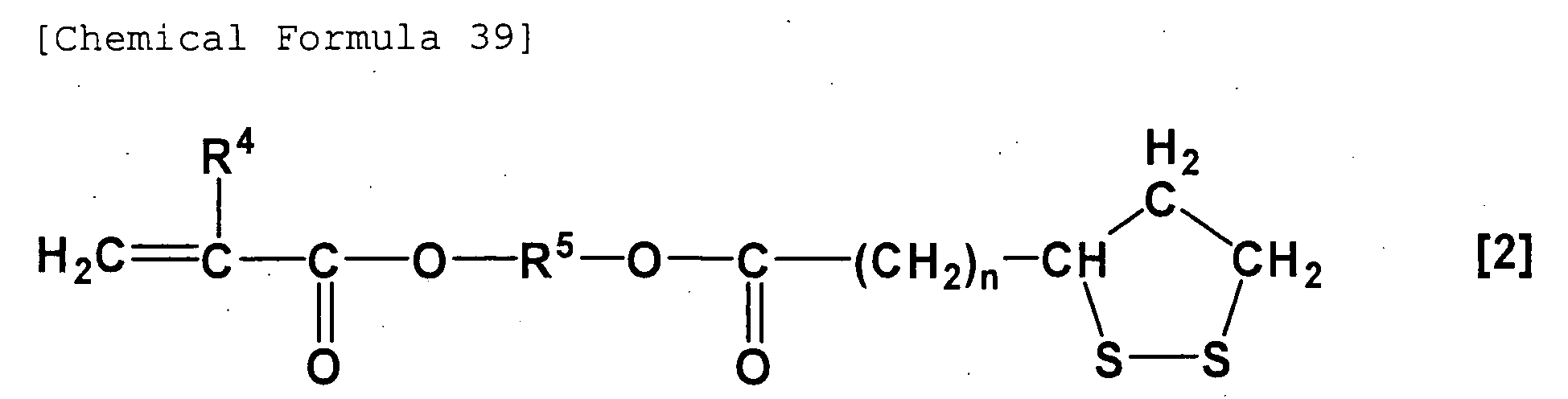
- In the general formula [2], R4 represents a hydrogen atom or a hydrocarbon group having 1 to 3 carbon atoms. Examples of the hydrocarbon group having 1 to 3 carbon atoms include -CH3, -C2H5 and -C3H7. R4 is preferably a hydrogen atom or a methyl group.
R5 represents an optionally substituted alkylene group having 1 to 30 carbon atoms, preferably 1 to 14 carbon atoms, and more preferably 2 to 12 carbon atoms. Examples of the alkylene group include -C2H4-, -C3H6-, - C4H8- and -C10H20-. The substituent, which may be combined with R5, is an alkenyl group or an alkyl group, or an alkyl group combined with a phenyl group. Examples of the alkenyl group include:
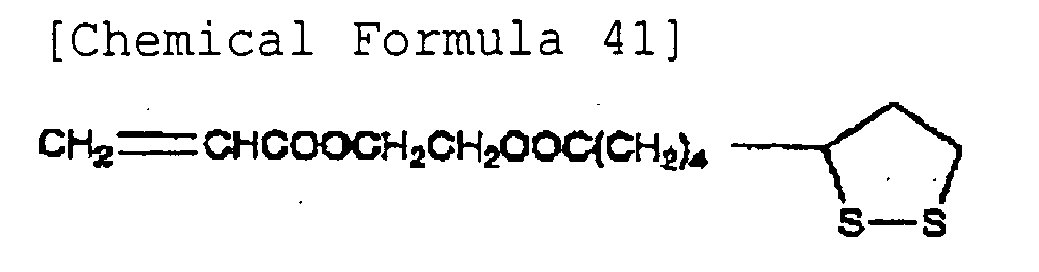
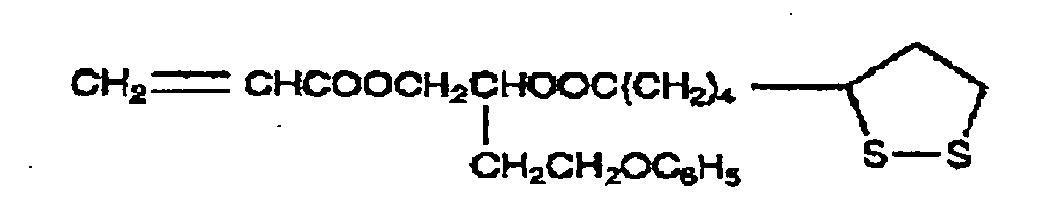
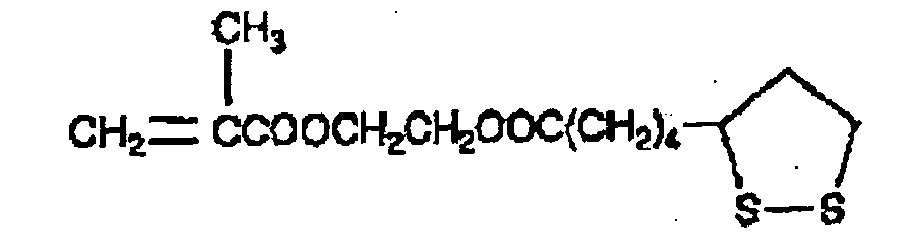
n represents an integer of 0 to 15. In the present invention, "(meth)acrylate" means acrylate or methacrylate. - Specific examples of the compound represented by the general formula [2] include the following compounds.
-



-


-




-


-


- Particularly preferred compounds are 10-methacryloxydecyl-6,8-dithioctanate or 6-methacryloxyhexyl-6,8-dithioctanate.
- The dental adhesive composition of the present invention contains the silane coupling agent as a component (a), the acidic group-containing polymerizable monomer as a component (b) and the volatile organic solvent as a component (c) as essential components, and other components can be appropriately selected and added. According to the applications, additive components such as radical polymerizable monomers, photopolymerization initiators, photopolymerization promoters, thermal polymerization initiators, polymerization catalysts, inorganic/organic fillers, polymerization inhibitors and pigment may be appropriately blended.
- A radical polymerizable monomer as a component (e) can be added to the dental adhesive composition in the present invention. Specific examples of the radical polymerizable monomer as the component (e) include (meth)acrylates such as (meth)acrylic acid, methyl (meth)acrylate and ethyl (meth)acrylate, and alkyl side chain substituents with a hydroxyl group or halogen; urethane (meth)acrylates such as methoxydiethylene glycol (meth)acrylate, methoxypolyethylene glycol (meth)acrylate, ethylene glycol di(meth)acrylate, triethylene glycol di(meth)acrylate, tetraethylene glycol di(meth)acrylate, hexamethylene glycol di(meth)acrylate, polyethylene glycol di(meth)acrylate, propylene glycol di(meth)acrylate, polypropylene glycol di(meth)acrylate, neopentyl glycol di(meth)acrylate, 2,2'-bis{4-(meth)acryloxypropoxyphenyl}propane, 2,2'-bis{4-(meth)acryloxyethoxyphenyl}propane, 2,2'-bis{4-(meth)acryloxydiethoxyphenyl}propane, bisphenol A di(meth)acrylate, bisphenol A diglycidyl (meth)acrylate, trimethylolpropane tri(meth)acrylate, trimethylolethane tri(meth)acrylate, tetramethylolethane tetra(meth)acrylate, epoxy-(meth)acrylate, and a reaction product of an organic diisocyanate and an alkyl (meth)acrylate; a polymerizable prepolymer having at least two polymerizable ethylenically unsaturated groups as a reaction product of a urethane prepolymer (a reaction product of an organic diisocyanate and diol) and a (meth)acrylate ester of an oxyalkanol having at least two carbon atoms; and a reaction product of a dibasic carboxylic acid having an ethylenically unsaturated group and a dihydric alcohol (namely, a polyester having an ethylenically unsaturated group).
- These radical polymerizable monomers are used alone or in combination, and a combination of a bisphenol A diglycidyl (meth)acrylate of a polymerizable monomer, such as di(meth)acrylate, and triethylene glycol di(meth)acrylate is preferred.
- As a polymerization initiator as a component (f) in the present invention, known compounds, which are usually used in the dental composition, are used without any limitation. The polymerization initiator is usually classified into a thermal polymerization initiator and a photopolymerization initiator.
- As the photopolymerization initiator as the component (f), a photosensitizer, which generates a radical under light irradiation, can be used. Examples of the ultraviolet photosensitizer include benzoin-based compounds such as benzoin, benzoin methyl ether and benzoin ethyl ether; benzophenone-based compounds such as acetoinbenzophenone, p-chlorobenzophenone and p-methoxybenzophenone; and thioxanthone-based compounds such as thioxanthone, 2-chlorothioxanthone, 2-methylthioxanthone, 2-isopropylthioxanthone, 2-methoxythioxanthone, 2-hydroxythioxanthone, 2,4-diethylthioxanthone and 2,4-diisopropylthioxanthone. Photosensitizers capable of initiating polymerization under irradiation with visible ray are preferably used since it does not required ultraviolet ray which is harmful to the human body. Examples thereof include α-diketones such as benzyl, camphorquinone, α-naphthyl, acetonaphthene, p,p'-dimethoxybenzyl, p,p'-dichlorobenzylacetyl, pentanedion, 1,2-phenanthrenequinone, 1,4-phenanthrenequinone, 3,4-phenanthrenequinone, 9,10-phenanthrenequinone and naphthoquinone. Preferably, camphorquinone is used.
- It is also preferred to use the above photosensitizer in combination with a photopolymerization promoter. When tertiary amines are used as the photopolymerization promoter, a compound having an aromatic group substituted directly with a nitrogen atom is preferred. It is possible to use, as the photopolymerization promoter, tertiary amines such as N,N-dimethylaniline, N,N-diethylaniline, N,N-di-n-butylaniline, N,N-dibenzylaniline, N,N-dimethyl-p-toluidine, N,N-dimethyl-m-toluidine, N,N-diethyl-p-toluidine, p-bromo-N,N-dimethylaniline, m-chloro-N,N-dimethylaniline, p-dimethylaminobenzaldehyde, p-dimethylaminoacetophenone, p-dimethylaminobenzoic acid, ethyl p-dimethylaminobenzoate, amino p-dimethylaminobenzoate, N,N-dimethylanthralinic acid methyl ester, N,N-dihydroxyethylaniline, N,N-dihydroxyethyl-p-toluidine, p-dimethylaminophenyl alcohol, p-dimethylaminostyrene, N,N-dimethyl-3,5-xylidine, 4-dimethylaminopyridine, N,N-dimethyl-α-naphthylamine, N,N-dimethyl-β-naphthylamine, tributylamine, tripropylamine, triethylamine, N-methyldiethanolamine, N-ethyldiethanolamine, N,N-dimethylhexylamine, N,N-dimethyldodecylamine, N,N-dimethylstearylamine, N,N-dimethylaminoethyl methacrylate, N,N-diethylaminoethyl methacrylate and 2,2'-(n-butylimino)dimethanol; barbituric acids such as 5-butylbarbituric acid and 1-benzyl-5-phenylbarbituric acid, and metal salts thereof such as sodium salts and calcium salts; and tin compounds such as dibutyltin diacetate, dibutyltin dimaleate, dioctyltin dimaleate, dioctyltin dilaurate, dibutyltin dilaurate, dioctyltin diversatate, dioctyl-tin-S,S'-bis-isooctylmercapto acetate and tetramethyl-1,3-diacetoxydistanoxane. Among these photopolymerization promoters, at least one kind can be selected and used, and also two or more kinds can be used in combination. The amounts of the initiator and the promoter can be appropriately decided.
- Furthermore, it is effective to add oxycarboxylic acids such as citric acid, malic acid, tartaric acid, glycolic acid, gluconic acid, α-oxyisobutyric acid, 2-hydroxypropanoic acid, 3-hydroxypropanoic acid, 3-hydroxybutanoic acid, 4-hydroxybutanoic acid and dimethylolpropionic acid, in addition to the tertiary amine, so as to improve photopolymerization promotion ability.
- Specific examples of the thermal polymerization initiator, which is preferably used, include organic peroxides such as benzoyl peroxide, parachlorobenzoyl peroxide, 2,4-dichlorobenzoyl peroxide, acetyl peroxide, lauroyl peroxide, tertiary butyl peroxide, cumen hydroperoxide, 2,5-dimethylhexane-2,5-dihydro peroxide, methyl ethyl ketone peroxide and tertiary butyl peroxybenzoate; and azo compounds such as azobisisobutyronitrile, methyl azobisisobutyrate and azobiscyanovaleric acid.
- Polymerization can be carried out at normal temperature by using the above organic peroxide in combination with an amine compound. As the amine compound, a secondary or tertiary amine in which an amine group is combined with an aryl group is preferably used in view of promotion of curing. For example, N,N-dimethyl-p-toluidine, N,N-dimethylaniline, N,N-β-hydroxyethyl-aniline, N,N-di(β-hydroxyethyl)-aniline, N,N-di(β-hydroxyethyl)-p-toluidine, N-methyl-aniline and N-methyl-p-toluidine are preferred.
- It is preferred to further use a combination of the organic peroxide and the amine compound in combination with sulfinate or borate. Examples of the sulfinates include sodium benzenesulfinate, lithium benzenesulfinate and sodium p-toluenesulfinate. Examples of the borate include trialkylphenylboron, and sodium salts, lithium salts, potassium salts, magnesium salts, tetrabutylammonium salts and tetramethylammonium salts of trialkyl(p-fluorophenyl)boron (alkyl group is an n-butyl group, an n-octyl group, n-dodecyl group, etc.). Organoboron compounds, which react with oxygen or water to generate a radical, such as tributylborane and tributylborane partial oxide can also be used as an organic metal type polymerization initiator.
- The dental adhesive composition of the present invention can be blended with various known additives as required. Examples of the additive include polymerization inhibitors, colorants, antitarnish agents, fluorescent agents, ultraviolet absorbers and antibacterial agents.
- The component (g) of the present invention include an inorganic/organic filler. Examples of the inorganic/organic filler include organic polymer powders such as polymethyl methacrylate, polyethyl methacrylate, copolymer of methyl methacrylate and ethyl methacrylate, and polystyrene; organic fillers obtained by grinding a thermosetting resin cured article or a thermosetting resin cured article containing an inorganic filler; inorganic fillers (kaolin, talc, quartz, silica, colloidal silica, alumina, aluminosilicate, silicon nitride, barium sulfate, calcium phosphate, barium sulfate, glass powder) and composite fillers of inorganic fillers and organic fillers, which are suited for use of the composition in the form of powder/liquid, paste or slurry. Their surface may be coated with a coupling agent having a silanol group (γ-methacryloxypropyltrimethoxysilane, etc.).
- Examples of the polymerization inhibitor include hydroquinone, hydroquinone monomethyl ether and butylated hydroxytoluene, and are suitable for stabilization of the shelf life of the composition.
- The present invention will be described in detail by way of Examples and Comparative Examples. The present invention is not limited to the following Examples.
- Abbreviations shown in Examples (Chemical Name)
- 1) Silane coupling agent
- 3-MPDES: 3-methacryloxypropylmethyldiethoxysilane
- 3-MPTES: 3-methacryloxypropyltriethoxysilane
- 2) Acidic group-containing polymerizable monomer
- 6-MHPA: 6-methacryloxyhexyl-phosphonoacetate
- 6-MHPP: 6-methacryloxyhexyl-3-phosphonopropionate
- 10-MDPP: 10-methacryloxydecyl-3-phosphonopropionate
- 4-META: 4-methacryloxyethyltrimellitic anhydride
- PM: Phosmer M (manufactured by Uni-Chemical Co., Ltd.)
- 3) Radical polymerizable monomer
- Bis-GMA: Bisphenol A diglycidyl methacrylate
- 3G: Triethylene glycol dimethacrylate
- 4) Photopolymerization initiator, photopolymerization promoter
CQ: Camphorquinone
DMBE: Ethyl p-dimethylaminobenzoate - 5) Filler
R-972: Fine silicic acid particles [manufactured by Nippon Aerosil Co. Ltd.] - 6) Sulfur atom-containing polymerizable monomer
10-MDDT: 10-methacryloxydecyl-6,8-dithioctanate - Resin cement: "RESICEM" [manufactured by SHOFU, INC.]
Aluminum oxide plate: measuring about 15 × 15 × 2 mm [manufactured by JAPAN FINE CERAMICS CO., LTD.]
Zirconium hydroxide plate: measuring about 15 × 15 × 2 mm [manufactured by JAPAN FINE CERAMICS CO., LTD.]
Porcelain disk-shaped plate: measuring 15.0 in diameter × 5.0 mm [Porcelain for firing dental metal [manufactured by SHOFU, INC. under the trade name of "VINTAGE HALO"]
Gold alloy plate: measuring 15 × 15 × 2 mm [manufactured by SHOFU, INC. under the trade name of "Super Gold Type 4"]
Thermal cycle testing machine: manufactured by Tokyo Giken Inc.
Instron's universal testing machine: manufactured by Instron Corp. - A test regarding tensile adhesive strength was carried out on an example of a dental ceramic material of aluminum oxide or zirconium oxide using an aluminum oxide plate (measuring about 15 × 15 × 2 mm [manufactured by JAPAN FINE CERAMICS CO., LTD.]) and a zirconium oxide plate (measuring about 15 × 15 × 2 mm [manufactured by JAPAN FINE CERAMICS CO., LTD.]). An adhesive composition was prepared by mixing components in each weight ratio shown in Tables 1 to 4.
- A flat surface of an aluminum oxide or zirconium oxide plate measuring about 15 × 15 × 2 mm was polished under running water using a silicone carbide paper #240 [manufactured by Sankyo-Rikagaku Co., Ltd.] and then polished using a silicone carbide paper #600 to obtain a smooth surface. The smooth surface was subjected to air abrasion (50 µm alumina beads, under a pressure of 2.5 kgf/cm2), ultrasonic-cleaned and then air-dried to obtain an adherend.
An adhesive composition was applied on an adhesive surface of the adherend using a small brush and, after standing for 30 seconds, the adherend was dried using an air syringe until fluidity of the adhesive composition disappeared. Separately, an adhesive surface of a cylindrical stainless steel bar measuring 5 mm in diameter × 10 mm in height was subjected to air abrasion (50 µm alumina beads, under a pressure of 5 kgf/cm2), ultrasonic-cleaned and then air-dried to obtain a jig for measurement of an adhesive strength. "RESICEM" in the form of a uniform paste prepared by kneading was interposed between the adhesive surface of the adherend and the adhesive surface of the stainless steel bar, followed by bonding. Excess cement was removed by a small brush and a cement margin was photopolymerized for 10 seconds using "Shofu GRIP LIGHT II".
All seven specimens were immersed in water at 37°C and immersed in water at 37°C for 24 hours, and then a tensile adhesive strength was measured. In the measurement of the adhesive strength, the tensile adhesive strength was measured under conditions of a crosshead speed of 1 mm/min using a universal testing machine (manufactured by Instron Corp.). The entire adhesion test was carried out at room temperature of 23°C±1°C. - An adhesive composition was prepared at each weight ratio shown in Tables 1 to 4, followed by mixing. The resultant adhesive composition was stored in a sealed state under a storage environment at 23°C within 24 hours. The measured tensile adhesive strength was taken as an "initial" tensile adhesive strength. Separately, an adhesive composition was prepared at each weight ratio shown in Tables 1 to 4, followed by mixing. The resultant adhesive composition was stored in a sealed state under a storage environment at 50°C for 2 months. The measured tensile adhesive strength was taken as a tensile adhesive strength "after storage at 50°C for 2 months".
- Using porcelain for firing dental metal [manufactured by SHOFU, INC. under the trade name of "VINTAGE HALO"] as a dental ceramic material containing a silicon dioxide as a main component, a disk-shaped (measuring 15.0 in diameter × 5.0 mm) fired material was made using a vacuum electric furnace for firing porcelain [manufactured by SHOFU, INC. under the trade name of "TWIN MAT"] and a test on a tensile adhesive strength was carried out. An adhesive composition was prepared by mixing components in each weight ratio shown in Tables 1 to 4.
- A flat surface of the disk-shaped (measuring 15.0 in diameter × 5.0 mm) fired material was polished under running water using a silicone carbide paper #240 [manufactured by Sankyo-Rikagaku Co., Ltd.] and then polished using a silicone carbide paper #600 to obtain a smooth surface. The smooth surface was subjected to air abrasion (50 µm alumina beads, under a pressure of 2.5 kgf/cm2), ultrasonic-cleaned and then air-dried to obtain an adherend.
An adhesive composition was applied on an adhesive surface of the adherend using a small brush and, after standing for 30 seconds, the adherend was dried using an air syringe until fluidity of the adhesive composition disappeared. Separately, an adhesive surface of a cylindrical stainless COBALTAM (cobalt-chromium alloy: manufactured by SHOFU, INC.) bar measuring 5 mm in diameter × 10 mm in height was subjected to air abrasion (50 µm alumina beads, under a pressure of 5 kgf/cm2), ultrasonic-cleaned and then air-dried to obtain a jig for measurement of an adhesive strength. "RESICEM" in the form of a uniform paste prepared by kneading was interposed between the adhesive surface of the adherend and the adhesive surface of the stainless steel bar, followed by bonding. Excess cement was removed by a small brush and a cement margin was photopolymerized for 10 seconds using "Shofu GRIP LIGHT II".
All seven specimens were immersed in water at 37°C and immersed in water at 37°C for 24 hours, and then a tensile adhesive strength was measured. In the measurement of the adhesive strength, the tensile adhesive strength was measured under conditions of a crosshead speed of 1 mm/min using a universal testing machine (manufactured by Instron Corp.). The entire adhesion test was carried out at room temperature of 23°C±1°C. - An adhesive composition was prepared at each weight ratio shown in Tables 1 to 4, followed by mixing. The resultant adhesive composition was stored in a sealed state under a storage environment at 23°C within 24 hours. The measured tensile adhesive strength was taken as an "initial" tensile adhesive strength. Separately, an adhesive composition was prepared at each weight ratio shown in Tables 1 to 4, followed by mixing. The resultant adhesive composition was stored in a sealed state under a storage environment at 50°C for 2 months. The measured tensile adhesive strength was taken as a tensile adhesive strength "after storage at 50°C for 2 months".
- Using a gold alloy plate (measuring about 15 × 15 × 2 mm [Super Gold Type 4 (alloy)) as an example of a dental noble metal material, a test on a tensile adhesive strength was carried out. An adhesive composition was prepared by mixing components in each weight ratio shown in Tables 1 to 4.
- A flat surface of an aluminum oxide or zirconium oxide plate measuring about 15 × 15 × 2 mm was polished under running water using a silicone carbide paper #600 [manufactured by Sankyo-Rikagaku Co., Ltd.] to obtain a smooth surface. The smooth surface was subjected to air abrasion (50 µm alumina beads, under a pressure of 2.5 kgf/cm2), ultrasonic-cleaned and then air-dried to obtain an adherend.
An adhesive composition was applied on an adhesive surface of the adherend using a small brush and, after standing for 30 seconds, the adherend was dried using an air syringe until fluidity of the adhesive composition disappeared. Separately, an adhesive surface of a cylindrical stainless steel bar measuring 5 mm in diameter × 10 mm in height was subjected to air abrasion (50 µm alumina beads, under a pressure of 5 kgf/cm2), ultrasonic-cleaned and then air-dried to obtain a jig for measurement of an adhesive strength. "RESICEM" in the form of a uniform paste prepared by kneading was interposed between the adhesive surface of the adherend and the adhesive surface of the stainless steel bar, followed by bonding. Excess cement was removed by a small brush and a cement margin was photopolymerized for 10 seconds using "Shofu GRIP LIGHT II".
All seven specimens were immersed in water at 37°C and immersed in water at 37°C for 24 hours, and then a tensile adhesive strength was measured. In the measurement of the adhesive strength, the tensile adhesive strength was measured under conditions of a crosshead speed of 1 mm/min using a universal testing machine (manufactured by Instron Corp.). The entire adhesion test was carried out at room temperature of 23°C±1°C. - An adhesive composition was prepared at each weight ratio shown in Tables 1 to 4, followed by mixing. The resultant adhesive composition was stored in a sealed state under a storage environment at 23°C within 24 hours. The measured tensile adhesive strength was taken as an "initial" tensile adhesive strength. Separately, an adhesive composition was prepared at each weight ratio shown in Tables 1 to 4, followed by mixing. The resultant adhesive composition was stored in a sealed state under a storage environment at 50°C for 2 months. The measured tensile adhesive strength was taken as a tensile adhesive strength "after storage at 50°C for 2 months".
- Test Nos. 22 to 23: Examples of dental primer or dental adhesive material
Using an aluminum oxide plate (measuring about 15 x 15 x 2 mm [manufactured by JAPAN FINE CERAMICS CO., LTD.]) and a zirconium oxide plate (measuring about 15 x 15 x 2 mm [manufactured by JAPAN FINE CERAMICS CO., LTD.]) as examples of a dental ceramic material of aluminum oxide or zirconium oxide, a test on a shear adhesive strength was carried out. An adhesive composition was prepared by mixing components in each weight ratio shown in Table 5. - A flat surface of an aluminum oxide or zirconium oxide plate measuring about 15 x 15 x 2 mm was polished under running water using a silicone carbide paper #240 [manufactured by Sankyo-Rikagaku Co., Ltd.] and then polished using a silicone carbide paper #600 to obtain a smooth surface. The smooth surface was subjected to air abrasion (50 µm alumina beads, under a pressure of 2.5 kgf/cm2), ultrasonic-cleaned and then air-dried to obtain an adherend. A double-stick tape with holes having a diameter of 4 mm was applied on the polished adhesive surface thereby defining the adhesive surface.
An adhesive composition was applied on an adhesive surface of the adherend using a small brush and, after standing for 30 seconds, the adherend was dried using an air syringe until fluidity of the adhesive composition disappeared. Subsequently, the adherend was irradiated with light using Shofu GRIP LIGHT II [manufactured by SHOFU, INC.] for 10 seconds. After fixing a plastic mold measuring 4 mm in diameter and 2 mm in height to an adhesion defined surface frame, a photopolymerizable composite resin "Beautiful" [manufactured by SHOFU, INC.] was filled in the mold. After shielding the air with a cover glass, a composite resin was cured by irradiating with light for 30 seconds using Shofu GRIP LIGHT II and the mold was removed to make an adhesion test specimen.
All seven specimens were immersed in water at 37°C and immersed in water at 37°C for 24 hours, and then a shear adhesive strength was measured. In the measurement of the adhesive strength, the shear adhesive strength was measured under conditions of a crosshead speed of 1 mm/min using a universal testing machine (manufactured by Instron Corp.). The entire adhesion test was carried out at room temperature of 23°C±1°C. - An adhesive composition was prepared at each weight ratio shown in Table 5, followed by mixing. The resultant adhesive composition was stored in a sealed state under a storage environment at 23°C within 24 hours. The measured shear adhesive strength was taken as an "initial" shear adhesive strength. Separately, an adhesive composition was prepared at each weight ratio shown in Table 5, followed by mixing. The resultant adhesive composition was stored in a sealed state under a storage environment at 50°C for 2 months. The measured shear adhesive strength was taken as a shear adhesive strength. "after storage at 50°C for 2 months".
- Using porcelain for firing dental metal [manufactured by SHOFU, INC. under the trade name of "VINTAGE HALO"] as a dental ceramic material containing a silicon dioxide as a main component, a disk-shaped (measuring 15.0 in diameter x 5.0 mm) fired material was made using a vacuum electric furnace for firing porcelain [manufactured by SHOFU, INC. under the trade name of "TWIN MAT"] and a test on a shear adhesive strength was carried out. An adhesive composition was prepared by mixing components in each weight ratio shown in Tables 1 to 4.
- A flat surface of the disk-shaped (measuring 15.0 in diameter x 5.0 mm) fired material was polished under running water using a silicone carbide paper #240 [manufactured by Sankyo-Rikagaku Co., Ltd.] and then polished using a silicone carbide paper #600 to obtain a smooth surface. The smooth surface was ultrasonic-cleaned and then air-dried to obtain an adherend.
An adhesive composition was applied on an adhesive surface of the adherend using a small brush and, after standing for 30 seconds, the adherend was dried using an air syringe until fluidity of the adhesive composition disappeared. Subsequently, the adherend was irradiated with light using Shofu GRIP LIGHT II [manufactured by SHOFU, INC.] for 10 seconds. After fixing a plastic mold measuring 4 mm in diameter and 2 mm in height to an adhesion defined surface frame, a photopolymerizable composite resin "Beautifil" [manufactured by SHOFU, INC.] was filled in the mold. After shielding the air with a cover glass, a composite resin was cured by irradiating with light for 30 seconds using Shofu GRIP LIGHT II and the mold was removed to make an adhesion test specimen.
All seven specimens were immersed in water at 37°C and immersed in water at 37°C for 24 hours, and then a shear adhesive strength was measured. In the measurement of the adhesive strength, the shear adhesive strength was measured under conditions of a crosshead speed of 1 mm/min using a universal testing machine (manufactured by Instron Corp.). The entire adhesion test was carried out at room temperature of 23°C±1°C. - An adhesive composition was prepared at each weight ratio shown in Table 5, followed by mixing. The resultant adhesive composition was stored in a sealed state under a storage environment at 23°C within 24 hours. The measured shear adhesive strength was taken as an "initial" shear adhesive strength. Separately, an adhesive composition was prepared at each weight ratio shown in Table 5, followed by mixing. The resultant adhesive composition was stored in a sealed state under a storage environment at 50°C for 2 months. The measured shear adhesive strength was taken as a shear adhesive strength "after storage at 50°C for 2 months".
- Using a gold alloy plate (measuring about 15 x 15 x 2 mm [Super Gold Type 4, manufactured by SHOFU, INC.] as an example of a dental noble metal material, a test on a shear adhesive strength was carried out. An adhesive composition was prepared by mixing components in each weight ratio shown in Table 5.
- A flat surface of a gold alloy plate measuring 15 x 15 x 2 mm was polished under running water using a silicone carbide paper #600 [manufactured by Sankyo-Rikagaku Co., Ltd.] to obtain a smooth surface. The smooth surface was ultrasonic-cleaned and then air-dried to obtain an adherend. A double-stick tape with holes having a diameter of 4 mm was applied on the polished adhesive surface thereby defining the adhesive surface.
An adhesive composition was applied on an adhesive surface of the adherend using a small brush and, after standing for 30 seconds, the adherend was dried using an air syringe until fluidity of the adhesive composition disappeared. Subsequently, the adherend was irradiated with light using Shofu GRIP LIGHT II [manufactured by SHOFU, INC.] for 10 seconds. After fixing a plastic mold measuring 4 mm in diameter and 2 mm in height to an adhesion defined surface frame, a photopolymerizable composite resin "Beautifil" [manufactured by SHOFU, INC.] was filled in the mold. After shielding the air with a cover glass, a composite resin was cured by irradiating with light for 30 seconds using Shofu GRIP LIGHT II and the mold was removed to make an adhesion test specimen.
All seven specimens were immersed in water at 37°C and immersed in water at 37°C for 24 hours, and then a shear adhesive strength was measured. In the measurement of the adhesive strength, the shear adhesive strength was measured under conditions of a crosshead speed of 1 mm/min using a universal testing machine (manufactured by Instron Corp.). The entire adhesion test was carried out at room temperature of 23°C±1°C. - An adhesive composition was prepared at each weight ratio shown in Table 5, followed by mixing. The resultant adhesive composition was stored in a sealed state under a storage environment at 23°C within 24 hours. The measured shear adhesive strength was taken as an "initial" shear adhesive strength. Separately, an adhesive composition was prepared at each weight ratio shown in Table 5, followed by mixing. The resultant adhesive composition was stored in a sealed state under a storage environment at 50°C for 2 months. The measured tensile adhesive strength was taken as a shear adhesive strength "after storage at 50°C for 2 months".
-
Table 1 Test No. 1 2 3 4 5 6 7 8 Examples and Comparative Examples Example 1 Example 2 Example 3 Example 4 Example 5 Example 6 Example 7 Example 8 Amounts [parts by weight] and names of components (a), (b), (c) and (d) (a) Silane coupling agent 3MPTES 40.0 40.0 40.0 4.00 4.00 20.00 50.00 60.00 (b) Acidic group- containing polymerizable monomer 6-MHPA 0.64 2.48 7.44 0.25 0.06 1.24 6.20 3.72 (c) Volatile Acetone 29.18 28.26 52.06 47.45 95.44 78.26 21.40 organic solvent Ethanol 29.68 28.76 47.80 21.90 35.78 (d) Sulfur atom-containing polymerizable monomer 10-MDDT 0.50 0.50 0.50 0.50 0.50 0.50 0.50 0.50 Total amount of components (a), (b), (c) and (d) [parts by weight] 100.0 100.0 100.0 100.0 100.0 100.0 100.0 100.0 Amount of component (b) based on 100 parts by weight of component (a) [parts by weight] 1.6 6.2 18.6 6.2 1.6 6.2 12.4 6.2 Tensile adhesive strength [MPa] Porcelain Initial 20.8 26.9 29.2 22.1 18.8 26.4 24.6 30.8 After storage at 50°C for 2 months 19.5 25.0 22.1 17.1 18.1 20.7 21.5 30.6 Alumina Initial 25.2 23.9 21.7 23.1 19.7 19.7 22.8 23.3 After storage at 50°C for 2 months 21.4 22.9 25.3 22.7 21.6 22.9 23.7 26.6 Zirconia Initial 16.0 21.9 24.5 20.9 21.7 21.2 18.0 18.4 After storage at 50°C for 2 months 23.9 21.4 20.8 24.4 19.3 18.9 19.4 23.4 Gold alloy Initial 24.5 25.4 26.8 21.7 26.6 24.0 22.2 23.8 After storage at 50°C for 2 months 23.1 26.9 27.6 24.6 23.4 22.5 23.5 21.8 -
Table 2 Test No. 9 10 11 12 Examples and Comparative Examples Comparative Example 1 Comparative Example 2 Comparative Example 3 Comparative Example 4 Amounts [parts by weight] and names of components (a), (b), (c) and (d) (a) Silane coupling agent 3MPTES 20.0 20.0 20.0 20.0 (b) Acidic group- containing polymerizable monomer 6-MHPA 1.2 5.0 0.1 (c) Volatile organic solvent Acetone Ethanol 79.5 78.8 74.5 79.4 (d) Sulfur atom- containing polymerizable monomer 10-MDDT 0.5 0.5 0.5 Total amount of components (a), (b), (c) and (d) [parts by weight] 100.0 100.0 100.0 100.0 Amount of component (b) based on 100 parts by weight of component (a) [parts by weight] 0.0 6.2 25.0 0.5 Tensile adhesive strength [MPa] Porcelain Initial 9.1 22.0 20.4 After storage at 50°C for 2 months 8.8 21.0 9.7 8.9 Alumina Initial 10.2 19.8 20.4 8.0 After storage at 50°C for 2 months 8.9 19.8 20.3 7.9 Zirconia Initial 6.5 16.5 17.7 7.6 After storage at 50°C for 2 months 6.6 16.5 16.2 6.2 Gold alloy Initial 11.6 9.7 15.6 10.2 After storage at 50°C for 2 months 11.0 8.1 16.6 10.6 -
Table 3 Test No. 13 14 15 16 17 18 Examples and Comparative Examples Comparative Example 5 Comparative Example 6 Example 9 Example 10 Example 11 Comparative Example 7 Amounts [parts by weight] and names of and components (a), (b), (c) and (d) (a) Silane coupling agent 3MPTES 20.0 20.0 20.0 20.0 20.0 20.0 (b) Acidic group- containing polymerizable monomer PM 0.05 0.6 1.2 2.4 5.00 (c) Volatile organic solvent Acetone Ethanol 79.5 79.5 78.9 78.3 77.1 74.5 (d) Sulfur atom- containing polymerizable monomer 10-MDDT 0.5 0.50 0.5 0.5 0.5. 0.50 Total amount of components (a), (b), (c) and (d) [parts by weight] 100.0 100.0 99.5 100.0 100.0 100.0 Amount of component (b) based on 100 parts by weight of component (a) [parts by weight] 0.0 0.3 3.0 6.0 12.0 25.0 Tensile adhesive strength [MPa] Porcelain Initial 4.7 4.9 21.7 16.0 17.6 16.9 After storage at 50°C for 2 months 3.9 5.7 16.6 15.4 16.9 5.7 Alumina Initial 8.3 7.7 24.1 23.7 23.1 20.3 After storage at 50°C for 2 months 8.2 6.8 19.4 20.8 19.2 13.6 Zirconia Initial 7.1 6.9 20.8 19.4 22.4 22.5 After storage at 50°C for 2 months 6.0 5.6 13.7 20.3 20.1 17.6 Gold alloy Initial 9.7 10.2 15.5 16.9 18.6 16.3 After storage at 50°C for 2 months 10.1 11.2 15.7 17.6 15.9 13.7 -
Table 4 Test No. 19 20 21 Examples and Comparative Examples Example 12 Example 13 Example 14 Amounts [parts by weight] and names of components (a), (b), (c) and (d) (a) Silane coupling agent 3MPTES 40.00 40.00 40.00 (b) Acidic group-containing polymerizable monomer 6-MHPP 3.72 10-MHPP 3.72 4-META 3.72 (c) Volatile organic solvent Acetone 7.98 55.78 18.26 Ethanol 47.80 37.52 (d) Sulfur atom-containing polymerizable monomer 10-MDDT 0.50 0.50 0.50 Total amount of components (a), (b), (c) and (d) [parts by weight] 100.0 100.0 100.0 Amount of component (b) based on 100 parts by weight of component (a) [parts by weight] 9.3 9.3 9.3 Tensile adhesive strength [MPa] Porcelain Initial 24.9 25.6 26.0 After storage at 50°C for 2 months 21.9 22.2 20.6 Alumina Initial 23.9 22.8 24.9 After storage at 50°C for 2 months 24.4 23.0 24.3 Zirconia Initial 22.2 17.1 19.0 After storage at 50°C for 2 months 17.5 17.8 19.5 Gold alloy Initial 25.7 25.8 24.9 After storage at 50°C for 2 months 24.3 23.9 23.8 -
Table 5 Test No. 22 23 Examples and Comparative Examples Example 15 Example 16 Amounts [parts by weight] and names of components (a), (b), (c) and (d) (a) Silane coupling agent 3MPTES 33.17 28.60 (b) Acidic group- containing polymerizable monomer 6-MHPA 2.06 2.10 (c) Volatile organic solvent Ethanol 47.18 16.80 (d) Sulfur atom- containing polymerizable monomer 10-MDDT 0.50 0.50 Radical polymerizable initiator Bis-GMA 3G 11.61 32.00 4.98 14.50 Photopolymerization initiator CQ 0.25 0.25 Photopolymerization promoter DMBE 0.25 0.25 Filler R-972 0.00 5.00 Total amount of components [parts by weight] 100.00 100.00 Amount of component (b) based on 100 parts by weight of component (a) [parts by weight] 6.2 7.3 Shear adhesive strength [MPa] Porcelain Initial 20.7 18.6 After storage at 50°C for 2 months 18.5 19.2 Alumina Initial 17.0 16.5 After storage at 50°C for 2 months 18.8 15.4 Zirconia Initial 19.4 18.5 After storage at 50°C for 2 months 18.7 17.9 Gold alloy Initial 25.5 24.3 After storage at 50°C for 2 months 22.8 26.2
Claims (4)
- A one-pack type dental primer comprising a silane coupling agent as a component (a), an acidic group-containing polymerizable monomer as a component (b), a volatile organic solvent as a component (c), and a sulfur atom-containing polymerizable monomer as a component (d),
wherein
the content of the component (a) is from 1 to 60 parts by weight based on the entire composition and the content of the component (b) is from 1.0 to 20.0 parts by weight based on 100 parts by weight of the component (a). - The one-pack type dental primer according to claim 1,
wherein the acidic group-containing polymerizable monomer as the component (b) is a phosphonic acid group-containing (meth)acrylate-based monomer represented by the following general formula [1]:

- A one-pack type dental primer comprising a silane coupling agent as a component (a), an acidic group-containing polymerizable monomer as a component (b), a sulfur atom-containing polymerizable monomer as a component (d), a radical polymerizable monomer as a component (e), and a photopolymerization initiator as a component (f), wherein
the content of the component (b) is from 1.0 to 20.0 parts by weight based on 100 parts by weight of the component (a). - The one-pack type dental primer according to claim 3, wherein the acidic group-containing polymerizable monomer as the component (b) is a phosphonic acid group-containing (meth)acrylate-based monomer represented by the following general formula [1]:
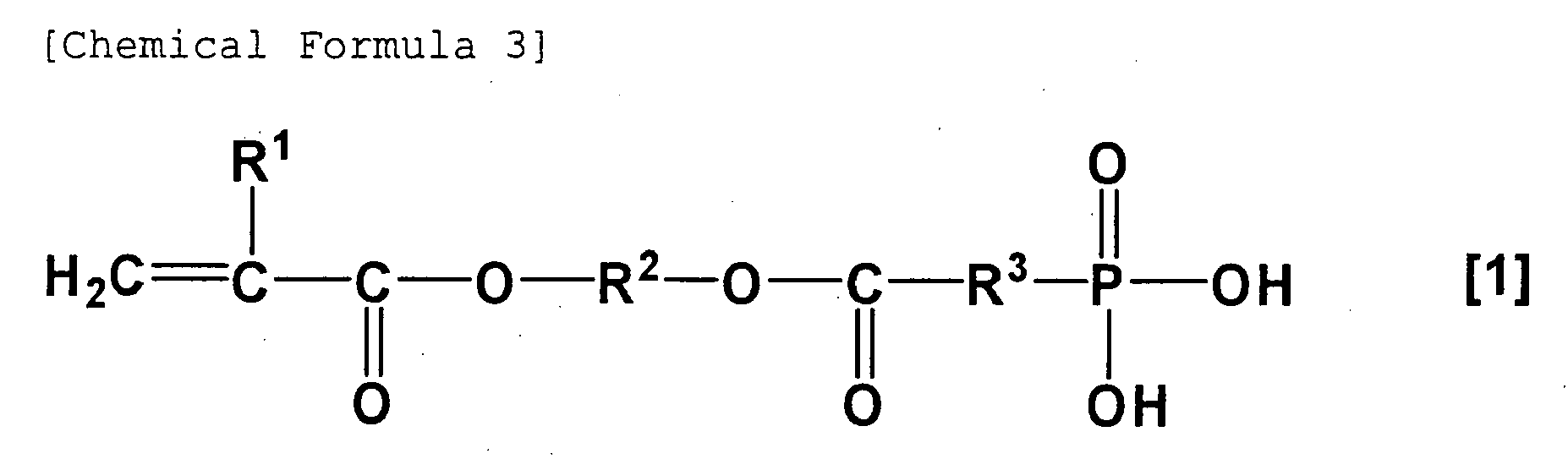

Applications Claiming Priority (1)
| Application Number | Priority Date | Filing Date | Title |
|---|---|---|---|
| JP2007239651A JP2009067746A (en) | 2007-09-14 | 2007-09-14 | One-pack type dental adhesive composition |
Publications (3)
| Publication Number | Publication Date |
|---|---|
| EP2036532A2 true EP2036532A2 (en) | 2009-03-18 |
| EP2036532A3 EP2036532A3 (en) | 2010-11-24 |
| EP2036532B1 EP2036532B1 (en) | 2015-07-29 |
Family
ID=40263586
Family Applications (1)
| Application Number | Title | Priority Date | Filing Date |
|---|---|---|---|
| EP08015778.7A Ceased EP2036532B1 (en) | 2007-09-14 | 2008-09-08 | One pack type dental adhesive composition |
Country Status (4)
| Country | Link |
|---|---|
| US (1) | US7776936B2 (en) |
| EP (1) | EP2036532B1 (en) |
| JP (1) | JP2009067746A (en) |
| CN (1) | CN101385687B (en) |
Cited By (6)
| Publication number | Priority date | Publication date | Assignee | Title |
|---|---|---|---|---|
| EP2229930A1 (en) * | 2009-03-17 | 2010-09-22 | Ivoclar Vivadent AG | Dental universal adhesive compound |
| EP2036532B1 (en) * | 2007-09-14 | 2015-07-29 | Kabushiki Kaisha Shofu | One pack type dental adhesive composition |
| EP3381433A1 (en) * | 2017-03-31 | 2018-10-03 | Shofu Inc. | Dental primer containing acid anhydride |
| EP3381432A1 (en) * | 2017-03-31 | 2018-10-03 | Shofu Inc. | Dental primer containing weakly-acidic compound |
| EP3533844A1 (en) | 2018-03-02 | 2019-09-04 | Agfa-Gevaert | Inkjet inks for manufacturing printed circuit boards |
| CN111225647A (en) * | 2017-10-23 | 2020-06-02 | 可乐丽则武齿科株式会社 | Dental composition |
Families Citing this family (22)
| Publication number | Priority date | Publication date | Assignee | Title |
|---|---|---|---|---|
| US8192673B2 (en) * | 2003-10-22 | 2012-06-05 | University Of Kansas | Resin systems for dental restorative materials |
| WO2007135742A1 (en) * | 2006-05-24 | 2007-11-29 | Kabushiki Kaisha Shofu | Dental adhesive primer composition |
| DE112007002629T5 (en) * | 2006-11-02 | 2009-09-10 | Kabushiki Kaisha Shofu | One-component dental composition containing silane coupling agent and acid group-containing polymerizable monomer |
| JP5612419B2 (en) | 2010-09-28 | 2014-10-22 | 株式会社ジーシー | Dental glass ionomer cement composition |
| ES2683883T3 (en) * | 2013-06-20 | 2018-09-28 | Ivoclar Vivadent Ag | Β-ketophosphonic acids and dental materials based on them |
| WO2016002949A1 (en) | 2014-07-04 | 2016-01-07 | 株式会社トクヤマデンタル | Bonding method, bonding kit, and bonding material |
| WO2016017581A1 (en) * | 2014-07-29 | 2016-02-04 | 株式会社松風 | Composite material with reduced deterioration of paste state |
| JP5716119B1 (en) | 2014-07-29 | 2015-05-13 | 株式会社松風 | Dental composite material with stable paste properties |
| JP5716118B1 (en) | 2014-07-29 | 2015-05-13 | 株式会社松風 | Composite material with reduced deterioration of paste properties |
| JP6274581B2 (en) * | 2015-03-16 | 2018-02-07 | 株式会社松風 | Dental material with reduced deterioration of paste properties |
| JP6274582B2 (en) * | 2015-03-16 | 2018-02-07 | 株式会社松風 | Dental material with stable paste properties |
| US10492888B2 (en) * | 2015-07-07 | 2019-12-03 | Align Technology, Inc. | Dental materials using thermoset polymers |
| JP6815621B2 (en) * | 2016-06-07 | 2021-01-20 | 株式会社トクヤマデンタル | Dental Adhesive Compositions, Ceramic Primers and Dental Adhesives |
| CN106176250B (en) * | 2016-08-03 | 2020-06-23 | 浙江大学 | Dental Adhesive System Based on New Concept of Hydrophobic Bonding |
| CN106137774B (en) * | 2016-08-08 | 2020-04-17 | 浙江大学 | Pit and fissure sealant based on tooth surface hydrophobization concept |
| JP6851611B2 (en) * | 2016-08-18 | 2021-03-31 | 株式会社トクヤマデンタル | Two-component dental adhesive composition |
| CA3031917C (en) * | 2016-08-18 | 2021-01-19 | Tokuyama Dental Corporation | Two-package dental adhesive composition |
| EP3624753B1 (en) * | 2017-05-15 | 2022-03-30 | 3M Innovative Properties Company | Dental adhesive composition, preparation and use thereof |
| CN116640061A (en) | 2018-05-04 | 2023-08-25 | 阿莱恩技术有限公司 | Polymerizable monomer and polymerization method thereof |
| KR102935711B1 (en) | 2018-05-04 | 2026-03-09 | 얼라인 테크널러지, 인크. | Curable composition for use in high-temperature lithographic-based photopolymerization processes and method for preparing crosslinked polymers therefrom |
| EP3804688B1 (en) * | 2019-09-26 | 2025-01-22 | Shofu Inc. | One pack-type dental adhesive composition |
| US12215223B2 (en) | 2019-10-31 | 2025-02-04 | Align Technology, Inc. | Crystallizable resins |
Citations (12)
| Publication number | Priority date | Publication date | Assignee | Title |
|---|---|---|---|---|
| JPS6042222B2 (en) | 1982-02-15 | 1985-09-20 | 株式会社松風 | 4-Acryloxethyl trimellitic acid ester and its acid anhydride |
| JPS62281885A (en) | 1986-02-12 | 1987-12-07 | Ube Ind Ltd | Phosphoryl compound and adhesive containing same |
| JPS6351308A (en) | 1986-08-19 | 1988-03-04 | Kuraray Co Ltd | Adhesive composition for dental use |
| JPH0567146B2 (en) | 1986-06-12 | 1993-09-24 | Kuraray Co | |
| JPH07258248A (en) | 1994-02-04 | 1995-10-09 | Shiyoufuu:Kk | (meth)acrylate ester derivative |
| JPH07277913A (en) | 1995-03-23 | 1995-10-24 | Kuraray Co Ltd | Dental adhesive composition |
| JPH0967546A (en) | 1995-09-04 | 1997-03-11 | Kuraray Co Ltd | Adhesive composition for metal |
| JPH09137129A (en) | 1995-08-28 | 1997-05-27 | Mitsui Petrochem Ind Ltd | Adhesive for ceramics |
| JP2000248201A (en) | 1999-03-03 | 2000-09-12 | Tokuyama Corp | Primer composition for both metal and ceramics |
| JP2002265312A (en) | 2001-03-13 | 2002-09-18 | Tokuyama Corp | Dental primer composition |
| JP2006045179A (en) | 2004-08-03 | 2006-02-16 | Shiyoufuu:Kk | Dental ceramic adhesive composition |
| JP2006045094A (en) | 2004-08-03 | 2006-02-16 | Tokuyama Corp | Primer composition for prosthesis comprising a hardened body of dental composite material |
Family Cites Families (13)
| Publication number | Priority date | Publication date | Assignee | Title |
|---|---|---|---|---|
| US4539382A (en) * | 1981-07-29 | 1985-09-03 | Kuraray Co., Ltd. | Adhesive composition |
| JPS60197609A (en) * | 1984-03-16 | 1985-10-07 | Kuraray Co Ltd | Composition for dental purpose |
| DE3536076A1 (en) * | 1985-10-09 | 1987-04-09 | Muehlbauer Ernst Kg | POLYMERIZABLE CEMENT MIXTURES |
| US5530038A (en) * | 1993-08-02 | 1996-06-25 | Sun Medical Co., Ltd. | Primer composition and curable composition |
| US5707611A (en) * | 1994-04-08 | 1998-01-13 | Kabushiki Kaisha Shofu | Tooth surface treating agent |
| JP2001072936A (en) * | 1999-07-06 | 2001-03-21 | Kuraray Co Ltd | Adhesive composition |
| JP4633236B2 (en) * | 2000-07-19 | 2011-02-16 | 株式会社クラレ | Dental adhesive composition |
| ATE348590T1 (en) * | 2001-08-10 | 2007-01-15 | Dentsply Int Inc | ONE PIECE SELF PRIMER DENTAL ADHESIVE |
| JP4130549B2 (en) * | 2002-02-12 | 2008-08-06 | 株式会社松風 | Adhesive composition for dental ceramics and resin materials |
| JP4167837B2 (en) * | 2002-02-15 | 2008-10-22 | 株式会社松風 | Metal adhesive composition |
| US6900251B2 (en) * | 2002-06-26 | 2005-05-31 | Ivoclar Vivadent Ag | Dental materials based on acrylic-ester phosphonic acids |
| DE112007002629T5 (en) * | 2006-11-02 | 2009-09-10 | Kabushiki Kaisha Shofu | One-component dental composition containing silane coupling agent and acid group-containing polymerizable monomer |
| JP2009067746A (en) * | 2007-09-14 | 2009-04-02 | Shiyoufuu:Kk | One-pack type dental adhesive composition |
-
2007
- 2007-09-14 JP JP2007239651A patent/JP2009067746A/en active Pending
-
2008
- 2008-08-26 US US12/230,225 patent/US7776936B2/en active Active
- 2008-09-08 EP EP08015778.7A patent/EP2036532B1/en not_active Ceased
- 2008-09-11 CN CN2008102118750A patent/CN101385687B/en not_active Expired - Fee Related
Patent Citations (12)
| Publication number | Priority date | Publication date | Assignee | Title |
|---|---|---|---|---|
| JPS6042222B2 (en) | 1982-02-15 | 1985-09-20 | 株式会社松風 | 4-Acryloxethyl trimellitic acid ester and its acid anhydride |
| JPS62281885A (en) | 1986-02-12 | 1987-12-07 | Ube Ind Ltd | Phosphoryl compound and adhesive containing same |
| JPH0567146B2 (en) | 1986-06-12 | 1993-09-24 | Kuraray Co | |
| JPS6351308A (en) | 1986-08-19 | 1988-03-04 | Kuraray Co Ltd | Adhesive composition for dental use |
| JPH07258248A (en) | 1994-02-04 | 1995-10-09 | Shiyoufuu:Kk | (meth)acrylate ester derivative |
| JPH07277913A (en) | 1995-03-23 | 1995-10-24 | Kuraray Co Ltd | Dental adhesive composition |
| JPH09137129A (en) | 1995-08-28 | 1997-05-27 | Mitsui Petrochem Ind Ltd | Adhesive for ceramics |
| JPH0967546A (en) | 1995-09-04 | 1997-03-11 | Kuraray Co Ltd | Adhesive composition for metal |
| JP2000248201A (en) | 1999-03-03 | 2000-09-12 | Tokuyama Corp | Primer composition for both metal and ceramics |
| JP2002265312A (en) | 2001-03-13 | 2002-09-18 | Tokuyama Corp | Dental primer composition |
| JP2006045179A (en) | 2004-08-03 | 2006-02-16 | Shiyoufuu:Kk | Dental ceramic adhesive composition |
| JP2006045094A (en) | 2004-08-03 | 2006-02-16 | Tokuyama Corp | Primer composition for prosthesis comprising a hardened body of dental composite material |
Cited By (12)
| Publication number | Priority date | Publication date | Assignee | Title |
|---|---|---|---|---|
| EP2036532B1 (en) * | 2007-09-14 | 2015-07-29 | Kabushiki Kaisha Shofu | One pack type dental adhesive composition |
| EP2229930A1 (en) * | 2009-03-17 | 2010-09-22 | Ivoclar Vivadent AG | Dental universal adhesive compound |
| EP3381433A1 (en) * | 2017-03-31 | 2018-10-03 | Shofu Inc. | Dental primer containing acid anhydride |
| EP3381432A1 (en) * | 2017-03-31 | 2018-10-03 | Shofu Inc. | Dental primer containing weakly-acidic compound |
| US10813848B2 (en) | 2017-03-31 | 2020-10-27 | Shofu Inc. | Dental primer containing acid anhydride |
| US11033466B2 (en) | 2017-03-31 | 2021-06-15 | Shofu Inc. | Dental primer containing weakly-acidic compound |
| CN111225647A (en) * | 2017-10-23 | 2020-06-02 | 可乐丽则武齿科株式会社 | Dental composition |
| EP3701930A4 (en) * | 2017-10-23 | 2021-07-21 | Kuraray Noritake Dental Inc. | DENTAL COMPOSITION |
| CN111225647B (en) * | 2017-10-23 | 2023-02-28 | 可乐丽则武齿科株式会社 | Dental Composition |
| US11607370B2 (en) | 2017-10-23 | 2023-03-21 | Kuraray Noritake Dental Inc. | Dental composition |
| EP3533844A1 (en) | 2018-03-02 | 2019-09-04 | Agfa-Gevaert | Inkjet inks for manufacturing printed circuit boards |
| WO2019166546A1 (en) | 2018-03-02 | 2019-09-06 | Agfa-Gevaert Nv | Inkjet inks for manufacturing printed circuit boards |
Also Published As
| Publication number | Publication date |
|---|---|
| EP2036532B1 (en) | 2015-07-29 |
| US20090076182A1 (en) | 2009-03-19 |
| US7776936B2 (en) | 2010-08-17 |
| JP2009067746A (en) | 2009-04-02 |
| CN101385687A (en) | 2009-03-18 |
| CN101385687B (en) | 2012-11-14 |
| EP2036532A3 (en) | 2010-11-24 |
Similar Documents
| Publication | Publication Date | Title |
|---|---|---|
| US7776936B2 (en) | One-pack type dental adhesive composition | |
| US8158694B2 (en) | Single component dental composition containing silane coupling agent and acidic group containing polymerizable monomer | |
| JP2690138B2 (en) | Adhesive composition | |
| US7879924B2 (en) | Dental composite resin cement, dental primer and dental adhesive kit containing them | |
| CN107427414B (en) | Polymerizable monomer, composition, adhesive dental material and kit for dental materials | |
| EP1269967B1 (en) | Dental composition kit | |
| EP2047837B1 (en) | Dental adhesive and use thereof | |
| EP3391871A1 (en) | Dental adhesive material kit | |
| JP7649619B2 (en) | Dental adhesive composition containing a chain transfer agent | |
| EP1459726B1 (en) | Adhesives for dental use | |
| JPH02279615A (en) | Adhesive composition for dental use | |
| JPS6351308A (en) | Adhesive composition for dental use | |
| JP4948915B2 (en) | One-part dental adhesive composition | |
| JP7121809B2 (en) | Dental material monomer composition, dental material composition and dental material | |
| US8029613B2 (en) | One-pack type dental adhesive composition | |
| JP2021054792A (en) | Low water sensitive universal resin cement | |
| JP6541185B2 (en) | Adhesive composition for polyaryl ether ketone resin composite material | |
| JP4167837B2 (en) | Metal adhesive composition | |
| JPS62175412A (en) | Restorative material composition for dental use | |
| JP7712116B2 (en) | 2. Paste-type dental hardenable composition | |
| JP6684173B2 (en) | Dental composition | |
| JP2006045179A (en) | Dental ceramic adhesive composition | |
| JP6639220B2 (en) | Adhesive composition for polyaryletherketone resin material | |
| JPH11116900A (en) | Adhesive composition | |
| JP2578212B2 (en) | Maleic acid monoester compounds and adhesives containing them |
Legal Events
| Date | Code | Title | Description |
|---|---|---|---|
| PUAI | Public reference made under article 153(3) epc to a published international application that has entered the european phase |
Free format text: ORIGINAL CODE: 0009012 |
|
| AK | Designated contracting states |
Kind code of ref document: A2 Designated state(s): AT BE BG CH CY CZ DE DK EE ES FI FR GB GR HR HU IE IS IT LI LT LU LV MC MT NL NO PL PT RO SE SI SK TR |
|
| AX | Request for extension of the european patent |
Extension state: AL BA MK RS |
|
| RIN1 | Information on inventor provided before grant (corrected) |
Inventor name: YAMAGUCHI, YUTAKA Inventor name: FUJII, TOSHIHIDE Inventor name: DEGUCHI, MIKITO Inventor name: TANAKA, HISAKI |
|
| PUAL | Search report despatched |
Free format text: ORIGINAL CODE: 0009013 |
|
| RIC1 | Information provided on ipc code assigned before grant |
Ipc: A61K 6/093 20060101ALI20101001BHEP Ipc: A61K 6/00 20060101AFI20090128BHEP Ipc: A61K 6/083 20060101ALI20101001BHEP |
|
| AK | Designated contracting states |
Kind code of ref document: A3 Designated state(s): AT BE BG CH CY CZ DE DK EE ES FI FR GB GR HR HU IE IS IT LI LT LU LV MC MT NL NO PL PT RO SE SI SK TR |
|
| AX | Request for extension of the european patent |
Extension state: AL BA MK RS |
|
| 17P | Request for examination filed |
Effective date: 20110524 |
|
| AKX | Designation fees paid |
Designated state(s): DE |
|
| 17Q | First examination report despatched |
Effective date: 20121024 |
|
| GRAP | Despatch of communication of intention to grant a patent |
Free format text: ORIGINAL CODE: EPIDOSNIGR1 |
|
| INTG | Intention to grant announced |
Effective date: 20150407 |
|
| GRAS | Grant fee paid |
Free format text: ORIGINAL CODE: EPIDOSNIGR3 |
|
| GRAA | (expected) grant |
Free format text: ORIGINAL CODE: 0009210 |
|
| AK | Designated contracting states |
Kind code of ref document: B1 Designated state(s): DE |
|
| REG | Reference to a national code |
Ref country code: DE Ref legal event code: R096 Ref document number: 602008039203 Country of ref document: DE |
|
| REG | Reference to a national code |
Ref country code: DE Ref legal event code: R097 Ref document number: 602008039203 Country of ref document: DE |
|
| PLBE | No opposition filed within time limit |
Free format text: ORIGINAL CODE: 0009261 |
|
| STAA | Information on the status of an ep patent application or granted ep patent |
Free format text: STATUS: NO OPPOSITION FILED WITHIN TIME LIMIT |
|
| 26N | No opposition filed |
Effective date: 20160502 |
|
| PGFP | Annual fee paid to national office [announced via postgrant information from national office to epo] |
Ref country code: DE Payment date: 20191004 Year of fee payment: 12 |
|
| REG | Reference to a national code |
Ref country code: DE Ref legal event code: R119 Ref document number: 602008039203 Country of ref document: DE |
|
| PG25 | Lapsed in a contracting state [announced via postgrant information from national office to epo] |
Ref country code: DE Free format text: LAPSE BECAUSE OF NON-PAYMENT OF DUE FEES Effective date: 20210401 |