EP2033244B1 - Leitfähiges polymer - Google Patents
Leitfähiges polymer Download PDFInfo
- Publication number
- EP2033244B1 EP2033244B1 EP07733402A EP07733402A EP2033244B1 EP 2033244 B1 EP2033244 B1 EP 2033244B1 EP 07733402 A EP07733402 A EP 07733402A EP 07733402 A EP07733402 A EP 07733402A EP 2033244 B1 EP2033244 B1 EP 2033244B1
- Authority
- EP
- European Patent Office
- Prior art keywords
- carbon atoms
- acid
- polymer
- resole
- solvented
- Prior art date
- Legal status (The legal status is an assumption and is not a legal conclusion. Google has not performed a legal analysis and makes no representation as to the accuracy of the status listed.)
- Not-in-force
Links
- 229920001940 conductive polymer Polymers 0.000 title claims description 7
- 229920003987 resole Polymers 0.000 claims abstract description 91
- 239000002253 acid Substances 0.000 claims abstract description 78
- 229920000642 polymer Polymers 0.000 claims abstract description 68
- XLYOFNOQVPJJNP-UHFFFAOYSA-N water Substances O XLYOFNOQVPJJNP-UHFFFAOYSA-N 0.000 claims abstract description 28
- 239000000463 material Substances 0.000 claims abstract description 8
- 125000004432 carbon atom Chemical group C* 0.000 claims description 60
- ISWSIDIOOBJBQZ-UHFFFAOYSA-N phenol group Chemical group C1(=CC=CC=C1)O ISWSIDIOOBJBQZ-UHFFFAOYSA-N 0.000 claims description 53
- 125000002887 hydroxy group Chemical group [H]O* 0.000 claims description 27
- 150000001875 compounds Chemical class 0.000 claims description 21
- 239000003792 electrolyte Substances 0.000 claims description 19
- 150000002148 esters Chemical group 0.000 claims description 17
- 239000000203 mixture Substances 0.000 claims description 16
- 125000000217 alkyl group Chemical group 0.000 claims description 15
- 125000005843 halogen group Chemical group 0.000 claims description 15
- 239000000446 fuel Substances 0.000 claims description 14
- 229910052500 inorganic mineral Inorganic materials 0.000 claims description 14
- 238000000034 method Methods 0.000 claims description 14
- 239000011707 mineral Substances 0.000 claims description 14
- 125000001997 phenyl group Chemical group [H]C1=C([H])C([H])=C(*)C([H])=C1[H] 0.000 claims description 14
- 239000002904 solvent Substances 0.000 claims description 13
- ZAMOUSCENKQFHK-UHFFFAOYSA-N Chlorine atom Chemical compound [Cl] ZAMOUSCENKQFHK-UHFFFAOYSA-N 0.000 claims description 12
- 239000000460 chlorine Substances 0.000 claims description 12
- 229910052801 chlorine Inorganic materials 0.000 claims description 12
- 150000002989 phenols Chemical class 0.000 claims description 11
- 150000001299 aldehydes Chemical class 0.000 claims description 10
- 238000000576 coating method Methods 0.000 claims description 9
- 239000011231 conductive filler Substances 0.000 claims description 9
- 239000003960 organic solvent Substances 0.000 claims description 9
- 125000001797 benzyl group Chemical group [H]C1=C([H])C([H])=C(C([H])=C1[H])C([H])([H])* 0.000 claims description 8
- 125000004417 unsaturated alkyl group Chemical group 0.000 claims description 8
- 238000009835 boiling Methods 0.000 claims description 7
- 239000011248 coating agent Substances 0.000 claims description 7
- 238000010438 heat treatment Methods 0.000 claims description 7
- 150000002576 ketones Chemical class 0.000 claims description 7
- 239000007789 gas Substances 0.000 claims description 6
- 239000012528 membrane Substances 0.000 claims description 6
- 125000004435 hydrogen atom Chemical group [H]* 0.000 claims description 5
- 238000002156 mixing Methods 0.000 claims description 4
- BDHFUVZGWQCTTF-UHFFFAOYSA-N sulfonic acid Chemical group OS(=O)=O BDHFUVZGWQCTTF-UHFFFAOYSA-N 0.000 claims description 4
- 239000007795 chemical reaction product Substances 0.000 claims description 3
- JBTWLSYIZRCDFO-UHFFFAOYSA-N ethyl methyl carbonate Chemical compound CCOC(=O)OC JBTWLSYIZRCDFO-UHFFFAOYSA-N 0.000 claims description 3
- 239000003014 ion exchange membrane Substances 0.000 claims description 3
- 239000002243 precursor Substances 0.000 claims description 3
- NBIIXXVUZAFLBC-UHFFFAOYSA-N Phosphoric acid Chemical group OP(O)(O)=O NBIIXXVUZAFLBC-UHFFFAOYSA-N 0.000 claims description 2
- 229910006069 SO3H Inorganic materials 0.000 claims description 2
- 150000001350 alkyl halides Chemical class 0.000 claims description 2
- 150000001732 carboxylic acid derivatives Chemical class 0.000 claims description 2
- 150000007522 mineralic acids Chemical class 0.000 claims description 2
- 150000007524 organic acids Chemical class 0.000 claims description 2
- OJMIONKXNSYLSR-UHFFFAOYSA-N phosphorous acid Chemical group OP(O)O OJMIONKXNSYLSR-UHFFFAOYSA-N 0.000 claims description 2
- 229920005989 resin Polymers 0.000 description 33
- 239000011347 resin Substances 0.000 description 33
- OKTJSMMVPCPJKN-UHFFFAOYSA-N Carbon Chemical compound [C] OKTJSMMVPCPJKN-UHFFFAOYSA-N 0.000 description 26
- 210000004027 cell Anatomy 0.000 description 19
- CSCPPACGZOOCGX-UHFFFAOYSA-N Acetone Chemical compound CC(C)=O CSCPPACGZOOCGX-UHFFFAOYSA-N 0.000 description 18
- 229910052799 carbon Inorganic materials 0.000 description 14
- WSFSSNUMVMOOMR-UHFFFAOYSA-N Formaldehyde Chemical compound O=C WSFSSNUMVMOOMR-UHFFFAOYSA-N 0.000 description 9
- 239000000047 product Substances 0.000 description 9
- 229910002804 graphite Inorganic materials 0.000 description 8
- 239000010439 graphite Substances 0.000 description 8
- 238000007792 addition Methods 0.000 description 7
- 239000002245 particle Substances 0.000 description 7
- 238000006243 chemical reaction Methods 0.000 description 6
- 239000004020 conductor Substances 0.000 description 6
- JOXIMZWYDAKGHI-UHFFFAOYSA-N toluene-4-sulfonic acid Chemical compound CC1=CC=C(S(O)(=O)=O)C=C1 JOXIMZWYDAKGHI-UHFFFAOYSA-N 0.000 description 6
- 239000004604 Blowing Agent Substances 0.000 description 5
- 239000011521 glass Substances 0.000 description 5
- -1 phenolic ester Chemical class 0.000 description 5
- 239000004014 plasticizer Substances 0.000 description 5
- YEJRWHAVMIAJKC-UHFFFAOYSA-N 4-Butyrolactone Chemical compound O=C1CCCO1 YEJRWHAVMIAJKC-UHFFFAOYSA-N 0.000 description 4
- CURLTUGMZLYLDI-UHFFFAOYSA-N Carbon dioxide Chemical compound O=C=O CURLTUGMZLYLDI-UHFFFAOYSA-N 0.000 description 4
- UFHFLCQGNIYNRP-UHFFFAOYSA-N Hydrogen Chemical compound [H][H] UFHFLCQGNIYNRP-UHFFFAOYSA-N 0.000 description 4
- QIGBRXMKCJKVMJ-UHFFFAOYSA-N Hydroquinone Chemical compound OC1=CC=C(O)C=C1 QIGBRXMKCJKVMJ-UHFFFAOYSA-N 0.000 description 4
- 230000008901 benefit Effects 0.000 description 4
- 239000003990 capacitor Substances 0.000 description 4
- YCIMNLLNPGFGHC-UHFFFAOYSA-N catechol Chemical compound OC1=CC=CC=C1O YCIMNLLNPGFGHC-UHFFFAOYSA-N 0.000 description 4
- 230000000052 comparative effect Effects 0.000 description 4
- JARKCYVAAOWBJS-UHFFFAOYSA-N hexanal Chemical compound CCCCCC=O JARKCYVAAOWBJS-UHFFFAOYSA-N 0.000 description 4
- 239000001257 hydrogen Substances 0.000 description 4
- 229910052739 hydrogen Inorganic materials 0.000 description 4
- 239000004033 plastic Substances 0.000 description 4
- 229920003023 plastic Polymers 0.000 description 4
- WQGWDDDVZFFDIG-UHFFFAOYSA-N pyrogallol Chemical compound OC1=CC=CC(O)=C1O WQGWDDDVZFFDIG-UHFFFAOYSA-N 0.000 description 4
- GHMLBKRAJCXXBS-UHFFFAOYSA-N resorcinol Chemical compound OC1=CC=CC(O)=C1 GHMLBKRAJCXXBS-UHFFFAOYSA-N 0.000 description 4
- 239000000243 solution Substances 0.000 description 4
- 239000007858 starting material Substances 0.000 description 4
- URAYPUMNDPQOKB-UHFFFAOYSA-N triacetin Chemical compound CC(=O)OCC(OC(C)=O)COC(C)=O URAYPUMNDPQOKB-UHFFFAOYSA-N 0.000 description 4
- IULJSGIJJZZUMF-UHFFFAOYSA-N 2-hydroxybenzenesulfonic acid Chemical compound OC1=CC=CC=C1S(O)(=O)=O IULJSGIJJZZUMF-UHFFFAOYSA-N 0.000 description 3
- QTBSBXVTEAMEQO-UHFFFAOYSA-N Acetic acid Chemical compound CC(O)=O QTBSBXVTEAMEQO-UHFFFAOYSA-N 0.000 description 3
- UDSFAEKRVUSQDD-UHFFFAOYSA-N Dimethyl adipate Chemical compound COC(=O)CCCCC(=O)OC UDSFAEKRVUSQDD-UHFFFAOYSA-N 0.000 description 3
- YEJSPQZHMWGIGP-YFKPBYRVSA-N L-glutamic acid, dimethyl ester Chemical compound COC(=O)CC[C@H](N)C(=O)OC YEJSPQZHMWGIGP-YFKPBYRVSA-N 0.000 description 3
- 239000000853 adhesive Substances 0.000 description 3
- 230000001070 adhesive effect Effects 0.000 description 3
- 239000007864 aqueous solution Substances 0.000 description 3
- 125000003118 aryl group Chemical group 0.000 description 3
- QVGXLLKOCUKJST-UHFFFAOYSA-N atomic oxygen Chemical compound [O] QVGXLLKOCUKJST-UHFFFAOYSA-N 0.000 description 3
- IISBACLAFKSPIT-UHFFFAOYSA-N bisphenol A Chemical compound C=1C=C(O)C=CC=1C(C)(C)C1=CC=C(O)C=C1 IISBACLAFKSPIT-UHFFFAOYSA-N 0.000 description 3
- PXKLMJQFEQBVLD-UHFFFAOYSA-N bisphenol F Chemical compound C1=CC(O)=CC=C1CC1=CC=C(O)C=C1 PXKLMJQFEQBVLD-UHFFFAOYSA-N 0.000 description 3
- ZTQSAGDEMFDKMZ-UHFFFAOYSA-N butyric aldehyde Natural products CCCC=O ZTQSAGDEMFDKMZ-UHFFFAOYSA-N 0.000 description 3
- 150000001733 carboxylic acid esters Chemical class 0.000 description 3
- 239000003054 catalyst Substances 0.000 description 3
- 238000004821 distillation Methods 0.000 description 3
- YEJSPQZHMWGIGP-UHFFFAOYSA-N dl-glutamic acid dimethyl ester Natural products COC(=O)CCC(N)C(=O)OC YEJSPQZHMWGIGP-UHFFFAOYSA-N 0.000 description 3
- 230000005611 electricity Effects 0.000 description 3
- 239000006260 foam Substances 0.000 description 3
- 239000007788 liquid Substances 0.000 description 3
- 238000004519 manufacturing process Methods 0.000 description 3
- 239000001301 oxygen Substances 0.000 description 3
- 229910052760 oxygen Inorganic materials 0.000 description 3
- 239000000843 powder Substances 0.000 description 3
- 150000003839 salts Chemical class 0.000 description 3
- IXQGCWUGDFDQMF-UHFFFAOYSA-N 2-Ethylphenol Chemical compound CCC1=CC=CC=C1O IXQGCWUGDFDQMF-UHFFFAOYSA-N 0.000 description 2
- QTWJRLJHJPIABL-UHFFFAOYSA-N 2-methylphenol;3-methylphenol;4-methylphenol Chemical compound CC1=CC=C(O)C=C1.CC1=CC=CC(O)=C1.CC1=CC=CC=C1O QTWJRLJHJPIABL-UHFFFAOYSA-N 0.000 description 2
- OZJPLYNZGCXSJM-UHFFFAOYSA-N 5-valerolactone Chemical compound O=C1CCCCO1 OZJPLYNZGCXSJM-UHFFFAOYSA-N 0.000 description 2
- KWOLFJPFCHCOCG-UHFFFAOYSA-N Acetophenone Chemical compound CC(=O)C1=CC=CC=C1 KWOLFJPFCHCOCG-UHFFFAOYSA-N 0.000 description 2
- IJGRMHOSHXDMSA-UHFFFAOYSA-N Atomic nitrogen Chemical compound N#N IJGRMHOSHXDMSA-UHFFFAOYSA-N 0.000 description 2
- RGSFGYAAUTVSQA-UHFFFAOYSA-N Cyclopentane Chemical compound C1CCCC1 RGSFGYAAUTVSQA-UHFFFAOYSA-N 0.000 description 2
- MUXOBHXGJLMRAB-UHFFFAOYSA-N Dimethyl succinate Chemical compound COC(=O)CCC(=O)OC MUXOBHXGJLMRAB-UHFFFAOYSA-N 0.000 description 2
- PXHVJJICTQNCMI-UHFFFAOYSA-N Nickel Chemical compound [Ni] PXHVJJICTQNCMI-UHFFFAOYSA-N 0.000 description 2
- XBDQKXXYIPTUBI-UHFFFAOYSA-M Propionate Chemical compound CCC([O-])=O XBDQKXXYIPTUBI-UHFFFAOYSA-M 0.000 description 2
- NBBJYMSMWIIQGU-UHFFFAOYSA-N Propionic aldehyde Chemical compound CCC=O NBBJYMSMWIIQGU-UHFFFAOYSA-N 0.000 description 2
- IPBVNPXQWQGGJP-UHFFFAOYSA-N acetic acid phenyl ester Natural products CC(=O)OC1=CC=CC=C1 IPBVNPXQWQGGJP-UHFFFAOYSA-N 0.000 description 2
- HUMNYLRZRPPJDN-UHFFFAOYSA-N benzaldehyde Chemical compound O=CC1=CC=CC=C1 HUMNYLRZRPPJDN-UHFFFAOYSA-N 0.000 description 2
- QUKGYYKBILRGFE-UHFFFAOYSA-N benzyl acetate Chemical compound CC(=O)OCC1=CC=CC=C1 QUKGYYKBILRGFE-UHFFFAOYSA-N 0.000 description 2
- 229930188620 butyrolactone Natural products 0.000 description 2
- 239000001569 carbon dioxide Substances 0.000 description 2
- 229910002092 carbon dioxide Inorganic materials 0.000 description 2
- 150000004649 carbonic acid derivatives Chemical class 0.000 description 2
- 238000005266 casting Methods 0.000 description 2
- 230000000694 effects Effects 0.000 description 2
- HYBBIBNJHNGZAN-UHFFFAOYSA-N furfural Chemical compound O=CC1=CC=CO1 HYBBIBNJHNGZAN-UHFFFAOYSA-N 0.000 description 2
- 235000013773 glyceryl triacetate Nutrition 0.000 description 2
- 238000000227 grinding Methods 0.000 description 2
- 229960004337 hydroquinone Drugs 0.000 description 2
- QWTDNUCVQCZILF-UHFFFAOYSA-N isopentane Chemical compound CCC(C)C QWTDNUCVQCZILF-UHFFFAOYSA-N 0.000 description 2
- 150000002596 lactones Chemical class 0.000 description 2
- 230000007246 mechanism Effects 0.000 description 2
- 239000002184 metal Substances 0.000 description 2
- 229910052751 metal Inorganic materials 0.000 description 2
- TZIHFWKZFHZASV-UHFFFAOYSA-N methyl formate Chemical compound COC=O TZIHFWKZFHZASV-UHFFFAOYSA-N 0.000 description 2
- ZRSNZINYAWTAHE-UHFFFAOYSA-N p-methoxybenzaldehyde Chemical compound COC1=CC=C(C=O)C=C1 ZRSNZINYAWTAHE-UHFFFAOYSA-N 0.000 description 2
- HGBOYTHUEUWSSQ-UHFFFAOYSA-N pentanal Chemical compound CCCCC=O HGBOYTHUEUWSSQ-UHFFFAOYSA-N 0.000 description 2
- WLJVXDMOQOGPHL-UHFFFAOYSA-M phenylacetate Chemical compound [O-]C(=O)CC1=CC=CC=C1 WLJVXDMOQOGPHL-UHFFFAOYSA-M 0.000 description 2
- 229940049953 phenylacetate Drugs 0.000 description 2
- 229920002239 polyacrylonitrile Polymers 0.000 description 2
- 238000002360 preparation method Methods 0.000 description 2
- 229910000679 solder Inorganic materials 0.000 description 2
- 238000003860 storage Methods 0.000 description 2
- 239000000126 substance Substances 0.000 description 2
- 150000005846 sugar alcohols Polymers 0.000 description 2
- 229960002622 triacetin Drugs 0.000 description 2
- CYRMSUTZVYGINF-UHFFFAOYSA-N trichlorofluoromethane Chemical compound FC(Cl)(Cl)Cl CYRMSUTZVYGINF-UHFFFAOYSA-N 0.000 description 2
- STOUHHBZBQBYHH-UHFFFAOYSA-N (3-acetyloxyphenyl) acetate Chemical compound CC(=O)OC1=CC=CC(OC(C)=O)=C1 STOUHHBZBQBYHH-UHFFFAOYSA-N 0.000 description 1
- BGJSXRVXTHVRSN-UHFFFAOYSA-N 1,3,5-trioxane Chemical compound C1OCOCO1 BGJSXRVXTHVRSN-UHFFFAOYSA-N 0.000 description 1
- KJCVRFUGPWSIIH-UHFFFAOYSA-N 1-naphthol Chemical compound C1=CC=C2C(O)=CC=CC2=C1 KJCVRFUGPWSIIH-UHFFFAOYSA-N 0.000 description 1
- ZZXDRXVIRVJQBT-UHFFFAOYSA-N 2,3-dimethylbenzenesulfonic acid Chemical compound CC1=CC=CC(S(O)(=O)=O)=C1C ZZXDRXVIRVJQBT-UHFFFAOYSA-N 0.000 description 1
- QWBBPBRQALCEIZ-UHFFFAOYSA-N 2,3-dimethylphenol Chemical compound CC1=CC=CC(O)=C1C QWBBPBRQALCEIZ-UHFFFAOYSA-N 0.000 description 1
- LBLYYCQCTBFVLH-UHFFFAOYSA-N 2-Methylbenzenesulfonic acid Chemical compound CC1=CC=CC=C1S(O)(=O)=O LBLYYCQCTBFVLH-UHFFFAOYSA-N 0.000 description 1
- JTXMVXSTHSMVQF-UHFFFAOYSA-N 2-acetyloxyethyl acetate Chemical compound CC(=O)OCCOC(C)=O JTXMVXSTHSMVQF-UHFFFAOYSA-N 0.000 description 1
- VADKRMSMGWJZCF-UHFFFAOYSA-N 2-bromophenol Chemical compound OC1=CC=CC=C1Br VADKRMSMGWJZCF-UHFFFAOYSA-N 0.000 description 1
- ISPYQTSUDJAMAB-UHFFFAOYSA-N 2-chlorophenol Chemical compound OC1=CC=CC=C1Cl ISPYQTSUDJAMAB-UHFFFAOYSA-N 0.000 description 1
- MEEKGULDSDXFCN-UHFFFAOYSA-N 2-pentylphenol Chemical compound CCCCCC1=CC=CC=C1O MEEKGULDSDXFCN-UHFFFAOYSA-N 0.000 description 1
- WJQOZHYUIDYNHM-UHFFFAOYSA-N 2-tert-Butylphenol Chemical compound CC(C)(C)C1=CC=CC=C1O WJQOZHYUIDYNHM-UHFFFAOYSA-N 0.000 description 1
- JIGUICYYOYEXFS-UHFFFAOYSA-N 3-tert-butylbenzene-1,2-diol Chemical compound CC(C)(C)C1=CC=CC(O)=C1O JIGUICYYOYEXFS-UHFFFAOYSA-N 0.000 description 1
- XESZUVZBAMCAEJ-UHFFFAOYSA-N 4-tert-butylcatechol Chemical compound CC(C)(C)C1=CC=C(O)C(O)=C1 XESZUVZBAMCAEJ-UHFFFAOYSA-N 0.000 description 1
- 244000226021 Anacardium occidentale Species 0.000 description 1
- 239000004215 Carbon black (E152) Substances 0.000 description 1
- 239000004821 Contact adhesive Substances 0.000 description 1
- 241000196324 Embryophyta Species 0.000 description 1
- KMTRUDSVKNLOMY-UHFFFAOYSA-N Ethylene carbonate Chemical compound O=C1OCCO1 KMTRUDSVKNLOMY-UHFFFAOYSA-N 0.000 description 1
- 229930040373 Paraformaldehyde Natural products 0.000 description 1
- JPYHHZQJCSQRJY-UHFFFAOYSA-N Phloroglucinol Natural products CCC=CCC=CCC=CCC=CCCCCC(=O)C1=C(O)C=C(O)C=C1O JPYHHZQJCSQRJY-UHFFFAOYSA-N 0.000 description 1
- 239000002202 Polyethylene glycol Substances 0.000 description 1
- BQCADISMDOOEFD-UHFFFAOYSA-N Silver Chemical compound [Ag] BQCADISMDOOEFD-UHFFFAOYSA-N 0.000 description 1
- NICIFDNECZCMQK-UHFFFAOYSA-N [4-acetyloxy-3,5-bis(acetyloxymethyl)phenyl]methyl acetate Chemical group CC(=O)OCC1=CC(COC(C)=O)=C(OC(C)=O)C(COC(C)=O)=C1 NICIFDNECZCMQK-UHFFFAOYSA-N 0.000 description 1
- IKHGUXGNUITLKF-XPULMUKRSA-N acetaldehyde Chemical compound [14CH]([14CH3])=O IKHGUXGNUITLKF-XPULMUKRSA-N 0.000 description 1
- DHKHKXVYLBGOIT-UHFFFAOYSA-N acetaldehyde Diethyl Acetal Natural products CCOC(C)OCC DHKHKXVYLBGOIT-UHFFFAOYSA-N 0.000 description 1
- KXKVLQRXCPHEJC-UHFFFAOYSA-N acetic acid trimethyl ester Natural products COC(C)=O KXKVLQRXCPHEJC-UHFFFAOYSA-N 0.000 description 1
- 125000002777 acetyl group Chemical class [H]C([H])([H])C(*)=O 0.000 description 1
- 150000007513 acids Chemical class 0.000 description 1
- 125000003277 amino group Chemical group 0.000 description 1
- 229910021383 artificial graphite Inorganic materials 0.000 description 1
- 229940007550 benzyl acetate Drugs 0.000 description 1
- VEZXCJBBBCKRPI-UHFFFAOYSA-N beta-propiolactone Chemical compound O=C1CCO1 VEZXCJBBBCKRPI-UHFFFAOYSA-N 0.000 description 1
- 239000011230 binding agent Substances 0.000 description 1
- 230000005540 biological transmission Effects 0.000 description 1
- 230000015572 biosynthetic process Effects 0.000 description 1
- 239000006229 carbon black Substances 0.000 description 1
- 235000020226 cashew nut Nutrition 0.000 description 1
- 210000000170 cell membrane Anatomy 0.000 description 1
- 239000000919 ceramic Substances 0.000 description 1
- 239000003795 chemical substances by application Substances 0.000 description 1
- KYKAJFCTULSVSH-UHFFFAOYSA-N chloro(fluoro)methane Chemical class F[C]Cl KYKAJFCTULSVSH-UHFFFAOYSA-N 0.000 description 1
- 239000011280 coal tar Substances 0.000 description 1
- 239000002131 composite material Substances 0.000 description 1
- 238000006482 condensation reaction Methods 0.000 description 1
- 229930003836 cresol Natural products 0.000 description 1
- 238000004132 cross linking Methods 0.000 description 1
- 230000006866 deterioration Effects 0.000 description 1
- 238000007865 diluting Methods 0.000 description 1
- AFABGHUZZDYHJO-UHFFFAOYSA-N dimethyl butane Natural products CCCC(C)C AFABGHUZZDYHJO-UHFFFAOYSA-N 0.000 description 1
- QYMFNZIUDRQRSA-UHFFFAOYSA-N dimethyl butanedioate;dimethyl hexanedioate;dimethyl pentanedioate Chemical compound COC(=O)CCC(=O)OC.COC(=O)CCCC(=O)OC.COC(=O)CCCCC(=O)OC QYMFNZIUDRQRSA-UHFFFAOYSA-N 0.000 description 1
- 125000000118 dimethyl group Chemical group [H]C([H])([H])* 0.000 description 1
- 230000003292 diminished effect Effects 0.000 description 1
- 239000000428 dust Substances 0.000 description 1
- 238000001704 evaporation Methods 0.000 description 1
- 230000008020 evaporation Effects 0.000 description 1
- 238000004880 explosion Methods 0.000 description 1
- 238000001125 extrusion Methods 0.000 description 1
- 239000000945 filler Substances 0.000 description 1
- 229920005570 flexible polymer Polymers 0.000 description 1
- NBVXSUQYWXRMNV-UHFFFAOYSA-N fluoromethane Chemical class FC NBVXSUQYWXRMNV-UHFFFAOYSA-N 0.000 description 1
- 235000013305 food Nutrition 0.000 description 1
- WBJINCZRORDGAQ-UHFFFAOYSA-N formic acid ethyl ester Natural products CCOC=O WBJINCZRORDGAQ-UHFFFAOYSA-N 0.000 description 1
- 238000005194 fractionation Methods 0.000 description 1
- 239000001087 glyceryl triacetate Substances 0.000 description 1
- 159000000011 group IA salts Chemical class 0.000 description 1
- 231100001261 hazardous Toxicity 0.000 description 1
- DMEGYFMYUHOHGS-UHFFFAOYSA-N heptamethylene Natural products C1CCCCCC1 DMEGYFMYUHOHGS-UHFFFAOYSA-N 0.000 description 1
- FUZZWVXGSFPDMH-UHFFFAOYSA-M hexanoate Chemical compound CCCCCC([O-])=O FUZZWVXGSFPDMH-UHFFFAOYSA-M 0.000 description 1
- NUKZAGXMHTUAFE-UHFFFAOYSA-N hexanoic acid methyl ester Natural products CCCCCC(=O)OC NUKZAGXMHTUAFE-UHFFFAOYSA-N 0.000 description 1
- 229930195733 hydrocarbon Natural products 0.000 description 1
- 150000002430 hydrocarbons Chemical class 0.000 description 1
- 238000003475 lamination Methods 0.000 description 1
- 229920005610 lignin Polymers 0.000 description 1
- 230000001050 lubricating effect Effects 0.000 description 1
- 238000003754 machining Methods 0.000 description 1
- 239000011159 matrix material Substances 0.000 description 1
- 238000005259 measurement Methods 0.000 description 1
- 229910044991 metal oxide Inorganic materials 0.000 description 1
- 150000004706 metal oxides Chemical class 0.000 description 1
- WSFSSNUMVMOOMR-NJFSPNSNSA-N methanone Chemical compound O=[14CH2] WSFSSNUMVMOOMR-NJFSPNSNSA-N 0.000 description 1
- 125000002496 methyl group Chemical group [H]C([H])([H])* 0.000 description 1
- 238000000465 moulding Methods 0.000 description 1
- 239000002105 nanoparticle Substances 0.000 description 1
- 239000002071 nanotube Substances 0.000 description 1
- 229910021382 natural graphite Inorganic materials 0.000 description 1
- 229910052759 nickel Inorganic materials 0.000 description 1
- 229910052757 nitrogen Inorganic materials 0.000 description 1
- 229920003986 novolac Polymers 0.000 description 1
- 239000007800 oxidant agent Substances 0.000 description 1
- 230000001590 oxidative effect Effects 0.000 description 1
- 239000005022 packaging material Substances 0.000 description 1
- 238000004806 packaging method and process Methods 0.000 description 1
- QNGNSVIICDLXHT-UHFFFAOYSA-N para-ethylbenzaldehyde Natural products CCC1=CC=C(C=O)C=C1 QNGNSVIICDLXHT-UHFFFAOYSA-N 0.000 description 1
- 229920002866 paraformaldehyde Polymers 0.000 description 1
- 150000007965 phenolic acids Chemical class 0.000 description 1
- 235000009048 phenolic acids Nutrition 0.000 description 1
- QCDYQQDYXPDABM-UHFFFAOYSA-N phloroglucinol Chemical compound OC1=CC(O)=CC(O)=C1 QCDYQQDYXPDABM-UHFFFAOYSA-N 0.000 description 1
- 229960001553 phloroglucinol Drugs 0.000 description 1
- 229920000573 polyethylene Polymers 0.000 description 1
- 229920001223 polyethylene glycol Polymers 0.000 description 1
- 239000002861 polymer material Substances 0.000 description 1
- 229920002689 polyvinyl acetate Polymers 0.000 description 1
- 239000011118 polyvinyl acetate Substances 0.000 description 1
- 230000008569 process Effects 0.000 description 1
- 229960000380 propiolactone Drugs 0.000 description 1
- KRIOVPPHQSLHCZ-UHFFFAOYSA-N propiophenone Chemical compound CCC(=O)C1=CC=CC=C1 KRIOVPPHQSLHCZ-UHFFFAOYSA-N 0.000 description 1
- RUOJZAUFBMNUDX-UHFFFAOYSA-N propylene carbonate Chemical compound CC1COC(=O)O1 RUOJZAUFBMNUDX-UHFFFAOYSA-N 0.000 description 1
- 229940079877 pyrogallol Drugs 0.000 description 1
- 230000009257 reactivity Effects 0.000 description 1
- 230000009467 reduction Effects 0.000 description 1
- 229910052709 silver Inorganic materials 0.000 description 1
- 239000004332 silver Substances 0.000 description 1
- 238000007592 spray painting technique Methods 0.000 description 1
- 238000005507 spraying Methods 0.000 description 1
- 230000003068 static effect Effects 0.000 description 1
- 229940029284 trichlorofluoromethane Drugs 0.000 description 1
- 239000002918 waste heat Substances 0.000 description 1
- 239000002351 wastewater Substances 0.000 description 1
- 150000003739 xylenols Chemical class 0.000 description 1
- PAPBSGBWRJIAAV-UHFFFAOYSA-N ε-Caprolactone Chemical compound O=C1CCCCCO1 PAPBSGBWRJIAAV-UHFFFAOYSA-N 0.000 description 1
Images
Classifications
-
- C—CHEMISTRY; METALLURGY
- C08—ORGANIC MACROMOLECULAR COMPOUNDS; THEIR PREPARATION OR CHEMICAL WORKING-UP; COMPOSITIONS BASED THEREON
- C08K—Use of inorganic or non-macromolecular organic substances as compounding ingredients
- C08K5/00—Use of organic ingredients
- C08K5/04—Oxygen-containing compounds
- C08K5/10—Esters; Ether-esters
- C08K5/101—Esters; Ether-esters of monocarboxylic acids
- C08K5/105—Esters; Ether-esters of monocarboxylic acids with phenols
-
- H—ELECTRICITY
- H01—ELECTRIC ELEMENTS
- H01G—CAPACITORS; CAPACITORS, RECTIFIERS, DETECTORS, SWITCHING DEVICES, LIGHT-SENSITIVE OR TEMPERATURE-SENSITIVE DEVICES OF THE ELECTROLYTIC TYPE
- H01G9/00—Electrolytic capacitors, rectifiers, detectors, switching devices, light-sensitive or temperature-sensitive devices; Processes of their manufacture
- H01G9/004—Details
- H01G9/04—Electrodes or formation of dielectric layers thereon
- H01G9/042—Electrodes or formation of dielectric layers thereon characterised by the material
-
- C—CHEMISTRY; METALLURGY
- C08—ORGANIC MACROMOLECULAR COMPOUNDS; THEIR PREPARATION OR CHEMICAL WORKING-UP; COMPOSITIONS BASED THEREON
- C08G—MACROMOLECULAR COMPOUNDS OBTAINED OTHERWISE THAN BY REACTIONS ONLY INVOLVING UNSATURATED CARBON-TO-CARBON BONDS
- C08G8/00—Condensation polymers of aldehydes or ketones with phenols only
- C08G8/04—Condensation polymers of aldehydes or ketones with phenols only of aldehydes
- C08G8/08—Condensation polymers of aldehydes or ketones with phenols only of aldehydes of formaldehyde, e.g. of formaldehyde formed in situ
- C08G8/10—Condensation polymers of aldehydes or ketones with phenols only of aldehydes of formaldehyde, e.g. of formaldehyde formed in situ with phenol
-
- C—CHEMISTRY; METALLURGY
- C08—ORGANIC MACROMOLECULAR COMPOUNDS; THEIR PREPARATION OR CHEMICAL WORKING-UP; COMPOSITIONS BASED THEREON
- C08G—MACROMOLECULAR COMPOUNDS OBTAINED OTHERWISE THAN BY REACTIONS ONLY INVOLVING UNSATURATED CARBON-TO-CARBON BONDS
- C08G8/00—Condensation polymers of aldehydes or ketones with phenols only
- C08G8/04—Condensation polymers of aldehydes or ketones with phenols only of aldehydes
- C08G8/08—Condensation polymers of aldehydes or ketones with phenols only of aldehydes of formaldehyde, e.g. of formaldehyde formed in situ
- C08G8/12—Condensation polymers of aldehydes or ketones with phenols only of aldehydes of formaldehyde, e.g. of formaldehyde formed in situ with monohydric phenols having only one hydrocarbon substituent ortho on para to the OH group, e.g. p-tert.-butyl phenol
-
- C—CHEMISTRY; METALLURGY
- C08—ORGANIC MACROMOLECULAR COMPOUNDS; THEIR PREPARATION OR CHEMICAL WORKING-UP; COMPOSITIONS BASED THEREON
- C08L—COMPOSITIONS OF MACROMOLECULAR COMPOUNDS
- C08L101/00—Compositions of unspecified macromolecular compounds
- C08L101/12—Compositions of unspecified macromolecular compounds characterised by physical features, e.g. anisotropy, viscosity or electrical conductivity
-
- C—CHEMISTRY; METALLURGY
- C08—ORGANIC MACROMOLECULAR COMPOUNDS; THEIR PREPARATION OR CHEMICAL WORKING-UP; COMPOSITIONS BASED THEREON
- C08L—COMPOSITIONS OF MACROMOLECULAR COMPOUNDS
- C08L61/00—Compositions of condensation polymers of aldehydes or ketones; Compositions of derivatives of such polymers
- C08L61/04—Condensation polymers of aldehydes or ketones with phenols only
- C08L61/06—Condensation polymers of aldehydes or ketones with phenols only of aldehydes with phenols
-
- H—ELECTRICITY
- H01—ELECTRIC ELEMENTS
- H01B—CABLES; CONDUCTORS; INSULATORS; SELECTION OF MATERIALS FOR THEIR CONDUCTIVE, INSULATING OR DIELECTRIC PROPERTIES
- H01B1/00—Conductors or conductive bodies characterised by the conductive materials; Selection of materials as conductors
- H01B1/04—Conductors or conductive bodies characterised by the conductive materials; Selection of materials as conductors mainly consisting of carbon-silicon compounds, carbon or silicon
-
- H—ELECTRICITY
- H01—ELECTRIC ELEMENTS
- H01B—CABLES; CONDUCTORS; INSULATORS; SELECTION OF MATERIALS FOR THEIR CONDUCTIVE, INSULATING OR DIELECTRIC PROPERTIES
- H01B1/00—Conductors or conductive bodies characterised by the conductive materials; Selection of materials as conductors
- H01B1/06—Conductors or conductive bodies characterised by the conductive materials; Selection of materials as conductors mainly consisting of other non-metallic substances
- H01B1/12—Conductors or conductive bodies characterised by the conductive materials; Selection of materials as conductors mainly consisting of other non-metallic substances organic substances
- H01B1/122—Ionic conductors
-
- H—ELECTRICITY
- H01—ELECTRIC ELEMENTS
- H01G—CAPACITORS; CAPACITORS, RECTIFIERS, DETECTORS, SWITCHING DEVICES, LIGHT-SENSITIVE OR TEMPERATURE-SENSITIVE DEVICES OF THE ELECTROLYTIC TYPE
- H01G11/00—Hybrid capacitors, i.e. capacitors having different positive and negative electrodes; Electric double-layer [EDL] capacitors; Processes for the manufacture thereof or of parts thereof
- H01G11/22—Electrodes
- H01G11/30—Electrodes characterised by their material
- H01G11/48—Conductive polymers
-
- H—ELECTRICITY
- H01—ELECTRIC ELEMENTS
- H01M—PROCESSES OR MEANS, e.g. BATTERIES, FOR THE DIRECT CONVERSION OF CHEMICAL ENERGY INTO ELECTRICAL ENERGY
- H01M8/00—Fuel cells; Manufacture thereof
- H01M8/02—Details
- H01M8/0202—Collectors; Separators, e.g. bipolar separators; Interconnectors
- H01M8/0204—Non-porous and characterised by the material
- H01M8/0221—Organic resins; Organic polymers
-
- H—ELECTRICITY
- H01—ELECTRIC ELEMENTS
- H01M—PROCESSES OR MEANS, e.g. BATTERIES, FOR THE DIRECT CONVERSION OF CHEMICAL ENERGY INTO ELECTRICAL ENERGY
- H01M8/00—Fuel cells; Manufacture thereof
- H01M8/02—Details
- H01M8/0202—Collectors; Separators, e.g. bipolar separators; Interconnectors
- H01M8/023—Porous and characterised by the material
- H01M8/0239—Organic resins; Organic polymers
-
- H—ELECTRICITY
- H01—ELECTRIC ELEMENTS
- H01M—PROCESSES OR MEANS, e.g. BATTERIES, FOR THE DIRECT CONVERSION OF CHEMICAL ENERGY INTO ELECTRICAL ENERGY
- H01M8/00—Fuel cells; Manufacture thereof
- H01M8/02—Details
- H01M8/0202—Collectors; Separators, e.g. bipolar separators; Interconnectors
- H01M8/0247—Collectors; Separators, e.g. bipolar separators; Interconnectors characterised by the form
-
- H—ELECTRICITY
- H01—ELECTRIC ELEMENTS
- H01M—PROCESSES OR MEANS, e.g. BATTERIES, FOR THE DIRECT CONVERSION OF CHEMICAL ENERGY INTO ELECTRICAL ENERGY
- H01M8/00—Fuel cells; Manufacture thereof
- H01M8/10—Fuel cells with solid electrolytes
-
- H—ELECTRICITY
- H01—ELECTRIC ELEMENTS
- H01M—PROCESSES OR MEANS, e.g. BATTERIES, FOR THE DIRECT CONVERSION OF CHEMICAL ENERGY INTO ELECTRICAL ENERGY
- H01M2300/00—Electrolytes
- H01M2300/0017—Non-aqueous electrolytes
- H01M2300/0065—Solid electrolytes
- H01M2300/0082—Organic polymers
-
- H—ELECTRICITY
- H01—ELECTRIC ELEMENTS
- H01M—PROCESSES OR MEANS, e.g. BATTERIES, FOR THE DIRECT CONVERSION OF CHEMICAL ENERGY INTO ELECTRICAL ENERGY
- H01M8/00—Fuel cells; Manufacture thereof
- H01M8/02—Details
- H01M8/0202—Collectors; Separators, e.g. bipolar separators; Interconnectors
- H01M8/0204—Non-porous and characterised by the material
- H01M8/0223—Composites
- H01M8/0226—Composites in the form of mixtures
-
- Y—GENERAL TAGGING OF NEW TECHNOLOGICAL DEVELOPMENTS; GENERAL TAGGING OF CROSS-SECTIONAL TECHNOLOGIES SPANNING OVER SEVERAL SECTIONS OF THE IPC; TECHNICAL SUBJECTS COVERED BY FORMER USPC CROSS-REFERENCE ART COLLECTIONS [XRACs] AND DIGESTS
- Y02—TECHNOLOGIES OR APPLICATIONS FOR MITIGATION OR ADAPTATION AGAINST CLIMATE CHANGE
- Y02E—REDUCTION OF GREENHOUSE GAS [GHG] EMISSIONS, RELATED TO ENERGY GENERATION, TRANSMISSION OR DISTRIBUTION
- Y02E60/00—Enabling technologies; Technologies with a potential or indirect contribution to GHG emissions mitigation
- Y02E60/13—Energy storage using capacitors
-
- Y—GENERAL TAGGING OF NEW TECHNOLOGICAL DEVELOPMENTS; GENERAL TAGGING OF CROSS-SECTIONAL TECHNOLOGIES SPANNING OVER SEVERAL SECTIONS OF THE IPC; TECHNICAL SUBJECTS COVERED BY FORMER USPC CROSS-REFERENCE ART COLLECTIONS [XRACs] AND DIGESTS
- Y02—TECHNOLOGIES OR APPLICATIONS FOR MITIGATION OR ADAPTATION AGAINST CLIMATE CHANGE
- Y02E—REDUCTION OF GREENHOUSE GAS [GHG] EMISSIONS, RELATED TO ENERGY GENERATION, TRANSMISSION OR DISTRIBUTION
- Y02E60/00—Enabling technologies; Technologies with a potential or indirect contribution to GHG emissions mitigation
- Y02E60/30—Hydrogen technology
- Y02E60/50—Fuel cells
Definitions
- the present invention relates to a conductive polymer and its uses.
- a polymer comprising an acid cured solvented resole wherein the solvented resole is substantially free from water.
- the polymer according to the invention has been found to be conductive. Indeed a sample of the polymer (which does not contain an additional conducting material) has been found to have superior conductivity to the Examples in WO 2004/091015 of polymers which do not contain such a material. This is surprising because normally acid cured phenolic polymers have good electrical insulating capabilities. This can be seen from Example 11 of WO 2004/091015 which is of an acid cured aqueous (the resin used had a water content of 28% by weight) resole polymer composition. This Example was found to be insulating because it had a resistance of over 20 Mohms cm. It is therefore surprising that the polymer according to the invention has such good conductivity.
- the polymer according to the invention shares the following advantages with the polymer used in WO 2004/091015 :
- the invention has the following further advantages over that used in WO 2004/091015 :
- the polymer according to the invention preferably comprises a phenolic resole, a solvent and an acid.
- the solvent used in the invention is preferably a low polarity organic solvent.
- the low polarity organic solvent for the phenolic resole preferably has a polarity such that it is appreciably water soluble in that the low polarity solvent does not form a visible bi-layer when mixed with water.
- the low polarity organic solvent optionally has a boiling point which is greater than 100°C. This is useful because it allows it to be used as a solvent in the preparation of the phenolic resole for use in the invention. This is because the phenolic resole is generally available as an aqueous solution which needs to be treated to reduce its water content.
- a low polarity organic solvent having a boiling point less than 100°C may be added to the solvented resole which is substantially free from water.
- suitable low polarity organic solvents include an ester, an aldehyde (for example caproaldehyde, phenylacetalaldehyde and/or anisaldehyde), a ketone (for example acetone, methyl isobutal ketone, acetophenone and/or propiophenone), a haloalkane and/or a carboxylic acid (for example acetic acid).
- the low polarity organic solvent is preferably an ester. It is surprising that an ester is a suitable solvent for the phenolic resole because esters are used as curing agents for phenolic resoles described in WO 2004/091015 .
- the ester solvent for the phenolic resole is preferably of formula R 1 COOR 2 (I) wherein R 1 represents a hydrogen atom or a straight or branched chain alkyl group containing from 1 to 20 carbon atoms (preferably from 1 to 8, preferably 1 to 4, more preferably from 1 to 2 carbon atoms) optionally substituted by a halogen atom, an amino group, and/or a - COOR 2 group; and R 2 represents a straight or branched chain alkyl group containing from 1 to 8 carbon atoms (preferably from 1 to 4, more preferably from 1 to 2 carbon atoms) optionally substituted by a hydroxy group; or R 2 represents a phenyl group optionally substituted by a straight or branched chain optional
- a suitable ester for use as the low polarity organic solvent includes, but is not restricted to, a carboxylic acid ester, an ester of a polyhydric alcohol, a dibasic ester, a lactone, phenolic ester and a resole ester.
- carboxylic acid esters with a boiling point below 100°C include methyl formate and ethyl formate
- examples of carboxylic acid esters with a boiling point above 100°C include benzyl acetate, phenyl acetate.
- polyhydric alcohol esters include glycerol triacetate and ethylene glycol diacetate.
- dibasic esters are dimethyl succinnate, dimethyl glutamate, dimethyl stearate, and dimethyl adipate.
- lactones include propiolactone, butyrolactone, valerolactone and caprolactone.
- phenolic esters are phenyl acetate and resorcinol diacetate.
- An example of an ester is 2,4,6-tris-acetoxymethylphenyl acetate.
- Mixtures of esters may be used, for example butyrolactone and triacetin.
- Lower boiling esters such as methyl acetate and butyl acetate may be added as solvents after distillation to modify the solvented resin viscosity.
- substantially free from water in the present specification is intended to cover a water content which is sufficiently low for the phenolic resole to be cured by a sufficient amount of acid for the resin to have conductive properties without a violent exotherm when the acid and phenolic resole are mixed.
- This water content may easily be determined by a person of skill in the art depending on the starting materials used.
- the water content is less than 5% by weight, preferably less than 4% by weight, preferably less than 3% by weight, preferably less than 2% by weight, preferably less than 2% by weight, preferably less than 1% by weight.
- violent exotherm in the present specification means a reaction where excessive heat is generated and control of the process is lost resulting in no useful product being obtained and potential risk to personnel and equipment.
- conductive in the present specification means a surface resistivity of 5 x 10 6 Ohms cm or less.
- the phenolic resole is preferably a reaction product of a phenol-reactive aldehyde with a compound of formula wherein R 3 represents a straight or branched chain optionally unsaturated alkyl group containing from 1 to 8 carbon atoms (preferably from 1 to 4 carbon atoms, more preferably from 1 to 2 carbon atoms) optionally substituted by a halogen atom (preferably chlorine) or a hydroxy group, a halogen atom (preferably chlorine), a hydroxy group, and/or a phenyl or benzyl group (optionally substituted by a hydroxy group and/or a straight or branched chain alkyl group containing from 1 to 8 carbon atoms (preferably from 1 to 4 carbon atoms, more preferably from 1 to 2 carbon atoms) optionally substituted by a halogen atom (preferably chlorine) or a hydroxy group); and n represents 0, 1 or 2.
- suitable compounds of formula (II) include, but are not restricted to phenol itself, a substituted phenol such as an alkylated phenol, halogenated phenol and polyhydric phenol, and a hydroxy-substituted poly-nuclear aromatic.
- a substituted phenol such as an alkylated phenol, halogenated phenol and polyhydric phenol, and a hydroxy-substituted poly-nuclear aromatic.
- alkylated phenol include methylphenol (also known as cresol), dimethylphenol (also known as xylenol), 2-ethylphenol, pentylphenol and tert-butyl phenol.
- Examples of a halogenated phenol are chlorophenol and bromophenol.
- polyhydric phenols examples include 1,3-benzenediol (also known as resorcinol), 1,2-benzenediol (also known as pyrocatechol), 1,4-benzenediol (also known as hydroquinone), 1,2,3-benzenetriol (also known as pyrogallol), 1,3,5-benzenetriol and 4-tert-butyl-1,2-benzenediol (also known as tert-butyl catechol).
- a hydroxy-substituted poly-nuclear aromatic examples include 4,4'-isopropylidenebisphenol (also known as bisphenol A), 4,4'methylidenebisphenol (also known as bisphenol F) and naphthol.
- a compound formed by the condensation reaction of two or more compounds of formula (II) with one or more phenol-reactive aldehydes are suitable for use as the phenolic resole used in the resin according to the invention.
- examples include, but are not limited to, a resinous reaction product of phenol itself, a salt of a substituted phenol such as an alkylated phenol, halogenated phenol and a multi-hydroxy phenol, and a hydroxy-substituted multi-ring aromatic.
- a mixture of an aldehyde-reactive phenol such as one obtained from coal tar fractionation, depolymerised lignin and cashew nut shell liquid, can be employed as all or part of the phenolic resole.
- the phenol-reactive aldehyde used to react with the compound of formula (II) to form a phenolic resole is preferably a compound of formula R 4 CHO (III) wherein R 4 represents a hydrogen atom or a straight or branched chain alkyl group having from 1 to 8 (preferably from 1 to 4, more preferably from 1 to 2, most preferably 1) carbon atoms; or a precursor of a compound of formula (III).
- Examples of a suitable aldehyde include formaldehyde, acetaldehyde, propionaldehyde, n-butylaldehyde, n-valeraldehyde, caproaldehyde.
- a compound suitable for use as a precursor for a compound of formula (III) include a compound that decomposes to formaldehyde such as paraformaldehyde, trioxane, furfural, hexamethylenetriamine, an acetal that liberates formaldehyde on heating, and benzaldehyde.
- the aldehyde is preferably reacted with the compound of formula (II) in a molar ratio of phenol to aldehyde from 1:1 to 1:3, preferably from 1:1.2 to 1:3, more preferably from 1:1.5 to 1:3.
- the acid used in the invention is believed to provide two functions which are to catalyse curing of the resin and to promote conductivity of the polymer.
- the mechanism by which the acid promotes the conductivity of the polymer is not understood.
- the acid may be added in a large quantity compared to the amount of the acid required for it to act as a catalyst.
- the acid may be selected so that it is strong enough to act as a catalyst but not so strong that when it is added in a sufficient quantity for it to act as a conductivity promoter, there is a violent exotherm.
- the acid may be selected from an inorganic acid, an organic acid and/or an organo-mineral acid.
- the organo-mineral acid may be a low molecular weight organo-mineral acid or a high molecular weight organo-mineral acid.
- a suitable low molecular weight organo-mineral acid for use as the acid is preferably a compound of formula R 5 X (IV) wherein R 5 represents a hydrogen atom; a straight or branched chain alkyl group containing from 1 to 8 carbon atoms (preferably from 1 to 4, more preferably from 1 to 2 carbon atoms) optionally substituted by a halogen atom; or a phenyl group optionally substituted by a straight or branched chain optionally unsaturated alkyl group containing from 1 to 8 carbon atoms (preferably from 1 to 4 carbon atoms, more preferably from 1 to 2 carbon atoms) optionally substituted by a hydroxy group, a halogen atom (preferably chlorine), a hydroxy group, and/or a phenyl or benzyl group (optionally substituted by a hydroxy group and/or a straight or branched chain alkyl group containing from 1 to 8 carbon atoms (preferably from 1 to 4 carbon atoms, more preferably from
- the acid is preferably an organo-mineral acid.
- R 5 in the compound of formula (IV) represents a phenyl group optionally substituted by a straight or branched chain optionally unsaturated alkyl group containing from 1 to 8 carbon atoms (preferably from 1 to 4 carbon atoms, more preferably from 1 to 2 carbon atoms) optionally substituted by a hydroxy group, a halogen atom (preferably chlorine), a hydroxy group, and/or a phenyl or benzyl group (optionally substituted by a hydroxy group and/or a straight or branched chain alkyl group containing from 1 to 8 carbon atoms (preferably from 1 to 4 carbon atoms, more preferably from 1 to 2 carbon atoms)).
- suitable low molecular weight organo-mineral acids include phenol sulphonic acid, toluene sulphonic acid or xylene sulphonic acid.
- the low molecular weight organo-mineral acid is a phenol sulphonic acid or paratoluene sulphonic acid.
- a suitable high molecular weight organo-mineral acid for use as the acid is preferably a compound of formula (R 6 (X)CH 2 ) p (R 6 CH 2 ) q (R 6 ) (V) wherein R 6 represents a phenyl group optionally substituted by a straight or branched chain optionally unsaturated alkyl group containing from 1 to 8 carbon atoms (preferably from 1 to 4 carbon atoms, more preferably from 1 to 2 carbon atoms) optionally substituted by a hydroxy group, a halogen atom (preferably chlorine), a hydroxy group, and/or a phenyl or benzyl group (optionally substituted by a hydroxy group and/or a straight or branched chain alkyl group containing from 1 to 8 carbon atoms (preferably from 1 to 4 carbon atoms, more preferably from 1 to 2 carbon atoms));
- X is as defined above;
- p represents an integer from 1 to 10 and q represents 0 or an integer
- the sum of p and q is from 3 to 10. More preferably the sum of p and q is from 4 to 6.
- q represents zero or an integer from 1 to 3, more preferably q represents zero or 1.
- X represents a sulphonic acid group.
- An additional benefit of using a compound of formula (V) which is a phenol sulphonic acid or a compound of formula (VI) which is a novolak sulphonic acid as the catalyst to cure the phenolic resole is a reduction in free formaldehyde emission during the crosslinking reaction as the phenolic acids become linked within the final polymer matrix.
- the amount of acid used should be sufficient for the polymer to be conductive without diluting the resin to a point where the structural integrity of the cured polymer is diminished. Generally a suitable amount is greater than 10% by weight of the solvented resole. Preferably the amount of acid is greater than 15% by weight of the solvented resole, preferably greater than 20% by weight of the solvented resole. Where the acid is a low molecular weight acid, preferably up to 300% by weight of the solvented resole may be used; preferably up to 200% by weight of the solvented resole may be used, more preferably up to 150% by weight of the solvented resole may be used, most preferably up to 100% by weight of the solvented resole may be used.
- the acid is a high molecular weight acid
- preferably up to 500% by weight of the solvented resole may be used; preferably up to 400% by weight of the solvented resole may be used; preferably up to 300% by weight of the solvented resole may be used; preferably up to 200% by weight of the solvented resole may be used, more preferably up to 150% by weight of the solvented resole may be used, most preferably up to 100% by weight of the solvented resole may be used.
- the polymer according to the invention is preferably prepared from a phenolic resole, a solvent and an acid.
- a phenolic resole and the solvent are provided together in the form of a solvented resole (also referred to herein as a resin).
- a method of preparing a conductive polymer which method comprises:
- the polymer used in the invention optionally includes a plasticiser to increase flexibility of the polymer. It will be appreciated that for some applications a flexible polymer would be useful.
- the plasticiser is preferably inert, acid compatible, non-volatile, and/or liquid.
- Preferably the plasticiser is soluble in the resin and/or the polymer.
- a suitable amount of plasticiser is determined by the application requirements and is limited by the effect on conductivity of the resin. A person of skill in the art would be able to determine a suitable amount by trial and error.
- the plasticiser include an excess of the ester solvent, a polyvinylacetate and/or a polyethylene glycol.
- the polymer may be foamed by employing a foam blowing agent in the resin to form a 3-d porous structure or by using a carbonate ester as the low polarity organic solvent.
- foam blowing agents include any low boiling solvent of low water miscibility such as trichloro-monofluoromethane (CFC-11), a hydrogenated chlorofluorocarbon (called a HCFC), a partially hydrogenated fluorocarbon (called a HFC), a hydrocarbon such as iso-pentane and/or cyclopentane.
- suitable carbonate esters include cyclic carbonate esters such as propylene carbonate and ethylene carbonate. Such carbonate esters generate carbon dioxide on contact with the acid.
- blowing agent is not to produce an insulating foam but only to form a 3-d open cell structure. Therefore the blowing agent used is lost during the curing stage but can be recovered and recycled after formation of the 3-d structure.
- blowing agents such as carbon dioxide and/or nitrogen can also be employed.
- the conductivity of the polymer according to the invention is enhanced by the addition of a conductive material.
- This additional conductive material will be referred to as a conductive filler.
- Any conductive material can be added to the resin as the conductive filler to impart improved conductivity provided the material is compatible with the resin components and does not interfere with the curing mechanism.
- Carbon, particularly in the form of graphite is suitable because of its compatibility with the resin and because it does not effect the chemistry of the reaction.
- the form of carbon preferably selected to improve conductivity is preferably natural or synthetic graphite powder or flake.
- the main requirements of the carbon is resin compatibility, carbon wettability and conductivity.
- Carbon of a wide range of particle size can be used such as from particles having a sub micron particle size to particles having a particle size of millimetres. More than one carbon combination can be used with blends of different carbons such as activated carbon powder, polyacrylonitrile (PAN)-based carbon fibres, nano particles, nano tubes, nano fibres, pitch-based carbon fibres and carbon black.
- a combination of carbon with a non-carbon conductive filler such as an acid stable metal and/or a metal oxide powder, metal coated graphite or glass (such as nickel coated graphite or silver coated glass) may be used. Alternatively one or more non-carbon conductive fillers may be used on their own.
- the polymer is preferably doped with a conductive filler in an amount such that the weight ratio of the resin to conducting material is preferably at least 0.001:1, more preferably at least 0.002:1, most preferably at least 1:1 and is preferably at most 100:1, more preferably at most 20:1 and most preferably at most 10:1.
- a shaped article formed from the polymer according to the invention which article is suitable for use as an electrical connector, an electrical current carrier, a shield for electrical or electrostatic discharge, an electrode, a heating element, an electrolyte, and/or a membrane.
- the shaped article is optionally formed by casting, moulding, extrusion, spraying, lamination, grinding (especially cryogenic grinding).
- the shaped article according to the invention is for use as an electrical connector, it may be in the form of a moulded connector.
- the shaped article according to the invention is for use as an electrical current carrier, it may be in the form of a cable or a conductive ink e.g. for use on a printed circuit board.
- the shaped article according to the invention is for use as a shield for electrical or electrostatic discharge (e.g. in an antistatic application or from discharge near a electrical transmission source e.g. a generator, electricity pylon and/or transformer), it may be in the form of a floor covering (e.g. a mat), a wall covering, a part of a building (e.g. a prefabricated building, especially a wall, floor or ceiling part or a door), a piece of furniture (e.g. a table, chair or a bench), an air craft or a part thereof (e.g. a wing or wing part, a fuselage or a fuselage part etc), a filter (e.g. a fuel filter), a container (e.g.
- a silo e.g. a silo
- an antistatic surface e.g. a surface suitable for spray painting
- a conduit e.g. a pipe
- a valve and/or a part of industrial plant or equipment e.g. to reduce potentially hazardous build up of static charge in an industrial process.
- the shaped article according to the invention may be in the form of an electrode for a fuel cell, a solar cell or a battery.
- the shaped article according to the invention when it is for use as an electrode, it may be in the form of a motor brush or a transducer (e.g. an underwater transducer).
- the shaped article according to the invention is for use as a heating element, it may be for use in under floor heating or in an electric blanket (e.g. a curing blanket).
- an electric blanket e.g. a curing blanket
- the shaped article according to the invention is for use as an electrolyte, it may be in the form of a fuel cell membrane or an electrolyte suitable for use in a battery.
- the shaped article according to the invention is for use as a membrane, particularly a conductive membrane, it may be in the form of a gas sensor, humidity sensor, capacitor, antistatic film, conductive coating, ion exchange membrane, water electrolyser, and/or salt electrolyser.
- an electrical device comprising:
- the bipolar and/or separator plate used in the electrical device according to the invention is preferably a separator plate according to the invention. It will be understood that when the electrical device comprises a bipolar plate, the device does not necessarily comprise a negative electrode (a) and a positive electrode (b). This is because a bipolar plate incorporates negative and positive electrodes.
- a separator plate suitable for use in a fuel cell having one or more flow field for directing gas flow wherein the plate comprises a polymer according to the invention.
- an electrode comprising a polymer according to the invention.
- the electrical device according to the invention is preferably a cell, a battery including two or more cells, or a capacitor (especially an electrolytic capacitor).
- the electrical device is a fuel cell, it includes at least one bipolar plate and inlets and outlets to control flow of oxygen and hydrogen through the cell.
- a separator according to the invention has a single flow field. It is useful as a current collector, particularly in a fuel cell.
- a bipolar plate is a flat, gas impermeable, electrically conductive separator between individual fuel cells in a stack. It has a flow field on each side.
- a flow field is preferably at least one channel machined or moulded into the plate. The flow field is suitable for carrying fuel (usually hydrogen) on one side and an oxidant on the other side from entry and exit points in the fuel cell.
- the electrolyte means of the electrical device according to the invention is optionally either in the form of an electrolyte or it is arranged to receive an electrolyte.
- the electrolyte means could be in the form of a conduit through which an electrolyte could flow during operation of the cell or the electrolyte means could be in the form of a container into which an electrolyte could be placed at least during operation of the cell.
- the invention also provides use of the polymer according to the invention as an electrode.
- the invention also provides use of the polymer according to the invention as an electromagnetic shielding material or to prevent electrostatic discharge at a location.
- Examples of applications for the polymer according to the invention as an electromagnetic shielding material include a housing for an electronic product, such as a computer, computer component, cash register, portable phone, other consumer electronics, an anti-static packaging material for use with an electronic component or with a fine powder, e.g. a food, where there is a risk of a dust explosion caused by electrostatic discharge.
- the invention further provides a method of suppressing electromagnetic interference in a product which method includes shielding the product with a polymer according to the invention.
- the shielding preferably involves providing the product with a housing constructed at least partially from the polymer according to the invention.
- the product may be an electrical or electronic product.
- the invention also provides a method of preventing electrostatic discharge at a location which method includes providing the polymer according to the invention at the location.
- a suitable location might be a packaging for a fine powder or for an electronic device or a component such as a micro chip or a printed circuit board; or the location might be a floor covering, a gas meter part, a water pump seal or a self lubricating bearing; or a workbench or a similar location where a device or a component sensitive to electrostatic discharge is manipulated or otherwise worked on.
- a two part composition comprising (a) a solvented resole which is substantially free from water; and (b) an acid.
- the solvented resole and acid are preferably as defined herein.
- the two part composition is useful where a user wishes to prepare and apply the polymer of the invention at a location for example so as to use the polymer as an adhesive and/or as a filler.
- the composition may be a contact adhesive composition, especially a solder (preferably a lead-free solder) for use in printed circuit board manufacture.
- a conductive coating comprising a polymer according to the invention.
- Conductive membranes are generally used in the following applications: gas sensors, humidity sensors, capacitors, antistatic films, conductive coatings, ion exchange membranes, water electrolysers, and/or salt electrolysers.
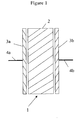
- Figure 1 shows an electrical device 1 which has a block of electrolyte 2 with asymmetric electrodes 3a,3b at each side of it.
- the asymmetric electrodes are each provided with electrical connectors 4a,4b.
- the electrodes 3a,3b are asymmetric electrodes in that one acts as a cathode and the other acts as an anode.
- One or both of the asymmetric electrodes 3a,3b are formed from, a polymer prepared, for example, according to Example 1.
- the electrolyte 2 may also be formed from a polymer according to the invention, for example prepared according to Example 1.
- the asymmetric electrodes 3a,3b may be formed from a conventional material known to a person skilled in the art and the electrolyte 2 may be formed from a polymer according to the invention.
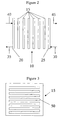
- Figure 2 shows an electrical device, for example, in the form of a fuel cell 10 having a hydrogen inlet 30 and outlet 35 and an oxygen inlet 40 and outlet 45.
- the example fuel cell 10 has electrodes 20,25 and bipolar plates 15.
- a bipolar plate 15 is shown in more detail in Figure 3 as having grooves 50 on its surface.
- the reverse face of the plate 15 also has grooves 50.
- a variant of the bipolar plate 15 is a separator plate which has grooves 50 on one face only.
- the resin used was solvented phenolic resole IDP139 which was supplied by Borden Chemical Uk Ltd and kept in storage at room temperature for 5 years. It is a non aqueous resole resin in a solvent which is a mixture of dibasic esters including dimethyl glutamate, dimethyl succinate and dimethyl adipate.
- the p-toluene sulphonic acid was supplied by Degussa. It is a 65% by weight aqueous solution. Water was removed from solvented phenolic resole IDP139 by distillation such that the residual water content was about 2% by weight.
- the solvented phenolic resole and acid were mixed and allowed to cure at room temperature over 7 days in an open polythene mould.
- the cured polymer was a hard casting with a glossy exposed air surface and a matt surface on unexposed mould surface.
- the surface resistivity of the glossy and matt surface were measured using a Como DT3800 Digital Multimeter and the results were as follows: Glossy surface > 20 M Ohms Matt surface 30 k Ohms
- Examples of an electrically conductive acid cured solvented phenolic resole polymer according to the invention were prepared as well as a comparative Example.
- Comparative Example 2 and Examples 3 to 7 were prepared as follows. Solvented phenolic resole resin was weighed into a plastic cup followed by the acid addition. The two components were hand mixed using a spatula for 15 seconds. The liquid mixtures were poured onto a flat ceramic plate to form a thick film and allowed to harden.
- Example 8 was prepared as follows: graphite was weighed into a plastic cup followed by the solvented phenolic resole resin. The graphite and solvented phenolic resole resin were premixed for one minute prior to the acid addition. After the acid addition the paste-like mixture was mixed for 30 seconds and transferred to a plastic mould 2 cm x 2 cm x 1 cm and hand pressed. After 24 hours, the cured moulded sample polymer was measured for resisitivity using the Multimeter used in Example 1. The result obtained is shown in Table 1. TABLE 1 Example Number Weight of solvented phenolic resole Weight of acid Weight of Graphite % by weight (based on weight of resole) of acid Resistivity (Ohms.cm) Comp.
- Example 2 In Comparative Example 2, a typical "safe" 5wt% acid addition was used (based on the resin weight). The resistivity data for this Example shows that it is not conductive. In Examples 3 to 6, increasing amounts of acid were used, up to 200wt% acid (1 part resin : 2 part acid). It is very surprising that the samples, especially Examples 5, 6, 7 and 8 were stable. For a person of skill in the art, it would normally be unthinkable and dangerous to add so much acid. In the preparation of Example 8, there was a mild exotherm.
- Example 1 It can be seen from Table 1 that the resistivity measurements correlate with the amount of acid added.
- the resistivity of Examples 6 and 7 (100 and 200wt% acid added respectively) is better than any of the results obtained in the Examples of WO 2004/091015 without a conductive filler.
- the result obtained in Example 8 is comparable with results obtained in WO 2004/091015 for Examples also having a conductive filler.
- p-Toluene sulphonic acid 10g was added and the solution mixed with a laboratory bench high speed stirrer. The solution was poured over a flat plastic mould and allowed to cure at room temperature. As the acetone evaporated a conductive coating was formed. After 24 hours, a reading of 1.2 k ⁇ was measured on the surface of the coating.
Landscapes
- Chemical & Material Sciences (AREA)
- Engineering & Computer Science (AREA)
- Chemical Kinetics & Catalysis (AREA)
- Power Engineering (AREA)
- Health & Medical Sciences (AREA)
- Organic Chemistry (AREA)
- Polymers & Plastics (AREA)
- Medicinal Chemistry (AREA)
- General Chemical & Material Sciences (AREA)
- Sustainable Development (AREA)
- Life Sciences & Earth Sciences (AREA)
- Manufacturing & Machinery (AREA)
- Sustainable Energy (AREA)
- Electrochemistry (AREA)
- Microelectronics & Electronic Packaging (AREA)
- Materials Engineering (AREA)
- Physics & Mathematics (AREA)
- Spectroscopy & Molecular Physics (AREA)
- Compositions Of Macromolecular Compounds (AREA)
- Conductive Materials (AREA)
- Silicon Polymers (AREA)
- Phenolic Resins Or Amino Resins (AREA)
- Inert Electrodes (AREA)
Claims (15)
- Leitfähiges Polymer, das ein säuregehärtetes lösungsmittelhaltiges Resol umfasst, wobei das lösungsmittelhaltige Resol im Wesentlichen frei von Wasser ist.
- Polymer gemäß Anspruch 1, wobei das lösungsmittelhaltige Resol ein niedrigpolares organisches Lösungsmittel umfasst, das vorzugsweise einen Siedepunkt von über 100 °C aufweist.
- Polymer gemäß einem der vorstehenden Ansprüche, wobei das Lösungsmittel ein Ester, ein Aldehyd, ein Keton, ein Halogenalkan und/oder eine Carbonsäure ist.
- Polymer gemäß einem der vorstehenden Ansprüche, wobei der Wassergehalt des lösungsmittelhaltigen Resols kleiner als 5 Gew.-% ist, vorzugsweise kleiner als 4 Gew.-%, vorzugsweise kleiner als 3 Gew.-%, vorzugsweise kleiner als 2 Gew.-%, vorzugsweise kleiner als 2 Gew.-%, vorzugsweise kleiner als 1 Gew.-%.
- Polymer gemäß einem der vorstehenden Ansprüche, wobei das lösungsmittelhaltige Resol ein lösungsmittelhaltiges Reaktionsprodukt eines phenolreaktiven Aldehyds mit einem gegebenenfalls substituierten Phenol ist, wobei das gegebenenfalls substituierte Phenol vorzugsweise eine Verbindung der Formel

n für 0, 1 oder 2 steht;
und/oder der phenolreaktive Aldehyd vorzugsweise eine Verbindung der Formel
R4CHO (III),
wobei R4 für ein Wasserstoffatom oder eine geradkettige oder verzweigte Alkylgruppe, die 1 bis 8 (vorzugsweise 1 bis 4, besonders bevorzugt 1 bis 2) Kohlenstoffatome enthält, steht, oder eine Vorstufe einer Verbindung der Formel (III) ist. - Polymer gemäß einem der vorstehenden Ansprüche, wobei die Säure eine anorganische Säure, eine organische Säure oder eine Organomineralsäure ist, wobei die Organomineralsäure vorzugsweise eine niedrigmolekulare Organomineralsäure ist, bei der es sich um eine Verbindung der Formel
R5X (IV)
handelt, wobei R5 für Folgendes steht:ein Wasserstoffatom;eine geradkettige oder verzweigte Alkylgruppe, die 1 bis 8 Kohlenstoffatome (vorzugsweise 1 bis 4, besonders bevorzugt 1 bis 2 Kohlenstoffatome) enthält und gegebenenfalls mit einem Halogenatom substituiert ist; odereine Phenylgruppe, die gegebenenfalls substituiert ist mit einer geradkettigen oder verzweigten, gegebenenfalls ungesättigten Alkylgruppe, die 1 bis 8 Kohlenstoffatome (vorzugsweise 1 bis 4 Kohlenstoffatome, besonders bevorzugt 1 bis 2 Kohlenstoffatome) enthält und gegebenenfalls mit einer Hydroxygruppe substituiert ist, einem Halogenatom (vorzugsweise Chlor), einer Hydroxygruppe und/oder einer Phenyl- oder Benzylgruppe (gegebenenfalls substituiert mit einer Hydroxygruppe und/oder einer geradkettigen oder verzweigten Alkylgruppe, die 1 bis 8 Kohlenstoffatome (vorzugsweise 1 bis 4 Kohlenstoffatome, besonders bevorzugt 1 bis 2 Kohlenstoffatome) enthält); undX für eine Sulfonsäuregruppe (-SO3H), eine Phosphorsäuregruppe (-OP(OH)3) oder eine Phosphonsäuregruppe (-P(O)(OH)2) steht;oder die Organomineralsäure vorzugsweise eine hochmolekulare Organomineralsäure ist, bei der es sich um eine Verbindung der Formel
(R6(X)CH2)p(R6CH2)q(R6) (V)
handelt, wobei R6 für eine Phenylgruppe steht, die gegebenenfalls substituiert ist mit einer geradkettigen oder verzweigten, gegebenenfalls ungesättigten Alkylgruppe, die 1 bis 8 Kohlenstoffatome (vorzugsweise 1 bis 4 Kohlenstoffatome, besonders bevorzugt 1 bis 2 Kohlenstoffatome) enthält und gegebenenfalls mit einer Hydroxygruppe substituiert ist, einem Halogenatom (vorzugsweise Chlor), einer Hydroxygruppe und/oder einer Phenyl- oder Benzylgruppe (gegebenenfalls substituiert mit einer Hydroxygruppe und/oder einer geradkettigen oder verzweigten Alkylgruppe, die 1 bis 8 Kohlenstoffatome (vorzugsweise 1 bis 4 Kohlenstoffatome, besonders bevorzugt 1 bis 2 Kohlenstoffatome) enthält);X wie oben definiert ist; p für eine ganze Zahl von 1 bis 10 steht und q für eine ganze Zahl von 0 bis 9 steht, und zwar so, dass die Summe von p und q 3 bis 20 beträgt. - Polymer gemäß einem der vorstehenden Ansprüche, das weiterhin einen leitfähigen Füllstoff umfasst.
- Elektrische Vorrichtung, umfassend:(a) eine negative Elektrode;(b) eine positive Elektrode;(c) ein Elektrolytmittel; und gegebenenfalls(d) eine Separator- und/oder bipolare Platte;wobei eine oder mehrere der Komponenten Elektrode und/oder Elektrolytmittel, Separator- oder bipolare Platte ein Polymer gemäß einem der vorstehenden Ansprüche umfassen.
- Geformter Artikel, geformt aus dem Polymer gemäß einem der Ansprüche 1 bis 7, wobei der Artikel zur Verwendung als elektrischer Stecker, elektrischer Stromträger, Abschirmung gegen elektrische oder elektrostatische Entladung, Elektrode, Heizelement, Elektrolyt und/oder Ionenaustauschermembran geeignet ist.
- Geformter Artikel gemäß Anspruch 9, bei dem es sich um eine Separatorplatte, die zur Verwendung in einer Brennstoffzelle geeignet ist und ein oder mehrere Strömungsfelder zur Lenkung des Gasstroms aufweist, eine Elektrode, eine leitfähige Beschichtung oder eine leitfähige Membran handelt.
- Verwendung eines Polymers gemäß einem der Ansprüche 1 bis 7 als Elektrode, als elektromagnetisches Abschirmungsmaterial zur Unterdrückung von elektromagnetischer Interferenz oder zur Verhinderung elektrostatischer Entladung an einer Stelle.
- Zweikomponentige Zusammensetzung, die (a) lösungsmittelhaltiges Resol, wobei das lösungsmittelhaltige Resol im Wesentlichen frei von Wasser ist, und (b) eine Säure umfasst.
- Verfahren zum Verkleben eines ersten Teils mit einem zweiten Teil, wobei das Verfahren die folgenden Schritte umfasst:Bereitstellen eines lösungsmittelhaltigen Resols, das im Wesentlichen frei von Wasser ist, und einer Säure;Mischen des lösungsmittelhaltigen Resols und der Säure; undVerwenden der Mischung des lösungsmittelhaltigen Resols und der Säure zum Verkleben des ersten Teils mit dem zweiten Teil.
- Zusammensetzung gemäß Anspruch 12 oder Verfahren gemäß Anspruch 13, wobei das lösungsmittelhaltige Resol und die Säure der Definition in einem der Ansprüche 1 bis 7 entsprechen.
- Verfahren zur Herstellung eines leitfähigen Polymers, wobei das Verfahren Folgendes umfasst:Bereitstellen eines lösungsmittelhaltigen Resols, das ein phenolisches Resol und ein Esterlösungsmittel umfasst;gegebenenfalls Destillieren des lösungsmittelhaltigen Resols zum Entfernen von überschüssigem Wasser;Mischen einer Säure mit dem lösungsmittelhaltigen Resol; undHärtenlassen des Gemischs;wobei das lösungsmittelhaltige Resol und die Säure vorzugsweise der Definition in einem der Ansprüche 1 bis 7 entsprechen.
Applications Claiming Priority (2)
| Application Number | Priority Date | Filing Date | Title |
|---|---|---|---|
| GBGB0612760.9A GB0612760D0 (en) | 2006-06-28 | 2006-06-28 | Conductive polymer |
| PCT/GB2007/002412 WO2008001089A1 (en) | 2006-06-28 | 2007-06-28 | Conductive polymer |
Publications (3)
| Publication Number | Publication Date |
|---|---|
| EP2033244A1 EP2033244A1 (de) | 2009-03-11 |
| EP2033244B1 true EP2033244B1 (de) | 2009-12-30 |
| EP2033244B8 EP2033244B8 (de) | 2010-02-17 |
Family
ID=36888178
Family Applications (1)
| Application Number | Title | Priority Date | Filing Date |
|---|---|---|---|
| EP07733402A Not-in-force EP2033244B8 (de) | 2006-06-28 | 2007-06-28 | Leitfähiges polymer |
Country Status (11)
| Country | Link |
|---|---|
| US (1) | US20090186254A1 (de) |
| EP (1) | EP2033244B8 (de) |
| JP (1) | JP2009541572A (de) |
| KR (1) | KR20090031924A (de) |
| CN (1) | CN101529622B (de) |
| AT (1) | ATE453934T1 (de) |
| CA (1) | CA2652659A1 (de) |
| DE (1) | DE602007004113D1 (de) |
| ES (1) | ES2336963T3 (de) |
| GB (1) | GB0612760D0 (de) |
| WO (1) | WO2008001089A1 (de) |
Cited By (1)
| Publication number | Priority date | Publication date | Assignee | Title |
|---|---|---|---|---|
| US9263653B2 (en) | 2014-05-15 | 2016-02-16 | Empire Technology Development Llc | Light-emissive devices and light-emissive displays |
Families Citing this family (8)
| Publication number | Priority date | Publication date | Assignee | Title |
|---|---|---|---|---|
| US20100126105A1 (en) * | 2008-11-26 | 2010-05-27 | Usg Interiors, Inc. | Multi-circuit electrified ceiling grid |
| GB0902863D0 (en) | 2009-02-20 | 2009-04-08 | Bac2 Ltd | Improved polymer preparation |
| GB0913722D0 (en) | 2009-08-06 | 2009-09-16 | Bac2 Ltd | Electrical device |
| US8758860B1 (en) | 2012-11-07 | 2014-06-24 | Bayer Materialscience Llc | Process for incorporating an ion-conducting polymer into a polymeric article to achieve anti-static behavior |
| US10256460B2 (en) | 2013-03-11 | 2019-04-09 | Fluidic, Inc. | Integrable redox-active polymer batteries |
| KR20140144843A (ko) * | 2013-06-12 | 2014-12-22 | 주식회사 엘지화학 | 실링부가 경화성 물질로 절연되어 있는 파우치형 전지셀의 제조방법 |
| WO2015175556A1 (en) | 2014-05-13 | 2015-11-19 | Arizona Board Of Regents On Behalf Of Arizona State University | Redox active polymer devices and methods of using and manufacturing the same |
| CN109910259B (zh) * | 2019-01-25 | 2021-07-09 | 上海神力科技有限公司 | 基于膨胀石墨的燃料电池极板成型方法 |
Family Cites Families (10)
| Publication number | Priority date | Publication date | Assignee | Title |
|---|---|---|---|---|
| US3910852A (en) * | 1971-03-22 | 1975-10-07 | Conshohocken Chemicals Inc | Conductive resin composition |
| CA1150450A (en) * | 1978-09-14 | 1983-07-19 | Company 'a' (Foam) Limited | Foamed plastics materials |
| US4246157A (en) * | 1979-03-07 | 1981-01-20 | Acme Resin Corporation | Binder compositions containing phenolic resins and organic phosphate and/or carbonate solvents |
| DE3335933A1 (de) * | 1983-10-04 | 1985-04-18 | Rütgerswerke AG, 6000 Frankfurt | Mehrkomponenten-bindemittel mit verlaengerter verarbeitbarkeitszeit |
| JPH04277585A (ja) * | 1991-03-05 | 1992-10-02 | Matsushita Electric Ind Co Ltd | 導電性接着剤 |
| JPH0953031A (ja) * | 1995-06-07 | 1997-02-25 | Hitachi Chem Co Ltd | 導電ペースト及び電気回路形成基板の製造法 |
| US6699958B1 (en) * | 2003-02-13 | 2004-03-02 | Borden Chemical, Inc. | Colorless phenol-formaldehyde resins that cure colorless |
| US7655159B2 (en) * | 2003-04-09 | 2010-02-02 | Graham Simpson Murray | Conductive polymer, conductive polymer compositions and their use |
| GB0308135D0 (en) * | 2003-04-09 | 2003-05-14 | Bac2 Ltd | Solid polymer electrolyte |
| JP2005078967A (ja) * | 2003-09-01 | 2005-03-24 | Toyobo Co Ltd | 導電性ペースト |
-
2006
- 2006-06-28 GB GBGB0612760.9A patent/GB0612760D0/en not_active Ceased
-
2007
- 2007-06-28 WO PCT/GB2007/002412 patent/WO2008001089A1/en not_active Ceased
- 2007-06-28 KR KR1020097001628A patent/KR20090031924A/ko not_active Withdrawn
- 2007-06-28 CN CN2007800242121A patent/CN101529622B/zh not_active Expired - Fee Related
- 2007-06-28 DE DE602007004113T patent/DE602007004113D1/de active Active
- 2007-06-28 AT AT07733402T patent/ATE453934T1/de not_active IP Right Cessation
- 2007-06-28 CA CA002652659A patent/CA2652659A1/en not_active Abandoned
- 2007-06-28 ES ES07733402T patent/ES2336963T3/es active Active
- 2007-06-28 EP EP07733402A patent/EP2033244B8/de not_active Not-in-force
- 2007-06-28 US US12/306,156 patent/US20090186254A1/en not_active Abandoned
- 2007-06-28 JP JP2009517396A patent/JP2009541572A/ja active Pending
Cited By (1)
| Publication number | Priority date | Publication date | Assignee | Title |
|---|---|---|---|---|
| US9263653B2 (en) | 2014-05-15 | 2016-02-16 | Empire Technology Development Llc | Light-emissive devices and light-emissive displays |
Also Published As
| Publication number | Publication date |
|---|---|
| CA2652659A1 (en) | 2008-01-03 |
| GB0612760D0 (en) | 2006-08-09 |
| DE602007004113D1 (de) | 2010-02-11 |
| ES2336963T3 (es) | 2010-04-19 |
| EP2033244A1 (de) | 2009-03-11 |
| WO2008001089A1 (en) | 2008-01-03 |
| CN101529622B (zh) | 2012-04-18 |
| KR20090031924A (ko) | 2009-03-30 |
| EP2033244B8 (de) | 2010-02-17 |
| JP2009541572A (ja) | 2009-11-26 |
| ATE453934T1 (de) | 2010-01-15 |
| CN101529622A (zh) | 2009-09-09 |
| US20090186254A1 (en) | 2009-07-23 |
Similar Documents
| Publication | Publication Date | Title |
|---|---|---|
| EP2033244B1 (de) | Leitfähiges polymer | |
| US7655159B2 (en) | Conductive polymer, conductive polymer compositions and their use | |
| EP1217675B1 (de) | Brennstoffzellenseparator und Verfahren zu dessen Herstellung | |
| CN1267696A (zh) | 应用于多层印刷电路板的层间绝缘粘合剂 | |
| US8623573B2 (en) | Porous, electrically conductive fluid distribution plate for fuel cells | |
| JP2002083609A (ja) | 燃料電池用セパレータ用組成物及びその製造方法 | |
| EP1826848B1 (de) | Trenngliedmaterial für eine festpolymer-brennstoffzelle und prozess zu seiner herstellung | |
| JP5502552B2 (ja) | 燃料電池セパレータ用組成物、燃料電池セパレータ、及び燃料電池の製造方法 | |
| JP4897160B2 (ja) | 燃料電池用セパレータの製造方法 | |
| JP5842142B2 (ja) | 燃料電池セパレータ用樹脂組成物、燃料電池セパレータ成形用シート及び燃料電池セパレータ | |
| JP5486276B2 (ja) | 燃料電池セパレータ用樹脂組成物、燃料電池セパレータ成形用シート及び燃料電池セパレータ | |
| JP4965832B2 (ja) | 燃料電池セパレータの製造方法及び燃料電池セパレータ | |
| JP5242666B2 (ja) | 導電性重合体、導電性重合体組成物、およびそれらの使用 | |
| US8333909B2 (en) | Conductive polymer, conductive polymer compositions and methods for their use | |
| KR101227900B1 (ko) | 기계적, 전기적 특성이 우수한 신규의 복합 재료 조성물 | |
| JP2005339954A (ja) | 燃料電池用プリプレグ及びこの燃料電池用プリプレグから成る燃料電池用セパレータ、並びにその製造方法 | |
| JP5193138B2 (ja) | 固体高分子型燃料電池用セパレータの製造方法、及び、固体高分子型燃料電池用セパレータ | |
| JP2011249085A (ja) | 燃料電池セパレータの製造方法、燃料電池セパレータ、及び燃料電池の製造方法。 | |
| JP2008311108A (ja) | 燃料電池用セパレータおよびその製造方法、並びに、燃料電池 | |
| KR20130014205A (ko) | 결정성 에폭시 수지를 포함하는 레진 조성물 및 이를 이용한 연료전지 분리판용 복합재료 조성물 | |
| JP2011216433A (ja) | 燃料電池用セパレータの製造方法 | |
| JP2002367623A (ja) | 燃料電池用セパレータ及び燃料電池用セパレータを用いた燃料電池 | |
| JP2010129203A (ja) | 固体高分子型燃料電池用セパレータ材、その製造方法および固体高分子型燃料電池用セパレータ | |
| JP2008130502A (ja) | 燃料電池用セパレータおよびその製造方法、並びに、燃料電池 |
Legal Events
| Date | Code | Title | Description |
|---|---|---|---|
| PUAI | Public reference made under article 153(3) epc to a published international application that has entered the european phase |
Free format text: ORIGINAL CODE: 0009012 |
|
| 17P | Request for examination filed |
Effective date: 20081208 |
|
| AK | Designated contracting states |
Kind code of ref document: A1 Designated state(s): AT BE BG CH CY CZ DE DK EE ES FI FR GB GR HU IE IS IT LI LT LU LV MC MT NL PL PT RO SE SI SK TR |
|
| AX | Request for extension of the european patent |
Extension state: AL BA HR MK RS |
|
| GRAP | Despatch of communication of intention to grant a patent |
Free format text: ORIGINAL CODE: EPIDOSNIGR1 |
|
| DAX | Request for extension of the european patent (deleted) | ||
| GRAS | Grant fee paid |
Free format text: ORIGINAL CODE: EPIDOSNIGR3 |
|
| GRAA | (expected) grant |
Free format text: ORIGINAL CODE: 0009210 |
|
| RAP1 | Party data changed (applicant data changed or rights of an application transferred) |
Owner name: BAC2 LIMITED |
|
| AK | Designated contracting states |
Kind code of ref document: B1 Designated state(s): AT BE BG CH CY CZ DE DK EE ES FI FR GB GR HU IE IS IT LI LT LU LV MC MT NL PL PT RO SE SI SK TR |
|
| REG | Reference to a national code |
Ref country code: GB Ref legal event code: FG4D |
|
| REG | Reference to a national code |
Ref country code: CH Ref legal event code: EP |
|
| REG | Reference to a national code |
Ref country code: IE Ref legal event code: FG4D |
|
| REF | Corresponds to: |
Ref document number: 602007004113 Country of ref document: DE Date of ref document: 20100211 Kind code of ref document: P |
|
| REG | Reference to a national code |
Ref country code: ES Ref legal event code: FG2A Ref document number: 2336963 Country of ref document: ES Kind code of ref document: T3 |
|
| PG25 | Lapsed in a contracting state [announced via postgrant information from national office to epo] |
Ref country code: FI Free format text: LAPSE BECAUSE OF FAILURE TO SUBMIT A TRANSLATION OF THE DESCRIPTION OR TO PAY THE FEE WITHIN THE PRESCRIBED TIME-LIMIT Effective date: 20091230 Ref country code: LT Free format text: LAPSE BECAUSE OF FAILURE TO SUBMIT A TRANSLATION OF THE DESCRIPTION OR TO PAY THE FEE WITHIN THE PRESCRIBED TIME-LIMIT Effective date: 20091230 Ref country code: SE Free format text: LAPSE BECAUSE OF FAILURE TO SUBMIT A TRANSLATION OF THE DESCRIPTION OR TO PAY THE FEE WITHIN THE PRESCRIBED TIME-LIMIT Effective date: 20091230 |
|
| REG | Reference to a national code |
Ref country code: NL Ref legal event code: VDEP Effective date: 20091230 |
|
| LTIE | Lt: invalidation of european patent or patent extension |
Effective date: 20091230 |
|
| PG25 | Lapsed in a contracting state [announced via postgrant information from national office to epo] |
Ref country code: SI Free format text: LAPSE BECAUSE OF FAILURE TO SUBMIT A TRANSLATION OF THE DESCRIPTION OR TO PAY THE FEE WITHIN THE PRESCRIBED TIME-LIMIT Effective date: 20091230 Ref country code: PL Free format text: LAPSE BECAUSE OF FAILURE TO SUBMIT A TRANSLATION OF THE DESCRIPTION OR TO PAY THE FEE WITHIN THE PRESCRIBED TIME-LIMIT Effective date: 20091230 Ref country code: LV Free format text: LAPSE BECAUSE OF FAILURE TO SUBMIT A TRANSLATION OF THE DESCRIPTION OR TO PAY THE FEE WITHIN THE PRESCRIBED TIME-LIMIT Effective date: 20091230 |
|
| PG25 | Lapsed in a contracting state [announced via postgrant information from national office to epo] |
Ref country code: AT Free format text: LAPSE BECAUSE OF FAILURE TO SUBMIT A TRANSLATION OF THE DESCRIPTION OR TO PAY THE FEE WITHIN THE PRESCRIBED TIME-LIMIT Effective date: 20091230 |
|
| PG25 | Lapsed in a contracting state [announced via postgrant information from national office to epo] |
Ref country code: EE Free format text: LAPSE BECAUSE OF FAILURE TO SUBMIT A TRANSLATION OF THE DESCRIPTION OR TO PAY THE FEE WITHIN THE PRESCRIBED TIME-LIMIT Effective date: 20091230 Ref country code: BG Free format text: LAPSE BECAUSE OF FAILURE TO SUBMIT A TRANSLATION OF THE DESCRIPTION OR TO PAY THE FEE WITHIN THE PRESCRIBED TIME-LIMIT Effective date: 20100330 Ref country code: IS Free format text: LAPSE BECAUSE OF FAILURE TO SUBMIT A TRANSLATION OF THE DESCRIPTION OR TO PAY THE FEE WITHIN THE PRESCRIBED TIME-LIMIT Effective date: 20100430 Ref country code: PT Free format text: LAPSE BECAUSE OF FAILURE TO SUBMIT A TRANSLATION OF THE DESCRIPTION OR TO PAY THE FEE WITHIN THE PRESCRIBED TIME-LIMIT Effective date: 20100430 Ref country code: NL Free format text: LAPSE BECAUSE OF FAILURE TO SUBMIT A TRANSLATION OF THE DESCRIPTION OR TO PAY THE FEE WITHIN THE PRESCRIBED TIME-LIMIT Effective date: 20091230 Ref country code: RO Free format text: LAPSE BECAUSE OF FAILURE TO SUBMIT A TRANSLATION OF THE DESCRIPTION OR TO PAY THE FEE WITHIN THE PRESCRIBED TIME-LIMIT Effective date: 20091230 |
|
| PG25 | Lapsed in a contracting state [announced via postgrant information from national office to epo] |
Ref country code: BE Free format text: LAPSE BECAUSE OF FAILURE TO SUBMIT A TRANSLATION OF THE DESCRIPTION OR TO PAY THE FEE WITHIN THE PRESCRIBED TIME-LIMIT Effective date: 20091230 Ref country code: CZ Free format text: LAPSE BECAUSE OF FAILURE TO SUBMIT A TRANSLATION OF THE DESCRIPTION OR TO PAY THE FEE WITHIN THE PRESCRIBED TIME-LIMIT Effective date: 20091230 Ref country code: SK Free format text: LAPSE BECAUSE OF FAILURE TO SUBMIT A TRANSLATION OF THE DESCRIPTION OR TO PAY THE FEE WITHIN THE PRESCRIBED TIME-LIMIT Effective date: 20091230 |
|
| PG25 | Lapsed in a contracting state [announced via postgrant information from national office to epo] |
Ref country code: GR Free format text: LAPSE BECAUSE OF FAILURE TO SUBMIT A TRANSLATION OF THE DESCRIPTION OR TO PAY THE FEE WITHIN THE PRESCRIBED TIME-LIMIT Effective date: 20100331 Ref country code: CY Free format text: LAPSE BECAUSE OF FAILURE TO SUBMIT A TRANSLATION OF THE DESCRIPTION OR TO PAY THE FEE WITHIN THE PRESCRIBED TIME-LIMIT Effective date: 20091230 |
|
| PLBE | No opposition filed within time limit |
Free format text: ORIGINAL CODE: 0009261 |
|
| STAA | Information on the status of an ep patent application or granted ep patent |
Free format text: STATUS: NO OPPOSITION FILED WITHIN TIME LIMIT |
|
| 26N | No opposition filed |
Effective date: 20101001 |
|
| PG25 | Lapsed in a contracting state [announced via postgrant information from national office to epo] |
Ref country code: DK Free format text: LAPSE BECAUSE OF FAILURE TO SUBMIT A TRANSLATION OF THE DESCRIPTION OR TO PAY THE FEE WITHIN THE PRESCRIBED TIME-LIMIT Effective date: 20091230 Ref country code: MC Free format text: LAPSE BECAUSE OF NON-PAYMENT OF DUE FEES Effective date: 20100630 |
|
| PG25 | Lapsed in a contracting state [announced via postgrant information from national office to epo] |
Ref country code: IT Free format text: LAPSE BECAUSE OF NON-PAYMENT OF DUE FEES Effective date: 20100628 |
|
| PG25 | Lapsed in a contracting state [announced via postgrant information from national office to epo] |
Ref country code: MT Free format text: LAPSE BECAUSE OF FAILURE TO SUBMIT A TRANSLATION OF THE DESCRIPTION OR TO PAY THE FEE WITHIN THE PRESCRIBED TIME-LIMIT Effective date: 20091230 Ref country code: IE Free format text: LAPSE BECAUSE OF NON-PAYMENT OF DUE FEES Effective date: 20100628 |
|
| PGFP | Annual fee paid to national office [announced via postgrant information from national office to epo] |
Ref country code: ES Payment date: 20110629 Year of fee payment: 5 |
|
| PGFP | Annual fee paid to national office [announced via postgrant information from national office to epo] |
Ref country code: IT Payment date: 20110624 Year of fee payment: 5 |
|
| PGFP | Annual fee paid to national office [announced via postgrant information from national office to epo] |
Ref country code: FR Payment date: 20110727 Year of fee payment: 5 |
|
| REG | Reference to a national code |
Ref country code: CH Ref legal event code: PL |
|
| PG25 | Lapsed in a contracting state [announced via postgrant information from national office to epo] |
Ref country code: CH Free format text: LAPSE BECAUSE OF NON-PAYMENT OF DUE FEES Effective date: 20110630 Ref country code: LI Free format text: LAPSE BECAUSE OF NON-PAYMENT OF DUE FEES Effective date: 20110630 |
|
| PG25 | Lapsed in a contracting state [announced via postgrant information from national office to epo] |
Ref country code: LU Free format text: LAPSE BECAUSE OF NON-PAYMENT OF DUE FEES Effective date: 20100628 Ref country code: HU Free format text: LAPSE BECAUSE OF FAILURE TO SUBMIT A TRANSLATION OF THE DESCRIPTION OR TO PAY THE FEE WITHIN THE PRESCRIBED TIME-LIMIT Effective date: 20100701 |
|
| PG25 | Lapsed in a contracting state [announced via postgrant information from national office to epo] |
Ref country code: TR Free format text: LAPSE BECAUSE OF FAILURE TO SUBMIT A TRANSLATION OF THE DESCRIPTION OR TO PAY THE FEE WITHIN THE PRESCRIBED TIME-LIMIT Effective date: 20091230 |
|
| PG25 | Lapsed in a contracting state [announced via postgrant information from national office to epo] |
Ref country code: IT Free format text: LAPSE BECAUSE OF NON-PAYMENT OF DUE FEES Effective date: 20120628 |
|
| REG | Reference to a national code |
Ref country code: FR Ref legal event code: ST Effective date: 20130228 |
|
| PG25 | Lapsed in a contracting state [announced via postgrant information from national office to epo] |
Ref country code: FR Free format text: LAPSE BECAUSE OF NON-PAYMENT OF DUE FEES Effective date: 20120702 |
|
| REG | Reference to a national code |
Ref country code: ES Ref legal event code: FD2A Effective date: 20131018 |
|
| PG25 | Lapsed in a contracting state [announced via postgrant information from national office to epo] |
Ref country code: ES Free format text: LAPSE BECAUSE OF NON-PAYMENT OF DUE FEES Effective date: 20120629 |
|
| PGFP | Annual fee paid to national office [announced via postgrant information from national office to epo] |
Ref country code: GB Payment date: 20140623 Year of fee payment: 8 |
|
| PGFP | Annual fee paid to national office [announced via postgrant information from national office to epo] |
Ref country code: DE Payment date: 20140828 Year of fee payment: 8 |
|
| REG | Reference to a national code |
Ref country code: DE Ref legal event code: R119 Ref document number: 602007004113 Country of ref document: DE |
|
| GBPC | Gb: european patent ceased through non-payment of renewal fee |
Effective date: 20150628 |
|
| PG25 | Lapsed in a contracting state [announced via postgrant information from national office to epo] |
Ref country code: DE Free format text: LAPSE BECAUSE OF NON-PAYMENT OF DUE FEES Effective date: 20160101 Ref country code: GB Free format text: LAPSE BECAUSE OF NON-PAYMENT OF DUE FEES Effective date: 20150628 |