EP2032506B1 - Aluminum hydroxide - Google Patents
Aluminum hydroxide Download PDFInfo
- Publication number
- EP2032506B1 EP2032506B1 EP07874562.7A EP07874562A EP2032506B1 EP 2032506 B1 EP2032506 B1 EP 2032506B1 EP 07874562 A EP07874562 A EP 07874562A EP 2032506 B1 EP2032506 B1 EP 2032506B1
- Authority
- EP
- European Patent Office
- Prior art keywords
- range
- ath
- ath particles
- polymer formulation
- flame retarded
- Prior art date
- Legal status (The legal status is an assumption and is not a legal conclusion. Google has not performed a legal analysis and makes no representation as to the accuracy of the status listed.)
- Active
Links
Images




Classifications
-
- C—CHEMISTRY; METALLURGY
- C01—INORGANIC CHEMISTRY
- C01F—COMPOUNDS OF THE METALS BERYLLIUM, MAGNESIUM, ALUMINIUM, CALCIUM, STRONTIUM, BARIUM, RADIUM, THORIUM, OR OF THE RARE-EARTH METALS
- C01F7/00—Compounds of aluminium
- C01F7/02—Aluminium oxide; Aluminium hydroxide; Aluminates
-
- C—CHEMISTRY; METALLURGY
- C07—ORGANIC CHEMISTRY
- C07F—ACYCLIC, CARBOCYCLIC OR HETEROCYCLIC COMPOUNDS CONTAINING ELEMENTS OTHER THAN CARBON, HYDROGEN, HALOGEN, OXYGEN, NITROGEN, SULFUR, SELENIUM OR TELLURIUM
- C07F5/00—Compounds containing elements of Groups 3 or 13 of the Periodic Table
- C07F5/06—Aluminium compounds
-
- C—CHEMISTRY; METALLURGY
- C01—INORGANIC CHEMISTRY
- C01F—COMPOUNDS OF THE METALS BERYLLIUM, MAGNESIUM, ALUMINIUM, CALCIUM, STRONTIUM, BARIUM, RADIUM, THORIUM, OR OF THE RARE-EARTH METALS
- C01F7/00—Compounds of aluminium
- C01F7/02—Aluminium oxide; Aluminium hydroxide; Aluminates
- C01F7/021—After-treatment of oxides or hydroxides
-
- C—CHEMISTRY; METALLURGY
- C01—INORGANIC CHEMISTRY
- C01F—COMPOUNDS OF THE METALS BERYLLIUM, MAGNESIUM, ALUMINIUM, CALCIUM, STRONTIUM, BARIUM, RADIUM, THORIUM, OR OF THE RARE-EARTH METALS
- C01F7/00—Compounds of aluminium
- C01F7/02—Aluminium oxide; Aluminium hydroxide; Aluminates
- C01F7/021—After-treatment of oxides or hydroxides
- C01F7/023—Grinding, deagglomeration or disintegration
-
- C—CHEMISTRY; METALLURGY
- C01—INORGANIC CHEMISTRY
- C01F—COMPOUNDS OF THE METALS BERYLLIUM, MAGNESIUM, ALUMINIUM, CALCIUM, STRONTIUM, BARIUM, RADIUM, THORIUM, OR OF THE RARE-EARTH METALS
- C01F7/00—Compounds of aluminium
- C01F7/02—Aluminium oxide; Aluminium hydroxide; Aluminates
- C01F7/16—Preparation of alkaline-earth metal aluminates or magnesium aluminates; Aluminium oxide or hydroxide therefrom
- C01F7/18—Aluminium oxide or hydroxide from alkaline earth metal aluminates
-
- C—CHEMISTRY; METALLURGY
- C08—ORGANIC MACROMOLECULAR COMPOUNDS; THEIR PREPARATION OR CHEMICAL WORKING-UP; COMPOSITIONS BASED THEREON
- C08K—Use of inorganic or non-macromolecular organic substances as compounding ingredients
- C08K3/00—Use of inorganic substances as compounding ingredients
- C08K3/18—Oxygen-containing compounds, e.g. metal carbonyls
- C08K3/20—Oxides; Hydroxides
- C08K3/22—Oxides; Hydroxides of metals
-
- C—CHEMISTRY; METALLURGY
- C09—DYES; PAINTS; POLISHES; NATURAL RESINS; ADHESIVES; COMPOSITIONS NOT OTHERWISE PROVIDED FOR; APPLICATIONS OF MATERIALS NOT OTHERWISE PROVIDED FOR
- C09C—TREATMENT OF INORGANIC MATERIALS, OTHER THAN FIBROUS FILLERS, TO ENHANCE THEIR PIGMENTING OR FILLING PROPERTIES ; PREPARATION OF CARBON BLACK ; PREPARATION OF INORGANIC MATERIALS WHICH ARE NO SINGLE CHEMICAL COMPOUNDS AND WHICH ARE MAINLY USED AS PIGMENTS OR FILLERS
- C09C1/00—Treatment of specific inorganic materials other than fibrous fillers; Preparation of carbon black
- C09C1/02—Compounds of alkaline earth metals or magnesium
-
- C—CHEMISTRY; METALLURGY
- C09—DYES; PAINTS; POLISHES; NATURAL RESINS; ADHESIVES; COMPOSITIONS NOT OTHERWISE PROVIDED FOR; APPLICATIONS OF MATERIALS NOT OTHERWISE PROVIDED FOR
- C09C—TREATMENT OF INORGANIC MATERIALS, OTHER THAN FIBROUS FILLERS, TO ENHANCE THEIR PIGMENTING OR FILLING PROPERTIES ; PREPARATION OF CARBON BLACK ; PREPARATION OF INORGANIC MATERIALS WHICH ARE NO SINGLE CHEMICAL COMPOUNDS AND WHICH ARE MAINLY USED AS PIGMENTS OR FILLERS
- C09C1/00—Treatment of specific inorganic materials other than fibrous fillers; Preparation of carbon black
- C09C1/40—Compounds of aluminium
- C09C1/407—Aluminium oxides or hydroxides
-
- C—CHEMISTRY; METALLURGY
- C09—DYES; PAINTS; POLISHES; NATURAL RESINS; ADHESIVES; COMPOSITIONS NOT OTHERWISE PROVIDED FOR; APPLICATIONS OF MATERIALS NOT OTHERWISE PROVIDED FOR
- C09K—MATERIALS FOR MISCELLANEOUS APPLICATIONS, NOT PROVIDED FOR ELSEWHERE
- C09K21/00—Fireproofing materials
- C09K21/02—Inorganic materials
-
- C—CHEMISTRY; METALLURGY
- C01—INORGANIC CHEMISTRY
- C01P—INDEXING SCHEME RELATING TO STRUCTURAL AND PHYSICAL ASPECTS OF SOLID INORGANIC COMPOUNDS
- C01P2002/00—Crystal-structural characteristics
- C01P2002/80—Crystal-structural characteristics defined by measured data other than those specified in group C01P2002/70
- C01P2002/88—Crystal-structural characteristics defined by measured data other than those specified in group C01P2002/70 by thermal analysis data, e.g. TGA, DTA, DSC
-
- C—CHEMISTRY; METALLURGY
- C01—INORGANIC CHEMISTRY
- C01P—INDEXING SCHEME RELATING TO STRUCTURAL AND PHYSICAL ASPECTS OF SOLID INORGANIC COMPOUNDS
- C01P2004/00—Particle morphology
- C01P2004/60—Particles characterised by their size
- C01P2004/61—Micrometer sized, i.e. from 1-100 micrometer
-
- C—CHEMISTRY; METALLURGY
- C01—INORGANIC CHEMISTRY
- C01P—INDEXING SCHEME RELATING TO STRUCTURAL AND PHYSICAL ASPECTS OF SOLID INORGANIC COMPOUNDS
- C01P2004/00—Particle morphology
- C01P2004/60—Particles characterised by their size
- C01P2004/62—Submicrometer sized, i.e. from 0.1-1 micrometer
-
- C—CHEMISTRY; METALLURGY
- C01—INORGANIC CHEMISTRY
- C01P—INDEXING SCHEME RELATING TO STRUCTURAL AND PHYSICAL ASPECTS OF SOLID INORGANIC COMPOUNDS
- C01P2006/00—Physical properties of inorganic compounds
- C01P2006/12—Surface area
-
- C—CHEMISTRY; METALLURGY
- C01—INORGANIC CHEMISTRY
- C01P—INDEXING SCHEME RELATING TO STRUCTURAL AND PHYSICAL ASPECTS OF SOLID INORGANIC COMPOUNDS
- C01P2006/00—Physical properties of inorganic compounds
- C01P2006/14—Pore volume
-
- C—CHEMISTRY; METALLURGY
- C01—INORGANIC CHEMISTRY
- C01P—INDEXING SCHEME RELATING TO STRUCTURAL AND PHYSICAL ASPECTS OF SOLID INORGANIC COMPOUNDS
- C01P2006/00—Physical properties of inorganic compounds
- C01P2006/16—Pore diameter
-
- C—CHEMISTRY; METALLURGY
- C01—INORGANIC CHEMISTRY
- C01P—INDEXING SCHEME RELATING TO STRUCTURAL AND PHYSICAL ASPECTS OF SOLID INORGANIC COMPOUNDS
- C01P2006/00—Physical properties of inorganic compounds
- C01P2006/19—Oil-absorption capacity, e.g. DBP values
-
- C—CHEMISTRY; METALLURGY
- C01—INORGANIC CHEMISTRY
- C01P—INDEXING SCHEME RELATING TO STRUCTURAL AND PHYSICAL ASPECTS OF SOLID INORGANIC COMPOUNDS
- C01P2006/00—Physical properties of inorganic compounds
- C01P2006/40—Electric properties
-
- C—CHEMISTRY; METALLURGY
- C01—INORGANIC CHEMISTRY
- C01P—INDEXING SCHEME RELATING TO STRUCTURAL AND PHYSICAL ASPECTS OF SOLID INORGANIC COMPOUNDS
- C01P2006/00—Physical properties of inorganic compounds
- C01P2006/80—Compositional purity
-
- C—CHEMISTRY; METALLURGY
- C08—ORGANIC MACROMOLECULAR COMPOUNDS; THEIR PREPARATION OR CHEMICAL WORKING-UP; COMPOSITIONS BASED THEREON
- C08K—Use of inorganic or non-macromolecular organic substances as compounding ingredients
- C08K9/00—Use of pretreated ingredients
- C08K9/02—Ingredients treated with inorganic substances
-
- H—ELECTRICITY
- H05—ELECTRIC TECHNIQUES NOT OTHERWISE PROVIDED FOR
- H05K—PRINTED CIRCUITS; CASINGS OR CONSTRUCTIONAL DETAILS OF ELECTRIC APPARATUS; MANUFACTURE OF ASSEMBLAGES OF ELECTRICAL COMPONENTS
- H05K1/00—Printed circuits
- H05K1/02—Details
- H05K1/03—Use of materials for the substrate
- H05K1/0313—Organic insulating material
- H05K1/0353—Organic insulating material consisting of two or more materials, e.g. two or more polymers, polymer + filler, + reinforcement
- H05K1/0373—Organic insulating material consisting of two or more materials, e.g. two or more polymers, polymer + filler, + reinforcement containing additives, e.g. fillers
-
- Y—GENERAL TAGGING OF NEW TECHNOLOGICAL DEVELOPMENTS; GENERAL TAGGING OF CROSS-SECTIONAL TECHNOLOGIES SPANNING OVER SEVERAL SECTIONS OF THE IPC; TECHNICAL SUBJECTS COVERED BY FORMER USPC CROSS-REFERENCE ART COLLECTIONS [XRACs] AND DIGESTS
- Y10—TECHNICAL SUBJECTS COVERED BY FORMER USPC
- Y10T—TECHNICAL SUBJECTS COVERED BY FORMER US CLASSIFICATION
- Y10T428/00—Stock material or miscellaneous articles
- Y10T428/29—Coated or structually defined flake, particle, cell, strand, strand portion, rod, filament, macroscopic fiber or mass thereof
- Y10T428/2982—Particulate matter [e.g., sphere, flake, etc.]
Definitions
- the present invention relates to aluminum hydroxide flame retardants and their use
- Aluminum hydroxide has a variety of alternative names such as aluminum hydrate, aluminum trihydrate etc., but is commonly referred to as ATH.
- ATH particles find use as a filler in many materials such as, for example, plastics, rubber, thermosets, papers, etc. These products find use in diverse commercial applications such as wire and cable compounds, conveyor belts, thermoplastics moldings, wall claddings, floorings, etc.
- ATH is typically used to improve the flame retardancy of such materials and also acts as a smoke suppressant.
- ATH grades are well known in the art.
- EP 1 206 412 B1 describes the production of fine precipitated aluminum hydroxide grades wherein a pregnant liquor obtained from the Bayer process is seeded with bayerite crystals
- d 50 median particle size
- BET specific surface area specific surface
- EP 0 807 603 3 A2 describes the production of ATH with a BET specific surface area 2 of at least 30m 2 /g, a maximum pore size distribution of 300 nm and a mean particle size of 1.0 ⁇ m, which is used as a filler for rubber compositions from which tire treads are made.
- ATH's are not selected solely on their d 50 and/or BET specific surface areas. To the contrary, ATH's are also selected based on the compounding performance of the ATH-containing resin, and the demand for better compounding performance has increased.
- the compounding performance of an ATH-containing resin is generally determined by viewing the power draw on the motor of the compounding machine used in compounding the ATH-containing resin. Less variations of the power draw on the motor of the compounding machine translates to less wear on the compounder engine, better compounded resins, and higher throughputs of the ATH-containing resin during compounding.
- the present invention relates to ATH particles having a median pore radius ("r 50 ”) in the range of from 0.09 to 0.33 ⁇ m, a BET, as determined by DIN-66132, in the range of from 1 to 15 m 2 /g, and a maximum specific pore volume ("V max ”) in the range of from 300 to 480 mm3/g.
- r 50 median pore radius
- BET BET
- V max maximum specific pore volume
- the present invention relates to a flame retarded polymer formulation comprising at least one synthetic resin and in the range of from 5 wt% to 90 wt% of said ATH particles .
- the wettability of ATH particles with resins depends on the morphology of the ATH particles, and the inventors hereof have unexpectedly discovered that the ATH particles according to the present invention have an improved wettability in relation to ATH particles currently available. While not wishing to be bound by theory, the inventors hereof believe that this improved wettability is attributable to an improvement in the morphology of the ATH particles disclosed herein.
- an ATH filler characterized by smaller median pore sizes and/or lower total pore volumes correlates with an improved wetting with polymeric materials and thus results in improved compounding behavior, i.e. less variations of the power draw of the engines (motors) of compounding machines used to compound a flame retarded resin containing the ATH filler.
- the aluminum hydroxide particles according to the present invention are characterized by a certain median pore radius and/or a lower total specific pore volume at 1000 bar, V max . as determined by mercury porosimetry.
- the r 50 and the V max of the ATH particles according to the present invention can be derived from mercury porosimetry.
- the theory of mercury porosimetry is based on the physical principle that a non-reactive, non-wetting liquid will not penetrate pores until sufficient pressure is applied to force its entrance. Thus, the higher the pressure necessary for the liquid to enter the pores, the smaller the pore size. A smaller pore size and/or a lower total specific pore volume was found to correlate to better wettability of the aluminum hydroxide particles.
- the pore size of the ATH particles was calculated from the second ATH intrusion test run, as described in the manual of the Porosimeter 2000.
- the second test run was used because the inventors observed that an amount of mercury having the volume V 0 remains in the sample of the ATH particles after extrusion, i.e. after release of the pressure to ambient pressure.
- the r 50 can be derived from this data as explained below with reference to Figures 1 , 2 , and 3 .
- an ATH sample was prepared as described in the manual of the Porosimeter 2000, and the pore volume was measured as a function of the applied intrusion pressure p using a maximum pressure of 1000 bar. The pressure was released and allowed to reach ambient pressure upon completion of the first test run.
- a second intrusion test run (according to the manual of the Porosimeter 2000) utilizing the same ATH sample, unadulterated, from the first test run was performed, where the measurement of the specific pore volume V(p) of the second test run takes the volume V 0 as a new starting volume, which is then set to zero for the second test run.
- FIG. 1 shows the specific pore volume V as a function of the applied pressure for the second intrusion test run and an ATH, grade no. 1, according to the present invention in comparison with current commercially available ATH products.
- the pore volume at 1000 bar, i.e. the maximum pressure used in the measurement, is referred to as V max herein.
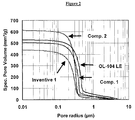
- Figure 2 shows the specific pore volume V of the second intrusion test run (using the same sample) plotted against the pore radius r.
- Figure 3 shows the normalized specific pore volume of the second intrusion test run plotted against the pore radius r, i.e. in this curve, the maximum specific pore volume of the second intrusion test run, V max , was set to 100% and the other specific volumes for that particular ATH were divided by this maximum value.
- the pore radius at 50% of the relative specific pore volume, by definition, is called median pore radius r 50 herein.
- the median pore radius r 50 for an ATH according to the present invention, i.e. Inventive 1 is 0.277 ⁇ m.
- the procedure described above was repeated using a sample of ATH particles according to the present invention, and the ATH particles were found to have an r 50 , i.e. a pore radius at 50% of the relative specific pore volume, in the range of from 0.09 to 0.33 ⁇ m.
- the r 50 of the ATH particles is in the range of from 0.20 to 0 33 ⁇ m, more preferably in the range of from 0.2 to 0.3 ⁇ m.
- the r 50 is in the range of from 0.185 to 0.325 ⁇ m, more preferably in the range of from 0.185 to 0.25 ⁇ m.
- the r 50 is in the range of from 0.09 to 0.21 ⁇ m, more preferably in the range of from 0.09 to 0.165 ⁇ m.
- the ATH particles of the present invention are characterized as having a V max , i.e. maximum specific pore volume at 1000 bar, in the range of from 300 to 480 mm 3 /g.
- V max i.e. maximum specific pore volume at 1000 bar
- the V max of the ATH particles is in the range of from t 390 to 480 mm 3 /g, more preferably in the range of from 410 to 450 mm 3 /g.
- the V max is in the range of from 400 to 480 mm 3 /g, more preferably in the range of from 450 to 480 mm 3 /g.
- the ATH particles of the present invention can also be characterized as having an oil absorption, as determined by ISO 787-5: 1980 of in the range of from 1 to 35%.
- the ATH particles of the present invention are characterized as having an oil absorption in the range of from 23 to 30%, more preferably in the range of from 25% to 28%.
- the ATH particles of the present invention are characterized as having an oil absorption in the range of from 25% to 32%, more preferably in the range of from 26% to 30%.
- the ATH particles of the present invention are characterized as having an oil absorption in the range of from 25 to 35% more preferably in the range of from 27% to 32%.
- the oil absorption of the ATH particles according to the present invention are in the range of from 19% to 23%, and in still other embodiments, the oil absorption of the ATH particles according to the present invention is in the range of from 21% to 25%.
- the ATH particles according to the present invention are characterized as having a BET specific surface area, as determined by DIN-66132, in the range of from 1 to 15 m 2 /g.
- the ATH particles according to the present invention have a BET specific surface in the range of from 3 to 6 m 2 /g, more preferably in the range of from 3.5 to 5.5 m 2 /g.
- the ATH particles according to the present invention have a BET specific surface of in the range of from 6 to 9 m 2 /g, more preferably in the range of from 6.5 to 8.5 m 2 /g.
- the ATH particles according to the present invention have a BET specific surface in the range of from 9 to 15 m 2 /g, more preferably in the range of from 10.5 to 12.5 m 2 /g.
- the ATH particles according to the present invention can also be characterized as having a d 50 in the range of from 0.5 to 2.5 ⁇ m.
- the ATH particles according to the present invention have a d 50 in the range of from 1.5 to 2.5 ⁇ m, more preferably in the range of from 1.8 to 2.2 ⁇ m.
- the ATH particles according to the present invention have a d 50 in the range of from 1.3 to 2.0 ⁇ m, more preferably in the range of from 1.4 to 1.8 ⁇ m.
- the ATH particles according to the present invention have a d 50 in the range of from 0.9 to 1.8 ⁇ m, more preferably in the range of from 1.1 to 1.5 ⁇ m.
- d 50 particle diameter measurements, i.e., d 50 , disclosed herein were measured by laser diffraction using a Cilas 1064 L laser spectrometer from Quantachrome.
- the procedure used herein to measure the d 50 can be practiced by first introducing a suitable water-dispersant solution (preparation see below) into the sample-preparation vessel of the apparatus. The standard measurement called “Particle Expert” is then selected, the measurement model "Range 1" is also selected, and apparatus-internal parameters, which apply to the expected particle size distribution, are then chosen. It should be noted that during the measurements the sample is typically exposed to ultrasound for about 60 seconds during the dispersion and during the measurement.
- the water/dispersant solution can be prepared by first preparing a concentrate from 500 g Calgon, available from KMF Laborchemie, with 3 liters of CAL Polysalt, available from BASF. This solution is made up to 10 liters with deionized water. 100 ml of this original 10 liters is taken and in turn diluted further to 10 liters with deionized water, and this final solution is used as the water-dispersant solution described above.
- the ATH particles of the present invention can be made by several processes such as, for example, by spray drying a slurry produced from, for example, a process such as that described below, and dry-milling; mill drying a slurry or filter cake produced from, for example, a process such as that described below, with optional deagglomeration; and wet milling followed by spray drying.
- the ATH particles of the present invention are made by a process comprising wet-milling an ATH slurry containing in the range of from 1 to 40 wt %, based on the total weight of the slurry, ATH particles.
- Wet-milling as used herein is meant to refer to the contacting of the ATH slurry with a milling media in the presence of a liquid.
- Liquids suitable for use in wet-milling herein are any liquids that do not substantially solubilize the ATH, preferably the liquid is water.
- the slurry may also contain a suitable dispersing agent.
- the milling media used in the wet-milling can be balls, rods, or other shapes made of various materials
- Some common materials of construction for the milling media include ceramic, steel, aluminum, glass or zirconium oxide (ZrO 2 )
- ZrO 2 zirconium oxide
- the density should be above 2.5 g/cm 3 .
- metal-based milling media with a density of at least 1.5 g/cm 3 are used, preferably in the range of from 2.0 to 2.5 g/cm 3 .
- the milling media is selected from those media having a general spherical shape, more preferably spherical milling media having a diameter in the range of from 0.1 mm to 1.0 mm, more preferably the milling media is a zirconium milling media, most preferably zirconium oxide.
- the ATH slurry that is wet-milled in the practice of the present invention can be obtained from any process used to produce ATH particles.
- the slurry is obtained from a process that involves producing ATH particles through precipitation and filtration.
- the wet-milling of the ATH slurry results in a milled ATH slurry that is recovered from the wet-milling operation by any technique commonly used to recover milled products from wet-milling operations.
- the recovered milled ATH slurry is then subjected to drying.
- Any drying method known in the art that is suitable for drying an ATH slurry can be used. Non-limiting examples of drying methods include spray drying, using spray driers such as those available from the Niro company/Sweden, flash drying or cell mill drying using mill-driers commercially available from the Atritor company or those available from Altenburger Maschinen Jaeckering, GmbH.
- the milled ATH slurry is spray dried, and in other embodiments, the milled ATH slurry is dried using a mill-drier.
- the ATH particles according to the present invention can be used as a flame retardant in a variety of synthetic resins.
- thermoplastic resins where the ATH particles find use include polyethylene, ethylene-propylene copolymer, polymers and copolymers of C 2 to C 8 olefins ( ⁇ -olefin) such as polybutene, poly(4-methylpentene-1) or the like, copolymers of these olefins and diene, ethylene-acrylate copolymer, polystyrene, ABS resin, AAS resin, AS resin, MBS resin, ethylene-vinyl chloride copolymer resin, ethylene-vinyl acetate copolymer resin, ethylene-vinyl chloride-vinyl acetate graft polymer resin, vinylidene chloride, polyvinyl chloride, chlorinated polyethylene, vinyl chloride-propylene copolymer, vinyl acetate resin, phenoxy resin, and the like.
- suitable synthetic resins include thermosetting resins such as epoxy resin, phenol resin, melamine resin, unsaturated polyester resin, alkyd resin and urea resin and natural or synthetic rubbers such as EPDM, butyl rubber, isoprene rubber, SBR, NIR, methane rubber, polybutadiene rubber, acrylic rubber, silicone rubber, fluoro-elastomer, NBR and chloro-sulfonated polyethylene are also included. Further included are polymeric suspensions (latices).
- thermosetting resins such as epoxy resin, phenol resin, melamine resin, unsaturated polyester resin, alkyd resin and urea resin
- natural or synthetic rubbers such as EPDM, butyl rubber, isoprene rubber, SBR, NIR, methane rubber, polybutadiene rubber, acrylic rubber, silicone rubber, fluoro-elastomer, NBR and chloro-sulfonated polyethylene are also included. Further included are polymeric suspensions (latices).
- the synthetic resin is a polyethylene-based resins such as high-density polyethylene, low-density polyethylene, linear low-density polyethylene, ultra low-density polyethylene, EVA (ethylene-vinyl acetate resin), EEA (ethylene-ethyl acrylate resin), EMA (ethylene-methyl acrylate copolymer resin), EAA (ethylene-acrylic acid copolymer resin) and ultra high molecular weight polyethylene; and polymers and copolymers of C 2 to C 8 olefins ( ⁇ -olefin) such as polybutene and poly(4-methylpentene-1), polyvinyl chloride and rubbers.
- the synthetic resin is a polyethylene-based resin.
- the inventors have discovered that by using the ATH particles according to the present invention as flame retardants in synthetic resins, better compounding performance, of the aluminum hydroxide containing synthetic resin can be achieved.
- the better compounding performance is highly desired by those compounders, manufactures, etc. producing highly filled flame retarded compounds and final extruded or molded articles out of ATH-containing synthetic resins.
- highly filled it is meant those containing the flame retarding amount of ATH, discussed below.
- the present invention relates to a flame retarded polymer formulation comprising at least one synthetic resin, selected from those described above, in some embodiments only one and a flame retarding amount of ATH particles according to the present invention, and extruded and/or molded article made from the flame retarded polymer formulation.
- a flame retarding amount of the ATH it is generally meant in the range of from 5 wt% to 90 wt%, based on the weight of the flame retarded polymer formulation, and more preferably from 20 wt% to 70 wt%, on the same basis. In a most preferred embodiment, a flame retarding amount is from 30 wt% to 65 wt% of the ATH particles, on the same basis.
- the flame retarded polymer formulation can also contain other additives commonly used in the art.
- additives that are suitable for use in the flame retarded polymer formulations of the present invention include extrusion aids such as polyethylene waxes, Si-based extrusion aids, fatty acids; coupling agents such as amino-, vinyl- or alkyl silanes or maleic acid grafted polymers; sodium stearate or calcium sterate; organoperoxides; dyes; pigments; fillers; blowing agents; deodorants; thermal stabilizers; antioxidants; antistatic agents; reinforcing agents; metal scavengers or deactivators; impact modifiers; processing aids; mold release aids, lubricants; anti-blocking agents; other flame retardants; UV stabilizers; plasticizers; flow aids; and the like.
- nucleating agents such as calcium silicate or indigo can be included in the flame retarded polymer formulations also.
- the proportions of the other optional additives are conventional and
- each of the above components, and optional additives if used can be mixed using a Buss Ko-kneader, internal mixers, Farrel continuous mixers or twin screw extruders or in some cases also single screw extruders or two roll mills.
- the flame retarded polymer formulation can then be molded in a subsequent processing step, if so desired.
- apparatuses can be used that thoroughly mix the components to form the flame retarded polymer formulation and also mold an article out of the flame retarded polymer formulation.
- the molded article of the flame-retardant polymer formulation may be used after fabrication for applications such as stretch processing, emboss processing, coating, printing, plating, perforation or cutting.
- the molded article may also be affixed to a material other than the flame-retardant polymer formulation of the present invention, such as a plasterboard, wood, a block board, a metal material or stone.
- the kneaded mixture can also be inflation-molded, injection-molded, extrusion-molded, blow-molded, press-molded, rotation-molded or calender-molded.
- any extrusion technique known to be effective with the synthetic resins mixture described above can be used.
- the synthetic resin, aluminum hydroxide particles, and optional components, if chosen are compounded in a compounding machine to form a flame-retardant resin formulation as described above.
- the flame-retardant resin formulation is then heated to a molten state in an extruder, and the molten flame-retardant resin formulation is then extruded through a selected die to form an extruded article or to coat for example a metal wire or a glass fiber used for data transmission.
- r 50 and V max described in the examples below was derived from mercury porosimetry using a Porosimeter 2000, as described above. All d 50 , BET, oil absorption, etc., unless otherwise indicated, were measured according to the techniques described above.
- the term "inventive aluminum hydroxide grade” and “inventive filler” as used in the examples is meant to refer to an ATH according to the present invention, and “comparative aluminum hydroxide grade” is meant to refer to an ATH that is commercially available and not according to the present invention.
- the slurry was fed into a pearl mill, type KD 200 D from Bachofen/Switzerland.
- This mill contained 270 kg of small beads made of zirconium oxide with a diameter of 0.6 mm
- the throughput of the mill was controlled so that after drying by means of a Niro F 100 spray drier and conveying of the inventive aluminum hydroxide into a silo the resulting d 50 was 1.89 ⁇ m and the specific surface was 4.9 m 2 /g. In the present example, the throughput was about 3 m 3 /h.
- Figure 1 shows the specific pore volume of the inventive aluminum hydroxide grade no.1 as a function of the applied pressure of the second intrusion test run.
- Figure 2 shows the specific pore volume of the inventive aluminum hydroxide grade no.
- Figure 3 shows the normalized specific pore volume of the inventive aluminum hydroxide grade no. 1 as a function of the pore radius on a linear scale.
- the product properties of the inventive aluminum hydroxide grade no. 1 are contained in Table 1, below.
- the inventive aluminum hydroxide grade no. 1 an ATH according to the present invention, has the lowest median pore radius and the lowest maximum specific pore volume.
- the slurry was fed into a pearl mill, type KD 200 D from Bachofen/Switzerland.
- This mill contained 270 kg of small beads made of zirconium oxide with a diameter of 0.6 mm,
- the throughput of the mill was controlled so that after drying by means of a Niro F 100 spray drier and conveying of the inventive aluminum hydroxide into a silo the resulting d 50 was 1.44 ⁇ m and the specific surface was 6.7 m 2 /g. In the present example, the throughput was about 2 m 3 /h.
- Figure 4 shows the specific pore volume of the inventive aluminum hydroxide grade no. 2 as a function of the applied pressure of the second intrusion test run.
- Figure 5 shows the specific pore volume of the inventive aluminum hydroxide grade no.
- Figure 6 shows the normalized specific pore volume of the inventive aluminum hydroxide grade no. 2 as a function of the pore radius on a linear scale.
- the product properties of the inventive aluminum hydroxide grade no. 2 are contained in Table 2, below.
- the inventive aluminum hydroxide grade no. 2 has the lowest median pore radius and the lowest maximum specific pore volume.
- the slurry was fed into a pearl mill, type KD 200 D from Bachofen/Switzerland.
- This mill contained 270 kg of small beads made of zirconium dioxide with a diameter of 0.6 mm.
- the throughput of the mill was controlled so that after drying by means of a Niro F 100 spray drier and conveying of the aluminum hydroxide into a silo the resulting d 50 was 1.36 ⁇ m and the specific surface was 10.0 m 2 /g. In the present example, the throughput was about 0.75 m 3 /h.
- Figure 7 shows the specific pore volume of the aluminum hydroxide grade no. 3 as a function of the applied pressure of the second intrusion test run.
- Figure 8 shows the specific pore volume of the aluminum hydroxide grade no.
- Figure 9 shows the normalized specific pore volume of the aluminum hydroxide grade no. 3 as a function of the pore radius on a linear scale.
- the product properties of the aluminum hydroxide grade no. 3 are contained in Table 3, below.
- the aluminum hydroxide grade no. 3 has a lower median pore radius and a lower maximum specific pore volume.
- the ready compound was removed from the mill, and after cooling to room temperature, was further reduced in size to obtain granulates suitable for compression molding in a two platen press or for feeding a laboratory extruder to obtain extruded strips for further evaluation.
- the granules were extruded into 2mm thick tapes using a Haake Polylab System with a Haake Rheomex extruder. Test bars according to DIN 53504 were punched out of the tape. The results of this experiment are contained in Table 4, below.
- the temperature of the two rolls was set to 130°C.
- the ready compound was removed from the mill, and after cooling to room temperature, was further reduced in size to obtain granulates suitable for compression molding in a two platen press or for feeding a laboratory extruder to obtain extruded strips for further evaluation.
- the granules were extruded into 2mm thick tapes using a Haake Polylab System with a Haake Rheomex extruder. Test bars according to DIN 53504 were punched out of the tape. The results of this experiment are contained in Table 4, below. Table 4 Comparative with OL-104 LE Inventive filler no.
- the inventive aluminum hydroxide grade no. 1 has similar mechanical, theological, electrical and flame retardant properties as the comparative grade Martinal OL-104 LE.
- the ready compound was removed from the mill, and after cooling to room temperature, was further reduced in size to obtain granulates suitable for compression molding in a two platen press or for feeding a laboratory extruder to obtain extruded strips for further evaluation.
- the granules were extruded into 2mm thick tapes using a Haake Polylab System with a Haake Rheomex extruder. Test bars according to DIN 53504 were punched out of the tape. The results of this experiment are contained in Table 5, below.
- the temperature of the two rolls was set to 130°C.
- the ready compound was removed from the mill, and after cooling to room temperature, was further reduced in size to obtain granulates suitable for compression molding in a two platen press or for feeding a laboratory extruder to obtain extruded strips for further evaluation.
- the granules were extruded into 2mm thick tapes using a Haake Polylab System with a Haake Rheomex extruder. Test bars according to DIN 53504 were punched out of the tape. The results of this experiment are contained in Table 5, below. Table 5 Comparative with OL-107 LE Inventive filler no.
- the inventive aluminum hydroxide grade no. 2 has similar mechanical, rheological, electrical and flame retardant properties as the comparative grade Martinal® OL-107 LE.
- the ready compound was removed from the mill, and after cooling to room temperature, was further reduced in size to obtain granulates suitable for compression molding in a two platen press or for feeding a laboratory extruder to obtain extruded strips for further evaluation.
- the granules were extruded into 2mm thick tapes using a Haake Polylab System with a Haake Rheomex extruder. Test bars according to DIN 53504 were punched out of the tape. The results of this experiment are contained in Table 6, below.
- the temperature of the two rolls was set to 130°C.
- the ready compound was removed from the mill, and after cooling to room temperature, was further reduced in size to obtain granulates suitable for compression molding in a two platen press or for feeding a laboratory extruder to obtain extruded strips for further evaluation.
- the granules were extruded into 2mm thick tapes using a Haake Polylab System with a Haake Rheomex extruder. Test bars according to DIN 53504 were punched out of the tape. The results of this experiment are contained in Table 6, below.
- Table 6 Comparative with OL-111 LE Filler no. 3 Melt Flow Index @ 150°C/21 . 6 kg (g/10 min) 113 1.22
- Tensile strength (MPa) 15.7 15.2 Elongation at break (%) 183 185 LOI (% O 2 ) 38.6 39.6
- the aluminum hydroxide grade no. 3 has similar mechanical and theological properties as the comparative grade Martinal® OL-111 LE.
- the Melt Flow Index was measured according to DIN 53735.
- the tensile strength and elongation at break were measured according to DIN 53504, and the resistivity before and after water ageing was measured according to DIN 53482 on 100x100x2 mm 3 pressed plates.
- the water pick-up in % is the difference in weight after water aging of a 100x100x2 mm 3 pressed plate in a de-salted water bath after 7 days at 70 °C relative to the initial weight of the plate.
- the oxygen index was measured according to ISO 4589 on 6 x 3 x 150 mm 3 samples.
- the comparative aluminum hydroxide particles Martinal® OL-104 LE of Example 2 and the inventive aluminum hydroxide grade no. 1 of Example 1 were separately used to form a flame-retardant resin formulation.
- the synthetic resin used was a mixture of EVA Escorene ⁇ Ultra UL00328 from ExxonMobil together with a LLDPE grade Escorene® LL1001XV from ExxonMobil, Ethanox® 310 antioxidant available commercially from the Albemarle® Corporation, and an amino silane Dynasylan AMEO from Degussa.
- the AMEO silane and Ethanox® 310 were first blended with the total amount of synthetic resin in a drum prior to Buss compounding.
- the resin/silane/antioxidant blend was fed into the first inlet of the Buss kneader, together with 50 % of the total amount of aluminum hydroxide, and the remaining 50% of the aluminum hydroxide was fed into the second feeding port of the Buss kneader.
- the discharge extruder was flanged perpendicular to the Buss Ko-kneader and had a screw size of 70 mm.
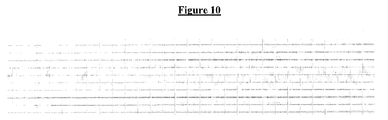
- Figure 10 shows the power draw on the motor of the discharge extruder for the inventive aluminum hydroxide grade no. 1.
- Figure 11 shows the power draw on the motor of the discharge extruder for the comparative aluminum hydroxide grade OL-104 LE, produced by Martinswerk GmbH.
Landscapes
- Chemical & Material Sciences (AREA)
- Organic Chemistry (AREA)
- Inorganic Chemistry (AREA)
- Geology (AREA)
- Life Sciences & Earth Sciences (AREA)
- Polymers & Plastics (AREA)
- Health & Medical Sciences (AREA)
- Medicinal Chemistry (AREA)
- Chemical Kinetics & Catalysis (AREA)
- Engineering & Computer Science (AREA)
- Materials Engineering (AREA)
- Compounds Of Alkaline-Earth Elements, Aluminum Or Rare-Earth Metals (AREA)
- Compositions Of Macromolecular Compounds (AREA)
- Fireproofing Substances (AREA)
- Pigments, Carbon Blacks, Or Wood Stains (AREA)
- Glanulating (AREA)
- Solid-Sorbent Or Filter-Aiding Compositions (AREA)
Description
- The present invention relates to aluminum hydroxide flame retardants and their use
- Aluminum hydroxide has a variety of alternative names such as aluminum hydrate, aluminum trihydrate etc., but is commonly referred to as ATH. ATH particles find use as a filler in many materials such as, for example, plastics, rubber, thermosets, papers, etc. These products find use in diverse commercial applications such as wire and cable compounds, conveyor belts, thermoplastics moldings, wall claddings, floorings, etc. ATH is typically used to improve the flame retardancy of such materials and also acts as a smoke suppressant.
- Methods for the synthesis of ATH are well known in the art. For example, see
EP 1 206 412 B1 -
EP 0 807 603 3 A2specific surface area 2 of at least 30m2/g, a maximum pore size distribution of 300 nm and a mean particle size of 1.0 µm, which is used as a filler for rubber compositions from which tire treads are made. - However, ATH's are not selected solely on their d50 and/or BET specific surface areas. To the contrary, ATH's are also selected based on the compounding performance of the ATH-containing resin, and the demand for better compounding performance has increased. The compounding performance of an ATH-containing resin is generally determined by viewing the power draw on the motor of the compounding machine used in compounding the ATH-containing resin. Less variations of the power draw on the motor of the compounding machine translates to less wear on the compounder engine, better compounded resins, and higher throughputs of the ATH-containing resin during compounding.
- Thus, because there is a demand for higher throughputs in the compounding of ATH-flame retarded resins and the performance of the ATH-flame retarded synthetic resin is a critical attribute that is linked to the ATH, compounders would benefit from, and thus there is a demand for, an ATH which, during compounding, would allow for higher throughputs in compounding machines like Buss Ko-kneaders, twin-screw extruders or other suitable machines.
-
-
Figure 1 shows the specific pore volume V as a function of the applied pressure for the second intrusion test run and an ATH grade no. 1, an ATH according to the present invention, in comparison with standard grades. -
Figure 2 shows the specific pore volume V plotted against the pore radius r for the second intrusion test run and an ATH grade no. 1, an ATH according to the present invention, in comparison with standard grades. -
Figure 3 shows the normalized specific pore volume for an ATH grade no. 1, an ATH according to the present invention, in comparison with standard grades, the graph was generated with the maximum specific pore volume for each ATH grade set at 100%, and the other specific volumes of the corresponding ATH grade were divided by this maximum value. -
Figure 4 shows the specific pore volume V as a function of the applied pressure for the second intrusion test run and an ATH grade no. 2, an ATH according to the present invention, in comparison with standard grades. -
Figure 5 shows the specific pore volume V plotted against the pore radius r for the second intrusion test run and an ATH grade no. 2, an ATH according to the present invention, in comparison with standard grades. -
Figure 6 shows the normalized specific pore volume for an ATH grade no.2, an ATH according to the present invention, in comparison with standard grades, the graph was generated with the maximum specific pore volume for each ATH grade set at 100%, and the other specific volumes of the corresponding ATH grade were divided by this maximum value. -
Figure 7 shows the specific pore volume V as a function of the applied pressure for the second intrusion test run and an ATH grade no. 3, which is not an ATH according to the present invention, in comparison with a standard grade. -
Figure 8 shows the specific pore volume V plotted against the pore radius r for the second intrusion test run and an ATH grade no. 3, which is not an ATH according to the present invention, in comparison with a standard grade. -
Figure 9 shows the normalized specific pore volume for an ATH grade no. 3, which is not an ATH according to the present invention, in comparison with standard grades, the graph was generated with the maximum specific pore volume for each ATH grade set at 100%, and the other specific volumes of the corresponding ATH grade were divided by this maximum value. -
Figure 10 shows the power draw on the motor of a discharge extruder for the inventive aluminum hydroxide grade no. 1 used in the Example 1. -
Figure 11 shows the power draw on the motor of a discharge extruder for the comparative aluminum hydroxide grade OL-104 LE used in Example 2. - Higher compounding throughputs can be achieved through the use of ATH's with better wettability in the selected synthetic material. An ATH with a poor wettability in the synthetic resin leads to higher variations in the power draw of the compounder motor during compounding, which in turn leads to, at best, a moderate compound quality, low throughputs, and, over time, can represent a considerable risk for damage to the engine of the compounding machine.
- The present invention relates to ATH particles having a median pore radius ("r 50 ") in the range of from 0.09 to 0.33 µm, a BET, as determined by DIN-66132, in the range of from 1 to 15 m 2 /g, and a maximum specific pore volume ("V max ") in the range of from 300 to 480 mm3/g.
- In another embodiment, the present invention relates to a flame retarded polymer formulation comprising at least one synthetic resin and in the range of from 5 wt% to 90 wt% of said ATH particles.
- The wettability of ATH particles with resins depends on the morphology of the ATH particles, and the inventors hereof have unexpectedly discovered that the ATH particles according to the present invention have an improved wettability in relation to ATH particles currently available. While not wishing to be bound by theory, the inventors hereof believe that this improved wettability is attributable to an improvement in the morphology of the ATH particles disclosed herein.
- Again, while not wishing to be bound by theory, the inventors hereof believe that this improved morphology is attributable to the specific pore volume and/or the median pore radius ("r50") of the ATH product particles of the present invention. The inventors hereof believe that, for a given polymer molecule, an ATH product having a higher structured aggregate contains more and bigger pores and seems to be more difficult to wet, leading to difficulties (higher variations of the power draw on the motor) during compounding in kneaders like Buss Ko-kneaders or twin-screw extruders or other machines known in the art and used to this purpose. Therefore, the inventors hereof have discovered that an ATH filler characterized by smaller median pore sizes and/or lower total pore volumes correlates with an improved wetting with polymeric materials and thus results in improved compounding behavior, i.e. less variations of the power draw of the engines (motors) of compounding machines used to compound a flame retarded resin containing the ATH filler.
- The aluminum hydroxide particles according to the present invention are characterized by a certain median pore radius and/or a lower total specific pore volume at 1000 bar, Vmax. as determined by mercury porosimetry. The r50 and the Vmax of the ATH particles according to the present invention can be derived from mercury porosimetry. The theory of mercury porosimetry is based on the physical principle that a non-reactive, non-wetting liquid will not penetrate pores until sufficient pressure is applied to force its entrance. Thus, the higher the pressure necessary for the liquid to enter the pores, the smaller the pore size. A smaller pore size and/or a lower total specific pore volume was found to correlate to better wettability of the aluminum hydroxide particles. The pore size of the aluminum hydroxide particles of the present invention can be calculated from data derived from mercury porosimetry using a Porosimeter 2000 from Carlo Erba Strumentazione, Italy. According to the manual of the Porosimeter 2000, the following equation is used to calculate the pore radius r from the measured pressure p: r = -2 γ cos(θ)/p; wherein θ is the wetting angle and γ is the surface tension. The measurements taken herein used a value of 141.3° for θ: and γ was set to 480 dyn/cm.
- In order to improve the repeatability of the measurements, the pore size of the ATH particles was calculated from the second ATH intrusion test run, as described in the manual of the Porosimeter 2000. The second test run was used because the inventors observed that an amount of mercury having the volume V0 remains in the sample of the ATH particles after extrusion, i.e. after release of the pressure to ambient pressure. Thus, the r50 can be derived from this data as explained below with reference to
Figures 1 ,2 , and3 . - In the first test run, an ATH sample was prepared as described in the manual of the Porosimeter 2000, and the pore volume was measured as a function of the applied intrusion pressure p using a maximum pressure of 1000 bar. The pressure was released and allowed to reach ambient pressure upon completion of the first test run. A second intrusion test run (according to the manual of the Porosimeter 2000) utilizing the same ATH sample, unadulterated, from the first test run was performed, where the measurement of the specific pore volume V(p) of the second test run takes the volume V0 as a new starting volume, which is then set to zero for the second test run.
- In the second intrusion test run, the measurement of the specific pore volume V(p) of the sample was again performed as a function of the applied intrusion pressure using a maximum pressure of 1000 bar.
Figure 1 shows the specific pore volume V as a function of the applied pressure for the second intrusion test run and an ATH, grade no. 1, according to the present invention in comparison with current commercially available ATH products. The pore volume at 1000 bar, i.e. the maximum pressure used in the measurement, is referred to as Vmax herein. - From the second ATH intrusion test run, the pore radius r was calculated by the Porosimeter 2000 according to the formula r = -2 γ cos(θ)/p; wherein θ is the wetting angle, γ is the surface tension and p the intrusion pressure. For all r-measurements taken herein, a value of 141.3° for θ was used and γ was set to 480 dyn/cm. The specific pore volume can thus be plotted against the pore radius r.
Figure 2 shows the specific pore volume V of the second intrusion test run (using the same sample) plotted against the pore radius r. -
Figure 3 shows the normalized specific pore volume of the second intrusion test run plotted against the pore radius r, i.e. in this curve, the maximum specific pore volume of the second intrusion test run, Vmax, was set to 100% and the other specific volumes for that particular ATH were divided by this maximum value. The pore radius at 50% of the relative specific pore volume, by definition, is called median pore radius r50 herein. For example, according toFigure 3 , the median pore radius r50 for an ATH according to the present invention, i.e. Inventive 1, is 0.277 µm. - The procedure described above was repeated using a sample of ATH particles according to the present invention, and the ATH particles were found to have an r50, i.e. a pore radius at 50% of the relative specific pore volume, in the range of from 0.09 to 0.33 µm. In preferred embodiments of the present invention, the r50 of the ATH particles is in the range of from 0.20 to 0 33µm, more preferably in the range of from 0.2 to 0.3µm. In other preferred embodiments, the r50 is in the range of from 0.185 to 0.325µm, more preferably in the range of from 0.185 to 0.25 µm. In still other preferred embodiments, the r50 is in the range of from 0.09 to 0.21 µm, more preferably in the range of from 0.09 to 0.165µm.
- The ATH particles of the present invention are characterized as having a Vmax, i.e. maximum specific pore volume at 1000 bar, in the range of from 300 to 480 mm3/g. In preferred embodiments of the present invention, the Vmax of the ATH particles is in the range of from t 390 to 480 mm3/g, more preferably in the range of from 410 to 450 mm3/g. In other preferred embodiments, the Vmax is in the range of from 400 to 480 mm3/g, more preferably in the range of from 450 to 480 mm3/g.
- The ATH particles of the present invention can also be characterized as having an oil absorption, as determined by ISO 787-5: 1980 of in the range of from 1 to 35%. In some preferred embodiments, the ATH particles of the present invention are characterized as having an oil absorption in the range of from 23 to 30%, more preferably in the range of from 25% to 28%. In other preferred embodiments, the ATH particles of the present invention are characterized as having an oil absorption in the range of from 25% to 32%, more preferably in the range of from 26% to 30%. In yet other preferred embodiments, the ATH particles of the present invention are characterized as having an oil absorption in the range of from 25 to 35% more preferably in the range of from 27% to 32%. In other embodiments, the oil absorption of the ATH particles according to the present invention are in the range of from 19% to 23%, and in still other embodiments, the oil absorption of the ATH particles according to the present invention is in the range of from 21% to 25%.
- The ATH particles according to the present invention are characterized as having a BET specific surface area, as determined by DIN-66132, in the range of from 1 to 15 m2/g. In preferred embodiments, the ATH particles according to the present invention have a BET specific surface in the range of from 3 to 6 m2/g, more preferably in the range of from 3.5 to 5.5 m2/g. In other preferred embodiments, the ATH particles according to the present invention have a BET specific surface of in the range of from 6 to 9 m2/g, more preferably in the range of from 6.5 to 8.5 m2/g. In still other preferred embodiments, the ATH particles according to the present invention have a BET specific surface in the range of from 9 to 15 m2/g, more preferably in the range of from 10.5 to 12.5 m2/g.
- The ATH particles according to the present invention can also be characterized as having a d50 in the range of from 0.5 to 2.5 µm. In preferred embodiments, the ATH particles according to the present invention have a d50 in the range of from 1.5 to 2.5µm, more preferably in the range of from 1.8 to 2.2 µm. In other preferred embodiments, the ATH particles according to the present invention have a d50 in the range of from 1.3 to 2.0 µm, more preferably in the range of from 1.4 to 1.8 µm. In still other preferred embodiments, the ATH particles according to the present invention have a d50 in the range of from 0.9 to 1.8 µm, more preferably in the range of from 1.1 to 1.5 µm.
- It should be noted that all particle diameter measurements, i.e., d50, disclosed herein were measured by laser diffraction using a Cilas 1064 L laser spectrometer from Quantachrome. Generally, the procedure used herein to measure the d50, can be practiced by first introducing a suitable water-dispersant solution (preparation see below) into the sample-preparation vessel of the apparatus. The standard measurement called "Particle Expert" is then selected, the measurement model "
Range 1" is also selected, and apparatus-internal parameters, which apply to the expected particle size distribution, are then chosen. It should be noted that during the measurements the sample is typically exposed to ultrasound for about 60 seconds during the dispersion and during the measurement. After a background measurement has taken place, from 75 to 100 mg of the sample to be analyzed is placed in the sample vessel with the water/dispersant solution and the measurement started. The water/dispersant solution can be prepared by first preparing a concentrate from 500 g Calgon, available from KMF Laborchemie, with 3 liters of CAL Polysalt, available from BASF. This solution is made up to 10 liters with deionized water. 100 ml of this original 10 liters is taken and in turn diluted further to 10 liters with deionized water, and this final solution is used as the water-dispersant solution described above. - The ATH particles of the present invention can be made by several processes such as, for example, by spray drying a slurry produced from, for example, a process such as that described below, and dry-milling; mill drying a slurry or filter cake produced from, for example, a process such as that described below, with optional deagglomeration; and wet milling followed by spray drying. For example, see those processes disclosed
US patent applications 60/818,63260/899,316 60/891,746 60/891,745 60/818,633 60/818,670 - The milling media used in the wet-milling can be balls, rods, or other shapes made of various materials Some common materials of construction for the milling media include ceramic, steel, aluminum, glass or zirconium oxide (ZrO2) For ceramic milling media, the density should be above 2.5 g/cm3. Preferably, metal-based milling media with a density of at least 1.5 g/cm3 are used, preferably in the range of from 2.0 to 2.5 g/cm3. In preferred wet-milling processes, the milling media is selected from those media having a general spherical shape, more preferably spherical milling media having a diameter in the range of from 0.1 mm to 1.0 mm, more preferably the milling media is a zirconium milling media, most preferably zirconium oxide.
- The ATH slurry that is wet-milled in the practice of the present invention can be obtained from any process used to produce ATH particles. Preferably the slurry is obtained from a process that involves producing ATH particles through precipitation and filtration.
- The wet-milling of the ATH slurry results in a milled ATH slurry that is recovered from the wet-milling operation by any technique commonly used to recover milled products from wet-milling operations. The recovered milled ATH slurry is then subjected to drying. Any drying method known in the art that is suitable for drying an ATH slurry can be used. Non-limiting examples of drying methods include spray drying, using spray driers such as those available from the Niro company/Sweden, flash drying or cell mill drying using mill-driers commercially available from the Atritor company or those available from Altenburger Maschinen Jaeckering, GmbH. In some embodiments, the milled ATH slurry is spray dried, and in other embodiments, the milled ATH slurry is dried using a mill-drier.
- The ATH particles according to the present invention can be used as a flame retardant in a variety of synthetic resins. Non-limiting examples of thermoplastic resins where the ATH particles find use include polyethylene, ethylene-propylene copolymer, polymers and copolymers of C2 to C8 olefins (α-olefin) such as polybutene, poly(4-methylpentene-1) or the like, copolymers of these olefins and diene, ethylene-acrylate copolymer, polystyrene, ABS resin, AAS resin, AS resin, MBS resin, ethylene-vinyl chloride copolymer resin, ethylene-vinyl acetate copolymer resin, ethylene-vinyl chloride-vinyl acetate graft polymer resin, vinylidene chloride, polyvinyl chloride, chlorinated polyethylene, vinyl chloride-propylene copolymer, vinyl acetate resin, phenoxy resin, and the like. Further examples of suitable synthetic resins include thermosetting resins such as epoxy resin, phenol resin, melamine resin, unsaturated polyester resin, alkyd resin and urea resin and natural or synthetic rubbers such as EPDM, butyl rubber, isoprene rubber, SBR, NIR, methane rubber, polybutadiene rubber, acrylic rubber, silicone rubber, fluoro-elastomer, NBR and chloro-sulfonated polyethylene are also included. Further included are polymeric suspensions (latices).
- Preferably, the synthetic resin is a polyethylene-based resins such as high-density polyethylene, low-density polyethylene, linear low-density polyethylene, ultra low-density polyethylene, EVA (ethylene-vinyl acetate resin), EEA (ethylene-ethyl acrylate resin), EMA (ethylene-methyl acrylate copolymer resin), EAA (ethylene-acrylic acid copolymer resin) and ultra high molecular weight polyethylene; and polymers and copolymers of C2 to C8 olefins (α-olefin) such as polybutene and poly(4-methylpentene-1), polyvinyl chloride and rubbers. In a more preferred embodiment, the synthetic resin is a polyethylene-based resin.
- The inventors have discovered that by using the ATH particles according to the present invention as flame retardants in synthetic resins, better compounding performance, of the aluminum hydroxide containing synthetic resin can be achieved. The better compounding performance is highly desired by those compounders, manufactures, etc. producing highly filled flame retarded compounds and final extruded or molded articles out of ATH-containing synthetic resins. By highly filled, it is meant those containing the flame retarding amount of ATH, discussed below.
- By better compounding performance, it is meant that variations in the amplitude of the energy level of compounding machines like Buss Ko-kneaders or twin screw extruders needed to mix a synthetic resin containing ATH particles according to the present invention are smaller than those of compounding machines mixing a synthetic resin containing conventional ATH particles. The smaller variations in the energy level allows for higher throughputs of the ATH-containing synthetic resins to be mixed or extruded and/or a more uniform (homogenous) material.
- Thus, in one embodiment, the present invention relates to a flame retarded polymer formulation comprising at least one synthetic resin, selected from those described above, in some embodiments only one and a flame retarding amount of ATH particles according to the present invention, and extruded and/or molded article made from the flame retarded polymer formulation.
- By a flame retarding amount of the ATH, it is generally meant in the range of from 5 wt% to 90 wt%, based on the weight of the flame retarded polymer formulation, and more preferably from 20 wt% to 70 wt%, on the same basis. In a most preferred embodiment, a flame retarding amount is from 30 wt% to 65 wt% of the ATH particles, on the same basis.
- The flame retarded polymer formulation can also contain other additives commonly used in the art. Non-limiting examples of other additives that are suitable for use in the flame retarded polymer formulations of the present invention include extrusion aids such as polyethylene waxes, Si-based extrusion aids, fatty acids; coupling agents such as amino-, vinyl- or alkyl silanes or maleic acid grafted polymers; sodium stearate or calcium sterate; organoperoxides; dyes; pigments; fillers; blowing agents; deodorants; thermal stabilizers; antioxidants; antistatic agents; reinforcing agents; metal scavengers or deactivators; impact modifiers; processing aids; mold release aids, lubricants; anti-blocking agents; other flame retardants; UV stabilizers; plasticizers; flow aids; and the like. If desired, nucleating agents such as calcium silicate or indigo can be included in the flame retarded polymer formulations also. The proportions of the other optional additives are conventional and can be varied to suit the needs of any given situation.
- The methods of incorporation and addition of the components of the flame-retarded polymer formulation is conducted is not critical to the present invention and can be any known in the art so long as the method selected involves substantially uniform mixing. For example, each of the above components, and optional additives if used, can be mixed using a Buss Ko-kneader, internal mixers, Farrel continuous mixers or twin screw extruders or in some cases also single screw extruders or two roll mills. The flame retarded polymer formulation can then be molded in a subsequent processing step, if so desired. In some embodiments, apparatuses can be used that thoroughly mix the components to form the flame retarded polymer formulation and also mold an article out of the flame retarded polymer formulation. Further, the molded article of the flame-retardant polymer formulation may be used after fabrication for applications such as stretch processing, emboss processing, coating, printing, plating, perforation or cutting. The molded article may also be affixed to a material other than the flame-retardant polymer formulation of the present invention, such as a plasterboard, wood, a block board, a metal material or stone. However, the kneaded mixture can also be inflation-molded, injection-molded, extrusion-molded, blow-molded, press-molded, rotation-molded or calender-molded.
- In the case of an extruded article, any extrusion technique known to be effective with the synthetic resins mixture described above can be used. In one exemplary technique, the synthetic resin, aluminum hydroxide particles, and optional components, if chosen, are compounded in a compounding machine to form a flame-retardant resin formulation as described above. The flame-retardant resin formulation is then heated to a molten state in an extruder, and the molten flame-retardant resin formulation is then extruded through a selected die to form an extruded article or to coat for example a metal wire or a glass fiber used for data transmission.
- The above description is directed to several embodiments of the present invention. The following examples will illustrate the present invention, but are not meant to be limiting in any manner
- The r50 and Vmax described in the examples below was derived from mercury porosimetry using a Porosimeter 2000, as described above. All d50, BET, oil absorption, etc., unless otherwise indicated, were measured according to the techniques described above Also, the term "inventive aluminum hydroxide grade" and "inventive filler" as used in the examples is meant to refer to an ATH according to the present invention, and "comparative aluminum hydroxide grade" is meant to refer to an ATH that is commercially available and not according to the present invention.
- By seeding a pregnant sodium aluminate liquor as e.g. disclosed in
EP 1 206 412 B1Niro F 100 spray drier and conveying of the inventive aluminum hydroxide into a silo the resulting d50 was 1.89 µm and the specific surface was 4.9 m2/g. In the present example, the throughput was about 3 m3/h.Figure 1 shows the specific pore volume of the inventive aluminum hydroxide grade no.1 as a function of the applied pressure of the second intrusion test run.Figure 2 shows the specific pore volume of the inventive aluminum hydroxide grade no. 1 as a function of the pore radius.Figure 3 shows the normalized specific pore volume of the inventive aluminum hydroxide grade no. 1 as a function of the pore radius on a linear scale. The product properties of the inventive aluminum hydroxide grade no. 1 are contained in Table 1, below. - The product properties of the comparative aluminum hydroxide grade Martinal OL-104 LE produced by Martinswerk GmbH and the product properties of two competitive aluminum hydroxide grades "Competitive 1" and "Competitive 2" are also shown in Table 1.
Table 1 Median pore radius ("r50") (µm) Maximum specific pore volume Vmax (mm3/g) Median particle size d50 (µm) Specific BET surface (m2/g) Comparative ATH OL-104 LE 0.419 529 1.83 3.2 Comparative 1 0.353 504 1.52 3.2 Comparative 2 0.303 615 1 61 4.0 Inventive ATH grade no. 1 0.277 439 1.89 4.9 - As can be seen in Table 1, the inventive aluminum hydroxide grade no. 1, an ATH according to the present invention, has the lowest median pore radius and the lowest maximum specific pore volume.
- By seeding a pregnant sodium aluminate liquor as e.g., disclosed in
EP 1 206 412 B1Niro F 100 spray drier and conveying of the inventive aluminum hydroxide into a silo the resulting d50 was 1.44 µm and the specific surface was 6.7 m2/g. In the present example, the throughput was about 2 m3/h.Figure 4 shows the specific pore volume of the inventive aluminum hydroxide grade no. 2 as a function of the applied pressure of the second intrusion test run.Figure 5 shows the specific pore volume of the inventive aluminum hydroxide grade no. 2 as a function of the pore radius,Figure 6 shows the normalized specific pore volume of the inventive aluminum hydroxide grade no. 2 as a function of the pore radius on a linear scale. The product properties of the inventive aluminum hydroxide grade no. 2 are contained in Table 2, below. - The product properties of the comparative aluminum hydroxide grade Martina! OL-107 LE produced by Martinswerk GmbH and the product properties of the competitive aluminum hydroxide grade "Competitive 3" are also shown in Table 2.
Table 2 Median pore radius ("r50") (µm) Maximum specific pore volume VMAX (mm3/g) Median particle size d50 (µm) Specific BET surface (m2/g) Comparative ATH OL-107 LE 0.266 696 1.35 6.2 Comparative 3 0.257 679 1.23 6.3 Inventive ATH grade no. 2 0.242 479 1.44 6.7 - As can be seen in Table 2, the inventive aluminum hydroxide grade no. 2 has the lowest median pore radius and the lowest maximum specific pore volume.
- By seeding a pregnant sodium aluminate liquor as e.g. disclosed in
EP 1 206 412 B1Niro F 100 spray drier and conveying of the aluminum hydroxide into a silo the resulting d50 was 1.36 µm and the specific surface was 10.0 m2/g. In the present example, the throughput was about 0.75 m3/h.Figure 7 shows the specific pore volume of the aluminum hydroxide grade no. 3 as a function of the applied pressure of the second intrusion test run.Figure 8 shows the specific pore volume of the aluminum hydroxide grade no. 3 as a function of the pore radius.Figure 9 shows the normalized specific pore volume of the aluminum hydroxide grade no. 3 as a function of the pore radius on a linear scale. The product properties of the aluminum hydroxide grade no. 3 are contained in Table 3, below. - The product properties of the comparative aluminum hydroxide grade Martinal OL-111 LE produced by Martinswerk GmbH are also shown in Table 3.
Table 3 Median pore radius ("r50") (µm) Maximum specific pore volume Vmax (mm3/g) Median particle size d50 (µm) Specific BET surface (m2/g) Comparative ATH OL-111LE 0.193 823 1.23 10.1 ATH grade no. 3 0.175 588 1.36 10.0 - As can be seen in Table 3, the aluminum hydroxide grade no. 3 has a lower median pore radius and a lower maximum specific pore volume.
- 396.9 g (100 phr) of ethylene vinyl acetate (EVA) Escorene™ Ultra UL00119 from ExxonMobil was mixed during about 20min on a two roll mill W150M from the Collin company with 595.4 g (150 phr) of the inventive aluminum hydroxide grade no. 1 in a usual manner familiar to a person skilled in the art, together with 4.8 g (1.2 phr) of aminosilane AMEO from Degussa AG and 2.9 g (0.75 phr) of the antioxidant Ethanox® 310 from Albemarle Corporation. The aminosilane ensures better coupling of the filler to the polymer matrix. The temperature of the two rolls was set to 130 °C. The ready compound was removed from the mill, and after cooling to room temperature, was further reduced in size to obtain granulates suitable for compression molding in a two platen press or for feeding a laboratory extruder to obtain extruded strips for further evaluation. In order to determine the mechanical properties of the flame retardant resin formulation, the granules were extruded into 2mm thick tapes using a Haake Polylab System with a Haake Rheomex extruder. Test bars according to DIN 53504 were punched out of the tape. The results of this experiment are contained in Table 4, below.
- 396.9 g (100 phr) of ethylene vinyl acetate (EVA) Escorene™ Ultra UL00119 from ExxonMobil was mixed during about 20min on a two roll mill W150M from the Collin company with 595.4 g (150 phr) of the commercially available ATH grade OL-104 LE produced by Martinswerk GmbH in a usual manner familiar to a person skilled in the art, together with 4.8 g (1.2 phr) of aminosilane AMEO from Degussa AG and 2.9 g (= 0.75 phr) of the antioxidant Ethanox® 310 from Albemarle Corporation. The aminosilane ensures better coupling of the filler to the polymer matrix. The temperature of the two rolls was set to 130°C. The ready compound was removed from the mill, and after cooling to room temperature, was further reduced in size to obtain granulates suitable for compression molding in a two platen press or for feeding a laboratory extruder to obtain extruded strips for further evaluation. In order to determine the mechanical properties of the flame retardant resin formulation, the granules were extruded into 2mm thick tapes using a Haake Polylab System with a Haake Rheomex extruder. Test bars according to DIN 53504 were punched out of the tape. The results of this experiment are contained in Table 4, below.
Table 4 Comparative with OL-104 LE Inventive filler no. 1 Melt Flow Index @ 150°C/21.6 kg (g/10min) 1.8 1.5 Tensile strength (MPa) 12.9 13.4 Elongation at break (%) 221 214 LOI (% O2) 36.2 38 Resistivity before water aging (Ohm·cm) 31 x 1012 1.7 x 10¹² Resistivity after 7d@70°C water aging (Ohm·cm) 8.1 x10¹¹ 8.4 x 10¹¹ Water pickup (%) 1.25 1.67 - As can be seen in Table 4, within the experimental error, the inventive aluminum hydroxide grade no. 1 has similar mechanical, theological, electrical and flame retardant properties as the comparative grade Martinal OL-104 LE.
- 396.9 g (100 phr) of ethylene vinyl acetate (EVA) Escorene™ Ultra UL00119 from ExxonMobil was mixed during about 20min on a two roll mill W150M from the Collin company with 595.4 g (150 phr) of the inventive filler no. 2 in a usual manner familiar to a person skilled in the art, together with 4.8 g (1.2 phr) of aminosilane AMEO from Degussa AG and 2.9 g (0.75 phr) of the antioxidant Ethanox® 310 from Albemarle Corporation. The aminosilane ensures better coupling of the filler to the polymer matrix. The temperature of the two rolls was set to 130°C. The ready compound was removed from the mill, and after cooling to room temperature, was further reduced in size to obtain granulates suitable for compression molding in a two platen press or for feeding a laboratory extruder to obtain extruded strips for further evaluation. In order to determine the mechanical properties of the flame retardant resin formulation, the granules were extruded into 2mm thick tapes using a Haake Polylab System with a Haake Rheomex extruder. Test bars according to DIN 53504 were punched out of the tape. The results of this experiment are contained in Table 5, below.
- 396.9 g (100 phr) of ethylene vinyl acetate (EVA) Escorene Ultra UL00119 from ExxonMobil was mixed during about 20min on a two roll mill W150M from the Collin company with 595.4 g (150 phr) of the commercially available ATH grade OL-107 LE produced by Martinswerk GmbH in a usual manner familiar to a person skilled in the art, together with 4.8 g (1.2 phr) of aminosilane AMEO from Degussa AG and 2.9 g (= 0 75 phr) of the antioxidant Ethanox® 310 from Albemarle Corporation. The aminosilane ensures better coupling of the filler to the polymer matrix. The temperature of the two rolls was set to 130°C. The ready compound was removed from the mill, and after cooling to room temperature, was further reduced in size to obtain granulates suitable for compression molding in a two platen press or for feeding a laboratory extruder to obtain extruded strips for further evaluation. In order to determine the mechanical properties of the flame retardant resin formulation, the granules were extruded into 2mm thick tapes using a Haake Polylab System with a Haake Rheomex extruder. Test bars according to DIN 53504 were punched out of the tape. The results of this experiment are contained in Table 5, below.
Table 5 Comparative with OL-107 LE Inventive filler no. 2 Melt Flow Index @ 150°C/21.6 kg (g/10min) 1.1 1.25 Tensile strength (MPa) 13.9 13.6 Elongation at break (%) 204 203 LOI (% O2) 38.7 38.2 Resistivity before water aging (Ohm·cm) 2.6 x 10¹² 1.5 x 10¹² Resistivity after 7d@70°C water aging (Ohm·cm) 6.3 x 10¹¹ 7.9 x 10¹¹ Water pickup (%) 2.78 1.67 - As can be seen in Table 5, within the experimental error, the inventive aluminum hydroxide grade no. 2 has similar mechanical, rheological, electrical and flame retardant properties as the comparative grade Martinal® OL-107 LE.
- 396.9 g (100 phr) of ethylene vinyl acetate (EVA) Escorene™ Ultra UL00119 from ExxonMobil was mixed during about 20min on a two roll mill W150M from the Collin company with 595.4 g (150 phr) of the fillet no. 3 in a usual manner familiar to a person skilled in the art, together1 with 4.8 g (1.2 phr) of aminosilane AMEO from Degussa AG and 2.9 g (0.75 phr) of the antioxidant Ethanox® 310 from Albemarle Corporation. The aminosilane ensures better coupling of the filler to the polymer matrix. The temperature of the two rolls was set to 130°C. The ready compound was removed from the mill, and after cooling to room temperature, was further reduced in size to obtain granulates suitable for compression molding in a two platen press or for feeding a laboratory extruder to obtain extruded strips for further evaluation. In order to determine the mechanical properties of the flame retardant resin formulation, the granules were extruded into 2mm thick tapes using a Haake Polylab System with a Haake Rheomex extruder. Test bars according to DIN 53504 were punched out of the tape. The results of this experiment are contained in Table 6, below.
- 396.9 g (100 phr) of ethylene vinyl acetate (EVA) Escorene™ Ultra UL00119 from ExxonMobil was mixed during about 20min on a two roll mill W150M from the Collin company with 595.4 g (150 phr) of the commercially available ATH grade OL-111 LE produced by Martinswerk GmbH in a usual manner familiar to a person skilled in the art, together with 4.8 g (1.2 phr) of aminosilane AMEO from Degussa AG and 2.9 g (0.75 phr) of the antioxidant Ethanox® 310 from Albemarle Corporation. The aminosilane ensures better coupling of the filler to the polymer matrix. The temperature of the two rolls was set to 130°C. The ready compound was removed from the mill, and after cooling to room temperature, was further reduced in size to obtain granulates suitable for compression molding in a two platen press or for feeding a laboratory extruder to obtain extruded strips for further evaluation. In order to determine the mechanical properties of the flame retardant resin formulation, the granules were extruded into 2mm thick tapes using a Haake Polylab System with a Haake Rheomex extruder. Test bars according to DIN 53504 were punched out of the tape. The results of this experiment are contained in Table 6, below.
Table 6 Comparative with OL-111 LE Filler no. 3 Melt Flow Index @ 150°C/21.6 kg (g/10 min) 113 1.22 Tensile strength (MPa) 15.7 15.2 Elongation at break (%) 183 185 LOI (% O2) 38.6 39.6 - As can be seen in Table 6, within the experimental error, the aluminum hydroxide grade no. 3 has similar mechanical and theological properties as the comparative grade Martinal® OL-111 LE.
- It should be noted that the Melt Flow Index was measured according to DIN 53735. The tensile strength and elongation at break were measured according to DIN 53504, and the resistivity before and after water ageing was measured according to DIN 53482 on 100x100x2 mm3 pressed plates. The water pick-up in % is the difference in weight after water aging of a 100x100x2 mm3 pressed plate in a de-salted water bath after 7 days at 70 °C relative to the initial weight of the plate. The oxygen index was measured according to ISO 4589 on 6 x 3 x 150 mm3 samples.
- The comparative aluminum hydroxide particles Martinal® OL-104 LE of Example 2 and the inventive aluminum hydroxide grade no. 1 of Example 1 were separately used to form a flame-retardant resin formulation. The synthetic resin used was a mixture of EVA Escorene© Ultra UL00328 from ExxonMobil together with a LLDPE grade Escorene® LL1001XV from ExxonMobil, Ethanox® 310 antioxidant available commercially from the Albemarle® Corporation, and an amino silane Dynasylan AMEO from Degussa. The components were mixed on a 46 mm Buss Ko-kneader (L/D ratio = 11) at a throughput of 25 kg/h with temperature settings and screw speed chosen in a usual manner familiar to a person skilled in the art. The amount of each component used in formulating the flame-retardant resin formulation is detailed in Table 7, below.
Table 7 Phr (parts per hundred total resin) Escorene Ultra UL00328 80 Escorene LL1001XV 20 Aluminum hydroxide 150 AMEO silane 1.6 Ethanox 310 0.6 - In forming the flame-retardant resin formulation, the AMEO silane and Ethanox® 310 were first blended with the total amount of synthetic resin in a drum prior to Buss compounding. By means of loss in weight feeders, the resin/silane/antioxidant blend was fed into the first inlet of the Buss kneader, together with 50 % of the total amount of aluminum hydroxide, and the remaining 50% of the aluminum hydroxide was fed into the second feeding port of the Buss kneader. The discharge extruder was flanged perpendicular to the Buss Ko-kneader and had a screw size of 70 mm.
Figure 10 shows the power draw on the motor of the discharge extruder for the inventive aluminum hydroxide grade no. 1.Figure 11 shows the power draw on the motor of the discharge extruder for the comparative aluminum hydroxide grade OL-104 LE, produced by Martinswerk GmbH. - As demonstrated in
Figures 10 and11 , variations in the energy (power) draw of the discharge extruder are significantly reduced when the aluminum hydroxide particles according to the present invention are used in the flame-retardant resin formulation. As stated above, smaller variations in energy level allows for higher throughputs and/or a more uniform (homogenous) flame-retardant resin formulation.
Claims (19)
- Aluminium hydroxide ("ATH") particles having a median pore radius ("r50") in the range of from 0.09 to 0.33 µm, a BET, as determined by DIN-66132, in. the range of from 1 to 15 m2/g, and a maximum specific pore volume ("Vmax") in the range of from 300 to 480 mm3/g.
- The ATH particles according to claim 1 wherein the Vmax of said ATH particles is in the range of from 390 to 480 mm3/g.
- The ATH particles according to claim 2 wherein the r50 of said ATH particles is in the range of from 0.20 to 0.33 µm.
- The ATH particles according to claim 1 wherein the Vmax of said ATH particles is in the range of from 400 to 480 mm3/g.
- The ATH particles according to claim 4 wherein the r50 of said ATH particles is in the range of from 0.185 to 0.325 µm.
- The ATH particles according to claim 1 wherein the Vmax of said ATH particles is in the range of from 450 to 480 mm3/g, and the r50 is in the range of from 0.185 to 0.25 µm.
- The ATH particles according to claim 1 wherein the r50 of said ATH particles is in the range of from 0.09 to 0.21 µm.
- The ATH particles according to claim 1 wherein the Vmax of said ATH particles is in the range of from 350 to 480 mm3/g.
- The ATH particles according to claim 8 wherein the r50 of said ATH particles is in the range of from 0.09 to 0.165 µm.
- The ATH particles according to claim 11 wherein the oil absorption, as determined by ISO 787-5:1980, is in the range of from 1 to 35%.
- The ATH particles according to claim 1 wherein the d50 is in the range of from 0.5 to 2.5 µm.
- A flame retarded polymer formulation comprising at least one synthetic resin and in the range of from 5 wt% to 90 wt% ATH particles according to claim 1.
- The flame retarded polymer formulation according to claim 12 wherein said synthetic resin is selected from thermoplastic resins, thermosetting resins, polymeric suspensions (latices), and polyethylene-based resins.
- The flame retarded polymer formulation according to claim 13 wherein said synthetic resin is a polyethylene-based resin.
- The flame retarded polymer formulation according to claim 13 wherein said ATH particles have a d50 in the range of from 0.5 to 2.5 µm.
- The flame retarded polymer formulation according to claim 13 wherein r50 is in the range of from 0.2 to 0.3 µm, Vmax is in the range of from 410 to 450 mm3/g, BET specific surface area is in the range of from 3.5 to 5.5 m2/g, oil absorption is in the range of from 23% to 30%, and d50 is in the range of from 1.3 to 2.5 µm.
- The flame retarded polymer formulation according to claim 15 wherein the oil absorption of said ATH particles is in the range of from 1 to 35%.
- The flame retarded polymer formulation according to any of claims 12 or 16-17 wherein said flame retarded polymer formulation contains at least one additional additive selected from extrusion aids; coupling agents; dyes; pigments; fillers; blowing agents; deodorants; thermal stabilizers; antioxidants; antistatic agents; reinforcing agents; metal scavengers or deactivators; impact modifiers; processing aids; mold release aids, lubricants; antiblocking agents; other flame retardants; UV stabilizers; plasticizers; and flow aids.
- A molded or extruded article formed from the flame retarded polymer formulation of claim 18.
Applications Claiming Priority (21)
| Application Number | Priority Date | Filing Date | Title |
|---|---|---|---|
| US81542606P | 2006-06-21 | 2006-06-21 | |
| US81551506P | 2006-06-21 | 2006-06-21 | |
| US81863306P | 2006-07-05 | 2006-07-05 | |
| US81863206P | 2006-07-05 | 2006-07-05 | |
| US81867006P | 2006-07-05 | 2006-07-05 | |
| US82890106P | 2006-10-10 | 2006-10-10 | |
| US82890806P | 2006-10-10 | 2006-10-10 | |
| US82891206P | 2006-10-10 | 2006-10-10 | |
| US82887706P | 2006-10-10 | 2006-10-10 | |
| US88932007P | 2007-02-12 | 2007-02-12 | |
| US88931907P | 2007-02-12 | 2007-02-12 | |
| US88932707P | 2007-02-12 | 2007-02-12 | |
| US88933007P | 2007-02-12 | 2007-02-12 | |
| US88932507P | 2007-02-12 | 2007-02-12 | |
| US88931607P | 2007-02-12 | 2007-02-12 | |
| US89174507P | 2007-02-27 | 2007-02-27 | |
| US89174707P | 2007-02-27 | 2007-02-27 | |
| US89174807P | 2007-02-27 | 2007-02-27 | |
| US89174607P | 2007-02-27 | 2007-02-27 | |
| US91647707P | 2007-05-07 | 2007-05-07 | |
| PCT/IB2007/004663 WO2009001169A2 (en) | 2006-06-21 | 2007-06-21 | Aluminum hydroxide |
Publications (2)
| Publication Number | Publication Date |
|---|---|
| EP2032506A2 EP2032506A2 (en) | 2009-03-11 |
| EP2032506B1 true EP2032506B1 (en) | 2016-08-10 |
Family
ID=38833827
Family Applications (7)
| Application Number | Title | Priority Date | Filing Date |
|---|---|---|---|
| EP17165927.9A Pending EP3216763A1 (en) | 2006-06-21 | 2007-06-21 | Spray-dried aluminum hydroxide particles |
| EP07874562.7A Active EP2032506B1 (en) | 2006-06-21 | 2007-06-21 | Aluminum hydroxide |
| EP07870442A Withdrawn EP2029487A2 (en) | 2006-06-21 | 2007-06-21 | Process for the production of aluminum hydroxide |
| EP07873355A Withdrawn EP2038221A2 (en) | 2006-06-21 | 2007-06-21 | Aluminum hydroxide particles produced from an organic acid containing aluminum hydroxide slurry |
| EP07805028A Withdrawn EP2029485A2 (en) | 2006-06-21 | 2007-06-21 | A process for producing thermally stable aluminum trihydroxide particles through mill-drying a filter cake |
| EP07789624A Withdrawn EP2029484A2 (en) | 2006-06-21 | 2007-06-21 | Thermally stable aluminum trihydroxide particles produced by spray drying with subsequent dry-milling and their use |
| EP07859093A Withdrawn EP2029486A2 (en) | 2006-06-21 | 2007-06-21 | A process for producing aluminum hydroxide particles |
Family Applications Before (1)
| Application Number | Title | Priority Date | Filing Date |
|---|---|---|---|
| EP17165927.9A Pending EP3216763A1 (en) | 2006-06-21 | 2007-06-21 | Spray-dried aluminum hydroxide particles |
Family Applications After (5)
| Application Number | Title | Priority Date | Filing Date |
|---|---|---|---|
| EP07870442A Withdrawn EP2029487A2 (en) | 2006-06-21 | 2007-06-21 | Process for the production of aluminum hydroxide |
| EP07873355A Withdrawn EP2038221A2 (en) | 2006-06-21 | 2007-06-21 | Aluminum hydroxide particles produced from an organic acid containing aluminum hydroxide slurry |
| EP07805028A Withdrawn EP2029485A2 (en) | 2006-06-21 | 2007-06-21 | A process for producing thermally stable aluminum trihydroxide particles through mill-drying a filter cake |
| EP07789624A Withdrawn EP2029484A2 (en) | 2006-06-21 | 2007-06-21 | Thermally stable aluminum trihydroxide particles produced by spray drying with subsequent dry-milling and their use |
| EP07859093A Withdrawn EP2029486A2 (en) | 2006-06-21 | 2007-06-21 | A process for producing aluminum hydroxide particles |
Country Status (12)
| Country | Link |
|---|---|
| US (3) | US20090203825A1 (en) |
| EP (7) | EP3216763A1 (en) |
| JP (6) | JP2010507548A (en) |
| KR (5) | KR20090020628A (en) |
| AU (14) | AU2007353537A1 (en) |
| BR (5) | BRPI0715592A2 (en) |
| CA (10) | CA2654348A1 (en) |
| ES (1) | ES2602312T3 (en) |
| HU (1) | HUE029736T2 (en) |
| MX (5) | MX2008015523A (en) |
| PL (1) | PL2032506T3 (en) |
| WO (15) | WO2008020324A2 (en) |
Families Citing this family (32)
| Publication number | Priority date | Publication date | Assignee | Title |
|---|---|---|---|---|
| US6618620B1 (en) | 2000-11-28 | 2003-09-09 | Txsonics Ltd. | Apparatus for controlling thermal dosing in an thermal treatment system |
| US8088067B2 (en) | 2002-12-23 | 2012-01-03 | Insightec Ltd. | Tissue aberration corrections in ultrasound therapy |
| US7611462B2 (en) | 2003-05-22 | 2009-11-03 | Insightec-Image Guided Treatment Ltd. | Acoustic beam forming in phased arrays including large numbers of transducer elements |
| US20070016039A1 (en) | 2005-06-21 | 2007-01-18 | Insightec-Image Guided Treatment Ltd. | Controlled, non-linear focused ultrasound treatment |
| US8642001B2 (en) * | 2007-02-27 | 2014-02-04 | Albemarle Corporation | Aluminum hydroxide |
| US8251908B2 (en) | 2007-10-01 | 2012-08-28 | Insightec Ltd. | Motion compensated image-guided focused ultrasound therapy system |
| US8425424B2 (en) | 2008-11-19 | 2013-04-23 | Inightee Ltd. | Closed-loop clot lysis |
| US9623266B2 (en) | 2009-08-04 | 2017-04-18 | Insightec Ltd. | Estimation of alignment parameters in magnetic-resonance-guided ultrasound focusing |
| US9289154B2 (en) | 2009-08-19 | 2016-03-22 | Insightec Ltd. | Techniques for temperature measurement and corrections in long-term magnetic resonance thermometry |
| US9177543B2 (en) | 2009-08-26 | 2015-11-03 | Insightec Ltd. | Asymmetric ultrasound phased-array transducer for dynamic beam steering to ablate tissues in MRI |
| US8368401B2 (en) | 2009-11-10 | 2013-02-05 | Insightec Ltd. | Techniques for correcting measurement artifacts in magnetic resonance thermometry |
| KR100996472B1 (en) * | 2010-04-16 | 2010-11-25 | 주식회사 해마루에너지 | Method for manufacturing high purity aluminium trihydroxide |
| US9852727B2 (en) | 2010-04-28 | 2017-12-26 | Insightec, Ltd. | Multi-segment ultrasound transducers |
| US8932237B2 (en) | 2010-04-28 | 2015-01-13 | Insightec, Ltd. | Efficient ultrasound focusing |
| JP5569177B2 (en) * | 2010-06-23 | 2014-08-13 | 日立化成株式会社 | Fine metal hydroxide particles and method for producing the same |
| US9981148B2 (en) | 2010-10-22 | 2018-05-29 | Insightec, Ltd. | Adaptive active cooling during focused ultrasound treatment |
| US12402802B2 (en) | 2011-08-31 | 2025-09-02 | Insightec Ltd. | Avoiding MRI-interference with co-existing systems |
| US9720157B2 (en) * | 2012-08-31 | 2017-08-01 | Corning Incorporated | Flame retardant light diffusing fiber |
| KR101475695B1 (en) | 2012-11-19 | 2015-01-15 | 이찰리 | Graphite and sodium silicate heating device |
| CN103114349B (en) * | 2013-02-26 | 2014-06-25 | 中国科学院合肥物质科学研究院 | Preparation method of ethylene propylene diene monomer flame-retardant composite fiber material |
| JP6104644B2 (en) * | 2013-03-04 | 2017-03-29 | 住友化学株式会社 | Aluminum hydroxide powder |
| JP6170182B2 (en) * | 2014-01-21 | 2017-07-26 | 株式会社フジクラ | Flame-retardant resin composition and cable using the same |
| US10222547B2 (en) | 2015-11-30 | 2019-03-05 | Corning Incorporated | Flame-retardant optical fiber coating |
| US10167396B2 (en) | 2017-05-03 | 2019-01-01 | Corning Incorporated | Low smoke fire-resistant optical ribbon |
| GR20180100313A (en) | 2018-07-12 | 2020-03-18 | Τερνα Λευκολιθοι Ανωνυμος Μεταλλευτικη, Εμπορικη, Τεχνικη, Βιομηχανικη Εταιρεια Α.Μ.Ε. Τ.Β.Ε | Magnesium hydroxide production method |
| US10851228B2 (en) | 2018-07-26 | 2020-12-01 | FSIT Services LLC | Flame-retardant composition |
| CN111180103B (en) * | 2020-01-17 | 2021-05-14 | 杭州远鸿科技有限公司 | Ultrahigh tensile alloy tin-plated copper conductor material |
| CN111423665B (en) * | 2020-05-18 | 2022-06-07 | 红壹佰照明有限公司 | Polypropylene-based composite material for coating metal and preparation method and application thereof |
| CN111960450A (en) * | 2020-06-30 | 2020-11-20 | 内蒙古蒙西鄂尔多斯铝业有限公司 | Method for preparing aluminum oxide by using aluminum ash |
| MY208898A (en) * | 2020-12-10 | 2025-06-08 | Nippon Paint Ind Coatings Co Ltd | Corrosion-resistant coating composition and method for producing corrosion-resistant coating film |
| WO2023154497A1 (en) * | 2022-02-11 | 2023-08-17 | Armstrong World Industries, Inc. | Fire resistant adhesive compositions and methods of preparing and using the same |
| CN116376328B (en) * | 2023-02-17 | 2024-05-17 | 广西电网有限责任公司电力科学研究院 | A method for short-time and high-efficiency epoxy coating of micron alumina |
Citations (1)
| Publication number | Priority date | Publication date | Assignee | Title |
|---|---|---|---|---|
| US4989794A (en) * | 1986-07-16 | 1991-02-05 | Alcan International Limited | Method of producing fine particles |
Family Cites Families (36)
| Publication number | Priority date | Publication date | Assignee | Title |
|---|---|---|---|---|
| US3268295A (en) * | 1961-10-06 | 1966-08-23 | Reynolds Metals Co | Alumina hydrate and its method of preparation |
| GB1317527A (en) * | 1971-07-14 | 1973-05-23 | Mitsubishi Chem Ind | Process for preparing pure hydrated alumina |
| GB1456310A (en) * | 1974-03-01 | 1976-11-24 | Inst Kataliza | Method for producing granulated porous corundum |
| US3950507A (en) * | 1974-03-19 | 1976-04-13 | Boreskov Georgy Konstantinovic | Method for producing granulated porous corundum |
| DE3543370A1 (en) * | 1985-12-07 | 1987-06-11 | Jackering Altenburger Masch | MILL WITH SEVERAL GRINDINGS |
| US5306480A (en) * | 1986-07-16 | 1994-04-26 | Alcan International Limited | Alumina hydrates |
| GB8617387D0 (en) * | 1986-07-16 | 1986-08-20 | Alcan Int Ltd | Alumina hydrates |
| DE68923171D1 (en) * | 1989-01-26 | 1995-07-27 | Showa Denko Kk | ALUMINUM HYDROXYD, METHOD FOR THE PRODUCTION AND COMPOSITION. |
| US5286285A (en) * | 1989-05-05 | 1994-02-15 | Veitscher Magnesitwerke-Actien-Gesellschaft | Finely powdery magnesium hydroxide and a process for preparing thereof |
| DE4024044C2 (en) * | 1990-07-28 | 1998-09-10 | Nabaltec Gmbh | Process for the production of a filler, use of the filler for flame fixing and flame-retardant plastic |
| GB9110883D0 (en) * | 1991-05-20 | 1991-07-10 | Ici Plc | Highly filled,polymerisable compositions |
| IE921328A1 (en) * | 1992-04-23 | 1993-11-03 | Defped Ltd | Particulate magnesium hydroxide |
| JPH0788391A (en) * | 1993-09-20 | 1995-04-04 | Showa Shell Sekiyu Kk | Manufacturing method of ultra fine powder |
| IL117216A (en) * | 1995-02-23 | 2003-10-31 | Martinswerk Gmbh | Surface-modified filler composition |
| DE19611112C2 (en) * | 1996-03-21 | 2002-04-18 | Jackering Altenburger Masch | Method and device for producing extremely fine powders |
| JP3633201B2 (en) * | 1996-05-16 | 2005-03-30 | 住友化学株式会社 | Aluminum hydroxide, process for producing the same and rubber composition for tire tread using the same |
| EP0807603B2 (en) * | 1996-05-16 | 2007-08-29 | Sumitomo Chemical Company, Limited | Aluminum hydroxide, method for producing the same, and use of the same |
| GB9700708D0 (en) * | 1997-01-15 | 1997-03-05 | Martinswerk Gmbh F R Chemische | Laminate for printed circuit boards |
| KR100532735B1 (en) * | 1997-04-17 | 2005-11-30 | 두슬로, 에이 . 에스. 살라 | A Surface Treated Magnesium Hydroxide, Method of Preparation Thereof And A Polymeric Composite Material With Improved Flame Resistance |
| DE59909538D1 (en) * | 1998-09-14 | 2004-06-24 | Albemarle Corp | SURFACE-MODIFIED FILLER COMPOSITION |
| DE19921472A1 (en) * | 1999-05-08 | 2000-11-16 | Sued Chemie Ag | Flame retardant polymer composition |
| JP2003503299A (en) * | 1999-06-29 | 2003-01-28 | アルベマール・コーポレーシヨン | Process for the production of aluminum hydroxide |
| ES2201030T3 (en) * | 2000-01-10 | 2004-03-16 | Albemarle Corporation | PROCESS FOR THE PRODUCTION OF ALUMINUM HYDROXIDE OF IMPROVED THERMAL STABILITY. |
| EP1236765A1 (en) * | 2001-02-28 | 2002-09-04 | hanse chemie GmbH | Silica dispersion |
| EP1383838A1 (en) * | 2001-04-05 | 2004-01-28 | Albemarle Corporation | Surface-coated magnesium hydroxide |
| JP3749682B2 (en) * | 2001-09-20 | 2006-03-01 | 神島化学工業株式会社 | Magnesium hydroxide flame retardant, method for producing the same, and flame retardant resin composition using the flame retardant |
| JP4081600B2 (en) * | 2002-03-29 | 2008-04-30 | 住友化学株式会社 | Polyolefin resin injection molding |
| EP1380540A1 (en) * | 2002-07-04 | 2004-01-14 | Albemarle Corporation | Fine aluminium hydroxide |
| DE10248174C1 (en) * | 2002-10-16 | 2003-11-13 | Nabaltec Gmbh | Flame-retardant thermoplastic, thermoset or thermosetting and/or elastomeric polymer composition, for producing coated electrical wire or cable by extrusion, contains aluminum hydroxide with specified properties as flame retardant |
| WO2004110931A2 (en) * | 2003-06-12 | 2004-12-23 | Showa Denko K.K. | Method for producing particulate alumina and composition containing particulate alumina |
| DE10332776B4 (en) * | 2003-07-17 | 2009-04-09 | Sasol Germany Gmbh | Process for producing high pore volume aluminum trihydrate |
| DE102004039664B4 (en) * | 2004-08-16 | 2007-08-02 | Albemarle Corp. | Flame retardant composition with monomodal particle size distribution based on metal hydroxide and clay, their method of preparation and use, and flame-retardant polymer |
| KR20080059392A (en) * | 2005-10-18 | 2008-06-27 | 알베마를 코포레이션 | Thermally stable aluminum hydroxide particles and their use as fillers in epoxy laminate resins |
| DE102005055563A1 (en) * | 2005-11-22 | 2007-05-24 | Altenburger Maschinen Jäckering GmbH | Air vortex mill for the milling drying of a flowable product and method for operating this mill |
| EP2001800A2 (en) * | 2006-03-31 | 2008-12-17 | Albermarle Corporation | Magnesium hydroxide with improved compounding and viscosity performance |
| WO2007117840A2 (en) * | 2006-03-31 | 2007-10-18 | Albemarle Corporation | Magnesium hydroxide with improved compounding and viscosity performance |
-
2007
- 2007-06-21 JP JP2009515999A patent/JP2010507548A/en active Pending
- 2007-06-21 AU AU2007353537A patent/AU2007353537A1/en not_active Abandoned
- 2007-06-21 AU AU2007335893A patent/AU2007335893A1/en not_active Abandoned
- 2007-06-21 BR BRPI0715592-1A patent/BRPI0715592A2/en not_active Application Discontinuation
- 2007-06-21 AU AU2007352537A patent/AU2007352537B8/en active Active
- 2007-06-21 WO PCT/IB2007/003216 patent/WO2008020324A2/en not_active Ceased
- 2007-06-21 CA CA002654348A patent/CA2654348A1/en not_active Abandoned
- 2007-06-21 EP EP17165927.9A patent/EP3216763A1/en active Pending
- 2007-06-21 HU HUE07874562A patent/HUE029736T2/en unknown
- 2007-06-21 EP EP07874562.7A patent/EP2032506B1/en active Active
- 2007-06-21 BR BRPI0715594-8A patent/BRPI0715594A2/en not_active Application Discontinuation
- 2007-06-21 KR KR1020087030859A patent/KR20090020628A/en not_active Withdrawn
- 2007-06-21 CA CA002653361A patent/CA2653361A1/en not_active Abandoned
- 2007-06-21 KR KR1020087030947A patent/KR101449059B1/en not_active Expired - Fee Related
- 2007-06-21 WO PCT/IB2007/003007 patent/WO2008001226A2/en not_active Ceased
- 2007-06-21 WO PCT/IB2007/004675 patent/WO2008152451A2/en not_active Ceased
- 2007-06-21 EP EP07870442A patent/EP2029487A2/en not_active Withdrawn
- 2007-06-21 WO PCT/IB2007/004663 patent/WO2009001169A2/en not_active Ceased
- 2007-06-21 CA CA002653723A patent/CA2653723A1/en not_active Abandoned
- 2007-06-21 AU AU2007311507A patent/AU2007311507A1/en not_active Abandoned
- 2007-06-21 CA CA002652402A patent/CA2652402A1/en not_active Abandoned
- 2007-06-21 JP JP2009515990A patent/JP2010512293A/en active Pending
- 2007-06-21 BR BRPI0715589-1A patent/BRPI0715589A2/en not_active Application Discontinuation
- 2007-06-21 AU AU2007350981A patent/AU2007350981A1/en not_active Abandoned
- 2007-06-21 AU AU2007280100A patent/AU2007280100A1/en not_active Abandoned
- 2007-06-21 WO PCT/IB2007/004572 patent/WO2008125909A2/en not_active Ceased
- 2007-06-21 CA CA002651059A patent/CA2651059A1/en not_active Abandoned
- 2007-06-21 US US12/300,430 patent/US20090203825A1/en not_active Abandoned
- 2007-06-21 AU AU2007263533A patent/AU2007263533A1/en not_active Abandoned
- 2007-06-21 EP EP07873355A patent/EP2038221A2/en not_active Withdrawn
- 2007-06-21 ES ES07874562.7T patent/ES2602312T3/en active Active
- 2007-06-21 KR KR1020087030989A patent/KR20090020633A/en not_active Withdrawn
- 2007-06-21 EP EP07805028A patent/EP2029485A2/en not_active Withdrawn
- 2007-06-21 US US12/304,527 patent/US20100152354A1/en not_active Abandoned
- 2007-06-21 JP JP2009515997A patent/JP2010507546A/en active Pending
- 2007-06-21 MX MX2008015523A patent/MX2008015523A/en unknown
- 2007-06-21 PL PL07874562T patent/PL2032506T3/en unknown
- 2007-06-21 JP JP2009520078A patent/JP5317970B2/en active Active
- 2007-06-21 MX MX2008015318A patent/MX2008015318A/en unknown
- 2007-06-21 WO PCT/IB2007/003375 patent/WO2008015579A2/en not_active Ceased
- 2007-06-21 AU AU2007344900A patent/AU2007344900B2/en active Active
- 2007-06-21 BR BRPI0715588-3A patent/BRPI0715588A2/en not_active Application Discontinuation
- 2007-06-21 WO PCT/IB2007/003970 patent/WO2008047237A2/en not_active Ceased
- 2007-06-21 MX MX2008015384A patent/MX2008015384A/en unknown
- 2007-06-21 MX MX2008015389A patent/MX2008015389A/en unknown
- 2007-06-21 AU AU2007270755A patent/AU2007270755A1/en not_active Abandoned
- 2007-06-21 US US12/300,423 patent/US20090118410A1/en not_active Abandoned
- 2007-06-21 AU AU2007352139A patent/AU2007352139A1/en not_active Abandoned
- 2007-06-21 WO PCT/IB2007/004638 patent/WO2008146089A2/en not_active Ceased
- 2007-06-21 AU AU2007262444A patent/AU2007262444A1/en not_active Abandoned
- 2007-06-21 AU AU2007285478A patent/AU2007285478A1/en not_active Abandoned
- 2007-06-21 CA CA002651533A patent/CA2651533A1/en not_active Abandoned
- 2007-06-21 WO PCT/IB2007/002982 patent/WO2008004131A2/en not_active Ceased
- 2007-06-21 JP JP2009515998A patent/JP5350232B2/en active Active
- 2007-06-21 WO PCT/IB2007/004636 patent/WO2008146088A2/en not_active Ceased
- 2007-06-21 BR BRPI0715591-3A patent/BRPI0715591A2/en not_active Application Discontinuation
- 2007-06-21 CA CA2654290A patent/CA2654290C/en active Active
- 2007-06-21 CA CA2646094A patent/CA2646094C/en active Active
- 2007-06-21 WO PCT/IB2007/002314 patent/WO2007148226A2/en not_active Ceased
- 2007-06-21 CA CA002652286A patent/CA2652286A1/en not_active Abandoned
- 2007-06-21 WO PCT/IB2007/004650 patent/WO2008155607A2/en not_active Ceased
- 2007-06-21 EP EP07789624A patent/EP2029484A2/en not_active Withdrawn
- 2007-06-21 AU AU2007293106A patent/AU2007293106A1/en not_active Abandoned
- 2007-06-21 AU AU2007352535A patent/AU2007352535A1/en not_active Abandoned
- 2007-06-21 MX MX2008014881A patent/MX2008014881A/en unknown
- 2007-06-21 EP EP07859093A patent/EP2029486A2/en not_active Withdrawn
- 2007-06-21 KR KR1020087030861A patent/KR101378714B1/en active Active
- 2007-06-21 JP JP2009515993A patent/JP2010506810A/en active Pending
- 2007-06-21 WO PCT/IB2007/004660 patent/WO2008152450A2/en not_active Ceased
- 2007-06-21 KR KR1020087030924A patent/KR20090020631A/en not_active Withdrawn
- 2007-06-21 CA CA002654288A patent/CA2654288A1/en not_active Abandoned
- 2007-06-21 WO PCT/IB2007/004405 patent/WO2008075203A2/en not_active Ceased
- 2007-06-21 WO PCT/IB2007/003967 patent/WO2008029299A2/en not_active Ceased
Patent Citations (1)
| Publication number | Priority date | Publication date | Assignee | Title |
|---|---|---|---|---|
| US4989794A (en) * | 1986-07-16 | 1991-02-05 | Alcan International Limited | Method of producing fine particles |
Non-Patent Citations (1)
| Title |
|---|
| WILLY A. BACHOFEN AG MASCHINENFABRIK: "DYNO-MILL KD; Horizontal agitator bead mill", Retrieved from the Internet <URL:http://www.wab.ch/fileadmin/redaktion/downloads/Prospekte_/EN_KD_Leaflet.pdf> [retrieved on 20110211] * |
Also Published As
Similar Documents
| Publication | Publication Date | Title |
|---|---|---|
| AU2007352537B2 (en) | Aluminum hydroxide | |
| US20090226710A1 (en) | Magnesium hydroxide with improved compounding and viscosity performance | |
| US20100324193A1 (en) | A process for the production of nanodispersible boehmite and the use thereof in flame retardant synthetic resins | |
| US8642001B2 (en) | Aluminum hydroxide | |
| US7959895B2 (en) | Process for the production of aluminum hydroxide | |
| US20090131573A1 (en) | Process for the production of aluminum hydroxide | |
| TWI427037B (en) | Aluminum hydroxide | |
| CN101711225B (en) | Aluminum hydroxide | |
| EP2032505A2 (en) | Process for the production of aluminum hydroxide |
Legal Events
| Date | Code | Title | Description |
|---|---|---|---|
| PUAI | Public reference made under article 153(3) epc to a published international application that has entered the european phase |
Free format text: ORIGINAL CODE: 0009012 |
|
| 17P | Request for examination filed |
Effective date: 20090107 |
|
| AK | Designated contracting states |
Kind code of ref document: A2 Designated state(s): AT BE BG CH CY CZ DE DK EE ES FI FR GB GR HU IE IS IT LI LT LU LV MC MT NL PL PT RO SE SI SK TR |
|
| AX | Request for extension of the european patent |
Extension state: RS |
|
| R17D | Deferred search report published (corrected) |
Effective date: 20091119 |
|
| RIC1 | Information provided on ipc code assigned before grant |
Ipc: C08K 3/22 20060101ALI20100119BHEP Ipc: C09K 21/02 20060101ALI20100119BHEP Ipc: C01F 7/02 20060101AFI20100119BHEP |
|
| RIN1 | Information on inventor provided before grant (corrected) |
Inventor name: KELLER, VOLKER ERNST WILLI Inventor name: TOEDT, WINFRIED, Inventor name: HERBIET, RENE, GABRIEL, ERICH, Inventor name: PUETZ, NORBERT, WILHELM, |
|
| RAX | Requested extension states of the european patent have changed |
Extension state: RS Payment date: 20090107 |
|
| 17Q | First examination report despatched |
Effective date: 20100701 |
|
| RIC1 | Information provided on ipc code assigned before grant |
Ipc: C01F 7/02 20060101AFI20151217BHEP Ipc: C09C 1/02 20060101ALI20151217BHEP Ipc: C08K 9/02 20060101ALI20151217BHEP Ipc: C09C 1/40 20060101ALI20151217BHEP Ipc: H05K 1/03 20060101ALI20151217BHEP Ipc: C09K 21/02 20060101ALI20151217BHEP Ipc: C08K 3/22 20060101ALI20151217BHEP |
|
| GRAP | Despatch of communication of intention to grant a patent |
Free format text: ORIGINAL CODE: EPIDOSNIGR1 |
|
| INTG | Intention to grant announced |
Effective date: 20160210 |
|
| RIN1 | Information on inventor provided before grant (corrected) |
Inventor name: KELLER, VOLKER ERNST WILLI Inventor name: HERBIET, RENE, GABRIEL, ERICH Inventor name: TOEDT, WINFRIED Inventor name: PUETZ, NORBERT, WILHELM |
|
| GRAS | Grant fee paid |
Free format text: ORIGINAL CODE: EPIDOSNIGR3 |
|
| GRAA | (expected) grant |
Free format text: ORIGINAL CODE: 0009210 |
|
| AK | Designated contracting states |
Kind code of ref document: B1 Designated state(s): AT BE BG CH CY CZ DE DK EE ES FI FR GB GR HU IE IS IT LI LT LU LV MC MT NL PL PT RO SE SI SK TR |
|
| AX | Request for extension of the european patent |
Extension state: RS |
|
| REG | Reference to a national code |
Ref country code: GB Ref legal event code: FG4D |
|
| REG | Reference to a national code |
Ref country code: CH Ref legal event code: EP Ref country code: AT Ref legal event code: REF Ref document number: 818816 Country of ref document: AT Kind code of ref document: T Effective date: 20160815 |
|
| REG | Reference to a national code |
Ref country code: IE Ref legal event code: FG4D |
|
| REG | Reference to a national code |
Ref country code: DE Ref legal event code: R096 Ref document number: 602007047441 Country of ref document: DE |
|
| REG | Reference to a national code |
Ref country code: LT Ref legal event code: MG4D |
|
| REG | Reference to a national code |
Ref country code: NL Ref legal event code: MP Effective date: 20160810 |
|
| PG25 | Lapsed in a contracting state [announced via postgrant information from national office to epo] |
Ref country code: LT Free format text: LAPSE BECAUSE OF FAILURE TO SUBMIT A TRANSLATION OF THE DESCRIPTION OR TO PAY THE FEE WITHIN THE PRESCRIBED TIME-LIMIT Effective date: 20160810 Ref country code: IS Free format text: LAPSE BECAUSE OF FAILURE TO SUBMIT A TRANSLATION OF THE DESCRIPTION OR TO PAY THE FEE WITHIN THE PRESCRIBED TIME-LIMIT Effective date: 20161210 Ref country code: NL Free format text: LAPSE BECAUSE OF FAILURE TO SUBMIT A TRANSLATION OF THE DESCRIPTION OR TO PAY THE FEE WITHIN THE PRESCRIBED TIME-LIMIT Effective date: 20160810 Ref country code: FI Free format text: LAPSE BECAUSE OF FAILURE TO SUBMIT A TRANSLATION OF THE DESCRIPTION OR TO PAY THE FEE WITHIN THE PRESCRIBED TIME-LIMIT Effective date: 20160810 |
|
| REG | Reference to a national code |
Ref country code: ES Ref legal event code: FG2A Ref document number: 2602312 Country of ref document: ES Kind code of ref document: T3 Effective date: 20170220 |
|
| PG25 | Lapsed in a contracting state [announced via postgrant information from national office to epo] |
Ref country code: GR Free format text: LAPSE BECAUSE OF FAILURE TO SUBMIT A TRANSLATION OF THE DESCRIPTION OR TO PAY THE FEE WITHIN THE PRESCRIBED TIME-LIMIT Effective date: 20161111 Ref country code: SE Free format text: LAPSE BECAUSE OF FAILURE TO SUBMIT A TRANSLATION OF THE DESCRIPTION OR TO PAY THE FEE WITHIN THE PRESCRIBED TIME-LIMIT Effective date: 20160810 Ref country code: PT Free format text: LAPSE BECAUSE OF FAILURE TO SUBMIT A TRANSLATION OF THE DESCRIPTION OR TO PAY THE FEE WITHIN THE PRESCRIBED TIME-LIMIT Effective date: 20161212 Ref country code: LV Free format text: LAPSE BECAUSE OF FAILURE TO SUBMIT A TRANSLATION OF THE DESCRIPTION OR TO PAY THE FEE WITHIN THE PRESCRIBED TIME-LIMIT Effective date: 20160810 |
|
| PG25 | Lapsed in a contracting state [announced via postgrant information from national office to epo] |
Ref country code: EE Free format text: LAPSE BECAUSE OF FAILURE TO SUBMIT A TRANSLATION OF THE DESCRIPTION OR TO PAY THE FEE WITHIN THE PRESCRIBED TIME-LIMIT Effective date: 20160810 Ref country code: RO Free format text: LAPSE BECAUSE OF FAILURE TO SUBMIT A TRANSLATION OF THE DESCRIPTION OR TO PAY THE FEE WITHIN THE PRESCRIBED TIME-LIMIT Effective date: 20160810 |
|
| REG | Reference to a national code |
Ref country code: HU Ref legal event code: AG4A Ref document number: E029736 Country of ref document: HU |
|
| REG | Reference to a national code |
Ref country code: DE Ref legal event code: R097 Ref document number: 602007047441 Country of ref document: DE |
|
| PG25 | Lapsed in a contracting state [announced via postgrant information from national office to epo] |
Ref country code: CZ Free format text: LAPSE BECAUSE OF FAILURE TO SUBMIT A TRANSLATION OF THE DESCRIPTION OR TO PAY THE FEE WITHIN THE PRESCRIBED TIME-LIMIT Effective date: 20160810 Ref country code: DK Free format text: LAPSE BECAUSE OF FAILURE TO SUBMIT A TRANSLATION OF THE DESCRIPTION OR TO PAY THE FEE WITHIN THE PRESCRIBED TIME-LIMIT Effective date: 20160810 Ref country code: SK Free format text: LAPSE BECAUSE OF FAILURE TO SUBMIT A TRANSLATION OF THE DESCRIPTION OR TO PAY THE FEE WITHIN THE PRESCRIBED TIME-LIMIT Effective date: 20160810 Ref country code: BE Free format text: LAPSE BECAUSE OF FAILURE TO SUBMIT A TRANSLATION OF THE DESCRIPTION OR TO PAY THE FEE WITHIN THE PRESCRIBED TIME-LIMIT Effective date: 20160810 Ref country code: BG Free format text: LAPSE BECAUSE OF FAILURE TO SUBMIT A TRANSLATION OF THE DESCRIPTION OR TO PAY THE FEE WITHIN THE PRESCRIBED TIME-LIMIT Effective date: 20161110 |
|
| PLBE | No opposition filed within time limit |
Free format text: ORIGINAL CODE: 0009261 |
|
| STAA | Information on the status of an ep patent application or granted ep patent |
Free format text: STATUS: NO OPPOSITION FILED WITHIN TIME LIMIT |
|
| REG | Reference to a national code |
Ref country code: FR Ref legal event code: PLFP Year of fee payment: 11 |
|
| 26N | No opposition filed |
Effective date: 20170511 |
|
| PG25 | Lapsed in a contracting state [announced via postgrant information from national office to epo] |
Ref country code: SI Free format text: LAPSE BECAUSE OF FAILURE TO SUBMIT A TRANSLATION OF THE DESCRIPTION OR TO PAY THE FEE WITHIN THE PRESCRIBED TIME-LIMIT Effective date: 20160810 |
|
| PG25 | Lapsed in a contracting state [announced via postgrant information from national office to epo] |
Ref country code: MC Free format text: LAPSE BECAUSE OF FAILURE TO SUBMIT A TRANSLATION OF THE DESCRIPTION OR TO PAY THE FEE WITHIN THE PRESCRIBED TIME-LIMIT Effective date: 20160810 |
|
| REG | Reference to a national code |
Ref country code: CH Ref legal event code: PL |
|
| REG | Reference to a national code |
Ref country code: IE Ref legal event code: MM4A |
|
| REG | Reference to a national code |
Ref country code: CH Ref legal event code: AECN Free format text: DAS PATENT IST AUFGRUND DES WEITERBEHANDLUNGSANTRAGS VOM 28.03.2018 REAKTIVIERT WORDEN Ref country code: CH Ref legal event code: NV Representative=s name: P&TS SA, CH |
|
| PG25 | Lapsed in a contracting state [announced via postgrant information from national office to epo] |
Ref country code: LU Free format text: LAPSE BECAUSE OF NON-PAYMENT OF DUE FEES Effective date: 20170621 Ref country code: IE Free format text: LAPSE BECAUSE OF NON-PAYMENT OF DUE FEES Effective date: 20170621 |
|
| REG | Reference to a national code |
Ref country code: CH Ref legal event code: NV Representative=s name: MURGITROYD AND COMPANY, CH |
|
| REG | Reference to a national code |
Ref country code: FR Ref legal event code: PLFP Year of fee payment: 12 |
|
| PG25 | Lapsed in a contracting state [announced via postgrant information from national office to epo] |
Ref country code: MT Free format text: LAPSE BECAUSE OF NON-PAYMENT OF DUE FEES Effective date: 20170621 |
|
| REG | Reference to a national code |
Ref country code: AT Ref legal event code: UEP Ref document number: 818816 Country of ref document: AT Kind code of ref document: T Effective date: 20160810 |
|
| PG25 | Lapsed in a contracting state [announced via postgrant information from national office to epo] |
Ref country code: CY Free format text: LAPSE BECAUSE OF NON-PAYMENT OF DUE FEES Effective date: 20160810 |
|
| PGFP | Annual fee paid to national office [announced via postgrant information from national office to epo] |
Ref country code: PL Payment date: 20250526 Year of fee payment: 19 |
|
| PGFP | Annual fee paid to national office [announced via postgrant information from national office to epo] |
Ref country code: GB Payment date: 20250627 Year of fee payment: 19 |
|
| PGFP | Annual fee paid to national office [announced via postgrant information from national office to epo] |
Ref country code: HU Payment date: 20250605 Year of fee payment: 19 Ref country code: FR Payment date: 20250626 Year of fee payment: 19 |
|
| PGFP | Annual fee paid to national office [announced via postgrant information from national office to epo] |
Ref country code: AT Payment date: 20250630 Year of fee payment: 19 |
|
| PGFP | Annual fee paid to national office [announced via postgrant information from national office to epo] |
Ref country code: TR Payment date: 20250619 Year of fee payment: 19 |
|
| PGFP | Annual fee paid to national office [announced via postgrant information from national office to epo] |
Ref country code: ES Payment date: 20250718 Year of fee payment: 19 |
|
| PGFP | Annual fee paid to national office [announced via postgrant information from national office to epo] |
Ref country code: DE Payment date: 20250630 Year of fee payment: 19 |
|
| PGFP | Annual fee paid to national office [announced via postgrant information from national office to epo] |
Ref country code: IT Payment date: 20250627 Year of fee payment: 19 |
|
| PGFP | Annual fee paid to national office [announced via postgrant information from national office to epo] |
Ref country code: CH Payment date: 20250701 Year of fee payment: 19 |