EP2023552B1 - Drahtlose Kommunikationsvorrichtung und drahtloses Kommunikationsverfahren - Google Patents
Drahtlose Kommunikationsvorrichtung und drahtloses Kommunikationsverfahren Download PDFInfo
- Publication number
- EP2023552B1 EP2023552B1 EP20080013964 EP08013964A EP2023552B1 EP 2023552 B1 EP2023552 B1 EP 2023552B1 EP 20080013964 EP20080013964 EP 20080013964 EP 08013964 A EP08013964 A EP 08013964A EP 2023552 B1 EP2023552 B1 EP 2023552B1
- Authority
- EP
- European Patent Office
- Prior art keywords
- scheduling table
- wireless communication
- communication device
- wireless
- voip
- Prior art date
- Legal status (The legal status is an assumption and is not a legal conclusion. Google has not performed a legal analysis and makes no representation as to the accuracy of the status listed.)
- Ceased
Links
Images





Classifications
-
- H—ELECTRICITY
- H04—ELECTRIC COMMUNICATION TECHNIQUE
- H04L—TRANSMISSION OF DIGITAL INFORMATION, e.g. TELEGRAPHIC COMMUNICATION
- H04L65/00—Network arrangements, protocols or services for supporting real-time applications in data packet communication
- H04L65/10—Architectures or entities
- H04L65/1059—End-user terminal functionalities specially adapted for real-time communication
-
- H—ELECTRICITY
- H04—ELECTRIC COMMUNICATION TECHNIQUE
- H04L—TRANSMISSION OF DIGITAL INFORMATION, e.g. TELEGRAPHIC COMMUNICATION
- H04L65/00—Network arrangements, protocols or services for supporting real-time applications in data packet communication
- H04L65/80—Responding to QoS
-
- H—ELECTRICITY
- H04—ELECTRIC COMMUNICATION TECHNIQUE
- H04W—WIRELESS COMMUNICATION NETWORKS
- H04W28/00—Network traffic management; Network resource management
- H04W28/16—Central resource management; Negotiation of resources or communication parameters, e.g. negotiating bandwidth or QoS [Quality of Service]
- H04W28/18—Negotiating wireless communication parameters
- H04W28/20—Negotiating bandwidth
-
- H—ELECTRICITY
- H04—ELECTRIC COMMUNICATION TECHNIQUE
- H04W—WIRELESS COMMUNICATION NETWORKS
- H04W52/00—Power management, e.g. Transmission Power Control [TPC] or power classes
- H04W52/02—Power saving arrangements
- H04W52/0209—Power saving arrangements in terminal devices
- H04W52/0212—Power saving arrangements in terminal devices managed by the network, e.g. network or access point is leader and terminal is follower
- H04W52/0216—Power saving arrangements in terminal devices managed by the network, e.g. network or access point is leader and terminal is follower using a pre-established activity schedule, e.g. traffic indication frame
-
- H—ELECTRICITY
- H04—ELECTRIC COMMUNICATION TECHNIQUE
- H04W—WIRELESS COMMUNICATION NETWORKS
- H04W52/00—Power management, e.g. Transmission Power Control [TPC] or power classes
- H04W52/02—Power saving arrangements
- H04W52/0209—Power saving arrangements in terminal devices
- H04W52/0212—Power saving arrangements in terminal devices managed by the network, e.g. network or access point is leader and terminal is follower
- H04W52/0219—Power saving arrangements in terminal devices managed by the network, e.g. network or access point is leader and terminal is follower where the power saving management affects multiple terminals
-
- H—ELECTRICITY
- H04—ELECTRIC COMMUNICATION TECHNIQUE
- H04W—WIRELESS COMMUNICATION NETWORKS
- H04W72/00—Local resource management
- H04W72/20—Control channels or signalling for resource management
- H04W72/23—Control channels or signalling for resource management in the downlink direction of a wireless link, i.e. towards a terminal
-
- Y—GENERAL TAGGING OF NEW TECHNOLOGICAL DEVELOPMENTS; GENERAL TAGGING OF CROSS-SECTIONAL TECHNOLOGIES SPANNING OVER SEVERAL SECTIONS OF THE IPC; TECHNICAL SUBJECTS COVERED BY FORMER USPC CROSS-REFERENCE ART COLLECTIONS [XRACs] AND DIGESTS
- Y02—TECHNOLOGIES OR APPLICATIONS FOR MITIGATION OR ADAPTATION AGAINST CLIMATE CHANGE
- Y02D—CLIMATE CHANGE MITIGATION TECHNOLOGIES IN INFORMATION AND COMMUNICATION TECHNOLOGIES [ICT], I.E. INFORMATION AND COMMUNICATION TECHNOLOGIES AIMING AT THE REDUCTION OF THEIR OWN ENERGY USE
- Y02D30/00—Reducing energy consumption in communication networks
- Y02D30/70—Reducing energy consumption in communication networks in wireless communication networks
Definitions
- the present invention relates to a wireless communication device and a wireless communication method that perform a communication priority control in a wireless LAN (Local Area Network) communication system, particularly in a CSMA/CA (Carrier Sense Multiple Access with Collision Avoidance) system.
- a wireless LAN Local Area Network
- CSMA/CA Carrier Sense Multiple Access with Collision Avoidance
- the system includes a main wireless terminal and at least two peripheral wireless terminals, the system comprising: a main wireless terminal for negotiating with each of the peripheral wireless terminals requesting transmission during a time period for which a frame will be transmitted, generating a schedule map including negotiated time information and a transmission sequence of each of the requesting peripheral wireless terminals, and transmitting the generated schedule map to all peripheral wireless terminals; and the peripheral wireless terminals storing the schedule map received from the main wireless terminal, and directly performing communication with the main wireless terminal according to the sequence determined in the schedule map for the negotiated time period.
- a terminal performs virtual carrier sensing for a certain random period before transmission and checks whether another terminal is communicating with a wireless base station. If another terminal is communicating with a wireless base station, the terminal waits for the completion of the communication and then performs actual packet transmission. All terminals have equal rights to transmission.
- the virtual carrier sensing denotes an act of generating a random number within a predetermined CW (Contention Window) after a channel has become idled for an IFS (Inter Frame Space) period, determining a random period based on the random number, and performing a back-off control in the random period.
- CW Contention Window
- IFS Inter Frame Space
- the back-off control denotes a control in which a calculated random value is set as an initial value, the value is reduced along with a lapse of time, and actual packet transmission is performed when the value becomes zero.
- the IFS is defined by the IEEE 802.11 wireless LAN standard and is a specific period in which an idle detection should be performed prior to the transmission.
- the CW is a maximum value of the random value that can be adopted in the back-off and is a parameter required to realize user multiplexing.
- the IEEE 802.11 defines a minimum value CWmin and a maximum value CWmax of the CW.
- a random value is calculated using the value of CWmin in the back-off of the first transmission, and the back-off is performed after doubling the CW in every retransmission.
- the CWmax denotes an upper limit of the CW.
- the back-off dependent on the randomness enables a plurality of terminals to share the same channel for communication.
- a plurality of terminals may simultaneously transmit packets. In that case, a packet collision occurs and the packets are not appropriately received, resulting in the degradation of the communication quality.
- the transmission quality is significantly degraded in a real-time application such as the VoIP (Voice over Internet Protocol).
- An example of a conventional technology related to the priority control in such a communication system includes the EDCA (Enhanced Distributed Channel Access) defined in IEEE 802.11 e as shown in Part 11: Wireless LAN Medium Access Control (MAC) and Physical Layer (PHY) specifications: Amendment 7: Medium Access Control (MAC) Quality of Service (QoS) Enhancements.
- EDCA Enhanced Distributed Channel Access
- MAC Wireless LAN Medium Access Control
- PHY Physical Layer
- QoS Medium Access Control
- any one of four types of priorities is applied to packets, respectively, and packet transmission rights are preferentially given to the packets with high priorities by shortening the transmission latency of the IFS, CWmin, CWmax, and so forth. This allows a relative priority control in a communication environment where various applications such as voice and data are mixed.
- the conventional EDCA method only provides a relative transmission priority order of the packets with different priorities.
- the method is a technique that does not contribute to the quality assurance or granting of priority among terminals that transmit packets with the same priority. Therefore, the possibility of an occurrence of packet collision caused by a plurality of terminals simultaneously transmitting the packets with the same priority cannot be inhibited.
- the packet collision occurs, there is a delay even if the retransmission succeeds, and a packet loss occurs if the retransmission fails.
- a plurality of terminals perform the back-off to obtain the packet transmission rights, there is a transmission latency or a delay for obtaining the transmission rights for a terminal deprived of the retransmission rights by other terminals.
- the incidence of the disadvantages is higher as the number of the terminals increases. Particularly, the delay or the packet loss generated by the disadvantages leads to a significant degradation of quality in a real-time application represented by the VoIP.
- An example of a method for solving such disadvantages includes a technology for controlling the packet collision by setting packet transmission right obtaining priority periods with different timings among wireless terminals for each VoIP packet generation cycle as shown in JP 2007-214795 A . Further, an example of a schedule setting technology of the priority period such as the one described in JP 2007-235445 A which includes JP 2007-214795 A . These technologies allow the terminals to perform distributed autonomous transmission scheduling, thereby realizing smooth VoIP communication.
- the terminals have to always or periodically receive downlink packets for other terminals from an AP (Access Point) in the technology of JP 2007-235445 A .
- packets in relation to communication of other terminals have to be observed in a cell, such as VoIP, in which a plurality of wireless terminals that periodically transmit packets exist. Therefore, the intermittent reception is impossible during the packet observation, and battery consumption (power consumption) is large because the intermittent reception cannot be performed.
- a large load is imposed on a terminal that continues to receive (continues to observe) downlink packets for other STAs (STAtion). In case of the overload, the packet transmission and reception process of the station may be affected by a delay or other reasons.
- the present invention has been made in view of the foregoing problems, and an object of the present invention is to provide a wireless communication device and a wireless communication method capable of realizing distributed autonomous transmission scheduling only by a terminal without the need to observe packets in relation to communication of other wireless terminals in a cell, such as VoIP, in which a plurality of wireless terminals that periodically transmit packets exist, thereby allowing intermittent reception during the packet observation and enabling to control power consumption of the wireless terminal as well as to reduce the load to thereby improve the communication quality.
- a first aspect of the present invention provides a
- wireless communication device (100) adapted to transmit and receive packets based on a packet transmission system for allocating a radio bandwidth by a virtual carrier sensing, the wireless communication device (100) comprising:
- the configuration can realize distributed autonomous transmission scheduling only by the terminal without the need to observe packets in relation to communication of other wireless terminals. Therefore, the configuration allows intermittent reception during the packet observation and enables to control power consumption of the wireless terminal as well as to reduce the load to thereby improve the communication quality.
- the updating means may delete the information of the wireless communication device from the scheduling table immediately before transition to a state of being connected only to the wireless base station or immediately after an end of communication, after at least one of the plurality of wireless communication devices that has been in communication ends the communication in accordance with the scheduling table; and the third transmitting means transmits the scheduling table from which the information is deleted, at least once.
- the transmission priority period of the other wireless terminal is removed between the transmission priority periods of a plurality of wireless terminals in communication.
- an interrupt may be generated by packet transmission from the terminal. The generation of the interrupt may cause a problem that a sequence of transmitting in order according to the schedule falls apart. The above configuration deletes the terminal information from the scheduling table, thereby preventing the problem from occurring.
- the updating means may delete the information of the wireless communication device from the scheduling table when at least one of the plurality of wireless communication devices in communication moves, while a communication state being maintained, from a cell which is a current communication area of the wireless base station to another cell having another wireless base station in accordance with the scheduling table; and the third transmitting means transmits the scheduling table from which the information is deleted, to the wireless base station at least once.
- the transmission priority period of the other wireless terminal is removed between the transmission priority periods of a plurality of wireless terminals in communication.
- an interrupt may be generated by packet transmission from the terminal. The generation of the interrupt may cause a problem that a sequence of transmitting in order according to the schedule falls apart. The above configuration deletes the terminal information from the scheduling table, thereby preventing the problem from occurring.
- the first transmitting means communicates by random accessing using virtual carrier sensing for a predetermined time, after the wireless communication device moves to another cell; and the second transmitting means additionally writes the information of the wireless communication device in the scheduling table received from another wireless communication device while random accessing after the wireless communication device moves to another cell and transmits the additionally-written scheduling table to the wireless base station at least once.
- the plurality of wireless base stations in the cell after the movement receive the additionally written scheduling table, and the other wireless terminals belonging to the cell update the scheduling table to the new scheduling table. Therefore, the other wireless terminals can continue to communicate based on the updated scheduling table.
- a transmission valid period that becomes invalid after a lapse of a predetermined period may be written in the scheduling table.
- the configuration can prevent an unnecessary transmission period for a wireless terminal that has exited the cell from being continuously set after the wireless terminal has exited the cell.
- a second aspect of the present invention provides a wireless communication method for transmitting and receiving packets based on a packet transmission system for allocating a radio bandwidth by virtual carrier sensing, the wireless communication method comprising:
- the method realizes distributed autonomous transmission scheduling only by a terminal without the need to observe packets in relation to communication of other wireless terminals. Therefore, the method allows intermittent reception during the packet observation and enables to control power consumption of the wireless terminal as well as to reduce the load to thereby improve the communication quality.
- the present invention is capable of realizing distributed autonomous transmission scheduling only by a terminal without the need to observe packets in relation to communication of other wireless terminals in a cell, such as VoIP, in which a plurality of wireless terminals that periodically transmit packets exist, thereby allowing intermittent reception during the packet observation and enabling to control power consumption of the wireless terminal as well as to reduce the load to thereby improve the communication quality.
- FIG. 1 is a block diagram of a hardware configuration of a VoIP terminal according to a first embodiment of the present invention.
- the present embodiment describes a scenario in which a VoIP terminal (wireless communication device) 100 starts VoIP communication.
- the VoIP terminal 100 comprises: a CPU 101 as an information processing device; a ROM 102 and a RAM 103 as a compact hard disk or a semiconductor memory device; an operating unit 104 such as a key button for a user to operate and input information; a wireless communication unit 105 capable of wireless communication by a CSMA/CA system; and a display 106 formed of liquid crystal, organic EL, or the like.
- the VoIP terminal 100 includes a processing function comprising a packet receiving unit 201, a scheduling table recognizing and retaining unit (recognizing and retaining means) 202, a wireless access controlling parameter setting unit 203, a packet transmission controlling unit 204 (first transmitting means), a scheduling table creating unit (updating means) 205, and a scheduling packet transmission controlling unit (third transmitting means) 206.
- the packet transmission controlling unit 204 constitutes second transmitting means in collaboration with the wireless access controlling parameter setting unit 203.
- the packet receiving unit 201 is mounted on the wireless communication unit 105 and includes a function for receiving packets from an AP (Access Point) which is not shown.
- AP Access Point
- the wireless access controlling parameter setting unit 203 mounted on the wireless communication unit 105, receives scheduling table information from the scheduling table recognizing and retaining unit 202 and uses the table information to set parameters in relation to the actual packet transmission.
- the packet transmission controlling unit 204 is mounted on the wireless communication unit 105 and transmits transmission packets generated inside the present VoIP terminal 100 based on the parameters set by the wireless access controlling parameter setting unit 203.
- the scheduling table creating unit 205 which is mounted on the CPU 101, the ROM 102, or the RAM 103, creates and updates a new scheduling table based on the scheduling table at the time obtained from the scheduling table recognizing and retaining unit 202 when the terminal desires to start new communication, stop the communication, or hand over the communication.
- the scheduling packet transmission controlling unit 206 mounted on the wireless communication unit 105, receives the new scheduling table information created by the scheduling table creating unit 205 and transmits the new scheduling table information to an AP by packets (new scheduling table packets).
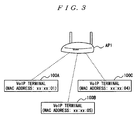
- an AP (Access Point) 1 as a base station of a wireless LAN as well as a VoIP terminal 100A (MAC address xx:xx:01), a VoIP terminal 100B (MAC address xx:xx:05), and a VoIP terminal 100C (MAC address xx:xx:04) as terminals of the wireless LAN mounted with IEEE 802.11 b, 802.11 e EDCA, and the present method constitute a wireless LAN network.
- VoIP terminals 100A and 100B are already communicating through VoIP and that the VoIP terminal 100C is connected to the AP 1 but is not communicating through VoIP at this point.
- the VoIP codec periods of the VoIP terminals 100A, 100B, and 100C are all 20 ms.
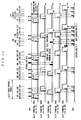
- FIG. 4 illustrates a sequence in which the VoId terminals 100A and 100B communicate with the AP 1 by VoIP packets as shown with times t1 to t8, while the VoIP terminal 100C participates later as shown with a time t21.
- the sequence diagram further depicts transmission priority periods (convex parts) of the VoIP terminals 100A, 100B, and 100C.
- the transmission priority periods are periods set up for the terminals to be able to transmit packets with priority over other terminals in accordance with the scheduling table.
- the VoIP terminals 100A and 100B perform transmission in the times t1 to t8 in accordance with already created and shared scheduling table.
- broadcast packets storing the scheduling tables describing an order of transmission by the terminals in the VoIP communication are periodically transmitted.
- the transmission is performed at times t1, t5, and t23 in the VoIP terminal 100A, at times t3, t7, and t27 in the VoIP terminal 100B, and at a time t25 in the VoIP terminal 100C.
- the VoIP terminal 100A transmits the scheduling table at a time t9. As shown with a time t10, not only the VoIP terminal 100B in VoIP communication, but also the VoIP terminal 100C that is not in VoIP communication but connected to the AP 1 receives the scheduling table packets transmitted by the VoIP terminal 100A. In this way, the terminal 100C that is not in VoIP communication can also recognize the VoIP communication schedule in the cell.
- the scheduling table transmitted at this point may have, for example, a MAC address as a terminal ID as shown in FIG. 5 .
- the VoIP terminal 100C creates a new table as shown in FIG. 6 in which the MAC address of the terminal is additionally written in the already held scheduling table as shown in FIG. 5 .
- the terminal 100C transmits the scheduling packets described with the new scheduling table by broadcasting at the time t21.
- the broadcast packets are relayed by the AP 1 and received by the VoIP terminals 100A and 100B at a time t22.
- An update time may also be described in the scheduling table.
- the update time denotes time information described when a terminal that updates the table actually rewrites the scheduling table.
- the VoIP terminals 100A and 100B update the scheduling tables held in the terminals when the update time of the received scheduling table is newer than the update time of the table held by the terminal and different from the order of transmission.
- the VoIP terminals 100A, 100B, and 100C share the new scheduling table.
- the VoIP terminals 100A, 100B, and 100C then set transmission periods of the terminals based on the new scheduling table as shown with the times t23, t25, and t27 and transmit VoIP packets based on the transmission periods. This realizes an update of the scheduling table when a new terminal starts communicating.
- the VoIP terminal 100C may transmit the scheduling table a plurality of times.
- the VoIP terminal 100C may also periodically broadcast the scheduling table. In this way, even if there is a terminal that has failed to receive the first broadcast packets of the scheduling table, the terminal can succeed in receiving the broadcast packets in a second or subsequent transmission.
- the above example is an example of the terminal periodically broadcasting the scheduling table, any of the following methods may be employed.
- the scheduling table may not be periodically broadcasted.
- the scheduling table may be broadcasted only when new communication is started. In this case, the sequence would be as shown in FIG. 7 .
- the VoIP terminal 100A As shown with times t30 and t31, it is assumed that only the VoIP terminal 100A is in VolP communication first.
- the VoIP terminal 100B then starts communicating at a time t32.
- the VoIP terminal 100C can receive the scheduling packets transmitted by the VoIP terminal 100B by broadcasting at the start of communication.
- the VoIP terminal 100C creates a new scheduling table upon the start of communication as shown with a time t38 and only has to transmit the new scheduling table through the AP 1 by broadcasting as shown with a time t39.
- This method is advantageous in that the overhead is small because the scheduling table does not have to be periodically transmitted.
- the scheduling table may not be shared if there is a terminal that has failed in the reception because the reception of the broadcast packets cannot be checked as the receiver does not return Ack (acknowledgment) packets.
- the method of periodically broadcasting the scheduling table achieves higher reliability for all terminals to receive the scheduling table by transmitting the scheduling table for a number of times.
- Each VoIP terminal described in the present invention comprises a hardware configuration shown in FIG. 1 and functional blocks shown in FIG. 2 .
- the configuration example of the wireless LAN network in the present embodiment is similar to the one in FIG. 3 .
- the VoIP terminals 100A, 100B, and 100C perform VoIP packet communication with the AP 1 in accordance with the scheduling table shown in FIG. 6 . Although only three terminals 100A, 100B, and 100C are described for the simplification of the description, any appropriate number of wireless terminals may exist. In the present embodiment, the VoIP codec periods of the VoIP terminals 100A, 100B, and 100C are all 20 ms.
- a scheduling method in the present technology in which the VoIP terminal 100C stops VoIP communication under these conditions will be described with reference to FIG. 8 .
- FIG. 8 illustrates a sequence in which the VoIP terminals 100A, 100B, and 100C communicate with the AP 1 by VoIP packets as shown with times t50 to t61, and the VoIP terminal 100C later stops the VoIP communication as shown with a time t62.
- the sequence diagram further depicts transmission priority periods (convex parts) of the VoIP terminals 100A, 100B, and 100C.
- the terminal 100C transmits a new scheduling table, in which the terminal information is removed, by broadcasting through the AP 1 as shown with times t62 and t63.
- a scheduling table described with information of only the VoIP terminals 100A and 100B as shown in FIG. 9 is transmitted.
- the VoIP terminal 100C may transmit the scheduling table immediately before the end of or immediately after the actual end of the VoIP communication.
- the scheduling table may be transmitted once or any appropriate number of times. This enables to inform the VoIP terminals 100A and 100B that the VoIP terminal 100C has ended communicating.
- the VoIP terminals 100A and 100B continue communicating based on the updated scheduling table as shown with times t64 to t71.
- the scheduling table at the end of communication is not transmitted, the following problems occur. If the VoIP terminal 100C arbitrarily ends communication, the transmission priority period of the VoIP terminal 100C is removed between the transmission priority periods of the VoIP terminal 100A and 100B. Furthermore, when a terminal that is not mounted with the present technology other than the terminals 100A, 100B, and 100C exists, the terminal may generate an interrupt by packet transmission. The sequence of transmitting in order according to the schedule may fall apart if an interrupt is generated. The second embodiment can prevent the problems from occurring.
- the VoIP terminal 100C may end the VoIP communication without transmitting anything. This is advantageous in that the overhead of transmitting the scheduling table is reduced.
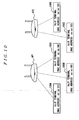
- each VoIP terminal described in the present embodiment comprises the hardware configuration shown in FIG. 1 and the functional blocks shown in FIG. 2 . It is also assumed that the configuration example of the wireless LAN network in the present embodiment has a configuration shown in FIG. 10 .
- the cell under the control of the AP 1 refers to a first cell, while the cell under the control of the AP 2 refers to a second cell.
- all terminals are VoIP terminals of wireless LAN mounted with IEEE 802.11 b, 802.11 e EDCA, and the present method.
- the VoIP terminal 100A (MAC address xx:xx:01), the VoIP terminal 100B (MAC address xx:xx:05), and the VoIP terminal 100C (MAC address xx:xx:04) exist in the first cell.
- a VoIP terminal 100D (MAC address xx:xx:03) and a VoIP terminal 100E (MAC address xx:xx:09) exist in the second cell.
- Each of the first cell and the second cell constitutes a wireless LAN network.
- the VoIP terminals 100A, 100B, and 100C perform VoIP packet communication with the AP 1 in the first cell in accordance with the scheduling table shown in FIG. 6 .
- the VoIP terminals 100D and 100E perform VoIP packet communication with the AP 2 in the second cell in accordance with a schedule shown in FIG. 11 .
- the VoIP codec periods of the terminals are all 20 ms in the present embodiment. Although two cells exist in the present embodiment, any appropriate number of the cells may exist.
- a scheduling method in the present technology in which the VoIP terminal 100C moves from the first cell to the second cell under these conditions with the VoIP communication being maintained will be described with reference to FIG. 11 .
- FIG. 11 illustrates a sequence in which the VoIP terminals 100A, 100B, and 100C communicate with the AP 1 by VoIP packets in accordance with the scheduling table shown in FIG. 6 , the VoIP terminals 100D and 100E communicate with the AP 2 by VoIP packets in accordance with the scheduling table shown in FIG. 11 , and as shown with a time t103, the VoIP terminal 100C later moves to the second cell with the VoIP communication maintained.
- the present sequence diagram further depicts transmission priority periods (convex parts) of the terminals 100A, 100B, 100C, 100D, and 100E.
- the VoIP terminal 100C first transmits a scheduling table, in which the terminal information of the VoIP terminal 100C is removed from the scheduling table of FIG. 6 , by broadcasting in order to inform other VoIP terminals 100A and 100B in the first cell that the VoIP terminal 100C will move out from the first cell.
- the scheduling table can be a table which is shown in FIG. 9 , for example.
- the scheduling table at the end of communication is not transmitted, the following problems occur. If the VoIP terminal 100C arbitrarily exits the first cell, the transmission priority period of the VoIP terminal 100C is removed between the transmission priority periods of the VoIP terminals 100A and 100B. Furthermore, when a terminal that is not mounted with the present technology other than the VoIP terminals 100A, 100B, and 100C exists, the terminal that is not mounted with the present technology may generate an interrupt by packet transmission. The sequence of transmitting in order according to the schedule may fall apart if an interrupt is generated. The third embodiment can prevent the problems from occurring.
- the VoIP terminal 100C Having moved to the second cell, the VoIP terminal 100C is not registered in the scheduling table of the second cell at first. Therefore, the VoIP terminal 100C performs a VoIP packet communication with the AP 2 by random access according to a normal wireless LAN access as shown with a time t103.
- a terminal in VoIP communication periodically transmits broadcast packets stored in a scheduling table described with an order of transmission.
- the VoIP terminal 100E performs the transmission as shown with times t85, t92, t101, t112, and t123.
- the VoIP terminal 100E performs the transmission, another terminal in the cell, i.e. the VoIP terminal 100D, may perform the transmission.
- the scheduling table can be a table which is shown in FIG. 12 .
- the VoIP terminal 100C After receiving the periodically broadcasted scheduling table of the second cell, the VoIP terminal 100C updates the scheduling table shown in FIG. 12 by additionally writing the terminal information of the VolP terminal 1 00C and then transmits the new scheduling table by broadcasting through the AP 2 as shown with a time t105.
- the new scheduling table can be a table which is shown in FIG. 13 .
- the new scheduling table among the terminals 100C, 100D, and 100E belonging to the second cell is updated.
- the terminals 100C, 100D, and 100E continue communicating based on the updated scheduling table.
- the transmission periods of the terminals in the scheduling table may have expiration time functions. More specifically, after a certain period has passed, the transmission period of the terminal may become invalid, and if the terminal still desires to set the transmission period, the terminal may transmit the scheduling table by broadcasting to inform other terminals.
- a transmission period setting time as shown in FIG. 14 is described as an element in a scheduling table example prior to the movement by the VoIP terminal 100C of the first cell in the present embodiment.
- the wireless communication device and the wireless communication method of the present invention are suitably available when performing priority control of communication with excellent quality in a network for communication in the CSMA/CA system.
Landscapes
- Engineering & Computer Science (AREA)
- Computer Networks & Wireless Communication (AREA)
- Signal Processing (AREA)
- Multimedia (AREA)
- Quality & Reliability (AREA)
- Mobile Radio Communication Systems (AREA)
- Small-Scale Networks (AREA)
Claims (6)
- Vorrichtung (100) für drahtlose Kommunikation, die dafür ausgelegt ist, Pakete anhand eines Paketübertragungssystems zu senden und zu empfangen, um Funkbandbreite durch eine virtuelle Trägererfassung zuzuweisen, wobei die Vorrichtung (100) für drahtlose Kommunikation umfasst:ein erstes Sendemittel (204) zum periodischen oder zeitweiligen Senden einer Zeitvorgabetabelle, die durch wenigstens eine von mehreren Vorrichtungen (100) für drahtlose Kommunikation erzeugt wird und von jeder der mehreren Vorrichtungen (100) für drahtlose Kommunikation gehalten und aktualisiert wird, zu einer drahtlosen Basisstation, wobei die Zeitvorgabetabelle wenigstens eine Reihenfolge des Sendens durch die Endgeräte und eine Aktualisierungszeit, die Zeitinformationen angibt, die beschrieben werden, wenn die wenigstens eine der mehreren Vorrichtungen (100) für drahtlose Kommunikation die Zeitvorgabetabelle aktualisiert, enthält;ein Erkennungs- und Haltemittel (202) zum Erkennen und Halten der Zeitvorgabetabelle die empfangen wird, wenn die Vorrichtung (100) für drahtlose Kommunikation mit der drahtlosen Basisstation verbunden ist und nicht mit einer weiteren Vorrichtung (100) für drahtlose Kommunikation kommuniziert;ein zweites Sendemittel zum zusätzlichen Schreiben von Informationen der Vorrichtung (100) für drahtlose Kommunikation in die Zeitvorgabetabelle, die durch das Erkennungs- und Haltemittel (202) gehalten wird, am Beginn der Kommunikation und zum wenigstens einmaligen Senden der zusätzlich geschriebenen Zeitvorgabetabelle;ein Aktualisierungsmittel (205) zum Aktualisieren der Zeitvorgabetabelle, die durch die Vorrichtung (100) für drahtlose Kommunikation gehalten wird, mit einer weiteren Zeitvorgabetabelle, wenn eine weitere Aktualisierungszeit der weiteren Zeitvorgabetabelle, die von der drahtlosen Basisstation empfangen wird, später ist als die Aktualisierungszeit der Zeitvorgabetabelle, die durch die Vorrichtung (100) für drahtlose Kommunikation gehalten wird, und wenn eine weitere Sendereihenfolge, die von der drahtlosen Basisstation empfangen wird, von der Sendereihenfolge in der Zeitvorgabetabelle, die durch die Vorrichtung (100) für drahtlose Kommunikation gehalten wird, verschieden ist; undein drittes Sendemittel (206) zum Kommunizieren nach dem Einstellen einer exklusiven oder bevorzugten Periode, in der Bandbreite verfügbar ist, in Übereinstimmung mit der durch das Aktualisierungsmittel (205) aktualisierten Zeitvorgabetabelle.
- Vorrichtung (100) für drahtlose Kommunikation nach Anspruch 1, wobei:das Aktualisierungsmittel (205) die Informationen der Vorrichtung (100) für drahtlose Kommunikation aus der Zeitvorgabetabelle unmittelbar vor dem Übergang in einen Zustand, in dem sie nur mit der drahtlosen Basisstation verbunden ist, oder unmittelbar nach einem Ende der Kommunikation, nachdem wenigstens eine der mehreren Vorrichtungen (100) für drahtlose Kommunikation, die kommuniziert hat, die Kommunikation entsprechend der Zeitvorgabetabelle beendet, löscht; unddas dritte Sendemittel (206) die Zeitvorgabetabelle, aus der die Informationen gelöscht werden, wenigstens einmal sendet.
- Vorrichtung (100) für drahtlose Kommunikation nach Anspruch 1, wobei:das Aktualisierungsmittel (205) die Informationen der Vorrichtung (100) für drahtlose Kommunikation aus der Zeitvorgabetabelle löscht, wenn sich wenigstens eine der mehreren Vorrichtungen (100) für drahtlose Kommunikation während der Kommunikation unter Aufrechterhaltung eines Kommunikationszustands aus einer Zelle, die einen momentanen Kommunikationsbereich der drahtlosen Basisstation bildet, zu einer weiteren Zelle, die eine weitere drahtlose Basisstation besitzt, in Übereinstimmung mit der Zeitvorgabetabelle bewegt; unddas dritte Sendemittel (206) die Zeitvorgabetabelle, aus der die Informationen gelöscht werden, zu der drahtlosen Basisstation wenigstens einmal sendet.
- Vorrichtung (100) für drahtlose Kommunikation nach Anspruch 3, wobei:das erste Sendemittel (204) durch zufälligen Zugriff unter Verwendung einer virtuellen Trägererfassung für eine vorgegebene Zeit kommuniziert, nachdem sich die Vorrichtung (100) für drahtlose Kommunikation zu einer weiteren Zelle bewegt hat; unddas zweite Sendemittel außerdem die Informationen der Vorrichtung (100) für drahtlose Kommunikation in die von der weiteren Vorrichtung (100) für drahtlose Kommunikation des Zufallszugriffs empfangene Zeitvorgabetabelle schreibt, nachdem sich die Vorrichtung (100) für drahtlose Kommunikation zu einer weiteren Zelle bewegt hat, und die zusätzlich geschriebene Zeitvorgabetabelle wenigstens einmal zu der drahtlosen Basisstation sendet.
- Vorrichtung (100) für drahtlose Kommunikation nach einem der Ansprüche 1 bis 4, wobei die Zeitvorgabetabelle eine Periode für gültiges Senden enthält, die nach Verstreichen einer vorgegebenen Periode ungültig wird.
- Verfahren für drahtlose Kommunikation zum Senden und Empfangen von Paketen anhand eines Paketübertragungssystems, um eine Funkbandbreite durch virtuelle Trägererfassung zuzuweisen, wobei das Verfahren für drahtlose Kommunikation umfasst:einen ersten Schritt zum periodischen oder zeitweiligen Senden einer Zeitvorgabetabelle, die durch wenigstens eine von mehreren Vorrichtungen (100) für drahtlose Kommunikation erzeugt wird und durch jede der mehreren Vorrichtungen (100) für drahtlose Kommunikation gehalten und aktualisiert wird, zu einer drahtlosen Basisstation, wobei die Zeitvorgabetabelle wenigstens eine Reihenfolge des Sendens durch die Endgeräte und eine Aktualisierungszeit, die Zeitinformationen angibt, die beschrieben werden, wenn die wenigstens eine der mehreren Vorrichtungen (100) für drahtlose Kommunikation die Zeitvorgabetabelle aktualisiert, enthält;einen zweiten Schritt zum Erkennen und Halten der Zeitvorgabetabelle, die empfangen wird, wenn die Vorrichtung (100) für drahtlose Kommunikation mit der drahtlosen Basisstation verbunden ist und nicht mit einer weiteren Vorrichtung (100) für drahtlose Kommunikation kommuniziert;einen dritten Schritt zum zusätzlichen Schreiben von Informationen der Vorrichtung (100) für drahtlose Kommunikation in die Zeitvorgabetabelle, die durch das Erkennungs- und Haltemittel (202) gehalten wird, am Beginn der Kommunikation und zum wenigstens einmaligen Senden der zusätzlich geschriebenen Zeitvorgabetabelle;einen vierten Schritt zum Aktualisieren der Zeitvorgabetabelle, die durch die Vorrichtung (100) für drahtlose Kommunikation gehalten wird, mit einer weiteren Zeitvorgabetabelle, wenn eine weitere Aktualisierungszeit der weiteren Zeitvorgabetabelle, die von der drahtlosen Basisstation (100) empfangen wird, später ist als die Aktualisierungszeit der Zeitvorgabetabelle, die von der Vorrichtung (100) für drahtlose Kommunikation gehalten wird, und eine weitere Sendereihenfolge, die von der drahtlosen Basisstation empfangen wird, von der Sendereihenfolge in der Zeitvorgabetabelle, die durch die Vorrichtung (100) für drahtlose Kommunikation gehalten wird, verschieden ist; undeinen fünften Schritt zum Kommunizieren, nachdem eine exklusive oder bevorzugte Periode, in der Bandbreite verfügbar ist, in Übereinstimmung mit der im vierten Schritt aktualisierten Zeitvorgabetabelle eingestellt worden ist.
Applications Claiming Priority (1)
| Application Number | Priority Date | Filing Date | Title |
|---|---|---|---|
| JP2007206711A JP5201498B2 (ja) | 2007-08-08 | 2007-08-08 | 無線通信装置及び無線通信方法 |
Publications (3)
| Publication Number | Publication Date |
|---|---|
| EP2023552A2 EP2023552A2 (de) | 2009-02-11 |
| EP2023552A3 EP2023552A3 (de) | 2011-11-30 |
| EP2023552B1 true EP2023552B1 (de) | 2012-12-05 |
Family
ID=39988498
Family Applications (1)
| Application Number | Title | Priority Date | Filing Date |
|---|---|---|---|
| EP20080013964 Ceased EP2023552B1 (de) | 2007-08-08 | 2008-08-05 | Drahtlose Kommunikationsvorrichtung und drahtloses Kommunikationsverfahren |
Country Status (4)
| Country | Link |
|---|---|
| US (1) | US8144677B2 (de) |
| EP (1) | EP2023552B1 (de) |
| JP (1) | JP5201498B2 (de) |
| CN (1) | CN101364943B (de) |
Families Citing this family (5)
| Publication number | Priority date | Publication date | Assignee | Title |
|---|---|---|---|---|
| US10178677B2 (en) | 2012-12-03 | 2019-01-08 | Sony Corporation | Transmission of control information to reduced bandwidth terminals |
| CN111526528B (zh) * | 2015-10-28 | 2024-04-05 | 中兴通讯股份有限公司 | 竞争窗调整方法和装置 |
| CN106533833B (zh) * | 2016-11-24 | 2019-09-10 | 重庆邮电大学 | 一种降低载波侦听多路访问资源冲突的方法 |
| CN107124372A (zh) * | 2017-04-28 | 2017-09-01 | 杭州万高通信技术有限公司 | 一种基于零交越可用区间的讯框传输方法及其装置 |
| JP7835467B2 (ja) * | 2022-04-29 | 2026-03-25 | ウィルス インスティテュート オブ スタンダーズ アンド テクノロジー インコーポレイティド | 無線通信システムにおいて信号を送信する方法及び装置 |
Family Cites Families (15)
| Publication number | Priority date | Publication date | Assignee | Title |
|---|---|---|---|---|
| JP2001053745A (ja) | 1999-08-11 | 2001-02-23 | Nippon Telegr & Teleph Corp <Ntt> | 無線パケット通信システム |
| US6788702B1 (en) * | 1999-10-15 | 2004-09-07 | Nokia Wireless Routers, Inc. | Protocol for neighborhood-established transmission scheduling |
| US20040013135A1 (en) * | 2002-07-17 | 2004-01-22 | Yoram Haddad | System and method for scheduling traffic in wireless networks |
| US7580394B2 (en) * | 2002-11-27 | 2009-08-25 | Nokia Corporation | System and method for collision-free transmission scheduling in a network |
| JP4042901B2 (ja) | 2002-11-28 | 2008-02-06 | Kddi株式会社 | 無線端末およびその無線アクセス制御方法 |
| JP2004186935A (ja) * | 2002-12-03 | 2004-07-02 | Mitsubishi Electric Corp | タイムスロット割当方法及び無線局 |
| ES2528360T3 (es) * | 2003-02-03 | 2015-02-09 | Sony Corporation | Sistema de radiocomunicación, dispositivo de radiocomunicación, método de radiocomunicación y programa informático |
| JP4582098B2 (ja) | 2003-02-03 | 2010-11-17 | ソニー株式会社 | 無線通信システム、通信装置、通信方法及びプログラム |
| US20040219919A1 (en) * | 2003-04-30 | 2004-11-04 | Nicholas Whinnett | Management of uplink scheduling modes in a wireless communication system |
| KR100584326B1 (ko) * | 2003-06-03 | 2006-05-26 | 삼성전자주식회사 | 무선 통신 시스템에서 근거리 통신 시스템 및 방법 |
| US7412265B2 (en) * | 2003-06-12 | 2008-08-12 | Industrial Technology Research Institute | Method and system for power-saving in a wireless local area network |
| JP4880316B2 (ja) * | 2006-02-08 | 2012-02-22 | 株式会社エヌ・ティ・ティ・ドコモ | 無線通信装置及び無線通信方法 |
| JP4799213B2 (ja) * | 2006-02-28 | 2011-10-26 | 株式会社エヌ・ティ・ティ・ドコモ | 無線通信端末及び無線通信方法 |
| KR101389680B1 (ko) * | 2007-02-06 | 2014-05-27 | 엘지전자 주식회사 | 무선 통신 시스템 및 이를 구성하는 단말장치와 베이스스테이션 그리고 이들의 채널 스케줄링 방법 |
| US8325627B2 (en) * | 2007-04-13 | 2012-12-04 | Hart Communication Foundation | Adaptive scheduling in a wireless network |
-
2007
- 2007-08-08 JP JP2007206711A patent/JP5201498B2/ja not_active Expired - Fee Related
-
2008
- 2008-08-05 EP EP20080013964 patent/EP2023552B1/de not_active Ceased
- 2008-08-07 CN CN2008101449188A patent/CN101364943B/zh not_active Expired - Fee Related
- 2008-08-08 US US12/188,786 patent/US8144677B2/en not_active Expired - Fee Related
Also Published As
| Publication number | Publication date |
|---|---|
| JP5201498B2 (ja) | 2013-06-05 |
| EP2023552A2 (de) | 2009-02-11 |
| CN101364943B (zh) | 2012-04-04 |
| US20090040991A1 (en) | 2009-02-12 |
| EP2023552A3 (de) | 2011-11-30 |
| CN101364943A (zh) | 2009-02-11 |
| US8144677B2 (en) | 2012-03-27 |
| JP2009044411A (ja) | 2009-02-26 |
Similar Documents
| Publication | Publication Date | Title |
|---|---|---|
| JP5295882B2 (ja) | 無線通信装置 | |
| EP4369797A1 (de) | Drx-konfigurationsverfahren und -vorrichtung, endgerätevorrichtung und netzwerkvorrichtung | |
| US10172146B2 (en) | Wi-Fi and bluetooth coexistence | |
| US11770752B2 (en) | Managing control plane latency for integrated access and backhaul | |
| CN102217395B (zh) | 无线通信系统中用于信道预留的装置和方法 | |
| US20090300457A1 (en) | Method and Apparatus for Improving HARQ Uplink Transmission | |
| CN107079470B (zh) | 用于许可辅助接入的媒体接入控制 | |
| US8081967B2 (en) | Method to manage medium access for a mixed wireless network | |
| CN116250314A (zh) | 用户设备及其在非授权频谱中进行侧链通信的方法 | |
| US8416799B2 (en) | Systems, methods and apparatuses for wireless communication | |
| US20200068601A1 (en) | Resource scheduling method and device | |
| CN112423391B (zh) | 资源指示方法及装置 | |
| US8848676B1 (en) | Apparatus and method for coexistent wireless and bluetooth communication employing interruption of arbitration requests to allocate use of a shared antenna | |
| EP4192149B1 (de) | Cg-konfigurationsverfahren und -vorrichtung sowie vorrichtung und medium | |
| JP5932162B2 (ja) | 一時的媒体ハンドオーバ | |
| US8144677B2 (en) | Wireless communication device and wireless communication method | |
| CN113647171B (zh) | 无线通信的方法和设备 | |
| KR100801876B1 (ko) | 무선랜 및 블루투스를 이용한 음성 데이터 전송 방법 및시스템 | |
| US20240057049A1 (en) | Resource indication method, apparatus, and system | |
| KR100741383B1 (ko) | 무선랜 및 블루투스를 이용한 음성 데이터 전송 방법 및시스템 | |
| US20250159553A1 (en) | Transmission latency mitigation for voice over new radio (vonr) | |
| US20050013325A1 (en) | Method for transmitting multimedia data in wireless network | |
| CN120752992A (zh) | 控制无线电网络的接入 | |
| US10271352B2 (en) | Wireless communication system and associated wireless communication method and wireless device having efficient polling mechanism in overlapping network environments | |
| US11412542B2 (en) | Scheduled transmission |
Legal Events
| Date | Code | Title | Description |
|---|---|---|---|
| PUAI | Public reference made under article 153(3) epc to a published international application that has entered the european phase |
Free format text: ORIGINAL CODE: 0009012 |
|
| 17P | Request for examination filed |
Effective date: 20080805 |
|
| AK | Designated contracting states |
Kind code of ref document: A2 Designated state(s): AT BE BG CH CY CZ DE DK EE ES FI FR GB GR HR HU IE IS IT LI LT LU LV MC MT NL NO PL PT RO SE SI SK TR |
|
| AX | Request for extension of the european patent |
Extension state: AL BA MK RS |
|
| PUAL | Search report despatched |
Free format text: ORIGINAL CODE: 0009013 |
|
| AK | Designated contracting states |
Kind code of ref document: A3 Designated state(s): AT BE BG CH CY CZ DE DK EE ES FI FR GB GR HR HU IE IS IT LI LT LU LV MC MT NL NO PL PT RO SE SI SK TR |
|
| AX | Request for extension of the european patent |
Extension state: AL BA MK RS |
|
| RIC1 | Information provided on ipc code assigned before grant |
Ipc: H04W 72/12 20090101AFI20111021BHEP |
|
| REG | Reference to a national code |
Ref country code: DE Ref legal event code: R079 Ref document number: 602008020543 Country of ref document: DE Free format text: PREVIOUS MAIN CLASS: H04L0012560000 Ipc: H04W0072120000 |
|
| GRAP | Despatch of communication of intention to grant a patent |
Free format text: ORIGINAL CODE: EPIDOSNIGR1 |
|
| RIC1 | Information provided on ipc code assigned before grant |
Ipc: H04W 72/12 20090101AFI20120613BHEP |
|
| AKX | Designation fees paid |
Designated state(s): DE GB |
|
| GRAS | Grant fee paid |
Free format text: ORIGINAL CODE: EPIDOSNIGR3 |
|
| GRAA | (expected) grant |
Free format text: ORIGINAL CODE: 0009210 |
|
| AK | Designated contracting states |
Kind code of ref document: B1 Designated state(s): DE GB |
|
| REG | Reference to a national code |
Ref country code: GB Ref legal event code: FG4D |
|
| REG | Reference to a national code |
Ref country code: DE Ref legal event code: R096 Ref document number: 602008020543 Country of ref document: DE Effective date: 20130131 |
|
| PLBE | No opposition filed within time limit |
Free format text: ORIGINAL CODE: 0009261 |
|
| STAA | Information on the status of an ep patent application or granted ep patent |
Free format text: STATUS: NO OPPOSITION FILED WITHIN TIME LIMIT |
|
| 26N | No opposition filed |
Effective date: 20130906 |
|
| REG | Reference to a national code |
Ref country code: DE Ref legal event code: R097 Ref document number: 602008020543 Country of ref document: DE Effective date: 20130906 |
|
| PGFP | Annual fee paid to national office [announced via postgrant information from national office to epo] |
Ref country code: DE Payment date: 20180724 Year of fee payment: 11 |
|
| PGFP | Annual fee paid to national office [announced via postgrant information from national office to epo] |
Ref country code: GB Payment date: 20180801 Year of fee payment: 11 |
|
| REG | Reference to a national code |
Ref country code: DE Ref legal event code: R119 Ref document number: 602008020543 Country of ref document: DE |
|
| GBPC | Gb: european patent ceased through non-payment of renewal fee |
Effective date: 20190805 |
|
| PG25 | Lapsed in a contracting state [announced via postgrant information from national office to epo] |
Ref country code: DE Free format text: LAPSE BECAUSE OF NON-PAYMENT OF DUE FEES Effective date: 20200303 |
|
| PG25 | Lapsed in a contracting state [announced via postgrant information from national office to epo] |
Ref country code: GB Free format text: LAPSE BECAUSE OF NON-PAYMENT OF DUE FEES Effective date: 20190805 |