EP2018454B1 - Grundbauverfahren - Google Patents
Grundbauverfahren Download PDFInfo
- Publication number
- EP2018454B1 EP2018454B1 EP07733649A EP07733649A EP2018454B1 EP 2018454 B1 EP2018454 B1 EP 2018454B1 EP 07733649 A EP07733649 A EP 07733649A EP 07733649 A EP07733649 A EP 07733649A EP 2018454 B1 EP2018454 B1 EP 2018454B1
- Authority
- EP
- European Patent Office
- Prior art keywords
- soil
- site
- compaction
- steps
- excavated
- Prior art date
- Legal status (The legal status is an assumption and is not a legal conclusion. Google has not performed a legal analysis and makes no representation as to the accuracy of the status listed.)
- Active
Links
Images



Classifications
-
- E—FIXED CONSTRUCTIONS
- E02—HYDRAULIC ENGINEERING; FOUNDATIONS; SOIL SHIFTING
- E02D—FOUNDATIONS; EXCAVATIONS; EMBANKMENTS; UNDERGROUND OR UNDERWATER STRUCTURES
- E02D27/00—Foundations as substructures
- E02D27/26—Compacting soil locally before forming foundations; Construction of foundation structures by forcing binding substances into gravel fillings
-
- E—FIXED CONSTRUCTIONS
- E02—HYDRAULIC ENGINEERING; FOUNDATIONS; SOIL SHIFTING
- E02D—FOUNDATIONS; EXCAVATIONS; EMBANKMENTS; UNDERGROUND OR UNDERWATER STRUCTURES
- E02D3/00—Improving or preserving soil or rock, e.g. preserving permafrost soil
- E02D3/12—Consolidating by placing solidifying or pore-filling substances in the soil
- E02D3/123—Consolidating by placing solidifying or pore-filling substances in the soil and compacting the soil
-
- E—FIXED CONSTRUCTIONS
- E02—HYDRAULIC ENGINEERING; FOUNDATIONS; SOIL SHIFTING
- E02D—FOUNDATIONS; EXCAVATIONS; EMBANKMENTS; UNDERGROUND OR UNDERWATER STRUCTURES
- E02D3/00—Improving or preserving soil or rock, e.g. preserving permafrost soil
- E02D3/02—Improving by compacting
- E02D3/026—Improving by compacting by rolling with rollers usable only for or specially adapted for soil compaction, e.g. sheepsfoot rollers
Definitions
- This invention relates to a ground engineering method.
- it relates to a method for modifying geotechnically unsuitable soils at a site so as to render the site capable of load bearing.
- Piling is however a time consuming, labour intensive, and costly procedure which moreover does not necessarily alleviate all of the problems presented by the presence of geotechnically unsuitable soils.
- the weaker upper layers of soil are left unchanged, they continue to exhibit undesirable properties - most notably in the case of clay soils the tendency to expand and contract in the presence or absence of water, and in the case of soils having air pockets or 'voids' therein , the tendency to settle.
- the geotechnically unsuitable soil layers are not uniform, such expansion, contraction and settlement may occur to differing degrees across a site. This leads to differential settlement of the site, which can ultimately lead to subsidence in the foundations of the buildings constructed thereon, causing cracks in masonry, and damage to drains and other subterranean infrastructure.
- Soil stabilisation is primarily used to dry out material which is too wet, and to modify chemically the make-up of the soils to enhance their weight-bearing capabilities.
- This process typically involves treating a hydrated clay soil with an anhydrous material such as lime, so as to reduce the water content of the soil, and to initiate a chemical reaction resulting in modification of the chemical structure of the soil so as to remove its capacity to shrink or heave in the future.
- anhydrous material such as lime
- Compaction requires the physical application of a load to the ground, so as to force the soil particles closer together, thereby expelling air.
- a number of compaction techniques are available, the type selected being determined by the depth of influence required. Good prior art examples are known from JP-A-2005076414 and EP-A-0443960 .
- Standard compaction techniques involve mechanically driving a cylindrical roller over an area of ground so as continuously to compact the soil layers therebeneath.
- Dynamic compaction improves the mechanical properties of the soil by repeated application of very high intensity impacts to the surface, achieved by dropping a weight across the surface to be compacted.
- the effective depth of the treatment will be determined by the magnitude of the weight and the height of the drop.
- Dynamic compaction has been found to have an influence on soils in excess of 20m below ground level. The type of dynamic compaction selected will depend on the geotechnical conditions to be addressed.
- rolling dynamic compaction has been developed, as in WO-A-96/27713 , in which a roller having a non-circular cross-section is used.
- RDC rollers have been developed having generally polygonal cross-sections with 3, 4, or 5 sides.
- the principle behind rolling dynamic compaction is that as the non-circular roller is driven across the ground and caused to rotate, one apex after another will be raised to a zenith, thus effectively gaining potential energy, before being released by compression springs to fall under gravity. The potential energy is thus converted into kinetic energy, which in turn is transferred to the soil when the apex reaches the lowest point of its cycle upon impact with the surface of the ground.
- Rolling dynamic compaction is capable of delivering significantly greater loads to the soil than dead weight or vibrating compaction, due to the height and weight multiplier factor which is inherent in its design. As a result, whilst other compaction methods are capable of delivering a high degree of compaction to soil layers near the surface of the ground, rolling dynamic compaction has been found to achieve compaction of soils in excess of 5m below the surface.
- the present invention stems from the realisation that, contrary to the beliefs of many within the construction industry, the techniques of soil stabilisation and rolling dynamic compaction can be adapted to work together in synergy.
- the present invention therefore seeks to combine these two traditionally disparate techniques in a single ground engineering method, whereby geotechnically unsuitable soils are modified so as to render them capable of load bearing.
- the present invention further seeks substantially to reduce or eliminate the need for piling and "dig and dump" techniques to be carried out at sites comprising geotechnically unsuitable soils. This will result in construction projects benefiting from significant cost savings, shorter construction times and reduced environmental impact.
- the present invention further seeks to deliver a method whereby a geotechnically unsuitable site is modified such that the risk of differential settlement following construction on the site is substantially reduced or eliminated.
- a method of modifying geotechnically unsuitable soils at a site so as to render the site capable of load bearing results from the soil stabilisation processes breaking down the structure of the soil, thus enabling the rolling dynamic compaction step(s) to expel air and water, thus causing compaction and consolidation. It is also believed that soil stabilisation improves the soil strength, so that more dynamic force can be applied during rolling dynamic compaction, thereby increasing the compaction and consolidation effect. In order to achieve this synergistic effect however, the soil stabilisation process must be adapted from conventional treatments - that is to say, the soils must be modified in excess of normal techniques, and in particular must have a moisture content of less than the standard optimum moisture content.
- the method of the present invention is performed according to a sequence comprising the following steps:
- the soil stabilisation treatments in steps (b) and (c) preferably involve treating the soil with one or more powder or binder materials selected from cement, lime (calcium oxide), pulverised fuel ash (PFA) and ground granulated blast-furnace slag (GGBS).
- the powder or binder materials are preferably selected so as to provide autogenous 'healing' properties, to enable the soil to recover its strength after the application of RDC.
- lime is particularly preferred, since anhydrous calcium oxide reacts with the water of hydration in the soil so as effectively to remove water from the soil, according to the following exothermic reaction, in which the heat produced also causes further drying of the soil by evaporation: CaO + H 2 O ⁇ Ca(OH) 2
- the calcium oxide is preferably mixed into the soil at the base of the excavated site by rotavation, to a depth of substantially 300mm.
- the soil stabilisation treatment applied to the excavated soil in step (c) also preferably includes a step of mixing the calcium oxide with the excavated soil.
- the soil stabilisation treatments in steps (b) and (c) are preferably continued until the moisture content of the treated soil is reduced to substantially 3% less than the standard optimum moisture content for the type of soil being treated.
- the rolling dynamic compaction treatment carried out in steps (d) and (h) may be performed with any suitable construction of RDC roller, however it is currently preferred to use a 4-sided, 8 or 12-tonne roller for this treatment.
- Rolling dynamic compaction is preferably continued until effective refusal is achieved (i.e. until no further compaction of the underlying ground is possible). In practice, this is likely to be achieved after in the range of 20 to 40 passes of the RDC roller for the base layer in step (d) and after 20 passes for the compound layers in step (h).
- step (f) need not be rolling dynamic compaction, since only the individual layers of backfilled material are required to be compacted in this step, rather than compacting areas deeper below the site surface, as in steps (d) and (h).
- the required zone of compaction influence is in step (f) is therefore typically only in the range of from 300 to 600 mm.
- compaction with a vibrating cylindrical roller is utilised in step (f), and is continued until substantially 95% compaction of the layer formed in step (e) is achieved, as measured by the Proctor dry density test.
- the method of the present invention eliminates the need for costly or environmentally unsound techniques such as piling or 'dig and dump' at a site comprising geotechnically unsuitable soils, by excavating, modifying, backfilling, compacting and consolidating the soils.
- the resultant backfilled site then comprises a system of re-engineered soils, which, in addition to exhibiting load-bearing capabilities sufficient to allow construction on the site, also effectively acts as a single mass due to the extensive consolidation and compaction. This effectively eliminates the risk of differential settlement, and hence subsidence, at the site.
- the soil stabilisation steps (b) and (c) preferably include soil modification treatment so as to prevent the subsequent swelling and contraction of the clay soils in the presence of water.
- an additional step is included, between steps (d) and (e), whereby there is introduced into the excavated site an additional layer having pipes for connection to a geothermal heating system.
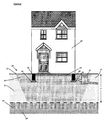
- FIG. 1 there is shown a site, generally indicated 20 in which the upper strata 21, immediately beneath the surface 22 of the ground, comprises geotechnically unsuitable or weak soils, down to a depth x of around 3m.
- Beneath the upper strata 21 is a natural ground strata 23, which although potentially geotechnically superior to the upper strata 21 is similarly incapable of supporting the stresses incurred in the piling technique illustrated in Figure 1 .
- Underlying the natural ground strata 23 is a load-bearing strata 24 to which any load resultant from construction on the site 20 must be transferred in order to achieve stability.
- piles 25 are driven down through the upper strata of geotechnically unsuitable soils 21, through the intermediary natural ground strata 23 and into the load-bearing strata 24.
- reinforced concrete beams 26 At the upper ends of the piles 25 are formed reinforced concrete beams 26 upon which is constructed a suspended floor 27 having an integral void 28 therewithin.
- a building 30 is then constructed upon the suspended floor 27.
- the reinforced concrete beams 26 and piles 25 serve to transfer the load imparted by the building 30 to the load-bearing strata 24, effectively by-passing the upper strata of geotechnically unsuitable soils 21, and the intermediary natural ground strata 23.
- drainage and paving 31 since drainage and paving 31 is located in the zone of geotechnically unsuitable soils 21, it must be formed with a flexible construction so as to account for any differential settlement, expansion or contraction of the upper strata 21.
- FIG. 2 there is shown an essentially identical basic site 20, comprising the same three strata as in Figure 1 , namely: an upper strata of geotechnically unsuitable soils 21, an intermediary natural ground strata 23 and a deep underlying load bearing strata 24.
- the site 20 has been re-engineered according to the method of the present invention, so as to eliminate the need for piling.
- FIG. 2 a section of the upper strata 21 has been excavated, modified, backfilled, consolidated and compacted to form a 'raft' 32 of re-engineered soils capable of supporting the required bearing pressure attributable to traditional foundations 33, such as would be used at a site comprising geotechnically sound soils.
- An important factor in the example shown in Figure 2 is that the intermediary natural ground strata 23 is capable of supporting the required bearing pressure attributable to the raft 32 of re-engineered soils, whereas the same strata 23 is incapable of supporting the pile stresses resultant from conventional piling techniques as illustrated in Figure 1 .
- the method of the present invention enables the load imparted by the building 30 to be dissipated over a large area of the site 20, rather than concentrated at specific points, as with the conventional piling technique illustrated in Figure 1 .
- the method of the present invention eliminates the need for re-inforced concrete beams 26 and piles 25 and instead allows the building 30 to be constructed on traditional foundations 33 incorporating a stone slab 34 and strip footings 35 set into the raft 32 of re-engineered soils. Since the drainage and paving 31 are now located within the raft 32 rather than in the surrounding zone of geotechnically unsuitable soils 21, they can now be formed with a fixed, rather than a flexible, construction. The raft 32 of re-engineered soils will exhibit uniform properties of settlement, expansion and contraction, thus effectively eliminating the risk of subsidence.
- FIG. 3 shows the site 20 in its original condition, before being re-engineered according to the method of the present invention.
- the site 20 comprises an upper strata of geotechnically unsuitable soils 21 immediately beneath the surface 22, an intermediary strata of natural ground 23 incapable of bearing normal stresses associated with conventional piling techniques, and a deep strata 24 having load-bearing capabilities.
- the method of the present invention begins with the preliminary steps of: (i) investigating the site to determine the characteristics of the soils in the various strata 21, 23, 24; and (ii) determining the building load and design requirements. From the data acquired in these steps a further preliminary step (iii) is carried out, in which the parameters of the ensuing process are determined. These parameters included the required excavation depth x , the required composition of the soil stabilisation treatment formulations, the required individual backfill layer thickness, the required compound layer thickness, and the required backfill level, as will be described in more detail below.
- the main part of the method of the present invention commences with a step (a) of excavating a volume of geotechnically unsuitable soil from the upper strata 21 of the site 20, down to a depth x as determined in preliminary step (iii).
- the excavation depth x is generally around 3m.
- the excavated soil (not shown) is not removed from the site 20 for disposal, but rather is retained for soil stabilisation treatment, following which it will be used to backfill the excavated site 40, as will be described in more detail below.
- This aspect of the present invention alone represents a major cost saving, and a major reduction in environmental impact, due to the reduction in lorry movements which would normally be required when using a conventional 'dig and dump' process.
- any contaminated materials identified during the preliminary site investigation step (i) can be modified to make them safe from leaching, and then buried at the bottom 41 of the excavated site, away from possible human contact, and isolated from drainage and other services.
- Another option is the incorporation of pipes (not shown) for a geothermal heating system, which can be incorporated at the base 41 of the excavated site, i . e . at a depth x of around 3m. This is particularly advantageous since the depth of installation is key to the efficiency of such systems, whilst the pipes would also be protected deep under the building 30, away from other services and infrastructure.
- a supplementary step (iv) is carried out, wherein the condition of the soil is tested and monitored so as to ascertain and verify the extent of consolidation and compaction.
- step (b) and (c) are performed, wherein soil stabilisation treatments are applied, respectively, to the newly exposed base surface 41 at the bottom of the excavated site 40, and to the volume of soil excavated from the site 40. Both steps involve treating the soil with a formulation comprising calcium oxide or other suitable binders, and mixing said formulation into the soil.
- the exposed base surface 41 is then subjected to rolling dynamic compaction (RDC) in step (d), using a four-sided RDC roller 42, as represented schematically in Figure 4 .
- RDC rolling dynamic compaction
- the Application of RDC proves out the base 41 by identifying any soft spots, and utilises the synergistic properties of stabilisation and dynamic compaction as the soft spots identified are dug out and replaced with suitably modified material.
- the base 41 is over-dried such that the base layer 41 then acts as a capillary to absorb any moisture generated from the RDC process. However, if the base surface 41 deteriorates during the RDC process, then the soil stabilisation step (b) must be repeated.
- compaction to the top 300mm of the base layer 41 is carried out using a vibrating cylindrical roller 45.
- this illustrates the subsequent step (e) of re-introducing into the excavated site 40 a portion of the soil which was excavated from the site 40 in step (a) and treated in step (c).
- the re-introduced treated soil forms a layer 43, of generally around 200 to 300 mm thickness.
- the top of the re-introduced soil layer 43 forms a new exposed surface 44, which is then subject to standard compaction in step (f) using a cylindrical roller 45, as represented schematically in Figure 5 .
- the next step (g) of the method involves repeating steps (e) and (f) of forming layers 43 of re-introduced treated soil and applying standard compaction 45 to the newly exposed surface 44. This cycle is repeated until the total depth of the formed layers 43 reaches a pre-determined thickness y , generally in the range of from 1.0 to 1.5 m, as shown in Figure 6 .
- the multiple layers 43 are then subjected to a step (h) of applying rolling dynamic compaction 42 to the newly formed exposed surface 44 so as to form a compound layer 46, as can be seen in Figure 7 .
- the RDC process instep (h) proves out the compound layer 46 in the same way as described above for step (d) with reference to Figure 4 .
- next method step (j) involves repeating the previous cycle of method steps (e) to (h): new layers 43 are added and the newly formed exposed surface 44 compacted under standard compaction 45 until the total thickness y of newly added layers 43 reaches a pre-determined value; rolling dynamic compaction 45 is then applied to the surface 44 of the newly added layers 43 so as to compact them into the compound layer 46; and this cycle is repeated until the excavated site 40 is effectively filled, and the level of the formed surface 44 is substantially equal to the level of the surface 22 of the original site 20, as shown in Figure 10 .
- the level of the formed surface 44 is in fact generally 100mm higher than the surface 22 of the original site 20, to allow for consolidation during the final compaction steps.
- the surface 22/44 of the site 20/40 is then subjected to a final treatment of rolling dynamic compaction 42 so as to compact the new layers 43 and compound layer 46 to form a raft 32 of modified soils, with a depth substantially equal to x as shown in Figure 11 . Any excess material is then trimmed back to the required final surface level 22/44.
Landscapes
- Engineering & Computer Science (AREA)
- Life Sciences & Earth Sciences (AREA)
- Structural Engineering (AREA)
- Paleontology (AREA)
- General Engineering & Computer Science (AREA)
- Civil Engineering (AREA)
- General Life Sciences & Earth Sciences (AREA)
- Mining & Mineral Resources (AREA)
- Soil Sciences (AREA)
- Environmental & Geological Engineering (AREA)
- Agronomy & Crop Science (AREA)
- Processing Of Solid Wastes (AREA)
- Investigation Of Foundation Soil And Reinforcement Of Foundation Soil By Compacting Or Drainage (AREA)
- Curing Cements, Concrete, And Artificial Stone (AREA)
- Compounds Of Unknown Constitution (AREA)
- Acyclic And Carbocyclic Compounds In Medicinal Compositions (AREA)
Claims (15)
- Ein Verfahren zum Modifizieren geotechnisch ungeeigneten Erdreichs an einem Bauplatz, um den Bauplatz zum Tragen von Last tauglich zu machen, wobei das Verfahren folgende Schritte umfasst:- (a) Ausschachten eines Volumens des Erdreichs bis zu einer vorgegebenen Tiefe;- (b) Durchführung einer In-Situ-Erdreichstabilisierungsbehandlung am Grund des ausgekofferten Bauplatzes, der durch den Schritt (a) freigelegt wurde;- (c) Durchführen einer Erdreichstabilisierungsbehandlung an dem Volumen des aus dem Bauplatz in dem Schritt (a) ausgekofferten Erdreichs;- (d) Durchführen einer dynamischen Walzenverdichtung am Grund des ausgekofferten Bauplatzes, der in Schritt (a) freigelegt wurde;- (e) Wiedereinfüllen eines Teils des in Schritt (c) behandelten Erdreichs in den ausgekofferten Bauplatz, um eine Lage mit einer vorbestimmten Dicke zu erhalten;- (f) Durchführen einer Verdichtung an der Lage, die in Schritt (e) gebildet wurde;- (g) Wiederholen der Schritte (e) und (f), um eine Verbundlage einer vorbestimmten Dicke zu bilden;- (h) Durchführen einer dynamischen Neuverdichtung an der Verbundlage, die in Schritt (g) gebildet wurde; und- (j) Wiederholen der Schritte (e) bis (h), um den Bauplatz bis zu einem vorbestimmten Füllstand wieder zu befüllen;
und wobei in der Erdreichstabilisierungsbehandlung gemäß Schritt (b) der Grund übertrocknet wird, so dass die Bodenlage dann als Kapilar zum Absorbieren eventueller Feuchtigkeit, die während des Schrittes (d) entsteht, agiert. - Ein Verfahren nach Anspruch 1, in dem die Erdreichstabilisierungsbehandlung gemäß den Schritten (b) und (c) die Behandlung des Erdreichs mit einem oder mehreren Pulvern oder Bindermaterial umfasst, welches aus Zement, Kalk, (Calciumoxid), Flugasche (PFA) und gemahlenem Schlackensand (GGBS) ausgewählt ist.
- Ein Verfahren nach Anspruch 1 oder 2, in dem eine gewöhnliche Verdichtung in Schritt (f) durchgeführt wird.
- Ein Verfahren nach Anspruch 3, in dem die übliche Verdichtung in Schritt (f) durchgeführt wird, bis im wesentlichen 95% der Verdichtung der Schicht, die in Schritt (e) gebildet wurde, erreicht ist.
- Ein Verfahren nach einem der vorhergehenden Ansprüche, in dem die dynamische Rollenverdichtung in Schritt (h) durchgeführt wird, bis eine effektive Verdichtung erreicht ist.
- Ein Verfahren nach einem der vorhergehenden Ansprüche, in dem die Erdreichstabilisierungsbehandlung in den Schritten (b) und (c) durchgeführt wird, bis Feuchtigkeitsbestandteile des behandelten Erdreichs bis im wesentlichen 3% weniger als dem üblichen optimalen Feuchtigkeitsgehalt für den Typ des behandelten Erdreichs reduziert ist.
- Ein Verfahren gemäß einem der vorherstehenden Ansprüche, weiterhin umfassend die vorläufigen Schritte von:- (i) Untersuchen des Bauplatzes, um die Erdreichscharakteristik zu ermitteln;- (ii) Ermitteln der Gebäudelast und Konstruktionsanforderungen; und- (iii) Bereitstellen der Daten der vorläufigen Schritte (i) und (ii), um die erforderliche Auskofferungstiefe für Schritt (a), die erforderliche Rezeptur für das Erdreichstabilisierungsbehandlungsmaterial für die Schritte (b) und (c), die erforderliche Schichtdicke für Schritt (e), die erforderliche Verbundschichtdicke für Schritt (g) und den erforderlichen Rückfüllungsgrad für Schritt (j) zu ermitteln
- Ein Verfahren nach Anspruch 9, in dem jedes kontaminierte Material, welches bei dem vorläufigen Schritt (i) identifiziert wurde, isoliert, zum Verhindern eines Auslaugen modifiziert und am Grund des ausgekofferten Bauplatzes in Schritt (a) begraben wird.
- Ein Verfahren nach einem der vorhergehenden Ansprüche, in dem die Auskofferungstiefe in Schritt (a) sich in einem Bereich von 2 m bis 5 m und vorzugsweise bei im Wesentlichen 3 m befindet.
- Ein Verfahren nach einem der vorhergehenden Ansprüche, in dem die Schichtdicke gemäß Schritt (e) sich in einem Bereich von 200 mm bis 300 mm befindet.
- Ein Verfahren nach einem der vorhergehenden Ansprüche, in dem die Verbundschichtdicke in Schritt (g) sich in einem Bereich von 1 m bis 1,5 m befindet.
- Ein Verfahren nach einem der vorhergehenden Ansprüche, welches weiterhin den ergänzenden Schritt umfasst:- (iv) Testen und Monitoren der Sollkonditionen nach jedem der Schritte (a) bis (j), um den Grad der Konsolidierung und Verdichtung nach jedem der Verfahrensschritte sicherzustellen und zu verifizieren und das Verfahren, falls erforderlich, geeignet zu modifizieren.
- Ein Verfahren nach einem der vorhergehenden Ansprüche, in dem der Rückfüllgrad in Schritt (j) im wesentlichen 100 mm höher als der ursprüngliche Oberflächenlevel ist, um eine Konsolidierung während nachfolgender Verdichtungsschritte zu ermöglichen:
- Ein Verfahren nach einem der vorhergehenden Ansprüche, welches den zusätzlichen Verfahrensschritt aufweist:- (v) nachfolgend zu Schritt (d) und vor dem Schritt (e) wird in den ausgekofferten Bauplatz eine zusätzliche Lage eingebracht, welche Rohre darin aufweist, um diese mit einem geothermalen Heizsystem zu verbinden.
- Ein Verfahren nach einem der vorhergehenden Ansprüche, in dem das zu behandelnde Erdreich ausdehnungsfähiges Lehmerdreich umfasst und in dem der/die Erdreichbehandlungsschritt(e) eine Erdreichsmodifizierungsbehandlung umfassen, um ein nachfolgendes Schrumpfen und Schwellen des ausdehnungsfähigen Lehmerdreichs zu verhindern.
Applications Claiming Priority (2)
| Application Number | Priority Date | Filing Date | Title |
|---|---|---|---|
| GB0608901A GB2437960B (en) | 2006-05-08 | 2006-05-08 | Ground engineering method |
| PCT/GB2007/050228 WO2007129112A1 (en) | 2006-05-08 | 2007-05-01 | Ground engineering method |
Publications (2)
| Publication Number | Publication Date |
|---|---|
| EP2018454A1 EP2018454A1 (de) | 2009-01-28 |
| EP2018454B1 true EP2018454B1 (de) | 2009-08-12 |
Family
ID=36603982
Family Applications (1)
| Application Number | Title | Priority Date | Filing Date |
|---|---|---|---|
| EP07733649A Active EP2018454B1 (de) | 2006-05-08 | 2007-05-01 | Grundbauverfahren |
Country Status (7)
| Country | Link |
|---|---|
| US (1) | US7661907B2 (de) |
| EP (1) | EP2018454B1 (de) |
| AT (1) | ATE439476T1 (de) |
| DE (1) | DE602007001973D1 (de) |
| ES (1) | ES2331819T3 (de) |
| GB (1) | GB2437960B (de) |
| WO (1) | WO2007129112A1 (de) |
Families Citing this family (13)
| Publication number | Priority date | Publication date | Assignee | Title |
|---|---|---|---|---|
| GB2478130B (en) * | 2010-02-25 | 2015-10-21 | Nicholas James Wincott | Load bearing construction pile |
| US8898996B2 (en) * | 2011-09-27 | 2014-12-02 | Maurice Garzon | Method for forming a retaining wall, and corresponding retaining wall |
| US11796225B2 (en) | 2012-10-18 | 2023-10-24 | American Piledriving Equipment, Inc. | Geoexchange systems including ground source heat exchangers and related methods |
| JP2015034439A (ja) * | 2013-08-09 | 2015-02-19 | 兼松日産農林株式会社 | 地盤改良構造および地盤改良工法 |
| JP2016011569A (ja) * | 2014-06-30 | 2016-01-21 | タマチ電機株式会社 | 半固化砂利洗浄土、その製造方法及びそれらを用いた地盤形成方法 |
| CN104358245B (zh) * | 2014-11-12 | 2016-06-29 | 中国电建集团华东勘测设计研究院有限公司 | 一种水工建筑物软基处理的方法 |
| CA2992668A1 (en) * | 2015-07-17 | 2017-01-26 | Thur S.R.L. | Method for improving the mechanical and hydraulic characteristics of foundation grounds of existing built structures |
| PE20181213A1 (es) * | 2015-11-16 | 2018-07-24 | Maurice Garzon | Metodo para formar un terreno de cimentacion estable |
| JP6436256B1 (ja) * | 2017-07-04 | 2018-12-12 | 株式会社タケウチ建設 | 建築物の基礎構造、及びその施工方法 |
| CN110344420A (zh) * | 2019-07-30 | 2019-10-18 | 北京首钢建设集团有限公司 | 一种低洼区域内先回填土后施工基础的方法 |
| CN110674995B (zh) * | 2019-09-27 | 2023-08-25 | 中科路恒工程设计有限公司 | 一种环保、经济约束条件下的路线优化方法 |
| CN112683233B (zh) * | 2020-12-15 | 2021-10-26 | 温州鼎玛建筑技术有限公司 | 一种建筑物沉降检测方法 |
| US11953237B2 (en) | 2021-08-12 | 2024-04-09 | Bernard J. Gochis | Piles providing support and geothermal heat exchange |
Family Cites Families (13)
| Publication number | Priority date | Publication date | Assignee | Title |
|---|---|---|---|---|
| FR443960A (fr) | 1911-07-26 | 1912-10-07 | Genossenschaft Fuer Textilpate | Dispositif pour métiers à tisser avec changement automatique des canettes servant à saisir et à maintenir l'extrémité du fil soufflée de la canette au moyen de l'air comprimé, au moment de l'échange et pendant l'enfilement dans la navette |
| US3898844A (en) * | 1971-09-24 | 1975-08-12 | Louis Menard | Method of compacting made-up ground and natural soil of mediocre quality |
| FR2292681A2 (fr) | 1974-11-29 | 1976-06-25 | Lafarge Sa | Ciment riche en chaux vive |
| GB1583425A (en) * | 1977-05-25 | 1981-01-28 | South African Inventions | Method of operating a compaction roller assembly and a compaction roller assembly |
| JPS5996321A (ja) * | 1982-11-25 | 1984-06-02 | Mitsubishi Heavy Ind Ltd | 基礎施工機 |
| FR2563852B1 (fr) * | 1984-05-07 | 1987-06-26 | Sif Entreprise Bachy | Procede et dispositif pour la realisation en place de colonnes de sol stabilise et compacte. |
| JPS63138014A (ja) * | 1986-11-29 | 1988-06-10 | Sekisui House Ltd | 建築用地盤改良工法 |
| DE3936351A1 (de) | 1989-11-02 | 1991-05-08 | Montana Handels Und Transportg | Aufbereitung von kontaminationsflaechen zur erzielung von bauland |
| FR2658545B1 (fr) * | 1990-02-22 | 1996-10-11 | Lefoll Pierre | Procede pour la construction d'un batiment sur un sol deformable et compressible et batiment ainsi construit. |
| GB9504345D0 (en) * | 1995-03-03 | 1995-04-19 | Compaction Tech Soil Ltd | Method and apparatus for monitoring soil compaction |
| DE10023189A1 (de) | 2000-03-23 | 2001-10-11 | A & U Abfallwirtschaft & Umwel | Verwendung von aschenhaltigen Materialien und Verfahren zur Verbesserung der Verdichtungsfähigkeit von Böden |
| HU225407B1 (en) * | 2002-07-08 | 2006-11-28 | Vilmos Bela Matyas | Procedure for augmentation physical parameters and bearing capacity of ground and for diminution time of consolidation and expected consolidation settlement of thereof |
| JP2005076414A (ja) | 2003-09-03 | 2005-03-24 | Mikio Umeoka | 建物基礎地盤の改良工法 |
-
2006
- 2006-05-08 GB GB0608901A patent/GB2437960B/en not_active Expired - Lifetime
-
2007
- 2007-05-01 DE DE602007001973T patent/DE602007001973D1/de active Active
- 2007-05-01 ES ES07733649T patent/ES2331819T3/es active Active
- 2007-05-01 WO PCT/GB2007/050228 patent/WO2007129112A1/en not_active Ceased
- 2007-05-01 EP EP07733649A patent/EP2018454B1/de active Active
- 2007-05-01 US US12/227,101 patent/US7661907B2/en not_active Expired - Fee Related
- 2007-05-01 AT AT07733649T patent/ATE439476T1/de not_active IP Right Cessation
Also Published As
| Publication number | Publication date |
|---|---|
| GB2437960B (en) | 2008-08-13 |
| GB0608901D0 (en) | 2006-06-14 |
| WO2007129112A1 (en) | 2007-11-15 |
| DE602007001973D1 (de) | 2009-09-24 |
| US7661907B2 (en) | 2010-02-16 |
| ATE439476T1 (de) | 2009-08-15 |
| GB2437960A (en) | 2007-11-14 |
| ES2331819T3 (es) | 2010-01-15 |
| EP2018454A1 (de) | 2009-01-28 |
| US20090110489A1 (en) | 2009-04-30 |
Similar Documents
| Publication | Publication Date | Title |
|---|---|---|
| EP2018454B1 (de) | Grundbauverfahren | |
| Patel | Geotechnical investigations and improvement of ground conditions | |
| Han | Principles and practice of ground improvement | |
| KR100634261B1 (ko) | 짧은 골재 피어 기술 | |
| CN108368685A (zh) | 稳定基础地面成型方法 | |
| Zhang et al. | Stabilization of expansive soil with polyvinyl alcohol and potassium carbonate | |
| Feng et al. | Elimination of loess collapsibility with application to construction and demolition waste during dynamic compaction | |
| Spaulding et al. | Ground improvement technologies for a sustainable world | |
| Kuranchie et al. | Load–settlement behaviour of a strip footing resting on iron ore tailings as a structural fill | |
| JP3894893B2 (ja) | 基礎地盤の施工法 | |
| Abdel-Rahman | Review of soil improvement techniques | |
| Bilal et al. | A study on advances in ground improvement techniques | |
| JP2006124962A (ja) | 直接基礎工法及びそれを用いた建造物並びに直接基礎構造 | |
| IE20060363A1 (en) | Ground engineering method | |
| IE85299B1 (en) | Ground engineering method | |
| Makowski et al. | Application of jet grouting technology for the renovation of historic buildings | |
| CN205954647U (zh) | 真空降水高频挤密微型桩专用设备 | |
| Divya et al. | Techniques of ground improvement and its applications | |
| RU2351711C1 (ru) | Способ изготовления в раскатанных скважинах набивной сваи из шлаков | |
| Rubright et al. | Compaction grouting | |
| CN204875831U (zh) | 一种表层土就地固化与桩组合承载的地基结构 | |
| Gitskin et al. | Settlement of building floor slab-on-grade constructed on unsuitable urban fill in Chicago | |
| JP2611564B2 (ja) | 埋戻し工法 | |
| Choudhary et al. | Assessment of Liquefaction and Extent of Ground Improvement | |
| JP2003221825A (ja) | 基礎地盤の施工法 |
Legal Events
| Date | Code | Title | Description |
|---|---|---|---|
| PUAI | Public reference made under article 153(3) epc to a published international application that has entered the european phase |
Free format text: ORIGINAL CODE: 0009012 |
|
| 17P | Request for examination filed |
Effective date: 20081205 |
|
| AK | Designated contracting states |
Kind code of ref document: A1 Designated state(s): AT BE BG CH CY CZ DE DK EE ES FI FR GB GR HU IE IS IT LI LT LU LV MC MT NL PL PT RO SE SI SK TR |
|
| AX | Request for extension of the european patent |
Extension state: AL BA HR MK RS |
|
| GRAP | Despatch of communication of intention to grant a patent |
Free format text: ORIGINAL CODE: EPIDOSNIGR1 |
|
| GRAS | Grant fee paid |
Free format text: ORIGINAL CODE: EPIDOSNIGR3 |
|
| GRAA | (expected) grant |
Free format text: ORIGINAL CODE: 0009210 |
|
| AK | Designated contracting states |
Kind code of ref document: B1 Designated state(s): AT BE BG CH CY CZ DE DK EE ES FI FR GB GR HU IE IS IT LI LT LU LV MC MT NL PL PT RO SE SI SK TR |
|
| REG | Reference to a national code |
Ref country code: GB Ref legal event code: FG4D |
|
| REG | Reference to a national code |
Ref country code: CH Ref legal event code: EP |
|
| REG | Reference to a national code |
Ref country code: IE Ref legal event code: FG4D |
|
| REF | Corresponds to: |
Ref document number: 602007001973 Country of ref document: DE Date of ref document: 20090924 Kind code of ref document: P |
|
| REG | Reference to a national code |
Ref country code: ES Ref legal event code: FG2A Ref document number: 2331819 Country of ref document: ES Kind code of ref document: T3 |
|
| LTIE | Lt: invalidation of european patent or patent extension |
Effective date: 20090812 |
|
| PG25 | Lapsed in a contracting state [announced via postgrant information from national office to epo] |
Ref country code: AT Free format text: LAPSE BECAUSE OF FAILURE TO SUBMIT A TRANSLATION OF THE DESCRIPTION OR TO PAY THE FEE WITHIN THE PRESCRIBED TIME-LIMIT Effective date: 20090812 Ref country code: LT Free format text: LAPSE BECAUSE OF FAILURE TO SUBMIT A TRANSLATION OF THE DESCRIPTION OR TO PAY THE FEE WITHIN THE PRESCRIBED TIME-LIMIT Effective date: 20090812 Ref country code: IS Free format text: LAPSE BECAUSE OF FAILURE TO SUBMIT A TRANSLATION OF THE DESCRIPTION OR TO PAY THE FEE WITHIN THE PRESCRIBED TIME-LIMIT Effective date: 20091212 Ref country code: SE Free format text: LAPSE BECAUSE OF FAILURE TO SUBMIT A TRANSLATION OF THE DESCRIPTION OR TO PAY THE FEE WITHIN THE PRESCRIBED TIME-LIMIT Effective date: 20090812 Ref country code: FI Free format text: LAPSE BECAUSE OF FAILURE TO SUBMIT A TRANSLATION OF THE DESCRIPTION OR TO PAY THE FEE WITHIN THE PRESCRIBED TIME-LIMIT Effective date: 20090812 |
|
| PG25 | Lapsed in a contracting state [announced via postgrant information from national office to epo] |
Ref country code: PL Free format text: LAPSE BECAUSE OF FAILURE TO SUBMIT A TRANSLATION OF THE DESCRIPTION OR TO PAY THE FEE WITHIN THE PRESCRIBED TIME-LIMIT Effective date: 20090812 Ref country code: SI Free format text: LAPSE BECAUSE OF FAILURE TO SUBMIT A TRANSLATION OF THE DESCRIPTION OR TO PAY THE FEE WITHIN THE PRESCRIBED TIME-LIMIT Effective date: 20090812 Ref country code: LV Free format text: LAPSE BECAUSE OF FAILURE TO SUBMIT A TRANSLATION OF THE DESCRIPTION OR TO PAY THE FEE WITHIN THE PRESCRIBED TIME-LIMIT Effective date: 20090812 |
|
| PG25 | Lapsed in a contracting state [announced via postgrant information from national office to epo] |
Ref country code: PT Free format text: LAPSE BECAUSE OF FAILURE TO SUBMIT A TRANSLATION OF THE DESCRIPTION OR TO PAY THE FEE WITHIN THE PRESCRIBED TIME-LIMIT Effective date: 20091212 Ref country code: BG Free format text: LAPSE BECAUSE OF FAILURE TO SUBMIT A TRANSLATION OF THE DESCRIPTION OR TO PAY THE FEE WITHIN THE PRESCRIBED TIME-LIMIT Effective date: 20091112 |
|
| PG25 | Lapsed in a contracting state [announced via postgrant information from national office to epo] |
Ref country code: CZ Free format text: LAPSE BECAUSE OF FAILURE TO SUBMIT A TRANSLATION OF THE DESCRIPTION OR TO PAY THE FEE WITHIN THE PRESCRIBED TIME-LIMIT Effective date: 20090812 Ref country code: RO Free format text: LAPSE BECAUSE OF FAILURE TO SUBMIT A TRANSLATION OF THE DESCRIPTION OR TO PAY THE FEE WITHIN THE PRESCRIBED TIME-LIMIT Effective date: 20090812 Ref country code: DK Free format text: LAPSE BECAUSE OF FAILURE TO SUBMIT A TRANSLATION OF THE DESCRIPTION OR TO PAY THE FEE WITHIN THE PRESCRIBED TIME-LIMIT Effective date: 20090812 Ref country code: EE Free format text: LAPSE BECAUSE OF FAILURE TO SUBMIT A TRANSLATION OF THE DESCRIPTION OR TO PAY THE FEE WITHIN THE PRESCRIBED TIME-LIMIT Effective date: 20090812 |
|
| PG25 | Lapsed in a contracting state [announced via postgrant information from national office to epo] |
Ref country code: SK Free format text: LAPSE BECAUSE OF FAILURE TO SUBMIT A TRANSLATION OF THE DESCRIPTION OR TO PAY THE FEE WITHIN THE PRESCRIBED TIME-LIMIT Effective date: 20090812 |
|
| PLBE | No opposition filed within time limit |
Free format text: ORIGINAL CODE: 0009261 |
|
| STAA | Information on the status of an ep patent application or granted ep patent |
Free format text: STATUS: NO OPPOSITION FILED WITHIN TIME LIMIT |
|
| 26N | No opposition filed |
Effective date: 20100517 |
|
| PG25 | Lapsed in a contracting state [announced via postgrant information from national office to epo] |
Ref country code: GR Free format text: LAPSE BECAUSE OF FAILURE TO SUBMIT A TRANSLATION OF THE DESCRIPTION OR TO PAY THE FEE WITHIN THE PRESCRIBED TIME-LIMIT Effective date: 20091113 |
|
| PG25 | Lapsed in a contracting state [announced via postgrant information from national office to epo] |
Ref country code: MC Free format text: LAPSE BECAUSE OF NON-PAYMENT OF DUE FEES Effective date: 20100531 |
|
| PG25 | Lapsed in a contracting state [announced via postgrant information from national office to epo] |
Ref country code: IT Free format text: LAPSE BECAUSE OF NON-PAYMENT OF DUE FEES Effective date: 20100501 |
|
| PG25 | Lapsed in a contracting state [announced via postgrant information from national office to epo] |
Ref country code: MT Free format text: LAPSE BECAUSE OF FAILURE TO SUBMIT A TRANSLATION OF THE DESCRIPTION OR TO PAY THE FEE WITHIN THE PRESCRIBED TIME-LIMIT Effective date: 20090812 Ref country code: IE Free format text: LAPSE BECAUSE OF NON-PAYMENT OF DUE FEES Effective date: 20100501 |
|
| PGFP | Annual fee paid to national office [announced via postgrant information from national office to epo] |
Ref country code: ES Payment date: 20110629 Year of fee payment: 5 Ref country code: FR Payment date: 20110610 Year of fee payment: 5 |
|
| PGFP | Annual fee paid to national office [announced via postgrant information from national office to epo] |
Ref country code: BE Payment date: 20110525 Year of fee payment: 5 Ref country code: NL Payment date: 20110530 Year of fee payment: 5 |
|
| PGFP | Annual fee paid to national office [announced via postgrant information from national office to epo] |
Ref country code: IT Payment date: 20110512 Year of fee payment: 5 Ref country code: DE Payment date: 20110509 Year of fee payment: 5 |
|
| REG | Reference to a national code |
Ref country code: CH Ref legal event code: PL |
|
| PG25 | Lapsed in a contracting state [announced via postgrant information from national office to epo] |
Ref country code: LI Free format text: LAPSE BECAUSE OF NON-PAYMENT OF DUE FEES Effective date: 20110531 Ref country code: CH Free format text: LAPSE BECAUSE OF NON-PAYMENT OF DUE FEES Effective date: 20110531 |
|
| REG | Reference to a national code |
Ref country code: GB Ref legal event code: 732E Free format text: REGISTERED BETWEEN 20120726 AND 20120801 |
|
| PG25 | Lapsed in a contracting state [announced via postgrant information from national office to epo] |
Ref country code: CY Free format text: LAPSE BECAUSE OF FAILURE TO SUBMIT A TRANSLATION OF THE DESCRIPTION OR TO PAY THE FEE WITHIN THE PRESCRIBED TIME-LIMIT Effective date: 20090812 |
|
| PG25 | Lapsed in a contracting state [announced via postgrant information from national office to epo] |
Ref country code: LU Free format text: LAPSE BECAUSE OF NON-PAYMENT OF DUE FEES Effective date: 20100501 Ref country code: HU Free format text: LAPSE BECAUSE OF FAILURE TO SUBMIT A TRANSLATION OF THE DESCRIPTION OR TO PAY THE FEE WITHIN THE PRESCRIBED TIME-LIMIT Effective date: 20100213 |
|
| PG25 | Lapsed in a contracting state [announced via postgrant information from national office to epo] |
Ref country code: TR Free format text: LAPSE BECAUSE OF FAILURE TO SUBMIT A TRANSLATION OF THE DESCRIPTION OR TO PAY THE FEE WITHIN THE PRESCRIBED TIME-LIMIT Effective date: 20090812 |
|
| BERE | Be: lapsed |
Owner name: AQS HOLDINGS LTD Effective date: 20120531 |
|
| REG | Reference to a national code |
Ref country code: NL Ref legal event code: V1 Effective date: 20121201 |
|
| PG25 | Lapsed in a contracting state [announced via postgrant information from national office to epo] |
Ref country code: BE Free format text: LAPSE BECAUSE OF NON-PAYMENT OF DUE FEES Effective date: 20120531 Ref country code: IT Free format text: LAPSE BECAUSE OF NON-PAYMENT OF DUE FEES Effective date: 20120501 |
|
| REG | Reference to a national code |
Ref country code: FR Ref legal event code: ST Effective date: 20130131 |
|
| REG | Reference to a national code |
Ref country code: DE Ref legal event code: R119 Ref document number: 602007001973 Country of ref document: DE Effective date: 20121201 |
|
| PG25 | Lapsed in a contracting state [announced via postgrant information from national office to epo] |
Ref country code: NL Free format text: LAPSE BECAUSE OF NON-PAYMENT OF DUE FEES Effective date: 20121201 |
|
| PG25 | Lapsed in a contracting state [announced via postgrant information from national office to epo] |
Ref country code: FR Free format text: LAPSE BECAUSE OF NON-PAYMENT OF DUE FEES Effective date: 20120531 |
|
| PG25 | Lapsed in a contracting state [announced via postgrant information from national office to epo] |
Ref country code: DE Free format text: LAPSE BECAUSE OF NON-PAYMENT OF DUE FEES Effective date: 20121201 |
|
| REG | Reference to a national code |
Ref country code: ES Ref legal event code: FD2A Effective date: 20130724 |
|
| PG25 | Lapsed in a contracting state [announced via postgrant information from national office to epo] |
Ref country code: ES Free format text: LAPSE BECAUSE OF NON-PAYMENT OF DUE FEES Effective date: 20120502 |
|
| PGFP | Annual fee paid to national office [announced via postgrant information from national office to epo] |
Ref country code: GB Payment date: 20260305 Year of fee payment: 20 |