EP2018155B1 - Verfahren zur reversiblen konzentration von liposomen - Google Patents
Verfahren zur reversiblen konzentration von liposomen Download PDFInfo
- Publication number
- EP2018155B1 EP2018155B1 EP07731392.2A EP07731392A EP2018155B1 EP 2018155 B1 EP2018155 B1 EP 2018155B1 EP 07731392 A EP07731392 A EP 07731392A EP 2018155 B1 EP2018155 B1 EP 2018155B1
- Authority
- EP
- European Patent Office
- Prior art keywords
- liposomes
- cyclodextrin
- liposome
- aggregates
- cyclodextrins
- Prior art date
- Legal status (The legal status is an assumption and is not a legal conclusion. Google has not performed a legal analysis and makes no representation as to the accuracy of the status listed.)
- Active
Links
Images




Classifications
-
- A—HUMAN NECESSITIES
- A61—MEDICAL OR VETERINARY SCIENCE; HYGIENE
- A61K—PREPARATIONS FOR MEDICAL, DENTAL OR TOILETRY PURPOSES
- A61K8/00—Cosmetics or similar toiletry preparations
- A61K8/02—Cosmetics or similar toiletry preparations characterised by special physical form
- A61K8/14—Liposomes; Vesicles
-
- A—HUMAN NECESSITIES
- A61—MEDICAL OR VETERINARY SCIENCE; HYGIENE
- A61K—PREPARATIONS FOR MEDICAL, DENTAL OR TOILETRY PURPOSES
- A61K47/00—Medicinal preparations characterised by the non-active ingredients used, e.g. carriers or inert additives; Targeting or modifying agents chemically bound to the active ingredient
- A61K47/30—Macromolecular organic or inorganic compounds, e.g. inorganic polyphosphates
- A61K47/36—Polysaccharides; Derivatives thereof, e.g. gums, starch, alginate, dextrin, hyaluronic acid, chitosan, inulin, agar or pectin
- A61K47/40—Cyclodextrins; Derivatives thereof
-
- A—HUMAN NECESSITIES
- A61—MEDICAL OR VETERINARY SCIENCE; HYGIENE
- A61K—PREPARATIONS FOR MEDICAL, DENTAL OR TOILETRY PURPOSES
- A61K8/00—Cosmetics or similar toiletry preparations
- A61K8/18—Cosmetics or similar toiletry preparations characterised by the composition
- A61K8/72—Cosmetics or similar toiletry preparations characterised by the composition containing organic macromolecular compounds
- A61K8/73—Polysaccharides
-
- A—HUMAN NECESSITIES
- A61—MEDICAL OR VETERINARY SCIENCE; HYGIENE
- A61K—PREPARATIONS FOR MEDICAL, DENTAL OR TOILETRY PURPOSES
- A61K9/00—Medicinal preparations characterised by special physical form
- A61K9/10—Dispersions; Emulsions
- A61K9/127—Synthetic bilayered vehicles, e.g. liposomes or liposomes with cholesterol as the only non-phosphatidyl surfactant
-
- A—HUMAN NECESSITIES
- A61—MEDICAL OR VETERINARY SCIENCE; HYGIENE
- A61Q—SPECIFIC USE OF COSMETICS OR SIMILAR TOILETRY PREPARATIONS
- A61Q19/00—Preparations for care of the skin
Definitions
- the present invention relates to a series of methods for the preparation of liposome-cyclodextrin mixed aggregates, and liposomes, as claimed, the mixed liposome-cyclodextrin aggregates obtainable according to the method of claim 1, and their uses in the pharmaceutical, diagnostic or cosmetic field.
- Liposomes are vesicles (a few tens of nanometers to several microns) delimited by one or more (phospho) lipid bilayers enclosing an aqueous volume. These structures thus result from the arrangement of amphiphilic molecules generally dispersed in a large excess of a continuous aqueous phase.
- the hydrophilic parts or polar heads of (phospho) lipids are oriented on both sides of the bimolecular layers constituting the bilayers, always in contact with the aqueous continuum, while their chains form the core of the membranes, minimizing their contact with the membrane. water.
- liposomes are nano- or micro-reservoirs that can contain and convey all types of products. Their actual and potential applications also affect other sectors ranging from basic biology to the agro-food or agrochemical industry (cell model, gene transfer, chemical or enzymatic reactors, formulation of pesticides, etc.).
- Liposomes can also be concentrated by lyophilization. However, most often, when the lyophilizate is rehydrated, there is a change in the initial characteristics of the liposomes.
- Cyclodextrins are cyclic oligosaccharides composed of glucopyranose units linked together by an oside linkage alpha (1-4), derived from starch. Their chiral macrocyclic structure takes the form of a truncated cone delimiting a very hydrophobic internal cavity (hydrocarbon backbones of the glucose units) while the external part remains hydrophilic (hydroxyl groups of the glucose units).
- cyclodextrins There is a wide variety of natural or modified cyclodextrins that are the subject of numerous studies and applications in the fields of basic research, the pharmaceutical industry, cosmetics, agri-food or agrochemical.
- cyclodextrins include poly (cyanoacrylate) nanospheres formed in the presence of cyclodextrins [anionic emulsion polymerization], nanocapsules with oily content or matrix nanoparticles composed of amphiphilic cyclodextrins [nanoprecipitation processes, solvent emulsion-evaporation, elimination of mixed micelle surfactant], ethylcellulose microspheres encapsulating cyclodextrin-hydrophobic active ingredient complexes [emulsion-solvent evaporation process], microcapsules [prepared by interfacial cross-linking of beta-cyclodextrin with terephthaloyl chloride], beads [ simple mixture of alpha-cyclodextrin and triglycerides].
- Liposome-cyclodextrin systems have also been described. These systems are in the form of liposomes encapsulating in their aqueous compartment a cyclodextrin-active ingredient complex. They are prepared by making the liposomes in the presence of the cyclodextrin-active compound complex. Liposomes are produced in a large excess of water and in no case can concentrated mixed aggregates [liposomes-cyclodextrins] be described.
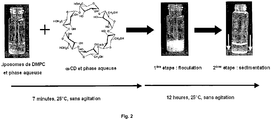
- the inventors have unexpectedly demonstrated that the addition of cyclodextrins to liposomes in aqueous dispersion makes it possible to cause the flocculation then the sedimentation of the liposomes, whereby a concentration of liposomes in the form of mixed aggregates liposomes -cyclodextrins is obtained.
- These mixed aggregates are stable in the state, combine the individual properties of liposomes and cyclodextrins and are also easily freeze-dried.
- the lyophilizate can be hydrated without the initial structure of the liposomes being affected.
- the liposomes may contain host substances without the latter being lost during the process. They can also be redispersed by simple dilution (reversible system).
- this method of aggregation and disaggregation does not involve the use of organic solvents, nor a heating step, nor a significant consumption of energy.
- it does not modify the physicochemical characteristics of the starting entities, which constitutes an advance of great interest in the field of liposome concentration.
- this method of concentrating liposomes does not require special equipment such as centrifuges. No agitation is required.
- the manufacturing process does not involve organic solvents or heating, which has an advantage in terms of safety.
- the invention thus provides means of great simplicity and low cost for concentrating and redispersing liposomes usable in many sectors of the industry.
- liposome-cyclodextrin mixed aggregates obtained by concentration of liposomes in the presence of cyclodextrins are generally micron size and can advantageously find new applications by combining the properties of liposomes and cyclodextrins.
- the invention describes a method for concentrating liposomes comprising a step of forming mixed liposome-cyclodextrin aggregates by contacting liposomes dispersed in aqueous medium with cyclodextrins.
- cyclodextrin is meant cyclic oligosaccharides composed of an ⁇ -1,4 linkage of at least six water-soluble, starch-derived D-glucopyranose units having a hydrophobic cavity capable of trapping lipophilic molecules.
- the cyclodextrins within the meaning of the present description include natural cyclodextrins or their derivatives, provided however that the latter are water-soluble, exhibit no detergency or solubilizing properties and do not develop specific interactions with the lipids constituting the liposomes which could generate the loss of the vesicular structure thereof when using the method.
- Natural cyclodextrins are cyclic oligosaccharides obtained by enzymatic hydrolysis of the starch. They include the cyclodextrins ⁇ , ⁇ and ⁇ (respectively comprising 6, 7 or 8 glucose units), ⁇ -cyclodextrins being particularly preferred.
- the cyclodextrin derivatives denote natural cyclodextrins whose native structure has been modified by covalent bonding of one or more chemical groups, in particular hydrophilic groups. It may be, for example, a natural cyclodextrin at least one of the hydroxyl functions is substituted by a saccharide group.
- the cyclodextrin derivatives within the meaning of the present description also include polymerized cyclodextrins.
- All or part of the cyclodextrins useful according to the process of the invention may be implemented in the form of an inclusion complex, ie contain a small hydrophobic molecule, hereinafter referred to as "host molecule".
- host molecules include molecules that can develop spectroscopic properties (such as dyes or pigments), radioactive elements (such as iodine), therapeutic active ingredients (such as certain vitamins, anti-inflammatories).
- liposome is meant a vesicle whose wall is formed of one or more bilayers of amphiphilic molecules containing an aqueous internal space, said amphiphilic molecules comprising a polar head and hydrophobic residues, most often alkyl chains or "tails". hydrophobic ".
- the bilayer (s) of the liposomes comprise phospholipids.
- liposome may designate a biological cell, prokaryotic or eukaryotic, animal or plant, or a reconstituted biological membrane type "ghost" ("ghost").
- phosphatidylcholine As an example of phospholipids, mention may be made of phosphatidylcholine (PC) and its derivatives: egg phosphatidylcholine (Egg-PC), dimyristoylphosphatidylcholine (DMPC), dipalmitoylphosphatidylcholine (DPPC), dioleoylphosphatidylcholine (DOPC), dilauroylphosphatidylcholine ( DLPC), distearoylphosphatidylcholine (DSPC), diarachidoylphosphatidylcholine (DAPC) and dilinoleoylphosphatidylcholine (DLPC).
- Egg-PC egg phosphatidylcholine
- DMPC dimyristoylphosphatidylcholine
- DPPC dipalmitoylphosphatidylcholine
- DOPC dioleoylphosphatidylcholine
- DLPC distearoylphosphat
- phospholipids for example comprising a glycerol group bonded to two fatty acid chains and whose polar head is different from phosphatidylcholine, may be used according to the method of the invention.
- amphiphilic molecules may partly enter into the composition of liposome bilayers (cholesterol, lipids whose polar head is modified by a hydrophilic group, cationic lipids, fluorescent lipids, etc.).
- the liposomes comprise mainly phospholipids.
- the liposomes according to the present invention do not comprise amphiphilic molecules modified by grafting hydrophilic polymers, such as those described in US Pat. WO 2005/0300170 , whose interaction with cyclodextrins leads to the destabilization of the liposome.
- the liposomes can be prepared according to conventional techniques, among which mention may be made of ultrasonic irradiation, phase inversion, extrusion, dialysis, resin absorption or gel filtration. Mixed micelles lipid-detergent, freeze-thaw.
- liposomes can be prepared by hydrating a phospholipid film followed by sequenced extrusion to calibrate the vesicles.
- the aqueous medium can be pure water or a buffered aqueous medium, especially at a pH of between 6 and 8, or an aqueous medium containing a monovalent salt, especially a cation and a monovalent anion, such as chloride sodium.
- the latter can be added at a preferred concentration less than or equal to 150 mM.
- buffers useful according to the invention are in particular phosphate buffer, PBS buffer, Hepes buffer, Hepes buffer + NaCl.
- the buffers advantageously make it possible to prolong the stability over time of the concentrated mixed liposome-cyclodextrin aggregates obtained according to the process.
- the molar concentration of liposomes in the aqueous medium is not critical and may vary to a large extent. Preferably, it is greater than 0.05 mM, and is more preferably between 0.5 mM and 5 mM.
- the molar concentration of liposomes refers here to the molar concentration of the amphiphilic molecules such as the phospholipids constituting the bilayer (s) of the liposome wall.
- the concentration of cyclodextrins in the aqueous medium is not critical and can vary between 10 mM and 80 mM, especially between 20 mM and 40 mM, especially for dioloylphosphatidylcholine liposomes.
- the molar cyclodextrin / liposome concentration ratio in the aqueous medium is greater than 1, in particular between 2 and 1500.
- the cyclodextrins are added to the liposomes dispersed in an aqueous medium.
- This addition is preferably controlled in concentration and / or addition rate (instantaneous or progressive).
- all or part of the liposomes contain an exogenous, hydrophilic or hydrophobic substance. It may be in particular a cosmetic active ingredient, therapeutic, diagnostic, or aromas, perfumes, nutrients, vitamins, pesticides.
- These substances are generally molecules or macromolecules whose passage through the bilayer of the liposome is very limited or even zero.
- the mixed aggregates obtained according to the process can be recovered according to conventional techniques such as filtration or centrifugation without being destroyed.
- the method further comprises a lyophilization step of mixed aggregates liposomes-cyclodextrins obtained according to the method.
- the method further comprises a step of dialysis of mixed aggregates liposomes-cyclodextrins obtained according to the method.
- the method further comprises a step of rehydrating the lyophilizate of the mixed liposome-cyclodextrin aggregates followed by a dialysis step.
- all or part of the liposomes represent (s) biological cells.
- the aqueous medium may contain a mixture of liposomes optionally encapsulating an active substance and biological cells.
- the method according to the invention then comprises a step of formation of mixed aggregates liposomes-biological cells-cyclodextrins.
- the method according to the invention is, according to this variant, particularly useful for promoting interactions between liposomes and biological cells, in particular their fusion or their internalization or the interactions between biological cells.
- the method may thus make it possible to improve the passage of an active substance contained in the liposomes into the interior of the biological cell.
- the subject of the invention is mixed aggregates of liposomes and cyclodextrins obtainable by the process according to claim 1.
- these mixed aggregates combine the properties of cyclodextrins, on the one hand, and liposomes, on the other hand. They can thus encapsulate hydrophobic molecules in the cyclodextrin part and / or hydrophobic or hydrophilic molecules or macromolecules in the liposome part. They are, moreover, advantageously dissociable by dilution, without the individual properties of the components being affected.
- These mixed aggregates may be in the form of particles, and generally have a micron size, especially between 100 nm and 10 microns.
- the mixed aggregates that can be obtained according to the method are mixed aggregates liposomes-biological cells-cyclodextrins.
- the invention relates to a concentrated mixture of liposomes enriched in cyclodextrins, especially in lyophilizate form, obtainable according to the method of the invention.
- the invention relates to the use of mixed liposome-cyclodextrin aggregates that can be obtained according to the process of the invention for encapsulating exogenous, hydrophilic or hydrophobic substances, in particular in cosmetic, pharmaceutical or diagnostic compositions. .
- the invention is indeed particularly useful for concentrating liposomes intended to be used as carriers or vectors of therapeutic or diagnostic active ingredients, in pharmacy or in cosmetics.
- mixed liposome-cyclodextrin aggregates may be used for topical application transdermally.
- binary or tertiary associations of absorption promoters show synergistic effects related to their own effects; however, phospholipids and ⁇ -cyclodextrin are both absorption promoters for use in transdermal devices.
- Mixed aggregates obtained by the method of the invention may also be used for oral administration or mucosal absorption.
- the invention also describes, in another aspect, the use of cyclodextrins as precursors for sedimentation of liposomes in an aqueous medium.
- the process applies to any type of liposome, in particular consisting mainly of phospholipids irrespective of their method of preparation and their final structure (size, shape, composition). Typically, the process has been tested on unilamellar liposomes (mean diameter: 200 nm) and on oligolamellar liposomes (average diameter: 1 ⁇ m).
- the liposomes used were prepared by hydrating a phospholipid film followed by sequenced extrusion to calibrate the vesicles.
- the phospholipid film is obtained by evaporation of the solvent from a chloroform solution of phospholipid under a stream of nitrogen. Traces of residual solvent are removed by lyophilization under high vacuum for 12 hours.
- This film is then hydrated with a determined volume of an aqueous phase (osmosis water, phosphate buffer, PBS buffer, Hepes buffer, Hepes buffer + NaCl) so that the total concentration of phospholipids is 10 mM.
- the dispersion is maintained in a water bath at 25 ° C. and homogenized by stirring with a vortex.
- the final dispersion is fluid and opalescent. It is then extruded by successive passages on Poretics® polycarbonate filters (Osmonics, Livermore, USA) with decreasing pore diameters (0.8, 0.4 and 2 ⁇ 0.2 ⁇ m) using an extruder built in the laboratory and operating under nitrogen pressure. After the last extrusion, mostly unilamellar vesicles, of homogeneous size and stable over time, are obtained. The evolution of the size is followed by quasi-elastic light scattering (nanosizer Coulter Electronics LTD).
- the liposomes are brought to the final concentration chosen by adding the aqueous dispersant phase.
- a solution of ⁇ -cyclodextrin ( ⁇ -CD) prepared in the same medium is then added all at once.
- ⁇ -CD ⁇ -cyclodextrin
- the liposomes flocculate in the form of a dispersion of aggregates with diameters ranging from 800 nm to a few microns.
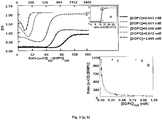
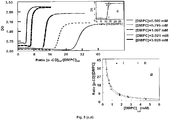
- the Figure 1 shows the evolution of the turbidity of the sample over time by measuring the optical density (OD). The higher the OD value, the higher the proportion of aggregates increases. The last plateau indicates the period of time required for the flocculation phenomenon to be complete.
- the concentration of cyclodextrin is a regulating parameter of the aggregation rate of liposomes in the dispersion.
- the monitoring of the turbidity of the liposome dispersions by measuring the optical density (OD) at the UV-Visible spectrophotometer as a function of the proportions of cyclodextrin added, of the aqueous phase and liposomes made it possible to specify the zone (s) of formation aggregates and thus to characterize the liposome concentration conditions.
- Example 3 Concentration of liposomes containing an exogenous substance Two model substances were tested.
- Rhod-PE is a phospholipid carrying a fluorescent group (rhodamine).
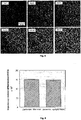
- the study was performed by confocal fluorescence microscopy. The results show that the phenomenon of ⁇ -cyclodextrin-induced flocculation of Rhod-PE-loaded liposomes (prepared by the method described in Example 1) does not modify the fluorescence of the liposomes. Confocal fluorescence microscopy clearly shows aggregates of fluorescent liposomes ( Figure 5 ).
- Calcein is a low molecular weight, water soluble, fluorescent molecule. No trace of calcein previously encapsulated in DOPC liposomes was detected by fluorescence spectrophotometry in the supernatant after spontaneous liposome sedimentation induced by addition of cyclodextrin. In addition, the amount of calcein contained in the liposomes was conserved in the aggregates ( Figure 6 ). Thus, the impermeability of the liposome membrane does not seem to be modified by the cyclodextrin molecules.
- the first step of the process is carried out as described in the previous paragraph.
- a concentrate of liposomes and cyclodextrins is obtained in the form of a white precipitate.
- a volume of aqueous phase (final dilution ⁇ 100 in volume) is added and the evolution of the system is monitored by optical microscopy ( Figure 7 ). Disintegration of the liposomes occurs within a few minutes as the aqueous phase progresses within the liposome concentrate to result in dispersion of liposomes without interactions in the medium; these latter appear as small spots isolated by black field microscopy.
- the aggregates formed by ⁇ -cyclodextrin and liposomes form a suspension that sediments over time. Sedimentation is complete after a time ranging from a few hours to 24 hours. This allows the concentration of liposomes in a very small volume.
- the system is redispersed by simple agitation, without the aggregates dissociate.
- the aggregates formed are stable over time at room temperature. They are white and their size can vary from 1 to 20 microns depending on the liposome and cyclodextrin concentrations used. Their dimensions can evolve under the action of a low shear.
- the sample produced by rehydration of the lyophilizate was diluted to dissociate the liposome-cyclodextrin aggregates. Measurements of quasi-elastic light scattering showed that the initial diameter of the liposomes before their concentration (200 nm) was found after lyophilization / rehydration. Thus, the concentration method developed is an excellent tool for preparing lyophilized liposomes without modifying their initial characteristics. Scanning electron microscopy experiments were performed on mixed liposome / cyclodextrin samples after aggregation and lyophilization. The images clearly show the liposomes, very similar in size to those of the liposomes within the hydrated aggregates, trapped in a cyclodextrin matrix ( Figure 10 ).
- Example 6 Dispersion of liposomes by dialysis of mixed aggregates of liposomes and ⁇ -cyclodextrin.
- the first step of the process is carried out as described in Example 1.
- a concentrate of liposomes and ⁇ -cyclodextrin is obtained in the form of a white precipitate.
- 2 ml of the preparation containing the mixed aggregates of liposomes and ⁇ -cyclodextrin are placed in a dialysis chamber. equipped with a Spectrapore membrane (cutoff 12000 Da) allowing the passage of the cyclodextrin molecules but not the liposomes.
- the chamber is then placed in a 1 L beaker containing 800 ml of the aqueous medium having been used for the manufacture of the starting liposomes.
- the assembly, chamber plus aqueous medium is stirred gently using a bar magnet at 25 ° C.
- the dialysis bath is renewed twice every 24 hours.
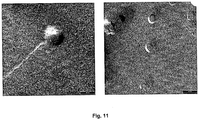
- a dispersion of individualized liposomes is recovered in the dialysis chamber (see FIG. Figure 11 ) in a volume equal to that of the starting sample (2 mL).
- the concentration of liposomes after dialysis is that within the mixed aggregates obtained by the concentration process.
- dialysis ensures the absence of free ⁇ -cyclodextrin molecules in the aqueous medium in equilibrium with the redispersed liposomes, which does not exclude that a small amount of ⁇ -cyclodextrin molecules remains ultimately adsorbed on the surface of the liposomes, giving rise to new hybrid nanoparticulate systems described as vesicle structures delimited by a phospholipid bilayer itself covered by one or more layers of ⁇ -cyclodextrin molecules.
- the dialysis makes it possible to produce a dispersion of individualized liposomes concentrated by a factor of at least 4 with respect to the liposomes before the formation of the mixed aggregates of liposomes and ⁇ -cyclodextrin.
Landscapes
- Health & Medical Sciences (AREA)
- Life Sciences & Earth Sciences (AREA)
- Public Health (AREA)
- Veterinary Medicine (AREA)
- Animal Behavior & Ethology (AREA)
- General Health & Medical Sciences (AREA)
- Chemical & Material Sciences (AREA)
- Epidemiology (AREA)
- Birds (AREA)
- Medicinal Chemistry (AREA)
- Pharmacology & Pharmacy (AREA)
- Inorganic Chemistry (AREA)
- Dermatology (AREA)
- Dispersion Chemistry (AREA)
- Medicinal Preparation (AREA)
- Cosmetics (AREA)
Claims (19)
- Verfahren zur Herstellung von gemischten Liposom-Cyclodextrin-Aggregaten, wobei das Verfahren Folgendes umfasst:die Einkapselung von wenigstens einer exogenen Substanz in Liposome,das Inkontaktbringen der in einem wässrigen Medium dispergierten Liposome mit α-Cyclodextrinen, wobei die α-Cyclodextrine und die Liposome in einem Cyclodextrin/Liposom-Molkonzentrationsverhältnis von mehr als 1 im wässrigen Medium vorhanden sind,das Erzielen von gemischten Liposom-Cyclodextrin-Aggregaten, die wenigstens eine exogene Substanz einkapseln.
- Verfahren zur Herstellung von gemischten Liposom-Cyclodextrin-Aggregaten, wobei das Verfahren Folgendes umfasst:das Inkontaktbringen von in einem wässrigen Medium dispergierten Liposomen mit α-Cyclodextrinen, wobei die α-Cyclodextrine und die Liposome in einem Cyclodextrin/Liposom-Molkonzentrationsverhältnis von mehr als 1 im wässrigen Medium vorhanden sind,das Erzielen von gemischten Liposom-Cyclodextrin-Aggregaten,das Lyophilisieren der erzielten gemischten Liposom-Cyclodextrin-Aggregate,die Hydratation der lyophilisierten gemischten Liposom-Cyclodextrin-Aggregate, um gemischte Liposom-Cyclodextrin-Aggregate zu erzielen.
- Verfahren zur Herstellung von gemischten Liposom-Cyclodextrin-Aggregaten, wobei das Verfahren Folgendes umfasst:das Inkontaktbringen von in einem wässrigen Medium dispergierten Liposomen mit α-Cyclodextrinen, wobei die α-Cyclodextrine und die Liposome in einem Cyclodextrin/Liposom-Molkonzentrationsverhältnis von mehr als 1 im wässrigen Medium vorhanden sind und die Liposomkonzentration zwischen 0,05 mM und 5 mM beträgt,das Erzielen von gemischten Liposom-Cyclodextrin-Aggregaten.
- Verfahren zur Herstellung von Liposomen, wobei das Verfahren Folgendes umfasst:das Inkontaktbringen von in einem wässrigen Medium dispergierten Liposomen mit α-Cyclodextrinen, wobei die α-Cyclodextrine und die Liposome in einem Cyclodextrin/Liposom-Molkonzentrationsverhältnis von mehr als 1 im wässrigen Medium vorhanden sind,das Erzielen von gemischten Liposom-Cyclodextrin-Aggregaten, unddie Dialyse der gemischten Liposom-Cyclodextrin-Aggregate zur Erzielung der Liposome.
- Verfahren zur Herstellung von Liposomen, wobei das Verfahren Folgendes umfasst:das Inkontaktbringen von in einem wässrigen Medium dispergierten Liposomen mit α-Cyclodextrinen, wobei die α-Cyclodextrine und die Liposome in einem Cyclodextrin/Liposom-Molkonzentrationsverhältnis von mehr als 1 im wässrigen Medium vorhanden sind,das Erzielen von gemischten Liposom-Cyclodextrin-Aggregaten, unddie Zersetzung der gemischten Liposom-Cyclodextrin-Aggregate durch Verdünnung, um einzelne Liposome zu erzielen.
- Verfahren nach einem der Ansprüche 1 bis 5, wobei das Cyclodextrin/Liposom-Molkonzentrationsverhältnis im wässrigen Medium zwischen 2 und 1500 beträgt.
- Verfahren nach einem der Ansprüche 2 bis 6, wobei alle oder ein Teil der Liposome eine exogene Substanz enthalten (enthält).
- Verfahren nach Anspruch 7, wobei die exogene Substanz ein kosmetischer, therapeutischer oder diagnostischer Wirkstoff ist.
- Verfahren nach einem der Ansprüche 1 bis 8, wobei die Liposome mehrheitlich aus Phospholipiden gebildet sind.
- Verfahren nach Anspruch 7, wobei die Phospholipide aus Phosphatidylcholin und seinen Derivaten ausgewählt sind.
- Verfahren nach einem der Ansprüche 1 bis 8, wobei das wässrige Medium auf einen pH zwischen 6 und 8 gepuffert ist.
- Verfahren nach einem der Ansprüche 1 oder 3 bis 5, umfassend einen Schritt des Lyophilisierens der gemischten Liposom-Cyclodextrin-Aggregate.
- Verfahren nach einem der Ansprüche 1 bis 3 oder 5, umfassend einen Schritt der Dialyse der gemischten Liposom-Cyclodextrin-Aggregate.
- Verfahren nach Anspruch 12, umfassend einen Schritt der Rehydratation des Lyophilisats der gemischten Liposom-Cyclodextrin-Aggregate, gefolgt von einem Dialyseschritt.
- Lyophilisat von gemischten Liposom-Cyclodextrin-Aggregaten, das durch das Verfahren erzielt werden kann, wie es in Anspruch 12 definiert wird.
- Gemischte Liposom-Cyclodextrin-Aggregate, die durch das Verfahren nach Anspruch 1 erzielt werden können.
- Gemischte Liposom-Cyclodextrin-Aggregate nach Anspruch 16 mit einer Größe zwischen 100 nm und 10 µm.
- Verwendung der gemischten Liposom-Cyclodextrin-Aggregate, wie sie in den Ansprüchen 16 oder 17 definiert sind, zum Einkapseln von exogenen Substanzen.
- Verwendung nach Anspruch 18 zur Herstellung von kosmetischen, pharmazeutischen oder diagnostischen Zusammensetzungen.
Applications Claiming Priority (2)
| Application Number | Priority Date | Filing Date | Title |
|---|---|---|---|
| FR0603945A FR2900576B1 (fr) | 2006-05-03 | 2006-05-03 | Procede de concentration extemporanee et reversible de liposomes. |
| PCT/FR2007/000742 WO2007125217A1 (fr) | 2006-05-03 | 2007-04-30 | Procede de concentration extemporanee et reversible de liposomes |
Publications (2)
| Publication Number | Publication Date |
|---|---|
| EP2018155A1 EP2018155A1 (de) | 2009-01-28 |
| EP2018155B1 true EP2018155B1 (de) | 2016-12-28 |
Family
ID=37618911
Family Applications (1)
| Application Number | Title | Priority Date | Filing Date |
|---|---|---|---|
| EP07731392.2A Active EP2018155B1 (de) | 2006-05-03 | 2007-04-30 | Verfahren zur reversiblen konzentration von liposomen |
Country Status (6)
| Country | Link |
|---|---|
| US (1) | US9895298B2 (de) |
| EP (1) | EP2018155B1 (de) |
| JP (1) | JP5431921B2 (de) |
| CA (1) | CA2651221C (de) |
| FR (1) | FR2900576B1 (de) |
| WO (1) | WO2007125217A1 (de) |
Families Citing this family (1)
| Publication number | Priority date | Publication date | Assignee | Title |
|---|---|---|---|---|
| US9719985B2 (en) * | 2009-08-03 | 2017-08-01 | The Arizona Board Of Regents On Behalf Of The University Of Arizona | Method of detection and related detection device |
Family Cites Families (12)
| Publication number | Priority date | Publication date | Assignee | Title |
|---|---|---|---|---|
| US4927571A (en) | 1987-05-18 | 1990-05-22 | Liposome Technology, Inc. | Preparation of injectable doxorubicin/liposome suspension |
| JPH082779B2 (ja) | 1990-05-17 | 1996-01-17 | テルモ株式会社 | リポソームの精製方法 |
| GB9320668D0 (en) * | 1993-10-07 | 1993-11-24 | Secr Defence | Liposomes containing particulare materials |
| US5855911A (en) | 1995-08-29 | 1999-01-05 | Board Of Regents, The University Of Texas System | Liposomal phosphodiester, phosphorothioate, and P-ethoxy oligonucleotides |
| US20030059440A1 (en) * | 1998-09-01 | 2003-03-27 | Tim Clarot | Composition and method for moisturizing nasal tissue |
| US7807377B2 (en) * | 1998-10-20 | 2010-10-05 | Salvatore Albani | Method of isolating antigen-specific T cells employing artificial antigen presenting cells |
| JP4651213B2 (ja) * | 2001-03-27 | 2011-03-16 | 株式会社グライコメディクス | インフルエンザウイルス・ヘマグルチニン結合性ペプチド |
| BRPI0105509B8 (pt) * | 2001-11-05 | 2021-05-25 | Univ Minas Gerais | formulações do peptídeo angiotensina-(1-7) usando as ciclodextrinas, lipossomas e o polímero plga |
| US20070065473A1 (en) * | 2002-07-09 | 2007-03-22 | Miller Christopher C | Nitric oxide gas (gO) as a cosmetic and wound healing agent |
| EP1643972A4 (de) * | 2003-06-27 | 2010-01-20 | Smithkline Beecham Corp | Stabilisierte liposomale topotecan-zusammensetzung und verfahren |
| US20050239747A1 (en) * | 2004-04-21 | 2005-10-27 | Pharmaceutical Industry Technology And Development Center | Compositions and methods of enhanced transdermal delivery of steroid compounds and preparation methods |
| US20050255154A1 (en) * | 2004-05-11 | 2005-11-17 | Lena Pereswetoff-Morath | Method and composition for treating rhinitis |
-
2006
- 2006-05-03 FR FR0603945A patent/FR2900576B1/fr not_active Expired - Fee Related
-
2007
- 2007-04-30 US US12/299,261 patent/US9895298B2/en active Active
- 2007-04-30 EP EP07731392.2A patent/EP2018155B1/de active Active
- 2007-04-30 CA CA2651221A patent/CA2651221C/fr active Active
- 2007-04-30 WO PCT/FR2007/000742 patent/WO2007125217A1/fr not_active Ceased
- 2007-04-30 JP JP2009508419A patent/JP5431921B2/ja active Active
Non-Patent Citations (1)
| Title |
|---|
| None * |
Also Published As
| Publication number | Publication date |
|---|---|
| JP5431921B2 (ja) | 2014-03-05 |
| CA2651221C (fr) | 2015-11-24 |
| FR2900576B1 (fr) | 2008-09-19 |
| WO2007125217A1 (fr) | 2007-11-08 |
| CA2651221A1 (fr) | 2007-11-08 |
| US20090285867A1 (en) | 2009-11-19 |
| US9895298B2 (en) | 2018-02-20 |
| JP2009535384A (ja) | 2009-10-01 |
| EP2018155A1 (de) | 2009-01-28 |
| FR2900576A1 (fr) | 2007-11-09 |
Similar Documents
| Publication | Publication Date | Title |
|---|---|---|
| EP0782851B1 (de) | Teilchenförmige synthetische Träger sowie Verfahren zu deren Herstellung | |
| EP0611326B1 (de) | Herstellungsverfahren von nanokapseln mit auf vernetzten proteinen basierenden wänden; derart hergestellte nanokapseln und diese enthaltende kosmetika, pharmazeutika und lebensmittel | |
| Khan et al. | Topical delivery of erythromycin through cubosomes for acne | |
| WO2009004214A2 (fr) | Procede de preparation de nanoparticules lipidiques | |
| EP2413719B1 (de) | Verfahren zur herstellung von funktionalisierten lipidkapseln | |
| EP2376218B1 (de) | Verfahren zur herstellung von lipidnanopartikeln | |
| FR2764508A1 (fr) | Nouveaux vecteurs liposomaux de principes actifs | |
| EP2018155B1 (de) | Verfahren zur reversiblen konzentration von liposomen | |
| WO1993025194A1 (fr) | Preparation et application de nouveaux systemes colloidaux nanovesiculaires dispersibles a base de cyclodextrine, sous forme de nanocapsules | |
| EP3024566B1 (de) | Lipidnanopartikel mit mehreren segmenten | |
| Vishnu et al. | Preparation and Evaluation of Valsartan Cubosomes. | |
| FR2802422A1 (fr) | Structures mixtes resultant de l'incorporation d'une macromolecule biologique, en particulier d'adn, dans une phase structuree d'amphiphiles et vesicules obtenues a partir de ces structures | |
| CA2157384C (fr) | Vecteurs particulaires synthetiques et procede de preparation | |
| Divekar et al. | CUBOSOMES–AN ADVANCED DRUG DELIVERY SYSTEM–A | |
| FR2757768A1 (fr) | Vecteur particulaire homeocharge et composition pharmaceutique ou cosmetique le contenant | |
| FR2964332A1 (fr) | Nanodispersions inverses stables | |
| WO2005030170A2 (fr) | Rupture controlee de liposomes furtifs | |
| FR2803517A1 (fr) | Matrices plymeriques amphiphiles et ioniques et derives de telles matrices | |
| FR2803526A1 (fr) | Matrices polymeriques amphiphiles et ioniques et derives de telles matrices |
Legal Events
| Date | Code | Title | Description |
|---|---|---|---|
| PUAI | Public reference made under article 153(3) epc to a published international application that has entered the european phase |
Free format text: ORIGINAL CODE: 0009012 |
|
| 17P | Request for examination filed |
Effective date: 20081103 |
|
| AK | Designated contracting states |
Kind code of ref document: A1 Designated state(s): AT BE BG CH CY CZ DE DK EE ES FI FR GB GR HU IE IS IT LI LT LU LV MC MT NL PL PT RO SE SI SK TR |
|
| AX | Request for extension of the european patent |
Extension state: AL BA HR MK RS |
|
| DAX | Request for extension of the european patent (deleted) | ||
| 17Q | First examination report despatched |
Effective date: 20130225 |
|
| REG | Reference to a national code |
Ref country code: DE Ref legal event code: R079 Ref document number: 602007049315 Country of ref document: DE Free format text: PREVIOUS MAIN CLASS: A61K0009127000 Ipc: A61K0008020000 |
|
| GRAP | Despatch of communication of intention to grant a patent |
Free format text: ORIGINAL CODE: EPIDOSNIGR1 |
|
| RIC1 | Information provided on ipc code assigned before grant |
Ipc: A61K 47/40 20060101ALI20160705BHEP Ipc: A61K 8/73 20060101ALI20160705BHEP Ipc: A61K 9/127 20060101ALI20160705BHEP Ipc: A61K 8/14 20060101ALI20160705BHEP Ipc: A61K 8/02 20060101AFI20160705BHEP Ipc: A61Q 19/00 20060101ALI20160705BHEP |
|
| INTG | Intention to grant announced |
Effective date: 20160803 |
|
| GRAS | Grant fee paid |
Free format text: ORIGINAL CODE: EPIDOSNIGR3 |
|
| GRAA | (expected) grant |
Free format text: ORIGINAL CODE: 0009210 |
|
| AK | Designated contracting states |
Kind code of ref document: B1 Designated state(s): AT BE BG CH CY CZ DE DK EE ES FI FR GB GR HU IE IS IT LI LT LU LV MC MT NL PL PT RO SE SI SK TR |
|
| REG | Reference to a national code |
Ref country code: GB Ref legal event code: FG4D Free format text: NOT ENGLISH |
|
| REG | Reference to a national code |
Ref country code: CH Ref legal event code: EP |
|
| REG | Reference to a national code |
Ref country code: AT Ref legal event code: REF Ref document number: 856690 Country of ref document: AT Kind code of ref document: T Effective date: 20170115 |
|
| REG | Reference to a national code |
Ref country code: IE Ref legal event code: FG4D Free format text: LANGUAGE OF EP DOCUMENT: FRENCH |
|
| REG | Reference to a national code |
Ref country code: DE Ref legal event code: R096 Ref document number: 602007049315 Country of ref document: DE |
|
| PG25 | Lapsed in a contracting state [announced via postgrant information from national office to epo] |
Ref country code: LV Free format text: LAPSE BECAUSE OF FAILURE TO SUBMIT A TRANSLATION OF THE DESCRIPTION OR TO PAY THE FEE WITHIN THE PRESCRIBED TIME-LIMIT Effective date: 20161228 |
|
| REG | Reference to a national code |
Ref country code: CH Ref legal event code: NV Representative=s name: ARNOLD AND SIEDSMA AG, CH |
|
| REG | Reference to a national code |
Ref country code: FR Ref legal event code: PLFP Year of fee payment: 11 |
|
| REG | Reference to a national code |
Ref country code: LT Ref legal event code: MG4D |
|
| PG25 | Lapsed in a contracting state [announced via postgrant information from national office to epo] |
Ref country code: LT Free format text: LAPSE BECAUSE OF FAILURE TO SUBMIT A TRANSLATION OF THE DESCRIPTION OR TO PAY THE FEE WITHIN THE PRESCRIBED TIME-LIMIT Effective date: 20161228 Ref country code: SE Free format text: LAPSE BECAUSE OF FAILURE TO SUBMIT A TRANSLATION OF THE DESCRIPTION OR TO PAY THE FEE WITHIN THE PRESCRIBED TIME-LIMIT Effective date: 20161228 Ref country code: GR Free format text: LAPSE BECAUSE OF FAILURE TO SUBMIT A TRANSLATION OF THE DESCRIPTION OR TO PAY THE FEE WITHIN THE PRESCRIBED TIME-LIMIT Effective date: 20170329 |
|
| REG | Reference to a national code |
Ref country code: NL Ref legal event code: MP Effective date: 20161228 |
|
| REG | Reference to a national code |
Ref country code: AT Ref legal event code: MK05 Ref document number: 856690 Country of ref document: AT Kind code of ref document: T Effective date: 20161228 |
|
| PG25 | Lapsed in a contracting state [announced via postgrant information from national office to epo] |
Ref country code: FI Free format text: LAPSE BECAUSE OF FAILURE TO SUBMIT A TRANSLATION OF THE DESCRIPTION OR TO PAY THE FEE WITHIN THE PRESCRIBED TIME-LIMIT Effective date: 20161228 |
|
| PG25 | Lapsed in a contracting state [announced via postgrant information from national office to epo] |
Ref country code: NL Free format text: LAPSE BECAUSE OF FAILURE TO SUBMIT A TRANSLATION OF THE DESCRIPTION OR TO PAY THE FEE WITHIN THE PRESCRIBED TIME-LIMIT Effective date: 20161228 |
|
| PG25 | Lapsed in a contracting state [announced via postgrant information from national office to epo] |
Ref country code: EE Free format text: LAPSE BECAUSE OF FAILURE TO SUBMIT A TRANSLATION OF THE DESCRIPTION OR TO PAY THE FEE WITHIN THE PRESCRIBED TIME-LIMIT Effective date: 20161228 Ref country code: CZ Free format text: LAPSE BECAUSE OF FAILURE TO SUBMIT A TRANSLATION OF THE DESCRIPTION OR TO PAY THE FEE WITHIN THE PRESCRIBED TIME-LIMIT Effective date: 20161228 Ref country code: SK Free format text: LAPSE BECAUSE OF FAILURE TO SUBMIT A TRANSLATION OF THE DESCRIPTION OR TO PAY THE FEE WITHIN THE PRESCRIBED TIME-LIMIT Effective date: 20161228 Ref country code: IS Free format text: LAPSE BECAUSE OF FAILURE TO SUBMIT A TRANSLATION OF THE DESCRIPTION OR TO PAY THE FEE WITHIN THE PRESCRIBED TIME-LIMIT Effective date: 20170428 Ref country code: RO Free format text: LAPSE BECAUSE OF FAILURE TO SUBMIT A TRANSLATION OF THE DESCRIPTION OR TO PAY THE FEE WITHIN THE PRESCRIBED TIME-LIMIT Effective date: 20161228 |
|
| PG25 | Lapsed in a contracting state [announced via postgrant information from national office to epo] |
Ref country code: PT Free format text: LAPSE BECAUSE OF FAILURE TO SUBMIT A TRANSLATION OF THE DESCRIPTION OR TO PAY THE FEE WITHIN THE PRESCRIBED TIME-LIMIT Effective date: 20170428 Ref country code: IT Free format text: LAPSE BECAUSE OF FAILURE TO SUBMIT A TRANSLATION OF THE DESCRIPTION OR TO PAY THE FEE WITHIN THE PRESCRIBED TIME-LIMIT Effective date: 20161228 Ref country code: PL Free format text: LAPSE BECAUSE OF FAILURE TO SUBMIT A TRANSLATION OF THE DESCRIPTION OR TO PAY THE FEE WITHIN THE PRESCRIBED TIME-LIMIT Effective date: 20161228 Ref country code: BG Free format text: LAPSE BECAUSE OF FAILURE TO SUBMIT A TRANSLATION OF THE DESCRIPTION OR TO PAY THE FEE WITHIN THE PRESCRIBED TIME-LIMIT Effective date: 20170328 Ref country code: AT Free format text: LAPSE BECAUSE OF FAILURE TO SUBMIT A TRANSLATION OF THE DESCRIPTION OR TO PAY THE FEE WITHIN THE PRESCRIBED TIME-LIMIT Effective date: 20161228 Ref country code: ES Free format text: LAPSE BECAUSE OF FAILURE TO SUBMIT A TRANSLATION OF THE DESCRIPTION OR TO PAY THE FEE WITHIN THE PRESCRIBED TIME-LIMIT Effective date: 20161228 |
|
| REG | Reference to a national code |
Ref country code: DE Ref legal event code: R097 Ref document number: 602007049315 Country of ref document: DE |
|
| PLBE | No opposition filed within time limit |
Free format text: ORIGINAL CODE: 0009261 |
|
| STAA | Information on the status of an ep patent application or granted ep patent |
Free format text: STATUS: NO OPPOSITION FILED WITHIN TIME LIMIT |
|
| PG25 | Lapsed in a contracting state [announced via postgrant information from national office to epo] |
Ref country code: DK Free format text: LAPSE BECAUSE OF FAILURE TO SUBMIT A TRANSLATION OF THE DESCRIPTION OR TO PAY THE FEE WITHIN THE PRESCRIBED TIME-LIMIT Effective date: 20161228 |
|
| 26N | No opposition filed |
Effective date: 20170929 |
|
| REG | Reference to a national code |
Ref country code: IE Ref legal event code: MM4A |
|
| PG25 | Lapsed in a contracting state [announced via postgrant information from national office to epo] |
Ref country code: MC Free format text: LAPSE BECAUSE OF FAILURE TO SUBMIT A TRANSLATION OF THE DESCRIPTION OR TO PAY THE FEE WITHIN THE PRESCRIBED TIME-LIMIT Effective date: 20161228 |
|
| PG25 | Lapsed in a contracting state [announced via postgrant information from national office to epo] |
Ref country code: SI Free format text: LAPSE BECAUSE OF FAILURE TO SUBMIT A TRANSLATION OF THE DESCRIPTION OR TO PAY THE FEE WITHIN THE PRESCRIBED TIME-LIMIT Effective date: 20161228 Ref country code: LU Free format text: LAPSE BECAUSE OF NON-PAYMENT OF DUE FEES Effective date: 20170430 |
|
| REG | Reference to a national code |
Ref country code: BE Ref legal event code: MM Effective date: 20170430 |
|
| REG | Reference to a national code |
Ref country code: FR Ref legal event code: PLFP Year of fee payment: 12 |
|
| PG25 | Lapsed in a contracting state [announced via postgrant information from national office to epo] |
Ref country code: IE Free format text: LAPSE BECAUSE OF NON-PAYMENT OF DUE FEES Effective date: 20170430 |
|
| PG25 | Lapsed in a contracting state [announced via postgrant information from national office to epo] |
Ref country code: BE Free format text: LAPSE BECAUSE OF NON-PAYMENT OF DUE FEES Effective date: 20170430 |
|
| PG25 | Lapsed in a contracting state [announced via postgrant information from national office to epo] |
Ref country code: MT Free format text: LAPSE BECAUSE OF FAILURE TO SUBMIT A TRANSLATION OF THE DESCRIPTION OR TO PAY THE FEE WITHIN THE PRESCRIBED TIME-LIMIT Effective date: 20161228 |
|
| PG25 | Lapsed in a contracting state [announced via postgrant information from national office to epo] |
Ref country code: HU Free format text: LAPSE BECAUSE OF FAILURE TO SUBMIT A TRANSLATION OF THE DESCRIPTION OR TO PAY THE FEE WITHIN THE PRESCRIBED TIME-LIMIT; INVALID AB INITIO Effective date: 20070430 |
|
| PG25 | Lapsed in a contracting state [announced via postgrant information from national office to epo] |
Ref country code: CY Free format text: LAPSE BECAUSE OF NON-PAYMENT OF DUE FEES Effective date: 20161228 |
|
| PG25 | Lapsed in a contracting state [announced via postgrant information from national office to epo] |
Ref country code: TR Free format text: LAPSE BECAUSE OF FAILURE TO SUBMIT A TRANSLATION OF THE DESCRIPTION OR TO PAY THE FEE WITHIN THE PRESCRIBED TIME-LIMIT Effective date: 20161228 |
|
| REG | Reference to a national code |
Ref country code: DE Ref legal event code: R082 Ref document number: 602007049315 Country of ref document: DE |
|
| PGFP | Annual fee paid to national office [announced via postgrant information from national office to epo] |
Ref country code: DE Payment date: 20250528 Year of fee payment: 19 |
|
| PGFP | Annual fee paid to national office [announced via postgrant information from national office to epo] |
Ref country code: GB Payment date: 20250429 Year of fee payment: 19 |
|
| PGFP | Annual fee paid to national office [announced via postgrant information from national office to epo] |
Ref country code: FR Payment date: 20250429 Year of fee payment: 19 |
|
| PGFP | Annual fee paid to national office [announced via postgrant information from national office to epo] |
Ref country code: CH Payment date: 20250602 Year of fee payment: 19 |