EP2017537A2 - Method for operating a stratified storage tank and drinking water system - Google Patents
Method for operating a stratified storage tank and drinking water system Download PDFInfo
- Publication number
- EP2017537A2 EP2017537A2 EP20080012357 EP08012357A EP2017537A2 EP 2017537 A2 EP2017537 A2 EP 2017537A2 EP 20080012357 EP20080012357 EP 20080012357 EP 08012357 A EP08012357 A EP 08012357A EP 2017537 A2 EP2017537 A2 EP 2017537A2
- Authority
- EP
- European Patent Office
- Prior art keywords
- hot water
- temperature
- storage
- charging pump
- water
- Prior art date
- Legal status (The legal status is an assumption and is not a legal conclusion. Google has not performed a legal analysis and makes no representation as to the accuracy of the status listed.)
- Withdrawn
Links
- 238000000034 method Methods 0.000 title claims abstract description 25
- 239000003651 drinking water Substances 0.000 title claims abstract description 17
- 235000020188 drinking water Nutrition 0.000 title claims abstract description 17
- XLYOFNOQVPJJNP-UHFFFAOYSA-N water Substances O XLYOFNOQVPJJNP-UHFFFAOYSA-N 0.000 claims abstract description 166
- 238000013500 data storage Methods 0.000 claims abstract 3
- 230000015572 biosynthetic process Effects 0.000 claims description 7
- 238000005259 measurement Methods 0.000 claims description 6
- JEGUKCSWCFPDGT-UHFFFAOYSA-N h2o hydrate Chemical compound O.O JEGUKCSWCFPDGT-UHFFFAOYSA-N 0.000 claims description 4
- 239000000523 sample Substances 0.000 claims description 2
- 238000011144 upstream manufacturing Methods 0.000 claims description 2
- 238000012935 Averaging Methods 0.000 description 3
- 238000009529 body temperature measurement Methods 0.000 description 3
- 238000011161 development Methods 0.000 description 3
- 230000018109 developmental process Effects 0.000 description 3
- 238000012217 deletion Methods 0.000 description 1
- 230000037430 deletion Effects 0.000 description 1
- 230000001419 dependent effect Effects 0.000 description 1
- 238000012544 monitoring process Methods 0.000 description 1
- 230000000630 rising effect Effects 0.000 description 1
- 238000010079 rubber tapping Methods 0.000 description 1
- 230000002123 temporal effect Effects 0.000 description 1
- 238000012546 transfer Methods 0.000 description 1
Images

Classifications
-
- F—MECHANICAL ENGINEERING; LIGHTING; HEATING; WEAPONS; BLASTING
- F24—HEATING; RANGES; VENTILATING
- F24D—DOMESTIC- OR SPACE-HEATING SYSTEMS, e.g. CENTRAL HEATING SYSTEMS; DOMESTIC HOT-WATER SUPPLY SYSTEMS; ELEMENTS OR COMPONENTS THEREFOR
- F24D17/00—Domestic hot-water supply systems
- F24D17/0026—Domestic hot-water supply systems with conventional heating means
- F24D17/0031—Domestic hot-water supply systems with conventional heating means with accumulation of the heated water
-
- F—MECHANICAL ENGINEERING; LIGHTING; HEATING; WEAPONS; BLASTING
- F24—HEATING; RANGES; VENTILATING
- F24D—DOMESTIC- OR SPACE-HEATING SYSTEMS, e.g. CENTRAL HEATING SYSTEMS; DOMESTIC HOT-WATER SUPPLY SYSTEMS; ELEMENTS OR COMPONENTS THEREFOR
- F24D19/00—Details
- F24D19/10—Arrangement or mounting of control or safety devices
- F24D19/1006—Arrangement or mounting of control or safety devices for water heating systems
- F24D19/1051—Arrangement or mounting of control or safety devices for water heating systems for domestic hot water
Definitions
- the invention relates to a method for operating stratified charge accumulators according to the preamble of patent claim 1.
- Shift-load accumulators are a further development of conventional domestic hot water tanks. Their special feature is that they ensure a high hot water availability with a comparatively small storage volume.
- Conventional domestic hot water storage tanks often have a storage tank with a heat exchanger coil arranged below, through which a heat transfer medium flows.
- the storage water contacting this heat exchanger heats up by heat conduction, thereby becoming lighter and rising upwards in the container.
- a flow roller is set in motion, which gradually detects the entire storage water and gradually heats it up to target temperature.
- a circulation pump conveys the heat carrier medium.
- the domestic hot water provided in stratified charge accumulators is withdrawn therefrom in the lower region of the storage container, heated to an intended temperature by an externally located heat exchanger or a heat generator operating according to the continuous flow principle and stacked in the upper container region.
- Inlet aids ensure that the storage water is neither swirled by the cold water drain nor by the hot water inflow. In this way, hot drinking water is already available for use at the beginning of the storage load.
- the stratified charge storage systems for domestic hot water water heaters include cold water supply line, cold water outlet, hot water entrance and hot water exit, a storage water temperature sensor for detecting a storage water temperature, a hot water inlet temperature sensor for detecting a hot water inlet temperature, and a hot water charge pump for circulation of storage water.
- the connections for cold water inlet and outlet as well as for hot water inlet and outlet can be structurally combined.
- a control device for the charging process is usually located in the control unit of the drinking water water heater. This implies that it must have a relatively complex control device that meets the requirements for controlling a hot water charging pump together with a suitable temperature monitoring.
- the control of the stratified storage system can be completely self-sufficient and independent of the condition and type of water heater.
- the stratified storage has its own control unit.
- the instantaneous water heater then only has to have the property of starting whenever it recognizes the storage water throughput promoted by the DHW charging pump.
- the desired domestic hot water temperature must then be set both on the instantaneous water heater and on the storage controller: the instantaneous water heater must provide water of the desired temperature, the control unit must control the charging process, i. operate the hot water charging pump depending on the degree of loading. This can be done by double manual setting of the setpoint temperature, or by a data connection, which transmits the value set on the water heater to the memory controller. Both methods are unsatisfactory because of their susceptibility to error or cabling. For stratified charge systems with self-contained stratified charge storage it would be desirable to dispense with a double adjustment or a data connection between the instantaneous water heater and the storage control unit. This would mean that the control unit had no information about which hot water temperature was set on the water heater.
- the invention is based on the object to develop a method for operating a self-sufficient stratified storage, which allows this to automatically determine the selected on a drinking water heater temperature specifications and to control a loading process, as well as in case of failure of the power supply from the public network emergency operation sure.
- the method is characterized by a memory control unit, which automatically uses the measuring signals detected by the measuring probes for a drinking water instantaneous water heater set storage water temperature setpoint and stored in a controller-internal RAM data memory. On the basis of this determined storage water temperature setpoint, it derives specifications for the switching on and off of the DHW charging pump, checks the measurement signal inputs for the presence of the conditions thus specified and switches the pump on and off accordingly.
- the control unit derives the default for switching on the DHW charging pump from a predetermined storage water temperature setpoint and a predetermined allowable first temperature difference value by the on threshold is set to the predetermined setpoint, reduced by the predetermined allowable temperature difference value. If the RAM data memory is not empty, the control unit derives the specification for switching on the DHW charging pump accordingly from the determined storage water temperature setpoint stored in the RAM module and the predefinable admissible first temperature difference value.
- the default for switching off the hot water charging pump derives the control unit from the determined and stored in the RAM module storage water temperature setpoint, the default condition for switching off the DHW pump is present when the currently measured storage water temperature measurement signal is greater than or equal to the storage water temperature setpoint is. Taking into account in this comparison may be a predetermined second temperature difference value, which may be greater than, less than or equal to zero.
- the RAM data memory of the control unit is a read-write memory, the deleted due to implemented in the control unit specifications, for example temporal nature, or via an interface, for example in the form of a manual input by the system owner or installer, and / or can be overwritten. This ensures that the control unit automatically or on the current request determines a new storage water temperature setpoint.
- the determination of the storage water temperature setpoint in the control unit is based on an (arithmetic) averaging of temperature individual values, which are formed from the measurement signals of the hot water inlet temperature sensor.
- the signals on this sensor show an increasing profile, which is related to the length of the line between the water heater and the sensor and their thermal inertia.
- the Averaging can be based on a predeterminable number of individual temperature readings, which are initially formed with the starting of the hot water charging pump.
- the formation of the predeterminable number of individual temperature measured values can also begin only after a predefinable time period beginning with the starting of the hot water charging pump has expired and thus take into account the dead time between pump start and effective temperature increase caused by the line length and thermal inertia.
- the mean value may also be a moving average, which is based on the continuous formation of a predefinable number of respectively recently generated temperature individual values, starting with the starting of the hot water charging pump.
- the equation of the mean value and the storage water temperature setpoint occurs in this method at the moment when this moving average differs at most by a predefinable amount from a minimum value and a maximum value of the last individual temperature measured values.
- the formation of the predeterminable number of each last formed individual temperature measurements only after a predeterminable, starting with the start of the hot water charging pump period begin and thus take into account the line length and thermal inertia caused dead time between pump start and effective temperature increase. This ensures that the averaging is carried out on the basis of suitable, namely stable, individual temperature measurement values and the setpoint thus determined is very close to the hot water temperature actually supplied by the instantaneous water heater.
- the generation of the individual temperature measured values in the control unit from the continuously applied measuring signals of the hot water inlet temperature sensor can expediently take place in a predefinable frequency.
- the sensors used are, for example, NTC resistors.
- a DHW heater suitable for mains-independent operation in combination with a self-sufficient stratified charge storage.
- the domestic hot water system is characterized by a switchable valve arranged in the cold water connection line which, when the power supply is functioning, is in a first valve position and directs the incoming cold water inlet into the cold water inlet of the stratified storage tank during hot water tapping.
- a second valve position which is responsible for the failure of the power supply is provided, the cold water inlet is directed directly into a cold water inlet of the drinking water heater.
- This second valve position adjusts itself either automatically in the absence of power supply or can also be started manually.
- the domestic hot water supply is then based on the flow principle without recharging the stratified storage tank, since the hot water charging pump can no longer be operated.
- valve automatically shifts automatically to the second position in the event of a power failure, the domestic hot water supply is maintained purely in accordance with the flow principle. If a manual valve actuation is provided, it is possible first to use the hot water in the stratified storage tank, to switch the valve only when the warm water has dried up, and then to prepare hot water purely in accordance with the continuous flow principle.
- the method according to the invention offers the advantage of optimized operation of a self-sufficient stratified charge accumulator, wherein the accumulator control unit automatically determines the temperature specifications selected on a drinking water instantaneous heater and controls the loading process. In case of failure of the power supply from the public network emergency operation is ensured.
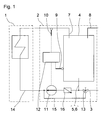
- the drawing shows in two figures embodiments of the invention and shows a domestic hot water system with drinking water heater 1 and stratified storage 2.
- FIG. 1 shows a stratified storage 2, comprising a cold water supply line 3, a storage tank 4 with cold water inlet 5 and cold water outlet 6 - here constructively summarized, hot water inlet 7 and hot water outlet 8, a storage water temperature sensor 9 for detecting a storage water temperature, a hot water inlet temperature sensor 10 for detecting a hot water inlet temperature, a hot water charging pump 11 for circulating storage water, as well as a control unit 12 for evaluating the measurement signals of the sensors 9, 10 and for switching on and off the hot water charging pump 11.
- the cold water inlet into the cold water inlet 5 of the stratified storage tank 2 and in a cold water inlet 14 of the drinking water heater 1 directs.
- the cold water inflow flows past the hot water charging pump 11 via a bypass line 15.
- One of the hot water pump 11 upstream check valve 16 blocks a cold water return flow through the hot water charging pump eleventh
- FIG. 2 differs from FIG. 1 in that here valve 13 is formed as arranged in the cold water inlet 5 shut-off valve 13. This shut-off valve 13 closes in the de-energized state and directs the cold water inflow into the cold water inlet 14 of the drinking water heater 1.
Landscapes
- Engineering & Computer Science (AREA)
- Physics & Mathematics (AREA)
- Thermal Sciences (AREA)
- Chemical & Material Sciences (AREA)
- Combustion & Propulsion (AREA)
- Mechanical Engineering (AREA)
- General Engineering & Computer Science (AREA)
- Heat-Pump Type And Storage Water Heaters (AREA)
- Cookers (AREA)
Abstract
Description
Die Erfindung betrifft ein Verfahren zum Betreiben von Schichtladespeichern nach dem Oberbegriff des Patentanspruches 1.The invention relates to a method for operating stratified charge accumulators according to the preamble of
Bei Schichtladespeichern handelt es sich um eine Weiterentwicklung der herkömmlichen Trinkwarmwasserspeicher. Ihre Besonderheit liegt darin, dass sie mit einem vergleichsweise geringen Speichervolumen eine hohe Warmwasserverfügbarkeit gewährleisten.Shift-load accumulators are a further development of conventional domestic hot water tanks. Their special feature is that they ensure a high hot water availability with a comparatively small storage volume.
Herkömmliche Trinkwarmwasserspeicher verfügen oft über einen Speicherbehälter mit einer unten angeordneten, von einem Heizträgermedium durchströmten Wärmetauscherwendel. Das diesen Wärmetauscher berührende Speicherwasser erwärmt sich durch Wärmeleitung, wird dabei leichter und steigt im Behälter nach oben. Hierdurch wird eine Strömungswalze in Gang gesetzt, die allmählich das gesamte Speicherwasser erfasst und es nach und nach auf Solltemperatur aufheizt. Eine Umwälzpumpe fördert das Heizträgermedium.Conventional domestic hot water storage tanks often have a storage tank with a heat exchanger coil arranged below, through which a heat transfer medium flows. The storage water contacting this heat exchanger heats up by heat conduction, thereby becoming lighter and rising upwards in the container. As a result, a flow roller is set in motion, which gradually detects the entire storage water and gradually heats it up to target temperature. A circulation pump conveys the heat carrier medium.
Das in Schichtladespeichern bereitgestellte Trinkwarmwasser wird demgegenüber im unteren Bereich des Speicherbehälters aus diesem abgezogen, von einem extern liegenden Wärmetauscher oder einem nach dem Durchlaufprinzip arbeitenden Wärmeerzeuger auf Solltemperatur erwärmt und in den oberen Behälterbereich eingeschichtet. Einströmhilfen sorgen dafür, dass das Speicherwasser weder durch den Kaltwasserabfluss noch durch den Warmwasserzufluss verwirbelt wird. Auf die Weise liegt bereits mit Beginn der Speicherbeladung heißes Trinkwarmwasser für die Nutzung bereit.In contrast, the domestic hot water provided in stratified charge accumulators is withdrawn therefrom in the lower region of the storage container, heated to an intended temperature by an externally located heat exchanger or a heat generator operating according to the continuous flow principle and stacked in the upper container region. Inlet aids ensure that the storage water is neither swirled by the cold water drain nor by the hot water inflow. In this way, hot drinking water is already available for use at the beginning of the storage load.
Die dieser Erfindung vorausgesetzten Schichtladespeichersysteme für Trinkwarmwasser zum hydraulischen Anschluss an Trinkwasserdurchlauferhitzer umfassen üblicherweise eine Kaltwasseranschlussleitung, einen Speicherbehälter mit Kaltwassereintritt, Kaltwasseraustritt, Warmwassereintritt und Warmwasseraustritt, einen Speicherwassertemperatur-Messfühler zur Erfassung einer Speicherwassertemperatur, einen Warmwassereintrittstemperatur-Messfühler zur Erfassung einer Warmwassereintrittstemperatur sowie eine Warmwasserladepumpe zum Umwälzen von Speicherwasser. Die Anschlüsse für Kaltwassereintritt und -austritt sowie die für Warmwassereintritt und -austritt können konstruktiv zusammengefasst sein.Typically, the stratified charge storage systems for domestic hot water water heaters include cold water supply line, cold water outlet, hot water entrance and hot water exit, a storage water temperature sensor for detecting a storage water temperature, a hot water inlet temperature sensor for detecting a hot water inlet temperature, and a hot water charge pump for circulation of storage water. The connections for cold water inlet and outlet as well as for hot water inlet and outlet can be structurally combined.
Eine Steuereinrichtung für den Ladevorgang befindet sich üblicherweise im Regelgerät des Trinkwasserdurchlauferhitzers. Das setzt voraus, dass dieser ein verhältnismäßig komplexes Regelgerät besitzen muss, das die Anforderungen zur Steuerung einer Warmwasserladepumpe mitsamt einer geeigneten Temperaturüberwachung erfüllt.A control device for the charging process is usually located in the control unit of the drinking water water heater. This implies that it must have a relatively complex control device that meets the requirements for controlling a hot water charging pump together with a suitable temperature monitoring.
Zur Kombination von Schichtladespeichern mit Trinkwasserdurchlauferhitzern mit vergleichsweise einfachen Regelgeräten kann die Steuerung des Schichtladespeichers völlig autark und unabhängig vom Zustand und von der Art des Durchlauferhitzers erfolgen. In diesem Fall verfügt der Schichtladespeicher über ein eigenes Steuergerät. Der Durchlauferhitzer muss dann nur die Eigenschaft besitzen, immer dann zu starten, wenn er den von der Warmwasserladepumpe geförderten Speicherwasserdurchsatz erkennt.For the combination of stratified storage tanks with drinking water water heaters with comparatively simple control devices, the control of the stratified storage system can be completely self-sufficient and independent of the condition and type of water heater. In this case, the stratified storage has its own control unit. The instantaneous water heater then only has to have the property of starting whenever it recognizes the storage water throughput promoted by the DHW charging pump.
Die gewünschte Trinkwarmwassertemperatur muss dann sowohl am Durchlauferhitzer als auch am Speicher-Steuergerät vorgegeben werden: Der Durchlauferhitzer muss Wasser der gewünschten Temperatur zur Verfügung stellen, das Steuergerät muss den Beladungsvorgang steuern, d.h. in Abhängigkeit des Beladungsgrades die Warmwasserladepumpe betreiben. Dies kann durch zweifache manuelle Einstellung der Soll-Temperatur geschehen, oder durch eine Datenverbindung, die den am Durchlauferhitzer eingestellten Wert an das Speicher-Steuergerät übermittelt. Beide Methoden sind wegen ihrer Fehleranfälligkeit oder des Verkabelungsaufwandes unbefriedigend. Für Schichtladesysteme mit autarken Schichtladespeichern wäre es wünschenswert, auf eine Doppeleinstellung oder auf eine Datenverbindung zwischen Durchlauferhitzer und dem Speicher-Steuergerät zu verzichten. Das hätte zur Folge, dass dem Steuergerät keine Information darüber vorläge, welche Warmwassertemperatur am Durchlauferhitzer eingestellt wurde.The desired domestic hot water temperature must then be set both on the instantaneous water heater and on the storage controller: the instantaneous water heater must provide water of the desired temperature, the control unit must control the charging process, i. operate the hot water charging pump depending on the degree of loading. This can be done by double manual setting of the setpoint temperature, or by a data connection, which transmits the value set on the water heater to the memory controller. Both methods are unsatisfactory because of their susceptibility to error or cabling. For stratified charge systems with self-contained stratified charge storage it would be desirable to dispense with a double adjustment or a data connection between the instantaneous water heater and the storage control unit. This would mean that the control unit had no information about which hot water temperature was set on the water heater.
Der Erfindung liegt die Aufgabe zu Grunde, ein Verfahren zum Betreiben eines autarken Schichtladespeichers zu entwickeln, das es diesem ermöglicht, selbsttätig die an einem Trinkwasserdurchlauferhitzer gewählten Temperaturvorgaben zu ermitteln und einen Beladungsprozess zu steuern, sowie auch bei Ausfall der Spannungsversorgung aus dem öffentlichen Netz einen Notbetrieb sicherzustellen.The invention is based on the object to develop a method for operating a self-sufficient stratified storage, which allows this to automatically determine the selected on a drinking water heater temperature specifications and to control a loading process, as well as in case of failure of the power supply from the public network emergency operation sure.
Erfindungsgemäß wird dies mit einem Verfahren mit den Merkmalen des Patentanspruches 1 und mit einem Trinkwarmwassersystem mit den Merkmalen des Patentanspruchs 13 gelöst. Vorteilhafte Weiterbildungen sind den Unteransprüchen zu entnehmen.This is achieved with a method having the features of
Das Verfahren ist gekennzeichnet durch ein Speicher-Steuergerät, das aus den von den Messfühlern erfassten Messsignalen selbsttätig einen am Trinkwasserdurchlauferhitzer eingestellten Speicherwassertemperatur-Sollwert ermittelt und in einem Steuergeräte-internen RAM-Datenspeicher abspeichert. Anhand dieses ermittelten Speicherwassertemperatur-Sollwertes leitet es Vorgaben für das Ein- und Ausschalten der Warmwasserladepumpe ab, prüft die Messsignaleingänge auf das Vorliegen der so vorgegebenen Bedingungen und schaltet die Pumpe entsprechend ein und aus.The method is characterized by a memory control unit, which automatically uses the measuring signals detected by the measuring probes for a drinking water instantaneous water heater set storage water temperature setpoint and stored in a controller-internal RAM data memory. On the basis of this determined storage water temperature setpoint, it derives specifications for the switching on and off of the DHW charging pump, checks the measurement signal inputs for the presence of the conditions thus specified and switches the pump on and off accordingly.
Im Auslieferungszustand oder nach Löschung ist der RAM-Datenspeicher leer, ein ermittelter Speicherwassertemperatur-Sollwert liegt nicht vor. In diesem Fall leitet das Steuergerät die Vorgabe für das Einschalten der Warmwasserladepumpe aus einem vorgebbaren Speicherwassertemperatur-Sollwert und einem vorgebbaren zulässigen ersten Temperaturdifferenzwert ab, indem die Einschaltschwelle dem vorgegebenen Sollwert, vermindert um den vorgegebenen zulässigen Temperaturdifferenzwert, gleichgesetzt wird. Bei nicht leerem RAM-Datenspeicher leitet das Steuergerät die Vorgabe für das Einschalten der Warmwasserladepumpe entsprechend aus dem ermittelten und im RAM-Baustein abgespeicherten Speicherwassertemperatur-Sollwert und dem vorgebbaren zulässigen ersten Temperaturdifferenzwert ab.On delivery or after deletion, the RAM data memory is empty, a determined storage water temperature setpoint is not available. In this case, the control unit derives the default for switching on the DHW charging pump from a predetermined storage water temperature setpoint and a predetermined allowable first temperature difference value by the on threshold is set to the predetermined setpoint, reduced by the predetermined allowable temperature difference value. If the RAM data memory is not empty, the control unit derives the specification for switching on the DHW charging pump accordingly from the determined storage water temperature setpoint stored in the RAM module and the predefinable admissible first temperature difference value.
Die Vorgabe für das Ausschalten der Warmwasserladepumpe leitet das Steuergerät aus dem ermittelten und im RAM-Baustein abgespeicherten Speicherwassertemperatur-Sollwert ab, wobei die vorgegebene Bedingung für das Ausschalten der Warmwasserladepumpe dann vorliegt, wenn das aktuell gemessene Speicherwassertemperatur-Messsignal größer oder gleich dem Speicherwassertemperatur-Sollwert ist. Berücksichtigung finden bei diesem Vergleich kann ein vorgebbarer zweiter Temperaturdifferenzwert, der größer, kleiner oder gleich Null sein kann.The default for switching off the hot water charging pump derives the control unit from the determined and stored in the RAM module storage water temperature setpoint, the default condition for switching off the DHW pump is present when the currently measured storage water temperature measurement signal is greater than or equal to the storage water temperature setpoint is. Taking into account in this comparison may be a predetermined second temperature difference value, which may be greater than, less than or equal to zero.
Der RAM-Datenspeicher des Steuergerätes ist ein Schreib-Lese-Speicher, der aufgrund von im Steuergerät implementierten Vorgaben, zum Beispiel zeitlicher Art, oder auch über eine Schnittstelle, zum Beispiel in Form einer manuellen Eingabe durch den Anlagenbesitzer oder Installateur, gelöscht und/oder überschrieben werden kann. So ist gewährleistet, dass das Steuergerät automatisch oder auf aktuellen Wunsch hin einen neuen Speicherwassertemperatur-Sollwert ermittelt.The RAM data memory of the control unit is a read-write memory, the deleted due to implemented in the control unit specifications, for example temporal nature, or via an interface, for example in the form of a manual input by the system owner or installer, and / or can be overwritten. This ensures that the control unit automatically or on the current request determines a new storage water temperature setpoint.
Die Ermittlung des Speicherwassertemperatur-Sollwertes im Steuergerät beruht auf einer (arithmetischen) Mittelwertbildung aus Temperatureinzelmesswerten, die aus den Messsignalen des Warmwassereintrittstemperatur-Messfühlers gebildet werden. Die Signale an diesem Messfühler zeigen einen ansteigenden Verlauf, der mit der Leitungslänge zwischen Durchlauferhitzer und Messfühler und deren thermischer Trägheit zusammenhängt. Die Mittelwertbildung kann sich auf eine vorgebbare Anzahl von Temperatureinzelmesswerten stützen, die anfangend mit dem Starten der Warmwasserladepumpe gebildet werden. Alternativ kann die Bildung der vorgebbaren Anzahl von Temperatureinzelmesswerten auch erst nach Ablauf einer vorgebbaren, mit dem Starten der Warmwasserladepumpe beginnenden Zeitdauer anfangen und so die durch Leitungslänge und thermische Trägheit bedingte Totzeit zwischen Pumpenstart und effektiver Temperaturerhöhung berücksichtigen.The determination of the storage water temperature setpoint in the control unit is based on an (arithmetic) averaging of temperature individual values, which are formed from the measurement signals of the hot water inlet temperature sensor. The signals on this sensor show an increasing profile, which is related to the length of the line between the water heater and the sensor and their thermal inertia. The Averaging can be based on a predeterminable number of individual temperature readings, which are initially formed with the starting of the hot water charging pump. Alternatively, the formation of the predeterminable number of individual temperature measured values can also begin only after a predefinable time period beginning with the starting of the hot water charging pump has expired and thus take into account the dead time between pump start and effective temperature increase caused by the line length and thermal inertia.
Bei dem Mittelwert kann es sich auch um einen gleitenden Mittelwert handeln, der auf der fortlaufenden Bildung einer vorgebbaren Anzahl von jeweils zuletzt erzeugten Temperatureinzelmesswerten, mit dem Starten der Warmwasserladepumpe anfangend, beruht. Die Gleichsetzung von Mittelwert und Speicherwassertemperatur-Sollwert geschieht bei dieser Methode in dem Moment, wenn dieser gleitende Mittelwert höchstens um einen vorgebbaren Betrag von einem Minimalwert und einem Maximalwert der zuletzt gebildeten Temperatureinzelmesswerte abweicht. Auch in diesem Fall kann die Bildung der vorgebbaren Anzahl von jeweils zuletzt gebildeten Temperatureinzelmesswerten erst nach Ablauf einer vorgebbaren, mit dem Starten der Warmwasserladepumpe beginnenden Zeitdauer anfangen und so die durch Leitungslänge und thermische Trägheit bedingte Totzeit zwischen Pumpenstart und effektiver Temperaturerhöhung berücksichtigen. Damit wird sichergestellt, dass die Mittelwertbildung anhand geeigneter, nämlich stabiler Temperatureinzelmesswerte erfolgt und der so ermittelte Sollwert sehr nah an der tatsächlich vom Durchlauferhitzer gelieferten Warmwassertemperatur liegt.The mean value may also be a moving average, which is based on the continuous formation of a predefinable number of respectively recently generated temperature individual values, starting with the starting of the hot water charging pump. The equation of the mean value and the storage water temperature setpoint occurs in this method at the moment when this moving average differs at most by a predefinable amount from a minimum value and a maximum value of the last individual temperature measured values. Also in this case, the formation of the predeterminable number of each last formed individual temperature measurements only after a predeterminable, starting with the start of the hot water charging pump period begin and thus take into account the line length and thermal inertia caused dead time between pump start and effective temperature increase. This ensures that the averaging is carried out on the basis of suitable, namely stable, individual temperature measurement values and the setpoint thus determined is very close to the hot water temperature actually supplied by the instantaneous water heater.
Die Erzeugung der Temperatureinzelmesswerte im Steuergerät aus den stetig anliegenden Messsignalen des Warmwassereintrittstemperatur-Messfühlers kann zweckmäßigerweise in einer vorgebbaren Frequenz erfolgen. Bei den verwendeten Messfühlern handelt es sich beispielsweise um NTC-Widerstände.The generation of the individual temperature measured values in the control unit from the continuously applied measuring signals of the hot water inlet temperature sensor can expediently take place in a predefinable frequency. The sensors used are, for example, NTC resistors.
Um auch bei Ausfall der Spannungsversorgung aus dem öffentlichen Netz einen Notbetrieb sicherzustellen, ist grundsätzlich die Verwendung eines für den stromnetzunabhängigen Betrieb geeigneten Trinkwasserdurchlauferhitzers in Kombination mit einem autarken Schichtladespeicher empfehlenswert.In order to ensure emergency operation even if the power supply from the public grid fails, it is generally advisable to use a DHW heater suitable for mains-independent operation in combination with a self-sufficient stratified charge storage.
Das erfindungsgemäße Trinkwarmwassersystem ist gekennzeichnet durch ein in der Kaltwasseranschlussleitung angeordnetes schaltbares Ventil, das sich bei funktionierender Spannungsversorgung in einer ersten Ventilstellung befindet und den sich bei Warmwasserzapfung einstellenden Kaltwasserzufluss in den Kaltwassereintritt des Schichtladespeichers lenkt. In einer zweiten Ventilstellung, die für den Ausfall der Spannungsversorgung vorgesehen ist, wird der Kaltwasserzufluss direkt in einen Kaltwassereintritt des Trinkwasserdurchlauferhitzers gelenkt. Diese zweite Ventilstellung stellt sich entweder automatisch bei fehlender Spannungsversorgung ein oder kann auch manuell angefahren werden. Die Trinkwarmwasserversorgung basiert dann auf dem Durchlaufprinzip ohne Nachladung des Schichtenspeichers, da die Warmwasserladepumpe nicht mehr betrieben werden kann. Schaltet das Ventil bei Stromausfall sofort automatisch in die zweite Stellung, so wird die Trinkwarmwasserversorgung rein nach dem Durchlaufprinzip aufrechterhalten. Ist eine manuelle Ventilbetätigung vorgesehen, besteht die Möglichkeit, zunächst noch das im Schichtladespeicher vorhandene Warmwasser zu nutzen, erst bei Versiegen des warmen Wassers das Ventil umzuschalten und Warmwasser dann rein nach dem Durchlaufprinzip zu bereiten.The domestic hot water system according to the invention is characterized by a switchable valve arranged in the cold water connection line which, when the power supply is functioning, is in a first valve position and directs the incoming cold water inlet into the cold water inlet of the stratified storage tank during hot water tapping. In a second valve position, which is responsible for the failure of the power supply is provided, the cold water inlet is directed directly into a cold water inlet of the drinking water heater. This second valve position adjusts itself either automatically in the absence of power supply or can also be started manually. The domestic hot water supply is then based on the flow principle without recharging the stratified storage tank, since the hot water charging pump can no longer be operated. If the valve automatically shifts automatically to the second position in the event of a power failure, the domestic hot water supply is maintained purely in accordance with the flow principle. If a manual valve actuation is provided, it is possible first to use the hot water in the stratified storage tank, to switch the valve only when the warm water has dried up, and then to prepare hot water purely in accordance with the continuous flow principle.
Eine vorteilhafte Weiterbildung dieser Ausführung ist dann gegeben, wenn das schaltbare Ventil in der zweiten Ventilstellung den Kaltwasserzufluss über eine Bypass-Leitung an der Warmwasserladepumpe vorbei lenkt und somit den bei Durchströmung der stillstehenden Pumpe auftretenden Druckverlust vermeidet, wobei eine Rückschlagklappe einen Kaltwasserrückfluss durch die Warmwasserladepumpe in den Kaltwasseraustritt des Schichtladespeichers sperrt.An advantageous development of this embodiment is given when the switchable valve in the second valve position directs the cold water inlet via a bypass line to the hot water pump over and thus avoids the pressure loss occurring when flowing through the stationary pump, a check valve cold water return flow through the hot water pump in blocks the cold water outlet of the stratified storage tank.
Das erfindungsgemäße Verfahren bietet den Vorteil eines optimierten Betriebs eines autarken Schichtladespeichers, wobei das Speicher-Steuergerät selbsttätig die an einem Trinkwasserdurchlauferhitzer gewählten Temperaturvorgaben ermittelt und den Beladungsprozess steuert. Bei Ausfall der Spannungsversorgung aus dem öffentlichen Netz ist einen Notbetrieb sichergestellt.The method according to the invention offers the advantage of optimized operation of a self-sufficient stratified charge accumulator, wherein the accumulator control unit automatically determines the temperature specifications selected on a drinking water instantaneous heater and controls the loading process. In case of failure of the power supply from the public network emergency operation is ensured.
Die Zeichnung stellt in zwei Figuren Ausführungsbeispiele der Erfindung dar und zeigt ein Trinkwarmwassersystem mit Trinkwasserdurchlauferhitzer 1 und Schichtladespeicher 2.The drawing shows in two figures embodiments of the invention and shows a domestic hot water system with
Claims (14)
dadurch gekennzeichnet, dass das Steuergerät (12) aus den von den Messfühlern (9, 10) erfassten Messsignalen selbsttätig einen am Trinkwasserdurchlauferhitzer (1) eingestellten Speicherwassertemperatur-Sollwert ermittelt und in einem Steuergeräte-internen RAM-Datenspeicher abspeichert, anhand dieses ermittelten Speicherwassertemperatur-Sollwertes Vorgaben für das Ein- und Ausschalten der Warmwasserladepumpe (11) ableitet, das Vorliegen der so vorgegebenen Bedingungen für das Ein- und Ausschalten der Warmwasserladepumpe (11) feststellt und die Warmwasserladepumpe (11) entsprechend ein- und ausschaltet.Method for operating a stratified charge accumulator (2) for domestic hot water, in particular for stratified storage with its own control unit (12), for hydraulic connection to a drinking water instantaneous water heater (1) comprising a cold water connection pipe (3), a storage tank (4) with cold water inlet (5), cold water outlet (6), hot water inlet (7) and hot water outlet (8), a storage water temperature sensor (9) for detecting a storage water temperature, a hot water inlet temperature sensor (10) for detecting a hot water inlet temperature, a hot water charging pump (11) for circulating storage water, and a Control unit (12) for evaluating the measuring signals of the measuring sensors (9, 10) and for switching on and off the hot water charging pump (11),
characterized in that the control unit (12) from the measured by the probes (9, 10) automatically detects a set on Trinkwasserwassersheater (1) storage water temperature setpoint and stored in a controller internal RAM data memory, based on this determined storage water temperature setpoint Derives requirements for switching on and off the hot water charging pump (11), detects the presence of the conditions thus defined for switching on and off the hot water charging pump (11) and the hot water charging pump (11) on and off accordingly.
dadurch gekennzeichnet, dass das Steuergerät (12) bei leerem RAM-Datenspeicher die Vorgabe für das Einschalten der Warmwasserladepumpe (11) aus einem vorgebbaren Speicherwassertemperatur-Sollwert und einem vorgebbaren zulässigen ersten Temperaturdifferenzwert ableitet.Method according to claim 1,
characterized in that the controller (12) with empty RAM data storage, the default for turning on the hot water charging pump (11) from a predetermined storage water temperature setpoint and a predetermined allowable first temperature difference value derived.
dadurch gekennzeichnet, dass das Steuergerät (12) bei nicht leerem RAM-Datenspeicher die Vorgabe für das Einschalten der Warmwasserladepumpe (11) aus dem ermittelten und im RAM-Baustein abgespeicherten Speicherwassertemperatur-Sollwert und dem vorgebbaren zulässigen ersten Temperaturdifferenzwert ableitet.Process according to claims 1 or 2,
characterized in that the control unit (12) in non-empty RAM data storage, the default for switching on the hot water charging pump (11) from the determined and stored in the RAM memory water temperature setpoint value and the predetermined allowable first temperature difference value derived.
dadurch gekennzeichnet, dass das Steuergerät (12) die Vorgabe für das Ausschalten der Warmwasserladepumpe (11) aus dem ermittelten und im RAM-Baustein abgespeicherten Speicherwassertemperatur-Sollwert ableitet, wobei die vorgegebene Bedingung für das Ausschalten der Warmwasserladepumpe dann vorliegt, wenn das aktuell gemessene Speicherwassertemperatur-Messsignal größer oder gleich der Summe aus dem Speicherwassertemperatur-Sollwert und einem vorgebbaren zweiten Temperaturdifferenzwert ist.Method according to one of claims 1 to 3,
characterized in that the control unit (12) derives the specification for switching off the hot water charging pump (11) from the determined and stored in the RAM module storage water temperature setpoint, wherein the predetermined condition for switching off the hot water charging pump is present when the currently measured storage water temperature -Messsignal is greater than or equal to the sum of the storage water temperature setpoint and a predetermined second temperature difference value.
dadurch gekennzeichnet, dass der RAM-Datenspeicher ein Schreib-Lese-Speicher ist, der aufgrund von im Steuergerät (12) implementierten Vorgaben oder auch über eine Schnittstelle gelöscht und/oder überschrieben werden kann.Method according to one of claims 1 to 4,
characterized in that the RAM data memory is a read-write memory which can be deleted and / or overwritten on the basis of instructions implemented in the control unit (12) or else via an interface.
dadurch gekennzeichnet, dass das Steuergerät (12) aus den Messsignalen des Warmwassereintrittstemperatur-Messfühlers (10) Temperatureinzelmesswerte bildet und den Speicherwassertemperatur-Sollwert gleich einem arithmetischen Mittelwert der Temperatureinzelmesswerte setzt.Method according to one of claims 1 to 5,
characterized in that the control unit (12) from the measurement signals of the hot water inlet temperature sensor (10) forms temperature individual readings and sets the storage water temperature setpoint equal to an arithmetic mean of the temperature individual readings.
dadurch gekennzeichnet, dass die Bildung einer vorgebbaren Anzahl von Temperatureinzelmesswerten mit dem Starten der Warmwasserladepumpe (11) anfängt.Method according to claim 6,
characterized in that the formation of a predeterminable number of temperature Einzelmesswerte starts with the starting of the hot water charging pump (11).
dadurch gekennzeichnet, dass die Bildung der vorgebbaren Anzahl von Temperatureinzelmesswerten nach Ablauf einer vorgebbaren, mit dem Starten der Warmwasserladepumpe (11) beginnenden Zeitdauer anfängt.Method according to claim 6,
characterized in that the formation of the predeterminable number of individual temperature measured values begins after a predeterminable period of time commencing with the starting of the hot water charging pump (11).
dadurch gekennzeichnet, dass die Bildung von Temperatureinzelmesswerten, mit dem Starten der Warmwasserladepumpe (11) anfangend, fortlaufend erfolgt, wobei der Speicherwassertemperatur-Sollwert einem gleitenden Mittelwert einer vorgebbaren Anzahl von zuletzt gebildeten Temperatureinzelmesswerten gleichgesetzt wird, wenn dieser gleitende Mittelwert höchstens um einen vorgebbaren Betrag von einem Minimalwert und einem Maximalwert der zuletzt gebildeten Temperatureinzelmesswerte abweicht.Method according to claim 6,
characterized in that the formation of temperature individual values, starting with the start of the hot water charging pump (11), takes place continuously, the storage water temperature setpoint being equated to a moving average of a predeterminable number of last-formed temperature individual values, if this moving average is at most a predeterminable amount of deviates from a minimum value and a maximum value of the last individual temperature measured values.
dadurch gekennzeichnet, dass die Bildung von Temperatureinzelmesswerten, nach Ablauf einer vorgebbaren, mit dem Starten der Warmwasserladepumpe (11) beginnenden Zeitdauer anfangend, fortlaufend erfolgt, wobei der Speicherwassertemperatur-Sollwert einem gleitenden Mittelwert einer vorgebbaren Anzahl von zuletzt gebildeten Temperatureinzelmesswerten gleichgesetzt wird, wenn dieser gleitende Mittelwert höchstens um einen vorgebbaren Betrag von einem Minimalwert und einem Maximalwert der zuletzt gebildeten Temperatureinzelmesswerte abweicht.Method according to claim 6,
characterized in that the formation of individual temperature measured values, starting after a predefinable starting with the starting of the hot water charging pump (11) beginning, takes place continuously, wherein the storage water temperature setpoint is equated to a moving average of a predeterminable number of last formed temperature individual readings, if this sliding Mean value deviates at most by a predetermined amount of a minimum value and a maximum value of the last-formed individual temperature measured values.
dadurch gekennzeichnet, dass das Steuergerät (12) die Temperatureinzelmesswerte aus den Messsignalen des Warmwassereintrittstemperatur-Messfühlers (10) in einer vorgebbaren Frequenz bildet.Method according to one of claims 6 to 10,
characterized in that the control unit (12) forms the temperature individual values from the measurement signals of the hot water inlet temperature sensor (10) in a predeterminable frequency.
dadurch gekennzeichnet, dass die Messfühler (9, 10) NTC-Widerstände sind.Method according to one of claims 1 to 11,
characterized in that the sensors (9, 10) are NTC resistors.
gekennzeichnet durch ein in der Kaltwasseranschlussleitung (3) oder im Kaltwassereintritt (5) angeordnetes schaltbares Ventil (13), das in einer ersten Ventilstellung den Kaltwasserzufluss in den Kaltwassereintritt (5) des Schichtladespeichers (2) und in einer zweiten Ventilstellung den Kaltwasserzufluss in einen Kaltwassereintritt (14) des Trinkwasserdurchlauferhitzers (1) lenkt, wobei die zweite Ventilstellung für einen stromlosen Betriebszustand vorgesehen ist und sich automatisch einstellt oder auch manuell angefahren wird.Domestic hot water system, including a drinking water instantaneous water heater (1) for the power supply independent operation and a stratified storage tank (2) comprising a cold water supply line (3), a storage tank (4) with cold water inlet (5), cold water outlet (6), hot water inlet (7) and hot water outlet (8 ), a storage water temperature sensor (9) for detecting a storage water temperature, a hot water inlet temperature sensor (10) for detecting a hot water inlet temperature, a hot water charging pump (11) for circulating storage water, and a control unit (12) for evaluating the measurement signals of the sensor (9 , 10) and for switching on and off the hot water charging pump (11),
characterized by a in the cold water supply line (3) or cold water inlet (5) arranged switchable valve (13) in a first valve position the cold water inlet into the cold water inlet (5) of the stratified storage tank (2) and in a second valve position the cold water inlet into a cold water inlet (14) of the drinking water water heater (1) directs, wherein the second valve position is provided for a de-energized operating state and automatically adjusts or is also approached manually.
dadurch gekennzeichnet, dass das schaltbare Ventil (13) in der zweiten Ventilstellung den Kaltwasserzufluss über eine Bypass-Leitung (15) an der Warmwasserladepumpe (11) vorbei lenkt, wobei eine der Warmwasserladepumpe (11) vorgeschaltete Rückschlagklappe (16) einen Kaltwasserrückfluss durch die Warmwasserladepumpe (11) in den Kaltwasseraustritt (6) des Schichtladespeichers (2) sperrt.Domestic hot water system according to claim 13,
characterized in that the switchable valve (13) in the second valve position the cold water inlet via a bypass line (15) to the hot water charging pump (11) over, one of the hot water charging pump (11) upstream check valve (16) a cold water return flow through the hot water charging pump (11) in the cold water outlet (6) of the stratified charge accumulator (2) locks.
Applications Claiming Priority (1)
| Application Number | Priority Date | Filing Date | Title |
|---|---|---|---|
| DE102007033564A DE102007033564B3 (en) | 2007-07-19 | 2007-07-19 | Method for operating a stratified charge storage and domestic hot water system |
Publications (2)
| Publication Number | Publication Date |
|---|---|
| EP2017537A2 true EP2017537A2 (en) | 2009-01-21 |
| EP2017537A3 EP2017537A3 (en) | 2015-06-17 |
Family
ID=39745283
Family Applications (1)
| Application Number | Title | Priority Date | Filing Date |
|---|---|---|---|
| EP08012357.3A Withdrawn EP2017537A3 (en) | 2007-07-19 | 2008-07-09 | Method for operating a stratified storage tank and drinking water system |
Country Status (2)
| Country | Link |
|---|---|
| EP (1) | EP2017537A3 (en) |
| DE (1) | DE102007033564B3 (en) |
Families Citing this family (4)
| Publication number | Priority date | Publication date | Assignee | Title |
|---|---|---|---|---|
| EP3062027B1 (en) * | 2015-02-25 | 2018-06-06 | Vaillant GmbH | Heat storage system and method for its operation |
| CN110285591A (en) * | 2019-07-19 | 2019-09-27 | 淮安市鼎盛太阳能有限公司 | An emergency water automatic control device based on a pressurized water storage tank |
| CN111536687A (en) * | 2020-06-01 | 2020-08-14 | 珠海格力电器股份有限公司 | Water heater and control method thereof |
| CN114251826A (en) * | 2021-08-24 | 2022-03-29 | 佛山市顺德区美的饮水机制造有限公司 | Instantaneous heating device, control method and control device thereof, water treatment device and medium |
Family Cites Families (7)
| Publication number | Priority date | Publication date | Assignee | Title |
|---|---|---|---|---|
| DE3016639A1 (en) * | 1980-04-30 | 1981-11-05 | Forbach Gmbh & Co Kg, 8740 Bad Neustadt | WATER TANK HEATER |
| DE3312479A1 (en) * | 1983-04-07 | 1984-10-11 | Nova-Apparatebau GmbH + Co, 7710 Donaueschingen | Hot water layer storage tank |
| EP0356609B1 (en) * | 1988-08-31 | 1993-02-10 | Landis & Gyr Business Support AG | Set-point adjuster for a domestic hot water storage regulator |
| AT405454B (en) * | 1994-08-03 | 1999-08-25 | Vaillant Gmbh | HOT WATER HEATING |
| ATE403114T1 (en) * | 2000-05-22 | 2008-08-15 | Vaillant Gmbh | METHOD FOR CONTROLLING A WATER HEATING DEVICE |
| DE10118343B4 (en) * | 2001-04-12 | 2006-09-07 | Robert Bosch Gmbh | heating system |
| DE102005058570B3 (en) * | 2005-12-08 | 2007-05-24 | Robert Bosch Gmbh | Method for controlling water heater and hot water tank with a control circuit to monitor the effect of the heater to optimize the heating to match the hot water demands |
-
2007
- 2007-07-19 DE DE102007033564A patent/DE102007033564B3/en not_active Expired - Fee Related
-
2008
- 2008-07-09 EP EP08012357.3A patent/EP2017537A3/en not_active Withdrawn
Also Published As
| Publication number | Publication date |
|---|---|
| DE102007033564B3 (en) | 2009-01-02 |
| EP2017537A3 (en) | 2015-06-17 |
Similar Documents
| Publication | Publication Date | Title |
|---|---|---|
| WO2018162679A1 (en) | Method for operating a heating installation | |
| EP0288695B1 (en) | Condensing boiler and method for its operation | |
| EP4050269B1 (en) | Heating device, heating system and method | |
| DE19859364C2 (en) | Heat supply system with peak load limitation | |
| DE19511369A1 (en) | Domestic hot-water installation with secondary heat exchanger and reservoir | |
| EP2017537A2 (en) | Method for operating a stratified storage tank and drinking water system | |
| EP4141334A1 (en) | Method for operating a heater, computer program, storage medium, regulation and control device, heater and use of a signal | |
| EP2659199B1 (en) | Flow heater | |
| EP0807790B1 (en) | Method and system for prepairing sanitary hot water | |
| DE102008009285B3 (en) | A layered charge storage system and method of operating a stratified charge storage system | |
| EP4071414A1 (en) | Method, system and computer program product for controlling a heat generator | |
| DE102009017423A1 (en) | Hot water store loading control process for laminar water storage involves driving second circulation pump on basis of parameter dependent on pump operating point | |
| EP3800403B1 (en) | Heating device and method for operating a heating device | |
| EP3924670B1 (en) | Method for controlling a circulation pump and circulation pump | |
| DE3538934C2 (en) | ||
| DE69105742T2 (en) | CENTRAL HEATING SYSTEM. | |
| EP2413047B1 (en) | Domestic water heating unit | |
| DE102013012724A1 (en) | Water heating device has control device which is connected with water charging pump to control power of water charging pump, so that temperature of water heated by electric water heater is set to predetermined value | |
| DE2301832C3 (en) | Hot water central heating system with flow and domestic water thermostats | |
| DE10254889B4 (en) | Control technology solution for a water heating system | |
| AT414272B (en) | LAYERS MEMORY | |
| EP0074360B1 (en) | Method for regulating a sorption heat pump | |
| EP0579933A1 (en) | Method of heating domestic water and water heater for carrying out the method | |
| DE102024105517A1 (en) | Method for detecting a water withdrawal from a hot water tank and method for controlling a temperature of water provided in a hot water tank | |
| EP0073796A1 (en) | METHOD FOR ADJUSTING A SORPTION HEAT PUMP. |
Legal Events
| Date | Code | Title | Description |
|---|---|---|---|
| PUAI | Public reference made under article 153(3) epc to a published international application that has entered the european phase |
Free format text: ORIGINAL CODE: 0009012 |
|
| AK | Designated contracting states |
Kind code of ref document: A2 Designated state(s): AT BE BG CH CY CZ DE DK EE ES FI FR GB GR HR HU IE IS IT LI LT LU LV MC MT NL NO PL PT RO SE SI SK TR |
|
| AX | Request for extension of the european patent |
Extension state: AL BA MK RS |
|
| PUAL | Search report despatched |
Free format text: ORIGINAL CODE: 0009013 |
|
| AK | Designated contracting states |
Kind code of ref document: A3 Designated state(s): AT BE BG CH CY CZ DE DK EE ES FI FR GB GR HR HU IE IS IT LI LT LU LV MC MT NL NO PL PT RO SE SI SK TR |
|
| AX | Request for extension of the european patent |
Extension state: AL BA MK RS |
|
| RIC1 | Information provided on ipc code assigned before grant |
Ipc: F24D 19/10 20060101ALI20150512BHEP Ipc: F24D 17/00 20060101AFI20150512BHEP |
|
| AKY | No designation fees paid | ||
| AXX | Extension fees paid |
Extension state: AL Extension state: MK Extension state: RS Extension state: BA |
|
| REG | Reference to a national code |
Ref country code: DE Ref legal event code: R108 |
|
| STAA | Information on the status of an ep patent application or granted ep patent |
Free format text: STATUS: THE APPLICATION IS DEEMED TO BE WITHDRAWN |
|
| 18D | Application deemed to be withdrawn |
Effective date: 20151218 |