EP2017095B1 - Gummireifen, der mit einer thermoelektrischen Vorrichtung ausgestattet ist - Google Patents
Gummireifen, der mit einer thermoelektrischen Vorrichtung ausgestattet ist Download PDFInfo
- Publication number
- EP2017095B1 EP2017095B1 EP08160021A EP08160021A EP2017095B1 EP 2017095 B1 EP2017095 B1 EP 2017095B1 EP 08160021 A EP08160021 A EP 08160021A EP 08160021 A EP08160021 A EP 08160021A EP 2017095 B1 EP2017095 B1 EP 2017095B1
- Authority
- EP
- European Patent Office
- Prior art keywords
- tire
- hot
- cold
- zone
- inner liner
- Prior art date
- Legal status (The legal status is an assumption and is not a legal conclusion. Google has not performed a legal analysis and makes no representation as to the accuracy of the status listed.)
- Not-in-force
Links
- 230000005678 Seebeck effect Effects 0.000 claims description 15
- 238000010586 diagram Methods 0.000 description 7
- 238000005452 bending Methods 0.000 description 6
- 210000000056 organ Anatomy 0.000 description 6
- 239000003990 capacitor Substances 0.000 description 4
- 238000010438 heat treatment Methods 0.000 description 4
- 239000000463 material Substances 0.000 description 3
- 229910001006 Constantan Inorganic materials 0.000 description 2
- 239000000470 constituent Substances 0.000 description 2
- 229910052751 metal Inorganic materials 0.000 description 2
- 239000002184 metal Substances 0.000 description 2
- 238000005096 rolling process Methods 0.000 description 2
- 229910002899 Bi2Te3 Inorganic materials 0.000 description 1
- RYGMFSIKBFXOCR-UHFFFAOYSA-N Copper Chemical compound [Cu] RYGMFSIKBFXOCR-UHFFFAOYSA-N 0.000 description 1
- 229910003336 CuNi Inorganic materials 0.000 description 1
- 238000013459 approach Methods 0.000 description 1
- 239000011324 bead Substances 0.000 description 1
- 230000005540 biological transmission Effects 0.000 description 1
- 229910052797 bismuth Inorganic materials 0.000 description 1
- JCXGWMGPZLAOME-UHFFFAOYSA-N bismuth atom Chemical compound [Bi] JCXGWMGPZLAOME-UHFFFAOYSA-N 0.000 description 1
- 238000006243 chemical reaction Methods 0.000 description 1
- 229910001179 chromel Inorganic materials 0.000 description 1
- 229910052802 copper Inorganic materials 0.000 description 1
- 239000010949 copper Substances 0.000 description 1
- 230000000694 effects Effects 0.000 description 1
- 230000005611 electricity Effects 0.000 description 1
- 238000009472 formulation Methods 0.000 description 1
- 238000002513 implantation Methods 0.000 description 1
- 239000000203 mixture Substances 0.000 description 1
- 238000010008 shearing Methods 0.000 description 1
- 229910052714 tellurium Inorganic materials 0.000 description 1
- PORWMNRCUJJQNO-UHFFFAOYSA-N tellurium atom Chemical compound [Te] PORWMNRCUJJQNO-UHFFFAOYSA-N 0.000 description 1
Images

Classifications
-
- B—PERFORMING OPERATIONS; TRANSPORTING
- B60—VEHICLES IN GENERAL
- B60C—VEHICLE TYRES; TYRE INFLATION; TYRE CHANGING; CONNECTING VALVES TO INFLATABLE ELASTIC BODIES IN GENERAL; DEVICES OR ARRANGEMENTS RELATED TO TYRES
- B60C23/00—Devices for measuring, signalling, controlling, or distributing tyre pressure or temperature, specially adapted for mounting on vehicles; Arrangement of tyre inflating devices on vehicles, e.g. of pumps or of tanks; Tyre cooling arrangements
- B60C23/02—Signalling devices actuated by tyre pressure
- B60C23/04—Signalling devices actuated by tyre pressure mounted on the wheel or tyre
- B60C23/0408—Signalling devices actuated by tyre pressure mounted on the wheel or tyre transmitting the signals by non-mechanical means from the wheel or tyre to a vehicle body mounted receiver
- B60C23/041—Means for supplying power to the signal- transmitting means on the wheel
-
- B—PERFORMING OPERATIONS; TRANSPORTING
- B60—VEHICLES IN GENERAL
- B60C—VEHICLE TYRES; TYRE INFLATION; TYRE CHANGING; CONNECTING VALVES TO INFLATABLE ELASTIC BODIES IN GENERAL; DEVICES OR ARRANGEMENTS RELATED TO TYRES
- B60C23/00—Devices for measuring, signalling, controlling, or distributing tyre pressure or temperature, specially adapted for mounting on vehicles; Arrangement of tyre inflating devices on vehicles, e.g. of pumps or of tanks; Tyre cooling arrangements
- B60C23/02—Signalling devices actuated by tyre pressure
- B60C23/04—Signalling devices actuated by tyre pressure mounted on the wheel or tyre
- B60C23/0491—Constructional details of means for attaching the control device
- B60C23/0493—Constructional details of means for attaching the control device for attachment on the tyre
-
- B—PERFORMING OPERATIONS; TRANSPORTING
- B29—WORKING OF PLASTICS; WORKING OF SUBSTANCES IN A PLASTIC STATE IN GENERAL
- B29D—PRODUCING PARTICULAR ARTICLES FROM PLASTICS OR FROM SUBSTANCES IN A PLASTIC STATE
- B29D30/00—Producing pneumatic or solid tyres or parts thereof
- B29D30/0061—Accessories, details or auxiliary operations not otherwise provided for
- B29D2030/0094—Tyres been capable of generating, e.g. recovering, energy
Definitions
- the invention relates to the technical field of tires for a motor vehicle.
- a wheel or tire of a functional member such as for example a pressure sensor, a temperature sensor or a device for measuring deformations of the wheel or the tire.
- the functional organ is active and must be electrically powered. It is known to electrically power the functional body for example by means of a battery or by transmission of electromagnetic waves and conversion of these waves into electricity.
- thermoelectric generator Seebeck effect Another known way to feed the organ is to use a thermoelectric generator Seebeck effect. It is recalled that a thermoelectric generator Seebeck effect is a conventional device that allows the generation of an electric current from a temperature gradient between two hot and cold elements with which two hot and cold poles of the generator are respectively in contact. The electric current supplied by the generator is all the more intense as the temperature gradient is large. However, the generation of a current sufficiently intense to supply a functional organ requires very specific conditions of use and implantation of the generator because the Seebeck effect is known to provide a low intensity current.
- thermoelectric generator to supply an electrical functional element carried by an assembly of a wheel and a tire.
- this document does not specify which hot and cold elements must be connected to the thermoelectric generator to obtain a sufficiently intense current to supply the functional organ.
- thermoelectric generator mounted with an inflation valve for supplying power to a pressure sensor.
- the object of the invention is in particular to identify hot and cold elements to which the Seebeck effect thermoelectric generator can be connected to effectively supply an electrical functional member carried by an assembly of a wheel and a tire.
- the subject of the invention is a tire equipped with a Seebeck effect thermoelectric generator for powering an organ, the generator comprising cold and hot poles respectively in contact with cold and hot elements, hot element being a constituent element of the tire.
- the tire is deformed, especially because of its passage in the contact area with the ground.
- the sidewalls of the tire undergo repeated bending. These deformations cause a significant heating of the tire.
- the invention therefore proposes to use an element forming part of the tire, heated by its rotation, as a hot element to which the hot pole of the Seebeck effect thermoelectric generator is connected.
- Positioning the generator on the tire also has other advantages.
- the tire has a large internal surface available to support the generator.
- the thermoelectric generator it is known that to increase the intensity of the current produced by the thermoelectric generator, one solution is to have several generators in series which requires a large support.
- the tire temperature is relatively constant during its use, unlike the wheel which is influenced by the brake disc whose temperature is variable. This makes it possible to produce a current of substantially constant intensity.
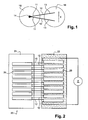
- the figure 1 is an explanatory diagram of the principle of the Seebeck effect.
- the Seebeck effect or thermocouple, uses the properties of certain materials which, under the effect of a temperature gradient, produce a voltage.
- FIG. 1 there is shown a pair of wires 10 and 12 each comprising first ends 11 connected to each other by a weld 14 and seconds ends 13.
- the first ends 11 are in contact with a cold element 16 and the second ends 13 are in contact with a hot element 18.
- the Seebeck effect produces a voltage E between the second ends 13 of the two material wires 10 and 12 which is proportional to the temperature difference between the cold elements 16 and the heat element 18.
- the proportionality coefficient ⁇ is a function of the materials of the wires 10 and 12.
- this coefficient ⁇ is equal to 70 ⁇ V / K when the wires are made of chromel (CrNi) and constantan (CuNi), or is equal to 200 ⁇ V / K when the wires are made of bismuth tellurium. (Bi2Te3).
- the figure 2 represents a Seebeck effect thermoelectric generator 20 comprising a plurality of pairs of wires 10 and 12 whose ends are intended to be brought to different temperatures so as to produce a voltage.
- the pairs of wires are electrically connected in series so that the voltage E supplied to the terminals of the generator is substantially proportional to the number of pairs in series.
- the generator 20 comprises two cold poles 22 and hot 24, respectively intended to come into contact with two cold elements 16 and 18 hot, to which are connected the ends of the pairs of son.
- These two poles 22 and 24 comprise, for example, flat rubber masses.
- the generator is provided with a copper grid 26 which promotes a distribution of heat.
- thermoelectric generator such as that represented on the figure 2 for supplying a functional member 28, for example a pressure sensor.
- This supply circuit comprises a resistor 30, a diode 32, a control diode 34 and a capacitor 36.
- the function of the capacitor 36 is to store energy during the phases in which the member 28 does not consume energy and to restore this energy to the phases where it is necessary.
- Resistor 30 and diodes 32 and 34 have the function of adjusting the voltage available across capacitor 36 and adjusting the alternating frequency of the voltage supplied across capacitor 36.
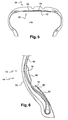
- thermoelectric generator 20 of the figure 2 We have shown on the figure 4 a tire 40 provided with the thermoelectric generator 20 of the figure 2 . For the sake of clarity, only the poles 22 and 24 of the generator 20 are represented on the figure 4 .
- the tire 40 comprises a tread 42 located at the top of the tire and two sidewalls 44 only one of which is shown.
- the part of the tire 40 in contact with the air inside the tire comprises the inner liner 46.
- the portion of the tire 40 which interconnects the tread 42 of the tire and the sidewall 44 is called the shoulder zone 48.
- the lower part of the sidewall 44 is called the lower zone 50.
- the shoulder zone 48 and the low zone 50 are zones that undergo strong bending during rolling which causes a local heating of the tire shown on the figure 4 by dark areas.
- the poles 22 and 24 of the generator 20 are in contact with cold elements 16 and hot 18 which are both part of the tire 40, more precisely of the inner rubber 46 of the tire.
- the hot pole 24 of the generator 20 is in contact with a zone 52 of the inner liner 46 forming part of the shoulder zone 48 of the tire 34 and constituting a hot element 18.
- the cold pole 22 of the generator 20 is in contact with an area 54 of the inner liner 46 located under the tread 42 and constituting a cold element 16.
- the zones 52 and 54 are chosen so that the temperature gradient between these two zones are maximum. According to this first provision, the temperature gradient is about 40 ° C for a running at 100 km / h in the average tire operating conditions.
- the hot pole 24 of the generator 20 is in contact with a zone 56 of the inner liner 46 forming part of the low zone 50 of the tire 34 and constituting a hot element 18.
- the cold pole 22 of the generator 20 is in contact with an area 58 of the inner liner 46 located at the heel 57 of the tire and constituting a cold element 16.
- the zones 56 and 58 are chosen so that the temperature gradient between these two zones is maximum. According to this second provision, the temperature gradient is about 30 ° C for average conditions of use and 100 km / h.
- Such temperature gradients are sufficiently large for the generator 20 to produce a voltage making it possible to supply the member 28.
- a generator 20 comprising ten chromel-constantan thermocouples of wires 10 and 12, in contact with two hot and cold points separated by 34 ° C, provides a voltage of 23mV and a power of 165 ⁇ W.
- the hot pole 24 of the generator 20 is in contact with a hot element 18 which is a constituent element of the inner liner 46 of the tire 40 and the cold pole 22 of the generator is in contact with a cold element 16 which is constituted by the air inside the tire 40 in contact with the cold pole 22.
- the temperature of the air inside the tire is in normal rolling conditions of the order of 30 ° C which allows to obtain a significant thermal gradient between the hot spots and cold.
- the tire 40 comprises an element 60 attached to the inner liner 46 of the tire 40, arranged and shaped so as to heat during the rotation of the tire and to constitute the hot element 18.
- the element 60 comprises for example a mass of eraser in the form of a paver or circumferential gum ring.
- the element 60 is made of specially dissipative formulation gum, with high hysteresis.
- the element 60 can be arranged in several places of the tire.
- the element 60 is disposed under the tread.
- the element 60 is disposed in a bending zone of the lower zone 50 of the sidewall 44 of the tire.
- the element 60 is disposed on the sidewall, near the heel 57 of the tire and is interposed between the inner liner and a metal blade 62 forming means of deformation of the element 60, in particular by shearing the rubber mass.
- the metal blade comprises an end connected to the bead of the tire so that during the rotation and the deformation of the tire, the free end of the blade moves away and approaches the inner liner for shear the element 60.
- the temperature of the element 60 is greater than the temperature that would have the inner liner if the element 60 was absent. Therefore, by increasing the temperature of the hot element to which the hot pole of the generator 20 is connected, the temperature gradient between the hot and cold elements is increased, which makes it possible to increase the voltage produced by the generator 20.
Landscapes
- Engineering & Computer Science (AREA)
- Mechanical Engineering (AREA)
- Tires In General (AREA)
Claims (11)
- Reifen (34), dadurch gekennzeichnet, dass er mit einem thermoelektrischen Generator (20) mit Seebeck-Effekt zur elektrischen Versorgung eines Glieds (28) versehen ist, wobei der Generator (20) einen Kaltpol (22) und einen Heißpol (24) umfasst, die mit einem Kaltelement (16) bzw. Heißelement (18) in Kontakt stehen, wobei das Heißelement (18) einen Teil des Reifens (34) bildet.
- Reifen (34) nach dem vorhergehenden Anspruch, wobei das Heißelement (18) einen Teil der Innenseele (46) des Reifens (34) bildet.
- Reifen (34) nach einem der Ansprüche 1 und 2, wobei das Heißelement (18) im Schulterbereich (48) des Reifens (34) positioniert ist.
- Reifen (34) nach einem der Ansprüche 1 und 2, wobei das Heißelement (18) im Wulstbereich (50) der Seitenwand (44) des Reifens (34) positioniert ist.
- Reifen (34) nach Anspruch 4, wobei das Heißelement (18) im Walkbereich des Wulstbereichs (50) der Seitenwand (44) des Reifens (34) positioniert ist.
- Reifen (34) nach einem der Ansprüche 1 bis 5, wobei das Kaltelement (16) einen Teil des Reifens (34) bildet.
- Reifen (34) nach dem vorhergehenden Anspruch, wobei das Kaltelement (16) einen Teil der Innenseele (46) des Reifens (34) bildet.
- Reifen (34) nach einem der Ansprüche 1 bis 5, wobei das Kaltelement (16) Luft im Inneren des Reifens (34) in Kontakt mit dem Kaltpol (22) umfasst.
- Reifen (34) nach einem der vorhergehenden Ansprüche, der ein an der Innenseele (46) des Reifens (34) angefügtes Element (60) umfasst, das dazu angeordnet und konfiguriert ist, sich bei Drehung des Reifens (34) zu erwärmen und das Heißelement zu bilden.
- Reifen (34) nach dem vorhergehenden Anspruch, wobei das angefügte Element (60) aus einem dissipativeren Kautschuk besteht als die Innenseele (46).
- Reifen (34) nach Anspruch 9 oder 10, der des Weiteren Mittel (62) zur Verformung des angefügten Elements (60) während der Drehung des Reifens (34) umfasst.
Applications Claiming Priority (1)
| Application Number | Priority Date | Filing Date | Title |
|---|---|---|---|
| FR0756580A FR2918926B1 (fr) | 2007-07-18 | 2007-07-18 | Pneumatique muni d'un dispositif thermoelectrique |
Publications (2)
| Publication Number | Publication Date |
|---|---|
| EP2017095A1 EP2017095A1 (de) | 2009-01-21 |
| EP2017095B1 true EP2017095B1 (de) | 2010-05-12 |
Family
ID=39081578
Family Applications (1)
| Application Number | Title | Priority Date | Filing Date |
|---|---|---|---|
| EP08160021A Not-in-force EP2017095B1 (de) | 2007-07-18 | 2008-07-09 | Gummireifen, der mit einer thermoelektrischen Vorrichtung ausgestattet ist |
Country Status (6)
| Country | Link |
|---|---|
| US (1) | US20090151440A1 (de) |
| EP (1) | EP2017095B1 (de) |
| JP (1) | JP2009040408A (de) |
| CN (1) | CN101357568A (de) |
| DE (1) | DE602008001211D1 (de) |
| FR (1) | FR2918926B1 (de) |
Families Citing this family (11)
| Publication number | Priority date | Publication date | Assignee | Title |
|---|---|---|---|---|
| CN103475275B (zh) * | 2013-09-28 | 2016-06-15 | 重庆大学 | 一种无源轮胎发电装置及轮胎参数检测系统 |
| JP6184284B2 (ja) * | 2013-10-08 | 2017-08-23 | 矢崎総業株式会社 | 車両用熱発電装置 |
| US10107343B2 (en) | 2015-01-22 | 2018-10-23 | Ford Global Technologies, Llc | Thermoelectric energy recovery from a brake system |
| US10035385B2 (en) * | 2015-03-03 | 2018-07-31 | The Goodyear Tire & Rubber Company | Tire producing electrical power |
| KR101741915B1 (ko) * | 2015-10-27 | 2017-05-31 | 금호타이어 주식회사 | 공기압상태를 인지하는 공기입타이어 |
| KR101799196B1 (ko) * | 2016-05-03 | 2017-12-12 | 한국타이어 주식회사 | 열전소자를 이용하여 자가발전이 가능한 타이어 및 이의 제조방법 |
| CN108638759A (zh) * | 2018-04-26 | 2018-10-12 | 青岛科技大学 | 一种轮胎热量管理方法及智能轮胎 |
| CN108674097A (zh) * | 2018-07-23 | 2018-10-19 | 吴沁怡 | 一种汽车轮胎加热装置 |
| CN110281706A (zh) * | 2019-07-02 | 2019-09-27 | 上汽通用汽车有限公司 | 车轮系统、汽车及车轮加热方法 |
| LU503583B1 (en) | 2023-03-06 | 2024-09-06 | Luxembourg Inst Science & Tech List | Regulation system for a vehicle component temperature |
| WO2024141581A1 (en) | 2022-12-28 | 2024-07-04 | Luxembourg Institute Of Science And Technology (List) | Regulation system for a vehicle component temperature |
Family Cites Families (8)
| Publication number | Priority date | Publication date | Assignee | Title |
|---|---|---|---|---|
| MXPA04002955A (es) | 2001-10-04 | 2004-07-05 | Continental Teves Ag & Co Ohg | Sistema para transmitir las condiciones variables de las llantas. |
| US7337584B2 (en) * | 2003-03-24 | 2008-03-04 | C & C Enterprises, Inc. | Insulated ceiling hatch |
| JP3874365B2 (ja) * | 2004-03-01 | 2007-01-31 | 松下電器産業株式会社 | 熱電変換デバイス、およびこれを用いた冷却方法および発電方法 |
| US20050248447A1 (en) * | 2004-05-10 | 2005-11-10 | Majdi Yaqub | Thermoelectric tire pressure monitor sensor |
| JP4677740B2 (ja) * | 2004-07-06 | 2011-04-27 | 横浜ゴム株式会社 | タイヤ用ホイール及びタイヤ気室内温度検知装置 |
| JP4491784B2 (ja) * | 2004-12-21 | 2010-06-30 | 横浜ゴム株式会社 | タイヤ・ホイール組立体及びホイール |
| US7446660B2 (en) * | 2006-03-22 | 2008-11-04 | Intel Corporation | Passive environmental RFID transceiver |
| US7726130B2 (en) * | 2007-05-11 | 2010-06-01 | Joseph Shea McDowell | Stirling-electric hybrid automobile |
-
2007
- 2007-07-18 FR FR0756580A patent/FR2918926B1/fr not_active Expired - Fee Related
-
2008
- 2008-07-09 DE DE602008001211T patent/DE602008001211D1/de not_active Expired - Fee Related
- 2008-07-09 EP EP08160021A patent/EP2017095B1/de not_active Not-in-force
- 2008-07-16 US US12/173,892 patent/US20090151440A1/en not_active Abandoned
- 2008-07-17 CN CNA2008102103469A patent/CN101357568A/zh active Pending
- 2008-07-18 JP JP2008209365A patent/JP2009040408A/ja active Pending
Also Published As
| Publication number | Publication date |
|---|---|
| FR2918926A1 (fr) | 2009-01-23 |
| CN101357568A (zh) | 2009-02-04 |
| EP2017095A1 (de) | 2009-01-21 |
| DE602008001211D1 (de) | 2010-06-24 |
| JP2009040408A (ja) | 2009-02-26 |
| US20090151440A1 (en) | 2009-06-18 |
| FR2918926B1 (fr) | 2009-10-16 |
Similar Documents
| Publication | Publication Date | Title |
|---|---|---|
| EP2017095A1 (de) | Gummireifen, der mit einer thermoelektrischen Vorrichtung ausgestattet ist | |
| EP2309560B1 (de) | Thermoelektrischer Generator | |
| EP2394326B1 (de) | Verfahren zur handhabung der wärme in einer elektrischen batterie | |
| FR2701435A1 (fr) | Véhicule automobile à traction électrique comprenant un dispositif de récupération d'énergie. | |
| EP2394325A1 (de) | Verfahren zur handhabung der wärme in einer elektrischen batterie | |
| EP3384727B1 (de) | Erwärmungsvorrichtung mit batterien zur speicherung von elektrischer energie | |
| WO2017046048A1 (fr) | Source lumineuse led a micro- ou nano-fils comprenant des moyens de mesure de la temperature | |
| FR3075552A1 (fr) | Dispositif de chauffage electrique avec moyens de mise a la masse | |
| EP3031726B1 (de) | Tragflächenelement für Luftfahrzeug | |
| FR3093863A1 (fr) | Batterie et procédé de régulation thermique d’une batterie embarquée sur un véhicule électrique | |
| EP3235050B1 (de) | Verfahren zur verwaltung eines hybridantriebstrangs eines kraftfahrzeugs | |
| EP1801949A2 (de) | Batterie, Elektrogerät und Versorgungsverfahren mit dem Einsatz eines Batteriekurzschlussmittels | |
| US11644176B2 (en) | Device and method for controlling heat dissipation of LED lamp for vehicle | |
| EP3284316B1 (de) | Vorrichtung zur erwärmung und kühlung durch eine leiterplatte zur regenerierung von elektronischen, bestrahlung ausgesetzten komponenten | |
| FR2951319A1 (fr) | Generateur thermoelectrique | |
| CN102714271B (zh) | 用于从导热材料中产生电能的装置 | |
| WO2006058970A1 (fr) | Procede d'evaluation de l'etat de charge d'une batterie electrique | |
| FR3011132A3 (fr) | Dispositif de chauffage d'une batterie dans une chaine de traction electrique pour vehicule automobile hybride | |
| EP2659526B1 (de) | Modulare verstellbare thermoelektrische vorrichtung und verfahren für den betrieb der thermoelektrischen vorrichtung | |
| FR2900503A1 (fr) | Procede de charge de batterie avec compensation de resistance interne, chargeur de batterie pour la mise en oeuvre de ce procede | |
| CA3068399C (fr) | Procede de regulation de la temperature d'un propulseur electrique | |
| FR3004244A1 (fr) | Dispositif thermoelectrique pour refroidir/chauffer une paroi externe et procede pour gerer l'alimentation d'un tel dispositif. | |
| FR2964799A1 (fr) | Batterie comprenant une plaque d'equilibrage de temperature | |
| FR2893779A1 (fr) | Alternateur de vehicule | |
| EP3839458A1 (de) | Energiespeicher mit einem thermochromatischen indikator |
Legal Events
| Date | Code | Title | Description |
|---|---|---|---|
| PUAI | Public reference made under article 153(3) epc to a published international application that has entered the european phase |
Free format text: ORIGINAL CODE: 0009012 |
|
| AK | Designated contracting states |
Kind code of ref document: A1 Designated state(s): AT BE BG CH CY CZ DE DK EE ES FI FR GB GR HR HU IE IS IT LI LT LU LV MC MT NL NO PL PT RO SE SI SK TR |
|
| AX | Request for extension of the european patent |
Extension state: AL BA MK RS |
|
| 17P | Request for examination filed |
Effective date: 20090717 |
|
| AKX | Designation fees paid |
Designated state(s): DE FR IT |
|
| GRAP | Despatch of communication of intention to grant a patent |
Free format text: ORIGINAL CODE: EPIDOSNIGR1 |
|
| GRAS | Grant fee paid |
Free format text: ORIGINAL CODE: EPIDOSNIGR3 |
|
| GRAA | (expected) grant |
Free format text: ORIGINAL CODE: 0009210 |
|
| AK | Designated contracting states |
Kind code of ref document: B1 Designated state(s): DE FR IT |
|
| REF | Corresponds to: |
Ref document number: 602008001211 Country of ref document: DE Date of ref document: 20100624 Kind code of ref document: P |
|
| PLBE | No opposition filed within time limit |
Free format text: ORIGINAL CODE: 0009261 |
|
| STAA | Information on the status of an ep patent application or granted ep patent |
Free format text: STATUS: NO OPPOSITION FILED WITHIN TIME LIMIT |
|
| PG25 | Lapsed in a contracting state [announced via postgrant information from national office to epo] |
Ref country code: IT Free format text: LAPSE BECAUSE OF FAILURE TO SUBMIT A TRANSLATION OF THE DESCRIPTION OR TO PAY THE FEE WITHIN THE PRESCRIBED TIME-LIMIT Effective date: 20100512 |
|
| 26N | No opposition filed |
Effective date: 20110215 |
|
| REG | Reference to a national code |
Ref country code: FR Ref legal event code: ST Effective date: 20110331 |
|
| PG25 | Lapsed in a contracting state [announced via postgrant information from national office to epo] |
Ref country code: DE Free format text: LAPSE BECAUSE OF NON-PAYMENT OF DUE FEES Effective date: 20110201 |
|
| REG | Reference to a national code |
Ref country code: DE Ref legal event code: R119 Ref document number: 602008001211 Country of ref document: DE Effective date: 20110201 |
|
| PG25 | Lapsed in a contracting state [announced via postgrant information from national office to epo] |
Ref country code: FR Free format text: LAPSE BECAUSE OF NON-PAYMENT OF DUE FEES Effective date: 20100802 |
|
| REG | Reference to a national code |
Ref country code: DE Ref legal event code: R097 Ref document number: 602008001211 Country of ref document: DE Effective date: 20110215 |