EP2011908A1 - Dispositif combiné pour l'ouverture et l'introduction de fibres de bourre dans une machine de cardage - Google Patents
Dispositif combiné pour l'ouverture et l'introduction de fibres de bourre dans une machine de cardage Download PDFInfo
- Publication number
- EP2011908A1 EP2011908A1 EP07111856A EP07111856A EP2011908A1 EP 2011908 A1 EP2011908 A1 EP 2011908A1 EP 07111856 A EP07111856 A EP 07111856A EP 07111856 A EP07111856 A EP 07111856A EP 2011908 A1 EP2011908 A1 EP 2011908A1
- Authority
- EP
- European Patent Office
- Prior art keywords
- fibres
- cylinders
- flock
- clothing
- cylinder
- Prior art date
- Legal status (The legal status is an assumption and is not a legal conclusion. Google has not performed a legal analysis and makes no representation as to the accuracy of the status listed.)
- Withdrawn
Links
- 238000009960 carding Methods 0.000 title claims abstract description 61
- 244000144992 flock Species 0.000 title claims abstract description 54
- 239000002657 fibrous material Substances 0.000 claims abstract description 10
- 239000000463 material Substances 0.000 claims description 32
- 230000000694 effects Effects 0.000 claims description 12
- 230000002093 peripheral effect Effects 0.000 claims description 10
- 210000003462 vein Anatomy 0.000 claims description 4
- 239000012535 impurity Substances 0.000 description 9
- 238000004519 manufacturing process Methods 0.000 description 7
- 230000008030 elimination Effects 0.000 description 6
- 238000003379 elimination reaction Methods 0.000 description 6
- 239000000835 fiber Substances 0.000 description 6
- 229920000742 Cotton Polymers 0.000 description 5
- 238000000034 method Methods 0.000 description 5
- 238000002360 preparation method Methods 0.000 description 5
- 238000004140 cleaning Methods 0.000 description 3
- 238000011144 upstream manufacturing Methods 0.000 description 3
- 230000006866 deterioration Effects 0.000 description 2
- 239000000428 dust Substances 0.000 description 2
- 230000001105 regulatory effect Effects 0.000 description 2
- 238000000926 separation method Methods 0.000 description 2
- 235000002566 Capsicum Nutrition 0.000 description 1
- 239000006002 Pepper Substances 0.000 description 1
- 235000016761 Piper aduncum Nutrition 0.000 description 1
- 235000017804 Piper guineense Nutrition 0.000 description 1
- 244000203593 Piper nigrum Species 0.000 description 1
- 235000008184 Piper nigrum Nutrition 0.000 description 1
- 230000001174 ascending effect Effects 0.000 description 1
- 230000015572 biosynthetic process Effects 0.000 description 1
- 230000006835 compression Effects 0.000 description 1
- 238000007906 compression Methods 0.000 description 1
- 230000001419 dependent effect Effects 0.000 description 1
- 238000007599 discharging Methods 0.000 description 1
- 238000012840 feeding operation Methods 0.000 description 1
- 238000003780 insertion Methods 0.000 description 1
- 230000037431 insertion Effects 0.000 description 1
- 238000010409 ironing Methods 0.000 description 1
- 239000010813 municipal solid waste Substances 0.000 description 1
- 238000007383 open-end spinning Methods 0.000 description 1
- 230000008092 positive effect Effects 0.000 description 1
- 238000009987 spinning Methods 0.000 description 1
Images

Classifications
-
- D—TEXTILES; PAPER
- D01—NATURAL OR MAN-MADE THREADS OR FIBRES; SPINNING
- D01G—PRELIMINARY TREATMENT OF FIBRES, e.g. FOR SPINNING
- D01G23/00—Feeding fibres to machines; Conveying fibres between machines
- D01G23/02—Hoppers; Delivery shoots
-
- D—TEXTILES; PAPER
- D01—NATURAL OR MAN-MADE THREADS OR FIBRES; SPINNING
- D01G—PRELIMINARY TREATMENT OF FIBRES, e.g. FOR SPINNING
- D01G9/00—Opening or cleaning fibres, e.g. scutching cotton
- D01G9/06—Opening or cleaning fibres, e.g. scutching cotton by means of toothed members
Definitions
- the present invention refers to the feeding line of carding machines by which the fibrous material coming from bales of raw fibres - for example cotton - is processed in a series of devices, currently known as battery line, until the flock fibres are produced that are fed in the form of a wadding mattress for carding in the carding machines.
- carding consists of passing the flock material onto a series of equipped surfaces, in other words equipped with a multitude of spikes, rotating at increasing peripheral speed.
- the fibrous material is opened in the form of single stretched out fibre, the dirt, like dust, short fibres and stubble are to a large extent eliminated, the fibres undergo mixing together and a band of non-twisted fibres is formed, to be sent to the subsequent processing stages.
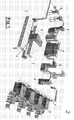
- bales of cotton that are stretched out side-by-side on the floor to form a fibrous layer and are subjected to the action of a plucker 1 with one or more reels that crosses with back-and-forth motion the layer of bales that is progressively used up.
- a plucker 1 essentially has the task of opening, i.e. of picking up the flock fibres, the bales of cotton and it is not equipped with dirt elimination elements: all of the material of the bales is therefore taken up and entered into the line.
- the duct 2 carries the flock material by pneumatic transportation to the subsequent treatment.
- the path elements for separating the flow are inserted, for example slits with grids, which allow the heaviest parts of the material carried by the transportation air that travel in the bottom parts of the duct to be eliminated.
- the first opening point of the opened material consists of an opener 3 with one or two reels, where the first elimination takes place through separation grids that allow the coarsest impurities to be discarded.
- the reels of this opener are equipped with a small number of pins and not with just real clothings. There are no knives or sucking mouths.
- the degree of opening of the flock is low and carries out a sort of pre-opening of the material that is then stored in the mixer 4, in which the different quality of the product loaded in the line by the plucker 1 is homogenised. Indeed, it must be taken into account that the bales are not all the same and that the compactness of the fibres inside the individual bales is subject to substantial variation.
- the flock fibres are therefore fed in pneumatic transportation to the opener 5 itself.
- the opener 5 is equipped with many reels - generally three or four - equipped with a clothing, having saw-teeth, points or needles according to the material to be treated. In general the population of the clothing increases from the first to the last reel, cooperating with impurity elimination groups consisting of knives and sucking mouths.
- the opener 5 is the point of the battery line where most of the opening process of the flock material and the elimination of its impurities is carried out. However, this is also the point where there is the most deterioration of the treated fibres, also due to the need to work on large amounts of material - from 600 even up to 1200 kg/h - sufficient to feed around ten carding machines, according to the type of production intended to be carried out.
- the treated material arrives at the launch cage 6 from which it is fed towards the feeding silo 7 of the carding machines 8.
- Said feeding silo like for example the silo according to patent EP 1.004.693 to the same Applicant, essentially have the task of preparing and feeding, in input to the feeding table of the carding machine, a wadding mattress that is homogeneous in terms of compactness and thickness. From such a table the feeding cylinder loads the cotton onto the introduction and preparation cylinders of the carding machine, known as licker-in, which shall be discussed later on.
- the operation carried out in the feeding silo 7 consists of flaking and subsequently compacting the flock material. Flaking is carried out with two or more rotary elements, whereas compacting is carried out with flows of air in the loading area to the carding machine. The thickness of the mattress thus formed is adjusted with levelling cylinders.
- the limiting factor of the productivity of carding machines is the degree of stretching out and of cleaning of the band of fibres that is produced: the greater is the amount of dirt in the starting product, the lower is the production of the carding machine.
- an initial preparation stage is foreseen on the carding machines, carried out - instead of on a single cylinder - on a plurality of cleaning and preparation cylinders, commonly known as licker-in, arranged in series in front of the main carding drum.
- the licker-in rolls in series are equipped with toothed clothings, fixed carding elements, separating knives and sucking mouths to stretch out the fibres and separate the dirt from them.
- the licker-in rolls in series work at increasing peripheral speed, in any case necessarily less than that of the main carding drum that must "strip" the last licker-in of the fibres carried by its clothing.
- the intended purpose of such licker-in rolls is to preventively improve the opening, stretching out and homogeneity of the material arriving on the main carding drum beforehand, and also to separate a further amount of impurities.
- the expectations for such insertion of the licker-in rolls in series are aimed, overall, at increasing the unitary production capacity of the carding machine, at increasing the quality of the band, at improving the carding effect, i.e. the stretching out of the fibres, increasing the lifetime of the clothings - in particular of the main drum and of its flats - and finally at having a band that is more suited to being used in open-end spinning machines, in which the residual "neps" and stubble can cause frequent breaking of the thread coming out from the spinning rotor.
- the present invention refers more specifically to a device for preparing and feeding flock fibres to a carding machine that allows higher production and better quality to the carding machine downstream, since it supplies staples that are more open and cleaner, and with the degree of preparation that is most advantageous for the single carding machine that is downstream from it.
- the device according to the invention is defined, in its essential characteristics, in the first claim, and in its preferred embodiments in the claims dependent upon it.
- FIG 2 shows a preparing and feeding device consisting of a vertical silo 11 in which the fibrous material comes by pneumatic transportation in air current from the launch cage 6 and accumulates in its end part, for example with a fill level control technique already described in the quoted patent EP 1.004.693 .
- the feeding cylinder or roller 12 is arranged that feeds the flock fibres to the equipped cylinder 13 that unravels the material and opens and cleans the flocks picked up.
- the two cylinders 12 and 13 operate with rotation in unison to take away the material and send it forwards.
- the feeding roller 12 is actuated at variable rotation speed and is made lobed or equipped with a clothing with saw-teeth, in a per se known way.
- the feeding roller 12 works facing the wall 14 of the end part of the silo 11, to create a gap 15 for the passage of the fibres between them.
- the cylinder 13 is equipped with groups of flock fibre treatment elements, according to a known scheme for cotton-type openers, for example from patent EP 952.244 to the same Applicant, shown more clearly in the enlarged detail of figure 2bis .
- a group consists of a clothing 20 with needles or saw-teeth, which receives the fibres from the roller 12, arranges them on the clothing and presents them to the treatment elements that consist of:
- the groups are mounted on rod supports 26.
- Elements 28 for containing the cylinder 13 are also foreseen.
- the flock material is detached by a stripping knife 30 that operates in the ascending contracted vein space that comes into the duct 31 through the effect of the blower 33.
- the air-flow goes upstream the duct 34 and goes downstream the second silo 35, along with the flock material.
- Said silos are preferably formed of quadrangular sections of plates.
- At the bottom of the silo 35 are arranged, on one or more of its walls, grids 36 for evacuation from the silo towards the outside and of recycle of the transportation air, which leave the fibrous flock material inside the bottom of the silo.
- the transportation air is gathered into collectors 37 and sent back through the duct 38 to the inlet 39 of suction of the blower 33.
- the density of the flock material can be controlled and regulated by pneumatic effect.
- a group of discharge cylinders or lobed rollers 41 rotating at commanded speed to regulate the flow rate of fibres, discharges the fibres onto a chute 42 that feeds the fibres in the form of a mattress to the carding machine with a conveying roller 43.
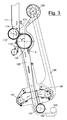
- the fibres go down from a vertical silo 111 in which the fibrous material comes by pneumatic transportation in air current from the launch cage 6.
- the descending fibres encounter a first feeding roller 112 that feeds and cooperates with the equipped cylinder 113 to unravel the fibres and clean the flocks picked up.
- the two cylinders 112 and 113 operate with rotation in unison to guide the descending fibrous material, as shown by the arrows in the figure.
- the feeding roller 112 works facing the wall 114 of the end part of the silo 111, to create a hinged gap 115 between them that can be regulated for the downward passage of the fibres.
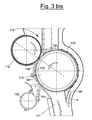
- the cylinder 113 On its periphery, similarly to the scheme of figure 2 , the cylinder 113 is equipped with one or more groups of elements for treating the flock fibres, shown in the enlarged detail of figure 3bis , in which a single group of elements is shown as an example.
- a group consists of a clothing 120 with saw-teeth, which receives the fibres from the roller 112, arranges them on its periphery and takes them into contact with:
- the flock material, opened and cleaned, carried by the clothing 120 arrives at the mouth 131 into the descending discharge channel 135, which also acts as a silo for the unravelled material.
- the stripping effect of the fibres from the clothing 120 is obtained both by pneumatic effect with the jet of air, shown with the arrow A, which comes from the blower 133, which crosses the duct 130 and that expands in the mouth 131 with Venturi effect, which acts as stripping means drawing air and fibres from the clothing 120, and by centrifugal effect.
- a centrifugal stripping effect can be increased by increasing the rotation speed of the cylinder 113.
- the flow of flock material detached from the clothing 120 is deviated and made to fall with the left face of the wedge 125, which joins the mouth 131 with the duct 130.
- the current of air A with the flock material descends and is contained in the silo duct 135.
- grids 136 are arranged that separate the transportation air and leave the flock material inside.
- the transportation air A is taken back with the manifolds 137 and sent on with the duct 138 to the blower 133.
- one or more discharge cylinders 141 actuated to regulate the flow rate of fibres, discharges the fibres onto a chute 142 that feeds the fibres in the form of a mattress to the following carding machine with a conveying roller 143.
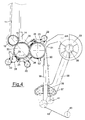
- Figure 4 illustrates an embodiment of the device according to the present invention with two opening cylinders 53 and 53'.
- the cylinders 53, 53' also counter-rotate and rotate a progressively greater speeds, so that the following cylinder strips the preceding cylinder of its film of fibres, sending it forwards.
- the fibrous flock material, detached by the stripping knife 30, is always conveyed into the duct 31 and into the silo 35 with the help of a contracted vein of transportation air coming from the blower 33, but with descending flow.
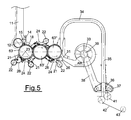
- Figure 5 illustrates an embodiment of the device according to the present invention with three opening cylinders 63, 63' and 63" .
- the cylinders 63, 63', 63" also counter-rotate and rotate a progressively greater speeds, so that the following cylinder strips the preceding cylinder of its film of fibres, sending it forwards.
- the discharging scheme of the fibres into the duct 31 with contracted vein remains the same as the one of figure 2 .
- the cylinder 13, 113 is actuated at a peripheral speed within the range from 5 to 18 m/sec.
- the speed range referring to the last cylinders of the series, 53' and 63" respectively goes from 25 to 50 m/sec, whereas the actuation speed values of the preceding cylinders are less by about 25-40%, for every passage, in order to allow the correct transfer of the film of treated fibres.
- the clothings of the cylinders have a progressively denser and less in relief population of tips, needles or saw-teeth, taking into account that the film deposited on it is progressively cleaner, more stretched out and thinner.
- the devices according to the invention work on the film of fibres with a work scheme that seems similar, but with the difference of serving a single carding machine, i.e. with much lower thicknesses of the layer of flock fibres.
- the ease of detachment and elimination of impurities be they dirt, neps or short fibres, is enormously greater and less aggressive clothings can be adopted, which therefore reduce the deterioration of the fibres.
- the device according to the invention boasts clothings and carding members of size and aggressiveness that differ from those used in conventional openers and carries out an opening and preparation process of the flocks that is more delicate and effective.
- the peripheral speeds on the first cylinder are in the order of 5-15 m/sec.
- the sizes of the cylinders are within the range of 200-300 mm.
- the clothings of the cylinders consist of a population within the range of 4-50 tips per square inch, i.e. 62-765 tips per dm 2 , with needles and/or saw-teeth.
- the device for preparing and feeding flock fibres for a carding machine allows substantial advantages with respect to the prior art. Amongst them, the following characteristics deserve at least an explicit mention.
- the opening cylinders that equip the device practically do not have the peripheral speed limitations that the licker-in rolls on board the carding machines do on the other hand have, being able to work at the peripheral speeds of the openers but on much thinner layers of fibre.
- the carding machine downstream requires a single licker-in, works on a much cleaner feed and can have a higher unitary production.
- the technological advantages deriving from this are substantial, because the opening cylinders on board the device work at the same unitary production of the carding machine and can be set at the ideal speed for discarding dirt, with low production of neps and safeguarding the length of the fibres. In such conditions a good separation of the so-called "pepper trash", the finest fraction of dust, is also obtained, which conventional openers arranged upstream are unable to carry out, working on thicker layers of fibres.
- the wadding mattress presented to the carding machine is of excellent quality, in terms of its smaller and more homogeneous flocks and its greater consistency due to the compression of the air produced in the ventilator integrated in the device, the blower 33. The quality of the band produced by the carding machine, the carding effect and the lifetime of the clothings are substantially advanced due to this.
- the device for preparing and feeding flock fibre to the carding machine according to the present invention allows the conventional scheme shown in figure 1 to be overcome, being able to eliminate from this scheme the conventional opener 5 with large capacity arranged upstream of the carding machines 8 with the described drawbacks, and delegate its function to the opening cylinders of the device according to the invention.
- the functions of the opening devices 5 and feeding silo 7, according to the conventional scheme of figure 1 are fulfilled, overcoming the aforementioned drawbacks thereof and taking the opening and cleaning function of the fibres at the feeding of each carding machine.
- the overall processing scheme allows greater flexibility over the entire battery line and advantages in carrying out the opening of the fibres, since it is carried out on many machines and on a smaller unitary amount, with much thinner layers of fibre, thus giving a more efficient and softer opening on the fibres and giving the carding machine a cleaner and more stretched out material.
- the positive effect also propagates downstream, being able to work on the carding machine with greater unitary capacity, and the carding machine not requiring the series of many licker-in rolls. Such advantages also affect the subsequent ironing, combing, sliver - yarn formation processes.
Landscapes
- Engineering & Computer Science (AREA)
- Textile Engineering (AREA)
- Preliminary Treatment Of Fibers (AREA)
Priority Applications (1)
| Application Number | Priority Date | Filing Date | Title |
|---|---|---|---|
| EP07111856A EP2011908A1 (fr) | 2007-07-05 | 2007-07-05 | Dispositif combiné pour l'ouverture et l'introduction de fibres de bourre dans une machine de cardage |
Applications Claiming Priority (1)
| Application Number | Priority Date | Filing Date | Title |
|---|---|---|---|
| EP07111856A EP2011908A1 (fr) | 2007-07-05 | 2007-07-05 | Dispositif combiné pour l'ouverture et l'introduction de fibres de bourre dans une machine de cardage |
Publications (1)
| Publication Number | Publication Date |
|---|---|
| EP2011908A1 true EP2011908A1 (fr) | 2009-01-07 |
Family
ID=38625845
Family Applications (1)
| Application Number | Title | Priority Date | Filing Date |
|---|---|---|---|
| EP07111856A Withdrawn EP2011908A1 (fr) | 2007-07-05 | 2007-07-05 | Dispositif combiné pour l'ouverture et l'introduction de fibres de bourre dans une machine de cardage |
Country Status (1)
| Country | Link |
|---|---|
| EP (1) | EP2011908A1 (fr) |
Cited By (7)
| Publication number | Priority date | Publication date | Assignee | Title |
|---|---|---|---|---|
| CN103225136A (zh) * | 2013-05-15 | 2013-07-31 | 海门市麒新纺织机械有限公司 | 一种开松机 |
| CN107904716A (zh) * | 2017-12-23 | 2018-04-13 | 盐城工业职业技术学院 | 一种超短细柔纤维聚绒纺纱设备 |
| EP3530781A1 (fr) * | 2018-02-26 | 2019-08-28 | Maschinenfabrik Rieter AG | Dispositif d'alimentation d'une carde |
| CN114263008A (zh) * | 2021-12-31 | 2022-04-01 | 浙江通圆经编股份有限公司 | 一种布料去浮毛装置 |
| WO2022135977A1 (fr) * | 2020-12-22 | 2022-06-30 | Trützschler Group SE | Procédé pour faire fonctionner un dispositif sur ou dans une machine textile, et machine textile fonctionnant avec celui-ci |
| EP4155440A1 (fr) * | 2021-09-28 | 2023-03-29 | Maschinenfabrik Rieter AG | Entrée de fibres pour une machine de nettoyage |
| WO2025160688A1 (fr) * | 2024-01-29 | 2025-08-07 | 里特机械公司 | Système de distribution d'impuretés pour machine à carder, machine à carder associée et procédé de modification de machine à carder |
Citations (6)
| Publication number | Priority date | Publication date | Assignee | Title |
|---|---|---|---|---|
| US4858278A (en) * | 1987-04-07 | 1989-08-22 | Hergeth Hollingsworth Gmbh | Apparatus for cleaning and opening textile fiber material |
| US5146652A (en) * | 1990-01-23 | 1992-09-15 | Trutzschler Gmbh & Co. Kg | Apparatus for opening and cleaning fiber material |
| EP1004693A2 (fr) * | 1998-11-24 | 2000-05-31 | Marzoli S.p.A. | Appareil de préparation et d'ouverture de flocs de fibres pour le chargement d'une carde |
| US6185787B1 (en) * | 1997-07-30 | 2001-02-13 | Maschinenfabrik Rieter Ag | Fiber flock cleaner |
| EP1262580A1 (fr) * | 2001-05-31 | 2002-12-04 | MARZOLI S.p.A. | Ouvreuse et méthode d'ouverture pour matériau fibreux |
| WO2007048262A2 (fr) * | 2005-10-28 | 2007-05-03 | Maschinenfabrik Rieter Ag | Cylindre d'ouverture et puits de remplissage pour machine a carder |
-
2007
- 2007-07-05 EP EP07111856A patent/EP2011908A1/fr not_active Withdrawn
Patent Citations (6)
| Publication number | Priority date | Publication date | Assignee | Title |
|---|---|---|---|---|
| US4858278A (en) * | 1987-04-07 | 1989-08-22 | Hergeth Hollingsworth Gmbh | Apparatus for cleaning and opening textile fiber material |
| US5146652A (en) * | 1990-01-23 | 1992-09-15 | Trutzschler Gmbh & Co. Kg | Apparatus for opening and cleaning fiber material |
| US6185787B1 (en) * | 1997-07-30 | 2001-02-13 | Maschinenfabrik Rieter Ag | Fiber flock cleaner |
| EP1004693A2 (fr) * | 1998-11-24 | 2000-05-31 | Marzoli S.p.A. | Appareil de préparation et d'ouverture de flocs de fibres pour le chargement d'une carde |
| EP1262580A1 (fr) * | 2001-05-31 | 2002-12-04 | MARZOLI S.p.A. | Ouvreuse et méthode d'ouverture pour matériau fibreux |
| WO2007048262A2 (fr) * | 2005-10-28 | 2007-05-03 | Maschinenfabrik Rieter Ag | Cylindre d'ouverture et puits de remplissage pour machine a carder |
Cited By (11)
| Publication number | Priority date | Publication date | Assignee | Title |
|---|---|---|---|---|
| CN103225136A (zh) * | 2013-05-15 | 2013-07-31 | 海门市麒新纺织机械有限公司 | 一种开松机 |
| CN107904716A (zh) * | 2017-12-23 | 2018-04-13 | 盐城工业职业技术学院 | 一种超短细柔纤维聚绒纺纱设备 |
| EP3530781A1 (fr) * | 2018-02-26 | 2019-08-28 | Maschinenfabrik Rieter AG | Dispositif d'alimentation d'une carde |
| CH714679A1 (de) * | 2018-02-26 | 2019-08-30 | Rieter Ag Maschf | Füllschachtaustrag zur Speisung einer Karde. |
| CN110195273A (zh) * | 2018-02-26 | 2019-09-03 | 里特机械公司 | 用于梳理机的喂给设备 |
| CN110195273B (zh) * | 2018-02-26 | 2022-11-29 | 里特机械公司 | 用于梳理机的喂给设备 |
| WO2022135977A1 (fr) * | 2020-12-22 | 2022-06-30 | Trützschler Group SE | Procédé pour faire fonctionner un dispositif sur ou dans une machine textile, et machine textile fonctionnant avec celui-ci |
| CN116438337A (zh) * | 2020-12-22 | 2023-07-14 | 特吕茨施勒集团欧洲公司 | 用于运行在纺纱机器上或中的设备的方法以及借此运行的纺纱机器 |
| EP4155440A1 (fr) * | 2021-09-28 | 2023-03-29 | Maschinenfabrik Rieter AG | Entrée de fibres pour une machine de nettoyage |
| CN114263008A (zh) * | 2021-12-31 | 2022-04-01 | 浙江通圆经编股份有限公司 | 一种布料去浮毛装置 |
| WO2025160688A1 (fr) * | 2024-01-29 | 2025-08-07 | 里特机械公司 | Système de distribution d'impuretés pour machine à carder, machine à carder associée et procédé de modification de machine à carder |
Similar Documents
| Publication | Publication Date | Title |
|---|---|---|
| US6212738B1 (en) | Method and device for fibre production | |
| JPH0213048B2 (fr) | ||
| EP1262580B1 (fr) | Ouvreuse et méthode d'ouverture pour matériau fibreux | |
| GB1586940A (en) | Apparatus for treating fibrous material for subsequent processing | |
| US4345356A (en) | Mechanism for eliminating impurities from fibrous material, in particular cotton | |
| GB2134553A (en) | Carding apparatus | |
| CN109913983A (zh) | 一种纯棉精梳机织纱高效生产方法 | |
| US4040948A (en) | Device for cleaning flock formed by natural fibers, especially cotton flock, of dirt particles | |
| CN116043371A (zh) | 一种防缠绕具有开松功能的羊绒纺纱装置 | |
| CN110004548A (zh) | 针织混纺纱的生产方法 | |
| US8112845B2 (en) | Method and apparatus for separating foreign matter from fibrous material | |
| US2071438A (en) | Method of and means for producing slivers or ends of fibrous materials | |
| US6061875A (en) | Powered roll gin stand | |
| CN101348954A (zh) | 用于开松丛束纤维和将其喂入到梳理机的组合装置 | |
| GB2367306A (en) | Separating blade system for spinning preparation machine | |
| EP0927779B1 (fr) | Appareil d'alimentation pour nappes de fibres dans machines de cardage à chapeaux | |
| CN207525395U (zh) | 梳理机 | |
| CN110621818B (zh) | 梳理机 | |
| US1165088A (en) | Carding-machine. | |
| CN117966322A (zh) | 一种涡流纺特高支纱线的生产工艺 | |
| CN211771702U (zh) | 一种棉纱生产用开棉装置 | |
| US1751306A (en) | Cotton gin | |
| US3080617A (en) | Fiber proportioning, blending and preparation method, system and apparatus | |
| US3320641A (en) | Method for continuous, high-speed processing and cleaning of fibers | |
| CN209941171U (zh) | 一种梳棉机的送料装置 |
Legal Events
| Date | Code | Title | Description |
|---|---|---|---|
| PUAI | Public reference made under article 153(3) epc to a published international application that has entered the european phase |
Free format text: ORIGINAL CODE: 0009012 |
|
| AK | Designated contracting states |
Kind code of ref document: A1 Designated state(s): AT BE BG CH CY CZ DE DK EE ES FI FR GB GR HU IE IS IT LI LT LU LV MC MT NL PL PT RO SE SI SK TR |
|
| AX | Request for extension of the european patent |
Extension state: AL BA HR MK RS |
|
| AKX | Designation fees paid | ||
| REG | Reference to a national code |
Ref country code: DE Ref legal event code: 8566 |
|
| STAA | Information on the status of an ep patent application or granted ep patent |
Free format text: STATUS: THE APPLICATION IS DEEMED TO BE WITHDRAWN |
|
| 18D | Application deemed to be withdrawn |
Effective date: 20090708 |