EP2008713A2 - Nanolegierungen in der Emissionssteuerung bei Nachbehandlungssystemen - Google Patents
Nanolegierungen in der Emissionssteuerung bei Nachbehandlungssystemen Download PDFInfo
- Publication number
- EP2008713A2 EP2008713A2 EP08157527A EP08157527A EP2008713A2 EP 2008713 A2 EP2008713 A2 EP 2008713A2 EP 08157527 A EP08157527 A EP 08157527A EP 08157527 A EP08157527 A EP 08157527A EP 2008713 A2 EP2008713 A2 EP 2008713A2
- Authority
- EP
- European Patent Office
- Prior art keywords
- alloy
- group
- metal
- washcoat
- support
- Prior art date
- Legal status (The legal status is an assumption and is not a legal conclusion. Google has not performed a legal analysis and makes no representation as to the accuracy of the status listed.)
- Withdrawn
Links
Images

Classifications
-
- B—PERFORMING OPERATIONS; TRANSPORTING
- B01—PHYSICAL OR CHEMICAL PROCESSES OR APPARATUS IN GENERAL
- B01J—CHEMICAL OR PHYSICAL PROCESSES, e.g. CATALYSIS OR COLLOID CHEMISTRY; THEIR RELEVANT APPARATUS
- B01J37/00—Processes, in general, for preparing catalysts; Processes, in general, for activation of catalysts
- B01J37/02—Impregnation, coating or precipitation
- B01J37/0215—Coating
-
- B—PERFORMING OPERATIONS; TRANSPORTING
- B01—PHYSICAL OR CHEMICAL PROCESSES OR APPARATUS IN GENERAL
- B01D—SEPARATION
- B01D53/00—Separation of gases or vapours; Recovering vapours of volatile solvents from gases; Chemical or biological purification of waste gases, e.g. engine exhaust gases, smoke, fumes, flue gases, aerosols
- B01D53/34—Chemical or biological purification of waste gases
- B01D53/92—Chemical or biological purification of waste gases of engine exhaust gases
- B01D53/94—Chemical or biological purification of waste gases of engine exhaust gases by catalytic processes
- B01D53/9445—Simultaneously removing carbon monoxide, hydrocarbons or nitrogen oxides making use of three-way catalysts [TWC] or four-way-catalysts [FWC]
- B01D53/945—Simultaneously removing carbon monoxide, hydrocarbons or nitrogen oxides making use of three-way catalysts [TWC] or four-way-catalysts [FWC] characterised by a specific catalyst
-
- B—PERFORMING OPERATIONS; TRANSPORTING
- B01—PHYSICAL OR CHEMICAL PROCESSES OR APPARATUS IN GENERAL
- B01J—CHEMICAL OR PHYSICAL PROCESSES, e.g. CATALYSIS OR COLLOID CHEMISTRY; THEIR RELEVANT APPARATUS
- B01J23/00—Catalysts comprising metals or metal oxides or hydroxides, not provided for in group B01J21/00
- B01J23/10—Catalysts comprising metals or metal oxides or hydroxides, not provided for in group B01J21/00 of rare earths
-
- B—PERFORMING OPERATIONS; TRANSPORTING
- B01—PHYSICAL OR CHEMICAL PROCESSES OR APPARATUS IN GENERAL
- B01J—CHEMICAL OR PHYSICAL PROCESSES, e.g. CATALYSIS OR COLLOID CHEMISTRY; THEIR RELEVANT APPARATUS
- B01J23/00—Catalysts comprising metals or metal oxides or hydroxides, not provided for in group B01J21/00
- B01J23/16—Catalysts comprising metals or metal oxides or hydroxides, not provided for in group B01J21/00 of arsenic, antimony, bismuth, vanadium, niobium, tantalum, polonium, chromium, molybdenum, tungsten, manganese, technetium or rhenium
- B01J23/32—Manganese, technetium or rhenium
- B01J23/34—Manganese
-
- B—PERFORMING OPERATIONS; TRANSPORTING
- B01—PHYSICAL OR CHEMICAL PROCESSES OR APPARATUS IN GENERAL
- B01J—CHEMICAL OR PHYSICAL PROCESSES, e.g. CATALYSIS OR COLLOID CHEMISTRY; THEIR RELEVANT APPARATUS
- B01J23/00—Catalysts comprising metals or metal oxides or hydroxides, not provided for in group B01J21/00
- B01J23/38—Catalysts comprising metals or metal oxides or hydroxides, not provided for in group B01J21/00 of noble metals
- B01J23/40—Catalysts comprising metals or metal oxides or hydroxides, not provided for in group B01J21/00 of noble metals of the platinum group metals
-
- B—PERFORMING OPERATIONS; TRANSPORTING
- B01—PHYSICAL OR CHEMICAL PROCESSES OR APPARATUS IN GENERAL
- B01J—CHEMICAL OR PHYSICAL PROCESSES, e.g. CATALYSIS OR COLLOID CHEMISTRY; THEIR RELEVANT APPARATUS
- B01J23/00—Catalysts comprising metals or metal oxides or hydroxides, not provided for in group B01J21/00
- B01J23/38—Catalysts comprising metals or metal oxides or hydroxides, not provided for in group B01J21/00 of noble metals
- B01J23/40—Catalysts comprising metals or metal oxides or hydroxides, not provided for in group B01J21/00 of noble metals of the platinum group metals
- B01J23/46—Ruthenium, rhodium, osmium or iridium
- B01J23/462—Ruthenium
-
- B—PERFORMING OPERATIONS; TRANSPORTING
- B01—PHYSICAL OR CHEMICAL PROCESSES OR APPARATUS IN GENERAL
- B01J—CHEMICAL OR PHYSICAL PROCESSES, e.g. CATALYSIS OR COLLOID CHEMISTRY; THEIR RELEVANT APPARATUS
- B01J23/00—Catalysts comprising metals or metal oxides or hydroxides, not provided for in group B01J21/00
- B01J23/38—Catalysts comprising metals or metal oxides or hydroxides, not provided for in group B01J21/00 of noble metals
- B01J23/40—Catalysts comprising metals or metal oxides or hydroxides, not provided for in group B01J21/00 of noble metals of the platinum group metals
- B01J23/46—Ruthenium, rhodium, osmium or iridium
- B01J23/464—Rhodium
-
- B—PERFORMING OPERATIONS; TRANSPORTING
- B01—PHYSICAL OR CHEMICAL PROCESSES OR APPARATUS IN GENERAL
- B01J—CHEMICAL OR PHYSICAL PROCESSES, e.g. CATALYSIS OR COLLOID CHEMISTRY; THEIR RELEVANT APPARATUS
- B01J23/00—Catalysts comprising metals or metal oxides or hydroxides, not provided for in group B01J21/00
- B01J23/70—Catalysts comprising metals or metal oxides or hydroxides, not provided for in group B01J21/00 of the iron group metals or copper
- B01J23/76—Catalysts comprising metals or metal oxides or hydroxides, not provided for in group B01J21/00 of the iron group metals or copper combined with metals, oxides or hydroxides provided for in groups B01J23/02 - B01J23/36
- B01J23/78—Catalysts comprising metals or metal oxides or hydroxides, not provided for in group B01J21/00 of the iron group metals or copper combined with metals, oxides or hydroxides provided for in groups B01J23/02 - B01J23/36 with alkali- or alkaline earth metals
-
- B—PERFORMING OPERATIONS; TRANSPORTING
- B01—PHYSICAL OR CHEMICAL PROCESSES OR APPARATUS IN GENERAL
- B01J—CHEMICAL OR PHYSICAL PROCESSES, e.g. CATALYSIS OR COLLOID CHEMISTRY; THEIR RELEVANT APPARATUS
- B01J23/00—Catalysts comprising metals or metal oxides or hydroxides, not provided for in group B01J21/00
- B01J23/70—Catalysts comprising metals or metal oxides or hydroxides, not provided for in group B01J21/00 of the iron group metals or copper
- B01J23/76—Catalysts comprising metals or metal oxides or hydroxides, not provided for in group B01J21/00 of the iron group metals or copper combined with metals, oxides or hydroxides provided for in groups B01J23/02 - B01J23/36
- B01J23/83—Catalysts comprising metals or metal oxides or hydroxides, not provided for in group B01J21/00 of the iron group metals or copper combined with metals, oxides or hydroxides provided for in groups B01J23/02 - B01J23/36 with rare earths or actinides
-
- B—PERFORMING OPERATIONS; TRANSPORTING
- B01—PHYSICAL OR CHEMICAL PROCESSES OR APPARATUS IN GENERAL
- B01J—CHEMICAL OR PHYSICAL PROCESSES, e.g. CATALYSIS OR COLLOID CHEMISTRY; THEIR RELEVANT APPARATUS
- B01J35/00—Catalysts, in general, characterised by their form or physical properties
- B01J35/40—Catalysts, in general, characterised by their form or physical properties characterised by dimensions, e.g. grain size
- B01J35/45—Nanoparticles
-
- B—PERFORMING OPERATIONS; TRANSPORTING
- B01—PHYSICAL OR CHEMICAL PROCESSES OR APPARATUS IN GENERAL
- B01J—CHEMICAL OR PHYSICAL PROCESSES, e.g. CATALYSIS OR COLLOID CHEMISTRY; THEIR RELEVANT APPARATUS
- B01J37/00—Processes, in general, for preparing catalysts; Processes, in general, for activation of catalysts
- B01J37/02—Impregnation, coating or precipitation
- B01J37/03—Precipitation; Co-precipitation
- B01J37/036—Precipitation; Co-precipitation to form a gel or a cogel
-
- B—PERFORMING OPERATIONS; TRANSPORTING
- B01—PHYSICAL OR CHEMICAL PROCESSES OR APPARATUS IN GENERAL
- B01J—CHEMICAL OR PHYSICAL PROCESSES, e.g. CATALYSIS OR COLLOID CHEMISTRY; THEIR RELEVANT APPARATUS
- B01J37/00—Processes, in general, for preparing catalysts; Processes, in general, for activation of catalysts
- B01J37/02—Impregnation, coating or precipitation
- B01J37/03—Precipitation; Co-precipitation
- B01J37/038—Precipitation; Co-precipitation to form slurries or suspensions, e.g. a washcoat
-
- B—PERFORMING OPERATIONS; TRANSPORTING
- B01—PHYSICAL OR CHEMICAL PROCESSES OR APPARATUS IN GENERAL
- B01J—CHEMICAL OR PHYSICAL PROCESSES, e.g. CATALYSIS OR COLLOID CHEMISTRY; THEIR RELEVANT APPARATUS
- B01J37/00—Processes, in general, for preparing catalysts; Processes, in general, for activation of catalysts
- B01J37/34—Irradiation by, or application of, electric, magnetic or wave energy, e.g. ultrasonic waves ; Ionic sputtering; Flame or plasma spraying; Particle radiation
- B01J37/341—Irradiation by, or application of, electric, magnetic or wave energy, e.g. ultrasonic waves ; Ionic sputtering; Flame or plasma spraying; Particle radiation making use of electric or magnetic fields, wave energy or particle radiation
- B01J37/344—Irradiation by, or application of, electric, magnetic or wave energy, e.g. ultrasonic waves ; Ionic sputtering; Flame or plasma spraying; Particle radiation making use of electric or magnetic fields, wave energy or particle radiation of electromagnetic wave energy
- B01J37/346—Irradiation by, or application of, electric, magnetic or wave energy, e.g. ultrasonic waves ; Ionic sputtering; Flame or plasma spraying; Particle radiation making use of electric or magnetic fields, wave energy or particle radiation of electromagnetic wave energy of microwave energy
-
- B—PERFORMING OPERATIONS; TRANSPORTING
- B22—CASTING; POWDER METALLURGY
- B22F—WORKING METALLIC POWDER; MANUFACTURE OF ARTICLES FROM METALLIC POWDER; MAKING METALLIC POWDER; APPARATUS OR DEVICES SPECIALLY ADAPTED FOR METALLIC POWDER
- B22F1/00—Metallic powder; Treatment of metallic powder, e.g. to facilitate working or to improve properties
- B22F1/05—Metallic powder characterised by the size or surface area of the particles
- B22F1/054—Nanosized particles
-
- B—PERFORMING OPERATIONS; TRANSPORTING
- B82—NANOTECHNOLOGY
- B82Y—SPECIFIC USES OR APPLICATIONS OF NANOSTRUCTURES; MEASUREMENT OR ANALYSIS OF NANOSTRUCTURES; MANUFACTURE OR TREATMENT OF NANOSTRUCTURES
- B82Y30/00—Nanotechnology for materials or surface science, e.g. nanocomposites
-
- B—PERFORMING OPERATIONS; TRANSPORTING
- B01—PHYSICAL OR CHEMICAL PROCESSES OR APPARATUS IN GENERAL
- B01D—SEPARATION
- B01D2255/00—Catalysts
- B01D2255/10—Noble metals or compounds thereof
- B01D2255/102—Platinum group metals
-
- B—PERFORMING OPERATIONS; TRANSPORTING
- B01—PHYSICAL OR CHEMICAL PROCESSES OR APPARATUS IN GENERAL
- B01D—SEPARATION
- B01D2255/00—Catalysts
- B01D2255/10—Noble metals or compounds thereof
- B01D2255/104—Silver
-
- B—PERFORMING OPERATIONS; TRANSPORTING
- B01—PHYSICAL OR CHEMICAL PROCESSES OR APPARATUS IN GENERAL
- B01D—SEPARATION
- B01D2255/00—Catalysts
- B01D2255/10—Noble metals or compounds thereof
- B01D2255/106—Gold
-
- B—PERFORMING OPERATIONS; TRANSPORTING
- B01—PHYSICAL OR CHEMICAL PROCESSES OR APPARATUS IN GENERAL
- B01D—SEPARATION
- B01D2255/00—Catalysts
- B01D2255/20—Metals or compounds thereof
- B01D2255/202—Alkali metals
-
- B—PERFORMING OPERATIONS; TRANSPORTING
- B01—PHYSICAL OR CHEMICAL PROCESSES OR APPARATUS IN GENERAL
- B01D—SEPARATION
- B01D2255/00—Catalysts
- B01D2255/20—Metals or compounds thereof
- B01D2255/204—Alkaline earth metals
-
- B—PERFORMING OPERATIONS; TRANSPORTING
- B01—PHYSICAL OR CHEMICAL PROCESSES OR APPARATUS IN GENERAL
- B01D—SEPARATION
- B01D2255/00—Catalysts
- B01D2255/20—Metals or compounds thereof
- B01D2255/204—Alkaline earth metals
- B01D2255/2047—Magnesium
-
- B—PERFORMING OPERATIONS; TRANSPORTING
- B01—PHYSICAL OR CHEMICAL PROCESSES OR APPARATUS IN GENERAL
- B01D—SEPARATION
- B01D2255/00—Catalysts
- B01D2255/20—Metals or compounds thereof
- B01D2255/207—Transition metals
- B01D2255/20715—Zirconium
-
- B—PERFORMING OPERATIONS; TRANSPORTING
- B01—PHYSICAL OR CHEMICAL PROCESSES OR APPARATUS IN GENERAL
- B01D—SEPARATION
- B01D2255/00—Catalysts
- B01D2255/20—Metals or compounds thereof
- B01D2255/207—Transition metals
- B01D2255/2073—Manganese
-
- B—PERFORMING OPERATIONS; TRANSPORTING
- B01—PHYSICAL OR CHEMICAL PROCESSES OR APPARATUS IN GENERAL
- B01D—SEPARATION
- B01D2255/00—Catalysts
- B01D2255/20—Metals or compounds thereof
- B01D2255/207—Transition metals
- B01D2255/20738—Iron
-
- B—PERFORMING OPERATIONS; TRANSPORTING
- B01—PHYSICAL OR CHEMICAL PROCESSES OR APPARATUS IN GENERAL
- B01D—SEPARATION
- B01D2255/00—Catalysts
- B01D2255/20—Metals or compounds thereof
- B01D2255/207—Transition metals
- B01D2255/20746—Cobalt
-
- B—PERFORMING OPERATIONS; TRANSPORTING
- B01—PHYSICAL OR CHEMICAL PROCESSES OR APPARATUS IN GENERAL
- B01D—SEPARATION
- B01D2255/00—Catalysts
- B01D2255/20—Metals or compounds thereof
- B01D2255/207—Transition metals
- B01D2255/20761—Copper
-
- B—PERFORMING OPERATIONS; TRANSPORTING
- B01—PHYSICAL OR CHEMICAL PROCESSES OR APPARATUS IN GENERAL
- B01D—SEPARATION
- B01D2255/00—Catalysts
- B01D2255/20—Metals or compounds thereof
- B01D2255/207—Transition metals
- B01D2255/20769—Molybdenum
-
- B—PERFORMING OPERATIONS; TRANSPORTING
- B01—PHYSICAL OR CHEMICAL PROCESSES OR APPARATUS IN GENERAL
- B01D—SEPARATION
- B01D2255/00—Catalysts
- B01D2255/20—Metals or compounds thereof
- B01D2255/209—Other metals
- B01D2255/2092—Aluminium
-
- B—PERFORMING OPERATIONS; TRANSPORTING
- B01—PHYSICAL OR CHEMICAL PROCESSES OR APPARATUS IN GENERAL
- B01D—SEPARATION
- B01D2255/00—Catalysts
- B01D2255/90—Physical characteristics of catalysts
- B01D2255/908—O2-storage component incorporated in the catalyst
-
- B—PERFORMING OPERATIONS; TRANSPORTING
- B01—PHYSICAL OR CHEMICAL PROCESSES OR APPARATUS IN GENERAL
- B01D—SEPARATION
- B01D2255/00—Catalysts
- B01D2255/90—Physical characteristics of catalysts
- B01D2255/91—NOx-storage component incorporated in the catalyst
-
- B—PERFORMING OPERATIONS; TRANSPORTING
- B22—CASTING; POWDER METALLURGY
- B22F—WORKING METALLIC POWDER; MANUFACTURE OF ARTICLES FROM METALLIC POWDER; MAKING METALLIC POWDER; APPARATUS OR DEVICES SPECIALLY ADAPTED FOR METALLIC POWDER
- B22F2998/00—Supplementary information concerning processes or compositions relating to powder metallurgy
-
- Y—GENERAL TAGGING OF NEW TECHNOLOGICAL DEVELOPMENTS; GENERAL TAGGING OF CROSS-SECTIONAL TECHNOLOGIES SPANNING OVER SEVERAL SECTIONS OF THE IPC; TECHNICAL SUBJECTS COVERED BY FORMER USPC CROSS-REFERENCE ART COLLECTIONS [XRACs] AND DIGESTS
- Y02—TECHNOLOGIES OR APPLICATIONS FOR MITIGATION OR ADAPTATION AGAINST CLIMATE CHANGE
- Y02T—CLIMATE CHANGE MITIGATION TECHNOLOGIES RELATED TO TRANSPORTATION
- Y02T10/00—Road transport of goods or passengers
- Y02T10/10—Internal combustion engine [ICE] based vehicles
- Y02T10/12—Improving ICE efficiencies
Definitions
- each composition can comprise an alloy of two or more different metals.
- Catalytic converters have the basic composition of a washcoat on a solid support.
- the washcoat has traditionally been formulated to contain active metal species to catalyze oxidation of pollutants such as CO, HC, and PM into CO 2 and H 2 O, and to reduce NO x into N 2 .
- TWCs Three-way catalysts
- HC, CO, and PM oxidation When lean, the TWC is oxidizing (HC, CO, and PM oxidation) and when rich, it is reducing (NOx to N 2 ).
- an alumina washcoat such as Al 2 O 3 , These components include an oxygen storage compound, such as CeO 2 ; an oxidation catalyst, such as Pt, or Pt/Pd; and a reduction catalyst, such as Rh.
- the dispersion includes an anti-sintering agent, such as Zr and/or a rare earth metal, which can increase the thermal durability of the catalyst by inhibiting sintering.
- an anti-sintering agent such as Zr and/or a rare earth metal
- the components in the dispersion form alloys.
- such traditional TWCs can exhibit the problems discussed earlier, such as the metals not being proximal to each other, thermal sintering of the metals, agglomeration, and reduced number of active sites.
- LNTs lean-NOx traps
- LNCs lean-NO, catalysts (LNCs), oxidation catalysts (OCs), and selective catalytic reduction catalysts (SCRCs)
- SCRCs selective catalytic reduction catalysts
- an alloy represented by the following generic formula (A a ) n (B b ) n (C c ) n (D d ) n (E e ) n
- A is an oxygen storage agent
- B is an anti-sintering agent
- C is an oxidation catalyst
- D is a reduction catalyst
- E is a NO x absorbing agent
- each subscript letter represents compositional stoichiometry
- each n is independently greater than or equal to zero; wherein the sum of the n's is equal to or greater than 2, and wherein the alloy comprises at least two different metals.
- a washcoat composition comprising (i) at least one metal selected from the group consisting of Al 2 O 3 , SiO 2 , ThO, TiO 2 , and mixtures thereof; and (ii) at least one alloy represented by the following generic formula (A a ) n (B b ) n (C c ) n (D d ) n (E e ) n through n ; wherein each capital letter and rigid is a metal; wherein A is an oxygen storage agent; B is an anti-sintering agent; C is an oxidation catalyst; D is a reduction catalyst; and E is a NO x absorbing agent; wherein each subscript letter represents compositional stoichiometry; wherein n is greater than or equal to zero; wherein the sum of the n's is equal to or greater than 2, and wherein the alloy comprises at least two different metals.
- a catalyst support comprising a support having deposited thereon a washcoat composition comprising (i) at least one metal selected from the group consisting of Al 2 O 3 , SiO 2 , ThO, TiO 2 , and mixtures thereof; and (ii) at least one alloy represented by the following generic formula (A a ) n (B b ) n (C c ) n (D d ) n (E e ) n covered n ; wherein each capital letter and fixed is a metal; wherein A is an oxygen storage agent; B is an anti-sintering agent; C is an oxidation catalyst; D is a reduction catalyst; and E is a NO x absorbing agent; wherein each subscript letter represents compositional stoichiometry; wherein n is greater than or equal to zero; wherein the sum of the n's is equal to or greater than 2, and wherein the alloy comprises at least two different metal
- a method of producing a washcoat composition comprising mixing in a solvent medium to form a sol (i) at least one metal selected from the group consisting of Al 2 O 3 , SiO 2 , ThO, TiO 2 , and mixtures thereof; and (ii) at least one alloy, wherein the alloy is represented by the following generic formula (A a ) n (B b ) n (C c ) n (D d ) n (E e ) n covered n ; wherein each capital letter and fixed is a metal; wherein A is an oxygen storage agent; B is an anti-sintering agent; C is an oxidation catalyst; D is a reduction catalyst; and E is a NO x absorbing agent; wherein each subscript letter represents compositional stoichiometry; wherein n is greater than or equal to zero; wherein the sum of the n's is equal to or greater than 2, and wherein the alloy comprises at least two different metals.
- a method of producing a catalyst support comprising mixing in a solvent medium to form a sol (i) at least one metal selected from the group consisting of Al 2 O 3 , SiO 2 , ThO, TiO 2 , and mixtures thereof; and (ii) at least one alloy, wherein the alloy is represented by the following generic formula (A a ) n (B b ) n (C c ) n (D d ) n (E e ) n covered n ; wherein each capital letter and fixed is a metal; wherein A is an oxygen storage agent; B is an anti-sintering agent; C is an oxidation catalyst; D is a reduction catalyst; and E is a NO x absorbing agent; wherein each subscript letter represents compositional stoichiometry; wherein n is greater than or equal to zero; wherein the sum of the n's is equal to or greater than 2, and wherein the alloy comprises at least two different metals; aging the sol into
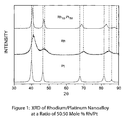
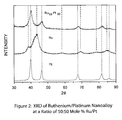
- Figures 1-3 illustrate the analytical results of various nanoalloys of the present disclosure.
- the present disclosure relates in one embodiment to an alloy of two or more metals.
- the alloy is different chemically from any of its constituent metals because it shows a different spectrum in the X-ray diffraction (XRD) than that of the individual constituent metals. In other words, it is not a mixture of different metals, but rather, an alloy of the constituent metals used.
- the alloys such as the disclosed nanoalloys, can be used in main emission control catalysts.
- Non-limiting examples of such systems include three-way catalysts (TWCs), lean-NOx traps (LNTs), lean-NOx catalysts (LNCs), oxidation catalysts (OCs), and selective catalytic reduction catalysts (SCRCs).
- TWCs three-way catalysts
- LNTs lean-NOx traps
- LNCs lean-NOx catalysts
- OCs oxidation catalysts
- SCRCs selective catalytic reduction catalysts
- the primary determining factors for activities metals is primarily the type, shape, size, electronic configuration, and energy levels of lowest unoccupied molecular orbitals (LUMO) and highest occupied molecular orbitals (HOMO) made available by the metal to interact with those of the intended substrate species at conditions when these species are to be chemically and physically transformed.
- LUMO lowest unoccupied molecular orbitals
- HOMO highest occupied molecular orbitals
- the disclosed alloy is the result of combining the different constituent metal atoms in the compound.
- This means that the LUMO/HOMO orbitals of the alloy are hybrids of those characteristic of the respective different metal atoms. Therefore, an alloy, for use in a washcoat, ensures that all constituent metals in the alloy particle end up at the same site and act as one, but in the modified i.e., alloy, form.
- the advantages of an alloy for this purpose would be due to unique modifications imparted to the LUMO/HOMO electronic and orbital configurations of the particles by the mixing of LUMO/HOMO orbitals of the different respective alloy composite metals.
- the number and shape of active sites would be expected to also change significantly in the alloy composites relative to the number and shape of active sites in equivalent but non-alloy mixtures.
- This unique orbital and electronic mixing at the LUMO/HOMO orbital level in the alloys is not possible by simply mixing particles of the respective metals in appropriate functional ratios.
- This disclosure is directed to alloys present in compositions for multifunctional applications.
- composition comprising an alloy represented by the following generic formula (A a ) n (B b ) n (C c ) n (D d ) n (E e ) n
- each capital letter and fixed is a metal
- A is an oxygen storage agent
- B is an anti-sintering agent
- C is an oxidation catalyst
- D is a reduction catalyst
- E is a NO x absorbing agent
- each n is independently greater than or equal to zero
- the alloy comprises at least two different metals.
- the sum of the n's is equal to or greater than 2.
- the strings is understood to include the presence of at least one metal other than those defined by A, B, C and D and the respective compositional stoichiometry.
- Each capital letter in the above-disclosed formula can be a metal.
- the metal can be selected from the group consisting of, transition metals, lanthanides, actinides, alkaline earth metals, and alkali metals.
- each capital letter can be the same or a different metal.
- Sources of the metal can include, but are not limited to, their aqueous salts, carbonyls, oxides, organometallics, and zerovalent metal powders.
- the aqueous salts can comprise, for example, hydroxides, nitrates, acetates, acetonates, ammonium salts, halides, phosphates, phosphonates, phosphites, sulfates, sulfonates, carboxylates, and carbonates.
- A can be an oxygen storage agent.
- A is or comprises a metal selected from the group consisting of Au, Al, Si, Zr, Ce, and oxides thereof.
- B can be an anti-sintering agent.
- B is or comprises a metal selected from the group consisting of Zr, La, Y, Yb, Pr, Sc, Lu, Lr and combinations thereof.
- C can be an oxidation catalyst.
- C is a metal selected from the group consisting of Pt, Pd, Ru, Rh, Os, Ir, Mn, Fe, Co, Cu, Mo, W, La, Ce, Ca, Sr, Ba, and combinations thereof.
- D can be a reduction catalyst.
- D is a metal selected from the group consisting of Rh, Re, Ru, and combinations thereof.
- E can be a NO x absorbing agent.
- E is or comprises a metal selected from the group consisting of Ba, Sr, Ca, Mg, Cs, Rb, K, Na, Li, Mn, Cu, Zn, Cr, and combinations thereof.
- the alloy discussed herein is represented by the following generic formula: (A a ) n (B b ) n (C c ) n (D d ) n (E e ) n through n , wherein each capital letter and rigid is a metal; wherein A is an oxygen storage agent; B is an anti-sintering agent; C is an oxidation catalyst; D is a reduction catalyst; and E is a NO x absorbing agent; wherein each n is independently greater than or equal to zero; wherein the sum of the n's is equal to or greater than 2, and wherein the alloy comprises at least two different metals.
- the disclosed alloy can be a nanoalloy.
- the nanoalloy can have an average particle size of from about 1 to about 100 nanometers, for example, from about 5 to about 75 nanometers, and as a further example from about 10 to about 35 nanometers.
- the alloy can be monofunctional such that it can perform any one of the following functions, for example: oxygen storage (Group A metal), anti-sintering agent (Group B metal), oxidation catalyst (Group C metal), reduction catalyst (Group D metal), or NO x absorbing agent (Group E metal).
- oxygen storage Group A metal
- anti-sintering agent Group B metal
- oxidation catalyst Group C metal
- reduction catalyst Group D metal
- NO x absorbing agent Group E metal
- the alloy can also be bifunctional such that it can perform any two of the functions identified above.
- the alloy can be trifunctional (i.e., it can perform any three of the functions identified above); tetrafunctional (i.e., it can perform any four of the functions identified above); or polyfunctional (i.e., it can perform any number of the functions identified above as well as those that are undefined).
- the disclosed alloy can comprise a metal that can be polyfunctional i.e., it is able to perform at least two functions, such as those identified above.
- platinum can function as an oxidation catalyst (Group C metal) and as a reduction catalyst (Group D metal).
- a Ru-Pt alloy would be a bimetallic alloy that is polyfunctional because both the ruthenium and platinum can function as a reduction catalyst and an oxidation catalyst.
- the alloy can be a nanoalloy and can be bimetallic (i.e., any combination of two different metals from the same or different functional groups, e.g., A a B b , or A a A' a' ); trimetallic (i.e., any combination of three different metals from the same or different functional groups, e.g., A a B b C c , or A a A' a' A" a" or A a A' a' B b ); tetrametallic (i.e., any combination of four different metals from the same or different functional groups, e.g., A a B b C c D d or A a A' a' A" a" A"' a'" or A a B b B' b' C c ); or polymetallic (i.e., any combination of two or more metals from the same or different functional groups, e.g., A a B
- the alloy must comprise at least two different metals, but beyond two the number of metals in each alloy would be dictated by the requirements of each specific combustion system and/or exhaust after treatment system.
- the composition can comprise an alloy selected from the group consisting of a bimetallic, trimetallic, tetrametallic and polymetallic, and wherein the alloy is selected from the group consisting of monofunctional, bifunctional, trifunctional, tetrafunctional, and polyfunctional.
- Monofunctional nanoalloy compositions can be prepared from any combination of metals within any group A - E as shown in the following non-limiting examples for group C:
- Bimetallics (C c C' c' ): Pt/Pd, Pt/Ru, Pt/Rh, Pt/Os, Pt/Ce, Pt/Ba, Pd/Ru, Pd/Rh, Pd/Os, Pd/Ce Pd/Ba, Mn/Fe, Mn/Co, Mn/Cu, Mn/Ca, Mn/Rh, Mn/Pd, Mn/Pt, Mn/Ru, Mn/Ce, Fe/Co, Fe/Cu, Fe/Ca, Fe/Rh, Fe/Pd, Fe/Rh, Fe/Pd/, Fe/Pt, Fe/Ru, Fe/Ce, Cu/Co, Cu/Ca, Cu/Rh, Cu/Pd, Cu/Pt, Cu/Ce, Ru/Pt, etc;
- Trimetallics (A a A' a' A" a ): Pt/Pd/Ce, Pt/Pd/Rh, PtlPd/Ru, Pt/Rh/Ce, Pt/Rh/Ru, Mn/Fe/Co, Mn/Fe/Cu, Mn/Fe/Ca, etc; and
- Polymetallics (A a A' a' A" a" A''' a'' ...etc): Pt/Rh/Ba/Ru/...etc, Mn/Ca/Rh/Pt/...etc, and so forth.
- Similar monofunctional bimetallic and polymetallic nanoalloy compositions can be assembled for groups A, B, D, and E respectively, to specifically address thermal sintering (B), oxidation (A), reduction (D), and NO x absorption (E).
- Polyfunctional alloy compositions can be formed between two or more different metal atoms across the functional groups A, B, C and D as shown in the following non-limiting examples:
- Bifunctional e.g., A a /B b , A a /C c , A a /D d , B b /C c , B b /D d , and C c /D d ): Al/Pt, Pt/Rh, Ba/Ru, Ru/Pt, etc.;
- Trifunctional e.g., A a /B b /C c , A a /C c /D d , or B b /C c /D d ): Au/Zr/Mn, Al/Mn/Rh, Zr/Pt/Ru, etc.; and
- Tetrafunctional (A a /B b /C c /D d ): Ce/Zr/Pt/Ru, Al/La/Pd/Rh, etc.
- Nanoalloys from combinations can also directly affect emissions. Uniform dispersion of active metal species and increased number of active sites in the catalytic washcoat can lead to improved catalytic function, thus leading to reduced toxicity of environmental pollutants.
- the most practical method for bulk preparation of the disclosed alloys is reduction of the aqueous salt mixtures of the respective chosen formulation, using any suitable reductant such as alcohols, primary or secondary amines, alkanolamines, urea, hydrogen, Na- and Li-borahydrides, etc, and an appropriate detergent/dispersant or polymer coater.
- the reaction conditions require a judicious but readily discernible balance between stoichiometry, temperature, pressure, pH, and dispersant.
- Other methods of activating a reaction mixture such as sonication, microwave irradiation, plasma, and optically modified electromagnetic radiation (i.e. UV, IR, lasers, etc) can also be used in the preparation of the disclosed nanoalloys.
- the dispersant can also be the reductant (i.e. alkanolamines where the alcohol functional group does the reduction while the amine group coordinates the reacting nanocluster and controls size through dispersion in the reaction media).
- the dispersant can also be any chelating molecule with a polar head and a non polar tail.
- Rate of reaction will also determine the physical composition of the nanoalloy. For example, fast reaction rates will lead to low density and porous nanoalloys, and slow reaction rates to a denser and less porous product. Porous nanoalloys will find enhanced utility in atmosphere combustion systems, while denser nanoalloys will be better suited for pressurized combustion systems. Such porous nanoalloys are described in Optical Materials, Tsui, Y. Y.; Sun, Y. W., Vol. 29, Issue 8, pp. 1111-1114 (April 2007 ).
- a method to produce nanoalloys of reduced density and/or increased porosity comprising accelerating a reaction rate between a reductant and a reacting substrate nanoalloy precursor by increasing the rate of energy input and/or decreasing the pressure on the reacting system.
- a method for producing nanoalloys of increased density and/or reduced porosity comprising decelerating a reaction rate between a reductant and a reacting substrate nanoalloy precursor by decreasing the rate of energy input and/or increasing the pressure on the reacting system.
- a more specialized method for forming porous nanoalloys is the sol-gel method, such as that developed by the Lawrence Livermore National Laboratory (LLNL).
- Another exemplary method that can be suited to bulk preparation of the disclosed nanoalloys is the mechanochemical method where liquid metal precursors are not necessary. Powders of the respective metal components are mixed and physically ground together under temperatures and pressures sufficient to form the alloy.
- the resultant nanoalloy produced by this method can be of a higher density hence of lower porosity. This reduced surface area will adversely affect gas phase combustion, combustion emissions removal (i.e., SO 3 and NO x from flue gases of utility boilers and incinerator furnaces), and deposit modification (slag in furnaces).
- combustion emissions removal i.e., SO 3 and NO x from flue gases of utility boilers and incinerator furnaces
- deposit modification slag in furnaces
- the alloys herein can be formulated into compositions that can be in any form, including but not limited to, crystalline (powder), or liquids (aqueous solutions, hydrocarbon solutions, sols, or emulsions).
- the liquids can possess the property of being transformable into water/hydrocarbon emulsions using suitable solvents and emulsifier/surfactant combination.
- the liquids can also be converted into high porosity high surface area powders to form catalytically activated washcoat powders.
- a washcoat composition comprising (i) at least one metal selected from the group consisting of Al 2 O 3 , SiO 2 , ThO, TiO 2 , and mixtures thereof; and (ii) at least one alloy represented by the following generic formula (A a ) n (B b ) n (C c ) n (D d ) n (E e ) n (...
- each capital letter and fixed is a metal; wherein A is an oxygen storage agent; B is an anti-sintering agent; C is an oxidation catalyst; D is a reduction catalyst; and E is a NO x absorbing agent; wherein each subscript letter represents compositional stoichiometry; wherein each n is independently greater than or equal to zero; the sum of the n's is equal to or greater than 2; and wherein the alloy comprises at least two different metals.
- the average particle size of the alloy ranges from about 1 to 100 nanometers, for example, from about 5 to about 75 nanometers.
- the washcoat composition can comprise at least one alloy, for example two alloys, or even three alloys.
- the washcoat composition comprises two or more alloys
- the two or more alloys can be the same or different.
- Non-limiting examples of alloys for use in the disclosed washcoat include those represented by the following generic formulae:
- the disclosed washcoat composition can be prepared by any suitable method know to those of ordinary skill in the art.
- the washcoat composition can be prepared by, for example, mixing in a solvent medium to form a sol (i) at least one metal selected from the group consisting of Al 2 O 3 , SiO 2 , ThO, TiO 2 , and mixtures thereof; and (ii) at least one alloy, wherein the alloy is represented by the following generic formula (A a ) n (B b ) n (C c ) n (D d ) n (E e ) n covered n ; wherein each capital letter and fixed is a metal; wherein A is an oxygen storage agent; B is an anti-sintering agent; C is an oxidation catalyst; D is a reduction catalyst; and E is a NO x absorbing agent; wherein each subscript letter represents compositional stoichiometry; wherein each n is independently greater than or equal to zero; and wherein the alloy comprises at least two different metals.
- the disclosed method for making the washcoat composition can further comprise aging the sol into a gel; treating the gel with high pressure gas, such as carbon dioxide; and venting the high pressure gas under supercritical conditions.
- high pressure gas such as carbon dioxide
- One of ordinary skill in the art would know what the supercritical conditions are for carbon dioxide, for example a temperature at least above about 31.1 °C and pressure at least above about 73 atm.
- the disclosed washcoat composition can then be applied to a support to form a catalytic support, such as a catalytic converter.
- the catalyst support can comprise a support having deposited thereon a washcoat composition comprising (i) at least one metal selected from the group consisting of Al 2 O 3 , SiO 2 , ThO, TiO 2 , and mixtures thereof; and (ii) at least one alloy represented by the following generic formula (A a ) n (B b ) n (C c ) n (D d ) n (E e ) n covered n ; wherein each capital letter and fixed is a metal; wherein A is an oxygen storage agent; B is an anti-sintering agent; C is an oxidation catalyst; D is a reduction catalyst; and E is a NO x absorbing agent; wherein each subscript letter represents compositional stoichiometry; wherein each n is independently greater than or equal to zero; and wherein the alloy comprises at least two different metals.
- the support can be chosen from, for example, an aluminosilicate, boron-nitride, silicon carbide, zeolites or other ceramic monolith and a stainless steel monolith.
- the support can be in the form of a porous aluminosilicate zeolite with a high silica content, for example, as described in Advanced Ceramics Support, published June 1, 2007 .
- a method of improving dispersion of active metal species in a washcoat composition comprising providing to the washcoat composition the disclosed alloy.
- a method of reducing agglomeration of active metal species in a washcoat composition comprising providing to the washcoat composition the disclosed alloy.
- a method of increasing active sites of active metal species in a washcoat composition comprising providing to the washcoat composition the disclosed alloy.
- the catalytic support such as a catalytic converter
- Non-limiting examples include three-way catalysts (TWCs), such as for stoichimetric charge feed combustion systems, lean-NO x traps (LNTs), lean-NO x catalysts (LNCs), selective catalytic reduction catalysts (SCRs) , such as for lean-burn variable pressure engines (i.e., diesel engines, leart-burn spark ignited engines, etc.), oxidation catalysts (OCs), diesel oxidation catalysts (DOCs), industrial burners in boilers, incinerators, furnaces, and lean-burn atmospheric burners (i.e., utility furnaces, industrial furnaces, boilers, and incinerators).
- the term "after-treatment system” is used to mean any system, device, method, or combination thereof that acts on
- the disclosed alloys can also be used in other systems, such as those of atmospheric combustion used in utility and industrial burners, boilers, furnaces, and incinerators. These systems can burn from natural gas to liquid fuels (#5 fuel oil and heavier), to solid fuels (coals, wood chips, burnable solid wastes, etc).
- the use in the combustion of a fuel, or the treatment of combustion by-products resulting from said combustion wherein said use comprises contacting the disclosed alloy with the fuel or the by-products.
- a use of an alloy to reduce the amount of at least one of CO, HC, NO x , and PM wherein said use comprises providing to an exhaust after-treatment system a catalytic support comprising the disclosed washcoat comprising the disclosed alloy.
- an alloy to increase at least one of oxygen storage, anti-sintering, oxidation, reduction, and NO x absorbing wherein said use comprises providing at least one alloy to the disclosed washcoat composition.
- reactants and components referred to by chemical name anywhere in the specification or claims hereof, whether referred to in the singular or plural, are identified as they exist prior to coming into contact with another substance referred to by chemical name or chemical type (e.g., base fuel, solvent, etc.). It matters not what chemical changes, transformations and/or reactions, if any, take place in the resulting mixture or solution or reaction medium as such changes, transformations and/or reactions are the natural result of bringing the specified reactants and/or components together under the conditions called for pursuant to this disclosure.
- the reactants and components are identified as ingredients to be brought together either in performing a desired chemical reaction (such as formation of the organometallic compound) or in forming a desired composition (such as a washcoat composition).
- the disclosed alloys can enable active components in the catalyst support function cooperatively due to their intimate location together in functional units, such as nano units, which can also be homogeneously dispersed in the washcoat composition.
- functional units such as nano units
- the surface and the porosity of the washcoat can be modulated by using nanotechnology methods of preparation known to those of ordinary skill in the art.
- the dispersion of the functional units can be maintained by including anti-sintering agents in the precursor to the desired alloy, before the alloy is made.
- alloying Ru with other components of the LNC composition can convert the Ru to an alloy with different volatility characteristics.
- nanoalloys were prepared using known techniques. All chemicals were purchased from Aldrich: (Platinum (IV) chloride, Rhodium (III) acetylacetonate, Ruthenium (III) chloride, Oleylamine 70% technical grade (OAm) and Oleic acid 90% technical grade (OAc)) were used without any further purification. A conventional microwave (800 W) was used in all the nanoalloy synthesis.
- Rh 50 Pt 50 As illustrated in Figure 1 : 15ml OAm + 5ml OAc + (0.2g Rh(acac)3 + 0.1683 g PtCl4)
- the nanoalloys of the present disclosure were prepared by combining desired metals and using appropriate nanoalloy chemistries (e.g., those described herein) to convert the metals into a nanoalloy.
- the nanoalloys had the following compositions: Ru 50 Pd 50 as illustrated in Figure 3 Ce 66 Al 8 O 26 Ce 67 Al 4 Fe 7 O 21 Fe 0.68 Al 0.25 Ce 0.07 FeCe 2 Fe 3 Ce 4 Na 9 Mn 2 Ce 7 Ce 2 CuNa 3 Ce 2 CuAl 3 Fe 3 Cu 4 Na 13
- desired combinations include an oxidation catalyst (such as Pt, Pd, Ru, Rh, Os, Ir, Mn, Fe, Co, Cu, Mo, W, La, Ce, Ca, Sr, and Ba), an anti-sintering agent (such as Zr, La, Y, Yb, Pr, Sc, Lu, and Lr), and cesium oxide (CeO 2 )
- an oxidation catalyst such as Pt, Pd, Ru, Rh, Os, Ir, Mn, Fe, Co, Cu, Mo, W, La, Ce, Ca, Sr, and Ba
- an anti-sintering agent such as Zr, La, Y, Yb, Pr, Sc, Lu, and Lr
- CeO 2 cesium oxide
- a reduction catalyst such as Rh, Re, and Ru
- a further example can be the combination of a NO x absorbing agent (such as Ba, Sr, Ca, Mg, Cs, Rb, K, Na, Li, Mn, Cu, Zn, and Cr), an anti-sintering agent, and an oxidation promoting agent.
- a NO x absorbing agent such as Ba, Sr, Ca, Mg, Cs, Rb, K, Na, Li, Mn, Cu, Zn, and Cr
- an anti-sintering agent such as Ba, Sr, Ca, Mg, Cs, Rb, K, Na, Li, Mn, Cu, Zn, and Cr
- an anti-sintering agent such as Ba, Sr, Ca, Mg, Cs, Rb, K, Na, Li, Mn, Cu, Zn, and Cr
- the prepared nanoalloys were confirmed by XRD, TEM, and SEM-EDS.
- the average particle sizes of these nanoalloys ranged from about 5 to about 25 nanometers landing them comfortably in the nanosize range which has an upper limit of about 100 nm.
- TEM, SEM-EDS and XRD confirmed them to be either homogeneous nanoalloys, or contact nanolloys, where all metal components are represented in the XRD unit cell. This is not the case with mixtures or "doped" mixed metal compositions.
- One of ordinary skill in the art could produce a washcoat sol by mixing the aqueous precursors to Al 2 O 3 , or SiO 2 , or ThO, or TiO 2 , or mixtures thereof by known solution methods.
- One of ordinary skill in the art could then separately prepare nanoalloys of (A a ) n (B b ) n (C c ) n (D d ) n (E e ) n extended n , as defined above, in the desired stoichiometries. In this case emphasis could be on A, B, C, and D, with E being zero.
- the prepared nanoalloys could then be dispersed into the washcoat sol.
- the resultant nanoalloy sol can be aged into the corresponding gel and treated with CO 2 under high pressure.
- the gel can then be brought to supercritical conditions and the CO 2 can be gradually vented while maintaining supercritical conditions.
- the final active-metal loaded washcoat can then be applied to a support to form a catalytic converter to be used in exhaust emissions control systems such as TWCs.
- One skilled in the art could make a slurry of a washcoat, an oxygen storage agent (A) and a NO x absorbing agent (E) using conventional means.
- Separate alloys of B/C/E and B/D can be prepared in a solvent medium compatible with the previously disclosed slurry. All three preparations can then be mixed to form a homogenous dispersion, which can then be loaded onto a support.
- the at least one washcoat metal precursor in a sol-form can be combined with at least one of an NOx absorbing agent (E), an anti-sintering agent (B), and an oxidation catalyst (C), which could be dissolved in a medium compatible with the sol before being made into an alloy.
- a second nanoalloy can also be prepared, such as A/B/D.
- the two nanoalloy compositions can be mixed washcoat sol to form a single sol solution.
- the nanoalloy loaded sol can then be allowed to age to the gel form, which can be finally converted to a high porosity high surface area powder,
- This catalytically activated washcoat powder can then be loaded onto a support which may be in the form of, for example, an aluminosilicate, boron nitride, silicon carbide, zeolite or other ceramic monolith, or a metal-based support system, or beads.
- the washcoat support can be in the form of a porous aluminosilicate zeolite with a high silica content.
Landscapes
- Chemical & Material Sciences (AREA)
- Engineering & Computer Science (AREA)
- Materials Engineering (AREA)
- Chemical Kinetics & Catalysis (AREA)
- Organic Chemistry (AREA)
- Physics & Mathematics (AREA)
- Nanotechnology (AREA)
- Health & Medical Sciences (AREA)
- General Chemical & Material Sciences (AREA)
- General Physics & Mathematics (AREA)
- Environmental & Geological Engineering (AREA)
- Analytical Chemistry (AREA)
- Combustion & Propulsion (AREA)
- Oil, Petroleum & Natural Gas (AREA)
- Inorganic Chemistry (AREA)
- Composite Materials (AREA)
- Condensed Matter Physics & Semiconductors (AREA)
- Biomedical Technology (AREA)
- Crystallography & Structural Chemistry (AREA)
- Electromagnetism (AREA)
- Optics & Photonics (AREA)
- Plasma & Fusion (AREA)
- Toxicology (AREA)
- Dispersion Chemistry (AREA)
- Catalysts (AREA)
- Exhaust Gas Treatment By Means Of Catalyst (AREA)
- Manufacture Of Metal Powder And Suspensions Thereof (AREA)
Applications Claiming Priority (1)
| Application Number | Priority Date | Filing Date | Title |
|---|---|---|---|
| US11/765,114 US20080318765A1 (en) | 2007-06-19 | 2007-06-19 | Nanoalloys in emissions control after-treatment systems |
Publications (2)
| Publication Number | Publication Date |
|---|---|
| EP2008713A2 true EP2008713A2 (de) | 2008-12-31 |
| EP2008713A3 EP2008713A3 (de) | 2009-04-29 |
Family
ID=39832275
Family Applications (1)
| Application Number | Title | Priority Date | Filing Date |
|---|---|---|---|
| EP08157527A Withdrawn EP2008713A3 (de) | 2007-06-19 | 2008-06-04 | Nanolegierungen in der Emissionssteuerung bei Nachbehandlungssystemen |
Country Status (4)
| Country | Link |
|---|---|
| US (1) | US20080318765A1 (de) |
| EP (1) | EP2008713A3 (de) |
| JP (1) | JP2009001901A (de) |
| CN (1) | CN101362086A (de) |
Cited By (2)
| Publication number | Priority date | Publication date | Assignee | Title |
|---|---|---|---|---|
| WO2013121066A1 (es) * | 2012-02-14 | 2013-08-22 | Abengoa Hidrogeno, S.A. | Proceso de producción de hidrógeno mediante hidrolisis catalitica en un reactor continuo para llevar a cabo dicho procedimiento |
| EP2898945A4 (de) * | 2012-09-18 | 2016-10-12 | Japan Science & Tech Agency | Katalysator mit pd-ru-feststofflösungsartigen legierungsteilchen |
Families Citing this family (7)
| Publication number | Priority date | Publication date | Assignee | Title |
|---|---|---|---|---|
| US20110041482A1 (en) * | 2009-08-20 | 2011-02-24 | Gm Global Technology Operations, Inc. | Method and apparatus for exhaust aftertreatment of an internal combustion engine |
| JP5620722B2 (ja) * | 2010-06-18 | 2014-11-05 | 三浦工業株式会社 | 燃焼装置及び触媒 |
| CN105163884A (zh) * | 2013-04-12 | 2015-12-16 | 德克萨斯州立大学董事会 | 使用微波辐射合成双金属纳米颗粒催化剂 |
| JP6199836B2 (ja) * | 2014-08-29 | 2017-09-20 | トヨタ自動車株式会社 | 排ガス浄化触媒 |
| JPWO2016039361A1 (ja) * | 2014-09-09 | 2017-07-13 | 国立大学法人京都大学 | 合金微粒子とその製造方法、合金微粒子群並びに触媒及びその製造方法 |
| WO2018182995A1 (en) | 2017-03-17 | 2018-10-04 | Board Of Regents, The University Of Texas System | Methods of making metal particles |
| CN110643882A (zh) * | 2019-09-12 | 2020-01-03 | 宁波天业精密铸造有限公司 | 一种高性能冲击钢材料及其铸造方法 |
Family Cites Families (21)
| Publication number | Priority date | Publication date | Assignee | Title |
|---|---|---|---|---|
| US3517918A (en) * | 1967-12-21 | 1970-06-30 | George A Cenkner | Metal recovery device |
| US4057232A (en) * | 1976-10-29 | 1977-11-08 | National Steel Corporation | Press for separating molten metal from dross |
| GB2002648B (en) * | 1977-08-05 | 1982-05-26 | Johnson Matthey Co Ltd | Catalyst |
| US5196589A (en) * | 1991-09-16 | 1993-03-23 | Lce Partnership | Stabilized acrylonitrile polymerizations |
| US6087295A (en) * | 1992-12-14 | 2000-07-11 | Asec Manufacturing | Reduction of NOx in the exhaust gases from internal combustion engines containing excess oxygen |
| JP2848764B2 (ja) * | 1993-08-09 | 1999-01-20 | 本田技研工業株式会社 | 強靭性アルミニウム合金粉末および合金とその製造方法 |
| JPH08294626A (ja) * | 1995-04-26 | 1996-11-12 | Toyota Central Res & Dev Lab Inc | 排ガス浄化用触媒 |
| US5961285A (en) * | 1996-06-19 | 1999-10-05 | Ak Steel Corporation | Method and apparatus for removing bottom dross from molten zinc during galvannealing or galvanizing |
| JP4130451B2 (ja) * | 1996-11-20 | 2008-08-06 | 株式会社東芝 | 交換結合膜とそれを用いた磁気抵抗効果素子および磁気装置 |
| DE69827778T2 (de) * | 1997-01-31 | 2005-11-10 | Clean Diesel Technologies Inc., Stamford | Verfahren zur verminderung von emissionen eines mit einem dreiwegekatalysator ausgerüsteten benzinmotors |
| JPH10216518A (ja) * | 1997-02-10 | 1998-08-18 | Toyota Motor Corp | 金合金触媒 |
| US6531704B2 (en) * | 1998-09-14 | 2003-03-11 | Nanoproducts Corporation | Nanotechnology for engineering the performance of substances |
| CA2346425A1 (en) * | 1998-10-05 | 2000-04-13 | International Zinc Company | Device and method for removing dross from a vessel of molten zinc with enhanced zinc yield |
| WO2003039791A1 (en) * | 2001-11-02 | 2003-05-15 | The Trustees Of Princeton University | Methods for the preparation of metallic alloy nanoparticles and compositions thereof |
| JP2004176089A (ja) * | 2002-11-25 | 2004-06-24 | Toyota Central Res & Dev Lab Inc | 水素吸蔵材料 |
| GB0405015D0 (en) * | 2004-03-05 | 2004-04-07 | Johnson Matthey Plc | Method of loading a monolith with catalyst and/or washcoat |
| GB0420245D0 (en) * | 2004-09-13 | 2004-10-13 | Johnson Matthey Plc | Improvements in catalyst coatings |
| JP4657884B2 (ja) * | 2005-10-19 | 2011-03-23 | 独立行政法人科学技術振興機構 | セリウム基金属ガラス合金及びその製造方法 |
| US7967876B2 (en) * | 2006-08-17 | 2011-06-28 | Afton Chemical Corporation | Nanoalloy fuel additives |
| US20080164141A1 (en) * | 2007-01-08 | 2008-07-10 | Mohamed Samy Sayed El-Shall | Methods for making metal-containing nanoparticles of controlled size and shape |
| US7775166B2 (en) * | 2007-03-16 | 2010-08-17 | Afton Chemical Corporation | Method of using nanoalloy additives to reduce plume opacity, slagging, fouling, corrosion and emissions |
-
2007
- 2007-06-19 US US11/765,114 patent/US20080318765A1/en not_active Abandoned
-
2008
- 2008-06-02 JP JP2008144785A patent/JP2009001901A/ja active Pending
- 2008-06-04 EP EP08157527A patent/EP2008713A3/de not_active Withdrawn
- 2008-06-18 CN CNA2008101289314A patent/CN101362086A/zh active Pending
Non-Patent Citations (2)
| Title |
|---|
| ADVANCED CERAMICS SUPPORT, 1 June 2007 (2007-06-01) |
| TSUI, Y. Y.; SUN, Y. W., OPTICAL MATERIALS, vol. 29, no. 8, April 2007 (2007-04-01), pages 1111 - 1114 |
Cited By (2)
| Publication number | Priority date | Publication date | Assignee | Title |
|---|---|---|---|---|
| WO2013121066A1 (es) * | 2012-02-14 | 2013-08-22 | Abengoa Hidrogeno, S.A. | Proceso de producción de hidrógeno mediante hidrolisis catalitica en un reactor continuo para llevar a cabo dicho procedimiento |
| EP2898945A4 (de) * | 2012-09-18 | 2016-10-12 | Japan Science & Tech Agency | Katalysator mit pd-ru-feststofflösungsartigen legierungsteilchen |
Also Published As
| Publication number | Publication date |
|---|---|
| EP2008713A3 (de) | 2009-04-29 |
| JP2009001901A (ja) | 2009-01-08 |
| CN101362086A (zh) | 2009-02-11 |
| US20080318765A1 (en) | 2008-12-25 |
Similar Documents
| Publication | Publication Date | Title |
|---|---|---|
| EP2008713A2 (de) | Nanolegierungen in der Emissionssteuerung bei Nachbehandlungssystemen | |
| KR920009112B1 (ko) | 빈(貧) 가스 배기계용 삼원 촉매 | |
| US7214643B2 (en) | Metal oxide and method for producing the same, and catalyst | |
| JP4833453B2 (ja) | 排ガス浄化触媒およびその製造および使用 | |
| CA1115681A (en) | Poisoning-resistant gas conversion catalysts and processes for making and using the same | |
| US6602820B1 (en) | Method for producing a nitrogen oxide storage material and a storage material made with it | |
| CN111065456B (zh) | 废气净化催化剂 | |
| KR970009558B1 (ko) | 산화구리 및 세리아 촉매 | |
| JP2020528348A (ja) | リーン/リッチシステムのための自動車排気からのn2o除去 | |
| US4001371A (en) | Catalytic process | |
| TW417004B (en) | Method for the elimination of carbonaceous particles collected in the exhaust system of an internal combustion engine | |
| CN103298553B (zh) | 脱硝催化剂组合物以及使用其的脱硝方法 | |
| KR102170448B1 (ko) | 비금속 촉매 및 그의 사용 방법 | |
| CN101448567A (zh) | 尤其用于捕集氮氧化物(NOx)的基于氧化铝、铈和钡和/或锶的组合物 | |
| US7399728B2 (en) | Catalyst formulation, exhaust system, and gas treatment device | |
| WO2011084484A1 (en) | Method of coating a support and obtained product | |
| US20110010986A1 (en) | Fuel additive | |
| Jiang et al. | Recent progress of Rh‐based three‐way catalysts | |
| JP2021514837A (ja) | ガソリンエンジン排ガス後処理用触媒 | |
| JP5196656B2 (ja) | 排ガス浄化用触媒及びその製造方法 | |
| JP2000511111A (ja) | シリカと酸化チタンをベースにした担体を有する触媒組成物を使用してガスを処理して窒素酸化物の発生を削減する方法 | |
| WO2011064655A2 (en) | Particulate filter, catalytic compositions useful for regenerating said filter and processes for their preparation | |
| WO2003002236A1 (en) | Doped alumina catalysts | |
| KR102569570B1 (ko) | 산소 저장 화합물을 포함하는 산화 촉매 및 이의 제조 방법 | |
| CN118679003A (zh) | 用于化学计量的内燃机的氨阻断催化剂 |
Legal Events
| Date | Code | Title | Description |
|---|---|---|---|
| PUAI | Public reference made under article 153(3) epc to a published international application that has entered the european phase |
Free format text: ORIGINAL CODE: 0009012 |
|
| 17P | Request for examination filed |
Effective date: 20080604 |
|
| AK | Designated contracting states |
Kind code of ref document: A2 Designated state(s): AT BE BG CH CY CZ DE DK EE ES FI FR GB GR HR HU IE IS IT LI LT LU LV MC MT NL NO PL PT RO SE SI SK TR |
|
| AX | Request for extension of the european patent |
Extension state: AL BA MK RS |
|
| PUAL | Search report despatched |
Free format text: ORIGINAL CODE: 0009013 |
|
| AK | Designated contracting states |
Kind code of ref document: A3 Designated state(s): AT BE BG CH CY CZ DE DK EE ES FI FR GB GR HR HU IE IS IT LI LT LU LV MC MT NL NO PL PT RO SE SI SK TR |
|
| AX | Request for extension of the european patent |
Extension state: AL BA MK RS |
|
| 17Q | First examination report despatched |
Effective date: 20090608 |
|
| AKX | Designation fees paid |
Designated state(s): AT BE BG CH CY CZ DE DK EE ES FI FR GB GR HR HU IE IS IT LI LT LU LV MC MT NL NO PL PT RO SE SI SK TR |
|
| STAA | Information on the status of an ep patent application or granted ep patent |
Free format text: STATUS: THE APPLICATION HAS BEEN WITHDRAWN |
|
| 18W | Application withdrawn |
Effective date: 20120524 |