EP2005656B1 - Verfahren zur behebung einer datagramm-beschädigung mithilfe eines internet-netzwerkprotokolls - Google Patents
Verfahren zur behebung einer datagramm-beschädigung mithilfe eines internet-netzwerkprotokolls Download PDFInfo
- Publication number
- EP2005656B1 EP2005656B1 EP07755232.1A EP07755232A EP2005656B1 EP 2005656 B1 EP2005656 B1 EP 2005656B1 EP 07755232 A EP07755232 A EP 07755232A EP 2005656 B1 EP2005656 B1 EP 2005656B1
- Authority
- EP
- European Patent Office
- Prior art keywords
- datagram
- identifiers
- identifier
- host
- pool
- Prior art date
- Legal status (The legal status is an assumption and is not a legal conclusion. Google has not performed a legal analysis and makes no representation as to the accuracy of the status listed.)
- Not-in-force
Links
Images




Classifications
-
- H—ELECTRICITY
- H04—ELECTRIC COMMUNICATION TECHNIQUE
- H04L—TRANSMISSION OF DIGITAL INFORMATION, e.g. TELEGRAPHIC COMMUNICATION
- H04L69/00—Network arrangements, protocols or services independent of the application payload and not provided for in the other groups of this subclass
- H04L69/16—Implementation or adaptation of Internet protocol [IP], of transmission control protocol [TCP] or of user datagram protocol [UDP]
-
- H—ELECTRICITY
- H04—ELECTRIC COMMUNICATION TECHNIQUE
- H04L—TRANSMISSION OF DIGITAL INFORMATION, e.g. TELEGRAPHIC COMMUNICATION
- H04L1/00—Arrangements for detecting or preventing errors in the information received
-
- H—ELECTRICITY
- H04—ELECTRIC COMMUNICATION TECHNIQUE
- H04L—TRANSMISSION OF DIGITAL INFORMATION, e.g. TELEGRAPHIC COMMUNICATION
- H04L1/00—Arrangements for detecting or preventing errors in the information received
- H04L1/0078—Avoidance of errors by organising the transmitted data in a format specifically designed to deal with errors, e.g. location
- H04L1/0079—Formats for control data
-
- H—ELECTRICITY
- H04—ELECTRIC COMMUNICATION TECHNIQUE
- H04L—TRANSMISSION OF DIGITAL INFORMATION, e.g. TELEGRAPHIC COMMUNICATION
- H04L69/00—Network arrangements, protocols or services independent of the application payload and not provided for in the other groups of this subclass
- H04L69/16—Implementation or adaptation of Internet protocol [IP], of transmission control protocol [TCP] or of user datagram protocol [UDP]
- H04L69/161—Implementation details of TCP/IP or UDP/IP stack architecture; Specification of modified or new header fields
-
- H—ELECTRICITY
- H04—ELECTRIC COMMUNICATION TECHNIQUE
- H04L—TRANSMISSION OF DIGITAL INFORMATION, e.g. TELEGRAPHIC COMMUNICATION
- H04L69/00—Network arrangements, protocols or services independent of the application payload and not provided for in the other groups of this subclass
- H04L69/16—Implementation or adaptation of Internet protocol [IP], of transmission control protocol [TCP] or of user datagram protocol [UDP]
- H04L69/166—IP fragmentation; TCP segmentation
-
- H—ELECTRICITY
- H04—ELECTRIC COMMUNICATION TECHNIQUE
- H04L—TRANSMISSION OF DIGITAL INFORMATION, e.g. TELEGRAPHIC COMMUNICATION
- H04L69/00—Network arrangements, protocols or services independent of the application payload and not provided for in the other groups of this subclass
- H04L69/16—Implementation or adaptation of Internet protocol [IP], of transmission control protocol [TCP] or of user datagram protocol [UDP]
- H04L69/167—Adaptation for transition between two IP versions, e.g. between IPv4 and IPv6
-
- H—ELECTRICITY
- H04—ELECTRIC COMMUNICATION TECHNIQUE
- H04L—TRANSMISSION OF DIGITAL INFORMATION, e.g. TELEGRAPHIC COMMUNICATION
- H04L69/00—Network arrangements, protocols or services independent of the application payload and not provided for in the other groups of this subclass
- H04L69/40—Network arrangements, protocols or services independent of the application payload and not provided for in the other groups of this subclass for recovering from a failure of a protocol instance or entity, e.g. service redundancy protocols, protocol state redundancy or protocol service redirection
-
- H—ELECTRICITY
- H04—ELECTRIC COMMUNICATION TECHNIQUE
- H04L—TRANSMISSION OF DIGITAL INFORMATION, e.g. TELEGRAPHIC COMMUNICATION
- H04L43/00—Arrangements for monitoring or testing data switching networks
- H04L43/08—Monitoring or testing based on specific metrics, e.g. QoS, energy consumption or environmental parameters
- H04L43/0876—Network utilisation, e.g. volume of load or congestion level
- H04L43/0894—Packet rate
-
- H—ELECTRICITY
- H04—ELECTRIC COMMUNICATION TECHNIQUE
- H04L—TRANSMISSION OF DIGITAL INFORMATION, e.g. TELEGRAPHIC COMMUNICATION
- H04L43/00—Arrangements for monitoring or testing data switching networks
- H04L43/16—Threshold monitoring
Definitions
- the field of invention relates to reliably transferring a datagram over an internetworking protocol.
- IPv4 internetworking protocol
- the reference written by J. Heffner, M. Mathis, and B. Chandler http://www.psc.edu/-jheffner/drafts/draft-heffner-frag-harmful-XX.html ) describes how datagrams transferred over IPv4 can suffer data corruption due to issues relating to the datagram identification field within an IPv4 header.
- the datagram corruption results from having a limited number of available datagram identifiers during the lifetime of the datagram. No solution to the problem was offered by the authors.
- IPv4 can transfer a datagram having a size up to 65,535 (2 16 ) bytes in size.
- An Internetworking Protocol (IP) layer of a protocol stack including IPv4 can assign the datagram a 16-bit identifier which implies there are 65,535 possible datagram identifiers.
- IP datagram identifier is implemented as a counter that is incremented every time a datagram identifier is used. When the counter reaches its maximum value, 65,535 for a 16-bit counter, the value returns to zero.
- the IP will fragment a large datagram into smaller chunks to send the fragments over a media, Ethernet for example.
- Ethernet supports 1500 byte frames
- the IP layer will create up to 44 frames where each frame has the same datagram identifier and has an offset into the datagram.
- the datagram identifier and offset information are used by a remote host to reassemble the datagram before passing the datagram to the upper layers of the communication stack.
- a host could send more than 65,535 datagrams in a very short time causing the host to wrap the value of the datagram identifier counter.
- Gbps Gigabit per second
- Most communication stacks hold a datagram for reassembly from 30 seconds to 120 seconds.
- a datagram having a specific datagram identifier is stored in memory for reassembly and one of its fragments is lost, then a subsequent, different datagram fragment having the same identifier could cause a corruption of the first datagram.
- the corruption occurs because the receiving host interprets the fragment from the second datagram as belonging to the first datagram because it has the same datagram identifier and offset.
- This problem applies to TCP, UDP, ICMP, or other data transported over IP.
- the problem can be characterized as resulting from using a pool of datagram identifiers where the pool has a limited number of available datagram identifiers while the datagram is alive in the system.
- ZeteraTM Corporation a producer of network storage technology, encountered and resolved the datagram corruption problem in the same time frame as the public release of the problem statement.
- Zetera discovered the problem while running a proprietary storage protocol, the Z-SANTM protocol, over UDP/IP on a 1 Gbps Ethernet system.
- Zetera has created a solution that solves the problem as described in Zetera U. S. provisional patent application assigned serial number 60/791,051 field on 10-APR-2006 .
- NFS Network File System
- a desirable solution should have the following characteristics:
- the solution completely addresses the problem rather than simply mitigating the risk of the problem occurring.
- the inventive subject matter comprises methods for resolving a datagram corruption problem that results from using datagram identifiers from a pool of identifiers that have a limited supply.
- the methods include providing a pool of identifiers that is different than the first pool and assigning a datagram identifier drawn from the second pool to a datagram.
- the datagram identifier is controlled from being reused during the lifetime of the datagram to ensure the corruption problem does not arise.
- the second pool of datagram identifiers comprises a larger number of datagram identifiers and in other embodiments the second pool comprises a smaller number of datagram identifiers.
- the time in which the increased number of identifiers is consumed exceeds the time period in which the datagram corruption problem is likely to occur in light of the datagram transfer rate.
- the identifier is controlled from being reused with subsequent datagrams.
- Especially preferred embodiments comprise storage protocols that utilize the methods disclosed. Data is exchanged with a storage device using the storage protocols via the contemplated datagrams.
- Storage protocols include proprietary storage protocols or standard storage protocols. Examples of standard storage protocols include iSCSI, FCIP, or iFCP.
- a first host keeps track of which datagram identifiers are currently in use.
- the first host notifies a second host of a datagram identifier that is allowable; then the second host uses the datagram identifier for a datagram sent back to the first host.
- the second host will not use the datagram identifier again unless the first host indicates that it can be reused.
- the first host tracks used datagram identifiers through a list.
- the datagram identifier is associated with the datagram in manner that communication protocol stacks are able to reassemble fragmented datagrams as they normally would. Datagram identifiers that have been recently used are controlled from being used again to ensure that following datagrams do not corrupt the reassembly of the current datagram.
- the teachings herein may be advantageously employed by developers of networking applications that use internetworking protocols to resolve datagram corruption that can cause data corruption.
- the methods presented can be used in conjunction with TCP or UDP transports or other protocols that leverage IP for sending datagrams.
- the methods are especially useful for deployment in network devices accessible by clients including data storage applications where data integrity is a paramount concern.
- datagram means a chunk of data sent over a communications link where the chunk can be fragmented into smaller pieces for ease of delivery.
- datagrams are associated with internetworking protocols (IP) including IPv4 or IPv6.
- IP internetworking protocols
- a datagram is identified through a datagram identifier to aid in reassembly of the fragments.
- IP fragmentation relates to an IP layer of a communication stack performing fragmentation of a datagram possibly transporting other protocols including TCP, UDP, ICMP, IGMP, or other protocols and matching the datagram to a Maximum Transfer Unit (MTU) of a physical media. Fragmentation is necessary given that IP deals with communication using virtual addresses and that IP needs to align the datagram transfer with the actual physical media which typically has a fixed maximum size. Datagrams can have a length of up to 65,535 bytes where an 802.3 Ethernet physical layer typically has a maximum size of 1500 bytes.
- MTU Maximum Transfer Unit
- IP performs both the fragmentation of the datagram during a transmit operation and the reassembly of the datagram upon reception.
- the process to perform reassembly is done through an association of fields in an IPv4 header including the source IP Address (32 bits), datagram identification field (16 bits), flags (3 bits), and fragment offset field (13 bits).
- IPv4 Multiple datagrams in-flight are identified through a datagram identifier which has a length of 16 bits in IPv4.
- an IP layer in a communication stack uses a counter which increments by one every time a datagram identifier is used. The value of the counter represents the datagram identifier.
- the datagram corruption problem arises in reassembly; the IP layer will retain fragments of a datagram for reassembly for up to 120 seconds.
- Windows® uses a 60 second window and Linux uses a 30 second window.
- a worst case scenario can be constructed to illustrate the issue.
- the situation can be addressed by adding additional optional fields to the IP headers of the datagram.
- the optional fields comprise extended datagram identification information which can be used by hosts to increase the pool of available datagram identifiers. If the pool has sufficient size relative to the speed of the network and to the rate at which datagrams are sent, then the increased pool of available datagram identifiers will have sufficient resolution to ensure that datagram corruption will not occur.
- the available datagram identifiers are controlled from being reused by their sheer number.
- a datagram comprising a command will also include a datagram identifier in the payload. Then the response datagram will use the identifier in its response both in the payload and in the IP layer header.
- a host can then use an exclusion table or list to avoid the reuse of datagram identifier during the datagram's lifetime. The exclusion table can then be scrubbed based upon entries living longer than a timeout period, which will guarantee no mismatched associations. If the exclusion list becomes full, the network is perceived as too dirty. Therefore, the solution is to create a pool of datagram identifiers that has a reduced number of available datagrams that can be controlled by one host.
- IP Internetworking protocols
- IPv4 and IPv6 are standardized, they have problems as previously described due to how they identify datagrams for reassembly.
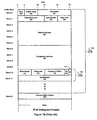
- Figure 1A displays a prior art IPv4 header.
- the IPv4 header is described fully in RFC 791.
- Header 100 comprises a number of standardized fields including the following fields:
- identification 110 states in RFC 791 that identification 110 "must be unique for that source-destination pair and protocol for the time that datagram will be active in the internet system.” Although there are numerous ways to pick a value for identification 110, no guidance is offered in the standard to ensure identification 110 is unique for the lifetime of the datagram. Typically, implementations of IPv4 use a counter that is incremented by one every time a datagram is used. Clearly, identification 110 as implemented by most IPv4 implementations do not follow the standard when the lifetime of the datagram exceeds the time it takes for a wrap condition to occur. Simply put the 16-bits of information in identification 110 represents a pool of datagram identifiers that is insufficient to maintain uniqueness for a datagram lifetime.
- FIG. 1B displays a prior art IPv6 header.
- the IPv6 standard is described in RFC 2460.
- RFC 2460 provides details of IPv6 header 150.
- IPv6 header 150 handles fragmentation information through a "next header" field rather than in the main header itself.
- IPv6 expects the source to fragment a datagram rather as opposed intermediary devices fragmenting the datagram as can happen in IPv4.
- IPv6 header 150 comprises the following fields:
- the preceding fields comprise the mandatory components of IPv6 header 150. Additional headers are allowed by setting appropriate values to next header 161. For example, if next header 161 has a value of six, the next header will be a TCP header; if next header 161 has a value of 17, the next header will be a UDP header; or if next header 161 has a value of 44, the next header will be a fragment header. Fragment header 180 comprises the following fields used for fragmentation:
- identification 170 should have a value that "must be different than that of any other fragmented packet sent recently with the same source address and destination address.”
- RFC 2460 suggests using multiple counters for each pair; however, it does not suggest or motivate using multiple fields for a datagram identifier.
- identification 170 comprises a 32-bit value, it is expected that as networking speeds increase, IPv6 could experience the same data corruption problem as IPv4 does at lower speeds. For example, assuming minimal fragmented IPv6 datagrams, if the line speed is 100 Gbps, then the pool of 2 32 values for identification 170 could be consumed in less than 180 seconds, about three minutes, approaching the lifetime of a datagram on the network. If the line speed is 1000 Gbps, then the pool of 2 32 values for identification 170 could be consumed in less than 18 seconds, well below the 30 to 120 second lifetime of a datagram.
- Datagrams of 512 bytes were chosen in the preceding example because block-level network storage typically operates in 512 byte blocks, although multiple blocks can be concatenated into a single datagram for reading or writing to storage media. Furthermore, the contemplated communication speeds are not unrealistic because it is possible to utilize an IP as an internal communication bus where distances are small and data rates can be high.
- datagram identifiers represent a much broader concept than just identification fields (identification 110 and 170) in an IP datagram header field.
- Datagram identifiers comprise one or more values that together allow a datagram to be uniquely identified between a source and destination during the lifetime of the datagram. The "uniqueness" of the datagram identifier does not have to be forever. In other words, after the lifetime of the datagram has been exceeded, the datagram identifier can be reused to identify any subsequently sent datagram.
- Datagram identifiers include single field identifiers or multiple field identifiers.
- Single field identifiers are those having a single value assigned to a datagram to identify the datagram and stored in a single field. Examples of single field identifiers include the 16-bit identification 110 in the IPv4 header or the 32-bit identification 170 in the IPv6 header.
- Multiple field datagram identifiers represent identifiers where two or more fields combine to form the datagram identifier. For example, identification 110 could combine with another field in the header or possibly the payload to form the datagram identifier. Alternatively, a single value for the datagram identifier could be replicated multiple times within the datagram.
- a single datagram identifier value could be stored in the header of an IPv4 packet as identification 110 and replicated within the payload of the datagram itself.
- Figure 2 illustrates a possible embodiment of a multiple field datagram identifier where the value of the datagram identifier is replicated.
- the datagram identifier is placed in the identification field of the IP header, and then also placed within the payload of the datagram.
- Datagram 200 represents a typical IP datagram having header 220 and possibly payload 230.
- datagram identifier 210 is replicated within header 220 and payload 230.
- datagram identifier 210 in header 220 is at least partially stored in identification 110 from Figure 1A .
- datagram identifier 210 in header 220 is at least partially stored in identification 170 in the fragment header from Figure 1B . It is contemplated that datagram identifier could be any size including 16-bits, 32-bits, 48-bits, 64-bits, or greater.
- Replicating datagram identifier 210 within payload 230 offers several advantages.
- One advantage relates to applications where it is infeasible to change the internal workings of the IP module. Placing datagram identifier 210 in payload 230 provides the application control over datagram identifier 210.
- An additional advantage includes resolving the datagram corruption problem without necessarily modifying the standard datagram header structure. Following sections will further clarify how placing datagram identifier 210 in the payload offers greater control over the "uniqueness" of the datagram identifier. It is contemplated the value of datagram identifier could be replicated any number of times as is desired, useful, or necessary.
- Figure 3 illustrates a possible embodiment of a multiple field datagram identifier where the datagram identifier comprises multiple values in different fields.
- Datagram 300 comprises header 320 and payload 330.
- datagram 300 is identified via a datagram identifier that is split among two or more fields as represented by datagram identifiers 310A through 310D.
- the fields spread among header 320 or payload 330 as desired.
- the additional fields allow for extending the resolution of the datagram identifier by increasing the number of available datagram identifiers in the pool.
- Preferred embodiments of multi-valued fields are located in an optional field within the header of an IP datagram.
- Using optional header fields minimally impacts changes to existing IP modules because the fields are optional.
- the legacy IP module should ignore any unknown options thereby resulting in legacy behavior.
- a modified IP module exchanges datagram with another modified IP module that understands the optional header fields, then a higher resolution datagram identifier resolves the datagram corruption problem.
- Figure 4A illustrates a possible embodiment of a multiple field datagram identifier for IPv4 where the datagram identifier comprises the use an IP option.
- An IPv4 header option structure is defined in RFC 791.
- Option 400 comprises three fields including type 401, length 407, and option data 409.
- Length 407 represents the total number of bytes in the option including type 401, length 407, and option data 409.
- Option data 409 includes information relating to the option and can comprise zero or more bytes of information.
- Type 401 is further segmented into three fields that are also defined in RFC 791. Copy 402 indicates if option 401 is copied into all fragments of the datagram.
- Class 403 indicates whether option 400 is for control, a value of 0x0, or for measurement, a value of 0x3.
- Number 404 represents a value ranging from 0 to 32 indicating what the option actually represents.
- the International Assigned Number Association (LANA) assigns these values. At the time of writing this document values 0 to 21 and 23 to 24 have been assigned (see http://www.iana.org/assignments/ip-parameters last updated 18-OCT-2005).
- an additional datagram header option defines an extended datagram identifier as illustrated in IPv4 header 420.
- Header length 405 has a value greater than five to indicate there are additional 32-bit words beyond the minimum of five in the header.
- one or more of datagram fragment a identification options can be added to header 420 as indicated by options 430B and 430C.
- Identification 410A stores at least part of the datagram identifier. Additionally, identification 410B and 410C extended the resolution of the datagram identifier.
- Length 407B or 407C could have a value of four to indicate that total option size is four bytes.
- identification 410B or 410C offer additional 16-bits to the datagram identifier. If more resolution is required, additional options can be added.
- the example embodiment illustrates a datagram identifier having 48-bits comprising identification 410A, 410B, and 410C.
- the length of a single option could be increased to include bytes from subsequent 32-bit words; therefore, the length field would have a value of eight bytes where two bytes come from the header identification field and six bytes come from the datagram fragment identification option fields. Consequently, the option would comprise up to 48-bits of additional resolution creating a datagram identifier of 64 bits. By changing the option length value, the datagram identifier resolution could be increased eight bits at a time.
- FIG. 4B illustrates a possible embodiment of a multiple field datagram identifier for IPv6 where the datagram identifier comprises multiple fields in an IPv6 header using multiple fragment header options.
- IPv6 header 450 includes the standard fields and two or more fragment headers as indicated by fragment a headers 480A and 480B.
- Next header 461 stores a value of 44 indicating that the next header is a fragment header.
- Fragment header 480A includes next header 471A that indicates the next header is also a fragment header. Zero or more fragment headers can be included in the overall datagram.
- fragment header 480B indicates that next header is TCP via a value of six stored in next header 471B.
- the datagram identifier for this datagram comprises two or more identification fields as indicated by identification 470A and 470B.
- Including multiple fragment headers provides for an IPv6 datagram to have its datagram identifier extended in 32-bit chucks. It is contemplated, that a change to the IPv6 fragment header would be more beneficial to allow an IPv6 module to change the fragment header as desired when conditions on the network change.
- Using multiple fragment headers allows for increasing the number of available datagram identifiers in the pool; consequently, the size of the pool exceeds the ability of the system to consume all datagram identifiers within the lifetime of a datagram.
- Preferred embodiments utilizing multi-valued datagram identifiers use the existing header identification fields as the Least Significant Bits (LSB) of the datagram identifier. By placing the LSB in the existing fields, interoperability can be maintained with legacy IP modules. It is also contemplated that new optional header fields could be defined to take over the role of the identification fields. Therefore, the datagram identifier would only be stored in the new optional fields as a single field identifier.
- LSB Least Significant Bits
- the previous embodiments offer a solution for the datagram corruption that involves providing a pool of datagram identifiers through increasing the number of available datagram identifiers that can be assigned to a datagram. Controlling the datagram identifiers in this way resolves the datagram corruption problem.
- such an approach is beneficially applied to IP layers of network communication stacks without affecting applications.
- communication stacks including Windows or Linux could be updated expeditiously to some degree; however, there are millions of devices having legacy stacks that would remain including routers, gateways, printers, or other devices having legacy stacks.
- an application level approach could be taken by device manufactures that involve multiple field datagram identifiers having a single value.
- a pool of datagram identifiers is created that has a reduced number of available datagram identifiers and where the datagram identifiers are controlled during the lifetime of a datagram.
- the datagram identifiers are controlled through an agreement between two hosts regarding which datagram identifiers are allowed to be used.
- a first host creates or controls a pool of datagram identifiers by making sure any datagram identifier in use will not be used again for the lifetime of a datagram to which the datagram identifier is assigned.
- the pool has a reduced number of available datagram identifiers because some of the identifiers might currently be in use.
- the first host sends a second host a suggested datagram identifier drawn from the pool. The second host uses the suggested datagram identifier in a response datagram sent back to the first host.
- the second host encodes the suggested datagram identifier in the header and in the payload of the response datagram.
- the first host receives the response datagram normally. Once the datagram is reassembled, the first host reads the suggested datagram identifier from the payload of the response datagram and places it back in the pool for use again.
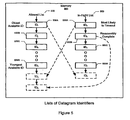
- Figure 5 illustrates an embodiment of a memory storing lists of datagram identifiers.
- Memory 540 is associated with a host that creates or controls a pool of datagram identifiers having a reduce number of available datagram identifiers.
- Allowed list 530 represents a list of datagram identifiers that are allowed to be assigned to datagrams.
- List 530 comprises zero or more datagram identifiers as indicated by IDs 535A through 535N.
- Each element in the list could comprise the actual identifier or an indirect reference to the identifier.
- the list is implemented as a linked list because the order of identifiers could change due to different having different lifetimes.
- Arranging list 530 in this manner ensures that datagrams assigned an identifier from the list have an identifier that is not in use or has exceeded the lifetime of a previously used datagram identifier.
- In-flight list 550 in a preferred embodiment, represents those identifiers that are currently being used and; therefore, represent the identifiers that are excluded from being used. In that sense, list 550 comprises an exclusion list. In a preferred embodiment, list 550 comprises zero or more identifiers as represented by identifier 555A through 555M ordered by timeout. Those identifiers that are expected to time out first are nearer the head of the list than those that are most recently deployed which are placed at the tail of the list. Similar to list 530, list 550 can be implemented through a linked list.
- the identifier when a datagram identifier is required, the identifier is drawn from the head of list 530 and placed at the tail of list 550 as indicated by identifier 535A. Once removed from allowed list 530, the datagram identifier is controlled from being again until the lifetime of the datagram to which it is assigned has been exceeded.
- the second condition is that the datagram's lifetime has been exceeded.
- the identifier is removed from list 555A and placed at the tail of list 530 as indicated by identifier 555A.
- a datagram lifetime used for controlling list 550 can be determined in many ways; preferably, it is simply larger than the reassembly time within an IP module.
- list 530 comprises a maximum of 65,535 datagram identifiers because the IPv4 header only supports a 16-bit identification field as previously described. As datagram identifiers are used, the list becomes shuffled; however, this does not matter because the value of the identifier does not matter as long as the identifier lasts for the lifetime of the datagram. For computer workstations having sufficient memory storing a list of 65,535 identifiers is not a problem.
- a host create a pool of datagram identifiers that has a reduced number of available .datagram identifiers that are allowed to be assigned to a datagram; thereby, resolving the data corruption problem.
- the resulting pool is different than the initial pool of available datagram identifier because there a different number of datagram identifiers that are actually available and the identifiers are controlled.
- Embedded devices have less memory and should make use of space saving techniques for conserving memory.
- Some embodiments use a reduced set of identifiers that can expand if necessary. For example, rather than controlling all 65,535 identifiers, a device might only use 1024 identifiers numbered 1. through 1024. If this pool is insufficient, it can be expanded by allowing identifiers 1 through 2048 or contracted as necessary if transfer rates fall. Controlling smaller lists or recycling available identifiers in this fashion offers benefits for IPv6 implementations where is could be impractical to store all possible 2 32 datagram identifiers.
- the reduced pool could have further characteristics. For example, one should note by having a first host suggest a single datagram identifier to a second host, the resulting number of available datagram identifiers is effectively one. In addition, most devices have more than one type of traffic associated with them. Therefore, one could reduce the list of allowed datagram identifier to only those having specific bit pattern, for example limiting the list to those identifiers with the most signification bits (MSB) set. The identifiers using only the LSB could be used for normal traffic. One should note that a block of identifiers could also be suggested to the second host representing a plurality of available datagram identifiers.
- MSB most signification bits
- the identification field is 16-bits. Allowed list 530 could comprise only those identifiers that have the two most significant bits set which creates a pool of 49,152 (2 16 - 2 14 ) available identifiers, leaving 16,384 (2 14 ) identifiers that are uncontrolled and available for other traffic.
- the pool has a reduced number of available datagram identifiers that is a function of powers of two, for example, 2 M - 2 N where M is the size of the identification field in bits and N has an integer value less than 32. As N approaches M, the available number could be reduced to a small number, one or even zero.
- Memory 540 represents a memory associated with a computing system.
- a computer or a device operating as a client comprises memory 540 and uses the lists to access a remote device.
- Example remote devices include network storage devices, printers, faxes, scanners, or other devices that use IP to communicate.
- Embodiments of memory 540 include using RAM, flash, disk drives, or other data storage memories accessible by a computing device on a network.
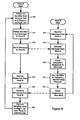
- Figure 6 presents an example embodiment of a method for controlling datagram identifiers drawn from a pool of datagram identifiers that have a reduced number of available datagram identifiers.
- the example in Figure 6 utilizes the lists previously described coupled with a multi-field datagram identifier having a single value.
- host A represents a device on a communication link that desires access to host B which is also accessible over the communication link.
- the communication link utilizes IP to convey datagrams from host A to host B and vice versa in a manner that supports fragmentation if necessary.
- host A could represent a client computer and host B represents a network storage server.
- the client uses UDP datagrams to access data on the storage server.
- host A wishes to exchange messages with host B utilizing datagrams.
- host A expects a response to its request. Consequently, host A draws a datagram identifier from an allowed list of datagram identifiers that represents those datagram available for use. The identifier is place in an in-flight list so that the identifier is excluded from being used again for the lifetime of the datagram to which is assigned.
- host B waits for the message from host A.
- host A prepares a message for host B.
- the message comprises a request that host B take some action including responding to host A's message.
- Host A places the identifier within the message to host B. It is contemplated that the identifier is placed in the payload of a datagram.
- the identifier is not assigned to host A's datagram, but is rather a suggestion meant for the datagram comprising host B's response.
- host A sends the message to host B over the communications link.
- host A calls aBSD socket send() call to send the message over an IP network.
- host B receives the datagram from host A.
- the message from host A is small enough that it won't be fragmented, for example, if the total datagram size is less than 576 bytes for IPv4 the datagram should not be fragmented.
- Host A expects a response from host B, so at step 620 host A waits for the response.
- host A waits for the response.
- host B forms a response to host A's message. During this step host B reads host A's message or reviews the message's datagram to find the suggested identifier. In some embodiments, the identifier is encoded in conjunction with the message's request command so the two can be found and correlated easily. In some embodiments, the datagram identifier can also be used as a transaction ID.
- host B uses the identifier as the datagram identifier for the datagram comprising its response message. In the case of IPv4, host B would place the identifier in the identification field of the IPv4 header or in the case of IPv6 host B would place the identifier in the identification field of the fragment header. In addition, host B encodes the identifier in the payload of the datagram. An astute reader will note that in this embodiment host B has an IP module adapted to allow such a datagram identifier manipulation to take place.
- host B sends the datagram comprising the response message back to host A.
- Host A receives the datagram at step 625. At this point the datagram could be fragmented and might arrive over a period of time.
- Host A attempts to reassemble the datagram comprising the response message as a function of the identifier. In this situation where host A controls the use of the identifier there is no risk for datagram corruption. Further more, host A operates normally at the IP layer without requiring modification to host A's IP module because the datagram appears as a normal datagram.
- the datagram is reassembled properly, or the datagram is not reassembled.
- the datagram might not be reassembled because one or more fragments might have been lost.
- host A can process the response.
- As host A processes the response it reads the datagram identifier encoded in the response datagram's payload.
- Host A now knows that the identifier can be reused because the datagram has arrived safely and the datagram's lifetime is over; consequently at step 630 host A removes the identifier from the in-flight list and places it at the tail of the allowed list.
- the datagram will be stored in the communication stack, possibly in host A's IP module, until a timeout occurs, typically on the order of 30 to 120 seconds after which the datagram is discarded. At this point, host A still must deal with the identifier for the discarded datagram.
- host A has a timeout associated in-flight datagram identifiers. When the timeout has been exceeded indicating the lifetime of the datagram has expired, host A removes the identifier from the in-flight list and places the identifier at the tail of the allowed list.
- the in-flight list timeout of identifiers is preferably longer than the timeout associated with reassembling datagrams, possibly as long as 300 seconds.
- Especially preferred embodiments couple the timeouts of the in-flight list to conditions on the communications link. Some conditions have measured values including round trip time, throughput, congestion, error rates, or other measurable conditions. Other conditions might not necessarily be measured but set according to a policy. For example, the timeout might be configured by an administrator based on the speed of the network.
- One host uses application level code to manage the identifier lists without having to change the existing communication stack on the host. This is advantageous for implementations having software applications running on established operating systems including Windows or Linux where is impracticable to make changes to the IP modules. Most application developers do not have access to communication stack internals.
- the approach is advantageous for vendors of embedded devices where the vendor has access to the source code of the communication stack of their devices. The vendor can modify the device's IP module to operate as described. For example companies that produce network storage products can modify their products to have the described characteristics.
- the described approach ensures compliance to IP standards where datagram identifiers are required to be unique for the lifetime of the datagram.
- Storage protocols include proprietary protocols including Zetera's Z-SAN protocol or standard protocols.
- Standard storage protocols include iSCSI, FCIP, or iFCP.
- the technique can be applied to those protocols using UDP or TCP as a transport layer.
- iSCSI implementations could be modified to exchange suggested datagram identifiers to ensure TCP datagrams do not suffer from datagram corruption while maintaining conformance to the iSCSI standard.
- Figure 7 illustrates an example embodiment of a method where a pool of datagram identifiers is created to ensure datagram corruption does not occur.
- the presented example employs many of the concepts previously presented.
- a first pool of datagram identifiers is established.
- the first pool represents the pools available in response to operating according to the standard working of IP.
- the first pool comprises the 2 16 identifiers available for use due to the 16-bit identification field in the IPv4 header.
- the first pool comprises the 2 32 identifiers available for use.
- the first pool is implemented by an incrementing counter. Counter to the standards, these pools do not provide unique identifier over the lifetime of the associated datagram when datagrams are deployed on sufficiently fast communication links.
- a second pool that provides available datagram identifiers having stronger uniqueness characteristics resolves the problem.
- a preferred embodiment comprises a threshold function to determine if a second pool of datagram identifiers is useful or not.
- a threshold function monitors the conditions of the communications between a first host and a second host over the communication link to determine if datagram identifiers should be controlled.
- a preferred embodiment uses a function that relates to the lifetime of a datagram to couple more closely the lifetime to the usage of datagram identifiers.
- Preferred threshold function embodiments operate as a function of a timeout period or rate at which datagrams are transferred over the communication link. Especially preferred embodiments use both the timeout period and the rate.
- the threshold function could include calculating if a wrap condition could occur in a datagram identification field for a given data rate. If the datagram transfer rate multiplied by the datagram reassembly timeout exceeds the number of available datagram identifiers, then a wrap in the identification field could result in datagram corruption. Under such conditions, the threshold function indicates a second datagram identifier pool is beneficial. It is contemplated that the threshold function could operate as a function of other values other than a rate or timeout period including congestion. Consequently, all threshold functions are contemplated. It is also contemplated that the second pool can be toggled on or off as necessary to adapt to legacy IP modules. For example, it might be beneficial to not use the second pool when working with a legacy IP module to ensure CPU cycles are not wasted.
- the values that are used in the threshold function can be measured or predetermined.
- a measured value can be taken in real-time or over time as the system operates.
- the rate could be measured by calculating round trip times of messages between two hosts or the rate could be measured over the entire communication link.
- a predetermined value includes the network bandwidth, 1 Gbps or 10 Gbps rates for Ethernet, for example.
- the second pool of datagram identifiers is created.
- Providing the second pool of identifiers represents establishing a set of conditions where the datagram identifiers in the second pool are controlled in a manner that ensures they are unique for the lifetime of a datagram relative to the first pool of datagram identifiers. Therefore, the second pool is different from the first pool because the number of available datagram identifiers is different or the control over the datagram identifiers is greater.
- Providing the second pool includes a priori modifying an IP module before run-time or altering the behavior of the IP layer at or during run-time.
- the creation of the second pool further includes increasing the number of available datagram identifiers in a manner that over comes the limited supply available in the first pool causing the datagram corruption problem. Increasing the number of available datagram identifiers can be achieved as previously described through the use of additional header options comprising extended datagram identifier information.
- the creation of the second pool also includes decreasing the number of available datagram identifiers for a datagram. Decreasing the number includes maintaining lists of allowed datagrams identifiers or suggesting a single datagram identifier or block of identifiers. In both cases increasing the number or decreasing the number of available datagram identifiers, the datagram identifiers are controlled from taking a value that causes the datagram corruption problem within the lifetime of a datagram.
- More than one second pool can be created for various reasons. Multiple second pools allows for establishing a pool for each host pair, for a protocol designation (TCP, UDP, ICMP, IGMP, etc...), or even for each transport protocol port. For example, all HTTP traffic on port 80 could have a pool while FTP traffic on port 21 could have a different pool. Having more than one second pool further ensures datagram identifiers are unique as required by the IP standards.
- a datagram identifier is drawn from the second pool at step 720.
- Drawing the datagram identifiers includes using the next identifier in a list or receiving a suggestion of a datagram identifier to use.
- the identifier is taken from an allowed list of identifiers or in the case of having a large pool, the identifier is generated by incrementing a counter similar to what is done in legacy IP modules.
- the datagram identifier is controlled from being reused.
- the identifiers are controlled from being reused during the lifetime of the datagram by ensuring the second pool has sufficient number of available datagram identifiers that an identifier can not be used within a defined timeout period associated with the datagram lifetime.
- the datagram identifier can be controlled by keeping track of which identifiers from the second pool have been used.
- the datagram identifier is assigned to a datagram.
- the assignment includes placing at least a portion of the datagram identifier in an identification field of an IP header.
- a portion of the identifier is placed in optional header fields.
- a portion of the identifier is place in the payload of the datagram.
- the datagram could be fragmented.
- the fragmentation could occur on the network by intermediary devices including routers.
- IPv6 the source of the datagram could have fragmented the datagram. If one or more fragments of the datagram have been received, the datagram is reassembled at step 760 using the datagram identifier or other information useful to identifier datagram fragments during reassembly. Other useful information includes IP address, protocol number, port assignment, or other datagram information.
- a check is made to see if the datagram has been completely reassembled.
- a check is preformed to determine if the identifier associated with the datagram has been controlled.
- the datagram's payload comprises the identifier or when an optional header field is used, the datagram identifier has been controlled. If not, then the datagram is processed normally as a legacy IP module would process it. Otherwise the datagram identifier is allowed to be reused again at step 780. In some embodiments, the identifier is moved from an in-flight or excluded list to an allowed list. In other embodiments, the second pool is sufficiently large that a datagram identifier based on a large counter will not wrap allowing the identifier to be reused after the datagram lifetime has been exceeded.
- the solution operates at an IP layer well below an application layer.
- An IP layer solution ensures that applications do not have to be modified to work properly.
- optional IP header fields there is minimal impact with respect to older devices running legacy IP modules.
- a legacy IP module should operate normally by ignoring unfamiliar optional headers.
- the system is future proofed. When data rates increase causing the pool of available datagram identifiers to become insufficient, the datagram identifiers can be extended by tacking one more optional datagram identifier fields when useful.
- IP modules of a set of hosts can also employ the disclosed techniques. Controlling the datagram identifiers that are available or in-flight, ensures the datagram identifiers are controlled from being reused under conditions that otherwise could result in datagram corruption.
- a vendor can modify the IP module for their products to protect datagrams and have a corresponding software module on a system that accesses the product that controls the datagram identifiers.
- Example software modules for network devices include device drivers.
- Coupling datagram lifetimes more closely with datagram identifiers provides for greater control over the uniqueness of the identifiers. Consequently, developers can ensure compliance with existing standards and future proof against additional datagram corruption problems.
- Network devices include any device that is accessible over communication link using datagrams. Examples of network devices include printers, digital video records, media players, faxes, scanners, copiers, VoIP phones, or other devices.
- inventive subject matter includes systems, methods, or apparatus for developing, producing, manufacturing, or running the hardware. In this sense, the hardware falls within the scope of the inventive subject matter.
- inventive subject matter includes methods of writing such software, recording the software on a machine readable form, licensing, selling, distributing, installing, or operating such software on suitable hardware. Moreover, the software per se is deemed to fall within the scope of the inventive subject matter.
- compositions and methods of resolving a datagram corruption problem using an internetworking protocol have been disclosed. It should be apparent, however, to those skilled in the art that many more modifications besides those already described are possible without departing from the inventive concepts herein. Moreover, in interpreting the disclosure all terms should be interpreted in the broadest possible manner consistent with the context. In particular the terms “comprises” and “comprising” should be interpreted as referring to the elements, components, or steps in a non-exclusive manner, indicating that the referenced elements, components, or steps can be present, or utilized, or combined with other elements, components, or steps that are not expressly referenced.
Landscapes
- Engineering & Computer Science (AREA)
- Computer Networks & Wireless Communication (AREA)
- Signal Processing (AREA)
- Computer Security & Cryptography (AREA)
- Data Exchanges In Wide-Area Networks (AREA)
- Communication Control (AREA)
- Computer And Data Communications (AREA)
Claims (15)
- Verfahren, umfassend:Bereitstellen (700) eines ersten Pools von Datagramm-Kennungen, der eine erste Anzahl von Datagramm-Kennungen aufweist;Bereitstellen (710) eines zweiten Pools von Datagramm-Kennungen, der eine zweite Anzahl von Datagramm-Kennungen aufweist, wobei die zweite Anzahl von der ersten Anzahl verschieden ist;Bestimmen (705), ob eine mit Kommunikation zwischen einem ersten Host und einen zweiten Host über eine Kommunikationsstrecke zusammenhängende Schwelle überschritten ist;Auswählen einer Datagramm-Kennung aus dem ersten Pool von Datagramm-Kennungen oder dem zweiten Pool von Datagramm-Kennungen mindestens teilweise auf der Basis des Bestimmens, ob die Schwelle überschritten ist; undVergeben (740) der ausgewählten Datagramm-Kennung an ein über die Kommunikationsstrecke zu übertragendes Datagramm.
- Verfahren nach Anspruch 1, wobei die Schwelle mit Folgendem zusammenhängt: einem Typ von Verkehr der Kommunikation, einer Zeitgrenzenperiode, einer Größe des Datagramms und/oder einer Rate, mit der Datagramme über die Kommunikationsstrecke transferiert werden.
- Verfahren nach Anspruch 1, ferner umfassend:Bereitstellen des zweiten Pools bei einer Bestimmung, dass die Schwelle überschritten ist.
- Verfahren nach Anspruch 1, wobei der erste Pool Datagramm-Kennungen umfasst, bei denen jedes von einem oder mehreren oberen Bit eines Identifikationsfelds auf null gesetzt ist, und der zweite Pool Datagramm-Kennungen umfasst, bei denen mindestens eines des einen oder der mehreren oberen Bit des Identifikationsfelds auf eins gesetzt ist.
- Verfahren nach Anspruch 1, ferner umfassend:Platzieren eines ersten Teils der Datagramm-Kennung in einem Header des Datagramms; undPlatzieren eines zweiten Teils der Datagramm-Kennung in Nutzinformationen des Datagramms.
- Verfahren nach Anspruch 5, wobei der zweite Teil ein Duplikat des ersten Teils ist.
- Verfahren nach Anspruch 5, wobei der zweite Teil von dem ersten Teil verschieden ist.
- Verfahren nach Anspruch 1, ferner umfassend:Bereitstellen der ausgewählten Datagramm-Kennung für den zweiten Host; undEmpfangen des Datagramms, das die ausgewählte Datagramm-Kennung enthält, von dem zweiten Host.
- Verfahren nach Anspruch 1, wobei der zweite Pool von Datagramm-Kennungen einem ersten Protokollport des ersten Hosts zugeordnet ist.
- Verfahren nach Anspruch 9, ferner umfassend:Bereitstellen eines dritten Pools von Datagramm-Kennungen, der einem zweiten Protokollport des ersten Hosts zugeordnet ist.
- Host zum Auflösen von Datagramm-Verfälschung über ein Vernetzungsprotokoll, indem er für Folgendes ausgelegt ist:Bereitstellen (700) eines ersten Pools von Datagramm-Kennungen, der eine erste Anzahl von Datagramm-Kennungen aufweist;Bereitstellen (710) eines zweiten Pools von Datagramm-Kennungen, der eine zweite Anzahl von Datagramm-Kennungen aufweist, wobei die zweite Anzahl von der ersten Anzahl verschieden ist;Bestimmen (705) ob eine mit Kommunikation zwischen dem Host und einem anderen Host über eine Kommunikationsstrecke zusammenhängende Schwelle überschritten ist;Auswählen einer Datagramm-Kennung aus dem ersten Pool von Datagramm-Kennungen oder dem zweiten Pool von Datagramm-Kennungen mindestens teilweise auf der Basis des Bestimmens, ob die Schwelle überschritten ist; undVergeben (740) der ausgewählten Datagramm-Kennung an ein über die Kommunikationsstrecke zu übertragendes Datagramm.
- Host nach Anspruch 11, wobei der erste Pool Datagramm-Kennungen umfasst, bei denen jedes von einem oder mehreren oberen Bit eines Identifikationsfelds auf null gesetzt ist, und der zweite Pool Datagramm-Kennungen umfasst, bei denen mindestens eines des einen oder der mehreren oberen Bit des Identifikationsfelds auf eins gesetzt ist.
- Host nach Anspruch 11, der ferner für Folgendes ausgelegt ist:Platzieren eines ersten Teils der Datagramm-Kennung in einem Header des Datagramms; undPlatzieren eines zweiten Teils der Datagramm-Kennung in Nutzinformationen des Datagramms.
- Host nach Anspruch 11, der ferner für Folgendes ausgelegt ist:Bereitstellen der ausgewählten Datagramm-Kennung für den anderen Host; undEmpfangen des Datagramms, das die ausgewählte Datagramm-Kennung enthält, von dem anderen Host.
- Host nach Anspruch 11, wobei der zweite Pool von Datagramm-Kennungen einem ersten Protokollport des ersten Hosts zugeordnet ist und der Host ferner für Folgendes ausgelegt ist:Bereitstellen eines dritten Pools von Datagramm-Kennungen, der einem zweiten Protokollport des ersten Hosts zugeordnet ist.
Applications Claiming Priority (3)
| Application Number | Priority Date | Filing Date | Title |
|---|---|---|---|
| US79105106P | 2006-04-10 | 2006-04-10 | |
| US11/435,239 US7924881B2 (en) | 2006-04-10 | 2006-05-15 | Datagram identifier management |
| PCT/US2007/008896 WO2007120685A2 (en) | 2006-04-10 | 2007-04-10 | Methods of resolving datagram corruption over an internetworking protocol |
Publications (3)
| Publication Number | Publication Date |
|---|---|
| EP2005656A2 EP2005656A2 (de) | 2008-12-24 |
| EP2005656A4 EP2005656A4 (de) | 2011-05-04 |
| EP2005656B1 true EP2005656B1 (de) | 2013-05-22 |
Family
ID=38575170
Family Applications (1)
| Application Number | Title | Priority Date | Filing Date |
|---|---|---|---|
| EP07755232.1A Not-in-force EP2005656B1 (de) | 2006-04-10 | 2007-04-10 | Verfahren zur behebung einer datagramm-beschädigung mithilfe eines internet-netzwerkprotokolls |
Country Status (8)
| Country | Link |
|---|---|
| US (1) | US7924881B2 (de) |
| EP (1) | EP2005656B1 (de) |
| JP (1) | JP5324424B2 (de) |
| KR (1) | KR101024877B1 (de) |
| CN (1) | CN101449519B (de) |
| CA (1) | CA2649172C (de) |
| MX (1) | MX2008013075A (de) |
| WO (1) | WO2007120685A2 (de) |
Families Citing this family (19)
| Publication number | Priority date | Publication date | Assignee | Title |
|---|---|---|---|---|
| US7616638B2 (en) | 2003-07-29 | 2009-11-10 | Orbital Data Corporation | Wavefront detection and disambiguation of acknowledgments |
| US8270423B2 (en) | 2003-07-29 | 2012-09-18 | Citrix Systems, Inc. | Systems and methods of using packet boundaries for reduction in timeout prevention |
| US7630305B2 (en) | 2003-07-29 | 2009-12-08 | Orbital Data Corporation | TCP selective acknowledgements for communicating delivered and missed data packets |
| US8005918B2 (en) | 2002-11-12 | 2011-08-23 | Rateze Remote Mgmt. L.L.C. | Data storage devices having IP capable partitions |
| US7921285B2 (en) * | 2002-12-27 | 2011-04-05 | Verizon Corporate Services Group Inc. | Means of mitigating denial of service attacks on IP fragmentation in high performance IPsec gateways |
| US8432800B2 (en) | 2003-07-29 | 2013-04-30 | Citrix Systems, Inc. | Systems and methods for stochastic-based quality of service |
| US8437284B2 (en) | 2003-07-29 | 2013-05-07 | Citrix Systems, Inc. | Systems and methods for additional retransmissions of dropped packets |
| US8238241B2 (en) | 2003-07-29 | 2012-08-07 | Citrix Systems, Inc. | Automatic detection and window virtualization for flow control |
| US7620981B2 (en) | 2005-05-26 | 2009-11-17 | Charles William Frank | Virtual devices and virtual bus tunnels, modules and methods |
| US8819092B2 (en) | 2005-08-16 | 2014-08-26 | Rateze Remote Mgmt. L.L.C. | Disaggregated resources and access methods |
| US8839268B2 (en) * | 2008-02-07 | 2014-09-16 | Oracle America, Inc. | Method and system of preventing silent data corruption |
| JP5517677B2 (ja) | 2010-02-26 | 2014-06-11 | 株式会社日立製作所 | 無線通信システム、及び、無線通信方法 |
| US10447767B2 (en) | 2010-04-26 | 2019-10-15 | Pure Storage, Inc. | Resolving a performance issue within a dispersed storage network |
| US8625635B2 (en) * | 2010-04-26 | 2014-01-07 | Cleversafe, Inc. | Dispersed storage network frame protocol header |
| US10834065B1 (en) | 2015-03-31 | 2020-11-10 | F5 Networks, Inc. | Methods for SSL protected NTLM re-authentication and devices thereof |
| US10404698B1 (en) | 2016-01-15 | 2019-09-03 | F5 Networks, Inc. | Methods for adaptive organization of web application access points in webtops and devices thereof |
| JP6534625B2 (ja) * | 2016-02-17 | 2019-06-26 | 日本電信電話株式会社 | 通信装置および通信方法 |
| US10089339B2 (en) * | 2016-07-18 | 2018-10-02 | Arm Limited | Datagram reassembly |
| KR102733036B1 (ko) * | 2022-06-24 | 2024-11-21 | 주식회사 드림디엔에스 | 데이터 암복호화 장치 및 방법 |
Family Cites Families (192)
| Publication number | Priority date | Publication date | Assignee | Title |
|---|---|---|---|---|
| US4422171A (en) * | 1980-12-29 | 1983-12-20 | Allied Corporation, Law Department | Method and system for data communication |
| JPS6024647A (ja) * | 1983-07-20 | 1985-02-07 | Hitachi Ltd | システムの自律化資源管理方式 |
| CA1220830A (en) * | 1984-12-28 | 1987-04-21 | David S. Drynan | Transmitting sequence numbers of information in a packet data transmission system |
| US5129088A (en) * | 1987-11-30 | 1992-07-07 | International Business Machines Corporation | Data processing method to create virtual disks from non-contiguous groups of logically contiguous addressable blocks of direct access storage device |
| JPH0286235A (ja) * | 1988-09-21 | 1990-03-27 | Nec Corp | 全銀協手順用テキストファイル転送方式 |
| JPH0792775B2 (ja) * | 1989-12-11 | 1995-10-09 | 株式会社日立製作所 | 外部記憶装置群のスペース管理方法 |
| US5544347A (en) | 1990-09-24 | 1996-08-06 | Emc Corporation | Data storage system controlled remote data mirroring with respectively maintained data indices |
| JPH04168841A (ja) * | 1990-11-01 | 1992-06-17 | Nec Eng Ltd | フレーム送受信方式 |
| EP0485110B1 (de) | 1990-11-09 | 1999-08-25 | Emc Corporation | Logische Aufteilung eines Speichersystems mit redundanter Matrix |
| US5546541A (en) * | 1991-02-05 | 1996-08-13 | International Business Machines Corporation | System for routing transaction commands to an external resource manager when the target resource is not managed by the local transaction managing computer program |
| DE69231873T2 (de) * | 1992-01-08 | 2002-04-04 | Emc Corp., Hopkinton | Verfahren zur Synchronisierung von reservierten Bereichen in einer redundanten Speicheranordnung |
| JP2868141B2 (ja) * | 1992-03-16 | 1999-03-10 | 株式会社日立製作所 | ディスクアレイ装置 |
| US5457683A (en) * | 1993-05-07 | 1995-10-10 | Apple Computer, Inc. | Link and discovery protocols for a ring interconnect architecture |
| US5444709A (en) * | 1993-09-30 | 1995-08-22 | Apple Computer, Inc. | Protocol for transporting real time data |
| WO1995013583A1 (en) * | 1993-11-09 | 1995-05-18 | Conner Kenneth H | First come memory accessing without conflict |
| JP3249868B2 (ja) | 1993-11-19 | 2002-01-21 | 株式会社日立製作所 | アレイ形式の記憶装置システム |
| US5506969A (en) * | 1993-11-29 | 1996-04-09 | Sun Microsystems, Inc. | Method and apparatus for bus bandwidth management |
| US5623605A (en) | 1994-08-29 | 1997-04-22 | Lucent Technologies Inc. | Methods and systems for interprocess communication and inter-network data transfer |
| US5615352A (en) | 1994-10-05 | 1997-03-25 | Hewlett-Packard Company | Methods for adding storage disks to a hierarchic disk array while maintaining data availability |
| US6396480B1 (en) | 1995-07-17 | 2002-05-28 | Gateway, Inc. | Context sensitive remote control groups |
| US5930786A (en) | 1995-10-20 | 1999-07-27 | Ncr Corporation | Method and apparatus for providing shared data to a requesting client |
| US5758188A (en) * | 1995-11-21 | 1998-05-26 | Quantum Corporation | Synchronous DMA burst transfer protocol having the peripheral device toggle the strobe signal such that data is latched using both edges of the strobe signal |
| US5758050A (en) * | 1996-03-12 | 1998-05-26 | International Business Machines Corporation | Reconfigurable data storage system |
| US5742604A (en) * | 1996-03-28 | 1998-04-21 | Cisco Systems, Inc. | Interswitch link mechanism for connecting high-performance network switches |
| US5889935A (en) | 1996-05-28 | 1999-03-30 | Emc Corporation | Disaster control features for remote data mirroring |
| US6886035B2 (en) | 1996-08-02 | 2005-04-26 | Hewlett-Packard Development Company, L.P. | Dynamic load balancing of a network of client and server computer |
| US5949977A (en) | 1996-10-08 | 1999-09-07 | Aubeta Technology, Llc | Method and apparatus for requesting and processing services from a plurality of nodes connected via common communication links |
| US6202060B1 (en) * | 1996-10-29 | 2001-03-13 | Bao Q. Tran | Data management system |
| US6157935A (en) | 1996-12-17 | 2000-12-05 | Tran; Bao Q. | Remote data access and management system |
| US5991891A (en) | 1996-12-23 | 1999-11-23 | Lsi Logic Corporation | Method and apparatus for providing loop coherency |
| US6710786B1 (en) * | 1997-02-03 | 2004-03-23 | Oracle International Corporation | Method and apparatus for incorporating state information into a URL |
| US6181927B1 (en) * | 1997-02-18 | 2001-01-30 | Nortel Networks Corporation | Sponsored call and cell service |
| US5884038A (en) | 1997-05-02 | 1999-03-16 | Whowhere? Inc. | Method for providing an Internet protocol address with a domain name server |
| KR100316631B1 (ko) * | 1997-06-25 | 2001-12-13 | 윤종용 | 홈 네트웍 자동 트리 생성기에 대한 방법 및 장치 |
| US6295584B1 (en) | 1997-08-29 | 2001-09-25 | International Business Machines Corporation | Multiprocessor computer system with memory map translation |
| US6385638B1 (en) | 1997-09-04 | 2002-05-07 | Equator Technologies, Inc. | Processor resource distributor and method |
| US7237036B2 (en) * | 1997-10-14 | 2007-06-26 | Alacritech, Inc. | Fast-path apparatus for receiving data corresponding a TCP connection |
| US6434620B1 (en) * | 1998-08-27 | 2002-08-13 | Alacritech, Inc. | TCP/IP offload network interface device |
| JPH11122301A (ja) | 1997-10-20 | 1999-04-30 | Fujitsu Ltd | アドレス変換接続装置 |
| US6101559A (en) | 1997-10-22 | 2000-08-08 | Compaq Computer Corporation | System for identifying the physical location of one or more peripheral devices by selecting icons on a display representing the one or more peripheral devices |
| US5937169A (en) * | 1997-10-29 | 1999-08-10 | 3Com Corporation | Offload of TCP segmentation to a smart adapter |
| US6081879A (en) | 1997-11-04 | 2000-06-27 | Adaptec, Inc. | Data processing system and virtual partitioning method for creating logical multi-level units of online storage |
| US6018779A (en) * | 1997-12-15 | 2000-01-25 | Emc Corporation | System for encapsulating a plurality of selected commands within a single command and transmitting the single command to a remote device over a communication link therewith |
| US6029168A (en) | 1998-01-23 | 2000-02-22 | Tricord Systems, Inc. | Decentralized file mapping in a striped network file system in a distributed computing environment |
| US6105122A (en) | 1998-02-06 | 2000-08-15 | Ncr Corporation | I/O protocol for highly configurable multi-node processing system |
| US6253273B1 (en) * | 1998-02-06 | 2001-06-26 | Emc Corporation | Lock mechanism |
| US6317430B1 (en) * | 1998-02-19 | 2001-11-13 | Lucent Technologies Inc. | ARQ protocol support for variable size transmission data unit sizes using a hierarchically structured sequence number approach |
| US6246683B1 (en) * | 1998-05-01 | 2001-06-12 | 3Com Corporation | Receive processing with network protocol bypass |
| KR100272165B1 (ko) * | 1998-05-20 | 2000-11-15 | 윤종용 | 캐쉬 메모리 시스템 및 그의 운영 방법 |
| US6330236B1 (en) | 1998-06-11 | 2001-12-11 | Synchrodyne Networks, Inc. | Packet switching method with time-based routing |
| US6157955A (en) * | 1998-06-15 | 2000-12-05 | Intel Corporation | Packet processing system including a policy engine having a classification unit |
| US6260120B1 (en) * | 1998-06-29 | 2001-07-10 | Emc Corporation | Storage mapping and partitioning among multiple host processors in the presence of login state changes and host controller replacement |
| US6542909B1 (en) | 1998-06-30 | 2003-04-01 | Emc Corporation | System for determining mapping of logical objects in a computer system |
| US6449607B1 (en) | 1998-09-11 | 2002-09-10 | Hitachi, Ltd. | Disk storage with modifiable data management function |
| US6330615B1 (en) | 1998-09-14 | 2001-12-11 | International Business Machines Corporation | Method of using address resolution protocol for constructing data frame formats for multiple partitions host network interface communications |
| DE69836326T2 (de) * | 1998-09-18 | 2007-06-14 | Alcatel Canada Inc., Kanata | Verfahren zur zellularen Datenübertragung, Zelle, Kommunikationssystem und entsprechendes Netz-Endgerät |
| JP4412685B2 (ja) * | 1998-09-28 | 2010-02-10 | 株式会社日立製作所 | 記憶制御装置及びこれを用いたデータ格納システムの取り扱い方法 |
| US6473774B1 (en) | 1998-09-28 | 2002-10-29 | Compaq Computer Corporation | Method and apparatus for record addressing in partitioned files |
| US6618743B1 (en) | 1998-10-09 | 2003-09-09 | Oneworld Internetworking, Inc. | Method and system for providing discrete user cells in a UNIX-based environment |
| US6654891B1 (en) | 1998-10-29 | 2003-11-25 | Nortel Networks Limited | Trusted network binding using LDAP (lightweight directory access protocol) |
| US6502135B1 (en) * | 1998-10-30 | 2002-12-31 | Science Applications International Corporation | Agile network protocol for secure communications with assured system availability |
| US6571274B1 (en) | 1998-11-05 | 2003-05-27 | Beas Systems, Inc. | Clustered enterprise Java™ in a secure distributed processing system |
| US6360270B1 (en) * | 1998-11-16 | 2002-03-19 | Hewlett-Packard Company | Hybrid and predictive admission control strategies for a server |
| FR2786892B3 (fr) | 1998-12-07 | 2000-12-29 | Schneider Automation | Coupleur d'automate programmable |
| US6728210B1 (en) * | 1998-12-21 | 2004-04-27 | Nec America, Inc. | Multi-logical access for a serial data link |
| US6434147B1 (en) * | 1999-01-08 | 2002-08-13 | Nortel Netwoks Limited | Method and system for sequential ordering of missing sequence numbers in SREJ frames in a telecommunication system |
| US6587464B1 (en) * | 1999-01-08 | 2003-07-01 | Nortel Networks Limited | Method and system for partial reporting of missing information frames in a telecommunication system |
| US6466571B1 (en) | 1999-01-19 | 2002-10-15 | 3Com Corporation | Radius-based mobile internet protocol (IP) address-to-mobile identification number mapping for wireless communication |
| US6470342B1 (en) * | 1999-03-12 | 2002-10-22 | Compaq Computer Corporation | Process of maintaining a distributed map of transaction identifiers and using hashing to access these maps |
| US6701432B1 (en) * | 1999-04-01 | 2004-03-02 | Netscreen Technologies, Inc. | Firewall including local bus |
| US6401183B1 (en) | 1999-04-01 | 2002-06-04 | Flash Vos, Inc. | System and method for operating system independent storage management |
| US6487555B1 (en) | 1999-05-07 | 2002-11-26 | Alta Vista Company | Method and apparatus for finding mirrored hosts by analyzing connectivity and IP addresses |
| US6275898B1 (en) | 1999-05-13 | 2001-08-14 | Lsi Logic Corporation | Methods and structure for RAID level migration within a logical unit |
| JP3685651B2 (ja) | 1999-06-04 | 2005-08-24 | 沖電気工業株式会社 | 相互接続装置及びアクティブQoSマッピング方法 |
| JP2001007835A (ja) * | 1999-06-23 | 2001-01-12 | Sony Corp | データ送信装置及び方法、データ中継装置及び方法、データ受信装置及び方法、並びにデータ通信システム、データ通信方法 |
| US7206805B1 (en) * | 1999-09-09 | 2007-04-17 | Oracle International Corporation | Asynchronous transcription object management system |
| JP4331835B2 (ja) | 1999-09-22 | 2009-09-16 | パナソニック株式会社 | 画像データ伝送方法 |
| US6882637B1 (en) * | 1999-10-14 | 2005-04-19 | Nokia Networks Oy | Method and system for transmitting and receiving packets |
| US7333451B1 (en) * | 1999-10-18 | 2008-02-19 | Nortel Networks Limited | Buffer management for mobile internet protocol |
| US6732230B1 (en) | 1999-10-20 | 2004-05-04 | Lsi Logic Corporation | Method of automatically migrating information from a source to an assemblage of structured data carriers and associated system and assemblage of data carriers |
| US6711164B1 (en) * | 1999-11-05 | 2004-03-23 | Nokia Corporation | Method and apparatus for performing IP-ID regeneration to improve header compression efficiency |
| US6535925B1 (en) * | 1999-11-09 | 2003-03-18 | Telefonaktiebolaget L M Ericsson (Publ) | Packet header compression using division remainders |
| JP2001160828A (ja) | 1999-12-03 | 2001-06-12 | Matsushita Electric Ind Co Ltd | セキュリティ・ゲートウェイ装置におけるvpn通信方法 |
| JP3959583B2 (ja) | 1999-12-10 | 2007-08-15 | ソニー株式会社 | レコーディングシステム |
| JP2001166993A (ja) | 1999-12-13 | 2001-06-22 | Hitachi Ltd | 記憶制御装置およびキャッシュメモリの制御方法 |
| WO2001055864A1 (en) | 2000-01-28 | 2001-08-02 | Morphics Technology Inc. | A method of generating a configuration for a configurable spread spectrum communication device |
| FR2804816B1 (fr) * | 2000-02-03 | 2003-10-31 | Gemplus Card Int | Transport d'unites de protocole d'objet electronique portable par protocole pour peripheriques de micro- ordinateur |
| US6834326B1 (en) * | 2000-02-04 | 2004-12-21 | 3Com Corporation | RAID method and device with network protocol between controller and storage devices |
| US7324228B2 (en) | 2000-02-25 | 2008-01-29 | Hewlett-Packard Development Company, L.P. | System and method for downloading and for printing data from an external content source |
| US6601101B1 (en) * | 2000-03-15 | 2003-07-29 | 3Com Corporation | Transparent access to network attached devices |
| US6947430B2 (en) * | 2000-03-24 | 2005-09-20 | International Business Machines Corporation | Network adapter with embedded deep packet processing |
| US6882648B2 (en) | 2000-03-29 | 2005-04-19 | Fujitsu Limited | Communication device |
| US6629264B1 (en) * | 2000-03-30 | 2003-09-30 | Hewlett-Packard Development Company, L.P. | Controller-based remote copy system with logical unit grouping |
| US7463582B2 (en) * | 2000-04-14 | 2008-12-09 | Hughes Network Systems, Llc | System and method for scaling a two-way satellite system |
| US6826561B2 (en) * | 2000-05-22 | 2004-11-30 | Broadcom Corporation | Method and apparatus for performing a binary search on an expanded tree |
| US6718404B2 (en) | 2000-06-02 | 2004-04-06 | Hewlett-Packard Development Company, L.P. | Data migration using parallel, distributed table driven I/O mapping |
| JP4168574B2 (ja) * | 2000-06-02 | 2008-10-22 | 株式会社日立製作所 | パケット転送装置、パケット転送制御方法、及びパケット転送装置の設定方法 |
| US7051087B1 (en) | 2000-06-05 | 2006-05-23 | Microsoft Corporation | System and method for automatic detection and configuration of network parameters |
| US6681244B1 (en) * | 2000-06-09 | 2004-01-20 | 3Com Corporation | System and method for operating a network adapter when an associated network computing system is in a low-power state |
| JP3890856B2 (ja) | 2000-06-12 | 2007-03-07 | ヤマハ株式会社 | 無線オーディオ機器 |
| US6894976B1 (en) * | 2000-06-15 | 2005-05-17 | Network Appliance, Inc. | Prevention and detection of IP identification wraparound errors |
| US7966421B2 (en) * | 2000-06-21 | 2011-06-21 | SAtech Group, A.B. Limited Liability Company | Method and apparatus for logically expanding the length of a search key |
| US7260638B2 (en) | 2000-07-24 | 2007-08-21 | Bluesocket, Inc. | Method and system for enabling seamless roaming in a wireless network |
| US6754662B1 (en) * | 2000-08-01 | 2004-06-22 | Nortel Networks Limited | Method and apparatus for fast and consistent packet classification via efficient hash-caching |
| US7278142B2 (en) | 2000-08-24 | 2007-10-02 | Veritas Operating Corporation | Dynamic computing environment using remotely allocable resources |
| JP3555568B2 (ja) | 2000-09-04 | 2004-08-18 | 日本電気株式会社 | Ip電話録音システム |
| US6928473B1 (en) * | 2000-09-26 | 2005-08-09 | Microsoft Corporation | Measuring network jitter on application packet flows |
| US6854021B1 (en) | 2000-10-02 | 2005-02-08 | International Business Machines Corporation | Communications between partitions within a logically partitioned computer |
| US6853382B1 (en) | 2000-10-13 | 2005-02-08 | Nvidia Corporation | Controller for a memory system having multiple partitions |
| JP3522250B2 (ja) | 2000-10-27 | 2004-04-26 | 株式会社ソニー・コンピュータエンタテインメント | パーティション作成方法および削除方法、プログラムを記録した記録媒体、情報処理装置 |
| US6862648B2 (en) | 2000-10-30 | 2005-03-01 | Sun Microsystems, Inc. | Interface emulation for storage devices |
| US6985956B2 (en) | 2000-11-02 | 2006-01-10 | Sun Microsystems, Inc. | Switching system |
| US6434683B1 (en) | 2000-11-07 | 2002-08-13 | Storage Technology Corporation | Method and system for transferring delta difference data to a storage device |
| ITBO20000653A1 (it) | 2000-11-14 | 2002-05-14 | Sichera Di Sichera Gianni | Metodo per l'inserimento di un foglio di copertina tra una pellicola trsparente e un contenitore con apertura a libro e dispositivo che attu |
| US6601135B1 (en) | 2000-11-16 | 2003-07-29 | International Business Machines Corporation | No-integrity logical volume management method and system |
| US7406523B1 (en) * | 2000-11-21 | 2008-07-29 | Microsoft Corporation | Client-server communications system and method using a semi-connectionless protocol |
| US6757845B2 (en) * | 2000-11-30 | 2004-06-29 | Bitmicro Networks, Inc. | Method and apparatus for testing a storage device |
| US7065568B2 (en) * | 2000-11-30 | 2006-06-20 | Microsoft Corporation | System and method for managing states and user context over stateless protocols |
| EP1598714B1 (de) | 2000-12-13 | 2016-09-28 | LG Electronics Inc. | Vorrichtung und Verfahren zur Fernsteuerung von Haushaltsgeräten |
| US6876657B1 (en) * | 2000-12-14 | 2005-04-05 | Chiaro Networks, Ltd. | System and method for router packet control and ordering |
| US7234029B2 (en) | 2000-12-28 | 2007-06-19 | Intel Corporation | Method and apparatus for reducing memory latency in a cache coherent multi-node architecture |
| US7200641B1 (en) * | 2000-12-29 | 2007-04-03 | Emc Corporation | Method and system for encoding SCSI requests for transmission using TCP/IP |
| JP3392828B2 (ja) | 2001-01-10 | 2003-03-31 | 株式会社東芝 | 分散処理システム、該システムにおける描画命令転送方法、及びコンピュータ読み取り可能な記憶媒体 |
| WO2002057917A2 (en) | 2001-01-22 | 2002-07-25 | Sun Microsystems, Inc. | Peer-to-peer network computing platform |
| US7260633B2 (en) | 2001-01-25 | 2007-08-21 | Microsoft Corporation | System and method for processing requests from newly registered remote application consumers |
| US7203730B1 (en) | 2001-02-13 | 2007-04-10 | Network Appliance, Inc. | Method and apparatus for identifying storage devices |
| US7069295B2 (en) | 2001-02-14 | 2006-06-27 | The Escher Group, Ltd. | Peer-to-peer enterprise storage |
| JP2002252880A (ja) | 2001-02-26 | 2002-09-06 | Sanyo Electric Co Ltd | 液晶プロジェクタ |
| US7145866B1 (en) | 2001-03-01 | 2006-12-05 | Emc Corporation | Virtual network devices |
| JP3470756B2 (ja) | 2001-03-06 | 2003-11-25 | 日本電気株式会社 | 主装置アドレス制限通知システム |
| JP3972596B2 (ja) | 2001-04-20 | 2007-09-05 | 株式会社日立製作所 | ディスクアレイシステム |
| US20020165978A1 (en) | 2001-05-07 | 2002-11-07 | Terence Chui | Multi-service optical infiniband router |
| US20020184327A1 (en) * | 2001-05-11 | 2002-12-05 | Major Robert Drew | System and method for partitioning address space in a proxy cache server cluster |
| US7145919B2 (en) * | 2001-06-01 | 2006-12-05 | Telefonaktienbolaget Lm Ericsson (Publ) | Method and apparatus for transporting different classes of data bits in a payload over a radio interface |
| US20030026246A1 (en) * | 2001-06-06 | 2003-02-06 | Zarlink Semiconductor V.N. Inc. | Cached IP routing tree for longest prefix search |
| US7613806B2 (en) | 2001-06-28 | 2009-11-03 | Emc Corporation | System and method for managing replication sets of data distributed over one or more computer systems |
| KR100392382B1 (ko) | 2001-07-27 | 2003-07-23 | 한국전자통신연구원 | 동적 크기 변경 및 메타 데이터 양의 최소화를 위한 논리볼륨 관리 방법 |
| US7437493B2 (en) | 2001-09-28 | 2008-10-14 | Dot Hill Systems Corp. | Modular architecture for a network storage controller |
| US20030069995A1 (en) * | 2001-10-05 | 2003-04-10 | Fayette Brad K. | Method and system for communicating among heterogeneous systems |
| US6772161B2 (en) | 2001-12-19 | 2004-08-03 | Hewlett-Packard Development Company, L.P. | Object-level migration in a partition-based distributed file system |
| US6775673B2 (en) | 2001-12-19 | 2004-08-10 | Hewlett-Packard Development Company, L.P. | Logical volume-level migration in a partition-based distributed file system |
| US6775672B2 (en) | 2001-12-19 | 2004-08-10 | Hewlett-Packard Development Company, L.P. | Updating references to a migrated object in a partition-based distributed file system |
| US7599360B2 (en) | 2001-12-26 | 2009-10-06 | Cisco Technology, Inc. | Methods and apparatus for encapsulating a frame for transmission in a storage area network |
| DE60228044D1 (de) | 2002-01-18 | 2008-09-18 | Hewlett Packard Co | Verteiltes Rechnersystem und Verfahren |
| US7283527B2 (en) * | 2002-02-27 | 2007-10-16 | International Business Machines Corporation | Apparatus and method of maintaining two-byte IP identification fields in IP headers |
| US7535913B2 (en) * | 2002-03-06 | 2009-05-19 | Nvidia Corporation | Gigabit ethernet adapter supporting the iSCSI and IPSEC protocols |
| US7539991B2 (en) | 2002-03-21 | 2009-05-26 | Netapp, Inc. | Method and apparatus for decomposing I/O tasks in a raid system |
| US7149769B2 (en) | 2002-03-26 | 2006-12-12 | Hewlett-Packard Development Company, L.P. | System and method for multi-destination merge in a storage area network |
| US6912622B2 (en) | 2002-04-15 | 2005-06-28 | Microsoft Corporation | Multi-level cache architecture and cache management method for peer-to-peer name resolution protocol |
| US6895461B1 (en) * | 2002-04-22 | 2005-05-17 | Cisco Technology, Inc. | Method and apparatus for accessing remote storage using SCSI and an IP network |
| US7188194B1 (en) | 2002-04-22 | 2007-03-06 | Cisco Technology, Inc. | Session-based target/LUN mapping for a storage area network and associated method |
| US7146427B2 (en) * | 2002-04-23 | 2006-12-05 | Lsi Logic Corporation | Polling-based mechanism for improved RPC timeout handling |
| US20030202510A1 (en) * | 2002-04-26 | 2003-10-30 | Maxxan Systems, Inc. | System and method for scalable switch fabric for computer network |
| US20030204611A1 (en) | 2002-04-29 | 2003-10-30 | Mccosh John C. | Communications tester and method of using same |
| US6732171B2 (en) | 2002-05-31 | 2004-05-04 | Lefthand Networks, Inc. | Distributed network storage system with virtualization |
| US7111303B2 (en) | 2002-07-16 | 2006-09-19 | International Business Machines Corporation | Virtual machine operating system LAN |
| US7263108B2 (en) | 2002-08-06 | 2007-08-28 | Netxen, Inc. | Dual-mode network storage systems and methods |
| US6741554B2 (en) | 2002-08-16 | 2004-05-25 | Motorola Inc. | Method and apparatus for reliably communicating information packets in a wireless communication network |
| US20040047367A1 (en) * | 2002-09-05 | 2004-03-11 | Litchfield Communications, Inc. | Method and system for optimizing the size of a variable buffer |
| JP4202709B2 (ja) | 2002-10-07 | 2008-12-24 | 株式会社日立製作所 | ストレージ装置を有するネットワークにおける、ボリューム及び障害管理方法 |
| US7152069B1 (en) * | 2002-10-15 | 2006-12-19 | Network Appliance, Inc. | Zero copy writes through use of mbufs |
| US7509645B2 (en) | 2002-10-17 | 2009-03-24 | Intel Corporation | Methods and apparatus for load balancing storage nodes in a distributed network attached storage system |
| US7616638B2 (en) * | 2003-07-29 | 2009-11-10 | Orbital Data Corporation | Wavefront detection and disambiguation of acknowledgments |
| US7120666B2 (en) | 2002-10-30 | 2006-10-10 | Riverbed Technology, Inc. | Transaction accelerator for client-server communication systems |
| JP2006506706A (ja) * | 2002-11-12 | 2006-02-23 | ゼテーラ・コーポレイシヨン | Ip対応パーティションを備えたデータ記憶装置 |
| US7170890B2 (en) | 2002-12-16 | 2007-01-30 | Zetera Corporation | Electrical devices with improved communication |
| US7327735B2 (en) * | 2002-11-27 | 2008-02-05 | Alcatel Canada Inc. | System and method for detecting lost messages transmitted between modules in a communication device |
| US20040181476A1 (en) | 2003-03-13 | 2004-09-16 | Smith William R. | Dynamic network resource brokering |
| US20040184455A1 (en) * | 2003-03-19 | 2004-09-23 | Institute For Information Industry | System and method used by a gateway for processing fragmented IP packets from a private network |
| US6904470B1 (en) | 2003-03-26 | 2005-06-07 | Emc Corporation | Device selection by a disk adapter scheduler |
| US7526577B2 (en) * | 2003-09-19 | 2009-04-28 | Microsoft Corporation | Multiple offload of network state objects with support for failover events |
| US7415018B2 (en) * | 2003-09-17 | 2008-08-19 | Alcatel Lucent | IP Time to Live (TTL) field used as a covert channel |
| GB2406742B (en) * | 2003-10-03 | 2006-03-22 | 3Com Corp | Switching fabrics and control protocols for them |
| US7436789B2 (en) * | 2003-10-09 | 2008-10-14 | Sarnoff Corporation | Ad Hoc wireless node and network |
| JP4397675B2 (ja) * | 2003-11-12 | 2010-01-13 | 株式会社日立製作所 | 計算機システム |
| US20050166022A1 (en) | 2004-01-28 | 2005-07-28 | Hitachi, Ltd. | Method and apparatus for copying and backup in storage systems |
| KR100600862B1 (ko) | 2004-01-30 | 2006-07-14 | 김선권 | 인터넷상의 정보자원에 대한 접근 경로를 체계적으로수집하고 검색하는 방법, 및 이 방법을 실행할 수 있는컴퓨터 프로그램을 수록한 기록매체 |
| US8990430B2 (en) | 2004-02-19 | 2015-03-24 | Cisco Technology, Inc. | Interface bundles in virtual network devices |
| US7447209B2 (en) * | 2004-03-09 | 2008-11-04 | The University Of North Carolina | Methods, systems, and computer program products for modeling and simulating application-level traffic characteristics in a network based on transport and network layer header information |
| JP2005265914A (ja) | 2004-03-16 | 2005-09-29 | Ricoh Co Ltd | ズームレンズ、カメラおよび携帯情報端末装置 |
| US7409494B2 (en) | 2004-04-30 | 2008-08-05 | Network Appliance, Inc. | Extension of write anywhere file system layout |
| US7886299B2 (en) | 2004-06-01 | 2011-02-08 | Hitachi, Ltd. | Method of dynamically balancing workload of a storage system |
| US20050270856A1 (en) | 2004-06-03 | 2005-12-08 | Inphase Technologies, Inc. | Multi-level format for information storage |
| US8155117B2 (en) * | 2004-06-29 | 2012-04-10 | Qualcomm Incorporated | Filtering and routing of fragmented datagrams in a data network |
| US20060036602A1 (en) | 2004-08-13 | 2006-02-16 | Unangst Marc J | Distributed object-based storage system that stores virtualization maps in object attributes |
| US20060077902A1 (en) * | 2004-10-08 | 2006-04-13 | Kannan Naresh K | Methods and apparatus for non-intrusive measurement of delay variation of data traffic on communication networks |
| US7564843B2 (en) * | 2004-12-16 | 2009-07-21 | International Business Machines Corporation | Method, system and article for improved network performance by avoiding IP-ID wrap-arounds causing data corruption on fast networks |
| US7742454B2 (en) * | 2004-12-16 | 2010-06-22 | International Business Machines Corporation | Network performance by dynamically setting a reassembly timer based on network interface |
| US7467189B2 (en) | 2005-01-21 | 2008-12-16 | Microsoft Corporation | Resource identifier zone translation |
| ATE536685T1 (de) * | 2005-02-04 | 2011-12-15 | Huawei Tech Co Ltd | Informationssendungsverfahren |
| EP1861949A2 (de) * | 2005-03-24 | 2007-12-05 | Nokia Corporation | Benachrichtigung einer empfangseinrichtung über eine bevorstehende übertragungssitzung |
| US20070101023A1 (en) * | 2005-10-28 | 2007-05-03 | Microsoft Corporation | Multiple task offload to a peripheral device |
-
2006
- 2006-05-15 US US11/435,239 patent/US7924881B2/en not_active Expired - Fee Related
-
2007
- 2007-04-10 CA CA2649172A patent/CA2649172C/en active Active
- 2007-04-10 MX MX2008013075A patent/MX2008013075A/es active IP Right Grant
- 2007-04-10 WO PCT/US2007/008896 patent/WO2007120685A2/en not_active Ceased
- 2007-04-10 KR KR1020087027409A patent/KR101024877B1/ko not_active Expired - Fee Related
- 2007-04-10 CN CN2007800181876A patent/CN101449519B/zh not_active Expired - Fee Related
- 2007-04-10 EP EP07755232.1A patent/EP2005656B1/de not_active Not-in-force
- 2007-04-10 JP JP2009505443A patent/JP5324424B2/ja not_active Expired - Fee Related
Also Published As
| Publication number | Publication date |
|---|---|
| KR20090026263A (ko) | 2009-03-12 |
| JP5324424B2 (ja) | 2013-10-23 |
| KR101024877B1 (ko) | 2011-03-31 |
| EP2005656A2 (de) | 2008-12-24 |
| MX2008013075A (es) | 2009-01-27 |
| CA2649172A1 (en) | 2007-10-25 |
| WO2007120685A2 (en) | 2007-10-25 |
| CN101449519A (zh) | 2009-06-03 |
| EP2005656A4 (de) | 2011-05-04 |
| CA2649172C (en) | 2012-10-02 |
| JP2009533960A (ja) | 2009-09-17 |
| US20070237157A1 (en) | 2007-10-11 |
| WO2007120685A3 (en) | 2008-08-07 |
| US7924881B2 (en) | 2011-04-12 |
| CN101449519B (zh) | 2012-08-15 |
Similar Documents
| Publication | Publication Date | Title |
|---|---|---|
| EP2005656B1 (de) | Verfahren zur behebung einer datagramm-beschädigung mithilfe eines internet-netzwerkprotokolls | |
| US6400730B1 (en) | Method and apparatus for transferring data between IP network devices and SCSI and fibre channel devices over an IP network | |
| US7596144B2 (en) | System-on-a-chip (SoC) device with integrated support for ethernet, TCP, iSCSI, RDMA, and network application acceleration | |
| JP4504977B2 (ja) | オフロードユニットを使用したtcp接続のためのデータ処理 | |
| US7471681B2 (en) | Determining network path transmission unit | |
| US7580406B2 (en) | Remote direct memory access segment generation by a network controller | |
| US7441006B2 (en) | Reducing number of write operations relative to delivery of out-of-order RDMA send messages by managing reference counter | |
| US10341230B2 (en) | Techniques for forwarding or receiving data segments associated with a large data packet | |
| CN111758090B (zh) | 用于通过网络访问和管理键值数据的系统和方法 | |
| US20100217878A1 (en) | Method, system, and program for enabling communication between nodes | |
| US20100220740A1 (en) | Method, system, and program for forwarding messages between nodes | |
| US20080304481A1 (en) | System and Method of Offloading Protocol Functions | |
| WO2001059966A1 (en) | Method and apparatus for transferring data between different network devices over an ip network | |
| US20160380882A1 (en) | System and method for detecting network neighbor reachability | |
| CN103414714B (zh) | 一种报文处理方法、装置和设备 | |
| US7480301B2 (en) | Method, system and article for improved TCP performance during retransmission in response to selective acknowledgement | |
| JP2004171206A (ja) | ストレージシステム | |
| US9673937B2 (en) | Adaptive network communication protocols | |
| US7420991B2 (en) | TCP time stamp processing in hardware based TCP offload | |
| CN115118392B (zh) | D-sack的确定方法、处理器与通信系统 | |
| JP4321390B2 (ja) | 半導体集積回路 | |
| CN100407713C (zh) | 网关网元以太口ip地址发现协议的实现方法 | |
| JP4443266B2 (ja) | パケット更新装置 | |
| JP2017049850A (ja) | 通信装置、通信方法およびプログラム |
Legal Events
| Date | Code | Title | Description |
|---|---|---|---|
| PUAI | Public reference made under article 153(3) epc to a published international application that has entered the european phase |
Free format text: ORIGINAL CODE: 0009012 |
|
| 17P | Request for examination filed |
Effective date: 20081008 |
|
| AK | Designated contracting states |
Kind code of ref document: A2 Designated state(s): AT BE BG CH CY CZ DE DK EE ES FI FR GB GR HU IE IS IT LI LT LU LV MC MT NL PL PT RO SE SI SK TR |
|
| AX | Request for extension of the european patent |
Extension state: AL BA HR MK RS |
|
| A4 | Supplementary search report drawn up and despatched |
Effective date: 20110404 |
|
| RIC1 | Information provided on ipc code assigned before grant |
Ipc: H04L 12/26 20060101ALI20110329BHEP Ipc: H04L 12/28 20060101AFI20081114BHEP |
|
| 17Q | First examination report despatched |
Effective date: 20111004 |
|
| DAX | Request for extension of the european patent (deleted) | ||
| REG | Reference to a national code |
Ref country code: DE Ref legal event code: R079 Ref document number: 602007030626 Country of ref document: DE Free format text: PREVIOUS MAIN CLASS: H04L0012280000 Ipc: H04L0029060000 |
|
| RIC1 | Information provided on ipc code assigned before grant |
Ipc: H04L 29/06 20060101AFI20120808BHEP Ipc: H04L 1/00 20060101ALI20120808BHEP Ipc: H04L 29/14 20060101ALI20120808BHEP |
|
| GRAP | Despatch of communication of intention to grant a patent |
Free format text: ORIGINAL CODE: EPIDOSNIGR1 |
|
| GRAS | Grant fee paid |
Free format text: ORIGINAL CODE: EPIDOSNIGR3 |
|
| GRAA | (expected) grant |
Free format text: ORIGINAL CODE: 0009210 |
|
| AK | Designated contracting states |
Kind code of ref document: B1 Designated state(s): AT BE BG CH CY CZ DE DK EE ES FI FR GB GR HU IE IS IT LI LT LU LV MC MT NL PL PT RO SE SI SK TR |
|
| REG | Reference to a national code |
Ref country code: GB Ref legal event code: FG4D |
|
| REG | Reference to a national code |
Ref country code: CH Ref legal event code: EP |
|
| REG | Reference to a national code |
Ref country code: AT Ref legal event code: REF Ref document number: 613717 Country of ref document: AT Kind code of ref document: T Effective date: 20130615 |
|
| REG | Reference to a national code |
Ref country code: IE Ref legal event code: FG4D |
|
| REG | Reference to a national code |
Ref country code: DE Ref legal event code: R096 Ref document number: 602007030626 Country of ref document: DE Effective date: 20130718 |
|
| REG | Reference to a national code |
Ref country code: AT Ref legal event code: MK05 Ref document number: 613717 Country of ref document: AT Kind code of ref document: T Effective date: 20130522 |
|
| REG | Reference to a national code |
Ref country code: LT Ref legal event code: MG4D |
|
| PG25 | Lapsed in a contracting state [announced via postgrant information from national office to epo] |
Ref country code: AT Free format text: LAPSE BECAUSE OF FAILURE TO SUBMIT A TRANSLATION OF THE DESCRIPTION OR TO PAY THE FEE WITHIN THE PRESCRIBED TIME-LIMIT Effective date: 20130522 Ref country code: GR Free format text: LAPSE BECAUSE OF FAILURE TO SUBMIT A TRANSLATION OF THE DESCRIPTION OR TO PAY THE FEE WITHIN THE PRESCRIBED TIME-LIMIT Effective date: 20130823 Ref country code: SI Free format text: LAPSE BECAUSE OF FAILURE TO SUBMIT A TRANSLATION OF THE DESCRIPTION OR TO PAY THE FEE WITHIN THE PRESCRIBED TIME-LIMIT Effective date: 20130522 Ref country code: PT Free format text: LAPSE BECAUSE OF FAILURE TO SUBMIT A TRANSLATION OF THE DESCRIPTION OR TO PAY THE FEE WITHIN THE PRESCRIBED TIME-LIMIT Effective date: 20130923 Ref country code: ES Free format text: LAPSE BECAUSE OF FAILURE TO SUBMIT A TRANSLATION OF THE DESCRIPTION OR TO PAY THE FEE WITHIN THE PRESCRIBED TIME-LIMIT Effective date: 20130902 Ref country code: LT Free format text: LAPSE BECAUSE OF FAILURE TO SUBMIT A TRANSLATION OF THE DESCRIPTION OR TO PAY THE FEE WITHIN THE PRESCRIBED TIME-LIMIT Effective date: 20130522 Ref country code: SE Free format text: LAPSE BECAUSE OF FAILURE TO SUBMIT A TRANSLATION OF THE DESCRIPTION OR TO PAY THE FEE WITHIN THE PRESCRIBED TIME-LIMIT Effective date: 20130522 Ref country code: IS Free format text: LAPSE BECAUSE OF FAILURE TO SUBMIT A TRANSLATION OF THE DESCRIPTION OR TO PAY THE FEE WITHIN THE PRESCRIBED TIME-LIMIT Effective date: 20130922 Ref country code: FI Free format text: LAPSE BECAUSE OF FAILURE TO SUBMIT A TRANSLATION OF THE DESCRIPTION OR TO PAY THE FEE WITHIN THE PRESCRIBED TIME-LIMIT Effective date: 20130522 |
|
| REG | Reference to a national code |
Ref country code: NL Ref legal event code: VDEP Effective date: 20130522 |
|
| PG25 | Lapsed in a contracting state [announced via postgrant information from national office to epo] |
Ref country code: BG Free format text: LAPSE BECAUSE OF FAILURE TO SUBMIT A TRANSLATION OF THE DESCRIPTION OR TO PAY THE FEE WITHIN THE PRESCRIBED TIME-LIMIT Effective date: 20130822 Ref country code: PL Free format text: LAPSE BECAUSE OF FAILURE TO SUBMIT A TRANSLATION OF THE DESCRIPTION OR TO PAY THE FEE WITHIN THE PRESCRIBED TIME-LIMIT Effective date: 20130522 |
|
| PG25 | Lapsed in a contracting state [announced via postgrant information from national office to epo] |
Ref country code: LV Free format text: LAPSE BECAUSE OF FAILURE TO SUBMIT A TRANSLATION OF THE DESCRIPTION OR TO PAY THE FEE WITHIN THE PRESCRIBED TIME-LIMIT Effective date: 20130522 |
|
| PG25 | Lapsed in a contracting state [announced via postgrant information from national office to epo] |
Ref country code: SK Free format text: LAPSE BECAUSE OF FAILURE TO SUBMIT A TRANSLATION OF THE DESCRIPTION OR TO PAY THE FEE WITHIN THE PRESCRIBED TIME-LIMIT Effective date: 20130522 Ref country code: CZ Free format text: LAPSE BECAUSE OF FAILURE TO SUBMIT A TRANSLATION OF THE DESCRIPTION OR TO PAY THE FEE WITHIN THE PRESCRIBED TIME-LIMIT Effective date: 20130522 Ref country code: EE Free format text: LAPSE BECAUSE OF FAILURE TO SUBMIT A TRANSLATION OF THE DESCRIPTION OR TO PAY THE FEE WITHIN THE PRESCRIBED TIME-LIMIT Effective date: 20130522 Ref country code: DK Free format text: LAPSE BECAUSE OF FAILURE TO SUBMIT A TRANSLATION OF THE DESCRIPTION OR TO PAY THE FEE WITHIN THE PRESCRIBED TIME-LIMIT Effective date: 20130522 Ref country code: BE Free format text: LAPSE BECAUSE OF FAILURE TO SUBMIT A TRANSLATION OF THE DESCRIPTION OR TO PAY THE FEE WITHIN THE PRESCRIBED TIME-LIMIT Effective date: 20130522 |
|
| PG25 | Lapsed in a contracting state [announced via postgrant information from national office to epo] |
Ref country code: RO Free format text: LAPSE BECAUSE OF FAILURE TO SUBMIT A TRANSLATION OF THE DESCRIPTION OR TO PAY THE FEE WITHIN THE PRESCRIBED TIME-LIMIT Effective date: 20130522 Ref country code: IT Free format text: LAPSE BECAUSE OF FAILURE TO SUBMIT A TRANSLATION OF THE DESCRIPTION OR TO PAY THE FEE WITHIN THE PRESCRIBED TIME-LIMIT Effective date: 20130522 Ref country code: NL Free format text: LAPSE BECAUSE OF FAILURE TO SUBMIT A TRANSLATION OF THE DESCRIPTION OR TO PAY THE FEE WITHIN THE PRESCRIBED TIME-LIMIT Effective date: 20130522 |
|
| PLBE | No opposition filed within time limit |
Free format text: ORIGINAL CODE: 0009261 |
|
| STAA | Information on the status of an ep patent application or granted ep patent |
Free format text: STATUS: NO OPPOSITION FILED WITHIN TIME LIMIT |
|
| 26N | No opposition filed |
Effective date: 20140225 |
|
| REG | Reference to a national code |
Ref country code: DE Ref legal event code: R097 Ref document number: 602007030626 Country of ref document: DE Effective date: 20140225 |
|
| PG25 | Lapsed in a contracting state [announced via postgrant information from national office to epo] |
Ref country code: MC Free format text: LAPSE BECAUSE OF FAILURE TO SUBMIT A TRANSLATION OF THE DESCRIPTION OR TO PAY THE FEE WITHIN THE PRESCRIBED TIME-LIMIT Effective date: 20130522 Ref country code: LU Free format text: LAPSE BECAUSE OF FAILURE TO SUBMIT A TRANSLATION OF THE DESCRIPTION OR TO PAY THE FEE WITHIN THE PRESCRIBED TIME-LIMIT Effective date: 20140410 |
|
| REG | Reference to a national code |
Ref country code: CH Ref legal event code: PL |
|
| REG | Reference to a national code |
Ref country code: IE Ref legal event code: MM4A |
|
| PG25 | Lapsed in a contracting state [announced via postgrant information from national office to epo] |
Ref country code: CH Free format text: LAPSE BECAUSE OF NON-PAYMENT OF DUE FEES Effective date: 20140430 Ref country code: LI Free format text: LAPSE BECAUSE OF NON-PAYMENT OF DUE FEES Effective date: 20140430 |
|
| PG25 | Lapsed in a contracting state [announced via postgrant information from national office to epo] |
Ref country code: IE Free format text: LAPSE BECAUSE OF NON-PAYMENT OF DUE FEES Effective date: 20140410 |
|
| PG25 | Lapsed in a contracting state [announced via postgrant information from national office to epo] |
Ref country code: MT Free format text: LAPSE BECAUSE OF FAILURE TO SUBMIT A TRANSLATION OF THE DESCRIPTION OR TO PAY THE FEE WITHIN THE PRESCRIBED TIME-LIMIT Effective date: 20130522 |
|
| REG | Reference to a national code |
Ref country code: FR Ref legal event code: PLFP Year of fee payment: 10 |
|
| PG25 | Lapsed in a contracting state [announced via postgrant information from national office to epo] |
Ref country code: CY Free format text: LAPSE BECAUSE OF FAILURE TO SUBMIT A TRANSLATION OF THE DESCRIPTION OR TO PAY THE FEE WITHIN THE PRESCRIBED TIME-LIMIT Effective date: 20130522 |
|
| PG25 | Lapsed in a contracting state [announced via postgrant information from national office to epo] |
Ref country code: HU Free format text: LAPSE BECAUSE OF FAILURE TO SUBMIT A TRANSLATION OF THE DESCRIPTION OR TO PAY THE FEE WITHIN THE PRESCRIBED TIME-LIMIT; INVALID AB INITIO Effective date: 20070410 Ref country code: TR Free format text: LAPSE BECAUSE OF FAILURE TO SUBMIT A TRANSLATION OF THE DESCRIPTION OR TO PAY THE FEE WITHIN THE PRESCRIBED TIME-LIMIT Effective date: 20130522 |
|
| REG | Reference to a national code |
Ref country code: FR Ref legal event code: PLFP Year of fee payment: 11 |
|
| PGFP | Annual fee paid to national office [announced via postgrant information from national office to epo] |
Ref country code: FR Payment date: 20170322 Year of fee payment: 11 |
|
| PGFP | Annual fee paid to national office [announced via postgrant information from national office to epo] |
Ref country code: GB Payment date: 20170328 Year of fee payment: 11 |
|
| PGFP | Annual fee paid to national office [announced via postgrant information from national office to epo] |
Ref country code: DE Payment date: 20170428 Year of fee payment: 11 |
|
| REG | Reference to a national code |
Ref country code: DE Ref legal event code: R119 Ref document number: 602007030626 Country of ref document: DE |
|
| GBPC | Gb: european patent ceased through non-payment of renewal fee |
Effective date: 20180410 |
|
| PG25 | Lapsed in a contracting state [announced via postgrant information from national office to epo] |
Ref country code: DE Free format text: LAPSE BECAUSE OF NON-PAYMENT OF DUE FEES Effective date: 20181101 |
|
| PG25 | Lapsed in a contracting state [announced via postgrant information from national office to epo] |
Ref country code: GB Free format text: LAPSE BECAUSE OF NON-PAYMENT OF DUE FEES Effective date: 20180410 |
|
| PG25 | Lapsed in a contracting state [announced via postgrant information from national office to epo] |
Ref country code: FR Free format text: LAPSE BECAUSE OF NON-PAYMENT OF DUE FEES Effective date: 20180430 |